SB 379: Pupil health: oral health assessment.
- Session Year: 2017-2018
- House: Senate
- Latest Version Date: 2017-10-13
Existing law requires a pupil, while enrolled in kindergarten in a public school, or while enrolled in first grade in a public school if the pupil was not previously enrolled in kindergarten in a public school, to present proof of having received an oral health assessment by a licensed dentist or other licensed or registered dental health professional operating within his or her scope of practice that was performed no earlier than 12 months prior to the date of the initial enrollment of the pupil. Existing law specifies that a school district or county office of education is not precluded from developing a schoolsite-based oral health assessment to comply with that requirement. Existing law requires a public school, using a standardized notification form developed and posted online by the State Department of Education in consultation with interested persons, to notify parents and legal guardians of the assessment requirement. Existing law requires a school district to send a report by December 31 of each year containing information related to the assessments to the county office of education in the county in which the school district is located. Existing law requires the Office of Oral Health of the Chronic Disease Control Branch of the State Department of Public Health to conduct an evaluation of, and submit a report related to, these requirements by January 1, 2010.
This bill would require the State Department of Education to also consult with the state dental director in developing and posting online the standardized notification form and would require the department, in consultation with those entities, to revise the standardized form as necessary. The bill would require the standardized form to also include specified information on parental rights relating to schoolsite oral health assessments. The bill would require a school district to instead submit the report to a system designated by the state dental director for the collection of those reports or to the county office of education, or both, by July 1 of each year and would require a school district to include in the report the total number of pupils required to submit an assessment who are assessed and found to have had caries experience. To the extent these requirements would impose additional duties on public schools and school districts, the bill would impose a state-mandated local program. The bill would encourage all school districts that have fulfilled the annual July 1 report requirement by submitting a report to the county office of education and all county offices of education to submit the report to a system designated by the state dental director for that purpose. The bill would require the Office of Oral Health to conduct or provide for the conducting of periodic evaluations of the pupil oral health assessment requirements.
The California Constitution requires the state to reimburse local agencies and school districts for certain costs mandated by the state. Statutory provisions establish procedures for making that reimbursement.
This bill would provide that, if the Commission on State Mandates determines that the bill contains costs mandated by the state, reimbursement for those costs shall be made pursuant to the statutory provisions noted above.
Existing law requires a pupil, while enrolled in kindergarten in a public school, or while enrolled in first grade in a public school if the pupil was not previously enrolled in kindergarten in a public school, to present proof of having received an oral health assessment by a licensed dentist or other licensed or registered dental health professional operating within his or her scope of practice that was performed no earlier than 12 months prior to the date of the initial enrollment of the pupil. Existing law specifies that a school district or county office of education is not precluded from developing a schoolsite-based oral health assessment to comply with that requirement. Existing law requires a public school, using a standardized notification form developed and posted online by the State Department of Education in consultation with interested persons, to notify parents and legal guardians of the assessment requirement. Existing law requires a public school to annually school district to send a report by December 31 of each year containing information related to the assessments to the county office of education in the county in which the school district is located. Existing law requires the Office of Oral Health of the Chronic Disease Control Branch of the State Department of Public Health to conduct an evaluation of, and submit a report related to, these requirements by January 1, 2010.
This bill would require the department to also consult with the State Dental Director state dental director in developing and posting online the standardized notification form and would require the department, in consultation with those entities, to revise the standardized form as necessary. The bill would require the standardized form to include specified information on parental rights relating to schoolsite oral health assessments. The bill would require a public school to include in the report sent to the county office of education school district to instead submit the report to a system designated by the state dental director for the collection of those reports or to the county office of education, or both, by July 1 of each year and would require a school district to include in the report the total number of pupils required to submit an assessment who are assessed and found to have had caries experience. To the extent these requirements would impose additional duties on public schools and school districts, the bill would impose a state-mandated local program. The bill would encourage all school districts that have fulfilled the annual July 1 report requirement by submitting a report to the county office of education and all county offices of education to submit the report to a system designated by the State Dental Director state dental director for that purpose. The bill would require the Office of Oral Health to conduct or provide for the conducting of periodic evaluations of the pupil oral health assessment requirements.
The California Constitution requires the state to reimburse local agencies and school districts for certain costs mandated by the state. Statutory provisions establish procedures for making that reimbursement.
This bill would provide that, if the Commission on State Mandates determines that the bill contains costs mandated by the state, reimbursement for those costs shall be made pursuant to the statutory provisions noted above.
Existing law requires a pupil, while enrolled in kindergarten in a public school, or while enrolled in first grade in a public school if the pupil was not previously enrolled in kindergarten in a public school, to present proof of having received an oral health assessment by a licensed dentist or other licensed or registered dental health professional operating within his or her scope of practice that was performed no earlier than 12 months prior to the date of the initial enrollment of the pupil. Existing law specifies that a school district or county office of education is not precluded from developing a schoolsite-based oral health assessment to comply with that requirement. Existing law requires a public school, using a standardized notification form developed and posted online by the State Department of Education in consultation with interested persons, to notify parents and legal guardians of the assessment requirement. Existing law requires a public school to annually send a report containing information related to the assessments to the county office of education in the county in which the school is located. Existing law requires the Office of Oral Health of the Chronic Disease Control Branch of the State Department of Public Health to conduct an evaluation of, and submit a report related to, these requirements by January 1, 2010.
This bill would require the department to also consult with the State Dental Director in developing and posting online the standardized notification form and would require the department, in consultation with those entities, to revise the standardized form as necessary. The bill would require the standardized form to include specified information on parental rights relating to schoolsite oral health assessments. The bill would require a public school to include in the report sent to the county office of education the total number of pupils required to submit an assessment who are assessed and found to have had caries experience. To the extent these requirements would impose additional duties on schools and school districts, the bill would impose a state-mandated local program. The bill would encourage school districts to submit the report to a system designated by the State Dental Director for that purpose. The bill would require the Office of Oral Health to conduct or provide for the conducting of periodic evaluations of the pupil oral health assessment requirements.
The California Constitution requires the state to reimburse local agencies and school districts for certain costs mandated by the state. Statutory provisions establish procedures for making that reimbursement.
This bill would provide that, if the Commission on State Mandates determines that the bill contains costs mandated by the state, reimbursement for those costs shall be made pursuant to the statutory provisions noted above.
(a)A pupil, while enrolled in kindergarten in a public school, or while enrolled in first grade in a public school if the pupil was not previously enrolled in kindergarten in a public school, no later than May 31 of the school year, shall present proof of having received an oral health assessment by a licensed dentist, or other licensed or registered dental health professional operating within his or her scope of practice, that was performed no earlier than 12 months before the date of the initial enrollment of the pupil.
(b)The parent or legal guardian of a pupil may be excused from complying with subdivision (a) by indicating on the form described in subdivision (d) that the oral health assessment could not be completed because of one or more of the reasons provided in subparagraphs (A) to (C), inclusive, of paragraph (2) of subdivision (d).
(c)A public school shall notify the parent or legal guardian of a pupil described in subdivision (a) concerning the assessment requirement. The notification, at a minimum, shall consist of a letter that includes all of the following:
(1)An explanation of the administrative requirements of this section.
(2)Information on the importance of primary teeth.
(3)Information on the importance of oral health to overall health and to learning.
(4)A toll-free telephone number to request an application for Medi-Cal or other government-subsidized health insurance programs.
(5)Contact information for county public health departments.
(6)A statement of privacy applicable under state and federal laws and regulations.
(d)In order to ensure uniform data collection, the department, in consultation with the state dental director and interested persons, shall develop, revise as necessary, and make available on the Internet Web site of the department, a standardized notification form as specified in subdivision (c) that shall be used by each school district. The standardized form shall include all of the following:
(1)A section to be used by the licensed dentist or other licensed or registered dental health professional performing the assessment to record information that is consistent with the information collected on the oral health assessment form developed by the Association of State and Territorial Dental Directors.
(2)A section in which the parent or legal guardian of a pupil can indicate the reason why an assessment could not be completed by marking the box next to the appropriate reason. The reasons for not completing an assessment shall include all of the following:
(A)Completion of an assessment poses an undue financial burden on the parent or legal guardian.
(B)Lack of access by the parent or legal guardian to a licensed dentist or other licensed or registered dental health professional.
(C)The parent or legal guardian does not consent to an assessment.
(3)(A)A section stating that, if a school or school district hosts a free oral health assessment event at which licensed dentists or other licensed or registered dental health professionals perform schoolsite assessments of pupils enrolled in the school, a pupil shall be given an oral health assessment unless the parent or legal guardian of the pupil has opted out of the schoolsite assessment pursuant to subparagraph (B).
(B)A section in which the parent or legal guardian of a pupil can indicate that the parent or legal guardian does not consent to the pupil receiving the oral health assessment described in subparagraph (A). A failure to opt out of the pupil oral health assessment pursuant to this subparagraph shall not be deemed to be consent for dental treatment of any kind.
(C)A section informing the parent or legal guardian that a pupil shall not receive dental treatment of any kind as part of the schoolsite assessment described in subparagraph (A) unless the pupils parent or legal guardian has provided informed consent for the treatment.
(e)Upon receiving completed assessments, all school districts, by July 1 of each year, shall submit a report to a system designated by the state dental director for the collection of those reports or the county office of education of the county in which the school district is located, or both. The report shall include all of the following:
(1)The total number of pupils in the school district, by school, who are subject to the requirement to present proof of having received an oral health assessment pursuant to subdivision (a).
(2)The total number of pupils described in paragraph (1) who present proof of an assessment.
(3)The total number of pupils described in paragraph (1) who could not complete an assessment due to financial burden.
(4)The total number of pupils described in paragraph (1) who could not complete an assessment due to lack of access to a licensed dentist or other licensed or registered dental health professional.
(5)The total number of pupils described in paragraph (1) who could not complete an assessment because their parents or legal guardians did not consent to their child receiving the assessment.
(6)The total number of pupils described in paragraph (1) who are assessed and found to have had caries experience.
(7)The total number of pupils described in paragraph (1) who are assessed and found to have untreated decay.
(8)The total number of pupils described in paragraph (1) who did not return either the assessment form or the waiver request to the school.
(f)All school districts that have fulfilled the report requirement described in subdivision (e) by submitting a report to the county office of education and all county offices of education are encouraged to submit the report described in subdivision (e) to a system designated by the state dental director for the collection of those reports.
(g)Each county office of education shall maintain the data described in subdivision (e) in a manner that allows the county office of education to release it upon request.
(h)This section does not prohibit any of the following:
(1)County offices of education from sharing aggregate data collected pursuant to this section with other governmental agencies, philanthropic organizations, or other nonprofit organizations for the purpose of data analysis.
(2)Use of assessment data that is compliant with the federal Health Insurance Portability and Accountability Act of 1996 (Public Law 104-191) for purposes of conducting research and analysis on the oral health status of public school pupils in California.
(i)This section does not preclude a school district or county office of education from developing a schoolsite-based oral health assessment program to meet the requirements of this section.
(j)The Office of Oral Health of the Chronic Disease Control Branch of the State Department of Public Health shall conduct or provide for the conducting of periodic evaluations of the requirements imposed by this section. The Office of Oral Health may receive private funds and contract with the University of California to fulfill the duties described in this subdivision.
(k)Funds appropriated in the annual Budget Act for the activities required by this section shall first be used to offset reimbursement provided to local educational agencies pursuant to Part 7 (commencing with Section 17500) of Division 4 of Title 2 of the Government Code for state-mandated costs imposed by this section.
SEC. 2.If the Commission on State Mandates determines that this act contains costs mandated by the state, reimbursement to local agencies and school districts for those costs shall be made pursuant to Part 7 (commencing with Section 17500) of Division 4 of Title 2 of the Government Code.
(a)A pupil, while enrolled in kindergarten in a public school, or while enrolled in first grade in a public school if the pupil was not previously enrolled in kindergarten in a public school, no later than May 31 of the school year, shall present proof of having received an oral health assessment by a licensed dentist, or other licensed or registered dental health professional operating within his or her scope of practice, that was performed no earlier than 12 months before the date of the initial enrollment of the pupil.
(b)The parent or legal guardian of a pupil may be excused from complying with subdivision (a) by indicating on the form described in subdivision (d) that the oral health assessment could not be completed because of one or more of the reasons provided in subparagraphs (A) to (C), inclusive, of paragraph (2) of subdivision (d).
(c)A public school shall notify the parent or legal guardian of a pupil described in subdivision (a) concerning the assessment requirement. The notification, at a minimum, shall consist of a letter that includes all of the following:
(1)An explanation of the administrative requirements of this section.
(2)Information on the importance of primary teeth.
(3)Information on the importance of oral health to overall health and to learning.
(4)A toll-free telephone number to request an application for Medi-Cal or other government-subsidized health insurance programs.
(5)Contact information for county public health departments.
(6)A statement of privacy applicable under state and federal laws and regulations.
(d)In order to ensure uniform data collection, the department, in consultation with the State Dental Director state dental director and interested persons, shall develop, revise as necessary, and make available on the Internet Web site of the department, a standardized notification form as specified in subdivision (c) that shall be used by each school district. The standardized form shall include all of the following:
(1)A section that can to be used by the licensed dentist or other licensed or registered dental health professional performing the assessment to record information that is consistent with the information collected on the oral health assessment form developed by the Association of State and Territorial Dental Directors.
(2)A section in which the parent or legal guardian of a pupil can indicate the reason why an assessment could not be completed by marking the box next to the appropriate reason. The reasons for not completing an assessment shall include all of the following:
(A)Completion of an assessment poses an undue financial burden on the parent or legal guardian.
(B)Lack of access by the parent or legal guardian to a licensed dentist or other licensed or registered dental health professional.
(C)The parent or legal guardian does not consent to an assessment.
(3)(A)A section stating that, if a school or school district hosts a free oral health assessment event at which licensed dentists or other licensed or registered dental health professionals perform schoolsite assessments of pupils enrolled in the school, a pupil shall be given an oral health assessment unless the parent or legal guardian of the pupil has opted out of the schoolsite assessment pursuant to subparagraph (B).
(B)A section in which the parent or legal guardian of a pupil can indicate that the parent or legal guardian does not consent to the pupil receiving the oral health assessment described in subparagraph (A). A failure to opt out of the pupil oral health assessment pursuant to this subparagraph shall not be deemed to be informed consent for dental treatment of any kind.
(C)A section informing the parent or legal guardian that a pupil shall not receive dental treatment of any kind as part of the schoolsite assessment described in subparagraph (A) unless the pupils parent or legal guardian has provided informed consent for the treatment.
(e)Upon receiving completed assessments, all school districts, by December 31 July 1 of each year, shall submit a report to a system designated by the state dental director for the collection of those reports or the county office of education of the county in which the school district is located. located, or both. The report shall include all of the following:
(1)The total number of pupils in the school district, by school, who are subject to the requirement to present proof of having received an oral health assessment pursuant to subdivision (a).
(2)The total number of pupils described in paragraph (1) who present proof of an assessment.
(3)The total number of pupils described in paragraph (1) who could not complete an assessment due to financial burden.
(4)The total number of pupils described in paragraph (1) who could not complete an assessment due to lack of access to a licensed dentist or other licensed or registered dental health professional.
(5)The total number of pupils described in paragraph (1) who could not complete an assessment because their parents or legal guardians did not consent to their child receiving the assessment.
(6)The total number of pupils described in paragraph (1) who are assessed and found to have had caries experience.
(7)The total number of pupils described in paragraph (1) who are assessed and found to have untreated decay.
(8)The total number of pupils described in paragraph (1) who did not return either the assessment form or the waiver request to the school.
(f)All school districts that have fulfilled the report requirement described in subdivision (e) by submitting a report to the county office of education and all county offices of education are encouraged to submit the report described in subdivision (e) to a system designated by the State Dental Director state dental director for the collection of those reports.
(g)Each county office of education shall maintain the data described in subdivision (e) in a manner that allows the county office of education to release it upon request.
(h)This section does not prohibit any of the following:
(1)County offices of education from sharing aggregate data collected pursuant to this section with other governmental agencies, philanthropic organizations, or other nonprofit organizations for the purpose of data analysis.
(2)Use of assessment data that is compliant with the federal Health Insurance Portability and Accountability Act of 1996 (P.L. (Public Law 104-191) for purposes of conducting research and analysis on the oral health status of public school pupils in California.
(i)This section does not preclude a school district or county office of education from developing a schoolsite-based oral health assessment program to meet the requirements of this section.
(j)The Office of Oral Health of the Chronic Disease Control Branch of the State Department of Public Health shall conduct or provide for the conducting of periodic evaluations of the requirements imposed by this section. The Office of Oral Health may receive private funds and contract with the University of California to fulfill the duties described in this subdivision.
(k)Funds appropriated in the annual Budget Act for the activities required by this section shall first be used to offset reimbursement provided to local educational agencies pursuant to Part 7 (commencing with Section 17500) of Division 4 of Title 2 of the Government Code for state-mandated costs imposed by this section.
SEC. 2.If the Commission on State Mandates determines that this act contains costs mandated by the state, reimbursement to local agencies and school districts for those costs shall be made pursuant to Part 7 (commencing with Section 17500) of Division 4 of Title 2 of the Government Code.
REVISIONS: HeadingLine 2.(a)A pupil, while enrolled in kindergarten in a public school, or while enrolled in first grade in a public school if the pupil was not previously enrolled in kindergarten in a public school, no later than May 31 of the school year, shall present proof of having received an oral health assessment by a licensed dentist, or other licensed or registered dental health professional operating within his or her scope of practice, that was performed no earlier than 12 months prior to before the date of the initial enrollment of the pupil.
(b)The parent or legal guardian of a pupil may be excused from complying with subdivision (a) by indicating on the form described in subdivision (d) that the oral health assessment could not be completed because of one or more of the reasons provided in subparagraphs (A) to (C), inclusive, of paragraph (2) of subdivision (d).
(c)A public school shall notify the parent or legal guardian of a pupil described in subdivision (a) concerning the assessment requirement. The notification, at a minimum, shall consist of a letter that includes all of the following:
(1)An explanation of the administrative requirements of this section.
(2)Information on the importance of primary teeth.
(3)Information on the importance of oral health to overall health and to learning.
(4)A toll-free telephone number to request an application for Healthy Families, Medi-Cal, Medi-Cal or other government-subsidized health insurance programs.
(5)Contact information for county public health departments.
(6)A statement of privacy applicable under state and federal laws and regulations.
(d)In order to ensure uniform data collection, the department, in consultation with the State Dental Director and interested persons, shall develop develop, revise as necessary, and make available on the Internet Web site of the department, a standardized notification form as specified in subdivision (c) that shall be used by each school district. The standardized form shall include all of the following:
(1)A section that can be used by the licensed dentist or other licensed or registered dental health professional performing the assessment to record information that is consistent with the information collected on the oral health assessment form developed by the Association of State and Territorial Dental Directors.
(2)A section in which the parent or legal guardian of a pupil can indicate the reason why an assessment could not be completed by marking the box next to the appropriate reason. The reasons for not completing an assessment shall include all of the following:
(A)Completion of an assessment poses an undue financial burden on the parent or legal guardian.
(B)Lack of access by the parent or legal guardian to a licensed dentist or other licensed or registered dental health professional.
(C)The parent or legal guardian does not consent to an assessment.
(3)(A)A section stating that, if a school or school district hosts a free oral health assessment event at which licensed dentists or other licensed or registered dental health professionals perform schoolsite assessments of pupils enrolled in the school, a pupil shall be given an oral health assessment unless the parent or legal guardian of the pupil has opted out of the schoolsite assessment pursuant to subparagraph (B).
(B)A section in which the parent or legal guardian of a pupil can indicate that the parent or legal guardian does not consent to the pupil receiving the oral health assessment described in subparagraph (A). A failure to opt out of the pupil oral health assessment pursuant to this subparagraph shall not be deemed to be informed consent for dental treatment of any kind.
(C)A section informing the parent or legal guardian that a pupil shall not receive dental treatment of any kind as part of the schoolsite assessment described in subparagraph (A) unless the pupils parent or legal guardian has provided informed consent for the treatment.
(e)Upon receiving completed assessments, all school districts, by December 31 of each year, shall submit a report to the county office of education of the county in which the school district is located. The report shall include all of the following:
(1)The total number of pupils in the school district, by school, who are subject to the requirement to present proof of having received an oral health assessment pursuant to subdivision (a).
(2)The total number of pupils described in paragraph (1) who present proof of an assessment.
(3)The total number of pupils described in paragraph (1) who could not complete an assessment due to financial burden.
(4)The total number of pupils described in paragraph (1) who could not complete an assessment due to lack of access to a licensed dentist or other licensed or registered dental health professional.
(5)The total number of pupils described in paragraph (1) who could not complete an assessment because their parents or legal guardians did not consent to their child receiving the assessment.
(6)The total number of pupils described in paragraph (1) who are assessed and found to have had caries experience.
(6)(7)The total number of pupils described in paragraph (1) who are assessed and found to have untreated decay.
(7)(8)The total number of pupils described in paragraph (1) who did not return either the assessment form or the waiver request to the school.
(f)All school districts are encouraged to submit the report described in subdivision (e) to a system designated by the State Dental Director for the collection of those reports.
(f)(g)Each county office of education shall maintain the data described in subdivision (e) in a manner that allows the county office of education to release it upon request.
(g)(h)This section does not prohibit any of the following:
(1)County offices of education from sharing aggregate data collected pursuant to this section with other governmental agencies, philanthropic organizations, or other nonprofit organizations for the purpose of data analysis.
(2)Use of assessment data that is compliant with the federal Health Insurance Portability and Accountability Act of 1996 (P.L. 104-191) for purposes of conducting research and analysis on the oral health status of public school pupils in California.
(h)(i)This section does not preclude a school district or county office of education from developing a schoolsite-based oral health assessment program to meet the requirements of this section.
(i)(j)The Office of Oral Health of the Chronic Disease Control Branch of the State Department of Public Health shall conduct an evaluation or provide for the conducting of periodic evaluations of the requirements imposed by this section and prepare and submit a report to the Legislature by January 1, 2010, that discusses improvements in the oral health of children resulting from the imposition of those requirements. section. The Office of Oral Health may receive private funds and contract with the University of California to fulfill the duties described in this subdivision.
(j)(k)Funds appropriated in the annual Budget Act for the activities required by this section shall first be used to offset reimbursement provided to local educational agencies pursuant to Part 7 (commencing with Section 17500) of Division 4 of Title 2 of the Government Code for state-mandated costs imposed by this section.
SEC. 2.If the Commission on State Mandates determines that this act contains costs mandated by the state, reimbursement to local agencies and school districts for those costs shall be made pursuant to Part 7 (commencing with Section 17500) of Division 4 of Title 2 of the Government Code.
|
Date
|
Status
|
|---|---|
| Oct 13, 2017 | Chaptered by Secretary of State. Chapter 772, Statutes of 2017. |
| Oct 13, 2017 | Approved by the Governor. |
| Sep 18, 2017 | Enrolled and presented to the Governor at 3 p.m. |
| Sep 13, 2017 | In Senate. Ordered to engrossing and enrolling. |
| Sep 12, 2017 | Read third time. Passed. Ordered to the Senate. |
| Sep 5, 2017 | Read second time. Ordered to third reading. |
| Sep 1, 2017 | Coauthors revised. |
| Jul 19, 2017 | July 19 set for first hearing. Placed on APPR. suspense file. |
| Jul 11, 2017 | From committee: Do pass and re-refer to Com. on APPR. (Ayes 15. Noes 0.) (July 11). Re-referred to Com. on APPR. |
| Jun 22, 2017 | From committee: Do pass and re-refer to Com. on HEALTH. (Ayes 6. Noes 0.) (June 21). Re-referred to Com. on HEALTH. |
| Jun 12, 2017 | Referred to Coms. on ED. and HEALTH. |
| Jun 1, 2017 | In Assembly. Read first time. Held at Desk. |
| May 31, 2017 | Read third time. Passed. (Ayes 40. Noes 0. Page 1356.) Ordered to the Assembly. |
| May 26, 2017 | Ordered to special consent calendar. |
| May 26, 2017 | Read second time. Ordered to third reading. |
| May 25, 2017 | From committee: Do pass. (Ayes 7. Noes 0. Page 1183.) (May 25). |
| May 19, 2017 | Set for hearing May 25. |
| May 1, 2017 | May 1 hearing: Placed on APPR. suspense file. |
| Apr 25, 2017 | Set for hearing May 1. |
| Apr 20, 2017 | From committee: Do pass and re-refer to Com. on APPR. (Ayes 9. Noes 0. Page 807.) (April 19). Re-referred to Com. on APPR. |
| Apr 6, 2017 | From committee with author's amendments. Read second time and amended. Re-referred to Com. on HEALTH. |
| Mar 30, 2017 | Set for hearing April 19. |
| Mar 29, 2017 | April 5 set for first hearing canceled at the request of author. |
| Mar 29, 2017 | Set for hearing April 5. |
| Mar 22, 2017 | From committee: Do pass and re-refer to Com. on HEALTH. (Ayes 7. Noes 0. Page 444.) (March 22). Re-referred to Com. on HEALTH. |
| Mar 7, 2017 | Set for hearing March 22. |
| Feb 23, 2017 | Referred to Coms. on ED. and HEALTH. |
| Feb 15, 2017 | From printer. May be acted upon on or after March 17. |
| Feb 14, 2017 | Introduced. Read first time. To Com. on RLS. for assignment. To print. |
|
Date
|
Description
|
Location
|
Votes
|
|
|---|---|---|---|---|
| Sep 12, 2017 | SB 379 Atkins Senate Third Reading By WOOD | Assembly Floor |
Passed |
|
| Sep 1, 2017 | Do pass. | Assembly Standing Committee on Appropriations |
Passed |
|
| Jul 11, 2017 | Do pass and be re-referred to the Committee on [Appropriations] | Assembly Standing Committee on Health |
Passed |
|
| Jun 21, 2017 | Do pass and be re-referred to the Committee on [Health] | Assembly Standing Committee on Education |
Passed |
|
| May 31, 2017 | Special Consent Calendar # SB379 | Senate Floor |
Passed |
|
| May 25, 2017 | Do pass | Senate Standing Committee on Appropriations |
Passed |
|
| May 1, 2017 | Placed on suspense file | Senate Standing Committee on Appropriations |
Passed |
|
| Apr 19, 2017 | Do pass, but first be re-referred to the Committee on [Appropriations] | Senate Standing Committee on Health |
Passed |
|
| Mar 22, 2017 | Do pass, but first be re-referred to the Committee on [Health] | Senate Standing Committee on Education |
Passed |
This list shows positions taken on this bill by organizations on the date displayed, which is linked to the original source.
Positions by individuals are not included.
|
Organization
|
Position
|
Date
|
|---|---|---|
| access dental services | ** Support | Jul 7, 2017 |
| California Coverage and Health Initiatives | ** Support | Jul 7, 2017 |
| California Dental Assistants Association | * Support | Apr 19, 2017 |
| California Dental Association | ** Support | Sep 1, 2017 |
| california dental hygienists' association | ** Support | Jul 7, 2017 |
| California Immigrant Policy Center | ** Support | Jul 7, 2017 |
| California Right to Life Committee, Inc. | ** Against | Sep 1, 2017 |
| California School Employees Association, AFL-CIO | ** Support | Jul 7, 2017 |
| Children Now | ** Support | Jul 7, 2017 |
| Children's Defense Fund California | ** Support | Jul 7, 2017 |
| children's partnership | ** Support | Jul 7, 2017 |
| Community Clinic Association of Los Angeles County | ** Support | Jul 7, 2017 |
| Delta Dental | ** Support | Sep 1, 2017 |
| Families In Schools | ** Support | Sep 1, 2017 |
| First 5 Sacramento | ** Support | Sep 1, 2017 |
| first 5 san joaquin | ** Support | Jul 7, 2017 |
| kids' community dental clinic | ** Support | Jul 7, 2017 |
| Liberty Dental Plan Of California, Inc. | ** Support | Jul 7, 2017 |
| Los Angeles Trust for Children's Health | ** Support | Jul 7, 2017 |
| Los Angeles Unified School District | ** Support | Jun 19, 2017 |
| Maternal and Child Health Access | ** Support | Jul 7, 2017 |
| Maternal and Child Heath Access | ** Support | Sep 1, 2017 |
| One individual | ** Support | Jun 19, 2017 |
| Oral Health Awareness Society | ** Support | Sep 1, 2017 |
| san fernando community health center | ** Support | Jul 7, 2017 |
| San Joaquin County Human Services Agency | ** Support | Sep 1, 2017 |
| Two individuals | ** Support | Jul 7, 2017 |
| United Ways Of California | ** Support | Sep 1, 2017 |
| valley care community consortium | ** Support | Jul 7, 2017 |
| western dental services | ** Support | Jul 7, 2017 |
SENATE THIRD READING
STR Bill Id:SB 379
Author:(Atkins)
As Amended Ver:April 6, 2017
Majority vote
SENATE VOTE: 40-0
Committee | Votes | Ayes | Noes |
Education | 6-0 | O'Donnell, Gloria, Kiley, McCarty, Thurmond, Weber | |
Health | 15-0 | Wood, Maienschein, Bonta, Burke, Gallagher, Limón, McCarty, Nazarian, Patterson, Ridley-Thomas, Rodriguez, Santiago, Thurmond, Waldron, Gloria | |
Appropriations | 16-0 | Gonzalez Fletcher, Bigelow, Bloom, Bocanegra, Bonta, Brough, Calderon, Chau, Eggman, Fong, Friedman, Gallagher, Eduardo Garcia, Jones-Sawyer, Obernolte, Reyes |
|
SUMMARY: Makes changes to the current oral health assessment requirement for pupils in public school. Specifically, this bill:
- Requires that the California Department of Education (CDE) consult with the state dental director, among other interested persons, to develop and revise as necessary, the standardized notification form to be used by school districts to notify parents or legal guardians of pupils of the requirement to provide proof of an oral health assessment upon initial entry.
- Requires modifications to the standardized notification form for the oral health assessment, including the provision of the following information:
- If a school or school district hosts a free oral health assessment event, a pupil will be given an oral health assessment unless the parent or legal guardian of the pupil opts out of the schoolsite assessment.
- The parent or legal guardian may indicate that they do not consent to the pupil receiving the oral health assessment at school.
- A pupil will not receive dental treatment of any kind as part of the schoolsite oral health assessment unless the pupil’s parent or guardian has provided informed consent for the treatment.
- Failure of the parent or guardian to opt out of the pupil oral health assessment is not deemed as consent for dental treatment of any kind.
- Amends the annual deadline for school districts to submit the specified report on the oral health of pupils to the state dental director and the county office of education from December 31 to July 1 of each year.
- Requires the annual oral health assessment report to include data on the number of pupils with caries experience.
- Encourages school districts to submit the annual report on the oral health assessments to a system designated by the state dental director in addition to the current requirement to submit the report to the county office of education.
- Requires the Office of Oral Health of the Chronic Disease Control Branch of the State Department of Public Health (CDPH) to conduct, or provide for, periodic evaluations of the requirements relating to the oral health assessment.
FISCAL EFFECT: According to the Assembly Appropriations Committee:
- Unknown costs to local education agencies (LEAs) to implement an opt out requirement for oral health assessments and conduct additional reporting requirements. Since free oral health assessments are voluntarily offered by LEA's, it is unlikely that reimbursable mandate costs will be imposed by this bill.
- Minor and or absorbable costs for the CDE to update standardized notification forms and consult with the state dental director.
- Minor and or absorbable costs for the CDPH to revise its existing evaluations of oral health assessments and to designate a system for the collection of completed oral health assessments.
COMMENTS: Current law requires all pupils initially enrolled in kindergarten or first grade to provide proof of a current oral health assessment no later than May 31 of the school year. State law also allows a parent or legal guardian of a pupil to be excused from the requirement, if the oral health assessment could not be completed for the following reasons: completion of an assessment poses undue financial burden; lack of access to a licensed dentist or other licensed or registered dental health professional; or the parent or legal guardian does not consent to an assessment.
Existing state law also requires the CDE, in consultation with interested persons, to develop and make available on its Internet Web site a standardized notification form to be used by each school district, and including a section for the dental health professional performing the assessment to record specified information, and a section for a parent or legal guardian to indicate a reason why an assessment could not be completed. School districts are currently required to report oral health assessment data annually to the county office of education.
According to the author, "good oral health is critical to children's ability to grow up healthy and succeed in school. Tooth decay is the most chronic, yet largely preventable health care need among children in California. More than half of California's kindergartners have experienced tooth decay and by third grade this number rises to over 70%. This bill would make modest changes to the current pupil dental assessment program to improve the quality of the data collected and to increase its impact."
Analysis Prepared by: Debbie Look / ED. / (916) 319-2087 FN: 0001675
SENATE COMMITTEE ON EDUCATION
Senator Benjamin Allen, Chair
2017 - 2018 Regular
Bill No: SB 379 Hearing Date: March 22, 2017
Author: | |||
Version: | February 14, 2017 | ||
Urgency: | No | Fiscal: | Yes |
Consultant: | Brandon Darnell | ||
Subject: Pupil health: oral health assessment
NOTE: This bill has been referred to the Committees on Education and Health. A
"do pass" motion should include referral to the Committee on Health.
SUMMARY
This bill requires the California Department of Education (CDE), in consultation with the State Dental Director (SDD) and interested persons, to revise as necessary the standardized notification form for the oral health assessment requirement to include a section stating that, if a school or school district hosts a free oral health assessment event, a pupil will be given an oral health assessment unless the parent or legal guardian of the pupil opts out of the school site assessment.
BACKGROUND
Existing law:
- Requires a pupil, while enrolled in kindergarten in a public school, or while enrolled in first grade in a public school if the pupil was not previously enrolled in kindergarten in a public school, to present proof, by May 31 of the school year, of having received an oral health assessment by a licensed dentist, or other licensed or registered dental health professional operating within his or her scope of practice, that was performed no earlier than 12 months before the date of the initial enrollment of the pupil. (Education Code § 49452.8(a))
- Excuses the parent or legal guardian of a pupil from complying with the oral health assessment requirement by indicating on a standardized form that the assessment could not be completed because of one or more of the following reasons:
- Completion of an assessment poses an undue financial burden on the parent or legal guardian.
- Lack of access by the parent or legal guardian to a licensed dentist or other licensed or registered dental health professional.
- The parent or legal guardian does not consent to an assessment. (EC § 49452.8(d)(2))
- Requires a public school to notify the parent or legal guardian of the oral health assessment requirement, and requires the notification to consist of a letter that includes all of the following:
- An explanation of the administrative requirements relating to the oral health assessment requirement.
- Information on the importance of primary teeth.
- Information on the importance of oral health to overall health and to learning.
- A toll-free telephone number to request an application for Medi-Cal or other government-subsidized health insurance programs.
- Contact information for county public health departments.
- A statement of privacy applicable under state and federal laws and regulations (EC § 49452.8(c)).
- Requires the California Department of Education (CDE), in consultation with the State Dental Director and interested persons, and in order to ensure uniform data collection, to develop and make available on CDE’s Internet Web site, a standardized notification form to be used by each school district, that includes all of the following:
- A section that can be used by the licensed dentist or other licensed or registered dental health professional performing the assessment to record information that is consistent with the information collected on the oral health assessment form developed by the Association of State and Territorial Dental Directors.
- A section in which the parent or legal guardian of a pupil can indicate one of the following reasons why an assessment could not be completed by marking the box next to the appropriate reason:
- Completion of an assessment poses an undue financial burden on the parent or legal guardian.
- Lack of access by the parent or legal guardian to a licensed dentist or other licensed or registered dental health professional.
- The parent or legal guardian does not consent to an assessment. (EC § 49452.8(d))
- Requires all school districts, upon receiving completed assessments and by December 31 of each year, to submit a report their county office of education that includes all of the following:
- The total number of pupils in the school district, by school, who are subject to the requirement to present proof of having received an oral health assessment.
- The total number of pupils who present proof of an assessment.
- The total number of pupils who could not complete an assessment due to financial burden.
- The total number of pupils who could not complete an assessment due to lack of access to a licensed dentist or other licensed or registered dental health professional.
- The total number of pupils who could not complete an assessment because their parents or legal guardians did not consent to their child receiving the assessment.
- The total number of pupils who are assessed and found to have untreated decay.
- The total number of pupils who did not return either the assessment form or the waiver request to the school. (EC § 49452.8(e))
- Specifies that school districts and county offices of education are not precluded from developing a schoolsite-based oral health assessment for purposes of the oral health assessment requirement. (EC § 49452.8(h))
- Requires the Office of Oral Health of the Chronic Disease Control Branch of the State Department of Public Health to conduct an evaluation of these requirements and to prepare and submit a report to the Legislature by January 1, 2010, that discusses improvements in the oral health of children resulting from the imposition of those requirements. (EC § 49452.8(i))
ANALYSIS
This bill requires the California Department of Education (CDE), in consultation with the State Dental Director (SDD) and interested persons, to revise as necessary the standardized notification form for the oral health assessment requirement to include a section stating that, if a school or school district hosts a free oral health assessment event, a pupil will be given an oral health assessment unless the parent or legal guardian of the pupil opts out of the schoolsite assessment. Specifically, this bill:
- Requires CDE, in consultation with the SDD and interested persons, to revise as necessary, the standardized notification form for the oral health assessment requirement to include each of the following:
- A section stating that, if a school or school district hosts a free oral health assessment event, a pupil will be given an oral health assessment unless the parent or legal guardian of the pupil opts out of the schoolsite assessment pursuant to (b) below.
- A section in which the parent or legal guardian of a pupil can indicate that the parent or legal guardian does not consent to the pupil receiving the oral health assessment described in (a) above.
- A section informing the parent or legal guardian that a pupil shall not receive dental treatment of any kind as part of the schoolsite assessment unless the pupil’s parent or legal guardian has provided informed consent for the treatment.
- Prohibits failure to opt out of the pupil oral health assessment from being deemed to be informed consent for dental treatment of any kind.
- Adds the total number of pupils who are assessed and found to have caries experience to the data school districts are required to report to their county office of education.
- Encourages all school districts to also submit the report submitted to the county office of education to a system designated by the State Dental Director for the collection of those reports.
- Requires the Office of Oral Health of the Chronic Disease Control Branch of the State Department of Public Health to conduct or provide for the conducting of periodic evaluations of the requirements relating to the oral health assessment.
STAFF COMMENTS
- Need for the bill. According to the author, “Good oral health is critical to children’s ability to grow up healthy and succeed in school. Tooth decay is the most chronic yet preventable health care need among children. Over the past few years, California has made significant strides toward addressing the critical oral health disparities facing both children and adults in our state, beginning in 2015 with the successful recruitment of a Dental Director to lead the office of Oral Health within the Department of Oral Health (DPH). The Director is responsible for developing a State Oral Health Plan (SOHP). Successful implementation of this plan requires data on the status of oral health. CDA is working with DPH and other stakeholders to promote the kindergarten oral health assessment as a component of that data collection to help measure the success of early prevention and intervention programs and guide the future direction of the SOHP. Statutory updates are needed to facilitate the efficient collection of this data.” The author also notes that “[t]he data collected in these oral health assessment is invaluable for school districts, county offices of education, and parents; as it helps measure the success of early prevention and intervention programs, and it educations families about the dental needs of their children. Unfortunately, the program requirements do not include key data such as the incidence rate of dental decay.”
- Increased data collection and report utility. The System for California Oral Health Reporting (SCOHR) was developed the San Joaquin County Office of Education’s Center for Educational Development and Research (CEDR), in consultation with the Association of California School Administrators, the California Dental Association, and the California County Superintendents Educational Services Association, to provide a centralized online method of all required student oral health assessment data. According to website for the System for California Oral Health Reporting (SCOHR), “[s]chools in participating districts will have access to input, manage, and track electronic Oral Health Assessment/Waiver Request Forms and all oral health assessment data, bulk upload data to pre-fill the Oral Health Assessment/Waiver Request Forms, print pre-filled Oral Health Assessment/Waiver Request Forms (individually or in-bulk), and export all data into a standardized format. SCOHR tracks the status of all Oral Health Assessment/Waiver Request Forms. SCOHR also includes a Report Generator utility to run ad-hoc, custom lists and aggregate reports at the school, district, county, and/or state levels.” This bill encourages school districts to report their data to a system designated by the State Dental Direction. According to the author, this will solidify the use of the SCOHR database for data collection.
- Is this optional or required? According to the author, “This bill will not impose additional costs to the program, as the Kindergarten Oral Health Assessment’s implementation is optional to school districts, and funding for these optional programs is allocated to the district through the Local Control Funding Formula.” However, it appears to committee staff that the substantive requirements on school districts to notify parents or guardians of the oral health assessment requirement and to report specified data to their county office of education remain mandatory. Unlike many other categorical programs whose funding was also rolled into the local control funding formula, the oral health assessment administrative requirements on school districts remain in statute. Additionally, the California Department of Education’s (CDE) website states that “schools must send notification of the new assessment requirement to parents or legal guardians…” and that “[e]ach district is responsible for aggregating the data received from pupils and for sending an annual report (by December 31) to the respective county office of education.” CDE’s website indicates that this information was last reviewed March 2, 2017. (http://www.cde.ca.gov/ls/he/hn/
- Passive consent. This bill requires the parent or guardian notification to include a section stating that if a school or school district hosts a free oral health assessment event, a pupil will be given an oral health assessment unless the parent or legal guardian of the pupil opts out of the schoolsite assessment. The committee may wish to consider whether schools should be venues that impose passive consent (opt-out) for oral health assessments they host rather than requiring active consent (opt-in). However, the bill does make clear that passive consent for assessment does not equate to consent for treatment, which would still require informed consent.
- Role for the Senate Committee on Health. This bill has been double-referred to the Senate Committee on Health, as it contains provisions within the jurisdiction of that Committee. The Senate Committee on Health may consider issues whether a pupil should be given an oral health assessment unless the parent or legal guardian of the pupil has opted out of the schoolsite assessment, as well as the differences between caries experience and untreated decay, which is already required to be reported.
- Office of Oral Health. This bill requires the Office of Oral Health of the Chronic Disease Control Branch of the State Department of Public Health (DPH) to conduct or provide for the conducting of periodic evaluations of the requirements relating to the oral health assessment. According to DPH’s website, it appears to committee staff that the Office of Oral Health is now known as the California Oral Health Program (https://www.cdph.ca. gov/programs/Pages/OralHealth.aspx). As the bill moves forward, the author should work with DPH to ensure that the proper entity is reflected in the bill.
- Previous Legislation. AB 1433 (Emmerson and Laird, Ch. 413, Stats. 2006) required a pupil attending a public school while in kindergarten or first grade to present proof, by May 31 of each year, of having received an oral health assessment by a licensed dentist or other licensed or registered dental health professional no earlier than 12 months prior to the date of the initial enrollment, and required public schools to send a notification of the assessment requirement to the parent or guardian of the pupil, as specified, and to send a report, as specified, to the public health department of the county in which the school is located.
AB 1077 (Chan, 2005) required students enrolled in kindergarten, grade two, and grade six, to provide proof of having received an oral assessment. AB 1077 was held on the Assembly Appropriations Committee's suspense file.
SUPPORT
California Dental Association
Delta Dental
Families in Schools
First 5 Sacramento
Maternal and Child Heath Access
Oral Health Awareness Society
San Joaquin County Human Services Agency
United Ways of California
OPPOSITION
California Right to Life Committee, Inc.
-- END --
Date of Hearing: July 19, 2017
ASSEMBLY COMMITTEE ON APPROPRIATIONS
Lorena Gonzalez Fletcher, Chair
SBPCA Bill Id:SB 379
Author:(Atkins) – As Amended Ver:April 6, 2017
Policy Committee: | Education | Vote: | 6 - 0 |
Health | 15-0 | ||
|
|
Urgency: No State Mandated Local Program: Yes Reimbursable: Yes
SUMMARY:
This bill modifies current oral health assessment requirements for pupils in public school, including authorizing that schools or school districts who host a free oral health assessment to provide an oral health assessment, unless the parent or legal guardian opts out. Specifically, this bill:
- Provides for a passive consent process on the standardized notification form that is required to be used by school districts.
- Adds the state Dental Director within the Department of Public Health (DPH) to the entities the California Department of Education (CDE) is required to consult with when developing a standardized notification form.
- Changes the date on which all school districts are required to report completed assessments and requires all school districts to submit reports to a system designated by the state Dental Director for the collection of the report or to the county office of education (COE) of the county in which the school district is located, or to both.
- Requires the Office of Oral Health of the Chronic Disease Control Branch of DPH to conduct, or provide for, periodic evaluations of the requirements relating to the oral health assessment.
FISCAL EFFECT:
- Reimbursable state mandated costs, potentially in the hundreds of thousands of dollars in Proposition 98 General Fund, for local education agencies to implement an opt out requirement for oral health assessments and provide notifications to parents regarding this provision.
- Minor and or absorbable costs for CDE to update standardized notification forms and consult with the state dental director.
- Minor and or absorbable costs for the DPH to revise its existing evaluations of oral health assessments and to designate a system for the collection of completed oral health assessments. DPH currently receives funds from the California Healthcare Research and Prevention Tobacco Tax Act of 2016 and expects any additional costs to be absorbed within these funds.
COMMENTS:
- Purpose and Background. Current law requires all pupils initially enrolled in kindergarten or first grade to provide proof of a current oral health assessment no later than May 31st of the school year. State law also allows a parent or legal guardian of a pupil to be excused from the requirement, if the oral health assessment could not be completed for the following reasons: completion of an assessment poses undue financial burden; lack of access to a licensed dentist or other licensed or registered dental health professional; or the parent or legal guardian does not consent to an assessment.
Existing state law also requires CDE, in consultation with interested persons, to develop and make available on its website a standardized notification form to be used by each school district, and including a section for the dental health professional performing the assessment to record specified information, and a section for a parent or legal guardian to indicate a reason why an assessment could not be completed. School districts are currently required to report oral health assessment data annually to the COE.
According to the author, “good oral health is critical to children’s ability to grow up healthy and succeed in school. Tooth decay is the most chronic, yet largely preventable health care need among children in California. More than half of California’s kindergartners have experienced tooth decay and by third grade this number rises to over 70%.This bill would make modest changes to the current pupil dental assessment program to improve the quality of the data collected and to increase its impact.”
- Prior Legislation. AB 1433 (Emmerson), Chapter 413, Statutes of 2006 requires a pupil attending a public school while in kindergarten or first grade to present proof, by May 31 of each year, of having received an oral health assessment by a licensed dentist or other licensed or registered dental health professional no earlier than 12 months prior to the date of the initial enrollment, and required public schools to send a notification of the assessment requirement to the parent or guardian of the pupil, as specified, and to send a report, as specified, to the public health department of the county in which the school is located.
Analysis Prepared by: Daisy Gonzales / APPR. / (916) 319-2081
Date of Hearing: July 11, 2017
ASSEMBLY COMMITTEE ON HEALTH
Jim Wood, Chair
SBPCA Bill Id:SB 379
Author:(Atkins) – As Amended Ver:April 6, 2017
SENATE VOTE: 40-0
SUBJECT: Pupil health: oral health assessment.
SUMMARY: Modifies the current oral health assessment requirement for pupils in public school, including: 1) authorizing schools that offer schoolsite-based oral health assessments to use a passive consent process; 2) adding requirements to reports submitted by school districts; and, 3) encouraging all school districts to report to a system designated by the state Dental Director for collection of the required reports. Specifically, this bill:
- Adds the state Dental Director within the Department of Public Health (DPH) to the entities the California Department of Education (CDE) is required to consult when developing a standardized notification form and requires CDE to revise the standardized notification form as necessary.
- Modifies the standardized notification form that is required to be used by school districts to include the following:
- A section stating that, if a school or school district hosts a free oral health assessment event at which licensed dentists or other licensed or registered dental health professionals perform schoolsite assessments of pupils enrolled in the school, a pupil is required to be given an oral health assessment unless the parent or legal guardian of the pupil has opted out of the schoolsite assessment;
- A section in which the parent or legal guardian of a pupil can indicate that the parent or legal guardian does not consent to the pupil receiving the oral health assessment. The section must also specify that a failure to opt out of the pupil oral health assessment does not equate to consent for dental treatment of any kind; and,
- A section informing the parent or legal guardian that the pupil’s parent or legal guardian must provide informed consent for dental treatment prior to receiving dental treatment of any kind as part of the schoolsite assessment.
- Changes the date on which all school districts are required to report completed assessments from December 31 to July 1 of each year, and requires all school districts to submit reports to a system designated by the state Dental Director for the collection of the report or to the county office of education (COE) of the county in which the school district is located, or to both.
- Requires the annual oral health assessment report to include data on the number of pupils with caries experience.
- Encourages school districts to submit the annual report on the oral health assessments to the state Dental Director in addition to the current requirement to submit the report to the COE.
- Requires the Office of Oral Health of the Chronic Disease Control Branch of DPH to conduct, or provide for, periodic evaluations of the requirements relating to the oral health assessment.
EXISTING LAW:
- Requires a pupil, while enrolled in kindergarten or first grade in a public school, to present proof, by May 31 of the school year, of having received an oral health assessment by a licensed dentist, or other licensed or registered dental health professional, that was performed no earlier than 12 months before the date of the initial enrollment of the pupil.
- Allows a parent or legal guardian of a pupil to be excused from the requirement in 1) above, if the oral health assessment could not be completed for the following reasons: completion of an assessment poses undue financial burden; lack of access to a licensed dentist or other licensed or registered dental health professional; or, the parent or legal guardian does not consent to an assessment.
- Requires a public school to notify a parent or legal guardian of a pupil concerning the oral health assessment requirement by letter that includes such information as: the importance of primary teeth, the importance of oral health to overall health and to learning, a toll-free number to request an application for Medi-Cal or other government-subsidized health insurance program, and contact information for county public health departments.
- Requires the CDE, in consultation with interested persons, to develop and make available on its Website a standardized notification form to be used by each school district, and including a section for the dental health professional performing the assessment to record specified information, and a section for a parent or legal guardian to indicate a reason why an assessment could not be completed.
- Requires all school districts, upon receiving completed assessments, by December 31 of each year, to submit a report to the COE of the county in which the school district is located that includes information on the total number of pupils in the district who:
- Are subject to the assessment requirement;
- Present proof of an assessment;
- Could not complete an assessment due to an undue financial burden;
- Could not complete an assessment due to a lack access to a dental health professional;
- Could not complete an assessment because their parent or guardians did not consent to their child receiving the assessment;
- Are assessed and found to have untreated decay; and,
- Do not return either the assessment form or the waiver request to the school.
- Authorizes, but does not require, a school district or COE to develop a schoolsite-based oral health assessment program to meet the requirements of the oral health assessment.
- Requires DPH’s Office of Oral Health within the Chronic Disease Control Branch to conduct an evaluation of the oral health assessment requirements and to prepare and submit a report to the Legislature by January 1, 2010 that discusses improvements in the oral health of children resulting from the imposition of the requirements.
FISCAL EFFECT: According to the Senate Appropriations Committee, reimbursable state mandated costs potentially in the hundreds of thousands in Proposition 98 General Fund for local education agencies to implement an opt out requirement for oral health assessments and provide notifications to parents. Additionally, minor and absorbable costs for DPH to comply with the bill’s revision to its existing requirement relative to the conducting of evaluations on oral health assessments and the requirement to designate a system for the collection of completed oral health assessments.
COMMENTS:
- PURPOSE OF THIS BILL. According to the author, good oral health is critical to children’s ability to grow up healthy and succeed in school. Tooth decay is the most chronic, yet largely preventable health care need among children in California. More than half of California’s kindergartners have experienced tooth decay and by third grade this number rises to over 70%. Data show that more than a quarter of these children have dental diseases that, if left untreated, have deleterious effects on children’s academic performance, social-emotional development, as well as sleep and nutrition. All of these lead to poor general health outcomes. This bill would make modest changes to the current pupil dental assessment program to improve the quality of the data collected and to increase its impact.
- BACKGROUND. According to the federal Office of Disease Prevention and Health Promotion (ODPHP), oral diseases ranging from dental caries (cavities) to oral cancers cause pain and disability for millions of Americans. The impact of these diseases does not stop at the mouth and teeth. A growing body of evidence has linked oral health, particularly periodontal (gum) disease, to several chronic diseases, including diabetes, heart disease, and stroke. In pregnant women, poor oral health has also been associated with premature births and low birth weight. ODPHP states that these conditions may be prevented in part with regular visits to the dentist. In 2007 only 44.5% of people age 2 years and older had a dental visit in the past 12 months, a rate that has remained essentially unchanged over the past decade.
According to the Centers for Disease Control and Prevention, data from the National Health and Nutrition Examination Survey from 2011–2012 found that approximately 23% of children aged 2 to 5 years had dental caries in primary teeth; untreated tooth decay in primary teeth among children aged 2 to 8 years was twice as high for Hispanic and non-Hispanic black children compared with non-Hispanic white children; among those aged 6 to 11 years, 27% of Hispanic children had any dental caries in permanent teeth compared with nearly 18% of non-Hispanic white and Asian children; about three in five adolescents aged 12 to 19 years had experienced dental caries in permanent teeth, and 15% had untreated tooth decay; and, dental sealants were more prevalent for non-Hispanic white children (44%) compared with non-Hispanic black and Asian children (31% each) aged 6 to 11 years.
- System for California Oral Health Reporting (SCOHR). According to the SCOHR Website, the system was developed by the San Joaquin County Office of Education’s Center for Educational Development and Research, in collaboration with the Association of California School Administrators, the California Dental Association (CDA), and the California County Superintendents Educational Services Association to provide a centralized online method of all required student oral health assessment data. The SCOHR Website notes that schools in participating districts will have access to input, manage, and track electronic Oral Health Assessment/Waiver Request Forms and all oral health assessment data, bulk upload data to pre-fill the Oral Health Assessment/Waiver Request Forms, print pre-filled Oral Health Assessment/Waiver Request Forms (individually or in-bulk), and export all data into a standardized format. SCOHR tracks the status of all Oral Health Assessment/Waiver Request Forms. SCOHR also includes a Report Generator utility to run ad-hoc, custom lists and aggregate reports at the school, district, county, and/or state levels.
- State Oral Health Program (SOHP). According to DPH’s Website, the SOHP was established in July 2014, and was previously known as the Oral Health Unit and the Office of Oral Health. The program’s mission is to improve the oral health of all Californians through prevention, education, and organized community efforts. To achieve these goals, SOHP is providing advice and leadership to oral health stakeholders throughout the state, building oral health workforce capacity and infrastructure, and implementing and evaluating evidence-based best practices in oral disease prevention. Initial steps to build capacity and address the burden of oral disease are to develop a state burden report, a SOHP, and an oral health surveillance plan. The SOHP is intended to serve as a roadmap to identify priorities, short-term, intermediate, and long-term goals and objectives along with recommendations to address the burden of disease, increase access to oral health services for high risk populations, and to increase the oral health status of all Californians.
- SUPPORT. Supporters, including CDA, Children Now, Children's Partnership, and other children’s advocates and providers, argue that this bill will ensure vital oral health data collection needed to help measure the success of early prevention and intervention programs and guide the future direction of the SOHP. Supporters state that tooth decay is the number one chronic disease among children and accounts for persistent pain, trouble eating and sleeping, missed school days, and expensive emergency room visits for preventable dental problems. Supporters argue that children, low-income families, and other underserved populations experience disproportionate levels of dental disease in large part due to difficulties accessing early preventive and routine dental care. Supporters further state that successful implementation of the SOHP requires data on the status of oral health and that this bill will help capture the data on caries experience currently reported on the assessment form but not integrated into the database reporting, which would make it easier for schools and school districts to provide students with school-based assessments.
- OPPOSITION. The California Right to Life Committee, Inc., states in opposition that this bill warrants the concern of families when one more demand or mandate is required of their students before entering school and that this bill necessitates that parents must actively opt-out of the program.
- PREVIOUS LEGISLATION.
- AB 1433 (Emmerson and Laird), Chapter 413, Statutes of 2006, requires a pupil attending a public school, as specified, to present proof of having received an oral health assessment, as specified, and requires public schools to send a notification of the assessment requirement to the parent or guardian of the pupil, as specified, and to report to specified entities.
- AB 1077 (Chan) of 2005 would have required students enrolled in kindergarten, grade two, and grade six, to provide proof of having received an oral assessment. AB 1077 was held under submission in the Assembly Appropriations Committee.
- DOUBLE REFERRAL. This bill has been double referred; was heard in the Assembly Education Committee and passed out on June 21, 2017 with a 6 to 0 vote.
REGISTERED SUPPORT / OPPOSITION:
Support
California Dental Association (cosponsor)
Children Now (cosponsor)
Children’s Partnership (cosponsor)
Access Dental Services
California Coverage and Health Initiatives
California Dental Hygienists’ Association
California Immigrant Policy Center
California School Employees Association, AFL-CIO
Children’s Defense Fund California
Community Clinic Association of Los Angeles County
Delta Dental
Families in Schools
First 5 Sacramento
First 5 San Joaquin
Kids’ Community Dental Clinic
LIBERTY Dental Plan of California, Inc.
Los Angeles Trust for Children’s Health
Maternal and Child Health Access
Oral Health Awareness Society
San Fernando Community Health Center
San Joaquin County Human Services Agency
United Ways of California
Valley Care Community Consortium
Western Dental Services
Two individuals
Opposition
California Right to Life Committee, Inc.
Analysis Prepared by: Paula Villescaz / HEALTH / (916) 319-2097
Date of Hearing: June 21, 2017
ASSEMBLY COMMITTEE ON EDUCATION
Patrick O'Donnell, Chair
SBPCA Bill Id:SB 379
Author:(Atkins) – As Amended Ver:April 6, 2017
SENATE VOTE: 40-0
SUBJECT: Pupil health: oral health assessment
SUMMARY: Makes changes to the current oral health assessment requirement for pupils in public school, including authorizing schools choosing to offer schoolsite-based oral health assessments to use a passive consent process, requiring the California Department of Education (CDE) to consult with the state dental director, adding requirements to reports submitted by school districts, and encouraging all school districts to report to a system designated by the state dental director for collection of the required reports. Specifically, this bill:
- Adds the requirement that the CDE consult with the state dental director, among other interested persons, to develop and revise as necessary, the standardized notification form to be used by school districts to notify parents or legal guardians of pupils subject to the requirement to provide proof of an oral health assessment upon initial entry.
- Requires modifications to the standardized notification form for the oral health assessment, including the provision of the following information:
- If a school or school district hosts a free oral health assessment event, a pupil will be given an oral health assessment unless the parent or legal guardian of the pupil opts out of the schoolsite assessment.
- The parent or legal guardian may indicate that they do not consent to the pupil receiving the oral health assessment at school.
- A pupil will not receive dental treatment of any kind as part of the schoolsite oral health assessment unless the pupil’s parent or guardian has provided informed consent for the treatment.
- Failure of the parent or guardian to opt out of the pupil oral health assessment is not deemed as consent for dental treatment of any kind.
- Amends the annual deadline for school districts to submit the specified report on the oral health of pupils to the state dental director and/or the county office of education from December 31 to July 1 of each year.
- Requires the annual oral health assessment report to include data on the number of pupils with caries experience.
- Encourages school districts to submit the annual report on the oral health assessments to the state dental director in addition to the current requirement to submit the report to the county office of education (COE).
- Requires the Office of Oral Health of the Chronic Disease Control Branch of the State Department of Public Health (CDPH) to conduct, or provide for, periodic evaluations of the requirements relating to the oral health assessment.
EXISTING LAW:
- Requires a pupil, while enrolled in kindergarten in a public school, or while enrolled in first grade in a public school, to present proof, by May 31 of the school year, of having received an oral health assessment by a licensed dentist, or other licensed or registered dental health professional, that was performed no earlier than 12 months before the date of the initial enrollment of the pupil.
- Allows a parent or legal guardian of a pupil to be excused from the requirement in 1) above, if the oral health assessment could not be completed for the following reasons: completion of an assessment poses undue financial burden; lack of access to a licensed dentist or other licensed or registered dental health professional; or the parent or legal guardian does not consent to an assessment.
- Requires a public school to notify a parent or legal guardian of a pupil concerning the oral health assessment requirement by letter that includes such information as: the importance of primary teeth, the importance of oral health to overall health and to learning, a toll-free number to request an application for Medi-Cal or other government-subsidized health insurance program, and contact information for county public health departments.
- Requires the CDE, in consultation with interested persons, to develop and make available on its website a standardized notification form to be used by each school district, and including a section for the dental health professional performing the assessment to record specified information, and a section for a parent or legal guardian to indicate a reason why an assessment could not be completed.
- Requires all school districts, upon receiving completed assessments, by December 31 of each year, to submit a report to the COE of the county in which the school district is located that includes information on the total number of pupils in the district who:
- Are subject to the assessment requirement
- Present proof of an assessment
- Could not complete an assessment due to an undue financial burden
- Could not complete an assessment due to a lack access to a dental health professional
- Could not complete an assessment because their parent or guardians did not consent to their child receiving the assessment
- Are assessed and found to have untreated decay
- Do not return either the assessment form or the waiver request to the school.
- Authorizes, but does not require, a school district or COE to develop a schoolsite-based oral health assessment program to meet the requirements of the oral health assessment.
- Requires CDPH’s Office of Oral Health within the Chronic Disease Control Branch to conduct an evaluation of the oral health assessment requirements and to prepare and submit a report to the Legislature by January 1, 2010 that discusses improvements in the oral health of children resulting from the imposition of the requirements.
FISCAL EFFECT:
According to the Senate Appropriations Committee:
- Reimbursable state mandated costs, potentially in the hundreds of thousands in Proposition 98 General Fund, for local education agencies to implement an opt out requirement for oral health assessments and provide notifications to parents regarding this provision.
- Minor and or absorbable costs for the Department of Public Health to comply with the bill’s revision to its existing requirement relative to the conducting of evaluations on oral health assessments and the requirement to designate a system for the collection of completed oral health assessments.
COMMENTS:
Purpose of the bill. Current law requires all pupils initially enrolled in kindergarten or first grade to provide proof of a current oral health assessment no later than May 31st of the school year. Schools are required to notify parents of this requirement.
Current law authorizes a school district or COE to offer a schoolsite-based free oral health assessment program. This bill specifies that the mandatory notification to the parent include information on the ability for the parent to opt out of any schoolsite-based oral health assessment and specifies that the pupil will not receive any dental treatment without the consent of the parent. As the bill authorizes a school to provide an oral health assessment to a pupil unless the parent has opted out of the assessment, it creates a passive consent process.
School districts are currently required to report oral health assessment data annually to the COE. This bill adds a requirement to report of the number of students with caries experience and encourages school districts to submit the required report to the state dental director in addition to the COE.
Need for the bill. According to the author, “Good oral health is critical to children’s ability to grow up healthy and succeed in school. Tooth decay is the most chronic, yet largely preventable health care need among children in California. It is the cause of 874,000 missed school days each year, leading to a loss of approximately $30 million in average daily attendance funding.
More than half of California’s kindergartners have experienced tooth decay and by third grade this number rises to over 70 percent. Data shows that more than a quarter of these children have dental disease that, if left untreated, has deleterious effects on children’s academic performance, social-emotional development, as well as sleep and nutrition. All of these lead to poor general health outcomes. SB 379 would make modest changes to the current pupil dental assessment program to improve the quality of the data collected and to increase its impact.”
Importance of dental health in children. According to the federal Office of Disease Prevention and Health Promotion, oral diseases ranging from dental caries to oral cancers cause pain and disability for millions of Americans. The American Dental Association defines dental caries as both the disease process and the lesion (noncavitated or cavitated) that is formed as a result of the disease process and which can culminate in localized destruction of hard dental tissues.
A growing body of evidence has linked oral health, particularly periodontal or gum disease, to several chronic diseases, including diabetes, heart disease, and stroke. Oral health is integral to general health. Children with dental pain may be irritable, withdrawn, or unable to concentrate at school, which can affect school attendance and test performance.
According to the Centers for Disease Control and Prevention, data from the National Health and Nutrition Examination Survey from 2011–2012 found that:
- Approximately 23% of children aged 2–5 years had dental caries in primary teeth.
- Untreated tooth decay in primary teeth among children aged 2–8 was twice as high for Hispanic and black children compared with white children.
- Among those aged 6–11, 27% of Hispanic children had dental caries in permanent teeth compared with approximately 18% of white and Asian children.
- About three in five adolescents aged 12–19 had experienced dental caries in permanent teeth and 15% had untreated tooth decay.
- Dental sealants were more prevalent for white children (44%) compared with black and Asian children (31% each) aged 6–11.
Need for increased data collection. This bill encourages school districts to report oral health assessment data to a system designated by the state dental director. The current System for California Oral Health Reporting (SCOHR) was developed the San Joaquin COE in consultation with the Association of California School Administrators, the California Dental Association, and the California County Superintendents Educational Services Association, to provide a centralized online method of all required student oral health assessment data. According to the author, the implementation of this bill will solidify the use of the SCOHR database for data collection.
Arguments in support. Supporters note that children from low-income families and other underserved populations experience disproportionate levels of dental disease in large part because of difficulties accessing early preventative and routine dental care. They contend that this bill will improve the oral health of all children by facilitating the efficient collection of statewide data on caries experience and making it easier for schools to provide students with school-based oral health assessments.
Prior legislation. AB 1433 (Emmerson), Chapter 413, Statutes of 2006 requires a pupil attending a public school while in kindergarten or first grade to present proof, by May 31 of each year, of having received an oral health assessment by a licensed dentist or other licensed or registered dental health professional no earlier than 12 months prior to the date of the initial enrollment, and required public schools to send a notification of the assessment requirement to the parent or guardian of the pupil, as specified, and to send a report, as specified, to the public health department of the county in which the school is located.
REGISTERED SUPPORT / OPPOSITION:
Support
California Dental Association (Co-Sponsor)
Children NOW (Co-Sponsor)
Children’s Partnership (Co-Sponsor)
Access Dental Services
California Coverage and Health Initiatives
California Immigrant Policy Center
California School Employees Association
Children’s Defense Fund
Community Clinic Association of Los Angeles County
Delta Dental
Families in Schools
First 5 Sacramento
Kids’ Community Dental Clinic
Liberty Dental Plan of California
Los Angeles Trust for Children’s Health
Los Angeles Unified School District
Maternal and Child Health Access
Oral Health Awareness Society
San Fernando Community Health Center
San Joaquin County Human Services Agency
United Ways of California
Valley Care Community Consortium
One individual
Opposition
California Right to Life Committee, Inc.
Analysis Prepared by: Debbie Look / ED. / (916) 319-2087
Office of Senate Floor Analyses (916) 651-1520 Fax: (916) 327-4478 | SB |
THIRD READING
Bill No: SB 379
:
SENATE EDUCATION COMMITTEE: 7-0, 3/22/17
AYES: Allen, Wilk, Galgiani, Leyva, Mendoza, Pan, Vidak
SENATE HEALTH COMMITTEE: 9-0, 4/19/17
AYES: Hernandez, Nguyen, Atkins, Leyva, Mitchell, Monning, Newman, Nielsen, Roth
SENATE APPROPRIATIONS COMMITTEE: 7-0, 5/25/17
AYES: Lara, Bates, Beall, Bradford, Hill, Nielsen, Wiener
SOURCE: California Dental Association
Children Now
The Children’s Partnership
DIGEST: This bill makes various modifications to the existing student oral health assessment provisions, including the requirement for the California Department of Education (CDE) to consult with the state dental director to revise as necessary, the standardized notification form for purposes of uniform data collection and additional components to be reported on the standardized notification form by school districts. This bill also encourages school districts to report the notification forms to a system designated by the state dental director for the collection of these reports.
Existing law:
- Requires a pupil, while enrolled in kindergarten in a public school, or while enrolled in first grade in a public school, as specified, to present proof, by May 31 of the school year, of having received an oral health assessment by a licensed dentist, or other licensed or registered dental health professional, as specified, that was performed no earlier than 12 months before the date of the initial enrollment of the pupil.
- Allows a parent or legal guardian of a pupil to be excused from the requirement in 1) above, as specified, if the oral health assessment could not be completed for the following reasons: completion of an assessment poses undue financial burden; lack of access to a licensed dentist or other licensed or registered dental health professional; or the parent or legal guardian does not consent to an assessment.
- Requires a public school to notify a parent or legal guardian of a pupil concerning the oral health assessment requirement by letter that includes such information as: the importance of primary teeth, the importance of oral health to overall health and to learning, a toll-free number to request an application for Medi-Cal or other government-subsidized health insurance program, and contact information for county public health departments.
- Requires the CDE, in consultation with interested persons, to develop and make available on its Internet Web site a standardized notification form to be used by each school district, and is required to include a section for the dental health professional performing the assessment to record specified information, and a section for a parent or legal guardian to indicate a reason why an assessment could not be completed.
- Requires all school districts, upon receiving completed assessments, by December 31 of each year, to submit a report to the county office of education of the county in which the school district is located that includes such information as: the total number of pupils in the district who are subject to the assessment requirement; the total number of pupils who present proof of an assessment; the number of pupils who would face an undue financial burden; the number of pupils who lack access to a dental health professional; and the number of pupils who are assessed and found to have untreated decay.
- Requires the California Department of Public Health’s (DPH’s) Office of Oral Health within the Chronic Disease Control Branch to conduct an evaluation of the oral health assessment requirements and to prepare and submit a report to the Legislature by January 1, 2010, that discusses improvements in the oral health of children resulting from the imposition of the requirements.
This bill:
- Adds the state Dental Director within DPH to the entities CDE is required to consult when developing a standardized notification form as required in 4) above and requires CDE to revise the standardized notification form as necessary.
- Adds sections to the standardized notification form as required in 4) above that:
- Require a pupil, if a school or school district hosts a free oral health assessment event where a dental health professional performs schoolsite assessments, to be given an oral health assessment unless the parent or legal guardian has opted out of the schoolsite assessment.
- Allow a parent or legal guardian to indicate that the parent or legal guardian does not consent to the pupil receiving a schoolsite assessment but prohibits the failure to opt out of the schoolsite assessment to be deemed to be consent for dental treatment of any kind.
- Inform the parent or legal guardian that the pupil will not receive dental treatment of any kind as part of the schoolsite assessment unless the pupil’s parent or legal guardian has provided informed consent for the treatment.
- Changes the date on which all school districts are required to report completed assessments in 5) above to July 1 of each year, and requires all school districts to submit reports to a system designated by the state Dental Director for the collection of the report or to the county office of education of the county in which the school district is located, or to both.
- Requires the reporting in 5) above to also include the number of pupils who are assessed and found to have had caries experience.
- Encourages all school districts that have fulfilled the reporting requirement in 5) above, as well as all county offices of education, to submit reports to the system designated by the state Dental Director for the collection of the reports.
- Deletes the obsolete date in 6) above by which DPH’s Office of Oral Health is required to report to the Legislature and instead requires the Office of Oral Health to conduct or provide for the conducting of periodic evaluations of the requirements of an oral health assessment.
Background
- According to the federal Office of Disease Prevention and Health Promotion (ODPHP), oral diseases ranging from dental caries (cavities) to oral cancers cause pain and disability for millions of Americans. The impact of these diseases does not stop at the mouth and teeth. A growing body of evidence has linked oral health, particularly periodontal (gum) disease, to several chronic diseases, including diabetes, heart disease, and stroke. In pregnant women, poor oral health has also been associated with premature births and low birth weight. ODPHP states that these conditions may be prevented in part with regular visits to the dentist, yet in 2007 roughly 44.5 percent of people age 2 and older had a dental visit in the past 12 months, a rate that has remained essentially unchanged over the past decade. According to the Centers for Disease Control and Prevention, data from the National Health and Nutrition Examination Survey from 2011–2012 found that approximately 23percent of children aged 2–5 years had dental caries in primary teeth; untreated tooth decay in primary teeth among children aged 2–8 was twice as high for Hispanic and non-Hispanic black children compared with non-Hispanic white children; among those aged 6–11, 27 percent of Hispanic children had any dental caries in permanent teeth compared with nearly 18 percent of non-Hispanic white and Asian children; about three in five adolescents aged 12–19 had experienced dental caries in permanent teeth, and 15 percent had untreated tooth decay; and dental sealants were more prevalent for non-Hispanic white children (44 percent) compared with non-Hispanic black and Asian children (31percent each) aged 6–11.
- Increased data collection and report utility. The System for California Oral Health Reporting (SCOHR) was developed the San Joaquin County Office of Education’s Center for Educational Development and Research (CEDR), in consultation with the Association of California School Administrators, the California Dental Association, and the California County Superintendents Educational Services Association, to provide a centralized online method of all required student oral health assessment data. According to website for the SCOHR, “[s]chools in participating districts will have access to input, manage, and track electronic Oral Health Assessment/Waiver Request Forms and all oral health assessment data, bulk upload data to pre-fill the Oral Health Assessment/Waiver Request Forms, print pre-filled Oral Health Assessment/Waiver Request Forms (individually or in-bulk), and export all data into a standardized format. SCOHR tracks the status of all Oral Health Assessment/Waiver Request Forms. SCOHR also includes a Report Generator utility to run ad-hoc, custom lists and aggregate reports at the school, district, county, and/or state levels.” This bill encourages school districts to report their data to a system designated by the State Dental Direction. According to the author, this will solidify the use of the SCOHR database for data collection.
- Oral Health Program (OHP). According to DPH’s Web site, OHP was established in July 2014, and was previously known as the Oral Health Unit and the Office of Oral Health. The program’s mission is to improve the oral health of all Californians through prevention, education, and organized community efforts. To achieve these goals, OHP is providing advice and leadership to oral health stakeholders throughout the state, building oral health workforce capacity and infrastructure, and implementing and evaluating evidence-based best practices in oral disease prevention. Initial steps to build capacity and address the burden of oral disease are to develop a state burden report, a SOHP, and an oral health surveillance plan. The SOHP is intended to serve as a roadmap to identify priorities, short-term, intermediate, and long-term goals and objectives along with recommendations to address the burden of disease, increase access to oral health services for high risk populations, and to increase the oral health status of all Californians.
Comments
Need for the bill. According to the author, “Good oral health is critical to children’s ability to grow up healthy and succeed in school. Tooth decay is the most chronic yet preventable health care need among children. Over the past few years, California has made significant strides toward addressing the critical oral health disparities facing both children and adults in our state, beginning in 2015 with the successful recruitment of a Dental Director to lead the office of Oral Health within DPH. The Director is responsible for developing a State Oral Health Plan (SOHP). Successful implementation of this plan requires data on the status of oral health. CDA is working with DPH and other stakeholders to promote the kindergarten oral health assessment as a component of that data collection to help measure the success of early prevention and intervention programs and guide the future direction of the SOHP. Statutory updates are needed to facilitate the efficient collection of this data.” The author also notes that “[t]he data collected in these oral health assessment is invaluable for school districts, county offices of education, and parents; as it helps measure the success of early prevention and intervention programs, and it educations families about the dental needs of their children. Unfortunately, the program requirements do not include key data such as the incidence rate of dental decay.”
Related/Prior Legislation
AB 1433 (Emmerson and Laird, Chapter 413, Statutes of 2016) required a pupil attending a public school while in kindergarten or first grade to present proof, by May 31 of each year, of having received an oral health assessment by a licensed dentist or other licensed or registered dental health professional no earlier than 12 months prior to the date of the initial enrollment, and required public schools to send a notification of the assessment requirement to the parent or guardian of the pupil, as specified, and to send a report, as specified, to the public health department of the county in which the school is located.
AB 1077 (Chan, 2005) would have required students enrolled in kindergarten, grade two, and grade six, to provide proof of having received an oral assessment. AB 1077 was held on the Assembly Appropriations Committee's suspense file.
FISCAL EFFECT: Appropriation: Fiscal Com.: Local:
According the Senate Appropriations Committee, “ reimbursable state mandated costs, potentially in the hundreds of thousands in Proposition 98 General Fund, for LEAs to implement an opt out requirement for oral health assessments and provide notifications to parents regarding this provision” and “minor and or absorbable costs for the DPH to comply with the bill’s revision to its existing requirement relative to the conducting of evaluations on oral health assessments and the requirement to designate a system for the collection of completed oral health assessments.”
California Dental Association (co-source)
Children Now (co-source)
The Children’s Partnership (co-source)
Delta Dental
Families in Schools
First 5 Sacramento
Maternal and Child Heath Access
Oral Health Awareness Society
San Joaquin County Human Services Agency
United Ways of California
OPPOSITION: (Verified 5/24/17)
California Right to Life, Inc.
5/27/17 16:23:23
**** END ****
SENATE COMMITTEE ON APPROPRIATIONS
Senator Ricardo Lara, Chair
2017 - 2018 Regular Session
SB 379 (Atkins) - Pupil health: oral health assessment
Version: April 6, 2017 | Policy Vote: ED. 7 - 0, HEALTH 9 - 0 |
Urgency: No | Mandate: Yes |
Hearing Date: May 1, 2017 | Consultant: Lenin Del Castillo |
This bill meets the criteria for referral to the Suspense File.
Bill Summary:
This bill makes various modifications to the existing student oral health assessment provisions, including the requirement for the California Department of Education (CDE) to consult with the state dental director to revise as necessary, the standardized notification form for purposes of uniform data collection and additional components to be reported on the standardized notification form by school districts. This bill also encourages school districts to report the notification forms to a system designated by the state dental director for the collection of these reports.
Fiscal Impact:
- Reimbursable state mandated costs, potentially in the hundreds of thousands in Proposition 98 General Fund, for LEAs to implement an opt out requirement for oral health assessments and provide notifications to parents regarding this provision.
- Minor and or absorbable costs for the Department of Public Health to comply with the bill’s revision to its existing requirement relative to the conducting of evaluations on oral health assessments and the requirement to designate a system for the collection of completed oral health assessments.
Background:
Existing law requires a pupil, while enrolled in kindergarten in a public school, or while enrolled in first grade in a public school if the pupil was not previously enrolled in kindergarten in a public school, to present proof, by May 31 of the school year, of having received an oral health assessment by a licensed dentist, or other licensed or registered dental health professional operating within his or her scope of practice, that was performed no earlier than 12 months before the date of the initial enrollment of the pupil.
Existing law also requires a public school to notify the parent or legal guardian of the oral health assessment requirement, and requires the notification to consist of a letter that includes specific information, including an explanation of the administrative requirements relating to the oral health assessment requirement and information on the importance of primary teeth.
Further, the CDE, in order to ensure uniform data collection, is required to develop and make available on CDE’s Internet Web site, a standardized notification form to be used by each school district.
Proposed Law:
This bill adds the state dental director for whom CDE is required to consult with when developing a standardized notification form and also requires the CDE to revise the form as necessary. The bill makes several additions to the notification form, including a section stating that, if a school district hosts a free oral health assessment event at which licensed dentists or other registered dental health professionals perform schoolsite assessments, a student shall be give an oral health assessment unless the parent or guardian of the student has opted out. The bill also proposes to add a section informing the parent or guardian that a student shall not receive dental treatment as part of the assessment unless the student’s parent or guardian has provided informed consent.
Further, the bill changes the date on which all school districts are required to report completed assessments to July 1 of each year, and encourages all school districts that have fulfilled the reporting requirement to their county office of education to also submit the reports to the system designated by the state dental director for collection. The bill also deletes the date in which the Department of Public Health’s Office of Oral Health is required to report to the Legislature and instead requires the Office of Oral Health to conduct or provide for the conducting of periodic evaluations of the requirements of an oral health assessment.
Related Legislation:
AB 1433 (Emmerson, Ch. 413, Stats. 2006) required a pupil attending a public school while in kindergarten or first grade to present proof of having received an oral health assessment by a licensed dentist or other licensed or registered dental health professional no earlier than 12 months prior to the date of the initial enrollment, and required public schools to send a notification of the assessment requirement to the parent or guardian of the pupil.
Staff Comments:
This bill imposes new requirements on local agencies relative to the implementation of an opt out provision for student oral health assessments and providing notifications to parents regarding this provision. Assuming that each of the state’s elementary and unified school districts serving grades K-6 spent .1 PYs on these activities, reimbursable costs would be in the hundreds of thousands in Proposition 98 General Fund.
The Department of Public Health indicates that the costs for the state dental director to designate a system for the collection of completed oral health assessment and the revision to its existing evaluations’ requirement should be minor and absorbable within existing resources.
-- END --
SENATE COMMITTEE ON HEALTH
Senator Ed Hernandez, O.D., Chair
BILL NO: SB 379
AUTHOR: | Atkins | ||
VERSION: | April 6, 2017 | ||
HEARING DATE: | April 19, 2017 | ||
CONSULTANT: | Reyes Diaz | ||
SUBJECT: Pupil health: oral health assessment
SUMMARY:
Makes changes to the current oral health assessment requirement for pupils in public school, as specified, including requiring the Department of Education to consult with the state Dental Director, adding requirements to reports submitted by school districts, and encouraging all school districts to report to a system designated by the state Dental Director for collection of the required reports.
Existing law:
- Requires a pupil, while enrolled in kindergarten in a public school, or while enrolled in first grade in a public school, as specified, to present proof, by May 31 of the school year, of having received an oral health assessment by a licensed dentist, or other licensed or registered dental health professional, as specified, that was performed no earlier than 12 months before the date of the initial enrollment of the pupil.
- Allows a parent or legal guardian of a pupil to be excused from the requirement in 1) above, as specified, if the oral health assessment could not be completed for the following reasons: completion of an assessment poses undue financial burden; lack of access to a licensed dentist or other licensed or registered dental health professional; or the parent or legal guardian does not consent to an assessment.
- Requires a public school to notify a parent or legal guardian of a pupil concerning the oral health assessment requirement by letter that includes such information as: the importance of primary teeth, the importance of oral health to overall health and to learning, a toll-free number to request an application for Medi-Cal or other government-subsidized health insurance program, and contact information for county public health departments.
- Requires the Department of Education (CDE), in consultation with interested persons, to develop and make available on its Internet Web site a standardized notification form to be used by each school district, and is required to include a section for the dental health professional performing the assessment to record specified information, and a section for a parent or legal guardian to indicate a reason why an assessment could not be completed.
- Requires all school districts, upon receiving completed assessments, by December 31 of each year, to submit a report to the county office of education of the county in which the school district is located that includes such information as: the total number of pupils in the district who are subject to the assessment requirement; the total number of pupils who present proof of an assessment; the number of pupils who would face an undue financial burden; the number of pupils who lack access to a dental health professional; and the number of pupils who are assessed and found to have untreated decay.
- Requires DPH’s Office of Oral Health within the Chronic Disease Control Branch to conduct an evaluation of the oral health assessment requirements and to prepare and submit a report to the Legislature by January 1, 2010, that discusses improvements in the oral health of children resulting from the imposition of the requirements.
This bill:
- Adds the state Dental Director within DPH to the entities CDE is required to consult when developing a standardized notification form as required in 4) above. Requires CDE to revise the standardized notification form as necessary.
- Adds sections to the standardized notification form as required in 4) above that:
- Requires a pupil, if a school or school district hosts a free oral health assessment event where a dental health professional performs schoolsite assessments, to be given an oral health assessment unless the parent or legal guardian has opted out of the schoolsite assessment;
- Allows a parent or legal guardian to indicate that the parent or legal guardian does not consent to the pupil receiving a schoolsite assessment. Prohibits the failure to opt out of the schoolsite assessment to be deemed to be consent for dental treatment of any kind; and,
- Informs the parent or legal guardian that the pupil will not receive dental treatment of any kind as part of the schoolsite assessment unless the pupil’s parent or legal guardian has provided informed consent for the treatment.
- Changes the date on which all school districts are required to report completed assessments in 5) above to July 1 of each year, and requires all school districts to submit reports to a system designated by the state Dental Director for the collection of the report or to the county office of education of the county in which the school district is located, or to both.
- Adds to the reporting requirements in 5) above to also include the number of pupils who are assessed and found to have had caries experience.
- Encourages all school districts that have fulfilled the reporting requirement in 5) above, as well as all county offices of education, to submit reports to the system designated by the state Dental Director for the collection of the reports.
- Deletes the date in 6) above by which DPH’s Office of Oral Health is required to report to the Legislature and instead requires the Office of Oral Health to conduct or provide for the conducting of periodic evaluations of the requirements of an oral health assessment.
FISCAL EFFECT:
This bill has not been analyzed by a fiscal committee.
COMMENTS:
- Author’s statement. According to the author, over the past few years, California has made significant strides toward addressing the critical oral health disparities facing both children and adults in our state, beginning in 2015 with the successful recruitment of a Dental Director to lead the Office of Oral Health within DPH. The Director is responsible for developing a State Oral Health Plan (SOHP). Successful implementation of this plan requires data on the status of oral health. DPH is working with the California Dental Association (CDA) and other stakeholders to promote the kindergarten oral health assessment as a component of that data collection to help measure the success of early prevention and intervention programs and guide the future direction of the SOHP. This bill would provide modest changes to the program that are needed to facilitate the efficient collection of this data.
- Background. According to the federal Office of Disease Prevention and Health Promotion (ODPHP), oral diseases ranging from dental caries (cavities) to oral cancers cause pain and disability for millions of Americans. The impact of these diseases does not stop at the mouth and teeth. A growing body of evidence has linked oral health, particularly periodontal (gum) disease, to several chronic diseases, including diabetes, heart disease, and stroke. In pregnant women, poor oral health has also been associated with premature births and low birth weight. ODPHP states that these conditions may be prevented in part with regular visits to the dentist, yet in 2007 roughly 44.5% of people age 2 and older had a dental visit in the past 12 months, a rate that has remained essentially unchanged over the past decade. According to the Centers for Disease Control and Prevention, data from the National Health and Nutrition Examination Survey from 2011–2012 found that approximately 23% of children aged 2–5 years had dental caries in primary teeth; untreated tooth decay in primary teeth among children aged 2–8 was twice as high for Hispanic and non-Hispanic black children compared with non-Hispanic white children; among those aged 6–11, 27% of Hispanic children had any dental caries in permanent teeth compared with nearly 18% of non-Hispanic white and Asian children; about three in five adolescents aged 12–19 had experienced dental caries in permanent teeth, and 15% had untreated tooth decay; and dental sealants were more prevalent for non-Hispanic white children (44%) compared with non-Hispanic black and Asian children (31% each) aged 6–11.
- System for California Oral Health Reporting (SCOHR). According to the SCOHR Web site, the system was developed by the San Joaquin County Office of Education’s Center for Educational Development and Research, in collaboration with the Association of California School Administrators, CDA, and the California County Superintendents Educational Services Association to provide a centralized online method of all required student oral health assessment data. The SCOHR Web site notes that schools in participating districts will have access to input, manage, and track electronic Oral Health Assessment/Waiver Request Forms and all oral health assessment data, bulk upload data to pre-fill the Oral Health Assessment/Waiver Request Forms, print pre-filled Oral Health Assessment/Waiver Request Forms (individually or in-bulk), and export all data into a standardized format. SCOHR tracks the status of all Oral Health Assessment/Waiver Request Forms. SCOHR also includes a Report Generator utility to run ad-hoc, custom lists and aggregate reports at the school, district, county, and/or state levels.
- Oral Health Program (OHP). According to DPH’s Web site, OHP was established in July 2014, and was previously known as the Oral Health Unit and the Office of Oral Health. The program’s mission is to improve the oral health of all Californians through prevention, education, and organized community efforts. To achieve these goals, OHP is providing advice and leadership to oral health stakeholders throughout the state, building oral health workforce capacity and infrastructure, and implementing and evaluating evidence-based best practices in oral disease prevention. Initial steps to build capacity and address the burden of oral disease are to develop a state burden report, a SOHP, and an oral health surveillance plan. The SOHP is intended to serve as a roadmap to identify priorities, short-term, intermediate, and long-term goals and objectives along with recommendations to address the burden of disease, increase access to oral health services for high risk populations, and to increase the oral health status of all Californians.
- Double referral. This bill was heard in the Senate Education Committee on March 22, 2017, and passed out on a vote of 7-0.
- Related legislation. SB 300 (Monning) requires a safety warning regarding sugar-sweetened beverages, as specified, to inform consumers about the effects of obesity, type 2 diabetes, and tooth decay. SB 300 is scheduled for hearing in the Senate Health Committee on April 19, 2017.
- Prior legislation. SB 203 (Monning of 2015) was substantially similar to SB 300. SB 203 failed passage in the Senate Health Committee.
SB 1000 (Monning of 2014) was substantially similar to SB 300 and SB 203. SB 1000 failed passage in the Assembly Health Committee.
AB 1433 (Emmerson and Laird, Chapter 413, Statutes of 2006) requires a pupil attending a public school, as specified, to present proof of having received an oral health assessment, as specified, and requires public schools to send a notification of the assessment requirement to the parent or guardian of the pupil, as specified, and to report to specified entities.
AB 1077 (Chan of 2005) would have required students enrolled in kindergarten, grade two, and grade six, to provide proof of having received an oral assessment. AB 1077 was held under submission in the Assembly Appropriations Committee.
- Support. Supporters, largely children’s advocates and providers, argue that this bill will ensure vital oral health data collection needed to help measure the success of early prevention and intervention programs and guide the future direction of the SOHP. Supporters state that tooth decay is the number one chronic disease among children and accounts for persistent pain, trouble eating and sleeping, missed school days, and expensive emergency room visits for preventable dental problems. Supporters argue that children, low-income families, and other underserved populations experience disproportionate levels of dental disease in large part due to difficulties accessing early preventive and routine dental care. Supporters further state that successful implementation of the SOHP requires data on the status of oral health and that this bill will help capture the data on caries experience currently reported on the assessment form but not integrated into the database reporting, which would make it easier for schools and school districts to provide students with school-based assessments.
SUPPORT AND OPPOSITION:
Support: California Dental Association (co-sponsor)
Children Now (co-sponsor)
The Children’s Partnership (co-sponsor)
California Coverage & Health Initiatives
California Dental Hygienists’ Association
California School Employees Association
Children’s Defense Fund California
Community Clinic Association of Los Angeles County
Delta Dental
Families in Schools
First 5 Sacramento
Kids’ Community Dental Clinic
Los Angeles Trust for Children’s Health
Maternal and Child Health Access
Oral Health Awareness Society
United Ways of California
One Individual
Oppose: None received
-- END --
Discussed in Hearing
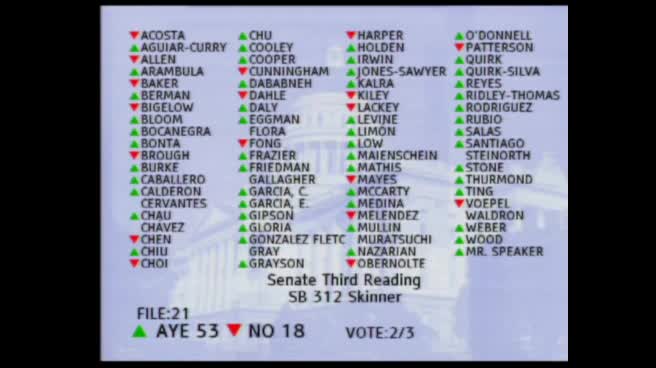 1MIN
Assembly Floor
 1H
Assembly Standing Committee on Appropriations
 8MIN
Assembly Standing Committee on Health
 4MIN
Assembly Standing Committee on Education
 48MIN
Senate Standing Committee on Appropriations
 4MIN
Senate Standing Committee on Health
 12MIN
Senate Standing Committee on Education
Bill Author


