SB 407: Common interest developments: noncommercial solicitation.
- Session Year: 2017-2018
- House: Senate
- Latest Version Date: 2017-09-11
Existing law, the Davis-Stirling Common Interest Development Act, defines and regulates common interest developments that are managed by homeowners associations. The act requires an association to adopt rules that ensure access to the common area meeting space, if any exists, during a campaign, at no cost, to all candidates and to all members advocating a point of view. The act also requires the adoption of rules that ensure that if any candidate or member advocating a point of view is provided access to association media, newsletters, or Internet Web sites during a campaign, for purposes that are related to that election, equal access is provided to all candidates and members advocating a point of view.
This bill would provide that the governing documents, including bylaws and operating rules, of a residential common interest development may not prohibit a member or resident of a common interest development from engaging in certain activities, including peacefully assembling or meeting during reasonable hours and in a reasonable manner for purposes relating to common interest development living, association elections, legislation, election to public office, or the initiative, referendum, or recall processes. The bill would prohibit a member or resident of a common interest development from being required to pay a fee, make a deposit, obtain liability insurance, or pay the premium or deductible on the associations insurance policy to use the associations common area for these activities. The bill would authorize a member or resident of a common interest development who is prevented by the association or its agents from engaging in any of these activities to bring a civil or small claims court action to enjoin the enforcement of a governing document that violates this bill. The bill would authorize a court to assess a civil penalty of not more than $500 per violation.
Existing law, the Davis-Stirling Common Interest Development Act, defines and regulates common interest developments that are managed by homeowners associations. The act requires an association to adopt rules that ensure access to the common area meeting space, if any exists, during a campaign, at no cost, to all candidates and to all members advocating a point of view. The act also requires the adoption of rules that ensure that if any candidate or member advocating a point of view is provided access to association media, newsletters, or Internet Web sites during a campaign, for purposes that are related to that election, equal access is provided to all candidates and members advocating a point of view.
This bill would provide that the governing documents, including bylaws and operating rules, of a residential common interest development may not prohibit a member or resident of a common interest development from engaging in certain activities, including peacefully assembling or meeting during reasonable hours and in a reasonable manner for purposes relating to common interest development living, association elections, legislation, election to public office, or the initiative, referendum, or recall processes. The bill would prohibit a member or resident of a common interest development from being required to pay a fee, make a deposit, obtain liability insurance, or pay the premium or deductible on the associations insurance policy to use the associations common area for these activities, unless nonresidents are invited to attend as members of the audience and certain conditions are met. activities. The bill would authorize a member or resident of a common interest development who is prevented by the association or its agents from engaging in any of these activities to bring a civil or small claims court action to enjoin the enforcement of a governing document that violates this bill. The bill would authorize a court to assess a civil penalty of not more than $500 per violation.
Existing law, the Davis-Stirling Common Interest Development Act, defines and regulates common interest developments that are managed by homeowners associations. The act requires an association to adopt rules that ensure access to the common area meeting space, if any exists, during a campaign, at no cost, to all candidates and to all members advocating a point of view. The act also requires the adoption of rules that ensure that if any candidate or member advocating a point of view is provided access to association media, newsletters, or Internet Web sites during a campaign, for purposes that are related to that election, equal access is provided to all candidates and members advocating a point of view.
This bill would provide that the governing documents, including bylaws and operating rules, of a residential common interest development may not prohibit a member or resident of a common interest development from engaging in certain activities, including peacefully assembling or meeting during reasonable hours and in a reasonable manner for purposes relating to common interest development living, association elections, legislation, election to public office, or the initiative, referendum, or recall processes. The bill would prohibit a member or resident of a common interest development from being required to pay a fee, make a deposit, obtain liability insurance, or pay the premium or deductible on the associations insurance policy to use the associations common area for these purposes, activities, unless nonresidents are invited to attend as members of the audience and certain conditions are met. The bill would authorize a member or resident of a common interest development who is prevented by the association or its agents from engaging in any of these activities to bring a civil or small claims court action to enjoin the enforcement of a governing document that violates this bill. The bill would authorize a court to assess a civil penalty of not more than $500 per violation.
Existing law, the Davis-Stirling Common Interest Development Act, defines and regulates common interest developments that are managed by homeowners associations. The act requires an association to adopt rules that ensure access to the common area meeting space, if any exists, during a campaign, at no cost, to all candidates and to all members advocating a point of view. The act also requires the adoption of rules that ensure that if any candidate or member advocating a point of view is provided access to association media, newsletters, or Internet Web sites during a campaign, for purposes that are related to that election, equal access is provided to all candidates and members advocating a point of view.
This bill would provide that the governing documents, including bylaws and operating rules, of a residential common interest development may not prohibit a member or resident of a common interest development from engaging in certain activities, including peacefully assembling or meeting during reasonable hours and in a reasonable manner for purposes relating to common interest development living, legislation, election to public office, or the initiative, referendum, or recall processes. The bill would prohibit a member or resident of a common interest development from being charged a deposit required to pay a fee, make a deposit, obtain liability insurance, or pay the premium or deductible on the associations insurance policy to use the associations recreation hall or clubhouse for a meeting for these purposes, if common area for these purposes, unless nonresidents are invited to attend as members of the audience and certain conditions are met. The bill would prohibit a requirement that a member or resident of a common interest development obtain liability insurance or pay the premium or deductible on the associations insurance policy in order to use a common area facility for these purposes. The bill would authorize a member or resident of a common interest development who is prevented by the association or its agents from engaging in any of these activities to bring a civil or small claims court action to enjoin the enforcement of a governing document that violates this bill.
Existing law, the Davis-Stirling Common Interest Development Act Act, defines and regulates common interest developments that are managed by homeowners associations. Existing law, with certain exceptions, prohibits an association from denying a member or occupant physical access through the common area, as specified. The act requires an association to adopt rules that ensure access to the common area meeting space, if any exists, during a campaign, at no cost, to all candidates and to all members advocating a point of view. The act also requires the adoption of rules that ensure that if any candidate or member advocating a point of view is provided access to association media, newsletters, or Internet Web sites during a campaign, for purposes that are related to that election, equal access is provided to all candidates and members advocating a point of view.
This bill would prohibit an association, through its governing documents, from enacting a rule or restriction prohibiting an owner of a separate interest from contacting any other owner or resident for the purpose of providing information about a candidate for public office or for an office within the association or on any issue that is the subject of a public or association election or pending public or association legislation or rulemaking. The bill would not apply to commercial solicitation or to an owner of a separate interest who wants to prevent all such solicitation or his or her private interest.This bill would provide that the governing documents, including bylaws and operating rules, of a residential common interest development may not prohibit a member or resident of a common interest development from engaging in certain activities, including peacefully assembling or meeting during reasonable hours and in a reasonable manner for purposes relating to common interest development living, legislation, election to public office, or the initiative, referendum, or recall processes. The bill would prohibit a member or resident of a common interest development from being charged a deposit to use the associations recreation hall or clubhouse for a meeting for these purposes, if certain conditions are met. The bill would prohibit a requirement that a member or resident of a common interest development obtain liability insurance or pay the premium or deductible on the associations insurance policy in order to use a common area facility for these purposes. The bill would authorize a member or resident of a common interest development who is prevented by the association or its agents from engaging in any of these activities to bring a civil action to enjoin the enforcement of a governing document that violates this bill.
Existing law, the Davis-Stirling Common Interest Development Act defines and regulates common interest developments that are managed by homeowners associations. Existing law, with certain exceptions, prohibits an association from denying a member or occupant physical access through the common area, as specified.
This bill would prohibit an association, through its governing documents, from enacting a rule or restriction prohibiting an owner of a separate interest from contacting any other owner or resident for the purpose of providing information about a candidate for public office or for an office within the association or on any issue that is the subject of a public or association election or pending public or association legislation or rulemaking. The bill would not apply to commercial solicitation or to an owner of a separate interest who wants to prevent all such solicitation or his or her private interest.
(a)It is the intent of the Legislature to ensure that members and residents of common interest developments have the ability to exercise their rights under law to peacefully assemble and freely communicate with one another and with others with respect to common interest development living or for social, political, or educational purposes.
(b)The governing documents, including bylaws and operating rules, shall not prohibit a member or resident of a common interest development from doing any of the following:
(1)Peacefully assembling or meeting with members, residents, and their invitees or guests during reasonable hours and in a reasonable manner for purposes relating to common interest development living, association elections, legislation, election to public office, or the initiative, referendum, or recall processes.
(2)Inviting public officials, candidates for public office, or representatives of homeowner organizations to meet with members, residents, and their invitees or guests and speak on matters of public interest.
(3)Using the common area, including the community or recreation hall or clubhouse, or, with the consent of the member, the area of a separate interest, for an assembly or meeting described in paragraph (1) or (2) when that facility or separate interest is not otherwise in use.
(4)Canvassing and petitioning the members, the association board, and residents for the activities described in paragraphs (1) and (2) at reasonable hours and in a reasonable manner.
(5)Distributing or circulating, without prior permission, information about common interest development living, association elections, legislation, election to public office, or the initiative, referendum, or recall processes, or other issues of concern to members and residents at reasonable hours and in a reasonable manner.
(c)A member or resident of a common interest development shall not be required to pay a fee, make a deposit, obtain liability insurance, or pay the premium or deductible on the associations insurance policy, in order to use a common area for the activities described in paragraphs (1), (2), and (3) of subdivision (b).
(d)A member or resident of a common interest development who is prevented by the association or its agents from engaging in any of the activities described in this section may bring a civil or small claims court action to enjoin the enforcement of a governing document, including a bylaw and operating rule, that violates this section. The court may assess a civil penalty of not more than five hundred dollars ($500) for each violation.
(a)It is the intent of the Legislature to ensure that members and residents of common interest developments have the ability to exercise their rights under law to peacefully assemble and freely communicate with one another and with others with respect to common interest development living or for social, political, or educational purposes.
(b)The governing documents, including bylaws and operating rules, shall not prohibit a member or resident of a common interest development from doing any of the following:
(1)Peacefully assembling or meeting with members, residents, and others their invitees or guests during reasonable hours and in a reasonable manner for purposes relating to common interest development living, association elections, legislation, election to public office, or the initiative, referendum, or recall processes.
(2)Inviting public officials, candidates for public office, or representatives of homeowner organizations to meet with members, residents, and others their invitees or guests and speak on matters of public interest.
(3)Using the common area, including the community or recreation hall or clubhouse, or, with the consent of the member, the area of a separate interest, for an assembly or meeting described in paragraph (1) or (2) when that facility or separate interest is not otherwise in use.
(4)Canvassing and petitioning the members, the association board, and residents for the activities described in paragraphs (1) and (2) at reasonable hours and in a reasonable manner.
(5)Distributing or circulating, without prior permission, information about common interest development living, association elections, legislation, election to public office, or the initiative, referendum, or recall processes, or other issues of concern to members and residents at reasonable hours and in a reasonable manner.
(c)A member or resident of a common interest development shall not be required to pay a fee, make a deposit, obtain liability insurance, or pay the premium or deductible on the associations insurance policy, in order to use a common area for the activities described in paragraphs (1), (2), and (3) of subdivision (b), unless nonresidents are invited to attend as members of the audience. If nonresidents are invited to attend as members of the audience, the association may impose a deposit, liability insurance requirement, or other precondition upon the use of the common area only if the deposit, liability insurance requirement, or other precondition is no greater or more burdensome than what the association would apply to any other meeting or gathering organized by a resident or by the association itself. (b).
(d)A member or resident of a common interest development who is prevented by the association or its agents from engaging in any of the activities described in this section may bring a civil or small claims court action to enjoin the enforcement of a governing document, including a bylaw and operating rule, that violates this section. The court may assess a civil penalty of not more than five hundred dollars ($500) for each violation.
(a)It is the intent of the Legislature to ensure that members and residents of common interest developments have the ability to exercise their rights under law to peacefully assemble and freely communicate with one another and with others with respect to common interest development living or for social, political, or educational purposes.
(b)The governing documents, including bylaws and operating rules, shall not prohibit a member or resident of a common interest development from doing any of the following:
(1)Peacefully assembling or meeting with members, residents, and others during reasonable hours and in a reasonable manner for purposes relating to common interest development living, association elections, legislation, election to public office, or the initiative, referendum, or recall processes.
(2)Inviting public officials, candidates for public office, or representatives of homeowner organizations to meet with members and residents members, residents, and others and speak on matters of public interest.
(3)Using the common area, including the community or recreation hall or clubhouse, or, with the consent of the member, the area of a separate interest, for an assembly or meeting described in paragraph (1) or (2) when that facility or separate interest is not otherwise in use.
(4)Canvassing and petitioning the members, the association board, and residents for the purposes activities described in paragraphs (1) and (2) at reasonable hours and in a reasonable manner.
(5)Distributing or circulating, without prior permission, information about common interest development living, legislation, election to public office, or the initiative, referendum, or recall processes, or other issues of concern to members and residents at reasonable hours and in a reasonable manner.
(c)A member or resident of a common interest development shall not be required to pay a fee, make a deposit, obtain liability insurance, or pay the premium or deductible on the associations insurance policy, in order to use a common area for any purpose the activities described in paragraphs (1), (2), and (3) of subdivision (b), unless nonresidents are invited to attend as members of the audience. If nonresidents are invited to attend as members of the audience, the association may impose a deposit, liability insurance requirement, or other precondition upon the use of the common area only if the deposit, liability insurance requirement, or other precondition is no greater or more burdensome than what the association would apply to any other meeting or gathering organized by a resident or by the association itself.
(d)A member or resident of a common interest development who is prevented by the association or its agents from engaging in any of the activities described in this section may bring a civil or small claims court action to enjoin the enforcement of a governing document, including a bylaw and operating rule, that violates this section. The court may assess a civil penalty of not more than five hundred dollars ($500) for each violation.
(a)It is the intent of the Legislature to ensure that members and residents of common interest developments have the ability to exercise their rights under law to peacefully assemble and freely communicate with one another and with others with respect to common interest development living or for social social, political, or educational purposes.
(b)The governing documents, including bylaws and operating rules, shall not prohibit a member or resident of a common interest development from doing any of the following:
(1)Peacefully assembling or meeting during reasonable hours and in a reasonable manner for purposes relating to common interest development living, legislation, election to public office, or the initiative, referendum, or recall processes.
(2)Inviting public officials, candidates for public office, or representatives of homeowner organizations to meet with members and residents and speak on matters of public interest.
(3)Using the common area, including the community or recreation hall or clubhouse, or, with the consent of the member, the area of a separate interest, for an assembly or meeting described in paragraph (1) or (2) when that facility or separate interest is not otherwise in use.
(4)Canvassing and petitioning the members, the association board, and residents for the purposes described in paragraph paragraphs (1) and (2) at reasonable hours and in a reasonable manner.
(5)Distributing or circulating, without prior permission, information about common interest development living, legislation, election to public office, or the initiative, referendum, or recall processes, or other issues of concern to members and residents at reasonable hours and in a reasonable manner.
(c)A member or resident of a common interest development shall not be charged a deposit to use the associations recreation hall or clubhouse for a meeting required to pay a fee, make a deposit, obtain liability insurance, or pay the premium or deductible on the associations insurance policy, in order to use a common area for any purpose described in paragraphs (1) and (2) (1), (2), and (3) of subdivision (a), whether or not guests or visitors from outside the common interest development are invited to attend the meeting, if a member or resident of the common interest development is hosting the meeting and all members or residents of the common interest development are allowed to attend. (b), unless nonresidents are invited to attend as members of the audience. If nonresidents are invited to attend as members of the audience, the association may impose a deposit, liability insurance requirement, or other precondition upon the use of the common area only if the deposit, liability insurance requirement, or other precondition is no greater or more burdensome than what the association would apply to any other meeting or gathering organized by a resident or by the association itself.
(d)A member or resident of a common interest development shall not be required to obtain liability insurance or pay the premium or deductible on the associations insurance policy in order to use a common area facility for any purpose described in paragraphs (1) and (2) of subdivision (a).(e)
(d)A member or resident of a common interest development who is prevented by the association or its agents from engaging in any of the activities described in this section may bring a civil or small claims court action to enjoin the enforcement of a governing document, including a bylaw and operating rule, that violates this section.
(a)It is the intent of the Legislature to ensure that members and residents of common interest developments have the ability to exercise their rights under law to peacefully assemble and freely communicate with one another and with others with respect to common interest development living or for social or educational purposes.
(b)The governing documents, including bylaws and operating rules, shall not prohibit a member or resident of a common interest development from doing any of the following:
(1)Peacefully assembling or meeting during reasonable hours and in a reasonable manner for purposes relating to common interest development living, legislation, election to public office, or the initiative, referendum, or recall processes.
(2)Inviting public officials, candidates for public office, or representatives of homeowner organizations to meet with members and residents and speak on matters of public interest.
(3)Using the common area, including the community or recreation hall or clubhouse, or, with the consent of the member, the area of a separate interest, for an assembly or meeting described in paragraph (1) or (2) when that facility or separate interest is not otherwise in use.
(4)Canvassing and petitioning the members, the association board, and residents for the purposes described in paragraph (1) at reasonable hours and in a reasonable manner.
(5)Distributing or circulating, without prior permission, information about common interest development living, legislation, election to public office, or the initiative, referendum, or recall processes, or other issues of concern to members and residents at reasonable hours and in a reasonable manner.
(c)A member or resident of a common interest development shall not be charged a deposit to use the associations recreation hall or clubhouse for a meeting for any purpose described in paragraphs (1) and (2) of subdivision (a), whether or not guests or visitors from outside the common interest development are invited to attend the meeting, if a member or resident of the common interest development is hosting the meeting and all members or residents of the common interest development are allowed to attend.
(d)A member or resident of a common interest development shall not be required to obtain liability insurance or pay the premium or deductible on the associations insurance policy in order to use a common area facility for any purpose described in paragraphs (1) and (2) of subdivision (a).
(e)A member or resident of a common interest development who is prevented by the association or its agents from engaging in any of the activities described in this section may bring a civil action to enjoin the enforcement of a governing document, including a bylaw and operating rule, that violates this section.
SECTION 1.Section 4515 is added to the Civil Code, to read:4515.(a)An association, through its governing documents or any interpretation of governing documents, shall not prohibit an owner of a separate interest from contacting any other owner or resident for the purpose of noncommercial solicitation by providing information in person or in writing about a candidate for public office or for an office within the association or on any issue that is the subject of a public election or association election or pending public or association legislation or rulemaking.(b)Subdivision (a) does not prohibit an association from restricting commercial solicitation nor does it prohibit any owner of a separate interest from preventing all solicitation on that owners separate interest.(a)An association, through its governing documents or any interpretation of governing documents, shall not prohibit an owner of a separate interest from contacting any other owner or resident for the purpose of noncommercial solicitation by providing information in person or in writing about a candidate for public office or for an office within the association or on any issue that is the subject of a public election or association election or pending public or association legislation or rulemaking.
(b)Subdivision (a) does not prohibit an association from restricting commercial solicitation nor does it prohibit any owner of a separate interest from preventing all solicitation on that owners separate interest.
|
Date
|
Status
|
|---|---|
| Sep 11, 2017 | Chaptered by Secretary of State. Chapter 236, Statutes of 2017. |
| Sep 11, 2017 | Approved by the Governor. |
| Aug 30, 2017 | Enrolled and presented to the Governor at 3 p.m. |
| Aug 24, 2017 | Assembly amendments concurred in. (Ayes 38. Noes 0.) Ordered to engrossing and enrolling. |
| Aug 22, 2017 | Ordered to special consent calendar. |
| Jul 18, 2017 | In Senate. Concurrence in Assembly amendments pending. |
| Jul 17, 2017 | Read third time. Passed. Ordered to the Senate. |
| Jun 27, 2017 | Read second time. Ordered to third reading. |
| Jun 26, 2017 | Read second time and amended. Ordered to second reading. |
| Jun 22, 2017 | From committee: Do pass as amended. (Ayes 11. Noes 0.) (June 20). |
| Jun 12, 2017 | Referred to Com. on JUD. |
| Jun 1, 2017 | In Assembly. Read first time. Held at Desk. |
| May 31, 2017 | Read third time. Passed. (Ayes 40. Noes 0. Page 1344.) Ordered to the Assembly. |
| May 30, 2017 | Read second time. Ordered to third reading. |
| May 26, 2017 | Read third time and amended. |
| May 17, 2017 | Published May 17 at 9 p.m. |
| May 16, 2017 | From committee: Do pass as amended. (Ayes 7. Noes 0. Page 1021.) (May 9). |
| May 1, 2017 | From committee with author's amendments. Read second time and amended. Re-referred to Com. on JUD. |
| Apr 18, 2017 | Set for hearing May 9. |
| Apr 17, 2017 | May 2 hearing postponed by committee. |
| Apr 13, 2017 | Set for hearing May 2. |
| Feb 23, 2017 | Referred to Com. on JUD. |
| Feb 16, 2017 | From printer. May be acted upon on or after March 18. |
| Feb 15, 2017 | Introduced. Read first time. To Com. on RLS. for assignment. To print. |
|
Date
|
Description
|
Location
|
Votes
|
|
|---|---|---|---|---|
| Aug 24, 2017 | Special Consent SB407 | Senate Floor |
Passed |
|
| Jul 17, 2017 | SB 407 Wieckowski Senate Third Reading By GONZALEZ FLETCHER | Assembly Floor |
Passed |
|
| Jun 20, 2017 | Do pass as amended. | Assembly Standing Committee on Judiciary |
Passed |
|
| May 31, 2017 | Senate 3rd Reading SB407 Wieckowski | Senate Floor |
Passed |
|
| May 9, 2017 | Do pass as amended | Senate Standing Committee on Judiciary |
Passed |
This list shows positions taken on this bill by organizations on the date displayed, which is linked to the original source.
Positions by individuals are not included.
|
Organization
|
Position
|
Date
|
|---|---|---|
| American Civil Liberties Union of California | ** Support | Jul 19, 2017 |
| California Alliance For Retired Americans | ** Support | Jul 19, 2017 |
| California School Employees Association | ** Support | Jul 19, 2017 |
| Center for California Homeowner Association Law | ** Support | Jul 19, 2017 |
| committee | ** Support | Jun 17, 2017 |
| committee golden state manufactured-home owners league | ** Support | Jul 19, 2017 |
| community associations institute, california legislative action committee | ** Against | May 30, 2017 |
| community associations institute-california legislative action | ** Support | Jul 19, 2017 |
| Non-Profit Housing Association of Northern California | ** Support | Jul 19, 2017 |
| Nonprofit Housing Association of Northern California | ** Support | May 30, 2017 |
Office of Senate Floor Analyses (916) 651-1520 Fax: (916) 327-4478 | SB |
UNFINISHED BUSINESS
Bill No: SB 407
:
SENATE JUDICIARY COMMITTEE: 7-0, 5/9/17
AYES: Jackson, Moorlach, Anderson, Hertzberg, Monning, Stern, Wieckowski
SENATE FLOOR: 40-0, 5/31/17
AYES: Allen, Anderson, Atkins, Bates, Beall, Berryhill, Bradford, Cannella, De León, Dodd, Fuller, Gaines, Galgiani, Glazer, Hernandez, Hertzberg, Hill, Hueso, Jackson, Lara, Leyva, McGuire, Mendoza, Mitchell, Monning, Moorlach, Morrell, Newman, Nguyen, Nielsen, Pan, Portantino, Roth, Skinner, Stern, Stone, Vidak, Wieckowski, Wiener, Wilk
ASSEMBLY FLOOR: 75-0, 7/17/17 - See last page for vote
SOURCE: Center for California Homeowner Association Law
DIGEST:
This bill clarifies the rights of homeowners and residents in common-interest developments (CIDs) to engage in politically expressive activities within the CID. Specifically, this bill makes it unlawful for a CID’s governing documents or operating rules to prohibit homeowners or residents from: assembling peacefully; inviting public officials, candidates for public office, and representatives of homeowner organizations to meet with homeowners and residents as well as their invitees and guests; using common areas for political meetings; canvassing and petitioning other CID members and residents; and distributing information, without prior permission, about matters of general public political concern and matters relating specifically to life in the CID.
Assembly Amendments strike the provisions of the bill that would have allowed homeowners’ associations (HOAs) to require deposits or insurance for the use of common areas for political activities, subject to the limitation that such any such precondition on the use of the common areas for political purposes could be no greater or more burdensome than preconditions placed on any other gathering in the common areas. Instead, the Assembly amendments prohibit an HOA from charging a deposit or requiring insurance as preconditions for use of a common area for political activities, while also limiting attendance at such events to homeowners, residents, and their invitees or guests.
Existing law:
- Guarantees every person in California the right to freely speak, write and publish his or her sentiments on all subjects, being responsible for the abuse of this right, and provides that a law may not restrain or abridge liberty of speech. (Cal. Const., Art. I, Sec. 2(a).)
- Guarantees Californians the right to assemble freely in order to consult for the common good. (Cal. Const., Art. I, Sec. 3(a).)
- Establishes that states may create state constitutional rights to free speech on private property where that property is not limited to the personal use of the owner. (PruneYard Shopping Center v. Robins (1980) 447 U.S. 74.)
- Provides that a landlord shall not prohibit a tenant from posting or displaying political signs relating to any of the following: (a) an election or legislative vote, including an election of a candidate to public office; (b) the initiative, referendum, or recall process; or (c) issues that are before a public commission, public board, or elected local body for a vote. (Civ. Code Sec. 1940.4.)
This bill:
- Declares that it is the intent of the Legislature to ensure that members and residents of CIDs have the ability to exercise their rights under law to peacefully assemble and freely communicate with one another and with others with respect to CID living or for social, political, or educational purposes.
- Makes it unlawful for a HOA’s governing documents to prohibit a member or resident from doing any of the following:
- Peacefully assembling or meeting with members, residents, or their invitees or guests during reasonable hours and in a reasonable manner for purposes relating to CID living, association elections, legislation, election to public office, or the initiative, referendum, or recall processes.
- Inviting public officials, candidates for public office, or representatives of homeowner organizations to meet with members, residents, or their invitees or guests and speak on matters of public interest.
- Using the common areas, or with consent of the member, the area of a separate interest, for an assembly or meeting on political and public interest topics when that facility is not otherwise in use.
- Canvassing and petitioning the members, the association board, and residents for the activities described in 2a) and 2b) above, at reasonable hours and in a reasonable manner.
- Distributing or circulating, without prior permission, information about CID living, association elections, legislation, or other issues of concern, as specified.
- Prohibits a member or resident of a CID from being required to pay a fee, make a deposit, obtain liability insurance, or pay the premium or deductible on the association’s insurance policy, in order to use a common area for any of the activities described in 2a), 2b), and 2c), above.
- Permits any member or resident of a CID who is prevented by the association or its agents from engaging in any of the activities described in this bill to bring a civil or small claims court action to enjoin the enforcement of a governing document, including a bylaw and operating rule, that violates these provisions. Allows the court to assess a civil penalty of not more than five hundred dollars ($500) for each violation.
Background
In California, CIDs are governed by the Davis-Stirling Common Interest Development Act. Owners of separate property in CIDs have an undivided interest in the common property of the development and are subject to the CID’s covenants, conditions, and restrictions. CIDs are also governed by an HOA which is run by volunteer directors that may or may not have prior experience managing an association. The Court of Appeal, Fourth Appellate District, previously observed that:
[t]he homeowners associations function almost “as a second municipal government, regulating many aspects of [the homeowners’] daily lives.” “[U]pon analysis of the association’s functions, one clearly sees the association as a quasi-government entity paralleling in almost every case the powers, duties, and responsibilities of a municipal government. As a ‘mini-government,’ the association provides to its members, in almost every case, utility services, road maintenance, street and common area lighting, and refuse removal. In many cases, it also provides security services and various forms of communication within the community. There is, moreover, a clear analogy to the municipal police and public safety functions. . . .” (Villa Milano Homeowners Ass’n v. Il Davorge (2000) 84 Cal.App.4th 819, 836 [citations omitted].)
Just as with municipalities, CIDs are marked by common areas, be they streets, sidewalks, parks, open courtyards, clubhouses, or common rooms. In the case of municipalities, these spaces would generally be considered traditional or designated public forums, meaning that the government can only put restrictions on the time, place, manner of speech, and only if such restrictions are content neutral, viewpoint neutral, and narrowly tailored to serve a significant government interest. (Perry Education Association v. Perry Local Educators’ Association (1983) 460 U.S. 37, 44.) CIDs, by contrast, are private property, where constitutional rights to free expression are usually far more limited. (Hudgens v. National Labor Relations Board (1976) 424 U.S. 507. (finding no First Amendment right to free expression on private property); but see (PruneYard Shopping Center v. Robins (1980) 447 U.S. 74.) (holding that state constitutional rights of access to certain private property do not violate the First Amendment and do not constitute a taking).)
This dual reality – that CIDs act as a functional equivalent of a local government and yet are legally private in nature – has led to controversy as to the proper application of free speech doctrine within CIDs. While California courts have generally construed the California Constitution as providing greater protections for freedom of expression than that granted by the First Amendment, the boundaries of this liberty within the CID context are not always clear. Homeowners report that, in the absence of clear rules, HOAs sometimes stifle free expression. (See Comments, below, for specific examples.)
This bill, adapted from similar provisions in the mobilehome park context, would clarify what politically expressive activities CID homeowners and residents are entitled to engage in and what type of restrictions associations may place on those activities.
Comments
Examples of the problem the bill is intended to address
The author and sponsor of the bill offered several examples which, they assert, demonstrate the need for this bill:
- A group of homeowners in an Orange County association who repeatedly asked the board and its agents for permission to use common areas to discuss a ballot measure that the board supported but that some members opposed. The opposition owners were repeatedly denied permission to use the HOA’s common areas to assemble for their meeting.
- An Alameda County homeowner, who planned to convene a forum on “Civil Rights in HOAs,” got a letter from the association’s law firm ordering him to cancel the event because he didn’t have permission to use the HOA’s common areas for the meeting. The letter said that if “outsiders” (referring, presumably, to the forum’s panelists) “trespassed” on the premises that law enforcement authorities would be summoned. The homeowner was forced to cancel the discussion and rescind the invitation to the panelists.
- An Alameda County homeowner was cited by the property manager for going door-to-door in her association with information about state legislation that would have impacted homeowner voting rights. She was summoned to a disciplinary committee, fined, and ordered not to approach her neighbors again.
- A Solano County homeowner was issued a cease and desist order for inviting neighbors to an event where he was hosting a candidate for mayor in an impending city election.
Related/Prior Legislation
SB 451 (Stone, 2017) provides that HOAs are not liable for failure to include, in their governing documents, a provision for addressing resident-to-resident harassment. SB 451 is currently pending consideration before the Senate Committee on the Judiciary.
AB 1426 (Irwin, 2017) eliminates certain procedural requirements in the case of uncontested elections for HOA board of directors positions and adds other procedural requirements relating to announcement of an election and notification of nomination. AB 1426 is currently pending before the Assembly Committee on Housing and Community Development.
SB 337 (Kehoe, Chapter 383, Statutes of 2011) prohibits a landlord from taking adverse action against a tenant who posts or displays campaign signs relating to an election or legislative vote, including an election for a candidate for public office, or to the initiative, referendum, or recall process within the time period allowed by local ordinance. In the CID context, any such sign must comply with HOA regulations.
SB 540 (Kehoe, 2006) would have prohibited a landlord from taking adverse action against a tenant who posts or displays campaign signs relating to an election or legislative vote, including an election for a candidate for public office, or to the initiative, referendum, or recall process, within 90 days before, or 15 days after, an election. SB 540 was vetoed by Governor Schwarzenegger.
AB 1525 (Longville, Chapter 774, Statutes of 2003) required HOAs to allow residents to post noncommercial signs, posters, flags, or banners.
SB 175 (Mello, Chapter 198, Statutes of 1989) established speech and assembly rights for mobilehome park residents that are nearly identical to the rights this bill establishes in CIDs.
FISCAL EFFECT: Appropriation: Fiscal Com.: Local:
Center for California Homeowner Association Law (source)
American Civil Liberties Union of California
California Alliance for Retired Americans
California School Employees Association
Community Associations Institute-California Legislative Action
Committee Golden State Manufactured-Home Owners League
Non-Profit Housing Association of Northern California
OPPOSITION: (Verified 7/19/17)
None received
ARGUMENTS IN SUPPORT: According to the author:
Common interested developments (CIDs) often incorporate a provision in their governing documents [restricting] door-to-door solicitation. However, blanket prohibitions of commercial solicitation are often so broadly written that they could be interpreted to prohibit non-commercial free and political speech. Significant anecdotal evidence demonstrates that HOAs have extended the restrictions of door-to-door solicitations to political speech.
Overly broad rules and policies discourage the civic participation of HOA members and criminalize free political expression. SB 407 would protect the existing political free speech rights of the estimated 25% of Californians who live in CIDs by prohibiting HOAs from creating community rules that disallow owners or residents from contacting their neighbors, using common areas for meetings, or posting signs about any political issue whether it pertains to an HOA board election or beyond. SB 407 ensures that HOA boards do not use their community’s bylaws as a prior restraint on residents’ protected speech.
In support of the bill, the American Civil Liberties Union of California writes:
By many accounts, a substantial percentage of all new housing in California over the past decades has been in the form of CIDs. As a practical matter, many Californians therefore have very little choice other than to live in a CID… The homeowners’ associations that operate these CIDs are quasi-governmental entities with great power over the lives and property of their residents, including powers exceeding those of local governments. Unfortunately, those powers have too often been used to control their residents and squelch opposing views with very little regulation or oversight. For example, we have been approached with complaints that officials of homeowners’ associations have excluded candidates for public office from visiting the CID, even when accompanied by a CID resident, because the officials supported the opposing candidate.
Whether or not CIDs are the functional equivalent of a traditional public forum, as they may indeed be, residents of CIDs should not be required to relinquish the free speech rights they would enjoy if they lived on a public street. Excluding CID residents from the most common and traditional forms of basic civil engagement and political interactions only burdens and diminishes political participation, and weakens our communities. Residents of CIDs especially need to be able to communicate with one another about their shared rights and responsibilities as members of the homeowners’ association that has such substantial power over their lives and their property.
ASSEMBLY FLOOR: 75-0, 7/17/17
AYES: Acosta, Aguiar-Curry, Travis Allen, Arambula, Baker, Berman, Bigelow, Bloom, Bocanegra, Bonta, Brough, Burke, Caballero, Calderon, Cervantes, Chau, Chávez, Chen, Chiu, Choi, Chu, Cooley, Cooper, Cunningham, Dababneh, Dahle, Daly, Flora, Fong, Frazier, Friedman, Gallagher, Cristina Garcia, Eduardo Garcia, Gipson, Gloria, Gonzalez Fletcher, Grayson, Holden, Jones-Sawyer, Kalra, Kiley, Lackey, Levine, Limón, Low, Maienschein, Mathis, Mayes, McCarty, Medina, Melendez, Mullin, Muratsuchi, Nazarian, Obernolte, O'Donnell, Patterson, Quirk, Quirk-Silva, Reyes, Ridley-Thomas, Rodriguez, Rubio, Salas, Santiago, Steinorth, Mark Stone, Thurmond, Ting, Voepel, Waldron, Weber, Wood, Rendon
NO VOTE RECORDED: Eggman, Gray, Harper, Irwin
7/19/17 16:26:58
**** END ****
SENATE THIRD READING
STR Bill Id:SB 407
Author:()
As Amended Ver:June 26, 2017
Majority vote
SENATE VOTE: 40-0
Committee | Votes | Ayes | Noes |
Judiciary | 11-0 | Mark Stone, Cunningham, Chau, Chiu, Cristina Garcia, Holden, Kalra, Kiley, Maienschein, Reyes, Ting |
|
SUMMARY: Protects basic rights of free speech and peaceful assembly for homeowners and residents in common interest developments by barring homeowners' associations (HOAs) from adopting rules or bylaws that prohibit certain free speech activities. Specifically, this bill:
- Declares that it is the intent of the Legislature to ensure that members and residents of common interest developments have the ability to exercise their rights under law to peacefully assemble and freely communicate with one another and with others with respect to common interest development living or for social, political, or educational purposes.
- Makes it unlawful for a HOA's governing documents to prohibit a member or resident from doing any of the following:
- Peacefully assembling or meeting with members, residents, or their invitees or guests during reasonable hours and in a reasonable manner for purposes relating to common interest development living, association elections, legislation, election to public office, or the initiative, referendum, or recall processes.
- Inviting public officials, candidates for public office, or representatives of homeowner organizations to meet with members, residents, or their invitees or guests and speak on matters of public interest.
- Using the common areas, or with consent of the member, the area of a separate interest, for an assembly or meeting on political and public interest topics when that facility is not otherwise in use.
- Canvassing and petitioning the members, the association board, and residents for the activities described in 2a) and 2b) above, at reasonable hours and in a reasonable manner.
- Distributing or circulating, without prior permission, information about common interest development living, association elections, legislation, or other issues of concern, as specified.
- Prohibits a member or resident of a common interest development (CID) from being required to pay a fee, make a deposit, obtain liability insurance, or pay the premium or deductible on the association's insurance policy, in order to use a common area for any of the activities described in 2a), 2b), and 2c), above.
- Permits any member or resident of a CID who is prevented by the association or its agents from engaging in any of the activities described in this bill to bring a civil or small claims court action to enjoin the enforcement of a governing document, including a bylaw and operating rule, that violates these provisions. Allows the court to assess a civil penalty of not more than $500 for each violation.
FISCAL EFFECT: None
COMMENTS: This bill, sponsored by the Center for California Homeowner Association Law, seeks to ensure that homeowners and residents living in CIDs continue to enjoy basic rights of free speech and peaceful assembly, and that these rights are not negated or relinquished by virtue of the bylaws or operating rules adopted by a homeowners' association (HOA) through the governing documents of the CID. According to the author:
Common interested developments (CIDs) often incorporate a provision in their governing documents [restricting] door-to-door solicitation. However, blanket prohibitions of commercial solicitation are often so broadly written that they could be interpreted to prohibit non-commercial free and political speech. Significant anecdotal evidence demonstrates that HOAs have extended the restrictions of door-to-door solicitations to political speech.
Overly broad rules and policies discourage the civic participation of HOA members and criminalize free political expression. SB 407 would protect the existing political free speech rights of the estimated 25% of Californians who live in CIDs by prohibiting HOAs from creating community rules that disallow owners or residents from contacting their neighbors, using common areas for meetings, or posting signs about any political issue whether it pertains to an HOA board election or beyond. SB 407 ensures that HOA boards do not use their community's bylaws as a prior restraint on residents' protected speech.
Proponents of the bill cite anecdotal evidence that some HOAs have adopted rules or bylaws in their governing documents that are used to quash political or non-commercial free speech or assembly by CID members, presumably, in some cases, because the member has opposing views from the HOA. For example, they report that a CID resident in Alameda County was cited for going door-to-door with information about an elections bill that would have impacted homeowner voting rights; she was summoned to a disciplinary committee, fined, and ordered not to approach her neighbors again. In a Solano County CID, a homeowner was issued a cease and desist order for inviting neighbors to an event that he was hosting for a candidate for mayor in an impending city election.
Finally, proponents shared with Judiciary Committee staff a letter from the law firm of one Alameda County HOA directing a homeowner to cancel a panel discussion meeting on "Civil Rights in HOAs" that he planned to hold in a common area meeting room. The letter states the HOA had not granted permission for the meeting, and that law enforcement would be contacted should "unauthorized persons trespass or attempt to enter the building in connection with the presentation/forum" (presumably meaning the "outside speakers and others" referenced elsewhere in the letter.) The homeowner eventually complied with the letter's directions to cancel the meeting and notified those expected to participate or attend of the cancellation.
Background on common interest developments. CIDs are multi-unit communities characterized by the following: 1) separate ownership of individual residential units coupled with an undivided interest in common property; 2) covenants, conditions, and restrictions (CC&Rs) that limit the use of both separate interests and common property; and 3) management of common property and enforcement of restrictions by a homeowner's association (HOA). An increasing proportion of Californians now live in CID's — by some accounts between one-fourth and one-third of all Californians — and it is likely CIDs represent the majority of new housing being built in the state. CIDs are governed by volunteer boards of directors who are elected by the members of the HOA and who are responsible for interpreting and enforcing the governing documents, rules and bylaws of the HOA.
Because homeowner associations, upon action of the board, have the ability to craft, adopt, and enforce bylaws and operating rules that touch broadly upon the rights and daily lives of their members, some courts have recognized the clear parallels between HOAs and local governments. (See, e.g., Chantiles v. Lake Forest II Master Homeowners Assn. (1995) Cal.App.4th 918, 922, "For many Californians, the homeowners association functions as a second municipal government, regulating many aspects of their daily lives"; also see Cohen v. Kite Hill Community Assn. (1983) 142 Cal. App. 3d 642, 651; ["[u]pon analysis of the association's functions, one clearly sees the association as a quasi-government entity paralleling in almost every case the powers, duties, and responsibilities of a municipal government"].)
In some cases, HOA rules or bylaws arguably conflict with important state policies, or encroach upon individual legal rights or protections. In recent years, the Legislature has enacted many laws that restrict HOAs from adopting in their governing documents any provisions that effectively prohibit or unreasonably restrict certain conduct by member homeowners when that conduct furthers other important public policy. (See, e.g., SB 150 (Correa), Chapter 62, Statutes of 2011) restricting prohibitions on renting units to tenants; SB 209 (Corbett), Chapter 121, Statutes of 2011), limiting rules restricting installation of electric vehicle charging stations; AB 2561 (Bradford), Chapter 584, Statutes of 2014) limiting rules restricting personal agriculture; AB 349 (Gonzalez), Chapter 266, Statutes of 2015), limiting rules restricting replacing lawns with artificial turf.)
This bill seeks to limit HOAs from adopting rules that may restrict or stifle freedom of expression, including political speech. Freedom of speech and the right to peaceably assemble are both guaranteed by the First Amendment of the U.S. Constitution and courts have construed the California Constitution as providing even greater protections for freedom of expression than those granted by the First Amendment. Because CID property is private, however, freedom of expression may be more limited than that otherwise guaranteed by the constitution. (See, e.g. Hudgens v. National Labor Relations Board (1976) 424 U.S. 507, establishing that there is no federal constitutional right to free speech on private property.) Nevertheless, because of the quasi-governmental role of HOAs and the longstanding public policy favoring strong protections for speech, particularly political speech, under federal and state law, the author contends that it is appropriate to ensure that members and residents of CIDs "have the ability to exercise their rights under law to peacefully assemble and freely communicate with others."
Accordingly, this bill seeks to restrict the ability of HOAs to adopt bylaws or rules in their governing documents that prohibit CID members and residents from engaging in certain activities, as specified, that reflect free expression of speech, including political speech, and freedom of assembly. Examples of such activities include, but are not limited to: 1) peacefully assembling or meeting with others during reasonable hours and in a reasonable manner for purposes relating to common interest development living, association elections, legislation, election to public office, or the initiative, referendum, or recall processes; 2) inviting public officials, candidates for public office, or representatives of homeowner organizations to meet and speak on matters of public interest; and 3) canvassing and petitioning the members, the association board, and residents for the activities described above. According to the author, this bill is modeled after existing provisions in the California Mobilehome Residency Law (MRL) that provide similar or identical protections of speech to residents of mobilehome parks, with respect to park management who adopt rules and regulations that may restrict activities generally within the park. (See Civil Code Section 798.51.) It should be noted that landlord-tenant law in California also contains various provisions protecting freedom of speech and assembly for tenants. (See, e.g. Civil Code Section 1940.4, prohibiting landlords from barring a tenant from posting or displaying political signs, as specified; and Civil Code 1942.5(c), prohibiting retaliation against a tenant for lawfully organizing or participating in a tenants' association.)
Homeowner associations previously expressed concerns about their potential liability arising from activities in common areas, specifically when non-residents or members of the public are also present. Recent amendments address the issue of when a HOA may charge a fee or deposit to use a common area for meetings or other activities involving speech. The bill now clarifies that the governing documents of the HOA may not prohibit a member from organizing meetings attended by members, residents, or their invitees or guests. This provision effectively limits the meetings covered by the bill to being attended by residents, members, or their invitees or guests — narrowing the attendees to those presumably invited by the meeting organizer, rather than the broader, more undefined group of "other" individuals. With these amendments, Community Associations Institute (CAI), representing HOA interests, now supports the bill instead of opposing it. They write: "SB 407 will create the appropriate balance of protecting the free speech rights of residents and members while also protecting the property interests of the association and its members."
Enforcement provisions. CID members and residents have limited remedies under this bill. A member or resident of the CID may bring an action in civil court or in small claims court to enjoin enforcement of any HOA governing document that violates provisions of this bill (Section 116.220(a)(5) of the Code of Civil Procedure allows small claims courts to order injunctive relief where expressly authorized by statute.) The bill does not authorize damages or other forms of relief, but does allow the court to assess a civil penalty of up to $500 per violation. Allowing injunctive relief to be sought in small claims court, where attorneys are not allowed, means that CID members and residents may find it easier and less cost prohibitive to seek to enforce their rights under this bill.
Analysis Prepared by: Anthony Lew / JUD. / (916) 319-2334 FN: 0001027
Date of Hearing: June 20, 2017
ASSEMBLY COMMITTEE ON JUDICIARY
Mark Stone, Chair
SBPCA Bill Id:SB 407
Author:(Wieckowski) – As Amended Ver:May 26, 2017
As Proposed to be Amended
SENATE VOTE: 40-0
SUBJECT: COMMON INTEREST DEVELOPMENTS: NONCOMMERCIAL SOLICITATION
KEY ISSUE: should homeowners' associations be barred from adopting rules and bylaws in their governing documents that prohibit the ability of owners and residents to assemble in common areas of a common interest development to have meetings, or to engage in other activities, as specified, involving expression of protected social and political speech?
SYNOPSIS
This bill, sponsored by the Center for California Homeowner Association Law, seeks to ensure that homeowners and residents in common interest developments (CIDs) continue to enjoy basic rights of free speech and peaceful assembly, and that these rights may not be negated or taken away pursuant to bylaws or operating rules adopted by the homeowners' association (HOA) that govern many aspects of daily living within the CID. According to the author, this bill is warranted because in some instances, HOAs have apparently been too zealous to enforce prohibitions against door-to-door solicitation and commercial speech, and instead have reportedly quashed the ability of CID members and residents to engage in protected activities involving political speech, peaceful assembly, and civic engagement on the premises of the CID.
Accordingly, this bill seeks to restrict the ability of HOAs to adopt bylaws or rules in their governing documents that prohibit CID members and residents from engaging in certain activities, as specified, that reflect free expression of speech and freedom of assembly. Examples of such activities specified by the bill include inviting public officials, candidates for public office, or representatives of homeowner organizations to meet and speak on matters of public interest, and canvassing and petitioning fellow members and residents. With respect to enforcement, a CID member or resident may bring an action in civil court or in small claims court to enjoin enforcement of any governing document that violates the provisions of this bill, and a court may impose a civil penalty of up to $500 for each violation. Proposed amendments to the bill clarify that the governing documents of the HOA may not prohibit a member from organizing meetings attended by members, residents, or their invitees or guests, and also remove previous amendments that specify how the HOA may proceed if nonresidents are invited to attend such meetings. With these proposed amendments, Community Associations Institute (CAI), representing HOAs, now supports the bill instead of opposing it, and joins with other supporters, including the ACLU and the California Alliance for Retired Americans, who believe that the bill strikes the right balance between protecting the free speech rights of residents and members and protecting the property interests of HOAs and their members. There is currently no registered opposition to the bill.
SUMMARY: Protects basic rights of free speech and peaceful assembly for homeowners and residents in common interest developments by barring HOAs from adopting rules or bylaws that prohibit certain free speech activities. Specifically, this bill:
- Declares that it is the intent of the Legislature to ensure that members and residents of common interest developments have the ability to exercise their rights under law to peacefully assemble and freely communicate with one another and with others with respect to common interest development living or for social, political, or educational purposes.
- Makes it unlawful for a HOA's governing documents to prohibit a member or resident from doing any of the following:
- Peacefully assembling or meeting with members, residents, or their invitees or guests during reasonable hours and in a reasonable manner for purposes relating to common interest development living, association elections, legislation, election to public office, or the initiative, referendum, or recall processes.
- Inviting public officials, candidates for public office, or representatives of homeowner organizations to meet with members, residents, or their invitees or guests and speak on matters of public interest.
- Using the common areas, or with consent of the member, the area of a separate interest, for an assembly or meeting on political and public interest topics when that facility is not otherwise in use.
- Canvassing and petitioning the members, the association board, and residents for the activities described in 2a) and 2b) above, at reasonable hours and in a reasonable manner.
- Distributing or circulating, without prior permission, information about common interest development living, association elections, legislation, or other issues of concern, as specified.
- Prohibits a member or resident of a CID from being required to pay a fee, make a deposit, obtain liability insurance, or pay the premium or deductible on the association’s insurance policy, in order to use a common area for any of the activities described in 2a), 2b), and 2c), above.
- Permits any member or resident of a CID who is prevented by the association or its agents from engaging in any of the activities described in this bill to bring a civil or small claims court action to enjoin the enforcement of a governing document, including a bylaw and operating rule, that violates these provisions. Allows the court to assess a civil penalty of not more than five hundred dollars ($500) for each violation.
EXISTING LAW:
- Guarantees every person in California the right to freely speak, write and publish his or her sentiments on all subjects, being responsible for the abuse of this right, and provides that a law may not restrain or abridge liberty of speech. (Cal. Const., art. I, Sec. 2(a).)
- Guarantees Californians the right to assemble freely in order to consult for the common good. (Cal. Const. art. I, Sec. 3(a).)
- Establishes that states may create state constitutional rights to free speech on private property where that property is not limited to the personal use of the owner. (PruneYard Shopping Center v. Robins (1980) 447 U.S. 74.)
- Provides that a landlord shall not prohibit a tenant from posting or displaying political signs relating to any of the following: (a) an election or legislative vote, including an election of a candidate to public office; (b) the initiative, referendum, or recall process; or (c) issues that are before a public commission, public board, or elected local body for a vote. (Civil Code Section 1940.4. All further references are to this code unless otherwise stated.)
- Provides that no provision contained in any mobilehome park rental agreement, rule, or regulation shall deny or prohibit the right of any homeowner or resident in the park to do any of the following:
- Peacefully assemble or meet in the park, at reasonable hours and in a reasonable manner, for any lawful purpose. Allows meetings to be held in the park community or recreation hall or clubhouse when the facility is not otherwise in use, and, with the consent of the homeowner, in any mobilehome within the park.
- Invite public officials, candidates for public office, or representatives of mobilehome owner organizations to meet with homeowners and residents and speak upon matters of public interest, with respect to mobilehome living or for social or educational purposes.
- Canvass and petition homeowners and residents for noncommercial purposes relating to mobilehome living, election to public office, or the initiative, referendum, or recall processes, at reasonable hours and in a reasonable manner, including the distribution or circulation of information. (Section 798.51 (a).)
- Prohibits a homeowner or resident of a mobilehome park from being charged a cleaning deposit in order to use the park recreation hall or clubhouse for meetings of resident organizations for the purposes listed in 5a) through 7c), whether or not guests or visitors from outside the park are invited to attend the meeting, if a homeowner or resident of the park is hosting the meeting and all homeowners or residents of the park are allowed to attend. (Section 798.51 (b).)
FISCAL EFFECT: As currently in print this bill is keyed non-fiscal.
COMMENTS: This bill, sponsored by the Center for California Homeowner Association Law, seeks to ensure that homeowners and residents living in common interest developments (CIDs) continue to enjoy basic rights of free speech and peaceful assembly, and that these rights are not negated or relinquished by virtue of the bylaws or operating rules adopted by a homeowners' association (HOA) through the governing documents of the CID.
Need for the bill. According to the author:
Common interested developments (CIDs) often incorporate a provision in their governing documents [restricting] door-to-door solicitation. However, blanket prohibitions of commercial solicitation are often so broadly written that they could be interpreted to prohibit non-commercial free and political speech. Significant anecdotal evidence demonstrates that HOAs have extended the restrictions of door-to-door solicitations to political speech.
Overly broad rules and policies discourage the civic participation of HOA members and criminalize free political expression. SB 407 would protect the existing political free speech rights of the estimated 25% of Californians who live in CIDs by prohibiting HOAs from creating community rules that disallow owners or residents from contacting their neighbors, using common areas for meetings, or posting signs about any political issue whether it pertains to an HOA board election or beyond. SB 407 ensures that HOA boards do not use their community’s bylaws as a prior restraint on residents’ protected speech.
Proponents of the bill cite anecdotal evidence that some HOAs have adopted rules or bylaws in their governing documents that are used to quash political or non-commercial free speech or assembly by CID members, presumably, in some cases, because the member has opposing views from the HOA. For example, they report that a CID resident in Alameda County was cited for going door-to-door with information about an elections bill that would have impacted homeowner voting rights; she was summoned to a disciplinary committee, fined, and ordered not to approach her neighbors again. In a Solano County CID, a homeowner was issued a cease and desist order for inviting neighbors to an event that he was hosting for a candidate for mayor in an impending city election.
Finally, proponents shared with Committee staff a letter from the law firm of one Alameda County HOA directing a homeowner to cancel a panel discussion meeting on "Civil Rights in HOAs" that he planned to hold in a common area meeting room. The letter states the HOA had not granted permission for the meeting, and that law enforcement would be contacted should "unauthorized persons trespass or attempt to enter the building in connection with the presentation/forum" (presumably meaning the "outside speakers and others" referenced elsewhere in the letter.) The homeowner eventually complied with the letter's directions to cancel the meeting and notified those expected to participate or attend of the cancellation.
Background on common interest developments. CIDs are multi-unit communities characterized by the following: (1) separate ownership of individual residential units coupled with an undivided interest in common property; (2) covenants, conditions, and restrictions (CC&Rs) that limit the use of both separate interests and common property; and (3) management of common property and enforcement of restrictions by a homeowner's association (HOA). An increasing proportion of Californians now live in CID's—by some accounts between one-fourth and one-third of all Californians—and it is likely CIDs represent the majority of new housing being built in the state. CIDs are governed by volunteer boards of directors who are elected by the members of the HOA and who are responsible for interpreting and enforcing the governing documents, rules and bylaws of the HOA.
Because homeowner associations, upon action of the board, have the ability to craft, adopt, and enforce bylaws and operating rules that touch broadly upon the rights and daily lives of their members, some courts have recognized the clear parallels between HOAs and local governments. (See, e.g., Chantiles v. Lake Forest II Master Homeowners Assn. (1995) Cal.App.4th 918, 922, "For many Californians, the homeowners association functions as a second municipal government, regulating many aspects of their daily lives"; also see Cohen v. Kite Hill Community Assn. (1983) 142 Cal. App. 3d 642, 651; ["[u]pon analysis of the association's functions, one clearly sees the association as a quasi-government entity paralleling in almost every case the powers, duties, and responsibilities of a municipal government"].)
In some cases, HOA rules or bylaws arguably conflict with important state policies, or encroach upon individual legal rights or protections. In recent years, the Legislature has enacted many laws that restrict HOAs from adopting in their governing documents any provisions that effectively prohibit or unreasonably restrict certain conduct by member homeowners when that conduct furthers other important public policy. (See, e.g., SB 150 (Ch. 62, Stats. 2011) restricting prohibitions on renting units to tenants; SB 209 (Ch. 121, Stats. 2011), limiting rules restricting installation of electric vehicle charging stations; AB 2561 (Ch. 584, Stats. 2014) limiting rules restricting personal agriculture; AB 349 (Ch. 266, Stats. 2015), limiting rules restricting replacing lawns with artificial turf.)
This bill seeks to limit HOAs from adopting rules that may restrict or stifle freedom of expression, including political speech. Freedom of speech and the right to peaceably assemble are both guaranteed by the First Amendment of the U.S. Constitution and courts have construed the California Constitution as providing even greater protections for freedom of expression than those granted by the First Amendment. Because CID property is private, however, freedom of expression may be more limited than that otherwise guaranteed by the constitution. (See, e.g. Hudgens v. National Labor Relations Board (1976) 424 U.S. 507, establishing that there is no federal constitutional right to free speech on private property. ) Nevertheless, because of the quasi-governmental role of HOAs and the longstanding public policy favoring strong protections for speech, particularly political speech, under federal and state law, the author contends that it is appropriate to ensure that members and residents of CIDs "have the ability to exercise their rights under law to peacefully assemble and freely communicate with others."
Accordingly, this bill seeks to restrict the ability of HOAs to adopt bylaws or rules in their governing documents that prohibit CID members and residents from engaging in certain activities, as specified, that reflect free expression of speech, including political speech, and freedom of assembly. Examples of such activities include, but are not limited to: (1) peacefully assembling or meeting with others during reasonable hours and in a reasonable manner for purposes relating to common interest development living, association elections, legislation, election to public office, or the initiative, referendum, or recall processes; (2) inviting public officials, candidates for public office, or representatives of homeowner organizations to meet and speak on matters of public interest; and (3) canvassing and petitioning the members, the association board, and residents for the activities described above. According to the author, this bill is modeled after existing provisions in the California Mobilehome Residency Law (MRL) that provide similar or identical protections of speech to residents of mobilehome parks, with respect to park management who adopt rules and regulations that may restrict activities generally within the park. (See Civil Code Section 798.51.) It should be noted that landlord-tenant law in California also contains various provisions protecting freedom of speech and assembly for tenants. (See, e.g. Civil Code Section 1940.4, prohibiting landlords from barring a tenant from posting or displaying political signs, as specified; and Civil Code 1942.5(c), prohibiting retaliation against a tenant for lawfully organizing or participating in a tenants’ association.)
Proposed amendments clarify when a HOA may charge a fee or deposit to use a common area for free or political speech activities. The bill has previously been amended twice to address the issue of when a HOA may charge a fee or deposit to use a common area for meetings or other activities involving speech. Homeowner associations previously expressed concerns about their potential liability arising from activities in common areas, specifically when non-residents or members of the public are also present. In addition, the use of any fee policy that differentiates between different kinds of meetings or attendees may raise additional concerns about stifling free speech based on likely content or viewpoint. The May 1, 2017 version of the bill restricted HOAs in many circumstances from charging a deposit or fee, or from being required to obtain liability insurance, to be able to use a common area for an event or meeting, even when the event includes non-residents of the CID. In response to concerns raised by HOAs in opposition, the bill was amended on May 17, 2017 in the Senate Judiciary Committee to create an exception to that rule, thereby allowing an HOA to impose a deposit, liability insurance requirement, or other precondition if non-residents are also invited to attend as members of the audience. In addition, these amendments would have authorized a deposit, liability insurance requirement, or other precondition only if no greater or more burdensome than what the association would apply to any other meeting or gathering organized by a resident, or by the association itself.
Further negotiations among the stakeholders have now resulted in a mutual agreement to adopt a different approach to this issue—one that involves, however, overwriting some of the May 17 amendments taken in the previous Committee. As proposed to be amended, the bill clarifies that the governing documents of the HOA may not prohibit a member from organizing meetings attended by members, residents, "or their invitees or guests." This amendment effectively limits the meetings protected by the bill to being attended by residents, members, or their invitees or guests—narrowing the attendees to those presumably invited by the meeting organizer, rather than the broader, more undefined group of "other" individuals. In addition, provisions specifying how the HOA may proceed if nonresidents are invited to attend as members of the audience become unnecessary as a result, and are proposed to be deleted under the amendments.
With these proposed amendments, Community Associations Institute (CAI) now supports the bill instead of opposing it. They write: "As proposed to be amended, SB 407 will create the appropriate balance of protecting the free speech rights of residents and members while also protecting the property interests of the association and its members."
The proposed amendments are:
On page 2, line 12, delete "others" and replace with "their invitees or guests"
On page 2, line 18, delete "others" and replace with "their invitees or guests"
On page 3, delete lines 18 through 25, inclusive, and insert "(b)."
There is one additional technical amendment, needed to correct an inadvertent drafting omission:
On page 3, line 9, after "living," insert "association elections,"
Enforcement provisions. CID members and residents have limited remedies under this bill. A member or resident of the CID may bring an action in civil court or in small claims court to enjoin enforcement of any HOA governing document that violates provisions of this bill (Section 116.220(a)(5) of the Code of Civil Procedure allows small claims courts to order injunctive relief where expressly authorized by statute.) The bill does not authorize damages or other forms of relief, but does allow the court to assess a civil penalty of up to $500 per violation. Allowing injunctive relief to be sought in small claims court, where attorneys are not allowed, means that CID members and residents may find it easier and less cost prohibitive to seek to enforce their rights under this bill.
ARGUMENTS IN SUPPORT: In addition to support by organizations that advocate for CID residents and mobilehome park residents, the bill is also supported by the American Civil Liberties Union of California for its stance against restrictions on free speech. The ACLU states:
By many accounts, a substantial percentage of all new housing in California over the past decades has been in the form of CIDs. As a practical matter, many Californians therefore have very little choice other than to live in a CID… The homeowners’ associations that operate these CIDs are quasi-governmental entities with great power over the lives and property of their residents, including powers exceeding those of local governments. Unfortunately, those powers have too often been used to control their residents and squelch opposing views with very little regulation or oversight. For example, we have been approached with complaints that officials of homeowners’ associations have excluded candidates for public office from visiting the CID, even when accompanied by a CID resident, because the officials supported the opposing candidate.
Whether or not CIDs are the functional equivalent of a traditional public forum, as they may indeed be, residents of CIDs should not be required to relinquish the free speech rights they would enjoy if they lived on a public street. Excluding CID residents from the most common and traditional forms of basic civil engagement and political interactions only burdens and diminishes political participation, and weakens our communities. Residents of CIDs especially need to be able to communicate with one another about their shared rights and responsibilities as members of the homeowners’ association that has such substantial power over their lives and their property.
REGISTERED SUPPORT / OPPOSITION:
Support
Center for California Homeowner Association Law (sponsor)
American Civil Liberties Union of California (ACLU)
California Alliance for Retired Americans
California School Employees Association
Community Associations Institute- CA Legislative Action
Committee (Support as Proposed to Be Amended)
Golden State Manufactured-Home Owners League (GSMOL)
Non-Profit Housing Association of Northern California
Opposition
None on file
Analysis Prepared by: Anthony Lew / JUD. / (916) 319-2334
Office of Senate Floor Analyses (916) 651-1520 Fax: (916) 327-4478 | SB |
THIRD READING
Bill No: SB 407
:
SENATE JUDICIARY COMMITTEE: 7-0, 5/9/17
AYES: Jackson, Moorlach, Anderson, Hertzberg, Monning, Stern, Wieckowski
SUBJECT: Common interest developments: noncommercial solicitation
SOURCE: Center for California Homeowner Association Law
DIGEST:
This bill clarifies the rights of homeowners and residents in common-interest developments (CIDs) to engage in politically expressive activities within the CID. Specifically, this bill makes it unlawful for a CID’s governing documents or operating rules to prohibit homeowners or residents from: assembling peacefully; inviting public officials, candidates for public office, and representatives of homeowner organizations to meet with homeowners, residents, and others; using common areas for political meetings; canvassing and petitioning other CID members and residents; and distributing information, without prior permission, about matters of general public political concern and matters relating specifically to life in the CID.
Senate Floor Amendments of 5/26/17 clarify that non-residents may also attend gatherings at CIDs on political topics. The amendments conform with the bill’s existing provision that a common interest association may not charge more or place greater preconditions on a political gathering to which non-residents are invited than it would on a non-political gathering. The amendments also add “teeth” to the enforcement provisions of the bill by establishing a $500 maximum civil penalty for violations.
Existing law:
- Provides that “Congress shall make no law… abridging the freedom of speech... or the right of the people peaceably to assemble…” (U.S. Const., Amend. 1.)
- Applies the First Amendment to the states through operation of the Fourteenth Amendment. (Gitlow v. New York (1925) 268 U.S. 652; NAACP v. Alabama (1925) 357 U.S. 449.)
- Establishes that there is no federal constitutional right to free speech on private property. (Hudgens v. National Labor Relations Board (1976) 424 U.S. 507.)
- Provides that states may create state constitutional rights to free speech on private property where that property is not limited to the personal use of the owner. (PruneYard Shopping Center v. Robins (1980) 447 U.S. 74.)
- Gives every person in California the right to freely speak, write and publish his or her sentiments on all subjects, being responsible for the abuse of this right. A law may not restrain or abridge liberty of speech. (Cal. Const., Art. I, Sec. 2(a).)
- Gives Californians the right to assemble freely in order to consult for the common good. (Cal. Const. Art. I, Sec. 3(a).)
- Establishes, in the Davis-Stirling Common Interest Development Act, the rules and regulations governing the operation of a residential CID and the respective rights and duties of a homeowners’ association (HOA) and its members. (Civ. Code Sec. 4000 et seq.)
This bill:
- States the intent of the Legislature to ensure that members and residents of CIDs have the ability to exercise their rights under law to peacefully assemble and freely communicate with one another and with others.
- Makes it unlawful for an HOA’s governing documents or operating rules to prohibit a resident or homeowner from:
- peacefully assembling or meeting during reasonable hours and in a reasonable manner for purposes relating to CID living, legislation, election to public office, referendum, or recall processes;
- inviting public officials, candidates for public office, or representatives of homeowner organizations to meet with members, residents, and others and speak on matters of public interest;
- using the common areas, or with consent of the member, the area of a separate interest, for an assembly or meeting on political and public interest topics when that facility is not otherwise in use;
- canvassing and petitioning the members, the association board, and residents for political and public interest activities at reasonable hours and in a reasonable manner; or
- distributing or circulating, without prior permission, information about CID living or other political matters.
- Prevents a CID association from charging a member a deposit or requiring liability insurance in order to use the CID’s common areas for political gatherings unless nonresidents are invited to attend as members of the audience. If nonresidents are invited to attend as members of the audience, then an association may impose a deposit, liability insurance requirement, or other precondition upon use of the common areas only if such precondition is no greater or more burdensome than what the association would apply to any other meeting or gathering organized by a resident or by the association itself.
- Permits any member or resident of a CID to enforce his or her rights under this bill through civil or small claims court actions seeking injunctive relief and allows courts to assess a civil penalty of up to $500 for each violation found.
In California, CIDs are governed by the Davis-Stirling Common Interest Development Act. Owners of separate property in CIDs have an undivided interest in the common property of the development and are subject to the CID’s covenants, conditions, and restrictions. CIDs are also governed by an HOA, which is run by volunteer directors that may or may not have prior experience managing an association. The Court of Appeal, Fourth Appellate District, previously observed that:
[t]he homeowners associations function almost “as a second municipal government, regulating many aspects of [the homeowners’] daily lives.” “[U]pon analysis of the association’s functions, one clearly sees the association as a quasi-government entity paralleling in almost every case the powers, duties, and responsibilities of a municipal government. As a ‘mini-government,’ the association provides to its members, in almost every case, utility services, road maintenance, street and common area lighting, and refuse removal. In many cases, it also provides security services and various forms of communication within the community. There is, moreover, a clear analogy to the municipal police and public safety functions. . . .” (Villa Milano Homeowners Ass’n v. Il Davorge (2000) 84 Cal.App.4th 819, 836 [citations omitted].)
Just as with municipalities, CIDs are marked by common areas, be they streets, sidewalks, parks, open courtyards, clubhouses, or common rooms. In the case of municipalities, these spaces would generally be considered traditional or designated public forums, meaning that the government can only put restrictions on the time, place, manner of speech, and only if such restrictions are content neutral, viewpoint neutral, and narrowly tailored to serve a significant government interest. (Perry Education Association v. Perry Local Educators’ Association (1983) 460 U.S. 37, 44.) CIDs, by contrast, are private property, where constitutional rights to free expression are usually far more limited. (Hudgens v. National Labor Relations Board (1976) 424 U.S. 507 (finding no First Amendment right to free expression on private property); but see (PruneYard Shopping Center v. Robins (1980) 447 U.S. 74.) (holding that state constitutional rights of access to certain private property do not violate the First Amendment and do not constitute a taking).)
This dual reality – that CIDs act as a functional equivalent of a local government and yet are legally private in nature – has led to controversy as to the proper application of free speech doctrine within CIDs. While California courts have generally construed the California Constitution as providing greater protections for freedom of expression than that granted by the First Amendment, the boundaries of this liberty within the CID context are not always clear. Homeowners report that, in the absence of clear rules, HOAs sometimes stifle free expression.
This bill, adapted from similar provisions in the mobilehome park context, clarifies what politically expressive activities CID homeowners and residents are entitled to engage in and what type of restrictions associations may place on those activities.
Comments
Examples of the problem this bill is intended to address
The author and sponsor of this bill offered several examples which, they assert, demonstrate the need for this bill:
- A group of homeowners in an Orange County association who repeatedly asked the board and its agents for permission to use common areas to discuss a ballot measure that the board supported but that some members opposed. The opposition owners were repeatedly denied permission to use the HOA’s common areas to assemble for their meeting.
- An Alameda County homeowner, who planned to convene a forum on “Civil Rights in HOAs,” got a letter from the association’s law firm ordering him to cancel the event because he didn’t have permission to use the HOA’s common areas for the meeting. The letter said that if “outsiders” (referring, presumably, to the forum’s panelists) “trespassed” on the premises that law enforcement authorities would be summoned. The homeowner was forced to cancel the discussion and rescind the invitation to the panelists.
- An Alameda County homeowner was cited by the property manager for going door-to-door in her association with information about state legislation that would have impacted homeowner voting rights. She was summoned to a disciplinary committee, fined, and ordered not to approach her neighbors again.
- A Solano County homeowner was issued a cease and desist order for inviting neighbors to an event where he was hosting a candidate for mayor in an impending city election.
Enforcement
The enforcement provisions associated with this are quite limited. CID homeowners and residents would be able to seek a court order enjoining enforcement of operating rules or bylaws that interfere with the their rights under the bill and the courts may impose up to a $500 civil penalty for each violation found, but no other form of relief is specified.
Absent an attorney’s fees provision or some other form of compensation, potential plaintiff and prospective legal counsel may conclude in many instances that vindicating the rights confirmed by this bill is not worth the significant investment of time and resources required to prosecute the action. It may be telling that a nearly identical enforcement provision exists in the Mobilehome Residency Law from which this bill was adapted (Civ. Code Sec. 798.52.) and, though that statute has been in place since 1990, there is no reported case law on it.
This bill does facilitate enforcement to some degree by vesting small claims courts with jurisdiction to hear claims arising under its terms. California Code of Civil Procedure Section 116.220(a)(5) allows small claims courts to order injunctive relieve where expressly authorized by statute. Small claims court procedures are cheaper, less formal, and faster than those in standard civil litigation. Moreover, no attorney is required (indeed, in most cases, attorneys are not permitted in small claims). Providing a small claims option should make it easier for homeowners and residents to obtain court orders to enforce their rights under this bill, when necessary.
Related/Prior Legislation
AB 1426 (Irwin, 2017) eliminates certain procedural requirements in the case of uncontested elections for HOA board of directors positions and adds other procedural requirements relating to announcement of an election and notification of nomination. AB 1426 is currently pending before the Assembly Committee on Housing and Community Development.
SB 337 (Kehoe, Chapter 383, Statutes of 2011) prohibited a landlord from taking adverse action against a tenant who posts or displays campaign signs relating to an election or legislative vote, including an election for a candidate for public office, or to the initiative, referendum, or recall process within the time period allowed by local ordinance. In the CID context, any such sign must comply with HOA regulations.
AB 1525 (Longville, Chapter 774, Statutes of 2003) required HOAs to allow residents to post noncommercial signs, posters, flags, or banners.
SB 175 (Mello, Chapter 198, Statutes of 1989) established speech and assembly rights for mobilehome park residents that are similar to the rights this bill would establish in CIDs.
FISCAL EFFECT: Appropriation: Fiscal Com.: Local:
Center for California Homeowner Association Law (source)
American Civil Liberties Union of California
California School Employees Association
Golden State Manufactured-Home Owners League
Nonprofit Housing Association of Northern California
OPPOSITION: (Verified 5/30/17)
Community Associations Institute, California Legislative Action Committee
ARGUMENTS IN SUPPORT: According to the author:
Common interest developments, such as homeowners associations, often incorporate a provision in their governing documents regarding door-to-door solicitation. However, blanket prohibitions of commercial solicitation are often so broadly written that they could be interpreted to prohibit non-commercial free and political speech.
Significant anecdotal evidence demonstrates that HOAs have extended the restrictions of door-to-door solicitations to political speech. This is a common occurrence within HOAs. Overly broad rules and policies discourage the civic participation of HOA members and criminalize free political expression.
SB 407 would protect the political free speech rights of the 25% of Californians that live in common interest developments by prohibiting HOAs from creating community rules that disallow owners or residents from contacting others for the purpose of informing them about any issue that is the subject of public or association legislation or rule-making.
In support, the American Civil Liberties Union of California writes:
By many accounts, a substantial percentage of all new housing in California over the past decades has been in the form of CIDs. As a practical matter, many Californians therefore have very little choice other than to live in a CID… The homeowners’ associations that operate these CIDs are quasi-governmental entities with great power over the lives and property of their residents, including powers exceeding those of local governments. Unfortunately, those powers have too often been used to control their residents and squelch opposing views with very little regulation or oversight….
Whether or not CIDs are the functional equivalent of a traditional public forum, as they may indeed be, residents of CIDs should not be required to relinquish the free speech rights they would enjoy if they lived on a public street. Excluding CID residents from the most common and traditional forms of basic civil engagement and political interactions only burdens and diminishes political participation, and weakens our communities. Residents of CIDs especially need to be able to communicate with one another about their shared rights and responsibilities as members of the homeowners’ association that has such substantial power over their lives and their property….
ARGUMENTS IN OPPOSITION: In opposition to the bill, unless amended to address this concern, the Community Associations Institute, California Legislative Action Committee writes:
SB 407 creates potential exposure and expense for an association and its members. Specifically, SB 407 would not allow an association to charge a deposit or require insurance to a group or political candidate seeking to use its common areas, even if the occasion included individuals who are not also residents of the community. Why should these activities be treated any different than another where a resident invites people from an outside community? Why should the association assume the liability for a meeting or special event that includes guests?
The author took an amendment to this bill in the Senate Committee on Judiciary that permits an association to impose fees and other preconditions on political meetings when nonresidents are invited as members of the audience, so long as the fees or other preconditions are no greater or more burdensome than the fees and preconditions that the association imposes on any other event to which nonresidents are invited. At the time of this analysis, however, the Community Associations Institute, California Legislative Action Committee had not withdrawn its opposition. No other opposition has been received.
Prepared by: Timothy Griffiths / JUD. / (916) 651-4113
5/30/17 19:36:14
Office of Senate Floor Analyses (916) 651-1520 Fax: (916) 327-4478 | SB |
THIRD READING
Bill No: SB 407
:
SENATE JUDICIARY COMMITTEE: 7-0, 5/9/17
AYES: Jackson, Moorlach, Anderson, Hertzberg, Monning, Stern, Wieckowski
SOURCE: Center for California Homeowner Association Law
DIGEST:
This bill clarifies the rights of homeowners and residents in common-interest developments (CIDs) to engage in politically expressive activities within the CID. Specifically, this bill makes it unlawful for a CID’s governing documents or operating rules to prohibit homeowners or residents from: assembling peacefully; inviting public officials, candidates for public office, and representatives of homeowner organizations to meet with homeowners and residents; using common areas for political meetings; canvassing and petitioning other CID members and residents; and distributing information, without prior permission, about matters of general public political concern and matters relating specifically to life in the CID.
Existing law:
- Provides that “Congress shall make no law… abridging the freedom of speech... or the right of the people peaceably to assemble…” (U.S. Const., Amend. 1.)
- Applies the First Amendment to the states through operation of the Fourteenth Amendment. (Gitlow v. New York (1925) 268 U.S. 652; NAACP v. Alabama (1925) 357 U.S. 449.)
- Establishes that there is no federal constitutional right to free speech on private property. (Hudgens v. National Labor Relations Board (1976) 424 U.S. 507.)
- Gives every person in California the right to freely speak, write and publish his or her sentiments on all subjects, being responsible for the abuse of this right. A law may not restrain or abridge liberty of speech. (Cal. Const., Art. I, Sec. 2(a).)
- Gives Californians the right to assemble freely in order to consult for the common good. (Cal. Const. Art. I, Sec. 3(a).)
- Provides that states may create state constitutional rights to free speech on private property where that property is not limited to the personal use of the owner. (PruneYard Shopping Center v. Robins (1980) 447 U.S. 74.)
- Establishes, in the Davis-Stirling Common Interest Development Act, the rules and regulations governing the operation of a residential CID and the respective rights and duties of a homeowners’ association (HOA) and its members. (Civ. Code Sec. 4000 et seq.)
This bill:
- States the intent of the Legislature to ensure that members and residents of CIDs have the ability to exercise their rights under law to peacefully assemble and freely communicate with one another and with others.
- Makes it unlawful for an HOA’s governing documents or operating rules to prohibit a resident or homeowners from:
- peacefully assembling or meeting during reasonable hours and in a reasonable manner for purposes relating to CID living, legislation, election to public office, referendum, or recall processes;
- inviting public officials, candidates for public office, or representatives of homeowner organizations to meet with members and residents and speak on matters of public interest;
- using the common areas, or with consent of the member, the area of a separate interest, for an assembly or meeting on political and public interest topics when that facility is not otherwise in use;
- canvassing and petitioning the members, the association board, and residents on political and public interest topics at reasonable hours and in a reasonable manner; or
- distributing or circulating, without prior permission, information about CID living or other political matters.
- Prevents a CID association from charging a member a deposit or requiring liability insurance in order to use the CID’s common areas for political gatherings unless nonresidents are invited to attend as members of the audience. If nonresidents are invited to attend as members of the audience, then an association may impose a deposit, liability insurance requirement, or other precondition upon use of the common areas only if such precondition is no greater or more burdensome than what the association would apply to any other meeting or gathering organized by a resident or by the association itself.
- Permits any member or resident of a CID to enforce his or her rights under this bill through the introduction of a civil or small claims court action seeking injunctive relief.
In California, CIDs are governed by the Davis-Stirling Common Interest Development Act. Owners of separate property in CIDs have an undivided interest in the common property of the development and are subject to the CID’s covenants, conditions, and restrictions. CIDs are also governed by an HOA, which is run by volunteer directors that may or may not have prior experience managing an association. The Court of Appeal, Fourth Appellate District, previously observed that:
[t]he homeowners associations function almost “as a second municipal government, regulating many aspects of [the homeowners’] daily lives.” “[U]pon analysis of the association’s functions, one clearly sees the association as a quasi-government entity paralleling in almost every case the powers, duties, and responsibilities of a municipal government. As a ‘mini-government,’ the association provides to its members, in almost every case, utility services, road maintenance, street and common area lighting, and refuse removal. In many cases, it also provides security services and various forms of communication within the community. There is, moreover, a clear analogy to the municipal police and public safety functions. . . .” (Villa Milano Homeowners Ass’n v. Il Davorge (2000) 84 Cal.App.4th 819, 836 [citations omitted].)
Just as with municipalities, CIDs are marked by common areas, be they streets, sidewalks, parks, open courtyards, clubhouses, or common rooms. In the case of municipalities, these spaces would generally be considered traditional or designated public forums, meaning that the government can only put restrictions on the time, place, manner of speech, and only if such restrictions are content neutral, viewpoint neutral, and narrowly tailored to serve a significant government interest. (Perry Education Association v. Perry Local Educators’ Association (1983) 460 U.S. 37, 44.) CIDs, by contrast, are private property, where constitutional rights to free expression are usually far more limited. (Hudgens v. National Labor Relations Board (1976) 424 U.S. 507 (finding no First Amendment right to free expression on private property); but see (PruneYard Shopping Center v. Robins (1980) 447 U.S. 74.) (holding that state constitutional rights of access to certain private property do not violate the First Amendment and do not constitute a taking).)
This dual reality – that CIDs act as a functional equivalent of a local government and yet are legally private in nature – has led to controversy as to the proper application of free speech doctrine within CIDs. While California courts have generally construed the California Constitution as providing greater protections for freedom of expression than that granted by the First Amendment, the boundaries of this liberty within the CID context are not always clear. Homeowners report that, in the absence of clear rules, HOAs sometimes stifle free expression.
This bill, adapted from similar provisions in the mobilehome park context, clarifies what politically expressive activities CID homeowners and residents are entitled to engage in and what type of restrictions associations may place on those activities.
Comments
Examples of the problem this bill is intended to address
The author and sponsor of this bill offered several examples which, they assert, demonstrate the need for this bill:
- A group of homeowners in an Orange County association who repeatedly asked the board and its agents for permission to use common areas to discuss a ballot measure that the board supported but that some members opposed. The opposition owners were repeatedly denied permission to use the HOA’s common areas to assemble for their meeting.
- An Alameda County homeowner, who planned to convene a forum on “Civil Rights in HOAs,” got a letter from the association’s law firm ordering him to cancel the event because he didn’t have permission to use the HOA’s common areas for the meeting. The letter said that if “outsiders” (referring, presumably, to the forum’s panelists) “trespassed” on the premises that law enforcement authorities would be summoned. The homeowner was forced to cancel the discussion and rescind the invitation to the panelists.
- An Alameda County homeowner was cited by the property manager for going door-to-door in her association with information about state legislation that would have impacted homeowner voting rights. She was summoned to a disciplinary committee, fined, and ordered not to approach her neighbors again.
- A Solano County homeowner was issued a cease and desist order for inviting neighbors to an event where he was hosting a candidate for mayor in an impending city election.
Enforcement
The enforcement provisions associated with this are quite limited. CID homeowners and residents would be able to seek a court order enjoining enforcement of operating rules or bylaws that interfere with the their rights under the bill and may do so in small claims court, but no other form of relief is specified. California Code of Civil Procedure Section 116.220(a)(5) allows small claims courts to order injunctive relieve where expressly authorized by statute. Small claims court procedures are cheaper, less formal, and faster than those in standard civil litigation. Moreover, no attorney is required (indeed, in most cases, attorneys are not permitted in small claims). Providing a small claims option should make it easier for homeowners and residents to obtain court orders to enforce their rights under this bill, when necessary. On the other hand, absent an attorney’s fees provision or some other form of compensation, potential plaintiff and prospective legal counsel may conclude in many instances that the right to be vindicated is not worth the significant investment of time and resources required to prosecute the action. A nearly identical enforcement provision exists in the Mobilehome Residency Law from which this bill was adapted. (Civ. Code Sec. 798.52.) It may be telling that though that statute has been in place since 1990, there is no reported case law on it.
Related/Prior Legislation
AB 1426 (Irwin, 2017) eliminates certain procedural requirements in the case of uncontested elections for HOA board of directors positions and adds other procedural requirements relating to announcement of an election and notification of nomination. AB 1426 is currently pending before the Assembly Committee on Housing and Community Development.
SB 337 (Kehoe, Chapter 383, Statutes of 2011) prohibited a landlord from taking adverse action against a tenant who posts or displays campaign signs relating to an election or legislative vote, including an election for a candidate for public office, or to the initiative, referendum, or recall process within the time period allowed by local ordinance. In the CID context, any such sign must comply with HOA regulations.
AB 1525 (Longville, Chapter 774, Statutes of 2003) required HOAs to allow residents to post noncommercial signs, posters, flags, or banners.
SB 175 (Mello, Chapter 198, Statutes of 1989) established speech and assembly rights for mobilehome park residents that are similar to the rights this bill would establish in CIDs.
FISCAL EFFECT: Appropriation: Fiscal Com.: Local:
Center for California Homeowner Association Law (source)
American Civil Liberties Union of California
California School Employees Association
Golden State Manufactured-Home Owners League
Nonprofit Housing Association of Northern California
OPPOSITION: (Verified 5/17/17)
Community Associations Institute, California Legislative Action Committee
ARGUMENTS IN SUPPORT: According to the author:
Common interest developments, such as homeowners associations, often incorporate a provision in their governing documents regarding door-to-door solicitation. However, blanket prohibitions of commercial solicitation are often so broadly written that they could be interpreted to prohibit non-commercial free and political speech.
Significant anecdotal evidence demonstrates that HOAs have extended the restrictions of door-to-door solicitations to political speech. This is a common occurrence within HOAs. Overly broad rules and policies discourage the civic participation of HOA members and criminalize free political expression.
SB 407 would protect the political free speech rights of the 25% of Californians that live in common interest developments by prohibiting HOAs from creating community rules that disallow owners or residents from contacting others for the purpose of informing them about any issue that is the subject of public or association legislation or rule-making.
In support, the American Civil Liberties Union of California writes:
By many accounts, a substantial percentage of all new housing in California over the past decades has been in the form of CIDs. As a practical matter, many Californians therefore have very little choice other than to live in a CID… The homeowners’ associations that operate these CIDs are quasi-governmental entities with great power over the lives and property of their residents, including powers exceeding those of local governments. Unfortunately, those powers have too often been used to control their residents and squelch opposing views with very little regulation or oversight….
Whether or not CIDs are the functional equivalent of a traditional public forum, as they may indeed be, residents of CIDs should not be required to relinquish the free speech rights they would enjoy if they lived on a public street. Excluding CID residents from the most common and traditional forms of basic civil engagement and political interactions only burdens and diminishes political participation, and weakens our communities. Residents of CIDs especially need to be able to communicate with one another about their shared rights and responsibilities as members of the homeowners’ association that has such substantial power over their lives and their property….
ARGUMENTS IN OPPOSITION: In opposition to the bill, unless amended to address this concern, the Community Associations Institute, California Legislative Action Committee writes:
SB 407 creates potential exposure and expense for an association and its members. Specifically, SB 407 would not allow an association to charge a deposit or require insurance to a group or political candidate seeking to use its common areas, even if the occasion included individuals who are not also residents of the community. Why should these activities be treated any different than another where a resident invites people from an outside community? Why should the association assume the liability for a meeting or special event that includes guests?
The author took an amendment to this bill in the Senate Committee on Judiciary that permits an association to impose fees and other preconditions on political meetings when nonresidents are invited as members of the audience, so long as the fees or other preconditions are no greater or more burdensome than the fees and preconditions that the association imposes on any other event to which nonresidents are invited. At the time of this analysis, however, the Community Associations Institute, California Legislative Action Committee had not fully considered this amendment and had not withdrawn its opposition.
Prepared by: Timothy Griffiths / JUD. / (916) 651-4113
5/17/17 15:51:01
Senator Hannah-Beth Jackson, Chair
2017-2018 Regular Session
Bill No: SB 407 (Author:Wieckowski)
Version: May 1, 2017
Hearing Date: May 9, 2017
Fiscal: No
Urgency: No
Consultant: TSG
SUBJECT
Common interest developments: noncommercial solicitation
DESCRIPTION
This bill would clarify the rights of homeowners and residents in common-interest developments (CIDs) to engage in politically expressive activities within the CID. Specifically, the bill would make it unlawful for a CID’s governing documents or operating rules to prohibit homeowners or residents from: assembling peacefully; inviting public officials, candidates for public office, and representatives of homeowner organizations to meet with homeowners and residents; using common areas for political meetings; canvassing and petitioning other CID members and residents; and distributing information, without prior permission, about matters of general public political concern and matters relating specifically to life in the CID.
BACKGROUND
In California, common interest developments (CIDs) are governed by the Davis-Stirling Common Interest Development Act (“Davis-Stirling Act” or “Act”). Owners of separate property in CIDs have an undivided interest in the common property of the development and are subject to the CID’s covenants, conditions, and restrictions. CIDs are also governed by a homeowner association, which is run by volunteer directors that may or may not have prior experience managing an association. The Court of Appeal, Fourth Appellate District, previously observed that:
[t]he homeowners associations function almost “as a second municipal government, regulating many aspects of [the homeowners’] daily lives.” “[U]pon analysis of the association’s functions, one clearly sees the association as a quasi-government entity paralleling in almost every case the powers, duties, and responsibilities of a municipal government. As a ‘mini-government,’ the association provides to its members, in almost every case, utility services, road maintenance, street and common area lighting, and refuse removal. In many cases, it also provides security services and various forms of communication within the community. There is, moreover, a clear analogy to the municipal police and public safety functions. . . .” (Villa Milano Homeowners Ass’n v. Il Davorge (2000) 84 Cal.App.4th 819, 836 [citations omitted].)
Just as with municipalities, CIDs are marked by common areas, be they streets, sidewalks, parks, open courtyards, clubhouses, or common rooms. In the case of municipalities, these spaces would generally be considered traditional or designated public forums, meaning that the government can only put restrictions on the time, place, manner of speech, and only if such restrictions are content neutral, viewpoint neutral, and narrowly tailored to serve a significant government interest. (Perry Education Association v. Perry Local Educators’ Association (1983) 460 U.S. 37, 44.) CIDs, by contrast, are private property, where constitutional rights to free expression are usually far more limited. (Hudgens v. National Labor Relations Board (1976) 424 U.S. 507. (finding no First Amendment right to free expression on private property); but see (PruneYard Shopping Center v. Robins (1980) 447 U.S. 74.) (holding that state constitutional rights of access to certain private property do not violate the First Amendment and do not constitute a taking).)
This dual reality – that CIDs act as a functional equivalent of a local government and yet are legally private in nature – has led to controversy as to the proper application of free speech doctrine within CIDs. While California courts have generally construed the California Constitution as providing greater protections for freedom of expression than that granted by the First Amendment, the boundaries of this liberty within the CID context are not always clear. Homeowners report that, in the absence of clear rules, homeowner’s associations sometimes stifle free expression. (See Comment 2, below, for specific examples.)
This bill, adapted from similar provisions in the mobilehome park context, would clarify what politically expressive activities CID homeowners and residents are entitled to engage in and what type of restrictions associations may place on those activities.
CHANGES TO EXISTING LAW
Existing law provides that “Congress shall make no law… abridging the freedom of speech... or the right of the people peaceably to assemble…” (U.S. Const., Amend. 1.)
Existing law applies the First Amendment to the states through operation of the Fourteenth Amendment. (Gitlow v. New York (1925) 268 U.S. 652; NAACP v. Alabama (1925) 357 U.S. 449.)
Existing law establishes that there is no federal constitutional right to free speech on private property. (Hudgens v. National Labor Relations Board (1976) 424 U.S. 507.)
Existing law gives every person in California the right to freely speak, write and publish his or her sentiments on all subjects, being responsible for the abuse of this right. A law may not restrain or abridge liberty of speech. (Cal. Const., art. I, Sec. 2(a).)
Existing law gives Californians the right to assemble freely in order to consult for the common good. (Cal. Const. art. I, Sec. 3(a).)
Existing law provides that states may create state constitutional rights to free speech on private property where that property is not limited to the personal use of the owner. (PruneYard Shopping Center v. Robins (1980) 447 U.S. 74.)
Existing law, the Davis-Stirling Common Interest Development Act, establishes the rules and regulations governing the operation of a residential common interest development (CID) and the respective rights and duties of a homeowners’ association and its members. (Civ. Code Sec. 4000 et seq.)
This bill would state the intent of the Legislature to ensure that members and residents of common interest developments have the ability to exercise their rights under law to peacefully assemble and freely communicate with one another and with others.
This bill would make it unlawful for a homeowners’ association’s governing documents or operating rules to prohibit a resident or homeowners from:
- peacefully assembling or meeting during reasonable hours and in a reasonable manner for purposes relating to common interest development living, legislation, election to public office, referendum, or recall processes;
- inviting public officials, candidates for public office, or representatives of homeowner organizations to meet with members and residents and speak on matters of public interest;
- using the common areas, or with consent of the member, the area of a separate interest, for an assembly or meeting on political and public interest topics when that facility is not otherwise in use;
- canvassing and petitioning the members, the association board, and residents on political and public interest topics at reasonable hours and in a reasonable manner; or
- distributing or circulating, without prior permission, information about common interest development living or other political matters.
This bill would prevent a CID association from charging a member a deposit or requiring liability insurance in order to use the CIDs recreational hall or clubhouse for political gatherings if a member is hosting the event and all homeowners and residents of the CID are allowed to attend.
This bill would permit any member or resident of a CID to enforce his or her rights under this bill through the introduction of a civil action seeking injunctive relief from the court.
COMMENT
1. Stated need for the bill
According to the author:
Common interest developments, such as homeowners associations, often incorporate a provision in their governing documents regarding door-to-door solicitation. However, blanket prohibitions of commercial solicitation are often so broadly written that they could be interpreted to prohibit non-commercial free and political speech.
Significant anecdotal evidence demonstrates that HOAs have extended the restrictions of door-to-door solicitations to political speech. This is a common occurrence within HOAs. Overly broad rules and policies discourage the civic participation of HOA members and criminalize free political expression.
SB 407 would protect the political free speech rights of the 25% of Californians that live in common interest developments by prohibiting HOAs from creating community rules that disallow owners or residents from contacting others for the purpose of informing them about any issue that is the subject of public or association legislation or rule-making.
In support, the American Civil Liberties Union of California writes:
By many accounts, a substantial percentage of all new housing in California over the past decades has been in the form of CIDs. As a practical matter, many Californians therefore have very little choice other than to live in a CID… The homeowners’ associations that operate these CIDs are quasi-governmental entities with great power over the lives and property of their residents, including powers exceeding those of local governments. Unfortunately, those powers have too often been used to control their residents and squelch opposing views with very little regulation or oversight. For example, we have been approached with complaints that officials of homeowners’ associations have excluded candidates for public office from visiting the CID, even when accompanied by a CID resident, because the officials supported the opposing candidate….
Whether or not CIDs are the functional equivalent of a traditional public forum, as they may indeed be, residents of CIDs should not be required to relinquish the free speech rights they would enjoy if they lived on a public street. Excluding CID residents from the most common and traditional forms of basic civil engagement and political interactions only burdens and diminishes political participation, and weakens our communities. Residents of CIDs especially need to be able to communicate with one another about their shared rights and responsibilities as members of the homeowners’ association that has such substantial power over their lives and their property….
2. Examples of the problem the bill is intended to address
The author and sponsor of the bill offered several examples which, they assert, demonstrate the need for this bill:
- A group of homeowners in an Orange County association who repeatedly asked the board and its agents for permission to use common areas to discuss a ballot measure that the board supported but that some members opposed. The opposition owners were repeatedly denied permission to use the HOA’s common areas to assemble for their meeting.
- An Alameda County homeowner, who planned to convene a forum on “Civil Rights in HOAs,” got a letter from the association’s law firm ordering him to cancel the event because he didn’t have permission to use the HOA’s common areas for the meeting. The letter said that if “outsiders” (referring, presumably, to the forum’s panelists) “trespassed” on the premises that law enforcement authorities would be summoned. The homeowner was forced to cancel the discussion and rescind the invitation to the panelists.
- An Alameda County homeowner was cited by the property manager for going door-to-door in her association with information about state legislation that would have impacted homeowner voting rights. She was summoned to a disciplinary committee, fined, and ordered not to approach her neighbors again.
- A Solano County homeowner was issued a cease and desist order for inviting neighbors to an event where he was hosting a candidate for mayor in an impending city election.
3. Expressed concerns about the bill
In opposition to the bill unless amended to address this concern, the Community Associations Institute, California Legislative Action Committee writes:
SB 407 creates potential exposure and expense for an association and its members. Specifically, SB 407 would not allow an association to charge a deposit or require insurance to a group or political candidate seeking to use its common areas, even if the occasion included individuals who are not also residents of the community. Why should these activities be treated any different than another where a resident invites people from an outside community? Why should the association assume the liability for a meeting or special event that includes guests?
HOAs usually take responsibility for general maintenance and cleaning of common areas. Similarly, an HOA typically carries liability coverage for activities in the common areas. The HOA then passes the associated expenses back to the HOA members as part of their annual assessments. However, an HOA could, through its governing documents, require a deposit or additional liability coverage for certain types of events. The concern expressed above assumes that HOAs typically do impose such deposit or additional liability coverage requirements.
Arguably, HOAs could be permitted to charge deposits or require additional liability coverage without stifling members’ and residents’ free expression so long as the HOA was prohibited from charging more for some events than others based on the content of the event. In other words, the HOA would have to charge the same deposit or require the same liability coverage for a birthday party with “outside” guests as it did for a political meeting with outside guests. On the other hand, even a relatively minimal charge could be seen as inhibiting residents’ and members’ ability to gather freely and frequently.
4. Enforcement
The enforcement provisions associated with this are quite limited. CID homeowners and residents would be able to seek a court order enjoining enforcement of operating rules or bylaws that interfere with the their rights under the bill, but no other form of relief is specified. Absent an attorney’s fees provision or some other form of compensation, potential plaintiff and prospective legal counsel may conclude in many instances that the right to be vindicated is not worth the significant investment of time and resources required to prosecute the action. A nearly identical enforcement provision exists in the Mobilehome Residency Law from which this bill was adapted. (Civ. Code Sec. 798.52.) It may be telling that though that statute has been in place since 1990, there is no reported case law on it.
To mitigate this enforcement concern somewhat, the author proposes to amend the bill in Committee to authorize a small claims court to provide injunctive relief under this statute. California Code of Civil Procedure Section 116.220(a)(5) allows small claims courts to order injunctive relieve where expressly authorized by statute. Small claims court procedures are cheaper, less formal, and faster than those in standard civil litigation. Moreover, no attorney is required (indeed, in most cases, attorneys are not permitted in small claims). Providing a small claims option should make it easier for homeowners and residents to obtain court orders to enforce their rights under this bill, when necessary.
5. Amendments
To clarify the applicability of the bill’s provision and allow for enforcement in small claims court, the author offers the following amendments to be taken in Committee.
Amendment 1
On page 2, in line 6, strike “social” and insert:
social, political,
Amendment 2
On page 3, in line 12, strike “paragraph (1)” and insert:
paragraphs (1) and (2)
Amendment 3
On page 3, in line 22, strike “(1) and (2)” and insert:
(1), (2), and (3)
Amendment 4
On page 3, in line 35, after “civil” insert:
or small claims court
Support: American Civil Liberties Union of California; California School Employees Association; Center for California Homeowner Association Law; Golden State Manufactured-Home Owners League
Opposition: Community Associations Institute, California Legislative Action Committee
HISTORY
Source: The Center for California Homeowner Association Law
Related Pending Legislation:
SB 451 (Stone, 2017) would provide that HOAs are not liable for failure to include, in their governing documents, a provision for addressing resident-to-resident harassment. SB 451 is currently pending in the Senate Judiciary Committee.
AB 1426 (Irwin, 2017) would eliminate certain procedural requirements in the case of uncontested elections for HOA board of directors positions and add other procedural requirements relating to announcement of an election and notification of nomination. AB 1426 is currently pending before the Assembly Committee on Housing and Community Development.
Prior Legislation:
SB 337 (Kehoe, Chapter 383, Statutes of 2011) prohibits a landlord from taking adverse action against a tenant who posts or displays campaign signs relating to an election or legislative vote, including an election for a candidate for public office, or to the initiative, referendum, or recall process within the time period allowed by local ordinance. In the common interest development context, any such sign must comply with HOA regulations.
SB 540 (Kehoe, 2006) would have prohibited a landlord from taking adverse action against a tenant who posts or displays campaign signs relating to an election or legislative vote, including an election for a candidate for public office, or to the initiative, referendum, or recall process, within 90 days before, or 15 days after, an election. SB 540 was vetoed by Governor Schwarzenegger.
AB 1525 (Longville, Chapter 774, Statutes of 2003) required HOAs to allow residents to post noncommercial signs, posters, flags, or banners.
SB 175 (Mello, Chapter 198, Statutes of 1989) established speech and assembly rights for mobilehome park residents that are nearly identical to the rights this bill would establish in common-interest developments.
**************
Discussed in Hearing
 1MIN
Assembly Floor
 7MIN
Assembly Standing Committee on Judiciary
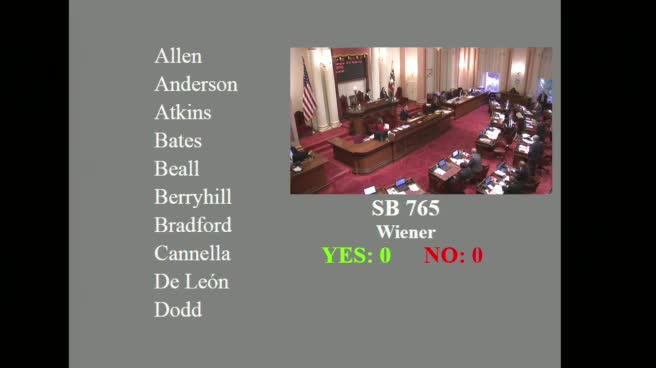 43SEC
Senate Floor
 13MIN
Senate Standing Committee on Judiciary
Bill Author
Bill Co-Author(s):