SB 413: Dementia: major neurocognitive disorder.
- Session Year: 2017-2018
- House: Senate
- Latest Version Date: 2017-07-24
Existing law regulates the licensure and operation of residential care facilities for the elderly, including the adoption of building standards to provide for locked and secured perimeters in residential care facilities for the elderly that care for persons with dementia.
Existing law, the California Conservatorship Jurisdiction Act, generally establishes the standards and procedures for establishing the proper jurisdiction for a proceeding to appoint a conservator of a person, an estate, or both. Existing law provides that application of these provisions to a conservatee with dementia is subject to the specified limitations.
Existing law authorizes a conservator to place a conservatee in a secured perimeter residential care facility for the elderly, as specified, or to authorize the administration of certain prescribed medications upon a courts finding that among other things, the conservatee has dementia and a functional impairment.
This bill would replace references to the term dementia in these provisions with major neurocognitive disorders. The bill would also make technical, nonsubstantive changes to these provisions.
(a)The State Fire Marshal has proposed that the California Building Standards Commission adopt building standards to provide for locked and secured perimeters in residential care facilities for the elderly that care for persons with major neurocognitive disorder:
(1)It is acknowledged that these building standards will not become effective until October 1, 1996.
(2)It is the policy of the California Building Standards Commission that building standards be adopted exclusively into the California Building Standards Code and not into state statute.
(3)However, in recognition of the immediate need of residential care facilities for the elderly caring for persons with major neurocognitive disorder to provide a secured environment, it is the intent of the Legislature that the building standards for locked and secured perimeters proposed by the State Fire Marshal for adoption in the 1994 California Building Standards Code, as set forth in Section 1569.699, be effective October 4, 1995.
(b)(1)Upon the filing of emergency regulations with the Secretary of State pursuant to subdivision (c), a residential care facility for the elderly that cares for people with major neurocognitive disorder may utilize secured perimeter fences or locked exit doors if it meets the requirements for additional safeguards required by those regulations.
(2)For the purposes of this article, major neurocognitive disorder includes Alzheimers disease and related disorders, diagnosed by a physician, that increase the tendency to wander and that decrease hazard awareness and the ability to communicate.
(3)It is the intent of the Legislature in enacting this article that residential care facilities for the elderly have options for the security of persons with major neurocognitive disorder who are residents of those facilities that are in addition to existing security exceptions made for individual residents. It is the further intent of the Legislature that these additional options shall include the use of waivers of certain building standards relating to fire safety, to be issued by the state department with the approval of the State Fire Marshal, to permit the care of a target group of persons with major neurocognitive disorder by means of secured perimeter fences, or the use of locked exterior doors. Each waiver request shall include a facility plan of operation that addresses elements of care to be identified by the department in regulations and demonstrates the facilitys ability to meet the safety needs of persons with major neurocognitive disorder.
(4)The department shall adopt regulations that ensure that staff for secured perimeter facilities receive appropriate and adequate training in the care of residents with major neurocognitive disorder.
(5)Nothing in this section is intended to prohibit residential care facilities for the elderly from accepting or retaining persons with major neurocognitive disorder whose needs can be fully met using care options permitted by existing law and regulations.
(6)It is not the intent of the Legislature to authorize an increase in the level of care provided in a residential care facility for the elderly or to establish a supplemental rate structure based on the services provided in the facility.
(7)All admissions to residential care facilities for the elderly shall continue to be voluntary on the part of the resident or with the lawful consent of the residents legal conservator.
(c)The department shall adopt regulations to implement subdivision (b) in accordance with those provisions of the Administrative Procedure Act contained in Chapter 3.5 (commencing with Section 11340) of Part 1 of Division 3 of Title 2 of the Government Code. The initial adoption of any emergency regulations following October 4, 1995, shall be deemed to be an emergency and necessary for the immediate preservation of the public peace, health and safety, or general welfare. Emergency regulations adopted pursuant to this subdivision shall remain in effect for no more than 180 days.
(d)In addition to the security options authorized by subdivision (b), residential care facilities for the elderly that accept or retain as residents persons with major neurocognitive disorder, and that choose to utilize the security options of egress-control devices of the time-delay type in addition to secured perimeter fences or locked exit doors, shall comply with Section 1569.699, or regulations adopted by the California Building Standards Commission, whichever is operative.
(e)A residential care facility for the elderly shall not utilize special egress-control devices of the time-delay type, secured perimeter fences, or locked exit doors unless the facility meets the requirements of Section 1569.699 or the California Building Standards Commission adopts building standards to implement this section.
(f)Any person who is not a conservatee and is entering a locked or secured perimeter facility pursuant to this section shall sign a statement of voluntary entry. The facility shall retain the original statement and shall send a copy of the statement to the department.
SEC. 2.Section 1569.699 of the Health and Safety Code is amended to read:1569.699.(a)When approved by the person responsible for enforcement, as described in Section 13146, exit doors in facilities classified as Group R, Division 2 facilities under the California Building Standards Code, licensed as residential care facilities for the elderly, and housing clients with Alzheimers disease or major neurocognitive disorder, may be equipped with approved listed special egress-control devices of the time-delay type, provided the building is protected throughout by an approved automatic sprinkler system and an approved automatic smoke-detection system. The devices shall conform to all of the following requirements:
(1)Automatic deactivation of the egress-control device upon activation of either the sprinkler system or the detection system.
(2)Automatic deactivation of the egress-control device upon loss of electrical power to any of the following:
(A)The egress-control device.
(B)The smoke-detection system.
(C)Exit illumination as required by Section 1012 of the California Building Standards Code.
(3)Be capable of being deactivated by a signal from a switch located in an approved location.
(4)Initiate an irreversible process that will deactivate the egress-control device whenever a manual force of not more than 15 pounds (66.72N) is applied for two seconds to the panic bar or other door-latching hardware. The egress-control device shall deactivate within an approved time period not to exceed a total of 15 seconds, except that the person responsible for enforcement, as described in Section 13146, may approve a delay not to exceed 30 seconds in residential care facilities for the elderly serving patients with Alzheimers disease. The time delay established for each egress-control device shall not be field adjustable.
(5)Actuation of the panic bar or other door-latching hardware shall activate an audible signal at the door.
(6)The unlatching shall not require more than one operation.
(7)(A)A sign shall be provided on the door located above and within 12 inches (305mm) of the panic bar or other door-latching hardware reading:
KEEP PUSHING. THIS DOOR WILL OPEN IN
___ SECONDS. ALARM WILL SOUND.
(B)Sign letter shall be at least one inch (25mm) in height and shall have a stroke of not less than 1/8 inch (3.3mm).
(8)Regardless of the means of deactivation, relocking of the egress-control device shall be by manual means only at the door.
(b)Grounds of residential care facilities for the elderly serving persons with Alzheimers disease or major neurocognitive disorder may be fenced, and gates therein equipped with locks, provided safe dispersal areas are located not less than 50 feet (15240mm) from the buildings. Dispersal areas shall be sized to provide an area of not less than three square feet (0.282) per occupant. Gates shall not be installed across corridors or passageways leading to the dispersal areas unless they comply with the exit requirements of Section 1021 of the California Building Standards Code.
(c)Exit doors may be locked in residential care facilities for the elderly that meet the requirements for Group I, Division 3 occupancies under the California Building Standards Code and that care for people with major neurocognitive disorder.
(d)This section shall become inoperative on the date the California Building Standards Commission adopts regulations regarding secured perimeters in residential care facilities for the elderly, and, as of the January 1 next following that date, is repealed, unless a later enacted statute, that becomes operative on or before that January 1, deletes or extends the dates on which it becomes inoperative and is repealed.
SEC. 3.Section 1569.7 of the Health and Safety Code is amended to read:1569.7.Residential care facilities for the elderly that serve residents with Alzheimers disease and other forms of major neurocognitive disorder should include information on sundowning as part of the training for direct care staff, and should include in the plan of operation a brief narrative description explaining activities available for residents to decrease the effects of sundowning, including, but not limited to, increasing outdoor activities in appropriate weather conditions.
SEC. 4.Section 1981 of the Probate Code is amended to read:1981.(a)(1)This chapter does not apply to a minor, regardless of whether the minor is or was married.
(2)This chapter does not apply to any proceeding in which a person is appointed to provide personal care or property administration for a minor, including, but not limited to, a guardianship under Part 2 (commencing with Section 1500).
(b)This chapter does not apply to any proceeding in which a person is involuntarily committed to a mental health facility or subjected to other involuntary mental health care, including, but not limited to, any of the following proceedings or any proceeding that is similar in substance:
(1)A proceeding under Sections 1026 to 1027, inclusive, of the Penal Code.
(2)A proceeding under Chapter 6 (commencing with Section 1367) of Title 10 of Part 2 of the Penal Code.
(3)A proceeding under Article 4 (commencing with Section 2960) of Chapter 7 of Title 1 of Part 3 of the Penal Code.
(4)A proceeding under Article 6 (commencing with Section 1800) of Chapter 1 of Division 2.5 of the Welfare and Institutions Code.
(5)A proceeding under Part 1 (commencing with Section 5000) of Division 5 of the Welfare and Institutions Code, which is also known as the Lanterman-Petris-Short Act.
(6)A proceeding under Article 2 (commencing with Section 6500) of Chapter 2 of Part 2 of Division 6 of the Welfare and Institutions Code.
(7)A proceeding under Article 4 (commencing with Section 6600) of Chapter 2 of Part 2 of Division 6 of the Welfare and Institutions Code.
(c)Article 3 (commencing with Section 2001) does not apply to an adult with a developmental disability, or to any proceeding in which a person is appointed to provide personal care or property administration for an adult with a developmental disability, including, but not limited to, the following types of proceedings:
(1)A proceeding under Article 7.5 (commencing with Section 416) of Chapter 2 of Part 1 of Division 1 of the Health and Safety Code.
(2)A limited conservatorship under subdivision (d) of Section 1801.
(3)A proceeding under Section 4825 of the Welfare and Institutions Code.
(4)A proceeding under Article 2 (commencing with Section 6500) of Chapter 2 of Part 2 of Division 6 of the Welfare and Institutions Code.
(d)Application of this chapter to a conservatee with major neurocognitive disorder is subject to the express limitations of Sections 2002 and 2016, as well as the other requirements of this chapter.
SEC. 5.Section 2356.5 of the Probate Code is amended to read:2356.5.(a)The Legislature hereby finds and declares of all the following:
(1)That people with major neurocognitive disorder, as defined in the last published edition of the Diagnostic and Statistical Manual of Mental Disorders, should have a conservatorship to serve their unique and special needs.
(2)That, by adding powers to the probate conservatorship for people with major neurocognitive disorder, their unique and special needs can be met. This will reduce costs to the conservatee and the family of the conservatee, reduce costly administration by state and county government, and safeguard the basic dignity and rights of the conservatee.
(3)That it is the intent of the Legislature to recognize that the administration of psychotropic medications has been, and can be, abused by caregivers and, therefore, granting powers to a conservator to authorize these medications for the treatment of major neurocognitive disorder requires the protections specified in this section.
(b)Notwithstanding any other law, a conservator may authorize the placement of a conservatee in a secured perimeter residential care facility for the elderly operated pursuant to Section 1569.698 of the Health and Safety Code, and that has a care plan that meets the requirements of Section 87705 of Title 22 of the California Code of Regulations, upon a courts finding, by clear and convincing evidence, of all of the following:
(1)The conservatee has major neurocognitive disorder, as defined in the last published edition of the Diagnostic and Statistical Manual of Mental Disorders.
(2)The conservatee lacks the capacity to give informed consent to this placement and has at least one mental function deficit pursuant to subdivision (a) of Section 811, and this deficit significantly impairs the persons ability to understand and appreciate the consequences of his or her actions pursuant to subdivision (b) of Section 811.
(3)The conservatee needs or would benefit from a restricted and secure environment, as demonstrated by evidence presented by the physician or psychologist referred to in paragraph (3) of subdivision (f).
(4)The court finds that the proposed placement in a locked facility is the least restrictive placement appropriate to the needs of the conservatee.
(c)Notwithstanding any other law, a conservator of a person may authorize the administration of medications appropriate for the care and treatment of major neurocognitive disorder, upon a courts finding, by clear and convincing evidence, of all of the following:
(1)The conservatee has major neurocognitive disorder, as defined in the last published edition of the Diagnostic and Statistical Manual of Mental Disorders.
(2)The conservatee lacks the capacity to give informed consent to the administration of medications appropriate to the care of major neurocognitive disorder, and has at least one mental function deficit pursuant to subdivision (a) of Section 811, and this deficit or deficits significantly impairs the persons ability to understand and appreciate the consequences of his or her actions pursuant to subdivision (b) of Section 811.
(3)The conservatee needs or would benefit from appropriate medication as demonstrated by evidence presented by the physician or psychologist referred to in paragraph (3) of subdivision (f).
(d)Pursuant to subdivision (b) of Section 2355, in the case of a person who is an adherent of a religion whose tenets and practices call for a reliance on prayer alone for healing, the treatment required by the conservator under subdivision (c) shall be by an accredited practitioner of that religion in lieu of the administration of medications.
(e)A conservatee who is to be placed in a facility pursuant to this section shall not be placed in a mental health rehabilitation center as described in Section 5675 of the Welfare and Institutions Code, or in an institution for mental disease as described in Section 5900 of the Welfare and Institutions Code.
(f)A petition for authority to act under this section is governed by Section 2357, except:
(1)The conservatee shall be represented by an attorney pursuant to Chapter 4 (commencing with Section 1470) of Part 1. Upon granting or denying authority to a conservator under this section, the court shall discharge the attorney or order the continuation of the legal representation, consistent with the standard set forth in subdivision (a) of Section 1470.
(2)The conservatee shall be produced at the hearing, unless excused pursuant to Section 1893.
(3)The petition shall be supported by a declaration of a licensed physician, or a licensed psychologist within the scope of his or her licensure, regarding each of the findings required to be made under this section for any power requested, except that the psychologist has at least two years of experience in diagnosing major neurocognitive disorder.
(4)The petition may be filed by any of the persons designated in Section 1891.
(g)The court investigator shall annually investigate and report to the court every two years pursuant to Sections 1850 and 1851 if the conservator is authorized to act under this section. In addition to the other matters provided in Section 1851, the conservatee shall be specifically advised by the investigator that the conservatee has the right to object to the conservators powers granted under this section, and the report shall also include whether powers granted under this section are warranted. If the conservatee objects to the conservators powers granted under this section, or the investigator determines that some change in the powers granted under this section is warranted, the court shall provide a copy of the report to the attorney of record for the conservatee. If no attorney has been appointed for the conservatee, one shall be appointed pursuant to Chapter 4 (commencing with Section 1470) of Part 1. The attorney shall, within 30 days after receiving this report, do either of the following:
(1)File a petition with the court regarding the status of the conservatee.
(2)File a written report with the court stating that the attorney has met with the conservatee and determined that the petition would be inappropriate.
(h)A petition to terminate authority granted under this section shall be governed by Section 2359.
(i)Nothing in this section shall be construed to affect a conservatorship of the estate of a person who has major neurocognitive disorder.
(j)Nothing in this section shall affect the laws that would otherwise apply in emergency situations.
(k)Nothing in this section shall affect current law regarding the power of a probate court to fix the residence of a conservatee or to authorize medical treatment for any conservatee who has not been determined to have major neurocognitive disorder.
(a)The State Fire Marshal has proposed that the State California Building Standards Commission adopt building standards to provide for locked and secured perimeters in residential care facilities for the elderly that care for persons with dementia: major neurocognitive disorder:
(1)It is acknowledged that these building standards will not become effective until October 1, 1996.
(2)It is the policy of the State California Building Standards Commission that building standards be adopted exclusively into the California Building Standards Code and not into state statute.
(3)However, in recognition of the immediate need of residential care facilities for the elderly caring for persons with dementia major neurocognitive disorder to provide a secured environment, it is the intent of the Legislature that the building standards for locked and secured perimeters proposed by the State Fire Marshal for adoption in the 1994 California Building Standards Code, as set forth in Section 1569.699, be effective upon the date this article becomes operative. October 4, 1995.
(b)(1)Upon the filing of emergency regulations with the Secretary of State pursuant to subdivision (c), a residential care facility for the elderly that cares for people with dementia major neurocognitive disorder may utilize secured perimeter fences or locked exit doors, doors if it meets the requirements for additional safeguards required by those regulations.
(2)For the purposes of this article, dementia major neurocognitive disorder includes Alzheimers disease and related disorders, diagnosed by a physician, that increase the tendency to wander and that decrease hazard awareness and the ability to communicate.
(3)It is the intent of the Legislature in enacting this article that residential care facilities for the elderly have options for the security of persons with dementia major neurocognitive disorder who are residents of those facilities that are in addition to existing security exceptions made for individual residents. It is the further intent of the Legislature that these additional options shall include the use of waivers of certain building standards relating to fire safety, to be issued by the state department with the approval of the State Fire Marshal, to permit the care of a target group of persons with dementia major neurocognitive disorder by means of secured perimeter fences, or the use of locked exterior doors. Each waiver request shall include a facility plan of operation that addresses elements of care to be identified by the department in regulations and demonstrates the facilitys ability to meet the safety needs of persons with dementia. major neurocognitive disorder.
(4)The department shall adopt regulations that ensure that staff for secured perimeter facilities receive appropriate and adequate training in the care of residents with dementia. major neurocognitive disorder.
(5)Nothing in this section is intended to prohibit residential care facilities for the elderly from accepting or retaining persons with dementia major neurocognitive disorder whose needs can be fully met using care options permitted by existing law and regulations.
(6)It is not the intent of the Legislature to authorize an increase in the level of care provided in a residential care facility for the elderly or to establish a supplemental rate structure based on the services provided in the facility.
(7)All admissions to residential care facilities for the elderly shall continue to be voluntary on the part of the resident or with the lawful consent of the residents legal conservator.
(c)The department shall adopt regulations to implement subdivision (b) in accordance with those provisions of the Administrative Procedure Act contained in Chapter 3.5 (commencing with Section 11340) of Part 1 of Division 3 of Title 2 of the Government Code. The initial adoption of any emergency regulations following the effective date of the act amending this section during the 199596 Regular Legislative Session October 4, 1995, shall be deemed to be an emergency and necessary for the immediate preservation of the public peace, health and safety, or general welfare. Emergency regulations adopted pursuant to this subdivision shall remain in effect for no more than 180 days.
(d)In addition to the security options authorized by subdivision (b), residential care facilities for the elderly that accept or retain as residents persons with dementia, major neurocognitive disorder, and that choose to utilize the security options of egress-control devices of the time-delay type in addition to secured perimeter fences or locked exit doors, shall comply with Section 1569.699, or regulations adopted by the State California Building Standards Commission, whichever is operative.
(e)A residential care facility for the elderly shall not utilize special egress-control devices of the time-delay type, secured perimeter fences, or locked exit doors unless the facility meets the requirements of Section 1569.699 or the California Building Standards Commission adopts building standards to implement this section.
(f)Any person who is not a conservatee and is entering a locked or secured perimeter facility pursuant to this section, section shall sign a statement of voluntary entry. The facility shall retain the original statement and shall send a copy of the statement to the department.
SEC. 2.Section 1569.699 of the Health and Safety Code is amended to read:1569.699.(a)When approved by the person responsible for enforcement enforcement, as described in Section 13146, exit doors in facilities classified as Group R, Division 2 facilities under the California Building Standards Code, licensed as residential care facilities for the elderly, and housing clients with Alzheimers disease or dementia, major neurocognitive disorder, may be equipped with approved listed special egress-control devices of the time-delay type, provided the building is protected throughout by an approved automatic sprinkler system and an approved automatic smoke-detection system. The devices shall conform to all of the following requirements:
(1)Automatic deactivation of the egress-control device upon activation of either the sprinkler system or the detection system.
(2)Automatic deactivation of the egress-control device upon loss of electrical power to any one of the following: The
(A)The egress-control device; the device.
(B)The smoke-detection system; exit system.
(C)Exit illumination as required by Section 1012 of the California Building Standards Code.
(3)Be capable of being deactivated by a signal from a switch located in an approved location.
(4)Initiate an irreversible process that will deactivate the egress-control device whenever a manual force of not more than 15 pounds (66.72N) is applied for two seconds to the panic bar or other door-latching hardware. The egress-control device shall deactivate within an approved time period not to exceed a total of 15 seconds, except that the person responsible for enforcement enforcement, as described in Section 13146 13146, may approve a delay not to exceed 30 seconds in residential care facilities for the elderly serving patients with Alzheimers disease. The time delay established for each egress-control device shall not be field adjustable.
(5)Actuation of the panic bar or other door-latching hardware shall activate an audible signal at the door.
(6)The unlatching shall not require more than one operation.
(7)(A)A sign shall be provided on the door located above and within 12 inches (305mm) of the panic bar or other door-latching hardware reading:
KEEP PUSHING. THIS DOOR WILL OPEN IN
___ SECONDS. ALARM WILL SOUND.
(B)Sign letter shall be at least one inch (25mm) in height and shall have a stroke of not less than 1/8 inch (3.3mm).
(8)Regardless of the means of deactivation, relocking of the egress-control device shall be by manual means only at the door.
(b)Grounds of residential care facilities for the elderly serving persons with Alzheimers disease or dementia major neurocognitive disorder may be fenced, and gates therein equipped with locks, provided safe dispersal areas are located not less than 50 feet (15240mm) from the buildings. Dispersal areas shall be sized to provide an area of not less than three square feet (0.282) per occupant. Gates shall not be installed across corridors or passageways leading to the dispersal areas unless they comply with the exit requirements of Section 1021 of the California Building Standards Code.
(c)Exit doors may be locked in residential care facilities for the elderly that meet the requirements for Group I, Division 3 occupancies under the California Building Standards Code and that care for people with dementia. major neurocognitive disorder.
(d)This section shall become inoperative on the date the State California Building Standards Commission adopts regulations regarding secured perimeters in residential care facilities for the elderly, and, as of the January 1 next following that date, is repealed, unless a later enacted statute, that becomes operative on or before that January 1, deletes or extends the dates on which it becomes inoperative and is repealed.
SEC. 3.Section 1569.7 of the Health and Safety Code is amended to read:1569.7.Residential care facilities for the elderly that serve residents with Alzheimers disease and other forms of dementia major neurocognitive disorder should include information on sundowning as part of the training for direct care staff, and should include in the plan of operation a brief narrative description explaining activities available for residents to decrease the effects of sundowning, including, but not limited to, increasing outdoor activities in appropriate weather conditions.
SEC. 4.Section 1981 of the Probate Code is amended to read:1981.(a)(1)This chapter does not apply to a minor, regardless of whether the minor is or was married.
(2)This chapter does not apply to any proceeding in which a person is appointed to provide personal care or property administration for a minor, including, but not limited to, a guardianship under Part 2 (commencing with Section 1500).
(b)This chapter does not apply to any proceeding in which a person is involuntarily committed to a mental health facility or subjected to other involuntary mental health care, including, but not limited to, any of the following proceedings or any proceeding that is similar in substance:
(1)A proceeding under Sections 1026 to 1027, inclusive, of the Penal Code.
(2)A proceeding under Chapter 6 (commencing with Section 1367) of Title 10 of Part 2 of the Penal Code.
(3)A proceeding under Article 4 (commencing with Section 2960) of Chapter 7 of Title 1 of Part 3 of the Penal Code.
(4)A proceeding under Article 6 (commencing with Section 1800) of Chapter 1 of Division 2.5 of the Welfare and Institutions Code.
(5)A proceeding under Article 2 (commencing with Section 3050) of Chapter 1 of Division 3 of the Welfare and Institutions Code.(6)A proceeding under Article 3 (commencing with Section 3100) of Chapter 1 of Division 3 of the Welfare and Institutions Code. (7)(5)A proceeding under Part 1 (commencing with Section 5000) of Division 5 of the Welfare and Institutions Code, which is also known as the Lanterman-Petris-Short Act.
(8)(6)A proceeding under Article 2 (commencing with Section 6500) of Chapter 2 of Part 2 of Division 6 of the Welfare and Institutions Code.
(9)(7)A proceeding under Article 4 (commencing with Section 6600) of Chapter 2 of Part 2 of Division 6 of the Welfare and Institutions Code.
(c)Article 3 (commencing with Section 2001) does not apply to an adult with a developmental disability, or to any proceeding in which a person is appointed to provide personal care or property administration for an adult with a developmental disability, including, but not limited to, the following types of proceedings:
(1)A proceeding under Article 7.5 (commencing with Section 416) of Chapter 2 of Part 1 of Division 1 of the Health and Safety Code.
(2)A limited conservatorship under subdivision (d) of Section 1801.
(3)A proceeding under Section 4825 of the Welfare and Institutions Code.
(4)A proceeding under Article 2 (commencing with Section 6500) of Chapter 2 of Part 2 of Division 6 of the Welfare and Institutions Code.
(d)Application of this chapter to a conservatee with dementia major neurocognitive disorder is subject to the express limitations of Sections 2002 and 2016, as well as the other requirements of this chapter.
SEC. 5.Section 2356.5 of the Probate Code is amended to read:2356.5.(a)The Legislature hereby finds and declares: declares of all the following:
(1)That people with dementia, major neurocognitive disorder, as defined in the last published edition of the Diagnostic and Statistical Manual of Mental Disorders, should have a conservatorship to serve their unique and special needs.
(2)That, by adding powers to the probate conservatorship for people with dementia, major neurocognitive disorder, their unique and special needs can be met. This will reduce costs to the conservatee and the family of the conservatee, reduce costly administration by state and county government, and safeguard the basic dignity and rights of the conservatee.
(3)That it is the intent of the Legislature to recognize that the administration of psychotropic medications has been, and can be, abused by caregivers and, therefore, granting powers to a conservator to authorize these medications for the treatment of dementia major neurocognitive disorder requires the protections specified in this section.
(b)Notwithstanding any other law, a conservator may authorize the placement of a conservatee in a secured perimeter residential care facility for the elderly operated pursuant to Section 1569.698 of the Health and Safety Code, and which that has a care plan that meets the requirements of Section 87705 of Title 22 of the California Code of Regulations, upon a courts finding, by clear and convincing evidence, of all of the following:
(1)The conservatee has dementia, major neurocognitive disorder, as defined in the last published edition of the Diagnostic and Statistical Manual of Mental Disorders.
(2)The conservatee lacks the capacity to give informed consent to this placement and has at least one mental function deficit pursuant to subdivision (a) of Section 811, and this deficit significantly impairs the persons ability to understand and appreciate the consequences of his or her actions pursuant to subdivision (b) of Section 811.
(3)The conservatee needs or would benefit from a restricted and secure environment, as demonstrated by evidence presented by the physician or psychologist referred to in paragraph (3) of subdivision (f).
(4)The court finds that the proposed placement in a locked facility is the least restrictive placement appropriate to the needs of the conservatee.
(c)Notwithstanding any other law, a conservator of a person may authorize the administration of medications appropriate for the care and treatment of dementia, major neurocognitive disorder, upon a courts finding, by clear and convincing evidence, of all of the following:
(1)The conservatee has dementia, major neurocognitive disorder, as defined in the last published edition of the Diagnostic and Statistical Manual of Mental Disorders.
(2)The conservatee lacks the capacity to give informed consent to the administration of medications appropriate to the care of dementia, major neurocognitive disorder, and has at least one mental function deficit pursuant to subdivision (a) of Section 811, and this deficit or deficits significantly impairs the persons ability to understand and appreciate the consequences of his or her actions pursuant to subdivision (b) of Section 811.
(3)The conservatee needs or would benefit from appropriate medication as demonstrated by evidence presented by the physician or psychologist referred to in paragraph (3) of subdivision (f).
(d)Pursuant to subdivision (b) of Section 2355, in the case of a person who is an adherent of a religion whose tenets and practices call for a reliance on prayer alone for healing, the treatment required by the conservator under subdivision (c) shall be by an accredited practitioner of that religion in lieu of the administration of medications.
(e)A conservatee who is to be placed in a facility pursuant to this section shall not be placed in a mental health rehabilitation center as described in Section 5675 of the Welfare and Institutions Code, or in an institution for mental disease as described in Section 5900 of the Welfare and Institutions Code.
(f)A petition for authority to act under this section is governed by Section 2357, except:
(1)The conservatee shall be represented by an attorney pursuant to Chapter 4 (commencing with Section 1470) of Part 1. Upon granting or denying authority to a conservator under this section, the court shall discharge the attorney or order the continuation of the legal representation, consistent with the standard set forth in subdivision (a) of Section 1470.
(2)The conservatee shall be produced at the hearing, unless excused pursuant to Section 1893.
(3)The petition shall be supported by a declaration of a licensed physician, or a licensed psychologist within the scope of his or her licensure, regarding each of the findings required to be made under this section for any power requested, except that the psychologist has at least two years of experience in diagnosing dementia. major neurocognitive disorder.
(4)The petition may be filed by any of the persons designated in Section 1891.
(g)The court investigator shall annually investigate and report to the court every two years pursuant to Sections 1850 and 1851 if the conservator is authorized to act under this section. In addition to the other matters provided in Section 1851, the conservatee shall be specifically advised by the investigator that the conservatee has the right to object to the conservators powers granted under this section, and the report shall also include whether powers granted under this section are warranted. If the conservatee objects to the conservators powers granted under this section, or the investigator determines that some change in the powers granted under this section is warranted, the court shall provide a copy of the report to the attorney of record for the conservatee. If no attorney has been appointed for the conservatee, one shall be appointed pursuant to Chapter 4 (commencing with Section 1470) of Part 1. The attorney shall, within 30 days after receiving this report, do one either of the following:
(1)File a petition with the court regarding the status of the conservatee.
(2)File a written report with the court stating that the attorney has met with the conservatee and determined that the petition would be inappropriate.
(h)A petition to terminate authority granted under this section shall be governed by Section 2359.
(i)Nothing in this section shall be construed to affect a conservatorship of the estate of a person who has dementia. major neurocognitive disorder.
(j)Nothing in this section shall affect the laws that would otherwise apply in emergency situations.
(k)Nothing in this section shall affect current law regarding the power of a probate court to fix the residence of a conservatee or to authorize medical treatment for any conservatee who has not been determined to have dementia. major neurocognitive disorder.
|
Date
|
Status
|
|---|---|
| Jul 24, 2017 | Chaptered by Secretary of State. Chapter 122, Statutes of 2017. |
| Jul 24, 2017 | Approved by the Governor. |
| Jul 12, 2017 | Enrolled and presented to the Governor at 12 p.m. |
| Jul 6, 2017 | In Senate. Ordered to engrossing and enrolling. |
| Jul 6, 2017 | Read third time. Passed. Ordered to the Senate. |
| Jun 29, 2017 | Read second time. Ordered to consent calendar. |
| Jun 28, 2017 | From committee: Do pass. Ordered to consent calendar. (Ayes 11. Noes 0.) (June 27). |
| Jun 21, 2017 | From committee: Do pass and re-refer to Com. on JUD. (Ayes 7. Noes 0.) (June 20). Re-referred to Com. on JUD. |
| May 22, 2017 | Referred to Coms. on AGING & L.T.C. and JUD. |
| Apr 27, 2017 | In Assembly. Read first time. Held at Desk. |
| Apr 27, 2017 | Read third time. Passed. (Ayes 36. Noes 0. Page 874.) Ordered to the Assembly. |
| Apr 20, 2017 | Read second time. Ordered to consent calendar. |
| Apr 19, 2017 | From committee: Do pass. Ordered to consent calendar. (Ayes 7. Noes 0. Page 746.) (April 18). |
| Mar 30, 2017 | Set for hearing April 18. |
| Mar 28, 2017 | From committee: Do pass and re-refer to Com. on JUD. with recommendation: To consent calendar. (Ayes 4. Noes 0.) (March 28). Re-referred to Com. on JUD. |
| Feb 28, 2017 | Set for hearing March 28. |
| Feb 23, 2017 | Referred to Coms. on HUMAN S. and JUD. |
| Feb 16, 2017 | From printer. May be acted upon on or after March 18. |
| Feb 15, 2017 | Introduced. Read first time. To Com. on RLS. for assignment. To print. |
|
Date
|
Description
|
Location
|
Votes
|
|
|---|---|---|---|---|
| Jul 6, 2017 | SB 413 Morrell Consent Calendar Second Day | Assembly Floor |
Passed |
|
| Jun 27, 2017 | Do pass. To Consent Calendar. | Assembly Standing Committee on Judiciary |
Passed |
|
| Jun 20, 2017 | Do pass and be re-referred to the Committee on [Judiciary] | Assembly Standing Committee on Aging and Long-Term Care |
Passed |
|
| Apr 27, 2017 | Consent Calendar 2nd SB413 | Senate Floor |
Passed |
|
| Apr 18, 2017 | Do pass and be ordered to the Consent Calendar | Senate Standing Committee on Judiciary |
Passed |
|
| Mar 28, 2017 | Do pass, but first be re-referred to the Committee on [Judiciary] with the recommendation: To Consent Calendar | Senate Standing Committee on Human Services |
Passed |
This list shows positions taken on this bill by organizations on the date displayed, which is linked to the original source.
Positions by individuals are not included.
|
Organization
|
Position
|
Date
|
|---|---|---|
| Conference of California Bar Associations | ** Support | Jun 23, 2017 |
| National Association Of Social Workers, California Chapter | ** Support | Jun 21, 2017 |
| Professional Fiduciary Association Of California | ** Support | Jun 23, 2017 |
| The Conference of California Bar Associations | ** Support | Apr 21, 2017 |
Date of Hearing: June 13, 2017
ASSEMBLY COMMITTEE ON JUDICIARY
Mark Stone, Chair
SBPCA Bill Id:SB 413
Author:(Morrell) – As Introduced Ver:February 15, 2017
PROPOSED CONSENT
SENATE VOTE: 36-0
SUBJECT: Dementia: major neurocognitive disorder
KEY ISSUE: IN ORDER TO BETTER REFLECT the most recent medical lexicon, SHOULD THE TERM "DEMENTIA" IN THE CALIFORNIA CODES BE REPLACED with "major NEUROCOGNITIVE DISORDER," consistent with THE LATEST EDITION OF THE American Psychiatric Association's Diagnostic and Statistical Manual of Mental Disorders?
SYNOPSIS
If a person is unable to adequately provide for his or her personal needs or incapable of managing his or her assets, a probate court can establish a conservatorship. A person with dementia may be subject to a conservatorship with additional restrictions, so long as extra protections and oversight are provided. The bill does not change those additional restrictions or increased protections. Rather, this bill simply updates and replaces, in the Health & Safety Code and the Probate Code, the term "dementia" with the new, broader diagnostic category of "major neurocognitive disorder," recognized in the latest edition of the American Psychiatric Association's Diagnostic and Statistical Manual of Mental Disorders, and makes various technical changes.
This bill is sponsored by the Conference of California Bar Associations and supported by the Professional Fiduciary Association of California. The bill has no opposition and passed the Assembly Committee on Aging and Long-Term Care unanimously last week.
SUMMARY: Replaces "dementia" with "major neurocognitive disorder.” Specifically, this bill:
- Replaces the term “dementia” with the term “major neurocognitive disorder” in the Health & Safety and Probate Codes.
- Makes technical, non-substantive changes.
EXISTING LAW:
- Allows the court to appoint a conservator to act on behalf of a person who is unable to adequately provide for his or her personal needs (a conservator of the person) or incapable of managing his or her property or other financial assets (a conservator of the estate). (Probate Code Section 1800 et seq. Unless stated otherwise, all further statutory references are to that code.)
- Specifies the powers and duties of a conservator and the powers and rights retained by a conservatee subject to a conservatorship. (Section 2350 et seq.)
- Authorizes the conservator to establish the residence of the conservatee at any place within California without the permission of the court, but requires that the conservator select the least restrictive residence that is appropriate. (Section 2352 (b).)
- Allows a conservator to place a conservatee with dementia in a secured perimeter residential care facility for the elderly, upon a court making specified findings, by clear and convincing evidence, as provided. Allows a conservator to authorize the administration of medications appropriate for the care and treatment of dementia, upon a court making specified findings, by clear and convincing evidence, as provided. Requires the conservatee, at a hearing to either place the conservatee in a secured perimeter residential care facility or allow for the administration of medication appropriate for the care and treatment of dementia, to be represented by an attorney, as specified. States, in legislative intent, that the term dementia is as defined in the latest edition of the Diagnostic and Statistical Manual of Mental Disorders. (Section 2356.5.)
- Requires the probate court investigator annually to investigate and report to the court every two years, as specified, if the conservator is authorized to place the conservatee in a secured perimeter residential care facility or administer medication appropriate for the care and treatment of dementia. Requires the investigator to specifically advise the conservatee that he or she has the right to object to the conservator’s powers, and requires the report to the court to include whether the powers granted are warranted. (Id.)
- Allows residential care facilities for the elderly that care for people with dementia to use secured perimeter fences or locked exit doors, if they comply with certain required safeguards. (Health & Safety Code Sections 1569.698 – 1569.699.)
- Provides that residential care facilities for the elderly that serve residents with Alzheimer’s disease and other forms of dementia should include information on sundowning as part of the training for direct care staff, and should include in the plan of operation a brief narrative description explaining activities available for residents to decrease the effects of sundowning. (Health & Safety Code Section 1569.7.)
FISCAL EFFECT: As currently in print this bill is keyed non-fiscal.
COMMENTS: If a person is unable to adequately provide for his or her personal needs or incapable of managing his or her assets, a probate court can establish a conservatorship. A person with dementia may be subject to a conservatorship with additional restrictions, so long as additional protections and oversight are provided. This bill does not change those additional restrictions or increased protections. Rather, this bill updates and replaces the term "dementia" with the new, broader diagnostic category of "major neurocognitive disorder," recognized in the latest edition of the American Psychiatric Association's Diagnostic and Statistical Manual of Mental Disorders, and makes various technical changes.
In support of the bill, the author writes:
In 2013, the American Psychiatric Association replaced the term “dementia” with “major neurocognitive disorder” in the latest published edition of the Diagnostic and Statistical Manual of Mental Disorders, also known as the DSM-5. Because numerous California statutes continue to refer to “dementia,” and “dementia as defined in the latest published edition of the DSM-5,” it is important that terminology in statute align with the manual itself, otherwise, those turning to the manual will not find clear diagnostic support when interpreting statutes at issue. SB 413 addresses this problem by updating these Health and Safety and Probate Code sections to replace dementia with major neurocognitive disorder.
Types of Conservatorships: A probate judge may appoint a conservator to act on behalf of a person who is unable to adequately provide for his or her personal needs (a "conservator of the person") or incapable of managing his or her property or other financial assets (a "conservator of the estate"). (Section 1800 et seq.) The Probate Code also offers a "limited conservatorship" for "developmentally disabled adults," under which the court limits the conservator's power so as to preserve the maximum amount of independence and self-sufficiency for the conservatee. (Section 1801 (d).) In addition, the Lanterman-Petris-Short (LPS) Act created a special adult conservatorship for persons who were considered "gravely disabled" by reason of mental illness or chronic alcoholism and subject to confinement in a locked psychiatric facility and administration of psychotropic medication, subject to more extensive oversight than a probate conservatorship. (Welfare & Institutions Code Section 5330 et seq.)
Conservatorship with Special Dementia Powers: In 1996, the Legislature created an alternative to the LPS conservatorship for people with dementia. Under AB 1481 (Mello), Chap. 910, Stats. 1996, a conservator under a Probate Code conservatorship may seek special powers to confine a conservatee with dementia in a "secured perimeter" residential care facility and to administer medication for dementia if various conditions, designed to protect the conservatee, are met. These conditions include the appointment of an attorney to represent the conservatee during the court's consideration of the conservator's petition for the dementia powers and the court making certain specified findings by the heightened clear and convincing evidence standard.
Of particular relevance for this bill, the legislative intent language defines dementia based on the "last published edition of the 'Diagnostic and Statistical Manual for Mental Disorders.'"
Following the Latest Edition of the Diagnostic and Statistical Manual for Mental Disorders, this Bill Replaces the Term Dementia with Major Neurocognitive Disorder: The Diagnostic and Statistical Manual for Mental Disorders is published by the American Psychiatric Association. Now in its 5th edition, the manual characterizes psychiatric diagnoses for adults and children, and helps professionals better understand their patients' illnesses and possible treatments. The 4th edition of the manual defined dementia as "multiple cognitive deficits, which include memory impairment and at least one of the following: aphasia, apraxia, agnosia or disturbance in executive functioning. Social or occupational function is also impaired."
The most recent edition of the Diagnostic and Statistical Manual for Mental Disorders, the 5th edition, replaced dementia with the term "major neurocognitive disorder" which can incorporate Alzheimer’s disease, vascular dementia, dementia with Lewy bodies, Parkinson’s Disease dementia, frontotemporal dementia, and long-term traumatic brain injury, under that new, broader diagnostic category. The updated manual specifically looks for significant cognitive decline that interferes with independence in everyday activities in order to be diagnosed with a major neurocognitive disorder.
This bill updates the law to properly reflect the revised term in the latest Diagnostic and Statistical Manual for Mental Disorders and to ensure that greater due process protections apply to this broader group of vulnerable adults. The change in this bill was included in SB 938 (Jackson), 2016, which contained other provisions as well. That bill passed this Committee by unanimous vote, but was held on the Assembly Floor.
REGISTERED SUPPORT / OPPOSITION:
Support
Conference of California Bar Associations (sponsor)
Professional Fiduciary Association of California
Opposition
None on file
Analysis Prepared by: Leora Gershenzon / JUD. / (916) 319-2334
Date of Hearing: June 20, 2017
ASSEMBLY COMMITTEE ON AGING AND LONG-TERM CARE
Ash Kalra, Chair
SBPCA Bill Id:SB 413
Author:(Morrell) – As Introduced Ver:February 15, 2017
SENATE VOTE: 36-0
SUBJECT: Dementia: major neurocognitive disorder.
SUMMARY: This bill replaces references to the term “dementia” with the term “major neurocognitive disorders” in existing law with regard to licensure and operation of residential care facilities for the elderly and conservatorships. This bill also makes technical, non-substantive changes to these provisions.
EXISTING LAW:
- Establishes the California Community Care Facilities Act, which provides regulatory structure for coordinated and comprehensive statewide system of care for people who are mentally ill, developmentally and physically disabled, and children and adults who require care or services provided by licensed community care facilities.
- Establishes a regulatory structure for licensed Residential Care Facilities for the Elderly (RCFE).
- Defines dementia to include Alzheimer’s disease and related disorders, diagnosed by a physician, that increase the tendency to wander and that decrease hazard awareness and the ability to communicate.
- Authorizes the adoption of building standards to provide for locked and secured perimeters in residential care facilities for the elderly that care for persons with dementia.
- Requires the California Department of Social Services (CDSS) to adopt regulations that ensure that staff for secured-perimeter facilities receive appropriate and adequate training in the care of residents with dementia.
- Requires CDSS to adopt regulations to allow RCFEs that care for people with dementia to utilize secured perimeter fences or locked exit doors, as specified.
- Encourages RCFEs that serve residents with Alzheimer’s disease and other forms of dementia to include information on sundowning as part of the training for direct care staff and to include information on sundowning within the RCFEs plan of operation.
- Establishes the California Conservatorship Jurisdiction Act in the Probate Code, which sets standards and procedures for appointing a conservator and provides specified limitations for conservatees with dementia.
- Specifies the powers and duties of a conservator and the powers and rights retained by a conservatee subject to a conservatorship.
- Authorizes the conservator to establish the residence of the conservatee at any place within California without the permission of the court, and requires the conservator to select the least restrictive appropriate residence that is available and necessary to meet the needs of the conservatee, that is in the best interests of the conservatee.
- Makes legislative findings and declarations with regard to conservatorships for people with dementia. Also authorizes a conservator to place a conservatee in a secured perimeter residential care facility for the elderly, or to authorize the administration of certain prescribed medications upon a court’s finding that, among other things, the conservatee has dementia and a functional impairment.
FISCAL EFFECT: This bill is keyed non-fiscal by Legislative Counsel.
COMMENTS:
Author’s Statement: “In 2013, the American Psychiatric Association replaced the term “dementia” with “major neurocognitive disorder” in the latest published edition of the Diagnostic and Statistical Manual of Mental Disorders, also known as the DSM-5. Because numerous California statutes continue to refer to “dementia,” and “dementia as defined in the latest published edition of the DSM-5,” it is important that terminology in statute align with the manual itself, otherwise, those turning to the manual will not find clear diagnostic support when interpreting statutes at issue. SB 413 addresses this problem by updating these Health and Safety and Probate Code sections to replace dementia with major neurocognitive disorder.”
Major Neurocognitive Disorder (NCD): The DSM-5 is a reference manual used by clinicians and researchers to diagnose and classify mental disorders published by the American Psychiatric Association in 2013. Prior editions of the DSM referenced dementia as a diagnosis. The DSM-5 no longer references “dementia.” Instead, DSM-5 uses the terms minor and major neurocognitive disorders (NCDs), which are boarder terms that indicate a decline in mental ability severe enough to interfere with independence and daily life. Subtypes of major and minor NCDs include NCD due to Alzheimer’s disease; vascular NCD; NCD with Lewy bodies; NCD due to Parkinson’s disease; frontotemporal NCD; NCD due to traumatic brain injury; NCD due to HIV infection; substance/medication-induced NCD; NCD due to Huntington’s disease; NCD due to prior disease; NCD due to another medical condition; NCD due to multiple etiologies; and unspecified NCD. All of these diseases are included under the NCD heading, and dementia is not used to describe any particular disease or subtype.
According to the publisher of the DSM-5, “while the term dementia is most often associated with older individuals, major neurocognitive disorder is widely used for conditions affecting younger individuals, such as secondary impairment to traumatic brain injury or HIV infection.”
Conservatorships: Existing law, the California Conservatorship Jurisdiction Act, generally establishes the standards and procedures for appointing a conservator, and provides that these provisions apply to a conservatee with dementia subject to specified limitations. Existing law authorizes the conservator to place a conservatee in a secured perimeter residential care facility for the elderly, or to authorize the administration of certain prescribed medications upon a court’s finding that among other things, the conservatee has dementia and a functional impairment.
Residential Care Facilities for the Elderly (RCFEs): RCFEs are regulated by the Community Care Licensing Division (CCLD), which is the regulatory and enforcement program within CDSS. CCLD has the responsibility to protect the health and safety of children and adults residing in, or spending a portion of their time in, out-of-home care.
RCFEs are sometimes called assisted living or board and care facilities. They are non-medical facilities that provide a level of care that includes assistance with activities of daily living, such as meals, housekeeping, supervision, storage and distribution of medication and personal care assistance with basic activities like hygiene, dressing, eating and bathing. RCFEs are intended to care for people who are 60 years of age and older and unable to live by themselves, but who do not need 24-hour nursing care.
There are special requirements for RCFEs who serve people with Alzheimer’s or dementia because this clientele may have a tendency to wonder off the premises, which could be dangerous. Therefore, RCFEs that serve people with Alzheimer’s or dementia are specifically permitted to operate locked secured facilities.
REGISTERED SUPPORT / OPPOSITION:
Support
Conference of California Bar Associations – Sponsor
National Association of Social Workers, California Chapter (NASW-CA)
Professional Fiduciary Association of California
Opposition
None on file.
Analysis Prepared by: Barry Brewer / AGING & L.T.C. / (916) 319-3990
Office of Senate Floor Analyses (916) 651-1520 Fax: (916) 327-4478 | SB |
CONSENT
Bill No: SB 413
:
SENATE HUMAN SERVICES COMMITTEE: 4-0, 3/28/17
AYES: Wiener, Glazer, Newman, Nguyen
NO VOTE RECORDED: Berryhill
SENATE JUDICIARY COMMITTEE: 7-0, 4/18/17
AYES: Jackson, Moorlach, Anderson, Hertzberg, Monning, Stern, Wieckowski
SUBJECT: Dementia: major neurocognitive disorder
DIGEST: This bill replaces references to the term “dementia” with the term “major neurocognitive disorders” in existing law with regard to licensure and operation of residential care facilities for the elderly and conservatorships. This bill also makes technical, nonsubstantive changes to these provisions.
Existing law:
- Establishes the California Community Care Facilities Act, which provides regulatory structure for coordinated and comprehensive statewide system of care for people who are mentally ill, developmentally and physically disabled, and children and adults who require care or services provided by licensed community care facilities. (HSC 1500 et seq.)
- Establishes a regulatory structure, for licensed Residential Care Facilities for the Elderly (RCFE). (HSC 1569 et seq.)
- Defines dementia to include Alzheimer’s disease and related disorders, diagnosed by a physician, that increase the tendency to wander and that decrease hazard awareness and the ability to communicate. (WIC 1569.698 (2))
- Authorizes the adoption of building standards to provide for locked and secured perimeters in residential care facilities for the elderly that care for persons with dementia. (HSC 1569.698 and HCS 1569.699)
- Requires California Department of Social Services (CDSS) to adopt regulations that ensure that staff for secured-perimeter facilities receive appropriate and adequate training in the care of residents with dementia.(HSC 1569.698(b)(4))
- Requires CDSS to adopt regulations to allow RCFEs that care for people with dementia to utilize secured perimeter fences or locked exit doors, as specified. (HSC 1569.698 (c))
- Encourages RCFEs that serve residents with Alzheimer’s disease and other forms of dementia to include information on sundowning as part of the training for direct care staff and to include information on sundowning within the RCFEs plan of operation. (HSC 1569.7).
- Establishes the California Conservatorship Jurisdiction Act in the Probate Code, which sets standards and procedures for appointing a conservator and provides specified limitations for conservatees with dementia. (PROB 1980, et seq.)
- Specifies the powers and duties of a conservator and the powers and rights retained by a conservatee subject to a conservatorship. (PROB 2350 et seq.)
- Authorizes the conservator to establish the residence of the conservatee at any place within California without the permission of the court, and requires the conservator to select the least restrictive appropriate residence, as specified, that is available and necessary to meet the needs of the conservatee, and that is in the best interests of the conservatee. (PROB 2352(b))
- Makes Legislative findings and declarations with regard to conservatorships for people with dementia. Also authorizes a conservator to place a conservatee in a secured perimeter residential care facility for the elderly, as specified, or to authorize the administration of certain prescribed medications upon a court’s finding that among other things, the conservatee has dementia and a functional impairment. (PROB 2356.5)
- Authorizes a conservator to place a conservatee in a secured perimeter residential care facility for the elderly, as specified, upon a court’s finding, by clear and convincing evidence, as specified. (PROB 2356.5(b))
This bill:
- Replaces references to the term “dementia” in current law with the term “major neurocognitive disorders.”
- Makes technical, nonsubstantive changes to current law.
Background
According to the author, many California statutory provisions currently refer to dementia, and specifically reference that term as it is defined in the Diagnostic and Statistical Manual of Mental Disorders (DSM). The most recent version of the DSM, the DSM-5, no longer refers to or defines “dementia.” The DSM-5 replaced the term “dementia” with the more technically accurate “major neurocognitive disorder,” per the author. Accordingly, references to “dementia” in California statutes are inaccurate, according to the author. The author states that SB 413 will cure this inaccuracy by replacing the outmoded, now-undefined term “dementia” in the code with the more accurate and appropriate “major neurocognitive disorder.”
Residential Care Facilities for the Elderly (RCFEs)
RCFEs are regulated by the Community Care Licensing Division (CCLD), which is the regulatory and enforcement program within CDSS. CCLD has the responsibility to protect the health and safety of children and adults residing in, or spending a portion of their time in, out-of-home care.
RCFEs are sometimes called assisted living or board and care facilities. They are non-medical facilities that provide a level of care that includes assistance with activities of daily living, such as meals, housekeeping, supervision, storage and distribution of medication and personal care assistance with basic activities like hygiene, dressing, eating and bathing. RCFEs are intended to care for people who are 60 years of age and older and unable to live by themselves, but who do not need 24-hour nursing care.
There are special requirements for RCFEs who serve people with Alzheimer’s or dementia because this clientele may have a tendency to wonder off the premises, which could be dangerous. Therefore, RCFEs that serve people with Alzheimer’s or dementia are specifically permitted to operate locked secured facilities, as specified.
Major Neurocognitive Disorder (NCD)
The DSM-5 is a reference manual used by clinicians and researchers to diagnose and classify mental disorders published by the American Psychiatric Association in 2013. Prior editions of the DSM referenced dementia as a diagnosis. The DSM-5 no longer references “dementia” Instead, DSM-5 uses the terms minor and major neurocognitive disorders (NCDs), which are boarder terms that indicate a decline in mental ability severe enough to interfere with independence and daily life. Subtypes of major and minor NCDs include NCD due to Alzheimer’s disease; vascular NCD; NCD with Lewy bodies; NCD due to Parkinson’s disease; frontotemporal NCD; NCD due to traumatic brain injury; NCD due to HIV infection; substance/medication-induced NCD; NCD due to Huntington’s disease; NCD due to prior disease; NCD due to another medical condition; NCD due to multiple etiologies; and unspecified NCD. All of these diseases are included under the NCD heading, and dementia is not used to describe any particular disease or subtype.
According to the publisher of the DSM-5, “while the term dementia is most often associated with older individuals, major neurocognitive disorder is widely used for conditions affecting younger individuals, such as secondary impairment to traumatic brain injury or HIV infection.”
Conservatorships
Existing law, the California Conservatorship Jurisdiction Act, generally establishes the standards and procedures for appointing a conservator, and provides that these provisions apply to a conservatee with dementia subject to specified limitations. Existing law authorizes the conservator to place a conservatee in a secured perimeter residential care facility for the elderly, or to authorize the administration of certain prescribed medications upon a court’s finding that among other things, the conservatee has dementia and a functional impairment.
Comments
This bill seeks to revise existing law to reflect the various dementia disorders that fall under the new, broader diagnostic category by switching references of “dementia” to “major neurological disorder” in applicable code sections. Additionally, this bill seeks to make technical, nonsubstantive changes. This bill does not impact law effecting administration of psychotropic medication to dementia conservatees.
According to the Senate Judiciary analysis of this bill, “It is important to note that existing law, which is continued in this bill, protects the due process rights of an individual with a dementia disorder by requiring that a conservatorship is necessary and has been established, as well as clear and convincing evidence that the conservatee lacks capacity to give informed consent prior to placement in a facility or the administration of psychotropic medication.”
Related/Prior Legislation
SB 938 (Jackson, 2016) would have replaced references to the term dementia with major neurocognitive disorders and made other changes in the Probate Code that relate to conservatorships, psychotropic medications and secured-perimeter facilities. This bill did not pass out of the Assembly.
AB 436 (Jones, Chapter 197, Statutes of 2015) required the court, upon granting or denying placement or medication authority to a conservator, to either discharge the attorney representing the conservatee or order continuation of the representation, as specified.
AB 2747 (Committee on Judiciary, Chapter 913, Statutes of 2014), among other things, deleted the placement of a dementia conservatee in a locked and secured nursing facility which specializes in the care and treatment of people with dementia pursuant to Health and Safety Code Section 1569.691(c) to reflect the repeal of that statute in 1998. AB 2747 also corrected the cross-references to the California Code of Regulations.
FISCAL EFFECT: Appropriation: No Fiscal Com.: No Local: No
The Conference of California Bar Associations
Professional Fiduciary Association of California
OPPOSITION: (Verified 4/21/17)
None received
Prepared by: Taryn Smith / HUMAN S. /
4/21/17 12:50:40
**** END ****
Senator Hannah-Beth Jackson, Chair
2017-2018 Regular Session
Bill No: SB 413 (Author:Morrell)
Version: February 15, 2017
Hearing Date: April 18, 2017
Fiscal: No
Urgency: No
Consultant: MS
SUBJECT
Dementia: major neurocognitive disorder
DESCRIPTION
Existing law regulates the licensure and operation of residential care facilities for the elderly, including the adoption of building standards to provide for locked and secured perimeters in residential care facilities that care for persons with dementia. Existing law, the California Conservatorship Jurisdiction Act, generally establishes the standards and procedures for appointing a conservator, and provides that these provisions apply to a conservatee with dementia subject to specified limitations. Existing law authorizes the conservator to place a conservatee in a secured perimeter residential care facility for the elderly, or to authorize the administration of certain prescribed medications upon a court’s finding that among other things, the conservatee has dementia and a functional impairment.
This bill would replace references to the term “dementia” in these provisions with the term “major neurocognitive disorders,” and make other technical, nonsubstantive changes to these provisions.
BACKGROUND
Existing law provides for judicial oversight of the administration of psychotropic medications to conservatees with dementia and requires conservators to petition the court to authorize the administration of psychotropic drugs to conservatees with dementia. (Prob. Code Sec. 2356.5(c).) Since conservatees lack the capacity to make their own medical decisions, judicial oversight is necessary to protect conservatees with dementia from being unnecessarily overmedicated. SB 1481 (Mello, Chapter 910, Statutes of 1996) established these protections to provide, within the scheme of a probate conservatorship, the authority to place a person with dementia in a locked facility and to authorize the administration of medications. Prior to 1996, that authority was only available through a temporary conservatorship established under the Lanterman-Petris-Short Act (LPS Act), which was designed to provide due process safeguards for persons deemed to be “gravely disabled” as a result of a mental disorder.
LPS conservatorships are established on a limited-time basis until the individual is no longer deemed “gravely disabled.” However, dementia is an illness that is progressively degenerative and does not respond to treatment in the same manner as other mental disorders. Accordingly, SB 1481 was enacted to meet the unique conservatorship needs of dementia patients. As noted in the codified intent language in SB 1481, psychotropic medications can be misused on patients with dementia to control behavior that conveys pain, distress, or discomfort.
In 2016, SB 938 (Jackson) was introduced to provide better guidance on whether psychotropic medication should be administered to dementia conservatees. The bill would have required additional information to be provided in a physician or psychologist declaration filed in support of the conservator’s petition to authorize the administration of psychotropic medication. Existing law, Probate Code Section 2365.5, relies on the “latest published edition” of the Diagnostic and Statistical Manual of Mental Disorders to define the term “dementia.” The latest edition of that manual (DSM-5) includes dementia disorders under a broader diagnostic category of major and minor neurocognitive disorders. Common forms of MNCDs include Alzheimer’s disease, vascular dementia, dementia with Lewy bodies, Parkinson’s Disease dementia, frontotemporal dementia, and mixed dementia. SB 938 would have also revised existing law to reflect the various dementia disorders that fall under the new, broader diagnostic category. SB 938 was held on the Assembly floor.
This bill seeks to revise existing law to reflect the various dementia disorders that fall under the new, broader diagnostic category by switching references of “dementia” to “major neurological disorder” in applicable code sections. Additionally, this bill seeks to make technical, nonsubstantive changes. This bill does not impact law effecting administration of psychotropic medication to dementia conservatees.
CHANGES TO EXISTING LAW
Existing law specifies the powers and duties of a conservator and the powers and rights retained by a conservatee subject to a conservatorship. (Prob. Code Sec. 2350 et seq.)
Existing law authorizes the conservator to establish the residence of the conservatee at any place within California without the permission of the court, and requires the conservator to select the least restrictive appropriate residence, as specified, that is available and necessary to meet the needs of the conservatee, and that is in the best interests of the conservatee. (Prob. Code. Sec. 2352(b).) Existing law requires filing and service of a notice of change of residence, as specified. (Prob. Code Sec. 2352(e).)
Existing law provides that if the conservatee has not been adjudicated to lack the capacity to give informed consent for medical treatment, the conservatee may consent to his or her medical treatment; the conservator may also give consent to the medical treatment, but the consent of the conservator is not required if the conservatee has the capacity to give informed consent to the medical treatment, and the consent of the conservator alone is not sufficient if the conservatee objects to the medical treatment. (Prob. Code Sec. 2354(a).)
Existing law, after obtaining a court order specifically authorizing medical treatment, authorizes the conservator to require the conservatee to receive medical treatment, whether or not the conservatee consents to the treatment. (Prob. Code Sec. 2354(b).)
Existing law, in an emergency case in which medical treatment is required, authorizes the conservator to consent to or require medical treatment to be performed upon the conservatee if the conservator determines in good faith based upon medical advice that the case is an emergency case in which the medical treatment is required because, (1) the treatment is required for the alleviation of severe pain, or (2) the conservatee has a medical condition which, if not immediately diagnosed and treated, will lead to serious disability or death. (Prob. Code Sec. 2354(c).)
Existing law, if the conservatee has been adjudicated to lack the capacity to make health care decisions, provides the conservator the exclusive authority to make health care decisions for the conservatee that the conservator in good faith based on medical advice determines to be necessary. (Prob. Code Sec. 2355(a).) Existing law requires the conservator to make health care decisions for the conservatee in accordance with the conservatee’s individual health care instructions, if any, and other wishes to the extent known to the conservator; otherwise, the conservator is required to make the decision in accordance with the conservator’s determination of the conservatee’s best interest, including the conservatee’s personal values to the extent known to the conservator. (Id.)
Existing law, subject to the provisions of a valid and effective advance health care directive, prohibits placing a conservatee in a mental health treatment facility against his or her will, and the involuntary civil placement of a conservatee in a mental health treatment facility may be obtained only pursuant to the Lanterman-Petris-Short Act, as specified. (Prob. Code Sec. 2356(a).)
Existing law, if a conservatee is unable to give an informed consent to medical treatment for an existing or continuing medical condition which is not authorized to be performed upon the conservatee, authorizes the conservator to petition the court for an order authorizing the medical treatment and authorizing the conservator to consent on behalf of the conservatee to the medical treatment. (Prob. Code Sec. 2357(b).)
Existing law, upon the filing of that petition, unless an attorney is already appointed, requires the court to appoint the public defender or private counsel, as specified, to consult with and represent the conservatee at the hearing on the petition. (Prob. Code Sec. 2357(d).)
Existing law requires notice of the petition to be given not less than 15 days before the hearing, notice of the time and place of the hearing, and a copy of the petition shall be personally served on the conservatee and the conservatee’s attorney, and a copy of the petition mailed to the conservatee’s spouse, domestic partner, and relatives, as specified. (Prob. Code Sec. 2357(e).)
Existing law, authorizes the court to shorten or waive notice of the hearing if the court takes into account the existing medical facts and circumstances set forth in the petition or in a medical affidavit attached to the petition or medical affidavit presented to the court and the desirability, where the condition of the conservatee permits, of giving adequate notice to all interested persons. (Prob. Code Sec. 2357(f).)
Existing law permits the court to make an order authorizing the recommended course of medical treatment of the conservatee and authorizing the conservator to consent on behalf of the conservatee to the recommended course of medical treatment for the conservatee if the court determines from the evidence all of the following:
- the existing or continuing medical condition of the conservatee requires the recommended course of medical treatment;
- if untreated, there is a probability that the condition will become life-endangering or result in a serious threat to the physical or mental health of the conservatee; and
- the conservatee is unable to give an informed consent to the recommended course of treatment. (Prob. Code Sec. 2357(h).)
Existing law finds and declares that: (1) people with dementia, as defined in the last published edition of the “Diagnostic and Statistical Manual of Mental Disorders,” should have a conservatorship to serve their unique and special needs; (2) adding powers to the probate conservatorship for people with dementia, their unique and special needs can be met, which will reduce costs to the conservatee and the conservatee’s family, reduce costly administration by state and county governments, and safeguard the basic dignity and rights of the conservatee; and (3) it is the intent of the Legislature to recognize that the administration of psychotropic medications has been, and can be, abused by caregivers and, therefore, granting powers to a conservator to authorize these medications for the treatment of dementia requires protections. (Prob. Code Sec. 2356.5(a).)
Existing law, notwithstanding any other law, authorizes a conservator to place a conservatee in a secured perimeter residential care facility for the elderly, as specified, upon a court’s finding, by clear and convincing evidence, of all of the following:
- the conservatee has dementia, as defined in the last published edition of the “Diagnostic and Statistical Manual of Mental Disorders;”
- the conservatee lacks the capacity to give informed consent to this placement and has at least one mental function deficit, as specified, and this deficit significantly impairs the person’s ability to understand and appreciate the consequences of his or her actions;
- the conservatee needs or would benefit from a restricted and secure environment, as demonstrated by evidence presented by the physician or psychologist, as specified; and
- the court finds that the proposed placement in a locked facility is the least restrictive placement appropriate to the needs of the conservatee. (Prob. Code Sec. 2356.5(b).)
Existing law, notwithstanding any other law, authorizes a conservator of a person to authorize the administration of medications appropriate for the care and treatment of dementia, upon a court’s finding, by clear and convincing evidence, of all of the following:
- the conservatee has dementia, as defined in the last published edition of the “Diagnostic and Statistical Manual of Mental Disorders;”
- the conservatee lacks the capacity to give informed consent to the administration of medications appropriate to the care of dementia, and has at least one mental function deficit, and this deficit or deficits significantly impairs the person’s ability to understand and appreciate the consequences of his or her actions; and
- the conservatee needs or would benefit from appropriate medication as demonstrated by evidence presented by the physician or psychologist. (Prob. Code Sec. 2356.5(c).)
Existing law requires the court investigator annually to investigate and report to the court every two years, as specified, if the conservator is authorized to act, and the investigator is required to specifically advise the conservatee that he or she has the right to object to the conservator’s powers, and the report is required to include whether the powers granted are warranted. (Prob. Code Sec. 2356.5(g).)
Existing law provides that if the conservatee objects to the conservator’s powers, or the investigator determines that some change in the powers is warranted, the court is required to provide a copy of the report to the attorney of record for the conservatee, or, if no attorney has been appointed, to the court-appointed attorney. (Prob. Code Sec. 2356.5(g).) Existing law requires the conservatee’s attorney, within 30 days after receiving the report, to either file a petition with the court regarding the status of the conservatee or file a written report with the court stating that the attorney has met with the conservatee and determined that the petition would be inappropriate. (Id.)
Existing law provides for the filing of a petition to terminate the authority granted to the conservator and provides that the petition for authorization to place the conservatee in a facility or to administer psychotropic medications does not affect a conservatorship of the estate of a person who has dementia, the laws that would otherwise apply in emergency situations, or the laws regarding the power of a probate court to fix the residence of a conservatee or to authorize medical treatment for any conservatee who has not been determined to have dementia. (Prob. Code Sec. 2356.5(h)-(k).)
This bill would replace references to the term “dementia” in these provisions with the term “major neurocognitive disorder.”
This bill would make technical, nonsubstantive changes to these provisions.
COMMENT
- Stated need for the bill
The author writes:
Since the current DSM-5 has substituted the term dementia with major neurocognitive disorder, those turning to DSM-5 will not find the clear diagnostic support needed when seeking to interpret the statutes at issue. SB 413 updates the relevant statutes to ensure they are consistent with the current language used by professionals in making a diagnosis. If the statutes are not amended, those professionals would be required to make separate findings using the superseded clinical definitions for purposes of complying with the statutory language.
- Updating terminology and intent language
Existing law provides enhanced due process protections for conservatees who suffer from “dementia,” as defined in the last published edition of the “Diagnostic and Statistical Manual of Mental Disorders.” The current edition is volume 5, commonly known as the “DSM-5,” which incorporates dementia along with Alzheimer’s disease, vascular dementia, dementia with Lewy bodies, Parkinson’s Disease dementia, frontotemporal dementia, and mixed dementia, under a new, broader diagnostic category called major neurocognitive disorders (MNCDs).
This bill would update the law to properly reflect today’s understanding of dementia disorders. In order to provide appropriate protection for conservatees with varying levels of dementia disorders, this bill would specify that the conservatee with either a major or mild neurocognitive disorder would qualify for the additional protections in this bill. It is important to note that existing law, which is continued in this bill, protects the due process rights of an individual with a dementia disorder by requiring that a conservatorship is necessary and has been established, as well as clear and convincing evidence that the conservatee lacks capacity to give informed consent prior to placement in a facility or the administration of psychotropic medication.
Support: National Association of Social Workers, California Chapter
Opposition: None Known
HISTORY
Source: Conference of California Bar Associations
Related Pending Legislation: None Known
Prior Legislation:
SB 938 (Jackson, 2016) See Background.
AB 436 (Jones, Chapter 197, Statutes of 2015) required the court, upon granting or denying placement or medication authority to a conservator, to either discharge the attorney representing the conservatee or order continuation of the representation, as specified.
AB 2747 (Committee on Judiciary, Chapter 913, Statutes of 2014), among other things, deleted the placement of a dementia conservatee in a locked and secured nursing facility which specializes in the care and treatment of people with dementia pursuant to Health and Safety Code Section 1569.691(c) to reflect the repeal of that statute in 1998. AB 2747 also corrected the cross-references to the California Code of Regulations.
AB 167 (Harman, Chapter 32, Statutes of 2003), among other things, provided the appropriate cross-reference for the definition of a mental function deficit suffered by the conservatee who lacks the capacity to give informed consent to placement or medication.
AB 1172 (Kaloogian, Chapter 724, Statutes of 1997), among other things, authorized a petition by the conservator for authorization for placement of the conservatee or administration of medication to be supported by a declaration of a licensed psychologist within the scope of his or her licensure.
SB 1481 (Mello, Chapter 910, Statutes of 1996) See Background.
Prior Vote: Senate Human Services Committee (Ayes 4, Noes 0)
**************
SENATE COMMITTEE ON HUMAN SERVICES
Senator Wiener, Chair
2017 - 2018 Regular
Bill No: SB 413
Author: | Morrell | ||
Version: | February 15, 2017 | Hearing Date: | March 28, 2017 |
Urgency: | No | Fiscal: | No |
Consultant: | Taryn Smith | ||
Subject: Dementia: major neurocognitive disorder
SUMMARY
This bill would replace references to the term “dementia” with the term “major neurocognitive disorders” in existing law with regard to licensure and operation of residential care facilities for the elderly and conservatorships. The bill would also make technical, nonsubstantive changes to these provisions.
ABSTRACT
Existing law:
- Establishes the California Community Care Facilities Act, which provides regulatory structure for coordinated and comprehensive statewide system of care for people who are mentally ill, developmentally and physically disabled, and children and adults who require care or services provided by licensed community care facilities. (HSC 1500 et seq.)
- Establishes a regulatory structure, for licensed Residential Care Facilities for the Elderly (RCFE). (HSC 1569 et seq.)
- Defines dementia to include Alzheimer’s disease and related disorders, diagnosed by a physician, that increase the tendency to wander and that decrease hazard awareness and the ability to communicate. (WIC 1569.698 (2))
- Authorizes the adoption of building standards to provide for locked and secured perimeters in residential care facilities for the elderly that care for persons with dementia. (HSC 1569.698 and HCS 1569.699)
- Requires California Department of Social Services (CDSS) to adopt regulations that ensure that staff for secured-perimeter facilities receive appropriate and adequate training in the care of residents with dementia.(HSC 1569.698(b)(4))
- Requires CDSS to adopt regulations to allow RCFEs that care for people with dementia to utilize secured perimeter fences or locked exit doors, as specified. (HSC 1569.698 (c))
- Encourages RCFEs that serve residents with Alzheimer’s disease and other forms of dementia to include information on sundowning as part of the training for direct care staff and to include information on sundowning within the RCFEs plan of operation. (HSC 1569.7).
- Establishes the California Conservatorship Jurisdiction Act in the Probate Code, which sets standards and procedures for appointing a conservator and provides specified limitations for conservatees with dementia. (PROB 1980, et seq.)
- Makes Legislative findings and declarations with regard to conservatorships for people with dementia. Also authorizes a conservator to place a conservatee in a secured perimeter residential care facility for the elderly, as specified, or to authorize the administration of certain prescribed medications upon a court’s finding that among other things, the conservatee has dementia and a functional impairment. (PROB 2356.5)
This bill:
- Replaces references to the term “dementia” in current law with the term “major neurocognitive disorders.”
- Makes technical, nonsubstantive changes to current law.
FISCAL IMPACT
This bill has not been analyzed by a fiscal committee.
BACKGROUND AND DISCUSSION
Purpose of the bill:
According to the author, many California statutory provisions currently refer to dementia, and specifically reference that term as it is defined in the Diagnostic and Statistical Manual of Mental Disorders (DSM). The most recent version of the DSM, the DSM-5, no longer refers to or defines “dementia.” The DSM-5 replaced the term “dementia” with the more technically accurate “major neurocognitive disorder,” per the author. Accordingly, references to “dementia” in California statutes are inaccurate, according to the author. The author states that SB 413 will cure this inaccuracy by replacing the outmoded, now-undefined term “dementia” in the code with the more accurate and appropriate “major neurocognitive disorder.”
Residential Care Facilities for the Elderly (RCFEs)
RCFEs are regulated by the Community Care Licensing Division (CCLD), which is the regulatory and enforcement program within CDSS. CCLD has the responsibility to protect the health and safety of children and adults residing in, or spending a portion of their time in, out-of-home care.
RCFEs are sometimes called assisted living or board and care facilities. They are non-medical facilities that provide a level of care that includes assistance with activities of daily living, such as meals, housekeeping, supervision, storage and distribution of medication and personal care assistance with basic activities like hygiene, dressing, eating and bathing. RCFEs are intended to care for people who are 60 years of age and older and unable to live by themselves, but who do not need 24-hour nursing care.
There are special requirements for RCFEs who serve people with Alzheimer’s or dementia because this clientele may have a tendency to wonder off the premises, which could be dangerous. Therefore, RCFEs that serve people with Alzheimer’s or dementia are specifically permitted to operate locked secured facilities, as specified.
Major Neurocognitive Disorder (NCD)
The DSM-5 is a reference manual used by clinicians and researchers to diagnose and classify mental disorders published by the American Psychiatric Association in 2013. Prior editions of the DSM referenced dementia as a diagnosis. The DSM-5 no longer references “dementia” Instead, DSM-5 uses the terms minor and major neurocognitive disorders (NCDs), which are boarder terms that indicate a decline in mental ability severe enough to interfere with independence and daily life. Subtypes of major and minor NCDs include NCD due to Alzheimer’s disease; vascular NCD; NCD with Lewy bodies; NCD due to Parkinson’s disease; frontotemporal NCD; NCD due to traumatic brain injury; NCD due to HIV infection; substance/medication-induced NCD; NCD due to Huntington’s disease; NCD due to prior disease; NCD due to another medical condition; NCD due to multiple etiologies; and unspecified NCD. All of these diseases are included under the NCD heading, and dementia is not used to describe any particular disease or subtype.
According to the publisher of the DSM-5, “while the term dementia is most often associated with older individuals, major neurocognitive disorder is widely used for conditions affecting younger individuals, such as secondary impairment to traumatic brain injury or HIV infection.”
Related legislation:
SB 938 (Jackson, 2016) would have replaced references to the term dementia with major neurocognitive disorders and made other changes in the Probate Code that relate to conservatorships, psychotropic medications and secured-perimeter facilities. This bill did not pass out of the Assembly.
SB 1113 (Haynes, 2000) would have permitted CDSS to impose special requirements on RCFEs that accept or retain residents who require protective supervision. The bill was vetoed by the Governor.
COMMENTS
According to the sponsor, this bill is necessary to update the codes to reflect current terminology in the psychiatric profession. The committee notes that dementia is mentioned throughout the California RCFE Act, but the bill only amends the law within Article 6 (Secured Perimeters) of the act. It may be appropriate to consider whether other code sections require updating.
This bill makes changes to the Probate Code, which are not addressed in this analysis. Those provisions of the bill will be addressed in Senate Judiciary Committee, should this bill pass this committee.
POSITIONS
Support:
The Conference of California Bar Associations (Sponsor)
Professional Fiduciary Association of California
Oppose:
None.
-- END –
Discussed in Hearing
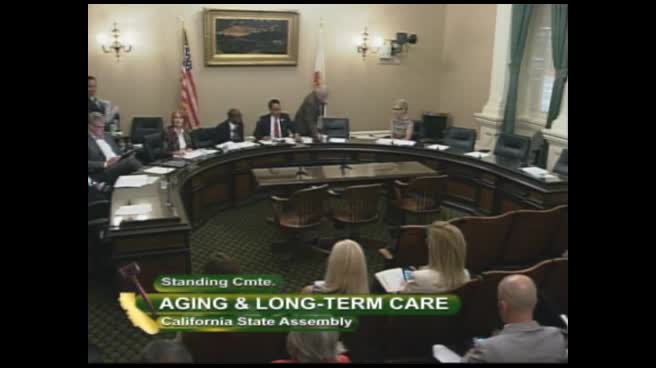 3MIN
Assembly Standing Committee on Aging and Long-Term Care
Bill Author
Bill Co-Author(s):