SB 462: Juveniles: case files: access.
- Session Year: 2017-2018
- House: Senate
- Latest Version Date: 2017-10-03
Existing law generally makes confidential information regarding a minor in proceedings in the juvenile court and related court proceedings and limits access to juvenile case files. Existing law authorizes only certain individuals to inspect a case file, including, among others, the attorneys for the parties, judges, referees, other hearing officers, probation officers, and law enforcement officers who are actively participating in criminal or juvenile proceedings involving the minor.
Existing law authorizes a person who is the subject of a juvenile court record, or the county probation officer, to petition the court for the sealing of the records relating to the persons case, including records in the custody of the juvenile court, the probation officer, or any other agencies, including law enforcement agencies and public officials as the petitioner alleges to have custody of the records. Under existing law, records sealed pursuant to this provision are generally not open to inspection, but may be accessed by a law enforcement agency, probation department, court, the Department of Justice, or other state or local agency that has custody of the sealed record for the limited purpose of complying with data collection or data reporting requirements.
This bill would similarly allow records contained in juvenile delinquency case files to be accessed by a law enforcement agency, probation department, court, the Department of Justice, or other state or local agency that has custody of the case file and juvenile record for the limited purpose of complying with data collection or data reporting requirements. The bill would allow the juvenile court, upon the request of the chief probation officer, to authorize a probation department to access and provide data contained in juvenile delinquency case files for the purpose of sharing data or conducting or facilitating research on juvenile justice populations, as specified.
Existing law generally makes confidential information regarding a minor in proceedings in the juvenile court and related court proceedings and limits access to juvenile case files. Existing law authorizes only certain individuals to inspect a case file, including, among others, the attorneys for the parties, judges, referees, other hearing officers, probation officers, and law enforcement officers who are actively participating in criminal or juvenile proceedings involving the minor.
Existing law authorizes a person who is the subject of a juvenile court record, or the county probation officer, to petition the court for the sealing of the records relating to the persons case, including records in the custody of the juvenile court, the probation officer, or any other agencies, including law enforcement agencies and public officials as the petitioner alleges to have custody of the records. Under existing law, records sealed pursuant to this provision are generally not open to inspection, but may be accessed by a law enforcement agency, probation department, court, the Department of Justice, or other state or local agency that has custody of the sealed record for the limited purpose of complying with data collection or data reporting requirements.
This bill would similarly allow records contained in juvenile delinquency case files to be accessed by a law enforcement agency, probation department, court, the Department of Justice, or other state or local agency that has custody of the case file and juvenile record for the limited purpose of complying with data collection or data reporting requirements. The bill would allow the juvenile court, upon the request of the chief probation officer, to authorize a probation department to access and provide data contained in juvenile delinquency case files to a program evaluator, researcher, or research organization for the purpose of sharing data or conducting or facilitating research on juvenile justice populations, as specified.
Existing law generally makes confidential information regarding a minor in proceedings in the juvenile court and related court proceedings and limits access to juvenile case files. Existing law authorizes only certain individuals to inspect a case file, including, among others, the attorneys for the parties, judges, referees, other hearing officers, probation officers, and law enforcement officers who are actively participating in criminal or juvenile proceedings involving the minor.
Existing law authorizes a person who is the subject of a juvenile court record, or the county probation officer, to petition the court for the sealing of the records relating to the persons case, including records in the custody of the juvenile court, the probation officer, or any other agencies, including law enforcement agencies and public officials as the petitioner alleges to have custody of the records. Under existing law, records sealed pursuant to this provision are generally not open to inspection, but may be accessed by a law enforcement agency, probation department, court, the Department of Justice, or other state or local agency that has custody of the sealed record for the limited purpose of complying with data collection or data reporting requirements.
This bill would similarly allow records contained in juvenile delinquency case files to be accessed by a law enforcement agency, probation department, court, the Department of Justice, or other state or local agency that has custody of the case file and juvenile record for the limited purpose of complying with data collection or data reporting. reporting requirements. The bill would allow the juvenile court, upon the request of the chief probation officer, to authorize a program evaluator, researcher, or research organization probation department to access information and provide data contained in juvenile delinquency case files to a program evaluator, researcher, or research organization for the purpose of conducting or facilitating research on juvenile justice populations, as specified.
Existing law generally makes confidential information regarding a minor in proceedings in the juvenile court and related court proceedings and limits access to juvenile case files. Existing law authorizes only certain individuals to inspect a case file, including, among others, the attorneys for the parties, judges, referees, other hearing officers, probation officers, and law enforcement officers who are actively participating in criminal or juvenile proceedings involving the minor.
Existing law authorizes a person who is the subject of a juvenile court record, or the county probation officer, to petition the court for the sealing of the records relating to the persons case, including records in the custody of the juvenile court, the probation officer, or any other agencies, including law enforcement agencies and public officials as the petitioner alleges to have custody of the records. Under existing law, records sealed pursuant to this provision are generally not open to inspection, but may be accessed by a law enforcement agency, probation department, court, the Department of Justice, or other state or local agency that has custody of the sealed record for the limited purpose of complying with data collection or data reporting requirements.
This bill would similarly allow records contained in juvenile case files to be accessed by a law enforcement agency, probation department, court, the Department of Justice, or other state or local agency that has custody of the sealed case file record for the limited purpose of complying with data collection or data reporting requirements. reporting. The bill would allow a court, the juvenile court, upon the request of the chief probation officer, to authorize a program evaluator, researcher, or research organization to access information contained in juvenile case files for the purpose of conducting research on juvenile justice populations, as specified.
Existing law generally makes confidential information regarding a minor in proceedings in the juvenile court and related court proceedings and limits access to juvenile case files. Existing law authorizes only certain individuals to inspect a case file, including, among others, the attorneys for the parties, judges, referees, other hearing officers, probation officers, and law enforcement officers who are actively participating in criminal or juvenile proceedings involving the minor.
Existing law authorizes a person who is the subject of a juvenile court record, or the county probation officer, to petition the court for the sealing of the records relating to the persons case, including records in the custody of the juvenile court, the probation officer, or any other agencies, including law enforcement agencies and public officials as the petitioner alleges to have custody of the records. Under existing law, records sealed pursuant to this provision are generally not open to inspection, but may be accessed by a law enforcement agency, probation department, court, the Department of Justice, or other state or local agency that has custody of the sealed record for the limited purpose of complying with data collection or data reporting requirements.
This bill would similarly allow juvenile case files to be accessed by a law enforcement agency, probation department, court, the Department of Justice, or other state or local agency that has custody of the sealed record for the limited purpose of complying with data collection or data reporting requirements. The bill would allow a court, upon the request of the chief probation officer, to authorize a program evaluator, researcher, or research organization to access information contained in juvenile case files for the purpose of conducting research on juvenile justice populations, as specified.
This bill would make a technical, nonsubstantive change to these provisions.Existing law authorizes a person who is the subject of a juvenile court record, or the county probation officer, to petition the court for the sealing of the records relating to the persons case, including records in the custody of the juvenile court, the probation officer, or any other agencies, including law enforcement agencies and public officials as the petitioner alleges to have custody of the records. Under existing law, records sealed pursuant to this provision are generally not open to inspection, but may be accessed by a law enforcement agency, probation department, court, the Department of Justice, or other state or local agency that has custody of the sealed record for the limited purpose of complying with data collection or data reporting requirements.
This bill would make a technical, nonsubstantive change to these provisions.
(a)(1)Records contained in a juvenile delinquency case file may be accessed by a law enforcement agency, probation department, court, the Department of Justice, or other state or local agency that has custody of the case file and juvenile record for the limited purpose of complying with data collection or data reporting requirements that are imposed under the terms of a grant or by another state or federal law. However, personally identifying information contained in a juvenile delinquency case file accessed under this subdivision shall not be released, disseminated, or published by or through an agency, department, court, or individual that has accessed or obtained information from the juvenile delinquency case file.
(2)Upon request of the chief probation officer, the juvenile court may authorize a probation department to access and provide data contained in juvenile delinquency case files and related juvenile records in the possession of the probation department for the purpose of data sharing or conducting or facilitating research on juvenile justice populations, practices, policies, or trends, if both of the following requirements are met:
(A)The court is satisfied that the research, evaluation, or study includes a sound methodology for the appropriate protection of the confidentiality of an individual whose juvenile delinquency case file is accessed pursuant to this subdivision.
(B)Personally identifying information relating to the individual whose juvenile delinquency case file is accessed pursuant to this subdivision is not further released, disseminated, or published by the probation department or by or through a program evaluator, researcher, or research organization that is retained by the department for research or evaluation purposes.
(3)For the purposes of this subdivision, personally identifying information has the same meaning as specified in subdivision (b) of Section 1798.79.8 of the Civil Code.
(b)(1)If information from a juvenile delinquency case record is being released for the purposes of human subject research, as defined in Part 46 of Title 45 of the Code of Federal Regulations, the probation department shall, after receiving authorization from the court but prior to the release of any information, enter into a formal agreement with the entity or entities conducting the research or evaluation that specifies what may and may not be done with the information disclosed.
(2)All human subject research governed by Part 46 of Title 45 of the Code of Federal Regulations shall be conducted in compliance with the protections set forth therein.
(c)The probation department shall not disclose any dependency information contained in a juvenile delinquency case record that pertains to a child who is currently receiving, or has previously received, public social services administered by the State Department of Social Services unless it has complied with the requirements for disclosure of that information set forth in Section 10850.
SECTION 1.Section 827 of the Welfare and Institutions Code is amended to read:827.(a)(1)Except as provided in Section 828, a case file may be inspected only by the following:(A)Court personnel.(B)The district attorney, a city attorney, or city prosecutor authorized to prosecute criminal or juvenile cases under state law.(C)The minor who is the subject of the proceeding.(D)The minors parents or guardian.(E)The attorneys for the parties, judges, referees, other hearing officers, probation officers, and law enforcement officers who are actively participating in criminal or juvenile proceedings involving the minor.(F)The county counsel, city attorney, or any other attorney representing the petitioning agency in a dependency action.(G)The superintendent or designee of the school district where the minor is enrolled or attending school.(H)Members of the child protective agencies as defined in Section 11165.9 of the Penal Code.(I)The State Department of Social Services, to carry out its duties pursuant to Division 9 (commencing with Section 10000), and Part 5 (commencing with Section 7900) of Division 12, of the Family Code to oversee and monitor county child welfare agencies, children in foster care or receiving foster care assistance, and out-of-state placements, Section 10850.4, and paragraph (2).(J)Authorized legal staff or special investigators who are peace officers who are employed by, or who are authorized representatives of, the State Department of Social Services, as necessary to the performance of their duties to inspect, license, and investigate community care facilities, and to ensure that the standards of care and services provided in those facilities are adequate and appropriate and to ascertain compliance with the rules and regulations to which the facilities are subject. The confidential information shall remain confidential except for purposes of inspection, licensing, or investigation pursuant to Chapter 3 (commencing with Section 1500) and Chapter 3.4 (commencing with Section 1596.70) of Division 2 of the Health and Safety Code, or a criminal, civil, or administrative proceeding in relation thereto. The confidential information may be used by the State Department of Social Services in a criminal, civil, or administrative proceeding. The confidential information shall be available only to the judge or hearing officer and to the parties to the case. Names that are confidential shall be listed in attachments separate to the general pleadings. The confidential information shall be sealed after the conclusion of the criminal, civil, or administrative hearings, and may not subsequently be released except in accordance with this subdivision. If the confidential information does not result in a criminal, civil, or administrative proceeding, it shall be sealed after the State Department of Social Services decides that no further action will be taken in the matter of suspected licensing violations. Except as otherwise provided in this subdivision, confidential information in the possession of the State Department of Social Services may not contain the name of the minor.(K)Members of childrens multidisciplinary teams, persons, or agencies providing treatment or supervision of the minor.(L)A judge, commissioner, or other hearing officer assigned to a family law case with issues concerning custody or visitation, or both, involving the minor, and the following persons, if actively participating in the family law case: a family court mediator assigned to a case involving the minor pursuant to Article 1 (commencing with Section 3160) of Chapter 11 of Part 2 of Division 8 of the Family Code, a court-appointed evaluator or a person conducting a court-connected child custody evaluation, investigation, or assessment pursuant to Section 3111 or 3118 of the Family Code, and counsel appointed for the minor in the family law case pursuant to Section 3150 of the Family Code. Prior to allowing counsel appointed for the minor in the family law case to inspect the file, the court clerk may require counsel to provide a certified copy of the court order appointing him or her as the minors counsel.(M)When acting within the scope of investigative duties of an active case, a statutorily authorized or court-appointed investigator who is conducting an investigation pursuant to Section 7663, 7851, or 9001 of the Family Code, or who is actively participating in a guardianship case involving a minor pursuant to Part 2 (commencing with Section 1500) of Division 4 of the Probate Code and acting within the scope of his or her duties in that case.(N)A local child support agency for the purpose of establishing paternity and establishing and enforcing child support orders.(O)Juvenile justice commissions as established under Section 225. The confidentiality provisions of Section 10850 shall apply to a juvenile justice commission and its members.(P)Any other person who may be designated by court order of the judge of the juvenile court upon filing a petition.(2)(A)Notwithstanding any other law and subject to subparagraph (A) of paragraph (3), juvenile case files, except those relating to matters within the jurisdiction of the court pursuant to Section 601 or 602, that pertain to a deceased child who was within the jurisdiction of the juvenile court pursuant to Section 300, shall be released to the public pursuant to an order by the juvenile court after a petition has been filed and interested parties have been afforded an opportunity to file an objection. Any information relating to another child or which could identify another child, except for information about the deceased, shall be redacted from the juvenile case file prior to release, unless a specific order is made by the juvenile court to the contrary. Except as provided in this paragraph, the presiding judge of the juvenile court may issue an order prohibiting or limiting access to the juvenile case file, or any portion thereof, of a deceased child only upon a showing by a preponderance of evidence that release of the juvenile case file or any portion thereof is detrimental to the safety, protection, or physical or emotional well-being of another child who is directly or indirectly connected to the juvenile case that is the subject of the petition.(B)This paragraph represents a presumption in favor of the release of documents when a child is deceased unless the statutory reasons for confidentiality are shown to exist.(C)If a child whose records are sought has died, and documents are sought pursuant to this paragraph, no weighing or balancing of the interests of those other than a child is permitted.(D)A petition filed under this paragraph shall be served on interested parties by the petitioner, if the petitioner is in possession of their identity and address, and on the custodian of records. Upon receiving a petition, the custodian of records shall serve a copy of the request upon all interested parties that have not been served by the petitioner or on the interested parties served by the petitioner if the custodian of records possesses information, such as a more recent address, indicating that the service by the petitioner may have been ineffective.(E)The custodian of records shall serve the petition within 10 calendar days of receipt. If any interested party, including the custodian of records, objects to the petition, the party shall file and serve the objection on the petitioning party no later than 15 calendar days after service of the petition.(F)The petitioning party shall have 10 calendar days to file any reply. The juvenile court shall set the matter for hearing no more than 60 calendar days from the date the petition is served on the custodian of records. The court shall render its decision within 30 days of the hearing. The matter shall be decided solely upon the basis of the petition and supporting exhibits and declarations, if any, the objection and any supporting exhibits or declarations, if any, and the reply and any supporting declarations or exhibits thereto, and argument at hearing. The court may solely upon its own motion order the appearance of witnesses. If no objection is filed to the petition, the court shall review the petition and issue its decision within 10 calendar days of the final day for filing the objection. Any order of the court shall be immediately reviewable by petition to the appellate court for the issuance of an extraordinary writ.(3)Access to juvenile case files pertaining to matters within the jurisdiction of the juvenile court pursuant to Section 300 shall be limited as follows:(A)If a juvenile case file, or any portion thereof, is privileged or confidential pursuant to any other state law or federal law or regulation, the requirements of that state law or federal law or regulation prohibiting or limiting release of the juvenile case file or any portions thereof shall prevail. Unless a person is listed in subparagraphs (A) to (O), inclusive, of paragraph (1) and is entitled to access under the other state law or federal law or regulation without a court order, all those seeking access, pursuant to other authorization, to portions of, or information relating to the contents of, juvenile case files protected under another state law or federal law or regulation, shall petition the juvenile court. The juvenile court may only release the portion of, or information relating to the contents of, juvenile case files protected by another state law or federal law or regulation if disclosure is not detrimental to the safety, protection, or physical or emotional well-being of a child who is directly or indirectly connected to the juvenile case that is the subject of the petition. This paragraph shall not be construed to limit the ability of the juvenile court to carry out its duties in conducting juvenile court proceedings.(B)Prior to the release of the juvenile case file or any portion thereof, the court shall afford due process, including a notice of and an opportunity to file an objection to the release of the record or report to all interested parties.(4)A juvenile case file, any portion thereof, and information relating to the content of the juvenile case file, may not be disseminated by the receiving agencies to any persons or agencies, other than those persons or agencies authorized to receive documents pursuant to this section. Further, a juvenile case file, any portion thereof, and information relating to the content of the juvenile case file, may not be made as an attachment to any other documents without the prior approval of the presiding judge of the juvenile court, unless it is used in connection with and in the course of a criminal investigation or a proceeding brought to declare a person a dependent child or ward of the juvenile court.(5)Individuals listed in subparagraphs (A), (B), (C), (D), (E), (F), (H), and (I) of paragraph (1) may also receive copies of the case file. In these circumstances, the requirements of paragraph (4) shall continue to apply to the information received.(b)(1)While the Legislature reaffirms its belief that juvenile court records, in general, should be confidential, it is the intent of the Legislature in enacting this subdivision to provide for a limited exception to juvenile court record confidentiality to promote more effective communication among juvenile courts, family courts, law enforcement agencies, and schools to ensure the rehabilitation of juvenile criminal offenders as well as to lessen the potential for drug use, violence, other forms of delinquency, and child abuse.(2)(A)Notwithstanding subdivision (a), written notice that a minor enrolled in a public school, kindergarten to grade 12, inclusive, has been found by a court of competent jurisdiction to have committed any felony or any misdemeanor involving curfew, gambling, alcohol, drugs, tobacco products, carrying of weapons, a sex offense listed in Section 290 of the Penal Code, assault or battery, larceny, vandalism, or graffiti shall be provided by the court, within seven days, to the superintendent of the school district of attendance. Written notice shall include only the offense found to have been committed by the minor and the disposition of the minors case. This notice shall be expeditiously transmitted by the district superintendent to the principal at the school of attendance. The principal shall expeditiously disseminate the information to those counselors directly supervising or reporting on the behavior or progress of the minor. In addition, the principal shall disseminate the information to any teacher or administrator directly supervising or reporting on the behavior or progress of the minor whom the principal believes needs the information to work with the pupil in an appropriate fashion, to avoid being needlessly vulnerable or to protect other persons from needless vulnerability.(B)Any information received by a teacher, counselor, or administrator under this subdivision shall be received in confidence for the limited purpose of rehabilitating the minor and protecting pupils and staff, and shall not be further disseminated by the teacher, counselor, or administrator, except insofar as communication with the juvenile, his or her parents or guardians, law enforcement personnel, and the juveniles probation officer is necessary to effectuate the juveniles rehabilitation or to protect pupils and staff.(C)An intentional violation of the confidentiality provisions of this paragraph is a misdemeanor punishable by a fine not to exceed five hundred dollars ($500).(3)If a minor is removed from public school as a result of the courts finding described in subdivision (b), the superintendent shall maintain the information in a confidential file and shall defer transmittal of the information received from the court until the minor is returned to public school. If the minor is returned to a school district other than the one from which the minor came, the parole or probation officer having jurisdiction over the minor shall so notify the superintendent of the last district of attendance, who shall transmit the notice received from the court to the superintendent of the new district of attendance.(c)Each probation report filed with the court concerning a minor whose record is subject to dissemination pursuant to subdivision (b) shall include on the face sheet the school at which the minor is currently enrolled. The county superintendent shall provide the court with a listing of all of the schools within each school district, within the county, along with the name and mailing address of each district superintendent.(d)(1)Each notice sent by the court pursuant to subdivision (b) shall be stamped with the instruction: Unlawful Dissemination Of This Information Is A Misdemeanor. Any information received from the court shall be kept in a separate confidential file at the school of attendance and shall be transferred to the minors subsequent schools of attendance and maintained until the minor graduates from high school, is released from juvenile court jurisdiction, or reaches 18 years of age, whichever occurs first. After that time the confidential record shall be destroyed. At any time after the date by which a record required to be destroyed by this section should have been destroyed, the minor or his or her parent or guardian shall have the right to make a written request to the principal of the school that the minors school records be reviewed to ensure that the record has been destroyed. Upon completion of any requested review and no later than 30 days after the request for the review was received, the principal or his or her designee shall respond in writing to the written request and either shall confirm that the record has been destroyed or, if the record has not been destroyed, shall explain why destruction has not yet occurred.(2)Except as provided in paragraph (2) of subdivision (b), no liability shall attach to any person who transmits or fails to transmit any notice or information required under subdivision (b).(e)For purposes of this section, a juvenile case file means a petition filed in any juvenile court proceeding, reports of the probation officer, and all other documents filed in that case or made available to the probation officer in making his or her report, or to the judge, referee, or other hearing officer, and thereafter retained by the probation officer, judge, referee, or other hearing officer.(f)The persons described in subparagraphs (A), (E), (F), (H), (K), (L), (M), and (N) of paragraph (1) of subdivision (a) include persons serving in a similar capacity for an Indian tribe, reservation, or tribal court when the case file involves a child who is a member of, or who is eligible for membership in, that tribe.(g)A case file that is covered by, or included in, an order of the court sealing a record pursuant to Section 781 or 786 may not be inspected or utilized except as specified by Section 781, 786, or 787.(h)(1)Records contained in a juvenile delinquency case file may be accessed by a law enforcement agency, probation department, court, the Department of Justice, or other state or local agency that has custody of the case file and juvenile record for the limited purpose of complying with data collection or data reporting requirements that are imposed under the terms of a grant or by another state or federal law. However, no personally identifying information from a juvenile delinquency case file accessed under this subdivision may be released, disseminated, or published by or through an agency, department, court, or individual that has accessed or obtained information from the juvenile delinquency case file.(2)Upon request of the chief probation officer, the juvenile court may authorize a probation department to access and provide data contained in juvenile delinquency case files and related juvenile records in the possession of the probation department to a program evaluator, researcher, or research organization for the purpose of conducting or facilitating research on juvenile justice populations, practices, policies, or trends, if both of the following requirements are met:(A)The court is satisfied that the research, evaluation, or study includes a sound methodology for the appropriate protection of the confidentiality of an individual whose juvenile delinquency case file is accessed pursuant to this subdivision.(B)Personally identifying information relating to the individual whose juvenile delinquency case file is accessed pursuant to this subdivision is not further released, disseminated, or published by the probation department or by or through a program evaluator, researcher, or research organization that is retained by the department for research or evaluation purposes.(3)For the purposes of this subdivision, personally identifying information has the same meaning as specified in Section 1798.79.8 of the Civil Code.(a)(1)Except as provided in Section 828, a case file may be inspected only by the following:
(A)Court personnel.
(B)The district attorney, a city attorney, or city prosecutor authorized to prosecute criminal or juvenile cases under state law.
(C)The minor who is the subject of the proceeding.
(D)The minors parents or guardian.
(E)The attorneys for the parties, judges, referees, other hearing officers, probation officers, and law enforcement officers who are actively participating in criminal or juvenile proceedings involving the minor.
(F)The county counsel, city attorney, or any other attorney representing the petitioning agency in a dependency action.
(G)The superintendent or designee of the school district where the minor is enrolled or attending school.
(H)Members of the child protective agencies as defined in Section 11165.9 of the Penal Code.
(I)The State Department of Social Services, to carry out its duties pursuant to Division 9 (commencing with Section 10000), and Part 5 (commencing with Section 7900) of Division 12, of the Family Code to oversee and monitor county child welfare agencies, children in foster care or receiving foster care assistance, and out-of-state placements, Section 10850.4, and paragraph (2).
(J)Authorized legal staff or special investigators who are peace officers who are employed by, or who are authorized representatives of, the State Department of Social Services, as necessary to the performance of their duties to inspect, license, and investigate community care facilities, and to ensure that the standards of care and services provided in those facilities are adequate and appropriate and to ascertain compliance with the rules and regulations to which the facilities are subject. The confidential information shall remain confidential except for purposes of inspection, licensing, or investigation pursuant to Chapter 3 (commencing with Section 1500) and Chapter 3.4 (commencing with Section 1596.70) of Division 2 of the Health and Safety Code, or a criminal, civil, or administrative proceeding in relation thereto. The confidential information may be used by the State Department of Social Services in a criminal, civil, or administrative proceeding. The confidential information shall be available only to the judge or hearing officer and to the parties to the case. Names that are confidential shall be listed in attachments separate to the general pleadings. The confidential information shall be sealed after the conclusion of the criminal, civil, or administrative hearings, and may not subsequently be released except in accordance with this subdivision. If the confidential information does not result in a criminal, civil, or administrative proceeding, it shall be sealed after the State Department of Social Services decides that no further action will be taken in the matter of suspected licensing violations. Except as otherwise provided in this subdivision, confidential information in the possession of the State Department of Social Services may not contain the name of the minor.
(K)Members of childrens multidisciplinary teams, persons, or agencies providing treatment or supervision of the minor.
(L)A judge, commissioner, or other hearing officer assigned to a family law case with issues concerning custody or visitation, or both, involving the minor, and the following persons, if actively participating in the family law case: a family court mediator assigned to a case involving the minor pursuant to Article 1 (commencing with Section 3160) of Chapter 11 of Part 2 of Division 8 of the Family Code, a court-appointed evaluator or a person conducting a court-connected child custody evaluation, investigation, or assessment pursuant to Section 3111 or 3118 of the Family Code, and counsel appointed for the minor in the family law case pursuant to Section 3150 of the Family Code. Prior to allowing counsel appointed for the minor in the family law case to inspect the file, the court clerk may require counsel to provide a certified copy of the court order appointing him or her as the minors counsel.
(M)When acting within the scope of investigative duties of an active case, a statutorily authorized or court-appointed investigator who is conducting an investigation pursuant to Section 7663, 7851, or 9001 of the Family Code, or who is actively participating in a guardianship case involving a minor pursuant to Part 2 (commencing with Section 1500) of Division 4 of the Probate Code and acting within the scope of his or her duties in that case.
(N)A local child support agency for the purpose of establishing paternity and establishing and enforcing child support orders.
(O)Juvenile justice commissions as established under Section 225. The confidentiality provisions of Section 10850 shall apply to a juvenile justice commission and its members.
(P)Any other person who may be designated by court order of the judge of the juvenile court upon filing a petition.
(2)(A)Notwithstanding any other law and subject to subparagraph (A) of paragraph (3), juvenile case files, except those relating to matters within the jurisdiction of the court pursuant to Section 601 or 602, that pertain to a deceased child who was within the jurisdiction of the juvenile court pursuant to Section 300, shall be released to the public pursuant to an order by the juvenile court after a petition has been filed and interested parties have been afforded an opportunity to file an objection. Any information relating to another child or which could identify another child, except for information about the deceased, shall be redacted from the juvenile case file prior to release, unless a specific order is made by the juvenile court to the contrary. Except as provided in this paragraph, the presiding judge of the juvenile court may issue an order prohibiting or limiting access to the juvenile case file, or any portion thereof, of a deceased child only upon a showing by a preponderance of evidence that release of the juvenile case file or any portion thereof is detrimental to the safety, protection, or physical or emotional well-being of another child who is directly or indirectly connected to the juvenile case that is the subject of the petition.
(B)This paragraph represents a presumption in favor of the release of documents when a child is deceased unless the statutory reasons for confidentiality are shown to exist.
(C)If a child whose records are sought has died, and documents are sought pursuant to this paragraph, no weighing or balancing of the interests of those other than a child is permitted.
(D)A petition filed under this paragraph shall be served on interested parties by the petitioner, if the petitioner is in possession of their identity and address, and on the custodian of records. Upon receiving a petition, the custodian of records shall serve a copy of the request upon all interested parties that have not been served by the petitioner or on the interested parties served by the petitioner if the custodian of records possesses information, such as a more recent address, indicating that the service by the petitioner may have been ineffective.
(E)The custodian of records shall serve the petition within 10 calendar days of receipt. If any interested party, including the custodian of records, objects to the petition, the party shall file and serve the objection on the petitioning party no later than 15 calendar days after service of the petition.
(F)The petitioning party shall have 10 calendar days to file any reply. The juvenile court shall set the matter for hearing no more than 60 calendar days from the date the petition is served on the custodian of records. The court shall render its decision within 30 days of the hearing. The matter shall be decided solely upon the basis of the petition and supporting exhibits and declarations, if any, the objection and any supporting exhibits or declarations, if any, and the reply and any supporting declarations or exhibits thereto, and argument at hearing. The court may solely upon its own motion order the appearance of witnesses. If no objection is filed to the petition, the court shall review the petition and issue its decision within 10 calendar days of the final day for filing the objection. Any order of the court shall be immediately reviewable by petition to the appellate court for the issuance of an extraordinary writ.
(3)Access to juvenile case files pertaining to matters within the jurisdiction of the juvenile court pursuant to Section 300 shall be limited as follows:
(A)If a juvenile case file, or any portion thereof, is privileged or confidential pursuant to any other state law or federal law or regulation, the requirements of that state law or federal law or regulation prohibiting or limiting release of the juvenile case file or any portions thereof shall prevail. Unless a person is listed in subparagraphs (A) to (O), inclusive, of paragraph (1) and is entitled to access under the other state law or federal law or regulation without a court order, all those seeking access, pursuant to other authorization, to portions of, or information relating to the contents of, juvenile case files protected under another state law or federal law or regulation, shall petition the juvenile court. The juvenile court may only release the portion of, or information relating to the contents of, juvenile case files protected by another state law or federal law or regulation if disclosure is not detrimental to the safety, protection, or physical or emotional well-being of a child who is directly or indirectly connected to the juvenile case that is the subject of the petition. This paragraph shall not be construed to limit the ability of the juvenile court to carry out its duties in conducting juvenile court proceedings.
(B)Prior to the release of the juvenile case file or any portion thereof, the court shall afford due process, including a notice of and an opportunity to file an objection to the release of the record or report to all interested parties.
(4)A juvenile case file, any portion thereof, and information relating to the content of the juvenile case file, may not be disseminated by the receiving agencies to any persons or agencies, other than those persons or agencies authorized to receive documents pursuant to this section. Further, a juvenile case file, any portion thereof, and information relating to the content of the juvenile case file, may not be made as an attachment to any other documents without the prior approval of the presiding judge of the juvenile court, unless it is used in connection with and in the course of a criminal investigation or a proceeding brought to declare a person a dependent child or ward of the juvenile court.
(5)Individuals listed in subparagraphs (A), (B), (C), (D), (E), (F), (H), and (I) of paragraph (1) may also receive copies of the case file. In these circumstances, the requirements of paragraph (4) shall continue to apply to the information received.
(b)(1)While the Legislature reaffirms its belief that juvenile court records, in general, should be confidential, it is the intent of the Legislature in enacting this subdivision to provide for a limited exception to juvenile court record confidentiality to promote more effective communication among juvenile courts, family courts, law enforcement agencies, and schools to ensure the rehabilitation of juvenile criminal offenders as well as to lessen the potential for drug use, violence, other forms of delinquency, and child abuse.
(2)(A)Notwithstanding subdivision (a), written notice that a minor enrolled in a public school, kindergarten to grade 12, inclusive, has been found by a court of competent jurisdiction to have committed any felony or any misdemeanor involving curfew, gambling, alcohol, drugs, tobacco products, carrying of weapons, a sex offense listed in Section 290 of the Penal Code, assault or battery, larceny, vandalism, or graffiti shall be provided by the court, within seven days, to the superintendent of the school district of attendance. Written notice shall include only the offense found to have been committed by the minor and the disposition of the minors case. This notice shall be expeditiously transmitted by the district superintendent to the principal at the school of attendance. The principal shall expeditiously disseminate the information to those counselors directly supervising or reporting on the behavior or progress of the minor. In addition, the principal shall disseminate the information to any teacher or administrator directly supervising or reporting on the behavior or progress of the minor whom the principal believes needs the information to work with the pupil in an appropriate fashion, to avoid being needlessly vulnerable or to protect other persons from needless vulnerability.
(B)Any information received by a teacher, counselor, or administrator under this subdivision shall be received in confidence for the limited purpose of rehabilitating the minor and protecting pupils and staff, and shall not be further disseminated by the teacher, counselor, or administrator, except insofar as communication with the juvenile, his or her parents or guardians, law enforcement personnel, and the juveniles probation officer is necessary to effectuate the juveniles rehabilitation or to protect pupils and staff.
(C)An intentional violation of the confidentiality provisions of this paragraph is a misdemeanor punishable by a fine not to exceed five hundred dollars ($500).
(3)If a minor is removed from public school as a result of the courts finding described in subdivision (b), the superintendent shall maintain the information in a confidential file and shall defer transmittal of the information received from the court until the minor is returned to public school. If the minor is returned to a school district other than the one from which the minor came, the parole or probation officer having jurisdiction over the minor shall so notify the superintendent of the last district of attendance, who shall transmit the notice received from the court to the superintendent of the new district of attendance.
(c)Each probation report filed with the court concerning a minor whose record is subject to dissemination pursuant to subdivision (b) shall include on the face sheet the school at which the minor is currently enrolled. The county superintendent shall provide the court with a listing of all of the schools within each school district, within the county, along with the name and mailing address of each district superintendent.
(d)(1)Each notice sent by the court pursuant to subdivision (b) shall be stamped with the instruction: Unlawful Dissemination Of This Information Is A Misdemeanor. Any information received from the court shall be kept in a separate confidential file at the school of attendance and shall be transferred to the minors subsequent schools of attendance and maintained until the minor graduates from high school, is released from juvenile court jurisdiction, or reaches 18 years of age, whichever occurs first. After that time the confidential record shall be destroyed. At any time after the date by which a record required to be destroyed by this section should have been destroyed, the minor or his or her parent or guardian shall have the right to make a written request to the principal of the school that the minors school records be reviewed to ensure that the record has been destroyed. Upon completion of any requested review and no later than 30 days after the request for the review was received, the principal or his or her designee shall respond in writing to the written request and either shall confirm that the record has been destroyed or, if the record has not been destroyed, shall explain why destruction has not yet occurred.
(2)Except as provided in paragraph (2) of subdivision (b), no liability shall attach to any person who transmits or fails to transmit any notice or information required under subdivision (b).
(e)For purposes of this section, a juvenile case file means a petition filed in any juvenile court proceeding, reports of the probation officer, and all other documents filed in that case or made available to the probation officer in making his or her report, or to the judge, referee, or other hearing officer, and thereafter retained by the probation officer, judge, referee, or other hearing officer.
(f)The persons described in subparagraphs (A), (E), (F), (H), (K), (L), (M), and (N) of paragraph (1) of subdivision (a) include persons serving in a similar capacity for an Indian tribe, reservation, or tribal court when the case file involves a child who is a member of, or who is eligible for membership in, that tribe.
(g)A case file that is covered by, or included in, an order of the court sealing a record pursuant to Section 781 or 786 may not be inspected or utilized except as specified by Section 781, 786, or 787.
(h)(1)Records contained in a juvenile delinquency case file may be accessed by a law enforcement agency, probation department, court, the Department of Justice, or other state or local agency that has custody of the case file and juvenile record for the limited purpose of complying with data collection or data reporting requirements that are imposed by under the terms of a grant requirement or by another state or federal law. However, no personally identifying information from a juvenile delinquency case file accessed under this subdivision may be released, disseminated, or published by or through an agency, department, court, or individual that has accessed or obtained information from the juvenile delinquency case file.
(2)Upon request of the chief probation officer, the juvenile court may authorize a program evaluator, researcher, or research organization to access information contained in juvenile case files a probation department to access and provide data contained in juvenile delinquency case files and related juvenile records in the possession of the probation department to a program evaluator, researcher, or research organization for the purpose of conducting or facilitating research on juvenile justice populations, practices, policies, or trends, if both of the following requirements are met:
(A)The court is satisfied that the research, evaluation, or study includes a sound methodology for the appropriate protection of the confidentiality of an individual whose juvenile delinquency case file is accessed pursuant to this subdivision.
(B)Personally identifying information relating to the individual whose juvenile delinquency case file is accessed pursuant to this subdivision is not further released, disseminated, or published by the probation department or by or through the a program evaluator, researcher, or research organization. For organization that is retained by the department for research or evaluation purposes.
(3)For the purposes of this section, subdivision, personally identifying information has the same meaning as specified in Section 1798.79.8 of the Civil Code.
(a)(1)Except as provided in Section 828, a case file may be inspected only by the following:
(A)Court personnel.
(B)The district attorney, a city attorney, or city prosecutor authorized to prosecute criminal or juvenile cases under state law.
(C)The minor who is the subject of the proceeding.
(D)The minors parents or guardian.
(E)The attorneys for the parties, judges, referees, other hearing officers, probation officers, and law enforcement officers who are actively participating in criminal or juvenile proceedings involving the minor.
(F)The county counsel, city attorney, or any other attorney representing the petitioning agency in a dependency action.
(G)The superintendent or designee of the school district where the minor is enrolled or attending school.
(H)Members of the child protective agencies as defined in Section 11165.9 of the Penal Code.
(I)The State Department of Social Services, to carry out its duties pursuant to Division 9 (commencing with Section 10000), and Part 5 (commencing with Section 7900) of Division 12, of the Family Code to oversee and monitor county child welfare agencies, children in foster care or receiving foster care assistance, and out-of-state placements, Section 10850.4, and paragraph (2).
(J)Authorized legal staff or special investigators who are peace officers who are employed by, or who are authorized representatives of, the State Department of Social Services, as necessary to the performance of their duties to inspect, license, and investigate community care facilities, and to ensure that the standards of care and services provided in those facilities are adequate and appropriate and to ascertain compliance with the rules and regulations to which the facilities are subject. The confidential information shall remain confidential except for purposes of inspection, licensing, or investigation pursuant to Chapter 3 (commencing with Section 1500) and Chapter 3.4 (commencing with Section 1596.70) of Division 2 of the Health and Safety Code, or a criminal, civil, or administrative proceeding in relation thereto. The confidential information may be used by the State Department of Social Services in a criminal, civil, or administrative proceeding. The confidential information shall be available only to the judge or hearing officer and to the parties to the case. Names that are confidential shall be listed in attachments separate to the general pleadings. The confidential information shall be sealed after the conclusion of the criminal, civil, or administrative hearings, and may not subsequently be released except in accordance with this subdivision. If the confidential information does not result in a criminal, civil, or administrative proceeding, it shall be sealed after the State Department of Social Services decides that no further action will be taken in the matter of suspected licensing violations. Except as otherwise provided in this subdivision, confidential information in the possession of the State Department of Social Services may not contain the name of the minor.
(K)Members of childrens multidisciplinary teams, persons, or agencies providing treatment or supervision of the minor.
(L)A judge, commissioner, or other hearing officer assigned to a family law case with issues concerning custody or visitation, or both, involving the minor, and the following persons, if actively participating in the family law case: a family court mediator assigned to a case involving the minor pursuant to Article 1 (commencing with Section 3160) of Chapter 11 of Part 2 of Division 8 of the Family Code, a court-appointed evaluator or a person conducting a court-connected child custody evaluation, investigation, or assessment pursuant to Section 3111 or 3118 of the Family Code, and counsel appointed for the minor in the family law case pursuant to Section 3150 of the Family Code. Prior to allowing counsel appointed for the minor in the family law case to inspect the file, the court clerk may require counsel to provide a certified copy of the court order appointing him or her as the minors counsel.
(M)When acting within the scope of investigative duties of an active case, a statutorily authorized or court-appointed investigator who is conducting an investigation pursuant to Section 7663, 7851, or 9001 of the Family Code, or who is actively participating in a guardianship case involving a minor pursuant to Part 2 (commencing with Section 1500) of Division 4 of the Probate Code and acting within the scope of his or her duties in that case.
(N)A local child support agency for the purpose of establishing paternity and establishing and enforcing child support orders.
(O)Juvenile justice commissions as established under Section 225. The confidentiality provisions of Section 10850 shall apply to a juvenile justice commission and its members.
(P)Any other person who may be designated by court order of the judge of the juvenile court upon filing a petition.
(2)(A)Notwithstanding any other law and subject to subparagraph (A) of paragraph (3), juvenile case files, except those relating to matters within the jurisdiction of the court pursuant to Section 601 or 602, that pertain to a deceased child who was within the jurisdiction of the juvenile court pursuant to Section 300, shall be released to the public pursuant to an order by the juvenile court after a petition has been filed and interested parties have been afforded an opportunity to file an objection. Any information relating to another child or which could identify another child, except for information about the deceased, shall be redacted from the juvenile case file prior to release, unless a specific order is made by the juvenile court to the contrary. Except as provided in this paragraph, the presiding judge of the juvenile court may issue an order prohibiting or limiting access to the juvenile case file, or any portion thereof, of a deceased child only upon a showing by a preponderance of evidence that release of the juvenile case file or any portion thereof is detrimental to the safety, protection, or physical or emotional well-being of another child who is directly or indirectly connected to the juvenile case that is the subject of the petition.
(B)This paragraph represents a presumption in favor of the release of documents when a child is deceased unless the statutory reasons for confidentiality are shown to exist.
(C)If a child whose records are sought has died, and documents are sought pursuant to this paragraph, no weighing or balancing of the interests of those other than a child is permitted.
(D)A petition filed under this paragraph shall be served on interested parties by the petitioner, if the petitioner is in possession of their identity and address, and on the custodian of records. Upon receiving a petition, the custodian of records shall serve a copy of the request upon all interested parties that have not been served by the petitioner or on the interested parties served by the petitioner if the custodian of records possesses information, such as a more recent address, indicating that the service by the petitioner may have been ineffective.
(E)The custodian of records shall serve the petition within 10 calendar days of receipt. If any interested party, including the custodian of records, objects to the petition, the party shall file and serve the objection on the petitioning party no later than 15 calendar days after service of the petition.
(F)The petitioning party shall have 10 calendar days to file any reply. The juvenile court shall set the matter for hearing no more than 60 calendar days from the date the petition is served on the custodian of records. The court shall render its decision within 30 days of the hearing. The matter shall be decided solely upon the basis of the petition and supporting exhibits and declarations, if any, the objection and any supporting exhibits or declarations, if any, and the reply and any supporting declarations or exhibits thereto, and argument at hearing. The court may solely upon its own motion order the appearance of witnesses. If no objection is filed to the petition, the court shall review the petition and issue its decision within 10 calendar days of the final day for filing the objection. Any order of the court shall be immediately reviewable by petition to the appellate court for the issuance of an extraordinary writ.
(3)Access to juvenile case files pertaining to matters within the jurisdiction of the juvenile court pursuant to Section 300 shall be limited as follows:
(A)If a juvenile case file, or any portion thereof, is privileged or confidential pursuant to any other state law or federal law or regulation, the requirements of that state law or federal law or regulation prohibiting or limiting release of the juvenile case file or any portions thereof shall prevail. Unless a person is listed in subparagraphs (A) to (O), inclusive, of paragraph (1) and is entitled to access under the other state law or federal law or regulation without a court order, all those seeking access, pursuant to other authorization, to portions of, or information relating to the contents of, juvenile case files protected under another state law or federal law or regulation, shall petition the juvenile court. The juvenile court may only release the portion of, or information relating to the contents of, juvenile case files protected by another state law or federal law or regulation if disclosure is not detrimental to the safety, protection, or physical or emotional well-being of a child who is directly or indirectly connected to the juvenile case that is the subject of the petition. This paragraph shall not be construed to limit the ability of the juvenile court to carry out its duties in conducting juvenile court proceedings.
(B)Prior to the release of the juvenile case file or any portion thereof, the court shall afford due process, including a notice of and an opportunity to file an objection to the release of the record or report to all interested parties.
(4)A juvenile case file, any portion thereof, and information relating to the content of the juvenile case file, may not be disseminated by the receiving agencies to any persons or agencies, other than those persons or agencies authorized to receive documents pursuant to this section. Further, a juvenile case file, any portion thereof, and information relating to the content of the juvenile case file, may not be made as an attachment to any other documents without the prior approval of the presiding judge of the juvenile court, unless it is used in connection with and in the course of a criminal investigation or a proceeding brought to declare a person a dependent child or ward of the juvenile court.
(5)Individuals listed in subparagraphs (A), (B), (C), (D), (E), (F), (H), and (I) of paragraph (1) may also receive copies of the case file. In these circumstances, the requirements of paragraph (4) shall continue to apply to the information received.
(b)(1)While the Legislature reaffirms its belief that juvenile court records, in general, should be confidential, it is the intent of the Legislature in enacting this subdivision to provide for a limited exception to juvenile court record confidentiality to promote more effective communication among juvenile courts, family courts, law enforcement agencies, and schools to ensure the rehabilitation of juvenile criminal offenders as well as to lessen the potential for drug use, violence, other forms of delinquency, and child abuse.
(2)(A)Notwithstanding subdivision (a), written notice that a minor enrolled in a public school, kindergarten to grade 12, inclusive, has been found by a court of competent jurisdiction to have committed any felony or any misdemeanor involving curfew, gambling, alcohol, drugs, tobacco products, carrying of weapons, a sex offense listed in Section 290 of the Penal Code, assault or battery, larceny, vandalism, or graffiti shall be provided by the court, within seven days, to the superintendent of the school district of attendance. Written notice shall include only the offense found to have been committed by the minor and the disposition of the minors case. This notice shall be expeditiously transmitted by the district superintendent to the principal at the school of attendance. The principal shall expeditiously disseminate the information to those counselors directly supervising or reporting on the behavior or progress of the minor. In addition, the principal shall disseminate the information to any teacher or administrator directly supervising or reporting on the behavior or progress of the minor whom the principal believes needs the information to work with the pupil in an appropriate fashion, to avoid being needlessly vulnerable or to protect other persons from needless vulnerability.
(B)Any information received by a teacher, counselor, or administrator under this subdivision shall be received in confidence for the limited purpose of rehabilitating the minor and protecting students pupils and staff, and shall not be further disseminated by the teacher, counselor, or administrator, except insofar as communication with the juvenile, his or her parents or guardians, law enforcement personnel, and the juveniles probation officer is necessary to effectuate the juveniles rehabilitation or to protect students pupils and staff.
(C)An intentional violation of the confidentiality provisions of this paragraph is a misdemeanor punishable by a fine not to exceed five hundred dollars ($500).
(3)If a minor is removed from public school as a result of the courts finding described in subdivision (b), the superintendent shall maintain the information in a confidential file and shall defer transmittal of the information received from the court until the minor is returned to public school. If the minor is returned to a school district other than the one from which the minor came, the parole or probation officer having jurisdiction over the minor shall so notify the superintendent of the last district of attendance, who shall transmit the notice received from the court to the superintendent of the new district of attendance.
(c)Each probation report filed with the court concerning a minor whose record is subject to dissemination pursuant to subdivision (b) shall include on the face sheet the school at which the minor is currently enrolled. The county superintendent shall provide the court with a listing of all of the schools within each school district, within the county, along with the name and mailing address of each district superintendent.
(d)(1)Each notice sent by the court pursuant to subdivision (b) shall be stamped with the instruction: Unlawful Dissemination Of This Information Is A Misdemeanor. Any information received from the court shall be kept in a separate confidential file at the school of attendance and shall be transferred to the minors subsequent schools of attendance and maintained until the minor graduates from high school, is released from juvenile court jurisdiction, or reaches the age of 18 years, 18 years of age, whichever occurs first. After that time the confidential record shall be destroyed. At any time after the date by which a record required to be destroyed by this section should have been destroyed, the minor or his or her parent or guardian shall have the right to make a written request to the principal of the school that the minors school records be reviewed to ensure that the record has been destroyed. Upon completion of any requested review and no later than 30 days after the request for the review was received, the principal or his or her designee shall respond in writing to the written request and either shall confirm that the record has been destroyed or, if the record has not been destroyed, shall explain why destruction has not yet occurred.
(2)Except as provided in paragraph (2) of subdivision (b), no liability shall attach to any person who transmits or fails to transmit any notice or information required under subdivision (b).
(e)For purposes of this section, a juvenile case file means a petition filed in any juvenile court proceeding, reports of the probation officer, and all other documents filed in that case or made available to the probation officer in making his or her report, or to the judge, referee, or other hearing officer, and thereafter retained by the probation officer, judge, referee, or other hearing officer.
(f)The persons described in subparagraphs (A), (E), (F), (H), (K), (L), (M), and (N) of paragraph (1) of subdivision (a) include persons serving in a similar capacity for an Indian tribe, reservation, or tribal court when the case file involves a child who is a member of, or who is eligible for membership in, that tribe.
(g)A case file that is covered by, or included in, an order of the court sealing a record pursuant to Section 781 or 786 may not be inspected or utilized except as specified by Section 781 or 786. 781, 786, or 787.
(h)(1)Notwithstanding any other law, Records contained in a juvenile case file may be accessed by a law enforcement agency, probation department, court, the Department of Justice, or other state or local agency that has custody of the sealed case file record for the limited purpose of complying with data collection or data reporting requirements that are imposed by a grant requirement or by another state or federal law. However, no personally identifying information from a juvenile case file accessed under this subdivision may be released, disseminated, or published by or through an agency, department, court, or individual that has accessed or obtained information from the juvenile case file.
(2)Upon request of the chief probation officer, a the juvenile court may authorize a program evaluator, researcher, or research organization to access information contained in juvenile case files for the purpose of conducting research on juvenile justice populations, practices, policies, or trends, if both of the following are true: requirements are met:
(A)The court is satisfied that the research project research, evaluation, or study includes a sound methodology for the appropriate protection of the confidentiality of an individual whose juvenile case file is accessed pursuant to this subdivision.
(B)Personally identifying information relating to the individual whose juvenile case file is accessed pursuant to this subdivision is not further released, disseminated, or published by or through the program evaluator, researcher, or research organization. For the purposes of this section section, personally identifying information has the same meaning as specified in Section 1798.79.8 of the Civil Code.
(a)(1)Except as provided in Section 828, a case file may be inspected only by the following:
(A)Court personnel.
(B)The district attorney, a city attorney, or city prosecutor authorized to prosecute criminal or juvenile cases under state law.
(C)The minor who is the subject of the proceeding.
(D)The minors parents or guardian.
(E)The attorneys for the parties, judges, referees, other hearing officers, probation officers, and law enforcement officers who are actively participating in criminal or juvenile proceedings involving the minor.
(F)The county counsel, city attorney, or any other attorney representing the petitioning agency in a dependency action.
(G)The superintendent or designee of the school district where the minor is enrolled or attending school.
(H)Members of the child protective agencies as defined in Section 11165.9 of the Penal Code.
(I)The State Department of Social Services, to carry out its duties pursuant to Division 9 (commencing with Section 10000), and Part 5 (commencing with Section 7900) of Division 12, of the Family Code to oversee and monitor county child welfare agencies, children in foster care or receiving foster care assistance, and out-of-state placements, Section 10850.4, and paragraph (2).
(J)Authorized legal staff or special investigators who are peace officers who are employed by, or who are authorized representatives of, the State Department of Social Services, as necessary to the performance of their duties to inspect, license, and investigate community care facilities, and to ensure that the standards of care and services provided in those facilities are adequate and appropriate and to ascertain compliance with the rules and regulations to which the facilities are subject. The confidential information shall remain confidential except for purposes of inspection, licensing, or investigation pursuant to Chapter 3 (commencing with Section 1500) and Chapter 3.4 (commencing with Section 1596.70) of Division 2 of the Health and Safety Code, or a criminal, civil, or administrative proceeding in relation thereto. The confidential information may be used by the State Department of Social Services in a criminal, civil, or administrative proceeding. The confidential information shall be available only to the judge or hearing officer and to the parties to the case. Names that are confidential shall be listed in attachments separate to the general pleadings. The confidential information shall be sealed after the conclusion of the criminal, civil, or administrative hearings, and may not subsequently be released except in accordance with this subdivision. If the confidential information does not result in a criminal, civil, or administrative proceeding, it shall be sealed after the State Department of Social Services decides that no further action will be taken in the matter of suspected licensing violations. Except as otherwise provided in this subdivision, confidential information in the possession of the State Department of Social Services may not contain the name of the minor.
(K)Members of childrens multidisciplinary teams, persons, or agencies providing treatment or supervision of the minor.
(L)A judge, commissioner, or other hearing officer assigned to a family law case with issues concerning custody or visitation, or both, involving the minor, and the following persons, if actively participating in the family law case: a family court mediator assigned to a case involving the minor pursuant to Article 1 (commencing with Section 3160) of Chapter 11 of Part 2 of Division 8 of the Family Code, a court-appointed evaluator or a person conducting a court-connected child custody evaluation, investigation, or assessment pursuant to Section 3111 or 3118 of the Family Code, and counsel appointed for the minor in the family law case pursuant to Section 3150 of the Family Code. Prior to allowing counsel appointed for the minor in the family law case to inspect the file, the court clerk may require counsel to provide a certified copy of the court order appointing him or her as the minors counsel.
(M)When acting within the scope of investigative duties of an active case, a statutorily authorized or court-appointed investigator who is conducting an investigation pursuant to Section 7663, 7851, or 9001 of the Family Code, or who is actively participating in a guardianship case involving a minor pursuant to Part 2 (commencing with Section 1500) of Division 4 of the Probate Code and acting within the scope of his or her duties in that case.
(N)A local child support agency for the purpose of establishing paternity and establishing and enforcing child support orders.
(O)Juvenile justice commissions as established under Section 225. The confidentiality provisions of Section 10850 shall apply to a juvenile justice commission and its members.
(P)Any other person who may be designated by court order of the judge of the juvenile court upon filing a petition.
(2)(A)Notwithstanding any other law and subject to subparagraph (A) of paragraph (3), juvenile case files, except those relating to matters within the jurisdiction of the court pursuant to Section 601 or 602, that pertain to a deceased child who was within the jurisdiction of the juvenile court pursuant to Section 300, shall be released to the public pursuant to an order by the juvenile court after a petition has been filed and interested parties have been afforded an opportunity to file an objection. Any information relating to another child or which could identify another child, except for information about the deceased, shall be redacted from the juvenile case file prior to release, unless a specific order is made by the juvenile court to the contrary. Except as provided in this paragraph, the presiding judge of the juvenile court may issue an order prohibiting or limiting access to the juvenile case file, or any portion thereof, of a deceased child only upon a showing by a preponderance of evidence that release of the juvenile case file or any portion thereof is detrimental to the safety, protection, or physical or emotional well-being of another child who is directly or indirectly connected to the juvenile case that is the subject of the petition.
(B)This paragraph represents a presumption in favor of the release of documents when a child is deceased unless the statutory reasons for confidentiality are shown to exist.
(C)If a child whose records are sought has died, and documents are sought pursuant to this paragraph, no weighing or balancing of the interests of those other than a child is permitted.
(D)A petition filed under this paragraph shall be served on interested parties by the petitioner, if the petitioner is in possession of their identity and address, and on the custodian of records. Upon receiving a petition, the custodian of records shall serve a copy of the request upon all interested parties that have not been served by the petitioner or on the interested parties served by the petitioner if the custodian of records possesses information, such as a more recent address, indicating that the service by the petitioner may have been ineffective.
(E)The custodian of records shall serve the petition within 10 calendar days of receipt. If any interested party, including the custodian of records, objects to the petition, the party shall file and serve the objection on the petitioning party no later than 15 calendar days after service of the petition.
(F)The petitioning party shall have 10 calendar days to file any reply. The juvenile court shall set the matter for hearing no more than 60 calendar days from the date the petition is served on the custodian of records. The court shall render its decision within 30 days of the hearing. The matter shall be decided solely upon the basis of the petition and supporting exhibits and declarations, if any, the objection and any supporting exhibits or declarations, if any, and the reply and any supporting declarations or exhibits thereto, and argument at hearing. The court may solely upon its own motion order the appearance of witnesses. If no objection is filed to the petition, the court shall review the petition and issue its decision within 10 calendar days of the final day for filing the objection. Any order of the court shall be immediately reviewable by petition to the appellate court for the issuance of an extraordinary writ.
(3)Access to juvenile case files pertaining to matters within the jurisdiction of the juvenile court pursuant to Section 300 shall be limited as follows:
(A)If a juvenile case file, or any portion thereof, is privileged or confidential pursuant to any other state law or federal law or regulation, the requirements of that state law or federal law or regulation prohibiting or limiting release of the juvenile case file or any portions thereof shall prevail. Unless a person is listed in subparagraphs (A) to (O), inclusive, of paragraph (1) and is entitled to access under the other state law or federal law or regulation without a court order, all those seeking access, pursuant to other authorization, to portions of, or information relating to the contents of, juvenile case files protected under another state law or federal law or regulation, shall petition the juvenile court. The juvenile court may only release the portion of, or information relating to the contents of, juvenile case files protected by another state law or federal law or regulation if disclosure is not detrimental to the safety, protection, or physical or emotional well-being of a child who is directly or indirectly connected to the juvenile case that is the subject of the petition. This paragraph shall not be construed to limit the ability of the juvenile court to carry out its duties in conducting juvenile court proceedings.
(B)Prior to the release of the juvenile case file or any portion thereof, the court shall afford due process, including a notice of and an opportunity to file an objection to the release of the record or report to all interested parties.
(4)A juvenile case file, any portion thereof, and information relating to the content of the juvenile case file, may not be disseminated by the receiving agencies to any persons or agencies, other than those persons or agencies authorized to receive documents pursuant to this section. Further, a juvenile case file, any portion thereof, and information relating to the content of the juvenile case file, may not be made as an attachment to any other documents without the prior approval of the presiding judge of the juvenile court, unless it is used in connection with and in the course of a criminal investigation or a proceeding brought to declare a person a dependent child or ward of the juvenile court.
(5)Individuals listed in subparagraphs (A), (B), (C), (D), (E), (F), (H), and (I) of paragraph (1) may also receive copies of the case file. In these circumstances, the requirements of paragraph (4) shall continue to apply to the information received.
(b)(1)While the Legislature reaffirms its belief that juvenile court records, in general, should be confidential, it is the intent of the Legislature in enacting this subdivision to provide for a limited exception to juvenile court record confidentiality to promote more effective communication among juvenile courts, family courts, law enforcement agencies, and schools to ensure the rehabilitation of juvenile criminal offenders as well as to lessen the potential for drug use, violence, other forms of delinquency, and child abuse.
(2)(A)Notwithstanding subdivision (a), written notice that a minor enrolled in a public school, kindergarten to grade 12, inclusive, has been found by a court of competent jurisdiction to have committed any felony or any misdemeanor involving curfew, gambling, alcohol, drugs, tobacco products, carrying of weapons, a sex offense listed in Section 290 of the Penal Code, assault or battery, larceny, vandalism, or graffiti shall be provided by the court, within seven days, to the superintendent of the school district of attendance. Written notice shall include only the offense found to have been committed by the minor and the disposition of the minors case. This notice shall be expeditiously transmitted by the district superintendent to the principal at the school of attendance. The principal shall expeditiously disseminate the information to those counselors directly supervising or reporting on the behavior or progress of the minor. In addition, the principal shall disseminate the information to any teacher or administrator directly supervising or reporting on the behavior or progress of the minor whom the principal believes needs the information to work with the pupil in an appropriate fashion, to avoid being needlessly vulnerable or to protect other persons from needless vulnerability.
(B)Any information received by a teacher, counselor, or administrator under this subdivision shall be received in confidence for the limited purpose of rehabilitating the minor and protecting students and staff, and shall not be further disseminated by the teacher, counselor, or administrator, except insofar as communication with the juvenile, his or her parents or guardians, law enforcement personnel, and the juveniles probation officer is necessary to effectuate the juveniles rehabilitation or to protect students and staff.
(C)An intentional violation of the confidentiality provisions of this paragraph is a misdemeanor punishable by a fine not to exceed five hundred dollars ($500).
(3)If a minor is removed from public school as a result of the courts finding described in subdivision (b), the superintendent shall maintain the information in a confidential file and shall defer transmittal of the information received from the court until the minor is returned to public school. If the minor is returned to a school district other than the one from which the minor came, the parole or probation officer having jurisdiction over the minor shall so notify the superintendent of the last district of attendance, who shall transmit the notice received from the court to the superintendent of the new district of attendance.
(c)Each probation report filed with the court concerning a minor whose record is subject to dissemination pursuant to subdivision (b) shall include on the face sheet the school at which the minor is currently enrolled. The county superintendent shall provide the court with a listing of all of the schools within each school district, within the county, along with the name and mailing address of each district superintendent.
(d)(1)Each notice sent by the court pursuant to subdivision (b) shall be stamped with the instruction: Unlawful Dissemination Of This Information Is A Misdemeanor. Any information received from the court shall be kept in a separate confidential file at the school of attendance and shall be transferred to the minors subsequent schools of attendance and maintained until the minor graduates from high school, is released from juvenile court jurisdiction, or reaches the age of 18 years, whichever occurs first. After that time the confidential record shall be destroyed. At any time after the date by which a record required to be destroyed by this section should have been destroyed, the minor or his or her parent or guardian shall have the right to make a written request to the principal of the school that the minors school records be reviewed to ensure that the record has been destroyed. Upon completion of any requested review and no later than 30 days after the request for the review was received, the principal or his or her designee shall respond in writing to the written request and either shall confirm that the record has been destroyed or, if the record has not been destroyed, shall explain why destruction has not yet occurred.
(2)Except as provided in paragraph (2) of subdivision (b), no liability shall attach to any person who transmits or fails to transmit any notice or information required under subdivision (b).
(e)For purposes of this section, a juvenile case file means a petition filed in any juvenile court proceeding, reports of the probation officer, and all other documents filed in that case or made available to the probation officer in making his or her report, or to the judge, referee, or other hearing officer, and thereafter retained by the probation officer, judge, referee, or other hearing officer.
(f)The persons described in subparagraphs (A), (E), (F), (H), (K), (L), (M), and (N) of paragraph (1) of subdivision (a) include persons serving in a similar capacity for an Indian tribe, reservation, or tribal court when the case file involves a child who is a member of, or who is eligible for membership in, that tribe.
(g)A case file that is covered by, or included in, an order of the court sealing a record pursuant to Section 781 or 786 may not be inspected except as specified by Section 781 or 786.
(h)(1)Notwithstanding any other law, a juvenile case file may be accessed by a law enforcement agency, probation department, court, the Department of Justice, or other state or local agency that has custody of the sealed record for the limited purpose of complying with data collection or data reporting requirements that are imposed by a grant requirement or by another law. However, no personally identifying information from a juvenile case file accessed under this subdivision may be released, disseminated, or published by or through an agency, department, court, or individual that has accessed or obtained information from the juvenile case file.
(2)Upon request of the chief probation officer, a court may authorize a program evaluator, researcher, or research organization to access information contained in juvenile case files for the purpose of conducting research on juvenile justice populations, practices, policies, or trends, if both of the following are true:
(A)The court is satisfied that the research project or study includes a methodology for the appropriate protection of the confidentiality of an individual whose juvenile case file is accessed pursuant to this subdivision.
(B)Personally identifying information relating to the individual whose juvenile case file is accessed pursuant to this subdivision is not further released, disseminated, or published by or through the program evaluator, researcher, or research organization. For the purposes of this section personally identifying information has the same meaning as specified in Section 1798.79.8 of the Civil Code.
SECTION 1.Section 787 of the Welfare and Institutions Code is amended to read:787.(a)Notwithstanding any other law, a record sealed pursuant to Section 781 or 786 may be accessed by a law enforcement agency, probation department, court, the Department of Justice, or other state or local agency that has custody of the sealed record for the limited purpose of complying with data collection or data reporting requirements that are imposed by other provisions of law. However, no personally identifying information from a sealed record accessed under this subdivision may be released, disseminated, or published by or through an agency, department, court, or individual that has accessed or obtained information from the sealed record.(b)Notwithstanding any other law, a court may authorize a researcher or research organization to access information contained in records that have been sealed pursuant to Section 781 or 786 for the purpose of conducting research on juvenile justice populations, practices, policies, or trends, if both of the following are true:(1)The court is satisfied that the research project or study includes a methodology for the appropriate protection of the confidentiality of an individual whose sealed record is accessed pursuant to this subdivision.(2)Personally identifying information relating to the individual whose sealed record is accessed pursuant to this subdivision is not further released, disseminated, or published by or through the researcher or research organization.(c)For the purposes of this section personally identifying information has the same meaning as specified in Section 1798.79.8 of the Civil Code.(a)Notwithstanding any other law, a record sealed pursuant to Section 781 or 786 may be accessed by a law enforcement agency, probation department, court, the Department of Justice, or other state or local agency that has custody of the sealed record for the limited purpose of complying with data collection or data reporting requirements that are imposed by other provisions of law. However, no personally identifying information from a sealed record accessed under this subdivision may be released, disseminated, or published by or through an agency, department, court, or individual that has accessed or obtained information from the sealed record.
(b)Notwithstanding any other law, a court may authorize a researcher or research organization to access information contained in records that have been sealed pursuant to Section 781 or 786 for the purpose of conducting research on juvenile justice populations, practices, policies, or trends, if both of the following are true:
(1)The court is satisfied that the research project or study includes a methodology for the appropriate protection of the confidentiality of an individual whose sealed record is accessed pursuant to this subdivision.
(2)Personally identifying information relating to the individual whose sealed record is accessed pursuant to this subdivision is not further released, disseminated, or published by or through the researcher or research organization.
(c)For the purposes of this section personally identifying information has the same meaning as specified in Section 1798.79.8 of the Civil Code.
|
Date
|
Status
|
|---|---|
| Oct 3, 2017 | Chaptered by Secretary of State. Chapter 462, Statutes of 2017. |
| Oct 3, 2017 | Approved by the Governor. |
| Sep 12, 2017 | Enrolled and presented to the Governor at 3 p.m. |
| Sep 7, 2017 | Assembly amendments concurred in. (Ayes 39. Noes 0.) Ordered to engrossing and enrolling. |
| Sep 6, 2017 | Ordered to special consent calendar. |
| Sep 5, 2017 | In Senate. Concurrence in Assembly amendments pending. |
| Sep 5, 2017 | Read third time. Passed. Ordered to the Senate. |
| Aug 31, 2017 | Read third time and amended. |
| Aug 21, 2017 | From consent calendar on motion of Assembly Member Calderon. |
| Jul 20, 2017 | Read second time. Ordered to consent calendar. |
| Jul 19, 2017 | From committee: Do pass. Ordered to consent calendar. (Ayes 16. Noes 0.) (July 19). |
| Jun 20, 2017 | From committee: Do pass and re-refer to Com. on APPR. with recommendation: To consent calendar. (Ayes 11. Noes 0.) (June 20). Re-referred to Com. on APPR. |
| Jun 15, 2017 | From committee with author's amendments. Read second time and amended. Re-referred to Com. on JUD. |
| Jun 1, 2017 | Referred to Com. on JUD. |
| May 16, 2017 | In Assembly. Read first time. Held at Desk. |
| May 15, 2017 | Read third time. Passed. (Ayes 39. Noes 0. Page 1067.) Ordered to the Assembly. |
| May 9, 2017 | Read second time. Ordered to third reading. |
| May 8, 2017 | From committee: Be ordered to second reading pursuant to Senate Rule 28.8. |
| May 4, 2017 | Set for hearing May 15. |
| May 3, 2017 | May 8 hearing postponed by committee. |
| May 2, 2017 | Set for hearing May 8. |
| Apr 26, 2017 | From committee: Do pass and re-refer to Com. on APPR. (Ayes 7. Noes 0. Page 852.) (April 25). Re-referred to Com. on APPR. |
| Apr 17, 2017 | From committee with author's amendments. Read second time and amended. Re-referred to Com. on JUD. |
| Apr 13, 2017 | Set for hearing April 25. |
| Mar 29, 2017 | Re-referred to Com. on JUD. |
| Mar 20, 2017 | From committee with author's amendments. Read second time and amended. Re-referred to Com. on RLS. |
| Mar 2, 2017 | Referred to Com. on RLS. |
| Feb 17, 2017 | From printer. May be acted upon on or after March 19. |
| Feb 16, 2017 | Introduced. Read first time. To Com. on RLS. for assignment. To print. |
|
Date
|
Description
|
Location
|
Votes
|
|
|---|---|---|---|---|
| Sep 7, 2017 | Special Consent Calendar # SB462 | Senate Floor |
Passed |
|
| Sep 5, 2017 | SB 462 Atkins Senate Third Reading By WEBER | Assembly Floor |
Passed |
|
| Jul 19, 2017 | Do pass. To Consent Calendar. | Assembly Standing Committee on Appropriations |
Passed |
|
| Jun 20, 2017 | Do pass and be re-referred to the Committee on [Appropriations] with recommendation: To Consent Calendar | Assembly Standing Committee on Judiciary |
Passed |
|
| May 15, 2017 | Senate 3rd Reading SB462 Atkins | Senate Floor |
Passed |
|
| Apr 25, 2017 | Do pass, but first be re-referred to the Committee on [Appropriations] | Senate Standing Committee on Judiciary |
Passed |
This list shows positions taken on this bill by organizations on the date displayed, which is linked to the original source.
Positions by individuals are not included.
|
Organization
|
Position
|
Date
|
|---|---|---|
| Chief Probation Officers Of California | ** Support | Sep 5, 2017 |
| Commonweal Juvenile Justice Program | ** Support | Jun 20, 2017 |
Office of Senate Floor Analyses (916) 651-1520 Fax: (916) 327-4478 | SB |
UNFINISHED BUSINESS
Bill No: SB 462
:
SENATE JUDICIARY COMMITTEE: 7-0, 4/25/17
AYES: Jackson, Moorlach, Anderson, Hertzberg, Monning, Stern, Wieckowski
SENATE APPROPRIATIONS COMMITTEE: Senate Rule 28.8
SENATE FLOOR: 39-0, 5/15/17
AYES: Allen, Anderson, Atkins, Bates, Beall, Berryhill, Bradford, Cannella, De León, Dodd, Fuller, Gaines, Galgiani, Glazer, Hernandez, Hertzberg, Hill, Hueso, Jackson, Lara, Leyva, McGuire, Mendoza, Mitchell, Monning, Moorlach, Morrell, Newman, Nguyen, Nielsen, Pan, Portantino, Roth, Skinner, Stern, Stone, Wieckowski, Wiener, Wilk
NO VOTE RECORDED: Vidak
ASSEMBLY FLOOR: 76-0, 9/5/17 - See last page for vote
DIGEST:
This bill provides access to information in a juvenile delinquency case file, including a sealed case file, as required by state or federal law or by a grant requirement or for research, provided no personally identifying information is released.
Assembly Amendments
create a new section in the Welfare and Institutions Code specific to a probation department’s ability to access juvenile delinquency case files for the purpose of data sharing or conducting or facilitating research on juvenile justice populations, practices, policies or trends. Assembly Amendments also add language relating to human subject research, as defined in Part 46 of Title 45 of the Code of Federal Regulations and limits research conducted for the purposes of human subject research be done in complain with the protections set forth within the Code of Federal Regulations.
Existing law:
- Provides that five years or more after the jurisdiction of the juvenile court has terminated over a person adjudged a ward of the court or after a minor appeared before a probation officer, or, in any case, at any time after the person has reached the age of 18, the person or county probation officer, with specified exceptions, may petition the juvenile court for sealing of the records, including arrest records, relating to the person’s case, in the custody of the juvenile court, the probation officer, or any other agency or public official. (Welf. & Inst. Code Sec. 781(a).)
- States that once the court has ordered the person’s records sealed, the proceedings in the case shall be deemed never to have occurred, and the person may reply accordingly to any inquiry about the events. (Welf. & Inst. Code Sec. 781(a).)
- Prohibits, notwithstanding any other provision of law, the court from ordering a person's records sealed in any case in which the person has been found to have committed an offense listed in section 707(b), which are offenses for which certain minors could be tried in adult court under specified circumstances. (Welf. & Inst. Code Sec. 781(a).)
- Permits the court to access a file that has been sealed for the limited purpose of verifying the prior jurisdictional status of the ward who is petitioning the court to resume its jurisdiction, as specified. This access is not to be deemed an unsealing of the records. (Welf. & Inst. Code Sec. 781(e).)
- Provides that a person who was under the age of 18 at the time of commission of a misdemeanor and is eligible for, or has previously received expungement relief, may petition the court for an order sealing the record of conviction and other official records in the case, including arrest records and records relating to other offenses charged in the accusatory pleading, whether the defendant was acquitted, or the charges dismissed. Thereafter the conviction, arrest, or other proceeding shall be deemed not to have occurred, and the petitioner may answer accordingly any question relating to their occurrence. (Pen. Code Sec. 1203.45(a).)
- Provides that, if a minor satisfactorily completes an informal program of supervision, probation as specified, or a term of probation for any offense other than a specified serious, sexual, or violent offense, then the court shall order sealed all records pertaining to that dismissed petition in the custody of the juvenile court, except that the prosecuting attorney and the probation department of any county shall have access to these records after they are sealed for the limited purpose of determining whether the minor is eligible for deferred entry of judgment. The court may access a file that has been sealed pursuant to this section for the limited purpose of verifying the prior jurisdictional status of a ward who is petitioning the court to resume its jurisdiction. This access shall not be deemed an unsealing of the record and shall not require notice to any other entity. (Welf. & Inst. Code Sec. 786.)
- Provides that the probation department of any county may access the records for the limited purpose of meeting federal Title IV-E compliance, even if the court has ordered the records sealed pursuant to the minor satisfactorily completing an informal program of supervision, probation as specified, or a term of probation for any offense other than a specified serious, sexual, or violent offense. (Welf. & Inst. Code Sec. 786(f)(1)(G).)
- Provides for a juvenile’s sealed records to be accessed by a law enforcement agency, probation department, court, the Department of Justice, or other state or local agency that has custody of the sealed record for the limited purpose of complying with data collection or data reporting requirements that are imposed by other provisions of law. However, no personally identifying information from a sealed record accessed under this subdivision may be released, disseminated, or published by or through an agency, department, court, or individual that has accused or obtained information from the sealed record. (Welf. & Inst. Code Sec. 787.)
- Provides a court may authorize a researcher or research organization to access information contained in a juvenile’s sealed records, for the purpose of conducting research on juvenile justice populations, practices, policies, or trends, if both of the following are true:
- the court is satisfied that the research project or study include a methodology for the appropriate protection of the confidentiality of an individual whose sealed record is accessed pursuant to this subdivision; and
- personally identifying information relating to the individual whose sealed record is accessed pursuant to this subdivision is not further released, disseminated, or published by or through the research or research organization. (Welf. & Inst. Code Sec. 787.)
This bill:
- Provides that records contained in a juvenile delinquency case file may be accessed by a law enforcement agency, probation department, court, the Department of Justice, or other state or local agency that has custody of the case file and juvenile record for the limited purpose of complying with data collection or data reporting requirements that are imposed under the terms of a grant or by another state or federal law.
- Provides that no personally identifying information from a juvenile delinquency case file accessed under 1), above, may be released, disseminated, or published by or through an agency, department, court, or individual that has accessed or obtained information from the juvenile case file.
- Provides that upon request of the chief probation officer, the juvenile court may authorize a probation department to access and provide data contained in juvenile delinquency case files and related juvenile records in the possession of the probation department to a program evaluator, researcher, or research organization for the purpose of data sharing or conducting or facilitating research on juvenile justice populations, practices, policies, or trends, if both of the following requirements are met:
- The court is satisfied that the research, evaluation, or study includes a sound methodology for the appropriate protection of the confidentiality of an individual whose juvenile delinquency case file is accessed pursuant to this provision; and
- Personally identifying information relating to the individual whose juvenile delinquency case file is accessed is not further released, disseminated, or published by the probation department or by or through a program evaluator, researcher, or research organization that is retained by the probation department for research or evaluation purposes.
- Defines "personally identifying information" as any of the following information:
- First and last name;
- Home address, other than an address obtained pursuant to the California Safe At Home program or a business mailing address for the victim service provider;
- Electronic mail address or other online contact information;
- Telephone number, other than a business telephone number for the victim service provider;
- Social security number;
- Date of birth, with the exception of the year of birth;
- Internet protocol address or host name that identifies an individual; or
- Any other information, including, but not limited to, the first and last names of children and relatives, racial or ethnic background, or religious affiliation, that, in combination with any other non-personally identifying information, would serve to identify any individual.
- Places, in order to conform to federal law, limits and requirements on all "human subjects research" as that term is defined in federal regulation (Code of Federal Regulations, Title 45, Part 46), including the following:
- A requirement that such research be conducted in compliance with federal regulations, as provided.
- A requirement that the probation department enter into a formal agreement with the entity conducting the human subjects research prior to releasing any information from a juvenile delinquency case record to that entity in which the entity agree to comply with federal law.
- Prohibits a probation department from disclosing any dependency information contained in a juvenile delinquency case record regarding a child who is currently receiving, or has previously received, public social services administered by the State Department of Social Services unless the probation department has complied with the requirements for disclosure set forth in Section 10850 of the Welfare and Institutions Code.
Comments
Purpose of the bill. Probation Departments have a long-standing history of contracting with researchers to evaluate the effectiveness of their programs. Furthermore, research and evaluation is often a requirement of many state and federal grants. For example, the Juvenile Justice Crime Prevention Act, which is aimed at curbing crime and delinquency among at-risk youth, requires counties to collect and report information related to annual program expenditures and juvenile justice outcomes. These evaluation activities enable stakeholders to assess progress toward desired goals, refine their programs, and target available resources.
For example, the Stanislaus County Probation Department has been working on the Sexual Orientation Gender Identification and Expression project with a non-profit organization called Impact Justice in order to identify resources for LGBTQ youth involved in the juvenile justice system. However, due to the ambiguity of current law, in an abundance of caution, the Stanislaus County Probation Department has ceased accessing juvenile case information to compile data for that program.
SB 462 provides necessary clarification, authorizing probation departments’ access to a juvenile case file for the purpose of complying with data collection or data reporting requirements. However, no personally identifying information from a juvenile case file accessed may be released, disseminated, or published.
Need for clarification. Existing law, Welfare and Institutions Code Section 827, provides a list of individuals and agencies that may access juvenile case file records upon court authorization. This list includes probation departments, and enables them to access these records to carry out specific duties pertaining to their work with juveniles. Moreover, Section 787 of the Welfare and Institutions Code specifies that a law enforcement agency, probation department, court, the Department of Justice, or other state or local agency that has custody of the sealed record has the ability to access for the limited purpose of complying with data collection or data reporting requirements that are imposed by other provisions of law.
As amended, this bill adds Section 827.12 to the Welfare and Institutions code, allowing a law enforcement agency, probation department, court, Department of Justice or other state or local agency that has custody of the case file record the ability to access the record for the limited purpose of complying with data collection or data reporting requirements that are imposed by a grant requirement or other state or federal law. This expands these departments’ ability to collect this data for grant purposes, rather than just data collection or reporting requirements that are proposed by other provisions of law. This bill subjects this data collection and data reporting to the same protections currently included in Section 787, specifically requiring the court be satisfied that the methodology used by the research, evaluation, or study includes a methodology for the appropriate protection of the confidentiality of the individual whose juvenile case file is accessed pursuant to this subdivision. Furthermore, it does not allow for personally identifying information, as defined, to be released, disseminated, or published by the researcher or research organization. Personally identifying information includes name, address, email address, phone number and social security number.
The bill also expands access to unsealed records for researchers by allowing the juvenile court, upon request of the chief probation officer, to authorize a probation department to access and provide data contained in juvenile delinquency case files and related juvenile records to researchers for the purpose of conducting research on juvenile justice populations, practices, policies, or trends, if the court is satisfied that the research includes a sound methodology for the protection of the confidentiality of an individual record, and any personally identifying information relating to the individual whose case file is accessed is not further released.
This bill, in its latest amendments, also ensures that research involving human subjects complies with applicable federal law.
FISCAL EFFECT: Appropriation: Fiscal Com.: Local:
According to the Assembly Appropriations Committee, negligible fiscal effect.
Chief Probation Officers of California (source)
None received
ASSEMBLY FLOOR: 76-0, 9/5/17
AYES: Acosta, Aguiar-Curry, Travis Allen, Arambula, Baker, Berman, Bigelow, Bloom, Bocanegra, Bonta, Brough, Burke, Caballero, Calderon, Cervantes, Chau, Chávez, Chen, Chiu, Choi, Chu, Cooley, Cooper, Cunningham, Dababneh, Dahle, Daly, Eggman, Flora, Fong, Frazier, Friedman, Gallagher, Cristina Garcia, Gipson, Gloria, Gonzalez Fletcher, Gray, Grayson, Harper, Holden, Irwin, Jones-Sawyer, Kalra, Kiley, Lackey, Levine, Limón, Low, Maienschein, Mathis, Mayes, McCarty, Medina, Melendez, Mullin, Muratsuchi, Nazarian, Obernolte, O'Donnell, Patterson, Quirk, Quirk-Silva, Reyes, Rodriguez, Rubio, Salas, Santiago, Mark Stone, Thurmond, Ting, Voepel, Waldron, Weber, Wood, Rendon
NO VOTE RECORDED: Eduardo Garcia, Ridley-Thomas, Steinorth
9/5/17 18:50:49
**** END ****
SENATE THIRD READING
STR Bill Id:SB 462
Author:(Atkins)
As Amended Ver:August 31, 2017
Majority vote
SENATE VOTE: 39-0
Committee | Votes | Ayes | Noes |
Judiciary | 11-0 | Mark Stone, Cunningham, Chau, Chiu, Cristina Garcia, Holden, Kalra, Kiley, Maienschein, Reyes, Ting |
|
Appropriations | 16-0 | Gonzalez Fletcher, Bigelow, Bloom, Bocanegra, Bonta, Brough, Quirk, Chau, Eggman, Fong, Friedman, Eduardo Garcia, McCarty, Muratsuchi, Obernolte, Reyes |
|
SUMMARY: Provides access to information in a juvenile delinquency case file, including a sealed case file, as required by state or federal law or by a grant requirement or for research, provided no personally identifying information is released. Specifically, this bill:
- Provides that records contained in a juvenile delinquency case file may be accessed by a law enforcement agency, probation department, court, the Department of Justice, or other state or local agency that has custody of the case file and juvenile record for the limited purpose of complying with data collection or data reporting requirements that are imposed under the terms of a grant or by another state or federal law.
- Provides that no personally identifying information from a juvenile delinquency case file accessed under 1), above, may be released, disseminated, or published by or through an agency, department, court, or individual that has accessed or obtained information from the juvenile case file.
- Provides that upon request of the chief probation officer, the juvenile court may authorize a probation department to access and provide data contained in juvenile delinquency case files and related juvenile records in the possession of the probation department to a program evaluator, researcher, or research organization for the purpose of data sharing or conducting or facilitating research on juvenile justice populations, practices, policies, or trends, if both of the following requirements are met:
- The court is satisfied that the research, evaluation, or study includes a sound methodology for the appropriate protection of the confidentiality of an individual whose juvenile delinquency case file is accessed pursuant to this provision; and
- Personally identifying information relating to the individual whose juvenile delinquency case file is accessed is not further released, disseminated, or published by the probation department or by or through a program evaluator, researcher, or research organization that is retained by the probation department for research or evaluation purposes.
- Defines "personally identifying information" as any of the following information:
- First and last name;
- Home address, other than an address obtained pursuant to the California Safe At Home program or a business mailing address for the victim service provider;
- Electronic mail address or other online contact information;
- Telephone number, other than a business telephone number for the victim service provider;
- Social security number;
- Date of birth, with the exception of the year of birth;
- Internet protocol address or host name that identifies an individual; or
- Any other information, including, but not limited to, the first and last names of children and relatives, racial or ethnic background, or religious affiliation, that, in combination with any other non-personally identifying information, would serve to identify any individual.
- In order to conform to federal law, places limits and requirements on all "human subjects research" as that term is defined in federal regulation (Code of Federal Regulations, Title 45, Part 46), including the following:
- A requirement that such research be conducted in compliance with federal regulations, as provided.
- A requirement that the probation department enter into a formal agreement with the entity conducting the human subjects research prior to releasing any information from a juvenile delinquency case record to that entity in which the entity agree to comply with federal law.
- Prohibits a probation department from disclosing any dependency information contained in a juvenile delinquency case record regarding a child who is currently receiving, or has previously received, public social services administered by the State Department of Social Services unless the probation department has complied with the requirements for disclosure set forth in Section 10850 of the Welfare and Institutions Code.
EXISTING LAW:
- Limits access to juvenile case files, as defined, to specified individuals and officials, including the child's parent or guardian, attorneys for the parties, court and state personnel, including law enforcement, child protective services, and school district officials. Prohibits any party authorized to inspect a juvenile court case file from disseminating the file or its contents unless otherwise permitted. (Welfare and Institutions Code (WIC) Section 827. Unless stated otherwise, all further statutory references are to that code.)
- Provides that a case file that is covered by, or included in, an order of the court sealing a record, as provided, may not be inspected, except as specified. (WIC Section 827(g).)
- Allows a court to authorize a researcher or research organization to access information contained in a juvenile's sealed records, for the purpose of conducting research on juvenile justice populations, practices, policies, or trends, if both of the following are true:
- The court is satisfied that the research project or study include a methodology for the appropriate protection of the confidentiality of an individual whose sealed record is accessed; and
- Personally identifying information relating to the individual whose sealed record is accessed is not further released, disseminated, or published by or through the researcher or research organization. (WIC Section 787.)
- Provides that five years or more after the jurisdiction of the juvenile court has terminated over a person adjudged a ward of the court or after a minor appeared before a probation officer, or, in any case, at any time after the person has reached the age of 18, the person or county probation officer, with specified exceptions, may petition the juvenile court for sealing of records, including arrest records, relating to the person's case, in the custody of the juvenile court, the probation officer, or any other agency or public official. States that once the court has ordered the person's records sealed, the proceedings in the case shall be deemed never to have occurred, and the person may reply accordingly to any inquiry about the events. Prohibits, notwithstanding any other provision of law, the court from ordering a person's records sealed in any case in which the person has been found to have committed an offense for which certain minors could be tried in adult court under specified circumstances. Permits the court to access a file that has been sealed for the limited purpose of verifying the prior jurisdictional status of the ward who is petitioning the court to resume its jurisdiction, as specified. (WIC Section 781.)
- Provides that if a minor satisfactorily completes an informal program of supervision or probation, as provided, the juvenile court petition shall be dismissed and the court shall order all records pertaining to the petition and in the possession of the court, law enforcement, probation, or the Department of Justice sealed. Requires all agencies named in the court order to seal their records, as specified. States that once the court has ordered the person's records sealed, the proceedings in the case shall be deemed never to have occurred, and the person may reply accordingly to any inquiry about the events. (WIC Section 786.)
- For purposes of protecting information of victims of domestic violence, sexual assault, and stalking by victim service providers seeking grants or other financial support, defines "personally identifying information." (Civil Code Section 1798.79.8.)
FISCAL EFFECT: According to the Assembly Appropriations Committee, negligible fiscal effect.
COMMENTS: Juvenile court case files – both dependency and delinquency files – are closed to the public and may only be inspected by a limited group of individuals, including court personnel, the parties and their attorneys, law enforcement and child protective services. Additionally, the Legislature has in recent years revised and recast rules for sealing of court records and other documents regarding wards of the juvenile court in order to ensure that after jurisdiction is dismissed or the wards have successfully completed certain requirements, their records can be sealed and they may move ahead with their lives as though the behavior for which they were before the juvenile court had never occurred. (See AB 666 (Stone), Chapter 368, Statutes of 2015; SB 1038 (Leno), Chapter 249, Statutes of 2014; AB 1006 (Yamada), Chapter 269, Statutes of 2013.) Sealing these records allows youth not to be permanently tarnished by certain bad acts they committed when they were children.
While requiring sealing and protecting juvenile court records to protect youth, AB 666 also specifically provided an exemption to access records if required by federal or state law or for research purposes, provided no personally identifying information is released. Specifically, Section 787, added by AB 666, provides that notwithstanding any other law, a sealed delinquency record may be accessed by a law enforcement agency, probation department, court, the Department of Justice, or other state or local agency that has custody of the sealed record for the limited purpose of complying with data collection or data reporting requirements that are imposed by other provisions of law. However, no personally identifying information may be released or published by or through an agency, court, or individual that has accessed the information from a sealed record.
Additionally, a court may authorize a researcher or research organization to access information contained in records that have been sealed for the purpose of conducting research on juvenile justice populations, practices, policies, or trends, if the court is satisfied that the research project or study includes a methodology for the appropriate protection of the confidentiality of an individual whose sealed record is accessed; and personally identifying information, as defined, relating to the individual whose sealed record is accessed is not further released, disseminated, or published by or through the researcher or research organization.
This bill expands slightly on the access provided in Section 787 in a new section in the Welfare & Institutions Code, including providing that records contained in a delinquency case file may be accessed by a law enforcement agency, probation department, court, the Department of Justice, or other state or local agency that has custody of the case file and juvenile record for the limited purpose of complying with data collection or data reporting requirements that are imposed under the terms of a grant or by another law. However, even if such records are accessed, no personally identifying information, as defined in the Civil Code, may be released, disseminated, or published by or through an agency, department, court, or individual that has accessed or obtained information from the juvenile case file. This limited expansion of access to these confidential files ensures access when required by law or by grant reporting requirements, but still requires that any personal information remains confidential. This should help ensure that agencies can comply with the law, and can obtain grants to help provide services and support to youth and comply with reporting requirements, providing individual privacy is maintained.
The bill also expands on AB 666's access to unsealed records for researchers by allowing the juvenile court, upon request of the chief probation officer, to authorize a probation department to access and provide data contained in juvenile delinquency case files and related juvenile records to researchers for the purpose of conducting research on juvenile justice populations, practices, policies, or trends, if the court is satisfied that the research includes a sound methodology for the protection of the confidentiality of an individual record, and any personally identifying information relating to the individual whose case file is accessed is not further released. Personally identifying information is defined as it was in AB 666 and includes name, address, email address, phone number and social security number. This will help ensure that research on the needs of and services for delinquent youth can continue.
This bill, in its latest amendments, also ensures that research involving human subjects complies with applicable federal law.
Analysis Prepared by: Leora Gershenzon / JUD. / (916) 319-2334 FN: 0001471
SENATE THIRD READING
STR Bill Id:SB 462
Author:(Atkins)
As Amended Ver:June 15, 2017
Majority vote
SENATE VOTE: 39-0
Committee | Votes | Ayes | Noes |
Judiciary | 11-0 | Mark Stone, Cunningham, Chau, Chiu, Cristina Garcia, Holden, Kalra, Kiley, Maienschein, Reyes, Ting | |
Appropriations | 16-0 | Gonzalez Fletcher, Bigelow, Bloom, Bocanegra, Bonta, Brough, Quirk, Chau, Eggman, Fong, Friedman, Eduardo Garcia, McCarty, Muratsuchi, Obernolte, Reyes |
SUMMARY: Provides access to information in a juvenile delinquency case file, including a sealed case file, as required by state or federal law or by a grant requirement or for research, provided no personally identifying information is released. Specifically, this bill:
- Provides that records contained in a juvenile delinquency case file may be accessed by a law enforcement agency, probation department, court, the Department of Justice, or other state or local agency that has custody of the case file and juvenile record for the limited purpose of complying with data collection or data reporting requirements that are imposed under the terms of a grant or by another state or federal law.
- Provides that no personally identifying information from a juvenile delinquency case file accessed under 1), above, may be released, disseminated, or published by or through an agency, department, court, or individual that has accessed or obtained information from the juvenile case file.
- Provides that upon request of the chief probation officer, the juvenile court may authorize a probation department to access and provide data contained in juvenile delinquency case files and related juvenile records in the possession of the probation department to a program evaluator, researcher, or research organization for the purpose of conducting or facilitating research on juvenile justice populations, practices, policies, or trends, if both of the following requirements are met:
- The court is satisfied that the research, evaluation, or study includes a sound methodology for the appropriate protection of the confidentiality of an individual whose juvenile delinquency case file is accessed pursuant to this provision; and
- Personally identifying information relating to the individual whose juvenile delinquency case file is accessed is not further released, disseminated, or published by the probation department or by or through a program evaluator, researcher, or research organization that is retained by the probation department for research or evaluation purposes.
- Defines "personally identifying information" as any of the following information:
- First and last name;
- Home address, other than an address obtained pursuant to the California Safe At Home program or a business mailing address for the victim service provider;
- Electronic mail address or other online contact information;
- Telephone number, other than a business telephone number for the victim service provider;
- Social security number;
- Date of birth, with the exception of the year of birth;
- Internet protocol address or host name that identifies an individual; or
- Any other information, including, but not limited to, the first and last names of children and relatives, racial or ethnic background, or religious affiliation, that, in combination with any other non-personally identifying information, would serve to identify any individual.
EXISTING LAW:
- Limits access to juvenile case files, as defined, to specified individuals and officials, including the child's parent or guardian, attorneys for the parties, court and state personnel, including law enforcement, child protective services, and school district officials. Prohibits any party authorized to inspect a juvenile court case file from disseminating the file or its contents unless otherwise permitted. (Welfare and Institutions Code (WIC) Section 827. Unless stated otherwise, all further statutory references are to that code.)
- Provides that a case file that is covered by, or included in, an order of the court sealing a record, as provided, may not be inspected, except as specified. (WIC Section 827(g).)
- Allows a court to authorize a researcher or research organization to access information contained in a juvenile's sealed records, for the purpose of conducting research on juvenile justice populations, practices, policies, or trends, if both of the following are true:
- The court is satisfied that the research project or study include a methodology for the appropriate protection of the confidentiality of an individual whose sealed record is accessed; and
- Personally identifying information relating to the individual whose sealed record is accessed is not further released, disseminated, or published by or through the researcher or research organization. (WIC Section 787.)
- Provides that five years or more after the jurisdiction of the juvenile court has terminated over a person adjudged a ward of the court or after a minor appeared before a probation officer, or, in any case, at any time after the person has reached the age of 18, the person or county probation officer, with specified exceptions, may petition the juvenile court for sealing of records, including arrest records, relating to the person's case, in the custody of the juvenile court, the probation officer, or any other agency or public official. States that once the court has ordered the person’s records sealed, the proceedings in the case shall be deemed never to have occurred, and the person may reply accordingly to any inquiry about the events. Prohibits, notwithstanding any other provision of law, the court from ordering a person's records sealed in any case in which the person has been found to have committed an offense for which certain minors could be tried in adult court under specified circumstances. Permits the court to access a file that has been sealed for the limited purpose of verifying the prior jurisdictional status of the ward who is petitioning the court to resume its jurisdiction, as specified. (WIC Section 781.)
- Provides that if a minor satisfactorily completes an informal program of supervision or probation, as provided, the juvenile court petition shall be dismissed and the court shall order all records pertaining to the petition and in the possession of the court, law enforcement, probation, or the Department of Justice sealed. Requires all agencies named in the court order to seal their records, as specified. States that once the court has ordered the person’s records sealed, the proceedings in the case shall be deemed never to have occurred, and the person may reply accordingly to any inquiry about the events. (WIC Section 786.)
- For purposes of protecting information of victims of domestic violence, sexual assault, and stalking by victim service providers seeking grants or other financial support, defines "personally identifying information." (Civil Code Section 1798.79.8.)
FISCAL EFFECT: According to the Assembly Appropriations Committee, negligible fiscal effect.
COMMENTS: Juvenile court case files – both dependency and delinquency files – are closed to the public and may only be inspected by a limited group of individuals, including court personnel, the parties and their attorneys, law enforcement and child protective services. Additionally, the Legislature has in recent years revised and recast rules for sealing of court records and other documents regarding wards of the juvenile court in order to ensure that after jurisdiction is dismissed or the wards have successfully completed certain requirements, their records can be sealed and they may move ahead with their lives as though the behavior for which they were before the juvenile court had never occurred. (See AB 666 (Stone), Chapter 368, Statutes of 2015; SB 1038 (Leno), Chapter 249, Statutes of 2014; AB 1006 (Yamada), Chapter 269, Statutes of 2013.) Sealing these records allows youth not to be permanently tarnished by certain bad acts they committed when they were children.
While requiring sealing and protecting juvenile court records to protect youth, AB 666 also specifically provided an exemption to access records if required by federal or state law or for research purposes, provided no personally identifying information is released. Specifically, Section 787, added by AB 666, provides that notwithstanding any other law, a sealed delinquency record may be accessed by a law enforcement agency, probation department, court, the Department of Justice, or other state or local agency that has custody of the sealed record for the limited purpose of complying with data collection or data reporting requirements that are imposed by other provisions of law. However, no personally identifying information may be released or published by or through an agency, court, or individual that has accessed the information from a sealed record.
Additionally, a court may authorize a researcher or research organization to access information contained in records that have been sealed for the purpose of conducting research on juvenile justice populations, practices, policies, or trends, if the court is satisfied that the research project or study includes a methodology for the appropriate protection of the confidentiality of an individual whose sealed record is accessed; and personally identifying information, as defined, relating to the individual whose sealed record is accessed is not further released, disseminated, or published by or through the researcher or research organization.
This bill expands slightly on the access provided in Section 787 and clarifies in Section 827, which provides access to juvenile records generally, including unsealed records, that records contained in a delinquency case file may be accessed by a law enforcement agency, probation department, court, the Department of Justice, or other state or local agency that has custody of the case file and juvenile record for the limited purpose of complying with data collection or data reporting requirements that are imposed under the terms of a grant or by another law. However, even if such records are accessed, no personally identifying information, as defined in the Civil Code, may be released, disseminated, or published by or through an agency, department, court, or individual that has accessed or obtained information from the juvenile case file. This limited expansion of access to these confidential files ensures access when required by law or by grant reporting requirements, but still requires that any personal information remains confidential. This should help ensure that agencies can comply with the law, and can obtain grants to help provide services and support to youth and comply with reporting requirements, providing individual privacy is maintained.
The bill also expands on AB 666's access to unsealed records for researchers by allowing the juvenile court, upon request of the chief probation officer, to authorize a probation department to access and provide data contained in juvenile delinquency case files and related juvenile records to researchers for the purpose of conducting research on juvenile justice populations, practices, policies, or trends, if the court is satisfied that the research includes a sound methodology for the protection of the confidentiality of an individual record, and any personally identifying information relating to the individual whose case file is accessed is not further released. Personally identifying information is defined as it was in AB 666 and includes name, address, email address, phone number and social security number. This will help ensure that research on the needs of and services for delinquent youth can continue.
Analysis Prepared by: Leora Gershenzon / JUD. / (916) 319-2334 0001321
Date of Hearing: July 19, 2017
ASSEMBLY COMMITTEE ON APPROPRIATIONS
Lorena Gonzalez Fletcher, Chair
SBPCA Bill Id:SB 462
Author:(Atkins) – As Amended Ver:June 15, 2017
Policy Committee: | Judiciary | Vote: | 11 - 0 |
Urgency: No State Mandated Local Program: No Reimbursable: No
SUMMARY:
This bill provides access to confidential information in a juvenile delinquency case file as required by state or federal law or by a grant requirement or for research, provided no personally identifying information is released. Specifically, this bill:
- Provides that records contained in a juvenile delinquency case file may be accessed by a law enforcement agency, probation department, court, the Department of Justice, or other state or local agency that has custody of the case file and juvenile record for the limited purpose of complying with data collection or data reporting requirements that are imposed under the terms of a grant or by another state or federal law so long as no personally identifying information is released.
- Provides that upon request of the chief probation officer, the juvenile court may authorize a probation department to access and provide data contained in juvenile delinquency case files and related juvenile records in the possession of the probation department to a program evaluator, researcher, or research organization for the purpose of conducting or facilitating research on juvenile justice populations, practices, policies, or trends, if both of the following requirements are met:
- The court is satisfied that the research, evaluation, or study includes a sound methodology for the appropriate protection of the confidentiality of an individual whose juvenile delinquency case file is accessed pursuant to this provision; and
- Personally identifying information relating to the individual whose juvenile delinquency case file is accessed is not further released, disseminated, or published by the probation department or by or through a program evaluator, researcher, or research organization that is retained by the probation department for research or evaluation purposes.
FISCAL EFFECT:
Negligible fiscal effect.
COMMENTS:
- Background. Existing law limits access to juvenile case files, as defined, to specified individuals and officials, including the child's parent or guardian, attorneys for the parties, court and state personnel, including law enforcement, child protective services, and school district officials. These parties are also prohibited from disseminating the file or its contents unless otherwise permitted. In addition, existing law allows access to sealed juvenile records for purposes of: (1) complying with data collection or reporting requirements established elsewhere in law, provided that no personally identifying information is released; and (2) allowing a researcher or research organization to conduct research on juvenile justice populations, practices, policies, or trends, if certain criteria are met.
- Purpose. This bill will allow similar access to juvenile records that are not-yet sealed. Because it can take months or even years to seal records, only allowing access for research purposes to sealed records limits the amount and timeliness of data available to researchers. According to the Chief Probation Officers of California, the bill’s sponsor, “This bill seeks to ensure that program evaluations and research can continue to be conducted to best serve the interests of the youth.”
Analysis Prepared by: Jessica Peters / APPR. / (916) 319-2081
Date of Hearing: June 20, 2017
ASSEMBLY COMMITTEE ON JUDICIARY
Mark Stone, Chair
SBPCA Bill Id:SB 462
Author:(Atkins) – As Amended Ver:June 15, 2017
PROPOSED CONSENT
SENATE VOTE: 39-0
SUBJECT: Juvenile delinquency case files: access for data reporting and research
KEY ISSUE: SHOULD JUVENILE delinquency CASE FILES, including SEALED files, THAT ARE CONFIDENTIAL AND ONLY ACCESSIBLE to A STATUTORILY LIMITED SET OF INDIVIDUALS, BE AVAILABLE FOR DATA REPORTING REQUIRED BY Another LAW or a grant, or for research, PROVIDED THAT NO PERSONALLY IDENTIFYING INFORMATION is RELEASED?
SYNOPSIS
Juvenile court case files -- both dependency and delinquency files -- are closed to the public and may only be inspected by a limited group of individuals, including court personnel, the parties and their attorneys, law enforcement and child protective services. Any individual authorized to inspect a juvenile court case file is prohibited from disseminating the file or its contents unless otherwise permitted. There are also multiple statutory requirements to seal these records in order to protect the youth. This bill, sponsored by the Chief Probation Officers of California and supported by the Commonweal Juvenile Justice Program, expands access to information in a juvenile delinquency case file, including a sealed case file, as required by state or federal law or by a grant requirement, provided no personally identifying information is released. The bill also allows researchers to have access to the information in delinquency files, provided that confidentiality is protected and that no personally identifying information is released. Supporters argue that this bill will encourage the development of juvenile justice programs that are evidence-based, while providing adequate protection against release of any personally identifying information. There is no known opposition to this bill.
SUMMARY: Provides access to information in a juvenile delinquency case file, including a sealed case file, as required by state or federal law or by a grant requirement or for research, provided no personally identifying information is released. Specifically, this bill:
- Provides that records contained in a juvenile delinquency case file may be accessed by a law enforcement agency, probation department, court, the Department of Justice, or other state or local agency that has custody of the case file and juvenile record for the limited purpose of complying with data collection or data reporting requirements that are imposed under the terms of a grant or by another state or federal law.
- Provides that no personally identifying information from a juvenile delinquency case file accessed under 1), above, may be released, disseminated, or published by or through an agency, department, court, or individual that has accessed or obtained information from the juvenile case file.
- Provides that upon request of the chief probation officer, the juvenile court may authorize a probation department to access and provide data contained in juvenile delinquency case files and related juvenile records in the possession of the probation department to a program evaluator, researcher, or research organization for the purpose of conducting or facilitating research on juvenile justice populations, practices, policies, or trends, if both of the following requirements are met:
- The court is satisfied that the research, evaluation, or study includes a sound methodology for the appropriate protection of the confidentiality of an individual whose juvenile delinquency case file is accessed pursuant to this provision; and
- Personally identifying information relating to the individual whose juvenile delinquency case file is accessed is not further released, disseminated, or published by the probation department or by or through a program evaluator, researcher, or research organization that is retained by the probation department for research or evaluation purposes.
- Defines "personally identifying information" as any of the following information:
- First and last name;
- Home address, other than an address obtained pursuant to the California Safe At Home program or a business mailing address for the victim service provider;
- Electronic mail address or other online contact information;
- Telephone number, other than a business telephone number for the victim service provider;
- Social security number;
- Date of birth, with the exception of the year of birth;
- Internet protocol address or host name that identifies an individual; or
- Any other information, including, but not limited to, the first and last names of children and relatives, racial or ethnic background, or religious affiliation, that, in combination with any other non-personally identifying information, would serve to identify any individual.
EXISTING LAW:
- Limits access to juvenile case files, as defined, to specified individuals and officials, including the child's parent or guardian, attorneys for the parties, court and state personnel, including law enforcement, child protective services, and school district officials. Prohibits any party authorized to inspect a juvenile court case file from disseminating the file or its contents unless otherwise permitted. (Welfare and Institutions Code Section 827. Unless stated otherwise, all further statutory references are to that code.)
- Provides that a case file that is covered by, or included in, an order of the court sealing a record, as provided, may not be inspected, except as specified. (Section 827 (g).)
- Allows a court to authorize a researcher or research organization to access information contained in a juvenile’s sealed records, for the purpose of conducting research on juvenile justice populations, practices, policies, or trends, if both of the following are true:
- The court is satisfied that the research project or study include a methodology for the appropriate protection of the confidentiality of an individual whose sealed record is accessed; and
- Personally identifying information relating to the individual whose sealed record is accessed is not further released, disseminated, or published by or through the researcher or research organization. (Section 787.)
- Provides that five years or more after the jurisdiction of the juvenile court has terminated over a person adjudged a ward of the court or after a minor appeared before a probation officer, or, in any case, at any time after the person has reached the age of 18, the person or county probation officer, with specified exceptions, may petition the juvenile court for sealing of records, including arrest records, relating to the person’s case, in the custody of the juvenile court, the probation officer, or any other agency or public official. States that once the court has ordered the person’s records sealed, the proceedings in the case shall be deemed never to have occurred, and the person may reply accordingly to any inquiry about the events. Prohibits, notwithstanding any other provision of law, the court from ordering a person's records sealed in any case in which the person has been found to have committed an offense for which certain minors could be tried in adult court under specified circumstances. Permits the court to access a file that has been sealed for the limited purpose of verifying the prior jurisdictional status of the ward who is petitioning the court to resume its jurisdiction, as specified. (Section 781.)
- Provides that if a minor satisfactorily completes an informal program of supervision or probation, as provided, the juvenile court petition shall be dismissed and the court shall order all records pertaining to the petition and in the possession of the court, law enforcement, probation, or the Department of Justice sealed. Requires all agencies named in the court order to seal their records, as specified. States that once the court has ordered the person’s records sealed, the proceedings in the case shall be deemed never to have occurred, and the person may reply accordingly to any inquiry about the events. (Section 786.)
- For purposes of protecting information of victims of domestic violence, sexual assault, and stalking by victim service providers seeking grants or other financial support, defines "personally identifying information," which must remain confidential, as any of the following information:
- First and last name;
- Home address, other than an address obtained pursuant to the California Safe At Home program or a business mailing address for the victim service provider;
- Electronic mail address or other online contact information;
- Telephone number, other than a business telephone number for the victim service provider;
- Social security number;
- Date of birth, with the exception of the year of birth;
- Internet protocol address or host name that identifies an individual; or
- Any other information, including, but not limited to, the first and last names of children and relatives, racial or ethnic background, or religious affiliation, that, in combination with any other non-personally identifying information, would serve to identify any individual. (Civil Code Section 1798.79.8.)
FISCAL EFFECT: As currently in print this bill is keyed fiscal.
COMMENTS: Juvenile court case files -- both dependency and delinquency files -- are closed to the public and may only be inspected by a limited group of individuals, including court personnel, the parties and their attorneys, law enforcement and child protective services. Additionally, the Legislature has in recent years revised and recast rules for sealing of court records and other documents regarding wards of the juvenile court in order to ensure that after jurisdiction is dismissed or the wards have successfully completed certain requirements, their records can be sealed and they may move ahead with their lives as though the behavior for which they were before the juvenile court had never occurred. (See AB 666 (Stone), Chap. 368, Stats. 2015; SB 1038 (Leno), Chap. 249, Stats. 2014; 1006 (Yamada), Chap. 269, Stats. 2013.) Sealing these records allows youth not to be permanently tarnished by certain bad acts they committed when they were children.
This bill allows limited access to juvenile delinquency case files, including sealed case files, if required by state or federal law or a grant requirement, or for research, provided no personally identifying information is released.
Basic Rules on Access to Juvenile Records and on Sealing Those Records Today: Juvenile court case files -- both dependency and delinquency files -- are closed to the public and may only be inspected by a limited group of individuals, including the child's parent or guardian, attorneys for the parties, court and state personnel, including law enforcement, child protective services, and school district officials. (Section 827.) Additionally, any party authorized to inspect a juvenile court case file is prohibited from disseminating the file or its contents unless otherwise permitted.
The existing statutory scheme for the sealing and destruction of juvenile records is complex. First, for youth who have been adjudicated wards of the juvenile court, the youth, or the county probation officer, can seek to have his or her juvenile records, in the custody of the juvenile court, the probation officer, or any other agency or public official, sealed, but must wait until five years after the court has terminated jurisdiction over the youth, or until after the youth turns 18 years of age, subject to specified exceptions. (Section 781.) If the individual just appeared before a probation officer, but was not adjudicated a ward of the court, he or she may request those records to be sealed after turning 18 years of age. Records cannot be sealed in any case in which the person has been found to have committed an offense for which he or she could be tried in adult court, under specified circumstances. Once the court has ordered the person’s records sealed, the proceedings in the case are deemed never to have occurred, and the individual may reply accordingly to any inquiry about the events.
Additionally, if a minor satisfactorily completes an informal program of supervision or probation, the juvenile court petition must be dismissed and the court must order sealed all records pertaining to the petition and in the possession of the court, law enforcement, probation, or the Department of Justice. (Section 786.) Once the court has ordered the person’s records sealed, the proceedings in the case are deemed never to have occurred, and the person may reply accordingly to any inquiry about the events.
In addition to the above provisions in the Welfare & Institutions Code, the Penal Code also permits the sealing of certain juvenile records. (Penal Code Section 851.7.)
Three years ago, the Legislature sought to ease the burden for some of these youth by requiring the automatic dismissal of juvenile petitions and sealing of records, in cases where juvenile offenders successfully complete probation. (SB 1038 (Leno), Chap. 249, Stats. 2014; Section 786.) Then, a year later, AB 666 (Stone), Chap. 368, Stats. 2015, improved that process by, among other things, expanding the types of records that must be sealed and detailing the sealing process and requirements in order to make it more effective. These changes helped open the door to school and work for youth who successfully complete the terms of their probation.
Recent Legislation Allows Access to Juvenile Records for Limited Purposes: While requiring sealing and protecting juvenile court records to protect youth, AB 666 (Stone) also specifically provided an exemption to access records if required by federal or state law or for research purposes, provided no personally identifying information is released. Specifically, Section 787, added by AB 666, provides that notwithstanding any other law, a sealed delinquency record may be accessed by a law enforcement agency, probation department, court, the Department of Justice, or other state or local agency that has custody of the sealed record for the limited purpose of complying with data collection or data reporting requirements that are imposed by other provisions of law. However, no personally identifying information may be released or published by or through an agency, court, or individual that has accessed the information from a sealed record.
Additionally, a court may authorize a researcher or research organization to access information contained in records that have been sealed for the purpose of conducting research on juvenile justice populations, practices, policies, or trends, if both of the following are true:
(1) The court is satisfied that the research project or study includes a methodology for the appropriate protection of the confidentiality of an individual whose sealed record is accessed; and
(2) Personally identifying information, as defined, relating to the individual whose sealed record is accessed is not further released, disseminated, or published by or through the researcher or research organization.
This Bill Clarifies and Expands on That Access Slightly: This bill expands slightly on the access provided in Section 787 and clarifies in Section 827, which provides access to juvenile records generally, including unsealed records, that records contained in a delinquency case file may be accessed by a law enforcement agency, probation department, court, the Department of Justice, or other state or local agency that has custody of the case file and juvenile record for the limited purpose of complying with data collection or data reporting requirements that are imposed under the terms of a grant or by another law. However, even if such records are accessed, no personally identifying information, as defined in the Civil Code, may be released, disseminated, or published by or through an agency, department, court, or individual that has accessed or obtained information from the juvenile case file. This limited expansion of access to these confidential files ensures access when required by law or by grant reporting requirements, but still requires that any personal information remains confidential. This should help ensure that agencies can comply with the law, and can obtain grants to help provide services and support to youth and comply with reporting requirements, providing individual privacy is maintained.
The bill also expands on AB 666's access to unsealed records for researchers by allowing the juvenile court, upon request of the chief probation officer, to authorize a probation department to access and provide data contained in juvenile delinquency case files and related juvenile records to researchers for the purpose of conducting research on juvenile justice populations, practices, policies, or trends, if the court is satisfied that the research includes a sound methodology for the protection of the confidentiality of an individual record, and any personally identifying information relating to the individual whose case file is accessed is not further released. Personally identifying information is defined as it was in AB 666 and includes name, address, email address, phone number and social security number. This will help ensure that research on the needs of and services for delinquent youth can continue. According to the author:
Probation Departments have a long-standing history of contracting with researchers to evaluate the effectiveness of their programs. Further, research and evaluation is often a requirement of many state and federal grants. For example, the Juvenile Justice Crime Prevention Act, which is aimed at curbing crime and delinquency among at-risk youth, requires counties to collect and report information related to annual program expenditures and juvenile justice outcomes. These evaluation activities enable stakeholders to assess progress toward desired goals, refine their programs, and target available resources.
Existing Welfare and Institutions Code Section 827 provides a list of individuals and agencies that can access juvenile case file records upon court authorization. Probation departments are included in this section in order to carry out specific duties pertaining to their work with juveniles. However, this section does not expressly cite the ability for a probation department to use juvenile case files in their custody for complying with data reporting requirements that are imposed by other provisions of law, such as state or federal grant reporting requirements.
This section also does not allow for probation departments to contract with third party researchers, universities, or other program evaluation consultants to evaluate the effectiveness of programs or to evaluate outcomes. The inability to use third party researchers and/or evaluators restricts probation’s ability to pursue these grant opportunities and to effectively implement evidence-based programs and practices.
This bill clarifies that juvenile delinquency records can be accessed for research purposes. The author provides an example of the Stanislaus County Probation Department which had been working on a sexual orientation gender identification project with a non-profit to better identify resources for LGBTQ youth in the juvenile justice system. However, because existing law is not sufficiently clear about accessing unsealed juvenile records, the probation department stopped accessing records for that research. By clarifying that delinquency records can be accessed for research purposes, as long as no identifying information is released, this bill will help provide the needed data to create better programs for youth in the juvenile justice system.
ARGUMENTS IN SUPPORT: The Chief Probation Officers of California, the bill's sponsor, writes:
Effective program evaluations are critical to the implementation and success of programming. Probation Departments have a long-standing history (Challenge Grants, JJCPA) of contracting with researchers to evaluate the effectiveness of their programs. Further, research and evaluation is often a requirement of many state and federal grants. . . .
This bill seeks to ensure that program evaluations and research can continue to be conducted to best serve the interests of the youth.
The Commonweal Juvenile Justice Program adds:
These proposed changes will clarify the authority of justice agencies to gather and report system-level data that are needed for grant compliance and for program, policy and trend research and evaluation. They are consistent with the overall need to encourage and develop justice system programs that are evidence-based. The bill includes adequate protection against the dissemination of any personally identifying information. We view this as a well-balanced measure that includes safeguards protecting the confidentiality of case files while supporting the need to gather system-level information to document the performance of juvenile justice grants, programs and policies.
Pending Related Legislation: AB 1181 (Stone) updates and revises the sealing of dependency court records, similar to the model for the sealing of delinquency records, in order to automatically protect the personal information contained in those records. That bill passed this Committee unanimously and is now in the Assembly Appropriations Committee.
REGISTERED SUPPORT / OPPOSITION:
Support
Chief Probation Officers of California (sponsor)
Commonweal Juvenile Justice Program
Opposition
None on file
Analysis Prepared by: Leora Gershenzon / JUD. / (916) 319-2334
Office of Senate Floor Analyses (916) 651-1520 Fax: (916) 327-4478 | SB |
THIRD READING
Bill No: SB 462
:
SENATE JUDICIARY COMMITTEE: 7-0, 4/25/17
AYES: Jackson, Moorlach, Anderson, Hertzberg, Monning, Stern, Wieckowski
SENATE APPROPRIATIONS COMMITTEE: Senate Rule 28.8
SOURCE: Chief Probation Officers of California
DIGEST:
This bill adds clarifying language to existing law, which provides authorization to probation departments to access juvenile case files for the purpose of complying with data collection or data reporting requirements. This bill also adds language to authorize the court, upon the recommendation by the Chief Probation Officer, to authorize a program evaluator or research organization to access juvenile case files for the purposes of conducting research if the court is satisfied that the research project includes methodology for the protections of the confidentiality of an individual.
Existing law:
- Provides that five years or more after the jurisdiction of the juvenile court has terminated over a person adjudged a ward of the court or after a minor appeared before a probation officer, or, in any case, at any time after the person has reached the age of 18, the person or county probation officer, with specified exceptions, may petition the juvenile court for sealing of the records, including arrest records, relating to the person’s case, in the custody of the juvenile court, the probation officer, or any other agency or public official. (Welf. & Inst. Code Sec. 781(a).)
- States that once the court has ordered the person’s records sealed, the proceedings in the case shall be deemed never to have occurred, and the person may reply accordingly to any inquiry about the events. (Welf. & Inst. Code Sec. 781(a).)
- Prohibits, notwithstanding any other provision of law, the court from ordering a person's records sealed in any case in which the person has been found to have committed an offense listed in section 707(b), which are offenses for which certain minors could be tried in adult court under specified circumstances. (Welf. & Inst. Code Sec. 781(a).)
- Permits the court to access a file that has been sealed for the limited purpose of verifying the prior jurisdictional status of the ward who is petitioning the court to resume its jurisdiction, as specified. This access is not to be deemed an unsealing of the records. (Welf. & Inst. Code Sec. 781(e).)
- Provides that a person who was under the age of 18 at the time of commission of a misdemeanor and is eligible for, or has previously received expungement relief, may petition the court for an order sealing the record of conviction and other official records in the case, including arrest records and records relating to other offenses charged in the accusatory pleading, whether the defendant was acquitted, or the charges dismissed. Thereafter the conviction, arrest, or other proceeding shall be deemed not to have occurred, and the petitioner may answer accordingly any question relating to their occurrence. (Pen. Code Sec. 1203.45(a).)
- Provides that, if a minor satisfactorily completes an informal program of supervision, probation as specified, or a term of probation for any offense other than a specified serious, sexual, or violent offense, then the court shall order sealed all records pertaining to that dismissed petition in the custody of the juvenile court, except that the prosecuting attorney and the probation department of any county shall have access to these records after they are sealed for the limited purpose of determining whether the minor is eligible for deferred entry of judgment. The court may access a file that has been sealed pursuant to this section for the limited purpose of verifying the prior jurisdictional status of a ward who is petitioning the court to resume its jurisdiction. This access shall not be deemed an unsealing of the record and shall not require notice to any other entity. (Welf. & Inst. Code Sec. 786.)
- Provides that the probation department of any county may access the records for the limited purpose of meeting federal Title IV-E compliance, even if the court has ordered the records sealed pursuant to the minor satisfactorily completing an informal program of supervision, probation as specified, or a term of probation for any offense other than a specified serious, sexual, or violent offense. (Welf. & Inst. Code Sec. 786(f)(1)(G).)
- Provides for a juvenile’s sealed records to be accessed by a law enforcement agency, probation department, court, the Department of Justice, or other state or local agency that has custody of the sealed record for the limited purpose of complying with data collection or data reporting requirements that are imposed by other provisions of law. However, no personally identifying information from a sealed record accessed under this subdivision may be released, disseminated, or published by or through an agency, department, court, or individual that has accused or obtained information from the sealed record. (Welf. & Inst. Code Sec. 787.)
- Provides a court may authorize a researcher or research organization to access information contained in a juvenile’s sealed records, for the purpose of conducting research on juvenile justice populations, practices, policies, or trends, if both of the following are true:
- the court is satisfied that the research project or study include a methodology for the appropriate protection of the confidentiality of an individual whose sealed record is accessed pursuant to this subdivision; and
- personally identifying information relating to the individual whose sealed record is accessed pursuant to this subdivision is not further released, disseminated, or published by or through the research or research organization. (Welf. & Inst. Code Sec. 787.)
This bill:
- Provides that records contained in a juvenile case file may be accessed by a law enforcement agency, probation department, court, the Department of Justice, or other state or local agency that has custody of the case file record for the limited purpose of complying with data collection or data reporting that are imposed by a grant requirement or by another state or federal law.
- Provides that no personally identifying information from a juvenile case file accessed under this subdivision may be released, disseminated, or published by or through an agency, department, court or individual that has accessed or obtained information from the juvenile case file.
- Provides that upon request of the chief probation officer, the juvenile court may authorize a program evaluator, researcher, or research organization to access information contained in juvenile case files for the purpose of conducting research on juvenile justice populations, practices, policies, or trends, if both of the following requirements are met:
- the court is satisfied that the research, evaluation, or study includes a sound methodology for the appropriate protection of the confidentiality of an individual whose juvenile case file is accessed pursuant to this subdivision; and
- personally identifying information relating to the individual whose juvenile case file is accessed pursuant to this subdivision is not further released, disseminated, or published by or through the program evaluator, researcher, or research organization.
Comments
Purpose of the bill. Probation Departments have a long-standing history of contracting with researchers to evaluate the effectiveness of their programs. Furthermore, research and evaluation is often a requirement of many state and federal grants. For example, the Juvenile Justice Crime Prevention Act, which is aimed at curbing crime and delinquency among at-risk youth, requires counties to collect and report information related to annual program expenditures and juvenile justice outcomes. These evaluation activities enable stakeholders to assess progress toward desired goals, refine their programs, and target available resources.
For example, the Stanislaus County Probation Department has been working on the Sexual Orientation Gender Identification and Expression project with a non-profit organization called Impact Justice in order to identify resources for LGBTQ youth involved in the juvenile justice system. However, due to the ambiguity of current law, in an abundance of caution, the Stanislaus County Probation Department has ceased accessing juvenile case information to compile data for that program.
SB 462 adds clarifying language to authorize probation to access a juvenile case file for the purpose of complying with data collection or data reporting requirements. However, no personally identifying information from a juvenile case file accessed may be released, disseminated, or published.
Need for clarification. Existing law, Welfare and Institutions Code Section 827, provides a list of individuals and agencies that may access juvenile case file records upon court authorization. This list includes probation departments, and enables them to access these records to carry out specific duties pertaining to their work with juveniles. Moreover, Section 787 of the Welfare and Institutions Code specifies that a law enforcement agency, probation department, court, the Department of Justice, or other state or local agency that has custody of the sealed record has the ability to access for the limited purpose of complying with data collection or data reporting requirements that are imposed by other provisions of law.
This bill updates Section 827 to allow a law enforcement agency, probation department, court, Department of Justice or other state or local agency that has custody of the case file record the ability to access the record for the limited purpose of complying with data collection or data reporting requirements that are imposed by a grant requirement or other state or federal law. This expands these departments’ ability to collect this data for grant purposes, rather than just data collection or reporting requirements that are proposed by other provisions of law. This bill subjects this data collection and data reporting to the same protections currently included in Section 787, specifically requiring the court be satisfied that the methodology used by the research, evaluation, or study includes a methodology for the appropriate protection of the confidentiality of the individual whose juvenile case file is accessed pursuant to this subdivision. Furthermore, it does not allow for personally identifying information, as defined, to be released, disseminated, or published by the researcher or research organization.
By clarifying a law enforcement agency, probation department, court, Department of Justice, or other state or local agency’s ability to collect and report this data for the purposes of grant requirements, this bill allows these agencies and departments to continue valuable relationships with their communities non-profit service providers. As state funding has become more scarce for these state department agencies and community organizations, grant funding has enabled community organizations to continue providing necessary services to this vulnerable juvenile population. Research is needed to ensure this population is being adequately served, giving insight to the impact programs have on juveniles impacted by the justice system and potentially highlighting ways to decrease recidivism.
Protection of privacy. This need for research must be balanced with the protection of these individual’s privacy rights. This bill arguably strikes this balance by allowing the juvenile court to authorize the evaluator, researcher, or research organization access to the information contained in the files, only if both of the following are met:
- the court is satisfied that the research, evaluation, or study includes a sound methodology for the appropriate protection of the confidentiality of an individual whose juvenile case file is accessed pursuant to this subdivision; and
- personally identifying information relating to the individual whose juvenile case file is accessed pursuant to this subdivision is not further released, disseminated, or published by or through the program evaluator, researcher, or research organization.
These requirements work to protect the individual’s privacy by ensuring the data collected and resulting research does not produce results that allow individual’s personal information to be identified. Additionally, this bill provides for the court to make this determination.
FISCAL EFFECT: Appropriation: No Fiscal Com.: Yes Local: No
Chief Probation Officers of California (source)
Commonweal Juvenile Justice Program
None received
5/12/17 13:16:42
**** END ****
Senator Hannah-Beth Jackson, Chair
2017-2018 Regular Session
Bill No: SB 462 (Author:Atkins)
Version: April 17, 2017
Hearing Date: April 25, 2017
Fiscal: Yes
Urgency: No
Consultant: MS
SUBJECT
Juveniles: case files: access
DESCRIPTION
Existing law provides a list of individuals and agencies that may access juvenile case file records upon court authorization. Probation departments are included in this section in order to carry out specific duties pertaining to their work with juveniles. Existing law authorizes access to sealed records for complying with data reporting requirements imposed by other provisions of law and contracting with third party researchers, universities, or other program evaluation consultants to evaluate the effectiveness of programs or evaluate their outcomes. This bill would add clarifying language to authorize probation access to a juvenile case file for the purpose of complying with data collection or data reporting requirements. This bill would also add language to authorize the court, upon the recommendation by the Chief Probation Officer, to authorize a program evaluator or research organization to access juvenile case files for the purposes of conducting research if the court is satisfied that the research project includes methodology for the protections of the confidentiality of an individual.
BACKGROUND
Minors adjudicated delinquent in juvenile court proceedings may petition the court to have their records sealed unless they were found to have committed certain serious offenses. (Welf. & Inst. Code Sec.781.) A person may have his or her juvenile court records sealed by petitioning the court "five years or more after the jurisdiction of the juvenile court has terminated over [the] person adjudged a ward of the court or after [the] minor appeared before a probation officer, or, in any case, at any time after the person has reached the age of 18." (Welf. & Inst. Code Sec. 781(a).) Once the court has ordered the records sealed, the proceedings in the case shall be deemed never to have occurred, and the person may properly reply accordingly to any inquiry about the events. (Ibid.) The relief consists of sealing all of the records related to the case, including the arrest record, court records, entries on dockets, and any other papers and exhibits. The court must send a copy of the order to each agency and official named in the petition for sealing records, directing the agency to seal its records and stating the date thereafter to destroy the sealed records. (Ibid.)
A minor's juvenile court case is dismissed and the court records are sealed without a petition from the minor if the minor has been found to have satisfactorily completed an informal program of supervision or probation, except in specified cases. (Welf. & Inst. Code Sec. 786.) Upon sealing of the record, the arrest upon which the judgment was deferred shall be deemed to have never occurred. (Ibid.) The court shall order sealed all records in its custody pertaining to a petition dismissed. (Ibid.) The prosecuting attorney and the probation department of any county shall have access to these records after they are sealed for the limited purpose of determining whether the minor is eligible for deferred entry of judgment. The court may access the sealed file for the limited purpose of verifying the prior jurisdictional status of a ward who is petitioning the court to resume its jurisdiction. (Ibid.)
In 2015, AB 666 (Stone, Ch. 368, Stats. 2015) enacted Section 787 of the Welfare and Institutions Code clarifying that a court may authorize a researcher or research organization to access information contained in these sealed juvenile records for the purpose of conducting research on juvenile justice, populations, practices, policies, or trends, as long as:
- the course is satisfied that the research project or study includes a methodology for the appropriate protection of the confidentiality of an individual whose sealed record is accessed pursuant to this subdivision; and
- personally identifying information relating to the individual whose sealed record is accessed pursuant to this subdivision is not further released, disseminated, or published by or through the researcher or research organization.
AB 989 (Cooper, Ch. 375, Stats. 2015) also made modifications to existing law regarding access to sealed juvenile records in 2015. AB 989 added to Section 786 of the Welfare and Institutions Code, enabling the probation department of any county to have access to sealed records for the limited purposes of identifying the minor’s previous court-ordered programs or placements in order to determine the individual’s eligibility or suitability for remedial programs or services. Additionally, AB 989 allowed probation department’s access to these sealed records for the limited purpose of meeting federal Title IV-E compliance.
This bill would clarify that probation departments may access a juvenile case file, even a sealed case file, for the purpose of complying with data collection or data reporting requirements. This bill would also authorize the court, upon the recommendation by the Chief Probation Officer, to authorize a program evaluator or research organization to access juvenile case files for the purposes of conducting research, as long as the court and chief probation officer are satisfied that the research project protects the confidentiality of the individual’s personal information.
CHANGES TO EXISTING LAW
Existing law provides that five years or more after the jurisdiction of the juvenile court has terminated over a person adjudged a ward of the court or after a minor appeared before a probation officer, or, in any case, at any time after the person has reached the age of 18, the person or county probation officer, with specified exceptions, may petition the juvenile court for sealing of the records, including arrest records, relating to the person’s case, in the custody of the juvenile court, the probation officer, or any other agency or public official. (Welf. & Inst. Code Sec. 781(a).)
Existing law states that once the court has ordered the person’s records sealed, the proceedings in the case shall be deemed never to have occurred, and the person may reply accordingly to any inquiry about the events. (Welf. & Inst. Code Sec. 781(a).)
Existing law prohibits, notwithstanding any other provision of law, the court from ordering a person's records sealed in any case in which the person has been found to have committed an offense listed in section 707(b), which are offenses for which certain minors could be tried in adult court under specified circumstances. (Welf. & Inst. Code Sec. 781(a).)
Existing law permits the court to access a file that has been sealed for the limited purpose of verifying the prior jurisdictional status of the ward who is petitioning the court to resume its jurisdiction, as specified. This access is not to be deemed an unsealing of the records. (Welf. & Inst. Code Sec. 781(e).)
Exisitng law states that any person who was under the age of 18 when he or she was arrested for a misdemeanor may petition the court in which the proceedings occurred or, if there were no court proceedings, the court in whose jurisdiction the arrest occurred, for an order sealing the records in the case, including any records of arrest and detention, in certain circumstances. (Pen. Code Sec. 851.7.)
Existing law provides that a person who was under the age of 18 at the time of commission of a misdemeanor and is eligible for, or has previously received expungement relief, may petition the court for an order sealing the record of conviction and other official records in the case, including arrest records and records relating to other offenses charged in the accusatory pleading, whether the defendant was acquitted, or the charges dismissed. Thereafter the conviction, arrest, or other proceeding shall be deemed not to have occurred, and the petitioner may answer accordingly any question relating to their occurrence. (Pen. Code Sec. 1203.45(a).)
Existing law provides that, if a minor satisfactorily completes an informal program of supervision, probation as specified, or a term of probation for any offense other than a specified serious, sexual, or violent offense, then the court shall order sealed all records pertaining to that dismissed petition in the custody of the juvenile court, except that the prosecuting attorney and the probation department of any county shall have access to these records after they are sealed for the limited purpose of determining whether the minor is eligible for deferred entry of judgment. The court may access a file that has been sealed pursuant to this section for the limited purpose of verifying the prior jurisdictional status of a ward who is petitioning the court to resume its jurisdiction. This access shall not be deemed an unsealing of the record and shall not require notice to any other entity. (Welf. & Inst. Code Sec. 786.)
Existing law provides that, if a new petition has been filed against the minor for a felony offense, the probation department of any county shall have access to the records for the limited purpose of identifying the minor’s previous court-ordered programs or placements, and in that event solely to determine the individual’s eligibility or suitability for remedial programs or services. The information obtained pursuant to this paragraph shall not be disseminated to other agencies or individuals, except as necessary to implement a referral to a remedial program or service, and shall not be used to support the imposition of penalties, detention, or other sanctions upon the minor. (Welf. & Inst. Code Sec. 786(f)(1)(C).)
Existing law provides that the probation department of any county may access the records for the limited purpose of meeting federal Title IV-E compliance, even if the court has ordered the records sealed pursuant to the minor satisfactorily completing an informal program of supervision, probation as specified, or a term of probation for any offense other than a specified serious, sexual, or violent offense. (Welf. & Inst. Code Sec. 786(f)(1)(G).)
Existing law provides for a juvenile’s sealed records to be accessed by a law enforcement agency, probation department, court, the Department of Justice, or other state or local agency that has custody of the sealed record for the limited purpose of complying with data collection or data reporting requirements that are imposed by other provisions of law. However, no personally identifying information from a sealed record accessed under this subdivision may be released, disseminated, or published by or through an agency, department, court, or individual, that has accused or obtained information from the sealed record. (Welf. & Inst. Code Sec. 787.)
Existing law provides a court may authorize a researcher or research organization to access information contained in a juvenile’s sealed records, for the purpose of conducting research on juvenile justice populations, practices, policies, or trends, if both of the following are true:
- the court is satisfied that the research project or study include a methodology for the appropriate protection of the confidentiality of an individual whose sealed record is accessed pursuant to this subdivision; and
- personally identifying information relating to the individual whose sealed record is accessed pursuant to this subdivision is not further released, disseminated, or published by or through the research or research organization. (Welf. & Inst. Code Sec. 787.)
Existing law provides for “personally identifying information,” in this context, to mean:
- first and last name or last name only;
- home or other physical address, including, but not limited to, a street name or ZIP Code, other than an address obtained pursuant to the California Safe At Home program or a business mailing address for the victim service provider;
- electronic mail address or other online contact information, such as an instant messaging user identifier or a screen name that reveals an individual’s electronic mail address;
- telephone number, other than a business telephone number for the victim service provider;
- social security number;
- date of birth, with the exception of the year of birth;
- internet protocol address or host name that identifies an individual; and
- any other information, including, but not limited to, the first and last names of children and relatives, racial or ethnic background, or religious affiliation, that, in combination with any other nonpersonally identifying information, would serve to identify any individual. (Civ. Code Sec. 1798.79.8.)
Existing law provides for the following to be able to inspect a sealed juvenile case file:
- court personnel;
- the district attorney, a city attorney, or city prosecutor authorized to prosecute criminal or juvenile cases under state law;
- the minor who is the subject of the proceeding;
- the minor’s parents or guardian;
- the attorneys for the parties, judges, referees, other hearing officers, probation officers, and law enforcement officers who are actively participating in criminal or juvenile proceedings involving the minor;
- the county counsel, city attorney, or any other attorney representing the petitioning agency in a dependency action;
- the superintendent or designee of the school district where the minor is enrolled or attending school;
- members of the child protective agencies as defined in Section 11165.9 of the Penal Code;
- the State Department of Social Services (CDSS), to carry out its duties to oversee and monitor county child welfare agencies, children in foster care or receiving foster care assistance, and out-of-state placements;
- authorized legal staff or special investigators who are peace officers who are employed by, or who are authorized representatives of, CDSS, as necessary to the performance of their duties to inspect, license, and investigate community care facilities, and to ensure that the standards of care and services provided in those facilities are adequate and appropriate and to ascertain compliance with the rules and regulations to which the facilities are subject;
- members of children’s multidisciplinary teams, persons, or agencies providing treatment or supervision of the minor;
- a judge, commissioner, or other hearing officer assigned to a family law case with issues concerning custody or visitation, or both, involving the minor, and the following persons, if actively participating in the family law case:
- a family court mediator assigned to a case involving the minor;
- a court-appointed evaluator or a person conducting a court-connected child custody evaluation, investigation, or assessment; and
- counsel appointed for the minor in the family law case;
- a statutorily authorized or court-appointed investigator who is conducting an investigation or who is actively participating in a guardianship case involving a minor who is acting within the scope of his or her duties in that case;
- a local child support agency for the purpose of establishing paternity and establishing and enforcing child support orders;
- juvenile justice commissions as established under Section 255 of the Welfare and Institutions Code; and/or
- any other person who may be designated by court order of the judge of the juvenile court upon filing a petition. (Welf. & Inst. Code Sec. 827(a)(1).)
Existing law defines “juvenile case file” as meaning a petition filed in any juvenile court proceeding, reports of the probation officer, and all other documents filed in that case or make available to the probation officer in making his or her report, or to the judge, referee, or other hearing officer, and thereafter retained by the probation officer, judge, referee, or other hearing officer. (Welf. & Inst. Code Sec. 827(e).)
Existing law provides that a case file that is covered by, or included in, a sealed juvenile record may not be inspected except as specified by section 781 or 786 of the Welfare and Institutions Code. (Welf. & Inst. Code Sec. 827(g).)
This bill would provide that records contained in a juvenile case file may be accessed by a law enforcement agency, probation department, court, the Department of Justice, or other state or local agency that has custody of the case file record for the limited purpose of complying with data collection or data reporting that are imposed by a grant requirement or by another state or federal law.
This bill would provide that no personally identifying information from a juvenile case file accessed under this subdivision may be released, disseminated, or published by or through an agency, department, court or individual that has accessed or obtained information from the juvenile case file.
This bill would provide that upon request of the chief probation officer, the juvenile court may authorize a program evaluator, researcher, or research organization to access information contained in juvenile case files for the purpose of conducting research on juvenile justice populations, practices, policies, or trends, if both of the following requirements are met:
- the court is satisfied that the research, evaluation, or study includes a sound methodology for the appropriate protection of the confidentiality of an individual whose juvenile case file is accessed pursuant to this subdivision; and
- personally identifying information relating to the individual whose juvenile case file is accessed pursuant to this subdivision is not further released, disseminated, or published by or through the program evaluator, researcher, or research organization.
COMMENT
- Stated need for this bill
According to the author:
Probation Departments have a long-standing history of contracting with researchers to evaluate the effectiveness of their programs. Further, research and evaluation is often a requirement of many state and federal grants. For example, the Juvenile Justice Crime Prevention Act, which is aimed at curbing crime and delinquency among at-risk youth, requires counties to collect and report information related to annual program expenditures and juvenile justice outcomes. These evaluation activities enable stakeholders to assess progress toward desired goals, refine their programs, and target available resources.
For example, the Stanislaus County Probation Department has been working on the Sexual Orientation Gender Identification and Expression project with a non-profit organization called Impact Justice in order to identify resources for LGBTQ youth involved in the juvenile justice system. However, due to the ambiguity of current law, in an abundance of caution, the Stanislaus County Probation Department has ceased accessing juvenile case information to compile data for that program.
SB 462 will add clarifying language to authorize probation to access a juvenile case file for the purpose of complying with data collection or data reporting requirements. However, no personally identifying information from a juvenile case file accessed may be released, disseminated, or published.
- Need for clarification
Existing law, Welfare and Institutions Code Section 827, provides a list of individuals and agencies that may access juvenile case file records upon court authorization. This list includes probation departments, and enables them to access these records to carry out specific duties pertaining to their work with juveniles. Moreover, Section 787 of the Welfare and Institutions Code specifies that a law enforcement agency, probation department, court, the Department of Justice, or other state or local agency that has custody of the sealed record has the ability to access for the limited purpose of complying with data collection or data reporting requirements that are imposed by other provisions of law.
This bill proposes to update Section 827 to allow a law enforcement agency, probation department, court, Department of Justice or other state or local agency that has custody of the case file record the ability to access the record for the limited purpose of complying with data collection or data reporting requirements that are imposed by a grant requirement or other state or federal law. This expands these departments’ ability to collect this data for grant purposes, rather than just data collection or reporting requirements that are proposed by other provisions of law. This bill would subject this data collection and data reporting to the same protections currently included in Section 787, specifically requiring the court be satisfied that the methodology used by the research, evaluation, or study includes a methodology for the appropriate protection of the confidentiality of the individual whose juvenile case file is accessed pursuant to this subdivision. Furthermore, it does not allow for personally identifying information, as defined, to be released, disseminated, or published by the researcher or research organization.
By clarifying a law enforcement agency, probation department, court, Department of Justice, or other state or local agency’s ability to collect and report this data for the purposes of grant requirements, this bill would allow these agencies and departments to continue valuable relationships with their communities non-profit service providers. As state funding has become more scarce for these state department agencies and community organizations, grant funding has enabled community organizations to continue providing necessary services to this vulnerable juvenile population. Research is needed to ensure this population is being adequately served, giving insight to the impact programs have on juveniles impacted by the justice system and potentially highlighting ways to decrease recidivism.
The Chief Probation Officers of California, sponsor, writes in support:
Effective program evaluations are critical to the implementation and success of programming. Probation Departments have a long-standing history of contracting with researchers to evaluate the effectiveness of their programs. Further, research and evaluation is often a requirement of many state and federal grants. This bill seeks to ensure that program evaluations and research can continue to be conducted to best serve the interests of the youth.
- Protection of privacy
This need for research must be balanced with the protection of these individual’s privacy rights. This bill arguably strikes this balance by allowing the juvenile court to authorize the evaluator, researcher, or research organization access to the information contained in the files, only if both of the following are met:
- the court is satisfied that the research, evaluation, or study includes a sound methodology for the appropriate protection of the confidentiality of an individual whose juvenile case file is accessed pursuant to this subdivision; and
- personally identifying information relating to the individual whose juvenile case file is accessed pursuant to this subdivision is not further released, disseminated, or published by or through the program evaluator, researcher, or research organization.
These requirements work to protect the individual’s privacy by ensuring the data collected and resulting research does not produce results that allow individual’s personal information to be identified. Additionally, this bill provides for the court to make this determination.
Writing in support, the Commonweal Juvenile Justice Program states:
These proposed changes will clarify the authority of justice agencies to gather and report system-level data that are needed for grant compliance and for program, policy and trend research and evaluation. They are consistent with the overall need to encourage and develop justice system programs that are evidence-based. The bill includes adequate protection against the dissemination of any personally identifying information. We view this as a well-balanced measure that includes safeguards protecting the confidentiality of case files while supporting the need to gather system-level information to document the performance of juvenile justice grants, programs and policies.
Support: Commonweal Juvenile Justice Program
Opposition: None Known
HISTORY
Source: Chief Probation Officers of California
Related Pending Legislation:
AB 529 (Stone, 2017) would require the juvenile court to seal all records, pertaining to a dismissed or unsustained petition alleging wardship, that are in the custody of the juvenile court and other government agencies. This bill was passed out of Assembly Public Safety and is now in the Senate Appropriations Committee.
SB 312 (Skinner, 2017) would restore an individual’s ability to seal a juvenile offense related to a Welfare and Institutions Code Section 707(b) offense. Proposition 21 was adopted in 2000; this proposition, among other provisions, imposed a lifetime ban on the sealing of juvenile Welfare and Institutions Code Section 707(b) records. This bill is in the Senate Public Safety Committee.
Prior Legislation:
AB 666 (Stone, Ch. 368, Stats. 2015) See Background.
AB 989 (Cooper, Ch. 375, Stats. 2015) See Background.
SB 504 (Lara, Ch. 388, Stats. 2015.) limited certain cost liabilities related to the sealing of juvenile records of persons over the age of 26. It provided that in considering a petition to seal certain juvenile records, an unfulfilled order of restitution shall not be a bar to sealing, and outstanding restitution fines and court-ordered fees shall not be considered when assessing a petitioner’s rehabilitation nor be a bar to sealing a record, as specified.
**************
Discussed in Hearing
 1MIN
Assembly Floor
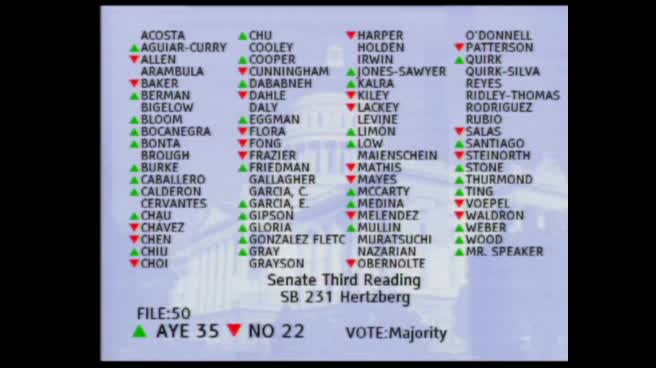 1MIN
Assembly Floor
 2MIN
Senate Floor
 3MIN
Senate Standing Committee on Judiciary
Bill Author

Bill Co-Author(s):