SB 468: School districts: governing boards: pupil members.
- Session Year: 2017-2018
- House: Senate
- Latest Version Date: 2017-09-25
(1)Existing law requires the governing board of a school district maintaining one or more high schools to appoint to its membership one or more pupil members if pupils submit a petition to the governing board to make those appointments, as provided. Existing law requires a pupil member to be recognized as a full member of the governing board of the school district at meetings, including receiving all materials presented to the board members and participating in the questioning of witnesses and the discussion of issues.
This bill would specify that a pupil member shall receive all open meeting materials presented to the board members at the same time the materials are presented to the board members and would additionally require a pupil member to be invited to staff briefings of board members or provided a separate staff briefing within the same timeframe as the staff briefing of board members. To the extent that this requirement would impose additional duties on school districts, the bill would impose a state-mandated local program.
(2)This bill would incorporate additional changes to Section 35012 of the Education Code proposed by AB 261 to be operative only if this bill and AB 261 are enacted and this bill is enacted last.
(3)The California Constitution requires the state to reimburse local agencies and school districts for certain costs mandated by the state. Statutory provisions establish procedures for making that reimbursement.
This bill would provide that, if the Commission on State Mandates determines that the bill contains costs mandated by the state, reimbursement for those costs shall be made pursuant to the statutory provisions noted above.
(1)Existing law requires the governing board of a school district maintaining one or more high schools to appoint to its membership one or more pupil members if pupils submit a petition to the governing board to make those appointments, as provided. Existing law requires a pupil member to be recognized as a full member of the governing board of the school district at meetings, including receiving all materials presented to the board members and participating in the questioning of witnesses and the discussion of issues.
This bill would specify that a pupil member shall receive all open meeting materials presented to the board members at the same time the materials are presented to the board members and would additionally require a pupil member to be invited to staff briefings of board members or provided a separate staff briefing within the same timeframe as the staff briefing of board members. To the extent that this requirement would impose additional duties on school districts, the bill would impose a state-mandated local program.
(2)This bill would incorporate additional changes to Section 35012 of the Education Code proposed by AB 261 to be operative only if this bill and AB 261 are enacted and this bill is enacted last.
The(3)The California Constitution requires the state to reimburse local agencies and school districts for certain costs mandated by the state. Statutory provisions establish procedures for making that reimbursement.
This bill would provide that, if the Commission on State Mandates determines that the bill contains costs mandated by the state, reimbursement for those costs shall be made pursuant to the statutory provisions noted above.
Existing law requires the governing board of a school district maintaining one or more high schools to appoint to its membership one or more pupil members if pupils submit a petition to the governing board to make those appointments, as provided. Existing law requires a pupil member to be recognized as a full member of the governing board of the school district at meetings, including receiving all materials presented to the board members and participating in the questioning of witnesses and the discussion of issues.
This bill would specify that a pupil member shall receive all open meeting materials presented to the board members at the same time the materials are presented to the board members and would additionally require a pupil member to be invited to staff briefings of board members or provided a separate staff briefing within the same timeframe as the staff briefing of board members. To the extent that this requirement would impose additional duties on school districts, the bill would impose a state-mandated local program.
The California Constitution requires the state to reimburse local agencies and school districts for certain costs mandated by the state. Statutory provisions establish procedures for making that reimbursement.
This bill would provide that, if the Commission on State Mandates determines that the bill contains costs mandated by the state, reimbursement for those costs shall be made pursuant to the statutory provisions noted above.
Existing law requires the governing board of a school district maintaining one or more high schools to appoint to its membership one or more pupil members if pupils submit a petition to the governing board to make those appointments, as provided. Existing law requires a pupil member to be recognized as a full member of the governing board of the school district at meetings, including receiving all materials presented to the board members and participating in the questioning of witnesses and the discussion of issues.
This bill would specify that a pupil member shall receive all materials presented to the board members at the same time the materials are presented to the board members and would additionally require a pupil member to be invited to staff briefings of board members. members or provided a separate staff briefing within the same timeframe as the staff briefing of board members. To the extent that this requirement would impose additional duties on school districts, the bill would impose a state-mandated local program.
The California Constitution requires the state to reimburse local agencies and school districts for certain costs mandated by the state. Statutory provisions establish procedures for making that reimbursement.
This bill would provide that, if the Commission on State Mandates determines that the bill contains costs mandated by the state, reimbursement for those costs shall be made pursuant to the statutory provisions noted above.
Existing law requires the governing board of a school district maintaining one or more high schools to appoint to its membership one or more pupil members if pupils submit a petition to the governing board to make those appointments, as provided. Existing law requires a pupil member to be recognized as a full member of the governing board of the school district at meetings, including receiving all materials presented to the board members and participating in the questioning of witnesses and the discussion of issues.
This bill would specify that a pupil member shall receive all materials presented to the board members at the same time the materials are presented to the board members and would additionally require a pupil member to be invited to staff briefings of board members. To the extent that this requirement would impose additional duties on school districts, the bill would impose a state-mandated local program.
The California Constitution requires the state to reimburse local agencies and school districts for certain costs mandated by the state. Statutory provisions establish procedures for making that reimbursement.
This bill would provide that, if the Commission on State Mandates determines that the bill contains costs mandated by the state, reimbursement for those costs shall be made pursuant to the statutory provisions noted above.
Existing law provides for a guardian or conservator to appear in a pending civil action or proceeding on behalf of a minor, a person who lacks legal capacity to make decisions, or a person for whom a conservator has been appointed, as specified. Existing law defines, for the purposes of these provisions, a person lacking legal competence to make decisions to include a person for whom a conservator may be appointed.This bill would make a technical, nonsubstantive change to that provision.Existing law provides for a guardian or conservator to appear in a pending civil action or proceeding on behalf of a minor, a person who lacks legal capacity to make decisions, or a person for whom a conservator has been appointed, as specified. Existing law defines, for the purposes of these provisions, a person lacking legal competence to make decisions to include a person for whom a conservator may be appointed.
This bill would make a technical, nonsubstantive change to that provision.
(a)Except as otherwise provided, the governing board of a school district shall consist of five members elected at large by the qualified voters of the school district. The terms of the members shall, except as otherwise provided, be for four years and staggered so that as nearly as practicable one-half of the members shall be elected in each odd-numbered year.
(b)A unified school district may have a governing board of seven members in the event the proposal for unification has specified a governing board of seven members. The members of the governing board of a unified school district shall be elected at large or by trustee areas as designated in the proposal for unification and shall serve four-year terms of office.
(c)Notwithstanding subdivision (a), and except as provided in this subdivision and Section 5018, the governing board of an elementary school district other than a union or joint union elementary school district shall consist of three members selected at large from the territory comprising the school district. Whenever, in any such elementary school district the average daily attendance during the preceding fiscal year is 300 or more, the procedures prescribed by Section 5018 shall be undertaken.
(d)(1)(A)There may be submitted to the governing board of a school district maintaining one or more high schools a pupil petition requesting the governing board to appoint one or more nonvoting pupil members to the governing board pursuant to this section.
(B)There may also be submitted to the governing board of a school district maintaining one or more high schools a pupil petition requesting the governing board to allow preferential voting for the pupil member or members of the governing board. This request may be made in the original petition for pupil representation on the governing board or in a separate petition after a pupil member or members have been appointed to the governing board.
(2)Whether for pupil representation or for preferential voting for the pupil member or members, the petition shall contain the signatures of either (A) not less than 500 pupils regularly enrolled in high schools of the school district, or (B) not less than 10 percent of the number of pupils regularly enrolled in high schools of the school district, whichever is less. Each fiscal year, and within 60 days of receipt of a petition for pupil representation, or at its next regularly scheduled meeting if no meeting is held within those 60 days, the governing board of a school district shall order the inclusion within the membership of the governing board, in addition to the number of members otherwise prescribed, at least one nonvoting pupil member. The governing board of a school district may order the inclusion of more than one nonvoting pupil member.
(3)Upon receipt of a petition for pupil representation, the governing board of a school district shall, commencing July 1, 1976, and each year thereafter, order the inclusion within the membership of the governing board, in addition to the number of members otherwise prescribed, at least one nonvoting pupil member. The governing board of a school district may order the inclusion of more than one nonvoting pupil member.
(4)(A)Upon receipt of a petition for preferential voting for the pupil member or members, the governing board of a school district shall allow preferential voting for the pupil member or members of the governing board.
(B)Preferential voting, as used in this section, means a formal expression of opinion that is recorded in the minutes and cast before the official vote of the governing board of the school district. A preferential vote shall not serve in determining the final numerical outcome of a vote. No preferential vote shall be solicited on matters subject to closed session discussion.
(5)The governing board of the school district may adopt a resolution authorizing the nonvoting or preferential voting pupil member or members to make motions that may be acted upon by the governing board, except on matters dealing with employer-employee relations pursuant to Chapter 10.7 (commencing with Section 3540) of Division 4 of Title 1 of the Government Code.
(6)Each pupil member shall have the right to attend each and all meetings of the governing board of the school district, except executive sessions.
(7)Any pupil selected to serve as a nonvoting or preferential voting member of the governing board of a school district shall be enrolled in a high school of the school district, may be less than 18 years of age, and shall be chosen by the pupils enrolled in the high school or high schools of the school district in accordance with procedures prescribed by the governing board. The term of a pupil member shall be one year commencing on July 1 of each year.
(8)A nonvoting or preferential voting pupil member shall be entitled to the mileage allowance to the same extent as regular members, but is not entitled to the compensation prescribed by Section 35120.
(9)A nonvoting or preferential voting pupil member shall be seated with the members of the governing board of the school district and shall be recognized as a full member of the governing board at the meetings, including receiving all open meeting materials presented to the board members at the same time the materials are presented to the board members, being invited to staff briefings of board members or being provided a separate staff briefing within the same timeframe as the staff briefing of board members, and participating in the questioning of witnesses and the discussion of issues.
(10)The nonvoting or preferential voting pupil member shall not be included in determining the vote required to carry any measure before the governing board of the school district.
(11)The nonvoting or preferential voting pupil member shall not be liable for any acts of the governing board of the school district.
(12)A majority vote of all voting board members shall be required to approve a motion to eliminate the nonvoting or preferential voting pupil member position from the governing board of a school district. The motion shall be listed as a public agenda item for a meeting of the governing board before the motion being voted upon.
SEC. 1.5.Section 35012 of the Education Code is amended to read:35012.(a)Except as otherwise provided, the governing board of a school district shall consist of five members elected at large by the qualified voters of the school district. The terms of the members shall, except as otherwise provided, be for four years and staggered so that as nearly as practicable one-half of the members shall be elected in each odd-numbered year.
(b)A unified school district may have a governing board of seven members in the event the proposal for unification has specified a governing board of seven members. The members of the governing board of a unified school district shall be elected at large or by trustee areas as designated in the proposal for unification and shall serve four-year terms of office.
(c)Notwithstanding subdivision (a), and except as provided in this subdivision and Section 5018, the governing board of an elementary school district other than a union or joint union elementary school district shall consist of three members selected at large from the territory comprising the school district. Whenever, in any such elementary school district the average daily attendance during the preceding fiscal year is 300 or more, the procedures prescribed by Section 5018 shall be undertaken.
(d)(1)There may be submitted to the governing board of a school district maintaining one or more high schools a pupil petition requesting the governing board to appoint one or more pupil members to the governing board pursuant to this section.
(2)The petition shall contain the signatures of either (A) not less than 500 pupils regularly enrolled in high schools of the school district, or (B) not less than 10 percent of the number of pupils regularly enrolled in high schools of the school district, whichever is less. Each fiscal year, and within 60 days of receipt of a petition for pupil representation, or at its next regularly scheduled meeting if no meeting is held within those 60 days, the governing board of a school district shall order the inclusion within the membership of the governing board, in addition to the number of members otherwise prescribed, at least one pupil member. The governing board of a school district may order the inclusion of more than one pupil member.
(3)Upon receipt of a petition for pupil representation, the governing board of a school district shall, commencing July 1, 1976, and each year thereafter, order the inclusion within the membership of the governing board, in addition to the number of members otherwise prescribed, at least one pupil member. The governing board of a school district may order the inclusion of more than one pupil member.
(4)(A)A pupil member of the governing board of a school district shall have preferential voting rights.
(B)Preferential voting, as used in this section, means a formal expression of opinion that is recorded in the minutes and cast before the official vote of the governing board of the school district. A preferential vote shall not serve in determining the final numerical outcome of a vote. No preferential vote shall be solicited on matters subject to closed session discussion.
(5)The governing board of the school district may adopt a resolution authorizing the pupil member or members to make motions that may be acted upon by the governing board, except on matters dealing with employer-employee relations pursuant to Chapter 10.7 (commencing with Section 3540) of Division 4 of Title 1 of the Government Code.
(6)Each pupil member shall have the right to attend each and all meetings of the governing board of the school district, except executive sessions.
(7)Any pupil selected to serve as a member of the governing board of a school district shall be enrolled in a high school of the school district, may be less than 18 years of age, and shall be chosen by the pupils enrolled in the high school or high schools of the school district in accordance with procedures prescribed by the governing board. The term of a pupil member shall be one year commencing on July 1 of each year.
(8)A pupil member shall be entitled to the mileage allowance to the same extent as regular members, but is not entitled to the compensation prescribed by Section 35120.
(9)A pupil member shall be seated with the members of the governing board of the school district and shall be recognized as a full member of the governing board at the meetings, including receiving all open meeting materials presented to the board members at the same time the materials are presented to the board members, being invited to staff briefings of board members or being provided a separate staff briefing within the same timeframe as the staff briefing of board members, and participating in the questioning of witnesses and the discussion of issues.
(10)The pupil member shall not be included in determining the vote required to carry any measure before the governing board of the school district.
(11)The pupil member shall not be liable for any acts of the governing board of the school district.
(12)A majority vote of all voting board members shall be required to approve a motion to eliminate the pupil member position from the governing board of a school district. The motion shall be listed as a public agenda item for a meeting of the governing board before the motion being voted upon.
SEC. 2.Section 1.5 of this bill incorporates amendments to Section 35012 of the Education Code proposed by both this bill and Assembly Bill 261. That section shall only become operative if (1) both bills are enacted and become effective on or before January 1, 2018, (2) each bill amends Section 35012 of the Education Code, and (3) this bill is enacted after Assembly Bill 261, in which case Section 1 of this bill shall not become operative.
SEC. 3.If the Commission on State Mandates determines that this act contains costs mandated by the state, reimbursement to local agencies and school districts for those costs shall be made pursuant to Part 7 (commencing with Section 17500) of Division 4 of Title 2 of the Government Code.
(a)Except as otherwise provided, the governing board of a school district shall consist of five members elected at large by the qualified voters of the school district. The terms of the members shall, except as otherwise provided, be for four years and staggered so that as nearly as practicable one-half of the members shall be elected in each odd-numbered year.
(b)A unified school district may have a governing board of seven members in the event the proposal for unification has specified a governing board of seven members. The members of the governing board of a unified school district shall be elected at large or by trustee areas as designated in the proposal for unification and shall serve four-year terms of office.
(c)Notwithstanding subdivision (a), and except as provided in this subdivision and Section 5018, the governing board of an elementary school district other than a union or joint union elementary school district shall consist of three members selected at large from the territory comprising the school district. Whenever, in any such elementary school district the average daily attendance during the preceding fiscal year is 300 or more, the procedures prescribed by Section 5018 shall be undertaken.
(d)(1)(A)There may be submitted to the governing board of a school district maintaining one or more high schools a pupil petition requesting the governing board to appoint one or more nonvoting pupil members to the governing board pursuant to this section.
(B)There may also be submitted to the governing board of a school district maintaining one or more high schools a pupil petition requesting the governing board to allow preferential voting for the pupil member or members of the governing board. This request may be made in the original petition for pupil representation on the governing board or in a separate petition after a pupil member or members have been appointed to the governing board.
(2)Whether for pupil representation or for preferential voting for the pupil member or members, the petition shall contain the signatures of either (A) not less than 500 pupils regularly enrolled in high schools of the school district, or (B) not less than 10 percent of the number of pupils regularly enrolled in high schools of the school district, whichever is less. Each fiscal year, and within 60 days of receipt of a petition for pupil representation, or at its next regularly scheduled meeting if no meeting is held within those 60 days, the governing board of a school district shall order the inclusion within the membership of the governing board, in addition to the number of members otherwise prescribed, at least one nonvoting pupil member. The governing board of a school district may order the inclusion of more than one nonvoting pupil member.
(3)Upon receipt of a petition for pupil representation, the governing board of a school district shall, commencing July 1, 1976, and each year thereafter, order the inclusion within the membership of the governing board, in addition to the number of members otherwise prescribed, at least one nonvoting pupil member. The governing board of a school district may order the inclusion of more than one nonvoting pupil member.
(4)(A)Upon receipt of a petition for preferential voting for the pupil member or members, the governing board of a school district shall allow preferential voting for the pupil member or members of the governing board.
(B)Preferential voting, as used in this section, means a formal expression of opinion that is recorded in the minutes and cast before the official vote of the governing board of the school district. A preferential vote shall not serve in determining the final numerical outcome of a vote. No preferential vote shall be solicited on matters subject to closed session discussion.
(5)The governing board of the school district may adopt a resolution authorizing the nonvoting or preferential voting pupil member or members to make motions that may be acted upon by the governing board, except on matters dealing with employer-employee relations pursuant to Chapter 10.7 (commencing with Section 3540) of Division 4 of Title 1 of the Government Code.
(6)Each pupil member shall have the right to attend each and all meetings of the governing board of the school district, except executive sessions.
(7)Any pupil selected to serve as a nonvoting or preferential voting member of the governing board of a school district shall be enrolled in a high school of the school district, may be less than 18 years of age, and shall be chosen by the pupils enrolled in the high school or high schools of the school district in accordance with procedures prescribed by the governing board. The term of a pupil member shall be one year commencing on July 1 of each year.
(8)A nonvoting or preferential voting pupil member shall be entitled to the mileage allowance to the same extent as regular members, but is not entitled to the compensation prescribed by Section 35120.
(9)A nonvoting or preferential voting pupil member shall be seated with the members of the governing board of the school district and shall be recognized as a full member of the governing board at the meetings, including receiving all open meeting materials presented to the board members at the same time the materials are presented to the board members, being invited to staff briefings of board members or being provided a separate staff briefing within the same timeframe as the staff briefing of board members, and participating in the questioning of witnesses and the discussion of issues.
(10)The nonvoting or preferential voting pupil member shall not be included in determining the vote required to carry any measure before the governing board of the school district.
(11)The nonvoting or preferential voting pupil member shall not be liable for any acts of the governing board of the school district.
(12)A majority vote of all voting board members shall be required to approve a motion to eliminate the nonvoting or preferential voting pupil member position from the governing board of a school district. The motion shall be listed as a public agenda item for a meeting of the governing board before the motion being voted upon.
SEC. 1.5.Section 35012 of the Education Code is amended to read:35012.(a)Except as otherwise provided, the governing board of a school district shall consist of five members elected at large by the qualified voters of the school district. The terms of the members shall, except as otherwise provided, be for four years and staggered so that as nearly as practicable one-half of the members shall be elected in each odd-numbered year.
(b)A unified school district may have a governing board of seven members in the event the proposal for unification has specified a governing board of seven members. The members of the governing board of a unified school district shall be elected at large or by trustee areas as designated in the proposal for unification and shall serve four-year terms of office.
(c)Notwithstanding subdivision (a), and except as provided in this subdivision and Section 5018, the governing board of an elementary school district other than a union or joint union elementary school district shall consist of three members selected at large from the territory comprising the school district. Whenever, in any such elementary school district the average daily attendance during the preceding fiscal year is 300 or more, the procedures prescribed by Section 5018 shall be undertaken.
(d)(1)(A)There may be submitted to the governing board of a school district maintaining one or more high schools a pupil petition requesting the governing board to appoint one or more nonvoting pupil members to the governing board pursuant to this section.
(B)There may also be submitted to the governing board of a school district maintaining one or more high schools a pupil petition requesting the governing board to allow preferential voting for the pupil member or members of the board. This request may be made in the original petition for pupil representation on the board or in a separate petition after a pupil member or members have been appointed to the board.(2)Whether for pupil representation or for preferential voting for the pupil member or members, the The petition shall contain the signatures of either (A) not less than 500 pupils regularly enrolled in high schools of the school district, or (B) not less than 10 percent of the number of pupils regularly enrolled in high schools of the school district, whichever is less. Each fiscal year, and within 60 days of receipt of a petition for pupil representation, or at its next regularly scheduled meeting if no meeting is held within those 60 days, the governing board of a school district shall order the inclusion within the membership of the governing board, in addition to the number of members otherwise prescribed, at least one nonvoting pupil member. The governing board of a school district may order the inclusion of more than one nonvoting pupil member.
(3)Upon receipt of a petition for pupil representation, the governing board of a school district shall, commencing July 1, 1976, and each year thereafter, order the inclusion within the membership of the governing board, in addition to the number of members otherwise prescribed, at least one nonvoting pupil member. The governing board of a school district may order the inclusion of more than one nonvoting pupil member.
(4)(A)Upon receipt of a petition for preferential voting for the pupil member or members, A pupil member of the governing board of the a school district shall allow preferential voting for the pupil member or members of the governing board. have preferential voting rights.
(B)Preferential voting, as used in this section, means a formal expression of opinion that is recorded in the minutes and cast before the official vote of the governing board of the school district. A preferential vote shall not serve in determining the final numerical outcome of a vote. No preferential vote shall be solicited on matters subject to closed session discussion.
(5)The governing board of the school district may adopt a resolution authorizing the nonvoting or preferential voting pupil member or members to make motions that may be acted upon by the governing board, except on matters dealing with employer-employee relations pursuant to Chapter 10.7 (commencing with Section 3540) of Division 4 of Title 1 of the Government Code.
(6)Each pupil member shall have the right to attend each and all meetings of the governing board of the school district, except executive sessions.
(7)Any pupil selected to serve as a nonvoting or preferential voting member of the governing board of a school district shall be enrolled in a high school of the school district, may be less than 18 years of age, and shall be chosen by the pupils enrolled in the high school or high schools of the school district in accordance with procedures prescribed by the governing board. The term of a pupil member shall be one year commencing on July 1 of each year.
(8)A nonvoting or preferential voting pupil member shall be entitled to the mileage allowance to the same extent as regular members, but is not entitled to the compensation prescribed by Section 35120.
(9)A nonvoting or preferential voting pupil member shall be seated with the members of the governing board of the school district and shall be recognized as a full member of the governing board at the meetings, including receiving all open meeting materials presented to the board members at the same time the materials are presented to the board members, being invited to staff briefings of board members or being provided a separate staff briefing within the same timeframe as the staff briefing of board members, and participating in the questioning of witnesses and the discussion of issues.
(10)The nonvoting or preferential voting pupil member shall not be included in determining the vote required to carry any measure before the governing board of the school district.
(11)The nonvoting or preferential voting pupil member shall not be liable for any acts of the governing board of the school district.
(12)A majority vote of all voting board members shall be required to approve a motion to eliminate the nonvoting or preferential voting pupil member position from the governing board of a school district. The motion shall be listed as a public agenda item for a meeting of the governing board prior to before the motion being voted upon.
SEC. 2.Section 1.5 of this bill incorporates amendments to Section 35012 of the Education Code proposed by both this bill and Assembly Bill 261. That section shall only become operative if (1) both bills are enacted and become effective on or before January 1, 2018, (2) each bill amends Section 35012 of the Education Code, and (3) this bill is enacted after Assembly Bill 261, in which case Section 1 of this bill shall not become operative.
SEC. 2.SEC. 3.If the Commission on State Mandates determines that this act contains costs mandated by the state, reimbursement to local agencies and school districts for those costs shall be made pursuant to Part 7 (commencing with Section 17500) of Division 4 of Title 2 of the Government Code.
(a)Except as otherwise provided, the governing board of a school district shall consist of five members elected at large by the qualified voters of the school district. The terms of the members shall, except as otherwise provided, be for four years and staggered so that as nearly as practicable one-half of the members shall be elected in each odd-numbered year.
(b)A unified school district may have a governing board of seven members in the event the proposal for unification has specified a governing board of seven members. The members of the governing board of a unified school district shall be elected at large or by trustee areas as designated in the proposal for unification and shall serve four-year terms of office.
(c)Notwithstanding subdivision (a), and except as provided in this subdivision and Section 5018, the governing board of an elementary school district other than a union or joint union elementary school district shall consist of three members selected at large from the territory comprising the school district. Whenever, in any such elementary school district the average daily attendance during the preceding fiscal year is 300 or more, the procedures prescribed by Section 5018 shall be undertaken.
(d)(1)(A)There may be submitted to the governing board of a school district maintaining one or more high schools a pupil petition requesting the governing board to appoint one or more nonvoting pupil members to the governing board pursuant to this section.
(B)There may also be submitted to the governing board of a school district maintaining one or more high schools a pupil petition requesting the governing board to allow preferential voting for the pupil member or members of the governing board. This request may be made in the original petition for pupil representation on the governing board or in a separate petition after a pupil member or members have been appointed to the governing board.
(2)Whether for pupil representation or for preferential voting for the pupil member or members, the petition shall contain the signatures of either (A) not less than 500 pupils regularly enrolled in high schools of the school district, or (B) not less than 10 percent of the number of pupils regularly enrolled in high schools of the school district, whichever is less. Each fiscal year, and within 60 days of receipt of a petition for pupil representation, or at its next regularly scheduled meeting if no meeting is held within those 60 days, the governing board of a school district shall order the inclusion within the membership of the governing board, in addition to the number of members otherwise prescribed, at least one nonvoting pupil member. The governing board of a school district may order the inclusion of more than one nonvoting pupil member.
(3)Upon receipt of a petition for pupil representation, the governing board of a school district shall, commencing July 1, 1976, and each year thereafter, order the inclusion within the membership of the governing board, in addition to the number of members otherwise prescribed, at least one nonvoting pupil member. The governing board of a school district may order the inclusion of more than one nonvoting pupil member.
(4)(A)Upon receipt of a petition for preferential voting for the pupil member or members, the governing board of a school district shall allow preferential voting for the pupil member or members of the governing board.
(B)Preferential voting, as used in this section, means a formal expression of opinion that is recorded in the minutes and cast before the official vote of the governing board of the school district. A preferential vote shall not serve in determining the final numerical outcome of a vote. No preferential vote shall be solicited on matters subject to closed session discussion.
(5)The governing board of the school district may adopt a resolution authorizing the nonvoting or preferential voting pupil member or members to make motions that may be acted upon by the governing board, except on matters dealing with employer-employee relations pursuant to Chapter 10.7 (commencing with Section 3540) of Division 4 of Title 1 of the Government Code.
(6)Each pupil member shall have the right to attend each and all meetings of the governing board of the school district, except executive sessions.
(7)Any pupil selected to serve as a nonvoting or preferential voting member of the governing board of a school district shall be enrolled in a high school of the school district, may be less than 18 years of age, and shall be chosen by the pupils enrolled in the high school or high schools of the school district in accordance with procedures prescribed by the governing board. The term of a pupil member shall be one year commencing on July 1 of each year.
(8)A nonvoting or preferential voting pupil member shall be entitled to the mileage allowance to the same extent as regular members, but is not entitled to the compensation prescribed by Section 35120.
(9)A nonvoting or preferential voting pupil member shall be seated with the members of the governing board of the school district and shall be recognized as a full member of the governing board at the meetings, including receiving all open meeting materials presented to the board members at the same time the materials are presented to the board members, being invited to staff briefings of board members, members or being provided a separate staff briefing within the same timeframe as the staff briefing of board members, and participating in the questioning of witnesses and the discussion of issues.
(10)The nonvoting or preferential voting pupil member shall not be included in determining the vote required to carry any measure before the governing board of the school district.
(11)The nonvoting or preferential voting pupil member shall not be liable for any acts of the governing board of the school district.
(12)A majority vote of all voting board members shall be required to approve a motion to eliminate the nonvoting or preferential voting pupil member position from the governing board of a school district. The motion shall be listed as a public agenda item for a meeting of the governing board before the motion being voted upon.
SEC. 2.If the Commission on State Mandates determines that this act contains costs mandated by the state, reimbursement to local agencies and school districts for those costs shall be made pursuant to Part 7 (commencing with Section 17500) of Division 4 of Title 2 of the Government Code.
(a)Except as otherwise provided, the governing board of a school district shall consist of five members elected at large by the qualified voters of the school district. The terms of the members shall, except as otherwise provided, be for four years and staggered so that as nearly as practicable one-half of the members shall be elected in each odd-numbered year.
(b)A unified school district may have a governing board of seven members in the event the proposal for unification has specified a governing board of seven members. The members of the governing board of a unified school district shall be elected at large or by trustee areas as designated in the proposal for unification and shall serve four-year terms of office.
(c)Notwithstanding subdivision (a), and except as provided in this subdivision and Section 5018, the governing board of an elementary school district other than a union or joint union elementary school district shall consist of three members selected at large from the territory comprising the school district. Whenever, in any such elementary school district the average daily attendance during the preceding fiscal year is 300 or more, the procedures prescribed by Section 5018 shall be undertaken.
(d)(1)(A)There may be submitted to the governing board of a school district maintaining one or more high schools a pupil petition requesting the governing board to appoint one or more nonvoting pupil members to the governing board pursuant to this section.
(B)There may also be submitted to the governing board of a school district maintaining one or more high schools a pupil petition requesting the governing board to allow preferential voting for the pupil member or members of the governing board. This request may be made in the original petition for pupil representation on the governing board or in a separate petition after a pupil member or members have been appointed to the governing board.
(2) Whether for pupil representation or for preferential voting for the pupil member or members, the petition shall contain the signatures of either (A) not less than 500 pupils regularly enrolled in high schools of the school district, or (B) not less than 10 percent of the number of pupils regularly enrolled in high schools of the school district, whichever is less. Each fiscal year, and within 60 days of receipt of a petition for pupil representation, or at its next regularly scheduled meeting if no meeting is held within those 60 days, the governing board of a school district shall order the inclusion within the membership of the governing board, in addition to the number of members otherwise prescribed, at least one nonvoting pupil member. The governing board of a school district may order the inclusion of more than one nonvoting pupil member.
(3)Upon receipt of a petition for pupil representation, the governing board of a school district shall, commencing July 1, 1976, and each year thereafter, order the inclusion within the membership of the governing board, in addition to the number of members otherwise prescribed, at least one nonvoting pupil member. The governing board of a school district may order the inclusion of more than one nonvoting pupil member.
(4)(A) Upon (A)Upon receipt of a petition for preferential voting for the pupil member or members, the governing board of a school district shall allow preferential voting for the pupil member or members of the governing board.
(B)Preferential voting, as used in this section, means a formal expression of opinion that is recorded in the minutes and cast before the official vote of the governing board of the school district. A preferential vote shall not serve in determining the final numerical outcome of a vote. No preferential vote shall be solicited on matters subject to closed session discussion.
(5)The governing board of the school district may adopt a resolution authorizing the nonvoting or preferential voting pupil member or members to make motions that may be acted upon by the governing board, except on matters dealing with employer-employee relations pursuant to Chapter 10.7 (commencing with Section 3540) of Division 4 of Title 1 of the Government Code.
(6)Each pupil member shall have the right to attend each and all meetings of the governing board of the school district, except executive sessions.
(7)Any pupil selected to serve as a nonvoting or preferential voting member of the governing board of a school district shall be enrolled in a high school of the school district, may be less than 18 years of age, and shall be chosen by the pupils enrolled in the high school or high schools of the school district in accordance with procedures prescribed by the governing board. The term of a pupil member shall be one year commencing on July 1 of each year.
(8)A nonvoting or preferential voting pupil member shall be entitled to the mileage allowance to the same extent as regular members, but is not entitled to the compensation prescribed by Section 35120.
(9)A nonvoting or preferential voting pupil member shall be seated with the members of the governing board of the school district and shall be recognized as a full member of the governing board at the meetings, including receiving all materials presented to the board members at the same time the materials are presented to the board members, being invited to staff briefings of board members, members, or being provided a separate staff briefing within the same timeframe as the staff briefing of board members, and participating in the questioning of witnesses and the discussion of issues.
(10)The nonvoting or preferential voting pupil member shall not be included in determining the vote required to carry any measure before the governing board of the school district.
(11)The nonvoting or preferential voting pupil member shall not be liable for any acts of the governing board of the school district.
(12)A majority vote of all voting board members shall be required to approve a motion to eliminate the nonvoting or preferential voting pupil member position from the governing board of a school district. The motion shall be listed as a public agenda item for a meeting of the governing board before the motion being voted upon.
SEC. 2.If the Commission on State Mandates determines that this act contains costs mandated by the state, reimbursement to local agencies and school districts for those costs shall be made pursuant to Part 7 (commencing with Section 17500) of Division 4 of Title 2 of the Government Code.
(a)Except as otherwise provided, the governing board of a school district shall consist of five members elected at large by the qualified voters of the school district. The terms of the members shall, except as otherwise provided, be for four years and staggered so that as nearly as practicable one-half of the members shall be elected in each odd-numbered year.
(b)A unified school district may have a governing board of seven members in the event the proposal for unification has specified a governing board of seven members. The members of the governing board of a unified school district shall be elected at large or by trustee areas as designated in the proposal for unification and shall serve four-year terms of office.
(c)Notwithstanding subdivision (a), and except as provided in this subdivision and Section 5018, the governing board of an elementary school district other than a union or joint union elementary school district shall consist of three members selected at large from the territory comprising the school district. Whenever, in any such elementary school district the average daily attendance during the preceding fiscal year is 300 or more, the procedures prescribed by Section 5018 shall be undertaken.
(d)(1)(A)There may be submitted to the governing board of a school district maintaining one or more high schools a pupil petition requesting the governing board to appoint one or more nonvoting pupil members to the governing board pursuant to this section.
(B)There may also be submitted to the governing board of a school district maintaining one or more high schools a pupil petition requesting the governing board to allow preferential voting for the pupil member or members of the governing board. This request may be made in the original petition for pupil representation on the governing board or in a separate petition after a pupil member or members have been appointed to the governing board.(2) Whether for pupil representation or for preferential voting for the pupil member or members, the petition shall contain the signatures of either (A) not less than 500 pupils regularly enrolled in high schools of the school district, or (B) not less than 10 percent of the number of pupils regularly enrolled in high schools of the school district, whichever is less. Each fiscal year, and within 60 days of receipt of a petition for pupil representation, or at its next regularly scheduled meeting if no meeting is held within those 60 days, the governing board of a school district shall order the inclusion within the membership of the governing board, in addition to the number of members otherwise prescribed, at least one nonvoting pupil member. The governing board of a school district may order the inclusion of more than one nonvoting pupil member.
(3)Upon receipt of a petition for pupil representation, the governing board of a school district shall, commencing July 1, 1976, and each year thereafter, order the inclusion within the membership of the governing board, in addition to the number of members otherwise prescribed, at least one nonvoting pupil member. The governing board of a school district may order the inclusion of more than one nonvoting pupil member.
(4)(A) Upon receipt of a petition for preferential voting for the pupil member or members, the governing board of the a school district shall allow preferential voting for the pupil member or members of the governing board.
(B)Preferential voting, as used in this section, means a formal expression of opinion that is recorded in the minutes and cast before the official vote of the governing board of the school district. A preferential vote shall not serve in determining the final numerical outcome of a vote. No preferential vote shall be solicited on matters subject to closed session discussion.
(5)The governing board of the school district may adopt a resolution authorizing the nonvoting or preferential voting pupil member or members to make motions that may be acted upon by the governing board, except on matters dealing with employer-employee relations pursuant to Chapter 10.7 (commencing with Section 3540) of Division 4 of Title 1 of the Government Code.
(6)Each pupil member shall have the right to attend each and all meetings of the governing board of the school district, except executive sessions.
(7)Any pupil selected to serve as a nonvoting or preferential voting member of the governing board of a school district shall be enrolled in a high school of the school district, may be less than 18 years of age, and shall be chosen by the pupils enrolled in the high school or high schools of the school district in accordance with procedures prescribed by the governing board. The term of a pupil member shall be one year commencing on July 1 of each year.
(8)A nonvoting or preferential voting pupil member shall be entitled to the mileage allowance to the same extent as regular members, but is not entitled to the compensation prescribed by Section 35120.
(9)A nonvoting or preferential voting pupil member shall be seated with the members of the governing board of the school district and shall be recognized as a full member of the governing board at the meetings, including receiving all materials presented to the board members at the same time the materials are presented to the board members, being invited to staff briefings of board members, and participating in the questioning of witnesses and the discussion of issues.
(10)The nonvoting or preferential voting pupil member shall not be included in determining the vote required to carry any measure before the governing board of the school district.
(11)The nonvoting or preferential voting pupil member shall not be liable for any acts of the governing board of the school district.
(12)A majority vote of all voting board members shall be required to approve a motion to eliminate the nonvoting or preferential voting pupil member position from the governing board of a school district. The motion shall be listed as a public agenda item for a meeting of the governing board prior to before the motion being voted upon.
SEC. 2.If the Commission on State Mandates determines that this act contains costs mandated by the state, reimbursement to local agencies and school districts for those costs shall be made pursuant to Part 7 (commencing with Section 17500) of Division 4 of Title 2 of the Government Code.
SECTION 1.Section 372 of the Code of Civil Procedure is amended to read:372.(a)(1)When a minor, a person who lacks legal capacity to make decisions, or a person for whom a conservator has been appointed is a party, that person shall appear either by a guardian or conservator of the estate or by a guardian ad litem appointed by the court in which the action or proceeding is pending, or by a judge thereof, in each case. A guardian ad litem may be appointed in any case when it is deemed by the court in which the action or proceeding is prosecuted, or by a judge thereof, expedient to appoint a guardian ad litem to represent the minor, person lacking legal capacity to make decisions, or person for whom a conservator has been appointed, notwithstanding that the person may have a guardian or conservator of the estate and may have appeared by the guardian or conservator of the estate. The guardian or conservator of the estate or guardian ad litem so appearing for any minor, person who lacks legal capacity to make decisions, or person for whom a conservator has been appointed shall have power, with the approval of the court in which the action or proceeding is pending, to compromise the same, to agree to the order or judgment to be entered therein for or against the ward or conservatee, and to satisfy any judgment or order in favor of the ward or conservatee or release or discharge any claim of the ward or conservatee pursuant to that compromise. Money or other property to be paid or delivered pursuant to the order or judgment for the benefit of a minor, person lacking legal capacity to make decisions, or person for whom a conservator has been appointed shall be paid and delivered as provided in Chapter 4 (commencing with Section 3600) of Part 8 of Division 4 of the Probate Code.(2)Where reference is made in this section to a person lacking legal competence to make decisions, the reference includes a person for whom a conservator may be appointed.(3)Nothing in this section, or in any other provision of this code, the Civil Code, the Family Code, or the Probate Code is intended by the Legislature to prohibit a minor from exercising an intelligent and knowing waiver of his or her constitutional rights in a proceeding under the Juvenile Court Law, Chapter 2 (commencing with Section 200) of Part 1 of Division 2 of the Welfare and Institutions Code.(b)(1)Notwithstanding subdivision (a), a minor 12 years of age or older may appear in court without a guardian, counsel, or guardian ad litem, for the purpose of requesting or opposing a request for any of the following:(A)An injunction or temporary restraining order or both to prohibit harassment pursuant to Section 527.6.(B)An injunction or temporary restraining order or both against violence or a credible threat of violence in the workplace pursuant to Section 527.8.(C)A protective order pursuant to Division 10 (commencing with Section 6200) of the Family Code.(D)A protective order pursuant to Sections 7710 and 7720 of the Family Code.The court may, either upon motion or in its own discretion, and after considering reasonable objections by the minor to the appointment of specific individuals, appoint a guardian ad litem to assist the minor in obtaining or opposing the order, provided that the appointment of the guardian ad litem does not delay the issuance or denial of the order being sought. In making the determination concerning the appointment of a particular guardian ad litem, the court shall consider whether the minor and the guardian have divergent interests.(2)For purposes of this subdivision only, upon the issuance of an order pursuant to paragraph (1), if the minor initially appeared in court seeking an order without a guardian or guardian ad litem, and if the minor is residing with a parent or guardian, the court shall send a copy of the order to at least one parent or guardian designated by the minor, unless, in the discretion of the court, notification of a parent or guardian would be contrary to the best interest of the minor. The court is not required to send the order to more than one parent or guardian.(3)The Judicial Council shall adopt forms by July 1, 1999, to facilitate the appointment of a guardian ad litem pursuant to this subdivision.(c)(1) Notwithstanding subdivision (a), a minor may appear in court without a guardian ad litem in the following proceedings if the minor is a parent of the child who is the subject of the proceedings:(A)Family court proceedings pursuant to Part 3 (commencing with Section 7600) of Division 12 of the Family Code.(B)Dependency proceedings pursuant to Chapter 2 (commencing with Section 200) of Part 1 of Division 2 of the Welfare and Institutions Code.(C)Guardianship proceedings for a minor child pursuant to Part 2 (commencing with Section 1500) of Division 4 of the Probate Code.(D)Any other proceedings concerning child custody, visitation, or support.(2)If the court finds that the minor parent is unable to understand the nature of the proceedings or to assist counsel in preparing the case, the court shall, upon its own motion or upon a motion by the minor parent or the minor parents counsel, appoint a guardian ad litem.(a)(1)When a minor, a person who lacks legal capacity to make decisions, or a person for whom a conservator has been appointed is a party, that person shall appear either by a guardian or conservator of the estate or by a guardian ad litem appointed by the court in which the action or proceeding is pending, or by a judge thereof, in each case. A guardian ad litem may be appointed in any case when it is deemed by the court in which the action or proceeding is prosecuted, or by a judge thereof, expedient to appoint a guardian ad litem to represent the minor, person lacking legal capacity to make decisions, or person for whom a conservator has been appointed, notwithstanding that the person may have a guardian or conservator of the estate and may have appeared by the guardian or conservator of the estate. The guardian or conservator of the estate or guardian ad litem so appearing for any minor, person who lacks legal capacity to make decisions, or person for whom a conservator has been appointed shall have power, with the approval of the court in which the action or proceeding is pending, to compromise the same, to agree to the order or judgment to be entered therein for or against the ward or conservatee, and to satisfy any judgment or order in favor of the ward or conservatee or release or discharge any claim of the ward or conservatee pursuant to that compromise. Money or other property to be paid or delivered pursuant to the order or judgment for the benefit of a minor, person lacking legal capacity to make decisions, or person for whom a conservator has been appointed shall be paid and delivered as provided in Chapter 4 (commencing with Section 3600) of Part 8 of Division 4 of the Probate Code.
(2)Where reference is made in this section to a person lacking legal competence to make decisions, the reference shall be deemed to include includes a person for whom a conservator may be appointed.
(3)Nothing in this section, or in any other provision of this code, the Civil Code, the Family Code, or the Probate Code is intended by the Legislature to prohibit a minor from exercising an intelligent and knowing waiver of his or her constitutional rights in a proceeding under the Juvenile Court Law, Chapter 2 (commencing with Section 200) of Part 1 of Division 2 of the Welfare and Institutions Code.
(b)(1)Notwithstanding subdivision (a), a minor 12 years of age or older may appear in court without a guardian, counsel, or guardian ad litem, for the purpose of requesting or opposing a request for any of the following:
(A)An injunction or temporary restraining order or both to prohibit harassment pursuant to Section 527.6.
(B)An injunction or temporary restraining order or both against violence or a credible threat of violence in the workplace pursuant to Section 527.8.
(C)A protective order pursuant to Division 10 (commencing with Section 6200) of the Family Code.
(D)A protective order pursuant to Sections 7710 and 7720 of the Family Code.
The court may, either upon motion or in its own discretion, and after considering reasonable objections by the minor to the appointment of specific individuals, appoint a guardian ad litem to assist the minor in obtaining or opposing the order, provided that the appointment of the guardian ad litem does not delay the issuance or denial of the order being sought. In making the determination concerning the appointment of a particular guardian ad litem, the court shall consider whether the minor and the guardian have divergent interests.
(2)For purposes of this subdivision only, upon the issuance of an order pursuant to paragraph (1), if the minor initially appeared in court seeking an order without a guardian or guardian ad litem, and if the minor is residing with a parent or guardian, the court shall send a copy of the order to at least one parent or guardian designated by the minor, unless, in the discretion of the court, notification of a parent or guardian would be contrary to the best interest of the minor. The court is not required to send the order to more than one parent or guardian.
(3)The Judicial Council shall adopt forms by July 1, 1999, to facilitate the appointment of a guardian ad litem pursuant to this subdivision.
(c)(1) Notwithstanding subdivision (a), a minor may appear in court without a guardian ad litem in the following proceedings if the minor is a parent of the child who is the subject of the proceedings:
(A)Family court proceedings pursuant to Part 3 (commencing with Section 7600) of Division 12 of the Family Code.
(B)Dependency proceedings pursuant to Chapter 2 (commencing with Section 200) of Part 1 of Division 2 of the Welfare and Institutions Code.
(C)Guardianship proceedings for a minor child pursuant to Part 2 (commencing with Section 1500) of Division 4 of the Probate Code.
(D)Any other proceedings concerning child custody, visitation, or support.
(2)If the court finds that the minor parent is unable to understand the nature of the proceedings or to assist counsel in preparing the case, the court shall, upon its own motion or upon a motion by the minor parent or the minor parents counsel, appoint a guardian ad litem.
|
Date
|
Status
|
|---|---|
| Sep 25, 2017 | Chaptered by Secretary of State. Chapter 283, Statutes of 2017. |
| Sep 25, 2017 | Approved by the Governor. |
| Sep 6, 2017 | Enrolled and presented to the Governor at 3 p.m. |
| Aug 31, 2017 | Assembly amendments concurred in. (Ayes 37. Noes 0.) Ordered to engrossing and enrolling. |
| Aug 29, 2017 | Ordered to special consent calendar. |
| Aug 24, 2017 | In Senate. Concurrence in Assembly amendments pending. |
| Aug 24, 2017 | Read third time. Passed. Ordered to the Senate. |
| Jul 17, 2017 | Read third time and amended. |
| Jul 3, 2017 | From consent calendar on motion of Assembly Member Bonta. |
| Jun 29, 2017 | Read second time. Ordered to consent calendar. |
| Jun 28, 2017 | From committee: Do pass. Ordered to consent calendar. (Ayes 14. Noes 0.) (June 28). |
| Jun 22, 2017 | From committee: Do pass and re-refer to Com. on APPR. with recommendation: To consent calendar. (Ayes 6. Noes 0.) (June 21). Re-referred to Com. on APPR. |
| Jun 8, 2017 | Referred to Com. on ED. |
| May 31, 2017 | In Assembly. Read first time. Held at Desk. |
| May 30, 2017 | Read third time. Passed. (Ayes 40. Noes 0. Page 1258.) Ordered to the Assembly. |
| May 22, 2017 | Read second time. Ordered to third reading. |
| May 18, 2017 | From consent calendar on motion of Senator Leyva. |
| May 16, 2017 | Read second time. Ordered to consent calendar. |
| May 15, 2017 | From committee: Be ordered to second reading pursuant to Senate Rule 28.8 and ordered to consent calendar. |
| May 5, 2017 | Set for hearing May 15. |
| May 3, 2017 | Read second time and amended. Re-referred to Com. on APPR. |
| May 2, 2017 | From committee: Do pass as amended and re-refer to Com. on APPR. with recommendation: To consent calendar. (Ayes 7. Noes 0. Page 848.) (April 26). |
| Apr 4, 2017 | Set for hearing April 26. |
| Mar 29, 2017 | Re-referred to Com. on ED. |
| Mar 23, 2017 | From committee with author's amendments. Read second time and amended. Re-referred to Com. on RLS. |
| Mar 2, 2017 | Referred to Com. on RLS. |
| Feb 17, 2017 | From printer. May be acted upon on or after March 19. |
| Feb 16, 2017 | Introduced. Read first time. To Com. on RLS. for assignment. To print. |
|
Date
|
Description
|
Location
|
Votes
|
|
|---|---|---|---|---|
| Aug 31, 2017 | Special Consent Calendar # SB468 | Senate Floor |
Passed |
|
| Aug 24, 2017 | SB 468 Leyva Senate Third Reading By THURMOND | Assembly Floor |
Passed |
|
| Jun 28, 2017 | Do pass. To Consent Calendar. | Assembly Standing Committee on Appropriations |
Passed |
|
| Jun 21, 2017 | Do pass and be re-referred to the Committee on [Appropriations] with recommendation: To Consent Calendar | Assembly Standing Committee on Education |
Passed |
|
| May 30, 2017 | Senate 3rd Reading SB468 Leyva | Senate Floor |
Passed |
|
| Apr 26, 2017 | Do pass as amended, but first amend, and re-refer to the Committee on [Appropriations] with the recommendation: To Consent Calendar | Senate Standing Committee on Education |
Passed |
This list shows positions taken on this bill by organizations on the date displayed, which is linked to the original source.
Positions by individuals are not included.
|
Organization
|
Position
|
Date
|
|---|---|---|
| california association of school councils | ** Support | May 25, 2017 |
| California Association of Student Councils | ** Support | Aug 25, 2017 |
Office of Senate Floor Analyses (916) 651-1520 Fax: (916) 327-4478 | SB |
UNFINISHED BUSINESS
Bill No: SB 468
:
SENATE EDUCATION COMMITTEE: 7-0, 4/26/17
AYES: Allen, Wilk, Galgiani, Leyva, Mendoza, Pan, Vidak
SENATE APPROPRIATIONS COMMITTEE: Senate Rule 28.8
SENATE FLOOR: 40-0, 5/30/17
AYES: Allen, Anderson, Atkins, Bates, Beall, Berryhill, Bradford, Cannella, De León, Dodd, Fuller, Gaines, Galgiani, Glazer, Hernandez, Hertzberg, Hill, Hueso, Jackson, Lara, Leyva, McGuire, Mendoza, Mitchell, Monning, Moorlach, Morrell, Newman, Nguyen, Nielsen, Pan, Portantino, Roth, Skinner, Stern, Stone, Vidak, Wieckowski, Wiener, Wilk
ASSEMBLY FLOOR: 75-1, 8/24/17 - See last page for vote
SOURCE: California Association of Student Councils
DIGEST:
This bill modifies the existing requirement that school district governing boards provide the student board member with materials presented to the board members to specify that the student members are to receive all open meeting materials at the same time the materials are presented to the board members, and requires governing boards to invite the student member to staff briefings provided to board members or provide a separate briefing within the same timeframe as the briefing of board members.
Assembly Amendments
add double-jointing language to avoid chaptering problems with AB 261 (Thurmond).
Existing law:
- Authorizes a student petition to be submitted to the governing board of a school district maintaining one or more high schools requesting the governing board to appoint one or more non-voting student members to the board.
- Authorizes a student petition to be submitted to the governing board of a school district maintaining one or more high schools requesting the governing board to allow preferential voting for the student member or members of the board.
- Requires the governing board of a school district, upon receipt of a petition for student representation, to order the inclusion within the membership of the governing board, in addition to the number of members otherwise prescribed, at least one nonvoting pupil member. Existing law authorizes the governing board to order the inclusion of more than one non-voting student member.
- Requires any student selected to serve as a non-voting or preferential voting member of the governing board of a school district to be enrolled in a high school of the district, authorizes the student to be less than 18 years of age, and requires the student to be chosen by the students enrolled in the high school or high schools of the district in accordance with procedures prescribed by the governing board. Existing law provides that the term of a student member is one year, beginning on July 1 of each year.
- Requires a non-voting or preferential voting student member to be seated with the members of the governing board of the school district and to be recognized as a full member of the board at the meetings, including receiving all materials presented to the board members and participating in the questioning of witnesses and the discussion of issues.
- Requires a majority vote of all voting board members to be required to approve a motion to eliminate the non-voting or preferential voting student member position from the governing board of a school district. Existing law requires the motion to be listed as a public agenda item for a meeting of the governing board prior to the motion being voted upon. (Education Code § 35012)
This bill:
- Modifies the existing requirement that school district governing boards provide the student board member with all materials presented to the board members to specify that the student members are to receive all open meeting materials at the same time the materials are presented to the board members.
- Requires governing boards to invite the student member to staff briefings provided to board members or provide a separate staff briefing within the same timeframe as the staff briefing of board members.
- Includes double-jointing language to avoid chaptering problems with AB 261 (Thurmond), which provides that student members of school district governing boards are to have preferential voting rights.
Comments
California Association of Student Councils. This bill is based upon a recommendation of the California Association of Student Councils’ Student Advisory Board on Legislation in Education which was presented to the Senate Education Committee at the February 22, 2017, informational hearing on the student councils. The students’ presentation included the following information relative to student members of school district governing boards:
- The delegation has realized there was an unequal distribution of information with student board members as student representatives from Ripon, Beaumont, Shasta County, Los Alamitos, and San Marino districts noticed unequal access to open session materials, including but not limited to agendas and meeting packets. Although these student board members were integral to meetings, they were not given the tools they needed to accurately represent the student body.
- Through this bill’s implementation, student board members will become more involved and aware of the school board’s decisions and reasoning. When students understand that their voices are heard, the student body, parents, administrators, and board members forge a more symbiotic relationship.
- Moreover, not only will student board members be able to make the most informed decisions possible, but they will also be able to accurately contribute to board discussions. This will foster a more thoughtful deliberation during the decision-making process. As a result, school boards will have a wider range of perspectives to consider. Without this ability, student board members are unable to fulfill their roles as mediators between students and the administration. [http://sedn.senate.ca.gov/sites/sedn.senate.ca.gov/files/casc_material.pdf]
FISCAL EFFECT: Appropriation: Fiscal Com.: Local:
According to the Assembly Appropriations Committee, this bill imposes minor and absorbable costs to school districts. Most school districts already comply with this bill by designating a resource teacher to conduct the student board member briefing during a time that does not conflict with the student’s school time. Additionally, existing law currently requires that all materials presented to board members be shared with student members.
California Association of Student Councils (source)
OPPOSITION: (Verified 8/24/17)
None received
ASSEMBLY FLOOR: 75-1, 8/24/17
AYES: Arambula, Baker, Berman, Bloom, Bocanegra, Bonta, Brough, Burke, Caballero, Calderon, Cervantes, Chau, Chávez, Chen, Chiu, Choi, Chu, Cooley, Cooper, Cunningham, Dababneh, Dahle, Daly, Eggman, Flora, Fong, Frazier, Friedman, Gallagher, Cristina Garcia, Eduardo Garcia, Gipson, Gloria, Gonzalez Fletcher, Gray, Grayson, Harper, Holden, Irwin, Jones-Sawyer, Kalra, Kiley, Lackey, Levine, Limón, Low, Maienschein, Mathis, Mayes, McCarty, Medina, Melendez, Mullin, Muratsuchi, Nazarian, Obernolte, O'Donnell, Patterson, Quirk, Quirk-Silva, Reyes, Ridley-Thomas, Rodriguez, Rubio, Salas, Santiago, Steinorth, Mark Stone, Thurmond, Ting, Voepel, Waldron, Weber, Wood, Rendon
NOES: Bigelow
NO VOTE RECORDED: Acosta, Aguiar-Curry, Travis Allen
8/25/17 10:54:00
**** END ****
SENATE THIRD READING
STR Bill Id:SB 468
Author:(Leyva)
As Amended Ver:July 17, 2017
Majority vote
SENATE VOTE: 40-0
Committee | Votes | Ayes | Noes |
Education | 6-0 | O'Donnell, Gloria, Kiley, McCarty, Thurmond, Weber | |
Appropriations | 14-0 | Gonzalez Fletcher, Bigelow, Bloom, Bocanegra, Bonta, Limón, Chau, Eggman, Fong, Friedman, Gallagher, Muratsuchi, Obernolte, Reyes |
SUMMARY:
- Modifies the existing requirement that school district governing boards provide the student board member with open meeting materials presented to the other board members to specify that the student members are to receive the materials at the same time the materials are presented to the other board members, and requires governing boards to invite the student member to staff briefings provided to other board members or provide them with a separate briefing within the same time frame as the briefing for other board members.
- Strikes the distinction in existing law between nonvoting pupil members of school district governing boards and pupil members that have preferential voting rights and provides that all pupil members of school district governing boards shall have preferential voting rights.
EXISTING LAW:
- Authorizes a student petition to be submitted to the governing board of a school district maintaining one or more high schools requesting the governing board to appoint one or more non-voting student members to the board.
- Authorizes a student petition to be submitted to the governing board of a school district maintaining one or more high schools requesting the governing board to allow preferential voting for the student member or members of the board.
- Requires the governing board of a school district, upon receipt of a petition for student representation, to order the inclusion within the membership of the governing board, in addition to the number of members otherwise prescribed, at least one nonvoting pupil member.
- Requires any student selected to serve as a non-voting or preferential voting member of the governing board of a school district to be enrolled in a high school of the district, authorizes the student to be less than 18 years of age, and requires the student to be chosen by the students enrolled in the high school or high schools of the district in accordance with procedures prescribed by the governing board. Existing law provides that the term of a student member is one year, beginning on July 1 of each year.
- Requires a non-voting or preferential voting student member to be seated with the members of the governing board of the school district and to be recognized as a full member of the board at the meetings, including receiving all materials presented to the board members and participating in the questioning of witnesses and the discussion of issues.
Requires a majority vote of all voting board members to be required to approve a motion to eliminate the non-voting or preferential voting student member position from the governing board of a school district. Existing law requires the motion to be listed as a public agenda item for a meeting of the governing board prior to the motion being voted upon.
FISCAL EFFECT: According to the Assembly Appropriations Committee: Minor and absorbable costs to school districts. Most school districts already comply with this bill by designating a resource teacher to conduct the student board member briefing during a time that does not conflict with the students school time. Additionally, existing law currently requires that all materials presented to board members be shared with student members.
COMMENTS:
Need for the bill. According to the author:
School boards handle complex and important issues, and sometimes vote on policies and programs that span several years. Student school board members are only elected for one-year terms and may lack the expertise needed to make an informed decision on some of the issues before the board. Under current law, there is no requirement that school boards provide the student board member with all the materials or staff assistance needed to make informed decisions about complex issues. Some school boards provide their student members with the materials beforehand and provide briefings for student board members, allowing them to make more informed decisions. This is a best practice that should be implemented by all school boards with a student board member.
California Association of Student Councils. This bill is based on a recommendation of the California Association of Student Councils' Student Advisory Board on Legislation in Education (SABLE), which was presented to the Senate Education Committee at the February 22, 2017, informational hearing on the student councils. The students' presentation included the following information relative to student members of school district governing boards:
- The delegation has realized there was an unequal distribution of information with student board members as student representatives from Ripon, Beaumont, Shasta County, Los Alamitos, and San Marino districts noticed unequal access to open session materials, including but not limited to agendas and meeting packets. Although these student board members were integral to meetings, they were not given the tools they needed to accurately represent the student body.
- Through the bill's implementation, student board members will become more involved and aware of the school board's decisions and reasoning. When students understand that their voices are heard, the student body, parents, administrators, and board members forge a more symbiotic relationship.
- Moreover, not only will student board members be able to make the most informed decisions possible, but they will also be able to accurately contribute to board discussions. This will foster a more thoughtful deliberation during the decision-making process. As a result, school boards will have a wider range of perspectives to consider. Without this ability, student board members are unable to fulfill their roles as mediators between students and the administration.
Related legislation. AB 261 (Thurmond) of the current legislative session, deletes the authority for a school district governing board to include a student as a non-voting member of the district governing board, and instead provides that a student member of the governing board is to have preferential voting rights. AB 261 is in Senate Third Reading.
Analysis Prepared by: Rick Pratt / ED. / (916) 319-2087 FN: 0001167
SENATE THIRD READING
STR Bill Id:SB 468
Author:(Leyva)
As Amended Ver:May 18, 2017
Majority vote
SENATE VOTE: 40-0
Committee | Votes | Ayes | Noes |
Education | 6-0 | O'Donnell, Gloria, Kiley, McCarty, Thurmond, Weber | |
Appropriations | 14-0 | Gonzalez Fletcher, Bigelow, Bloom, Bocanegra, Bonta, Limón, Chau, Eggman, Fong, Friedman, Gallagher, Muratsuchi, Obernolte, Reyes |
SUMMARY: Modifies the existing requirement that school district governing boards provide the student board member with open meeting materials presented to the other board members to specify that the student members are to receive the materials at the same time the materials are presented to the other board members, and requires governing boards to invite the student member to staff briefings provided to other board members or provide them with a separate briefing within the same time frame as the briefing for other board members.
EXISTING LAW:
- Authorizes a student petition to be submitted to the governing board of a school district maintaining one or more high schools requesting the governing board to appoint one or more non-voting student members to the board.
- Authorizes a student petition to be submitted to the governing board of a school district maintaining one or more high schools requesting the governing board to allow preferential voting for the student member or members of the board.
- Requires the governing board of a school district, upon receipt of a petition for student representation, to order the inclusion within the membership of the governing board, in addition to the number of members otherwise prescribed, at least one nonvoting pupil member.
- Requires any student selected to serve as a non-voting or preferential voting member of the governing board of a school district to be enrolled in a high school of the district, authorizes the student to be less than 18 years of age, and requires the student to be chosen by the students enrolled in the high school or high schools of the district in accordance with procedures prescribed by the governing board. Existing law provides that the term of a student member is one year, beginning on July 1 of each year.
- Requires a non-voting or preferential voting student member to be seated with the members of the governing board of the school district and to be recognized as a full member of the board at the meetings, including receiving all materials presented to the board members and participating in the questioning of witnesses and the discussion of issues.
- Requires a majority vote of all voting board members to be required to approve a motion to eliminate the non-voting or preferential voting student member position from the governing board of a school district. Existing law requires the motion to be listed as a public agenda item for a meeting of the governing board prior to the motion being voted upon.
FISCAL EFFECT: According to the Assembly Appropriations Committee: Minor and absorbable costs to school districts. Most school districts already comply with this bill by designating a resource teacher to conduct the student board member briefing during a time that does not conflict with the students school time. Additionally, existing law currently requires that all materials presented to board members be shared with student members.
COMMENTS:
Need for the bill. According to the author:
"School boards handle complex and important issues, and sometimes vote on policies and programs that span several years. Student school board members are only elected for one-year terms and may lack the expertise needed to make an informed decision on some of the issues before the board. Under current law, there is no requirement that school boards provide the student board member with all the materials or staff assistance needed to make informed decisions about complex issues. Some school boards provide their student members with the materials beforehand and provide briefings for student board members, allowing them to make more informed decisions. This is a best practice that should be implemented by all school boards with a student board member."
California Association of Student Councils. This bill is based on a recommendation of the California Association of Student Councils' Student Advisory Board on Legislation in Education (SABLE), which was presented to the Senate Education Committee at the February 22, 2017, informational hearing on the student councils. The students' presentation included the following information relative to student members of school district governing boards:
- The delegation has realized there was an unequal distribution of information with student board members as student representatives from Ripon, Beaumont, Shasta County, Los Alamitos, and San Marino districts noticed unequal access to open session materials, including but not limited to agendas and meeting packets. Although these student board members were integral to meetings, they were not given the tools they needed to accurately represent the student body.
- Through the bill's implementation, student board members will become more involved and aware of the school board's decisions and reasoning. When students understand that their voices are heard, the student body, parents, administrators, and board members forge a more symbiotic relationship.
- Moreover, not only will student board members be able to make the most informed decisions possible, but they will also be able to accurately contribute to board discussions. This will foster a more thoughtful deliberation during the decision-making process. As a result, school boards will have a wider range of perspectives to consider. Without this ability, student board members are unable to fulfill their roles as mediators between students and the administration.
Related legislation. AB 261 (Thurmond) of the current legislative session deletes the authority for a school district governing board to include a student as a non-voting member of the district governing board, and instead provides that a student member of the governing board is to have preferential voting rights. AB 261 is pending in the Senate Appropriations Committee.
SB 596 (Stern) of the current legislative session authorizes a school, subject to authorization by the school administration, to hold an election where the student body may vote to nominate a student or students to be considered for appointment as a student member of the State Board of Education. SB 596 is scheduled to be heard by this Committee on June 21.
Analysis Prepared by: Rick Pratt / ED. / (916) 319-2087 FN: 0001098
Date of Hearing: June 28, 2017
ASSEMBLY COMMITTEE ON APPROPRIATIONS
Lorena Gonzalez Fletcher, Chair
SBPCA Bill Id:SB 468
Author:(Leyva) – As Amended Ver:May 18, 2017
Policy Committee: | Assembly Education | Vote: | 6 - 0 |
Urgency: No State Mandated Local Program: Yes Reimbursable: No
SUMMARY:
This bill modifies the existing requirement that school districts' governing boards provide the student board member with open meeting materials presented to the other board members to specify that the student members are to receive the materials at the same time the materials are presented to the other board members, and requires governing boards to invite the student member to staff briefings provided to other board members or provide them with a separate briefing within the same time frame as the briefing for other board members.
FISCAL EFFECT:
Minor and absorbable costs to school districts. Most school districts already comply with this bill by designating a resource teacher to conduct the student board member briefing during a time that does not conflict with the students school time. Additionally, existing law currently requires that all materials presented to board members be shared with student members.
COMMENTS:
- Background and Purpose. Existing law authorizes a student petition to be submitted to the governing board of a school district maintaining one or more high schools requesting the governing board to allow preferential voting for the student member or members of the board. Upon receipt of a petition for student representation, to order the inclusion within the membership of the governing board, in addition to the number of members otherwise prescribed, at least one nonvoting pupil member. The term of a student member is one year, beginning on July 1 of each year. Existing law also requires a non-voting or preferential voting student member to be seated with the members of the governing board of the school district and to be recognized as a full member of the board at the meetings, including receiving all materials presented to the board members and participating in the questioning of witnesses and the discussion of issues.
According to the author, “School boards handle complex and important issues, and sometimes vote on policies and programs that span several years. Student school board members are only elected for one-year terms and may lack the expertise needed to make an informed decision on some of the issues before the board. Under current law, there is no requirement that school boards provide the student board member with all the materials or staff assistance needed to make informed decisions about complex issues. Some school boards provide their student members with the materials beforehand and provide briefings for student board members, allowing them to make more informed decisions. This is a best practice that should be implemented by all school boards with a student board member.”
- Related legislation. AB 261 (Thurmond) deletes the authority for a school district governing board to include a student as a non-voting member of the district governing board, and instead provides that a student member of the governing board is to have preferential voting rights. AB 261 is pending in the Senate Appropriations Committee.
SB 596 (Stern) authorizes a school, subject to authorization by the school administration, to hold an election where the student body may vote to nominate a student or students to be considered for appointment as a student member of the State Board of Education. SB 596 is pending a hearing in the Assembly Education Committee.
Analysis Prepared by: Daisy Gonzales / APPR. / (916) 319-2081
Date of Hearing: June 21, 2017
ASSEMBLY COMMITTEE ON EDUCATION
Patrick O'Donnell, Chair
SBPCA Bill Id:SB 468
Author:(Leyva) – As Amended Ver:May 18, 2017
SENATE VOTE: 40-0
SUBJECT: School districts: governing boards: pupil members
SUMMARY: Modifies the existing requirement that school district governing boards provide the student board member with open meeting materials presented to the other board members to specify that the student members are to receive the materials at the same time the materials are presented to the other board members, and requires governing boards to invite the student member to staff briefings provided to other board members or provide them with a separate briefing within the same time frame as the briefing for other board members.
EXISTING LAW:
- Authorizes a student petition to be submitted to the governing board of a school district maintaining one or more high schools requesting the governing board to appoint one or more non-voting student members to the board.
- Authorizes a student petition to be submitted to the governing board of a school district maintaining one or more high schools requesting the governing board to allow preferential voting for the student member or members of the board.
- Requires the governing board of a school district, upon receipt of a petition for student representation, to order the inclusion within the membership of the governing board, in addition to the number of members otherwise prescribed, at least one nonvoting pupil member.
- Requires any student selected to serve as a non-voting or preferential voting member of the governing board of a school district to be enrolled in a high school of the district, authorizes the student to be less than 18 years of age, and requires the student to be chosen by the students enrolled in the high school or high schools of the district in accordance with procedures prescribed by the governing board. Existing law provides that the term of a student member is one year, beginning on July 1 of each year.
- Requires a non-voting or preferential voting student member to be seated with the members of the governing board of the school district and to be recognized as a full member of the board at the meetings, including receiving all materials presented to the board members and participating in the questioning of witnesses and the discussion of issues.
- Requires a majority vote of all voting board members to be required to approve a motion to eliminate the non-voting or preferential voting student member position from the governing board of a school district. Existing law requires the motion to be listed as a public agenda item for a meeting of the governing board prior to the motion being voted upon.
FISCAL EFFECT: According to the Senate Appropriations Committee, pursuant to Senate Rule 28.2, negligible state costs.
COMMENTS:
Need for the bill. According to the author:
“School boards handle complex and important issues, and sometimes vote on policies and programs that span several years. Student school board members are only elected for one-year terms and may lack the expertise needed to make an informed decision on some of the issues before the board. Under current law, there is no requirement that school boards provide the student board member with all the materials or staff assistance needed to make informed decisions about complex issues. Some school boards provide their student members with the materials beforehand and provide briefings for student board members, allowing them to make more informed decisions. This is a best practice that should be implemented by all school boards with a student board member.”
California Association of Student Councils. This bill is based on a recommendation of the California Association of Student Councils’ Student Advisory Board on Legislation in Education (SABLE), which was presented to the Senate Education Committee at the February 22, 2017, informational hearing on the student councils. The students’ presentation included the following information relative to student members of school district governing boards:
- The delegation has realized there was an unequal distribution of information with student board members as student representatives from Ripon, Beaumont, Shasta County, Los Alamitos, and San Marino districts noticed unequal access to open session materials, including but not limited to agendas and meeting packets. Although these student board members were integral to meetings, they were not given the tools they needed to accurately represent the student body.
- Through the bill’s implementation, student board members will become more involved and aware of the school board’s decisions and reasoning. When students understand that their voices are heard, the student body, parents, administrators, and board members forge a more symbiotic relationship.
- Moreover, not only will student board members be able to make the most informed decisions possible, but they will also be able to accurately contribute to board discussions. This will foster a more thoughtful deliberation during the decision-making process. As a result, school boards will have a wider range of perspectives to consider. Without this ability, student board members are unable to fulfill their roles as mediators between students and the administration.
Related legislation. AB 261 (Thurmond) deletes the authority for a school district governing board to include a student as a non-voting member of the district governing board, and instead provides that a student member of the governing board is to have preferential voting rights. AB 261 is pending in the Senate Appropriations Committee.
SB 596 (Stern) authorizes a school, subject to authorization by the school administration, to hold an election where the student body may vote to nominate a student or students to be considered for appointment as a student member of the State Board of Education. SB 596 is scheduled to be heard by this Committee on June 21.
REGISTERED SUPPORT / OPPOSITION:
Support
None received
Opposition
None received
Analysis Prepared by: Rick Pratt / ED. / (916) 319-2087
Office of Senate Floor Analyses (916) 651-1520 Fax: (916) 327-4478 | SB |
THIRD READING
Bill No: SB 468
Amended: 5/18/17
SENATE EDUCATION COMMITTEE: 7-0, 4/26/17
AYES: Allen, Wilk, Galgiani, Leyva, Mendoza, Pan, Vidak
SENATE APPROPRIATIONS COMMITTEE: Senate Rule 28.8
SOURCE: California Association of School Councils
DIGEST:
This bill modifies the existing requirement that school district governing boards provide the student board member with materials presented to the board members to specify that the student members are to receive the materials at the same time the materials are presented to the board members, and requires governing boards to invite the student member to staff briefings provided to board members.
Senate Floor Amendments of 5/18/17 clarify that the materials to be provided to student board members are to be all open meeting materials.
Existing law:
- Authorizes a student petition to be submitted to the governing board of a school district maintaining one or more high schools requesting the governing board to appoint one or more non-voting student members to the board.
- Authorizes a student petition to be submitted to the governing board of a school district maintaining one or more high schools requesting the governing board to allow preferential voting for the student member or members of the board.
- Requires the governing board of a school district, upon receipt of a petition for student representation, to order the inclusion within the membership of the governing board, in addition to the number of members otherwise prescribed, at least one nonvoting pupil member. Existing law authorizes the governing board to order the inclusion of more than one non-voting student member.
- Requires any student selected to serve as a non-voting or preferential voting member of the governing board of a school district to be enrolled in a high school of the district, authorizes the student to be less than 18 years of age, and requires the student to be chosen by the students enrolled in the high school or high schools of the district in accordance with procedures prescribed by the governing board. Existing law provides that the term of a student member is one year, beginning on July 1 of each year.
- Requires a non-voting or preferential voting student member to be seated with the members of the governing board of the school district and to be recognized as a full member of the board at the meetings, including receiving all materials presented to the board members and participating in the questioning of witnesses and the discussion of issues.
- Requires a majority vote of all voting board members to be required to approve a motion to eliminate the non-voting or preferential voting student member position from the governing board of a school district. Existing law requires the motion to be listed as a public agenda item for a meeting of the governing board prior to the motion being voted upon. (Education Code § 35012)
This bill:
- Modifies the existing requirement that school district governing boards provide the student board member with open meeting materials presented to the board members to specify that the student members are to receive the materials at the same time the materials are presented to the board members.
- Requires governing boards to invite the student member to staff briefings provided to board members or provide a separate staff briefing within the same timeframe as the staff briefing of board members.
Comments
California Association of Student Councils. This bill is based upon a recommendation of the California Association of Student Councils’ Student Advisory Board on Legislation in Education which was presented to the Senate Education Committee at the February 22, 2017, informational hearing on the student councils. The students’ presentation included the following information relative to student members of school district governing boards:
- The delegation has realized there was an unequal distribution of information with student board members as student representatives from Ripon, Beaumont, Shasta County, Los Alamitos, and San Marino districts noticed unequal access to open session materials, including but not limited to agendas and meeting packets. Although these student board members were integral to meetings, they were not given the tools they needed to accurately represent the student body.
- Through the bill’s implementation, student board members will become more involved and aware of the school board’s decisions and reasoning. When students understand that their voices are heard, the student body, parents, administrators, and board members forge a more symbiotic relationship.
Moreover, not only will student board members be able to make the most informed decisions possible, but they will also be able to accurately contribute to board discussions. This will foster a more thoughtful deliberation during the decision-making process. As a result, school boards will have a wider range of perspectives to consider. Without this ability, student board members are unable to fulfill their roles as mediators between students and the administration. [http://sedn.senate.ca.gov/sites/sedn.senate.ca.gov/files/casc_material.pdf]
FISCAL EFFECT: Appropriation: Fiscal Com.: Local:
California Association of School Councils (source)
OPPOSITION: (Verified 5/18/17)
5/25/17 9:46:39
**** END ****
Office of Senate Floor Analyses (916) 651-1520 Fax: (916) 327-4478 | SB 468 |
CONSENT
Bill No: SB 468
Amended: 5/3/17
SENATE EDUCATION COMMITTEE: 7-0, 4/26/17
AYES: Allen, Wilk, Galgiani, Leyva, Mendoza, Pan, Vidak
SENATE APPROPRIATIONS COMMITTEE: Senate Rule 28.8
SUBJECT: School districts: governing boards: pupil members
SOURCE: California Association of School Councils
DIGEST:
This bill modifies the existing requirement that school district governing boards provide the student board member with materials presented to the board members to specify that the student members are to receive the materials at the same time the materials are presented to the board members, and requires governing boards to invite the student member to staff briefings provided to board members.
Existing law:
- Authorizes a student petition to be submitted to the governing board of a school district maintaining one or more high schools requesting the governing board to appoint one or more non-voting student members to the board.
- Authorizes a student petition to be submitted to the governing board of a school district maintaining one or more high schools requesting the governing board to allow preferential voting for the student member or members of the board.
- Requires the governing board of a school district, upon receipt of a petition for student representation, to order the inclusion within the membership of the governing board, in addition to the number of members otherwise prescribed, at least one nonvoting pupil member. Existing law authorizes the governing board to order the inclusion of more than one non-voting student member.
- Requires any student selected to serve as a non-voting or preferential voting member of the governing board of a school district to be enrolled in a high school of the district, authorizes the student to be less than 18 years of age, and requires the student to be chosen by the students enrolled in the high school or high schools of the district in accordance with procedures prescribed by the governing board. Existing law provides that the term of a student member is one year, beginning on July 1 of each year.
- Requires a non-voting or preferential voting student member to be seated with the members of the governing board of the school district and to be recognized as a full member of the board at the meetings, including receiving all materials presented to the board members and participating in the questioning of witnesses and the discussion of issues.
- Requires a majority vote of all voting board members to be required to approve a motion to eliminate the non-voting or preferential voting student member position from the governing board of a school district. Existing law requires the motion to be listed as a public agenda item for a meeting of the governing board prior to the motion being voted upon. (Education Code § 35012)
This bill:
- Modifies the existing requirement that school district governing boards provide the student board member with materials presented to the board members to specify that the student members are to receive the materials at the same time the materials are presented to the board members.
- Requires governing boards to invite the student member to staff briefings provided to board members or provide a separate staff briefing within the same timeframe as the staff briefing of board members.
Comments
California Association of Student Councils. This bill is based upon a recommendation of the California Association of Student Councils’ Student Advisory Board on Legislation in Education which was presented to the Senate Education Committee at the February 22, 2017, informational hearing on the student councils. The students’ presentation included the following information relative to student members of school district governing boards:
- The delegation has realized there was an unequal distribution of information with student board members as student representatives from Ripon, Beaumont, Shasta County, Los Alamitos, and San Marino districts noticed unequal access to open session materials, including but not limited to agendas and meeting packets. Although these student board members were integral to meetings, they were not given the tools they needed to accurately represent the student body.
- Through the bill’s implementation, student board members will become more involved and aware of the school board’s decisions and reasoning. When students understand that their voices are heard, the student body, parents, administrators, and board members forge a more symbiotic relationship.
Moreover, not only will student board members be able to make the most informed decisions possible, but they will also be able to accurately contribute to board discussions. This will foster a more thoughtful deliberation during the decision-making process. As a result, school boards will have a wider range of perspectives to consider. Without this ability, student board members are unable to fulfill their roles as mediators between students and the administration. [http://sedn.senate.ca.gov/sites/sedn.senate.ca.gov/files/casc_material.pdf]
FISCAL EFFECT: Appropriation: No Fiscal Com.: Yes Local: Yes
California Association of School Councils (source)
OPPOSITION: (Verified 5/16/17)
None received
Prepared by: Lynn Lorber / ED. /
5/16/17 16:22:05
**** END ****
SENATE COMMITTEE ON EDUCATION
Senator Benjamin Allen, Chair
2017 - 2018 Regular
Bill No: SB 468 Hearing Date: April 26, 2017
Author: | |||
Version: | March 23, 2017 | ||
Urgency: | No | Fiscal: | Yes |
Consultant: | Lynn Lorber | ||
Subject: School districts: governing boards: pupil members
SUMMARY
This bill modifies the existing requirement that school district governing boards provide the student board member with materials presented to the board members to specify that the student members are to receive the materials at the same time the materials are presented to the board members, and requires governing boards to invite the student member to staff briefings provided to board members.
BACKGROUND
Existing law:
- Authorizes a student petition to be submitted to the governing board of a school district maintaining one or more high schools requesting the governing board to appoint one or more non-voting student members to the board.
- Authorizes a student petition to be submitted to the governing board of a school district maintaining one or more high schools requesting the governing board to allow preferential voting for the student member or members of the board.
- Requires the governing board of a school district, upon receipt of a petition for student representation, to order the inclusion within the membership of the governing board, in addition to the number of members otherwise prescribed, at least one nonvoting pupil member. Existing law authorizes the governing board to order the inclusion of more than one non-voting student member.
- Requires any student selected to serve as a non-voting or preferential voting member of the governing board of a school district to be enrolled in a high school of the district, authorizes the student to be less than 18 years of age, and requires the student to be chosen by the students enrolled in the high school or high schools of the district in accordance with procedures prescribed by the governing board. Existing law provides that the term of a student member is one year, beginning on July 1 of each year.
- Requires a non-voting or preferential voting student member to be seated with the members of the governing board of the school district and to be recognized as a full member of the board at the meetings, including receiving all materials presented to the board members and participating in the questioning of witnesses and the discussion of issues.
- Requires a majority vote of all voting board members to be required to approve a motion to eliminate the non-voting or preferential voting student member position from the governing board of a school district. Existing law requires the motion to be listed as a public agenda item for a meeting of the governing board prior to the motion being voted upon. (Education Code § 35012)
ANALYSIS
This bill:
- Modifies the existing requirement that school district governing boards provide the student board member with materials presented to the board members to specify that the student members are to receive the materials at the same time the materials are presented to the board members.
- Requires governing boards to invite the student member to staff briefings provided to board members.
STAFF COMMENTS
- Need for the bill. According to the author, “School boards handle complex and important issues, and sometimes vote on policies and programs that span several years. Student school board members are only elected for one-year terms and may lack the expertise needed to make an informed decision on some of the issues before the board. Under current law, there is no requirement that school boards provide the student board member with all the materials or staff assistance needed to make informed decisions about complex issues. Some school boards provide their student members with the materials beforehand and provide briefings for student board members, allowing them to make more informed decisions. This is a best practice that should be implemented by all school boards with a student board member.”
- California Association of Student Councils. This bill is based upon a recommendation of the California Association of Student Councils’ Student Advisory Board on Legislation in Education (SABLE) which was presented to this Committee at the February 22, 2017, informational hearing on the student councils. The students’ presentation included the following information relative to student members of school district governing boards:
- The delegation has realized there was an unequal distribution of information with student board members as student representatives from Ripon, Beaumont, Shasta County, Los Alamitos, and San Marino districts noticed unequal access to open session materials, including but not limited to agendas and meeting packets. Although these student board members were integral to meetings, they were not given the tools they needed to accurately represent the student body.
- Through the bill’s implementation, student board members will become more involved and aware of the school board’s decisions and reasoning. When students understand that their voices are heard, the student body, parents, administrators, and board members forge a more symbiotic relationship.
- Moreover, not only will student board members be able to make the most informed decisions possible, but they will also be able to accurately contribute to board discussions. This will foster a more thoughtful deliberation during the decision-making process. As a result, school boards will have a wider range of perspectives to consider. Without this ability, student board members are unable to fulfill their roles as mediators between students and the administration. http://sedn.senate.ca.gov/sites/sedn.senate.ca.gov/files/casc_material.pdf
- The delegation has realized there was an unequal distribution of information with student board members as student representatives from Ripon, Beaumont, Shasta County, Los Alamitos, and San Marino districts noticed unequal access to open session materials, including but not limited to agendas and meeting packets. Although these student board members were integral to meetings, they were not given the tools they needed to accurately represent the student body.
- Staff briefings. This bill requires governing boards to invite the student member to staff briefings provided to board members. Staff recommends an amendment to clarify that, as an alternative, student board members may be provided a separate staff briefing within the same timeframe as the staff briefing of board members.
(9) A nonvoting or preferential voting pupil member shall be seated with the members of the governing board of the school district and shall be recognized as a full member of the governing board at the meetings, including receiving all materials presented to the board members at the same time the materials are presented to the board members, being invited to staff briefings of board members or being provided a separate staff briefing within the same timeframe as the staff briefing of board members, and participating in the questioning of witnesses and the discussion of issues. - Related legislation. AB 261 (Thurmond) deletes the authority for a school district governing board to include a student as a non-voting member of the district governing board, and instead provides that a student member of the governing board is to have preferential voting rights. AB 261 is pending in the Assembly Appropriations Committee.
SB 596 (Stern) authorizes a school, subject to authorization by the school administration, to hold an election where the student body may vote to nominate a student or students to be considered for appointment as a student member of the State Board of Education. SB 596 is scheduled to be heard by this Committee on April 26.
SUPPORT
None received
OPPOSITION
None received
-- END --
Discussed in Hearing
View Older Hearings
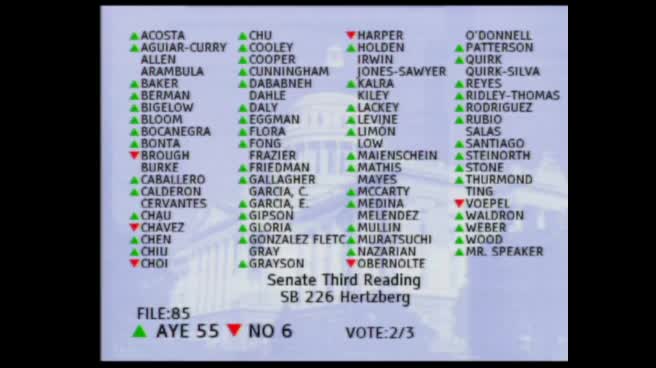
Bill Author

Bill Co-Author(s):