SB 506: Department of Fish and Wildlife: lake or streambed alteration agreements: Internet Web site.
- Session Year: 2017-2018
- House: Senate
- Latest Version Date: 2017-07-11
Existing law prohibits an entity from substantially diverting or obstructing the natural flow of, or substantially changing or using any material from the bed, channel, or bank of, any river, stream, or lake, or from depositing certain material where it may pass into any river, stream, or lake, without first notifying the Department of Fish and Wildlife of that activity, and entering into a lake or streambed alteration agreement if required by the department to protect fish and wildlife resources.
This bill would require the department, on or before December 31, 2018, and periodically thereafter, to upgrade the information on its Internet Web site regarding lake or streambed alteration agreements, to update its Frequently Asked Questions document and other appropriate sources of information regarding the lake and streambed alteration program, and to provide guidance on its Internet Web site to facilitate members of the public in obtaining individualized guidance regarding the lake and streambed alteration program, as specified.
Existing law prohibits an entity from substantially diverting or obstructing the natural flow of, or substantially changing or using any material from the bed, channel, or bank of, any river, stream, or lake, or from depositing certain material where it may pass into any river, stream, or lake, without first notifying the Department of Fish and Wildlife of that activity, and entering into a lake or streambed alteration agreement if required by the department to protect fish and wildlife resources.
This bill would limit the diversions and obstructions governed by these alteration agreement requirements to the diversions and obstructions that alter the bed, channel, or bank of a river, stream, or lake. The bill would exempt routine maintenance and repair of facilities for instream agricultural diversions from the alteration agreement requirements. require the department, on or before December 31, 2018, and periodically thereafter, to upgrade the information on its Internet Web site regarding lake or streambed alteration agreements, to update its Frequently Asked Questions document and other appropriate sources of information regarding the lake and streambed alteration program, and to provide guidance on its Internet Web site to facilitate members of the public in obtaining individualized guidance regarding the lake and streambed alteration program, as specified.
Existing law prohibits an entity from substantially diverting or obstructing the natural flow of, or substantially changing or using any material from the bed, channel, or bank of, any river, stream, or lake, or from depositing certain material where it may pass into any river, stream, or lake, without first notifying the Department of Fish and Wildlife of that activity, and entering into a lake or streambed alteration agreement if required by the department to protect fish and wildlife resources.
This bill would limit the diversions and obstructions governed by these alteration agreement requirements to the diversions and obstructions that alter the bed, channel, or bank of a river, stream, or lake. The bill would exempt routine maintenance and repair of facilities for instream agricultural diversions from the alteration agreement requirements.
On or before December 31, 2018, and periodically thereafter, the department shall do all of the following:
(a)Upgrade the information on its Internet Web site regarding agreements issued pursuant to this chapter by identifying and segregating documents created for informational, guidance, or regulatory purposes in order to provide clarity to the public.
(b)Update its Frequently Asked Questions document and other appropriate sources of information, as determined by the department, to provide current information to the public on matters that generate the most questions from the public regarding the lake and streambed alteration program.
(c)Provide guidance on its Internet Web site to facilitate members of the public in obtaining individualized guidance regarding the lake and streambed alteration program.
On or before December 31, 2018, and periodically thereafter, the department shall do all of the following:
(a)Upgrade the information on its Internet Web site regarding agreements issued pursuant to this chapter by identifying and segregating documents created for informational, guidance, or regulatory purposes in order to provide clarity to the public.
(b)Update its Frequently Asked Questions document and other appropriate sources of information, as determined by the department, to provide current information to the public on matters that generate the most questions from the public regarding the lake and streambed alteration program, including, but not limited to, the applicability of the program to infrequently flooded lands. program.
(c)Provide guidance on its Internet Web site to facilitate members of the public in obtaining individualized guidance regarding the lake and streambed alteration program.
On or before December 31, 2018, and periodically thereafter, the department shall do all of the following:
(a)Upgrade the information on its Internet Web site regarding agreements issued pursuant to this chapter by identifying and segregating documents created for informational, guidance, or regulatory purposes in order to provide clarity to the public.
(b)Update its Frequently Asked Questions document and other appropriate sources of information, as determined by the department, to provide current information to the public on matters that generate the most questions from the public regarding the lake and streambed alteration program, including, but not limited to, the applicability of the program to infrequently flooded lands.
(c)Provide guidance on its Internet Web site to facilitate members of the public in obtaining individualized guidance regarding the lake and streambed alteration program.
SECTION 1.Section 1602 of the Fish and Game Code is amended to read:1602.(a)An entity shall not substantially alter the bed, channel, or bank of any river, stream, or lake in a manner that diverts or obstructs the natural flow of the river, stream, or lake, substantially change or use any material from the bed, channel, or bank of any river, stream, or lake, or deposit or dispose of debris, waste, or other material containing crumbled, flaked, or ground pavement where it may pass into any river, stream, or lake, unless all of the following occur:(1)The department receives written notification regarding the activity in the manner prescribed by the department. The notification shall include, but is not limited to, all of the following:(A)A detailed description of the projects location and a map.(B)The name, if any, of the river, stream, or lake affected.(C)A detailed project description, including, but not limited to, construction plans and drawings, if applicable.(D)A copy of any document prepared pursuant to Division 13 (commencing with Section 21000) of the Public Resources Code.(E)A copy of any other applicable local, state, or federal permit or agreement already issued.(F)Any other information required by the department.(2)The department determines the notification is complete in accordance with Chapter 4.5 (commencing with Section 65920) of Division 1 of Title 7 of the Government Code, irrespective of whether the activity constitutes a development project for the purposes of that chapter.(3)The entity pays the applicable fees, pursuant to Section 1609.(4)One of the following occurs:(A)(i)The department informs the entity, in writing, that the activity will not substantially adversely affect an existing fish or wildlife resource, and that the entity may commence the activity without an agreement, if the entity conducts the activity as described in the notification, including any measures in the notification that are intended to protect fish and wildlife resources.(ii)Each region of the department shall log the notifications of activities where no agreement is required. The log shall list the date the notification was received by the department, a brief description of the proposed activity, and the location of the activity. Each item shall remain on the log for one year. Upon written request by any person, a regional office shall send the log to that person monthly for one year. A request made pursuant to this clause may be renewed annually.(B)The department determines that the activity may substantially adversely affect an existing fish or wildlife resource and issues a final agreement to the entity that includes reasonable measures necessary to protect the resource, and the entity conducts the activity in accordance with the agreement.(C)A panel of arbitrators issues a final agreement to the entity in accordance with subdivision (b) of Section 1603, and the entity conducts the activity in accordance with the agreement.(D)The department does not issue a draft agreement to the entity within 60 days from the date notification is complete, and the entity conducts the activity as described in the notification, including any measures in the notification that are intended to protect fish and wildlife resources.(b)(1)If an activity involves the routine maintenance and operation of water supply, drainage, flood control, or waste treatment and disposal facilities, notice to and agreement with the department shall not be required after the initial notification and agreement, unless the department determines either of the following:(A)The work described in the agreement has substantially changed.(B)Conditions affecting fish and wildlife resources have substantially changed, and those resources are adversely affected by the activity conducted under the agreement.(2)This subdivision applies only if notice to, and agreement with, the department was attained before January 1, 1977, and the department has been provided a copy of the agreement or other proof of the existence of the agreement that satisfies the department, if requested.(c)Notwithstanding subdivision (a), the department is not required to determine whether the notification is complete or otherwise process the notification until the department has received the applicable fees.(d)(1)Notwithstanding subdivision (a), an entity shall not be required to obtain an agreement with the department pursuant to this chapter for activities authorized by a license or renewed license for cannabis cultivation issued by the Department of Food and Agriculture for the term of the license or renewed license if all of the following occur:(A)The entity submits all of the following to the department:(i)The written notification described in paragraph (1) of subdivision (a).(ii)A copy of the license or renewed license for cannabis cultivation issued by the Department of Food and Agriculture that includes the requirements specified in subdivisions (d), (e), and (f) of Section 19332.2 of the Business and Professions Code.(iii)The fee specified in paragraph (3) of subdivision (a).(B)The department determines in its sole discretion that compliance with the requirements specified in subdivisions (d), (e), and (f) of Section 19332.2 of the Business and Professions Code that are included in the license will adequately protect existing fish and wildlife resources that may be substantially adversely affected by the cultivation without the need for additional measures that the department would include in a draft streambed alteration agreement in accordance with Section 1603.(C)The department notifies the entity in writing that the exemption applies to the cultivation authorized by the license or renewed license.(2)The department shall notify the entity in writing whether the exemption in paragraph (1) applies to the cultivation authorized by the license or renewed license within 60 days from the date that the notification is complete and the fee has been paid.(3)If an entity receives an exemption pursuant to this subdivision and fails to comply with any of the requirements described in subdivision (d), (e), or (f) of Section 19332.2 of the Business and Professions Code that are included in the license, the failure shall constitute a violation under this section, and the department shall notify the Department of Food and Agriculture of any enforcement action taken.(e)This section does not apply to the routine maintenance and repair of facilities for instream agricultural irrigation diversions. (f)It is unlawful for any entity to violate this chapter.(a)An entity shall not substantially divert or obstruct alter the bed, channel, or bank of any river, stream, or lake in a manner that diverts or obstructs the natural flow of, or of the river, stream, or lake, substantially change or use any material from the bed, channel, or bank of, of any river, stream, or lake, or deposit or dispose of debris, waste, or other material containing crumbled, flaked, or ground pavement where it may pass into any river, stream, or lake, unless all of the following occur:
(1)The department receives written notification regarding the activity in the manner prescribed by the department. The notification shall include, but is not limited to, all of the following:
(A)A detailed description of the projects location and a map.
(B)The name, if any, of the river, stream, or lake affected.
(C)A detailed project description, including, but not limited to, construction plans and drawings, if applicable.
(D)A copy of any document prepared pursuant to Division 13 (commencing with Section 21000) of the Public Resources Code.
(E)A copy of any other applicable local, state, or federal permit or agreement already issued.
(F)Any other information required by the department.
(2)The department determines the notification is complete in accordance with Chapter 4.5 (commencing with Section 65920) of Division 1 of Title 7 of the Government Code, irrespective of whether the activity constitutes a development project for the purposes of that chapter.
(3)The entity pays the applicable fees, pursuant to Section 1609.
(4)One of the following occurs:
(A)(i)The department informs the entity, in writing, that the activity will not substantially adversely affect an existing fish or wildlife resource, and that the entity may commence the activity without an agreement, if the entity conducts the activity as described in the notification, including any measures in the notification that are intended to protect fish and wildlife resources.
(ii)Each region of the department shall log the notifications of activities where no agreement is required. The log shall list the date the notification was received by the department, a brief description of the proposed activity, and the location of the activity. Each item shall remain on the log for one year. Upon written request by any person, a regional office shall send the log to that person monthly for one year. A request made pursuant to this clause may be renewed annually.
(B)The department determines that the activity may substantially adversely affect an existing fish or wildlife resource and issues a final agreement to the entity that includes reasonable measures necessary to protect the resource, and the entity conducts the activity in accordance with the agreement.
(C)A panel of arbitrators issues a final agreement to the entity in accordance with subdivision (b) of Section 1603, and the entity conducts the activity in accordance with the agreement.
(D)The department does not issue a draft agreement to the entity within 60 days from the date notification is complete, and the entity conducts the activity as described in the notification, including any measures in the notification that are intended to protect fish and wildlife resources.
(b)(1)If an activity involves the routine maintenance and operation of water supply, drainage, flood control, or waste treatment and disposal facilities, notice to and agreement with the department shall not be required after the initial notification and agreement, unless the department determines either of the following:
(A)The work described in the agreement has substantially changed.
(B)Conditions affecting fish and wildlife resources have substantially changed, and those resources are adversely affected by the activity conducted under the agreement.
(2)This subdivision applies only if notice to, and agreement with, the department was attained prior to before January 1, 1977, and the department has been provided a copy of the agreement or other proof of the existence of the agreement that satisfies the department, if requested.
(c)Notwithstanding subdivision (a), the department is not required to determine whether the notification is complete or otherwise process the notification until the department has received the applicable fees.
(d)(1)Notwithstanding subdivision (a), an entity shall not be required to obtain an agreement with the department pursuant to this chapter for activities authorized by a license or renewed license for cannabis cultivation issued by the Department of Food and Agriculture for the term of the license or renewed license if all of the following occur:
(A)The entity submits all of the following to the department:
(i)The written notification described in paragraph (1) of subdivision (a).
(ii)A copy of the license or renewed license for cannabis cultivation issued by the Department of Food and Agriculture that includes the requirements specified in subdivisions (d), (e), and (f) of Section 19332.2 of the Business and Professions Code.
(iii)The fee specified in paragraph (3) of subdivision (a).
(B)The department determines in its sole discretion that compliance with the requirements specified in subdivisions (d), (e), and (f) of Section 19332.2 of the Business and Professions Code that are included in the license will adequately protect existing fish and wildlife resources that may be substantially adversely affected by the cultivation without the need for additional measures that the department would include in a draft streambed alteration agreement in accordance with Section 1603.
(C)The department notifies the entity in writing that the exemption applies to the cultivation authorized by the license or renewed license.
(2)The department shall notify the entity in writing whether the exemption in paragraph (1) applies to the cultivation authorized by the license or renewed license within 60 days from the date that the notification is complete and the fee has been paid.
(3)If an entity receives an exemption pursuant to this subdivision and fails to comply with any of the requirements described in subdivision (d), (e), or (f) of Section 19332.2 of the Business and Professions Code that are included in the license, the failure shall constitute a violation under this section, and the department shall notify the Department of Food and Agriculture of any enforcement action taken.
(e)This section does not apply to the routine maintenance and repair of facilities for instream agricultural irrigation diversions.
(e)(f)It is unlawful for any entity to violate this chapter.
|
Date
|
Status
|
|---|---|
| Feb 4, 2018 | Last day to consider Governor’s veto pursuant to Joint Rule 58.5. |
| Jul 21, 2017 | In Senate. Consideration of Governor's veto pending. |
| Jul 21, 2017 | Vetoed by the Governor. |
| Jul 13, 2017 | Enrolled and presented to the Governor at 10 a.m. |
| Jul 10, 2017 | Assembly amendments concurred in. (Ayes 38. Noes 0.) Ordered to engrossing and enrolling. |
| Jul 6, 2017 | In Senate. Concurrence in Assembly amendments pending. |
| Jul 6, 2017 | Read third time. Passed. Ordered to the Senate. |
| Jun 29, 2017 | Read second time. Ordered to consent calendar. |
| Jun 28, 2017 | From committee: Do pass. Ordered to consent calendar. (Ayes 14. Noes 0.) (June 28). |
| Jun 13, 2017 | From committee: Do pass and re-refer to Com. on APPR. (Ayes 14. Noes 0.) (June 13). Re-referred to Com. on APPR. |
| Jun 5, 2017 | From committee with author's amendments. Read second time and amended. Re-referred to Com. on W.,P., & W. |
| May 18, 2017 | Referred to Com. on W.,P., & W. |
| Apr 20, 2017 | In Assembly. Read first time. Held at Desk. |
| Apr 20, 2017 | Read third time. Passed. (Ayes 36. Noes 0. Page 769.) Ordered to the Assembly. |
| Apr 18, 2017 | Read second time. Ordered to consent calendar. |
| Apr 17, 2017 | From committee: Be ordered to second reading pursuant to Senate Rule 28.8 and ordered to consent calendar. |
| Apr 5, 2017 | Set for hearing April 17. |
| Apr 3, 2017 | Read second time and amended. Re-referred to Com. on APPR. |
| Mar 30, 2017 | From committee: Do pass as amended and re-refer to Com. on APPR. with recommendation: To consent calendar. (Ayes 9. Noes 0. Page 512.) (March 28). |
| Mar 7, 2017 | Set for hearing March 28. |
| Mar 2, 2017 | Referred to Com. on N.R. & W. |
| Feb 17, 2017 | From printer. May be acted upon on or after March 19. |
| Feb 16, 2017 | Introduced. Read first time. To Com. on RLS. for assignment. To print. |
|
Date
|
Description
|
Location
|
Votes
|
|
|---|---|---|---|---|
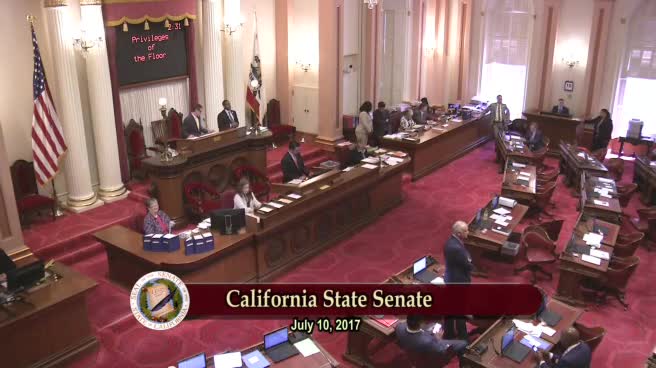
| Jul 10, 2017 | Unfinished Business SB506 Nielsen et al. Concurrence | Senate Floor |
Passed |
|
| Jul 6, 2017 | SB 506 Nielsen Consent Calendar Second Day Regular Session | Assembly Floor |
Passed |
|
| Jun 28, 2017 | Do pass. To Consent Calendar. | Assembly Standing Committee on Appropriations |
Passed |
|
| Jun 13, 2017 | Do pass and be re-referred to the Committee on [Appropriations] | Assembly Standing Committee on Water, Parks, and Wildlife |
Passed |
|
| Apr 20, 2017 | Consent Calendar 2nd SB506 | Senate Floor |
Passed |
|
| Mar 28, 2017 | Do pass as amended, but first amend, and re-refer to the Committee on [Appropriations] with the recommendation: To Consent Calendar | Senate Standing Committee on Natural Resources and Water |
Passed |
This list shows positions taken on this bill by organizations on the date displayed, which is linked to the original source.
Positions by individuals are not included.
|
Organization
|
Position
|
Date
|
|---|---|---|
| California Central Valley Flood Control Association | ** Support | Jan 2, 2018 |
| California Farm Bureau Federation | ** Support | Jan 2, 2018 |
| California Forestry Association | ** Support | Jan 2, 2018 |
| City of Roseville | ** Support | Jan 2, 2018 |
| N.R. & W. | ** Against | Apr 19, 2017 |
| Prepared By: William Craven | ** Against | Apr 19, 2017 |
| rural california representatives of california | ** Support | Jan 2, 2018 |
| Sierra Club California | ** Against | Jan 2, 2018 |
Office of Senate Floor Analyses (916) 651-1520 Fax: (916) 327-4478 | SB |
VETO
Bill No: SB 506
:
SENATE NATURAL RES. & WATER COMMITTEE: 9-0, 3/28/17
AYES: Hertzberg, Stone, Allen, Atkins, Hueso, Jackson, Monning, Stern, Vidak
SENATE APPROPRIATIONS COMMITTEE: Senate Rule 28.8
SENATE FLOOR: 36-0, 4/20/17 (Consent)
AYES: Anderson, Atkins, Bates, Berryhill, Bradford, Cannella, De León, Dodd, Fuller, Gaines, Galgiani, Glazer, Hernandez, Hertzberg, Hill, Jackson, Leyva, McGuire, Mendoza, Mitchell, Monning, Moorlach, Morrell, Newman, Nguyen, Nielsen, Pan, Portantino, Roth, Skinner, Stern, Stone, Vidak, Wieckowski, Wiener, Wilk
NO VOTE RECORDED: Allen, Beall, Hueso, Lara
SENATE FLOOR: 38-0, 7/10/17
AYES: Anderson, Atkins, Bates, Beall, Berryhill, Bradford, Cannella, De León, Dodd, Fuller, Gaines, Galgiani, Glazer, Hernandez, Hertzberg, Hill, Hueso, Jackson, Lara, Leyva, McGuire, Mendoza, Mitchell, Monning, Moorlach, Morrell, Newman, Nguyen, Nielsen, Pan, Portantino, Roth, Skinner, Stone, Vidak, Wieckowski, Wiener, Wilk
NO VOTE RECORDED: Allen, Stern
ASSEMBLY FLOOR: 74-0, 7/6/17 (Consent) - See last page for vote
DIGEST:
This bill requires the Department of Fish and Wildlife (DFW) to upgrade the information on its Internet Web site regarding lake and streambed alteration agreements (LSAA) by December 31, 2018, and periodically thereafter.
Existing law:
- Prohibits any activity in a river, stream, or lake, which may alter a streambed. Allows the DFW to enter into an LSAA which permits activities that alter a streambed if reasonable measures to protect fish and wildlife resources are included.
- Requires any person, state or local governmental agency, or public utility to notify the DFW prior to commencing any activity that may substantially alter a streambed.
This bill:
- Requires DFW to identify and segregate documents created for informational, guidance, and regulatory purposes on its Internet Web site in order to provide clarity to the public.
- Requires DFW to update the “Frequently Asked Questions” document and other appropriate sources of information, as determined by DFW, to provide current information to the public on matters that generate the most questions.
- Requires DFW to provide guidance on the DFW Internet Web site to members of the public obtaining individualized guidance regarding the program.
Comments
Opposition? The opposition was based on a prior version of the bill.
FISCAL EFFECT: Appropriation: Fiscal Com.: Local:
According to the Assembly Appropriations Committee, this bill has negligible fiscal impact.
California Central Valley Flood Control Association
California Farm Bureau Federation
California Forestry Association
City of Roseville
Rural California Representatives of California
OPPOSITION: (Verified 8/21/17)
Sierra Club California
ARGUMENTS IN SUPPORT: Proponents state that regulatory compliance with streambed alteration requirements can be very time-consuming and costly for local agencies that provide flood protection, drainage and water diversion services to their constituents. Providing current information through the Internet access to regarding streambed alteration agreements will assist local agencies and landowners to better understand the compliance process, which will result in greater efficiencies in achieving compliance and likely fewer departmental enforcement actions.
GOVERNOR'S VETO MESSAGE:
I am returning Senate Bill 506 without my signature.
This bill requires the Department of Fish and Wildlife (Department) to upgrade its Lake and Streambed Alteration Program website and post any documents created for informational, guidance, or regulatory purposes on the website by December 31, 2018.
The Department is beginning a rulemaking process on the Lake and Streambed Alteration Program and the bill, as currently written, is premature.
I am directing the Department to update its website to reflect the new guidance, once the regulations are complete.
ASSEMBLY FLOOR: 74-0, 7/6/17
AYES: Acosta, Aguiar-Curry, Travis Allen, Arambula, Baker, Berman, Bigelow, Bloom, Bonta, Brough, Burke, Caballero, Cervantes, Chau, Chávez, Chen, Chiu, Choi, Chu, Cooley, Cooper, Cunningham, Dahle, Daly, Eggman, Flora, Fong, Frazier, Friedman, Gallagher, Cristina Garcia, Eduardo Garcia, Gipson, Gloria, Gomez, Gonzalez Fletcher, Grayson, Harper, Holden, Irwin, Jones-Sawyer, Kalra, Kiley, Levine, Limón, Low, Maienschein, Mathis, Mayes, Medina, Melendez, Mullin, Muratsuchi, Nazarian, Obernolte, O'Donnell, Patterson, Quirk, Quirk-Silva, Reyes, Ridley-Thomas, Rodriguez, Rubio, Salas, Santiago, Steinorth, Mark Stone, Thurmond, Ting, Voepel, Waldron, Weber, Wood, Rendon
NO VOTE RECORDED: Bocanegra, Calderon, Dababneh, Gray, Lackey, McCarty
1/2/18 10:09:55
**** END ****
Office of Senate Floor Analyses (916) 651-1520 Fax: (916) 327-4478 | SB |
UNFINISHED BUSINESS
Bill No: SB 506
:
SENATE NATURAL RES. & WATER COMMITTEE: 9-0, 3/28/17
AYES: Hertzberg, Stone, Allen, Atkins, Hueso, Jackson, Monning, Stern, Vidak
SENATE APPROPRIATIONS COMMITTEE: Senate Rule 28.8
SENATE FLOOR: 36-0, 4/20/17 (Consent)
AYES: Anderson, Atkins, Bates, Berryhill, Bradford, Cannella, De León, Dodd, Fuller, Gaines, Galgiani, Glazer, Hernandez, Hertzberg, Hill, Jackson, Leyva, McGuire, Mendoza, Mitchell, Monning, Moorlach, Morrell, Newman, Nguyen, Nielsen, Pan, Portantino, Roth, Skinner, Stern, Stone, Vidak, Wieckowski, Wiener, Wilk
NO VOTE RECORDED: Allen, Beall, Hueso, Lara
ASSEMBLY FLOOR: 74-0, 7/6/17 (Consent) - See last page for vote
DIGEST:
This bill requires the Department of Fish and Wildlife (DFW) to upgrade the information on its Internet Web site regarding lake and streambed alteration agreements (LSAA) by December 31, 2018, and periodically thereafter.
Assembly Amendments delete the reference to flood plains.
Existing law:
- Prohibits any activity in a river, stream, or lake, which may alter a streambed. Allows the DFW to enter into an LSAA which permits activities that alter a streambed if reasonable measures to protect fish and wildlife resources are included.
- Requires any person, state or local governmental agency, or public utility to notify the DFW prior to commencing any activity that may substantially alter a streambed.
This bill:
- Requires DFW to identify and segregate documents created for informational, guidance, and regulatory purposes on its Internet Web site in order to provide clarity to the public.
- Requires DFW to update the “Frequently Asked Questions” document and other appropriate sources of information, as determined by DFW, to provide current information to the public on matters that generate the most questions.
- Requires DFW to provide guidance on the DFW Internet Web site to members of the public obtaining individualized guidance regarding the program.
Comments
Proponents state that regulatory compliance with streambed alteration requirements can be very time-consuming and costly for local agencies that provide flood protection, drainage and water diversion services to their constituents. The provision of Internet access to current information regarding streambed alteration agreements will assist local agencies to better understand the compliance process, which will result in greater efficiencies in achieving compliance and likely fewer departmental enforcement actions.
The opposition was based on a prior version of the bill.
FISCAL EFFECT: Appropriation: Fiscal Com.: Local:
According to the Assembly Appropriations Committee, this bill has negligible fiscal impact.
California Central Valley Flood Control Association
California Farm Bureau Federation
California Forestry Association
City of Roseville
Rural California Representatives of California
Sierra Club California
ASSEMBLY FLOOR: 74-0, 7/6/17
AYES: Acosta, Aguiar-Curry, Travis Allen, Arambula, Baker, Berman, Bigelow, Bloom, Bonta, Brough, Burke, Caballero, Cervantes, Chau, Chávez, Chen, Chiu, Choi, Chu, Cooley, Cooper, Cunningham, Dahle, Daly, Eggman, Flora, Fong, Frazier, Friedman, Gallagher, Cristina Garcia, Eduardo Garcia, Gipson, Gloria, Gomez, Gonzalez Fletcher, Grayson, Harper, Holden, Irwin, Jones-Sawyer, Kalra, Kiley, Levine, Limón, Low, Maienschein, Mathis, Mayes, Medina, Melendez, Mullin, Muratsuchi, Nazarian, Obernolte, O'Donnell, Patterson, Quirk, Quirk-Silva, Reyes, Ridley-Thomas, Rodriguez, Rubio, Salas, Santiago, Steinorth, Mark Stone, Thurmond, Ting, Voepel, Waldron, Weber, Wood, Rendon
NO VOTE RECORDED: Bocanegra, Calderon, Dababneh, Gray, Lackey, McCarty
7/7/17 15:07:44
**** END ****
Date of Hearing: June 28, 2017
ASSEMBLY COMMITTEE ON APPROPRIATIONS
Lorena Gonzalez Fletcher, Chair
SBPCA Bill Id:SB 506
Author:(Nielsen) – As Amended Ver:June 5, 2017
Policy Committee: | Water, Parks and Wildlife | Vote: | 14 - 0 |
|
| ||
|
|
Urgency: No State Mandated Local Program: No Reimbursable: No
SUMMARY:
This bill requires the Department of Fish and Wildlife (DFW) to upgrade the information on its Internet Web site regarding lake and streambed alteration agreements (LSAA) by December 31, 2018, and periodically thereafter. Specifically, this bill requires DFW to:
- Identify and segregate documents created for informational, guidance, and regulatory purposes on its Internet Web site in order to provide clarity to the public.
- Update the “Frequently Asked Questions” document and other appropriate sources of information, as determined by DFW, to provide current information to the public on matters that generate the most questions.
- Provide guidance on the DFW Internet Web site to members of the public obtaining individualized guidance regarding the program.
FISCAL EFFECT:
Negligible fiscal impact.
COMMENTS:
- Purpose. According to the author, “The LSAA were conceived in the early 1960s in order to require notice to the DFW prior to conducting activities that would substantially alter the bed, bank, or channel of a stream, river, or lake. More recently DFW’s enforcement practices reflect the most stringent possible interpretation of the law, contravening original intent, feasibility, or usefulness. For many, this creates unnecessary burden and expense. This bill provides better, clearer information to those who are forced to comply with the onerous regulations.”
- Background. Fish and Game Code section 1602 requires an entity to notify DFW prior to commencing any activity that may do one or more of the following:
- Substantially divert or obstruct the natural flow of any river, stream or lake;
- Substantially change or use any material from the bed, channel or bank of any river, stream, or lake; or
- Deposit debris, waste or other materials that could pass into any river, stream or lake.
Any river, stream or lake includes those that are episodic as well as those that are perennial. This includes ephemeral streams, desert washes, and watercourses with a subsurface flow. It may also apply to work undertaken within the flood plain of a body of water.
DFW requires an LSAA when it determines that the activity, as described in a complete lake and stream alteration notification, may substantially adversely affect existing fish or wildlife resources. An LSAA includes measures necessary to protect existing fish and wildlife resources. DFW may suggest ways to modify the project that would eliminate or reduce harmful impacts to fish and wildlife resources. Before issuing an LSAA, DFW must comply with the California Environmental Quality Act (CEQA).
- Related Legislation. AB 947 (Gallagher) defines the boundaries of a water way for purposes of applying an LSAA. The bill is currently pending in the Assembly Appropriations Committee (two-year bill).
Analysis Prepared by: Jennifer Galehouse / APPR. / (916) 319-2081
Date of Hearing: June 13, 2017
ASSEMBLY COMMITTEE ON WATER, PARKS, AND WILDLIFE
Eduardo Garcia, Chair
SBPCA Bill Id:SB 506
Author:(Nielsen) – As Amended Ver:June 5, 2017
SENATE VOTE: 36-0
SUBJECT: Department of Fish and Wildlife: lake or streambed alteration agreements: Internet Web site
SUMMARY: Requires the Department of Fish and Wildlife (DFW) to, on or before December 31, 2018, and periodically thereafter, upgrade the information on its Internet Web site regarding lake and streambed alteration agreements (LSAA) in order to provide clarity to the public. Specifically, this bill:
- Requires the DFW to identify and segregate informational, guidance, and regulatory documents on its Internet Web site.
- Update the “Frequently Asked Questions” document and other appropriate sources of information, to provide current information to the public on matters that generate the most questions from the public.
- Provide guidance on the DFW Internet Web site to members of the public obtaining individual guidance on the lake and streambed alteration program.
EXISTING LAW:
- Prohibits any activity in a river, stream, or lake, which may alter a streambed. Allows the DFW to enter into an LSAA which permits activities that alter a streambed if reasonable measures to protect fish and wildlife resources are included.
- Requires any person, state or local governmental agency, or public utility to notify the DFW prior to commencing any activity that may substantially alter a streambed.
FISCAL EFFECT: Unknown.
COMMENTS: Requires the DFW to, on or before December 31, 2018, and periodically thereafter, upgrade the information on LSAA’s on its Internet Web site.
Author’s statement:
The LSAA were conceived in the early 1960s in order to require notice to the DFW prior to conducting activities that would substantially alter the bed, bank, or channel of a stream, river, or lake. More recently DFW’s enforcement practices reflect the most stringent possible interpretation of the law, contravening original intent, feasibility, or usefulness. For many, this creates unnecessary burden and expense. This bill provides better, clearer information to those who are forced to comply with the onerous regulations.
Background. LSAA Basics. The purpose of an LSAA is to protect fish, wildlife, and native plant resources. The DFW requires an LSAA when it determines that an activity that alters a streambed may substantially adversely affect existing fish or wildlife resources. It is incumbent upon an entity carrying out a project to notify the DFW for the DFW to make a determination. An LSAA includes measures necessary to protect existing fish and wildlife resources. The DFW may suggest ways to modify a project that would eliminate or reduce harmful impacts to fish and wildlife resources. Before issuing an LSAA, the DFW must comply with the California Environmental Quality Act (CEQA).
Under historical practice, an LSAA can be required for an activity adversely affecting a river, stream or lake, including those that are episodic, or dry for periods of time. This includes ephemeral streams, desert washes, and watercourses with a subsurface flow. An LSAA may also apply to work undertaken within the flood plain of a body of water.
Communication Is Key. For an entity performing a project, determining when to engage in an LSAA can be a challenge. Because it is the responsibility of the entity performing a project to reach out to the DFW, that entity should have an understanding of the types of projects and the location of the projects that they should reach out on. The DFW’s website is intended to be a place where an entity can receive guidance on whether a project will requires an LSAA.
Currently, the DFW website contains significant information on LSAA’s, but it is not organized in an easily navigable fashion. It is not segregated by topic so that an entity can tell what information is scientific background, what is guidance, or what are regulatory requirements. Additionally, the Frequently-Asked-Questions document on the website has not been updated since 2007.
This bill requires the DFW to upgrade its website and to provide project proponents with better information about what is required when applying for an LSAA. The new website information will segregate regulatory information from other types of information. The Frequently-Asked-Questions document will also be updated to provide current information to the public on matters that generate the most questions from the public. Additionally, the DFW will provide guidance when members of the public need individualized answers to questions.
Prior and Related Legislation.
- AB 947 (Gallagher), 2017, would define the boundaries of a water way for purposes of applying an LSAA. The bill is currently in the Assembly Appropriations Committee.
Supporting Arguments.
Regulatory compliance with streambed alteration requirements can be very time-consuming and costly for local agencies that provide flood protection, drainage and water diversion services to their constituents. The provision of Internet access to current information regarding streambed alteration agreements will assist local agencies to better understand the compliance process, which will result in greater efficiencies in achieving compliance and likely fewer departmental enforcement actions.
REGISTERED SUPPORT / OPPOSITION:
Support
California Central Valley Flood Control Association
California Farm Bureau Federation
California Forestry Association (Calforests)
Opposition
None on file
Analysis Prepared by: Ryan Ojakian / W., P., & W. /
Office of Senate Floor Analyses (916) 651-1520 Fax: (916) 327-4478 | SB |
CONSENT
Bill No: SB 506
:
SENATE NATURAL RES. & WATER COMMITTEE: 9-0, 3/28/17
AYES: Hertzberg, Stone, Allen, Atkins, Hueso, Jackson, Monning, Stern, Vidak
SENATE APPROPRIATIONS COMMITTEE: Senate Rule 28.8
DIGEST: This bill requires the Department of Fish and Wildlife (DFW) to upgrade the information on its Web site regarding streambed alteration agreements in order to provide more useful information to those landowners who may need a permit.
Existing law:
- Provides numerous state laws designed to protect fish and wildlife. This bill affects Fish and Game Code Section 1602 which is commonly referred to as one part of the “streambed alteration” statute which begins at Section 1600. It contains the provisions relating to permits for streambed and lake agreements that, when issued, determine the extent to which a planned activity within a stream or river may adversely affect fish or wildlife or habitat and what off-setting mitigation may be required. In the absence of a permit, the section states that an entity may not substantially divert or obstruct the natural flow of stream or deposit or dispose of material. Existing law requires the entity to notify the Department of Fish and Wildlife (DFW) which triggers the negotiation of the standards that may apply to the request. At that point the entity and DFW enter into a streambed alteration agreement (SAA) that contains any necessary provisions to mitigate the planned activity’s potentially adverse consequences.
- Declares that “the protection and conservation of the fish and wildlife resources of this state are of utmost public interest. Fish and wildlife are the property of the people and provide a major contribution to the economy of the state, as well as providing a significant part of the people’s food supply; therefore their conservation is a proper responsibility of the state.”
- Provides that a permit fee is required, and the law provides for binding arbitration in the event of a disagreement.
- Does not apply to the routine maintenance and operation of water supply, drainage, flood control, or waste treatment and disposal facilities except when the work described in the SAA has substantially changed, or the conditions affecting fish and wildlife resources have substantially changed.
- Requires, under Section 1609 of the Fish and Game Code as amended in 2016, that the fees be adequate to administer and enforce the provisions related to SAAs, and establishes a cap on fees of $5000. DFW has published the fee schedule on its Web site.
- Contains, on the DFW Web site, significant information on this topic, but it is not segregated so that landowners can tell what information is scientific background, what is guidance, or what are regulatory requirements. The Frequently-Asked-Questions document on this Web site has not been updated since 2007.
This bill requires DFW to upgrade its Web site and to provide landowners better information about what is required when applying for a SAA. The new Web site information will segregate regulatory information from other types of information. The Frequently-Asked-Questions document will also be updated to provide current information to the public on matters that generate the most questions from the public. Additionally, DFW will provide guidance when members of the public need individualized answers to questions.
FISCAL EFFECT: Appropriation: Fiscal Com.: Local:
California Farm Bureau Federation
California Forestry Association
OPPOSITION: (Verified 4/17/17)
Sierra Club California
ARGUMENTS IN SUPPORT: According to the California Farm Bureau Federation, “SB 506 will help clarify when a [section] 1600 [streambed alteration] agreement is necessary.”
4/19/17 10:26:36
**** END ****
SENATE COMMITTEE ON NATURAL RESOURCES AND WATER
Senator Robert Hertzberg, Chair
2017 - 2018 Regular
Bill No: SB Hearing Date: March 28, 2017
Author: | Nielsen | ||
Version: | February 16, 2017 | ||
Urgency: | No | Fiscal: | Yes |
Consultant: | William Craven | ||
Subject: Department of Fish and Wildlife: lake or streambed alteration agreements
BACKGROUND AND EXISTING LAW
Fish and Game Code.
- California has numerous state laws designed to protect fish and wildlife. This bill would affect Fish and Game Code Section 1602 which is commonly referred to as one part of the “streambed alteration” statute which begins at Section 1600. It contains the provisions relating to permits for streambed and lake agreements that, when issued, determine the extent to which a planned activity within a stream or river may adversely affect fish or wildlife or habitat and what off-setting mitigation may be required. In the absence of a permit, the section states that an entity may not substantially divert or obstruct the natural flow of stream or deposit or dispose of material. Existing law requires the entity to notify the Department of Fish and Wildlife (DFW) which triggers the negotiation of the standards that may apply to the request. At that point the entity and DFW enter into a streambed alteration agreement (SAA) that contains any necessary provisions to mitigate the planned activity’s potentially adverse consequences.
- This law was enacted first in 1970, reenacted in 1976, and amended in 2003, but the purpose of the law has never changed. The law declares “the protection and conservation of the fish and wildlife resources of this state are of utmost public interest. Fish and wildlife are the property of the people and provide a major contribution to the economy of the state, as well as providing a significant part of the people’s food supply; therefore their conservation is a proper responsibility of the state.”
- A permit fee is required, and the law provides for binding arbitration in the event of a disagreement.
- Existing law and determinations made by DFW do not require physical alteration of a streambed for the permitting provisions to apply, although that was contested in recent and unsuccessful litigation brought by the Siskiyou County Farm Bureau and which this bill seeks to address.
- Specifically, section 1602 prohibits, in relevant part, those diversions that substantially divert or obstruct the natural flow of the river in the absence of the permit described earlier.
- This section does not apply to the routine maintenance and operation of water supply, drainage, flood control, or waste treatment and disposal facilities except when the work described in the SAA has substantially changed, or the conditions affecting fish and wildlife resources have substantially changed.
- Section 1609 of the Fish and Game Code was amended in 2016 to require the fees to be adequate to administer and enforce the provisions related to streambed alteration agreements, and establishes a cap on fees of $5000. DFW has published the fee schedule on its website.
Water Law.
- Water use by those with appropriative or riparian rights is limited by the “reasonable use” doctrine which forbids the waste of water or its unreasonable use. In addition, the public trust doctrine vests the state with sovereign authority over all navigable waterways.
- Although the term “water rights” is often rhetorically discussed as an absolute concept of ownership, the water in California is in fact owned by the people of California. (Water Code Section 102). The right to use water may be acquired in the manner provided by law.
- The "public trust doctrine" requires the state, as a trustee, to manage its public trust resources (including wildlife and water) to derive the maximum benefit for its citizenry. The benefits to be considered and balanced include economic, recreational, aesthetic and environmental; if at any time the trustee determines that a use of water other than the then current use would better serve the public trust, the state has the power and the obligation to reallocate that water in accordance with the public's interest. Even if the water at issue has been put to beneficial use (and relied upon) for decades, it can be taken from one user in favor of another need or use. The public trust doctrine therefore means that no water rights in California are truly "vested" in the traditional sense of property rights. (Sawyer, Primer on California Water Law, 10).
- In all contexts, what constitutes a reasonable use of water depends on many factors and often involve “statewide considerations of transcendent importance.” These statewide considerations, as defined in court decisions and the state constitution, are that ‘limited water resources be put only to those beneficial uses “to the fullest extent of which they are capable,” that “waste or unreasonable use” be prevented, and that conservation be exercised “in the interest of the people and for the public welfare.”
PROPOSED LAW
This bill limits and re-defines the threshold for a streambed alteration agreement to require substantial alterations of the “bed, channel, or bank” of any river or stream and by deleting the provision that diversions in and of themselves may trigger the need for a SAA. It also adds an exemption to section 1602 of the Fish and Game Code that would apply to “routine maintenance and repair of facilities for instream agricultural irrigation diversions.”
ARGUMENTS IN SUPPORT
According to the author, the original purpose of section 1602 was designed to affect large construction projects and mining operations that could substantially alter a streambed or channel and thereby physically divert the flow of a river or stream. The author argues that in 2005 DFW expanded its interpretation of the section to require agricultural water right owners to obtain a permit for extracting water in routine and ongoing operations. In addition to the burdensome nature of the permitting process, the author predicts that in low water years, permits will not be issued.
The California Farm Bureau Federation characterizes the streambed alteration program as “requiring a permit to open a headgate to exercise their existing water rights to irrigate their crops or pastures.” The organization is also concerned about the increase in application fees and the capability of DFW to process the significant numbers of applications that requires notifications for all diversions.
ARGUMENTS IN OPPOSITION
Sierra Club California opposes the bill because it does not believe that those with water rights should have a free pass from the application of other environmental laws. It considers the issue closed in light of the Siskiyou Farm Bureau decision discussed elsewhere. The basic structure of this law requires notification to DFW to determine if a substantial diversion is involved. The Sierra Club believes that is a reasonable way for DFW to determine the cumulative effects of diversions on fish and wildlife, especially on endangered species, and especially in drought years.
COMMENTS
- The policy arguments in support advanced by the author were considered and rejected in a unanimous, published Court of Appeal decision in 2015. Siskiyou Farm Bureau v. Department of Fish and Wildlife.
The court disposed of the arguments as follows:
- The word “divert” clearly and without ambiguity includes diversions that do not alter the streambed itself. A diversion can and does mean a diversion of water, whether or not the streambed or channel is physically altered. It rejected all of the Farm Bureau arguments that questioned that conclusion. The court did point out that the Legislature created the statutory balance that is currently in effect, and theoretically could alter that balance. However, the court noted that such a step may put at risk the de-watering of streams that provide important fish habitat, especially in drought years.
- The court did not accept the view that DFW abruptly changed its policy and began enforcing Section 1602 in a way that it had never done before. However, even if DFW had not enforced section 1602 in such a way previously, the statute does not preclude it from doing so “in the face of extreme drought and piscatorial peril.” DFW has the legal authority to prevent “substantial dewatering of streams absent physical alteration to the streambeds.”
- Whether a diversion is substantial depends on a number of factors “including the amount of water taken relative to the supply, the use to which the water is applied, the historical usage by the diverter, and the needs of the fish, given the palpable fact that—due to yet another in a series of recurring drought conditions in California—there simply is not enough water to satisfy all legitimate needs.”
- The water law considerations that were recited earlier came from this decision.
- The court rejected the author’s position that the use of this statute casts DFW as another arbiter of water rights, usurping authority from the State Water Board. That argument was opposed in court by the State Water Board itself and the court pointed out that the section does not blur the lines of authority between the two agencies.
- It is worth noting that the one of the important fish species that is at risk in Siskiyou County when streams are inadequate to provide habitat is Coho salmon. In 2005, the coho salmon was listed as threatened under the California Endangered Species Act.
The National Marine Fisheries Service has divided West Coast Coho into six evolutionary significant units, including the South Oregon/Northern California Coasts (SONCC), which is comprised of 41 populations. Once numbering 150,000 to 400,000 naturally spawning fish in the mid-twentieth century, populations have declined to a mere 10,000. In light of this trend, the U.S. government in 1997 listed the SONCC coho unit as endangered under the federal Endangered Species Act. (Note: The overall Coho population has declined further since this report was published in 2012.)
It is a threatened species under California law.
Coho runs in particular will likely continue to be extremely low because of warm oceans which is a lingering effect of the warm North Pacific “blob” and this year’s El Niño weather system, and what appears to be an ongoing, but less severe drought, notwithstanding the rains of 2016.
The overall picture of coho salmon in California is one of severely depleted populations. The main factors and threats affecting population viability of Coho salmon, as listed in the DFW Recovery Strategy, have not changed substantially over several decades: That document states: “The ongoing population declines are thought to be largely attributable to human causes, such as water diversions, stream flow regulation, forestry and man-made barriers affecting migration. Of particular concern is the loss and degradation of suitable freshwater and estuarine habitat conditions for juvenile rearing and adult reproduction (emphasis added).”
That report continues: “However, in recent years, the primary causes of population decline have been compounded by natural environmental factors, specifically poor ocean conditions in 2005 and 2006, which led to low adult survival in the marine environment and poor returns in both 2006-07 and 2007-08. In addition, recent ongoing drought conditions have further hampered population recovery through the adverse effects of low flow conditions on adult spawning and juvenile survival in coastal watersheds.”
Many observers believe that northern California Coho salmon are at great risk of extinction within several decades if the current rate of decline continues.
Since 1986, DFW, through its Fisheries Restoration Grant Program, has spent $250 million on 433 projects in northern California to benefit Coho salmon. Of that, more than $100 million has been spent since 2004.
- Existing law has a current exemption for routine maintenance and operation of water supply, drainage, flood control, or waste treatment and disposal facilities following notification to the department unless the work or conditions affecting fish and wildlife resources have substantially changed and those resources are adversely affected by the activity under the agreement.
- Last year, when the identical bill SB 1026 (Nielsen) was before the Committee, Staff suggested to the author’s staff and the representative of the California Central Valley Flood Control Association that a conversation with DFW about routine maintenance of facilities and the best management practices that might be developed may be useful. The author apparently did have a conversation with DFW, but it is not clear that the conversation focused on identification of best management practices that could be authorized without the need for a permit. Instead, the author has informed the Committee that DFW acknowledges over-enforcement and agreed with the author’s view of the original intent of the law (even though that was not the DFW position in the litigation.) This may be a classic “he said, she said” situation where the parties are talking past each other.
- Staff has talked with some supporters of this bill who have made a point that the law (to the public) and the DFW website is perhaps lacking in clarity. For example, the Frequently Asked Questions document regarding the streambed alteration program indicates it was developed in 2007. In addition, the website lists documents and studies without indicating whether those documents are considered regulatory or guidance documents or not, or whether they are included for informational purposes only. The author may consider it advisable to re-focus the bill to direct the department to provide more guidance to the public and to facilitate public interaction with the department when questions arise. (Amendment 1). DFW may also want to provide clarity on other questions frequently asked by the public such as what triggers the need for a permit on lands that are flooded, and other questions frequently asked by the public. This is an important area of the law and it is worth the effort to explain it fully to the public. Because this bill would not become effective until January 1, 2018, the recommendation is that the department’s website be upgraded by December 31, 2018, although it is likely that it could be done much sooner.
SUGGESTED AMENDMENTS
AMENDMENT 1
Delete contents of bill and add content as identified in Comment 5 as follows:
New Fish and Game Code Section 1618.
On or before December 31, 2018, and periodically thereafter, the department shall upgrade the information on its website regarding permits for streambed alteration agreements in order to identify and segregate informational, guidance, and regulatory information to provide clarity to the public. The department shall update its Frequently Asked Questions document and other appropriate sources of information as determined by the department to provide current information to the public on matters that generate the most public comment (including but not limited to the applicability of the program to infrequently flooded lands). The department shall also provide guidance on its website to facilitate members of the public in obtaining individualized guidance regarding this program.
SUPPORT
California Farm Bureau Federation
OPPOSITION
Sierra Club California
Bill Author

Bill Co-Author(s):
