SB 536: Firearm Violence Research Center: gun violence restraining orders.
- Session Year: 2017-2018
- House: Senate
- Latest Version Date: 2017-10-14
Existing law requests the Regents of the University of California to establish and administer a Firearm Violence Research Center to research firearm-related violence. Existing law states the intent of the Legislature that the university report, on or before December 31, 2017, and every 5 years thereafter, specified information regarding the activities of the center and information pertaining to research grants that the center awards. Existing law requires the center and the grant recipients to provide copies of their research publications to the Legislature and specified agencies. Existing law specifies that those provisions would apply to the university only to the extent that the regents, by resolution, make any of those provisions applicable to the university.
This bill would require the Department of Justice to make information relating to gun violence restraining orders that is maintained in the California Restraining and Protective Order System, or any similar database maintained by the department, available to researchers affiliated with the center, or, at the discretion of the department, to any other entity that is concerned with the study and prevention of violence, as specified, for academic and policy research purposes, provided that any material identifying individuals is not transferred, revealed, or used for other than research or statistical activities and reports or publications derived therefrom do not identify specific individuals.
Existing law requests the Regents of the University of California to establish and administer a Firearm Violence Research Center to research firearm-related violence. Existing law states the intent of the Legislature that the university report, on or before December 31, 2017, and every 5 years thereafter, specified information regarding the activities of the center and information pertaining to research grants that the center awards. Existing law requires the center and the grant recipients to provide copies of their research publications to the Legislature and specified agencies. Existing law specifies that those provisions would apply to the university only to the extent that the regents, by resolution, make any of those provisions applicable to the university.
This bill would require the Department of Justice to make information relating to gun violence restraining orders that is maintained in the California Restraining and Protective Order System System, or any similar database maintained by the department department, available to researchers affiliated with the center, or, at the discretion of the department, to any other entity that is concerned with the study and prevention of violence, as specified, for academic and policy research purposes, provided that any material identifying individuals is not transferred, revealed, or used for other than research or statistical activities and reports or publications derived therefrom do not identify specific individuals.
Existing law requests the Regents of the University of California to establish and administer a Firearm Violence Research Center to research firearm-related violence. Existing law states the intent of the Legislature that the university report, on or before December 31, 2017, and every 5 years thereafter, specified information regarding the activities of the center and information pertaining to research grants that the center awards. Existing law requires the center and the grant recipients to provide copies of their research publications to the Legislature and specified agencies. Existing law specifies that those provisions would apply to the university only to the extent that the regents, by resolution, make any of those provisions applicable to the university.
This bill would require the Department of Justice, to the extent the above-described provisions are made applicable to the university, Justice to make information relating to gun violence restraining orders that is maintained in the California Restraining and Protective Order System or any similar database maintained by the department available to researchers affiliated with the center center, or, at the discretion of the department, to any other entity that is concerned with the study and prevention of violence, for academic and policy research purposes pursuant to those provisions, purposes, provided that any material identifying individuals is not transferred, revealed, or used for other than research or statistical activities and reports or publications derived therefrom do not identify specific individuals.
Existing law requests the Regents of the University of California to establish and administer a Firearm Violence Research Center to research firearm-related violence. Existing law states the intent of the Legislature that the university report, on or before December 31, 2017, and every 5 years thereafter, specified information regarding the activities of the center and information pertaining to research grants that the center awards. Existing law requires the center and the grant recipients to provide copies of their research publications to the Legislature and specified agencies. Existing law specifies that those provisions would apply to the university only to the extent that the regents, by resolution, make any of those provisions applicable to the university.
This bill would require the Department of Justice, to the extent the above-described provisions are made applicable to the university, to make information relating to gun violence restraining orders that is maintained in the California Restraining and Protective Order System available to researchers affiliated with the center for academic and policy research purposes pursuant to those provisions, provided that any material identifying individuals is not transferred, revealed, or used for other than research or statistical activities and reports or publications derived therefrom do not identify specific individuals.
Notwithstanding any other law, the Department of Justice shall make information relating to gun violence restraining orders that is maintained in the California Restraining and Protective Order System, or any similar database maintained by the department, available to researchers affiliated with the University of California Firearm Violence Research Center, or, at the departments discretion, to any other nonprofit educational institution or public agency immediately concerned with the study and prevention of violence, for academic and policy research purposes, provided that any material identifying individuals is not transferred, revealed, or used for other than research or statistical activities and reports or publications derived therefrom shall not identify specific individuals.
Notwithstanding any other law, the Department of Justice shall make information relating to gun violence restraining orders that is maintained in the California Restraining and Protective Order System, or any similar database maintained by the department, available to researchers affiliated with the University of California Firearm Violence Research Center, or, at the departments discretion, to any other nonprofit educational institution or public agency immediately concerned with the study and prevention of violence, for academic and policy research purposes, provided that any material identifying individuals is not transferred, revealed, or used for other than research or statistical activities and reports or publications derived therefrom shall not identify specific individuals.
Notwithstanding any other provision of law, the Department of Justice shall make information relating to gun violence restraining orders that is maintained in the California Restraining and Protective Order System, or any similar database maintained by the department, available to researchers affiliated with the University of California Firearm Violence Research Center, or, at the departments discretion, to any other nonprofit educational institution or public agency immediately concerned with the study and prevention of violence, for academic and policy research purposes, provided that any material identifying individuals is not transferred, revealed, or used for other than research or statistical activities and reports or publications derived therefrom shall not identify specific individuals.
Notwithstanding any other provision of law, pursuant to Section 14232, the Department of Justice shall make information relating to gun violence restraining orders that is maintained in the California Restraining and Protective Order System System, or any similar database maintained by the department, available to researchers affiliated with the University of California Firearm Violence Research Center Center, or, at the departments discretion, to any other nonprofit educational institution or public agency immediately concerned with the study and prevention of violence, for academic and policy research purposes pursuant to this article, purposes, provided that any material identifying individuals is not transferred, revealed, or used for other than research or statistical activities and reports or publications derived therefrom do shall not identify specific individuals.
Notwithstanding any other provision of law, pursuant to Section 14232, the Department of Justice shall make information relating to gun violence restraining orders that is maintained in the California Restraining and Protective Order System available to researchers affiliated with the Firearm Violence Research Center for academic and policy research purposes pursuant to this article, provided that any material identifying individuals is not transferred, revealed, or used for other than research or statistical activities and reports or publications derived therefrom do not identify specific individuals.
|
Date
|
Status
|
|---|---|
| Oct 14, 2017 | Chaptered by Secretary of State. Chapter 810, Statutes of 2017. |
| Oct 14, 2017 | Approved by the Governor. |
| Sep 11, 2017 | Enrolled and presented to the Governor at 4 p.m. |
| Sep 6, 2017 | Assembly amendments concurred in. (Ayes 26. Noes 13.) Ordered to engrossing and enrolling. |
| Sep 5, 2017 | In Senate. Concurrence in Assembly amendments pending. |
| Sep 5, 2017 | Read third time. Passed. Ordered to the Senate. |
| Aug 24, 2017 | Read third time and amended. |
| Jun 29, 2017 | Read second time. Ordered to third reading. |
| Jun 28, 2017 | From committee: Do pass. (Ayes 10. Noes 4.) (June 28). |
| Jun 13, 2017 | From committee: Do pass and re-refer to Com. on APPR. (Ayes 5. Noes 2.) (June 13). Re-referred to Com. on APPR. |
| May 22, 2017 | Referred to Com. on PUB. S. |
| Apr 24, 2017 | In Assembly. Read first time. Held at Desk. |
| Apr 24, 2017 | Read third time. Passed. (Ayes 25. Noes 13. Page 799.) Ordered to the Assembly. |
| Apr 18, 2017 | Read second time. Ordered to third reading. |
| Apr 17, 2017 | From committee: Be ordered to second reading pursuant to Senate Rule 28.8. |
| Apr 5, 2017 | Set for hearing April 17. |
| Mar 28, 2017 | From committee: Do pass and re-refer to Com. on APPR. (Ayes 5. Noes 2.) (March 28). Re-referred to Com. on APPR. |
| Mar 20, 2017 | From committee with author's amendments. Read second time and amended. Re-referred to Com. on PUB. S. |
| Mar 8, 2017 | Set for hearing March 28. |
| Mar 2, 2017 | Referred to Com. on PUB. S. |
| Feb 17, 2017 | From printer. May be acted upon on or after March 19. |
| Feb 16, 2017 | Introduced. Read first time. To Com. on RLS. for assignment. To print. |
|
Date
|
Description
|
Location
|
Votes
|
|
|---|---|---|---|---|
| Sep 6, 2017 | Unfinished Business SB536 Pan et al. Concurrence | Senate Floor |
Passed |
|
| Sep 5, 2017 | SB 536 Pan Senate Third Reading By QUIRK | Assembly Floor |
Passed |
|
| Jun 28, 2017 | Do pass. | Assembly Standing Committee on Appropriations |
Passed |
|
| Jun 13, 2017 | Do pass and be re-referred to the Committee on [Appropriations] | Assembly Standing Committee on Public Safety |
Passed |
|
| Apr 24, 2017 | Senate 3rd Reading SB536 Pan | Senate Floor |
Passed |
|
| Mar 28, 2017 | Do pass, but first be re-referred to the Committee on [Appropriations] | Senate Standing Committee on Public Safety |
Passed |
This list shows positions taken on this bill by organizations on the date displayed, which is linked to the original source.
Positions by individuals are not included.
|
Organization
|
Position
|
Date
|
|---|---|---|
| American Academy Of Pediatrics, California | ** Support | Jun 12, 2017 |
| Americans for Responsible Solutions | ** Support | Sep 5, 2017 |
| Americans for Responsible Solutions Foundation | ** Support | Apr 19, 2017 |
| Arguments In Opposition: According To The Firearms Policy Coalition: | ** Against | Apr 19, 2017 |
| Brady Campaign to Prevent Gun Violence | * Support | Mar 28, 2017 |
| California Academy Of Family Physicians | * Support | Mar 28, 2017 |
| California Medical Association | ** Support | Sep 5, 2017 |
| Firearms Policy Coalition | ** Against | Sep 5, 2017 |
| Firearms Policy Coalition; Gun Owners Of California | ** Against | Mar 27, 2017 |
| Gun Owners of California | ** Against | Sep 5, 2017 |
| Law Center to Prevent Gun Violence | ** Support | Sep 5, 2017 |
| National Rifle Association | * Against | Mar 28, 2017 |
| PURPOSE | ** Against | Mar 27, 2017 |
Office of Senate Floor Analyses (916) 651-1520 Fax: (916) 327-4478 | SB |
UNFINISHED BUSINESS
Bill No: SB 536
:
SENATE PUBLIC SAFETY COMMITTEE: 5-2, 3/28/17
AYES: Skinner, Bradford, Jackson, Mitchell, Wiener
NOES: Anderson, Stone
SENATE APPROPRIATIONS COMMITTEE: Senate Rule 28.8
SENATE FLOOR: 25-13, 4/24/17
AYES: Allen, Atkins, Beall, Bradford, Dodd, Galgiani, Glazer, Hernandez, Hertzberg, Hill, Hueso, Jackson, Lara, Leyva, McGuire, Mendoza, Mitchell, Monning, Newman, Pan, Portantino, Skinner, Stern, Wieckowski, Wiener
NOES: Anderson, Bates, Berryhill, Cannella, Fuller, Gaines, Moorlach, Morrell, Nguyen, Nielsen, Stone, Vidak, Wilk
NO VOTE RECORDED: De León, Roth
ASSEMBLY FLOOR: 48-23, 9/5/17 - See last page for vote
SOURCE: Americans for Responsible Solutions
Law Center to Prevent Gun Violence
DIGEST:
This bill requires the state Department of Justice (DOJ) to make information related to gun-violence restraining orders (GVRO's) that is maintained in the California Restraining Order and Protective Order System or any similar database maintained by DOJ available to researchers affiliated with the University of California (UC), or, at the discretion of DOJ, any other entity that is concerned with the study and prevention of violence, for academic and research purposes.
Assembly Amendments
are non-substantive and clarifying amendments.
Existing law:
- Provides that it is the intent of the Legislature to establish a center for research into firearm-related violence. It is the intent of the Legislature that the center be administered by UC pursuant to the following principles:
- Interdisciplinary work of the center shall address the following:
- The nature of firearm violence, including individual and societal determinants of risk for involvement in firearm violence, whether as a victim or a perpetrator;
- The individual, community, and societal consequences of firearm violence; and
- Prevention and treatment of firearm violence at the individual, community, and societal levels. (Pen. Code, § 14231, subd. (a)(1)(A)-(C).)
- Interdisciplinary work of the center shall address the following:
- Requires the center to conduct basic, translational, and transformative research with a mission to provide the scientific evidence on which sound firearm violence prevention policies and programs can be based. Its research shall include, but not be limited to, the effectiveness of existing laws and policies intended to reduce firearm violence, including the criminal misuse of firearms, and efforts to promote the responsible ownership and use of firearms. (Pen. Code, § 14231, subd. (a)(2).)
- Requires the center to work on a continuing basis with policymakers in the Legislature and state agencies to identify, implement, and evaluate innovative firearm violence prevention policies and programs. (Pen. Code, § 14231, subd. (a)(3).)
- States that to help ensure a long-term and successful effort to understand and prevent firearm violence, the center shall recruit and provide specialized training opportunities for new researchers, including experienced investigators in related fields who are beginning work on firearm violence, young investigators who have completed their education, postdoctoral scholars, doctoral students, and undergraduates. (Pen. Code, § 14231, subd. (a)(4).)
- Provides that as a supplement to its own research, the center may administer a small grant program for research on firearm violence. All research funds shall be awarded on the basis of scientific merit as determined by an open, competitive peer review process that assures objectivity, consistency, and high quality. All qualified investigators, regardless of institutional affiliation, shall have equal access and opportunity to compete for the funds. (Pen. Code, § 14231, subd. (a)(5).)
- Requires the peer review process for the selection of grants awarded under this program to be modeled on the process used by the National Institutes of Health in its grantmaking process. (Pen. Code, § 14231, subd. (a)(6).)
- States it is further the intent of the Legislature that on or before December 31, 2017, and every five years thereafter, that UC transmit programmatic, as well as financial, reports to the state, including a report on the grants made, pending grants, program accomplishments, and the future direction of the program. The report shall be submitted in compliance with Section 9795 of the Government Code. (Pen. Code, § 14231, subd. (b).)
- Provides that the conditions and requirements established elsewhere in statute, state agencies, including, but not limited to the DOJ, the State Department of Health Care Services, the Office of Statewide Health Planning and Development, and the Department of Motor Vehicles, shall provide to the center, upon proper request, the data necessary for the center to conduct its research. (Pen. Code, § 14231, subd. (c).)
- Requires the center and all recipients of grants to provide copies of their research publications to the Legislature and to agencies supplying data used in the conduct of that research as soon as is practicable following publication. (Pen Code § 14231, subd. (d).)
- States that towards these ends, the Legislature requests that the Regents of the UC establish a Firearms Violence Research Center and administer the center and grant program pursuant to, and consistent with the principles and goals stated herein. (Pen. Code, § 14231, subd. (e).
- Defines a “gun violence restraining order” as “an order, in writing, signed by the court, prohibiting and enjoining a named person from having in his or her custody or control, owning, purchasing, possessing, or receiving any firearms or ammunition.” (Pen, Code, § 18100.)
- Requires the court to notify the DOJ when a GVRO has been issued or renewed under this division no later than one court day after issuing or renewing the order. (Pen. Code, § 18115, subd. (a).)
- Requires the court to notify DOJ when a GVRO has been dissolved or terminated under this division no later than five court days after dissolving or terminating the order. Upon receipt of either a notice of dissolution or a notice of termination of a GVRO, the DOJ shall, within 15 days, document the updated status of any order issued under this division. (Pen. Code, § 18115, subd. (b).)
- States that when notifying DOJ the court must indicate in the notice whether the person subject to the GVRO was present in court to be informed of the contents of the order or if the person failed to appear. The person's presence in court constitutes proof of service of notice of the terms of the order. (Pen. Code § 18115, subd. (d).)
- Provides that within one business day of service, a law enforcement officer who served a GVRO must submit the proof of service directly into the California Restraining and Protective Order System, including his or her name and law enforcement agency, and shall transmit the original proof of service form to the issuing court. (Pen. Code, § 18115, subd. (e)(1).)
- States that within one business day of receipt of proof of service by a person other than a law enforcement officer, the clerk of the court must submit the proof of service of a GVRO directly into the California Restraining and Protective Order System, including the name of the person who served the order. If the court is unable to provide this notification to DOJ by electronic transmission, the court shall, within one business day of receipt, transmit a copy of the proof of service to a local law enforcement agency. The local law enforcement agency shall submit the proof of service directly into the California Restraining and Protective Order System within one business day of receipt from the court. (Pen. Code, § 18115, subd. (e)(2).)
This bill requires DOJ to make information related to GVRO's that is maintained in the California Restraining Order and Protective Order System or any similar database maintained by the department available to researchers affiliated with the UC, or, at the discretion of DOJ, any other entity that is concerned with the study and prevention of violence, for academic and research purposes, as specified.
Background
California’s GVRO laws, modeled after domestic violence restraining order laws, went into effect on January 1, 2016. A GVRO will prohibit the restrained person from purchasing or possessing firearms or ammunition and authorizes law enforcement to remove any firearms or ammunition already in the individual's possession.
The statutory scheme establishes three types of GVRO's: a temporary emergency GVRO, an ex parte GVRO, and a GVRO issued after notice and hearing. A law enforcement officer may seek a temporary emergency GVRO by submitting a written petition to or calling a judicial officer to request an order at any time of day or night. In contrast, an immediate family member or a law enforcement officer can petition for either an ex parte GVRO or a GVRO after notice and a hearing.
An ex parte GVRO is based on an affidavit filed by the petitioner which sets forth the facts establishing the grounds for the order. The court will determine whether good cause exists to issue the order. If, the court issues the order, it can remain in effect for 21 days. Within that time frame, the court must provide an opportunity for a hearing. At the hearing, the court can determine whether the firearms should be returned to the restrained person, or whether it should issue a more permanent order.
If the court issues a GVRO after notice and hearing has been provided to the person to be restrained, this more permanent order can last for up to one year.
Existing law requires that DOJ provide to the Firearm Violence Research Center, upon proper request, the data necessary for the center to conduct its research. (Penal Code § 14231(c).) Given this, the Firearm Violence Research Center should, arguably already have access to GVRO information. This bill makes it clear that researchers at the Firearm Violence Research Center and, at DOJ’s discretion, any other nonprofit educational institution or public agency immediately concerned with the study and prevention of violence, can access GVRO information.
FISCAL EFFECT: Appropriation: Fiscal Com.: Local:
According to the Assembly Appropriations Committee, first year costs of approximately $80,000, and annual on-ongoing costs of $125,000 to DOJ for one position, a Research Analyst. (GF)
Americans for Responsible Solutions (co-source)
Law Center to Prevent Gun Violence (co-source)
California Chapters of the Brady Campaign to Prevent Gun Violence
California Medical Association
Firearms Policy Coalition
Gun Owners of California
One individual
ASSEMBLY FLOOR: 48-23, 9/5/17
AYES: Aguiar-Curry, Arambula, Baker, Berman, Bloom, Bocanegra, Bonta, Burke, Calderon, Chau, Chiu, Chu, Dababneh, Daly, Eggman, Friedman, Cristina Garcia, Gipson, Gloria, Gonzalez Fletcher, Grayson, Holden, Irwin, Jones-Sawyer, Kalra, Levine, Limón, Low, Maienschein, McCarty, Medina, Mullin, Muratsuchi, Nazarian, O'Donnell, Quirk, Quirk-Silva, Reyes, Rodriguez, Rubio, Salas, Santiago, Mark Stone, Thurmond, Ting, Weber, Wood, Rendon
NOES: Acosta, Travis Allen, Bigelow, Brough, Cervantes, Chávez, Chen, Choi, Cunningham, Dahle, Flora, Fong, Gallagher, Harper, Kiley, Lackey, Mathis, Mayes, Melendez, Obernolte, Patterson, Voepel, Waldron
NO VOTE RECORDED: Caballero, Cooley, Cooper, Frazier, Eduardo Garcia, Gray, Ridley-Thomas, Steinorth
9/5/17 19:13:08
**** END ****
SENATE THIRD READING
STR Bill Id:SB 536
Author:(Pan)
As Amended Ver:August 24, 2017
Majority vote
SENATE VOTE: 25-13
Committee | Votes | Ayes | Noes |
Public Safety | 5-2 | Jones-Sawyer, Gonzalez Fletcher, Quirk, Rubio, Santiago | Lackey, Flora |
Appropriations | 10-4 | Gonzalez Fletcher, Bloom, Bocanegra, Bonta, Limón, Chau, Eggman, Friedman, Muratsuchi, Reyes | Bigelow, Fong, Gallagher, Obernolte |
SUMMARY: Requires the state Department of Justice (DOJ) to make information related to gun-violence restraining orders (GVRO's) that is maintained in the California Restraining Order and Protective Order System or any similar database maintained by the department available to researchers affiliated with the University of California (UC), or, at the discretion of the department, any other entity that is concerned with the study and prevention of violence, for academic and research purposes, as specified.
EXISTING LAW:
- Provides that it is the intent of the Legislature to establish a center for research into firearm-related violence. It is the intent of the Legislature that the center be administered by UC pursuant to the following principles:
- Interdisciplinary work of the center shall address the following:
- The nature of firearm violence, including individual and societal determinants of risk for involvement in firearm violence, whether as a victim or a perpetrator;
- The individual, community, and societal consequences of firearm violence; and
- Prevention and treatment of firearm violence at the individual, community, and societal levels.
- Interdisciplinary work of the center shall address the following:
- Requires the center to conduct basic, translational, and transformative research with a mission to provide the scientific evidence on which sound firearm violence prevention policies and programs can be based. Its research shall include, but not be limited to, the effectiveness of existing laws and policies intended to reduce firearm violence, including the criminal misuse of firearms, and efforts to promote the responsible ownership and use of firearms.
- Requires the center to work on a continuing basis with policymakers in the Legislature and state agencies to identify, implement, and evaluate innovative firearm violence prevention policies and programs.
- States that to help ensure a long-term and successful effort to understand and prevent firearm violence, the center shall recruit and provide specialized training opportunities for new researchers, including experienced investigators in related fields who are beginning work on firearm violence, young investigators who have completed their education, postdoctoral scholars, doctoral students, and undergraduates.
- Provides that as a supplement to its own research, the center may administer a small grant program for research on firearm violence. All research funds shall be awarded on the basis of scientific merit as determined by an open, competitive peer review process that assures objectivity, consistency, and high quality. All qualified investigators, regardless of institutional affiliation, shall have equal access and opportunity to compete for the funds.
- Requires the peer review process for the selection of grants awarded under this program to be modeled on the process used by the National Institutes of Health in its grantmaking process.
- States it is further the intent of the Legislature that on or before December 31, 2017, and every five years thereafter, that UC transmit programmatic, as well as financial, reports to the state, including a report on the grants made, pending grants, program accomplishments, and the future direction of the program. The report shall be submitted in compliance with Section 9795 of the Government Code.
- Provides that the conditions and requirements established elsewhere in statute, state agencies, including, but not limited to the DOJ, the State Department of Health Care Services, the Office of Statewide Health Planning and Development, and the Department of Motor Vehicles (DMV), shall provide to the center, upon proper request, the data necessary for the center to conduct its research.
- Requires the center and all recipients of grants to provide copies of their research publications to the legislature and to agencies supplying data used in the conduct of that research as soon as is practicable following publication.
- States that towards these ends, the Legislature requests that the Regents of the University of California establish a Firearms Violence Research Center and administer the center and grant program pursuant to, and consistent with the principles and goals stated herein.
- Defines a "gun violence restraining order" as "an order, in writing, signed by the court, prohibiting and enjoining a named person from having in his or her custody or control, owning, purchasing, possessing, or receiving any firearms or ammunition."
- Requires the court to notify the DOJ when a GVRO has been issued or renewed under this division no later than one court day after issuing or renewing the order.
- Requires the court to notify DOJ when a GVRO has been dissolved or terminated under this division no later than five court days after dissolving or terminating the order. Upon receipt of either a notice of dissolution or a notice of termination of a GVRO, the DOJ shall, within 15 days, document the updated status of any order issued under this division.
- States that when notifying DOJ the court must indicate in the notice whether the person subject to the GVRO was present in court to be informed of the contents of the order or if the person failed to appear. The person's presence in court constitutes proof of service of notice of the terms of the order.
- Provides that within one business day of service, a law enforcement officer who served a GVRO must submit the proof of service directly into the California Restraining and Protective Order System, including his or her name and law enforcement agency, and shall transmit the original proof of service form to the issuing court.
- States that within one business day of receipt of proof of service by a person other than a law enforcement officer, the clerk of the court must submit the proof of service of a GVRO directly into the California Restraining and Protective Order System, including the name of the person who served the order. If the court is unable to provide this notification to DOJ by electronic transmission, the court shall, within one business day of receipt, transmit a copy of the proof of service to a local law enforcement agency. The local law enforcement agency shall submit the proof of service directly into the California Restraining and Protective Order System within one business day of receipt from the court.
FISCAL EFFECT: According to the Assembly Appropriations Committee, first year costs of approximately $80,000, and annual on-ongoing costs of $125,000 to the Department of Justice for one position, a Research Analyst. (General Fund (GF))
COMMENTS: According to the author, "The GVRO is a relatively new program that could play an important role in preventing gun violence. Without access to the GVRO records, researchers will not be able to monitor its effectiveness or make suggestions on how to improve the program and overall gun violence prevention measures, SB 536 will allow researchers to access this information so they can comprehensively conduct their research on firearm violence and prevention."
Analysis Prepared by: Gregory Pagan / PUB. S. / (916) 319-3744 FN: 0001223
SENATE THIRD READING
STR Bill Id:SB 536
Author:(Pan)
As Amended Ver:March 20, 2017
Majority vote
SENATE VOTE: 25-13
Committee | Votes | Ayes | Noes |
Public Safety | 5-2 | Jones-Sawyer, Gonzalez Fletcher, Quirk, Rubio, Santiago | Lackey, Flora |
Appropriations | 10-4 | Gonzalez Fletcher, Bloom, Bocanegra, Bonta, Limón, Chau, Eggman, Friedman, Muratsuchi, Reyes | Bigelow, Fong, Gallagher, Obernolte |
SUMMARY: Requires the state Department of Justice (DOJ) to make information related to gun-violence restraining orders (GVRO's) that is maintained in the California Restraining Order and Protective Order System or any similar database maintained by the department available to researchers affiliated with the University of California (UC), or, at the discretion of the department, any other entity that is concerned with the study and prevention of violence, for academic and research purposes, as specified.
EXISTING LAW:
- Provides that it is the intent of the Legislature to establish a center for research into firearm-related violence. It is the intent of the Legislature that the center be administered by UC pursuant to the following principles:
- Interdisciplinary work of the center shall address the following:
- The nature of firearm violence, including individual and societal determinants of risk for involvement in firearm violence, whether as a victim or a perpetrator;
- The individual, community, and societal consequences of firearm violence; and
- Prevention and treatment of firearm violence at the individual, community, and societal levels.
- Interdisciplinary work of the center shall address the following:
- Requires the center to conduct basic, translational, and transformative research with a mission to provide the scientific evidence on which sound firearm violence prevention policies and programs can be based. Its research shall include, but not be limited to, the effectiveness of existing laws and policies intended to reduce firearm violence, including the criminal misuse of firearms, and efforts to promote the responsible ownership and use of firearms.
- Requires the center to work on a continuing basis with policymakers in the Legislature and state agencies to identify, implement, and evaluate innovative firearm violence prevention policies and programs.
- States that to help ensure a long-term and successful effort to understand and prevent firearm violence, the center shall recruit and provide specialized training opportunities for new researchers, including experienced investigators in related fields who are beginning work on firearm violence, young investigators who have completed their education, postdoctoral scholars, doctoral students, and undergraduates.
- Provides that as a supplement to its own research, the center may administer a small grant program for research on firearm violence. All research funds shall be awarded on the basis of scientific merit as determined by an open, competitive peer review process that assures objectivity, consistency, and high quality. All qualified investigators, regardless of institutional affiliation, shall have equal access and opportunity to compete for the funds.
- Requires the peer review process for the selection of grants awarded under this program to be modeled on the process used by the National Institutes of Health in its grantmaking process.
- States it is further the intent of the Legislature that on or before December 31, 2017, and every five years thereafter, that UC transmit programmatic, as well as financial, reports to the state, including a report on the grants made, pending grants, program accomplishments, and the future direction of the program. The report shall be submitted in compliance with Government Code Section 9795.
- Provides that the conditions and requirements established elsewhere in statute, state agencies, including, but not limited to the DOJ, the State Department of Health Care Services, the Office of Statewide Health Planning and Development, and the Department of Motor Vehicles (DMV), shall provide to the center, upon proper request, the data necessary for the center to conduct its research.
- Requires the center and all recipients of grants to provide copies of their research publications to the legislature and to agencies supplying data used in the conduct of that research as soon as is practicable following publication.
- States that towards these ends, the Legislature requests that the Regents of the University of California establish a Firearms Violence Research Center and administer the center and grant program pursuant to, and consistent with the principles and goals stated herein.
- Defines a "gun violence restraining order" as "an order, in writing, signed by the court, prohibiting and enjoining a named person from having in his or her custody or control, owning, purchasing, possessing, or receiving any firearms or ammunition."
- Requires the court to notify the DOJ when a GVRO has been issued or renewed under this division no later than one court day after issuing or renewing the order.
- Requires the court to notify DOJ when a GVRO has been dissolved or terminated under this division no later than five court days after dissolving or terminating the order. Upon receipt of either a notice of dissolution or a notice of termination of a GVRO, the DOJ shall, within 15 days, document the updated status of any order issued under this division.
- States that when notifying DOJ the court must indicate in the notice whether the person subject to the GVRO was present in court to be informed of the contents of the order or if the person failed to appear. The person's presence in court constitutes proof of service of notice of the terms of the order.
- Provides that within one business day of service, a law enforcement officer who served a GVRO must submit the proof of service directly into the California Restraining and Protective Order System, including his or her name and law enforcement agency, and shall transmit the original proof of service form to the issuing court.
- States that within one business day of receipt of proof of service by a person other than a law enforcement officer, the clerk of the court must submit the proof of service of a GVRO directly into the California Restraining and Protective Order System, including the name of the person who served the order. If the court is unable to provide this notification to DOJ by electronic transmission, the court shall, within one business day of receipt, transmit a copy of the proof of service to a local law enforcement agency. The local law enforcement agency shall submit the proof of service directly into the California Restraining and Protective Order System within one business day of receipt from the court.
FISCAL EFFECT: According to the Assembly Appropriations Committee, first year costs of approximately $80,000, and annual on-ongoing costs of $125,000 to the Department of Justice for one position, a Research Analyst. (General Fund)
COMMENTS: According to the author, "The GVRO is a relatively new program that could play an important role in preventing gun violence. Without access to the GVRO records, researchers will not be able to monitor its effectiveness or make suggestions on how to improve the program and overall gun violence prevention measures, SB 536 will allow researchers to access this information so they can comprehensively conduct their research on firearm violence and prevention."
Analysis Prepared by: Gregory Pagan / PUB. S. / (916) 319-3744 FN: 0001054
Date of Hearing: June 28, 2017
ASSEMBLY COMMITTEE ON APPROPRIATIONS
Lorena Gonzalez Fletcher, Chair
SBPCA Bill Id:SB 536
Author:(Pan) – As Amended Ver:March 20, 2017
Policy Committee: | Public Safety | Vote: | 5 - 2 |
Urgency: No State Mandated Local Program: No Reimbursable: No
SUMMARY:
This bill requires the state Department of Justice (DOJ) to make information related to gun-violence restraining orders (GVRO's) maintained in the California Restraining Order and Protective Order System or any similar database maintained by the department, available to researchers affiliated with the University of California (UC), or, at the discretion of the department, any other entity that is concerned with the study and prevention of violence, for academic and research purposes, as specified.
FISCAL EFFECT:
First year costs of approximately $80,000, and annual on-ongoing costs of $125,000 to the Department of Justice for one position, a Research Analyst. (GF)
COMMENTS:
- Background. Current law provides that it is the intent of the Legislature to establish a center for research into firearm-related violence and it is the intent that the center be administered by UC. Current law also requires the center to conduct basic, translational, and transformative research with a mission to provide the scientific evidence on which sound firearm violence prevention policies and programs can be based. Under current law, various state agencies, including DOJ, are required to provide to the center, upon proper request, the data necessary for the center to conduct its research.
Current law requires the court to notify the DOJ, within specified time frames, when a GVRO has been issued or renewed, and when the GVRO has been dissolved or terminated. A law enforcement officer who served a GVRO must submit the proof of service directly into the California Restraining and Protective Order System. Also, the clerk of the court must submit the proof of service of a GVRO directly into the California Restraining and Protective Order System. If the court is unable to provide this notification to DOJ by electronic transmission, the court must transmit a copy of the proof of service to a local law enforcement agency. In this case, the local law enforcement agency must submit the proof of service directly into the California Restraining and Protective Order System within specified time frames.
- Purpose. According to the author, "The GVRO is a relatively new program that could play an important role in preventing gun violence. Without access to the GVRO records, researchers will not be able to monitor its effectiveness or make suggestions on how to improve the program and overall gun violence prevention measures. SB 536 will allow researchers to access this information so they can comprehensively conduct their research on firearm violence and prevention."
- Support. According to the American Academy of Pediatrics, California, gun violence is a public health crises and it is imperative that we do all we can to reduce and prevent firearm violence. The UC's Firearm Violence Research Center has begun research on best practices to reduce gun violence, but they do not currently have access to critical information related to gun violence restraining orders, hampering their ability to study the effectiveness of the restraining orders in reducing violence.
- Opposition. According to the Firearms Policy Coalition, SB 536 requires DOJ to make information relating to GVRO's that is maintained in the California Restraining and Protective Order System or any similar database But it does not require DOJ to make the same data available to other organizations for the purpose of research.
- Prior Legislation. AB 1602 (Committee on the Budget), Chapter 24, Statutes of 2016, stated legislative intent to establish a center for research into firearm-related violence at the University of California. Its research must include, but not be limited to, the effectiveness of existing laws and policies intended to reduce firearm violence, including the criminal misuse of firearms, and efforts to promote the responsible ownership and use of firearms.
AB 1014 (Skinner and Williams), Chapter 872, Statutes of 2014, authorized a law enforcement officer or immediate family member of a person, to seek, and a court to issue, a GVRO, as specified, prohibiting that person from having in his or her custody or control, owning, purchasing, possessing, or receiving any firearms or ammunition.
Analysis Prepared by: Pedro Reyes / APPR. / (916) 319-2081
Date of Hearing: June 13, 2017
Chief Counsel: Gregory Pagan
ASSEMBLY COMMITTEE ON PUBLIC SAFETY
Reginald Byron Jones-Sawyer, Sr., Chair
SBPCA Bill Id:SB 536
Author:(Pan) – As Amended: Ver:March 20, 2017
SUMMARY: Requires the state Department of Justice (DOJ) to make information related to gun-violence restraining orders (GVRO's) that is maintained in the California Restraining Order and Protective Order System or any similar database maintained by the department available to researchers affiliated with the University of California (UC), or, at the discretion of the department, any other entity that is concerned with the study and prevention of violence, for academic and research purposes, as specified.
EXISTING LAW:
- Provides that it is the intent of the Legislature to establish a center for research into firearm-related violence. It is the intent of the Legislature that the center be administered by UC pursuant to the following principles:
- Interdisciplinary work of the center shall address the following:
- The nature of firearm violence, including individual and societal determinants of risk for involvement in firearm violence, whether as a victim or a perpetrator;
- The individual, community, and societal consequences of firearm violence; and
- Prevention and treatment of firearm violence at the individual, community, and societal levels. (Pen. Code, § 14231, subd. (a)(1)(A)-(C).)
- The nature of firearm violence, including individual and societal determinants of risk for involvement in firearm violence, whether as a victim or a perpetrator;
- Interdisciplinary work of the center shall address the following:
- Requires the center to conduct basic, translational, and transformative research with a mission to provide the scientific evidence on which sound firearm violence prevention policies and programs can be based. Its research shall include, but not be limited to, the effectiveness of existing laws and policies intended to reduce firearm violence, including the criminal misuse of firearms, and efforts to promote the responsible ownership and use of firearms. (Pen. Code, § 14231, subd. (a)(2).)
- Requires the center to work on a continuing basis with policymakers in the Legislature and state agencies to identify, implement, and evaluate innovative firearm violence prevention policies and programs. (Pen. Code, § 14231, subd. (a)(3).)
- States that to help ensure a long-term and successful effort to understand and prevent firearm violence, the center shall recruit and provide specialized training opportunities for new researchers, including experienced investigators in related fields who are beginning work on firearm violence, young investigators who have completed their education, postdoctoral scholars, doctoral students, and undergraduates. (Pen. Code, § 14231, subd. (a)(4).)
- Provides that as a supplement to its own research, the center may administer a small grant program for research on firearm violence. All research funds shall be awarded on the basis of scientific merit as determined by an open, competitive peer review process that assures objectivity, consistency, and high quality. All qualified investigators, regardless of institutional affiliation, shall have equal access and opportunity to compete for the funds. (Pen. Code, § 14231, subd. (a)(5).)
- Requires the peer review process for the selection of grants awarded under this program to be modeled on the process used by the National Institutes of Health in its grantmaking process. (Pen. Code, § 14231, subd. (a)(6).)
- States it is further the intent of the Legislature that on or before December 31, 2017, and every five years thereafter, that UC transmit programmatic, as well as financial, reports to the state, including a report on the grants made, pending grants, program accomplishments, and the future direction of the program. The report shall be submitted in compliance with Section 9795 of the Government Code. (Pen. Code, § 14231, subd. (b).)
- Provides that the conditions and requirements established elsewhere in statute, state agencies, including, but not limited to the DOJ, the State Department of Health Care Services, the Office of Statewide Health Planning and Development, and the Department of Motor Vehicles (DMV), shall provide to the center, upon proper request, the data necessary for the center to conduct its research. (Pen. Code, § 14231, subd. (c).)
- Requires the center and all recipients of grants to provide copies of their research publications to the legislature and to agencies supplying data used in the conduct of that research as soon as is practicable following publication. (Pen Code § 14231, subd. (d).)
- States that towards these ends, the Legislature requests that the Regents of the University of California establish a Firearms Violence Research Center and administer the center and grant program pursuant to, and consistent with the principles and goals stated herein. (Pen. Code, § 14231, subd. (e).
- Defines a “gun violence restraining order” as “an order, in writing, signed by the court, prohibiting and enjoining a named person from having in his or her custody or control, owning, purchasing, possessing, or receiving any firearms or ammunition.” (Pen, Code, § 18100.)
- Requires the court to notify the DOJ when a GVRO has been issued or renewed under this division no later than one court day after issuing or renewing the order. (Pen. Code, § 18115, subd. (a).)
- Requires the court to notify DOJ when a GVRO has been dissolved or terminated under this division no later than five court days after dissolving or terminating the order. Upon receipt of either a notice of dissolution or a notice of termination of a GVRO, the DOJ shall, within 15 days, document the updated status of any order issued under this division. (Pen. Code, § 18115, subd. (b).)
- States that when notifying DOJ the court must indicate in the notice whether the person subject to the GVRO was present in court to be informed of the contents of the order or if the person failed to appear. The person's presence in court constitutes proof of service of notice of the terms of the order. (Pen. Code § 18115, subd. (d).)
- Provides that within one business day of service, a law enforcement officer who served a GVRO must submit the proof of service directly into the California Restraining and Protective Order System, including his or her name and law enforcement agency, and shall transmit the original proof of service form to the issuing court. (Pen. Code, § 18115, subd. (e)(1).)
- States that within one business day of receipt of proof of service by a person other than a law enforcement officer, the clerk of the court must submit the proof of service of a GVRO directly into the California Restraining and Protective Order System, including the name of the person who served the order. If the court is unable to provide this notification to DOJ by electronic transmission, the court shall, within one business day of receipt, transmit a copy of the proof of service to a local law enforcement agency. The local law enforcement agency shall submit the proof of service directly into the California Restraining and Protective Order System within one business day of receipt from the court. (Pen. Code, § 18115, subd. (e)(2).)
FISCAL EFFECT: Unknown
COMMENTS:
- Author's Statement: According to the author, "The GVRO is a relatively new program that could play an important role in preventing gun violence. Without access to the GVRO records, researchers will not be able to monitor its effectiveness or make suggestions on how to improve the program and overall gun violence prevention measures, SB 536 will allow researchers to access this information so they can comprehensively conduct their research on firearm violence and prevention."
- Argument in Support: According to the American Academy of Pediatrics, California, "Gun Violence is among the greatest public health crises facing California's California children and youth. As of 2102, adolescents between 15 and 24 years of age were the most likely group to suffer a firearm related death in the state of California. As such, it is imperative that we do all within our power to reduce and prevent firearm violence. This includes the effective study of gun violence, so that best practices to reduce it may be found. While the UC's Firearm Violence Research Center has begun this research, they do not currently have access to critical information related to gun violence restraining orders, hampering their ability to study the effectiveness of the restraining orders in reducing violence.
"SB 536 (Pan) would make sure researchers have access to this critical data while also protecting the confidentiality of victims, thus helping prevent gun violence by enabling researches to more effectively study the topic. This stands to improve the safety of children and youth across California threatened by gun violence." - Argument in Opposition: According to the Firearms Policy Coalition, "As amended March 20, 2017, SB 536 requires the DOJ to make information relating to GVRO's that is maintained in the California Restraining and Protective Order System or any similar database maintained by the department available to researchers affiliated with the UC Firearm Violence Research Center. But it does not require DOJ to make the same data available to other organizations for the purpose of research.
"While we do appreciate a passing thought give to others whose research may benefit from this data, to state that such access is to '…at the discretion of the department…"places all other requestors at a significant disadvantage.
"Clearly in the eyes of the author, all research is not created equal. Otherwise, why restrict this information to an entity that is tasked with manufacturing studies aimed at supporting a particular political agenda – to infringe on the rights of law abiding Californians to exercise their rights to keep and bear arms." - Prior Legislation:
- AB 1602 (Committee on the Budget), Chapter 24, Statutes of 2016, stated legislative intent to establish a center for research into firearm-related violence at the University of California. Its research shall include, but not be limited to, the effectiveness of existing laws and policies intended to reduce firearm violence, including the criminal misuse of firearms, and efforts to promote the responsible ownership and use of firearms
- AB 1014, Chapter 872, Statutes of 2014, authorized a law enforcement officer or immediate family member of a person, to seek, and a court to issue, a GVRO, as specified, prohibiting that person from having in his or her custody or control, owning, purchasing, possessing, or receiving any firearms or ammunition.
- AB 1602 (Committee on the Budget), Chapter 24, Statutes of 2016, stated legislative intent to establish a center for research into firearm-related violence at the University of California. Its research shall include, but not be limited to, the effectiveness of existing laws and policies intended to reduce firearm violence, including the criminal misuse of firearms, and efforts to promote the responsible ownership and use of firearms
REGISTERED SUPPORT / OPPOSITION:
Support
Law Center to Prevent Gun Violence (Co-sponsor)
Americans for Responsible Solutions (Co-sponsor)
American Academy of Pediatrics, California
California Chapters of the Brady Campaign to Prevent Gun Violence
California Medical Association
Opposition
Gun Owners of California
Firearms Policy Coalition
Analysis Prepared by: Gregory Pagan / PUB. S. / (916) 319-3744
Office of Senate Floor Analyses (916) 651-1520 Fax: (916) 327-4478 | SB 536 |
THIRD READING
Bill No: SB 536
Amended: 3/20/17
SENATE PUBLIC SAFETY COMMITTEE: 5-2, 3/28/17
AYES: Skinner, Bradford, Jackson, Mitchell, Wiener
NOES: Anderson, Stone
SENATE APPROPRIATIONS COMMITTEE: Senate Rule 28.8
SUBJECT: Firearm Violence Research Center: gun violence restraining orders
SOURCE: Americans for Responsible Solutions Foundation
California Chapters of the Brady Campaign to Prevent Gun Violence
Law Center to Prevent Gun Violence
DIGEST: This bill gives researchers at the Firearm Violence Research Center, and, at the discretion of the Department of Justice (DOJ), any other nonprofit educational institution or public agency immediately concerned with the study and prevention of violence, access to information relating to gun violence restraining orders, as specified.
Existing law:
- Provides that every public agency or bona fide research body immediately concerned with the prevention or control of crime, the quality of criminal justice, or the custody or correction of offenders may be provided with such criminal offender record information as is required for the performance of its duties, provided that any material identifying individuals is not transferred, revealed, or used for other than research or statistical activities and reports or publications derived therefrom do not identify specific individuals, and provided that such agency or body pays the cost of the processing of such data as determined by the Attorney General. (Penal Code § 13202.)
- Defines a “gun violence restraining order” (GVRO) as “an order, in writing, signed by the court, prohibiting and enjoining a named person from having in his or her custody or control, owning, purchasing, possessing, or receiving any firearms or ammunition.” (Penal Code § 18100.)
- Requires the court to notify DOJ when a GVRO has been issued or renewed under this division no later than one court day after issuing or renewing the order. (Penal Code § 18115(a).)
- Requires the court to notify DOJ when a GVRO has been dissolved or terminated under this division no later than five court days after dissolving or terminating the order. Upon receipt of either a notice of dissolution or a notice of termination of a GVRO, the DOJ shall, within 15 days, document the updated status of any order issued under this division. (Penal Code § 18115(b).)
- States that when notifying DOJ the court must indicate in the notice whether the person subject to the GVRO was present in court to be informed of the contents of the order or if the person failed to appear. The person's presence in court constitutes proof of service of notice of the terms of the order. (Penal Code § 18115(d).)
- Provides in Penal Code Section 18115(e):
- Within one business day of service, a law enforcement officer who served a GVRO must the proof of service directly into the California Restraining and Protective Order System, including his or her name and law enforcement agency, and shall transmit the original proof of service form to the issuing court.
- Within one business day of receipt of proof of service by a person other than a law enforcement officer, the clerk of the court must submit the proof of service of a GVRO directly into the California Restraining and Protective Order System, including the name of the person who served the order. If the court is unable to provide this notification to DOJ by electronic transmission, the court shall, within one business day of receipt, transmit a copy of the proof of service to a local law enforcement agency. The local law enforcement agency shall submit the proof of service directly into the California Restraining and Protective Order System within one business day of receipt from the court.
- Codifies, in Penal Code Section 14230, the following legislative findings and declarations:
- Firearm violence is a significant public health and public safety problem in California and nationwide. Nationally, rates of fatal firearm violence have remained essentially unchanged for more than a decade, as declines in homicide have been offset by increases in suicide.
- California has been the site of some of the nation's most infamous mass shootings, such as those at a McDonald's in San Ysidro, at Cleveland Elementary School in Stockton, near the University of California, Santa Barbara in Isla Vista, and most recently at the Inland Regional Center in San Bernardino. Yet public mass shootings account for less than one percent of firearm violence. In 2014, there were 2,939 firearm-related deaths in California, including 1,582 suicides, 1,230 homicides, 89 deaths by legal intervention, and 38 unintentional or undetermined deaths. In communities where firearm violence is a frequent occurrence, the very structure of daily life is affected.
- Nationwide, the annual societal cost of firearm violence was estimated at $229,000,000,000 in 2012. A significant share of this burden falls on California. In 2013, the Office of Statewide Health Planning and Development noted that government-sponsored insurance programs covered nearly two-thirds of the costs of hospitalizations for firearm assaults in California, and about one-half of the costs of hospitalizations for unintentional injuries or those resulting from deliberate self-harm.
- California has been a leader in responding to this continuing crisis. However, although rates of fatal firearm violence in California are well below average for the 50 states, they are not low enough.
- Too little is known about firearm violence and its prevention. This is in substantial part because too little research has been done. The need for more research and more sophisticated research has repeatedly been emphasized. Because there has been so little support for research, only a small number of trained investigators are available.
- When confronted by other major health and social problems, California and the nation have mounted effective responses, coupling an expanded research effort with policy reform in the public's interest. Motor vehicle accidents, cancer, heart disease, and tobacco use are all examples of the benefits of this approach.
- Federal funding for firearm violence research through the federal Centers for Disease Control and Prevention has been virtually eliminated by Congress since 1996, leaving a major gap that must be filled by other sources.
- States, in Penal Code Section 14231(a), that it is the intent of the Legislature to establish a center for research into firearm-related violence. It is the intent of the Legislature that the center be administered by the University of California pursuant to the following principles:
- Interdisciplinary work of the center shall address the following:
- The nature of firearm violence, including individual and societal determinants of risk for involvement in firearm violence, whether as a victim or a perpetrator.
- The individual, community, and societal consequences of firearm violence.
- Prevention and treatment of firearm violence at the individual, community, and societal levels.
- The center shall conduct basic, translational, and transformative research with a mission to provide the scientific evidence on which sound firearm violence prevention policies and programs can be based. Its research shall include, but not be limited to, the effectiveness of existing laws and policies intended to reduce firearm violence, including the criminal misuse of firearms, and efforts to promote the responsible ownership and use of firearms.
- The center shall work on a continuing basis with policymakers in the Legislature and state agencies to identify, implement, and evaluate innovative firearm violence prevention policies and programs.
- To help ensure a long-term and successful effort to understand and prevent firearm violence, the center shall recruit and provide specialized training opportunities for new researchers, including experienced investigators in related fields who are beginning work on firearm violence, young investigators who have completed their education, postdoctoral scholars, doctoral students, and undergraduates.
- As a supplement to its own research, the center may administer a small grant program for research on firearm violence. All research funds shall be awarded on the basis of scientific merit as determined by an open, competitive peer review process that assures objectivity, consistency, and high quality. All qualified investigators, regardless of institutional affiliation, shall have equal access and opportunity to compete for the funds.
- The peer review process for the selection of grants awarded under this program shall be modeled on the process used by the National Institutes of Health in its grantmaking process.
- Provides that it is further the intent of the Legislature that on or before December 31, 2017, and every five years thereafter, the University of California transmit programmatic, as well as financial, reports to the state, including a report on the grants made, pending grants, program accomplishments, and the future direction of the program. (Penal Code § 14231(b).)
- Requires that subject to the conditions and requirements established elsewhere in statute, state agencies, including, but not limited to, DOJ, the State Department of Public Health, the State Department of Health Care Services, the Office of Statewide Health Planning and Development, and the Department of Motor Vehicles, provide to the center, upon proper request, the data necessary for the center to conduct its research. (Penal Code § 14231(c).)
- States that the center and all recipients of grants shall provide copies of their research publications to the Legislature and to agencies supplying data used in the conduct of that research as soon as is practicable following publication. (Penal Code § 14231(d).)
- States that the Legislature requests that the Regents of the University of California establish a Firearm Violence Research Center and administer the center and grant program pursuant to, and consistent with, the principles and goals stated. (Penal Code § 14231(e).)
This bill requires DOJ to make information relating to GVROs that is maintained in the California Restraining and Protective Order System, or any similar database maintained by DOJ, available to researchers affiliated with the University of California Firearm Violence Research Center, or, at DOJ’s discretion, to any other nonprofit educational institution or public agency immediately concerned with the study and prevention of violence, for academic and policy research purposes, provided that any material identifying individuals is not transferred, revealed, or used for other than research or statistical activities and reports or publications derived therefrom cannot identify specific individuals.
Comments
Existing law requires that DOJ provide to the Firearm Violence Research Center, upon proper request, the data necessary for the center to conduct its research. (Penal Code § 14231(c).) Given this, the Firearm Violence Research Center should, arguably already have access to GVRO information. This bill makes it clear that researchers at the Firearm Violence Research Center and, at DOJ’s discretion, any other nonprofit educational institution or public agency immediately concerned with the study and prevention of violence, can access GVRO information.
FISCAL EFFECT: Appropriation: No Fiscal Com.: Yes Local: No
Americans for Responsible Solutions Foundation (co-source)
California Chapters of the Brady Campaign to Prevent Gun Violence (co-source)
Law Center to Prevent Gun Violence (co-source)
OPPOSITION: (Verified 4/17/17)
Firearms Policy Coalition
Gun Owners of California
One individual
ARGUMENTS IN SUPPORT: According to the California Chapters of the Brady Campaign to Prevent Gun Violence:
The California Brady Campaign was instrumental in the enactment of California’s Gun Violence Restraining Order law. This new law, which went into effect January 1, 2016, establishes a process to allow law enforcement and immediate family members to petition the court to obtain a Gun Violence Restraining Order when a person is at risk of injury to self or others by having a firearm. The order would temporarily prohibit the purchase or possession of firearms while the order is in effect. The Gun Violence Restraining Order is innovative new policy that has the potential to save many lives by enabling the removal of firearms from a dangerous person before a tragedy occurs.
Research is an essential element in understanding and improving public policy. It is in the interest of public safety for qualified researchers to have data and information to adequately study the Gun Violence Restraining Order law in order to better analyze its use and effectiveness and inform any necessary changes.
Gun Violence Restraining Order records are currently maintained by the Department of Justice in electronic format in the California Restraining and Protective Order System. By statute, law enforcement officers and other designated government officials have access to this database, but not academic researchers. California law does provide academics with access to criminal history records, but because Gun Violence Restraining Orders are civil court orders, that statute does not apply.
SB 536 will make information relating to Gun Violence Restraining Orders that is maintained in the California Restraining and Protective Order System, or any similar database maintained by the Department, available to researchers affiliated with the newly established University of California Firearm Violence Research Center, or, at the Department’s discretion, to other nonprofit educational institutions or public agencies focused on the study and prevention of violence, for academic and policy research purposes. Under the bill, privacy will be protected as any information identifying individuals may not be transferred, revealed, or used for other than research or statistical activities, and reports or publications may not identify specific individuals.
ARGUMENTS IN OPPOSITION: According to the Firearms Policy Coalition:
As amended on March 20, 2017, SB 536 requires the Department of Justice (DOJ) to make information relating to gun violence restraining orders that is maintained in the California Restraining and Protective Order System or any similar database maintained by the department available to researchers affiliated with the University of California Firearm Violence Research Center. But it does not require DOJ to make the same data available to other organizations for the purpose of research.
While we do appreciate a passing thought given to others whose research may benefit from this data, to state that such access is to “…at the discretion of the department…” places all other requestors at a significant disadvantage.
Clearly in the eyes of the author, all research is not created equal. Otherwise, why restrict this information to an entity that is tasked with manufacturing studies aimed at supporting a particular political agenda – to infringe on the rights of law abiding Californians to exercise their right to keep and bear arms.
As legislation establishing the Center was discussed in the legislature, the supporters insisted that it was not a sole-source contract for Dr. Garen Wintemute, who was already conducting such research at UC Davis. But where did the money go? To Garen Wintemute at UC Davis. And now this same propaganda machine is to be the sole recipient of key data needed to study Gun Violence Restraining Orders?
If public data, collected by public employees, using public tax dollars is to be made available to anyone, it is PUBLIC.
Prepared by: Jessica Devencenzi / PUB. S. /
4/19/17 14:10:31
**** END ****
SENATE COMMITTEE ON PUBLIC SAFETY
Senator Nancy Skinner, Chair
2017 - 2018 Regular
Bill No: SB 536 Hearing Date: March 28, 2017
Author: | Pan | ||
Version: | March 20, 2017 | ||
Urgency: | No | Fiscal: | Yes |
Consultant: | JRD | ||
Subject: Firearm Violence Research Center: Gun Violence Restraining Orders
HISTORY
Source: Law Center to Prevent Gun Violence
Americans for Responsible Solutions Foundation
California Brady Campaign to Prevent Gun Violence
Prior Legislation: AB 1602 (Committee on Budget) – Chap. 24, Stats. of 2016
SB 1006 (Wolk) – Held in Assembly Higher Education, 2016
AB 1014 (Skinner) – Chap. 872, Stats. of 2014
Support: Unknown
Opposition: Firearms Policy Coalition; Gun Owners of California
PURPOSE
The purpose of this legislation is to give researchers at the Firearm Violence Research Center, and, at DOJ’s discretion, any other nonprofit educational institution or public agency immediately concerned with the study and prevention of violence, access to information relating to gun violence restraining orders, as specified.
Existing law provides every public agency or bona fide research body immediately concerned with the prevention or control of crime, the quality of criminal justice, or the custody or correction of offenders may be provided with such criminal offender record information as is required for the performance of its duties, provided that any material identifying individuals is not transferred, revealed, or used for other than research or statistical activities and reports or publications derived therefrom do not identify specific individuals, and provided that such agency or body pays the cost of the processing of such data as determined by the Attorney General. (Penal Code § 13202.)
Existing law defines a “gun violence restraining order” (GVRO) as “an order, in writing, signed by the court, prohibiting and enjoining a named person from having in his or her custody or control, owning, purchasing, possessing, or receiving any firearms or ammunition.” (Penal Code § 18100.)
Existing law requires the court to notify the Department of Justice (DOJ) when a GVRO has been issued or renewed under this division no later than one court day after issuing or renewing the order. (Penal Code § 18115(a).)
Existing law requires the court to notify DOJ when a GVRO has been dissolved or terminated under this division no later than five court days after dissolving or terminating the order. Upon receipt of either a notice of dissolution or a notice of termination of a GVRO, the DOJ shall, within 15 days, document the updated status of any order issued under this division. (Penal Code § 18115(b).)
Existing law states that when notifying DOJ the court must indicate in the notice whether the person subject to the GVRO was present in court to be informed of the contents of the order or if the person failed to appear. The person's presence in court constitutes proof of service of notice of the terms of the order. (Penal Code § 18115(d).)
Existing law provides:
- Within one business day of service, a law enforcement officer who served a GVRO must the proof of service directly into the California Restraining and Protective Order System, including his or her name and law enforcement agency, and shall transmit the original proof of service form to the issuing court.
- Within one business day of receipt of proof of service by a person other than a law enforcement officer, the clerk of the court must submit the proof of service of a GVRO directly into the California Restraining and Protective Order System, including the name of the person who served the order. If the court is unable to provide this notification to DOJ by electronic transmission, the court shall, within one business day of receipt, transmit a copy of the proof of service to a local law enforcement agency. The local law enforcement agency shall submit the proof of service directly into the California Restraining and Protective Order System within one business day of receipt from the court.
(Penal Code § 18115(e).)
Existing law codifies the following legislative findings and declarations:
- Firearm violence is a significant public health and public safety problem in California and nationwide. Nationally, rates of fatal firearm violence have remained essentially unchanged for more than a decade, as declines in homicide have been offset by increases in suicide.
- California has been the site of some of the nation's most infamous mass shootings, such as those at a McDonald's in San Ysidro, at Cleveland Elementary School in Stockton, near the University of California, Santa Barbara in Isla Vista, and most recently at the Inland Regional Center in San Bernardino. Yet public mass shootings account for less than 1 percent of firearm violence. In 2014, there were 2,939 firearm-related deaths in California, including 1,582 suicides, 1,230 homicides, 89 deaths by legal intervention, and 38 unintentional or undetermined deaths. In communities where firearm violence is a frequent occurrence, the very structure of daily life is affected.
- Nationwide, the annual societal cost of firearm violence was estimated at $229,000,000,000 in 2012. A significant share of this burden falls on California. In 2013, the Office of Statewide Health Planning and Development noted that government-sponsored insurance programs covered nearly two-thirds of the costs of hospitalizations for firearm assaults in California, and about one-half of the costs of hospitalizations for unintentional injuries or those resulting from deliberate self-harm.
- California has been a leader in responding to this continuing crisis. However, although rates of fatal firearm violence in California are well below average for the 50 states, they are not low enough.
- Too little is known about firearm violence and its prevention. This is in substantial part because too little research has been done. The need for more research and more sophisticated research has repeatedly been emphasized. Because there has been so little support for research, only a small number of trained investigators are available.
- When confronted by other major health and social problems, California and the nation have mounted effective responses, coupling an expanded research effort with policy reform in the public's interest. Motor vehicle accidents, cancer, heart disease, and tobacco use are all examples of the benefits of this approach.
- Federal funding for firearm violence research through the federal Centers for Disease Control and Prevention has been virtually eliminated by Congress since 1996, leaving a major gap that must be filled by other sources.
(Penal Code § 14230.)
Existing law states that it is the intent of the Legislature to establish a center for research into firearm-related violence. It is the intent of the Legislature that the center be administered by the University of California pursuant to the following principles:
- Interdisciplinary work of the center shall address the following:
- The nature of firearm violence, including individual and societal determinants of risk for involvement in firearm violence, whether as a victim or a perpetrator.
- The individual, community, and societal consequences of firearm violence.
- Prevention and treatment of firearm violence at the individual, community, and societal levels.
- The center shall conduct basic, translational, and transformative research with a mission to provide the scientific evidence on which sound firearm violence prevention policies and programs can be based. Its research shall include, but not be limited to, the effectiveness of existing laws and policies intended to reduce firearm violence, including the criminal misuse of firearms, and efforts to promote the responsible ownership and use of firearms.
- The center shall work on a continuing basis with policymakers in the Legislature and state agencies to identify, implement, and evaluate innovative firearm violence prevention policies and programs.
- To help ensure a long-term and successful effort to understand and prevent firearm violence, the center shall recruit and provide specialized training opportunities for new researchers, including experienced investigators in related fields who are beginning work on firearm violence, young investigators who have completed their education, postdoctoral scholars, doctoral students, and undergraduates.
- As a supplement to its own research, the center may administer a small grant program for research on firearm violence. All research funds shall be awarded on the basis of scientific merit as determined by an open, competitive peer review process that assures objectivity, consistency, and high quality. All qualified investigators, regardless of institutional affiliation, shall have equal access and opportunity to compete for the funds.
- The peer review process for the selection of grants awarded under this program shall be modeled on the process used by the National Institutes of Health in its grantmaking process.
(Penal Code § 14231(a).)
Existing law provide that it is further the intent of the Legislature that on or before December 31, 2017, and every five years thereafter, the University of California transmit programmatic, as well as financial, reports to the state, including a report on the grants made, pending grants, program accomplishments, and the future direction of the program. (Penal Code § 14231(b).)
Existing law requires that subject to the conditions and requirements established elsewhere in statute, state agencies, including, but not limited to, DOJ, the State Department of Public Health, the State Department of Health Care Services, the Office of Statewide Health Planning and Development, and the Department of Motor Vehicles, provide to the center, upon proper request, the data necessary for the center to conduct its research. (Penal Code § 14231(c).)
Existing law states that the center and all recipients of grants shall provide copies of their research publications to the Legislature and to agencies supplying data used in the conduct of that research as soon as is practicable following publication. (Penal Code § 14231(d).)
Existing law states that the Legislature requests that the Regents of the University of California establish a Firearm Violence Research Center and administer the center and grant program pursuant to, and consistent with, the principles and goals stated. (Penal Code § 14231(e).)
This bill requires DOJ to make information relating to GVROs that is maintained in the California Restraining and Protective Order System, or any similar database maintained by DOJ, available to researchers affiliated with the University of California Firearm Violence Research Center, or, at DOJ’s discretion, to any other nonprofit educational institution or public agency immediately concerned with the study and prevention of violence, for academic and policy research purposes, provided that any material identifying individuals is not transferred, revealed, or used for other than research or statistical activities and reports or publications derived therefrom cannot identify specific individuals.
COMMENTS
1. Need for This Bill
According to the author:
Last year, the Legislature appropriated funds to establish the University of California’s Firearm Violence Research Center to conduct research related to firearm violence and its prevention. Currently, the UC Firearm Violence Research Center does not have access to information regarding gun violence restraining orders. Existing law does allow academic researchers to access some criminal history records. However, since the GVROs are civil court orders and not criminal offender records, existing law does not allow researchers to access the GVRO information.
2. California’s Gun Violence Restraining Order
California’s GVRO laws, modeled after domestic violence restraining order laws, went into effect on January 1, 2016. A GVRO will prohibit the restrained person from purchasing or possessing firearms or ammunition and authorizes law enforcement to remove any firearms or ammunition already in the individual's possession.
The statutory scheme establishes three types of GVRO's: a temporary emergency GVRO, an ex parte GVRO, and a GVRO issued after notice and hearing. A law enforcement officer may seek a temporary emergency GVRO by submitting a written petition to or calling a judicial officer to request an order at any time of day or night. In contrast, an immediate family member or a law enforcement officer can petition for either an ex parte GVRO or a GVRO after notice and a hearing.
An ex parte GVRO is based on an affidavit filed by the petitioner which sets forth the facts establishing the grounds for the order. The court will determine whether good cause exists to issue the order. If, the court issues the order, it can remain in effect for 21 days. Within that time frame, the court must provide an opportunity for a hearing. At the hearing, the court can determine whether the firearms should be returned to the restrained person, or whether it should issue a more permanent order.
Finally, if the court issues a GVRO after notice and hearing has been provided to the person to be restrained, this more permanent order can last for up to one year.
3. UC Firearm Violence Research Center
In 2016, the legislature appropriated five million dollars over the next five years to the University of California for purposes of firearms research. On August 29, 2016, the President of the University of California announced her intent to establish the University of California Firearm Violence Research Center at UC Davis’ Sacramento campus under the direction of Garen Wintemute:
The new center, funded with an appropriation of $5 million over the next five years from the state of California, will build on unique resources already in place at UC Davis for conducting transformative violence-prevention research and draw on the power of other UC campuses and beyond to provide the scientific evidence that informs the development of effective prevention policies and programs.
“The state’s decision to provide public funding for a center to study firearm violence — the first of its kind in the nation — demonstrates great leadership by the state and presents a unique opportunity for the University of California to be at the forefront of researching a growing public health issue,” Napolitano said.
Napolitano said she was designating UC Davis as the lead campus for the firearm violence research center with the expectation that experts from other UC campuses will contribute to the effort. “It is important that we draw upon the power of all the campuses to help tackle this issue,” she said.
UC Davis will take the lead in developing a comprehensive, multicampus plan for the new center, which will be submitted to the Office of the President for approval by Oct. 15. The plan will propose and prioritize initial research projects, develop a timeline for accepting applications for small grants, outline efforts to increase philanthropic support to sustain the research, and define an annual operating budget and structure for reporting activities and accomplishments.
An advisory board that includes scholars, law enforcement officials, elected officials and other experts in the area of firearm violence also will be established to provide research input.
“UC Davis has a long track record on firearm violence research and is well-positioned to direct a collaborative center,” said UC Davis Acting Chancellor Ralph J. Hexter. “Through the UC Davis Violence Prevention Research Program, established in 1989, Dr. Wintemute and his team have consistently generated hard, scientific data that have made clear connections between factors that increase gun violence as well as effective risk-reduction measures.
“Over the years, they also have developed strong and productive partnerships with federal, state and local policymakers, as well as law enforcement agencies, policy research institutes, co-investigators at many other leading universities and violence prevention coalitions. It is on this firm foundation that the new UC firearm research center is being built,” he said.
State funding dedicated for firearm violence research is unprecedented and important, experts say.
(Nation’s First State-Funded Firearm Violence Research Center to Be Established at UC Davis, Carole Gan, August 29, 2016, https://www.ucdavis.edu/news/nation%E2%80%99s-first-state-funded-firearm-violence-research-center-be-established-uc-davis/.)
4. Effect of This Legislation
Existing law requires that DOJ provide to the Firearm Violence Research Center, upon proper request, the data necessary for the center to conduct its research. (Penal Code § 14231(c).) Given this, the Firearm Violence Research Center should, arguably already have access to GVRO information. This legislation makes it clear that researchers at the Firearm Violence Research Center and, at DOJ’s discretion, any other nonprofit educational institution or public agency immediately concerned with the study and prevention of violence, can access GVRO information.
-- END –
Discussed in Hearing
 3MIN
Senate Floor
 2MIN
Assembly Floor
 1MIN
Assembly Floor
 1MIN
Assembly Standing Committee on Appropriations
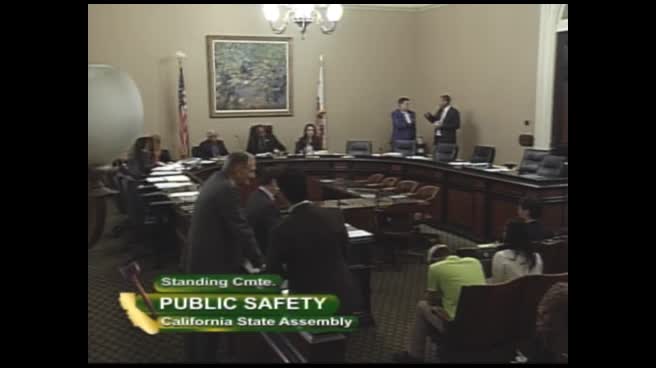 19MIN
Assembly Standing Committee on Public Safety
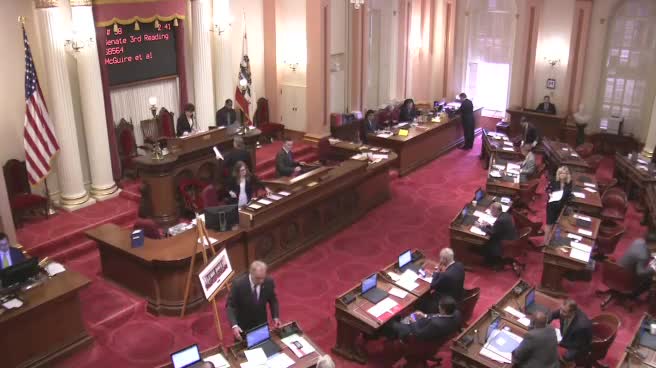 5MIN
Senate Floor
 13MIN
Senate Standing Committee on Public Safety
Bill Author

Bill Co-Author(s):
