SB 624: Property taxation: liens: recordation.
- Session Year: 2017-2018
- House: Senate
- Latest Version Date: 2017-07-31
Existing law provides that every tax, penalty, or interest on real property is a lien against the property assessed. Existing law also provides that every tax on improvements is a lien on the taxable land on which they are located. Existing law provides that a tax on personal property is a lien against any real property on the secured roll also belonging to the owner of the personal property in specified circumstances. Existing law authorizes the county tax collector to record a lien with respect to certain types of taxes on real and personal property with the county recorder.
This bill would authorize the board of supervisors of a county to provide that a tax on real or personal property is not a lien against the property assessed or the assessee if the amount of the tax assessed against that property or assessee is less than an amount set by that ordinance or resolution, up to $200, excluding any interest, penalties, or other fees.
Existing law provides that every tax, penalty, or interest on real property is a lien against the property assessed. Existing law also provides that every tax on improvements is a lien on the taxable land on which they are located. Existing law provides that a tax on personal property is a lien against any real property on the secured roll also belonging to the owner of the personal property in specified circumstances. Existing law authorizes the county tax collector to record a lien with respect to certain types of taxes on real and personal property with the county recorder.
This bill would authorize the board of supervisors of a county to provide that a tax on real or personal property is not a lien against the property assessed or the assessee if the amount of the tax assessed against that property or assessee is less than an amount set by that ordinance or resolution, up to $200, excluding any interest, penalties, or other fees.
Existing law provides that every tax, penalty, or interest on real property is a lien against the property assessed. Existing law also provides that every tax on improvements is a lien on the taxable land on which they are located. Existing law provides that a tax on personal property is a lien against any real property on the secured roll also belonging to the owner of the personal property in specified circumstances. Existing law authorizes the county tax collector to record a lien with respect to certain types of taxes on real and personal property with the county recorder.
This bill would authorize the board of supervisors of a county to provide that a tax on real or personal property is not a lien against the property assessed or the assessee if the amount of the tax assessed against that property or assessee is less than an amount set by that ordinance or resolution, up to $200, excluding any interest, penalties, or other fees.
Existing law provides that every tax, penalty, or interest on real property is a lien against the property assessed. Existing law also provides that every tax on improvements is a lien on the taxable land on which they are located. Existing law provides that a tax on personal property is a lien against any real property on the secured roll also belonging to the owner of the personal property in specified circumstances. Existing law authorizes the county tax collector to record a lien with respect to certain types of taxes on real and personal property with the county recorder.
This bill would authorize the board of supervisors of a county to provide that a tax on real or personal property is not a lien against the property assessed or the assessee if the amount of the tax assessed against that property or assessee is less than $200, excluding any interest, penalties, or other fees.
Existing law authorizes a county board of equalization or its executive director to extend the time for the performance of any act by the assessor or county board by up to 30 days, or 40 days in the case of public calamity, and requires written notice be given to specified persons if an extension is granted.This bill would make a nonsubstantive change to that provision.Existing law authorizes a county board of equalization or its executive director to extend the time for the performance of any act by the assessor or county board by up to 30 days, or 40 days in the case of public calamity, and requires written notice be given to specified persons if an extension is granted.
This bill would make a nonsubstantive change to that provision.
Notwithstanding any other law, the board of supervisors of a county may adopt an ordinance or resolution to provide that a tax on real or personal property is not a lien against the property assessed or the assessee and shall not be recorded by the tax collector if the amount of the tax assessed against the property or the assessee is less than an amount set by that ordinance or resolution, up to two hundred dollars ($200), excluding any interest, penalties, or other fees. This section does not authorize a county to exempt any property from taxation, and does not relieve the taxpayer from the obligation to pay any tax.
Notwithstanding any other law, the board of supervisors of a county may adopt an ordinance or resolution to provide that a tax on real or personal property is not a lien against the property assessed or the assessee and shall not be recorded by the tax collector if the amount of the tax assessed against the property or the assessee is less than an amount set by that ordinance or resolution, up to two hundred dollars ($200), excluding any interest, penalties, or other fees. This section does not authorize a county to exempt any property from taxation, and does not relieve the taxpayer from the obligation to pay any tax.
Notwithstanding any other law, the board of supervisors of a county may adopt an ordinance or resolution to provide that a tax on real or personal property is not a lien against the property assessed or the assessee and shall not be recorded by the tax collector if the amount of the tax assessed against the property or the assessee is less than an amount set by that ordinance or resolution, up to two hundred dollars ($200), excluding any interest, penalties, or other fees. This section does not authorize a county to exempt any property from taxation, and does not relieve the taxpayer from the obligation to pay any tax.
Notwithstanding any other law, the board of supervisors of a county may adopt an ordinance resolution to provide that a tax on real or personal property is not a lien against the property assessed or the assessee and shall not be recorded by the tax collector if the amount of the tax assessed against the property or the assessee is less than two hundred dollars ($200), excluding any interest, penalties, or other fees. This section does not authorize a county to exempt any property from taxation, and does not relieve the taxpayer from the obligation to pay any tax.
SECTION 1.Section 155 of the Revenue and Taxation Code is amended to read:155.The time fixed in this division for the performance of any act by the assessor or county board may be extended by the board or its executive director for not more than 30 days, or, in case of public calamity, 40 days. If an extension of time is granted, the executive director of the board shall provide written notice thereof to the county auditor, county tax collector, and the officer or county board to whom the extension is granted. The executive director shall inform the board at its next regular meeting of any action with respect to extensions taken by him or her. There shall be the same extension of time for any act of the board dependent on the act for which time was extended.The time fixed in this division for the performance of any act by the assessor or county board may be extended by the board or its executive director for not more than 30 days, or, in case of public calamity, 40 days. If an extension of time is granted, the executive director of the board shall give provide written notice thereof to the county auditor, county tax collector, and the officer or county board to whom the extension is granted. The executive director shall inform the board at its next regular meeting of any action with respect to extensions taken by him or her. There shall be the same extension of time for any act of the board dependent on the act for which time was extended.
|
Date
|
Status
|
|---|---|
| Jul 31, 2017 | Chaptered by Secretary of State. Chapter 164, Statutes of 2017. |
| Jul 31, 2017 | Approved by the Governor. |
| Jul 21, 2017 | Enrolled and presented to the Governor at 3 p.m. |
| Jul 18, 2017 | In Senate. Ordered to engrossing and enrolling. |
| Jul 17, 2017 | Read third time. Passed. Ordered to the Senate. |
| Jun 29, 2017 | Read second time. Ordered to third reading. |
| Jun 28, 2017 | From committee: Do pass. (Ayes 9. Noes 0.) (June 26). |
| Jun 1, 2017 | Referred to Com. on REV. & TAX. |
| May 23, 2017 | In Assembly. Read first time. Held at Desk. |
| May 22, 2017 | Read third time. Passed. (Ayes 37. Noes 0. Page 1144.) Ordered to the Assembly. |
| May 9, 2017 | Read second time and amended. Ordered to third reading. |
| May 8, 2017 | From committee: Do pass as amended. (Ayes 6. Noes 0. Page 945.) (May 3). |
| Apr 19, 2017 | Set for hearing May 3. |
| Apr 18, 2017 | April 26 hearing postponed by committee. |
| Apr 7, 2017 | Set for hearing April 26. |
| Apr 5, 2017 | Re-referred to Com. on GOV. & F. |
| Mar 28, 2017 | From committee with author's amendments. Read second time and amended. Re-referred to Com. on RLS. |
| Mar 2, 2017 | Referred to Com. on RLS. |
| Feb 21, 2017 | From printer. May be acted upon on or after March 23. |
| Feb 17, 2017 | Introduced. Read first time. To Com. on RLS. for assignment. To print. |
|
Date
|
Description
|
Location
|
Votes
|
|
|---|---|---|---|---|
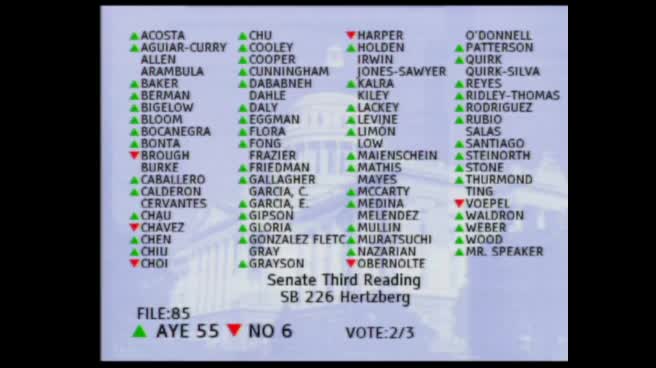
| Jul 17, 2017 | SB 624 Galgiani Senate Third Reading By RIDLEY-THOMAS | Assembly Floor |
Passed |
|
| Jun 26, 2017 | Do pass. | Assembly Standing Committee on Revenue and Taxation |
Passed |
|
| May 22, 2017 | Senate 3rd Reading SB624 Galgiani | Senate Floor |
Passed |
|
| May 3, 2017 | Do pass as amended | Senate Standing Committee on Governance and Finance |
Passed |
This list shows positions taken on this bill by organizations on the date displayed, which is linked to the original source.
Positions by individuals are not included.
|
Organization
|
Position
|
Date
|
|---|---|---|
| assessor | ** Support | Jun 23, 2017 |
| assessor, county of los angeles, jeffrey prang | ** Support | Jun 23, 2017 |
| assessor, county of orange, claude parrish | ** Support | Jun 23, 2017 |
| California Association Of County Treasurer-Tax Collectors. | ** Against | Apr 28, 2017 |
| California Association of Mortgage Professionals | ** Support | Jun 23, 2017 |
| Los Angeles County Assessor Jeffrey Prang | ** Support | May 10, 2017 |
| Orange County | * Support | Jun 26, 2017 |
| Orange County Assessor Claude Parrish | ** Support | May 10, 2017 |
| Recorder | ** Support | Jun 23, 2017 |
SENATE THIRD READING
STR Bill Id:SB 624
Author:(Galgiani)
As Amended Ver:May 9, 2017
Majority vote
SENATE VOTE: 37-0
Committee | Votes | Ayes | Noes |
Revenue & Taxation | 9-0 | Ridley-Thomas, Travis Allen, Bocanegra, Burke, Chen, Dababneh, Gipson, Mullin, Quirk |
SUMMARY: Authorizes a county board of supervisors to provide by ordinance or resolution that a tax on real or personal property is not a lien against the property assessed or the assessee, thereby precluding the county tax collector from recording a lien for delinquent taxes, if the amount of tax assessed is $200 or less. Specifically, this bill:
- Authorizes a county board of supervisors to adopt an ordinance or resolution providing that a tax on real or personal property is not a lien against the property assessed or assessee and thus may not be recorded by the county tax collector, if the amount of tax assessed is less than a specified amount set by the ordinance or resolution, up to $200, excluding any interest, penalties, or other fees.
- Specifies that this provision does not authorize a county to exempt any property from taxation, and does not relieve the taxpayer from the obligation to pay any tax.
EXISTING LAW:
- Provides that all property is taxable unless explicitly exempted by the California Constitution or federal law. January 1 of each year is the "lien date" for all property, or the time when taxes for any fiscal year become a lien on property. The tax is calculated at 1% of the "taxable" value of the property in addition to the tax rate needed to fund costs of voter-approved indebtedness that may vary from area to area within a county.
- Allows, pursuant to the California Constitution Article XIII, Section 7, counties to enact ordinances exempting from property tax any real or personal property that has a value so low that the amount of total taxes received is below the calculated costs of assessment and collection. Counties may exempt property with a total base year value (adjusted annually for inflation) or full value of up to $10,000, with the limit increased to $50,000 in the case of a possessory interest, as specified. (Revenue and Taxation Code (R&TC) Section 155.20.)
- Specifies that the county tax collector is responsible for preparing property tax bills for property on the secured roll, unsecured roll, and supplemental roll, and provides methods for the collection of delinquent property taxes.
- Provides that property tax bills for the secured roll are due in two equal installments, with the first installment due November 1 and delinquent December 10, the second installment due February 1 and delinquent April 10. Property becomes tax-defaulted if taxes remain unpaid after June 30 and may be sold to the highest bidder at public sale if the taxpayer fails to redeem the property by repaying in full the defaulted taxes, interest, and penalties within five years (three years for nonresidential commercial property).
- Provides that property tax bills for the unsecured roll are due January 1 and delinquent August 31. Delinquent property taxes on the unsecured roll may be involuntarily collected by seizure and sale of the property, filing suit for taxes owed, seeking summary judgement against the assessee, or filing a certificate of lien. The certificate of lien may be recorded in any county without fee and constitutes a lien upon all personal and real property in the county owned by the assessee named in the certificate. The recorded lien, which appears on title and credit reports, continues for 10 years from the time the certificate is recorded and may be extended for two subsequent 10-year periods, or until the bill is paid in full or otherwise settled, as specified.
- Requires the county recorder to send a notice of the filing of a certificate of lien to the assessee at the assessee's last known address. The notice must contain the information from the filing and prominently display on its face the following heading: "THIS IS TO NOTIFY YOU THAT A TAX LIEN HAS BEEN FILED WITH RESPECT TO UNSECURED PROPERTY". (R&TC Section 2191.3.)
FISCAL EFFECT: Unknown. This bill has been keyed non-fiscal by the Legislative Counsel.
COMMENTS:
- The author has provided the following statement in support of this bill:
SB 624 will assist many California taxpayers by eliminating the potential of a negative credit report which could impact the purchase of a home or other big items. In many cases, taxpayers are not aware they even have these liens on their credit.
Also, by allowing a county board of supervisors the flexibility to not secure debts $200 or less with liens, you are saving the county employee time and expense.
- Proponents state the following in support of this bill:
Giving the counties the option of eliminating the filing of liens under $200 is good public policy as it assists taxpayers from a potential tax liability, of which they are often unaware or not property notified. This change in law also focuses recording and filing tax liens on amounts that exceed the administrative costs of implementation.
- Committee Staff Comments:
- Delinquent Property Taxes on the Secured Roll: The secured roll is the listing of properties that, in the opinion of the assessor, has sufficient value to guarantee payment of taxes levied thereon, generally real property. As such, secured taxes are those which, if unpaid, can be satisfied by the sale of realty against which they are levied. Property tax bills for the secured roll are due in two equal installments, with the first installment due November 1 and delinquent December 10, and the second installment due February 1 and delinquent April 10. Property becomes tax-defaulted if taxes remain unpaid after June 30 and may be sold to the highest bidder at public sale if the taxpayer fails to redeem the property by repaying in full the defaulted taxes, interest, and penalties within five years (three years for nonresidential commercial property).
- Delinquent Property Taxes on the Unsecured Roll: The unsecured roll is the listing of properties that, in the opinion of the assessor, a lien on real property is not sufficient to guarantee payment of taxes levied against them. As such, unsecured taxes are charges levied from assessment liens against property, where such charges cannot be satisfied by tax default of the property but only by some action against the person responsible for payment. Property tax bills for the unsecured roll are due January 1 and delinquent August 31. Delinquent property taxes on the unsecured roll may be involuntarily collected by seizure and sale of the property, filing suit for taxes owed, seeking summary judgement against the assessee, or filing a certificate of lien. The certificate of lien may be recorded in any county without fee and constitutes a lien upon all personal and real property in the county owned by the assessee named in the certificate. The recorded lien, which appears on title and credit reports, continues for 10 years from the time the certificate is recorded and may be extended for two subsequent 10-year periods, or until the bill is paid in full or otherwise settled.
- What Does This Bill Do? This bill authorizes a county board of supervisors to adopt an ordinance or resolution providing that a tax on real or personal property is not a lien against the property assessed or the assessee. Existing law otherwise provides that every tax (including penalties and interest) on real property is a lien against the property assessed, and that a tax on personal property is a lien on real property also belonging to the owner of the personal property, as specified. Although the language is not explicitly clear, Committee staff believes the intent of this bill is to preclude the county tax collector from recording a certificate of lien to collect delinquent taxes if the amount of tax assessed is less than a specified amount set by the ordinance or resolution, up to $200, excluding any interest, penalties, or other fees (which could make the actual amount owed by the taxpayer much higher than $200). It is also unclear whether a taxpayer could cumulatively have multiple tax liabilities for different years or different properties, each of which would no longer be subject to collection through recording a certificate of lien so long as the amount of tax assessed for each property is under $200 or the value specified by the county.
Data provided by the Orange County Assessor's office shows that 45,331 liens were filed between January 1, 2015 and December 31, 2015, with a random sample of 3,300 liens revealing that liens under $200 represented 64.24% of the total number of sampled liens, but only accounted for 13.59% of the total sampled lien values. Since this random sample of liens may not be representative of the nature of liens filed in other years or other counties, however, this bill specifies that each county may set its own "low-dollar amount" under $200, at which property taxes no longer constitute a lien against the property assessed or the assessee.
- Existing Low-Value Ordinance Exemption: Existing law authorizes counties to exempt property from taxation if the costs of assessment and collection exceed a specified low value, in recognition of the practical reality that, notwithstanding the constitutional requirement that all property be taxed, certain assessments are not cost effective to pursue. In other words, the value of a property is deemed too low to justify the costs of assessment and collection. Each board of supervisors may set its own maximum value that real or personal property in the county cannot exceed to qualify for the Low-Value Ordinance Exemption, up to $10,000 ($100 in tax at the 1% rate).
This bill does not further exempt low-value property from tax, but instead provides that a lien may no longer be attached to property required to be assessed for which taxes total less than $200. As such, taxpayers would still be liable for taxes due, but there is no longer a lien attached to the amount of tax by which tax collectors can secure payment or threaten enforcement. Tax collectors must instead rely on voluntary collection and compliance efforts for payment, potentially giving rise to circumstances in which property tax is primarily collected from highly conscientious taxpayers. For example, a taxpayer who moves out of the county and later receives an escape assessment may never receive his or her property tax bill, leading to delinquent tax and the filing of a certificate of lien against him or her, an involuntary collection action this bill would prohibit. However, another similarly situated taxpayer may proactively contact the county to pay any remaining property tax bills. If filing a certificate of lien for small amounts of delinquent taxes is not cost-effective, a more equitable policy that would also protect taxpayers from the consequences of unbeknownst tax bills may be to increase the Low-Value Ordinance Exemption counties may provide to $20,000 ($200 in tax at the 1% rate). Alternatively, increased voluntary collection efforts by county tax collectors may help a greater number of taxpayers receive timely notice of their property tax obligations and thus avoid the consequences of future involuntary collection efforts.
Analysis Prepared by: Irene Ho / REV. & TAX. / (916) 319-2098 FN: 0001070
Date of Hearing: June 26, 2017
ASSEMBLY COMMITTEE ON REVENUE AND TAXATION
Sebastian Ridley-Thomas, Chair
SBPCA Bill Id:SB 624
Author:(Galgiani) – As Amended Ver:May 9, 2017
Majority vote.
SENATE VOTE: 37-0
SUBJECT: Property taxation: liens: recordation
SUMMARY: Authorizes a county board of supervisors to provide by ordinance or resolution that a tax on real or personal property is not a lien against the property assessed or the assessee, thereby precluding the county tax collector from recording a lien for delinquent taxes, if the amount of tax assessed is $200 or less. Specifically, this bill:
- Authorizes a county board of supervisors to adopt an ordinance or resolution providing that a tax on real or personal property is not a lien against the property assessed or assessee and thus may not be recorded by the county tax collector, if the amount of tax assessed is less than a specified amount set by the ordinance or resolution, up to $200, excluding any interest, penalties, or other fees.
- Specifies that this provision does not authorize a county to exempt any property from taxation, and does not relieve the taxpayer from the obligation to pay any tax.
EXISTING LAW:
- Provides that all property is taxable unless explicitly exempted by the California Constitution or federal law. January 1 of each year is the "lien date" for all property, or the time when taxes for any fiscal year become a lien on property. The tax is calculated at 1% of the "taxable" value of the property in addition to the tax rate needed to fund costs of voter-approved indebtedness that may vary from area to area within a county.
- Allows, pursuant to Article XIII, Section 7 of the California Constitution, counties to enact ordinances exempting from property tax any real or personal property that has a value so low that the amount of total taxes received is below the calculated costs of assessment and collection. Counties may exempt property with a total base year value (adjusted annually for inflation) or full value of up to $10,000, with the limit increased to $50,000 in the case of a possessory interest, as specified. (Revenue and Taxation Code (R&TC) Section 155.20.)
- Specifies that the county tax collector is responsible for preparing property tax bills for property on the secured roll, unsecured roll, and supplemental roll, and provides methods for the collection of delinquent property taxes.
- Provides that property tax bills for the secured roll are due in two equal installments, with the first installment due November 1 and delinquent December 10, the second installment due February 1 and delinquent April 10. Property becomes tax-defaulted if taxes remain unpaid after June 30 and may be sold to the highest bidder at public sale if the taxpayer fails to redeem the property by repaying in full the defaulted taxes, interest, and penalties within five years (three years for nonresidential commercial property).
- Provides that property tax bills for the unsecured roll are due January 1 and delinquent August 31. Delinquent property taxes on the unsecured roll may be involuntarily collected by seizure and sale of the property, filing suit for taxes owed, seeking summary judgement against the assessee, or filing a certificate of lien. The certificate of lien may be recorded in any county without fee and constitutes a lien upon all personal and real property in the county owned by the assessee named in the certificate. The recorded lien, which appears on title and credit reports, continues for 10 years from the time the certificate is recorded and may be extended for two subsequent 10-year periods, or until the bill is paid in full or otherwise settled, as specified.
- Requires the county recorder to send a notice of the filing of a certificate of lien to the assessee at the assessee's last known address. The notice must contain the information from the filing and prominently display on its face the following heading: "THIS IS TO NOTIFY YOU THAT A TAX LIEN HAS BEEN FILED WITH RESPECT TO UNSECURED PROPERTY". (R&TC Section 2191.3.)
FISCAL EFFECT: No estimate.
COMMENTS:
- The author has provided the following statement in support of this bill:
SB 624 will assist many California taxpayers by eliminating the potential of a negative credit report which could impact the purchase of a home or other big items. In many cases, taxpayers are not aware they even have these liens on their credit.
Also, by allowing a county board of supervisors the flexibility to not secure debts $200 or less with liens, you are saving the county employee time and expense.
- Proponents state the following in support of this bill:
Giving the counties the option of eliminating the filing of liens under $200 is good public policy as it assists taxpayers from a potential tax liability, of which they are often unaware or not property notified. This change in law also focuses recording and filing tax liens on amounts that exceed the administrative costs of implementation.
- Committee Staff Comments:
- Delinquent Property Taxes on the Secured Roll: The secured roll is the listing of properties that, in the opinion of the assessor, has sufficient value to guarantee payment of taxes levied thereon, generally real property. As such, secured taxes are those which, if unpaid, can be satisfied by the sale of realty against which they are levied. Property tax bills for the secured roll are due in two equal installments, with the first installment due November 1 and delinquent December 10, and the second installment due February 1 and delinquent April 10. Property becomes tax-defaulted if taxes remain unpaid after June 30 and may be sold to the highest bidder at public sale if the taxpayer fails to redeem the property by repaying in full the defaulted taxes, interest, and penalties within five years (three years for nonresidential commercial property).
- Delinquent Property Taxes on the Unsecured Roll: The unsecured roll is the listing of properties that, in the opinion of the assessor, a lien on real property is not sufficient to guarantee payment of taxes levied against them. As such, unsecured taxes are charges levied from assessment liens against property, where such charges cannot be satisfied by tax default of the property but only by some action against the person responsible for payment. Property tax bills for the unsecured roll are due January 1 and delinquent August 31. Delinquent property taxes on the unsecured roll may be involuntarily collected by seizure and sale of the property, filing suit for taxes owed, seeking summary judgement against the assessee, or filing a certificate of lien. The certificate of lien may be recorded in any county without fee and constitutes a lien upon all personal and real property in the county owned by the assessee named in the certificate. The recorded lien, which appears on title and credit reports, continues for 10 years from the time the certificate is recorded and may be extended for two subsequent 10-year periods, or until the bill is paid in full or otherwise settled.
- What Does This Bill Do? This bill authorizes a county board of supervisors to adopt an ordinance or resolution providing that a tax on real or personal property is not a lien against the property assessed or the assessee. Existing law otherwise provides that every tax (including penalties and interest) on real property is a lien against the property assessed, and that a tax on personal property is a lien on real property also belonging to the owner of the personal property, as specified. Although the language is not explicitly clear, Committee staff believes the intent of this bill is to preclude the county tax collector from recording a certificate of lien to collect delinquent taxes if the amount of tax assessed is less than a specified amount set by the ordinance or resolution, up to $200, excluding any interest, penalties, or other fees (which could make the actual amount owed by the taxpayer much higher than $200). It is also unclear whether a taxpayer could cumulatively have multiple tax liabilities for different years or different properties, each of which would no longer be subject to collection through recording a certificate of lien so long as the amount of tax assessed for each property is under $200 or the value specified by the county.
Data provided by the Orange County Assessor's office shows that 45,331 liens were filed between January 1, 2015 and December 31, 2015, with a random sample of 3,300 liens revealing that liens under $200 represented 64.24% of the total number of sampled liens, but only accounted for 13.59% of the total sampled lien values. Since this random sample of liens may not be representative of the nature of liens filed in other years or other counties, however, this bill specifies that each county may set its own "low-dollar amount" under $200, at which property taxes no longer constitute a lien against the property assessed or the assessee.
- Existing Low-Value Ordinance Exemption: Existing law authorizes counties to exempt property from taxation if the costs of assessment and collection exceed a specified low value, in recognition of the practical reality that, notwithstanding the constitutional requirement that all property be taxed, certain assessments are not cost effective to pursue. In other words, the value of a property is deemed too low to justify the costs of assessment and collection. Each board of supervisors may set its own maximum value that real or personal property in the county cannot exceed to qualify for the Low-Value Ordinance Exemption, up to $10,000 ($100 in tax at the 1% rate).
This bill does not further exempt low-value property from tax, but instead provides that a lien may no longer be attached to property required to be assessed for which taxes total less than $200. As such, taxpayers would still be liable for taxes due, but there is no longer a lien attached to the amount of tax by which tax collectors can secure payment or threaten enforcement. Tax collectors must instead rely on voluntary collection and compliance efforts for payment, potentially giving rise to circumstances in which property tax is primarily collected from highly conscientious taxpayers. For example, a taxpayer who moves out of the county and later receives an escape assessment may never receive his or her property tax bill, leading to delinquent tax and the filing of a certificate of lien against him or her, an involuntary collection action this bill would prohibit. However, another similarly situated taxpayer may proactively contact the county to pay any remaining property tax bills. The Committee may wish to consider, if filing a certificate of lien for small amounts of delinquent taxes is not cost-effective, whether a more equitable policy that would also protect taxpayers from the consequences of unbeknownst tax bills is to increase the Low-Value Ordinance Exemption counties may provide to $20,000 ($200 in tax at the 1% rate). Alternatively, the Committee may wish to consider whether county tax collectors should reevaluate voluntary collection efforts so a greater number of taxpayers receive notice of their property tax obligations and thus avoid the consequences of future involuntary collection efforts.
REGISTERED SUPPORT / OPPOSITION:
Support
Assessor, County of Los Angeles, Jeffrey Prang
Assessor, County of Orange, Claude Parrish
Assessor/Recorder/County Clerk, County of San Diego, Ernest J. Dronenburg, Jr.
California Association of Mortgage Professionals
Opposition
None on file
Analysis Prepared by: Irene Ho / REV. & TAX. / (916) 319-2098
Office of Senate Floor Analyses (916) 651-1520 Fax: (916) 327-4478 | SB |
THIRD READING
Bill No: SB 624
Amended: 5/9/17
SENATE GOVERNANCE & FIN. COMMITTEE: 6-0, 5/3/17
AYES: McGuire, Nguyen, Beall, Hernandez, Lara, Moorlach
NO VOTE RECORDED: Hertzberg
SOURCE: Orange County Assessor Claude Parrish
DIGEST:
This bill allows counties to enact ordinances providing that taxes of $200 or less are not secured by liens.
Existing law:
- Provides that all property is taxable unless explicitly exempted by the Constitution or federal law (California Constitution, Article XIII).
- Limits the maximum amount of any ad valorem tax on real property at 1% of full cash value, and directs assessors to reappraise property only when it is newly constructed, or when ownership changes (California Constitution, Article XIIIA).
- Allows counties to enact ordinances exempting from the property tax any real or personal property which has a value so low that the amount of total taxes received is below the costs of assessment and collection. Under this authority:
- Counties can exempt property with a value of up to $10,000, indexed annually for inflation, where the costs of assessment and collection exceed the total taxes and assessments received.
- Counties must determine the exemption level by calculating specified costs, and apply the exemption uniformly for different classes of property.
- Sets January 1st of each year as the “lien date,” or the date upon which the assessor values property and property taxes are imposed on its owner in the form of a lien against the property.
- Requires taxpayers to pay their property tax bills on real property in two installments: the first on November 1st, which becomes delinquent December 10th, and the second on February 1st, with delinquency occurring on April 10th.
- Imposes a 10% penalty on each delinquent amount, and allows counties to also apply administrative charges.
- Provides that a property becomes tax defaulted if taxes remain unpaid as of June 30th, triggering redemption penalties of 1.5% a month until the full amount is paid. After five years, the tax collector with approval by the Board of Supervisors can sell a tax defaulted residential property to satisfy back taxes, penalties, costs, and other liens; for commercial property, the tax collector can do so after three years.
- Directs county tax collectors to file tax liens against property when an owner is late paying property taxes, which are included on a taxpayer’s credit report. The lien attaches to all pieces of property owned by the delinquent taxpayer, and is removed when the property tax is paid, or the property is sold to satisfy the lien.
- States that after 30 years, the lien ceases to exist and is conclusively presumed paid.
This bill allows a county board of supervisors to enact an ordinance or resolution to provide that a tax on real property is not a lien against the property at an amount set in the ordinance up to $200.
FISCAL EFFECT: Appropriation: Fiscal Com.: Local:
Orange County Assessor Claude Parrish (source)
California Association of Mortgage Professionals
Los Angeles County Assessor Jeffrey Prang
OPPOSITION: (Verified 5/10/17)
None received
ARGUMENTS IN SUPPORT: According to the author, “Current law requires county board of supervisors to record liens on property for any monies owed, even if the cost of assessing and collecting them would prove more costly. SB 624 would authorize the board of supervisors of a county to elect not to record a lien against a property if the debt owed is less than $200. In addition to saving staff time on trying to collect a lien, by not recording these liens, we are potentially helping an estimated 50% of taxpayers receiving these liens keep their credit undamaged, thus allowing purchases of homes and other big-ticket items.”
5/10/17 14:21:30
**** END ****
SENATE COMMITTEE ON GOVERNANCE AND FINANCE
Senator Mike McGuire, Chair
2017 - 2018 Regular
Bill No: | SB 624 | Hearing Date: | 5/3/17 |
Author: | Galgiani | Tax Levy: | No |
Version: | 3/28/17 | Fiscal: | No |
Consultant: | Grinnell | ||
Property taxation: liens: recordation
Allows counties to provide that taxes below $200 are not secured by liens.
Background
Article XIII of the California Constitution provides that all property is taxable unless explicitly exempted by the Constitution or federal law. The Constitution limits the maximum amount of any ad valorem tax on real property at 1% of full cash value. Assessors reappraise property whenever it is purchased, newly constructed, or when ownership changes.
County boards of supervisors can enact an ordinance exempting from the property tax any real or personal property which has a value so low that the amount of total taxes received is below the costs of assessment and collection. Counties can exempt property with a value of up to $10,000, indexed annually for inflation, where the costs of assessment and collection exceed the total taxes and assessments received. Counties must determine the exemption level by calculating specified costs, and apply the exemption uniformly for different classes of property. In 2009, the Legislature increased the amount, previously set at $5,000 (SB 822, Committee on Revenue and Taxation). According to Board of Equalization (BOE) data, 51 counties have enacted an ordinance, with significant variance in their application to different classes of property. Currently, 18 set the amount at $5,000, with only Ventura County at the maximum of $10,000, but only for personal property.
State law sets January 1st of each year as the “lien date,” or the date upon which the assessor values property, and property taxes are imposed on its owner in the form of a lien against the property. Taxpayers must pay their property tax bills on real property in two installments: the first on November 1st, which becomes delinquent December 10th, and the second on February 1st, with delinquency occurring on April 10th. When taxes become delinquent, state law imposes a 10% penalty on each amount, and counties can also apply administrative charges. The property becomes tax defaulted if taxes remain unpaid as of June 30th, triggering redemption penalties of 1.5% a month until the full amount is paid. After five years, the tax collector with approval by the Board of Supervisors can sell a tax defaulted residential property to satisfy back taxes, penalties, costs, and other liens; for commercial property, the tax collector can do so after three years.
County tax collectors generally file tax liens against property when an owner is late paying property taxes, which are included on a taxpayer’s credit report. The lien attaches to all pieces of property owned by the delinquent taxpayer, and is removed when the property tax is paid, or the property is sold to satisfy the lien. After thirty years, the lien ceases to exist and is conclusively presumed paid. Orange County Assessor Claude Parrish wants to allow counties to enact ordinances providing that taxes of $200 or less do not constitute liens against the property.
Proposed Law
Senate Bill 624 allows a county board of supervisors to enact an ordinance to provide that a tax on real or personal property is not a lien against the property if the amount of tax assessed is less than $200, excluding any penalties, interest, and fees. The bill applies notwithstanding any other law.
State Revenue Impact
No estimate.
Comments
1. Purpose of the bill. According to the author, “Current law requires county board of supervisors to record liens on property for any monies owed, even if the cost of assessing and collecting them would prove more costly. SB 624 would authorize the board of supervisors of a county to elect not to record a lien against a property if the debt owed is less than $200. In addition to saving staff time on trying to collect a lien, by not recording these liens, we are potentially helping an estimated 50% of taxpayers receiving these liens keep their credit undamaged, thus allowing purchases of homes and other big-ticket items.”
2. Right way? Counties can currently exempt property with a value of less than $10,000 ($100 in taxes at the 1% rate) from tax by determining that the proceeds of any taxes received would be less than the costs of assessment and collection. This authority is optional, and each county determines its own exemption levels by looking at its own costs compared to the proceeds of taxes. If counties exercise this authority, they must apply any exemption uniformly for each class of property. Instead of exempting property from tax, SB 624 allows counties to detach liens from tax amounts of less than $200. As such, taxpayers would still be liable for taxes due, but tax collectors would no longer be able to secure payment using a lien. Tax collectors argue that the while the bill’s fixed amount $200 may be suitable for larger counties, it may not be for smaller ones. Tax collectors add that the authority in current law allows for appropriate local flexibility. The Committee may wish to consider whether SB 624 is necessary given current law, and if so, whether the measure should be amended to remove liens from amounts of tax set by each county’s board of supervisors up to $200.
Support and Opposition
(4/27/17)
Support: Orange County Assessor Claude Parrish.
Opposition: California Association of County Treasurer-Tax Collectors.
-- END --
Discussed in Hearing
 1MIN
Assembly Floor
 3MIN
Assembly Standing Committee on Revenue and Taxation
 2MIN
Senate Floor
 5MIN
Senate Standing Committee on Governance and Finance
Bill Author

Bill Co-Author(s):