SB 626: Tribal gaming: compact ratification.
- Session Year: 2017-2018
- House: Senate
- Latest Version Date: 2017-10-03
Existing federal law, the Indian Gaming Regulatory Act of 1988, provides for the negotiation and execution of tribal-state gaming compacts for the purpose of authorizing certain types of gaming on Indian lands within a state. The California Constitution authorizes the Governor to negotiate and conclude tribal-state gaming compacts, subject to ratification by the Legislature. Existing law expressly ratifies a number of tribal-state gaming compacts, and amendments of tribal-state gaming compacts, between the State of California and specified Indian tribes.
The California Environmental Quality Act (CEQA) requires a lead agency to prepare, or cause to be prepared, and certify the completion of, an environmental impact report on a project, as defined, that it proposes to carry out or approve that may have a significant effect on the environment, as defined, or to adopt a negative declaration if it finds that the project will not have that effect.
This bill would ratify the amendment to the tribal-state gaming compact entered into between the State of California and the Federated Indians of Graton Rancheria, executed on August 18, 2017. The bill would provide that, in deference to tribal sovereignty, certain actions related to that amended compact are not projects for purposes of CEQA.
This bill would declare that it is to take effect immediately as an urgency statute.
Existing law establishes within state government a Military Department that includes the office of the Adjutant General, the California National Guard, the State Military Reserve, the California Cadet Corps, and the Naval Militia. Existing law also generally governs the administration of military and veterans affairs, including those relating to enlisted men and women.This bill would make technical amendments to modify references throughout the code to enlisted man or woman or enlisted men or women to instead refer to enlisted person or enlisted persons.Existing law establishes within state government a Military Department headed by an Adjutant General. Existing law includes within the Military Department that includes the office of the Adjutant General, the California National Guard, the State Military Reserve, the California Cadet Corps, and the Naval Militia. Existing law also generally governs the administration of military and veterans affairs, including those relating to enlisted men and women.
This bill would deem any reference in the Military and Veterans Code to make technical amendments to modify references throughout the code to enlisted man or woman or enlisted men or women to instead refer to enlisted person or enlisted persons.
Existing law establishes within state government a Military Department headed by an Adjutant General. Existing law includes within the Military Department the office of the Adjutant General, the California National Guard, the State Military Reserve, the California Cadet Corps, and the Naval Militia. Existing law also generally governs the administration of military and veterans affairs, including those relating to enlisted men and women.
This bill would deem any reference in the Military and Veterans Code to enlisted man or woman or enlisted men or women to refer to enlisted person or enlisted persons.
Existing law authorizes the Attorney General and other public prosecutors to bring an action for relief from an act of unfair competition, as defined. Under existing law, a civil penalty may be assessed in the action that is designated for the exclusive use of a public prosecutor, including the Attorney General, for enforcing consumer protection laws. Under existing law, if a person violates these unfair competition provisions and the act or acts are perpetrated against one or more senior citizens or disabled persons, the person is authorized to be liable for a specified civil penalty. Existing law defines various terms for purposes of carrying out that provision.This bill would make a nonsubstantive change to that definition provision.Existing law authorizes the Attorney General and other public prosecutors to bring an action for relief from an act of unfair competition, as defined. Under existing law, a civil penalty may be assessed in the action that is designated for the exclusive use of a public prosecutor, including the Attorney General, for enforcing consumer protection laws. Under existing law, if a person violates these unfair competition provisions and the act or acts are perpetrated against one or more senior citizens or disabled persons, the person is authorized to be liable for a specified civil penalty. Existing law defines various terms for purposes of carrying out that provision.
This bill would make a nonsubstantive change to that definition provision.
(a)The amendment to the tribal-state gaming compact entered into in accordance with the federal Indian Gaming Regulatory Act of 1988 (18 U.S.C. Secs. 1166 to 1168, inclusive, and 25 U.S.C. Sec. 2701 et seq.) between the State of California and the Federated Indians of Graton Rancheria, executed on August 18, 2017, is hereby ratified.
(b)(1)In deference to tribal sovereignty, none of the following shall be deemed a project for purposes of the California Environmental Quality Act (Division 13 (commencing with Section 21000) of the Public Resources Code):
(A)The execution of an amendment to the tribal-state gaming compact ratified by this section.
(B)The execution of the amended tribal-state gaming compact ratified by this section.
(C)The execution of an intergovernmental agreement between a tribe and a county or city government negotiated pursuant to the express authority of, or as expressly referenced in, the amended tribal-state gaming compact ratified by this section.
(D)The execution of an intergovernmental agreement between a tribe and the Department of Transportation, or other state agency, negotiated pursuant to the express authority of, or as expressly referenced in, the amended tribal-state gaming compact ratified by this section.
(E)The on-reservation impacts of compliance with the terms of the amended tribal-state gaming compact ratified by this section.
(2)Except as expressly provided in this section, this subdivision does not exempt a city, county, or city and county, or the Department of Transportation, or any state agency or local jurisdiction, from the requirements of the California Environmental Quality Act.
SEC. 2.This act is an urgency statute necessary for the immediate preservation of the public peace, health, or safety within the meaning of Article IV of the California Constitution and shall go into immediate effect. The facts constituting the necessity are:
In order to enhance the economic development, stability, and self-sufficiency of the Federated Indians of Graton Rancheria, and to protect the interests of the tribe and its members, the surrounding community, and the California public at the earliest possible time, it is necessary that this act take effect immediately.
SECTION 1.Section 20282 of the Government Code is amended to read:20282.All officers, warrant officers, and enlisted persons who after October 1, 1961, are placed on full-time active duty with the office of the Adjutant General, pursuant to Sections 142, 167, 321, 340 and 551 of the Military and Veterans Code, shall become members in the manner and under the same conditions as under this article apply to other state employees. The retirement benefit provisions of the Military and Veterans Code shall not apply to those persons. This section shall not apply to the Adjutant General or the Assistant Adjutant General.SEC. 2.Section 182 of the Military and Veterans Code is amended to read:182.The Adjutant General shall keep a correct account of all expenses necessarily incurred, including pay of officers and enlisted persons, subsistence of militia, transportation of the militia, and all military property of the state. Those expenses shall be audited and paid in the same manner as other military accounts are audited and paid.SEC. 3.Section 210 of the Military and Veterans Code is amended to read:210.The National Guard consists of:(a)General officers.(b)The several staff corps and departments prescribed in tables of organization of the United States Army or United States Air Force or tables of organization for the National Guard.(c)The officers and enlisted persons on the retired and the reserve lists.(d)The organizations forming the National Guard and persons enlisted or commissioned therein.SEC. 4.Section 212 of the Military and Veterans Code is amended to read:212.The inactive National Guard shall consist of those organizations, officers, and enlisted persons as are authorized and prescribed by the laws of the United States and regulations issued thereunder.SEC. 5.Section 215 of the Military and Veterans Code is amended to read:215.For all purposes under this code, commissioned officers, warrant officers and enlisted persons of the California National Guard, California Air National Guard, and California National Guard Reserve who have heretofore or hereafter performed service in the United States Army, United States Air Force, United States Navy, or a reserve component thereof shall be entitled to credit for time so served as if that service had been rendered in the state forces. Service in the state forces shall include all full-time active duty and part-time duty performed heretofore or hereafter either as an enlisted person, warrant officer or commissioned officer pursuant to any prior or present section or sections or provisions of this code. Federal law notwithstanding, in computing state service for retirement with pay under this authority, full-time active service and part-time duty or service with the Armed Forces of the United States or any reserve component thereof shall be considered.SEC. 6.Section 223 of the Military and Veterans Code is amended to read:223.All officers, warrant officers, and enlisted persons of the militia and all persons on duty with the militia shall give any bonds and security as may be required and within the time prescribed by the Adjutant General to secure the state against loss on account of misuse or misapplication of state or company property or funds or the property or funds of the United States in use by the State of California.All bonds shall be conditioned upon the faithful performance of all duties and the accounting for all property and moneys, including organization funds, for which the obligee is responsible or accountable.The Adjutant General may in lieu of the foregoing enter into an agreement conditioned in like terms and for the same purpose with a qualified surety company to bond all officers, warrant officers, and enlisted persons of the militia, and all persons on duty with the militia without specifically naming them. The agreement shall also provide that the report and final action of military or naval authorities having jurisdiction for fixing responsibility for loss or damage shall be conclusive proof of the responsibility or liability of any officer, warrant officer, or enlisted person in a suit brought to enforce the obligation of the bond.The premiums on bonds shall be charged to those funds appropriated for the support of the militia as the Governor directs.SEC. 7.The heading of Article 3 (commencing with Section 250) of Chapter 3 of Part 1 of Division 2 of the Military and Veterans Code is amended to read:3.Enlisted PersonsSEC. 8.Section 252 of the Military and Veterans Code is amended to read:252.Appointments of noncommissioned and petty officers shall conform to the tables of organization and to the rules and regulations prescribed by the United States for the government and administration of the National Guard. All noncommissioned and petty officers shall be appointed by the commanding officer of the division, brigade, regiment, separate battalion, squadron, marine division, or similar organization, upon the recommendation of the commanding officer of the unit in which they are to serve. Noncommissioned and petty officers of separate companies, troops, batteries, detachments, and similar units, not forming part of an existing higher tactical organization, shall be appointed by the Adjutant General. When an examination is required by federal laws or regulations or by state regulations, no enlisted person shall be appointed until he or she has successfully passed the examination.SEC. 9.Section 254 of the Military and Veterans Code is amended to read:254.Enlisted persons may be transferred to or from organizations or units. Noncommissioned officers may be reduced one or more grades upon good cause appearing therefor. In transferring or reducing an enlisted person or noncommissioned officer the procedure laid down in regulations for the National Guard shall be followed.An order discharging a member of the militia may be vacated by the Adjutant General for good cause; provided, a certificate or other evidence of discharge has not been delivered to the discharged member.SEC. 10.Section 255 of the Military and Veterans Code is amended to read:255.Every enlisted person who enters the National Guard or who is a member of the unorganized militia when called into the service of the state, may be provided by the state with a service or dress uniform, or both, corresponding in make and general appearance to the service or dress uniform of the United States Army.SEC. 11.Section 257 of the Military and Veterans Code is amended to read:257.When an enlisted person of the National Guard is sixty-four years of age, he or she shall be retired from active service or discharged.SEC. 12.Section 258 of the Military and Veterans Code is amended to read:258.In time of war or other emergency or imminent danger thereof, the Governor may detail retired enlisted persons to active duty and on conclusion of the emergency return them to the retired list.SEC. 13.Section 259 of the Military and Veterans Code is amended to read:259.Separation from service of an enlisted person of the National Guard or the unorganized militia called into active service is effected by death or by discharge by proper authority.SEC. 14.Section 262 of the Military and Veterans Code is amended to read:262.An enlisted person discharged from the National Guard or the unorganized militia when called or ordered into active service of the state shall receive a discharge in writing in a form and with those qualifications as may be prescribed under the laws and regulations prescribed for the government of the National Guard by the United States and that are not inconsistent with this code. The certificates of discharge may be in the form of an honorable, a general, or undesirable discharge. Bad conduct and dishonorable discharges shall be awarded only by courts-martial as provided in this code.SEC. 15.Section 263 of the Military and Veterans Code is amended to read:263.When an enlisted person of the National Guard or the unorganized militia called into active service is absent without leave and there is reason to believe that the enlisted person does not intend to return; or quits his or her organization or place of duty with the intent to avoid hazardous duty or to shirk important service, that person is a deserter.SEC. 16.Section 266 of the Military and Veterans Code is amended to read:266.An enlisted person who has been dropped as a deserter shall not be restored to duty without prior disposition of the charge of desertion standing against him or her. The charge shall be disposed of by trial by court-martial; by restoration to duty, desertion admitted, upon a written application of the soldier admitting the desertion; or by the setting aside of the charge of desertion in case it had been erroneously made.SEC. 17.Section 267 of the Military and Veterans Code is amended to read:267.A deserter shall not be restored to duty without trial except by the Governor or by an officer authorized to appoint a general court-martial. Restoration to duty without trial shall not remove the charge of desertion or relieve the enlisted person from any of the forfeitures attached to that offense. Setting aside a charge of desertion as having been erroneously made shall remove the charge of desertion and all stoppages and forfeitures arising therefrom.SEC. 18.Section 268 of the Military and Veterans Code is amended to read:268.All time lost while absent without leave or in desertion, in excess of twenty-four hours, shall be made good unless the enlisted person is sooner discharged by proper authority.SEC. 19.Section 269 of the Military and Veterans Code is amended to read:269.No enlisted person who has been dishonorably discharged from the military or naval service of this state, or of another state, territory or district, or of the United States shall be permitted to enter again the military or naval service of this state without the approval of the Governor of this state.SEC. 20.Section 280 of the Military and Veterans Code is amended to read:280.Except where this chapter is inconsistent therewith, Chapter 3 (commencing with Section 210) of Part 1 of Division 2 is hereby incorporated by reference in this chapter and those provisions shall apply to the Naval Militia and the officers and enlisted persons thereof with the same force and effect as if the provisions were set out in detail in this chapter.In applying Chapter 3 (commencing with Section 210) of Part 1 of Division 2 to this chapter, the term Naval Militia shall be substituted for the term National Guard and the term Navy Department for the term War Department.SEC. 21.Section 289 of the Military and Veterans Code is amended to read:289.The officers, chief warrant officers, warrant officers, and enlisted persons of the Naval Militia shall be of any amount and grades prescribed by the Governor and shall be of the same number and grades as are authorized or prescribed by the laws and regulations of the United States for similar organizations of the United States Navy or as authorized or prescribed by the laws and regulations of the Navy Department for the Naval Militia.SEC. 22.Section 296 of the Military and Veterans Code is amended to read:296.Every enlisted person who enters the Naval Militia may be provided by the state with a service or dress uniform, or both, corresponding in make and appearance to the service or dress uniform of the United States Navy.SEC. 23.Section 321 of the Military and Veterans Code is amended to read:321.Enlisted persons, while on active duty in the service of the state, shall receive the same pay and allowances as enlisted persons of similar grade in the United States Army, United States Air Force, and United States Navy, except that enlisted persons in the pay grade of E1 through E4 ordered to active duty pursuant to Section 143 or 146, while on active duty, shall receive not less than the minimum daily rate of pay applicable to a pay grade of E5 in the active military service of the United States. It is the intent of the Legislature that the foregoing minimum payments to enlisted persons in the pay grade of E1 through E4 may be paid from the State Emergency Fund when, in the judgment of the Director of Finance, there is a case of actual necessity for which no appropriation has been made. All full-time active duty previously or hereafter performed in the service of the state shall be credited for purposes of determining longevity and service within the provisions of this section and Section 340.SEC. 24.Section 322 of the Military and Veterans Code is amended to read:322.Officers, warrant officers, and enlisted persons on active duty in the service of the state, except in situations described in Section 188, shall be reimbursed for their necessary traveling and other expenses in accordance with the rules and regulations adopted by the Department of Human Resources.SEC. 25.Section 324 of the Military and Veterans Code is amended to read:324.Whenever an officer of the National Guard or Naval Militia is detailed for special duty in any matter relating to the National Guard or Naval Militia, by order of the Governor, that officer shall be allowed the same pay and allowances as officers of similar grade in the United States Army and United States Navy and actual traveling expenses. An enlisted person similarly detailed shall be allowed the same pay and allowances as enlisted persons of similar grade in the United States Army and United States Navy and actual traveling expenses, except that family allowances shall not be allowed to those enlisted persons. An officer of the National Guard or Naval Militia may, with his or her consent, be detailed for special duty without expense to the state, except and provided, however, the officer may be paid actual traveling expenses. An officer of the National Guard or Naval Militia may, with his or her consent, be detailed for duty and may be paid compensation in a grade lower than the officer actually holds provided the officer voluntarily waives all compensation in excess of the lower grade.If not inconsistent with the performance of required military duty, members of the National Guard may perform emergency services as defined in Section 18531 of the Government Code, and as provided in Section 19888 of the Government Code, and shall receive as compensation therefore the going wages paid for similar service at or near the place of performance.SEC. 26.Section 325 of the Military and Veterans Code is amended to read:325.Whenever an officer or enlisted person of the United States Army or United States Navy or United States Air Force, detailed by the Department of the Army or the Department of the Navy or the Department of the Air Force for service with the National Guard or Naval Militia, is detailed by the Governor for special duty or requested to perform any duty involving travel not specially directed by the Department of the Army or the Department of the Navy or the Department of the Air Force, the officer or enlisted person shall be allowed his or her actual traveling expenses, but no per diem.SEC. 27.Section 326 of the Military and Veterans Code is amended to read:326.Commissioned officers, warrant officers and enlisted persons and former commissioned officers, warrant officers and enlisted persons of the United States Army, United States Air Force, United States Navy, or any reserve component thereof, California National Guard, State Military Reserve, California National Guard Reserve, California Defense and Security Corps, California State Guard, California Reserve and Retired List or the active militia, may, with his or her consent, be detailed for active duty with a security section which the Adjutant General is hereby authorized to maintain in his or her office. A commissioned officer, warrant officer or enlisted person who is detailed for duty as provided in this section may be paid compensation in any grade or rank lower than the person actually holds provided the commissioned officer, warrant officer or enlisted person voluntarily waives all compensation in excess of the lower grade or rank.SEC. 28.Section 327 of the Military and Veterans Code is amended to read:327.Officers, warrant officers, and enlisted persons on active duty in the service of the state shall be eligible for health care benefits 30 days after being called to active duty.SEC. 29.Section 342 of the Military and Veterans Code is amended to read:342.The appeals board is empowered to hear and determine all issues concerning any obligation of the State of California to provide to any officer, warrant officer, or enlisted person on active duty with the Office of the Adjutant General any rights or benefits provided in Section 3, Public Law 108, Chapter 225, 81st Congress, First Session, and any and all issues arising under or in connection with that law. In doing so, the appeals board shall follow the same procedures in all respects as are provided in Division 4 (commencing with Section 3200) of the Labor Code for the determination of workers compensation claims. The orders, decisions, and awards of the appeals board issued in exercising this jurisdiction are subject to review and rehearing in the manner provided in Sections 5900 to 5956, inclusive, of the Labor Code.SEC. 30.Section 363 of the Military and Veterans Code is amended to read:363.Every officer and enlisted person shall be responsible to the officer under whose immediate command he or she serves for prompt and unhesitating obedience to lawful orders, faithful performance of duty, and the preservation and proper use of the property in his or her possession that belongs to the United States, the State of California, or the appropriate military organization. Each officer and enlisted person shall at all times, without equivocation, obey the lawful orders of his or her superior officers.SEC. 31.Section 364 of the Military and Veterans Code is amended to read:364.Any officer or enlisted person of the National Guard or Naval Militia who willfully fails to attend any parade or encampment, or who neglects or refuses to obey the lawful command of his or her superior officer on any day of parade or encampment, or who fails to perform any military duty that may be lawfully required of him or her, or who uses disrespectful language toward his or her superior officer or commits any act of insubordination, is guilty of a misdemeanor.SEC. 32.Section 368 of the Military and Veterans Code is amended to read:368.Each company, troop, squadron, battery, detachment, and unit shall assemble for drill and instruction, including indoor target practice, not less than forty-eight times each year unless excused by the Governor or other competent authority, and shall in addition thereto participate in encampments, maneuvers, or other exercises, including outdoor target practice, for at least fifteen consecutive days in each year unless excused by competent authority.In addition to those drills and periods of duty above specified the commanding officer of any unit may require the officers and enlisted persons of his or her command to meet for parade, drill, and instruction at the times and places as he or she may appoint.SEC. 33.Section 372 of the Military and Veterans Code is amended to read:372.Officers and enlisted persons may be warned for duty by stating the substance of the order, by reading the order to the person warned, by delivering a copy of the order to that person, by leaving a copy of the order at the last known place of abode or business of that person with some person of the age of discretion, or by sending a copy of the order or its substance to that person by registered mail directed to the enlisted person at his or her last known place of abode or business or to the post office nearest thereto.In addition to or in lieu of the foregoing, notice may be given by posting a copy of the order at the entrance to the nearest post office to the military or naval headquarters issuing the order, at the entrances of the city hall or county courthouse of the city or county where the headquarters are located, and by causing a copy of the warning order to be published in a newspaper of general circulation in that county.SEC. 34.Section 375 of the Military and Veterans Code is amended to read:375.Officers and enlisted persons of the active militia not in the service of the United States shall be subject to and governed by this code while outside this state under the order or authorization of the Governor under Section 142 in like manner and to the same extent as when on duty within this state under orders of the Governor. Military courts may be convened and held outside the state with the same jurisdiction and power of punishment as if held within the state. Offenses and delinquencies committed outside the state may be tried and punished either within or without the state after the termination of the duty.SEC. 35.Section 395.04 of the Military and Veterans Code is amended to read:395.04.During the time that as an officer or enlisted person of the California National Guard, who is on full-time active duty in the military service of the state, and is engaged, with the approval of the Adjutant General, in the military service of the state in attendance at drills, camps, or special exercises, sponsored by federal authority or by the United States Department of Defense, as a member of the National Guard of the United States, he or she shall receive salary, pay, and compensation as provided in Sections 320 and 321.SEC. 36.Section 414 of the Military and Veterans Code is amended to read:414.Every officer and enlisted person to whom public property has been issued shall be personally responsible to the state for that property. No one shall be relieved from this responsibility, unless it is shown, to the satisfaction of the Governor, that the loss or destruction of the property was unavoidable and in no way the fault of the person responsible for the loss. In all other cases the value of the property lost or destroyed, in the amount determined by a surveying officer or a board as herein provided, shall be charged against the person at fault or, with the concurrence of the appropriate commanding officer, against the command to or for which it had been issued, and if not relieved from the charge by the Governor, there shall be an indebtedness from that person or command to the state.SEC. 37.Section 422 of the Military and Veterans Code is amended to read:422.Any person other than an officer, warrant officer, or enlisted person of the California National Guard, or of the unorganized militia when called into the service of the state or of the State Military Reserve or who may be appointed under Section 141 or who may be authorized by Sections 502, 502.1, or 502.2 or who may be a member of the Naval Militia of this state, or who may be a member of the military forces of another state or of the United States Army, United States Air Force, United States Navy, United States Marine Corps, United States Coast Guard Service or United States or State Forest Service, or personnel of the Department of Fish and Wildlife, or members of the Department of the California Highway Patrol, or an inmate of any veterans or soldiers home, or other person authorized by the laws of the United States or of this state, who at any time wears the uniform of the United States Army, United States Air Force, or United States Navy, or of the armed forces of the United States or any organization thereof, or National Guard or Naval Militia, or any part of that uniform, or a uniform or part of a uniform similar thereto, is guilty of a misdemeanor and is punishable by a fine of not less than one hundred dollars ($100) nor more than five hundred dollars ($500), or by imprisonment in the county jail not exceeding 60 days, or by both.SEC. 38.Section 450.1 of the Military and Veterans Code is amended to read:450.1.(a)Under regulations as the Governor may prescribe, and under any additional regulations as may be prescribed by the Adjutant General, limitations may be placed on the powers granted by this section with respect to the kind and amount of punishment authorized, the categories of commanding officers and warrant officers exercising command authorized to exercise those powers, the applicability of this section to an accused who demands trial by court-martial, and the kinds of courts-martial to which the case may be referred upon that demand. Except in the case of the imposition of fines upon officers and warrant officers, punishment may not be imposed upon any member of the California National Guard under this section if the member has, before the imposition of punishment, demanded trial by court-martial in lieu of punishment. Under similar regulations, rules may be prescribed with respect to the suspension of punishments authorized hereunder. If authorized by regulations of the Adjutant General, a commanding officer who under the Uniform Code of Military Justice would exercise general court-martial jurisdiction or an officer of general rank in command may delegate his or her powers under this section to a principal assistant.(b)Subject to subdivision (a), any commanding officer may, in addition to or in lieu of admonition or reprimand, impose one or more of the following disciplinary punishments for minor offenses without the intervention of a court-martial:(1)Upon officers of his or her command:(A)Restriction to certain specified limits, with or without suspension from duty, for not more than 30 consecutive days.(B)If imposed by an officer who under the Uniform Code of Military Justice would exercise general court-martial jurisdiction or an officer of general rank in command:(i)Arrest in quarters for not more than 30 consecutive days.(ii)Impose a fine of not more than 15 days pay per month for two months.(iii)Restriction to certain specified limits with or without suspension from duty for not more than 60 consecutive days.(iv)Detention of not more than 15 days pay per month for three months.(2)Upon other personnel of his or her command:(A)Correctional custody for not more than seven consecutive days.(B)Impose a fine of not more than seven days pay.(C)Reduction to the next inferior pay grade, if the grade from which demoted is within the promotion authority of the officer imposing the reduction or any officer subordinate to the one who imposes the reduction.(D)Extra duties, including fatigue or other duties, for not more than 14 consecutive days.(E)Restriction to certain specified limits, with or without suspension from duty, for not more than 14 consecutive days.(F)Detention of not more than 14 days pay.(G)If imposed by an officer of the grade of major or above:(i)Correctional custody for not more than 30 consecutive days.(ii)Impose a fine of not more than 15 days pay per month for two months.(iii)Reduction to the lowest or any intermediate pay grade, if the grade from which demoted is within the promotion authority of the officer imposing the reduction or any officer subordinate to the one who imposes the reduction, but an enlisted member in a pay grade above E-4 may not be reduced more than two pay grades.(iv)Extra duties, including fatigue or other duties, for not more than 45 consecutive days.(v)Restrictions to certain specified limits, with or without suspension from duty, for not more than 60 consecutive days.(vi)Detention of not more than 15 days pay per month for three months.The punishments heretofore prescribed by subdivision (b)(1)A, B(i) and (iii) and subdivision (b)(2)A, D, E, G(i), (iv) and (v) hereof may be imposed only during annual active duty for training or active state service, except that extra duties may be imposed upon enlisted persons while in armory drill status for two hours (to be completed not later than 2400 hours) for two consecutive drills.Detention of pay shall be for a stated period of not more than one year but if the offenders term of service expires earlier, the detention shall terminate upon that expiration. No two or more of the punishments of arrest in quarters, correctional custody, extra duties, and restriction may be combined to run consecutively in the maximum amount imposable for each. Whenever any of those punishments are combined to run consecutively, there shall be an apportionment. In addition, forfeiture of pay may not be combined with detention of pay without an apportionment. For the purposes of this subdivision, correctional custody means the physical restraint of a person during duty or nonduty hours and may include extra duties, fatigue duties, or hard labor. If practicable, correctional custody shall not be served in immediate association with persons awaiting trial or held in confinement pursuant to trial by court-martial.(c)An officer in charge may impose upon enlisted members assigned to the unit of which he or she is in charge any of the punishments authorized under subdivision (b)(2)(A) to (G), inclusive, as the Adjutant General may specifically prescribe by regulation.(d)The officer who imposes the punishment authorized in subdivision (b), or his or her successor in command, may, at any time, suspend probationally any part or amount of the unexecuted punishment imposed and may suspend probationally a reduction in grade or a fine imposed under subdivision (b), whether or not executed. In addition, the officer may, at any time, remit or mitigate any part or amount of the unexecuted punishment imposed and may set aside in whole or in part the punishment, whether executed or unexecuted, and restore all rights, privileges, and property affected. The officer may also mitigate reduction in grade to a fine or detention of pay. When mitigating:(1)arrest in quarters to restriction;(2)correctional custody to extra duties or restriction, or both; or(3)extra duties to restriction;the mitigated punishment shall not be for a greater period than the punishment mitigated. When mitigating a fine to detention of pay, the amount of the detention shall not be greater than the amount of the fine. When mitigating reduction in grade to a fine or detention of pay, the amount of the fine or detention shall not be greater than the amount that could have been imposed initially under this article by the officer who imposed the punishment mitigated.(e)A person punished under this section who considers his or her punishment unjust or disproportionate to the offense may, through the proper channel, appeal to the next superior authority. The appeal shall be promptly forwarded and decided, but the person punished may in the meantime be required to undergo the punishment adjudged. The superior authority may exercise the same powers with respect to the punishment imposed as may be exercised under subdivision (d) by the officer who imposed the punishment. Before acting on an appeal from a punishment of:(1)arrest in quarters for more than seven days;(2)correctional custody for more than seven days;(3)a fine of more than seven days pay;(4)reduction of one or more pay grades from the fourth or a higher pay grade;(5)extra duties for more than 14 days;(6)restriction for more than 14 days; or(7)detention of more than 14 days pay;the authority who is to act on the appeal shall refer the case to a judge advocate of the California National Guard for consideration and advice, and may so refer the case upon appeal from any punishment imposed under subdivision (b).(f)The imposition and enforcement of disciplinary punishment under this section for any act or omission is not a bar to trial by court-martial for a serious crime or offense growing out of the same act or omission, and not properly punishable under this section; but the fact that a disciplinary punishment has been enforced may be shown by the accused upon trial, and when so shown shall be considered in determining the measure of punishment to be adjudged in the event of a finding of guilty.(g)The Adjutant General may, by regulation, prescribe the form of records to be kept of proceedings under this article and may also prescribe that certain categories of those proceedings shall be in writing.SEC. 39.Section 455 of the Military and Veterans Code is amended to read:455.Courts of inquiry shall consist of at least three members and may be ordered by the Governor to examine into the nature of any transaction of or accusation or imputation against any officer or enlisted person. The courts shall not be ordered except upon the request of the officer concerned or whose conduct is to be inquired into or upon the request of the enlisted person concerned.The members of the court may be officers or qualified enlisted persons, and the court may include both officers and qualified enlisted persons.The practice and procedure of the court of inquiry shall be in accordance with the Articles of War and like tribunals appointed for similar purposes in the United States Army, United States Air Force, and United States Navy. The court shall, without delay, report to the officer ordering it, the evidence adduced, a statement of the facts, and, when required, an opinion thereon.Boards for conducting investigations and investigating officers may be appointed in accordance with the rules and regulations adopted for the appointment of similar boards and officers in the United States Army, United States Air Force, and United States Navy.SEC. 40.Section 458.1 of the Military and Veterans Code is amended to read:458.1.The Courts-Martial Appellate Panel shall have power over the following:(a)The issuance of extraordinary writs relative to all matters arising under the following:(1)The provisions of this code.(2)The Uniform Code of Military Justice.(3)Any regulation issued by the Governor pertaining to members of the California active militia.(4)Court-martial actions pending before any military judge of the California Military Department.(b)Adjudicating appeals of sentences of a court-martial that have been approved by the convening authority, as described in Section 455.1, and which include:(1)Dismissal, in the case of a commissioned or warrant officer.(2)Dishonorable discharge, in the case of an enlisted person.(3)Bad-conduct discharge, in the case of an enlisted person.(4)Forfeiture of all pay and allowances.(5)Any confinement.(c)The practices and procedures of the Courts-Martial Appellate Panel shall follow the federal Manual for Courts-Martial described in Section 102 and the California Manual for Courts-Martial.SEC. 41.Section 463 of the Military and Veterans Code is amended to read:463.Military courts may issue all process and mandates, including writs and warrants, necessary and proper to carry into full effect the powers vested in those courts. Process or mandates may be directed to the sheriff of any county, any peace officer, the police of any city and the marshals of any town or city, or to any officer or enlisted person appointed by the court to serve or execute process or mandates. All officers to whom process or mandates are directed shall execute the process or mandates and make return of their acts thereunder according to the requirements thereof.SEC. 42.Section 465 of the Military and Veterans Code is amended to read:465.Presidents of courts-martial, one-officer special courts-martial, and summary court officers shall have power to issue warrants to arrest an accused person and to bring him or her before the court for trial. A court shall be ordered for his or her trial within the time similarly prescribed by the rules and regulations of the United States Army. If a copy of the charges and specifications is not served, or a court is not ordered within the time herein limited, the arrest shall cease, but the charges and specifications may be served, a court ordered, and the officer or enlisted person be brought to trial after the release from arrest within the time prescribed by the rules and regulations of the United States Army in similar circumstances. The appearance of the accused, without objection and pleading to the charges, shall be a waiver of any defect or irregularity of service of any of the papers mentioned in this section.SEC. 43.Section 551 of the Military and Veterans Code is amended to read:551.The Governor is hereby authorized to prescribe rules and regulations not inconsistent with the provisions of this chapter governing the enlistment, organization, administration, equipment, maintenance, training, and discipline of forces. The rules and regulations, insofar as the Governor deems practicable and desirable, shall conform to existing law governing and pertaining to the National Guard and the rules and regulations adopted thereunder and shall prohibit the acceptance of gifts, donations, gratuities, or anything of value by those forces or any member of those forces from any individual, firm, association, or corporation by reason of that membership. Section 167 shall at no time apply to the forces herein authorized except that all officers, warrant officers, and enlisted persons on active duty with the Office of the Adjutant General shall be appointed by the Governor, with consideration of the recommendation of the Adjutant General. All officers, warrant officers and enlisted persons on active duty under Section 167 who are ordered into federal service by federal authority during the emergency or who are ordered by state authority to perform duty with the forces herein authorized shall not thereby lose the rights and privileges provided in Section 167 and shall be restored to those rights and privileges upon completion of that service or duty.Members of the California National Guard not ordered to federal service or who are not required to perform federal service or who have been deferred from federal duty may perform service as members of the California National Guard on state active duty on behalf of the forces herein authorized and may be compensated as provided in Sections 320 and 321.SEC. 44.Section 552 of the Military and Veterans Code is amended to read:552.Officers and warrant officers of the forces herein authorized on active duty in the service of the state shall receive the same pay and allowances as officers of similar grade in the Army of the United States.An officer, warrant officer or enlisted person of the forces herein authorized may, with his or her consent, be detailed for duty and may be paid compensation in any grade lower than the officer, warrant officer, or enlisted person actually holds; provided, the officer, warrant officer or enlisted person voluntarily waives all compensation in excess of the lower grade in which he or she is detailed to duty.Whenever an officer or warrant officer of the forces herein authorized is detailed for special duty in any matter relating to those forces, by order of the Governor, he or she shall be allowed the same pay and allowances as officers or warrant officers of similar grade in the Army of the United States and actual traveling expenses. An enlisted person similarly detailed shall be allowed the same pay and allowances as enlisted persons of similar grade in the Army of the United States and actual traveling expenses, except that family allowances shall not be allowed those enlisted persons. An officer, warrant officer or enlisted person of the forces herein authorized may, with his or her consent, be detailed for special duty without expense to the state, except and provided, however, he or she may be paid his or her actual traveling expenses.In addition to the pay and allowances authorized in this code, personnel of the forces created herein having administrative functions connected therewith may be paid not more than twenty dollars ($20) per month for the performance of those duties according to rules and regulations adopted by the Adjutant General.All enlistments of members of the active militia may be extended by the Adjutant General if necessary during the existence of a national emergency.SEC. 45.Section 562 of the Military and Veterans Code is amended to read:562.In all cases in which any officer, warrant officer or enlisted person of the State Military Reserve, when organized or authorized as a cadre or otherwise, when in the performance of ordered duty, or when ordered into the active service of the state, is wounded, injured, disabled, or killed in active service, or in the performance of ordered duty and in line of duty, the officer or warrant officer or enlisted person or the dependents of that officer or warrant officer or enlisted person shall be entitled to receive compensation from the state in accordance with the provisions of Division 4 (commencing with Section 3201) of the Labor Code. In all such cases, an officer, warrant officer, enlisted person shall be held and deemed to be an employee of the state. The compensation to be awarded to any such officer, warrant officer, enlisted person shall be ascertained, determined, and fixed upon the basis of his or her average income from all sources during the year immediately preceding the date of the injury or death or the commencement of the disability, but the compensation shall in no case exceed the maximum prescribed in Division 4 (commencing with Section 3201) of the Labor Code.In the determination of the benefits to be awarded any member of the State Military Reserve or his or her dependents under the provisions of this section it shall be conclusively presumed that the average yearly earning of the injured or deceased member is not less than two thousand five hundred dollars ($2,500). Any injury, death, or disability shall be deemed to have been suffered in line of duty unless the same resulted from misconduct or disobedience of lawful orders by the injured or deceased member.SEC. 46.Section 648 of the Military and Veterans Code is amended to read:648.(a)Except as provided by subdivision (b), decorations authorized by this code and decorations, medals, badges, ribbons, and insignia authorized by the laws or regulations of the United States pertaining to the National Guard, Air National Guard, and Naval Militia may be worn by officers, warrant officers, and enlisted persons in accordance with the code, laws, or regulations. However, decorations awarded by other states and territories of the United States may be worn, but shall be subordinated to those issued by federal and state laws or regulations. No other decorations, medals, badges, ribbons, or insignia may be worn. A violation of this section shall constitute a misdemeanor.(b)Decorations authorized by this code and decorations or medals from the Armed Forces of the United States, the California National Guard, State Military Reserve, or Naval Militia, or any service medals or badges awarded to the members of such forces, may be worn by uniformed public safety personnel in accordance with the code, laws, or regulations, during the business week prior to Veterans Day and Memorial Day, the day of Veterans Day and Memorial Day, and the business day immediately following Veterans Day and Memorial Day. The employer of the uniformed public safety personnel shall retain the right to prohibit the wearing of military decorations pursuant to this subdivision if the employer determines that wearing the military decorations poses a safety hazard to the uniformed public safety personnel or to the public.SEC. 47.Section 32177.5 of the Revenue and Taxation Code is amended to read:32177.5.No tax shall be imposed upon the sale of distilled spirits by brandy manufacturers, distilled spirits manufacturers, rectifiers, importers, and distilled spirits wholesalers to the following listed instrumentalities of the armed forces of the United States organized under Army, Air Force, Navy, Marine Corps, or Coast Guard regulations and located upon territory within the geographical boundaries of the state:(a)Army, Air Force, Navy, Marine Corps, and Coast Guard exchanges.(b)Officers, noncommissioned officers, and enlisted persons clubs or messes.If any manufacturer, rectifier, importer or wholesaler has paid the tax on alcoholic beverages, except beer and wine, thereafter sold to an instrumentality of the Armed Forces so located, the taxpayer may claim and shall be allowed credit with respect to the tax so paid in any report filed or assessment paid under this part.All officers, warrant officers, and enlisted men persons who after October 1, 1961, are placed on full-time active duty with the office of the Adjutant General, pursuant to Sections 142, 167, 321, 340 and 551 of the Military and Veterans Code, shall become members in the manner and under the same conditions as under this article apply to other state employees. The retirement benefit provisions of the Military and Veterans Code shall not apply to those persons. This section shall not apply to the Adjutant General or the Assistant Adjutant General.
SEC. 2.Section 182 of the Military and Veterans Code is amended to read:182.The Adjutant General shall keep a correct account of all expenses necessarily incurred, including pay of officers and enlisted men and women, persons, subsistence of militia, transportation of the militia, and all military property of the state. Those expenses shall be audited and paid in the same manner as other military accounts are audited and paid.
SEC. 3.Section 210 of the Military and Veterans Code is amended to read:210.The National Guard consists of:
(a)General officers.
(b)The several staff corps and departments prescribed in tables of organization of the United States Army or United States Air Force or tables of organization for the National Guard.
(c)The officers and enlisted men and women persons on the retired and the reserve lists.
(d)The organizations forming the National Guard and persons enlisted or commissioned therein.
SEC. 4.Section 212 of the Military and Veterans Code is amended to read:212.The inactive National Guard shall consist of those organizations, officers, and enlisted men and women persons as are authorized and prescribed by the laws of the United States and regulations issued thereunder.
SEC. 5.Section 215 of the Military and Veterans Code is amended to read:215.For all purposes under this code, commissioned officers, warrant officers and enlisted men and women persons of the California National Guard, California Air National Guard, and California National Guard Reserve who have heretofore or hereafter performed service in the United States Army, United States Air Force, United States Navy, or a reserve component thereof shall be entitled to credit for time so served as if that service had been rendered in the state forces. Service in the state forces shall include all full-time active duty and part-time duty performed heretofore or hereafter either as an enlisted man or woman, person, warrant officer or commissioned officer pursuant to any prior or present section or sections or provisions of this code. Federal law notwithstanding, in computing state service for retirement with pay under this authority, full-time active service and part-time duty or service with the Armed Forces of the United States or any reserve component thereof shall be considered.
SEC. 6.Section 223 of the Military and Veterans Code is amended to read:223.All officers, warrant officers, and enlisted men and women persons of the militia and all persons on duty with the militia shall give any bonds and security as may be required and within the time prescribed by the Adjutant General to secure the state against loss on account of misuse or misapplication of state or company property or funds or the property or funds of the United States in use by the State of California.
All bonds shall be conditioned upon the faithful performance of all duties and the accounting for all property and moneys, including organization funds, for which the obligee is responsible or accountable.
The Adjutant General may in lieu of the foregoing enter into an agreement conditioned in like terms and for the same purpose with a qualified surety company to bond all officers, warrant officers, and enlisted men and women persons of the militia, and all persons on duty with the militia without specifically naming them. The agreement shall also provide that the report and final action of military or naval authorities having jurisdiction for fixing responsibility for loss or damage shall be conclusive proof of the responsibility or liability of any officer, warrant officer, or enlisted man or woman person in a suit brought to enforce the obligation of the bond.
The premiums on bonds shall be charged to those funds appropriated for the support of the militia as the Governor directs.
SEC. 7.The heading of Article 3 (commencing with Section 250) of Chapter 3 of Part 1 of Division 2 of the Military and Veterans Code is amended to read:3.Enlisted Men PersonsSEC. 8.Section 252 of the Military and Veterans Code is amended to read:252.Appointments of noncommissioned and petty officers shall conform to the tables of organization and to the rules and regulations prescribed by the United States for the government and administration of the National Guard. All noncommissioned and petty officers shall be appointed by the commanding officer of the division, brigade, regiment, separate battalion, squadron, marine division, or similar organization, upon the recommendation of the commanding officer of the unit in which they are to serve. Noncommissioned and petty officers of separate companies, troops, batteries, detachments, and similar units, not forming part of an existing higher tactical organization, shall be appointed by the Adjutant General. When an examination is required by federal laws or regulations or by state regulations, no enlisted man or woman person shall be appointed until he or she has successfully passed the examination.
SEC. 9.Section 254 of the Military and Veterans Code is amended to read:254.Enlisted men and women persons may be transferred to or from organizations or units. Noncommissioned officers may be reduced one or more grades upon good cause appearing therefor. In transferring or reducing an enlisted man or woman person or noncommissioned officer the procedure laid down in regulations for the National Guard shall be followed.
An order discharging a member of the militia may be vacated by the Adjutant General for good cause; provided, a certificate or other evidence of discharge has not been delivered to the discharged member.
SEC. 10.Section 255 of the Military and Veterans Code is amended to read:255.Every enlisted man and woman person who enters the National Guard or who is a member of the unorganized militia when called into the service of the state, may be provided by the state with a service or dress uniform, or both, corresponding in make and general appearance to the service or dress uniform of the United States Army.
SEC. 11.Section 257 of the Military and Veterans Code is amended to read:257.When an enlisted man or woman person of the National Guard is sixty-four years of age, he or she shall be retired from active service or discharged.
SEC. 12.Section 258 of the Military and Veterans Code is amended to read:258.In time of war or other emergency or imminent danger thereof, the Governor may detail retired enlisted men and women persons to active duty and on conclusion of the emergency return them to the retired list.
SEC. 13.Section 259 of the Military and Veterans Code is amended to read:259.Separation from service of an enlisted man or woman person of the National Guard or the unorganized militia called into active service is effected by death or by discharge by proper authority.
SEC. 14.Section 262 of the Military and Veterans Code is amended to read:262.An enlisted man or woman person discharged from the National Guard or the unorganized militia when called or ordered into active service of the state shall receive a discharge in writing in a form and with those qualifications as may be prescribed under the laws and regulations prescribed for the government of the National Guard by the United States and that are not inconsistent with this code. The certificates of discharge may be in the form of an honorable, a general, or undesirable discharge. Bad conduct and dishonorable discharges shall be awarded only by courts-martial as provided in this code.
SEC. 15.Section 263 of the Military and Veterans Code is amended to read:263.When an enlisted man or woman person of the National Guard or the unorganized militia called into active service is absent without leave and there is reason to believe that the enlisted man or woman person does not intend to return; or quits his or her organization or place of duty with the intent to avoid hazardous duty or to shirk important service, that person is a deserter.
SEC. 16.Section 266 of the Military and Veterans Code is amended to read:266.An enlisted man or woman person who has been dropped as a deserter shall not be restored to duty without prior disposition of the charge of desertion standing against him or her. The charge shall be disposed of by trial by court-martial; by restoration to duty, desertion admitted, upon a written application of the soldier admitting the desertion; or by the setting aside of the charge of desertion in case it had been erroneously made.
SEC. 17.Section 267 of the Military and Veterans Code is amended to read:267.A deserter shall not be restored to duty without trial except by the Governor or by an officer authorized to appoint a general court-martial. Restoration to duty without trial shall not remove the charge of desertion or relieve the enlisted man or woman person from any of the forfeitures attached to that offense. Setting aside a charge of desertion as having been erroneously made shall remove the charge of desertion and all stoppages and forfeitures arising therefrom.
SEC. 18.Section 268 of the Military and Veterans Code is amended to read:268.All time lost while absent without leave or in desertion, in excess of twenty-four hours, shall be made good unless the enlisted man or woman person is sooner discharged by proper authority.
SEC. 19.Section 269 of the Military and Veterans Code is amended to read:269.No enlisted man or woman person who has been dishonorably discharged from the military or naval service of this state, or of another state, territory or district, or of the United States shall be permitted to enter again the military or naval service of this state without the approval of the Governor of this state.
SEC. 20.Section 280 of the Military and Veterans Code is amended to read:280.Except where this chapter is inconsistent therewith, Chapter 3 (commencing with Section 210) of Part 1 of Division 2 is hereby incorporated by reference in this chapter and those provisions shall apply to the Naval Militia and the officers and enlisted men and women persons thereof with the same force and effect as if the provisions were set out in detail in this chapter.
In applying Chapter 3 (commencing with Section 210) of Part 1 of Division 2 to this chapter, the term Naval Militia shall be substituted for the term National Guard and the term Navy Department for the term War Department.
SEC. 21.Section 289 of the Military and Veterans Code is amended to read:289.The officers, chief warrant officers, warrant officers, and enlisted men or women persons of the Naval Militia shall be of any amount and grades prescribed by the Governor and shall be of the same number and grades as are authorized or prescribed by the laws and regulations of the United States for similar organizations of the United States Navy or as authorized or prescribed by the laws and regulations of the Navy Department for the Naval Militia.
SEC. 22.Section 296 of the Military and Veterans Code is amended to read:296.Every enlisted man or woman person who enters the Naval Militia may be provided by the state with a service or dress uniform, or both, corresponding in make and appearance to the service or dress uniform of the United States Navy.
SEC. 23.Section 321 of the Military and Veterans Code is amended to read:321.Enlisted men and women, persons, while on active duty in the service of the state, shall receive the same pay and allowances as enlisted men and women persons of similar grade in the United States Army, United States Air Force, and United States Navy, except that enlisted men and women persons in the pay grade of E1 through E4 ordered to active duty pursuant to Section 143 or 146, while on active duty, shall receive not less than the minimum daily rate of pay applicable to a pay grade of E5 in the active military service of the United States. It is the intent of the Legislature that the foregoing minimum payments to enlisted men and women persons in the pay grade of E1 through E4 may be paid from the State Emergency Fund when, in the judgment of the Director of Finance, there is a case of actual necessity for which no appropriation has been made. All full-time active duty previously or hereafter performed in the service of the state shall be credited for purposes of determining longevity and service within the provisions of this section and Section 340.
SEC. 24.Section 322 of the Military and Veterans Code is amended to read:322.Officers, warrant officers, and enlisted men and women persons on active duty in the service of the state, except in situations described in Section 188, shall be reimbursed for their necessary traveling and other expenses in accordance with the rules and regulations adopted by the Department of Human Resources.
SEC. 25.Section 324 of the Military and Veterans Code is amended to read:324.Whenever an officer of the National Guard or Naval Militia is detailed for special duty in any matter relating to the National Guard or Naval Militia, by order of the Governor, that officer shall be allowed the same pay and allowances as officers of similar grade in the United States Army and United States Navy and actual traveling expenses. An enlisted man or woman person similarly detailed shall be allowed the same pay and allowances as enlisted men and women persons of similar grade in the United States Army and United States Navy and actual traveling expenses, except that family allowances shall not be allowed to those enlisted men and women. persons. An officer of the National Guard or Naval Militia may, with his or her consent, be detailed for special duty without expense to the state, except and provided, however, the officer may be paid actual traveling expenses. An officer of the National Guard or Naval Militia may, with his or her consent, be detailed for duty and may be paid compensation in a grade lower than the officer actually holds provided the officer voluntarily waives all compensation in excess of the lower grade.
If not inconsistent with the performance of required military duty, members of the National Guard may perform emergency services as defined in Section 18531 of the Government Code, and as provided in Section 19888 of the Government Code, and shall receive as compensation therefore the going wages paid for similar service at or near the place of performance.
SEC. 26.Section 325 of the Military and Veterans Code is amended to read:325.Whenever an officer or enlisted man or woman person of the United States Army or United States Navy or United States Air Force, detailed by the Department of the Army or the Department of the Navy or the Department of the Air Force for service with the National Guard or Naval Militia, is detailed by the Governor for special duty or requested to perform any duty involving travel not specially directed by the Department of the Army or the Department of the Navy or the Department of the Air Force, the officer or enlisted man or woman person shall be allowed his or her actual traveling expenses, but no per diem.
SEC. 27.Section 326 of the Military and Veterans Code is amended to read:326.Commissioned officers, warrant officers and enlisted men and women persons and former commissioned officers, warrant officers and enlisted men and women persons of the United States Army, United States Air Force, United States Navy, or any reserve component thereof, California National Guard, State Military Reserve, California National Guard Reserve, California Defense and Security Corps, California State Guard, California Reserve and Retired List or the active militia, may, with his or her consent, be detailed for active duty with a security section which the Adjutant General is hereby authorized to maintain in his or her office. A commissioned officer, warrant officer or enlisted man or woman person who is detailed for duty as provided in this section may be paid compensation in any grade or rank lower than the person actually holds provided the commissioned officer, warrant officer or enlisted man or woman person voluntarily waives all compensation in excess of the lower grade or rank.
SEC. 28.Section 327 of the Military and Veterans Code is amended to read:327.Officers, warrant officers, and enlisted men and women persons on active duty in the service of the state shall be eligible for health care benefits 30 days after being called to active duty.
SEC. 29.Section 342 of the Military and Veterans Code is amended to read:342.The appeals board is empowered to hear and determine all issues concerning any obligation of the State of California to provide to any officer, warrant officer, or enlisted man or woman person on active duty with the Office of the Adjutant General any rights or benefits provided in Section 3, Public Law 108, Chapter 225, 81st Congress, First Session, and any and all issues arising under or in connection with that law. In doing so, the appeals board shall follow the same procedures in all respects as are provided in Division 4 (commencing with Section 3200) of the Labor Code for the determination of workers compensation claims. The orders, decisions, and awards of the appeals board issued in exercising this jurisdiction are subject to review and rehearing in the manner provided in Sections 5900 to 5956, inclusive, of the Labor Code.
SEC. 30.Section 363 of the Military and Veterans Code is amended to read:363.Every officer and enlisted man or woman person shall be responsible to the officer under whose immediate command he or she serves for prompt and unhesitating obedience to lawful orders, faithful performance of duty, and the preservation and proper use of the property in his or her possession that belongs to the United States, the State of California, or the appropriate military organization. Each officer and enlisted man or woman person shall at all times, without equivocation, obey the lawful orders of his or her superior officers.
SEC. 31.Section 364 of the Military and Veterans Code is amended to read:364.Any officer or enlisted man or woman person of the National Guard or Naval Militia who willfully fails to attend any parade or encampment, or who neglects or refuses to obey the lawful command of his or her superior officer on any day of parade or encampment, or who fails to perform any military duty that may be lawfully required of him or her, or who uses disrespectful language toward his or her superior officer or commits any act of insubordination, is guilty of a misdemeanor.
SEC. 32.Section 368 of the Military and Veterans Code is amended to read:368.Each company, troop, squadron, battery, detachment, and unit shall assemble for drill and instruction, including indoor target practice, not less than forty-eight times each year unless excused by the Governor or other competent authority, and shall in addition thereto participate in encampments, maneuvers, or other exercises, including outdoor target practice, for at least fifteen consecutive days in each year unless excused by competent authority.
In addition to those drills and periods of duty above specified the commanding officer of any unit may require the officers and enlisted men and women persons of his or her command to meet for parade, drill, and instruction at the times and places as he or she may appoint.
SEC. 33.Section 372 of the Military and Veterans Code is amended to read:372.Officers and enlisted men and women persons may be warned for duty by stating the substance of the order, by reading the order to the person warned, by delivering a copy of the order to that person, by leaving a copy of the order at the last known place of abode or business of that person with some person of the age of discretion, or by sending a copy of the order or its substance to that person by registered mail directed to the enlisted man or woman person at his or her last known place of abode or business or to the post office nearest thereto.
In addition to or in lieu of the foregoing, notice may be given by posting a copy of the order at the entrance to the nearest post office to the military or naval headquarters issuing the order, at the entrances of the city hall or county courthouse of the city or county where the headquarters are located, and by causing a copy of the warning order to be published in a newspaper of general circulation in that county.
SEC. 34.Section 375 of the Military and Veterans Code is amended to read:375.Officers and enlisted men and women persons of the active militia not in the service of the United States shall be subject to and governed by this code while outside this state under the order or authorization of the Governor under Section 142 in like manner and to the same extent as when on duty within this state under orders of the Governor. Military courts may be convened and held outside the state with the same jurisdiction and power of punishment as if held within the state. Offenses and delinquencies committed outside the state may be tried and punished either within or without the state after the termination of the duty.
SEC. 35.Section 395.04 of the Military and Veterans Code is amended to read:395.04.During the time that as an officer or enlisted man or woman person of the California National Guard, who is on full-time active duty in the military service of the state, and is engaged, with the approval of the Adjutant General, in the military service of the state in attendance at drills, camps, or special exercises, sponsored by federal authority or by the United States Department of Defense, as a member of the National Guard of the United States, he or she shall receive salary, pay, and compensation as provided in Sections 320 and 321.
SEC. 36.Section 414 of the Military and Veterans Code is amended to read:414.Every officer and enlisted man or woman person to whom public property has been issued shall be personally responsible to the state for that property. No one shall be relieved from this responsibility, unless it is shown, to the satisfaction of the Governor, that the loss or destruction of the property was unavoidable and in no way the fault of the person responsible for the loss. In all other cases the value of the property lost or destroyed, in the amount determined by a surveying officer or a board as herein provided, shall be charged against the person at fault or, with the concurrence of the appropriate commanding officer, against the command to or for which it had been issued, and if not relieved from the charge by the Governor, there shall be an indebtedness from that person or command to the state.
SEC. 37.Section 422 of the Military and Veterans Code is amended to read:422.Any person other than an officer, warrant officer, or enlisted man or woman person of the California National Guard, or of the unorganized militia when called into the service of the state or of the State Military Reserve or who may be appointed under Section 141 or who may be authorized by Sections 502, 502.1, or 502.2 or who may be a member of the Naval Militia of this state, or who may be a member of the military forces of another state or of the United States Army, United States Air Force, United States Navy, United States Marine Corps, United States Coast Guard Service or United States or State Forest Service, or personnel of the Department of Fish and Game, Wildlife, or members of the Department of the California Highway Patrol, or an inmate of any veterans or soldiers home, or other person authorized by the laws of the United States or of this state, who at any time wears the uniform of the United States Army, United States Air Force, or United States Navy, or of the armed forces of the United States or any organization thereof, or National Guard or Naval Militia, or any part of that uniform, or a uniform or part of a uniform similar thereto, is guilty of a misdemeanor and is punishable by a fine of not less than one hundred dollars ($100) nor more than five hundred dollars ($500), or by imprisonment in the county jail not exceeding 60 days, or by both.
SEC. 38.Section 450.1 of the Military and Veterans Code is amended to read:450.1.(a)Under regulations as the Governor may prescribe, and under any additional regulations as may be prescribed by the Adjutant General, limitations may be placed on the powers granted by this section with respect to the kind and amount of punishment authorized, the categories of commanding officers and warrant officers exercising command authorized to exercise those powers, the applicability of this section to an accused who demands trial by court-martial, and the kinds of courts-martial to which the case may be referred upon that demand. Except in the case of the imposition of fines upon officers and warrant officers, punishment may not be imposed upon any member of the California National Guard under this section if the member has, before the imposition of punishment, demanded trial by court-martial in lieu of punishment. Under similar regulations, rules may be prescribed with respect to the suspension of punishments authorized hereunder. If authorized by regulations of the Adjutant General, a commanding officer who under the Uniform Code of Military Justice would exercise general court-martial jurisdiction or an officer of general rank in command may delegate his or her powers under this section to a principal assistant.
(b)Subject to subdivision (a), any commanding officer may, in addition to or in lieu of admonition or reprimand, impose one or more of the following disciplinary punishments for minor offenses without the intervention of a court-martial:
(1)Upon officers of his or her command:
(A)Restriction to certain specified limits, with or without suspension from duty, for not more than 30 consecutive days.
(B)If imposed by an officer who under the Uniform Code of Military Justice would exercise general court-martial jurisdiction or an officer of general rank in command:
(i)Arrest in quarters for not more than 30 consecutive days.
(ii)Impose a fine of not more than 15 days pay per month for two months.
(iii)Restriction to certain specified limits with or without suspension from duty for not more than 60 consecutive days.
(iv)Detention of not more than 15 days pay per month for three months.
(2)Upon other personnel of his or her command:
(A)Correctional custody for not more than seven consecutive days.
(B)Impose a fine of not more than seven days pay.
(C)Reduction to the next inferior pay grade, if the grade from which demoted is within the promotion authority of the officer imposing the reduction or any officer subordinate to the one who imposes the reduction.
(D)Extra duties, including fatigue or other duties, for not more than 14 consecutive days.
(E)Restriction to certain specified limits, with or without suspension from duty, for not more than 14 consecutive days.
(F)Detention of not more than 14 days pay.
(G)If imposed by an officer of the grade of major or above:
(i)Correctional custody for not more than 30 consecutive days.
(ii)Impose a fine of not more than 15 days pay per month for two months.
(iii)Reduction to the lowest or any intermediate pay grade, if the grade from which demoted is within the promotion authority of the officer imposing the reduction or any officer subordinate to the one who imposes the reduction, but an enlisted member in a pay grade above E-4 may not be reduced more than two pay grades.
(iv)Extra duties, including fatigue or other duties, for not more than 45 consecutive days.
(v)Restrictions to certain specified limits, with or without suspension from duty, for not more than 60 consecutive days.
(vi)Detention of not more than 15 days pay per month for three months.
The punishments heretofore prescribed by subdivision (b)(1)A, B(i) and (iii) and subdivision (b)(2)A, D, E, G(i), (iv) and (v) hereof may be imposed only during annual active duty for training or active state service, except that extra duties may be imposed upon enlisted men and women persons while in armory drill status for two hours (to be completed not later than 2400 hours) for two consecutive drills.
Detention of pay shall be for a stated period of not more than one year but if the offenders term of service expires earlier, the detention shall terminate upon that expiration. No two or more of the punishments of arrest in quarters, correctional custody, extra duties, and restriction may be combined to run consecutively in the maximum amount imposable for each. Whenever any of those punishments are combined to run consecutively, there shall be an apportionment. In addition, forfeiture of pay may not be combined with detention of pay without an apportionment. For the purposes of this subdivision, correctional custody means the physical restraint of a person during duty or nonduty hours and may include extra duties, fatigue duties, or hard labor. If practicable, correctional custody shall not be served in immediate association with persons awaiting trial or held in confinement pursuant to trial by court-martial.
(c)An officer in charge may impose upon enlisted members assigned to the unit of which he or she is in charge any of the punishments authorized under subdivision (b)(2)(A) to (G), inclusive, as the Adjutant General may specifically prescribe by regulation.
(d)The officer who imposes the punishment authorized in subdivision (b), or his or her successor in command, may, at any time, suspend probationally any part or amount of the unexecuted punishment imposed and may suspend probationally a reduction in grade or a fine imposed under subdivision (b), whether or not executed. In addition, the officer may, at any time, remit or mitigate any part or amount of the unexecuted punishment imposed and may set aside in whole or in part the punishment, whether executed or unexecuted, and restore all rights, privileges, and property affected. The officer may also mitigate reduction in grade to a fine or detention of pay. When mitigating:
(1)arrest in quarters to restriction;
(2)correctional custody to extra duties or restriction, or both; or
(3)extra duties to restriction;
the mitigated punishment shall not be for a greater period than the punishment mitigated. When mitigating a fine to detention of pay, the amount of the detention shall not be greater than the amount of the fine. When mitigating reduction in grade to a fine or detention of pay, the amount of the fine or detention shall not be greater than the amount that could have been imposed initially under this article by the officer who imposed the punishment mitigated.
(e)A person punished under this section who considers his or her punishment unjust or disproportionate to the offense may, through the proper channel, appeal to the next superior authority. The appeal shall be promptly forwarded and decided, but the person punished may in the meantime be required to undergo the punishment adjudged. The superior authority may exercise the same powers with respect to the punishment imposed as may be exercised under subdivision (d) by the officer who imposed the punishment. Before acting on an appeal from a punishment of:
(1)arrest in quarters for more than seven days;
(2)correctional custody for more than seven days;
(3)a fine of more than seven days pay;
(4)reduction of one or more pay grades from the fourth or a higher pay grade;
(5)extra duties for more than 14 days;
(6)restriction for more than 14 days; or
(7)detention of more than 14 days pay;
the authority who is to act on the appeal shall refer the case to a judge advocate of the California National Guard for consideration and advice, and may so refer the case upon appeal from any punishment imposed under subdivision (b).
(f)The imposition and enforcement of disciplinary punishment under this section for any act or omission is not a bar to trial by court-martial for a serious crime or offense growing out of the same act or omission, and not properly punishable under this section; but the fact that a disciplinary punishment has been enforced may be shown by the accused upon trial, and when so shown shall be considered in determining the measure of punishment to be adjudged in the event of a finding of guilty.
(g)The Adjutant General may, by regulation, prescribe the form of records to be kept of proceedings under this article and may also prescribe that certain categories of those proceedings shall be in writing.
SEC. 39.Section 455 of the Military and Veterans Code is amended to read:455.Courts of inquiry shall consist of at least three members and may be ordered by the Governor to examine into the nature of any transaction of or accusation or imputation against any officer or enlisted man or woman. person. The courts shall not be ordered except upon the request of the officer concerned or whose conduct is to be inquired into or upon the request of the enlisted man or woman person concerned.
The members of the court may be officers or qualified enlisted men or women, persons, and the court may include both officers and qualified enlisted men or women. persons.
The practice and procedure of the court of inquiry shall be in accordance with the Articles of War and like tribunals appointed for similar purposes in the United States Army, United States Air Force, and United States Navy. The court shall, without delay, report to the officer ordering it, the evidence adduced, a statement of the facts, and, when required, an opinion thereon.
Boards for conducting investigations and investigating officers may be appointed in accordance with the rules and regulations adopted for the appointment of similar boards and officers in the United States Army, United States Air Force, and United States Navy.
SEC. 40.Section 458.1 of the Military and Veterans Code is amended to read:458.1.The Courts-Martial Appellate Panel shall have power over the following:
(a)The issuance of extraordinary writs relative to all matters arising under the following:
(1)The provisions of this code.
(2)The Uniform Code of Military Justice.
(3)Any regulation issued by the Governor pertaining to members of the California active militia.
(4)Court-martial actions pending before any military judge of the California Military Department.
(b)Adjudicating appeals of sentences of a court-martial that have been approved by the convening authority, as described in Section 455.1, and which include:
(1)Dismissal, in the case of a commissioned or warrant officer.
(2)Dishonorable discharge, in the case of an enlisted man or woman. person.
(3)Bad-conduct discharge, in the case of an enlisted man or woman. person.
(4)Forfeiture of all pay and allowances.
(5)Any confinement.
(c)The practices and procedures of the Courts-Martial Appellate Panel shall follow the federal Manual for Courts-Martial described in Section 102 and the California Manual for Courts-Martial.
SEC. 41.Section 463 of the Military and Veterans Code is amended to read:463.Military courts may issue all process and mandates, including writs and warrants, necessary and proper to carry into full effect the powers vested in those courts. Process or mandates may be directed to the sheriff of any county, any peace officer, the police of any city and the marshals of any town or city, or to any officer or enlisted man or woman person appointed by the court to serve or execute process or mandates. All officers to whom process or mandates are directed shall execute the process or mandates and make return of their acts thereunder according to the requirements thereof.
SEC. 42.Section 465 of the Military and Veterans Code is amended to read:465.Presidents of courts-martial, one-officer special courts-martial, and summary court officers shall have power to issue warrants to arrest an accused person and to bring him or her before the court for trial. A court shall be ordered for his or her trial within the time similarly prescribed by the rules and regulations of the United States Army. If a copy of the charges and specifications is not served, or a court is not ordered within the time herein limited, the arrest shall cease, but the charges and specifications may be served, a court ordered, and the officer or enlisted man or woman person be brought to trial after the release from arrest within the time prescribed by the rules and regulations of the United States Army in similar circumstances. The appearance of the accused, without objection and pleading to the charges, shall be a waiver of any defect or irregularity of service of any of the papers mentioned in this section.
SEC. 43.Section 551 of the Military and Veterans Code is amended to read:551.The Governor is hereby authorized to prescribe rules and regulations not inconsistent with the provisions of this chapter governing the enlistment, organization, administration, equipment, maintenance, training, and discipline of forces. The rules and regulations, insofar as the Governor deems practicable and desirable, shall conform to existing law governing and pertaining to the National Guard and the rules and regulations adopted thereunder and shall prohibit the acceptance of gifts, donations, gratuities, or anything of value by those forces or any member of those forces from any individual, firm, association, or corporation by reason of that membership. Section 167 shall at no time apply to the forces herein authorized except that all officers, warrant officers, and enlisted men and women persons on active duty with the Office of the Adjutant General shall be appointed by the Governor, with consideration of the recommendation of the Adjutant General. All officers, warrant officers and enlisted men and women persons on active duty under Section 167 who are ordered into federal service by federal authority during the emergency or who are ordered by state authority to perform duty with the forces herein authorized shall not thereby lose the rights and privileges provided in Section 167 and shall be restored to those rights and privileges upon completion of that service or duty.
Members of the California National Guard not ordered to federal service or who are not required to perform federal service or who have been deferred from federal duty may perform service as members of the California National Guard on state active duty on behalf of the forces herein authorized and may be compensated as provided in Sections 320 and 321.
SEC. 44.Section 552 of the Military and Veterans Code is amended to read:552.Officers and warrant officers of the forces herein authorized on active duty in the service of the state shall receive the same pay and allowances as officers of similar grade in the Army of the United States.
An officer, warrant officer or enlisted man or woman person of the forces herein authorized may, with his or her consent, be detailed for duty and may be paid compensation in any grade lower than the officer, warrant officer, or enlisted man or woman person actually holds; provided, the officer, warrant officer or enlisted man or woman person voluntarily waives all compensation in excess of the lower grade in which he or she is detailed to duty.
Whenever an officer or warrant officer of the forces herein authorized is detailed for special duty in any matter relating to those forces, by order of the Governor, he or she shall be allowed the same pay and allowances as officers or warrant officers of similar grade in the Army of the United States and actual traveling expenses. An enlisted man or woman person similarly detailed shall be allowed the same pay and allowances as enlisted men and women persons of similar grade in the Army of the United States and actual traveling expenses, except that family allowances shall not be allowed those enlisted men and women. persons. An officer, warrant officer or enlisted man or woman person of the forces herein authorized may, with his or her consent, be detailed for special duty without expense to the state, except and provided, however, he or she may be paid his or her actual traveling expenses.
In addition to the pay and allowances authorized in this code, personnel of the forces created herein having administrative functions connected therewith may be paid not more than twenty dollars ($20) per month for the performance of those duties according to rules and regulations adopted by the Adjutant General.
All enlistments of members of the active militia may be extended by the Adjutant General if necessary during the existence of a national emergency.
SEC. 45.Section 562 of the Military and Veterans Code is amended to read:562.In all cases in which any officer, warrant officer or enlisted man or woman person of the State Military Reserve, when organized or authorized as a cadre or otherwise, when in the performance of ordered duty, or when ordered into the active service of the state, is wounded, injured, disabled, or killed in active service, or in the performance of ordered duty and in line of duty, the officer or warrant officer or enlisted man or woman person or the dependents of that officer or warrant officer or enlisted man or woman person shall be entitled to receive compensation from the state in accordance with the provisions of Division 4 (commencing with Section 3201) of the Labor Code. In all such cases, such an officer, warrant officer, enlisted man or woman person shall be held and deemed to be an employee of the state. The compensation to be awarded to any such officer, warrant officer, enlisted man or woman person shall be ascertained, determined, and fixed upon the basis of his or her average income from all sources during the year immediately preceding the date of the injury or death or the commencement of the disability, but the compensation shall in no case exceed the maximum prescribed in Division 4 (commencing with Section 3201) of the Labor Code.
In the determination of the benefits to be awarded any member of the State Military Reserve or his or her dependents under the provisions of this section it shall be conclusively presumed that the average yearly earning of the injured or deceased member is not less than two thousand five hundred dollars ($2,500). Any injury, death, or disability shall be deemed to have been suffered in line of duty unless the same resulted from misconduct or disobedience of lawful orders by the injured or deceased member.
SEC. 46.Section 648 of the Military and Veterans Code is amended to read:648.(a)Except as provided by subdivision (b), decorations authorized by this code and decorations, medals, badges, ribbons, and insignia authorized by the laws or regulations of the United States pertaining to the National Guard, Air National Guard, and Naval Militia may be worn by officers, warrant officers, and enlisted men and women persons in accordance with the code, laws, or regulations. However, decorations awarded by other states and territories of the United States may be worn, but shall be subordinated to those issued by federal and state laws or regulations. No other decorations, medals, badges, ribbons, or insignia may be worn. A violation of this section shall constitute a misdemeanor.
(b)Decorations authorized by this code and decorations or medals from the Armed Forces of the United States, the California National Guard, State Military Reserve, or Naval Militia, or any service medals or badges awarded to the members of such forces, may be worn by uniformed public safety personnel in accordance with the code, laws, or regulations, during the business week prior to Veterans Day and Memorial Day, the day of Veterans Day and Memorial Day, and the business day immediately following Veterans Day and Memorial Day. The employer of the uniformed public safety personnel shall retain the right to prohibit the wearing of military decorations pursuant to this subdivision if the employer determines that wearing the military decorations poses a safety hazard to the uniformed public safety personnel or to the public.
SEC. 47.Section 32177.5 of the Revenue and Taxation Code is amended to read:32177.5.No tax shall be imposed upon the sale of distilled spirits by brandy manufacturers, distilled spirits manufacturers, rectifiers, importers, and distilled spirits wholesalers to the following listed instrumentalities of the armed forces of the United States organized under Army, Air Force, Navy, Marine Corps, or Coast Guard regulations and located upon territory within the geographical boundaries of the state:
(a)Army, Air Force, Navy, Marine Corps, and Coast Guard exchanges.
(b)Officers, noncommissioned officers, and enlisted mens persons clubs or messes.
If any manufacturer, rectifier, importer or wholesaler has paid the tax on alcoholic beverages, except beer and wine, thereafter sold to an instrumentality of the Armed Forces so located, the taxpayer may claim and shall be allowed credit with respect to the tax so paid in any report filed or assessment paid under this part.
SECTION 1.Section 20 is added to the Military and Veterans Code, to read:20. Any reference in this code to enlisted man or woman or enlisted men or women shall be deemed to refer to enlisted person or enlisted persons.Any reference in this code to enlisted man or woman or enlisted men or women shall be deemed to refer to enlisted person or enlisted persons.
SECTION 1.Section 17206.1 of the Business and Professions Code is amended to read:17206.1.(a)(1)In addition to any liability for a civil penalty pursuant to Section 17206, a person who violates this chapter, and the act or acts of unfair competition are perpetrated against one or more senior citizens or disabled persons, may be liable for a civil penalty not to exceed two thousand five hundred dollars ($2,500) for each violation, which may be assessed and recovered in a civil action as prescribed in Section 17206.(2)Subject to subdivision (d), any civil penalty shall be paid as prescribed by subdivisions (b) and (c) of Section 17206.(b)As used in this section, the following terms shall have the following meanings:(1)Senior citizen means a person who is 65 years of age or older.(2)Disabled person means a person who has a physical or mental impairment that substantially limits one or more major life activities.(A)As used in this subdivision, physical or mental impairment means any of the following:(i)A physiological disorder or condition, cosmetic disfigurement, or anatomical loss substantially affecting one or more of the following body systems: neurological; musculoskeletal; special sense organs; respiratory, including speech organs; cardiovascular; reproductive; digestive; genitourinary; hemic and lymphatic; skin; or endocrine.(ii)A mental or psychological disorder, including intellectual disability, organic brain syndrome, emotional or mental illness, and specific learning disabilities.Physical or mental impairment includes, but is not limited to, diseases and conditions including orthopedic, visual, speech, and hearing impairment, cerebral palsy, epilepsy, muscular dystrophy, multiple sclerosis, cancer, heart disease, diabetes, intellectual disability, and emotional illness.(B)Major life activities means functions that include caring for ones self, performing manual tasks, walking, seeing, hearing, speaking, breathing, learning, and working.(c)In determining whether to impose a civil penalty pursuant to subdivision (a) and the amount thereof, the court shall consider, in addition to any other appropriate factors, the extent to which one or more of the following factors are present:(1)Whether the defendant knew or should have known that his or her conduct was directed to one or more senior citizens or disabled persons.(2)Whether the defendants conduct caused one or more senior citizens or disabled persons to suffer any of the following: loss or encumbrance of a primary residence, principal employment, or source of income; substantial loss of property set aside for retirement, or for personal or family care and maintenance; or substantial loss of payments received under a pension or retirement plan or a government benefits program, or assets essential to the health or welfare of the senior citizen or disabled person.(3)Whether one or more senior citizens or disabled persons are substantially more vulnerable than other members of the public to the defendants conduct because of age, poor health or infirmity, impaired understanding, restricted mobility, or disability, and actually suffered substantial physical, emotional, or economic damage resulting from the defendants conduct.(d)A court of competent jurisdiction hearing an action pursuant to this section may make orders and judgments as necessary to restore to a senior citizen or disabled person money or property, real or personal that may have been acquired by means of a violation of this chapter. Restitution ordered pursuant to this subdivision shall be given priority over recovery of a civil penalty designated by the court as imposed pursuant to subdivision (a), but shall not be given priority over a civil penalty imposed pursuant to subdivision (a) of Section 17206. If the court determines that full restitution cannot be made to those senior citizens or disabled persons, either at the time of judgment or by a future date determined by the court, then restitution under this subdivision shall be made on a pro rata basis depending on the amount of loss.(a)(1)In addition to any liability for a civil penalty pursuant to Section 17206, a person who violates this chapter, and the act or acts of unfair competition are perpetrated against one or more senior citizens or disabled persons, may be liable for a civil penalty not to exceed two thousand five hundred dollars ($2,500) for each violation, which may be assessed and recovered in a civil action as prescribed in Section 17206.
(2)Subject to subdivision (d), any civil penalty shall be paid as prescribed by subdivisions (b) and (c) of Section 17206.
(b)As used in this section, the following terms shall have the following meanings:
(1)Senior citizen means a person who is 65 years of age or older.
(2)Disabled person means a person who has a physical or mental impairment that substantially limits one or more major life activities.
(A)As used in this subdivision, physical or mental impairment means any of the following:
(i)A physiological disorder or condition, cosmetic disfigurement, or anatomical loss substantially affecting one or more of the following body systems: neurological; musculoskeletal; special sense organs; respiratory, including speech organs; cardiovascular; reproductive; digestive; genitourinary; hemic and lymphatic; skin; or endocrine.
(ii)A mental or psychological disorder, including intellectual disability, organic brain syndrome, emotional or mental illness, and specific learning disabilities.
Physical or mental impairment includes, but is not limited to, diseases and conditions including orthopedic, visual, speech, and hearing impairment, cerebral palsy, epilepsy, muscular dystrophy, multiple sclerosis, cancer, heart disease, diabetes, intellectual disability, and emotional illness.
(B)Major life activities means functions that include caring for ones self, performing manual tasks, walking, seeing, hearing, speaking, breathing, learning, and working.
(c)In determining whether to impose a civil penalty pursuant to subdivision (a) and the amount thereof, the court shall consider, in addition to any other appropriate factors, the extent to which one or more of the following factors are present:
(1)Whether the defendant knew or should have known that his or her conduct was directed to one or more senior citizens or disabled persons.
(2)Whether the defendants conduct caused one or more senior citizens or disabled persons to suffer any of the following: loss or encumbrance of a primary residence, principal employment, or source of income; substantial loss of property set aside for retirement, or for personal or family care and maintenance; or substantial loss of payments received under a pension or retirement plan or a government benefits program, or assets essential to the health or welfare of the senior citizen or disabled person.
(3)Whether one or more senior citizens or disabled persons are substantially more vulnerable than other members of the public to the defendants conduct because of age, poor health or infirmity, impaired understanding, restricted mobility, or disability, and actually suffered substantial physical, emotional, or economic damage resulting from the defendants conduct.
(d)A court of competent jurisdiction hearing an action pursuant to this section may make orders and judgments as necessary to restore to a senior citizen or disabled person money or property, real or personal that may have been acquired by means of a violation of this chapter. Restitution ordered pursuant to this subdivision shall be given priority over recovery of a civil penalty designated by the court as imposed pursuant to subdivision (a), but shall not be given priority over a civil penalty imposed pursuant to subdivision (a) of Section 17206. If the court determines that full restitution cannot be made to those senior citizens or disabled persons, either at the time of judgment or by a future date determined by the court, then restitution under this subdivision shall be made on a pro rata basis depending on the amount of loss.
|
Date
|
Status
|
|---|---|
| Oct 3, 2017 | Chaptered by Secretary of State. Chapter 465, Statutes of 2017. |
| Oct 3, 2017 | Approved by the Governor. |
| Sep 12, 2017 | Enrolled and presented to the Governor at 3 p.m. |
| Sep 7, 2017 | Assembly amendments concurred in. (Ayes 39. Noes 0.) Ordered to engrossing and enrolling. |
| Sep 6, 2017 | Ordered to special consent calendar. |
| Sep 5, 2017 | In Senate. Concurrence in Assembly amendments pending. |
| Sep 5, 2017 | Read third time. Urgency clause adopted. Passed. Ordered to the Senate. |
| Sep 1, 2017 | Read third time and amended. |
| Aug 29, 2017 | From inactive file. |
| Aug 28, 2017 | Notice of intention to remove from inactive file given by Assembly Member Calderon. |
| Jul 17, 2017 | Ordered to inactive file on request of Assembly Member Calderon. |
| Jul 13, 2017 | Read second time. Ordered to third reading. |
| Jul 12, 2017 | From committee: Do pass. (Ayes 9. Noes 0.) (July 11). |
| Jun 15, 2017 | Referred to Com. on V.A. |
| Jun 1, 2017 | In Assembly. Read first time. Held at Desk. |
| May 31, 2017 | Read third time. Passed. (Ayes 40. Noes 0. Page 1347.) Ordered to the Assembly. |
| May 26, 2017 | Read second time. Ordered to third reading. |
| May 25, 2017 | Read third time and amended. |
| May 10, 2017 | Read second time. Ordered to third reading. |
| May 9, 2017 | From committee: Do pass. (Ayes 6. Noes 0. Page 1006.) (May 9). |
| May 2, 2017 | Set for hearing May 9. |
| Apr 26, 2017 | Re-referred to Com. on V.A. |
| Apr 25, 2017 | From committee with author's amendments. Read second time and amended. Re-referred to Com. on RLS. |
| Mar 2, 2017 | Referred to Com. on RLS. |
| Feb 21, 2017 | From printer. May be acted upon on or after March 23. |
| Feb 17, 2017 | Introduced. Read first time. To Com. on RLS. for assignment. To print. |
|
Date
|
Description
|
Location
|
Votes
|
|
|---|---|---|---|---|
| Sep 7, 2017 | Special Consent Calendar # SB626 Dodd et al. Urgency Clause | Senate Floor |
Passed |
|
| Sep 5, 2017 | SB 626 Dodd Third Reading Urgency By AGUIAR-CURRY | Assembly Floor |
Passed |
|
| Jul 11, 2017 | Do pass. | Assembly Standing Committee on Veterans Affairs |
Passed |
|
| May 31, 2017 | Senate 3rd Reading SB626 Newman | Senate Floor |
Passed |
|
| May 9, 2017 | Do pass | Senate Standing Committee on Veterans Affairs |
Passed |
This list shows positions taken on this bill by organizations on the date displayed, which is linked to the original source.
Positions by individuals are not included.
|
Organization
|
Position
|
Date
|
|---|---|---|
| american civil liberties union of california. | ** Support | Jul 10, 2017 |
SENATE THIRD READING
STR Bill Id:SB 626
Author:(Dodd)
As Amended Ver:September 1, 2017
Majority vote
SENATE VOTE: 40-0
Committee | Votes | Ayes | Noes |
Veterans Affairs | 9-0 | Irwin, Chávez, Daly, Frazier, Gloria, Mathis, Muratsuchi, Quirk-Silva, Salas |
|
SUMMARY: Ratify amendments to the tribal-state gaming compact (Compact amendment) entered into between the State of California and the Federated Indians of Graton Rancheria, executed on August 18, 2017. Specifically this bill:
- The Compact amendment with the Tribe conforms the provisions of its 2012 Compact regarding workers' compensation and authorized gaming activities to those of more recent and ratified compacts, as specified.
- The Compact amendment states that neither the presence in another tribal-state Class III gaming compact of language that is not included in this amended Compact, nor the absence in another tribal-state Class III gaming compact of language that is present in this amended Compact shall be a factor in construing the terms of this amended Compact.
- All other provisions of the Tribe's existing 2012 Compact remain intact and valid until December 31, 2033.
- Provides that, in deference to tribal sovereignty, certain actions are not deemed projects for purposes of the California Environmental Quality Act (CEQA); and, stipulate, except as expressly provided, that none of the provisions shall be construed to exempt a city, county, or city and county, or the Department of Transportation from CEQA requirements.
- Contain an urgency clause, allowing this bill to take effect immediately upon enactment.
EXISTING LAW:
- Provides, under the Indian Gaming Regulatory Act (IGRA), for the negotiation and conclusion of compacts between federally recognized Indian tribes and the State for the purpose of conducting Class III gaming activities on Indian lands within a State as a means of promoting tribal economic development, self-sufficiency, and strong tribal governments.
- Authorizes expressly a number of tribal-state gaming compacts between the State of California and specified Indian tribes.
- Authorizes the conduct of Class III gaming activities to the extent such activities are permitted by state law, a gaming compact has been concluded by a federally recognized tribe and the State, and the compact has been approved by the Secretary of the Interior.
- Limits the operation of Class III gaming activities to Indian lands acquired on or before October 17, 1988. Provides exceptions to conduct gaming activities on Indian lands acquired after October 17, 1988.
- Defines Indian lands to mean all lands within the limits of any Indian reservation, and any lands title to which is either held in trust by the United States (U.S.) for the benefit of any Indian tribe, or individual, or held by any Indian tribe or individual subject to restriction by the U.S. against alienation and over which an Indian tribe exercises governmental power.
- Requires the State to negotiate to conclude a compact in good faith with an Indian tribe having jurisdiction over the Indian lands upon which the Class III gaming activity is to be conducted. Provides the U.S. district courts with jurisdiction over any cause of action initiated by a tribal government alleging that the State failed to negotiate in good faith to conclude a compact. Prescribes the remedy, mediation supervised by the courts, if it is found that the State failed to negotiate in good faith to conclude a compact.
- Authorizes the Governor, under the California Constitution, to negotiate and conclude compacts, subject to ratification by the Legislature.
FISCAL EFFECT: Unknown. This bill is keyed non-fiscal by the Legislative Counsel.
COMMENTS: On August 31, 2017, the Assembly Governmental Organization Committee held an informational hearing on the contents of the Compact amendment entered into between the State of California and the Graton Rancheria of Sonoma County.
Brief History and Background: The Federated Indians of Graton Rancheria, formerly known as the Federated Coast Miwok, is a federally recognized American Indian tribe of Coast Miwok and Southern Pomo Indians. The Indian tribe is comprised of nearly 1,300 members with government offices located in Rohnert Park, California. The Tribe is governed by a seven-member Tribal Council who is elected to two-year terms by the adult tribal membership. Tribal governmental programs and services include sacred sites preservation and protection, Indian housing, Indian education, membership, cultural arts, social services, and tribal health.
In 1966, the federal government terminated its relationship with the Tribe pursuant to the California Rancheria Act of 1958 and transferred title to the lands known as the Graton Rancheria into private ownership.
In 2000, Congress restored federal recognition to the Tribe under the Graton Rancheria Restoration Act, which required the Secretary of the Department of the Interior to take land identified by the Tribe and located in Marin or Sonoma Counties into trust as the Tribe's reservation. In 2003, the Tribe entered into an agreement with Station Casinos, Inc. to acquire land on property located on Highway 37 in southern Sonoma County for its reservation and announced plans to develop a resort hotel and gaming facility on a portion of the Highway 37 property once in trust and deemed eligible for gaming.
At the urging of community representatives and environmentalists, the Tribe reconsidered its plans for the Highway 37 property and thereafter donated its rights to a large portion of the Highway 37 property to the Sonoma Land Trust for perpetual preservation. After consultation with the County and the City of Rohnert Park (City) the Tribe, acquired rights to purchase alternative property located on Stony Point Road just outside the City's urban growth boundary for its reservation and proposed project.
In August 2005, the Tribe abandoned its plans for the Stony Point Road property and once again moved its proposed location in order to address local land use and environmental concerns and thereafter, purchased approximately 254-acres of land for its reservation, a portion of which will be used for its proposed project.
In October 2010, the federal National Indian Gaming Commission (NIGC) issued its Record of Decision for the Tribe's project, concluding that the 254-acre parcel is eligible for gaming under IGRA and adopting a reduced intensity casino and hotel project as the preferred action alternative that is significantly smaller than the project initially proposed by the Tribe.
In 2012, the State and the Tribe completed negotiations for a compact that protects the interests of the Tribe and its members, the surrounding community, and the California public, and promotes and secures long-term stability, mutual respect, and mutual benefits. The 2012 Compact, the first of the "post-Rincon era" compacts (see below), allowed the operation of 3,000 gaming devices and directed up to 15% of the casino's net win towards local communities and gambling mitigation and regulation. The 2012 Compact provided financial incentives for the Tribe to enter into agreements with local agencies to provide funding to mitigate the off-reservation impacts of the casino on the surrounding community. Furthermore, it created the Tribal Nations' Grant Fund (TNGF), which provided for the distribution of funds to non-gaming and limited-gaming tribes for purposes related to effective self-governance, self-determined community, and economic development. All subsequent compacts have provided for contributions to the TNGF.
The 2012 Compact was ratified in accordance with state law (AB 517 (Hall), Chapter 12, Statutes of 2012), and notice of approval by the U.S. Secretary of the Interior was published in the Federal Register.
The Graton Resort & Casino, which opened on November 5, 2013 is owned by the Tribe and managed by Las Vegas-based Station Casinos. The Tribe secured $825 million to fund the project. The gaming facility features 3,000 slots, video poker, over 100 table games including Blackjack, Pai Gow Poker, and Baccarat, a live poker room and VIP gaming salons. The casino also includes upscale and casual dining and various entertainment options, supported by a 10,000 square foot events center. The 5,500 guest parking spaces (1,900 covered spaces), include a 5-story parking facility. In November 2016, the Tribe opened a full-service 200-room hotel. The $175 million project includes 20,000-square feet of event and convention space, an outdoor pool, spa, fitness center, and more. In April 2017, the Tribe announced a proposal to expand the existing Graton Resort & Casino with the development of a new 200-room hotel wing.
According to the Governor's office, Section 15.1 of the 2012 Compact provides that it may be amended upon written agreement of both parties, and the parties agreed to negotiate regarding amending the 2012 Compact's provision regarding mandatory participation in the state workers' compensation program.
The Compact's preamble states, "the State and the Tribe share an interest in creating a framework within which the gaming facility can operate successfully to generate revenue for essential government programs for tribal members while also ensuring that other interests, including an efficient and effective system to address the appropriate costs arising from employees who are injured or become sick while performing work-related duties, are also furthered."
The Compact's preamble declares, "the State and the Tribe share an interest in ensuring that the Tribe is entitled to offer only the forms of Class III Gaming that the State possesses the power to authorize or permit under the California Constitution."
It should be noted, the Compact amendments do not change any of the existing financial terms in the 2012 Compact.
The Compact's preamble further states, "the State and the Tribe recognize that this amendment is authorized and negotiated and shall take effect pursuant to IGRA. Additionally, the State and the Tribe agree that all terms of this amendment to the 2012 Compact (collectively, Amended Compact) are intended to be binding and enforceable."
Key Components of the Compact Amendment:
Authorized Class III Gaming: The 2012 Compact prohibits the play of roulette or the operation of any game that incorporates the use of dice. The language could be considered to be not specific or exclusionary enough to cover all games that are prohibited under State law. The amended Compact states, "Section 3.1, subdivision (c) of the 2012 Compact is repealed and is replaced as follows: Nothing herein shall be construed to authorize or permit the operation of any Class III Gaming that the State lacks the power to authorize or permit under article IV, section 19, subdivision (f), of the California Constitution."
This provision is substantially similar to several of the more recent Tribal-State Compacts ratified by the Legislature.
Participation in State Statutory Programs Related to Employment: The Compact amendment provision is substantially similar to several of the more recent Tribal-State Compacts ratified by the Legislature. The amendment states that not later than the effective date of this Amended Compact, the Tribe will advise the State of its election to continue to participate in the State's statutory workers' compensation system, as provided, or, alternatively, will forward to the State all relevant ordinances that have been adopted and all other documents establishing the system and demonstrating that the system is fully operational and compliant with the comparability standard set forth, as defined. The parties agree that independent contractors doing business with the Tribe are bound by and must comply with all state workers' compensation laws and obligations, as specified.
If the Tribe agrees to participate in the State's workers' compensation program with respect to employees at the casino. All disputes arising from the workers' compensation laws shall be heard by the State Workers' Compensation Appeals Board (Board) pursuant to the California Labor Code, as specified. The Tribe acknowledges the jurisdiction of the Board in such manners, as defined.
In lieu of participating in the State's statutory workers' compensation system, the Tribe may create and maintain a system that provides redress for gaming operation and gaming facility employees' work-related injuries through requiring insurance or self-insurance, which includes specified provisions, including hearings before an independent tribunal, a means of enforcement against the employer, and benefits (including, but not limited to, disability, rehabilitation and return to work) comparable to those mandated for comparable employees under state law, as defined.
Construction of Amended Compact: Neither the presence in another tribal-state Class III gaming compact of language that is not included in this Compact amendment, nor the absence in another tribal-state Class III gaming compact of language that is present in this Compact amendment shall be a factor in construing the terms of this Compact amendment. In the event of a dispute between the parties as to the language of this Compact amendment or the construction or meaning of any term hereof, this Compact amendment will be deemed to have been drafted by the parties in equal parts so that no presumptions or inferences concerning its terms or interpretation may be construed against any party to this Compact amendment.
Representations. The Tribe expressly represents that as of the date of the undersigned's execution of this Compact amendment, the undersigned has the authority to execute this Compact amendment on behalf of the Tribe, including any waiver of sovereign immunity and the right to assert sovereign immunity therein, and will provide written proof of such authority and of the ratification of this Compact amendment by the tribal governing body to the Governor no later than 30 days after the execution of this Compact amendment by the undersigned.
Effective Date: This Compact amendment does not change the effective date of the 2012 Compact. The 2012 Compact will be valid until December 31, 2033.
Additional Background Information:
Indian Gaming Regulatory Act (IGRA): In 1988, Congress enacted the Indian Gaming Regulatory Act (IGRA) to provide a statutory basis for the operation and regulation of gaming on Indian lands. IGRA provides that an Indian tribe may conduct gaming activity on Indian lands if the activity "is not specifically prohibited by federal law and is conducted within a State which does not prohibit such gaming activity."
IGRA distinguishes between three classes of gaming (Class I, Class II, and Class III) and provides for different forms of regulation for each class. Class I gaming includes "social games" for minor prizes or "traditional forms of Indian gaming." Class II gaming is defined to include bingo and card games that are explicitly authorized by the laws of the state, or that are not explicitly prohibited by the laws of the state and are played at any location in the State, so long as the card games are played in conformity with those laws and regulations. Class III gaming includes such things as slot machines, casino games and banked card games such as black jack and baccarat. Class III gaming may only be conducted under terms of a compact negotiated between an Indian tribe and a State.
IGRA was enacted against a legal background in which Indian tribes and individuals generally are exempt from state taxation within their own territory. IGRA provides that with the exception of assessments permitted under the statute, to defray the State's costs of regulating gaming activity, IGRA shall not be interpreted as conferring upon a State authority to impose any tax, fee, charge, or other assessment upon an Indian tribe to engage in Class III activity. Nor may a State refuse to enter into negotiations based on the lack of authority to impose such a tax, fee, charge, or other assessment.
When a tribe requests negotiations for a Class III compact, IGRA requires the State to negotiate with the Indian tribe in good faith. IGRA provides a comprehensive process to prevent an impasse in compact negotiations, which is triggered when a tribe files suit alleging that the State has refused to negotiate or has failed to negotiate in good faith.
Before 2000, the California Constitution prohibited Class III gaming. In 2000, California voters approved Proposition 1A which had been proposed by the Governor and passed by the Legislature. Proposition 1A amended the California Constitution to permit the State to negotiate compacts with federally recognized Indian tribes for certain Class III gaming activities. Because non-Indian parties were still forbidden from operating gaming facilities, Proposition 1A granted Indian tribes a "constitutionally protected monopoly on most types of Class III games in California."
Prior legislation: SB 404 (De León), Chapter 229, Statutes of 2016, ratified the tribal-state gaming compact entered into between the State of California and the Viejas Band of Kumeyaay Indians, executed on June 22, 2016.
SB 187 (Hall), Chapter 306, Statutes of 2016, ratified the tribal-state gaming compact entered into between the State of California and the Jamul Indian Village, executed August 4, 2016.
SB 1313 (Hall), Chapter 310, Statutes of 2016, ratified the tribal-state gaming compact entered into between the State of California and the Yocha Dehe Wintun Nation, executed on August 4, 2016.
AB 2915 (Garcia), Chapter 240, Statutes of 2016, ratified an amendment to the 2006 tribal state gaming compact entered into between the State of California and the Agua Caliente Band of Cahuilla Indians, executed on August 4, 2016.
AB 2358 (Gonzalez), Chapter 298, Statutes 2016, ratified the tribal-state gaming compact entered into between the State of California and the Pechanga Band of Luiseno Indians, executed August 4, 2016.
AB 1977 (Wood), Chapter 296, Statutes of 2016, ratified the first amendment to the 2006 tribal-state gaming compact entered into between the State of California and the Yurok Tribe, executed August 4, 2016.
AB 1767 (Bigelow), Chapter 291, Statutes 2016, ratified first amendment to the 2015 tribal-state gaming compact entered into between the State of California and the Jackson Rancheria Band of Miwuk Indians, executed on June 22, 2016.
AB 1282 (Gray), Chapter 287, Statutes 2016, ratified the tribal-state gaming compact entered into between the State of California and the Buena Vista Rancheria of Me-Wuk Indians, executed on June 28, 2016.
AB 629 (Gonzalez), Chapter 160, Statutes 2016, ratified the tribal-state gaming compact entered into between the State of California and the Pala Band of Mission Indians, executed on May 6, 2016.
AB 466 (Brown), Chapter 285, Statutes of 2016, ratified an amendment to the 2006 tribal-state gaming compact entered into between the State of California and the San Manuel Band of Mission Indians, executed on August 16, 2016.
AB 291 (Atkins), Chapter 284, Statutes of 2016, ratified the tribal-state gaming compact entered into between the State of California and the Barona Band of Mission Indians, executed on June 22, 2016.
AB 795 (Atkins), Chapter 520, Statutes of 2015, ratified the tribal-state gaming compact entered into between the State of California and the Sycuan Band of Kumeyaay Nation, executed on September 2, 2015.
AB 1540 (Gray), Chapter 531, Statutes of 2015, ratified the tribal-state gaming compact entered into between the State of California and the Santa Ynez Band of Chumash Indians, executed on August 26, 2015.
AB 315 (Bigelow), Chapter 512, Statutes of 2015, ratified the amended and restated tribal-state gaming compact entered into between the State of California and the United Auburn Indian Community, executed on August 14, 2015.
AB 475 (Bigelow), Chapter 8, Statutes of 2015, ratified the tribal-state gaming compact entered into between the State of California and Jackson Rancheria Band of Miwuk Indians, executed on February 1, 2015.
SB 1356 (De León), Chapter 314, Statutes of 2014, ratified the amendment to the tribal-state gaming compact entered into between the State of California and the Viejas Band of Kumeyaay Indians, executed on August 12, 2014.
SB 1224 (Correa), Chapter 300, Statutes of 2014, ratified the tribal-state gaming compact entered into between the State of California and the Karuk Tribe, executed on December 4, 2013.
AB 1245 (V. Manuel Perez), Chapter 462, Statutes of 2013, ratified the tribal-state gaming compact entered into between the State of California and the Ramona Band of Cahuilla Indians located in Riverside County, executed on June 10, 2013.
AB 277 (Hall), Chapter 51, Statutes of 2013, ratified two new compacts entered into between the State of California and the following tribes: North Fork Rancheria, executed on August 31, 2012 and the Wiyot Tribe, executed on March 20, 2013.
AB 1267 (Hall), Chapter 6, Statutes of 2013, ratified the amended tribal-state gaming compact entered into between the State of California and the Shingle Springs Band of Miwok Indians, executed on November 15, 2012.
SB 668 (Fuller), Chapter 67, Statutes of 2013, ratified the tribal-state gaming compact entered into between the State of California and the Fort Independence Indian Community of Paiute Indians, executed on February 28, 2013.
AB 517 (Hall), Chapter 12, Statutes of 2012, ratified the tribal-state gaming compact entered into between the State of California and the Federated Indians of Graton Rancheria of Sonoma County, executed on March 27, 2012.
AB 787 (Chesbro), Chapter 340, Statutes of 2012, ratified the amendment to the tribal-state gaming compact entered into between the State of California and the Coyote Valley Band of Pomo Indians, executed on July 25, 2012.
AB 1418 (Hall), Chapter 412, Statutes of 2011, repealed those provisions ratifying the tribal-state gaming compact entered into between the State of California and Pinoleville Pomo Nation, executed on March 9, 2009 and instead ratified the tribal-state gaming compact entered into between the State of California and the Pinoleville Pomo Nation, executed on August 8, 2011. Ratification of this revised compact authorized the Tribe to operate up to 900 slot machines with up to 15% of the casino's net win from the slots designated for local communities, gambling mitigation and regulation, instead of requiring revenue contributions be made to the General Fund as provided by the 2009 compact.
AB 1020 (Chesbro), Chapter 27, Statutes of 2011, repealed the ratification of the tribal-state gaming compact entered into between the State of California and the Habematolel Pomo of Upper Lake, executed on September 2, 2009, and instead ratified a new tribal-state gaming compact entered into between the State of California and the Habematolel Pomo of Upper Lake, executed on March 17, 2011. Ratification of this revised compact authorized the Tribe to operate up to 750 slot machines with up to 15% of the net-win from those gaming devices being paid to the Special Distribution Fund (SDF) and the Revenue Sharing Trust Fund (RSTF), instead of requiring revenue contributions be made to the General Fund as provided by the 2009 compact.
SB 89 (Budget Committee), Chapter 1, Statutes of 2010, ratified the tribal-state gaming compact entered into between the State of California and the Habematolel Pomo of Upper Lake, executed on September 2, 2009.
AB 122 (Coto), Chapter 3, Statutes of 2009, ratified the tribal-state gaming compact entered into between the State of California and the Pinoleville Pomo Nation, executed on March 10, 2009.
AB 3072 (Price), Chapter 334, Statutes of 2008, ratified the first amendment to a tribal-state gaming compact entered into between the State of California and the Shingle Springs Band of Miwok Indians, executed on June 30, 2008.
SB 106 (Wiggins), Chapter 37, Statutes of 2007, ratified a new compact between the State of California and the Yurok Tribe of the Yurok Reservation (Yurok).
SB 174 (Ducheny), Chapter 38, Statutes of 2007, ratified the first compact amendment to the compact between the State of California and Sycuan.
SB 175 (Ducheny), Chapter 39, Statutes of 2007, ratified the first compact amendment to the compact between the State of California and Morongo.
SB 903 (Padilla), Chapter 40, Statutes of 2007, ratified the first compact amendment to the compact between the State of California and Pechanga.
SB 941 (Padilla), Chapter 226, Statutes of 2007, ratified the first compact amendment to the compact between the State of California and San Manuel.
SB 957 (Torlakson), Chapter 41, Statutes of 2007, ratified the first compact amendment to the compact between the State of California and Agua Caliente.
SB 470 (Ducheny), Chapter 527, Statutes of 2006, ratified the first amendment to the compact between the State and the Quechan Tribe of the Fort Yuma Reservation (Quechan).
SB 1117 (Burton), Chapter 856, Statutes of 2004, ratified two new and two amended compacts entered into between the State and the following tribes: Coyote Valley Band of Pomo Indians (new compact); Fort Mojave Indian Tribe (new compact); Buena Vista Rancheria of Me-Wuk Indians (amended compact); and, Ewiiaapaayp Band of Kumeyaay Indians (amended compact).
AB 687 (Nuñez), Chapter 91, Statutes of 2004, ratified amendments to five compacts entered into between the State and the following tribes: Pala Band of Mission Indians; Pauma Band of Luiseno Mission Indians of the Pauma and Yuima Reservation; Rumsey Band of Wintun Indians; United Auburn Indian Communities; and, Viejas Group of Kumeyaay Indians. Also, provided for the issuance of bonds in an amount not to exceed $1.5 billion by the California Infrastructure and Economic Development Bank and required the net proceeds of the sale of the compact assets to be deposited in the Traffic Congestion Relief Fund and the Transportation Deferred Investment Fund.
SB 930 (Ducheny), Chapter 802, Statutes of 2003, ratified a compact between the State of California and the Torres-Martinez Desert Cahuilla Indians.
SB 411 (Ducheny), Chapter 790, Statutes of 2003, ratified compacts between the State of California and the La Posta Band of Diegueno Mission Indians and the Santa Ysabel Band of Diegueno Mission Indians in San Diego County.
Proposition 1A (Adopted by the People of California on March 7, 2000) modified the prohibition against casinos and lotteries in the California Constitution to authorize the Governor to negotiate compacts, subject to legislative ratification, for the operation of slot machines, lottery games, and banking and percentage card games by federally recognized Indian tribes on Indian lands in California, in accordance with federal law. Authorized slot machines, lottery games, and banking and percentage card games to be conducted and operated on Indian lands subject to the compacts.
AB 1385 (Battin), Chapter 874, Statutes of 1999, designated the Governor as the state officer responsible for negotiating and executing compacts between the state and federally recognized Indian tribes located in the state. Also, ratified 57 compacts and created two special funds in the State Treasury (SDF and RSTF), as specified.
Proposition 5 (Adopted by the People of California on November 3, 1998) specified the terms and conditions of mandatory compacts between the State and tribal governments for class III gambling on Indian lands; amended California law to allow slot machines and banked card games at tribal casinos; provided for contributions to trust funds benefiting non-gaming tribes, statewide emergency medical care programs, and programs benefiting communities near tribes; and, allowed tribes to retain a monopoly on authorized gambling. Proposition 5 was found to be unconstitutional because it amended a provision of the Government Code and did not amend the Constitution. The proposition was invalidated in its entirety, save the final sentence of Government Code Section 98005, containing the state's consent to federal suits brought by California tribes pursuant to IGRA.
SB 287 (Burton), Chapter 409, Statutes of 1998, ratified 11 compacts negotiated between the State of California and Indian tribes that permitted class III video gaming devices on tribal lands and established a process for ratifying other compacts.
Analysis Prepared by: Eric Johnson / G.O. / (916) 319-2531 FN: 0001578
Office of Senate Floor Analyses (916) 651-1520 Fax: (916) 327-4478 | SB |
UNFINISHED BUSINESS
Bill No: SB 626
:
PRIOR SENATE VOTE NOT RELEVANT
ASSEMBLY FLOOR: 76-0, 9/5/17 - See last page for vote
NOTE: On August 31, 2017, the Senate Governmental Organization Committee held an informational hearing on the amended tribal-state gaming compact between the State of California and the Federated Indians of Graton Rancheria.
DIGEST:
This bill ratifies the amended tribal-state gaming compact (Compact) entered into between the State of California and the Federated Graton Rancheria (hereafter “Tribe”).
Assembly Amendments
delete the contents of this bill and instead add language pertaining to ratification of the Federated Graton Rancheria amended compact.
Existing law:
- Provides, under the Indian Gaming Regulatory Act (IGRA), for the negotiation and conclusion of compacts between federally recognized Indian tribes and the State for the purpose of conducting Class III gaming activities on Indian lands within a State as a means of promoting tribal economic development, self-sufficiency, and strong tribal governments.
- Authorizes expressly a number of tribal-state gaming compacts between the State of California and specified Indian tribes.
- Authorizes the conduct of Class III gaming activities to the extent such activities are permitted by state law, a gaming compact has been concluded by a federally recognized tribe and the State, and the compact has been approved by the Secretary of the Interior.
- Limits the operation of Class III gaming activities to Indian lands acquired on or before October 17, 1988. Provides for certain exceptions to conduct gaming activities on Indian lands acquired after October 17, 1988.
- Defines “Indian lands” to mean all lands within the limits of any Indian reservation, and any lands title to which is either held in trust by the United States for the benefit of any Indian tribe, or individual, or held by any Indian tribe or individual subject to restriction by the U.S. against alienation and over which an Indian tribe exercises governmental power.
- Requires the State to negotiate to conclude a compact in good faith with an Indian tribe having jurisdiction over the Indian lands upon which the Class III gaming activity is to be conducted. Provides the U.S. district courts with jurisdiction over any cause of action initiated by a tribal government alleging that the State failed to negotiate in good faith to conclude a compact. Prescribes the remedy, mediation supervised by the courts, if it is found that the State failed to negotiate in good faith to conclude a compact.
- Authorizes the Governor, under the California Constitution, to negotiate and conclude compacts, subject to ratification by the Legislature.
This bill:
- Ratifies the Compact between the State of California and the Tribe executed on August 18, 2017.
- Provides that in deference to tribal sovereignty, certain actions are not deemed projects for purposes of the California Environmental Quality Act (CEQA).
- Stipulates, except as expressly provided, that none of the provisions shall be construed to exempt a city, county, or city, and county, or the Department of Transportation, or any state agency or local jurisdictions, from CEQA requirements.
- Contains an urgency clause.
Background
The Amendment to the Tribal-State Gaming Compact (hereafter “Amended Compact”) between the State of California and the Federated Indians of Graton Rancheria (hereafter “Tribe”) was executed on August 18, 2017. The Amended Compact conforms the worker compensation provision of the Tribe’s existing compact, ratified in 2012, to those of more recent compacts. In addition, the Amended Compact conforms the provision related to what types of games the Tribe can offer to those provisions in most other compacts. Finally, the Amended Compact clarifies that nothing in any other tribal compact should be a factor in construing the terms of this Amended Compact. All other provisions of the existing Compact remain intact.
In 2012, the Tribe entered into a new tribal-state compact [ratified by AB 517 (Hall), Chapter 12, Statutes of 2012)] that authorized the operation of no more than 3,000 slot machines at one gaming facility located on those Indian lands held in trust for the Tribe.
Under terms of the 2012 Compact, the Tribe agreed to contribute to the Special Distribution Fund (SDF) with payments of $1.4 million per year during the first seven years of the Compact and 3% of the net win from all gaming devices thereafter, to reimburse the State for the costs of regulating gaming activities and to provide programs for the education and treatment of problem gamblers.
Additionally, the Tribe agreed to pay into the Revenue Sharing Trust Fund (RSTF) to fund the tribal governmental programs of non-gaming and limited-gaming tribes. If the Tribe operates the maximum number of gaming devices authorized under the Compact, the Tribe would pay the following amounts to fund such programs: $8.9 million (at 3,000 slots) annually for years 1-7 and $12.1 million (at 3,000 slots) annually for years 8-20.
Furthermore, the 2012 Compact established the “Graton Mitigation Fund” for the purpose of mitigating the impact of the Tribe’s gaming operation on the local community and requires that the Tribe pay 15% of net win, subject to certain deductions during the first seven years of the Compact and 12% thereafter. Revenues from the Graton Mitigation Fund will be distributed on a quarterly basis to the City of Rohnert Park and Sonoma County in amounts ranging from at
least an estimated $10 million per year, in years 1-7, to an estimated $36 million per year or more in the later years of the Compact, with the remainder being paid to the RSTF or the Tribal Nation Grant Fund (TNGF), to provide grants to assist California tribes for purposes related to effective self-governance, self-determined community, and economic development.
In November 2013, the Tribe opened the Graton Resort and Casino, which includes over 3,000 slot machines. The Casino provides over 1,700 jobs to the community. Through the Graton Mitigation Fund, the Tribe has provided $57 million in cash payments to Sonoma County and the City of Rohnert Park to benefit public safety, roads, the environment, schools, and other causes.
Brief History of the Federated Indians of Graton Rancheria. The Federated Indians of Graton Rancheria is a federally recognized Indian tribe comprised of nearly 1,400 members of coast Miwok and Southern Pomo descent.
In 1966, the Federal Government terminated its relationship with the Tribe pursuant to the California Rancheria Act of 1958 and transferred title to the lands known as the Graton Rancheria into private ownership. In 2000, Congress restored federal recognition to the Tribe under the Graton Rancheria Restoration Act which required the Secretary of the Interior to take land identified by the Tribe and located in Marin or Sonoma Counties into trust as the Tribe’s reservation. In 2013, the Tribe entered into an agreement with Station Casinos, Inc. to acquire land on property located on Highway 37 in southern Sonoma County for its reservation and announced plans to develop a resort hotel and gaming facility on a portion of the Highway 37 property once in trust and deemed eligible for gaming.
At the urging of community representatives and environmentalists, the Tribe reconsidered its plans for the Highway 37 property and thereafter donated its rights to a large portion of the Highway 37 property to the Sonoma Land Trust for perpetual preservation. After consultation with Sonoma County (County) and the City of Rohnert Park (City), the Tribe acquired rights to purchase alternative property located on Stony Point Road just outside the City’s urban growth boundary for its reservation and proposed project.
In August 2005, the Tribe abandoned its plans for the Stony Point Road property and once again moved its proposed location in order to address local land use and environmental concerns and thereafter, purchased approximately 254 acres of land for its reservation. The Tribe agreed to wait until the environmental review of the proposed gaming facility was completed before exercising its right under the Graton Rancheria Restoration Act to have the 254-acre parcel placed into trust.
The National Indian Gaming Commission (NIGC) conducted four public hearings and provided over 160 days for public comment in preparing an environmental impact statement with respect to construction and operation of the Tribe’s project on the 254-acre parcel pursuant to the National Environmental Policy Act (NEPA), including an analysis of eight different project alternatives, and a Notice of Availability of a Final Environmental Impact Statement which was published in the Federal Register on February 19, 2009.
In October 2010, the NIGC issued its Record of Decision for the Tribe’s project, concluding that the 254-acre parcel was eligible for gaming under IGRA and adopting a reduced intensity casino and hotel project as the preferred action alternative that is significantly smaller than the project initially proposed by the Tribe. In October 2010, the Bureau of Indian Affairs of the U.S. Department of the Interior accepted the 254-acre parcel into trust on behalf of the tribe. On March 27, 2012, Governor Brown signed a gaming compact with the Tribe to conduct Class III gaming.
In 2012, the State of California and the Tribe completed negotiations for a Compact that, according to the Amended Compact preamble protects the interests of the Tribe and its members, the surrounding community, and the California public, and promotes and secures the long-term stability, mutual respect, and mutual benefits.
In November 2013, the Tribe opened the Graton Resort and Casino, which includes over 3,000 slot machines. The Casino provides over 1,700 jobs to the community. Through the Graton Mitigation Fund, the Tribe has provided $57 million in cash payments to Sonoma County and the City of Rohnert Park to benefit public safety, roads, the environment, schools, and other causes.
DETAILS OF THE AMENDED COMPACT:
Worker Compensation System. This Amended Compact authorizes the Tribe to opt out of the State’s Workers Compensation program and instead authorizes the Tribe to create and maintain their own worker's compensation program as long as the tribe provides the same benefits and legal protections to employees as the state does. Recent compacts have included a similar provision.
Scope of Class III Gaming. Similar to other compacts, this Amended Compact clarifies that types of games the Tribe can offer. Specifically, the Amended Compact specifies that nothing in the compact shall be construed to authorize the operation of Class III Gaming that the state lacks the power to authorize or permit under the California Constitution.
Construction. Similar to other compacts, this Amended Compact specifies that neither the presence nor omission in another tribal-state Class III Gaming of language that is present in this Amended Compact shall be a factor in construing the terms of this Amended Compact.
ADDITIONAL BACKGROUND INFORMATION:
Indian Gaming Regulatory Act. In 1988, Congress enacted IGRA to provide a statutory basis for the operation and regulation of gaming on Indian lands. IGRA provides that an Indian tribe may conduct gaming activity on Indian lands if the activity “is not specifically prohibited by federal law and is conducted within a State which does not prohibit such gaming activity.”
IGRA distinguishes between three classes of gaming (Class I, Class II, and Class III) and provides for different forms of regulation for each class. Class I gaming includes “social games” for minor prizes or “traditional forms of Indian gaming.” Class II gaming is defined to include bingo and card games that are explicitly authorized by the laws of the state, or that are not explicitly prohibited by the laws of the state and are played at any location in the State, so long as the card games are played in conformity with those laws and regulations. Class III gaming includes such things as slot machines, casino games, and banked card games such as black jack and baccarat. Class III gaming may only be conducted under terms of a compact negotiated between an Indian tribe and a State.
IGRA was enacted against a legal background in which Indian tribes and individuals generally are exempt from state taxation within their own territory. IGRA provides that with the exception of assessments permitted under the statute, to defray the State’s costs of regulating gaming activity, IGRA shall not be interpreted as conferring upon a State authority to impose any tax, fee, charge, or other assessment upon an Indian tribe to engage in Class III activity. Nor may a State refuse to enter into negotiations based on the lack of authority to impose such a tax, fee, charge, or other assessment.
When a tribe requests negotiations for a Class III compact, IGRA requires the State to negotiate with the Indian tribe in good faith. IGRA provides a comprehensive process to prevent an impasse in compact negotiations, which is triggered when a tribe files suit alleging that the State has refused to negotiate or has failed to negotiate in good faith.
Before 2000, the California Constitution prohibited Class III gaming. In 2000, California voters approved Proposition 1A, which had been proposed by the Governor and passed by the Legislature. Proposition 1A amended the California Constitution to permit the State to negotiate compacts with federally recognized Indian tribes for certain Class III gaming activities. Because non-Indian parties were still forbidden from operating gaming facilities, Proposition 1A granted Indian tribes a “constitutionally protected monopoly on most types of Class III games in California.”
Special Distribution Fund. Existing law creates the SDF in the State Treasury for the receipt of revenue contributions made by tribal governments pursuant to the terms of the 1999 model Tribal-State Gaming Compacts and authorizes the Legislature to appropriate money from the SDF for the following purposes: grants for programs designed to address gambling addiction; grants for the support of state and local government agencies impacted by tribal government gaming; compensation for regulatory costs incurred by the CGCC and DOJ in connection with the implementation and administration of compacts; payment of shortfalls that may occur in the RSTF; disbursements for the purpose of implementing the terms of tribal labor relations ordinances promulgated in accordance with the terms of the 1999 compacts; and, any other purpose specified by law. (Pursuant to compact renegotiations that took place with several of the larger gaming tribes during the Schwarzenegger administration, revenue from those tribes is directed into the State General Fund, instead of the SDF.)
Current law establishes a method of calculating the distribution of appropriations from the SDF for grants to local government agencies impacted by tribal gaming. This method includes a requirement that the State Controller, in consultation with the CGCC, deposit funds into County Tribal Casino Accounts and Individual Tribal Casino Accounts based upon a process that takes into consideration whether the county has tribes that pay, or do not pay, into the SDF.
Revenue Sharing Trust Fund. Existing law creates in the State Treasury the RSTF for the receipt and deposit of moneys derived from gaming device license fees that are paid into the RSTF pursuant to the terms of specified tribal-state gaming compacts for the purpose of making distributions to non-compacted California tribes (e.g., federally-recognized non-gaming tribes and tribes that operate casinos with fewer than 350 slot machines).
Revenue in the RSTF is available to CGCC, upon appropriation by the Legislature, for making distributions of $1.1 million annually to non-compact tribes. The RSTF was created as part of the 1999 compacts, which, in conjunction with the passage of Proposition 1A, created gaming compacts with approximately 60 California tribes. Non-compact tribes are considered third-party beneficiaries of the 1999 compacts.
Tribal Nation Grant Fund. This particular fund (referenced in recent compacts) was created to complement the RSTF and provides for the distribution of funds to non-gaming tribes, upon application of such tribes for purposes related to effective self-governance, self-determined community, and economic development. Payments from this fund are intended to be made to non-gaming tribes on a “need” basis, upon application. Payments from the TNGF are expected to begin in 2018.
Related/Prior Legislation
AB 174 (Bigelow, 2017) ratified the tribal-state gaming compact entered into between the State of California and the United Auburn Indian Community, executed on August 18, 2017. (Pending on the Senate Floor)
AB 253 (Bigelow, 2017) ratified the tribal-state gaming compact entered into between the State of California and the Tuolumne Band of Me-Wuk Indians, executed on August 18, 2017. (Pending on the Senate Floor)
AB 1606 (Cooper, 2017) ratified the tribal-state gaming compact entered into between the State of California and the Wilton Rancheria, executed on July 19, 2017. (Pending on the Governor’s Desk)
AB 1378 (Gray, 2017) ratified the tribal-state gaming compact entered into between the State of California and the San Manual Band of Mission Indians executed on August 18, 2017. (Pending on the Senate Floor)
SB 187 (Hall, Chapter 306, Statutes of 2016) ratified the tribal-state gaming compact entered into between the State of California and the Jamul Indian Village, executed August 4, 2016.
SB 404 (De León, Chapter 229, Statutes of 2016) ratified the tribal-state gaming compact entered into between the State of California and the Viejas Band of Kumeyaay Indians, executed on June 22, 2016.
SB 1313 (Hall, Chapter 310, Statutes of 2016) ratified the tribal-state gaming compact entered into between the State of California and the Yocha Dehe Wintun Nation, executed on August 4, 2016.
AB 2915 (Garcia, Chapter 240, Statutes of 216) ratified an amendment to the 2006 tribal state gaming compact entered into between the State of California and the Agua Caliente Band of Cahuilla Indians, executed on August 4, 2016.
AB 2358 (Gonzalez, Chapter 298, Statutes 2016) ratified the tribal-state gaming compact entered into between the State of California and the Pechanga Band of Luiseno Indians, executed August 4, 2016.
AB 1977 (Wood, Chapter 296, Statutes of 2016) ratified the first amendment to the 2006 tribal-state gaming compact entered into between the State of California and the Yurok Tribe, executed August 4, 2016.
AB 1767 (Bigelow, Chapter 291, Statutes 2016) ratified the first amendment to the 2015 tribal-state gaming compact entered into between the State of California and the Jackson Rancheria Band of Miwuk Indians, executed on June 22, 2016.
AB 1282 (Gray, Chapter 287, Statutes 2016) ratified the tribal-state gaming compact entered into between the State of California and the Buena Vista Rancheria of Me-Wuk Indians, executed on June 28, 2016.
AB 629 (Gonzalez, Chapter 160, Statutes 2016) ratified the tribal-state gaming compact entered into between the State of California and the Pala Band of Mission Indians, executed on May 6, 2016.
AB 466 (Brown, Chapter 285, Statutes of 2016) ratified an amendment to the 2006 tribal-state gaming compact entered into between the State of California and the San Manuel Band of Mission Indians, executed on August 16, 2016.
AB 291 (Atkins, Chapter 284, Statutes of 2016) ratified the tribal-state gaming compact entered into between the State of California and the Barona Band of Mission Indians, executed on June 22, 2016.
FISCAL EFFECT: Appropriation: Fiscal Com.: Local:
None received
None received
ASSEMBLY FLOOR: 76-0, 9/5/17
AYES: Acosta, Aguiar-Curry, Travis Allen, Arambula, Baker, Berman, Bigelow, Bloom, Bocanegra, Bonta, Brough, Burke, Caballero, Calderon, Cervantes, Chau, Chávez, Chen, Chiu, Choi, Chu, Cooley, Cooper, Cunningham, Dababneh, Dahle, Daly, Eggman, Flora, Fong, Frazier, Friedman, Gallagher, Cristina Garcia, Gipson, Gloria, Gonzalez Fletcher, Gray, Grayson, Harper, Holden, Irwin, Jones-Sawyer, Kalra, Kiley, Lackey, Levine, Limón, Low, Maienschein, Mathis, Mayes, McCarty, Medina, Melendez, Mullin, Muratsuchi, Nazarian, Obernolte, O'Donnell, Patterson, Quirk, Quirk-Silva, Reyes, Rodriguez, Rubio, Salas, Santiago, Mark Stone, Thurmond, Ting, Voepel, Waldron, Weber, Wood, Rendon
NO VOTE RECORDED: Eduardo Garcia, Ridley-Thomas, Steinorth
9/5/17 19:13:07
**** END ****
SENATE THIRD READING
STR Bill Id:SB 626
Author:(Newman)
As Amended Ver:May 25, 2017
Majority vote
SENATE VOTE: 40-0
Committee | Votes | Ayes | Noes |
Veterans Affairs | 9-0 | Irwin, Chávez, Daly, Frazier, Gloria, Mathis, Muratsuchi, Quirk-Silva, Salas |
SUMMARY: Updates gender-specific references in the Military and Veterans Code (MVC), the Government Code, and the Revenue and Taxation Code to conform to the terminology currently used by the Unites States Armed Forces. Specifically, this bill: Changes specified code references from "enlisted man or woman" to "enlisted person" and "enlisted men or women" to "enlisted persons."
EXISTING LAW:
- Establishes the California Military Department (CMD) which includes:
- The office of the Adjutant General.
- The California National Guard.
- The State Military Reserve.
- The California Cadet Corps.
- The Naval Militia.
- Governs the administration of military and veterans' affairs, including those relating to enlisted men and women.
FISCAL EFFECT: This bill is keyed non-fiscal by the Legislative Counsel.
COMMENTS: In recent decades, female service members have come to comprise an increasing proportion of all branches of the United States Armed Forces. As proof, in today's all-volunteer military, approximately 14-15% of enlisted personnel are currently female and 16-17% of officers are female.
Historically, female service members were segregated within special subcomponents of the military, such as the Women's Army Corps with the U.S. Army. A member of that Corps was known as a WAC. Historically, enlisted personnel were referred as either "enlisted men (EM)" or "enlisted women (EW)."
In the 1970s, each of the service branches fully integrated its respective women-only subcomponents into the branch's larger organizational and operational structures. In the ensuing decades, the terms "enlisted men" and "enlisted women" have steadily come to be replaced by the generic, non-discriminatory term "enlisted persons."
California's current Military and Veterans Code is heavily sprinkled with references to "enlisted men" and "enlisted women." In the current context, these terms are outdated and often regarded as discriminatory and sexist.
This bill is code clean-up language that would replace the numerous outdated references to male and female military personnel in existing state statutes to properly conform to prevailing usage by the active duty military.
Analysis Prepared by: Jenny Callison / V.A. / (916) 319-3550 FN: 0001151
Date of Hearing: July 11, 2017
ASSEMBLY COMMITTEE ON VETERANS AFFAIRS
Jacqui Irwin, Chair
SBPCA Bill Id:SB 626
Author:(Newman) – As Amended Ver:May 25, 2017
SENATE VOTE: 40-0
SUBJECT: Military and veterans: enlisted persons
SUMMARY: Updates gender-specific references in the Military and Veterans Code (MVC), the Government Code, and the Revenue and Taxation Code to conform to the terminology currently used by the Unites States Armed Forces. Specifically, this bill: Changes specified code references from “enlisted man or woman” to “enlisted person” and “enlisted men or women” to “enlisted persons.”
EXISTING LAW:
- Establishes the California Military Department (CMD) which includes:
- The office of the Adjutant General.
- The California National Guard.
- The State Military Reserve.
- The California Cadet Corps.
- The Naval Militia.
- Governs the administration of military and veterans’ affairs, including those relating to enlisted men and women.
FISCAL EFFECT: This bill is not keyed fiscal.
COMMENTS: In recent decades, female service members have come to comprise an increasing proportion of all branches of the United States Armed Forces. As proof, in today’s all-volunteer military, approximately 14-15% of enlisted personnel are currently female and 16-17% of officers are female.
Historically, female service members were segregated within special subcomponents of the military, such as the Women’s Army Corps with the U.S. Army. A member of that Corps was known as a WAC. Historically, enlisted personnel were referred as either “enlisted men (EM)” or “enlisted women (EW).”
In the 1970s, each of the service branches fully integrated its respective women-only subcomponents into the branch’s larger organizational and operational structures. In the ensuing decades, the terms “enlisted men” and “enlisted women” have steadily come to be replaced by the generic, non-discriminatory term “enlisted persons.”
California’s current Military and Veterans Code is heavily sprinkled with references to “enlisted men” and “enlisted women.” In the current context, these terms are outdated and often regarded as discriminatory and sexist.
This bill is code clean-up language that would replace the numerous outdated references to male and female military personnel in existing state statutes to properly conform to prevailing usage by the active duty military.
REGISTERED SUPPORT / OPPOSITION:
Support
American Civil Liberties Union of California.
Opposition
None on File.
Analysis Prepared by: Jenny Callison / V.A. / (916) 319-3550
Office of Senate Floor Analyses (916) 651-1520 Fax: (916) 327-4478 | SB |
THIRD READING
Bill No: SB 626
:
SENATE VETERANS AFFAIRS COMMITTEE: 6-0, 5/9/17
AYES: Newman, Dodd, Hueso, Nguyen, Roth, Wilk
NO VOTE RECORDED: Nielsen
DIGEST:
This bill updates outdated, gender-specific references in the Military and Veterans Code (MVC) to conform to contemporary language used by the federal military.
Senate Floor Amendments of 5/25/17 update specified code references to male and female military personnel to conform to the gender-neutral terminology currently used by the United States Armed Forces.
Existing law:
- Provides for the establishment and administration of the state’s military forces, including the California National Guard (CNG).
- Establishes the California Military Department (CMD), under the supervision of the Adjutant General, to serve as an administrative parent organization for the state’s several military forces.
This bill updates outdated, gender-specific references in the MVC to conform to contemporary usage by the federal military. Specifically, it specifies that references to “enlisted man” or “enlisted woman” or “enlisted men” or “enlisted women” shall be deemed to refer to “enlisted person” or “enlisted persons.”
Background
California State Militia. The MVC provides for a California state militia, which contains both an active militia and an unorganized militia, as follows:
- The active militia consists of the CNG, State Military Reserve (SMR) and Naval Militia. (MVC §120)
- The unorganized militia:
- Consists of all persons liable to serve in the militia, but not members of the CNG, SMR, or Naval Militia. (MVC §121)
- All able-bodied males between 18 and 45 years old who are not members of the CMD constitute the unorganized militia of the state. (MVC §122)
California Military Department. The CMD is a state department located within the executive branch. According to MVC Code §51, the CMD comprises the following:
- The active militia, which consists of the CNG, SMR and Naval Militia; and
- Two non-militia elements: (a) The Office of the Adjutant General and (b) the California Cadet Corps.
The CMD’s eclectic personnel mix includes both paid employees and volunteers, both uniformed military and civilian workers, both full-time and part-time status, and both federally funded and state-funded. All uniformed employees are subject to military law, either federal or state, depending upon their legal authorization and/or current duty status.
National Guard – A Federal/State Hybrid. The National Guard of the United States (NGUS) is part of the reserve components of the United States Armed Forces and is composed of National Guard units and personnel of each state and the territories of Guam, the Virgin Islands, and Puerto Rico, as well as the District of Columbia, for a total of 54 separate organizations.
The National Guard has a uniquely dual federal/state identify and mission. It provides Army National Guard and Air National Guard units and personnel, fully trained and certified, to serve as a formal part of the United States Army and Air Force, respectively, in defending our nation and its interests around the globe. Additionally, under the control and direction of governors, National Guard units and personnel help protect life and property in home states and territories in response to natural and manmade disasters. For the purposes of exercising state control (whenever the CNG is not on federal active duty), California statute places the CNG within the CMD.
Gender references in state military law. In general, and particularly with regard to the National Guard, California military law should conform to substantive and terminological changes in law and word usage adopted by the United States Armed Forces. Currently, state law contains specific gender references that are no longer used by the federal military, except in special cases.
Division 2 of the MVC is the primary location for state military law within California statutes. The index for Division 2 provides just one example of outdated gender-based terminology under Part 1, Chapter 3, Article 3, as follows:
Division 2. The Military Forces of the State
Part 1. The State Militia
Chapter 3. The National Guard
Article 1 Membership
Article 2 Officers
Article 3 Enlisted Men
FISCAL EFFECT: Appropriation: Fiscal Com.: Local:
None received
OPPOSITION: (Verified 5/26/17)
None received
5/27/17 15:52:34
Office of Senate Floor Analyses (916) 651-1520 Fax: (916) 327-4478 | SB |
THIRD READING
Bill No: SB 626
:
SENATE VETERANS AFFAIRS COMMITTEE: 6-0, 5/9/17
AYES: Newman, Dodd, Hueso, Nguyen, Roth, Wilk
NO VOTE RECORDED: Nielsen
DIGEST:
This bill updates outdated, gender-specific references in the Military and Veterans Code (MVC) to conform to contemporary language used by the federal military.
Existing law:
- Provides for the establishment and administration of the state’s military forces, including the California National Guard (CNG).
- Establishes the California Military Department (CMD), under the supervision of the Adjutant General, to serve as an administrative parent organization for the state’s several military forces.
This bill updates outdated, gender-specific references in the MVC to conform to contemporary usage by the federal military. Specifically, it specifies that references to “enlisted man” or “enlisted woman” or “enlisted men” or “enlisted women” shall be deemed to refer to “enlisted person” or “enlisted persons.”
Background
California State Militia. The MVC provides for a California state militia, which contains both an active militia and an unorganized militia, as follows:
- The active militia consists of the CNG, State Military Reserve (SMR) and Naval Militia. (MVC §120)
- The unorganized militia:
- Consists of all persons liable to serve in the militia, but not members of the CNG, SMR, or Naval Militia. (MVC §121)
- All able-bodied males between 18 and 45 years old who are not members of the CMD constitute the unorganized militia of the state. (MVC §122)
California Military Department. The CMD is a state department located within the executive branch. According to MVC Code §51, the CMD comprises the following:
- The active militia, which consists of the CNG, SMR and Naval Militia; and
- Two non-militia elements: (a) The Office of the Adjutant General and (b) the California Cadet Corps.
The CMD’s eclectic personnel mix includes both paid employees and volunteers, both uniformed military and civilian workers, both full-time and part-time status, and both federally funded and state-funded. All uniformed employees are subject to military law, either federal or state, depending upon their legal authorization and/or current duty status.
National Guard – A Federal/State Hybrid. The National Guard of the United States (NGUS) is part of the reserve components of the United States Armed Forces and is composed of National Guard units and personnel of each state and the territories of Guam, the Virgin Islands, and Puerto Rico, as well as the District of Columbia, for a total of 54 separate organizations.
The National Guard has a uniquely dual federal/state identify and mission. It provides Army National Guard and Air National Guard units and personnel, fully trained and certified, to serve as a formal part of the United States Army and Air Force, respectively, in defending our nation and its interests around the globe. Additionally, under the control and direction of governors, National Guard units and personnel help protect life and property in home states and territories in response to natural and manmade disasters. For the purposes of exercising state control (whenever the CNG is not on federal active duty), California statute places the CNG within the CMD.
Gender references in state military law. In general, and particularly with regard to the National Guard, California military law should conform to substantive and terminological changes in law and word usage adopted by the United States Armed Forces. Currently, state law contains specific gender references that are no longer used by the federal military, except in special cases.
Division 2 of the MVC is the primary location for state military law within California statutes. The index for Division 2 provides just one example of outdated gender-based terminology under Part 1, Chapter 3, Article 3, as follows:
Division 2. The Military Forces of the State
Part 1. The State Militia
Chapter 3. The National Guard
Article 1 Membership
Article 2 Officers
Article 3 Enlisted Men
FISCAL EFFECT: Appropriation: Fiscal Com.: Local:
None received
None received
5/10/17 14:05:51
**** END ****
SENATE COMMITTEE ON VETERANS AFFAIRS
Senator Josh Newman, Chair
2017 - 2018 Regular
Bill No: SB 626 Hearing Date: 5/9/17
Author: | |||
Version: | 4/25/17 Amended | ||
Urgency: | No | Fiscal: | No |
Consultant: | Wade Teasdale | ||
Subject: Military and veterans: enlisted persons
DESCRIPTION
Summary:
This bill updates outdated, gender-specific references in the Military and Veterans Code (MVC) to conform to contemporary military terminology used by the federal military.
Existing law:
Provides for the establishment and administration of the state’s military forces, including the California National Guard (CNG).
Establishes the California Military Department (CMD), under the supervision of the Adjutant General, to manage the state military forces.
This bill:
Updates outdated, gender-specific references in the MVC to conform to contemporary usage by the federal military. Specifically, it specifies that references to “enlisted man” or “enlisted woman” or “enlisted men” or “enlisted women” shall be deemed to refer to “enlisted person” or “enlisted persons.”
BACKGROUND
California State Militia. The MVC provides for a California state militia, which contains both an active militia and an unorganized militia, as follows:
- The active militia consists of the CNG, State Military Reserve (SMR) and Naval Militia. (MVC §120)
- The unorganized militia:
- Consists of all persons liable to serve in the militia, but not members of the CNG, SMR, or Naval Militia. (MVC §121)
- All able-bodied males between 18 and 45 years old who are not members of the CMD constitute the unorganized militia of the state. (MVC §122)
- The Governor may call the unorganized militia onto state active duty in case of war, rebellion, insurrection, invasion, tumult, riot, breach of the peace, public calamity or catastrophe, or other emergency or imminent danger, or may be called forth for service under the Constitution and laws of the United States. (MVC §128)
California Military Department. The CMD is a state department located within the executive branch. According to MVC Code §51, the Department comprises the following:
- The active militia, which consists of the CNG, SMR and Naval Militia; and
- Two non-militia elements: (a) The Office of the Adjutant General and (b) the California Cadet Corps.
The CMD’s eclectic personnel mix includes both paid employees and volunteers, both uniformed military and civilian workers, both full-time and part-time status, and both federally funded and state-funded. All uniformed employees are subject to military law, either federal or state, depending upon their legal authorization and/or current duty status.
National Guard – A Federal/State Hybrid. The National Guard of the United States (NGUS) is part of the reserve components of the United States Armed Forces and is composed of National Guard units and personnel of each state and the territories of Guam, the Virgin Islands, and Puerto Rico, as well as the District of Columbia, for a total of 54 separate organizations.
The National Guard has a uniquely dual federal/state mission. It provides Army National Guard and Air National Guard units and personnel, which are fully trained and certified, to serve as a formal part of the United States Army and Air Force, respectively, in defending our nation and its interests around the globe. Additionally, under the control and direction of governors, National Guard units and personnel help protect life and property in home states and territories in response to natural and manmade disasters. For the purposes of exercising state control (whenever the CNG is not on federal active duty), California statute places the CNG within the CMD.
Gender references in state military law. In general, and particularly with regard to the National Guard, California law should conform to substantive and terminological changes in law and word usage adopted by the United States Armed Forces. Currently, state law contains specific gender references that are no longer used by the federal military, except in special cases.
Division 2 of the MVC is the primary location for state military law within California statutes. The index for Division 2 provides just one example of outdated gender-based terminology under Part 1, Chapter 3, Article 3, as follows:
Division 2. The Military Forces of the State
Part 1. The State Militia
Chapter 3. The National Guard
Article 1 Membership
Article 2 Officers
Article 3 Enlisted Men
COMMENT
Committee Comments: The 4/25/17 version of SB 626 was drafted by Legislative Counsel without correcting specific instances of gender-specific references. At the author’s request, Legislative Counsel currently is working through the MVC, working with Committee staff to determine which references should be changed. Committee staff also has been coordinating technically with the CMD.
POSITIONS
Sponsor: Author.
Support: None received.
Oppose: None received.
-- END --
Discussed in Hearing
 1MIN
Assembly Floor
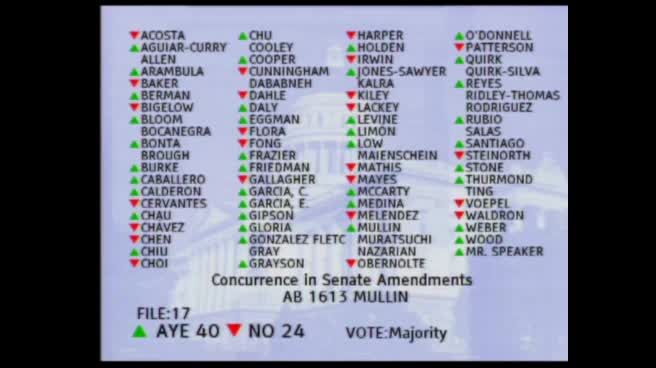 1MIN
Assembly Floor
 2MIN
Senate Floor
 5MIN


