SB 663: Packages and labels of cannabis or cannabis products: children.
- Session Year: 2017-2018
- House: Senate
- Latest Version Date: 2017-08-25
(1)Existing law, the Control, Regulate and Tax Adult Use of Marijuana Act (AUMA), enacted by the voters at the November 8, 2016, statewide general election, regulates the cultivation, distribution, and use of marijuana, also known as cannabis, for nonmedical purposes by persons 21 years of age and older. AUMA prohibits a marijuana product from being appealing to children or easily confused with commercially sold candy or foods that do not contain marijuana. AUMA requires, prior to delivery or sale at a retailer, marijuana and marijuana products to be labeled and placed in a resealable, tamper-evident, child resistant package, and prohibits packages and labels from being attractive to children.
This bill would specify that a package or label of cannabis or cannabis products is deemed to be attractive to children if the package or label has specific characteristics, including, among others, displaying a name resembling the name of any candy, snack food, baked good, or beverage commercially sold without cannabis.
(2)AUMA authorizes the Legislature to amend, by a majority vote, certain provisions of the act to implement specified substantive provisions, provided that the amendments are consistent with and further specified purposes and the intent of the act.
This bill would declare that its provisions implement specified substantive provisions of AUMA. The bill would also declare that its provisions further specified purposes and the intent of the act.
(1)Existing law, the Control, Regulate and Tax Adult Use of Marijuana Act (AUMA), enacted by the voters at the November 8, 2016, statewide general election, regulates the cultivation, distribution, and use of marijuana, also known as cannabis, for nonmedical purposes by people 21 years of age and older. AUMA prohibits a marijuana product from being appealing to children or easily confused with commercially sold candy or foods that do not contain marijuana. AUMA requires, prior to delivery or sale at a retailer, marijuana and marijuana products to be labeled and placed in a resealable, tamper-evident, child resistant package, and prohibits packages and labels from being attractive to children.
This bill would specify that a package or label of cannabis or cannabis products is deemed to be attractive to children if the package or label has specific characteristics, including, among others, displaying a name resembling the name of any candy, snack food, baked good, or beverage commercially sold without marijuana.
(2)AUMA authorizes the Legislature to amend, by a majority vote, certain provisions of the act to implement specified substantive provisions, provided that the amendments are consistent with and further specified purposes and the intent of the act.
This bill would declare that its provisions implement specified substantive provisions of AUMA. The bill would also declare that its provisions further specified purposes and the intent of the act.
(1)Existing law, the Control, Regulate and Tax Adult Use of Marijuana Act (AUMA), enacted by the voters at the November 8, 2016, statewide general election, regulates the cultivation, distribution, and use of marijuana marijuana, also known as cannabis, for nonmedical purposes by people 21 years of age and older. AUMA prohibits a marijuana product from being appealing to children or easily confused with commercially sold candy or foods that do not contain marijuana. AUMA requires, prior to delivery or sale at a retailer, marijuana and marijuana products to be labeled and placed in a resealable, child resistant package, and prohibits packages and labels from being attractive to children.
This bill would specify that a package or label of marijuana or marijuana cannabis or cannabis products is deemed to be attractive to children if the package or label has specific characteristics, including, among others, resembling any candy, snack food, baked good, or beverage commercially sold without marijuana.
(2)AUMA authorizes the Legislature to amend, by a majority vote, certain provisions of the act to implement specified substantive provisions, provided that the amendments are consistent with and further the specified purposes and the intent of the act.
This bill would declare that its provisions implement specified substantive provisions of AUMA. The bill would also declare that its provisions further specified purposes and the intent of the act.
(1)Existing law, the Control, Regulate and Tax Adult Use of Marijuana Act (AUMA), enacted by the voters at the November 8, 2016, statewide general election, regulates the cultivation, distribution, and use of marijuana for nonmedical purposes by people 21 years of age and older. AUMA prohibits a marijuana product from being appealing to children or easily confused with commercially sold candy or foods that do not contain marijuana. AUMA requires, prior to delivery or sale at a retailer, marijuana and marijuana products to be labeled and placed in a resealable, child resistant package, and prohibits packages and labels from being attractive to children.
This bill would specify that a package or label of marijuana or marijuana products is deemed to be attractive to children if the package or label has specific characteristics, including, among others, resembling any candy, snack food, baked good, or beverage commercially sold without marijuana.
(2)AUMA authorizes the Legislature to amend, by a majority vote, certain provisions of the act to implement specified substantive provisions, provided that the amendments are consistent with and further the purposes and intent of the act.
This bill would declare that its provisions implement specified substantive provisions of AUMA. The bill would also declare that its provisions further specified purposes and the intent of the act.
(a)A package or label of cannabis or cannabis products shall be deemed to be attractive to children if the package or label has any of the following characteristics:
(1)Displays the contents of the package through transparent material.
(2)Displays a name that resembles the name of a candy, snack food, baked good, or beverage commercially sold without cannabis.
(3)Contains a design feature that resembles the package or labeling of a candy, snack food, baked good, or beverage commercially offered for sale that does not contain cannabis.
(4)Displays a statement, artwork, or design that could reasonably mislead a natural person under 21 years of age to believe that the package contains anything other than cannabis or cannabis products.
(5)Displays a cartoon, logo, or design feature that would reasonably make the package or label appeal primarily to a natural person under 21 years of age.
(6)Displays a name or slogan that would reasonably make the package or label appeal primarily to a natural person under 21 years of age.
(b)This section does not establish an exclusive list of the characteristics that make a package or label attractive to children.
SEC. 2.The Legislature finds and declares that Section 1 of this bill implements Section 6.1 of the Control, Regulate and Tax Adult Use of Marijuana Act, and that it is consistent with and further the purposes of the act as stated in Section 3 of the act.
(a)A package or label of cannabis or cannabis products shall be deemed to be attractive to children if the package or label has any of the following characteristics:
(1)Displays the contents of the package through transparent material.
(2)Resembles Displays a name that resembles the name of a candy, snack food, baked good, or beverage commercially sold without cannabis.
(3)Contains a design feature that resembles the package or labeling of a candy, snack food, baked good, or beverage commercially offered for sale that does not contain cannabis.
(3)(4)Displays a statement, artwork, or design that could reasonably mislead a natural person under 21 years of age to believe that the package contains anything other than cannabis or cannabis products.
(4)(5)Displays a cartoon, logo, color scheme, image, graphic, or design feature that would reasonably make the package or label attractive appeal primarily to a natural person under 21 years of age.
(5)(6)Displays a name or slogan that would reasonably make the package or label attractive appeal primarily to a natural person under 21 years of age.
(b)This section does not establish an exclusive list of the characteristics that make a package or label attractive to children.
SEC. 2.The Legislature finds and declares that Section 1 of this bill implements Section 6.1 of the Control, Regulate and Tax Adult Use of Marijuana Act, and that it is consistent with and further the purposes of the act as stated in Section 3 of the act.
(a)A package or label of marijuana or marijuana cannabis or cannabis products shall be deemed to be attractive to children if the package or label has any of the following characteristics:
(1)Displays the contents of the package through transparent material.
(2)Resembles any a candy, snack food, baked good, or beverage commercially sold without marijuana. cannabis.
(3)Displays any a statement, artwork, or design that could reasonably mislead a natural person under 21 years of age to believe that the package contains anything other than marijuana or marijuana cannabis or cannabis products.
(4)Displays any a cartoon, logo, color scheme, image, graphic, or design feature that would reasonably make the package or label attractive to a natural person under 21 years of age.
(5)Displays a name or slogan that would reasonably make the package or label attractive to a natural person under 21 years of age.
(b)This section does not establish an exclusive list of the characteristics that make a package or label attractive to children.
SEC. 2.The Legislature finds and declares that Section 1 of this bill implements Section 6.1 of the Control, Regulate and Tax Adult Use of Marijuana Act, and that it is consistent with and further the purposes of the act as stated in Section 3. 3 of the act.
(a)A package or label of marijuana or marijuana products shall be deemed to be attractive to children if the package or label has any of the following characteristics:
(1)Displays the contents of the package through transparent material.
(2)Resembles any candy, snack food, baked good, or beverage commercially sold without marijuana.
(3)Displays any statement, artwork, or design that could reasonably mislead a natural person under 21 years of age to believe that the package contains anything other than marijuana or marijuana products.
(4)Displays any cartoon, logo, color scheme, image, graphic, or design feature that would reasonably make the package or label attractive to a natural person under 21 years of age.
(5)Displays a name or slogan that would reasonably make the package or label attractive to a natural person under 21 years of age.
(b)This section does not establish an exclusive list of the characteristics that make a package or label attractive to children.
SEC. 2.The Legislature finds and declares that Section 1 of this bill implements Section 6.1 of the Control, Regulate and Tax Adult Use of Marijuana Act, and that it is consistent with and further the purposes of the act as stated in Section 3.
|
Date
|
Status
|
|---|---|
| Feb 26, 2018 | Last day to consider Governor’s veto pursuant to Joint Rule 58.5. |
| Sep 11, 2017 | In Senate. Consideration of Governor's item veto pending. |
| Sep 11, 2017 | Vetoed by the Governor. |
| Aug 30, 2017 | Enrolled and presented to the Governor at 3 p.m. |
| Aug 24, 2017 | Assembly amendments concurred in. (Ayes 38. Noes 0.) Ordered to engrossing and enrolling. |
| Aug 22, 2017 | Ordered to special consent calendar. |
| Jul 18, 2017 | In Senate. Concurrence in Assembly amendments pending. |
| Jul 17, 2017 | Read third time. Passed. Ordered to the Senate. |
| Jul 13, 2017 | Read second time. Ordered to third reading. |
| Jul 12, 2017 | Read second time and amended. Ordered to second reading. |
| Jul 11, 2017 | From committee: Do pass as amended. (Ayes 16. Noes 0.) (July 11). |
| Jun 29, 2017 | Read second time and amended. Re-referred to Com. on B. & P. |
| Jun 28, 2017 | From committee: Do pass as amended and re-refer to Com. on B. & P. (Ayes 14. Noes 0.) (June 27). |
| Jun 15, 2017 | Referred to Coms. on HEALTH and B. & P. |
| Apr 20, 2017 | In Assembly. Read first time. Held at Desk. |
| Apr 20, 2017 | Read third time. Passed. (Ayes 39. Noes 0. Page 768.) Ordered to the Assembly. |
| Apr 19, 2017 | Read second time. Ordered to third reading. |
| Apr 18, 2017 | From committee: Do pass. (Ayes 9. Noes 0. Page 726.) (April 17). |
| Mar 28, 2017 | Set for hearing April 17. |
| Mar 9, 2017 | Referred to Com. on B., P. & E.D. |
| Feb 21, 2017 | From printer. May be acted upon on or after March 23. |
| Feb 17, 2017 | Introduced. Read first time. To Com. on RLS. for assignment. To print. |
|
Date
|
Description
|
Location
|
Votes
|
|
|---|---|---|---|---|
| Aug 24, 2017 | Special Consent Calendar # SB663 | Senate Floor |
Passed |
|
| Jul 17, 2017 | SB 663 Nielsen Senate Third Reading By CUNNINGHAM | Assembly Floor |
Passed |
|
| Jul 11, 2017 | Do pass as amended. | Assembly Standing Committee on Business and Professions |
Passed |
|
| Jun 27, 2017 | Do pass as amended and be re-referred to the Committee on [Business and Professions] | Assembly Standing Committee on Health |
Passed |
|
| Apr 20, 2017 | Senate 3rd Reading SB663 Nielsen | Senate Floor |
Passed |
|
| Apr 17, 2017 | Do pass | Senate Standing Committee on Business, Professions and Economic Development |
Passed |
This list shows positions taken on this bill by organizations on the date displayed, which is linked to the original source.
Positions by individuals are not included.
|
Organization
|
Position
|
Date
|
|---|---|---|
| Association For Los Angeles Deputy Sheriffs | ** Support | Jan 2, 2018 |
| Association of Deputy District Attorneys | ** Support | Jan 2, 2018 |
| California Association Of Code Enforcement Officers | ** Support | Jan 2, 2018 |
| California Cannabis Industry Association | ** Against | Apr 19, 2017 |
| California Chapter American College Of Emergency Physicians | * Support | Jul 11, 2017 |
| California College And University Police Chiefs Association | ** Support | Jan 2, 2018 |
| California Medical Association | ** Support | Jan 2, 2018 |
| California Narcotic Officers Association | ** Support | Jan 2, 2018 |
| California Police Chiefs Association | ** Support | Jan 2, 2018 |
| Caliva | * Support | Jul 11, 2017 |
| Consortium Management Group | ** Support | Jan 2, 2018 |
| County Health Executives Association Of California | ** Support | Jan 2, 2018 |
| Los Angeles County Professional Peace Officers Association | ** Support | Jan 2, 2018 |
| Los Angeles Police Protective League | ** Support | Jan 2, 2018 |
| Riverside Sheriffs' Association | ** Support | Jan 2, 2018 |
Office of Senate Floor Analyses (916) 651-1520 Fax: (916) 327-4478 | SB |
VETO
Bill No: SB 663
:
SENATE BUS., PROF. & ECON. DEV. COMMITTEE: 9-0, 4/17/17
AYES: Hill, Bates, Dodd, Galgiani, Glazer, Hernandez, Newman, Pan, Wilk
SENATE FLOOR: 39-0, 4/20/17
AYES: Allen, Anderson, Atkins, Bates, Beall, Berryhill, Bradford, Cannella, De León, Dodd, Fuller, Gaines, Galgiani, Glazer, Hernandez, Hertzberg, Hill, Jackson, Lara, Leyva, McGuire, Mendoza, Mitchell, Monning, Moorlach, Morrell, Newman, Nguyen, Nielsen, Pan, Portantino, Roth, Skinner, Stern, Stone, Vidak, Wieckowski, Wiener, Wilk
NO VOTE RECORDED: Hueso
SENATE FLOOR: 38-0, 8/24/17 (Consent)
AYES: Allen, Anderson, Atkins, Bates, Beall, Berryhill, Bradford, Cannella, Dodd, Fuller, Gaines, Galgiani, Glazer, Hernandez, Hertzberg, Hill, Hueso, Jackson, Lara, Leyva, McGuire, Mendoza, Mitchell, Monning, Moorlach, Morrell, Newman, Nguyen, Nielsen, Pan, Portantino, Roth, Stern, Stone, Vidak, Wieckowski, Wiener, Wilk
NO VOTE RECORDED: De León, Skinner
ASSEMBLY FLOOR: 77-0, 7/17/17 - See last page for vote
DIGEST:
This bill establishes criteria for cannabis packaging that shall be considered “attractive to children.”
Existing law:
- Establishes the Bureau of Cannabis Control (Bureau) under the Department of Consumer Affairs (DCA) to regulate the medical and recreational cannabis industry. (Business and Professions Code (BPC) § 26010)
- Defines “advertise” to mean the publication or dissemination of an advertisement, which includes any written or verbal statement, illustration, or depiction which is calculated to induce sales of cannabis or cannabis products, including any written, printed, graphic, or other material, billboard, sign, or other outdoor display, public transit card, other periodical literature, publication, or in a radio or television broadcast, or in any other media; except that “advertisement” shall not include a label affixed to any cannabis product, or any individual covering, carton, or other wrapper of such container that constitutes a part of the labeling. (BPC § 26150)
- Requires any advertising or marketing placed in broadcast, cable, radio, print and digital communications to only be displayed where at least 71.6 percent of the audience is reasonably expected to be 21 years of age or older, as determined by reliable, up-to-date audience composition data. (BPC § 26151 (b))
- Requires cannabis and cannabis products to be labeled and placed in child resistant package. (BPC §26120 (a))
- Prohibits cannabis and cannabis product packages and labels from being made to be attractive to children. (BPC § 26120 (b))
- Prohibits cannabis products from being designed to be appealing to children or from being easily confused with commercially sold candy or foods that do not contain cannabis. (BPC § 26130 (a)(1))
- Prohibits any licensee from selling cannabis or cannabis products to persons under 21 years of age. (BPC § 26140 (a)(1))
- Prohibits any licensee from allowing any person under 21 years of age on its premises. (BPC § 26140 (a)(2))
- Prohibits a licensee from advertising or marketing cannabis or cannabis products in a manner intended to encourage persons under the age of 21 years to consume cannabis or cannabis products, or publishing or disseminating advertising or marketing containing symbols, language, music, gestures, cartoon characters or other content elements known to appeal primarily to persons below the legal age of consumption. (BPC § 26152)
- Prohibits any licensee from advertising or marketing cannabis or cannabis products on an advertising sign within 1,000 feet of a day care center, school providing instruction in kindergarten or any grades 1 through 12, playground, or youth center. (BPC § 26152 (g))
- Authorizes the Bureau or Department of Public Health to establish other requirements for cannabis and cannabis product labels. (BPC § 26120)
This bill:
- Declares a package or label of cannabis or cannabis products to be attractive to children if the package or label has any of the following characteristics:
- Displays the contents of the package through transparent material.
- Displays a name that resembles the name of a candy, snack food, baked good, or beverage commercially sold without cannabis.
- Contains a design feature that resembles the package or labeling of a candy, snack food, baked good, or beverage commercially offered for sale that does not contain cannabis.
- Displays a statement, artwork, or design that could reasonably mislead a natural person under 21 years of age to believe that the package contains anything other than cannabis or cannabis products.
- Displays a cartoon, logo, or design feature that would reasonably make the package or label appeal primarily to a natural person under 21 years of age.
- Displays a name or slogan that would reasonably make the package or label appeal primarily to a natural person under 21 years of age.
- States that this bill does not establish an exclusive list of the characteristics that make a package or label attractive to children.
- Makes legislative findings and declarations that this bill implements Section 6.1 of the Control, Regulate and Tax Adult Use of Marijuana Act (Act), and that it is consistent with and further the purposes of the Act as stated in Section 3 of the Act.
Background
Visits to Colorado’s children’s hospital for cannabis-related visits jumped in the years following that state’s legalization of cannabis, and over half of these were due to edible recreational cannabis products.
Current California law already prohibits medical and recreational cannabis products, product packages, and labels from being designed to be appealing to children, or from being easily confused with commercially sold candy or foods that do not contain cannabis. This bill further specifies what shall be considered attractive to children. While it appears to duplicate much of existing law, current statutes are confusing in this area.
The Act does not define “product,” but states that a “package” is any container or receptacle used for holding cannabis or cannabis “products.” Thus, a “product” does not necessarily include its label or packaging. Existing law states that a product must not be designed to be easily confused with commercially sold candy or foods that do not contain cannabis. This bill prohibits packaging from being similarly misleading to the packaging of commercially available candy, snack food, baked good, or beverages sold without cannabis. Thus, you can neither have cannabis Lucky Charms nor a package of cannabis products that looks like a Lucky Charms box.
Existing law also has extensive prohibitions on advertising or marketing cannabis products to children, specifically disallowing the use of cartoon characters, music, or “other content elements” that may appeal to minors. However, the Act inexplicably excludes a “label” from the definition of “advertisement.” This is nonsensical, for package design, including labels and logos are vital to inducing sales of cannabis or cannabis products, which is the definition of an advertisement. Regardless, for the purposes of the Act, it is not precisely stated that a label cannot portray a cartoon character or other images that appeal to minors. This bill appears to resolve this issue.
This bill’s main departure from existing law is the prohibition on transparent packaging. This bill will effectively ban transparent packaging by deeming it “attractive to children.”
FISCAL EFFECT: Appropriation: Fiscal Com.: Local:
Association for Los Angeles Deputy Sheriffs
Association of Deputy District Attorneys
California Association for Health, Physical Education, Recreation and Dance
California Association of Code Enforcement Officers
California Chapter of the American College of Emergency Physicians
California College and University Police Chiefs Association
California Medical Association
California Narcotic Officers Association
California Police Chiefs Association
Consortium Management Group
County Health Executives Association of California
Los Angeles County Professional Peace Officers Association
Los Angeles Police Protective League
Riverside Sheriffs’ Association
OPPOSITION: (Verified 9/12/17)
None received
ARGUMENTS IN SUPPORT: The California Chapter of the American College of Emergency Physicians writes, “According to a 2016 study published in JAMA Pediatrics, Colorado saw an increase of young children treated in the emergency department (ED) for accidental cannabis ingestion. In 2014 and 2015, twice as many children visited the ED at Children’s Hospital Colorado as did in the years prior to recreational marijuana legalization in the state. Likewise, calls to poison-control for marijuana ingestion by a child increased five-fold. Researchers found that edibles accounted for approximately half of the accidental marijuana ingestion cases at Children’s Hospital Colorado. In July 2016, Colorado banned edibles in certain shapes that are appealing to children.
“Our members support SB 663 because they fear that California will experience a similar increase in accidental marijuana ingestion following legalization and support additional safeguards. We should learn from the experiences of others and not repeat their harmful mistakes.”
GOVERNOR'S VETO MESSAGE:
I am returning Senate Bill 663 without my signature.
This bill outlines standards that will determine if cannabis packages or labels are attractive to children.
Current law already prohibits cannabis and cannabis products from being designed to be attractive to children.
State licensing authorities are currently drafting emergency regulations on packaging and labeling for the cannabis industry, which must take effect before January 1, 2018. This process is more nimble than statute and allows the licensing authorities to respond to the changing industry. Rather than creating new statutory restrictions, it would be prudent to allow licensing authorities to finish drafting the regulations.
ASSEMBLY FLOOR: 77-0, 7/17/17
AYES: Acosta, Aguiar-Curry, Travis Allen, Arambula, Baker, Berman, Bigelow, Bloom, Bocanegra, Bonta, Brough, Burke, Caballero, Calderon, Cervantes, Chau, Chávez, Chen, Chiu, Choi, Chu, Cooley, Cooper, Cunningham, Dahle, Daly, Eggman, Flora, Fong, Frazier, Friedman, Gallagher, Cristina Garcia, Eduardo Garcia, Gipson, Gloria, Gonzalez Fletcher, Gray, Grayson, Harper, Holden, Jones-Sawyer, Kalra, Kiley, Lackey, Levine, Limón, Low, Maienschein, Mathis, Mayes, McCarty, Medina, Melendez, Mullin, Muratsuchi, Nazarian, Obernolte, O'Donnell, Patterson, Quirk, Quirk-Silva, Reyes, Ridley-Thomas, Rodriguez, Rubio, Salas, Santiago, Steinorth, Mark Stone, Thurmond, Ting, Voepel, Waldron, Weber, Wood, Rendon
NO VOTE RECORDED: Dababneh, Irwin
1/2/18 9:53:38
**** END ****
Office of Senate Floor Analyses (916) 651-1520 Fax: (916) 327-4478 | SB |
UNFINISHED BUSINESS
Bill No: SB 663
:
SENATE BUS., PROF. & ECON. DEV. COMMITTEE: 9-0, 4/17/17
AYES: Hill, Bates, Dodd, Galgiani, Glazer, Hernandez, Newman, Pan, Wilk
SENATE FLOOR: 39-0, 4/20/17
AYES: Allen, Anderson, Atkins, Bates, Beall, Berryhill, Bradford, Cannella, De León, Dodd, Fuller, Gaines, Galgiani, Glazer, Hernandez, Hertzberg, Hill, Jackson, Lara, Leyva, McGuire, Mendoza, Mitchell, Monning, Moorlach, Morrell, Newman, Nguyen, Nielsen, Pan, Portantino, Roth, Skinner, Stern, Stone, Vidak, Wieckowski, Wiener, Wilk
NO VOTE RECORDED: Hueso
ASSEMBLY FLOOR: 77-0, 7/17/17 - See last page for vote
DIGEST:
This bill establishes criteria for cannabis packaging that shall be considered “attractive to children.”
Assembly Amendments
make technical changes to further specify what shall be deemed attractive to children, and state that that a cannabis package shall be deemed attractive to children if the package is designed to “appeal primarily” to an individual under 21 years of age.
Existing law:
- Establishes the Bureau of Cannabis Control (Bureau) under the Department of Consumer Affairs (DCA) to regulate the medical and recreational cannabis industry. (Business and Professions Code (BPC) § 26010)
- Defines “advertise” to mean the publication or dissemination of an advertisement, which includes any written or verbal statement, illustration, or depiction which is calculated to induce sales of cannabis or cannabis products, including any written, printed, graphic, or other material, billboard, sign, or other outdoor display, public transit card, other periodical literature, publication, or in a radio or television broadcast, or in any other media; except that “advertisement” shall not include a label affixed to any cannabis product, or any individual covering, carton, or other wrapper of such container that constitutes a part of the labeling. (BPC § 26150)
- Requires any advertising or marketing placed in broadcast, cable, radio, print and digital communications to only be displayed where at least 71.6 percent of the audience is reasonably expected to be 21 years of age or older, as determined by reliable, up-to-date audience composition data. (BPC § 26151 (b))
- Requires cannabis and cannabis products to be labeled and placed in child resistant package. (BPC §26120 (a))
- Prohibits cannabis and cannabis product packages and labels from being made to be attractive to children. (BPC § 26120 (b))
- Prohibits cannabis products from being designed to be appealing to children or from being easily confused with commercially sold candy or foods that do not contain cannabis. (BPC § 26130 (a)(1))
- Prohibits any licensee from selling cannabis or cannabis products to persons under 21 years of age. (BPC § 26140 (a)(1))
- Prohibits any licensee from allowing any person under 21 years of age on its premises. (BPC § 26140 (a)(2))
- Prohibits a licensee from advertising or marketing cannabis or cannabis products in a manner intended to encourage persons under the age of 21 years to consume cannabis or cannabis products, or publishing or disseminating advertising or marketing containing symbols, language, music, gestures, cartoon characters or other content elements known to appeal primarily to persons below the legal age of consumption. (BPC § 26152)
- Prohibits any licensee from advertising or marketing cannabis or cannabis products on an advertising sign within 1,000 feet of a day care center, school providing instruction in kindergarten or any grades 1 through 12, playground, or youth center. (BPC § 26152 (g))
- Authorizes the Bureau or Department of Public Health to establish other requirements for cannabis and cannabis product labels. (BPC § 26120)
This bill:
- Declares a package or label of cannabis or cannabis products to be attractive to children if the package or label has any of the following characteristics:
- Displays the contents of the package through transparent material.
- Displays a name that resembles the name of a candy, snack food, baked good, or beverage commercially sold without cannabis.
- Contains a design feature that resembles the package or labeling of a candy, snack food, baked good, or beverage commercially offered for sale that does not contain cannabis.
- Displays a statement, artwork, or design that could reasonably mislead a natural person under 21 years of age to believe that the package contains anything other than cannabis or cannabis products.
- Displays a cartoon, logo, or design feature that would reasonably make the package or label appeal primarily to a natural person under 21 years of age.
- Displays a name or slogan that would reasonably make the package or label appeal primarily to a natural person under 21 years of age.
- States that this bill does not establish an exclusive list of the characteristics that make a package or label attractive to children.
- Makes legislative findings and declarations that this bill implements Section 6.1 of the Control, Regulate and Tax Adult Use of Marijuana Act (Act), and that it is consistent with and further the purposes of the Act as stated in Section 3 of the Act.
Background
Visits to Colorado’s children’s hospital for cannabis-related visits jumped in the years following that state’s legalization of cannabis, and over half of these were due to edible recreational cannabis products.
Current California law already prohibits medical and recreational cannabis products, product packages, and labels from being designed to be appealing to children, or from being easily confused with commercially sold candy or foods that do not contain cannabis. This bill further specifies what shall be considered attractive to children. While it appears to duplicate much of existing law, current statutes are confusing in this area.
The Act does not define “product,” but states that a “package” is any container or receptacle used for holding cannabis or cannabis “products.” Thus, a “product” does not necessarily include its label or packaging. Existing law states that a product must not be designed to be easily confused with commercially sold candy or foods that do not contain cannabis. This bill prohibits packaging from being similarly misleading to the packaging of commercially available candy, snack food, baked good, or beverages sold without cannabis. Thus, you can neither have cannabis Lucky Charms nor a package of cannabis products that looks like a Lucky Charms box.
Existing law also has extensive prohibitions on advertising or marketing cannabis products to children, specifically disallowing the use of cartoon characters, music, or “other content elements” that may appeal to minors. However, the Act inexplicably excludes a “label” from the definition of “advertisement.” This is nonsensical, for package design, including labels and logos are vital to inducing sales of cannabis or cannabis products, which is the definition of an advertisement. Regardless, for the purposes of the Act, it is not precisely stated that a label cannot portray a cartoon character or other images that appeal to minors. This bill appears to resolve this issue.
The bill’s main departure from existing law is the prohibition on transparent packaging. This bill will effectively ban transparent packaging by deeming it “attractive to children.”
FISCAL EFFECT: Appropriation: Fiscal Com.: Local:
Association for Los Angeles Deputy Sheriffs
Association of Deputy District Attorneys
California Association for Health, Physical Education, Recreation and Dance
California Association of Code Enforcement Officers
California Chapter of the American College of Emergency Physicians
California College and University Police Chiefs Association
California Medical Association
California Narcotic Officers Association
California Police Chiefs Association
Consortium Management Group
County Health Executives Association of California
Los Angeles County Professional Peace Officers Association
Los Angeles Police Protective League
Riverside Sheriffs’ Association
OPPOSITION: (Verified 7/19/17)
None received
ARGUMENTS IN SUPPORT: The California Chapter of the American College of Emergency Physicians writes, “According to a 2016 study published in JAMA Pediatrics, Colorado saw an increase of young children treated in the emergency department (ED) for accidental cannabis ingestion. In 2014 and 2015, twice as many children visited the ED at Children’s Hospital Colorado as did in the years prior to recreational marijuana legalization in the state. Likewise, calls to poison-control for marijuana ingestion by a child increased five-fold. Researchers found that edibles accounted for approximately half of the accidental marijuana ingestion cases at Children’s Hospital Colorado. In July 2016, Colorado banned edibles in certain shapes that are appealing to children.
“Our members support SB 663 because they fear that California will experience a similar increase in accidental marijuana ingestion following legalization and support additional safeguards. We should learn from the experiences of others and not repeat their harmful mistakes.”
ASSEMBLY FLOOR: 77-0, 7/17/17
AYES: Acosta, Aguiar-Curry, Travis Allen, Arambula, Baker, Berman, Bigelow, Bloom, Bocanegra, Bonta, Brough, Burke, Caballero, Calderon, Cervantes, Chau, Chávez, Chen, Chiu, Choi, Chu, Cooley, Cooper, Cunningham, Dahle, Daly, Eggman, Flora, Fong, Frazier, Friedman, Gallagher, Cristina Garcia, Eduardo Garcia, Gipson, Gloria, Gonzalez Fletcher, Gray, Grayson, Harper, Holden, Jones-Sawyer, Kalra, Kiley, Lackey, Levine, Limón, Low, Maienschein, Mathis, Mayes, McCarty, Medina, Melendez, Mullin, Muratsuchi, Nazarian, Obernolte, O'Donnell, Patterson, Quirk, Quirk-Silva, Reyes, Ridley-Thomas, Rodriguez, Rubio, Salas, Santiago, Steinorth, Mark Stone, Thurmond, Ting, Voepel, Waldron, Weber, Wood, Rendon
NO VOTE RECORDED: Dababneh, Irwin
7/19/17 16:26:59
**** END ****
SENATE THIRD READING
STR Bill Id:SB 663
Author:(Nielsen)
As Amended Ver:July 12, 2017
Majority vote
SENATE VOTE: 39-0
Committee | Votes | Ayes | Noes |
Health | 14-0 | Wood, Bonta, Kalra, Gallagher, Limón, McCarty, Nazarian, Patterson, Ridley-Thomas, Rodriguez, Santiago, Thurmond, Waldron, Chau | |
Business & Professions | 16-0 | Low, Brough, Arambula, Baker, Bloom, Chiu, Cunningham, Dahle, Eggman, Gipson, Grayson, Holden, Irwin, Mullin, Steinorth, Ting |
SUMMARY: Specifies that a package or label of cannabis or cannabis products shall be deemed appealing to children if it has any of a number of characteristics, including: showing the content of the package through a transparent material, resembles any commercially available candy, snack or beverage, displays cartoons, logos, or colors that appeal children, or includes designs that could reasonably mislead a person under 21 that the package contains anything other than cannabis or cannabis products. Specifically, this bill:
- Specifies that a package or label of cannabis or cannabis products shall be deemed appealing to children if it has any of a number of characteristics, including:
- Displays the content of the package through transparent material;
- Resembles any candy, snack, baked good, or beverage commercially sold without cannabis;
- Displays any statement, artwork, or design that could reasonably mislead a person under 21 years of age to believe that the package contains anything other than marijuana or marijuana products;
- Displays any cartoon, logo, color scheme, image, graphic, or design feature that would reasonably make the package or label attractive to a natural person under 21 years of age; and,
- Displays a name or slogan that would reasonably make the package or label attractive to a natural person under 21 years of age.
- Indicates that this bill does not establish an exclusive list of the characteristics that make a package or label attractive to children.
- FISCAL EFFECT: None
- COMMENTS:
Purpose. This bill is sponsored by the author. According to the author, "SB 663 takes necessary steps to protect children from accidentally ingesting marijuana by placing reasonable, common-sense restrictions on the packaging and labeling of edible marijuana products. Colorado saw an unexpected and alarming increase in marijuana exposures in young children after legalizing marijuana – it is this risk to children that SB 663 hopes to mitigate in California by building on the intent of current requirements. SB 663 enumerates additional packaging and labeling features that make marijuana products attractive to children, and prohibits those elements from being used for the packaging of marijuana and marijuana products."
Background. This bill seeks to protect minors from accidentally ingesting cannabis products by constraining the design of packaging that may be used to sell cannabis or cannabis products.
Child-Resistant Marijuana Packaging – The regulation of cannabis has been subdivided between three state agencies: 1) the California Department of Food and Agriculture (CDFA) will regulate the cultivation of cannabis, 2) the Department of Public Health (DPH) will regulate cannabis products, including edibles, and 3) the Bureau under the direction of DCA will regulate commerce and handle the largest segment of enforcement. Agencies are in the process of creating regulations in accordance with Medical Cannabis Regulation and Safety Act and are expected to release the initial regulations in April of 2017.
Current law requires marijuana products to be labeled and packaged in a resealable, child-resistant package and stipulates that packages and labels shall not be made attractive to children. The law does not state by which standards packaging would be determined to be child resistant or what constitutes labeling that is unattractive to children. There are a number of such vague prescriptions in current law that will be clarified by regulation when it is implemented. Most relevant to this bill will be the regulations issued by DPH regarding edibles and their manufacture and sale. These regulations have been broadly outlined, including the likely restriction on anything other than "shelf-stable" products and an emphasis on preventing the diversion and accidental consumption of cannabis products by minors; however it is not clear how these regulations would tackle the issues raised in this bill. While these provisions are intended to protect children, the interpretation of whether a product or packaging may be appealing to children is arguably subjective.
The cannabis industry, regulators, and lawmakers are concerned about the accidental consumption of cannabis and cannabis products by children. In response to these concerns, the California Cannabis Industry Association (CCIA) released a white paper on October 26, 2016 outlining its position on this issue. Specifically, the paper highlights concerns that child resistant packaging is only intended to prevent access by children five years of age or younger and that child resistant packaging fails to prevent teens from accessing cannabis. This issue is bolstered by data from the Washington Poison Center, which indicates that in 2015 it received 272 calls for exposure to cannabis products, of which, 46%, 126 calls, were regarding children. Of those 126 calls, most involved teens, nearly 25% of all cannabis related poison center calls statewide. (Washington Poison Center Toxic Trends Report: 2015 Annual Cannabis Report)
Pediatric Cannabis Exposure - In September 2016, the American Medical Association published a study comparing the incidence of exposure to cannabis before and after the legalization of recreational cannabis and found that Colorado saw more cases of unintentional pediatric exposure to cannabis that the rest of the United States. Specifically the study found that the mean rate of exposure increased from 1.2 per 100,000 population two years prior to legalization to 2.3 per 100,000 population two years after legalization. (Wang, Le Lait, Deakyne, et al. "Unintentional Pediatric Exposures to Marijuana in Colorado, 2009-2015" JAMA Pediatrics.) While Colorado's increase of 34% per year of exposure is higher than other states, it is notable that pediatric cannabis exposure is on the rise generally in the United States, increasing 19% over the same time period. The study found that when the source of the exposure was known, 48% included cannabis edibles and 40% of scenarios were attributed to poor-child supervision or product storage. For 9% of cases, the product was not in a child resistant container.
Analysis Prepared by: Jimmy Fremgen / B. & P. / (916) 319-3301 FN: 0001161
Date of Hearing: July 11, 2017
ASSEMBLY COMMITTEE ON BUSINESS AND PROFESSIONS
Evan Low, Chair
SBPCA Bill Id:SB 663
Author:(Nielsen) – As Introduced Ver:February 17, 2017
NOTE: This bill is double-referred, having previously been heard by the Assembly Committee on Health on June 27, 2017 and approved on a 14-0 vote.
SENATE VOTE: 39-0
SUBJECT: Packages and labels of marijuana or marijuana products: children
SUMMARY: Specifies that a package or label of cannabis or cannabis products shall be deemed appealing to children if it has any of a number of characteristics, including: showing the content of the package through a transparent material, resembles any commercially available candy, snack or beverage, displays cartoons, logos, or colors that appeal children, or includes designs that could reasonably mislead a person under 21 that the package contains anything other than cannabis or cannabis products.
EXISTING LAW:
- Requires a manufacturer, prior to delivery or sale, to label and place marijuana products in a resealable, child resistant package. Packages and labels shall not be made to be attractive to children and must be labeled clearly as containing a marijuana product. (Business and Professions Code (BPC) Section 26120)
- All marijuana and products must be labeled and must include the manufacture date and source, the appellation of origin (if any), list of pharmacologically active ingredients, a list of all ingredients and nutritional information, any solvents, nonorganic pesticides, or fertilizers, a warning if allergens are used in manufacturing, and one of the following statements: (BPC Section 26120)
- For marijuana: GOVERNMENT WARNING: THIS PACKAGE CONTAINS MARIJUANA, A SCHEDULE I CONTROLLED SUBSTANCE. KEEP OUT OF REACH OF CHILDREN AND ANIMALS. MARIJUANA MAY ONLY BE POSSESSED OR CONSUMED BY PERSONS 21 YEARS OF AGE OR OLDER UNLESS THE PERSON IS A QUALIFIED PATIENT. MARIJUANA USE WHILE PREGNANT OR BREASTFEEDING MAY BE HARMFUL. CONSUMPTION OF MARIJUANA IMPAIRS YOUR ABILITY TO DRIVE AND OPERATE MACHINERY. PLEASE USE EXTREME CAUTION.”
- For marijuana products: “GOVERNMENT WARNING: THIS PRODUCT CONTAINS MARIJUANA, A SCHEDULE I CONTROLLED SUBSTANCE. KEEP OUT OF REACH OF CHILDREN AND ANIMALS. MARIJUANA PRODUCTS MAY ONLY BE POSSESSED OR CONSUMED BY PERSONS 21 YEARS OF AGE OR OLDER UNLESS THE PERSON IS A QUALIFIED PATIENT. THE INTOXICATING EFFECTS OF MARIJUANA PRODUCTS MAY BE DELAYED UP TO TWO HOURS. MARIJUANA USE WHILE PREGNANT OR BREASTFEEDING MAY BE HARMFUL. CONSUMPTION OF MARIJUANA PRODUCTS IMPAIRS YOUR ABILITY TO DRIVE AND OPERATE MACHINERY. PLEASE USE EXTREME CAUTION.”
- Requires that marijuana products shall:
- Not be designed to appeal to children or be easily confused with commercially available candy or foods.
- Have a standardized dosage up to 10 milligrams tetrahydrocannabinol (THC) per serving.
- Be scored or easily broken up into standardized serving sizes if the product contains more than one serving and is in solid form.
- Be homogenized to ensure uniform distribution of cannabinoids throughout the product.
- Be manufactured and sold in sanitary conditions and provided to customers with sufficient information to enable informed consumption. (BPC Section 26130)
- Prohibits the sale or transfer of marijuana products to minors and forbids the presence of anyone under the age of 21 on any licensed premises. (BPC Section 26140)
THIS BILL:
- Specifies that a package or label of cannabis or cannabis products shall be deemed appealing to children if it has any of a number of characteristics, including:
- Displays the content of the package through transparent material;
- Resembles any candy, snack, baked good, or beverage commercially sold without cannabis;
- Displays any statement, artwork, or design that could reasonably mislead a person under 21 years of age to believe that the package contains anything other than marijuana or marijuana products;
- Displays any cartoon, logo, color scheme, image, graphic, or design feature that would reasonably make the package or label attractive to a natural person under 21 years of age; and,
- Displays a name or slogan that would reasonably make the package or label attractive to a natural person under 21 years of age.
- Indicates that this bill does not establish an exclusive list of the characteristics that make a package or label attractive to children.
FISCAL EFFECT: None
COMMENTS:
Purpose. This bill is sponsored by the author. According to the author, “SB 663 takes necessary steps to protect children from accidentally ingesting marijuana by placing reasonable, common-sense restrictions on the packaging and labeling of edible marijuana products. Colorado saw an unexpected and alarming increase in marijuana exposures in young children after legalizing marijuana – it is this risk to children that SB 663 hopes to mitigate in California by building on the intent of current requirements. SB 663 enumerates additional packaging and labeling features that make marijuana products attractive to children, and prohibits those elements from being used for the packaging of marijuana and marijuana products.”
Background. This bill seeks to protect minors from accidentally ingesting cannabis products by constraining the design of packaging that may be used to sell cannabis or cannabis products.
History of Legal Cannabis in California - In 1996, California voters passed Proposition 215, legalizing the use of medical cannabis (MC) in the state. In October 2015, nearly 20 years after the authorization of the use of MC, Governor Jerry Brown signed into law a trio of bills [AB 243 (Wood), Chapter 688, Statutes of 2015, AB 266 (Bonta, Cooley, Jones-Sawyer, Lackey, and Wood), Chapter 689, Statutes of 2015, and SB 643 (McGuire), Chapter 719, Statutes of 2015] collectively known as the Medical Cannabis Regulation and Safety Act (MCRSA). MCRSA established the state's first regulatory framework for MC. In 2016, the voters of California passed Proposition 64, the Adult Use of Marijuana Act (AUMA), to legalize the recreational use of cannabis in the state by 2018.
As of 2016, 28 states, the District of Columbia, and Guam allow MC programs. Even though California was the first to authorize the medical use of cannabis, it was the only state that allowed cannabis-use without a robust state regulatory framework until passage of MCRSA. States with MC laws generally have a form of patient registry, which may provide some protection against arrest for possession up to a certain amount of cannabis for personal medicinal use. A limited number of states restrict MC usage to products with low to zero THC and high CBD concentrations, in an effort to more strictly limit the use of THC due to its known psychoactive effects. To date, eight states, Alaska, Colorado, Oregon, Washington, California, Nevada, Massachusetts, Maine, and the District of Columbia have legalized recreational cannabis.
The authors of AUMA sought to make use of much of the regulatory structure and authorities set out by MCRSA while making a few notable changes to the structure being implemented. In addition, the AUMA approved by the voters adopted the January 1, 2018 deadline for state implementation of recreational cannabis in addition to the regulations required in MCRSA that are scheduled to take effect on the same date. The same agencies as under MCRSA remain responsible for implementing regulations for adult use.
Under AUMA, the Department of Consumer Affairs (DCA), continues to serve as the lead regulatory agency for all cannabis, both medical and non-medical, and renames the existing Bureau of Medical Cannabis Regulation as the Bureau of Marijuana Control. AUMA includes 19 different license types compared to the 17 in MCRSA and authorizes DCA (and the Bureau) the exclusive authority to create and regulate a license for transportation of cannabis.
While the language of AUMA allows for modifications to the law by majority vote of the legislature, any legislative changes inconsistent with the original intent of the law may require voter approval. If the state and its various agencies of jurisdiction have not finalized regulations, hired staff, and created technology solutions by January 1, 2018, it is unclear how wide-sweeping and detrimental the consequences may be.
Child-Resistant Marijuana Packaging – The regulation of cannabis has been subdivided between three state agencies: 1) the California Department of Food and Agriculture (CDFA) will regulate the cultivation of cannabis, 2) the Department of Public Health (DPH) will regulate cannabis products, including edibles, and 3) the Bureau under the direction of DCA will regulate commerce and handle the largest segment of enforcement. Agencies are in the process of creating regulations in accordance with MCRSA and are expected to release the initial regulations in April of 2017.
Current law requires marijuana products to be labeled and packaged in a resealable, child-resistant package and stipulates that packages and labels shall not be made attractive to children. The law does not state by which standards packaging would be determined to be child resistant or what constitutes labeling that is unattractive to children. There are a number of such vague prescriptions in current law that will be clarified by regulation when it is implemented. Most relevant to this bill will be the regulations issued by DPH regarding edibles and their manufacture and sale. These regulations have been broadly outlined, including the likely restriction on anything other than “shelf-stable” products and an emphasis on preventing the diversion and accidental consumption of cannabis products by minors; however it is not clear how these regulations would tackle the issues raised in this bill. While these provisions are intended to protect children, the interpretation of whether a product or packaging may be appealing to children is arguably subjective.
The cannabis industry, regulators, and lawmakers are concerned about the accidental consumption of cannabis and cannabis products by children. In response to these concerns, the California Cannabis Industry Association (CCIA) released a white paper on October 26, 2016 outlining its position on this issue. Specifically, the paper highlights concerns that child resistant packaging is only intended to prevent access by children five years of age or younger and that child resistant packaging fails to prevent teens from accessing cannabis. This issue is bolstered by data from the Washington Poison Center, which indicates that in 2015 it received 272 calls for exposure to cannabis products, of which, 46 percent, 126 calls, were regarding children. Of those 126 calls, most involved teens, nearly 25 percent of all cannabis related poison center calls statewide. (Washington Poison Center Toxic Trends Report: 2015 Annual Cannabis Report)
Pediatric Cannabis Exposure - In September 2016, the American Medical Association published a study comparing the incidence of exposure to cannabis before and after the legalization of recreational cannabis and found that Colorado saw more cases of unintentional pediatric exposure to cannabis that the rest of the United States. Specifically the study found that the mean rate of exposure increased from 1.2 per 100,000 population two years prior to legalization to 2.3 per 100,000 population two years after legalization. (Wang, Le Lait, Deakyne, et al. “Unintentional Pediatric Exposures to Marijuana in Colorado, 2009-2015” JAMA Pediatrics.) While Colorado’s increase of 34 percent per year of exposure is higher than other states, it is notable that pediatric cannabis exposure is on the rise generally in the United States, increasing 19 percent over the same time period. The study found that when the source of the exposure was known, 48 percent included cannabis edibles and 40 percent of scenarios were attributed to poor-child supervision or product storage. For 9 percent of cases, the product was not in a child resistant container.
Current Related Legislation. AB 175 (Chau) of the current legislative session requires manufacturers of edible cannabis products to submit the packaging and labeling to the State Department of Health for approval before bringing the product to market. STATUS: This bill was passed by the Assembly and is currently in the Senate Committee on Health.
AB 350 (Salas) of the current legislative session requires that marijuana products shall not be manufactured in the shape of a person, animal, insect, fruit, or any other shape normally associated with candy. STATUS: This bill is pending on the Senate floor.
AB 389 (Salas) of the current legislative session requires the Bureau to establish and make available a guide for consumers to educate the public on the regulation of medical and nonmedical marijuana. STATUS: This bill is pending in the Senate Appropriations Committee.
AB 64 (Bonta, Cooley, Jones-Sawyer, Lackey, Wood) seeks to reconcile a number of differences between MCRSA and AUMA to provide clarity in regulation and enforcement of both medical and recreational cannabis. STATUS: This bill has been referred to the Assembly Committee on Business and Professions and will be heard on April 18, 2017
Prior Related Legislation. AB 266 (Bonta, Cooley, Jones-Sawyer, Lackey, Wood) part of the legislative package that became known as MCRSA, and required the regulation of medical cannabis products, including edibles.
ARGUMENTS IN SUPPORT:
The California Association for Health, Physical Education, Recreation and Dance (CAHPERD) writes in support, “CAHPERD supports SB 663 (Nielsen) Packages and labels of marijuana or marijuana products: children, because it builds on the knowledge learned from the advertising related to tobacco products. CAHPERD supports actions to educate students regarding consumer advertising and increasing health literacy skills. This bill will assure that children will not be subjected to advertisements that may send mixed messages to student.”
Consortium Management Group, on behalf of Caliva writes in support, “The intent of SB 663 is laudable, and we believe that the amendments will allow us to continue to protect children while ensuring our ability to do business in California.”
The California Medical Association writes in support, “Proposition 64 recognized that keeping marijuana out of the hands of children is an important state priority and SB 663 enhances these protections by solving issues the proposition did not fully address. We thank Senator Nielsen for SB 663 and for addressing an incredibly important issue facing California today.”
The Association for Los Angeles Deputy Sheriffs, the Association of Deputy District Attorneys, the California Association of Code Enforcement Officers, the California College and University Police Chiefs Association, the California Narcotic Officers Association, the Los Angeles County Professional Peace Officers Association, the Los Angeles Police Protective League and the Riverside Sheriffs' Association write in support, “This bill will provide that a package of label or marijuana or marijuana products is deemed to be attractive to children if the package or label has specific characteristics, including resembling any candy, snack food, backed goods or beverage that is currently sold without marijuana. We commend you for introducing this Important bill.”
ARGUMENTS IN OPPOSITION:
None on file
AMENDMENTS:
To clarify the intent of the measure, committee staff worked with the author’s office and stakeholders to draft the following amendments:
Amendment 1
On Page 2, in line 9, strike out “Resembles” and insert:
Displays a name that resembles the name of
Amendment 2
On Page 2, between lines 10 and 11, insert:
(3) Contains a design feature that resembles the package or labeling of a candy, snack food, baked good, or beverage commercially offered for sale that does not contain cannabis.
Amendment 3
On Page 2, in line 11, strike out “(3)” and insert:
(4)
Amendment 4
On Page 2, in line 15, strike out “(4)” and insert:
(5)
Amendment 5
On Page 2, in line 15, strike out “color scheme, image, graphic,”
Amendment 6
On Page 2, in line 17, strike out “attractive” and insert:
appeal primarily
Amendment 7
On Page 2, in line 18, strike out “(5)” and insert:
(6)
Amendment 8
On Page 2, in line 19, strike out “attractive” and insert:
appeal primarily
REGISTERED SUPPORT:
California Association for Health, Physical Education, Recreation and Dance (CAHPERD)
Consortium Management Group, on behalf of Caliva
California Medical Association
Association for Los Angeles Deputy Sheriffs
Association of Deputy District Attorneys
California Association of Code Enforcement Officers
California College and University Police Chiefs Association
California Narcotic Officers Association
Los Angeles County Professional Peace Officers Association
Los Angeles Police Protective League
Riverside Sheriffs’ Association
REGISTERED OPPOSITION:
None on file.
Analysis Prepared by: Jimmy Fremgen / B. & P. / (916) 319-3301
Date of Hearing: June 27, 2017
ASSEMBLY COMMITTEE ON HEALTH
Jim Wood, Chair
SBPCA Bill Id:SB 663
Author:(Nielsen) – As Introduced Ver:February 17, 2017
SENATE VOTE: 39-0
SUBJECT: Packages and labels of marijuana or marijuana products: children.
SUMMARY: Deems a package or label of marijuana or marijuana products attractive to children if the package or label meets specified characteristics. Specifically, this bill:
- Deems a package or label of marijuana or marijuana products to be attractive to children if the package or label has any of the following characteristics:
- Displays the content of the package through transparent material;
- Resembles any candy, snack food, baked good, or beverage commercially sold without marijuana;
- Displays any statement, artwork, or design that could reasonably mislead a natural person under 21 years of age to believe that the package contains anything other than marijuana or marijuana products;
- Displays any cartoon, logo, color scheme, image, graphic, or design feature that would reasonably make the package or label attractive to a natural person under 21 years of age; and,
- Displays a name or slogan that would reasonably make the package or label attractive to a natural person under 21 years of age.
- Indicates that this bill does not establish an exclusive list of the characteristics that make a package or label attractive to children.
EXISTING LAW:
- Establishes Proposition (Prop) 215, referred to as the Compassionate Care Act, which legalized the possession and cultivation of marijuana for personal medical use upon recommendation of a physician and ensures that patients and their primary caregivers are not subject to criminal prosecution or sanction. Creates within the Department of Public Health (DPH), a voluntary Medical Marijuana Identification Card program for the registration of patients using medical marijuana and their primary caregivers.
- Enacts the Medical Cannabis Regulation and Safety Act to regulate numerous aspects of medical cannabis in California, including cultivation, transportation, storage, testing, labeling, manufacturing, and sale codified pursuant to AB 243 (Wood), Chapter 688, Statutes of 2015; AB 266 (Bonta), Chapter 689, Statutes of 2015; and, SB 643 (McGuire), Chapter 719, Statutes of 2015.
- Establishes within the Department of Consumer Affairs, the Bureau of Medical Cannabis Regulation for the licensure and regulation of medical cannabis.
- Establishes, through the voter initiative process, Proposition 64 or the Adult Use of Marijuana Act of 2016 (AUMA) which permits adults 21 years of age or older to legally grow, possess, and use cannabis for non-medical purposes, as specified. Authorizes, beginning January 1, 2018, the sale and distribution of cannabis through a regulated business.
- Renames the Bureau of Medical Marijuana Regulation (now referred to as the Bureau of Medical Cannabis Regulation) as the Bureau of Marijuana Control (Bureau).
- Specifies packaging and labeling requirements for marijuana and marijuana products.
FISCAL EFFECT: None
COMMENTS:
- PURPOSE OF THIS BILL. According to the author, this bill takes necessary steps to protect children from accidentally ingesting marijuana by placing reasonable, common-sense restrictions on the packaging and labeling of edible marijuana products. After legalizing marijuana, Colorado saw an unexpected and alarming increase in marijuana exposures in young children and it is this risk to children that this bill hopes to mitigate in California. By building on the intent of current requirements this bill enumerates additional packaging and labeling features that make marijuana products attractive to children, and prohibits those elements from being used for the packaging of marijuana and marijuana products.
Keeping these products out of the hands of children should be a priority for our state. Current law recognizes this and takes a step in the right direction, but does not go far enough. This bill addresses this oversight by providing clarity to existing law and enacting additional safeguards to protect children from mistaking marijuana edibles for their favorite snack food or candy. - BACKGROUND.
- AUMA. Prop 64 was passed by the voters in November 2016. As a result of the passage of Prop 64, adults, aged 21 years or older, are allowed to possess, cultivate and use marijuana for recreational purposes. AUMA, in addition to allowing adult consumption of marijuana and marijuana products for recreational purposes, established numerous controls and safeguards to protect the public, specifically children under the age of 21, including: allowing local governments to enforce state laws and regulations for nonmedical marijuana businesses and enact additional local requirements for nonmedical marijuana businesses; requiring a rigid track and trace management process from cultivation to sale; comprehensive testing; strict environmental and product safety standards; prohibiting the sale of nonmedical marijuana by businesses that also sell alcohol or tobacco; and, prohibiting the marketing and advertising of nonmedical marijuana to persons younger than 21 years of age or near schools or other places where children are present.
- Labeling Requirements. AUMA requires that prior to the delivery or sale of marijuana and marijuana products, they must be labeled and placed in a resealable, child resistant package, and must not be made attractive to children. The inserts must also be prominently displayed in a clear and legible fashion and include the following information, as prescribed by the Bureau or DPH: i) manufacture date and source; ii) for packages containing only dried flower, the net weight of marijuana in the package; iii) identification of the source and date of cultivation, the type of marijuana or marijuana product and the date of manufacturing and packaging; iv) the appellation of origin, if any; v) list of pharmacologically active ingredients, as specified; vi) for marijuana products, a list of all ingredients and disclosure of nutritional information, as specified; vii) a list of any solvents, nonorganic pesticides, herbicides, and fertilizers that were used, as specified; viii) a warning if nuts or other known allergens are used; ix) information associated with the unique identifier issued by the Department of Food and Agriculture; and, x) and the following statements, in bold print:
For marijuana:
“GOVERNMENT WARNING: THIS PACKAGE CONTAINS MARIJUANA, A SCHEDULE I CONTROLLED SUBSTANCE. KEEP OUT OF REACH OF CHILDREN AND ANIMALS. MARIJUANA MAY ONLY BE POSSESSED OR CONSUMED BY PERSONS 21 YEARS OF AGE OR OLDER UNLESS THE PERSON IS A QUALIFIED PATIENT. MARIJUANA USE WHILE PREGNANT OR BREASTFEEDING MAY BE HARMFUL. CONSUMPTION OF MARIJUANA IMPAIRS YOUR ABILITY TO DRIVE AND OPERATE MACHINERY. PLEASE USE EXTREME CAUTION.”
For marijuana products:
“GOVERNMENT WARNING: THIS PRODUCT CONTAINS MARIJUANA, A SCHEDULE I CONTROLLED SUBSTANCE. KEEP OUT OF REACH OF CHILDREN AND ANIMALS. MARIJUANA PRODUCTS MAY ONLY BE POSSESSED OR CONSUMED BY PERSONS 21 YEARS OF AGE OR OLDER UNLESS THE PERSON IS A QUALIFIED PATIENT. THE INTOXICATING EFFECTS OF MARIJUANA PRODUCTS MAY BE DELAYED UP TO TWO HOURS. MARIJUANA USE WHILE PREGNANT OR BREASTFEEDING MAY BE HARMFUL. CONSUMPTION OF MARIJUANA PRODUCTS IMPAIRS YOUR ABILITY TO DRIVE AND OPERATE MACHINERY. PLEASE USE EXTREME CAUTION.”
- Protection of minors. In addition to the labeling requirements above, AUMA also includes provisions to ensure the protection of minors, including prohibiting the sale of marijuana or marijuana products to persons under 21 years of age and prohibiting the design of marijuana products to be appealing to children or easily confused with commercially sold candy or foods that do not contain marijuana.
- Journal of the American Medical Association (JAMA) Article. A JAMA Pediatrics article was published in 2016 entitled, “Unintentional Pediatric Exposures to Marijuana in Colorado, 2009-2015.” The authors of this article examined the effect of the legalization of recreational marijuana on unintentional pediatric exposures by evaluating data on hospital admissions at a tertiary children’s hospital and cases at a regional poison center (RPC) between 2009 and 2015. Study participants included children younger than 10 years who were evaluated at the hospital’s emergency department, urgent care centers, or an inpatient unit and RPC cases for marijuana exposure. The authors identified 81 children (62 included in the analysis), evaluated at the hospital and 163 marijuana exposure calls to a Colorado RPC. For 10 exposure scenarios, the product was not in a child-resistant container; and, for an additional 40 scenarios (34%), poor child supervision or product storage was reported. Edible products were responsible for 51 exposures (52%)
- DPH Proposed Regulations. On April 28, 2017, DPH, charged with licensing cannabis product manufacturers and developing standards for the production and labeling of marijuana products, released proposed regulations. The proposed regulations aim to do the following: i) establish the licensing scheme for manufacturers of medical cannabis products; ii) set minimum standards for sanitary manufacturing practices; and, iii) establish packaging and labeling standards for manufactured cannabis products.
For purposes of labeling, the regulations prohibit a label from containing any content that is or designed to be attractive to individuals under the age of 21, including but not limited to: i) cartoons; ii) any likeness to images, characters, or phrases that are popularly used to advertise to children; or, iii) any imitation of candy packaging or labeling. Additionally, the proposed regulations require that a package used to contain a cannabis product must be child-resistant, which means that the package must be designed or constructed to be significantly difficult for children under five years of age to open or otherwise obtain access to the product within a reasonable time. - Governor’s Budget Trailer Bill. SB 94 (Committee on Budget and Fiscal Review) is the cannabis trailer bill for the Budget Act of 2017. SB 94 establishes a single system of administration for cannabis laws in California. It contains changes related to the Budget Act of 2017 that are necessary for state licensing entities to implement a regulatory framework pursuant to the Medical Cannabis Regulation and Safety Act (MCRSA), established by AB 266, AB 243, SB 643, and SB 837 (Committee on Budget and Fiscal Review), Chapter 32, Statutes of 2016, and AUMA (Prop 64). SB 94 conforms MCRSA and AUMA into a single system that prioritizes consumer safety, public safety and tax compliance. Among other provisions, SB 94 creates agricultural cooperatives, a method for collecting and remitting taxes, a process for testing and packaging, and a process for collecting data related to driving under the influence. SB 94 has been sent to the Governor and is awaiting signature.
- TECHNICAL AMENDMENTS. SB 94 deletes the terms marijuana and replaces them with cannabis. Consistent with these changes, the Committee recommends deleting references in the bill to “marijuana” and replacing them with “cannabis.”
- SUPPORT. The California Chapter of the American College of Emergency Physicians states that its members support this bill because they fear California will experience a similar increase in accidental marijuana ingestion following legalization and support additional safeguards. The California Police Chiefs Association indicates that this bill furthers efforts to prevent underage consumption of cannabis.
- RELATED LEGISLATION.
- AB 350 (Salas) prohibits nonmedical marijuana products from being made in the shape of a person, animal, insect, or fruit. AB 350 is pending in the Senate Floor.
- AB 175 (Chau) requires the Bureau to approve the package and label of an edible marijuana product, as specified. AB 175 is pending in Senate Health Committee.
- AB 823 (Chau) requires each single serving of chocolate, soft confections, hard confections, and lozenges, consolidated baked goods, and pressed pills and capsules that include marijuana or marijuana products to be stamped, marked, or otherwise imprinted directly on the product with a cannabis product symbol, to be designed by DPH; and, specifies the required size and visibility of the cannabis product symbol. AB 823 is pending in Senate Appropriations Committee.
- SB 794 (Stern) requires each single serving of an edible marijuana product to be stamped, marked, or otherwise imprinted directly on the product with a universal symbol, as specified. Requires edible products to be sold in packaging that is tamper-proof, child resistant, and, if the product contains more than one serving. SB 794 is pending in this Committee.
- DOUBLE REFERRAL. This bill is double referred; upon passage in this committee, it will be referred to the Assembly Committee on Business and Professions.
REGISTERED SUPPORT / OPPOSITION:
Support
Association of Deputy District Attorneys
Association for Los Angeles Deputy Sheriffs
California Association for Health, Physical Education, Recreation and Dance
California Association of Code Enforcement Officers
California Chapter of the American College of Emergency Physicians
California College and University Police Chiefs Association
California Medical Association
California Narcotic Officers Association
California Police Chiefs Association
Los Angeles County Professional Peace Officers Association
Los Angeles Police Protective League
Riverside Sheriffs Association
Opposition
None on file.
Analysis Prepared by: Rosielyn Pulmano / HEALTH / (916) 319-2097
Office of Senate Floor Analyses (916) 651-1520 Fax: (916) 327-4478 | SB |
THIRD READING
Bill No: SB 663
:
SENATE BUS., PROF. & ECON. DEV. COMMITTEE: 9-0, 4/17/17
AYES: Hill, Bates, Dodd, Galgiani, Glazer, Hernandez, Newman, Pan, Wilk
DIGEST: This bill establishes criteria for packaging that shall be considered “attractive to children.”
Existing law:
- Establishes the Bureau of Marijuana Control (Bureau) under the Department of Consumer Affairs (DCA) to regulate the medical and recreational cannabis industry. (Business and Professions Code (BPC) § 26010)
- Defines “advertise” to mean the publication or dissemination of an advertisement, which includes any written or verbal statement, illustration, or depiction which is calculated to induce sales of marijuana or marijuana products, including any written, printed, graphic, or other material, billboard, sign, or other outdoor display, public transit card, other periodical literature, publication, or in a radio or television broadcast, or in any other media; except that “advertisement” shall not include a label affixed to any marijuana product, or any individual covering, carton, or other wrapper of such container that constitutes a part of the labeling. (BPC § 26150)
- Defines “labeling” as any label or other written, printed, or graphic matter upon a medical cannabis product, or upon its container or wrapper, or that accompanies any medical cannabis product. (BPC § 19300.5 (v))
- Requires any advertising or marketing placed in broadcast, cable, radio, print and digital communications to only be displayed where at least 71.6 percent of the audience is reasonably expected to be 21 years of age or older, as determined by reliable, up-to-date audience composition data. (BPC § 26151 (b))
- Requires marijuana and marijuana products to be labeled and placed in child resistant package. (BPC §§ 19347, 26120 (a))
- Prohibits marijuana and marijuana product packages and labels from being made to be attractive to children. (BPC §§ 19347, 26120 (b))
- Prohibits marijuana products from being designed to be appealing to children or from being easily confused with commercially sold candy or foods that do not contain marijuana. (BPC § 26130 (a)(1))
- Prohibits any licensee from selling marijuana or marijuana products to persons under 21 years of age. (BPC § 26140 (a)(1))
- Prohibits any licensee from allowing any person under 21 years of age on its premises. (BPC § 26140 (a)(2))
- Prohibits a licensee from advertising or marketing marijuana or marijuana products in a manner intended to encourage persons under the age of 21 years to consume marijuana or marijuana products, or publishing or disseminating advertising or marketing containing symbols, language, music, gestures, cartoon characters or other content elements known to appeal primarily to persons below the legal age of consumption. (BPC § 26152)
- Prohibits any licensee from advertising or marketing marijuana or marijuana products on an advertising sign within 1,000 feet of a day care center, school providing instruction in kindergarten or any grades 1 through 12, playground, or youth center. (BPC § 26152 (g))
- Authorizes the Bureau or Department of Public Health to establish other requirements for marijuana and marijuana product labels. (BPC § 26120)
This bill:
- States that a package or label of marijuana or marijuana products shall be deemed to be attractive to children if it has any of the following characteristics:
- Displays the contents of the package through transparent material.
- Resembles any candy, snack food, baked good, or beverage commercially sold without marijuana.
- Displays any statement, artwork, or design that could reasonably mislead a natural person under 21 years of age to believe that the package contains anything other than marijuana or marijuana products.
- Displays any cartoon, logo, color scheme, image, graphic, or design feature that would reasonably make the package or label attractive to a natural person under 21 years of age.
- Displays a name or slogan that would reasonably make the package or label attractive to a natural person under 21 years of age.
- States that this bill does not establish an exclusive list of the characteristics that make a package or label attractive to children.
Background
Visits to Colorado’s children’s hospital for marijuana-related visits jumped in the years following legalization, and over half of these were due to edible recreational marijuana products.
Current California law already prohibits medical and recreational marijuana products, product packages, and labels from being designed to be appealing to children, or from being easily confused with commercially sold candy or foods that do not contain marijuana. This bill further specifies what shall be considered attractive to children. While it appears to duplicate much of existing law, current statutes are confusing in this area.
The Adult Use of Marijuana Act (AUMA) does not define “product,” but states that a “package” is any container or receptacle used for holding marijuana or marijuana “products.” Thus, a “product” does not necessarily include its label or packaging. Existing law states that a product must not be designed to be easily confused with commercially sold candy or foods that do not contain marijuana. This bill prohibits packaging from being similarly misleading to the packaging of commercially available candy, snack food, baked good, or beverages sold without marijuana. Thus, you can neither have marijuana Lucky Charms nor a package of marijuana products that looks like a Lucky Charms box.
Existing law also has extensive prohibitions on advertising or marketing marijuana products to children, specifically disallowing the use of cartoon characters, music, or “other content elements” that may appeal to minors. However, the AUMA inexplicably excludes a “label” from the definition of “advertisement.” This is nonsensical, for package design, including labels and logos are vital to inducing sales of marijuana or marijuana products, which is the AUMA definition of an advertisement. Regardless, for the purposes of AUMA, it is not precisely stated that a label cannot portray a cartoon character or other images that appeal to minors. This bill appears to resolve this issue.
The bill’s main departure from existing law is the prohibition on transparent packaging. This bill will effectively ban transparent packaging by deeming it “attractive to children.”
FISCAL EFFECT: Appropriation: Fiscal Com.: Local:
Association for Los Angeles Deputy Sheriffs
Association of Deputy District Attorneys
California Association for Health, Physical Education, Recreation and Dance
California Association of Code Enforcement Officers
California Chapter of the American College of Emergency Physicians
California College and University Police Chiefs Association
California Medical Association
California Narcotic Officers Association
California Police Chiefs Association
Los Angeles County Professional Peace Officers Association
Los Angeles Police Protective League
Riverside Sheriffs’ Association
OPPOSITION: (Verified 4/19/17)
California Cannabis Industry Association
4/19/17 14:39:26
**** END ****
SENATE COMMITTEE ON
BUSINESS, PROFESSIONS AND ECONOMIC DEVELOPMENT
Senator Jerry Hill, Chair
2017 - 2018 Regular
Bill No: Hearing Date: April 17, 2017
Author: | |||
Version: |
| ||
Urgency: | Fiscal: | ||
Consultant: | |||
Subject:
SUMMARY:
Establishes criteria for packaging that shall be considered “attractive to children.”
Existing law:
- Establishes the Bureau of Marijuana Control (Bureau) under the Department of Consumer Affairs (DCA) to regulate the medical and recreational cannabis industry. (Business and Professions Code (BPC) § 26010)
- Defines “advertise” to mean the publication or dissemination of an advertisement, which includes any written or verbal statement, illustration, or depiction which is calculated to induce sales of marijuana or marijuana products, including any written, printed, graphic, or other material, billboard, sign, or other outdoor display, public transit card, other periodical literature, publication, or in a radio or television broadcast, or in any other media; except that “advertisement” shall not include a label affixed to any marijuana product, or any individual covering, carton, or other wrapper of such container that constitutes a part of the labeling. (BPC § 26150)
- Defines “labeling” as any label or other written, printed, or graphic matter upon a medical cannabis product, or upon its container or wrapper, or that accompanies any medical cannabis product. (BPC § 19300.5 (v))
- Requires any advertising or marketing placed in broadcast, cable, radio, print and digital communications to only be displayed where at least 71.6 percent of the audience is reasonably expected to be 21 years of age or older, as determined by reliable, up-to-date audience composition data. (BPC § 26151 (b))
- Requires marijuana and marijuana products to be labeled and placed in child resistant package. (BPC §§ 19347, 26120 (a))
- Prohibits marijuana and marijuana product packages and labels from being made to be attractive to children. (BPC §§ 19347, 26120 (b))
- Prohibits marijuana products from being designed to be appealing to children or from being easily confused with commercially sold candy or foods that do not contain marijuana. (BPC § 26130 (a)(1))
- Prohibits any licensee from selling marijuana or marijuana products to persons under 21 years of age. (BPC § 26140 (a)(1))
- Prohibits any licensee from allowing any person under 21 years of age on its premises. (BPC § 26140 (a)(2))
- Prohibits a licensee from advertising or marketing marijuana or marijuana products in a manner intended to encourage persons under the age of 21 years to consume marijuana or marijuana products, or publishing or disseminating advertising or marketing containing symbols, language, music, gestures, cartoon characters or other content elements known to appeal primarily to persons below the legal age of consumption. (BPC § 26152)
- Prohibits any licensee from advertising or marketing marijuana or marijuana products on an advertising sign within 1,000 feet of a day care center, school providing instruction in kindergarten or any grades 1 through 12, playground, or youth center. (BPC § 26152 (g))
- Authorizes the Bureau or Department of Public Health to establish other requirements for marijuana and marijuana product labels. (BPC § 26120)
This bill:
- States that a package or label of marijuana or marijuana products shall be deemed to be attractive to children if it has any of the following characteristics:
- Displays the contents of the package through transparent material.
- Resembles any candy, snack food, baked good, or beverage commercially sold without marijuana.
- Displays any statement, artwork, or design that could reasonably mislead a natural person under 21 years of age to believe that the package contains anything other than marijuana or marijuana products.
- Displays any cartoon, logo, color scheme, image, graphic, or design feature that would reasonably make the package or label attractive to a natural person under 21 years of age.
- Displays a name or slogan that would reasonably make the package or label attractive to a natural person under 21 years of age.
- States that this bill does not establish an exclusive list of the characteristics that make a package or label attractive to children.
FISCAL EFFECT:
Unknown. This bill has not been keyed “fiscal” by Legislative Counsel.
COMMENTS:
- Purpose. This bill is sponsored by the Author. According to the Author, “SB 663 builds on the intent of current Adult Use of Marijuana Act (AUMA, enacted by Prop 64) requirements by further clarifying – in a way that is consistent with marijuana packaging laws in other states – what violates the provision prohibiting packaging that is attractive to children.”
- Background. Visits to Colorado’s children’s hospital for marijuana-related visits jumped in the years following legalization, and over half of these were due to edible recreational marijuana products.
Current California law already prohibits medical and recreational marijuana products, product packages, and labels from being designed to be appealing to children, or from being easily confused with commercially sold candy or foods that do not contain marijuana. This bill further specifies what shall be considered attractive to children. While it appears to duplicate much of existing law, current statutes are confusing in this area.
AUMA does not define “product,” but states that a “package” is any container or receptacle used for holding marijuana or marijuana “products.” Thus, a “product” does not necessarily include its label or packaging. Existing law states that a product must not be designed to be easily confused with commercially sold candy or foods that do not contain marijuana. This bill prohibits packaging from being similarly misleading to the packaging of commercially available candy, snack food, baked good, or beverages sold without marijuana. Thus, you can neither have marijuana Lucky Charms nor a package of marijuana products that looks like a Lucky Charms box.
Existing law also has extensive prohibitions on advertising or marketing marijuana products to children, specifically disallowing the use of cartoon characters, music, or “other content elements” that may appeal to minors. However, the AUMA inexplicably excludes a “label” from the definition of “advertisement.” This is nonsensical, for package design, including labels and logos are vital to inducing sales of marijuana or marijuana products, which is the AUMA definition of an advertisement. Regardless, for the purposes of AUMA, it is not precisely stated that a label cannot portray a cartoon character or other images that appeal to minors. This bill appears to resolve this issue.
The bill’s main departure from existing law is the prohibition on transparent packaging. This bill will effectively ban transparent packaging by deeming it “attractive to children.”
- Related Legislation. AB 420 (Wood) would require an advertisement for the sale of nonmedical marijuana or nonmedical marijuana products to include, at a minimum, the license number of the AUMA licensee responsible for its content. (Status: This bill is currently pending in the Assembly Business and Professions Committee.)
AB 350 (Salas) would specify that a marijuana product is deemed to be appealing to children or easily confused with commercially sold candy if it is in the shape of a person, animal, insect, fruit, or in another shape normally associated with candy, but would not prohibit a licensee from making an edible marijuana product in the shape of the licensee’s logo. (Status: This bill is currently pending in the Assembly Health Committee.)
AB 1143 (Gray) would prohibit advertising marijuana adjacent to and within specified distances of certain highways. (Status: This bill is currently pending in the Assembly Governmental Organization Committee.)
SB 175 (McGuire) expands marijuana appellation of origin protections to advertising and prohibits the use of names that sound similar to a California county in advertising, labeling, marketing, or packaging of marijuana products if it is likely to mislead consumers as to the product’s appellation of origin. (Status: This bill is currently pending in the Senate Appropriations Committee.)
- Prior Related Legislation. SB 837 (Budget, Chapter 32, Statutes of 2016) defined “misbranding” of a cannabis product to include false or misleading labeling, and makes it unlawful to manufacture, sell, deliver, hold, or offer for sale a misbranded medical cannabis product.
AB 243 (Wood, Chapter 688, Statutes of 2015) requires CDFA, DPR, the State Department of Public Health, the Department of Fish and Wildlife, and the State Water Resources Control Board to promulgate regulations or standards relating to medical cannabis and its cultivation, as specified. This bill also establishes licensing fees, fines, and penalties.
AB 266 (Bonta et al., Chapter 689, Statutes of 2015) established the Act for the licensure and regulation of medical cannabis and establishes the Bureau of Medical Cannabis Regulation within the DCA.
SB 643 (McGuire, Chapter 719, Statutes of 2015) set standards for the licensed cultivation and physician prescription of medical cannabis; establishes a track and trace program for the transportation of medical cannabis; and authorizes counties to impose a tax on medical cannabis.
- Arguments in Support. The California Chapter of the American College of Emergency Physicians writes, “According to a 2016 study published in JAMA Pediatrics, Colorado saw an increase of young children treated in the emergency department (ED) for accidental marijuana ingestion. In 2014 and 2015, twice as many children visited the ED at Children’s Hospital Colorado as did in the years prior to recreational marijuana legalization in the state. Likewise, calls to poison-control for marijuana ingestion by a child increased five-fold. Researchers found that edibles accounted for approximately half of the accidental marijuana ingestion cases at Children’s Hospital Colorado. In July 2016, Colorado banned edibles in certain shapes that are appealing to children.
“Our members support SB 663 because they fear that California will experience a similar increase in accidental marijuana ingestion following legalization and support additional safeguards. We should learn from the experiences of others and not repeat their harmful mistakes.”
- Arguments in Opposition. California Cannabis Industry Association is concerned that this bill “will slow down implementation of the medical and nonmedical frameworks. California has no real idea of the size or scope of what the packaging of the industry is going to look like. Requiring the state implement extra packaging requirements on top of the existing child safety provision in the MCRSA and the AUMA is not practical and will slow down the regulatory writing process.”
SUPPORT AND OPPOSITION:
Support:
Association for Los Angeles Deputy Sheriffs
Association of Deputy District Attorneys
California Association for Health, Physical Education, Recreation and Dance
California Association of Code Enforcement Officers
California Chapter of the American College of Emergency Physicians
California College and University Police Chiefs Association
California Medical Association
California Narcotic Officers Association
California Police Chiefs Association
Los Angeles County Professional Peace Officers Association
Los Angeles Police Protective League
Riverside Sheriffs’ Association
Opposition:
California Cannabis Industry Association
-- END --
Discussed in Hearing
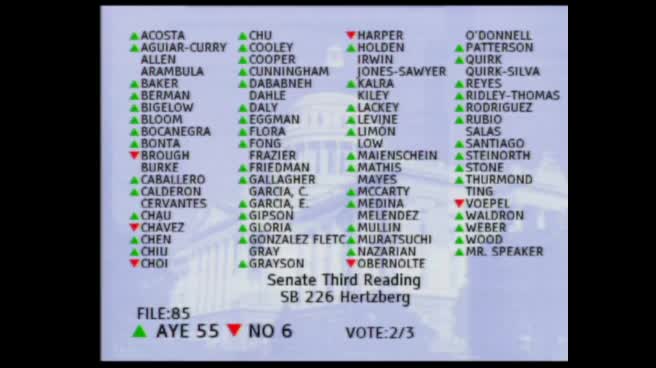 1MIN
Assembly Floor
 4MIN
Assembly Standing Committee on Business and Professions
 15MIN
Assembly Standing Committee on Health
 3MIN
Senate Floor
 16MIN
Senate Standing Committee on Business, Professions and Economic Development
Bill Author

Bill Co-Author(s):