SB 691: Educational equity: immigration status.
- Session Year: 2017-2018
- House: Senate
- Latest Version Date: 2018-08-06
Existing law, the Equity in Higher Education Act, states the policy of the State of California to afford all persons, regardless of their disability, gender, gender identity, gender expression, nationality, race or ethnicity, religion, sexual orientation, or any other specified characteristic, equal rights and opportunities in postsecondary educational institutions of the state, and states that the purpose of related existing law is to prohibit acts that are contrary to that policy and to provide remedies therefor. Existing law prohibits a person from being subjected to discrimination on those bases and states that each characteristic includes a perception that the person has that characteristic or that the person is associated with a person who has, or is perceived to have, that characteristic.
This bill would expressly reference immigration status in the specified characteristics for purposes of those provisions. The bill would state that the Legislature finds and declares these changes to be declaratory of existing law. The bill would also specify that nothing in the Equity in Higher Education Act shall be construed to require a postsecondary educational institution to offer admission or student financial aid to a nonimmigrant alien, as specified, except as provided.
Existing law law, the Equity in Higher Education Act, states the policy of the State of California to afford all persons, regardless of their disability, gender, gender identity, gender expression, nationality, race or ethnicity, religion, sexual orientation, or any other specified characteristic, equal rights and opportunities in postsecondary educational institutions of the state, and states that the purpose of related existing law is to prohibit acts that are contrary to that policy and to provide remedies therefor. Existing law prohibits a person from being subjected to discrimination on those bases and states that each characteristic includes a perception that the person has that characteristic or that the person is associated with a person who has, or is perceived to have, that characteristic.
This bill would expressly reference immigration status in the specified characteristics for purposes of those provisions. The bill would state that the Legislature finds and declares these changes to be declaratory of existing law. The bill would also specify that nothing in the Equity in Higher Education Act shall be construed to require a postsecondary educational institution to offer admission or student financial aid to a nonimmigrant alien, as specified, except as provided.
Existing law states the policy of the State of California to afford all persons, regardless of their disability, gender, gender identity, gender expression, nationality, race or ethnicity, religion, sexual orientation, or any other specified characteristic, equal rights and opportunities in postsecondary educational institutions of the state, and states that the purpose of related existing law is to prohibit acts that are contrary to that policy and to provide remedies therefor. Existing law prohibits a person from being subjected to discrimination on those bases and states that each characteristic includes a perception that the person has that characteristic or that the person is associated with a person who has, or is perceived to have, that characteristic.
This bill would expressly reference immigration status in the specified characteristics for purposes of those provisions.
Existing law states the policy of the State of California to afford all persons, regardless of their disability, gender, gender identity, gender expression, nationality, race or ethnicity, religion, sexual orientation, or any other specified characteristic, equal rights and opportunities in postsecondary educational institutions of the state, and states that the purpose of related existing law is to prohibit acts that are contrary to that policy and to provide remedies therefor.
This bill would expressly reference immigration status in the specified characteristics for purposes of those provisions.
Existing law prohibits the willful interference with the free exercise of any constitutional right of another person because of the race, nationality, gender, disability, sexual orientation, or religion of that person. Existing law prohibits the assault of another person with a deadly weapon. Existing law prohibits the killing of another person, as prescribed.This bill would prohibit the use of a motor vehicle to willfully stop, disrupt, interfere with or prevent an assembly of people, as defined, and thereby proximately causing death or serious bodily injury, except as specified. By creating a new crime, the bill would create a state-mandated local program.The California Constitution requires the state to reimburse local agencies and school districts for certain costs mandated by the state. Statutory provisions establish procedures for making that reimbursement.This bill would provide that no reimbursement is required by this act for a specified reason.Existing law prohibits the willful interference with the free exercise of any constitutional right of another person because of the race, nationality, gender, disability, sexual orientation, or religion of that person. Existing law prohibits the assault of another person with a deadly weapon. Existing law prohibits the killing of another person, as prescribed.
This bill would prohibit the use of a motor vehicle to willfully stop, disrupt, interfere with or prevent an assembly of people, as defined, and thereby proximately causing death or serious bodily injury, except as specified. By creating a new crime, the bill would create a state-mandated local program.
The California Constitution requires the state to reimburse local agencies and school districts for certain costs mandated by the state. Statutory provisions establish procedures for making that reimbursement.
This bill would provide that no reimbursement is required by this act for a specified reason.
(1)Existing law permits the voters of a city to nominate a candidate for an elective office of the city by the signing and filing of nomination papers, as specified. Existing law requires a candidate for an elective office in a local agency to include an affidavit with his or her nomination papers, indicating the candidates name, designation, and residence address, as specified.This bill would additionally require that the candidate disclose his or her party preference, or indicate that he or she declines to disclose a party preference, on the affidavit of the nominee. The bill also would make conforming changes.(2)Existing law authorizes each candidate for nonpartisan elective office in any local agency, including any city, county, city and county, or district, to prepare a candidates statement on an appropriate form provided by the elections official. Existing law prohibits the statement from including the candidates party affiliation or membership or activity in partisan political organizations.This bill would instead authorize a candidate to include his or her party preference or membership or activity in partisan political organizations in his or her candidates statement.(3)Existing law prohibits a ballot for an elective office in any local agency election from including a candidates party preference.This bill would require a ballot for an elective office in a local agency, including any city, county, city and county, or district, to include a candidates party preference, as specified. Because this bill would impose additional duties on local elections officials, it would impose a state-mandated local program.The California Constitution requires the state to reimburse local agencies and school districts for certain costs mandated by the state. Statutory provisions establish procedures for making that reimbursement.This bill would provide that, if the Commission on State Mandates determines that the bill contains costs mandated by the state, reimbursement for those costs shall be made pursuant to the statutory provisions noted above.This bill would provide that it would become operative only if SCA ____ is approved by the voters.(1)Existing law permits the voters of a city to nominate a candidate for an elective office of the city by the signing and filing of nomination papers, as specified. Existing law requires a candidate for an elective office in a local agency to include an affidavit with his or her nomination papers, indicating the candidates name, designation, and residence address, as specified.
This bill would additionally require that the candidate disclose his or her party preference, or indicate that he or she declines to disclose a party preference, on the affidavit of the nominee. The bill also would make conforming changes.
(2)Existing law authorizes each candidate for nonpartisan elective office in any local agency, including any city, county, city and county, or district, to prepare a candidates statement on an appropriate form provided by the elections official. Existing law prohibits the statement from including the candidates party affiliation or membership or activity in partisan political organizations.
This bill would instead authorize a candidate to include his or her party preference or membership or activity in partisan political organizations in his or her candidates statement.
(3)Existing law prohibits a ballot for an elective office in any local agency election from including a candidates party preference.
This bill would require a ballot for an elective office in a local agency, including any city, county, city and county, or district, to include a candidates party preference, as specified. Because this bill would impose additional duties on local elections officials, it would impose a state-mandated local program.
The California Constitution requires the state to reimburse local agencies and school districts for certain costs mandated by the state. Statutory provisions establish procedures for making that reimbursement.
This bill would provide that, if the Commission on State Mandates determines that the bill contains costs mandated by the state, reimbursement for those costs shall be made pursuant to the statutory provisions noted above.
This bill would provide that it would become operative only if SCA ____ is approved by the voters.
It is the policy of the State of California to afford all persons, regardless of disability, gender, gender identity, gender expression, nationality, race or ethnicity, religion, sexual orientation, or any other basis that is contained in the prohibition of hate crimes set forth in subdivision (a) of Section 422.6 of the Penal Code, including immigration status, equal rights and opportunities in the postsecondary educational institutions of the state. The purpose of this chapter is to prohibit acts that are contrary to that policy and to provide remedies for the commission of those prohibited acts.
SEC. 2.Section 66260.6 of the Education Code is amended to read:66260.6.Disability, gender, gender identity, gender expression, nationality, race or ethnicity, religion, sexual orientation, or any other characteristic that is contained in the definition of hate crimes set forth in Section 422.55 of the Penal Code, including immigration status, includes a perception that the person has any of those characteristics or that the person is associated with a person who has, or is perceived to have, any of those characteristics.
SEC. 3.Section 66270 of the Education Code is amended to read:66270.No person shall be subjected to discrimination on the basis of disability, gender, gender identity, gender expression, nationality, race or ethnicity, religion, sexual orientation, or any characteristic listed or defined in Section 11135 of the Government Code or any other characteristic that is contained in the prohibition of hate crimes set forth in subdivision (a) of Section 422.6 of the Penal Code, including immigration status, in any program or activity conducted by any postsecondary educational institution that receives, or benefits from, state financial assistance or enrolls students who receive state student financial aid.
SEC. 4.Section 66270.3 is added to the Education Code, to read:66270.3.Nothing in this chapter shall be construed to require a postsecondary institution to offer admission or student financial aid to a nonimmigrant alien within the meaning of paragraph (15) of subdivision (a) of Section 1101 of Title 8 of the United States Code, as that paragraph exists on January 1, 2019, except for students 2019. However, students granted status pursuant to subparagraphs (T) or (U) of paragraph (15), as specified. specified, shall not be subjected to discrimination in admission or financial aid on the basis of immigration status.
SEC. 5.The Legislature finds and declares that the amendments of Sections 66251, 66260.6, and 66270 made by this act do not constitute a change in, but are declaratory of, existing law.
It is the policy of the State of California to afford all persons, regardless of disability, gender, gender identity, gender expression, nationality, race or ethnicity, religion, sexual orientation, or any other basis that is contained in the prohibition of hate crimes set forth in subdivision (a) of Section 422.6 of the Penal Code, including immigration status, equal rights and opportunities in the postsecondary educational institutions of the state. The purpose of this chapter is to prohibit acts that are contrary to that policy and to provide remedies for the commission of those prohibited acts.
SEC. 2.Section 66260.6 of the Education Code is amended to read:66260.6.Disability, gender, gender identity, gender expression, nationality, race or ethnicity, religion, sexual orientation, or any other characteristic that is contained in the definition of hate crimes set forth in Section 422.55 of the Penal Code, including immigration status, includes a perception that the person has any of those characteristics or that the person is associated with a person who has, or is perceived to have, any of those characteristics.
SEC. 3.Section 66270 of the Education Code is amended to read:66270.No person shall be subjected to discrimination on the basis of disability, gender, gender identity, gender expression, nationality, race or ethnicity, religion, sexual orientation, or any characteristic listed or defined in Section 11135 of the Government Code or any other characteristic that is contained in the prohibition of hate crimes set forth in subdivision (a) of Section 422.6 of the Penal Code, including immigration status, in any program or activity conducted by any postsecondary educational institution that receives, or benefits from, state financial assistance or enrolls students who receive state student financial aid.
SEC. 4.Section 66270.3 is added to the Education Code, to read:66270.3.Nothing in this chapter shall be construed to require a postsecondary institution to offer admission or student financial aid to a nonimmigrant alien within the meaning of paragraph (15) of subdivision (a) of Section 1101 of Title 8 of the United States Code, as that paragraph exists on January 1, 2019, except for students granted status pursuant to subparagraphs (T) or (U) of paragraph (15), as specified.
SEC. 5.The Legislature finds and declares that the amendments of Sections 66251, 66260.6, and 66270 made by this act do not constitute a change in, but are declaratory of, existing law.
It is the policy of the State of California to afford all persons, regardless of disability, gender, gender identity, gender expression, nationality, race or ethnicity, religion, sexual orientation, or any other basis that is contained in the prohibition of hate crimes set forth in subdivision (a) of Section 422.6 of the Penal Code, including immigration status, equal rights and opportunities in the postsecondary educational institutions of the state. The purpose of this chapter is to prohibit acts that are contrary to that policy and to provide remedies for the commission of those prohibited acts.
SEC. 2.Section 66260.6 of the Education Code is amended to read:66260.6.Disability, gender, gender identity, gender expression, nationality, race or ethnicity, religion, sexual orientation, or any other characteristic that is contained in the definition of hate crimes set forth in Section 422.55 of the Penal Code Code, including immigration status, includes a perception that the person has any of those characteristics or that the person is associated with a person who has, or is perceived to have, any of those characteristics.
SEC. 3.Section 66270 of the Education Code is amended to read:66270.No person shall be subjected to discrimination on the basis of disability, gender, gender identity, gender expression, nationality, race or ethnicity, religion, sexual orientation, or any characteristic listed or defined in Section 11135 of the Government Code or any other characteristic that is contained in the prohibition of hate crimes set forth in subdivision (a) of Section 422.6 of the Penal Code Code, including immigration status, in any program or activity conducted by any postsecondary educational institution that receives, or benefits from, state financial assistance or enrolls students who receive state student financial aid.
It is the policy of the State of California to afford all persons, regardless of disability, gender, gender identity, gender expression, nationality, race or ethnicity, religion, sexual orientation, or any other basis that is contained in the prohibition of hate crimes set forth in subdivision (a) of Section 422.6 of the Penal Code, including immigration status, equal rights and opportunities in the postsecondary educational institutions of the state. The purpose of this chapter is to prohibit acts that are contrary to that policy and to provide remedies therefor. for the commission of those prohibited acts.
SECTION 1.The Legislature finds and declares that the threat of terrorism involving the use of a vehicle to disrupt, prevent, or stop a current or future rally, protest, or other form of assembly is a public safety concern and an unacceptable infringement on the exercise of the constitutional rights of free speech and assembly.SEC. 2.Title 11.8 (commencing with Section 423.8) is added to Part 1 of the Penal Code, to read:11.8.Domestic Terrorism Prevention Act423.8.This title shall be known, and may be cited, as the Domestic Terrorism Prevention Act of 2017.423.85.(a)Any person who wilfully uses a motor vehicle to interfere with, disrupt, or stop an assembly of people or to intimidate or coerce people from forming or participating in an assembly of people, and thereby proximately causes significant or substantial bodily injury to another person shall be punished by imprisonment in the state prison for two, three, or four years.(b)Any person who violates subdivision (a) in a manner likely to cause death or significant or substantial bodily injury, and proximately causes the death of another person shall be punished by imprisonment in the state prison for a term of life without the possibility of parole, or imprisonment in the state prison for a term of 25 years to life.(c)This section does not preclude prosecution under any other provision of law.(d)This section does not apply to either of the following:(1)A person who, in reasonable fear for their personal safety, uses a motor vehicle to flee from a violent protest, in a reasonable manner.(2)A peace officer who, in the performance of his or her duties, uses a motor vehicle in a safe and reasonable manner while attempting to direct, control, or disperse a crowd or respond to an emergency.(e)For the purposes of this section, an assembly of people means three or more people gathering in a place open to the public for the purpose of expressing, representing, or advocating for a cause or political position, and includes a rally, march, or protest, whether it is organized or spontaneous, and whether or not is has been permitted.SEC. 3.No reimbursement is required by this act pursuant to Section 6 of Article XIIIB of the California Constitution because the only costs that may be incurred by a local agency or school district will be incurred because this act creates a new crime or infraction, eliminates a crime or infraction, or changes the penalty for a crime or infraction, within the meaning of Section 17556 of the Government Code, or changes the definition of a crime within the meaning of Section 6 of Article XIIIB of the California Constitution.The Legislature finds and declares that the threat of terrorism involving the use of a vehicle to disrupt, prevent, or stop a current or future rally, protest, or other form of assembly is a public safety concern and an unacceptable infringement on the exercise of the constitutional rights of free speech and assembly.
SEC. 2.Title 11.8 (commencing with Section 423.8) is added to Part 1 of the Penal Code, to read:11.8.Domestic Terrorism Prevention Act423.8.This title shall be known, and may be cited, as the Domestic Terrorism Prevention Act of 2017.
423.85.(a)Any person who wilfully uses a motor vehicle to interfere with, disrupt, or stop an assembly of people or to intimidate or coerce people from forming or participating in an assembly of people, and thereby proximately causes significant or substantial bodily injury to another person shall be punished by imprisonment in the state prison for two, three, or four years.
(b)Any person who violates subdivision (a) in a manner likely to cause death or significant or substantial bodily injury, and proximately causes the death of another person shall be punished by imprisonment in the state prison for a term of life without the possibility of parole, or imprisonment in the state prison for a term of 25 years to life.
(c)This section does not preclude prosecution under any other provision of law.
(d)This section does not apply to either of the following:
(1)A person who, in reasonable fear for their personal safety, uses a motor vehicle to flee from a violent protest, in a reasonable manner.
(2)A peace officer who, in the performance of his or her duties, uses a motor vehicle in a safe and reasonable manner while attempting to direct, control, or disperse a crowd or respond to an emergency.
(e)For the purposes of this section, an assembly of people means three or more people gathering in a place open to the public for the purpose of expressing, representing, or advocating for a cause or political position, and includes a rally, march, or protest, whether it is organized or spontaneous, and whether or not is has been permitted.
SEC. 3.No reimbursement is required by this act pursuant to Section 6 of Article XIIIB of the California Constitution because the only costs that may be incurred by a local agency or school district will be incurred because this act creates a new crime or infraction, eliminates a crime or infraction, or changes the penalty for a crime or infraction, within the meaning of Section 17556 of the Government Code, or changes the definition of a crime within the meaning of Section 6 of Article XIIIB of the California Constitution.
All matter omitted in this version of the bill appears in the bill as introduced in the Senate, February 17, 2017. (JR11)(a)A candidate for an elective office in any local agency, including any city, county, city and county, or district, shall indicate one of the following upon his or her nomination papers, which shall be consistent with what appears on the candidates most recent affidavit of registration:
(1)Party Preference: ______ (insert the name of the qualified political party as disclosed upon your affidavit of registration).
(2)Party Preference: None (if you have declined to disclose a preference for a qualified political party upon your affidavit of registration).
(b)The selection made by the candidate pursuant to subdivision (a) shall appear on the election ballot in conjunction with his or her name.
(c)A candidate designating a party preference pursuant to subdivision (a) shall not be deemed to be the official nominee of the party designated as preferred by the candidate. A candidates designation of party preference shall not be construed as an endorsement of that candidate by the party designated. The party preference designated by the candidate is shown for the information of the voters only and shall not limit the options available to voters.
(d)All references to party preference or affiliation shall be omitted from all forms required to be filed by a candidate for elective office pursuant to this division, except that the affidavit of the nominee required by Section 10051 shall include space for the candidate to list the party preference disclosed upon the candidates most recent affidavit of registration, in accordance with subdivision (a).
10051.The nomination papers and affidavits shall be substantially in the following form:
NOMINATION PAPER | ||
We, the undersigned voters of the ____ of ____ hereby nominate ____ for the office of ____ of the city, county, city and county, or district: | ||
Name | Residence | |
AFFIDAVITOFTHECIRCULATOR | ||
State of California County of |
| ss. |
I, ______, solemnly swear (or affirm) all of the following: 1.That I am 18 years of age or older. 2.That my residence address, including street and number, is 3.That the signatures on this nomination paper were obtained between _____, 2__, and _____, 2__; that I circulated this petition and I saw the signatures on this section of the nomination papers being written; and that, to the best of my information and belief, each signature is the genuine signature of the person whose name it purports to be. | ||
(Signature) | ||
I certify (or declare)
under the penalty of perjury under the laws of the | ||
AFFIDAVITOFTHENOMINEE | ||
State of California County of |
| ss. |
______ being duly sworn, says that he or she is the above-named nominee | ||
(Print name above), | ||
and that he or she desires the following designation to appear on the ballot | ||
(Print desired designation above), | ||
and that his or her residence address is . | ||
(Print residence address as provided by affiant) | ||
Pursuant to Section 10050 of the Elections Code, select one of the following: | ||
______ Party Preference: _____________________ (insert the name of the qualified political party as disclosed upon your affidavit of registration). | ||
______ Party Preference: None (if you have declined to disclose a preference for a qualified political party upon your affidavit of registration). | ||
I certify (or declare) under the penalty of perjury under the laws of the State of California that the foregoing is true and correct. | ||
(a)In the case of a candidate for a voter-nominated office in a primary election, a general election, or a special election to fill a vacancy in the office of United States Senator, Member of the United States House of Representatives, State Senator, or Member of the Assembly, immediately to the right of and on the same line as the name of the candidate, or immediately below the name if there is not sufficient space to the right of the name, there shall be identified, as specified by the Secretary of State, the designation made by the candidate pursuant to Section 8002.5. The identification shall be in substantially the following form:
(1)In the case of a candidate who designated a political party preference pursuant to Section 8002.5, Party Preference: ______.
(2)In the case of a candidate who did not state a preference for a political party pursuant to Section 8002.5, Party Preference: None.
(b)In the case of candidates for President and Vice President, the name of the party shall appear to the right of and equidistant from the pair of names of these candidates and on the same line as the name of the candidate for President, or immediately below the name of the vice presidential candidate if there is not sufficient space to the right of the name.
(c)If for a general election any candidate for President of the United States or Vice President of the United States has received the nomination of any additional party or parties, the name(s) shall be printed to the right of the name of the candidates own party. Party names of a candidate shall be separated by commas. If a candidate has qualified for the ballot by virtue of an independent nomination, the word Independent shall be printed instead of the name of a political party in accordance with the above rules.
(d)In the case of a candidate for elective office in any local agency, including any city, county, city and county, or district, immediately to the right of and on the same line as the name of the candidate, or immediately below the name if there is not sufficient space to the right of the name, there shall be identified, as specified by the Secretary of State, the designation made by the candidate pursuant to Section 10050. The identification shall be in substantially the following form:
(1)In the case of a candidate who designated a political party preference pursuant to Section 10050, Party Preference: ______.
(2)In the case of a candidate who did not state a preference for a political party pursuant to Section 10050, Party Preference: None.
SEC. 4.Section 13307 of the Elections Code is amended to read:13307.(a)(1)Each candidate for nonpartisan elective office in any local agency, including any city, county, city and county, or district, may prepare a candidates statement on an appropriate form provided by the elections official. The statement may include the name, age, and occupation of the candidate and a brief description, of no more than 200 words, of the candidates education and qualifications expressed by the candidate himself or herself. However, the governing body of the local agency may authorize an increase in the limitations on words for the statement from 200 to 400 words. The statement shall not may include the party affiliation preference of the candidate, nor or membership or activity in partisan political organizations.
(2)The statement authorized by this subdivision shall be filed in the office of the elections official when the candidates nomination papers are returned for filing, if it is for a primary election, or for an election for offices for which there is no primary. The statement shall be filed in the office of the elections official no later than the 88th day before the election, if it is for an election for which nomination papers are not required to be filed. If a runoff election or general election occurs within 88 days of the primary or first election, the statement shall be filed with the elections official by the third day following the governing bodys declaration of the results from the primary or first election.
(3)Except as provided in Section 13309, the statement may be withdrawn, but not changed, during the period for filing nomination papers and until 5 p.m. of the next working day after the close of the nomination period.
(b)(1)The elections official shall send to each voter a county voter information guide that contains the written statements of each candidate that is prepared pursuant to subdivision (a). The statement of each candidate shall be printed in type of uniform size and darkness, and with uniform spacing.
(2)The elections official shall provide a Spanish translation to those candidates who wish to have one, and shall select a person to provide that translation who is one of the following:
(A)A certified and registered interpreter on the Judicial Council Master List.
(B)An interpreter categorized as certified or professionally qualified by the Administrative Office of the United States Courts.
(C)From an institution accredited by a regional or national accrediting agency recognized by the United States Secretary of Education.
(D)A current voting member in good standing of the American Translators Association.
(E)A current member in good standing of the American Association of Language Specialists.
(c)(1)In addition to the statement prepared pursuant to subdivision (a), if the elections official who is conducting the election permits electronic distribution of a candidates statement, the governing body of a local agency may permit each candidate for nonpartisan elective office in the local agency to prepare a candidate's statement for the purpose of electronic distribution pursuant to this subdivision.
(2)A statement prepared pursuant to this subdivision shall be posted on the Internet Web site of the elections official, and may be included in a voter's pamphlet that is electronically distributed by the elections official pursuant to Section 13300.7, but shall not be included in a voter's pamphlet that is printed and mailed to voters pursuant to subdivision (b).
(3)A statement that is printed in the voter's pamphlet and mailed to voters pursuant to subdivision (b) shall be included with the statement that is prepared and electronically distributed pursuant to this subdivision.
(4)A statement that is prepared and electronically distributed pursuant to this subdivision shall be displayed in type of uniform size and darkness, and with uniform spacing.
(5)The elections official shall provide a Spanish translation to those candidates who wish to have one, and shall select a person to provide that translation who is one of the persons listed in paragraph (2) of subdivision (b).
(d)The local agency may estimate the total cost of printing, handling, translating, mailing, and electronically distributing candidates statements filed pursuant to this section, including costs incurred as a result of complying with the federal Voting Rights Act of 1965, as amended. The local agency may require each candidate filing a statement to pay in advance to the local agency his or her estimated pro rata share as a condition of having his or her statement included in the county voter information guide or electronically distributed. In the event the estimated payment is required, the receipt for the payment shall include a written notice that the estimate is just an approximation of the actual cost that varies from one election to another election and may be significantly more or less than the estimate, depending on the actual number of candidates filing statements. Accordingly, the local agency is not bound by the estimate and may, on a pro rata basis, bill the candidate for additional actual expense or refund any excess paid depending on the final actual cost. In the event of underpayment, the local agency may require the candidate to pay the balance of the cost incurred. In the event of overpayment, the local agency that, or the elections official who, collected the estimated cost shall prorate the excess amount among the candidates and refund the excess amount paid within 30 days of the election.
(e)This section shall not be deemed to make any statement, or the authors of any statement, free or exempt from any civil or criminal action or penalty because of any false, slanderous, or libelous statements offered for printing electronic distribution pursuant to this section or contained in the county voter information guide.
(f)Before the nominating period opens, the local agency for that election shall determine whether a charge shall be levied against that candidate for the candidates statement sent to each voter and, if authorized pursuant to subdivision (c), for the electronically distributed candidates statement. This decision shall not be revoked or modified after the seventh day before the opening of the nominating period. A written statement of the regulations with respect to charges for handling, packaging, mailing, and electronic distribution shall be provided to each candidate or his or her representative, at the time he or she picks up the nomination papers.
(g)For purposes of this section and Section 13310, the board of supervisors is the governing body of judicial elections.
SEC. 5.If the Commission on State Mandates determines that this act contains costs mandated by the state, reimbursement to local agencies and school districts for those costs shall be made pursuant to Part 7 (commencing with Section 17500) of Division 4 of Title 2 of the Government Code.
SEC. 6.This measure shall become operative only if SCA ____ is approved by the voters.
|
Date
|
Status
|
|---|---|
| Aug 29, 2018 | Ordered to inactive file on request of Senator Lara. |
| Aug 21, 2018 | In Senate. Concurrence in Assembly amendments pending. |
| Aug 20, 2018 | Read third time. Passed. Ordered to the Senate. |
| Aug 9, 2018 | Read second time. Ordered to third reading. |
| Aug 8, 2018 | From committee: Do pass. (Ayes 12. Noes 5.) (August 8). |
| Aug 6, 2018 | From committee with author's amendments. Read second time and amended. Re-referred to Com. on APPR. |
| Jun 28, 2018 | Read second time and amended. Re-referred to Com. on APPR. |
| Jun 27, 2018 | From committee: Do pass as amended and re-refer to Com. on APPR. (Ayes 9. Noes 1.) (June 26). |
| Jun 18, 2018 | June 19 hearing postponed by committee. |
| Apr 23, 2018 | Referred to Com. on JUD. |
| Jan 30, 2018 | In Assembly. Read first time. Held at Desk. |
| Jan 29, 2018 | Read third time. Passed. (Ayes 30. Noes 9.) Ordered to the Assembly. |
| Jan 22, 2018 | Read second time. Ordered to third reading. |
| Jan 18, 2018 | From committee: Be ordered to second reading pursuant to Senate Rule 28.8. |
| Jan 17, 2018 | Set for hearing January 18. |
| Jan 16, 2018 | Re-referred to Com. on APPR. pursuant to Joint Rule 10.5. |
| Jan 12, 2018 | Read second time and amended. Ordered to third reading. |
| Jan 11, 2018 | From committee: Do pass as amended. (Ayes 5. Noes 2.) (January 9). |
| Jan 5, 2018 | Set for hearing January 9. |
| Jan 3, 2018 | Re-referred to Com. on JUD. |
| Jan 3, 2018 | From committee with author's amendments. Read second time and amended. Re-referred to Com. on RLS. |
| Aug 30, 2017 | Withdrawn from committee. |
| Aug 28, 2017 | From committee with author's amendments. Read second time and amended. Re-referred to Com. on E. & C.A. |
| Apr 13, 2017 | April 18 set for first hearing canceled at the request of author. |
| Apr 4, 2017 | Set for hearing April 18. |
| Mar 9, 2017 | Referred to Com. on E. & C.A. |
| Feb 21, 2017 | From printer. May be acted upon on or after March 23. |
| Feb 17, 2017 | Introduced. Read first time. To Com. on RLS. for assignment. To print. |
|
Date
|
Description
|
Location
|
Votes
|
|
|---|---|---|---|---|
| Aug 20, 2018 | SB 691 Lara Senate Third Reading By ARAMBULA | Assembly Floor |
Passed |
|
| Aug 8, 2018 | Do pass. | Assembly Standing Committee on Appropriations |
Passed |
|
| Jun 26, 2018 | Do pass as amended and be re-referred to the Committee on [Appropriations] | Assembly Standing Committee on Judiciary |
Passed |
|
| Jan 29, 2018 | Senate 3rd Reading SB691 Lara et al. | Senate Floor |
Passed |
|
| Jan 9, 2018 | Do pass as amended | Senate Standing Committee on Judiciary |
Passed |
This list shows positions taken on this bill by organizations on the date displayed, which is linked to the original source.
Positions by individuals are not included.
|
Organization
|
Position
|
Date
|
|---|---|---|
| American Academy of Pediatrics - California | ** Support | Aug 21, 2018 |
| Association of Independent California Colleges and Universities | * Neutral | Jan 9, 2018 |
| California Asian Pacific Chamber Of Commerce | ** Support | Aug 21, 2018 |
| California Community College Chancellor's Office | * Support | Jan 9, 2018 |
| California Health Advocates | ** Support | Aug 21, 2018 |
| California Immigrant Policy Center | ** Support | Aug 21, 2018 |
| California State PTA | ** Support | Aug 21, 2018 |
| California State Student Association | ** Support | Aug 21, 2018 |
| Disability Rights California | ** Support | Aug 21, 2018 |
| Los Angeles County Office Of Education | ** Support | Aug 21, 2018 |
| San Jose Evergreen Community College District | ** Support | Aug 21, 2018 |
| Univeristy of California, Berkeley | * Support | Jan 9, 2018 |
| University Of California Student Association | ** Support | Aug 21, 2018 |
Office of Senate Floor Analyses (916) 651-1520 Fax: (916) 327-4478 | SB |
UNFINISHED BUSINESS
Bill No: SB 691
:
SENATE JUDICIARY COMMITTEE: 5-2, 1/9/18
AYES: Jackson, Hertzberg, Monning, Stern, Wieckowski
NOES: Moorlach, Anderson
SENATE APPROPRIATIONS COMMITTEE: Senate Rule 28.8
SENATE FLOOR: 30-9, 1/29/18
AYES: Allen, Atkins, Beall, Bradford, Cannella, De León, Dodd, Galgiani, Glazer, Hernandez, Hertzberg, Hill, Hueso, Jackson, Lara, Leyva, McGuire, Mitchell, Monning, Newman, Nguyen, Pan, Portantino, Roth, Skinner, Stern, Vidak, Wieckowski, Wiener, Wilk
NOES: Anderson, Bates, Berryhill, Fuller, Gaines, Moorlach, Morrell, Nielsen, Stone
NO VOTE RECORDED: Mendoza
ASSEMBLY FLOOR: 58-19, 8/20/18 - See last page for vote
DIGEST:
This bill provides that it is the policy of the State of California to afford all persons, regardless of immigration status, equal rights and opportunities in the postsecondary educational institutions of the state.
Assembly Amendments (1) clarify that the bill shall not be construed to require a postsecondary institution to offer admission or student financial aid to non-immigrants, except for those holding visas based on being a victim of crime or trafficking; and (2) indicate that the bill is declaratory of existing law.
Existing law:
- Establishes the Equity in Higher Education Act (Act), which provides that it is the policy of the State of California to afford all persons, regardless of disability, gender, gender identity, gender expression, nationality, race or ethnicity, religion, sexual orientation equal rights and opportunities in the postsecondary educational institutions of the state, as specified. (Ed. Code Sec. 66251 et seq.)
- Prohibits a person from being subjected to discrimination on the basis of disability, gender, gender identity, gender expression, nationality, race or ethnicity, religion, sexual orientation, or any other characteristic that is listed under Section 11135 of the Government Code prohibiting discrimination in state or state-funded programs or activities on certain bases (including sex), or any other characteristic contained in the Penal Code statute prohibiting hate crimes, in any program or activity conducted by an educational institution that receives, or benefits from, state financial assistance or enrolls pupils who receive state student financial aid. (Ed. Code Sec. 66270.)
- Provides specified guidance and requirements related to a discrimination complaint against a post-secondary educational institution, including the following:
- persons who have filed a complaint shall be advised by the educational institution that they may have civil law remedies, as specified;
- that nothing in the Act shall require an exhaustion of remedies provided by the institution before a civil law remedy may be purchased; and
- a moratorium requiring that a student file a discrimination complaint with the educational institution 90 days prior to seeking any civil remedy, as specified. (Ed. Code Sec. 66292.3.)
This bill:
- Provides that the policy of the State of California to afford all persons equal rights and opportunities in postsecondary education institutions, regardless of disability, gender, race or ethnicity, and other specified characteristics, also extends to immigration status under existing law.
- Provides that discrimination on the basis of immigration status (in addition to characteristics, such as disability, gender, race, and religion) in any program or activity conducted by any postsecondary education institution that receives, or benefits from, state financial assistance, or enrolls students who receive state student financial aid, is also prohibited under existing law.
- Provides that "disability, gender, gender identity, gender expression, nationality, race or ethnicity, religion, sexual orientation, or any other characteristic that is contained in the definition of hate crimes set forth in Penal Code Section 422.55, including immigration status," includes a perception that the person has any of those characteristics or that the person is associated with a person who has, or is perceived to have, any of those characteristics.
- Provides that nothing in this act shall be construed to require a postsecondary institution to offer admission or student financial aid to a nonimmigrant alien within the meaning of Title 8 United States Code (U.S.C.) Section 1101(a)(15), as that paragraph exists on January 1, 2019. Further provides, however that students granted status pursuant to subparagraphs (T) or (U) of paragraph (15), as specified, shall not be subjected to discrimination in admission or financial aid on the basis of immigration status.
- Finds and declares that the amendments to the Education Code made by this bill (as described in 1) to 3), above) do not constitute a change in, but are declaratory of, existing law.
Background
California provides a host of nondiscrimination statutes that generally seek to ensure equal opportunities in state educational programs by prohibiting discrimination against protected classes of individuals. (See e.g. Ed. Code Sec. 200 et seq., entitled Educational Equity; see also 5 C.C.R. Sec. 4900 et seq. for regulations that seek to ensure compliance with federal and state nondiscrimination laws.) With respect to higher education institutions, California’s Equity in Higher Education Act prohibits a person from being subject to discrimination on the basis of certain characteristics in any program or activity conducted by an educational institution that receives, or benefits from, state financial assistance or enrolls pupils who receive state student financial aid. (Ed. Code Sec. 66270 et seq.) These protected bases include disability, gender, gender identity, gender expression, nationality, race or ethnicity, religion, sexual orientation, or any other characteristic that is listed under Section 11135 of the Government Code prohibiting discrimination in state or state-funded programs or activities on certain bases (such as sex), or any other characteristic contained in the Penal Code statute prohibiting hate crimes. (Ed. Code Sec. 66270.)
With regard to K-12 educational institutions, the U.S. Supreme Court has long held that all children, regardless of immigration status, have a right to attend public school. The Court first laid down this principle in its landmark decision, Plyer v. Doe (1982) 457 U.S. 202. Subsequently, California voters attempted to restrict the ability of undocumented students to attend California public schools when they passed Proposition 187 in 1994. Applying, among other things, the holding in Plyer v. Doe, the federal courts first enjoined and then ultimately approved a settlement striking down this aspect of Proposition 187. (League of United Latin Am. Citizens v. Wilson (C.D. Cal. Nov. 20, 1995) 908 F. Supp. 755.; League of United Latin Am. Citizens v. Wilson (C.D. Cal. Nov. 14, 1997) 997 F. Supp. 1244.)
Last year the Senate passed, and the Governor signed into law, AB 699 (O’Donnell, Chapter 493, Statutes of 2017) which, among other things, codified Plyer by amending various Education Code provisions to prohibit discrimination based on immigration status in K-12 public schools. By adding “immigration status” to the list of protected characteristics in the Equity in Higher Education Act, this bill seeks to prohibit discrimination based on immigration status in California’s public post-secondary institutions as well.
FISCAL EFFECT: Appropriation: Fiscal Com.: Yes Local:
According to the Assembly Appropriations Committee, the bill would have no cost.
American Academy of Pediatrics – California
California Asian Pacific Chamber of Commerce
California Health Advocates
California Immigrant Policy Center
California State PTA
California State Student Association
Disability Rights California
Los Angeles County Office of Education
San Jose Evergreen Community College District
University of California Student Association
OPPOSITION: (Verified 8/20/18)
None received
ARGUMENTS IN SUPPORT: The author writes:
California has worked to ensure that undocumented students are able to attain post-secondary education in the same way every other Californian is able to do so. While not exclusively for undocumented students, AB 540 (Firebaugh, Ch. 814, Stats. 2001) exempts California nonresidents from paying nonresident tuition at our public higher education institutions if they meet certain criteria. Including immigration status as a covered basis under the Equity in Higher Education Act will make very clear California’s continued commitment to all people looking to further their education. With the successful passage of AB 699 (O’Donnell, Ch. 493, Stats. 2017), the Legislature has demonstrated that it is already willing to support this same language in the Educational Equity Chapter (Ed. Code Sec. 200) for students in K-12 public schools. By including this language for postsecondary educational institutions, California will ensure that this principle and policy is carried throughout a student’s entire educational career in our public school systems.
ASSEMBLY FLOOR: 58-19, 8/20/18
AYES: Aguiar-Curry, Arambula, Baker, Berman, Bloom, Bonta, Burke, Caballero, Calderon, Carrillo, Cervantes, Chau, Chiu, Chu, Cooley, Cooper, Cunningham, Daly, Eggman, Frazier, Friedman, Gabriel, Cristina Garcia, Eduardo Garcia, Gipson, Gloria, Gonzalez Fletcher, Gray, Grayson, Holden, Irwin, Jones-Sawyer, Kalra, Kamlager-Dove, Lackey, Levine, Limón, Low, McCarty, Medina, Mullin, Muratsuchi, Nazarian, O'Donnell, Quirk, Quirk-Silva, Reyes, Rivas, Rodriguez, Rubio, Salas, Santiago, Mark Stone, Thurmond, Ting, Weber, Wood, Rendon
NOES: Travis Allen, Bigelow, Brough, Chen, Choi, Dahle, Fong, Gallagher, Harper, Kiley, Maienschein, Mathis, Mayes, Melendez, Obernolte, Patterson, Steinorth, Voepel, Waldron
NO VOTE RECORDED: Acosta, Chávez, Flora
Prepared by: Timothy Griffiths / JUD. / (916) 651-4113
8/21/18 13:33:03
**** END ****
SENATE THIRD READING
STR Bill Id:
Author:(Lara)
As Amended Ver:
Majority vote
SENATE VOTE: 30-9
Committee | Votes | Ayes | Noes |
Judiciary | 9-1 | Mark Stone, Cunningham, Chau, Chiu, Holden, Kalra, Maienschein, Reyes, Gabriel | Kiley |
Appropriations | 12-5 | Gonzalez Fletcher, Bloom, Bonta, Calderon, Carrillo, Chau, Eggman, Friedman, Eduardo Garcia, Nazarian, Quirk, Reyes | Bigelow, Brough, Fong, Gallagher, Obernolte |
SUMMARY: Clarifies that, under the Equity in Higher Education Act, all persons in post-secondary educational institutions are entitled to equal rights and freedom from discrimination on the basis of their immigration status. Specifically, this bill:
- Provides that the policy of the State of California to afford all persons equal rights and opportunities in postsecondary education institutions, regardless of disability, gender, race or ethnicity, and other specified characteristics, also extends to immigration status under existing law.
- Provides that discrimination on the basis of immigration status (in addition to characteristics, such as disability, gender, race, and religion) in any program or activity conducted by any postsecondary education institution that receives, or benefits from, state financial assistance, or enrolls students who receive state student financial aid, is also prohibited under existing law.
- Provides that "disability, gender, gender identity, gender expression, nationality, race or ethnicity, religion, sexual orientation, or any other characteristic that is contained in the definition of hate crimes set forth in Penal Code Section 422.55, including immigration status," includes a perception that the person has any of those characteristics or that the person is associated with a person who has, or is perceived to have, any of those characteristics.
- Provides that nothing in this act shall be construed to require a postsecondary institution to offer admission or student financial aid to a nonimmigrant alien within the meaning of Title 8 United States Code (U.S.C.) Section 1101(a)(15), as that paragraph exists on January 1, 2019. Further provides, however that students granted status pursuant to subparagraphs (T) or (U) of paragraph (15), as specified, shall not be subjected to discrimination in admission or financial aid on the basis of immigration status.
- Finds and declares that the amendments to the Education Code made by this bill (as described in 1) to 3), above) do not constitute a change in, but are declaratory of, existing law.
FISCAL EFFECT: According to the Assembly Appropriations Committee, no cost.
COMMENTS: This bill seeks to clarify that, under the Equity in Higher Education Act, all persons in post-secondary educational institutions are entitled to equal rights and freedom from discrimination on the basis of their immigration status.
According to the author: "The Equity in Higher Education Act does not explicitly list immigration status as a covered basis for equal rights and opportunities offered to all people in postsecondary educational institutions in California. Discrimination on the basis of immigration status in public schools is already prohibited by California law. This bill's inclusion of 'immigration status' among the protected classes from discrimination in California public schools would just make that explicitly clear."
K-12 schools. With regard to K-12 education, all children have a right to attend public school, regardless of immigration status, under the United States (U.S.) Supreme Court's landmark decision in Plyler v. Doe (1982) 457 U.S. 202. Subsequently, California voters attempted to restrict the ability of undocumented students to attend California public schools when they passed Proposition 187 in 1994. However, this part of Proposition 187 was ultimately found to be unenforceable by the federal courts (League of United Latin Am. Citizens v. Wilson (C.D. Cal. 1997) 997 F. Supp. 1244) because, as a state law, it was pre-empted by the federal Personal Responsibility and Work Opportunity Reconciliation Act of 1996 (PRA), a comprehensive statutory scheme enacted by Congress to determine aliens' eligibility for federal, state, and local benefits and services. Because the PRA preempts state law and expressly defers to the Plyler v. Doe ruling, the right of all children to receive a K-12 education in our public schools remains the law.
Last year, the Legislature passed and the Governor signed AB 699 (O'Donnell), Chapter 493, Statutes of 2017, which codifies Plyler in the Education Code by expressly prohibiting discrimination based on immigration status in K-12 education. AB 699 also acts to ensure educational opportunity for immigrant students in a different way—specifically, by establishing various policies to be implemented by public schools in California that safeguard against immigration enforcement activities on K-12 school campuses.
Post-secondary educational institutions. Last year, the Legislature also approved and the Governor signed AB 21 (Kalra), Chapter 488, Statutes of 2017, which urges higher education institutions in California to implement various prescribed policies and protections in order to safeguard against immigration enforcement on these campuses.
In the realm of higher education, where ability to pay tuition is a potential barrier that does not exist at the K-12 level, the Legislature has in the past enacted laws intended to ensure that undocumented students, who are ineligible for federal financial aid, nonetheless have access to an affordable state education. For example, in 2001 the Legislature passed AB 540 (Firebaugh), Chapter 814, Statutes of 2001, to ensure that students who had graduated from and attended a California high school for at least three years, were exempted from paying out-of-state tuition at California community colleges and state universities, regardless of immigration status. In addition, the Legislature passed and the Governor signed SB 1139 (Lara), Chapter 786, Statutes of 2016, which makes any student who meets the requirements for admission eligible to participate in a medical school program and medical residency training program, regardless of immigration status. SB 1139 also prohibits grant and loan forgiveness programs from denying an application based on applicants' citizenship or immigration status.
Consistent with the legislation and policies described above, this bill seeks to further the purpose of AB 699 in the Equity in Higher Education Act and make clear that discrimination on the basis of immigration status is prohibited in post-secondary educational institutions in California.
Clarification that discrimination based on immigration status is already unlawful. Existing law, Education Code Section 66251, declares that it is the policy of the State of California to afford all persons in public schools equal rights and opportunities in the educational institutions of the state, regardless of their disability, gender, gender identity, gender expression, nationality, race or ethnicity, religion, sexual orientation, or any other characteristic that is contained in the definition of hate crimes set forth in Penal Code Section 422.6(a). Similarly, Section 66270 prohibits discrimination on the basis of disability, gender, gender identity, gender expression, nationality, race or ethnicity, religion, sexual orientation, or any characteristic listed or defined in Government Code Section 11135 or any other characteristic that is contained in the prohibition of hate crimes set forth in Penal Code Section 422.6(a).
In order to clarify that discrimination based on immigration status is already unlawful in post-secondary institutions and that this bill is simply making this fact more transparent, recent amendments to the bill state that the amendments made to Education Code Sections 66251, 66260.6, and 66270 by this bill are declaratory of existing law. This also helps harmonize the interpretation of this bill with AB 699—the bill establishing current law which it seeks to adopt and extend to the higher education arena.
Offers of admission or financial aid to nonimmigrant students. As stated by the author, this bill seeks to guarantee all persons equal rights and opportunities, and freedom from discrimination, in the postsecondary educational institutions of the state, regardless of immigration status. However, as mentioned above, a student's immigration status may make that student ineligible, under federal rules, for federal financial aid or admission to a federal program or fellowship that provides financial support, depending on the circumstance (for example, whether the student is an undocumented immigrant to the U.S., or a nonimmigrant foreign national temporarily in the country on a student visa). This raises the question whether a college or university can truly provide "equal rights and opportunities" under this statute to certain categories of students in cases where federal law prohibits it based on immigration status. Furthermore, because existing law allows these nondiscrimination provisions to be enforced through a civil action (Education Code Section 66292.4), post-secondary institutions may be rightfully concerned that they could be forced to defend a lawsuit for breach of this bill, should it become law, for actions taken simply to comply with federal law.
In order to address this concern, recent amendments to the bill clarify that nothing in the Act shall be construed to require a postsecondary institution to offer admission or student financial aid to certain nonimmigrant foreign students, as defined by reference to specified provisions of the federal Immigration and Nationality Act (INA) (8 U.S.C. Section 1101).
Paragraph (15) of subdivision (a) of Section 1101 of Title 8 of the United States Code specifies almost two dozen classes of "nonimmigrant aliens" which are excluded from the INA's definition of the term "immigrant." According to the author, this bill mirrors other provisions of the Education Code that also refer to paragraph (15) of subdivision (a) of 8 U.S.C. Section1101 in order to draw a distinction between immigrant and nonimmigrant students for purposes of eligibility for certain benefits. For example, AB 540 (2001) exempts certain nonresident students, including persons without lawful immigration status, from paying more costly nonresident tuition at California State Universities and community colleges—with the exception of "nonimmigrant aliens within the meaning of paragraph (15) of subsection (a) of Section 1101 of Title 8 of the United States Code." (Education Code 68130.5(a).)
According to the author, the legislative history of AB 540 shows that this language was used to make clear that nonimmigrant foreign nationals, including ambassadors, foreign ministers, diplomats, and others listed in paragraph (15) would not be exempt from paying nonresident tuition because that was not the subgroup of people judged to be in need of the benefit conferred by the bill. Several committee analyses of the bill indicate that this exemption language was amended into AB 540 after the Chief Legislative Counsel issued an opinion that an exemption from nonresident tuition (as previously proposed under AB 1197 of 2000, the predecessor to AB 540) would not violate relevant federal law if it did not tamper with a student's residency status under federal law and excluded from out-of-state tuition exemptions foreign residents as specified in Title 8 U.S.C. Section 1101(a)(15).
Among other things, SB 1139 (Lara), Chapter 786, Statutes of 2016, provides that any student who meets the requirements for admission is eligible to participate in a medical school program and medical residency training program, regardless of immigration status, including undocumented students and those who are exempt from nonresident tuition under AB 540. SB 1139, by the same author as this bill, recognized that some classes of "nonimmigrant aliens"—specifically, those who qualify as victims of human trafficking or victims of crime or abuse under subparagraphs (T) and (U), respectively—do in fact qualify for federal financial aid benefits, and therefore were exempted from the nonimmigrant exemption. Accordingly, this bill follows the same approach as SB 1139 and likewise excludes victims of human trafficking or victims of crime or abuse under subparagraphs (T) and (U) from the class of nonimmigrant aliens to whom the bill's protections are not intended to apply. Specifically, the bill clarifies that students granted status pursuant to subparagraphs (T) or (U) of paragraph (15), as specified, shall not be subjected to discrimination in admission or financial aid on the basis of immigration status.
Analysis Prepared by: Anthony Lew / JUD. / (916) 319-2334 FN: 0003836
Date of Hearing: August 8, 2018
ASSEMBLY COMMITTEE ON APPROPRIATIONS
Lorena Gonzalez Fletcher, Chair
SBPCA Bill Id:SB 691
Author:(Lara) – As Amended Ver:August 6, 2018
Policy Committee: | Judiciary | Vote: | 9 - 1 |
|
|
Urgency: No State Mandated Local Program: No Reimbursable: No
SUMMARY:
This bill clarifies in state law that discrimination on the basis of immigration status is prohibited in post-secondary educational institutions. Specifically, it adds immigration status as a protected characteristic under the Equity in Higher Education Act.
FISCAL EFFECT:
No cost.
COMMENTS:
- Existing Law. The Equity in Higher Education Act states it is the policy of the state to afford all persons, regardless of their disability, gender, gender identity, gender expression, nationality, race, ethnicity, religion, sexual orientation, or any other specified characteristic, equal rights and opportunities in post-secondary educational institutions in California.
This bill adds immigration status explicitly to the list of characteristics in the act.
- Purpose. According to the author:
By adding immigration status to the list of protected characteristics in the Equity in Higher Education Act, this bill seeks to prohibit discrimination based on immigration status in California’s public post-secondary institutions.
- Staff Comments. Adding immigration status to the list of groups against which post-secondary education institutions may not discriminate is unlikely to result in additional costs to the state. Public institutions already provide admission and other services to undocumented students.
- Prior Legislation. AB 699 (O’Donnell) Chapter 493, Statutes of 2017, clarified in state law that discrimination on the basis of immigration status is prohibited in secondary educational institutions.
Analysis Prepared by: Natasha Collins / APPR. / (916) 319-2081
Date of Hearing: June 26, 2018
ASSEMBLY COMMITTEE ON JUDICIARY
Mark Stone, Chair
SBPCA Bill Id:SB 691
Author:(Lara) – As Amended Ver:January 12, 2018
As Proposed to be Amended
SENATE VOTE: 30-9
SUBJECT: EDUCATIONAL EQUITY: IMMIGRATION STATUS
KEY ISSUE: should it be clarified that it is the policy of california that all persons are to be afforded equaL RIGHTS AND OPPORTUNITIES IN HIGHER EDUCATION, AS WELL AS FREEDOM FROM DISCRIMINAtion, on the basis of immigration status?
SYNOPSIS
Last year, the Legislature passed and the Governor signed AB 699 (O’Donnell), Chap. 493, Stats. 2017, which amended the Education Code to expressly prohibit discrimination based on immigration status in K-12 education, and require that equal rights and opportunities be afforded to all K-12 students regardless of immigration status. Amendments to AB 699 taken in this Committee clarified that such discrimination was already prohibited by existing law, but that specifying immigration status in the statute was a helpful clarification because that conclusion was not necessarily easy to ascertain for the lay person without reference to multiple code sections.
Currently, the Equity in Higher Education Act (Act) does not explicitly list immigration status as a covered basis for equal rights and opportunities offered to all people in postsecondary educational institutions in California. This bill would include “immigration status” as a covered basis for educational equity in higher education, following the language enacted last year by AB 699 for K-12 schools. Proposed amendments to the bill fully mirror AB 699 by also incorporating language finding that these changes are declaratory of existing law, thus creating parity and consistency between K-12 and higher education policy on nondiscrimination. Additional proposed amendments to the bill clarify that nothing in the Act shall be construed to require a postsecondary institution to offer admission or student financial aid to certain non-immigrant foreign students, as defined by reference to specified provisions of the federal Immigration and Nationality Act (8 U.S.C. Section 1101). This amendment simply clarifies that complying with this bill's call to ensure "equal rights and opportunities" to all students does not necessarily require California postsecondary institutions to grant admission or student financial aid to certain categories of nonimmigrant students where federal law prohibits such benefits for those groups on the basis of immigration status. The bill is supported by the UC and CSU Student Associations, immigrant advocate groups and others and has no known opposition.
SUMMARY: Clarifies that, under the Equity in Higher Education Act, all persons in post-secondary educational institutions are entitled to equal rights and freedom from discrimination on the basis of their immigration status. Specifically, this bill:
- Provides that the policy of the State of California to afford all persons equal rights and opportunities in postsecondary education institutions, regardless of disability, gender, race or ethnicity, and other specified characteristics, also extends to immigration status under existing law.
- Provides that discrimination on the basis of immigration status (in addition to characteristics, such as disability, gender, race, and religion) in any program or activity conducted by any postsecondary education institution that receives, or benefits from, state financial assistance, or enrolls students who receive state student financial aid, is also prohibited under existing law.
- Provides that “disability, gender, gender identity, gender expression, nationality, race or ethnicity, religion, sexual orientation, or any other characteristic that is contained in the definition of hate crimes set forth in Section 422.55 of the Penal Code, including immigration status,” includes a perception that the person has any of those characteristics or that the person is associated with a person who has, or is perceived to have, any of those characteristics.
- Provides that nothing in this act shall be construed to require a postsecondary institution to offer admission or student financial aid to a nonimmigrant alien within the meaning of paragraph (15) of subdivision (a) of Section 1101 of Title 8 of the United States Code, as that paragraph exists on January 1, 2019, except for students granted status pursuant to subparagraphs (T) or (U) of paragraph (15), as specified.
- Finds and declares that the amendments to the Education Code made by this bill (as described in 1 to 3, above) do not constitute a change in, but are declaratory of, existing law.
EXISTING LAW:
- Establishes the Donohoe Higher Education Act, stating that the public elementary and secondary schools, the California Community Colleges, the California State University, the University of California, and independent institutions of higher education share goals designed to provide educational opportunity and success to the broadest possible range of our citizens, and shall provide the following:
- Access to education and the opportunity for educational success for all qualified Californians.
- Quality teaching and programs of excellence for their students.
- Educational equity not only through a diverse and representative student body and faculty but also through educational environments in which each person, regardless of race, gender, gender identity, gender expression, sexual orientation, age, disability, or economic circumstances, has a reasonable chance to fully develop his or her potential. (Education Code Section 66010 et seq. All further references are to the Education Code unless otherwise stated.)
- Within the Donahoe Act, establishes the Equity in Higher Education Act (EHEA), which provides that it is the policy of the State of California to afford all persons, regardless of disability, gender, gender identity, gender expression, nationality, race or ethnicity, religion, or sexual orientation, equal rights and opportunities in the postsecondary educational institutions of the state, as specified. Further provides that the purpose of the EHEA is to prohibit acts that are contrary to that policy and to provide remedies therefor. (Section 66251.)
- Prohibits discrimination against any person on the basis of disability, gender, gender identity, gender expression, nationality, race or ethnicity, religion, sexual orientation, or any characteristic listed or defined in Section 11135 of the Government Code or any other characteristic that is contained in the prohibition of hate crimes set forth in subdivision (a) of Section 422.6 of the Penal Code in any program or activity conducted by any postsecondary educational institution that receives, or benefits from, state financial assistance or enrolls students who receive state student financial aid. (Section 66270.)
- Provides that “disability, gender, gender identity, gender expression, nationality, race or ethnicity, religion, sexual orientation, or any other characteristic that is contained in the definition of hate crimes set forth in Section 422.55 of the Penal Code”, for the purpose of 1) and 2), includes a perception that the person has any of those characteristics or that the person is associated with a person who has, or is perceived to have, any of those characteristics. (Section 66260.6.)
- Provides that no person in the State of California shall, on the basis of sex, race, color, religion, ancestry, national origin, ethnic group identification, age, mental disability, physical disability, medical condition, genetic information, marital status, or sexual orientation, be unlawfully denied full and equal access to the benefits of, or be unlawfully subjected to discrimination under, any program or activity that is conducted, operated, or administered by the state or by any state agency, is funded directly by the state, or receives any financial assistance from the state (including the California State University). (Government Code Section 11135 (a).)
- With respect to K-12 public schools, provides that it is the policy of the State of California to afford all persons in those schools, regardless of their disability, gender, gender identity, gender expression, nationality, race or ethnicity, religion, sexual orientation, or any other characteristic that is contained in the definition of hate crimes set forth in Section 422.55 of the Penal Code, including immigration status, equal rights, and opportunities in the educational institutions of the state. (Section 200 (emphasis added).)
FISCAL EFFECT: As currently in print this bill is keyed fiscal.
COMMENTS: This bill seeks to clarify that, under the Equity in Higher Education Act, all persons in post-secondary educational institutions are entitled to equal rights and freedom from discrimination on the basis of their immigration status.
According to the author:
AB 699 (O’Donnell, Ch. 493, Stats. 2017) required the Attorney General to create model policies limiting assistance with immigration enforcement at K-12 public schools. It also amended Education Code Section 200 to now include “immigration status” as a covered basis under the Educational Equity chapter’s declaration of purpose.
SB 691 would create parity between higher education and K-12 public schools in terms of state policies on educational equity. Mirroring the change made by AB 699, the language that amended EDC Section 200 would be included in EDC Section 66251 under the Donahoe Higher Education Act’s Chapter on Equity in Higher Education. Language would now include “immigration status” as a covered basis for educational equity as was done in last year’s AB 699 for K-12 public schools.
The Equity in Higher Education Act does not explicitly list immigration status as a covered basis for equal rights and opportunities offered to all people in postsecondary educational institutions in California. Discrimination on the basis of immigration status in public schools is already prohibited by California law. This bill’s inclusion of “immigration status” among the protected classes from discrimination in California public schools would just make that explicitly clear.
California law ensures educational opportunity for immigrant students in California schools and universities. Existing state law seeks to ensure equal opportunity in state educational programs generally by prohibiting discrimination against many protected classes of individuals. For example, Government Code Section 11135 prohibits any person in this state from being unlawfully denied, on the basis of race, national origin, ethnic group identification, religion, age, sex, sexual orientation, color, genetic information, or disability, full and equal access to the benefits of any program or activity that is conducted, operated, or administered by the state or by any state agency, is funded directly by the state, or receives any financial assistance from the state.
K-12 schools. With regard to K-12 education, all children have a right to attend public school, regardless of immigration status, under the U.S. Supreme Court's landmark decision in Plyler v. Doe (1982) 457 U.S. 202. Subsequently, California voters attempted to restrict the ability of undocumented students to attend California public schools when they passed Proposition 187 in 1994. However, this part of Proposition 187 was ultimately found to be unenforceable by the federal courts (League of United Latin Am. Citizens v. Wilson (C.D. Cal. 1997) 997 F. Supp. 1244) because, as a state law, it was pre-empted by the federal Personal Responsibility and Work Opportunity Reconciliation Act of 1996 (PRA), a comprehensive statutory scheme enacted by Congress to determine aliens' eligibility for federal, state, and local benefits and services. Because the PRA preempts state law and expressly defers to the Plyler v. Doe ruling, the right of all children to receive a K-12 education in our public schools remains the law.
Last year, the Legislature passed and the Governor signed AB 699 (O’Donnell), Chap. 493, Stats. 2017, which codifies Plyler in the Education Code by expressly prohibiting discrimination based on immigration status in K-12 education. AB 699 also acts to ensure educational opportunity for immigrant students in a different way—specifically, by establishing various policies to be implemented by public schools in California that safeguard against immigration enforcement activities on K-12 school campuses.
Post-secondary educational institutions. Last year, the Legislature also approved and the Governor signed AB 21 (Kalra), Chap. 488, Stats. 2017, which urges higher education institutions in California to implement various prescribed policies and protections in order to safeguard against immigration enforcement on these campuses.
In the realm of higher education, where ability to pay tuition is a potential barrier that does not exist at the K-12 level, the Legislature has in the past enacted laws intended to ensure that undocumented students, who are ineligible for federal financial aid, nonetheless have access to an affordable state education. For example, in 2001 the Legislature passed AB 540 (Firebaugh), Chap. 814, Stats. 2001, to ensure that students who had graduated from and attended a California high school for at least three years, were exempted from paying out-of-state tuition at California community colleges and state universities, regardless of immigration status. In addition, the Legislature passed and the Governor signed SB 1139 (Lara), Chap. 786, Stats. 201, which makes any student who meets the requirements for admission eligible to participate in a medical school program and medical residency training program, regardless of immigration status. SB 1139 also prohibits grant and loan forgiveness programs from denying an application based on applicants' citizenship or immigration status.
Consistent with the legislation and policies described above, this bill seeks to further the purpose of AB 699 in the Equity in Higher Education Act and make clear that discrimination on the basis of immigration status is prohibited in post-secondary educational institutions in California.
Proposed author's amendments clarify that discrimination based on immigration status is already unlawful. Existing law, Education Code Section 66251, declares that it is the policy of the State of California to afford all persons in public schools equal rights and opportunities in the educational institutions of the state, regardless of their disability, gender, gender identity, gender expression, nationality, race or ethnicity, religion, sexual orientation, or any other characteristic that is contained in the definition of hate crimes set forth in Section 422.6(a) of the Penal Code. Similarly, Section 66270 prohibits discrimination on the basis of disability, gender, gender identity, gender expression, nationality, race or ethnicity, religion, sexual orientation, or any characteristic listed or defined in Section 11135 of the Government Code or any other characteristic that is contained in the prohibition of hate crimes set forth in Section 422.6(a) of the Penal Code.
A closer look at Penal Code Section 422.6(a) reveals that it incorporates by reference the characteristics listed in Section 422.55(a) which defines "hate crime" to include, among other things, the characteristic of nationality. The following section, Penal Code Section 422.56, defines nationality to include citizenship, country of origin, and national origin, for the purpose of Section 422.55 (emphasis added). In addition, it should be noted that Education Code Section 66261.3 also expressly defines "nationality" to include citizenship, country of origin, and national origin (emphasis added). Discrimination based on citizenship, however, is essentially equivalent to discrimination based on immigration status, which is what this bill seeks to prohibit in the Equity in Higher Education Act.
As currently in print, the bill expressly states that immigration status is included among those characteristics already covered or "contained in the definition of hate crimes set forth in Section 422.55 of the Penal Code." According to the author, this language mirrors the changes made by AB 699 to the Education Code pertaining to K-12 schools, and it is the author's intent to avoid any negative implication that might be created by adding immigration status to the list of characteristics in Sections 66251 (and Sections 66260.6 and 66270, respectively)—specifically, the implication that such discrimination is currently permitted because it is not already expressly prohibited. Importantly, however, AB 699 also contained a legislative declaration that the changes it made to the non-discrimination sections of the Education Code were, in fact, declaratory of existing law—which helps explain why the inclusion of "immigration status" was worded particularly so. This bill differs from AB 699 in that it currently does not contain the same declaratory language, although it mirrors the rest of the operative language of the bill.
In order to clarify that discrimination based on immigration status is already unlawful in post-secondary institutions and that this bill is simply making this fact more transparent, proposed author's amendments to the bill state that the amendments made to Education Code Sections 66251, 66260.6, and 66270 by this bill are declaratory of existing law. This proposed amendment also helps harmonize the interpretation of this bill with AB 699—the bill establishing current law which it seeks to adopt and extend to the higher education arena. The proposed amendment reads:
On page 2, after line 34, insert:
SEC 5. The Legislature finds and declares that the amendments of Sections 66251, 66260.6, and 66270 of the Education Code made by this act do not constitute a change in, but are declaratory of, existing law.
Proposed amendment to clarify offers of admission or financial aid to nonimmigrant students. As currently in print, the bill seeks to guarantee all persons equal rights and opportunities, and freedom from discrimination, in the postsecondary educational institutions of the state, regardless of immigration status. However, as mentioned above, a student's immigration status may make that student ineligible, under federal rules, for federal financial aid or admission to a federal program or fellowship that provides financial support, depending on the circumstance (for example, whether the student is an undocumented immigrant to the U.S., or a nonimmigrant foreign national temporarily in the country on a student visa). This raises the question whether a college or university can truly provide "equal rights and opportunities" under this statute to certain categories of students in cases where federal law prohibits it based on immigration status. Furthermore, because existing law allows these nondiscrimination provisions to be enforced through a civil action (Section 66292.4), post-secondary institutions may be rightfully concerned that they could be forced to defend a lawsuit for breach of this bill, should it become law, for actions taken simply to comply with federal law.
In order to address this concern, the author proposes to amend the bill to clarify that nothing in the Act shall be construed to require a postsecondary institution to offer admission or student financial aid to certain nonimmigrant foreign students, as defined by reference to specified provisions of the federal Immigration and Nationality Act (INA) (8 U.S.C. Section 1101). The amendment is:
On page 2, after line 34, insert:
66270.3. Nothing in this chapter shall be construed to require a postsecondary institution to offer admission or student financial aid to a nonimmigrant alien within the meaning of paragraph (15) of subdivision (a) of Section 1101 of Title 8 of the United States Code, as that paragraph exists on January 1, 2019, except for students granted status pursuant to subparagraphs (T) or (U) of paragraph (15), as specified.
Origin of paragraph (15) language restricting applicability to nonimmigrants. Paragraph (15) of subdivision (a) of Section 1101 of Title 8 of the United States Code specifies almost two dozen classes of "nonimmigrant aliens" which are excluded from the INA's definition of the term "immigrant." According to the author, the proposed amendment to this bill mirrors other provisions of the Education Code that also refer to paragraph (15) of subdivision (a) of 8 U.S.C. Section1101 in order to draw a distinction between immigrant and nonimmigrant students for purposes of eligibility for certain benefits. For example, AB 540 (2001) exempts certain nonresident students, including persons without lawful immigration status, from paying more costly nonresident tuition at California State Universities and community colleges—with the exception of "nonimmigrant aliens within the meaning of paragraph (15) of subsection (a) of Section 1101 of Title 8 of the United States Code." (Education Code 68130.5 (a).)
According to the author, the legislative history of AB 540 shows that this language was used to make clear that nonimmigrant foreign nationals, including ambassadors, foreign ministers, diplomats, and others listed in paragraph (15) would not be exempt from paying nonresident tuition because that was not the subgroup of people judged to be in need of the benefit conferred by the bill. Several committee analyses of the bill indicate that this exemption language was amended into AB 540 after the Chief Legislative Counsel issued an opinion that an exemption from nonresident tuition (as previously proposed under AB 1197, the predecessor to AB 540) would not violate relevant federal law if it did not tamper with a student's residency status under federal law and excluded from out-of-state tuition exemptions foreign residents as specified in the paragraph (15) of subdivision (a) of 8 U.S.C. Section 1101.
Among other things, SB 1139 (Lara), Chap. 786, Stats. 201, provides that any student who meets the requirements for admission is eligible to participate in a medical school program and medical residency training program, regardless of immigration status, including undocumented students and those who are exempt from nonresident tuition under AB 540. SB 1139, by the same author as this bill, recognized that some classes of "nonimmigrant aliens"—specifically, those who qualify as victims of human trafficking or victims of crime or abuse under subparagraphs (T) and (U), respectively—do in fact qualify for federal financial aid benefits, and therefore were exempted from the nonimmigrant exemption. Accordingly, as proposed to be amended, this bill follows the same approach as SB 1139 and likewise excludes victims of human trafficking or victims of crime or abuse under subparagraphs (T) and (U) from the class of nonimmigrant aliens to whom the bill's protections are not intended to apply.
ARGUMENTS IN SUPPORT: In support of the bill, the California Immigrant Policy Center writes:
This bill continues to build on the investment and actions that the legislature has taken to ensure immigrant youth have equitable access to higher education. Last year’s AB 699 (O’Donnell) amended Education Code Section 200 to now include immigration status as a covered basis under the Educational Equity chapter’s declaration of purpose. SB 691 would mirror the language made by AB 699 to now include immigration status in the Donahoe Higher Education Act’s chapter on Equity in Higher Education found in EDC Section 66251.
SB 691 aligns state policies on educational equity between higher education and K-12 public schools. By adding immigration status to the list of protected characteristics in the Equity in Higher Education Act, this bill prohibits discrimination based on immigration status in California’s public post-secondary institutions. It is more imperative now than ever to invest in California’s future by protecting the right of all students to learn without fear, by ensuring educational environments are safe and welcoming.
The California State Student Association (CSSA) writes in support:
The national political climate has had a major impact on our California State University (CSU) system students, particularly for our students who are immigrants to this country – documented or otherwise. It is absolutely critical for these students, as well as our entire student population, to know that it is against state law to discriminate based on their immigration status.
REGISTERED SUPPORT / OPPOSITION:
Support
American Academy of Pediatrics – California
California Asian Pacific Chamber of Commerce
California Health Advocates
California Immigrant Policy Center
California State PTA
California State Student Association
Disability Rights California
Los Angeles County Office of Education
San Jose Evergreen Community College District
University of California Student Association
Opposition
None on file
Analysis Prepared by: Anthony Lew / JUD. / (916) 319-2334
Office of Senate Floor Analyses (916) 651-1520 Fax: (916) 327-4478 | SB |
THIRD READING
Bill No: SB 691
:
SENATE JUDICIARY COMMITTEE: 5-2, 1/9/18
AYES: Jackson, Hertzberg, Monning, Stern, Wieckowski
NOES: Moorlach, Anderson
SENATE APPROPRIATIONS COMMITTEE: Senate Rule 28.8
DIGEST:
This bill provides that it is the policy of the State of California to afford all persons, regardless of immigration status, equal rights and opportunities in the postsecondary educational institutions of the state.
Existing law:
- Establishes the Equity in Higher Education Act (Act), which provides that it is the policy of the State of California to afford all persons, regardless of disability, gender, gender identity, gender expression, nationality, race or ethnicity, religion, sexual orientation equal rights and opportunities in the postsecondary educational institutions of the state, as specified. (Ed. Code Sec. 66251 et seq.)
- Prohibits a person from being subjected to discrimination on the basis of disability, gender, gender identity, gender expression, nationality, race or ethnicity, religion, sexual orientation, or any other characteristic that is listed under Section 11135 of the Government Code prohibiting discrimination in state or state-funded programs or activities on certain bases (including sex), or any other characteristic contained in the Penal Code statute prohibiting hate crimes, in any program or activity conducted by an educational institution that receives, or benefits from, state financial assistance or enrolls pupils who receive state student financial aid. (Ed. Code Sec. 66270.)
- Provides specified guidance and requirements related to a discrimination complaint against a post-secondary educational institution, including the following:
- persons who have filed a complaint shall be advised by the educational institution that they may have civil law remedies, as specified;
- that nothing in the Act shall require an exhaustion of remedies provided by the institution before a civil law remedy may be purchased; and
- a moratorium requiring that a student file a discrimination complaint with the educational institution 90 days prior to seeking any civil remedy, as specified. (Ed. Code Sec. 66292.3.)
This bill adds “including immigration status” to the provisions above.
Background
California provides a host of nondiscrimination statutes that generally seek to ensure equal opportunities in state educational programs by prohibiting discrimination against protected classes of individuals. (See e.g. Ed. Code Sec. 200 et seq., entitled Educational Equity; see also 5 C.C.R. Sec. 4900 et seq. for regulations that seek to ensure compliance with federal and state nondiscrimination laws.) With respect to higher education institutions, California’s Equity in Higher Education Act prohibits a person from being subject to discrimination on the basis of certain characteristics in any program or activity conducted by an educational institution that receives, or benefits from, state financial assistance or enrolls pupils who receive state student financial aid. (Ed. Code Sec. 66270 et seq.) These protected bases include disability, gender, gender identity, gender expression, nationality, race or ethnicity, religion, sexual orientation, or any other characteristic that is listed under Section 11135 of the Government Code prohibiting discrimination in state or state-funded programs or activities on certain bases (such as sex), or any other characteristic contained in the Penal Code statute prohibiting hate crimes. (Ed. Code Sec. 66270.)
With regard to K-12 educational institutions, the U.S. Supreme Court has long held that all children, regardless of immigration status, have a right to attend public school. The Court first laid down this principle in its landmark decision, Plyer v. Doe (1982) 457 U.S. 202. Subsequently, California voters attempted to restrict the ability of undocumented students to attend California public schools when they passed Proposition 187 in 1994. Applying, among other things, the holding in Plyer v. Doe, the federal courts first enjoined and then ultimately approved a settlement striking down this aspect of Proposition 187. (League of United Latin Am. Citizens v. Wilson (C.D. Cal. Nov. 20, 1995) 908 F. Supp. 755.; League of United Latin Am. Citizens v. Wilson (C.D. Cal. Nov. 14, 1997) 997 F. Supp. 1244.)
Last year the Senate passed, and the Governor signed into law, AB 699 (O’Donnell, Chapter 493, Statutes of 2017) which, among other things, codified Plyer by amending various Education Code provisions to prohibit discrimination based on immigration status in K-12 public schools. By adding “immigration status” to the list of protected characteristics in the Equity in Higher Education Act, this bill seeks to prohibit discrimination based on immigration status in California’s public post-secondary institutions as well.
FISCAL EFFECT: Appropriation: Fiscal Com.: Yes Local:
Disability Rights California
OPPOSITION: (Verified 1/18/18)
None received
ARGUMENTS IN SUPPORT: The author writes:
California has worked to ensure that undocumented students are able to attain post-secondary education in the same way every other Californian is able to do so. While not exclusively for undocumented students, AB 540 (Firebaugh, Ch. 814, Stats. 2001) exempts California nonresidents from paying nonresident tuition at our public higher education institutions if they meet certain criteria. Including immigration status as a covered basis under the Equity in Higher Education Act will make very clear California’s continued commitment to all people looking to further their education. With the successful passage of AB 699 (O’Donnell, Ch. 493, Stats. 2017), the Legislature has demonstrated that it is already willing to support this same language in the Educational Equity Chapter (Ed. Code Sec. 200) for students in K-12 public schools. By including this language for postsecondary educational institutions, California will
ensure that this principle and policy is carried throughout a student’s entire educational career in our public school systems.
1/24/18 15:33:30
**** END ****
Office of Senate Floor Analyses (916) 651-1520 Fax: (916) 327-4478 | SB |
THIRD READING
Bill No: SB 691
:
SENATE JUDICIARY COMMITTEE: 5-2, 1/9/18
AYES: Jackson, Hertzberg, Monning, Stern, Wieckowski
NOES: Moorlach, Anderson
DIGEST:
This bill provides that it is the policy of the State of California to afford all persons, regardless of immigration status, equal rights and opportunities in the postsecondary educational institutions of the state.
Existing law:
- Establishes the Equity in Higher Education Act (Act), which provides that it is the policy of the State of California to afford all persons, regardless of disability, gender, gender identity, gender expression, nationality, race or ethnicity, religion, sexual orientation equal rights and opportunities in the postsecondary educational institutions of the state, as specified. (Ed. Code Sec. 66251 et seq.)
- Prohibits a person from being subjected to discrimination on the basis of disability, gender, gender identity, gender expression, nationality, race or ethnicity, religion, sexual orientation, or any other characteristic that is listed under Section 11135 of the Government Code prohibiting discrimination in state or state-funded programs or activities on certain bases (including sex), or any other characteristic contained in the Penal Code statute prohibiting hate crimes, in any program or activity conducted by an educational institution that receives, or benefits from, state financial assistance or enrolls pupils who receive state student financial aid. (Ed. Code Sec. 66270.)
- Provides specified guidance and requirements related to a discrimination complaint against a post-secondary educational institution, including the following:
- persons who have filed a complaint shall be advised by the educational institution that they may have civil law remedies, as specified;
- that nothing in the Act shall require an exhaustion of remedies provided by the institution before a civil law remedy may be purchased; and
- a moratorium requiring that a student file a discrimination complaint with the educational institution 90 days prior to seeking any civil remedy, as specified. (Ed. Code Sec. 66292.3.)
This bill adds “including immigration status” to the provisions above.
Background
California provides a host of nondiscrimination statutes that generally seek to ensure equal opportunities in state educational programs by prohibiting discrimination against protected classes of individuals. (See e.g. Ed. Code Sec. 200 et seq., entitled Educational Equity; see also 5 C.C.R. Sec. 4900 et seq. for regulations that seek to ensure compliance with federal and state nondiscrimination laws.) With respect to higher education institutions, California’s Equity in Higher Education Act prohibits a person from being subject to discrimination on the basis of certain characteristics in any program or activity conducted by an educational institution that receives, or benefits from, state financial assistance or enrolls pupils who receive state student financial aid. (Ed. Code Sec. 66270 et seq.) These protected bases include disability, gender, gender identity, gender expression, nationality, race or ethnicity, religion, sexual orientation, or any other characteristic that is listed under Section 11135 of the Government Code prohibiting discrimination in state or state-funded programs or activities on certain bases (such as sex), or any other characteristic contained in the Penal Code statute prohibiting hate crimes. (Ed. Code Sec. 66270.)
With regard to K-12 educational institutions, the U.S. Supreme Court has long held that all children, regardless of immigration status, have a right to attend public school. The Court first laid down this principle in its landmark decision, Plyer v. Doe (1982) 457 U.S. 202. Subsequently, California voters attempted to restrict the ability of undocumented students to attend California public schools when they passed Proposition 187 in 1994. Applying, among other things, the holding in Plyer v. Doe, the federal courts first enjoined and then ultimately approved a settlement striking down this aspect of Proposition 187. (League of United Latin Am. Citizens v. Wilson (C.D. Cal. Nov. 20, 1995) 908 F. Supp. 755.; League of United Latin Am. Citizens v. Wilson (C.D. Cal. Nov. 14, 1997) 997 F. Supp. 1244.)
Last year the Senate passed, and the Governor signed into law, AB 699 (O’Donnell, Chapter 493, Statutes of 2017) which, among other things, codified Plyer by amending various Education Code provisions to prohibit discrimination based on immigration status in K-12 public schools. By adding “immigration status” to the list of protected characteristics in the Equity in Higher Education Act, this bill seeks to prohibit discrimination based on immigration status in California’s public post-secondary institutions as well.
FISCAL EFFECT: Appropriation: Fiscal Com.: Local:
Disability Rights California
OPPOSITION: (Verified 1/12/18)
None received
ARGUMENTS IN SUPPORT: The author writes:
California has worked to ensure that undocumented students are able to attain post-secondary education in the same way every other Californian is able to do so. While not exclusively for undocumented students, AB 540 (Firebaugh, Ch. 814, Stats. 2001) exempts California nonresidents from paying nonresident tuition at our public higher education institutions if they meet certain criteria. Including immigration status as a covered basis under the Equity in Higher Education Act will make very clear California’s continued commitment to all people looking to further their education. With the successful passage of AB 699 (O’Donnell, Ch. 493, Stats. 2017), the Legislature has demonstrated that it is already willing to support this same language in the Educational Equity Chapter (Ed. Code Sec. 200) for students in K-12 public schools. By including this language for postsecondary educational institutions, California will
ensure that this principle and policy is carried throughout a student’s entire educational career in our public school systems.
Prepared by: Nichole Rapier / JUD. / (916) 651-4113
1/12/18 13:53:48
**** END ****
Senator Hannah-Beth Jackson, Chair
2017-2018 Regular Session
Bill No: SB 691 (Author:Lara)
Version: January 3, 2018
Hearing Date: January 9, 2018
Fiscal: No
Urgency: No
Consultant: NR
SUBJECT
Educational equity: immigration status
DESCRIPTION
This bill would provide that it is the policy of the State of California to afford all persons, regardless of immigration status, equal rights and opportunities in the postsecondary educational institutions of the state.
BACKGROUND
California provides a host of nondiscrimination statutes that generally seek to ensure equal opportunities in state educational programs by prohibiting discrimination against protected classes of individuals. (See e.g. Ed. Code Sec. 200 et seq., entitled Educational Equity; see also 5 C.C.R. Sec. 4900 et seq. for regulations that seek to ensure compliance with federal and state nondiscrimination laws.) With respect to higher education institutions, California’s Equity in Higher Education Act prohibits a person from being subject to discrimination on the basis of certain characteristics in any program or activity conducted by an educational institution that receives, or benefits from, state financial assistance or enrolls pupils who receive state student financial aid. (Ed. Code Sec. 66270 et seq.) These protected bases include disability, gender, gender identity, gender expression, nationality, race or ethnicity, religion, sexual orientation, or any other characteristic that is listed under Section 11135 of the Government Code prohibiting discrimination in state or state-funded programs or activities on certain bases (such as sex), or any other characteristic contained in the Penal Code statute prohibiting hate crimes. (Ed. Code Sec. 66270.)
With regard to K-12 educational institutions, the U.S. Supreme Court has long held that all children, regardless of immigration status, have a right to attend public school. The Court first laid down this principle in its landmark decision, Plyer v. Doe (1982) 457 U.S. 202. Subsequently, California voters attempted to restrict the ability of undocumented students to attend California public schools when they passed Proposition 187 in 1994. Applying, among other things, the holding in Plyer v. Doe, the federal courts first enjoined and then ultimately approved a settlement striking down this aspect of Proposition 187. (League of United Latin Am. Citizens v. Wilson (C.D. Cal. Nov. 20, 1995) 908 F. Supp. 755.; League of United Latin Am. Citizens v. Wilson (C.D. Cal. Nov. 14, 1997) 997 F. Supp. 1244.)
Last year this Committee passed, and the Governor signed into law, AB 699 (O’Donnell, Ch. 493, Stats. 2017) which, among other things, codified Plyer by amending various Education Code provisions to prohibit discrimination based on immigration status in K-12 public schools. By adding “immigration status” to the list of protected characteristics in the Equity in Higher Education Act, this bill seeks to prohibit discrimination based on immigration status in California’s public post-secondary institutions as well.
CHANGES TO EXISTING LAW
- Existing law establishes the Equity in Higher Education Act (Act), which provides that it is the policy of the State of California to afford all persons, regardless of disability, gender, gender identity, gender expression, nationality, race or ethnicity, religion, sexual orientation equal rights and opportunities in the postsecondary educational institutions of the state, as specified. (Ed. Code Sec. 66251 et seq.)
This bill would add “immigration status” to the provision above.
- Existing law, the Act, prohibits a person from being subjected to discrimination on the basis of disability, gender, gender identity, gender expression, nationality, race or ethnicity, religion, sexual orientation, or any other characteristic that is listed under Section 11135 of the Government Code prohibiting discrimination in state or state-funded programs or activities on certain bases (including sex), or any other characteristic contained in the Penal Code statute prohibiting hate crimes, in any program or activity conducted by an educational institution that receives, or benefits from, state financial assistance or enrolls pupils who receive state student financial aid. (Ed. Code Sec. 66270.)
Existing law provides specified guidance and requirements related to a discrimination complaint against a post-secondary educational institution, including the following:
- persons who have filed a complaint shall be advised by the educational institution that they may have civil law remedies, as specified;
- that nothing in the Act shall require an exhaustion of remedies provided by the institution before a civil law remedy may be purchased; and
- a moratorium requiring that a student file a discrimination complaint with the educational institution 90 days prior to seeking any civil remedy, as specified. (Ed. Code Sec. 66292.3.)
Existing law, Section 11135 of the Government Code, prohibits any person in this state from being unlawfully denied, on the basis of race, national origin, ethnic group identification, religion, age, sex, sexual orientation, color, genetic information, or disability, full and equal access to the benefits of, or the unlawful discrimination under, any program or activity that is conducted, operated, or administered by the state or by any state agency, is funded directly by the state, or receives any financial assistance from the state. (Gov. Code Sec. 11135(a).) Existing state law provides that this protection also applies to any perception that a person has any of those characteristics or that the person is associated with a person who has, or is perceived to have, any of those characteristics. (Gov. Code Sec. 11135(f).)
Existing law, in relevant part, provides that Section 11135 et seq. and its implementing regulations may be enforced by a civil action for equitable relief, which may be independent of any other rights and remedies. (Gov. Code Sec. 11139.)
COMMENT
- Stated need for the bill
According to the author:
California has worked to ensure that undocumented students are able to attain post-secondary education in the same way every other Californian is able to do so. While not exclusively for undocumented students, AB 540 (Firebaugh, Ch. 814, Stats. 2001) exempts California nonresidents from paying nonresident tuition at our public higher education institutions if they meet certain criteria. Including immigration status as a covered basis under the Equity in Higher Education Act will make very clear California’s continued commitment to all people looking to further their education. With the successful passage of AB 699 (O’Donnell, Ch. 493, Stats. 2017), the Legislature has demonstrated that it is already willing to support this same language in the Educational Equity Chapter (Ed. Code Sec. 200) for students in K-12 public schools. By including this language for postsecondary educational institutions, California will ensure that this principle and policy is carried throughout a student’s entire educational career in our public school systems.
- Protection from discrimination based on immigration status in post-secondary institutions is consistent with recent policies enacted by State of California
Seeking to ensure that immigrant students may pursue a public education in California despite the uncertainty of federal immigration law, California has recently passed a number of legislative measures to ensure that all Californians, regardless of immigration status, are able to attain a post-secondary education.
For example, to ensure that undocumented students, who are ineligible for federal financial aid, may have access to an affordable state education, the Legislature passed AB 540 (Firebaugh, Ch. 814, Stats. 2001) to ensure that students, regardless of immigration status, who had graduated from and attended a California high school for at least three years, were exempted from paying out-of-state tuition at California community colleges and State universities. This past year, the Legislature passed SB 54 (De León, Ch. 495, Stats. 2017) which required, among other things, that the California Attorney General publish model policies limiting assistance with immigration enforcement to the fullest extent possible (consistent with federal and state law) at public schools and other public facilities to assure that public facilities remain safe and accessible to all California residents, regardless of immigration status. Similarly, AB 21 (Kalra Ch. 488, Stats. 2017) urged California’s post-secondary educational institutions take certain actions in response to the possibility of immigration law enforcement activity on their campuses. Finally, AB 699 (O’Donnell, Ch. 493, Stats. 2017), which prohibits discrimination in K-12 public education, took effect this month.
Consistent with the legislation and policies described above, this bill seeks to ensure that persons, regardless of immigration status, may pursue, free from discrimination, a college education at a California institution.
- Bill as drafted might not provide meaningful protection against discrimination based on immigration status
The Equity in Higher Education Act begins with Education Code Section 66251 providing the following:
It is the policy of the State of California to afford all persons, regardless of disability, gender, gender identity, gender expression, nationality, race or ethnicity, religion, sexual orientation, or any other basis that is contained in the prohibition of hate crimes set forth in subdivision (a) of Section 422.6 of the Penal Code, equal rights and opportunities in the postsecondary educational institutions of the state. The purpose of this chapter is to prohibit acts that are contrary to that policy and to provide remedies therefor.
As with many acts, this initial provision functions somewhat as an introduction. It seeks to illustrate the purpose of the Act, but provides no specific mechanism by which a person who experienced discrimination could seek redress. The Act then goes on to provide such mechanisms: detailed definitions of the various protected classes; specific prohibitions of discrimination; and procedural guidelines in seeking civil or other relief.
As drafted, this bill adds the phrase “including immigration status” only to the introductory provision provided above. Without adding the language to the other operative statutory provisions, it is unlikely that a person would be able to use the protective provisions of the Act to address specific acts of discrimination. Accordingly, the author may wish to amend the bill to include “immigration status” in the other relevant sections within the Act, and additionally consider whether adding “immigration status” to other corresponding code provisions would aid in the enforcement of the Act.
The following amendments would add “immigration status” to the definitions found within the Act and the provision prohibiting discrimination based on specified characteristics to ensure that immigration status is protected to the same degree as the other characteristics listed in the Act.
Suggested amendments
- Ed. Code Sec. 66260.6 is amended to read: “Disability, gender, gender identity, gender expression, nationality, race or ethnicity, religion, sexual orientation, or any other characteristic that is contained in the definition of hate crimes set forth in Section 422.55 of the Penal Code, including immigration status,” includes a perception that the person has any of those characteristics or that the person is associated with a person who has, or is perceived to have, any of those characteristics.
- Ed Code Sec. 66270 is amended to read: No person shall be subjected to discrimination on the basis of disability, gender, gender identity, gender expression, nationality, race or ethnicity, religion, sexual orientation, or any characteristic listed or defined in Section 11135 of the Government Code or any other characteristic that is contained in the prohibition of hate crimes set forth in subdivision (a) of Section 422.6 of the Penal Code, including immigration status, in any program or activity conducted by any postsecondary educational institution that receives, or benefits from, state financial assistance or enrolls students who receive state student financial aid.
- Medical residency programs
SB 1139 (Lara, Ch. 786, Stats. 2016) made any student, including a person without lawful immigration status, who meets the requirements for admission, eligible to participate in a medical school program and medical residency training program, and prohibited specified grant and loan forgiveness programs from denying an application based on applicants citizenship or immigration status.
Despite SB 1139, some medical schools have raised concerns regarding the ability of undocumented students to complete medical residency programs. Specifically, there are programs, including medical residencies and fellowships, which have a federal component, and a student without legal status may be unable to finish the program. Accordingly, these institutions question their ability to provide “equal rights and opportunities” in cases where the federal law prohibits it.
In response, the author writes “it is important to acknowledge that there is a shortage of doctors in California. It is critical to figure out how we can meet this need. People who are willing, able, and qualified should be able to study and practice medicine. This should be the case for all fields of study, beyond just the medical profession. Our institutions of higher learning should be as inclusive as possible and committed to furthering the education of all people, regardless of status. In situations where federal funding is restricted or fellowships require legal status, we are hopeful that educational institutions in California will invest in and find innovative solutions for the most qualified students so they do not miss out on opportunities. Funding for programs, or the restrictions as a result of federal funding, should not be the sole determining factor for admissions. This practice will be a benefit not only to the individual but to the state as well.”
Support: None Known
Opposition: None Known
HISTORY
Source: Author
Related Pending Legislation: None Known
Prior Legislation:
AB 21 (Kalra Ch. 488, Stats. 2017) See Comment 2.
AB 699 (O’Donnell, Ch. 493, Stats. 2017) See Background.
SB 54 (De León, Ch. 495, Stats. 2017) See Comment 2.
SB 1139 (Lara, Ch. 786, Stats. 2016) See Comment 4.
AB 540 (Firebaugh, Ch. 814, Stats. 2001) See Comment 2.
Prior Vote: Prior vote not relevant.
**************
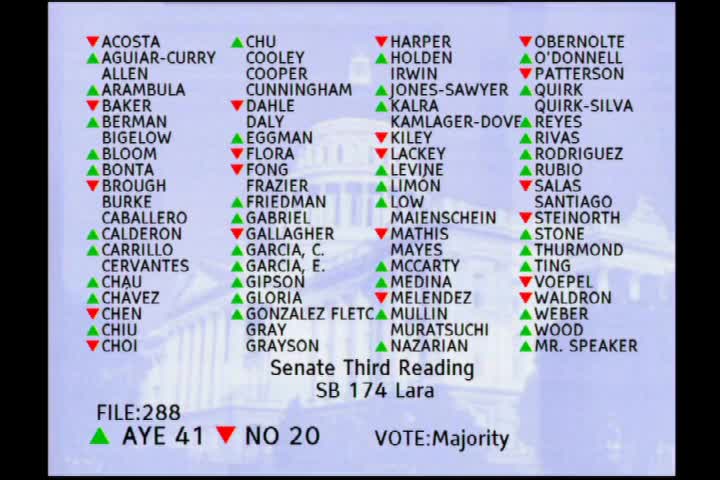
Bill Author

Bill Co-Author(s):
