SB 824: Insurers: declared disaster: homeowners’ insurance policies.
- Session Year: 2017-2018
- House: Senate
- Latest Version Date: 2018-09-21
(1)Existing law requires an insurer to comply with certain procedures relating to the cancellation of insurance policies, except as specified, in the case of a total loss to the primary insured structure under a residential policy. Among other requirements, an insurer may not cancel coverage while the primary insured structure is being rebuilt, as specified, nor use the fact that the primary insured structure is in damaged condition as a result of the total loss as the sole basis for a decision to cancel the policy, and must offer, at least once, to renew the policy, as specified, if the total loss to the primary insured structure was caused by a disaster.
This bill would prohibit, subject to certain exceptions, an insurer from canceling or refusing to renew a policy of residential property insurance for one year after the declaration of a state of emergency based solely on the fact that the insured structure is located in an area in which a wildfire has occurred, with respect to an insured property located within or adjacent to the fire perimeter, as specified.
(2)Existing law creates the Department of Insurance, headed by the Insurance Commissioner, and prescribes the departments and commissioners powers and duties. Existing law authorizes the commissioner to require reports from insurers concerning risks and solvency, and authorizes the commissioner to impose civil penalties for failure to submit reports or data to the commissioner. Under existing law, the acts and orders of the commissioner are subject to a courts review or other action.
This bill would require an admitted insurer with written California premiums above a specified threshold to submit a report with specified fire risk information on its residential property policies to the commissioner on or before April 1, 2020, and every 2 years thereafter. The bill would require the commissioner to post a report on wildfire risk compiled from the submitted data to the departments Internet Web site every 2 years. The bill would authorize the commissioner to specify the manner of submission and the format of the report submitted by the insurer and would authorize the commissioner to grant a submission extension to an insurer. The bill would subject an admitted insurer that fails to submit a report to a civil penalty to be fixed by the commissioner, not to exceed $5,000, or $10,000 if the act was willful, and would specify the appeals process. The bill would provide that fire risk information submitted to the commissioner is confidential and not subject to subpoena, as specified.
(3)Existing constitutional provisions require that a statute that limits the right of access to the meetings of public bodies or the writings of public officials and agencies be adopted with findings demonstrating the interest protected by the limitation and the need for protecting that interest.
This bill would make legislative findings to that effect.
(4)This bill would incorporate additional changes to Section 675.1 of the Insurance Code proposed by SB 894 to be operative only if this bill and SB 894 are enacted and this bill is enacted last.
(1)Existing law requires an insurer to comply with certain procedures relating to the cancellation of insurance policies, except as specified, in the case of a total loss to the primary insured structure under a residential policy. Among other requirements, an insurer may not cancel coverage while the primary insured structure is being rebuilt, as specified, nor use the fact that the primary insured structure is in damaged condition as a result of the total loss as the sole basis for a decision to cancel the policy, and must offer, at least once, to renew the policy, as specified, if the total loss to the primary insured structure was caused by a disaster.
This bill would prohibit, subject to certain exceptions, an insurer from canceling or refusing to renew a policy of residential property insurance for one year after the declaration of a state of emergency based solely on the fact that the insured structure is located in an area in which a wildfire has occurred, with respect to an insured property located within or adjacent to the fire perimeter, as specified.
(2)Existing law creates the Department of Insurance, headed by the Insurance Commissioner, and prescribes the departments and commissioners powers and duties. Existing law authorizes the commissioner to require reports from insurers concerning risks and solvency, and authorizes the commissioner to impose civil penalties for failure to submit reports or data to the commissioner. Under existing law, the acts and orders of the commissioner are subject to a courts review or other action.
This bill would require an admitted insurer with written California premiums above a specified threshold to submit a report with specified fire risk information on its residential property policies to the commissioner on or before April 1, 2020, and every 2 years thereafter. The bill would require the commissioner to post a report on wildfire risk compiled from the submitted data to the departments Internet Web site every 2 years. The bill would authorize the commissioner to specify the manner of submission and the format of the report submitted by the insurer and would authorize the commissioner to grant a submission extension to an insurer. The bill would subject an admitted insurer that fails to submit a report to a civil penalty to be fixed by the commissioner, not to exceed $5,000, or $10,000 if the act was willful, and would specify the appeals process. The bill would provide that fire risk information submitted to the commissioner is confidential and not subject to subpoena, as specified.
(3)Existing constitutional provisions require that a statute that limits the right of access to the meetings of public bodies or the writings of public officials and agencies be adopted with findings demonstrating the interest protected by the limitation and the need for protecting that interest.
This bill would make legislative findings to that effect.
(4)This bill would incorporate additional changes to Section 675.1 of the Insurance Code proposed by SB 894 to be operative only if this bill and SB 894 are enacted and this bill is enacted last.
(1)Existing law requires an insurer to comply with certain procedures relating to the cancellation of insurance policies, except as specified, in the case of a total loss to the primary insured structure under a residential policy. Among other requirements, an insurer may not cancel coverage while the primary insured structure is being rebuilt, as specified, nor use the fact that the primary insured structure is in damaged condition as a result of the total loss as the sole basis for a decision to cancel the policy, and must offer, at least once, to renew the policy, as specified, if the total loss to the primary insured structure was caused by a disaster.
This bill would prohibit, subject to certain exceptions, an insurer from canceling or refusing to renew a policy of residential property insurance for one year after the declaration of a state of emergency based solely on the fact that the insured structure is located in an area in which a wildfire has occurred, with respect to an insured property located within or adjacent to the fire perimeter, as specified.
(2)Existing law creates the Department of Insurance, headed by the Insurance Commissioner, and prescribes the departments and commissioners powers and duties. Existing law authorizes the commissioner to require reports from insurers concerning risks and solvency, and authorizes the commissioner to impose civil penalties for failure to submit reports or data to the commissioner. Under existing law, the acts and orders of the commissioner are subject to a courts review or other action.
This bill would require an admitted insurer with written California premiums above a specified threshold to submit a report with specified fire risk information on its residential property policies to the commissioner on or before April 1, 2020, and every 2 years thereafter. The bill would require the commissioner to post a report on wildfire risk compiled from the submitted data to the departments Internet Web site every 2 years. The bill would authorize the commissioner to specify the manner of submission and the format of the report submitted by the insurer and would authorize the commissioner to grant a submission extension to an insurer. The bill would subject an admitted insurer that fails to submit a report to a civil penalty to be fixed by the commissioner, not to exceed $5,000, or $10,000 if the act was willful, and would specify the appeals process. The bill would provide that fire risk information submitted to the commissioner is confidential and not subject to subpoena, as specified.
(3)Existing constitutional provisions require that a statute that limits the right of access to the meetings of public bodies or the writings of public officials and agencies be adopted with findings demonstrating the interest protected by the limitation and the need for protecting that interest.
This bill would make legislative findings to that effect.
(4)This bill would incorporate additional changes to Section 675.1 of the Insurance Code proposed by SB 894 to be operative only if this bill and SB 894 are enacted and this bill is enacted last.
(1)Existing law requires an insurer to comply with certain procedures relating to the cancellation of insurance policies, except as specified, in the case of a total loss to the primary insured structure under a residential policy. Among other requirements, an insurer may not cancel coverage while the primary insured structure is being rebuilt, as specified, nor use the fact that the primary insured structure is in damaged condition as a result of the total loss as the sole basis for a decision to cancel the policy, and must offer, at least once, to renew the policy, as specified, if the total loss to the primary insured structure was caused by a disaster.
This bill would prohibit prohibit, subject to certain exceptions, an insurer from canceling or refusing to renew a policy of residential property insurance for one year after the declaration of a state of emergency based solely on the fact that the insured structure is located in a county in which one or more catastrophic events have occurred for which a state of emergency has been declared, as specified and subject to exceptions if the insurers solvency is threatened. an area in which a wildfire has occurred, with respect to an insured property located within or adjacent to the fire perimeter, as specified.
(2)Existing law creates the Department of Insurance, headed by the Insurance Commissioner, and prescribes the departments and commissioners powers and duties. Existing law authorizes the commissioner to require reports from insurers concerning risks and solvency, and authorizes the commissioner to impose civil penalties for failure to submit reports or data to the commissioner. Under existing law, the acts and orders of the commissioner are subject to a courts review or other action.
This bill would require an admitted insurer with written California premiums totaling $10,000,000 or more above a specified threshold to submit a report with specified fire risk information on its residential property policies to the commissioner on or before April 1, 2020, and every 2 years thereafter. The bill would require the commissioner to post a report on wildfire risk compiled from the submitted data to the departments Internet Web site every 2 years. The bill would authorize the commissioner to specify the report format and additional information to be submitted, and manner of submission and the format of the report submitted by the insurer and would authorize the commissioner to grant a submission extension to an insurer. The bill would subject an admitted insurer that fails to submit a report to a civil penalty to be fixed by the commissioner, not to exceed $5,000, or $10,000 if the act was willful, and would specify the appeals process. The bill would provide that fire risk information submitted to the commissioner is confidential and not subject to subpoena, as specified.
(3)Existing constitutional provisions require that a statute that limits the right of access to the meetings of public bodies or the writings of public officials and agencies be adopted with findings demonstrating the interest protected by the limitation and the need for protecting that interest.
This bill would make legislative findings to that effect.
(1)Existing law requires an insurer to comply with certain procedures relating to the cancellation of insurance policies, except as specified, in the case of a total loss to the primary insured structure under a residential policy. Among other requirements, an insurer may not cancel coverage while the primary insured structure is being rebuilt, as specified, nor use the fact that the primary insured structure is in damaged condition as a result of the total loss as the sole basis for a decision to cancel the policy, and must offer, at least once, to renew the policy, as specified, if the total loss to the primary insured structure was caused by a disaster.
This bill would prohibit an insurer from canceling, canceling or refusing to renew, or including a surcharge or an increase in the premium of, renew a policy of residential property insurance for one year after the declaration of a state of emergency based solely on the fact that the insured structure is located in a county in which one or more catastrophic events have occurred for which a state of emergency has been declared for one year after the declaration of a state of emergency, declared, as specified. specified and subject to exceptions if the insurers solvency is threatened.
(2)Existing law governs the business of insurance and proscribes certain unlawful practices. Existing law requires the Insurance Commissioner to enforce the laws and regulations governing the business of insurance.This bill would require an insurer that intends to reduce, within the first 12 months after a declared disaster, the total number of its homeowners insurance policies in force by 20% or more, as specified, to submit to the commissioner, 60 days prior to implementing that action, a plan for the orderly reduction of the total number of its homeowners insurance policies in that area. The bill would also specify the information that must be included in the plan.(3)Existing law authorizes the commissioner to require information on specified topics from insurers by means of a data call.This bill would direct the Department of Insurance to conduct a data call on wildfire and fire loss experience from insurers writing residential property insurance policies.(2)Existing law creates the Department of Insurance, headed by the Insurance Commissioner, and prescribes the departments and commissioners powers and duties. Existing law authorizes the commissioner to require reports from insurers concerning risks and solvency, and authorizes the commissioner to impose civil penalties for failure to submit reports or data to the commissioner. Under existing law, the acts and orders of the commissioner are subject to a courts review or other action.
This bill would require an admitted insurer with written California premiums totaling $10,000,000 or more to submit a report with specified fire risk information on its residential property policies to the commissioner on or before April 1, 2020, and every 2 years thereafter. The bill would require the commissioner to post a report on wildfire risk compiled from the submitted data to the departments Internet Web site every 2 years. The bill would authorize the commissioner to specify the report format and additional information to be submitted, and authorize the commissioner to grant a submission extension to an insurer. The bill would subject an admitted insurer that fails to submit a report to a civil penalty to be fixed by the commissioner, not to exceed $5,000, or $10,000 if the act was willful, and would specify the appeals process. The bill would provide that fire risk information submitted to the commissioner is confidential and not subject to subpoena, as specified.
(3)Existing constitutional provisions require that a statute that limits the right of access to the meetings of public bodies or the writings of public officials and agencies be adopted with findings demonstrating the interest protected by the limitation and the need for protecting that interest.
This bill would make legislative findings to that effect.
(1)Existing law requires an insurer to comply with certain procedures relating to the cancellation of insurance policies, except as specified, in the case of a total loss to the primary insured structure under a residential policy. Among other requirements, an insurer may not cancel coverage while the primary insured structure is being rebuilt, as specified, nor use the fact that the primary insured structure is in damaged condition as a result of the total loss as the sole basis for a decision to cancel the policy, and must offer, at least once, to renew the policy, as specified, if the total loss to the primary insured structure was caused by a disaster.
This bill would express the intent of the Legislature to clarify that the provision described above is applicable to all insured properties located within a county for which a state of emergency has been declared, as specified.(2)Existing law prohibits cancellation of a policy that has been in effect for 60 days unless, after the effective date of the policy, one or more specified acts have occurred, including nonpayment of the premium, conviction of the named insured of a crime having as one of its necessary elements an act increasing any hazard insured against, or the discovery of fraud or material misrepresentation, as specified.This bill would also prohibit the nonrenewal of the policy under those circumstances.This bill would prohibit an insurer from canceling, refusing to renew, or including a surcharge or an increase in the premium of, a policy of residential property insurance based solely on the fact that the insured structure is located in a county in which one or more catastrophic events have occurred for which a state of emergency has been declared for one year after the declaration of a state of emergency, as specified.
(3)(2)Existing law governs the business of insurance and proscribes certain unlawful practices. Existing law requires the Insurance Commissioner to enforce the laws and regulations governing the business of insurance.
This bill would require an insurer that intends to materially reduce the number of policies written by that insurer covering properties located within a particular geographic region to submit to the commissioner, at least 30 days prior to implementing that action, or 60 days prior to implementing that action if the policies include homeowners insurance policies, reduce, within the first 12 months after a declared disaster, the total number of its homeowners insurance policies in force by 20% or more, as specified, to submit to the commissioner, 60 days prior to implementing that action, a plan for the orderly reduction of volume of policies written and would the total number of its homeowners insurance policies in that area. The bill would also specify the information that must be included in the plan. The bill would provide that the commissioner would have 30 days to approve or disapprove the plan submitted. The bill would require the commissioner to approve the plan if the insurer demonstrates that the material reduction would be accomplished in a manner that minimizes market disruption in areas of material reduction. The bill would also require the commissioner to assess the impact of the planned withdrawal from potentially impacted counties.
(4)The bill would also express the intent of the Legislature to enact legislation that would require insurance companies to provide mitigation discounts and continued coverage to homeowners who employ wildlife mitigation techniques.(3)Existing law authorizes the commissioner to require information on specified topics from insurers by means of a data call.
This bill would direct the Department of Insurance to conduct a data call on wildfire and fire loss experience from insurers writing residential property insurance policies.
(1)Existing law requires an insurer to comply with certain procedures relating to the cancellation of insurance policies, except as specified, in the case of a total loss to the primary insured structure under a residential policy. Among other requirements, an insurer may not cancel coverage while the primary insured structure is being rebuilt, as specified, nor use the fact that the primary insured structure is in damaged condition as a result of the total loss as the sole basis for a decision to cancel the policy, and must offer, at least once, to renew the policy, as specified, if the total loss to the primary insured structure was caused by a disaster.
This bill would express the intent of the Legislature to clarify that the provision described above is applicable to all insured properties located within a county for which a state of emergency has been declared, as specified.
(2)Existing law prohibits cancellation of a policy that has been in effect for 60 days unless, after the effective date of the policy, one or more specified acts have occurred, including nonpayment of the premium, conviction of the named insured of a crime having as one of its necessary elements an act increasing any hazard insured against, or the discovery of fraud or material misrepresentation, as specified.
This bill would also prohibit the nonrenewal of the policy under those circumstances.
(3)Existing law governs the business of insurance and proscribes certain unlawful practices. Existing law requires the Insurance Commissioner to enforce the laws and regulations governing the business of insurance.
This bill would require an insurer that intends to materially reduce the number of policies written by that insurer covering properties located within a particular geographic region to submit to the commissioner, at least 30 days prior to implementing that action, or 60 days prior to implementing that action if the policies include homeowners insurance policies, a plan for the orderly reduction of volume of policies written and would specify the information that must be included in the plan. The bill would provide that the commissioner would have 30 days to approve or disapprove the plan submitted. The bill would require the commissioner to approve the plan if the insurer demonstrates that the material reduction would be accomplished in a manner that minimizes market disruption in areas of material reduction. The bill would also require the commissioner to assess the impact of the planned withdrawal from potentially impacted counties.
(4)The bill would also express the intent of the Legislature to enact legislation that would require insurance companies to provide mitigation discounts and continued coverage to homeowners who employ wildlife mitigation techniques.
The Legislature finds and declares the following:
(a)Insurance losses due to wildfires are on the rise in California.
(b)The risk of catastrophic wildfires is increasing due to global climate change.
(c)In order to ensure a vibrant and robust insurer marketplace relating to fire risk, it is necessary for the Insurance Commissioner to collect data on fire loss experience from insurers writing residential property insurance, including the Fair Access to Insurance Requirements (FAIR) Plan, and to issue a report summarizing findings from that data collection.
SEC. 2.Section 675.1 of the Insurance Code is amended to read:675.1.(a)In the case of a total loss to the primary insured structure under a policy of residential property insurance subject to Section 675, the following provisions apply:
(1)If reconstruction of the primary insured structure has not been completed by the time of policy renewal, the insurer, prior to or at the time of renewal, and after consultation by the insurer or its representative with the insured as to what limits and coverages might or might not be needed, shall adjust the limits and coverages, write an additional policy, or attach an endorsement to the policy that reflects the change, if any, in the insureds exposure to loss. The insurer shall adjust the premium charged to reflect any change in coverage.
(2)The insurer shall not cancel coverage while the primary insured structure is being rebuilt, except for the reasons specified in subdivisions (a) to (e), inclusive, of Section 676. The insurer shall not use the fact that the primary insured structure is in damaged condition as a result of the total loss as the sole basis for a decision to cancel the policy pursuant to subdivision (e) of that section.
(3)Except for the reasons specified in subdivisions (a) to (e), inclusive, of Section 676, the insurer shall offer to, at least once, renew the policy in accordance with paragraph (1) if the total loss to the primary insured structure was caused by a disaster, as defined in subdivision (b) of Section 1689.14 of the Civil Code, and the loss was not also due to the negligence of the insured.
(4)With respect to policies of residential earthquake insurance, the California Earthquake Authority, or any insurer, including a participating insurer, as defined in subdivision (i) of Section 10089.5, may defer its initial implementation of this section until no later than October 1, 2005.
(5)With respect to a residential earthquake insurance policy issued by the California Earthquake Authority, the following provisions apply:
(A)The participating insurer that issued the underlying policy of residential property insurance on the primary insured structure shall consult with the insured as to what limits and coverages might or might not be needed as required by paragraph (1).
(B)The California Earthquake Authority, in lieu of meeting the requirements of paragraph (1), shall establish procedures and practices that allow it to reasonably accommodate the needs and interests of consumers in maintaining appropriate earthquake insurance coverage, within the statutory and regulatory limitations on the types of insurance coverages and the coverage limits of the policies that the authority may issue.
(b)(1)An insurer shall not cancel or refuse to renew a policy of residential property insurance for a property located in any ZIP Code within or adjacent to the fire perimeter, for one year after the declaration of a state of emergency, as defined in Section 8558 of the Government Code, based solely on the fact that the insured structure is located in an area in which a wildfire has occurred. This prohibition applies to all policies of residential property insurance in effect at the time of the declared emergency.
(2)For the purposes of this section, the fire perimeter shall be determined by the Department of Forestry and Fire Protection in consultation with the Office of Emergency Services. The department shall provide the commissioner with data describing the fire perimeter sufficient for the commissioner to determine which ZIP Codes are within or adjacent to the fire perimeter. The commissioner shall then issue a bulletin to inform insurers which ZIP Codes are subject to this subdivision.
(c)Subdivision (b) does not apply in any of the following circumstances:
(1)If willful or grossly negligent acts or omissions by the named insured, or his or her representatives, are discovered that materially increase any of the risks insured against.
(2)If losses unrelated to the postdisaster loss condition of the property have occurred that would collectively render the risk ineligible for renewal.
(3)If there are physical or risk changes to the insured property beyond the catastrophe-damaged condition of the structures and surface landscape that result in the property becoming uninsurable.
(d)For the purposes of this section, policy of residential property insurance has the meaning described in subdivision (a) of Section 10087.
SEC. 2.5.Section 675.1 of the Insurance Code is amended to read:675.1.(a)In the case of a total loss to the primary insured structure under a policy of residential property insurance subject to Section 675, the following provisions apply:
(1)If reconstruction of the primary insured structure has not been completed by the time of policy renewal, the insurer, prior to or at the time of renewal, and after consultation by the insurer or its representative with the insured as to what limits and coverages might or might not be needed, shall adjust the limits and coverages, write an additional policy, or attach an endorsement to the policy that reflects the change, if any, in the insureds exposure to loss. The insurer shall adjust the premium charged to reflect any change in coverage.
(2)The insurer shall not cancel coverage while the primary insured structure is being rebuilt, except for the reasons specified in subdivisions (a) to (e), inclusive, of Section 676. The insurer shall not use the fact that the primary insured structure is in damaged condition as a result of the total loss as the sole basis for a decision to cancel the policy pursuant to subdivision (e) of that section.
(3)Except for the reasons specified in subdivisions (a) to (e), inclusive, of Section 676, the insurer shall offer, for at least the next two annual renewal periods, but no less than 24 months of coverage from the date of the loss, to renew the policy in accordance with paragraph (1) if the total loss to the primary insured structure was caused by a disaster, as defined in subdivision (b) of Section 1689.14 of the Civil Code, the loss was not also due to the negligence of the insured, and losses have not occurred subsequent to the disaster related total loss that relate to physical or risk changes to the insured property that result in the property becoming uninsurable.
(4)With respect to policies of residential earthquake insurance, the California Earthquake Authority, or any insurer, including a participating insurer, as defined in subdivision (i) of Section 10089.5, may defer its initial implementation of this section until no later than October 1, 2005.
(5)With respect to a residential earthquake insurance policy issued by the California Earthquake Authority, the following provisions apply:
(A)The participating insurer that issued the underlying policy of residential property insurance on the primary insured structure shall consult with the insured as to what limits and coverages might or might not be needed as required by paragraph (1).
(B)The California Earthquake Authority, in lieu of meeting the requirements of paragraph (1), shall establish procedures and practices that allow it to reasonably accommodate the needs and interests of consumers in maintaining appropriate earthquake insurance coverage, within the statutory and regulatory limitations on the types of insurance coverages and the coverage limits of the policies that the authority may issue.
(b)(1)An insurer shall not cancel or refuse to renew a policy of residential property insurance for a property located in any ZIP Code within or adjacent to the fire perimeter, for one year after the declaration of a state of emergency, as defined in Section 8558 of the Government Code, based solely on the fact that the insured structure is located in an area in which a wildfire has occurred. This prohibition applies to all policies of residential property insurance in effect at the time of the declared emergency.
(2)For the purposes of this section, the fire perimeter shall be determined by the Department of Forestry and Fire Protection in consultation with the Office of Emergency Services. The department shall provide the commissioner with data describing the fire perimeter sufficient for the commissioner to determine which ZIP Codes are within or adjacent to the fire perimeter. The commissioner shall then issue a bulletin to inform insurers which ZIP Codes are subject to this subdivision.
(c)Subdivision (b) does not apply in any of the following circumstances:
(1)If willful or grossly negligent acts or omissions by the named insured, or his or her representatives, are discovered that materially increase any of the risks insured against.
(2)If losses unrelated to the postdisaster loss condition of the property have occurred that would collectively render the risk ineligible for renewal.
(3)If there are physical or risk changes to the insured property beyond the catastrophe-damaged condition of the structures and surface landscape that result in the property becoming uninsurable.
(d)For the purposes of this section, policy of residential property insurance has the meaning described in subdivision (a) of Section 10087.
SEC. 3.Article 10.4 (commencing with Section 929) is added to Chapter 1 of Part 2 of Division 1 of the Insurance Code, to read:10.4.Wildfire Risk Information Reporting929.(a)(1)On or before April 1, 2020, and every two years thereafter, an admitted insurer with written California premiums totaling ten million dollars ($10,000,000) or more shall submit a report to the commissioner on its residential property experience data for the previous two years for policies written in California.
(2)The premium threshold for reporting shall be increased to twelve million dollars ($12,000,000) for the reports due on April 1, 2026, and shall thereafter be increased every five years by 20 percent of the threshold amount required in the year immediately preceding the increase.
(3)Reports filed on April 1, 2020, shall include data from calendar years 2018 and 2019. Subsequent reports shall likewise include data from the two calendar years immediately preceding the year in which the report is due.
(b)The commissioner may specify, by bulletin, the manner of submission and format of the report required pursuant to subdivision (a). The report shall include the following information reported by individual policy:
(1)Fire- or wildfire-incurred losses, if any, reported by property coverage category and the date of the loss.
(2)The public protection class or its equivalent, if utilized by the insurer.
(3)The specific numerical or other fire risk score and source of fire risk score, if applicable.
(4)Premium.
(5)ZIP Code.
(c)If the commissioner issues a bulletin pursuant to subdivision (b), the initial bulletin shall be posted to the departments Internet Web site on or before May 1, 2019. Any updated bulletin shall be posted no less than two months before the date that the insurers report in which the changes are required is due.
(d)An insurance holding company system, as defined in subdivision (e) of Section 1215, may submit a consolidated report of the information required by this section for all insurers comprising the holding company system.
(e)For the purposes of this section, policy of residential property insurance has the meaning described in subdivision (a) of Section 10087.
929.1.Information submitted to the commissioner, as required by Section 929, shall be confidential pursuant to subdivision (d) of Section 6254 of the Government Code and exempt from the California Public Records Act (Chapter 3.5 (commencing with Section 6250) of Division 7 of Title 1 of the Government Code). Additionally, that information shall not be subject to subpoena or subpoena duces tecum. Testimony by the commissioner, the commissioners staff, an employee of the department, or a person to whom the report required by Section 929 was disclosed, regarding the contents of any report submitted pursuant to Section 929, shall be inadmissible as evidence in a civil proceeding.
929.2.(a)The commissioner shall post to the departments Internet Web site a report on wildfire risk compiled from the data collected pursuant to Section 929.
(b)The report shall be updated every two years to reflect new data submitted by insurers.
(c)The report shall separately provide information each calendar year.
929.3.(a)Failure to submit a report pursuant to Section 929 shall subject an admitted insurer to a civil penalty to be fixed by the commissioner, not to exceed five thousand dollars ($5,000) or, if the act was willful, a civil penalty not to exceed ten thousand dollars ($10,000).
(b)An insurer may request, and the commissioner may grant, a 30-day extension, if needed due to unintended or unforeseen delays, to submit the report. If the insurer fails to submit the report within 30 days of a written notice by the commissioner regarding the failure to submit the report, the commissioner may find that the failure to submit the report was willful and increase the civil penalty to an amount not to exceed ten thousand dollars ($10,000).
(c)The penalty imposed by this section shall be enforced by the commissioner and may be appealed by means of a remedy provided by Section 12940, or by Chapter 5 (commencing with Section 11500) of Part 1 of Division 3 of Title 2 of the Government Code. This subdivision is the sole means for enforcement of this section.
SEC. 4.The Legislature finds and declares that Section 3 of this act, which adds Section 929.1 to the Insurance Code, imposes a limitation on the publics right of access to the meetings of public bodies or the writings of public officials and agencies within the meaning of Section 3 of Article I of the California Constitution. Pursuant to that constitutional provision, the Legislature makes the following findings to demonstrate the interest protected by this limitation and the need for protecting that interest:
In order to protect proprietary insurer information, it is necessary for information reported to the Insurance Commissioner by insurers pursuant to Section 3 of this act to remain confidential.
SEC. 5.Section 2.5 of this bill incorporates amendments to Section 675.1 of the Insurance Code proposed by both this bill and Senate Bill 894. That section of this bill shall only become operative if (1) both bills are enacted and become effective on or before January 1, 2019, (2) each bill amends Section 675.1 of the Insurance Code, and (3) this bill is enacted after Senate Bill 894, in which case Section 2 of this bill shall not become operative.
The Legislature finds and declares the following:
(a)Insurance losses due to wildfires are on the rise in California.
(b)The risk of catastrophic wildfires is increasing due to global climate change.
(c)In order to ensure a vibrant and robust insurer marketplace relating to fire risk, it is necessary for the Insurance Commissioner to collect data on fire loss experience from insurers writing residential property insurance, including the Fair Access to Insurance Requirements (FAIR) Plan, and to issue a report summarizing findings from that data collection.
SEC. 2.Section 675.1 of the Insurance Code is amended to read:675.1.(a)In the case of a total loss to the primary insured structure under a policy of residential property insurance subject to Section 675, the following provisions apply:
(1)If reconstruction of the primary insured structure has not been completed by the time of policy renewal, the insurer, prior to or at the time of renewal, and after consultation by the insurer or its representative with the insured as to what limits and coverages might or might not be needed, shall adjust the limits and coverages, write an additional policy, or attach an endorsement to the policy that reflects the change, if any, in the insureds exposure to loss. The insurer shall adjust the premium charged to reflect any change in coverage.
(2)The insurer shall not cancel coverage while the primary insured structure is being rebuilt, except for the reasons specified in subdivisions (a) to (e), inclusive, of Section 676. The insurer shall not use the fact that the primary insured structure is in damaged condition as a result of the total loss as the sole basis for a decision to cancel the policy pursuant to subdivision (e) of that section.
(3)Except for the reasons specified in subdivisions (a) to (e), inclusive, of Section 676, the insurer shall offer to, at least once, renew the policy in accordance with paragraph (1) if the total loss to the primary insured structure was caused by a disaster, as defined in subdivision (b) of Section 1689.14 of the Civil Code, and the loss was not also due to the negligence of the insured.
(4)With respect to policies of residential earthquake insurance, the California Earthquake Authority, or any insurer, including a participating insurer, as defined in subdivision (i) of Section 10089.5, may defer its initial implementation of this section until no later than October 1, 2005.
(5)With respect to a residential earthquake insurance policy issued by the California Earthquake Authority, the following provisions apply:
(A)The participating insurer that issued the underlying policy of residential property insurance on the primary insured structure shall consult with the insured as to what limits and coverages might or might not be needed as required by paragraph (1).
(B)The California Earthquake Authority, in lieu of meeting the requirements of paragraph (1), shall establish procedures and practices that allow it to reasonably accommodate the needs and interests of consumers in maintaining appropriate earthquake insurance coverage, within the statutory and regulatory limitations on the types of insurance coverages and the coverage limits of the policies that the authority may issue.
(b)(1)An insurer shall not cancel or refuse to renew a policy of residential property insurance for a property located in any ZIP Code within or adjacent to the fire perimeter, for one year after the declaration of a state of emergency, as defined in Section 8558 of the Government Code, based solely on the fact that the insured structure is located in an area in which a wildfire has occurred. This prohibition applies to all policies of residential property insurance in effect at the time of the declared emergency.
(2)For the purposes of this section, the fire perimeter shall be determined by the Department of Forestry and Fire Protection in consultation with the Office of Emergency Services. The department shall provide the commissioner with data describing the fire perimeter sufficient for the commissioner to determine which ZIP Codes are within or adjacent to the fire perimeter. The commissioner shall then issue a bulletin to inform insurers which ZIP Codes are subject to this subdivision.
(c)Subdivision (b) does not apply in any of the following circumstances:
(1)If willful or grossly negligent acts or omissions by the named insured, or his or her representatives, are discovered that materially increase any of the risks insured against.
(2)If losses unrelated to the postdisaster loss condition of the property have occurred that would collectively render the risk ineligible for renewal.
(3)If there are physical or risk changes to the insured property beyond the catastrophe-damaged condition of the structures and surface landscape that result in the property becoming uninsurable.
(d)For the purposes of this section, policy of residential property insurance has the meaning described in subdivision (a) of Section 10087.
SEC. 2.5.Section 675.1 of the Insurance Code is amended to read:675.1.(a)In the case of a total loss to the primary insured structure under a policy of residential property insurance subject to Section 675, the following provisions apply:
(1)If reconstruction of the primary insured structure has not been completed by the time of policy renewal, the insurer, prior to or at the time of renewal, and after consultation by the insurer or its representative with the insured as to what limits and coverages might or might not be needed, shall adjust the limits and coverages, write an additional policy, or attach an endorsement to the policy that reflects the change, if any, in the insureds exposure to loss. The insurer shall adjust the premium charged to reflect any change in coverage.
(2)The insurer shall not cancel coverage while the primary insured structure is being rebuilt, except for the reasons specified in subdivisions (a) to (e), inclusive, of Section 676. The insurer shall not use the fact that the primary insured structure is in damaged condition as a result of the total loss as the sole basis for a decision to cancel the policy pursuant to subdivision (e) of that section.
(3)Except for the reasons specified in subdivisions (a) to (e), inclusive, of Section 676, the insurer shall offer, for at least the next two annual renewal periods, but no less than 24 months of coverage from the date of the loss, to renew the policy in accordance with paragraph (1) if the total loss to the primary insured structure was caused by a disaster, as defined in subdivision (b) of Section 1689.14 of the Civil Code, the loss was not also due to the negligence of the insured, and losses have not occurred subsequent to the disaster related total loss that relate to physical or risk changes to the insured property that result in the property becoming uninsurable.
(4)With respect to policies of residential earthquake insurance, the California Earthquake Authority, or any insurer, including a participating insurer, as defined in subdivision (i) of Section 10089.5, may defer its initial implementation of this section until no later than October 1, 2005.
(5)With respect to a residential earthquake insurance policy issued by the California Earthquake Authority, the following provisions apply:
(A)The participating insurer that issued the underlying policy of residential property insurance on the primary insured structure shall consult with the insured as to what limits and coverages might or might not be needed as required by paragraph (1).
(B)The California Earthquake Authority, in lieu of meeting the requirements of paragraph (1), shall establish procedures and practices that allow it to reasonably accommodate the needs and interests of consumers in maintaining appropriate earthquake insurance coverage, within the statutory and regulatory limitations on the types of insurance coverages and the coverage limits of the policies that the authority may issue.
(b)(1)An insurer shall not cancel or refuse to renew a policy of residential property insurance for a property located in any ZIP Code within or adjacent to the fire perimeter, for one year after the declaration of a state of emergency, as defined in Section 8558 of the Government Code, based solely on the fact that the insured structure is located in an area in which a wildfire has occurred. This prohibition applies to all policies of residential property insurance in effect at the time of the declared emergency.
(2)For the purposes of this section, the fire perimeter shall be determined by the Department of Forestry and Fire Protection in consultation with the Office of Emergency Services. The department shall provide the commissioner with data describing the fire perimeter sufficient for the commissioner to determine which ZIP Codes are within or adjacent to the fire perimeter. The commissioner shall then issue a bulletin to inform insurers which ZIP Codes are subject to this subdivision.
(c)Subdivision (b) does not apply in any of the following circumstances:
(1)If willful or grossly negligent acts or omissions by the named insured, or his or her representatives, are discovered that materially increase any of the risks insured against.
(2)If losses unrelated to the postdisaster loss condition of the property have occurred that would collectively render the risk ineligible for renewal.
(3)If there are physical or risk changes to the insured property beyond the catastrophe-damaged condition of the structures and surface landscape that result in the property becoming uninsurable.
(d)For the purposes of this section, policy of residential property insurance has the meaning described in subdivision (a) of Section 10087.
SEC. 3.Article 10.4 (commencing with Section 929) is added to Chapter 1 of Part 2 of Division 1 of the Insurance Code, to read:10.4.Wildfire Risk Information Reporting929.(a)(1)On or before April 1, 2020, and every two years thereafter, an admitted insurer with written California premiums totaling ten million dollars ($10,000,000) or more shall submit a report to the commissioner on its residential property experience data for the previous two years for policies written in California.
(2)The premium threshold for reporting shall be increased to twelve million dollars ($12,000,000) for the reports due on April 1, 2026, and shall thereafter be increased every five years by 20 percent of the threshold amount required in the year immediately preceding the increase.
(3)Reports filed on April 1, 2020, shall include data from calendar years 2018 and 2019. Subsequent reports shall likewise include data from the two calendar years immediately preceding the year in which the report is due.
(b)The commissioner may specify, by bulletin, the manner of submission and format of the report required pursuant to subdivision (a). The report shall include the following information reported by individual policy:
(1)Fire- or wildfire-incurred losses, if any, reported by property coverage category and the date of the loss.
(2)The public protection class or its equivalent, if utilized by the insurer.
(3)The specific numerical or other fire risk score and source of fire risk score, if applicable.
(4)Premium.
(5)ZIP Code.
(c)If the commissioner issues a bulletin pursuant to subdivision (b), the initial bulletin shall be posted to the departments Internet Web site on or before May 1, 2019. Any updated bulletin shall be posted no less than two months before the date that the insurers report in which the changes are required is due.
(d)An insurance holding company system, as defined in subdivision (e) of Section 1215, may submit a consolidated report of the information required by this section for all insurers comprising the holding company system.
(e)For the purposes of this section, policy of residential property insurance has the meaning described in subdivision (a) of Section 10087.
929.1.Information submitted to the commissioner, as required by Section 929, shall be confidential pursuant to subdivision (d) of Section 6254 of the Government Code and exempt from the California Public Records Act (Chapter 3.5 (commencing with Section 6250) of Division 7 of Title 1 of the Government Code). Additionally, that information shall not be subject to subpoena or subpoena duces tecum. Testimony by the commissioner, the commissioners staff, an employee of the department, or a person to whom the report required by Section 929 was disclosed, regarding the contents of any report submitted pursuant to Section 929, shall be inadmissible as evidence in a civil proceeding.
929.2.(a)The commissioner shall post to the departments Internet Web site a report on wildfire risk compiled from the data collected pursuant to Section 929.
(b)The report shall be updated every two years to reflect new data submitted by insurers.
(c)The report shall separately provide information each calendar year.
929.3.(a)Failure to submit a report pursuant to Section 929 shall subject an admitted insurer to a civil penalty to be fixed by the commissioner, not to exceed five thousand dollars ($5,000) or, if the act was willful, a civil penalty not to exceed ten thousand dollars ($10,000).
(b)An insurer may request, and the commissioner may grant, a 30-day extension, if needed due to unintended or unforeseen delays, to submit the report. If the insurer fails to submit the report within 30 days of a written notice by the commissioner regarding the failure to submit the report, the commissioner may find that the failure to submit the report was willful and increase the civil penalty to an amount not to exceed ten thousand dollars ($10,000).
(c)The penalty imposed by this section shall be enforced by the commissioner and may be appealed by means of a remedy provided by Section 12940, or by Chapter 5 (commencing with Section 11500) of Part 1 of Division 3 of Title 2 of the Government Code. This subdivision is the sole means for enforcement of this section.
SEC. 4.The Legislature finds and declares that Section 3 of this act, which adds Section 929.1 to the Insurance Code, imposes a limitation on the publics right of access to the meetings of public bodies or the writings of public officials and agencies within the meaning of Section 3 of Article I of the California Constitution. Pursuant to that constitutional provision, the Legislature makes the following findings to demonstrate the interest protected by this limitation and the need for protecting that interest:
In order to protect proprietary insurer information, it is necessary for information reported to the Insurance Commissioner by insurers pursuant to Section 3 of this act to remain confidential.
SEC. 5.Section 2.5 of this bill incorporates amendments to Section 675.1 of the Insurance Code proposed by both this bill and Senate Bill 894. That section of this bill shall only become operative if (1) both bills are enacted and become effective on or before January 1, 2019, (2) each bill amends Section 675.1 of the Insurance Code, and (3) this bill is enacted after Senate Bill 894, in which case Section 2 of this bill shall not become operative.
The Legislature finds and declares the following:
(a)Insurance losses due to wildfires are on the rise in California.
(b)The risk of catastrophic wildfires is increasing due to global climate change.
(c)In order to ensure a vibrant and robust insurer marketplace relating to fire risk, it is necessary for the Insurance Commissioner to collect data on fire loss experience from insurers writing residential property insurance, including the Fair Access to Insurance Requirements (FAIR) Plan, and to issue a report summarizing findings from that data collection.
SEC. 2.Section 675.1 of the Insurance Code is amended to read:675.1.(a)In the case of a total loss to the primary insured structure under a policy of residential property insurance subject to Section 675, the following provisions apply:
(1)If reconstruction of the primary insured structure has not been completed by the time of policy renewal, the insurer, prior to or at the time of renewal, and after consultation by the insurer or its representative with the insured as to what limits and coverages might or might not be needed, shall adjust the limits and coverages, write an additional policy, or attach an endorsement to the policy that reflects the change, if any, in the insureds exposure to loss. The insurer shall adjust the premium charged to reflect any change in coverage.
(2)The insurer shall not cancel coverage while the primary insured structure is being rebuilt, except for the reasons specified in subdivisions (a) to (e), inclusive, of Section 676. The insurer shall not use the fact that the primary insured structure is in damaged condition as a result of the total loss as the sole basis for a decision to cancel the policy pursuant to subdivision (e) of that section.
(3)Except for the reasons specified in subdivisions (a) to (e), inclusive, of Section 676, the insurer shall offer to, at least once, renew the policy in accordance with paragraph (1) if the total loss to the primary insured structure was caused by a disaster, as defined in subdivision (b) of Section 1689.14 of the Civil Code, and the loss was not also due to the negligence of the insured.
(4)With respect to policies of residential earthquake insurance, the California Earthquake Authority, or any insurer, including a participating insurer, as defined in subdivision (i) of Section 10089.5, may defer its initial implementation of this section until no later than October 1, 2005.
(5)With respect to a residential earthquake insurance policy issued by the California Earthquake Authority, the following provisions apply:
(A)The participating insurer that issued the underlying policy of residential property insurance on the primary insured structure shall consult with the insured as to what limits and coverages might or might not be needed as required by paragraph (1).
(B)The California Earthquake Authority, in lieu of meeting the requirements of paragraph (1), shall establish procedures and practices that allow it to reasonably accommodate the needs and interests of consumers in maintaining appropriate earthquake insurance coverage, within the statutory and regulatory limitations on the types of insurance coverages and the coverage limits of the policies that the authority may issue.
(b)(1)An insurer shall not cancel or refuse to renew a policy of residential property insurance for a property located in any ZIP Code within or adjacent to the fire perimeter, for one year after the declaration of a state of emergency, as defined in Section 8558 of the Government Code, based solely on the fact that the insured structure is located in an area in which a wildfire has occurred. This prohibition applies to all policies of residential property insurance in effect at the time of the declared emergency.
(2)For the purposes of this section, the fire perimeter shall be determined by the Department of Forestry and Fire Protection in consultation with the Office of Emergency Services. The department shall provide the commissioner with data describing the fire perimeter sufficient for the commissioner to determine which ZIP Codes are within or adjacent to the fire perimeter. The commissioner shall then issue a bulletin to inform insurers which ZIP Codes are subject to this subdivision.
(c)Subdivision (b) does not apply in any of the following circumstances:
(1)If willful or grossly negligent acts or omissions by the named insured, or his or her representatives, are discovered that materially increase any of the risks insured against.
(2)If losses unrelated to the postdisaster loss condition of the property have occurred that would collectively render the risk ineligible for renewal.
(3)If there are physical or risk changes to the insured property beyond the catastrophe-damaged condition of the structures and surface landscape that result in the property becoming uninsurable.
(d)For the purposes of this section, policy of residential property insurance has the meaning described in subdivision (a) of Section 10087.
SEC. 2.5.Section 675.1 of the Insurance Code is amended to read:675.1.(a)In the case of a total loss to the primary insured structure under a residential policy of residential property insurance subject to Section 675, the following provisions apply:
(a)(1)If reconstruction of the primary insured structure has not been completed by the time of policy renewal, the insurer, prior to or at the time of renewal, and after consultation by the insurer or its representative with the insured as to what limits and coverages might or might not be needed, shall adjust the limits and coverages, write an additional policy, or attach an endorsement to the policy that reflects the change, if any, in the insureds exposure to loss. The insurer shall adjust the premium charged to reflect any change in coverage.
(b)(2)The insurer shall not cancel coverage while the primary insured structure is being rebuilt, except for the reasons specified in subdivisions (a) to (e), inclusive, of Section 676. The insurer shall not use the fact that the primary insured structure is in damaged condition as a result of the total loss as the sole basis for a decision to cancel the policy pursuant to subdivision (e) of that section.
(c)(3)Except for the reasons specified in subdivisions (a) to (e), inclusive, of Section 676, the insurer shall offer to, at least once, offer, for at least the next two annual renewal periods, but no less than 24 months of coverage from the date of the loss, to renew the policy in accordance with the provisions of subdivision (a) paragraph (1) if the total loss to the primary insured structure was caused by a disaster, as defined in subdivision (b) of Section 1689.14 of the Civil Code, and the loss was not also due to the negligence of the insured. insured, and losses have not occurred subsequent to the disaster related total loss that relate to physical or risk changes to the insured property that result in the property becoming uninsurable.
(d)(4)With respect to policies of residential earthquake insurance, the California Earthquake Authority, or any insurer, including a participating insurer, as defined in subdivision (i) of Section 10089.5, may defer its initial implementation of this section until no later than October 1, 2005.
(e)(5)With respect to a residential earthquake insurance policy issued by the California Earthquake Authority, the following provisions apply:
(1)(A)The participating insurer that issued the underlying policy of residential property insurance on the primary insured structure shall consult with the insured as to what limits and coverages might or might not be needed as required by subdivision (a). paragraph (1).
(2)(B)The California Earthquake Authority, in lieu of meeting the requirements of subdivision (a), paragraph (1), shall establish procedures and practices that allow it to reasonably accommodate the needs and interests of consumers in maintaining appropriate earthquake insurance coverage, within the statutory and regulatory limitations on the types of insurance coverages and the coverage limits of the policies that the authority may issue.
(b)(1)An insurer shall not cancel or refuse to renew a policy of residential property insurance for a property located in any ZIP Code within or adjacent to the fire perimeter, for one year after the declaration of a state of emergency, as defined in Section 8558 of the Government Code, based solely on the fact that the insured structure is located in an area in which a wildfire has occurred. This prohibition applies to all policies of residential property insurance in effect at the time of the declared emergency.
(2)For the purposes of this section, the fire perimeter shall be determined by the Department of Forestry and Fire Protection in consultation with the Office of Emergency Services. The department shall provide the commissioner with data describing the fire perimeter sufficient for the commissioner to determine which ZIP Codes are within or adjacent to the fire perimeter. The commissioner shall then issue a bulletin to inform insurers which ZIP Codes are subject to this subdivision.
(c)Subdivision (b) does not apply in any of the following circumstances:
(1)If willful or grossly negligent acts or omissions by the named insured, or his or her representatives, are discovered that materially increase any of the risks insured against.
(2)If losses unrelated to the postdisaster loss condition of the property have occurred that would collectively render the risk ineligible for renewal.
(3)If there are physical or risk changes to the insured property beyond the catastrophe-damaged condition of the structures and surface landscape that result in the property becoming uninsurable.
(d)For the purposes of this section, policy of residential property insurance has the meaning described in subdivision (a) of Section 10087.
SEC. 3.Article 10.4 (commencing with Section 929) is added to Chapter 1 of Part 2 of Division 1 of the Insurance Code, to read:10.4.Wildfire Risk Information Reporting929.(a)(1)On or before April 1, 2020, and every two years thereafter, an admitted insurer with written California premiums totaling ten million dollars ($10,000,000) or more shall submit a report to the commissioner on its residential property experience data for the previous two years for policies written in California.
(2)The premium threshold for reporting shall be increased to twelve million dollars ($12,000,000) for the reports due on April 1, 2026, and shall thereafter be increased every five years by 20 percent of the threshold amount required in the year immediately preceding the increase.
(3)Reports filed on April 1, 2020, shall include data from calendar years 2018 and 2019. Subsequent reports shall likewise include data from the two calendar years immediately preceding the year in which the report is due.
(b)The commissioner may specify, by bulletin, the manner of submission and format of the report required pursuant to subdivision (a). The report shall include the following information reported by individual policy:
(1)Fire- or wildfire-incurred losses, if any, reported by property coverage category and the date of the loss.
(2)The public protection class or its equivalent, if utilized by the insurer.
(3)The specific numerical or other fire risk score and source of fire risk score, if applicable.
(4)Premium.
(5)ZIP Code.
(c)If the commissioner issues a bulletin pursuant to subdivision (b), the initial bulletin shall be posted to the departments Internet Web site on or before May 1, 2019. Any updated bulletin shall be posted no less than two months before the date that the insurers report in which the changes are required is due.
(d)An insurance holding company system, as defined in subdivision (e) of Section 1215, may submit a consolidated report of the information required by this section for all insurers comprising the holding company system.
(e)For the purposes of this section, policy of residential property insurance has the meaning described in subdivision (a) of Section 10087.
929.1.Information submitted to the commissioner, as required by Section 929, shall be confidential pursuant to subdivision (d) of Section 6254 of the Government Code and exempt from the California Public Records Act (Chapter 3.5 (commencing with Section 6250) of Division 7 of Title 1 of the Government Code). Additionally, that information shall not be subject to subpoena or subpoena duces tecum. Testimony by the commissioner, the commissioners staff, an employee of the department, or a person to whom the report required by Section 929 was disclosed, regarding the contents of any report submitted pursuant to Section 929, shall be inadmissible as evidence in a civil proceeding.
929.2.(a)The commissioner shall post to the departments Internet Web site a report on wildfire risk compiled from the data collected pursuant to Section 929.
(b)The report shall be updated every two years to reflect new data submitted by insurers.
(c)The report shall separately provide information each calendar year.
929.3.(a)Failure to submit a report pursuant to Section 929 shall subject an admitted insurer to a civil penalty to be fixed by the commissioner, not to exceed five thousand dollars ($5,000) or, if the act was willful, a civil penalty not to exceed ten thousand dollars ($10,000).
(b)An insurer may request, and the commissioner may grant, a 30-day extension, if needed due to unintended or unforeseen delays, to submit the report. If the insurer fails to submit the report within 30 days of a written notice by the commissioner regarding the failure to submit the report, the commissioner may find that the failure to submit the report was willful and increase the civil penalty to an amount not to exceed ten thousand dollars ($10,000).
(c)The penalty imposed by this section shall be enforced by the commissioner and may be appealed by means of a remedy provided by Section 12940, or by Chapter 5 (commencing with Section 11500) of Part 1 of Division 3 of Title 2 of the Government Code. This subdivision is the sole means for enforcement of this section.
SEC. 4.The Legislature finds and declares that Section 3 of this act, which adds Section 929.1 to the Insurance Code, imposes a limitation on the publics right of access to the meetings of public bodies or the writings of public officials and agencies within the meaning of Section 3 of Article I of the California Constitution. Pursuant to that constitutional provision, the Legislature makes the following findings to demonstrate the interest protected by this limitation and the need for protecting that interest:
In order to protect proprietary insurer information, it is necessary for information reported to the Insurance Commissioner by insurers pursuant to Section 3 of this act to remain confidential.
SEC. 5.Section 2.5 of this bill incorporates amendments to Section 675.1 of the Insurance Code proposed by both this bill and Senate Bill 894. That section of this bill shall only become operative if (1) both bills are enacted and become effective on or before January 1, 2019, (2) each bill amends Section 675.1 of the Insurance Code, and (3) this bill is enacted after Senate Bill 894, in which case Section 2 of this bill shall not become operative.
The Legislature finds and declares the following:
(a)Insurance losses due to wildfires are on the rise in California.
(b)The risk of catastrophic wildfires is increasing due to global climate change.
(c)In order to ensure a vibrant and robust insurer marketplace relating to fire risk, it is necessary for the Insurance Commissioner to collect data on fire loss experience from insurers writing residential property insurance, including the FAIR (fair access to insurance requirements) Fair Access to Insurance Requirements (FAIR) Plan, and to issue a report summarizing findings from that data collection.
SEC. 2.Section 675.1 of the Insurance Code is amended to read:675.1.(a)In the case of a total loss to the primary insured structure under a policy of residential property insurance subject to Section 675, the following provisions apply:
(1)If reconstruction of the primary insured structure has not been completed by the time of policy renewal, the insurer, prior to or at the time of renewal, and after consultation by the insurer or its representative with the insured as to what limits and coverages might or might not be needed, shall adjust the limits and coverages, write an additional policy, or attach an endorsement to the policy that reflects the change, if any, in the insureds exposure to loss. The insurer shall adjust the premium charged to reflect any change in coverage.
(2)The insurer shall not cancel coverage while the primary insured structure is being rebuilt, except for the reasons specified in subdivisions (a) to (e), inclusive, of Section 676. The insurer shall not use the fact that the primary insured structure is in damaged condition as a result of the total loss as the sole basis for a decision to cancel the policy pursuant to subdivision (e) of that section.
(3)Except for the reasons specified in subdivisions (a) to (e), inclusive, of Section 676, the insurer shall offer to, at least once, renew the policy in accordance with paragraph (1) if the total loss to the primary insured structure was caused by a disaster, as defined in subdivision (b) of Section 1689.14 of the Civil Code, and the loss was not also due to the negligence of the insured.
(4)With respect to policies of residential earthquake insurance, the California Earthquake Authority, or any insurer, including a participating insurer, as defined in subdivision (i) of Section 10089.5, may defer its initial implementation of this section until no later than October 1, 2005.
(5)With respect to a residential earthquake insurance policy issued by the California Earthquake Authority, the following provisions apply:
(A)The participating insurer that issued the underlying policy of residential property insurance on the primary insured structure shall consult with the insured as to what limits and coverages might or might not be needed as required by paragraph (1).
(B)The California Earthquake Authority, in lieu of meeting the requirements of paragraph (1), shall establish procedures and practices that allow it to reasonably accommodate the needs and interests of consumers in maintaining appropriate earthquake insurance coverage, within the statutory and regulatory limitations on the types of insurance coverages and the coverage limits of the policies that the authority may issue.
(b)(1)An insurer shall not cancel or refuse to renew a policy of residential property insurance for a property located in any ZIP Code within or adjacent to the fire perimeter, for one year after the declaration of a state of emergency, as defined in Section 8558 of the Government Code, based solely on the fact that the insured structure is located in a county in which one or more catastrophic events have occurred for which a state of emergency has been declared. an area in which a wildfire has occurred. This prohibition applies to all policies of residential property insurance in effect at the time of the declared emergency in the counties affected by the declared emergency.
(2)For the purposes of this section, the fire perimeter shall be determined by the Department of Forestry and Fire Protection in consultation with the Office of Emergency Services. The department shall provide the commissioner with data describing the fire perimeter sufficient for the commissioner to determine which ZIP Codes are within or adjacent to the fire perimeter. The commissioner shall then issue a bulletin to inform insurers which ZIP Codes are subject to this subdivision.
(c)Subdivision (b) shall not apply in either of the following circumstances:(1)If the renewal of the policy would threaten the financial solvency of the insurer.(2)If the insurer suffers the withdrawal of reinsurance covering all or part of the risk and this withdrawal will likely threaten the financial solvency of the insurer.(d)An insurer that does not renew a policy pursuant to subdivision (c) shall report that nonrenewal and the reason for its financial solvency issues to the commissioner.(c)Subdivision (b) does not apply in any of the following circumstances:
(1)If willful or grossly negligent acts or omissions by the named insured, or his or her representatives, are discovered that materially increase any of the risks insured against.
(2)If losses unrelated to the postdisaster loss condition of the property have occurred that would collectively render the risk ineligible for renewal.
(3)If there are physical or risk changes to the insured property beyond the catastrophe-damaged condition of the structures and surface landscape that result in the property becoming uninsurable.
(d)For the purposes of this section, policy of residential property insurance has the meaning described in subdivision (a) of Section 10087.
SEC. 3.Article 10.4 (commencing with Section 929) is added to Chapter 1 of Part 2 of Division 1 of the Insurance Code, to read:10.4.Wildfire Risk Information Reporting929.(a)(1)On or before April 1, 2020, and every two years thereafter, an admitted insurer with written California premiums totaling ten million dollars ($10,000,000) or more shall submit a report to the commissioner on its residential property experience data for the previous two years for policies written in California.
(2)The premium threshold for reporting shall be increased to twelve million dollars ($12,000,000) for the reports due on April 1, 2026, and shall thereafter be increased every five years by 20 percent of the threshold amount required in the year immediately preceding the increase.
(3)Reports filed on April 1, 2020, shall include data from calendar years 2018 and 2019. Subsequent reports shall likewise include data from the two calendar years immediately preceding the year in which the report is due.
(b)The commissioner may specify, by bulletin, the form and information to be included in the report submitted the manner of submission and format of the report required pursuant to subdivision (a). The report shall include the following information reported by individual policy:
(1)Fire- or wildfire-incurred losses, if any, reported by property coverage category and the date of the loss.
(2)Fire-incurred defense and cost containment expense.(3)Fire claim counts.(4)Protection class.(2)The public protection class or its equivalent, if utilized by the insurer.
(5)Fire(3)The specific numerical or other fire risk score and source of fire risk score, if applicable.
(6)(4)Premium.
(7)(5)ZIP Code.
(c)If the commissioner issues a bulletin pursuant to subdivision (b), the initial bulletin shall be posted to the departments Internet Web site on or before May 1, 2019. Any updated bulletin shall be posted no less than two months before the date that the insurers report in which the changes are required is due.
(d)An insurance holding company system, as defined in subdivision (e) of Section 1215, may submit a consolidated report of the information required by this section for all insurers comprising the holding company system.
(e)For the purposes of this section, policy of residential property insurance has the meaning described in subdivision (a) of Section 10087.
929.1.Information submitted to the commissioner, as required by Section 929, shall be confidential pursuant to subdivision (d) of Section 6254 of the Government Code and exempt from the California Public Records Act (Chapter 3.5 (commencing with Section 6250) of Division 7 of Title 1 of the Government Code). Additionally, that information shall not be subject to subpoena or subpoena duces tecum. Testimony by the commissioner, the commissioners staff, an employee of the department, or a person to whom the report required by Section 929 was disclosed, regarding the contents of any report submitted pursuant to Section 929, shall be inadmissible as evidence in a civil proceeding.
929.2.(a)The commissioner shall post to the departments Internet Web site a report on wildfire risk compiled from the data collected pursuant to Section 929. The
(b)The report shall be updated every two years to reflect new data submitted by insurers.
(c)The report shall separately provide information each calendar year.
929.3.(a)Failure to submit a report pursuant to Section 929 shall subject an admitted insurer to a civil penalty to be fixed by the commissioner, not to exceed five thousand dollars ($5,000) or, if the act was willful, a civil penalty not to exceed ten thousand dollars ($10,000).
(b)An insurer may request, and the commissioner may grant, a 30-day extension, if needed due to unintended or unforeseen delays, to submit the report. If the insurer fails to submit the report within 30 days of a written notice by the commissioner regarding the failure to submit the report, the commissioner may find that the failure to submit the report was willful and increase the civil penalty to an amount not to exceed ten thousand dollars ($10,000).
(c)The penalty imposed by this section shall be enforced by the commissioner and may be appealed by means of a remedy provided by Section 12940, or by Chapter 5 (commencing with Section 11500) of Part 1 of Division 3 of Title 2 of the Government Code. This subdivision is the sole means for enforcement of this section.
SEC. 4.The Legislature finds and declares that Section 3 of this act, which adds Section 929.1 to the Insurance Code, imposes a limitation on the publics right of access to the meetings of public bodies or the writings of public officials and agencies within the meaning of Section 3 of Article I of the California Constitution. Pursuant to that constitutional provision, the Legislature makes the following findings to demonstrate the interest protected by this limitation and the need for protecting that interest:
In order to protect proprietary insurer information, it is necessary for information reported to the Insurance Commissioner by insurers pursuant to Section 3 of this act to remain confidential.
The Legislature finds and declares the following:
(a)Insurance losses due to wildfires are on the rise in California.
(b)The risk of catastrophic wildfires is increasing due to global climate change.
(c)In order to ensure a vibrant and robust insurer marketplace relating to fire risk, it is necessary for the Insurance Commissioner to collect data on fire loss experience from insurers writing residential property insurance, including the FAIR (fair access to insurance requirements) Plan, and to issue a report summarizing findings from that data collection.
SECTION 1.SEC. 2.Section 675.1 of the Insurance Code is amended to read:675.1.(a)In the case of a total loss to the primary insured structure under a policy of residential property insurance subject to Section 675, the following provisions apply:
(1)If reconstruction of the primary insured structure has not been completed by the time of policy renewal, the insurer, prior to or at the time of renewal, and after consultation by the insurer or its representative with the insured as to what limits and coverages might or might not be needed, shall adjust the limits and coverages, write an additional policy, or attach an endorsement to the policy that reflects the change, if any, in the insureds exposure to loss. The insurer shall adjust the premium charged to reflect any change in coverage.
(2)The insurer shall not cancel coverage while the primary insured structure is being rebuilt, except for the reasons specified in subdivisions (a) to (e), inclusive, of Section 676. The insurer shall not use the fact that the primary insured structure is in damaged condition as a result of the total loss as the sole basis for a decision to cancel the policy pursuant to subdivision (e) of that section.
(3)Except for the reasons specified in subdivisions (a) to (e), inclusive, of Section 676, the insurer shall offer to, at least once, renew the policy in accordance with paragraph (1) if the total loss to the primary insured structure was caused by a disaster, as defined in subdivision (b) of Section 1689.14 of the Civil Code, and the loss was not also due to the negligence of the insured.
(4)With respect to policies of residential earthquake insurance, the California Earthquake Authority, or any insurer, including a participating insurer, as defined in subdivision (i) of Section 10089.5, may defer its initial implementation of this section until no later than October 1, 2005.
(5)With respect to a residential earthquake insurance policy issued by the California Earthquake Authority, the following provisions apply:
(A)The participating insurer that issued the underlying policy of residential property insurance on the primary insured structure shall consult with the insured as to what limits and coverages might or might not be needed as required by paragraph (1).
(B)The California Earthquake Authority, in lieu of meeting the requirements of paragraph (1), shall establish procedures and practices that allow it to reasonably accommodate the needs and interests of consumers in maintaining appropriate earthquake insurance coverage, within the statutory and regulatory limitations on the types of insurance coverages and the coverage limits of the policies that the authority may issue.
(b)An insurer shall not cancel, cancel or refuse to renew, or include a surcharge or an increase in the premium of, renew a policy of residential property insurance for one year after the declaration of a state of emergency, as defined in Section 8558 of the Government Code, based solely on the fact that the insured structure is located in a county in which one or more catastrophic events have occurred for which a state of emergency has been declared by the Governor, the President of the United States, the executive officer or governing body of a city, county, or city and county, or a nationally recognized catastrophe loss index provider, for one year after the declaration of a state of emergency. declared. This prohibition applies to all residences policies of residential property insurance in effect at the time of the declared emergency in the counties affected by the declared emergency.
(c)Subdivision (b) shall not apply in either of the following circumstances:
(1)If the renewal of the policy would threaten the financial solvency of the insurer.
(2)If the insurer suffers the withdrawal of reinsurance covering all or part of the risk and this withdrawal will likely threaten the financial solvency of the insurer.
(d)An insurer that does not renew a policy pursuant to subdivision (c) shall report that nonrenewal and the reason for its financial solvency issues to the commissioner.
SEC. 2.Section 758.8 is added to the Insurance Code, to read:758.8.An insurer that intends to reduce, within the first 12 months after a declared disaster, the total number of its homeowners insurance policies in force, for properties within the same ZIP Code and located in this state, by 20 percent or more, shall submit to the commissioner, 60 days prior to implementing that action, a plan for the orderly reduction of the total number of its homeowners insurance policies in that area. This section applies to an insurer if its anticipated total number of homeowners insurance policies in force for properties within the same ZIP Code and located in this state, at any time during the 12 months after a declared disaster and after the planned reduction, will be at least 20 percent less than its total number of homeowners insurance policies in force in that ZIP Code and located in this state on January 1 of the year in which the disaster occurs. The plan shall do all of the following: (a)Describe the contemplated actions.(b)Set forth the reasons for those actions. (c)Describe the measures the insurer intends to take in order to minimize market disruption.(d)Provide other information that the commissioner requires.SEC. 3.The Department of Insurance shall conduct a data call on wildfire and fire loss experience from insurers writing residential property insurance policies.SEC. 3.Article 10.4 (commencing with Section 929) is added to Chapter 1 of Part 2 of Division 1 of the Insurance Code, to read:10.4.Wildfire Risk Information Reporting929.(a)On or before April 1, 2020, and every two years thereafter, an admitted insurer with written California premiums totaling ten million dollars ($10,000,000) or more shall submit a report to the commissioner on its residential property experience data for policies written in California.
(b)The commissioner may specify, by bulletin, the form and information to be included in the report submitted pursuant to subdivision (a). The report shall include the following information reported by individual policy:
(1)Fire- or wildfire-incurred losses, if any, and the date of the loss.
(2)Fire-incurred defense and cost containment expense.
(3)Fire claim counts.
(4)Protection class.
(5)Fire risk score and source of fire risk score, if applicable.
(6)Premium.
(7)ZIP Code.
(c)If the commissioner issues a bulletin pursuant to subdivision (b), the initial bulletin shall be posted to the departments Internet Web site on or before May 1, 2019.
(d)An insurance holding company system, as defined in subdivision (e) of Section 1215, may submit a consolidated report of the information required by this section for all insurers comprising the holding company system.
929.1.Information submitted to the commissioner, as required by Section 929, shall be confidential pursuant to subdivision (d) of Section 6254 of the Government Code and exempt from the California Public Records Act (Chapter 3.5 (commencing with Section 6250) of Division 7 of Title 1 of the Government Code). Additionally, that information shall not be subject to subpoena or subpoena duces tecum. Testimony by the commissioner, the commissioners staff, an employee of the department, or a person to whom the report required by Section 929 was disclosed, shall be inadmissible as evidence in a civil proceeding.
929.2.The commissioner shall post to the departments Internet Web site a report on wildfire risk compiled from the data collected pursuant to Section 929. The report shall be updated every two years to reflect new data submitted by insurers.
929.3.(a)Failure to submit a report pursuant to Section 929 shall subject an admitted insurer to a civil penalty to be fixed by the commissioner, not to exceed five thousand dollars ($5,000) or, if the act was willful, a civil penalty not to exceed ten thousand dollars ($10,000).
(b)An insurer may request, and the commissioner may grant, a 30-day extension, if needed due to unintended or unforeseen delays, to submit the report. If the insurer fails to submit the report within 30 days of a written notice by the commissioner regarding the failure to submit the report, the commissioner may find that the failure to submit the report was willful and increase the civil penalty to an amount not to exceed ten thousand dollars ($10,000).
(c)The penalty imposed by this section shall be enforced by the commissioner and may be appealed by means of a remedy provided by Section 12940, or by Chapter 5 (commencing with Section 11500) of Part 1 of Division 3 of Title 2 of the Government Code. This subdivision is the sole means for enforcement of this section.
SEC. 4.The Legislature finds and declares that Section 3 of this act, which adds Section 929.1 to the Insurance Code, imposes a limitation on the publics right of access to the meetings of public bodies or the writings of public officials and agencies within the meaning of Section 3 of Article I of the California Constitution. Pursuant to that constitutional provision, the Legislature makes the following findings to demonstrate the interest protected by this limitation and the need for protecting that interest:
In order to protect proprietary insurer information, it is necessary for information reported to the Insurance Commissioner by insurers pursuant to Section 3 of this act to remain confidential.
(a)In the case of a total loss to the primary insured structure under a residential policy policy of residential property insurance subject to Section 675, the following provisions apply:
(a)(1)If reconstruction of the primary insured structure has not been completed by the time of policy renewal, the insurer, prior to or at the time of renewal, and after consultation by the insurer or its representative with the insured as to what limits and coverages might or might not be needed, shall adjust the limits and coverages, write an additional policy, or attach an endorsement to the policy that reflects the change, if any, in the insureds exposure to loss. The insurer shall adjust the premium charged to reflect any change in coverage.
(b)(2)The insurer shall not cancel coverage while the primary insured structure is being rebuilt, except for the reasons specified in subdivisions (a) to (e), inclusive, of Section 676. The insurer shall not use the fact that the primary insured structure is in damaged condition as a result of the total loss as the sole basis for a decision to cancel the policy pursuant to subdivision (e) of that section.
(c)(3)Except for the reasons specified in subdivisions (a) to (e), inclusive, of Section 676, the insurer shall offer to, at least once, renew the policy in accordance with the provisions of subdivision (a) paragraph (1) if the total loss to the primary insured structure was caused by a disaster, as defined in subdivision (b) of Section 1689.14 of the Civil Code, and the loss was not also due to the negligence of the insured.
(d)(4)With respect to policies of residential earthquake insurance, the California Earthquake Authority, or any insurer, including a participating insurer, as defined in subdivision (i) of Section 10089.5, may defer its initial implementation of this section until no later than October 1, 2005.
(e)(5)With respect to a residential earthquake insurance policy issued by the California Earthquake Authority, the following provisions apply:
(1)(A)The participating insurer that issued the underlying policy of residential property insurance on the primary insured structure shall consult with the insured as to what limits and coverages might or might not be needed as required by subdivision (a). paragraph (1).
(2)(B)The California Earthquake Authority, in lieu of meeting the requirements of subdivision (a), paragraph (1), shall establish procedures and practices that allow it to reasonably accommodate the needs and interests of consumers in maintaining appropriate earthquake insurance coverage, within the statutory and regulatory limitations on the types of insurance coverages and the coverage limits of the policies that the authority may issue.
(f)It is the intent of the Legislature to clarify that this section applies, but is not limited to, all insured properties located within a county for which a state of emergency has been declared by the President of the United States or the Governor, or for which a local emergency has been declared by the executive officer or governing body of a city, county, or city and county.(b)An insurer shall not cancel, refuse to renew, or include a surcharge or an increase in the premium of, a policy of residential property insurance based solely on the fact that the insured structure is located in a county in which one or more catastrophic events have occurred for which a state of emergency has been declared by the Governor, the President of the United States, the executive officer or governing body of a city, county, or city and county, or a nationally recognized catastrophe loss index provider, for one year after the declaration of a state of emergency. This prohibition applies to all residences in the counties affected by the declared emergency.
SEC. 2.Section 676 of the Insurance Code is amended to read:676.After a policy specified in Section 675 has been in effect for 60 days, or, if the policy is a renewal, effective immediately, no notice of cancellation or nonrenewal shall be effective unless it is based on the occurrence, after the effective date of the policy, of one or more of the following:(a)Nonpayment of premium, including nonpayment of any additional premiums, calculated in accordance with the current rating manual of the insurer, justified by a physical change in the insured property or a change in its occupancy or use.(b)Conviction of the named insured of a crime having as one of its necessary elements an act increasing any hazard insured against.(c)Discovery of fraud or material misrepresentation by either of the following:(1)The insured or his or her representative in obtaining the insurance.(2)The named insured or his or her representative in pursuing a claim under the policy.(d)Discovery of grossly negligent acts or omissions by the insured or his or her representative substantially increasing any of the hazards insured against.(e)Physical changes in the insured property which result in the property becoming uninsurable.SEC. 3.SEC. 2.Section 758.8 is added to the Insurance Code, to read:758.8.(a)An insurer that intends to materially reduce the number of policies written by that insurer covering properties located within a particular geographic region shall submit to the commissioner, at least 30 days prior to implementing that action, or 60 days prior to implementing that action if the policies include homeowners insurance policies, a plan for the orderly reduction of the volume of policies written that does An insurer that intends to reduce, within the first 12 months after a declared disaster, the total number of its homeowners insurance policies in force, for properties within the same ZIP Code and located in this state, by 20 percent or more, shall submit to the commissioner, 60 days prior to implementing that action, a plan for the orderly reduction of the total number of its homeowners insurance policies in that area. This section applies to an insurer if its anticipated total number of homeowners insurance policies in force for properties within the same ZIP Code and located in this state, at any time during the 12 months after a declared disaster and after the planned reduction, will be at least 20 percent less than its total number of homeowners insurance policies in force in that ZIP Code and located in this state on January 1 of the year in which the disaster occurs. The plan shall do all of the following:
(1)Describes(a)Describe the contemplated actions.
(2)Sets(b)Set forth the reasons for those actions.
(3)Describes(c)Describe the measures the insurer intends to take in order to minimize market disruption.
(4)Provides(d)Provide other information that the commissioner requires.
(b)The commissioner shall have 30 days to approve or disapprove the plan submitted pursuant to subdivision (a). The commissioner shall approve the plan if the insurer demonstrates that the material reduction will be accomplished in a manner that minimizes market disruption in areas of material reduction. In reviewing each plan submitted, the commissioner shall assess the impact of the planned withdrawal from potentially impacted counties.SEC. 4.It is the intent of the Legislature to enact legislation that would require insurance companies to provide mitigation discounts and continued coverage to homeowners who employ wildlife mitigation techniques.SEC. 3.The Department of Insurance shall conduct a data call on wildfire and fire loss experience from insurers writing residential property insurance policies.
In the case of a total loss to the primary insured structure under a residential policy subject to Section 675, the following provisions apply:
(a)If reconstruction of the primary insured structure has not been completed by the time of policy renewal, the insurer, prior to or at the time of renewal, and after consultation by the insurer or its representative with the insured as to what limits and coverages might or might not be needed, shall adjust the limits and coverages, write an additional policy, or attach an endorsement to the policy that reflects the change, if any, in the insureds exposure to loss. The insurer shall adjust the premium charged to reflect any change in coverage.
(b)The insurer shall not cancel coverage while the primary insured structure is being rebuilt, except for the reasons specified in subdivisions (a) to (e), inclusive, of Section 676. The insurer shall not use the fact that the primary insured structure is in damaged condition as a result of the total loss as the sole basis for a decision to cancel the policy pursuant to subdivision (e) of that section.
(c)Except for the reasons specified in subdivisions (a) to (e), inclusive, of Section 676, the insurer shall offer to, at least once, renew the policy in accordance with the provisions of subdivision (a) if the total loss to the primary insured structure was caused by a disaster, as defined in subdivision (b) of Section 1689.14 of the Civil Code, and the loss was not also due to the negligence of the insured.
(d)With respect to policies of residential earthquake insurance, the California Earthquake Authority, or any insurer, including a participating insurer, as defined in subdivision (i) of Section 10089.5, may defer its initial implementation of this section until no later than October 1, 2005.
(e)With respect to a residential earthquake insurance policy issued by the California Earthquake Authority, the following provisions apply:
(1)The participating insurer that issued the underlying policy of residential property insurance on the primary insured structure shall consult with the insured as to what limits and coverages might or might not be needed as required by subdivision (a).
(2)The California Earthquake Authority, in lieu of meeting the requirements of subdivision (a), shall establish procedures and practices that allow it to reasonably accommodate the needs and interests of consumers in maintaining appropriate earthquake insurance coverage, within the statutory and regulatory limitations on the types of insurance coverages and the coverage limits of the policies that the authority may issue.
(f)It is the intent of the Legislature to clarify that this section applies, but is not limited to, all insured properties located within a county for which a state of emergency has been declared by the President of the United States or the Governor, or for which a local emergency has been declared by the executive officer or governing body of a city, county, or city and county.
SEC. 2.Section 676 of the Insurance Code is amended to read:676.After a policy specified in Section 675 has been in effect for 60 days, or, if the policy is a renewal, effective immediately, no notice of cancellation or nonrenewal shall be effective unless it is based on the occurrence, after the effective date of the policy, of one or more of the following:
(a)Nonpayment of premium, including nonpayment of any additional premiums, calculated in accordance with the current rating manual of the insurer, justified by a physical change in the insured property or a change in its occupancy or use.
(b)Conviction of the named insured of a crime having as one of its necessary elements an act increasing any hazard insured against.
(c)Discovery of fraud or material misrepresentation by either of the following:
(1)The insured or his or her representative in obtaining the insurance.
(2)The named insured or his or her representative in pursuing a claim under the policy.
(d)Discovery of grossly negligent acts or omissions by the insured or his or her representative substantially increasing any of the hazards insured against.
(e)Physical changes in the insured property which result in the property becoming uninsurable.
SEC. 3.Section 758.8 is added to the Insurance Code, to read:758.8.(a)An insurer that intends to materially reduce the number of policies written by that insurer covering properties located within a particular geographic region shall submit to the commissioner, at least 30 days prior to implementing that action, or 60 days prior to implementing that action if the policies include homeowners insurance policies, a plan for the orderly reduction of the volume of policies written that does all of the following:
(1)Describes the contemplated actions.
(2)Sets forth the reasons for those actions.
(3)Describes the measures the insurer intends to take in order to minimize market disruption.
(4)Provides other information that the commissioner requires.
(b)The commissioner shall have 30 days to approve or disapprove the plan submitted pursuant to subdivision (a). The commissioner shall approve the plan if the insurer demonstrates that the material reduction will be accomplished in a manner that minimizes market disruption in areas of material reduction. In reviewing each plan submitted, the commissioner shall assess the impact of the planned withdrawal from potentially impacted counties.
SEC. 4.It is the intent of the Legislature to enact legislation that would require insurance companies to provide mitigation discounts and continued coverage to homeowners who employ wildlife mitigation techniques.
|
Date
|
Status
|
|---|---|
| Sep 21, 2018 | Chaptered by Secretary of State. Chapter 616, Statutes of 2018. |
| Sep 21, 2018 | Approved by the Governor. |
| Sep 6, 2018 | Enrolled and presented to the Governor at 4 p.m. |
| Aug 29, 2018 | Assembly amendments concurred in. (Ayes 39. Noes 0.) Ordered to engrossing and enrolling. |
| Aug 28, 2018 | In Senate. Concurrence in Assembly amendments pending. |
| Aug 28, 2018 | Read third time. Passed. Ordered to the Senate. |
| Aug 24, 2018 | Read third time and amended. |
| Aug 16, 2018 | Read second time. Ordered to third reading. |
| Aug 15, 2018 | From committee: Do pass. (Ayes 17. Noes 0.) (August 15). |
| Jun 28, 2018 | Read second time and amended. Re-referred to Com. on APPR. |
| Jun 27, 2018 | From committee: Do pass as amended and re-refer to Com. on APPR. (Ayes 8. Noes 0.) (June 26). |
| Jun 20, 2018 | From committee: Do pass and re-refer to Com. on JUD. (Ayes 8. Noes 0.) (June 20). Re-referred to Com. on JUD. |
| Jun 7, 2018 | Referred to Coms. on INS. and JUD. |
| May 29, 2018 | In Assembly. Read first time. Held at Desk. |
| May 29, 2018 | Read third time. Passed. (Ayes 27. Noes 5.) Ordered to the Assembly. |
| May 25, 2018 | From committee: Do pass. (Ayes 5. Noes 1.) (May 25). |
| May 23, 2018 | Set for hearing May 25. |
| May 22, 2018 | May 22 hearing: Placed on APPR. suspense file. |
| May 14, 2018 | Set for hearing May 22. |
| May 2, 2018 | Read second time and amended. Re-referred to Com. on APPR. |
| May 1, 2018 | From committee: Do pass as amended and re-refer to Com. on APPR. (Ayes 9. Noes 0.) (April 25). |
| Apr 16, 2018 | From committee with author's amendments. Read second time and amended. Re-referred to Com. on INS. |
| Apr 4, 2018 | Set for hearing April 25. |
| Apr 2, 2018 | April 11 set for first hearing canceled at the request of author. |
| Mar 23, 2018 | Set for hearing April 11. |
| Mar 15, 2018 | Re-referred to Com. on INS. |
| Mar 15, 2018 | Withdrawn from committee. |
| Jan 16, 2018 | Referred to Com. on I., B. & F.I. |
| Jan 4, 2018 | From printer. May be acted upon on or after February 3. |
| Jan 3, 2018 | Introduced. Read first time. To Com. on RLS. for assignment. To print. |
|
Date
|
Description
|
Location
|
Votes
|
|
|---|---|---|---|---|
| Aug 29, 2018 | Unfinished Business SB824 Lara et al. Concurrence | Senate Floor |
Passed |
|
| Aug 28, 2018 | SB 824 Lara Senate Third Reading By AGUIAR-CURRY | Assembly Floor |
Passed |
|
| Aug 15, 2018 | Do pass. | Assembly Standing Committee on Appropriations |
Passed |
|
| Jun 26, 2018 | Do pass as amended and be re-referred to the Committee on [Appropriations] | Assembly Standing Committee on Judiciary |
Passed |
|
| Jun 20, 2018 | Do pass and be re-referred to the Committee on [Judiciary] | Assembly Standing Committee on Insurance |
Passed |
|
| May 29, 2018 | Senate 3rd Reading SB824 Lara et al. | Senate Floor |
Passed |
|
| May 25, 2018 | Do pass | Senate Standing Committee on Appropriations |
Passed |
|
| May 22, 2018 | Placed on suspense file | Senate Standing Committee on Appropriations |
Passed |
|
| Apr 25, 2018 | Do pass as amended, but first amend, and re-refer to the Committee on [Appropriations] | Senate Standing Committee on Insurance |
Passed |
This list shows positions taken on this bill by organizations on the date displayed, which is linked to the original source.
Positions by individuals are not included.
|
Organization
|
Position
|
Date
|
|---|---|---|
| American Insurance Association | ** Against | Jun 25, 2018 |
| Association Of California Insurance Companies | * Against Unless Amend | Apr 25, 2018 |
| Calaveras County Board Of Supervisors | ** Support | Jun 25, 2018 |
| California Department of Insurance | ** Support | Aug 28, 2018 |
| California State Association Of Counties | ** Support | Aug 28, 2018 |
| City Of Oakland | ** Support | Aug 28, 2018 |
| Consumer Attorneys Of California | ** Support | Aug 28, 2018 |
| Fire Incurred Dcce | ** Against | Apr 23, 2018 |
| Fire Reported Claim Counts | ** Against | Apr 23, 2018 |
| League Of California Cities | ** Support | Jun 25, 2018 |
| National Association of Mutual Insurance Companies | ** Against | Jun 25, 2018 |
| Oppose Unless Amended | ** Against | Apr 23, 2018 |
| Pacific Association Of Domestic Insurance Companies | ** Against | Jun 25, 2018 |
| Personal Insurance Federation Of California | ** Against | Jun 25, 2018 |
| Placer County Board Of Supervisor | ** Support | May 26, 2018 |
| Placer County Board of Supervisors | ** Support | Aug 28, 2018 |
| Premium | ** Against | Apr 23, 2018 |
| Prior and Related Legislation POSITIONS | ** Against | Apr 23, 2018 |
| Property Casualty Insurers | ** Against | Jun 25, 2018 |
| Property Casualty Insurers Association of America | ** Against | May 26, 2018 |
| Protection Class | ** Against | Apr 23, 2018 |
| Rural County Representatives of California | ** Support | Aug 28, 2018 |
| Ss929 Wildfire Risk Information Reporting | ** Against | Apr 23, 2018 |
| Ss929.1 Confidentiality | ** Against | Apr 23, 2018 |
| Ss929.2 Report Of The Commissioner | ** Against | Apr 23, 2018 |
| Subdivision Does Not Apply | ** Against | Apr 23, 2018 |
| The Legislature Finds And Declares That: | ** Against | Apr 23, 2018 |
| United Policyholders | ** Support | Aug 28, 2018 |
| Zip Code | ** Against | Apr 23, 2018 |
Office of Senate Floor Analyses (916) 651-1520 Fax: (916) 327-4478 | SB |
UNFINISHED BUSINESS
Bill No: SB 824
:
SENATE INSURANCE COMMITTEE: 9-0, 4/25/18
AYES: Glazer, Galgiani, Hernandez, Hueso, Lara, Mitchell, Newman, Portantino, Roth
NO VOTE RECORDED: Gaines, Berryhill, Moorlach, Morrell
SENATE APPROPRIATIONS COMMITTEE: 5-1, 5/25/18
AYES: Lara, Beall, Bradford, Hill, Wiener
NOES: Nielsen
NO VOTE RECORDED: Bates
SENATE FLOOR: 27-5, 5/29/18
AYES: Allen, Atkins, Beall, Bradford, Cannella, De León, Dodd, Galgiani, Glazer, Hernandez, Hertzberg, Hill, Hueso, Jackson, Lara, Leyva, McGuire, Mitchell, Monning, Newman, Pan, Portantino, Roth, Skinner, Stern, Wieckowski, Wiener
NOES: Anderson, Morrell, Nguyen, Stone, Vidak
NO VOTE RECORDED: Bates, Berryhill, Fuller, Gaines, Moorlach, Nielsen, Wilk
ASSEMBLY FLOOR: 79-0, 8/28/18 - See last page for vote
DIGEST:
This bill prohibits an insurer from canceling or refusing to renew a homeowners’ insurance policy for one year from the date of a declaration of a state of emergency, as specified; and requires admitted insurers with at least $10 million in written premiums in California to biennially report to the California Department of Insurance (CDI) specified fire risk information on residential property policies, as specified.
Assembly Amendments
narrow the geographic region in which insurers are prohibited from canceling or non-renewing a homeowner's policy from the declared disaster county to a home within the fire perimeter or in a ZIP code adjacent to the fire perimeter; require the Department of Forestry and Fire Protection (CalFire) to provide the CDI with mapping data sufficient to allow the Insurance Commissioner (IC) to determine which ZIP codes are adjacent; require the IC to notify insurers of the area in which policies may not be non-renewed or cancelled; add additional exemptions to the requirement to renew homeowners' policies in the fire zone; and include clarifying changes and double-jointing language to SB 894 (Dodd) to prevent chaptering conflicts.
Existing law:
- Requires insurers to comply with certain requirements relating to the cancellation of insurance policies, as specified.
- Provides that an insurer cannot cancel coverage while a primary insured structure is being rebuilt after a total loss, except for specified reasons, including non-payment of premium, fraud or negligent acts, as specified.
- Requires an insurer to offer to renew, at least once, a homeowners’ insurance policy if there was a total loss of a residential property caused by a declared disaster, as defined.
- Authorizes the IC to require information on specified topics from insurers by means of a data call.
This bill:
- Makes specified findings regarding the increasing risk of catastrophic wildfires due to climate change and the need for the IC to collect more data.
- Provides an insurer shall not cancel or refuse to renew a policy of residential property insurance for a property located in any ZIP Code within or adjacent to the fire perimeter, for one year after the declaration of a state of emergency, as defined, based solely on the fact that the insured structure is located in an area in which a wildfire has occurred, as specified.
- Specifies the fire perimeter shall be determined by CalFire in consultation with the Office of Emergency Services, and CalFire shall provide the IC with data describing the fire perimeter sufficient for the IC to determine which ZIP Codes are within or adjacent to the fire perimeter and requires the IC to issue a bulletin to inform insurers which ZIP Codes are subject to the requirement to renew.
- Provides specified exceptions to 2) above, including if willful or grossly negligent acts or omissions by the insured materially increase the risks insured against, or there are losses after and unrelated to the disaster that render the property ineligible for renewal.
- Requires on or before April 1, 2020, and every two years thereafter insurers with written premium of $10 million or more to report to the IC specified residential property experience data for policies written in California for the two previous years, and increases the threshold reporting amount every five years thereafter, as specified.
- Directs the IC to specify, by bulletin, the form and information to be included in the report.
- Provides that the information submitted pursuant to this requirement is exempt from the California Public Records Act as proprietary information of the insurers.
- Requires the IC to post to the CDI Web site a report on wildfire risk compiled from the data reported, and to update that report every two years with new data submitted by insurers.
- Imposes a civil penalty on insurers who fail to submit the required information, as specified.
Background
In 2017 California experienced the largest and most destructive wildfire season in its history. Nearly 9,000 wildfires tore through the state, burning 1.2 million acres of land, destroying more than 10,800 structures—more than the previous nine years combined--and killing at least 46 people. In addition, mudslides following and resulting from the Thomas fire in Santa Barbara County destroyed or damaged more than 400 homes and killed at least another 21. Insured fire losses for 2017 exceed $11 billion. The requirement that insurers offer at least one renewal for a total loss property after a declared disaster was enacted by AB 2962 (Pavley, Chapter 602, Statutes of 2004) after multiple fires destroyed or damaged more than 2,800 structures in San Diego, San Bernardino, Ventura, and Los Angeles Counties in 2003.
There has been a great deal of discussion, and largely anecdotal evidence that many insurers are withdrawing from high fire risk areas. According to data from the CDI, more than 10,000 homeowners in high risk counties were non-renewed by their insurer in 2016. More than 36 thousand homeowners in those counties chose to not renew their policies, however, presumably because of steep premium increases or lower coverage reasons. The data does not detail if these homeowners subsequently found insurance with other insurers, although there has been little policy growth to date in the homeowners’ insurer of last resort—the Fair Access to Insurance Requirements Plan.
Losses in homeowners insurance can swing widely from year to year, unlike relatively constant losses in auto insurance. For some smaller companies in the homeowners’ insurance market, loss ratios can swing widely. Even large companies can experience higher losses in concentrated catastrophic events like the Tubbs fire depending on a particular insurer’s penetration of a regional market.
Given the possibility of catastrophic fires that destroy hundreds of thousands of acres and thousands of homes, some insurers not surprisingly are seeking to limit their exposure to the highest risk areas and to reduce their exposure in any areas where they might have had too high a concentration of policies, leading to non-renewals of some homeowners. There is little solid data, however, on the responses of insurers to restrict issuing or renewing policies following major fire events. This bill extends the existing one year renewal requirement for total loss homes to all homes in the defined disaster area, based on the premise that insurers will likely be reexamining their exposure and the risks in the area, which could make it more difficult for all homeowners in the area to find new insurance if they are non-renewed soon after the event.
The Senate Insurance Committee held its second informational hearing on the impact of drought, climate change and wildfires on the homeowners’ insurance market on March 20, 2018. One of the key findings was the lack of data to really understand the impact of climate change and the growing wildfire risk on both the availability and affordability of homeowners’ insurance in high and extreme fire risk areas. This bill addresses that data gap by authorizing the CDI to conduct a data call on insurer losses related to fires and wildfires, including data on issues such as premiums in high risk areas, the use of fire risk scores, losses by zip code and other important information, and requiring CDI to issue a report summarizing the findings both to help insurer assessment of risk and guide policymakers in determining what additional steps might need to be taken.
FISCAL EFFECT: Appropriation: Fiscal Com.: Local:
According to the Assembly Appropriations Committee:
- Ongoing costs to CDI of about $130,000 to $140,000 per year for additional workload for data validation and reporting processes development, publishing the required report, and investigation and enforcement activities.
- Unknown revenue from civil penalties imposed on insurers for failing to submit a report.
California Department of Insurance
California State Association of Counties
City of Oakland
Consumer Attorneys of California
Placer County Board of Supervisors
Rural County Representatives of California
United Policyholders
OPPOSITION: (Verified 8/28/18)
None received
ARGUMENTS IN SUPPORT: United Policyholders supports SB 824 because it will slow the pace of non-renewals, extend existing renewal protections that are now available to total loss disaster survivors to their neighboring homeowners. The Rural County Representatives of California support SB 824 because it is concerned that the frequency of insurance cancellations and non-renewals will increase exponentially and expand throughout the state as the entirety of California becomes more prone to wildfire. This bill will help preserve coverage for those homeowners who did not suffer a total loss in the wake of wildfires and other disasters.
ASSEMBLY FLOOR: 79-0, 8/28/18
AYES: Acosta, Aguiar-Curry, Travis Allen, Arambula, Baker, Berman, Bigelow, Bloom, Bonta, Brough, Burke, Caballero, Calderon, Carrillo, Cervantes, Chau, Chávez, Chen, Chiu, Choi, Chu, Cooley, Cooper, Cunningham, Daly, Eggman, Flora, Fong, Frazier, Friedman, Gabriel, Gallagher, Cristina Garcia, Eduardo Garcia, Gipson, Gloria, Gonzalez Fletcher, Gray, Grayson, Harper, Holden, Irwin, Jones-Sawyer, Kalra, Kamlager-Dove, Kiley, Lackey, Levine, Limón, Low, Maienschein, Mathis, Mayes, McCarty, Medina, Melendez, Mullin, Muratsuchi, Nazarian, Obernolte, O'Donnell, Patterson, Quirk, Quirk-Silva, Reyes, Rivas, Rodriguez, Rubio, Salas, Santiago, Steinorth, Mark Stone, Thurmond, Ting, Voepel, Waldron, Weber, Wood, Rendon
NO VOTE RECORDED: Dahle
8/28/18 21:31:11
**** END ****
SENATE THIRD READING
STR Bill Id:SB 824
Author:(Lara)
As Amended Ver:August 24, 2018
Majority vote
SENATE VOTE: 27-5
Committee | Votes | Ayes | Noes |
Insurance | 8-0 | Daly, Calderon, Chu, Cooley, Cooper, Frazier, Gipson, Grayson |
|
Judiciary | 8-0 | Mark Stone, Chau, Chiu, Holden, Kalra, Maienschein, Reyes, Gabriel |
|
Appropriations | 17-0 | Gonzalez Fletcher, Bigelow, Bloom, Bonta, Brough, Calderon, Carrillo, Chau, Eggman, Fong, Friedman, Gallagher, Eduardo Garcia, Nazarian, Obernolte, Quirk, Reyes |
|
SUMMARY: Requires an insurer to renew homeowners' insurance policies after a declaration of emergency and requires insurers to submit wildfire loss data to the Department of Insurance (DOI). Specifically, this bill:
- Makes specified findings regarding the increasing risk of catastrophic wildfires due to climate change and the need for the DOI to collect more data.
- Prohibits an insurer from canceling or refusing to renew a homeowners' insurance policy for one year from the date of a declaration of a state of emergency, if the home is located within the perimeter or in a zip code adjacent to the perimeter of a wildfire.
- Requires insurers with written premium of $10 million or more to report to the DOI every two years specified residential property experience data for policies written in California.
- Directs the DOI to specify, by bulletin, the form and information to be included in the report.
- Provides that the information submitted pursuant to this requirement is exempt from the California Public Records Act as proprietary information of the insurers.
- Requires the DOI to publish a report regarding wildfire risk on its Web site and to update that report every two years with new data submitted by insurers.
- Imposes a civil penalty on insurers who fail to submit the required information.
- Resolves chaptering conflicts Senate Bill 894 (Dodd) of the current legislative session.
EXISTING LAW:
- Prohibits an insurer from cancelling a policy except for specific reasons which are generally within control of the policyholder, such as non-payment of premium, fraud, or gross negligence.
- Requires an insurer to offer to renew, at least once, a homeowners' insurance policy if there was a total loss of a residential property caused by a declared disaster.
- Establishes the Fair Access to Insurance Requirements (FAIR) Plan which is the insurer of last resort for homeowners in California.
- Requires an insurer selling homeowners' insurance in California to be a member of the FAIR Plan.
FISCAL EFFECT: According to the Assembly Appropriations Committee:
- Ongoing costs to CDI of about $130,000 - $140,000 per year for additional workload for data validation and reporting processes development, publishing the required report, and investigation and enforcement activities (Insurance Fund).
- Unknown revenue from civil penalties imposed on insurers for failing to submit a report.
COMMENTS:
- Purpose. According to the author, there is significant ongoing concern that some insurers, in response to the increasing risk of catastrophic wildfires, are seeking to limit their exposure to the areas with the highest wildfire risk by not renewing homeowner's insurance policies in those areas or in areas where the insurer has a very high concentration of risk. While there is not substantial statistical evidence to indicate a major pullback on the part of insurers, this bill will ensure that homeowners in or near a burn zone will have their policy renewed once following a catastrophic fire. The bill also requires individual insurers to submit fire loss data to the DOI so that we can develop a more complete understanding of fire losses on an ongoing basis.
- Wildfires. California experienced a record fire season in 2017 with the largest fires in state history in terms of acres burned (Thomas Fire in Southern California) and in terms of structure loss (Tubbs and other fires in Northern California), and loss of life. CalFire statistics indicate that more than 1.2 million acres burned in California in 2017. The October and December firestorms resulted in the loss of more than 10,000 structures and, tragically, more than 40 lives. California has never witnessed this scale of devastation from fire before. With more and more residential development occurring in or near areas of extreme fire risk, widespread tree deaths resulting from a long drought, a century of fire suppression policy that has allowed a massive increase in the fuel load, and changing weather patterns (global warming), it is expected that California will continue to experience more and more losses from wildfires.
- Non-Renewals. In December 2017, the DOI published a report regarding the availability and affordability of homeowner's insurance in the wildland-urban interface. This report has generated a great deal of discussion, much of which has been driven by largely anecdotal evidence that many insurers are no longer selling policies in these high risk areas. According to data from the DOI, more than 10,000 homeowners in high risk counties were non-renewed by their insurer in 2016, while nearly 640,000 policies were renewed in these counties. More than 36,000 homeowners in those same counties chose to not renew their policies. The report does not detail if these homeowners subsequently found insurance with other insurers, although there has been little policy growth to date in the homeowners' insurer of last resort—the FAIR Plan.
- Senate Hearings. The Senate Insurance Committee held its second informational hearing on the impact of drought, climate change and wildfires on the homeowners' insurance market on March 20, 2018. One of the key findings was the lack of data to really understand the impact of climate change and the growing wildfire risk on both the availability and affordability of homeowners' insurance in high and extreme fire risk areas. This bill would address that data gap by authorizing the DOI to conduct a data call on insurer losses related to wildfires, including data on issues such as premiums in high risk areas, the use of fire risk scores, losses by zip code and other important information, and requiring DOI to issue a report summarizing the findings both to help insurer assessment of risk and guide policymakers in determining what additional steps might need to be taken.
Analysis Prepared by: Paul Riches / INS. / (916) 319-2086 FN: 0004762
SENATE THIRD READING
STR Bill Id:SB 824
Author:(Lara)
As Amended Ver:June 28, 2018
Majority vote
SENATE VOTE: 27-5
Committee | Votes | Ayes | Noes |
Insurance | 8-0 | Daly, Calderon, Chu, Cooley, Cooper, Frazier, Gipson, Grayson | |
Judiciary | 8-0 | Mark Stone, Chau, Chiu, Holden, Kalra, Maienschein, Reyes, Gabriel | |
Appropriations | 17-0 | Gonzalez Fletcher, Bigelow, Bloom, Bonta, Brough, Calderon, Carrillo, Chau, Eggman, Fong, Friedman, Gallagher, Eduardo Garcia, Nazarian, Obernolte, Quirk, Reyes |
SUMMARY: Requires an insurer to renew homeowners' insurance policies after a declaration of emergency and requires insurers to submit wildfire loss data to the Department of Insurance (DOI). Specifically, this bill:
- Makes specified findings regarding the increasing risk of catastrophic wildfires due to climate change and the need for the DOI to collect more data.
- Prohibits an insurer from canceling or refusing to renew a homeowners' insurance policy for one year from the date of a declaration of a state of emergency, if the home is located within the perimeter or in a zip code adjacent to the perimeter of a wildfire.
- Requires insurers with written premium of $10 million or more to report to the DOI every two years specified residential property experience data for policies written in California.
- Directs the DOI to specify, by bulletin, the form and information to be included in the report.
- Provides that the information submitted pursuant to this requirement is exempt from the California Public Records Act as proprietary information of the insurers.
- Requires the DOI to publish a report regarding wildfire risk on its Web site and to update that report every two years with new data submitted by insurers.
- Imposes a civil penalty on insurers who fail to submit the required information.
EXISTING LAW:
- Prohibits an insurer from cancelling a policy except for specific reasons which are generally within control of the policyholder, such as non-payment of premium, fraud, or gross negligence.
- Requires an insurer to offer to renew, at least once, a homeowners' insurance policy if there was a total loss of a residential property caused by a declared disaster.
- Establishes the Fair Access to Insurance Requirements (FAIR) Plan which is the insurer of last resort for homeowners in California.
- Requires an insurer selling homeowners' insurance in California to be a member of the FAIR Plan.
FISCAL EFFECT: According to the Assembly Appropriations Committee:
- Ongoing costs to CDI of about $130,000 - $140,000 per year for additional workload for data validation and reporting processes development, publishing the required report, and investigation and enforcement activities (Insurance Fund).
- Unknown revenue from civil penalties imposed on insurers for failing to submit a report.
COMMENTS:
- Purpose. According to the author, there is significant ongoing concern that some insurers, in response to the increasing risk of catastrophic wildfires, are seeking to limit their exposure to the areas with the highest wildfire risk by not renewing homeowner's insurance policies in those areas or in areas where the insurer has a very high concentration of risk. While there is not substantial statistical evidence to indicate a major pullback on the part of insurers, this bill will ensure that homeowners in or near a burn zone will have their policy renewed once following a catastrophic fire. The bill also requires individual insurers to submit fire loss data to the DOI so that we can develop a more complete understanding of fire losses on an ongoing basis.
- Wildfires. California experienced a record fire season in 2017 with the largest fires in state history in terms of acres burned (Thomas Fire in Southern California) and in terms of structure loss (Tubbs and other fires in Northern California), and loss of life. CalFire statistics indicate that more than 1.2 million acres burned in California in 2017. The October and December firestorms resulted in the loss of more than 10,000 structures and, tragically, more than 40 lives. California has never witnessed this scale of devastation from fire before. With more and more residential development occurring in or near areas of extreme fire risk, widespread tree deaths resulting from a long drought, a century of fire suppression policy that has allowed a massive increase in the fuel load, and changing weather patterns (global warming), it is expected that California will continue to experience more and more losses from wildfires.
- Non-Renewals. In December 2017, the DOI published a report regarding the availability and affordability of homeowner's insurance in the wildland-urban interface. This report has generated a great deal of discussion, much of which has been driven by largely anecdotal evidence that many insurers are no longer selling policies in these high risk areas. According to data from the DOI, more than 10,000 homeowners in high risk counties were non-renewed by their insurer in 2016, while nearly 640,000 policies were renewed in these counties. More than 36,000 homeowners in those same counties chose to not renew their policies. The report does not detail if these homeowners subsequently found insurance with other insurers, although there has been little policy growth to date in the homeowners' insurer of last resort – the FAIR Plan.
- Senate Hearings. The Senate Insurance Committee held its second informational hearing on the impact of drought, climate change and wildfires on the homeowners' insurance market on March 20, 2018. One of the key findings was the lack of data to really understand the impact of climate change and the growing wildfire risk on both the availability and affordability of homeowners' insurance in high and extreme fire risk areas. This bill would address that data gap by authorizing the DOI to conduct a data call on insurer losses related to wildfires, including data on issues such as premiums in high risk areas, the use of fire risk scores, losses by zip code and other important information, and requiring DOI to issue a report summarizing the findings both to help insurer assessment of risk and guide policymakers in determining what additional steps might need to be taken.
Analysis Prepared by: Paul Riches / INS. / (916) 319-2086 FN: 0004249
Date of Hearing: August 15, 2018
ASSEMBLY COMMITTEE ON APPROPRIATIONS
Lorena Gonzalez Fletcher, Chair
SBPCA Bill Id:SB 824
Author:(Lara) – As Amended Ver:June 28, 2018
Policy Committee: | Insurance | Vote: | 8 - 0 |
Judiciary | 8 - 0 |
Urgency: No State Mandated Local Program: No Reimbursable: No
SUMMARY:
This bill requires an insurer to renew homeowners' insurance policies after a declaration of emergency and requires insurers to submit wildfire loss data to the California Department of Insurance (CDI).
FISCAL EFFECT:
- Ongoing costs to CDI of about $130,000 - $140,000 per year for additional workload for data validation and reporting processes development, publishing the required report, and investigation and enforcement activities (Insurance Fund).
- Unknown revenue from civil penalties imposed on insurers for failing to submit a report.
COMMENTS:
Purpose and Background. According to the author, there is significant ongoing concern that some insurers, in response to the increasing risk of catastrophic wildfires, are seeking to limit their exposure to the areas with the highest wildfire risk by not renewing homeowner's insurance policies in those areas or in areas where the insurer has a very high concentration of risk. While there is not substantial statistical evidence to indicate a major pullback on the part of insurers, this bill will ensure that a homeowner in or near a burn zone will have their policy renewed once following a catastrophic fire. The bill also requires individual insurers to submit fire loss data to CDI to develop a more complete understanding of fire losses on an ongoing basis.
Analysis Prepared by: Lisa Murawski / APPR. / (916) 319-2081
Date of Hearing: June 26, 2018
ASSEMBLY COMMITTEE ON JUDICIARY
Mark Stone, Chair
SBPCA Bill Id:SB 824
Author:(Lara) – As Amended Ver:May 2, 2018
As Proposed to be Amended
SENATE VOTE: 27-5
SUBJECT: Insurers: declared disaster: homeowners’ insurance policies
KEY ISSUES:
- SHOULD INSURERS BE PROHIBITED FROM REFUSING TO RENEW ANY RESIDENTIAL INSURANCE POLICY IF THE INSURED PROPERTY IS, GENERALLY, WITHIN A WILDFIRE PERIMETER FOR ONE-YEAR FOLLOWING THE FIRE?
- SHOULD INSURERS BE REQUIRED TO SUBMIT POLICY-SPECIFIC DATA TO THE DEPARTMENT OF INSURANCE FOR THE PURPOSE OF PRODUCING A BIENNIAL STATEWIDE FIRE RISK REPORT, SO LONG AS THE DATA REMAINS CONFIDENTIAL?
SYNOPSIS
This bill is one of the many bills, on a range of topics, introduced after California’s deadly 2017 wildfires. This insurance related bill, as proposed to be amended, seeks to provide protections to homeowners living in areas in which a wildfire has recently burned. The bill would prohibit insurance companies from terminating or non-renewing a residential property insurance policy for one-year following a wildfire for properties within, or adjacent to, the burn area. Additionally, as proposed to be amended, this bill requires insurance companies to submit policy-specific data to the Department of Insurance in order enable the Insurance Commissioner to develop a biennial report on fire risk in California. The bill would deem the non-aggregated data submitted by insurers confidential.
This bill is supported by the Consumer Attorneys of California, the California Department of Insurance, as well as a coalition of local governments. The supporters argue that this bill provides homeowners needed protection from increasing insurance prices. These premium increases reflect the insurance industry’s growing awareness of the wildfire risk across the state that is the result of climate change, as well as local governments’ decisions to permit significant, and at times unchecked, development into the wildland-urban interface. This bill is opposed by a coalition of insurance carriers who contend that the bill limits their ability to properly assess, and reassess, risk as conditions change. Despite their opposition, the insurance carriers have engaged with the author and bill’s proponents. While those discussions continue, proposed amendments to this bill reflect the product of several recent discussions between these stakeholders. The proposed amendments also reflect changes agreed to in this Committee as well as in the Assembly Committee on Insurance. Due to this bill’s double-referral and the looming fiscal deadline, the Assembly Insurance Committee requested that all amendments be taken in this Committee. This bill passed the Assembly Insurance Committee on an 8-0 vote and was approved by the California Senate by a 27-5 margin.
SUMMARY: Prohibits insurance companies from cancelling or refusing to renew the residential insurance policy of any person living in a ZIP Code within, or adjacent to, a fire perimeter, as specified, for one year after the Governor has declared the area to be experiencing a state of emergency. Additionally, this bill requires insurers to report data to the California Department of Insurance (Department) regarding fire-incurred losses. Specifically, this bill:
- Finds and declares all of the following:
- Insurance losses due to wildfires are on the rise in California;
- The risk of catastrophic wildfires is increasing due to global climate change; and
- In order to ensure a vibrant and robust insurer marketplace relating to fire risk, it is necessary for the Insurance Commissioner to collect data on fire loss experience from insurers writing residential property insurance, including the FAIR (Fair Access to Insurance Requirements) Plan, and to issue a report summarizing findings from that data.
- Prohibits an insurer from cancelling or refusing to renew an insurance policy for residential property if the property is located in any ZIP Code within, or adjacent to, a fire perimeter for one year following a declaration of a state of emergency, based solely on the fact that the insured structure is located within an area where a wildfire has occurred.
- Provides, for the purpose of this bill, that a fire perimeter shall be determined by the Department of Forestry and Fire Protection in consultation with the Governor’s Office of Emergency Services.
- Requires the Department to provide the Insurance Commissioner data describing the fire perimeter so that the Insurance Commissioner can determine which ZIP Codes were within, or adjacent to, the fire perimeter and issue a bulletin to inform insurers which ZIP Codes are subject to this bill.
- Provides that the prohibition described in 2) shall not apply in any of the following circumstances:
- If willful or grossly negligent acts or omissions by the named insured, or their representative, are discovered which materially increase any of the risks insured against;
- If losses unrelated to the post-disaster loss condition of the property have occurred that would collectively render the risk ineligible for renewal; or
- If there are physical or risk changes to the insured property beyond the catastrophe-damaged condition of the structures and surface landscape that result in the property becoming uninsurable.
- Requires an admitted insurer with California premiums totaling $10 million or more to submit a report to the Insurance Commissioner on its residential property experience data for the previous two calendar years for policies written in California. Requires the report be submitted in accordance with any applicable Insurance Commissioner bulletin, and report the following information by property coverage category:
- Fire- or wildfire-incurred losses, if any, itemized by coverage category and the date of the loss;
- The public protection class or its equivalent if utilized by the insurer;
- The specific numerical or other fire risk score and source of fire risk score, if applicable;
- Premium; and
- ZIP Code.
- Provides that if the Insurance Commissioner issues a bulletin to specify the reporting described in 6), that bulletin must be posted to the Department’s Internet website by May 1, 2019, and any updates must be posted two months prior to the date on which the insurers’ next report is due.
- Provides that the premium threshold for reporting to the Insurance Commissioner pursuant to 6), shall be increased to $12 million for the reports due on April 1, 2026, and shall thereafter be increased every five years by 20 percent of the threshold amount required in the year immediately preceding the increase.
- Provides that the reports filed pursuant to 6) on April 1, 2020, shall include data from the calendar years 2018 and 2019.
- Provides that the data submitted pursuant to 6) shall be confidential, be exempt from the California Public Records Act, and shall not be subject to subpoena or subpoena duces tecum.
- Prohibits the admission of any testimony in a civil proceeding, regarding the contents of any report submitted pursuant to 6), given by the Insurance Commissioner, a member of the Insurance Commissioner’s staff, an employee of the Department, or a person to whom the report in 6) was disclosed.
- Requires the Insurance Commissioner to post a report on wildfire risk that includes aggregated data collected by the report required by 6) to the Department’s website.
- Requires the report described in 12) to be updated every two years to reflect new data, and contain specific data for each calendar year.
- Provides that failure to submit the data required pursuant to 6) shall subject the insurer to a civil penalty fixed by the Insurance Commissioner not to exceed $5,000. If the failure to submit the data was willful, provides that the civil penalty shall not exceed $10,000.
- Provides that the insurer may request, and the Insurance Commissioner may grant, a 30-day extension of the due date for the data provided in 6) if unforeseen or unintended delays necessitate such an extension.
- Defines for the purpose of the bill “policy of residential property insurance” to mean a policy insuring individually owned residential structures of not more than four dwelling units, individually owned condominium units, or individually owned mobilehomes, and their contents, located in this state and used exclusively for residential purposes, or a tenant’s policy insuring personal contents of a residential unit located in this state.
EXISTING LAW:
- Provides that in the event that an insured residential property has been destroyed, if reconstruction of a primary insured structure has not been completed by the time of policy renewal, the insurer, after consultation with the insured as to what limits and coverages might or might not be needed, shall adjust the limits and coverages, write an additional policy, or attach an endorsement to the policy that reflects the change in the insured’s exposure to loss, and shall adjust the premium charged to reflect any change in coverage. (Insurance Code Section 675.1 (a).)
- Prohibits an insurer from cancelling coverage while the primary insured structure is being rebuilt, except for the reasons described in 5). Prohibits the insurer from using the fact that the primary insured structure is in damaged condition as a result of the total loss as the sole basis for a decision to cancel the policy. (Insurance Code Section 675.1 (b).)
- Requires an insurer to offer to renew the policy at least once, in accordance with the provisions of 1) if the total loss to the primary insured structure was caused by a disaster and the loss was not also due to the negligence of the insured. (Insurance Code Section 675.1 (c).)
- Defines, for the purpose of 3), “disaster” as an earthquake, flood, fire, hurricane, riot, storm, tidal wave, or other similar sudden or catastrophic occurrence for which a state of emergency has been declared by the President of the United States or the Governor or for which a local emergency has been declared by the executive officer or governing body of any city, county, or city and county. (Civil Code Section 1689.14 (b).)
- Provides, notwithstanding the prohibition in 2), that the insurer may cancel coverage if any of the following occur:
- Nonpayment of premium, including nonpayment of any additional premiums, calculated in accordance with the current rating manual of the insurer, justified by a physical change in the insured property or a change in its occupancy or use;
- Conviction of the named insured of a crime having as one of its necessary elements an act increasing any hazard insured against; or
- Discovery of fraud or material misrepresentation by either the insured or their representative in obtaining the insurance, or the named insured or their representative in pursuing a claim under the policy. (Insurance Code Section 676.)
- Establishes the Fair Access to Insurance Requirements (FAIR) Plan in California and states the findings of the Legislature that the plan is designed to assure stability in the property insurance market for property located in the State of California and to assure the availability of basic property insurance. (Insurance Code Section 10090 et seq.)
- Requires all insurers licensed to write basic property insurance or any component thereof in multiperil policies to establish an industry placement facility, the California FAIR Plan Association, to formulate and administer a program for the equitable apportionment among such insurers of basic property insurance which may be afforded to persons having an interest in real or tangible personal property who, after diligent effort, are unable to procure such insurance through normal channels from an admitted insurer or a surplus line broker. (Insurance Code Section 10094.)
- Provides that the acceptance of risks assigned under the FAIR Program, and performance of any act required by the FAIR Program is a condition of the right to continue to hold a certificate of authority to transact insurance business in California. (Insurance Code Section 10098.)
- States that the rate for the FAIR Plan shall not be excessive, inadequate, or unfairly discriminatory, and shall be actuarially sound so that premiums are adequate to cover expected losses, expenses, and taxes, and shall reflect the investment income of the plan. Provides that if the plan returns premiums to members annually, the rates shall not include any component relating to surplus enhancements. (Insurance Code Section 10100.2 (a).)
FISCAL EFFECT: As currently in print this bill is keyed fiscal.
COMMENTS: Following the destructive wildfires that struck California’s wine country and Central Coast in 2017, this bill seeks to clarify existing law to prevent an insurance company from terminating or non-renewing any residential policy for property within the fire perimeter, or immediately adjacent to the perimeter, for one-year. Additionally, this bill creates a robust reporting structure whereby insurance companies provide data on the status of residential policies in California to the Insurance Commissioner so that the Insurance Commissioner may release a biennial public report regarding the state’s wildfire risks.
Existing law does not prohibit the cancelling of insurance in a burn area if a person’s home survived. Existing law greatly constrains an insurer’s ability to terminate or significantly modify a residential insurance policy if the insured property has been destroyed and is being rebuilt. Additionally, existing law requires an insurer to renew the policy if the loss was attributable to a natural disaster including fire, flood, the rare California hurricane, other storms, riots, tidal waves, or other similar disasters. These protections, however, do not extend to those homeowners lucky enough to have survived the disaster with their residential property intact, leaving those parties exposed to potentially significant rate increases or policy terminations.
Following the conflagrations that devastated the state in 2017, the Department released a white paper detailing the availability and affordability of property insurance in the wildland-urban interface and other high-fire risk areas. That report found that some major insurance carriers are beginning to withdraw from certain areas of the California insurance market, that premiums have increased in the wildland-urban interface, and that most insurers were not taking into account mitigation efforts by homeowners. (California Department of Insurance, The Availability and Affordability of Coverage for Wildfire Loss in Residential Property Insurance in the Wildland-Urban Interface and Other High-Risk Areas of California: CDI Summary and Proposed Solutions, December 2017.)
Survey data in the report indicated that insurance companies refused to renew approximately 20,000 residential insurance policies for homes in high-fire risk areas. The data in that same report however, notes that 140,000 new insurance lines were issued in those areas over the same two-year period, and none of the data reflects the impacts of the 2017 fires. Accordingly, the changes in policies may simply reflect insurance carriers adjusting their exposure to risk. Nonetheless, as the author of this bill suggests, there is anecdotal evidence of increased instances of insurance carriers refusing to renew policies in the areas impacted by the 2017 wildfires. While such non-renewals may reflect insurance carriers growing realization of the scope of their exposure to wildfire resulting from many local governments’ poorly conceived expansion of residential development into wildland areas, as well as the growing impacts of climate change, the author correctly notes that an immediate non-renewal of a residential insurance policy in the wake of a wildfire is harsh and potentially unnecessary given that the wildfire likely burned most of the fuels that would pose the greatest risk of a new configuration breaking out in the same area in the near term.
Author’s Statement. In support of the homeowner protections and data reporting requirements of this bill the author states:
In 2017 California experienced the largest and most destructive wildfire season in its history. Nearly 9,000 wildfires tore through the state, burning 1.2 million acres of land, destroying more than 10,800 structures—more than the previous nine years combined— and killing at least 46 people. In addition, mudslides following and resulting from the Thomas fire in Santa Barbara County destroyed or damaged more than 400 homes and killed at least another 21. Insured fire losses for 2017 exceed $11 billion. The requirement that insurers offer at least one renewal for a total loss property after a declared disaster was enacted by AB 2962 (Pavley, Chapter 602, Statutes of 2004) after multiple fires destroyed or damaged more than 2,800 structures in San Diego, San Bernardino, Ventura, and Los Angeles Counties in 2003.
Given the possibility of catastrophic fires destroying hundreds of thousands of acres and thousands of homes, some insurers are seeking to limit their exposure in the highest risk areas and reduce their exposure in any areas where they might have had a very high concentration of policies, leading to non-renewals of some homeowners. However, there is minimal information on the responses of insurers to restrict issuing or renewing policies following major fire events. SB 824 would extend the existing one year renewal requirement for total loss homes to all homes in the affected disaster area, based on the premise that insurers will likely be reexamining their exposure and the risks in the area, which could make it more difficult for all homeowners in the area to find new insurance if they are non-renewed soon after the catastrophe.
This bill. As proposed to be amended, this bill would prohibit an insurer from non-renewing or terminating a residential insurance policy issued to a property in a ZIP Code that is within, or immediately adjacent to, inside a fire perimeter, as determined by the California Department of Forestry and Fire Protection and the Governor’s Office of Emergency Services, whether or not an insured structure suffered damage. This prohibition would extend for one year from the Governor’s declaration of a state of emergency in the burn area. This bill, as proposed to be amended, limits this prohibition in cases in which the insured party commits acts generally considered to be fraudulent, or cases in which a factor unrelated to the prior disaster increases overall risk.
Additionally, to ensure that California can better understand the pressure that fire risk is placing on residential insurance policies, and associated premiums, this bill would require insurers to provide detailed, policy-specific data to the Insurance Commissioner. The Insurance Commissioner must then aggregate the data and publish a biennial report on wildfire risk in the state. To protect the privacy of this information, the bill deems the data confidential and prohibits Department staff from releasing the information as a part of a Public Records Act request and in testimony related to the reports. Finally, to ensure timely reporting, the bill permits the imposition of civil penalties on insurers who fail to comply with the bill’s reporting requirements.
This bill imposes significant restrictions on public access to records. Existing law, the California Public Records Act, is designed to provide the public with access to government records in order to provide proper oversight of governmental activity. This Committee typically treats any attempt to limit public access to government records with a degree of skepticism. This Committee, however, also strongly supports the right to privacy and Californians’ right to protect their sensitive data. The records that insurers are required to submit to the Department contain policy-specific information and potentially personally identifying information for policy holders. At minimum this information is directly linked to a residential property and may be detrimental to insured parties should the information be released. Additionally, this information contains significant data on an insurance company’s financial risk that could cause disruptions to securities markets if released outside of the normal course of business.
Given the sensitive nature of the information contained in the data submitted by insurers and the public reporting requirement for aggregated data provided in the bill, the confidentiality provisions appear appropriate. Furthermore, the bill limits the Insurance Commissioner and the Department’s ability to release the information in litigation. However, this information is likely discoverable on a case-by-case basis should a litigant seek to obtain the information from the insurer. This bill simply ensures that the California Public Records Act and the state’s preference for open government cannot be used to circumvent the traditional civil discovery process.
Nonetheless, one provision of this bill may be too restrictive. As in print, the bill provides that the Insurance Commissioner, their staff, Department staff, or any other person with access to the insurers reported data may not testify in a civil action. This language may be read to limit testimony from these parties in any civil action. Accordingly, as proposed to be amended, the prohibition on testimony will be limited to testimony regarding the contents of the report only.
Additional proposed amendments reflect changes agreed to in the Assembly Committee on Insurance. This bill was approved by the Assembly Committee on Insurance on the condition that amendments be taken in this Committee due to the timing constraints posed by the forthcoming fiscal bill deadline. Accordingly, those amendments, which will be adopted in addition to the above discussed amendments should this bill be approved by this Committee, seek to do the following:
- Better classify the geographic area encompassed by the bill’s prohibition on non-renewing residential property insurance to properties within the ZIP Codes within, or immediately adjacent to, the fire perimeter determined by the Department of Forestry and Fire Protection and the Governor’s Office of Emergency Services.
- Revise and reclassify the conditions upon which non-renewal is not prohibited to include incidences in which an insured behaves in a willful or negligent manner to increase risk on the insured property, losses unrelated to post-disaster conditions increase risk, or if changes to physical conditions unrelated to the disaster increase risk.
- Provide for an inflationary escalator for the total level of premiums issued in California that would trigger an insurer’s reporting under the bill.
- Technical and conforming changes to the data required to be reported to the Department.
ARGUMENTS IN SUPPORT: In support of this measure a coalition of local governments contend that this bill helps homeowners facing year-round fire risks. Representative of the supporters, the League of California Cities argues:
As the costly and destructive wildfires in October and December 2017 illustrate, extreme fire conditions have become a statewide and year-round concern. Residents who have experienced natural disasters are entitled to fair property insurance practices that provide flexibility to rebuild, including maintaining coverage during rebuilding efforts and not cancelling policies immediately following a disaster.
ARGUMENTS IN OPPOSITION: This bill is opposed by a coalition of insurance industry representatives. Although this bill is the product of robust stakeholder discussions, the industry remains opposed to the bill in print arguing that:
SB 824 would significantly limit insurers from managing their risk appropriately by reducing their ability to consider loss history to evaluate and re-underwrite homeowners’ policies. Insurers cannot simply ignore significant events. And when one insurer may be over-exposed in one area necessitating non-renewals, other insurers are available to build new relationships with new policy holders.
REGISTERED SUPPORT / OPPOSITION:
Support
Calaveras County Board of Supervisors
California Department of Insurance
Consumer Attorneys of California
League of California Cities
Placer County Board of Supervisors
Opposition
American Insurance Association
National Association of Mutual Insurance Companies
Pacific Association of Domestic Insurance Companies
Personal Insurance Federation of California
Property Casualty Insurers
Analysis Prepared by: Nicholas Liedtke / JUD. / (916) 319-2334
Date of Hearing: June 20, 2018
ASSEMBLY COMMITTEE ON INSURANCE
Tom Daly, Chair
SBPCA Bill Id:SB 824
Author:(Lara) – As Amended Ver:May 2, 2018
SENATE VOTE: 27-5
SUBJECT: Insurers: declared disaster: homeowners’ insurance policies
SUMMARY: Requires an insurer to renew homeowners' insurance policies after a declaration of emergency and requires insurers to submit wildfire loss data to the Department of Insurance (DOI). Specifically, this bill:
- Makes specified findings regarding the increasing risk of catastrophic wildfires due to climate change and the need for the DOI to collect more data.
- Prohibits an insurer from canceling or refusing to renew a homeowners’ insurance policy for one year from the date of a declaration of a state of emergency, based solely on the fact the property is in a county where a state of emergency has been declared.
- Provides that an insurer does not have to renew a policy if the renewal would threaten the financial solvency of the insurer and the insurer reports that solvency issue to the DOI.
- Requires insurers with written premium of $10 million or more to report to the DOI every two years specified residential property experience data for policies written in California.
- Directs the DOI to specify, by bulletin, the form and information to be included in the report.
- Provides that the information submitted pursuant to this requirement is exempt from the California Public Records Act as proprietary information of the insurers.
- Requires the DOI to publish a report regarding wildfire risk on its Web site and to update that report every two years with new data submitted by insurers.
- Imposes a civil penalty on insurers who fail to submit the required information.
EXISTING LAW:
- Prohibits an insurer from cancelling a policy except for specific reasons which are generally within control of the policyholder, such as non-payment of premium, fraud, or gross negligence.
- Requires an insurer to offer to renew, at least once, a homeowners’ insurance policy if there was a total loss of a residential property caused by a declared disaster.
- Establishes the Fair Access to Insurance Requirements (FAIR) Plan which is the insurer of last resort for homeowners in California.
- Requires an insurer selling homeowners' insurance in California to be a member of the FAIR Plan.
FISCAL EFFECT: According to the Senate Appropriations Committee:
- Ongoing costs to DOI of about $130,000 - $140,000 per year for additional workload for data validation and reporting processes development, publishing the required report, and investigation and enforcement activities. (Insurance Fund)
- Unknown revenue from civil penalties imposed on insurers for failing to submit a report to DOI.
COMMENTS:
- Purpose. According to the author, there is significant ongoing concern that some insurers, in response to the increasing risk of catastrophic wildfires, are seeking to limit their exposure to the areas with the highest wildfire risk by not renewing homeowner's insurance policies in those areas or in areas where the insurer has a very high concentration of risk. While there is not substantial statistical evidence to indicate a major pullback on the part of insurers, this bill will ensure that homeowners in or near a burn zone will have their policy renewed once following a catastrophic fire. The bill also requires individual insurers to submit fire loss data to the DOI so that we can develop a more complete understanding of fire losses on an ongoing basis.
- Wildfires. California experienced a record fire season in 2017 with the largest fires in state history in terms of acres burned (Thomas Fire in Southern California) and in terms of structure loss (Tubbs and other fires in Northern California), and loss of life. CalFire statistics indicate that more than 1.2 million acres burned in California in 2017. The October and December firestorms resulted in the loss of more than 10,000 structures and, tragically, more than 40 lives. California has never witnessed this scale of devastation from fire before. With more and more residential development occurring in or near areas of extreme fire risk, widespread tree deaths resulting from a long drought, a century of fire suppression policy that has allowed a massive increase in the fuel load, and changing weather patterns (global warming), it is expected that California will continue to experience more and more losses from wildfires.
- Non-Renewals. In December 2017, the DOI published a report regarding the availability and affordability of homeowner's insurance in the wildland-urban interface. This report has generated a great deal of discussion, much of which has been driven by largely anecdotal evidence that many insurers are no longer selling policies in these high risk areas. According to data from the DOI, more than 10,000 homeowners in high risk counties were non-renewed by their insurer in 2016, while nearly 640,000 policies were renewed in these counties. More than 36,000 homeowners in those same counties chose to not renew their policies. The report does not detail if these homeowners subsequently found insurance with other insurers, although there has been little policy growth to date in the homeowners’ insurer of last resort—the FAIR Plan.
- Senate Hearings. The Senate Insurance Committee held its second informational hearing on the impact of drought, climate change and wildfires on the homeowners’ insurance market on March 20, 2018. One of the key findings was the lack of data to really understand the impact of climate change and the growing wildfire risk on both the availability and affordability of homeowners’ insurance in high and extreme fire risk areas. This bill would address that data gap by authorizing the DOI to conduct a data call on insurer losses related to wildfires, including data on issues such as premiums in high risk areas, the use of fire risk scores, losses by zip code and other important information, and requiring DOI to issue a report summarizing the findings both to help insurer assessment of risk and guide policymakers in determining what additional steps might need to be taken.
- Suggested Amendments. The author should consider making the following amendments to the bill:
- Remove the reference to "county" in subdivision (b) and instead prohibit the cancellation or non-renewal of a homeowner's policy for a home within the fire perimeter or in a zip code adjacent to the fire perimeter. Also require CalFire to provide the DOI with mapping data sufficient to allow the Insurance Commissioner (commissioner) to determine which zip codes are adjacent. Lastly, require the commissioner to notify insurers of the area in which policies may not be non-renewed or cancelled.
- Strike "threaten the financial solvency of the insurer" as an exemption to the requirement to renew homeowners' policies in the fire zone and replace it with language providing an exemption to mandatory renewal if the renewal of all of an insurer's policies in the fire zone would have a material, adverse impact on the insurer's reasonable rate of return.
- Add three new exemptions to the requirement to renew homeowners' policies in the fire zone.
- Specify that the fire protection class of a home must only be provided in the data call if the insurer collects that data.
- Specify that an insurer responding to the first data call shall include data from calendar years 2018 and 2019.
- Specify that the premium threshold used to determine whether an insurer must respond to the data call is increased from $10 million to $12 million in 2025 and will increase by 20% every five years thereafter.
- Additional clarifying amendments agreed upon by the stakeholders.
REGISTERED SUPPORT / OPPOSITION:
Support
Calaveras County Board of Supervisors
California Department of Insurance (CDI)
Consumer Attorneys of California
League of California Cities
Placer County Board of Supervisors
Opposition
American Insurance Association
National Association of Mutual Insurance Companies
Pacific Association of Domestic Insurance Companies
Personal Insurance Federation of California
Property Casualty Insurers
Analysis Prepared by: Paul Riches / INS. / (916) 319-2086
Office of Senate Floor Analyses (916) 651-1520 Fax: (916) 327-4478 | SB 824 |
THIRD READING
Bill No: SB 824
Amended: 5/2/18
SENATE INSURANCE COMMITTEE: 9-0, 4/25/18
AYES: Glazer, Galgiani, Hernandez, Hueso, Lara, Mitchell, Newman, Portantino, Roth
NO VOTE RECORDED: Gaines, Berryhill, Moorlach, Morrell
SENATE APPROPRIATIONS COMMITTEE: 5-1, 5/25/18
AYES: Lara, Beall, Bradford, Hill, Wiener
NOES: Nielsen
NO VOTE RECORDED: Bates
SUBJECT: Insurers: declared disaster: homeowners’ insurance policies
DIGEST:
This bill prohibits an insurer from canceling or refusing to renew a homeowners’ insurance policy for one year from the date of a declaration of a state of emergency, as specified; and requires admitted insurers with at least $10 million in written premiums in California to biennially report to the California Department of Insurance (CDI) specified fire risk information on residential property policies to the insurance commissioner (IC), as specified.
Existing law:
- Requires insurers to comply with certain requirements relating to the cancellation of insurance policies, as specified.
- Provides that an insurer cannot cancel coverage while a primary insured structure is being rebuilt after a total loss, except for specified reasons, including non-payment of premium, fraud or negligent acts, as specified.
- Requires an insurer to offer to renew, at least once, a homeowners’ insurance policy if there was a total loss of a residential property caused by a declared disaster, as defined.
- Authorizes the IC to require information on specified topics from insurers by means of a data call.
This bill:
- Makes specified findings regarding the increasing risk of catastrophic wildfires due to climate change and the need for the IC to collect more data.
- Prohibits an insurer from canceling or refusing to renew a homeowners’ insurance policy for one year from the date of a declaration of a state of emergency, based solely on the fact the property is in a county where a state of emergency has been declared.
- Provides that an insurer does not have to renew a policy if the renewal would threaten the financial solvency of the insurer and the insurer reports that solvency issue to the IC.
- Requires insurers with written premium of $10 million or more to report to the IC every two years specified residential property experience data for policies written in California.
- Directs the IC to specify, by bulletin, the form and information to be included in the report.
- Provides that the information submitted pursuant to this requirement is exempt from the California Public Records Act as proprietary information of the insurers.
- Requires the IC to post to the CDI Web site a report on wildfire risk compiled from the data reported, and to update that report every two years with new data submitted by insurers.
- Imposes a civil penalty on insurers who fail to submit the required information, as specified.
Background
In 2017 California experienced the largest and most destructive wildfire season in its history. Nearly 9,000 wildfires tore through the state, burning 1.2 million acres of land, destroying more than 10,800 structures—more than the previous nine years combined--and killing at least 46 people. In addition, mudslides following and resulting from the Thomas fire in Santa Barbara County destroyed or damaged more than 400 homes and killed at least another 21. Insured fire losses for 2017 exceed $11 billion. The requirement that insurers offer at least one renewal for a total loss property after a declared disaster was enacted by AB 2962 (Pavley, Chapter 602, Statutes of 2004) after multiple fires destroyed or damaged more than 2,800 structures in San Diego, San Bernardino, Ventura, and Los Angeles Counties in 2003.
There has been a great deal of discussion, and largely anecdotal evidence that many insurers are withdrawing from high fire risk areas. According to data from the CDI, more than 10,000 homeowners in high risk counties were non-renewed by their insurer in 2016. More than 36 thousand homeowners in those counties chose to not renew their policies, however, presumably because of steep premium increases or lower coverage reasons. The data does not detail if these homeowners subsequently found insurance with other insurers, although there has been little policy growth to date in the homeowners’ insurer of last resort—the Fair Access to Insurance Requirements Plan.
Losses in homeowners insurance can swing widely from year to year, unlike relatively constant losses in auto insurance. For some smaller companies in the homeowners’ insurance market, loss ratios can swing widely. Even large companies can experience higher losses in concentrated catastrophic events like the Tubbs fire depending on a particular insurer’s penetration of a regional market.
Given the possibility of catastrophic fires that destroy hundreds of thousands of acres and thousands of homes, some insurers not surprisingly are seeking to limit their exposure to the highest risk areas and to reduce their exposure in any areas where they might have had too high a concentration of policies, leading to non-renewals of some homeowners. There is little solid data, however, on the responses of insurers to restrict issuing or renewing policies following major fire events. This bill would extend the existing one year renewal requirement for total loss homes to all homes in the affected disaster area, based on the premise that insurers will likely be reexamining their exposure and the risks in the area, which could make it more difficult for all homeowners in the area to find new insurance if they are non-renewed soon after the event.
The Senate Insurance Committee held its second informational hearing on the impact of drought, climate change and wildfires on the homeowners’ insurance market on March 20, 2018. One of the key findings was the lack of data to really understand the impact of climate change and the growing wildfire risk on both the availability and affordability of homeowners’ insurance in high and extreme fire risk areas. This bill would address that data gap by authorizing the CDI to conduct a data call on insurer losses related to fires and wildfires, including data on issues such as premiums in high risk areas, the use of fire risk scores, losses by zip code and other important information, and requiring CDI to issue a report summarizing the findings both to help insurer assessment of risk and guide policymakers in determining what additional steps might need to be taken.
FISCAL EFFECT: Appropriation: Fiscal Com.: Local:
According to the Senate Appropriations Committee, ongoing costs to CDI of about $130,000 to $140,000 per year for additional workload for data validation and reporting processes development, publishing the required report, and investigation and enforcement activities.
California Department of Insurance
California State Association of Counties
City of Oakland
Consumer Attorneys of California
Placer County Board of Supervisor
Rural County Representatives of California
United Policyholders
OPPOSITION: (Verified 5/25/18)
American Insurance Association
National Association of Mutual Insurance Companies
Pacific Association of Domestic Insurance Companies
Personal Insurance Federation of California
Property Casualty Insurers Association of America
ARGUMENTS IN SUPPORT: United Policyholders supports SB 824 because it will slow the pace of non-renewals, extend existing renewal protections that are now available to disaster survivors to their neighboring homeowners, give additional authority to the IC, and encourage insurers to support and reward wildfire risk reduction. The Rural County Representatives of California support SB 824 because it is concerned that the frequency of insurance cancellations and non-renewals will increase exponentially and expand throughout the state as the entirety of California becomes more prone to wildfire. This bill would help preserve coverage for those homeowners who did not suffer a total loss in the wake of wildfires and other disasters.
ARGUMENTS IN OPPOSITION: The major insurance industry trade organizations in the state oppose SB 824 unless it is amended to only include data call language to gather important and needed information that could help show that the marketplace is functioning. They argue that there is no evidence of widespread insurer-initiated non-renewals.
Prepared by: Erin Ryan / INS. / (916) 651-4110
5/26/18 16:52:50
**** END ****
SENATE COMMITTEE ON APPROPRIATIONS
Senator Ricardo Lara, Chair
2017 - 2018 Regular Session
SB 824 (Lara) - Insurers: declared disaster: homeowners’ insurance policies
Version: May 2, 2018 | Policy Vote: INS. 9 - 0 |
Urgency: No | Mandate: No |
Hearing Date: May 22, 2018 | Consultant: Debra Cooper |
This bill meets the criteria for referral to the Suspense File.
Bill Summary:
SB 824 would prohibit an insurer from canceling or refusing to renew a policy of residential property insurance for one year after the declaration of a state of emergency, as specified. This bill would also require an admitted insurer with written California premiums totaling $10,000,000 or more to biennially submit a report with specified fire risk information on its residential property policies to the commissioner and for the commissioner to biennially post a compiled report to the California Department of Insurance’s (CDI) Internet Web site.
Fiscal Impact:
- Ongoing costs to CDI of about $130,000 - $140,000 per year for additional workload for data validation and reporting processes development, publishing the required report, and investigation and enforcement activities. (Insurance Fund)
- Unknown revenue from civil penalties imposed on insurers for failing to submit a report to CDI.
Background:
In 2017, California experienced unprecedented wildland fire events: the North Bay Area Firestorm is ranked as the most destructive and deadly wildland fire in American history and the Thomas Fire in Southern California was the largest wildfire in California’s modern history. Nearly 9,000 wildfires tore through the state, burning 1.2 million acres of land, destroying more than 10,800 structures, more than the previous nine years combined, and killing at least 46 people. In addition, mudslides following and resulting from the Thomas Fire destroyed or damaged more than 400 homes and killed at least another 21. Insured fire losses for 2017 exceed $11 billion.
There has been a great deal of discussion, and largely anecdotal evidence that many insurers are withdrawing from high fire risk areas. According to data from the CDI, more than 10,000 homeowners in high risk counties were non-renewed by their insurer in 2016. More than 36,000 homeowners in those counties chose to not renew their policies, presumably because of steep premium increases or lower coverage reasons. The data does not detail if these homeowners subsequently found insurance with other insurers, although there has been little policy growth to date in the homeowners’ insurer of last resort – the Fair Access to Insurance Requirements Plan.
Proposed Law:
This bill would:
- Prohibit an insurer from canceling or refusing to renew a policy of residential property insurance for one year after the declaration of a state of emergency, as defined, based solely on the fact that the insured structure is located in a county in which one or more catastrophic events have occurred for which a state of emergency has been declared;
- Specify the conditions under which the prohibition shall not apply;
- Require an admitted insurer with written California premiums totaling $10,000,000 or more to submit a report to the commissioner on its residential property experience data for policies written in California;
- Authorize the commissioner to specify, by bulletin, the form and information to be included in the report in addition to the required information;
- Require that information submitted to the commissioner be confidential and exempt from the California Public Records Act;
- Require the commissioner to post to CDI’s website a report on wildfire risk compiled from the data collected from the reports and for that report to be updated every two years;
- Provide that failure for an insurer to submit a report shall subject an admitted insurer to a civil penalty to be fixed by the commissioner, not to exceed $5,000 or, if the act was willful, a civil penalty not to exceed $10,000;
- Authorize an insurer to request and authorize the commissioner to grant a 30-day extension (if needed due to unintended or unforeseen delays) to submit the report and authorize the commissioner to impose a civil penalty if the insurer fails to submit a report within the 30-day extension;
- Require the penalty to be enforced by the commissioner and authorize the penalty to be appealed, as specified.
Related Legislation:
SB 894 (Dodd, 2018) would extend the mandatory one year renewal of a homeowners’ insurance policy after a total loss in a disaster to at least two years, require the insurer to report to the commissioner if the policy is non-renewed after the second renewal, increase additional living expense coverage from at least 24 to at least 36 months following a state of emergency, allow insureds to combine the policy limits for dwelling, other structures, contents and additional living expense for any covered purposes, and make these changes retroactive to July 1, 2017. This bill is pending on the Senate floor.
SB 917 (Jackson, 2018) would provide that if loss or damage results from a combination of perils, one of which is a landslide, coverage shall be provided if an insured peril is the efficient proximate cause of the loss or damage. This bill is pending on the Senate floor.
AB 1772 (Aguiar-Curry, 2018) would extend the minimum time to rebuild or replace after a declared disaster from 24 to 36 months. This bill is pending in the Senate Insurance Committee.
AB 1797 (Levine, 2018) would require insurers to provide an annual estimate of replacement costs to the insured, and make the insurer liable for any replacement cost in excess of policy value if it fails to do so. This bill is pending in the Senate.
AB 1799 (Levine, 2018) would require an insurer to provide a full copy of an insurance policy upon request after a covered loss. This bill is pending in the Senate Insurance Committee.
AB 1800 (Levine, 2018) would allow an insured to claim extended replacement coverage even if they rebuild at a different location. This bill is pending Senate Insurance Committee.
-- END --
SENATE COMMITTEE ON INSURANCE
Senator Steven Glazer, Chair
2017 - 2018 Regular
Bill No: SB 824 Hearing Date: April 25, 2018
Author: | Lara | ||
Version: | April 16, 2018 Amended | ||
Urgency: | No | Fiscal: | Yes |
Consultant: | Erin Ryan | ||
Subject: Insurers: declared disaster: homeowners’ insurance policies
SUMMARY
Prohibits an insurer from canceling, refusing to renew, or including a surcharge or an increase in the premium of a homeowners’ insurance policy for one year from the date of a declaration of a state of emergency, as specified; requires an insurer that intends to reduce, within 12 months of a declared disaster, the total number of homeowners’ policies in the disaster area by 20% or more, to submit a plan to the Insurance Commissioner (IC), 60 days prior to implementing that action; and directs the California Department of Insurance (CDI) to conduct a data call on wild fire and fire loss experience from insurers writing homeowners’ insurance.
DIGEST
Existing law
- Requires insurers to comply with certain requirements relating to the cancellation of insurance policies, as specified.
- Provides that an insurer cannot cancel coverage while a primary insured structure is being rebuilt after a total loss, except for specified reasons, including non-payment of premium, fraud or negligent acts, as specified.
- Requires an insurer to offer to renew, at least once, a homeowners’ insurance policy if there was a total loss of a residential property caused by a declared disaster, as defined.
- Authorizes the IC to require information on specified topics from insurers by means of a data call.
This bill
- Prohibits an insurer from canceling, refusing to renew, or including a surcharge or an increase in the premium of a homeowners’ insurance policy for one year from the date of a declaration of a state of emergency, based solely on the fact the property is in a county where a state of emergency has been declared.
- Requires an insurer that intends to reduce, within 12 months of a declared disaster, the total number of homeowners’ policies in the disaster area by 20% or more, to submit to the IC, 60 days prior to implementing that action, a plan for the orderly reduction of policies in that area, as specified.
- Directs the CDI to conduct a data call on wild fire and fire loss experience from insurers writing homeowners’ insurance, as specified.
COMMENTS
- Purpose of the bill To help California homeowners adapt to wildfires, prevent insurance companies from dropping customers after a major disaster, and ensure the CDI, insurers and the Legislature have the data they need to ensure that the homeowners’ insurance market is healthy and homeowners are adequately protected from the growing risk of wild fire.
- Background In 2017 California experienced the largest and most destructive wildfire season in its history. Nearly 9,000 wildfires tore through the state, burning 1.2 million acres of land, destroying more than 10,800 structures—more than the previous nine years combined--and killing at least 46 people. In addition, mudslides following and resulting from the Thomas fire in Santa Barbara County destroyed or damaged more than 400 homes and killed at least another 21. Insured fire losses for 2017 exceed $11 billion. The requirement that insurers offer at least one renewal for a total loss property after a declared disaster was enacted by AB 2962 (Pavley, Chap. 602, Stat. of 2004) after multiple fires destroyed or damaged more than 2,800 structures in San Diego, San Bernardino, Ventura, and Los Angeles Counties in 2003.
There has been a great deal of discussion, and largely anecdotal evidence that many insurers are withdrawing from high fire risk areas. According to data from the CDI, more than 10,000 homeowners in high risk counties were non-renewed by their insurer in 2016. More than 36 thousand homeowners in those counties chose to not renew their policies, however, presumably because of steep premium increases or lower coverage reasons. The data does not detail if these homeowners subsequently found insurance with other insurers, although there has been little policy growth to date in the homeowners’ insurer of last resort—the Fair Access to Insurance Requirements Plan.
Losses in homeowners insurance can swing widely from year to year, unlike relatively constant losses in auto insurance. For some smaller companies in the homeowners’ insurance market, loss ratios can swing widely. Even large companies can experience higher losses in concentrated catastrophic events like the Tubbs fire depending on a particular insurer’s penetration of a regional market.
Given the possibility of catastrophic fires that destroy hundreds of thousands of acres and thousands of homes, some insurers not surprisingly are seeking to limit their exposure to the highest risk areas and to reduce their exposure in any areas where they might have had too high a concentration of policies, leading to non-renewals of some homeowners. There is little solid data, however, on the responses of insurers to restrict issuing or renewing policies following major fire events. SB 894 (Dodd), also being heard by this committee today, would increase from one renewal to two renewals or 24 months, whichever is long in the case of a total loss. This bill would extend the one year renewal requirement to all homes in the affected disaster area, based on the premise that insurers will likely be reexamining their exposure and the risks in the area, which would likely make it more difficult for all homeowners in the area to find new insurance if they are non-renewed soon after the event. This bill goes beyond the existing one year renewal requirement for total losses, however, by also prohibiting the insurer from imposing a surcharge or premium increase during the mandatory renewal period. The Tubbs fire burned in an area that was not previously considered at high risk of wildfire, so premiums in the area did not necessarily reflect the risk of a conflagration as large as occurred. The rates used by insurers must be approved by the CDI prior to use and reflect the risks posed by the property. If the risk profile has changed, should the insurer be prohibited from increasing the premium for properties to reflect that risk?
This committee held its second informational hearing on the impact of drought, climate change and wildfires on the homeowners’ insurance market on March 20, 2018. One of the key findings of both hearings was the lack of data to really understand the impact of climate change and the growing wildfire risk on both the availability and affordability of homeowners’ insurance in high and extreme fire risk areas. This bill would address that data gap by authorizing the CDI to conduct a data call on insurer losses related to fires and wildfires. The author has been working with the CDI and insurers to detail the requirements of such a data call that addresses issues such as frequency, premiums, the use of fire risk scores, losses by zip code and other important information, and requiring CDI to issue a report summarizing their findings to help insurers with assessment of risks actually posed and guide policymakers in determining what additional steps might need to be taken.
- Support United Policyholders supports SB 824 because it will slow the pace of non-renewals, extend existing renewal protections that are now available to disaster survivors to their neighboring homeowners, give additional authority to the IC, and encourage insurers to support and reward wildfire risk reduction. The Rural County Representatives of California support SB 824 because it is concerned that the frequency of insurance cancellations and non-renewals will increase exponentially and expand throughout the state as the entirety of California becomes more prone to wildfire. This bill would help preserve coverage for those homeowners who did not suffer a total loss in the wake of wildfires and other disasters
- Opposition The major insurance industry trade organizations in the state oppose SB 824 unless it is amended to address their concerns, including language that limits an insurer’s ability to non-renew policies and requires insurers to report non-renewals of policies in disaster areas to the IC. They would like the bill amended to only include data call language to gather important and needed information that could help show that the marketplace is functioning. They argue that there is no evidence of widespread insurer-initiated non-renewals.
- Questions
- Should this this bill prohibit insurers from imposing rate surcharges or premium increases for the mandatory one year renewal period for all homes in a declared disaster area? Should it include an exception from the one year mandatory renewal provision if such renewals might threaten the solvency of the insurer, similar to amendments proposed for SB 894? This bill uses a different standard for what constitutes a declaration of a state of emergency than contained in current statute and in SB 894 and SB 897. Should the bill be changed to be consistent with existing practice?
- The requirement that an insurer that intends to reduce its exposure in a ZIP code following a declared disaster report to the IC prior to taking such action appears duplicative of the data to be collected under the data call for fire loss information also being added by this bill. Should the reporting requirement added by new Section 758.8 be deleted?
- Suggested Amendments
- On page 4, lines 33-34 DELETE “or include a surcharge or an increase in the premium of”. On line 38 DELETE “by the Governor, the President of the United States, the executive officer or governing body of a city, county or city and county, or a nationally recognized catastrophe loss index provider. And ADD: as defined in Section 8558 of the Government Code has been declared, for a period of one year from the date of the declaration of the state of emergency.
On page 5 lines 1-2 Revise to the following: This prohibition applies to all residences policies of residential property insurance in the counties affected by the declared emergency that were in effect at the time of the declaration.
On page 5, line 4, ADD:
(c) Subdivision (b) does not apply
(1) Where the renewal of the policy would threaten the solvency of the insurer;
(2) If the insurer suffers the withdrawal of reinsurance covering all or part of the risk and this withdrawal will likely threaten the financial solvency of the insurers; or
(3) If the insurer has withdrawn from the State of California in accordance with Sections 1070 and 1076 inclusive.
- On page 5, lines 36-40 and on page 6 lines 1-19, DELETE Section 2 of the bill.
- On page 6 DELETE Section 3 and replace with following language:
The Legislature finds and declares that:
(1) Insurance losses due to wildfires are on the rise in California.
(2) The risk of catastrophic wildfires is increasing due to global climate change.
(3) In order to ensure a vibrant and robust insurer marketplace relating to fire risk, it is necessary for the Insurance Commissioner to collect data on fire loss experience from insurers writing residential personal property insurance, including the Fair Access to Insurance Requirements Plan, and to issue a report summarizing findings from that data collection.
Add Article 10.4 to Chapter 1 of Part 2, Division 1 of the Insurance Code
§929 Wildfire Risk Information Reporting
- By April 1, 2020, and biennially thereafter, each admitted insurer with California premiums written of ten million dollars ($10,000,000) or more, shall submit a report to the commissioner on its residential personal property experience data for policies written in California.
- The commissioner may specify the form and information to be included in the report referenced in subdivision (a) by bulletin. This report shall include the following information on a per-policy basis:
- Fire or wildfire incurred losses, if any, and date of the loss
- Fire incurred DCCE
- Fire reported claim counts
- Protection class
- Fire risk score and source of score, if applicable
- Premium
- ZIP code
- The initial bulletin referenced in subdivision (b) shall be posted to the Department of Insurance website by May 1, 2019.
- An insurance holding company system, as defined in subdivision (e) of Section 1215 may submit a consolidated report of the information required by this section for all insurers comprising the holding company system.
§929.1 Confidentiality
All information submitted to the commissioner as required by Section 929 shall be received in confidence within the meaning of subdivision (d) of Section 6254 of the Government Code and exempt from the California Public Records Act (Chapter 3.5 (commencing with Section 6250) of Division 7 of Title 1 of the Government Code). Additionally, that information shall not be subject to subpoena or subpoena duces tecum. Any testimony by the commissioner, any of the commissioner’s staff, any employee of the Department of Insurance, and any person to whom the report required by Section 929 was disclosed, shall be inadmissible as evidence in civil court.
§929.2 Report of the Commissioner
Pursuant to section 929, the commissioner shall post to the Department of Insurance website a report on wildfire risk derived from the data collected. The report required by this section shall be updated biennially by the commissioner to reflect new data submitted by insurers.
§929.3 Compliance with reporting requirement
Failure to submit a report pursuant to Section 929 shall subject the admitted insurer to a civil penalty to be fixed by the commissioner, not to exceed five thousand dollars ($5,000), or if the act or practice was willful, a civil penalty not to exceed ten thousand dollars ($10,000). An insurer may request, and the commissioner may grant, a 30-day extension to file the report if needed due to unintended or unforeseen delays. If the insurer has failed to file the report within 30 days of a written notice by the commissioner that the insurer has failed to file the report, the commissioner may find that the failure to file the report was willful and increase the civil penalty to an amount not to exceed ten thousand dollars ($10,000). The penalty imposed by this section shall be enforced by the commissioner and is appealable by means of any remedy provided by Section 12940, or by Chapter 5 (commencing with Section 11500) of Part 1 of Division 3 of Title 2 of the Government Code. This subdivision is the sole means for enforcement of this section.
- Prior and Related Legislation
SB 894 (Dodd) Extends the mandatory one year renewal of a homeowners’ insurance policy after a total loss in a disaster to at least two years, requires the insurer to report to the IC if the policy is non-renewed after the second renewal, increases ALE coverage from at least 24 to at least 36 months following a state of emergency, allows insureds to combine the policy limits for dwelling, other structures, contents and ALE for any covered purposes, and makes these changes retroactive to July 1, 2017.
SB 897 (McGuire) Requires ALE to provide for a comparable standard of living for the insured, requires an insurer to pay the insured 80% of contents coverage without an inventory or itemized claim, provides a 30 day grace period for paying policy premiums for homeowners in a disaster area and prohibits cancelling a policy or assessing a late fee during that period, and specifies it is retroactive to July 1, 2017.
SB 917 (Jackson) Provides that if loss or damage results from a combination of perils, one of which is a landslide, coverage shall be provided if an insured peril is the efficient proximate cause of the loss or damage.
AB 1722 (Aguiar-Curry) Extends the minimum time to rebuild or replace after a declared disaster from 24 to 36 months.
AB 1797 (Levine) Requires insurers to provide an annual estimate of replacement costs to the insured, and makes the insurer liable for any replacement cost in excess of policy value if it fails to do so.
AB 1799 (Levine) Requires an insurer to provide a full copy of an insurance policy upon request after a covered loss.
AB 1800 (Levine) Allows an insured to claim extended replacement coverage even if they rebuild at a different location.
AB 1875 (Wood) Requires a homeowners’ insurer to offer extended replacement cost coverage of at least 50% when issuing or renewing a policy, and disclose the premium for that coverage.
AB 1923 (Limon) Establishes a consolidated debris removal program following a declaration of a state of emergency, and requires insurers to participate in that program.
AB 2229 (Wood) Requires changes to the standard homeowners’ insurance form including requiring specific information on features of the insured property that may contribute to increased or decreased risk as compared to similar properties.
AB 2594 (Friedman) Revises the standard form policy and extends the period in which to bring suit from 12 to 24 months after inception of the loss if the loss was related to a state of emergency.
AB 3166 (Burke) Requires insurers who do not use brokers, upon non-renewal of a homeowners’ insurance policy, to inform the homeowners about other brokers who may be able to help them obtain insurance, surplus line brokers, and information about the FAIR Plan.
POSITIONS
Support
California State Association of Counties
City of Oakland
Consumer Attorneys of California
Placer County Board of Supervisor
Rural County Representatives of California
United Policyholders
Oppose Unless Amended
American Insurance Association
National Association of Mutual Insurance Companies
Pacific Association of Domestic Insurance Companies
Personal Insurance Federation of California
Property Casualty Insurers Association of America
-- END --
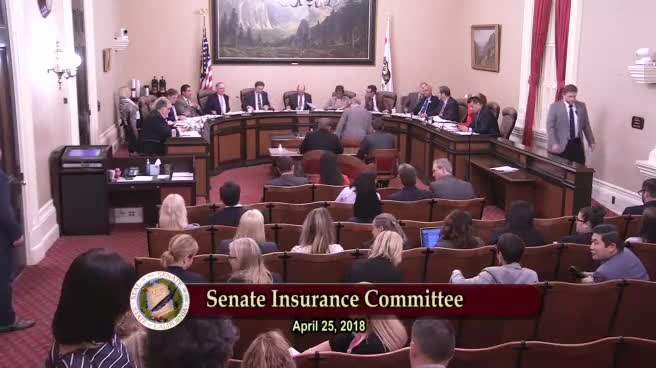
Bill Author