SB 826: Corporations: boards of directors.
- Session Year: 2017-2018
- House: Senate
- Latest Version Date: 2018-09-30
The General Corporation Law provides for the formation of domestic general corporations by the execution and filing of articles of incorporation with the Secretary of State. Under that law, the business and affairs of these corporations are generally managed by, and all corporate powers exercised by or under, the direction of their boards of directors, and each director is elected by shareholder vote, with certain exceptions, as specified. That law also allows foreign corporations to transact intrastate business by obtaining certificates of qualification from the Secretary of State and requires foreign corporations that meet certain criteria to comply with specified provisions applicable to domestic general corporations to the exclusion of the law of the jurisdiction in which the foreign corporation is incorporated.
This bill, no later than the close of the 2019 calendar year, would require a domestic general corporation or foreign corporation that is a publicly held corporation, as defined, whose principal executive offices, according to the corporations SEC 10-K form, are located in California to have a minimum of one female, as defined, on its board of directors, as specified. No later than the close of the 2021 calendar year, the bill would increase that required minimum number to 2 female directors if the corporation has 5 directors or to 3 female directors if the corporation has 6 or more directors. The bill would require, on or before specified dates, the Secretary of State to publish various reports on its Internet Web site documenting, among other things, the number of corporations in compliance with these provisions. The bill would also authorize the Secretary of State to impose fines for violations of the bill, as specified, and would provide that moneys from these fines are to be available, upon appropriation, to offset the cost of administering the bill.
The General Corporation Law provides for the formation of domestic general corporations by the execution and filing of articles of incorporation with the Secretary of State. Under that law, the business and affairs of these corporations are generally managed by, and all corporate powers exercised by or under, the direction of their boards of directors, and each director is elected by shareholder vote, with certain exceptions, as specified. That law also allows foreign corporations to transact intrastate business by obtaining certificates of qualification from the Secretary of State and requires foreign corporations that meet certain criteria to comply with specified provisions applicable to domestic general corporations to the exclusion of the law of the jurisdiction in which the foreign corporation is incorporated.
This bill, no later than December 31, 2019, the close of the 2019 calendar year, would require a domestic general corporation or foreign corporation that is a publicly held corporation, as defined, whose principal executive offices, according to the corporations SEC 10-K form, are located in California to have a minimum of one female, as defined, on its board of directors. On or before December 31, 2021, directors, as specified. No later than the close of the 2021 calendar year, the bill would increase that required minimum number to 2 female directors if the corporation has 5 authorized directors or to 3 female directors if the corporation has 6 or more authorized directors. The bill would require, on or before specified dates, the Secretary of State to publish various reports on its Internet Web site documenting, among other things, the number of corporations in compliance with these provisions. The bill would also authorize the Secretary of State to impose fines for violations of the bill, as specified, and would provide that moneys from these fines are to be available, upon appropriation, to offset the cost of administering the bill.
The General Corporation Law provides for the formation of domestic general corporations by the execution and filing of articles of incorporation with the Secretary of State. Under that law, the business and affairs of these corporations are generally managed by, and all corporate powers exercised by or under, the direction of their boards of directors, and each director is elected by shareholder vote, with certain exceptions, as specified. That law also allows foreign corporations to transact intrastate business by obtaining certificates of qualification from the Secretary of State and requires foreign corporations that meet certain criteria to comply with specified provisions applicable to domestic general corporations to the exclusion of the law of the jurisdiction in which the foreign corporation is incorporated.
This bill, no later than December 31, 2019, would require a domestic general corporation or foreign corporation that is a publicly held corporation, as defined, whose principal executive offices, according to the corporations SEC 10-K form, are located in California to have a minimum of one female female, as defined, on its board of directors. On or before December 31, 2021, the bill would increase that required minimum number to 2 female directors if the corporation has 5 authorized directors or to 3 female directors if the corporation has 6 or more authorized directors. The bill would require, on or before specified dates, the Secretary of State to publish various reports on its Internet Web site documenting, among other things, the number of corporations in compliance with these provisions. The bill would also authorize the Secretary of State to impose fines for violations of the bill, as specified, and would provide that moneys from these fines are to be available, upon appropriation, to offset the cost of administering the bill.
The General Corporation Law provides for the formation of domestic general corporations by the execution and filing of articles of incorporation with the Secretary of State. Under that law, the business and affairs of these corporations are generally managed by, and all corporate powers exercised by or under, the direction of their boards of directors, and each director is elected by shareholder vote, with certain exceptions, as specified. That law also allows foreign corporations to transact intrastate business by obtaining certificates of qualification from the Secretary of State and requires foreign corporations that meet certain criteria to comply with specified provisions applicable to domestic general corporations to the exclusion of the law of the jurisdiction in which the foreign corporation is incorporated.
This bill, commencing no later than December 31, 2019, would require a domestic general corporation or foreign corporation that is a publicly held corporation, as defined, with its principal place of business whose principal executive offices, according to the corporations SEC 10-K form, are located in California to have a minimum of one woman female on its board of directors. Commencing July 1, 2021, On or before December 31, 2021, the bill would increase that required minimum number to 2 women female directors if the corporation has 5 authorized directors or to 3 women female directors if the corporation has 6 or more authorized directors. Commencing July 1, 2019, and annually thereafter, the bill would require the Secretary of State to review these corporations to determine the number of women currently serving on their boards and note the changes that have occurred during the previous fiscal year. The bill would require, on or before specified dates, the Secretary of State to publish various reports on its Internet Web site documenting, among other things, the number of corporations in compliance with these provisions. The bill would also authorize the Secretary of State to impose fines for violations of the bill, as specified, and would provide that moneys from these fines are to be available, upon appropriation, to offset the cost of administering the bill.
The General Corporation Law provides for the formation of domestic general corporations by the execution and filing of articles of incorporation with the Secretary of State. Under that law, the business and affairs of these corporations are generally managed by, and all corporate powers exercised by or under, the direction of their boards of directors, and each director is elected by shareholder vote, with certain exceptions, as specified. That law also allows foreign corporations to transact intrastate business by obtaining certificates of qualification from the Secretary of State and requires foreign corporations that meet certain criteria to comply with specified provisions applicable to domestic general corporations to the exclusion of the law of the jurisdiction in which the foreign corporation is incorporated.
This bill, commencing December 31, 2019, would require a domestic general corporation or foreign corporation that is a publicly held corporation, as defined, with its principal place of business located in California to have a minimum of one woman on its board of directors. Commencing July 1, 2021, the bill would increase that required minimum number to 2 women directors if the corporation has 5 authorized directors or to 3 women directors if the corporation has 6 or more authorized directors. Commencing July 1, 2019, and annually thereafter, the bill would require the Secretary of State to review these corporations to determine the number of women currently serving on their boards and note the changes that have occurred during the previous fiscal year. The bill would also authorize the Secretary of State to impose fines for violations of the bill, as specified, and would provide that moneys from these fines are to be available, upon appropriation, to offset the cost of administering the bill.
The Legislature finds and declares as follows:
(a)More women directors serving on boards of directors of publicly held corporations will boost the California economy, improve opportunities for women in the workplace, and protect California taxpayers, shareholders, and retirees, including retired California state employees and teachers whose pensions are managed by CalPERS and CalSTRS. Yet studies predict that it will take 40 or 50 years to achieve gender parity, if something is not done proactively.
(b)In September 2013, Senate Concurrent Resolution 62 urged that by December 31, 2016, all public companies in California increase the number of women on their boards of directors ranging from one to three, depending upon the size of their boards. California was the first state in the United States to adopt such a resolution, followed by five other states that passed similar resolutions urging more women directors on corporate boards in their states.
(c)Numerous independent studies have concluded that publicly held companies perform better when women serve on their boards of directors, including:
(1)A 2017 study by MSCI found that United States companies that began the five-year period from 2011 to 2016 with three or more female directors reported earnings per share that were 45 percent higher than those companies with no female directors at the beginning of the period.
(2)In 2014, Credit Suisse found that companies with at least one woman on the board had an average return on equity (ROE) of 12.2 percent, compared to 10.1 percent for companies with no female directors. Additionally, the price-to-book value of these firms was greater for those with women on their boards: 2.4 times the value in comparison to 1.8 times the value for zero-women boards.
(3)A 2012 University of California, Berkeley study called Women Create a Sustainable Future found that companies with more women on their boards are more likely to create a sustainable future by, among other things, instituting strong governance structures with a high level of transparency.
(4)Credit Suisse conducted a six-year global research study from 2006 to 2012, with more than 2,000 companies worldwide, showing that women on boards improve business performance for key metrics, including stock performance. For companies with a market capitalization of more than $10 billion, those with women directors on boards outperformed shares of comparable businesses with all-male boards by 26 percent.
(5)The Credit Suisse report included the following findings:
(A)There has been a greater correlation between stock performance and the presence of women on a board since the financial crisis in 2008.
(B)Companies with women on their boards of directors significantly outperformed others when the recession occurred.
(C)Companies with women on their boards tend to be somewhat risk averse and carry less debt, on average.
(D)Net income growth for companies with women on their boards averaged 14 percent over a six-year period, compared with 10 percent for companies with no women directors.
(d)Other countries have addressed the lack of gender diversity on corporate boards by instituting quotas mandating 30 to 40 percent of seats to be held by women directors. Germany is the largest economy to mandate a quota requiring that 30 percent of public company board seats be held by women; in 2003, Norway was the first country to legislate a mandatory 40 percent quota for female representation on corporate boards. Since then, other European nations that have legislated similar quotas include France, Spain, Iceland, and the Netherlands.
(e)One-fourth of Californias public companies in the Russell 3000 index have NO women on their boards of directors; and for the rest of the companies, women hold only 15.5 percent of the board seats. A 2017 report being prepared by Board Governance Research LLC, conducted by University of San Diego professor Annalisa Barrett, found the following:
(1)As of June 2017, among the 446 publicly traded companies included in the Russell 3000 index and headquartered in California, representing nearly $5 trillion in market capitalization, women directors held 566 seats, or 15.5 percent of seats, while men held 3,089 seats, or 84.5 percent of seats.
(2)More than one-quarter, numbering 117, or 26 percent, of the Russell 3000 companies based in California have NO women directors serving on their boards.
(3)Only 54, or 12 percent, of these companies have three or more female directors on their boards.
(4)Smaller companies are much more likely to lack female directors. Among the 50 California-based companies with the lowest revenues, with an average of $13 million in 2015 revenues, only 8.4 percent of the director seats are held by women, and nearly half, or 48 percent, of these companies have NO women directors. Among the 50 largest California companies, with an average of nearly $30 billion in 2015 revenues, 23.5 percent of the director seats are held by women. All of the 50 have at least one woman director.
(f)If measures are not taken to proactively increase the numbers of women serving on corporate boards, studies have shown that it will take decades, as many as 40 or 50 years, to achieve gender parity among directors, including:
(1)A 2015 study conducted by the United States Government Accountability Office estimated that it could take more than 40 years for the numbers of women on boards to match men.
(2)The 2017 Equilar Gender Diversity Index (GDI) revealed that it will take nearly 40 years for the Russell 3000 companies nationwide to reach gender parity the year 2055.
(3)Nearly one-half of the 75 largest IPOs from 2014 to 2016 went public with NO women on their boards. Many technology companies in California have gone public with no women on their boards, according to a 2017 national study by 2020 Women on Boards.
(g)Further, several studies have concluded that having three women on the board, rather than just one or none, increases the effectiveness of boards, including:
(1)(A)According to the study entitled Women Directors on Corporate Boards From Tokenism to Critical Mass, by M. Torchia, A. Calabro, and M. Huse, published in the Journal of Business Ethics in 2011, and a report entitled Critical Mass on Corporate Boards: Why Three or More Women Enhance Governance, attaining critical mass, going from one or two women directors to at least three women directors, creates an environment where women are no longer seen as outsiders and are able to influence the content and process of board discussions more substantially.
(B)Boards of directors need to have at least three women to enable them to interact and exercise an influence on the working style, processes, and tasks of the board, in turn positively affecting the level of organizational innovation within the firm they govern.
(2)(A)A 2016 McKinsey and Company study entitled Women Matter showed nationwide that companies where women are most strongly represented at board or top-management levels are also the companies that perform the best in profitability, productivity, and workforce engagement.
(B)Companies with three or more women in senior management functions score even more highly, on average, on the organizational performance profile, than companies with no women on boards or in the executive ranks. When there are at least three women on corporate boards with an average membership of 10 directors, performance increases significantly.
SEC. 2.Section 301.3 is added to the Corporations Code, to read:301.3.(a)No later than the close of the 2019 calendar year, a publicly held domestic or foreign corporation whose principal executive offices, according to the corporations SEC 10-K form, are located in California shall have a minimum of one female director on its board. A corporation may increase the number of directors on its board to comply with this section.
(b)No later than the close of the 2021 calendar year, a publicly held domestic or foreign corporation whose principal executive offices, according to the corporations SEC 10-K form, are located in California shall comply with the following:
(1)If its number of directors is six or more, the corporation shall have a minimum of three female directors.
(2)If its number of directors is five, the corporation shall have a minimum of two female directors.
(3)If its number of directors is four or fewer, the corporation shall have a minimum of one female director.
(c)No later than July 1, 2019, the Secretary of State shall publish a report on its Internet Web site documenting the number of domestic and foreign corporations whose principal executive offices, according to the corporations SEC 10-K form, are located in California and who have at least one female director.
(d)No later than March 1, 2020, and annually thereafter, the Secretary of State shall publish a report on its Internet Web site regarding, at a minimum, all of the following:
(1)The number of corporations subject to this section that were in compliance with the requirements of this section during at least one point during the preceding calendar year.
(2)The number of publicly held corporations that moved their United States headquarters to California from another state or out of California into another state during the preceding calendar year.
(3)The number of publicly held corporations that were subject to this section during the preceding year, but are no longer publicly traded.
(e)(1)The Secretary of State may adopt regulations to implement this section. The Secretary of State may impose fines for violations of this section as follows:
(A)For failure to timely file board member information with the Secretary of State pursuant to a regulation adopted pursuant to this paragraph, the amount of one hundred thousand dollars ($100,000).
(B)For a first violation, the amount of one hundred thousand dollars ($100,000).
(C)For a second or subsequent violation, the amount of three hundred thousand dollars ($300,000).
(2)For the purposes of this subdivision, each director seat required by this section to be held by a female, which is not held by a female during at least a portion of a calendar year, shall count as a violation.
(3)For purposes of this subdivision, a female director having held a seat for at least a portion of the year shall not be a violation.
(4)Fines collected pursuant to this section shall be available, upon appropriation by the Legislature, for use by the Secretary of State to offset the cost of administering this section.
(f)For purposes of this section, the following definitions apply:
(1)Female means an individual who self-identifies her gender as a woman, without regard to the individuals designated sex at birth.
(2)Publicly held corporation means a corporation with outstanding shares listed on a major United States stock exchange.
SEC. 3.Section 2115.5 is added to the Corporations Code, to read:2115.5.(a)Section 301.3 shall apply to a foreign corporation that is a publicly held corporation to the exclusion of the law of the jurisdiction in which the foreign corporation is incorporated.
(b)For purposes of this section, a publicly held corporation means a foreign corporation with outstanding shares listed on a major United States stock exchange.
The Legislature finds and declares as follows:
(a)More women directors serving on boards of directors of publicly held corporations will boost the California economy, improve opportunities for women in the workplace, and protect California taxpayers, shareholders, and retirees, including retired California state employees and teachers whose pensions are managed by CalPERS and CalSTRS. Yet studies predict that it will take 40 or 50 years to achieve gender parity, if something is not done proactively.
(b)In September 2013, Senate Concurrent Resolution 62 urged that by December 31, 2016, all public companies in California increase the number of women on their boards of directors ranging from one to three, depending upon the size of their boards. California was the first state in the United States to adopt such a resolution, followed by five other states that passed similar resolutions urging more women directors on corporate boards in their states.
(c)Numerous independent studies have concluded that publicly held companies perform better when women serve on their boards of directors, including:
(1)A 2017 study by MSCI found that United States companies that began the five-year period from 2011 to 2016 with three or more female directors reported earnings per share that were 45 percent higher than those companies with no female directors at the beginning of the period.
(2)In 2014, Credit Suisse found that companies with at least one woman on the board had an average return on equity (ROE) of 12.2 percent, compared to 10.1 percent for companies with no female directors. Additionally, the price-to-book value of these firms was greater for those with women on their boards: 2.4 times the value in comparison to 1.8 times the value for zero-women boards.
(3)A 2012 University of California, Berkeley study called Women Create a Sustainable Future found that companies with more women on their boards are more likely to create a sustainable future by, among other things, instituting strong governance structures with a high level of transparency.
(4)Credit Suisse conducted a six-year global research study from 2006 to 2012, with more than 2,000 companies worldwide, showing that women on boards improve business performance for key metrics, including stock performance. For companies with a market capitalization of more than $10 billion, those with women directors on boards outperformed shares of comparable businesses with all-male boards by 26 percent.
(5)The Credit Suisse report included the following findings:
(A)There has been a greater correlation between stock performance and the presence of women on a board since the financial crisis in 2008.
(B)Companies with women on their boards of directors significantly outperformed others when the recession occurred.
(C)Companies with women on their boards tend to be somewhat risk averse and carry less debt, on average.
(D)Net income growth for companies with women on their boards averaged 14 percent over a six-year period, compared with 10 percent for companies with no women directors.
(d)Other countries have addressed the lack of gender diversity on corporate boards by instituting quotas mandating 30 to 40 percent of seats to be held by women directors. Germany is the largest economy to mandate a quota requiring that 30 percent of public company board seats be held by women; in 2003, Norway was the first country to legislate a mandatory 40 percent quota for female representation on corporate boards. Since then, other European nations that have legislated similar quotas include France, Spain, Iceland, and the Netherlands.
(e)One-fourth of Californias public companies in the Russell 3000 index have NO women on their boards of directors; and for the rest of the companies, women hold only 15.5 percent of the board seats. A 2017 report being prepared by Board Governance Research LLC, conducted by University of San Diego professor Annalisa Barrett, found the following:
(1)As of June 2017, among the 446 publicly traded companies included in the Russell 3000 index and headquartered in California, representing nearly $5 trillion in market capitalization, women directors held 566 seats, or 15.5 percent of seats, while men held 3,089 seats, or 84.5 percent of seats.
(2)More than one-quarter, numbering 117, or 26 percent, of the Russell 3000 companies based in California have NO women directors serving on their boards.
(3)Only 54, or 12 percent, of these companies have three or more female directors on their boards.
(4)Smaller companies are much more likely to lack female directors. Among the 50 California-based companies with the lowest revenues, with an average of $13 million in 2015 revenues, only 8.4 percent of the director seats are held by women. women, and nearly half, or 48 percent, of these companies have NO women directors. Among the 50 largest California companies, with an average of nearly $30 billion in 2015 revenues, 23.5 percent of the director seats are held by women. All of the 50 have at least one woman director.
(f)If measures are not taken to proactively increase the numbers of women serving on corporate boards, studies have shown that it will take decades, as many as 40 or 50 years, to achieve gender parity among directors, including:
(1)A 2015 study conducted by the United States Government Accountability Office estimated that it could take more than 40 years for the numbers of women on boards to match men.
(2)The 2017 Equilar Gender Diversity Index (GDI) revealed that it will take nearly 40 years for the Russell 3000 companies nationwide to reach gender parity the year 2055.
(3)Fewer than Nearly one-half of the 75 largest IPOs from 2014 to 2016 went public with NO women on their boards. Many technology companies in California have gone public with no women on their boards, according to a 2017 national study by 2020 Women on Boards.
(g)Further, several studies have concluded that having three women on the board, rather than just one or none, increases the effectiveness of boards, including:
(1)(A)According to the study entitled Women Directors on Corporate Boards From Tokenism to Critical Mass, by M. Torchia, A. Calabro, and M. Huse, published in the Journal of Business Ethics in 2011, and a report entitled Critical Mass on Corporate Boards: Why Three or More Women Enhance Governance, attaining critical mass, going from one or two women directors to at least three women directors, creates an environment where women are no longer seen as outsiders and are able to influence the content and process of board discussions more substantially.
(B)Boards of directors need to have at least three women to enable them to interact and exercise an influence on the working style, processes, and tasks of the board, in turn positively affecting the level of organizational innovation within the firm they govern.
(2)(A)A 2016 McKinsey and Company study entitled Women Matter showed nationwide that companies where women are most strongly represented at board or top-management levels are also the companies that perform the best in profitability, productivity, and workforce engagement.
(B)Companies with three or more women in senior management functions score even more highly, on average, on the organizational performance profile, than companies with no women on boards or in the executive ranks. When there are at least three women on corporate boards with an average membership of 10 directors, performance increases significantly.
SEC. 2.Section 301.3 is added to the Corporations Code, to read:301.3.(a)No later than the close of the 2019 calendar year, a publicly held domestic or foreign corporation whose principal executive offices, according to the corporations SEC 10-K form, are located in California shall have a minimum of one female director on its board. A corporation may increase the number of directors on its board to comply with this section.
(b)No later than the close of the 2021 calendar year, a publicly held domestic or foreign corporation whose principal executive offices, according to the corporations SEC 10-K form, are located in California shall comply with the following:
(1)If its number of directors is six or more, the corporation shall have a minimum of three female directors.
(2)If its number of directors is five, the corporation shall have a minimum of two female directors.
(3)If its number of directors is four or fewer, the corporation shall have a minimum of one female director.
(c)No later than July 1, 2019, the Secretary of State shall publish a report on its Internet Web site documenting the number of domestic and foreign corporations whose principal executive offices, according to the corporations SEC 10-K form, are located in California and who have at least one female director.
(d)No later than March 1, 2020, and annually thereafter, the Secretary of State shall publish a report on its Internet Web site regarding, at a minimum, all of the following:
(1)The number of corporations subject to this section that were in compliance with the requirements of this section during at least one point during the preceding calendar year.
(2)The number of publicly held corporations that moved their United States headquarters to California from another state or out of California into another state during the preceding calendar year.
(3)The number of publicly held corporations that were subject to this section during the preceding year, but are no longer publicly traded.
(e)(1)The Secretary of State may adopt regulations to implement this section. The Secretary of State may impose fines for violations of this section as follows:
(A)For failure to timely file board member information with the Secretary of State pursuant to a regulation adopted pursuant to this paragraph, the amount of one hundred thousand dollars ($100,000).
(A)(B)For a first violation, an amount equal to the average annual cash compensation for the directors of the corporation. violation, the amount of one hundred thousand dollars ($100,000).
(B)(C)For a second or subsequent violation, an amount equal to three times the average annual cash compensation for the directors of the corporation. violation, the amount of three hundred thousand dollars ($300,000).
(2)For the purposes of this subdivision, each director seat required by this section to be held by a female, which is not held by a female during at least a portion of a calendar year, shall count as a violation.
(3)For purposes of this subdivision, a female director having held a seat for at least a portion of the year shall not be a violation.
(3)(4)Fines collected pursuant to this section shall be available, upon appropriation by the Legislature, for use by the Secretary of State to offset the cost of administering this section.
(f)For purposes of this section, the following definitions apply:
(1)Female means an individual who self-identifies her gender as a woman, without regard to the individuals designated sex at birth.
(2)Publicly held corporation means a corporation with outstanding shares listed on a major United States stock exchange.
SEC. 3.Section 2115.5 is added to the Corporations Code, to read:2115.5.(a)Section 301.3 shall apply to a foreign corporation that is a publicly held corporation to the exclusion of the law of the jurisdiction in which the foreign corporation is incorporated.
(b)For purposes of this section, a publicly held corporation means a foreign corporation with outstanding shares listed on a major United States stock exchange.
The Legislature finds and declares as follows:
(a)More women directors serving on boards of directors of publicly held corporations will boost the California economy, improve opportunities for women in the workplace, and protect California taxpayers, shareholders, and retirees, including retired California state employees and teachers whose pensions are managed by CalPERS and CalSTRS. Yet studies predict that it will take 40 or 50 years to achieve gender parity, if something is not done proactively.
(b)In September 2013, Senate Concurrent Resolution 62 urged that by December 31, 2016, all public companies in California increase the number of women on their boards of directors ranging from one to three, depending upon the size of their boards. California was the first state in the United States to adopt such a resolution, followed by five other states that passed similar resolutions urging more women directors on corporate boards in their states.
(c)Numerous independent studies have concluded that publicly held companies perform better when women serve on their boards of directors, including:
(1)A 2017 study by MSCI found that United States companies that began the five-year period from 2011 to 2016 with three or more female directors reported earnings per share that were 45 percent higher than those companies with no female directors at the beginning of the period.
(2)In 2014, Credit Suisse found that companies with at least one woman on the board had an average return on equity (ROE) of 12.2 percent, compared to 10.1 percent for companies with no female directors. Additionally, the price-to-book value of these firms was greater for those with women on their boards: 2.4 times the value in comparison to 1.8 times the value for zero-women boards.
(3)A 2012 University of California, Berkeley study called Women Create a Sustainable Future found that companies with more women on their boards are more likely to create a sustainable future by, among other things, instituting strong governance structures with a high level of transparency.
(4)Credit Suisse conducted a six-year global research study from 2006 to 2012, with more than 2,000 companies worldwide, showing that women on boards improve business performance for key metrics, including stock performance. For companies with a market capitalization of more than $10 billion, those with women directors on boards outperformed shares of comparable businesses with all-male boards by 26 percent.
(5)The Credit Suisse report included the following findings:
(A)There has been a greater correlation between stock performance and the presence of women on a board since the financial crisis in 2008.
(B)Companies with women on their boards of directors significantly outperformed others when the recession occurred.
(C)Companies with women on their boards tend to be somewhat risk averse and carry less debt, on average.
(D)Net income growth for companies with women on their boards averaged 14 percent over a six-year period, compared with 10 percent for companies with no women directors.
(d)Other countries have addressed the lack of gender diversity on corporate boards by instituting quotas mandating 30 to 40 percent of seats to be held by women directors. Germany is the largest economy to mandate a quota requiring that 30 percent of public company board seats be held by women; in 2003, Norway was the first country to legislate a mandatory 40 percent quota for female representation on corporate boards. Since then, other European nations that have legislated similar quotas include France, Spain, Iceland, and the Netherlands.
(e)One-fourth of Californias public companies in the Russell 3000 index have NO women on their boards of directors; and for the rest of the companies, women hold only 15.5 percent of the board seats. A 2017 report being prepared by Board Governance Research LLC, conducted by University of San Diego professor Annalisa Barrett, found the following:
(1)As of June 2017, among the 446 publicly traded companies included in the Russell 3000 index and headquartered in California, representing nearly $5 trillion in market capitalization, women directors held 566 seats, or 15.5 percent of seats, while men held 3,089 seats, or 84.5 percent of seats.
(2)More than one-quarter, numbering 117, or 26 percent, of the Russell 3000 companies based in California have NO women directors serving on their boards.
(3)Only 54, or 12 percent, of these companies have three or more female directors on their boards.
(4)Smaller companies are much more likely to lack female directors. Among the 50 California-based companies with the lowest revenues, with an average of $13 million in 2015 revenues, only 8.4 percent of the director seats are held by women. nearly half, or 48 percent, of these companies have NO women directors. Among the 50 largest California companies, with an average of nearly $30 billion in 2015 revenues, 23.5 percent of the director seats are held by women. All of the 50 have at least one woman director.
(f)If measures are not taken to proactively increase the numbers of women serving on corporate boards, studies have shown that it will take decades, as many as 40 or 50 years, to achieve gender parity among directors, including:
(1)A 2015 study conducted by the United States Government Accountability Office estimated that it could take more than 40 years for the numbers of women on boards to match men.
(2)The 2017 Equilar Gender Diversity Index (GDI) revealed that it will take nearly 40 years for Russell 3000 nationwide to reach gender parity the year 2055.
(3)Fewer than one-half of the 75 largest IPOs from 2014 to 2016 went public with NO women on their boards. Many technology companies in California have gone public with no women on their boards, according to a 2017 national study by 2020 Women on Boards.
(g)Further, several studies have concluded that having three women on the board, rather than just one or none, increases the effectiveness of boards, including:
(1)(A)According to the study entitled Women Directors on Corporate Boards From Tokenism to Critical Mass, by M. Torchia, A. Calabro, and M. Huse, published in the Journal of Business Ethics in 2011, and a report entitled Critical Mass on Corporate Boards: Why Three or More Women Enhance Governance, attaining critical mass, going from one or two women directors to at least three women directors, creates an environment where women are no longer seen as outsiders and are able to influence the content and process of board discussions more substantially.
(B)Boards of directors need to have at least three women to enable them to interact and exercise an influence on the working style, processes, and tasks of the board, in turn positively affecting the level of organizational innovation within the firm they govern.
(2)(A)A 2016 McKinsey and Company study entitled Women Matter showed nationwide that companies where women are most strongly represented at board or top-management levels are also the companies that perform the best in profitability, productivity, and workforce engagement.
(B)Companies with three or more women in senior management functions score even more highly, on average, on the organizational performance profile, than companies with no women on boards or in the executive ranks. When there are at least three women on corporate boards with an average membership of 10 directors, performance increases significantly.
SEC. 2.Section 301.3 is added to the Corporations Code, to read:301.3.(a)No later than the close of the 2019 calendar year, a publicly held domestic or foreign corporation whose principal executive offices, according to the corporations SEC 10-K form, are located in California shall have a minimum of one female director on its board. A corporation may increase the number of directors on its board to comply with this section.
(b)No later than the close of the 2021 calendar year, a publicly held domestic or foreign corporation whose principal executive offices, according to the corporations SEC 10-K form, are located in California shall comply with the following:
(1)If its number of directors is six or more, the corporation shall have a minimum of three female directors.
(2)If its number of directors is five, the corporation shall have a minimum of two female directors.
(3)If its number of directors is four or fewer, the corporation shall have a minimum of one female director.
(c)No later than July 1, 2019, the Secretary of State shall publish a report on its Internet Web site documenting the number of domestic and foreign corporations whose principal executive offices, according to the corporations SEC 10-K form, are located in California and who have at least one female director.
(d)No later than March 1, 2020, and annually thereafter, the Secretary of State shall publish a report on its Internet Web site regarding, at a minimum, all of the following:
(1)The number of corporations subject to this section that were in compliance with the requirements of this section during at least one point during the preceding calendar year.
(2)The number of publicly held corporations that moved their United States headquarters to California from another state or out of California into another state during the preceding calendar year.
(3)The number of publicly held corporations that were subject to this section during the preceding year, but are no longer publicly traded.
(e)(1)The Secretary of State may adopt regulations to implement this section. The Secretary of State may impose fines for violations of this section as follows:
(A)For a first violation, an amount equal to the average annual cash compensation for the directors of the corporation.
(B)For a second or subsequent violation, an amount equal to three times the average annual cash compensation for the directors of the corporation.
(2)For the purposes of this subdivision, each director seat required by this section to be held by a female, which is not held by a female during at least a portion of a calendar year, shall count as a violation.
(3)Fines collected pursuant to this section shall be available, upon appropriation by the Legislature, for use by the Secretary of State to offset the cost of administering this section.
(f)For purposes of this section, a publicly the following definitions apply:
(1)Female means an individual who self-identifies her gender as a woman, without regard to the individuals designated sex at birth.
(2)Publicly held corporation means a corporation with outstanding shares listed on a major United States stock exchange.
SEC. 3.Section 2115.5 is added to the Corporations Code, to read:2115.5.(a)Section 301.3 shall apply to a foreign corporation that is a publicly held corporation to the exclusion of the law of the jurisdiction in which the foreign corporation is incorporated.
(b)For purposes of this section, a publicly held corporation means a foreign corporation with outstanding shares listed on a major United States stock exchange.
The Legislature finds and declares as follows:
(a)More women directors serving on boards of directors of publicly held corporations will boost the California economy, improve opportunities for women in the workplace, and protect California taxpayers, shareholders, and retirees, including retired California state employees and teachers whose pensions are managed by CalPERS and CalSTRS. Yet studies predict that it will take 40 or 50 years to achieve gender parity, if something is not done proactively.
(b)In September 2013, Senate Concurrent Resolution 62 urged that by December 31, 2016, all public companies in California increase the number of women on their boards of directors ranging from one to three, depending upon the size of their boards. California was the first state in the United States to adopt such a resolution, followed by five other states that passed similar resolutions urging more women directors on corporate boards in their states.
(c)Numerous independent studies have concluded that publicly held companies perform better when women serve on their boards of directors, including:
(1)A 2017 study by MSCI found that United States companies that began the five-year period from 2011 to 2016 with three or more female directors reported earnings per share that were 45 percent higher than those companies with no female directors at the beginning of the period.
(2)In 2014, Credit Suisse found that companies with at least one woman on the board had an average return on equity (ROE) of 12.2 percent, compared to 10.1 percent for companies with no female directors. Additionally, the price-to-book value of these firms was greater for those with women on their boards: 2.4 times the value in comparison to 1.8 times the value for zero-women boards.
(3)A 2012 University of California, Berkeley study called Women Create a Sustainable Future found that companies with more women on their boards are more likely to create a sustainable future by, among other things, instituting strong governance structures with a high level of transparency.
(4)Credit Suisse conducted a six-year global research study from 2006 to 2012, with more than 2,000 companies worldwide, showing that women on boards improve business performance for key metrics, including stock performance. For companies with a market capitalization of more than $10 billion, those with women directors on boards outperformed shares of comparable businesses with all-male boards by 26 percent.
(5)The Credit Suisse report included the following findings:
(A)There has been a greater correlation between stock performance and the presence of women on a board since the financial crisis in 2008.
(B)Companies with women on their boards of directors significantly outperformed others when the recession occurred.
(C)Companies with women on their boards tend to be somewhat risk averse and carry less debt, on average.
(D)Net income growth for companies with women on their boards averaged 14 percent over a six-year period, compared with 10 percent for companies with no women directors.
(d)Other countries have addressed the lack of gender diversity on corporate boards by instituting quotas mandating 30 to 40 percent of seats to be held by women directors. Germany is the largest economy to mandate a quota requiring that 30 percent of public company board seats be held by women; in 2003, Norway was the first country to legislate a mandatory 40 percent quota for female representation on corporate boards. Since then, other European nations that have legislated similar quotas include France, Spain, Iceland, and the Netherlands.
(e)One-fourth of Californias public companies in the Russell 3000 index have NO women on their boards of directors; and for the rest of the companies, women hold only 15.5 percent of the board seats. A 2017 report being prepared by Board Governance Research LLC, conducted by University of San Diego professor Annalisa Barrett, found the following:
(1)As of June 2017, among the 446 publicly traded companies included in the Russell 3000 index and headquartered in California, representing nearly $5 trillion in market capitalization, women directors held 566 seats, or 15.5 percent of seats, while men held 3,089 seats, or 84.5 percent of seats.
(2)More than one-quarter, numbering 117, or 26 percent, of the Russell 3000 companies based in California have NO women directors serving on their boards.
(3)Only 54, or 12 percent, of these companies have three or more female directors on their boards.
(4)Smaller companies are much more likely to lack female directors. Among the 50 California-based companies with the lowest revenues, with an average of $13 million in 2015 revenues, only 8.4 percent of the director seats are held by women. nearly half, or 48 percent, of these companies have NO women directors. Among the 50 largest California companies, with an average of nearly $30 billion in 2015 revenues, 23.5 percent of the director seats are held by women. All of the 50 have at least one woman director.
(f)If measures are not taken to proactively increase the numbers of women serving on corporate boards, studies have shown that it will take decades, as many as 40 or 50 years, to achieve gender parity among directors, including:
(1)A 2015 study conducted by the United States Government Accountability Office estimated that it could take more than 40 years for the numbers of women on boards to match men.
(2)The 2017 Equilar Gender Diversity Index (GDI) revealed that it will take nearly 40 years for Russell 3000 nationwide to reach gender parity the year 2055.
(3)Fewer than one-half of the 75 largest IPOs from 2014 to 2016 went public with NO women on their boards. Many technology companies in California have gone public with no women on their boards, according to a 2017 national study by 2020 Women on Boards.
(g)Further, several studies have concluded that having three women on the board, rather than just one or none, increases the effectiveness of boards, including:
(1)(A)According to the study entitled Women Directors on Corporate Boards From Tokenism to Critical Mass, by M. Torchia, A. Calabro, and M. Huse, published in the Journal of Business Ethics in 2011, and a report entitled Critical Mass on Corporate Boards: Why Three or More Women Enhance Governance, attaining critical mass, going from one or two women directors to at least three women directors, creates an environment where women are no longer seen as outsiders and are able to influence the content and process of board discussions more substantially.
(B)Boards of directors need to have at least three women to enable them to interact and exercise an influence on the working style, processes, and tasks of the board, in turn positively affecting the level of organizational innovation within the firm they govern.
(2)(A)A 2016 McKinsey and Company study entitled Women Matter showed nationwide that companies where women are most strongly represented at board or top-management levels are also the companies that perform the best in profitability, productivity, and workforce engagement.
(B)Companies with three or more women in senior management functions score even more highly, on average, on the organizational performance profile, than companies with no women on boards or in the executive ranks. When there are at least three women on corporate boards with an average membership of 10 directors, performance increases significantly.
SEC. 2.Section 301.3 is added to the Corporations Code, to read:301.3.(a)Commencing December 31, 2019, No later than the close of the 2019 calendar year, a publicly held domestic or foreign corporation with its principal place of business whose principal executive offices, according to the corporations SEC 10-K form, are located in California shall have a minimum of one woman director. If, by December 31, 2019, no director retires from the board, or an open seat does not otherwise occur, the board shall increase its authorized number of directors by one, and that seat shall be filled by a woman. female director on its board. A corporation may increase the number of directors on its board to comply with this section.
(b)Commencing July 1, 2021, every No later than the close of the 2021 calendar year, a publicly held corporation with its principal place of business domestic or foreign corporation whose principal executive offices, according to the corporations SEC 10-K form, are located in California shall comply with the following:
(1)If its authorized number of directors is six or more, the publicly held corporation shall have a minimum of three women female directors.
(2)If its authorized number of directors is five, the publicly held corporation shall have a minimum of two women female directors.
(3)If its authorized number of directors is four or fewer, the publicly held corporation shall have a minimum of one woman female director.
(c)No later than July 1, 2019, the Secretary of State shall publish a report on its Internet Web site documenting the number of domestic and foreign corporations whose principal executive offices, according to the corporations SEC 10-K form, are located in California and who have at least one female director.
(c)Commencing July 1, 2019,(d)No later than March 1, 2020, and annually thereafter, the Secretary of State shall review publicly held corporations subject to this section to determine the number of women currently serving on their boards and shall note the changes that have occurred during the previous fiscal year. publish a report on its Internet Web site regarding, at a minimum, all of the following:
(1)The number of corporations subject to this section that were in compliance with the requirements of this section during at least one point during the preceding calendar year.
(2)The number of publicly held corporations that moved their United States headquarters to California from another state or out of California into another state during the preceding calendar year.
(3)The number of publicly held corporations that were subject to this section during the preceding year, but are no longer publicly traded.
(d)(e)(1)The Secretary of State may adopt regulations to implement this section. The Secretary of State may impose a fine fines for violations of this section as follows:
(A)For a first violation, in an amount equal to the average annual cash compensation for the directors of the corporation.
(B)For a second or subsequent violation, in an amount equal to three times the average annual cash compensation for the directors of the corporation.
(2)For the purposes of this subdivision, each director seat required by this section to be held by a female, which is not held by a female during at least a portion of a calendar year, shall count as a violation.
(2)(3)Fines collected pursuant to this section shall be available, upon appropriation by the Legislature, for use by the Secretary of State to offset the cost of administering this section.
(e)(f)For purposes of this section, a publicly held corporation means a corporation with outstanding shares listed on the New York Stock Exchange, the NYSE Amex, the NASDAQ Global Market, or the NASDAQ Capital Market. a major United States stock exchange.
SEC. 3.Section 2115.5 is added to the Corporations Code, to read:2115.5.(a)Section 301.3 shall apply to a foreign corporation that is a publicly held corporation to the exclusion of the law of the jurisdiction in which the foreign corporation is incorporated.
(b)For purposes of this section, a publicly held corporation means a foreign corporation with outstanding shares listed on the New York Stock Exchange, the NYSE Amex, the NASDAQ Global Market, or the NASDAQ Capital Market. a major United States stock exchange.
The Legislature finds and declares as follows:
(a)More women directors serving on boards of directors of publicly held corporations will boost the California economy, improve opportunities for women in the workplace, and protect California taxpayers, shareholders, and retirees, including retired California state employees and teachers whose pensions are managed by CalPERS and CalSTRS. Yet studies predict that it will take 40 or 50 years to achieve gender parity, if something is not done proactively.
(b)In September 2013, Senate Concurrent Resolution 62 urged that by December 31, 2016, all public companies in California increase the number of women on their boards of directors ranging from one to three, depending upon the size of their boards. California was the first state in the United States to adopt such a resolution, followed by five other states that passed similar resolutions urging more women directors on corporate boards in their states.
(c)Numerous independent studies have concluded that publicly held companies perform better when women serve on their boards of directors, including:
(1)A 2017 study by MSCI found that United States companies that began the five-year period from 2011 to 2016 with three or more female directors reported earnings per share that were 45 percent higher than those companies with no female directors at the beginning of the period.
(2)In 2014, Credit Suisse found that companies with at least one woman on the board had an average return on equity (ROE) of 12.2 percent, compared to 10.1 percent for companies with no female directors. Additionally, the price-to-book value of these firms was greater for those with women on their boards: 2.4 times the value in comparison to 1.8 times the value for zero-women boards.
(3)A 2012 University of California, Berkeley study called Women Create a Sustainable Future found that companies with more women on their boards are more likely to create a sustainable future by, among other things, instituting strong governance structures with a high level of transparency.
(4)Credit Suisse conducted a six-year global research study from 2006 to 2012, with more than 2,000 companies worldwide, showing that women on boards improve business performance for key metrics, including stock performance. For companies with a market capitalization of more than $10 billion, those with women directors on boards outperformed shares of comparable businesses with all-male boards by 26 percent.
(5)The Credit Suisse report included the following findings:
(A)There has been a greater correlation between stock performance and the presence of women on a board since the financial crisis in 2008.
(B)Companies with women on their boards of directors significantly outperformed others when the recession occurred.
(C)Companies with women on their boards tend to be somewhat risk averse and carry less debt, on average.
(D)Net income growth for companies with women on their boards averaged 14 percent over a six-year period, compared with 10 percent for companies with no women directors.
(d)Other countries have addressed the lack of gender diversity on corporate boards by instituting quotas mandating 30 to 40 percent of seats to be held by women directors. Germany is the largest economy to mandate a quota requiring that 30 percent of public company board seats be held by women; in 2003, Norway was the first country to legislate a mandatory 40 percent quota for female representation on corporate boards. Since then, other European nations that have legislated similar quotas include France, Spain, Iceland, and the Netherlands.
(e)One-fourth of Californias public companies in the Russell 3000 index have NO women on their boards of directors; and for the rest of the companies, women hold only 15.5 percent of the board seats. A 2017 report being prepared by Board Governance Research LLC, conducted by University of San Diego professor Annalisa Barrett, found the following:
(1)As of June 2017, among the 446 publicly traded companies included in the Russell 3000 index and headquartered in California, representing nearly $5 trillion in market capitalization, women directors held 566 seats, or 15.5 percent of seats, while men held 3,089 seats, or 84.5 percent of seats.
(2)More than one-quarter, numbering 117, or 26 percent, of the Russell 3000 companies based in California have NO women directors serving on their boards.
(3)Only 54, or 12 percent, of these companies have three or more female directors on their boards.
(4)Smaller companies are much more likely to lack female directors. Among the 50 California-based companies with the lowest revenues, with an average of $13 million in 2015 revenues, only 8.4 percent of the director seats are held by women. nearly half, or 48 percent, of these companies have NO women directors. Among the 50 largest California companies, with an average of nearly $30 billion in 2015 revenues, 23.5 percent of the director seats are held by women. All of the 50 have at least one woman director.
(f)If measures are not taken to proactively increase the numbers of women serving on corporate boards, studies have shown that it will take decades, as many as 40 or 50 years, to achieve gender parity among directors, including:
(1)A 2015 study conducted by the United States Government Accountability Office estimated that it could take more than 40 years for the numbers of women on boards to match men.
(2)The 2017 Equilar Gender Diversity Index (GDI) revealed that it will take nearly 40 years for Russell 3000 nationwide to reach gender parity the year 2055.
(3)Fewer than one-half of the 75 largest IPOs from 2014 to 2016 went public with NO women on their boards. Many technology companies in California have gone public with no women on their boards, according to a 2017 national study by 2020 Women on Boards.
(g)Further, several studies have concluded that having three women on the board, rather than just one or none, increases the effectiveness of boards, including:
(1)(A)According to the study entitled Women Directors on Corporate Boards From Tokenism to Critical Mass, by M. Torchia, A. Calabro, and M. Huse, published in the Journal of Business Ethics in 2011, and a report entitled Critical Mass on Corporate Boards: Why Three or More Women Enhance Governance, attaining critical mass, going from one or two women directors to at least three women directors, creates an environment where women are no longer seen as outsiders and are able to influence the content and process of board discussions more substantially.
(B)Boards of directors need to have at least three women to enable them to interact and exercise an influence on the working style, processes, and tasks of the board, in turn positively affecting the level of organizational innovation within the firm they govern.
(2)(A)A 2016 McKinsey and Company study entitled Women Matter showed nationwide that companies where women are most strongly represented at board or top-management levels are also the companies that perform the best in profitability, productivity, and workforce engagement.
(B)Companies with three or more women in senior management functions score even more highly, on average, on the organizational performance profile, than companies with no women on boards or in the executive ranks. When there are at least three women on corporate boards with an average membership of 10 directors, performance increases significantly.
SEC. 2.Section 301.3 is added to the Corporations Code, to read:301.3.(a)Commencing December 31, 2019, a publicly held corporation with its principal place of business located in California shall have a minimum of one woman director. If, by December 31, 2019, no director retires from the board, or an open seat does not otherwise occur, the board shall increase its authorized number of directors by one, and that seat shall be filled by a woman.
(b)Commencing July 1, 2021, every publicly held corporation with its principal place of business located in California shall comply with the following:
(1)If its authorized number of directors is six or more, the publicly held corporation shall have a minimum of three women directors.
(2)If its authorized number of directors is five, the publicly held corporation shall have a minimum of two women directors.
(3)If its authorized number of directors is four or fewer, the publicly held corporation shall have a minimum of one woman director.
(c)Commencing July 1, 2019, and annually thereafter, the Secretary of State shall review publicly held corporations subject to this section to determine the number of women currently serving on their boards and shall note the changes that have occurred during the previous fiscal year.
(d)(1)The Secretary of State may adopt regulations to implement this section. The Secretary of State may impose a fine for violations of this section as follows:
(A)For a first violation, in an amount equal to the average annual cash compensation for the directors of the corporation.
(B)For a second or subsequent violation, in an amount equal to three times the average annual cash compensation for the directors of the corporation.
(2)Fines collected pursuant to this section shall be available, upon appropriation by the Legislature, for use by the Secretary of State to offset the cost of administering this section.
(e)For purposes of this section, a publicly held corporation means a corporation with outstanding shares listed on the New York Stock Exchange, the NYSE Amex, the NASDAQ Global Market, or the NASDAQ Capital Market.
SEC. 3.Section 2115.5 is added to the Corporations Code, to read:2115.5.(a)Section 301.3 shall apply to a foreign corporation that is a publicly held corporation to the exclusion of the law of the jurisdiction in which the foreign corporation is incorporated.
(b)For purposes of this section, publicly held corporation means a foreign corporation with outstanding shares listed on the New York Stock Exchange, the NYSE Amex, the NASDAQ Global Market, or the NASDAQ Capital Market.
|
Date
|
Status
|
|---|---|
| Sep 30, 2018 | Chaptered by Secretary of State. Chapter 954, Statutes of 2018. |
| Sep 30, 2018 | Approved by the Governor. |
| Sep 10, 2018 | Enrolled and presented to the Governor at 4 p.m. |
| Aug 30, 2018 | Assembly amendments concurred in. (Ayes 23. Noes 9.) Ordered to engrossing and enrolling. |
| Aug 29, 2018 | In Senate. Concurrence in Assembly amendments pending. |
| Aug 29, 2018 | Read third time. Passed. Ordered to the Senate. |
| Aug 21, 2018 | Read second time. Ordered to third reading. |
| Aug 20, 2018 | Read second time and amended. Ordered to second reading. |
| Aug 16, 2018 | From committee: Do pass as amended. (Ayes 12. Noes 0.) (August 16). |
| Aug 8, 2018 | August 8 set for first hearing. Placed on suspense file. |
| Jun 26, 2018 | From committee: Do pass and re-refer to Com. on APPR. (Ayes 7. Noes 1.) (June 26). Re-referred to Com. on APPR. |
| Jun 26, 2018 | From committee: Do pass and re-refer to Com. on JUD. (Ayes 8. Noes 0.) (June 25). Re-referred to Com. on JUD. |
| Jun 21, 2018 | Assembly Rule 56 suspended. |
| Jun 14, 2018 | Referred to Coms. on B. & F. and JUD. |
| May 31, 2018 | In Assembly. Read first time. Held at Desk. |
| May 31, 2018 | Read third time. Passed. (Ayes 22. Noes 11.) Ordered to the Assembly. |
| May 29, 2018 | Read second time. Ordered to third reading. |
| May 25, 2018 | Read second time and amended. Ordered to second reading. |
| May 18, 2018 | Set for hearing May 25. |
| May 7, 2018 | May 7 hearing: Placed on APPR. suspense file. |
| Apr 27, 2018 | Set for hearing May 7. |
| Apr 25, 2018 | From committee: Do pass and re-refer to Com. on APPR. (Ayes 5. Noes 1.) (April 24). Re-referred to Com. on APPR. |
| Apr 20, 2018 | Set for hearing April 24. |
| Apr 19, 2018 | From committee: Do pass and re-refer to Com. on JUD. (Ayes 5. Noes 1.) (April 18). Re-referred to Com. on JUD. |
| Apr 3, 2018 | From committee with author's amendments. Read second time and amended. Re-referred to Com. on B. & F.I. |
| Mar 21, 2018 | Set for hearing April 18. |
| Mar 20, 2018 | April 4 set for first hearing canceled at the request of author. |
| Mar 16, 2018 | Set for hearing April 4. |
| Mar 15, 2018 | Re-referred to Coms. on B. & F.I. and JUD. |
| Mar 15, 2018 | Re-referred to Com. on RLS. |
| Jan 16, 2018 | Referred to Coms. on I., B. & F.I. and JUD. |
| Jan 4, 2018 | From printer. May be acted upon on or after February 3. |
| Jan 3, 2018 | Introduced. Read first time. To Com. on RLS. for assignment. To print. |
|
Date
|
Description
|
Location
|
Votes
|
|
|---|---|---|---|---|
| Aug 30, 2018 | Unfinished Business SB826 Jackson et al. Concurrence | Senate Floor |
Passed |
|
| Aug 29, 2018 | SB 826 Jackson Senate Third Reading By GONZALEZ FLETCHER | Assembly Floor |
Passed |
|
| Aug 16, 2018 | Do pass as amended. | Assembly Standing Committee on Appropriations |
Passed |
|
| Jun 26, 2018 | Do pass and be re-referred to the Committee on [Appropriations] | Assembly Standing Committee on Judiciary |
Passed |
|
| Jun 25, 2018 | Do pass and be re-referred to the Committee on [Judiciary] | Assembly Standing Committee on Banking and Finance |
Passed |
|
| May 31, 2018 | Senate 3rd Reading SB826 Jackson et al. | Senate Floor |
Passed |
|
| May 25, 2018 | Do pass as amended | Senate Standing Committee on Appropriations |
Passed |
|
| May 7, 2018 | Placed on suspense file | Senate Standing Committee on Appropriations |
Passed |
|
| Apr 24, 2018 | Do pass, but first be re-referred to the Committee on [Appropriations] | Senate Standing Committee on Judiciary |
Passed |
|
| Apr 24, 2018 | [04-25-2018] set for [First] hearing: Reconsideration of favorable vote granted | Senate Standing Committee on Judiciary |
Passed |
|
| Apr 24, 2018 | Do pass, but first be re-referred to the Committee on [Appropriations] | Senate Standing Committee on Judiciary |
Passed |
|
| Apr 18, 2018 | Do pass, but first be re-referred to the Committee on [Judiciary] | Senate Standing Committee on Banking and Financial Institutions |
Passed |
This list shows positions taken on this bill by organizations on the date displayed, which is linked to the original source.
Positions by individuals are not included.
|
Organization
|
Position
|
Date
|
|---|---|---|
| A Cone Zone | * Support | Apr 24, 2018 |
| Alliance Of Chief Executives | ** Support | Aug 30, 2018 |
| American River Bank | * Support | Apr 18, 2018 |
| AmPac Tri-State CDC | * Support | Apr 24, 2018 |
| Anvaya Solutions | ** Support | Aug 30, 2018 |
| Bargas Environmental Consulting | ** Support | Apr 16, 2018 |
| Barnard-Bahn Consulting & Coaching | ** Support | Aug 30, 2018 |
| Berkhemer Clayton, Inc. | ** Support | Aug 30, 2018 |
| Biocom | ** Against | Aug 30, 2018 |
| Brea Chamber of Commerce | ** Against | Aug 30, 2018 |
| Burkhemer Clayton Retained Executive Search | * Support | Apr 24, 2018 |
| Burleson Consulting | ** Support | Aug 30, 2018 |
| Business Owner | * Support | Apr 24, 2018 |
| California Ambulance Association | ** Against | Aug 30, 2018 |
| California Association Of Winegrape Growers | ** Against | Aug 30, 2018 |
| California Business Properties Association | ** Against | Aug 30, 2018 |
| California Chamber Of Commerce | ** Against | Aug 30, 2018 |
| California Employment Lawyer's Association | * Support | May 7, 2018 |
| California Grocers Association | ** Against | Aug 30, 2018 |
| California Manufacturers And Technology Association | ** Against | Aug 30, 2018 |
| California Restaurant Association | ** Against | Aug 30, 2018 |
| California State University | * Support | Apr 18, 2018 |
| California Trucking Association | ** Against | Aug 30, 2018 |
| Camarillo Chamber of Commerce | ** Against | Aug 30, 2018 |
| Cerritos Chamber Of Commerce | ** Against | Aug 30, 2018 |
| Change Agent Media | * Support | Apr 18, 2018 |
| Chelette Enterprises | ** Support | Aug 30, 2018 |
| CMG Caliva | * Support | Apr 24, 2018 |
| Construction Employers' Association | ** Against | Aug 30, 2018 |
| Consumer Attorneys Of California | ** Support | Aug 30, 2018 |
| Cr&A Custom | ** Support | Aug 30, 2018 |
| D G Consulting | * Support | Apr 24, 2018 |
| DDM Metering Systems | * Support | Apr 24, 2018 |
| Dg Consulting | ** Support | Aug 30, 2018 |
| DH Casters | * Support | Apr 24, 2018 |
| Dlc Consulting Services | ** Support | Aug 30, 2018 |
| Dowitcher Designs | * Support | Apr 24, 2018 |
| Dr. Sandra'S Sanctuary | ** Support | Aug 30, 2018 |
| Dyer Sheehan Group | * Support | Apr 24, 2018 |
| Dynam Consulting | ** Support | Apr 24, 2018 |
| Elevations Construction Management | * Support | Apr 24, 2018 |
| Equality California | * Support | Jun 26, 2018 |
| Fraser Communications | ** Support | Aug 30, 2018 |
| Frieda'S Specialty Produce | ** Support | Aug 30, 2018 |
| Garcia Realty | ** Support | Aug 30, 2018 |
| Garden Grove Chamber Of Commerce | ** Against | Aug 30, 2018 |
| Gateway Chambers Alliance | ** Against | Aug 30, 2018 |
| Greater Coachella Valley Chamber of Commerce | ** Against | Aug 30, 2018 |
| Greater Riverside Chambers of Commerce | ** Against | Aug 30, 2018 |
| Hiland Consulting | ** Support | Aug 30, 2018 |
| Hispanas Organized for Political Equality | ** Support | Jun 24, 2018 |
| Hollifield Creative | ** Support | Aug 30, 2018 |
| Hunter Hawk Inc. | ** Support | Aug 30, 2018 |
| Impact Sciences | ** Support | Aug 30, 2018 |
| Launchwise | * Support | Apr 24, 2018 |
| Legislative Women's Caucus | ** Support | Aug 30, 2018 |
| Lentini Design & Marketing | ** Support | Aug 30, 2018 |
| Lentini Design & Marketing, Inc.· | * Support | Apr 24, 2018 |
| LillyWyattPR | * Support | Aug 8, 2018 |
| Lodi Chamber of Commerce | ** Against | Aug 30, 2018 |
| Long Beach Area Chamber of Commerce | ** Against | Aug 30, 2018 |
| Loza And Loza | ** Support | Jun 24, 2018 |
| Murrieta Chamber of Commerce | ** Against | Aug 30, 2018 |
| National Association For Women Business Owners | * Support | May 7, 2018 |
| National Association of Woman Business owners | * Support | Jun 26, 2018 |
| National Association Of Women Business Owners California | * Support | Aug 8, 2018 |
| National Association Of Women Business Owners - California | ** Support | Aug 30, 2018 |
| National Association Of Women Business Owners -California | ** Support | Jun 22, 2018 |
| NAWBO California | * Support | Aug 8, 2018 |
| Nawbo Los Angeles | ** Support | Aug 30, 2018 |
| NAWBO sacramento | * Support | Apr 18, 2018 |
| Nawbo Ventura County | ** Support | Aug 30, 2018 |
| Nawbo-Ca | ** Support | Apr 16, 2018 |
| North Orange County Chamber | ** Against | Aug 30, 2018 |
| Official Police Garages of Los Angeles | ** Against | Aug 30, 2018 |
| PCV Murcor | * Support | Apr 24, 2018 |
| Personal Insurance Federation Of California | ** Against | Aug 30, 2018 |
| Plan the World | ** Support | Jun 24, 2018 |
| Plan the World | * Support | Apr 24, 2018 |
| Plan the World | * Support | Apr 24, 2018 |
| Posh Baban | ** Support | Aug 30, 2018 |
| prior and related legislation: positions | ** Support | Apr 16, 2018 |
| Rancho Cordova Chamber of Commerce | ** Against | Aug 30, 2018 |
| Redondo Beach Chamber of Commerce | ** Against | Aug 30, 2018 |
| Redwood Resources | * Support | Apr 24, 2018 |
| Rios Design Studio | * Support | Apr 24, 2018 |
| Rose Policy Solutions | ** Support | Aug 30, 2018 |
| Sacramento Women Achieving Greatness | * Support | Apr 18, 2018 |
| Sagent | ** Support | Jun 24, 2018 |
| Sagent Marketing | * Support | Apr 24, 2018 |
| Santa Maria Valley Chamber of Commerce | ** Against | Aug 30, 2018 |
| Schaub Insurance Agency | ** Support | Aug 30, 2018 |
| Simi Valley Chamber of Commerce | ** Against | Aug 30, 2018 |
| Sloat Higgins Jensen And Associates | * Against | May 7, 2018 |
| Small Business California | ** Support | Aug 30, 2018 |
| South Bay Association of Chambers of Commerce | ** Against | Aug 30, 2018 |
| Sunrun | ** Support | Aug 30, 2018 |
| The Living Planner | ** Support | Apr 16, 2018 |
| Toni'S Kitchen | ** Support | Aug 30, 2018 |
| UC San Diego | * Support | Apr 24, 2018 |
| Unisource | ** Support | Jun 24, 2018 |
| University of San Diego | * Support | Jun 26, 2018 |
| Vacaville Chamber of Commerce | ** Against | Aug 30, 2018 |
| Vargas Environmental Consulting | * Support | Apr 18, 2018 |
| Wholed Me Biodynamics | * Support | Apr 24, 2018 |
| Wildomar Chamber Of Commerce | ** Against | Aug 30, 2018 |
| Women and Girl's Advancement - Sacramento | * Support | Apr 18, 2018 |
| Women on Boards | * Support | May 7, 2018 |
Office of Senate Floor Analyses (916) 651-1520 Fax: (916) 327-4478 | SB 826 |
UNFINISHED BUSINESS
Bill No: SB 826
Author: Jackson (D) and Atkins (D), et al.
Amended: 8/20/18
SENATE BANKING & F.I. COMMITTEE: 5-1, 4/18/18
AYES: Bradford, Galgiani, Hueso, Lara, Portantino
NOES: Vidak
NO VOTE RECORDED: Gaines
SENATE JUDICIARY COMMITTEE: 5-2, 4/24/18
AYES: Jackson, Hertzberg, Monning, Stern, Wieckowski
NOES: Moorlach, Anderson
SENATE APPROPRIATIONS COMMITTEE: 5-2, 5/25/18
AYES: Lara, Beall, Bradford, Hill, Wiener
NOES: Bates, Nielsen
SENATE FLOOR: 22-11, 5/31/18
AYES: Allen, Atkins, Beall, Bradford, De León, Dodd, Galgiani, Hernandez, Hill, Hueso, Jackson, Lara, Leyva, McGuire, Mitchell, Monning, Pan, Portantino, Roth, Skinner, Stern, Wiener
NOES: Anderson, Berryhill, Cannella, Gaines, Moorlach, Morrell, Nguyen, Nielsen, Stone, Vidak, Wilk
NO VOTE RECORDED: Bates, Fuller, Glazer, Hertzberg, Newman, Wieckowski
ASSEMBLY FLOOR: Not available
SUBJECT: Corporations: boards of directors
SOURCE: National Association of Women Business Owners – California
DIGEST:
This bill requires each publicly held corporation whose principal executive offices are located in California to have a minimum number of women on its board of directors, as specified. It further requires the Secretary of State (SOS) to review and issue reports regarding corporations’ compliance with the bill’s provisions and to impose fines for violations of the bill, as specified.
Assembly Amendments
make minor changes to the bill’s findings and declarations, add a fine for failing to timely file board member information with the SOS, modify the dollar amounts of the fines imposed for first and subsequent violations of the bill, and clarify that a female director that holds a board seat for at least a portion of the year shall not represent a violation of the bill.
Existing law:
- Provides for the General Corporation Law (Corporations Code Section 100 et seq.). Defines a domestic corporation as a corporation formed under the laws of this state (Corporations Code Section 167).
- Defines a foreign corporation as a corporation other than a domestic corporation (Corporations Code Section 171) but further provides that a foreign corporation, as used in Chapter 21 of the General Corporation Law, does not include a corporation chartered under the laws of the United States. Thus, for certain purposes, a foreign corporation is a corporation incorporated in another state, but for other purposes (specifically, for purposes of Chapter 21, which this bill proposes to amend), a foreign corporation is a corporation incorporated in another country.
- Provides, pursuant to an extensive body of common law, that the board members of a corporation have a fiduciary duty to that corporation.
This bill:
- Contains findings and declarations regarding the relative lack of women on corporate boards, the likelihood that this gender disparity will exist for at least the next forty to fifty years if proactive steps are not taken to achieve gender parity, and summarizes research which has found that adding women to corporate boards increases the effectiveness of those boards and the performance of those corporations.
- Requires each publicly held, domestic or foreign corporation with its principal executive offices in California, according to the corporation’s Securities and Exchange Commission 10-K form, to have at least one female director on its board, commencing December 31, 2019. Provides that if no board seat opens up on an all-male board before that date, a corporation must increase its authorized number of directors by one and must fill that seat with a woman.
- Requires each publicly held, domestic or foreign corporation whose principal executive offices are located in California, and whose board contains more than four board members, to increase the number of female directors on its board, no later than the close of the 2021 calendar year, as follows:
- If the authorized number of directors is five, the corporation must have at least two female directors on its board.
- If the authorized number of directors is six or more, the corporation must have at least three female directors on its board.
- Defines publicly held corporations as corporations with outstanding shares listed on a major United States stock exchange.
- Defines female as an individual who self-identifies her gender as a woman, without regard to the individual’s designated sex at birth.
- Provides that its provisions apply to a publicly held, foreign corporation to the exclusion of the law of the jurisdiction in which that foreign corporation is incorporated.
- Requires the SOS, no later than July 1, 2019, to publish a report on his or her Internet Web site, documenting the number of publicly held, domestic and foreign corporations whose principal executive offices are located in California, which have at least one female director on their boards.
- Requires, further, the SOS, no later than March 1, 2020, and annually thereafter, to publish a report on his or her Internet Web site regarding all of the following, at a minimum:
- The number of corporations subject to the provisions of this bill, which were in compliance with the requirements of the bill during at least one point during the preceding calendar year.
- The number of publicly held corporations that moved their United States headquarters into California from another state, or that moved their United States headquarters out of California and into another state during the preceding calendar year.
- The number of publicly held corporations that were subject to this bill during the preceding year, which were taken private.
- Authorizes the SOS to fine corporations for violating the provisions of this bill and provides that the money derived from those fines shall be used to offset the SOS’s cost to administer the bill, subject to appropriation by the Legislature. Counts as a violation each director seat, which is required to be held by a female by the end of a calendar year, and which is not held by a female during at least a portion of that calendar year. Sets the fines at $100,000 for a first violation, $300,000 for a second or subsequent violation, and $100,000 for failure to timely file board member information with the SOS.
Background
This bill is sponsored by the National Association of Women Business Owners-California (NAWBO-CA) and is intended to promote equitable and diverse gender representation on every corporate board.
According to the author and sponsor, one-fourth of California’s publicly held corporations have no female directors on their boards. Further, California’s public corporations have fewer female directors than public corporations elsewhere in United States. The author notes that, in California, only 15.5% of board seats are held by women, relative to 16.5% of board seats held by women in Russell 3000 companies and 19.8% of board seats held by women in Fortune 1000 firms. According to Equilar, a company founded to help serve the needs of corporate boards, women currently account for 21.3% of S&P 500 board seats, a figure that has increased by five percentage points in the last five years.
In 2013, this bill’s sponsor and author teamed up to advance SCR 62 (Jackson, Resolution Chapter 127), which urged every publicly held corporation in California to name women to their boards by December 31, 2016. SCR 62 urged companies with nine or more director seats to have at least three female board members, companies with five to eight director seats to have at least two female board members, and companies with fewer than five director seats to have at least one female board member. As of the cut-off date of December 31, 2016, fewer than 20% of the companies headquartered in California had the number of women directors called for in the resolution. Senator Jackson and NAWBO-CA are proposing SB 826 as a follow-up to SCR 62, in light of studies that predict it will take more than 40 years for the boards of directors of California’s publicly traded businesses to achieve gender parity, absent proactive measures like this bill.
Comments
There are currently 761 publicly traded companies headquartered in California, including 510 traded on NASDAQ, 216 traded on the NYSE, and 35 on AMEX (https://www.nasdaq.com/screening/companies-by-region.aspx?region=North+ America&country=United+States&state=CA). The vast majority of these companies are corporations and would thus be subject to this bill’s provisions.
FISCAL EFFECT: Appropriation: No Fiscal Com.: Yes Local: No
According to the Assembly Appropriations Committee, this bill will have ongoing General Fund costs of approximately $500,000 each year for the SOS to develop regulations, investigate claims, and enforce the violations of this bill’s provisions and unknown additional costs for SOS related to production of the annual report, including the collection of required data and determining headquarter addresses.
SUPPORT: (Verified 5/24/18 – unable to reverify at time of writing)
National Association of Women Business Owners – California (source)
Alliance of Chief Executives
Anvaya Solutions
Barnard-Bahn Consulting & Coaching
Berkhemer Clayton, Inc.
Burleson Consulting
Chelette Enterprises
Consumer Attorneys of California
CR&A Custom
DG Consulting
DLC Consulting Services
Dr. Sandra’s Sanctuary
Fraser Communications
Frieda’s Specialty Produce
Garcia Realty
Hiland Consulting
Hollifield Creative
Hunter Hawk Inc.
Impact Sciences
Legislative Women’s Caucus
Lentini Design & Marketing
NAWBO Los Angeles
NAWBO Ventura County
Posh Baban
Rose Policy Solutions
Schaub Insurance Agency
Small Business California
Sunrun
Toni’s Kitchen
50 private individuals (female executives)
OPPOSITION: (Verified 5/24/18 – unable to reverify at time of writing)
Biocom
Brea Chamber of Commerce
California Ambulance Association
California Association of Winegrape Growers
California Business Properties Association
California Chamber of Commerce
California Grocers Association
California Manufacturers and Technology Association
California Restaurant Association
California Trucking Association
Camarillo Chamber of Commerce
Cerritos Chamber of Commerce
Construction Employers’ Association
Garden Grove Chamber of Commerce
Gateway Chambers Alliance
Greater Coachella Valley Chamber of Commerce
Greater Riverside Chambers of Commerce
Lodi Chamber of Commerce
Long Beach Area Chamber of Commerce
Murrieta Chamber of Commerce
North Orange County Chamber
Official Police Garages of Los Angeles
Personal Insurance Federation of California
Rancho Cordova Chamber of Commerce
Redondo Beach Chamber of Commerce
Santa Maria Valley Chamber of Commerce
Simi Valley Chamber of Commerce
South Bay Association of Chambers of Commerce
Vacaville Chamber of Commerce
Wildomar Chamber of Commerce
ARGUMENTS IN SUPPORT: The National Association of Women Business Owners-California, sponsor of this bill, writes, “California is the 5th largest economy in the world and should set an example globally for enlightened business practices. therefore, California has a responsibility to ensure that women are included in board discussions and decisions that affect corporate actions and profitability. Research shows that corporations with female directors outperform companies that don’t have women on boards. Yet, one-fourth of California’s public companies still have no women directors.
“California would lead the way as the first state in the union to have such a law. To become a corporate board member is serious business – and it’s a serious business issue. Our state ranks No. 1 nationally in the number of women-owned firms, who provide 1.9 million jobs, and generate $318.2 Billion in annual revenues. Women business owners are CEOs who bring diversity of thought, represent the majority of consumer purchasing power, and understand supplier/vendor relationships. As directors, we would be role models for aspiring women leaders inside corporations.”
ARGUMENTS IN OPPOSITION: A coalition of over two dozen business groups led by the California Chamber of Commerce opposes the bill on both policy and legal grounds. The coalition notes, “Gender is an important aspect of diversity, as are the other protected classifications recognized under our laws. We are concerned that the mandate under SB 826 that focuses only on gender potentially elevates it as a priority over other aspects of diversity. Many of our companies are making significant efforts to address and improve diversity in the workforce by focusing on their hiring practices, training promotion, retention, etc. Our companies are not focused on only one particular classification, but rather all classifications. We believe this comprehensive approach is more productive in addressing diversity than a mandated quota that only focuses on one aspect of diversity.”
The coalition also believes that SB 826 violates the equal protection clauses of the U.S. Constitution and the California Constitution, as well as the Unruh Civil Rights Law (Civil Code Section 51) and believes that the bill conflicts with Corporations Code Section 2116 (the internal affairs doctrine). “SB 826 seeks to manage the directors of publicly traded corporations that have their principal executive offices in California yet are incorporated in another state. The internal affairs doctrine appears to dictate that the laws of the state where the company is incorporated apply for these issues, not the law of where the principal executive offices are located, such as California. Such confusion
and ambiguity will only lead to costly fines as proposed under the bill and potential litigation.”
Prepared by: Eileen Newhall / B. & F.I. /
8/30/18 0:06:03
**** END ****
SENATE THIRD READING
STR Bill Id:SB 826
Author:(Jackson and Atkins)
As Amended Ver:August 20, 2018
Majority vote
SENATE VOTE: 22-11
Committee | Votes | Ayes | Noes |
Banking | 8-0 | Limón, Burke, Gloria, Gabriel, Gonzalez Fletcher, Grayson, Mark Stone, Weber | |
Judiciary | 7-1 | Mark Stone, Chau, Chiu, Holden, Kalra, Reyes, Gabriel | Kiley |
Appropriations | 12-0 | Gonzalez Fletcher, Bloom, Bonta, Calderon, Carrillo, Chau, Eggman, Friedman, Eduardo Garcia, Nazarian, Quirk, Reyes |
SUMMARY: Requires each publicly held corporation whose principal executive offices are located in California to have a minimum number of females on its board of directors.
Specifically, this bill:
- Defines "female" as an individual who self-identifies her gender as a woman, without regard to the individual's designated sex at birth.
- Defines "publicly held corporation" as a corporation with outstanding shares listed on a major United States stock exchange.
- By the end of calendar year 2019, requires each publicly held corporation whose principal executive offices are located in California to have a minimum of one female director on its board.
- By the end of calendar year 2021, requires each publicly held corporation whose principal executive offices are located in California to comply with the following:
- If its number of directors is six or more, the corporation shall have a minimum of three female directors.
- If its number of directors is five, the corporation shall have a minimum of two female directors.
- If its number of directors is four or fewer, the corporation shall have a minimum of one female director.
- Requires the Secretary of State to report on corporations subject to the requirements summarized in 3) and 4), above and those corporations' compliance with the requirements.
- Authorizes the Secretary of State to impose fines of $100,000 for the first violation and $300,000 for subsequent violations of the requirements in #3 and #4, and a fine of $100,000 for failure to timely file board member information with the Secretary of State.
- Makes findings and declarations regarding the underrepresentation of women on corporate boards of directors and the benefits of more equitable representation of women on corporate boards.
FISCAL EFFECT: According to the Assembly Appropriations Committee,
- Ongoing General Fund costs of approximately $500,000 each year for the Secretary of State (SOS) to develop regulations, investigate claims, and enforce the violations of this bill's provisions.
- Unknown additional costs for SOS related to production of the annual report, including the collection of required data and determining headquarter addresses.
COMMENTS:
- PURPOSE
This bill is sponsored by the National Association of Women Business Owners California (NAWBO-CA). The author states:
California women make up 52 percent of the state's population, but only about 28 percent of the directors of our public corporations…Research clearly shows that boards with women members perform better in the marketplace. By having such low participation rates for women in California's corporate leadership ranks, we effectively inhibit our own economic performance as a state. Senate Bill 826 takes the first step towards closing this gender gap.
- BACKGROUND
Women are significantly underrepresented on corporate boards of directors, relative to women's share of the population and share of the workforce. According to Pew Research Center, women comprised a 47% share of the labor force in 2015. Yet, only 16% of board seats are held by women.[1] The board of directors has the responsibility of hiring the company's chief executive officers (CEOs), and the gender disparity on boards may be a contributing factor to the even larger gender disparity at the CEO level – women hold less than 4% of CEO positions in the largest 3,400 companies worldwide.[2]
In 2013, the author and sponsor of this bill worked to pass SCR 62 (Jackson), Resolution Chapter 127, Statutes of 2013, which encouraged equitable and diverse gender representation on corporate boards. SCR 62 urged public companies in California to have a minimum number of director seats held by women, based on the size of the companies' boards, by December 2016. Fewer than 20% of corporations complied with the targets encouraged by the Legislature, so the author and sponsor introduced this bill to provide impetus for action in closing the gender gap on corporate boards.
- BOARD MANDATES IN EUROPE
Ten years ago, Norway required publicly-traded companies to appoint women to at least 40% of their board seats. Subsequently, more than a dozen European countries established similar quotas with varying levels of enforceability. According to The Economist, these policies were met with concerns that few women would be spread thin between boards and that underqualified women would be appointed to boards.[3] Those fears have not been realized. The incidence of board members serving on three or more boards does not significantly differ between male and female directors. A study on Italy's quota showed that the population of female board members after the policy change was more qualified than before the policy change.
On the other hand, The Economist article suggests that the quotas have not been successful in generating additional benefits beyond more diverse boards. Empirical research has been inconclusive in showing positive benefits related to company performance, corporate decision-making, or beneficial effects on the representation of women in senior management.
- RISK OF NEGATIVE UNINTENDED CONSEQUENCES UNCLEAR
If enacted into law, the requirements of this bill would likely result in a significant increase in demand for female board candidates by public corporations in California. This increase in demand may result in one or more of the following outcomes, some of which may be intended by the author and others which are likely not intended:
- A change, possibly an increase or decrease, in the diversity of boards when measured on other aspects besides gender;
- A decrease in board seats held by females at non-California corporations in the short-run as California corporations outbid non-California corporations for female directors;
- An increase in board seats held by females at non-California corporations in the long-run as more females build experience serving on boards in California, potentially widening and deepening the pool of female board candidates qualified to serve on boards of non-California corporations;
- A shortage of female board candidates who fit the qualifications desired by some California corporations, which may result in such a corporation paying a fine authorized by this bill, rather than complying with the mandate;
- Publicly held corporations may move their principal offices from California to another state or choose not to locate in California in the first place to avoid compliance with the law; however, it may be more costly to move their principal offices than to pay the fines authorized by this bill.
- SIGNIFICANT RISK OF LEGAL CHALLENGES
As discussed in the Assembly Judiciary Committee analysis, this bill, if enacted into law, would likely be challenged on equal protection grounds. This bill creates an express gender classification, which subjects the proposed law to heightened scrutiny under the equal protection clause of the 14th Amendment of the United States Constitution and California Constitution Article 1, Section 7. The use of a quota-like system, as proposed by this bill, to remedy past discrimination and differences in opportunity may be difficult to defend.
In addition to equal protection concerns, this bill may conflict with the internal affairs doctrine. As described by the United States Supreme Court, the "internal affairs doctrine is a conflict of laws principle which recognizes that only one State should have the authority to regulate a corporation's internal affairs – matters peculiar to the relationships among or between the corporation and its current officers, directors, and shareholders – because otherwise a corporation could be faced with conflicting demands." California is said to have codified this doctrine in Corporations Code Section 2116. However, this rule is apparently not absolute. For example, the Witkin treatise notes that the internal affairs doctrine is sometimes ignored where, despite foreign [i.e. another state] incorporation, a business' books, records and principal operations are located in California. (Witkin, Summary of Cal. Law, Corporations, Section 239, p. 1006; quoted in Vaughn v. LJ Ineternat (2009) 174 Cal.App.4th 213).) Whether or not a court would find that this bill violates the internal affairs doctrine is open to question, but it is reasonable to assume that were this bill to become law it could be challenged under that doctrine.
Analysis Prepared by: Michael Burdick / B. & F. / (916) 319-3081 FN: 0004503
https://static1.squarespace.com/static/56e8489162cd944a6424f542/t/5a3215a40d9297f7991e7582/1513231783352/California+Women+on+Boards+2017+Report.pdf ↑
http://publications.credit-suisse.com/tasks/render/file/index.cfm?fileid=5A7755E1-EFDD-1973-A0B5C54AFF3FB0AE ↑
https://www.economist.com/business/2018/02/17/ten-years-on-from-norways-quota-for-women-on-corporate-boards ↑
Date of Hearing: August 8, 2018
ASSEMBLY COMMITTEE ON APPROPRIATIONS
Lorena Gonzalez Fletcher, Chair
SBPCA Bill Id:SB 826
Author:(Jackson) – As Amended Ver:May 25, 2018
Policy Committee: | Banking and Finance | Vote: | 8 - 0 |
Judiciary | 7 - 1 | ||
|
|
Urgency: No State Mandated Local Program: No Reimbursable: No
SUMMARY:
This bill requires each publicly held corporation whose principal executive offices are located in California (corporation) to have a minimum number of females on its board of directors. Specifically, this bill:
- Requires, by December 31, 2019, a corporation to have at least one female director on its board and, by December 31, 2021, at least three female directors on a board with six directors, at least two female directors on a board with five directors, and at least one female director on a board with four or fewer directors.
- Authorizes the Secretary of State (SOS) to impose specified fines for violations and adopt regulations to implement this bill’s provisions.
- Requires, by July 1, 2019, SOS to post an online report documenting the number of corporations covered by this bill with at least one female director and, by March 1, 2020, and annually thereafter, a report with specified data related to compliance with this bill’s requirements.
FISCAL EFFECT:
- Ongoing General Fund costs of approximately $500,000 each year for the SOS to develop regulations, investigate claims, and enforce the violations of this bill’s provisions.
- Unknown additional costs for SOS related to production of the annual report, including the collection of required data and determining headquarter addresses.
COMMENTS:
- Background. Women are significantly underrepresented on corporate boards of directors relative to their share of the population and share of the workforce. A 2017 Pew Research Center report found that women comprised 47% of the labor force in 2015 but only 16% of board seats. Moreover, women hold less than 4% of chief executive officer (CEO) positions in the largest 3,400 companies worldwide.
- Purpose. According to the bill’s sponsor the National Association of Women Business Owners California, SB 826 will take a first step towards closing the gender gap on corporate boards and help improve California’s economic performance.
- Enforcement costs. A key cost driver for SB 826 is the lack of easily retrievable data on the makeup of corporate boards or a way for SOS to quickly identify corporations for which the bill’s provisions apply. The SEC 10-K form – which allows the SOS to identify corporations with principal executive offices located in California – does not provide demographic information about directors, nor are companies operating in California required to submit the form to SOS. As a result, any adequate enforcement of this bill’s provisions will require staff to manually review SEC 10-K forms and conduct follow-up investigations about board composition, as needed.
- Related legislation. SB 984 (Skinner), of the 2017-18 Legislative Session, requires a minimum percentage or number of women to serve on each state board or commission beginning on January 1, 2024. SB 984 is also being heard today in this committee.
Analysis Prepared by: Luke Reidenbach / APPR. / (916) 319-2081
Date of Hearing: June 26, 2018
ASSEMBLY COMMITTEE ON JUDICIARY
Mark Stone, Chair
SBPCA Bill Id:SB 826
Author:(Jackson and Atkins) – As Amended Ver:May 25, 2018
SENATE VOTE: 22-11
SUBJECT: CORPORATIONS: BOARDS OF DIRECTORS
KEY ISSUES:
- Should a Corporation headquartered in California HAVE at least one WOMAN ON its BOARD BY December 31, 2019, AND have between one and three WOMEN, depending upon the size of the board, by December 31, 2021?
- Should the secretary of state publish reports disclosing information about the number of corporations subject to the provisions of this bill and the extent to which they are in compliance?
SYNOPSIS
This bill would require all corporations that have headquarters in this state to have at least one woman on their board of directors by the end of 2019, and to have between one and three women on the board, depending upon the size of the board, by the end of 2021. This bill is a follow up to the author's SCR 62 (Res. Chap. 127, Stats. 2013) which urged corporations to diversify their corporate boards by increasing the number of women over a three-year period from January 2014 to December 2016. The minimum numbers urged in SCR 62 are similar to the numbers required by this bill. The aspirational goals of SCR 62 apparently went unrealized. Therefore, this bill would require corporations to place women on their boards of directors or face fines developed and administered by the Secretary of State. The bill would also require the Secretary of State to post information on its Internet Web site disclosing the number of corporations subject to the provisions of this bill and extent to which they are in compliance. According to the author and sponsor, women remain grossly under-represented on corporate boards, even though many studies demonstrate that corporations that have a certain threshold of female board members perform better than companies with all-male boards. As noted in the analysis, this bill, while certainly laudable and well-intended, raises considerable constitutional questions as well as more practical questions of implementation. The bill is supported by a broad coalition of women's groups and is sponsored by the California Chapter of the National Association of Women Business Owners (NAWBO). The bill is opposed by several business groups, spearheaded by the California Chamber of Commerce. The bill will be heard by the Assembly Banking & Finance Committee the day before it is heard in this Committee.
SUMMARY: Requires that publicly held companies have at least one woman on their board of directors by December 31, 2019 with increasing numbers required, depending upon the size of the board, by December 31, 2021. Specifically, this bill:
- Requires that, by December 31, 2019, all publicly held domestic or foreign corporations whose principal executive offices, according to the corporation’s SEC 10-K form, are located in California shall have a minimum of one female director on its board.
- Requires that, by December 31, 2021, the number of female directors on the board for subject corporations shall be as follows:
- If the number of directors is six or more, a minimum of three female directors.
- If the number of directors is five, a minimum of two female directors.
- If the number of directors is four or fewer, a minimum of one female director.
- Provides that a corporation may increase the number of directors on its board in order to comply with the required number of female directors.
- Mandates that, no later than July 1, 2019, the Secretary of State shall publish a report on its Internet Web site documenting the number of domestic and foreign corporations whose principal executive offices, according to the corporation’s SEC 10-K form, are located in California and who have at least one female director.
- Requires that no later than March 1, 2020, and annually thereafter, the Secretary of State shall publish a report on its Internet Web site regarding, at a minimum, all of the following:
- The number of corporations subject to this section that were in compliance with the requirements of this section during at least one point during the preceding calendar year.
- The number of publicly held corporations that moved their United States headquarters to California from another state or out of California into another state during the preceding calendar year.
- The number of publicly held corporations that were subject to this section during the preceding year, but are no longer publicly traded.
- Authorizes the Secretary of State to adopt regulations to implement this section and permits specified fines for violations and provides that fines collected pursuant to this bill shall be available, upon appropriation by the Legislature, for use by the Secretary of State to offset the cost of administering this section.
- Defines “female” as an individual who self-identifies her gender as a woman, without regard to the individual’s designated sex at birth.
- Defines “publicly held corporation” to mean a corporation with outstanding shares listed on a major United States stock exchange.
- Makes legislative findings and declarations related to the current state of women’s representation on corporate boards of directors and the related benefits of such representation.
EXISTING LAW:
- Provides that, unless otherwise specified, the business and affairs of the corporation shall be managed and all corporate powers shall be exercised by or under the direction of the board and that the board may delegate the management of the day-to-day operation of the business of the corporation to a management company or other person. (Corportations Code Section 300 (a). All further references are to the Corporations Code unless otherwise stated.)
- Specifies that at the annual shareholder meeting of a corporation, directors shall be elected to hold office until the next annual meeting. (Section 301 (a).)
- Provides that a corporation may adopt provisions to split its board of directors in two or three classes to serve for terms of three years respectively, or to eliminate cumulative voting, or both. (Section 301.5 (a).)
- Defines a “listed corporation” as one with outstanding shares listed on the New York Stock Exchange, the NYSE Amex, the NASDAQ Global Marker, or the NASDAQ Capital Market. (Section 301.5 (d).)
- Allows a board to declare vacant the office of a director who has been declared of unsound mind by order of a court or who is convicted of a felony. (Section 302.)
- Provides that shareholders may elect a director at any time to fill any vacancy not filled by the directors, through a majority vote of the outstanding shares entitled to vote, unless the vacancy was created by removal, then a unanimous consent vote is required. (Section 305 (b).)
- Tasks the Secretary of State to develop and maintain a registry of distinguished women and minorities who are available to serve on corporate boards of directors and specifies “minority” to mean an ethnic person of color including American Indians, Asians (including, but not limited to, Chinese, Japanese, Koreans, Pacific Islanders, Samoans, and Southeast Asians), Blacks, Filipinos, and Hispanics. (Section 318 (a).)
- Requires that at least once in each three-year period during which the registry is available for corporate use, the Secretary of State, in consultation with the Senate Commission on Corporate Governance, Shareholder Rights, and Securities Transactions, shall report to the Legislature on the extent to which the registry has helped women and minorities progress toward achieving parity in corporate board appointments or elections. (Section 318 (s).)
- Provides, through the United States Constitution, that no State shall deny any person within its jurisdiction the equal protection of the laws. (U.S. Const., art. XIV, Section 1.)
- Prohibits under the California State Constitution that a person may not be denied equal protection of the laws. (Cal. Const., art. I, Section 7 (a).)
FISCAL EFFECT: As currently in print this bill is keyed fiscal.
COMMENTS: According to the author, SB 826 will ensure "a greater role for women in corporate boardrooms and would make California the first in the nation to require the proactive change needed to fully realize gender equality throughout society."
Stunted Progress: As noted in the legislative findings and declarations for this measure, women in the U.S. are underrepresented on corporate boards of directors. The dearth of women in the board room mirrors a larger pattern of gender inequity in leadership roles across the private and public sectors. A 2017 report from the Center for American Progress notes that “the United States ranks first in women’s educational attainment on the World Economic Forum’s 2016 Global Gender Gap Index of 144 countries. But it it ranks 26th in women’s economic participation and opportunity and 73rd in women’s political empowerment.” (Judith Warner and Danielle Corley, The Women’s Leadership Gap, Center for American Progress (May 21, 2017) (www.americanprogress.org/issues/women/reports/2017/05/21/432758/womens-leadership-gap).)
In terms of women’s lack of representation in private sector leadership roles, according to a 2015 news article, there are more men named “John” than there are women amongst CEOs of S&P 1500 companies. (Justin Wolfers, Fewer Women Run Big Companies than Men Named John, New York Times (March 2, 2015) (https://www.nytimes.com/2015/03/03/upshot/fewer-women-run-big-companies-than-men-named-john.html).) Likewise, in the political sphere women are greatly outnumbered by men – out of the 120 California State legislators who started the 2017-2018 legislative session, only 22 percent were women. (Matt Levin, California legislators: just like you?, CALmatters (January 6, 2017) (https://calmatters.org/articles/new-california-legislators-just-like-you).)
While there are many policies that could be used to advance the representation of women in leadership roles, this measure takes the approach of setting requirements for the number of women who sit on corporate boards of directors for publicly traded companies. Companies which do not comply with the requirement would be subject to a fine.
Yet another approach to promoting women’s representation in corporate boards can be seen in Section 318 of the Corporations Code. Under Section 318, the Secretary of State is tasked with maintaining a list of women and minority individuals who are available to serve on corporate boards of directors – with the logic that companies may use the registry in order to find diverse candidates for boards. While that statute mandates that a report should be issued every three years that the registry is in existence to document the extent to which the registry has led to greater representation of women and minorities on boards, no such report appears to have been issued since the statute was enacted in 1995.
To understand the specific issue of women’s representation on corporate boards in California, the National Association of Women Business Owners (NAWBO) California writes in support of the measure:
You probably will be quite surprised to know that one-fourth of California’s public companies still have NO women directors. And that California companies average only 15.5% women directors, lagging behind the national Russell 3000 at 16.5%, and significantly behind the Fortune 1000 at 19.8%.
As of June 30, 2017, California has 445 companies in the Russell 3000 with a total of 3,645 corporate directors, but only 565 of those seats are held by women, compared to 3,080 held by men. Among the counties in the state: Los Angeles, Orange County and San Diego Counties have the lowers percent of women directors (12%). Silicon Valley (Santa Clara County), which has been historically low, has 16%. And San Francisco County has the highest at 21%.
Outcomes related to more equitable gender representation on corporate boards. Numerous studies have looked at the association between women’s representation on corporate boards and the performance of firms. In particular, research cited in the legislative findings and declarations for this measure has shown that companies with a greater share of women serving on the board of directors tend to have higher profits and take fewer risks. While these studies establish a relationship between the proportion of women on corporate boards and these outcomes, it is important to note that such studies are observational in nature and do not necessarily provide evidence for a causal relationship. In other words, while company profits tend to go up when women are better represented on the board, it is possible that factors other than women’s representation on the board could also explain variability in corporate performance measures. For example, corporations which are likely to elect women to the board of directors may also have more effective management personnel or better customer service – both of which could plausibly explain the increased performance of these companies.
Problems of implementation and the "internal affairs" doctrine. As suggested above, there are many strong policy arguments for increasing the number of women who sit on corporate boards of directors. Given the strides that women have made in professions like medicine and law – in 2016 the New York Times reported that for the first time women made up over 50 percent of first year law students– they remain conspicuously and grossly underrepresented in corporate board rooms. This bill provides a seemingly straightforward solution: require by law that corporate boards have a minimum number of women. The author believes that this could be done easily and without displacing any male board members. If a company needed to, it could simply create additional seats in order to meet the minimum requirements.
Unfortunately, the manner in which boards are elected or appointed are determined by the laws of the state of incorporation and by corporate by-laws, which in turn must be consistent with the laws of the state of incorporation. Although the method varies according to state laws and corporate by-laws, as a general rule directors are elected to the board by shareholders. Clearly, California law cannot dictate how individual shareholders must vote. While this analysis, like those prepared for this bill by prior committees, cites provisions of California's Corporations Code governing the election, appointment, and replacement of board members, these statutes are only relevant for corporations that are incorporated in California. As for companies incorporated in other states – which would most likely be the vast majority of publicly-traded companies headquartered in California – the election, appointment, and replacement of board members will be governed by the laws of those states. Whatever the state of incorporation, however, the author correctly points out that, at least initially, a corporation could comply with the bill by adding another seat. However, this may require a change in the corporate by-laws, which most likely will require a vote of the shareholders. At some point – again depending on the laws in the state of incorporation and the particular provisions of the corporate by-laws – the newly-created seat will be up for re-election. In order to ensure compliance, the board would need to place only female candidates before voting shareholders, which would mean that the nominating process could only consist of female candidates. This is not to say that by-laws could not be changed and future elections could not be structured in ways that would ensure a minimum number of female board members; it is merely to suggest that compliance will not be a simple matter of adding another seat to the board.
Another question raised by opponents concerns the extent to which California can dictate the internal affairs of companies incorporated in another state. To be sure, California's police powers allow it to regulate any business that operates within its borders, regardless of where the business is incorporated. If this were not the case, the state's labor laws, health and safety codes, business regulations, anti-discrimination laws, and more, would not apply to most of the publicly-traded companies that operate within in the state, since most are incorporated elsewhere. However, those laws regulate the activities of those corporations while operating within the state; they do not regulate what the courts refer to as the "internal affairs" of the corporation. According to the "internal affairs doctrine," those matters are regulated by the laws of the state of incorporation.
As described by the United States Supreme Court, the "internal affairs doctrine is a conflict of laws principle which recognizes that only one State should have the authority to regulate a corporation's internal affairs—matters peculiar to the relationships among or between the corporation and its current officers, directors, and shareholders—because otherwise a corporation could be faced with conflicting demands." (Edgar v. MITE Corp. (1982) 457 U.S. 624, citing Havlicek v. Coast-to-Coast Analytical Services, Inc. (1995) 39 Cal.App.4th 1844; see also Atherton v. FDIC (1997) 519 U.S. 213, 224 (holding that states normally look to the state of incorporation for the law that provides the relevant corporate governance general standard of care).) California is said to have codified this doctrine in Corporations Code Section 2116. However, this rule is apparently not absolute. For example, the Witkin treatise notes that the internal affairs doctrine is sometimes ignored where, despite foreign [i.e. another state] incorporation, a business's books, records and principal operations are located in California. (Witkin, Summary of Cal. Law, Corporations, Section 239, p. 1006; quoted in Vaughn v. LJ Ineternat (2009) 174 Cal.App.4th 213).) Whether or not a court would find that this bill violates the internal affairs doctrine is open to question, but it is reasonable to assume that were this bill to become law it could be challenged under that doctrine.
Constitutional questions: equal protection. Because this bill creates an express gender classification, it would be subjected to heightened scrutiny under the equal protection clause of the 14th Amendment of the U.S. Constitution and Article I, Section 7 of the California Constitution. Because all government classifications "discriminate" (that is, draw distinctions) between persons or groups of persons in some way, they create a potential equal protection problem. Government classifications, therefore, must be justified by some sufficient government interest. Most classifications, such as those based on age or type of business enterprise, are subject to a "rational basis test," meaning that the classification only needs to serve a "legitimate" government purpose and the means used to achieve that purpose must be "reasonably related" to that purpose. The rational basis test is highly deferential, and the courts will generally uphold the classification so long as it is not completely arbitrary.
However, some statutory classifications are deemed "suspect" – most notably race and gender – and are therefore subject to heightened scrutiny. Under federal law, racial classifications are subject to "strict scrutiny," meaning that the classification is only justified by a "compelling government interest" and the means used to achieve that interest must be "narrowly tailored," meaning that they must be the "least restrictive" or "least discriminatory" means of achieving the interest. Beginning in the 1970s the U.S. Supreme Court began to subject gender classifications to heightened scrutiny, though it turned out to be something less than the "strict scrutiny" applied to racial classifications. By 1976 the Court and commentators had labeled this new level "intermediate scrutiny." Under this test, the government must justify the classification by showing an "important" government interest (rather than "compelling") that is "substantially related" (rather than "narrowly tailored") to that interest. (Craig v. Boren (1976) 429 U.S. 190, 197.) In United States v. Virginia (1996) 581 U.S. 515, Justice Ginsburg seemingly raised the test for gender discrimination by requiring an "exceedingly persuasive justification," which presumably lies somewhere between "compelling" and "important." The California courts, perhaps wisely, reject the federal race-gender distinction and apply "strict scrutiny" to classifications based on race or sex, as well as sexual orientation, on the theory that all are "immutable" characteristics that are not chosen and cannot be easily changed. (In Re Marriage Cases (2008) 43 Cal. 4th 757.) Therefore, whether the gender classification in this bill is subject to strict or intermediate scrutiny may depend upon whether a challenge is filed in state or federal court.
Gender classifications that benefit women. Many of the earliest equal protection cases considering gender classification involved laws that limited or restricted women's activities or, to the extent they "benefitted" women – such as protective labor laws or exemptions from civic duties like jury service – were based on stereotypes about women's "natural" domestic roles, physical weakness, or forced economic dependence upon men. (See, e.g., Bradwell v. Illinois (1873) 83 U.S. 130, upholding a state law that prohibited women from practicing law on the grounds that a woman's "paramount destiny" was to be a "wife and mother"; Muller v Oregon (1908) 208 U.S. 412, upholding a state maximum hours law for women; Hoyt Florida (1961) 368 U.S. 57, upholding a state law exempting women from jury service.)
In more recent decades, equal protection cases involving gender and racial classification have involved affirmative action programs that have sought to promote gender and racial diversity or remedy past discrimination. For example: Can public universities use "quotas" or race as a "factor" in the admissions process in order to diversify their student body? Can state or local governments set aside a certain number of contracts for women-owned or minority-owned businesses, or otherwise favor women or minorities in the public employment or public contracting? On the first question, the prevailing view of the courts is still the Bakke rule that using race as a "factor" to reap the benefits of diversity is permissible, but using a "quota," or anything like it, is not a narrowly tailored means. (Regents of University of California v. Bakke (1978) 438 U.S. 265; Grutter v Bollinger (2003) 539 U.S. 306; Gratz v Bollinger (2003) 539 U.S. 244.) On the second question, courts have looked askance at contractual "set asides" for women and minorities, and in California the use of race and gender as a factor in public education, public employment, and public contracting was prohibited by Proposition 209. (City of Richmond v J.A. Croson (1989) 488 U.S. 469.) However, this bill differs from the affirmative action decisions because those programs usually involved government imposing the classification on itself – that is, in public agencies or institutions. This bill, however, would create what is essentially a quota system for private corporate boards. Should this bill be challenged, the State would confront a difficult challenge in showing a compelling government interest in requiring a gender-based quota system for a private corporation.
Classification, the meaning of "discrimination," and remedying past wrongs. Critics of the courts’ treatment of laws that benefit women and minorities as forms of "discrimination" demanding heightened scrutiny persuasively argue that there is a fundamental moral and political difference between discriminatory laws that seek to exclude groups of people (such as laws prohibiting women from the legal profession or racial segregation laws) on the one hand, and, on the other hand, "benign" classifications that seek to redress past discrimination by making the centers of economic and political privilege more accessible to those who have been historically excluded. (See, e.g., Richard Lempert, "The Force of Irony: On the Morality of Affirmative Action and United Steelworks v. Weber," 95 Ethics 86-89 (1984); John Hart Ely, "The Constitutionality of Reverse Racial Discrimination," 41 U. Chi. L. Rev 723 (1974).) In the courts, this debate has often taken the form of whether "strict scrutiny" should apply to affirmative action programs that attempt to address historically-based inequality. For example, in Gratz v. Bollinger (2003) 539 U.S. 244, the U.S. Supreme Court invalidated a race-based preference at the University of Michigan graduate program. In her dissenting opinion, however, Justice Ginsburg criticized the Court's equal protection jurisprudence for failing to appreciate that the court began applying "strict scrutiny" to racial classifications not because race is an inherently "suspect" category, but because historically racial classifications were always drawn for maintaining racial inequality. Ginsburg wrote that, "Where race is considered for 'the purpose of achieving equality,' no automatic proscription is in order." (Id. at 301, quoting from Norwalk C.O.R.E. v. Norwalk Redevelopment Agency (1968) 395 F. 2d 921.) Notwithstanding Justice Ginsburg’s dissent, the Court majority continues to maintain that all suspect classifications are subject to heightened scrutiny whether they are benign or not, since one person's "benign discrimination" is another person's "reverse discrimination."
Closely related to the question of the appropriate level of scrutiny for benign discrimination is the extent to which remedying past discrimination is a sufficiently compelling or important justification for affirmative action or, in the case of this bill, whether laws that benefit women can be justified as a remedy to past discrimination and differences in opportunity. While the courts have held that in certain cases remedying past discrimination may be a valid justification for both race and gender classifications, they have generally construed this very narrowly. That is, the courts have generally not accepted broad assertions of generalized discrimination that permeate society at large; rather, race- or gender-conscious preferences are only justified, if at all, where they address specific examples of discrimination in specific industries or government institutions. (See e.g. Erwin Chemerinsky, Constitutional Law: Principles and Policies, 3d ed., pp. 760-765.) To defend the constitutionality of this bill, it would not appear to be enough to simply cite statistics showing that women are grossly underrepresented on corporate boards. The defenders of the bill would most likely need to show specific evidence of discriminatory behavior, rather than simply inferring discrimination from the disproportionate numbers. Nonetheless, because courts have held in some cases that past discrimination and differences in opportunity, when demonstrated with specificity, can justify gender classification, this may be a potentially promising strategy for supporters of this measure.
As the discussion above suggests, SB 826 would likely be challenged on equal protection grounds and the means that the bill uses, which is essentially a quota, could be difficult to defend. But if governments refrained from enacting laws because of the possibility that such laws might be deemed unconstitutional, constitutional law would never change because there would be no laws that tested constitutional boundaries or challenged constitutional orthodoxies. Constitutional traditionalists might favor this timid approach because they believe that those boundaries were fixed in 1787 (or 1868 for the 14th Amendment) and should not be changed absent a constitutional amendment. However, the author does not appear to be a constitutional traditionalist.
Arguments in Support: According to the author: "California women make up 52 percent of the state’s population, but only about 28 percent of the directors of our public corporations. So, roughly 70 percent of the state’s corporations are operating without the benefit of the experience, perspective and tools that women bring with them to the corporate setting. Research clearly shows that boards with women members perform better in the marketplace. By having such low participation rates for women in California’s corporate leadership ranks, we effectively inhibit our own economic performance as a state. Other nations have previously acknowledged the financial benefits and require a percentage of board membership to be female – thus representing the experience, expertise and wisdom of half of the population. Senate Bill 826 takes the first step towards closing this gender gap. SB 826 increases gender diversity on corporate boards by requiring each publicly-held corporation headquartered in California to have at least one woman on its board of directors by the end of 2019. Further, beginning in July 2021, the bill requires a minimum of two women directors on boards with five directors, and at least three women on boards with six or more directors."
The National Association of Women Business Owners (NAWBO) California – the sponsor of SB 826 – argues that "California is the 5th largest economy in the world and should set an example globally for enlightened business practice." Therefore, NAWBO believes, "California has a responsibility to ensure that women are included in the board discussions and decisions that affect corporate actions and profitably." NAWBO claims that "research shows that corporations with female directors outperform companies that don't have women on the boards. Yet one-fourth of California's public companies still have no women directors. "
Arguments in Opposition: The California Chamber of Commerce and several other business groups oppose this bill. They make three central arguments.
First, opponents argue that SB 826 is flawed because it considers "only one element of diversity." The opposition writes: "Gender is an important aspect of diversity, as are the other protected classifications recognized under our laws. We are concerned that the mandate under SB 826 that focuses only on gender potentially elevates it as a priority over other aspects of diversity. Many of our companies are making significant efforts to address and improve diversity in the workforce by focusing on their hiring practices, training promotion, retention, etc. Our companies are not focused on only one particular classification, but rather all classifications. We believe this comprehensive approach is more productive in addressing diversity than a mandated quota that only focuses on one aspect of diversity." [It is not clear that the opposition would support a measure that required racial and ethnic diversity, as well as gender diversity.]
Second, the opposition argues that SB 826 violates the U.S. Constitution, the California Constitution, and civil rights law by subjecting corporations to civil penalties if they fail to achieve the phased-in, but mandatory requirement to have a minimum number of female directors by the dates set forth in the bill. Opponents believe that this will require them to discriminate against males who wish to serve on corporate boards. While the author contends that corporations could meet the requirements of this bill by simply adding another seat to the board, and thereby avoiding the need to displace a male member, opponents point out that where there are two qualified candidates for an open board seat, one female and one male, if the open seat must be filled by a female to maintain the minimum number, then the company would be required to select the female candidate and reject the male candidate. Also, opponents point out that if shareholders do not approve an additional seat on the board, the company would have no choice but to replace a male board member with a female board member, or pay a fine. The opponents believe that in making these decisions, the company would be liable for violating the Unruh Civil Rights Act.
Finally, opponents argue that this bill conflicts with Corporations Code Section 2116 and the internal affairs doctrine which holds that the internal affairs of a corporation should be governed by the state law in which the company is incorporated.
REGISTERED SUPPORT / OPPOSITION:
Support
National Association of Women Business Owners – California (sponsor)
Alliance of Chief Executives
Anvaya Solutions
Barnard-Bahn Consulting & Coaching
Berkhemer Clayton, Inc.
Burleson Consulting
Chelette Enterprises
Consumer Attorneys of California
CR&A Custom
DG Consulting
DLC Consulting Services
Dr. Sandra’s Sanctuary
Fraser Communications
Frieda’s Specialty Produce
Garcia Realty
Hiland Consulting
Hispanas Organized For Political Equality (Hope)
Hollifield Creative
Hunter Hawk Inc.
Impact Sciences
Legislative Women’s Caucus
Lentini Design & Marketing
Loza and Loza
NAWBO Los Angeles
NAWBO Ventura County
Plan the World
Posh Baban
Rose Policy Solutions
Sagent
Schaub Insurance Agency
Small Business California
Sunrun
Toni’s Kitchen
Unisource
Several private individuals
Opposition
Brea Chamber of Commerce
California Ambulance Association
California Association of Winegrape Growers
California Business Properties Association
California Chamber of Commerce
California Grocers Association
California Manufacturers and Technology Association
California Restaurant Association
California Trucking Association
Camarillo Chamber of Commerce
Cerritos Chamber of Commerce
Garden Grove Chamber of Commerce
Gateway Chambers Alliance
Greater Coachella Valley Chamber of Commerce
Greater Riverside Chambers of Commerce
Murrieta Chamber of Commerce
North Orange County Chamber
Official Police Garages of Los Angeles
Personal Insurance Federation of California
Rancho Cordova Chamber of Commerce
Redondo Beach Chamber of Commerce
Santa Maria Valley Chamber of Commerce
South Bay Association of Chambers of Commerce
Wildomar Chamber of Commerce
Analysis Prepared by: Thomas Clark and Sandra Nakagawa / JUD. / (916) 319-2334
Date of Hearing: June 25, 2018
ASSEMBLY COMMITTEE ON BANKING AND FINANCE
Monique Limón, Chair
SBPCA Bill Id:SB 826
Author:(Jackson) – As Amended Ver:May 25, 2018
SENATE VOTE: 22-11
SUBJECT: Corporations: boards of directors
SUMMARY: Requires each publicly held corporation whose principal executive offices are located in California to have a minimum number of females on its board of directors.
Specifically, this bill:
- Defines “female” as an individual who self-identifies her gender as a woman, without regard to the individual’s designated sex at birth.
- Defines “publicly held corporation” as a corporation with outstanding shares listed on a major United States stock exchange.
- By the end of calendar year 2019, requires each publicly held corporation whose principal executive offices are located in California to have a minimum of one female director on its board.
- By the end of calendar year 2021, requires each publicly held corporation whose principal executive offices are located in California to comply with the following:
- If its number of directors is six or more, the corporation shall have a minimum of three female directors.
- If its number of directors is five, the corporation shall have a minimum of two female directors.
- If its number of directors is four or fewer, the corporation shall have a minimum of one female director.
- Requires the Secretary of State to report on corporations subject to the requirements summarized in #3 and #4 and those corporations’ compliance with the requirements.
- Authorizes the Secretary of State to impose fines for violations of the requirements in #3 and #4 in amounts based on the cash compensation paid to directors of the corporation.
- Makes findings and declarations regarding the underrepresentation of women on corporate boards of directors and the benefits of more equitable representation of women on corporate boards.
EXISTING LAW:
- Provides for the General Corporation Law (Corporations Code Section 100 et seq.). Defines a domestic corporation as a corporation formed under the laws of this state (Corporations Code Section 167).
- Defines a foreign corporation as a corporation incorporated in another country (Corporations Code Section 171).
- Provides that the board members of a corporation have a fiduciary duty to that corporation.
FISCAL EFFECT: According to the Senate Appropriations Committee, unknown, significant costs for Secretary of State (SOS) to comply with reporting requirement. Ongoing costs of about $600,000 annually for SOS to develop regulations and investigate violations. Unknown revenue from fines.
COMMENTS:
- PURPOSE
This bill is sponsored by the National Association of Women Business Owners California (NAWBO-CA). The author states:
California women make up 52 percent of the state’s population, but only about 28 percent of the directors of our public corporations…Research clearly shows that boards with women members perform better in the marketplace. By having such low participation rates for women in California’s corporate leadership ranks, we effectively inhibit our own economic performance as a state. Senate Bill 826 takes the first step towards closing this gender gap.
- BACKGROUND
Women are significantly underrepresented on corporate boards of directors, relative to women’s share of the population and share of the workforce. According to Pew Research Center, women comprised a 47% share of the labor force in 2015. Yet, only 16% of board seats are held by women.[1] The board of directors has the responsibility of hiring the company’s chief executive officers (CEOs), and the gender disparity on boards may be a contributing factor to the even larger gender disparity at the CEO level – women hold less than 4% of CEO positions in the largest 3,400 companies worldwide.[2]
This disparity raises important questions and concerns related to structural discrimination and gender equity, but it also may be hindering the productivity and economic value of corporations based in California. Credit Suisse, a global investment bank and financial services company, has researched the impacts of gender diversity on business performance. Their research finds clear evidence that higher levels of gender diversity in decision-making roles lead to higher return on equity, even while maintaining less risky balance sheets.[3]
In 2013, the author and sponsor of this bill worked to pass Senate Concurrent Resolution (SCR) 62, which encouraged equitable and diverse gender representation on corporate boards. SCR 62 urged public companies in California to have a minimum number of director seats held by women, based on the size of the companies’ boards, by December 2016. Fewer than 20% of corporations complied with the targets encouraged by the Legislature, so the author and sponsor introduced this bill to provide impetus for action in closing the gender gap on corporate boards.
- BOARD MANDATES IN EUROPE
Ten years ago, Norway required publicly-traded companies to appoint women to at least 40% of their board seats. Subsequently, more than a dozen European countries established similar quotas with varying levels of enforceability. The result of these policies is a dramatic increase in female representation on corporate boards, as shown in the chart below.

According to The Economist, these policies were met with concerns that few women would be spread thin between boards and that underqualified women would be appointed to boards.[4] Those fears have not been realized. The incidence of board members serving on three or more boards does not significantly differ between male and female directors. A study on Italy’s quota showed that the population of female board members after the policy change was actually more qualified than before the policy change.
On the other hand, The Economist article suggests that the quotas have not been as successful in generating additional benefits beyond more diverse boards. Empirical research has been inconclusive in showing positive benefits related to company performance, corporate decision-making, or beneficial effects on the representation of women in senior management.
- RISK OF NEGATIVE UNINTENDED CONSEQUENCES UNCLEAR
If enacted into law, the requirements of this bill would likely result in a significant increase in demand for female board candidates by public corporations in California. This increase in demand may result in one or more of the following outcomes, some of which may be intended by the author and others which are likely not intended:
- Higher compensation for the most qualified female board candidates;
- A change, possibly an increase or decrease, in the diversity of boards when measured on other aspects besides gender;
- A decrease in board seats held by females at non-California corporations in the short-run as California corporations outbid non-California corporations for female directors;
- An increase in board seats held by females at non-California corporations in the long-run as more females build experience serving on boards in California, potentially widening and deepening the pool of female board candidates qualified to serve on boards of non-California corporations;
- A shortage of female board candidates who fit the qualifications desired by some California corporations, which may result in such a corporation paying a fine authorized by this bill, rather than comply with the mandate;
- In order to reduce the amount of fines authorized by this bill, corporations may decrease the cash compensation paid to directors and increase noncash forms of compensation.
- Publicly held corporations may move their principal offices from California to another state to avoid compliance with the law; however, it may be more costly to move their principal offices than to pay the fines authorized by this bill.
- The most qualified female board candidates serving simultaneously on three or more boards, which may negatively impact such a candidate’s effectiveness on a given board.
- CONCERNS RELATED TO CONSTITUTIONALITY WILL BE ADDRESSED BY ASSEMBLY JUDICIARY COMMITTEE
Opponents argue that provisions of this bill violate both the California and U.S. Constitutions. This bill is double-referred to this committee and the Assembly Judiciary Committee. Constitutional issues and related case law that apply to this bill will be discussed in the analysis written by the Assembly Judiciary Committee, if this bill passes the Assembly Banking Committee.
REGISTERED SUPPORT / OPPOSITION:
Support
National Association of Women Business Owners –California (source)
Alliance of Chief Executives
Anvaya Solutions
Barnard-Bahn Consulting & Coaching
Berkhemer Clayton, Inc.
Burleson Consulting
Chelette Enterprises
Consumer Attorneys of California
CR&A Custom
DG Consulting
DLC Consulting Services
Dr. Sandra’s Sanctuary
Fraser Communications
Frieda’s Specialty Produce
Garcia Realty
Hiland Consulting
Hispanas Organized For Political Equality (Hope)
Hollifield Creative
Hunter Hawk Inc.
Impact Sciences
Legislative Women’s Caucus
Lentini Design & Marketing
NAWBO Los Angeles
NAWBO Ventura County
Posh Baban
Rose Policy Solutions
Schaub Insurance Agency
Small Business California
Sunrun
Toni’s Kitchen
50 private individuals (female executives)
Opposition
Biocom
Brea Chamber of Commerce
California Ambulance Association
California Association of Winegrape Growers
California Business Properties Association
California Chamber of Commerce
California Grocers Association
California Manufacturers and Technology Association
California Restaurant Association
California Trucking Association
Camarillo Chamber of Commerce
Cerritos Chamber of Commerce
Construction Employers’ Association
Garden Grove Chamber of Commerce
Gateway Chambers Alliance
Greater Coachella Valley Chamber of Commerce
Greater Riverside Chambers of Commerce
Lodi Chamber of Commerce
Long Beach Area Chamber of Commerce
Murrieta Chamber of Commerce
North Orange County Chamber
Official Police Garages of Los Angeles
Personal Insurance Federation of California
Rancho Cordova Chamber of Commerce
Redondo Beach Chamber of Commerce
Santa Maria Valley Chamber of Commerce
Simi Valley Chamber of Commerce
South Bay Association of Chambers of Commerce
Vacaville Chamber of Commerce
Wildomar Chamber of Commerce
Analysis Prepared by: Michael Burdick / B. & F. / (916) 319-3081
https://static1.squarespace.com/static/56e8489162cd944a6424f542/t/5a3215a40d9297f7991e7582/1513231783352/California+Women+on+Boards+2017+Report.pdf ↑
http://publications.credit-suisse.com/tasks/render/file/index.cfm?fileid=5A7755E1-EFDD-1973-A0B5C54AFF3FB0AE ↑
Ibid. ↑
https://www.economist.com/business/2018/02/17/ten-years-on-from-norways-quota-for-women-on-corporate-boards ↑
Office of Senate Floor Analyses (916) 651-1520 Fax: (916) 327-4478 | SB |
THIRD READING
Bill No: SB 826
:
SENATE BANKING & F.I. COMMITTEE: 5-1, 4/18/18
AYES: Bradford, Galgiani, Hueso, Lara, Portantino
NOES: Vidak
NO VOTE RECORDED: Gaines
SENATE JUDICIARY COMMITTEE: 5-2, 4/24/18
AYES: Jackson, Hertzberg, Monning, Stern, Wieckowski
NOES: Moorlach, Anderson
SENATE APPROPRIATIONS COMMITTEE: 5-2, 5/25/18
AYES: Lara, Beall, Bradford, Hill, Wiener
NOES: Bates, Nielsen
SOURCE: National Association of Women Business Owners -California
DIGEST:
This bill requires each publicly held corporation whose principal executive offices are located in California to have a minimum number of women on its board of directors, as specified. It further requires the Secretary of State to review and issue reports regarding corporations’ compliance with the bill’s provisions and to impose fines for violations of the bill, as specified.
Existing law:
- Provides for the General Corporation Law (Corporations Code Section 100 et seq.). Defines a domestic corporation as a corporation formed under the laws of this state (Corporations Code Section 167).
- Defines a foreign corporation as a corporation other than a domestic corporation (Corporations Code Section 171) but further provides that a foreign corporation, as used in Chapter 21 of the General Corporation Law, does not include a corporation chartered under the laws of the United States. Thus, for certain purposes, a foreign corporation is a corporation incorporated in another state, but for other purposes (specifically, for purposes of Chapter 21, which this bill proposes to amend), a foreign corporation is a corporation incorporated in another country.
- Provides, pursuant to an extensive body of common law, that the board members of a corporation have a fiduciary duty to that corporation.
This bill:
- Contains findings and declarations regarding the relative lack of women on corporate boards, the likelihood that this gender disparity will exist for at least the next forty to fifty years if proactive steps are not taken to achieve gender parity, and summarizes research which has found that adding women to corporate boards increases the effectiveness of those boards and the performance of those corporations.
- Requires each publicly held, domestic or foreign corporation with its principal executive offices in California, according to the corporation’s Securities and Exchange Commission 10-K form, to have at least one female director on its board, commencing December 31, 2019. Provides that if no board seat opens up on an all-male board before that date, a corporation must increase its authorized number of directors by one and must fill that seat with a woman.
- Requires each publicly held, domestic or foreign corporation whose principal executive offices are located in California, and whose board contains more than four board members, to increase the number of female directors on its board, no later than the close of the 2021 calendar year, as follows:
- If the authorized number of directors is five, the corporation must have at least two female directors on its board.
- If the authorized number of directors is six or more, the corporation must have at least three female directors on its board.
- Defines publicly held corporations as corporations with outstanding shares listed on a major United States stock exchange.
- Defines female as an individual who self-identifies her gender as a woman, without regard to the individual’s designated sex at birth.
- Provides that its provisions apply to a publicly held, foreign corporation to the exclusion of the law of the jurisdiction in which that foreign corporation is incorporated.
- Requires the Secretary of State (SOS), no later than July 1, 2019, to publish a report on his or her Internet Web site, documenting the number of publicly held, domestic and foreign corporations whose principal executive offices are located in California, which have at least one female director on their boards.
- Requires, further, the SOS, no later than March 1, 2020, and annually thereafter, to publish a report on his or her Internet Web site regarding all of the following, at a minimum:
- The number of corporations subject to the provisions of this bill, which were in compliance with the requirements of the bill during at least one point during the preceding calendar year.
- The number of publicly held corporations that moved their United States headquarters into California from another state, or that moved their United States headquarters out of California and into another state during the preceding calendar year.
- The number of publicly held corporations that were subject to this bill during the preceding year, which were taken private.
- Authorizes the SOS to fine corporations for violating the provisions of this bill and provides that the money derived from those fines shall be used to offset the SOS’s cost to administer the bill, subject to appropriation by the Legislature. Counts as a violation each director seat, which is required to be held by a female by the end of a calendar year, and which is not held by a female during at least a portion of that calendar year.
- For a first violation, the fine equals the average annual cash compensation of the corporation’s directors.
- For a second or subsequent violation, the fine equals three times the average annual cash compensation of the corporation’s directors.
Background
This bill is sponsored by the National Association of Women Business Owners-California (NAWBO-CA) and is intended to promote equitable and diverse gender representation on every corporate board.
According to the author and sponsor, one-fourth of California’s publicly held corporations have no female directors on their boards. Further, California’s public corporations have fewer female directors than public corporations elsewhere in United States. The author notes that, in California, only 15.5% of board seats are held by women, relative to 16.5% of board seats held by women in Russell 3000 companies and 19.8% of board seats held by women in Fortune 1000 firms. According to Equilar, a company founded to help serve the needs of corporate boards, women currently account for 21.3% of S&P 500 board seats, a figure that has increased by five percentage points in the last five years.
In 2013, this bill’s sponsor and author teamed up to advance SCR 62 (Jackson, Resolution Chapter 127), which urged every publicly held corporation in California to name women to their boards by December 31, 2016. SCR 62 urged companies with nine or more director seats to have at least three female board members, companies with five to eight director seats to have at least two female board members, and companies with fewer than five director seats to have at least one female board member. As of the cut-off date of December 31, 2016, fewer than 20% of the companies headquartered in California had the number of women directors called for in the resolution. Senator Jackson and NAWBO-CA are proposing SB 826 as a follow-up to SCR 62, in light of studies that predict it will take more than 40 years for the boards of directors of California’s publicly traded businesses to achieve gender parity, absent proactive measures like this bill.
Comments
There are currently 761 publicly traded companies headquartered in California, including 510 traded on NASDAQ, 216 traded on the NYSE, and 35 on AMEX (https://www.nasdaq.com/screening/companies-by-region.aspx?region=North+ America&country=United+States&state=CA). The vast majority of these companies are corporations and would thus be subject to this bill’s provisions.
FISCAL EFFECT: Appropriation: Fiscal Com.: Local:
According to the Senate Appropriations Committee, this bill will result in unknown, significant costs for the SOS to collect data required to investigate corporations in order to produce an initial report and annual reports thereafter and significant ongoing costs of approximately $600,000 annually for additional workload to develop regulations and to investigate and process violations. These costs may be offset by an unknown potential revenue from any fees imposed on corporations for violations of the bill.
National Association of Women Business Owners –California (source)
Alliance of Chief Executives
Anvaya Solutions
Barnard-Bahn Consulting & Coaching
Berkhemer Clayton, Inc.
Burleson Consulting
Chelette Enterprises
Consumer Attorneys of California
CR&A Custom
DG Consulting
DLC Consulting Services
Dr. Sandra’s Sanctuary
Fraser Communications
Frieda’s Specialty Produce
Garcia Realty
Hiland Consulting
Hollifield Creative
Hunter Hawk Inc.
Impact Sciences
Legislative Women’s Caucus
Lentini Design & Marketing
NAWBO Los Angeles
NAWBO Ventura County
Posh Baban
Rose Policy Solutions
Schaub Insurance Agency
Small Business California
Sunrun
Toni’s Kitchen
50 private individuals (female executives)
OPPOSITION: (Verified 5/24/18)
Biocom
Brea Chamber of Commerce
California Ambulance Association
California Association of Winegrape Growers
California Business Properties Association
California Chamber of Commerce
California Grocers Association
California Manufacturers and Technology Association
California Restaurant Association
California Trucking Association
Camarillo Chamber of Commerce
Cerritos Chamber of Commerce
Construction Employers’ Association
Garden Grove Chamber of Commerce
Gateway Chambers Alliance
Greater Coachella Valley Chamber of Commerce
Greater Riverside Chambers of Commerce
Lodi Chamber of Commerce
Long Beach Area Chamber of Commerce
Murrieta Chamber of Commerce
North Orange County Chamber
Official Police Garages of Los Angeles
Personal Insurance Federation of California
Rancho Cordova Chamber of Commerce
Redondo Beach Chamber of Commerce
Santa Maria Valley Chamber of Commerce
Simi Valley Chamber of Commerce
South Bay Association of Chambers of Commerce
Vacaville Chamber of Commerce
Wildomar Chamber of Commerce
ARGUMENTS IN SUPPORT: The National Association of Women Business Owners-California, sponsor of this bill, writes, “California is the 5th largest economy in the world and should set an example globally for enlightened business practices. therefore, California has a responsibility to ensure that women are included in board discussions and decisions that affect corporate actions and profitability. Research shows that corporations with female directors outperform companies that don’t have women on boards. Yet, one-fourth of California’s public companies still have no women directors.
“California would lead the way as the first state in the union to have such a law. To become a corporate board member is serious business – and it’s a serious business issue. Our state ranks No. 1 nationally in the number of women-owned firms, who provide 1.9 million jobs, and generate $318.2 Billion in annual revenues. Women business owners are CEOs who bring diversity of thought, represent the majority of consumer purchasing power, and understand supplier/vendor relationships. As directors, we would be role models for aspiring women leaders inside corporations.”
ARGUMENTS IN OPPOSITION: A coalition of over two dozen business groups led by the California Chamber of Commerce opposes the bill on both policy and legal grounds. The coalition notes, “Gender is an important aspect of diversity, as are the other protected classifications recognized under our laws. We are concerned that the mandate under SB 826 that focuses only on gender potentially elevates it as a priority over other aspects of diversity. Many of our companies are making significant efforts to address and improve diversity in the workforce by focusing on their hiring practices, training promotion, retention, etc. Our companies are not focused on only one particular classification, but rather all classifications. We believe this comprehensive approach is more productive in addressing diversity than a mandated quota that only focuses on one aspect of diversity.”
The coalition also believes that SB 826 violates the equal protection clauses of the U.S. Constitution and the California Constitution, as well as the Unruh Civil Rights Law (Civil Code Section 51) and believes that the bill conflicts with Corporations Code Section 2116 (the internal affairs doctrine). “SB 826 seeks to manage the directors of publicly traded corporations that have their principal executive offices in California yet are incorporated in another state. The internal affairs doctrine appears to dictate that the laws of the state where the company is incorporated apply for these issues, not the law of where the principal executive offices are located, such as California. Such confusion and ambiguity will only lead to costly fines as proposed under the bill and potential litigation.”
5/29/18 10:44:16
**** END ****
SENATE COMMITTEE ON APPROPRIATIONS
Senator Ricardo Lara, Chair
2017 - 2018 Regular Session
SB 826 (Jackson) - Corporations: boards of directors
Version: April 3, 2018 | Policy Vote: B. & F.I. 5 - 1, JUD. 5 - 1, JUD. 5 - 2, JUD. 7 - 0 |
Urgency: No | Mandate: No |
Hearing Date: May 25, 2018 | Consultant: Debra Cooper |
Bill Summary:
SB 826 would require a publicly held corporation, as defined, to have a minimum number of women on its board of directors, dependent on the size of its board. This bill would also require the Secretary of State (SOS) to review and issue reports regarding corporations’ compliance with the bill’s provisions and authorize SOS to impose fines for violations.
*********** ANALYSIS ADDENDUM – SUSPENSE FILE ***********
The following information is revised to reflect amendments
adopted by the committee on May 25, 2018
Fiscal Impact:
- Unknown, significant costs for SOS to collect data required to investigate corporations in order to produce an initial report and annual reports thereafter.
- Significant ongoing costs of approximately $600,000 annually for additional workload to develop regulations and to investigate and process violations.
- Unknown potential revenue from any fees imposed on corporations for violations.
Committee Amendments:
Define a “female” to mean an individual who self-identifies her gender as a woman, without regard to the individual’s designated sex at birth.
-- END --
SENATE COMMITTEE ON
Senator Ricardo Lara, Chair
2017 - 2018 Regular Session
SB 826 (Jackson) - Corporations: boards of directors
Version: | Policy Vote: |
Urgency: | Mandate: |
Hearing Date: | Consultant: |
This bill meets the criteria for referral to the Suspense File.
Bill Summary:
SB 826 would require a publicly held corporation, as defined, to have a minimum number of women on its board of directors, dependent on the size of its board. This bill would also require the Secretary of State (SOS) to review and issue reports regarding corporations’ compliance with the bill’s provisions and authorize SOS to impose fines for violations.
Fiscal Impact:
- Unknown, significant costs for SOS to collect data required to investigate corporations in order to produce an initial report and annual reports thereafter.
- Significant ongoing costs of approximately $600,000 annually for additional workload to develop regulations and to investigate and process violations.
- Unknown potential revenue from any fees imposed on corporations for violations.
Background:
There are currently 761 publicly traded corporations headquartered in California. According to the author, one-fourth of California’s publicly held corporations have no female director on the board. In addition, California’s public corporations have fewer female directors than elsewhere in the United States.
In 2013, SCR 62 (Jackson) encouraged equitable and diverse gender representation on corporate boards by December 2016. By December 2016, fewer than 20% of the corporations headquartered in California had the number of women directors that the resolution suggested. An August 2017 Senate Select Committee on Women, Work, and Families hearing on the topic of women on corporate boards suggested that despite existing law and the encouragement of SCR 62, not much has changed since 2013.
Proposed Law:
This bill would:
- Make various findings and declarations regarding gender diversity on corporate boards;
- Require, by December 31, 2019, a publicly held domestic or foreign corporation whose principal executive offices, according to the corporation’s SEC 10-K form, are located in California to have a minimum of one female director on its board;
- Require, by December 31, 2021, a publicly held domestic or foreign corporation whose principal executive offices, according to the corporation’s SEC 10-K form, are located in California, to have a minimum number of female directors on its board according to the size of the board, as specified;
- Require, by July 1, 2019, the SOS to publish a report on its Internet Web site documenting the number of domestic and foreign corporations whose principal executive offices, according to the corporation’s SEC 10-K form, are located in California and who have at least one female director;
- Require, by March 1, 2020, and annually thereafter, the SOS to publish a report on its Internet Web site regarding, at a minimum, the number of corporations that were in compliance with these provisions during at least one point during the preceding calendar year, the number of publicly held corporations that moved their United States headquarters to California from another state or out of California into another state during the preceding calendar year, and the number of publicly held corporations that were subject to these provisions during the preceding year, but are no longer publicly traded;
- Authorize SOS to adopt regulations to implement these provisions;
- Authorize SOS to impose fines for violations, as specified;
- Require fines collected to be available upon appropriation by the Legislature, for use by the Secretary of State to offset costs for administering these provisions;
- Define “publicly held corporation.”
Related Legislation:
SB 984 (Skinner) would require the composition of state boards and commissions to be composed of at least 50% women and require the SOS to disclose the gender composition of each state board and commission on its Internet web site. This bill is pending in the Senate Appropriations Committee.
SCR 62 (Jackson, Chapter 127, Statutes of 2013) encouraged equitable and diverse gender representation on corporate boards, and urges that, within a three-year period from January 2014 to December 2016, inclusive, every publicly held corporation in California with nine or more director seats have a minimum of three women on its board, every publicly held corporation in California with five to eight director seats have a minimum of two women on its board, and every publicly held corporation in California with fewer than five director seats have a minimum of one woman on its board.
Staff Comments:
In order to fulfill the provisions of the bill, the Secretary of State would need to access and evaluate information that the Secretary of State does not currently receive. For instance, the Secretary of State currently does not receive the U.S. Securities and Exchange Commission (SEC) 10-K filing nor does the Secretary of State receive notices when corporations’ headquarters move in or out of California, or information on directors’ compensation. Additionally, no SEC or Secretary of State filing currently requires a corporation to declare the gender composition of its Board of Directors. The Secretary of State would need additional resources to initially compile and subsequently update all of this information.
-- END --
Senator Hannah-Beth Jackson, Chair
2017-2018 Regular Session
Bill No: SB 826 (Author:Jackson)
Version: April 3, 2018
Hearing Date: April 24, 2018
Fiscal: Yes
Urgency: No
TG/Consultant: MS
SUBJECT
Corporations: boards of directors
DESCRIPTION
This bill would require that by December 31, 2019, a domestic general corporation or a foreign corporation have at least one female on its board of directors if it is a publicly held corporation, as defined, whose principal executive offices, according to the corporation’s SEC 10-K form, are located in California. By December 31, 2021, this bill would require those corporations have a minimum of three, two, or one females on their board of directors, depending on the size of the board of directors, as provided.
This bill would additionally require the Secretary of State (SOS) to publish various reports on its Internet Web site documenting, among other things, the number of corporations in compliance with these provisions by or before specified dates. As well as, authorize the SOS to impose fines for violations of the bill, as specified, and would provide that monies from these fines are available, upon appropriation, to offset the cost of administering the bill.
BACKGROUND
The General Corporation Law provides for the formation of domestic general corporations by the execution and filing of articles of incorporation with the SOS. Under that law, the business and affairs of these corporations are generally managed by, and all corporate powers exercised by or under, the direction of their boards of directors, and each director is elected by shareholder vote, with certain exceptions, as specified. That law also allows foreign corporations to transact intrastate business by obtaining certificates of qualification from the SOS and requires foreign corporations that meet certain criteria to comply with specified provisions applicable to domestic general corporations to the exclusion of the law of the jurisdiction in which the foreign corporation is incorporated.
Additionally, existing law provides that the SOS shall develop and maintain a registry of distinguished women and minorities who are available to serve on corporate boards of directors. As used in these provisions, “minority” is defined as meaning an ethnic person of color, including American Indians, Asians, Blacks, Filipinos, and Hispanics. (Corp. Code Sec. 318(a).) This information is then made available to persons and entities qualified to transact business in California, or that meet other qualifications as provided, in an effort to provide corporations with more diverse candidates for their board of directors. (Corp. Code Sec. 318.) Despite this registry having been in effect since 1995, there continues to be a lack of diversity on corporate boards of directors.
In 2013, SCR 62 (Jackson, Ch. 127, Stats. 2013) was introduced in an effort to encourage equitable and diverse gender representation on corporate boards, and urge that, within a 3-year period from January 2014 to December 2016, inclusive, every publicly held corporation in California with: 9 or more director seats have a minimum of 3 women on its board; 5 to 8 director seats have a minimum of 2 women on its board; and fewer than 5 director seats have a minimum of one woman on its board.
SCR 62 was based upon several studies, cited within the resolution, that suggested there is a positive correlation between a corporation’s economic performance and the number of women who serve on the corporation's board of directors or in upper management. Yet, despite this, these studies found that even where women make up 50 percent or more of the company’s new hires, they make up only a fraction (typically 16 percent or less) of those company’s board directors or executive officers. This suggests well-qualified and well-educated women are obtaining positions in the corporate world in growing numbers, but they are rarely making it into the corporate board room. (See SCR 62 (Jackson, Ch. 127, Stats. 2013).)
An August 2017 Senate Select Committee on Women, Work and Families hearing on the topic of women on corporate boards suggested that despite existing law and the encouragement of SCR 62, not much has changed from 2013 to now. To make real change, this bill would require that specified corporations have at least one female director by the end of 2019, and one or more female directors by the end of 2021, as provided. Additionally, this bill would require the SOS to publish various reports on their Internet Web site documenting, among other things, the number of corporations in compliance with these provisions, as specified. The SOS would also be authorized to impose fines for violations of the bill, as specified.
CHANGES TO EXISTING LAW
Existing federal law, the United States Constitution, provides that no State shall deny any person within its jurisdiction the equal protection of the laws. (U.S. Const., art. XIV, Sec. 1.)
Existing law, the California Constitution, provides that a person may not be denied equal protection of the laws. (Cal. Const., art. 1, Sec. 7(a).)
Existing law, the California Constitution, provides that a person may not be disqualified from entering or pursuing a business, profession, vocation, or employment because of sex, race, creed, color, or national or ethnic origin. (Cal. Const., art. 1, Sec. 8.)
Existing law, the California Constitution, provides that the state shall not discriminate against, or grant preferential treatment to, any individual or group on the basis of race, sex, color, ethnicity, or national origin in the operation of public employment, public education, or public contracting. (Cal. Const., art. 1, Sec. 31.)
Existing law provides that, unless subject to limitations in the articles of incorporation relating to an act required to be approved by shareholders, the business and affairs of the corporation shall be managed and all corporate powers shall be exercised by or under the direction of the board. (Corp. Code Sec. 300(a).)
Existing law provides that a board may delegate the management of the day-to-day operation of the business of the corporation to a management company or other person provided that the business and affairs of the corporation shall be managed and all corporate powers shall be exercised under the ultimate direction of the board.
Existing law provides that at each annual meeting of shareholders, directors shall be elected to hold office until the next annual meeting. (Corp. Code Sec. 301(a).)
Existing law provides that the articles of incorporation may provide that the directors hold office for a shorter term. They may also provide for the election of one or more directors by the holders of the shares of any class or series of shares voting as a class or series. (Corp. Code Sec. 301(a).)
Existing law provides that each director, including those elected to fill a vacancy, shall hold office until the expiration of the term for which elected and until a successor has been elected and qualified. (Corp. Code Sec. 301(b).)
Existing law provides that a listed corporation may, by amendment of its articles or bylaws, adopt provisions to divide its board of directors into two or three classes to serve for terms of three years respectively, or to eliminate cumulative voting, or both. (Corp. Code Sec. 301.5(a).)
Existing law provides that an article or bylaw amendment providing for division of the board of directors into classes, or any change in the number of classes, or the elimination of cumulative voting, may only be adopted by the approval of the board and the outstanding shares voting as a single class, except as provided. (Corp. Code Sec. 301.5(a).)
Existing law provides that if the board of directors is divided into two classes, the authorized number of directors shall be no less than six and one-half of the directors or as close an approximation as possible, shall be elected at each annual meeting of shareholders. If the board of directors is divided into three classes, the authorized number of directors shall be no less than nine and one-third of the directors, or as close an approximation as possible, shall be elected at each annual meeting of shareholders. (Corp. Code Sec. 301.5(b).)
Existing law provides that if directors for more than one class are to be elected by the shareholders at any one meeting of shareholders and the election is by cumulative voting, as provided, votes may be cumulated only for directors to be elected within each class. (Corp. Code Sec. 301.5(c).)
Existing law defines “listed corporation” as meaning a corporation with outstanding shares listed on the New York Stock Exchange, the NYSE Amex, the NASDAQ Global Marker, or the NASDAQ Capital Market. (Corp. Code Sec. 301.5(d).)
Existing law provides that the board may declare vacant the office of a director who has been declared of unsound mind by an order of court or convicted of a felony. (Corp. Code Sec. 302.)
Existing law provides that a director may not be removed prior to the expiration of the director’s term of office unless the removal is approved by the outstanding shares and subject to the following:
- no director may be removed (unless the entire board is removed) when the votes cast against removal, or not consenting in writing to the removal, would be sufficient to elect the director if voted cumulatively at an election at which the same total number of votes were cast and the entire number of directors authorized at the time of the director’s most recent election were then being elected;
- when by the provisions of the articles of incorporation, the holders of the shares of any class or series, voting as a class or series, are entitled to elect one or more directors, any director so elected may be removed only by the applicable vote of the holders of the shares of that class or series; or
- a director of a corporation whose board of directors is classified pursuant to Section 301.5 may not be removed if the votes cast against removal of the director, or not consenting in writing to the removal would be sufficient to elect the director if voted cumulatively at an election at which the same total number of votes were cast and either the number of directors elected at the most recent annual meeting of shareholders, or if greater, the number of directors for whom removal is being sought, were then being elected. (Corp. Code Sec. 303.)
Existing law provides that any reduction of the authorized number of directors or amendment reducing the number of classes of directors does not remove any director prior to the expiration of the director’s term of office. (Corp. Code Sec. 303(b).)
Existing law provides that the superior court of the proper county may, at the petition of shareholders holding at least 10 percent of the number of outstanding shares of any class, remove from office any director in case of fraudulent or dishonest acts or gross abuse of authority or discretion with reference to the corporation, and may bar from reelection any director so removed for a period prescribed by the court. (Corp. Code Sec. 304.)
Existing law provides that unless otherwise provided in the article or bylaws and except for a vacancy created by the removal of a director, vacancies on the board may be filled by approval of the board or, if the number of directors then in office is less than a quorum, by the following:
- the unanimous written consent of the directors then in office;
- the affirmative vote of a majority of the directors then in office at a meeting held pursuant to notice or waivers of notice; or
- a sole remaining director. (Corp. Code Sec. 305(a).)
Existing law provides that unless the articles or a bylaw adopted by the shareholders provide that the board may fill vacancies occurring in the board by reason of the removal of directors, such vacancies may be filled only by approval of the shareholders. (Corp. Code Sec. 305(a).)
Existing law provides that the shareholders may elect a director at any time to fill any vacancy not filled by the directors, through a majority vote of the outstanding shares entitled to vote, unless the vacancy was created by a removal, then a unanimous consent vote is required. (Corp. Code Sec. 305(b).)
Existing law provides that if, after the filling of any vacancy by the directors, the directors then in office who have been elected by the shareholders shall constitute less than a majority of the directors then in office, then both of the following shall be applicable:
- any holder or holders of an aggregate of 5 percent or more of the total number of shares at the time outstanding having the right to vote for those directors may call a special meeting of shareholders; or
- the superior court of the proper county shall, upon application of such shareholder or shareholders, summarily order a special meeting of shareholders, to be held to elect the entire board. The term of office of any director shall terminate upon the election of a success. (Corp. Code Sec. 305(c).)
Existing law provides that any director may resign, effective upon giving written notice to the chairperson of the board, the president, the secretary or the board of directors of the corporation, unless the notice specifies a later time for the effectiveness of such resignation. If the resignation is effective at a future time, a successor may be elected to take office when the resignation becomes effective. (Corp. Code Sec. 305(d).)
Existing law provides that the SOS shall develop and maintain a registry of distinguished women and minorities who are available to serve on corporate boards of directors. As used in these provisions, “minority” is defined as meaning an ethnic person of color including American Indians, Asians, Blacks, Filipinos, and Hispanics. (Corp. Code Sec. 318(a).)
Existing law provides that for each woman or minority who participates in the registry, the SOS shall maintain information on their educational, professional, community service, and corporate governance background. That information may include, but is not limited to:
- paid or volunteer employment;
- service in elected public office or on public boards or commissions;
- directorships, officerships, and trusteeships of business and nonprofit entities, including committee experience;
- professional, academic, or community awards or honors;
- publications;
- government relations experience;
- experience with corporate constituents; and
- any other areas of special expertise. (Corp. Code Sec. 318(b).)
Existing law provides each woman or minority who participates in the registry may additionally disclose any number of personal attributes that may contribute to board diversity. Those attributes may include, but are not limited to, gender, physical disability, race, or ethnic origin. (Corp. Code Sec. 318(c).)
Existing law provides each woman or minority who participates in the registry may additionally indicate characteristics of corporations for which he or she would consider, or is especially interested in, serving as a director. These characteristics may include, but are not limited to, company size, industry, geographic location, board meeting frequency, director time commitments, director compensation, director insurance or indemnification, or social policy concerns. (Corp. Code Sec. 318(d).)
Existing law provides that any woman or minority may nominate themselves to the registry by filing with the SOS the information required, as provided. Any registrant may attach a copy of his or her resume and up to two letters of recommendation to his or her registration form. Each registrant’s registration form, together with any attached resume or letters of recommendation, shall constitute his or her registry transcript. (Corp. Code Sec. 318(e).)
Existing law provides that the SOS shall make appropriate rules requiring registrants to renew or update their filings with the registry, as necessary to ensure continued accuracy of registry information. (Corp. Code Sec. 318(f).)
Existing law provides that the SOS may also make information contained in the registry data base available to any person or entity qualified to transact business in California that regularly engages in the business of providing data base access or search services; provided, that data base access will not be construed to entitle the user to access any registrant’s transcript. (Corp. Code Sec. 318(h).)
Existing law provides that the SOS shall make information contained in a reasonable number of registrants’ transcripts available to any corporation or its representative. A “representative,” for purposes of this subdivision, may be an attorney, an accountant, or a retained executive recruiter. A “retained executive recruiter,” for purposes of this subdivision, is an individual or business entity engaged in the executive search business that is regularly retained to locate qualified candidates for appointment or election as corporate directors or executive officers. (Corp. Code Sec. 318(i).)
Existing law provides that the SOS may also grant access to a reasonable number of registrants’ transcripts to any other person who demonstrates to the secretary’s satisfaction that the person does both of the following:
- Seeks access to the registry in connection with an actual search for a corporate director;
- Intends to use any information obtained from the registry only for the purpose of finding qualified candidates for an open position on a corporate board of directors. (Corp. Code Sec. 318(j).)
Existing law provides that the SOS shall charge fees for registering with the registry, obtaining access to the registry data base, and obtaining copies of registrants’ transcripts. The SOS, in consultation with the Senate Commission on Corporate Governance, Shareholder Rights, and Securities Transactions, shall fix those fees by regulation. Fees shall be fixed so that the aggregate amount of all fees collected shall be sufficient to cover the total cost of administering the registry program. Registration fees shall be fixed so as to encourage qualified women and minorities to participate. Fees shall be deposited into the SOS’s Business Fee Fund. (Corp. Code Sec. 318(n).)
Existing law provides that the SOS may make any rule, regulation, guideline, or agreement the secretary deems necessary to carry out the purposes and provisions of this section. (Corp. Code Sec. 318(o).)
Existing law provides that the SOS may cooperate with the Commission on the Status of Women and Girls, the California Council to Promote Business Ownership by Women, the Senate Commission on Corporate Governance, Shareholder Rights, and Securities Transactions, women’s organizations, minority organizations, business and professional organizations, and any other individual or entity the secretary deems appropriate, for any of the following purposes:
- promoting corporate use of the registry;
- locating qualified women and minorities and encouraging them to participate in the registry; and/or
- educating interested parties on the purpose and most effective use of the registry. (Corp. Code Sec. 318(p).)
Existing law provides that the secretary may also prepare and distribute publications designed to promote informed use of the registry. (Corp. Code Sec. 318(p).)
Existing law provides that the SOS may seek registrants’ consent to be listed in a published directory of women and minorities eligible to serve as corporate directors, which will contain a summary of each listed registrant’s qualifications. The secretary may periodically publish, or cause to be published, such a directory. Only those registrants who so consent in writing may be included in the directory. The printed directory shall be provided to any person upon payment of a fee, which the SOS will determine by regulation, in consultation with the Senate Commission on Corporate Governance, Shareholder Rights, and Securities Transactions. (Corp. Code Sec. 318(q).)
Existing law provides that the SOS shall implement this section no later than January 1, 1995. (Corp. Code Sec. 318(r).)
Existing law provides that at least once in each three-year period during which the registry is available for corporate use, the SOS, in consultation with the Senate Commission on Corporate Governance, Shareholder Rights, and Securities Transactions, shall report to the Legislature on the extent to which the registry has helped women and minorities progress toward achieving parity in corporate board appointments or elections. (Corp. Code Sec. 318(s).)
This bill would make various findings and declarations regarding the importance of increasing the number of women directors.
This bill would provide that no later than the close of the 2019 calendar year, a publicly held domestic or foreign corporation whose principal executive offices, according to the corporation’s SEC 10-K form, are located in California, shall have a minimum of one female director on its board. A corporation may increase the number of directors on its board to comply with this section.
This bill would provide that no later than the close of the 2021 calendar year, a publicly held domestic or foreign corporation whose principal executive offices, according to the corporation’s SEC 10-K form, are located in California, shall comply with the following:
- if its number of directors is six or more, the corporation shall have a minimum of three female directors;
- if its number of directors is five, the corporation shall have a minimum of two female directors; or
- if its number of directors is four or fewer, the corporation shall have a minimum of one female director.
This bill would provide that by July 1, 2019, the SOS shall publish a report on its Internet Web site documenting the number of domestic and foreign corporations whose principal executive offices are located in California and who have at least one female director.
This bill would provide that by March 1, 2020, and annually thereafter, the SOS shall publish a report on its Internet Web site regarding, at a minimum, all of the following:
- the number of corporations subject to this section that were in compliance with the requirements of this section during at least one point during the preceding calendar year;
- the number of publicly held corporations that moved their United States headquarters to California from another state or out of California into another state during the preceding calendar year; and
- the number of publicly held corporations that were subject to this section during the preceding year, but are no longer publicly traded.
This bill would provide that the SOS may adopt regulations to implement this section. Additionally, the SOS may impose fines for violations of this section as follows:
- for a first violation, an amount equal to the average annual cash compensation for the directors of the corporation; and
- for a second or subsequent violation, an amount equal to three times the average annual cash compensation for the directors of the corporation.
This bill would provide that for the purposes of imposing fines for violations, each director seat required by this section to be held by a female, which is not held by a female during at least a portion of a calendar year, shall count as a violation.
This bill would provide that fines collected pursuant to these provisions, shall be available, upon appropriation by the Legislature, for use by the SOS to offset the cost of administering this section.
This bill would define, for the purposes of these provisions, a “publicly held corporation” to mean a corporation with outstanding shares listed on a major United States stock exchange.
This bill would include foreign corporations that are publicly held, to the exclusion of the law of the jurisdiction in which the foreign corporation is incorporated. This bill would define, for this purpose, a “publicly held corporation” as meaning a foreign corporation with outstanding shares listed on a major United States stock exchange.
COMMENT
- Stated need for this bill
According to the Author:
California is the 5th largest economy in the world and as an economic powerhouse we have an opportunity to take the lead on this issue. Women’s high-level involvement in corporations clearly provides a benefit to corporations and to the economic strength and vitality of our state.
In order to finally achieve gender equity in the workplace, including fair representation, pay parity, safer workplaces, and greater work-life balance, changes need to occur at the top of the corporate structure. Moreover, by adding more women, we are likely to reduce and change the culture that has permitted sexual harassment to be so pervasive in our society.
SB 826 ensures a greater role for women in boardrooms and would make California the first in the nation to require the proactive change needed to fully realize gender equality throughout society.
In support, the National Association of Women Business Owners (NAWBO) California, the Sponsor of this bill, writes:
You probably will be quite surprised to know that one-fourth of California’s public companies still have NO women directors. And that California companies average only 15.5% women directors, lagging behind the national Russell 3000 at 16.5%, and significantly behind the Fortune 1000 at 19.8%.
As of June 30, 2017, California has 445 companies in the Russell 3000 with a total of 3,645 corporate directors, but only 565 of those seats are held by women, compared to 3,080 held by men. Among the counties in the state: Los Angeles, Orange County and San Diego Counties have the lowers percent of women directors (12%). Silicon Valley (Santa Clara County), which has been historically low, has 16%. And San Francisco County has the highest at 21%.
Senate Bill 826 would advance gender representation on corporate boards by requiring each publicly-held corporation with its principal executive offices in California to have at least one woman on its board of directors by the end of 2019.
California would lead the way as the first state in the union to have such a law. To have more women on corporate boards is a serious business issue – and it’s a serious culture issue for women in the workforce. Women of all ethnic backgrounds should be on boards in equal numbers to men. But research also says it will take 50 years to achieve parity unless something proactive is done! SB 826 is that crucial, proactive step.
- Constitutional considerations
In its present form, this bill would mandate, as a matter of state law, that female directors occupy a gradually increasing number of private sector corporate board seats, commencing no later than December 31, 2019. Such a requirement potentially conflicts with a number of federal and state constitutional provisions. Since a statute cannot supersede constitutional mandates, if there are indeed conflicts, then this bill would be unenforceable, at least to the degree of the conflict. If enacted, it is possible that this bill would face constitutional challenge in court.
- Equal Protection Considerations
Both the U.S. and California Constitutions contain an Equal Protection Clause. The federal Constitution says: [n]o State shall… deny to any person within its jurisdiction the equal protection of the laws.” (U.S. Const., Amend. XIV, Sec. 1.) Very similarly, the state Constitution states that: “[a] person may not be… denied equal protection of the laws.” (Cal. Const., Art. 1, Sec. 7(a).) Courts applying the constitutional concept of equal protection have ruled that laws drawing suspect classifications between people and treating them differently on that basis are subject to heightened judicial scrutiny.
Subdivision (a) makes a classification based on gender. The courts have held that, under the federal Equal Protection Clause, such gender classifications only have to meet intermediate scrutiny, meaning that the underlying statute “must serve important governmental objectives and must be substantially related to achievement of those objectives.” (Craig v. Boren (1976) 429 U.S. 190, 197.) By contrast, the courts have ruled that California’s Equal Protection Clause is more demanding. Under the California Constitution, a law based on a classification by gender must meet strict scrutiny, meaning that such laws “may be upheld only if they are shown to be necessary for furtherance of a compelling state interest and they address that interest through the least restrictive means available.” (Connerly v. State Personnel Bd. (2001) 92 Cal.App.4th 16, 33.) This is so whether or not “the intent behind the law is claimed to be benign or remedial.” (Id. at 20-21.) Moreover, strict scrutiny applies regardless of what word the statute uses to express its aim; be it “goal,” “quota,” or, in the case of this bill, a minimum number of seats.
Strict scrutiny is even more rigorous than intermediate scrutiny. If this bill’s provisions pass the test for strict scrutiny, therefore, they almost certainly pass the test for intermediate scrutiny. Bearing that in mind, the remainder of this Comment focuses only on whether this bill could meet the higher, state test.
To pass strict scrutiny, the government must show, first, that the statute is necessary to the furtherance of a compelling state interest and, second, that the statute uses the least restrictive means to further that interest.
With regard to the compelling state interest component of strict scrutiny, courts have set a high bar and warned that evidence must be marshalled in advance. (Connerly, supra, 92 Cal.App.4th 16, 37.) Conclusive statements about the government’s interest are not enough; “governmental specificity and precision are demanded” and “simple legislative assurances of good intention cannot suffice.” (Id. at 36.)
Remedying past discrimination can be a sufficiently compelling interest to pass strict scrutiny, but for that to be so, the government must meet two criteria. (Connerly, supra, 92 Cal.App.4th 16, 37.) First, the government must identify the discrimination to be remedied with some degree of specificity. (Id. at 38.) “A generalized assertion that there has been discrimination in a particular industry or region is insufficient and mere statistical anomalies, without more,” will not suffice. (Id. at 38, internal citations omitted.) Second, the government must have strong evidence on which to conclude that the remedial action is necessary. It is not enough for the governmental entity in question to concede past discrimination and, while statistical analysis may be valuable evidence in some instances, statistical generalizations alone cannot meet the government’s burden. (Ibid.)
This bill opens with an extensive set of findings and declarations. They are replete with statistics and citations to studies. While the strict scrutiny test sets a high bar, these finding and declarations go well beyond “conclusive statements” and “assurances of good intentions.” They provide ample evidence, marshalled in advance, and articulating a case for why the Legislature believes, if this bill were enacted, it would serve a compelling government interest.
The author proposes to amend the bill, either in Committee or going forward, to further bolster these findings and declarations by more fully articulating the compelling state interest behind the bill. As its purpose is to remedy a long and well-documented history of discrimination depriving women of the equal opportunity (or, in many cases, any opportunity at all) to serve on corporate boards, the author proposes to elaborate on this more explicitly within the findings and declarations. Currently, the findings and declarations provide ample evidence of the vastly disproportionate underrepresentation of women on corporate boards – indeed, they point out that there is often no female representation at all. While it seems patently obvious that this must be the result of discrimination, the findings and declarations do not explicitly draw that link. Given the high bar set for meeting strict scrutiny, and court commentary on what sort of evidence of past discrimination will be required to meet it, the author is considering adding findings that point to specific forms of past or present gender discrimination that further justify, from a judicial point of view, enacting a remedial approach like the one proposed by the bill.
With regard to the component of strict scrutiny analysis that requires the government to show that it has employed the least restrictive means for furthering the state’s interest, the courts have been equally demanding. Demonstrating that the chosen means are reasonable or efficient is not sufficient. (Connerly, supra, 92 Cal.App.4th 16, 37.) There must be a precise nexus between the justification for the statute and the classification used, the Legislature must consider gender-neutral alternatives, and the classification must be limited in scope and duration to that which is necessary to accomplish the legislative purpose. (Ibid). In addition, to pass strict scrutiny, use of the suspect classification must actually be remedial, meaning that the statute must be designed as nearly as possible to restore the victims of specific discriminatory conduct to the position they would have occupied in the absence of such conduct. (Ibid.)
While the least restrictive means test is demanding, a court reviewing this bill could conclude that it meets that high bar. It is self-evident that, in the absence of discrimination, women would currently occupy close to 50 percent of the seats on corporate boards, if not more. Still, given that courts applying strict scrutiny have indicated a desire to see a nexus between specific past discrimination and the remedial action proposed, the author may wish to set forth specific information about past discrimination against women in the findings and declarations.
In a similar vein, California has already tried a number of approaches to advancing gender diversity on corporate boards without much success. As detailed in the Background to this analysis, for example, California has had a registry of qualified board candidates since 1995, and, in 2013, the Legislature passed a resolution urging greater diversity on corporate boards. Neither attempt has had an appreciable effect on the problem. Bearing those efforts in mind, a court could conclude that California is turning to the remedial action proposed by this bill only after having exhausted alternative approaches, as strict scrutiny requires. Here again, the author proposes strengthening the bill through amendments to the findings and declarations that draw out the history of these past initiatives explicitly.
The bill’s case for passing strict scrutiny review is further strengthened by the unique remedial structure it proposes. The bill calls for expansion of corporate boards if necessary in order to add the requisite female director or directors. Thus, the bill avoids a significant pitfall that has doomed other remedial policies under strict scrutiny review. Unlike a number of affirmative action programs that have been struck down because they required “displacement” of an individual of one race or gender in order to bring another individual of a different race or gender (see, e.g., Wygant v. Jackson Bd. of Education (1986) 476 U.S. 267 (white teachers with seniority let go to spare teachers of color with less seniority from personnel cuts)), this bill operates outside of that sort of zero-sum paradigm. Arguably, the bill does not discriminate against men since male directors suffer no negative consequence from merely adding female directors.
- California Constitution Article 1, Section 8 Considerations
Section 8 of Article 1 of the California Constitution states that: “[a] person may not be disqualified from entering or pursuing a business, profession, vocation, or employment because of sex, race, creed, color, or national or ethnic origin.”
On its face, this bill does not appear to violate Section 8 of Article 1 in as much as it does not, alone, “disqualify” anyone from serving on a corporate board. It might also be debatable whether serving on a corporate board could appropriately be characterized as “entering or pursuing a business, profession, vocation, or employment.”
At the same time, the California courts have construed Section 8 of Article 1 as articulating a general public policy against discrimination on the basis of gender (Rojo v. Kliger (1990) 52 Cal.3d 65, 89-90), and a reviewing court might well find that general policy to be applicable to this bill. Still, the case law interpreting Section 8 of Article 1 seems to suggest that it is, if anything, more permissive of gender based classifications than the strict scrutiny standard discussed above in relation to the state Equal Protection Clause.
Applying Section 8 of Article 1 in the context of alleged religious discrimination in the workplace, the California Supreme Court concluded that Section 8 of Article 1 “does not require full equality of treatment of all employees’ religious practices under all circumstances, but does require whatever reduction of inequality of treatment is possible through reasonable steps that do not impose undue hardship on employers.” (Rankins v. Commission on Professional Competence (1979) 24 Cal. 3d 167, 174.) Elaborating on this holding, one California Court of Appeal wrote that, as Section 8 of Article 1 “does not proscribe discriminatory practices resting on suitably cogent justifications, we infer that the policy against discrimination stated by section 8 also yields in some circumstances to competing concerns about the general welfare.” (Sistare-Meyer v. Young Men's Christian Ass’n (1997) 58 Cal.App.4th 10, 16.)
In light of the foregoing, it seems likely that, if this bill passed the strict scrutiny test under the state Equal Protection Clause, it would also survive review under Section 8 of Article 1.
- California Constitution Article 1, Section 31 Considerations
Section 31 of Article I of the California Constitution is frequently known by the ballot initiative from which it came: Proposition 209, passed by the California voters in 1996. The relevant part of Proposition 209 reads as follows:
The state shall not discriminate against, or grant preferential treatment to, any individual or group on the basis of race, sex, color, ethnicity, or national origin in the operation of public employment, public education, or public contracting.
In contrast to equal protection analysis, which permits classifications based on race or gender provided they can meet heightened scrutiny, Proposition 209 is a nearly absolute bar on the use of such classifications. Unless the federal Constitution requires the implementation of a remedial program that takes race or gender into account, Proposition 209 forbids it. (Hi-Voltage Wire Works, Inc. v. City of San Jose (2000) 24 Cal.4th 537, 567.)
The provisions of this bill apply to private corporate boards. Since this bill does not affect the operation of public employment, public education, or public contracting, Proposition 209 is inapplicable to it.
- Ability for corporations to comply
Under the timelines provided for in this bill, the affected corporations would have until the end of 2019 to ensure at least one board member is a female. They would then have an additional two years to meet the additional requirements based upon the size of their board of directors. Existing law provides that these impacted corporations should have yearly shareholder meetings, at which directors should be elected, by shareholder vote, to serve until the following annual meeting. (Corp. Code Sec. 301(a).) This suggests that some corporations would have annual voting to determine the membership of their board of directors. Corporations operating under these provisions would arguably be able to meet the 2019 requirement of one female member, because they would be re-electing their entire board of directors during that period. Thus, at least one female candidate should be able to be put forward for consideration.
However, existing law additionally provides for a corporation, through amendment of its articles or bylaws, to divide its board of directors into two or three classes that serve for terms of two or three years respectively. This suggests that some companies may not have any director seats up for election in time for meeting the requirements of this legislation. As such, these corporations would arguably be unable to comply with these requirements until their next election.
In this instance where no female director is elected, this bill would provide that a seat could simply be added to the board of directors to provide for space for a female member. However, the corporation’s articles of incorporation, or by-laws if utilized, typically provide for the number of directors a corporation’s board contains. Therefore, amending these provisions might require a vote of the shareholders, or action by the board, and may not be available until after the deadline imposed by this legislation.
On this issue, NAWBO California writes:
[I]f there’s not a retirement or other open seat in 2019, then the board must simply “add a seat for a woman director.” Boards add or reduce seats whenever they choose. This solves the problem that open board seats rarely happen. Some board members serve “for life” even beyond the generally accepted board retirement age of 75. And when an opening is expected, male candidates are confidentially expecting their friends on the board to select them.
From my experiences handling board searches, I assure you that being known to board members in advance of any opening is critical to being nominated. The whole process is very secretive, so that Wall Street isn’t privy to who is being considered. Additionally, by the end of 2021, the bill requires a minimum of two women directors on boards with five directors, and at least three women on board with six or more directors. For any company that does not comply, the CA Secretary of state will be authorized to impose fines annually – an amount at least equal to the compensation that company pays its directors each year.
- Provision for fines
Existing law requires publicly traded corporations to file with the SOS an annual statement disclosing the compensation paid to each of the members of the corporation’s board of directors and its five most highly compensated executive officers who are not board members. The SOS is then required to make this information publicly available, as prescribed. (Corp. Code Secs. 1502.1, 2117.1.) Therefore, the SOS would have readily available information for use in determining the fines as provided by this bill. What does not seem as readily apparent is how greatly these fines might vary since they are based on the average annual cash compensation for the directors of the corporation. Thus, what one company’s annual cash compensation is might vary greatly from another’s, resulting in greatly different fines. As a matter of public policy, the Author may wish to consider this and ways to create a more equitable fining process.
- The issue of gender
For the last several years, the Legislature has been introducing legislation that seeks to move our statutes to a place of increased inclusivity. Public discourse, and thus public policy, have begun to better recognize the impact sex and gender specific terminology in our statutes has on lesbian, gay, bisexual, transgender, gender nonconforming, or nonbinary Californians. In recent legislative sessions, we have seen this change throughout our family codes, with sex neutral terms, such as spouse, parent, and they/them/theirs pronouns being utilized over less inclusive language as we work to recognize what California’s families actually look like. (See SB 1306 (Leno, Ch. 82, Stats. 2014), AB 2344 (Ammiano, Ch. 636, Stats. 2014).)
Additionally, in 2011, AB 887 (Atkins, Ch. 718, Stats. 2011) corrected the interchangeable use of gender and sex throughout many anti-discrimination codes by expressly defining “gender” to mean “sex, and includes a person’s gender identity and gender expression. ‘Gender expression’ means a person’s gender-related appearance and behavior whether or not stereotypically associated with the person’s assigned sex at birth.” These changes were necessary to ensure transgender or gender non-conforming individuals who are discriminated against based on those attributes received proper protection under existing anti-discrimination laws. Most recently, SB 179 (Atkins, Ch. 853, Stats. 2017) provided for a third gender category in California, nonbinary. Thus allowing Californians to list their gender as male, female, or nonbinary.
This bill would require that there be at least one female director on a corporation’s board. This effort to provide gender diversity on our corporate boards is arguably leaving out nonbinary, gender nonconforming, and transgender Californians. Additionally, it is unclear what is meant by “female.” Would this include an individual who was born with female sex characteristics, or someone who identifies that way, or both? Increased diversity on corporate boards, both in terms of gender and other categories, would arguably benefit California. The Author may wish to consider what is meant by “female.”
- Opposition Arguments
The California Chamber of Commerce, on behalf of a coalition of organizations, writes in opposition:
SB 826 conflicts with Corporations Code Section 2116 – Internal Affairs Doctrine:
“Corporations Code section 2116 codifies the modern view of the common law doctrine, whereby a court will entertain an action involving the internal affairs of a foreign corporation. With certain exceptions, the law of the state of incorporation applies.” Vaughn v. LJ Intern., Inc., 174 Cal.App.4th 213, 226-227 (2009) (internal citations omitted).
“Uniform treatment of directors, officers and shareholders is an important objective which can only be attained by having the rights and liabilities of those persons with respect to the corporation governed by a single law. To the extent that they think about the matter, these persons would usually expect that their rights and duties with respect to the corporation would be determined by the local law of the state of incorporation. This state is also easy to identify, and thus the value of ease of application is attained when the local law of this state is applied. Vaughn, 174 Cal.App.4th at 226-227; See also State Farm. Mut. Auto. Ins. Co. v. Superior Court, 114 Cal.App.4th 434 (2003) (explaining internal affairs doctrine and application).
SB 826 seeks to manage the directors of publicly traded corporations that have its principal executive offices in California yet are incorporated in another state. The internal affairs doctrine appears to dictate that the laws of the state where the company is incorporated apply for these issues, not the law of where the principal executive offices are located, such as California. Such confusion and ambiguity will only lead to costly fines as proposed under the bill and potential litigation.
In response, the Author’s office states:
Although the US Supreme Court has taken a broad view of the internal affairs doctrine, stating that only one State should have the authority to regulate a corporation's internal affairs because otherwise a corporation could be faced with conflicting demands, California Corporations Code Section 2115 applies a full laundry list of California statutes to out-of-state corporations, notwithstanding the law applicable within their state of incorporation. In other words, the internal affairs doctrine does not overrule applicability of Section 2115 to out-of-state corporations. Unless exempt, an out-of-state corporation is subject to Section 2115 when specified shareholder and business tests are met.
Insofar as the author’s office is aware, this existing California statute has not been nullified or limited by any court in California or in any federal court of the United States.
Support: Alliance of Chief Executives, LLC; Bargas Environmental Consulting; Berkhemer Clayton, Inc.; Consumer Attorneys of California; Fraser Communications; NAWBO LA; Sagent Marketing; Sanrun
Opposition: Brea Chamber of Commerce; California Ambulance Association; California Association of Winegrape Growers; California Business Properties Association; California Chamber of Commerce; California Grocers Association; California Manufacturers and Technology Association; California Restaurant Association; California Trucking Association; Camarillo Chamber of Commerce; Cerritos Chamber of Commerce; Garden Grove Chamber of Commerce; Gateway Chambers Alliance; Greater Coachella Valley Chamber of Commerce; Greater Riverside Chambers of Commerce; Murrieta Chamber of Commerce; North Orange County Chamber; Official Police Garages of Los Angeles; Personal Insurance Federation of California; Rancho Cordova Chamber of Commerce; Redondo Beach Chamber of Commerce; Santa Maria Valley Chamber of Commerce; South Bay Association of Chambers of Commerce; Wildomar Chamber of Commerce;
HISTORY
Source: National Association of Women Business Owners (NAWBO) California
Related Pending Legislation: SB 984 (Skinner, 2018) would require each appointed state board and commission to be comprised of, at a minimum, 50 percent women. The bill would also require the office of the Governor to disclose on its Internet Web site the demographic information, including ethnicity, nationality, and gender, of each appointee made by the Governor and the demographic composition of each state board, commission, and task force appointed by the Governor, the Senate Rules Committee, and the Speaker of the Assembly. This bill will also be heard by this Committee on April 24th.
Prior Legislation: SCR 62 (Jackson, Ch. 127, Stats. 2013) See background.
Prior Vote: Senate Banking and Financial Institutions Committee (Ayes 5, Noes 1)
**************
SENATE COMMITTEE ON
BANKING AND FINANCIAL INSTITUTIONS
Senator Steven Bradford, Chair
2017 - 2018 Regular
Bill No: Hearing Date: April 18, 2018
Author: | |||
Version: | April 3, 2018 Amended | ||
Urgency: | Fiscal: | ||
Consultant: | |||
Subject:
SUMMARY
This bill requires each publicly held corporation whose principal executive offices are located in California to have a minimum number of women on its board of directors, as specified. It further requires the Secretary of State to review and issue reports regarding corporations’ compliance with the bill’s provisions and to impose fines for violations of the bill, as specified.
EXISTING LAW
- Provides for the General Corporation Law (Corporations Code Section 100 et seq.). Defines a domestic corporation as a corporation formed under the laws of this state (Corporations Code Section 167).
- Defines a foreign corporation as a corporation other than a domestic corporation (Corporations Code Section 171) but further provides that a foreign corporation, as used in Chapter 21 of the General Corporation Law, does not include a corporation chartered under the laws of the United States. Thus, for certain purposes, a foreign corporation is a corporation incorporated in another state, but for other purposes (specifically, for purposes of Chapter 21, which this bill proposes to amend), a foreign corporation is a corporation incorporated in another country.
- Provides, pursuant to an extensive body of common law, that the board members of a corporation have a fiduciary duty to that corporation.
THIS BILL
- Contains findings and declarations regarding the relative lack of women on corporate boards, the likelihood that this gender disparity will exist for at least the next forty to fifty years if proactive steps are not taken to achieve gender parity, and summarizes research which has found that adding women to corporate boards increases the effectiveness of those boards and the performance of those corporations.
- Requires each publicly held, domestic or foreign corporation with its principal executive offices in California, according to the corporation’s Securities and Exchange Commission (SEC) 10-K form, to have at least one female director on its board, commencing December 31, 2019. Provides that if no board seat opens up on an all-male board before that date, a corporation must increase its authorized number of directors by one and must fill that seat with a woman.
- Requires each publicly held, domestic or foreign corporation whose principal executive offices are located in California, and whose board contains more than four board members, to increase the number of female directors on its board, no later than the close of the 2021 calendar year, as follows:
- If the authorized number of directors is five, the corporation must have at least two female directors on its board.
- If the authorized number of directors is six or more, the corporation must have at least three female directors on its board.
- If the authorized number of directors is five, the corporation must have at least two female directors on its board.
- Defines publicly held corporations as corporations with outstanding shares listed on a major United States stock exchange.
- Provides that its provisions apply to a publicly held, foreign corporation to the exclusion of the law of the jurisdiction in which that foreign corporation is incorporated.
- Requires the Secretary of State (SoS), no later than July 1, 2019, to publish a report on his or her Internet Web site, documenting the number of publicly held, domestic and foreign corporations whose principal executive offices are located in California, which have at least one female director on their boards.
- Further requires the SoS, no later than March 1, 2020, and annually thereafter, to publish a report on his or her Internet Web site regarding all of the following, at a minimum:
- The number of corporations subject to the provisions of this bill, which were in compliance with the requirements of the bill during at least one point during the preceding calendar year.
- The number of publicly held corporations that moved their United States headquarters into California from another state, or that moved their United States headquarters out of California and into another state during the preceding calendar year.
- The number of publicly held corporations that were subject to this bill during the preceding year, which were taken private.
- The number of corporations subject to the provisions of this bill, which were in compliance with the requirements of the bill during at least one point during the preceding calendar year.
- Authorizes the SoS to fine corporations for violating the provisions of this bill and provides that the money derived from those fines shall be used to offset the SoS’s cost to administer the bill, subject to appropriation by the Legislature. Counts as a violation each director seat, which is required to be held by a female by the end of a calendar year, and which is not held by a female during at least a portion of that calendar year.
- For a first violation, the fine equals the average annual cash compensation of the corporation’s directors.
- For a second or subsequent violation, the fine equals three times the average annual cash compensation of the corporation’s directors.
- For a first violation, the fine equals the average annual cash compensation of the corporation’s directors.
COMMENTS
- Purpose of the bill: This bill is sponsored by the National Association of Women Business Owners California (NAWBO-CA) and is intended to promote equitable and diverse gender representation on every corporate board.
- Background: There are currently 761 publicly traded companies headquartered in California, including 510 traded on NASDAQ, 216 traded on the NYSE, and 35 on AMEX (https://www.nasdaq.com/screening/companies-by-region.aspx?region=North+America&country=United+States&state=CA). The vast majority of these companies are corporations and would thus be subject to this bill’s provisions.
According to the author and sponsor, one-fourth of California’s publicly held corporations have no female directors on their boards. Further, California’s public corporations have fewer female directors than public corporations elsewhere in United States. The author notes that, in California, only 15.5% of board seats are held by women, relative to 16.5% of board seats held by women in Russell 3000 companies and 19.8% of board seats held by women in Fortune 1000 firms. According to Equilar, a company founded to help serve the needs of corporate boards, women currently account for 21.3% of S&P 500 board seats, a figure that has increased by five percentage points in the last five years.
In 2013, this bill’s sponsor and author teamed up to advance Senate Concurrent Resolution (SCR) 62, which urged every publicly held corporation in California to name women to their boards by December 31, 2016. SCR 62 urged companies with nine or more director seats to have at least three female board members, companies with five to eight director seats to have at least two female board members, and companies with fewer than five director seats to have at least one female board member. As of the cut-off date of December 31, 2016, fewer than 20% of the companies headquartered in California had the number of women directors called for in the resolution. Senator Jackson and NAWBO-CA are proposing SB 826 as a follow-up to SCR 62, in light of studies that predict it will take more than 40 years for the boards of directors of California’s publicly traded businesses to achieve gender parity, absent proactive measures like this bill. - Unanswered Questions and Unintended Consequences: Although well-intended, the mandate contained in SB 826 raises several unanswered questions and may result in unintended consequences. For example, will this bill have an adverse impact on minority board representation? Will any men of color fail to be offered board seats, so that corporations can add women to their boards?
Furthermore, are we confident that corporations will be able to identify a sufficient pool of qualified female directors to comply with the provisions of this bill? Few would argue that educated, professional women are unqualified to hold board seats; it is less clear whether corporations know where to find an adequate supply of these women when seeking to fill board seats. If a corporation is unable to identify a sufficient number of qualified female board candidates to comply with this bill, how will that board balance its fiduciary duty to the corporation and that corporation’s shareholders against the requirements of the bill? Will this bill result in a less qualified woman being named to a board over a more qualified man?
Will this bill lead to “overboarding” among qualified female board directors? Although different people define overboarding differently, this situation generally occurs when the same individual sits on the boards of three or more (or, according to some people, four or more) companies . Over the years, many institutional investors have voiced concerns about overboarding, believing that the focus and attention of otherwise qualified board members can be too thinly spread, if the same individual serves on too many boards. If SB 826 is enacted, existing, experienced female board members will be in high demand, leading to the possibility that some of these women may become overboarded.
In discussions held prior to this bill’s hearing date, this bill’s sponsor attempted to counter some of the questions and concerns raised above by pointing to the Equilar Diversity Network (http://www.equilar.com/diversity), a comprehensive database of qualified board candidates. According to David Chun, the founder and CEO of Equilar, “In the past, boards looking for qualified director candidates with diverse backgrounds would have to go to multiple registries and compile significant amounts of data from various sources in order to narrow their searches. With the Equilar Diversity Network, they can start that search with just one click.” This bill’s sponsor also points to the National Association of Corporate Directors and the National Association of Women Business Owners as resources for corporations seeking to identify women capable of holding board seats. - Would An Alternate Approach Be Preferable? The Rooney Rule, adopted by the National Football League (NFL) in 2003, may provide the framework for an alternate approach that will further the goals of this bill’s author and sponsor, without incurring the possible unintended consequences identified in the section above. Named after Dan Rooney, former chairman of the league’s diversity committee, and intended to address the significant underrepresentation of people of color among the NFL’s head coaching ranks, the Rooney Rule requires league teams to interview minority candidates for head coaching and senior football operation jobs before filling those jobs. The rule appears to be working. Since 2003, when the rule was instituted, the percentage of head coaching jobs filled by people of color has jumped to 22%, up from 6% prior to the rule’s enactment.
If SB 826 were amended to require every publicly traded corporation with its principal executive office in California to interview at least one woman and one minority for every board opening, the bill would help many women and minorities achieve a goal that has thus far eluded them: getting into the interview room to demonstrate their worth as board members. If the interview process works as it should, the highest quality candidate, regardless of race or gender, should receive an offer. Requiring women and minorities to be interviewed, but leaving the ultimate choice of board member selection to the corporation, will not only ensure that women and minorities are given consideration, but will also help ensure that the highest quality candidate is offered the position. - Will Any Corporations Move Their Headquarters or Take Themselves Private to Avoid the Requirements of This Bill? The most recent amendments to this bill require the SoS to collect data intended to study this issue. Although there is no way to know how many corporations that take themselves private or relocate their corporate headquarters following enactment of this bill will have done so in direct response to the bill without asking the CEOs of those firms for their reasons, data of the sort the SoS will be required to collect may help inform those who wish to study the effects of the bill.
- Can California Dictate The Makeup of Foreign Corporate Boards? This bill is not limited to publicly traded corporations incorporated in California. Instead, it applies to all publicly traded, domestic and foreign corporations, regardless of their state or country of incorporation, as long as their principal executive offices are located in California. It is unclear whether California can legally dictate the makeups of the boards of corporations incorporated outside of the state.
- Constitutional Questions: Questions have also been raised by some regarding the extent to which SB 826 may represent a violation of the Equal Protection Clauses of the California and United States Constitutions. Section 1 of the 14th amendment to the United Stated States Constitution provides that “no state shall make or enforce any law which shall abridge the privileges or immunities of citizens of the United States; nor shall any state deprive any person of life, liberty, or property, without due process of law; nor deny to any person within its jurisdiction the equal protection of the laws” (emphasis added).. Section 7 of Article I of the California Constitution similarly states, “A person may not be deprived of life, liberty, or property without due process of law or denied equal protection of the laws (emphasis added).”
According to informal advice provided to Committee staff by the Office of the Legislative Counsel, California court rulings on the constitutionality of laws that require differential treatment based on gender have identified gender as a suspect classification subject to strict scrutiny review. Under that level of scrutiny, a law will be upheld as constitutional only if it furthers a compelling state interest through the least restrictive means available. - Support:
- NAWBO-CA, sponsor of SB 826, represents the interests of the more than 1.6 million established women business owners and women entrepreneurs across all industries in California. The organization writes, “California is the 5th largest economy in the world and should set an example globally for enlightened business practices. therefore, California has a responsibility to ensure that women are included in board discussions and decisions that affect corporate actions and profitability. Research shows that corporations with female directors outperform companies that don’t have women on boards. Yet, one-fourth of California’s public companies still have no women directors.
“California would lead the way as the first state in the union to have such a law. To become a corporate board member is serious business – and it’s a serious business issue. Our state ranks No. 1 nationally in the number of women-owned firms, who provide 1.9 million jobs, and generate $318.2 Billion in annual revenues. Women business owners are CEOs who bring diversity of thought, represent the majority of consumer purchasing power, and understand supplier/vendor relationships. As directors, we would be role models for aspiring women leaders inside corporations.” - In his letter of support, the founder and CEO of the Alliance of Chief Executives, an organization of 300 CEOs in Northern California, discusses several initiatives to increase diversity on corporate boards, including the Directors Academy, Athena Alliance, and Bay Area Women Leadership Roundtables. He states, “gender is only one dimension of diversity but is one of the most obvious opportunities to improve board performance....There is an abundance of qualified women leaders who would be excellent board members if given the opportunity and I would like California to take a leadership role in this initiative.”
- NAWBO-CA, sponsor of SB 826, represents the interests of the more than 1.6 million established women business owners and women entrepreneurs across all industries in California. The organization writes, “California is the 5th largest economy in the world and should set an example globally for enlightened business practices. therefore, California has a responsibility to ensure that women are included in board discussions and decisions that affect corporate actions and profitability. Research shows that corporations with female directors outperform companies that don’t have women on boards. Yet, one-fourth of California’s public companies still have no women directors.
- Opposition: A coalition of 24 business groups led by the California Chamber of Commerce opposes the bill on both policy and legal grounds. The coalition notes, “Gender is an important aspect of diversity, as are the other protected classifications recognized under our laws. We are concerned that the mandate under SB 826 that focuses only on gender potentially elevates it as a priority over other aspects of diversity. Many of our companies are making significant efforts to address and improve diversity in the workforce by focusing on their hiring practices, training promotion, retention, etc. Our companies are not focused on only one particular classification, but rather all classifications. We believe this comprehensive approach is more productive in addressing diversity than a mandated quota that only focuses on one aspect of diversity.”
The coalition also believes that SB 826 violates the equal protection clauses of the U.S. Constitution and the California Constitution, as well as the Unruh Civil Rights Law (Civil Code Section 51), which states that “all persons within the jurisdiction of this state are free and equal, and no matter what their sex, race, color, religion, ancestry, national origin, disability, medical condition, genetic information, marital status, sexual orientation, citizenship, primary language, or immigration status are entitled to the full and equal accommodations, advantages, facilities, privileges, or services in all business establishments of every kind whatsoever.” - Amendments: If this Committee believes that a Rooney Rule-like approach is preferable to the strict mandate in this bill and additionally wishes to address the concerns raised by the opposition about this bill’s exclusive focus on women, the following amendments are suggested:
Update the findings and declarations to include references to the value of minorities.
Delete Sections 2 and 3 of the bill and replace them with language to require the board of each publicly held, domestic or foreign corporation incorporated in the United States, whose principal executive offices, according to the corporation’s SEC 10-K form, are located in California, to interview at least one woman and one minority for every unfilled board seat, beginning on January 1, 2019. Define “minority” as someone whose race is other than Caucasian. Make conforming amendments to the reporting and fine provisions of the bill. - Prior and Related Legislation:
- SB 984 (Skinner) requires the composition of state boards and commissions to be comprised of at least 50% women and requires the SoS to disclose the gender composition of each state board and commission on its Internet web site. Double-referred to
- SCR 62 (Jackson), Resolution Chapter 127, Statutes of 2013 encouraged equitable and diverse gender representation on corporate boards, and urges that, within a three-year period from January 2014 to December 2016, inclusive, every publicly held corporation in California with nine or more director seats have a minimum of three women on its board, every publicly held corporation in California with five to eight director seats have a minimum of two women on its board, and every publicly held corporation in California with fewer than five director seats have a minimum of one woman on its board.
- SB 984 (Skinner) requires the composition of state boards and commissions to be comprised of at least 50% women and requires the SoS to disclose the gender composition of each state board and commission on its Internet web site. Double-referred to
POSITIONS
Support
NAWBO-CA (sponsor)
Alliance of Chief Executives
Bargas Environmental Consulting
Berkhemer Clayton, Inc.
Consumer Attorneys of California
The Living Planner
NAWBO Ventura County
Sagent
Small Business California
Sunrun
Two private individuals (female executives)
Opposition
Brea Chamber of Commerce
California Ambulance Association
California Association of Winegrape Growers
California Business Properties Association
California Chamber of Commerce
California Grocers Association
California Manufacturers and Technology Association
California Restaurant Association
California Trucking Association
Camarillo Chamber of Commerce
Cerritos Chamber of Commerce
Garden Grove Chamber of Commerce
Gateway Chambers Alliance
Greater Coachella Valley Chamber of Commerce
Greater Riverside Chambers of Commerce
Murrieta Chamber of Commerce
North Orange County Chamber
Official Police Garages of Los Angeles
Personal Insurance Federation of California
Rancho Cordova Chamber of Commerce
Redondo Beach Chamber of Commerce
Santa Maria Valley Chamber of Commerce
South Bay Association of Chambers of Commerce
Wildomar Chamber of Commerce
-- END --
Discussed in Hearing
 10MIN
Senate Floor
 3MIN
Assembly Floor
 1H
Assembly Standing Committee on Appropriations
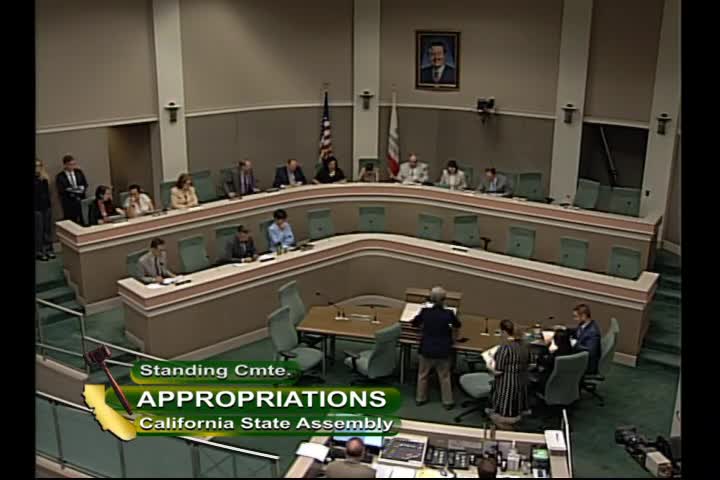 3MIN
Assembly Standing Committee on Appropriations
 15MIN
Assembly Standing Committee on Judiciary
 18MIN
Senate Floor
 10MIN
Senate Standing Committee on Appropriations
 58MIN



