SB 909: Uniform Trust Decanting Act.
- Session Year: 2017-2018
- House: Senate
- Latest Version Date: 2018-09-14
Existing law regulates trust administration and generally requires a trustee to administer the trust according to the trust instrument. Under existing law, a trustee may exercise specified powers without court authorization, including the power to acquire or dispose of property. Existing law authorizes the beneficiaries of an irrevocable trust to compel modification of the trust upon petition to the court, if all beneficiaries of the trust consent.
This bill would enact the Uniform Trust Decanting Act, under which a fiduciary of an irrevocable trust may distribute the property of a first trust to one or more 2nd trusts or modify the terms of the first trust without the consent of the beneficiaries or approval of the court, subject to certain exceptions. The bill would require specified persons, including qualified beneficiaries and, if the trust contains a determinable charitable interest, the Attorney General, to be provided notice of the intended exercise of the decanting power, and would authorize the court, on application by specified persons, to, among other things, approve an exercise of the decanting power. Among other provisions, the bill would require a fiduciary exercising the decanting power to act in accordance with its fiduciary duties and in accordance with the purposes of the first trust. The bill would also specify that the decanting power does not apply to a trust held solely for charitable purposes.
Existing law regulates trust administration and generally requires a trustee to administer the trust according to the trust instrument. Under existing law, a trustee may exercise specified powers without court authorization, including the power to acquire or dispose of property. Existing law authorizes the beneficiaries of an irrevocable trust to compel modification of the trust upon petition to the court, if all beneficiaries of the trust consent.
This bill would enact the Uniform Trust Decanting Act, under which a fiduciary of an irrevocable trust may distribute the property of a first trust to one or more 2nd trusts or modify the terms of the first trust without the consent of the beneficiaries or approval of the court, subject to certain exceptions. The bill would require specified persons, including qualified beneficiaries and, if the trust contains a determinable charitable interest, the Attorney General, to be provided notice of the intended exercise of the decanting power, and would authorize the court, on application by specified persons, to, among other things, approve an exercise of the decanting power. Among other provisions, the bill would require a fiduciary exercising the decanting power to act in accordance with its fiduciary duties and in accordance with the purposes of the first trust. The bill would also specify that the decanting power does not apply to a trust held solely for charitable purposes.
Existing law regulates trust administration and generally requires a trustee to administer the trust according to the trust instrument. Under existing law, a trustee may exercise specified powers without court authorization, including the power to acquire or dispose of property. Existing law authorizes the beneficiaries of an irrevocable trust to compel modification of the trust upon petition to the court, if all beneficiaries of the trust consent.
This bill would enact the Uniform Trust Decanting Act, under which a fiduciary of an irrevocable trust may distribute the property of a first trust to one or more 2nd trusts or modify the terms of the first trust without the consent of the beneficiaries or approval of the court, subject to certain exceptions. The bill would require specified persons, including qualified beneficiaries and, if the trust contains a determinable charitable interest, the Attorney General, to be provided notice of the intended exercise of the decanting power, and would authorize the court, on application by specified persons, to, among other things, approve an exercise of the decanting power. Among other provisions, the bill would require a fiduciary exercising the decanting power to act in accordance with its fiduciary duties and in accordance with the purposes of the first trust. The bill would also specify that the decanting power does not apply to a trust held solely for charitable purposes.
Existing law regulates trust administration and generally requires a trustee to administer the trust according to the trust instrument. Under existing law, a trustee may exercise specified powers without court authorization, including the power to acquire or dispose of property. Existing law authorizes the beneficiaries of an irrevocable trust to compel modification of the trust upon petition to the court, if all beneficiaries of the trust consent.
This bill would enact the Uniform Trust Decanting Act, under which a fiduciary of an irrevocable trust may distribute the property of a first trust to one or more 2nd trusts or modify the terms of the first trust without the consent of the beneficiaries or approval of the court, subject to certain exceptions. The bill would require specified persons, including qualified beneficiaries and, if the trust contains a determinable charitable interest, the Attorney General, to be provided notice of the intended exercise of the decanting power, and would authorize the court, on application by specified persons, to, among other things, approve an exercise of the decanting power. Among other provisions, the bill would require a fiduciary exercising the decanting power to act in accordance with its fiduciary duties and in accordance with the purposes of the first trust. The bill would also specify that the decanting power does not apply to a trust held solely for charitable purposes.
This part may be cited as the Uniform Trust Decanting Act.
19502.For purposes of this part:
(a)Appointive property means the property or property interest subject to a power of appointment.
(b)Ascertainable standard means a standard relating to an individuals health, education, support, or maintenance within the meaning of Section 2041(b)(1)(A) or Section 2514(c)(1) of the Internal Revenue Code (26 U.S.C. Secs. 2041(b)(1)(A), 2514(c)(1)) and any applicable regulations.
(c)Authorized fiduciary means any of the following:
(1)A trustee or other fiduciary, other than a settlor, that has discretion to distribute or direct a trustee to distribute part or all of the principal of the first trust to one or more current beneficiaries.
(2)A special fiduciary appointed under Section 19509.
(3)A special-needs fiduciary under Section 19513.
(d)Beneficiary means a person that meets one of the following conditions:
(1)Has a present or future, vested or contingent, beneficial interest in a trust.
(2)Holds a power of appointment over trust property.
(3)Is an identified charitable organization that will or may receive distributions under the terms of the trust.
(e)Charitable interest means an interest in a trust that meets one of the following conditions:
(1)Is held by an identified charitable organization and makes the organization a qualified beneficiary.
(2)Benefits only charitable organizations and, if the interest were held by an identified charitable organization, would make the organization a qualified beneficiary.
(3)Is held solely for charitable purposes and, if the interest were held by an identified charitable organization, would make the organization a qualified beneficiary.
(f)Charitable organization means either of the following:
(1)A person, other than an individual, organized and operated exclusively for charitable purposes.
(2)A government or governmental subdivision, agency, or instrumentality, to the extent it holds funds exclusively for a charitable purpose.
(g)Charitable purpose means the relief of poverty, the advancement of education or religion, the promotion of health, a municipal or other governmental purpose, or another purpose the achievement of which is beneficial to the community.
(h)Court means the court in this state having jurisdiction in matters relating to trusts.
(i)Current beneficiary means a beneficiary that on the date the beneficiarys qualification is determined is a distributee or permissible distributee of trust income or principal. The term includes the holder of a presently exercisable general power of appointment but does not include a person that is a beneficiary only because the person holds any other power of appointment.
(j)Decanting power or the decanting power means the power of an authorized fiduciary under this part to distribute property of a first trust to one or more second trusts or to modify the terms of the first trust.
(k)Expanded distributive discretion means a discretionary power of distribution that is not limited to an ascertainable standard or a reasonably definite standard.
(l)First trust means a trust over which an authorized fiduciary may exercise the decanting power.
(m)First trust instrument means the trust instrument for a first trust.
(n)General power of appointment means a power of appointment exercisable in favor of a powerholder, the powerholders estate, a creditor of the powerholder, or a creditor of the powerholders estate.
(o)Jurisdiction, with respect to a geographic area, includes a state or country.
(p)Person means an individual, estate, business or nonprofit entity, public corporation, government or governmental subdivision, agency, or instrumentality, or other legal entity.
(q)Power of appointment means a power that enables a powerholder acting in a nonfiduciary capacity to designate a recipient of an ownership interest in, or another power of appointment over, the appointive property. The term does not include a power of attorney.
(r)Powerholder means a person in which a donor creates a power of appointment.
(s)Presently exercisable power of appointment means a power of appointment exercisable by the powerholder at the relevant time.
(1)The term includes a power of appointment exercisable only after the occurrence of a specified event, the satisfaction of an ascertainable standard, or the passage of a specified time only after one of the following, respectively:
(A)The occurrence of the specified event.
(B)The satisfaction of the ascertainable standard.
(C)The passage of the specified time.
(2)The term does not include a power exercisable only at the powerholders death.
(t)Qualified beneficiary means a beneficiary that, on the date the beneficiarys qualification is determined, satisfies one of the following conditions:
(1)Is a distributee or permissible distributee of trust income or principal.
(2)Would be a distributee or permissible distributee of trust income or principal if the interests of the distributees described in paragraph (1) terminated on that date without causing the trust to terminate.
(3)Would be a distributee or permissible distributee of trust income or principal if the trust terminated on that date.
(u)Reasonably definite standard means a clearly measurable standard under which a holder of a power of distribution is legally accountable within the meaning of Section 674(b)(5)(A) of the Internal Revenue Code (26 U.S.C. Sec. 674(b)(5)(A)) and any applicable regulations.
(v)Second trust means either of the following:
(1)A first trust after modification under this part.
(2)A trust to which a distribution of property from a first trust is or may be made under this part.
(w)Second trust instrument means the trust instrument for a second trust.
(x)Settlor, except as otherwise provided in Section 19525, means a person, including a testator, that creates or contributes property to a trust. If more than one person creates or contributes property to a trust, each person is a settlor of the portion of the trust property attributable to the persons contribution except to the extent another person has power to revoke or withdraw that portion.
(y)State means a state of the United States, the District of Columbia, Puerto Rico, the United States Virgin Islands, or any territory or insular possession subject to the jurisdiction of the United States.
(z)Terms of the trust means the manifestation of the settlors intent regarding a trusts provisions as expressed in the trust instrument, as may be established by other evidence that would be admissible in a judicial proceeding, or as may be established by court order or nonjudicial settlement agreement.
(aa)Trust instrument means a trust executed by the settlor to create a trust or by any person to create a second trust that contains some or all of the terms of the trust, including any amendments.
19503.(a)Except as otherwise provided in subdivisions (b) and (c), this part applies to an express trust that is irrevocable or revocable by the settlor only with the consent of the trustee or a person holding an adverse interest.
(b)This part does not apply to a trust held solely for charitable purposes.
(c)Subject to Section 19515, a trust instrument may restrict or prohibit exercise of the decanting power.
(d)This part does not limit the power of a trustee, powerholder, or other person to distribute or appoint property in further trust or to modify a trust under the trust instrument, law of this state other than this part, common law, a court order, or a nonjudicial settlement agreement.
(e)This part does not affect the ability of a settlor to provide in a trust instrument for the distribution of the trust property or appointment in further trust of the trust property or for modification of the trust instrument.
19504.(a)In exercising the decanting power, an authorized fiduciary shall act in accordance with its fiduciary duties, including the duty to act in accordance with the purposes of the first trust.
(b)This part does not create or imply a duty to exercise the decanting power or to inform beneficiaries about the applicability of this part.
(c)Except as otherwise provided in a first trust instrument, for purposes of this part, the terms of the first trust are deemed to include the decanting power.
19505.This part applies to a trust created before, on, or after January 1, 2019, that satisfies either of the following conditions:
(a)Has its principal place of administration in this state, including a trust whose principal place of administration has been changed to this state.
(b)Provides by its trust instrument that it is governed by the law of this state or is governed by the law of this state for the purpose of any of the following:
(1)Administration, including administration of a trust whose governing law for purposes of administration has been changed to the law of this state.
(2)Construction of terms of the trust.
(3)Determining the meaning or effect of terms of the trust.
19507.(a)In this section, a notice period begins on the day notice is given under subdivision (c) and ends 59 days after the day notice is given.
(b)An authorized fiduciary may exercise the decanting power without the consent of any person and without court approval in compliance with this part.
(c)Except as otherwise provided in subdivision (h), an authorized fiduciary shall give notice of the intended exercise of the decanting power not later than 60 days before the exercise to all of the following:
(1)Each settlor of the first trust, if living or then in existence.
(2)Each qualified beneficiary of the first trust.
(3)Each holder of a presently exercisable power of appointment over any part or all of the first trust.
(4)Each person that currently has the right to remove or replace the authorized fiduciary.
(5)Each other fiduciary of the first trust.
(6)Each fiduciary of the second trust.
(7)The Attorney General, if subdivision (b) of Section 19514 applies.
(d)Unless the trust instrument provides otherwise, an authorized fiduciary shall give notice under subdivision (c) to the guardian ad litem for a qualified beneficiary who is a minor and has no representative or who is an unascertained or unborn person. If a guardian ad litem has not been appointed at the time of the notice, the authorized fiduciary shall seek the appointment of one. The court may appoint a guardian ad litem, for purposes of this section, in instances where the only matter before the court is that appointment.
(e)If an authorized fiduciary knows, or has reason to know, that a person entitled to notice under subdivision (c) is substantially unable to manage that persons own financial resources or resist fraud or undue influence, the authorized fiduciary shall give notice under subdivision (c) to that person and to the individual appointed to act on that persons behalf, including, but not limited to, an attorney-in-fact under a power of attorney. If no such individual has been appointed at the time of the notice, the authorized fiduciary shall seek the appointment of such an individual. The court may appoint a guardian ad litem, for purposes of this section, in instances where the only matter before the court is that appointment.
(f)An authorized fiduciary is not required to give notice under subdivision (c) to a person who is known to the fiduciary but cannot be located by the fiduciary after reasonable diligence.
(g)A notice under subdivision (c) shall include all of the following:
(1)A description of the manner in which the authorized fiduciary intends to exercise the decanting power, which shall include a statement as to the authorized fiduciarys reason for the proposed decanting and an explanation as to the differences between the first trust and the second trust or trusts.
(2)The proposed effective date for exercise of the power.
(3)A copy of the first trust instrument.
(4)A copy of all second trust instruments.
(5)A warning, set out in a separate paragraph in not less than 10-point bold type, or a reasonable equivalent thereof, that states the following:
If you do not bring a court action to contest the proposed trust decanting (the proposed changes to the trust) within 59 days of this notice, you will lose your right to contest the decanting.
(h)The decanting power may be exercised before expiration of the notice period under subdivision (a) if all persons entitled to receive notice waive the period in a signed waiver.
(i)The receipt of notice, waiver of the notice period, or expiration of the notice period does not affect the right of a person to file an application under Section 19509 that asserts either of the following:
(1)An attempted exercise of the decanting power is ineffective because it did not comply with this part or was an abuse of discretion or breach of fiduciary duty.
(2)Section 19522 applies to the exercise of the decanting power.
(j)The notice required by this section shall be served by mail to the last known address, pursuant to Section 1215, or by personal delivery.
19508.(a)Notice to a person with authority to represent and bind another person under this code or a first trust instrument has the same effect as notice given directly to the person represented.
(b)Consent of or waiver by a person with authority to represent and bind another person under this code or a first trust instrument is binding on the person represented unless the person represented objects to the representation before the consent or waiver otherwise would become effective.
(c)A person with authority to represent and bind another person under this code or a first trust instrument may file an application under Section 19509 on behalf of the person represented.
(d)A settlor may not represent or bind a beneficiary under this part.
19509.(a)On application of an authorized fiduciary, a person entitled to notice under subdivision (c) of Section 19507, a beneficiary, or, with respect to a charitable interest, the Attorney General or other person that has standing to enforce the charitable interest, the court may do any of the following:
(1)Provide instructions to the authorized fiduciary regarding whether a proposed exercise of the decanting power is permitted under this part and is consistent with the fiduciary duties of the authorized fiduciary.
(2)Appoint a special fiduciary and authorize the special fiduciary to determine whether the decanting power should be exercised under this part and to exercise the decanting power.
(3)Approve an exercise of the decanting power.
(4)Determine that a proposed or attempted exercise of the decanting power is ineffective because of either of the following:
(A)After applying Section 19522, the proposed or attempted exercise does not or did not comply with this part.
(B)The proposed or attempted exercise would be or was an abuse of the fiduciarys discretion or a breach of fiduciary duty.
(5)Determine the extent to which Section 19522 applies to a prior exercise of the decanting power.
(6)Provide instructions to the trustee regarding the application of Section 19522 to a prior exercise of the decanting power.
(7)Order other relief to carry out the purposes of this part.
(b)If an application is made under subdivision (a), the burden is on the authorized fiduciary to establish that notice was given as required by Section 19507 and that the authorized fiduciary may exercise the decanting power.
(c)On application of an authorized fiduciary, the court may approve either or both of the following:
(1)An increase in the fiduciarys compensation under Section 19516.
(2)A modification under Section 19518 of a provision granting a person the right to remove or replace the fiduciary.
19510.An exercise of the decanting power shall be made in a writing signed by an authorized fiduciary. The signed writing shall, directly or by reference to the notice required by Section 19507, identify the first trust and the second trust or trusts and state the property of the first trust being distributed to each second trust and the property, if any, that remains in the first trust.
19511.(a)For purposes of this section:
(1)Noncontingent right means a right that is not subject to the exercise of discretion or the occurrence of a specified event that is not certain to occur. The term does not include a right held by a beneficiary if any person has discretion to distribute property subject to the right to any person other than the beneficiary or the beneficiarys estate.
(2)Presumptive remainder beneficiary means a qualified beneficiary other than a current beneficiary.
(3)Successor beneficiary means a beneficiary that is not a qualified beneficiary on the date the beneficiarys qualification is determined. The term does not include a person that is a beneficiary only because the person holds a nongeneral power of appointment.
(4)Vested interest means any of the following:
(A)A right to a mandatory distribution that is a noncontingent right as of the date of the exercise of the decanting power.
(B)A current and noncontingent right, annually or more frequently, to a mandatory distribution of income, a specified dollar amount, or a percentage of value of some or all of the trust property.
(C)A current and noncontingent right, annually or more frequently, to withdraw income, a specified dollar amount, or a percentage of value of some or all of the trust property.
(D)A presently exercisable general power of appointment.
(E)A right to receive an ascertainable part of the trust property on the trusts termination that is not subject to the exercise of discretion or to the occurrence of a specified event that is not certain to occur.
(b)Subject to subdivision (c) and Section 19514, an authorized fiduciary that has expanded distributive discretion over the principal of a first trust for the benefit of one or more current beneficiaries may exercise the decanting power over the principal of the first trust.
(c)Subject to Section 19513, in an exercise of the decanting power under this section, a second trust may not do any of the following:
(1)Include as a current beneficiary a person that is not a current beneficiary of the first trust, except as otherwise provided in subdivision (d).
(2)Include as a presumptive remainder beneficiary or successor beneficiary a person that is not a current beneficiary, presumptive remainder beneficiary, or successor beneficiary of the first trust, except as otherwise provided in subdivision (d).
(3)Reduce or eliminate a vested interest.
(d)Subject to paragraph (3) of subdivision (c) and Section 19514, in an exercise of the decanting power under this section, a second trust may be a trust created or administered under the law of any jurisdiction and may do each of the following:
(1)Retain a power of appointment granted in the first trust.
(2)Omit a power of appointment granted in the first trust, other than a presently exercisable general power of appointment.
(3)Create or modify a power of appointment if the powerholder is a current beneficiary of the first trust and the authorized fiduciary has expanded distributive discretion to distribute principal to the beneficiary.
(4)Create or modify a power of appointment if the powerholder is a presumptive remainder beneficiary or successor beneficiary of the first trust, but the exercise of the power may take effect only after the powerholder becomes, or would have become if then living, a current beneficiary.
(e)A power of appointment described in paragraphs (1) to (4), inclusive, of subdivision (d) may be general or nongeneral. The class of permissible appointees in favor of which the power may be exercised may be broader than, or different from, the beneficiaries of the first trust.
(f)If an authorized fiduciary has expanded distributive discretion over part but not all of the principal of a first trust, the fiduciary may exercise the decanting power under this section over that part of the principal over which the authorized fiduciary has expanded distributive discretion.
19512.(a)For purposes of this section, limited distributive discretion means a discretionary power of distribution that is limited to an ascertainable standard or a reasonably definite standard.
(b)An authorized fiduciary that has limited distributive discretion over the principal of the first trust for benefit of one or more current beneficiaries may exercise the decanting power over the principal of the first trust.
(c)Under this section and subject to Section 19514, a second trust may be created or administered under the law of any jurisdiction. Under this section, the second trusts, in the aggregate, shall grant each beneficiary of the first trust beneficial interests which are substantially similar to the beneficial interests of the beneficiary in the first trust. For purposes of this subdivision, substantially similar means that there is no material change in a beneficiarys beneficial interests, except as provided in subdivision (d).
(d)A power to make a distribution under a second trust for the benefit of a beneficiary who is an individual is substantially similar to a power under the first trust to make a distribution directly to the beneficiary. A distribution is for the benefit of a beneficiary if it satisfies any of the following conditions:
(1)The distribution is applied for the benefit of the beneficiary.
(2)The beneficiary is under a legal disability or the trustee reasonably believes the beneficiary is incapacitated, and the distribution is made as permitted under this code.
(3)The distribution is made as permitted under the terms of the first trust instrument and the second trust instrument for the benefit of the beneficiary.
(e)If an authorized fiduciary has limited distributive discretion over part but not all of the principal of a first trust, the fiduciary may exercise the decanting power under this section over that part of the principal over which the authorized fiduciary has limited distributive discretion.
19513.(a)For purposes of this section:
(1)Beneficiary with a disability means a beneficiary of a first trust who the special needs fiduciary believes may qualify for governmental benefits based on disability, whether or not the beneficiary currently receives those benefits or is an individual who has been adjudicated legally incompetent.
(2)Governmental benefits means financial aid or services from a state, federal, or other public agency.
(3)Special needs fiduciary means, with respect to a trust that has a beneficiary with a disability, any of the following:
(A)A trustee or other fiduciary, other than a settlor, that has discretion to distribute part or all of the principal of a first trust to one or more current beneficiaries.
(B)If no trustee or fiduciary has discretion under subparagraph (A), a trustee or other fiduciary, other than a settlor, that has discretion to distribute part or all of the income of the first trust to one or more current beneficiaries.
(C)If no trustee or fiduciary has discretion under subparagraphs (A) and (B), a trustee or other fiduciary, other than a settlor, that is required to distribute part or all of the income or principal of the first trust to one or more current beneficiaries.
(4)Special needs trust means a trust the trustee believes would not be considered a resource for purposes of determining whether a beneficiary with a disability is eligible for governmental benefits.
(b)A special needs fiduciary may exercise the decanting power under Section 19511 over the principal of a first trust as if the fiduciary had authority to distribute principal to a beneficiary with a disability subject to expanded distributive discretion if both of the following conditions are satisfied:
(1)A second trust is a special needs trust that benefits the beneficiary with a disability.
(2)The special needs fiduciary determines that exercise of the decanting power will further the purposes of the first trust.
(c)In an exercise of the decanting power under this section, all of the following rules apply:
(1)Notwithstanding paragraph (2) of subdivision (c) of Section 19511, the interest in the second trust of a beneficiary with a disability may fulfill either of the following:
(A)Be a pooled trust as defined by Medicaid law for the benefit of the beneficiary with a disability under Section 1396p(d)(4)(C) of the Public Health and Welfare Code (42 U.S.C. Sec. 1396p(d)(4)(C)).
(B)Contain payback provisions complying with reimbursement requirements of Medicaid law under Section 1396p(d)(4)(A) of the Public Health and Welfare Code (42 U.S.C. Sec. 1396p(d)(4)(A)).
(2)Paragraph (3) of subdivision (c) of Section 19511 does not apply to the interests of the beneficiary with a disability.
(3)Except as affected by any change to the interests of the beneficiary with a disability, the second trust, or if there are two or more second trusts, the second trusts in the aggregate, shall grant each other beneficiary of the first trust beneficial interests in the second trusts which are substantially similar to the beneficiarys beneficial interests in the first trust.
19514.(a)For purposes of this section:
(1)Determinable charitable interest means a charitable interest that is a right to a mandatory distribution currently, periodically, on the occurrence of a specified event, or after the passage of a specified time and that is unconditional or will be held solely for charitable purposes.
(2)Unconditional means not subject to the occurrence of a specified event that is not certain to occur, other than a requirement in a trust instrument that a charitable organization be in existence or qualify under a particular provision of the United States Internal Revenue Code of 1986 on the date of the distribution, if the charitable organization meets the requirement on the date of determination.
(b)If a first trust contains a determinable charitable interest, the Attorney General has the rights of a qualified beneficiary and may represent and bind the charitable interest.
(c)If a first trust contains a charitable interest, the second trust or trusts may not do any of the following:
(1)Diminish the charitable interest.
(2)Diminish the interest of an identified charitable organization that holds the charitable interest.
(3)Alter any charitable purpose stated in the first trust instrument.
(4)Alter any condition or restriction related to the charitable interest.
(d)If there are two or more second trusts, the second trusts shall be treated as one trust for purposes of determining whether the exercise of the decanting power diminishes the charitable interest or diminishes the interest of an identified charitable organization for purposes of subdivision (c).
(e)If a first trust contains a determinable charitable interest, the second trust or trusts that include a charitable interest pursuant to subdivision (c) shall be administered under the law of this state unless any of the following occur:
(1)The Attorney General, after receiving notice under Section 19507, fails to object in a signed writing delivered to the authorized fiduciary within the notice period.
(2)The Attorney General consents in a signed writing to the second trust or trusts being administered under the law of another jurisdiction.
(3)The court approves the exercise of the decanting power.
(f)This part does not limit the powers and duties of the Attorney General under law of this state other than this part.
19515.(a)An authorized fiduciary may not exercise the decanting power to the extent the first trust instrument expressly prohibits exercise of either of the following:
(1)The decanting power.
(2)A power granted by state law to the fiduciary to distribute part or all of the principal of the trust to another trust or to modify the trust.
(b)Exercise of the decanting power is subject to any restriction in the first trust instrument that expressly applies to exercise of either of the following:
(1)The decanting power.
(2)A power granted by state law to a fiduciary to distribute part or all of the principal of the trust to another trust or to modify the trust.
(c)A general prohibition of the amendment or revocation of a first trust, a spendthrift clause, or a clause restraining the voluntary or involuntary transfer of a beneficiarys interest does not preclude exercise of the decanting power.
(d)Subject to subdivisions (a) and (b), an authorized fiduciary may exercise the decanting power under this part even if the first trust instrument permits the authorized fiduciary or another person to modify the first trust instrument or to distribute part or all of the principal of the first trust to another trust.
(e)If a first trust instrument contains an express prohibition described in subdivision (a) or an express restriction described in subdivision (b), the authorized fiduciary shall include that provision or restriction in the second trust instrument.
19516.(a)If a first trust instrument specifies an authorized fiduciarys compensation, the fiduciary may not exercise the decanting power to increase the fiduciarys compensation above the specified compensation unless either of the following occurs:
(1)All qualified beneficiaries of the second trust consent to the increase in a signed writing.
(2)The increase is approved by the court.
(b)If a first trust instrument does not specify an authorized fiduciarys compensation, the fiduciary may not exercise the decanting power to increase the fiduciarys compensation above the compensation permitted by this code unless either of the following occurs:
(1)All qualified beneficiaries of the second trust consent to the increase in a signed writing.
(2)The increase is approved by the court.
(c)(1)A change in an authorized fiduciarys compensation which is incidental to other changes made by the exercise of the decanting power is not an increase in the fiduciarys compensation for purposes of subdivisions (a) and (b).
(2)For purposes of this subdivision, an incidental change to an authorized fiduciarys compensation includes, but is not limited to, an increase in the compensation of the authorized fiduciary for either of the following reasons:
(A)The second trust lasts longer than the first trust.
(B)The second trust has a greater value than the first trust.
19517.(a)Except as otherwise provided in this section, a second trust instrument may not relieve an authorized fiduciary from liability for breach of trust to a greater extent than the first trust instrument.
(b)A second trust instrument may provide for indemnification of an authorized fiduciary of the first trust or another person acting in a fiduciary capacity under the first trust for any liability or claim that would have been payable from the first trust if the decanting power had not been exercised.
(c)A second trust instrument may not reduce fiduciary liability in the aggregate.
(d)Subject to subdivision (c), a second trust instrument may reallocate fiduciary powers among fiduciaries as permitted by the law of this state other than this part.
19518.An authorized fiduciary may not exercise the decanting power to modify a provision in a first trust instrument granting another person power to remove or replace the fiduciary unless any of the following occurs:
(a)The person holding the power consents to the modification in a signed writing and the modification applies only to the person.
(b)The person holding the power and the qualified beneficiaries of the second trust consent to the modification in a signed writing and the modification grants a substantially similar power to another person.
(c)The court approves the modification and the modification grants a substantially similar power to another person.
19519.(a)For purposes of this section:
(1)Grantor trust means a trust as to which a settlor of a first trust is considered the owner under Sections 671 to 677, inclusive, or Section 679 of the Internal Revenue Code (26 U.S.C. Secs. 671 to 677, 679).
(2)Nongrantor trust means a trust that is not a grantor trust.
(3)Qualified benefits property means property subject to the minimum distribution requirements of Section 401(a)(9) of the Internal Revenue Code (26 U.S.C. Sec. 401(a)(9)), and any applicable regulations, or to any similar requirements that refer to Section 401(a)(9) of the Internal Revenue Code (26 U.S.C. Sec. 401(a)(9)) or the regulations.
(b)An exercise of the decanting power is subject to all of the following limitations:
(1)If a first trust contains property that qualified, or would have qualified but for provisions of this part other than this section, for a marital deduction for purposes of the gift or estate tax under the Internal Revenue Code or a state gift, estate, or inheritance tax, the second trust instrument shall not include or omit any term that, if included in or omitted from the trust instrument for the trust to which the property was transferred, would have prevented the transfer from qualifying for the deduction, or would have reduced the amount of the deduction, under the same provisions of the Internal Revenue Code or state law under which the transfer qualified.
(2)If the first trust contains property that qualified, or would have qualified but for provisions of this part other than this section, for a charitable deduction for purposes of the income, gift, or estate tax under the Internal Revenue Code or a state income, gift, estate, or inheritance tax, the second trust instrument shall not include or omit any term that, if included in or omitted from the trust instrument for the trust to which the property was transferred, would have prevented the transfer from qualifying for the deduction, or would have reduced the amount of the deduction, under the same provisions of the Internal Revenue Code or state law under which the transfer qualified.
(3)If the first trust contains property that qualified, or would have qualified but for provisions of this part other than this section, for the exclusion from the gift tax described in Section 2503(b) of the Internal Revenue Code (26 U.S.C. Sec. 2503(b)), the second trust instrument shall not include or omit a term that, if included in or omitted from the trust instrument for the trust to which the property was transferred, would have prevented the transfer from qualifying under Section 2503(b) of the Internal Revenue Code (26 U.S.C. Sec. 2503(b)). If the first trust contains property that qualified, or would have qualified but for provisions of this part other than this section, for the exclusion from the gift tax described in Section 2503(b) of the Internal Revenue Code (26 U.S.C. Sec. 2503(b)) by application of Section 2503(c) of the Internal Revenue Code (26 U.S.C. Sec. 2503(c)), the second trust instrument shall not include or omit a term that, if included or omitted from the trust instrument for the trust to which the property was transferred, would have prevented the transfer from qualifying under Section 2503(c) of the Internal Revenue Code (26 U.S.C. Sec. 2503(c)).
(4)If the property of the first trust includes shares of stock in an S-corporation, as defined in Section 1361 of the Internal Revenue Code (26 U.S.C. Sec. 1361) and the first trust is, or but for provisions of this part other than this section would be, a permitted shareholder under any provision of Section 1361 of the Internal Revenue Code (26 U.S.C. Sec. 1361), an authorized fiduciary may exercise the power with respect to part or all of the S-corporation stock only if any second trust receiving the stock is a permitted shareholder under Section 1361(c)(2) of the Internal Revenue Code (26 U.S.C. Sec. 1361(c)(2)). If the property of the first trust includes shares of stock in an S-corporation and the first trust is, or but for provisions of this part other than this section would be, a qualified subchapter-S trust within the meaning of Section 1361(d) of the Internal Revenue Code (26 U.S.C. Sec. 1361(d)), the second trust instrument shall not include or omit a term that prevents the second trust from qualifying as a qualified subchapter-S trust.
(5)If the first trust contains property that qualified, or would have qualified but for provisions of this part other than this section, for a zero inclusion ratio for purposes of the generation-skipping transfer tax under Section 2642(c) of the Internal Revenue Code (26 U.S.C. Sec. 2642(c)), the second trust instrument shall not include or omit a term that, if included in or omitted from the first trust instrument, would have prevented the transfer to the first trust from qualifying for a zero inclusion ratio under Section 2642(c) of the Internal Revenue Code (26 U.S.C. Sec. 2642(c)).
(6)If the first trust is directly or indirectly the beneficiary of qualified benefits property, the second trust instrument may not include or omit any term that, if included in or omitted from the first trust instrument, would have increased the minimum distributions required with respect to the qualified benefits property under Section 401(a)(9) of the Internal Revenue Code (26 U.S.C. Sec. 401(a)(9)) and any applicable regulations, or any similar requirements that refer to Section 401(a)(9) of the Internal Revenue Code (26 U.S.C. Sec. 401(a)(9)) or the regulations. If an attempted exercise of the decanting power violates the preceding sentence, the trustee is deemed to have held the qualified benefits property and any reinvested distributions of the property as a separate share from the date of the exercise of the power and Section 19522 applies to the separate share.
(7)If the first trust qualifies as a grantor trust because of the application of Section 672(f)(2)(A) of the Internal Revenue Code (26 U.S.C. Sec. 672(f)(2)(A)), the second trust may not include or omit a term that, if included in or omitted from the first trust instrument, would have prevented the first trust from qualifying under Section 672(f)(2)(A) of the Internal Revenue Code (26 U.S.C. Sec. 672(f)(2)(A)).
(8)In this paragraph, tax benefit means a federal or state tax deduction, exemption, exclusion, or other benefit not otherwise listed in this section, except for a benefit arising from being a grantor trust. Subject to paragraph (9), a second trust instrument may not include or omit a term that, if included in or omitted from the first trust instrument, would have prevented qualification for a tax benefit if both of the following apply:
(A)The first trust instrument expressly indicates an intent to qualify for the benefit or the first trust instrument clearly is designed to enable the first trust to qualify for the benefit.
(B)The transfer of property held by the first trust or the first trust qualified, or, but for provisions of this part other than this section, would have qualified for the tax benefit.
(9)(A)Subject to paragraph (4), and except as otherwise provided in paragraph (7), the second trust may be a nongrantor trust, even if the first trust is a grantor trust.
(B)Subject to paragraph (4), and except as otherwise provided in paragraph (10), the second trust may be a grantor trust, even if the first trust is a nongrantor trust.
(10)An authorized fiduciary may not exercise the decanting power if a settlor objects in a signed writing delivered to the fiduciary within the notice period and either of the following conditions is satisfied:
(A)The first trust and a second trust are both grantor trusts, in whole or in part, the first trust grants the settlor or another person the power to cause the first trust to cease to be a grantor trust, and the second trust does not grant an equivalent power to the settlor or other person.
(B)The first trust is a nongrantor trust and a second trust is a grantor trust, in whole or in part, with respect to the settlor, unless either of the following apply:
(i)The settlor has the power at all times to cause the second trust to cease to be a grantor trust.
(ii)The first trust instrument contains a provision granting the settlor or another person a power that would cause the first trust to cease to be a grantor trust and the second trust instrument contains the same provision.
19520.(a)Subject to subdivision (b), a second trust may have a duration that is the same as, or different from, the duration of the first trust.
(b)To the extent that property of a second trust is attributable to property of the first trust, the property of the second trust is subject to any rules governing maximum perpetuity, accumulation, or suspension of the power of alienation that apply to property of the first trust.
19521.An authorized fiduciary may exercise the decanting power whether or not under the first trusts discretionary distribution standard the fiduciary would have made or could have been compelled to make a discretionary distribution of principal at the time of the exercise.
19522.(a)If exercise of the decanting power would be effective under this part, except that the second trust instrument in part does not comply with this part, the exercise of the power is effective and the following rules apply with respect to the principal of the second trust attributable to the exercise of the power:
(1)A provision in the second trust instrument that is not permitted under this part is void to the extent necessary to comply with this part.
(2)A provision required by this part to be in the second trust instrument, which is not contained in the instrument, is deemed to be included in the instrument to the extent necessary to comply with this part.
(b)If a trustee or other fiduciary of a second trust determines that subdivision (a) applies to a prior exercise of the decanting power, the fiduciary shall take corrective action consistent with the fiduciarys duties.
19523.(a)For purposes of this section:
(1)Animal trust means a trust or an interest in a trust described in Section 15212.
(2)Protector means either of the following:
(A)A person appointed in an animal trust to enforce the trust on behalf of the animal as described in subdivision (c) of Section 15212 or, if no person is appointed in the trust for that purpose, a person appointed by the court for that purpose.
(B)A nonprofit charitable corporation described in subdivision (e) of Section 15212 that has requested an accounting in writing.
(b)The decanting power may be exercised over an animal trust that has a protector to the extent the trust could be decanted under this part if each animal that benefits from the trust were an individual, if the protector consents in a signed writing to the exercise of the power.
(c)A protector for an animal has the rights under this part of a qualified beneficiary.
(d)Notwithstanding any other provision of this part, if a first trust is an animal trust, in an exercise of the decanting power, the second trust shall provide that trust property may be applied only to its intended purpose for the period the first trust benefited the animal.
19524.A reference in this code to a trust instrument or terms of the trust includes a second trust instrument and the terms of the second trust.
19525.(a)For purposes of the law of this state other than this part and subject to subdivision (b), a settlor of a first trust is deemed to be the settlor of the second trust with respect to the portion of the principal of the first trust subject to the exercise of the decanting power.
(b)In determining settlor intent with respect to a second trust, the intent of a settlor of the first trust, a settlor of the second trust, and the authorized fiduciary may be considered.
19526.(a)Except as otherwise provided in subdivision (c), if exercise of the decanting power was intended to distribute all the principal of the first trust to one or more second trusts, later-discovered property belonging to the first trust and property paid to or acquired by the first trust after the exercise of the power is part of the trust estate of the second trust or trusts.
(b)Except as otherwise provided in subdivision (c), if exercise of the decanting power was intended to distribute less than all the principal of the first trust to one or more second trusts, later-discovered property belonging to the first trust or property paid to or acquired by the first trust after exercise of the power remains part of the trust estate of the first trust.
(c)An authorized fiduciary may provide in an exercise of the decanting power or by the terms of a second trust for disposition of later-discovered property belonging to the first trust or property paid to or acquired by the first trust after exercise of the power.
19527.A debt, liability, or other obligation enforceable against property of a first trust is enforceable to the same extent against the property when held by the second trust after exercise of the decanting power.
19529.Nothing in this part limits a trustees ability to petition for instructions or other approval under a trust pursuant Chapter 3 (commencing with Section 17200) of Part 5 or to petition for modification of a trust pursuant to Chapter 3 (commencing with Section 15400) of Part 2.
19530.The provisions of this part are severable. If any provision of this part or its application is held invalid, that invalidity shall not affect other provisions or applications that can be given effect without the invalid provision or application.
This part may be cited as the Uniform Trust Decanting Act.
19502.For purposes of this part:
(a)Appointive property means the property or property interest subject to a power of appointment.
(b)Ascertainable standard means a standard relating to an individuals health, education, support, or maintenance within the meaning of Section 2041(b)(1)(A) or Section 2514(c)(1) of the Internal Revenue Code (26 U.S.C. Secs. 2041(b)(1)(A), 2514(c)(1)) and any applicable regulations.
(c)Authorized fiduciary means any of the following:
(1)A trustee or other fiduciary, other than a settlor, that has discretion to distribute or direct a trustee to distribute part or all of the principal of the first trust to one or more current beneficiaries.
(2)A special fiduciary appointed under Section 19509.
(3)A special-needs fiduciary under Section 19513.
(d)Beneficiary means a person that meets one of the following conditions:
(1)Has a present or future, vested or contingent, beneficial interest in a trust.
(2)Holds a power of appointment over trust property.
(3)Is an identified charitable organization that will or may receive distributions under the terms of the trust.
(e)Charitable interest means an interest in a trust that meets one of the following conditions:
(1)Is held by an identified charitable organization and makes the organization a qualified beneficiary.
(2)Benefits only charitable organizations and, if the interest were held by an identified charitable organization, would make the organization a qualified beneficiary.
(3)Is held solely for charitable purposes and, if the interest were held by an identified charitable organization, would make the organization a qualified beneficiary.
(f)Charitable organization means either of the following:
(1)A person, other than an individual, organized and operated exclusively for charitable purposes.
(2)A government or governmental subdivision, agency, or instrumentality, to the extent it holds funds exclusively for a charitable purpose.
(g)Charitable purpose means the relief of poverty, the advancement of education or religion, the promotion of health, a municipal or other governmental purpose, or another purpose the achievement of which is beneficial to the community.
(h)Court means the court in this state having jurisdiction in matters relating to trusts.
(i)Current beneficiary means a beneficiary that on the date the beneficiarys qualification is determined is a distributee or permissible distributee of trust income or principal. The term includes the holder of a presently exercisable general power of appointment but does not include a person that is a beneficiary only because the person holds any other power of appointment.
(j)Decanting power or the decanting power means the power of an authorized fiduciary under this part to distribute property of a first trust to one or more second trusts or to modify the terms of the first trust.
(k)Expanded distributive discretion means a discretionary power of distribution that is not limited to an ascertainable standard or a reasonably definite standard.
(l)First trust means a trust over which an authorized fiduciary may exercise the decanting power.
(m)First trust instrument means the trust instrument for a first trust.
(n)General power of appointment means a power of appointment exercisable in favor of a powerholder, the powerholders estate, a creditor of the powerholder, or a creditor of the powerholders estate.
(o)Jurisdiction, with respect to a geographic area, includes a state or country.
(p)Person means an individual, estate, business or nonprofit entity, public corporation, government or governmental subdivision, agency, or instrumentality, or other legal entity.
(q)Power of appointment means a power that enables a powerholder acting in a nonfiduciary capacity to designate a recipient of an ownership interest in, or another power of appointment over, the appointive property. The term does not include a power of attorney.
(r)Powerholder means a person in which a donor creates a power of appointment.
(s)Presently exercisable power of appointment means a power of appointment exercisable by the powerholder at the relevant time.
(1)The term includes a power of appointment exercisable only after the occurrence of a specified event, the satisfaction of an ascertainable standard, or the passage of a specified time only after one of the following, respectively:
(A)The occurrence of the specified event.
(B)The satisfaction of the ascertainable standard.
(C)The passage of the specified time.
(2)The term does not include a power exercisable only at the powerholders death.
(t)Qualified beneficiary means a beneficiary that, on the date the beneficiarys qualification is determined, satisfies one of the following conditions:
(1)Is a distributee or permissible distributee of trust income or principal.
(2)Would be a distributee or permissible distributee of trust income or principal if the interests of the distributees described in paragraph (1) terminated on that date without causing the trust to terminate.
(3)Would be a distributee or permissible distributee of trust income or principal if the trust terminated on that date.
(u)Reasonably definite standard means a clearly measurable standard under which a holder of a power of distribution is legally accountable within the meaning of Section 674(b)(5)(A) of the Internal Revenue Code (26 U.S.C. Sec. 674(b)(5)(A)) and any applicable regulations.
(v)Second trust means either of the following:
(1)A first trust after modification under this part.
(2)A trust to which a distribution of property from a first trust is or may be made under this part.
(w)Second trust instrument means the trust instrument for a second trust.
(x)Settlor, except as otherwise provided in Section 19525, means a person, including a testator, that creates or contributes property to a trust. If more than one person creates or contributes property to a trust, each person is a settlor of the portion of the trust property attributable to the persons contribution except to the extent another person has power to revoke or withdraw that portion.
(y)State means a state of the United States, the District of Columbia, Puerto Rico, the United States Virgin Islands, or any territory or insular possession subject to the jurisdiction of the United States.
(z)Terms of the trust means the manifestation of the settlors intent regarding a trusts provisions as expressed in the trust instrument, as may be established by other evidence that would be admissible in a judicial proceeding, or as may be established by court order or nonjudicial settlement agreement.
(aa)Trust instrument means a trust executed by the settlor to create a trust or by any person to create a second trust that contains some or all of the terms of the trust, including any amendments.
19503.(a)Except as otherwise provided in subdivisions (b) and (c), this part applies to an express trust that is irrevocable or revocable by the settlor only with the consent of the trustee or a person holding an adverse interest.
(b)This part does not apply to a trust held solely for charitable purposes.
(c)Subject to Section 19515, a trust instrument may restrict or prohibit exercise of the decanting power.
(d)This part does not limit the power of a trustee, powerholder, or other person to distribute or appoint property in further trust or to modify a trust under the trust instrument, law of this state other than this part, common law, a court order, or a nonjudicial settlement agreement.
(e)This part does not affect the ability of a settlor to provide in a trust instrument for the distribution of the trust property or appointment in further trust of the trust property or for modification of the trust instrument.
19504.(a)In exercising the decanting power, an authorized fiduciary shall act in accordance with its fiduciary duties, including the duty to act in accordance with the purposes of the first trust.
(b)This part does not create or imply a duty to exercise the decanting power or to inform beneficiaries about the applicability of this part.
(c)Except as otherwise provided in a first trust instrument, for purposes of this part, the terms of the first trust are deemed to include the decanting power.
19505.This part applies to a trust created before, on, or after January 1, 2019, that satisfies either of the following conditions:
(a)Has its principal place of administration in this state, including a trust whose principal place of administration has been changed to this state.
(b)Provides by its trust instrument that it is governed by the law of this state or is governed by the law of this state for the purpose of any of the following:
(1)Administration, including administration of a trust whose governing law for purposes of administration has been changed to the law of this state.
(2)Construction of terms of the trust.
(3)Determining the meaning or effect of terms of the trust.
19507.(a)In this section, a notice period begins on the day notice is given under subdivision (c) and ends 59 days after the day notice is given.
(b)An authorized fiduciary may exercise the decanting power without the consent of any person and without court approval in compliance with this part.
(c)Except as otherwise provided in subdivision (h), an authorized fiduciary shall give notice of the intended exercise of the decanting power not later than 60 days before the exercise to all of the following:
(1)Each settlor of the first trust, if living or then in existence.
(2)Each qualified beneficiary of the first trust.
(3)Each holder of a presently exercisable power of appointment over any part or all of the first trust.
(4)Each person that currently has the right to remove or replace the authorized fiduciary.
(5)Each other fiduciary of the first trust.
(6)Each fiduciary of the second trust.
(7)The Attorney General, if subdivision (b) of Section 19514 applies.
(d)Unless the trust instrument provides otherwise, an authorized fiduciary shall give notice under subdivision (c) to the guardian ad litem for a qualified beneficiary who is a minor and has no representative or who is an unascertained or unborn person. If a guardian ad litem has not been appointed at the time of the notice, the authorized fiduciary shall seek the appointment of one. The court may appoint a guardian ad litem, for purposes of this section, in instances where the only matter before the court is that appointment.
(e)If an authorized fiduciary knows, or has reason to know, that a person entitled to notice under subdivision (c) is substantially unable to manage that persons own financial resources or resist fraud or undue influence, the authorized fiduciary shall give notice under subdivision (c) to that person and to the individual appointed to act on that persons behalf, including, but not limited to, an attorney-in-fact under a power of attorney. If no such individual has been appointed at the time of the notice, the authorized fiduciary shall seek the appointment of such an individual. The court may appoint a guardian ad litem, for purposes of this section, in instances where the only matter before the court is that appointment.
(f)An authorized fiduciary is not required to give notice under subdivision (c) to a person who is known to the fiduciary but cannot be located by the fiduciary after reasonable diligence.
(g)A notice under subdivision (c) shall include all of the following:
(1)A description of the manner in which the authorized fiduciary intends to exercise the decanting power, which shall include a statement as to the authorized fiduciarys reason for the proposed decanting and an explanation as to the differences between the first trust and the second trust or trusts.
(2)The proposed effective date for exercise of the power.
(3)A copy of the first trust instrument.
(4)A copy of all second trust instruments.
(5)A warning, set out in a separate paragraph in not less than 10-point bold type, or a reasonable equivalent thereof, that states the following:
If you do not bring a court action to contest the proposed trust decanting (the proposed changes to the trust) within 59 days of this notice, you will lose your right to contest the decanting.
(h)The decanting power may be exercised before expiration of the notice period under subdivision (a) if all persons entitled to receive notice waive the period in a signed waiver.
(i)The receipt of notice, waiver of the notice period, or expiration of the notice period does not affect the right of a person to file an application under Section 19509 that asserts either of the following:
(1)An attempted exercise of the decanting power is ineffective because it did not comply with this part or was an abuse of discretion or breach of fiduciary duty.
(2)Section 19522 applies to the exercise of the decanting power.
(j)The notice required by this section shall be served by mail to the last known address, pursuant to Section 1215, or by personal delivery.
19508.(a)Notice to a person with authority to represent and bind another person under this code or a first trust instrument has the same effect as notice given directly to the person represented.
(b)Consent of or waiver by a person with authority to represent and bind another person under this code or a first trust instrument is binding on the person represented unless the person represented objects to the representation before the consent or waiver otherwise would become effective.
(c)A person with authority to represent and bind another person under this code or a first trust instrument may file an application under Section 19509 on behalf of the person represented.
(d)A settlor may not represent or bind a beneficiary under this part.
19509.(a)On application of an authorized fiduciary, a person entitled to notice under subdivision (c) of Section 19507, a beneficiary, or, with respect to a charitable interest, the Attorney General or other person that has standing to enforce the charitable interest, the court may do any of the following:
(1)Provide instructions to the authorized fiduciary regarding whether a proposed exercise of the decanting power is permitted under this part and is consistent with the fiduciary duties of the authorized fiduciary.
(2)Appoint a special fiduciary and authorize the special fiduciary to determine whether the decanting power should be exercised under this part and to exercise the decanting power.
(3)Approve an exercise of the decanting power.
(4)Determine that a proposed or attempted exercise of the decanting power is ineffective because of either of the following:
(A)After applying Section 19522, the proposed or attempted exercise does not or did not comply with this part.
(B)The proposed or attempted exercise would be or was an abuse of the fiduciarys discretion or a breach of fiduciary duty.
(5)Determine the extent to which Section 19522 applies to a prior exercise of the decanting power.
(6)Provide instructions to the trustee regarding the application of Section 19522 to a prior exercise of the decanting power.
(7)Order other relief to carry out the purposes of this part.
(b)If an application is made under subdivision (a), the burden is on the authorized fiduciary to establish that notice was given as required by Section 19507 and that the authorized fiduciary may exercise the decanting power.
(c)On application of an authorized fiduciary, the court may approve either or both of the following:
(1)An increase in the fiduciarys compensation under Section 19516.
(2)A modification under Section 19518 of a provision granting a person the right to remove or replace the fiduciary.
19510.An exercise of the decanting power shall be made in a writing signed by an authorized fiduciary. The signed writing shall, directly or by reference to the notice required by Section 19507, identify the first trust and the second trust or trusts and state the property of the first trust being distributed to each second trust and the property, if any, that remains in the first trust.
19511.(a)For purposes of this section:
(1)Noncontingent right means a right that is not subject to the exercise of discretion or the occurrence of a specified event that is not certain to occur. The term does not include a right held by a beneficiary if any person has discretion to distribute property subject to the right to any person other than the beneficiary or the beneficiarys estate.
(2)Presumptive remainder beneficiary means a qualified beneficiary other than a current beneficiary.
(3)Successor beneficiary means a beneficiary that is not a qualified beneficiary on the date the beneficiarys qualification is determined. The term does not include a person that is a beneficiary only because the person holds a nongeneral power of appointment.
(4)Vested interest means any of the following:
(A)A right to a mandatory distribution that is a noncontingent right as of the date of the exercise of the decanting power.
(B)A current and noncontingent right, annually or more frequently, to a mandatory distribution of income, a specified dollar amount, or a percentage of value of some or all of the trust property.
(C)A current and noncontingent right, annually or more frequently, to withdraw income, a specified dollar amount, or a percentage of value of some or all of the trust property.
(D)A presently exercisable general power of appointment.
(E)A right to receive an ascertainable part of the trust property on the trusts termination that is not subject to the exercise of discretion or to the occurrence of a specified event that is not certain to occur.
(b)Subject to subdivision (c) and Section 19514, an authorized fiduciary that has expanded distributive discretion over the principal of a first trust for the benefit of one or more current beneficiaries may exercise the decanting power over the principal of the first trust.
(c)Subject to Section 19513, in an exercise of the decanting power under this section, a second trust may not do any of the following:
(1)Include as a current beneficiary a person that is not a current beneficiary of the first trust, except as otherwise provided in subdivision (d).
(2)Include as a presumptive remainder beneficiary or successor beneficiary a person that is not a current beneficiary, presumptive remainder beneficiary, or successor beneficiary of the first trust, except as otherwise provided in subdivision (d).
(3)Reduce or eliminate a vested interest.
(d)Subject to paragraph (3) of subdivision (c) and Section 19514, in an exercise of the decanting power under this section, a second trust may be a trust created or administered under the law of any jurisdiction and may do each of the following:
(1)Retain a power of appointment granted in the first trust.
(2)Omit a power of appointment granted in the first trust, other than a presently exercisable general power of appointment.
(3)Create or modify a power of appointment if the powerholder is a current beneficiary of the first trust and the authorized fiduciary has expanded distributive discretion to distribute principal to the beneficiary.
(4)Create or modify a power of appointment if the powerholder is a presumptive remainder beneficiary or successor beneficiary of the first trust, but the exercise of the power may take effect only after the powerholder becomes, or would have become if then living, a current beneficiary.
(e)A power of appointment described in paragraphs (1) to (4), inclusive, of subdivision (d) may be general or nongeneral. The class of permissible appointees in favor of which the power may be exercised may be broader than, or different from, the beneficiaries of the first trust.
(f)If an authorized fiduciary has expanded distributive discretion over part but not all of the principal of a first trust, the fiduciary may exercise the decanting power under this section over that part of the principal over which the authorized fiduciary has expanded distributive discretion.
19512.(a)For purposes of this section, limited distributive discretion means a discretionary power of distribution that is limited to an ascertainable standard or a reasonably definite standard.
(b)An authorized fiduciary that has limited distributive discretion over the principal of the first trust for benefit of one or more current beneficiaries may exercise the decanting power over the principal of the first trust.
(c)Under this section and subject to Section 19514, a second trust may be created or administered under the law of any jurisdiction. Under this section, the second trusts, in the aggregate, shall grant each beneficiary of the first trust beneficial interests which are substantially similar to the beneficial interests of the beneficiary in the first trust. For purposes of this subdivision, substantially similar means that there is no material change in a beneficiarys beneficial interests, except as provided in subdivision (d).
(d)A power to make a distribution under a second trust for the benefit of a beneficiary who is an individual is substantially similar to a power under the first trust to make a distribution directly to the beneficiary. A distribution is for the benefit of a beneficiary if it satisfies any of the following conditions:
(1)The distribution is applied for the benefit of the beneficiary.
(2)The beneficiary is under a legal disability or the trustee reasonably believes the beneficiary is incapacitated, and the distribution is made as permitted under this code.
(3)The distribution is made as permitted under the terms of the first trust instrument and the second trust instrument for the benefit of the beneficiary.
(e)If an authorized fiduciary has limited distributive discretion over part but not all of the principal of a first trust, the fiduciary may exercise the decanting power under this section over that part of the principal over which the authorized fiduciary has limited distributive discretion.
19513.(a)For purposes of this section:
(1)Beneficiary with a disability means a beneficiary of a first trust who the special needs fiduciary believes may qualify for governmental benefits based on disability, whether or not the beneficiary currently receives those benefits or is an individual who has been adjudicated legally incompetent.
(2)Governmental benefits means financial aid or services from a state, federal, or other public agency.
(3)Special needs fiduciary means, with respect to a trust that has a beneficiary with a disability, any of the following:
(A)A trustee or other fiduciary, other than a settlor, that has discretion to distribute part or all of the principal of a first trust to one or more current beneficiaries.
(B)If no trustee or fiduciary has discretion under subparagraph (A), a trustee or other fiduciary, other than a settlor, that has discretion to distribute part or all of the income of the first trust to one or more current beneficiaries.
(C)If no trustee or fiduciary has discretion under subparagraphs (A) and (B), a trustee or other fiduciary, other than a settlor, that is required to distribute part or all of the income or principal of the first trust to one or more current beneficiaries.
(4)Special needs trust means a trust the trustee believes would not be considered a resource for purposes of determining whether a beneficiary with a disability is eligible for governmental benefits.
(b)A special needs fiduciary may exercise the decanting power under Section 19511 over the principal of a first trust as if the fiduciary had authority to distribute principal to a beneficiary with a disability subject to expanded distributive discretion if both of the following conditions are satisfied:
(1)A second trust is a special needs trust that benefits the beneficiary with a disability.
(2)The special needs fiduciary determines that exercise of the decanting power will further the purposes of the first trust.
(c)In an exercise of the decanting power under this section, all of the following rules apply:
(1)Notwithstanding paragraph (2) of subdivision (c) of Section 19511, the interest in the second trust of a beneficiary with a disability may fulfill either of the following:
(A)Be a pooled trust as defined by Medicaid law for the benefit of the beneficiary with a disability under Section 1396p(d)(4)(C) of the Public Health and Welfare Code (42 U.S.C. Sec. 1396p(d)(4)(C)).
(B)Contain payback provisions complying with reimbursement requirements of Medicaid law under Section 1396p(d)(4)(A) of the Public Health and Welfare Code (42 U.S.C. Sec. 1396p(d)(4)(A)).
(2)Paragraph (3) of subdivision (c) of Section 19511 does not apply to the interests of the beneficiary with a disability.
(3)Except as affected by any change to the interests of the beneficiary with a disability, the second trust, or if there are two or more second trusts, the second trusts in the aggregate, shall grant each other beneficiary of the first trust beneficial interests in the second trusts which are substantially similar to the beneficiarys beneficial interests in the first trust.
19514.(a)For purposes of this section:
(1)Determinable charitable interest means a charitable interest that is a right to a mandatory distribution currently, periodically, on the occurrence of a specified event, or after the passage of a specified time and that is unconditional or will be held solely for charitable purposes.
(2)Unconditional means not subject to the occurrence of a specified event that is not certain to occur, other than a requirement in a trust instrument that a charitable organization be in existence or qualify under a particular provision of the United States Internal Revenue Code of 1986 on the date of the distribution, if the charitable organization meets the requirement on the date of determination.
(b)If a first trust contains a determinable charitable interest, the Attorney General has the rights of a qualified beneficiary and may represent and bind the charitable interest.
(c)If a first trust contains a charitable interest, the second trust or trusts may not do any of the following:
(1)Diminish the charitable interest.
(2)Diminish the interest of an identified charitable organization that holds the charitable interest.
(3)Alter any charitable purpose stated in the first trust instrument.
(4)Alter any condition or restriction related to the charitable interest.
(d)If there are two or more second trusts, the second trusts shall be treated as one trust for purposes of determining whether the exercise of the decanting power diminishes the charitable interest or diminishes the interest of an identified charitable organization for purposes of subdivision (c).
(e)If a first trust contains a determinable charitable interest, the second trust or trusts that include a charitable interest pursuant to subdivision (c) shall be administered under the law of this state unless any of the following occur:
(1)The Attorney General, after receiving notice under Section 19507, fails to object in a signed writing delivered to the authorized fiduciary within the notice period.
(2)The Attorney General consents in a signed writing to the second trust or trusts being administered under the law of another jurisdiction.
(3)The court approves the exercise of the decanting power.
(f)This part does not limit the powers and duties of the Attorney General under law of this state other than this part.
19515.(a)An authorized fiduciary may not exercise the decanting power to the extent the first trust instrument expressly prohibits exercise of either of the following:
(1)The decanting power.
(2)A power granted by state law to the fiduciary to distribute part or all of the principal of the trust to another trust or to modify the trust.
(b)Exercise of the decanting power is subject to any restriction in the first trust instrument that expressly applies to exercise of either of the following:
(1)The decanting power.
(2)A power granted by state law to a fiduciary to distribute part or all of the principal of the trust to another trust or to modify the trust.
(c)A general prohibition of the amendment or revocation of a first trust, a spendthrift clause, or a clause restraining the voluntary or involuntary transfer of a beneficiarys interest does not preclude exercise of the decanting power.
(d)Subject to subdivisions (a) and (b), an authorized fiduciary may exercise the decanting power under this part even if the first trust instrument permits the authorized fiduciary or another person to modify the first trust instrument or to distribute part or all of the principal of the first trust to another trust.
(e)If a first trust instrument contains an express prohibition described in subdivision (a) or an express restriction described in subdivision (b), the authorized fiduciary shall include that provision or restriction in the second trust instrument.
19516.(a)If a first trust instrument specifies an authorized fiduciarys compensation, the fiduciary may not exercise the decanting power to increase the fiduciarys compensation above the specified compensation unless either of the following occurs:
(1)All qualified beneficiaries of the second trust consent to the increase in a signed writing.
(2)The increase is approved by the court.
(b)If a first trust instrument does not specify an authorized fiduciarys compensation, the fiduciary may not exercise the decanting power to increase the fiduciarys compensation above the compensation permitted by this code unless either of the following occurs:
(1)All qualified beneficiaries of the second trust consent to the increase in a signed writing.
(2)The increase is approved by the court.
(c)(1)A change in an authorized fiduciarys compensation which is incidental to other changes made by the exercise of the decanting power is not an increase in the fiduciarys compensation for purposes of subdivisions (a) and (b).
(2)For purposes of this subdivision, an incidental change to an authorized fiduciarys compensation includes, but is not limited to, an increase in the compensation of the authorized fiduciary for either of the following reasons:
(A)The second trust lasts longer than the first trust.
(B)The second trust has a greater value than the first trust.
19517.(a)Except as otherwise provided in this section, a second trust instrument may not relieve an authorized fiduciary from liability for breach of trust to a greater extent than the first trust instrument.
(b)A second trust instrument may provide for indemnification of an authorized fiduciary of the first trust or another person acting in a fiduciary capacity under the first trust for any liability or claim that would have been payable from the first trust if the decanting power had not been exercised.
(c)A second trust instrument may not reduce fiduciary liability in the aggregate.
(d)Subject to subdivision (c), a second trust instrument may reallocate fiduciary powers among fiduciaries as permitted by the law of this state other than this part.
19518.An authorized fiduciary may not exercise the decanting power to modify a provision in a first trust instrument granting another person power to remove or replace the fiduciary unless any of the following occurs:
(a)The person holding the power consents to the modification in a signed writing and the modification applies only to the person.
(b)The person holding the power and the qualified beneficiaries of the second trust consent to the modification in a signed writing and the modification grants a substantially similar power to another person.
(c)The court approves the modification and the modification grants a substantially similar power to another person.
19519.(a)For purposes of this section:
(1)Grantor trust means a trust as to which a settlor of a first trust is considered the owner under Sections 671 to 677, inclusive, or Section 679 of the Internal Revenue Code (26 U.S.C. Secs. 671 to 677, 679).
(2)Nongrantor trust means a trust that is not a grantor trust.
(3)Qualified benefits property means property subject to the minimum distribution requirements of Section 401(a)(9) of the Internal Revenue Code (26 U.S.C. Sec. 401(a)(9)), and any applicable regulations, or to any similar requirements that refer to Section 401(a)(9) of the Internal Revenue Code (26 U.S.C. Sec. 401(a)(9)) or the regulations.
(b)An exercise of the decanting power is subject to all of the following limitations:
(1)If a first trust contains property that qualified, or would have qualified but for provisions of this part other than this section, for a marital deduction for purposes of the gift or estate tax under the Internal Revenue Code or a state gift, estate, or inheritance tax, the second trust instrument shall not include or omit any term that, if included in or omitted from the trust instrument for the trust to which the property was transferred, would have prevented the transfer from qualifying for the deduction, or would have reduced the amount of the deduction, under the same provisions of the Internal Revenue Code or state law under which the transfer qualified.
(2)If the first trust contains property that qualified, or would have qualified but for provisions of this part other than this section, for a charitable deduction for purposes of the income, gift, or estate tax under the Internal Revenue Code or a state income, gift, estate, or inheritance tax, the second trust instrument shall not include or omit any term that, if included in or omitted from the trust instrument for the trust to which the property was transferred, would have prevented the transfer from qualifying for the deduction, or would have reduced the amount of the deduction, under the same provisions of the Internal Revenue Code or state law under which the transfer qualified.
(3)If the first trust contains property that qualified, or would have qualified but for provisions of this part other than this section, for the exclusion from the gift tax described in Section 2503(b) of the Internal Revenue Code (26 U.S.C. Sec. 2503(b)), the second trust instrument shall not include or omit a term that, if included in or omitted from the trust instrument for the trust to which the property was transferred, would have prevented the transfer from qualifying under Section 2503(b) of the Internal Revenue Code (26 U.S.C. Sec. 2503(b)). If the first trust contains property that qualified, or would have qualified but for provisions of this part other than this section, for the exclusion from the gift tax described in Section 2503(b) of the Internal Revenue Code (26 U.S.C. Sec. 2503(b)) by application of Section 2503(c) of the Internal Revenue Code (26 U.S.C. Sec. 2503(c)), the second trust instrument shall not include or omit a term that, if included or omitted from the trust instrument for the trust to which the property was transferred, would have prevented the transfer from qualifying under Section 2503(c) of the Internal Revenue Code (26 U.S.C. Sec. 2503(c)).
(4)If the property of the first trust includes shares of stock in an S-corporation, as defined in Section 1361 of the Internal Revenue Code (26 U.S.C. Sec. 1361) and the first trust is, or but for provisions of this part other than this section would be, a permitted shareholder under any provision of Section 1361 of the Internal Revenue Code (26 U.S.C. Sec. 1361), an authorized fiduciary may exercise the power with respect to part or all of the S-corporation stock only if any second trust receiving the stock is a permitted shareholder under Section 1361(c)(2) of the Internal Revenue Code (26 U.S.C. Sec. 1361(c)(2)). If the property of the first trust includes shares of stock in an S-corporation and the first trust is, or but for provisions of this part other than this section would be, a qualified subchapter-S trust within the meaning of Section 1361(d) of the Internal Revenue Code (26 U.S.C. Sec. 1361(d)), the second trust instrument shall not include or omit a term that prevents the second trust from qualifying as a qualified subchapter-S trust.
(5)If the first trust contains property that qualified, or would have qualified but for provisions of this part other than this section, for a zero inclusion ratio for purposes of the generation-skipping transfer tax under Section 2642(c) of the Internal Revenue Code (26 U.S.C. Sec. 2642(c)), the second trust instrument shall not include or omit a term that, if included in or omitted from the first trust instrument, would have prevented the transfer to the first trust from qualifying for a zero inclusion ratio under Section 2642(c) of the Internal Revenue Code (26 U.S.C. Sec. 2642(c)).
(6)If the first trust is directly or indirectly the beneficiary of qualified benefits property, the second trust instrument may not include or omit any term that, if included in or omitted from the first trust instrument, would have increased the minimum distributions required with respect to the qualified benefits property under Section 401(a)(9) of the Internal Revenue Code (26 U.S.C. Sec. 401(a)(9)) and any applicable regulations, or any similar requirements that refer to Section 401(a)(9) of the Internal Revenue Code (26 U.S.C. Sec. 401(a)(9)) or the regulations. If an attempted exercise of the decanting power violates the preceding sentence, the trustee is deemed to have held the qualified benefits property and any reinvested distributions of the property as a separate share from the date of the exercise of the power and Section 19522 applies to the separate share.
(7)If the first trust qualifies as a grantor trust because of the application of Section 672(f)(2)(A) of the Internal Revenue Code (26 U.S.C. Sec. 672(f)(2)(A)), the second trust may not include or omit a term that, if included in or omitted from the first trust instrument, would have prevented the first trust from qualifying under Section 672(f)(2)(A) of the Internal Revenue Code (26 U.S.C. Sec. 672(f)(2)(A)).
(8)In this paragraph, tax benefit means a federal or state tax deduction, exemption, exclusion, or other benefit not otherwise listed in this section, except for a benefit arising from being a grantor trust. Subject to paragraph (9), a second trust instrument may not include or omit a term that, if included in or omitted from the first trust instrument, would have prevented qualification for a tax benefit if both of the following apply:
(A)The first trust instrument expressly indicates an intent to qualify for the benefit or the first trust instrument clearly is designed to enable the first trust to qualify for the benefit.
(B)The transfer of property held by the first trust or the first trust qualified, or, but for provisions of this part other than this section, would have qualified for the tax benefit.
(9)(A)Subject to paragraph (4), and except as otherwise provided in paragraph (7), the second trust may be a nongrantor trust, even if the first trust is a grantor trust.
(B)Subject to paragraph (4), and except as otherwise provided in paragraph (10), the second trust may be a grantor trust, even if the first trust is a nongrantor trust.
(10)An authorized fiduciary may not exercise the decanting power if a settlor objects in a signed writing delivered to the fiduciary within the notice period and either of the following conditions is satisfied:
(A)The first trust and a second trust are both grantor trusts, in whole or in part, the first trust grants the settlor or another person the power to cause the first trust to cease to be a grantor trust, and the second trust does not grant an equivalent power to the settlor or other person.
(B)The first trust is a nongrantor trust and a second trust is a grantor trust, in whole or in part, with respect to the settlor, unless either of the following apply:
(i)The settlor has the power at all times to cause the second trust to cease to be a grantor trust.
(ii)The first trust instrument contains a provision granting the settlor or another person a power that would cause the first trust to cease to be a grantor trust and the second trust instrument contains the same provision.
19520.(a)Subject to subdivision (b), a second trust may have a duration that is the same as, or different from, the duration of the first trust.
(b)To the extent that property of a second trust is attributable to property of the first trust, the property of the second trust is subject to any rules governing maximum perpetuity, accumulation, or suspension of the power of alienation that apply to property of the first trust.
19521.An authorized fiduciary may exercise the decanting power whether or not under the first trusts discretionary distribution standard the fiduciary would have made or could have been compelled to make a discretionary distribution of principal at the time of the exercise.
19522.(a)If exercise of the decanting power would be effective under this part, except that the second trust instrument in part does not comply with this part, the exercise of the power is effective and the following rules apply with respect to the principal of the second trust attributable to the exercise of the power:
(1)A provision in the second trust instrument that is not permitted under this part is void to the extent necessary to comply with this part.
(2)A provision required by this part to be in the second trust instrument, which is not contained in the instrument, is deemed to be included in the instrument to the extent necessary to comply with this part.
(b)If a trustee or other fiduciary of a second trust determines that subdivision (a) applies to a prior exercise of the decanting power, the fiduciary shall take corrective action consistent with the fiduciarys duties.
19523.(a)For purposes of this section:
(1)Animal trust means a trust or an interest in a trust described in Section 15212.
(2)Protector means either of the following:
(A)A person appointed in an animal trust to enforce the trust on behalf of the animal as described in subdivision (c) of Section 15212 or, if no person is appointed in the trust for that purpose, a person appointed by the court for that purpose.
(B)A nonprofit charitable corporation described in subdivision (e) of Section 15212 that has requested an accounting in writing.
(b)The decanting power may be exercised over an animal trust that has a protector to the extent the trust could be decanted under this part if each animal that benefits from the trust were an individual, if the protector consents in a signed writing to the exercise of the power.
(c)A protector for an animal has the rights under this part of a qualified beneficiary.
(d)Notwithstanding any other provision of this part, if a first trust is an animal trust, in an exercise of the decanting power, the second trust shall provide that trust property may be applied only to its intended purpose for the period the first trust benefited the animal.
19524.A reference in this code to a trust instrument or terms of the trust includes a second trust instrument and the terms of the second trust.
19525.(a)For purposes of the law of this state other than this part and subject to subdivision (b), a settlor of a first trust is deemed to be the settlor of the second trust with respect to the portion of the principal of the first trust subject to the exercise of the decanting power.
(b)In determining settlor intent with respect to a second trust, the intent of a settlor of the first trust, a settlor of the second trust, and the authorized fiduciary may be considered.
19526.(a)Except as otherwise provided in subdivision (c), if exercise of the decanting power was intended to distribute all the principal of the first trust to one or more second trusts, later-discovered property belonging to the first trust and property paid to or acquired by the first trust after the exercise of the power is part of the trust estate of the second trust or trusts.
(b)Except as otherwise provided in subdivision (c), if exercise of the decanting power was intended to distribute less than all the principal of the first trust to one or more second trusts, later-discovered property belonging to the first trust or property paid to or acquired by the first trust after exercise of the power remains part of the trust estate of the first trust.
(c)An authorized fiduciary may provide in an exercise of the decanting power or by the terms of a second trust for disposition of later-discovered property belonging to the first trust or property paid to or acquired by the first trust after exercise of the power.
19527.A debt, liability, or other obligation enforceable against property of a first trust is enforceable to the same extent against the property when held by the second trust after exercise of the decanting power.
19529.Nothing in this part limits a trustees ability to petition for instructions or other approval under a trust pursuant Chapter 3 (commencing with Section 17200) of Part 5 or to petition for modification of a trust pursuant to Chapter 3 (commencing with Section 15400) of Part 2.
19530.The provisions of this part are severable. If any provision of this part or its application is held invalid, that invalidity shall not affect other provisions or applications that can be given effect without the invalid provision or application.
This part may be cited as the Uniform Trust Decanting Act.
19502.For purposes of this part:
(a)Appointive property means the property or property interest subject to a power of appointment.
(b)Ascertainable standard means a standard relating to an individuals health, education, support, or maintenance within the meaning of Section 2041(b)(1)(A) or Section 2514(c)(1) of the Internal Revenue Code (26 U.S.C. Secs. 2041(b)(1)(A), 2514(c)(1)) and any applicable regulations.
(c)Authorized fiduciary means any of the following:
(1)A trustee or other fiduciary, other than a settlor, that has discretion to distribute or direct a trustee to distribute part or all of the principal of the first trust to one or more current beneficiaries.
(2)A special fiduciary appointed under Section 19509.
(3)A special-needs fiduciary under Section 19513.
(d)Beneficiary means a person that meets one of the following conditions:
(1)Has a present or future, vested or contingent, beneficial interest in a trust.
(2)Holds a power of appointment over trust property.
(3)Is an identified charitable organization that will or may receive distributions under the terms of the trust.
(e)Charitable interest means an interest in a trust that meets one of the following conditions:
(1)Is held by an identified charitable organization and makes the organization a qualified beneficiary.
(2)Benefits only charitable organizations and, if the interest were held by an identified charitable organization, would make the organization a qualified beneficiary.
(3)Is held solely for charitable purposes and, if the interest were held by an identified charitable organization, would make the organization a qualified beneficiary.
(f)Charitable organization means either of the following:
(1)A person, other than an individual, organized and operated exclusively for charitable purposes.
(2)A government or governmental subdivision, agency, or instrumentality, to the extent it holds funds exclusively for a charitable purpose.
(g)Charitable purpose means the relief of poverty, the advancement of education or religion, the promotion of health, a municipal or other governmental purpose, or another purpose the achievement of which is beneficial to the community.
(h)Court means the court in this state having jurisdiction in matters relating to trusts.
(i)Current beneficiary means a beneficiary that on the date the beneficiarys qualification is determined is a distributee or permissible distributee of trust income or principal. The term includes the holder of a presently exercisable general power of appointment but does not include a person that is a beneficiary only because the person holds any other power of appointment.
(j)Decanting power or the decanting power means the power of an authorized fiduciary under this part to distribute property of a first trust to one or more second trusts or to modify the terms of the first trust.
(k)Expanded distributive discretion means a discretionary power of distribution that is not limited to an ascertainable standard or a reasonably definite standard.
(l)First trust means a trust over which an authorized fiduciary may exercise the decanting power.
(m)First trust instrument means the trust instrument for a first trust.
(n)General power of appointment means a power of appointment exercisable in favor of a powerholder, the powerholders estate, a creditor of the powerholder, or a creditor of the powerholders estate.
(o)Jurisdiction, with respect to a geographic area, includes a state or country.
(p)Person means an individual, estate, business or nonprofit entity, public corporation, government or governmental subdivision, agency, or instrumentality, or other legal entity.
(q)Power of appointment means a power that enables a powerholder acting in a nonfiduciary capacity to designate a recipient of an ownership interest in, or another power of appointment over, the appointive property. The term does not include a power of attorney.
(r)Powerholder means a person in which a donor creates a power of appointment.
(s)Presently exercisable power of appointment means a power of appointment exercisable by the powerholder at the relevant time.
(1)The term includes a power of appointment exercisable only after the occurrence of a specified event, the satisfaction of an ascertainable standard, or the passage of a specified time only after one of the following, respectively:
(A)The occurrence of the specified event.
(B)The satisfaction of the ascertainable standard.
(C)The passage of the specified time.
(2)The term does not include a power exercisable only at the powerholders death.
(t)Qualified beneficiary means a beneficiary that, on the date the beneficiarys qualification is determined, satisfies one of the following conditions:
(1)Is a distributee or permissible distributee of trust income or principal.
(2)Would be a distributee or permissible distributee of trust income or principal if the interests of the distributees described in paragraph (1) terminated on that date without causing the trust to terminate.
(3)Would be a distributee or permissible distributee of trust income or principal if the trust terminated on that date.
(u)Reasonably definite standard means a clearly measurable standard under which a holder of a power of distribution is legally accountable within the meaning of Section 674(b)(5)(A) of the Internal Revenue Code (26 U.S.C. Sec. 674(b)(5)(A)) and any applicable regulations.
(v)Second trust means either of the following:
(1)A first trust after modification under this part.
(2)A trust to which a distribution of property from a first trust is or may be made under this part.
(w)Second trust instrument means the trust instrument for a second trust.
(x)Settlor, except as otherwise provided in Section 19525, means a person, including a testator, that creates or contributes property to a trust. If more than one person creates or contributes property to a trust, each person is a settlor of the portion of the trust property attributable to the persons contribution except to the extent another person has power to revoke or withdraw that portion.
(y)State means a state of the United States, the District of Columbia, Puerto Rico, the United States Virgin Islands, or any territory or insular possession subject to the jurisdiction of the United States.
(z)Terms of the trust means the manifestation of the settlors intent regarding a trusts provisions as expressed in the trust instrument, as may be established by other evidence that would be admissible in a judicial proceeding, or as may be established by court order or nonjudicial settlement agreement.
(aa)Trust instrument means a trust executed by the settlor to create a trust or by any person to create a second trust that contains some or all of the terms of the trust, including any amendments.
19503.(a)Except as otherwise provided in subdivisions (b) and (c), this part applies to an express trust that is irrevocable or revocable by the settlor only with the consent of the trustee or a person holding an adverse interest.
(b)This part does not apply to a trust held solely for charitable purposes.
(c)Subject to Section 19515, a trust instrument may restrict or prohibit exercise of the decanting power.
(d)This part does not limit the power of a trustee, powerholder, or other person to distribute or appoint property in further trust or to modify a trust under the trust instrument, law of this state other than this part, common law, a court order, or a nonjudicial settlement agreement.
(e)This part does not affect the ability of a settlor to provide in a trust instrument for the distribution of the trust property or appointment in further trust of the trust property or for modification of the trust instrument.
19504.(a)In exercising the decanting power, an authorized fiduciary shall act in accordance with its fiduciary duties, including the duty to act in accordance with the purposes of the first trust.
(b)This part does not create or imply a duty to exercise the decanting power or to inform beneficiaries about the applicability of this part.
(c)Except as otherwise provided in a first trust instrument, for purposes of this part, the terms of the first trust are deemed to include the decanting power.
19505.This part applies to a trust created before, on, or after January 1, 2019, that satisfies either of the following conditions:
(a)Has its principal place of administration in this state, including a trust whose principal place of administration has been changed to this state.
(b)Provides by its trust instrument that it is governed by the law of this state or is governed by the law of this state for the purpose of any of the following:
(1)Administration, including administration of a trust whose governing law for purposes of administration has been changed to the law of this state.
(2)Construction of terms of the trust.
(3)Determining the meaning or effect of terms of the trust.
19507.(a)In this section, a notice period begins on the day notice is given under subdivision (c) and ends 59 days after the day notice is given.
(b)An authorized fiduciary may exercise the decanting power without the consent of any person and without court approval in compliance with this part.
(c)Except as otherwise provided in subdivision (g), (h), an authorized fiduciary shall give notice of the intended exercise of the decanting power not later than 60 days before the exercise to all of the following:
(1)Each settlor of the first trust, if living or then in existence.
(2)Each qualified beneficiary of the first trust.
(3)Each holder of a presently exercisable power of appointment over any part or all of the first trust.
(4)Each person that currently has the right to remove or replace the authorized fiduciary.
(5)Each other fiduciary of the first trust.
(6)Each fiduciary of the second trust.
(7)The Attorney General, if subdivision (b) of Section 19514 applies.
(d)Unless the trust instrument provides otherwise, an authorized fiduciary shall give notice under subdivision (c) to the guardian ad litem for a qualified beneficiary who is a minor and has no representative or who is an unascertained or unborn person. If a guardian ad litem has not been appointed at the time of the notice, the authorized fiduciary shall seek the appointment of one. The court may appoint a guardian ad litem, for purposes of this section, in instances where the only matter before the court is that appointment.
(e)If an authorized fiduciary knows, or has reason to know, that a person entitled to notice under subdivision (c) is substantially unable to manage that persons own financial resources or resist fraud or undue influence, the authorized fiduciary shall give notice under subdivision (c) to that person and to the individual appointed to act on that persons behalf, including, but not limited to, an attorney-in-fact under a power of attorney. If no such individual has been appointed at the time of the notice, the authorized fiduciary shall seek the appointment of such an individual. The court may appoint a guardian ad litem, for purposes of this section, in instances where the only matter before the court is that appointment.
(e)(f)An authorized fiduciary is not required to give notice under subdivision (c) to a person who is known to the fiduciary but cannot be located by the fiduciary after reasonable diligence.
(f)(g)A notice under subdivision (c) shall include all of the following:
(1)A description of the manner in which the authorized fiduciary intends to exercise the decanting power. power, which shall include a statement as to the authorized fiduciarys reason for the proposed decanting and an explanation as to the differences between the first trust and the second trust or trusts.
(2)The proposed effective date for exercise of the power.
(3)A copy of the first trust instrument.
(4)A copy of all second trust instruments.
(5)A warning, set out in a separate paragraph in not less than 10-point bold type, or a reasonable equivalent thereof, that states the following:
If you do not bring a court action to contest the proposed trust decanting (the proposed changes to the trust) within 59 days of this notice, you will lose your right to contest the decanting.
(g)
(h)The decanting power may be exercised before expiration of the notice period under subdivision (a) if all persons entitled to receive notice waive the period in a signed waiver.
(h)(i)The receipt of notice, waiver of the notice period, or expiration of the notice period does not affect the right of a person to file an application under Section 19509 that asserts either of the following:
(1)An attempted exercise of the decanting power is ineffective because it did not comply with this part or was an abuse of discretion or breach of fiduciary duty.
(2)Section 19522 applies to the exercise of the decanting power.
(i)(j)The notice required by this section shall be served by mail to the last known address, pursuant to Section 1215, or by personal delivery.
19508.(a)Notice to a person with authority to represent and bind another person under this code or a first trust instrument has the same effect as notice given directly to the person represented.
(b)Consent of or waiver by a person with authority to represent and bind another person under this code or a first trust instrument is binding on the person represented unless the person represented objects to the representation before the consent or waiver otherwise would become effective.
(c)A person with authority to represent and bind another person under this code or a first trust instrument may file an application under Section 19509 on behalf of the person represented.
(d)A settlor may not represent or bind a beneficiary under this part.
19509.(a)On application of an authorized fiduciary, a person entitled to notice under subdivision (c) of Section 19507, a beneficiary, or, with respect to a charitable interest, the Attorney General or other person that has standing to enforce the charitable interest, the court may do any of the following:
(1)Provide instructions to the authorized fiduciary regarding whether a proposed exercise of the decanting power is permitted under this part and is consistent with the fiduciary duties of the authorized fiduciary.
(2)Appoint a special fiduciary and authorize the special fiduciary to determine whether the decanting power should be exercised under this part and to exercise the decanting power.
(3)Approve an exercise of the decanting power.
(4)Determine that a proposed or attempted exercise of the decanting power is ineffective because of either of the following:
(A)After applying Section 19522, the proposed or attempted exercise does not or did not comply with this part.
(B)The proposed or attempted exercise would be or was an abuse of the fiduciarys discretion or a breach of fiduciary duty.
(5)Determine the extent to which Section 19522 applies to a prior exercise of the decanting power.
(6)Provide instructions to the trustee regarding the application of Section 19522 to a prior exercise of the decanting power.
(7)Order other relief to carry out the purposes of this part.
(b)If an application is made under subdivision (a), the burden is on the authorized fiduciary to establish that notice was given as required by Section 19507 and that the authorized fiduciary may exercise the decanting power.
(b)(c)On application of an authorized fiduciary, the court may approve either or both of the following:
(1)An increase in the fiduciarys compensation under Section 19516.
(2)A modification under Section 19518 of a provision granting a person the right to remove or replace the fiduciary.
19510.An exercise of the decanting power shall be made in a writing signed by an authorized fiduciary. The signed writing shall, directly or by reference to the notice required by Section 19507, identify the first trust and the second trust or trusts and state the property of the first trust being distributed to each second trust and the property, if any, that remains in the first trust.
19511.(a)For purposes of this section:
(1)Noncontingent right means a right that is not subject to the exercise of discretion or the occurrence of a specified event that is not certain to occur. The term does not include a right held by a beneficiary if any person has discretion to distribute property subject to the right to any person other than the beneficiary or the beneficiarys estate.
(2)Presumptive remainder beneficiary means a qualified beneficiary other than a current beneficiary.
(3)Successor beneficiary means a beneficiary that is not a qualified beneficiary on the date the beneficiarys qualification is determined. The term does not include a person that is a beneficiary only because the person holds a nongeneral power of appointment.
(4)Vested interest means any of the following:
(A)A right to a mandatory distribution that is a noncontingent right as of the date of the exercise of the decanting power.
(B)A current and noncontingent right, annually or more frequently, to a mandatory distribution of income, a specified dollar amount, or a percentage of value of some or all of the trust property.
(C)A current and noncontingent right, annually or more frequently, to withdraw income, a specified dollar amount, or a percentage of value of some or all of the trust property.
(D)A presently exercisable general power of appointment.
(E)A right to receive an ascertainable part of the trust property on the trusts termination that is not subject to the exercise of discretion or to the occurrence of a specified event that is not certain to occur.
(b)Subject to subdivision (c) and Section 19514, an authorized fiduciary that has expanded distributive discretion over the principal of a first trust for the benefit of one or more current beneficiaries may exercise the decanting power over the principal of the first trust.
(c)Subject to Section 19513, in an exercise of the decanting power under this section, a second trust may not do any of the following:
(1)Include as a current beneficiary a person that is not a current beneficiary of the first trust, except as otherwise provided in subdivision (d).
(2)Include as a presumptive remainder beneficiary or successor beneficiary a person that is not a current beneficiary, presumptive remainder beneficiary, or successor beneficiary of the first trust, except as otherwise provided in subdivision (d).
(3)Reduce or eliminate a vested interest.
(d)Subject to paragraph (3) of subdivision (c) and Section 19514, in an exercise of the decanting power under this section, a second trust may be a trust created or administered under the law of any jurisdiction and may do each of the following:
(1)Retain a power of appointment granted in the first trust.
(2)Omit a power of appointment granted in the first trust, other than a presently exercisable general power of appointment.
(3)Create or modify a power of appointment if the powerholder is a current beneficiary of the first trust and the authorized fiduciary has expanded distributive discretion to distribute principal to the beneficiary.
(4)Create or modify a power of appointment if the powerholder is a presumptive remainder beneficiary or successor beneficiary of the first trust, but the exercise of the power may take effect only after the powerholder becomes, or would have become if then living, a current beneficiary.
(e)A power of appointment described in paragraphs (1) to (4), inclusive, of subdivision (d) may be general or nongeneral. The class of permissible appointees in favor of which the power may be exercised may be broader than, or different from, the beneficiaries of the first trust.
(f)If an authorized fiduciary has expanded distributive discretion over part but not all of the principal of a first trust, the fiduciary may exercise the decanting power under this section over that part of the principal over which the authorized fiduciary has expanded distributive discretion.
19512.(a)For purposes of this section, limited distributive discretion means a discretionary power of distribution that is limited to an ascertainable standard or a reasonably definite standard.
(b)An authorized fiduciary that has limited distributive discretion over the principal of the first trust for benefit of one or more current beneficiaries may exercise the decanting power over the principal of the first trust.
(c)Under this section and subject to Section 19514, a second trust may be created or administered under the law of any jurisdiction. Under this section, the second trusts, in the aggregate, shall grant each beneficiary of the first trust beneficial interests which are substantially similar to the beneficial interests of the beneficiary in the first trust. For purposes of this subdivision, substantially similar means that there is no material change in a beneficiarys beneficial interests, except as provided in subdivision (d).
(d)A power to make a distribution under a second trust for the benefit of a beneficiary who is an individual is substantially similar to a power under the first trust to make a distribution directly to the beneficiary. A distribution is for the benefit of a beneficiary if it satisfies any of the following conditions:
(1)The distribution is applied for the benefit of the beneficiary.
(2)The beneficiary is under a legal disability or the trustee reasonably believes the beneficiary is incapacitated, and the distribution is made as permitted under this code.
(3)The distribution is made as permitted under the terms of the first trust instrument and the second trust instrument for the benefit of the beneficiary.
(e)If an authorized fiduciary has limited distributive discretion over part but not all of the principal of a first trust, the fiduciary may exercise the decanting power under this section over that part of the principal over which the authorized fiduciary has limited distributive discretion.
19513.(a)For purposes of this section:
(1)Beneficiary with a disability means a beneficiary of a first trust who the special needs fiduciary believes may qualify for governmental benefits based on disability, whether or not the beneficiary currently receives those benefits or is an individual who has been adjudicated legally incompetent.
(2)Governmental benefits means financial aid or services from a state, federal, or other public agency.
(3)Special needs fiduciary means, with respect to a trust that has a beneficiary with a disability, any of the following:
(A)A trustee or other fiduciary, other than a settlor, that has discretion to distribute part or all of the principal of a first trust to one or more current beneficiaries.
(B)If no trustee or fiduciary has discretion under subparagraph (A), a trustee or other fiduciary, other than a settlor, that has discretion to distribute part or all of the income of the first trust to one or more current beneficiaries.
(C)If no trustee or fiduciary has discretion under subparagraphs (A) and (B), a trustee or other fiduciary, other than a settlor, that is required to distribute part or all of the income or principal of the first trust to one or more current beneficiaries.
(4)Special needs trust means a trust the trustee believes would not be considered a resource for purposes of determining whether a beneficiary with a disability is eligible for governmental benefits.
(b)A special needs fiduciary may exercise the decanting power under Section 19511 over the principal of a first trust as if the fiduciary had authority to distribute principal to a beneficiary with a disability subject to expanded distributive discretion if both of the following conditions are satisfied:
(1)A second trust is a special needs trust that benefits the beneficiary with a disability.
(2)The special needs fiduciary determines that exercise of the decanting power will further the purposes of the first trust.
(c)In an exercise of the decanting power under this section, all of the following rules apply:
(1)Notwithstanding paragraph (2) of subdivision (c) of Section 19511, the interest in the second trust of a beneficiary with a disability may fulfill either of the following:
(A)Be a pooled trust as defined by Medicaid law for the benefit of the beneficiary with a disability under Section 1396p(d)(4)(C) of the Public Health and Welfare Code (42 U.S.C. Sec. 1396p(d)(4)(C)).
(B)Contain payback provisions complying with reimbursement requirements of Medicaid law under Section 1396p(d)(4)(A) of the Public Health and Welfare Code (42 U.S.C. Sec. 1396p(d)(4)(A)).
(2)Paragraph (3) of subdivision (c) of Section 19511 does not apply to the interests of the beneficiary with a disability.
(3)Except as affected by any change to the interests of the beneficiary with a disability, the second trust, or if there are two or more second trusts, the second trusts in the aggregate, shall grant each other beneficiary of the first trust beneficial interests in the second trusts which are substantially similar to the beneficiarys beneficial interests in the first trust.
19514.(a)For purposes of this section:
(1)Determinable charitable interest means a charitable interest that is a right to a mandatory distribution currently, periodically, on the occurrence of a specified event, or after the passage of a specified time and that is unconditional or will be held solely for charitable purposes.
(2)Unconditional means not subject to the occurrence of a specified event that is not certain to occur, other than a requirement in a trust instrument that a charitable organization be in existence or qualify under a particular provision of the United States Internal Revenue Code of 1986 on the date of the distribution, if the charitable organization meets the requirement on the date of determination.
(b)If a first trust contains a determinable charitable interest, the Attorney General has the rights of a qualified beneficiary and may represent and bind the charitable interest.
(c)If a first trust contains a charitable interest, the second trust or trusts may not do any of the following:
(1)Diminish the charitable interest.
(2)Diminish the interest of an identified charitable organization that holds the charitable interest.
(3)Alter any charitable purpose stated in the first trust instrument.
(4)Alter any condition or restriction related to the charitable interest.
(d)If there are two or more second trusts, the second trusts shall be treated as one trust for purposes of determining whether the exercise of the decanting power diminishes the charitable interest or diminishes the interest of an identified charitable organization for purposes of subdivision (c).
(e)If a first trust contains a determinable charitable interest, the second trust or trusts that include a charitable interest pursuant to subdivision (c) shall be administered under the law of this state unless any of the following occur:
(1)The Attorney General, after receiving notice under Section 19507, fails to object in a signed writing delivered to the authorized fiduciary within the notice period.
(2)The Attorney General consents in a signed writing to the second trust or trusts being administered under the law of another jurisdiction.
(3)The court approves the exercise of the decanting power.
(f)This part does not limit the powers and duties of the Attorney General under law of this state other than this part.
19515.(a)An authorized fiduciary may not exercise the decanting power to the extent the first trust instrument expressly prohibits exercise of either of the following:
(1)The decanting power.
(2)A power granted by state law to the fiduciary to distribute part or all of the principal of the trust to another trust or to modify the trust.
(b)Exercise of the decanting power is subject to any restriction in the first trust instrument that expressly applies to exercise of either of the following:
(1)The decanting power.
(2)A power granted by state law to a fiduciary to distribute part or all of the principal of the trust to another trust or to modify the trust.
(c)A general prohibition of the amendment or revocation of a first trust, a spendthrift clause, or a clause restraining the voluntary or involuntary transfer of a beneficiarys interest does not preclude exercise of the decanting power.
(d)Subject to subdivisions (a) and (b), an authorized fiduciary may exercise the decanting power under this part even if the first trust instrument permits the authorized fiduciary or another person to modify the first trust instrument or to distribute part or all of the principal of the first trust to another trust.
(e)If a first trust instrument contains an express prohibition described in subdivision (a) or an express restriction described in subdivision (b), the authorized fiduciary shall include that provision or restriction in the second trust instrument.
19516.(a)If a first trust instrument specifies an authorized fiduciarys compensation, the fiduciary may not exercise the decanting power to increase the fiduciarys compensation above the specified compensation unless either of the following occurs:
(1)All qualified beneficiaries of the second trust consent to the increase in a signed writing.
(2)The increase is approved by the court.
(b)If a first trust instrument does not specify an authorized fiduciarys compensation, the fiduciary may not exercise the decanting power to increase the fiduciarys compensation above the compensation permitted by this code unless either of the following occurs:
(1)All qualified beneficiaries of the second trust consent to the increase in a signed writing.
(2)The increase is approved by the court.
(c)(1)A change in an authorized fiduciarys compensation which is incidental to other changes made by the exercise of the decanting power is not an increase in the fiduciarys compensation for purposes of subdivisions (a) and (b).
(2)For purposes of this subdivision, an incidental change to an authorized fiduciarys compensation includes, but is not limited to, an increase in the compensation of the authorized fiduciary for either of the following reasons:
(A)The second trust lasts longer than the first trust.
(B)The second trust has a greater value than the first trust.
(C)Changes in investments.(D)Changes in the law governing the administration of the trust.(E)Changes in the identity of the authorized fiduciary.(F)Changes in the duties of the authorized fiduciary.19517.(a)Except as otherwise provided in this section, a second trust instrument may not relieve an authorized fiduciary from liability for breach of trust to a greater extent than the first trust instrument.
(b)A second trust instrument may provide for indemnification of an authorized fiduciary of the first trust or another person acting in a fiduciary capacity under the first trust for any liability or claim that would have been payable from the first trust if the decanting power had not been exercised.
(c)A second trust instrument may not reduce fiduciary liability in the aggregate.
(d)Subject to subdivision (c), a second trust instrument may reallocate fiduciary powers among fiduciaries as permitted by the law of this state other than this part.
19518.An authorized fiduciary may not exercise the decanting power to modify a provision in a first trust instrument granting another person power to remove or replace the fiduciary unless any of the following occurs:
(a)The person holding the power consents to the modification in a signed writing and the modification applies only to the person.
(b)The person holding the power and the qualified beneficiaries of the second trust consent to the modification in a signed writing and the modification grants a substantially similar power to another person.
(c)The court approves the modification and the modification grants a substantially similar power to another person.
19519.(a)For purposes of this section:
(1)Grantor trust means a trust as to which a settlor of a first trust is considered the owner under Sections 671 to 677, inclusive, or Section 679 of the Internal Revenue Code (26 U.S.C. Secs. 671 to 677, 679).
(2)Nongrantor trust means a trust that is not a grantor trust.
(3)Qualified benefits property means property subject to the minimum distribution requirements of Section 401(a)(9) of the Internal Revenue Code (26 U.S.C. Sec. 401(a)(9)), and any applicable regulations, or to any similar requirements that refer to Section 401(a)(9) of the Internal Revenue Code (26 U.S.C. Sec. 401(a)(9)) or the regulations.
(b)An exercise of the decanting power is subject to all of the following limitations:
(1)If a first trust contains property that qualified, or would have qualified but for provisions of this part other than this section, for a marital deduction for purposes of the gift or estate tax under the Internal Revenue Code or a state gift, estate, or inheritance tax, the second trust instrument shall not include or omit any term that, if included in or omitted from the trust instrument for the trust to which the property was transferred, would have prevented the transfer from qualifying for the deduction, or would have reduced the amount of the deduction, under the same provisions of the Internal Revenue Code or state law under which the transfer qualified.
(2)If the first trust contains property that qualified, or would have qualified but for provisions of this part other than this section, for a charitable deduction for purposes of the income, gift, or estate tax under the Internal Revenue Code or a state income, gift, estate, or inheritance tax, the second trust instrument shall not include or omit any term that, if included in or omitted from the trust instrument for the trust to which the property was transferred, would have prevented the transfer from qualifying for the deduction, or would have reduced the amount of the deduction, under the same provisions of the Internal Revenue Code or state law under which the transfer qualified.
(3)If the first trust contains property that qualified, or would have qualified but for provisions of this part other than this section, for the exclusion from the gift tax described in Section 2503(b) of the Internal Revenue Code (26 U.S.C. Sec. 2503(b)), the second trust instrument shall not include or omit a term that, if included in or omitted from the trust instrument for the trust to which the property was transferred, would have prevented the transfer from qualifying under Section 2503(b) of the Internal Revenue Code (26 U.S.C. Sec. 2503(b)). If the first trust contains property that qualified, or would have qualified but for provisions of this part other than this section, for the exclusion from the gift tax described in Section 2503(b) of the Internal Revenue Code (26 U.S.C. Sec. 2503(b)) by application of Section 2503(c) of the Internal Revenue Code (26 U.S.C. Sec. 2503(c)), the second trust instrument shall not include or omit a term that, if included or omitted from the trust instrument for the trust to which the property was transferred, would have prevented the transfer from qualifying under Section 2503(c) of the Internal Revenue Code (26 U.S.C. Sec. 2503(c)).
(4)If the property of the first trust includes shares of stock in an S-corporation, as defined in Section 1361 of the Internal Revenue Code (26 U.S.C. Sec. 1361) and the first trust is, or but for provisions of this part other than this section would be, a permitted shareholder under any provision of Section 1361 of the Internal Revenue Code (26 U.S.C. Sec. 1361), an authorized fiduciary may exercise the power with respect to part or all of the S-corporation stock only if any second trust receiving the stock is a permitted shareholder under Section 1361(c)(2) of the Internal Revenue Code (26 U.S.C. Sec. 1361(c)(2)). If the property of the first trust includes shares of stock in an S-corporation and the first trust is, or but for provisions of this part other than this section would be, a qualified subchapter-S trust within the meaning of Section 1361(d) of the Internal Revenue Code (26 U.S.C. Sec. 1361(d)), the second trust instrument shall not include or omit a term that prevents the second trust from qualifying as a qualified subchapter-S trust.
(5)If the first trust contains property that qualified, or would have qualified but for provisions of this part other than this section, for a zero inclusion ratio for purposes of the generation-skipping transfer tax under Section 2642(c) of the Internal Revenue Code (26 U.S.C. Sec. 2642(c)), the second trust instrument shall not include or omit a term that, if included in or omitted from the first trust instrument, would have prevented the transfer to the first trust from qualifying for a zero inclusion ratio under Section 2642(c) of the Internal Revenue Code (26 U.S.C. Sec. 2642(c)).
(6)If the first trust is directly or indirectly the beneficiary of qualified benefits property, the second trust instrument may not include or omit any term that, if included in or omitted from the first trust instrument, would have increased the minimum distributions required with respect to the qualified benefits property under Section 401(a)(9) of the Internal Revenue Code (26 U.S.C. Sec. 401(a)(9)) and any applicable regulations, or any similar requirements that refer to Section 401(a)(9) of the Internal Revenue Code (26 U.S.C. Sec. 401(a)(9)) or the regulations. If an attempted exercise of the decanting power violates the preceding sentence, the trustee is deemed to have held the qualified benefits property and any reinvested distributions of the property as a separate share from the date of the exercise of the power and Section 19522 applies to the separate share.
(7)If the first trust qualifies as a grantor trust because of the application of Section 672(f)(2)(A) of the Internal Revenue Code (26 U.S.C. Sec. 672(f)(2)(A)), the second trust may not include or omit a term that, if included in or omitted from the first trust instrument, would have prevented the first trust from qualifying under Section 672(f)(2)(A) of the Internal Revenue Code (26 U.S.C. Sec. 672(f)(2)(A)).
(8)In this paragraph, tax benefit means a federal or state tax deduction, exemption, exclusion, or other benefit not otherwise listed in this section, except for a benefit arising from being a grantor trust. Subject to paragraph (9), a second trust instrument may not include or omit a term that, if included in or omitted from the first trust instrument, would have prevented qualification for a tax benefit if both of the following apply:
(A)The first trust instrument expressly indicates an intent to qualify for the benefit or the first trust instrument clearly is designed to enable the first trust to qualify for the benefit.
(B)The transfer of property held by the first trust or the first trust qualified, or, but for provisions of this part other than this section, would have qualified for the tax benefit.
(9)(A)Subject to paragraph (4), and except as otherwise provided in paragraph (7), the second trust may be a nongrantor trust, even if the first trust is a grantor trust.
(B)Subject to paragraph (4), and except as otherwise provided in paragraph (10), the second trust may be a grantor trust, even if the first trust is a nongrantor trust.
(10)An authorized fiduciary may not exercise the decanting power if a settlor objects in a signed writing delivered to the fiduciary within the notice period and either of the following conditions is satisfied:
(A)The first trust and a second trust are both grantor trusts, in whole or in part, the first trust grants the settlor or another person the power to cause the first trust to cease to be a grantor trust, and the second trust does not grant an equivalent power to the settlor or other person.
(B)The first trust is a nongrantor trust and a second trust is a grantor trust, in whole or in part, with respect to the settlor, unless either of the following apply:
(i)The settlor has the power at all times to cause the second trust to cease to be a grantor trust.
(ii)The first trust instrument contains a provision granting the settlor or another person a power that would cause the first trust to cease to be a grantor trust and the second trust instrument contains the same provision.
19520.(a)Subject to subdivision (b), a second trust may have a duration that is the same as, or different from, the duration of the first trust.
(b)To the extent that property of a second trust is attributable to property of the first trust, the property of the second trust is subject to any rules governing maximum perpetuity, accumulation, or suspension of the power of alienation that apply to property of the first trust.
19521.An authorized fiduciary may exercise the decanting power whether or not under the first trusts discretionary distribution standard the fiduciary would have made or could have been compelled to make a discretionary distribution of principal at the time of the exercise.
19522.(a)If exercise of the decanting power would be effective under this part, except that the second trust instrument in part does not comply with this part, the exercise of the power is effective and the following rules apply with respect to the principal of the second trust attributable to the exercise of the power:
(1)A provision in the second trust instrument that is not permitted under this part is void to the extent necessary to comply with this part.
(2)A provision required by this part to be in the second trust instrument, which is not contained in the instrument, is deemed to be included in the instrument to the extent necessary to comply with this part.
(b)If a trustee or other fiduciary of a second trust determines that subdivision (a) applies to a prior exercise of the decanting power, the fiduciary shall take corrective action consistent with the fiduciarys duties.
19523.(a)For purposes of this section:
(1)Animal trust means a trust or an interest in a trust described in Section 15212.
(2)Protector means either of the following:
(A)A person appointed in an animal trust to enforce the trust on behalf of the animal as described in subdivision (c) of Section 15212 or, if no person is appointed in the trust for that purpose, a person appointed by the court for that purpose.
(B)A nonprofit charitable corporation described in subdivision (e) of Section 15212 that has requested an accounting in writing.
(b)The decanting power may be exercised over an animal trust that has a protector to the extent the trust could be decanted under this part if each animal that benefits from the trust were an individual, if the protector consents in a signed writing to the exercise of the power.
(c)A protector for an animal has the rights under this part of a qualified beneficiary.
(d)Notwithstanding any other provision of this part, if a first trust is an animal trust, in an exercise of the decanting power, the second trust shall provide that trust property may be applied only to its intended purpose for the period the first trust benefited the animal.
19524.A reference in this code to a trust instrument or terms of the trust includes a second trust instrument and the terms of the second trust.
19525.(a)For purposes of the law of this state other than this part and subject to subdivision (b), a settlor of a first trust is deemed to be the settlor of the second trust with respect to the portion of the principal of the first trust subject to the exercise of the decanting power.
(b)In determining settlor intent with respect to a second trust, the intent of a settlor of the first trust, a settlor of the second trust, and the authorized fiduciary may be considered.
19526.(a)Except as otherwise provided in subdivision (c), if exercise of the decanting power was intended to distribute all the principal of the first trust to one or more second trusts, later-discovered property belonging to the first trust and property paid to or acquired by the first trust after the exercise of the power is part of the trust estate of the second trust or trusts.
(b)Except as otherwise provided in subdivision (c), if exercise of the decanting power was intended to distribute less than all the principal of the first trust to one or more second trusts, later-discovered property belonging to the first trust or property paid to or acquired by the first trust after exercise of the power remains part of the trust estate of the first trust.
(c)An authorized fiduciary may provide in an exercise of the decanting power or by the terms of a second trust for disposition of later-discovered property belonging to the first trust or property paid to or acquired by the first trust after exercise of the power.
19527.A debt, liability, or other obligation enforceable against property of a first trust is enforceable to the same extent against the property when held by the second trust after exercise of the decanting power.
19529.This part modifies, limits, or supersedes the federal Electronic Signatures in Global and National Commerce Act (15 U.S.C. Sec. 7001 et seq.), but does not modify, limit, or supersede Section 101(c) of that act (15 U.S.C. Sec. 7001(c)) or authorize electronic delivery of any of the notices described in Section 103(b) of that act (15 U.S.C. Sec. 7003(b)).19529.Nothing in this part limits a trustees ability to petition for instructions or other approval under a trust pursuant Chapter 3 (commencing with Section 17200) of Part 5 or to petition for modification of a trust pursuant to Chapter 3 (commencing with Section 15400) of Part 2.
19530.The provisions of this part are severable. If any provision of this part or its application is held invalid, that invalidity shall not affect other provisions or applications that can be given effect without the invalid provision or application.
This part may be cited as the Uniform Trust Decanting Act.
19502.For purposes of this part:
(a)Appointive property means the property or property interest subject to a power of appointment.
(b)Ascertainable standard means a standard relating to an individuals health, education, support, or maintenance within the meaning of Section 2041(b)(1)(A) or Section 2514(c)(1) of the Internal Revenue Code (26 U.S.C. Secs. 2041(b)(1)(A), 2514(c)(1)) and any applicable regulations.
(c)Authorized fiduciary means any of the following:
(1)A trustee or other fiduciary, other than a settlor, that has discretion to distribute or direct a trustee to distribute part or all of the principal of the first trust to one or more current beneficiaries.
(2)A special fiduciary appointed under Section 19509.
(3)A special-needs fiduciary under Section 19513.
(d)Beneficiary means a person that meets one of the following conditions:
(1)Has a present or future, vested or contingent, beneficial interest in a trust.
(2)Holds a power of appointment over trust property.
(3)Is an identified charitable organization that will or may receive distributions under the terms of the trust.
(e)Charitable interest means an interest in a trust that meets one of the following conditions:
(1)Is held by an identified charitable organization and makes the organization a qualified beneficiary.
(2)Benefits only charitable organizations and, if the interest were held by an identified charitable organization, would make the organization a qualified beneficiary.
(3)Is held solely for charitable purposes and, if the interest were held by an identified charitable organization, would make the organization a qualified beneficiary.
(f)Charitable organization means either of the following:
(1)A person, other than an individual, organized and operated exclusively for charitable purposes.
(2)A government or governmental subdivision, agency, or instrumentality, to the extent it holds funds exclusively for a charitable purpose.
(g)Charitable purpose means the relief of poverty, the advancement of education or religion, the promotion of health, a municipal or other governmental purpose, or another purpose the achievement of which is beneficial to the community.
(h)Court means the court in this state having jurisdiction in matters relating to trusts.
(i)Current beneficiary means a beneficiary that on the date the beneficiarys qualification is determined is a distributee or permissible distributee of trust income or principal. The term includes the holder of a presently exercisable general power of appointment but does not include a person that is a beneficiary only because the person holds any other power of appointment.
(j)Decanting power or the decanting power means the power of an authorized fiduciary under this part to distribute property of a first trust to one or more second trusts or to modify the terms of the first trust.
(k)Expanded distributive discretion means a discretionary power of distribution that is not limited to an ascertainable standard or a reasonably definite standard.
(l)First trust means a trust over which an authorized fiduciary may exercise the decanting power.
(m)First trust instrument means the trust instrument for a first trust.
(n)General power of appointment means a power of appointment exercisable in favor of a powerholder, the powerholders estate, a creditor of the powerholder, or a creditor of the powerholders estate.
(o)Jurisdiction, with respect to a geographic area, includes a state or country.
(p)Person means an individual, estate, business or nonprofit entity, public corporation, government or governmental subdivision, agency, or instrumentality, or other legal entity.
(q)Power of appointment means a power that enables a powerholder acting in a nonfiduciary capacity to designate a recipient of an ownership interest in, or another power of appointment over, the appointive property. The term does not include a power of attorney.
(r)Powerholder means a person in which a donor creates a power of appointment.
(s)Presently exercisable power of appointment means a power of appointment exercisable by the powerholder at the relevant time.
(1)The term includes a power of appointment exercisable only after the occurrence of a specified event, the satisfaction of an ascertainable standard, or the passage of a specified time only after one of the following, respectively:
(A)The occurrence of the specified event.
(B)The satisfaction of the ascertainable standard.
(C)The passage of the specified time.
(2)The term does not include a power exercisable only at the powerholders death.
(t)Qualified beneficiary means a beneficiary that, on the date the beneficiarys qualification is determined, satisfies one of the following conditions:
(1)Is a distributee or permissible distributee of trust income or principal.
(2)Would be a distributee or permissible distributee of trust income or principal if the interests of the distributees described in paragraph (1) terminated on that date without causing the trust to terminate.
(3)Would be a distributee or permissible distributee of trust income or principal if the trust terminated on that date.
(u)Reasonably definite standard means a clearly measurable standard under which a holder of a power of distribution is legally accountable within the meaning of Section 674(b)(5)(A) of the Internal Revenue Code (26 U.S.C. Sec. 674(b)(5)(A)) and any applicable regulations.
(v)Second trust means either of the following:
(1)A first trust after modification under this part.
(2)A trust to which a distribution of property from a first trust is or may be made under this part.
(w)Second trust instrument means the trust instrument for a second trust.
(x)Settlor, except as otherwise provided in Section 19525, means a person, including a testator, that creates or contributes property to a trust. If more than one person creates or contributes property to a trust, each person is a settlor of the portion of the trust property attributable to the persons contribution except to the extent another person has power to revoke or withdraw that portion.
(y)State means a state of the United States, the District of Columbia, Puerto Rico, the United States Virgin Islands, or any territory or insular possession subject to the jurisdiction of the United States.
(z)Terms of the trust means the manifestation of the settlors intent regarding a trusts provisions as expressed in the trust instrument, as may be established by other evidence that would be admissible in a judicial proceeding, or as may be established by court order or nonjudicial settlement agreement.
(aa)Trust instrument means a trust executed by the settlor to create a trust or by any person to create a second trust that contains some or all of the terms of the trust, including any amendments.
19503.(a)Except as otherwise provided in subdivisions (b) and (c), this part applies to an express trust that is irrevocable or revocable by the settlor only with the consent of the trustee or a person holding an adverse interest.
(b)This part does not apply to a trust held solely for charitable purposes.
(c)Subject to Section 19515, a trust instrument may restrict or prohibit exercise of the decanting power.
(d)This part does not limit the power of a trustee, powerholder, or other person to distribute or appoint property in further trust or to modify a trust under the trust instrument, law of this state other than this part, common law, a court order, or a nonjudicial settlement agreement.
(e)This part does not affect the ability of a settlor to provide in a trust instrument for the distribution of the trust property or appointment in further trust of the trust property or for modification of the trust instrument.
19504.(a)In exercising the decanting power, an authorized fiduciary shall act in accordance with its fiduciary duties, including the duty to act in accordance with the purposes of the first trust.
(b)This part does not create or imply a duty to exercise the decanting power or to inform beneficiaries about the applicability of this part.
(c)Except as otherwise provided in a first trust instrument, for purposes of this part, the terms of the first trust are deemed to include the decanting power.
19505.This part applies to a trust created before, on, or after January 1, 2019, that satisfies either of the following conditions:
(a)Has its principal place of administration in this state, including a trust whose principal place of administration has been changed to this state.
(b)Provides by its trust instrument that it is governed by the law of this state or is governed by the law of this state for the purpose of any of the following:
(1)Administration, including administration of a trust whose governing law for purposes of administration has been changed to the law of this state.
(2)Construction of terms of the trust.
(3)Determining the meaning or effect of terms of the trust.
19507.(a)In this section, a notice period begins on the day notice is given under subdivision (c) and ends 59 days after the day notice is given.
(b)An authorized fiduciary may exercise the decanting power without the consent of any person and without court approval in compliance with this part.
(c)Except as otherwise provided in subdivision (g), an authorized fiduciary shall give notice of the intended exercise of the decanting power not later than 60 days before the exercise to all of the following:
(1)Each settlor of the first trust, if living or then in existence.
(2)Each qualified beneficiary of the first trust.
(3)Each holder of a presently exercisable power of appointment over any part or all of the first trust.
(4)Each person that currently has the right to remove or replace the authorized fiduciary.
(5)Each other fiduciary of the first trust.
(6)Each fiduciary of the second trust.
(7)The Attorney General, if subdivision (b) of Section 19514 applies.
(d)Unless the trust instrument provides otherwise, an authorized fiduciary shall give notice under subdivision (c) to the guardian ad litem for a qualified beneficiary who is a minor and has no representative or who is an unascertained or unborn person. If a guardian ad litem has not been appointed at the time of the notice, the authorized fiduciary shall seek the appointment of one. The court may appoint a guardian ad litem, for purposes of this section, in instances where the only matter before the court is that appointment.
(e)An authorized fiduciary is not required to give notice under subdivision (c) to a person who is known to the fiduciary but cannot be located by the fiduciary after reasonable diligence.
(f)A notice under subdivision (c) shall include all of the following:
(1)A description of the manner in which the authorized fiduciary intends to exercise the decanting power.
(2)The proposed effective date for exercise of the power.
(3)A copy of the first trust instrument.
(4)A copy of all second trust instruments.
(g)The decanting power may be exercised before expiration of the notice period under subdivision (a) if all persons entitled to receive notice waive the period in a signed waiver.
(h)The receipt of notice, waiver of the notice period, or expiration of the notice period does not affect the right of a person to file an application under Section 19509 that asserts either of the following:
(1)An attempted exercise of the decanting power is ineffective because it did not comply with this part or was an abuse of discretion or breach of fiduciary duty.
(2)Section 19522 applies to the exercise of the decanting power.
(i)The notice required by this section shall be served by mail to the last known address, pursuant to Section 1215, or by personal delivery.
19508.(a)Notice to a person with authority to represent and bind another person under this code or a first trust instrument has the same effect as notice given directly to the person represented.
(b)Consent of or waiver by a person with authority to represent and bind another person under this code or a first trust instrument is binding on the person represented unless the person represented objects to the representation before the consent or waiver otherwise would become effective.
(c)A person with authority to represent and bind another person under this code or a first trust instrument may file an application under Section 19509 on behalf of the person represented.
(d)A settlor may not represent or bind a beneficiary under this part.
19509.(a)On application of an authorized fiduciary, a person entitled to notice under subdivision (c) of Section 19507, a beneficiary, or, with respect to a charitable interest, the Attorney General or other person that has standing to enforce the charitable interest, the court may do any of the following:
(1)Provide instructions to the authorized fiduciary regarding whether a proposed exercise of the decanting power is permitted under this part and is consistent with the fiduciary duties of the authorized fiduciary.
(2)Appoint a special fiduciary and authorize the special fiduciary to determine whether the decanting power should be exercised under this part and to exercise the decanting power.
(3)Approve an exercise of the decanting power.
(4)Determine that a proposed or attempted exercise of the decanting power is ineffective because of either of the following:
(A)After applying Section 19522, the proposed or attempted exercise does not or did not comply with this part.
(B)The proposed or attempted exercise would be or was an abuse of the fiduciarys discretion or a breach of fiduciary duty.
(5)Determine the extent to which Section 19522 applies to a prior exercise of the decanting power.
(6)Provide instructions to the trustee regarding the application of Section 19522 to a prior exercise of the decanting power.
(7)Order other relief to carry out the purposes of this part.
(b)On application of an authorized fiduciary, the court may approve either or both of the following:
(1)An increase in the fiduciarys compensation under Section 19516.
(2)A modification under Section 19518 of a provision granting a person the right to remove or replace the fiduciary.
19510.An exercise of the decanting power shall be made in a writing signed by an authorized fiduciary. The signed writing shall, directly or by reference to the notice required by Section 19507, identify the first trust and the second trust or trusts and state the property of the first trust being distributed to each second trust and the property, if any, that remains in the first trust.
19511.(a)For purposes of this section:
(1)Noncontingent right means a right that is not subject to the exercise of discretion or the occurrence of a specified event that is not certain to occur. The term does not include a right held by a beneficiary if any person has discretion to distribute property subject to the right to any person other than the beneficiary or the beneficiarys estate.
(2)Presumptive remainder beneficiary means a qualified beneficiary other than a current beneficiary.
(3)Successor beneficiary means a beneficiary that is not a qualified beneficiary on the date the beneficiarys qualification is determined. The term does not include a person that is a beneficiary only because the person holds a nongeneral power of appointment.
(4)Vested interest means any of the following:
(A)A right to a mandatory distribution that is a noncontingent right as of the date of the exercise of the decanting power.
(B)A current and noncontingent right, annually or more frequently, to a mandatory distribution of income, a specified dollar amount, or a percentage of value of some or all of the trust property.
(C)A current and noncontingent right, annually or more frequently, to withdraw income, a specified dollar amount, or a percentage of value of some or all of the trust property.
(D)A presently exercisable general power of appointment.
(E)A right to receive an ascertainable part of the trust property on the trusts termination that is not subject to the exercise of discretion or to the occurrence of a specified event that is not certain to occur.
(b)Subject to subdivision (c) and Section 19514, an authorized fiduciary that has expanded distributive discretion over the principal of a first trust for the benefit of one or more current beneficiaries may exercise the decanting power over the principal of the first trust.
(c)Subject to Section 19513, in an exercise of the decanting power under this section, a second trust may not do any of the following:
(1)Include as a current beneficiary a person that is not a current beneficiary of the first trust, except as otherwise provided in subdivision (d).
(2)Include as a presumptive remainder beneficiary or successor beneficiary a person that is not a current beneficiary, presumptive remainder beneficiary, or successor beneficiary of the first trust, except as otherwise provided in subdivision (d).
(3)Reduce or eliminate a vested interest.
(d)Subject to paragraph (3) of subdivision (c) and Section 19514, in an exercise of the decanting power under this section, a second trust may be a trust created or administered under the law of any jurisdiction and may do each of the following:
(1)Retain a power of appointment granted in the first trust.
(2)Omit a power of appointment granted in the first trust, other than a presently exercisable general power of appointment.
(3)Create or modify a power of appointment if the powerholder is a current beneficiary of the first trust and the authorized fiduciary has expanded distributive discretion to distribute principal to the beneficiary.
(4)Create or modify a power of appointment if the powerholder is a presumptive remainder beneficiary or successor beneficiary of the first trust, but the exercise of the power may take effect only after the powerholder becomes, or would have become if then living, a current beneficiary.
(e)A power of appointment described in paragraphs (1) to (4), inclusive, of subdivision (d) may be general or nongeneral. The class of permissible appointees in favor of which the power may be exercised may be broader than, or different from, the beneficiaries of the first trust.
(f)If an authorized fiduciary has expanded distributive discretion over part but not all of the principal of a first trust, the fiduciary may exercise the decanting power under this section over that part of the principal over which the authorized fiduciary has expanded distributive discretion.
19512.(a)For purposes of this section, limited distributive discretion means a discretionary power of distribution that is limited to an ascertainable standard or a reasonably definite standard.
(b)An authorized fiduciary that has limited distributive discretion over the principal of the first trust for benefit of one or more current beneficiaries may exercise the decanting power over the principal of the first trust.
(c)Under this section and subject to Section 19514, a second trust may be created or administered under the law of any jurisdiction. Under this section, the second trusts, in the aggregate, shall grant each beneficiary of the first trust beneficial interests which are substantially similar to the beneficial interests of the beneficiary in the first trust. For purposes of this subdivision, substantially similar means that there is no material change in a beneficiarys beneficial interests, except as provided in subdivision (d).
(d)A power to make a distribution under a second trust for the benefit of a beneficiary who is an individual is substantially similar to a power under the first trust to make a distribution directly to the beneficiary. A distribution is for the benefit of a beneficiary if it satisfies any of the following conditions:
(1)The distribution is applied for the benefit of the beneficiary.
(2)The beneficiary is under a legal disability or the trustee reasonably believes the beneficiary is incapacitated, and the distribution is made as permitted under this code.
(3)The distribution is made as permitted under the terms of the first trust instrument and the second trust instrument for the benefit of the beneficiary.
(e)If an authorized fiduciary has limited distributive discretion over part but not all of the principal of a first trust, the fiduciary may exercise the decanting power under this section over that part of the principal over which the authorized fiduciary has limited distributive discretion.
19513.(a)For purposes of this section:
(1)Beneficiary with a disability means a beneficiary of a first trust who the special needs fiduciary believes may qualify for governmental benefits based on disability, whether or not the beneficiary currently receives those benefits or is an individual who has been adjudicated legally incompetent.
(2)Governmental benefits means financial aid or services from a state, federal, or other public agency.
(3)Special needs fiduciary means, with respect to a trust that has a beneficiary with a disability, any of the following:
(A)A trustee or other fiduciary, other than a settlor, that has discretion to distribute part or all of the principal of a first trust to one or more current beneficiaries.
(B)If no trustee or fiduciary has discretion under subparagraph (A), a trustee or other fiduciary, other than a settlor, that has discretion to distribute part or all of the income of the first trust to one or more current beneficiaries.
(C)If no trustee or fiduciary has discretion under subparagraphs (A) and (B), a trustee or other fiduciary, other than a settlor, that is required to distribute part or all of the income or principal of the first trust to one or more current beneficiaries.
(4)Special needs trust means a trust the trustee believes would not be considered a resource for purposes of determining whether a beneficiary with a disability is eligible for governmental benefits.
(b)A special needs fiduciary may exercise the decanting power under Section 19511 over the principal of a first trust as if the fiduciary had authority to distribute principal to a beneficiary with a disability subject to expanded distributive discretion if both of the following conditions are satisfied:
(1)A second trust is a special needs trust that benefits the beneficiary with a disability.
(2)The special needs fiduciary determines that exercise of the decanting power will further the purposes of the first trust.
(c)In an exercise of the decanting power under this section, all of the following rules apply:
(1)Notwithstanding paragraph (2) of subdivision (c) of Section 19511, the interest in the second trust of a beneficiary with a disability may fulfill either of the following:
(A)Be a pooled trust as defined by Medicaid law for the benefit of the beneficiary with a disability under Section 1396p(d)(4)(C) of the Public Health and Welfare Code (42 U.S.C. Sec. 1396p(d)(4)(C)).
(B)Contain payback provisions complying with reimbursement requirements of Medicaid law under Section 1396p(d)(4)(A) of the Public Health and Welfare Code (42 U.S.C. Sec. 1396p(d)(4)(A)).
(2)Paragraph (3) of subdivision (c) of Section 19511 does not apply to the interests of the beneficiary with a disability.
(3)Except as affected by any change to the interests of the beneficiary with a disability, the second trust, or if there are two or more second trusts, the second trusts in the aggregate, shall grant each other beneficiary of the first trust beneficial interests in the second trusts which are substantially similar to the beneficiarys beneficial interests in the first trust.
19514.(a)For purposes of this section:
(1)Determinable charitable interest means a charitable interest that is a right to a mandatory distribution currently, periodically, on the occurrence of a specified event, or after the passage of a specified time and that is unconditional or will be held solely for charitable purposes.
(2)Unconditional means not subject to the occurrence of a specified event that is not certain to occur, other than a requirement in a trust instrument that a charitable organization be in existence or qualify under a particular provision of the United States Internal Revenue Code of 1986 on the date of the distribution, if the charitable organization meets the requirement on the date of determination.
(b)If a first trust contains a determinable charitable interest, the Attorney General has the rights of a qualified beneficiary and may represent and bind the charitable interest.
(c)If a first trust contains a charitable interest, the second trust or trusts may not do any of the following:
(1)Diminish the charitable interest.
(2)Diminish the interest of an identified charitable organization that holds the charitable interest.
(3)Alter any charitable purpose stated in the first trust instrument.
(4)Alter any condition or restriction related to the charitable interest.
(d)If there are two or more second trusts, the second trusts shall be treated as one trust for purposes of determining whether the exercise of the decanting power diminishes the charitable interest or diminishes the interest of an identified charitable organization for purposes of subdivision (c).
(e)If a first trust contains a determinable charitable interest, the second trust or trusts that include a charitable interest pursuant to subdivision (c) shall be administered under the law of this state unless any of the following occur:
(1)The Attorney General, after receiving notice under Section 19507, fails to object in a signed writing delivered to the authorized fiduciary within the notice period.
(2)The Attorney General consents in a signed writing to the second trust or trusts being administered under the law of another jurisdiction.
(3)The court approves the exercise of the decanting power.
(f)This part does not limit the powers and duties of the Attorney General under law of this state other than this part.
19515.(a)An authorized fiduciary may not exercise the decanting power to the extent the first trust instrument expressly prohibits exercise of either of the following:
(1)The decanting power.
(2)A power granted by state law to the fiduciary to distribute part or all of the principal of the trust to another trust or to modify the trust.
(b)Exercise of the decanting power is subject to any restriction in the first trust instrument that expressly applies to exercise of either of the following:
(1)The decanting power.
(2)A power granted by state law to a fiduciary to distribute part or all of the principal of the trust to another trust or to modify the trust.
(c)A general prohibition of the amendment or revocation of a first trust, a spendthrift clause, or a clause restraining the voluntary or involuntary transfer of a beneficiarys interest does not preclude exercise of the decanting power.
(d)Subject to subdivisions (a) and (b), an authorized fiduciary may exercise the decanting power under this part even if the first trust instrument permits the authorized fiduciary or another person to modify the first trust instrument or to distribute part or all of the principal of the first trust to another trust.
(e)If a first trust instrument contains an express prohibition described in subdivision (a) or an express restriction described in subdivision (b), the authorized fiduciary shall include that provision or restriction in the second trust instrument.
19516.(a)If a first trust instrument specifies an authorized fiduciarys compensation, the fiduciary may not exercise the decanting power to increase the fiduciarys compensation above the specified compensation unless either of the following occurs:
(1)All qualified beneficiaries of the second trust consent to the increase in a signed writing.
(2)The increase is approved by the court.
(b)If a first trust instrument does not specify an authorized fiduciarys compensation, the fiduciary may not exercise the decanting power to increase the fiduciarys compensation above the compensation permitted by this code unless either of the following occurs:
(1)All qualified beneficiaries of the second trust consent to the increase in a signed writing.
(2)The increase is approved by the court.
(c)(1)A change in an authorized fiduciarys compensation which is incidental to other changes made by the exercise of the decanting power is not an increase in the fiduciarys compensation for purposes of subdivisions (a) and (b).
(2)For purposes of this subdivision, an incidental change to an authorized fiduciarys compensation includes, but is not limited to, an increase in the compensation of the authorized fiduciary for the following reasons:
(A)The second trust lasts longer than the first trust.
(B)The second trust has a greater value than the first trust.
(C)Changes in investments.
(D)Changes in the law governing the administration of the trust.
(E)Changes in the identity of the authorized fiduciary.
(F)Changes in the duties of the authorized fiduciary.
19517.(a)Except as otherwise provided in this section, a second trust instrument may not relieve an authorized fiduciary from liability for breach of trust to a greater extent than the first trust instrument.
(b)A second trust instrument may provide for indemnification of an authorized fiduciary of the first trust or another person acting in a fiduciary capacity under the first trust for any liability or claim that would have been payable from the first trust if the decanting power had not been exercised.
(c)A second trust instrument may not reduce fiduciary liability in the aggregate.
(d)Subject to subdivision (c), a second trust instrument may reallocate fiduciary powers among fiduciaries as permitted by the law of this state other than this part.
19518.An authorized fiduciary may not exercise the decanting power to modify a provision in a first trust instrument granting another person power to remove or replace the fiduciary unless any of the following occurs:
(a)The person holding the power consents to the modification in a signed writing and the modification applies only to the person.
(b)The person holding the power and the qualified beneficiaries of the second trust consent to the modification in a signed writing and the modification grants a substantially similar power to another person.
(c)The court approves the modification and the modification grants a substantially similar power to another person.
19519.(a)For purposes of this section:
(1)Grantor trust means a trust as to which a settlor of a first trust is considered the owner under Sections 671 to 677, inclusive, or Section 679 of the Internal Revenue Code (26 U.S.C. Secs. 671 to 677, 679).
(2)Nongrantor trust means a trust that is not a grantor trust.
(3)Qualified benefits property means property subject to the minimum distribution requirements of Section 401(a)(9) of the Internal Revenue Code (26 U.S.C. Sec. 401(a)(9)), and any applicable regulations, or to any similar requirements that refer to Section 401(a)(9) of the Internal Revenue Code (26 U.S.C. Sec. 401(a)(9)) or the regulations.
(b)An exercise of the decanting power is subject to all of the following limitations:
(1)If a first trust contains property that qualified, or would have qualified but for provisions of this part other than this section, for a marital deduction for purposes of the gift or estate tax under the Internal Revenue Code or a state gift, estate, or inheritance tax, the second trust instrument shall not include or omit any term that, if included in or omitted from the trust instrument for the trust to which the property was transferred, would have prevented the transfer from qualifying for the deduction, or would have reduced the amount of the deduction, under the same provisions of the Internal Revenue Code or state law under which the transfer qualified.
(2)If the first trust contains property that qualified, or would have qualified but for provisions of this part other than this section, for a charitable deduction for purposes of the income, gift, or estate tax under the Internal Revenue Code or a state income, gift, estate, or inheritance tax, the second trust instrument shall not include or omit any term that, if included in or omitted from the trust instrument for the trust to which the property was transferred, would have prevented the transfer from qualifying for the deduction, or would have reduced the amount of the deduction, under the same provisions of the Internal Revenue Code or state law under which the transfer qualified.
(3)If the first trust contains property that qualified, or would have qualified but for provisions of this part other than this section, for the exclusion from the gift tax described in Section 2503(b) of the Internal Revenue Code (26 U.S.C. Sec. 2503(b)), the second trust instrument shall not include or omit a term that, if included in or omitted from the trust instrument for the trust to which the property was transferred, would have prevented the transfer from qualifying under Section 2503(b) of the Internal Revenue Code (26 U.S.C. Sec. 2503(b)). If the first trust contains property that qualified, or would have qualified but for provisions of this part other than this section, for the exclusion from the gift tax described in Section 2503(b) of the Internal Revenue Code (26 U.S.C. Sec. 2503(b)) by application of Section 2503(c) of the Internal Revenue Code (26 U.S.C. Sec. 2503(c)), the second trust instrument shall not include or omit a term that, if included or omitted from the trust instrument for the trust to which the property was transferred, would have prevented the transfer from qualifying under Section 2503(c) of the Internal Revenue Code (26 U.S.C. Sec. 2503(c)).
(4)If the property of the first trust includes shares of stock in an S-corporation, as defined in Section 1361 of the Internal Revenue Code (26 U.S.C. Sec. 1361) and the first trust is, or but for provisions of this part other than this section would be, a permitted shareholder under any provision of Section 1361 of the Internal Revenue Code (26 U.S.C. Sec. 1361), an authorized fiduciary may exercise the power with respect to part or all of the S-corporation stock only if any second trust receiving the stock is a permitted shareholder under Section 1361(c)(2) of the Internal Revenue Code (26 U.S.C. Sec. 1361(c)(2)). If the property of the first trust includes shares of stock in an S-corporation and the first trust is, or but for provisions of this part other than this section would be, a qualified subchapter-S trust within the meaning of Section 1361(d) of the Internal Revenue Code (26 U.S.C. Sec. 1361(d)), the second trust instrument shall not include or omit a term that prevents the second trust from qualifying as a qualified subchapter-S trust.
(5)If the first trust contains property that qualified, or would have qualified but for provisions of this part other than this section, for a zero inclusion ratio for purposes of the generation-skipping transfer tax under Section 2642(c) of the Internal Revenue Code (26 U.S.C. Sec. 2642(c)), the second trust instrument shall not include or omit a term that, if included in or omitted from the first trust instrument, would have prevented the transfer to the first trust from qualifying for a zero inclusion ratio under Section 2642(c) of the Internal Revenue Code (26 U.S.C. Sec. 2642(c)).
(6)If the first trust is directly or indirectly the beneficiary of qualified benefits property, the second trust instrument may not include or omit any term that, if included in or omitted from the first trust instrument, would have increased the minimum distributions required with respect to the qualified benefits property under Section 401(a)(9) of the Internal Revenue Code (26 U.S.C. Sec. 401(a)(9)) and any applicable regulations, or any similar requirements that refer to Section 401(a)(9) of the Internal Revenue Code (26 U.S.C. Sec. 401(a)(9)) or the regulations. If an attempted exercise of the decanting power violates the preceding sentence, the trustee is deemed to have held the qualified benefits property and any reinvested distributions of the property as a separate share from the date of the exercise of the power and Section 19522 applies to the separate share.
(7)If the first trust qualifies as a grantor trust because of the application of Section 672(f)(2)(A) of the Internal Revenue Code (26 U.S.C. Sec. 672(f)(2)(A)), the second trust may not include or omit a term that, if included in or omitted from the first trust instrument, would have prevented the first trust from qualifying under Section 672(f)(2)(A) of the Internal Revenue Code (26 U.S.C. Sec. 672(f)(2)(A)).
(8)In this paragraph, tax benefit means a federal or state tax deduction, exemption, exclusion, or other benefit not otherwise listed in this section, except for a benefit arising from being a grantor trust. Subject to paragraph (9), a second trust instrument may not include or omit a term that, if included in or omitted from the first trust instrument, would have prevented qualification for a tax benefit if both of the following apply:
(A)The first trust instrument expressly indicates an intent to qualify for the benefit or the first trust instrument clearly is designed to enable the first trust to qualify for the benefit.
(B)The transfer of property held by the first trust or the first trust qualified, or, but for provisions of this part other than this section, would have qualified for the tax benefit.
(9)(A)Subject to paragraph (4), and except as otherwise provided in paragraph (7), the second trust may be a nongrantor trust, even if the first trust is a grantor trust.
(B)Subject to paragraph (4), and except as otherwise provided in paragraph (10), the second trust may be a grantor trust, even if the first trust is a nongrantor trust.
(10)An authorized fiduciary may not exercise the decanting power if a settlor objects in a signed writing delivered to the fiduciary within the notice period and either of the following conditions is satisfied:
(A)The first trust and a second trust are both grantor trusts, in whole or in part, the first trust grants the settlor or another person the power to cause the first trust to cease to be a grantor trust, and the second trust does not grant an equivalent power to the settlor or other person.
(B)The first trust is a nongrantor trust and a second trust is a grantor trust, in whole or in part, with respect to the settlor, unless either of the following apply:
(i)The settlor has the power at all times to cause the second trust to cease to be a grantor trust.
(ii)The first trust instrument contains a provision granting the settlor or another person a power that would cause the first trust to cease to be a grantor trust and the second trust instrument contains the same provision.
19520.(a)Subject to subdivision (b), a second trust may have a duration that is the same as, or different from, the duration of the first trust.
(b)To the extent that property of a second trust is attributable to property of the first trust, the property of the second trust is subject to any rules governing maximum perpetuity, accumulation, or suspension of the power of alienation that apply to property of the first trust.
19521.An authorized fiduciary may exercise the decanting power whether or not under the first trusts discretionary distribution standard the fiduciary would have made or could have been compelled to make a discretionary distribution of principal at the time of the exercise.
19522.(a)If exercise of the decanting power would be effective under this part, except that the second trust instrument in part does not comply with this part, the exercise of the power is effective and the following rules apply with respect to the principal of the second trust attributable to the exercise of the power:
(1)A provision in the second trust instrument that is not permitted under this part is void to the extent necessary to comply with this part.
(2)A provision required by this part to be in the second trust instrument, which is not contained in the instrument, is deemed to be included in the instrument to the extent necessary to comply with this part.
(b)If a trustee or other fiduciary of a second trust determines that subdivision (a) applies to a prior exercise of the decanting power, the fiduciary shall take corrective action consistent with the fiduciarys duties.
19523.(a)For purposes of this section:
(1)Animal trust means a trust or an interest in a trust described in Section 15212.
(2)Protector means either of the following:
(A)A person appointed in an animal trust to enforce the trust on behalf of the animal as described in subdivision (c) of Section 15212 or, if no person is appointed in the trust for that purpose, a person appointed by the court for that purpose.
(B)A nonprofit charitable corporation described in subdivision (e) of Section 15212 that has requested an accounting in writing.
(b)The decanting power may be exercised over an animal trust that has a protector to the extent the trust could be decanted under this part if each animal that benefits from the trust were an individual, if the protector consents in a signed writing to the exercise of the power.
(c)A protector for an animal has the rights under this part of a qualified beneficiary.
(d)Notwithstanding any other provision of this part, if a first trust is an animal trust, in an exercise of the decanting power, the second trust shall provide that trust property may be applied only to its intended purpose for the period the first trust benefited the animal.
19524.A reference in this code to a trust instrument or terms of the trust includes a second trust instrument and the terms of the second trust.
19525.(a)For purposes of the law of this state other than this part and subject to subdivision (b), a settlor of a first trust is deemed to be the settlor of the second trust with respect to the portion of the principal of the first trust subject to the exercise of the decanting power.
(b)In determining settlor intent with respect to a second trust, the intent of a settlor of the first trust, a settlor of the second trust, and the authorized fiduciary may be considered.
19526.(a)Except as otherwise provided in subdivision (c), if exercise of the decanting power was intended to distribute all the principal of the first trust to one or more second trusts, later-discovered property belonging to the first trust and property paid to or acquired by the first trust after the exercise of the power is part of the trust estate of the second trust or trusts.
(b)Except as otherwise provided in subdivision (c), if exercise of the decanting power was intended to distribute less than all the principal of the first trust to one or more second trusts, later-discovered property belonging to the first trust or property paid to or acquired by the first trust after exercise of the power remains part of the trust estate of the first trust.
(c)An authorized fiduciary may provide in an exercise of the decanting power or by the terms of a second trust for disposition of later-discovered property belonging to the first trust or property paid to or acquired by the first trust after exercise of the power.
19527.A debt, liability, or other obligation enforceable against property of a first trust is enforceable to the same extent against the property when held by the second trust after exercise of the decanting power.
19529.This part modifies, limits, or supersedes the federal Electronic Signatures in Global and National Commerce Act (15 U.S.C. Sec. 7001 et seq.), but does not modify, limit, or supersede Section 101(c) of that act (15 U.S.C. Sec. 7001(c)) or authorize electronic delivery of any of the notices described in Section 103(b) of that act (15 U.S.C. Sec. 7003(b)).
19530.The provisions of this part are severable. If any provision of this part or its application is held invalid, that invalidity shall not affect other provisions or applications that can be given effect without the invalid provision or application.
|
Date
|
Status
|
|---|---|
| Sep 14, 2018 | Chaptered by Secretary of State. Chapter 407, Statutes of 2018. |
| Sep 14, 2018 | Approved by the Governor. |
| Aug 28, 2018 | Enrolled and presented to the Governor at 3:30 p.m. |
| Aug 21, 2018 | Assembly amendments concurred in. (Ayes 39. Noes 0.) Ordered to engrossing and enrolling. |
| Aug 16, 2018 | In Senate. Concurrence in Assembly amendments pending. |
| Aug 16, 2018 | Read third time. Passed. Ordered to the Senate. |
| Aug 9, 2018 | Read second time. Ordered to consent calendar. |
| Aug 8, 2018 | From committee: Do pass. Ordered to consent calendar. (Ayes 17. Noes 0.) (August 8). |
| Jun 13, 2018 | Read second time and amended. Re-referred to Com. on APPR. |
| Jun 12, 2018 | From committee: Do pass as amended and re-refer to Com. on APPR. with recommendation: To consent calendar. (Ayes 9. Noes 0.) (June 12). |
| May 7, 2018 | Referred to Com. on JUD. |
| Apr 30, 2018 | In Assembly. Read first time. Held at Desk. |
| Apr 30, 2018 | Read third time. Passed. (Ayes 36. Noes 0.) Ordered to the Assembly. |
| Apr 24, 2018 | Read second time. Ordered to consent calendar. |
| Apr 23, 2018 | From committee: Be ordered to second reading pursuant to Senate Rule 28.8 and ordered to consent calendar. |
| Apr 13, 2018 | Set for hearing April 23. |
| Apr 11, 2018 | From committee: Do pass and re-refer to Com. on APPR. with recommendation: To consent calendar. (Ayes 7. Noes 0.) (April 10). Re-referred to Com. on APPR. |
| Mar 22, 2018 | Set for hearing April 10. |
| Feb 1, 2018 | Referred to Com. on JUD. |
| Jan 19, 2018 | From printer. May be acted upon on or after February 18. |
| Jan 18, 2018 | Introduced. Read first time. To Com. on RLS. for assignment. To print. |
|
Date
|
Description
|
Location
|
Votes
|
|
|---|---|---|---|---|
| Aug 21, 2018 | Unfinished Business SB909 Hertzberg Concurrence | Senate Floor |
Passed |
|
| Aug 16, 2018 | SB 909 Hertzberg Consent Calendar Second Day Regular Session | Assembly Floor |
Passed |
|
| Aug 8, 2018 | Do pass. To Consent Calendar. | Assembly Standing Committee on Appropriations |
Passed |
|
| Jun 12, 2018 | Do pass as amended, and be re-referred to the Committee on [Appropriations] with recommendation: To Consent Calendar | Assembly Standing Committee on Judiciary |
Passed |
|
| Apr 30, 2018 | Consent Calendar SB909 Hertzberg | Senate Floor |
Passed |
|
| Apr 10, 2018 | Do pass, but first be re-referred to the Committee on [Appropriations] with the recommendation: To Consent Calendar | Senate Standing Committee on Judiciary |
Passed |
This list shows positions taken on this bill by organizations on the date displayed, which is linked to the original source.
Positions by individuals are not included.
|
Organization
|
Position
|
Date
|
|---|---|---|
| California Commission On Uniform State Laws | ** Support | Aug 18, 2018 |
Office of Senate Floor Analyses (916) 651-1520 Fax: (916) 327-4478 | SB 909 |
UNFINISHED BUSINESS
Bill No: SB 909
Amended: 6/13/18
SENATE JUDICIARY COMMITTEE: 7-0, 4/10/18
AYES: Jackson, Moorlach, Anderson, Hertzberg, Monning, Stern, Wieckowski
SENATE APPROPRIATIONS COMMITTEE: Senate Rule 28.8
SENATE FLOOR: 36-0, 4/30/18 (Consent)
AYES: Allen, Anderson, Atkins, Bates, Beall, Bradford, Dodd, Fuller, Gaines, Galgiani, Glazer, Hernandez, Hertzberg, Hill, Hueso, Jackson, Lara, Leyva, McGuire, Mitchell, Monning, Moorlach, Morrell, Newman, Nguyen, Nielsen, Pan, Portantino, Roth, Skinner, Stern, Stone, Vidak, Wieckowski, Wiener, Wilk
NO VOTE RECORDED: Berryhill, Cannella, De León
ASSEMBLY FLOOR: 76-0, 8/16/18 (Consent) - See last page for vote
SUBJECT: Uniform Trust Decanting Act
SOURCE: California Commission on Uniform State Laws
DIGEST:
This bill enacts the Uniform Trust Decanting Act, under which a fiduciary of an irrevocable trust may distribute the property of a first trust into a second trust or trusts, without first obtaining the consent of the beneficiaries or approval of the court, subject to certain exceptions.
Assembly Amendments
make various changes to the notice requirements an authorized fiduciary must follow when exercising the decanting power. If the fiduciary knows or has reason to know that a person entitled to notice is substantially unable to manage their financial resources, the amendments require that notice be given to that person and to an individual appointed to act for them or, if no such person exists, require the fiduciary to seek the appointment of the guardian. The amendments also require that the notice state the fiduciary’s proposed reason for decanting and an explanation as to the differences between the first trust and the second trust or trusts. The amendments also require that the notice state that if a party wishes to contest the decanting, they have 59 days after receiving the notice to do so. The amendments impose the burden on the fiduciary, if an interested party submits a specified application to a court, to establish that notice was duly provided and that the fiduciary has the authority to exercise the decanting power. The amendments make other minor, technical changes.
Existing law:
- Provides that, unless a trust is expressly made irrevocable by the trust instrument, the trust is revocable by the settlor. (Prob. Code Sec. 15400 et seq.)
- Provides that if all beneficiaries of an irrevocable trust consent, they may compel modification or termination of the trust upon petition to the court. (Prob. Code Sec. 15403(a)). However, if the continuance of the trust is necessary to carry out a material purpose of the trust, the trust cannot be modified or terminated unless the court, in its discretion, determines that the reason for doing so under the circumstances outweighs the interest in accomplishing a material purpose of the trust. (Prob. Code Sec. 15403(b).)
- Provides that if a trust is subject to a valid restraint on the transfer of a beneficiary’s interest, the trust may not be terminated unless the court determines there is good cause to do so. (Prob. Code Sec. 15403(b).)
- Provides that if a trust provides for the disposition of principal to a class of persons described only as “heirs” or “next of kin” of the settlor, or using other words that describe the class of all persons who would take under the rules of intestacy, the court may limit the class of beneficiaries whose consent is necessary to modify or terminate a trust to the beneficiaries who are reasonably likely to take under the circumstances. (Prob. Code Sec. 15403(c).)
- Provides, with respect to beneficiary consent to those petitions to compel modification or termination of the trust, that the consent of a beneficiary who lacks legal capacity, including a minor, or who is an unascertained or unborn person may be given in proceedings before the court by a guardian ad litem, if it would be appropriate to do so. (Prob. Code Sec. 15404). In determining whether to give consent, existing law authorizes the guardian ad litem of the minor to rely on general family benefit accruing to living members of the beneficiary’s family as a basis for approving a modification or termination of the trust. (Prob. Code Sec. 15404.)
This bill:
- Establishes the Uniform Trust Decanting Act and defines specified terms used under the act, including "decanting power," which is defined as the power of an authorized fiduciary to distribute property of a first trust to one or more second trusts or to modify the terms of the first trust.
- Provides that the UTDA applies only to an express trust that is irrevocable or revocable by the settlor only with the consent of the trustee or a person holding an adverse interest. Does not apply to a trust held solely for charitable purposes. Allows a trust instrument to restrict or prohibit the exercise of the decanting power.
- Requires an authorized fiduciary, in exercising the decanting power to act in accordance with their fiduciary duties, including the duty to act in accordance with the purposes of the first trust.
- Provides that the UTDA applies to a trust created before, on, or after January 1, 2019, that satisfies either of the following:
- Has its principal place of administration in this state, including a trust whose principal place of administration has been changed to this state; or
- Provides by its trust instrument that it is governed by the law of this state, as provided.
- Establishes notice requirements an authorized fiduciary must follow when exercising the decanting power, including a 60-day notice before exercising a decanting power to, among others, each settlor, qualified beneficiary, and fiduciary of the first trust. Requires that notice be given to the guardian ad litem for a qualified beneficiary who is a minor or who is unascertained or unborn, and requires the fiduciary to seek the appointment of the guardian if one does not exist. If the fiduciary knows or has reason to know that a person entitled to notice is substantially unable to manage their financial resources, requires that notice be given to that person and to an individual appointed to act for them or, if no such person exists, requires the fiduciary to seek the appointment of the guardian. Allows notice not to be given to someone who is known to the fiduciary but cannot, after reasonable diligence, be located by the fiduciary.
- Requires that the notice in 5) explain the reason for the proposed decanting, the differences between the trusts, and a warning that if the person does not act within 59 days, they will lose their right to contest the action in court. Requires the notice to include a copy of both the first and second trust instruments.
- Requires, if an application for court review is made by an authorized fiduciary or beneficiary, or other party with standing, that the authorized fiduciary has the burden to establish that notice was given as required and that the fiduciary can exercise the decanting power. Allows a court, upon application, to do any of the following:
- Provide instructions to the authorized fiduciary regarding whether a proposed exercise of the decanting power is permitted and consistent with the fiduciary duties;
- Appoint a special fiduciary and authorize the special fiduciary to determine whether the decanting power should be exercised;
- Approve an exercise of the decanting power;
- Determine that a proposed or attempted exercise of the decanting power is ineffective because it does not comply with the UTDA or would be an abuse of the fiduciary’s discretion or a breach of duty;
- Determine the extent to which a prior exercise of the decanting power would be effective, but for the second trust not complying with the UTDA;
- Provide instructions to the trustee; or
- Provide other relief as necessary.
- Allows a court, on application from an authorized fiduciary, to approve an increase in the fiduciary’s compensation or a modification to a provision within the trust granting a person the right to remove or replace the fiduciary.
- Allows an authorized fiduciary, with a discretionary power of distribution not limited to an ascertainable standard or a reasonably definite standard over the principal of a first trust, to exercise decanting power over the principal of that trust.
- Provides that a second trust, into which the first trust under the UTDA may be decanted, cannot:
- Include as a current beneficiary a person who is not a current beneficiary of the first trust, except as provided;
- Include as a presumptive remainder beneficiary or successor beneficiary a person that is not a current beneficiary, presumptive remainder beneficiary, or successor beneficiary of the first trust, except as provided; or
- Reduce or eliminate a vested interest.
- Provides that a second trust may be created or administered under the law of any jurisdiction and may retain, omit, create, or modify a power of appointment in the first trust, as provided.
- Allows an authorized fiduciary, with a discretionary power of distribution that is limited to an ascertainable standard or a reasonably definite standard over the principal of a first trust, to exercise decanting power over the principal of that trust. Provides that a second trust must grant each beneficiary of the first trust beneficial interests which are substantially similar, as defined, to the beneficial interests of each beneficiary of the first trust.
- Provides that the second trust may be a “special needs trust,” subject to certain limitations, as provided.
- Provides specific limitations on the decanting of a first trust that contains a determinable charitable interest, including providing the Attorney General with the rights of a qualified beneficiary to represent and bind the charitable interest and ensuring that the charitable interest is not diminished.
- Provides that an authorized fiduciary may not exercise the decanting power if the first trust instrument expressly prohibits the exercise of the decanting power or expressly prohibits a power granted by state law to the fiduciary to distribute part or all of the principal of the trust to another trust or to modify the trust. However, provides that a general prohibition of amendment or revocation, or a spendthrift clause, does not preclude decanting.
- Prohibits a fiduciary from exercising the decanting power to increase the fiduciary’s compensation if the first trust instrument specifies a fiduciary’s compensation. Prohibits the fiduciary from using the decanting power to increase their compensation even if the first trust does not specify an amount, unless all qualified beneficiaries consent in writing, the increase is approved by the court, or the increase is incidental to other changes, as provided.
- Prohibits a second trust instrument from relieving an authorized fiduciary from liability for breach of a trust to a greater extent than the first trust instrument did, but allows for indemnification of an authorized fiduciary of the first trust for any liability or claim that would have been payable from the first trust if the decanting power had not been exercised. Allows a second trust to reallocate fiduciary powers among fiduciaries, but may not reduce liability in the aggregate.
- Limits how decanting power may be exercised if it changes the power to remove or replace the fiduciary.
- Limits the use of decanting if certain tax benefits, including the marital deduction, charitable deduction, and gift tax exclusion, would be lost.
- Allows the decanting power to be exercised over a trust for the care of an animal.
- Provides that if exercise of the decanting power would have been effective under the UTDA, except that the second trust instrument in part does not comply with the UTDA, the exercise of the decanting power is effective and the following rules apply with respect to the principal of the second trust attributable to the exercise of the power:
- A provision in the second trust instrument that is not permitted under the UTDA would be void to the extend necessary to comply with the UTDA;
- A provision required to be in the second trust instrument, which is not contained in the instrument, would be deemed to be included in the instrument to the extent necessary to comply.
- Provides that a debt, liability, or other obligation enforceable against property of a first trust is enforceable to the same extent against the property when held by the second trust after exercise of the decanting power.
- Provides that nothing in the UTDA is intended to limit a trustee's ability to modify a trust or petition the court regarding the trust.
- Contains a severability clause.
FISCAL EFFECT: Appropriation: No Fiscal Com.: Yes Local: No
According to the Assembly Appropriations Committee, this bill will impose negligible direct state costs, if any.
California Commission on Uniform State Laws (source)
OPPOSITION: (Verified 8/16/18)
None received
ASSEMBLY FLOOR: 76-0, 8/16/18
AYES: Acosta, Aguiar-Curry, Travis Allen, Arambula, Baker, Berman, Bigelow, Bonta, Brough, Burke, Caballero, Calderon, Carrillo, Cervantes, Chau, Chávez, Chen, Chiu, Choi, Chu, Cooley, Cooper, Cunningham, Dahle, Daly, Eggman, Flora, Fong, Frazier, Friedman, Gabriel, Gallagher, Eduardo Garcia, Gipson, Gloria, Gonzalez Fletcher, Gray, Grayson, Harper, Holden, Irwin, Jones-Sawyer, Kalra, Kamlager-Dove, Kiley, Lackey, Levine, Limón, Maienschein, Mathis, Mayes, Medina, Melendez, Mullin, Muratsuchi, Nazarian, Obernolte, O'Donnell, Patterson, Quirk, Quirk-Silva, Reyes, Rivas, Rodriguez, Rubio, Salas, Santiago, Steinorth, Mark Stone, Thurmond, Ting, Voepel, Waldron, Weber, Wood, Rendon
NO VOTE RECORDED: Bloom, Cristina Garcia, Low, McCarty
Prepared by: Josh Tosney / JUD. / (916) 651-4113
8/18/18 12:40:16
**** END ****
Date of Hearing: August 8, 2018
ASSEMBLY COMMITTEE ON APPROPRIATIONS
Lorena Gonzalez Fletcher, Chair
SBPCA Bill Id:SB 909
Author:(Hertzberg) – As Amended Ver:June 13, 2018
Policy Committee: | Judiciary | Vote: | 9 - 0 |
Urgency: No State Mandated Local Program: No Reimbursable: No
SUMMARY:
This bill implements the Uniform Trust Decanting Act to allow a trustee to modify the terms of an irrevocable trust without court approval, provided the settlor’s intent is upheld and no beneficiary objects.
FISCAL EFFECT:
Negligible direct state costs, if any.
COMMENTS:
- Purpose. According to the author:
“Decanting” is used to describe the distribution of assets from one trust into a second trust, providing an opportunity for the trust terms to be modified. For the sake of court efficiency, twenty-four states have already enacted trust decanting laws.
SB 909 follows this trend and authorizes a fiduciary of an irrevocable trust to distribute the property of a first trust to one or more trusts, without approval of the court so long as proper notice is given to the beneficiaries.
- Background—Changing an Irrevocable Trust: Current Law Says You De-Can’t; This Bill Says You De-Can. This bill concerns trusts used for estate planning, that is, a legal arrangement, created by a “settlor,” that allows a third party “trustee” to hold estate assets on behalf of a beneficiary. While some trusts take effect upon death, inter vivos trusts or “living” trusts, are prepared while the settlor still lives.
Living trusts are assumed to be revocable while the settlor remains living, meaning the settlor can alter or revoke the trust. A trust may also be irrevocable, either because the trust instrument establishes it that way or because the settlor is no longer able to consent to changes to trust, which generally means it cannot be changed without involvement of the court. As reported by the policy committee, this sometimes results in trusts with outdated terms and conditions; this is because the beneficiaries of the trust will not, or financially or otherwise cannot, seek modification of the trust through the court.
In response to this undesirable outcome, the Uniform Law Commission in 2015 approved the Uniform Trust Decanting Act to provide a model for changes to law that would allow modification of an irrevocable trust without court approval by allowing the terms of a trust to be poured (or decanted) into second trust with terms that differ from original trust but maintain the intent of the settlor.
This bill seeks to make changes to California law consistent with the Uniform Trust Decanting Act.
Analysis Prepared by: Jay Dickenson / APPR. / (916) 319-2081
Date of Hearing: June 12, 2018
ASSEMBLY COMMITTEE ON JUDICIARY
Mark Stone, Chair
SBPCA Bill Id:SB 909
Author:(Hertzberg) – As Introduced Ver:January 18, 2018
PROPOSED CONSENT (As Proposed to be Amended)
SENATE VOTE: 36-0
SUBJECT: Uniform Trust Decanting Act
KEY ISSUE: SHOULD THE UNIFORM TRUST DECANTING ACT, WHICH ALLOWS A TRusTEE TO MODIFY THE TerMS OF AN irrevocable trust WITHout COURT approval PROVIDED the settlor's intent is upheld and NO BENEFICIARY OBJECTS, BE IMPLEMENTED IN CALIFORNIA?
SYNOPSIS
Trusts are often used as part of estate planning. Trusts are commonly used to avoid probate and can provide certain tax advantages. There are two types of trusts: revocable and irrevocable. Current law provides procedures to modify or terminate an irrevocable trust, either when the settlor and beneficiaries agree or when the beneficiaries alone agree, which often occurs after the death of the settlor. Last year, SB 333 (Anderson), Chap. 61, Stats. 2017, revised these procedures and made it easier to modify or terminate an existing irrevocable trust, although without consent of the settlor the beneficiaries must seek court approval. This procedural limitation on changes to an irrevocable trust can at times result in trusts with outdated terms and conditions. To address these concerns, the Uniform Law Commission in 2015 approved the Uniform Trust Decanting Act, which allows a trustee to modify, without court approval, the terms of a trust by pouring the trust's property (decanting) into a second trust or trusts with different terms, but that still maintains the settlor's intents and does not disadvantage any beneficiary. This bill seeks to enact a modified version of the Uniform Trust Decanting Act in California, with additional provisions to better protect the intent of the settlor and the beneficiaries' interests. The bill is sponsored by the California Commission on Uniform State Laws and supported by the Trusts and Estates Section of the California Lawyers Association. There is no known opposition to this bill.
SUMMARY: Establishes the Uniform Trust Decanting Act (UTDA). Specifically, this bill:
- Establishes the Uniform Trust Decanting Act and defines specified terms used under the act, including "decanting power," which is defined as the power of an authorized fiduciary to distribute property of a first trust to one or more second trusts or to modify the terms of the first trust.
- Provides that the UTDA applies only to an express trust that is irrevocable or revocable by the settlor only with the consent of the trustee or a person holding an adverse interest. Does not apply to a trust held solely for charitable purposes. Allows a trust instrument to restrict or prohibit the exercise of the decanting power.
- Requires an authorized fiduciary, in exercising the decanting power to act in accordance with their fiduciary duties, including the duty to act in accordance with the purposes of the first trust.
- Provides that the UTDA applies to a trust created before, on, or after January 1, 2019, that satisfies either of the following:
- Has its principal place of administration in this state, including a trust whose principal place of administration has been changed to this state; or
- Provides by its trust instrument that it is governed by the law of this state, as provided.
- Establishes notice requirements an authorized fiduciary must follow when exercising the decanting power, including a 60-day notice before exercising a decanting power to, among others, each settlor, qualified beneficiary, and fiduciary of the first trust. Requires that notice be given to the guardian ad litem for a qualified beneficiary who is a minor or who is unascertained or unborn, and requires the fiduciary to seek the appointment of the guardian if one does not exist. If the fiduciary knows or has reason to know that a person entitled to notice is substantially unable to manage their financial resources, requires that notice be given to that person and to an individual appointed to act for them or, if no such person exists, requires the fiduciary to seek the appointment of the guardian. Allows notice not to be given to someone who is known to the fiduciary but cannot, after reasonable diligence, be located by the fiduciary.
- Requires that the notice in 5) explain the reason for the proposed decanting, the differences between the trusts, and a warning that if the person does not act within 59 days, they will lose their right to contest the action in court. Requires the notice to include a copy of both the first and second trust instruments.
- If an application for court review is made by an authorized fiduciary or beneficiary, or other party with standing, requires that the authorized fiduciary has the burden to establish that notice was given as required and that the fiduciary can exercise the decanting power. Allows a court, upon application, to do any of the following:
- Provide instructions to the authorized fiduciary regarding whether a proposed exercise of the decanting power is permitted and consistent with the fiduciary duties;
- Appoint a special fiduciary and authorize the special fiduciary to determine whether the decanting power should be exercised;
- Approve an exercise of the decanting power;
- Determine that a proposed or attempted exercise of the decanting power is ineffective because it does not comply with the UTDA or would be an abuse of the fiduciary’s discretion or a breach of duty;
- Determine the extent to which a prior exercise of the decanting power would be effective, but for the second trust not complying with the UTDA;
- Provide instructions to the trustee; or
- Provide other relief as necessary.
- Allows a court, on application from an authorized fiduciary, to approve an increase in the fiduciary’s compensation or a modification to a provision within the trust granting a person the right to remove or replace the fiduciary.
- Allows an authorized fiduciary, with a discretionary power of distribution not limited to an ascertainable standard or a reasonably definite standard over the principal of a first trust, to exercise decanting power over the principal of that trust.
- Provides that a second trust, into which the first trust under the UTDA may be decanted, cannot:
- Include as a current beneficiary a person who is not a current beneficiary of the first trust, except as provided;
- Include as a presumptive remainder beneficiary or successor beneficiary a person that is not a current beneficiary, presumptive remainder beneficiary, or successor beneficiary of the first trust, except as provided; or
- Reduce or eliminate a vested interest.
- Provides that a second trust may be created or administered under the law of any jurisdiction and may retain, omit, create, or modify a power of appointment in the first trust, as provided.
- Allows an authorized fiduciary, with a discretionary power of distribution that is limited to an ascertainable standard or a reasonably definite standard over the principal of a first trust, to exercise decanting power over the principal of that trust. Provides that a second trust must grant each beneficiary of the first trust beneficial interests which are substantially similar, as defined, to the beneficial interests of each beneficiary of the first trust.
- Provides that the second trust may be a “special needs trust,” subject to certain limitations, as provided.
- Provides specific limitations on the decanting of a first trust that contains a determinable charitable interest, including providing the Attorney General with the rights of a qualified beneficiary to represent and bind the charitable interest and ensuring that the charitable interest is not diminished.
- Provides that an authorized fiduciary may not exercise the decanting power if the first trust instrument expressly prohibits the exercise of the decanting power or expressly prohibits a power granted by state law to the fiduciary to distribute part or all of the principal of the trust to another trust or to modify the trust. However, provides that a general prohibition of amendment or revocation, or a spendthrift clause, does not preclude decanting.
- Prohibits a fiduciary from exercising the decanting power to increase the fiduciary’s compensation if the first trust instrument specifies a fiduciary’s compensation. Prohibits the fiduciary from using the decanting power to increase their compensation even if the first trust does not specify an amount, unless all qualified beneficiaries consent in writing, the increase is approved by the court, or the increase is incidental to other changes, as provided.
- Prohibits a second trust instrument from relieving an authorized fiduciary from liability for breach of a trust to a greater extent than the first trust instrument did, but allows for indemnification of an authorized fiduciary of the first trust for any liability or claim that would have been payable from the first trust if the decanting power had not been exercised. Allows a second trust to reallocate fiduciary powers among fiduciaries, but may not reduce liability in the aggregate.
- Limits how decanting power may be exercised if it changes the power to remove or replace the fiduciary.
- Limits the use of decanting if certain tax benefits, including the marital deduction, charitable deduction, and gift tax exclusion, would be lost.
- Allows the decanting power to be exercised over a trust for the care of an animal.
- Provides that if exercise of the decanting power would have been effective under the UTDA, except that the second trust instrument in part does not comply with the UTDA, the exercise of the decanting power is effective and the following rules apply with respect to the principal of the second trust attributable to the exercise of the power:
- A provision in the second trust instrument that is not permitted under the UTDA would be void to the extend necessary to comply with the UTDA;
- A provision required to be in the second trust instrument, which is not contained in the instrument, would be deemed to be included in the instrument to the extent necessary to comply.
- Provides that a debt, liability, or other obligation enforceable against property of a first trust is enforceable to the same extent against the property when held by the second trust after exercise of the decanting power.
- Provides that nothing in the UTDA is intended to limit a trustee's ability to modify a trust or petition the court regarding the trust.
- Contains a severability clause.
EXISTING LAW:
- Provides that, unless a trust is expressly made irrevocable by the trust instrument, the trust is revocable by the settlor. (Probate Code Section 15400. Unless stated otherwise all further references are to that code.)
- Provides that if all beneficiaries of an irrevocable trust consent, they may petition the court for modification. However, if the continuance of the trust is necessary to carry out a material purpose of the trust, the trust cannot be modified or terminated unless the court, in its discretion, determines that the reason for doing so under the circumstances outweighs the interest in accomplishing a material purpose of the trust. Prohibits the court from terminating a trust that is subject to a valid restraint on transfer of the beneficiary’s interest, unless the court determines there is good cause to do so. (Section 15403.)
- Allows a trust to be modified or terminated by written consent of the settlor and all beneficiaries without court approval. If any beneficiary does not consent, authorizes the other beneficiaries, with the consent of the settlor, to petition the court to modify or partially terminate the trust, provided the interests of the beneficiaries who do not consent are not substantially impaired. (Section 15404.)
- For both 2) and 3), above, if the trust provides for the disposition of principal to a class of persons described only as “heirs” or “next of kin” of the settlor or uses other words to describe a class of persons who would take under the rules of intestacy, authorizes the court to limit the class of beneficiaries whose consent is needed to modify or terminate the trust to the beneficiaries who are reasonably likely to take under the circumstances. (Sections 15403 and 15404.)
- Except as otherwise provided, prohibits transfer of a beneficiary’s interest in income under a trust if the trust instrument provides that a beneficiary’s interest in the trust's income is not subject to voluntary or involuntary transfer (also known as a spendthrift provision). (Section 15300.)
- Provides that, when seeking to modify or terminate a trust under 2) and 3), above, the consent of a beneficiary who lacks legal capacity, including a minor, or who is an unascertained or unborn person, may be given in proceedings before the court by a guardian ad litem if it would be appropriate to do so. In determining whether to give consent, authorizes the guardian ad litem to rely on general family benefit accruing to living members of the beneficiary’s family as a basis for approving a modification or termination of the trust. (Section 15405.)
FISCAL EFFECT: As currently in print this bill is keyed fiscal.
COMMENTS: Trusts are often used as part of estate planning. Trusts are commonly used to avoid probate of a person’s estate upon the person’s death and can provide certain tax advantages. There are two types of trust estate plans; a testamentary trust, which is written into a will and becomes effective upon death, and a living or inter vivos trust, which is created by a separate document. There are two types of inter vivos trusts, revocable and irrevocable. Unlike an irrevocable trust, a revocable trust allows the person creating the trust, referred to as the settlor, to instruct the trustee to pay over all or any portion of the trust property, revoke, alter, and amend the trust. Unless a trust is expressly made irrevocable by the trust instrument, existing law presumes the trust is revocable by the settlor, though it becomes irrevocable after the settlor's death.
Existing law provides procedures for modification or termination of an irrevocable trust when the settlor and beneficiaries consent to the modification, without the need for court involvement. (Sections 15404.) If the settlor is unavailable to consent, generally because they have died, court approval is required for a modification, even if all beneficiaries agree. (Section 15403.) If the continuance of a trust is necessary to carry out a material purpose of the trust, the trust cannot be modified or terminated, even if all the beneficiaries agree to its modification or termination. The court may, in its discretion, make a determination that the reason for modification or termination outweighs the interest in accomplishing a material purpose under the specific circumstances before the court. The existing requirement to go to court to change an irrevocable trust after the settlor's death has, at times, resulted in trusts with outdated terms and conditions because many beneficiaries find the court process too difficult, expensive, and time-consuming to attempt. To address this concern, the Uniform Law Commission in 2015 approved the Uniform Trust Decanting Act, which allows a trustee, without court approval, to modify the terms of a trust by pouring the trust's property (decanting) into a second trust or trusts with different terms, but that still maintains the settlor's intent and does not disadvantage any beneficiary. This bill seeks to enact the UTDA in California.
Uniform Law Commission approves the UTDA in 2015. The existing limitations on changes to irrevocable trusts can result in an outdated trust, particularly for older trusts with provisions relating to no longer application tax provisions. Without changes to these outdated terms or provisions, a trust may no longer be working as the settlor intended. Thus, the Uniform Law Commission approved the Uniform Trust Decanting Act for adoption by individual states in 2015. The UTDA provides an authorized fiduciary with the ability to decant a trust, basically distribute the assets from one trust into a second trust that does not contain the outdated terms but still complies with the settlor’s intent and protects the beneficiaries' interests. Six states, including Virginia and Washington, have enacted the UTDA, although many other states have already enacted their own version of trust decanting.
The UTDA was first proposed for adoption in California in 2016 when Assemblymember Bonta introduced AB 1855. AB 1855 was held in this Committee so that a stakeholder group could be convened to determine how to best align the UTDA with existing California trust and estates law and policy. This bill is the result of the Uniform Law Commission’s proposal and that stakeholder process. It adopts a version of the UTDA that has been revised and updated to best comply with existing California law and policy.
According to the author:
Irrevocable trusts are a type of trust that, generally, cannot be modified or terminated without probate court approval. However, certain events or circumstances that may affect the terms of the trust cannot be predicted when the trust was originally created. For example a beneficiary may face a disability or the federal tax code may be reformed. Both of these scenarios may affect the settlor’s original intent and can negatively affect the beneficiaries. In these circumstances, decanting can be an effective tool.
“Decanting” is used to describe the distribution of assets from one trust into a second trust, providing an opportunity for the trust terms to be modified. For the sake of court efficiency, twenty-four states have already enacted trust decanting laws.
SB 909 follows this trend and authorizes a fiduciary of an irrevocable trust to distribute the property of a first trust to one or more trusts, without approval of the court so long as proper notice is given to the beneficiaries.
How trust decanting works. If a trustee determines that the provisions of an irrevocable trust no longer work to comply with the settlor's intent and for the benefit of the beneficiaries, the trustee can seek to transfer the property in the trust into another trust with more favorable terms. To do so, the trustee must first, 60 days before exercising a decanting power, provide notice to all "qualified beneficiaries" of the first trust. "Qualified beneficiaries" are defined as beneficiaries who are current or future distributees of income or principal from the trust, as defined. As proposed to be amended, this bill requires that the notice provide a description of the manner in which the trustee intends to exercise the decanting power, including a statement as to the reason for the proposed decanting and an explanation as to the differences between the first trust and the second trusts, the proposed effective date for exercise of the decanting power, and a copy of the first and the second trusts. The notice must also warn that if the beneficiary does not bring a court action to contest the proposed trust decanting within 59 days of this notice, they will lose the right to contest the decanting. The notice, as revised in the proposed amendments, should help ensure that beneficiaries understand what is being done to the trust, why, and how to challenge the proposed action in court.
If a beneficiary does choose to challenge the action in court, the bill, as proposed to be amended, puts the burden on the trustee to establish that notice was given as required and that the trustee can exercise the decanting power. The court then has broad powers to, among other things, approve or disapprove the decanting, appoint a special fiduciary to determine whether the decanting power should be exercised, or provide other relief as necessary.
To ensure that beneficiaries' interests are adequately protected, the bill requires special notice for beneficiaries who are minors, unascertained or unborn, or incompetent. For minors or unascertained or unborn beneficiaries, the bill requires that the trustee provide notice to their guardian ad litem and, if one does not exist, go to court to seek an appointment of a guardian ad litem. If the trustee knows or has reason to know that a beneficiary is substantially unable to manage their financial resources, the bill requires that notice be given to that person and to an individual appointed to act for them (such as a person with power of attorney) or, if no such person exists, the trustee must go to court and seek appointment of a guardian. These enhanced notice requirements help ensure that beneficiaries, and those representing their interests for beneficiaries who are not able to do so themselves, understand what is being proposed and how to challenge it if they disagree. However, notice need not be given to a beneficiary who cannot, after reasonable diligence, be located. This is similar to other notice requirements in the Probate Code. (See, e.g., Section 1511.)
The bill – and the UTDA – also have special provisions to address particular types of trusts. Trust decanting is permitted even if the trust contains charitable interest, provided notice is given to the Attorney General, who has the same rights as a qualified beneficiary in order to protect the charitable interest. A trustee of a special-needs trust may exercise decanting if specified conditions are met to ensure that Medicaid rules are followed. Trust decanting may also be done for pet trusts.
Striking the right balance between ease of modification and protection of settlor’s intent. The UTDA helps strike an appropriate balance between enabling a trustee's ability to modify an irrevocable trust when the terms of the trust may have become outdated or otherwise at odds with the settlor’s intent and ensuring that the second trust or trusts continue to comply with the settlor’s intent for the first trust. By allowing these changes to occur without court oversight or approval, the UTDA helps with the administration of the trust’s purpose and reduces the burden on the courts by preventing them from having to hear and approve small modifications that are in keeping with the purpose of the original trust. This saves court resources and potentially cuts the waiting time for the proposed modifications. The UTDA protects this process from potential abuse by providing methods for court oversight and ensuring those impacted receive proper notice of the proposed changes. The importance of this balance is noted in the Uniform Law Commission’s legislative fact sheet for the UTDA, which states:
Decanting can be a useful strategy for changing the outdated terms of an otherwise irrevocable trust, but can also be abused to defeat the settlor’s intent. The Uniform Trust Decanting Act allows the trustee to reform an irrevocable trust document within reasonable limits that ensure the trust will achieve the settlor’s original intent.
The proposal in this bill takes the UTDA protections a step further. A group of stakeholders were convened to carefully review the Uniform Law Commission’s proposal and ensure it fit with the existing protections and restrictions found within California’s current probate system. During this stakeholder process and while the bill was before this Committee, changes were made to ensure it properly aligns with existing state law and policy, and better protects beneficiaries interests and the settlor's intent, even in the absence of court oversight. This included enhanced notice requirements, clarifying that the authorized fiduciary has the initial burden of persuasion if the action is challenged in court, and limitations on changes to trustee compensation. These efforts have resulted in the proposal before this Committee that strikes a balance between ease of application and protection of the settlor’s intent and the beneficiaries' interests.
ARGUMENTS IN SUPPORT: The California Commission on Uniform State Laws, the bill's sponsor, writes:
This bill would enact the Uniform Trust Decanting Act. That act is a product of the Uniform Law Commission, which approved it for enactment in 2015. Specifically, Senate Bill 909 would authorize a fiduciary of an irrevocable trust to distribute the property of a first trust to one or more second trusts without the consent of the beneficiaries of approval of the court. The bill would require specified persons to be provided with notice of the intended exercise of the decanting power and would authorize the court, on application by specified persons, to approve the exercise of the decanting power.
While trust decanting is allowed in many states in some form, the adoption of the uniform act, through enactment of Senate Bill 909, would provide a more complete set of rules for decanting.
The Trusts & Estates Section of the California Lawyers Association adds:
Enactment to SB 909 would benefit the citizens of California. While beneficiaries of trusts are able to modify an irrevocable trust, under Probate Code § 15403, doing so requires court approval. Taking the matter to court is extremely costly and not always financially feasible for – as two examples only – a widow with an irrevocable trust that is no longer administered efficiently due to changes in the Internal Revenue Code, or for a special needs beneficiary that has an irrevocable trust scheduled to terminate in such a way that will disqualify the beneficiary from public assistance.
Prior Legislation: SB 333 (Anderson), Chap. 61, Stats. 2017, clarified that an irrevocable trust may be modified or terminated by the written consent of the settlor and all beneficiaries without court approval of the modification or termination.
AB 1855 (Bonta, 2016) would have implemented the UTDA.
REGISTERED SUPPORT / OPPOSITION:
Support
California Commission on Uniform State Laws (sponsor)
Trusts and Estates Section of the California Lawyers Association
Opposition
None on file
Analysis Prepared by: Leora Gershenzon / JUD. / (916) 319-2334
Office of Senate Floor Analyses (916) 651-1520 Fax: (916) 327-4478 | SB |
CONSENT
Bill No: SB 909
:
SENATE JUDICIARY COMMITTEE: 7-0, 4/10/18
AYES: Jackson, Moorlach, Anderson, Hertzberg, Monning, Stern, Wieckowski
SENATE APPROPRIATIONS COMMITTEE: Senate Rule 28.8
SOURCE: California Commission on Uniform State Laws
DIGEST:
This bill enacts the Uniform Trust Decanting Act, under which a fiduciary of an irrevocable trust may distribute the property of a first trust into a second trust or trusts, without first obtaining the consent of the beneficiaries or approval of the court, subject to certain exceptions.
Existing law:
- Provides that, unless a trust is expressly made irrevocable by the trust instrument, the trust is revocable by the settlor. (Prob. Code Sec. 15400 et seq.)
- Provides that if all beneficiaries of an irrevocable trust consent, they may compel modification or termination of the trust upon petition to the court. (Prob. Code Sec. 15403(a)). However, if the continuance of the trust is necessary to carry out a material purpose of the trust, the trust cannot be modified or terminated unless the court, in its discretion, determines that the reason for doing so under the circumstances outweighs the interest in accomplishing a material purpose of the trust. (Prob. Code Sec. 15403(b).)
- Provides that if a trust is subject to a valid restraint on the transfer of a beneficiary’s interest, the trust may not be terminated unless the court determines there is good cause to do so. (Prob. Code Sec. 15403(b).)
- Provides that if a trust provides for the disposition of principal to a class of persons described only as “heirs” or “next of kin” of the settlor, or using other words that describe the class of all persons who would take under the rules of intestacy, the court may limit the class of beneficiaries whose consent is necessary to modify or terminate a trust to the beneficiaries who are reasonably likely to take under the circumstances. (Prob. Code Sec. 15403(c).)
- Provides, with respect to beneficiary consent to those petitions to compel modification or termination of the trust, that the consent of a beneficiary who lacks legal capacity, including a minor, or who is an unascertained or unborn person may be given in proceedings before the court by a guardian ad litem, if it would be appropriate to do so. (Prob. Code Sec. 15404). In determining whether to give consent, existing law authorizes the guardian ad litem of the minor to rely on general family benefit accruing to living members of the beneficiary’s family as a basis for approving a modification or termination of the trust. (Prob. Code Sec. 15404.)
This bill:
- Establishes the Uniform Trust Decanting Act (UTDA) and provides needed definitions for use under this Act.
- Provides that the UTDA would apply only to an express trust that is irrevocable or revocable by the settlor only with the consent of the trustee or a person holding an adverse interest. The UTDA would not apply to a trust held solely for charitable purposes and a settlor may restrict or prohibit the exercise of the decanting power if so provided in the trust instrument.
- Provides that the UTDA would not limit the ability of the settlor to provide in a trust instrument for the distribution of the trust property or appointment into a second trust or for modification of the trust instrument.
- Requires an authorized fiduciary to act in accordance with its fiduciary duties, including the duty to act in accordance with the purposes of the first trust, while exercising the decanting power.
- Provides that the terms of a first trust are deemed to include the decanting power, unless otherwise provided in the first trust instrument.
- Provides that the UTDA applies to a trust created, before, on, or after January 1, 2019, that satisfies either of the following:
- has its principal place of administration in this state, including a trust whose principal place of administration has been changed to this state; or
- provides by its trust instrument that it is governed by the law of this state or is governed by the law of this state for the purpose of any of the following:
- administration of the trust;
- construction of terms of the trust; or
- determining the meaning or effect of the terms of the trust.
- Establishes notice requirements a fiduciary must follow when exercising the decanting power, as provided.
- Provides that upon application of an authorized fiduciary or beneficiary, or other party with standing, the court may do any of the following:
- provide instructions to the authorized fiduciary regarding whether a proposed exercise of the decanting power is permitted and consistent with the fiduciary duties;
- appoint a special fiduciary and authorize the special fiduciary to determine whether the decanting power should be exercised;
- approve an exercise of the decanting power;
- determine that a proposed or attempted exercise of the decanting power is ineffective because it:
- does not comply with the UTDA; or
- would be or was an abuse of the fiduciary’s discretion or a breach of duty;
- determine the extent to which a prior exercise of the decanting power would be effective, but for the second trust not complying with the UTDA;
- provide instructions to the trustee; or
- provide other relief as necessary.
- Provides that a second trust under the UTDA may not do any of the following:
- include as a current beneficiary a person that is not a current beneficiary of the first trust, unless subject to a provided exception;
- include as a presumptive remainder beneficiary or successor beneficiary a person that is not a current beneficiary, presumptive remainder beneficiary, or successor beneficiary of the first trust, unless subject to a provided exception; or
- reduce or eliminate a vested interest.
- Provides that a second trust may be created or administered under the law of any jurisdiction and may do each of the following:
- retain a power of appointment granted in the first trust;
- omit a power of appointment granted in the first trust, other than a presently exercisable general power of appointment;
- create or modify a power of appointment if the powerholder is a current beneficiary of the first trust and the authorized fiduciary has expanded distributive discretion to distribute principal to the beneficiary; or
- create or modify a power of appointment if the powerholder is a presumptive beneficiary or successor beneficiary of the first trust, but the exercise of the power may take effect only after the powerholder becomes, or would have become if then living, a current beneficiary.
- Provides that a second trust shall grant each beneficiary of the first trust beneficial interests which are substantially similar to the beneficial interests of the beneficiary in the first trust.
- Provides specific limitations and restraints on the decanting of a first trust that contains a determinable charitable interest, including providing the Attorney General with the rights of a qualified beneficiary to represent and bind the charitable interest. This bill provides limitations on the decanting power.
- Provides that an authorized fiduciary may not exercise the decanting power if the first trust instrument expressly prohibits the exercise of the decanting power or expressly prohibits a power granted by state law to the fiduciary to distribute part or all of the principal of the trust to another trust or to modify the trust.
- Provides that exercising the decanting power would be limited to any restriction in the first trust instrument that expressly applies to the decanting power or a power granted by state law to the fiduciary to distribute part or the entire principal of the trust to another trust or to modify the trust.
- Provides that a fiduciary may not exercise the decanting power to increase the fiduciary’s compensation if the first trust instrument specifies a fiduciary’s compensation. This bill prohibits the fiduciary from using the decanting power to increase their compensation even if the first trust does not specify an amount, unless all qualified beneficiaries consent in writing or the increase is approved by the court.
- Provides that a second trust instrument may not relieve an authorized fiduciary from liability for breach of a trust to a greater extent than the first trust instrument did, but it would allow for indemnification of an authorized fiduciary of the first trust for any liability or claim that would have been payable from the first trust if the decanting power had not been exercised.
- Provides that a debt, liability, or other obligation enforceable against property of a first trust is enforceable to the same extent against the property when held by the second trust after exercise of the decanting power.
- Provides for other changes as needed for the use of the decanting power, as specified.
Comments
Purpose of the bill. Irrevocable trusts are a type of trust that, generally, cannot be modified or terminated without probate court approval. However, certain events or circumstances that may affect the terms of the trust cannot be predicted when the trust was originally created. For example a beneficiary may face a disability or the federal tax code may be reformed. Both of these scenarios may affect the settlor’s original intent and can negatively affect the beneficiaries. In these circumstances, decanting can be an effective tool.
“Decanting” is used to describe the distribution of assets from one trust into a second trust, providing an opportunity for the trust terms to be modified. For the sake of court efficiency, twenty-four states have already enacted trust decanting laws.
SB 909 follows this trend and authorizes a fiduciary of an irrevocable trust to distribute the property of a first trust to one or more trusts, without approval of the court so long as proper notice is given to the beneficiaries.
Striking the right balance between ease of modification and protection of the settlor’s intent. The UTDA helps states strike the right balance between enabling a fiduciary’s ability to modify an irrevocable trust when the terms of the trust may have become outdated or otherwise at odds with the settlor’s intent and ensuring that the second trust or trusts continue to comply with the settlor’s intent for the first trust. By allowing these changes to occur without court oversight or approval, the UTDA helps with the administration of the trust’s purpose and reduces the burden on the courts by preventing them from having to hear and approve minor modifications that are in keeping with the purpose of the original trust. This saves court resources and potentially cuts the waiting time for the proposed modifications. The UTDA protects this process from potential abuse by providing methods for court oversight and ensuring those impacted receive proper notice of the potential changes. The importance of this balance is noted in the Uniform Law Commission’s legislative fact sheet for the UTDA, which states:
Decanting can be a useful strategy for changing the outdated terms of an otherwise irrevocable trust, but can also be abused to defeat the settlor’s intent. The Uniform Trust Decanting Act allows the trustee to reform an irrevocable trust document within reasonable limits that ensure the trust will achieve the settlor’s original intent. The act prevents decanting when it would defeat a charitable or tax-related purpose of the settlor.
The proposal before the Senate Judiciary Committee took the UTDA protections a step further. A group of stakeholders were convened to carefully review the Uniform Law Commission’s proposal and ensure it fit with the existing protections and restrictions found within California’s current trust and estates law system. During this stakeholder process, minor changes were made to the language of this proposal to ensure it properly aligned with existing state law and policy. These efforts have resulted in the proposal before the Senate Judiciary Committee that strikes the right balance between ease of application and protection of the settlor’s interests.
FISCAL EFFECT: Appropriation: Fiscal Com.: Local:
California Commission on Uniform State Laws (source)
OPPOSITION: (Verified 4/24/18)
None received
4/25/18 14:35:28
**** END ****
Senator Hannah-Beth Jackson, Chair
2017-2018 Regular Session
Bill No: SB 909 (Author:Hertzberg)
Version: January 18, 2018
Hearing Date: April 10, 2018
Fiscal: Yes
Urgency: No
Consultant: MS
SUBJECT
Uniform Trust Decanting Act
DESCRIPTION
SB 909 would enact the Uniform Trust and Decanting Act, under which a fiduciary of an irrevocable trust may distribute the property of a first trust into a second trust or trusts, without first obtaining the consent of the beneficiaries or approval of the court, subject to certain exceptions.
BACKGROUND
As part of a person’s estate planning, he or she may create a trust into which the person transfers specified property. Trusts are commonly used to avoid probate of the person’s estate upon the person’s death and may provide certain tax advantages relative to the property. There are two types of trust estate plans; a testamentary trust, which is written into a will and becomes effective upon death, and a living or inter vivos trust, which is created by a separate document. There are two types of inter vivos trusts, revocable and irrevocable. Unlike an irrevocable trust, a revocable trust allows the person creating the trust, referred to as the settlor, to instruct the trustee to pay over all or any portion of the trust property, revoke, alter, and amend the trust. Unless a trust is expressly made irrevocable by the trust instrument, existing law presumes the trust is revocable by the settlor. (Prob. Code Sec. 15400.)
Existing law provides procedures for modification or termination of an irrevocable trust when the settlor and beneficiaries consent to the trust. (Prob. Code Sec. 15400 et. al.) Specifically, existing law provides that an irrevocable trust may be modified or terminated by the written consent of the settlor and all beneficiaries without court approval of the modification or termination. Without the written consent of the settlor, the beneficiaries of an irrevocable trust may compel modification or termination of the trust only upon petition to the court with the consent of all beneficiaries. (Prob. Code Sec. 15403.) The court may limit the class of beneficiaries whose consent is necessary to those beneficiaries who are reasonably likely to take from the trust under the circumstances. (Id.)
Additionally, existing law typically provides that if the continuance of a trust is necessary to carry out a material purpose of the trust, the trust cannot be modified or terminated, even if all the beneficiaries agree to its modification or termination. The court may, in its discretion, make a determination that the reason for modification or termination outweighs the interest in accomplishing a material purpose under the specific circumstances before the court. Moreover, if there is a valid restraint on the transfer of a beneficiary’s interest within the trust, then the trust may not be terminated unless the court determines there is good cause to do so. (Prob. Code Sec. 15403.)
These existing limitations on changes to an irrevocable trust can at times result in a trust with outdated terms and conditions. Without changes to these outdated terms or provisions, a trust may no longer be working as the settlor intended. Thus, the Uniform Law Commission approved the Uniform Trust Decanting Act (UTDA) for adoption by individual states in 2015. The UTDA would provide the fiduciary with the ability to decant a trust, or distribute the assets from one trust into a second trust that does not contain the outdated terms but still complies with the settlor’s intent. This ability to decant a trust would be able to occur without the consent of the trust’s beneficiaries or approval of the court, subject to certain conditions and proper notice.
The UTDA was first proposed for adoption in California in 2016 when Assemblymember Bonta introduced AB 1855. AB 1855 was held in the Assembly Judiciary Committee so that a stakeholder group could be convened to determine how to best align the UTDA with existing California trust and estates law and policy. This bill is the result of Uniform Law Commission’s proposal and that stakeholder process. It would adopt a version of the UTDA that has been reviewed and amended to best comply with existing California law and policy.
CHANGES TO EXISTING LAW
Existing law provides that, unless a trust is expressly made irrevocable by the trust instrument, the trust is revocable by the settlor. (Prob. Code Sec. 15400 et seq.)
Existing law provides that if all beneficiaries of an irrevocable trust consent, they may compel modification or termination of the trust upon petition to the court. (Prob. Code Sec. 15403(a)). However, if the continuance of the trust is necessary to carry out a material purpose of the trust, the trust cannot be modified or terminated unless the court, in its discretion, determines that the reason for doing so under the circumstances outweighs the interest in accomplishing a material purpose of the trust. (Prob. Code Sec. 15403(b).)
Existing law provides that if a trust is subject to a valid restraint on the transfer of a beneficiary’s interest, the trust may not be terminated unless the court determines there is good cause to do so. (Prob. Code Sec. 15403(b).)
Existing law provides that if a trust provides for the disposition of principal to a class of persons described only as “heirs” or “next of kin” of the settlor, or using other words that describe the class of all persons who would take under the rules of intestacy, the court may limit the class of beneficiaries whose consent is necessary to modify or terminate a trust to the beneficiaries who are reasonably likely to take under the circumstances. (Prob. Code Sec. 15403(c).)
Existing law, with respect to beneficiary consent to those petitions to compel modification or termination of the trust, provides that the consent of a beneficiary who lacks legal capacity, including a minor, or who is an unascertained or unborn person may be given in proceedings before the court by a guardian ad litem, if it would be appropriate to do so. (Prob. Code Sec. 15404). In determining whether to give consent, existing law authorizes the guardian ad litem of the minor to rely on general family benefit accruing to living members of the beneficiary’s family as a basis for approving a modification or termination of the trust. (Prob. Code Sec. 15404.)
This bill would establish the Uniform Trust Decanting Act (UTDA) and would provide needed definitions for use under this Act.
This bill would provide that the UTDA would apply only to an express trust that is irrevocable or revocable by the settlor only with the consent of the trustee or a person holding an adverse interest. The UTDA would not apply to a trust held solely for charitable purposes and a settlor may restrict or prohibit the exercise of the decanting power if so provided in the trust instrument.
This bill would provide that the UTDA would not limit the ability of the settlor to provide in a trust instrument for the distribution of the trust property or appointment into a second trust or for modification of the trust instrument.
This bill would require an authorized fiduciary to act in accordance with its fiduciary duties, including the duty to act in accordance with the purposes of the first trust, while exercising the decanting power.
This bill would provide that the terms of a first trust are deemed to include the decanting power, unless otherwise provided in the first trust instrument.
This bill would provide that the UTDA applies to a trust created, before, on, or after January 1, 2019, that satisfies either of the following:
- has its principal place of administration in this state, including a trust whose principal place of administration has been changed to this state; or
- provides by its trust instrument that it is governed by the law of this state or is governed by the law of this state for the purpose of any of the following:
- administration of the trust;
- construction of terms of the trust; or
- determining the meaning or effect of the terms of the trust.
This bill would establish notice requirements a fiduciary must follow when exercising the decanting power, as provided.
This bill would provide that upon application of an authorized fiduciary or beneficiary, or other party with standing, the court may do any of the following:
- provide instructions to the authorized fiduciary regarding whether a proposed exercise of the decanting power is permitted and consistent with the fiduciary duties;
- appoint a special fiduciary and authorize the special fiduciary to determine whether the decanting power should be exercised;
- approve an exercise of the decanting power;
- determine that a proposed or attempted exercise of the decanting power is ineffective because it:
- does not comply with the UTDA; or
- would be or was an abuse of the fiduciary’s discretion or a breach of duty;
- determine the extent to which a prior exercise of the decanting power would be effective, but for the second trust not complying with the UTDA;
- provide instructions to the trustee; or
- provide other relief as necessary.
This bill would provide that the court may approve an increase in the fiduciary’s compensation or a modification to a provision within the trust granting a person the right to remove or replace the fiduciary.
This bill would provide that a second trust under the UTDA may not do any of the following:
- Include as a current beneficiary a person that is not a current beneficiary of the first trust, unless subject to a provided exception;
- Include as a presumptive remainder beneficiary or successor beneficiary a person that is not a current beneficiary, presumptive remainder beneficiary, or successor beneficiary of the first trust, unless subject to a provided exception; or
- Reduce or eliminate a vested interest.
This bill would provide that a second trust may be created or administered under the law of any jurisdiction and may do each of the following:
- Retain a power of appointment granted in the first trust;
- Omit a power of appointment granted in the first trust, other than a presently exercisable general power of appointment;
- Create or modify a power of appointment if the powerholder is a current beneficiary of the first trust and the authorized fiduciary has expanded distributive discretion to distribute principal to the beneficiary; or
- Create or modify a power of appointment if the powerholder is a presumptive beneficiary or successor beneficiary of the first trust, but the exercise of the power may take effect only after the powerholder becomes, or would have become if then living, a current beneficiary.
This bill would provide that a second trust shall grant each beneficiary of the first trust beneficial interests which are substantially similar to the beneficial interests of the beneficiary in the first trust.
This bill would provide that a second trust may be a “special needs trust,” subject to certain restraints as provided.
This bill would provide specific limitations and restraints on the decanting of a first trust that contains a determinable charitable interest, including providing the Attorney General with the rights of a qualified beneficiary to represent and bind the charitable interest. This bill would provide limitations on the decanting power.
This bill would provide that an authorized fiduciary may not exercise the decanting power if the first trust instrument expressly prohibits the exercise of the decanting power or expressly prohibits a power granted by state law to the fiduciary to distribute part or all of the principal of the trust to another trust or to modify the trust.
This bill would provide that exercising the decanting power would be limited to any restriction in the first trust instrument that expressly applies to the decanting power or a power granted by state law to the fiduciary to distribute part or the entire principal of the trust to another trust or to modify the trust.
This bill would provide that a fiduciary may not exercise the decanting power to increase the fiduciary’s compensation if the first trust instrument specifies a fiduciary’s compensation. This bill would prohibit the fiduciary from using the decanting power to increase their compensation even if the first trust does not specify an amount, unless all qualified beneficiaries consent in writing or the increase is approved by the court.
This bill would provide that a second trust instrument may not relieve an authorized fiduciary from liability for breach of a trust to a greater extent than the first trust instrument did, but it would allow for indemnification of an authorized fiduciary of the first trust for any liability or claim that would have been payable from the first trust if the decanting power had not been exercised.
This bill would provide that a debt, liability, or other obligation enforceable against property of a first trust is enforceable to the same extent against the property when held by the second trust after exercise of the decanting power.
This bill would provide that if exercise of the decanting power was intended to distribute all of the principal of the first trust to one or more second trusts, later-discovered property belonging to the first trust and property paid to or acquired by the first trust after the exercise of the decanting power would be part of the trust estate of the second trust or trusts.
This bill would provide that if exercise of the decanting power would have been effective under the UTDA, except that the second trust instrument in part does not comply with the UTDA, the exercise of the decanting power is effective and the following rules would apply with respect to the principal of the second trust attributable to the exercise of the power:
- A provision in the second trust instrument that is not permitted under the UTDA would be void to the extend necessary to comply with the UTDA;
- A provision required to be in the second trust instrument, which is not contained in the instrument, would be deemed to be included in the instrument to the extent necessary to comply.
This bill would provide for other changes as needed for the use of the decanting power, as specified.
COMMENT
- Stated need for this bill
According to the author:
Irrevocable trusts are a type of trust that, generally, cannot be modified or terminated without probate court approval. However, certain events or circumstances that may affect the terms of the trust cannot be predicted when the trust was originally created. For example a beneficiary may face a disability or the federal tax code may be reformed. Both of these scenarios may affect the settlor’s original intent and can negatively affect the beneficiaries. In these circumstances, decanting can be an effective tool.
“Decanting” is used to describe the distribution of assets from one trust into a second trust, providing an opportunity for the trust terms to be modified. For the sake of court efficiency, twenty-four states have already enacted trust decanting laws.
SB 909 follows this trend and authorizes a fiduciary of an irrevocable trust to distribute the property of a first trust to one or more trusts, without approval of the court so long as proper notice is given to the beneficiaries.
The California Commission on Uniform State laws, Sponsor, writes:
This bill would enact the Uniform Trust Decanting Act. That act is a product of the Uniform Law Commission, which approved it for enactment in 2015. Specifically, Senate Bill 909 would authorize a fiduciary of an irrevocable trust to distribute the property of a first trust to one or more second trusts … The bill would require specified persons to be provided with notice of the intended exercise of the decanting power and would authorize the court, on application by specified persons, to approve the exercise of the decanting power.
- Striking the right balance between ease of modification and protection of settlor’s intent
The UTDA helps states strike the right balance between enabling a fiduciary’s ability to modify an irrevocable trust when the terms of the trust may have become outdated or otherwise at odds with the settlor’s intent and ensuring that the second trust or trusts continue to comply with the settlor’s intent for the first trust. By allowing these changes to occur without court oversight or approval, the UTDA helps with the administration of the trust’s purpose and reduces the burden on the courts by preventing them from having to hear and approve minor modifications that are in keeping with the purpose of the original trust. This saves court resources and potentially cuts the waiting time for the proposed modifications. The UTDA protects this process from potential abuse by providing methods for court oversight and ensuring those impacted receive proper notice of the potential changes. The importance of this balance is noted in the Uniform Law Commission’s legislative fact sheet for the UTDA, which states:
Decanting can be a useful strategy for changing the outdated terms of an otherwise irrevocable trust, but can also be abused to defeat the settlor’s intent. The Uniform Trust Decanting Act allows the trustee to reform an irrevocable trust document within reasonable limits that ensure the trust will achieve the settlor’s original intent. The act prevents decanting when it would defeat a charitable or tax-related purpose of the settlor.
The proposal before this Committee took the UTDA protections a step further. A group of stakeholders were convened to carefully review the Uniform Law Commission’s proposal and ensure it fit with the existing protections and restrictions found within California’s current trust and estates law system. During this stakeholder process, minor changes were made to the language of this proposal to ensure it properly aligned with existing state law and policy. These efforts have resulted in the proposal before this Committee that strikes the right balance between ease of application and protection of the settlor’s interests.
Support: None Known
Opposition: None Known
HISTORY
Source: California Commission on Uniform State Laws
Related Pending Legislation: None Known
Prior Legislation:
SB 333 (Anderson, Ch. 61, Stats. 2017) clarified that an irrevocable trust may be modified or terminated by the written consent of the settlor and all beneficiaries without court approval of the modification or termination. The bill also clarified the court’s ability to limit the class of beneficiaries whose consent is needed to those reasonably likely to take under the circumstances. This bill additionally made other clarifying changes related to a petition by consenting beneficiaries, with the consent of the settlor, for modification or partial termination of an irrevocable trust.
AB 1855 (Bonta, 2016) See Background.
**************
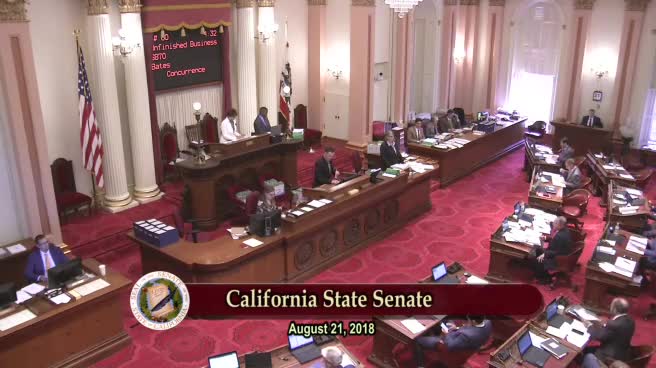
Bill Author

Bill Co-Author(s):