SB 965: California Cattle Council.
- Session Year: 2017-2018
- House: Senate
- Latest Version Date: 2018-09-14
Existing law, the California Beef Council Law, establishes the California Beef Council, comprised of 20 members and 20 alternate members appointed by the Secretary of Food and Agriculture to perform various advisory and other duties relating to the California beef industry. The California Beef Council Law establishes a $1 fee per head on each sale of cattle and calves to administer the California Beef Council Law, and requires the fee to be collected from the seller by the operator of the stockyard, live auction market, slaughterhouse, or feedlot, or from the seller along with brand inspection fees by the Bureau of Livestock Identification. Existing law also provides that the fee from the sale of calves exempt from brand inspection that is not collected in the manner specified above is required to be collected from the seller by the purchaser, for payment to the secretary.
This bill would instead require the fee from the sale of cattle or calves exempt from a brand inspection that is not collected from the seller in the manner specified above to be charged and collected from the seller in a manner determined by the Department of Food and Agriculture.
This bill would also establish the California Cattle Council Law (the law), for purposes that include to formulate and effectuate research relating to all types of California cattle production. The bill would create the California Cattle Council, which would be comprised of 11 members and 11 alternate members appointed by the secretary, as provided. The bill would provide for reimbursement of necessary traveling and other expenses incurred by council members in the performance of their duties. The bill would set forth the powers and duties of the council. The bill would provide for an assessment of $1 per head to be paid on each sale of cattle and calves to carry out the laws provisions. The bill would authorize the council to expend those funds for purposes of implementing the bill, thereby making an appropriation.
The bill would require the secretary to conduct a referendum of producers on implementation of the laws provisions and would make operation of the laws provisions, except as specified, contingent upon approval of the referendum by a majority of producers who participate in the referendum, or, if an initial referendum fails, on approval of a 2nd referendum. If the law is approved, the bill would require the secretary, 5 years after approval, and each 5 years thereafter, to hold a public hearing to determine whether the operation of the law should be continued, and, if the secretary finds that a substantial question exists on that subject, to hold a reapproval referendum. The bill would also authorize the secretary to determine that it is no longer in the best interest of the state to continue the existence of the council and the programs established and maintained pursuant to the law, would require the secretary to call a vote of the producers to determine if the council should be terminated, and would provide for suspension of the law if a majority of producers do not vote in favor of continuing the laws operation.
The bill would require any person who fails to pay, collect, or remit any fees due to be liable for administrative costs incurred by the department in enforcing these provisions. The bill would authorize the secretary, within 3 years from the date of discovery of the alleged violation, to hold a person who fails to pay, collect, or remit fees due civilly liable in an amount not to exceed $100 for each head of cattle or calves that is sold by the person. The bill would authorize a person to contest a determination of delinquent assessments or other violation and request an informal hearing presided over and conducted by a hearing officer designated by the department, as specified.
Existing constitutional provisions require that a statute that limits the right of access to the meetings of public bodies or the writings of public officials and agencies be adopted with findings demonstrating the interest protected by the limitation and the need for protecting that interest.
This bill would make legislative findings to that effect.
Existing law, the California Beef Council Law, establishes the California Beef Council, comprised of 20 members and 20 alternate members appointed by the Secretary of Food and Agriculture to perform various advisory and other duties relating to the California beef industry. The California Beef Council Law establishes a $1 fee per head on each sale of cattle and calves to administer the California Beef Council Law, and requires the fee to be collected from the seller by the operator of the stockyard, live auction market, slaughterhouse, or feedlot, or from the seller along with brand inspection fees by the Bureau of Livestock Identification. Existing law also provides that the fee from the sale of calves exempt from brand inspection that is not collected in the manner specified above is required to be collected from the seller by the purchaser, for payment to the secretary.
This bill would instead require the fee from the sale of cattle or calves exempt from a brand inspection that is not collected from the seller in the manner specified above to be charged and collected from the seller in a manner determined by the Department of Food and Agriculture.
This bill would also establish the California Cattle Council Law (the law), for purposes that include to formulate and effectuate research relating to all types of California cattle production. The bill would create the California Cattle Council, which would be comprised of 11 members and 11 alternate members appointed by the secretary, as provided. The bill would provide for reimbursement of traveling and other expenses incurred by council members in the performance of their duties. The bill would set forth the powers and duties of the council. The bill would provide for an assessment of $1 per head to be paid on each sale of cattle and calves to carry out the laws provisions. The bill would authorize the council to expend those funds for purposes of implementing the bill, thereby making an appropriation.
The bill would require the secretary to conduct a referendum of producers on implementation of the laws provisions and would make operation of the laws provisions, except as specified, contingent upon approval of the referendum by a majority of producers who participate in the referendum, or, if an initial referendum fails, on approval of a 2nd referendum. If the law is approved, the bill would require the secretary, 5 years after approval, and each 5 years thereafter, to hold a public hearing to determine whether the operation of the law should be continued, and, if the secretary finds that a substantial question exists on that subject, to hold a reapproval referendum. The bill would also authorize the secretary to determine that it is no longer in the best interest of the state to continue the existence of the council and the programs established and maintained pursuant to the law, would require the secretary to call a vote of the producers to determine if the council should be terminated, and would provide for suspension of the law if a majority of producers do not vote in favor of continuing the laws operation.
The bill would require any person who fails to pay, collect, or remit any fees due to be liable for administrative costs incurred by the department in enforcing these provisions. The bill would authorize the secretary, within 3 years from the date of discovery of the alleged violation, to hold a person who fails to pay, collect, or remit fees due civilly liable in an amount not to exceed $100 for each head of cattle or calves that is sold by the person. The bill would authorize a person to contest a determination of delinquent assessments or other violation and request an informal hearing presided over and conducted by a hearing officer designated by the department, as specified.
Existing constitutional provisions require that a statute that limits the right of access to the meetings of public bodies or the writings of public officials and agencies be adopted with findings demonstrating the interest protected by the limitation and the need for protecting that interest.
This bill would make legislative findings to that effect.
Existing law, the California Beef Council Law, establishes the California Beef Council, comprised of 20 members and 20 alternate members appointed by the Secretary of Food and Agriculture to perform various advisory and other duties relating to the California beef industry. The California Beef Council Law establishes a $1 fee per head on each sale of cattle and calves to administer the California Beef Council Law, and requires the fee to be collected from the seller by the operator of the stockyard, live auction market, slaughterhouse, or feedlot, or from the seller along with brand inspection fees by the Bureau of Livestock Identification. Existing law also provides that the fee from the sale of calves exempt from brand inspection that is not collected in the manner specified above is required to be collected from the seller by the purchaser, for payment to the secretary.
This bill would instead require the fee from the sale of cattle or calves exempt from a brand inspection that is not collected from the seller in the manner specified above to be charged and collected from the seller in a manner determined by the Department of Food and Agriculture.
This bill would also establish the California Cattle Council Law (the law), for purposes that include to formulate and effectuate research relating to all types of California cattle production. The bill would create the California Cattle Council, which would be comprised of 11 members and 11 alternate members appointed by the secretary. secretary, as provided. The bill would provide for reimbursement of traveling and other expenses incurred by council members in the performance of their duties. The bill would set forth the powers and duties of the council. The bill would provide for an assessment of $1 per head to be paid on each sale of cattle and calves to carry out the laws provisions. The bill would authorize the council to expend those funds for purposes of implementing the bill, thereby making an appropriation.
The bill would require the secretary to conduct a referendum of producers on implementation of the laws provisions and would make operation of the laws provisions, except as specified, contingent upon approval of the referendum by a majority of producers who participate in the referendum, or, if an initial referendum fails, on approval of a second 2nd referendum. If the law is approved, the bill would require the secretary, 5 years after approval, and each 5 years thereafter, to hold a public hearing to determine whether the operation of the law should be continued, and, if the secretary finds that a substantial question exists on that subject, to hold a reapproval referendum. The bill would also authorize the secretary to determine that it is no longer in the best interest of the state to continue the existence of the council and the programs established and maintained pursuant to the law, would require the secretary to call a vote of the producers to determine if the council should be terminated, and would provide for suspension of the law if a majority of producers do not vote in favor of continuing the laws operation.
The bill would require any person who fails to pay, collect, or remit any fees due to be liable for administrative costs incurred by the department in enforcing these provisions. The bill would authorize the secretary, within 3 years from the date of discovery of the alleged violation, to hold a person who fails to pay, collect, or remit fees due civilly liable in an amount not to exceed $100 for each head of cattle or calves that is sold by the person. The bill would authorize a person to contest a determination of delinquent assessments or other violation and request an informal hearing presided over and conducted by a hearing officer designated by the department, as specified.
Existing constitutional provisions require that a statute that limits the right of access to the meetings of public bodies or the writings of public officials and agencies be adopted with findings demonstrating the interest protected by the limitation and the need for protecting that interest.
This bill would make legislative findings to that effect.
Existing law, the California Beef Council Law, establishes the California Beef Council, comprised of 20 members and 20 alternate members appointed by the Secretary of Food and Agriculture to perform various advisory and other duties relating to the California beef industry. The California Beef Council Law establishes a $1 fee per head on each sale of cattle and calves to administer the California Beef Council Law, and requires the fee to be collected from the seller by the operator of the stockyard, live auction market, slaughterhouse, or feedlot, or from the seller along with brand inspection fees by the Bureau of Livestock Identification. Existing law also provides that the fee from the sale of calves exempt from brand inspection that is not collected in the manner specified above is required to be collected from the seller by the purchaser, for payment to the secretary.
This bill would instead require the fee from the sale of cattle or calves exempt from a brand inspection that is not collected from the seller in the manner specified above to be charged and collected from the seller in a manner determined by the Department of Food and Agriculture.
This bill would also establish the California Cattle Council Law (the law), for purposes that include to formulate and effectuate research relating to all types of California cattle production. The bill would create the California Cattle Council, which would be comprised of 11 members and 11 alternate members appointed by the secretary. The bill would provide for reimbursement of traveling and other expenses incurred by council members in the performance of their duties. The bill would set forth the powers and duties of the council. The bill would provide for an assessment of $1 per head to be paid on each sale of cattle and calves to carry out the laws provisions. The bill would authorize the council to expend those funds for purposes of implementing the bill, thereby making an appropriation.
The bill would require the secretary to conduct a referendum of producers on implementation of the laws provisions and would make operation of the laws provisions, except as specified, contingent upon approval of the referendum by a majority of producers who participate in the referendum, or, if an initial referendum fails, on approval of a second referendum. If the law is approved, the bill would require the secretary, 5 years after approval, and each 5 years thereafter, to hold a public hearing to determine whether the operation of the law should be continued, and, if the secretary finds that a substantial question exists on that subject, to hold a reapproval referendum. The bill would also authorize the secretary to determine that it is no longer in the best interest of the state to continue the existence of the council and the programs established and maintained pursuant to the law, would require the secretary to call a vote of the producers to determine if the council should be terminated, and would provide for suspension of the law if a majority of producers do not vote in favor of continuing the laws operation.
The bill would require any person who fails to pay, collect, or remit any fees due to be liable for administrative costs incurred by the department in enforcing these provisions. The bill would authorize the secretary, within 3 years from the date of discovery of the alleged violation, to hold a person who fails to pay, collect, or remit fees due civilly liable in an amount not to exceed $100 for each head of cattle or calves that is sold by the person. The bill would authorize a person to contest a determination of delinquent assessments or other violation and request an informal hearing presided over and conducted by a hearing officer designated by the department, as specified.
Existing constitutional provisions require that a statute that limits the right of access to the meetings of public bodies or the writings of public officials and agencies be adopted with findings demonstrating the interest protected by the limitation and the need for protecting that interest.
This bill would make legislative findings to that effect.
Existing law sets forth various fiscal powers and duties of the Secretary of Food and Agriculture, and authorizes the secretary to remove from the Department of food and Agricultures records an amount due pursuant to the provisions of the Food and Agricultural Code if the amount is $5 or less and the secretary either finds that the amount is too small to justify the cost of its collection, or believes that collection is improbable.This bill would increase the maximum amount from $5 to $25, and would also make nonsubstantive changes to those provisions.Existing law sets forth various fiscal powers and duties of the Secretary of Food and Agriculture, and authorizes the secretary to remove from the Department of food and Agricultures records an amount due pursuant to the provisions of the Food and Agricultural Code if the amount is $5 or less and the secretary either finds that the amount is too small to justify the cost of its collection, or believes that collection is improbable.
This bill would increase the maximum amount from $5 to $25, and would also make nonsubstantive changes to those provisions.
The fees required pursuant to Section 64691 shall be due and payable as follows:
(a)The fee for cattle or calves, whether originating in the state or out of state, shall be paid by the seller. The fee shall be charged and collected from the seller or from the sellers account and paid to the secretary by each operator of any stockyard, livestock auction market, slaughterhouse, or registered feedlot in the state. The fee is due and payable to the secretary on or before the 15th day of the month next succeeding the month in which the cattle and calves are sold. Fees that are not collected in the manner provided in this subdivision shall be collected from the seller by the Bureau of Livestock Identification at the time that brand inspection fees are collected.
(b)The fee for cattle or calves for which the fee would not otherwise be collected pursuant to subdivision (a) and that are also exempt from brand inspection, shall be charged and collected from the seller in a manner determined by the department.
(c)Any fees that are not collected in the manner specified in subdivision (a) or (b) shall be paid to the secretary directly by the seller on or before the 15th day of the month next succeeding the month in which the sale occurs.
(d)A fee shall be paid for each head of cattle or calves slaughtered in the state unless specifically exempted by Section 64691 or 64702. If the fee is not deducted from the seller it shall be paid by the purchaser or slaughterer and is due and payable in the manner provided in this section.
SEC. 2.Chapter 2.5 (commencing with Section 65001) is added to Part 2 of Division 22 of the Food and Agricultural Code, to read:2.5.California Cattle Council Law1.General65001.The Legislature finds and declares all of the following:
(a)The production of cattle for both beef and dairy constitutes a paramount industry of this state that not only provides substantial revenues for the state but also provides willing consumers with local and nutritious food.
(b)The raising of beef and dairy cattle provides a viable living for many Californians and serves as the economic foundation for many rural communities. Cattle producers strive to be stewards of the resources they manage and the existence of ranching in California serves the public by providing numerous environmental and aesthetic benefits that would otherwise be lost without the use of Californias various range and pasture lands as working landscapes.
(c)Cattle production in California reflects a diverse set of family farmers and ranchers, including women- and minority-owned businesses, that provide a varied line of beef and dairy products through conventional, organic, grass-fed, kosher, halal, and other production methods that fill niche markets desired by willing consumers. Cattle producers vary in size from small to large based on the total number of animals raised and contribute equally to providing wholesome beef and dairy products to willing consumers.
(d)The stabilization, maintenance, and expansion of the cattle industry of California and for the expansion of local, state, nationwide, and foreign markets for California beef and other products derived from the California cattle industry are necessary in order to provide willing consumers an adequate supply of high-quality California beef and dairy products.
(e)The councils form of administration created by this chapter is uniquely situated to provide those engaged principally in the production of cattle, along with beef and other products derived from the California cattle industry, the opportunity to avail themselves of the benefits of collective action in advertising, promotion, food safety, production research, nutrition, marketing research, the collection and dissemination of production and related statistics, and public education.
65002.The purposes of this chapter are as follows:
(a)Most notably, to authorize and enable the secretary and the appointed governing body of the council to formulate and effectuate, directly or in cooperation with other agencies and parties, research relating to all types of California cattle production, including nonconventional and organic methods of production. Research may be focused on, but not limited to, improving the efficiency and sustainability of the California cattle industry, the development of management practices and assistance with compliance for rules and regulations that govern the production of cattle in California, the nutritional qualities of California beef and other products derived from the California cattle industry, public consumption patterns and trends, sales stimulation, and the development of consumer or other educational programs designed to increase the use and consumption of California beef and other products derived from the California cattle industry by willing consumers.
(b)To enable the California cattle industry to develop, maintain, and expand the local, state, nationwide, and foreign markets for all types, conventional and nonconventional, of California beef and other products derived from the California cattle industry.
(c)To enhance the California cattle and dairy industries, create a favorable environment for California cattle producers to operate, and improve the competitiveness of California cattle producers in both the national and international marketplace.
(d)To enable the council to present facts to local, state, federal, and foreign agencies on matters that affect the California cattle industry and the production of California beef and dairy cattle, beef, and other products derived from the California cattle industry.
(e)To provide funds for the administration and enforcement of this chapter by mandatory fees to be collected in the manner that is prescribed in this chapter, unless producers elect to receive a refund of those funds pursuant to Section 65075.
65003.This chapter shall be liberally construed. If any provision of this chapter or the application of this chapter to any person or circumstances is held invalid, the invalidity shall not affect other provisions or applications of the chapter that can be given effect without the invalid provision or application, and to this end the provisions of this chapter are severable.
65004.It is hereby declared as a matter of legislative determination that council members and alternates are intended to represent and further the interest of the particular industry concerned and that this representation and furtherance is intended to serve the public interest. Accordingly, the Legislature finds that with respect to persons who are elected or appointed to the council, the particular industry concerned is tantamount to and constitutes the public generally within the meaning of Section 87103 of the Government Code.
2.Definitions65011.Unless the context otherwise requires, the definitions in this article govern the construction of this chapter.
65012.(a)Beef means the meat of cattle and includes veal.
(b)Cattle and beef cattle are synonymous and mean bovine animals of any breed, regardless of age.
(c)Cattle feeder means a producer raising cattle in confined spaces for the purposes of finishing cattle for market.
(d)Council means the California Cattle Council.
(e)Department means the Department of Food and Agriculture.
(f)Ex officio member means a nonvoting member of the council.
(g)Handler means a person engaged in the marketing of beef that the handler has produced, purchased, or acquired from a producer, or is marketed on behalf of a producer, whether as the owner, agent, employee, broker, or otherwise.
(h)Member means any member of the council.
(i)Other products derived from the California cattle industry include, but are not limited to, those edible, industrial, and medicinal products produced in whole or in part from beef, dairy, or cattle.
(j)Processor means a person who harvests cattle or markets products derived from cattle to willing consumers, including beef, dairy products, or other products derived from the California cattle industry.
(k)Producer is a person who owns or acquires ownership of beef or dairy cattle, and who, upon request, provides proof of ownership of cattle or, for purposes of voting pursuant to this chapter, has owned beef or dairy cattle within the same calendar year as the vote occurs. A person is not a producer if the persons only share in the proceeds of the sale of cattle or beef is a sales commission, handling fee, or other service fee.
(l)Range cattle producer means a person who owns and raises cattle primarily on range or pastureland for the purpose of producing beef and other products derived from the California cattle industry.
(m)Secretary means the Secretary of Food and Agriculture.
3.California Cattle Council65015.There is in the state government the California Cattle Council that consists of 11 members and 11 alternates appointed by the secretary, each of whom shall be a producer in this state who is a range cattle producer, cattle feeder, dairy producer, or processor, with the exception of the public member who shall be a resident of this state. The secretary shall appoint members and alternates to the council to reflect the diversity of Californias cattle industry, including women- and minority-owned businesses, varying beef and dairy products, and cattle producers varying in size from small to large based on the total number of animals raised, as described in subdivision (c) of Section 65001.
65016.The secretary or the secretarys designee shall serve as an ex officio member.
65017.(a)The secretary shall appoint to the council three range cattle producers, three cattle feeders, three dairy producers, one processor, and one public member to represent the general public.
(b)(1)Each member appointed as a range cattle producer, at the time of initial appointment, shall be a resident of a different county from the county in which any other range cattle producer members reside.
(2)Each member appointed as a dairy producer, at the time of initial appointment, shall be a resident of a different county from the county in which any other dairy producer members reside.
(c)The secretary shall use the same formula described in subdivisions (a) and (b) in the appointment of alternates.
65018.Except as otherwise provided in this section, the public member and the public members alternate shall have all the powers, rights, and privileges of any other member or alternate, respectively, on the council, except that the public member or the public members alternate shall not have a vote on issues regarding the assessment established pursuant to Section 65071.
65019.(a)The terms of office of the members and alternates of the council shall be three years. At the discretion of the secretary, the first appointments made under this chapter shall be so made that the terms of three members and the three members alternates shall expire at the end of one year, three members and the three members alternates shall expire at the end of two years, and three members and the three members alternates shall expire at the end of three years.
(b)Any vacancy that occurs during the unexpired term shall be filled by the secretary for the unexpired term from eligible nominees. No council member or alternate shall serve more than two consecutive three-year terms. Service as an alternate does not disqualify a person to then serve two terms as a member, and a member who was appointed for a one-year or two-year term may serve two additional three-year terms.
(c)If the secretary removes a member or alternate of the council, the vacancy shall be filled in the manner as provided in subdivision (a) for the duration of the unexpired term.
65020.Six members of the council shall constitute a quorum for the transaction of all business, including the election of officers.
65021.(a)The council shall annually select a chairperson and vice chairperson from its membership, to serve at the councils pleasure, who, together with three other members selected annually by the council, shall constitute an executive committee.
(b)The executive committee shall have and exercise powers of the council as the council may delegate to it.
65022.(a)The council shall have two regular meetings each year at times and places determined by the council.
(b)The times for regular meetings shall be fixed so that there is an interval of at least four months between each meeting.
(c)The council may hold additional meetings at any time and place at the call of the chairperson.
(d)The executive committee shall have two regular meetings each year and may hold additional meetings at any time and place at the call of the chairperson.
65023.Members of the council shall be reimbursed for necessary traveling and other expenses incurred in the performance of their official duties.
65024.An alternate member of the council shall sit as a regular member of the council if the regular member fails for any reason to attend any meeting of the council. An alternate member shall be compensated and reimbursed in the same manner and to the same extent as a regular member when serving and has all the powers, duties, liabilities, and immunities of the member in whose place he or she is serving, except that the alternate to the chairperson or vice chairperson shall not succeed to the functions of these offices or sit as a regular member on the executive committee.
65025.The secretary or the secretarys representative shall be notified and may attend each meeting of the council.
65026.No member or alternate of the council shall receive a salary.
65027.All funds received by any person from the assessments levied under this chapter or otherwise received by the council shall be deposited in banks designated by the council and shall be disbursed by order of the council through an agent or agents as it may designate for that purpose. A private agent or agents, other than the department, shall be bonded by a fidelity bond, executed by a surety company authorized to transact business in this state, in favor of the council, in an amount of not less than twenty-five thousand dollars ($25,000).
65028.The state is not liable for the acts of the council or its contracts. Payments of all claims arising by reason of the administration of this chapter or acts of the council are limited to the funds collected by the council. No member or alternate of the council, or any employee or agent thereof, is personally liable for the contracts of the council. No member or alternate of the council, or any employee or agent thereof, is responsible individually in any way to any other person for errors in judgment, mistakes, or other acts, either of council or omission, as principal, agent, or employee, except for his or her own individual acts of dishonesty or crime. No member or alternate of the council, or any employee or agent thereof, is responsible individually for any act or omission of any other member or alternate of the council, or any employee or agent thereof. No member or alternate of the council, or any employee or agent thereof, is liable for the default of any other member or alternate of the council, or any employee or agent thereof.
65029.The council may enter into contracts. Copies of its proceedings, records, and acts, when authenticated, shall be admissible in evidence in all courts of the state and shall be prima facie evidence of the truth of all statements therein.
4.Powers and Duties65040.The powers and duties of the council shall include, but are not limited to, all of those contained in this article.
65041.The council may adopt and from time to time alter, rescind, modify, and amend all proper and necessary bylaws, rules, and orders in accordance with council procedures for purposes of carrying out this chapter, including rules for appeals from any bylaw, rule, operating procedure, or order of the council. The council shall be charged with exercising any and all necessary duties to accomplish the objectives outlined in this chapter.
65042.If the council and the California Beef Council determine that a project is of mutual benefit and consistent with state and federal laws governing the California Beef Council, the project may be jointly funded by the council and the California Beef Council, subject to approval by the secretary.
65043.(a)The council may employ a person to serve at the pleasure of the council as the executive director of the council and other personnel. If any person employed by the council engages in any conduct that the secretary determines is not in the public interest or that is in violation of this chapter, the secretary shall notify the council of the conduct and request that corrective and, if appropriate, disciplinary action be taken by the council. If the council fails or refuses to correct the situation or to take disciplinary action satisfactory to the secretary, the secretary may suspend or discharge the person.
(b)The council may retain additional staff or agents of the council to discharge the duties outlined in this chapter.
(c)Notwithstanding subdivision (d) of Section 65002, a member, alternate member, agent, or employee of the council shall not do either of the following:
(1)Appear before any committee of the Legislature or federal government as a representative of the council unless requested to do so by that committee.
(2)Lobby in any manner as a representative of the council.
65044.The council may appoint committees composed of members, alternates, and nonmembers not serving with the council in any official capacity to advise the council in carrying out this chapter.
65045.The council shall approve reasonable compensation for the executive director and any agents or contractors of the council.
65046.The council may establish offices and incur expenses, enter into any and all contracts and agreements, create liabilities, develop, own, and control the use of any intellectual or physical property, including real estate for the purpose of housing the operations of the council, and borrow funds in advance of receipt of assessments as may be necessary in the opinion of the council for the proper administration and enforcement of this chapter and the performance of its duties.
65047.The council shall keep books, records, and accounts of all its transactions, dealings, contracts, agreements, funds, and expenditures as it deems necessary. Those books, records, and accounts shall at all times be open to inspection and audit by the secretary. The council shall be subject to an annual audit by an auditing firm selected by the council with the concurrence of the secretary. The audit shall be made a part of an annual report to be posted on the councils Internet Web site and submitted to the department. In addition, the secretary may determine it is necessary to conduct, or cause to be conducted, a fiscal and compliance audit of the council.
65048.Funds collected pursuant to this chapter shall not be used for political contributions.
65049.The council may accept grants from state and federal entities to carry out the duties authorized by this chapter.
65050.The council may collect information about California beef and dairy production and publish and distribute, without charge, a bulletin or other communication to all eligible producers.
65051.(a)The council shall establish an annual budget according to generally accepted accounting practices. The council shall prepare annually summarized statements of the activities in which it has been engaged in the previous annual period, and of the activities in which it proposes to engage in the ensuing annual period. The annual budget and statements shall be made available to all eligible producers at their request and shall also be posted on the councils public Internet Web site.
(b)Before the adoption of the annual budget, the council shall submit the proposed annual budget and its statement of contemplated activities to the secretary for the secretarys concurrence.
(c)The annual budget and statement of contemplated activities shall be concurred in by the secretary before disbursement of funds, with the exception of expenditures made by the council pursuant to Section 65043.
65052.When the secretary is required to concur in a decision of the council, the secretary shall give his or her response to the council within 15 working days from notification of the decision. The secretary shall set forth in writing with specificity the reasons for any refusal to concur. The secretarys response may be a requirement that additional information be provided.
65053.The council shall reimburse the secretary for all expenditures incurred by the secretary in carrying out his or her duties and responsibilities pursuant to this chapter.
65054.(a)The secretary may require the council to correct or cease any existing activity or function that is determined by the secretary not to be in the public interest or that is in violation of this chapter.
(b)If the council refuses or fails to cease those activities or functions or to make the corrections as required by the secretary, the secretary may, upon written notice, suspend all or a portion of the activities or functions of the council until the time that the cessation or correction of activities or functions as required by the secretary has been accomplished by the council.
(c)Actions of the council in violation of the written notice are without legal force or effect. The secretary, to the extent feasible, shall issue the written notice before the council entering into any contractual relationship affecting the existing or proposed activities or functions that are the subject of the written notice.
(d)Upon service of the written notice, the secretary shall notify the council in writing of the specific acts that the secretary determines are not in the public interest or are in violation of this chapter, the secretarys reasons for requiring a cessation or correction of specific existing or proposed activities or functions, and recommendations that will make the activities or functions acceptable.
65055.The council may recommend to the secretary the adoption of administrative regulations that relate to the administration and enforcement of this chapter.
65056.(a)The council and the secretary shall keep confidential and shall not disclose, except when required by court order after a hearing in a judicial proceeding, all lists in their possession of persons subject to this chapter. However, the council shall establish procedures consistent with this confidentiality requirement to enable producers to communicate with other producers on the lists regarding noncommercial matters affecting the council and persons subject to this chapter.
(b)Information on volume shipments, other information that is required for reports to governmental agencies, financial reports to the council, aggregate sales and inventory information, and any other information that does not include individual identifying producer or handler information may be disclosed by the council.
65057.The council may investigate all matters that affect the administration of this chapter and report violations to the secretary.
65058.(a)(1)A program or activity that is conducted or sponsored pursuant to this chapter shall not make false or unwarranted claims, or disparage the quality, value, use, or sale of any commodity authorized by law to be marketed in this state.
(2)Paragraph (1) shall not be construed to prohibit disclosure of any information to an investigative agency or a member of the public to protect the health or safety of the public.
(b)A program or activity shall not be conducted pursuant to this chapter with reference to a private brand or trade name that refers to beef or other products derived from the California cattle industry, except as provided for in subdivision (c).
(c)The council shall not expend funds for the advertising of brand name beef or other products derived from the California cattle industry unless the expenditures are approved by a two-thirds vote of the council with the concurrence of the secretary. The council may expend funds to conduct cost-sharing advertising with nonbeef brand name products.
5.Implementation and Suspension of Operations65060.(a)On or before June 1, 2019, the Bureau of Livestock Identification shall submit to the secretary for review a list of producers who have sold or owned cattle in the last calendar year.
(b)The secretary may require auction markets and packers to submit the names and mailing addresses of all producers from whom they acquired cattle in the most recently completed fiscal year. The request for information shall be in writing and shall be filed within 10 days following receipt of the request.
(c)The secretary shall determine which producers are eligible to vote consistent with the definition of producer in subdivision (k) of Section 65012.
(d)Any producer who believes himself or herself to be eligible to vote whose name does not appear on the appropriate list may have his or her name placed on the list by filing with the secretary a signed statement identifying the producer as a person eligible to vote. Failure to be on the list does not exempt the person from paying fees and does not invalidate any votes conducted pursuant to this chapter.
(e)Any producer eligible to vote may contact those on the list regarding the referendum in a form and manner prescribed by the secretary if all expenses associated with those contacts are paid in advance.
65061.This chapter, except as necessary to conduct an implementation referendum vote, shall not become operative until the secretary finds that a majority of producers participating in an initial referendum vote conducted by the secretary on or before June 1, 2020, or a second referendum vote conducted by the secretary pursuant to Section 65066, approve the referendum.
65062.An implementation referendum shall advertise the amount to be assessed and declare that the assessment shall be a mandatory fee. An implementation referendum shall also advertise that the council will accept petitions to refund the fee for any producer subject to this chapter pursuant to Section 65075.
65063.The secretary shall establish a period in which to conduct a referendum, that shall not be more than 60 days in duration, and may prescribe additional procedures necessary to conduct the referendum.
65064.Nonreceipt of a ballot by an eligible producer shall not invalidate a referendum.
65065.If the secretary finds that a majority vote has been given, the secretary shall certify and give notice of the majority vote to all producers whose names and addresses are on file with the secretary.
65066.If the secretary finds that a majority vote has not been given for an initial referendum, the secretary shall certify and declare all provisions of this chapter inoperative, except as necessary to conduct a second implementation referendum vote pursuant to this section. The secretary shall conduct a second implementation referendum vote two years or later following certification of the first vote. If the second referendum vote conducted pursuant to this section does not receive a majority vote in favor, this chapter is repealed six months following the certification of the second vote unless a later statute is enacted altering this section.
65067.(a)Before an implementation referendum vote conducted by the secretary pursuant to this article, a proponent of the establishment of the council shall deposit with the secretary the amount that the secretary deems necessary to defray the expenses of analyzing the proposed council and certifying the necessary list of producers submitted by the Bureau of Livestock Identification and conducting the vote.
(b)Any funds not used in conducting an implementation referendum established by this article shall be returned to the proponents of the council who deposited the funds with the secretary.
(c)Upon establishment of the council, the council may reimburse the proponents of the council for any funds deposited with the secretary that were used in carrying out this article, and for any legal expenses and costs incurred in establishing the council.
65068.(a)Five years after implementation of this chapter, the secretary shall hold a public hearing after providing proper notice to producers subject to this chapter and any other persons or entities who have requested, in writing, notice of the hearing to determine whether the operation of this chapter should be continued. If, after the hearing, the secretary finds that a substantial question exists among the producers assessed under this chapter as to whether the operation of this chapter should be continued, the secretary shall conduct a reapproval referendum to be conducted among producers to determine whether the operation of this chapter shall be reapproved and continue in effect.
(b)If the secretary finds, after conducting a hearing that no substantial question exists or if a reapproval referendum is required and a majority of eligible producers voting in the referendum voted in favor of continuing the operation of this chapter, the secretary shall certify the vote and this chapter shall remain operative. If the secretary finds that a majority vote has not been given, the secretary shall certify the vote and declare the operation of this chapter suspended and the operations of the council concluded and funds distributed in the manner provided in subdivision (c). A bond or security shall not be required for the referendum. The secretary shall provide public notice of the suspension of this chapter on the departments Internet Web site.
(c)On the expiration of this chapter pursuant to this article, the council shall remain in existence for the purpose of furnishing the secretary with a complete record of its outstanding financial obligations, accrued and to accrue. The secretary shall pay from the money deposited and disbursed any outstanding obligations and any obligations incurred by the secretary and the department under the terms and provisions of this section. Any money that remains shall be retained by the secretary to defray the expenses of formulation, issuance, administration, or enforcement of any subsequent program for beef promotion. If no such program is undertaken within a period of three years from the date of termination of this chapter, the money shall be used to fund activities related to the subject matter of this chapter at the discretion of the secretary.
(d)Following a hearing and favorable referendum, if required, the process specified in this section shall be conducted by the secretary every five years between July 1 and June 30 of the following year.
65069.(a)On the secretarys own motion, at the request of the council, or at the request of a producer, the secretary may determine that it is no longer in the best interest of the state to continue the existence of the council and the programs established and maintained pursuant to this chapter.
(b)If the secretary makes the determination described in subdivision (a), the secretary shall call a vote of the producers to determine if the council should be terminated.
(c)(1)The secretary shall certify a vote conducted pursuant to subdivision (b).
(2)If a majority of producers vote in favor of terminating the council, the secretary shall declare the operation of this chapter suspended, the operations of the council concluded, and distribute the funds in the manner provided for in subdivision (c) of Section 65068. The secretary shall provide public notice of the suspension of this chapter on the departments Internet Web site.
(3)If a majority of producers do not vote in favor of terminating the council, the operation of this chapter shall continue in effect.
6.Financial Provisions65071.(a)In order to carry out the programs and administer the activities that are conducted pursuant to this chapter, an assessment of one dollar ($1) per head shall be paid on each sale of cattle and calves. The assessment shall be charged on all cattle and calves, except the following:
(1)Hides, skins, or the offal of animals.
(2)Any cattle or calves that are transported for purposes other than for sale or slaughter and without a change of ownership.
(3)Any cattle or calves custom slaughtered exclusively for the owner, members of the owners household, or the owners nonpaying guests or employees.
(4)Any cattle or calves weighing less than 200 pounds.
(b)The assessment charged pursuant to this chapter shall not be charged or collected more than once from each owner upon the same animal.
65072.(a)Each person who is required to pay or collect the assessment shall maintain a complete and accurate record of all transactions subject to assessments under this chapter. These records shall contain information required by the secretary relating to the payment or collection of assessments, shall be preserved for a period of two years, and shall be offered and submitted for inspection and audit at any reasonable time upon written demand by the secretary or the secretarys duly authorized agent.
(b)All information obtained by the secretary or the secretarys duly authorized agent from any inspection or audit of records shall be confidential and shall not be disclosed except when required in a judicial proceeding.
65073.(a)The assessment for cattle or calves, whether originating in the state or out of state, shall be paid by the seller. The assessment shall be charged and collected from the seller or from the sellers account and paid to the council by each operator of a stockyard, livestock auction market, or slaughter facility. The assessment is due and payable to the council on or before the 15th day of the month next succeeding the month in which the cattle and calves are sold. Assessments that are not collected in the manner provided in this subdivision shall be collected from the seller by the Bureau of Livestock Identification at the time that brand inspection fees are collected.
(b)The assessment for cattle or calves for which the assessment would not otherwise be collected pursuant to subdivision (a) and that are also exempt from a brand inspection shall be charged and collected from the seller and paid to the council in a manner determined by the department.
(c)Any assessment that is not collected in the manner specified in subdivision (a) or (b) shall be paid to the council directly by the seller on or before the 15th day of the month next succeeding the month in which the sale occurs.
65074.The assessments that are collected by the Bureau of Livestock Identification pursuant to this article shall be forwarded to the secretary at the same time and in the same manner as the inspection fees that are provided for in Article 9 (commencing with Section 21281) of Chapter 6 of Division 10. The secretary shall reimburse, from any money that is collected pursuant to this section, the Bureau of Livestock Identification and any other bureaus or agencies of the state for any additional expenses that are incurred by them in the administration or enforcement of this chapter.
65075.Any person who is subject to the assessment that is required by Section 65071 may obtain a refund of the assessment collected by submitting to the council a claim for a refund. The claim shall be submitted to the council by mail, facsimile, electronic mail, or a refund request form through the councils Internet Web site within 90 days after the date of the brand inspection or the date of payment of the assessment, whichever date is later. The refund of an assessment shall be made by the council within 60 days of the date on which the refund request is received. The council or the department may not place conditions on the issuance of the refund except for requiring the claim for the refund to demonstrate the fee has been paid. The secretary, department, council, or producers, by referendum, shall not limit or inhibit a refund under this section for a person that has paid the assessment required by Section 65071.
65076.(a)Proprietary information obtained pursuant to this article by the council or the secretary, including the names and addresses of producers and the amounts of individual refunds or the identity of a person that received a refund pursuant to Section 65075, is confidential and shall not be disclosed except when required by a court order after a hearing in a judicial proceeding.
(b)Data that is aggregated from proprietary information, including the total amount refunded by the council annually, is not confidential, and may be disclosed to the public, if the data does not disclose proprietary information of an individual producer and the data does not identify an individual producer.
65077.An assessment that is levied pursuant to this chapter is a personal debt of the assessed person.
7.Actions and Penalties65081.Any person who fails to pay, collect, or remit any fees due within the time specified in this chapter shall be liable for administrative costs incurred by the department in enforcing this chapter.
65082.The secretary may pursue an action to hold a person civilly liable in an amount not to exceed one hundred dollars ($100) for each head of cattle or calves that is sold by any person who fails to pay, collect, or remit any fees due within the time specified in this chapter. The person also shall be liable for the total amount of fees due and the costs of a civil suit, including attorneys fees.
65083.The secretary may request that the Attorney General file an action in an appropriate court to collect any unpaid fees, civil penalties, or other costs incurred by the department in pursuit of a violation.
65084.The secretary may request that the Attorney General petition an appropriate court for the issuance of an injunction, restraining any person in violation of any requirement specified in this chapter, or regulation adopted pursuant to this chapter, from continuing the violation. The court also may require the performance of any obligation imposed under this chapter or any regulations adopted pursuant to this chapter.
65085.Any action by the secretary for any penalty or other remedy that is prescribed under this chapter shall be commenced within three years from the date of discovery of the alleged violation. Any action against the council by any person shall be commenced within three years from the date of the alleged violation.
65086.(a)Any person subject to this chapter may contest a determination of delinquent assessments, or other violation of this chapter, and request an informal hearing as outlined in this section.
(b)A request for an informal hearing shall be submitted in writing to the department.
(c)A request for an informal hearing shall be submitted within 30 days from the receipt of the departments adverse determination. The failure to present a timely request for an informal hearing constitutes a waiver of the respondents right to contest the adverse determination. The department shall deny an untimely request for a hearing.
(d)Upon receipt of a timely request for an informal hearing, the department shall provide a notice of the hearing to the respondent that contains all of the following information:
(1)Date, location, and time of the hearing.
(2)The departments contact information, including, but not limited to, applicable telephone and facsimile numbers.
(3)Subject matter of the adverse determination.
(4)Any other information or documentation relative to the adverse determination.
(e)The department shall designate a hearing officer to preside over and conduct the informal hearing. A hearing officer may conduct a hearing by telephone, at the hearing officers discretion.
(f)(1)The standard of proof to be applied by the hearing officer shall be a preponderance of the evidence, unless statutes or regulations applicable to the determination provide a higher standard.
(2)The hearing officer shall issue a written decision with a brief statement of the conclusion and findings to support the conclusion within 14 days after the conclusion of the hearing. The hearing officer may issue the decision orally at the conclusion of the hearing, subject to written confirmation.
(3)The written decision of the hearing officer shall be served on the respondent either by overnight mail or by facsimile transmission.
(g)The written decision of the hearing officer shall be effective immediately upon receipt and shall be final.
(h)The respondent may appeal the hearing officers decision in accordance with Section 1094.5 of the Code of Civil Procedure.
65087.The termination of this chapter shall not affect or waive any right, duty, obligation, or liability that has arisen or that may thereafter arise in connection with this chapter, release or extinguish any violation of this chapter, or affect or impair any right or remedies of the secretary with respect to any violation.
SEC. 3.The Legislature finds and declares that Section 2 of this act, which adds Sections 65056, 65072, and 65076 to the Food and Agricultural Code, imposes a limitation on the publics right of access to the meetings of public bodies or the writings of public officials and agencies within the meaning of Section 3 of Article I of the California Constitution. Pursuant to that constitutional provision, the Legislature makes the following findings to demonstrate the interest protected by this limitation and the need for protecting that interest:
In order to protect the personal and financial information of a person subject to the act, it is necessary that this act limit the publics right of access to that information.
The fees required pursuant to Section 64691 shall be due and payable as follows:
(a)The fee for cattle or calves, whether originating in the state or out of state, shall be paid by the seller. The fee shall be charged and collected from the seller or from the sellers account and paid to the secretary by each operator of any stockyard, livestock auction market, slaughterhouse, or registered feedlot in the state. The fee is due and payable to the secretary on or before the 15th day of the month next succeeding the month in which the cattle and calves are sold. Fees that are not collected in the manner provided in this subdivision shall be collected from the seller by the Bureau of Livestock Identification at the time that brand inspection fees are collected.
(b)The fee for cattle or calves for which the fee would not otherwise be collected pursuant to subdivision (a) and that are also exempt from brand inspection, shall be charged and collected from the seller in a manner determined by the department.
(c)Any fees that are not collected in the manner specified in subdivision (a) or (b) shall be paid to the secretary directly by the seller on or before the 15th day of the month next succeeding the month in which the sale occurs.
(d)A fee shall be paid for each head of cattle or calves slaughtered in the state unless specifically exempted by Section 64691 or 64702. If the fee is not deducted from the seller it shall be paid by the purchaser or slaughterer and is due and payable in the manner provided in this section.
SEC. 2.Chapter 2.5 (commencing with Section 65001) is added to Part 2 of Division 22 of the Food and Agricultural Code, to read:2.5.California Cattle Council Law1.General65001.The Legislature finds and declares all of the following:
(a)The production of cattle for both beef and dairy constitutes a paramount industry of this state that not only provides substantial revenues for the state but also provides willing consumers with local and nutritious food.
(b)The raising of beef and dairy cattle provides a viable living for many Californians and serves as the economic foundation for many rural communities. Cattle producers strive to be stewards of the resources they manage and the existence of ranching in California serves the public by providing numerous environmental and aesthetic benefits that would otherwise be lost without the use of Californias various range and pasture lands as working landscapes.
(c)Cattle production in California reflects a diverse set of family farmers and ranchers, including women- and minority-owned businesses, that provide a varied line of beef and dairy products through conventional, organic, grass-finished, grass-fed, kosher, halal, and other production methods that fill niche markets desired by willing consumers. Cattle producers vary in size from small to large based on the total number of animals raised and contribute equally to providing wholesome beef and dairy products to willing consumers.
(d)The stabilization, maintenance, and expansion of the cattle industry of California and for the expansion of local, state, nationwide, and foreign markets for California beef and other products derived from the California cattle industry are necessary in order to provide willing consumers an adequate supply of high-quality California beef and dairy products.
(e)The councils form of administration created by this chapter is uniquely situated to provide those engaged principally in the production of cattle, along with beef and other products derived from the California cattle industry, the opportunity to avail themselves of the benefits of collective action in advertising, promotion, food safety, production research, nutrition, marketing research, the collection and dissemination of production and related statistics, and public education.
65002.The purposes of this chapter are as follows:
(a)Most notably, to authorize and enable the secretary and the appointed governing body of the council to formulate and effectuate, directly or in cooperation with other agencies and parties, research relating to all types of California cattle production, including nonconventional and organic methods of production. Research may be focused on, but not limited to, improving the efficiency and sustainability of the California cattle industry, the development of management practices and assistance with compliance for rules and regulations that govern the production of cattle in California, the nutritional qualities of California beef and other products derived from the California cattle industry, public consumption patterns and trends, sales stimulation, and the development of consumer or other educational programs designed to increase the use and consumption of California beef and other products derived from the California cattle industry by willing consumers.
(b)To enable the California cattle industry to develop, maintain, and expand the local, state, nationwide, and foreign markets for all types, conventional and nonconventional, of California beef and other products derived from the California cattle industry.
(c)To enhance the California cattle and dairy industries, create a favorable environment for California cattle producers to operate, and improve the competitiveness of California cattle producers in both the national and international marketplace.
(d)To enable the council to present facts to local, state, federal, and foreign agencies on matters that affect the California cattle industry and the production of California beef and dairy cattle, beef, and other products derived from the California cattle industry.
(e)To provide funds for the administration and enforcement of this chapter by mandatory fees to be collected in the manner that is prescribed in this chapter, unless producers elect to receive a refund of those funds pursuant to Section 65075.
65003.This chapter shall be liberally construed. If any provision of this chapter or the application of this chapter to any person or circumstances is held invalid, the invalidity shall not affect other provisions or applications of the chapter that can be given effect without the invalid provision or application, and to this end the provisions of this chapter are severable.
65004.It is hereby declared as a matter of legislative determination that council members and alternates are intended to represent and further the interest of the particular industry concerned and that this representation and furtherance is intended to serve the public interest. Accordingly, the Legislature finds that with respect to persons who are elected or appointed to the council, the particular industry concerned is tantamount to and constitutes the public generally within the meaning of Section 87103 of the Government Code.
2.Definitions65011.Unless the context otherwise requires, the definitions in this article govern the construction of this chapter.
65012.(a)Beef means the meat of cattle and includes veal.
(b)Cattle and beef cattle are synonymous and mean bovine animals of any breed, regardless of age.
(c)Cattle feeder means a producer raising cattle in confined spaces for the purposes of finishing cattle for market.
(d)Council means the California Cattle Council.
(e)Department means the Department of Food and Agriculture.
(f)Ex officio member means a nonvoting member of the council.
(g)Handler means a person engaged in the marketing of beef that the handler has produced, purchased, or acquired from a producer, or is marketed on behalf of a producer, whether as the owner, agent, employee, broker, or otherwise.
(h)Member means any member of the council.
(i)Other products derived from the California cattle industry include, but are not limited to, those edible, industrial, and medicinal products produced in whole or in part from beef, dairy, or cattle.
(j)Processor means a person who harvests cattle or markets products derived from cattle to willing consumers, including beef, dairy products, or other products derived from the California cattle industry.
(k)Producer is a person who owns or acquires ownership of beef or dairy cattle, and who, upon request, provides proof of ownership of cattle or, for purposes of voting pursuant to this chapter, has owned beef or dairy cattle within the same calendar year as the vote occurs. A person is not a producer if the persons only share in the proceeds of the sale of cattle or beef is a sales commission, handling fee, or other service fee.
(l)Range cattle producer means a person who owns and raises cattle primarily on range or pastureland for the purpose of producing beef and other products derived from the California cattle industry.
(m)Secretary means the Secretary of Food and Agriculture.
3.California Cattle Council65015.There is in the state government the California Cattle Council that consists of 11 members and 11 alternates appointed by the secretary, each of whom shall be a producer in this state who is a range cattle producer, cattle feeder, dairy producer, or processor, with the exception of the public member who shall be a resident of this state. The secretary shall appoint members and alternates to the council to reflect the diversity of Californias cattle industry, including women- and minority-owned businesses, varying beef and dairy products, and cattle producers varying in size from small to large based on the total number of animals raised, as described in subdivision (c) of Section 65001.
65016.The secretary or the secretarys designee shall serve as an ex officio member.
65017.(a)The secretary shall appoint to the council three range cattle producers, three cattle feeders, three dairy producers, one processor, and one public member to represent the general public.
(b)(1)Each member appointed as a range cattle producer, at the time of initial appointment, shall be a resident of a different county from the county in which any other range cattle producer members reside.
(2)Each member appointed as a dairy producer, at the time of initial appointment, shall be a resident of a different county from the county in which any other dairy producer members reside.
(c)The secretary shall use the same formula described in subdivisions (a) and (b) in the appointment of alternates.
65018.Except as otherwise provided in this section, the public member and the public members alternate shall have all the powers, rights, and privileges of any other member or alternate, respectively, on the council, except that the public member or the public members alternate shall not have a vote on issues regarding the assessment established pursuant to Section 65071.
65019.(a)The terms of office of the members and alternates of the council shall be three years. At the discretion of the secretary, the first appointments made under this chapter shall be so made that the terms of three members and the three members alternates shall expire at the end of one year, three members and the three members alternates shall expire at the end of two years, and three members and the three members alternates shall expire at the end of three years.
(b)Any vacancy that occurs during the unexpired term shall be filled by the secretary for the unexpired term from eligible nominees. No council member or alternate shall serve more than two consecutive three-year terms. Service as an alternate does not disqualify a person to then serve two terms as a member, and a member who was appointed for a one-year or two-year term may serve two additional three-year terms.
(c)If the secretary removes a member or alternate of the council, the vacancy shall be filled in the manner as provided in subdivision (a) for the duration of the unexpired term.
65020.Six members of the council shall constitute a quorum for the transaction of all business, including the election of officers.
65021.(a)The council shall annually select a chairperson and vice chairperson from its membership, to serve at the councils pleasure, who, together with three other members selected annually by the council, shall constitute an executive committee.
(b)The executive committee shall have and exercise powers of the council as the council may delegate to it.
65022.(a)The council shall have two regular meetings each year at times and places determined by the council.
(b)The times for regular meetings shall be fixed so that there is an interval of at least four months between each meeting.
(c)The council may hold additional meetings at any time and place at the call of the chairperson.
(d)The executive committee shall have two regular meetings each year and may hold additional meetings at any time and place at the call of the chairperson.
65023.Members of the council shall be reimbursed for necessary traveling and other expenses incurred in the performance of their official duties.
65024.An alternate member of the council shall sit as a regular member of the council if the regular member fails for any reason to attend any meeting of the council. An alternate member shall be compensated and reimbursed in the same manner and to the same extent as a regular member when serving and has all the powers, duties, liabilities, and immunities of the member in whose place he or she is serving, except that the alternate to the chairperson or vice chairperson shall not succeed to the functions of these offices or sit as a regular member on the executive committee.
65025.The secretary or the secretarys representative shall be notified and may attend each meeting of the council.
65026.No member or alternate of the council shall receive a salary.
65027.All funds received by any person from the assessments levied under this chapter or otherwise received by the council shall be deposited in banks designated by the council and shall be disbursed by order of the council through an agent or agents as it may designate for that purpose. A private agent or agents, other than the department, shall be bonded by a fidelity bond, executed by a surety company authorized to transact business in this state, in favor of the council, in an amount of not less than twenty-five thousand dollars ($25,000).
65028.The state is not liable for the acts of the council or its contracts. Payments of all claims arising by reason of the administration of this chapter or acts of the council are limited to the funds collected by the council. No member or alternate of the council, or any employee or agent thereof, is personally liable for the contracts of the council. No member or alternate of the council, or any employee or agent thereof, is responsible individually in any way to any other person for errors in judgment, mistakes, or other acts, either of council or omission, as principal, agent, or employee, except for his or her own individual acts of dishonesty or crime. No member or alternate of the council, or any employee or agent thereof, is responsible individually for any act or omission of any other member or alternate of the council, or any employee or agent thereof. No member or alternate of the council, or any employee or agent thereof, is liable for the default of any other member or alternate of the council, or any employee or agent thereof.
65029.The council may enter into contracts. Copies of its proceedings, records, and acts, when authenticated, shall be admissible in evidence in all courts of the state and shall be prima facie evidence of the truth of all statements therein.
4.Powers and Duties65040.The powers and duties of the council shall include, but are not limited to, all of those contained in this article.
65041.The council may adopt and from time to time alter, rescind, modify, and amend all proper and necessary bylaws, rules, and orders in accordance with council procedures for purposes of carrying out this chapter, including rules for appeals from any bylaw, rule, operating procedure, or order of the council. The council shall be charged with exercising any and all necessary duties to accomplish the objectives outlined in this chapter.
65042.If the council and the California Beef Council determine that a project is of mutual benefit and consistent with state and federal laws governing the California Beef Council, the project may be jointly funded by the council and the California Beef Council, subject to approval by the secretary.
65043.(a)The council may employ a person to serve at the pleasure of the council as the executive director of the council and other personnel. If any person employed by the council engages in any conduct that the secretary determines is not in the public interest or that is in violation of this chapter, the secretary shall notify the council of the conduct and request that corrective and, if appropriate, disciplinary action be taken by the council. If the council fails or refuses to correct the situation or to take disciplinary action satisfactory to the secretary, the secretary may suspend or discharge the person.
(b)The council may retain additional staff or agents of the council to discharge the duties outlined in this chapter.
(c)A Notwithstanding subdivision (d) of Section 65002, a member, alternate member, agent, or employee of the council shall not do either of the following:
(1)Appear before any committee of the Legislature or federal government as a representative of the council unless requested to do so by that committee.
(2)Lobby in any manner as a representative of the council.
65044.The council may appoint committees composed of members, alternates, and nonmembers not serving with the council in any official capacity to advise the council in carrying out this chapter.
65045.The council shall approve reasonable compensation for the executive director and any agents or contractors of the council.
65046.The council may establish offices and incur expenses, enter into any and all contracts and agreements, create liabilities, develop, own, and control the use of any intellectual or physical property, including real estate for the purpose of housing the operations of the council, and borrow funds in advance of receipt of assessments as may be necessary in the opinion of the council for the proper administration and enforcement of this chapter and the performance of its duties.
65047.The council shall keep books, records, and accounts of all its transactions, dealings, contracts, agreements, funds, and expenditures as it deems necessary. Those books, records, and accounts shall at all times be open to inspection and audit by the secretary. The council shall be subject to an annual audit by an auditing firm selected by the council with the concurrence of the secretary. The audit shall be made a part of an annual report to be posted on the councils Internet Web site and submitted to the department. In addition, the secretary may determine it is necessary to conduct, or cause to be conducted, a fiscal and compliance audit of the council.
65048.Funds collected pursuant to this chapter shall not be used for political contributions.
65049.The council may accept grants from state and federal entities to carry out the duties authorized by this chapter.
65050.The council may collect information about California beef and dairy production and publish and distribute, without charge, a bulletin or other communication to all eligible producers.
65051.(a)The council shall establish an annual budget according to generally accepted accounting practices. The council shall prepare annually summarized statements of the activities in which it has been engaged in the previous annual period, and of the activities in which it proposes to engage in the ensuing annual period. The annual budget and statements shall be made available to all eligible producers at their request and be posted on the councils Internet Web site.
(b)Before the adoption of the annual budget, the council shall submit the proposed annual budget and its statement of contemplated activities to the secretary for the secretarys concurrence.
(c)The annual budget and statement of contemplated activities shall be concurred in by the secretary before disbursement of funds, with the exception of expenditures made by the council pursuant to Section 65043.
65052.When the secretary is required to concur in a decision of the council, the secretary shall give his or her response to the council within 15 working days from notification of the decision. The secretary shall set forth in writing with specificity the reasons for any refusal to concur. The secretarys response may be a requirement that additional information be provided.
65053.The council shall reimburse the secretary for all expenditures incurred by the secretary in carrying out his or her duties and responsibilities pursuant to this chapter.
65054.(a)The secretary may require the council to correct or cease any existing activity or function that is determined by the secretary not to be in the public interest or that is in violation of this chapter.
(b)If the council refuses or fails to cease those activities or functions or to make the corrections as required by the secretary, the secretary may, upon written notice, suspend all or a portion of the activities or functions of the council until the time that the cessation or correction of activities or functions as required by the secretary has been accomplished by the council.
(c)Actions of the council in violation of the written notice are without legal force or effect. The secretary, to the extent feasible, shall issue the written notice before the council entering into any contractual relationship affecting the existing or proposed activities or functions that are the subject of the written notice.
(d)Upon service of the written notice, the secretary shall notify the council in writing of the specific acts that the secretary determines are not in the public interest or are in violation of this chapter, the secretarys reasons for requiring a cessation or correction of specific existing or proposed activities or functions, and recommendations that will make the activities or functions acceptable.
65055.The council may recommend to the secretary the adoption of administrative regulations that relate to the administration and enforcement of this chapter.
65056.(a)The council and the secretary shall keep confidential and shall not disclose, except when required by court order after a hearing in a judicial proceeding, all lists in their possession of persons subject to this chapter. However, the council shall establish procedures consistent with this confidentiality requirement to enable producers to communicate with other producers on the lists regarding noncommercial matters affecting the council and persons subject to this chapter.
(b)Information on volume shipments, other information that is required for reports to governmental agencies, financial reports to the council, aggregate sales and inventory information, and any other information that does not include individual identifying producer or handler information may be disclosed by the council.
65057.The council may investigate all matters that affect the administration of this chapter and report violations to the secretary.
65058.(a)(1)A program or activity that is conducted or sponsored pursuant to this chapter shall not make false or unwarranted claims, or disparage the quality, value, use, or sale of any commodity authorized by law to be marketed in this state.
(2)Paragraph (1) shall not be construed to prohibit disclosure of any information to an investigative agency or a member of the public to protect the health or safety of the public.
(b)A program or activity shall not be conducted pursuant to this chapter with reference to a private brand or trade name that refers to beef or other products derived from the California cattle industry, except as provided for in subdivision (c).
(c)The council shall not expend funds for the advertising of brand name beef or other products derived from the California cattle industry unless the expenditures are approved by a two-thirds vote of the council with the concurrence of the secretary. The council may expend funds to conduct cost-sharing advertising with nonbeef brand name products.
5.Implementation and Suspension of Operations65060.(a)On or before June 1, 2019, the Bureau of Livestock Identification shall submit to the secretary for review a list of producers who have sold or owned cattle in the last calendar year.
(b)The secretary may require auction markets and packers to submit the names and mailing addresses of all producers from whom they acquired cattle in the most recently completed fiscal year. The request for information shall be in writing and shall be filed within 10 days following receipt of the request.
(c)The secretary shall determine which producers are eligible to vote consistent with the definition of producer in subdivision (k) of Section 65012.
(d)Any producer who believes himself or herself to be eligible to vote whose name does not appear on the appropriate list may have his or her name placed on the list by filing with the secretary a signed statement identifying the producer as a person eligible to vote. Failure to be on the list does not exempt the person from paying fees and does not invalidate any votes conducted pursuant to this chapter.
(e)Any producer eligible to vote may contact those on the list regarding the referendum in a form and manner prescribed by the secretary if all expenses associated with those contacts are paid in advance.
65061.This chapter, except as necessary to conduct an implementation referendum vote, shall not become operative until the secretary finds that a majority of producers participating in an initial referendum vote conducted by the secretary on or before June 1, 2020, or a second referendum vote conducted by the secretary pursuant to Section 65066, approve the referendum.
65062.An implementation referendum shall advertise the amount to be assessed and declare that the assessment shall be a mandatory fee. An implementation referendum shall also advertise that the council will accept petitions to refund the fee for any producer subject to this chapter pursuant to Section 65075.
65063.The secretary shall establish a period in which to conduct a referendum, that shall not be more than 60 days in duration, and may prescribe additional procedures necessary to conduct the referendum.
65064.Nonreceipt of a ballot by an eligible producer shall not invalidate a referendum.
65065.If the secretary finds that a majority vote has been given, the secretary shall certify and give notice of the majority vote to all producers whose names and addresses are on file with the secretary.
65066.If the secretary finds that a majority vote has not been given for an initial referendum, the secretary shall certify and declare all provisions of this chapter inoperative, except as necessary to conduct a second implementation referendum vote pursuant to this section. The secretary shall conduct a second implementation referendum vote two years or later following certification of the first vote. If the second referendum vote conducted pursuant to this section does not receive a majority vote in favor, this chapter is repealed six months following the certification of the second vote unless a later statute is enacted altering this section.
65067.(a)Before an implementation referendum vote conducted by the secretary pursuant to this article, a proponent of the establishment of the council shall deposit with the secretary the amount that the secretary deems necessary to defray the expenses of analyzing the proposed council and certifying the necessary list of producers submitted by the Bureau of Livestock Identification and conducting the vote.
(b)Any funds not used in conducting an implementation referendum established by this article shall be returned to the proponents of the council who deposited the funds with the secretary.
(c)Upon establishment of the council, the council may reimburse the proponents of the council for any funds deposited with the secretary that were used in carrying out this article, and for any legal expenses and costs incurred in establishing the council.
65068.(a)Five years after implementation of this chapter, the secretary shall hold a public hearing after providing proper notice to producers subject to this chapter and any other persons or entities who have requested, in writing, notice of the hearing to determine whether the operation of this chapter should be continued. If, after the hearing, the secretary finds that a substantial question exists among the producers assessed under this chapter as to whether the operation of this chapter should be continued, the secretary shall conduct a reapproval referendum to be conducted among producers to determine whether the operation of this chapter shall be reapproved and continue in effect.
(b)If the secretary finds, after conducting a hearing that no substantial question exists or if a reapproval referendum is required and a majority of eligible producers voting in the referendum voted in favor of continuing the operation of this chapter, the secretary shall certify the vote and this chapter shall remain operative. If the secretary finds that a majority vote has not been given, the secretary shall certify the vote and declare the operation of this chapter suspended and the operations of the council concluded and funds distributed in the manner provided in subdivision (c). A bond or security shall not be required for the referendum. The secretary shall provide public notice of the suspension of this chapter on the departments Internet Web site.
(c)On the expiration of this chapter pursuant to this article, the council shall remain in existence for the purpose of furnishing the secretary with a complete record of its outstanding financial obligations, accrued and to accrue. The secretary shall pay from the money deposited and disbursed any outstanding obligations and any obligations incurred by the secretary and the department under the terms and provisions of this section. Any money that remains shall be retained by the secretary to defray the expenses of formulation, issuance, administration, or enforcement of any subsequent program for beef promotion. If no such program is undertaken within a period of three years from the date of termination of this chapter, the money shall be used to fund activities related to the subject matter of this chapter at the discretion of the secretary.
(d)Following a hearing and favorable referendum, if required, the process specified in this section shall be conducted by the secretary every five years between July 1 and June 30 of the following year.
65069.(a)On the secretarys own motion, at the request of the council, or at the request of a producer, the secretary may determine that it is no longer in the best interest of the state to continue the existence of the council and the programs established and maintained pursuant to this chapter.
(b)If the secretary makes the determination described in subdivision (a), the secretary shall call a vote of the producers to determine if the council should be terminated.
(c)(1)The secretary shall certify a vote conducted pursuant to subdivision (b).
(2)If a majority of producers vote in favor of terminating the council, the secretary shall declare the operation of this chapter suspended, the operations of the council concluded, and distribute the funds in the manner provided for in subdivision (c) of Section 65068. The secretary shall provide public notice of the suspension of this chapter on the departments Internet Web site.
(3)If a majority of producers do not vote in favor of terminating the council, the operation of this chapter shall continue in effect.
6.Financial Provisions65071.(a)In order to carry out the programs and administer the activities that are conducted pursuant to this chapter, an assessment of one dollar ($1) per head shall be paid on each sale of cattle and calves. The assessment shall be charged on all cattle and calves, except the following:
(1)Hides, skins, or the offal of animals.
(2)Any cattle or calves that are transported for purposes other than for sale or slaughter and without a change of ownership.
(3)Any cattle or calves custom slaughtered exclusively for the owner, members of the owners household, or the owners nonpaying guests or employees.
(4)Any cattle or calves weighing less than 200 pounds.
(b)The assessment charged pursuant to this chapter shall not be charged or collected more than once from each owner upon the same animal.
65072.(a)Each person who is required to pay or collect the assessment shall maintain a complete and accurate record of all transactions subject to assessments under this chapter. These records shall contain information required by the secretary relating to the payment or collection of assessments, shall be preserved for a period of two years, and shall be offered and submitted for inspection and audit at any reasonable time upon written demand by the secretary or the secretarys duly authorized agent.
(b)All information obtained by the secretary or the secretarys duly authorized agent from any inspection or audit of records shall be confidential and shall not be disclosed except when required in a judicial proceeding.
65073.(a)The assessment for cattle or calves, whether originating in the state or out of state, shall be paid by the seller. The assessment shall be charged and collected from the seller or from the sellers account and paid to the council by each operator of a stockyard, livestock auction market, or slaughter facility. The assessment is due and payable to the council on or before the 15th day of the month next succeeding the month in which the cattle and calves are sold. Assessments that are not collected in the manner provided in this subdivision shall be collected from the seller by the Bureau of Livestock Identification at the time that brand inspection fees are collected.
(b)The assessment for cattle or calves for which the assessment would not otherwise be collected pursuant to subdivision (a) and that are also exempt from a brand inspection shall be charged and collected from the seller and paid to the council in a manner determined by the department.
(c)Any assessment that is not collected in the manner specified in subdivision (a) or (b) shall be paid to the council directly by the seller on or before the 15th day of the month next succeeding the month in which the sale occurs.
65074.The assessments that are collected by the Bureau of Livestock Identification pursuant to this article shall be forwarded to the secretary at the same time and in the same manner as the inspection fees that are provided for in Article 9 (commencing with Section 21281) of Chapter 6 of Division 10. The secretary shall reimburse, from any money that is collected pursuant to this section, the Bureau of Livestock Identification and any other bureaus or agencies of the state for any additional expenses that are incurred by them in the administration or enforcement of this chapter.
65075.Any person who is subject to the assessment that is required by Section 65071 may obtain a refund of the assessment collected by submitting to the council a claim for a refund. The claim shall be submitted to the council by mail, facsimile, electronic mail, or a refund request form through the councils Internet Web site within 90 days after the date of the brand inspection or the date of payment of the assessment, whichever date is later. The refund of an assessment shall be made by the council within 60 days of the date on which the refund request is received. The council or the department may not place conditions on the issuance of the refund except for requiring the claim for the refund to demonstrate the fee has been paid. The secretary, department, council, or producers, by referendum, shall not limit or inhibit a refund under this section for a person that has paid the assessment required by Section 65071.
65076.(a)Proprietary information obtained pursuant to this article by the council or the secretary, including the names and addresses of producers and the amounts of individual refunds or the identity of a person that received a refund pursuant to Section 65075, is confidential and shall not be disclosed except when required by a court order after a hearing in a judicial proceeding.
(b)Data that is aggregated from proprietary information, including the total amount refunded by the council annually, is not confidential, and may be disclosed to the public, if the data does not disclose proprietary information of an individual producer and the data does not identify an individual producer.
65077.An assessment that is levied pursuant to this chapter is a personal debt of the assessed person.
7.Actions and Penalties65081.Any person who fails to pay, collect, or remit any fees due within the time specified in this chapter shall be liable for administrative costs incurred by the department in enforcing this chapter.
65082.The secretary may pursue an action to hold a person civilly liable in an amount not to exceed one hundred dollars ($100) for each head of cattle or calves that is sold by any person who fails to pay, collect, or remit any fees due within the time specified in this chapter. The person also shall be liable for the total amount of fees due and the costs of a civil suit, including attorneys fees.
65083.The secretary may request that the Attorney General file an action in an appropriate court to collect any unpaid fees, civil penalties, or other costs incurred by the department in pursuit of a violation.
65084.The secretary may request that the Attorney General petition an appropriate court for the issuance of an injunction, restraining any person in violation of any requirement specified in this chapter, or regulation adopted pursuant to this chapter, from continuing the violation. The court also may require the performance of any obligation imposed under this chapter or any regulations adopted pursuant to this chapter.
65085.Any action by the secretary for any penalty or other remedy that is prescribed under this chapter shall be commenced within three years from the date of discovery of the alleged violation. Any action against the council by any person shall be commenced within three years from the date of the alleged violation.
65086.(a)Any person subject to this chapter may contest a determination of delinquent assessments, or other violation of this chapter, and request an informal hearing as outlined in this section.
(b)A request for an informal hearing shall be submitted in writing to the department.
(c)A request for an informal hearing shall be submitted within 30 days from the receipt of the departments adverse determination. The failure to present a timely request for an informal hearing constitutes a waiver of the respondents right to contest the adverse determination. The department shall deny an untimely request for a hearing.
(d)Upon receipt of a timely request for an informal hearing, the department shall provide a notice of the hearing to the respondent that contains all of the following information:
(1)Date, location, and time of the hearing.
(2)The departments contact information, including, but not limited to, applicable telephone and facsimile numbers.
(3)Subject matter of the adverse determination.
(4)Any other information or documentation relative to the adverse determination.
(e)The department shall designate a hearing officer to preside over and conduct the informal hearing. A hearing officer may conduct a hearing by telephone, at the hearing officers discretion.
(f)(1)The standard of proof to be applied by the hearing officer shall be a preponderance of the evidence, unless statutes or regulations applicable to the determination provide a higher standard.
(2)The hearing officer shall issue a written decision with a brief statement of the conclusion and findings to support the conclusion within 14 days after the conclusion of the hearing. The hearing officer may issue the decision orally at the conclusion of the hearing, subject to written confirmation.
(3)The written decision of the hearing officer shall be served on the respondent either by overnight mail or by facsimile transmission.
(g)The written decision of the hearing officer shall be effective immediately upon receipt and shall be final.
(h)The respondent may appeal the hearing officers decision in accordance with Section 1094.5 of the Code of Civil Procedure.
65087.The termination of this chapter shall not affect or waive any right, duty, obligation, or liability that has arisen or that may thereafter arise in connection with this chapter, release or extinguish any violation of this chapter, or affect or impair any right or remedies of the secretary with respect to any violation.
SEC. 3.The Legislature finds and declares that Section 2 of this act, which adds Sections 65056, 65072, and 65076 to the Food and Agricultural Code, imposes a limitation on the publics right of access to the meetings of public bodies or the writings of public officials and agencies within the meaning of Section 3 of Article I of the California Constitution. Pursuant to that constitutional provision, the Legislature makes the following findings to demonstrate the interest protected by this limitation and the need for protecting that interest:
In order to protect the personal and financial information of a person subject to the act, it is necessary that this act limit the publics right of access to that information.
The fees required pursuant to Section 64691 shall be due and payable as follows:
(a)The fee for cattle or calves, whether originating in the state or out of state, shall be paid by the seller. The fee shall be charged and collected from the seller or from the sellers account and paid to the secretary by each operator of any stockyard, livestock auction market, slaughterhouse, or registered feedlot in the state. The fee is due and payable to the secretary on or before the 15th day of the month next succeeding the month in which the cattle and calves are sold. Fees that are not collected in the manner provided in this subdivision shall be collected from the seller by the Bureau of Livestock Identification at the time that brand inspection fees are collected.
(b)The fee for cattle or calves for which the fee would not otherwise be collected pursuant to subdivision (a) and that are also exempt from brand inspection, shall be charged and collected from the seller in a manner determined by the department.
(c)Any fees that are not collected in the manner specified in subdivision (a) or (b) shall be paid to the secretary directly by the seller on or before the 15th day of the month next succeeding the month in which the sale occurs.
(d)A fee shall be paid for each head of cattle or calves slaughtered in the state unless specifically exempted by Section 64691 or 64702. If the fee is not deducted from the seller it shall be paid by the purchaser or slaughterer and is due and payable in the manner provided in this section.
SEC. 2.Chapter 2.5 (commencing with Section 65001) is added to Part 2 of Division 22 of the Food and Agricultural Code, to read:2.5.California Cattle Council Law1.General65001.The Legislature finds and declares all of the following:
(a)The production of cattle for both beef and dairy constitutes a paramount industry of this state that not only provides substantial revenues for the state but also provides willing consumers with local and nutritious food.
(b)The raising of beef and dairy cattle provides a viable living for many Californians and serves as the economic foundation for many rural communities. Cattle producers strive to be stewards of the resources they manage and the existence of ranching in California serves the public by providing numerous environmental and aesthetic benefits that would otherwise be lost without the use of Californias various range and pasture lands as working landscapes.
(c)Cattle production in California reflects a diverse set of family farmers and ranchers, including women- and minority-owned businesses, that provide a varied line of beef and dairy products through conventional, organic, grass-finished, kosher, halal, and other production methods that fill niche markets desired by willing consumers. Cattle producers vary in size from small to large based on the total number of animals raised and contribute equally to providing wholesome beef and dairy products to willing consumers.
(d)The stabilization, maintenance, and expansion of the cattle industry of California and for the expansion of local, state, nationwide, and foreign markets for California beef and other products derived from the California cattle industry are necessary in order to provide willing consumers an adequate supply of high-quality California beef and dairy products.
(e)The councils form of administration created by this chapter is uniquely situated to provide those engaged principally in the production of cattle, along with beef and other products derived from the California cattle industry, the opportunity to avail themselves of the benefits of collective action in advertising, promotion, food safety, production research, nutrition, marketing research, the collection and dissemination of production and related statistics, and public education.
65002.The purposes of this chapter are as follows:
(a)Most notably, to authorize and enable the secretary and the appointed governing body of the council to formulate and effectuate, directly or in cooperation with other agencies and parties, research relating to all types of California cattle production, including nonconventional and organic methods of production. Research may be focused on, but not limited to, improving the efficiency and sustainability of the California cattle industry, the development of management practices and assistance with compliance for rules and regulations that govern the production of cattle in California, the nutritional qualities of California beef and other products derived from the California cattle industry, public consumption patterns and trends, sales stimulation, and the development of consumer or other educational programs designed to increase the use and consumption of California beef and other products derived from the California cattle industry by willing consumers.
(b)To enable the California cattle industry to develop, maintain, and expand the local, state, nationwide, and foreign markets for all types, conventional and nonconventional, of California beef and other products derived from the California cattle industry.
(c)To enhance the California cattle and dairy industries, create a favorable environment for California cattle producers to operate, and improve the competitiveness of California cattle producers in both the national and international marketplace.
(d)To enable the council to present facts to local, state, federal, and foreign agencies on matters that affect the California cattle industry and the production of California beef and dairy cattle, beef, and other products derived from the California cattle industry.
(e)To provide funds for the administration and enforcement of this chapter by mandatory fees to be collected in the manner that is prescribed in this chapter, unless producers elect to receive a refund of those funds pursuant to Section 65075.
65003.This chapter shall be liberally construed. If any provision of this chapter or the application of this chapter to any person or circumstances is held invalid, the invalidity shall not affect other provisions or applications of the chapter that can be given effect without the invalid provision or application, and to this end the provisions of this chapter are severable.
65004.It is hereby declared as a matter of legislative determination that council members and alternates are intended to represent and further the interest of the particular industry concerned and that this representation and furtherance is intended to serve the public interest. Accordingly, the Legislature finds that with respect to persons who are elected or appointed to the council, the particular industry concerned is tantamount to and constitutes the public generally within the meaning of Section 87103 of the Government Code.
2.Definitions65011.Unless the context otherwise requires, the definitions in this article govern the construction of this chapter.
65012.(a)Beef means the meat of cattle and includes veal.
(b)Cattle and beef cattle are synonymous and mean bovine animals of any breed, regardless of age.
(c)Cattle feeder means a producer raising cattle in confined spaces for the purposes of finishing cattle for market.
(d)Council means the California Cattle Council.
(e)Department means the Department of Food and Agriculture.
(f)Ex officio member means a nonvoting member of the council.
(g)Handler means a person engaged in the marketing of beef that the handler has produced, purchased, or acquired from a producer, or is marketed on behalf of a producer, whether as the owner, agent, employee, broker, or otherwise.
(h)Member means any member of the council.
(i)Other products derived from the California cattle industry include, but are not limited to, those edible, industrial, and medicinal products produced in whole or in part from beef, dairy, or cattle.
(j)Processor means a person who harvests cattle or markets products derived from cattle to willing consumers, including beef, dairy products, or other products derived from the California cattle industry.
(k)Producer is a person who owns or acquires ownership of beef or dairy cattle, and who, upon request, provides proof of ownership of cattle or, for purposes of voting pursuant to this chapter, has owned beef or dairy cattle within the same calendar year as the vote occurs. A person is not a producer if the persons only share in the proceeds of the sale of cattle or beef is a sales commission, handling fee, or other service fee.
(l)Range cattle producer means a person who owns and raises cattle primarily on range or pastureland for the purpose of producing beef and other products derived from the California cattle industry.
(m)Secretary means the Secretary of Food and Agriculture.
3.California Cattle Council65015.There is in the state government the California Cattle Council that consists of 11 members and 11 alternates appointed by the secretary, each of whom shall be a producer in this state who is a range cattle producer, cattle feeder, dairy producer, or processor, with the exception of the public member who shall be a resident of this state. The secretary shall appoint members and alternates to the council to reflect the diversity of Californias cattle industry, including women- and minority-owned businesses, varying beef and dairy products, and cattle producers varying in size from small to large based on the total number of animals raised, as described in subdivision (c) of Section 65001.
65016.The secretary or the secretarys designee shall serve as an ex officio member.
65017.(a)The secretary shall appoint to the council three range cattle producers, three cattle feeders, three dairy producers, one processor, and one public member to represent the general public.
(b)(1)Each member appointed as a range cattle producer, at the time of initial appointment, shall be a resident of a different county from the county in which any other range cattle producer members reside.
(2)Each member appointed as a dairy producer, at the time of initial appointment, shall be a resident of a different county from the county in which any other dairy producer members reside.
(c)The secretary shall use the same formula described in subdivisions (a) and (b) in the appointment of alternates.
65018.Except as otherwise provided in this section, the public member and the public members alternate shall have all the powers, rights, and privileges of any other member or alternate, respectively, on the council, except that the public member or the public members alternate shall not have a vote on issues regarding the assessment established pursuant to Section 65071.
65019.(a)The terms of office of the members and alternates of the council shall be three years. At the discretion of the secretary, the first appointments made under this chapter shall be so made that the terms of three members and the three members alternates shall expire at the end of one year, three members and the three members alternates shall expire at the end of two years, and three members and the three members alternates shall expire at the end of three years.
(b)Any vacancy that occurs during the unexpired term shall be filled by the secretary for the unexpired term from eligible nominees. No council member or alternate shall serve more than two consecutive three-year terms. Service as an alternate does not disqualify a person to then serve two terms as a member, and a member who was appointed for a one-year or two-year term may serve two additional three-year terms.
(c)If the secretary removes a member or alternate of the council, the vacancy shall be filled in the manner as provided in subdivision (a) for the duration of the unexpired term.
65020.Six members of the council shall constitute a quorum for the transaction of all business, including the election of officers.
65021.(a)The council shall annually select a chairperson and vice chairperson from its membership, to serve at the councils pleasure, who, together with three other members selected annually by the council, shall constitute an executive committee.
(b)The executive committee shall have and exercise powers of the council as the council may delegate to it.
65022.(a)The council shall have two regular meetings each year at times and places determined by the council.
(b)The times for regular meetings shall be fixed so that there is an interval of at least four months between each meeting.
(c)The council may hold additional meetings at any time and place at the call of the chairperson.
(d)The executive committee shall have two regular meetings each year and may hold additional meetings at any time and place at the call of the chairperson.
65023.Members of the council shall be reimbursed for necessary traveling and other expenses incurred in the performance of their official duties.
65024.An alternate member of the council shall sit as a regular member of the council if the regular member fails for any reason to attend any meeting of the council. An alternate member shall be compensated and reimbursed in the same manner and to the same extent as a regular member when serving and has all the powers, duties, liabilities, and immunities of the member in whose place he or she is serving, except that the alternate to the chairperson or vice chairperson shall not succeed to the functions of these offices or sit as a regular member on the executive committee.
65025.The secretary or the secretarys representative shall be notified and may attend each meeting of the council.
65026.No member or alternate of the council shall receive a salary.
65027.All funds received by any person from the assessments levied under this chapter or otherwise received by the council shall be deposited in banks designated by the council and shall be disbursed by order of the council through an agent or agents as it may designate for that purpose. A private agent or agents, other than the department, shall be bonded by a fidelity bond, executed by a surety company authorized to transact business in this state, in favor of the council, in an amount of not less than twenty-five thousand dollars ($25,000).
65028.The state is not liable for the acts of the council or its contracts. Payments of all claims arising by reason of the administration of this chapter or acts of the council are limited to the funds collected by the council. No member or alternate of the council, or any employee or agent thereof, is personally liable for the contracts of the council. No member or alternate of the council, or any employee or agent thereof, is responsible individually in any way to any other person for errors in judgment, mistakes, or other acts, either of council or omission, as principal, agent, or employee, except for his or her own individual acts of dishonesty or crime. No member or alternate of the council, or any employee or agent thereof, is responsible individually for any act or omission of any other member or alternate of the council, or any employee or agent thereof. No member or alternate of the council, or any employee or agent thereof, is liable for the default of any other member or alternate of the council, or any employee or agent thereof.
65029.The council may enter into contracts. Copies of its proceedings, records, and acts, when authenticated, shall be admissible in evidence in all courts of the state and shall be prima facie evidence of the truth of all statements therein.
4.Powers and Duties65040.The powers and duties of the council shall include, but are not limited to, all of those contained in this article.
65041.The council may adopt and from time to time alter, rescind, modify, and amend all proper and necessary bylaws, rules, and orders in accordance with council procedures for purposes of carrying out this chapter, including rules for appeals from any bylaw, rule, operating procedure, or order of the council. The council shall be charged with exercising any and all necessary duties to accomplish the objectives outlined in this chapter.
65042.If the council and the California Beef Council determine that a project is of mutual benefit and consistent with state and federal laws governing the California Beef Council, the project may be jointly funded by the council and the California Beef Council, subject to approval by the secretary.
65043.(a)The council may employ a person to serve at the pleasure of the council as the executive director of the council and other personnel. If any person employed by the council engages in any conduct that the secretary determines is not in the public interest or that is in violation of this chapter, the secretary shall notify the council of the conduct and request that corrective and, if appropriate, disciplinary action be taken by the council. If the council fails or refuses to correct the situation or to take disciplinary action satisfactory to the secretary, the secretary may suspend or discharge the person.
(b)The council may retain additional staff or agents of the council to discharge the duties outlined in this chapter.
(c)A member, alternate member, agent, or employee of the council shall not do either of the following:
(1)Appear before any committee of the Legislature or federal government as a representative of the council unless requested to do so by that committee.
(2)Lobby in any manner as a representative of the council.
65044.The council may appoint committees composed of members, alternates, and nonmembers not serving with the council in any official capacity to advise the council in carrying out this chapter.
65045.The council shall approve reasonable compensation for the executive director and any agents or contractors of the council.
65046.The council may establish offices and incur expenses, enter into any and all contracts and agreements, create liabilities, develop, own, and control the use of any intellectual or physical property, including real estate for the purpose of housing the operations of the council, and borrow funds in advance of receipt of assessments as may be necessary in the opinion of the council for the proper administration and enforcement of this chapter and the performance of its duties.
65047.The council shall keep books, records, and accounts of all its transactions, dealings, contracts, agreements, funds, and expenditures as it deems necessary. Those books, records, and accounts shall at all times be open to inspection and audit by the secretary. The council shall be subject to an annual audit by an auditing firm selected by the council with the concurrence of the secretary. The audit shall be made a part of an annual report to be posted on the councils Internet Web site and submitted to the department. In addition, the secretary may determine it is necessary to conduct, or cause to be conducted, a fiscal and compliance audit of the council.
65048.Funds collected pursuant to this chapter shall not be used for political contributions.
65049.The council may accept grants from state and federal entities to carry out the duties authorized by this chapter.
65050.The council may collect information about California beef and dairy production and publish and distribute, without charge, a bulletin or other communication to all eligible producers.
65051.(a)The council shall establish an annual budget according to generally accepted accounting practices. The council shall prepare annually summarized statements of the activities in which it has been engaged in the previous annual period, and of the activities in which it proposes to engage in the ensuing annual period. The annual budget and statements shall be made available to all eligible producers at their request and be posted on the councils Internet Web site.
(b)Before the adoption of the annual budget, the council shall submit the proposed annual budget and its statement of contemplated activities to the secretary for the secretarys concurrence.
(c)The annual budget and statement of contemplated activities shall be concurred in by the secretary before disbursement of funds, with the exception of expenditures made by the council pursuant to Section 65043.
65052.When the secretary is required to concur in a decision of the council, the secretary shall give his or her response to the council within 15 working days from notification of the decision. The secretary shall set forth in writing with specificity the reasons for any refusal to concur. The secretarys response may be a requirement that additional information be provided.
65053.The council shall reimburse the secretary for all expenditures incurred by the secretary in carrying out his or her duties and responsibilities pursuant to this chapter.
65054.(a)The secretary may require the council to correct or cease any existing activity or function that is determined by the secretary not to be in the public interest or that is in violation of this chapter.
(b)If the council refuses or fails to cease those activities or functions or to make the corrections as required by the secretary, the secretary may, upon written notice, suspend all or a portion of the activities or functions of the council until the time that the cessation or correction of activities or functions as required by the secretary has been accomplished by the council.
(c)Actions of the council in violation of the written notice are without legal force or effect. The secretary, to the extent feasible, shall issue the written notice before the council entering into any contractual relationship affecting the existing or proposed activities or functions that are the subject of the written notice.
(d)Upon service of the written notice, the secretary shall notify the council in writing of the specific acts that the secretary determines are not in the public interest or are in violation of this chapter, the secretarys reasons for requiring a cessation or correction of specific existing or proposed activities or functions, and recommendations that will make the activities or functions acceptable.
65055.The council may recommend to the secretary the adoption of administrative regulations that relate to the administration and enforcement of this chapter.
65056.(a)The council and the secretary shall keep confidential and shall not disclose, except when required by court order after a hearing in a judicial proceeding, all lists in their possession of persons subject to this chapter. However, the council shall establish procedures consistent with this confidentiality requirement to enable producers to communicate with other producers on the lists regarding noncommercial matters affecting the council and persons subject to this chapter. Information
(b)Information on volume shipments, other information that is required for reports to governmental agencies, financial reports to the council, aggregate sales and inventory information, and any other information that does not include individual identifying producer or handler information may be disclosed by the council.
65057.The council may investigate all matters that affect the administration of this chapter and report violations to the secretary.
65058.(a)(1)A program or activity that is conducted or sponsored pursuant to this chapter shall not make false or unwarranted claims, or disparage the quality, value, use, or sale of any commodity authorized by law to be marketed in this state. A
(2)Paragraph (1) shall not be construed to prohibit disclosure of any information to an investigative agency or a member of the public to protect the health or safety of the public.
(b)A program or activity shall not be conducted pursuant to this chapter with reference to a private brand or trade name that refers to beef or other products derived from the California cattle industry, except as provided for in subdivision (b). (c).
(b)(c)The council shall not expend funds for the advertising of brand name beef or other products derived from the California cattle industry unless the expenditures are approved by a two-thirds vote of the council with the concurrence of the secretary. The council may expend funds to conduct cost-sharing advertising with nonbeef brand name products.
5.Implementation and Suspension of Operations65060.(a)On or before June 1, 2019, the Bureau of Livestock Identification shall submit to the secretary for review a list of producers who have sold or owned cattle in the last calendar year.
(b)The secretary may require auction markets and packers to submit the names and mailing addresses of all producers from whom they acquired cattle in the most recently completed fiscal year. The request for information shall be in writing and shall be filed within 10 days following receipt of the request.
(c)The secretary shall determine which producers are eligible to vote consistent with the definition of producer in subdivision (k) of Section 65012.
(d)Any producer who believes himself or herself to be eligible to vote whose name does not appear on the appropriate list may have his or her name placed on the list by filing with the secretary a signed statement identifying the producer as a person eligible to vote. Failure to be on the list does not exempt the person from paying fees and does not invalidate any votes conducted pursuant to this chapter.
(e)Any producer eligible to vote may contact those on the list regarding the referendum in a form and manner prescribed by the secretary if all expenses associated with those contacts are paid in advance.
65061.This chapter, except as necessary to conduct an implementation referendum vote, shall not become operative until the secretary finds that a majority of producers participating in an initial referendum vote conducted by the secretary on or before June 1, 2020, or a second referendum vote conducted by the secretary pursuant to Section 65066, approve the referendum.
65062.An implementation referendum shall advertise the amount to be assessed and declare that the assessment shall be a mandatory fee. An implementation referendum shall also advertise that the council will accept petitions to refund the fee for any producer subject to this chapter pursuant to Section 65075.
65063.The secretary shall establish a period in which to conduct a referendum, that shall not be more than 60 days in duration, and may prescribe additional procedures necessary to conduct the referendum.
65064.Nonreceipt of a ballot by an eligible producer shall not invalidate a referendum.
65065.If the secretary finds that a majority vote has been given, the secretary shall certify and give notice of the majority vote to all producers whose names and addresses are on file with the secretary.
65066.If the secretary finds that a majority vote has not been given for an initial referendum, the secretary shall certify and declare all provisions of this chapter inoperative, except as necessary to conduct a second implementation referendum vote pursuant to this section. The secretary shall conduct a second implementation referendum vote two years or later following certification of the first vote. If the second referendum vote conducted pursuant to this section does not receive a majority vote in favor, this chapter is repealed six months following the certification of the second vote unless a later statute is enacted altering this section.
65067.(a)Before an implementation referendum vote conducted by the secretary pursuant to this article, a proponent of the establishment of the council shall deposit with the secretary the amount that the secretary deems necessary to defray the expenses of analyzing the proposed council and certifying the necessary list of producers submitted by the Bureau of Livestock Identification and conducting the vote.
(b)Any funds not used in conducting an implementation referendum established by this article shall be returned to the proponents of the council who deposited the funds with the secretary.
(c)Upon establishment of the council, the council may reimburse the proponents of the council for any funds deposited with the secretary that were used in carrying out this article, and for any legal expenses and costs incurred in establishing the council.
65068.(a)Five years after implementation of this chapter, the secretary shall hold a public hearing after providing proper notice to producers subject to this chapter and any other persons or entities who have requested, in writing, notice of the hearing to determine whether the operation of this chapter should be continued. If, after the hearing, the secretary finds that a substantial question exists among the producers assessed under this chapter as to whether the operation of this chapter should be continued, the secretary shall conduct a reapproval referendum to be conducted among producers to determine whether the operation of this chapter shall be reapproved and continue in effect.
(b)If the secretary finds, after conducting a hearing that no substantial question exists or if a reapproval referendum is required and a majority of eligible producers voting in the referendum voted in favor of continuing the operation of this chapter, the secretary shall certify the vote and this chapter shall remain operative. If the secretary finds that a majority vote has not been given, the secretary shall certify the vote and declare the operation of this chapter suspended and the operations of the council concluded and funds distributed in the manner provided in subdivision (c). A bond or security shall not be required for the referendum. The secretary shall provide public notice of the suspension of this chapter on the departments Internet Web site.
(c)On the expiration of this chapter pursuant to this article, the council shall remain in existence for the purpose of furnishing the secretary with a complete record of its outstanding financial obligations, accrued and to accrue. The secretary shall pay from the money deposited and disbursed any outstanding obligations and any obligations incurred by the secretary and the department under the terms and provisions of this section. Any money that remains shall be retained by the secretary to defray the expenses of formulation, issuance, administration, or enforcement of any subsequent program for beef promotion. If no such program is undertaken within a period of three years from the date of termination of this chapter, the money shall be used to fund activities related to the subject matter of this chapter at the discretion of the secretary.
(d)Following a hearing and favorable referendum, if required, the process specified in this section shall be conducted by the secretary every five years between July 1 and June 30 of the following year.
65069.(a)On the secretarys own motion, at the request of the council, or at the request of a producer, the secretary may determine that it is no longer in the best interest of the state to continue the existence of the council and the programs established and maintained pursuant to this chapter.
(b)If the secretary makes the determination described in subdivision (a), the secretary shall call a vote of the producers to determine if the council should be terminated.
(c)(1)The secretary shall certify a vote conducted pursuant to subdivision (b).
(2)If a majority of producers vote in favor of terminating the council, the secretary shall declare the operation of this chapter suspended, the operations of the council concluded, and distribute the funds in the manner provided for in subdivision (c) of Section 65068. The secretary shall provide public notice of the suspension of this chapter on the departments Internet Web site.
(3)If a majority of producers do not vote in favor of terminating the council, the operation of this chapter shall continue in effect.
6.Financial Provisions65071.(a)In order to carry out the programs and administer the activities that are conducted pursuant to this chapter, an assessment of one dollar ($1) per head shall be paid on each sale of cattle and calves. The assessment shall be charged on all cattle and calves, except the following:
(1)Hides, skins, or the offal of animals.
(2)Any cattle or calves that are transported for purposes other than for sale or slaughter and without a change of ownership.
(3)Any cattle or calves custom slaughtered exclusively for the owner, members of the owners household, or the owners nonpaying guests or employees.
(4)Any cattle or calves weighing less than 200 pounds.
(b)The assessment charged pursuant to this chapter shall not be charged or collected more than once from each owner upon the same animal.
65072.(a)Each person who is required to pay or collect the assessment shall maintain a complete and accurate record of all transactions subject to assessments under this chapter. These records shall contain information required by the secretary relating to the payment or collection of assessments, shall be preserved for a period of two years, and shall be offered and submitted for inspection and audit at any reasonable time upon written demand by the secretary or the secretarys duly authorized agent.
(b)All information obtained by the secretary or the secretarys duly authorized agent from any inspection or audit of records shall be confidential and shall not be disclosed except when required in a judicial proceeding.
65073.(a)The assessment for cattle or calves, whether originating in the state or out of state, shall be paid by the seller. The assessment shall be charged and collected from the seller or from the sellers account and paid to the council by each operator of a stockyard, livestock auction market, or slaughter facility. The assessment is due and payable to the council on or before the 15th day of the month next succeeding the month in which the cattle and calves are sold. Assessments that are not collected in the manner provided in this subdivision shall be collected from the seller by the Bureau of Livestock Identification at the time that brand inspection fees are collected.
(b)The assessment for cattle or calves for which the assessment would not otherwise be collected pursuant to subdivision (a) and that are also exempt from a brand inspection shall be charged and collected from the seller and paid to the council in a manner determined by the department.
(c)Any assessment that is not collected in the manner specified in subdivision (a) or (b) shall be paid to the council directly by the seller on or before the 15th day of the month next succeeding the month in which the sale occurs.
65074.The assessments that are collected by the Bureau of Livestock Identification pursuant to this article shall be forwarded to the secretary at the same time and in the same manner as the inspection fees that are provided for in Article 9 (commencing with Section 21281) of Chapter 6 of Division 10. The secretary shall reimburse, from any money that is collected pursuant to this section, the Bureau of Livestock Identification and any other bureaus or agencies of the state for any additional expenses that are incurred by them in the administration or enforcement of this chapter.
65075.Any person who is subject to the assessment that is required by Section 65071 may obtain a refund of the assessment collected by submitting to the council a claim for a refund. The claim shall be submitted to the council by mail, facsimile, electronic mail, or a refund request form through the councils Internet Web site within 90 days after the date of the brand inspection or the date of payment of the assessment, whichever date is later. The refund of an assessment shall be made by the council within 60 days of the date on which the refund request is received. The council or the department may not place conditions on the issuance of the refund except for requiring the claim for the refund to demonstrate the fee has been paid. The secretary, department, council, or producers, by referendum, shall not limit or inhibit a refund under this section for a person that has paid the assessment required by Section 65071.
65076.(a)Proprietary information obtained pursuant to this article by the council or the secretary, including the names and addresses of producers and the amounts of individual refunds or the identity of a person that received a refund pursuant to Section 65075, is confidential and shall not be disclosed except when required by a court order after a hearing in a judicial proceeding.
(b)Data that is aggregated from proprietary information, including the total amount refunded by the council annually, is not confidential, and may be disclosed to the public, if the data does not disclose proprietary information of an individual producer and the data does not identify an individual producer.
65077.An assessment that is levied pursuant to this chapter is a personal debt of the assessed person.
7.Actions and Penalties65081.Any person who fails to pay, collect, or remit any fees due within the time specified in this chapter shall be liable for administrative costs incurred by the department in enforcing this chapter.
65082.The secretary may pursue an action to hold a person civilly liable in an amount not to exceed one hundred dollars ($100) for each head of cattle or calves that is sold by any person who fails to pay, collect, or remit any fees due within the time specified in this chapter. The person also shall be liable for the total amount of fees due and the costs of a civil suit, including attorneys fees.
65083.The secretary may request that the Attorney General file an action in an appropriate court to collect any unpaid fees, civil penalties, or other costs incurred by the department in pursuit of a violation.
65084.The secretary may request that the Attorney General petition an appropriate court for the issuance of an injunction, restraining any person in violation of any requirement specified in this chapter, or regulation adopted pursuant to this chapter, from continuing the violation. The court also may require the performance of any obligation imposed under this chapter or any regulations adopted pursuant to this chapter.
65085.Any action by the secretary for any penalty or other remedy that is prescribed under this chapter shall be commenced within three years from the date of discovery of the alleged violation. Any action against the council by any person shall be commenced within three years from the date of the alleged violation.
65086.(a)Any person subject to this chapter may contest a determination of delinquent assessments, or other violation of this chapter, and request an informal hearing as outlined in this section.
(b)A request for an informal hearing shall be submitted in writing to the department.
(c)A request for an informal hearing shall be submitted within 30 days from the receipt of the departments adverse determination. The failure to present a timely request for an informal hearing constitutes a waiver of the respondents right to contest the adverse determination. The department shall deny an untimely request for a hearing.
(d)Upon receipt of a timely request for an informal hearing, the department shall provide a notice of the hearing to the respondent that contains all of the following information:
(1)Date, location, and time of the hearing.
(2)The departments contact information, including, but not limited to, applicable telephone and facsimile numbers.
(3)Subject matter of the adverse determination.
(4)Any other information or documentation relative to the adverse determination.
(e)The department shall designate a hearing officer to preside over and conduct the informal hearing. A hearing officer may conduct a hearing by telephone, at the hearing officers discretion.
(f)(1)The standard of proof to be applied by the hearing officer shall be a preponderance of the evidence, unless statutes or regulations applicable to the determination provide a higher standard.
(2)The hearing officer shall issue a written decision with a brief statement of the conclusion and findings to support the conclusion within 14 days after the conclusion of the hearing. The hearing officer may issue the decision orally at the conclusion of the hearing, subject to written confirmation.
(3)The written decision of the hearing officer shall be served on the respondent either by overnight mail or by facsimile transmission.
(g)The written decision of the hearing officer shall be effective immediately upon receipt and shall be final.
(h)The respondent may appeal the hearing officers decision in accordance with Section 1094.5 of the Code of Civil Procedure.
65087.The termination of this chapter shall not affect or waive any right, duty, obligation, or liability that has arisen or that may thereafter arise in connection with this chapter, release or extinguish any violation of this chapter, or affect or impair any right or remedies of the secretary with respect to any violation.
SEC. 3.The Legislature finds and declares that Section 2 of this act, which adds Sections 65056, 65072, and 65076 to the Food and Agricultural Code, imposes a limitation on the publics right of access to the meetings of public bodies or the writings of public officials and agencies within the meaning of Section 3 of Article I of the California Constitution. Pursuant to that constitutional provision, the Legislature makes the following findings to demonstrate the interest protected by this limitation and the need for protecting that interest:
In order to protect the personal and financial information of a person subject to the act, it is necessary that this act limit the publics right of access to that information.
The fees required pursuant to Section 64691 shall be due and payable as follows:
(a)The fee for cattle or calves, whether originating in the state or out-of-state, out of state, shall be paid by the seller. The fee shall be charged and collected from the seller or from the sellers account and paid to the secretary by each operator of any stockyard, livestock auction market, slaughterhouse, or registered feedlot in the state. The fee is due and payable to the secretary on or before the 15th day of the month next succeeding the month in which the cattle and calves are sold. Fees that are not collected in the manner provided in this subdivision shall be collected from the seller by the Bureau of Livestock Identification at the time that brand inspection fees are collected.
(b)The fee for cattle or calves for which the fee would not otherwise be collected pursuant to subdivision (a) and that are also exempt from brand inspection, shall be charged and collected from the seller in a manner determined by the department.
(c)Any fees that are not collected in the manner specified in subdivision (a) or (b) shall be paid to the secretary directly by the seller on or before the 15th day of the month next succeeding the month in which the sale occurs.
(d)A fee shall be paid for each head of cattle or calves slaughtered in the state unless specifically exempted by Section 64691 or 64702. If the fee is not deducted from the seller it shall be paid by the purchaser or slaughterer and is due and payable in the manner provided in this section section.
SEC. 2.Chapter 2.5 (commencing with Section 65001) is added to Part 2 of Division 22 of the Food and Agricultural Code, to read:2.5.California Cattle Council Law1.General65001.The Legislature finds and declares all of the following:
(a)The production of cattle for both beef and dairy constitutes a paramount industry of this state that not only provides substantial revenues for the state but also provides willing consumers with local and nutritious food.
(b)The raising of beef and dairy cattle provides a viable living for many Californians and serves as the economic foundation for many rural communities. Cattle producers strive to be stewards of the resources they manage and the existence of ranching in California serves the public by providing numerous environmental and aesthetic benefits that would otherwise be lost without the use of Californias various range and pasture lands as working landscapes.
(c)Cattle production in California reflects a diverse set of family farmers and ranchers ranchers, including women- and minority-owned businesses, that provide a varied line of beef and dairy products representing through conventional, organic, grass-finished, kosher, halal, and other production methods that fill niche markets desired by willing consumers. Cattle producers vary in size from small to large based on the total number of animals raised and contribute equally to providing wholesome beef and dairy products to willing consumers.
(d)The stabilization, maintenance, and expansion of the cattle industry of California and for the expansion of local, state, nationwide, and foreign markets for California beef and other products derived from the California cattle industry are necessary in order to provide willing consumers an adequate supply of high-quality California beef and dairy products.
(e)The councils form of administration created by this chapter is uniquely situated to provide those engaged principally in the production of cattle, along with beef and other products derived from the California cattle industry, the opportunity to avail themselves of the benefits of collective action in advertising, promotion, food safety, production research, nutrition, marketing research, the collection and dissemination of production and related statistics, and public education.
65002.The purposes of this chapter are as follows:
(a)Most notably, to authorize and enable the secretary and the appointed governing body of the council to formulate and effectuate, directly or in cooperation with other agencies and parties, research relating to all types of California cattle production, including nonconventional and organic methods of production. Research may be focused on, but not limited to, improving the efficiency and sustainability of the California cattle industry, the development of management practices and assistance with compliance for rules and regulations that govern the production of cattle in California, the nutritional qualities of California beef and other products derived from the California cattle industry, public consumption patterns and trends, sales stimulation, and the development of consumer or other educational programs designed to increase the use and consumption of California beef and other products derived from the California cattle industry by willing consumers.
(b)To enable the California cattle industry to develop, maintain, and expand the local, state, nationwide, and foreign markets for all types, conventional and nonconventional, of California beef and other products derived from the California cattle industry.
(c)To enhance the California cattle and dairy industries, create a favorable environment for California cattle producers to operate, and improve the competitiveness of California cattle producers in both the national and international marketplace.
(d)To enable the council to present facts to local, state, federal, and foreign agencies on matters that affect the California cattle industry and the production of California beef and dairy cattle, beef, and other products derived from the California cattle industry.
(e)To provide funds for the administration and enforcement of this chapter by mandatory fees to be collected in the manner that is prescribed in this chapter, unless producers elect to receive a refund of those funds pursuant to Section 65075.
65003.This chapter shall be liberally construed. If any provision of this chapter or the application of this chapter to any person or circumstances is held invalid, the invalidity shall not affect other provisions or applications of the chapter that can be given effect without the invalid provision or application, and to this end the provisions of this chapter are severable.
65004.It is hereby declared as a matter of legislative determination that council members and alternates are intended to represent and further the interest of the particular industry concerned and that this representation and furtherance is intended to serve the public interest. Accordingly, the Legislature finds that with respect to persons who are elected or appointed to the council, the particular industry concerned is tantamount to and constitutes the public generally within the meaning of Section 87103 of the Government Code.
2.Definitions65011.Unless the context otherwise requires, the definitions in this article govern the construction of this chapter.
65012.(a)Beef means the meat of cattle and includes veal.
(b)Cattle and beef cattle are synonymous and mean bovine animals of any breed, regardless of age.
(c)Cattle feeder means a producer raising cattle in confined spaces for the purposes of finishing cattle for market.
(d)Council means the California Cattle Council.
(e)Department means the Department of Food and Agriculture.
(f)Ex officio member means a nonvoting member of the council.
(g)Handler means a person engaged in the marketing of beef that the handler has produced, purchased, or acquired from a producer, or is marketed on behalf of a producer, whether as the owner, agent, employee, broker, or otherwise.
(h)Member means any member of the council.
(i)Other products derived from the California cattle industry include, but are not limited to, those edible, industrial, and medicinal products produced in whole or in part from beef, dairy, or cattle.
(j)Processor means a person who harvests cattle or markets products derived from cattle to willing consumers, including beef, dairy products, or other products derived from the California cattle industry.
(k)Producer is a person who owns or acquires ownership of beef or dairy cattle, and who, upon request, provides proof of ownership of cattle or, for purposes of voting pursuant to this chapter, has owned beef or dairy cattle within the same calendar year as the vote occurs. A person is not a producer if the persons only share in the proceeds of the sale of cattle or beef is a sales commission, handling fee, or other service fee.
(l)Range cattle producer means a person who owns and raises cattle primarily on range or pastureland for the purpose of producing beef and other products derived from the California cattle industry.
(m)Secretary means the Secretary of Food and Agriculture.
3.California Cattle Council65015.There is in the state government the California Cattle Council that consists of 11 members and 11 alternates appointed by the secretary, each of whom shall be a producer in this state who is a range cattle producer, cattle feeder, dairy producer, or processor, with the exception of the public member who shall be a citizen and resident of this state. The secretary shall consider the appointment of representatives from each industry segment that reflect conventional, grass-finished, organic, kosher, halal, or other niche market production systems. appoint members and alternates to the council to reflect the diversity of Californias cattle industry, including women- and minority-owned businesses, varying beef and dairy products, and cattle producers varying in size from small to large based on the total number of animals raised, as described in subdivision (c) of Section 65001.
65016.The secretary or the secretarys designee shall serve as an ex officio member.
65017.(a)The secretary shall appoint to the council three range cattle producers, three cattle feeders, three dairy producers, one processor, and one public member to represent the general public. The
(b)(1)Each member appointed as a range cattle producer, at the time of initial appointment, shall be a resident of a different county from the county in which any other range cattle producer members reside.
(2)Each member appointed as a dairy producer, at the time of initial appointment, shall be a resident of a different county from the county in which any other dairy producer members reside.
(c)The secretary shall use the same formula described in subdivisions (a) and (b) in the appointment of alternates.
65018.Except as otherwise provided in this section, the public member and the public members alternate shall have all the powers, rights, and privileges of any other member or alternate, respectively, on the council, except that the public member or the public members alternate shall not have a vote on issues regarding the assessment established pursuant to Section 65071.
65019.(a)The terms of office of the members and alternates of the council shall be three years. At the discretion of the secretary, the first appointments made under this chapter shall be so made that the terms of three members and the three members alternates shall expire at the end of one year, three members and the three members alternates shall expire at the end of two years, and three members and the three members alternates shall expire at the end of three years.
(b)Any vacancy that occurs during the unexpired term shall be filled by the secretary for the unexpired term from eligible nominees. No council member or alternate shall serve more than two consecutive three-year terms. Service as an alternate does not disqualify a person to then serve two terms as a member, and a member who was appointed for a one-year or two-year term may serve two additional three-year terms.
(c)If the secretary removes a member or alternate of the council, the vacancy shall be filled in the manner as provided in subdivision (a) for the duration of the unexpired term.
65020.Six members of the council shall constitute a quorum for the transaction of all business, including the election of officers.
65021.(a)The council shall annually select a chairperson and vice chairperson from its membership, to serve at the councils pleasure, who, together with three other members selected annually by the council, shall constitute an executive committee.
(b)The executive committee shall have and exercise powers of the council as the council may delegate to it.
65022.(a)The council shall have two regular meetings each year at times and places determined by the council.
(b)The times for regular meetings shall be fixed so that there is an interval of at least four months between each meeting.
(c)The council may hold additional meetings at any time and place at the call of the chairperson.
(d)The executive committee shall have two regular meetings each year and may hold additional meetings at any time and place at the call of the chairperson.
65023.Members of the council shall be reimbursed for necessary traveling and other expenses incurred in the performance of their official duties.
65024.An alternate member of the council shall sit as a regular member of the council if the regular member fails for any reason to attend any meeting of the council. An alternate member shall be compensated and reimbursed in the same manner and to the same extent as a regular member when serving and has all the powers, duties, liabilities, and immunities of the member in whose place he or she is serving, except that the alternate to the chairperson or vice chairperson shall not succeed to the functions of these offices or sit as a regular member on the executive committee.
65025.The secretary or the secretarys representative shall be notified and may attend each meeting of the council.
65026.No member or alternate of the council shall receive a salary.
65027.All funds received by any person from the assessments levied under this chapter or otherwise received by the council shall be deposited in banks designated by the council and shall be disbursed by order of the council through an agent or agents as it may designate for that purpose. A private agent or agents, other than the department, shall be bonded by a fidelity bond, executed by a surety company authorized to transact business in this state, in favor of the council, in an amount of not less than twenty-five thousand dollars ($25,000).
65028.The state is not liable for the acts of the council or its contracts. Payments of all claims arising by reason of the administration of this chapter or acts of the council are limited to the funds collected by the council. No member or alternate of the council, or any employee or agent thereof, is personally liable for the contracts of the council. No member or alternate of the council, or any employee or agent thereof, is responsible individually in any way to any other person for errors in judgment, mistakes, or other acts, either of council or omission, as principal, agent, or employee, except for his or her own individual acts of dishonesty or crime. No member or alternate of the council, or any employee or agent thereof, is responsible individually for any act or omission of any other member or alternate of the council, or any employee or agent thereof. No member or alternate of the council, or any employee or agent thereof, is liable for the default of any other member or alternate of the council, or any employee or agent thereof.
65029.The council may enter into contracts. Copies of its proceedings, records, and acts, when authenticated, shall be admissible in evidence in all courts of the state and shall be prima facie evidence of the truth of all statements therein.
4.Powers and Duties65040.The powers and duties of the council shall include, but are not limited to, all of those contained in this article.
65041.The council may adopt and from time to time alter, rescind, modify, and amend all proper and necessary bylaws, rules, and orders in accordance with council procedures for purposes of carrying out this chapter, including rules for appeals from any bylaw, rule, operating procedure, or order of the council. The council shall be charged with exercising any and all necessary duties to accomplish the objectives outlined in this chapter.
65042.If the council and the California Beef Council determine that a project is of mutual benefit and consistent with state and federal laws governing the California Beef Council, the project may be jointly funded by the council and the California Beef Council, subject to approval by the secretary.
65043.(a)The council may employ a person to serve at the pleasure of the council as the executive director of the council and other personnel. If any person employed by the council engages in any conduct that the secretary determines is not in the public interest or that is in violation of this chapter, the secretary shall notify the council of the conduct and request that corrective and, if appropriate, disciplinary action be taken by the council. If the council fails or refuses to correct the situation or to take disciplinary action satisfactory to the secretary, the secretary may suspend or discharge the person.
(b)The council may retain additional staff or agents of the council to discharge the duties outlined in this chapter.
(c)The council shall not employ a lobbyist, as defined in Section 82039 of the Government Code, a lobbyist employer, as defined in Section 82039.5 of the Government Code, or a lobbying firm, as defined in Section 82038.5 of the Government Code, in order to conduct legislative action, as defined in Section 82037 of the Government Code.(c)A member, alternate member, agent, or employee of the council shall not do either of the following:
(1)Appear before any committee of the Legislature or federal government as a representative of the council unless requested to do so by that committee.
(2)Lobby in any manner as a representative of the council.
65044.The council may appoint committees composed of members, alternates, and nonmembers not serving with the council in any official capacity to advise the council in carrying out this chapter.
65045.The council shall approve reasonable compensation for the executive director and any agents or contractors of the council.
65046.The council may establish offices and incur expenses, enter into any and all contracts and agreements, create liabilities, develop, own, and control the use of any intellectual or physical property, including real estate for the purpose of housing the operations of the council, and borrow funds in advance of receipt of assessments as may be necessary in the opinion of the council for the proper administration and enforcement of this chapter and the performance of its duties.
65047.The council shall keep books, records, and accounts of all its transactions, dealings, contracts, agreements, funds, and expenditures as it deems necessary. Those books, records, and accounts shall at all times be open to inspection and audit by the secretary. The council shall be subject to an annual audit by an auditing firm selected by the council with the concurrence of the secretary. The audit shall be made a part of an annual report to be posted on the councils Internet Web site and submitted to the department. In addition, the secretary may determine it is necessary to conduct, or cause to be conducted, a fiscal and compliance audit of the council.
65048.(a)A member, employee, or agent of the council shall not appear before any legislative committee of the state or federal government as a representative of the council unless requested to do so by the legislative committee.(b)65048.Funds collected pursuant to this chapter shall not be used for political contributions.
65049.The council may accept grants from state and federal entities to carry out the duties authorized by this chapter.
65050.The council may collect information about California beef and dairy production and publish and distribute, without charge, a bulletin or other communication to all eligible producers.
65051.(a)The council shall establish an annual budget according to generally accepted accounting practices. The council shall prepare annually summarized statements of the activities in which it has been engaged in the previous annual period, and of the activities in which it proposes to engage in the ensuing annual period. The annual budget and statements shall be made available to all eligible producers at their request and be posted on the councils Internet Web site.
(b)Before the adoption of the annual budget, the council shall submit the proposed annual budget and its statement of contemplated activities to the secretary for the secretarys concurrence.
(c)The annual budget and statement of contemplated activities shall be concurred in by the secretary before disbursement of funds, with the exception of expenditures made by the council pursuant to Section 65043.
65052.When the secretary is required to concur in a decision of the council, the secretary shall give his or her response to the council within 15 working days from notification of the decision. The secretary shall set forth in writing with specificity the reasons for any refusal to concur. The secretarys response may be a requirement that additional information be provided.
65053.The council shall reimburse the secretary for all expenditures incurred by the secretary in carrying out his or her duties and responsibilities pursuant to this chapter.
65054.(a)The secretary may require the council to correct or cease any existing activity or function that is determined by the secretary not to be in the public interest or that is in violation of this chapter.
(b)If the council refuses or fails to cease those activities or functions or to make the corrections as required by the secretary, the secretary may, upon written notice, suspend all or a portion of the activities or functions of the council until the time that the cessation or correction of activities or functions as required by the secretary has been accomplished by the council.
(c)Actions of the council in violation of the written notice are without legal force or effect. The secretary, to the extent feasible, shall issue the written notice before the council entering into any contractual relationship affecting the existing or proposed activities or functions that are the subject of the written notice.
(d)Upon service of the written notice, the secretary shall notify the council in writing of the specific acts that the secretary determines are not in the public interest or are in violation of this chapter, the secretarys reasons for requiring a cessation or correction of specific existing or proposed activities or functions, and recommendations that will make the activities or functions acceptable.
65055.The council may recommend to the secretary the adoption of administrative regulations that relate to the administration and enforcement of this chapter.
65056.The council and the secretary shall keep confidential and shall not disclose, except when required by court order after a hearing in a judicial proceeding, all lists in their possession of persons subject to this chapter. However, the council shall establish procedures to provide access to communication with other producers regarding noncommercial matters affecting the council and persons subject to its jurisdiction. The access shall not include the actual release of the list of the names and addresses of producers and packers in the possession of the council or the secretary. In addition, notwithstanding any other law, proprietary or trade secret information developed or gathered pursuant to this chapter, except as provided in Section 65076, including names and addresses of packers and producers, cattle or beef produced, bought, or sold, prices paid, and proprietary information used to conduct research obtained by the council, or by the department on behalf of the council, from any source is confidential and shall not be considered a public record as that term is defined in Section 6252 of the Government Code. Information on volume shipments, other information that is required for reports to governmental agencies, financial reports to the council, aggregate sales and inventory information, and any other information that does not include individual identifying producer or handler information may be disclosed by the council.
65057.The council may investigate all matters that affect the administration of this chapter and report violations to the secretary.
65058.(a)A program or activity that is conducted or sponsored pursuant to this chapter shall not make false or unwarranted claims, or disparage the quality, value, use, or sale of any commodity authorized by law to be marketed in this state. A program or activity shall not be conducted pursuant to this chapter with reference to a private brand or trade name that refers to beef or other products derived from the California cattle industry, except as provided for in subdivision (b).
(b)The council shall not expend funds for the advertising of brand name beef or other products derived from the California cattle industry unless the expenditures are approved by a two-thirds vote of the council with the concurrence of the secretary. The council may expend funds to conduct cost-sharing advertising with nonbeef brand name products.
5.Implementation and Suspension of Operations65060.(a)On or before June 1, 2019, the Bureau of Livestock Identification shall submit to the secretary for review a list of producers who have sold or owned cattle in the last calendar year.
(b)The secretary may require auction markets and packers to submit the names and mailing addresses of all producers from whom they acquired cattle in the most recently completed fiscal year. The request for information shall be in writing and shall be filed within 10 days following receipt of the request.
(c)The secretary shall determine which producers are eligible to vote consistent with the definition of producer in subdivision (k) of Section 65012.
(d)Any producer who believes himself or herself to be eligible to vote whose name does not appear on the appropriate list may have his or her name placed on the list by filing with the secretary a signed statement identifying the producer as a person eligible to vote. Failure to be on the list does not exempt the person from paying fees and does not invalidate any votes conducted pursuant to this chapter.
(e)Any producer eligible to vote may contact those on the list regarding the referendum in a form and manner prescribed by the secretary if all expenses associated with those contacts are paid in advance.
65061.This chapter, except as necessary to conduct an implementation referendum vote, shall not become operative until the secretary finds that a majority of producers participating in an initial referendum vote conducted by the secretary on or before June 1, 2020, or a second referendum vote conducted by the secretary pursuant to Section 65066, approve the referendum.
65062.An implementation referendum shall advertise the amount to be assessed and declare that the assessment shall be a mandatory fee. An implementation referendum shall also advertise that the council will accept petitions to refund the fee for any producer subject to this chapter pursuant to Section 65075.
65063.The secretary shall establish a period in which to conduct a referendum, that shall not be more than 60 days in duration, and may prescribe additional procedures necessary to conduct the referendum.
65064.Nonreceipt of a ballot by an eligible producer shall not invalidate a referendum.
65065.If the secretary finds that a majority vote has been given, the secretary shall certify and give notice of the majority vote to all producers whose names and addresses are on file with the secretary.
65066.If the secretary finds that a majority vote has not been given for an initial referendum, the secretary shall certify and declare all provisions of this chapter inoperative, except as necessary to conduct a second implementation referendum vote pursuant to this section. The secretary shall conduct a second implementation referendum vote two years or later following certification of the first vote. If the second referendum vote conducted pursuant to this section does not receive a majority vote in favor, this chapter is repealed six months following the certification of the second vote unless a later statute is enacted altering this section.
65067.(a)Before an implementation referendum vote conducted by the secretary pursuant to this article, a proponent of the establishment of the council shall deposit with the secretary the amount that the secretary deems necessary to defray the expenses of analyzing the proposed council and certifying the necessary list of producers submitted by the Bureau of Livestock Identification and conducting the vote.
(b)Any funds not used in conducting an implementation referendum established by this article shall be returned to the proponents of the council who deposited the funds with the secretary.
(c)Upon establishment of the council, the council may reimburse the proponents of the council for any funds deposited with the secretary that were used in carrying out this article, and for any legal expenses and costs incurred in establishing the council.
65068.(a)Five years after implementation of this chapter, the secretary shall hold a public hearing after providing proper notice to producers subject to this chapter and any other persons or entities who have requested, in writing, notice of the hearing to determine whether the operation of this chapter should be continued. If, after the hearing, the secretary finds that a substantial question exists among the producers assessed under this chapter as to whether the operation of this chapter should be continued, the secretary shall conduct a reapproval referendum to be conducted among producers to determine whether the operation of this chapter shall be reapproved and continue in effect.
(b)If the secretary finds, after conducting a hearing that no substantial question exists or if a reapproval referendum is required and a majority of eligible producers voting in the referendum voted in favor of continuing the operation of this chapter, the secretary shall certify the vote and this chapter shall remain operative. If the secretary finds that a majority vote has not been given, the secretary shall certify the vote and declare the operation of this chapter suspended and the operations of the council concluded and funds distributed in the manner provided in subdivision (c). A bond or security shall not be required for the referendum. The secretary shall provide public notice of the suspension of this chapter on the departments Internet Web site.
(c)On the expiration of this chapter pursuant to this article, the council shall remain in existence for the purpose of furnishing the secretary with a complete record of its outstanding financial obligations, accrued and to accrue. The secretary shall pay from the money deposited and disbursed any outstanding obligations and any obligations incurred by the secretary and the department under the terms and provisions of this section. Any money that remains shall be retained by the secretary to defray the expenses of formulation, issuance, administration, or enforcement of any subsequent program for beef promotion. If no such program is undertaken within a period of three years from the date of termination of this chapter, the money shall be used to fund activities related to the subject matter of this chapter at the discretion of the secretary.
(d)Following a hearing and favorable referendum, if required, the process specified in this section shall be conducted by the secretary every five years between July 1 and June 30 of the following year.
65069.(a)On the secretarys own motion, at the request of the council, or at the request of a producer, the secretary may determine that it is no longer in the best interest of the state to continue the existence of the council and the programs established and maintained pursuant to this chapter.
(b)If the secretary makes the determination described in subdivision (a), the secretary shall call a vote of the producers to determine if the council should be terminated.
(c)(1)The secretary shall certify a vote conducted pursuant to subdivision (b).
(2)If a majority of producers vote in favor of terminating the council, the secretary shall declare the operation of this chapter suspended, the operations of the council concluded, and distribute the funds in the manner provided for in subdivision (c) of Section 65068. The secretary shall provide public notice of the suspension of this chapter on the departments Internet Web site.
(3)If a majority of producers do not vote in favor of terminating the council, the operation of this chapter shall continue in effect.
6.Financial Provisions65071.(a)In order to carry out the programs and administer the activities that are conducted pursuant to this chapter, an assessment of one dollar ($1) per head shall be paid on each sale of cattle and calves. The assessment shall be charged on all cattle and calves, except the following:
(1)Hides, skins, or the offal of animals.
(2)Any cattle or calves that are transported for purposes other than for sale or slaughter and without a change of ownership.
(3)Any cattle or calves custom slaughtered exclusively for the owner, members of the owners household, or the owners nonpaying guests or employees.
(4)Any cattle or calves weighing less than 200 pounds.
(b)The assessment charged pursuant to this chapter shall not be charged or collected more than once from each owner upon the same animal.
65072.(a)Each person who is required to pay or collect the assessment shall maintain a complete and accurate record of all transactions subject to assessments under this chapter. These records shall contain information required by the secretary relating to the payment or collection of assessments, shall be preserved for a period of two years, and shall be offered and submitted for inspection and audit at any reasonable time upon written demand by the secretary or the secretarys duly authorized agent.
(b)All information obtained by the secretary or the secretarys duly authorized agent from any inspection or audit of records shall be confidential and shall not be disclosed except when required in a judicial proceeding.
65073.(a)The assessment for cattle or calves, whether originating in the state or out-of-state, out of state, shall be paid by the seller. The assessment shall be charged and collected from the seller or from the sellers account and paid to the council by each operator of a stockyard, livestock auction market, or slaughter facility. The assessment is due and payable to the council on or before the 15th day of the month next succeeding the month in which the cattle and calves are sold. Assessments that are not collected in the manner provided in this subdivision shall be collected from the seller by the Bureau of Livestock Identification at the time that brand inspection fees are collected.
(b)The assessment for cattle or calves for which the assessment would not otherwise be collected pursuant to subdivision (a) and that are also exempt from a brand inspection shall be charged and collected from the seller and paid to the council in a manner determined by the department.
(c)Any assessment that is not collected in the manner specified in subdivision (a) or (b) shall be paid to the council directly by the seller on or before the 15th day of the month next succeeding the month in which the sale occurs.
65074.The assessments that are collected by the Bureau of Livestock Identification pursuant to this article shall be forwarded to the secretary at the same time and in the same manner as the inspection fees that are provided for in Article 9 (commencing with Section 21281) of Chapter 6 of Division 10. The secretary shall reimburse, from any money that is collected pursuant to this section, the Bureau of Livestock Identification and any other bureaus or agencies of the state for any additional expenses that are incurred by them in the administration or enforcement of this chapter.
65075.Any person who is subject to the assessment that is required by Section 65071 may obtain a refund of the assessment collected by submitting to the council a claim for a refund. The claim shall be submitted to the council by mail, facsimile, electronic mail, or a refund request form through the councils Internet Web site within 90 days after the date of the brand inspection or the date of payment of the assessment, whichever date is later. The refund of an assessment shall be made by the council within 60 days of the date on which the refund request is received. The council or the department may not place conditions on the issuance of the refund except for requiring the claim for the refund to demonstrate the fee has been paid. The secretary, department, council, or producers, by referendum, shall not limit or inhibit a refund under this section for a person that has paid the assessment required by Section 65071.
65076.(a)Proprietary information obtained or developed pursuant to this article by the council or the secretary, including the names and addresses of producers and the amounts of individual refunds or the identity of a person that received a refund pursuant to Section 65075, is confidential and shall not be disclosed except when required by a court order after a hearing in a judicial proceeding. Data
(b)Data that is aggregated from proprietary information, including the total amount refunded by the council annually, is not confidential, and may be disclosed, only disclosed to the public, if the data does not disclose proprietary information of an individual producer and the data cannot be used to does not identify an individual producer.
65077.An assessment that is levied pursuant to this chapter is a personal debt of the assessed person.
7.Actions and Penalties65081.Any person who fails to pay, collect, or remit any fees due within the time specified in this chapter shall be liable for administrative costs incurred by the department in enforcing this chapter.
65082.The secretary may pursue an action to hold a person civilly liable in an amount not to exceed one hundred dollars ($100) for each head of cattle or calves that is sold by any person who fails to pay, collect, or remit any fees due within the time specified in this chapter. The person also shall be liable for the total amount of fees due and the costs of a civil suit, including attorneys fees.
65083.The secretary may request that the Attorney General file an action in an appropriate court to collect any unpaid fees, civil penalties, or other costs incurred by the department in pursuit of a violation.
65084.The secretary may request that the Attorney General petition an appropriate court for the issuance of an injunction, restraining any person in violation of any requirement specified in this chapter, or regulation adopted pursuant to this chapter, from continuing the violation. The court also may require the performance of any obligation imposed under this chapter or any regulations adopted pursuant to this chapter.
65085.Any action by the secretary for any penalty or other remedy that is prescribed under this chapter shall be commenced within three years from the date of discovery of the alleged violation. Any action against the council by any person shall be commenced within three years from the date of the alleged violation.
65086.(a)Any person subject to this chapter may contest a determination of delinquent assessments, or other violation of this chapter, and request an informal hearing as outlined in this section.
(b)A request for an informal hearing shall be submitted in writing to the department.
(c)A request for an informal hearing shall be submitted within 30 days from the receipt of the departments adverse determination. The failure to present a timely request for an informal hearing constitutes a waiver of the respondents right to contest the adverse determination. The department shall deny an untimely request for a hearing.
(d)Upon receipt of a timely request for an informal hearing, the department shall provide a notice of the hearing to the respondent that contains all of the following information:
(1)Date, location, and time of the hearing.
(2)The departments contact information, including, but not limited to, applicable telephone and facsimile numbers.
(3)Subject matter of the adverse determination.
(4)Any other information or documentation relative to the adverse determination.
(e)The department shall designate a hearing officer to preside over and conduct the informal hearing. A hearing officer may conduct a hearing by telephone, at the hearing officers discretion.
(f)(1)The standard of proof to be applied by the hearing officer shall be a preponderance of the evidence, unless statutes or regulations applicable to the determination provide a higher standard.
(2)The hearing officer shall issue a written decision with a brief statement of the conclusion and findings to support the conclusion within 14 days after the conclusion of the hearing. The hearing officer may issue the decision orally at the conclusion of the hearing, subject to written confirmation.
(3)The written decision of the hearing officer shall be served on the respondent either by overnight mail or by facsimile transmission.
(g)The written decision of the hearing officer shall be effective immediately upon receipt and shall be final.
(h)The respondent may appeal the hearing officers decision in accordance with Section 1094.5 of the Code of Civil Procedure.
65087.The termination of this chapter shall not affect or waive any right, duty, obligation, or liability that has arisen or that may thereafter arise in connection with this chapter, release or extinguish any violation of this chapter, or affect or impair any right or remedies of the secretary with respect to any violation.
SEC. 3.The Legislature finds and declares that Section 2 of this act, which adds Sections 65056, 65072, and 65076 to the Food and Agricultural Code, imposes a limitation on the publics right of access to the meetings of public bodies or the writings of public officials and agencies within the meaning of Section 3 of Article I of the California Constitution. Pursuant to that constitutional provision, the Legislature makes the following findings to demonstrate the interest protected by this limitation and the need for protecting that interest:
In order to protect the personal and financial information of a person subject to the act, it is necessary that this act limit the publics right of access to that information.
The fees required pursuant to Section 64691 shall be due and payable as follows:
(a)The fee for cattle or calves, whether originating in the state or out-of-state, shall be paid by the seller. The fee shall be charged and collected from the seller or from the sellers account and paid to the director secretary by each operator of any stockyard, livestock auction market, slaughterhouse, or registered feedlot in the state. The fee is due and payable to the director secretary on or before the 15th day of the month next succeeding the month in which the cattle and calves are sold. Fees which that are not collected in the manner provided in this subdivision shall be collected from the seller by the Bureau of Livestock Identification at the time that brand inspection fees are collected.
(b)The fee for cattle or calves for which the fee would not otherwise be collected pursuant to subdivision (a) and which that are also exempt from brand inspection, shall be charged and collected from the seller or from the sellers account in a manner determined by the purchaser and paid to the director in the manner specified in subdivision (a). department.
(c)Any fees which that are not collected in the manner specified in subdivision (a) or (b) shall be paid to the director secretary directly by the seller on or before the 15th day of the month next succeeding the month in which the sale occurs.
(d)A fee shall be paid for each head of cattle or calves slaughtered in the state unless specifically exempted by Section 64691 or 64702. If the fee is not deducted from the seller it shall be paid by the purchaser or slaughterer and is due and payable in the manner provided in this section
SEC. 2.Chapter 2.5 (commencing with Section 65001) is added to Part 2 of Division 22 of the Food and Agricultural Code, to read:2.5.California Cattle Council Law1.General65001.The Legislature finds and declares all of the following:
(a)The production of cattle for both beef and dairy constitutes a paramount industry of this state that not only provides substantial revenues for the state but also provides willing consumers with local and nutritious food.
(b)The raising of beef and dairy cattle provides a viable living for many Californians and serves as the economic foundation for many rural communities. Cattle producers strive to be stewards of the resources they manage and the existence of ranching in California serves the public by providing numerous environmental and aesthetic benefits that would otherwise be lost without the use of Californias various range and pasture lands as working landscapes.
(c)Cattle production in California reflects a diverse set of family farmers and ranchers that provide a varied line of products representing conventional, organic, grass-finished, kosher, halal, and other production methods that fill niche markets desired by willing consumers.
(d)The stabilization, maintenance, and expansion of the cattle industry of California and for the expansion of local, state, nationwide, and foreign markets for California beef and other products derived from the California cattle industry are necessary in order to provide willing consumers an adequate supply of high-quality California beef and dairy products.
(e)The councils form of administration created by this chapter is uniquely situated to provide those engaged principally in the production of cattle, along with beef and other products derived from the California cattle industry, the opportunity to avail themselves of the benefits of collective action in advertising, promotion, food safety, production research, nutrition, marketing research, the collection and dissemination of production and related statistics, and public education.
65002.The purposes of this chapter are as follows:
(a)Most notably, to authorize and enable the secretary and the appointed governing body of the council to formulate and effectuate, directly or in cooperation with other agencies and parties, research relating to all types of California cattle production, including nonconventional and organic methods of production. Research may be focused on, but not limited to, improving the efficiency and sustainability of the California cattle industry, the development of management practices and assistance with compliance for rules and regulations that govern the production of cattle in California, the nutritional qualities of California beef and other products derived from the California cattle industry, public consumption patterns and trends, sales stimulation, and the development of consumer or other educational programs designed to increase the use and consumption of California beef and other products derived from the California cattle industry by willing consumers.
(b)To enable the California cattle industry to develop, maintain, and expand the local, state, nationwide, and foreign markets for all types, conventional and nonconventional, of California beef and other products derived from the California cattle industry.
(c)To enhance the California cattle and dairy industries, create a favorable environment for California cattle producers to operate, and improve the competitiveness of California cattle producers in both the national and international marketplace.
(d)To enable the council to present facts to local, state, federal, and foreign agencies on matters that affect the California cattle industry and the production of California beef and dairy cattle, beef, and other products derived from the California cattle industry.
(e)To provide funds for the administration and enforcement of this chapter by mandatory fees to be collected in the manner that is prescribed in this chapter, unless producers elect to receive a refund of those funds pursuant to Section 65075.
65003.This chapter shall be liberally construed. If any provision of this chapter or the application of this chapter to any person or circumstances is held invalid, the invalidity shall not affect other provisions or applications of the chapter that can be given effect without the invalid provision or application, and to this end the provisions of this chapter are severable.
65004.It is hereby declared as a matter of legislative determination that council members and alternates are intended to represent and further the interest of the particular industry concerned and that this representation and furtherance is intended to serve the public interest. Accordingly, the Legislature finds that with respect to persons who are elected or appointed to the council, the particular industry concerned is tantamount to and constitutes the public generally within the meaning of Section 87103 of the Government Code.
2.Definitions65011.Unless the context otherwise requires, the definitions in this article govern the construction of this chapter.
65012.(a)Beef means the meat of cattle and includes veal.
(b)Cattle and beef cattle are synonymous and mean bovine animals of any breed, regardless of age.
(c)Cattle feeder means a producer raising cattle in confined spaces for the purposes of finishing cattle for market.
(d)Council means the California Cattle Council.
(e)Department means the Department of Food and Agriculture.
(f)Ex officio member means a nonvoting member of the council.
(g)Handler means a person engaged in the marketing of beef that the handler has produced, purchased, or acquired from a producer, or is marketed on behalf of a producer, whether as the owner, agent, employee, broker, or otherwise.
(h)Member means any member of the council.
(i)Other products derived from the California cattle industry include, but are not limited to, those edible, industrial, and medicinal products produced in whole or in part from beef, dairy, or cattle.
(j)Processor means a person who harvests cattle or markets products derived from cattle to willing consumers, including beef, dairy products, or other products derived from the California cattle industry.
(k)Producer is a person who owns or acquires ownership of beef or dairy cattle, and who, upon request, provides proof of ownership of cattle or, for purposes of voting pursuant to this chapter, has owned beef or dairy cattle within the same calendar year as the vote occurs. A person is not a producer if the persons only share in the proceeds of the sale of cattle or beef is a sales commission, handling fee, or other service fee.
(l)Range cattle producer means a person who owns and raises cattle primarily on range or pastureland for the purpose of producing beef and other products derived from the California cattle industry.
(m)Secretary means the Secretary of Food and Agriculture.
3.California Cattle Council65015.There is in the state government the California Cattle Council that consists of 11 members and 11 alternates appointed by the secretary, each of whom shall be a producer in this state who is a range cattle producer, cattle feeder, dairy producer, or processor, with the exception of the public member who shall be a citizen and resident of this state. The secretary shall consider the appointment of representatives from each industry segment that reflect conventional, grass-finished, organic, kosher, halal, or other niche market production systems.
65016.The secretary or the secretarys designee shall serve as an ex officio member.
65017.The secretary shall appoint to the council three range cattle producers, three cattle feeders, three dairy producers, one processor, and one public member to represent the general public. The secretary shall use the same formula in the appointment of alternates.
65018.Except as otherwise provided in this section, the public member and the public members alternate shall have all the powers, rights, and privileges of any other member or alternate, respectively, on the council, except that the public member or the public members alternate shall not have a vote on issues regarding the assessment established pursuant to Section 65071.
65019.(a)The terms of office of the members and alternates of the council shall be three years. At the discretion of the secretary, the first appointments made under this chapter shall be so made that the terms of three members and the three members alternates shall expire at the end of one year, three members and the three members alternates shall expire at the end of two years, and three members and the three members alternates shall expire at the end of three years.
(b)Any vacancy that occurs during the unexpired term shall be filled by the secretary for the unexpired term from eligible nominees. No council member or alternate shall serve more than two consecutive three-year terms. Service as an alternate does not disqualify a person to then serve two terms as a member, and a member who was appointed for a one-year or two-year term may serve two additional three-year terms.
(c)If the secretary removes a member or alternate of the council, the vacancy shall be filled in the manner as provided in subdivision (a) for the duration of the unexpired term.
65020.Six members of the council shall constitute a quorum for the transaction of all business, including the election of officers.
65021.(a)The council shall annually select a chairperson and vice chairperson from its membership, to serve at the councils pleasure, who, together with three other members selected annually by the council, shall constitute an executive committee.
(b)The executive committee shall have and exercise powers of the council as the council may delegate to it.
65022.(a)The council shall have two regular meetings each year at times and places determined by the council.
(b)The times for regular meetings shall be fixed so that there is an interval of at least four months between each meeting.
(c)The council may hold additional meetings at any time and place at the call of the chairperson.
(d)The executive committee shall have two regular meetings each year and may hold additional meetings at any time and place at the call of the chairperson.
65023.Members of the council shall be reimbursed for necessary traveling and other expenses incurred in the performance of their official duties.
65024.An alternate member of the council shall sit as a regular member of the council if the regular member fails for any reason to attend any meeting of the council. An alternate member shall be compensated and reimbursed in the same manner and to the same extent as a regular member when serving and has all the powers, duties, liabilities, and immunities of the member in whose place he or she is serving, except that the alternate to the chairperson or vice chairperson shall not succeed to the functions of these offices or sit as a regular member on the executive committee.
65025.The secretary or the secretarys representative shall be notified and may attend each meeting of the council.
65026.No member or alternate of the council shall receive a salary.
65027.All funds received by any person from the assessments levied under this chapter or otherwise received by the council shall be deposited in banks designated by the council and shall be disbursed by order of the council through an agent or agents as it may designate for that purpose. A private agent or agents, other than the department, shall be bonded by a fidelity bond, executed by a surety company authorized to transact business in this state, in favor of the council, in an amount of not less than twenty-five thousand dollars ($25,000).
65028.The state is not liable for the acts of the council or its contracts. Payments of all claims arising by reason of the administration of this chapter or acts of the council are limited to the funds collected by the council. No member or alternate of the council, or any employee or agent thereof, is personally liable for the contracts of the council. No member or alternate of the council, or any employee or agent thereof, is responsible individually in any way to any other person for errors in judgment, mistakes, or other acts, either of council or omission, as principal, agent, or employee, except for his or her own individual acts of dishonesty or crime. No member or alternate of the council, or any employee or agent thereof, is responsible individually for any act or omission of any other member or alternate of the council, or any employee or agent thereof. No member or alternate of the council, or any employee or agent thereof, is liable for the default of any other member or alternate of the council, or any employee or agent thereof.
65029.The council may enter into contracts. Copies of its proceedings, records, and acts, when authenticated, shall be admissible in evidence in all courts of the state and shall be prima facie evidence of the truth of all statements therein.
4.Powers and Duties65040.The powers and duties of the council shall include, but are not limited to, all of those contained in this article.
65041.The council may adopt and from time to time alter, rescind, modify, and amend all proper and necessary bylaws, rules, and orders in accordance with council procedures for purposes of carrying out this chapter, including rules for appeals from any bylaw, rule, operating procedure, or order of the council. The council shall be charged with exercising any and all necessary duties to accomplish the objectives outlined in this chapter.
65042.If the council and the California Beef Council determine that a project is of mutual benefit and consistent with state and federal laws governing the California Beef Council, the project may be jointly funded by the council and the California Beef Council, subject to approval by the secretary.
65043.(a)The council may employ a person to serve at the pleasure of the council as the executive director of the council and other personnel. If any person employed by the council engages in any conduct that the secretary determines is not in the public interest or that is in violation of this chapter, the secretary shall notify the council of the conduct and request that corrective and, if appropriate, disciplinary action be taken by the council. If the council fails or refuses to correct the situation or to take disciplinary action satisfactory to the secretary, the secretary may suspend or discharge the person.
(b)The council may retain additional staff or agents of the council to discharge the duties outlined in this chapter.
(c)The council shall not employ a lobbyist, as defined in Section 82039 of the Government Code, a lobbyist employer, as defined in Section 82039.5 of the Government Code, or a lobbying firm, as defined in Section 82038.5 of the Government Code, in order to conduct legislative action, as defined in Section 82037 of the Government Code.
65044.The council may appoint committees composed of members, alternates, and nonmembers not serving with the council in any official capacity to advise the council in carrying out this chapter.
65045.The council shall approve reasonable compensation for the executive director and any agents or contractors of the council.
65046.The council may establish offices and incur expenses, enter into any and all contracts and agreements, create liabilities, develop, own, and control the use of any intellectual or physical property, including real estate for the purpose of housing the operations of the council, and borrow funds in advance of receipt of assessments as may be necessary in the opinion of the council for the proper administration and enforcement of this chapter and the performance of its duties.
65047.The council shall keep books, records, and accounts of all its transactions, dealings, contracts, agreements, funds, and expenditures as it deems necessary. Those books, records, and accounts shall at all times be open to inspection and audit by the secretary. The council shall be subject to an annual audit by an auditing firm selected by the council with the concurrence of the secretary. The audit shall be made a part of an annual report to be posted on the councils Internet Web site and submitted to the department. In addition, the secretary may determine it is necessary to conduct, or cause to be conducted, a fiscal and compliance audit of the council.
65048.(a)A member, employee, or agent of the council shall not appear before any legislative committee of the state or federal government as a representative of the council unless requested to do so by the legislative committee.
(b)Funds collected pursuant to this chapter shall not be used for political contributions.
65049.The council may accept grants from state and federal entities to carry out the duties authorized by this chapter.
65050.The council may collect information about California beef and dairy production and publish and distribute, without charge, a bulletin or other communication to all eligible producers.
65051.(a)The council shall establish an annual budget according to generally accepted accounting practices. The council shall prepare annually summarized statements of the activities in which it has been engaged in the previous annual period, and of the activities in which it proposes to engage in the ensuing annual period. The annual budget and statements shall be made available to all eligible producers at their request and be posted on the councils Internet Web site.
(b)Before the adoption of the annual budget, the council shall submit the proposed annual budget and its statement of contemplated activities to the secretary for the secretarys concurrence.
(c)The annual budget and statement of contemplated activities shall be concurred in by the secretary before disbursement of funds, with the exception of expenditures made by the council pursuant to Section 65043.
65052.When the secretary is required to concur in a decision of the council, the secretary shall give his or her response to the council within 15 working days from notification of the decision. The secretary shall set forth in writing with specificity the reasons for any refusal to concur. The secretarys response may be a requirement that additional information be provided.
65053.The council shall reimburse the secretary for all expenditures incurred by the secretary in carrying out his or her duties and responsibilities pursuant to this chapter.
65054.(a)The secretary may require the council to correct or cease any existing activity or function that is determined by the secretary not to be in the public interest or that is in violation of this chapter.
(b)If the council refuses or fails to cease those activities or functions or to make the corrections as required by the secretary, the secretary may, upon written notice, suspend all or a portion of the activities or functions of the council until the time that the cessation or correction of activities or functions as required by the secretary has been accomplished by the council.
(c)Actions of the council in violation of the written notice are without legal force or effect. The secretary, to the extent feasible, shall issue the written notice before the council entering into any contractual relationship affecting the existing or proposed activities or functions that are the subject of the written notice.
(d)Upon service of the written notice, the secretary shall notify the council in writing of the specific acts that the secretary determines are not in the public interest or are in violation of this chapter, the secretarys reasons for requiring a cessation or correction of specific existing or proposed activities or functions, and recommendations that will make the activities or functions acceptable.
65055.The council may recommend to the secretary the adoption of administrative regulations that relate to the administration and enforcement of this chapter.
65056.The council and the secretary shall keep confidential and shall not disclose, except when required by court order after a hearing in a judicial proceeding, all lists in their possession of persons subject to this chapter. However, the council shall establish procedures to provide access to communication with other producers regarding noncommercial matters affecting the council and persons subject to its jurisdiction. The access shall not include the actual release of the list of the names and addresses of producers and packers in the possession of the council or the secretary. In addition, notwithstanding any other law, proprietary or trade secret information developed or gathered pursuant to this chapter, except as provided in Section 65076, including names and addresses of packers and producers, cattle or beef produced, bought, or sold, prices paid, and proprietary information used to conduct research obtained by the council, or by the department on behalf of the council, from any source is confidential and shall not be considered a public record as that term is defined in Section 6252 of the Government Code.
65057.The council may investigate all matters that affect the administration of this chapter and report violations to the secretary.
65058.(a)A program or activity that is conducted or sponsored pursuant to this chapter shall not make false or unwarranted claims, or disparage the quality, value, use, or sale of any commodity authorized by law to be marketed in this state. A program or activity shall not be conducted pursuant to this chapter with reference to a private brand or trade name that refers to beef or other products derived from the California cattle industry, except as provided for in subdivision (b).
(b)The council shall not expend funds for the advertising of brand name beef or other products derived from the California cattle industry unless the expenditures are approved by a two-thirds vote of the council with the concurrence of the secretary. The council may expend funds to conduct cost-sharing advertising with nonbeef brand name products.
5.Implementation and Suspension of Operations65060.(a)On or before June 1, 2019, the Bureau of Livestock Identification shall submit to the secretary for review a list of producers who have sold or owned cattle in the last calendar year.
(b)The secretary may require auction markets and packers to submit the names and mailing addresses of all producers from whom they acquired cattle in the most recently completed fiscal year. The request for information shall be in writing and shall be filed within 10 days following receipt of the request.
(c)The secretary shall determine which producers are eligible to vote consistent with the definition of producer in subdivision (k) of Section 65012.
(d)Any producer who believes himself or herself to be eligible to vote whose name does not appear on the appropriate list may have his or her name placed on the list by filing with the secretary a signed statement identifying the producer as a person eligible to vote. Failure to be on the list does not exempt the person from paying fees and does not invalidate any votes conducted pursuant to this chapter.
(e)Any producer eligible to vote may contact those on the list regarding the referendum in a form and manner prescribed by the secretary if all expenses associated with those contacts are paid in advance.
65061.This chapter, except as necessary to conduct an implementation referendum vote, shall not become operative until the secretary finds that a majority of producers participating in an initial referendum vote conducted by the secretary on or before June 1, 2020, or a second referendum vote conducted by the secretary pursuant to Section 65066, approve the referendum.
65062.An implementation referendum shall advertise the amount to be assessed and declare that the assessment shall be a mandatory fee. An implementation referendum shall also advertise that the council will accept petitions to refund the fee for any producer subject to this chapter pursuant to Section 65075.
65063.The secretary shall establish a period in which to conduct a referendum, that shall not be more than 60 days in duration, and may prescribe additional procedures necessary to conduct the referendum.
65064.Nonreceipt of a ballot by an eligible producer shall not invalidate a referendum.
65065.If the secretary finds that a majority vote has been given, the secretary shall certify and give notice of the majority vote to all producers whose names and addresses are on file with the secretary.
65066.If the secretary finds that a majority vote has not been given for an initial referendum, the secretary shall certify and declare all provisions of this chapter inoperative, except as necessary to conduct a second implementation referendum vote pursuant to this section. The secretary shall conduct a second implementation referendum vote two years or later following certification of the first vote. If the second referendum vote conducted pursuant to this section does not receive a majority vote in favor, this chapter is repealed six months following the certification of the second vote unless a later statute is enacted altering this section.
65067.(a)Before an implementation referendum vote conducted by the secretary pursuant to this article, a proponent of the establishment of the council shall deposit with the secretary the amount that the secretary deems necessary to defray the expenses of analyzing the proposed council and certifying the necessary list of producers submitted by the Bureau of Livestock Identification and conducting the vote.
(b)Any funds not used in conducting an implementation referendum established by this article shall be returned to the proponents of the council who deposited the funds with the secretary.
(c)Upon establishment of the council, the council may reimburse the proponents of the council for any funds deposited with the secretary that were used in carrying out this article, and for any legal expenses and costs incurred in establishing the council.
65068.(a)Five years after implementation of this chapter, the secretary shall hold a public hearing after providing proper notice to producers subject to this chapter and any other persons or entities who have requested, in writing, notice of the hearing to determine whether the operation of this chapter should be continued. If, after the hearing, the secretary finds that a substantial question exists among the producers assessed under this chapter as to whether the operation of this chapter should be continued, the secretary shall conduct a reapproval referendum to be conducted among producers to determine whether the operation of this chapter shall be reapproved and continue in effect.
(b)If the secretary finds, after conducting a hearing that no substantial question exists or if a reapproval referendum is required and a majority of eligible producers voting in the referendum voted in favor of continuing the operation of this chapter, the secretary shall certify the vote and this chapter shall remain operative. If the secretary finds that a majority vote has not been given, the secretary shall certify the vote and declare the operation of this chapter suspended and the operations of the council concluded and funds distributed in the manner provided in subdivision (c). A bond or security shall not be required for the referendum. The secretary shall provide public notice of the suspension of this chapter on the departments Internet Web site.
(c)On the expiration of this chapter pursuant to this article, the council shall remain in existence for the purpose of furnishing the secretary with a complete record of its outstanding financial obligations, accrued and to accrue. The secretary shall pay from the money deposited and disbursed any outstanding obligations and any obligations incurred by the secretary and the department under the terms and provisions of this section. Any money that remains shall be retained by the secretary to defray the expenses of formulation, issuance, administration, or enforcement of any subsequent program for beef promotion. If no such program is undertaken within a period of three years from the date of termination of this chapter, the money shall be used to fund activities related to the subject matter of this chapter at the discretion of the secretary.
(d)Following a hearing and favorable referendum, if required, the process specified in this section shall be conducted by the secretary every five years between July 1 and June 30 of the following year.
65069.(a)On the secretarys own motion, at the request of the council, or at the request of a producer, the secretary may determine that it is no longer in the best interest of the state to continue the existence of the council and the programs established and maintained pursuant to this chapter.
(b)If the secretary makes the determination described in subdivision (a), the secretary shall call a vote of the producers to determine if the council should be terminated.
(c)(1)The secretary shall certify a vote conducted pursuant to subdivision (b).
(2)If a majority of producers vote in favor of terminating the council, the secretary shall declare the operation of this chapter suspended, the operations of the council concluded, and distribute the funds in the manner provided for in subdivision (c) of Section 65068. The secretary shall provide public notice of the suspension of this chapter on the departments Internet Web site.
(3)If a majority of producers do not vote in favor of terminating the council, the operation of this chapter shall continue in effect.
6.Financial Provisions65071.(a)In order to carry out the programs and administer the activities that are conducted pursuant to this chapter, an assessment of one dollar ($1) per head shall be paid on each sale of cattle and calves. The assessment shall be charged on all cattle and calves, except the following:
(1)Hides, skins, or the offal of animals.
(2)Any cattle or calves that are transported for purposes other than for sale or slaughter and without a change of ownership.
(3)Any cattle or calves custom slaughtered exclusively for the owner, members of the owners household, or the owners nonpaying guests or employees.
(4)Any cattle or calves weighing less than 200 pounds.
(b)The assessment charged pursuant to this chapter shall not be charged or collected more than once from each owner upon the same animal.
65072.(a)Each person who is required to pay or collect the assessment shall maintain a complete and accurate record of all transactions subject to assessments under this chapter. These records shall contain information required by the secretary relating to the payment or collection of assessments, shall be preserved for a period of two years, and shall be offered and submitted for inspection and audit at any reasonable time upon written demand by the secretary or the secretarys duly authorized agent.
(b)All information obtained by the secretary or the secretarys duly authorized agent from any inspection or audit of records shall be confidential and shall not be disclosed except when required in a judicial proceeding.
65073.(a)The assessment for cattle or calves, whether originating in the state or out-of-state, shall be paid by the seller. The assessment shall be charged and collected from the seller or from the sellers account and paid to the council by each operator of a stockyard, livestock auction market, or slaughter facility. The assessment is due and payable to the council on or before the 15th day of the month next succeeding the month in which the cattle and calves are sold. Assessments that are not collected in the manner provided in this subdivision shall be collected from the seller by the Bureau of Livestock Identification at the time that brand inspection fees are collected.
(b)The assessment for cattle or calves for which the assessment would not otherwise be collected pursuant to subdivision (a) and that are also exempt from a brand inspection shall be charged and collected from the seller and paid to the council in a manner determined by the department.
(c)Any assessment that is not collected in the manner specified in subdivision (a) or (b) shall be paid to the council directly by the seller on or before the 15th day of the month next succeeding the month in which the sale occurs.
65074.The assessments that are collected by the Bureau of Livestock Identification pursuant to this article shall be forwarded to the secretary at the same time and in the same manner as the inspection fees that are provided for in Article 9 (commencing with Section 21281) of Chapter 6 of Division 10. The secretary shall reimburse, from any money that is collected pursuant to this section, the Bureau of Livestock Identification and any other bureaus or agencies of the state for any additional expenses that are incurred by them in the administration or enforcement of this chapter.
65075.Any person who is subject to the assessment that is required by Section 65071 may obtain a refund of the assessment collected by submitting to the council a claim for a refund. The claim shall be submitted to the council by mail, facsimile, electronic mail, or a refund request form through the councils Internet Web site within 90 days after the date of the brand inspection or the date of payment of the assessment, whichever date is later. The refund of an assessment shall be made by the council within 60 days of the date on which the refund request is received. The council or the department may not place conditions on the issuance of the refund except for requiring the claim for the refund to demonstrate the fee has been paid. The secretary, department, council, or producers, by referendum, shall not limit or inhibit a refund under this section for a person that has paid the assessment required by Section 65071.
65076.Proprietary information obtained or developed pursuant to this article by the council or the secretary, including the names and addresses of producers and the amounts of individual refunds or the identity of a person that received a refund pursuant to Section 65075, is confidential and shall not be disclosed except when required by a court order after a hearing in a judicial proceeding. Data that is aggregated from proprietary information, including the total amount refunded by the council annually, is not confidential, and may be disclosed, only if the data does not disclose proprietary information of an individual producer and the data cannot be used to identify an individual producer.
65077.An assessment that is levied pursuant to this chapter is a personal debt of the assessed person.
7.Actions and Penalties65081.Any person who fails to pay, collect, or remit any fees due within the time specified in this chapter shall be liable for administrative costs incurred by the department in enforcing this chapter.
65082.The secretary may pursue an action to hold a person civilly liable in an amount not to exceed one hundred dollars ($100) for each head of cattle or calves that is sold by any person who fails to pay, collect, or remit any fees due within the time specified in this chapter. The person also shall be liable for the total amount of fees due and the costs of a civil suit, including attorneys fees.
65083.The secretary may request that the Attorney General file an action in an appropriate court to collect any unpaid fees, civil penalties, or other costs incurred by the department in pursuit of a violation.
65084.The secretary may request that the Attorney General petition an appropriate court for the issuance of an injunction, restraining any person in violation of any requirement specified in this chapter, or regulation adopted pursuant to this chapter, from continuing the violation. The court also may require the performance of any obligation imposed under this chapter or any regulations adopted pursuant to this chapter.
65085.Any action by the secretary for any penalty or other remedy that is prescribed under this chapter shall be commenced within three years from the date of discovery of the alleged violation. Any action against the council by any person shall be commenced within three years from the date of the alleged violation.
65086.(a)Any person subject to this chapter may contest a determination of delinquent assessments, or other violation of this chapter, and request an informal hearing as outlined in this section.
(b)A request for an informal hearing shall be submitted in writing to the department.
(c)A request for an informal hearing shall be submitted within 30 days from the receipt of the departments adverse determination. The failure to present a timely request for an informal hearing constitutes a waiver of the respondents right to contest the adverse determination. The department shall deny an untimely request for a hearing.
(d)Upon receipt of a timely request for an informal hearing, the department shall provide a notice of the hearing to the respondent that contains all of the following information:
(1)Date, location, and time of the hearing.
(2)The departments contact information, including, but not limited to, applicable telephone and facsimile numbers.
(3)Subject matter of the adverse determination.
(4)Any other information or documentation relative to the adverse determination.
(e)The department shall designate a hearing officer to preside over and conduct the informal hearing. A hearing officer may conduct a hearing by telephone, at the hearing officers discretion.
(f)(1)The standard of proof to be applied by the hearing officer shall be a preponderance of the evidence, unless statutes or regulations applicable to the determination provide a higher standard.
(2)The hearing officer shall issue a written decision with a brief statement of the conclusion and findings to support the conclusion within 14 days after the conclusion of the hearing. The hearing officer may issue the decision orally at the conclusion of the hearing, subject to written confirmation.
(3)The written decision of the hearing officer shall be served on the respondent either by overnight mail or by facsimile transmission.
(g)The written decision of the hearing officer shall be effective immediately upon receipt and shall be final.
(h)The respondent may appeal the hearing officers decision in accordance with Section 1094.5 of the Code of Civil Procedure.
65087.The termination of this chapter shall not affect or waive any right, duty, obligation, or liability that has arisen or that may thereafter arise in connection with this chapter, release or extinguish any violation of this chapter, or affect or impair any right or remedies of the secretary with respect to any violation.
SEC. 3.The Legislature finds and declares that Section 2 of this act, which adds Sections 65056, 65072, and 65076 to the Food and Agricultural Code, imposes a limitation on the publics right of access to the meetings of public bodies or the writings of public officials and agencies within the meaning of Section 3 of Article I of the California Constitution. Pursuant to that constitutional provision, the Legislature makes the following findings to demonstrate the interest protected by this limitation and the need for protecting that interest:
In order to protect the personal and financial information of a person subject to the act, it is necessary that this act limit the publics right of access to that information.
SECTION 1.Section 284 of the Food and Agricultural Code is amended to read:284.If the secretary finds that an amount not in excess of twenty-five dollars ($25) that is due pursuant to this code is too small to justify the cost of its collection or believes that its collection is improbable, the secretary may remove the amount that is due from the records of the department, and shall not be held accountable for its collection.If the director secretary finds that any an amount not in excess of five twenty-five dollars ($5) which ($25) that is due pursuant to this code is so too small as not to justify the cost of its collection or believes that its collection is improbable, he the secretary may remove the amount which that is due from the records of the department. He department, and shall not, thereafter, not be held accountable for its collection.
|
Date
|
Status
|
|---|---|
| Sep 14, 2018 | Chaptered by Secretary of State. Chapter 410, Statutes of 2018. |
| Sep 14, 2018 | Approved by the Governor. |
| Aug 28, 2018 | Enrolled and presented to the Governor at 3:30 p.m. |
| Aug 22, 2018 | Assembly amendments concurred in. (Ayes 36. Noes 0.) Ordered to engrossing and enrolling. |
| Aug 21, 2018 | In Senate. Concurrence in Assembly amendments pending. |
| Aug 20, 2018 | Read third time. Passed. Ordered to the Senate. |
| Aug 16, 2018 | Read third time and amended. |
| Aug 9, 2018 | Read second time. Ordered to third reading. |
| Aug 8, 2018 | From committee: Do pass. (Ayes 16. Noes 0.) (August 8). |
| Aug 6, 2018 | From committee with author's amendments. Read second time and amended. Re-referred to Com. on APPR. |
| Jun 28, 2018 | From committee: Do pass and re-refer to Com. on APPR. (Ayes 9. Noes 0.) (June 27). Re-referred to Com. on APPR. |
| Jun 21, 2018 | From committee with author's amendments. Read second time and amended. Re-referred to Com. on AGRI. |
| May 25, 2018 | Referred to Com. on AGRI. |
| May 17, 2018 | In Assembly. Read first time. Held at Desk. |
| May 17, 2018 | Read third time. Passed. (Ayes 36. Noes 0.) Ordered to the Assembly. |
| May 8, 2018 | Read second time. Ordered to third reading. |
| May 7, 2018 | From committee: Do pass. (Ayes 6. Noes 0.) (May 7). |
| Apr 27, 2018 | Set for hearing May 7. |
| Apr 24, 2018 | Withdrawn from committee. |
| Apr 23, 2018 | From committee with author's amendments. Read second time and amended. Re-referred to Com. on RLS. |
| Apr 3, 2018 | From committee: Do pass and re-refer to Com. on RLS. (Ayes 4. Noes 0.) (April 3). Re-referred to Com. on RLS. |
| Mar 22, 2018 | From committee with author's amendments. Read second time and amended. Re-referred to Com. on AGRI. |
| Mar 16, 2018 | Set for hearing April 3. |
| Feb 8, 2018 | Referred to Com. on AGRI. |
| Feb 1, 2018 | From printer. May be acted upon on or after March 3. |
| Jan 31, 2018 | Introduced. Read first time. To Com. on RLS. for assignment. To print. |
|
Date
|
Description
|
Location
|
Votes
|
|
|---|---|---|---|---|
| Aug 22, 2018 | Unfinished Business SB965 McGuire et al. Concurrence | Senate Floor |
Passed |
|
| Aug 20, 2018 | SB 965 McGuire Senate Third Reading By GARCIA, E. | Assembly Floor |
Passed |
|
| Aug 8, 2018 | Do pass. | Assembly Standing Committee on Appropriations |
Passed |
|
| Jun 27, 2018 | Do pass and be re-referred to the Committee on [Appropriations] | Assembly Standing Committee on Agriculture |
Passed |
|
| May 17, 2018 | Senate 3rd Reading SB965 McGuire | Senate Floor |
Passed |
|
| May 7, 2018 | Do pass | Senate Standing Committee on Appropriations |
Passed |
|
| Apr 3, 2018 | Do pass, but first be re-referred to the Committee on [Rules] | Senate Standing Committee on Agriculture |
Passed |
This list shows positions taken on this bill by organizations on the date displayed, which is linked to the original source.
Positions by individuals are not included.
|
Organization
|
Position
|
Date
|
|---|---|---|
| 263 Individuals | ** Support | May 9, 2018 |
| 302 Individual Cattle Ranchers, Dairy Operator And Producers | ** Support | Jun 26, 2018 |
| 651-1508 | ** Against | May 9, 2018 |
| A.P. Avila & Sons Dairy Lp | ** Support | Aug 21, 2018 |
| Agri. | ** Against | May 9, 2018 |
| Agudath Israel Of California | ** Support | Aug 21, 2018 |
| Amador County Cattlemen'S Association | ** Support | Jun 26, 2018 |
| Amador, El Dorado, And Sacramento County Cattlemen'S Association | ** Support | Aug 21, 2018 |
| An individual | ** Support | Aug 21, 2018 |
| Andrew Zylstra Dairy Inc. | ** Support | Aug 21, 2018 |
| Andrew Zylstra Dairy, Inc. | ** Support | May 9, 2018 |
| Association | ** Support | Jun 26, 2018 |
| Bar-E Dairy | ** Support | Aug 21, 2018 |
| Beretta Family Dairy | ** Support | Aug 21, 2018 |
| Bergwerff Farms, Inc. | ** Support | Aug 21, 2018 |
| Butte County Cattlemen'S & Cattlewomen'S | ** Support | Jun 26, 2018 |
| butte county cattlemen's association | ** Support | Aug 21, 2018 |
| California Cattlemen'S Association | ** Support | Aug 21, 2018 |
| California Dairy Campaign | ** Against | Aug 21, 2018 |
| California Farm Bureau Federation | ** Support | Aug 21, 2018 |
| California Farmers Union | ** Against | Aug 21, 2018 |
| California News Publishers Association | * Against | Apr 3, 2018 |
| California Teamsters Public Affairs Council | ** Support | Aug 21, 2018 |
| Carl Ott & Sons Dairy | ** Support | Aug 21, 2018 |
| Cattlemen'S Association | ** Support | Jun 26, 2018 |
| Center For Food Safety | ** Against | Aug 21, 2018 |
| Center For Food Safety | * Against | Apr 3, 2018 |
| Coelho Farms Lp | ** Support | Aug 21, 2018 |
| Contra Costa - Alameda County | ** Support | Jun 26, 2018 |
| Contra Costa Alameda County Cattlemen'S Association | ** Support | Aug 21, 2018 |
| Corda Family Dairy | ** Support | Aug 21, 2018 |
| Costa View Dairy | ** Support | Aug 21, 2018 |
| Crossview Dairy | ** Support | Aug 21, 2018 |
| Deniz Dairy | ** Support | Aug 21, 2018 |
| Domenic & Lynda Carinalli Dairy | ** Support | Aug 21, 2018 |
| El Dorado County Cattlemen'S Association | ** Support | Jun 26, 2018 |
| Fm Ranch | ** Support | Aug 21, 2018 |
| Foggy Bottoms Jerseys | ** Support | Jun 26, 2018 |
| Foggy Bottoms Jerseys Dairy | * Support | Apr 3, 2018 |
| Food and Water Watch | ** Against | Aug 21, 2018 |
| Fresno Kings County Cattlemen'S Association | ** Support | Jun 26, 2018 |
| Fresno Kings County Cattlemen'S Association | ** Support | Aug 21, 2018 |
| Gamlake Dairy | ** Support | Aug 21, 2018 |
| Glenn-Colusa Cattlemen'S Association | ** Support | Aug 21, 2018 |
| Hidden Valley Dairy | ** Support | Aug 21, 2018 |
| Humane Society United States | * Indeterminate | May 7, 2018 |
| Humboldt County Board of Supervisors | ** Support | Aug 21, 2018 |
| Humboldt-Del Norte Cattlemen'S Association | ** Support | Jun 26, 2018 |
| Humboldt-Del Norte Cattlemen'S Association | ** Support | Aug 21, 2018 |
| Inyo | ** Support | May 9, 2018 |
| Inyo And Mono Counties Cattlemen'S Association | ** Support | Jun 26, 2018 |
| Inyo And Mono Counties Cattlemen'S Association | ** Support | Aug 21, 2018 |
| John & Joanne Deraadt Dairy | ** Support | Aug 21, 2018 |
| John And Joanne Deraadt Dairy | ** Support | May 9, 2018 |
| Ken Van Foeken Dairy | ** Support | Aug 21, 2018 |
| Koolhaus Dairy | ** Support | Aug 21, 2018 |
| Lassen County Cattlemen'S Association | ** Support | Aug 21, 2018 |
| Legacy Ranches | ** Support | Aug 21, 2018 |
| Lumar Dairy Farms | ** Support | Aug 21, 2018 |
| Mazzetta Dairy | ** Support | Aug 21, 2018 |
| Milk Producers Council | ** Support | Jun 26, 2018 |
| Mono County Cattlemen'S Association | ** Support | May 9, 2018 |
| Monterey County Cattlemen'S Association | ** Support | Aug 21, 2018 |
| N. Mcisaac & Son Dairy | ** Support | Aug 21, 2018 |
| Napa | ** Support | Jun 26, 2018 |
| Napa-Solano Cattlemen'S Association | ** Support | Aug 21, 2018 |
| Nicholson Dairy | ** Support | Aug 21, 2018 |
| O&S Holsteins Lp | ** Support | Aug 21, 2018 |
| Organization For Competitive Markets | ** Against | May 9, 2018 |
| PAN North America | * Against | Apr 3, 2018 |
| Panorama Meats | ** Support | Aug 21, 2018 |
| Pinheiro & Deniz Dairy | ** Support | Aug 21, 2018 |
| Plumas-Sierra Cattlemen'S Association | ** Support | Aug 21, 2018 |
| Renner Ranches | ** Support | Jun 26, 2018 |
| Renner Ranches, Inc. | ** Support | Aug 21, 2018 |
| Robert Gioletti & Sons Dairy | ** Support | Aug 21, 2018 |
| Robert Gioletti & Sons Dairy, Inc | ** Support | Apr 2, 2018 |
| Robert Gioletti & Sons Dairy, Inc. | ** Support | May 9, 2018 |
| Rural County Representatives of California | ** Support | Aug 21, 2018 |
| Sacramento County Cattlemen'S Association | ** Support | Jun 26, 2018 |
| San Joaquin-Stanislaus Cattlemen'S Association | ** Support | Jun 26, 2018 |
| San Joaquin-Stanislaus Cattlemen'S Association | ** Support | Aug 21, 2018 |
| San Luis Obispo County Cattlemen'S Association | ** Support | Jun 26, 2018 |
| San Luis Obispo County Cattlemen'S Association | ** Support | Aug 21, 2018 |
| Santa Clara County Cattlemen'S Association | ** Support | Aug 21, 2018 |
| Senator Cathleen Galgiani, Fifth Senate District | ** Support | Jun 26, 2018 |
| Shasta County Cattlemen'S Association | ** Support | Aug 21, 2018 |
| Snedden Ranch | ** Against | Aug 21, 2018 |
| Solano Cattlemen'S Association | ** Support | May 9, 2018 |
| Solano Cattlement'S Association | ** Support | Jun 26, 2018 |
| Sonoma Marin Cattlemen'S Association | ** Support | Jun 26, 2018 |
| Sonoma-Marin Cattlemen'S Association | ** Support | Aug 21, 2018 |
| Sunfed Ranch | ** Support | Aug 21, 2018 |
| T-Bar Dairy | ** Support | Aug 21, 2018 |
| Tulare County Cattlemen'S Association | ** Support | Aug 21, 2018 |
| Two individuals | ** Against | Jun 26, 2018 |
| University Of California, Agriculture And Natural Resources | ** Support | Jun 26, 2018 |
| ventura county cattlemen's association | ** Support | Aug 21, 2018 |
| Visser & Sons Dairy | ** Support | Aug 21, 2018 |
| Western United Dairymen | ** Support | Aug 21, 2018 |
| Wyeth Dairy | ** Support | Aug 21, 2018 |
Office of Senate Floor Analyses (916) 651-1520 Fax: (916) 327-4478 | SB |
UNFINISHED BUSINESS
Bill No: SB 965
:
SENATE AGRICULTURE COMMITTEE: 4-0, 4/3/18
AYES: Galgiani, Wilk, Dodd, Pan
NO VOTE RECORDED: Berryhill
SENATE APPROPRIATIONS COMMITTEE: 6-0, 5/7/18
AYES: Lara, Bates, Beall, Bradford, Hill, Wiener
NO VOTE RECORDED: Nielsen
SENATE FLOOR: 33-0, 5/17/18
AYES: Anderson, Atkins, Bates, Beall, Cannella, De León, Dodd, Fuller, Gaines, Galgiani, Glazer, Hernandez, Hertzberg, Hill, Hueso, Lara, Leyva, McGuire, Mitchell, Monning, Moorlach, Morrell, Newman, Nielsen, Pan, Portantino, Roth, Skinner, Stern, Stone, Vidak, Wiener, Wilk
NO VOTE RECORDED: Allen, Berryhill, Bradford, Jackson, Nguyen, Wieckowski
ASSEMBLY FLOOR: 78-0, 8/20/18 - See last page for vote
DIGEST: This bill establishes the California Cattle Council within the California Department of Food and Agriculture (CDFA) to provide production research, producer and consumer education, and various promotional activities related to cattle in California; and provides that the council will consist of 11 members and 11 alternates appointed by the Secretary of CDFA. This bill assesses $1 per head of live cattle and calves sold to enable the council to carry out programs and administer activities.
Assembly Amendments (1) change “grass- finished” to “grass- fed”; (2) state the fee for cattle or calves will be charged and collected in a manner determined by the department; (3) clarify that the Council’s budget must be published on a public Internet Web site; (4) add the “notwithstanding” phrase (Sec. 65403: “(c) Notwithstanding subdivision (d) of Section 65002”) on lobbying to further clarify that the intent of the bill is not to allow lobbying; (5) clarify that Section 65058 about false or unwarranted claims should not be construed to prohibit the disclosure of any information to protect health or safety of the public; and (6) state that producers shall communicate with other producers regarding noncommercial matters.
Existing law:
- Establishes, under the California Beef Council Law, the California Beef Council (CBC), comprised of 20 members and 20 alternate members appointed by the Secretary of CDFA to perform various advisory and other duties relating to the California beef industry. The California Beef Council Law establishes a $1 fee per head on each sale of cattle and calves to administer the California Beef Council Law and requires the fee to be collected from the seller by the operator of the stockyard, live auction market, slaughterhouse, or feedlot or from the seller along with brand inspection fees by the Bureau of Livestock Identification.
- Provides that the fee from the sale of calves exempt from brand inspection that is not collected in the manner specified above is required to be collected from the seller by the purchaser for payment to the secretary.
This bill:
- Makes findings and declarations regarding production research for both beef and dairy cattle in California.
- Establishes the California Cattle Council, consisting of 11 members and 11 alternates appointed by the secretary.
- Clarifies the secretary shall appoint members and alternates to the council to reflect the diversity of California’s cattle industry, including women- and minority-owned businesses, varying beef and dairy products, and cattle producers varying in size from small to large based on the total number of animals raised.
- Ensures that each member appointed as a range cattle producer or as a dairy producer shall be a resident of a different county from the county in which any other range cattle producer or dairy producer member resides.
- Authorizes the secretary and the council to formulate and effectuate research relating to all types of California cattle production, including nonconventional and organic methods of production.
- Enables the council to present facts to local, state, federal, and foreign agencies on matters that affect the California cattle industry and the production of California beef and dairy cattle, beef, and other products derived from the California cattle industry.
- Clarifies a member, alternate member, agent, or employee of the council shall not appear before any committee of the Legislature or federal government as a representative of the council unless requested to do so by that committee.
- States the council and the secretary shall keep all lists in their possession confidential and shall not disclose the information, except when required by court order after a hearing in a judicial proceeding.
- Requires that all information disclosed to governmental agencies, financial reports to the council and aggregate sales and inventory information shall not include individual identifying producer or handler information.
- Provides for an assessment of $1 per head of cattle and calves sold to carry out the California Cattle Council Law’s provisions, to be collected in a manner determined by the department.
- Establishes that any person who is subject to the assessment may obtain a refund.
- Requires the secretary to conduct a referendum of producers on implementation of the California Cattle Council Law’s provisions and makes operation of the law’s provisions contingent upon approval by a majority of producers who participate in the referendum.
- Requires the council to post their budget on a public internet website.
- Establishes penalties for any person who fails to pay, collect, or remit any fees. This bill authorizes the Secretary to hold a person who fails to pay fees civilly liable in an amount not to exceed $100 for each head of cattle or calves sold by that person.
Background
According to CDFA, milk and cattle are among California’s top five valued agricultural commodities. In 2016, California agricultural exports totaled $20.4 billion, of which $6.07 billion was from dairy products and milk and $2.53 billion was from cattle and calves.
- California Marketing Act of 1937. Chapter 1 of Part 2, Division 21 of the California Food and Agricultural Code establishes the California Marketing Act of 1937. It states CDFA has a responsibility to both the agriculture industry and the public that its marketing orders, agreements, councils, and commissions regulate the production, pricing, and distribution of agricultural commodities and that they operate in a fair and practical manner.
- California Beef Council. CBC was established in 1954 to serve as the promotion, research, and education arm of the California beef industry. CBC is comprised of 20 members and 20 alternates appointed by the secretary. CBC serves in an advisory capacity. Even though CBC was established in California law, the budget, marketing plan, and audits of the council are submitted to and approved by the United States Department of Agriculture’s (USDA) Cattlemen’s Beef Board.
- Beef Checkoff Program. The Beef Checkoff Program was established as part of the 1985 federal Farm Bill. In 1988, Congress approved making the program mandatory. The program establishes that a fee of $1 per head will be paid, of which 50 cents is retained by the state and the other 50 cents goes to the Cattlemen’s Beef Promotion and Research Board. The 50 cents the state retains must be used in accordance with the federal act. The federal act states the money must be spent on the marketing and promotion of beef, not live cattle. By law, checkoff funds cannot be used to promote particular breeds or brands without prior approval from the Beef Board Executive Committee and USDA, nor can they be used to influence government policy or action, including lobbying. (Chapter 2, Part 2, Division 22, section 64691 (a)).
Comments
According to the author, “California is one of the top beef producing states in America and has one of the most diverse cattle markets in the country. Many beef ranches have been family owned for generations and are the main income source for hundreds of small, family farmers. These small family farmers take pride that their beef is farmed in California, which is the land of golden hills, organic grass fed cattle, and environmentally friendly farming practices. Despite its top production of beef and widespread cattle market, no state entity exists to promote or conduct research for California’s diverse cattle industry.”
The author also states, “The existing California Beef Council was established in 1955. Though established in California law, the Beef Council became a qualified state beef council under federal law in the 1980s. The federal act authorizing qualified beef councils limits the expenditures of state beef councils to the marketing and promotion of beef generally, and does not allow money to be spent on live cattle issues. In addition, funds cannot be used to differentiate between products (i.e. California beef versus American beef) and cannot promote, market, or conduct research on specific niche markets prevalent in California, such as the organic, grass-fed, or kosher beef markets.”
Finally, according to the author, “Not having our own Cattle Council to promote California products and aid producers in moving forward on California’s environmental goals puts the Golden State at a significant disadvantage to our domestic competitors. To address these issues, SB 965 allows a vote of California beef and dairy producers to determine if they want to establish a refundable assessment on cattle at the point of sale, and create the California Cattle Council. If the referendum is passed, this bill creates the framework for the Cattle Council, which will work to fund research, education, and promotion as it relates to all type of California cattle production, including nonconventional and organic methods. California-specific research and education, such as how to minimize impacts on water supply during drought or how to reduce methane emissions in light of new state laws, is essential to ensuring that we give cattle producers the tools they need to thrive in an ever-changing industry.”
FISCAL EFFECT: Appropriation: Fiscal Com.: Local:
According to the Assembly Appropriations Committee, one-time costs of $22,000 for CDFA to establish the council and ongoing annual administrative and programmatic costs of $25,000. The council will reimburse CDFA for all costs once it is established.
A.P. Avila & Sons Dairy LP
Agudath Israel of California
Amador, El Dorado, and Sacramento County Cattlemen’s Association
Andrew Zylstra Dairy Inc.
Bar-E Dairy
Beretta Family Dairy
Bergwerff Farms, Inc.
Butte County Cattlemen’s Association
California Cattlemen’s Association
California Farm Bureau Federation
California Teamsters Public Affairs Council
Carl Ott & Sons Dairy
Coelho Farms LP
Contra Costa Alameda County Cattlemen’s Association
Corda Family Dairy
Costa View Dairy
Crossview Dairy
Deniz Dairy
Domenic & Lynda Carinalli Dairy
FM Ranch
Fresno Kings County Cattlemen’s Association
Gamlake Dairy
Glenn-Colusa Cattlemen’s Association
Hidden Valley Dairy
Humboldt County Board of Supervisors
Humboldt-Del Norte Cattlemen’s Association
Inyo and Mono Counties Cattlemen’s Association
John & Joanne DeRaadt Dairy
Ken Van Foeken Dairy
Koolhaus Dairy
Lassen County Cattlemen’s Association
Legacy Ranches
Lumar Dairy Farms
Mazzetta Dairy
Monterey County Cattlemen’s Association
N. McIsaac & Son Dairy
Napa-Solano Cattlemen’s Association
Nicholson Dairy
O&S Holsteins LP
Panorama Meats
Pinheiro & Deniz Dairy
Plumas-Sierra Cattlemen’s Association
Renner Ranches, Inc.
Robert Gioletti & Sons Dairy
Rural County Representatives of California
San Joaquin-Stanislaus Cattlemen’s Association
San Luis Obispo County Cattlemen’s Association
Santa Clara County Cattlemen’s Association
Shasta County Cattlemen’s Association
Sonoma-Marin Cattlemen’s Association
SunFed Ranch
T-Bar Dairy
Tulare County Cattlemen’s Association
Ventura County Cattlemen’s Association
Visser & Sons Dairy
Western United Dairymen
Wyeth Dairy
An individual
OPPOSITION: (Verified 8/21/18)
Center for Food Safety
Snedden Ranch
Food and Water Watch
California Dairy Campaign
California Farmers Union
ARGUMENTS IN SUPPORT: Western United Dairymen (WUD) argues in its letter of support that forming the Council will help research on reducing methane gas emissions. Their letter states, “As you know, California dairy producers are the most progressive in the nation and must comply with strong environmental and greenhouse gas reduction goals that far exceed standards anywhere else in the United States, regardless of their method of production. The greatest benefit provided by the proposed Council will be to enable producers to collectively fund production research to improve the sustainability and economic viability of our state’s dairy farmers.”
WUD also states, “A prime example of the research needed is assisting producers in reducing methane emissions pursuant to SB 1383 (Lara, 2016) and to promote the judicious use of antibiotics, for our milk producers, to combat resistance in order to accomplish the goals of SB 27 (Hill, 2015). Although we recognize that not all California consumers consume beef or dairy products, we also must recognize that beef and dairy products are highly nutritious, are an affordable protein source all over the state, important aspects of a balanced diet, and will continue to be marketed and consumed in California and throughout the United States; and we believe it is in the state’s interest to ensure those products come from local ranches and dairy farms.”
Some organic dairy producers have also stated their support for the formation of the Council because of the opportunity to fund research, marketing, and education activities related to dairy and beef cattle production.
ARGUMENTS IN OPPOSITION: The California Farmers Union wrote in opposition, stating this bill would “lower the threshold for passage of a new beef checkoff tax and fail to ensure that checkoff funds are focused on improving the outlook for California family farmers and ranchers.” They also stated concern that this bill “contains no assurance that alternative forms of beef production will be represented.” Finally, they noted concern for the refund provision, stating that it would be overly cumbersome by requiring beef and dairy producers to request a refund each time a cow is sold.
Other opposition expressed concern over provisions relating to the requirement that the Council and the Secretary keep confidential all lists in their possession of persons subject to this chapter. They feel this bill creates a dangerous precedent, making it impossible for the public to monitor the effectiveness of the Council.
ASSEMBLY FLOOR: 78-0, 8/20/18
AYES: Acosta, Aguiar-Curry, Travis Allen, Arambula, Baker, Berman, Bigelow, Bloom, Bonta, Brough, Burke, Caballero, Calderon, Carrillo, Cervantes, Chau, Chávez, Chen, Chiu, Choi, Chu, Cooley, Cooper, Cunningham, Dahle, Daly, Eggman, Flora, Frazier, Friedman, Gabriel, Gallagher, Cristina Garcia, Eduardo Garcia, Gipson, Gloria, Gonzalez Fletcher, Gray, Grayson, Holden, Irwin, Jones-Sawyer, Kalra, Kamlager-Dove, Kiley, Lackey, Levine, Limón, Low, Maienschein, Mathis, Mayes, McCarty, Medina, Melendez, Mullin, Muratsuchi, Nazarian, Obernolte, O'Donnell, Patterson, Quirk, Quirk-Silva, Reyes, Rivas, Rodriguez, Rubio, Salas, Santiago, Steinorth, Mark Stone, Thurmond, Ting, Voepel, Waldron, Weber, Wood, Rendon
NO VOTE RECORDED: Fong, Harper
8/21/18 13:33:06
**** END ****
SENATE THIRD READING
STR Bill Id:SB 965
Author:(McGuire)
As Amended Ver:August 16, 2018
Majority vote
SENATE VOTE: 33-0
Committee | Votes | Ayes | Noes |
Agriculture | 9-0 | Caballero, Mathis, Aguiar-Curry, Flora, Gallagher, Irwin, Jones-Sawyer, Levine, Salas |
|
Appropriations | 16-0 | Gonzalez Fletcher, Bigelow, Bloom, Bonta, Brough, Calderon, Carrillo, Chau, Eggman, Friedman, Gallagher, Eduardo Garcia, Nazarian, Obernolte, Quirk, Reyes |
|
SUMMARY: This bill establishes the California Cattle Council (Council) within the California Department of Food and Agriculture (CDFA) to provide production research, producer and consumer education, and various promotional activities related to cattle in California. The Council will consist of 11 members and 11 alternates appointed by the Secretary of CDFA. This bill provides for an assessment of $1 per head of cattle and calves sold to carry out Council activities.
EXISTING LAW:
- Establishes the California Beef Council (CBC), to perform promotion, research and education duties relating to the California beef industry. CBC establishes a $1 fee per head on each sale of cattle and calves to administer CBC. Half of this fee stays in-state, with the rest going to the Cattlemen's Beef Promotion and Research Board.
- Authorizes various marketing and promotion commissions (commissions) to promote the production and marketing of California agricultural commodities (commodities). Commissions have a variety of powers covering promotion, advertising, education, production or post-harvest research, and quality standards and inspections. Commissions cover a variety of commodities.
FISCAL EFFECT: According to the Assembly Appropriations Committee, this bill has one-time costs of $22,000 for CDFA to establish the Council and ongoing annual administrative and programmatic costs of $25,000. The Council will reimburse CDFA for all costs once it is established.
COMMENTS: Milk and cattle are among California's top five valued agricultural commodities. In 2016, California agricultural exports totaled $20.4 billion, of which $6.07 billion was from dairy products and milk, and $2.53 billion was from cattle and calves.
California Marketing Act of 1937 states CDFA has a responsibility to both the agricultural industry and the public that its marketing orders, agreements, councils, and commissions regulate the production, pricing, and distribution of agricultural commodities and that they operate in a fair and practical manner.
CBC was established in 1954 to serve as the promotion, research, and education arm of the California beef industry. CBC is comprised of 20 members and 20 alternates appointed by the Secretary, and serves in an advisory capacity. Even though CBC was established in California law, the budget, marketing plan, and audits of the council are submitted to and approved by the United States Department of Agriculture's (USDA) Cattlemen's Beef Board.
The Beef Checkoff Program was established as part of the 1985 federal Farm Bill. In 1988, Congress approved making the program mandatory. The program establishes that a fee of $1 per head will be paid, of which $0.50 is retained by the state and the other $0.50 goes to the Cattlemen's Beef Promotion and Research Board. The $0.50 the state retains must be used in accordance with the federal act. The federal act states the money must be spent on the marketing and promotion of beef, not live cattle. By law, checkoff funds cannot be used to promote particular breeds or brands without prior approval from the Beef Board Executive Committee and USDA, nor can they be used to influence government policy or action, including lobbying.
According to the author, "California is one of the top beef producing states in America and has one of the most diverse cattle markets in the country. Many beef ranches have been family owned for generations and are the main income source for hundreds of small, family farmers. Despite its top production of beef and widespread cattle market, no state entity exists to promote or conduct research for California's diverse cattle industry."
The author also states CBC was established in 1955. The federal act authorizing qualified beef councils limits the expenditures of state beef councils to the marketing and promotion of beef generally, and does not allow money to be spent on live cattle issues. In addition, funds cannot be used to differentiate between products (i.e. California beef versus American beef) and cannot promote, market, or conduct research on specific niche markets prevalent in California, such as the organic, grass-finished, or kosher beef markets.
The proposed Council has two main differences from the way most recent marketing commissions operate. The first is that Council can be established with a majority vote in a referendum, while most commissions need a 65% vote to be established. The second difference is the option to petition for a refund if they do not want to pay the Council fee. These two unique features make it easier for Council to be formed, but give fee payers a way to "opt-out" if they object to the fees.
The purpose of marketing programs is to provide agricultural producers and handlers an organizational structure, operating under government sanction, which allows them to solve production and marketing problems collectively that could not be addressed individually. Current marketing programs' activities include commodity promotion, research, and maintenance of quality standards. Commissions provide a structure for solving problems and also provide a vehicle for collecting funds to support activities.
For accomplishing the purposes stated by the author for this industry, a commission may be an appropriate entity. Current commissions and marketing orders have been successful in expanding markets, improving product quality, and providing more research for pest and disease prevention. In recent years, one commission was terminated by the industry and another had an audit by the Secretary, which revealed potential misuse of funds. This bill has language requiring annual audits, and upon determination of the need, the Secretary may conduct a fiscal and administrative audit of Council.
Analysis Prepared by: Victor Francovich / AGRI. / (916) 319-2084 FN: 0003987
SENATE THIRD READING
STR Bill Id:SB 965
Author:(McGuire)
As Amended Ver:August 6, 2018
Majority vote
SENATE VOTE: 33-0
Committee | Votes | Ayes | Noes |
Agriculture | 9-0 | Caballero, Mathis, Aguiar-Curry, Flora, Gallagher, Irwin, Jones-Sawyer, Levine, Salas | |
Appropriations | 16-0 | Gonzalez Fletcher, Bigelow, Bloom, Bonta, Brough, Calderon, Carrillo, Chau, Eggman, Friedman, Gallagher, Eduardo Garcia, Nazarian, Obernolte, Quirk, Reyes |
|
SUMMARY: This bill establishes the California Cattle Council (Council) within the California Department of Food and Agriculture (CDFA) to provide production research, producer and consumer education, and various promotional activities related to cattle in California. The Council will consist of 11 members and 11 alternates appointed by the Secretary of CDFA. This bill provides for an assessment of $1 per head of cattle and calves sold to carry out Council activities.
EXISTING LAW:
- Establishes the California Beef Council (CBC), to perform promotion, research and education duties relating to the California beef industry. CBC establishes a $1 fee per head on each sale of cattle and calves to administer CBC. Half of this fee stays in-state, with the rest going to the Cattlemen's Beef Promotion and Research Board.
- Authorizes various marketing and promotion commissions (commissions) to promote the production and marketing of California agricultural commodities (commodities). Commissions have a variety of powers covering promotion, advertising, education, production or post-harvest research, and quality standards and inspections. Commissions cover a variety of commodities.
FISCAL EFFECT: According to the Assembly Appropriations Committee, this bill has one-time costs of $22,000 for CDFA to establish the Council and ongoing annual administrative and programmatic costs of $25,000. The Council will reimburse CDFA for all costs once it is established.
COMMENTS: Milk and cattle are among California's top five valued agricultural commodities. In 2016, California agricultural exports totaled $20.4 billion, of which $6.07 billion was from dairy products and milk, and $2.53 billion was from cattle and calves.
California Marketing Act of 1937 states CDFA has a responsibility to both the agricultural industry and the public that its marketing orders, agreements, councils, and commissions regulate the production, pricing, and distribution of agricultural commodities and that they operate in a fair and practical manner.
CBC was established in 1954 to serve as the promotion, research, and education arm of the California beef industry. CBC is comprised of 20 members and 20 alternates appointed by the Secretary, and serves in an advisory capacity. Even though CBC was established in California law, the budget, marketing plan, and audits of the council are submitted to and approved by the United States Department of Agriculture's (USDA) Cattlemen's Beef Board.
The Beef Checkoff Program was established as part of the 1985 federal Farm Bill. In 1988, Congress approved making the program mandatory. The program establishes that a fee of $1 per head will be paid, of which $0.50 is retained by the state and the other $0.50 goes to the Cattlemen's Beef Promotion and Research Board. The $0.50 the state retains must be used in accordance with the federal act. The federal act states the money must be spent on the marketing and promotion of beef, not live cattle. By law, checkoff funds cannot be used to promote particular breeds or brands without prior approval from the Beef Board Executive Committee and USDA, nor can they be used to influence government policy or action, including lobbying.
According to the author, "California is one of the top beef producing states in America and has one of the most diverse cattle markets in the country. Many beef ranches have been family owned for generations and are the main income source for hundreds of small, family farmers. Despite its top production of beef and widespread cattle market, no state entity exists to promote or conduct research for California's diverse cattle industry."
The author also states CBC was established in 1955. The federal act authorizing qualified beef councils limits the expenditures of state beef councils to the marketing and promotion of beef generally, and does not allow money to be spent on live cattle issues. In addition, funds cannot be used to differentiate between products (i.e. California beef versus American beef) and cannot promote, market, or conduct research on specific niche markets prevalent in California, such as the organic, grass-finished, or kosher beef markets.
The proposed Council has two main differences from the way most recent marketing commissions operate. The first is that Council can be established with a majority vote in a referendum, while most commissions need a 65% vote to be established. The second difference is the option to petition for a refund if they do not want to pay the Council fee. These two unique features make it easier for Council to be formed, but give fee payers a way to "opt-out" if they object to the fees.
The purpose of marketing programs is to provide agricultural producers and handlers an organizational structure, operating under government sanction, which allows them to solve production and marketing problems collectively that could not be addressed individually. Current marketing programs' activities include commodity promotion, research, and maintenance of quality standards. Commissions provide a structure for solving problems and also provide a vehicle for collecting funds to support activities.
For accomplishing the purposes stated by the author for this industry, a commission may be an appropriate entity. Current commissions and marketing orders have been successful in expanding markets, improving product quality, and providing more research for pest and disease prevention. In recent years, one commission was terminated by the industry and another had an audit by the Secretary, which revealed potential misuse of funds. This bill has language requiring annual audits, and upon determination of the need, the Secretary may conduct a fiscal and administrative audit of Council.
Analysis Prepared by: Victor Francovich / AGRI. / (916) 319-2084 FN: 0003823
Date of Hearing: August 8, 2018
ASSEMBLY COMMITTEE ON APPROPRIATIONS
Lorena Gonzalez Fletcher, Chair
SBPCA Bill Id:SB 965
Author:(McGuire) – As Amended Ver:August 6, 2018
Policy Committee: | Agriculture | Vote: | 9 - 0 |
|
| ||
|
|
Urgency: No State Mandated Local Program: No Reimbursable: No
SUMMARY:
This bill establishes the California Cattle Council (Council) within the California Department of Food and Agriculture (CDFA) to provide production research, producer and consumer education, and various promotional activities related to cattle in California. The Council will consist of 11 members and 11 alternates appointed by the Secretary of CDFA. This bill provides for an assessment of $1 per head of cattle and calves sold to carry out Council activities.
FISCAL EFFECT:
One-time costs of $22,000 for CDFA to establish the Council and ongoing annual administrative and programmatic costs of $25,000. The Council will reimburse CDFA for all costs once it is established.
COMMENTS:
- Background. There are currently 20 agricultural commissions overseen by CDFA. These commissions, which are generally industry-funded programs and governed by a board of directors, aid their respective industries through promotion, advertising, education, marketing research, scientific research, and the creation of regulation of quality standards.
- California Beef Council. The California Beef Council was established in 1954 to serve as the promotion, research, and education arm of the California beef industry. It is comprised of 20 members and 20 alternates appointed by the Secretary of CDFA. Even though the council was established in California law, the budget, marketing plan, and audits of the council are submitted to and approved by the United States Department of Agriculture’s (USDA) Cattlemen’s Beef Board.
- Purpose. According to the author, SB 965 will promote California’s diverse cattle industry. The author notes that under federal law, state beef councils are limited in the type of marketing, research, and promotion they can conduct. These councils are not allowed to spend money on live cattle issues and cannot promote or market a specific niche market prevalent in California.
- Differences. As the Assembly Agriculture Committee notes in its analysis of SB 965, the proposed Council has two main differences from the way most marketing commissions operate. While most commissions need approval from 65% producers to be established, the Council can be established with a simple majority vote. Moreover, SB 965 allows for a producer to petition for a refund if they do not want to pay the fee.
- Related legislation. AB 243 (Cooper), of the 2017-18 Legislative Session, establishes the California Beef Commission to augment and support the work of the California Beef Council and is pending in Senate Judiciary Committee. AB 944 (Limón), Chapter 503, Statutes of 2017, created the California Spiny Lobster Commission to maintain the spiny lobster commercial fishing industry through research, promotion, and education.
Analysis Prepared by: Luke Reidenbach / APPR. / (916) 319-2081
Date of Hearing: June 27, 2018
ASSEMBLY COMMITTEE ON AGRICULTURE
Anna Caballero, Chair
SBPCA Bill Id:SB 965
Author:(McGuire) – As Amended Ver:June 21, 2018
SENATE VOTE: 33-0
SUBJECT: California Cattle Council
SUMMARY: This bill establishes the California Cattle Council (CCC) within the California Department of Food and Agriculture (CDFA) to provide production research, producer and consumer education, and various promotional activities related to cattle in California.
Specifically, this bill:
- Makes findings and declarations regarding production research for both beef and dairy cattle in California.
- Establishes CCC, consisting of 11 members and 11 alternates appointed by the Secretary (Secretary) of CDFA.
- Requires the Secretary to appoint members and alternates to CCC to reflect the diversity of California’s cattle industry, including women and minority-owned businesses, varying beef and dairy products, and cattle producers varying in size from small to large, based on the total number of animals raised; and,
- Requires each member appointed as a range cattle producer or as a dairy producer shall be a resident of a different county from the county in which any other range cattle producer or dairy producer members reside.
- Authorizes the Secretary and CCC to formulate and effectuate research relating to all types of California cattle production, including nonconventional and organic methods of production.
- Enables CCC to present facts to local, state, federal, and foreign agencies on matters that affect the California cattle industry and the production of California beef and dairy cattle, beef, and other products derived from the California cattle industry.
- Clarifies a member, alternate member, agent, or employee of CCC shall not appear before any committee of the Legislature or federal government as a representative of CCC unless requested to do so by that committee.
- States CCC and the Secretary shall keep all lists in their possession confidential and shall not disclose the information, except when required by court order after a hearing in a judicial proceeding.
- Requires that all information disclosed to governmental agencies, financial reports to CCC, aggregate sales and inventory information, not include individual identifying producer or handler information.
- Provides for an assessment of $1 per head of cattle and calves sold to carry out CCC provisions.
- Establishes that any person who is subject to the assessment may obtain a refund, as specified.
- Requires the Secretary to conduct a referendum of producers on implementation of CCC's provisions and makes operation of the law’s provisions contingent upon approval of the referendum by a majority of producers who participate in the referendum.
- Establishes penalties for any person who fails to pay, collect, or remit any fees. This bill authorizes the Secretary to hold a person who fails to pay fees civilly liable in an amount not to exceed $100 for each head of cattle or calves sold by that person.
EXISTING LAW:
- Establishes the California Beef Council (CBC), to perform promotion, research and education duties relating to the California beef industry. CBC establishes a $1 fee per head on each sale of cattle and calves to administer CBC. Half of this fee stays in-state, with the rest going to the Cattlemen's Beef Promotion and Research Board.
- Authorizes various marketing and promotion commissions (commissions) to promote the production and marketing of California agricultural commodities (commodities). Commissions have a variety of powers covering promotion, advertising, education, production or post-harvest research, and quality standards and inspections. Commissions cover a variety of commodities.
FISCAL EFFECT: Unknown
COMMENTS: Milk and cattle are among California’s top five valued agricultural commodities. In 2016, California agricultural exports totaled $20.4 billion, of which $6.07 billion was from dairy products and milk and $2.53 billion was from cattle and calves.
California Marketing Act of 1937 states CDFA has a responsibility to both the agricultural industry and the public that its marketing orders, agreements, councils, and commissions regulate the production, pricing, and distribution of agricultural commodities and that they operate in a fair and practical manner.
CBC was established in 1954 to serve as the promotion, research, and education arm of the California beef industry. CBC is comprised of 20 members and 20 alternates appointed by the Secretary. CBC serves in an advisory capacity. Even though CBC was established in California law, the budget, marketing plan, and audits of the council are submitted to and approved by the United States Department of Agriculture’s (USDA) Cattlemen’s Beef Board.
The Beef Checkoff Program was established as part of the 1985 federal Farm Bill. In 1988, Congress approved making the program mandatory. The program establishes that a fee of $1 per head will be paid, of which .50 cents is retained by the state and the other .50 cents goes to the Cattlemen’s Beef Promotion and Research Board. The .50 cents the state retains must be used in accordance with the federal act. The federal act states the money must be spent on the marketing and promotion of beef, not live cattle. By law, checkoff funds cannot be used to promote particular breeds or brands without prior approval from the Beef Board Executive Committee and USDA, nor can they be used to influence government policy or action, including lobbying.
According to the author, “California is one of the top beef producing states in America and has one of the most diverse cattle markets in the country. Many beef ranches have been family owned for generations and are the main income source for hundreds of small, family farmers. Despite its top production of beef and widespread cattle market, no state entity exists to promote or conduct research for California’s diverse cattle industry.”
The author also states CBC was established in 1955. The federal act authorizing qualified beef councils limits the expenditures of state beef councils to the marketing and promotion of beef generally, and does not allow money to be spent on live cattle issues. In addition, funds cannot be used to differentiate between products (i.e. California beef versus American beef) and cannot promote, market, or conduct research on specific niche markets prevalent in California, such as the organic, grass-finished, or kosher beef markets.
Supporters argue that forming CCC will help research on reducing methane gas emissions by allowing producers to collectively fund production research to improve the sustainability and economic viability of our state’s dairy farmers. Some organic dairy producers have also stated their support for the formation of the Council because of the opportunity to fund research, marketing, and education activities related to dairy and beef cattle production.
Furthermore, supporters point out while there is authorization for CCC to engage in production research and promote California cattle production, CCC specifically prohibits lobbying or the Council utilizing funds for political contributions. The Secretary and CDFA are also given clear oversight to administer CCC. The Secretary must first approve a budget and activities proposed by CCC and direct CCC to cease or correct any activities in violation of the statute or not in the interest of the state’s producers or the public.
The proposed CCC has two main differences from the way most recent marketing commissions operate. The first is that CCC can be established with a majority vote in a referendum, while most commissions need a 65% vote to be established. The second difference is the option to petition for a refund if they do not want to pay the CCC fee. These two unique features make it easier for CCC to be formed, but give fee payers a way to "opt-out" if they object to the fees.
Opponents express concerns that this bill would “lower the threshold for passage of a new beef checkoff tax and fail to ensure that checkoff funds are focused on improving the outlook for California family farmers and ranchers.” Opponents also stated concern that this bill “contains no assurance that alternative forms of beef production will be represented.” Finally, they note concern for the refund provision, stating that it would be overly cumbersome by requiring beef and dairy producers to request a refund each time a cow is sold.
Other opposition expressed concern over provisions relating to the requirement that the Council and the Secretary keep confidential all lists in their possession of persons subject to this chapter. Opponents feel this bill creates a dangerous precedent, making it impossible for the public to monitor the effectiveness of the Council. The language that the opponents point to that may set a dangerous precedent is in current use in eight commissions and has been standard language for many commissions since 1988.
The purpose of marketing programs is to provide agricultural producers and handlers an organizational structure, operating under government sanction, which allows them to solve production and marketing problems collectively that could not be addressed individually. Current marketing programs’ activities include commodity promotion, research, and maintenance of quality standards. Commissions provide a structure for solving problems and also provide a vehicle for collecting funds to support activities.
For accomplishing the purposes stated by the author for this industry, a commission may be an appropriate entity. Current commissions and marketing orders have been successful in expanding markets, improving product quality, and providing more research for pests and disease prevention. In recent years, one commission was terminated by the industry and another had an audit by the Secretary, which revealed potential misuse of funds. This bill has language requiring annual audits, and upon determination of the need, the Secretary may conduct a fiscal and administrative audit of CCC.
RECENT LEGISLATION:
AB 243 (Cooper) of 2017 would create the California Beef Commission for the purposes of marketing, public information and research related to California beef. This bill is currently inactive in the Senate Judiciary Committee.
AB 944 (Limón), Chapter 503, Statutes of 2017, created the California Spiny Lobster Commission to maintain the spiny lobster commercial fishing industry through research, promotion, and education.
SB 250 (Wolk), Chapter 344, Statutes of 2013, created the Olive Oil Commission of California to engage in olive oil quality and nutritional research and to recommend grades and labeling standards.
AB 2695 (Hernandez), Chapter 605, Statutes of 2010, created the California Nursery Producers Commission to engage in outreach, education, promotion, marketing, and research relating to nursery products.
AB 606 (Ma), Chapter 366, Statutes of 2009, created the California Blueberry Commission to engage in education, promotion, marketing, and research relating to blueberries.
REGISTERED SUPPORT / OPPOSITION:
Support
Agudath Israel of California
Amador County Cattlemen's Association
Beretta Family Dairy
Butte County Cattlemen's & Cattlewomen's
Association
California Cattlemen's Association
California Farm Bureau Federation
California Teamsters Public Affairs Council
Contra Costa - Alameda County
Cattlemen's Association
Crossview Dairy
El Dorado County Cattlemen's Association
Fresno Kings County Cattlemen's Association
Glenn-Colusa Cattlemen's Association
Humboldt County Board of Supervisors
Humboldt-Del Norte Cattlemen's Association
Inyo and Mono Counties Cattlemen's Association
Lassen County Cattlemen's Association
Mazzetta Dairy
Milk Producers Council
Monterey County Cattlemen's Association
N. McIsaac & Son Dairy
Napa/Solano Cattlement's Association
Nicholson Dairy/Foggy Bottoms Jerseys
Plumas-Sierra Cattlemen's Association
Renner Ranches
Rural County Representatives of California
Sacramento County Cattlemen's Association
San Joaquin-Stanislaus Cattlemen's Association
San Luis Obispo County Cattlemen's Association
Santa Clara County Cattlemen's Association
Senator Cathleen Galgiani, Fifth Senate District
Shasta County Cattlemen's Association
Sonoma Marin Cattlemen's Association
SunFed Ranch
Tulare County Cattlemen's Association
University of California, Agriculture and Natural Resources
Ventura County Cattlemen's Association
Western United Dairymen
302 Individual cattle ranchers, dairy operator and Producers
Opposition
California Dairy Campaign
California Farmers Union
Center for Food Safety
Food & Water Watch
Two individuals
Analysis Prepared by: Victor Francovich / AGRI. / (916) 319-2084
Office of Senate Floor Analyses (916) 651-1520 Fax: (916) 327-4478 | SB |
THIRD READING
Bill No: SB 965
:
SENATE AGRICULTURE COMMITTEE: 4-0, 4/3/18
AYES: Galgiani, Wilk, Dodd, Pan
NO VOTE RECORDED: Berryhill
SENATE APPROPRIATIONS COMMITTEE: 6-0, 5/7/18
AYES: Lara, Bates, Beall, Bradford, Hill, Wiener
NO VOTE RECORDED: Nielsen
DIGEST: This bill establishes the California Cattle Council Law, which includes formulating and effectuating research related to California cattle production. This bill establishes the California Cattle Council (Council) within the California Department of Food and Agriculture (CDFA) to provide production research, producer and consumer education, and various promotional activities related to cattle in California. This bill assesses $1 per head of live cattle and calves sold to enable the Council to carry out programs and administer activities. This bill also provides a refund provision that cannot be repealed should a producer not wish to participate in the program.
Existing law:
- Establishes, under the California Beef Council Law, the California Beef Council (CBC), comprised of 20 members and 20 alternate members appointed by the Secretary of CDFA (Secretary) to perform various advisory and other duties relating to the California beef industry. The California Beef Council Law establishes a $1 fee per head on each sale of cattle and calves to administer the California Beef Council Law, and requires the fee to be collected from the seller by the operator of the stockyard, live auction market, slaughterhouse, or feedlot, or from the seller along with brand inspection fees by the Bureau of Livestock Identification.
- Provides that the fee from the sale of calves exempt from brand inspection that is not collected in the manner specified above is required to be collected from the seller by the purchaser, for payment to the Secretary.
This bill:
- Makes findings and declarations regarding production research for both beef and dairy cattle in California.
- Establishes the California Cattle Council, consisting of 11 members and 11 alternates appointed by the Secretary. This bill clarifies the Secretary shall appoint members and alternates to the Council to reflect the diversity of California’s cattle industry, including women- and minority-owned businesses, varying beef and dairy products, and cattle producers varying in size from small to large based on the total number of animals raised. It also ensures that each member appointed as a range cattle producer or as a dairy producer shall be a resident of a different county from the county in which any other range cattle producer or dairy producer members reside.
- Authorizes the Secretary and the Council to formulate and effectuate research relating to all types of California cattle production, including nonconventional and organic methods of production.
- Enables the Council to present facts to local, state, federal, and foreign agencies on matters that affect the California cattle industry and the production of California beef and dairy cattle, beef, and other products derived from the California cattle industry.
- Clarifies a member, alternate member, agent, or employee of the Council shall not appear before any committee of the Legislature or federal government as a representative of the Council unless requested to do so by that committee.
- States the Council and the Secretary shall keep all lists in their possession confidential and shall not disclose the information, except when required by court order after a hearing in a judicial proceeding. This bill requires that all information disclosed to governmental agencies, financial reports to the Council, aggregate sales and inventory information, shall not include individual identifying producer or handler information.
- Provides for an assessment of $1 per head of cattle and calves sold to carry out the California Cattle Council Law’s provisions.
- Establishes that any person who is subject to the assessment may obtain a refund.
- Requires the Secretary to conduct a referendum of producers on implementation of the California Cattle Council Law’s provisions and makes operation of the law’s provisions contingent upon approval of the referendum by a majority of producers who participate in the referendum.
- Establishes penalties for any person who fails to pay, collect, or remit any fees. This bill authorizes the Secretary to hold a person who fails to pay fees civilly liable in an amount not to exceed $100 for each head of cattle or calves sold by that person.
Background
According to CDFA, milk and cattle are among California’s top five valued agricultural commodities. In 2016, California agricultural exports totaled $20.4 billion, of which $6.07 billion was from dairy products and milk and $2.53 billion was from cattle and calves.
- California Marketing Act of 1937. Chapter 1 of Part 2, Division 21 of the California Food and Agricultural Code establishes the California Marketing Act of 1937. It states CDFA has a responsibility to both the agriculture industry and the public that its marketing orders, agreements, councils, and commissions regulate the production, pricing, and distribution of agricultural commodities and that they operate in a fair and practical manner.
- California Beef Council. CBC was established in 1954 to serve as the promotion, research, and education arm of the California beef industry. CBC is comprised of 20 members and 20 alternates appointed by the Secretary. CBC serves in an advisory capacity. Even though CBC was established in California law, the budget, marketing plan, and audits of the council are submitted to and approved by the United States Department of Agriculture’s (USDA) Cattlemen’s Beef Board.
- Beef Checkoff Program. The Beef Checkoff Program was established as part of the 1985 federal Farm Bill. In 1988, Congress approved making the program mandatory. The program establishes that a fee of $1 per head will be paid, of which 50 cents is retained by the state and the other 50 cents goes to the Cattlemen’s Beef Promotion and Research Board. The 50 cents the state retains must be used in accordance with the federal act. The federal act states the money must be spent on the marketing and promotion of beef, not live cattle. By law, checkoff funds cannot be used to promote particular breeds or brands without prior approval from the Beef Board Executive Committee and USDA, nor can they be used to influence government policy or action, including lobbying. (Chapter 2, Part 2, Division 22, section 64691 (a)).
Comments
According to the author, “California is one of the top beef producing states in America and has one of the most diverse cattle markets in the country. Many beef ranches have been family owned for generations and are the main income source for hundreds of small, family farmers. These small family farmers take pride that their beef is farmed in California, which is the land of golden hills, organic grass fed cattle, and environmentally friendly farming practices. Despite its top production of beef and widespread cattle market, no state entity exists to promote or conduct research for California’s diverse cattle industry.”
The author also states, “The existing California Beef Council was established in 1955. Though established in California law, the Beef Council became a qualified state beef council under federal law in the 1980s. The federal act authorizing qualified beef councils limits the expenditures of state beef councils to the marketing and promotion of beef generally, and does not allow money to be spent on live cattle issues. In addition, funds cannot be used to differentiate between products (i.e. California beef versus American beef) and cannot promote, market, or conduct research on specific niche markets prevalent in California, such as the organic, grass-finished, or kosher beef markets.”
Finally, according to the author, “Not having our own Cattle Council to promote California products and aid producers in moving forward on California’s environmental goals puts the Golden State at a significant disadvantage to our domestic competitors. To address these issues, SB 965 allows a vote of California beef and dairy producers to determine if they want to establish a refundable assessment on cattle at the point of sale, and create the California Cattle Council. If the referendum is passed, this bill creates the framework for the Cattle Council, which will work to fund research, education, and promotion as it relates to all type of California cattle production, including nonconventional and organic methods. California-specific research and education, such as how to minimize impacts on water supply during drought or how to reduce methane emissions in light of new state laws, is essential to ensuring that we give cattle producers the tools they need to thrive in an ever-changing industry.”
FISCAL EFFECT: Appropriation: Fiscal Com.: Local:
According to the Senate Appropriations Committee, this bill would not result in additional state costs. All costs to CDFA would be covered by assessments.
A.P. Avila & Sons Dairy LP
Agudath Israel of California
Amador, El Dorado, and Sacramento County Cattlemen’s Association
Andrew Zylstra Dairy, Inc.
Bar-E Dairy
Beretta Family Dairy
Bergwerff Farms, Inc.
Butte County Cattlemen’s Association
California Cattlemen’s Association
California Farm Bureau Federation
California Teamsters Public Affairs Council
Carl Ott & Sons Dairy
Coelho Farms LP
Contra Costa Alameda County Cattlemen’s Association
Corda Family Dairy
Costa View Dairy
Crossview Dairy
Deniz Dairy
Domenic & Lynda Carinalli Dairy
FM Ranch
Fresno Kings County Cattlemen’s Association
Gamlake Dairy
Glenn-Colusa Cattlemen’s Association
Hidden Valley Dairy
Humboldt County Board of Supervisors
Humboldt-Del Norte Cattlemen’s Association
Inyo/Mono County Cattlemen’s Association
John and Joanne DeRaadt Dairy
Ken Van Foeken Dairy
Koolhaus Dairy
Lassen County Cattlemen’s Association
Legacy Ranches
Lumar Dairy Farms
Mazzetta Dairy
Monterey County Cattlemen’s Association
N. McIsaac & Son Dairy
Napa/Solano Cattlemen’s Association
Nicholson Dairy
O&S Holsteins LP
Panorama Meats
Pinheiro & Deniz Dairy
Plumas-Sierra Cattlemen’s Association
Renner Ranches, Inc.
Robert Gioletti & Sons Dairy, Inc.
Rural County Representatives of California
San Joaquin-Stanislaus Cattlemen’s Association
San Luis Obispo County Cattlemen’s Association
Santa Clara County Cattlemen’s Association
Shasta County Cattlemen’s Association
Sonoma-Marin Cattlemen’s Association
SunFed Ranch
T-Bar Dairy
Tulare County Cattlemen’s Association
Ventura County Cattlemen’s Association
Visser & Sons Dairy
Western United Dairymen
Wyeth Dairy
263 individuals
California Dairy Campaign
California Farmers Union
Center for Food Safety
Organization for Competitive Markets
Two individuals
ARGUMENTS IN SUPPORT: Western United Dairymen (WUD) argues in its letter of support that forming the Council will help research on reducing methane gas emissions. Their letter states, “As you know, California dairy producers are the most progressive in the nation and must comply with strong environmental and greenhouse gas reduction goals that far exceed standards anywhere else in the United States, regardless of their method of production. The greatest benefit provided by the proposed Council will be to enable producers to collectively fund production research to improve the sustainability and economic viability of our state’s dairy farmers.”
WUD also states, “A prime example of the research needed is assisting producers in reducing methane emissions pursuant to SB 1383 (Lara, 2016) and to promote the judicious use of antibiotics, for our milk producers, to combat resistance in order to accomplish the goals of SB 27 (Hill, 2015). Although we recognize that not all California consumers consume beef or dairy products, we also must recognize that beef and dairy products are highly nutritious, are an affordable protein source all over the state, important aspects of a balanced diet, and will continue to be marketed and consumed in California and throughout the United States; and we believe it is in the state’s interest to ensure those products come from local ranches and dairy farms.”
Some organic dairy producers have also stated their support for the formation of the Council because of the opportunity to fund research, marketing, and education activities related to dairy and beef cattle production.
ARGUMENTS IN OPPOSITION: The California Farmers Union wrote in opposition, stating this bill would “lower the threshold for passage of a new beef checkoff tax and fail to ensure that checkoff funds are focused on improving the outlook for California family farmers and ranchers.” They also stated concern that this bill “contains no assurance that alternative forms of beef production will be represented.” Finally, they noted concern for the refund provision, stating that it would be overly cumbersome by requiring beef and dairy producers to request a refund each time a cow is sold.
Other opposition expressed concern over provisions relating to the requirement that the Council and the Secretary keep confidential all lists in their possession of persons subject to this chapter. They feel this bill creates a dangerous precedent, making it impossible for the public to monitor the effectiveness of the Council.
5/9/18 15:00:38
SENATE COMMITTEE ON APPROPRIATIONS
Senator Ricardo Lara, Chair
2017 - 2018 Regular Session
SB 965 (McGuire) - California Cattle Council
Version: April 23, 2018 | Policy Vote: AGRI. 4 - 0 |
Urgency: No | Mandate: No |
Hearing Date: May 7, 2018 | Consultant: Robert Ingenito |
This bill does not meet the criteria for referral to the Suspense File.
Bill Summary:
SB 965 would establish the California Cattle Council.
Fiscal Impact:
This bill would not result in additional state costs. All costs to the California Department of Food and Agriculture (CDFA) would be covered by assessments (See Staff Comments).
Background:
Currently, there are 20 active agricultural commissions in the State, all of which are governed by boards of directors and overseen by CDFA. These commissions were created to enhance their industries by investing in promotion, advertising, education, marketing research, scientific research, and the creation and regulation of quality standards. Commissions are industry-funded programs funded through grower and/or handler assessment fees. The industry pays for all costs of the commission, including all costs for governmental oversight. The fee rate may be prescribed in statute with the potential to be increased by a referendum vote of the commission.
Thus, under the California Marketing Act, commodity-specific councils and commissions are created to promote, advertise, educate, and research a product. Marketing councils and commissions are similar in that they both subject to CDFA’s approval. However, commissions do not serve in an advisory capacity and only need CDFA’s approval for their budget and proposed activities. Commissions are not authorized to lobby, but can provide informational materials and proposition letters on specific pieces of legislation.
The California Beef Council was established in 1954 to serve as the promotion, research, and education arm of the California beef industry. The Council is comprised of 20 members and 20 alternates that are appointed by the secretary of CDFA. The council serves in an advisory capacity. Even though the council was established in California law, the budget, marketing plan, and audits of the council are submitted to and approved by the United States Department of Agriculture’s (USDA) Cattlemen’s Beef Board.
The Beef Checkoff Program was established as part of the 1985 federal Farm Bill. In 1988, Congress approved making the program mandatory. The program establishes a fee of one dollar per head, 50 cents of which is retained by the State; the other 50 cents goes to the Cattlemen’s Beef Promotion and Research Board. The 50 cents the State retains must be used in accordance with the federal act, which states the money must be spent on the marketing and promotion of beef, not live cattle. By law, checkoff funds cannot be used to promote particular breeds or brands without prior approval from the Beef Board Executive Committee and USDA, nor can they be used to influence government policy or action, including lobbying.
Proposed Law:
This bill would, among other things, do the following:
- Establish the California Cattle Council, as specified.
- Authorize CDFA and the Council to formulate and effectuate research relating to all types of California cattle production, including nonconventional and organic methods of production.
- Enable the Council to present facts to local, state, federal, and foreign agencies on matters that affect the California cattle industry and the production of California beef and dairy cattle, beef, and other products derived from the California cattle industry.
- State the Council and CDFA shall keep all lists in their possession confidential and shall not disclose the information except when required by a court order after a hearing in a judicial proceeding. However, specified information that does not include individual identifying producer or handler information may be disclosed.
- Provide for an assessment of $1 per head of cattle and calves sold to carry out the California Cattle Council Law’s provisions. Any person who is subject to the assessment may obtain a refund, as specified.
- Require CDFA to conduct a referendum of producers on implementation of the California Cattle Council Law’s provisions and makes operation of the law’s provisions contingent upon approval of the referendum by a majority of producers who participate in the referendum.
- Establish penalties for any person who fails to pay, collect, or remit any fees. The bill would authorize CDFA to hold a person who fails to pay fees civilly liable in an amount not to exceed $100 for each head of cattle or calves sold by that person.
Related Legislation:
- AB 243 (Cooper, 2017) would establish the California Beef Commission to augment and support the work of the California Beef Council, expand beef markets and improve competitiveness, conduct research, and negotiate with government agencies. The commission would not become operative unless a favorable producer referendum vote occurs before June 1, 2019. The bill is currently in Senate Judiciary Committee.
- AB 944 (Limón, Chapter 503, Statutes of 2017) created the California Spiny Lobster Commission to maintain the spiny lobster commercial fishing industry through research, promotion, and education.
- SB 250 (Wolk, Chapter 344, Statutes of 2013) created the Olive Oil Commission of California to engage in olive oil quality and nutritional research and to recommend grades and labeling standards. The commission does not become operative until a favorable producer referendum vote.
Staff Comments:
As noted above, though established in California law, the Beef Council became a qualified state beef council under federal law in the 1980s. The federal act authorizing qualified beef councils limits the expenditures of state beef councils to the marketing and promotion of beef generally, and does not allow money to be spent on live cattle issues. In addition, funds cannot be used to differentiate between products (i.e. California beef versus American beef) and cannot promote, market, or conduct research on specific niche markets prevalent in California, such as the organic, grass-finished, or kosher beef markets. This bill would allow state cattle producers to promote California products.
This bill would allow a vote of California beef and dairy producers to determine if they want to establish a refundable assessment on cattle at the point of sale, and create the California Cattle Council. If the referendum is passed, this bill would create the framework for the Cattle Council, which would fund research, education, and promotion as it relates to all type of California cattle production, including nonconventional and organic methods.
Currently, annual assessment revenue for the Beef Council totals $3.6 million. The one-dollar fee for the Cattle Council would generate slightly less than that amount. The assessment base for the existing Beef Council and the proposed Cattle Council is nearly identical, with one exception: the Cattle Council would exempt calves under 200 lbs., whereas the Beef Council does not.
CDFA indicates that there would be no fiscal impact resulting from the bill, assuming assessment revenues are sufficient to reimburse its administrative costs. CDFA notes that it would incur an annual cost of $22,000 to implement the provisions of the bill, and another $22,000 to oversee the administrative and programmatic aspects of the proposed Cattle Council. If the Cattle Council Law is fully implemented, the Cattle Council would reimburse CDFA for all costs incurred in the administration and oversight of the Cattle Council’s activities. The bill would require a proponent of the Cattle Council to fully fund the referendum to approve the Council at a cost determined by CDFA. Thus, in addition to the language that requires the Council to reimburse CDFA for any costs that are incurred, the bill would ensure that CDFA is not required to advance any funds for a referendum vote to be reimbursed later, which would expose CDFA fiscally if the vote fails and the chapter is repealed.
CDFA expects no fiscal impact resulting from the proposed changes to the Beef Council Law.
-- END --
SENATE COMMITTEE ON AGRICULTURE
Senator Cathleen Galgiani, Chair
2017 - 2018 Regular
Bill No: Hearing Date: 4/3/18
Author: | |||
Version: |
| ||
Urgency: | Fiscal: | ||
Consultant: | |||
Subject:
SUMMARY
: This bill would establish the California Cattle Council Law which would include formulating and effectuating research related to California cattle production. It would establish the California Cattle Council within the California Department of Food and Agriculture (CDFA) to provide production research, producer and consumer education, and various promotional activities related to cattle in California. The bill would assess $1 per head of live cattle and calves sold so the council can carry out the programs and administer activities. The bill would also provide a refund provision that cannot be repealed should a producer not wish to participate in the program.
BACKGROUND AND EXISTING LAW
: According to CDFA, milk and cattle are among California’s top five valued agricultural commodities. In 2016, California agricultural exports totaled $20.4 billion, of which $6.07 billion was from dairy products and milk, and $2.53 billion was from cattle and calves.
The California Marketing Act of 1937: Chapter 1 of Part 2, Division 21 of the California Food and Agricultural Code establishes the California Marketing Act of 1937. It states CDFA has a responsibility to both the agriculture industry and the public that its marketing orders, agreements, councils, and commissions regulate the production, pricing, and distribution of agricultural commodities and that they operate in a fair and practical manner.
- Marketing Orders or Agreements are implemented by CDFA. Their scope of activity includes promotion, advertising, education, production research, quality standards, inspection, and supply control. Marketing order and agreement boards serve in an advisory capacity to CDFA, and all actions of an advisory board are subject to CDFA’s approval.
- Councils are created through legislation. Their scope of activity includes promotion, advertising, education, marketing research, and production research. Subject to CDFA’s approval, any council may petition to adopt and administer any activity authorized by the California Marketing Act. Councils are advisory to CDFA. All actions of a council are subject to CDFA’s approval.
- Commissions are created through legislation. Their scope of activity includes promotion, advertising, education, marketing research, and production research. Subject to CDFA’s approval, any commission may petition to adopt and administer any activity authorized by the California Marketing Act. In general, commissions are not advisory to CDFA. However, CDFA has authority in most cases to issue cease and desist orders in response to commission actions that CDFA deems to be not in the public interest. For many commissions, CDFA must concur with the annual budget and activity statement. CDFA has a non-voting ex-officio member position on most commissions.
The California Beef Council: The California Beef Council was established in 1954 to serve as the promotion, research, and education arm of the California beef industry. The council is comprised of 20 members and 20 alternates that are appointed by the secretary of Food and Agriculture. The council serves in an advisory capacity. Even though the council was established in California law, the budget, marketing plan, and audits of the council are submitted to and approved by the United States Department of Agriculture’s (USDA) Cattlemen’s Beef Board.
The Beef Checkoff Program: The Beef Checkoff Program was established as part of the 1985 federal Farm Bill. In 1988, Congress approved making the program mandatory. The program establishes a fee of one dollar ($1) per head will be paid and of which 50 cents is retained by the state and the other 50 cents goes to the Cattlemen’s Beef Promotion and Research Board. The 50 cents the state retains must be used in accordance with the federal act. The federal act states the money must be spent on the marketing and promotion of beef, not live cattle. By law, checkoff funds cannot be used to promote particular breeds or brands without prior approval from the Beef Board Executive Committee and USDA, nor can they be used to influence government policy or action, including lobbying. (Chapter 2, Part 2, Division 22, section 64691 (a)).
PROPOSED LAW
: This bill:
- Makes findings and declarations regarding production research for both beef and dairy cattle in California.
- Establishes the California Cattle Council, consisting of 11 members and 11 alternates appointed by the secretary of CDFA. Each council member shall be a producer in this state, a range cattle producer, cattle feeder, dairy producer, or processor with the exception of the public member who shall be a resident of California. The secretary will consider the appointment of a representative from each industry segment that reflects conventional, grass-finished, organic, kosher, halal, or other niche market production systems.
- Authorizes the secretary and council to formulate and effectuate research relating to all types of California cattle production, including nonconventional and organic methods of production.
- Enables the council to present facts to local, state, federal, and foreign agencies on matters that affect the California cattle industry and the production of California beef and dairy cattle, beef, and other products derived from the California cattle industry.
- States the council shall not employ a lobbyist, lobbyist employer, or a lobbying firm.
- States that councilmembers, employees, or agents of the council shall not appear before any legislative committee of the state or federal government as a representative of the council unless requested to do so by the legislative committee.
- States the council and the secretary shall keep all lists in their possession confidential and shall not disclose the information except when required by a court order after a hearing in a judicial proceeding. It also states the council shall establish procedures to provide access to communications with other producers regarding noncommercial matters affecting the council.
- Provides for an assessment of $1 per head of cattle and calves sold to carry out the California Cattle Council Law’s provisions.
- Establishes that any person who is subject to the assessment may obtain a refund.
- Requires the secretary to conduct a referendum of producers on implementation of the California Cattle Council Law’s provisions and makes operation of the law’s provisions contingent upon approval of the referendum by a majority of producers who participate in the referendum.
- Establishes penalties for any person who fails to pay, collect, or remit any fees. The bill would authorize the secretary to hold a person who fails to pay fees civilly liable in an amount not to exceed $100 for each head of cattle or calves sold by that person.
COMMENTS
: Why choose a council instead of a commission or marketing order? Under the California Marketing Act, commodity-specific councils and commissions are created to promote, advertise, educate, and research a product. Marketing councils and commissions are similar in that they both subject to CDFAs approval. However, commissions do not serve in an advisory capacity and only need CDFAs approval for their budget and proposed activities. Commissions are not authorized to lobby but can provide informational materials and proposition letters on specific pieces of legislation. The author has taken steps in this bill to clarify the council will not participate in lobbying activities.
The author states marketing orders were created for crops that are harvested or sold by a handler where collection of an assessment would be easier. The cattle industry is fragmented and many cattle change hands multiple times before being harvested. Additionally, using a marketing order would have prevented the establishment of a refund process. This bill would allow the assessment to be fully refundable.
According to the author, “California is one of the top beef producing states in America and has one of the most diverse cattle markets in the country. Many beef ranches have been family owned for generations and are the main income source for hundreds of small, family farmers. These small family farmers take pride that their beef is farmed in California, which is the land of golden hills, organic grass fed cattle, and environmentally friendly farming practices. Despite its top production of beef and widespread cattle market, no state entity exists to promote or conduct research for California’s diverse cattle industry.
The existing California Beef Council was established in 1955. Though established in California law, the Beef Council became a qualified state beef council under federal law in the 1980s. The federal act authorizing qualified beef councils limits the expenditures of state beef councils to the marketing and promotion of beef generally, and does not allow money to be spent on live cattle issues. In addition, funds cannot be used to differentiate between products (i.e. California beef versus American beef) and cannot promote, market, or conduct research on specific niche markets prevalent in California, such as the organic, grass-finished, or kosher beef markets.
Not having our own Cattle Council to promote California products and aid producers in moving forward on California’s environmental goals puts the Golden State at a significant disadvantage to our domestic competitors. To address these issues, SB 965 allows a vote of California beef and dairy producers to determine if they want to establish a refundable assessment on cattle at the point of sale, and create the California Cattle Council. If the referendum is passed, this bill creates the framework for the Cattle Council, which will work to fund research, education, and promotion as it relates to all type of California cattle production, including nonconventional and organic methods. California-specific research and education, such as how to minimize impacts on water supply during drought or how to reduce methane emissions in light of new state laws, is essential to ensuring that we give cattle producers the tools they need to thrive in an ever-changing industry.”
Senate Rules Committee has requested, should this measure be approved by this committee, that the measure be re-referred to Rules Committee for possible re-referral to a second policy committee. Therefore, the motion should include an action to re-refer the bill to the Senate Committee on Rules.
Comments in Support: Western United Dairymen state in their letter of support that forming the council will help research on reducing methane gas emissions. Their letter states, “As you know, California dairy producers are the most progressive in the nation and must comply with strong environmental and greenhouse gas reduction goals that far exceed standards anywhere else in the United States, regardless of their method of production. The greatest benefit provided by the proposed Council will be to enable producers to collectively fund production research to improve the sustainability and economic viability of our state’s dairy farmers.
A prime example of the research needed is assisting producers in reducing methane emissions pursuant to SB 1383 (Lara, 2016) and to promote the judicious use of antibiotics, for our milk producers, to combat resistance in order to accomplish the goals of SB 27 (Hill, 2015). Although we recognize that not all California consumers consume beef or dairy products, we also must recognize that beef and dairy products are highly nutritious, are an affordable protein source all over the state, important aspects of a balanced diet, and will continue to be marketed and consumed in California and throughout the United States; and we believe it is in the state’s interest to ensure those products come from local ranches and dairy farms.”
Some organic dairy producers have also stated their support for the formation of the council because of the opportunity to fund research, marketing, and education activities related to dairy and beef cattle production.
Comments in Opposition: The California Farmers Union wrote in opposition, stating the bill would, “lower the threshold for passage of a new beef checkoff tax and fail to ensure that checkoff funds are focused on improving the outlook for California family farmers and ranchers.” They also stated concern that the legislation “contains no assurance that alternative forms of beef production will be represented.” Finally, they noted concern for the refund provision, stating that it would be overly cumbersome by requiring beef and dairy producers to request a refund each time a cow is sold.
Other opposition expressed concern over provisions relating to the requirement that the council and the secretary keep confidential all lists in their possession of persons subject to this chapter. They feel the bill creates a dangerous precedent, making it impossible for the public to monitor the effectiveness of the council.
RELATED LEGISLATION
:
AB 243 (Cooper) of 2017. Currently in Senate Judiciary Committee. This bill would establish the California Beef Commission to augment and support the work of the California Beef Council, expand beef markets and improve competitiveness, conduct research, and negotiate with government agencies. This bill would prescribe membership, powers and duties, fees, actions and penalties, and implementation, continuation, and termination voting procedures. The commission would not become operative unless a favorable producer referendum vote occurs before June 1, 2019.
AB 944 (Limón) Chapter 503, Statutes of 2017. Created the California Spiny Lobster Commission to maintain the spiny lobster commercial fishing industry through research, promotion, and education.
SB 250 (Wolk) Chapter 344, Statutes of 2013. Created the Olive Oil Commission of California to engage in olive oil quality and nutritional research and to recommend grades and labeling standards. The commission does not become operative until a favorable producer referendum vote.
AB 2695 (Hernandez) Chapter 605, Statutes of 2010. Created the California Nursery Producers Commission with prescribed membership, powers, duties, and responsibilities. Authorized the commission to engage in outreach, education, promotion, marketing, and research relating to nursery products.
SUPPORT
:
A.P. Avila & Sons Dairy LP
Agudath Israel of California
Andrew Zylstra Dairy, Inc.
Bar-E Dairy
Beretta Family Dairy
Bergwerff Farms, Inc.
Butte County Cattlemen’s Association
California Cattlemen’s Association
Carl Ott & Sons Dairy
Coelho Farms LP
Contra Costa Alameda County Cattlemen’s Association
Corda Family Dairy
Costa View Dairy
Crossview Dairy
Deniz Dairy
Domenic & Lynda Carinalli Dairy
FM Ranch
Fresno Kings County Cattlemen’s Association
Gamlake Dairy
Glenn-Colusa Cattlemen’s Association
Hidden Valley Dairy
Humboldt-Del Norte Cattlemen’s Association
Inyo/Mono County Cattlemen’s Association
John and Joanne DeRaadt Dairy
Ken Van Foeken Dairy
Koolhaus Dairy
Lassen County Cattlemen’s Association
Legacy Ranches
Lumar Dairy Farms
Mazzetta Dairy
Monterey County Cattlemen’s Association
N. McIsaac & Son Dairy
Napa/Solano Cattlemen’s Association
Nicholson Dairy
O&S Holsteins LP
Panorama Meats
Pinheiro & Deniz Dairy
Plumas-Sierra Cattlemen’s Association
Renner Ranches, Inc.
Robert Gioletti & Sons Dairy, Inc
San Joaquin-Stanislaus Cattlemen’s Association
San Luis Obispo County Cattlemen’s Association
Santa Clara County Cattlemen’s Association
Shasta County Cattlemen’s Association
Sonoma-Marin Cattlemen’s Association
SunFed Ranch
T-Bar Dairy
Tulare County Cattlemen’s Association
Ventura County Cattlemen’s Association
Visser & Sons Dairy
Western United Dairymen
Wyeth Dairy
263 individuals
OPPOSITION
:
California Dairy Campaign
California Farmers Union
Center for Food Safety
Organization for Competitive Markets
2 individuals
-- END --
Discussed in Hearing
 1MIN
Senate Floor
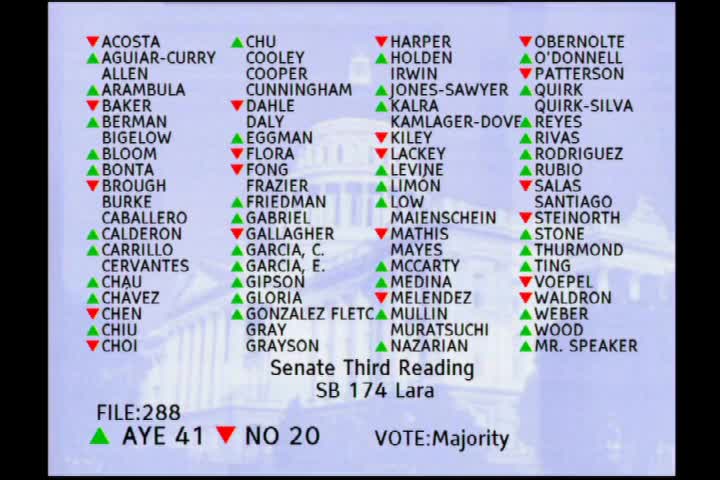 1MIN
Assembly Floor
 54SEC
Assembly Floor
 2MIN
Assembly Standing Committee on Appropriations
 4MIN
Senate Floor
 3MIN
Senate Standing Committee on Appropriations
 30MIN
Senate Standing Committee on Agriculture
Bill Author





