SJR 20: Electrical grid.
- Session Year: 2017-2018
- House: Senate
- Latest Version Date: 2018-08-09
This measure would urge Congress and the President of the United States to work together to implement grid hardening measures and to help ensure our nations critical electrical infrastructure is protected from threats from electromagnetic pulses and physical attacks on the infrastructure.
This measure would urge Congress and the President of the United States to work together to implement grid hardening measures and to help ensure our nations critical electrical infrastructure is protected from threats from electromagnetic pulses and physical attacks on the infrastructure.
This measure would urge Congress and the President of the United States to work together to implement grid hardening measures and to help ensure our nations critical electrical infrastructure is protected from threats from electromagnetic pulses and physical attacks on the infrastructure.
WHEREAS, Geomagnetic storms are natural phenomena involving disturbances in the earths geomagnetic field caused by solar activity; and
WHEREAS, Disruptions of electrical power caused by geomagnetic storms, such as the collapse of the Hydro-Quebec grid during the geomagnetic storm of 1989, have occurred many times in the past; and
WHEREAS, The congressionally mandated Commission to Assess the Threat to the United States from Electromagnetic Pulse Attack found, in its report delivered in July of 2004, that an enemy using a low-yield nuclear weapon detonated at a high altitude above the United States could carry out an electromagnetic pulse (EMP) attack against the United States, and that an EMP attack has the potential to place our society at risk and to defeat the Armed Forces of the United States; and
WHEREAS, Congress has commissioned numerous other hearings and reports on this issue, including the House of Representatives National Security Committee hearing on the EMP threat in 1997, the House of Representatives Military Research and Development Subcommittee hearing on the threat to the United States of potential EMP attacks in 1999, the creation of the Commission to Assess the Threat to the United States from Electromagnetic Pulse Attack in 2001, the congressional commission report, Critical National Infrastructures, issued in 2008, the United States Navy Naval Sea Systems Command EMP program in 2010, the North American Electric Reliability Corporation/federal Department of Energy report, High-Impact, Low-Frequency Event Risk to the North American Bulk Power System, issued in 2010, and the federal Department of Homeland Security testimony to the House of Representatives Committee on Homeland Security, The Electromagnetic Pulse (EMP) Threat: Examining the Consequences, in 2012; and
WHEREAS, In April 2013, an electrical substation in San Jose, California, was attacked with gunfire, leaving transformers disabled for nearly four weeks in an apparent attempt to disrupt power to Silicon Valley, raising questions about the vulnerability of power grids across the United States; now, therefore, be it
Resolved by the Senate and the Assembly of the State of California, jointly, That the Legislature urges the President and the Congress of the United States to work together to implement grid hardening measures and to help ensure our nations critical electrical infrastructure is protected from threats from electromagnetic pulses and physical attacks on the infrastructure; and be it further
Resolved, That the Secretary of the Senate transmit copies of this resolution to the President and the Vice President of the United States, to the Speaker of the House of Representatives, to the Majority Leader of the Senate, and to each Senator and Representative from California in the Congress of the United States.
|
Date
|
Status
|
|---|---|
| Aug 9, 2018 | Chaptered by Secretary of State. Res. Chapter 130, Statutes of 2018. |
| Aug 9, 2018 | Enrolled and filed with the Secretary of State at 2 p.m. |
| Aug 6, 2018 | In Senate. Ordered to engrossing and enrolling. |
| Aug 6, 2018 | Read. Adopted. Ordered to the Senate. |
| Jul 3, 2018 | From committee: Be adopted. Ordered to consent calendar. (Ayes 14. Noes 0.) (July 3). |
| Jun 27, 2018 | June 27 hearing postponed by committee. |
| May 10, 2018 | Referred to Com. on U. & E. |
| May 3, 2018 | In Assembly. Held at Desk. |
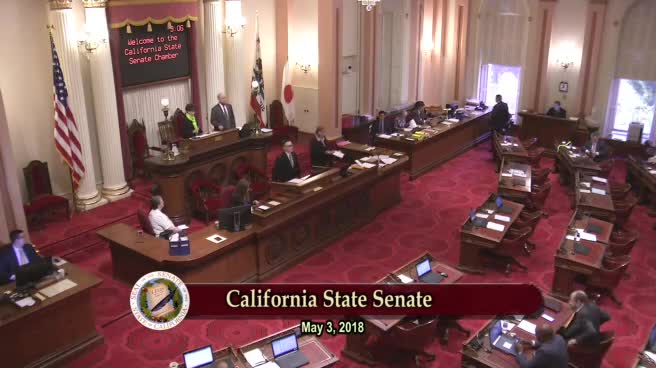
| May 3, 2018 | Read. Adopted. (Ayes 37. Noes 0.) Ordered to the Assembly. |
| Mar 14, 2018 | From committee: Ordered to third reading. |
| Mar 6, 2018 | Introduced. Referred to Com. on RLS. |
|
Date
|
Description
|
Location
|
Votes
|
|
|---|---|---|---|---|
| Aug 6, 2018 | SJR 20 Hertzberg Consent Calendar Second Day Regular Session | Assembly Floor |
Passed |
|
| Jul 3, 2018 | Be adopted. To Consent Calendar. | Assembly Standing Committee on Utilities and Energy |
Passed |
|
| May 3, 2018 | Senate 3rd Reading SJR20 Hertzberg | Senate Floor |
Passed |
This list shows positions taken on this bill by organizations on the date displayed, which is linked to the original source.
Positions by individuals are not included.
Date of Hearing: July 3, 2018
ASSEMBLY COMMITTEE ON UTILITIES AND ENERGY
Chris Holden, Chair
SBPCA Bill Id:SJR 20
Author:(Hertzberg) – As Introduced Ver:March 6, 2018
SENATE VOTE: 37-0
SUBJECT: Electrical grid
SUMMARY: Urges Congress and the President of the United States to work together to implement grid hardening measures and to help ensure our nation’s critical electrical infrastructure is protected from threats from electromagnetic pulses and physical attacks on the infrastructure. Specifically, this bill:
- Makes numerous legislative findings related to grid hardening including the following:
- Geomagnetic storms are natural phenomena involving disturbances in the earth’s geomagnetic field caused by solar activity;
- Disruptions of electrical power caused by geomagnetic storms, such as the collapse of the Hydro-Quebec grid during the geomagnetic storm of 1989, have occurred many times in the past;
- The congressionally mandated Commission to Assess the Threat to the United States from Electromagnetic Pulse Attack found, in its report delivered in July of 2004, that an enemy using a low-yield nuclear weapon detonated at a high altitude above the United States could carry out an electromagnetic pulse (EMP) attack against the United States, and that an EMP attack has the potential to place our society at risk and to defeat the Armed Forces of the United States; and
- Congress has commissioned numerous other hearings and reports on this issue, including the House of Representatives National Security Committee hearing on the EMP threat in 1997, the House of Representatives Military Research and Development Subcommittee hearing on the threat to the United States of potential EMP attacks in 1999, the creation of the Commission to Assess the Threat to the United States from Electromagnetic Pulse Attack in 2001, the congressional commission report, “Critical National Infrastructures,” issued in 2008, the United States Navy Naval Sea Systems Command EMP program in 2010, the North American Electric Reliability Corporation/federal Department of Energy report, “High-Impact, Low-Frequency Event Risk to the North American Bulk Power System,” issued in 2010, and the federal Department of Homeland Security testimony to the House of Representatives Committee on Homeland Security, “The Electromagnetic Pulse Threat: Examining the Consequences,” in 2012.
BACKGROUND:
The Electrical Grid – The U.S. electric grid (“the grid”) constitutes a vital component of the nation’s critical infrastructure. The grid generates, transmits, and distributes electric power to millions of Americans in homes, schools, offices, and factories across the United States. Severe weather is the number one cause of power outages in the United States and costs the economy billions of dollars a year in lost output and wages, spoiled inventory, delayed production, inconvenience and damage to grid infrastructure. Moreover, the aging nature of the grid – much of which was constructed over a period of more than one hundred years – has made Americans more susceptible to outages caused by severe weather. Between 2003 and 2012, roughly 679 power outages, each affecting at least 50,000 customers, occurred due to weather events (U.S. Department of Energy). The number of outages caused by severe weather is expected to rise as climate change increases the frequency and intensity of hurricanes, blizzards, floods and other extreme weather events. In 2012, the United States suffered eleven billion-dollar weather disasters – the second-most for any year on record, behind only 2011. The U.S. energy sector in general and the grid in particular, is vulnerable to the increasingly severe weather expected as the climate changes (DOE 2013).[1]
Federal Energy Regulatory Commission (FERC) – FERC has jurisdiction of implementing “grid hardening measures.” FERC has approved standards to implement grid hardening measures and to help ensure critical electrical infrastructure is protected from threats from electromagnetic pulses (NERC TPL-007-1 GMD Standard) and physical attacks on the infrastructure (NERC CIP-014-2 Physical Security Standard).
Recent Activity – On May 17, 2018, FERC issued a Notice of Proposed Rulemaking in which it proposed to approve Reliability Standard TPL-007-2 (Transmission System Planned Performance for Geomagnetic Disturbance Events) submitted by the North American Electric Reliability Corporation (NERC) which develops reliability standards for the electric system in the United States.
Geomagnetic Storms – Geomagnetic disturbance events result from charged particles ejected from the sun that interact with and cause changes in the earth’s magnetic fields, impacting flows on electric power systems and potentially causing voltage instability and equipment failure. Like regular weather, most of these storms are mild, but occasionally an unusually strong storm can strike Earth. The biggest solar storm on record occurred in 1859, named the Carrington Event, and was strong enough that telegraph operators reported sparks leaping from their equipment – some bad enough to set fires. Scientists predict that if a similar storm were to hit Earth today, power surges caused by solar particles could blow out giant transformers, potentially leaving cities without power for weeks, months, or even a year.
Electromagnetic Radiation (EMP) – An EMP is a burst of electromagnetic radiation caused by a nuclear explosion. Although the likelihood of such an attack remains low, if an EMP could cause electromagnetic “shocking” of electronics and cause stressing of our electrical systems. According to the federal Commission to Assess the Threat to the United States from EMP Attack, the electromagnetic fields produced by weapons designed to produce EMP have a high likelihood of damaging our electrical power systems, electronics, and information systems which American society depends. Depending on the size and specifics of the attack, unprecedented failures of major infrastructure could result.
Grid Resilience – In 2013 President Obama released report on Grid Resilience, titled, The Economic Benefits of Increasing Electric Grid Resilience to Weather Outages. In this report, resilience strategies include: reconstitution and general readiness (such as pole maintenance, vegetation management, use of mobile transformers and substations, and participation in mutual assistance groups), managing for risk, grid strengthening measures, increased flexibility, real time outage data through smart metering and software system updates. These strategies require a partnership across all levels of government and the private sector to promote a regional and cross-jurisdictional approach. Since the electric grid cannot be 100 percent secure, the strategy chosen to make the grid resilient must identify the greatest risks to the system and determine the cost and impact to mitigation/hardening strategies to advance the capability of the grid.
The following entities play key roles in ensuring the security of the nation’s electric grid. These entities’ contributions include rulemaking, regulatory enforcement, law enforcement and intelligence gathering, and emergency response:
- U.S. Department of Energy (DOE) – The U.S. Department of Energy provides support and resources to improve physical – and cyber security and resilience. U.S. DOE’s role includes supporting the Electric Sector Coordinating Council, a public-private partnership that supports threat information sharing, and research and development. The U.S. DOE is considered to be the nation’s most complete source for information on physical security incidents, thanks to its OE-417 Electric Emergency Incident and Disturbance reporting program.
- Federal Energy Regulatory Commission (FERC) – FERC is the federal agency that oversees the interstate transmission of energy in the U.S., including natural gas, oil, and electricity as afforded by the Federal Power Act. Responsibilities include approving reliability standards for bulk power systems to address physical – and cyber security. FERC also certifies electric reliability organizations which are responsible for the monitoring and enforcement of these standards at the regional interstate level.
- North American Electric Reliability Corporation (NERC) – NERC is a nongovernmental organization (NGO) that reports to FERC and is responsible for carrying out federal rules surrounding reliability and security of the bulk power transmission system in North America. It oversees eight regional electric reliability organizations that monitor and enforce compliance with NERC/FERC rules. NERC also provides reliability standards for power systems, including the protection of critical infrastructure. NERC has 14 critical infrastructure protection (CIP) standards, 13 of which address cyber security and one standard, CIP-014, to address physical security. NERC operates the Electricity Information Sharing and Analysis Center (E-ISAC) which offers security data services to bulk power system owners and operators.
- The Western Electricity Coordinating Council (WECC) –WECC is an NGO regulatory authority responsible for coordinating and promoting system reliability for the Western Interconnection, a territory that includes 14 U.S. states, two Canadian provinces, and the northern portion of one Mexican state. WECC is the regional compliance enforcement agent for NERC, and to ensure compliance with CIP-014, it conducts audits of utility CIP security plans and implementation practices. WECC supports a Physical Security Working Group that meets every six months and consists of about 60 members representing utilities in the Western U.S. The working group exchanges information on physical security best practices including security metrics, active shooter protocols and training, new security technologies, and advanced design. Of particular note, this group has provided support to member utilities on CIP 014 compliance, and conveyed federal updates. The working group also serves as liaison between utilities and WECC and the NERC Critical Infrastructure Protection Committee.


Source: Safety and Enforcement Division Security and Resilience for California
Electric Distribution Infrastructure: Regulatory and Industry Response to SB 699
A CPUC Staff White Paper [2]
COMMENTS:
- Author’s Statement. According to the author, “The role of government is to get ahead of problems that could result in dire consequences. Any major disruption to our grid will have costly and fatal consequences. This past March, the FBI revealed that our electrical grid is under constant threat of cyberattack by Russian actors. The Department of Homeland Security identified our electrical infrastructure as a natural “soft target” for terrorism, and we experienced that in 2013 in San Jose when armed gunmen took out a substation there, costing $15 million in damage. Fortunately we have the technology and the expertise to protect the grid in a cost-efficient manner. If we wait until after our nation has plunged into chaos, it will be too late to act. We cannot afford such complacency now.”
- Related Legislation.
SB 1076 (Hertzberg) Requires the Governor’s Office of Emergency Services (CalOES) to develop preparedness recommendations to harden the critical infrastructure of electrical utilities against an electromagnetic pulse (EMP) attack, geomagnetic storm event, or other long-term outage. Status: Assembly Governmental Organization Committee.
- Prior Legislation:
SB 699 (Hill), directed the California Public Utilities Commission to explore policies and practices related to physical security of electric distribution assets. Specifically, the law directed the Commission to consider adoption of new standards and rules to address any physical security risk to the distribution system of California’s electric corporations so as to ensure high-quality, safe, and reliable service. (Chapter 550, Statutes 2014)
REGISTERED SUPPORT / OPPOSITION:
Support
None on file.
Opposition
None on file.
Analysis Prepared by: Elle Hoxworth / U. & E. /
Office of Senate Floor Analyses (916) 651-1520 Fax: (916) 327-4478 | SJR 20 |
THIRD READING
Bill No: SJR 20
Introduced: 3/6/18
DIGEST:
This resolution urges Congress and the President of the United States to work together to implement grid hardening measures and to help ensure our nation’s critical electrical infrastructure is protected from threats from electromagnetic pulses and physical attacks on the infrastructure.
ANALYSIS: This resolution makes the following legislative findings:
- Geomagnetic storms are natural phenomena involving disturbances in the earth’s geomagnetic field caused by solar activity.
- Disruptions of electrical power caused by geomagnetic storms, such as the collapse of the Hydro-Quebec grid during the geomagnetic storm of 1989, have occurred many times in the past.
- The congressionally mandated Commission to Assess the Threat to the United States from Electromagnetic Pulse Attack found, in its report delivered in July of 2004, that an enemy using a low-yield nuclear weapon detonated at a high altitude above the United States could carry out an electromagnetic pulse (EMP) attack against the United States, and that an EMP attack has the potential to place our society at risk and to defeat the Armed Forces of the United States.
- Congress has commissioned numerous other hearings and reports on this issue, including the House of Representatives National Security Committee hearing on the EMP threat in 1997, the House of Representatives Military Research and Development Subcommittee hearing on the threat to the United States of potential EMP attacks in 1999, the creation of the Commission to Assess the Threat to the United States from Electromagnetic Pulse Attack in 2001, the congressional commission report, “Critical National Infrastructures,” issued in 2008, the United States Navy Naval Sea Systems Command EMP program in 2010, the North American Electric Reliability Corporation/federal Department of Energy report, “High-Impact, Low-Frequency Event Risk to the North American Bulk Power System,” issued in 2010, and the federal Department of Homeland Security testimony to the House of Representatives Committee on Homeland Security, “The Electromagnetic Pulse (EMP) Threat: Examining the Consequences,” in 2012.
This resolution urges the President and the Congress of the United States to work together to implement grid hardening measures and to help ensure our nation’s critical electrical infrastructure is protected from threats from electromagnetic pulses and physical attacks on the infrastructure.
FISCAL EFFECT: Appropriation: No Fiscal Com.: No Local: No
None received
OPPOSITION: (Verified 3/13/18)
None received
Prepared by: Karen Chow / SFA / (916) 651-1520
3/14/18 15:25:07
**** END ****
Bill Author

Bill Co-Author(s):