SB 402: Involuntary commitment.
- Session Year: 2023-2024
- House: Senate
- Latest Version Date: 2024-07-03
Current Status:
Failed
(2024-08-15: August 15 hearing: Held in committee and under submission.)
Introduced
In Committee
First Chamber
In Committee
Second Chamber
Enacted
Existing law, the Lanterman-Petris-Short Act, authorizes the involuntary commitment and treatment of persons with specified mental disorders. Under the act, when a person, as a result of a mental health disorder, is a danger to self or others, or gravely disabled, the person may, upon probable cause, be taken into custody by specified individuals, including, among others, by peace officers and designated members of a mobile crisis team, and placed in a facility designated by the county and approved by the State Department of Health Care Services for up to 72 hours for evaluation and treatment.
This bill would additionally authorize authorize, until January 1, 2030, a person to be taken into custody, pursuant to those provisions, by a licensed mental health professional, as defined. The bill would require a licensed mental health professional who is not direct staff of, or contracted by, a county to complete a specified training prior to exercising that authority and would prohibit those licensed mental health professionals from transporting a person taken into custody pursuant to the above-described provisions unless specifically authorized by the county to do so.
Existing law requires the State Department of Health Care Services to collect and publish annually quantitative information concerning the operation of various provisions relating to community mental health services, including the number of persons admitted for evaluation and treatment for certain periods, transferred to mental health facilities, and for whom certain conservatorships are established, as specified. Existing law requires each county behavioral health director, each designated and approved facility, and each other entity, as specified, to provide accurate and complete data as prescribed by the department.
This bill would require county behavioral health directors to provide, and would require the State Department of Health Care Services to collect and publish, additional information, including, among other things, the number of individuals designated by each county to perform specified functions, their profession, and the number of holds initiated per profession, as specified. The bill would require each law enforcement agency to provide accurate and complete data to the department regarding the number of holds initiated by a peace officer. By increasing the duties on county behavioral health directors and law enforcement agencies, this bill would impose a state-mandated local program.
The California Constitution requires the state to reimburse local agencies and school districts for certain costs mandated by the state. Statutory provisions establish procedures for making that reimbursement.
This bill would provide that, if the Commission on State Mandates determines that the bill contains costs mandated by the state, reimbursement for those costs shall be made pursuant to the statutory provisions noted above.
Existing law, the Lanterman-Petris-Short Act, authorizes the involuntary commitment and treatment of persons with specified mental disorders. Under the act, when a person, as a result of a mental health disorder, is a danger to self or others, or gravely disabled, the person may, upon probable cause, be taken into custody by specified individuals, including, among others, by peace officers and designated members of a mobile crisis team, and placed in a facility designated by the county and approved by the State Department of Health Care Services for up to 72 hours for evaluation and treatment.
This bill would additionally authorize a person to be taken into custody, pursuant to those provisions, by a licensed mental health professional, as defined.
Existing law requires the State Department of Health Care Services to collect and publish annually quantitative information concerning the operation of various provisions relating to community mental health services, including the number of persons admitted for evaluation and treatment for certain periods, transferred to mental health facilities, and for whom certain conservatorships are established, as specified. Existing law requires each county behavioral health director, each designated and approved facility, and each other entity, as specified, to provide accurate and complete data as prescribed by the department.
This bill would require county behavioral health directors to provide, and would require the State Department of Health Care Services to collect and publish, additional information, including, among other things, the number of individuals designated by each county to perform specified functions, their profession, and the number of holds initiated per profession, as specified. The bill would require each law enforcement agency to provide accurate and complete data to the department regarding the number of holds initiated by a peace officer. By increasing the duties on county behavioral health directors and law enforcement agencies, this bill would impose a state-mandated local program.
The California Constitution requires the state to reimburse local agencies and school districts for certain costs mandated by the state. Statutory provisions establish procedures for making that reimbursement.
This bill would provide that, if the Commission on State Mandates determines that the bill contains costs mandated by the state, reimbursement for those costs shall be made pursuant to the statutory provisions noted above.
Existing law, the Lanterman-Petris-Short Act, authorizes the involuntary commitment and treatment of persons with specified mental disorders. Under the act, when a person, as a result of a mental health disorder, is a danger to self or others, or gravely disabled, the person may, upon probable cause, be taken into custody by specified individuals, including, among others, by peace officers and designated members of a mobile crisis team, and placed in a facility designated by the county and approved by the State Department of Health Care Services for up to 72 hours for evaluation and treatment.
This bill would additionally authorize a person to be taken into custody, pursuant to those provisions, by a licensed mental health professional, as defined.
Existing law, the Lanterman-Petris-Short Act, authorizes the involuntary commitment and treatment of persons with specified mental disorders. Under the act, when a person, as a result of a mental health disorder, is a danger to self or others, or gravely disabled, the person may, upon probable cause, be taken into custody by specified individuals, including, among others, by peace officers and designated members of a mobile crisis team, and placed in a facility designated by the county and approved by the State Department of Health Care Services for up to 72 hours for evaluation and treatment.
This bill would additionally authorize a person to be taken into custody, pursuant to those provisions, by a licensed mental health professional, as defined.
Existing law, the Warren-911-Emergency Assistance Act, requires every local public agency, as defined, to have an emergency communication system and requires the digits 911 to be the primary emergency telephone number within the system.Existing law requires the future implementation of a statewide 988 telephone system for suicide prevention and mental health crises.This bill would require 911 or other service center calls for service relating to mental health or homelessness, as specified, to be dispatched to fire district or department personnel, EMS personnel, mental health personnel, or nonsworn unarmed police personnel and not to police officers, except as otherwise provided.By requiring a higher level of service for local governments, this bill would impose a state-mandated local program.The California Constitution requires the state to reimburse local agencies and school districts for certain costs mandated by the state. Statutory provisions establish procedures for making that reimbursement.This bill would provide that, if the Commission on State Mandates determines that the bill contains costs mandated by the state, reimbursement for those costs shall be made pursuant to the statutory provisions noted above.Existing law, the Warren-911-Emergency Assistance Act, requires every local public agency, as defined, to have an emergency communication system and requires the digits 911 to be the primary emergency telephone number within the system.
Existing law requires the future implementation of a statewide 988 telephone system for suicide prevention and mental health crises.
This bill would require 911 or other service center calls for service relating to mental health or homelessness, as specified, to be dispatched to fire district or department personnel, EMS personnel, mental health personnel, or nonsworn unarmed police personnel and not to police officers, except as otherwise provided.
By requiring a higher level of service for local governments, this bill would impose a state-mandated local program.
The California Constitution requires the state to reimburse local agencies and school districts for certain costs mandated by the state. Statutory provisions establish procedures for making that reimbursement.
This bill would provide that, if the Commission on State Mandates determines that the bill contains costs mandated by the state, reimbursement for those costs shall be made pursuant to the statutory provisions noted above.
(a)The county behavioral health director may develop procedures for the countys designation and training of professionals who will be designated to perform functions under Section 5150. These procedures may include, but are not limited to, the following:
(1)The license types, practice disciplines, and clinical experience of professionals eligible to be designated by the county.
(2)The initial and ongoing training and testing requirements for professionals eligible to be designated by the county.
(3)The application and approval processes for professionals seeking to be designated by the county, including the timeframe for initial designation and procedures for renewal of the designation.
(4)The countys process for monitoring and reviewing professionals designated by the county to ensure appropriate compliance with state law, regulations, and county procedures.
(b)A county behavioral health director may develop a training for the procedures for designation developed pursuant to subdivision (a).
(c)If a county behavioral health director denies or revokes an individuals designation, the county behavioral health director shall, in writing, notify the person who made the request for designation of the individual and the individual who is the subject of the request for designation describing the reasons for denial or revocation.
(d)(1)Designated members of a mobile crisis team and designated professional persons shall not be prohibited from transporting a person taken into custody pursuant to Section 5150.
(2)Notwithstanding paragraph (1), a person who qualifies as a licensed mental health professional, as defined in paragraph (2) of subdivision (a) of Section 5150, but is not direct staff of, or contracted by, a county, is prohibited from transporting a person taken into custody pursuant to Section 5150, unless specifically authorized by the county to do so.
(e)If the county behavioral health director of the County of Sacramento develops procedures pursuant to subdivision (a), the county behavioral health director of the County of Sacramento shall, by April 1, 2022, issue a written policy regarding the procedures developed pursuant to subdivision (a). The policy shall address, at a minimum, the topics identified in paragraphs (1) to (4), inclusive, of subdivision (a). The policy shall require the county behavioral health director of the County of Sacramento to designate individuals employed by the City of Sacramento who are also members of a mobile crisis team or who are also professional persons if all of the following are true:
(1)The City of Sacramento submits a written request to the county behavioral health director.
(2)The individuals meet the requirements for designation included in the policy.
(3)If the county behavioral health director of the County of Sacramento has developed a training pursuant to subdivision (b), the individuals have completed that training.
(f)A person who qualifies as a licensed mental health professional as defined in paragraph (2) of subdivision (a) of Section 5150, but is not direct staff of, or contracted by, a county, shall not exercise the authority described in subdivision (a) of Section 5150 prior to completing the training requirements for professionals eligible to be designated by the county described in paragraph (2) of subdivision (a).
(g)This section shall remain in effect only until January 1, 2030, and as of that date is repealed.
SEC. 2.Section 5121 is added to the Welfare and Institutions Code, to read:5121.(a)The county behavioral health director may develop procedures for the countys designation and training of professionals who will be designated to perform functions under Section 5150. These procedures may include, but are not limited to, the following:
(1)The license types, practice disciplines, and clinical experience of professionals eligible to be designated by the county.
(2)The initial and ongoing training and testing requirements for professionals eligible to be designated by the county.
(3)The application and approval processes for professionals seeking to be designated by the county, including the timeframe for initial designation and procedures for renewal of the designation.
(4)The countys process for monitoring and reviewing professionals designated by the county to ensure appropriate compliance with state law, regulations, and county procedures.
(b)A county behavioral health director may develop a training for the procedures for designation developed pursuant to subdivision (a).
(c)If a county behavioral health director denies or revokes an individuals designation, the county behavioral health director shall, in writing, notify the person who made the request for designation of the individual and the individual who is the subject of the request for designation describing the reasons for denial or revocation.
(d)Designated members of a mobile crisis team and designated professional persons shall not be prohibited from transporting a person taken into custody pursuant to Section 5150.
(e)If the county behavioral health director of the County of Sacramento develops procedures pursuant to subdivision (a), the county behavioral health director of the County of Sacramento shall, by April 1, 2022, issue a written policy regarding the procedures developed pursuant to subdivision (a). The policy shall address, at a minimum, the topics identified in paragraphs (1) to (4), inclusive, of subdivision (a). The policy shall require the county behavioral health director of the County of Sacramento to designate individuals employed by the City of Sacramento who are also members of a mobile crisis team or who are also professional persons if all of the following are true:
(1)The City of Sacramento submits a written request to the county behavioral health director.
(2)The individuals meet the requirements for designation included in the policy.
(3)If the county behavioral health director of the County of Sacramento has developed a training pursuant to subdivision (b), the individuals have completed that training.
(f)This section shall be operative on January 1, 2030.
SECTION 1.SEC. 3.Section 5150 of the Welfare and Institutions Code is amended to read:5150.(a)(1)When a person, as a result of a mental health disorder, is a danger to others or to themselves, or is gravely disabled, a peace officer, licensed mental health professional, professional person in charge of a facility designated by the county for evaluation and treatment, member of the attending staff, as defined by regulation, of a facility designated by the county for evaluation and treatment, designated members of a mobile crisis team, or professional person designated by the county may, upon probable cause, take, or cause to be taken, the person into custody for a period of up to 72 hours for assessment, evaluation, and crisis intervention or placement for evaluation and treatment in a facility designated by the county for evaluation and treatment and approved by the State Department of Health Care Services. The 72-hour period begins at the time when the person is first detained. At a minimum, assessment, as defined in Section 5150.4, and evaluation, as defined in subdivision (a) of Section 5008, shall be conducted and provided on an ongoing basis. Crisis intervention, as defined in subdivision (e) of Section 5008, may be provided concurrently with assessment, evaluation, or any other service.
(2)(A)As used in this section, licensed mental health professional means an individual who is designated by the county and who holds a current and active license in good standing standing, and has completed all of the supervised clinical experience required for the license, as any of the following:
(i)Physician and surgeon specializing in the practice of psychiatry.
(ii)Psychologist.
(iii)Licensed clinical social worker.
(iv)Licensed marriage and family therapist.
(v)Licensed professional clinical counselor who has completed all required supervised clinical experience. counselor.
(B)For purposes of this section, a licensed mental health professional does not need to be direct staff of, or contracted by, the county.
(b)When determining if a person should be taken into custody pursuant to subdivision (a), the individual making that determination shall apply the provisions of Section 5150.05 and shall not be limited to consideration of the danger of imminent harm.
(c)The professional person in charge of a facility designated by the county for evaluation and treatment, member of the attending staff, or professional person designated by the county shall assess the person to determine whether the person can be properly served without being detained. If, in the judgment of the professional person in charge of the facility designated by the county for evaluation and treatment, member of the attending staff, or professional person designated by the county, the person can be properly served without being detained, the person shall be provided evaluation, crisis intervention, or other inpatient or outpatient services on a voluntary basis. This subdivision does not prevent a peace officer from delivering an individual to a designated facility for assessment under this section. Furthermore, the assessment requirement of this subdivision does not require a peace officer to perform any additional duties other than those specified in Sections 5150.1 and 5150.2.
(d)If a person is evaluated by a professional person in charge of a facility designated by the county for evaluation or treatment, member of the attending staff, or professional person designated by the county and is found to be in need of mental health services, but is not admitted to the facility, all available alternative services provided pursuant to subdivision (c) shall be offered, as determined by the county mental health director.
(e)If, in the judgment of the professional person in charge of the facility designated by the county for evaluation and treatment, member of the attending staff, or the professional person designated by the county, the person cannot be properly served without being detained, the admitting facility shall require an application in writing stating the circumstances under which the persons condition was called to the attention of the peace officer, licensed mental health professional, professional person in charge of the facility designated by the county for evaluation and treatment, member of the attending staff, or professional person designated by the county and stating that the peace officer, licensed mental health professional, professional person in charge of the facility designated by the county for evaluation and treatment, member of the attending staff, or professional person designated by the county has probable cause to believe that the person is, as a result of a mental health disorder, a danger to others or to themselves, or is gravely disabled. The application shall also record whether the historical course of the persons mental disorder was considered in the determination pursuant to Section 5150.05. If the probable cause is based on the statement of a person other than the peace officer, licensed mental health professional, professional person in charge of the facility designated by the county for evaluation and treatment, member of the attending staff, or professional person designated by the county, the person shall be liable in a civil action for intentionally giving a statement that the person knows to be false. A copy of the application shall be treated as the original.
(f)(1)At the time a person is taken into custody for evaluation, or within a reasonable time thereafter, unless a responsible relative or the guardian or conservator of the person is in possession of the persons personal property, the person taking them into custody shall take reasonable precautions to preserve and safeguard the personal property in the possession of or on the premises occupied by the person. The person taking them into custody shall then furnish to the court a report generally describing the persons property so preserved and safeguarded and its disposition, in substantially the form set forth in Section 5211, except that if a responsible relative or the guardian or conservator of the person is in possession of the persons property, the report shall include only the name of the relative or guardian or conservator and the location of the property, whereupon responsibility of the person taking them into custody for that property shall terminate.
(2)As used in this section, responsible relative includes the spouse, parent, adult child, domestic partner, grandparent, grandchild, or adult brother or sister of the person.
(g)(1)Each person, at the time the person is first taken into custody under this section, shall be provided, by the person who takes them into custody, the following information orally in a language or modality accessible to the person. If the person cannot understand an oral advisement, the information shall be provided in writing. The information shall be in substantially the following form:
My name is . I am a(peace officer/mental health professional) . with(name of agency) . You are not under criminal arrest, but I am taking you for an examination by mental health professionals at . (name of facility) You will be told your rights by the mental health staff. |
(2)If taken into custody at the persons own residence, the person shall also be provided the following information:
You may bring a few personal items with you, which I will have to approve. Please inform me if you need assistance turning off any appliance or water. You may make a phone call and leave a note to tell your friends or family where you have been taken.
(h)The designated facility shall keep, for each patient evaluated, a record of the advisement given pursuant to subdivision (g), which shall include all of the following:
(1)The name of the person detained for evaluation.
(2)The name and position of the peace officer or mental health professional taking the person into custody.
(3)The date the advisement was completed.
(4)Whether the advisement was completed.
(5)The language or modality used to give the advisement.
(6)If the advisement was not completed, a statement of good cause as defined by regulations of the State Department of Health Care Services.
(i)(1)Each person admitted to a facility designated by the county for evaluation and treatment shall be given the following information by admission staff of the facility. The information shall be given orally and in writing and in a language or modality accessible to the person. The written information shall be available to the person in English and in the language that is the persons primary means of communication. Accommodations for other disabilities that may affect communication shall also be provided. The information shall be in substantially the following form:
My name is. |
My position here is. |
You are being placed into this psychiatric facility because it is our professional opinion that, as a result of a mental health disorder, you are likely to (check applicable): |
Harm yourself. |
(list of the facts upon which the allegation of dangerous |
You will be held for a period up to 72 hours. During the 72 hours you may also be transferred to another facility. You may request to be evaluated or treated at a facility of your choice. You may request to be evaluated or treated by a mental health professional of your choice. We cannot guarantee the facility or mental health professional you choose will be available, but we will honor your choice if we can. |
During these 72 hours you will be evaluated by the facility staff, and you may be given treatment, including medications. It is possible for you to be released before the end of the 72 hours. But if the staff decides that you need continued treatment you can be held for a longer period of time. If you are held longer than 72 hours, you have the right to a lawyer and a qualified interpreter and a hearing before a judge. If you are unable to pay for the lawyer, then one will be provided to you free of charge. |
If you have questions about your legal rights, you may contact the county Patients Rights Advocate at (phone number for the county Patients Rights Advocacy office). Your 72-hour period began (date/time). |
(2)If the notice is given in a county where weekends and holidays are excluded from the 72-hour period, the person shall be informed of this fact.
(j)For each person admitted for evaluation and treatment, the facility shall keep with the persons medical record a record of the advisement given pursuant to subdivision (i), which shall include all of the following:
(1)The name of the person performing the advisement.
(2)The date of the advisement.
(3)Whether the advisement was completed.
(4)The language or modality used to communicate the advisement.
(5)If the advisement was not completed, a statement of good cause.
(k)A facility to which a person who is involuntarily detained pursuant to this section is transported shall notify the county patients rights advocate, as defined in Section 5500, if a person has not been released within 72 hours of the involuntary detention.
(l)This section shall remain in effect only until January 1, 2030, and as of that date is repealed.
SEC. 4.Section 5150 is added to the Welfare and Institutions Code, to read:5150.(a)When a person, as a result of a mental health disorder, is a danger to others or to themselves, or is gravely disabled, a peace officer, professional person in charge of a facility designated by the county for evaluation and treatment, member of the attending staff, as defined by regulation, of a facility designated by the county for evaluation and treatment, designated members of a mobile crisis team, or professional person designated by the county may, upon probable cause, take, or cause to be taken, the person into custody for a period of up to 72 hours for assessment, evaluation, and crisis intervention or placement for evaluation and treatment in a facility designated by the county for evaluation and treatment and approved by the State Department of Health Care Services. The 72-hour period begins at the time when the person is first detained. At a minimum, assessment, as defined in Section 5150.4, and evaluation, as defined in subdivision (a) of Section 5008, shall be conducted and provided on an ongoing basis. Crisis intervention, as defined in subdivision (e) of Section 5008, may be provided concurrently with assessment, evaluation, or any other service.
(b)When determining if a person should be taken into custody pursuant to subdivision (a), the individual making that determination shall apply the provisions of Section 5150.05 and shall not be limited to consideration of the danger of imminent harm.
(c)The professional person in charge of a facility designated by the county for evaluation and treatment, member of the attending staff, or professional person designated by the county shall assess the person to determine whether the person can be properly served without being detained. If, in the judgment of the professional person in charge of the facility designated by the county for evaluation and treatment, member of the attending staff, or professional person designated by the county, the person can be properly served without being detained, the person shall be provided evaluation, crisis intervention, or other inpatient or outpatient services on a voluntary basis. This subdivision does not prevent a peace officer from delivering an individual to a designated facility for assessment under this section. Furthermore, the assessment requirement of this subdivision does not require a peace officer to perform any additional duties other than those specified in Sections 5150.1 and 5150.2.
(d)If a person is evaluated by a professional person in charge of a facility designated by the county for evaluation or treatment, member of the attending staff, or professional person designated by the county and is found to be in need of mental health services, but is not admitted to the facility, all available alternative services provided pursuant to subdivision (c) shall be offered, as determined by the county mental health director.
(e)If, in the judgment of the professional person in charge of the facility designated by the county for evaluation and treatment, member of the attending staff, or the professional person designated by the county, the person cannot be properly served without being detained, the admitting facility shall require an application in writing stating the circumstances under which the persons condition was called to the attention of the peace officer, professional person in charge of the facility designated by the county for evaluation and treatment, member of the attending staff, or professional person designated by the county and stating that the peace officer, professional person in charge of the facility designated by the county for evaluation and treatment, member of the attending staff, or professional person designated by the county has probable cause to believe that the person is, as a result of a mental health disorder, a danger to others or to themselves, or is gravely disabled. The application shall also record whether the historical course of the persons mental disorder was considered in the determination pursuant to Section 5150.05. If the probable cause is based on the statement of a person other than the peace officer, professional person in charge of the facility designated by the county for evaluation and treatment, member of the attending staff, or professional person designated by the county, the person shall be liable in a civil action for intentionally giving a statement that the person knows to be false. A copy of the application shall be treated as the original.
(f)(1)At the time a person is taken into custody for evaluation, or within a reasonable time thereafter, unless a responsible relative or the guardian or conservator of the person is in possession of the persons personal property, the person taking them into custody shall take reasonable precautions to preserve and safeguard the personal property in the possession of or on the premises occupied by the person. The person taking them into custody shall then furnish to the court a report generally describing the persons property so preserved and safeguarded and its disposition, in substantially the form set forth in Section 5211, except that if a responsible relative or the guardian or conservator of the person is in possession of the persons property, the report shall include only the name of the relative or guardian or conservator and the location of the property, whereupon responsibility of the person taking them into custody for that property shall terminate.
(2)As used in this section, responsible relative includes the spouse, parent, adult child, domestic partner, grandparent, grandchild, or adult brother or sister of the person.
(g)(1)Each person, at the time the person is first taken into custody under this section, shall be provided, by the person who takes them into custody, the following information orally in a language or modality accessible to the person. If the person cannot understand an oral advisement, the information shall be provided in writing. The information shall be in substantially the following form:
My name is . I am a(peace officer/mental health professional) . with(name of agency) . You are not under criminal arrest, but I am taking you for an examination by mental health professionals at . (name of facility) You will be told your rights by the mental health staff. |
(2)If taken into custody at the persons own residence, the person shall also be provided the following information:
You may bring a few personal items with you, which I will have to approve. Please inform me if you need assistance turning off any appliance or water. You may make a phone call and leave a note to tell your friends or family where you have been taken.
(h)The designated facility shall keep, for each patient evaluated, a record of the advisement given pursuant to subdivision (g), which shall include all of the following:
(1)The name of the person detained for evaluation.
(2)The name and position of the peace officer or mental health professional taking the person into custody.
(3)The date the advisement was completed.
(4)Whether the advisement was completed.
(5)The language or modality used to give the advisement.
(6)If the advisement was not completed, a statement of good cause as defined by regulations of the State Department of Health Care Services.
(i)(1)Each person admitted to a facility designated by the county for evaluation and treatment shall be given the following information by admission staff of the facility. The information shall be given orally and in writing and in a language or modality accessible to the person. The written information shall be available to the person in English and in the language that is the persons primary means of communication. Accommodations for other disabilities that may affect communication shall also be provided. The information shall be in substantially the following form:
My name is. |
My position here is. |
You are being placed into this psychiatric facility because it is our professional opinion that, as a result of a mental health disorder, you are likely to (check applicable): |
Harm yourself. |
(list of the facts upon which the allegation of dangerous |
You will be held for a period up to 72 hours. During the 72 hours you may also be transferred to another facility. You may request to be evaluated or treated at a facility of your choice. You may request to be evaluated or treated by a mental health professional of your choice. We cannot guarantee the facility or mental health professional you choose will be available, but we will honor your choice if we can. |
During these 72 hours you will be evaluated by the facility staff, and you may be given treatment, including medications. It is possible for you to be released before the end of the 72 hours. But if the staff decides that you need continued treatment you can be held for a longer period of time. If you are held longer than 72 hours, you have the right to a lawyer and a qualified interpreter and a hearing before a judge. If you are unable to pay for the lawyer, then one will be provided to you free of charge. |
If you have questions about your legal rights, you may contact the county Patients Rights Advocate at (phone number for the county Patients Rights Advocacy office). Your 72-hour period began (date/time). |
(2)If the notice is given in a county where weekends and holidays are excluded from the 72-hour period, the person shall be informed of this fact.
(j)For each person admitted for evaluation and treatment, the facility shall keep with the persons medical record a record of the advisement given pursuant to subdivision (i), which shall include all of the following:
(1)The name of the person performing the advisement.
(2)The date of the advisement.
(3)Whether the advisement was completed.
(4)The language or modality used to communicate the advisement.
(5)If the advisement was not completed, a statement of good cause.
(k)A facility to which a person who is involuntarily detained pursuant to this section is transported shall notify the county patients rights advocate, as defined in Section 5500, if a person has not been released within 72 hours of the involuntary detention.
(l)This section shall be operative on January 1, 2030.
SEC. 2.SEC. 5.Section 5402 of the Welfare and Institutions Code is amended to read:5402.(a)The State Department of Health Care Services shall collect data quarterly and publish, on or before May 1 of each year, a report including quantitative, deidentified information concerning the operation of this division. The report shall include an evaluation of the effectiveness of achieving the legislative intent of this part pursuant to Section 5001. Based on information that is available from each county, the report shall include all of the following information:
(1)The number of persons in designated and approved facilities admitted or detained for 72-hour evaluation and treatment, admitted for 14-day and 30-day periods of intensive treatment, and admitted for 180-day postcertification intensive treatment in each county.
(2)The number of persons transferred to mental health facilities pursuant to Section 4011.6 of the Penal Code in each county.
(3)The number of persons for whom temporary conservatorships are established in each county.
(4)The number of persons for whom conservatorships are established in each county.
(5)The number of persons admitted or detained either once, between two and five times, between six and eight times, and greater than eight times for each type of detention, including 72-hour evaluation and treatment, 14-day and 30-day periods of intensive treatment, and 180-day postcertification intensive treatment.
(6)The clinical outcomes for individuals identified in paragraphs (1) to (4), inclusive.
(7)The services provided or offered to individuals identified in paragraphs (1) to (4), inclusive. Data pertaining to services provided or offered to individuals placed on each type of hold shall include, but not be limited to, assessment, evaluation, medication treatment, crisis intervention, and psychiatric and psychological treatment services. Data pertaining to services shall specify the payer information or funding used to pay for services.
(8)The waiting periods for individuals prior to receiving an evaluation in a designated and approved facility pursuant to Section 5150 or 5151 and waiting periods for individuals prior to receiving treatment services in a designated facility, including the reasons for waiting periods. The waiting period shall be calculated from the date and time when the hold began and end on the date and time when the individual received an evaluation or received evaluation and treatment services in a designated facility.
(9)If the source of admission is an emergency department, the date and time of service and release from emergency care.
(10)Demographic data of those receiving care, including age, sex, gender identity, race, ethnicity, primary language, sexual orientation, veteran status, and housing status, to the extent those data are available.
(11)The number of all county-contracted beds.
(12)(A)The number of individuals designated by each county to perform functions under Section 5150.
(B)This data shall include the profession of each individual, including license type, practice discipline, or clinical experience, and if they are direct staff of, or contracted by, the county.
(13)The number of holds initiated per profession, including the license type, practice discipline, and clinical experience.
(14)(A)The number of designations denied or revoked by a county.
(B)This data shall include the profession of each individual, including license type, practice discipline, or clinical experience and if they are direct staff of, or contracted by, the county.
(15)The number of holds initiated by a peace officer.
(16)The number and outcomes of all of the following:
(A)The certification review hearings held pursuant to Section 5256.
(B)The petitions for writs of habeas corpus filed pursuant to Section 5275.
(C)The judicial review hearings held pursuant to Section 5276.
(D)The petitions for capacity hearings filed pursuant to Section 5332.
(E)The capacity hearings held pursuant to Section 5334 in each superior court.
(17)Analysis and evaluation of the efficacy of mental health assessments, detentions, treatments, and supportive services provided both under this part and subsequent to release.
(18)Recommendations for improving mental health assessments, detentions, treatments, and supportive services provided under this part and subsequent to release.
(19)An assessment of the disproportionate use of detentions and conservatorships on various groups, including an assessment of use by the race, ethnicity, gender identity, age group, veteran status, housing status, and Medi-Cal enrollment status of detained and conserved persons. This assessment shall evaluate disproportionate use at the county, regional, and state levels.
(20)An explanation for the absence of any data required pursuant to this section that are not included in the report.
(21)Beginning with the report due May 1, 2025, the report shall also include the progress that has been made on implementing recommendations from prior reports issued under this subdivision.
(22)Beginning with the report due May 1, 2024, the number of persons admitted or detained, including 72-hour evaluations and treatment, 14-day and 30-day periods of intensive treatment, and 180-day postcertification intensive treatment, for each of the following conditions:
(A)Danger to self.
(B)Danger to others.
(C)Grave disability due to a mental health disorder.
(D)Grave disability due to a severe substance use disorder.
(E)Grave disability due to both a mental health disorder and a severe substance use disorder.
(b)(1)(A)Each county behavioral health director shall provide accurate and complete data to the department in a form and manner, and in accordance with timelines, prescribed by the department.
(B)County behavioral health directors shall provide the data specified in paragraphs (1) to (14), inclusive, of subdivision (a), and any other information, records, and reports that the department deems necessary for the purposes of this section.
(C)Data shall be submitted on a quarterly basis, or more frequently, as required by the department. The department shall not have access to patient name identifiers.
(2)(A)Each designated and approved facility that admits, detains, or provides services to persons pursuant to this part and Part 1.5 (commencing with Section 5585) and each other entity involved in implementing Section 5150 shall collect and provide accurate and complete data to the county behavioral health director in the county in which they operate to meet the reporting obligations specified in paragraphs (1) to (11), inclusive, of subdivision (a) and any other information, records, and reports that the county or the department deems necessary for the purposes of this section.
(B)A county may establish policies and procedures for this paragraph to ensure compliance with the requirements of this section. These facilities and entities shall collect and report data to the county behavioral health director consistent with the countys policies and procedures, if established.
(C)Data shall be submitted to the county behavioral health director on a quarterly basis, or more frequently, as required by the county.
(3)A county behavioral health director shall provide the accurate and complete data it receives pursuant to paragraph (2) to the department pursuant to paragraph (1).
(4)All data submitted to the department by each county behavioral health director shall be transmitted in a secure manner in compliance with all applicable state and federal requirements, including, but not limited to, Section 164.312 of Title 45 of the Code of Federal Regulations.
(c)Information published pursuant to subdivision (a) shall not contain data that may lead to the identification of patients receiving services under this division and shall contain statistical data only. Data published by the department shall be deidentified in compliance with subdivision (b) of Section 164.514 of Title 45 of the Code of Federal Regulations.
(d)The Judicial Council shall provide the department, by October 1 of each year, with data from each superior court to complete the report described in this section, including the number and outcomes of certification review hearings held pursuant to Section 5256, petitions for writs of habeas corpus filed pursuant to Section 5275, judicial review hearings held pursuant to Section 5276, petitions for capacity hearings filed pursuant to Section 5332, and capacity hearings held pursuant to Section 5334 in each superior court. The department shall not have access to patient name identifiers.
(e)(1)Each law enforcement agency shall provide accurate and complete data, as described in paragraph (15) of subdivision (a), to the department in a form and manner, and in accordance with timelines, prescribed by the department.
(2)Data shall be submitted on a quarterly basis, or more frequently, as required by the department. The department shall not have access to patient name identifiers.
(f)The department shall make the report publicly available on the departments internet website.
(g)(1)The department may impose a plan of correction or assess civil money penalties, pursuant to paragraph (3), or both, against a designated and approved facility that fails to submit data on a timely basis or as otherwise required by this section.
(2)The department may impose a plan of correction or assess civil money penalties, pursuant to paragraph (3), or both, against a county that fails to submit data on a timely basis or as otherwise required by this section.
(3)The department may assess civil money penalties against a designated and approved facility or county in the amount of fifty dollars ($50) per day from the date specified in the notice to impose civil money penalties from the department.
(4)(A)A designated and approved facility or county may submit an informal written appeal of a civil money penalty to the department within 30 calendar days of the date of issuance of a notice to impose civil money penalties.
(B)The designated and approved facility or county shall include any supporting documentation and explain any mitigating circumstances.
(C)The department shall make a determination on the appeal within 60 calendar days of receipt of the informal written appeal.
(5)(A)A designated and approved facility or county may request a formal hearing within 30 calendar days following the issuance of the departments final determination on the appeal pursuant to paragraph (4).
(B)All hearings to review the imposition of civil money penalties shall be held pursuant to the procedures set forth in Section 100171 of the Health and Safety Code.
(C)Civil money penalties imposed upon a designated and approved facility or county shall continue to accrue until the effective date of the final decision of the department.
(h)(1)The Lanterman-Petris-Short Act Data and Reporting Oversight Fund is hereby created in the State Treasury.
(2)The Lanterman-Petris-Short Act Data and Reporting Oversight Fund shall be administered by the State Department of Health Care Services.
(3)Civil money penalties assessed and collected pursuant to subdivision (g) shall be deposited into this fund.
(4)(A)Notwithstanding Section 13340 of the Government Code, moneys deposited in the Lanterman-Petris-Short Act Data and Reporting Oversight Fund shall be continuously appropriated, without regard to fiscal year, to the State Department of Health Care Services for the purposes of funding its oversight activities and administrative costs associated with implementing this section.
(B)Notwithstanding any other law, the Controller may use the moneys in the Lanterman-Petris-Short Act Data and Reporting Oversight Fund for cashflow loans to the General Fund as provided in Sections 16310 and 16381 of the Government Code.
(i)Notwithstanding Chapter 3.5 (commencing with Section 11340) of Part 1 of Division 3 of Title 2 of the Government Code, the department may implement, interpret, or make specific this section, in whole or in part, by means of information notices, provider bulletins, or other similar instructions, without taking any further regulatory action.
(j)The department may enter into exclusive or nonexclusive contracts, or amend existing contracts, on a bid or negotiated basis for purposes of administering or implementing the requirements of this section. Contracts entered into or amended pursuant to this section shall be exempt from Chapter 6 (commencing with Section 14825) of Part 5.5 of Division 3 of Title 2 of the Government Code, Section 19130 of the Government Code, and Part 2 (commencing with Section 10100) of Division 2 of the Public Contract Code, and shall be exempt from the review or approval of any division of the Department of General Services.
SEC. 3.SEC. 6.If the Commission on State Mandates determines that this act contains costs mandated by the state, reimbursement to local agencies and school districts for those costs shall be made pursuant to Part 7 (commencing with Section 17500) of Division 4 of Title 2 of the Government Code.
(a)(1)When a person, as a result of a mental health disorder, is a danger to others or to themselves, or is gravely disabled, a peace officer, licensed mental health professional, professional person in charge of a facility designated by the county for evaluation and treatment, member of the attending staff, as defined by regulation, of a facility designated by the county for evaluation and treatment, designated members of a mobile crisis team, or professional person designated by the county may, upon probable cause, take, or cause to be taken, the person into custody for a period of up to 72 hours for assessment, evaluation, and crisis intervention or placement for evaluation and treatment in a facility designated by the county for evaluation and treatment and approved by the State Department of Health Care Services. The 72-hour period begins at the time when the person is first detained. At a minimum, assessment, as defined in Section 5150.4, and evaluation, as defined in subdivision (a) of Section 5008, shall be conducted and provided on an ongoing basis. Crisis intervention, as defined in subdivision (e) of Section 5008, may be provided concurrently with assessment, evaluation, or any other service.
(2)(A)As used in this section, licensed mental health professional means a psychiatrist, psychologist, licensed clinical social worker, licensed marriage and family therapist, or a licensed professional clinical counselor who has completed all required supervised clinical experience, who is designated by the county. an individual who is designated by the county and who holds a current and active license in good standing as any of the following:
(i)Physician and surgeon specializing in the practice of psychiatry.
(ii)Psychologist.
(iii)Licensed clinical social worker.
(iv)Licensed marriage and family therapist.
(v)Licensed professional clinical counselor who has completed all required supervised clinical experience.
(B)For purposes of this section, a licensed mental health professional does not need to be direct staff of, or contracted by, the county.
(b)When determining if a person should be taken into custody pursuant to subdivision (a), the individual making that determination shall apply the provisions of Section 5150.05 and shall not be limited to consideration of the danger of imminent harm.
(c)The professional person in charge of a facility designated by the county for evaluation and treatment, member of the attending staff, or professional person designated by the county shall assess the person to determine whether the person can be properly served without being detained. If, in the judgment of the professional person in charge of the facility designated by the county for evaluation and treatment, member of the attending staff, or professional person designated by the county, the person can be properly served without being detained, the person shall be provided evaluation, crisis intervention, or other inpatient or outpatient services on a voluntary basis. This subdivision does not prevent a peace officer from delivering an individual to a designated facility for assessment under this section. Furthermore, the assessment requirement of this subdivision does not require a peace officer to perform any additional duties other than those specified in Sections 5150.1 and 5150.2.
(d)If a person is evaluated by a professional person in charge of a facility designated by the county for evaluation or treatment, member of the attending staff, or professional person designated by the county and is found to be in need of mental health services, but is not admitted to the facility, all available alternative services provided pursuant to subdivision (c) shall be offered, as determined by the county mental health director.
(e)If, in the judgment of the professional person in charge of the facility designated by the county for evaluation and treatment, member of the attending staff, or the professional person designated by the county, the person cannot be properly served without being detained, the admitting facility shall require an application in writing stating the circumstances under which the persons condition was called to the attention of the peace officer, licensed mental health professional, professional person in charge of the facility designated by the county for evaluation and treatment, member of the attending staff, or professional person designated by the county and stating that the peace officer, licensed mental health professional, professional person in charge of the facility designated by the county for evaluation and treatment, member of the attending staff, or professional person designated by the county has probable cause to believe that the person is, as a result of a mental health disorder, a danger to others or to themselves, or is gravely disabled. The application shall also record whether the historical course of the persons mental disorder was considered in the determination pursuant to Section 5150.05. If the probable cause is based on the statement of a person other than the peace officer, licensed mental health professional, professional person in charge of the facility designated by the county for evaluation and treatment, member of the attending staff, or professional person designated by the county, the person shall be liable in a civil action for intentionally giving a statement that the person knows to be false. A copy of the application shall be treated as the original.
(f)(1)At the time a person is taken into custody for evaluation, or within a reasonable time thereafter, unless a responsible relative or the guardian or conservator of the person is in possession of the persons personal property, the person taking them into custody shall take reasonable precautions to preserve and safeguard the personal property in the possession of or on the premises occupied by the person. The person taking them into custody shall then furnish to the court a report generally describing the persons property so preserved and safeguarded and its disposition, in substantially the form set forth in Section 5211, except that if a responsible relative or the guardian or conservator of the person is in possession of the persons property, the report shall include only the name of the relative or guardian or conservator and the location of the property, whereupon responsibility of the person taking them into custody for that property shall terminate.
(2)As used in this section, responsible relative includes the spouse, parent, adult child, domestic partner, grandparent, grandchild, or adult brother or sister of the person.
(g)(1)Each person, at the time the person is first taken into custody under this section, shall be provided, by the person who takes them into custody, the following information orally in a language or modality accessible to the person. If the person cannot understand an oral advisement, the information shall be provided in writing. The information shall be in substantially the following form:
My name is . I am a(peace officer/mental health professional) . with(name of agency) . You are not under criminal arrest, but I am taking you for an examination by mental health professionals at . (name of facility) You will be told your rights by the mental health staff. |
(2)If taken into custody at the persons own residence, the person shall also be provided the following information:
You may bring a few personal items with you, which I will have to approve. Please inform me if you need assistance turning off any appliance or water. You may make a phone call and leave a note to tell your friends or family where you have been taken.
(h)The designated facility shall keep, for each patient evaluated, a record of the advisement given pursuant to subdivision (g), which shall include all of the following:
(1)The name of the person detained for evaluation.
(2)The name and position of the peace officer or mental health professional taking the person into custody.
(3)The date the advisement was completed.
(4)Whether the advisement was completed.
(5)The language or modality used to give the advisement.
(6)If the advisement was not completed, a statement of good cause as defined by regulations of the State Department of Health Care Services.
(i)(1)Each person admitted to a facility designated by the county for evaluation and treatment shall be given the following information by admission staff of the facility. The information shall be given orally and in writing and in a language or modality accessible to the person. The written information shall be available to the person in English and in the language that is the persons primary means of communication. Accommodations for other disabilities that may affect communication shall also be provided. The information shall be in substantially the following form:
My name is. |
My position here is. |
You are being placed into this psychiatric facility because it is our professional opinion that, as a result of a mental health disorder, you are likely to (check applicable): |
Harm yourself. |
(list of the facts upon which the allegation of dangerous |
You will be held for a period up to 72 hours. During the 72 hours you may also be transferred to another facility. You may request to be evaluated or treated at a facility of your choice. You may request to be evaluated or treated by a mental health professional of your choice. We cannot guarantee the facility or mental health professional you choose will be available, but we will honor your choice if we can. |
During these 72 hours you will be evaluated by the facility staff, and you may be given treatment, including medications. It is possible for you to be released before the end of the 72 hours. But if the staff decides that you need continued treatment you can be held for a longer period of time. If you are held longer than 72 hours, you have the right to a lawyer and a qualified interpreter and a hearing before a judge. If you are unable to pay for the lawyer, then one will be provided to you free of charge. |
If you have questions about your legal rights, you may contact the county Patients Rights Advocate at (phone number for the county Patients Rights Advocacy office). Your 72-hour period began (date/time). |
(2)If the notice is given in a county where weekends and holidays are excluded from the 72-hour period, the person shall be informed of this fact.
(j)For each person admitted for evaluation and treatment, the facility shall keep with the persons medical record a record of the advisement given pursuant to subdivision (i), which shall include all of the following:
(1)The name of the person performing the advisement.
(2)The date of the advisement.
(3)Whether the advisement was completed.
(4)The language or modality used to communicate the advisement.
(5)If the advisement was not completed, a statement of good cause.
(k)A facility to which a person who is involuntarily detained pursuant to this section is transported shall notify the county patients rights advocate, as defined in Section 5500, if a person has not been released within 72 hours of the involuntary detention.
SEC. 2.Section 5402 of the Welfare and Institutions Code is amended to read:5402.(a)The State Department of Health Care Services shall collect data quarterly and publish, on or before May 1 of each year, a report including quantitative, deidentified information concerning the operation of this division. The report shall include an evaluation of the effectiveness of achieving the legislative intent of this part pursuant to Section 5001. Based on information that is available from each county, the report shall include all of the following information:
(1)The number of persons in designated and approved facilities admitted or detained for 72-hour evaluation and treatment, admitted for 14-day and 30-day periods of intensive treatment, and admitted for 180-day postcertification intensive treatment in each county.
(2)The number of persons transferred to mental health facilities pursuant to Section 4011.6 of the Penal Code in each county.
(3)The number of persons for whom temporary conservatorships are established in each county.
(4)The number of persons for whom conservatorships are established in each county.
(5)The number of persons admitted or detained either once, between two and five times, between six and eight times, and greater than eight times for each type of detention, including 72-hour evaluation and treatment, 14-day and 30-day periods of intensive treatment, and 180-day postcertification intensive treatment.
(6)The clinical outcomes for individuals identified in paragraphs (1) to (4), inclusive.
(7)The services provided or offered to individuals identified in paragraphs (1) to (4), inclusive. Data pertaining to services provided or offered to individuals placed on each type of hold shall include, but not be limited to, assessment, evaluation, medication treatment, crisis intervention, and psychiatric and psychological treatment services. Data pertaining to services shall specify the payer information or funding used to pay for services.
(8)The waiting periods for individuals prior to receiving an evaluation in a designated and approved facility pursuant to Section 5150 or 5151 and waiting periods for individuals prior to receiving treatment services in a designated facility, including the reasons for waiting periods. The waiting period shall be calculated from the date and time when the hold began and end on the date and time when the individual received an evaluation or received evaluation and treatment services in a designated facility.
(9)If the source of admission is an emergency department, the date and time of service and release from emergency care.
(10)Demographic data of those receiving care, including age, sex, gender identity, race, ethnicity, primary language, sexual orientation, veteran status, and housing status, to the extent those data are available.
(11)The number of all county-contracted beds.
(12)(A)The number of individuals designated by each county to perform functions under Section 5150.
(B)This data shall include the profession of each individual, including license type, practice discipline, or clinical experience, and if they are direct staff of, or contracted by, the county.
(13)The number of holds initiated per profession, including the license type, practice discipline, and clinical experience.
(14)(A)The number of designations denied or revoked by a county.
(B)This data shall include the profession of each individual, including license type, practice discipline, or clinical experience and if they are direct staff of, or contracted by, the county.
(15)The number of holds initiated by a peace officer.
(12)(16)The number and outcomes of all of the following:
(A)The certification review hearings held pursuant to Section 5256.
(B)The petitions for writs of habeas corpus filed pursuant to Section 5275.
(C)The judicial review hearings held pursuant to Section 5276.
(D)The petitions for capacity hearings filed pursuant to Section 5332.
(E)The capacity hearings held pursuant to Section 5334 in each superior court.
(13)(17)Analysis and evaluation of the efficacy of mental health assessments, detentions, treatments, and supportive services provided both under this part and subsequent to release.
(14)(18)Recommendations for improving mental health assessments, detentions, treatments, and supportive services provided under this part and subsequent to release.
(15)(19)An assessment of the disproportionate use of detentions and conservatorships on various groups, including an assessment of use by the race, ethnicity, gender identity, age group, veteran status, housing status, and Medi-Cal enrollment status of detained and conserved persons. This assessment shall evaluate disproportionate use at the county, regional, and state levels.
(16)(20)An explanation for the absence of any data required pursuant to this section that are not included in the report.
(17)(21)Beginning with the report due May 1, 2025, the report shall also include the progress that has been made on implementing recommendations from prior reports issued under this subdivision.
(18)(22)Beginning with the report due May 1, 2024, the number of persons admitted or detained, including 72-hour evaluations and treatment, 14-day and 30-day periods of intensive treatment, and 180-day postcertification intensive treatment, for each of the following conditions:
(A)Danger to self.
(B)Danger to others.
(C)Grave disability due to a mental health disorder.
(D)Grave disability due to a severe substance use disorder.
(E)Grave disability due to both a mental health disorder and a severe substance use disorder.
(b)(1)(A)Each county behavioral health director shall provide accurate and complete data to the department in a form and manner, and in accordance with timelines, prescribed by the department.
(B)County behavioral health directors shall provide the data specified in paragraphs (1) to (11), (14), inclusive, of subdivision (a), and any other information, records, and reports that the department deems necessary for the purposes of this section.
(C)Data shall be submitted on a quarterly basis, or more frequently, as required by the department. The department shall not have access to patient name identifiers.
(2)(A)Each designated and approved facility that admits, detains, or provides services to persons pursuant to this part and Part 1.5 (commencing with Section 5585) and each other entity involved in implementing Section 5150 shall collect and provide accurate and complete data to the county behavioral health director in the county in which they operate to meet the reporting obligations specified in paragraphs (1) to (11), inclusive, of subdivision (a) and any other information, records, and reports that the county or the department deems necessary for the purposes of this section.
(B)A county may establish policies and procedures for this paragraph to ensure compliance with the requirements of this section. These facilities and entities shall collect and report data to the county behavioral health director consistent with the countys policies and procedures, if established.
(C)Data shall be submitted to the county behavioral health director on a quarterly basis, or more frequently, as required by the county.
(3)A county behavioral health director shall provide the accurate and complete data it receives pursuant to paragraph (2) to the department pursuant to paragraph (1).
(4)All data submitted to the department by each county behavioral health director shall be transmitted in a secure manner in compliance with all applicable state and federal requirements, including, but not limited to, Section 164.312 of Title 45 of the Code of Federal Regulations.
(c)Information published pursuant to subdivision (a) shall not contain data that may lead to the identification of patients receiving services under this division and shall contain statistical data only. Data published by the department shall be deidentified in compliance with subdivision (b) of Section 164.514 of Title 45 of the Code of Federal Regulations.
(d)The Judicial Council shall provide the department, by October 1 of each year, with data from each superior court to complete the report described in this section, including the number and outcomes of certification review hearings held pursuant to Section 5256, petitions for writs of habeas corpus filed pursuant to Section 5275, judicial review hearings held pursuant to Section 5276, petitions for capacity hearings filed pursuant to Section 5332, and capacity hearings held pursuant to Section 5334 in each superior court. The department shall not have access to patient name identifiers.
(e)(1)Each law enforcement agency shall provide accurate and complete data, as described in paragraph (15) of subdivision (a), to the department in a form and manner, and in accordance with timelines, prescribed by the department.
(2)Data shall be submitted on a quarterly basis, or more frequently, as required by the department. The department shall not have access to patient name identifiers.
(e)(f)The department shall make the report publicly available on the departments internet website.
(f)(g)(1)The department may impose a plan of correction or assess civil money penalties, pursuant to paragraph (3), or both, against a designated and approved facility that fails to submit data on a timely basis or as otherwise required by this section.
(2)The department may impose a plan of correction or assess civil money penalties, pursuant to paragraph (3), or both, against a county that fails to submit data on a timely basis or as otherwise required by this section.
(3)The department may assess civil money penalties against a designated and approved facility or county in the amount of fifty dollars ($50) per day from the date specified in the notice to impose civil money penalties from the department.
(4)(A)A designated and approved facility or county may submit an informal written appeal of a civil money penalty to the department within 30 calendar days of the date of issuance of a notice to impose civil money penalties.
(B)The designated and approved facility or county shall include any supporting documentation and explain any mitigating circumstances.
(C)The department shall make a determination on the appeal within 60 calendar days of receipt of the informal written appeal.
(5)(A)A designated and approved facility or county may request a formal hearing within 30 calendar days following the issuance of the departments final determination on the appeal pursuant to paragraph (4).
(B)All hearings to review the imposition of civil money penalties shall be held pursuant to the procedures set forth in Section 100171 of the Health and Safety Code.
(C)Civil money penalties imposed upon a designated and approved facility or county shall continue to accrue until the effective date of the final decision of the department.
(g)(h)(1)The Lanterman-Petris-Short Act Data and Reporting Oversight Fund is hereby created in the State Treasury.
(2)The Lanterman-Petris-Short Act Data and Reporting Oversight Fund shall be administered by the State Department of Health Care Services.
(3)Civil money penalties assessed and collected pursuant to subdivision (f) (g) shall be deposited into this fund.
(4)(A)Notwithstanding Section 13340 of the Government Code, moneys deposited in the Lanterman-Petris-Short Act Data and Reporting Oversight Fund shall be continuously appropriated, without regard to fiscal year, to the State Department of Health Care Services for the purposes of funding its oversight activities and administrative costs associated with implementing this section.
(B)Notwithstanding any other law, the Controller may use the moneys in the Lanterman-Petris-Short Act Data and Reporting Oversight Fund for cashflow loans to the General Fund as provided in Sections 16310 and 16381 of the Government Code.
(h)(i)Notwithstanding Chapter 3.5 (commencing with Section 11340) of Part 1 of Division 3 of Title 2 of the Government Code, the department may implement, interpret, or make specific this section, in whole or in part, by means of information notices, provider bulletins, or other similar instructions, without taking any further regulatory action.
(i)(j)The department may enter into exclusive or nonexclusive contracts, or amend existing contracts, on a bid or negotiated basis for purposes of administering or implementing the requirements of this section. Contracts entered into or amended pursuant to this section shall be exempt from Chapter 6 (commencing with Section 14825) of Part 5.5 of Division 3 of Title 2 of the Government Code, Section 19130 of the Government Code, and Part 2 (commencing with Section 10100) of Division 2 of the Public Contract Code, and shall be exempt from the review or approval of any division of the Department of General Services.
SEC. 3.If the Commission on State Mandates determines that this act contains costs mandated by the state, reimbursement to local agencies and school districts for those costs shall be made pursuant to Part 7 (commencing with Section 17500) of Division 4 of Title 2 of the Government Code.
(a)(1)When a person, as a result of a mental health disorder, is a danger to others or to themselves, or is gravely disabled, a peace officer, licensed mental health professional, professional person in charge of a facility designated by the county for evaluation and treatment, member of the attending staff, as defined by regulation, of a facility designated by the county for evaluation and treatment, designated members of a mobile crisis team, or professional person designated by the county may, upon probable cause, take, or cause to be taken, the person into custody for a period of up to 72 hours for assessment, evaluation, and crisis intervention or placement for evaluation and treatment in a facility designated by the county for evaluation and treatment and approved by the State Department of Health Care Services. The 72-hour period begins at the time when the person is first detained. At a minimum, assessment, as defined in Section 5150.4, and evaluation, as defined in subdivision (a) of Section 5008, shall be conducted and provided on an ongoing basis. Crisis intervention, as defined in subdivision (e) of Section 5008, may be provided concurrently with assessment, evaluation, or any other service.
(2)(A)As used in this section, licensed mental health professional means a psychiatrist, psychologist, licensed clinical social worker, licensed marriage and family therapist, or a licensed professional clinical counselor who has completed all required supervised clinical experience. experience, who is designated by the county.
(B)For purposes of this section, a licensed mental health professional does not need to be direct staff of, or contracted by, the county.
(b)When determining if a person should be taken into custody pursuant to subdivision (a), the individual making that determination shall apply the provisions of Section 5150.05 and shall not be limited to consideration of the danger of imminent harm.
(c)The professional person in charge of a facility designated by the county for evaluation and treatment, member of the attending staff, or professional person designated by the county shall assess the person to determine whether the person can be properly served without being detained. If, in the judgment of the professional person in charge of the facility designated by the county for evaluation and treatment, member of the attending staff, or professional person designated by the county, the person can be properly served without being detained, the person shall be provided evaluation, crisis intervention, or other inpatient or outpatient services on a voluntary basis. This subdivision does not prevent a peace officer from delivering an individual to a designated facility for assessment under this section. Furthermore, the assessment requirement of this subdivision does not require a peace officer to perform any additional duties other than those specified in Sections 5150.1 and 5150.2.
(d)If a person is evaluated by a professional person in charge of a facility designated by the county for evaluation or treatment, member of the attending staff, or professional person designated by the county and is found to be in need of mental health services, but is not admitted to the facility, all available alternative services provided pursuant to subdivision (c) shall be offered, as determined by the county mental health director.
(e)If, in the judgment of the professional person in charge of the facility designated by the county for evaluation and treatment, member of the attending staff, or the professional person designated by the county, the person cannot be properly served without being detained, the admitting facility shall require an application in writing stating the circumstances under which the persons condition was called to the attention of the peace officer, licensed mental health professional, professional person in charge of the facility designated by the county for evaluation and treatment, member of the attending staff, or professional person designated by the county and stating that the peace officer, licensed mental health professional, professional person in charge of the facility designated by the county for evaluation and treatment, member of the attending staff, or professional person designated by the county has probable cause to believe that the person is, as a result of a mental health disorder, a danger to others or to themselves, or is gravely disabled. The application shall also record whether the historical course of the persons mental disorder was considered in the determination pursuant to Section 5150.05. If the probable cause is based on the statement of a person other than the peace officer, licensed mental health professional, professional person in charge of the facility designated by the county for evaluation and treatment, member of the attending staff, or professional person designated by the county, the person shall be liable in a civil action for intentionally giving a statement that the person knows to be false. A copy of the application shall be treated as the original.
(f)(1)At the time a person is taken into custody for evaluation, or within a reasonable time thereafter, unless a responsible relative or the guardian or conservator of the person is in possession of the persons personal property, the person taking them into custody shall take reasonable precautions to preserve and safeguard the personal property in the possession of or on the premises occupied by the person. The person taking them into custody shall then furnish to the court a report generally describing the persons property so preserved and safeguarded and its disposition, in substantially the form set forth in Section 5211, except that if a responsible relative or the guardian or conservator of the person is in possession of the persons property, the report shall include only the name of the relative or guardian or conservator and the location of the property, whereupon responsibility of the person taking them into custody for that property shall terminate.
(2)As used in this section, responsible relative includes the spouse, parent, adult child, domestic partner, grandparent, grandchild, or adult brother or sister of the person.
(g)(1)Each person, at the time the person is first taken into custody under this section, shall be provided, by the person who takes them into custody, the following information orally in a language or modality accessible to the person. If the person cannot understand an oral advisement, the information shall be provided in writing. The information shall be in substantially the following form:
My name is . I am a(peace officer/mental health professional) . with(name of agency) . You are not under criminal arrest, but I am taking you for an examination by mental health professionals at . (name of facility) You will be told your rights by the mental health staff. |
(2)If taken into custody at the persons own residence, the person shall also be provided the following information:
You may bring a few personal items with you, which I will have to approve. Please inform me if you need assistance turning off any appliance or water. You may make a phone call and leave a note to tell your friends or family where you have been taken.
(h)The designated facility shall keep, for each patient evaluated, a record of the advisement given pursuant to subdivision (g), which shall include all of the following:
(1)The name of the person detained for evaluation.
(2)The name and position of the peace officer or mental health professional taking the person into custody.
(3)The date the advisement was completed.
(4)Whether the advisement was completed.
(5)The language or modality used to give the advisement.
(6)If the advisement was not completed, a statement of good cause as defined by regulations of the State Department of Health Care Services.
(i)(1)Each person admitted to a facility designated by the county for evaluation and treatment shall be given the following information by admission staff of the facility. The information shall be given orally and in writing and in a language or modality accessible to the person. The written information shall be available to the person in English and in the language that is the persons primary means of communication. Accommodations for other disabilities that may affect communication shall also be provided. The information shall be in substantially the following form:
My name is. |
My position here is. |
You are being placed into this psychiatric facility because it is our professional opinion that, as a result of a mental health disorder, you are likely to (check applicable): |
Harm yourself. |
(list of the facts upon which the allegation of dangerous |
You will be held for a period up to 72 hours. During the 72 hours you may also be transferred to another facility. You may request to be evaluated or treated at a facility of your choice. You may request to be evaluated or treated by a mental health professional of your choice. We cannot guarantee the facility or mental health professional you choose will be available, but we will honor your choice if we can. |
During these 72 hours you will be evaluated by the facility staff, and you may be given treatment, including medications. It is possible for you to be released before the end of the 72 hours. But if the staff decides that you need continued treatment you can be held for a longer period of time. If you are held longer than 72 hours, you have the right to a lawyer and a qualified interpreter and a hearing before a judge. If you are unable to pay for the lawyer, then one will be provided to you free of charge. |
If you have questions about your legal rights, you may contact the county Patients Rights Advocate at (phone number for the county Patients Rights Advocacy office). Your 72-hour period began (date/time). |
(2)If the notice is given in a county where weekends and holidays are excluded from the 72-hour period, the person shall be informed of this fact.
(j)For each person admitted for evaluation and treatment, the facility shall keep with the persons medical record a record of the advisement given pursuant to subdivision (i), which shall include all of the following:
(1)The name of the person performing the advisement.
(2)The date of the advisement.
(3)Whether the advisement was completed.
(4)The language or modality used to communicate the advisement.
(5)If the advisement was not completed, a statement of good cause.
(k)A facility to which a person who is involuntarily detained pursuant to this section is transported shall notify the county patients rights advocate, as defined in Section 5500, if a person has not been released within 72 hours of the involuntary detention.
(a)(1)When a person, as a result of a mental health disorder, is a danger to others, others or to themselves, or is gravely disabled, a peace officer, licensed mental health professional, professional person in charge of a facility designated by the county for evaluation and treatment, member of the attending staff, as defined by regulation, of a facility designated by the county for evaluation and treatment, designated members of a mobile crisis team, or professional person designated by the county may, upon probable cause, take, or cause to be taken, the person into custody for a period of up to 72 hours for assessment, evaluation, and crisis intervention, intervention or placement for evaluation and treatment in a facility designated by the county for evaluation and treatment and approved by the State Department of Health Care Services. The 72-hour period begins at the time when the person is first detained. At a minimum, assessment, as defined in Section 5150.4, and evaluation, as defined in subdivision (a) of Section 5008, shall be conducted and provided on an ongoing basis. Crisis intervention, as defined in subdivision (e) of Section 5008, may be provided concurrently with assessment, evaluation, or any other service.
(2)As used in this section, licensed mental health professional means a psychiatrist, psychologist, licensed clinical social worker, licensed marriage and family therapist, or a licensed professional clinical counselor who has completed all required supervised clinical experience.
(b)When determining if a person should be taken into custody pursuant to subdivision (a), the individual making that determination shall apply the provisions of Section 5150.05, 5150.05 and shall not be limited to consideration of the danger of imminent harm.
(c)The professional person in charge of a facility designated by the county for evaluation and treatment, member of the attending staff, or professional person designated by the county shall assess the person to determine whether the person can be properly served without being detained. If, in the judgment of the professional person in charge of the facility designated by the county for evaluation and treatment, member of the attending staff, or professional person designated by the county, the person can be properly served without being detained, the person shall be provided evaluation, crisis intervention, or other inpatient or outpatient services on a voluntary basis. This subdivision does not prevent a peace officer from delivering an individual to a designated facility for assessment under this section. Furthermore, the assessment requirement of this subdivision does not require a peace officer to perform any additional duties other than those specified in Sections 5150.1 and 5150.2.
(d)If a person is evaluated by a professional person in charge of a facility designated by the county for evaluation or treatment, member of the attending staff, or professional person designated by the county and is found to be in need of mental health services, but is not admitted to the facility, all available alternative services provided pursuant to subdivision (c) shall be offered, as determined by the county mental health director.
(e)If, in the judgment of the professional person in charge of the facility designated by the county for evaluation and treatment, member of the attending staff, or the professional person designated by the county, the person cannot be properly served without being detained, the admitting facility shall require an application in writing stating the circumstances under which the persons condition was called to the attention of the peace officer, licensed mental health professional, professional person in charge of the facility designated by the county for evaluation and treatment, member of the attending staff, or professional person designated by the county, county and stating that the peace officer, licensed mental health professional, professional person in charge of the facility designated by the county for evaluation and treatment, member of the attending staff, or professional person designated by the county has probable cause to believe that the person is, as a result of a mental health disorder, a danger to others, others or to themselves, or is gravely disabled. The application shall also record whether the historical course of the persons mental disorder was considered in the determination, determination pursuant to Section 5150.05. If the probable cause is based on the statement of a person other than the peace officer, licensed mental health professional, professional person in charge of the facility designated by the county for evaluation and treatment, member of the attending staff, or professional person designated by the county, the person shall be liable in a civil action for intentionally giving a statement that the person knows to be false. A copy of the application shall be treated as the original.
(f)(1)At the time a person is taken into custody for evaluation, or within a reasonable time thereafter, unless a responsible relative or the guardian or conservator of the person is in possession of the persons personal property, the person taking them into custody shall take reasonable precautions to preserve and safeguard the personal property in the possession of or on the premises occupied by the person. The person taking them into custody shall then furnish to the court a report generally describing the persons property so preserved and safeguarded and its disposition, in substantially the form set forth in Section 5211, except that if a responsible relative or the guardian or conservator of the person is in possession of the persons property, the report shall include only the name of the relative or guardian or conservator and the location of the property, whereupon responsibility of the person taking them into custody for that property shall terminate. As
(2)As used in this section, responsible relative includes the spouse, parent, adult child, domestic partner, grandparent, grandchild, or adult brother or sister of the person.
(g)(1)Each person, at the time the person is first taken into custody under this section, shall be provided, by the person who takes them into custody, the following information orally in a language or modality accessible to the person. If the person cannot understand an oral advisement, the information shall be provided in writing. The information shall be in substantially the following form:
My name is . I am a(peace officer/mental health professional) . with(name of agency) . You are not under criminal arrest, but I am taking you for an examination by mental health professionals at . (name of facility) You will be told your rights by the mental health staff. |
(2)If taken into custody at the persons own residence, the person shall also be provided the following information:
You may bring a few personal items with you, which I will have to approve. Please inform me if you need assistance turning off any appliance or water. You may make a phone call and leave a note to tell your friends or family where you have been taken.
(h)The designated facility shall keep, for each patient evaluated, a record of the advisement given pursuant to subdivision (g) (g), which shall include all of the following:
(1)The name of the person detained for evaluation.
(2)The name and position of the peace officer or mental health professional taking the person into custody.
(3)The date the advisement was completed.
(4)Whether the advisement was completed.
(5)The language or modality used to give the advisement.
(6)If the advisement was not completed, a statement of good cause, cause as defined by regulations of the State Department of Health Care Services.
(i)(1)Each person admitted to a facility designated by the county for evaluation and treatment shall be given the following information by admission staff of the facility. The information shall be given orally and in writing and in a language or modality accessible to the person. The written information shall be available to the person in English and in the language that is the persons primary means of communication. Accommodations for other disabilities that may affect communication shall also be provided. The information shall be in substantially the following form:
My name is. |
My position here is. |
You are being placed into this psychiatric facility because it is our professional opinion that, as a result of a mental health disorder, you are likely to (check applicable): |
Harm yourself. |
(list of the facts upon which the allegation of dangerous |
You will be held for a period up to 72 hours. During the 72 hours you may also be transferred to another facility. You may request to be evaluated or treated at a facility of your choice. You may request to be evaluated or treated by a mental health professional of your choice. We cannot guarantee the facility or mental health professional you choose will be available, but we will honor your choice if we can. |
During these 72 hours you will be evaluated by the facility staff, and you may be given treatment, including medications. It is possible for you to be released before the end of the 72 hours. But if the staff decides that you need continued treatment you can be held for a longer period of time. If you are held longer than 72 hours, you have the right to a lawyer and a qualified interpreter and a hearing before a judge. If you are unable to pay for the lawyer, then one will be provided to you free of charge. |
If you have questions about your legal rights, you may contact the county Patients Rights Advocate at (phone number for the county Patients Rights Advocacy office). Your 72-hour period began (date/time). |
(2)If the notice is given in a county where weekends and holidays are excluded from the 72-hour period, the person shall be informed of this fact.
(j)For each person admitted for evaluation and treatment, the facility shall keep with the persons medical record a record of the advisement given pursuant to subdivision (i), which shall include all of the following:
(1)The name of the person performing the advisement.
(2)The date of the advisement.
(3)Whether the advisement was completed.
(4)The language or modality used to communicate the advisement.
(5)If the advisement was not completed, a statement of good cause.
(k)A facility to which a person who is involuntarily detained pursuant to this section is transported shall notify the county patients rights advocate, as defined in Section 5500, if a person has not been released within 72 hours of the involuntary detention.
SECTION 1.Article 6.8 (commencing with Section 53128) is added to Chapter 1 of Part 1 of Division 2 of Title 5 of the Government Code, to read:6.8.Limited Police Response to Noncriminal Calls for Service.53128.(a)Except as otherwise provided in subdivision (d), any call described in subdivision (b) that is received by a 911 center or other call center for the receiving and dispatching of emergency services such as police, fire, and EMS services shall not be dispatched to a police officer and shall instead be dispatched to a person described in subdivision (c), as appropriate.(b)Subdivision (a) applies to both of the following types of requests:(1)Any call related to homeless individuals, including, without limitation, illegal camping, panhandling, drug or alcohol use, public urination or defecation, disturbing the peace, or obstructing a sidewalk or entryway.(2)Any call related to a person who appears to be experiencing mental health issues.(c)Calls for service described in subdivision (b) shall be dispatched to one of the following, as appropriate:(1)Fire district or department personnel such as a firefighter or paramedic.(2)Emergency medical personnel such as a paramedic or emergency medical technician.(3)A counselor, therapist, or other mental health professional.(4)Nonsworn and unarmed police personnel such as a community service officer.(d)Subdivision (a) does not apply in any of the following circumstances:(1)Any call in which the subject is armed with a weapon or described as, or known to be, aggressive, combative, or otherwise posing an unreasonable risk of harm to responding personnel.(2)Any call in which a crime, other than crimes related to the subjects homelessness or mental health such as those described in subdivision (b), has been alleged.(3)Any request for police assistance by a person described in subdivision (c) that has responded to a call described in subdivision (b).(4)Any call involving a medical emergency in which a police officer is trained and equipped to provide a medical first response and is able to provide that response faster than other personnel described in subdivision (c).SEC. 2.If the Commission on State Mandates determines that this act contains costs mandated by the state, reimbursement to local agencies and school districts for those costs shall be made pursuant to Part 7 (commencing with Section 17500) of Division 4 of Title 2 of the Government Code.(a)Except as otherwise provided in subdivision (d), any call described in subdivision (b) that is received by a 911 center or other call center for the receiving and dispatching of emergency services such as police, fire, and EMS services shall not be dispatched to a police officer and shall instead be dispatched to a person described in subdivision (c), as appropriate.
(b)Subdivision (a) applies to both of the following types of requests:
(1)Any call related to homeless individuals, including, without limitation, illegal camping, panhandling, drug or alcohol use, public urination or defecation, disturbing the peace, or obstructing a sidewalk or entryway.
(2)Any call related to a person who appears to be experiencing mental health issues.
(c)Calls for service described in subdivision (b) shall be dispatched to one of the following, as appropriate:
(1)Fire district or department personnel such as a firefighter or paramedic.
(2)Emergency medical personnel such as a paramedic or emergency medical technician.
(3)A counselor, therapist, or other mental health professional.
(4)Nonsworn and unarmed police personnel such as a community service officer.
(d)Subdivision (a) does not apply in any of the following circumstances:
(1)Any call in which the subject is armed with a weapon or described as, or known to be, aggressive, combative, or otherwise posing an unreasonable risk of harm to responding personnel.
(2)Any call in which a crime, other than crimes related to the subjects homelessness or mental health such as those described in subdivision (b), has been alleged.
(3)Any request for police assistance by a person described in subdivision (c) that has responded to a call described in subdivision (b).
(4)Any call involving a medical emergency in which a police officer is trained and equipped to provide a medical first response and is able to provide that response faster than other personnel described in subdivision (c).
SEC. 2.If the Commission on State Mandates determines that this act contains costs mandated by the state, reimbursement to local agencies and school districts for those costs shall be made pursuant to Part 7 (commencing with Section 17500) of Division 4 of Title 2 of the Government Code.
|
Date
|
Status
|
|---|---|
| Aug 15, 2024 | August 15 hearing: Held in committee and under submission. |
| Aug 7, 2024 | August 7 set for first hearing. Placed on suspense file. |
| Jul 3, 2024 | Read second time and amended. Re-referred to Com. on APPR. |
| Jul 2, 2024 | From committee: Do pass as amended and re-refer to Com. on APPR. (Ayes 10. Noes 0.) (July 2). |
| Jun 20, 2024 | Read second time and amended. Re-referred to Com. on JUD. |
| Jun 19, 2024 | From committee: Do pass as amended and re-refer to Com. on JUD. (Ayes 16. Noes 0.) (June 18). |
| Apr 29, 2024 | Referred to Coms. on HEALTH and JUD. |
| Jan 29, 2024 | In Assembly. Read first time. Held at Desk. |
| Jan 29, 2024 | Read third time. Passed. (Ayes 37. Noes 1. Page 3047.) Ordered to the Assembly. |
| Jan 12, 2024 | Read second time and amended. Ordered to third reading. |
| Jan 11, 2024 | From committee: Do pass as amended. (Ayes 10. Noes 0. Page 2979.) (January 11). |
| Jan 10, 2024 | From committee: Do pass and re-refer to Com. on JUD. (Ayes 9. Noes 1. Page 2970.) (January 10). Re-referred to Com. on JUD. |
| Jan 4, 2024 | Set for hearing January 11 in JUD. pending receipt. |
| Jan 3, 2024 | Withdrawn from committee. |
| Jan 3, 2024 | Set for hearing January 10. |
| Jan 3, 2024 | Re-referred to Coms. on HEALTH and JUD. |
| Jan 3, 2024 | Re-referred to Com. on RLS. |
| Jan 3, 2024 | From committee with author's amendments. Read second time and amended. Re-referred to Com. on HEALTH. |
| Feb 22, 2023 | Referred to Coms. on HEALTH and G.O. |
| Feb 10, 2023 | From printer. May be acted upon on or after March 12. |
| Feb 9, 2023 | Introduced. Read first time. To Com. on RLS. for assignment. To print. |
|
Date
|
Description
|
Location
|
Votes
|
|
|---|---|---|---|---|
| Jul 2, 2024 | Do pass as amended and be re-referred to the Committee on [Appropriations] | Assembly Standing Committee on Judiciary |
Passed |
|
| Jun 18, 2024 | Do pass as amended and be re-referred to the Committee on [Judiciary] | Assembly Standing Committee on Health |
Passed |
|
| Jan 29, 2024 | Senate 3rd Reading SB402 Wahab | Senate Floor |
Passed |
|
| Jan 11, 2024 | Do pass as amended | Senate Standing Committee on Judiciary |
Passed |
|
| Jan 10, 2024 | Do pass, but first be re-referred to the Committee on [Judiciary] | Senate Standing Committee on Health |
Passed |
This list shows positions taken on this bill by organizations on the date displayed, which is linked to the original source.
Positions by individuals are not included.
|
Organization
|
Position
|
Date
|
|---|---|---|
| Aclu California Action | ** Against | |
| Alameda County Supervisor Elisa Marquez | ** Support | |
| Behavioral Health Collaborative of Alameda County | * Support | Jul 2, 2024 |
| Behavioral Health Collaborative of Alameda County | ** Support | |
| Bill Wilson Center | ** Support | |
| Board of Behavioral Sciences | ** Support | |
| Cal Voices | ** Against | |
| California Pan-Ethnic Health Network | * Against | Jan 10, 2024 |
| California Police Chiefs Association | ** Support | |
| Citizens Commission on Human Rights | ** Against | |
| City of Fremont | ** Support | |
| City Of Hayward | ** Support | |
| County Behavioral Health Directors Association | * Against | Jan 11, 2024 |
| County Behavioral Health Directors Association of California | ** Against | |
| Dignity Health | * Neutral | Jan 11, 2024 |
| Disability Rights California | * Against | Jul 2, 2024 |
| East Bay Agency for Children | ** Support | |
| La Clinica de La Raza, Inc. | ** Support | |
| La Familia Counseling Service | ** Support | |
| Mental Health America of California | * Against | Jul 2, 2024 |
| National Association Of Social Workers, California Chapter | ** Support | |
| North East Medical Services | ** Support | |
| Northeast Medical Services | * Support | Jul 2, 2024 |
| Options Recovery Services | * Support | Jul 2, 2024 |
| SCIU California | * Neutral | Jul 2, 2024 |
| Treatment Advocacy Center | ** Support | |
| Westcoast Children's Clinic | ** Support |
Date of Hearing: August 7, 2024
ASSEMBLY COMMITTEE ON APPROPRIATIONS
Buffy Wicks, Chair
SBPCA Bill Id:SB 402
Author:(Wahab) – As Amended Ver:July 3, 2024
Policy Committee: | Health | Vote: | 16 - 0 |
Judiciary | 10 - 0 | ||
|
|
Urgency: No State Mandated Local Program: Yes Reimbursable: Yes
SUMMARY:
This bill authorizes, for a “5150 hold,” a licensed mental health professional (LMHP) who is not direct staff of, or contracted by, a county to take into custody a person who, as result of a mental health disorder, is a danger to self or others, or gravely disabled, under certain conditions and expands related requirements regarding information collection and publication.
Specifically, this bill:
- Authorizes, until January 1, 2030, an LMHP who is designated by a county but is neither direct staff of, or contracted by, the county to take a person into custody for a 5150 hold, meaning an involuntary detention for evaluation and treatment of a person who, as result of a mental health disorder, is a danger to self or others, or is gravely disabled.
- Defines “licensed mental health professional” as a psychiatrist, psychologist, licensed clinical social worker, licensed marriage and family therapist, or licensed professional clinical counselor who holds a current and active license in good standing and has completed the supervised clinical experience required for the license.
- Prohibits an LMHP who is not direct staff of, or contracted by, a county from transporting a person who is being taken into custody for a 5150 hold, unless specifically authorized by the county to do so.
- Requires the Department of Health Care Services (DHCS) to collect the following, in addition to what it already collects quarterly and publishes annually:
- The number of individuals designated by each county to perform functions under Section 5150 of the Welfare and Institutions Code, and the profession of each individual, including license type, practice discipline, or clinical experience, and whether they are direct staff of, or contracted by, the county.
- The number of such holds initiated per profession, including the license type, practice discipline, and clinical experience.
- The number of designations denied or revoked by a county, and the profession of each individual subject to such denial or revocation, including license type, practice discipline, or clinical experience and whether they are direct staff of, or contracted by, the county.
- The number of holds initiated by a peace officer.
- Requires each law enforcement agency to submit, as required by DHCS and without patient name identifiers, the number of holds initiated by a peace officer.
FISCAL EFFECT:
- DHCS estimates General Fund costs of $184,000 in fiscal year (FY) 2024-25, $287,000 in FY 2025-26, $1,291,000 in FY 2026-27 and $1,237,000 in FY 2027-28 and ongoing. DHCS states it will need eight permanent full-time staff members to do the following: draft all-county letters, provider bulletins, and policies and procedures for the various data requirements and consequences of failure to report; ensure compliance; collect and process data; manage and interpret data; monitor data to ensure quality; translate technical needs to collect the required data; provide technical assistance to data submitters; transform data into suitable formats for ongoing reporting; and create visualizations with additional data elements.
- The County Behavioral Health Directors Association (CBHDA) estimates annual ongoing costs of $3.4 million to $4.6 million for counties to hire additional staff to meet new data collection and reporting requirements, increase the number of trainings for newly designated mental health providers, and provide licensing and supervised clinical experience verification to the increased number of designees. Fund sources would be local funds and Mental Health Services Fund.
- Costs to local law enforcement agencies for data collection is likely negligible.
If the Commission on State Mandates determines the reporting requirement of this bill constitute a state-mandated local program, a local agency could claim General Fund reimbursement of those costs.
According to the Legislative Analyst’s Office, the General Fund faces a structural deficit in the tens of billions of dollars over the next several fiscal years.
COMMENTS:
- Purpose. According to the author:
SB 402 is vital legislation that will allow for appropriately trained and licensed mental health professionals to initiate the placement of an individual experiencing a mental health crisis on a 72 hour...5150 hold. Currently, mental health professionals are significantly limited in providing support to vulnerable populations...This proposal seeks to rectify this by authorizing a broader spectrum of licensed mental health professionals—such as Licensed Marriage & Family Therapists (LMFT), Licensed Clinical Social Workers (LCSW), and Licensed Professional Clinical Counselors (LPCC)—to intervene promptly in mental health emergencies…This strategic expansion aligns with contemporary best practices, ensures more inclusive crisis response, reduces the burden on law enforcement, and ultimately enhances public safety. This bill can save lives.
- Background.
The Lanterman-Petris-Short (LPS) Act 5150 Holds. The LPS Act provides for involuntary detentions for varying lengths of time for the purpose of evaluation and treatment, if certain requirements are met, such as that an individual is taken to a county-designated facility. Typically, one first interacts with the LPS Act through a 5150 hold initiated by a peace officer or other person authorized by a county, who must determine and document that the individual meets the standard for a 5150 hold. A county-designated facility may then involuntarily detain an individual for up to 72 hours for evaluation and treatment if they are determined to be, as a result of a mental health disorder, a danger to self or others, or gravely disabled. The professional in charge of the county-designated facility is required to assess an individual to determine the appropriateness of the involuntary detention prior to admitting the individual. Under certain conditions, the detained person may be subsequently involuntarily detained for an initial up-to 14 days for intensive treatment, an additional 14 days (or up to an additional 30 days in some counties), and ultimately, a conservatorship, which is typically for up to a year and may be extended as appropriate.
County Designation. The LPS Act allows a county behavioral health director to develop procedures for designating and training people other than peace officers to initiate involuntary holds.
- Concerns. The Assembly Health Committee analysis of this bill raises numerous concerns about this bill, contrasting the bill’s language with the author’s stated intent. The Assembly Health Committee analysis contends:
- Existing law already allows a county to develop procedures to designate and train people who will be authorized to perform functions for 5150 holds, this bill does not change the authority, and this bill unnecessarily proposes a narrow definition of LMHPs who may be, and in many counties already are, designated to initiate 5150 holds.
- Nothing in this bill will reduce law enforcement involvement in either 5150 holds or crisis response, in spite of the author’s assertion otherwise.
- Existing law already permits any “professional person” to be designated by the county – there are no requirements that the professional work for or be contracted with the county.
- Prior Legislation.
- SB 929 (Eggman), Chapter 539, Statutes of 2022, expands DHCS’ responsibility to collect and publish information about involuntary detentions under the LPS Act to include additional information, such as clinical outcomes, services provided, and availability of treatment beds, and requires DHCS to convene a stakeholder group to make recommendations on how to provide this information. SB 929 also requires each entities involved in LPS Act to provide data to DHCS upon request, and requires DHCS to annually report to the Legislature information concerning the LPS system.
- AB 1443 (McCarty), Chapter 399, Statutes of 2021, permits a county to develop training and procedures related to taking, or causing to be taken, a person into custody for an involuntary detention, as specified. Requires the County of Sacramento to develop a written policy for training and procedures for designating persons who are employed by the City of Sacramento and who meet specified criteria to involuntarily detain individuals.
Analysis Prepared by: Allegra Kim / APPR. / (916) 319-2081
Date of Hearing: July 2, 2024
ASSEMBLY COMMITTEE ON JUDICIARY
Ash Kalra, Chair
SBPCA Bill Id:SB 402
Author:(Wahab) – As Amended Ver:June 20, 2024
As Proposed to be Amended
SENATE VOTE: 37-1
SUBJECT: INVOLUNTARY COMMITMENT: LICENSED HEALTH CARE PROFESSIONALS
KEY ISSUES:
- SHOULD LICENSED MENTAL HEALTH PROFESSIONALS WHO ARE NOT COUNTY EMPLOYEES AND MAY NOT HAVE TRAINING OR EXPERIENCE WITH PERSONS IN MENTAL HEALTH CRISES, BE EMPOWERED TO TAKE SUCH PERSONS INTO CUSTODY FOR EVALUATION AND TREATMENT PURSUANT TO THE LPS ACT?
- SHOULD THESE LICENSED MENTAL HEALTH PROFESSIONALS BE PROHIBITED FROM TRANSPORTING DETAINED PERSONS TO A MENTAL HEALTH FACILITY FOR EVALUATION AND TREATMENT, UNLESS SPECIFICALLY AUTHORIZED BY THE COUNTY TO DO SO?
- SHOULD THESE LICENSED MENTAL HEALTH PROFESSIONALS BE REQUIRED TO RECEIVE TRAINING PRIOR TO EXERCISING THE POWER TO INVOLUNTARILY TAKE PERSONS INTO CUSTODY; AND SHOULD THERE BE A SUNSET ON THIS AUTHORITY, ALLOWING POLICY MAKERS TO EVALUATE ITS CONSEQUENCES?
SYNOPSIS
The LPS Act provides for involuntary detentions for varying lengths of time for the purpose of evaluation and treatment, provided certain requirements are met, such as that an individual is taken to a county-designated facility. Typically, one first interacts with the LPS Act through a “5150” hold initiated by a peace officer or other person authorized by a county, who must determine and document that the individual meets the standard for a 5150 hold.
This well-intentioned author-sponsored bill clarifies that a Licensed Mental Health Provider (LMHP), as defined, including an LMHP who is not an employee or contractor of a county, can be designated by a county, to initiate the placement of an individual experiencing a mental health crisis on a 72-hour (or colloquially a “5150”) involuntary hold. The author argues that involving LMHPs in the process would provide greater support to vulnerable populations and reduce the need for law enforcement involvement in the detention process. Current law allows a county to designate a “professional person” to exercise the authority to take a person into custody for evaluation and treatment. Nothing in existing law prohibits a county from designating a LMHP to do so, or from designating a professional person who is not a county employee or contractor. What appears to be new in the bill is that it specifically codifies a definition of LMHP, singles them out as a class of “professional person” who can be designated by a county, and specifies that they are not required to be “staff of, or contracted by, the county.”
The analysis reviews how and why, despite various immunities in existing law, there nevertheless could be liability risks (for counties and LMHPs) and unintended consequences if LMHPs who had no training or experience exercised 5150 authority, especially when the LMHP is not a county employee or contractor. The author proposes a number of amendments to address these issues, and also add a sunset to the bill. The amendments are included in the SUMMARY, below, and explained in the analysis. The bill is supported by a number of cities, health and mental health service providers, the California Police Chiefs Association, and the National Association of Social Workers. It is opposed by civil liberties and disability rights advocates and the County Behavioral Health Directors Association of California.
SUMMARY: Authorizes licensed mental health professionals (as defined), including those who are not county employees or contractors, to place an involuntary hold on persons in mental health crises pursuant to Section 5150 of the Welfare and Institutions Code; requires them to be trained by a county prior to exercising this authority; prohibits them from transporting detained persons, unless specifically authorized to do so; and sunsets that authority as of January 1, 2030. Specifically, this bill:
- Adds a Licensed Mental Health Professional (LMHP), as defined, to the list of those who are authorized to initiate involuntary holds for those who are to be a danger to self or others, or who are gravely disabled.
- Defines LMHP to mean a psychiatrist, psychologist, licensed clinical social worker, licensed marriage and family therapist, or a licensed professional clinical counselor who has completed all required supervised clinical experience and who is designated by the county.
- Clarifies that an LMHP does not need to be direct staff of, or contracted by, the county in order to be designated by the county.
- Requires the following information to be included in the regular reports required under current law to be made by the Department of Health Care Services regarding local implementation of the LPS Act:
- The number of individuals designated by each county to perform functions under Section 5150; this data shall include the profession of each individual, including license type, practice discipline, or clinical experience, and if they are direct staff of, or contracted by, the county.
- The number of holds initiated per profession, including the license type, practice discipline, and clinical experience.
- The number of designations denied or revoked by a county; this data shall include the profession of each individual, including license type, practice discipline, or clinical experience and if they are direct staff of, or contracted by, the county.
- The number of holds initiated by a peace officer.
- Requires any LMHP who is designated by the county, but is not direct staff of, or contracted by, the county, to be trained by the county prior to exercising the authority to initiate involuntary holds for those who are to be a danger to self or others, or who are gravely disabled.
- Prohibits any LMHP who is designated by the county, but is not direct staff of, or contracted by, the county, from transporting a person to a mental health facility for evaluation and treatment, unless specifically authorized by the county to do so.
EXISTING LAW:
- Establishes the LPS Act to end inappropriate, indefinite, and involuntary commitment of mentally disordered persons, developmentally disabled persons, and persons impaired by chronic alcoholism, and to provide prompt evaluation and treatment of those with mental health disorders or impaired by chronic alcoholism. (Welfare & Institutions Code Section 5000 et seq. All further statutory references are to this code, unless otherwise indicated.)
- Defines, as a basis for involuntary commitment under the LPS Act, “grave disability” as a condition in which a person, as a result of a mental disorder, or impairment by chronic alcoholism, is unable to provide for their basic personal needs for food, clothing, or shelter, or is found to be mentally incompetent under the Penal Code. Excludes from that definition persons with intellectual disabilities by reason of that disability alone. (Section 5008 (h).)
- Provides that if a person is gravely disabled as a result of mental illness, or a danger to self or others, then a peace officer, staff of a designated treatment facility or crisis team, or other professional person designated by the county, may, upon probable cause, take that person into custody for a period of up to 72 hours for assessment, evaluation, crisis intervention, or placement in a designated treatment facility. (Section 5150.)
- Allows a person who has been detained for 72 hours to be detained for up to 14 days of intensive treatment if the person continues to pose a danger to self or others, or to be gravely disabled, and the person has been unwilling or unable to accept voluntary treatment. (Section 5250.)
- Allows a person to be held at the expiration of a 14-day period of intensive treatment for further intensive treatment of up to 14 days if, during the detention period, a person threatened or attempted to take their own life or was detained because they threatened or attempted to their own life and continues to present an imminent threat of taking their own life and other specified conditions. (Section 5260.)
- Allows a person who has been detained for 14 days of intensive treatment to be detained for up to 30 additional days of intensive treatment if the person remains gravely disabled and is unwilling or unable to voluntarily accept treatment. (Section 5270.15.)
- Requires a certification review hearing to be held within four days of the date on which a person is certified for a 14-day period of intensive treatment or 30 additional days of intensive treatment unless judicial review has been requested or a postponement is requested by a person or their attorney or advocate. (Section 5256.)
- Provides every person detained by certification for intensive treatment with a right to a hearing by writ of habeas corpus for their release. Enumerates specified requirements and procedures for judicial review. (Sections 5275, 5276.)
- Allows the professional person in charge of a facility providing 72-hour, 14-day, or 30-day treatment to recommend an LPS conservatorship to the county conservatorship investigator for a person who is gravely disabled and is unwilling or unable to voluntarily accept treatment; and requires the conservatorship investigator, if they concur with the recommendation, to petition the superior court to establish an LPS conservatorship. Provides that a person for whom an LPS conservatorship is sought has the right to demand a court or jury trial on the issue of whether they are gravely disabled. (Section 5350 et seq.)
- Provides that individuals authorized to, among other things, detain a person for 72-hour treatment and evaluation pursuant to Article 1 (commencing with Section 5150) or Article 2 (commencing with Section 5200), shall not be held either criminally or civilly liable for exercising such authority in accordance with the law. (Section 5278.)
- Allows the county behavioral health director to develop procedures for the county’s designation and training of professionals who will be designated to perform functions under Section 5150. These procedures may include, but are not limited to, the following:
- The license types, practice disciplines, and clinical experience of professionals eligible to be designated by the county.
- The initial and ongoing training and testing requirements for professionals eligible to be designated by the county.
- The application and approval processes for professionals seeking to be designated by the county, including the timeframe for initial designation and procedures for renewal of the designation.
- The county’s process for monitoring and reviewing professionals designated by the county to ensure appropriate compliance with state law, regulations, and county procedures. (Section 5121 (a).)
- Provides that a county behavioral health director may develop a training for the procedures for designation developed pursuant to 11). (Id., at (b).)
- Requires, if a county behavioral health director denies or revokes an individual’s designation, the county behavioral health director shall, in writing, notify the person who made the request for designation of the individual and the individual who is the subject of the request for designation describing the reasons for denial or revocation. (Id., at (c).)
- Provides that designated members of a mobile crisis team and designated professional persons shall not be prohibited from transporting a person taken into custody pursuant to Section 5150. (Id., at (d).)
FISCAL EFFECT: As currently in print this bill is keyed fiscal.
COMMENTS: This well-intentioned author-sponsored bill clarifies that a Licensed Mental Health Provider (LMHP), including an LMHP who is not an employee or contractor of a county, may be designated by a county to take into custody an individual experiencing a mental health crisis on a 72 hour (or colloquially a “5150”) involuntary hold. The author argues that involving LMHPs in the process would provide greater support to vulnerable populations and reduce the need for law enforcement involvement in the detention process. According to the author:
SB 402 is vital legislation that will allow for appropriately trained and licensed mental health professionals to initiate the placement of an individual experiencing a mental health crisis on a 72 hour hold—or what is called a 5150 hold. Currently, mental health professionals are significantly limited in providing support to vulnerable populations. The current framework reveals limitations that hinder our ability to respond adeptly to mental health crises by first responders and healthcare professionals. This proposal seeks to rectify this by authorizing a broader spectrum of licensed mental health professionals—such as Licensed Marriage & Family Therapists (LMFT), Licensed Clinical Social Workers (LCSW), and Licensed Professional Clinical Counselors (LPCC)—to intervene promptly in mental health emergencies; all of whom work one-on-one with those struggling with mental health. This strategic expansion aligns with contemporary best practices, ensures more inclusive crisis response, reduces the burden on law enforcement, and ultimately enhances public safety.
As explained in detail below, current law (Section 5150 (a)) allows a county to designate a “professional person” (in addition to “a peace officer, professional person in charge of a facility designated by the county for evaluation and treatment, member of the attending staff, as defined by regulation, of a facility designated by the county for evaluation and treatment, [and] designated members of a mobile crisis team”) to exercise authority under Section 5150 to take a person into custody so they can be transported to mental health facility for evaluation and treatment. Nothing in existing law prohibits a county from designating a LMHP to have this authority, or from designating a professional person who is not a county employee or contractor. What appears to be new in the bill is that it specifically codifies a definition of LMHP, singles LMHPs out as a class of “professional person” who can be designated by a county, and specifies that only they are not required to be “staff of, or contracted by, the county.”
Background—The LPS Act and involuntary detentions. The LPS Act provides for involuntary detentions for varying lengths of time for the purpose of evaluation and treatment, provided that certain due process requirements are met, such as requiring that an individual is taken to a county-designated facility. Typically, one first interacts with the LPS Act through a “5150” hold initiated by a peace officer or other person authorized by a county, who must determine and document that the individual meets the standard for a hold. A county-designated facility is authorized to then involuntarily detain an individual for up to 72 hours for evaluation and treatment if they are determined to be, as a result of a mental health disorder, a danger to self or others, or if they are gravely disabled. The professional person in charge of the county-designated facility is required to assess an individual to determine the appropriateness of the involuntary detention prior to admitting the individual.
Subject to various conditions, a person who is found to be a danger to self or others, or gravely disabled, can be subsequently involuntarily detained for an initial up-to 14 days for intensive treatment, an additional 14 days (or up to an additional 30 days in counties that have opted to provide this additional up-to 30 day intensive treatment episode), and ultimately a conservatorship, which is typically for up to a year and may be extended as appropriate.
Throughout this process, existing law requires specified entities to notify family members or others identified by the detained individual of various hearings, where it is determined whether a person will be further detained or released, unless the detained person requests that this information is not provided. Additionally, a person cannot be found to be “gravely disabled” if they can survive safely without involuntary detention with the help of responsible family, friends, or others who indicate they are both willing and able to help. A person can also be released prior to the end of intensive treatment if they are found to no longer meet the criteria justifying involuntary detention, or if they agree to voluntarily participate in treatment.
County designation. Under the LPS Act, an involuntary hold can be initiated by a peace officer or other person authorized by a county, who must determine and document that the individual meets the standard for a 5150 hold. (Section 5150 (a).) Current law permits a county behavioral health director to develop procedures for the designation and training of persons who are authorized to make 5150 holds. (Section 5121 (a).) Counties ultimately have the authority to decide the appropriateness of designating certain individuals, including LMHPs, and determining the requirements for their training and experience. Existing law allows a county behavioral health director to revoke 5150 authority. In the event that a county behavioral health director denies or revokes an individual’s designation, the county behavioral health director must give written notification to the person who made the request for designation, and the individual who is the subject of the request for designation, describing the reasons for denial or revocation. (Id., at (c).) Relevant to this bill, current law also provides, by default, authority for persons who are designated to exercise 5150 authority to also transport the person to a mental health facility for evaluation and treatment. (Id., at (d).)
The LPS Act permits (but does not require) a county behavioral health director to develop procedures for designating and training people to initiate involuntary holds—outside of peace officers. Those procedures may include, but not be limited to, the following:
- The license types, practice disciplines, and clinical experience of professionals eligible to be designated by the county;
- The initial and ongoing training and testing requirements for professionals eligible to be designated by the county;
- The application and approval processes for professionals seeking to be designated by the county, including the timeframe for initial designation and procedures for renewal of the designation; and,
- The county’s process for monitoring and reviewing professionals designated by the county to ensure appropriate compliance with state law, regulations, and county procedures. (Section 5121.)
Liability concerns about designated persons who are not county employees exercising detention power pursuant to Section 5150. It might be reasonable to question whether designating an LMHP, such as a marriage and family therapist with no background or experience dealing with persons in mental health crisis, to carry out the authority to involuntarily detain persons as authorized by Section 5150 could pose a liability risk for the county, especially when the LMHP is not an employee or contractor of the county. At first blush, there would appear to be little, if any, risk to the county (or the LMHP) for doing so because existing law provides that individuals who are authorized to detain a person for 72-hour treatment and evaluation “shall not be held either criminally or civilly liable for exercising such authority in accordance with the law.” (Section 5278.) The designating county correspondingly "is not liable for an injury resulting from an act or omission of an employee of the public entity where the employee is immune from liability." (Government Code Section 815.2 (b).)
However, the immunity provided pursuant to Section 5278 is not so broad that it entirely immunizes the designated person or the county for all acts taken in conjunction with a detention; rather, it does not apply to actions not taken in good faith or action other than the act of detention itself. For example, Section 5259 provided that, “Anyone who knowingly or willfully is responsible for detaining a person in violation of the commitment statutes is liable in a civil code action by the detained party.” So if the designated party knows that the person does not meet the criteria justifying an involuntary hold, or exercises their power in bad faith, they are not immunized from civil liability. Also, every medical provider, including an LMHP, “owes a patient a general duty of due care. . . Even an orderly transporting a patient from one point of service to another owes the patient a duty to act with due care,” including for actions that do not require “[. . . any particular skill, training, experience or exercise of professional judgment].” (T.L. v. City Ambulance of Eureka, Inc. (2022) 83 Cal.App.5th 864, 879.) So while the LMHP may have immunity for making a good faith determination that a person met the criteria of Section 5150 (which but for the immunity for criminal acts could constitute kidnapping), they are not immune for injuries caused but their knowing or willful violation of the law, or as a result of their professional negligence. The detained person would be able to bring a cause of action against the LMHP (and possibly the county) for any injuries they suffer as a result of the LMHP’s violation of Section 5259 or breach of their duty to act with due care.
Ways to limit the liability exposure of LMHPs and designating counties: (1) Training and (2) Limited authority to transport. Training. The bill in print allows LMHPs who are not employed by, or under contract with, a county to be designated by counties to exercise the authority to involuntarily detain individuals pursuant to Section 5150, regardless of whether they have any training or experience in doing so. One way that designating counties could reduce their liability risk of having LMHPs without experience or an employment relationship with the county to exercise 5150 authority would be to require that LMHPs are trained. As discussed above, current law allows, but does not require, the county behavioral health director to develop training programs and requirements for their staff who exercise 5150 authority. While there is no explicit requirement in the law for counties to do so (or for designated persons to complete such training), counties are virtually certain to both provide and require training for their staff and designated persons before allowing them to involuntarily detain persons in a mental health crisis. The author’s amendments will make the training requirement clear, at least for LMHPs who are not county employees or contractors.
Authority to transport. Under existing law, a person who is designated by a county to exercise 5150 authority to take a person into custody also has the authority to transport the person to a mental health facility for evaluation and treatment. (Section 5121 (d).) And while nothing in the LPS Act requires transportation to be conducted by a peace officer (or any other specific party), as a practical matter, once an involuntary hold is initiated, the mechanics of enforcement likely require law enforcement to be called to the scene (if they are not already there). Only law enforcement generally has the specially designed vehicles, training, and capacity to involuntarily transport someone who is in crisis to a mental health facility in a manner that is designed to provide safety and security. So although all designated persons, in theory, have the authority to transport to a mental health facility a person they have taken into custody, only law enforcement—at least under current practice—realistically can do so. Thus, arguably allowing additional persons to be designated by a county to make the determination that persons should be taken into custody could result in more law enforcement involvement in the 5150 process, not less.
The County Behavioral Health Directors of California make this point in their letter of opposition to this bill:
Ultimately, we believe SB 402 would lead to greater, not less, law enforcement involvement. Regardless of who initiates a hold, an individual unwilling to go to a facility for evaluation and treatment under the LPS Act requires an involuntary detention and transportation to get there. When individuals are unwilling or unable to be transported by mobile crisis teams, often law enforcement is called upon to provide that transportation. There is nothing in this bill that would curtail their role in LPS and in fact this bill could unintentionally increase their involvement in detention and transportation of these dispersed and uncoordinated holds. Finally, CBHDA is concerned regarding the education, training, and liability associated with such a significant expansion of who can initiate holds.
The bill. The bill in print merely clarifies that an LMHP, including an LMHP who is not an employee or contractor of a county, may be designated by a county to initiate the placement of an individual experiencing a mental health crisis on a 72 hour (or colloquially a “5150”) involuntary hold. As recently amended in the Assembly Health Committee, the bill also prudently requires that information about who counties are designating, and other crucial data about local implementation of the LPS Act, is reported to the state’s Department of Health Care Services.
The author provides several rationales for the bill:
- Currently, there is a lack of mental health professionals involved in the initiation of a 5150. The decision-making phase of initiating a 5150 does not include the active involvement of mental health experts. The current reliance on law enforcement or individuals without specialized mental health training may lead to less nuanced evaluations of situations involving mental health crises. Problems include limited initiators, delayed interventions, underutilization of resources, and at times an inappropriate response to mental health crises that may result in death.
- Further, in both Alameda County and Santa Clara County (as well as many counties across the state) only designated professionals working in county facilities may initiate a 5150. This means licensed mental health professionals in private practice who may witness clients in crisis are unable to obtain certification or training to initiate a 5150. Instead, they have to contact a 3rd party which slows down the process and delays time-sensitive support for the person in crisis.
- SB 402 would allow any licensed mental health professionals, as defined, to apply for county designation to initiate a 5150, regardless of whether they contract with or are employed by the county. This provision would allow licensed mental health professionals already embedded in their communities, with extensive knowledge of their patient’s mental health conditions and triggers, to safely initiate a 5150 when all other treatments have failed.
As mentioned above, current law (Section 5150 (a)) allows a county to designate a “professional person” (in addition to “a peace officer, professional person in charge of a facility designated by the county for evaluation and treatment, member of the attending staff, as defined by regulation, of a facility designated by the county for evaluation and treatment, [and] designated members of a mobile crisis team”) to exercise the authority to take a person into custody for evaluation and treatment. Nothing in existing law prohibits a county from designating a LMHP to do so, or from designating a professional person who is not a county employee or contractor. What the bill (in print) does is to codify a definition of LMHP, single them out as a class of “professional person” who can be designated by a county.
Nothing in existing law prohibits a county from designating a “professional person” who is not “staff of, or contracted by, the county.” What this bill does is to specify that an LMHP is a professional person who specifically is not required to be “staff of, or contracted by, the county.” Arguably, this could lead courts and counties to conclude—which likely is contrary to the author’s intent-- that other professional persons who are designated by counties must be “staff of, or contracted by, the county.”
As explained, a county can, under existing law, designate “licensed mental health professionals already embedded in their communities, with extensive knowledge of their patient’s mental health conditions and triggers, to safely initiate a 5150” and they can do so prior to, “when all other treatments have failed.”
Author’s amendments. In order to address some of the liability risks explained above and to allow the Legislature to evaluate the policy impacts of the bill, the author proposes a number of amendments. First, as proposed to be amended, the bill would prohibit a LMHP who is not direct staff of, or contracted by, the county that designates them to exercise 5150 authority from exercising that authority prior to being trained by the county.
Amend Section 5150 to add a new subdivision (f) to read as follows:
(f) A person who qualifies as a “licensed mental health professional” as defined in paragraph (2) of subdivision (a) of Section 5150, but is not direct staff of, or contracted by, a county, shall not exercise the authority described in subdivision (a) of Section 5150 prior to completing the training requirements for professionals eligible to be designated by the county described in paragraph (2) of subdivision (a).
Second, as proposed to be amended, the bill also would specifically prohibit a LMHP who is not direct staff of, or contracted by, the county from exercising the authority to transport to a mental health facility for evaluation and treatment a person they have taken into custody, unless specifically authorized to do so my a county.
Amend subdivision (d) of Section 5121 [which will be added to the bill] to read as follows:
(d) (1) Designated members of a mobile crisis team and designated professional
persons shall not be prohibited from transporting a person taken into custody pursuant
to Section 5150.
(2) Notwithstanding paragraph (1), a person who qualifies as a “licensed mental
health professional,” as defined in paragraph (2) of subdivision (a) of Section 5150,
but is not direct staff of, or contracted by, a county, is prohibited from transporting a
person taken into custody pursuant to Section 5150, unless specifically authorized by
the county to do so.
Finally, as proposed to be amended, the bill would include a sunset on the authority of a county to specifically designate an LMHP (as defined by the bill) to exercise 5150 authority, including when they are not direct staff of, or contracted by, the county that designates them by adding the following to each Section of the bill (with Sections of the Welfare and Institutions Code in their pre-amended form—except for the reporting provision of the bill--going back into effect as of January 1, 2030):
This section shall remain in effect only until January 1, 2030, and as of that date is repealed.
Additional amendments/discussions requested by stakeholders. The Board of Behavioral Sciences (Board) writes that it has taken a “support if amended” position on SB 402 because while the bill “would include several types of licensed mental health professionals, including marriage and family therapists, clinical social workers, and professional clinical counselors, which are licensed and regulated by the Board, in the types of professionals who may be designated by a county to take a person into 72-hour custody,” it does not currently include licensed educational psychologists (LEPs), who the board believes, “should also be included in the definition of ‘licensed mental health professional’.”
SEIU urges the author to “engage stakeholders on crisis response and transportation practices”:
The bill in print today does not change or modify current statute on who holds ultimate responsibility in transporting a person taken into custody pursuant to Section 5150. As a result, even if the involuntary hold is initiated by a well-trained, culturally component professional and/or organization designated by the county, the individual in crisis may still be engaging with law enforcement for purposes of transport. In fact, if this bill encourages counties to take a broader approach to designating professionals, there could be an increase in engagements between persons in crisis and law enforcement, even if just for transportation purposes. . . .[We] suggest that a stakeholder process is added in order to analyze the data and make recommendations on how to improve the 5150 process and procedures. Appreciating that the initial response and transportation arrangements could be a particular point of trauma for the individual in crisis, attention should be given to understanding models working well today, training needs, and guaranteeing appropriateness of vehicles to be used. A stakeholder process inclusive of consumer stakeholders, county behavioral health leadership, behavioral health workforce and their labor representatives, community-based nonprofits, law enforcement and other emergency personnel would be a meaningful first step and recommended pivot for this bill.
ARGUMENTS IN SUPPORT: The National Association of Social Workers writes the following to explain its support:
Including these licensed mental health professionals in the 5150 process through SB 402 will have far-reaching positive impacts on countless Community-Based Organizations that tirelessly strive to serve their communities better. These culturally competent mental health professionals work diligently within communities across California, providing mental health care specifically tailored to meet the unique needs of each community.
The California Police Chiefs Association observes:
When an individual experiencing a psychiatric crisis presents a significant risk of harming themselves or others, there will be a need for law enforcement to protect both the individual and the public. However, it remains important to expand LMHP’s role in these situations in order to not overly rely on a law enforcement response. In many cases, it is more than appropriate to have LMHP’s initiate an involuntary hold. Those authorized under SB 402 are more than qualified to make these decisions in the best interest of individuals in crisis.
ARGUMENTS IN OPPOSITION: Mental Health America writes that the bill reduces quality standards and accountability of persons who exercise 5150 authority:
If a person is experiencing a crisis and must be placed on a 5150 hold, the person making that determination should be held to the highest standard possible. However, Senate Bill 402 lowers this standard by allowing private practicing licensed professionals to be eligible for county designation to write holds. These professionals do not need to be county employees or contractors, which creates a gap in accountability. Not all mental health professionals receive the same training or have experience with crisis response, and this bill does not ensure that the most qualified mental health professionals are writing holds.
Disability Rights California writes:
We oppose SB 402 because it will increase the number of involuntary holds written, increase the number of interactions between law enforcement and individuals with mental health disabilities, thwart guardrails limiting involuntary hold writers to qualified professionals, and fails to take account of larger statewide behavioral health system reforms.
. . .
SB 402 is out of sync with recent reforms in California seeking to increase the involvement of mental health professionals in behavioral health crisis response. For example, the bill makes no mention of mobile crisis response teams, which are coming online statewide through the new mobile crisis benefit under CalAIM.4 Unlike private licensed mental health professionals, some mobile crisis teams are able to provide independent transportation services that do not involve law enforcement.
REGISTERED SUPPORT / OPPOSITION:
Support
Alameda County Supervisor Elisa Marquez
Behavioral Health Collaborative of Alameda County
Bill Wilson Center
California Police Chiefs Association
City of Fremont
City of Hayward
East Bay Agency for Children
La Clinica de la Raza, Inc.
LA Familia Counseling Service
National Association of Social Workers, California Chapter
North East Medical Services
Treatment Advocacy Center
Westcoast Children's Clinic
Three individuals
Support if amended
Board of Behavioral Sciences
Opposition
ACLU California Action
Cal Voices
Citizens Commission on Human Rights
County Behavioral Health Directors Association of California
Disability Rights California
Mental Health America of California
Oppose Unless Amended
California State Council of Service Employees International Union (SEIU California)
Analysis Prepared by: Alison Merrilees / JUD. / (916) 319-2334
Date of Hearing: June 18, 2024
ASSEMBLY COMMITTEE ON HEALTH
Mia Bonta, Chair
SBPCA Bill Id:SB 402
Author:(Wahab) – As Amended Ver:January 12, 2024
SENATE VOTE: 37-1
SUBJECT: Involuntary commitment.
SUMMARY: Adds licensed mental health professionals (LMHPs) to the list of those authorized to initiate involuntary holds for those who are found to be a danger to self or others, or gravely disabled. Specifically, this bill:
- Adds LMHP, as defined, to the list of those authorized to initiate involuntary holds for those who are found to be a danger to self or others, or gravely disabled.
- Defines LMHP as a psychiatrist, psychologist, licensed clinical social worker, licensed marriage and family therapist, or a licensed professional clinical counselor who has completed all required supervised clinical experience and who is designated by the county.
EXISTING LAW:
- Establishes the Lanterman-Petris-Short Act (LPS Act) to end the inappropriate, indefinite, and involuntary commitment of persons with mental health disorders, developmental disabilities, and chronic alcoholism, as well as to safeguard a person’s rights, provide prompt evaluation and treatment, and provide services in the least restrictive setting appropriate to the needs of each person. Permits involuntary detention of a person deemed to be a danger to self or others, or “gravely disabled,” as defined, for periods of up to 72 hours for evaluation and treatment, or for up-to 14 days and up-to 30 days for additional intensive treatment in county-designated facilities. [Welfare and Institutions Code (WIC) §5000, et seq.]
- Defines “gravely disabled,” for purposes of evaluating and treating an individual who has been involuntarily detained or for placing an individual in conservatorship, as a condition in which a person, as a result of a mental health disorder, a severe substance use disorder (SUD), or both, is unable to provide for their basic personal needs for food, clothing, shelter, personal safety, or necessary medical care. [WIC §5008]
- Permits a county behavioral health director to develop procedures for the county’s designation and training of professionals who will be designated to perform functions for involuntary holds, as specified. [WIC §5121]
COMMENTS:
- PURPOSE OF THIS BILL. According to the author, this bill will allow for appropriately trained LMHPs to initiate the placement of an individual experiencing a mental health crisis on a 72 hour involuntary hold—or what is called a 5150 hold. The author argues that mental health professionals are significantly limited in providing support to vulnerable populations, even with current law allowing for community based organizations to provide prevention & early intervention services. The author continues that the current framework reveals limitations that hinder our ability to respond adeptly to mental health crises by first responders and healthcare professionals. The author states that this bill seeks to rectify this by authorizing a broader spectrum of licensed mental health professionals to intervene promptly in mental health emergencies; all of whom work one-on-one with those struggling with mental health. The author concludes that this strategic expansion aligns with contemporary best practices, ensures more inclusive crisis response, reduces the burden on law enforcement, and ultimately enhances public safety.
- BACKGROUND.
- LPS Act involuntary detentions. The LPS Act provides for involuntary detentions for varying lengths of time for the purpose of evaluation and treatment, provided certain requirements are met, such as that an individual is taken to a county-designated facility. Typically, one first interacts with the LPS Act through a “5150” hold initiated by a peace officer or other person authorized by a county, who must determine and document that the individual meets the standard for a 5150 hold. A county-designated facility is authorized to then involuntarily detain an individual for up to 72 hours for evaluation and treatment if they are determined to be, as a result of a mental health disorder, a danger to self or others, or gravely disabled. The professional person in charge of the county-designated facility is required to assess an individual to determine the appropriateness of the involuntary detention prior to admitting the individual. Subject to various conditions, a person who is found to be a danger to self or others, or gravely disabled, can be subsequently involuntarily detained for an initial up-to 14 days for intensive treatment, an additional 14 days (or up to an additional 30 days in counties that have opted to provide this additional up-to 30-day intensive treatment episode), and ultimately a conservatorship, which is typically for up to a year and may be extended as appropriate.
Throughout this process, existing law requires specified entities to notify family members or others identified by the detained individual of various hearings, where it is determined whether a person will be further detained or released, unless the detained person requests that this information is not provided. Additionally, a person cannot be found to be gravely disabled if they can survive safely without involuntary detention with the help of responsible family, friends, or others who indicate they are both willing and able to help. A person can also be released prior to the end of intensive treatment if they are found to no longer meet the criteria or are prepared to accept treatment voluntarily.
- County designation. The LPS Act permits a county behavioral health director to develop procedures for designating and training people to initiate involuntary holds—outside of peace officers. Those procedures may include, but not be limited to, the following:
- The license types, practice disciplines, and clinical experience of professionals eligible to be designated by the county;
- The initial and ongoing training and testing requirements for professionals eligible to be designated by the county;
- The application and approval processes for professionals seeking to be designated by the county, including the timeframe for initial designation and procedures for renewal of the designation; and,
- The county’s process for monitoring and reviewing professionals designated by the county to ensure appropriate compliance with state law, regulations, and county procedures.
- County designation. The LPS Act permits a county behavioral health director to develop procedures for designating and training people to initiate involuntary holds—outside of peace officers. Those procedures may include, but not be limited to, the following:
- SUPPORT. The California Police Chiefs Association (CPCA) supports this bill, stating that when an individual experiencing a psychiatric crisis presents a significant risk of harming themselves or others, there will be a need for law enforcement to protect both the individual and the public. CPCA argues that it remains important to expand LMHP’s role in these situations in order to not overly rely on a law enforcement response. CPCA continues that many cases, it is more than appropriate to have LMHPs initiate an involuntary hold. North East Medical Services (NEMS) also supports this bill, stating that allowing licensed mental health professionals who have a preexisting relationship with their patients to also initiate a 5150 hold could potentially reduce the intensity, danger, and mistrust that usually occurs when a hold is initiated. NEMS argues that people who are undergoing mental health crises are often further triggered when encountered by law enforcement and this bill would allow for people who are experiencing a mental health crisis to be first approached by a person they trust, which could reduce the need for law enforcement in certain situations. NEMS continues that this bill merely aims to reduce, not eliminate, the need for law enforcement involvement.
- OPPOSITION. ACLU California Action is opposed to this bill stating that it increases the likelihood that more holds will be placed, not that fewer people will engage with peace officers. The ACLU contends that involuntary commitment should be used in only a narrow set of circumstances because a 5150 hold can lead to weeks or months of detainment, job loss, and trauma, and these holds do not have robust evidence of long-term success in addressing mental health needs. The ACLU cites concerns that this bill expands the universe of people with the discretion to limit a person’s autonomy in a way that lacks evidence basis or necessary guardrails. The ACLU continues that not all mental health professionals are trained in crisis response or risk assessment, arguing that under this bill counties would be encouraged to allow a marriage and family therapist who provides couples’ counseling, or a licensed social worker who works as a middle manager at a food bank, to place people into involuntary commitment. The ACLU further contends that community safety instead requires creation and expansion of non-law enforcement alternatives, such as AB 118 (Kamlager), Chapter 694, Statutes of 2021, which has proven that emergency interventions can be “addressed more safely, with greater impact, and more cost effectively and efficiently by community-based organizations which often have deeper knowledge and understanding of the issues, trusted relationships with the people and communities involved, and specific knowledge and relationships surrounding the emergency.”
- PREVIOUS LEGISLATION.
- SB 929 (Eggman), Chapter 539, Statutes of 2022, expands the Department of Health Care Services’ responsibility in current law to collect and publish information about involuntary detentions to include additional information, including the number of persons admitted or detained and the amount of times they have been admitted or detained; clinical outcomes for specified individuals, including the services provided or offered to them; waiting periods for individuals prior to receiving an evaluation; and, an analysis and evaluation of the efficacy of mental health assessments, detentions, treatments, and supportive services.
- AB 1443 (McCarty), Chapter 399, Statutes of 2021, permits a county to develop training and procedures related to taking, or causing to be taken, a person into custody for an involuntary detention, as specified. Requires the County of Sacramento to develop a written policy for training and procedures for designating persons who are employed by the City of Sacramento and who meet specified criteria to involuntarily detain individuals.
- DOUBLE REFERRAL. This bill is double referred; upon passage in this Committee, this bill will be referred to the Assembly Committee on Judiciary.
- POLICY COMMENTS.
- Stated intent vs. language in this bill. The author of this bill argues that it authorizes LMHPs to initiate involuntary holds. Under the LPS Act an involuntary hold can be initiated by a peace officer or other person authorized by a county, who must determine and document that the individual meets the standard for a 5150 hold. Current law permits a county to develop procedures for the county’s designation and training of people who will be permitted to perform functions for 5150 holds. This means counties have authority to ultimately decide the appropriateness of designating certain individuals, including LMHPs. This bill does nothing to change a county’s authority in creating their own designation standards and processes for individuals that place 5150 holds. This bill does unnecessarily state a narrow definition of LMHPs who can be, and in many counties already are, designated to initiate 5150 holds.
The author also argues that this bill will reduce law enforcement involvement in 5150 holds and crisis response. There is nothing in this bill that in effect reduces law enforcement involvement in either instance. Once an LMHP initiates an involuntary hold, the mechanics of enforcement of that involuntary hold will require police to be called as they are the only agency with the authority to involuntarily transport someone. The author’s office and proponents of this bill have argued that an LMHP will be equipped with the tools from their training and clinical experience to de-escalate and get an individual to willingly go to treatment – but if this is the case, the person would be voluntarily agreeing to treatment and there is no need for an involuntary 5150 hold to be initiated. Some proponents of this bill have also argued that LMHPs can call an ambulance or mobile crisis team if involuntary transportation is needed, but neither emergency medical technicians nor mobile crisis units have the authority to transport people against their will.
The author and proponents of this bill have also stated that some licensed professionals are excluded from designation under current law and that counties are not designating practitioners that are not employees or contracted. Current law permits any “professional person” to be designated by the county – there are no requirements that they work for or be contracted with the county. In speaking with various counties, this committee learned about a range of professionals who are designated across the state ranging from emergency room doctors to community based organizations. What is true is that counties have control over their designation authority, and processes differ county by county. Counties are charged with delivering all specialty mental health services in their community, and are thus given the agency to build protocols and processes that reflect the diversity of their county mental health system’s needs. Rural, urban, large, and small counties will all have differing needs, capacities, and resources. Additionally, 5150 designation is a huge responsibility – it is a rare area in our state’s law where people are granted the authority to strip away a person’s autonomy with no Miranda Rights. Counties can therefore be selective in their designation processes to ensure they are able to appropriately train, oversee, and ultimately take on liability for those in their jurisdiction with this power.
- PROPOSED AMENDMENTS. While the language in this bill does not achieve the author’s stated goals, this bill has highlighted an important gap in recent legislative efforts to collect more data on the LPS Act across the state. The Committee may wish to amend this bill to expand upon SB 929 by adding the collection of data on county designees and their professions, the number of involuntary holds initiated by designees and peace officers, and the number of designations denied or revoked by a county. These data would create transparency around county designation processes and involuntary holds by peace officers and designees across the state. These data would additionally ensure the Legislature and stakeholders can make informed and evidence-based proposals to alter these processes, as needed.
REGISTERED SUPPORT / OPPOSITION:
Support
Behavioral Health Collaborative of Alameda County
California Police Chief’s Association
City of Fremont
La Familia Counseling Service
North East Medical Services
Westcoast Children’s Clinic
Opposition
ACLU California Action
Cal Voices
Citizens Commission on Human Rights
Disability Rights California
Mental Health America of California
Analysis Prepared by: Riana King / HEALTH / (916) 319-2097
SENATE RULES COMMITTEE Office of Senate Floor Analyses (916) 651-1520 Fax: (916) 327-4478 | SB 402 |
THIRD READING
Bill No: SB 402
Author: Wahab (D)
Amended: 1/12/24
Vote: 21
SENATE HEALTH COMMITTEE: 9-1, 1/10/24
AYES: Eggman, Glazer, Gonzalez, Hurtado, Limón, Menjivar, Rubio, Wahab, Wiener
NOES: Nguyen
NO VOTE RECORDED: Grove, Roth
SENATE JUDICIARY COMMITTEE: 10-0, 1/11/24
AYES: Umberg, Wilk, Allen, Ashby, Caballero, Gonzalez, Laird, Min, Niello, Wiener
NO VOTE RECORDED: Stern
SUBJECT: Involuntary commitment
SOURCE: Author
DIGEST:
This bill clarifies that licensed mental health professionals are authorized to initiate involuntary detentions for individuals who are found to be a danger to self or others, or gravely disabled, when designated by a county behavioral health director.
ANALYSIS:
Existing law:
- Establishes the Lanterman-Petris-Short (LPS) Act to end the inappropriate, indefinite, and involuntary commitment of persons with mental health disorders, developmental disabilities, and chronic alcoholism, as well as to safeguard a person’s rights, provide prompt evaluation and treatment, and provide services in the least restrictive setting appropriate to the needs of each person. Permits the involuntary detention (a “5150 hold”) of a person who is found to be a danger to self or others, or gravely disabled, for various periods of time for evaluation and treatment by a peace officer; professional person in charge of a facility designated by the county for evaluation and treatment; member of the attending staff of a facility designated by the county for evaluation and treatment; designated members of a mobile crisis team; or, professional person designated by the county. (WIC §5000, et seq.)
- Defines “gravely disabled” as a condition in which a person, as a result of a mental health disorder, a severe substance use disorder, or a co-occurring mental health disorder and a severe substance use disorder, or impairment by chronic alcoholism is unable to provide for their basic personal needs for food, clothing, shelter, personal safety, or necessary medical care, or a condition in which a person has been found mentally incompetent, as specified, for purposes of detaining the person for assessment, evaluation, and treatment; providing a court-ordered evaluation, as specified; certifying the person for intensive treatment; or, placing the person under conservatorship. (WIC §5008)
- Permits a county behavioral health director to develop procedures for the county’s designation and training of professionals who will be designated to perform functions for 5150 holds, as specified. (WIC §5121)
This bill:
- Clarifies “licensed mental health professionals (LMHP),” as defined, are authorized to initiate involuntary detentions for those who are found to be a danger to self or others, or gravely disabled, when designated by a county behavioral health director.
- Specifies that an LMHP does not need to be employed by, or contracted with, a county to be eligible for designation.
- Defines LMHP as a psychiatrist, psychologist, licensed clinical social worker, licensed marriage and family therapist, or a licensed professional clinical counselor who has completed all required supervised clinical experience.
Comments
- Author’s statement. According to the author, this bill is vital legislation that will allow for appropriately trained and licensed LMHPs to initiate the placement of an individual experiencing a mental health crisis on a 5150 hold. Currently, LMHPs are significantly limited in providing support to vulnerable populations. The current framework reveals limitations that hinder our ability to respond adeptly to mental health crises by first responders and health care professionals. This bill seeks to rectify this by authorizing a broader spectrum of LMHPs to intervene promptly in mental health emergencies, all of whom work one-on-one with those struggling with mental health. This strategic expansion aligns with contemporary best practices, ensures more inclusive crisis response, reduces the burden on law enforcement, and ultimately enhances public safety. This bill can save lives.
- LPS Act and involuntary detentions. The LPS Act provides for involuntary detentions for varying lengths of time for the purpose of evaluation and treatment, provided certain requirements are met, such as that an individual is taken to a county-designated facility by county-designated individuals. Typically, one first interacts with the LPS Act through a 5150 hold initiated by a peace officer or other person authorized by a county, including designated members of a mobile crisis team or professional person designated by the county, who must determine and document that the individual meets this standard. A county-designated facility is authorized to then involuntarily detain an individual for up to 72 hours for evaluation and treatment if they are determined to be, as a result of a mental health or substance use disorder, a threat to self or others, or gravely disabled. The professional person in charge of the county-designated facility is required to assess an individual in person to determine the appropriateness of the involuntary detention prior to admitting the individual. Outside of the LPS Act process, a non-designated facility (NDF) is authorized to involuntarily detain an individual for up to eight hours but less than 24 hours after examination, assessment, or evaluation by specified persons. Some NDFs use county-designated persons to make the examinations, assessments, or evaluations prior to either involuntarily detaining an individual or releasing an individual from involuntary detention.
- County designation. The LPS Act permits a county behavioral health director to develop procedures for designating and training people to initiate involuntary holds—outside of peace officers—to include, but not be limited to, the following:
- The license types, practice disciplines, and clinical experience of professionals eligible to be designated by the county;
- The initial and ongoing training and testing requirements for professionals eligible to be designated by the county;
- The application and approval processes for professionals seeking to be designated by the county, including the timeframe for initial designation and procedures for renewal of the designation; and,
- The county’s process for monitoring and reviewing professionals designated by the county to ensure appropriate compliance with state law, regulations, and county procedures.
- Instances of peace officer-initiated involuntary detentions. According to the California Hospital Association (CHA), every day California’s hospitals care for a significant and growing number of people in a behavioral health crisis. In 2021, patients with behavioral health diagnoses accounted for one in every three patients hospitalized and one-fifth of all emergency department (ED) visits. The crisis is particularly acute for young people, with adolescents’ visits to EDs due to a behavioral health crisis climbing by nearly one-third during the pandemic. In one example provided by CHA, a large hospital ED in Fresno County received over 6,100 individuals last year who were on psychiatric holds that were primarily placed by law enforcement. Of these, only 16% were admitted to inpatient psychiatric care and deemed to have met the criteria for involuntary detention. That hospital’s current ED boarding time (the time admitted patients are held in the ED, often in hallways, while awaiting an inpatient bed) for individuals on a psychiatric hold, due to lack of available inpatient psychiatric bed placements, is 48 hours. CHA notes that not only are hospitals seeing more Californians in crisis, but people with behavioral health needs spend disproportionately more time waiting in the ED than other patients. While the national quality standard for emergency hospital care is four hours or less, it is common for people in a behavioral health crisis to languish in an ED for days or even weeks while waiting for an inpatient mental health treatment bed to become available.
FISCAL EFFECT: Appropriation: No Fiscal Com.: No Local: No
SUPPORT: (Verified 1/11/24)
Treatment Advocacy Center
OPPOSITION: (Verified 1/11/24)
Cal Voices
County Behavioral Health Directors Association of California
Disability Rights California
Mental Health America of California
ARGUMENTS IN SUPPORT: Treatment Advocacy Center (TAC) states that California is one of a minority of states whose statutes are constructed to require law enforcement involvement in order to access emergency evaluation for people in the community. As a practical matter, this means that unless someone is able to arrive on their own in an emergency department and seek admission, the only way to be admitted for care during a psychiatric crisis is following a law enforcement encounter. This contributes to a lack of meaningful access, and the existence of evaluation and treatment bottlenecks throughout California’s system. TAC further states that police encounters are incredibly dangerous for individuals in psychiatric crisis and improperly places the role of initially interpreting whether someone meets criteria onto the shoulders of individuals not trained in conducting a clinical analysis. This bill allows this analysis to be done by treatment professionals with an actual and pre-existing relationship with the individual, ensuring better accuracy and decisions based on a more complete picture of a person’s needs and status. There is no benefit to a requirement that law enforcement be the sole access point to emergency evaluation.
ARGUMENTS IN OPPOSITION: On a previous version of this bill, Disability Rights California (DRC) states that if a LMHP not otherwise authorized to initiate a 5150 is providing therapy to a person in the community, this bill would authorize that provider to initiate a 5150. Once the provider does that, the mechanics of enforcement will require police to be called because that would seem to be the only way to get a person to the hospital if the person does not want to go. Conversely, if the person is willing to go to the ED, that should be encouraged without the need to take away the person’s voluntary status. Voluntary treatment that recognizes a person’s autonomy and right of self-determination is far more likely to succeed. DRC asks if a peace officer is called to the office on an LMHP, what would happen if that peace officer disagrees with the provider’s assessment for involuntary detention? If law enforcement does not want to detain the person, will the provider/police disagreement play out in real time? DRC states this could be very traumatizing to the person having a mental health crisis and would be a setback in future efforts to gain the person’s trust and cooperation. DRC believes the approach in this bill to make it easier to detain people involuntarily will neither improve outcomes nor reduce law enforcement’s role. Also on a previous version of this bill, Mental Health America of California (MHAC) states that this bill may deter people from seeking voluntary mental health services. Due to stigma, many individuals refuse to seek help or fully utilize services because of the fear of being placed on a 5150 hold. Trust with a provider is built over time and requires a safe place where people aren’t threatened with or have the potential to be forcibly detained while seeking recovery. Expanding 5150 hold authority to mental health professionals won’t decrease peace officer involvement as law enforcement is currently the authority that enforces 5150 holds. Addressing California’s mental health crisis means supporting the individual and their right to dignity and autonomy during their recovery process and investing in the interventions that work.
Cal Voices states that massively expanding the number of persons permitted to initiate 5150 holds will result in a higher number of psychiatric holds, which will be initiated in the community in the offices of therapists and psychiatrists. Psychiatric holds are unavoidably involuntary, against the client’s will, and clients often react to being placed on a hold with a fight or flight response. If a client is not resisting the placement or a hold or inpatient hospitalization, no hold was necessary or should ever have been placed. Psychiatric, inpatient hospitalization is not an evidence-based practice for the treatment of mental illness. It is unproven to have a net positive effect on the course of a person’s illness, including subsequent self-adherence to voluntary care on either a near-term or long-term basis. Clients who have experienced involuntary hospitalization commonly describe experiencing it as carceral and violent. Cal Voices opposed a previous version of this bill unless it is amended to (1) remove the authority of peace officers to initiate 5150 psychiatric holds, and (2) strike the expansion of hold-writing authority to practitioners in private practice.
While this bill has been amended to more in a direction more towards what the opposition would like to see, no formal removal of opposition has been expressed.
Prepared by: Reyes Diaz / HEALTH / (916) 651-4111
1/12/24 11:57:27
**** END ****
SENATE COMMITTEE ON HEALTH
Senator Dr. Susan Talamantes Eggman, Chair
BILL NO: SB 402
AUTHOR: | Wahab | ||
VERSION: | January 3, 2024 | ||
HEARING DATE: | January 10, 2024 | ||
CONSULTANT: | Reyes Diaz | ||
SUBJECT: Involuntary commitment
SUMMARY:
Adds licensed mental health professionals to the list of those authorized to initiate involuntary holds for individuals who are found to be a danger to self or others, or gravely disabled, without needing to be designated by a county behavioral health director.
Existing law:
- Establishes the Lanterman-Petris-Short (LPS) Act to end the inappropriate, indefinite, and involuntary commitment of persons with mental health disorders, developmental disabilities, and chronic alcoholism, as well as to safeguard a person’s rights, provide prompt evaluation and treatment, and provide services in the least restrictive setting appropriate to the needs of each person. Permits the involuntary detention (a “5150 hold”) of a person who is found to be a danger to self or others, or gravely disabled, for various periods of time for evaluation and treatment by a peace officer; professional person in charge of a facility designated by the county for evaluation and treatment; member of the attending staff of a facility designated by the county for evaluation and treatment; designated members of a mobile crisis team; or, professional person designated by the county. [WIC §5000, et seq.]
- Defines “gravely disabled” as a condition in which a person, as a result of a mental health disorder, a severe substance use disorder, or a co-occurring mental health disorder and a severe substance use disorder, or impairment by chronic alcoholism is unable to provide for their basic personal needs for food, clothing, shelter, personal safety, or necessary medical care, or a condition in which a person has been found mentally incompetent, as specified, for purposes of detaining the person for assessment, evaluation, and treatment; providing a court-ordered evaluation, as specified; certifying the person for intensive treatment; or, placing the person under conservatorship. [WIC §5008]
- Permits a county behavioral health director to develop procedures for the county’s designation and training of professionals who will be designated to perform functions for 5150 holds, as specified. [WIC §5121]
This bill:
- Adds “licensed mental health professionals (LMHP),” as defined, to the list of those authorized to initiate involuntary holds for those who are found to be a danger to self or others, or gravely disabled, without needing to be designated by a county behavioral health director.
- Defines LMHP as a psychiatrist, psychologist, licensed clinical social worker (LCSW), licensed marriage and family therapist (LMFT), or a licensed professional clinical counselor (LPCC) who has completed all required supervised clinical experience.
FISCAL EFFECT:
This bill has not been analyzed by a fiscal committee.
COMMENTS:
- Author’s statement. According to the author, this bill is vital legislation that will allow for appropriately trained and licensed LMHPs to initiate the placement of an individual experiencing a mental health crisis on a 5150 hold. Currently, LMHPs are significantly limited in providing support to vulnerable populations. The current framework reveals limitations that hinder our ability to respond adeptly to mental health crises by first responders and health care professionals. This proposal seeks to rectify this by authorizing a broader spectrum of LMHPs to intervene promptly in mental health emergencies, all of whom work one-on-one with those struggling with mental health. This strategic expansion aligns with contemporary best practices, ensures more inclusive crisis response, reduces the burden on law enforcement, and ultimately enhances public safety. This bill can save lives.
- LPS Act and involuntary detentions. The LPS Act provides for involuntary detentions for varying lengths of time for the purpose of evaluation and treatment, provided certain requirements are met, such as that an individual is taken to a county-designated facility by county-designated individuals. Typically, one first interacts with the LPS Act through a 5150 hold initiated by a peace officer or other person authorized by a county, including designated members of a mobile crisis team or professional person designated by the county, who must determine and document that the individual meets this standard. A county-designated facility is authorized to then involuntarily detain an individual for up to 72 hours for evaluation and treatment if they are determined to be, as a result of a mental health or substance use disorder, a threat to self or others, or gravely disabled. The professional person in charge of the county-designated facility is required to assess an individual in person to determine the appropriateness of the involuntary detention prior to admitting the individual. Outside of the LPS Act process, a non-designated facility (NDF) is authorized to involuntarily detain an individual for up to eight hours but less than 24 hours after examination, assessment, or evaluation by specified persons. Some NDFs use county-designated persons to make the examinations, assessments, or evaluations prior to either involuntarily detaining an individual or releasing an individual from involuntary detention.
- County designation. The LPS Act permits a county behavioral health director to develop procedures for designating and training people to initiate involuntary holds—outside of peace officers—to include, but not be limited to, the following:
- The license types, practice disciplines, and clinical experience of professionals eligible to be designated by the county;
- The initial and ongoing training and testing requirements for professionals eligible to be designated by the county;
- The application and approval processes for professionals seeking to be designated by the county, including the timeframe for initial designation and procedures for renewal of the designation; and,
- The county’s process for monitoring and reviewing professionals designated by the county to ensure appropriate compliance with state law, regulations, and county procedures.
- Instances of peace officer-initiated involuntary detentions. According to the California Hospital Association (CHA), every day California’s hospitals care for a significant and growing number of people in a behavioral health crisis. In 2021, patients with behavioral health diagnoses accounted for one in every three patients hospitalized and one-fifth of all emergency department (ED) visits. The crisis is particularly acute for young people, with adolescents’ visits to EDs due to a behavioral health crisis climbing by nearly one-third during the pandemic. In one example provided by CHA, a large hospital ED in Fresno County received over 6,100 individuals last year who were on psychiatric holds that were primarily placed by law enforcement. Of these, only 16% were admitted to inpatient psychiatric care and deemed to have met the criteria for involuntary detention. That hospital’s current ED boarding time (the time admitted patients are held in the ED, often in hallways, while awaiting an inpatient bed) for individuals on a psychiatric hold, due to lack of available inpatient psychiatric bed placements, is 48 hours. CHA notes that not only are hospitals seeing more Californians in crisis, but people with behavioral health needs spend disproportionately more time waiting in the ED than other patients. While the national quality standard for emergency hospital care is four hours or less, it is common for people in a behavioral health crisis to languish in an ED for days or even weeks while waiting for an inpatient mental health treatment bed to become available.
- Double referral. This bill is double referred. Should it pass out of this Committee, it will be referred to the Senate Committee on Judiciary.
- Prior legislation. SB 929 (Eggman, Chapter 539, Statutes of 2022) expands the Department of Health Care Services’ responsibility in current law to collect and publish information about involuntary detentions to include additional information, including the number of persons admitted or detained and the amount of times they have been admitted or detained; clinical outcomes for specified individuals, including the services provided or offered to them; waiting periods for individuals prior to receiving an evaluation; and, an analysis and evaluation of the efficacy of mental health assessments, detentions, treatments, and supportive services.
AB 1443 (McCarty, Chapter 399, Statutes of 2021) permits a county to develop training and procedures related to taking, or causing to be taken, a person into custody for an involuntary detention, as specified. Requires the County of Sacramento to develop a written policy for training and procedures for designating persons who are employed by the City of Sacramento and who meet specified criteria to involuntarily detain individuals.
- Opposition. Disability Rights California (DRC) states that if a LMHP not otherwise authorized to initiate a 5150 is providing therapy to a person in the community, this bill would authorize that provider to initiate a 5150. Once the provider does that, the mechanics of enforcement will require police to be called because that would seem to be the only way to get a person to the hospital if the person does not want to go. Conversely, if the person is willing to go to the ED, that should be encouraged without the need to take away the person’s voluntary status. Voluntary treatment that recognizes a person’s autonomy and right of self-determination is far more likely to succeed. DRC asks if a peace officer is called to the office on an LMHP, what would happen if that peace officer disagrees with the provider’s assessment for involuntary detention? If law enforcement does not want to detain the person, will the provider/police disagreement play out in real time? DRC states this could be very traumatizing to the person having a mental health crisis and would be a setback in future efforts to gain the person’s trust and cooperation. DRC believes the approach in this bill to make it easier to detain people involuntarily will neither improve outcomes nor reduce law enforcement’s role. Mental Health America of California (MHAC) states that this bill may deter people from seeking voluntary mental health services. Due to stigma, many individuals refuse to seek help or fully utilize services because of the fear of being placed on a 5150 hold. Trust with a provider is built over time and requires a safe place where people aren’t threatened with or have the potential to be forcibly detained while seeking recovery. Expanding 5150 hold authority to mental health professionals won’t decrease peace officer involvement as law enforcement is currently the authority that enforces 5150 holds. Addressing California’s mental health crisis means supporting the individual and their right to dignity and autonomy during their recovery process and investing in the interventions that work.
- Oppose unless amended. Cal Voices states that massively expanding the number of persons permitted to initiate 5150 holds will result in a higher number of psychiatric holds, which will be initiated in the community in the offices of therapists and psychiatrists. Psychiatric holds are unavoidably involuntary, against the client’s will, and clients often react to being placed on a hold with a fight or flight response. If a client is not resisting the placement or a hold or inpatient hospitalization, no hold was necessary or should ever have been placed. Psychiatric, inpatient hospitalization is not an evidence-based practice for the treatment of mental illness. It is unproven to have a net positive effect on the course of a person’s illness, including subsequent self-adherence to voluntary care on either a near-term or long-term basis. Clients who have experienced involuntary hospitalization commonly describe experiencing it as carceral and violent. Therefore, Cal Voices opposes this bill unless it is amended to (1) remove the authority of peace officers to initiate 5150 psychiatric holds, and (2) strike the expansion of hold-writing authority to practitioners in private practice.
- Is there another solution? Current law makes it permissive for county behavioral health directors to develop procedures for designating and training people to initiate involuntary holds, which can result in counties doing things differently, but nevertheless helps those who have been designated to place involuntary detentions to understand their roles. Oftentimes, individual cities may have concerns about a county’s designation process. One example is AB 1443 (McCarty), which resulted in law that requires a behavioral health director to notify individuals in writing when they have been denied or have had their designation revoked. AB 1443 also requires Sacramento County to designate Sacramento City employees who are members of a mobile crisis team, as long as they meet county designation requirements, because Sacramento City was concerned that the county was not designating enough of its staff. Under current law, only peace officers do not have to be designated by a county. This bill seeks to give LMHPs that same authority. The author states that there are current barriers for LMHPs to initiate involuntary detentions, but it is unclear what those barriers are as a county can currently designate various people, including LMHPs. If this bill is a result of a certain county not designating enough of a certain type of LMHP, perhaps the Committee may wish to consider if there is another solution rather than expanding authority for any LMHP to initiate detentions without county designation. The Legislature has recently passed various bills in this space to try to streamline and make the involuntary detention process more cohesive.
SUPPORT AND OPPOSITION:
Support: None received
Oppose: Cal Voices (unless amended)
County Behavioral Health Directors Association of California
Disability Rights California
Mental Health America of California
-- END --
Senator Thomas Umberg, Chair
2023-2024 Regular Session
Bill No: SB 402 (Author:Wahab)
Version: January 3, 2024
Hearing Date: January 11, 2024
Fiscal: No
Urgency: No
Consultant: AWM
SUBJECT
Involuntary commitment
DIGEST
This bill, as the author has agreed to amend it, clarifies that a county may designate certain licensed mental health professionals to take a person into custody, or cause them to be taken into custody, for a 72-hour hold for assessment, evaluation, and treatment under the Lanterman-Petris-Short (LPS) Act. The bill, as the author has agreed to amend it, defined “licensed mental health professional” and clarifies that a licensed mental health professional need not be an employee or a contractor of a county in order to be designated.
EXECUTIVE SUMMARY
The LPS Act permits a county to involuntarily detain a person for treatment of a mental health disorder, substance abuse disorder, or, in some cases, chronic alcoholism. The goal of the LPS Act is to detain a person for the shortest amount of time necessary, and accordingly provides for a series of holds of different lengths that may culminate in a one-year conservatorship.
Typically, a person’s point of entry into the LPS Act system is through a 72-hour hold known as a “5150 hold.”[1] A 5150 hold is initiated by a peace officer or person designated by the county—who may be a mental health professional—when there is probable cause to believe that the person is a danger to themselves or others or gravely disabled as a result of their mental health or substance abuse disorder. When a person is brought to a county-designated facility, the staff must independently determine whether the person can be treated by a means other than a 5150 hold; if the facility determines that the person cannot be served without being detained, the facility may detain the person for up to 72 hours for assessment, evaluation, and crisis intervention. If, at the end of the 5150 hold, the person remains a risk to themselves or others, or remains gravely disabled, the county facility may continue to hold the person for longer periods to continue the treatment.
In recent years, mental health advocates have questioned whether the involuntary detention system is effective, in part because the trauma of being taken into custody by a peace officer and involuntarily detained can exacerbate, rather than alleviate, a mental health disorder. The author and supporters of this bill argue that giving mental health professionals a greater role in the 5150 hold process could improve outcomes. As drafted, the bill permits any “licensed mental health professional”—defined to include a psychiatrist, psychologist, licensed clinical social worker, licensed marriage and family therapist, or licensed professional clinical counselor who has completed all required clinical experience—to take a person into custody on a 5150 hold. While these individuals may be qualified to assess whether a person is in need of mental health intervention, permitting private citizens—mental health professionals with no connection to the state or county—to take other citizens into custody carries troubling due process implications.
In recognition of this issue, the author agreed in the Senate Health Committee to amend the bill to clarify that a county may designate licensed mental health professionals, as defined, to take persons into custody for a 5150 hold. The amendments further clarify that a licensed health mental professional does not need to be the direct staff of, or contracted by, the county in order to be designated. The bill was heard the day before this Committee is hearing the bill, so there was not time to cross the amendments and they will instead be taken in this Committee. Because the author has already agreed to amend the bill, this analysis going forward discusses the bill as proposed to be amended.
This bill is sponsored by the author and is supported by over 40 individuals. This bill is opposed by CalVoices, the County Behavioral Directors Association, Disability Rights California, and Mental Health America of California. The Senate Health Committee passed this bill out with a vote of 9-1.
PROPOSED CHANGES TO THE LAW
Existing law:
- Establishes the LPS Act, which provides for the involuntary detention for treatment and evaluation of people who are gravely disabled or a danger to self or others. (Welf. & Inst. Code, div. 5, pt. 1, §§ 5000 et seq.)
- As relevant to this bill, defines “gravely disabled” as:
- A condition in which a person, as a result of a mental health disorder, a severe substance use disorder, or a co-occurring mental health disorder and a severe substance use disorder, is unable to provide for their basic personal needs for food, clothing, shelter, personal safety, or necessary medical care.[2] (Welf. & Inst. Code, § 5008(h)(1)(A).)
- A condition in which a person has been found mentally incompetent under section 1370 of the Penal Code, and other specified conditions exist. (Welf. & Inst. Code, § 5008(h)(1)(B).)
- Defines a “peace officer” as a duly sworn peace officer as defined in Chapter 4.5 of Title 3 of Part 2 of the Penal Code who has completed the basic training course established by the Commission on Peace Officer Standards and Training, or any parole officer or probation officer specified in Penal Code section 830.5 when acting in relation to cases for which the officer has a legally mandated responsibility. (Welf. & Inst. Code, § 5008(i).)
- Defines a “designated facility” or a “facility designated by the county for evaluation and treatment” as a facility that is licensed or certified as a mental health treatment facility or a hospital, as defined, by the State Department of Public Health, and may include, but is not limited to, a licensed psychiatric hospital, a licensed psychiatric health facility, and a certified crisis stabilization unit. (Welf. & Inst. Code, § 5008(n).)
- Provides that, if a person is gravely disabled as a result of mental illness, or a danger to themselves or others, then a peace officer, staff of a designated treatment facility or crisis team, or other professional person designated by the county,[3] may, upon probable cause, take that person into custody for a period of up to 72 hours for assessment, evaluation, crisis intervention, or placement in a designated treatment facility (known as a “5150 hold”). The 72-hour period begins at the time the person is first detained. (Welf. & Inst. Code, § 5150(a).)
- Requires, when a person has been taken into custody under 5), the professional person in charge of the facility designated by the county for evaluation and treatment, member of the attending staff, or professional person designated by the county to assess the person to determine whether the person can be properly served without being detained. If, in the judgment of the professional person in charge of the designated facility, member of the attending staff, or designated professional person, the person can be properly served without being detained, the person shall be provided evaluation, crisis intervention, or other inpatient or outpatient services on a voluntary basis. (Welf. & Inst. Code, § 5150(c).)
- Provides that if, in the judgment of the professional person in charge of the designated facility, member of the attending staff, or the designated professional person, the person cannot be properly served without being detained, the admitting facility shall require an application in writing stating the circumstances under which the person’s condition was called to the attention of the peace officer, professional person in charge of the designated facility, member of the attending staff, or designated professional person, and stating that the peace officer, professional person in charge of the designated facility, member of the attending staff, or designated professional has probable cause to believe that the person is, as a result of a mental health disorder, a danger to others, or to themselves, or gravely disabled. The application shall also record whether the historical course of the person's mental disorder was considered in the determination, pursuant to 8). (Welf. & Inst. Code, § 5150(e).)
- Provides that, when determining if probable cause exists to take a person into custody under a 5150 hold, an authorized person under 5) shall consider available relevant information about the historical course of the person’s mental disorder if the authorized person determines that the information has a reasonable bearing on the determination as to whether the person is a danger to others, themselves, or is gravely disabled as a result of the mental health disorder. “Information about the historical course of the person’s mental disorder” includes evidence presented by the persons providing mental health or related to support to the person, evidence presented by the person’s family members, and evidence presented by the person or their designee. (Welf. & Inst. Code, § 5150.5.)
- Establishes a series of escalating detentions for involuntary treatment following a 5150 hold, provided that the person continues to meet the definition of “gravely disabled,” which may culminate in a renewable one-year conservatorship. (Welf. & Inst. Code, §§ 5250, 5260, 5270.1, 5270.35, 5270.70, 5350.)
This bill, as the author has agreed to amend it:
- Authorizes a licensed mental health professional designated by the county to, upon probable cause, take, or cause to be taken, the person into custody for a 5150 hold.
- Defines “licensed mental health professional” as a psychiatrist, psychologist, licensed clinical social worker, licensed marriage and family therapist, or a licensed professional clinical counselor who has completed all required supervised clinical experience.
- Requires, when a licensed mental health professional designated by the county has taken, or caused someone to be taken, into custody, and when, in the judgment of the professional person in charge of the designated facility, member of the attending staff, or the designated professional person, the person taken into custody cannot be properly served without being detained, the licensed mental health professional to complete an application in writing stating the circumstances under which the person’s condition was called to their attention and stating that they have probable cause to believe that the person is, as a result of a mental health disorder, a danger to others, or to themselves, or gravely disabled. The application shall also record whether the historical course of the person's mental disorder was considered in the determination.
COMMENTS
- Author’s comment
According to the author:
SB 402 is vital legislation that will allow for appropriately trained and licensed mental health professionals to initiate the placement of an individual experiencing a mental health crisis on a 72 hour hold—or what is called a 5150 hold. Currently, mental health professionals are significantly limited in providing support to vulnerable populations. Even with Prop. 63 allowing for CBOs to provide prevention & early intervention services, the current framework reveals limitations that hinder our ability to respond adeptly to mental health crises by first responders and healthcare professionals. This proposal seeks to rectify this by authorizing a broader spectrum of licensed mental health professionals—such as Licensed Marriage & Family Therapists (LMFT), Licensed Clinical Social Workers (LCSW), and Licensed Professional Clinical Counselors (LPCC)—to intervene promptly in mental health emergencies; all of whom work one-on-one with those struggling with mental health. This strategic expansion aligns with contemporary best practices, ensures more inclusive crisis response, reduces the burden on law enforcement, and ultimately enhances public safety. This bill can save lives.
2. The LPS Act framework
The California Legislature has long sought to achieve the right balance between providing for the safety and well-being of those suffering from severe mental illness, those who are seen as gravely disabled or at risk of harming themselves or others, and recognizing their inherent due process and civil rights. In the 1960s, the Legislature enacted the LPS Act to develop a statutory process under which individuals could be involuntarily held and treated in a mental health facility in a manner that safeguarded their constitutional rights.[4] The goals of the Act include “ending the inappropriate and indefinite commitment of the mentally ill, providing prompt evaluation and treatment of persons with serious mental disorders, guaranteeing and protecting public safety, safeguarding the rights of the involuntarily committed through judicial review, and providing individualized treatment, supervision and placement services for the gravely disabled by means of a conservatorship program.”[5]
The LPS Act provides for involuntary commitment for varying lengths of time for the purpose of treatment and evaluation, provided certain requirements are met.[6] The LPS Act also authorizes the establishment of LPS conservatorships, which can result in involuntary commitment for the purposes of treatment, if an individual is found to meet the “grave disability” standard.[7]
Typically, a person is generally brought into the LPS Act process through what is commonly referred to as a “5150 hold.” This allows an approved facility to involuntarily commit a person for 72 hours for evaluation and treatment if they are determined to be, as a result of a mental health disorder, a threat to themselves or others, or gravely disabled.[8] The peace officer or other authorized person who detains the individual must know of a state of facts that would lead a person of ordinary care and prudence to believe that the individual meets this standard.[9] When making this determination, the peace officer, or other authorized person, may consider the individual’s past conduct, character, and reputation, and the historical course of the individual’s mental illness, so long as the case is decided on facts and circumstances presented to the detaining person at the time of detention.[10] If, at the end of the 72-hour period, the person remains gravely disabled, the LPS Act provides for a series of additional involuntary holds of increasing length—which may include a 14-day hold, a 30-day hold, and another 30-day hold—which can culminate in the establishment of a one-year conservatorship for the gravely disabled person.[11]
The initial holds—the 5150 hold, the 14-day hold, and the first 30-day hold—may be certified by a health professional or reviewed by a hearing officer, but do not require judicial review unless the individual files a writ of habeas corpus.[12] Only if a county decides to seek a second 30-day hold or a conservatorship does the detained person receive judicial review.[13]
The vast majority of persons detained in a 5150 hold do not end up in conservatorships. According to the California Department of Health Care Services (DHCS), there were 120,402 adults placed in a 5150 hold in the 2020-2021 fiscal year; of those persons, 48,282 were held for the additional 14 days of treatment, 3,299 were held for the additional 30-day treatment hold, and 2,254 were placed in temporary conservatorships.[14] Accordingly, for many Californians, the 5150 hold represents the most significant—and most traumatic—imposition of state control into their lives. Opponents of the bill argue that involuntary inpatient hospitalization is ineffective, and in fact counterproductive, for treating persons with mental health issues, noting that involuntary hospitalization is often carceral and violent. The trauma of being detained in a 5150 hold may be exacerbated by the fact that, in many cases, the person is brought to the health facility by a law enforcement officer.
3. This bill, as the author has agreed to amend it, clarifies that a county may designate certain licensed mental health professionals to place individuals in 5150 holds
As the author agreed to amend it in the Senate Health Committee, this bill permits a county to designate certain licensed mental health professionals to place persons into a 5150 hold. The “licensed mental health professionals” who may be designated by a county are psychiatrists, psychologists, licensed clinical social workers, licensed marriage and family therapists, and licensed professional clinical counselors who have completed all required supervised clinical experience. The amendments also clarify that a licensed mental health professional need not be an employee of, or contracted by, the county in order for the county to designate them under this bill. By limiting the bill to licensed mental health professionals designated by the county, the author appears to have ameliorated the due process concerns raised by the current draft.
This bill is intended to encourage counties to employ more mental health professionals, rather than peace officers, to bring persons into 5150 holds; as many of the opponents note, having a peace officer bring a person in on a 5150 hold can be counterproductive to the goal of treatment. This bill is thus consistent with similar measures to encourage counties to reduce the reliance on peace officers’ involvement in 5150 holds. AB 1143 (McCarty, Ch. 399, Stats. 2021), for example, established express statutory authorization for mobile crisis units and gave counties greater authorization to create training programs for potential designees.
SUPPORT
Over 40 individuals
OPPOSITION
CalVoices
County Behavioral Directors Association
Disability Rights California
Mental Health America of California
RELATED LEGISLATION
Pending Legislation: None known.
Prior Legislation:
SB 43 (Eggman, Ch. 637, Stats. 2023) expanded the definition of “gravely disabled,” for purposes of involuntarily detaining an individual with a severe substance use disorder, or a co-occurring mental health disorder and a severe substance abuse disorder, or chronic alcoholism, that is unable to additionally provide for personal safety or necessary medical care.
AB 2291 (Muratsuchi, 2022) among other things, would have required a county, when releasing a person who is homeless from involuntary detention in a 5150 hold, to offer the person a local crisis bed or recuperative care upon their release. AB 2291 died in the Assembly Health Committee.
AB 2275 (Wood, Ch. 960, Stats. 2022) among other things, clarified that the 72-hour window for a 5150 hold commences when the person is first detained.
AB 1443 (McCarty, Ch. 399, Stats. 2021) permitted any county to develop training and procedures related to taking, or causing to be taken, a person into custody for an involuntary detention, as specified; and required the County of Sacramento to develop a written policy for training and procedures for designating persons who are employed by the City of Sacramento and who meet specified criteria to involuntarily detain individuals.
PRIOR VOTES:
Senate Health Committee (Ayes 9, Noes 1)
**************
See Welf. & Inst. Code, § 5150. ↑
A county may elect, by adoption of a resolution of its governing body, to delay implementation of this definition of “gravely disabled” until January 1, 2026 (Welf. & Inst. Code, § 5008(h)(4); in such a case, the “gravely disabled” definition in Welfare and Institutions Code section 5008(h)(1)(A) would be limited to a condition in which a person, as a result of a mental disorder, or impairment by chronic alcoholism, is unable to provide for the person’s basic personal needs for food, clothing, or shelter (see SB 43 (Eggman, Ch. 637, Stats. 2023)). ↑
This term includes members of a mobile crisis team designated by the county. ↑
See Welf. & Inst. Code, div. 5, pt. 1, §§ 5000 et seq. ↑
Id., § 5001. ↑
Id., §§ 5150 et seq. ↑
Id., §§ 5350 et seq. ↑
Welf. & Inst. Code, § 5150. ↑
People v. Triplett (1983) 144 Cal.App.3rd 283, pp. 287-288. ↑
Welf. & Inst. Code, § 5150.05; Heater v. Southwood Psychiatric Center (1996) 42 Cal.App.4th 1068. ↑
Welf. & Inst. Code, §§ 5250, 5270.15, 5270.70, 5350. ↑
Conservatorship of Ben C. (2007) 40 Cal.4th 529, 541. ↑
Welf. & Inst. Code, §§ 5270.70, 5350. ↑
DHCS, California Involuntary Detentions Data Report, FY 2020-2021, p. 4. The report also listed 8,368 persons being placed in “permanent conservatorships”; although the report does not clarify, it may be that this refers to conservatorships under the Probate Code for persons with developmental disabilities. (Id.) ↑
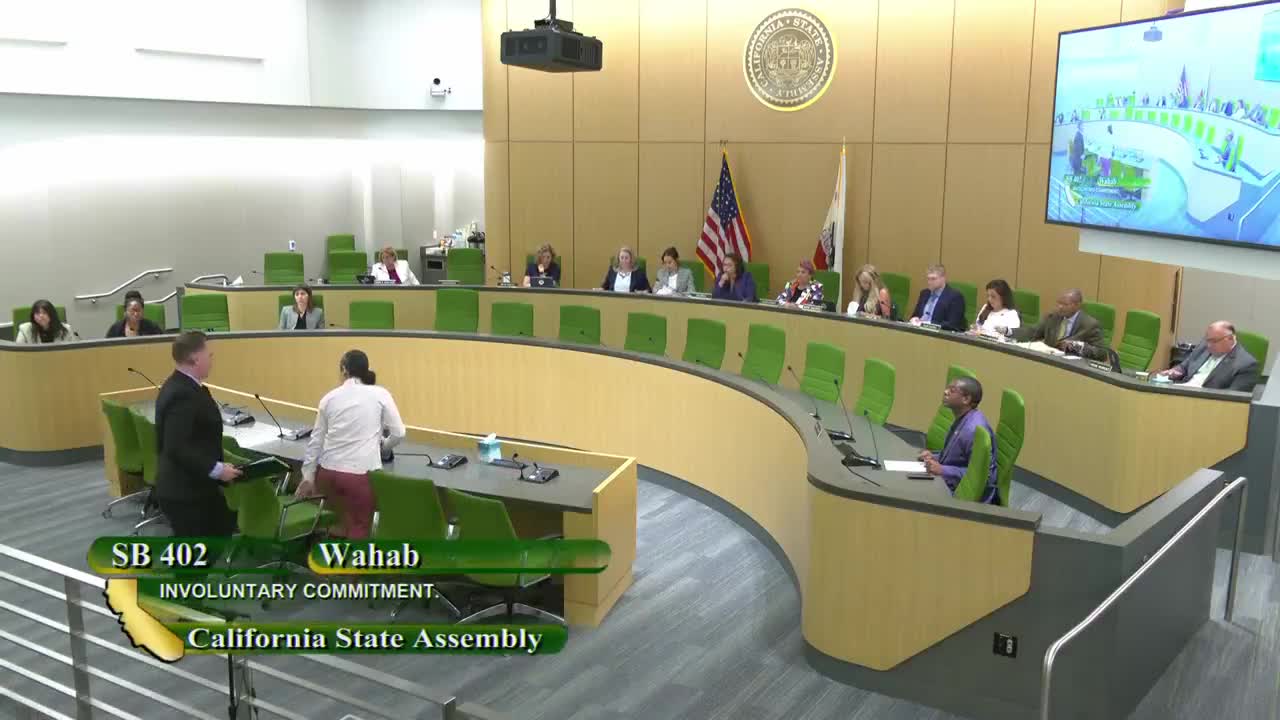

Bill Author