SB 363: Health care coverage: independent medical review.
- Session Year: 2025-2026
- House: Senate
- Latest Version Date: 2025-07-17
Current Status:
In Progress
(2026-08-13: August 13 hearing: Held in committee and under submission.)
Introduced
In Committee
Awaiting First Chamber Vote
Passed First Chamber
In Committee
Awaiting Second Chamber Vote
Passed Second Chamber
Enacted
Existing law, the Knox-Keene Health Care Service Plan Act of 1975, provides for the licensure and regulation of health care service plans by the Department of Managed Health Care, and makes a willful violation of the act a crime. Existing law provides for the regulation of health insurers by the Department of Insurance. Existing law establishes the Independent Medical Review System within each department, under which an enrollee or insured may seek review if a health care service has been denied, modified, or delayed by a health care service plan or health insurer and the enrollee or insured has previously filed a grievance that remains unresolved after 30 days.
This bill would require a health care service plan or health insurer to annually report to the appropriate department the total number of claims processed by the health care service plan or health insurer for the prior year and its number of treatment denials or modifications, separated and disaggregated as specified, commencing on or before June 1, 2026. The bill would require the departments to compare the number of a health care service plans or health insurers treatment denials and modifications to (1) the number of successful independent medical review overturns of the plans or insurers treatment denials or modifications and (2) the number of treatment denials or modifications reversed by a plan or insurer after an independent medical review for the denial or modification is requested, filed, or applied for. For a health care service plan or health insurer with 10 or more independent medical reviews in a given year, the bill would make the health care service plan or health insurer liable for an administrative penalty, as specified, if more than 50% of the independent medical reviews filed with a health care service plan or health insurer result in an overturning or reversal of a treatment denial or modification in any one individual category of specified general types of care. The bill would make a health care service plan or health insurer liable for additional administrative penalties for each independent medical review resulting in an additional overturned or reversed denial or modification in excess of that threshold. The bill would require the departments to annually include data, analysis, and conclusions relating to these provisions in specified reports.
Because a willful violation of these provisions by a health care service plan would be a crime, this bill would impose a state-mandated local program.
Existing law creates the Managed Care Administrative Fines and Penalties Fund in the State Treasury for the deposit of fines and administrative penalties collected pursuant to provisions licensing and regulating health care service plans.
This bill would create the Managed Care Independent Medical Review Administrative Penalties Subaccount in the Managed Care Administrative Fines and Penalties Fund for the receipt and deposit of moneys generated from the administrative penalties described above with respect to health care service plans. The bill would create the Health Insurance Independent Medical Review Administrative Penalties Fund in the State Treasury for the receipt and deposit of moneys generated from the administrative penalties described above with respect to health insurers. The bill would authorize the moneys in the Managed Care Independent Medical Review Administrative Penalties Subaccount and Health Insurance Independent Medical Review Administrative Penalties Fund to be expended, as specified, upon appropriation by the Legislature.
This bill would declare that its provisions are severable.
The California Constitution requires the state to reimburse local agencies and school districts for certain costs mandated by the state. Statutory provisions establish procedures for making that reimbursement.
This bill would provide that no reimbursement is required by this act for a specified reason.
Existing law, the Knox-Keene Health Care Service Plan Act of 1975, provides for the licensure and regulation of health care service plans by the Department of Managed Health Care, and makes a willful violation of the act a crime. Existing law provides for the regulation of health insurers by the Department of Insurance. Existing law establishes the Independent Medical Review System within each department, under which an enrollee or insured may seek review if a health care service has been denied, modified, or delayed by a health care service plan or health insurer and the enrollee or insured has previously filed a grievance that remains unresolved after 30 days.
This bill would require a health care service plan or health insurer to annually report to the appropriate department the total number of claims processed by the health care service plan or health insurer for the prior year and its number of treatment denials or modifications, separated and disaggregated as specified, commencing on or before June 1, 2026. The bill would require the departments to compare the number of a health care service plans or health insurers treatment denials and modifications to (1) the number of successful independent medical review overturns of the plans or insurers treatment denials or modifications and (2) the number of treatment denials or modifications reversed by a plan or insurer after an independent medical review for the denial or modification is requested, filed, or applied for. The For a health care service plan or health insurer with 10 or more independent medical reviews in a given year, the bill would make a the health care service plan or health insurer liable for an administrative penalty, as specified, if more than 50% of the independent medical reviews filed with a health care service plan or health insurer result in an overturning or reversal of a treatment denial or modification in any one individual category of specified general types of care. The bill would make a health care service plan or health insurer liable for additional administrative penalties for each independent medical review resulting in an additional overturned or reversed denial or modification in excess of that threshold. The bill would require the departments to annually include data, analysis, and conclusions relating to these provisions in specified reports.
Because a willful violation of these provisions by a health care service plan would be a crime, this bill would impose a state-mandated local program.
Existing law creates the Managed Care Administrative Fines and Penalties Fund in the State Treasury for the deposit of fines and administrative penalties collected pursuant to provisions licensing and regulating health care service plans.
This bill would create the Managed Care Independent Medical Review Administrative Penalties Subaccount in the Managed Care Administrative Fines and Penalties Fund for the receipt and deposit of moneys generated from the administrative penalties described above with respect to health care service plans. The bill would create the Health Insurance Independent Medical Review Administrative Penalties Fund in the State Treasury for the receipt and deposit of moneys generated from the administrative penalties described above with respect to health insurers. The bill would authorize the moneys in the Managed Care Independent Medical Review Administrative Penalties Subaccount and Health Insurance Independent Medical Review Administrative Penalties Fund to be expended, as specified, upon appropriation by the Legislature.
This bill would declare that its provisions are severable.
The California Constitution requires the state to reimburse local agencies and school districts for certain costs mandated by the state. Statutory provisions establish procedures for making that reimbursement.
This bill would provide that no reimbursement is required by this act for a specified reason.
Existing law, the Knox-Keene Health Care Service Plan Act of 1975, provides for the licensure and regulation of health care service plans by the Department of Managed Health Care, and makes a willful violation of the act a crime. Existing law provides for the regulation of health insurers by the Department of Insurance. Existing law establishes the Independent Medical Review System within each department, under which an enrollee or insured may seek review if a health care service has been denied, modified, or delayed by a health care service plan or health insurer and the enrollee or insured has previously filed a grievance that remains unresolved after 30 days.
This bill would require a health care service plan or health insurer to annually report to the appropriate department the total number of claims processed by the health care service plan or health insurer for the prior year and its number of treatment denials or modifications, separated and disaggregated as specified, commencing on or before June 1, 2026. The bill would require the departments to compare the number of a health care service plans or health insurers treatment denials and modifications to (1) the number of successful independent medical review overturns of the plans or insurers treatment denials or modifications and (2) the number of treatment denials or modifications reversed by a plan or insurer after an independent medical review for the denial or modification is requested, filed, or applied for. The bill would make a health care service plan or health insurer liable for an administrative penalty, as specified, if more than 50% of the independent medical reviews filed with a health care service plan or health insurer result in an overturning or reversal of a treatment denial or modification in any one individual category of specified general types of care. The bill would make a health care service plan or health insurer liable for additional administrative penalties for each independent medical review resulting in an additional overturned or reversed denial or modification in excess of that threshold. The bill would require the departments to annually include data, analysis, and conclusions relating to these provisions in specified reports.
Because a willful violation of these provisions by a health care service plan would be a crime, this bill would impose a state-mandated local program.
Existing law creates the Managed Care Administrative Fines and Penalties Fund in the State Treasury for the deposit of fines and administrative penalties collected pursuant to provisions licensing and regulating health care service plans.
This bill would create the Managed Care Independent Medical Review Administrative Penalties Subaccount in the Managed Care Administrative Fines and Penalties Fund for the receipt and deposit of moneys generated from the administrative penalties described above with respect to health care service plans. The bill would create the Health Insurance Independent Medical Review Administrative Penalties Fund in the State Treasury for the receipt and deposit of moneys generated from the administrative penalties described above with respect to health insurers. The bill would authorize the moneys in the Managed Care Independent Medical Review Administrative Penalties Subaccount and Health Insurance Independent Medical Review Administrative Penalties Fund to be expended, as specified, upon appropriation by the Legislature.
This bill would declare that its provisions are severable.
The California Constitution requires the state to reimburse local agencies and school districts for certain costs mandated by the state. Statutory provisions establish procedures for making that reimbursement.
This bill would provide that no reimbursement is required by this act for a specified reason.
Existing law, the Knox-Keene Health Care Service Plan Act of 1975, provides for the licensure and regulation of health care service plans by the Department of Managed Health Care, and makes a willful violation of the act a crime. Existing law provides for the regulation of health insurers by the Department of Insurance. Existing law establishes the Independent Medical Review System within each department, under which an enrollee or insured may seek review if a health care service has been denied, modified, or delayed by a health care service plan or health insurer and the enrollee or insured has previously filed a grievance that remains unresolved after 30 days.
This bill would require a health care service plan or health insurer to annually report to the appropriate department the total number of claims processed by the health care service plan or health insurer for the prior year. The bill would require a health care service plan or health insurer to annually report year and its number of treatment denials or modifications, separated by type of care into general and specific categories and disaggregated as specified, to the appropriate department, commencing on or before June 1, 2026. The bill would require the departments to compare the number of a health care service plans or health insurers treatment denials and modifications to (1) the number of successful independent medical review overturns of the plans or insurers treatment denials or modifications and (2) the number of treatment denials or modifications reversed by a plan or insurer after an independent medical review for the denial or modification is requested, filed, or applied for. The bill would make a health care service plan or health insurer liable for an administrative penalty, as specified, if more than 40% 50% of the independent medical reviews filed with a health care service plan or health insurer result in an overturning or reversal of a treatment denial or modification in any one individual category of the specified general types of care. The bill would make a health care service plan or health insurer liable for additional administrative penalties for each independent medical review resulting in an additional overturned or reversed denial or modification in excess of that threshold. The bill would require the departments to annually include data, analysis, and conclusions relating to these provisions in specified reports.
Because a willful violation of these provisions by a health care service plan would be a crime, this bill would impose a state-mandated local program.
This bill would declare that its provisions are severable.
The California Constitution requires the state to reimburse local agencies and school districts for certain costs mandated by the state. Statutory provisions establish procedures for making that reimbursement.
This bill would provide that no reimbursement is required by this act for a specified reason.
Existing law, the Knox-Keene Health Care Service Plan Act of 1975, provides for the licensure and regulation of health care service plans by the Department of Managed Health Care, and makes a willful violation of the act a crime. Existing law provides for the regulation of health insurers by the Department of Insurance. Existing law establishes the Independent Medical Review System within each department, under which an enrollee or insured may seek review if a health care service has been denied, modified, or delayed by a health care service plan or health insurer and the enrollee or insured has previously filed a grievance that remains unresolved after 30 days.
This bill would require a health care service plan or health insurer to annually report to the appropriate department the total number of claims processed by the health care service plan or health insurer for the prior year. The bill would require a health care service plan or health insurer to annually report its number of treatment denials or modifications, separated by type of care into general and specific categories and disaggregated by age, as specified, to the appropriate department, commencing on or before June 1, 2026. The bill would require the departments to compare the number of a health care service plans or health insurers treatment denials and modifications to (1) the number of successful independent medical review overturns of the plans or insurers treatment denials or modifications and (2) the number of treatment denials or modifications reversed by a plan or insurer after an independent medical review for the denial or modification is requested, filed, or applied for. The bill would make a health care service plan or health insurer liable for an administrative penalty, as specified, if more than half 40% of the independent medical reviews filed with a health care service plan or health insurer result in an overturning or reversal of a treatment denial or modification in any one individual category of the specified general types of care. The bill would make a health care service plan or health insurer liable for additional administrative penalties for each independent medical review resulting in an additional overturned or reversed denial or modification in excess of that threshold. The bill would specify that these provisions do not apply to Medi-Cal managed care plan contracts. The bill would require the departments to annually include data, analysis, and conclusions relating to these provisions in specified reports.
Because a willful violation of these provisions by a health care service plan would be a crime, this bill would impose a state-mandated local program.
Existing law requires the Insurance Commissioner to make a report to the Governor and the Legislature, as specified, on the condition of the insurance business and interests in this state, and other matters concerning insurance.The bill would require the department to include in the commissioners annual report information relating to independent medical review overturns of, and reversals of, treatment denials and modifications with respect to health insurers.Existing law establishes the Center for Data Insights and Innovation, and authorizes the center to collect and analyze data on problems and complaints by, and questions from, consumers about health care coverage. Existing law requires that data to include, among others, plan data, appeals, source of coverage, regulator, type of problem or issue or comparable types of problems or issues, and resolution of complaints, including timeliness of resolution. Existing law requires the center to annually report this data to the Legislature.This bill would require the center to include in that report data relating to independent medical review overturns of, and reversals of, treatment denials and modifications with respect to health care service plans. The bill would require the Department of Managed Health Care to provide related information requested by the center, as specified.This bill would declare that its provisions are severable.
The California Constitution requires the state to reimburse local agencies and school districts for certain costs mandated by the state. Statutory provisions establish procedures for making that reimbursement.
This bill would provide that no reimbursement is required by this act for a specified reason.
Existing law, the Knox-Keene Health Care Service Plan Act of 1975, provides for the licensure and regulation of health care service plans by the Department of Managed Health Care, and makes a willful violation of the act a crime. Existing law provides for the regulation of health insurers by the Department of Insurance. Existing law establishes the Independent Medical Review System within each department, under which an enrollee or insured may seek review if a health care service has been denied, modified, or delayed by a health care service plan or health insurer and the enrollee or insured has previously filed a grievance that remains unresolved after 30 days.
This bill would require a health care service plan or health insurer to annually report its number of treatment denials or modifications, separated by type of care and disaggregated by age, to the appropriate department, commencing on or before June 1, 2026. The bill would require the departments to compare the number of a health care service plans or health insurers treatment denials and modifications to (1) the number of successful independent medical review overturns of the plans or insurers treatment denials or modifications and (2) the number of treatment denials or modifications reversed by a plan or insurer after an independent medical review for the denial or modification is requested, filed, or applied for. The bill would make a health care service plan or health insurer liable for an administrative penalty, as specified, if more than half of the independent medical reviews filed with a health care service plan or health insurer result in an overturning or reversal of a treatment denial or modification in any one individual category of the specified types of care. The bill would make a health care service plan or health insurer liable for additional administrative penalties for each independent medical review resulting in an additional overturned or reversed denial or modification in excess of that threshold. The bill would specify that these provisions do not apply to Medi-Cal managed care plan contracts.
Because a willful violation of these provisions by a health care service plan would be a crime, this bill would impose a state-mandated local program.
Existing law requires the Insurance Commissioner to make a report to the Governor and the Legislature, as specified, on the condition of the insurance business and interests in this state, and other matters concerning insurance.
The bill would require the department to include in the commissioners annual report information relating to independent medical review overturns of, and reversals of, treatment denials and modifications with respect to health insurers.
Existing law establishes the Center for Data Insights and Innovation, and authorizes the center to collect and analyze data on problems and complaints by, and questions from, consumers about health care coverage. Existing law requires that data to include, among others, plan data, appeals, source of coverage, regulator, type of problem or issue or comparable types of problems or issues, and resolution of complaints, including timeliness of resolution. Existing law requires the center to annually report this data to the Legislature.
This bill would require the center to include in that report data relating to independent medical review overturns of, and reversals of, treatment denials and modifications with respect to health care service plans. The bill would require the Department of Managed Health Care to provide related information requested by the center, as specified.
The California Constitution requires the state to reimburse local agencies and school districts for certain costs mandated by the state. Statutory provisions establish procedures for making that reimbursement.
This bill would provide that no reimbursement is required by this act for a specified reason.
(a)A health care service plan shall report every treatment denial or modification to the department in accordance with all of the following requirements:
(1)Every treatment denial or modification shall be separated by type of care into the following categories:
(A)Surgical/Medical.
(B)Behavioral.
(2)Every treatment denial or modification shall be separated by diagnosis category or subcategory as determined by the department. The department shall coordinate with the Department of Insurance to ensure consistent diagnosis categories or subcategories across both departments.
(3)Reporting shall be disaggregated by age.
(4)To the extent that demographic data is available, reporting shall be disaggregated by categories determined in accordance with the departments recommendation in coordination with the Department of Insurance.
(5)Reporting shall include information on the health care service plans number of denials and modifications. A health care service plan shall report the applicable reason for each denial or modification by selecting from all of the following categories:
(A)Medical necessity.
(B)Investigative or experimental.
(C)Emergency or urgent care reimbursement.
(D)Incorrect billing.
(E)Duplicate claims.
(F)Out-of-network provider.
(G)Insufficient information, including medical records and patient or provider signature.
(H)Ineligibility or coverage issue.
(I)Lack of timely submission.
(J)(i)Other.
(ii)If other is designated, the health care service plan shall specify the reason for the denial or modification.
(6)Reporting on modifications shall include information on the type of modifications made.
(b)A health care service plan shall report to the department on an annual basis the total number of claims that the plan processed in the prior year.
(c)A health care service plan shall submit its first report required by subdivisions (a) and (b) to the department on or before June 1, 2026, and annually thereafter.
(d)(1)The department shall ensure that both of the following are included in a report, as specified in paragraphs (2) and (3), at least once per year, beginning January 1, 2028:
(A)Data, analysis, and conclusions relating to information required to be reported by health care service plans pursuant to subdivisions (a) and (b).
(B)Data, analysis, and conclusions relating to compliance with, or violations of, Section 1374.38, including, but not limited to, the number of independent medical review overturns of, and reversals of, treatment denials and modifications.
(2)If the department publishes a report not required by this code and relating to independent medical reviews, the department shall include in the report the information specified in paragraph (1).
(3)If the department is not required to include the information in a report pursuant to paragraph (2), the department shall include the information in the report required by subdivision (f) of Section 1375.7.
(4)The department shall ensure that a report required to include the information specified in paragraph (1) is published on its internet website.
SEC. 2.Section 1374.38 is added to the Health and Safety Code, to read:1374.38.(a)(1)For each annual report submitted to the department by a health care service plan pursuant to Section 1374.37, the department shall compare the number of a health care service plans treatment denials and modifications to both of the following:
(A)The number of successful independent medical review overturns of a health care service plans treatment denials or modifications.
(B)The number of treatment denials or modifications reversed by the health care service plan after an independent medical review for the denial or modification is requested, filed, or applied for.
(2)(A)For a health care service plan with 10 or more independent medical reviews in a given year, if more than 50 percent of a health care service plans independent medical reviews result in an overturning or reversal of a treatment denial or modification in any one individual category enumerated in paragraph (1) of subdivision (a) of Section 1374.37, the health care service plan is in violation of this section and liable for an administrative penalty pursuant to subdivision (b). A health care service plan may be liable for multiple violations per annual report.
(B)Each independent medical review resulting in an additional overturned or reversed denial or modification in excess of the threshold described in subparagraph (A) constitutes a separate violation of this section.
(C)For purposes of this section, an independent medical review results in an overturning or reversal of a treatment denial or modification any time a treatment denial or modification is overturned or reversed after an independent medical review is requested, filed, or applied for, regardless of whether a determination is made by an independent medical review organization or health care service plan.
(3)A failure to report a treatment denial or modification to the department pursuant to Section 1374.37 is a violation of this section.(b)A health care service plan that violates this section, or that violates any rule or order adopted or issued pursuant to this section, is liable for administrative penalties of not less than twenty-five thousand dollars ($25,000) for the first violation, and of not less than fifty thousand dollars ($50,000) nor more than two hundred thousand dollars ($200,000) for the second violation, and of not less than five hundred thousand dollars ($500,000) for each subsequent violation.
(c)The administrative penalties available to the director pursuant to this section are not exclusive, and may be sought and employed in any combination with civil, criminal, and other administrative remedies deemed advisable by the director to enforce the provisions of this chapter.
(d)Commencing January 1, 2031, and every five years thereafter, the penalty amounts specified in this section shall be adjusted to reflect the percentage change in the calendar year average, for the five-year period, of the medical care index of the Consumer Price Index, as published by the United States Bureau of Labor Statistics.
(e)(1)The Managed Care Independent Medical Review Administrative Penalties Subaccount is hereby created in the Managed Care Administrative Fines and Penalties Fund, as described in Section 1341.45, for the receipt and deposit of moneys generated from the administrative penalties assessed pursuant to this section.
(2)Upon appropriation by the Legislature, moneys in the subaccount may be expended for both of the following purposes:
(A)To offset the reasonable costs of implementing this section and Section 1374.37.
(B)For other purposes of the Managed Care Administrative Fines and Penalties Fund, as specified in Section 1341.45.
SEC. 3.Section 10169.6 is added to the Insurance Code, to read:10169.6.(a)A health insurer shall report every treatment denial or modification to the department in accordance with all of the following requirements:
(1)Every treatment denial or modification shall be separated by type of care into the following categories:
(A)Surgical/Medical.
(B)Behavioral.
(2)Every treatment denial or modification shall be separated by diagnosis category or subcategory as determined by the department. The department shall coordinate with the Department of Managed Health Care to ensure consistent diagnosis categories or subcategories across both departments.
(3)Reporting shall be disaggregated by age.
(4)To the extent that demographic data is available, reporting shall be disaggregated by categories determined in accordance with the departments recommendation in coordination with the Department of Managed Health Care.
(5)Reporting shall include information on the health insurers number of denials and modifications. A health insurer shall report the applicable reason for each denial or modification by selecting from all of the following categories:
(A)Medical necessity.
(B)Investigative or experimental.
(C)Emergency or urgent care reimbursement.
(D)Incorrect billing.
(E)Duplicate claims.
(F)Out-of-network provider.
(G)Insufficient information, including medical records and patient or provider signature.
(H)Ineligibility or coverage issue.
(I)Lack of timely submission.
(J)(i)Other.
(ii)If other is designated, the health insurer shall specify the reason for the denial or modification.
(6)Reporting on modifications shall include information on the type of modifications made.
(b)A health insurer shall report to the department on an annual basis the total number of claims that the insurer processed in the prior year.
(c)A health insurer shall submit its first report required by subdivisions (a) and (b) to the department on or before June 1, 2026, and annually thereafter.
(d)(1)The department shall include in the annual report of the commissioner required by Section 12922, commencing with the 2028 report, both of the following:
(A)Data, analysis, and conclusions relating to information required to be reported by health insurers pursuant to subdivisions (a) and (b).
(B)Data, analysis, and conclusions relating to compliance with, or violations of, Section 10169.7, including, but not limited to, the number of independent medical review overturns of, and reversals of, treatment denials and modifications.
(2)The department shall ensure that the report required to include the information specified in paragraph (1) is published on its internet website.
SEC. 4.Section 10169.7 is added to the Insurance Code, to read:10169.7.(a)(1)For each annual report submitted to the department by a health insurer pursuant to Section 10169.6, the department shall compare the number of a health insurers treatment denials and modifications to both of the following:
(A)The number of successful independent medical review overturns of a health insurers treatment denials or modifications.
(B)The number of treatment denials or modifications reversed by the health insurer after an independent medical review for the denial or modification is requested, filed, or applied for.
(2)(A)For a health insurer with 10 or more independent medical reviews in a given year, if more than 50 percent of a health insurers independent medical reviews result in an overturning or reversal of a treatment denial or modification in any one individual category enumerated in paragraph (1) of subdivision (a) of Section 10169.6, the health insurer is in violation of this section and liable for an administrative penalty pursuant to subdivision (b). A health insurer may be liable for multiple violations per annual report.
(B)Each independent medical review resulting in an additional overturned or reversed denial or modification in excess of the threshold described in subparagraph (A) constitutes a separate violation of this section.
(C)For purposes of this section, an independent medical review results in an overturning or reversal of a treatment denial or modification any time a treatment denial or modification is overturned or reversed after an independent medical review is requested, filed, or applied for, regardless of whether a determination is made by an independent medical review organization or health insurer.
(3)A failure to report a treatment denial or modification to the department pursuant to Section 10169.6 is a violation of this section.(b)A health insurer that violates this section, or that violates any rule or order adopted or issued pursuant to this section, is liable for administrative penalties of not less than twenty-five thousand dollars ($25,000) for the first violation, and of not less than fifty thousand dollars ($50,000) nor more than two hundred thousand dollars ($200,000) for the second violation, and of not less than five hundred thousand dollars ($500,000) for each subsequent violation.
(c)The administrative penalties available to the commissioner pursuant to this section are not exclusive, and may be sought and employed in any combination with civil, criminal, and other administrative remedies deemed advisable by the commissioner to enforce the provisions of this chapter.
(d)Commencing January 1, 2031, and every five years thereafter, the penalty amounts specified in this section shall be adjusted to reflect the percentage change in the calendar year average, for the five-year period, of the medical care index of the Consumer Price Index, as published by the United States Bureau of Labor Statistics.
(e)(1)The Health Insurance Independent Medical Review Administrative Penalties Fund is hereby created in the State Treasury for the receipt and deposit of moneys generated from the administrative penalties assessed pursuant to this section.
(2)Upon appropriation by the Legislature, moneys in the fund may be expended to offset the reasonable costs of implementing this section and Section 10169.6.
SEC. 5.The provisions of this act are severable. If any provision of this act or its application is held invalid, that invalidity shall not affect other provisions or applications that can be given effect without the invalid provision or application.
SEC. 6.No reimbursement is required by this act pursuant to Section 6 of Article XIIIB of the California Constitution because the only costs that may be incurred by a local agency or school district will be incurred because this act creates a new crime or infraction, eliminates a crime or infraction, or changes the penalty for a crime or infraction, within the meaning of Section 17556 of the Government Code, or changes the definition of a crime within the meaning of Section 6 of Article XIIIB of the California Constitution.
(a)A health care service plan shall report every treatment denial or modification to the department in accordance with all of the following requirements:
(1)Every treatment denial or modification shall be separated by type of care into the following categories:
(A)Surgical. Surgical/Medical.
(B)Medical.(C)(B)Behavioral.
(D)Pharmaceutical.(2)Every treatment denial or modification shall be separated by diagnosis category or subcategory as determined by the department. The department shall coordinate with the Department of Insurance to ensure consistent diagnosis categories or subcategories across both departments.
(3)Reporting shall be disaggregated by age into the following groups: age.
(A)Enrollees 0 to 10 years of age, inclusive.(B)Enrollees 11 to 20 years of age, inclusive.(C)Enrollees 21 to 30 years of age, inclusive.(D)Enrollees 31 to 40 years of age, inclusive.(E)Enrollees 41 to 50 years of age, inclusive.(F)Enrollees 51 to 64 years of age, inclusive.(G)Enrollees 65 years of age or older.(4)To the extent that demographic data is available, reporting shall be disaggregated by all of the following: categories determined in accordance with the departments recommendation in coordination with the Department of Insurance.
(A)Gender.(B)Gender identity.(C)Sexuality.(D)Race.(E)Ethnicity.(5)Reporting shall include information on the health care service plans number of denials and modifications. A health care service plan shall report the applicable reason for each denial or modification by selecting from all of the following categories:
(A)Medical necessity.
(B)Investigative or experimental.
(C)Emergency or urgent care reimbursement.
(D)Incorrect billing.
(E)Duplicate claims.
(F)Out-of-network provider.
(G)Insufficient information, including medical records and patient or provider signature.
(H)Ineligibility or coverage issue.
(I)Lack of timely submission.
(J)(i)Other.
(ii)If other is designated, the health care service plan shall specify the reason for the denial or modification.
(6)Reporting on modifications shall include information on the type of modifications made.
(b)A health care service plan shall report to the department on an annual basis the total number of claims that the plan processed in the prior year.
(c)A health care service plan shall submit its first report required by subdivisions (a) and (b) to the department on or before June 1, 2026, and annually thereafter.
(d)(1)The department shall ensure that both of the following are included in a report, as specified in paragraphs (2) and (3), at least once per year: year, beginning January 1, 2028:
(A)Data, analysis, and conclusions relating to information required to be reported by health care service plans pursuant to subdivisions (a) and (b).
(B)Data, analysis, and conclusions relating to compliance with, or violations of, Section 1374.38, including, but not limited to, the number of independent medical review overturns of, and reversals of, treatment denials and modifications.
(2)If the department publishes a report not required by this code and relating to independent medical reviews, the department shall include in the report the information specified in paragraph (1).
(3)If the department is not required to include the information in a report pursuant to paragraph (2), the department shall include the information in the report required by subdivision (f) of Section 1375.7.
(4)The department shall ensure that a report required to include the information specified in paragraph (1) is published on its internet website.
SEC. 2.Section 1374.38 is added to the Health and Safety Code, to read:1374.38.(a)(1)For each annual report submitted to the department by a health care service plan pursuant to Section 1374.37, the department shall compare the number of a health care service plans treatment denials and modifications to both of the following:
(A)The number of successful independent medical review overturns of a health care service plans treatment denials or modifications.
(B)The number of treatment denials or modifications reversed by the health care service plan after an independent medical review for the denial or modification is requested, filed, or applied for.
(2)(A)If For a health care service plan with 10 or more independent medical reviews in a given year, if more than 50 percent of a health care service plans independent medical reviews result in an overturning or reversal of a treatment denial or modification in any one individual category enumerated in paragraph (1) of subdivision (a) of Section 1374.37, the health care service plan is in violation of this section and liable for an administrative penalty pursuant to subdivision (b). A health care service plan may be liable for multiple violations per annual report.
(B)Each independent medical review resulting in an additional overturned or reversed denial or modification in excess of the threshold described in subparagraph (A) constitutes a separate violation of this section.
(C)For purposes of this section, an independent medical review results in an overturning or reversal of a treatment denial or modification any time a treatment denial or modification is overturned or reversed after an independent medical review is requested, filed, or applied for, regardless of whether a determination is made by an independent medical review organization or health care service plan.
(3)A failure to report a treatment denial or modification to the department pursuant to Section 1374.37 is a violation of this section.
(b)A health care service plan that violates this section, or that violates any rule or order adopted or issued pursuant to this section, is liable for administrative penalties of not less than twenty-five thousand dollars ($25,000) for the first violation, and of not less than fifty thousand dollars ($50,000) nor more than two hundred thousand dollars ($200,000) for the second violation, and of not less than five hundred thousand dollars ($500,000) for each subsequent violation.
(c)The administrative penalties available to the director pursuant to this section are not exclusive, and may be sought and employed in any combination with civil, criminal, and other administrative remedies deemed advisable by the director to enforce the provisions of this chapter.
(d)Commencing January 1, 2031, and every five years thereafter, the penalty amounts specified in this section shall be adjusted to reflect the percentage change in the calendar year average, for the five-year period, of the medical care index of the Consumer Price Index, as published by the United States Bureau of Labor Statistics.
(e)(1)The Managed Care Independent Medical Review Administrative Penalties Subaccount is hereby created in the Managed Care Administrative Fines and Penalties Fund, as described in Section 1341.45, for the receipt and deposit of moneys generated from the administrative penalties assessed pursuant to this section.
(2)Upon appropriation by the Legislature, moneys in the subaccount may be expended for both of the following purposes:
(A)To offset the reasonable costs of implementing this section and Section 1374.37.
(B)For other purposes of the Managed Care Administrative Fines and Penalties Fund, as specified in Section 1341.45.
SEC. 3.Section 10169.6 is added to the Insurance Code, to read:10169.6.(a)A health insurer shall report every treatment denial or modification to the department in accordance with all of the following requirements:
(1)Every treatment denial or modification shall be separated by type of care into the following categories:
(A)Surgical. Surgical/Medical.
(B)Medical.(C)(B)Behavioral.
(D)Pharmaceutical.(2)Every treatment denial or modification shall be separated by diagnosis category or subcategory as determined by the department. The department shall coordinate with the Department of Managed Health Care to ensure consistent diagnosis categories or subcategories across both departments.
(3)Reporting shall be disaggregated by age into the following groups: age.
(A)Insureds 0 to 10 years of age, inclusive.(B)Insureds 11 to 20 years of age, inclusive.(C)Insureds 21 to 30 years of age, inclusive.(D)Insureds 31 to 40 years of age, inclusive.(E)Insureds 41 to 50 years of age, inclusive.(F)Insureds 51 to 64 years of age, inclusive.(G)Insureds 65 years of age or older.(4)To the extent that demographic data is available, reporting shall be disaggregated by all of the following: categories determined in accordance with the departments recommendation in coordination with the Department of Managed Health Care.
(A)Gender.(B)Gender identity.(C)Sexuality.(D)Race.(E)Ethnicity.(5)Reporting shall include information on the health insurers number of denials and modifications. A health insurer shall report the applicable reason for each denial or modification by selecting from all of the following categories:
(A)Medical necessity.
(B)Investigative or experimental.
(C)Emergency or urgent care reimbursement.
(D)Incorrect billing.
(E)Duplicate claims.
(F)Out-of-network provider.
(G)Insufficient information, including medical records and patient or provider signature.
(H)Ineligibility or coverage issue.
(I)Lack of timely submission.
(J)(i)Other.
(ii)If other is designated, the health insurer shall specify the reason for the denial or modification.
(6)Reporting on modifications shall include information on the type of modifications made.
(b)A health insurer shall report to the department on an annual basis the total number of claims that the insurer processed in the prior year.
(c)A health insurer shall submit its first report required by subdivisions (a) and (b) to the department on or before June 1, 2026, and annually thereafter.
(d)(1)The department shall include in the annual report of the commissioner required by Section 12922, commencing with the 2026 2028 report, both of the following:
(A)Data, analysis, and conclusions relating to information required to be reported by health insurers pursuant to subdivisions (a) and (b).
(B)Data, analysis, and conclusions relating to compliance with, or violations of, Section 10169.7, including, but not limited to, the number of independent medical review overturns of, and reversals of, treatment denials and modifications.
(2)The department shall ensure that the report required to include the information specified in paragraph (1) is published on its internet website.
SEC. 4.Section 10169.7 is added to the Insurance Code, to read:10169.7.(a)(1)For each annual report submitted to the department by a health insurer pursuant to Section 10169.6, the department shall compare the number of a health insurers treatment denials and modifications to both of the following:
(A)The number of successful independent medical review overturns of a health insurers treatment denials or modifications.
(B)The number of treatment denials or modifications reversed by the health insurer after an independent medical review for the denial or modification is requested, filed, or applied for.
(2)(A)If For a health insurer with 10 or more independent medical reviews in a given year, if more than 50 percent of a health insurers independent medical reviews result in an overturning or reversal of a treatment denial or modification in any one individual category enumerated in paragraph (1) of subdivision (a) of Section 10169.6, the health insurer is in violation of this section and liable for an administrative penalty pursuant to subdivision (b). A health insurer may be liable for multiple violations per annual report.
(B)Each independent medical review resulting in an additional overturned or reversed denial or modification in excess of the threshold described in subparagraph (A) constitutes a separate violation of this section.
(C)For purposes of this section, an independent medical review results in an overturning or reversal of a treatment denial or modification any time a treatment denial or modification is overturned or reversed after an independent medical review is requested, filed, or applied for, regardless of whether a determination is made by an independent medical review organization or health insurer.
(3)A failure to report a treatment denial or modification to the department pursuant to Section 10169.6 is a violation of this section.
(b)A health insurer that violates this section, or that violates any rule or order adopted or issued pursuant to this section, is liable for administrative penalties of not less than twenty-five thousand dollars ($25,000) for the first violation, and of not less than fifty thousand dollars ($50,000) nor more than two hundred thousand dollars ($200,000) for the second violation, and of not less than five hundred thousand dollars ($500,000) for each subsequent violation.
(c)The administrative penalties available to the commissioner pursuant to this section are not exclusive, and may be sought and employed in any combination with civil, criminal, and other administrative remedies deemed advisable by the commissioner to enforce the provisions of this chapter.
(d)Commencing January 1, 2031, and every five years thereafter, the penalty amounts specified in this section shall be adjusted to reflect the percentage change in the calendar year average, for the five-year period, of the medical care index of the Consumer Price Index, as published by the United States Bureau of Labor Statistics.
(e)(1)The Health Insurance Independent Medical Review Administrative Penalties Fund is hereby created in the State Treasury for the receipt and deposit of moneys generated from the administrative penalties assessed pursuant to this section.
(2)Upon appropriation by the Legislature, moneys in the fund may be expended to offset the reasonable costs of implementing this section and Section 10169.6.
SEC. 5.The provisions of this act are severable. If any provision of this act or its application is held invalid, that invalidity shall not affect other provisions or applications that can be given effect without the invalid provision or application.
SEC. 6.No reimbursement is required by this act pursuant to Section 6 of Article XIIIB of the California Constitution because the only costs that may be incurred by a local agency or school district will be incurred because this act creates a new crime or infraction, eliminates a crime or infraction, or changes the penalty for a crime or infraction, within the meaning of Section 17556 of the Government Code, or changes the definition of a crime within the meaning of Section 6 of Article XIIIB of the California Constitution.
(a)A health care service plan shall report every treatment denial or modification to the department in accordance with all of the following requirements:
(1)Every treatment denial or modification shall be separated by type of care into the following categories:
(A)Surgical.
(B)Medical.
(C)Behavioral.
(D)Pharmaceutical.
(2)Every treatment denial or modification shall be separated by diagnosis category or subcategory as determined by the department. The department shall coordinate with the Department of Insurance to ensure consistent diagnosis categories or subcategories across both departments.
(3)Reporting shall be disaggregated by age into the following groups:
(A)Enrollees 0 to 10 years of age, inclusive.
(B)Enrollees 11 to 20 years of age, inclusive.
(C)Enrollees 21 to 30 years of age, inclusive.
(D)Enrollees 31 to 40 years of age, inclusive.
(E)Enrollees 41 to 50 years of age, inclusive.
(F)Enrollees 51 to 64 years of age, inclusive.
(G)Enrollees 65 years of age or older.
(4)To the extent that demographic data is available, reporting shall be disaggregated by all of the following:
(A)Gender.
(B)Gender identity.
(C)Sexuality.
(D)Race.
(E)Ethnicity.
(5)Reporting shall include information on the health care service plans number of denials and modifications. A health care service plan shall report the applicable reason for each denial or modification by selecting from all of the following categories:
(A)Medical necessity.
(B)Investigative or experimental.
(C)Emergency or urgent care reimbursement.
(D)Incorrect billing.
(E)Duplicate claims.
(F)Out-of-network provider.
(G)Insufficient information, including medical records and patient or provider signature.
(H)Ineligibility or coverage issue.
(I)Lack of timely submission.
(J)(i)Other.
(ii)If other is designated, the health care service plan shall specify the reason for the denial or modification.
(6)Reporting on modifications shall include information on the type of modifications made.
(b)A health care service plan shall report to the department on an annual basis the total number of claims that the plan processed in the prior year.
(c)A health care service plan shall submit its first report required by subdivisions (a) and (b) to the department on or before June 1, 2026, and annually thereafter.
(d)(1)The department shall ensure that both of the following are included in a report, as specified in paragraphs (2) and (3), at least once per year:
(A)Data, analysis, and conclusions relating to information required to be reported by health care service plans pursuant to subdivisions (a) and (b).
(B)Data, analysis, and conclusions relating to compliance with, or violations of, Section 1374.38, including, but not limited to, the number of independent medical review overturns of, and reversals of, treatment denials and modifications.
(2)If the department publishes a report not required by this code and relating to independent medical reviews, the department shall include in the report the information specified in paragraph (1).
(3)If the department is not required to include the information in a report pursuant to paragraph (2), the department shall include the information in the report required by subdivision (f) of Section 1375.7.
(4)The department shall ensure that a report required to include the information specified in paragraph (1) is published on its internet website.
SEC. 2.Section 1374.38 is added to the Health and Safety Code, to read:1374.38.(a)(1)For each annual report submitted to the department by a health care service plan pursuant to Section 1374.37, the department shall compare the number of a health care service plans treatment denials and modifications to both of the following:
(A)The number of successful independent medical review overturns of a health care service plans treatment denials or modifications.
(B)The number of treatment denials or modifications reversed by the health care service plan after an independent medical review for the denial or modification is requested, filed, or applied for.
(2)(A)If more than 50 percent of a health care service plans independent medical reviews result in an overturning or reversal of a treatment denial or modification in any one individual category enumerated in paragraph (1) of subdivision (a) of Section 1374.37, the health care service plan is in violation of this section and liable for an administrative penalty pursuant to subdivision (b). A health care service plan may be liable for multiple violations per annual report.
(B)Each independent medical review resulting in an additional overturned or reversed denial or modification in excess of the threshold described in subparagraph (A) constitutes a separate violation of this section.
(C)For purposes of this section, an independent medical review results in an overturning or reversal of a treatment denial or modification any time a treatment denial or modification is overturned or reversed after an independent medical review is requested, filed, or applied for, regardless of whether a determination is made by an independent medical review organization or health care service plan.
(3)A failure to report a treatment denial or modification to the department pursuant to Section 1374.37 is a violation of this section.
(b)A health care service plan that violates this section, or that violates any rule or order adopted or issued pursuant to this section, is liable for administrative penalties of not less than twenty-five thousand dollars ($25,000) for the first violation, and of not less than fifty thousand dollars ($50,000) nor more than two hundred thousand dollars ($200,000) for the second violation, and of not less than five hundred thousand dollars ($500,000) for each subsequent violation.
(c)The administrative penalties available to the director pursuant to this section are not exclusive, and may be sought and employed in any combination with civil, criminal, and other administrative remedies deemed advisable by the director to enforce the provisions of this chapter.
(d)Commencing January 1, 2031, and every five years thereafter, the penalty amounts specified in this section shall be adjusted to reflect the percentage change in the calendar year average, for the five-year period, of the medical care index of the Consumer Price Index, as published by the United States Bureau of Labor Statistics.
(e)It is the intent of the Legislature for the funds generated from administrative penalties assessed pursuant to this section to be used to fund child health care services.(e)(1)The Managed Care Independent Medical Review Administrative Penalties Subaccount is hereby created in the Managed Care Administrative Fines and Penalties Fund, as described in Section 1341.45, for the receipt and deposit of moneys generated from the administrative penalties assessed pursuant to this section.
(2)Upon appropriation by the Legislature, moneys in the subaccount may be expended for both of the following purposes:
(A)To offset the reasonable costs of implementing this section and Section 1374.37.
(B)For other purposes of the Managed Care Administrative Fines and Penalties Fund, as specified in Section 1341.45.
SEC. 3.Section 10169.6 is added to the Insurance Code, to read:10169.6.(a)A health insurer shall report every treatment denial or modification to the department in accordance with all of the following requirements:
(1)Every treatment denial or modification shall be separated by type of care into the following categories:
(A)Surgical.
(B)Medical.
(C)Behavioral.
(D)Pharmaceutical.
(2)Every treatment denial or modification shall be separated by diagnosis category or subcategory as determined by the department. The department shall coordinate with the Department of Managed Health Care to ensure consistent diagnosis categories or subcategories across both departments.
(3)Reporting shall be disaggregated by age into the following groups:
(A)Insureds 0 to 10 years of age, inclusive.
(B)Insureds 11 to 20 years of age, inclusive.
(C)Insureds 21 to 30 years of age, inclusive.
(D)Insureds 31 to 40 years of age, inclusive.
(E)Insureds 41 to 50 years of age, inclusive.
(F)Insureds 51 to 64 years of age, inclusive.
(G)Insureds 65 years of age or older.
(4)To the extent that demographic data is available, reporting shall be disaggregated by all of the following:
(A)Gender.
(B)Gender identity.
(C)Sexuality.
(D)Race.
(E)Ethnicity.
(5)Reporting shall include information on the health insurers number of denials and modifications. A health insurer shall report the applicable reason for each denial or modification by selecting from all of the following categories:
(A)Medical necessity.
(B)Investigative or experimental.
(C)Emergency or urgent care reimbursement.
(D)Incorrect billing.
(E)Duplicate claims.
(F)Out-of-network provider.
(G)Insufficient information, including medical records and patient or provider signature.
(H)Ineligibility or coverage issue.
(I)Lack of timely submission.
(J)(i)Other.
(ii)If other is designated, the health insurer shall specify the reason for the denial or modification.
(6)Reporting on modifications shall include information on the type of modifications made.
(b)A health insurer shall report to the department on an annual basis the total number of claims that the insurer processed in the prior year.
(c)A health insurer shall submit its first report required by subdivisions (a) and (b) to the department on or before June 1, 2026, and annually thereafter.
(d)(1)The department shall include in the annual report of the commissioner required by Section 12922, commencing with the 2026 report, both of the following:
(A)Data, analysis, and conclusions relating to information required to be reported by health insurers pursuant to subdivisions (a) and (b).
(B)Data, analysis, and conclusions relating to compliance with, or violations of, Section 10169.7, including, but not limited to, the number of independent medical review overturns of, and reversals of, treatment denials and modifications.
(2)The department shall ensure that the report required to include the information specified in paragraph (1) is published on its internet website.
SEC. 4.Section 10169.7 is added to the Insurance Code, to read:10169.7.(a)(1)For each annual report submitted to the department by a health insurer pursuant to Section 10169.6, the department shall compare the number of a health insurers treatment denials and modifications to both of the following:
(A)The number of successful independent medical review overturns of a health insurers treatment denials or modifications.
(B)The number of treatment denials or modifications reversed by the health insurer after an independent medical review for the denial or modification is requested, filed, or applied for.
(2)(A)If more than 50 percent of a health insurers independent medical reviews result in an overturning or reversal of a treatment denial or modification in any one individual category enumerated in paragraph (1) of subdivision (a) of Section 10169.6, the health insurer is in violation of this section and liable for an administrative penalty pursuant to subdivision (b). A health insurer may be liable for multiple violations per annual report.
(B)Each independent medical review resulting in an additional overturned or reversed denial or modification in excess of the threshold described in subparagraph (A) constitutes a separate violation of this section.
(C)For purposes of this section, an independent medical review results in an overturning or reversal of a treatment denial or modification any time a treatment denial or modification is overturned or reversed after an independent medical review is requested, filed, or applied for, regardless of whether a determination is made by an independent medical review organization or health insurer.
(3)A failure to report a treatment denial or modification to the department pursuant to Section 10169.6 is a violation of this section.
(b)A health insurer that violates this section, or that violates any rule or order adopted or issued pursuant to this section, is liable for administrative penalties of not less than twenty-five thousand dollars ($25,000) for the first violation, and of not less than fifty thousand dollars ($50,000) nor more than two hundred thousand dollars ($200,000) for the second violation, and of not less than five hundred thousand dollars ($500,000) for each subsequent violation.
(c)The administrative penalties available to the commissioner pursuant to this section are not exclusive, and may be sought and employed in any combination with civil, criminal, and other administrative remedies deemed advisable by the commissioner to enforce the provisions of this chapter.
(d)Commencing January 1, 2031, and every five years thereafter, the penalty amounts specified in this section shall be adjusted to reflect the percentage change in the calendar year average, for the five-year period, of the medical care index of the Consumer Price Index, as published by the United States Bureau of Labor Statistics.
(e)It is the intent of the Legislature for the funds generated from administrative penalties assessed pursuant to this section to be used to fund child health care services.(e)(1)The Health Insurance Independent Medical Review Administrative Penalties Fund is hereby created in the State Treasury for the receipt and deposit of moneys generated from the administrative penalties assessed pursuant to this section.
(2)Upon appropriation by the Legislature, moneys in the fund may be expended to offset the reasonable costs of implementing this section and Section 10169.6.
SEC. 5.The provisions of this act are severable. If any provision of this act or its application is held invalid, that invalidity shall not affect other provisions or applications that can be given effect without the invalid provision or application.
SEC. 6.No reimbursement is required by this act pursuant to Section 6 of Article XIIIB of the California Constitution because the only costs that may be incurred by a local agency or school district will be incurred because this act creates a new crime or infraction, eliminates a crime or infraction, or changes the penalty for a crime or infraction, within the meaning of Section 17556 of the Government Code, or changes the definition of a crime within the meaning of Section 6 of Article XIIIB of the California Constitution.
(a)A health care service plan shall report every treatment denial or modification to the department in accordance with all of the following requirements:
(1)Reporting shall occur on an annual basis. A health care service plan shall submit its first report to the department on or before June 1, 2026. (2)(1)Every treatment denial or modification shall be separated by type of care into the following categories:
(A)Surgical.
(B)Medical.
(C)Behavioral.
(D)Pharmaceutical.
(3)(2)Every treatment denial or modification shall be separated by type of care into the following categories: diagnosis category or subcategory as determined by the department. The department shall coordinate with the Department of Insurance to ensure consistent diagnosis categories or subcategories across both departments.
(A)Autism spectrum.(B)Digestive system or gastrointestinal.(C)Endocrine or metabolic.(D)Infectious disease.(E)Central nervous system or neuromuscular disorders.(F)Orthopedic or musculoskeletal.(G)Skin disorders.(H)Mental disorders.(I)Substance use disorder.(J)Substance abuse.(K)Alcohol abuse or addiction.(L)Attention deficit hyperactivity disorder.(M)Eating disorders.(N)Depression.(O)Traumatic brain injury.(P)Cancer.(Q)Cardiac or circulatory problems.(R)Genetic diseases.(S)Postsurgical complications.(T)Pediatrics.(U)Trauma or injuries.(V)Autoimmune disorders.(W)Immunology disorders.(X)Genitourinary or kidney disorders.(Y)Ears, nose, or throat.(Z)Foot disorders.(AA)Prevention or good health.(AB)Respiratory system.(AC)Blood-related disorders.(AD)Vision.(AE)Pregnancy or childbirth.(AF)Dental problems.(AG)Morbid obesity.(AH)Pregnancy or obstetrics and gynecology.(AI)Chronic pain syndrome.(AJ)(i)Other.(ii)If other is designated, the health care service plan shall specify the type of care.(AK)(i)A category added to the list by the department pursuant to clause (ii).(ii)The department may add categories to the list enumerated in this paragraph. (4)(3)Reporting shall be disaggregated by age into the following groups:
(A)Enrollees 0 to 10 years of age, inclusive.
(B)Enrollees 11 to 20 years of age, inclusive.
(C)Enrollees 21 to 30 years of age, inclusive.
(D)Enrollees 31 to 40 years of age, inclusive.
(E)Enrollees 41 to 50 years of age, inclusive.
(F)Enrollees 51 to 64 years of age, inclusive.
(G)Enrollees 65 years of age or older.
(5)(4)To the extent that demographic data is available, reporting shall be disaggregated by all of the following:
(A)Gender.
(B)Gender identity.
(C)Sexuality.
(D)Race.
(E)Ethnicity.
(6)(5)Reporting shall include information on the health care service plans number of denials and modifications. A health care service plan shall report the applicable reason for each denial or modification by selecting from all of the following categories:
(A)Medical necessity.
(B)Investigative or experimental.
(C)Urgent care.(C)Emergency or urgent care reimbursement.
(D)Incorrect billing.
(E)Duplicate claims.
(F)Out-of-network provider.
(G)Insufficient information, including medical records and patient or provider signature.
(H)Ineligibility or coverage issue.
(I)Lack of timely submission.
(J)(i)Other.
(ii)If other is designated, the health care service plan shall specify the reason for the denial or modification.
(7)(6)Reporting on modifications shall include information on the type of modifications made.
(b)A health care service plan shall report to the department on an annual basis the total number of claims that the plan processed in the prior year.
(c)A health care service plan shall submit its first report required by subdivisions (a) and (b) to the department on or before June 1, 2026, and annually thereafter.
(c)(d)(1)The department shall ensure that both of the following are included in a report, as specified in paragraphs (2) and (3), at least once per year:
(A)Data, analysis, and conclusions relating to information required to be reported by health care service plans pursuant to subdivisions (a) and (b).
(B)Data, analysis, and conclusions relating to compliance with, or violations of, Section 1374.38, including, but not limited to, the number of independent medical review overturns of, and reversals of, treatment denials and modifications.
(2)If the department publishes a report not required by this code and relating to independent medical reviews, the department shall include in the report the information specified in paragraph (1).
(3)If the department is not required to include the information in a report pursuant to paragraph (2), the department shall include the information in the report required by subdivision (f) of Section 1375.7.
(4)The department shall ensure that a report required to include the information specified in paragraph (1) is published on its internet website.
SEC. 2.Section 1374.38 is added to the Health and Safety Code, to read:1374.38.(a)(1)For each annual report submitted to the department by a health care service plan pursuant to Section 1374.37, the department shall compare the number of a health care service plans treatment denials and modifications to both of the following:
(A)The number of successful independent medical review overturns of a health care service plans treatment denials or modifications.
(B)The number of treatment denials or modifications reversed by the health care service plan after an independent medical review for the denial or modification is requested, filed, or applied for.
(2)(A)If more than 40 50 percent of independent medical reviews filed with a health care service plan a health care service plans independent medical reviews result in an overturning or reversal of a treatment denial or modification in any one individual category enumerated in paragraph (2) (1) of subdivision (a) of Section 1374.37, the health care service plan is in violation of this section and liable for an administrative penalty pursuant to subdivision (b). A health care service plan may be liable for multiple violations per annual report.
(B)Each independent medical review resulting in an additional overturned or reversed denial or modification in excess of the threshold described in subparagraph (A) constitutes a separate violation of this section.
(C)For purposes of this section, an independent medical review results in an overturning or reversal of a treatment denial or modification any time a treatment denial or modification is overturned or reversed after an independent medical review is requested, filed, or applied for, regardless of whether a determination is made by an independent medical review organization or health care service plan.
(3)A failure to report a treatment denial or modification to the department pursuant to Section 1374.37 is a violation of this section.
(b)A health care service plan that violates this section, or that violates any rule or order adopted or issued pursuant to this section, is liable for administrative penalties of not less than fifty thousand dollars ($50,000) twenty-five thousand dollars ($25,000) for the first violation, and of not less than one hundred thousand dollars ($100,000) fifty thousand dollars ($50,000) nor more than four hundred thousand dollars ($400,000) two hundred thousand dollars ($200,000) for the second violation, and of not less than one million dollars ($1,000,000) five hundred thousand dollars ($500,000) for each subsequent violation.
(c)The administrative penalties available to the director pursuant to this section are not exclusive, and may be sought and employed in any combination with civil, criminal, and other administrative remedies deemed advisable by the director to enforce the provisions of this chapter.
(d)Commencing January 1, 2031, and every five years thereafter, the penalty amounts specified in this section shall be adjusted to reflect the percentage change in the calendar year average, for the five-year period, of the medical care index of the Consumer Price Index, as published by the United States Bureau of Labor Statistics.
(e)It is the intent of the Legislature for the funds generated from administrative penalties assessed pursuant to this section to be used to fund child health care services.
SEC. 3.Section 10169.6 is added to the Insurance Code, to read:10169.6.(a)A health insurer shall report every treatment denial or modification to the department in accordance with all of the following requirements:
(1)Reporting shall occur on an annual basis. A health insurer shall submit its first report to the department on or before June 1, 2026. (2)(1)Every treatment denial or modification shall be separated by type of care into the following categories:
(A)Surgical.
(B)Medical.
(C)Behavioral.
(D)Pharmaceutical.
(3)(2)Every treatment denial or modification shall be separated by type of care into the following categories: diagnosis category or subcategory as determined by the department. The department shall coordinate with the Department of Managed Health Care to ensure consistent diagnosis categories or subcategories across both departments.
(A)Autism spectrum.(B)Digestive system or gastrointestinal.(C)Endocrine or metabolic.(D)Infectious disease.(E)Central nervous system or neuromuscular disorders.(F)Orthopedic or musculoskeletal.(G)Skin disorders.(H)Mental disorders.(I)Substance use disorder.(J)Substance abuse.(K)Alcohol abuse or addiction.(L)Attention deficit hyperactivity disorder.(M)Eating disorders.(N)Depression.(O)Traumatic brain injury.(P)Cancer.(Q)Cardiac or circulatory problems.(R)Genetic diseases.(S)Postsurgical complications.(T)Pediatrics.(U)Trauma or injuries.(V)Autoimmune disorders.(W)Immunology disorders.(X)Genitourinary or kidney disorders.(Y)Ears, nose, or throat.(Z)Foot disorders.(AA)Prevention or good health.(AB)Respiratory system.(AC)Blood-related disorders.(AD)Vision.(AE)Pregnancy or childbirth.(AF)Dental problems.(AG)Morbid obesity.(AH)Pregnancy or obstetrics and gynecology.(AI)Chronic pain syndrome.(AJ)(i)Other.(ii)If other is designated, the health insurer shall specify the type of care.(AK)(i)A category added to the list by the department pursuant to clause (ii).(ii)The department may add categories to the list enumerated in this paragraph.(4)(3)Reporting shall be disaggregated by age into the following groups:
(A)Insureds 0 to 10 years of age, inclusive.
(B)Insureds 11 to 20 years of age, inclusive.
(C)Insureds 21 to 30 years of age, inclusive.
(D)Insureds 31 to 40 years of age, inclusive.
(E)Insureds 41 to 50 years of age, inclusive.
(F)Insureds 51 to 64 years of age, inclusive.
(G)Insureds 65 years of age or older.
(5)(4)To the extent that demographic data is available, reporting shall be disaggregated by all of the following:
(A)Gender.
(B)Gender identity.
(C)Sexuality.
(D)Race.
(E)Ethnicity.
(6)(5)Reporting shall include information on the health insurers number of denials and modifications. A health insurer shall report the applicable reason for each denial or modification by selecting from all of the following categories:
(A)Medical necessity.
(B)Investigative or experimental.
(C)Urgent care.(C)Emergency or urgent care reimbursement.
(D)Incorrect billing.
(E)Duplicate claims.
(F)Out-of-network provider.
(G)Insufficient information, including medical records and patient or provider signature.
(H)Ineligibility or coverage issue.
(I)Lack of timely submission.
(J)(i)Other.
(ii)If other is designated, the health insurer shall specify the reason for the denial or modification.
(7)(6)Reporting on modifications shall include information on the type of modifications made.
(b)A health insurer shall report to the department on an annual basis the total number of claims that the insurer processed in the prior year.
(c)A health insurer shall submit its first report required by subdivisions (a) and (b) to the department on or before June 1, 2026, and annually thereafter.
(c)(d)(1)The department shall include in the annual report of the commissioner required by Section 12922, commencing with the 2026 report, both of the following:
(1)(A)Data, analysis, and conclusions relating to information required to be reported by health insurers pursuant to subdivisions (a) and (b).
(2)(B)Data, analysis, and conclusions relating to compliance with, or violations of, Section 10169.7, including, but not limited to, the number of independent medical review overturns of, and reversals of, treatment denials and modifications.
(2)The department shall ensure that the report required to include the information specified in paragraph (1) is published on its internet website.
SEC. 4.Section 10169.7 is added to the Insurance Code, to read:10169.7.(a)(1)For each annual report submitted to the department by a health insurer pursuant to Section 10169.6, the department shall compare the number of a health insurers treatment denials and modifications to both of the following:
(A)The number of successful independent medical review overturns of a health insurers treatment denials or modifications.
(B)The number of treatment denials or modifications reversed by the health insurer after an independent medical review for the denial or modification is requested, filed, or applied for.
(2)(A)If more than 40 50 percent of independent medical reviews filed with a health insurer a health insurers independent medical reviews result in an overturning or reversal of a treatment denial or modification in any one individual category enumerated in paragraph (2) (1) of subdivision (a) of Section 10169.6, the health insurer is in violation of this section and liable for an administrative penalty pursuant to subdivision (b). A health insurer may be liable for multiple violations per annual report.
(B)Each independent medical review resulting in an additional overturned or reversed denial or modification in excess of the threshold described in subparagraph (A) constitutes a separate violation of this section.
(C)For purposes of this section, an independent medical review results in an overturning or reversal of a treatment denial or modification any time a treatment denial or modification is overturned or reversed after an independent medical review is requested, filed, or applied for, regardless of whether a determination is made by an independent medical review organization or health insurer.
(3)A failure to report a treatment denial or modification to the department pursuant to Section 10169.6 is a violation of this section.
(b)A health insurer that violates this section, or that violates any rule or order adopted or issued pursuant to this section, is liable for administrative penalties of not less than fifty thousand dollars ($50,000) twenty-five thousand dollars ($25,000) for the first violation, and of not less than one hundred thousand dollars ($100,000) fifty thousand dollars ($50,000) nor more than four hundred thousand dollars ($400,000) two hundred thousand dollars ($200,000) for the second violation, and of not less than one million dollars ($1,000,000) five hundred thousand dollars ($500,000) for each subsequent violation.
(c)The administrative penalties available to the commissioner pursuant to this section are not exclusive, and may be sought and employed in any combination with civil, criminal, and other administrative remedies deemed advisable by the commissioner to enforce the provisions of this chapter.
(d)Commencing January 1, 2031, and every five years thereafter, the penalty amounts specified in this section shall be adjusted to reflect the percentage change in the calendar year average, for the five-year period, of the medical care index of the Consumer Price Index, as published by the United States Bureau of Labor Statistics.
(e)It is the intent of the Legislature for the funds generated from administrative penalties assessed pursuant to this section to be used to fund child health care services.
SEC. 5.The provisions of this act are severable. If any provision of this act or its application is held invalid, that invalidity shall not affect other provisions or applications that can be given effect without the invalid provision or application.
SEC. 6.No reimbursement is required by this act pursuant to Section 6 of Article XIIIB of the California Constitution because the only costs that may be incurred by a local agency or school district will be incurred because this act creates a new crime or infraction, eliminates a crime or infraction, or changes the penalty for a crime or infraction, within the meaning of Section 17556 of the Government Code, or changes the definition of a crime within the meaning of Section 6 of Article XIIIB of the California Constitution.
(a)A health care service plan shall report every treatment denial or modification to the department in accordance with all of the following requirements:
(1)Reporting shall occur on an annual basis. A health care service plan shall submit its first report to the department on or before June 1, 2026.
(2)Reporting Every treatment denial or modification shall be separated by type of care into the following categories:
(A)Surgical.
(B)Medical.
(C)Behavioral.
(D)Pharmaceutical.
(3)Every treatment denial or modification shall be separated by type of care into the following categories:
(A)Autism spectrum.
(B)Digestive system or gastrointestinal.
(C)Endocrine or metabolic.
(D)Infectious disease.
(E)Central nervous system or neuromuscular disorders.
(F)Orthopedic or musculoskeletal.
(G)Skin disorders.
(H)Mental disorders.
(I)Substance use disorder.
(J)Substance abuse.
(K)Alcohol abuse or addiction.
(L)Attention deficit hyperactivity disorder.
(M)Eating disorders.
(N)Depression.
(O)Traumatic brain injury.
(P)Cancer.
(Q)Cardiac or circulatory problems.
(R)Genetic diseases.
(S)Postsurgical complications.
(T)Pediatrics.
(U)Trauma or injuries.
(V)Autoimmune disorders.
(W)Immunology disorders.
(X)Genitourinary or kidney disorders.
(Y)Ears, nose, or throat.
(Z)Foot disorders.
(AA)Prevention or good health.
(AB)Respiratory system.
(AC)Blood-related disorders.
(AD)Vision.
(AE)Pregnancy or childbirth.
(AF)Dental problems.
(AG)Morbid obesity.
(AH)Pregnancy or obstetrics and gynecology.
(AI)Chronic pain syndrome.
(AJ)(i)Other.
(ii)If other is designated, the health care service plan shall specify the type of care.
(AK)(i)A category added to the list by the department pursuant to clause (ii).
(ii)The department may add categories to the list enumerated in this paragraph.
(3)(4)Reporting shall be disaggregated by age. age into the following groups:
(A)Enrollees 0 to 10 years of age, inclusive.
(B)Enrollees 11 to 20 years of age, inclusive.
(C)Enrollees 21 to 30 years of age, inclusive.
(D)Enrollees 31 to 40 years of age, inclusive.
(E)Enrollees 41 to 50 years of age, inclusive.
(F)Enrollees 51 to 64 years of age, inclusive.
(G)Enrollees 65 years of age or older.
(5)To the extent that demographic data is available, reporting shall be disaggregated by all of the following:
(A)Gender.
(B)Gender identity.
(C)Sexuality.
(D)Race.
(E)Ethnicity.
(4)(6)Reporting shall include information on the health care service plans number of denials and modifications and the reasons provided for denials and modifications. A health care service plan shall report the applicable reason for each denial or modification by selecting from all of the following categories:
(A)Medical necessity.
(B)Investigative or experimental.
(C)Urgent care.
(D)Incorrect billing.
(E)Duplicate claims.
(F)Out-of-network provider.
(G)Insufficient information, including medical records and patient or provider signature.
(H)Ineligibility or coverage issue.
(I)Lack of timely submission.
(J)(i)Other.
(ii)If other is designated, the health care service plan shall specify the reason for the denial or modification.
(5)(7)Reporting on modifications shall include information on the type of modifications made.
(b)(1)The department shall compare the number of a health care service plans treatment denials and modifications to both of the following:(A)The number of successful independent medical review overturns of a health care service plans treatment denials or modifications.(B)The number of treatment denials or modifications reversed by the health care service plan after an independent medical review for the denial or modification is requested, filed, or applied for.(2)If more than half of independent medical reviews filed with a health care service plan result in an overturning or reversal of a treatment denial or modification in any one individual category enumerated in paragraph (2) of subdivision (a), the health care service plan is in violation of this section and liable for an administrative penalty pursuant to subdivision (c). A health care service plan may be liable for multiple violations per annual report. (3)Each independent medical review resulting in an additional overturned or reversed denial or modification in excess of the threshold described in paragraph (2) constitutes a separate violation of this section.(4)A failure to report a treatment denial or modification to the department is a violation of this section. (5)For purposes of this section, an independent medical review results in an overturning or reversal of a treatment denial or modification any time a treatment denial or modification is overturned or reversed after an independent medical review is requested, filed, or applied for, regardless of whether a determination is made by an independent medical review organization or health care service plan. (c)A health care service plan that violates this section, or that violates any rule or order adopted or issued pursuant to this section, is liable for administrative penalties of not less than fifty thousand dollars ($50,000) for the first violation, and of not less than one hundred thousand dollars ($100,000) nor more than four hundred thousand dollars ($400,000) for the second violation, and of not less than one million dollars ($1,000,000) for each subsequent violation.(d)The administrative penalties available to the director pursuant to this section are not exclusive, and may be sought and employed in any combination with civil, criminal, and other administrative remedies deemed advisable by the director to enforce the provisions of this chapter.(e)Commencing January 1, 2031, and every five years thereafter, the penalty amounts specified in this section shall be adjusted based on the average rate of change in premium rates for the individual and small group markets, and weighted by enrollment, since the previous adjustment.(f)The department shall provide information requested by the Center for Data Insights and Innovation and relating to this section, in the time, data elements, manner, and format requested by the center.(g)This section does not apply to Medi-Cal managed care plan contracts entered into with the State Department of Health Care Services pursuant to Chapter 7 (commencing with Section 14000) or Chapter 8 (commencing with Section 14200) of Part 3 of Division 9 of the Welfare and Institutions Code.(h)It is the intent of the legislature for the funds generated from administrative penalties assessed pursuant to this section to be used to fund child health care services.(b)A health care service plan shall report to the department on an annual basis the total number of claims that the plan processed in the prior year.
(c)(1)The department shall ensure that both of the following are included in a report, as specified in paragraphs (2) and (3), at least once per year:
(A)Data, analysis, and conclusions relating to information required to be reported by health care service plans pursuant to subdivisions (a) and (b).
(B)Data, analysis, and conclusions relating to compliance with, or violations of, Section 1374.38, including, but not limited to, the number of independent medical review overturns of, and reversals of, treatment denials and modifications.
(2)If the department publishes a report not required by this code and relating to independent medical reviews, the department shall include in the report the information specified in paragraph (1).
(3)If the department is not required to include the information in a report pursuant to paragraph (2), the department shall include the information in the report required by subdivision (f) of Section 1375.7.
SEC. 2.Section 130204 of the Health and Safety Code is amended to read:130204.(a)(1)The center shall compile annual publications, to be made publicly available on the centers internet website, including, but not limited to, a quality of care report card that reflects health care service plans, preferred provider organizations, and medical groups.(2)The Department of Managed Health Care, the State Department of Health Care Services, the Department of Insurance, the Exchange, the State Department of Social Services, the Office of Statewide Health Planning and Development, and any other public health coverage program or state entity shall provide to the center data concerning the quality of care report card in the time, manner, and format requested by the center. The center may also request data related to the cost of care, quality of care, patient experience, socioeconomic status impact on health, access to care, and access to social services programs.(3)The center may request data from and contract with academic or nonprofit organizations related to quality of health care and patient experience to develop the quality of care report card.(b)The center shall produce an annual report to be made publicly available on the centers internet website by December 31, 2022, and annually thereafter, of health care consumer or patient assistance help centers, call centers, ombudsperson, or other assistance centers operated by the Department of Managed Health Care, the State Department of Health Care Services, the Department of Insurance, and the Exchange, that includes, at a minimum, all of the following:(1)The types of calls received and the number of calls.(2)The call centers role with regard to each type of call, question, complaint, or grievance.(3)The call centers protocol for responding to requests for assistance from health care consumers, including any performance standards.(4)The protocol for referring or transferring calls outside the jurisdiction of the call center.(5)The call centers methodology of tracking calls, complaints, grievances, or inquiries.(c)(1)(A)The center may collect and analyze data on problems and complaints by, and questions from, consumers about health care coverage for the purpose of providing public information about problems faced and information needed by consumers in obtaining coverage and care. The data collected shall include demographic data, insurer or plan data, appeals, source of coverage, regulator, type of problem or issue or comparable types of problems or issues, and resolution of complaints, including timeliness of resolution. Notwithstanding Section 10231.5 of the Government Code, the center shall submit a report by December 31, 2022, and annually thereafter to the Legislature. The report shall be submitted in compliance with Section 9795 of the Government Code. The format may be modified annually as needed based upon comments from the Legislature and stakeholders.(B)The center shall include in the annual report described in subparagraph (A) data relating to Section 1374.37 concerning independent medical review overturns of, and reversals of, treatment denials and modifications. The center shall include this data commencing with the 2026 report.(2)The Department of Managed Health Care, the State Department of Health Care Services, the Department of Insurance, the Exchange, and any other public health coverage programs shall provide to the center data concerning call centers to meet the reporting requirements in this section in the time, data elements, manner, and format requested by the center.(3)For the purpose of publicly reporting information as required in paragraph (1) and this paragraph about the problems faced by consumers in obtaining care and coverage, the center shall analyze data on consumer complaints, appeals, and grievances resolved by the agencies listed in subdivision (b), including demographic data, source of coverage, insurer or plan, resolution of complaints, and other information intended to improve health care and coverage for consumers.(d)To the extent that funds are appropriated in the annual Budget Act for this purpose, the center shall do all of the following to assist state entities that provide public health coverage programs or oversight of health insurance or health care service plans:(1)After evaluation of data from the Department of Insurance and the Department of Managed Health Care, coordinate with public health coverage programs and state oversight departments of public and commercial health coverage programs to provide assistance related to addressing the quality of care and patient experience of public and commercial health coverage programs that have been determined to be deficient in the annual quality of care report card.(2)Create and provide tools and education to consumers of health insurance and public health coverage programs to better enable them to access and utilize the quality of care report card and the health care services to which they are eligible.(3)Develop tools and education related to improvement of consumer access to care, quality of care, and addressing the disparities in quality of care related to socioeconomic status.(4)Develop and implement consumer surveys of the patient experience, quality of care, and any other topic consistent with this section.(5)Develop standards for departments within the California Health and Human Services Agency related to public reports published by the departments to ensure consumer readability and understanding across programs.(e)If the departmental letters or other similar instruction are only issued to other state entities, the center may implement, interpret, or make specific this section by means of a departmental letter or other similar instruction, as necessary, notwithstanding Chapter 3.5 (commencing with Section 11340) of Part 1 of Division 3 of Title 2 of the Government Code.(f)For purposes of this section, the following definitions apply:(1)Data means information that is not individually identifiable health information, as defined in Section 160.103 of Title 45 of the Code of Federal Regulations.(2)Exchange means the California Health Benefit Exchange established pursuant to Title 22 (commencing with Section 100500) of the Government Code.(3)Health care includes services provided by any health care coverage program.(4)Health care service plan has the same meaning as that set forth in subdivision (f) of Section 1345. Health care service plan includes specialized health care service plans, including behavioral health plans.(5)Health coverage program includes the Medi-Cal program, tax subsidies and premium credits under the Exchange, the Basic Health Program, if enacted, and county health care programs.(6)Health insurance has the same meaning as set forth in Section 106 of the Insurance Code.SEC. 2.Section 1374.38 is added to the Health and Safety Code, to read:1374.38.(a)(1)For each annual report submitted to the department by a health care service plan pursuant to Section 1374.37, the department shall compare the number of a health care service plans treatment denials and modifications to both of the following:
(A)The number of successful independent medical review overturns of a health care service plans treatment denials or modifications.
(B)The number of treatment denials or modifications reversed by the health care service plan after an independent medical review for the denial or modification is requested, filed, or applied for.
(2)(A)If more than 40 percent of independent medical reviews filed with a health care service plan result in an overturning or reversal of a treatment denial or modification in any one individual category enumerated in paragraph (2) of subdivision (a) of Section 1374.37, the health care service plan is in violation of this section and liable for an administrative penalty pursuant to subdivision (b). A health care service plan may be liable for multiple violations per annual report.
(B)Each independent medical review resulting in an additional overturned or reversed denial or modification in excess of the threshold described in subparagraph (A) constitutes a separate violation of this section.
(C)For purposes of this section, an independent medical review results in an overturning or reversal of a treatment denial or modification any time a treatment denial or modification is overturned or reversed after an independent medical review is requested, filed, or applied for, regardless of whether a determination is made by an independent medical review organization or health care service plan.
(3)A failure to report a treatment denial or modification to the department pursuant to Section 1374.37 is a violation of this section.
(b)A health care service plan that violates this section, or that violates any rule or order adopted or issued pursuant to this section, is liable for administrative penalties of not less than fifty thousand dollars ($50,000) for the first violation, and of not less than one hundred thousand dollars ($100,000) nor more than four hundred thousand dollars ($400,000) for the second violation, and of not less than one million dollars ($1,000,000) for each subsequent violation.
(c)The administrative penalties available to the director pursuant to this section are not exclusive, and may be sought and employed in any combination with civil, criminal, and other administrative remedies deemed advisable by the director to enforce the provisions of this chapter.
(d)Commencing January 1, 2031, and every five years thereafter, the penalty amounts specified in this section shall be adjusted to reflect the percentage change in the calendar year average, for the five-year period, of the medical care index of the Consumer Price Index, as published by the United States Bureau of Labor Statistics.
(e)It is the intent of the Legislature for the funds generated from administrative penalties assessed pursuant to this section to be used to fund child health care services.
SEC. 3.Section 10169.6 is added to the Insurance Code, to read:10169.6.(a)A health insurer shall report every treatment denial or modification to the department in accordance with all of the following requirements:
(1)Reporting shall occur on an annual basis. A health insurer shall submit its first report to the department on or before June 1, 2026.
(2)Reporting Every treatment denial or modification shall be separated by type of care into the following categories:
(A)Surgical.
(B)Medical.
(C)Behavioral.
(D)Pharmaceutical.
(3)Every treatment denial or modification shall be separated by type of care into the following categories:
(A)Autism spectrum.
(B)Digestive system or gastrointestinal.
(C)Endocrine or metabolic.
(D)Infectious disease.
(E)Central nervous system or neuromuscular disorders.
(F)Orthopedic or musculoskeletal.
(G)Skin disorders.
(H)Mental disorders.
(I)Substance use disorder.
(J)Substance abuse.
(K)Alcohol abuse or addiction.
(L)Attention deficit hyperactivity disorder.
(M)Eating disorders.
(N)Depression.
(O)Traumatic brain injury.
(P)Cancer.
(Q)Cardiac or circulatory problems.
(R)Genetic diseases.
(S)Postsurgical complications.
(T)Pediatrics.
(U)Trauma or injuries.
(V)Autoimmune disorders.
(W)Immunology disorders.
(X)Genitourinary or kidney disorders.
(Y)Ears, nose, or throat.
(Z)Foot disorders.
(AA)Prevention or good health.
(AB)Respiratory system.
(AC)Blood-related disorders.
(AD)Vision.
(AE)Pregnancy or childbirth.
(AF)Dental problems.
(AG)Morbid obesity.
(AH)Pregnancy or obstetrics and gynecology.
(AI)Chronic pain syndrome.
(AJ)(i)Other.
(ii)If other is designated, the health insurer shall specify the type of care.
(AK)(i)A category added to the list by the department pursuant to clause (ii).
(ii)The department may add categories to the list enumerated in this paragraph.
(3)(4)Reporting shall be disaggregated by age. age into the following groups:
(A)Insureds 0 to 10 years of age, inclusive.
(B)Insureds 11 to 20 years of age, inclusive.
(C)Insureds 21 to 30 years of age, inclusive.
(D)Insureds 31 to 40 years of age, inclusive.
(E)Insureds 41 to 50 years of age, inclusive.
(F)Insureds 51 to 64 years of age, inclusive.
(G)Insureds 65 years of age or older.
(5)To the extent that demographic data is available, reporting shall be disaggregated by all of the following:
(A)Gender.
(B)Gender identity.
(C)Sexuality.
(D)Race.
(E)Ethnicity.
(4)(6)Reporting shall include information on the health insurers number of denials and modifications and the reasons provided for denials and modifications. A health insurer shall report the applicable reason for each denial or modification by selecting from all of the following categories:
(A)Medical necessity.
(B)Investigative or experimental.
(C)Urgent care.
(D)Incorrect billing.
(E)Duplicate claims.
(F)Out-of-network provider.
(G)Insufficient information, including medical records and patient or provider signature.
(H)Ineligibility or coverage issue.
(I)Lack of timely submission.
(J)(i)Other.
(ii)If other is designated, the health insurer shall specify the reason for the denial or modification.
(5)(7)Reporting on modifications shall include information on the type of modifications made.
(b)(1)The department shall compare the number of a health insurers treatment denials and modifications to both of the following:(A)The number of successful independent medical review overturns of a health insurers treatment denials or modifications.(B)The number of treatment denials or modifications reversed by the health insurer after an independent medical review for the denial or modification is requested, filed, or applied for.(2)If more than half of independent medical reviews filed with a health insurer result in an overturning or reversal of a treatment denial or modification in any one individual category enumerated in paragraph (2) of subdivision (a), the health insurer is in violation of this section and liable for an administrative penalty pursuant to subdivision (c). A health insurer may be liable for multiple violations per annual report.(3)Each independent medical review resulting in an additional overturned or reversed denial or modification in excess of the threshold described in paragraph (2) constitutes a separate violation of this section.(4)A failure to report a treatment denial or modification to the department is a violation of this section.(5)For purposes of this section, an independent medical review results in an overturning or reversal of a treatment denial or modification any time a treatment denial or modification is overturned or reversed after an independent medical review is requested, filed, or applied for, regardless of whether a determination is made by an independent medical review organization or health insurer.(c)A health insurer that violates this section, or that violates any rule or order adopted or issued pursuant to this section, is liable for administrative penalties of not less than fifty thousand dollars ($50,000) for the first violation, and of not less than one hundred thousand dollars ($100,000) nor more than four hundred thousand dollars ($400,000) for the second violation, and of not less than one million dollars ($1,000,000) for each subsequent violation.(d)The administrative penalties available to the commissioner pursuant to this section are not exclusive, and may be sought and employed in any combination with civil, criminal, and other administrative remedies deemed advisable by the commissioner to enforce the provisions of this chapter.(e)Commencing January 1, 2031, and every five years thereafter, the penalty amounts specified in this section shall be adjusted based on the average rate of change in premium rates for the individual and small group markets, and weighted by enrollment, since the previous adjustment.(b)A health insurer shall report to the department on an annual basis the total number of claims that the insurer processed in the prior year.
(f)(c)The department shall include information relating to this section in the annual report of the commissioner required by Section 12922, commencing with the 2026 report. report, both of the following:
(1)Data, analysis, and conclusions relating to information required to be reported by health insurers pursuant to subdivisions (a) and (b).
(2)Data, analysis, and conclusions relating to compliance with, or violations of, Section 10169.7, including, but not limited to, the number of independent medical review overturns of, and reversals of, treatment denials and modifications.
(g)It is the intent of the legislature for the funds generated from administrative penalties assessed pursuant to this section to be used to fund child health care services.SEC. 4.Section 10169.7 is added to the Insurance Code, to read:10169.7.(a)(1)For each annual report submitted to the department by a health insurer pursuant to Section 10169.6, the department shall compare the number of a health insurers treatment denials and modifications to both of the following:
(A)The number of successful independent medical review overturns of a health insurers treatment denials or modifications.
(B)The number of treatment denials or modifications reversed by the health insurer after an independent medical review for the denial or modification is requested, filed, or applied for.
(2)(A)If more than 40 percent of independent medical reviews filed with a health insurer result in an overturning or reversal of a treatment denial or modification in any one individual category enumerated in paragraph (2) of subdivision (a) of Section 10169.6, the health insurer is in violation of this section and liable for an administrative penalty pursuant to subdivision (b). A health insurer may be liable for multiple violations per annual report.
(B)Each independent medical review resulting in an additional overturned or reversed denial or modification in excess of the threshold described in subparagraph (A) constitutes a separate violation of this section.
(C)For purposes of this section, an independent medical review results in an overturning or reversal of a treatment denial or modification any time a treatment denial or modification is overturned or reversed after an independent medical review is requested, filed, or applied for, regardless of whether a determination is made by an independent medical review organization or health insurer.
(3)A failure to report a treatment denial or modification to the department pursuant to Section 10169.6 is a violation of this section.
(b)A health insurer that violates this section, or that violates any rule or order adopted or issued pursuant to this section, is liable for administrative penalties of not less than fifty thousand dollars ($50,000) for the first violation, and of not less than one hundred thousand dollars ($100,000) nor more than four hundred thousand dollars ($400,000) for the second violation, and of not less than one million dollars ($1,000,000) for each subsequent violation.
(c)The administrative penalties available to the commissioner pursuant to this section are not exclusive, and may be sought and employed in any combination with civil, criminal, and other administrative remedies deemed advisable by the commissioner to enforce the provisions of this chapter.
(d)Commencing January 1, 2031, and every five years thereafter, the penalty amounts specified in this section shall be adjusted to reflect the percentage change in the calendar year average, for the five-year period, of the medical care index of the Consumer Price Index, as published by the United States Bureau of Labor Statistics.
(e)It is the intent of the Legislature for the funds generated from administrative penalties assessed pursuant to this section to be used to fund child health care services.
SEC. 5.The provisions of this act are severable. If any provision of this act or its application is held invalid, that invalidity shall not affect other provisions or applications that can be given effect without the invalid provision or application.
SEC. 4.SEC. 6.No reimbursement is required by this act pursuant to Section 6 of Article XIIIB of the California Constitution because the only costs that may be incurred by a local agency or school district will be incurred because this act creates a new crime or infraction, eliminates a crime or infraction, or changes the penalty for a crime or infraction, within the meaning of Section 17556 of the Government Code, or changes the definition of a crime within the meaning of Section 6 of Article XIIIB of the California Constitution.
(a)A health care service plan shall report every treatment denial or modification to the department in accordance with the following requirements:
(1)Reporting shall occur on an annual basis. A health care service plan shall submit its first report to the department on or before June 1, 2026.
(2)Reporting shall be separated by type of care into the following categories:
(A)Surgical.
(B)Medical.
(C)Behavioral.
(3)Reporting shall be disaggregated by age.
(4)Reporting shall include information on the health care service plans number of denials and modifications and the reasons provided for denials and modifications.
(5)Reporting on modifications shall include information on the type of modifications made.
(b)(1)The department shall compare the number of a health care service plans treatment denials and modifications to both of the following:
(A)The number of successful independent medical review overturns of a health care service plans treatment denials or modifications.
(B)The number of treatment denials or modifications reversed by the health care service plan after an independent medical review for the denial or modification is requested, filed, or applied for.
(2)If more than half of independent medical reviews filed with a health care service plan result in an overturning or reversal of a treatment denial or modification in any one individual category enumerated in paragraph (2) of subdivision (a), the health care service plan is in violation of this section and liable for an administrative penalty pursuant to subdivision (c). A health care service plan may be liable for multiple violations per annual report.
(3)Each independent medical review resulting in an additional overturned or reversed denial or modification in excess of the threshold described in paragraph (2) constitutes a separate violation of this section.
(4)A failure to report a treatment denial or modification to the department is a violation of this section.
(5)For purposes of this section, an independent medical review results in an overturning or reversal of a treatment denial or modification any time a treatment denial or modification is overturned or reversed after an independent medical review is requested, filed, or applied for, regardless of whether a determination is made by an independent medical review organization or health care service plan.
(c)A health care service plan that violates this section, or that violates any rule or order adopted or issued pursuant to this section, is liable for administrative penalties of not less than fifty thousand dollars ($50,000) for the first violation, and of not less than one hundred thousand dollars ($100,000) nor more than four hundred thousand dollars ($400,000) for the second violation, and of not less than one million dollars ($1,000,000) for each subsequent violation.
(d)The administrative penalties available to the director pursuant to this section are not exclusive, and may be sought and employed in any combination with civil, criminal, and other administrative remedies deemed advisable by the director to enforce the provisions of this chapter.
(e)Commencing January 1, 2031, and every five years thereafter, the penalty amounts specified in this section shall be adjusted based on the average rate of change in premium rates for the individual and small group markets, and weighted by enrollment, since the previous adjustment.
(f)The department shall provide information requested by the Center for Data Insights and Innovation and relating to this section, in the time, data elements, manner, and format requested by the center.
(g)This section does not apply to Medi-Cal managed care plan contracts entered into with the State Department of Health Care Services pursuant to Chapter 7 (commencing with Section 14000) or Chapter 8 (commencing with Section 14200) of Part 3 of Division 9 of the Welfare and Institutions Code.
(h)It is the intent of the legislature for the funds generated from administrative penalties assessed pursuant to this section to be used to fund child health care services.
SEC. 2.Section 130204 of the Health and Safety Code is amended to read:130204.(a)(1)The center shall compile annual publications, to be made publicly available on the centers internet website, including, but not limited to, a quality of care report card that reflects health care service plans, preferred provider organizations, and medical groups.
(2)The Department of Managed Health Care, the State Department of Health Care Services, the Department of Insurance, the Exchange, the State Department of Social Services, the Office of Statewide Health Planning and Development, and any other public health coverage program or state entity shall provide to the center data concerning the quality of care report card in the time, manner, and format requested by the center. The center may also request data related to the cost of care, quality of care, patient experience, socioeconomic status impact on health, access to care, and access to social services programs.
(3)The center may request data from and contract with academic or nonprofit organizations related to quality of health care and patient experience to develop the quality of care report card.
(b)The center shall produce an annual report to be made publicly available on the centers internet website by December 31, 2022, and annually thereafter, of health care consumer or patient assistance help centers, call centers, ombudsperson, or other assistance centers operated by the Department of Managed Health Care, the State Department of Health Care Services, the Department of Insurance, and the Exchange, that includes, at a minimum, all of the following:
(1)The types of calls received and the number of calls.
(2)The call centers role with regard to each type of call, question, complaint, or grievance.
(3)The call centers protocol for responding to requests for assistance from health care consumers, including any performance standards.
(4)The protocol for referring or transferring calls outside the jurisdiction of the call center.
(5)The call centers methodology of tracking calls, complaints, grievances, or inquiries.
(c)(1)(A)The center may collect and analyze data on problems and complaints by, and questions from, consumers about health care coverage for the purpose of providing public information about problems faced and information needed by consumers in obtaining coverage and care. The data collected shall include demographic data, insurer or plan data, appeals, source of coverage, regulator, type of problem or issue or comparable types of problems or issues, and resolution of complaints, including timeliness of resolution. Notwithstanding Section 10231.5 of the Government Code, the center shall submit a report by December 31, 2022, and annually thereafter to the Legislature. The report shall be submitted in compliance with Section 9795 of the Government Code. The format may be modified annually as needed based upon comments from the Legislature and stakeholders.
(B)The center shall include in the annual report described in subparagraph (A) data relating to Section 1374.37 concerning independent medical review overturns of, and reversals of, treatment denials and modifications. The center shall include this data commencing with the 2026 report.
(2)The Department of Managed Health Care, the State Department of Health Care Services, the Department of Insurance, the Exchange, and any other public health coverage programs shall provide to the center data concerning call centers to meet the reporting requirements in this section in the time, data elements, manner, and format requested by the center.
(3)For the purpose of publicly reporting information as required in paragraph (1) and this paragraph about the problems faced by consumers in obtaining care and coverage, the center shall analyze data on consumer complaints, appeals, and grievances resolved by the agencies listed in subdivision (b), including demographic data, source of coverage, insurer or plan, resolution of complaints, and other information intended to improve health care and coverage for consumers.
(d)To the extent that funds are appropriated in the annual Budget Act for this purpose, the center shall do all of the following to assist state entities that provide public health coverage programs or oversight of health insurance or health care service plans:
(1)After evaluation of data from the Department of Insurance and the Department of Managed Health Care, coordinate with public health coverage programs and state oversight departments of public and commercial health coverage programs to provide assistance related to addressing the quality of care and patient experience of public and commercial health coverage programs that have been determined to be deficient in the annual quality of care report card.
(2)Create and provide tools and education to consumers of health insurance and public health coverage programs to better enable them to access and utilize the quality of care report card and the health care services to which they are eligible.
(3)Develop tools and education related to improvement of consumer access to care, quality of care, and addressing the disparities in quality of care related to socioeconomic status.
(4)Develop and implement consumer surveys of the patient experience, quality of care, and any other topic consistent with this section.
(5)Develop standards for departments within the California Health and Human Services Agency related to public reports published by the departments to ensure consumer readability and understanding across programs.
(e)If the departmental letters or other similar instruction are only issued to other state entities, the center may implement, interpret, or make specific this section by means of a departmental letter or other similar instruction, as necessary, notwithstanding Chapter 3.5 (commencing with Section 11340) of Part 1 of Division 3 of Title 2 of the Government Code.
(f)For purposes of this section, the following definitions apply:
(1)Data means information that is not individually identifiable health information, as defined in Section 160.103 of Title 45 of the Code of Federal Regulations.
(2)Exchange means the California Health Benefit Exchange established pursuant to Title 22 (commencing with Section 100500) of the Government Code.
(3)Health care includes services provided by any health care coverage program.
(4)Health care service plan has the same meaning as that set forth in subdivision (f) of Section 1345. Health care service plan includes specialized health care service plans, including behavioral health plans.
(5)Health coverage program includes the Medi-Cal program, tax subsidies and premium credits under the Exchange, the Basic Health Program, if enacted, and county health care programs.
(6)Health insurance has the same meaning as set forth in Section 106 of the Insurance Code.
SEC. 3.Section 10169.6 is added to the Insurance Code, to read:10169.6.(a)A health insurer shall report every treatment denial or modification to the department in accordance with the following requirements:
(1)Reporting shall occur on an annual basis. A health insurer shall submit its first report to the department on or before June 1, 2026.
(2)Reporting shall be separated by type of care into the following categories:
(A)Surgical.
(B)Medical.
(C)Behavioral.
(3)Reporting shall be disaggregated by age.
(4)Reporting shall include information on the health insurers number of denials and modifications and the reasons provided for denials and modifications.
(5)Reporting on modifications shall include information on the type of modifications made.
(b)(1)The department shall compare the number of a health insurers treatment denials and modifications to both of the following:
(A)The number of successful independent medical review overturns of a health insurers treatment denials or modifications.
(B)The number of treatment denials or modifications reversed by the health insurer after an independent medical review for the denial or modification is requested, filed, or applied for.
(2)If more than half of independent medical reviews filed with a health insurer result in an overturning or reversal of a treatment denial or modification in any one individual category enumerated in paragraph (2) of subdivision (a), the health insurer is in violation of this section and liable for an administrative penalty pursuant to subdivision (c). A health insurer may be liable for multiple violations per annual report.
(3)Each independent medical review resulting in an additional overturned or reversed denial or modification in excess of the threshold described in paragraph (2) constitutes a separate violation of this section.
(4)A failure to report a treatment denial or modification to the department is a violation of this section.
(5)For purposes of this section, an independent medical review results in an overturning or reversal of a treatment denial or modification any time a treatment denial or modification is overturned or reversed after an independent medical review is requested, filed, or applied for, regardless of whether a determination is made by an independent medical review organization or health insurer.
(c)A health insurer that violates this section, or that violates any rule or order adopted or issued pursuant to this section, is liable for administrative penalties of not less than fifty thousand dollars ($50,000) for the first violation, and of not less than one hundred thousand dollars ($100,000) nor more than four hundred thousand dollars ($400,000) for the second violation, and of not less than one million dollars ($1,000,000) for each subsequent violation.
(d)The administrative penalties available to the commissioner pursuant to this section are not exclusive, and may be sought and employed in any combination with civil, criminal, and other administrative remedies deemed advisable by the commissioner to enforce the provisions of this chapter.
(e)Commencing January 1, 2031, and every five years thereafter, the penalty amounts specified in this section shall be adjusted based on the average rate of change in premium rates for the individual and small group markets, and weighted by enrollment, since the previous adjustment.
(f)The department shall include information relating to this section in the annual report of the commissioner required by Section 12922, commencing with the 2026 report.
(g)It is the intent of the legislature for the funds generated from administrative penalties assessed pursuant to this section to be used to fund child health care services.
SEC. 4.No reimbursement is required by this act pursuant to Section 6 of Article XIIIB of the California Constitution because the only costs that may be incurred by a local agency or school district will be incurred because this act creates a new crime or infraction, eliminates a crime or infraction, or changes the penalty for a crime or infraction, within the meaning of Section 17556 of the Government Code, or changes the definition of a crime within the meaning of Section 6 of Article XIIIB of the California Constitution.
|
Date
|
Status
|
|---|---|
| Aug 13, 2026 | August 13 hearing: Held in committee and under submission. |
| Aug 29, 2025 | August 29 hearing postponed by committee. |
| Aug 20, 2025 | August 20 set for first hearing. Placed on APPR. suspense file. |
| Jul 17, 2025 | Read second time and amended. Re-referred to Com. on APPR. |
| Jul 16, 2025 | From committee: Do pass as amended and re-refer to Com. on APPR. (Ayes 13. Noes 0.) (July 15). |
| Jun 24, 2025 | From committee with author's amendments. Read second time and amended. Re-referred to Com. on HEALTH. |
| Jun 5, 2025 | Referred to Com. on HEALTH. |
| May 28, 2025 | In Assembly. Read first time. Held at Desk. |
| May 28, 2025 | Read third time. Passed. (Ayes 29. Noes 8. Page 1291.) Ordered to the Assembly. |
| May 27, 2025 | Read second time. Ordered to third reading. |
| May 23, 2025 | From committee: Do pass as amended. (Ayes 5. Noes 1. Page 1198.) (May 23). |
| May 23, 2025 | Read second time and amended. Ordered to second reading. |
| May 16, 2025 | Set for hearing May 23. |
| Apr 28, 2025 | April 28 hearing: Placed on APPR. suspense file. |
| Apr 17, 2025 | Set for hearing April 28. |
| Apr 10, 2025 | Read second time and amended. Re-referred to Com. on APPR. |
| Apr 10, 2025 | From committee: Do pass as amended and re-refer to Com. on APPR. (Ayes 9. Noes 2. Page 737.) (April 9). |
| Mar 26, 2025 | Set for hearing April 9. |
| Mar 26, 2025 | From committee with author's amendments. Read second time and amended. Re-referred to Com. on HEALTH. |
| Mar 26, 2025 | April 2 hearing postponed by committee. |
| Mar 17, 2025 | Set for hearing April 2. |
| Feb 26, 2025 | Referred to Com. on HEALTH. |
| Feb 14, 2025 | From printer. May be acted upon on or after March 16. |
| Feb 13, 2025 | Introduced. Read first time. To Com. on RLS. for assignment. To print. |
|
Date
|
Description
|
Location
|
Votes
|
|
|---|---|---|---|---|
| Jul 15, 2025 | Do pass as amended and be re-referred to the Committee on [Appropriations] | Assembly Standing Committee on Health |
Passed |
|
| May 28, 2025 | Senate 3rd Reading SB363 Wiener et al. | Senate Floor |
Passed |
|
| May 23, 2025 | Do pass as amended | Senate Standing Committee on Appropriations |
Passed |
|
| Apr 28, 2025 | Placed on suspense file | Senate Standing Committee on Appropriations |
Passed |
|
| Apr 9, 2025 | Do pass as amended, but first amend, and re-refer to the Committee on [Appropriations] | Senate Standing Committee on Health |
Passed |
This list shows positions taken on this bill by organizations on the date displayed, which is linked to the original source.
Positions by individuals are not included.
|
Organization
|
Position
|
Date
|
|---|---|---|
| Access Reproductive Justice | ** Support | |
| Aids Healthcare Foundation | ** Against | |
| America'S Physician Groups | ** Against | |
| American Diabetes Association | ** Support | |
| Asian Americans Advancing Justice Southern California | ** Support | |
| Association Of California Life & Health Insurance Companies | ** Against | |
| Association Of Northern California Oncologists | ** Support | |
| Autism Speaks | ** Support | |
| California Academy of Child & Adolescent Psychiatry | ** Support | |
| California Acupuncture Coalition | ** Support | |
| California Advocates for Nursing Home Reform | ** Support | |
| California Alliance of Caregivers | ** Support | |
| California Alliance Of Child And Family Services | ** Support | |
| California Association of Air Medical Services | ** Support | |
| California Association Of Health Plans | ** Against | |
| California Association Of Medical Product Suppliers | ** Support | |
| California Behavioral Health Association | ** Support | |
| California Chapter of the American College of Emergency Physicians | ** Support | |
| California Chronic Care Coalition | ** Support | |
| California Consortium of Addiction Programs and Professionals | ** Support | |
| California Health Collaborative | ** Support | |
| California Hospital Association | ** Support | |
| California Orthopedic Association | ** Support | |
| California Pharmacists Association | ** Support | |
| California Physicians Alliance | ** Support | |
| California Psychological Association | ** Support | |
| California Rheumatology Alliance | ** Support | |
| California Rural Legal Assistance Foundation, Inc. | ** Support | |
| Carrie’s Touch | ** Support | |
| Children Now | ** Support | |
| Children'S Specialty Care Coalition | ** Support | |
| Council of Autism Service Providers | ** Support | |
| Courage California | ** Support | |
| Cystic Fibrosis Research, Inc. | ** Support | |
| Friends Committee On Legislation Of California | ** Support | |
| Global Medical Response | ** Support | |
| Health Access California | ** Support | |
| Hemophilia Council Of California | ** Support | |
| Indivisible Ca: Statestrong | ** Support | |
| Latino Coalition for a Healthy California | ** Support | |
| Local Health Plans Of California | ** Against | |
| Looms for Lupus | ** Support | |
| Medical Oncology Association Of Southern California | ** Support | |
| National Health Law Program | ** Support | |
| National Multiple Sclerosis Society | ** Support | |
| San Francisco Aids Foundation | ** Support | |
| san francisco marin medical society | ** Support | |
| Santa Clara County Office Of Education | ** Support | |
| Santa Monica Democratic Club | ** Support | |
| Several individuals | ** Against | |
| Sharp Healthcare | ** Against | |
| State Council on Developmental Disabilities | ** Support | |
| Steinberg Institute | ** Support | |
| The ALS Association | ** Support | |
| The Arc California | ** Support | |
| The Children's Partnership | ** Support | |
| The Kennedy Forum | ** Support | |
| The Los Angeles Trust for Childrens Health | ** Support | |
| U.S. Pain Foundation | ** Support | |
| Western Center on Law & Poverty, INC. | ** Support |
Date of Hearing: August 20, 2025
ASSEMBLY COMMITTEE ON APPROPRIATIONS
Buffy Wicks, Chair
SBPCA Bill Id:SB 363
Author:(Wiener) – As Amended Ver:July 17, 2025
Policy Committee: | Health | Vote: | 13 - 0 |
|
| ||
|
|
Urgency: No State Mandated Local Program: Yes Reimbursable: No
SUMMARY:
This bill requires a health plan or insurer be liable for an administrative penalty if the health plan or insurer has more than 50% of independent medical reviews (IMRs) result in an overturn or reversal of a treatment denial or modification in either the surgical/medical or behavioral category.
Specifically, this bill:
Reporting Requirements for Health Plans and Health Insurers
- Requires a health plan and health insurer (collectively, “health insurer”), beginning June 1, 2026, to annually report to the Department of Managed Health Care (DMHC) or the California Department of Insurance (CDI; collectively, “regulators”), as appropriate, the total number of claims processed in the prior year and every treatment denial or modification in accordance with specified requirements. Reports must:
- Include information on the health insurer’s number of denials and modifications.
- Be separated by type of care as surgical/medical or behavioral.
- Be separated by diagnosis category or subcategory, as determined by the regulators.
- Be disaggregated by age and demographic categories determined by the regulators in coordination with one another.
- Include the reason for each denial or modification, selected from specified categories that include, among others, medical necessity, incorrect billing, out of network provider, and other specified reasons.
- Include the type of modifications made.
DMHC and CDI Analysis and Report
- Requires each of the regulators ensure both of the following are included in a report published on the regulator’s website, at least once per year, beginning January 1, 2028:
- Data, analysis, and conclusions relating to information on denials, modifications and number of claims that health insurers are required to report pursuant to item 1, above.
- Data, analysis, and conclusions relating to compliance with, or violations of, this bill, including, but not limited to, the number of IMR overturns and reversals of treatment denials and modifications.
- If a regulator publishes a report not required by existing law and relating to IMRs, requires the regulator include in the report the information specified in item 2, above.
- If a regulator is not required to include the information in a report pursuant to item 3, above, requires the regulator include the information specified in item 2, above, in the dispute resolution report required under the Health Care Providers’ Bill of Rights.
Administrative Penalties
- For each annual report a health insurer submits to a regulator pursuant to item 1, above, requires the regulator compare the number of a health insurer’s treatment denials and modifications to:
- The number of successful IMR overturns of that health insurer’s treatment denials and modifications.
- The number of treatment denials or modifications reversed by a health insurer after an IMR is requested, filed, or applied for.
- The number of successful IMR overturns of that health insurer’s treatment denials and modifications.
- For a health insurer with 10 or more IMRs in a given year, if more than 50% of the health insurer’s IMRs result in an overturning or reversal of a treatment denial or modification in either the surgical/medical or behavioral category, provides that the health insurer is in violation of this bill and liable for an administrative penalty. Provides that a health insurer may be liable for multiple violations per annual report.
- Provides that each IMR resulting in an additional overturned or reversed denial or modification in excess of the 50% threshold constitutes a separate violation of this bill.
- Provides that for the purposes of this bill, an IMR results in an overturning or reversal of a treatment denial or modification any time a treatment denial or modification is overturned or reversed after an IMR is requested, filed, or applied for, regardless of whether a determination is made by an IMR organization or health insurer.
- Makes a health insurer that violates an IMR-related provision of this bill, or that violates any rule or order adopted or issued pursuant to the IMR-related provisions above, liable for administrative penalties of not less than $25,000 for the first violation, not less than $50,000 nor more than $200,000 for the second violation, and not less than $500,000 for each subsequent violation.
- Prohibits the administrative penalties available to the DMHC Director and the CDI Commissioner under this bill from being exclusive, and permits the administrative penalties to be sought and employed in any combination with civil, criminal, and other administrative remedies deemed advisable by the Director and the Commissioner to enforce the provisions of each regulator’s body of law.
- Commencing January 1, 2031, and every five years thereafter, requires the penalty amounts specified in this bill to be adjusted to reflect the percentage change in the calendar year average, for the five-year period, of the medical care index of the Consumer Price Index, as published by the U.S. Bureau of Labor Statistics.
- Establishes the Managed Care IMR Administrative Penalties Subaccount in the Managed Care Administrative Fines and Penalties Fund and the Health Insurance Independent Medical Review Administrative Penalties Fund, for the receipt and deposit of moneys generated from the assessed pursuant to this bill.
- Permits, upon appropriation by the Legislature, administrative penalties moneys in the subaccount and fund created in item 12, above, to be expended to offset the reasonable costs of implementing this bill and for other specified purposes.
- Provides that the provisions of this bill are severable.
FISCAL EFFECT:
DMHC estimates costs of approximately $2.65 million in fiscal year (FY) 2025-26, $4.51 million in FY 2026-27, $5.14 million in FY 2027-28, $5.57 million in FY 2028-29, $5.62 million in FY 2029-30, and $5.68 million in FY 2030-31 and annually thereafter for the following: develop the reporting template; review and analyze data and prepare the annual report; enforcement, including investigations and trial-related costs; and modernize the consumer complaint system and provide technical and administrative support, among other things (Managed Care Fund).
CDI estimates costs of approximately $255,000 FY 2025-26, $731,000 FY 2026-27, and $183,000 FY 2027-28 and ongoing (Insurance Fund).
Costs to the Department of Health Care Services (DHCS) of an unknown amount, possibly hundreds of thousands of dollars annually, for staffing to provide technical assistance to Medi-Cal managed care plans, and a possible minor increase in Medi-Cal managed care plans’ capitated rates due to the costs of reporting data as required by this bill. (General Fund, federal funds).
This bill could result in revenues of an unknown amount from administrative penalties established under the bill. Such revenues, upon appropriation by the Legislature, could be used to offset costs of implementing this bill (Managed Care Administrative Fines and Penalties Fund and Health Insurance Independent Medical Review Administrative Penalties Fund).
COMMENTS:
- Purpose. This bill is sponsored by Children Now, the California Academy of Child & Adolescent Psychiatry, and the California Chronic Care Coalition. According to the author:
This bill will ensure that Californians are receiving the health care to which they are entitled and that health plans are contractually obligated to provide. We are facing a health care crisis in this country and California must lead in finding solutions. Patients are routinely denied the provider-recommended care needed to live healthy and full lives, resulting in worsening health outcomes for individuals and our health care system. Lawmakers, regulators, and advocates are lacking the basic and essential information about these modifications and denials needed to address these issues. Without this information, and at what rate they are making these denials and modifications, targeted policies for a healthier California cannot be crafted…It is vital that Californians have information on the health care decisions that impact their lives and that the state creates the accountability systems to ensure plans are authorizing the care patients deserve and are entitled to.
- Background. Under state law, if an enrollee’s health plan denies, changes, or delays a request for medical services, denies payment for emergency treatment or refuses to cover experimental or investigational treatment for a serious medical condition, the enrollee may file a grievance with the health insurer. If the enrollee has participated in the grievance process with the health insurer and, after 30 days – or three days if the grievance requires expedited review – the issue has not been resolved or the enrollee is not satisfied with the decision, the enrollee may proceed with filing an IMR application with the appropriate regulator. The IMR process must determine whether the disputed health care service was medically necessary based on the specific medical needs of the enrollee and other information, such as peer-reviewed evidence regarding the effectiveness of the disputed service, nationally recognized professional standards, expert opinion, generally accepted standards of medical practice, or the absence of other effective treatments. A health insurer must provide an external IMR to examine a coverage decision regarding experimental or investigational therapies for an individual with a life-threatening or seriously debilitating condition.
According to DMHC data from 2023, in approximately 72% of the 2,838 IMR cases, the health plan’s denial of service was reversed by the health plan after an IMR was filed (21%) or overturned by the IMR organization (51%), and the enrollee received authorization for the requested service or treatment. Approximately 56% of IMRs for experimental or investigational treatment were reversed or overturned, 75% of IMRs on whether an item or service is medically necessary were reversed or overturned, and 75% of disputes involving reimbursement for emergency services were reversed or overturned. CDI’s 2023 IMR data contains 221 IMRs with 61% overturned in favor of the consumer. - Prior Legislation. SB 858 (Wiener), Chapter 985, Statutes of 2022 increased the base amount of the civil penalty for DMHC-regulated plans, from $2,500 per violation to not more than $25,000 per violation per day per enrollee, and required DMHC to determine the appropriate amount for determining the penalty amount, based upon consideration of specified factors, including nature, scope, and gravity of the violation; good or bad faith of the plan; and, the plan's history of violations. SB 858 also doubled the minimum and maximum amounts of specified civil and administrative penalties.
Analysis Prepared by: Allegra Kim / APPR. / (916) 319-2081
Date of Hearing: July 15, 2025
ASSEMBLY COMMITTEE ON HEALTH
Mia Bonta, Chair
SBPCA Bill Id:SB 363
Author:(Wiener) – As Amended Ver:June 24, 2025
SENATE VOTE: 29-8
SUBJECT: Health care coverage: independent medical review.
SUMMARY: Requires a health plan and health insurer report every treatment denial or modification to the Department of Managed Health Care (DMHC) and the California Department of Insurance (CDI), separated by type of care into Surgical/Medical and Behavioral. Requires every treatment denial or modification to be separated by diagnosis category or subcategory, as determined by DMHC or CDI. Requires a health plan and health insurer to report to their regulator on an annual basis the total number of claims that the plan or insurer processed in the prior year. Requires DMHC and CDI to report at least once per year, beginning January 1, 2028 on data, analysis, and conclusions relating to information required to be reported by health plans and health insurers on denials, modifications and number of claims and compliance with, or violations of this bill. Requires, for a health plan or health insurer with 10 or more independent medical reviews (IMRs) in a given year, if more than 50% of a health plan or health insurer’s IMRs result in an overturn or a reversal of a treatment denial or modification in either the Surgical/Medical or Behavioral category, the health plan or health insurer to be in violation of this bill and liable for an administrative penalty. Makes a health plan or health insurer that fails to report a treatment denial or modification, that violates the IMR-related provisions of this bill, or that violates any rule or order adopted or issued pursuant to the IMR-related provisions above, liable for administrative penalties of not less than $25,000 for the first violation, of not less than $50,000 nor more than $200,000 for the second violation, and of not less than $500,000 for each subsequent violation. Specifically, this bill:
Health Plan and Insurer Reporting on Treatment Denials and Modifications
- Requires a health plan and health insurer to report every treatment denial or modification to the DMHC and the CDI, respectively, in accordance with all of the following requirements:
- Requires every treatment denial or modification to be separated by type of care into the following two categories: Surgical/Medical and Behavioral;
- Requires every treatment denial or modification to be separated by diagnosis category or subcategory, as determined by DMHC or CDI;
- Requires DMHC and CDI to coordinate to ensure consistent diagnosis categories or subcategories across both departments;
- Requires reporting to be disaggregated by age;
- Requires reporting, to the extent that demographic data is available, to be disaggregated by categories determined in accordance with the regulator’s recommendation in coordination with the other regulator;
- Requires reporting to include information on the health plan and health insurer’s number of denials and modifications. Requires a health plan and health insurer to report the applicable reason for each denial or modification by selecting from all of the following categories:
- Medical necessity;
- Investigative or experimental;
- Emergency or urgent care reimbursement;
- Incorrect billing;
- Duplicate claims;
- Out-of-network provider;
- Insufficient information, including medical records and patient or provider signature;
- Ineligibility or coverage issue;
- Lack of timely submission; and,
- Other.
- Requires, if “other” is designated, the health plan and health insurer to specify the reason for the denial or modification; and,
- Requires reporting on modifications to include information on the type of modifications made.
Health Plan and Insurer Reporting on Number of Claims
- Requires a health plan and health insurer to report to their regulator on an annual basis the total number of claims that the plan or insurer processed in the prior year.
- Requires a health plan and health insurer to submit its first report to its regulator on or before June 1, 2026, and annually thereafter.
DMHC and CDI Annual Report on Denials, Modifications and Number of Claims
- Requires DMHC and CDI to ensure both of the following are included in a report, at least once per year, beginning January 1, 2028:
- Relating to information required to be reported by health plans and health insurers on denials, modifications and number of claims; and,
- Compliance with, or violations of, this bill, including, but not limited to, the number of IMR overturns of, and reversals of, treatment denials and modifications.
- Requires, if the DMHC or CDI publishes a report not required by existing law relating to IMRs, DMHC and CDI to include in the report the information specified above.
- Requires, if DMHC and CDI are not required to include the information in a report pursuant to the above, DMHC and CDI to include the information in the report required under existing law under the Health Care Providers’ Bill of Rights.
- Requires DMHC and CDI to ensure that a report required includes the information specified above on its internet website.
Administrative Penalties for Health Plans and Insurers with 10 or More IMRs and an Overturn Rate of 50% or Greater
- Requires, for a health plan or health insurer with 10 or more IMRs in a given year, if more than 50% of a health plan or health insurer’s IMR result in an overturning or reversal of a treatment denial or modification in either the Surgical/Medical or Behavioral category, the health plan or health insurer to be in violation of this bill and liable for an administrative penalty. Makes a health plan or health insurer liable for multiple violations per annual report.
- Requires each IMR resulting in an additional overturned or reversed denial or modification in excess of the 50% threshold to constitute a separate violation of this bill.
- Requires an IMR that results in an overturning or reversal of a treatment denial or modification any time a treatment denial or modification is overturned or reversed after an IMR is requested, filed, or applied for, regardless of whether a determination is made by an IMR organization or health plan or health insurer.
Administrative Penalties on Health Plans and Insurers
- Makes a health plan or health insurer that that fails to report a treatment denial or modification, violates the IMR-related provisions of this bill, or that violates any rule or order adopted or issued pursuant to the IMR-related provisions above, liable for administrative penalties of not less than $25,000 for the first violation, of not less than $50,000 nor more than $200,000 for the second violation, and of not less than $500,000 for each subsequent violation.
- Prohibits the administrative penalties available to the DMHC Director and the CDI Commissioner under this bill from being exclusive, and permits the administrative penalties to be sought and employed in any combination with civil, criminal, and other administrative remedies deemed advisable by the Director and the Commissioner to enforce their respective provisions of their body of law.
- Requires, commencing January 1, 2031, and every five years thereafter, the penalty amounts specified in this bill to be adjusted to reflect the percentage change in the calendar year average, for the five-year period, of the medical care index of the Consumer Price Index, as published by the United States Bureau of Labor Statistics.
- Establishes the Managed Care IMR Administrative Penalties Subaccount in the Managed Care Administrative Fines and Penalties Fund, for the receipt and deposit of moneys generated from the administrative penalties assessed pursuant to this bill.
- Permits, upon appropriation by the Legislature, moneys in the subaccount to be expended for both of the following purposes:
- To offset the reasonable costs of implementing this bill; and,
- For other purposes of the Managed Care Administrative Fines and Penalties Fund, as specified in existing law.
EXISTING LAW:
- Establishes the DMHC to regulate health plans under the Knox-Keene Health Care Service Plan Act of 1975 and CDI to regulate health insurers under the Insurance Code. [Health and Safety Code (HSC) § 1340, et seq., and Insurance Code (INS) § 106, et seq.]
- Establishes, in DMHC and CDI, the IMR System which reviews disputed health care services that a plan, or one of its contracting entities, or insurer determines is not medically necessary. Permits enrollees and insureds to apply for IMR when all of the following conditions are met:
- The provider has recommended a health care service as medically necessary; or, the enrollee or insured has received urgent care or emergency services that a provider determined was medically necessary; or, has been seen by an in-plan provider for the diagnosis or treatment of the medical condition;
- The disputed health care service has been denied, modified, or delayed by the plan, or by one of its contracting providers, or insurer based on a decision that it is not medically necessary; and,
- The enrollee or insured has filed a grievance with the plan, provider, or insurer and the decision was upheld or remains unresolved after 30 days. Permits a grievance requiring expedited review to go to IMR after three days of the grievance process. [HSC § 1374.30 and INS § 10169]
- Requires reviews, for purposes of IMR, to determine whether the disputed health care service was medically necessary based on the specific medical needs of the enrollee or insured and any of the following:
- Peer-reviewed scientific and medical evidence regarding the effectiveness of the disputed service;
- Nationally recognized professional standards;
- Expert opinion;
- Generally accepted standards of medical practice; or,
- Treatments that are likely to provide a benefit to a patient for conditions for which other treatments are not clinically efficacious. [HSC § 1374.33 and INS § 10169.3]
- Requires health plans and disability insurers to provide an external IMR to examine the insurer’s or plan’s coverage decisions regarding experimental or investigational therapies for an individual with a life-threatening or seriously debilitating condition, as specified.
FISCAL EFFECT: According to the Senate Appropriations Committee analysis of the prior version of this bill, this bill would have the following fiscal impact:
- DMHC estimates costs to be approximately $2,651,000 in 2025-26, $4,507,000 in 2026-27, $5,139,000 in 2027-28, $5,575,000 in 2028-29, $5,621,000 in 2029-30, and $5,684,000 in 2030-31 and annually thereafter for state administration (Managed Care Fund);
- Unknown ongoing costs, likely tens of thousands to hundreds of thousands, for CDI for state administration (Insurance Fund); and,
- Unknown revenues from administrative penalties established under the bill. Moneys from penalty revenues could be used to offset the state administration costs for DMHC/CDI.
COMMENTS:
- PURPOSE OF THIS BILL. According to the author, this bill requires health plans and insurers to report denials and modification to provider-recommended care and imposes fines for unreasonably high rates of IMR overturns. This bill will ensure that Californians are receiving the health care to which they are entitled, and that health plans are contractually obligated to provide. The author argues we are facing a health care crisis in this country, and California must lead in finding solutions. Patients are routinely denied the provider-recommended care needed to live healthy and full lives, resulting in worsening health outcomes for individuals and our health care system. Lawmakers, regulators, and advocates are lacking the basic and essential information about these modifications and denials needed to address these issues. Without this information, and at what rate they are making these denials and modifications, targeted policies for a healthier California cannot be crafted. No industry should be able to operate in a black hole of information, especially not one so crucial to the wellbeing of our state. The author concludes that it is vital that Californians have information on the health care decisions that impact their lives and that the state creates the accountability systems to ensure plans are authorizing the care patients deserve and are entitled.
- IMR. Under state law, if an enrollee’s health plan denies, changes, or delays a request for medical services, denies payment for emergency treatment or refuses to cover experimental or investigational treatment for a serious medical condition, an enrollee can apply for an IMR. Before filing an IMR with the regulator, enrollees are first required to file a grievance with the health plan or insurer (absent an emergency). Once an enrollee has participated in the 30-day process with the health plan or insurer, if the issue has not been resolved or an enrollee is not satisfied with the decision, an enrollee can proceed with filing an IMR application with the DMHC or CDI. A grievance requiring expedited review can go to IMR after three days. IMR decisions are available on a searchable basis on the DMHC and CDI’s respective websites (without the name of the patient, the medical providers, and the health plan/insurer). The database is required to be accompanied by the annual rate of IMR among the total enrolled population, the annual rate of IMR cases by health plan, the number, type, and resolution of IMR cases by health plan, and the number, type, and resolution of IMR cases by ethnicity, race, and primary language spoken.
According to the most recent DMHC data from 2023, in approximately 72% of the 2,838 IMR cases, the health plan’s denial of service was reversed by the health plan (21%) or overturned by the IMR organization (51%), and the enrollee received authorization for the requested service or treatment. Decisions that are reversed by the health plan included in this data are only those decisions that are reversed after an IMR is filed, and not decisions that are reversed earlier when an enrollee files an internal grievance. Broken down by IMR type, approximately 56% of IMRs for experimental or investigational treatment were reversed or overturned, 75% of IMRs on whether an item or service is medically necessary were reversed or overturned, and 75% of disputes involving reimbursement for emergency services were reversed or overturned. CDI’s 2023 IMR data contains only 221 total IMRs with 134, or 61%, overturned in favor of the consumer.
- REPORTING REQUIREMENT ON DENIALS, MODIFICATIONS AND CLAIMS PROCESSED. This bill requires health plans and insures to report every treatment denial or modification and the total number of claims that the plan or insurer processed in the prior year to their respective regulators. Plans are not required to report treatment denials or modifications under existing law or regulation. Existing Knox-Keene regulations require a plan to submit to DMHC, as part of the Annual Plan Claims Payment and Dispute Resolution Mechanism Report, information disclosing the claims payment compliance status of the plan and each of its claims processing organizations and capitated providers under specified provisions of law. Existing regulations allow DMHC to review the plan's and the plan's capitated provider's claims processing system through periodic medical surveys and financial examinations under specified provisions of existing law, and when appropriate, through the investigation of complaints of demonstrable and unjust payment patterns. DMHC indicates that, as part of its surveys done of plans that are done on an every three year basis or as needed, it will ask for a log of health plan denials and review a subset of claims.
According to the DMHC’s “Health Care Service Plans’ Provider Dispute Resolution Mechanisms 2023 Annual Report,” there are 59 licensed full service health plans in California (this figure excludes that are licensed only for Medicare products, are operating as a county organized health system which are exempt from licensure, and plans had no enrollment in California) that processed approximately 175 million claims in the reporting period, and approximately 1.5% of these claims resulted in disputes.
- EXISTING DMHC DISCIPLINARY AUTHORITY. The Knox-Keene Act grants DMHC the authority to regulate health care service plans and enforce compliance, with a range of penalties (DMHC regulated health plans cover over 97% of individuals in state-regulated health plan products). The DMHC can (after notice and opportunity for a hearing), suspend or revoke any license, assess administrative penalties if the director determines the plan committed specified acts constituting grounds for disciplinary action, issue cease and desist orders, and requires a plan to implement a corrective action plan.
SB 858 (Wiener), Chapter 985, Statutes of 2022, among other provisions, increased the base amount of the civil penalty in the Knox-Keene Act from $2,500 per violation to not more than $25,000 per violation, and required DMHC Director, in assessing an administrative and civil penalty, to determine the appropriate amount for determining the penalty amount, based upon consideration of specified factors, including nature, scope, and gravity of the violation; good or bad faith of the plan; and, the plan's history of violations. SB 858 also doubled the minimum and maximum amounts of specified civil and administrative penalties, and, beginning January 1, 2028, and every five years thereafter, requires these civil and administrative penalties be adjusted, as specified.
- SUPPORT. This bill is jointly sponsored by Children Now, the California Academy of Child & Adolescent Psychiatry, and the California Chronic Care Coalition. Children Now writes that this bill will hold health insurers accountable for baseless coverage denials and provide the transparency needed to understand why denial rates are on the rise. Specifically, this bill requires health insurers to report to their respective regulator on any denials and modifications made to provider-recommended care, and would include this information in an annual report. Parents, caregivers and healthcare providers have raised the alarm that treatment denial rates have increased in recent years. Children Now states that nearly three in four providers reported an increase in denials between 2022-2024, and hospitals reported a 20% increase in private insurance coverage denials from 2022 to 2023. Children Now states the number of treatment denials or modifications is not public information, which makes it difficult to ensure that patients are receiving the care to which they are entitled. This gap in knowledge is especially concerning when paired with the high rates of IMR overturns, which indicates that much of the care being denied is appropriate and necessary. The lack of information surrounding the scope of denials and modifications is troubling and enables the industry to potentially hide mass-scale wrongdoing. If lawmakers, agencies, and advocacy organizations are unaware of the scale on which denials are taking place, it becomes difficult to ensure patients receive the care to which they are entitled. The limited data that is available further affirms why policymakers should be concerned.
In addition, the bill imposes fines for unreasonably high rates of IMR overturns or reversals. Children Now argues that, by imposing these fines, this bill will incentivize health insurers to make sure that the denials they are making are reasonable and that they are transparent in their actions. About 72% of IMRs brought to DMHC last year resulted in a successful overturning or reversal of a denial, meaning the enrollee eventually got the services they requested, and for some demographics and diagnoses, the IMR overturn rate is even higher. For example, in 2020, 82% of health plan denials for youth mental health care were overturned by IMR. This high rate of overturns paired with the general opacity around denials results in potentially thousands of patients being denied care to which they are entitled. Without proper data and tracking, Children Now states it is impossible to hold health insurers to account, especially if the state is lacking an incentive structure to ensure that health insurers avoid superfluous denials and modifications.
Children Now argues this bill will incentivize health insurers to make sure that the denials they are making are reasonable and that they are transparent in their reporting, and by imposing fines on outrageously high IMR overturn rates, this bill will provide strong incentives to avoid denials that are likely to be overturned and ensure patients receive the care they need. Children Now concludes this bill delivers the transparency and accountability about their care that California patients are owed and ensures that health insurers can no longer operate behind closed doors but must instead provide the care they are obligated to deliver.
- SUPPORT IF AMENDED. The California Chiropractic Association (CalChiro) requests this bill be amended to explicitly include specialty health plans within its provisions. CalChiro writes that specialty health plans, including those that provide limited-scope coverage such as chiropractic, behavioral health, dental, vision, and other allied services, play a critical role in California’s health care delivery system. Like full-service plans, these entities make utilization review decisions that directly affect patient care and provider practice. CalChiro argues that they should be held to the same transparency and accountability standards established in this bill. Including specialty plans would ensure consistency in oversight, promote uniform patient protections across all health care coverage products, and provide regulators and policymakers with a more complete picture of denial patterns across California's diverse insurance marketplace. Specialty plan reporting will also help identify whether certain categories of care are disproportionately subject to inappropriate denials or unnecessary administrative burdens that delay treatment and disrupt continuity of care.
- OPPOSITION. The California Association of Health Plans (CAHP) and the Association of California Life and Health Insurance Companies (ACLHIC) argue this bill severely hinders the operational integrity of health plans/insurers medical review process by imposing massive penalties on health plans and insurers when they are overturned through the IMR process. CAHP and ACLHIC argue IMR is a venue to resolve differences of opinion regarding the medical necessity of a covered service as the practice of medicine is a nuanced field where equally qualified and experienced clinicians frequently arrive at differing, yet valid, conclusions regarding a patient's needs. CAHP and ACLHIC contend that imposing penalties on plans and insurers for these inherent differences of clinical opinion, particularly on complex medical questions, is punitive and overreaching. There are many instances when denials were based on valid medical practice guidelines informed by evidence-based protocols and yet were still overturned by the IMR reviewers. CAHP and ACLHIC conclude that arbitrary and excessive penalties will not enhance care, and will instead, they will inject unnecessary complexity and ultimately increase cost.
America’s Physician Groups (APG) writes in opposition that the fine structure established in this bill is intended to penalize health plans when IMRs overturn denials. However, the bill does not distinguish between large health plans and the much smaller, delegated risk-bearing organizations (RBOs) that lack comparable financial reserves. APG writes that these fines could disproportionately impact these smaller organizations, potentially destabilizing them, despite their critical role in delivering care. APG states this bill does not account for two key considerations when assessing penalties: The total number of prior authorizations, modifications, and denials issued by an RBO, relative to the number of actual IMRs (whether overturned or upheld), and the severity of each IMR case, including whether the enrollee sustained any harm. Without this context, the bill risks penalizing organizations disproportionately and without regard to the overall quality or intent of their care coordination efforts. APG concludes that existing legal authority already exists to achieve the goals of this bill, the proposed fine structure lacks nuance and could financially destabilize smaller RBOs, and this bill undermines policy goals of care coordination, risk-sharing, and cost containment promoted by other recent legislation.
- RELATED LEGISLATION. AB 682 (Ortega) would require health plans, insurers and multiple-employer welfare arrangements (MEWAs) to report specified information for each month, including information on the number of claims processed or adjudicated, claims denials, total cost of claims denied, the number and total costs of prior authorization requests denied or partially denied, the number of decisions that were approved, modified, or denied for retrospective requests beyond the 30-day requirement, the number of retrospective requests that were extended and approved, the average and median time that elapsed between the submission of a retrospective request and the decision by the plan, the number and total costs of requests made under expedited timeframes involving an eminent and serious threat to the enrollee’s health pursuant to paragraph (2) of subdivision (h) of Section 1367.01 that were denied, the total out-of-pocket costs paid by an enrollee to pay for a treatment and procedure of which a claim was denied or partially denied, claims payment timeframes, claims denied by various reasons, the number and total costs of claims denied or partially denied, broken down by age, gender identity, sex, ethnicity, disability and sexual orientation, the list of services requiring prior authorization, the number of internal appeals or grievances filed or processed on contested claims, the number of contested claims that were denied or partially denied that were overturned through internal appeals or grievances processes, the number of contested claims that were denied or partially denied that were overturned through external appeals or grievances processes, the number of contested claims denied or partially denied that at any point were processed, adjudicated, or reviewed with artificial intelligence or other predictive algorithms, and the number of contested claims that resulted in written determination. DMHC and CDI would be required to publish on their respective websites monthly claims denial information for each plan in a manner prescribed by the director. AB 682 is scheduled for hearing in the Senate Health Committee on July 16, 2025.
- PREVIOUS LEGISLATION. SB 294 (Wiener) of 2024 would have established an automated grievance and IMR processes when a health plan or insurer modifies, delays, or dienes an authorization request for coverage of treatment for mental health or substance use disorders for an enrollee or insured up to age 26. SB 294 was held on the Assembly Appropriations Committee suspense file.
AB 3260 (Pellerin) of 2024 would have made various changes to the prior authorization, grievance, and IMR processes for commercial health care coverage, including tightening the timeline for reviewing missing documents during the prior authorization process, making a provider’s determination of urgency binding on the plan or insurer, automating the filing of a grievance when authorization timelines are not met, automating approvals of services when the grievance timeline is not met, eliminating exemptions from the grievance process, and requiring additional documentation to be shared with the enrollee or insured after an IMR is filed. AB 3260 was held on the Assembly Appropriations suspense file.
SB 238 (Wiener) of 2023 would have required a health plan or insurer that modifies, delays, or denies a mental health or substance use disorder service based on medical necessity, to submit the decision to the IMR System within 24 hours, without requiring the enrollee or insured to file a grievance, for an enrollee or insured up to 26 years of age. SB 238 was held on the Assembly Appropriations Committee suspense file.
- AMENDMENT. Following discussions, the provision in this bill that applies the increased fines if a plan or insurer fails to meet the requirement that plans and insurers report a treatment denial or modification, will be deleted.
- POLICY QUESTION. This bill (as proposed to be amended) makes a health plan or health insurer that violates the IMR-related provisions of this bill, or that violates any rule or order adopted or issued pursuant to the IMR-related provisions above, liable for administrative penalties of not less than $25,000 for the first violation, and of not less than $50,000 nor more than $200,000 for the second violation, and not less than $500,000 for each subsequent violation. The administrative penalties available to the regulator under this bill are not exclusive, and may be sought and employed in any combination with civil, criminal, and other administrative remedies deemed advisable by the regulator. Beginning January 1, 2031 and every five years thereafter, the penalty amounts specified in this bill are required to be adjusted to reflect the percentage change in the calendar year average, for the five-year period, of the medical care index of the Consumer Price Index, as published by the United States Bureau of Labor Statistics.
This approach raises several policy issues, including the dollar amount of the administrative penalties, whether the regulators should have discretion in levying the penalty, whether the regulator should have discretion in determining the amount of the penalty (versus the penalties being a minimum amount), the conduct the health plan and insurer engages in that the penalty would apply to, and whether the regulator should be required to take into account factors in existing law (such as the nature, scope and gravity of the violation, good or bad faith by the plan, the plan’s history of violations, and what health plan and insurer conduct would result in a penalty). The approach taken in this bill is to make a health plan liable for minimum penalty amounts, instead of authorizing the regulator to determine the appropriateness of the fine.
REGISTERED SUPPORT / OPPOSITION:
Support
California Academy of Child & Adolescent Psychiatry (co-sponsor)
California Chronic Care Coalition (co-sponsor)
Children Now (co-sponsor)
Access Reproductive Justice
Asian Americans Advancing Justice-Southern California
Autism Speaks
California Acupuncture Coalition
California Alliance of Caregivers
California Alliance of Child and Family Services
California Association of Air Medical Services
California Association of Medical Product Suppliers
California Behavioral Health Association
California Chapter of the American College of Emergency Physicians
California Consortium of Addiction Programs and Professionals
California Hospital Association
California Orthopedic Association
California Pharmacists Association
California Physicians Alliance
California Psychological Association
California Rheumatology Alliance
California Rural Legal Assistance Foundation, Inc.
California Advocates for Nursing Home Reform
Children's Specialty Care Coalition
Council of Autism Service Providers
Courage California
Friends Committee on Legislation of California
Global Medical Response
Health Access California
Indivisible CA: StateStrong
Latino Coalition for a Healthy California
National Health Law Program
National Multiple Sclerosis Society
San Francisco Marin Medical Society
Santa Monica Democratic Club
State Council on Developmental Disabilities
Steinberg Institute
The ALS Association
The Arc California
The Children's Partnership
The Los Angeles Trust for Children’s Health
Western Center on Law & Poverty, Inc.
One individual
Opposition
America's Physician Groups
Association of California Life & Health Insurance Companies
California Association of Health Plans
Local Health Plans of California
Sharp Healthcare
Several individuals
Analysis Prepared by: Scott Bain / HEALTH / (916) 319-2097
SENATE RULES COMMITTEE Office of Senate Floor Analyses (916) 651-1520 Fax: (916) 327-4478 | SB 363 |
THIRD READING
Bill No: SB 363
Author: Wiener (D), et al.
Amended: 5/23/25
Vote: 21
SENATE HEALTH COMMITTEE: 9-2, 4/9/25
AYES: Menjivar, Durazo, Gonzalez, Limón, Padilla, Richardson, Rubio, Weber Pierson, Wiener
NOES: Valladares, Grove
SENATE APPROPRIATIONS COMMITTEE: 5-1, 5/23/25
AYES: Caballero, Cabaldon, Grayson, Richardson, Wahab
NOES: Seyarto
NO VOTE RECORDED: Dahle
SUBJECT: Health care coverage: independent medical review
SOURCE: California Academy of Child & Adolescent Psychiatry, California Chronic Care Coalition and Children Now
DIGEST:
This bill requires health plans and insurers to annually report to their regulator their total number of claims processed and treatment denials or modifications. Makes health plans and insurers liable for penalties for each independent medical review that is resolved in favor of the consumer in excess of 50% or for each failure to report a treatment denial or modification.
ANALYSIS:
Existing law:
- Establishes the Department of Managed Health Care (DMHC) to regulate health plans under the Knox-Keene Health Care Service Plan Act of 1975 (Knox-Keene Act) and the California Department of Insurance (CDI) to regulate health and other insurers. [HSC §1340, et seq. and INS §106, et seq.]
- Requires a health plan or insurer to have written policies and procedures establishing the process by which the plan reviews and approves, modifies, delays, or denies, based in whole or in part on medical necessity, requests by providers of health care services for plan enrollees or insureds. Requires these policies and procedures to ensure that decisions based on the medical necessity of proposed health care services are consistent with criteria or guidelines that are supported by clinical principles and processes. [HSC §1367.01 and INS §10123.135]
- Requires a health plan or insurer to make decisions to approve, modify, or deny, based on medical necessity within five business days from the plan or insurer’s receipt of information reasonably necessary and requested by the plan or insurer to make the determination. Requires such a decision within 72 hours of the plan or insurer’s receipt of information if the enrollee or insured faces an imminent and serious threat to their health, which includes the potential loss of life, limb, or other major bodily function or the normal timeframe for decision making would be detrimental to the enrollee or insured’s life or health or could jeopardize their ability to regain maximum function, unless a shorter period is required under federal law. [HSC §1367.01 and INS §10123.135]
- Requires decisions made by the health plan or insurer to specify the specific health care services approved and to be communicated to the enrollee in writing and to providers initially by telephone or fax and then in writing, and to include a clear and concise explanation of the reason for the decision, a description of the criteria or guidelines used, and the clinical reason for the decisions regarding medical necessity. Requires any written communication to a provider that denies, delays, or modifies a request to include the name and telephone number of the health care professional responsible for the denial, delay, or modification, and requires the telephone number to be a direct number or extension that allows the provider to easily contact the health care professional responsible. Also requires responses to include information as to how enrollees may file a grievance with the plan or insureds may file an appeal with the insurer or seek a department review. [HSC §1367.01 and INS §10123.135]
- Requires every plan to establish and maintain a grievance system under which enrollees submit their grievance to the plan; inform its enrollees upon enrollment and annually thereafter of the grievance procedure; provide forms for enrollees who wish to file written grievances; provide written acknowledgement within five days of receipt of a grievance except for grievances that are received by phone, fax, email or online, that are resolved by the next business day and that are not coverage disputes, disputed health care services involving medical necessity or experimental treatment. Requires grievances that require a written response to contain a clear and concise explanation for the plan’s response and for delays, denials, or modifications, the criteria used and the clinical reasons for its decisions. Requires decisions based on services that are not covered benefits to include the contract provision that excludes the coverage. [HSC §1368]
- Requires plans to resolve grievances within 30 days. Requires plans to expedite the plan review of grievances for cases involving an imminent and serious threat to the health of the patient, including severe pain, potential loss of life, limb, or major bodily function. Requires the plan to immediately inform enrollees with expedited grievances of their right to notify DMHC of the grievance. Requires the plan to provide enrollees and DMHC with a written statement on the disposition or pending status within three days from the receipt of the grievance. [HSC §1368.01]
- Establishes, in DMHC and CDI, the Independent Medical Review (IMR) System which reviews disputed health care services that a plan, or one of its contracting entities, or insurer determines is not medically necessary. Permits enrollees and insureds to apply for IMR when all of the following conditions are met:
- The provider has recommended a health care service as medically necessary; or, the enrollee or insured has received urgent care or emergency services that a provider determined was medically necessary; or, has been seen by an in-plan provider for the diagnosis or treatment of the medical condition;
- The disputed health care service has been denied, modified, or delayed by the plan, or by one of its contracting providers, or insurer based on a decision that it is not medically necessary; and,
- The enrollee or insured has filed a grievance with the plan, provider, or insurer and the decision was upheld or remains unresolved after 30 days. Permits a grievance requiring expedited review to go to IMR after three days of the grievance process. [HSC §1374.30 and INS §10169]
- Establishes the Managed Care Administrative Fines and Penalties Fund and requires fines and administrative penalties to be deposited into the Managed Care Administrative Fines and Penalties Fund and to be transferred by DMHC annually, as follows:
a) $1,000,000 to the Medically Underserved Account for Physicians within the Health Professions Education Fund and, upon appropriation by the Legislature, to be used for the purposes of the Steven M. Thompson Physician Corps Loan Repayment Program, as specified; and,
b) Any amount over the $1,000,000, including accrued interest, in the fund to be transferred to the Health Care Services Plan Fines and Penalties Fund created to be continuously appropriated for health care services for people eligible for the Medi-Cal program. [HSC §1341.45]
This bill:
- Requires health plans and insurers to annually report every treatment denial or modification to DMHC or CDI, starting June 1, 2026, broken down into the categories of surgical, medical, behavioral, or pharmaceutical, as well as into other subcategories determined by DMHC or CDI.
- Requires the reporting to be disaggregated by age into seven age bands, as well as by gender, gender identity, sexuality, race, and ethnicity, to the extent such demographic data is available.
- Requires the reporting to include the applicable reason for each denial or modification from the following categories: medical necessity, investigative or experimental, emergency or urgent care reimbursement, incorrect billing, duplicate claims, out-of-network provider, insufficient information, ineligibility or coverage issue, lack of timely submission, or other. Requires denials or modifications in the “other” category to include the reason for the denial or modification. Requires reporting on modifications to include information on the type of modification made.
- Requires the reporting to also include the total number of claims processed by the health plan or health insurer in the prior year.
- Requires DHMC and CDI to report annually on a comparison of the number of treatment denials and modifications to the number of IMRs overturned in favor of the consumer or reversed by the plan in favor of the consumer and to publish this information on their websites.
- Establishes administrative penalties for plans and insurers for failure to report a treatment denial or modification or if more than 50% of the IMRs filed with a plan or insurer is overturned by the IMR organization or reversed by the plan in any of the following categories: medical, surgical, behavioral, or pharmaceutical.
- Establishes administrative penalties at not less than $25,000 for the first violation, not less than $50,000 nor more than $200,000 for the second violation, and not less than $500,000 for each subsequent violation. Establishes that each IMR resulting in an additional overturned or reversed denial or modification in excess of the 50% threshold constitutes a separate violation, regardless of whether the IMR organization or plan or insurer made the determination. Requires these penalties to be adjusted annually according to the Consumer Price Index’s medical care index.
- Creates funds to deposit moneys generated from the administrative penalties assessed pursuant to this bill and allows moneys to be used to offset the reasonable costs of implementing this bill and, in the case of DMHC administrative penalties, for the purposes required in the Managed Care Administrative Fines and Penalties Fund.
- Allows DMHC or CDI to pursue other civil, criminal, or other administrative penalties available to enforce the requirements of this bill.
- Allows each provision in this bill to remain valid if another provision is determined invalid.
Comments
According to the author of this bill:
This bill requires health plans and insurers to report denials and modifications to provider-recommended care and imposes fines for unreasonably high rates of IMR overturns. This bill will ensure that Californians are receiving the health care to which they are entitled and that health plans are contractually obligated to provide. We are facing a health care crisis in this country and California must lead in finding solutions. Patients are routinely denied the provider-recommended care needed to live healthy and full lives, resulting in worsening health outcomes for individuals and our health care system. Lawmakers, regulators, and advocates are lacking the basic and essential information about these modifications and denials needed to address these issues. Without this information, and at what rate they are making these denials and modifications, targeted policies for a healthier California cannot be crafted. No industry should be able to operate in a black hole of information, especially not one so crucial to the wellbeing of our state. It is vital that Californians have information on the health care decisions that impact their lives and that the state creates the accountability systems to ensure plans are authorizing the care patients deserve and are entitled to.
Background
IMR Process. An enrollee or insured can apply for an IMR when they have filed a grievance with the plan, provider, or insurer and the decision was upheld or remains unresolved after 30 days. A grievance requiring expedited review can go to IMR after three days of the grievance process. Enrollees and insureds can apply for an IMR when a) the provider has recommended a health care service as medically necessary; b) the enrollee or insured has received urgent care or emergency services that a provider determined was medically necessary; c) the enrollee has received experimental or investigational treatment for a serious condition; or, d) the enrollee or insured has been seen by an in-plan provider for the diagnosis or treatment of the medical condition and the disputed health care service has been denied, modified, or delayed by the plan or insurer or by one of its contracting providers, based on a decision that it is not medically necessary. IMR is free to the enrollee or insured, and in most cases decided within 30 days of IMR qualification and receipt of all required documentation. For more urgent situations, an expedited IMR can be requested and is usually decided within seven days after the supporting documentation is provided. An IMR can take longer if all of the medical records needed are not provided in a timely manner.
IMR Statistics. According to the most recent DMHC data from 2023, in approximately 72% of the 2,838 IMR cases, the health plan’s denial of service was reversed by the health plan (21%) or overturned by the IMR organization (51%), and the enrollee received authorization for the requested service or treatment. Decisions that are reversed by the health plan included in this data are only those decisions that are reversed after an IMR is filed, not decisions that are reversed earlier when an enrollee files an internal grievance. In other words, just filing an IMR means that an enrollee is more likely than not to get the service. Broken down by IMR type, approximately 56% of IMRs for experimental or investigational treatment were reversed or overturned, 75% of IMRs on whether an item or service is medically necessary were reversed or overturned, and 75% of disputes involving reimbursement for emergency services were reversed or overturned. CDI’s 2023 IMR data contains only 221 total IMRs with 134, or 61%, overturned in favor of the consumer. If the IMR decision is in favor of the enrollee, the health plan must authorize the service or treatment within five business days. Both health plans and insurers must comply with the IMR requirements.
FISCAL EFFECT: Appropriation: No Fiscal Com.: Yes Local: Yes
According to the Senate Appropriations Committee, this bill would have the following fiscal impact:
- DMHC estimates costs to be approximately $2,651,000 in 2025-26, $4,507,000 in 2026-27, $5,139,000 in 2027-28, $5,575,000 in 2028-29, $5,621,000 in 2029-30, and $5,684,000 in 2030-31 and annually thereafter for state administration (Managed Care Fund);
- Unknown ongoing costs, likely tens of thousands to hundreds of thousands, for CDI for state administration (Insurance Fund); and,
- Unknown revenues from administrative penalties established under the bill. Moneys from penalty revenues could be used to offset the state administration costs for DMHC/CDI.
SUPPORT: (Verified 5/23/25)
California Academy of Child & Adolescent Psychiatry (co-source)
California Chronic Care Coalition (co-source)
Children Now (co-source)
ALS Association
American Diabetes Association
Asian Americans Advancing Justice – Southern California
Association of Northern California Oncologists
Autism Speaks
California Advocates for Nursing Home Reform
California Alliance of Caregivers
California Alliance of Child and Family Services
California Association of Air Medical Services
California Association of Medical Product Suppliers
California Chapter of the American College of Emergency Physicians
California Consortium of Addiction Programs and Professionals
California Health Collaborative
California Orthopedic Association
California Pharmacists Association
California Physicians Alliance
California Psychological Association
California Rheumatology Alliance
Carrie’s TOUCH
Children’s Specialty Care Coalition
Council of Autism Service Providers
Courage California
Cystic Fibrosis Research, Inc.
Friends Committee on Legislation of California
Global Medical Response
Health Access California
Hemophilia Council of California
Indivisible CA: StateStrong
Latino Coalition for a Healthy California
Looms for Lupus
Medical Oncology Association of Southern California
National Health Law Program
National Multiple Sclerosis Society
San Francisco AIDS Foundation
Santa Clara County Office of Education
Santa Monica Democratic Club
State Council on Developmental Disabilities
Steinberg Institute
The Arc and United Cerebral Palsy California Collaboration
The Children’s Partnership
The Kennedy Forum
U.S. Pain Foundation
OPPOSITION: (Verified 5/23/25)
AIDS Healthcare Foundation
America’s Physician Groups
Association of California Life and Health Insurance Companies
California Association of Health Plans
Local Health Plans of California
ARGUMENTS IN SUPPORT: Co-sponsors and supporters include providers and consumer advocacy groups who write that parents, caregivers and healthcare providers have raised the alarm that treatment denial rates have increased in recent years. They state that nearly three in four providers reported an increase in denials between 2022 and 2024 and that hospitals reported a 20% increase in private insurance coverage denials from 2022 to 2023. They point to the previously discussed IMR data concluding that this high rate of overturns paired with the general opacity around denials results in potentially thousands of patients being denied care to which they are entitled. Without proper data and tracking, it is impossible to hold health insurers to account, especially if the state is lacking an incentive structure to ensure that health insurers avoid superfluous denials and modifications. Supporters, Autism Speaks, state that it’s common to see denials and modifications for the Applied Behavior Analysis (ABA) therapy used for autism. They state that although enrollees are often successful with IMRs, many denied or modified claims are never appealed which suggests that plans are routinely denying medically necessary treatment that patients have a right to. The National Multiple Sclerosis Society writes that for patients living with diseases like MS, prolonging ineffective treatment or delaying access to the right treatment may result in increased disease activity, loss of function and possible irreversible progression of the disability.
ARGUMENTS IN OPPOSITION: The California Association of Health Plans and the Association of California Life and Health Insurance Companies write in opposition stating that the threshold regarding IMR reversals is arbitrary as there are many instances when denials were based on sound medical practice guidelines informed by evidence-based protocols, yet were still overturned. They state that determinations of medical necessity can vary greatly among providers, which is why these requests are submitted for review. They also state that the reporting requirements are administratively burdensome and will add cost to the system without directly benefiting the consumers or adding value to the system. America’s Physician Groups which represents smaller risk bearing organizations write in opposition due to the lack of scaling based on the proportion of IMRs to the total volume of utilization review, the failure to consider the reason for the IMR overturn, and the penalty amounts.
Prepared by: Jen Flory / HEALTH / (916) 651-4111
5/27/25 11:17:11
**** END ****
SENATE COMMITTEE ON APPROPRIATIONS
Senator Anna Caballero, Chair
2025 - 2026 Regular Session
SB 363 (Wiener) - Health care coverage: independent medical review
Version: April 10, 2025 | Policy Vote: HEALTH 9 - 2 |
Urgency: No | Mandate: Yes |
Hearing Date: May 23, 2025 | Consultant: Agnes Lee |
Bill Summary:
SB 363 would require health plans and health insurers to report on an annual basis the total number of claims processed in the prior year and to report every treatment denial or modification, as specified.
*********** ANALYSIS ADDENDUM – SUSPENSE FILE ***********
The following information is revised to reflect amendments
adopted by the committee on May 23, 2025
Fiscal Impact:
- The Department of Managed Health Care (DMHC) estimates costs to be approximately $2,651,000 in 2025-26, $4,507,000 in 2026-27, $5,139,000 in 2027-28, $5,575,000 in 2028-29, $5,621,000 in 2029-30, and $5,684,000 in 2030-31 and annually thereafter for state administration (Managed Care Fund).
- Unknown ongoing costs, likely tens of thousands to hundreds of thousands, for the California Department of Insurance (CDI) for state administration (Insurance Fund).
- Unknown revenues from administrative penalties established under the bill. Moneys from penalty revenues could be used to offset the state administration costs for DMHC/CDI.
Author Amendments:
Create a special account and a special fund for the receipt and deposit of moneys generated from the administrative penalties assessed under the bill’s provisions, which may be expended, upon appropriation by the Legislature, to offset the reasonable costs of implementation, as specified.
-- END --
SENATE COMMITTEE ON APPROPRIATIONS
Senator Anna Caballero, Chair
2025 - 2026 Regular Session
SB 363 (Wiener) - Health care coverage: independent medical review
Version: April 10, 2025 | Policy Vote: HEALTH 9 - 2 |
Urgency: No | Mandate: Yes |
Hearing Date: April 28, 2025 | Consultant: Agnes Lee |
Bill Summary:
SB 363 would require health plans and health insurers to report on an annual basis the total number of claims processed in the prior year and to report every treatment denial or modification, as specified.
Fiscal Impact:
- The Department of Managed Health Care (DMHC) estimates costs to be approximately $2,651,000 in 2025-26, $4,507,000 in 2026-27, $5,139,000 in 2027-28, $5,575,000 in 2028-29, $5,621,000 in 2029-30, and $5,684,000 in 2030-31 and annually thereafter for state administration (Managed Care Fund).
- Unknown ongoing costs, likely tens of thousands to hundreds of thousands, for the California Department of Insurance (CDI) for state administration (Insurance Fund).
- Unknown revenues from administrative penalties established under the bill.
Background:
The DMHC regulates health plans under the Knox-Keene Act and the CDI regulates health insurers under the Insurance Code. Current law establishes, in DMHC and CDI, the Independent Medical Review (IMR) System which reviews disputed health care services that a health plan or health insurer determines is not medically necessary.
An enrollee or insured may apply to the DMHC/CDI for an independent medical review when all of the following conditions are met:
- The enrollee or insured’s provider has recommended a health care service as medically necessary; or the enrollee or insured has received urgent care or emergency services that a provider determined was medically necessary; or the enrollee or insured, in the absence of a provider recommendation or the receipt of urgent care or emergency services by a provider, has been seen by an in-plan/contracting provider for the diagnosis or treatment of the medical condition for which the enrollee/insured seeks independent review.
- The disputed health care service has been denied, modified, or delayed by the plan/insurer, or by one of its contracting providers, based in whole or in part on a decision that the health care service is not medically necessary.
- The enrollee or insured has filed a grievance with the plan/insurer or its contracting provider, and the disputed decision is upheld or the grievance remains unresolved after 30 days.
IMR is free to the enrollee or insured, and in most cases decided within 30 days of IMR qualification and receipt of all required documentation. For more urgent situations, an expedited IMR can be requested and is usually decided within seven days after the supporting documentation is provided. An IMR can take longer if all of the medical records needed are not provided in a timely manner.
Proposed Law:
Specific provisions of the bill would:
- Require health plans and health insurers to report on an annual basis the total number of claims processed in the prior year and to report every treatment denial or modification to the DMHC/CDI in accordance with all of the following:
- Every treatment denial or modification must be separated by type of care into the following categories: surgical, medical, behavioral and pharmaceutical.
- Every treatment denial or modification must be separated by diagnosis category or subcategory as determined by the DMHC/CDI.
- Reporting must be disaggregated by age into groups, as specified.
- To the extent that demographic data is available, reporting must be disaggregated by all of the following: gender, gender identity, sexuality, race, and ethnicity.
- Reporting must include information on the number of denials and modifications and the applicable reason for each denial or modification, as specified.
- Reporting on modifications must include information on the type of modifications made.
- Require the DMHC and CDI to compare the number of a health plan’s/insurer’s treatment denials and modifications to both of the following:
- The number of successful IMR overturns of a health plan’s/insurer’s treatment denials or modifications.
- The number of treatment denials or modifications reversed by the health plan/insurer after an IMR for the denial or modification is requested, filed, or applied for.
- Provide that if more than 50 percent of a health plan’s/insurer’s IMRs result in an overturning or reversal of a treatment denial or modification in any one individual category, the health plan/insurer is in violation of the bill’s provisions and liable for an administrative penalty, as specified.
- Provide that a health plan/insurer, for violations as specified, is liable for administrative penalties of not less than $25,000 for the first violation, and of not less than $50,000 nor more than $200,000 for the second violation, and of not less than $500,000 for each subsequent violation; require the penalty amounts to be adjusted based on the medical care index of the Consumer Price Index, as specified; and specify that the administrative penalties are not exclusive, and may be sought and employed in any combination with civil, criminal, and other administrative remedies deemed advisable by the Director of DMHC or the Insurance Commissioner for enforcement.
- State the intent of the Legislature that the funds generated from administrative penalties assessed be used to fund child health care services.
Related Legislation:
AB 682 (Ortega) would require health plans and health insurers to include in their financial reports to DMHC and CDI, the total number of claims processed, adjudicated, denied, or partially denied for each month. AB 682 is scheduled to be heard in the Assembly Health Committee on April 29, 2025.
-- END --
SENATE COMMITTEE ON HEALTH
Senator Caroline Menjivar, Chair
BILL NO: SB 363
AUTHOR: | Wiener | ||
VERSION: | March 26, 2025 | ||
HEARING DATE: | April 9, 2025 | ||
CONSULTANT: | Jen Flory | ||
SUBJECT: Health care coverage: independent medical review
SUMMARY:
Requires health plans and insurers to annually report to their regulator their total number of claims processed and treatment denials or modifications. Makes health plans and insurers liable for penalties for each independent medical review that is resolved in favor of the consumer in excess of 40% or for each failure to report a treatment denial or modification.
Existing law:
- Establishes the Department of Managed Health Care (DMHC) to regulate health plans under the Knox-Keene Health Care Service Plan Act of 1975 (Knox-Keene Act) and the California Department of Insurance (CDI) to regulate health and other insurers. [HSC §1340, et seq. and INS §106, et seq.]
- Requires a health plan or insurer to have written policies and procedures establishing the process by which the plan reviews and approves, modifies, delays, or denies, based in whole or in part on medical necessity, requests by providers of health care services for plan enrollees or insureds. Requires these policies and procedures to ensure that decisions based on the medical necessity of proposed health care services are consistent with criteria or guidelines that are supported by clinical principles and processes. [HSC §1367.01 and INS §10123.135]
- Requires a health plan or insurer to make decisions to approve, modify, or deny, based on medical necessity within five business days from the plan or insurer’s receipt of information reasonably necessary and requested by the plan or insurer to make the determination. Requires such a decision within 72 hours of the plan or insurer’s receipt of information if the enrollee or insured faces an imminent and serious threat to their health, which includes the potential loss of life, limb, or other major bodily function or the normal timeframe for decision making would be detrimental to the enrollee or insured’s life or health or could jeopardize their ability to regain maximum function, unless a shorter period is required under federal law. [HSC §1367.01 and INS §10123.135]
- Requires decisions made by the health plan or insurer to specify the specific health care services approved and to be communicated to the enrollee in writing and to providers initially by telephone or fax and then in writing, and to include a clear and concise explanation of the reason for the decision, a description of the criteria or guidelines used, and the clinical reason for the decisions regarding medical necessity. Requires any written communication to a provider that denies, delays, or modifies a request to include the name and telephone number of the health care professional responsible for the denial, delay, or modification, and requires the telephone number to be a direct number or extension that allows the provider to easily contact the health care professional responsible. Also requires responses to include information as to how enrollees may file a grievance with the plan or insureds may file an appeal with the insurer or seek a department review. [HSC §1367.01 and INS §10123.135]
- Requires every plan to establish and maintain a grievance system under which enrollees submit their grievance to the plan; inform its enrollees upon enrollment and annually thereafter of the grievance procedure; provide forms for enrollees who wish to file written grievances; provide written acknowledgement within five days of receipt of a grievance except for grievances that are received by phone, fax, email or online, that are resolved by the next business day and that are not coverage disputes, disputed health care services involving medical necessity or experimental treatment. Requires grievances that require a written response to contain a clear and concise explanation for the plan’s response and for delays, denials, or modifications, the criteria used and the clinical reasons for its decisions. Requires decisions based on services that are not covered benefits to include the contract provision that excludes the coverage. [HSC §1368]
- Requires plans to resolve grievances within 30 days. Requires plans to expedite the plan review of grievances for cases involving an imminent and serious threat to the health of the patient, including severe pain, potential loss of life, limb, or major bodily function. Requires the plan to immediately inform enrollees with expedited grievances of their right to notify DMHC of the grievance. Requires the plan to provide enrollees and DMHC with a written statement on the disposition or pending status within three days from the receipt of the grievance. [HSC §1368.01]
- Establishes, in DMHC and CDI, the Independent Medical Review (IMR) System which reviews disputed health care services that a plan, or one of its contracting entities, or insurer determines is not medically necessary. Permits enrollees and insureds to apply for IMR when all of the following conditions are met:
- The provider has recommended a health care service as medically necessary; or, the enrollee or insured has received urgent care or emergency services that a provider determined was medically necessary; or, has been seen by an in-plan provider for the diagnosis or treatment of the medical condition;
- The disputed health care service has been denied, modified, or delayed by the plan, or by one of its contracting providers, or insurer based on a decision that it is not medically necessary; and,
- The enrollee or insured has filed a grievance with the plan, provider, or insurer and the decision was upheld or remains unresolved after 30 days. Permits a grievance requiring expedited review to go to IMR after three days of the grievance process. [HSC §1374.30 and INS §10169]
- Establishes, within the California Health and Human Services Agency, the Center for Data Insights and Innovation. Requires the center to produce an annual report to be made publicly available on the center’s website of health care consumer or patient assistance help centers, call centers, ombudsperson, or other assistance centers operated by DMHC, CDI, and other health departments. Permits the center to collect and analyze data on problems and complaints by, and questions from, consumers about health care coverage and requires the data collected to include demographic data, insurer or plan data, appeals, source of coverage, regulator, type of problem, resolution of complains, and timeliness of resolution. Requires the center to publish a report on this information annually. [HSC §130204]
This bill:
- Requires health plans and insurers to annually report every treatment denial or modification to DMHC or CDI, starting June 1, 2026, broken down into the categories of surgical, medical, behavioral, or pharmaceutical, as well as into 36 subcategories, and any other subcategory added by DMHC or CDI.
- Requires the reporting to be disaggregated by age into seven age bands, as well as by gender, gender identity, sexuality, race, and ethnicity, to the extent such demographic data is available.
- Requires the reporting to include the applicable reason for each denial or modification from the following categories: medical necessity, investigative or experimental, urgent care, incorrect billing, duplicate claims, out-of-network provider, insufficient information, ineligibility or coverage issue, lack of timely submission, or other. Requires denials or modifications in the “other” category to include the reason for the denial or modification. Requires reporting on modifications to include information on the type of modification made.
- Requires health plans and insurers to annually report the total number of claims processed in the prior year.
- Requires DHMC and CDI to report annually on a comparison of the number of treatment denials and modifications to the number of IMRs overturned in favor of the consumer or reversed by the plan in favor of the consumer.
- Establishes administrative penalties for plans and insurers for failure to report a treatment denial or modification or if more than 40% of the IMRs filed with a plan or insurer is overturned by the IMR organization or reversed by the plan in any of the following categories: medical, surgical, behavioral, or pharmaceutical.
- Establishes administrative penalties at not less than $50,000 for the first violation, not less than $100,000 nor more than $400,000 for the second violation, and not less than $1 million for each subsequent violation. Establishes that each IMR resulting in an additional overturned or reversed denial or modification in excess of the 40% threshold constitutes a separate violation, regardless of whether the IMR organization or plan or insurer made the determination. Requires these penalties to be adjusted annually according to the Consumer Price Index’s medical care index.
- Allows DMHC or CDI to pursue other civil, criminal, or other administrative penalties available to enforce the requirements of this bill.
- Allows each provision in this bill to remain valid if another provision is determined invalid.
FISCAL EFFECT:
This bill has not been analyzed by a fiscal committee.
COMMENTS:
- Author’s statement. According to the author, this bill requires health plans and insurers to report denials and modifications to provider-recommended care and imposes fines for unreasonably high rates of IMR overturns. This bill will ensure that Californians are receiving the health care to which they are entitled and that health plans are contractually obligated to provide. We are facing a health care crisis in this country and California must lead in finding solutions. Patients are routinely denied the provider-recommended care needed to live healthy and full lives, resulting in worsening health outcomes for individuals and our health care system. Lawmakers, regulators, and advocates are lacking the basic and essential information about these modifications and denials needed to address these issues. Without this information, and at what rate they are making these denials and modifications, targeted policies for a healthier California cannot be crafted. No industry should be able to operate in a black hole of information, especially not one so crucial to the wellbeing of our state. It is vital that Californians have information on the health care decisions that impact their lives and that the state creates the accountability systems to ensure plans are authorizing the care patients deserve and are entitled to.
- IMR Process. An enrollee or insured can apply for an IMR when they have filed a grievance with the plan, provider, or insurer and the decision was upheld or remains unresolved after 30 days. A grievance requiring expedited review can go to IMR after three days of the grievance process. Enrollees and insureds can apply for an IMR when a) the provider has recommended a health care service as medically necessary; b) the enrollee or insured has received urgent care or emergency services that a provider determined was medically necessary; c) the enrollee has received experimental or investigational treatment for a serious condition; or, d) the enrollee or insured has been seen by an in-plan provider for the diagnosis or treatment of the medical condition and the disputed health care service has been denied, modified, or delayed by the plan or insurer or by one of its contracting providers, based on a decision that it is not medically necessary. IMR is free to the enrollee or insured, and in most cases decided within 30 days of IMR qualification and receipt of all required documentation. For more urgent situations, an expedited IMR can be requested and is usually decided within seven days after the supporting documentation is provided. An IMR can take longer if all of the medical records needed are not provided in a timely manner.
- IMR Statistics. According to the most recent DMHC data from 2023, in approximately 72% of the 2,838 IMR cases, the health plan’s denial of service was reversed by the health plan (21%) or overturned by the IMR organization (51%), and the enrollee received authorization for the requested service or treatment. Decisions that are reversed by the health plan included in this data are only those decisions that are reversed after an IMR is filed, not decisions that are reversed earlier when an enrollee files an internal grievance. In other words, just filing an IMR means that an enrollee is more likely than not to get the service. Broken down by IMR type, approximately 56% of IMRs for experimental or investigational treatment were reversed or overturned, 75% of IMRs on whether an item or service is medically necessary were reversed or overturned, and 75% of disputes involving reimbursement for emergency services were reversed or overturned. CDI’s 2023 IMR data contains only 221 total IMRs with 134, or 61%, overturned in favor of the consumer. If the IMR decision is in favor of the enrollee, the health plan must authorize the service or treatment within five business days. Both health plans and insurers must comply with the IMR requirements.
- Related legislation. AB 682 (Ortega) would require health plans and insurers to include in their annual reports to DMHC and CDI the total number of claims processed, adjudicated, denied, or partially denied for each month. AB 682 is pending in the Assembly Health Committee.
- Prior legislation. SB 294 (Wiener of 2024) would have established an automated grievance and IMR processes when a health plan or insurer modifies, delays, or dienes an authorization request for coverage of treatment for mental health or substance use disorders for an enrollee or insured up to age 26. SB 294 was held on the Assembly Appropriations Committee suspense file.
AB 3260 (Pellerin of 2024) would have made various changes to the prior authorization, grievance, and IMR processes for commercial health care coverage, including tightening the timeline for reviewing missing documents during the prior authorization process, making a provider’s determination of urgency binding on the plan or insurer, automating the filing of a grievance when authorization timelines are not met, automating approvals of services when the grievance timeline is not met, eliminating exemptions from the grievance process, and requiring additional documentation to be shared with the enrollee or insured after an IMR is filed. Ab 3260 was held on the Assembly Appropriations suspense file.
SB 238 (Wiener of 2023) would have required a health plan or insurer that modifies, delays, or denies a mental health or substance use disorder service based on medical necessity, to submit within 24 hours the decision to the IMR System, without requiring the enrollee or insured to file a grievance, for an enrollee or insured up to 26 years of age. SB 238 was held on the Assembly Appropriations Committee suspense file.
- Support. Co-sponsors and supporters include providers and consumer advocacy groups who write that parents, caregivers and healthcare providers have raised the alarm that treatment denial rates have increased in recent years. They state that nearly three in four providers reported an increase in denials between 2022 and 2024 and that hospitals reported a 20% increase in private insurance coverage denials from 2022 to 2023. They point to the previously discussed IMR data concluding that this high rate of overturns paired with the general opacity around denials results in potentially thousands of patients being denied care to which they are entitled. Without proper data and tracking, it is impossible to hold health insurers to account, especially if the state is lacking an incentive structure to ensure that health insurers avoid superfluous denials and modifications. Supporters, Autism Speaks, state that it’s common to see denials and modifications for the Applied Behavior Analysis (ABA) therapy used for autism. They state that although enrollees are often successful with IMRs, many denied or modified claims are never appealed which suggests that plans are routinely denying medically necessary treatment that patients have a right to. The National Multiple Sclerosis Society writes that for patients living with diseases like MS, prolonging ineffective treatment or delaying access to the right treatment may result in increased disease activity, loss of function and possible irreversible progression of the disability.
- Opposition. The California Association of Health Plans and the Association of California Life and Health Insurance Companies write in opposition stating that the 40% threshold regarding IMR reversals is arbitrary as there are many instances when denials were based on sound medical practice guidelines informed by evidence-based protocols, yet were still overturned. They state that determinations of medical necessity can vary greatly among providers, which is why these requests are submitted for review. They also state that the reporting requirements are administratively burdensome and will add cost to the system without directly benefiting the consumers or adding value to the system. America’s Physician Groups which represents smaller risk bearing organizations write in opposition due to the lack of scaling based on the proportion of IMRs to the total volume of utilization review, the failure to consider the reason for the IMR overturn, and the penalty amounts.
- Policy comments.
- This bill requires treatment denials to be reported on in four different categories, 36 subcategories, as well as by age and other demographics when such information is available. More conversation is needed to determine whether the four initial categories (surgical, medical, behavioral, and pharmaceutical) are mutually exclusive so as to not require repeated reporting of the same denials or conversely, allow plans and insurers to choose which category to report a denial in that would lessen the probability of incurring a fine. Also, while many of the 36 subcategories are based on the sort function in the current IMR decision database, there is considerable overlap between categories, and some categories are very specific (e.g., “attention deficit hyperactivity disorder”) while others are very broad (e.g., “mental disorders”). A shorter list developed and maintained by DMHC and CDI may better serve the aims of this bill.
- The concerns regarding demographic data might be resolved with more conversation as to how this would be implemented as well as any barriers plans and insurers may face in providing this information.
- Finally, the fines in this bill far exceed any other fines imposed on health plans or insurers to date. While the author understandably wants providing care to be less expensive than the penalties for not providing care, a fine of not less than $1 million per overturned denial after the second violation is not necessary to accomplish that goal.
- Amendments. The author and the committee have agreed to an amendment to remove the 36 subcategories and instead leave it up to the departments to determine subcategories based on diagnosis codes. The author and the committee have also agreed to halve the penalties and increase the threshold for triggering the penalties from more than 40% of IMRs resolved in favor of the consumer to more than 50%, as well as a number of technical clarifying amendments.
SUPPORT AND OPPOSITION:
Support: California Academy of Child & Adolescent Psychiatry (co-sponsor)
California Chronic Care Coalition (co-sponsor)
Children Now (co-sponsor)
ALS Association
American Diabetes Association
Asian Americans Advancing Justice – Southern California
Association of Northern California Oncologists
Autism Speaks
California Advocates for Nursing Home Reform
California Alliance of Caregivers
California Alliance of Child and Family Services
California Chapter of the American College of Emergency Phyisicians
California Health Collaborative
California Orthopedic Association
California Pharmacists Association
California Physicians Alliance
California Psychological Association
California Rheumatology Alliance
Carrie’s TOUCH
Children’s Specialty Care Coalition
Council of Autism Service Providers
Courage California
Cystic Fibrosis Research, Inc.
Friends Committee on Legislation of California
Health Access California
Hemophilia Council of California
Indivisible CA: StateStrong
Latino Coalition for a Healthy California
Looms for Lupus
Medical Oncology Association of Southern California
National Health Law Program
National Multiple Sclerosis Society
San Francisco AIDS Foundation
Santa Monica Democratic Club
State Council on Developmental Disabilities
Steinberg Institute
The Arc and United Cerebral Palsy California Collaboration
The Children’s Partnership
U.S. Pain Foundation
Oppose: America’s Physician Groups
Association of California Life and Health Insurance Companies
California Association of Health Plans
-- END --
Discussed in Hearing
 23MIN
Assembly Standing Committee on Health
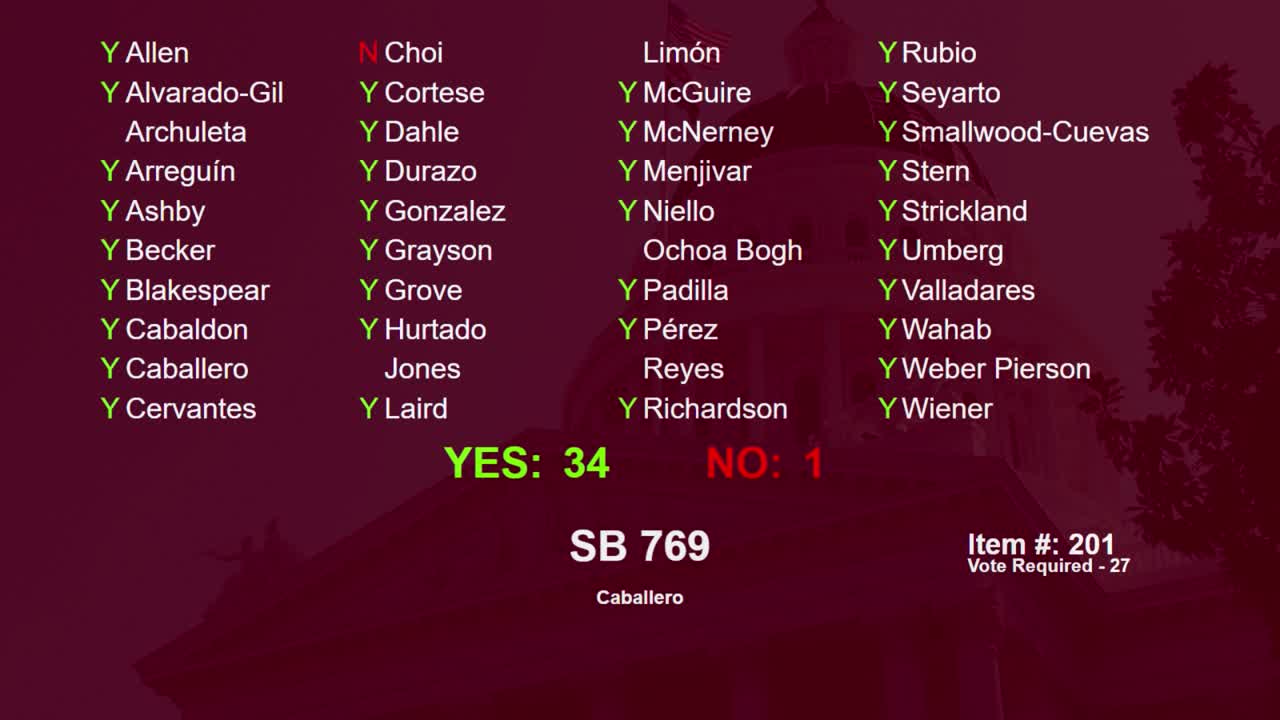 6MIN
Senate Floor
 33MIN
Senate Standing Committee on Health
Bill Author