SB 1199: Prescription drug cost sharing.
- Session Year: 2025-2026
- House: Senate
- Latest Version Date: 2026-07-02
Current Status:
In Progress
(2026-08-13: August 13 hearing: Held in committee and under submission.)
Introduced
In Committee
Awaiting First Chamber Vote
Passed First Chamber
In Committee
Awaiting Second Chamber Vote
Passed Second Chamber
Enacted
What does this bill do?
The bill requires health care service plans and health insurers to count any money an insured person pays, or that is paid on their behalf, for a covered prescription drug toward that person’s out‑of‑pocket maximum and in‑network deductible. It allows exceptions if a lower‑cost generic, a biosimilar (a similar biologic medicine), or an available over‑the‑counter alternative exists, requires pharmacies to notify plans or insurers when manufacturer assistance is used, and authorizes the Insurance Commissioner to impose fines for violations.
The summary is provided by generative AI which can make mistakes. For original language, please view the details in the table below.
Existing law, the Knox-Keene Health Care Service Plan Act of 1975, provides for the licensure and regulation of health care service plans by the Department of Managed Health Care and makes a willful violation of the act a crime. Existing law also provides for the regulation of health insurers by the Department of Insurance. Existing law, except as provided and under certain circumstances, prohibits a person who manufactures a prescription drug from offering a discount, repayment, product voucher, or other reduction in an individuals out-of-pocket expenses associated with their health insurance or health care service plan. Existing law generally imposes specified cost sharing limits on covered prescription drugs.
This bill would require a health care service plan or health insurer, when calculating an enrollees or insureds overall contribution to an out-of-pocket maximum or cost sharing requirement under the plan contract or insurance policy, to count any amount paid by the enrollee or insured or on behalf of the enrollee or insured for a covered drug toward the enrollees or insureds cost sharing, including any form of direct support offered by drug manufacturers that is permitted, sharing, except as provided. The bill would prescribe an administrative penalty for each violation by a health insurer that is enforceable by the Insurance Commissioner after appropriate notice and opportunity for hearing. Because a willful violation of these provisions by a health care service plan would be a crime, the bill would impose a state-mandated local program.
The California Constitution requires the state to reimburse local agencies and school districts for certain costs mandated by the state. Statutory provisions establish procedures for making that reimbursement.
This bill would provide that no reimbursement is required by this act for a specified reason.
Existing law, the Knox-Keene Health Care Service Plan Act of 1975, provides for the licensure and regulation of health care service plans by the Department of Managed Health Care and makes a willful violation of the act a crime. Existing law also provides for the regulation of health insurers by the Department of Insurance. Existing law, except as provided and under certain circumstances, prohibits a person who manufactures a prescription drug from offering a discount, repayment, product voucher, or other reduction in an individuals out-of-pocket expenses associated with their health insurance or health care service plan. Existing law generally imposes specified cost sharing limits on covered prescription drugs.
This bill would require a health care service plan or health insurer, when calculating an enrollees or insureds overall contribution to an out-of-pocket maximum or cost sharing requirement under the plan contract or insurance policy, to count any amount paid by the enrollee or insured or on behalf of the enrollee or insured toward the enrollees or insureds cost sharing, including any form of direct support offered by drug manufacturers that is permitted. permitted, except as provided. The bill would prescribe an administrative penalty for each violation by a health insurer that is enforceable by the Insurance Commissioner after appropriate notice and opportunity for hearing. Because a willful violation of these provisions by a health care service plan would be a crime, the bill would impose a state-mandated local program.
The California Constitution requires the state to reimburse local agencies and school districts for certain costs mandated by the state. Statutory provisions establish procedures for making that reimbursement.
This bill would provide that no reimbursement is required by this act for a specified reason.
Existing law, the Knox-Keene Health Care Service Plan Act of 1975, provides for the licensure and regulation of health care service plans by the Department of Managed Health Care and makes a willful violation of the act a crime. Existing law also provides for the regulation of health insurers by the Department of Insurance. Existing law, except as provided and under certain circumstances, prohibits a person who manufactures a prescription drug from offering a discount, repayment, product voucher, or other reduction in an individuals out-of-pocket expenses associated with their health insurance or health care service plan. Existing law generally imposes specified cost sharing limits on covered prescription drugs.
This bill would require a health care service plan or health insurer, when calculating an enrollees or insureds overall contribution to an out-of-pocket maximum or cost sharing requirement under the plan contract or insurance policy, to count any amount paid by the enrollee or insured or on behalf of the enrollee or insured toward the enrollees or insureds cost sharing, including any form of direct support offered by drug manufacturers that is permitted. The bill would prescribe an administrative penalty for each violation by a health insurer that is enforceable by the Insurance Commissioner after appropriate notice and opportunity for hearing. Because a willful violation of these provisions by a health care service plan would be a crime, the bill would impose a state-mandated local program.
The California Constitution requires the state to reimburse local agencies and school districts for certain costs mandated by the state. Statutory provisions establish procedures for making that reimbursement.
This bill would provide that no reimbursement is required by this act for a specified reason.
(a)(1)When calculating an enrollees overall contribution to an out-of-pocket maximum or cost sharing requirement under the enrollees health care service plan contract, a health care service plan shall count any amount paid by the enrollee or on behalf of the enrollee for a covered drug toward an enrollees cost sharing, including any form of direct support offered by drug manufacturers when permitted under Division 114 (commencing with Section 132000). sharing, unless any of the following conditions apply:
(A)There is a covered generic equivalent at a lower cost sharing tier.
(B)There is a covered interchangeable biosimilar or biosimilar drug at the same or lower cost sharing.
(C)Active ingredients of the drug are contained in products regulated by the United States Food and Drug Administration, are available without prescription at a lower cost, and are not otherwise contraindicated for treatment of the condition for which the prescription drug is approved.
(2)The exceptions in subparagraphs (A) to (C), inclusive, of paragraph (1) do not apply if the enrollee has obtained coverage for a medically necessary nonformulary or nonpreferred prescription drug under state or federal law.
(3)Amounts paid on behalf of the enrollee, including any form of direct assistance offered by drug manufacturers when permitted under Division 114 (commencing with Section 132000), shall only be counted if the pharmacy processing a claim using assistance notifies the applicable health care service plan of the use of the assistance, the enrollee to whom it was provided, and the amount of assistance that was provided.
(2)(4)Amounts described in paragraph (1) shall be counted toward the annual limit on cost sharing and the applicable in-network deductible.
(3)Notwithstanding paragraph (1), this subdivision shall not apply to any amount paid on behalf of the enrollee by a drug manufacturer that is permitted under subdivision (b) of Section 132000.(b)(1)This section shall apply to all nongrandfathered health care service plan contracts that are subject to Section 1367.006.
(2)This section shall not apply to a grandfathered health plan, a specialized health care service plan contract that does not provide essential health benefits, a Medicare supplement plan contract, or accident-only, specified disease, or hospital indemnity plan contracts.
(c)Direct support offered by a drug manufacturer to an enrollee to reduce or eliminate immediate out-of-pocket expenses is subject to the limitations under Sections 132000 and 132002.
(d)For purposes of this section, the following definitions apply:
(1)Annual limitation on cost sharing means the limit described in Section 1367.006.
(2)Biosimilar has the same meaning as defined in Section 262(i)(2) of Title 42 of the United States Code, as it may be amended from time to time.
(2)(3)Cost sharing means any expenditure required by or on behalf of an enrollee with respect to essential health benefits. As set forth under Section 155.20 of Title 45 of the Code of Federal Regulations, cost sharing includes deductibles, coinsurance, copayments, or similar charges, but does not include premiums, balance billing amounts for nonnetwork providers, and spending for noncovered services.
(3)(4)Essential health benefits has the same meaning as set forth under Section 1367.005.
(5)Interchangeable biological product has the same meaning as defined in Section 262(i)(3) of Title 42 of the United States Code, as it may be amended from time to time.
(e)(1)For health savings account-qualified high deductible health plans, if, under federal law, application of this section would result in health savings account ineligibility under Section 223 of Title 26 of the United States Code, then this section applies only with respect to the deductible of those plans after the enrollee has satisfied the minimum deductible under Section 223 of Title 26 of the United States Code.
(2)Paragraph (1) does not apply to items or services that are preventive care pursuant to Section 223(c)(2)(C) of Title 26 of the United States Code, in which case the requirements of this section shall apply regardless of whether the minimum deductible has been satisfied.
SEC. 2.Section 10112.283 is added to the Insurance Code, to read:10112.283.(a)(1)When calculating an insureds overall contribution to an out-of-pocket maximum or cost sharing requirement under the insureds health insurance policy, a health insurer shall count any amount paid by the insured or on behalf of the insured for a covered drug toward an insureds cost sharing, including any form of direct support offered by drug manufacturers when permitted under Division 114 (commencing with Section 132000) of the Health and Safety Code. sharing, unless any of the following conditions apply:
(A)There is a covered generic equivalent at a lower cost sharing tier.
(B)There is a covered interchangeable biosimilar or biosimilar drug at the same or lower cost sharing.
(C)Active ingredients of the drug are contained in products regulated by the United States Food and Drug Administration, are available without prescription at a lower cost, and are not otherwise contraindicated for treatment of the condition for which the prescription drug is approved.
(2)The exceptions in subparagraphs (A) to (C), inclusive, of paragraph (1) do not apply if the insured has obtained coverage for a medically necessary nonformulary or nonpreferred prescription drug under state or federal law.
(3)Amounts paid on behalf of the insured, including any form of direct assistance offered by drug manufacturers when permitted under Division 114 (commencing with Section 132000) of the Health and Safety Code, shall only be counted if the pharmacy processing a claim using assistance notifies the applicable health insurer of the use of the assistance, the insured to whom it was provided, and the amount of assistance that was provided.
(2)(4)Amounts described in paragraph (1) shall be counted toward the annual limit on cost sharing and the applicable in-network deductible.
(3)Notwithstanding paragraph (1), this subdivision shall not apply to any amount paid on behalf of the insured by a drug manufacturer that is permitted under subdivision (b) of Section 132000 of the Health and Safety Code.(b)(1)This section shall apply to all nongrandfathered health insurance policies that are subject to Section 10112.28.
(2)This section shall not apply to a grandfathered health insurance policy, a specialized health insurance policy that does not provide essential health benefits, Medicare supplement insurance, or accident-only, specified disease, or hospital indemnity policies.
(c)Direct support offered by a drug manufacturer to an insured to reduce or eliminate immediate out-of-pocket expenses is subject to the limitations under Sections 132000 and 132002 of the Health and Safety Code.
(d)In addition to any other remedies that are available to the commissioner for a violation of this code, the commissioner may enforce this section pursuant to Chapter 4.5 (commencing with Section 11400) or Chapter 5 (commencing with Section 11500) of Part 1 of Division 3 of Title 2 of the Government Code. After appropriate notice and opportunity for hearing in accordance with either of those provisions, the commissioner shall, by order, assess an administrative penalty not to exceed five thousand dollars ($5,000) for each violation, or, if a violation was willful, an administrative penalty not to exceed ten thousand dollars ($10,000) for each violation.
(e)For purposes of this section, the following definitions apply:
(1)Annual limitation on cost sharing means the limit described in Section 10112.28.
(2)Biosimilar has the same meaning as defined in Section 262(i)(2) of Title 42 of the United States Code, as it may be amended from time to time.
(2)(3)Cost sharing means any expenditure required by or on behalf of an insured with respect to essential health benefits. As set forth under Section 155.20 of Title 45 of the Code of Federal Regulations, cost sharing includes deductibles, coinsurance, copayments, or similar charges, but does not include premiums, balance billing amounts for nonnetwork providers, and spending for noncovered services.
(3)(4)Essential health benefits has the same meaning as set forth under Section 10112.27.
(5)Interchangeable biological product has the same meaning as defined in Section 262(i)(3) of Title 42 of the United States Code, as it may be amended from time to time.
(f)(1)For health savings account-qualified high deductible health plans, if, under federal law, application of this section would result in health savings account ineligibility under Section 223 of Title 26 of the United States Code, then this section applies only with respect to the deductible of those plans after the insured has satisfied the minimum deductible under Section 223 of Title 26 of the United States Code.
(2)Paragraph (1) does not apply to items or services that are preventive care pursuant to Section 223(c)(2)(C) of Title 26 of the United States Code, in which case the requirements of this section shall apply regardless of whether the minimum deductible has been satisfied.
SEC. 3.No reimbursement is required by this act pursuant to Section 6 of Article XIIIB of the California Constitution because the only costs that may be incurred by a local agency or school district will be incurred because this act creates a new crime or infraction, eliminates a crime or infraction, or changes the penalty for a crime or infraction, within the meaning of Section 17556 of the Government Code, or changes the definition of a crime within the meaning of Section 6 of Article XIIIB of the California Constitution.
(a)(1)When calculating an enrollees overall contribution to an out-of-pocket maximum or cost sharing requirement under the enrollees health care service plan contract, a health care service plan shall count any amount paid by the enrollee or on behalf of the enrollee for a drug toward an enrollees cost sharing, including any form of direct support offered by drug manufacturers when permitted under Division 114 (commencing with Section 132000).
(2)Amounts described in paragraph (1) shall be counted toward the annual limit on cost sharing and the applicable in-network deductible.
(3)Notwithstanding paragraph (1), this subdivision shall not apply to any amount paid on behalf of the enrollee by a drug manufacturer that is permitted under subdivision (b) of Section 132000.
(b)(1)This section shall apply to all nongrandfathered health care service plan contracts that are subject to Section 1367.006.
(2)This section shall not apply to a grandfathered health plan, a specialized health care service plan contract that does not provide essential health benefits, a Medicare supplement plan contract, or accident-only, specified disease, or hospital indemnity plan contracts.
(c)Direct support offered by a drug manufacturer to an enrollee to reduce or eliminate immediate out-of-pocket expenses is subject to the limitations under Sections 132000 and 132002.
(d)For purposes of this section, the following definitions apply:
(1)Annual limitation on cost sharing means the limit described in Section 1367.006.
(2)Cost sharing means any expenditure required by or on behalf of an enrollee with respect to essential health benefits. As set forth under Section 155.20 of Title 45 of the Code of Federal Regulations, cost sharing includes deductibles, coinsurance, copayments, or similar charges, but does not include premiums, balance billing amounts for nonnetwork providers, and spending for noncovered services.
(3)Essential health benefits has the same meaning as set forth under Section 1367.005.
(e)(1)For health savings account-qualified high deductible health plans, if, under federal law, application of this section would result in health savings account ineligibility under Section 223 of Title 26 of the United States Code, then this section applies only with respect to the deductible of those plans after the enrollee has satisfied the minimum deductible under Section 223 of Title 26 of the United States Code.
(2)Paragraph (1) does not apply to items or services that are preventive care pursuant to Section 223(c)(2)(C) of Title 26 of the United States Code, in which case the requirements of this section shall apply regardless of whether the minimum deductible has been satisfied.
SEC. 2.Section 10112.283 is added to the Insurance Code, to read:10112.283.(a)(1)When calculating an insureds overall contribution to an out-of-pocket maximum or cost sharing requirement under the insureds health insurance policy, a health insurer shall count any amount paid by the insured or on behalf of the insured for a drug toward an insureds cost sharing, including any form of direct support offered by drug manufacturers when permitted under Division 114 (commencing with Section 132000) of the Health and Safety Code.
(2)Amounts described in paragraph (1) shall be counted toward the annual limit on cost sharing and the applicable in-network deductible.
(3)Notwithstanding paragraph (1), this subdivision shall not apply to any amount paid on behalf of the insured by a drug manufacturer that is permitted under subdivision (b) of Section 132000 of the Health and Safety Code.
(b)(1)This section shall apply to all nongrandfathered health insurance policies that are subject to Section 10112.28.
(2)This section shall not apply to a grandfathered health insurance policy, a specialized health insurance policy that does not provide essential health benefits, Medicare supplement insurance, or accident-only, specified disease, or hospital indemnity policies.
(c)Direct support offered by a drug manufacturer to an insured to reduce or eliminate immediate out-of-pocket expenses is subject to the limitations under Sections 132000 and 132002 of the Health and Safety Code.
(d)In addition to any other remedies that are available to the commissioner for a violation of this code, the commissioner may enforce this section pursuant to Chapter 4.5 (commencing with Section 11400) or Chapter 5 (commencing with Section 11500) of Part 1 of Division 3 of Title 2 of the Government Code. After appropriate notice and opportunity for hearing in accordance with either of those provisions, the commissioner shall, by order, assess an administrative penalty not to exceed five thousand dollars ($5,000) for each violation, or, if a violation was willful, a civil an administrative penalty not to exceed ten thousand dollars ($10,000) for each violation.
(e)For purposes of this section, the following definitions apply:
(1)Annual limitation on cost sharing means the limit described in Section 10112.28.
(2)Cost sharing means any expenditure required by or on behalf of an insured with respect to essential health benefits. As set forth under Section 155.20 of Title 45 of the Code of Federal Regulations, cost sharing includes deductibles, coinsurance, copayments, or similar charges, but does not include premiums, balance billing amounts for nonnetwork providers, and spending for noncovered services.
(3)Essential health benefits has the same meaning as set forth under Section 10112.27.
(f)(1)For health savings account-qualified high deductible health plans, if, under federal law, application of this section would result in health savings account ineligibility under Section 223 of Title 26 of the United States Code, then this section applies only with respect to the deductible of those plans after the insured has satisfied the minimum deductible under Section 223 of Title 26 of the United States Code.
(2)Paragraph (1) does not apply to items or services that are preventive care pursuant to Section 223(c)(2)(C) of Title 26 of the United States Code, in which case the requirements of this section shall apply regardless of whether the minimum deductible has been satisfied.
SEC. 3.No reimbursement is required by this act pursuant to Section 6 of Article XIIIB of the California Constitution because the only costs that may be incurred by a local agency or school district will be incurred because this act creates a new crime or infraction, eliminates a crime or infraction, or changes the penalty for a crime or infraction, within the meaning of Section 17556 of the Government Code, or changes the definition of a crime within the meaning of Section 6 of Article XIIIB of the California Constitution.
(a)(1)When calculating an enrollees overall contribution to an out-of-pocket maximum or cost sharing requirement under the enrollees health care service plan contract, a health care service plan shall count any amount paid by the enrollee or on behalf of the enrollee for a drug toward an enrollees cost sharing, including any form of direct support offered by drug manufacturers when permitted under Division 114 (commencing with Section 132000).
(2)Amounts described in paragraph (1) shall be counted toward the annual limit on cost sharing and the applicable in-network deductible.
(b)(1)This section shall apply to all nongrandfathered health care service plan contracts that are subject to Section 1367.006.
(2)This section shall not apply to a grandfathered health plan, a specialized health care service plan contract that does not provide essential health benefits, a Medicare supplement plan contract, or accident-only, specified disease, or hospital indemnity plan contracts.
(c)Direct support offered by a drug manufacturer to an enrollee to reduce or eliminate immediate out-of-pocket expenses is subject to the limitations under Sections 132000 and 132002.
(d)For purposes of this section, the following definitions apply:
(1)Annual limitation on cost sharing means the limit described in Section 1367.006.
(2)Cost sharing means any expenditure required by or on behalf of an enrollee with respect to essential health benefits. As set forth under Section 155.20 of Title 45 of the Code of Federal Regulations, cost sharing includes deductibles, coinsurance, copayments, or similar charges, but does not include premiums, balance billing amounts for nonnetwork providers, and spending for noncovered services.
(3)Essential health benefits has the same meaning as set forth under Section 1367.005.
SEC. 2.Section 10112.283 is added to the Insurance Code, to read:10112.283.(a)(1)When calculating an insureds overall contribution to an out-of-pocket maximum or cost sharing requirement under the insureds health insurance policy, a health insurer shall count any amount paid by the insured or on behalf of the insured for a drug toward an insureds cost sharing, including any form of direct support offered by drug manufacturers when permitted under Division 114 (commencing with Section 132000) of the Health and Safety Code.
(2)Amounts described in paragraph (1) shall be counted toward the annual limit on cost sharing and the applicable in-network deductible.
(b)(1)This section shall apply to all nongrandfathered health insurance policies that are subject to Section 10112.28.
(2)This section shall not apply to a grandfathered health insurance policy, a specialized health insurance policy that does not provide essential health benefits, Medicare supplement insurance, or accident-only, specified disease, or hospital indemnity policies.
(c)Direct support offered by a drug manufacturer to an insured to reduce or eliminate immediate out-of-pocket expenses is subject to the limitations under Sections 132000 and 132002 of the Health and Safety Code.
(d)In addition to any other remedies that are available to the commissioner for a violation of this code, the commissioner may enforce this section pursuant to Chapter 4.5 (commencing with Section 11400) or Chapter 5 (commencing with Section 11500) of Part 1 of Division 3 of Title 2 of the Government Code. After appropriate notice and opportunity for hearing in accordance with either of those provisions, the commissioner shall, by order, assess an administrative penalty not to exceed five thousand dollars ($5,000) for each violation, or, if a violation was willful, a civil penalty not to exceed ten thousand dollars ($10,000) for each violation.
(e)For purposes of this section, the following definitions apply:
(1)Annual limitation on cost sharing means the limit described in Section 10112.28.
(2)Cost sharing means any expenditure required by or on behalf of an insured with respect to essential health benefits. As set forth under Section 155.20 of Title 45 of the Code of Federal Regulations, cost sharing includes deductibles, coinsurance, copayments, or similar charges, but does not include premiums, balance billing amounts for nonnetwork providers, and spending for noncovered services.
(3)Essential health benefits has the same meaning as set forth under Section 10112.27.
SEC. 3.No reimbursement is required by this act pursuant to Section 6 of Article XIIIB of the California Constitution because the only costs that may be incurred by a local agency or school district will be incurred because this act creates a new crime or infraction, eliminates a crime or infraction, or changes the penalty for a crime or infraction, within the meaning of Section 17556 of the Government Code, or changes the definition of a crime within the meaning of Section 6 of Article XIIIB of the California Constitution.
|
Date
|
Status
|
|---|---|
| Aug 13, 2026 | August 13 hearing: Held in committee and under submission. |
| Aug 5, 2026 | August 5 set for first hearing. Placed on suspense file. |
| Jul 2, 2026 | Read second time and amended. Re-referred to Com. on APPR. |
| Jul 1, 2026 | From committee: Do pass as amended and re-refer to Com. on APPR. (Ayes 13. Noes 0.) (June 30). |
| Jun 1, 2026 | Referred to Com. on HEALTH. |
| May 22, 2026 | In Assembly. Read first time. Held at Desk. |
| May 22, 2026 | Read third time. Passed. (Ayes 26. Noes 0.) Ordered to the Assembly. |
| May 22, 2026 | Read third time. Passed. (Ayes 26. Noes 0. Page 4413.) Ordered to the Assembly. |
| May 14, 2026 | From committee: Do pass. (Ayes 5. Noes 0. Page 4268.) (May 14). |
| May 14, 2026 | Read second time. Ordered to third reading. |
| May 14, 2026 | From committee: Do pass. (Ayes 5. Noes 0.) (May 14). |
| May 8, 2026 | Set for hearing May 14. |
| May 4, 2026 | May 4 hearing: Placed on APPR. suspense file. |
| Apr 28, 2026 | Set for hearing May 4. |
| Apr 27, 2026 | Read second time and amended. Re-referred to Com. on APPR. |
| Apr 23, 2026 | From committee: Do pass as amended and re-refer to Com. on APPR. (Ayes 9. Noes 0.) (April 22). |
| Apr 23, 2026 | From committee: Do pass as amended and re-refer to Com. on APPR. (Ayes 9. Noes 0. Page 4011.) (April 22). |
| Apr 13, 2026 | Set for hearing April 22. |
| Mar 4, 2026 | Referred to Com. on HEALTH. |
| Feb 20, 2026 | From printer. May be acted upon on or after March 22. |
| Feb 19, 2026 | Introduced. Read first time. To Com. on RLS. for assignment. To print. |
|
Date
|
Description
|
Location
|
Votes
|
|
|---|---|---|---|---|
| Jun 30, 2026 | Do pass as amended and be re-referred to the Committee on [Appropriations] | Assembly Standing Committee on Health |
Passed |
|
| May 22, 2026 | Senate 3rd Reading SB1199 Weber Pierson | Senate Floor |
Passed |
|
| May 14, 2026 | Do pass | Senate Standing Committee on Appropriations |
Passed |
|
| May 4, 2026 | Placed on suspense file | Senate Standing Committee on Appropriations |
Passed |
|
| Apr 22, 2026 | Do pass as amended, but first amend, and re-refer to the Committee on [Appropriations] | Senate Standing Committee on Health |
Passed |
This list shows positions taken on this bill by organizations on the date displayed, which is linked to the original source.
Positions by individuals are not included.
|
Organization
|
Position
|
Date
|
|---|---|---|
| Aids Healthcare Foundation | ** Support | |
| Alliance for Gout Awareness | ** Support | |
| Alliance for Patient Access | ** Support | |
| ALS Association | ** Support | |
| America'S Health Insurance Plans | ** Against | |
| Association for Clinical Oncology | ** Support | |
| Association for Northern California Oncologists | ** Support | |
| Association Of California Life And Health Insurance Companies | ** Against | |
| Association Of Northern California Oncologists | ** Support | |
| Biocom | ** Support | |
| Bleeding Disorders Council of California | ** Support | |
| California Academy Of Family Physicians | ** Support | |
| California Agents And Health Insurance Professionals | ** Against | |
| California Association Of Health Plans | ** Against | |
| California Association Of Joint Powers Authorities | ** Against | |
| California Chapter American College Of Cardiology | ** Support | |
| California Chronic Care Coalition | ** Support | |
| California Department of Insurance | ** Support | |
| California Life Sciences Association | ** Support | |
| California Pharmacists Association | ** Support | |
| California Podiatric Medical Association | ** Support | |
| California Rare Disease Access Coalition | ** Support | |
| California Rheumatology Alliance | ** Support | |
| Children'S Specialty Care Coalition | ** Support | |
| Children’s Specialty Care Coalition | ** Support | |
| Community Liver Alliance | ** Support | |
| community oncology alliance | ** Support | |
| Crohn’s and Colitis Foundation | ** Support | |
| Cystic Fibrosis Foundation | ** Support | |
| Eb Research Partnership | ** Support | |
| Equality California | ** Support | |
| HIV + Hepatitis Policy Institute | ** Support | |
| Insurance Commissioner Ricardo Lara | ** Support | |
| International Foundation for Autoimmune and Autoinflammatory Arthritis | ** Support | |
| Los Angeles LGBT Center | ** Support | |
| Medical Oncology Association Of Southern California | ** Support | |
| Mental Health America of California | ** Support | |
| Movement Disorders Policy Coalition | ** Support | |
| National Bleeding Disorders Foundation | ** Support | |
| National Health Law Program | ** Support | |
| National Infusion Center Association (NICA) | ** Support | |
| National Multiple Sclerosis Society | ** Support | |
| National Psoriasis Foundation | ** Support | |
| Neuropathy Action Foundation | ** Support | |
| One individual | ** Against | |
| Osteopathic Physicians And Surgeons Of California | ** Support | |
| Pharmaceutical Care Management Association (unless amended) | ** Against | |
| San Francisco Aids Foundation | ** Support | |
| Spondylitis Association of America | ** Support | |
| The Everylife Foundation for Rare Diseases | ** Support | |
| U.S. Pain Foundation | ** Support | |
| Vision Health Advocacy Coalition | ** Support | |
| western center on law & poverty | ** Support |
Date of Hearing: August 5, 2026
ASSEMBLY COMMITTEE ON APPROPRIATIONS
Buffy Wicks, Chair
SBPCA Bill Id:SB 1199
Author:(Weber Pierson) – As Amended Ver:July 2, 2026
Policy Committee: | Health | Vote: | 13 - 0 |
|
| ||
|
|
Urgency: No State Mandated Local Program: Yes Reimbursable: No
SUMMARY:
This bill requires a health plan or health insurer (collectively, health plan), when calculating an enrollee’s overall contribution to an out-of-pocket maximum or cost sharing requirement, to count any amount paid by the enrollee or on behalf of the enrollee for a covered drug toward the enrollee’s cost sharing requirement, except as provided.
More specifically, this bill:
- Requires, when calculating an enrollee’s overall contribution to an out-of-pocket maximum (MOOP) or cost sharing requirement under the enrollee’s health plan contract or policy, a health plan count any amount paid by the enrollee or on the enrollee’s behalf for a covered drug toward the enrollee’s cost sharing, unless (a) there is a covered generic equivalent at a lower cost sharing tier or a covered interchangeable biosimilar or biosimilar drug at the same or lower cost sharing, or (b) active ingredients of the drug are contained in products regulated by the U.S. Food and Drug Administration (FDA), are available without prescription at a lower cost, and are not otherwise contraindicated for treatment of the condition for which the prescription drug is approved.
- Requires a health plan count toward an enrollee’s MOOP any amount paid by an enrollee or on the enrollee’s behalf if an enrollee has obtained coverage for a medically necessary nonformulary or nonpreferred prescription drug under existing law.
- Requires a health plan apply amounts paid on behalf of the enrollee, including direct assistance offered by drug manufacturers, towards an enrollee’s MOOP or cost sharing requirement only if the pharmacy notifies the enrollee’s health plan of the use of the assistance, the enrollee to whom it was provided, and the amount of assistance that was provided.
- Applies the provisions of this bill to all nongrandfathered plans and insurers and exempts grandfathered plans, specialized health plans and insurers, Medicare supplements, and accident-only, specific disease, or hospital indemnity contracts or policies.
- Defines “cost sharing” to mean any expenditure required by or on behalf of an enrollee or insured with respect to essential health benefits, including deductibles, coinsurance, copayments, or similar charges, but not premiums, balance billing amounts for non-network providers, and spending for non-covered services.
FISCAL EFFECT:
The California Health Benefits Review Program (CHBRP) estimates annual costs of $16.4 million to the California Public Employees’ Retirement System (CalPERS) in increased premium costs ($1.74 per member per month) for DMHC- regulated plans. Of these costs, approximately $6.5 million would be General Fund costs. General Fund liability for CDI-regulated CalPERS insurance premiums would likely also increase by an unknown amount, potentially in the low millions of dollars per year. CHBRP states recent amendments do not change CHBRP’s cost estimate.
The Department of Managed Health Care (DMHC) estimates costs of approximately $165,000 in fiscal year (FY) 2026-27, $537,000 in FY 2027-28, and $501,000 in FY 2028-29 and annually thereafter for additional workload and staffing, primarily to address an increased volume of consumer complaints to the DMHC Help Center (Managed Care Fund).
The California Department of Insurance (CDI) anticipates minor and absorbable costs to review insurance policies (Insurance Fund).
CHBRP estimates this bill would increase total premiums paid by all employers and enrollees statewide by approximately $354.5 million per year.
COMMENTS:
- Purpose. This bill is sponsored by Insurance Commissioner Ricardo Lara. According to the author:
Too many Californians rely on copay assistance programs to access life-saving medications, only to find that those payments do not count toward their deductible or out-of-pocket maximum, leaving them with unexpected and often unaffordable costs.
SB 1199 fixes this by requiring health plans and insurers to count all payments made on a patient’s behalf toward their cost-sharing obligations…This is especially critical for individuals managing chronic and serious conditions, who can face thousands of dollars in additional costs when these payments are excluded.
By closing this loophole, SB 1199 improves affordability, promotes medication adherence, and protects patients from unfair insurance practices.
- Background. To help mitigate costs to the health plan, health plans often assign specialty and other high-cost drugs a coinsurance (a percentage of cost), rather than a copay (a flat-rate amount) as the enrollee’s cost-sharing responsibility. Thus, the high cost of specialty drugs increases out-of-pocket (OOP) costs for patients. In response, drug manufacturers, nonprofit organizations, and other entities have established strategies to reduce patients’ OOP costs, such as drug copay coupons, which lower OOP costs at the pharmacy to encourage the use of specific drugs.
While these coupons may help with unaffordable copays and coinsurance, the availability of a coupon may cause physicians and enrollees to choose an expensive brand-name drug when a less expensive and equally effective generic or other alternative is available. When consumers are relieved of copayment obligations through coupons, the costs of drugs are distorted. Such coupons can add significant long-term costs to the health care system that may outweigh the short-term benefits of allowing the coupons, and thwart health plans’ efforts to point enrollees to more cost-effective drugs. A 2016 study found that payment coupons reduced the use of effective generic drugs and increased the use of brand name drugs by 60%. The study estimated that the use of payment coupons would increase total spending for the study sample by $700 million to $2.7 billion over the ensuing five years. Multiple states, including California with AB 265 (Wood), Chapter 611, Statutes of 2017, have prohibited prescription drug manufacturers from offering coupons or other discounts in an individual's OOP expenses if a lower cost, therapeutically equivalent generic drug is available.
According to CHBRP, the estimated 0.70% to 0.77% of enrollees who would use the benefits provided by this bill would experience significant decreases in annual spending, estimated at $530 per CalPERS enrollee in DMHC-regulated plans to $2600 per enrollee in small-group plans. However, for the more than 99% of enrollees who do not use prescriptions affected by this bill, average annual costs could increase by $10 for a large group market enrollee to $50 for an enrollee in the small group market.
- Prior Legislation. AB 2180 (Weber), of the 2023-24 Legislative Session, was similar to this bill but applied only to enrollees with a chronic disease or terminal illness. AB 2180 was held in this committee.
AB 874 (Weber), of the 2023-24 Legislative Session, was similar to AB 2180 and was referred to, but did not receive a hearing in, Assembly Health Committee.
Analysis Prepared by: Allegra Kim / APPR. / (916) 319-2081
Date of Hearing: June 30, 2026
ASSEMBLY COMMITTEE ON HEALTH
Mia Bonta, Chair
SBPCA Bill Id:SB 1199
Author:(Weber Pierson) – As Amended Ver:April 27, 2026
SENATE VOTE: 26-0
SUBJECT: Prescription drug cost sharing.
SUMMARY: Requires a health plan or insurer, when calculating an enrollee’s or insured’s overall contribution to an out-of-pocket (OOP) maximum or cost-sharing requirement, to count any amount paid by the enrollee or insured or on behalf of the enrollee or insured toward their cost-sharing. Specifically, this bill:
- Requires a health plan or insurer, when calculating an enrollee’s overall contribution to an OOP maximum or cost-sharing requirement to count any amount paid by the enrollee or on behalf of the enrollee for a drug toward an enrollee’s cost-sharing, including any form of direct support offered by drug manufacturers when permitted under existing law.
- Requires amounts in 1) above to count toward the annual limit on cost-sharing and the applicable in-network deductible.
- Requires any direct support offered by a drug manufacturer to reduce or eliminate immediate OOP expenses to comply with existing law.
- Applies the provisions of this bill to all nongrandfathered plans and insurers. Exempts grandfathered plans, specialized health plans and insurers that don’t cover essential health benefits (EHBs), Medicare supplements, or accident-only, specific disease, or hospital indemnity contracts or policies.
- Defines “cost-sharing” to mean any expenditure required by or on behalf of an enrollee or insured with respect to EHBs, including deductibles, coinsurance, copayments, or similar charges, but does not include premiums, balance billing amounts for non-network providers, and spending for non-covered services.
EXISTING LAW:
- Establishes the Department of Managed Health Care (DMHC) to regulate health plans under the Knox-Keene Health Care Service Plan Act of 1975 (Knox-Keene Act) and the Department of Insurance (CDI) to regulate health insurance. [Health and Safety Code (HSC) § 1340, et seq. and Insurance Code (INS) § 106, et seq.]
- Requires a health plan contract or health insurance policy that provides prescription drugs to cover medically necessary prescription drugs, including nonformulary drugs determined to be medically necessary consistent with the law. [HSC § 1342.71 and INS § 10123.193]
- Establishes as California's Essential Health Benefits (EHB) benchmark pursuant to the federal Patient Protection and Affordable Care Act (ACA), the Kaiser Small Group Health Maintenance Organization, existing California mandates, and ten ACA mandated benefits, including prescription drugs. [HSC § 1367.005 and INS § 10112.27]
- Limits cost-sharing for a covered outpatient prescription drug for up to a 30-day supply from exceeding $250, $500 for bronze level plans, or for federally defined high-deductible health plans, those amounts after the deductible is met. [HSC § 1342.73 and INS § 10123.1932]
- Prohibits a person who manufactures a prescription drug, from offering in California a discount repayment, product voucher, or other reduction in an individual’s out-of-pocket expenses associated with the individual’s health coverage, including but not limited to, a copayment, coinsurance, or deductible, for a prescription drug if:
- A lower cost generic drug is covered under the individual’s health coverage on a lower cost-sharing tier that is designated to be therapeutically equivalent by the U.S. Food and Drug Administration (FDA), as specified; or,
- The active ingredients of the drug are contained in FDA-regulated products that are available without a prescription at a lower cost and are not otherwise contraindicated for treatment of the condition for which the prescription drug is approved. [HSC § 132000 and § 132002]
- Excludes from the prohibition in 5) above:
- The first three calendar months of the availability of a drug designated in the U.S. as therapeutically equivalent to a branded drug;
- A discount, repayment, product voucher, or other payment to a patient or another person on the patient’s behalf for a prescription drug required under an FDA Risk Evaluation and Mitigation Strategy for the purpose of monitoring or facilitating the use of that prescription drug in a manner consistent with the approved labeling of the prescription drug;
- A single-tablet drug regimen for treatment or prevention of HIV or AIDS that is as effective as a multitablet regimen, unless consistent with clinical guidelines and peer-reviewed scientific and medical literature, the multitablet regimen is clinically equally effective or more effective and is more likely to result in adherence to the drug regimen;
- When an individual has completed any applicable step therapy or prior authorization requirements for the branded prescription drug as mandated by the individual’s health insurance, or other coverage;
- A discount, repayment, product voucher, or other reduction in an individual’s out-of-pocket expenses that is not associated with his or her health insurance, health plan, or other health coverage;
- Rebates received by a state agency; or,
- Assistance provided by an independent charity patient assistance program that does not allow a pharmaceutical manufacturer or affiliate or others to exert any direct or indirect influence or control over the program or assistance. [HSC § 132000 and § 132004]
FISCAL EFFECT: According to the Senate Appropriations Committee, DMHC estimates costs of approximately $165,000 in 2026-27, $537,000 in 2027-28, and $501,000 in 2028-29 and annually thereafter for state administration (Managed Care Fund). CDI estimates costs of $7,000 in 2026-27 and $19,000 in 2027-28 for state administration (Insurance Fund) and unknown ongoing General Fund costs, potentially low millions, due to increased CalPERS plan premiums.
COMMENTS:
- PURPOSE OF THIS BILL. According to the author, this bill addresses a hidden barrier in our health care system that drives up costs for patients who can least afford it. The author states that too many Californians rely on copay assistance programs to access life-saving medications, only to find that those payments do not count toward their deductible or OOP maximum, leaving them with unexpected and often unaffordable costs. The author continues that this bill fixes this by requiring health plans and insurers to count all payments made on a patient’s behalf toward their cost-sharing obligations, ensuring that financial assistance actually benefits the patient as intended. The author argues this is especially critical for individuals managing chronic and serious conditions, who can face thousands of dollars in additional costs when these payments are excluded. The author concludes that by closing this loophole, this bill improves affordability, promotes medication adherence, and protects patients from unfair insurance practices.
- BACKGROUND. Copayment adjustment programs exist, in part, because of divergent economic interests between drug manufacturers and health insurers and payers regarding high-cost specialty drugs. According to DMHC, the portion of California insurance premiums driven by prescription drug spending has grown from 12.7% in 2020 to 15.4% in 2024. One of the primary drivers of these increases is the rising cost of specialty drugs, which account for 63% of prescription drug spending but make up less than 2% of the total number of drugs dispensed in the state.
- High-cost drugs & copay coupons. According to the California Health Benefits Review Program (CHBRP), studies point to a wide range of factors that influence the cost and prices of specialty drugs. These include, among other factors, lack of competition in the biosimilar market, high drug development costs, regulatory challenges, and exclusive sales rights to manufacturers of newly approved brand-name drugs. Specialty and other high-cost drugs are typically assigned a coinsurance (a percentage of cost) regarding patient cost sharing responsibility, rather than a copay (a flat-rate amount) to help mitigate the costs to the health plan or insurer. Thus, the high cost of specialty drugs increases OOP costs for patients. In response to these cost increases, drug manufacturers, nonprofit organizations, and other entities have established several strategies to reduce some of the OOP costs patients face when purchasing prescriptions. Examples include drug copay coupons, which lower OOP costs at the pharmacy to encourage the use of specific drugs, and patient assistance programs, which provide direct financial aid to patients.
While it is recognized that these coupons may help with unaffordable copays, the availability of a coupon may cause physicians and enrollees to choose an expensive brand-name drug when a less expensive and equally effective generic or other alternative is available. When consumers are relieved of copayment obligations, manufacturers are relieved of a market constraint on drug prices which can distort the true costs of drugs. Such coupons can add significant long-term costs to the health care system that may outweigh the short-term benefits of allowing the coupons, and counter-balance issuers’ efforts to point enrollees to more cost-effective drugs. For example, a 2016 study titled “Effect of Coupons on Use of Generics” by Harvard, Kellogg, and UCLA Business Schools found that payment coupons reduced the sale of effective generic drugs and increased the use of brand name drugs by 60%. The study estimated that the use of payment coupons would, over the ensuing five years, increase spending per drug in the range of $30 to $120 million and increase total spending for the study sample by $700 million to $2.7 billion. Multiple states, including California under AB 265 (Wood), Chapter 611, Statutes of 2017, have prohibited prescription drug manufacturers from offering coupons or other discounts in an individual's OOP expenses if a lower cost therapeutically equivalent generic drug is available.
- Copay adjustment programs. According to CHBRP, copayment adjustment programs emerged as a benefit design response to the potential for third-party financial assistance, such as drug manufacturer coupons, to affect how patient cost-sharing requirements function within a health plan. They are a type of pharmacy benefit design that limits how third-party financial assistance counts towards a patient’s OOP costs. Specifically, they exclude the contributions made by a third party (like drug manufacturer coupons) from counting towards the enrollee’s OOP maximum or deductible. The programs typically target specialty drugs, which tend to have higher OOP costs and the most financial assistance from third parties. There are two types of copayment adjustment programs:
- Copay accumulators: programs that exclude any amounts collected at the point of sale when using financial assistance from a third party for a prescription drug from counting towards a person’s deductible or annual OOP maximum.
- Copay maximizers: programs that adjust the cost-sharing at the point-of-sale to an amount that utilizes the entire amount of the financial assistance available from a third party. This approach ensures that: (1) the plan captures the full value of available manufacturer copay assistance and (2) the member does not pay OOP for the targeted drugs, but (3) none of the copay assistance counts towards deductibles or OOP maximums.
- Copay adjustment programs. According to CHBRP, copayment adjustment programs emerged as a benefit design response to the potential for third-party financial assistance, such as drug manufacturer coupons, to affect how patient cost-sharing requirements function within a health plan. They are a type of pharmacy benefit design that limits how third-party financial assistance counts towards a patient’s OOP costs. Specifically, they exclude the contributions made by a third party (like drug manufacturer coupons) from counting towards the enrollee’s OOP maximum or deductible. The programs typically target specialty drugs, which tend to have higher OOP costs and the most financial assistance from third parties. There are two types of copayment adjustment programs:
In effect, this bill would prohibit both of these types of copay adjustment programs.
- Federal Regulations. Federal regulations states that, beginning plan year January 1, 2020, to the extent consistent with state law, amounts paid toward cost-sharing, using any form of direct support offered by drug manufacturers to enrollees to reduce or eliminate immediate OOP costs for certain prescription brand drugs that have an available and medically appropriate generic equivalent, are not required to be counted toward the annual limitation on cost-sharing. Not counting such amounts toward the annual limitation on cost-sharing would promote prudent prescribing and purchasing choices by physicians and patients based on true costs of drugs and price competition in the pharmaceutical market. Further, it was noted that the regulation is permissive and would apply to non-grandfathered group health plans, to which the annual OOP limitation applies, under the ACA and the Employee Retirement Income Security Act (ERISA).
The final 2020 regulation allows plans to exclude manufacturer coupons from counting for specific prescription brand drugs that have a generic equivalent. The preamble states where there is no generic equivalent available or medically appropriate, it is less likely that the manufacturer’s coupon would disincentivize a lower cost alternative and thereby distort the market. Similarly, when an enrollee is determined through an appeals process or drug exception process to require a brand drug because the generic or other alternative may not be available or medically appropriate, the manufacturer coupon would not disincentivize a less expensive choice. These federal regulations were adopted under the first Trump Administration. Under the Biden Administration in 2021, these regulations were rescinded and replaced with a rule that allowed any form of manufacturer direct support paid on behalf of a consumer to be excluded from the maximum out-of-pocket limit. However, that regulation was challenged in 2022, and ruled invalid in 2023. The U.S. District Court for the District of Columbia reinstated the original 2020 regulation in December of 2023.
- CHBRP. CHBRP was created in response to AB 1996 (Thomson), Chapter 795, Statutes of 2002, which requests the University of California to assess legislation proposing a mandated benefit or service and prepare a written analysis with relevant data on the medical, economic, and public health impacts of proposed health plan and health insurance benefit mandate legislation. SB 125 (Hernandez), Chapter 9, Statutes of 2015, added an impact assessment on EHBs, and legislation that impacts health insurance benefit designs, cost-sharing, premiums, and other health insurance topics to CHBRP’s purview. CHBRP reviewed this bill and included the following impact estimates in their analysis:
- Premium increases and OOP savings. CHBRP estimates this bill would result in approximately 44,300 enrollees having third-party financial assistance for 253,800 prescriptions applied to their annual cost sharing requirements. This would lead to an annual premium increase of approximately $355 million for all enrollees, regardless of their access to third-party financial assistance. Enrollees using drugs impacted by this bill would see a total decrease in cost sharing of $75.6 million, with an annual OOP savings ranging from $530 to $2,600 per utilizer, depending on the market segment.
- Reducing racial disparities. CHBRP found literature showing that copayment adjustment programs disproportionately affect non-white patient populations because these patients are significantly more likely to be enrolled in them than white patients. If this bill were to be enacted, disparities related to enrollment in copayment adjustment programs would dissipate due to the elimination of these programs.
- Rising biologic costs. CHBRP noted that the global biologics market continues to experience significant growth. This bill would not impose any requirements that would change the initial prices of biologics or other drugs; these would still be set by drug manufacturers. As these are high-cost specialty drugs, manufacturers would likely continue to offer coupons for new biologics to offset patient OOP costs. This bill may compound this effect by removing a barrier to patient access. Combined, this may increase utilization of specialty drugs and subsequently increase premiums.
- Growing consumer premiums and affordability concerns. Over the last two decades, significant federal policy changes have reshaped the health insurance landscape in California, expanding coverage, increasing affordability, and strengthening consumer protections for millions of residents. These policies drove historic reductions in the uninsured rate and provided greater stability for families, providers, and health systems across the state. These gains, however, are under threat as the expiration and rollback of key federal supports, combined with broader economic uncertainty and rising health care costs, risk reversing hard-won progress and increasing the number of Californians who are struggling to access affordable health care. According to the California Health Care Foundation 2026 Health Policy Survey (CHCF Survey), half of Californians (51%) reported that their health care expenses have increased faster than their incomes, and a vast majority (71%) are experiencing financial strain due to health care costs. About 6 in 10 Californians overall (59%), and 70% of Californians with low incomes, say they skipped or postponed care due to cost in the past year. Nearly half of Californians (47%) say it is “very” or “somewhat” difficult to afford health care.
- Covered California. Covered California is the state’s ACA marketplace where small-businesses and individuals can directly purchase coverage. Over 90% of Covered California enrollees receive some combination of state and federal subsidies to afford their premiums. However, the expiration of federal enhanced premium tax credits at the end of 2025 is creating stark affordability concerns. Covered California estimates that about 1.7 million Californians will see significant increases to their costs in 2026; on average, enrollees will notice 97% increases to their monthly health insurance premiums. As of February, Covered California estimated a 3% decrease in enrollment overall, with a 32% decrease in new enrollments compared to 2025. One-third of enrollees are opting for lower-cost Bronze plans, compared to 25% in 2025, and 75% of renewals who switched plans downgraded to Bronze-level coverage. About 14% of previous enrollees cancelled their plans, and for those making over 400% of the federal poverty level (FPL), policy termination rates are double what they were in 2025 (22% up from 11%).
- Employer coverage. For those on employer-based individual and family plans, the California Health Benefits Survey found that the average total premium for family coverage in California has increased by 24% since 2022 – rapidly outpacing the national rates of inflation (12%) and wages (14%). This continues a 20-year trend: according to the UC Labor Center, family health care premiums for private-sector workers have grown by 129% since 2005, faster than the state’s median household income (94%) and the inflation rate (69%). Because health insurance is part of an employee’s total compensation plan, higher premiums cut into employee wage increases and other benefits.
- OHCA cost targets. OHCA was established in 2022 in response to widespread cost-related access challenges across California. OHCA collects, analyzes, and publicly reports data on total health care expenditures and enforces spending targets. OHCA’s spending targets are intended to reduce excess spending and slow health care spending growth. In April of 2024, OHCA approved a statewide cost growth target of 3.5% starting in 2025 and phasing down to 3% by 2029. Health care entities, including health plans and insurers, are subject to the statewide spending target and are subject to progressive enforcement if the entity’s costs exceed the target. Some entities have raised concerns that new legislative insurance mandates will make it difficult for them to meet the established cost growth target.
- CHBRP. CHBRP was created in response to AB 1996 (Thomson), Chapter 795, Statutes of 2002, which requests the University of California to assess legislation proposing a mandated benefit or service and prepare a written analysis with relevant data on the medical, economic, and public health impacts of proposed health plan and health insurance benefit mandate legislation. SB 125 (Hernandez), Chapter 9, Statutes of 2015, added an impact assessment on EHBs, and legislation that impacts health insurance benefit designs, cost-sharing, premiums, and other health insurance topics to CHBRP’s purview. CHBRP reviewed this bill and included the following impact estimates in their analysis:
Current law does not explicitly require OHCA to adjust the cost growth targets based on changes to state policy, such as insurance mandates, that may increase spending. However, it does require OHCA to consider state benefit mandates in its development and enforcement of cost growth targets. Specifically, when establishing cost growth target methodology, OHCA is required to review relevant state policy changes impacting covered benefits, provider reimbursement, and costs, among other factors. In addition, in enforcing cost growth targets, OHCA is required to consider factors that contribute to spending in excess of the applicable target, and the extent to which each entity has control over the applicable components of its cost target.
- SUPPORT. This bill is sponsored by Insurance Commissioner Ricardo Lara (Commissioner). The Commissioner argues that copay accumulators are harmful policies used by health plans, health insurers, and pharmacy benefit managers to prevent copay cost-sharing assistance given to qualified patients from counting towards the patient’s deductible and maximum cost-sharing obligation. The Commissioner continues that while patients can initially use the assistance to afford their medications, they are often shocked by the substantial costs later in the year when the assistance runs out, leaving them unable to pay for their prescriptions and leading to poor health outcomes. The Commissioner states that when copay assistance is excluded from patients’ cost-sharing obligations, patients receive no credit toward their deductible or out-of-pocket maximum, despite insurers collecting the manufacturer’s assistance. The Commissioner concludes that this bill will help ensure Californians receive the credit they deserve and are not burdened financially when accessing life-saving medications. No one should have to choose between essential medication and their basic needs.
- OPPOSITION. The California Association of Health Plans, Association of California Life and Health Insurance Companies, and America’s Health Insurance Plans are opposed to this bill, stating that this bill would effectively result in lower cost-sharing for some conditions over others depending on whether a particular drug has manufacturer assistance available. The opposition continues that as a result, similarly situated patients could face very different cost-sharing outcomes (for example, heart patients versus lung cancer patients, or individuals with high blood pressure versus other chronic conditions) based not on medical need, but on the presence of a manufacturer assistance program tied to a specific drug. The opposition argues that this bill lowers pressure on drug manufacturers to reduce list prices, because manufacturers can maintain higher prices while using coupons or other direct support to help members meet their cost-sharing obligations. The opposition notes that there are implementation issues with the bill, as plans and their vendors cannot reliably identify, validate, and track in real time the assistance a drug manufacturer provides to offset a member’s required cost-sharing. The opposition argues that this bill leaves unanswered key questions, including what burden of proof plans may require, what documentation would be sufficient, and whether plans can consistently track these third-party payments across pharmacies, benefit managers, and manufacturer programs. Lastly, the opposition argues that this bill lays the groundwork for similar requirements across non-prescription-drug cost sharing, including medical devices and other provider types.
- PREVIOUS LEGISLATION.
- AB 2180 (Weber) of 2024, would have required a health plan, insurer, or pharmacy benefit manager to apply any amounts paid by the enrollee, insured, or third-party patient assistance program for prescription drugs towards the enrollee or insured’s cost-sharing requirement for those who have a chronic disease or terminal illness. AB 2180 was held on the Assembly Appropriations Committee suspense file.
- AB 874 (Weber) of 2023 was similar to AB 2180 but was never heard in Assembly Health Committee.
- AB 265 (Wood), Chapter 611, Statutes of 2017 prohibits prescription drug manufacturers from offering discounts or other reductions in an individual's OOP expenses associated with their insurance coverage, if a lower cost therapeutically equivalent generic drug is available. Specifies several exceptions that allow discounts even if a lower cost therapeutically equivalent generic drug is available.
- PROPOSED AMENDMENTS.
- Reducing consumer premium impact. As detailed in the CHBRP analysis, this bill could incentivize pharmaceutical manufacturers to offer additional cost-sharing assistance, such as coupons, to encourage the utilization of more high-cost, biologic specialty drugs. As a result, premiums would continue to increase in the long term. Existing law prohibits manufacturer funded copay coupons when a lower-cost generic is available, meaning such coupons wouldn’t apply to the provisions of this bill. The committee may wish to amend the bill to also exempt biologics from the provisions of this bill when there is a lower-cost biosimilar covered by the health plan.
- Addressing logistical hurdles. The health plans have raised the issue that cost-sharing assistance is utilized at the point-of-sale, generally at the pharmacy. The use of assistance is not required to be reported to the health plan, meaning they don’t have the ability to accurately track it to offset a member’s required cost-sharing as required under this bill. The committee may wish to clarify that cost-sharing assistance can only be counted if it is reported by the pharmacy to the health plan.
REGISTERED SUPPORT / OPPOSITION:
Support
Insurance Commissioner Ricardo Lara (sponsor)
Aids Healthcare Foundation
Association for Clinical Oncology
Association of Northern California Oncologists
Bleeding Disorders Council of California
California Academy of Family Physicians
California Chapter American College of Cardiology
California Chronic Care Coalition
California Pharmacists Association
California Rare Disease Access Coalition
California Rheumatology Alliance
Children's Specialty Care Coalition
Community Liver Alliance
Crohn’s and Colitis Foundation
Cystic Fibrosis Foundation
EB Research Partnership
Los Angeles LGBT Center
Medical Oncology Association of Southern California
National Health Law Program
National Infusion Center Association (NICA)
National Multiple Sclerosis Society
National Psoriasis Foundation
Neuropathy Action Foundation
The Everylife Foundation for Rare Diseases
Western Center on Law & Poverty
Several individuals
Opposition
America's Health Insurance Plans
Association of California Life & Health Insurance Companies
California Agents and Health Insurance Professionals
California Association of Health Plans
California Association of Joint Powers Authorities
Analysis Prepared by: Riana King / HEALTH / (916) 319-2097
SENATE RULES COMMITTEE Office of Senate Floor Analyses (916) 651-4171 | SB 1199 |
THIRD READING
Bill No: SB 1199
Author: Weber Pierson (D)
Amended: 4/27/26
Vote: 21
SENATE HEALTH COMMITTEE: 9-0, 4/22/26
AYES: Weber Pierson, Caballero, Durazo, Gonzalez, Menjivar, Padilla, Pérez, Rubio, Smallwood-Cuevas
NO VOTE RECORDED: Valladares, Grove
SENATE APPROPRIATIONS COMMITTEE: 5-0, 5/14/26
AYES: Cervantes, Cabaldon, Grayson, Richardson, Wahab
NO VOTE RECORDED: Seyarto, Dahle
SUBJECT: Prescription drug cost sharing
SOURCE: California Insurance Commissioner Ricardo Lara/California Department of Insurance
DIGEST:
This bill requires health plans and health insurers to count any amount paid for an enrollee’s or insured’s drug cost-sharing toward the enrollee’s or insured’s annual limit on cost-sharing and deductible including any form of direct support offered by drug manufacturers permitted under existing state law.
ANALYSIS:
Existing federal law:
Federal regulation states that, beginning plan year January 1, 2020, to the extent consistent with state law, amounts paid toward cost-sharing, using any form of direct support offered by drug manufacturers to enrollees to reduce or eliminate immediate out-of-pocket costs for certain prescription brand drugs that have an available and medically appropriate generic equivalent, are not required to be counted toward the annual limitation on cost-sharing. [45 Code of Federal Regulations (CFR) §156.130]
Existing state law:
- Establishes the Department of Managed Health Care (DMHC) to regulate health plans under the Knox-Keene Health Care Service Plan Act of 1975 (Knox-Keene Act) and the Department of Insurance (CDI) to regulate health insurance. [Health and Safety Code (HSC) §1340, et seq. and Insurance Code (INS) §106, et seq.]
- Establishes as California's Essential Health Benefits (EHB) benchmark pursuant to the federal Affordable Care Act (ACA), the Kaiser Small Group Health Maintenance Organization, existing California mandates, and ten ACA mandated benefits, including prescription drugs. [HSC §1367.005 and INS §10112.27]
- Prohibits a person who manufactures a prescription drug, from offering in California a discount repayment, product voucher, or other reduction in an individual’s out-of-pocket expenses associated with the individual’s health coverage, including but not limited to, a copayment, coinsurance, or deductible, for a prescription drug if:
- A lower cost generic drug is covered under the individual’s health coverage on a lower cost-sharing tier that is designated to be therapeutically equivalent by the U.S. Food and Drug Administration (FDA), as specified; or,
- The active ingredients of the drug are contained in FDA-regulated products that are available without a prescription at a lower cost and are not otherwise contraindicated for treatment of the condition for which the prescription drug is approved. [HSC §132000 and §132002]
- Excludes from the prohibition in 3) above:
- The first three calendar months of the availability of a drug designated in the U.S. as therapeutically equivalent to a branded drug;
- A discount, repayment, product voucher, or other payment to a patient or another person on the patient’s behalf for a prescription drug required under an FDA Risk Evaluation and Mitigation Strategy for the purpose of monitoring or facilitating the use of that prescription drug in a manner consistent with the approved labeling of the prescription drug;
- A single-tablet drug regimen for treatment or prevention of HIV or AIDS that is as effective as a multi-tablet regimen, unless consistent with clinical guidelines and peer-reviewed scientific and medical literature, the multi-tablet regimen is clinically equally effective or more effective and is more likely to result in adherence to the drug regimen;
- When an individual has completed any applicable step therapy or prior authorization requirements for the branded prescription drug as mandated by the individual’s health insurance, or other coverage;
- A discount, repayment, product voucher, or other reduction in an individual’s out-of-pocket expenses that is not associated with his or her health insurance, health plan, or other health coverage;
- Rebates received by a state agency; or,
- Assistance provided by an independent charity patient assistance program that does not allow a pharmaceutical manufacturer or affiliate or others to exert any direct or indirect influence or control over the program or assistance. [HSC §132000 and §132004]
This bill:
- Requires, when calculating an enrollee’s or insured’s contribution to their out-of-pocket maximum or cost-sharing requirement, a non-grandfathered health plan or insurer to count any amount paid for a drug by the enrollee/insured or on behalf of the enrollee/insured, including any form of direct support offered by drug manufacturers when permitted under existing law, as specified.
- Applies this bill to the annual limit on cost-sharing and the applicable in-network deductible.
- Exempts a grandfathered health plan and insurance policy, a specialized health plan or policy that does not provide EHBs, a Medicare supplement plan contract, or accident-only, specified disease, or hospital indemnity plan contract or policy.
- Requires any direct support offered by a drug manufacturer to an enrollee/insured to reduce or eliminate immediate out-of-pocket expenses to comply with existing law described in 3) and 4) above.
Comments
According to the author of this bill:
This bill addresses a hidden barrier in our healthcare system that drives up costs for patients who can least afford it. Too many Californians rely on copay assistance programs to access life-saving medications, only to find that those payments do not count toward their deductible or out-of-pocket maximum, leaving them with unexpected and often unaffordable costs. This bill fixes this by requiring health plans and insurers to count all payments made on a patient’s behalf toward their cost-sharing obligations, ensuring that financial assistance benefits the patient as intended. This is especially critical for individuals managing chronic and serious conditions, who can face thousands of dollars in additional costs when these payments are excluded. By closing this loophole, this bill improves affordability, promotes medication adherence, and protects patients from unfair insurance practices. It is a commonsense step to ensure that Californians can access the care they need without facing unnecessary financial hardship.
Background
The final 2020 federal ACA regulation described in existing law above allows plans to exclude manufacturer coupons from counting for specific prescription brand drugs that have a generic equivalent. The preamble to the regulation states where there is no generic equivalent available or medically appropriate, it is less likely that the manufacturer’s coupon would disincentivize a lower cost alternative and thereby distort the market. Similarly, when an enrollee is determined through an appeals process or drug exception process to require a brand drug because the generic or other alternative may not be available or medically appropriate, the manufacturer coupon would not disincentivize a less expensive choice. These federal regulations were adopted under the first Trump Administration. Under the Biden Administration in 2021, these regulations were rescinded and replaced with a rule that allowed any form of manufacturer direct support paid on behalf of a consumer to be excluded from the maximum out-of-pocket limit. However, that regulation was challenged in 2022, and ruled invalid in 2023. The U.S. District Court for the District of Columbia reinstated the original 2020 regulation in December of 2023.
- California Health Benefits Review Program (CHBRP) report.
- Background. The high cost of certain specialty drugs impacts the enrollee’s out-of-pocket costs. CHBRP cites a study that for every 10% increase in cost-sharing, there was 2% to 6% decrease in utilization, resulting in people with chronic conditions who have increased cost-sharing having decreased adherence and worst health outcomes. Drug manufacturers offer assistance to help offset those costs so that prescribers will be more inclined to prescribe and enrollees will be more inclined to use those high-cost treatments. Typically, once an enrollee has spent up to their deductible the plan covers more health care costs. When an enrollee reaches the limit on out-of-pocket costs for the year, the plan is required to cover all the remaining costs for covered services. In response to drug assistance programs plans have used copayment adjustment programs as a plan design to affect how drug assistance affects an enrollee’s out-of-pocket limit. A plan copay accumulator program excludes copayments paid by drug assistance from counting toward an enrollee’s out-of-pocket limit. In this case an enrollee may use up the drug assistance in the first few months of the year and then have to pay large amounts out-of-pocket to maintain treatment on the drug. A copay maximizer uses the drug assistance to help offset patient costs over a longer term to shield the enrollee throughout the year. But again, the payments made through the drug assistance program do not count toward the enrollee’s out-of-pocket limit.
- Coverage impacts and enrollees covered. CHBRP assumes approximately 5.8 million Californians have health insurance that is subject to this bill.
- Medical effectiveness. CHBRP found some evidence that copayment adjustment programs impact utilization of prescription drugs; the specific impact utilization of prescription drugs; the specific impacts, however, depend on multiple factors including drug type, patient condition, the type of copayment adjustment program, and other factors.
- Utilization. Claims data and underlying cost models were used to estimate the utilization and unit cost of drugs with eligible drug coupons. Drugs with a generic equivalent available were excluded from this list. CHBRP determined that roughly 9% of prescription drugs with coupons and a generic equivalent have a generic drug covered on a lower tier of the formulary, and would not be impacted by this bill, due to existing restrictions on drug coupons in California law. CHBRP assumed that for every $1 of cost-sharing “saved,” there would be $0.05 in additional spending due to utilization of other services. CHBRP estimates that 44,300 enrollees would fill approximately 253,500 prescriptions because of this bill. CHBRP projects an increase of 300 specialty drug prescriptions filled. Because the elimination of copay adjustment programs would allow patients to reach their out-of-pocket limits sooner, CHBRP assumed this would also lead to an increase in utilization of other medical services. In total, CHBRP estimates an additional $9.5 million would be spent on other health care services that patients would otherwise forego if they had not yet reached their annual out-of-pocket limit.
- Impact on expenditures. Total premiums paid by employers and enrollees would be $355 million of this $187 million would be paid by employers, $60 million would be paid by employees, and $108 million would be paid by individuals and families who purchase coverage directly from insurance companies without the benefit of employer subsidy. This translates to premium increases ranging from $1.11 per member per month to $6.57 per member per month. CalPERS premiums would increase by $16 million ($1.74 per member per month). For those individuals benefiting from the use of drug manufacturer assistance, cost-sharing would decrease by $76 million.
FISCAL EFFECT: Appropriation: No Fiscal Com.: Yes Local: Yes
According to the Senate Appropriations Committee, DMHC estimates costs of approximately $165,000 in 2026-27, $537,000 in 2027-28, and $501,000 in 2028-29 and annually thereafter for state administration (Managed Care Fund), CDI estimates costs of $7,000 in 2026-27 and $19,000 in 2027-28 for state administration (Insurance Fund) and unknown ongoing General Fund costs, potentially low millions, due to increased CalPERS plan premiums.
SUPPORT: (Verified 5/14/26)
California Insurance Commissioner Ricardo Lara/California Department of Insurance (sponsor)
Alliance for Gout Awareness
Alliance for Patient Access
ALS Association
Association for Clinical Oncology
Association of Northern California Oncologists
Autoimmune and Autoinflammatory Arthritis
Biocom
Bleeding Disorders Council of California
California Access Coalition
California Academy of Family Physicians
California Chapter American College of Cardiology
California Chapter of the American College of Emergency Physicians
California Chronic Care Coalition
California Life Sciences Association
California Pharmacists Association
California Podiatric Medical Association
California Rheumatology Alliance
Children’s Specialty Care Coalition
Community Oncology Alliance
Crohn’s and Colitis Foundation
Cystic Fibrosis Foundation
Diabetes Patient Advocacy Coalition
EB Research Partnership
Equality California
HIV + Hepatitis Policy Institute
International Foundation for Autoimmune and Autoinflammatory Arthritis
Los Angeles LGBT Center
Medical Oncology Association of Southern California
Mental Health America of California
Movement Disorders Policy Coalition
National Bleeding Disorders Foundation
National Health Law Program
National Multiple Sclerosis Society
Osteopathic Physicians and Surgeons of California
San Francisco AIDS Foundation
Spondylitis Association of America
The EveryLife Foundation for Rare Diseases
U.S. Pain Foundation
Vision Health Advocacy Coalition
Western Center on Law & Poverty, Inc.
OPPOSITION: (Verified 5/14/26)
America's Health Insurance Plans
Association of California Life and Health Insurance Companies
California Association of Health Plans
Pharmaceutical Care Management Association
One individual
ARGUMENTS IN SUPPORT: This bill’s sponsor, Insurance Commissioner Ricardo Lara, writes, “Copay accumulators are harmful policies used by health plans, health insurers, and pharmacy benefit managers to prevent copay cost-sharing assistance given to qualified patients from counting towards the patient’s deductible and maximum cost-sharing obligation. While patients can initially use the assistance to afford their medications, they are often shocked by the substantial costs later in the year when the assistance runs out, leaving them unable to pay for their prescriptions and leading to poor health outcomes. When copay assistance is excluded from patients’ cost-sharing obligations, patients receive no credit toward their deductible or out-of-pocket maximum, despite insurers collecting the manufacturer’s assistance. As a result, patients often face unaffordable copays at refill, effectively paying twice. This double-dipping practice places an unfair burden on patients and threatens their ability to maintain essential treatments,”. The National Multiple Sclerosis Society writes that “people living with MS often face high deductible and cost-sharing burdens and are responsible for thousands of dollars in out-of-pocket costs, even with health insurance. Because patients are responsible for all their health care costs until the deductible is satisfied, prolonging the deductible period can also put other medical needs—such as doctors’ visits, rehabilitation therapies, MRIs, or other medications—financially out-of-reach.” The Bleeding Disorders Council of California writes patients with bleeding disorders rely on specialized medications and obstacles to obtaining these medications can have life‑threatening consequences, and this bill would take meaningful steps to protect bleeding disorder patients’ ability to obtain their life-saving medications by requiring insurers to include all copays, including those made by third parties on the patient’s behalf, to contribute to the patient’s out-of-pocket maximum or other forms of patient cost-sharing. The Community Oncology Alliance (COA) indicates insurers and pharmacy benefit managers use copay accumulators to shift financial responsibility away from themselves and onto patients already struggling under the weight of cancer care. COA writes that they undermine the affordability and continuity of treatment and violate the basic principle that a patient’s financial assistance should directly support their ability to stay on therapy.
ARGUMENTS IN OPPOSITION: The California Association of Health Plans, the Association of California Life and Health Insurance Companies, and America’s Health Insurance Plans believe this bill would lower cost-sharing for some and not others depending on whether a particular drug manufacturer has assistance available. The opposition writes that this bill encourages patients to choose high-cost name brand drugs when lower-cost, clinically appropriate options may be available, and it lowers pressure on drug manufacturers to reduce list prices, because they can maintain higher prices while using coupons or other direct support to help patients meet their cost-sharing. Opponents indicate these dynamics can increase total drug spending and drive higher premiums for all enrollees. Opponents believe this may set a precedent laying the groundwork for similar requirements on other non-prescription-drug cost-sharing, such as medical devices.
- Oppose unless amended. The Pharmaceutical Care Management Association (PCMA) writes “By making the brand seem less expensive at the pharmacy counter, these coupons steer patient away from lower cost generics and toward drugs that cost employers and unions more overall. Nationwide, the use of coupons has increased health care costs by up to $2.7 billion. For this reason, heath plans implement programs to minimize the impact the use of coupons has on premiums.” PCMA requests amendments to add the following limits for when drug assistance can be used and counted pursuant to this bill:
- If the prescription drug does not have a generic or therapeutic equivalent (as referenced California Business and Professions Code § 4073) preferred under the enrollee's health care service plan contract; or
- The prescription drug has a generic or therapeutic equivalent preferred under the health care service plan contract and the enrollee obtained coverage through prior authorization, a step therapy protocol, or the health care service plan’s exceptions and appeals process.
- Has not been deemed medically unnecessary by a provider.
Prepared by: Teri Boughton / HEALTH / (916) 651-4111
5/16/26 10:44:27
**** END ****
SENATE COMMITTEE ON
Senator Sabrina Cervantes, Chair
2025 - 2026 Regular Session
SB 1199 (Weber Pierson) - Prescription drug cost sharing
Version: | Policy Vote: |
Urgency: | Mandate: |
Hearing Date: | Consultant: |
Bill Summary:
SB 1199 would require health plans and insurers to count certain amounts paid by the enrollee/insured for prescription drugs toward the enrollee’s/insured’s cost-sharing requirements, as specified.
Fiscal Impact:
- The Department of Managed Health Care (DMHC) estimates costs of approximately $165,000 in 2026-27, $537,000 in 2027-28, and $501,000 in 2028-29 and annually thereafter for state administration (Managed Care Fund).
- The California Department of Insurance (CDI) estimates costs of $7,000 in 2026-27 and $19,000 in 2027-28 for state administration (Insurance Fund).
- Unknown ongoing General Fund costs, potentially low millions, due to increased CalPERS plan premiums.
Background:
Prescription Drug Copayment Adjustment Programs. According to the California Health Benefits Review Program (CHBRP), prescription drug copayment adjustment programs emerged as a benefit design in response to the potential for third-party financial assistance, such as drug manufacturer coupons, to affect patient cost-sharing requirements within a health plan. They are a type of pharmacy benefit design that limits how third-party financial assistance counts towards a patient’s out-of-pocket costs. Specifically, they exclude the contributions made by a third party (such as a drug manufacturer coupon) from counting towards the health plan enrollee’s out-of-pocket maximum or deductible.
State Prohibition on Prescription Drug Manufacturer Discounts. State law prohibits a person who manufactures a prescription drug, from offering in California a discount, repayment, product voucher, or other reduction in an individual’s out-of-pocket expenses associated with the individual’s health coverage, including but not limited to, a copayment, coinsurance, or deductible, for a prescription drug if:
- A lower cost generic drug is covered under the individual’s health coverage on a lower cost-sharing tier that is designated to be therapeutically equivalent by the U.S. Food and Drug Administration (FDA), except as specified; or,
- The active ingredients of the drug are contained in FDA-regulated products that are available without a prescription at a lower cost and are not otherwise contraindicated for treatment of the condition for which the prescription drug is approved.
Exceptions from the prohibitions above include:
- A discount, repayment, product voucher, or other payment to a patient or another person on the patient’s behalf for a prescription drug required under an FDA Risk Evaluation and Mitigation Strategy for the purpose of monitoring or facilitating the use of that prescription drug in a manner consistent with the approved labeling of the prescription drug.
- A single-tablet drug regimen for treatment or prevention of HIV or AIDS that is as effective as a multitablet regimen, unless consistent with clinical guidelines and peer-reviewed scientific and medical literature, the multitablet regimen is clinically equally effective or more effective and is more likely to result in adherence to the drug regimen.
- When an individual has completed any applicable step therapy or prior authorization requirements for the branded prescription drug as mandated by the individual’s health insurance, or other coverage.
- A discount, repayment, product voucher, or other reduction in an individual’s out-of-pocket expenses that is not associated with his or her health coverage.
- Rebates received by a state agency.
Proposed Law:
Specific provisions of the bill would:
- Require health plans and insurers, when calculating an enrollee’s/insured’s overall contribution to an out-of-pocket maximum or cost-sharing requirement, to count any amount paid by the enrollee/insured or on behalf of the enrollee/insured for a drug toward an enrollee’s/insured’s cost-sharing, including any form of direct support offered by drug manufacturers when permitted under existing law, except as specified; and require the amounts to be counted toward the annual limit on cost-sharing and the applicable in-network deductible.
- Authorize the CDI commissioner to assess an administrative penalty up to $5,000 for each violation of these provisions, or, if a violation was willful, an administrative penalty up to $10,000 for each violation.
Related Legislation:
AB 2180 (Weber, 2024) included provisions related to applying enrollee/insured payments for prescription drugs toward cost-sharing requirements. The bill was held on the suspense file in the Assembly Appropriations Committee.
Staff Comments:
According to the CHBRP analysis of SB 1199 (introduced version), the bill would increase total premiums paid by employers and enrollees for newly covered benefits by approximately $354,536,000. This includes an increase in CalPERS employer premiums of $16,357,000.
-- END --
SENATE COMMITTEE ON HEALTH
Senator Dr. Akilah Weber Pierson, Chair
BILL NO: SB 1199
AUTHOR: | Weber Pierson | ||
VERSION: | February 19, 2026 | ||
HEARING DATE: | April 22, 2026 | ||
CONSULTANT: | Teri Boughton | ||
SUBJECT: Prescription drug cost sharing
SUMMARY:
Requires health plans and health insurers to count any amount paid for an enrollee’s or insured’s drug cost-sharing toward the enrollee’s or insured’s annual limit on cost-sharing, and in-network deductible including any form of direct support offered by drug manufacturers permitted under existing state law.
Existing federal regulation: States that, beginning plan year January 1, 2020, to the extent consistent with state law, amounts paid toward cost-sharing, using any form of direct support offered by drug manufacturers to enrollees to reduce or eliminate immediate out-of-pocket costs for certain prescription brand drugs that have an available and medically appropriate generic equivalent, are not required to be counted toward the annual limitation on cost-sharing. [45 CFR §156.130]
Existing law:
- Establishes the Department of Managed Health Care (DMHC) to regulate health plans under the Knox-Keene Health Care Service Plan Act of 1975 (Knox-Keene Act) and the Department of Insurance (CDI) to regulate health insurance. [HSC §1340, et seq. and INS §106, et seq.]
- Requires a health plan contract or health insurance policy that provides prescription drugs to cover medically necessary prescription drugs, including nonformulary drugs determined to be medically necessary consistent with the law. [HSC §1342.71 and INS §10123.193]
- Establishes as California's Essential Health Benefits (EHB) benchmark pursuant to the federal Affordable Care Act (ACA), the Kaiser Small Group Health Maintenance Organization, existing California mandates, and ten ACA mandated benefits, including prescription drugs. [HSC §1367.005 and INS §10112.27]
- Limits cost-sharing for a covered outpatient prescription drug for up to a 30-day supply from exceeding $250, $500 for bronze level plans, or for federally defined high-deductible health plans, those amounts after the deductible is met. [HSC §1342.73 and INS § 10123.1932]
- Prohibits a person who manufactures a prescription drug, from offering in California a discount repayment, product voucher, or other reduction in an individual’s out-of-pocket expenses associated with the individual’s health coverage, including but not limited to, a copayment, coinsurance, or deductible, for a prescription drug if:
- A lower cost generic drug is covered under the individual’s health coverage on a lower cost-sharing tier that is designated to be therapeutically equivalent by the U.S. Food and Drug Administration (FDA), as specified; or,
- The active ingredients of the drug are contained in FDA-regulated products that are available without a prescription at a lower cost and are not otherwise contraindicated for treatment of the condition for which the prescription drug is approved. [HSC §132000 and §132002]
- Excludes from the prohibition in 5) above:
- The first three calendar months of the availability of a drug designated in the U.S. as therapeutically equivalent to a branded drug;
- A discount, repayment, product voucher, or other payment to a patient or another person on the patient’s behalf for a prescription drug required under an FDA Risk Evaluation and Mitigation Strategy for the purpose of monitoring or facilitating the use of that prescription drug in a manner consistent with the approved labeling of the prescription drug;
- A single-tablet drug regimen for treatment or prevention of HIV or AIDS that is as effective as a multitablet regimen, unless consistent with clinical guidelines and peer-reviewed scientific and medical literature, the multitablet regimen is clinically equally effective or more effective and is more likely to result in adherence to the drug regimen;
- When an individual has completed any applicable step therapy or prior authorization requirements for the branded prescription drug as mandated by the individual’s health insurance, or other coverage;
- A discount, repayment, product voucher, or other reduction in an individual’s out-of-pocket expenses that is not associated with his or her health insurance, health plan, or other health coverage;
- Rebates received by a state agency; or,
- Assistance provided by an independent charity patient assistance program that does not allow a pharmaceutical manufacturer or affiliate or others to exert any direct or indirect influence or control over the program or assistance. [HSC §132000 and §132004]
This bill:
- Requires, when calculating an enrollee’s or insured’s contribution to their out-of-pocket maximum or cost-sharing requirement, a non-grandfathered health plan or insurer to count any amount paid for a drug by the enrollee/insured or on behalf of the enrollee/insured, including any form of direct support offered by drug manufacturers when permitted under existing law.
- Applies these amounts to the annual limit on cost-sharing and the applicable in-network deductible.
- Exempts a grandfathered health plan and insurance policy, a specialized health plan or policy that does not provide EHBs, a Medicare supplement plan contract, or accident-only, specified disease, or hospital indemnity plan contract or policy.
- Requires any direct support offered by a drug manufacturer to an enrollee/insured to reduce or eliminate immediate out-of-pocket expenses to comply with existing law described in 5) and 6) above.
- Defines “cost-sharing” to mean any expenditure required by or on behalf of an enrollee or insured with respect to EHBs, including deductibles, coinsurance, copayments, or similar charges, but does not include premiums, balance billing amounts for non-network providers, and spending for non-covered services.
FISCAL EFFECT:
This bill has not been analyzed by a fiscal committee.
COMMENTS:
Author’s statement. According to the author, this bill addresses a hidden barrier in our healthcare system that drives up costs for patients who can least afford it. Too many Californians rely on copay assistance programs to access life-saving medications, only to find that those payments do not count toward their deductible or out-of-pocket maximum, leaving them with unexpected and often unaffordable costs. This bill fixes this by requiring health plans and insurers to count all payments made on a patient’s behalf toward their cost-sharing obligations, ensuring that financial assistance benefits the patient as intended. This is especially critical for individuals managing chronic and serious conditions, who can face thousands of dollars in additional costs when these payments are excluded. By closing this loophole, this bill improves affordability, promotes medication adherence, and protects patients from unfair insurance practices. It is a commonsense step to ensure that Californians can access the care they need without facing unnecessary financial hardship.
Federal Regulations. According to the preamble to the federal ACA regulation described in existing law above, drug manufacturers often offer coupons to patients to reduce patient out-of-pocket costs. Drug manufactures may offer these coupons to compete with another brand name drug in the same therapeutic class, to compete with a generic equivalent when released, or to assist consumers whose drug costs would otherwise be extremely high due to a rare or costly condition. Some states prohibit the use of such coupons if a generic alternative is available. While it is recognized that copayment support may help with adherence when copayments may be unaffordable, the availability of a coupon may cause physicians and enrollees to choose an expensive brand-name drug when a less expensive and equally effective generic or other alternative is available. When consumers are relieved of copayment obligations, manufacturers are relieved of a market constraint on drug prices which can distort the market and true costs of drugs. Such coupons can add significant long-term costs to the health care system that may outweigh the short-term benefits of allowing the coupons, and counter-balance issuers’ efforts to point enrollees to more cost-effective drugs. The preamble indicates that in some cases, manufacturer coupons may be increasing overall drug costs, and the proliferation of drug coupons supports higher cost brand drugs when generic alternatives are available which in turn supports increased costs to all Americans and for other federal health programs. For these reasons, the regulation was proposed. Not counting such amounts toward the annual limitation on cost-sharing would promote prudent prescribing and purchasing choices by physicians and patients based on true costs of drugs and price competition in the pharmaceutical market. Further, it was noted that the regulation is permissive and would apply to non-grandfathered group health plans, to which the annual out-of-pocket limitation applies, under the ACA and ERISA.
The final 2020 regulation allows plans to exclude manufacturer coupons from counting for specific prescription brand drugs that have a generic equivalent. The preamble states where there is no generic equivalent available or medically appropriate, it is less likely that the manufacturer’s coupon would disincentivize a lower cost alternative and thereby distort the market. Similarly, when an enrollee is determined through an appeals process or drug exception process to require a brand drug because the generic or other alternative may not be available or medically appropriate, the manufacturer coupon would not disincentivize a less expensive choice. These federal regulations were adopted under the first Trump Administration. Under the Biden Administration in 2021, these regulations were rescinded and replaced with a rule that allowed any form of manufacturer direct support paid on behalf of a consumer to be excluded from the maximum out-of-pocket limit. However, that regulation was challenged in 2022, and ruled invalid in 2023. The U.S. District Court for the District of Columbia reinstated the original 2020 regulation in December of 2023.
California Health Benefits Review Program (CHBRP) report. AB 1996 (Thomson, Chapter 795, Statutes of 2002) requests the University of California to assess legislation proposing a mandated benefit or service and prepare a written analysis with relevant data on the medical, economic, and public health impacts of proposed health plan and health insurance benefit mandate legislation. CHBRP was created in response to AB 1996 and reviewed this bill. Key findings include:
- Background. High cost “specialty” drugs tend to have coinsurance requirements where the consumer pays a percentage of the cost rather than a fixed copayment. People with high-deductible health plans must pay more up front before their deductible is met. The high cost of these drugs impacts the enrollee’s out-of-pocket costs. CHBRP cites a study that for every 10% increase in cost-sharing, there was 2% to 6% decrease in utilization, resulting in people with chronic conditions who have increased cost-sharing having decreased adherence and worst health outcomes. Drug manufacturers offer assistance to help offset those costs so that prescribers will be more inclined to prescribe and enrollees will be more inclined to use those high-cost treatments. Typically, once an enrollee has spent up to their deductible the plan covers more health care costs. When an enrollee reaches the limit on out-of-pocket costs for the year, the plan is required to cover all the remaining costs for covered services. In response to drug assistance programs plans have used copayment adjustment programs as a plan design to affect how drug assistance affects an enrollee’s out-of-pocket limit. A plan copay accumulator program excludes copayments paid by drug assistance from counting toward an enrollee’s out-of-pocket limit. In this case an enrollee may use up the drug assistance in the first few months of the year and then have to pay large amounts out-of-pocket to maintain treatment on the drug. A copay maximizer uses the drug assistance to help offset patient costs over a longer term to shield the enrollee throughout the year. But again, the payments made through the drug assistance program do not count toward the enrollee’s out-of-pocket limit.
- Coverage impacts and enrollees covered. CHBRP assumes approximately 5.8 million Californians have health insurance that is subject to this bill.
- Medical effectiveness. CHBRP found some evidence that copayment adjustment programs impact utilization of prescription drugs; the specific impact utilization of prescription drugs; the specific impacts, however, depend on multiple factors including drug type, patient condition, the type of copayment adjustment program, and other factors.
- Utilization. Claims data and underlying cost models were used to estimate the utilization and unit cost of drugs with eligible drug coupons. Drugs with a generic equivalent available were excluded from this list. CHBRP determined that roughly 9% of prescription drugs with coupons and a generic equivalent have a generic drug covered on a lower tier of the formulary, and would not be impacted by this bill, due to existing restrictions on drug coupons in California law. CHBRP assumed that for every $1 of cost-sharing “saved,” there would be $0.05 in additional spending due to utilization of other services. CHBRP estimates that 44,300 enrollees would fill approximately 253,500 prescriptions because of this bill. CHBRP projects an increase of 300 specialty drug prescriptions filled. Because the elimination of copay adjustment programs would allow patients to reach their out-of-pocket limits sooner, CHBRP assumed this would also lead to an increase in utilization of other medical services. In total, CHBRP estimates an additional $9.5 million would be spent on other health care services that patients would otherwise forego if they had not yet reached their annual out-of-pocket limit.
- Impact on expenditures. Total premiums paid by employers and enrollees would be $355 million of this $187 million would be paid by employers, $60 million would be paid by employees, and $108 million would be paid by individuals and families who purchase coverage directly from insurance companies without the benefit of employer subsidy. CalPERS premiums would increase by $16 million. For those individuals benefiting from the use of drug manufacturer assistance, cost-sharing would decrease by $76 million. Impacts would vary by market, in large group annual cost-sharing savings are estimated at approximately $1,740, and in the individual market approximately $2,600.
- Prior legislation. AB 2180 (Weber of 2024) would have required a health plan, insurer, or pharmacy benefit manager to apply any amounts paid by the enrollee, insured, or third-party patient assistance program for prescription drugs towards the enrollee or insured’s cost-sharing requirement for those who have a chronic disease or terminal illness. AB 2180 was held on the Assembly Appropriations Committee suspense file.
AB 874 (Weber of 2023) was similar to AB 2180 but was never heard in Assembly Health Committee.
AB 265 (Wood, Chapter 611, Statutes of 2017) prohibits prescription drug manufacturers from offering discounts or other reductions in an individual's out-of-pocket expenses associated with his or her insurance coverage, if a lower cost therapeutically equivalent generic drug is available. Specifies several exceptions that allow discounts even if a lower cost therapeutically equivalent generic drug is available.
- Support. This bill’s sponsor, Insurance Commissioner Ricardo Lara, writes, “Copay accumulators are harmful policies used by health plans, health insurers, and pharmacy benefit managers to prevent copay cost-sharing assistance given to qualified patients from counting towards the patient’s deductible and maximum cost-sharing obligation. While patients can initially use the assistance to afford their medications, they are often shocked by the substantial costs later in the year when the assistance runs out, leaving them unable to pay for their prescriptions and leading to poor health outcomes. When copay assistance is excluded from patients’ cost-sharing obligations, patients receive no credit toward their deductible or out-of-pocket maximum, despite insurers collecting the manufacturer’s assistance. As a result, patients often face unaffordable copays at refill, effectively paying twice. This double-dipping practice places an unfair burden on patients and threatens their ability to maintain essential treatments,”. The National Multiple Sclerosis Society writes that “people living with MS often face high deductible and cost-sharing burdens and are responsible for thousands of dollars in out-of-pocket costs, even with health insurance. Because patients are responsible for all their health care costs until the deductible is satisfied, prolonging the deductible period can also put other medical needs—such as doctors’ visits, rehabilitation therapies, MRIs, or other medications—financially out-of-reach.” The Bleeding Disorders Council of California writes patients with bleeding disorders rely on specialized medications and obstacles to obtaining these medications can have life‑threatening consequences, and this bill would take meaningful steps to protect bleeding disorder patients’ ability to obtain their life-saving medications by requiring insurers to include all copays, including those made by third parties on the patient’s behalf, to contribute to the patient’s out-of-pocket maximum or other forms of patient cost-sharing. The Community Oncology Alliance (COA) indicates insurers and pharmacy benefit managers use copay accumulators to shift financial responsibility away from themselves and onto patients already struggling under the weight of cancer care. COA writes that they undermine the affordability and continuity of treatment and violate the basic principle that a patient’s financial assistance should directly support their ability to stay on therapy.
- Opposition. The California Association of Health Plans, the Association of California Life and Health Insurance Companies, and America’s Health Insurance Plans believe this bill would lower cost-sharing for some and not others depending on whether a particular drug manufacturer has assistance available. The opposition writes that this bill encourages patients to choose high-cost name brand drugs when lower-cost, clinically appropriate options may be available, and it lowers pressure on drug manufacturers to reduce list prices, because they can maintain higher prices while using coupons or other direct support to help patients meet their cost-sharing. Opponents indicate these dynamics can increase total drug spending and drive higher premiums for all enrollees. Opponents believe this may set a precedent laying the groundwork for similar requirements on other non-prescription-drug cost-sharing, such as medical devices.
- Oppose unless amended. The Pharmaceutical Care Management Association (PCMA) writes that this bill limits tools that discourage the use of high-cost brand name drugs when equally effective and less expensive alternatives are available to patients. PCMA acknowledges the benefits of copay coupons from drug companies but indicates they are not true financial need programs. PCMA writes “…they are sales tools. By making the brand seem less expensive at the pharmacy counter, these coupons steer patient away from lower cost generics and toward drugs that cost employers and unions more overall. Nationwide, the use of coupons has increased health care costs by up to $2.7 billion. For this reason, heath plans implement programs to minimize the impact the use of coupons has on premiums.” PCMA requests amendments to add the following limits for when drug assistance can be used and counted pursuant to this bill:
- If the prescription drug does not have a generic or therapeutic equivalent (as referenced California Business and Professions Code § 4073) preferred under the enrollee's health care service plan contract; or
- The prescription drug has a generic or therapeutic equivalent preferred under the health care service plan contract and the enrollee obtained coverage through prior authorization, a step therapy protocol, or the health care service plan’s exceptions and appeals process.
- Has not been deemed medically unnecessary by a provider.
- Amendments. It appears that IRS defined high-deductible health plans cannot be required to count payments provided through drug manufacturer assistance toward a deductible so this bill may need an amendment to exempt those plans. Additional clarifying amendments are also needed.
SUPPORT AND OPPOSITION:
Support: California Insurance Commissioner Ricardo Lara / California Department of Insurance (sponsor)
Alliance for Gout Awareness
Alliance for Patient Access
ALS Association
Association for Clinical Oncology
Association for Northern California Oncologists
Biocom
Bleeding Disorders Council of California
California Academy of Family Physicians
California Chapter American College of Cardiology
California Chronic Care Coalition
California Life Sciences Association
California Pharmacists Association
California Podiatric Medical Association
California Rheumatology Alliance
Children’s Specialty Care Coalition
Community Oncology Alliance
Chrons and Colitis Foundation
Cystic Fibrosis Foundation
EB Research Partnership
Equality California
HIV + Hepatitis Policy Institute
International Foundation for Autoimmune and Autoinflammatory Arthritis
Los Angeles LGBT Center
Medical Oncology Association of Southern California
Mental Health America of California
Movement Disorders Policy Coalition
National Bleeding Disorders Foundation
National Health Law Program
National Multiple Sclerosis Society
Osteopathic Physicians and Surgeons of California
San Francisco AIDS Foundation
Spondylitis Association of America
The EveryLife Foundation for Rare Diseases
U.S. Pain Foundation
Vision Health Advocacy Coalition
Western Center on Law & Poverty, Inc.
Oppose: America's Health Insurance Plans
Association of California Life and Health Insurance Companies
California Association of Health Plans
Pharmaceutical Care Management Association (unless amended)
One individual
-- END --
Discussed in Hearing
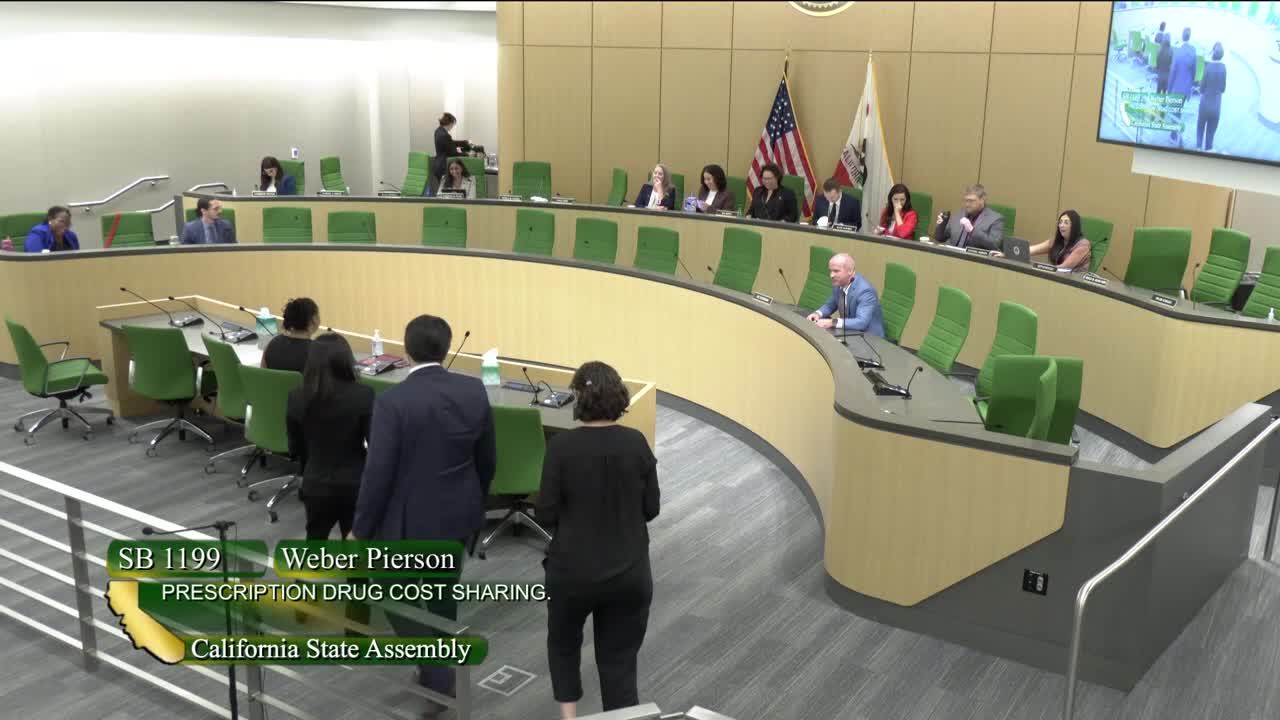 17MIN
Assembly Standing Committee on Health
 4MIN
Senate Floor
 18MIN
Senate Standing Committee on Health
Bill Author

Bill Co-Author(s):