SB 473: Water corporations: demand elasticity: rates and surcharges.
- Session Year: 2025-2026
- House: Senate
- Latest Version Date: 2025-04-10
Current Status:
In Progress
(2025-08-29: Coauthors revised.)
Introduced
In Committee
Awaiting First Chamber Vote
Passed First Chamber
In Committee
Awaiting Second Chamber Vote
Passed Second Chamber
Enacted
The California Constitution and the Public Utilities Act vest the Public Utilities Commission with regulatory authority over electrical corporations and water corporations. The act requires the commission to ensure that errors in estimates of demand elasticity or sales do not result in material overcollections or undercollections of electrical corporations.
This bill would additionally require the commission to ensure that those errors do not result in material overcollections or undercollections of water corporations.
Existing law requires the commission, in establishing rates for water service, to consider separate charges for costs associated with customer service, facilities, variable operating costs, or other components of the water service provided to water users. Existing law requires the commission to consider, and authorizes the commission to authorize, a water corporation to establish programs, including rate designs, for achieving conservation of water and recovering the cost of these programs through the rates, as provided.
This bill would, for purposes of the above-described rates for water service, require that any changes to rates or implementation of surcharges in accordance with the above-described requirement on the commission to ensure errors in estimates of demand elasticity or sales do not result in material overcollections or undercollections of water corporations do not result in revenues above those approved by the commission.
Under existing law, a violation of the act or any order, decision, rule, direction, demand, or requirement of the commission is a crime.
Because the above requirement requirements would be part of the act and a violation of a commission action implementing this bills requirements would be a crime, the bill would impose a state-mandated local program.
The California Constitution requires the state to reimburse local agencies and school districts for certain costs mandated by the state. Statutory provisions establish procedures for making that reimbursement.
This bill would provide that no reimbursement is required by this act for a specified reason.
The California Constitution and the Public Utilities Act vest the Public Utilities Commission with regulatory authority over electrical corporations and water corporations. The act requires the commission to ensure that errors in estimates of demand elasticity or sales do not result in material overcollections or undercollections of electrical corporations.
This bill would additionally require the commission to ensure that those errors do not result in material overcollections or undercollections of water corporations.
Under existing law, a violation of the act or any order, decision, rule, direction, demand, or requirement of the commission is a crime.
Because the above requirement would be part of the act and a violation of a commission action implementing this bills requirements would be a crime, the bill would impose a state-mandated local program.
The California Constitution requires the state to reimburse local agencies and school districts for certain costs mandated by the state. Statutory provisions establish procedures for making that reimbursement.
This bill would provide that no reimbursement is required by this act for a specified reason.
(a)The Legislature finds and declares all of the following:
(1)Adequate water supply reliability for all uses is essential to the future economic and environmental health of California.
(2)California is in a severe drought, and in 2021 the Governor issued executive orders declaring a drought emergency.
(3)Droughts in California are expected to become more frequent and more severe as a result of climate change.
(4)The frequency of droughts highlights the continued importance of encouraging both water suppliers and their customers to practice water conservation as the most cost-effective means of ensuring that there are adequate water supplies for the environment and people in the state.
(5)Because water suppliers have very significant fixed costs that do not fluctuate with changes in consumption patterns, they have a financial disincentive to encourage water conservation as reductions in water consumption directly translate into cost recovery challenges.
(6)The Legislature has addressed this same financial challenge for electricity suppliers by requiring that changes in demand do not result in material overcollections or undercollections of revenue.
(b)It is the intent of the Legislature to ensure that water corporations are authorized to establish revenue adjustment mechanisms that provide for a full decoupling of sales and revenue in order to further incentivize water conservation efforts.
SEC. 2.Section 727.5 of the Public Utilities Code is amended to read:727.5.(a)In establishing rates for water service, the commission shall consider, and may establish, separate charges for costs associated with customer service, facilities, variable operating costs, including fixed and variable costs associated with supplying the water, or other components of the water service provided to water users.
(b)The commission shall consider, and may authorize, a water corporation to assess a fee for future water service, or a reservation charge for future water service, for persons or entities occupying or owning property within the service territory of the water corporation.
(c)The commission shall consider, and may authorize, a water corporation to establish a balancing account, rate stabilization fund, or other contingency fund, the purpose of which shall be the long-term stabilization of water rates.
(d)(1)The commission shall consider, and may authorize, a water corporation to establish programs, including rate designs, for achieving conservation of water and recovering the cost of these programs through the rates.
(2)(A)Upon application by a water corporation with more than 10,000 service connections, the commission shall consider, and may authorize, the implementation of a mechanism that separates the water corporations revenues and its water sales, commonly referred to as a decoupling mechanism.
(B)An authorized decoupling mechanism shall be designed to ensure that the differences between actual and authorized water sales do not result in the overrecovery or underrecovery of the water corporations authorized water sales revenue.
(C)An authorized decoupling mechanism shall not enable the water corporation to earn a revenue windfall by encouraging higher sales.
(D)The water corporation may only submit an application to the commission pursuant to this paragraph as part of its triennial general rate case application described in Section 455.2, unless the commission and the water corporation mutually agree for the application to be otherwise submitted.
(e)In establishing rates for recovery of the costs of a used and useful water plant, the commission may use a capital structure and payback methodology that maintains the reliability of water service, minimizes the long-term cost to ratepayers, provides equity between present and future ratepayers, and affords the utility an opportunity to earn a reasonable return on its used and useful investment, attract capital for investment on reasonable terms, and ensure the financial integrity of the utility.
(f)Any change to a rate for water service or the implementation of a surcharge on water service in accordance with Section 739.10 shall not result in revenues above those approved by the commission.
SEC. 2.SEC. 3.Section 739.10 of the Public Utilities Code is amended to read:739.10.The commission shall ensure that errors in estimates of demand elasticity or sales do not result in material overcollections or undercollections of electrical or water corporations.
SEC. 3.SEC. 4.No reimbursement is required by this act pursuant to Section 6 of Article XIIIB of the California Constitution because the only costs that may be incurred by a local agency or school district will be incurred because this act creates a new crime or infraction, eliminates a crime or infraction, or changes the penalty for a crime or infraction, within the meaning of Section 17556 of the Government Code, or changes the definition of a crime within the meaning of Section 6 of Article XIIIB of the California Constitution.
REVISIONS: HeadingLine 2.(a)The Legislature finds and declares all of the following:
(1)Adequate water supply reliability for all uses is essential to the future economic and environmental health of California.
(2)California is in a severe drought, and in 2021 the Governor issued executive orders declaring a drought emergency.
(3)Droughts in California are expected to become more frequent and more severe as a result of climate change.
(4)The frequency of droughts highlights the continued importance of encouraging both water suppliers and their customers to practice water conservation as the most cost-effective means of ensuring that there are adequate water supplies for the environment and people in the state.
(5)Because water suppliers have very significant fixed costs that do not fluctuate with changes in consumption patterns, they have a financial disincentive to encourage water conservation as reductions in water consumption directly translate into cost recovery challenges.
(6)The Legislature has addressed this same financial challenge for electricity suppliers by requiring that changes in demand do not result in material overcollections or undercollections of revenue.
(b)It is the intent of the Legislature to ensure that water corporations are authorized to establish revenue adjustment mechanisms that provide for a full decoupling of sales and revenue in order to further incentivize water conservation efforts.
SEC. 2.Section 739.10 of the Public Utilities Code is amended to read:739.10.The commission shall ensure that errors in estimates of demand elasticity or sales do not result in material over overcollections or undercollections of the electrical or water corporations.
SEC. 3.No reimbursement is required by this act pursuant to Section 6 of Article XIIIB of the California Constitution because the only costs that may be incurred by a local agency or school district will be incurred because this act creates a new crime or infraction, eliminates a crime or infraction, or changes the penalty for a crime or infraction, within the meaning of Section 17556 of the Government Code, or changes the definition of a crime within the meaning of Section 6 of Article XIIIB of the California Constitution.
|
Date
|
Status
|
|---|---|
| Aug 29, 2025 | Coauthors revised. |
| Aug 29, 2025 | August 29 hearing: Held in committee and under submission. |
| Aug 20, 2025 | August 20 set for first hearing. Placed on APPR. suspense file. |
| Jul 17, 2025 | From committee: Do pass and re-refer to Com. on APPR. (Ayes 15. Noes 0.) (July 16). Re-referred to Com. on APPR. |
| Jun 9, 2025 | Referred to Com. on U. & E. |
| Jun 4, 2025 | In Assembly. Read first time. Held at Desk. |
| Jun 3, 2025 | Read third time. Passed. (Ayes 37. Noes 0. Page 1443.) Ordered to the Assembly. |
| May 23, 2025 | Read second time. Ordered to third reading. |
| May 23, 2025 | From committee: Do pass. (Ayes 5. Noes 0. Page 1201.) (May 23). |
| May 16, 2025 | Set for hearing May 23. |
| May 5, 2025 | May 5 hearing: Placed on APPR. suspense file. |
| Apr 25, 2025 | Set for hearing May 5. |
| Apr 24, 2025 | April 28 hearing postponed by committee. |
| Apr 17, 2025 | Set for hearing April 28. |
| Apr 10, 2025 | Read second time and amended. Re-referred to Com. on APPR. |
| Apr 9, 2025 | From committee: Do pass as amended and re-refer to Com. on APPR. (Ayes 15. Noes 0. Page 681.) (April 7). |
| Apr 1, 2025 | Set for hearing April 7. |
| Feb 26, 2025 | Referred to Com. on E., U & C. |
| Feb 20, 2025 | From printer. May be acted upon on or after March 22. |
| Feb 19, 2025 | Introduced. Read first time. To Com. on RLS. for assignment. To print. |
|
Date
|
Description
|
Location
|
Votes
|
|
|---|---|---|---|---|
| Jul 16, 2025 | Do pass and be re-referred to the Committee on [Appropriations] | Assembly Standing Committee on Utilities and Energy |
Passed |
|
| Jun 3, 2025 | Senate 3rd Reading SB473 Padilla | Senate Floor |
Passed |
|
| May 23, 2025 | Do pass | Senate Standing Committee on Appropriations |
Passed |
|
| May 5, 2025 | Placed on suspense file | Senate Standing Committee on Appropriations |
Passed |
|
| Apr 7, 2025 | Do pass as amended, but first amend, and re-refer to the Committee on [Appropriations] | Senate Standing Committee on Energy, Utilities and Communications |
Passed |
This list shows positions taken on this bill by organizations on the date displayed, which is linked to the original source.
Positions by individuals are not included.
|
Organization
|
Position
|
Date
|
|---|---|---|
| Alliance for Water Efficiency | ** Support | |
| Bay Area Council | ** Support | |
| Butte Environmental Council | ** Support | |
| CalAsian Chamber of Commerce | ** Support | |
| California African American Chamber Of Commerce | ** Support | |
| California Alliance for Jobs | ** Support | |
| California American Water | ** Support | |
| California Asian Pacific Chamber Of Commerce | ** Support | |
| California Chamber Of Commerce | ** Support | |
| california hawaii state conference of the naacp | ** Support | |
| California Hispanic Chambers Of Commerce | ** Support | |
| California Pacific Asian Chamber of Commerce | ** Support | |
| California State Pipe Trades Council | ** Support | |
| California Water Association | ** Support | |
| California Water Efficiency Partnership | ** Support | |
| california water service | ** Support | |
| California-Hawaii State Conference Of The Naacp | ** Support | |
| Carson Chamber of Commerce | ** Support | |
| City of Thousand Oaks | ** Support | |
| Commerce Business Council | ** Support | |
| Commerce Business Council Chamber of Commerce | ** Support | |
| Cupertino Chamber of Commerce | ** Support | |
| East Bay Leadership Council | ** Support | |
| El Concilio California | ** Support | |
| Golden State Water Company | ** Support | |
| Great Oaks Water Company | ** Support | |
| Hawthorne Chamber Of Commerce | ** Support | |
| Hermosa Beach Chamber of Commerce | ** Support | |
| Hermosa Beach, Long Beach Area, Palos Verdes Peninsula, Sacramento | ** Support | |
| Icon CDC | ** Support | |
| Initiating Change In Our Neighborhoods Community Development Corporation | ** Support | |
| Initiating Change in Our Neighborhoods Community Development Corporation Icon CDC | ** Support | |
| International Association Of Plumbing & Mechanical Officials | ** Support | |
| International Union Of Operating Engineers Local 3 | ** Support | |
| large water IOUs | ** Support | |
| League Of California Cities | ** Support | |
| Liberty Utilities | ** Support | |
| Long Beach Area Chamber of Commerce | ** Support | |
| Metropolitan, San Jose, and Torrance Area | ** Support | |
| Monterey Peninsula Water Management District | ** Against | |
| National Association of Water Companies | ** Support | |
| Office of Monterey County Supervisor Chris Lopez | ** Support | |
| Pacific, California Hispanic, Cupertino, East Los Angeles, Hawthorne, | ** Support | |
| Palos Verdes Peninsula Chamber Of Commerce | ** Support | |
| Public Advocates Office | ** Against | |
| PUBLIC WATER NOW | ** Against | |
| Regional Water Authority | ** Support | |
| Sacramento Metro Chamber of Commerce | ** Support | |
| Sacramento Metropolitan Chamber of Commerce | ** Support | |
| San Jose Chamber of Commerce | ** Support | |
| San Jose Water Company | ** Support | |
| Santa Clara & San Benito Building and Construction Trades Council | ** Support | |
| several of their customers | ** Support | |
| Sierra Nevada Alliance | ** Support | |
| Silicon Valley Leadership Group | ** Support | |
| Southern California Water Coalition | ** Support | |
| Torrance Area Chamber of Commerce | ** Support | |
| Utility Workers Union of America, Local 259 | ** Support | |
| Water Replenishment District | ** Support | |
| West Basin Water Association | ** Support | |
| West Los Angeles Chamber of Commerce | ** Support |
Date of Hearing: August 20, 2025
ASSEMBLY COMMITTEE ON APPROPRIATIONS
Buffy Wicks, Chair
SBPCA Bill Id:SB 473
Author:(Padilla) – As Amended Ver:April 10, 2025
Policy Committee: | Utilities and Energy | Vote: | 15 - 0 |
|
| ||
|
|
Urgency: No State Mandated Local Program: Yes Reimbursable: No
SUMMARY:
This bill requires the California Public Utilities Commission (CPUC) to ensure that errors in estimates of demand elasticity or sales do not result in material over collections or undercollections by water corporations, and that any changes to water service rates or implementation of surcharges do not result in revenues exceeding those approved by the CPUC.
FISCAL EFFECT:
This bill will likely result in significant new workload for the CPUC, with associated annual costs likely in the hundreds of thousands of dollars (Public Utilities Commission Utilities Reimbursement Account).
The CPUC estimates this new workload will require the addition of staff at an annual cost of approximately $576,000, as follows: a regulatory analyst ($140,000 annually), a more-senior regulatory analyst ($179,000) and an administrative law judge ($257,000). CPUC describes tasks these position will undertake as establishing a full decoupling mechanism in general rate case proceedings and then reviewing water utilities’ decoupling requests.
COMMENTS:
- Purpose. The author intends this bill to allow water utilities to decouple charges applied to a customer’s bill to recover the utility’s fixed costs from the volume of water the customer uses during the billing period, a practice known as “decoupling,” which the author describes as “proven to reduce water usage and keep utility rates affordable.”
- Background. The CPUC regulates the rates charged by the investor-owned utilities (IOUs). In the case of gas and electric IOUs, the CPUC long ago decoupled electricity use from IOU rate recovery, to remove the incentive for the profit-seeking IOUs to maximize energy consumption. However, the Legislature recognized that an IOU may, in good faith, misestimate demand for gas or electricity and held that such an IOU should not benefit by nor suffer from such a misestimation. For this reason, existing law directs the CPUC to ensure that errors in estimates of demand elasticity or sales do not result in material over or under collections by the electrical IOUs.
The CPUC has also attempted to decouple water use from the ability of water IOUs to recover their just and reasonable costs from ratepayers. Through implementation of what are known as WRAMs (water revenue adjustment mechanisms), the CPUC sought to encourage large water IOUs to conserve water through pilot projects that separate certain costs from charges collected from the IOUs’ customers for each volume of water used. Under a WRAM, a water IOU forecasts the amount of water its customers will use over a given period, and the IOU charges its customers a rate for each unit of water used in an amount sufficient to allow the IOU to recover its authorized costs over the period.
However, an IOU is not always successful in forecasting the amount of water its customers will use over a given period. In such instances, the IOU will collect too much revenue from its customers if the IOU underestimates the amount of water it customers will use over the given period, and IOU will collect too little revenue if it overestimates the amount of water its customers will use. To account for this potential under or over collection of revenue, the IOU tracks revenues for the period and, through use of the WRAM, either collects additional revenue from its customers through a surcharge or refunds revenue to its customers, as appropriate.
The CPUC concluded its WRAM pilots did not result in consistent water savings compared to other rate structures, finding the mechanism encouraged a water IOU to over forecast water use, which kept volumetric water charges low, knowing it could later collect any revenue shortfall through a WRAM surcharge. For this reason, in 2020, the CPUC ended the use of WRAMs by water IOUs. The CPUC did allow IOUs to use a modified version of the mechanism, known as a “Monterey-style WRAM,” distinct from the “full WRAM” discussed in this analysis so far.)
The large water IOUs sued the CPUC to allow them to continue using WRAMs. But, before conclusion of the lawsuit, the Legislature passed SB 1469 (Bradford), Chapter 890, Statutes of 2022, which authorizes a water IOU to propose decoupling mechanisms—including full WRAMs—in its general rate cases. Importantly, SB 1469 does not require the CPUC to approve an IOU’s WRAM proposal.
- Support and Opposition. This bill is supported by large water IOUs and several of their customers, among others. Writing jointly in support, the California Water Association and several of the state’s larger water IOUs assert:
The program [decoupling] lets water utilities separate the fixed costs of water infrastructure from the variable costs of water consumption. It’s a proven tactic but unfortunately, since SB 1469 passed, the California Public Utilities Commission (CPUC) has denied all decoupling requests from water suppliers, discouraging programs that help make water bills more affordable and that encourage conservation.
SB 473 offers a permanent solution to water affordability by ensuring the CPUC permits water utilities to utilize decoupling when requested and honor the intent of the Legislature when they passed SB 1469.
These opponents also contend the bill should result in few or no new costs for CPUC, since the CPUC already has resources to consider the IOU’s past and current full decoupling proposals.
The bill is opposed by the Public Advocate’s Office, which describes water decoupling as “a flawed rate adjustment mechanism” that has been proven over a 10-year pilot project to not lead to water conservation but that shifts forecasting risks from IOUs to ratepayers.
Analysis Prepared by: Jay Dickenson / APPR. / (916) 319-2081
Date of Hearing: July 16, 2025
ASSEMBLY COMMITTEE ON UTILITIES AND ENERGY
Cottie Petrie-Norris, Chair
SBPCA Bill Id:SB 473
Author:(Padilla) – As Amended Ver:April 10, 2025
SENATE VOTE: 37-0
SUBJECT: Water corporations: demand elasticity: rates and surcharges
SUMMARY: Requires the CPUC to ensure that errors in estimates of demand elasticity or sales do not result in material overcollections or undercollections by water corporations, and that any changes to water service rates or implementation of surcharges do not result in revenues exceeding those approved by the CPUC.
EXISTING LAW:
- Establishes and vests the CPUC with regulatory authority over water corporations. (Article XII of the California Constitution)
- Requires all charges demanded or received by any public utility for any product or commodity furnished or any service rendered shall be just and reasonable. (Public Utilities Code § 451)
- Requires the CPUC in establishing rates for water service to consider separate charges for costs associated with customer service, facilities, variable operating costs, or other components of the water service provided to water users. Requires the CPUC to consider, and permits the CPUC to authorize, a water corporation to establish programs, including rate designs, for achieving conservation of water and recovering the cost of these programs through the rates. (Public Utilities Code § 727.5)
- Requires the CPUC to ensure that errors in estimates of demand elasticity or sales do not result in material overcollections or undercollections of electrical corporations. (Public Utilities Code §739.10)
FISCAL EFFECT: According to the Senate Committee on Appropriations, the CPUC estimates ongoing ratepayer-funded costs of approximately $576,000 annually to support review of requests from regulated water corporations related to decoupling mechanisms, recovery of revenue shortfalls through rate surcharges, and other related responsibilities.
BACKGROUND:
CPUC-Regulated Water Utilities – The CPUC regulates more than 100 investor-owned water and sewer utilities (IOUs) that provide water service to approximately 16% of California’s residents, with combined annual revenues of about $1.4 billion.[1] Among these, roughly 95% of customers—nearly 1.2 million—are served by nine large water IOUs, known as Class A water utilities, each serving more than 10,000 service connections.[2] The CPUC ensures that water utility rates, services, and operations are just and reasonable by requiring Class A water utilities to submit a General Rate Case (GRC) every three years to justify any proposed rate changes.[3] These applications include historical expenses, infrastructure improvement projects, and forward‑looking cost projections to justify proposed rate increases. The CPUC reviews the request and supporting documentation through a formal public process that includes opportunities for public comment, input from the Public Advocates Office, and evidentiary hearings.
Water rates for Class A utilities typically include two components:
- Service Charge (Fixed Charge): A recurring monthly or bi-monthly charge that helps recover up to 50% of the utility’s fixed costs—expenses that do not vary based on customer usage. These typically include costs such as water quality testing, infrastructure maintenance, meter reading, billing, and customer service.
- Quantity Charge (Use Charge): A volumetric charge based on a customer’s actual water consumption. Utilities apply a tiered rate structure that sets different prices per unit of water depending on the amount used—charging lower rates for lower levels of water usage and higher rates as usage increases. This structure is designed both to encourage conservation and to reflect the rising cost of supplying additional water.
Decoupling. Revenue decoupling is a ratemaking mechanism that allows an investor-owned utility (IOU) to recover its authorized revenue requirement regardless of how much volume of electricity or gas it sells, meaning a utility’s earning is not affected by changes in customer usage. Instead the utility is allowed to recover a fixed, pre-approved amount of revenue set by the CPUC.
For background, in the aftermath of the 1970s energy crises—marked by fuel shortages and price shocks—California launched a broad effort to reduce energy consumption and improve efficiency. At the time, utilities operated under traditional cost-of-service regulation, which tied revenues directly to the volume of energy sold. As a result, when customers used less energy—due to conservation or efficiency programs—utilities collected less revenue, even though their fixed costs remained the same. This structure created a financial disincentive for utilities to promote conservation. To address this misalignment, the CPUC adopted the Supply Adjustment Mechanism (SAM) in 1978 for gas utilities.[4] SAM was the state’s first decoupling mechanism, designed to stabilize utility revenues despite fluctuations in sales caused by weather, fuel switching, or conservation efforts. It worked by tracking the difference between a utility’s authorized revenue and its actual revenue in a balancing account. Over-or under-collections were then refunded or recovered semi-annually through changes in rates. Building on this model, the CPUC adopted the Electric Revenue Adjustment Mechanism (ERAM) in 1982, extending decoupling to investor-owned electric utilities.[5] By adopting ERAM, California became the first state to decouple utility revenues from electricity sales—removing the disincentive for utilities to support energy efficiency and conservation, while helping reduce reliance on costly new power plants. Over time, the concept of decoupling was extended to other utility sectors, including water, through mechanisms such as the Water Revenue Adjustment Mechanism (WRAM).
Water Revenue Adjustment Mechanisms (WRAMs). WRAMs are ratemaking mechanisms developed by the CPUC to incentivize Class A investor-owned water utilities (IOUs) to pursue water conservation. WRAM balances are not included in standard service or volumetric (per-unit) charges. Instead, they are tracked in a balancing account and recovered—or refunded—through a separate surcharge or credit on customer bills, based on the difference between actual and authorized revenues. The CPUC has instituted two types of WRAMs: full WRAM and Monterey-style WRAM:
- Full WRAM: Utilities are required to forecast how much water their customers will use, and rates are set based on those projections to ensure the utility collects enough revenue to cover its authorized costs. However, actual water usage can vary significantly from these forecasts due to factors such as drought conditions, customer conservation, or unexpected economic changes—for example, periods of high inflation or sudden increases in water rates may prompt customers to reduce their water use, leading to deviations from pre-approved forecasts. Under a full WRAM, if actual water sales—and resulting revenue—fall below the forecast used to set rates, the utility is authorized to recover its full authorized revenue. The shortfall is captured in the WRAM balancing account and later recovered from customers via a surcharge. Similarly, if billed revenue exceeds forecasts, the difference is returned to customers as a credit.
- Monterey-style WRAM: Unlike Full WRAM, Monterey-style WRAM does not compare actual water sales to a forecast. Instead, it compares two different ways of calculating revenue based on the same volume of water sold. The first is the actual revenue collected under the adopted tiered rate structure, which charges lower rates for basic water use and higher rates for more water consumption. The second is the amount the utility would have collected if it had used a uniform rate—a single flat rate applied to all water use, regardless of how much a customer consumes. If actual revenue under the tiered structure is lower than the revenue that would have been collected under the uniform rate, the utility is authorized to recover the difference. The shortfall is captured in the WRAM balancing account and later recovered from customers through a surcharge. Similarly, if revenue under the tiered structure exceeds the uniform-rate equivalent, the difference is returned to customers as a credit.
CPUC full WRAM pilot program – The Full WRAM was first implemented in 2008 as part of a pilot program approved by the California Public Utilities Commission (CPUC) to promote water conservation while ensuring utilities could still recover their authorized revenue. The pilot was the result of settlement agreements between several Class A investor-owned water utilities and the CPUC’s Public Advocates Office (PAO), which recognized that traditional rate structures created a disincentive for utilities to promote conservation efforts.
Under these settlements, Full WRAM mechanisms were adopted by California Water Service Company, California-American Water Company, Golden State Water Company, Liberty Utilities (Park Water) Corp., and Liberty Utilities (Apple Valley Ranchos Water) Corp. These mechanisms fully decouple a utility’s revenue from actual water sales by allowing the recovery or refund of the difference between actual billed revenue and the CPUC-authorized revenue requirement—regardless of whether the shortfall results from conservation, weather or economic conditions. In contrast, San Jose Water Company and California-American Water’s Monterey District operate under Monterey-style WRAMs. Rather than fully decoupling revenue from water sales, these mechanisms compare revenue collected under tiered rates to what would have been collected under a uniform, revenue-neutral rate—reflecting only the impact of the rate design on revenue (i.e., whether the utility earns more or less simply because of how rates are structured, not because customers used more or less water).
CPUC Eliminates Full WRAM – In 2020, the CPUC adopted Decision 20-08-047, which eliminated the use of full WRAMs for all Class A water utilities and allowed utilities to instead petition for a Monterey-style WRAM in their general rate cases. The decision marked the end of a 10-year pilot program intended to promote water conservation by decoupling utility revenues from sales. However, after reviewing the program results, the CPUC concluded that the full WRAMs did not produce the expected benefits. Notably, the CPUC found no clear evidence that utilities operating under full WRAMs conserved more water than those without decoupling mechanisms. The analysis suggested that conservation outcomes were comparable regardless of the revenue model. The decision also cited a range of issues stemming from the mechanism’s structure, including increased rate volatility, large deferred balances, and customer confusion over bill surcharges. Furthermore, the CPUC noted that the full WRAM made it difficult to determine whether declines in water use were largely due to conservation efforts versus other factors such as weather patterns, economic conditions, drought, or inaccurate sales forecasts — limiting the ability to evaluate program effectiveness and ensure accountability.
In other words, the CPUC found that full WRAMs had the potential to create a perverse incentive for water utilities to inflate their sales forecasts. Because the mechanism guaranteed recovery of the difference between forecasted and actual revenues—regardless of the cause of that difference—utilities could benefit from setting sales forecasts higher than likely outcomes, knowing they would recover the difference through WRAM surcharges on customer bills. The CPUC concluded that eliminating full WRAMs would remove this incentive and encourage utilities to develop more accurate sales forecasts. By contrast, the CPUC maintained that Monterey-style WRAMs, which only adjust for revenue differences caused by the tiered rate design rather than total sales volume, continue to support conservation efforts while providing a narrower and more transparent form of revenue recovery.
In her dissent to Decision 20-08-047, then-Commissioner Liane Randolph acknowledged the shortcomings of both full and Monterey-style WRAMs. She noted that both mechanisms could incentivize utilities to project higher sales in rate cases to safeguard against undercollection. However, she cautioned that eliminating full WRAMs could lead water utilities to seek substantial rate increases upfront to compensate for the lost ability to recover revenue shortfalls through surcharges. Randolph expressed concern that this shift could shift financial risk to ratepayers in new ways, potentially resulting in higher fixed charges or steeper volumetric rates.
Nevertheless, the CPUC ultimately determined that the risks associated with the full WRAM—including rate volatility, reduced transparency, and difficulty assessing conservation outcomes—justified phasing it out in favor of the Monterey-style WRAM, which better supports transparency, accountability, and alignment between rates and the cost of providing service.
COMMENTS:
- According to the author, “As California families face increasing economic pressures like rising costs and inflation, we must take every step to lower costs and address the affordability crisis in our communities. Water decoupling is proven to reduce water usage and keep utility rates affordable – exactly the kinds of solutions we need to deliver to Californians.”
- Supreme Court Decision. Following the CPUC’s adoption of Decision 20-08-047 in 2020, which eliminated full WRAMs for Class A water utilities, several affected utilities—including Golden State Water Company—filed petitions for rehearing. Before the CPUC issued its rehearing decision, Golden State Water also filed a petition for writ of review with the California Supreme Court, challenging the procedural validity of the CPUC’s action. The Court agreed to hold the case in abeyance pending the outcome of the CPUC’s rehearing process. In September 2021, the CPUC denied the rehearing request in Decision 21-09-047, prompting Golden State and several other utilities to file amended or separate petitions. The Supreme Court consolidated the cases and on July 2024, issued its decision in Golden State Water Co. v. Public Utilities Commission. The Court set aside the CPUC’s prohibition of full WRAMs on procedural grounds – not on the policy merits – because the CPUC did not provide adequate notice during the rulemaking process that eliminating WRAMs was under consideration.
The Supreme Court reversed only the part of the CPUC’s decision that categorically barred IOUs from requesting WRAMs in future proceedings. The Supreme Court also noted that this prohibition had effectively been rendered moot by SB 1469 (Bradford, Chapter 890, Statutes of 2022), which had already granted IOUs the statutory right to propose decoupling mechanisms—including full WRAMs—in their general rate cases. The legislation which took effect on January 1, 2023, clarified that the CPUC has discretion to approve or reject such mechanisms on a case-by-case basis.
- This Bill. SB 473 would require the CPUC to provide water utilities with full decoupling revenue mechanisms. As stated earlier, under full decoupling, water utilities are guaranteed recovery of their authorized revenue, regardless of how much water they actually sell. While this approach is intended to remove the disincentive for utilities to support conservation, it also introduces other challenges—particularly related to forecasting discipline and ratepayer impacts.
In a typical rate case, utilities are expected to submit data-driven forecasts of future water sales. These forecasts serve as the foundation for setting rates that will allow the utility to recover its authorized costs. However, full decoupling removes the financial consequences of inaccurate forecasts. If a utility overestimates its sales—whether intentionally or not—it can still recover its full revenue through surcharges on customers, even if actual consumption is significantly lower than projected. This structure creates a potential perverse incentive to inflate sales forecasts, knowing that any shortfall will ultimately be covered by ratepayers through the WRAM balancing account.
The CPUC, in its 2020 decision to phase out full WRAMs, raised the same concern. It found that full decoupling had not led to measurable conservation benefits compared to utilities without WRAMs, and instead had resulted in large balancing account surcharges, reduced transparency and regulatory accountability. These outcomes not only confused customers—who faced unpredictable adjustments on their bills—but also undermined the integrity of the rate-setting process by shifting financial risk away from utilities and onto the very customers the mechanism was intended to protect.
Without additional safeguards to ensure forecasting accuracy and customer protections, this measure may unintentionally reintroduce the very problems that led the CPUC to eliminate full WRAMs in the first place.
- Prior Legislation.
SB 1469 (Bradford) required the CPUC to consider whether to authorize, upon application by a water corporation, implementation of a utility rate mechanism that separates a water corporation’s revenues and its water sales, commonly referred to as a “decoupling mechanism.” Status: Chapter 890, Statutes of 2022.
AB 29 (Kehoe) among its many provisions related to energy, included explicit language to decouple electricity sales with revenue recovery for electrical corporations. Status: Chapter 8, First Extraordinary Session of 2001.
AB 2815 (Moore) authorized the CPUC, in establishing rates for water service, to establish separate charges for costs associated with customer service, facilities, and fixed and variable operating costs, as specified. Status: Chapter 549, Statutes of 1992.
REGISTERED SUPPORT / OPPOSITION:
Support
Alliance for Water Efficiency
Bay Area Council
Butte Environmental Council
Calasian Chamber of Commerce
California African American Chamber of Commerce
California Alliance for Jobs
California American Water
California Chamber of Commerce
California Hawaii State Conference of the NAACP
California Hispanic Chambers of Commerce
California Pacific Asian Chamber of Commerce (calasian Chamber)
California State Pipe Trades Council
California Water Association
California Water Service
California-hawaii State Conference of the NAACP
Carson Chamber of Commerce
City of Thousand Oaks
Commerce Business Council Chamber of Commerce
Cupertino Chamber of Commerce
East Bay Leadership Council
East Los Angeles Chamber of Commerce
El Concilio California
Golden State Water Company
Hawthorne Chamber of Commerce
Hermosa Beach Chamber of Commerce
Icon CDC
Initiating Change in Our Neighborhoods Community Development Corporation Icon CDC
International Association of Plumbing & Mechanical Officials
International Union of Operating Engineers Local 3
League of California Cities
Long Beach Area Chamber of Commerce
National Association of Water Companies
Office of Monterey County Supervisor Chris Lopez
Palos Verdes Peninsula Chamber of Commerce
Regional Water Authority
Sacramento Metro Chamber of Commerce
Sacramento Metropolitan Chamber of Commerce
San Jose Chamber of Commerce
San Jose Water Company
Santa Clara & San Benito Building and Construction Trades Council
Sierra Nevada Alliance
Silicon Valley Leadership Group
Southern California Water Coalition
Torrance Area Chamber of Commerce
Utility Workers Union of America Local 259
Water Replenishment District
West Basin Water Association
Opposition
Monterey Peninsula Water Management District
Public Advocates Office
Public Water Now
Analysis Prepared by: Lina V. Malova / U. & E. / (916) 319-2083
CPUC, “Water Division”; https://www.cpuc.ca.gov/about-cpuc/divisions/water-division ↑
Class A water utilities serve more than 10,000 service connections. On a per-utility basis, the majority of the CPUC-regulated water utilities (92) have service connections of 2,000 customers or less, and 87 of those have service connections of 500 or less. ↑
CPUC; “What is a General Rate Case?” https://www.cpuc.ca.gov/about-cpuc/divisions/water-division/water-rates-and-general-rate-case-proceedings-section/general-rate-case-process? ↑
CPUC Decision 88835 established Supply Adjustment Mechanism (SAM), California’s first revenue decoupling policy for gas utilities. ↑
CPUC Decision 82‑12‑055 adopted the Electric Revenue Adjustment Mechanism (ERAM) ↑
SENATE RULES COMMITTEE Office of Senate Floor Analyses (916) 651-1520 Fax: (916) 327-4478 | SB 473 |
THIRD READING
Bill No: SB 473
Author: Padilla (D)
Amended: 4/10/25
Vote: 21
SENATE ENERGY, U. & C. COMMITTEE: 15-0, 4/7/25
AYES: Becker, Ochoa Bogh, Allen, Archuleta, Arreguín, Ashby, Caballero, Dahle, Gonzalez, Grove, Hurtado, Limón, McNerney, Rubio, Stern
NO VOTE RECORDED: Strickland, Wahab
SENATE APPROPRIATIONS COMMITTEE: 5-0, 5/23/25
AYES: Caballero, Seyarto, Cabaldon, Grayson, Richardson
NO VOTE RECORDED: Dahle, Wahab
SUBJECT: Water corporations: demand elasticity: rates and surcharges
SOURCE: California Water Association
DIGEST:
This bill requires the California Public Utilities Commission (CPUC) to ensure errors in estimates of demand elasticity or sales do not result in material overcollections or undercollections of water corporations.
ANALYSIS:
Existing law:
- Establishes and vests the CPUC with regulatory authority over public utilities, including electrical and water corporations. (Article XII of the California Constitution)
- Requires all charges demanded or received by any public utility for any product or commodity furnished or any service rendered shall be just and reasonable. (Public Utilities Code §451)
- Requires the CPUC in establishing rates for water service to consider separate charges for costs associated with customer service, facilities, variable operating costs, or other components of the water service provided to water users. Requires the CPUC to consider, and authorizes the CPUC to authorize, a water corporation to establish programs, including rate designs, for achieving conservation of water and recovering the cost of these programs through the rates. (Public Utilities Code §727.5)
- Requires the CPUC to ensure that errors in estimates of demand elasticity or sales do not result in material overcollections or undercollections of electrical corporations. (Public Utilities Code §739.10)
This bill:
- Requires the CPUC to ensure errors in estimates of demand elasticity or sales do not result in material overcollections or undercollections of water corporations.
- Requires that any changes to rates or implementation of surcharges in accordance with Public Utilities Code §727.5 requirement on the CPUC to ensure errors in estimates of demand elasticity or sales do not result in material overcollections or undercollections of water corporations do not result in revenues above those approved by the CPUC.
Background
Decoupling. Decoupling is a utility rate-making mechanism that separates a utility’s revenue from its sales. Under a decoupling approach, if a utility sells more or less electricity in one year, any revenue over-collection will be returned to customers and any under-collection will be collected the next year. California was the first state to introduce decoupling in 1982 in order to encourage energy conservation and efficiency and reduce the need to build more power plants. This mechanism ensures utilities receive a pre-determined revenue, regardless of electricity sales volume, incentivizing them to promote energy conservation.
CPUC-regulated water utilities. The CPUC has jurisdiction over water utility corporations, or water investor-owned utilities (IOUs), that provide water service to about 16% of California’s residents. Approximately 95% of those residents are served by nine large water IOUs, known as Class A water utilities, each serving more than 10,000 customer service connections. Combined, the nine largest utilities serve nearly 1.2 million customers. The majority of the CPUC-regulated water utilities (92) have service connections of 2,000 or less, and 87 of those have service connections of 500 or less.
CPUC water utility rates. As with other IOUs, the CPUC regulates the rates of water utilities (known as water corporations or water IOUs) under its jurisdiction to ensure rates are just and reasonable. Class A water utilities file a formal General Rate Case (GRC) application to the CPUC every three years that includes information to justify any proposed rate changes. Class A water utility rates have two main components: a service meter charge and a use charge. The service charge is a monthly (or bi-monthly) charge applied to all customers regardless of how much water is used. The service charge allows water utilities to recover up to 50% of the total fixed costs to operate and maintain water utility systems. The use charge is a charge for actual water used during the utility billing period, calculated by multiplying the usage by the quantity rate. Quantity rates are tiered to allow for different prices per unit of water depending on the amount used. Utilities utilize tiered rate structures to account for a lower tier for the basic amount of service needed (in this case water) and to help encourage conservation by pricing higher volumes of usage (in this case water) at a higher rate.
Water Revenue Adjustment Mechanism (WRAM). WRAMs are ratemaking mechanisms developed by the CPUC to incentivize Class A water IOUs to conserve water. WRAM balances are not included in service or use charges. Instead, WRAMs are recovered through a separate surcharge on customer water utility bills. The CPUC has instituted two types of WRAMS: full WRAM and Monterey-style WRAM. Full WRAM is a full sales and revenue decoupling mechanism whereby when actual sales are less than those adopted in the GRC sales forecasts, uncollected revenues may be recovered through a surcharge. When sales are more than the amount adopted in the GRC sales forecasts, over-collected revenues may result in a refund to customers. Monterey WRAM calculates sales differences due to increasing tiered, quantity rates, also referred to as “conservation rate design.” The sales differences come from comparing the revenue collected through the tiered rates, and those that would have been collected if there were no tiered rate structure, resulting in a revenue adjustment tracked through the Monterey WRAM.
CPUC pilot program of full WRAM (full decoupling mechanism). Full WRAMS were first implemented in 2008 and were developed as part of a pilot program to promote water conservation. The CPUC adopted several settlements between various Class A water utilities and the Public Advocates Office (PAO). These settlements included conservation rate designs and adoption of full WRAM as a means of promoting conservation by decoupling sales from revenues. Specifically, the settlement decisions adopted full WRAM (decoupling) mechanisms for California Water Service Company, California-American Water Company, Golden State Water Company, Liberty Utilities (Park Water) Corp., and Liberty Utilities (Apple Valley Ranchos Water) Corp. In contrast, San Jose Water Company and California American’s Monterey district have Monterey-style WRAMS.
CPUC eliminates decoupling cites lack of conservation benefits and customer complaints. In CPUC proceeding (Rulemaking 17-06-024) related to water affordability issues, the CPUC adopted a decision (D. 20-08-047) in Phase 1 that, among other provisions, eliminated the use of full WRAMs (decoupling) beginning in the next GRC cycle for each of the Class A water utilities and authorized the utilities to petition for a Monterey-style WRAM mechanism. The CPUC’s decision noted that the 10-year pilot program of full WRAMs did not provide the anticipated benefits, especially in light of the issues it created. Specifically, the CPUC decision noted the full WRAMs did not result in more conservation of water than those without them. The decision noted that customers may see their bills increase when they conserve more under full WRAMS, full WRAMs resulted in major under-collections and large balances, and rarely credits to customers. The CPUC stated the Monterey-style WRAMs are authorized to provide for recovery of revenue, other mechanisms are available to address loss revenue (including Lost Revenue Memorandum Account as utilized by some of the utilities not using WRAMs) and that the elimination of the full WRAMs would better induce the water utilities to provide more accurate sales forecasts and accurate tiered rates (including those authorized by the Monterey-style WRAMs) also incentivize conservation.
Water IOUs petition California Supreme Court. After the CPUC decision to eliminate full decoupling (the full WRAMs), several of the water utilities petitioned the CPUC for rehearing. Prior to a rehearing decision, Golden State Water filed a petition with the Supreme Court of California for writ of review. The Court granted the CPUC’s request to hold the court case in abeyance until a decision on rehearing was issued. In September 2021, the CPUC issued a decision denying rehearing. Subsequently, Golden State Water filed an amended petition with the California Supreme Court and a separate petition was filed by several of the water utilities. The Court combined the petitions, and ruled in favor of the water utilities on procedural grounds after the adoption of SB 1469 (Bradford, Chapter 890, Statutes of 2022) which explicitly authorized the CPUC to consider the WRAMs. Since then the CPUC has denied applications by water corporations for full decoupling due to the continued concerns with the mechanism.
CPUC regulatory flexibility. Many of the water utilities supporting this bill disagree with the CPUC decision to eliminate the full WRAM (decoupling). They argue that decoupling provides stability despite changes in water use and ensures that water suppliers only receive the funds they need to safely operate and upgrade the water system. In previous proceedings and in relation to SB 1469, the PAO argued that the decision on whether to decouple water utility rates is best left to the CPUC. They note that the issues in determining just and reasonable rates for customers are complex and involve multiple variables, particularly as it relates to encouraging conservation. They express concerns that the surcharges imposed by full WRAMs lack transparency, create customer complaints, and can saddle customers with costs for extended periods.
Concerns. In opposition to SB 1469 and proceedings proposing decoupling, the PAO argue against full decoupling contending it does not advance the goals of promoting conservation or keeping water rates affordable, largely due to the surcharges imposed on customers. They note that the CPUC eliminated decoupling after 10 years of experience with a pilot project. The PAO opposes decoupling as it “charges customers for any reduction in sales, even those unrelated to conservation, such as economic downturn…”, limits transparency on cumulative bill impacts, removes the incentive for water utilities to accurately forecast sales and costs, and unfairly transferring forecasting risks to customers. The water corporations supporting this bill contend that full decoupling supports conservation and addresses affordability for low-use customers. They acknowledge that surcharges can be confusing for customers, and note a desire to consider other decoupling rate designs that result in less confusion for customers while supporting conservation.
Related/Prior Legislation
SB 1469 (Bradford, Chapter 890, Statutes of 2022) required the CPUC to consider whether to authorize, upon application by a water corporation, implementation of a utility rate mechanism that separates a water corporation’s revenues and its water sales, commonly referred to as a “decoupling mechanism.”
AB 29 X1 (Kehoe, Chapter 8, Statutes of 2001-02, First Extraordinary Session) among its many provisions related to energy, included explicit language to decouple electricity sales with revenue recovery for electrical corporations.
AB 2815 (Moore, Chapter 549, Statutes of 1992) authorized the CPUC, in establishing rates for water service, to establish separate charges for costs associated with customer service, facilities, and fixed and variable operating costs, as specified.
FISCAL EFFECT: Appropriation: No Fiscal Com.: Yes Local: Yes
According to the Senate Appropriations Committee, the CPUC estimates ongoing costs of about $576,000 annually (ratepayer funds) and 3 positions to provide analysis and advisory support to Administrative Law Judges and Commissioner offices related to requests from regulated water corporations for decoupling mechanisms and recovery of revenue shortfalls through implementation of rate surcharges, among other things.
SUPPORT: (Verified 5/22/25)
California Water Association (Source)
Alliance for Water Efficiency
Bay Area Council
Butte Environmental Council
California Alliance for Jobs
California American Water
California State Pipe Trades Council
California Water Efficiency Partnership
California Water Service
Chamber of Commerce: California, California African American, California Asian
Pacific, California Hispanic, Cupertino, East Los Angeles, Hawthorne,
Hermosa Beach, Long Beach Area, Palos Verdes Peninsula, Sacramento
Metropolitan, San Jose, and Torrance Area
City of Thousand Oaks
Commerce Business Council
East Bay Leadership Council
El Concilio California
Golden State Water Company
Great Oaks Water Company
Initiating Change in Our Neighborhoods Community Development Corporation
International Association of Plumbing and Mechanical Officials
International Union of Operating Engineers, Local 3
League of California Cities
Liberty Utilities
NAACP California-Hawaii State Conference
National Association of Water Companies
Regional Water Authority
San Jose Water Company
Santa Clara & San Benito Counties Building & Construction Trades Council
Sierra Nevada Alliance
Silicon Valley Leadership Group
Utility Workers Union of America, Local 259
Water Replenishment District
OPPOSITION: (Verified 5/22/25)
Public Advocates Office
ARGUMENTS IN SUPPORT: California Water Service, Golden State Water Company, San Jose Water Company, California American Water, Liberty Utilities, and Great Oaks Water Company state:
SB 473 is a pragmatic solution that will promote affordability and encourage water conservation. In 2022, the California Legislature passed Senate Bill 1469 to make permanent a successful pilot program, called “decoupling,” that promotes water affordability, conservation, and protects investments in clean, safe, reliable water infrastructure. The program lets water utilities separate the fixed costs of water infrastructure from the variable costs of water consumption. It’s a proven tactic but unfortunately, since SB 1469 passed, the California Public Utilities Commission (CPUC) has denied all decoupling requests from water suppliers, discouraging programs that help make water bills more affordable and that encourage conservation.
ARGUMENTS IN OPPOSITION: The Public Advocates Office states:
Simply put, this bill is not in the best interests of water utility customers. In 2008, the CPUC authorized decoupling as a pilot project to promote water conservation. After 10 years, the CPUC eliminated decoupling, determining that the flaws outweigh any benefits. The CPUC concluded that the year-to-year change in water usage per customer was nearly identical for utilities that implemented decoupling and those that did not. We strongly supported the CPUC’s decision. …This [WRAM/full-decoupling] mechanism allowed the utilities to impose on customers nearly $1 billion in charges outside of the utilities’ central budgeting process. As such, it is unreasonable to expect households to anticipate their water bills from month to month. Moreover, the water utilities that did not implement the WRAM did not experience any of the concerns or ill-effects to which proponents of the WRAM mechanisms are claiming. With the current affordability challenge in providing safe and reliable water service to all Californians, SB 473’s requirement to reinstate full-revenue decoupling mechanisms for investor-owned water utilities will heighten the current affordability challenge to provide safe and reliable water service to customers of the investor-owned water utilities.
Prepared by: Nidia Bautista / E., U. & C. / (916) 651-4107
5/25/25 18:06:36
**** END ****
SENATE COMMITTEE ON
Senator Anna Caballero, Chair
2025 - 2026 Regular Session
SB 473 (Padilla) - Water corporations: demand elasticity: rates and surcharges
Version: | Policy Vote: |
Urgency: | Mandate: |
Hearing Date: | Consultant: |
Bill Summary:
This bill would require the California Public Utilities Commission (CPUC) to ensure errors in estimates of demand elasticity or sales do not result in material overcollections or undercollections of water corporations. It would also require that any changes to rates or implementation of surcharges in accordance with this requirement not result in revenues above those approved by the CPUC.
Fiscal Impact:
- The CPUC estimates ongoing costs of about $576,000 annually (ratepayer funds) and 3 positions to provide analysis and advisory support to Administrative Law Judges and Commissioner offices related to requests from regulated water corporations for decoupling mechanisms and recovery of revenue shortfalls through implementation of rate surcharges, among other things.
Background:
Decoupling. Decoupling is a utility rate-making mechanism that separates a utility’s revenue from its sales. Under a decoupling approach, if a utility sells more or less electricity in one year, any revenue over-collection will be returned to customers and any under-collection will be collected the next year. California was the first state to introduce decoupling in 1982 in order to encourage energy conservation and efficiency and reduce the need to build more power plants. This mechanism ensures utilities receive a pre-determined revenue, regardless of electricity sales volume, incentivizing them to promote energy conservation.
CPUC-regulated water utilities. The CPUC has jurisdiction over water utility corporations, or investor-owned water utilities (IOUs), that provide water service to about 16% of California’s residents. Approximately 95% of those residents are served by nine large water IOUs, known as Class A water utilities, each serving more than 10,000 customer service connections. Combined, the nine largest utilities serve nearly 1.2 million customers. The majority of the CPUC-regulated water utilities (92) have service connections of 2,000 or less, and 87 of those have service connections of 500 or less.
CPUC water utility rates. As with other IOUs, the CPUC regulates the rates of water utilities (known as water corporations or water IOUs) under its jurisdiction to ensure rates are just and reasonable. Class A water utilities file a formal General Rate Case (GRC) application to the CPUC every three years that includes information to justify any proposed rate changes. Class A water utility rates have two main components: a service meter charge and a use charge. The service charge is a monthly (or bi-monthly) charge applied to all customers regardless of how much water is used. The service charge allows water utilities to recover up to 50% of the total fixed costs to operate and maintain water utility systems. The use charge is a charge for actual water used during the utility billing period, calculated by multiplying the usage by the quantity rate. Quantity rates are tiered to allow for different prices per unit of water depending on the amount used. Utilities utilize tiered rate structures to account for a lower tier for the basic amount of service needed (in this case water) and to help encourage conservation by pricing higher volumes of usage (in this case water) at a higher rate.
Water Revenue Adjustment Mechanism (WRAM). WRAMs are ratemaking mechanisms developed by the CPUC to incentivize Class A water IOUs to conserve water. WRAM balances are not included in service or use charges. Instead, WRAMs are recovered through a separate surcharge on customer water utility bills. The CPUC has instituted two types of WRAMS: full WRAM and Monterey-style WRAM. Full WRAM is a full sales and revenue decoupling mechanism whereby when actual sales are less than those adopted in the GRC sales forecasts, uncollected revenues may be recovered through a surcharge. When sales are more than the amount adopted in the GRC sales forecasts, over-collected revenues may result in a refund to customers. Monterey WRAM calculates sales differences due to increasing tiered, quantity rates, also referred to as “conservation rate design.” The sales differences come from comparing the revenue collected through the tiered rates, and those that would have been collected if there were no tiered rate structure, resulting in a revenue adjustment tracked through the Monterey WRAM.
CPUC pilot program of full WRAM (full decoupling mechanism). Full WRAMS were first implemented in 2008 and were developed as part of a pilot program to promote water conservation. The CPUC adopted several settlements between various Class A water utilities and the Public Advocates Office (PAO). These settlements included conservation rate designs and adoption of full WRAM as a means of promoting conservation by decoupling sales from revenues. Specifically, the settlement decisions adopted full WRAM (decoupling) mechanisms for California Water Service Company, California-American Water Company, Golden State Water Company, Liberty Utilities (Park Water) Corp., and Liberty Utilities (Apple Valley Ranchos Water) Corp. In contrast, San Jose Water Company and California American’s Monterey district have Monterey-style WRAMS.
CPUC decision cites lack of conservation benefits and customer complaints. In CPUC proceeding (Rulemaking 17-06-024) related to water affordability issues, the CPUC adopted a decision (D. 20-08-047) in Phase 1 that, among other provisions, eliminated the use of full WRAMs (decoupling) beginning in the next GRC cycle for each of the Class A water utilities and authorized the utilities to petition for a Monterey-style WRAM mechanism. The CPUC’s decision noted that the 10-year pilot program of full WRAMs did not provide the anticipated benefits, especially in light of the issues it created. Specifically, the CPUC decision noted the full WRAMs did not result in more conservation of water than those without them. The decision noted that customers may see their bills increase when they conserve more under full WRAMS, full WRAMs resulted in major under-collections and large balances, and rarely credits to customers. The CPUC stated the Monterey-style WRAMs are authorized to provide for recovery of revenue, other mechanisms are available to address loss revenue (including Lost Revenue Memorandum Account as utilized by some of the utilities not using WRAMs) and that the elimination of the full WRAMs would better induce the water utilities to provide more accurate sales forecasts and accurate tiered rates (including those authorized by the Monterey-style WRAMs) also incentivize conservation.
Water IOUs petition California Supreme Court. After the CPUC decision to eliminate full decoupling (the full WRAMs), several of the water utilities petitioned the CPUC for rehearing. Prior to a rehearing decision, Golden State Water filed a petition with the Supreme Court of California for writ of review. The Court granted the CPUC’s request to hold the court case in abeyance until a decision on rehearing was issued. In September 2021, the CPUC issued a decision denying rehearing. Subsequently, Golden State Water filed an amended petition with the California Supreme Court and a separate petition was filed by several of the water utilities. The Court combined the petitions, and ruled in favor of the water utilities on procedural grounds after the adoption of SB 1469 (Bradford, Chapter 890, Statutes of 2022) which explicitly authorized the CPUC to consider the WRAMs. Since then the CPUC has denied applications by water corporations for full decoupling due to the continued concerns with the mechanism.
CPUC regulatory flexibility. Many of the water utilities supporting this bill disagree with the CPUC decision to eliminate the full WRAM (decoupling). They argue that decoupling provides stability despite changes in water use and ensures that water suppliers only receive the funds they need to safely operate and upgrade the water system. In previous proceedings and in relation to SB 1469, the PAO argued that the decision on whether to decouple water utility rates is best left to the CPUC. They note that the issues in determining just and reasonable rates for customers are complex and involve multiple variables, particularly as it relates to encouraging conservation. They express concerns that the surcharges imposed by full WRAMs lack transparency, create customer complaints, and can saddle customers with costs for extended periods.
Concerns. In opposition to SB 1469 and proceedings proposing decoupling, the PAO argue against full decoupling contending it does not advance the goals of promoting conservation or keeping water rates affordable, largely due to the surcharges imposed on customers. They note that the CPUC eliminated decoupling after 10 years of experience with a pilot project. The PAO opposes decoupling as it “charges customers for any reduction in sales, even those unrelated to conservation, such as economic downturn…”, limits transparency on cumulative bill impacts, removes the incentive for water utilities to accurately forecast sales and costs, and unfairly transferring forecasting risks to customers. The water corporations supporting this bill contend that full decoupling supports conservation and addresses affordability for low-use customers. They acknowledge that surcharges can be confusing for customers, and note a desire to consider other decoupling rate designs that result in less confusion for customers while supporting conservation.
Proposed Law:
Existing law requires the CPUC to ensure that errors in estimates of demand elasticity or sales do not result in material overcollections or undercollections of electrical corporations. (Public Utilities Code §739.10). This bill would require the CPUC to additionally ensure errors in estimates of demand elasticity or sales do not result in material overcollections or undercollections of water corporations. It would also require that any changes to rates or implementation of surcharges in accordance with this requirement not result in revenues above those approved by the CPUC.
Related Legislation:
SB 1469 (Bradford, Chapter 890, Statutes of 2022) required the CPUC to consider whether to authorize, upon application by a water corporation, implementation of a utility rate mechanism that separates a water corporation’s revenues and its water sales, commonly referred to as a “decoupling mechanism.”
AB 29 (Kehoe, Chapter 8, First Extraordinary Session of 2001) among its many provisions related to energy, included explicit language to decouple electricity sales with revenue recovery for electrical corporations.
AB 2815 (Moore, Chapter 549, Statutes of 1992) authorized the CPUC, in establishing rates for water service, to establish separate charges for costs associated with customer service, facilities, and fixed and variable operating costs, as specified.
Staff Comments:
Staff notes that the 2023-2024 budget included $950,000 and authority for 4 positions for the CPUC to implement SB 1469 to assist with its review of decoupling requests.
-- END --
SENATE COMMITTEE ON ENERGY, UTILITIES AND COMMUNICATIONS
Senator Josh Becker, Chair
2025 - 2026 Regular
Bill No: Hearing Date: 4/7/2025
Author: | |||
Version: | Introduced | ||
Urgency: | Fiscal: | ||
Consultant: | |||
SUBJECT:
DIGEST: This bill requires the California Public Utilities Commission (CPUC) to ensure errors in estimates of demand elasticity or sales do not result in material overcollections or undercollections of water corporations.
ANALYSIS:
Existing law:
- Establishes and vests the CPUC with regulatory authority over public utilities, including electrical and water corporations. (Article XII of the California Constitution)
- Requires all charges demanded or received by any public utility for any product or commodity furnished or any service rendered shall be just and reasonable. (Public Utilities Code §451)
- Requires the CPUC in establishing rates for water service to consider separate charges for costs associated with customer service, facilities, variable operating costs, or other components of the water service provided to water users. Requires the CPUC to consider, and authorizes the CPUC to authorize, a water corporation to establish programs, including rate designs, for achieving conservation of water and recovering the cost of these programs through the rates. (Public Utilities Code §727.5)
- Requires the CPUC to ensure that errors in estimates of demand elasticity or sales do not result in material overcollections or undercollections of electrical corporations. (Public Utilities Code §739.10)
This bill requires the CPUC to additionally ensure errors in estimates of demand elasticity or sales do not result in material overcollections or undercollections of water corporations.
Background
Decoupling. Decoupling is a utility rate-making mechanism that separates a utility’s revenue from its sales. Under a decoupling approach, if a utility sells more or less electricity in one year, any revenue over-collection will be returned to customers and any under-collection will be collected the next year. California was the first state to introduce decoupling in 1982 in order to encourage energy conservation and efficiency and reduce the need to build more power plants. This mechanism ensures utilities receive a pre-determined revenue, regardless of electricity sales volume, incentivizing them to promote energy conservation.
CPUC-regulated water utilities. The CPUC has jurisdiction over water utility corporations, or investor-owned water utilities (IOUs), that provide water service to about 16% of California’s residents. Approximately 95% of those residents are served by nine large water IOUs, known as Class A water utilities, each serving more than 10,000 customer service connections. Combined, the nine largest utilities serve nearly 1.2 million customers. The majority of the CPUC-regulated water utilities (92) have service connections of 2,000 or less, and 87 of those have service connections of 500 or less.
CPUC water utility rates. As with other IOUs, the CPUC regulates the rates of water utilities (known as water corporations or water IOUs) under its jurisdiction to ensure rates are just and reasonable. Class A water utilities file a formal General Rate Case (GRC) application to the CPUC every three years that includes information to justify any proposed rate changes. Class A water utility rates have two main components: a service meter charge and a use charge. The service charge is a monthly (or bi-monthly) charge applied to all customers regardless of how much water is used. The service charge allows water utilities to recover up to 50% of the total fixed costs to operate and maintain water utility systems. The use charge is a charge for actual water used during the utility billing period, calculated by multiplying the usage by the quantity rate. Quantity rates are tiered to allow for different prices per unit of water depending on the amount used. Utilities utilize tiered rate structures to account for a lower tier for the basic amount of service needed (in this case water) and to help encourage conservation by pricing higher volumes of usage (in this case water) at a higher rate.
Water Revenue Adjustment Mechanism (WRAM). WRAMs are ratemaking mechanisms developed by the CPUC to incentivize Class A water IOUs to conserve water. WRAM balances are not included in service or use charges. Instead, WRAMs are recovered through a separate surcharge on customer water utility bills. The CPUC has instituted two types of WRAMS: full WRAM and Monterey-style WRAM. Full WRAM is a full sales and revenue decoupling mechanism whereby when actual sales are less than those adopted in the GRC sales forecasts, uncollected revenues may be recovered through a surcharge. When sales are more than the amount adopted in the GRC sales forecasts, over-collected revenues may result in a refund to customers. Monterey WRAM calculates sales differences due to increasing tiered, quantity rates, also referred to as “conservation rate design.” The sales differences come from comparing the revenue collected through the tiered rates, and those that would have been collected if there were no tiered rate structure, resulting in a revenue adjustment tracked through the Monterey WRAM.
CPUC pilot program of full WRAM (full decoupling mechanism). Full WRAMS were first implemented in 2008 and were developed as part of a pilot program to promote water conservation. The CPUC adopted several settlements between various Class A water utilities and the Public Advocates Office (PAO). These settlements included conservation rate designs and adoption of full WRAM as a means of promoting conservation by decoupling sales from revenues. Specifically, the settlement decisions adopted full WRAM (decoupling) mechanisms for California Water Service Company, California-American Water Company, Golden State Water Company, Liberty Utilities (Park Water) Corp., and Liberty Utilities (Apple Valley Ranchos Water) Corp. In contrast, San Jose Water Company and California American’s Monterey district have Monterey-style WRAMS.
CPUC eliminates decoupling cites lack of conservation benefits and customer complaints. In CPUC proceeding (Rulemaking 17-06-024) related to water affordability issues, the CPUC adopted a decision (D. 20-08-047) in Phase 1 that, among other provisions, eliminated the use of full WRAMs (decoupling) beginning in the next GRC cycle for each of the Class A water utilities and authorized the utilities to petition for a Monterey-style WRAM mechanism. The CPUC’s decision noted that the 10-year pilot program of full WRAMs did not provide the anticipated benefits, especially in light of the issues it created. Specifically, the CPUC decision noted the full WRAMs did not result in more conservation of water than those without them. The decision noted that customers may see their bills increase when they conserve more under full WRAMS, full WRAMs resulted in major under-collections and large balances, and rarely credits to customers. The CPUC stated the Monterey-style WRAMs are authorized to provide for recovery of revenue, other mechanisms are available to address loss revenue (including Lost Revenue Memorandum Account as utilized by some of the utilities not using WRAMs) and that the elimination of the full WRAMs would better induce the water utilities to provide more accurate sales forecasts and accurate tiered rates (including those authorized by the Monterey-style WRAMs) also incentivize conservation.
Water IOUs petition California Supreme Court. After the CPUC decision to eliminate full decoupling (the full WRAMs), several of the water utilities petitioned the CPUC for rehearing. Prior to a rehearing decision, Golden State Water filed a petition with the Supreme Court of California for writ of review. The Court granted the CPUC’s request to hold the court case in abeyance until a decision on rehearing was issued. In September 2021, the CPUC issued a decision denying rehearing. Subsequently, Golden State Water filed an amended petition with the California Supreme Court and a separate petition was filed by several of the water utilities. The Court combined the petitions, and ruled in favor of the water utilities on procedural grounds after the adoption of SB 1469 (Bradford, Chapter 890, Statutes of 2022) which explicitly authorized the CPUC to consider the WRAMs. Since then the CPUC has denied applications by water corporations for full decoupling due to the continued concerns with the mechanism.
CPUC regulatory flexibility. Many of the water utilities supporting this bill disagree with the CPUC decision to eliminate the full WRAM (decoupling). They argue that decoupling provides stability despite changes in water use and ensures that water suppliers only receive the funds they need to safely operate and upgrade the water system. In previous proceedings and in relation to SB 1469, the PAO argued that the decision on whether to decouple water utility rates is best left to the CPUC. They note that the issues in determining just and reasonable rates for customers are complex and involve multiple variables, particularly as it relates to encouraging conservation. They express concerns that the surcharges imposed by full WRAMs lack transparency, create customer complaints, and can saddle customers with costs for extended periods.
Concerns. In opposition to SB 1469 and proceedings proposing decoupling, the PAO argue against full decoupling contending it does not advance the goals of promoting conservation or keeping water rates affordable, largely due to the surcharges imposed on customers. They note that the CPUC eliminated decoupling after 10 years of experience with a pilot project. The PAO opposes decoupling as it “charges customers for any reduction in sales, even those unrelated to conservation, such as economic downturn…”, limits transparency on cumulative bill impacts, removes the incentive for water utilities to accurately forecast sales and costs, and unfairly transferring forecasting risks to customers. The water corporations supporting this bill contend that full decoupling supports conservation and addresses affordability for low-use customers. They acknowledge that surcharges can be confusing for customers, and note a desire to consider other decoupling rate designs that result in less confusion for customers while supporting conservation.
Amendments needed. In order to provide additional guard rails to better protect customers from additional costs, the author and committee may wish to amend this bill to add language that ensures that the decoupling mechanism does not result in the over recovery of the water corporation’s water sales revenue.
Prior/Related Legislation
SB 1469 (Bradford, Chapter 890, Statutes of 2022) required the CPUC to consider whether to authorize, upon application by a water corporation, implementation of a utility rate mechanism that separates a water corporation’s revenues and its water sales, commonly referred to as a “decoupling mechanism.”
AB 29 (Kehoe, Chapter 8, First Extraordinary Session of 2001) among its many provisions related to energy, included explicit language to decouple electricity sales with revenue recovery for electrical corporations.
AB 2815 (Moore, Chapter 549, Statutes of 1992) authorized the CPUC, in establishing rates for water service, to establish separate charges for costs associated with customer service, facilities, and fixed and variable operating costs, as specified.
FISCAL EFFECT: Appropriation: Fiscal Com.: Local:
SUPPORT:
California Water Association (Sponsor)
Alliance for Water Efficiency
Bay Area Council
Butte Environmental Council
California African American Chamber of Commerce
California Alliance for Jobs
California American Water
California Asian Pacific Chamber of Commerce
California Chamber of Commerce
California State Pipe Trades Council
California Water Service
Cupertino Chamber of Commerce
El Concilio California
Golden State Water Company
Great Oaks Water Company
Initiating Change in Our Neighborhoods Community Development Corporation
International Union of Operating Engineers, Local 3
Liberty Utilities
NAACP California-Hawaii State Conference
National Association of Water Companies
Regional Water Authority
Sacramento Metropolitan Chamber of Commerce
San Jose Chamber of Commerce
San Jose Water Company
Sierra Nevada Alliance
Silicon Valley Leadership Group
Torrance Area Chamber of Commerce
Utility Workers Union of America, Local 259
OPPOSITION:
None received
ARGUMENTS IN SUPPORT: California Water Service, Golden State Water Company, San Jose Water Company, California American Water, Liberty Utilities, and Great Oaks Water Company state:
SB 473 is a pragmatic solution that will promote affordability and encourage water conservation. In 2022, the California Legislature passed Senate Bill 1469 to make permanent a successful pilot program, called “decoupling,” that promotes water affordability, conservation, and protects investments in clean, safe, reliable water infrastructure. The program lets water utilities separate the fixed costs of water infrastructure from the variable costs of water consumption. It’s a proven tactic but unfortunately, since SB 1469 passed, the California Public Utilities Commission (CPUC) has denied all decoupling requests from water suppliers, discouraging programs that help make water bills more affordable and that encourage conservation.
-- END --
Discussed in Hearing
 1H
Assembly Standing Committee on Utilities and Energy
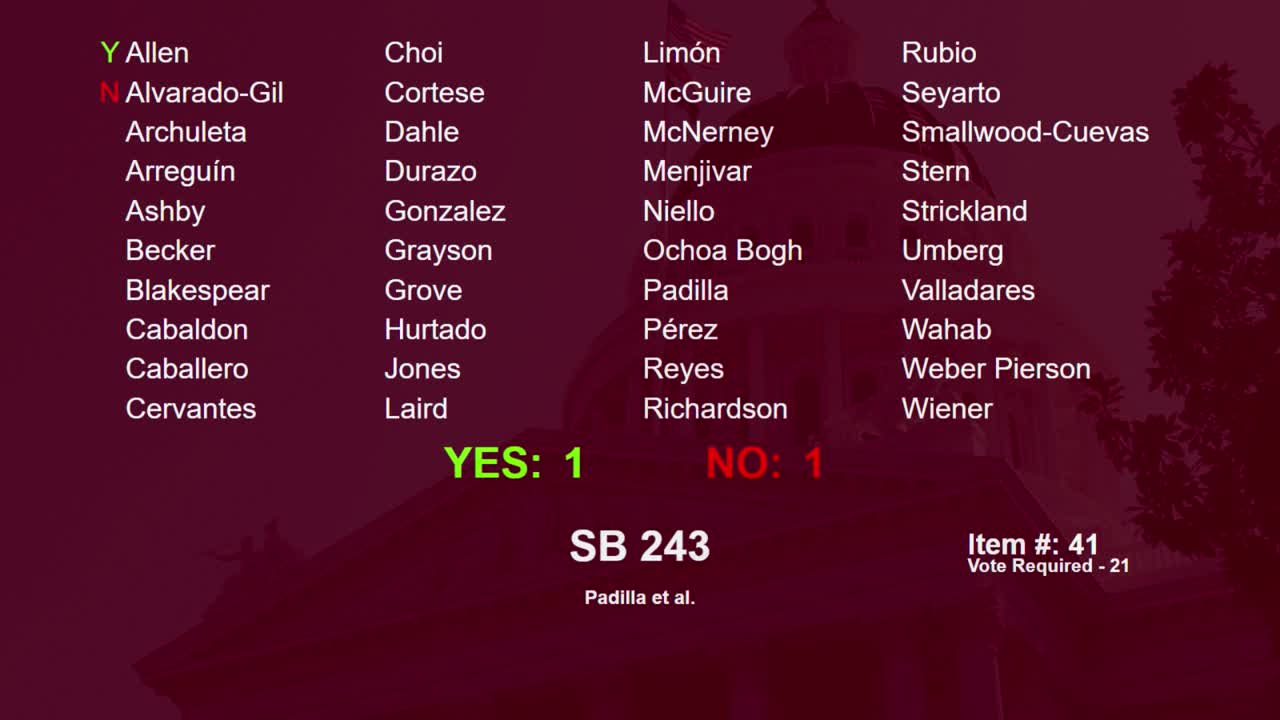 2MIN
Senate Floor
 14SEC
Senate Standing Committee on Appropriations
 11MIN
Senate Standing Committee on Energy, Utilities and Communications
Bill Author

Bill Co-Author(s):
