SB 536: Workers’ compensation insurance fraud reporting.
- Session Year: 2025-2026
- House: Senate
- Latest Version Date: 2026-06-15
Current Status:
In Progress
(2026-08-13: August 13 hearing: Held in committee and under submission.)
Introduced
In Committee
Awaiting First Chamber Vote
Passed First Chamber
In Committee
Awaiting Second Chamber Vote
Passed Second Chamber
Enacted
What does this bill do?
The bill requires insurers to notify the Employment Development Department (EDD) when suspected premium fraud is involved and allows insurers to submit employers’ wage records and employee counts to the EDD for comparison. The EDD must flag and report discrepancies to the insurer and, if federal law and ongoing investigations allow and the insurer pays the department’s direct costs, may provide confidential detailed payroll data to help investigate possible workers’ compensation fraud; by buying a policy, an employer is treated as consenting to that limited release.
The summary is provided by generative AI which can make mistakes. For original language, please view the details in the table below.
Existing law makes it a misdemeanor or a felony to engage in specified acts of fraud or material misrepresentation for the purpose of obtaining or denying workers compensation, as specified. Existing law, the Workers Compensation Insurance Fraud Reporting Act (the act), requires insurers and licensed rating organizations to release upon request to an authorized governmental agency, as defined, relevant information deemed important to the authorized governmental agency that the insurer or licensed rating organization may possess relating to any specific workers compensation insurance fraud investigation. The act requires, under specified circumstances, an insurer or licensed rating organization to notify the local district attorneys office and the Fraud Division of the Department of Insurance, and requires that entity, unless specified circumstances exist, to notify any other authorized governmental agency of suspected fraud, as specified. The act also requires the Employment Development Department (EDD) to release, upon written request, to an authorized governmental agency relevant information that the EDD may possess relating to any specific workers compensation insurance fraud investigation. The act requires, unless specified circumstances exist, an authorized governmental agency that is provided with information pursuant to those provisions to release or provide that information in a confidential manner to any other authorized governmental agency for purposes of investigation, prosecution, or prevention of insurance fraud or workers compensation fraud.
This bill would require an insurer or licensed rating organization to notify the EDD, in addition to the local district attorneys office and Fraud Division on the Department of Insurance, of suspected fraud when the fraudulent act relates to premium fraud. The bill would authorize an insurer, an agent authorized by an insurer, or a licensed rating organization insurer to submit wage records and employee counts for an employer to the EDD and would require the EDD to identify discrepancies in the submitted information, as specified, and report any discrepancies back to the submitting party. insurer. Upon request by an insurer, an agent of an insurer, or a licensed rating organization, the bill would require the EDD to release or provide detailed payroll information, including payroll summary totals, allowing the requester to compare the records with the information they are otherwise entitled to receive from employers in workers compensation claims or pursuant to workers compensation policies, unless doing so would violate federal law or compromise an ongoing investigation. The bill would require the EDD to only provide the information if specified requirements are met, and the requesting insurer, agent, or licensed rating organization insurer to reimburse the departments actual, direct costs of releasing or providing this information. The bill would prohibit the provided documents from being used for specified purposes.
Existing federal regulations generally prohibit the disclosure of confidential unemployment compensation information unless disclosure is on the basis of, among other things, informed consent to an agent of an employer.
This bill would provide that by entering into a policy of workers compensation insurance with an insurer, an employer in California consents and designates that insurer as the employers agent to act for or in the place of the employer only with respect to a request for the above-described payroll information.
Existing constitutional provisions require that a statute that limits the right of access to the meetings of public bodies or the writings of public officials and agencies be adopted with findings demonstrating the interest protected by the limitation and the need for protecting that interest.
This bill would make legislative findings to that effect.
Existing law makes it a misdemeanor or a felony to engage in specified acts of fraud or material misrepresentation for the purpose of obtaining or denying workers compensation, as specified. Existing law, the Workers Compensation Insurance Fraud Reporting Act (the act), requires insurers and licensed rating organizations to release upon request to an authorized governmental agency, as defined, relevant information deemed important to the authorized governmental agency that the insurer or licensed rating organization may possess relating to any specific workers compensation insurance fraud investigation. The act requires, under specified circumstances, an insurer or licensed rating organization to notify the local district attorneys office and the Fraud Division of the Department of Insurance, and requires that entity, unless specified circumstances exist, to notify any other authorized governmental agency of suspected fraud, as specified. The act also requires the Employment Development Department (EDD) to release, upon written request, to an authorized governmental agency relevant information that the Employment Development Department EDD may possess relating to any specific workers compensation insurance fraud investigation. The act requires, unless specified circumstances exist, an authorized governmental agency that is provided with information pursuant to those provisions to release or provide that information in a confidential manner to any other authorized governmental agency for purposes of investigation, prosecution, or prevention of insurance fraud or workers compensation fraud.
This bill would require an insurer or licensed rating organization to notify the Employment Development Department, EDD, in addition to the local district attorneys office and Fraud Division on the Department of Insurance, of suspected fraud when the fraudulent act relates to premium fraud. The bill would also require, upon written request by an insurer, agent, or licensed rating organization, the Employment Development Department authorize an insurer, an agent authorized by an insurer, or a licensed rating organization to submit wage records and employee counts for an employer to the EDD and would require the EDD to identify discrepancies in the submitted information, as specified, and report any discrepancies back to the submitting party. Upon request by an insurer, an agent of an insurer, or a licensed rating organization, the bill would require the EDD to release or provide detailed payroll information, including payroll summary totals, allowing the requester to compare the records with the information they are otherwise entitled to receive from employers in workers compensation claims or pursuant to workers compensation policies, unless doing so would violate existing federal law or compromise an ongoing investigation. The bill would require the Employment Development Department EDD to only provide the information if specified requirements are met, and the requesting insurer, agent, or licensed rating organization to reimburse the departments actual, direct costs of releasing or providing this information. The bill would prohibit the provided documents from being used for specified purposes.
Existing federal regulations generally prohibit the disclosure of confidential unemployment compensation information unless disclosure is on the basis of, among other things, informed consent to an agent of an employer.
This bill would provide that by entering into a policy of workers compensation insurance with an insurer, an employer in California consents and designates that insurer as the employers agent to act for or in the place of the employer only with respect to a request for the above-described payroll information.
Existing constitutional provisions require that a statute that limits the right of access to the meetings of public bodies or the writings of public officials and agencies be adopted with findings demonstrating the interest protected by the limitation and the need for protecting that interest.
This bill would make legislative findings to that effect.
Existing law makes it a misdemeanor or a felony to engage in specified acts of fraud or material misrepresentation for the purpose of obtaining or denying workers compensation, as specified. Existing law, the Workers Compensation Insurance Fraud Reporting Act (the act), requires insurers and licensed rating organizations to release upon request to an authorized governmental agency, as defined, relevant information deemed important to the authorized governmental agency that the insurer or licensed rating organization may possess relating to any specific workers compensation insurance fraud investigation. The act requires, under specified circumstances, an insurer or licensed rating organization to notify the local district attorneys office and the Fraud Division of the Department of Insurance, and requires that entity, unless specified circumstances exist, to notify any other authorized governmental agency of suspected fraud, as specified. The act also requires the Employment Development Department to release, upon written request, to an authorized governmental agency relevant information that the Employment Development Department may possess relating to any specific workers compensation insurance fraud investigation. The act requires, unless specified circumstances exist, an authorized governmental agency that is provided with information pursuant to those provisions to release or provide that information in a confidential manner to any other authorized governmental agency for purposes of investigation, prosecution, or prevention of insurance fraud or workers compensation fraud.
This bill would require an insurer or licensed rating organization to notify the Employment Development Department, in addition to the local district attorneys office and Fraud Division on the Department of Insurance, of suspected fraud when the fraudulent act relates to premium fraud. The bill would also require, upon written request by an insurer or specified others, insurer, agent, or licensed rating organization, the Employment Development Department to release or provide detailed payroll information, including payroll summary totals, allowing the requester to compare the records with the information they are otherwise entitled to receive from employers in workers compensation claims or pursuant to workers compensation policies, unless doing so would violate existing law or compromise an ongoing investigation. The bill would require the Employment Development Department to only provide the information if specified requirements are met. met, and the requesting insurer, agent, or licensed rating organization to reimburse the departments actual, direct costs of releasing or providing this information. The bill would prohibit the provided documents from being used for specified purposes.
Existing constitutional provisions require that a statute that limits the right of access to the meetings of public bodies or the writings of public officials and agencies be adopted with findings demonstrating the interest protected by the limitation and the need for protecting that interest.
This bill would make legislative findings to that effect.
Existing law makes it a misdemeanor or a felony to engage in specified acts of fraud or material misrepresentation for the purpose of obtaining or denying workers compensation, as specified. Existing law, the Workers Compensation Insurance Fraud Reporting Act (the act), requires insurers and licensed rating organizations to release upon request to an authorized governmental agency, as defined, relevant information deemed important to the authorized governmental agency that the insurer or licensed rating organization may possess relating to any specific workers compensation insurance fraud investigation. The act requires, under specified circumstances, an insurer or licensed rating organization to notify the local district attorneys office and the Fraud Division of the Department of Insurance, and requires that entity, unless specified circumstances exist, to notify any other authorized governmental agency of suspected fraud, as specified. The act also requires the Employment Development Department to release, upon written request, to an authorized governmental agency relevant information that the Employment Development Department may possess relating to any specific workers compensation insurance fraud investigation. The act requires, unless specified circumstances exist, an authorized governmental agency that is provided with information pursuant to those provisions to release or provide that information in a confidential manner to any other authorized governmental agency for purposes of investigation, prosecution, or prevention of insurance fraud or workers compensation fraud.
This bill would require an insurer or licensed rating organization to notify the Employment Development Department, in addition to the local district attorneys office and Fraud Division on the Department of Insurance, of suspected fraud when the fraudulent act relates to premium fraud. The bill would also require, upon written request by an insurer or specified others, the Employment Development Department to release or provide detailed payroll information, including payroll summary totals, allowing the requester to compare the records with the information they are otherwise entitled to receive from employers in workers compensation claims or pursuant to workers compensation policies. policies, unless doing so would violate existing law or compromise an ongoing investigation. The bill would require the Employment Development Department to only provide the information if specified requirements are met. The bill would prohibit the provided documents from being used for specified purposes.
Existing constitutional provisions require that a statute that limits the right of access to the meetings of public bodies or the writings of public officials and agencies be adopted with findings demonstrating the interest protected by the limitation and the need for protecting that interest.
This bill would make legislative findings to that effect.
Existing law makes it a misdemeanor or a felony to engage in specified acts of fraud or material misrepresentation for the purpose of obtaining or denying workers compensation, as specified. Existing law, the Workers Compensation Insurance Fraud Reporting Act (the act), requires insurers and licensed rating organizations to release upon request to an authorized governmental agency, as defined, relevant information deemed important to the authorized governmental agency that the insurer or licensed rating organization may possess relating to any specific workers compensation insurance fraud investigation. The act requires, under specified circumstances, an insurer or licensed rating organization to notify the local district attorneys office and the Fraud Division of the Department of Insurance, and requires that entity, unless specified circumstances exist, to notify any other authorized governmental agency of suspected fraud, as specified. The act also requires the Employment Development Department to release, upon written request, to an authorized governmental agency relevant information that the Employment Development Department may possess relating to any specific workers compensation insurance fraud investigation. The act requires, unless specified circumstances exist, an authorized governmental agency that is provided with information pursuant to those provisions to release or provide that information in a confidential manner to any other authorized governmental agency for purposes of investigation, prosecution, or prevention of insurance fraud or workers compensation fraud.
This bill would require an insurer or licensed rating organization to notify the Employment Development Department, in addition to the local district attorneys office and Fraud Division on the Department of Insurance, of suspected fraud when the fraudulent act relates to premium fraud. The bill would also require, upon written request by an insurer or specified others, the Employment Development Department to release detailed payroll information, including payroll summary totals, allowing the requester to compare the records with the information they are otherwise entitled to receive from employers in workers compensation claims or pursuant to workers compensation policies. The bill would prohibit the provided documents from being used for specified purposes.
(a)Upon written request to an insurer or a licensed rating organization by an authorized governmental agency, an insurer, an agent authorized by that insurer, or a licensed rating organization to act on behalf of the insurer, shall release to the requesting authorized governmental agency any or all relevant information deemed important to the authorized governmental agency that the insurer or licensed rating organization may possess relating to any specific workers compensation insurance fraud investigation.
(b)(1)When an insurer or licensed rating organization knows or reasonably believes it knows the identity of a person or entity whom it has reason to believe committed a fraudulent act relating to a workers compensation insurance claim or a workers compensation insurance policy, including any policy application, or has knowledge of such a fraudulent act, then, for the purpose of notification and investigation, the insurer, or agent authorized by an insurer to act on its behalf, or licensed rating organization shall notify the local district attorneys office, the Fraud Division of the Department of Insurance, and, when the fraudulent act relates to premium fraud, the Employment Development Department, and may notify any other authorized governmental agency of that suspected fraud and provide any additional information in accordance with subdivision (a). The insurer or licensed rating organization shall state in its notice the basis of the suspected fraud.
(2)Insurers shall use a form prescribed by the department for the purposes of reporting suspected fraudulent workers compensation acts pursuant to this subdivision.
(3)This section does not abrogate or impair the rights or powers created under subdivision (a).
(c)The authorized governmental agency provided with information pursuant to subdivision (a), (b), or (e) shall, upon request, unless it would violate federal law or otherwise compromise an investigation, release or provide that information in a confidential manner to any other authorized governmental agency for purposes of investigation, prosecution, or prevention of insurance fraud or workers compensation fraud.
(d)An insurer or licensed rating organization providing information to an authorized governmental agency pursuant to this section shall provide the information within a reasonable time, but not exceeding 60 days from the day on which the duty arose.
(e)Upon written request by an authorized governmental agency, as specified in subdivision (o) of Section 1095 of the Unemployment Insurance Code, the Employment Development Department shall release to the requesting agency any or all relevant information that the Employment Development Department may possess relating to any specific workers compensation insurance fraud investigation. If an authorized governmental agency seeks to disclose this information to any other governmental agency that is not authorized to receive that information pursuant to subdivision (o) of Section 1095 of the Unemployment Insurance Code or subdivision (c) of Section 603.9 of Title 20 of the Code of Federal Regulations, that agency shall submit a request to the Employment Development Department for approval prior to disclosure. Relevant information may include, but is not limited to, all of the following:
(1)Copies of unemployment and disability insurance application and claim forms and copies of any supporting medical records, documentation, and records pertaining thereto.
(2)Copies of returns filed by an employer pursuant to Section 1088 of the Unemployment Insurance Code and copies of supporting documentation.
(3)Copies of benefit payment checks issued to claimants.
(4)Copies of any documentation that specifically identifies the claimant by social security number, residence address, or telephone number.
(f)(1)An insurer, an agent authorized by an insurer, or a licensed rating organization insurer may submit wage records and employee counts for an employer to the Employment Development Department. The department shall identify discrepancies in the submitted information as compared to the information maintained by the department. The department shall report any discrepancies back to the submitting party. insurer.
(2)Based on the discrepancies and a relevant potential workers compensation insurance fraud investigation, the insurer, agent authorized by an insurer, or licensed rating organization insurer may submit a request to the Employment Development Department, and the department shall release or provide to the requester, detailed payroll information, including payroll summary totals, that would allow the requester to compare the records with the information they are otherwise entitled to receive from employers in workers compensation claims or pursuant to workers compensation policies, unless it would violate federal law or otherwise compromise an ongoing investigation. The information described in this paragraph shall only be released or provided if both of the following requirements are met:
(A)The insurer, agent, or licensed rating organization insurer specifies in the written request what information is necessary.
(B)The Employment Development Department determines the information requested is consistent with a workers compensation investigation by an insurer, agent, or licensed rating organization insurer and could be used in the investigation of potential workers compensation insurance fraud.
(3)The information released or provided under this subdivision shall be provided in a confidential manner and shall be used only in furtherance of the investigation of potential workers compensation insurance fraud and any required reporting, underwriting actions, and audit and collection of premiums. The information shall not, in any circumstance, be used for the purposes described in subdivision (k) of Section 791.13 of the Insurance Information and Privacy Protection Act (Article 6.6 (commencing with Section 791) of Chapter 1).
(4)The information released or provided cannot be shared with law enforcement unless released or provided as part of a fraud referral pursuant to special investigative unit compliance requirements as authorized by Section 1872.4 or as part of the information provided or released pursuant to subdivision (a) or (b) of this section.
(5)(A)The information requested pursuant to this subdivision shall only be released or provided in compliance with the requirements of Part 603 of Title 20 of the Code of Federal Regulations.
(B)By entering into a policy of workers compensation insurance with an insurer, an employer in California consents and designates that insurer as the employers agent to act for or in the place of the employer only with respect to a request for the information described in paragraph (2). The declaration page of a workers compensation insurance policy shall constitute written release that confirms the insurer as the agent of the employer sufficient for the requirements of Part 603 of Title 20 of the Code of Federal Regulations.
(6)An insurer, agent, or licensed rating organization insurer requesting information pursuant to this subdivision shall quarterly reimburse the Employment Development Department for the departments actual, direct costs of releasing or providing information from its records to the requesting insurer, agent, or licensed rating organization. insurer.
(7)The Employment Development Department may require an insurer, agent authorized by an insurer, or licensed rating organization insurer submitting information or a request pursuant to this subdivision to enter into a written, enforceable agreement that shall be terminable if the department determines the insurer, agent authorized by an insurer, or licensed rating organization insurer did not adhere to the safeguards in that agreement.
SEC. 2.The Legislature finds and declares that Section 1 of this act, which amends Section 1877.3 of the Insurance Code, imposes a limitation on the publics right of access to the meetings of public bodies or the writings of public officials and agencies within the meaning of Section 3 of Article I of the California Constitution. Pursuant to that constitutional provision, the Legislature makes the following findings to demonstrate the interest protected by this limitation and the need for protecting that interest:
In order to protect the privacy of California workers, while also gathering useful information related to a workers compensation investigation, it is necessary that personal identifying information remain confidential.
(a)Upon written request to an insurer or a licensed rating organization by an authorized governmental agency, an insurer, an agent authorized by that insurer, or a licensed rating organization to act on behalf of the insurer, shall release to the requesting authorized governmental agency any or all relevant information deemed important to the authorized governmental agency that the insurer or licensed rating organization may possess relating to any specific workers compensation insurance fraud investigation.
(b)(1)When an insurer or licensed rating organization knows or reasonably believes it knows the identity of a person or entity whom it has reason to believe committed a fraudulent act relating to a workers compensation insurance claim or a workers compensation insurance policy, including any policy application, or has knowledge of such a fraudulent act, then, for the purpose of notification and investigation, the insurer, or agent authorized by an insurer to act on its behalf, or licensed rating organization shall notify the local district attorneys office, the Fraud Division of the Department of Insurance, and, when the fraudulent act relates to premium fraud, the Employment Development Department, and may notify any other authorized governmental agency of that suspected fraud and provide any additional information in accordance with subdivision (a). The insurer or licensed rating organization shall state in its notice the basis of the suspected fraud.
(2)Insurers shall use a form prescribed by the department for the purposes of reporting suspected fraudulent workers compensation acts pursuant to this subdivision.
(3)This section does not abrogate or impair the rights or powers created under subdivision (a).
(c)The authorized governmental agency provided with information pursuant to subdivision (a), (b), or (e) shall, upon request, unless it would violate federal law or otherwise compromise an investigation, release or provide that information in a confidential manner to any other authorized governmental agency for purposes of investigation, prosecution, or prevention of insurance fraud or workers compensation fraud.
(d)An insurer or licensed rating organization providing information to an authorized governmental agency pursuant to this section shall provide the information within a reasonable time, but not exceeding 60 days from the day on which the duty arose.
(e)Upon written request by an authorized governmental agency, as specified in subdivision (o) of Section 1095 of the Unemployment Insurance Code, the Employment Development Department shall release to the requesting agency any or all relevant information that the Employment Development Department may possess relating to any specific workers compensation insurance fraud investigation. If an authorized governmental agency seeks to disclose this information to any other governmental agency that is not authorized to receive that information pursuant to subdivision (o) of Section 1095 of the Unemployment Insurance Code or subdivision (c) of Section 603.9 of Title 20 of the Code of Federal Regulations, that agency shall submit a request to the Employment Development Department for approval prior to disclosure. Relevant information may include, but is not limited to, all of the following:
(1)Copies of unemployment and disability insurance application and claim forms and copies of any supporting medical records, documentation, and records pertaining thereto.
(2)Copies of returns filed by an employer pursuant to Section 1088 of the Unemployment Insurance Code and copies of supporting documentation.
(3)Copies of benefit payment checks issued to claimants.
(4)Copies of any documentation that specifically identifies the claimant by social security number, residence address, or telephone number.
(f)(1)Upon written request by an insurer, an agent authorized by that insurer, or a licensed rating organization, the Employment Development Department shall release or provide to the requesting insurer, agent, or licensed rating organization detailed payroll information, including payroll summary totals, that would allow the insurer, agent, or licensed rating organization to compare the records with the information they are otherwise entitled to receive from employers in workers compensation claims or pursuant to workers compensation policies, unless it would violate federal law or otherwise compromise an ongoing investigation. The information shall only be provided or released if both of the following requirements are met:(f)(1)An insurer, an agent authorized by an insurer, or a licensed rating organization may submit wage records and employee counts for an employer to the Employment Development Department. The department shall identify discrepancies in the submitted information as compared to the information maintained by the department. The department shall report any discrepancies back to the submitting party.
(2)Based on the discrepancies and a relevant potential workers compensation insurance fraud investigation, the insurer, agent authorized by an insurer, or licensed rating organization may submit a request to the Employment Development Department, and the department shall release or provide to the requester, detailed payroll information, including payroll summary totals, that would allow the requester to compare the records with the information they are otherwise entitled to receive from employers in workers compensation claims or pursuant to workers compensation policies, unless it would violate federal law or otherwise compromise an ongoing investigation. The information described in this paragraph shall only be released or provided if both of the following requirements are met:
(A)The insurer, agent, or licensed rating organization specifies in the written request what information is necessary.
(B)The Employment Development Department determines the information requested is consistent with a workers compensation investigation by an insurer, agent, or licensed rating organization and could be used in the investigation of potential workers compensation insurance fraud.
(2)(3)The information released or provided under this subdivision shall be provided in a confidential manner and shall not be used only in furtherance of the investigation of potential workers compensation insurance fraud and any required reporting, underwriting actions, and audit and collection of premiums. The information shall not, in any circumstance, be used for the purposes described in subdivision (k) of Section 791.13 of the Insurance Information and Privacy Protection Act (Article 6.6 (commencing with Section 791) of Chapter 1).
(3)(4)The information released or provided cannot be shared with law enforcement unless released or provided as part of a fraud referral pursuant to special investigative unit compliance requirements as authorized by Section 1872.4 or as part of the information provided or released pursuant to subdivision (a) or (b) of this section.
(5)(A)The information requested pursuant to this subdivision shall only be released or provided in compliance with the requirements of Part 603 of Title 20 of the Code of Federal Regulations.
(B)By entering into a policy of workers compensation insurance with an insurer, an employer in California consents and designates that insurer as the employers agent to act for or in the place of the employer only with respect to a request for the information described in paragraph (2). The declaration page of a workers compensation insurance policy shall constitute written release that confirms the insurer as the agent of the employer sufficient for the requirements of Part 603 of Title 20 of the Code of Federal Regulations.
(4)(6)An insurer, agent, or licensed rating organization requesting information pursuant to this subdivision shall quarterly reimburse the Employment Development Department for the departments actual, direct costs of releasing or providing information from its records to the requesting insurer, agent, or licensed rating organization.
(7)The Employment Development Department may require an insurer, agent authorized by an insurer, or licensed rating organization submitting information or a request pursuant to this subdivision to enter into a written, enforceable agreement that shall be terminable if the department determines the insurer, agent authorized by an insurer, or licensed rating organization did not adhere to the safeguards in that agreement.
SEC. 2.The Legislature finds and declares that Section 1 of this act, which amends Section 1877.3 of the Insurance Code, imposes a limitation on the publics right of access to the meetings of public bodies or the writings of public officials and agencies within the meaning of Section 3 of Article I of the California Constitution. Pursuant to that constitutional provision, the Legislature makes the following findings to demonstrate the interest protected by this limitation and the need for protecting that interest:
In order to protect the privacy of California workers, while also gathering useful information related to a workers compensation investigation, it is necessary that personal identifying information remain confidential.
(a)Upon written request to an insurer or a licensed rating organization by an authorized governmental agency, an insurer, an agent authorized by that insurer, or a licensed rating organization to act on behalf of the insurer, shall release to the requesting authorized governmental agency any or all relevant information deemed important to the authorized governmental agency that the insurer or licensed rating organization may possess relating to any specific workers compensation insurance fraud investigation.
(b)(1)When an insurer or licensed rating organization knows or reasonably believes it knows the identity of a person or entity whom it has reason to believe committed a fraudulent act relating to a workers compensation insurance claim or a workers compensation insurance policy, including any policy application, or has knowledge of such a fraudulent act, then, for the purpose of notification and investigation, the insurer, or agent authorized by an insurer to act on its behalf, or licensed rating organization shall notify the local district attorneys office, the Fraud Division of the Department of Insurance, and, when the fraudulent act relates to premium fraud, the Employment Development Department, and may notify any other authorized governmental agency of that suspected fraud and provide any additional information in accordance with subdivision (a). The insurer or licensed rating organization shall state in its notice the basis of the suspected fraud.
(2)Insurers shall use a form prescribed by the department for the purposes of reporting suspected fraudulent workers compensation acts pursuant to this subdivision.
(3)This section does not abrogate or impair the rights or powers created under subdivision (a).
(c)The authorized governmental agency provided with information pursuant to subdivision (a), (b), or (e) shall, upon request, unless it would violate federal law or otherwise compromise an investigation, release or provide that information in a confidential manner to any other authorized governmental agency for purposes of investigation, prosecution, or prevention of insurance fraud or workers compensation fraud.
(d)An insurer or licensed rating organization providing information to an authorized governmental agency pursuant to this section shall provide the information within a reasonable time, but not exceeding 60 days from the day on which the duty arose.
(e)Upon written request by an authorized governmental agency, as specified in subdivision (o) of Section 1095 of the Unemployment Insurance Code, the Employment Development Department shall release to the requesting agency any or all relevant information that the Employment Development Department may possess relating to any specific workers compensation insurance fraud investigation. If an authorized governmental agency seeks to disclose this information to any other governmental agency that is not authorized to receive that information pursuant to subdivision (o) of Section 1095 of the Unemployment Insurance Code or subdivision (c) of Section 603.9 of Title 20 of the Code of Federal Regulations, that agency shall submit a request to the Employment Development Department for approval prior to disclosure. Relevant information may include, but is not limited to, all of the following:
(1)Copies of unemployment and disability insurance application and claim forms and copies of any supporting medical records, documentation, and records pertaining thereto.
(2)Copies of returns filed by an employer pursuant to Section 1088 of the Unemployment Insurance Code and copies of supporting documentation.
(3)Copies of benefit payment checks issued to claimants.
(4)Copies of any documentation that specifically identifies the claimant by social security number, residence address, or telephone number.
(f)(1)Upon written request by an insurer, an agent authorized by that insurer, or a licensed rating organization, the Employment Development Department shall release or provide to the requesting insurer, agent, or licensed rating organization detailed payroll information, including payroll summary totals, that would allow the insurer, agent, or licensed rating organization to compare the records with the information they are otherwise entitled to receive from employers in workers compensation claims or pursuant to workers compensation policies, unless it would violate federal law or otherwise compromise an ongoing investigation. The information shall only be provided or released if both of the following requirements are met:
(A)The insurer, agent, or licensed rating organization specifies in the written request what information is necessary.
(B)The Employment Development Department determines the information requested is consistent with a workers compensation investigation by an insurer, agent, or licensed rating organization and could be used in the investigation of potential workers compensation insurance fraud.
(2)The information provided under this subdivision shall be provided in a confidential manner and shall not be used for the purposes described in subdivision (k) of Section 791.13 of the Insurance Information and Privacy Protection Act (Article 6.6 (commencing with Section 791) of Chapter 1).
(3)The information released or provided cannot be shared with law enforcement unless released or provided as part of a fraud referral pursuant to special investigative unit compliance requirements as authorized by Section 1872.4 or as part of the information provided or released pursuant to subdivision (a) or (b) of this section.
(4)An insurer, agent, or licensed rating organization requesting information pursuant to this subdivision shall quarterly reimburse the Employment Development Department for the departments actual, direct costs of releasing or providing information from its records to the requesting insurer, agent, or licensed rating organization.
SEC. 2.The Legislature finds and declares that Section 1 of this act, which amends Section 1877.3 of the Insurance Code, imposes a limitation on the publics right of access to the meetings of public bodies or the writings of public officials and agencies within the meaning of Section 3 of Article I of the California Constitution. Pursuant to that constitutional provision, the Legislature makes the following findings to demonstrate the interest protected by this limitation and the need for protecting that interest:
In order to protect the privacy of California workers, while also gathering useful information related to a workers compensation investigation, it is necessary that personal identifying information remain confidential.
(a)Upon written request to an insurer or a licensed rating organization by an authorized governmental agency, an insurer, an agent authorized by that insurer, or a licensed rating organization to act on behalf of the insurer, shall release to the requesting authorized governmental agency any or all relevant information deemed important to the authorized governmental agency that the insurer or licensed rating organization may possess relating to any specific workers compensation insurance fraud investigation.
(b)(1)When an insurer or licensed rating organization knows or reasonably believes it knows the identity of a person or entity whom it has reason to believe committed a fraudulent act relating to a workers compensation insurance claim or a workers compensation insurance policy, including any policy application, or has knowledge of such a fraudulent act, then, for the purpose of notification and investigation, the insurer, or agent authorized by an insurer to act on its behalf, or licensed rating organization shall notify the local district attorneys office, the Fraud Division of the Department of Insurance, and, when the fraudulent act relates to premium fraud, the Employment Development Department, and may notify any other authorized governmental agency of that suspected fraud and provide any additional information in accordance with subdivision (a). The insurer or licensed rating organization shall state in its notice the basis of the suspected fraud.
(2)Insurers shall use a form prescribed by the department for the purposes of reporting suspected fraudulent workers compensation acts pursuant to this subdivision.
(3)This section does not abrogate or impair the rights or powers created under subdivision (a).
(c)The authorized governmental agency provided with information pursuant to subdivision (a), (b), or (e) shall, upon request, unless it would violate federal law or otherwise compromise an investigation, release or provide that information in a confidential manner to any other authorized governmental agency for purposes of investigation, prosecution, or prevention of insurance fraud or workers compensation fraud.
(d)An insurer or licensed rating organization providing information to an authorized governmental agency pursuant to this section shall provide the information within a reasonable time, but not exceeding 60 days from the day on which the duty arose.
(e)Upon written request by an authorized governmental agency, as specified in subdivision (o) of Section 1095 of the Unemployment Insurance Code, the Employment Development Department shall release to the requesting agency any or all relevant information that the Employment Development Department may possess relating to any specific workers compensation insurance fraud investigation. If an authorized governmental agency seeks to disclose this information to any other governmental agency that is not authorized to receive that information pursuant to subdivision (o) of Section 1095 of the Unemployment Insurance Code or subdivision (c) of Section 603.9 of Title 20 of the Code of Federal Regulations, that agency shall submit a request to the Employment Development Department for approval prior to disclosure. Relevant information may include, but is not limited to, all of the following:
(1)Copies of unemployment and disability insurance application and claim forms and copies of any supporting medical records, documentation, and records pertaining thereto.
(2)Copies of returns filed by an employer pursuant to Section 1088 of the Unemployment Insurance Code and copies of supporting documentation.
(3)Copies of benefit payment checks issued to claimants.
(4)Copies of any documentation that specifically identifies the claimant by social security number, residence address, or telephone number.
(f)(1)Upon written request by an insurer, an agent authorized by that insurer, or a licensed rating organization, the Employment Development Department shall release or provide to the requesting insurer, agent, or licensed rating organization detailed payroll information, including payroll summary totals, that would allow the insurer, agent, or licensed rating organization to compare the records with the information they are otherwise entitled to receive from employers in workers compensation claims or pursuant to workers compensation policies. The documents provided under policies, unless it would violate federal law or otherwise compromise an ongoing investigation. The information shall only be provided or released if both of the following requirements are met:
(A)The insurer, agent, or licensed rating organization specifies in the written request what information is necessary.
(B)The Employment Development Department determines the information requested is consistent with a workers compensation investigation by an insurer, agent, or licensed rating organization and could be used in the investigation of potential workers compensation insurance fraud.
(2)The information provided under this subdivision shall be provided in a confidential manner and shall not be used for the purposes described in subdivision (k) of Section 791.13 of the Insurance Information and Privacy Protection Act (Article 6.6 (commencing with Section 791) of Chapter 1).
(3)The information released or provided cannot be shared with law enforcement unless released or provided as part of a fraud referral pursuant to special investigative unit compliance requirements as authorized by Section 1872.4 or as part of the information provided or released pursuant to subdivision (a) or (b) of this section.
SEC. 2.The Legislature finds and declares that Section 1 of this act, which amends Section 1877.3 of the Insurance Code, imposes a limitation on the publics right of access to the meetings of public bodies or the writings of public officials and agencies within the meaning of Section 3 of Article I of the California Constitution. Pursuant to that constitutional provision, the Legislature makes the following findings to demonstrate the interest protected by this limitation and the need for protecting that interest:
In order to protect the privacy of California workers, while also gathering useful information related to a workers compensation investigation, it is necessary that personal identifying information remain confidential.
(a)Upon written request to an insurer or a licensed rating organization by an authorized governmental agency, an insurer, an agent authorized by that insurer, or a licensed rating organization to act on behalf of the insurer, shall release to the requesting authorized governmental agency any or all relevant information deemed important to the authorized governmental agency that the insurer or licensed rating organization may possess relating to any specific workers compensation insurance fraud investigation.
(b)(1)When an insurer or licensed rating organization knows or reasonably believes it knows the identity of a person or entity whom it has reason to believe committed a fraudulent act relating to a workers compensation insurance claim or a workers compensation insurance policy, including any policy application, or has knowledge of such a fraudulent act, then, for the purpose of notification and investigation, the insurer, or agent authorized by an insurer to act on its behalf, or licensed rating organization shall notify the local district attorneys office and office, the Fraud Division of the Department of Insurance, and, when the fraudulent act relates to premium fraud, the Employment Development Department, and may notify any other authorized governmental agency of that suspected fraud and provide any additional information in accordance with subdivision (a). The insurer or licensed rating organization shall state in its notice the basis of the suspected fraud.
(2)Insurers shall use a form prescribed by the department for the purposes of reporting suspected fraudulent workers compensation acts pursuant to this subdivision.
(3)This section does not abrogate or impair the rights or powers created under subdivision (a).
(c)The authorized governmental agency provided with information pursuant to subdivision (a), (b), or (e) shall, upon request, unless it would violate federal law or otherwise compromise an investigation, release or provide that information in a confidential manner to any other authorized governmental agency for purposes of investigation, prosecution, or prevention of insurance fraud or workers compensation fraud.
(d)An insurer or licensed rating organization providing information to an authorized governmental agency pursuant to this section shall provide the information within a reasonable time, but not exceeding 60 days from the day on which the duty arose.
(e)Upon written request by an authorized governmental agency, as specified in subdivision (o) of Section 1095 of the Unemployment Insurance Code, the Employment Development Department shall release to the requesting agency any or all relevant information that the Employment Development Department may possess relating to any specific workers compensation insurance fraud investigation. If an authorized governmental agency seeks to disclose this information to any other governmental agency that is not authorized to receive that information pursuant to subdivision (o) of Section 1095 of the Unemployment Insurance Code or subdivision (c) of Section 603.9 of Title 20 of the Code of Federal Regulations, that agency shall submit a request to the Employment Development Department for approval prior to disclosure. Relevant information may include, but is not limited to, all of the following:
(1)Copies of unemployment and disability insurance application and claim forms and copies of any supporting medical records, documentation, and records pertaining thereto.
(2)Copies of returns filed by an employer pursuant to Section 1088 of the Unemployment Insurance Code and copies of supporting documentation.
(3)Copies of benefit payment checks issued to claimants.
(4)Copies of any documentation that specifically identifies the claimant by social security number, residence address, or telephone number.
(f)Upon written request by an insurer, an agent authorized by that insurer, or a licensed rating organization, the Employment Development Department shall release to the requesting insurer, agent, or licensed rating organization detailed payroll information, including payroll summary totals, that would allow the insurer, agent, or licensed rating organization to compare the records with the information they are otherwise entitled to receive from employers in workers compensation claims or pursuant to workers compensation policies. The documents provided under this subdivision shall not be used for the purposes described in subdivision (k) of Section 791.13 of the Insurance Information and Privacy Protection Act (Article 6.6 (commencing with Section 791) of Chapter 1).
|
Date
|
Status
|
|---|---|
| Aug 13, 2026 | August 13 hearing: Held in committee and under submission. |
| Aug 5, 2026 | August 5 set for first hearing. Placed on suspense file. |
| Jun 24, 2026 | From committee: Do pass and re-refer to Com. on APPR. with recommendation: To consent calendar. (Ayes 17. Noes 0.) (June 24). Re-referred to Com. on APPR. |
| Jun 15, 2026 | From committee with author's amendments. Read second time and amended. Re-referred to Com. on INS. |
| May 18, 2026 | From committee with author's amendments. Read second time and amended. Re-referred to Com. on INS. |
| Jun 16, 2025 | Referred to Com. on INS. |
| Jun 5, 2025 | In Assembly. Read first time. Held at Desk. |
| Jun 4, 2025 | Read third time. Passed. (Ayes 39. Noes 0. Page 1505.) Ordered to the Assembly. |
| May 27, 2025 | Read second time. Ordered to third reading. |
| May 23, 2025 | Read second time and amended. Ordered to second reading. |
| May 23, 2025 | From committee: Do pass as amended. (Ayes 6. Noes 0. Page 1203.) (May 23). |
| May 16, 2025 | Set for hearing May 23. |
| May 12, 2025 | May 12 hearing: Placed on APPR. suspense file. |
| May 2, 2025 | Set for hearing May 12. |
| Apr 30, 2025 | Read second time and amended. Re-referred to Com. on APPR. |
| Apr 29, 2025 | From committee: Do pass as amended and re-refer to Com. on APPR. (Ayes 5. Noes 0. Page 870.) (April 23). |
| Apr 4, 2025 | Set for hearing April 23. |
| Mar 5, 2025 | Referred to Com. on L., P.E. & R. |
| Feb 21, 2025 | From printer. May be acted upon on or after March 23. |
| Feb 20, 2025 | Introduced. Read first time. To Com. on RLS. for assignment. To print. |
|
Date
|
Description
|
Location
|
Votes
|
|
|---|---|---|---|---|
| Jun 24, 2026 | Do pass and be re-referred to the Committee on [Appropriations] with recommendation: To Consent Calendar | Assembly Standing Committee on Insurance |
Passed |
|
| Jun 4, 2025 | Senate 3rd Reading SB536 Archuleta | Senate Floor |
Passed |
|
| May 23, 2025 | Do pass as amended | Senate Standing Committee on Appropriations |
Passed |
|
| May 12, 2025 | Placed on suspense file | Senate Standing Committee on Appropriations |
Passed |
|
| Apr 23, 2025 | Do pass as amended, but first amend, and re-refer to the Committee on [Appropriations] | Senate Standing Committee on Labor, Public Employment and Retirement |
Passed |
This list shows positions taken on this bill by organizations on the date displayed, which is linked to the original source.
Positions by individuals are not included.
|
Organization
|
Position
|
Date
|
|---|---|---|
| African American Farmers of California | ** Support | |
| Almond Alliance | ** Support | |
| American Pistachio Growers | ** Support | |
| American Property Casualty Insurance Association | ** Support | |
| California Association Of Joint Powers Authorities | ** Support | |
| California Association of Joint Powers Authorities (CAJPA) | ** Support | |
| California Association Of Winegrape Growers | ** Support | |
| California Chamber Of Commerce | ** Support | |
| California Citrus Mutual | ** Support | |
| California Coalition On Workers Compensation | ** Support | |
| California Cotton Ginners and Growers Association | ** Support | |
| California District Attorneys Association | ** Support | |
| California Farm Bureau | ** Support | |
| California Fresh Fruit Association | ** Support | |
| California Hotel & Lodging Association | ** Support | |
| California League of Food Producers | ** Support | |
| California Pool & Spa Association | ** Support | |
| California State Council Of Laborers | ** Support | |
| California Walnut Commission | ** Support | |
| Center for Contract Compliance | ** Support | |
| Coalition Against Insurance Fraud | ** Support | |
| County of Orange, Through its Office of The District Attorney/public Administrator | ** Support | |
| Grower-Shipper Association of Central California | ** Support | |
| Independent Insurance Agents & Brokers of California, Inc. | ** Support | |
| National Insurance Crime Bureau | ** Support | |
| Nisei Farmers League | ** Support | |
| Pacific Association Of Building Service Contractors | ** Support | |
| Riverside County District Attorney | ** Support | |
| Ventura County District Attorney's Office | ** Support | |
| Ventura County Office of the District Attorney | ** Support | |
| Western Electrical Contractors Association | ** Support | |
| Western States Regional Council of Carpenters | ** Support | |
| Western Tree Nut Association | ** Support |
Date of Hearing: August 5, 2026
ASSEMBLY COMMITTEE ON APPROPRIATIONS
Buffy Wicks, Chair
SBPCA Bill Id:SB 536
Author:(Archuleta) – As Amended Ver:June 15, 2026
Policy Committee: | Insurance | Vote: | 17 - 0 |
|
| ||
|
|
Urgency: No State Mandated Local Program: No Reimbursable: No
SUMMARY:
This bill requires an insurer to notify the Employment Development Department (EDD) of suspected workers’ compensation premium fraud and requires EDD to release payroll information to the insurer to conduct a fraud investigation.
Specifically, this bill:
- Requires an insurer or licensed rating organization to notify EDD of suspected workers’ compensation fraud when the fraudulent act relates to premium fraud.
- Authorizes an insurer to submit wage records and employee counts for an employer to EDD, and requires EDD to identify and report back discrepancies in the submitted information compared with payroll information maintained by EDD.
- Authorizes an insurer, based on the discrepancies and relevant premium fraud investigation, to submit a request for detailed payroll information to EDD, and requires EDD to release the information unless doing so violates federal law or compromises an ongoing investigation, allowing the insurer to investigate fraud by comparing such information to records the insurer has from that employer’s workers’ compensation claims or policies.
- Requires an insurer requesting information to reimburse EDD quarterly for the actual, direct costs of providing the information.
- Requires such payroll information to be provided in a confidential manner and used for investigation and subsequent compliance purposes only, and authorizes EDD to require a requesting insurer to enter into a written, enforceable agreement to adhere to safeguards.
- Provides that the informed consent of an employer required under federal law for EDD to disclose such confidential payroll information to an insurer is given by the employer entering into a workers’ compensation insurance policy with the insurer, and establishes the insurer as an agent of the employer for such purposes.
FISCAL EFFECT:
- One-time costs of approximately $9.7 million and ongoing costs of approximately $6.5 million to EDD to implement this bill, including reviewing employer records submitted by an insurer to identify discrepancies, releasing payroll information to requesting insurers, and ensuring compliance with information sharing agreements, as well as related information technology system upgrades, partially offset by quarterly insurer reimbursements (General Fund).
- To the extent this bill increases the detection of workers’ compensation fraud by EDD and insurers, this bill would increase costs to the Department of Insurance (CDI) and district attorneys (DAs) to investigate and prosecute additional fraud cases (Insurance Fund), as well as cost pressures to the courts in additional related workload (General Fund or Trial Court Trust Fund). CDI estimates costs of approximately $192,000 in fiscal year (FY) 2026-27, $837,000 in FY 2027-28, and $2.4 million in FY 2028-29 and annually thereafter in increased staff workload to its Fraud Division to investigate suspected fraudulent claims.
- Potential cost savings to the state as an employer to the extent this bill lowers employers’ workers’ compensation premium payments by reducing systemic fraud (General Fund or special fund). Additionally, potential increase in various state revenues to the extent this bill helps prevent payroll tax evasion (General Fund and special fund).
COMMENTS:
- Purpose. According to the author:
California sees underreporting of payroll in the tens of millions of dollars each year, providing an unfair advantage to employers cheating the system. SB 536 will empower insurers and licensed rating organizations to identify when employers are fraudulently withholding premium by comparing what is reported to them with what is reported to [EDD]. It is expected that restitution of premium fraud will amount to tens of millions and potentially even a hundred million dollars a year. SB 536 is also designed to provide tools for [EDD] to identify and prevent tax evasion.
This bill is sponsored by the American Property Casualty Insurance Association and supported by other insurer groups, employer groups, DA offices, and the California State Council of Laborers.
- Background. Workers’ Compensation Insurance. An employer is required to provide workers’ compensation by either receiving approval from the Department of Industrial Relations to self-insure following substantial requirements or obtaining coverage from an authorized insurer. When an employer applies for workers’ compensation insurance coverage, the insurer generally collects payroll information from the employer, including the number of employees, employee job classifications and duties, and total payroll, as well as information about the employer’s industry, workplace locations, prior workers’ compensation claims, and workplace safety and risk management practices. This information plays a significant role in setting premiums for workers’ compensation insurance. Thus, an employer that provides inaccurate or misleading information distorts the market and places significant strain on the workers’ compensation system, generally requiring insurers to increase all premiums to compensate for those insufficient premiums.
Premium Fraud. Payroll or premium fraud is the misrepresentation of payroll and employer information with the intent to reduce the employer’s workers’ compensation premium. Such fraud may constitute a misdemeanor or felony and includes underreporting total payroll, employee counts, and hours and wages or misclassifying employees into lower-risk job classifications or as independent contractors.
The Workers’ Compensation Insurance Fraud Reporting Act (Act) requires an insurer or licensed rating organization to notify the local DA’s office and CDI’s Fraud Division of suspected workers’ compensation fraud, which may include premium fraud or fraud relating to a specific claim. In addition to conducting its own investigations, the Fraud Division administers four of five CDI grant programs that provide funding to DA offices to assist with local efforts to prosecute fraud.
This bill requires an insurer or rating organization to also notify EDD of suspected workers’ compensation fraud when the fraudulent act relates to premium fraud. This bill authorizes an insurer to submit payroll and employer information the insurer has collected from the employer to EDD and requires EDD to compare such information against separate payroll information maintained by EDD to identify discrepancies.
The Act requires the insurer or rating organization and EDD, upon request and under certain conditions, to release relevant information deemed important to an authorized governmental agency’s workers’ compensation fraud investigation. This bill authorizes an insurer, based on discrepancies identified by EDD and reported back to the insurer, to request detailed payroll information from EDD, which EDD must release under certain conditions, to allow the insurer to further compare records and investigate fraud.
Proponents of this bill note that a program enabling the State Compensation Insurance Fund (State Fund) to access EDD payroll data to effectively identify premium fraud has existed for over a decade and “should be expanded to all insurers.” The State Fund is a quasi-governmental, public enterprise fund created by the Legislature in 1914 to provide a stable source of workers’ compensation insurance to public agencies and private employers. As noted in Assembly Insurance Committee’s analysis of this bill, although the author has amended this bill to more closely align with the State Fund program:
Still, there are key factors distinguishing the process…For instance, State Fund is a quasi-governmental entity, meaning it is bound by different restrictions on its uses of information than a private company, and state and federal confidentiality requirements concerning the sharing of EDD information differ as well.
Additionally, and perhaps most importantly, State Fund is a single entity responsible for insuring a large percentage of California’s employers. The program proposed by this bill…extend[s] to any insurer. Consequently, the requisite data infrastructure and oversight necessary to ensure maintenance of adequate confidentiality is much broader than it is for sharing with State Fund alone. The attack surface for potential data breach exposing the EDD information would also be exponentially larger.
- Related Legislation. SB 1054 (Cabaldon) requires certain employers to report additional employment and wage information to EDD and requires EDD to share the information with certain state agencies to facilitate benefits administration and other program purposes. SB 1054 is pending hearing by this committee.
Analysis Prepared by: Irene Ho / APPR. / (916) 319-2081
Date of Hearing: June 24, 2026
ASSEMBLY COMMITTEE ON INSURANCE
Lisa Calderon, Chair
SBPCA Bill Id:SB 536
Author:(Archuleta) – As Amended Ver:June 15, 2026
SENATE VOTE: 39-0
SUBJECT: Workers’ compensation insurance fraud reporting
SUMMARY: Requires the Employment Development Department (EDD) to release detailed payroll information to insurers, including private insurers, under specified circumstances in order to identify and investigate fraud. Specifically, this bill:
- Allows an insurer to submit wage records and employee counts for an employer to EDD, and requires EDD to identify discrepancies in the submitted information as compared to the information maintained by EDD and report those discrepancies back to the submitting insurer.
- Allows an insurer, based on discrepancies pursuant to 1), above, and a relevant potential workers’ compensation insurance fraud investigation, to submit a request to EDD, and requires EDD to, in response to that request, release or provide to the requester detailed payroll information, including payroll summary totals, that would allow the requester to compare the records with the information they are otherwise entitled to receive from employers in workers’ compensation claims or pursuant to workers’ compensation policies, unless it would violate federal law or otherwise compromise an ongoing investigation.
- Specifies that information shall only be released pursuant to 2), above, if the insurer specifies in the written request what information is necessary, and EDD determines that the information requested is consistent with a workers’ compensation investigation by an insurer and could be used in the investigation of potential workers’ compensation insurance fraud.
- Specifies that the information released or provided pursuant to 1) and 2), above, shall be provided in a confidential manner and shall be used only in furtherance of the investigation of potential workers’ compensation insurance fraud and any required reporting, underwriting actions, and audit and collection of premiums; and clarifies that the information shall not, in any circumstances, be used for marketing purposes, as specified.
- Prohibits the information released or provided pursuant to 1) and 2), above, from being shared with law enforcement unless released or provided as part of a fraud referral pursuant to special investigative unit compliance requirements, or as otherwise specified.
- Provides that information requested pursuant to 1) and 2), above, shall only be released or provided in compliance with the requirements of specified federal confidentiality requirement.
- Specifies that by entering into a policy of workers’ compensation insurance with an insurer, an employer in California consents and designates that insurer as the employer’s agent to act for or in the place of the employer only with respect to a request for the information described in 2), above; and provides that the declaration page of a workers’ compensation insurance policy shall constitute written release that confirms the insurer as the agent of the employer sufficient for the requirements of the specified federal regulations pursuant to 6), above.
- Requires an insurer requesting information pursuant to the bill’s provision to quarterly reimburse EDD for EDD’s actual, direct costs of releasing or providing information from its records to the requesting insurer.
- Authorizes EDD to require an insurer submitting information or a request pursuant to the bill’s provisions to enter into a written, enforceable agreement that shall be terminable if EDD determines the insurer did not adhere to the safeguards in that agreement.
EXISTING LAW:
- Provides that it is unlawful to make or cause to be made a knowingly false or fraudulent material statement or material representation for the purpose of obtaining or amending an insurance policy under any line of insurance regulated by the Department of Insurance; and provides that a violation of this provision is a public offense punishable by a fine not to exceed $10,000, by imprisonment commensurate with a felony conviction, as specified, or by imprisonment in a county jail not to exceed one year, or by both that fine and imprisonment. (Insurance Code Sec. 1871.10)
- Establishes EDD in the Labor and Workforce Development Agency (LWDA), and vests it with various duties and responsibilities including the administration of the Unemployment Insurance (UI) program, the State Disability Insurance (SDI) program, and the Paid Family Leave (PFL) program. (Unemployment Insurance (UI) Code Secs. 301, et seq.)
- Establishes the UI program as a joint state/federal program, administered by EDD, that provides weekly payments for workers who lose their job through no fault of their own. (UI Code Secs. 100, et seq., and 301, et seq.)
- Requires each employer to file a report with EDD of employer contributions to the UI fund and worker contributions to the Disability Fund, a quarterly return, and a report of wages paid to the employer’s workers in the form and containing any information prescribed by the director of EDD; requires that the report be filed electronically; and authorizes employers to request a waiver from electronic filing requirements, as specified. (UI Code Sec. 1088)
- Requires each employer to file a report with EDD reporting the hiring of any employee to whom the employer anticipates paying wages, and the hiring of any employee who previously worked for the employer but had been separated from that prior employment for at least 60 consecutive days; and specifies that the report shall include the name, address, and social security number of the employees, the employer’s name, address, state employer identification number, and identifying number assigned to the employer under Section 61095 of the Internal Revenue Code, and the first date the employee worked for the employer. (UI Code Sec. 1088.5)
- Establishes that, except as otherwise specifically provided in the UI Code, information obtained in the administration of the UI Code is confidential, not open to the public, and for the exclusive use and information of the director of EDD in discharge of their duties. (UI Code Sec. 1094(a))
- Specifies that information released to authorized entities pursuant to other provisions of the UI Code shall not be admissible in evidence in any action or special proceeding, other than one arising out of the provisions of the UI Code or as specified. (UI Code Sec. 1094(b))
- Provides that any person who knowingly accesses, uses, or discloses any confidential information without authorization is guilty of a misdemeanor. (UI Code Sec. 1094(f))
- Authorizes EDD to share wage and employment data, under specified conditions, for a variety of purposes, including to provide an authorized governmental agency with any and all relevant information that relates to any specific workers’ compensation insurance fraud investigation, as specified. (UI Code Sec. 1095)
- Pursuant to federal regulations, specifies that in order to receive federal grant funds intended for conducting a state UI program, the methods of administration of the program must include provision for maintaining the confidentiality of any information which reveals the name or any identifying particular about any individual or any past or present employer or employing unit, or which could foreseeably be combined with other publicly available information to reveal any such particulars, and must include provision for barring the disclosure of any such information, except as provided. (20 Code of Federal Regulations (CFR) §603.4)
- Pursuant to federal regulations, specifies circumstances under which disclosure of confidential UI program information is permissible, provided it is authorized by state law and does not interfere with the efficient administration of the state UI program. (20 CFR §603.5)
- Authorizes disclosure of confidential UI program information, on the basis of informed consent, to an agent, defined as one who acts for or in the place of an individual or an employer by the authority of that individual or employer, if the agent presents a written release from the individual or employer being represented, or, if a written release is impossible or impracticable to obtain, the agent presents such other form of consent as is permitted by the state UI program in accordance with state law. (20 CFR §603.5(d)(1))
- Authorizes disclosure of confidential UI program information to a third party other than an agent, or to a third party that receives confidential information following an informed consent disclosure on an ongoing basis (even if such entity is an agent), only if that entity obtains a written release from the individual or employer to whom the information pertains; specifies that the release must be signed and must include a statement with specified information, including the purpose or purposes for which the information is sought and a statement that information obtained under the release will only be used for that purpose or purposes; and requires that the purpose specified in the release be limited to either providing a service or benefit to the individual signing the release that such individual expects to receive as a result of signing the release, or carrying out administration or evaluation of a public program to which the release pertains. (20 CFR §603.5(d)(2))
FISCAL EFFECT: Unknown.
COMMENTS:
- Purpose. According to the author:
SB 536 is needed due to substantial underreporting of payroll to insurers by dishonest employers, which directly impacts the competitiveness of honest employers. Employers who accurately report their payroll potentially face rates three to ten times higher in the high-risk classifications than they would face if all employers reported accurately. California sees underreporting of payroll in the tens of millions of dollars each year, providing an unfair advantage to employers cheating the system. SB 536 will empower insurers and licensed rating organizations to identify when employers are fraudulently withholding premium by comparing what is reported to them with what is reported to the Employment Development Department. It is expected that restitution of premium fraud will amount to tens of millions and potentially even a hundred million dollars a year. SB 536 is also designed to provide tools for the Employment Development Department to identify and prevent tax evasion. This bill is a win-win for California, bringing costs down for honest employers and targeting bad actors who are cheating the system.
This bill is sponsored by the American Property Casualty Insurance Association (APCIA).
- Workers’ compensation and premium fraud. At its core, the workers’ compensation system relies on a so-called “grand bargain.” If a worker is injured on the job, the employer must pay for the worker’s medical treatment, including monetary benefits if the injury is permanent. In exchange for receiving the guarantee of such treatment, the worker surrenders the right to sue the employer for monetary damages in civil court. All employers are required to secure the payment of workers’ compensation either by receiving approval from DIR to self-insure in accordance with substantial requirements, or by obtaining workers’ compensation insurance coverage from an authorized insurer. The Labor Code explicitly asserts that it is the policy of the state to “vigorously enforce” this law.
When an employer applies for workers’ compensation insurance coverage, the insurer generally collects information from the employer pertaining to payroll, including the number of employees, job classifications and duties, and total payroll, in addition to information about the employer’s industry, workplace locations, prior workers’ compensation claims, and workplace safety and risk management practices. Because this employee and payroll information can impact loss exposure for the insurer, these figures play a significant role in setting premiums for workers’ compensation insurance. An employer providing inaccurate or misleading employee or payroll information during the application process can therefore place significant strain on the workers’ compensation system, requiring insurers to generally increase premiums in order to compensate for premiums that are insufficient due to misrepresentation.
Misrepresentation of employee and payroll information with the intent to reduce workers’ compensation premiums, known as payroll or premium fraud, can take many forms. This can include underreporting total payroll, representing employees as belonging to lower-risk job classifications, underreporting employee counts, misclassifying employees as independent contractors, underreporting or not reporting overtime hours and pay, reporting lower wages than are actually paid, or paying employees in cash to avoid reporting the employees and/or their wages.
- EDD and the base wage file. EDD is responsible for administering the state’s unemployment insurance (UI), disability insurance, and paid family leave programs, among others, including collecting the employer and employee payroll taxes that underlie them. In addition to providing funds necessary to administer the programs, these transactions serve as a rich source of administrative data relating to employment in California. This data source is known as the “base wage file.”
As a 2024 report from EDD, the California Workforce Development Board, and the LWDA explains:
As part of the UI, DI, and PFL benefit program administration, the EDD is responsible for gathering and maintaining information in the base wage file, which assists in determining benefit program eligibility, distributing benefits, and minimizing fraud in the distribution of benefits. In California, the base wage file includes employee first and last name, social security number, total subject wages, wage plan code, total PIT [personal income tax] wages, and total PIT withheld of each employee in California recorded separately for each employer on a quarterly basis. Base wage file data is reported from employers to EDD’s Tax Branch on a quarterly basis and stored securely by EDD to protect confidentiality. In California, there are approximately 1.6 million employers reporting 22.5 million wage lines per quarter on behalf of approximately 18.5 million California wage earners.
Because workers’ compensation insurers generally base an employer’s premiums on information such as the number of employees, their respective wages, and the nature of their occupations, identifying discrepancies between the payroll information reported to the insurer and the contents of the base wage file as reported to EDD can be invaluable for determining whether an employer has misrepresented their payroll in order to fraudulently obtain insurance coverage at a premium that does not accurately reflect the risk incurred.
- State Fund program. A coalition representing insurers and employers, including the APCIA, who sponsor the bill, the California Chamber of Commerce (CalChamber), the California Coalition on Workers’ Compensation, the California District Attorneys Association, the California Farm Bureau, and the Independent Insurance Agents & Brokers of California, argues in support of the bill:
Dishonest entities significantly and substantially underreport or misreport payroll to insurers. This directly impacts the competitiveness of employers that accurately report payroll. In 2011, efforts were made to allow insurers to verify and ensure compliance with workers’ compensation payroll reporting requirements for calculating premiums by providing them access to payroll reporting records from the Employment Development Department (EDD). Though the legislative package was not enacted, one element was initiated with the State Compensation Insurance Fund (State Fund) and for over a decade, this program has allowed State Fund to effectively identify premium fraud and recover premium via restitution. This successful initiative, allowing State Fund access to EDD’s payroll data, should be expanded to all insurers to assist in payroll verification compliance. Applying this program to the entire workers’ compensation insurance market would likely identify over $100 million annually in underreported premiums and would result in the actual recovery of tens of millions of dollars or more.
The State Fund is a quasi-governmental, public enterprise fund created by the Legislature in 1914 to provide a stable source of workers’ compensation insurance to public agencies and private employers. State Fund is the largest workers’ compensation insurer in the state, with nearly $21 billion in assets and tens of thousands of policyholders, and maintains an “open door” policy, providing workers’ compensation insurance to anyone who requests it.
The State Fund program is implemented such that State Fund never actually possesses or sees the payroll records provided by EDD. Instead, the program operates as follows: State Fund periodically sends policyholder information to EDD, and EDD provides quarterly wage records and monthly employee counts for only those policyholders. Rather than the provided records being possessed by State Fund, however, those records are input into a system that flags discrepancies for State Fund that may warrant further investigation, without State Fund directly accessing the payroll information itself. That said, for furtherance of ongoing premium fraud investigations, State Fund is able to send one-off requests to EDD for specific information where necessary. These requests are bound by several stringent confidentiality and use requirements, and the terms of the program specify that the information cannot be used for anything other than furthering the investigation. The author of this bill has amended the bill to more closely align with the procedures of the State Fund program, including only requiring EDD to flag discrepancies, rather than provide personal information, upon initial inquiry, and assigning strict confidentiality and use requirements to any personal information actually shared with the insurer.
Still, there are key factors distinguishing the process proposed by this bill and the fraud prevention program State Fund maintains with EDD. For instance, State Fund is a quasi-governmental entity, meaning it is bound by different restrictions on its uses of information than a private company, and state and federal confidentiality requirements concerning the sharing of EDD information differ as well.
Additionally, and perhaps most importantly, State Fund is a single entity responsible for insuring a large percentage of California’s employers. The program proposed by this bill, on the other hand, is not restricted in terms of the number of potential parties with whom EDD may be required to share information, as its authorities extend to any insurer. Consequently, the requisite data infrastructure and oversight necessary to ensure maintenance of adequate confidentiality is much broader than it is for sharing with State Fund alone. The attack surface for potential data breach exposing the EDD information would also be exponentially larger.
- Federal confidentiality regulations. Both state and federal law impose strict confidentiality requirements on the use and disclosure of the base wage file. Section 1094(a) of the UI Code provides that, except as otherwise specifically provided in the UI Code, information in the administration of the UI Code is “confidential, not open to the public, and shall be for the exclusive use and information of the director in the discharge of [their] duties.” Violation of this confidentiality is a crime punishable as a misdemeanor.
Similarly, Part 603 of Title 20 of the Code of Federal Regulations details confidentiality and permissible disclosure of state unemployment compensation (UC) program information. 20 CFR §603.2 defines UC information to mean “information in the records of a State or State UC agency that pertains to the administration of the State UC law.”
§603.4 lays out the basic confidentiality requirement, specifying that in order to receive federal grant funds intended for conducting a state UC program, the methods of administration of the state UC program “must include provision for maintaining the confidentiality of any UC information which reveals the name or any identifying particular about any individual or any past or present employer or employing unit, or which could foreseeably be combined with other publicly available information to reveal any such particulars, and must include provision for barring the disclosure of any such information, except as provided [].” In other words, violation of the confidentiality requirements prescribed by federal law with respect to the base wage file can result in withholding of federal UI funding, which can have catastrophic consequences for the state UI program.
§603.5 lays out the exceptions to the confidentiality requirement, specifying that “[d]isclosure of confidential UC information is permissible under the exceptions [] only if authorized by State law and if such disclosure does not interfere with the efficient administration of the State UC law.” Relevant to this bill, §603.5(d) authorizes “disclosure of confidential UC information on the basis of informed consent to […] one who acts for or in the place of an individual or an employer by the authority of that individual or employer,” as specified. The regulation specifies that disclosure to an agent is permissible so long as the agent presents a written release from the individual or employer being represented, or, if a written release is impossible or impracticable to obtain, the agent presents such other form of consent as is permitted by the state’s UC agency in accordance with state law.
Notably, disclosure of confidential UC information to an agent is subject to different requirements than disclosure to a third party who is not an agent, and disclosure to an agent on an ongoing basis is subject to the confidentiality requirements applicable to third parties generally. Disclosure to a third party or to an agent on an ongoing basis requires written release from the individual or employer to whom the information pertains, and is only permissible either in order to provide a service or benefit to the individual signing the release, or to carry out administration or evaluation of a public program to which the release pertains.
Because disclosure to a third party who is not an agent requires that the disclosure serve the purpose of providing a benefit or service to the individual or employer to whom the information pertains, provision of information for fraud prevention purposes may not be permissible. While fraud prevention provides a significant benefit, that benefit is not enjoyed by the employer who would need to sign the release for disclosure, since the employer would potentially be penalized for misrepresentations. This presents a significant challenge for a payroll fraud prevention program that relies on the disclosure of confidential UI information.
This bill seeks to circumvent this issue by requiring the insurer to be established as an agent of the employer as a condition of entering into a policy of workers’ compensation insurance. The bill further specifies that the declaration page of a workers’ compensation insurance policy constitutes written release confirming the insurer as the employer’s agent for purposes of the federal regulations. Because confidential information is only disclosed by EDD on specified occasions where potential fraud is identified, this would not seem to constitute disclosure on an ongoing basis, and election of the insurer as an agent of the employer should be sufficient for compliance with the federal requirements. An informal review of the bill by the United States Department of Labor offered minor suggestions for amendments to resolve potential compliance issues that have since been adopted by the author, raising no addition concerns with this approach.
- Federal threats to withhold UI funding. Strict compliance by EDD with federal confidentiality requirements is particularly critical in the current political environment. Under the Trump administration, the federal government has made repeated threats to state UI programs that federal funds could be withheld due to fraud in the systems, specifically targeting EDD on multiple occasions. Most recently, on June 17, 2026, in a letter to the governors of 53 states and territories, the United States Department of Labor “demand[ed] immediate action to combat fraud, waste, and abuse within the unemployment insurance program.” According to a press release from the Department of Labor, “the department announced its intent to crack down on rampant fraud and end mismanagement, improper payments, and corruption within the UI program. Acting Secretary Sonderling notified states that, in partnership with the Office of the Inspector General, the department will use every available enforcement tool—including withholding administrative funds from states for the first time in history—to ensure compliance in protecting UI system integrity and safeguarding taxpayer dollars.” Few details were provided as to the specific mismanagement and corruption targeted by the crackdown, but the pattern of threats to withhold federal UI funding seems to indicate that even minor procedural violations of federal UI laws and regulations could jeopardize federal funding and risk rendering the California UI program insolvent.
- Pending legislation:
SB 1054 (Cabaldon) would expand the breadth and frequency of required employment and earning data reporting to EDD, and would require EDD to share relevant employment data with the Department of Social Services, the Department of Health Care Services (DHCS), and the Office of the California Education Interagency Council, for specified purposes. This bill is pending hearing in the Assembly Appropriations Committee.
REGISTERED SUPPORT / OPPOSITION:
Support
Support
American Property Casualty Insurance Association
African American Farmers of California
Almond Alliance
American Pistachio Growers
American Property Casualty Insurance Association
California Association of Joint Powers Authorities (CAJPA)
California Association of Winegrape Growers
California Chamber of Commerce
California Citrus Mutual
California Coalition on Workers Compensation
California Cotton Ginners and Growers Association
California District Attorneys Association
California Farm Bureau
California Fresh Fruit Association
California Hotel & Lodging Association
California League of Food Producers
California Pool & Spa Association
California State Council of Laborers
California Walnut Commission
Center for Contract Compliance
Coalition Against Insurance Fraud
Grower-shipper Association of Central California
Independent Insurance Agents & Brokers of California, INC.
National Insurance Crime Bureau
Nisei Farmers League
Pacific Association of Building Service Contractors
Ventura County District Attorney's Office
Western Electrical Contractors Association
Western States Regional Council of Carpenters
Western Tree Nut Association
Opposition
None on file.
Analysis Prepared by: Landon Klein / INS. / (916) 319-2086
SENATE RULES COMMITTEE Office of Senate Floor Analyses (916) 651-1520 Fax: (916) 327-4478 | SB 536 |
THIRD READING
Bill No: SB 536
Author: Archuleta (D)
Amended: 5/23/25
Vote: 21
SENATE LABOR, PUB. EMP. & RET. COMMITTEE: 5-0, 4/23/25
AYES: Smallwood-Cuevas, Strickland, Cortese, Durazo, Laird
SENATE APPROPRIATIONS COMMITTEE: 6-0, 5/23/25
AYES: Caballero, Seyarto, Cabaldon, Grayson, Richardson, Wahab
NO VOTE RECORDED: Dahle
SUBJECT: Workers’ compensation insurance fraud reporting
SOURCE: American Property Casualty Insurance Association
DIGEST:
This bill (1) requires an insurer or licensed rating organization to notify the Employment Development Department (EDD) of suspected workers’ compensation fraudulent acts related to premium fraud for the purpose of notification and investigation, and (2) requires EDD, upon written request, to release detailed payroll information, to insurers or licensed rating organizations that would allow the insurer or licensed rating organization to compare the records with the information they are otherwise entitled to receive from employers in workers’ compensation claims, in a confidential manner, and if specific requirements are met.
ANALYSIS:
Existing law:
- Establishes a comprehensive system of workers' compensation that provides a range of benefits for an employee who suffers from an injury or illness that arises out of and in the course of employment, regardless of fault. This system requires all employers to insure payment of benefits by either securing the consent of the Department of Industrial Relations to self-insure or by obtaining insurance from a company authorized by the state. (Labor Code §§3200-6002)
- Specifies that failure to have workers’ compensation coverage, or make a false or fraudulent statement to obtain or deny any compensation, is a criminal and civil offense; including a misdemeanor or felony, punishable by imprisonment, and/or fines ranging from $10,000 to $100,000; as well as civil penalties, including stop orders, and personal liability. (Labor Code §§3700-3823)
- Establishes the Workers’ Compensation Insurance Fraud Reporting Act. (Insurance Code §§1877-1877.5)
- Requires insurers and licensed rating organizations to release relevant information deemed important to the authorized governmental agency that the insurer or licensed rating organization may possess relating to any specific worker’s compensation insurance fraud investigations to an authorized government agency, upon written request.
- Requires, under specified circumstances, an insurer or licensed rating organization to notify the local district attorney’s office and the Fraud Division of the Department of Insurance of suspected fraud relating to a workers’ compensation insurance claim or a workers’ compensation insurance policy.
- Authorizes, under specified circumstances, an insurer or licensed rating organization to notify any other authorized governmental agency of suspected fraud.
- Requires the Employment EDD to release relevant information that the EDD may possesses relating to any specific worker’s compensation insurance fraud investigation to an authorized governmental agency, upon written request.
- Requires an authorized governmental agency that is provided with information pursuant to these provisions to release or provide that information in a confidential manner to any other authorized governmental agency for purposes of investigation, production, or prevention of insurance fraud of worker’s compensation fraud, unless it would violate federal law or otherwise compromise an investigation.
- Defines “authorized governmental agency” as the district attorney of any county, any city attorney whose duties include criminal prosecutions, any law enforcement agency investigating workers’ compensation fraud, the office of the Attorney General, the Department of Insurance, the Department of Industrial Relations, the EDD, the Department of Corrections and Rehabilitation, the Public Employees’ Retirement System, any licensing agency governed by the Business and Professions Code, and any licensing agency governed by the Chiropractic Initiative Act.
- Defines “insurer” as an insurer admitted to transact workers’ compensation insurance in this state, the State Compensation Insurance Fund, an employer that has secured a certificate of consent to self-insure pursuant to subdivision (b) or (c) of Section 3700 of the Labor Code, or a third-party administrator that has secured a certificate pursuant to Section 3702.1 of the Labor Code.
- Defines “licensed rating organization” as a rating organization licensed by the Insurance Commissioner pursuant to Section 11750.1.
- Prohibits an insurance institution, agent, or insurance-support organization from disclosing any personal or privileged information about an individual in connection with an insurance transaction unless the disclosure is, among other things, to a person whose only use of the information will be in connection with the marketing of a product or service, as specified. (Insurance Code §791.13)
This bill:
- Requires an insurer or licensed rating organization to notify the EDD of suspected fraudulent acts related to premium fraud for the purpose of notification and investigation.
- Requires EDD, upon written request, to release or provide detailed payroll information, including payroll summary totals, to insurers or licensed rating organizations that would allow the insurer or licensed rating organization to compare the records with the information they are otherwise entitled to receive from employers in worker’s compensation claims, unless doing so would violate existing law or compromise an ongoing investigation.
- Requires EDD to only provide the information, under specified circumstances, and in a confidential manner.
- Requires the requesting insurer, agent, or licensed rating organization to reimburse the EDD’s actual, direct costs of releasing or providing specified information.
Background
Workers’ Compensation Fraud. Under the California workers’ compensation system, if a worker is injured on a job, the employer must pay for the worker’s medical treatment, and provide monetary benefits if the injury is permanent. In return for receiving free medical treatment, the worker surrenders the right to sue the employer for monetary damages in civil court. In California, all employers are required to either purchase a workers' compensation insurance policy from a licensed insurer authorized to write policies in California or become self-insured.
Failing to have workers' compensation coverage is a criminal offense: it is a misdemeanor punishable by either a fine of up to $10,000 or imprisonment in the county jail for up to one year, or both. Additionally, the state issues penalties of up to $100,000 against illegally uninsured employers. If a worker has a work-related injury or illness and their employer is not insured, the employer is responsible for paying all bills related to the worker’s injury or illness. If an employer is illegally uninsured and a worker has a work-related injury or illness, the worker can file a civil action against their employer in addition to filing a workers' compensation claim.
Workers’ compensation fraud costs California billions each year. Workers’ compensation fraud can take many forms, including for example, health care providers billing for services never performed, employers under-reporting payroll, and attorneys or claims adjusters facilitating fraud.
Workers’ Compensation Fraud Notifications to Authorized Governmental Agencies. Currently, insurers and licensed rating organizations are required to notify the local district attorney’s office and the Fraud Division of the Department of Insurance (DOI) of any suspected workers’ compensation fraud. Insurers and licensed rating organizations are also permitted to notify authorized governmental agencies, which includes EDD, among others, of any suspected workers’ compensation fraud. The author and sponsors want to require that insurers notify the local district attorney’s office, the Fraud Division of the Department of Insurance, and EDD of suspected workers’ compensation fraud.
Existing Processes for Authorized Governmental Agencies to Share Relevant Workers’ Compensation Fraud Information. Under existing law, the Workers’ Compensation Insurance Fraud Reporting Act,[1] an authorized governmental agency that has information relevant to suspected workers’ compensation fraud is required to provide that information in a confidential manner to any other authorized governmental agency for purposes of investigation, production, or prevention of insurance fraud of worker’s compensation fraud, unless it would violate federal law or otherwise compromise an investigation. An authorized governmental agency includes (1) the district attorney of any county, (2) any city attorney whose duties include criminal prosecutions, (3) any law enforcement agency investigating workers’ compensation fraud, (4) the office of the Attorney General, (5) the Department of Insurance, (6) Department of Industrial Relations, (7) EDD, (8) the Department of Corrections and Rehabilitation, (9) the Public Employees’ Retirement System, (10) any licensing agency governed by the Business and Professions Code, and (11) any licensing agency governed by the Chiropractic Initiative Act.
These agencies are required to exchange relevant information related to suspected workers’ compensation fraud. EDD is also required, upon written request, to release to a requesting authorized governmental agency relevant information EDD has relating to a workers’ compensation fraud investigation. This information must be released or provided to the requesting authorized governmental agency in a confidential manner.
If an authorized governmental agency seeks to disclose this information to any other governmental agency that is not authorized to receive that information pursuant to existing law, that agency has to submit a request to EDD for approval prior to disclosure. The State Compensation Insurance Fund (State Fund) can also identify premium fraud due to an existing agreement with EDD that allows the exchange of certain tax information strictly for the purpose of detecting and preventing workers’ compensation fraud.
Prior/Related Legislation
AB 2046 (Daly, Chapter 709, Statutes of 2018), among other things, required (1) an authorized governmental agency that is provided with specified information, upon request, to release information deemed important related to workers’ compensation fraud, and (2) authorized governmental agency that seeks to disclose this information to any other governmental agency that is not authorized to receive that information to obtain EDD approval prior to disclosure, as specified.
FISCAL EFFECT: Appropriation: No Fiscal Com.: Yes Local: No
According to the Senate Appropriations Committee:
- EDD has yet to fully determine the administrative costs it would incur as a result of the bill. However, the department anticipates ongoing expenditures resulting from legal uncertainty. Staff notes that provisions requiring reimbursement to EDD will lower the bill’s costs relative to the previous version.
- To the extent that this bill results in increased restitution payments related to workers’ compensation fraud, and increased compliance regarding workers’ compensation generally, (1) premiums paid by the State as a direct employer could be reduced as a result of the bill, and (2) various state revenues could increase. The respective magnitudes are unknown, but potentially significant.
- This bill would not have a fiscal impact to the Department of Insurance (DOI).
SUPPORT: (Verified 5/23/25)
American Property Casualty Insurance Association (Source)
African American Farmers of California
Almond Alliance
Almond Alliance of California
American Pistachio Growers
California Association of Joint Powers Authorities
California Association of Winegrape Growers
California Chamber of Commerce
California Citrus Mutual
California Coalition on Workers Compensation
California Cotton Ginners and Growers Association
California District Attorneys Association
California Farm Bureau
California Fresh Fruit Association
California Hotel & Lodging Association
California League of Food Producers
California Pool & Spa Association
California State Council of Laborers
California Walnut Commission
County of Orange, Through its Office of the District Attorney/public Administrator
Grower-shipper Association of Central California
Independent Insurance Agents & Brokers of California, INC.
Nisei Farmers League
Riverside County District Attorney
Ventura County Office of the District Attorney
Western States Regional Council of Carpenters
Western Tree Nut Association
OPPOSITION: (Verified 5/23/25)
None received
ARGUMENTS IN SUPPORT:
According to the sponsors, the American Property Casualty Insurance Association (APCIA):
“Employers who accurately report their payroll probably face rates three to ten times higher in the high-risk classifications than they would face if all employers reported accurately. California sees an underreporting of payroll in the tens of millions of dollars each year, providing an unfair advantage to those cheating the system. Fortunately, SB 536 addresses the type of premium fraud in which employers underreport payroll for purposes of workers’ compensation insurance while separately reporting alternate amounts of payroll for state tax purposes. This bill would allow for the provision of EDD data directly to insurers, allowing them to quickly identify premium fraud. Importantly, this bill would create a new obligation for insurers to report suspected fraud directly back to the EDD (in addition to the Department of Insurance (CDI) and relevant district attorneys), which would alert the EDD to conduct further investigations of potential fraud. Where an employer commits insurance fraud, they are more likely to commit tax fraud. Once this process is established, the EDD can take advantage of the fraud fighting efforts of all California insurers to increase tax recoveries in California. As this reporting would also go to CDI, CDI already is empowered to monitor insurer follow-up to assure that insurers investigate and use information from EDD appropriately.”
ARGUMENTS IN OPPOSITION:
Prepared by: Jazmin Marroquin / L., P.E. & R. / (916) 651-1556
5/27/25 13:05:30
**** END ****
Insurance Code §§1877-1877.5 ↑
SENATE COMMITTEE ON
Senator Anna Caballero, Chair
2025 - 2026 Regular Session
SB 536 (Archuleta) - Workers’ compensation insurance fraud reporting
Version: | Policy Vote: |
Urgency: | Mandate: |
Hearing Date: | Consultant: |
Bill Summary:
SB 536 would require (1) an insurer or licensed rating organization to notify the Employment Development Department (EDD) of suspected workers’ compensation fraudulent acts related to premium fraud for the purpose of notification and investigation, and (2) EDD, upon written request, to release detailed payroll information, including payroll summary totals, to insurers or licensed rating organizations that would allow the insurer or licensed rating organization to compare the records with the information they are otherwise entitled to receive from employers in workers’ compensation claims, as specified.
*********** ANALYSIS ADDENDUM – SUSPENSE FILE ***********
The following information is revised to reflect amendments
adopted by the committee on May 23, 2025
Fiscal Impact:
- EDD has yet to fully determine the administrative costs it would incur as a result of the bill. However, the department anticipates ongoing expenditures resulting from legal uncertainty. Staff notes that provisions requiring reimbursement to EDD will lower the bill’s costs relative to the previous version.
- To the extent that this bill results in increased restitution payments related to workers’ compensation fraud, and increased compliance regarding workers’ compensation generally, (1) premiums paid by the State as a direct employer could be reduced as a result of the bill, and (2) various state revenues could increase. The respective magnitudes are unknown, but potentially significant.
- The bill would not have a fiscal impact to the Department of Insurance (DOI).
Author Amendments:
Require an insurer, agent, or licensed rating organization to quarterly reimburse EDD for its actual costs of providing information from its records to the requester.
-- END --
SENATE COMMITTEE ON
Senator Anna Caballero, Chair
2025 - 2026 Regular Session
SB 536 (Archuleta) - Workers’ compensation insurance fraud reporting
Version: | Policy Vote: |
Urgency: | Mandate: |
Hearing Date: | Consultant: |
Bill Summary:
SB 536 would require (1) an insurer or licensed rating organization to notify the Employment Development Department (EDD) of suspected workers’ compensation fraudulent acts related to premium fraud for the purpose of notification and investigation, and (2) EDD, upon written request, to release detailed payroll information, including payroll summary totals, to insurers or licensed rating organizations that would allow the insurer or licensed rating organization to compare the records with the information they are otherwise entitled to receive from employers in workers’ compensation claims, as specified.
Fiscal Impact:
- EDD has yet to fully determine the administrative costs it would incur as a result of the bill. However, the department anticipates ongoing expenditures resulting from legal uncertainty.
- To the extent that this bill results in increased restitution payments related to workers’ compensation fraud, and increased compliance regarding workers’ compensation generally, (1) premiums paid by the State as a direct employer could be reduced as a result of the bill, and (2) various state revenues could increase. The respective magnitudes are unknown, but potentially significant.
- The bill would not have a fiscal impact to the Department of Insurance (DOI).
Background:
Under the California workers’ compensation system, if a worker is injured on a job, the employer must pay for the worker’s medical treatment, and provide monetary benefits if the injury is permanent. In return for receiving free medical treatment, the worker foregoes the right to sue the employer for monetary damages in civil court. In California, all employers are required to either purchase a workers' compensation insurance policy from a licensed insurer authorized to write policies in California or become self-insured.
Failing to have workers' compensation coverage is a criminal offense: it is a misdemeanor punishable by either a fine of up to $10,000 or imprisonment in the county jail for up to one year, or both. Additionally, the State issues penalties of up to $100,000 against illegally uninsured employers. If a worker has a work-related injury or illness and their employer is not insured, the employer is responsible for paying all bills related to the worker’s injury or illness. If an employer is illegally uninsured and a worker has a work-related injury or illness, the worker can file a civil action against their employer in addition to filing a workers' compensation claim.
Workers’ compensation fraud costs California billions of dollars annually. Workers’ compensation fraud can take many forms, including health care providers billing for services never performed, employers under-reporting payroll, and attorneys or claims adjusters facilitating fraud.
Currently, insurers and licensed rating organizations are required to notify the local district attorney’s office and the Fraud Division of (DOI) any suspected workers’ compensation fraud. Insurers and licensed rating organizations are also permitted to notify authorized governmental agencies, including EDD, of any suspected workers’ compensation fraud.
Under current law, the Workers’ Compensation Insurance Fraud Reporting Act, an authorized governmental agency that has information relevant to suspected workers’ compensation fraud is required to provide that information in a confidential manner to any other authorized governmental agency for purposes of investigation, production, or prevention of insurance fraud of worker’s compensation fraud, unless it would violate federal law or otherwise compromise an investigation. An authorized governmental agency includes (1) the district attorney of any county, (2) any city attorney whose duties include criminal prosecutions, (3) any law enforcement agency investigating workers’ compensation fraud, (4) the office of the Attorney General, (5) the Department of Insurance, (6) Department of Industrial Relations, (7) EDD, (8) the Department of Corrections and Rehabilitation, (9) the Public Employees’ Retirement System, (10) any licensing agency governed by the Business and Professions Code, and (11) any licensing agency governed by the Chiropractic Initiative Act.
These agencies are required to exchange relevant information related to suspected workers’ compensation fraud. EDD is also required, upon written request, to release to a requesting authorized governmental agency relevant information EDD has relating to a workers’ compensation fraud investigation. This information must be released or provided to the requesting authorized governmental agency in a confidential manner.
If an authorized governmental agency seeks to disclose this information to any other governmental agency that is not authorized to receive that information pursuant to existing law, that agency has to submit a request to EDD for approval prior to disclosure. The State Compensation Insurance Fund (State Fund) can also identify premium fraud due to an existing agreement with EDD that allows the exchange of certain tax information strictly for the purpose of detecting and preventing workers’ compensation fraud.
Proposed Law:
This bill would do the following:
- Require an insurer or licensed rating organization to notify EDD, in addition to the local district attorney’s office and Fraud Division of DOI, of suspected fraud when the fraudulent act relates to premium fraud.
- Require EDD, upon specified written request to release or provide detailed payroll information, including payroll summary totals, allowing the requester to compare the records with the information they are otherwise entitled to receive from employers in workers’ compensation claims or pursuant to workers’ compensation
- Require EDD to only provide the information if specified requirements are met.
- Prohibit the provided documents from being used for specified purposes.
Related Legislation: AB 2046 (Daly, Chapter 709, Statutes of 2018), among other things, required (1) an authorized governmental agency that is provided with specified information, upon request, to release information deemed important related to workers’ compensation fraud, and (2) authorized governmental agency that seeks to disclose this information to any other governmental agency that is not authorized to receive that information to obtain EDD approval prior to disclosure, as specified.
Staff Comments:
To the extent that this bill disincentivizes employers who intentionally underreport payrolls, in additional to increased workers’ compensation premiums, it could additionally result in an increase to various General Fund revenues. The magnitude is unknown.
-- END --
SENATE COMMITTEE ON LABOR, PUBLIC EMPLOYMENT AND RETIREMENT
Senator Lola Smallwood-Cuevas, Chair
2025 - 2026 Regular
Bill No: SB 536 Hearing Date: April 23, 2025
Author: | Archuleta | ||
Version: | February 20, 2025 | ||
Urgency: | No | Fiscal: | Yes |
Consultant: | Jazmin Marroquin | ||
SUBJECT: Workers’ compensation insurance fraud reporting
KEY ISSUE
This bill 1) requires an insurer or licensed rating organization to notify the Employment Development Department (EDD) of suspected workers’ compensation fraudulent acts related to premium fraud for the purpose of notification and investigation, and 2) requires EDD, upon written request, to release detailed payroll information, including payroll summary totals, to insurers or licensed rating organizations that would allow the insurer or licensed rating organization to compare the records with the information they are otherwise entitled to receive from employers in workers’ compensation claims, as specified.
ANALYSIS
Existing law:
- Establishes a comprehensive system of workers' compensation that provides a range of benefits for an employee who suffers from an injury or illness that arises out of and in the course of employment, regardless of fault. This system requires all employers to insure payment of benefits by either securing the consent of the Department of Industrial Relations to self-insure or by obtaining insurance from a company authorized by the state. (Labor Code §§3200-6002)
- Specifies that failure to have workers’ compensation coverage, or make a false or fraudulent statement to obtain or deny any compensation, is a criminal and civil offense; including a misdemeanor or felony, punishable by imprisonment, and/or fines ranging from $10,000 to $100,000; as well as civil penalties, including stop orders, and personal liability. (Labor Code §§3700-3823)
- Establishes the Workers’ Compensation Insurance Fraud Reporting Act. (Insurance Code §§1877-1877.5)
- Requires insurers and licensed rating organizations to release relevant information deemed important to the authorized governmental agency that the insurer or licensed rating organization may possess relating to any specific worker’s compensation insurance fraud investigations to an authorized government agency, upon written request.
- Requires, under specified circumstances, an insurer or licensed rating organization to notify the local district attorney’s office and the Fraud Division of the Department of Insurance of suspected fraud relating to a workers’ compensation insurance claim or a workers’ compensation insurance policy.
- Authorizes, under specified circumstances, an insurer or licensed rating organization to notify any other authorized governmental agency of suspected fraud.
- Requires the Employment EDD to release relevant information that the EDD may possesses relating to any specific worker’s compensation insurance fraud investigation to an authorized governmental agency, upon written request.
- Requires an authorized governmental agency that is provided with information pursuant to these provisions to release or provide that information in a confidential manner to any other authorized governmental agency for purposes of investigation, production, or prevention of insurance fraud of worker’s compensation fraud, unless it would violate federal law or otherwise compromise an investigation.
- Defines “authorized governmental agency” as the district attorney of any county, any city attorney whose duties include criminal prosecutions, any law enforcement agency investigating workers’ compensation fraud, the office of the Attorney General, the Department of Insurance, the Department of Industrial Relations, the EDD, the Department of Corrections and Rehabilitation, the Public Employees’ Retirement System, any licensing agency governed by the Business and Professions Code, and any licensing agency governed by the Chiropractic Initiative Act.
- Defines “insurer” as an insurer admitted to transact workers’ compensation insurance in this state, the State Compensation Insurance Fund, an employer that has secured a certificate of consent to self-insure pursuant to subdivision (b) or (c) of Section 3700 of the Labor Code, or a third-party administrator that has secured a certificate pursuant to Section 3702.1 of the Labor Code.
- Defines “licensed rating organization” as a rating organization licensed by the Insurance Commissioner pursuant to Section 11750.1.
- Prohibits an insurance institution, agent, or insurance-support organization from disclosing any personal or privileged information about an individual in connection with an insurance transaction unless the disclosure is, among other things, to a person whose only use of the information will be in connection with the marketing of a product or service, as specified. (Insurance Code §791.13)
This bill:
- Requires an insurer or licensed rating organization to notify the EDD of suspected fraudulent acts related to premium fraud for the purpose of notification and investigation.
- Requires EDD, upon written request, to release detailed payroll information, including payroll summary totals, to insurers or licensed rating organizations that would allow the insurer or licensed rating organization to compare the records with the information they are otherwise entitled to receive from employers in worker’s compensation claims.
- Specifies the documents provided under this subdivision are prohibited from being used in connection with the marketing of a product or service, as specified.
COMMENTS
1. Background:
Workers’ compensation fraud
Under the California workers’ compensation system, if a worker is injured on a job, the employer must pay for the worker’s medical treatment, and provide monetary benefits if the injury is permanent. In return for receiving free medical treatment, the worker surrenders the right to sue the employer for monetary damages in civil court. In California, all employers are required to either purchase a workers' compensation insurance policy from a licensed insurer authorized to write policies in California or become self-insured.
Failing to have workers' compensation coverage is a criminal offense: it is a misdemeanor punishable by either a fine of up to $10,000 or imprisonment in the county jail for up to one year, or both. Additionally, the state issues penalties of up to $100,000 against illegally uninsured employers. If a worker has a work-related injury or illness and their employer is not insured, the employer is responsible for paying all bills related to the worker’s injury or illness. If an employer is illegally uninsured and a worker has a work-related injury or illness, the worker can file a civil action against their employer in addition to filing a workers' compensation claim.
Workers’ compensation fraud costs California billions each year. Workers’ compensation fraud can take many forms, including for example, health care providers billing for services never performed, employers under-reporting payroll, and attorneys or claims adjusters facilitating fraud.
Workers’ compensation fraud notifications to authorized governmental agencies
Currently, insurers and licensed rating organizations are required to notify the local district attorney’s office and the Fraud Division of the Department of Insurance of any suspected workers’ compensation fraud. Insurers and licensed rating organizations are also permitted to notify authorized governmental agencies, which includes EDD, among others, of any suspected workers’ compensation fraud. The author and sponsors want to require that insurers notify the local district attorney’s office, the Fraud Division of the Department of Insurance, and EDD of suspected workers’ compensation fraud.
Existing processes for authorized governmental agencies to share relevant workers’ compensation fraud information
Under existing law, the Workers’ Compensation Insurance Fraud Reporting Act,[1] an authorized governmental agency that has information relevant to suspected workers’ compensation fraud is required to provide that information in a confidential manner to any other authorized governmental agency for purposes of investigation, production, or prevention of insurance fraud of worker’s compensation fraud, unless it would violate federal law or otherwise compromise an investigation. An authorized governmental agency includes:
- the district attorney of any county,
- any city attorney whose duties include criminal prosecutions,
- any law enforcement agency investigating workers’ compensation fraud,
- the office of the Attorney General,
- the Department of Insurance,
- the Department of Industrial Relations,
- the Employment Development Department,
- the Department of Corrections and Rehabilitation,
- the Public Employees’ Retirement System,
- any licensing agency governed by the Business and Professions Code, and
- any licensing agency governed by the Chiropractic Initiative Act.
These agencies are required to exchange relevant information related to suspected workers’ compensation fraud. EDD is also required, upon written request, to release to a requesting authorized governmental agency relevant information EDD has relating to a workers’ compensation fraud investigation. This information must be released or provided to the requesting authorized governmental agency in a confidential manner.
If an authorized governmental agency seeks to disclose this information to any other governmental agency that is not authorized to receive that information pursuant to existing law, that agency has to submit a request to EDD for approval prior to disclosure.
Currently, the State Compensation Insurance Fund (State Fund) can also identify premium fraud due to an existing agreement with EDD that allows the exchange of certain tax information strictly for the purpose of detecting and preventing workers’ compensation fraud.
Additionally, according to the State Fund, any insurer or carrier may currently obtain relevant records from EDD. If there is a fire, for example, or any other circumstance where insurers may need this information, an insurer can request EDD records, upon submission of an authorization signed by the policyholder, to obtain payroll records, or signed by the injured worker to obtain wage records.
2. Committee Comments:
Expanding EDD information sharing requirements to insurers
The author and sponsors would like to require EDD to share payroll data with insurers and licensed rating organizations who request it. This proposal would expand an existing information sharing process that exists between agencies, to include non-governmental entities. As noted above, any authorized governmental agency that shares relevant workers’ compensation fraud information with another authorized governmental agency must do so in a confidential manner.
Under existing law, the Insurance Information and Privacy Protection Act (IIPPA)[2] ensures that insurance institutions, agents, or insurance-support organizations do not disclose any personal or privileged information about an individual that is collected or received in connection with an insurance transaction, except under certain circumstances.
While this bill, SB 536, prohibits the information that an insurer would obtain from EDD from being used to market a product or service, this bill also requires EDD to release detailed payroll and payroll summary totals to insurers or licensed rating organizations. This information would allow the insurer or licensed rating organization to compare their records with the information they are otherwise entitled to receive from employers in worker’s compensation claims information (which may include birth dates, and social security numbers).
Workers’ compensation insurers currently receive payroll information from policyholders in order to determine the premium owed. This information may include employee name, social security number, and detailed payroll information (wages, taxes, net pay, employer taxes/contributions, etc). The author and sponsors claim this bill, SB 536, only allows insurers to check what has been reported directly to them with what has been reported to EDD to identify misreporting, whether because of fraud, abuse, or mistake.
Sharing data that can include sensitive information must be done in an appropriate and confidential way, especially data that is released by a government agency. With the exception of the marketing prohibition, the author and sponsors claim that the protections of the IIPPA that currently apply to personal information received from the employer will apply equally to the information received from EDD for insurers. However, the IIPPA primarily deals with data that is provided to the insurer directly, not information that is provided to the government and then shared with the insurer. It is not clear what protections exist for an authorized governmental agency (in this case EDD) to release information to an insurer.
Should EDD be required to share detailed payroll data to insurers? Should there be additional privacy protections or guardrails to ensure the information EDD provides to the insurer or licensed rating organization is limited and provided in a confidential manner?
3. Need for this bill?
According to the author:
“SB 536 is needed due to substantial underreporting or misreporting of payroll to insurers by dishonest employers, which directly impacts the competitiveness of honest employers. Employers who accurately report their payroll potentially face rates three to ten times higher in the high-risk classifications than they would face if all employers reported accurately. California sees underreporting of payroll in the tens of millions of dollars each year, providing an unfair advantage to employers cheating the system.
Underreporting of payroll also impacts the collection of taxes, and in California that may add up to more than $10 billion a year.
In 2011, a pilot program was initiated with the State Compensation Insurance Fund (the State Fund) and for over a decade, this program has allowed State Fund to effectively identify premium fraud and recover significant amounts of premium each year via restitution. The pilot has been successful, and it should be expanded to the other 90% of the market so that all insurers can verify that premium is based on accurate payroll reporting.”
4. Proponent Arguments:
According to the sponsors, the American Property Casualty Insurance Association (APCIA):
“Employers who accurately report their payroll probably face rates three to ten times higher in the high-risk classifications than they would face if all employers reported accurately. California sees an underreporting of payroll in the tens of millions of dollars each year, providing an unfair advantage to those cheating the system.
Fortunately, SB 536 addresses the type of premium fraud in which employers underreport payroll for purposes of workers’ compensation insurance while separately reporting alternate amounts of payroll for state tax purposes. This bill would allow for the provision of EDD data directly to insurers, allowing them to quickly identify premium fraud.
Importantly, this bill would create a new obligation for insurers to report suspected fraud directly back to the EDD (in addition to the Department of Insurance (CDI) and relevant district attorneys), which would alert the EDD to conduct further investigations of potential fraud. Where an employer commits insurance fraud, they are more likely to commit tax fraud. Once this process is established, the EDD can take advantage of the fraud fighting efforts of all California insurers to increase tax recoveries in California. As this reporting would also go to CDI, CDI already is empowered to monitor insurer follow-up to assure that insurers investigate and use information from EDD appropriately.”
5. Opponent Arguments:
None received.
6. Prior Legislation:
AB 2046 (Daly, Chapter 709, Statutes of 2018) required, among other things, an authorized governmental agency that is provided with specified information, upon request, to release information deemed important related to workers’ compensation fraud. It also required an authorized governmental agency that seeks to disclose this information to any other governmental agency that is not authorized to receive that information to obtain EDD approval prior to disclosure, as specified.
SUPPORT
American Property Casualty Insurance Association (Sponsor)
African American Farmers of California
Almond Alliance
Almond Alliance of California
American Pistachio Growers
California Association of Joint Powers Authorities (CAJPA)
California Association of Winegrape Growers
California Chamber of Commerce
California Citrus Mutual
California Coalition on Workers Compensation
California Cotton Ginners and Growers Association
California District Attorneys Association
California Farm Bureau
California Fresh Fruit Association
California Hotel & Lodging Association
California League of Food Producers
California Pool & Spa Association
California State Council of Laborers
California Walnut Commission
Grower-shipper Association of Central California
Independent Insurance Agents & Brokers of California, INC.
Nisei Farmers League
Riverside County District Attorney
Ventura County Office of the District Attorney
Western States Regional Council of Carpenters
Western Tree Nut Association
OPPOSITION
None received.
-- END --
Discussed in Hearing
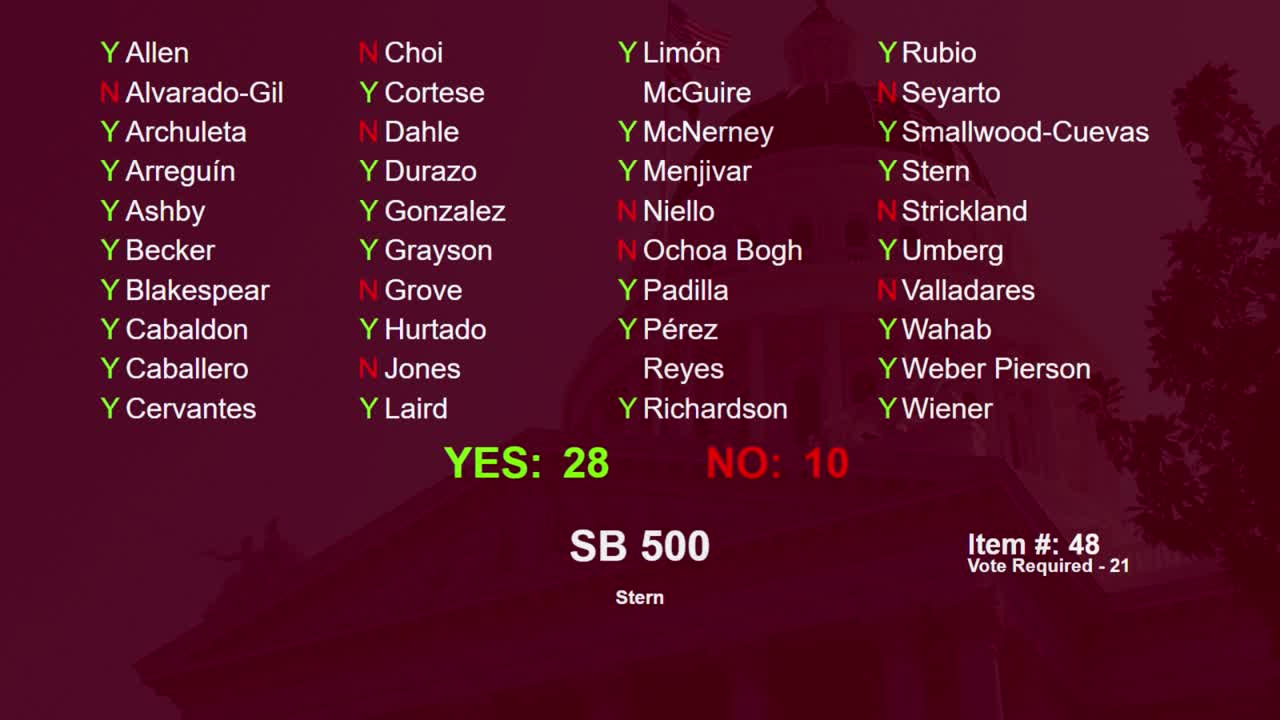 3MIN
Senate Floor
 12MIN
Senate Standing Committee on Labor, Public Employment and Retirement
Bill Author

Bill Co-Author(s):