SB 888: Property taxation: disabled veterans’ exemption: household income.
- Session Year: 2025-2026
- House: Senate
- Latest Version Date: 2026-03-26
Current Status:
In Progress
(2026-08-13: August 13 hearing: Held in committee and under submission.)
Introduced
In Committee
Awaiting First Chamber Vote
Passed First Chamber
In Committee
Awaiting Second Chamber Vote
Passed Second Chamber
Enacted
What does this bill do?
This bill changes California’s disabled‑veterans home property tax exemption so that VA service‑connected disability payments are not counted as household income when deciding who qualifies for, or gets the larger low‑income exemption; that exclusion is in place through January 1, 2037. It also requires the state to track and report claims and adds duties for local tax officials, while stating the state will not reimburse local agencies for property tax revenue lost because of the change.
The summary is provided by generative AI which can make mistakes. For original language, please view the details in the table below.
The California Constitution provides that all property is taxable, taxable and requires that it be assessed at the same percentage of fair market value, unless otherwise provided by the California Constitution or federal law. The California Constitution and existing property tax law provide various exemptions from taxation, including, among others, a disabled veterans exemption. Under existing law, the disabled veterans exemption exempts from taxation part of the full value of property that constitutes the principal place of residence of a veteran, the veterans spouse, or the veteran and veterans spouse jointly, and the unmarried surviving spouse of a veteran, as provided, if the veteran incurred specified injuries or died while on active duty in military service, as described. Existing law exempts that part of the full value of the residence that does not exceed $100,000, or $150,000 if the household income of the claimant does not exceed $40,000, as adjusted for inflation, as specified.
This bill would, until January 1, 2037, exclude service-connected disability payments from the definition of household income for purposes of the disabled veterans exemption. The bill would also correct an erroneous cross-reference in the above-described provisions. By imposing additional duties on local tax officials, the bill would impose a state-mandated local program.
Existing law requires any bill authorizing a new tax expenditure to contain, among other things, specific goals, purposes, and objectives that the tax expenditure will achieve, detailed performance indicators, and data collection requirements.
This bill would include additional information required for any bill authorizing a new tax expenditure.
The California Constitution requires the state to reimburse local agencies and school districts for certain costs mandated by the state. Statutory provisions establish procedures for making that reimbursement.
This bill would provide that, if the Commission on State Mandates determines that the bill contains costs mandated by the state, reimbursement for those costs shall be made pursuant to the statutory provisions noted above.
Existing law requires the state to reimburse local agencies annually for certain property tax revenues lost as a result of any exemption or classification of property for purposes of ad valorem property taxation.
This bill would provide that, notwithstanding those provisions, no appropriation is made and the state shall not reimburse local agencies for property tax revenues lost by them pursuant to the bill.
This bill would take effect immediately as a tax levy.
The California Constitution provides that all property is taxable, and requires that it be assessed at the same percentage of fair market value, unless otherwise provided by the California Constitution or federal law. The California Constitution and existing property tax law provide various exemptions from taxation, including, among others, a disabled veterans exemption. Under existing law, the disabled veterans exemption exempts from taxation part of the full value of property that constitutes the principal place of residence of a veteran, the veterans spouse, or the veteran and veterans spouse jointly, and the unmarried surviving spouse of a veteran, as provided, if the veteran incurred specified injuries or died while on active duty in military service, as described. Existing law exempts that part of the full value of the residence that does not exceed $100,000, or $150,000 if the household income of the claimant does not exceed $40,000, as adjusted for inflation, as specified.
This bill would, until January 1, 2037, exclude service-connected disability payments from the definition of household income for purposes of the disabled veterans exemption. The bill would also correct an erroneous cross-reference in the above-described provisions. By imposing additional duties on local tax officials, the bill would impose a state-mandated local program.
Existing law requires any bill authorizing a new tax expenditure to contain, among other things, specific goals, purposes, and objectives that the tax expenditure will achieve, detailed performance indicators, and data collection requirements.
This bill would include additional information required for any bill authorizing a new tax expenditure.
The California Constitution requires the state to reimburse local agencies and school districts for certain costs mandated by the state. Statutory provisions establish procedures for making that reimbursement.
This bill would provide that, if the Commission on State Mandates determines that the bill contains costs mandated by the state, reimbursement for those costs shall be made pursuant to the statutory provisions noted above.
Existing law requires the state to reimburse local agencies annually for certain property tax revenues lost as a result of any exemption or classification of property for purposes of ad valorem property taxation.
This bill would provide that, notwithstanding those provisions, no appropriation is made and the state shall not reimburse local agencies for property tax revenues lost by them pursuant to the bill.
This bill would take effect immediately as a tax levy.
(a)Property that constitutes the principal place of residence of a veteran, that is owned by the veteran, the veterans spouse, or the veteran and the veterans spouse jointly, is exempted from taxation on that part of the full value of the residence that does not exceed one hundred thousand dollars ($100,000), as adjusted for the relevant assessment year as provided in subdivision (i), if the veteran is blind in both eyes, has lost the use of two or more limbs, or if the veteran is totally disabled as a result of injury or disease incurred in military service. The one-hundred-thousand-dollar ($100,000) exemption shall be one hundred fifty thousand dollars ($150,000), as adjusted for the relevant assessment year as provided in subdivision (i), in the case of an eligible veteran whose household income does not exceed the amount of forty thousand dollars ($40,000), as adjusted for the relevant assessment year as provided in paragraph (2) of subdivision (h).
(b)(1)For purposes of this section, veteran means either of the following:
(A)A person who is serving in or has served in and has been discharged under other than dishonorable conditions from service in the United States Army, Navy, Air Force, Marine Corps, Space Force, or Coast Guard, and served either in time of war or in time of peace in a campaign or expedition for which a medal has been issued by Congress, or in time of peace and because of a service-connected disability was released from active duty, and who has been determined by the United States Department of Veterans Affairs to be eligible for federal veterans health and medical benefits.
(B)Any person who would qualify as a veteran pursuant to subparagraph (A) except that they have, as a result of a service-connected injury or disease, died while on active duty in military service. The United States Department of Veterans Affairs shall determine whether an injury or disease is service connected.
(2)For purposes of this section, property is deemed to be the principal place of residence of a veteran, disabled as described in subdivision (a), if either of the following applies:
(A)The veteran is confined to a hospital or other care facility, if that property would be that veterans principal place of residence were it not for their confinement to a hospital or other care facility, provided that the residence is not rented or leased to a third party. For purposes of this subparagraph, a family member who resides at the residence is not a third party.
(B)A dwelling on the property was completely destroyed in a disaster for which the Governor proclaimed a state of emergency and all of the following apply:
(i)The property qualified as the veterans principal place of residence prior to the commencement date of the disaster.
(ii)The property has not changed ownership since the commencement date of the disaster.
(iii)The veteran intends to reconstruct a dwelling on the property and occupy the dwelling as their principal place of residence when it is possible to do so.
(iv)In the case of an eligible veteran receiving an increased exemption amount based on household income, as described in subdivision (a), the veteran continues to comply with any applicable annual filing requirement.
(c)(1)Property that is owned by, and that constitutes the principal place of residence of, the unmarried surviving spouse of a deceased veteran is exempt from taxation on that part of the full value of the residence that does not exceed one hundred thousand dollars ($100,000), as adjusted for the relevant assessment year as provided in subdivision (i), in the case of a veteran who was blind in both eyes, had lost the use of two or more limbs, or was totally disabled provided that either of the following conditions is met:
(A)The deceased veteran during their lifetime qualified for the exemption pursuant to subdivision (a), or would have qualified for the exemption under the laws effective on January 1, 1977, except that the veteran died prior to January 1, 1977.
(B)The veteran died from a disease that was service connected as determined by the United States Department of Veterans Affairs.
The one-hundred-thousand-dollar ($100,000) exemption shall be one hundred fifty thousand dollars ($150,000), as adjusted for the relevant assessment year as provided in subdivision (i), in the case of an eligible unmarried surviving spouse whose household income does not exceed the amount of forty thousand dollars ($40,000), as adjusted for the relevant assessment year as provided in paragraph (2) of subdivision (h).
(2)Commencing with the 199495 fiscal year, property that is owned by, and that constitutes the principal place of residence of, the unmarried surviving spouse of a veteran as described in subparagraph (B) of paragraph (1) of subdivision (b) is exempt from taxation on that part of the full value of the residence that does not exceed one hundred thousand dollars ($100,000), as adjusted for the relevant assessment year as provided in subdivision (i). The one-hundred-thousand-dollar ($100,000) exemption shall be one hundred fifty thousand dollars ($150,000), as adjusted for the relevant assessment year as provided in subdivision (i), in the case of an eligible unmarried surviving spouse whose household income does not exceed the amount of forty thousand dollars ($40,000), as adjusted for the relevant assessment year as provided in paragraph (2) of subdivision (h).
(3)Beginning with the 201213 fiscal year and for each fiscal year thereafter, property is deemed to be the principal place of residence of the unmarried surviving spouse of a deceased veteran, who is confined to a hospital or other care facility, if that property would be the unmarried surviving spouses principal place of residence were it not for their confinement to a hospital or other care facility, provided that the residence is not rented or leased to a third party. For purposes of this paragraph, a family member who resides at the residence is not a third party.
(d)As used in this section, property that is owned by a veteran or property that is owned by the veterans unmarried surviving spouse includes all of the following:
(1)Property owned by the veteran with the veterans spouse as a joint tenancy, tenancy in common, or as community property.
(2)Property owned by the veteran or the veterans spouse as separate property.
(3)Property owned with one or more other persons to the extent of the interest owned by the veteran, the veterans spouse, or both the veteran and the veterans spouse.
(4)Property owned by the veterans unmarried surviving spouse with one or more other persons to the extent of the interest owned by the veterans unmarried surviving spouse.
(5)So much of the property of a corporation as constitutes the principal place of residence of a veteran or a veterans unmarried surviving spouse when the veteran, or the veterans spouse, or the veterans unmarried surviving spouse is a shareholder of the corporation and the rights of shareholding entitle one to the possession of property, legal title to which is owned by the corporation. The exemption provided by this paragraph shall be shown on the local roll and shall reduce the full value of the corporate property. Notwithstanding any law or articles of incorporation or bylaws of a corporation described in this paragraph, any reduction of property taxes paid by the corporation shall reflect an equal reduction in any charges by the corporation to the person who, by reason of qualifying for the exemption, made possible the reduction for the corporation.
(e)For purposes of this section, being blind in both eyes means having a visual acuity of 5/200 or less, or concentric contraction of the visual field to 5 degrees or less; losing the use of a limb means that the limb has been amputated or its use has been lost by reason of ankylosis, progressive muscular dystrophies, or paralysis; and being totally disabled means that the United States Department of Veterans Affairs or the military service from which the veteran was discharged has rated the disability at 100 percent or has rated the disability compensation at 100 percent by reason of being unable to secure or follow a substantially gainful occupation.
(f)(1)The county assessor shall accept an electronically generated letter of service-connected disability in lieu of an original letter of service-connected disability, at the discretion of the claimant, for purposes of verifying eligibility for an exemption pursuant to this section.
(2)For purposes of this subdivision, letter of service-connected disability means a letter from the United States Department of Veterans Affairs that provides a benefit summary of the claimants service-connected disability for purposes of claiming disabled veterans exemptions.
(g)An exemption granted to a claimant pursuant to this section shall be in lieu of the veterans exemption provided by subdivisions (o), (p), (q), and (r) of Section 3 of Article XIII of the California Constitution and any other real property tax exemption to which the claimant may be entitled. Other real property tax exemptions shall not be granted to any other person with respect to the same residence for which an exemption has been granted pursuant to this section. However, if two or more veterans qualified pursuant to this section coown a property in which they reside, each is entitled to the exemption to the extent of their interest.
(h)(1)For purposes of this section, household income shall not include service-connected disability payments.
(2)Commencing on January 1, 2002, and for each assessment year thereafter, the household income limit shall be compounded annually by an inflation factor that is the annual percentage change, measured from February to February of the two previous assessment years, rounded to the nearest one-thousandth of 1 percent, in the California Consumer Price Index for all items, as determined by the Department of Industrial Relations.
(i)Commencing on January 1, 2006, and for each assessment year thereafter, the exemption amounts set forth in subdivisions (a) and (c) shall be compounded annually by an inflation factor that is the annual percentage change, measured from February to February of the two previous assessment years, rounded to the nearest one-thousandth of 1 percent, in the California Consumer Price Index for all items, as determined by the Department of Industrial Relations.
(j)The amendments made to this section by Chapter 871 of the Statutes of 2016 shall apply for property tax lien dates for the 201718 fiscal year and for each fiscal year thereafter.
(k)The county assessor may provide written or electronic determination of preliminary eligibility for an exemption under this section.
(l)It is the intent of the Legislature to apply the requirements of Section 41 to the act that added this subdivision. Therefore, the Legislature finds and declares the following with respect to the tax exemption provided by this section:
(1)The goals, purposes, and objectives of this act are to do the following: ensure that service-connected veteran disability payments do not unfairly deny disabled veterans a greater property tax exemption amount.
(A)Remove the counterproductive requirement that also disqualifies.(B)Provide that, under the law, the act of qualifying should never disqualify an individual from support or well-deserved benefits.(C)Authorize veterans who qualify for this tax exemption to receive this tax exemption.(2)Detailed performance indicators for the Legislature to use in determining whether the expanded disabled veterans tax exemption meets the goals, purposes, and objectives described in paragraph (1) shall be the number of qualified claims under the disabled veterans tax exemption reported each year by the State Board of Equalization pursuant to subparagraph (B) of paragraph (3). change in the ratio between claims for a low-income exemption and claims for a standard exemption under subdivision (a).
(3)The data collection requirements for determining whether the expanded disabled veterans exemption is meeting, failing to meet, or exceeding the specific goals, purposes, and objectives described in subparagraph (A) are as follows:
(A)The Board of Equalization shall use existing methods to track the number of claims under this section.
(B)On or before January 1, 2036, the State Board of Equalization shall submit to the Legislature, and publish on its internet website, a comparison of the number of claims under this section for each taxable year 2025 to 2034, inclusive, for the Legislature to use in determining whether the expanded disabled veterans tax exemption meets the goals, purposes, and objectives of the act that added this subdivision.
(C)The report required to be submitted pursuant to subparagraph (B) shall be submitted in compliance with Section 9795 of the Government Code.
(m)This section shall remain in effect only until January 1, 2037, and as of that date is repealed.
SEC. 2.Section 205.5 is added to the Revenue and Taxation Code, to read:205.5.(a)Property that constitutes the principal place of residence of a veteran, that is owned by the veteran, the veterans spouse, or the veteran and the veterans spouse jointly, is exempted from taxation on that part of the full value of the residence that does not exceed one hundred thousand dollars ($100,000), as adjusted for the relevant assessment year as provided in subdivision (i), if the veteran is blind in both eyes, has lost the use of two or more limbs, or if the veteran is totally disabled as a result of injury or disease incurred in military service. The one-hundred-thousand-dollar ($100,000) exemption shall be one hundred fifty thousand dollars ($150,000), as adjusted for the relevant assessment year as provided in subdivision (i), in the case of an eligible veteran whose household income does not exceed the amount of forty thousand dollars ($40,000), as adjusted for the relevant assessment year as provided in subdivision (h).
(b)(1) For purposes of this section, veteran means either of the following:
(A)A person who is serving in or has served in and has been discharged under other than dishonorable conditions from service in the United States Army, Navy, Air Force, Marine Corps, Space Force, or Coast Guard, and served either in time of war or in time of peace in a campaign or expedition for which a medal has been issued by Congress, or in time of peace and because of a service-connected disability was released from active duty, and who has been determined by the United States Department of Veterans Affairs to be eligible for federal veterans health and medical benefits.
(B)Any person who would qualify as a veteran pursuant to subparagraph (A) except that they have, as a result of a service-connected injury or disease, died while on active duty in military service. The United States Department of Veterans Affairs shall determine whether an injury or disease is service connected.
(2)For purposes of this section, property is deemed to be the principal place of residence of a veteran, disabled as described in subdivision (a), if either of the following applies:
(A)The veteran is confined to a hospital or other care facility, if that property would be that veterans principal place of residence were it not for their confinement to a hospital or other care facility, provided that the residence is not rented or leased to a third party. For purposes of this subparagraph, a family member who resides at the residence is not a third party.
(B)A dwelling on the property was completely destroyed in a disaster for which the Governor proclaimed a state of emergency and all of the following apply:
(i)The property qualified as the veterans principal place of residence prior to the commencement date of the disaster.
(ii)The property has not changed ownership since the commencement date of the disaster.
(iii)The veteran intends to reconstruct a dwelling on the property and occupy the dwelling as their principal place of residence when it is possible to do so.
(iv)In the case of an eligible veteran receiving an increased exemption amount based on household income, as described in subdivision (a), the veteran continues to comply with any applicable annual filing requirement.
(c)(1) Property that is owned by, and that constitutes the principal place of residence of, the unmarried surviving spouse of a deceased veteran is exempt from taxation on that part of the full value of the residence that does not exceed one hundred thousand dollars ($100,000), as adjusted for the relevant assessment year as provided in subdivision (i), in the case of a veteran who was blind in both eyes, had lost the use of two or more limbs, or was totally disabled provided that either of the following conditions is met:
(A)The deceased veteran during their lifetime qualified for the exemption pursuant to subdivision (a), or would have qualified for the exemption under the laws effective on January 1, 1977, except that the veteran died prior to January 1, 1977.
(B)The veteran died from a disease that was service connected as determined by the United States Department of Veterans Affairs.
The one-hundred-thousand-dollar ($100,000) exemption shall be one hundred fifty thousand dollars ($150,000), as adjusted for the relevant assessment year as provided in subdivision (i), in the case of an eligible unmarried surviving spouse whose household income does not exceed the amount of forty thousand dollars ($40,000), as adjusted for the relevant assessment year as provided in subdivision (h).
(2)Commencing with the 199495 fiscal year, property that is owned by, and that constitutes the principal place of residence of, the unmarried surviving spouse of a veteran as described in subparagraph (B) of paragraph (1) of subdivision (b) is exempt from taxation on that part of the full value of the residence that does not exceed one hundred thousand dollars ($100,000), as adjusted for the relevant assessment year as provided in subdivision (h). The one-hundred-thousand-dollar ($100,000) exemption shall be one hundred fifty thousand dollars ($150,000), as adjusted for the relevant assessment year as provided in subdivision (i), in the case of an eligible unmarried surviving spouse whose household income does not exceed the amount of forty thousand dollars ($40,000), as adjusted for the relevant assessment year as provided in subdivision (h).
(3)Beginning with the 201213 fiscal year and for each fiscal year thereafter, property is deemed to be the principal place of residence of the unmarried surviving spouse of a deceased veteran, who is confined to a hospital or other care facility, if that property would be the unmarried surviving spouses principal place of residence were it not for their confinement to a hospital or other care facility, provided that the residence is not rented or leased to a third party. For purposes of this paragraph, a family member who resides at the residence is not a third party.
(d)As used in this section, property that is owned by a veteran or property that is owned by the veterans unmarried surviving spouse includes all of the following:
(1)Property owned by the veteran with the veterans spouse as a joint tenancy, tenancy in common, or as community property.
(2)Property owned by the veteran or the veterans spouse as separate property.
(3)Property owned with one or more other persons to the extent of the interest owned by the veteran, the veterans spouse, or both the veteran and the veterans spouse.
(4)Property owned by the veterans unmarried surviving spouse with one or more other persons to the extent of the interest owned by the veterans unmarried surviving spouse.
(5)So much of the property of a corporation as constitutes the principal place of residence of a veteran or a veterans unmarried surviving spouse when the veteran, or the veterans spouse, or the veterans unmarried surviving spouse is a shareholder of the corporation and the rights of shareholding entitle one to the possession of property, legal title to which is owned by the corporation. The exemption provided by this paragraph shall be shown on the local roll and shall reduce the full value of the corporate property. Notwithstanding any law or articles of incorporation or bylaws of a corporation described in this paragraph, any reduction of property taxes paid by the corporation shall reflect an equal reduction in any charges by the corporation to the person who, by reason of qualifying for the exemption, made possible the reduction for the corporation.
(e)For purposes of this section, being blind in both eyes means having a visual acuity of 5/200 or less, or concentric contraction of the visual field to 5 degrees or less; losing the use of a limb means that the limb has been amputated or its use has been lost by reason of ankylosis, progressive muscular dystrophies, or paralysis; and being totally disabled means that the United States Department of Veterans Affairs or the military service from which the veteran was discharged has rated the disability at 100 percent or has rated the disability compensation at 100 percent by reason of being unable to secure or follow a substantially gainful occupation.
(f)(1) The county assessor shall accept an electronically generated letter of service-connected disability in lieu of an original letter of service-connected disability, at the discretion of the claimant, for purposes of verifying eligibility for an exemption pursuant to this section.
(2)For purposes of this subdivision, letter of service-connected disability means a letter from the United States Department of Veterans Affairs that provides a benefit summary of the claimants service-connected disability for purposes of claiming disabled veterans exemptions.
(g)An exemption granted to a claimant pursuant to this section shall be in lieu of the veterans exemption provided by subdivisions (o), (p), (q), and (r) of Section 3 of Article XIII of the California Constitution and any other real property tax exemption to which the claimant may be entitled. Other real property tax exemptions shall not be granted to any other person with respect to the same residence for which an exemption has been granted pursuant to this section. However, if two or more veterans qualified pursuant to this section coown a property in which they reside, each is entitled to the exemption to the extent of their interest.
(h)Commencing on January 1, 2002, and for each assessment year thereafter, the household income limit shall be compounded annually by an inflation factor that is the annual percentage change, measured from February to February of the two previous assessment years, rounded to the nearest one-thousandth of 1 percent, in the California Consumer Price Index for all items, as determined by the Department of Industrial Relations.
(i)Commencing on January 1, 2006, and for each assessment year thereafter, the exemption amounts set forth in subdivisions (a) and (c) shall be compounded annually by an inflation factor that is the annual percentage change, measured from February to February of the two previous assessment years, rounded to the nearest one-thousandth of 1 percent, in the California Consumer Price Index for all items, as determined by the Department of Industrial Relations.
(j)The amendments made to this section by Chapter 871 of the Statutes of 2016 shall apply for property tax lien dates for the 201718 fiscal year and for each fiscal year thereafter.
(k)The county assessor may provide written or electronic determination of preliminary eligibility for an exemption under this section.
(l)This section shall become operative on January 1, 2037.
SEC. 3.If the Commission on State Mandates determines that this act contains costs mandated by the state, reimbursement to local agencies and school districts for those costs shall be made pursuant to Part 7 (commencing with Section 17500) of Division 4 of Title 2 of the Government Code.
SEC. 4.Notwithstanding Section 2229 of the Revenue and Taxation Code, no appropriation is made by this act and the state shall not reimburse any local agency for any property tax revenues lost by it pursuant to this act.
SEC. 5.This act provides for a tax levy within the meaning of Article IV of the California Constitution and shall go into immediate effect.
REVISIONS: HeadingLine 5. REVISIONS: HeadingLines 3 and 4.(a)Property that constitutes the principal place of residence of a veteran, that is owned by the veteran, the veterans spouse, or the veteran and the veterans spouse jointly, is exempted from taxation on that part of the full value of the residence that does not exceed one hundred thousand dollars ($100,000), as adjusted for the relevant assessment year as provided in subdivision (i), if the veteran is blind in both eyes, has lost the use of two or more limbs, or if the veteran is totally disabled as a result of injury or disease incurred in military service. The one-hundred-thousand-dollar ($100,000) exemption shall be one hundred fifty thousand dollars ($150,000), as adjusted for the relevant assessment year as provided in subdivision (i), in the case of an eligible veteran whose household income does not exceed the amount of forty thousand dollars ($40,000), as adjusted for the relevant assessment year as provided in paragraph (2) of subdivision (h).
(b)(1)For purposes of this section, veteran means either of the following:
(A)A person who is serving in or has served in and has been discharged under other than dishonorable conditions from service in the United States Army, Navy, Air Force, Marine Corps, Space Force, or Coast Guard, and served either in time of war or in time of peace in a campaign or expedition for which a medal has been issued by Congress, or in time of peace and because of a service-connected disability was released from active duty, and who has been determined by the United States Department of Veterans Affairs to be eligible for federal veterans health and medical benefits.
(B)Any person who would qualify as a veteran pursuant to subparagraph (A) except that they have, as a result of a service-connected injury or disease, died while on active duty in military service. The United States Department of Veterans Affairs shall determine whether an injury or disease is service connected.
(2)For purposes of this section, property is deemed to be the principal place of residence of a veteran, disabled as described in subdivision (a), if either of the following applies:
(A)The veteran is confined to a hospital or other care facility, if that property would be that veterans principal place of residence were it not for their confinement to a hospital or other care facility, provided that the residence is not rented or leased to a third party. For purposes of this subparagraph, a family member who resides at the residence is not a third party.
(B)A dwelling on the property was completely destroyed in a disaster for which the Governor proclaimed a state of emergency and all of the following apply:
(i)The property qualified as the veterans principal place of residence prior to the commencement date of the disaster.
(ii)The property has not changed ownership since the commencement date of the disaster.
(iii)The veteran intends to reconstruct a dwelling on the property and occupy the dwelling as their principal place of residence when it is possible to do so.
(iv)In the case of an eligible veteran receiving an increased exemption amount based on household income, as described in subdivision (a), the veteran continues to comply with any applicable annual filing requirement.
(c)(1)Property that is owned by, and that constitutes the principal place of residence of, the unmarried surviving spouse of a deceased veteran is exempt from taxation on that part of the full value of the residence that does not exceed one hundred thousand dollars ($100,000), as adjusted for the relevant assessment year as provided in subdivision (i), in the case of a veteran who was blind in both eyes, had lost the use of two or more limbs, or was totally disabled provided that either of the following conditions is met:
(A)The deceased veteran during their lifetime qualified for the exemption pursuant to subdivision (a), or would have qualified for the exemption under the laws effective on January 1, 1977, except that the veteran died prior to January 1, 1977.
(B)The veteran died from a disease that was service connected as determined by the United States Department of Veterans Affairs.
The one-hundred-thousand-dollar ($100,000) exemption shall be one hundred fifty thousand dollars ($150,000), as adjusted for the relevant assessment year as provided in subdivision (i), in the case of an eligible unmarried surviving spouse whose household income does not exceed the amount of forty thousand dollars ($40,000), as adjusted for the relevant assessment year as provided in paragraph (2) of subdivision (h).
(2)Commencing with the 199495 fiscal year, property that is owned by, and that constitutes the principal place of residence of, the unmarried surviving spouse of a veteran as described in subparagraph (B) of paragraph (1) of subdivision (b) is exempt from taxation on that part of the full value of the residence that does not exceed one hundred thousand dollars ($100,000), as adjusted for the relevant assessment year as provided in subdivision (h). (i). The one-hundred-thousand-dollar ($100,000) exemption shall be one hundred fifty thousand dollars ($150,000), as adjusted for the relevant assessment year as provided in subdivision (i), in the case of an eligible unmarried surviving spouse whose household income does not exceed the amount of forty thousand dollars ($40,000), as adjusted for the relevant assessment year as provided in paragraph (2) of subdivision (h).
(3)Beginning with the 201213 fiscal year and for each fiscal year thereafter, property is deemed to be the principal place of residence of the unmarried surviving spouse of a deceased veteran, who is confined to a hospital or other care facility, if that property would be the unmarried surviving spouses principal place of residence were it not for their confinement to a hospital or other care facility, provided that the residence is not rented or leased to a third party. For purposes of this paragraph, a family member who resides at the residence is not a third party.
(d)As used in this section, property that is owned by a veteran or property that is owned by the veterans unmarried surviving spouse includes all of the following:
(1)Property owned by the veteran with the veterans spouse as a joint tenancy, tenancy in common, or as community property.
(2)Property owned by the veteran or the veterans spouse as separate property.
(3)Property owned with one or more other persons to the extent of the interest owned by the veteran, the veterans spouse, or both the veteran and the veterans spouse.
(4)Property owned by the veterans unmarried surviving spouse with one or more other persons to the extent of the interest owned by the veterans unmarried surviving spouse.
(5)So much of the property of a corporation as constitutes the principal place of residence of a veteran or a veterans unmarried surviving spouse when the veteran, or the veterans spouse, or the veterans unmarried surviving spouse is a shareholder of the corporation and the rights of shareholding entitle one to the possession of property, legal title to which is owned by the corporation. The exemption provided by this paragraph shall be shown on the local roll and shall reduce the full value of the corporate property. Notwithstanding any law or articles of incorporation or bylaws of a corporation described in this paragraph, any reduction of property taxes paid by the corporation shall reflect an equal reduction in any charges by the corporation to the person who, by reason of qualifying for the exemption, made possible the reduction for the corporation.
(e)For purposes of this section, being blind in both eyes means having a visual acuity of 5/200 or less, or concentric contraction of the visual field to 5 degrees or less; losing the use of a limb means that the limb has been amputated or its use has been lost by reason of ankylosis, progressive muscular dystrophies, or paralysis; and being totally disabled means that the United States Department of Veterans Affairs or the military service from which the veteran was discharged has rated the disability at 100 percent or has rated the disability compensation at 100 percent by reason of being unable to secure or follow a substantially gainful occupation.
(f)(1)The county assessor shall accept an electronically generated letter of service-connected disability in lieu of an original letter of service-connected disability, at the discretion of the claimant, for purposes of verifying eligibility for an exemption pursuant to this section.
(2)For purposes of this subdivision, letter of service-connected disability means a letter from the United States Department of Veterans Affairs that provides a benefit summary of the claimants service-connected disability for purposes of claiming disabled veterans exemptions.
(g)An exemption granted to a claimant pursuant to this section shall be in lieu of the veterans exemption provided by subdivisions (o), (p), (q), and (r) of Section 3 of Article XIII of the California Constitution and any other real property tax exemption to which the claimant may be entitled. Other real property tax exemptions shall not be granted to any other person with respect to the same residence for which an exemption has been granted pursuant to this section. However, if two or more veterans qualified pursuant to this section coown a property in which they reside, each is entitled to the exemption to the extent of their interest.
(h)Commencing on(1)For purposes of this section, household income shall not include service-connected disability payments.
(2)Commencing on January 1, 2002, and for each assessment year thereafter, the household income limit shall be compounded annually by an inflation factor that is the annual percentage change, measured from February to February of the two previous assessment years, rounded to the nearest one-thousandth of 1 percent, in the California Consumer Price Index for all items, as determined by the California Department of Industrial Relations.
(i)Commencing on January 1, 2006, and for each assessment year thereafter, the exemption amounts set forth in subdivisions (a) and (c) shall be compounded annually by an inflation factor that is the annual percentage change, measured from February to February of the two previous assessment years, rounded to the nearest one-thousandth of 1 percent, in the California Consumer Price Index for all items, as determined by the California Department of Industrial Relations.
(j)The amendments made to this section by Chapter 871 of the Statutes of 2016 shall apply for property tax lien dates for the 201718 fiscal year and for each fiscal year thereafter.
(k)The county assessor may provide written or electronic determination of preliminary eligibility for an exemption under this section.
(l)It is the intent of the Legislature to apply the requirements of Section 41 to the act that added this subdivision. Therefore, the Legislature finds and declares the following with respect to the tax exemption provided by this section:
(1)The goals, purposes, and objectives of this act are to do the following:
(A)Remove the counterproductive requirement that also disqualifies.
(B)Provide that, under the law, the act of qualifying should never disqualify an individual from support or well-deserved benefits.
(C)Authorize veterans who qualify for this tax exemption to receive this tax exemption.
(2)Detailed performance indicators for the Legislature to use in determining whether the expanded disabled veterans tax exemption meets the goals, purposes, and objectives described in paragraph (1) shall be the number of qualified claims under the disabled veterans tax exemption reported each year by the State Board of Equalization pursuant to subparagraph (B) of paragraph (3).
(3)The data collection requirements for determining whether the expanded disabled veterans exemption is meeting, failing to meet, or exceeding the specific goals, purposes, and objectives described in subparagraph (A) are as follows:
(A)The Board of Equalization shall use existing methods to track the number of claims under this section.
(B)On or before January 1, 2036, the State Board of Equalization shall submit to the Legislature, and publish on its internet website, a comparison of the number of claims under this section for each taxable year 2025 to 2034, inclusive, for the Legislature to use in determining whether the expanded disabled veterans tax exemption meets the goals, purposes, and objectives of the act that added this subdivision.
(C)The report required to be submitted pursuant to subparagraph (B) shall be submitted in compliance with Section 9795 of the Government Code.
(m)This section shall remain in effect only until January 1, 2037, and as of that date is repealed.
SEC. 2.Section 205.5 is added to the Revenue and Taxation Code, to read:205.5.(a)Property that constitutes the principal place of residence of a veteran, that is owned by the veteran, the veterans spouse, or the veteran and the veterans spouse jointly, is exempted from taxation on that part of the full value of the residence that does not exceed one hundred thousand dollars ($100,000), as adjusted for the relevant assessment year as provided in subdivision (i), if the veteran is blind in both eyes, has lost the use of two or more limbs, or if the veteran is totally disabled as a result of injury or disease incurred in military service. The one-hundred-thousand-dollar ($100,000) exemption shall be one hundred fifty thousand dollars ($150,000), as adjusted for the relevant assessment year as provided in subdivision (i), in the case of an eligible veteran whose household income does not exceed the amount of forty thousand dollars ($40,000), as adjusted for the relevant assessment year as provided in subdivision (h).
(b)(1) For purposes of this section, veteran means either of the following:
(A)A person who is serving in or has served in and has been discharged under other than dishonorable conditions from service in the United States Army, Navy, Air Force, Marine Corps, Space Force, or Coast Guard, and served either in time of war or in time of peace in a campaign or expedition for which a medal has been issued by Congress, or in time of peace and because of a service-connected disability was released from active duty, and who has been determined by the United States Department of Veterans Affairs to be eligible for federal veterans health and medical benefits.
(B)Any person who would qualify as a veteran pursuant to subparagraph (A) except that they have, as a result of a service-connected injury or disease, died while on active duty in military service. The United States Department of Veterans Affairs shall determine whether an injury or disease is service connected.
(2)For purposes of this section, property is deemed to be the principal place of residence of a veteran, disabled as described in subdivision (a), if either of the following applies:
(A)The veteran is confined to a hospital or other care facility, if that property would be that veterans principal place of residence were it not for their confinement to a hospital or other care facility, provided that the residence is not rented or leased to a third party. For purposes of this subparagraph, a family member who resides at the residence is not a third party.
(B)A dwelling on the property was completely destroyed in a disaster for which the Governor proclaimed a state of emergency and all of the following apply:
(i)The property qualified as the veterans principal place of residence prior to the commencement date of the disaster.
(ii)The property has not changed ownership since the commencement date of the disaster.
(iii)The veteran intends to reconstruct a dwelling on the property and occupy the dwelling as their principal place of residence when it is possible to do so.
(iv)In the case of an eligible veteran receiving an increased exemption amount based on household income, as described in subdivision (a), the veteran continues to comply with any applicable annual filing requirement.
(c)(1) Property that is owned by, and that constitutes the principal place of residence of, the unmarried surviving spouse of a deceased veteran is exempt from taxation on that part of the full value of the residence that does not exceed one hundred thousand dollars ($100,000), as adjusted for the relevant assessment year as provided in subdivision (i), in the case of a veteran who was blind in both eyes, had lost the use of two or more limbs, or was totally disabled provided that either of the following conditions is met:
(A)The deceased veteran during their lifetime qualified for the exemption pursuant to subdivision (a), or would have qualified for the exemption under the laws effective on January 1, 1977, except that the veteran died prior to January 1, 1977.
(B)The veteran died from a disease that was service connected as determined by the United States Department of Veterans Affairs.
The one-hundred-thousand-dollar ($100,000) exemption shall be one hundred fifty thousand dollars ($150,000), as adjusted for the relevant assessment year as provided in subdivision (i), in the case of an eligible unmarried surviving spouse whose household income does not exceed the amount of forty thousand dollars ($40,000), as adjusted for the relevant assessment year as provided in subdivision (h).
(2)Commencing with the 199495 fiscal year, property that is owned by, and that constitutes the principal place of residence of, the unmarried surviving spouse of a veteran as described in subparagraph (B) of paragraph (1) of subdivision (b) is exempt from taxation on that part of the full value of the residence that does not exceed one hundred thousand dollars ($100,000), as adjusted for the relevant assessment year as provided in subdivision (h). The one-hundred-thousand-dollar ($100,000) exemption shall be one hundred fifty thousand dollars ($150,000), as adjusted for the relevant assessment year as provided in subdivision (i), in the case of an eligible unmarried surviving spouse whose household income does not exceed the amount of forty thousand dollars ($40,000), as adjusted for the relevant assessment year as provided in subdivision (h).
(3)Beginning with the 201213 fiscal year and for each fiscal year thereafter, property is deemed to be the principal place of residence of the unmarried surviving spouse of a deceased veteran, who is confined to a hospital or other care facility, if that property would be the unmarried surviving spouses principal place of residence were it not for their confinement to a hospital or other care facility, provided that the residence is not rented or leased to a third party. For purposes of this paragraph, a family member who resides at the residence is not a third party.
(d)As used in this section, property that is owned by a veteran or property that is owned by the veterans unmarried surviving spouse includes all of the following:
(1)Property owned by the veteran with the veterans spouse as a joint tenancy, tenancy in common, or as community property.
(2)Property owned by the veteran or the veterans spouse as separate property.
(3)Property owned with one or more other persons to the extent of the interest owned by the veteran, the veterans spouse, or both the veteran and the veterans spouse.
(4)Property owned by the veterans unmarried surviving spouse with one or more other persons to the extent of the interest owned by the veterans unmarried surviving spouse.
(5)So much of the property of a corporation as constitutes the principal place of residence of a veteran or a veterans unmarried surviving spouse when the veteran, or the veterans spouse, or the veterans unmarried surviving spouse is a shareholder of the corporation and the rights of shareholding entitle one to the possession of property, legal title to which is owned by the corporation. The exemption provided by this paragraph shall be shown on the local roll and shall reduce the full value of the corporate property. Notwithstanding any law or articles of incorporation or bylaws of a corporation described in this paragraph, any reduction of property taxes paid by the corporation shall reflect an equal reduction in any charges by the corporation to the person who, by reason of qualifying for the exemption, made possible the reduction for the corporation.
(e)For purposes of this section, being blind in both eyes means having a visual acuity of 5/200 or less, or concentric contraction of the visual field to 5 degrees or less; losing the use of a limb means that the limb has been amputated or its use has been lost by reason of ankylosis, progressive muscular dystrophies, or paralysis; and being totally disabled means that the United States Department of Veterans Affairs or the military service from which the veteran was discharged has rated the disability at 100 percent or has rated the disability compensation at 100 percent by reason of being unable to secure or follow a substantially gainful occupation.
(f)(1) The county assessor shall accept an electronically generated letter of service-connected disability in lieu of an original letter of service-connected disability, at the discretion of the claimant, for purposes of verifying eligibility for an exemption pursuant to this section.
(2)For purposes of this subdivision, letter of service-connected disability means a letter from the United States Department of Veterans Affairs that provides a benefit summary of the claimants service-connected disability for purposes of claiming disabled veterans exemptions.
(g)An exemption granted to a claimant pursuant to this section shall be in lieu of the veterans exemption provided by subdivisions (o), (p), (q), and (r) of Section 3 of Article XIII of the California Constitution and any other real property tax exemption to which the claimant may be entitled. Other real property tax exemptions shall not be granted to any other person with respect to the same residence for which an exemption has been granted pursuant to this section. However, if two or more veterans qualified pursuant to this section coown a property in which they reside, each is entitled to the exemption to the extent of their interest.
(h)Commencing on January 1, 2002, and for each assessment year thereafter, the household income limit shall be compounded annually by an inflation factor that is the annual percentage change, measured from February to February of the two previous assessment years, rounded to the nearest one-thousandth of 1 percent, in the California Consumer Price Index for all items, as determined by the Department of Industrial Relations.
(i)Commencing on January 1, 2006, and for each assessment year thereafter, the exemption amounts set forth in subdivisions (a) and (c) shall be compounded annually by an inflation factor that is the annual percentage change, measured from February to February of the two previous assessment years, rounded to the nearest one-thousandth of 1 percent, in the California Consumer Price Index for all items, as determined by the Department of Industrial Relations.
(j)The amendments made to this section by Chapter 871 of the Statutes of 2016 shall apply for property tax lien dates for the 201718 fiscal year and for each fiscal year thereafter.
(k)The county assessor may provide written or electronic determination of preliminary eligibility for an exemption under this section.
(l)This section shall become operative on January 1, 2037.
SEC. 3.If the Commission on State Mandates determines that this act contains costs mandated by the state, reimbursement to local agencies and school districts for those costs shall be made pursuant to Part 7 (commencing with Section 17500) of Division 4 of Title 2 of the Government Code.
SEC. 4.Notwithstanding Section 2229 of the Revenue and Taxation Code, no appropriation is made by this act and the state shall not reimburse any local agency for any property tax revenues lost by it pursuant to this act.
SEC. 5.This act provides for a tax levy within the meaning of Article IV of the California Constitution and shall go into immediate effect.
|
Date
|
Status
|
|---|---|
| Aug 13, 2026 | August 13 hearing: Held in committee and under submission. |
| Aug 5, 2026 | August 5 set for first hearing. Placed on suspense file. |
| Jun 30, 2026 | From committee: Do pass and re-refer to Com. on APPR. (Ayes 7. Noes 0.) (June 29). Re-referred to Com. on APPR. |
| Jun 30, 2026 | Coauthors revised. |
| Jun 23, 2026 | June 22 set for first hearing. Placed on suspense file. |
| Jun 17, 2026 | From committee: Do pass and re-refer to Com. on REV. & TAX. (Ayes 8. Noes 0.) (June 16). Re-referred to Com. on REV. & TAX. |
| Jun 17, 2026 | Coauthors revised. |
| Jun 4, 2026 | Re-referred to Coms. on M. & V.A. and REV. & TAX. pursuant to Assembly Rule 96. |
| Jun 1, 2026 | Referred to Coms. on REV. & TAX. and M. & V.A. |
| May 22, 2026 | In Assembly. Read first time. Held at Desk. |
| May 22, 2026 | Read third time. Passed. (Ayes 33. Noes 0.) Ordered to the Assembly. |
| May 22, 2026 | Read third time. Passed. (Ayes 33. Noes 0. Page 4417.) Ordered to the Assembly. |
| May 20, 2026 | Ordered to special consent calendar. |
| May 14, 2026 | Read second time. Ordered to third reading. |
| May 14, 2026 | From committee: Do pass. (Ayes 7. Noes 0.) (May 14). |
| May 14, 2026 | From committee: Do pass. (Ayes 7. Noes 0. Page 4256.) (May 14). |
| May 8, 2026 | Set for hearing May 14. |
| Apr 27, 2026 | April 27 hearing: Placed on APPR. suspense file. |
| Apr 22, 2026 | Set for hearing April 27. |
| Apr 21, 2026 | From committee: Do pass and re-refer to Com. on APPR. (Ayes 4. Noes 0.) (April 20). Re-referred to Com. on APPR. |
| Apr 21, 2026 | From committee: Do pass and re-refer to Com. on APPR. (Ayes 4. Noes 0. Page 3956.) (April 20). Re-referred to Com. on APPR. |
| Mar 26, 2026 | Read second time and amended. Re-referred to Com. on M. & V.A. |
| Mar 25, 2026 | From committee: Do pass as amended and re-refer to Com. on M. & V.A. (Ayes 5. Noes 0.) (March 25). |
| Mar 25, 2026 | From committee: Do pass as amended and re-refer to Com. on M. & V.A. (Ayes 5. Noes 0. Page 3691.) (March 25). |
| Mar 11, 2026 | Set for hearing March 25. |
| Feb 11, 2026 | Referred to Coms. on REV. & TAX. and M. & V.A. |
| Jan 15, 2026 | From printer. May be acted upon on or after February 14. |
| Jan 14, 2026 | Introduced. Read first time. To Com. on RLS. for assignment. To print. |
|
Date
|
Description
|
Location
|
Votes
|
|
|---|---|---|---|---|
| Jun 29, 2026 | Do pass and be re-referred to the Committee on [Appropriations] | Assembly Standing Committee on Revenue and Taxation |
Passed |
|
| Jun 16, 2026 | Do pass and be re-referred to the Committee on [Revenue and Taxation] | Assembly Standing Committee on Military and Veterans Affairs |
Passed |
|
| May 22, 2026 | Special Consent SB888 Seyarto et al. | Senate Floor |
Passed |
|
| May 14, 2026 | Do pass | Senate Standing Committee on Appropriations |
Passed |
|
| Apr 27, 2026 | Placed on suspense file | Senate Standing Committee on Appropriations |
Passed |
|
| Apr 20, 2026 | Do pass, but first be re-referred to the Committee on [Appropriations] | Senate Standing Committee on Military and Veterans Affairs |
Passed |
|
| Mar 25, 2026 | Do pass as amended, but first amend, and re-refer to the Committee on [Military and Veterans Affairs] | Senate Standing Committee on Revenue and Taxation |
Passed |
This list shows positions taken on this bill by organizations on the date displayed, which is linked to the original source.
Positions by individuals are not included.
|
Organization
|
Position
|
Date
|
|---|---|---|
| American Legion, Department Of California | ** Support | |
| Amvets, Department Of California | ** Support | |
| California State Commanders Veterans Council | ** Support | |
| California State Retirees | ** Support | |
| California Teachers Association | ** Against | |
| CFT – a Union of Educators & Classified Professionals, AFT, AFL-CIO | ** Against | |
| Los Angeles County Assessor | ** Support | |
| Los Angeles County Assessor Jeffrey Prang | ** Support | |
| Military Officers Association Of America, California Council Of Chapters | ** Support | |
| Orange County | ** Support | |
| Peace Officers Research Association of California (PORAC) | ** Support | |
| State Board of Equalization | ** Support | |
| Vietnam Veterans Of America, California State Council | ** Support |
Date of Hearing: August 5, 2026
ASSEMBLY COMMITTEE ON APPROPRIATIONS
Buffy Wicks, Chair
SBPCA Bill Id:SB 888
Author:(Seyarto) – As Amended Ver:March 26, 2026
Policy Committee: | Military and Veterans Affairs | Vote: | 8 - 0 |
Revenue and Taxation | 7 - 0 | ||
|
|
Urgency: No State Mandated Local Program: Yes Reimbursable: Yes
SUMMARY:
This bill excludes service-connected disability payments from the calculation of household income when determining whether a veteran qualifies for the low-income disabled veterans’ property tax exemption (“low-income exemption”).
Specifically, this bill:
- Provides, until January 1, 2037, that the definition of “household income” used to determine whether a veteran qualifies for the low-income exemption excludes service-connected disability payments.
- Declares the goal of the expanded exemption and requires the State Board of Equalization (BOE) to use existing methods to track the number of exemption claims and publish, by June 1, 2036, a report with such data for the Legislature to use to determine whether the expanded exemption meets the declared goal.
FISCAL EFFECT:
- Annual property tax revenue loss of approximately $48 million by discounting disability payments when calculating income for purposes of the low-income exemption, thus allowing more veterans to qualify for the low-income exemption. Although property tax is a local government revenue source and this bill prohibits the state from reimbursing local agencies for lost property tax revenues, reductions in property tax revenues, in turn, increase General Fund (GF) Proposition 98 spending (the exact amount depends on the operative test of the annual Proposition 98 guarantee).
- Costs of approximately $11,000 in the initial year and $2,000 annually thereafter to BOE to update related guidance and materials and track exemption claims to publish the report (GF).
- Modifying income requirements for the low-income exclusion requires a county assessor to make eligibility redeterminations and update claims forms and informational materials. By adding to the duties of a county assessor in administering the exemption, this bill likely creates a state-mandated local program. If the Commission on State Mandates determines the provisions of this bill create a new program or impose a higher level of service for which the state must reimburse local costs, the county may seek reimbursement from the state (GF). The magnitude of such costs is unknown.
COMMENTS:
- Purpose. According to the author:
SB 888 seeks to remove the counterproductive inclusion of disability compensation from the calculation of the Low-Income Exclusion of the Disabled Veterans’ Property Tax Exemption, as Veterans must receive that compensation in order to qualify for the tax exemption in the first place. Families surviving on only social security and disability pay should qualify for the low-income exclusion.
- Disabled Veterans’ Exemption. Existing law authorizes a property tax exemption for the principal residence of a disabled veteran or for the unmarried surviving spouse of a deceased disabled veteran. For purposes of the exemption, the veteran must have been discharged under honorable conditions and the disability rating must be 100%, generally occurring for a veteran who is blind in both eyes, has lost the use of two or more limbs, or is totally disabled. This exemption is commonly referred to as the “disabled veterans’ exemption.”
The property tax exemption amount is equal to the assessed value of the property, up to $100,000 (the “basic” exemption). If household income does not exceed $40,000, the maximum property tax exemption is increased to $150,000 (the “low-income” exemption). The exemption amounts and income limitation are adjusted annually for changes to the California Consumer Price Index. For example, the adjusted income limitation for the 2026 lien date is $81,131. This bill excludes service-connected disability payments from the calculation of household income when determining whether a veteran qualifies for the low-income exemption. Thus, this bill would allow some veterans currently claiming the basic exemption to instead qualify for the low-income exemption.
- Support and Opposition. This bill is supported by the BOE, county entities, a retiree and a peace officer association, and a coalition of veterans groups, the latter of which argues, “the compensation a veteran receives because of their service-connected disability can push them over the income threshold and disqualify them from the low-income exemption they have earned” and that this bill’s treatment of such income aligns “with an advancing trend in federal and state policy.”
This bill is opposed by labor organizations, with the California Teachers Association arguing it “opposes any reduction in revenue to the State’s General Fund which would reduce Proposition 98 funding.”
- Related Legislation. SB 54 (Umberg), Chapter 646, Statues of 2025, prohibited a veteran’s disability service-connected compensation from the monthly household income calculation used to determine an individual’s eligibility for a court fee waiver program.
SB 56 (Seyarto) is substantially similar to this bill. SB 56 was held on the Assembly Revenue and Taxation Committee’s suspense file.
SB 296 (Archuleta) and AB 2022 (Jeff Gonzalez) are identical and expand the value of the basic and low-income exemption. SB 296 is pending hearing by this committee and AB 2022 is pending hearing by the Senate Appropriations Committee.
SB 1407 (Archuleta) doubles the amount of retirement pay and annuity payments that a qualifying military retiree or surviving spouse may exclude from gross income under the Personal Income Tax Law. SB 1407 is pending hearing by this committee.
Analysis Prepared by: Irene Ho / APPR. / (916) 319-2081
Date of Hearing: June 29, 2026
ASSEMBLY COMMITTEE ON REVENUE AND TAXATION
Mike Gipson, Chair
SBPCA Bill Id:SB 888
Author:(Seyarto) – As Amended Ver:March 26, 2026
SUSPENSE
Majority vote. Tax levy. Fiscal committee.
SENATE VOTE: 33-0
SUBJECT: Property taxation: disabled veterans' exemption: household income
SUMMARY: Excludes service-connected disability income from household income when determining if a homeowner qualifies for the low-income veterans' property tax exemption. Specifically, this bill:
- Provides that, until January 1, 2037, "household income" does not include service-connected disability payments for purposes of the low-income veterans' property tax exemption.
- Finds and declares the following for purposes of satisfying Revenue and Taxation Code (R&TC) Section 41:
- The goals, purposes, and objectives of this bill are to do all of the following:
- Remove the counterproductive requirement that also disqualifies;
- Provide that, under the law, the act of qualifying should never disqualify an individual from support or well-deserved benefits; and,
- Authorize veterans who qualify for this tax exemption to receive this tax exemption.
- The detailed performance indicators for the Legislature to use in determining whether this expenditure meets these goals, purposes, and objectives are the number of qualified claims under the disabled veterans' tax exemption reported each year by the State Board of Equalization (BOE) using existing methods to track the number of claims.
- Requires the BOE, on or before January 1, 2036, to submit to the Legislature and publish on its website a comparison of the number of claims for the low-income disabled veterans' property tax exemption for each taxable year from 2025 to 2034.
- The goals, purposes, and objectives of this bill are to do all of the following:
- Reverts the provisions of the low-income disabled veterans' exemption to current law on January 1, 2037.
EXISTING LAW:
- Provides that all property is taxable unless explicitly exempted by the California Constitution or the laws of the United States. (California Constitution, Article XIII, Section 1.)
- Limits the maximum amount of ad valorem property taxation to 1% of the full cash value of the property. Generally, the Constitution restricts the full cash value of a property to the assessed value upon a change of ownership in, or new construction on, the property. This is referred to as the base year value, which may be adjusted upwards for inflation at no more than 2% annually. (California Constitution, Article XIIIA, Section 1 and 2.)
- Exempts $7,000 of the full value of an individual's principal residence from property taxation, unless the residence benefits from another real property tax exemption. This exemption is often referred to as the "homeowner's exemption". (California Constitution, Article XIII, Section 3, Subdivision (k).)
- Authorizes a property tax exemption of $4,000 for a veteran discharged under honorable conditions from specified armed service branches if that veteran has property valued in the aggregate of less than $5,000 if single, and $10,000 if married, commonly referred to as the "veteran's exemption". This exemption may also be claimed by the unmarried spouse of a deceased veteran or the surviving parents, as defined, of a deceased veteran, subject to the same limitation on the value of aggregate ownership in property. (California Constitution, Article XIII, Section 3, Subdivision (o), (p), and (q).)
- Authorizes the Legislature to exempt the home of a disabled veteran, or their eligible surviving spouse, from property taxation. (California Constitution, Article XIII, Section 4.) In implementing this authorization, the Legislature exempts $100,000 of the value of an eligible disabled veteran's principal residence from property taxation, or $150,000 if the disabled veteran has a household income of $40,000, or less. These amounts are all adjusted for inflation beginning on specified dates and this exemption is also known as the "disabled veteran's exemption". A disabled veteran meets the qualifications of the exemption if they are rated by the U.S. Department of Veterans Affairs (USDVA) as 100% disabled or unemployable as a result of a service-connected injury or disease. (R&TC Section 205.5.)
- Provides that qualifying taxpayers can file a claim for the exemption when they receive a rating letter from the USDVA indicating a 100% disability rating or that the disability compensation is at the 100% level, so long as they provide:
- Proof of the veteran's disability, which is generally a letter from the USDVA; and,
- Proof that the character of service was under "other than dishonorable" conditions, such as a DD-214, or other letter from the USDVA indicating the character of service. (R&TC Section 205.5.)
- Requires a county assessor to accept an electronically generated letter of service-connected disability in lieu of an original letter of service-connected disability. (R&TC Section 205.5.)
FISCAL EFFECT: According to the BOE, this bill would result in a $48 million reduction in annual property tax revenues. Reductions in local property tax revenues, in turn, can increase General Fund (GF) Proposition 98 spending by roughly 40% (the exact amount depends on the specific amount of the annual Proposition 98 guarantee, which in turn depends upon a variety of economic, demographic, and budgetary factors).
COMMENTS:
- The author has provided the following statement in support of this bill:
SB 888 seeks to remove the counterproductive inclusion of disability compensation from the calculation of the Low-Income Exclusion of the Disabled Veterans' Property Tax Exemption, as Veterans must receive that compensation in order to qualify for the tax exemption in the first place. Families surviving on only social security and disability pay should qualify for the low-income exclusion.
- Writing in support of this bill, a large coalition of California veterans groups notes, in part:
Under current law, a disabled veteran whose household income falls below approximately $81,131 qualifies for a higher property tax exemption of roughly $271,009 in assessed value. However, the income calculation currently includes service-connected disability compensation -- the very payments that establish the veteran's eligibility for the exemption in the first place. This creates an absurd catch-22: the compensation a veteran receives because of their service-connected disability can push them over the income threshold and disqualify them from the low-income exemption they have earned.
SB 888 corrects this by excluding service-connected disability payments from the household income calculation. This change aligns California with an advancing trend in federal and state policy. In 2024, the U.S. Department of Housing and Urban Development adopted an alternative income definition for the HUD-VA Supportive Housing program that excludes veterans' disability benefits. The IRS applied that change for the federal Low-Income Housing Tax Credit, and the California Legislature enacted AB 535 (Schiavo, 2024), making a similar change to the Veterans' Housing and Homeless Prevention Act. SB 888 is the logical next step.
- Writing in opposition to this bill, the CFT — A Union of Educators & Classified Professionals, AFT, AFL-CIO, notes, in part:
The CFT supports veterans and thanks every member of our society that served the nation. CFT members strive to serve veterans and their families in the public education system, which is dependent on funding formulas from Proposition 98. Unfortunately, this bill would lead to a lower level of revenue into the education system, since every dollar that is provided as a tax expenditure includes a roughly 40-cent charge to California's classrooms. The CFT rather advocates for revenue increases into the state, perhaps by a more equitable tax system that recognizes the vast sums of capital held by 0.1% of the population who rarely pay income tax on those dollars. Tax billionaires, and give disabled veterans mansions among our communities rather than provide a reduction in their property taxes.
- Committee Staff Comments:
- Double referred: In addition to this Committee, this bill was referred to the Assembly Committee on Military and Veterans Affairs, which passed this bill on June 16, 2026, with a vote of 8-to-0. For additional discussion regarding issues that fall under that Committee's jurisdiction, please refer to that Committee's analysis.
- What is a "tax expenditure"? Existing law provides various credits, deductions, exclusions, and exemptions for particular taxpayer groups. In the late 1960s, U.S. Treasury officials began arguing that these features of the tax law should be referred to as "expenditures" since they are generally enacted to accomplish some governmental purpose and there is a determinable cost associated with each (in the form of foregone revenues).
As the Department of Finance notes in its annual Tax Expenditure Report, there are several key differences between tax expenditures and direct expenditures. First, tax expenditures are typically reviewed less frequently than direct expenditures. Second, there is generally no control over the amount of revenue losses associated with any given tax expenditure. Finally, it should also be noted that, once enacted, it takes a two-thirds vote to rescind an existing tax expenditure absent a sunset date. This effectively results in a "one-way ratchet" whereby tax expenditures can be conferred by majority vote, but cannot be rescinded, irrespective of their efficacy or cost, without a supermajority vote.
- How does this work? The California Constitution allows the Legislature to partially or wholly exempt from property tax the value of a disabled veteran's principal place of residence if the veteran has lost two or more limbs, is totally blind, or is totally disabled as a result of a service-connected injury. The taxpayer must have served in the United States Army, Navy, Air Force, Space Force, Coast Guard, or Marine Corps and been discharged under conditions other than dishonorable. This disabled veterans' exemption is available to disabled veteran taxpayers or their unmarried surviving spouses so long as the surviving spouse receives a USDVA determination that the spouse's death was service-connected.
Current law defines "totally disabled" to mean that either the USDVA or the military service from which the veteran was discharged has rated the disability at 100% or has rated the disability compensation at 100% because of being unable to secure or follow a substantially gainful occupation. State law also contains specific definitions for blindness and the loss of two or more limbs.
State law implementing the exemption does not entirely exclude the value of a disabled veteran's property. Instead, state law provides a partial exemption of $100,000 for disabled veteran taxpayers with annual household income of more than $40,000, or $150,000 for income lower than that amount, with each threshold adjusted for inflation by the Department of Industrial Relations using the California Consumer Price Index for all items. The current inflation-adjusted value of the exemption for 2026 is $180,671 for disabled veterans with income above $81,131 and $271,009 for those with income below $81,131.[1]
The California Constitution prohibits a taxpayer that claims the homeowners' exemption from also claiming the disabled veterans' or veterans' exemption. - What is considered as household income? Taxpayers claiming the exemption for the first time must file BOE Form 261-G, Claim for Disabled Veterans' Property Tax Exemption. After the initial claim has been filed, taxpayers must make an additional annual filing between January 1 and February 15 to certify that the claimant's household income continues to meet the income limit restriction. Income from the prior calendar year determines eligibility for the year in which they claim the exemption. The term “household” includes the claimant and all other persons, except bona fide renters, minors, or students. Household income includes all of the following:
- Wages, salaries, tips, and other employee compensation;
- Social Security, including the amount deducted for Medi-Care premiums;
- Railroad retirement;
- Interest and dividends;
- Pensions, annuities and disability retirement payments;
- SSI/SSP (Supplemental Security Income/State Supplemental Plan), AB (Aid to the Blind), ATD (Aid to Totally Disabled), AFDC (Aid to Families with Dependent Children), and APSB (Aid to the Potentially Self-Supporting Blind);
- Rental income (or loss);
- Net income (or loss) from a business;
- Income (or loss) from the sale of capital assets;
- Life insurance proceeds that exceed expenses;
- Veterans benefits received from the Veterans Administration;
- Gifts and inheritances in excess of $300, except between members of the household;
- Unemployment insurance benefits;
- Workers compensation for temporary disability (not for permanent disability);
- Amounts contributed on behalf of the claimant to a tax sheltered or deferred compensation plan (also a deduction);
- Sick leave payments;
- Nontaxable gain from the sale of a residence; and,
- Income received by all other household members while they lived in the claimant's home during the last calendar year except a minor, student, or renter.
- What is considered income in other contexts? This bill advances a recent trend in federal and state housing policy. In August of 2024, the United States Department of Housing and Urban Development (HUD) adopted an alternative definition of annual income for applicants and participants in the HUD-VA Supportive Housing program, which excludes veterans' service-connected disability benefits when determining eligibility. In Revenue Proclamation 24-36, the Internal Revenue Service implemented the change for purposes of the federal Low-Income Housing Tax Credit (LIHTC), which the California Tax Credit Allocation Committee subsequently applied for purposes of the state LIHTC. Furthermore, the Legislature enacted AB 535 (Schiavo), Chapter 918, Statutes of 2024, which made a similar change to the state's Veterans Housing and Homeless Prevention Act. Last year, the Legislature also enacted SB 54 (Umberg), Chapter 646, Statutes of 2025, which excludes veterans disability service-connected compensation from the monthly household income calculation to determine eligibility for a court fee waiver for individuals at 200% or less of the U.S. Department of Health and Human Services federal poverty guidelines.
- Committee's tax expenditure policy: Both R&TC Section 41 and Committee policy require any tax expenditure bill to outline specific goals, purposes, and objectives that the tax expenditure will achieve, along with detailed performance indicators for the Legislature to use when measuring whether the tax expenditure meets those stated goals, purposes, and objectives. A tax expenditure bill will not be eligible for a Committee vote unless it has complied with these requirements.
- How does this work? The California Constitution allows the Legislature to partially or wholly exempt from property tax the value of a disabled veteran's principal place of residence if the veteran has lost two or more limbs, is totally blind, or is totally disabled as a result of a service-connected injury. The taxpayer must have served in the United States Army, Navy, Air Force, Space Force, Coast Guard, or Marine Corps and been discharged under conditions other than dishonorable. This disabled veterans' exemption is available to disabled veteran taxpayers or their unmarried surviving spouses so long as the surviving spouse receives a USDVA determination that the spouse's death was service-connected.
In its current form, this bill states that the expenditure is designed to remove the counterproductive requirement and authorize veterans who qualify for this tax exemption to receive this tax exemption. In addition, this bill provides that the expenditure's effectiveness shall be measured by the number of taxpayers claiming the exemption. The Committee may wish to consider whether the utilization of the exemption, in and of itself, is a sufficient rubric by which to measure this exemption's effectiveness.
In addition to the R&TC Section 41 requirements, this Committee's policy also requires that all tax expenditure proposals contain an appropriate sunset provision to be eligible for a vote. According to this policy, an "appropriate sunset provision" means five years, except in the case of a tax expenditure measure providing relief to California veterans, in which case "appropriate sunset provision" means ten years. This bill, as currently drafted, complies with the Committee's policy on sunset dates.
- Related legislation:
- AB 2022 (Jeff Gonzalez) would create a new property tax exemption equal to 50% of the full value of the property owned by, and that constitutes the principal place of residence of, a veteran, the veteran's spouse, or the veteran and the veteran's spouse jointly, if the veteran is 100% disabled to be taken in lieu of the existing exemption for qualified disabled veterans. AB 2022 is currently pending hearing by the Senate Revenue and Taxation Committee.
- SB 296 (Archuleta) completely exempts from property taxes the principal residence of a veteran, the veteran's spouse, or the veteran and spouse jointly, when the veteran is 100% disabled. SB 296 is currently pending on this Committee's Suspense File.
- Prior legislation:
- SB 56 (Seyarto), of the current legislative session, was substantially similar to this bill. SB 56 was held on this Committee's Suspense File.
- SB 54 (Umberg), Chapter 646, Statutes of 2025, excludes veterans disability service-connected compensation from the monthly household income calculation to determine eligibility for a court fee waiver for individuals at 200% or less of the U.S. Department of Health and Human Services federal poverty guidelines.
- AB 535 (Schiavo), Chapter 918, Statutes of 2024, prohibited a determination of whether a potential tenant is eligible for supportive, affordable, or transitional housing under the Veterans Housing and Homeless Prevention Act from considering a potential tenant's service-connected disability benefits, and modified definitions of "secondary tenant" to conform to this exclusion.
- AB 1014 (Schiavo), of the 2023-24 Legislative Session, would have allowed a claimant to combine the disabled veterans exemption with any other real property exemption to which the claimant may be entitled, including the regular veteran's exemptions, as specified. AB 1014 was not heard by the Assembly Committee on Military and Veterans Affairs.
- SB 82 (Seyarto), Chapter 773, Statutes of 2023, required a county assessor to accept an electronically generated letter of service-connected disability in lieu of an original letter of service-connected disability.
- AB 1361 (Hoover), Chapter 473, Statutes of 2023, authorized a county assessor to provide written or electronic determination of preliminary eligibility for the disabled veteran's tax exemption.
- AB 2898 (Fong and Mathis), of the 2022-23 Legislative Session, would have expanded the disabled veterans' property tax exemption by doubling the allowable exemption amount to $200,000, or $300,000 if the household income of the claimant does not exceed $40,000 (adjusted for inflation). AB 2898 was held on the Assembly Appropriations Committee's Suspense File.
- SB 658 (Grove), of the 2020-21 Legislative Session, would have expanded the disabled veterans' exemption to allow a reduced exemption for partially disabled veterans. SB 658 was held on the Senate Appropriations Committee's Suspense File.
- Related legislation:
REGISTERED SUPPORT / OPPOSITION:
Support
American Legion, Department of California
Amvets, Department of California
California State Board of Equalization
California State Commanders Veterans Council
California State Retirees
Military Officers Association of America, California Council of Chapters
Orange; County of
Peace Officers Research Association of California (PORAC)
Vietnam Veterans of America, California State Council
Opposition
California Teachers Association
CFT – a Union of Educators & Classified Professionals, AFT, AFL-CIO
Analysis Prepared by: Wesley Whitaker / REV. & TAX. / (916) 319-2098
Yeung, David. "Letter to County Assessors: Disabled Veterans Exemption Increases for 2026." State Board of Equalization. May 21, 2025. https://boe.ca.gov/proptaxes/pdf/
lta25014.pdf. ↑
Date of Hearing: June 22, 2026
ASSEMBLY COMMITTEE ON REVENUE AND TAXATION
Mike Gipson, Chair
SBPCA Bill Id:SB 888
Author:(Seyarto) – As Amended Ver:March 26, 2026
Majority vote. Tax levy. Fiscal committee.
SENATE VOTE: 33-0
SUBJECT: Property taxation: disabled veterans' exemption: household income
SUMMARY: Excludes service-connected disability income from household income when determining if a homeowner qualifies for the low-income veterans' property tax exemption. Specifically, this bill:
- Provides that, until January 1, 2037, "household income" does not include service-connected disability payments for purposes of the low-income veterans' property tax exemption.
- Finds and declares the following for purposes of satisfying Revenue and Taxation Code (R&TC) Section 41:
- The goals, purposes, and objectives of this bill are to do all of the following:
- Remove the counterproductive requirement that also disqualifies;
- Provide that, under the law, the act of qualifying should never disqualify an individual from support or well-deserved benefits; and,
- Authorize veterans who qualify for this tax exemption to receive this tax exemption.
- The detailed performance indicators for the Legislature to use in determining whether this expenditure meets these goals, purposes, and objectives are the number of qualified claims under the disabled veterans' tax exemption reported each year by the State Board of Equalization (BOE) using existing methods to track the number of claims.
- Requires the BOE, on or before January 1, 2036, to submit to the Legislature and publish on its website a comparison of the number of claims for the low-income disabled veterans' property tax exemption for each taxable year from 2025 to 2034.
- The goals, purposes, and objectives of this bill are to do all of the following:
- Reverts the provisions of the low-income disabled veterans' exemption to current law on January 1, 2037.
EXISTING LAW:
- Provides that all property is taxable unless explicitly exempted by the California Constitution or the laws of the United States. (California Constitution, Article XIII, Section 1.)
- Limits the maximum amount of ad valorem property taxation to 1% of the full cash value of the property. Generally, the Constitution restricts the full cash value of a property to the assessed value upon a change of ownership in, or new construction on, the property. This is referred to as the base year value, which may be adjusted upwards for inflation at no more than 2% annually. (California Constitution, Article XIIIA, Section 1 and 2.)
- Exempts $7,000 of the full value of an individual's principal residence from property taxation, unless the residence benefits from another real property tax exemption. This exemption is often referred to as the "homeowner's exemption". (California Constitution, Article XIII, Section 3, Subdivision (k).)
- Authorizes a property tax exemption of $4,000 for a veteran discharged under honorable conditions from specified armed service branches if that veteran has property valued in the aggregate of less than $5,000 if single, and $10,000 if married, commonly referred to as the "veteran's exemption". This exemption may also be claimed by the unmarried spouse of a deceased veteran or the surviving parents, as defined, of a deceased veteran, subject to the same limitation on the value of aggregate ownership in property. (California Constitution, Article XIII, Section 3, Subdivision (o), (p), and (q).)
- Authorizes the Legislature to exempt the home of a disabled veteran, or their eligible surviving spouse, from property taxation. (California Constitution, Article XIII, Section 4.) In implementing this authorization, the Legislature exempts $100,000 of the value of an eligible disabled veteran's principal residence from property taxation, or $150,000 if the disabled veteran has a household income of $40,000, or less. These amounts are all adjusted for inflation beginning on specified dates and this exemption is also known as the "disabled veteran's exemption". A disabled veteran meets the qualifications of the exemption if they are rated by the U.S. Department of Veterans Affairs (USDVA) as 100% disabled or unemployable as a result of a service-connected injury or disease. (R&TC Section 205.5.)
- Provides that qualifying taxpayers can file a claim for the exemption when they receive a rating letter from the USDVA indicating a 100% disability rating or that the disability compensation is at the 100% level, so long as they provide:
- Proof of the veteran's disability, which is generally a letter from the USDVA; and,
- Proof that the character of service was under "other than dishonorable" conditions, such as a DD-214, or other letter from the USDVA indicating the character of service. (R&TC Section 205.5.)
- Requires a county assessor to accept an electronically generated letter of service-connected disability in lieu of an original letter of service-connected disability. (R&TC Section 205.5.)
FISCAL EFFECT: According to the BOE, this bill would result in a $48 million reduction in annual property tax revenues. Reductions in local property tax revenues, in turn, can increase General Fund (GF) Proposition 98 spending by roughly 40% (the exact amount depends on the specific amount of the annual Proposition 98 guarantee, which in turn depends upon a variety of economic, demographic, and budgetary factors).
COMMENTS:
- The author has provided the following statement in support of this bill:
SB 888 seeks to remove the counterproductive inclusion of disability compensation from the calculation of the Low-Income Exclusion of the Disabled Veterans' Property Tax Exemption, as Veterans must receive that compensation in order to qualify for the tax exemption in the first place. Families surviving on only social security and disability pay should qualify for the low-income exclusion.
- Writing in support of this bill, a large coalition of California veterans groups notes, in part:
Under current law, a disabled veteran whose household income falls below approximately $81,131 qualifies for a higher property tax exemption of roughly $271,009 in assessed value. However, the income calculation currently includes service-connected disability compensation -- the very payments that establish the veteran's eligibility for the exemption in the first place. This creates an absurd catch-22: the compensation a veteran receives because of their service-connected disability can push them over the income threshold and disqualify them from the low-income exemption they have earned.
SB 888 corrects this by excluding service-connected disability payments from the household income calculation. This change aligns California with an advancing trend in federal and state policy. In 2024, the U.S. Department of Housing and Urban Development adopted an alternative income definition for the HUD-VA Supportive Housing program that excludes veterans' disability benefits. The IRS applied that change for the federal Low-Income Housing Tax Credit, and the California Legislature enacted AB 535 (Schiavo, 2024), making a similar change to the Veterans' Housing and Homeless Prevention Act. SB 888 is the logical next step.
- Writing in opposition to this bill, the CFT — A Union of Educators & Classified Professionals, AFT, AFL-CIO, notes, in part:
The CFT supports veterans and thanks every member of our society that served the nation. CFT members strive to serve veterans and their families in the public education system, which is dependent on funding formulas from Proposition 98. Unfortunately, this bill would lead to a lower level of revenue into the education system, since every dollar that is provided as a tax expenditure includes a roughly 40-cent charge to California's classrooms. The CFT rather advocates for revenue increases into the state, perhaps by a more equitable tax system that recognizes the vast sums of capital held by 0.1% of the population who rarely pay income tax on those dollars. Tax billionaires, and give disabled veterans mansions among our communities rather than provide a reduction in their property taxes.
- Committee Staff Comments:
- Double referred: In addition to this Committee, this bill was referred to the Assembly Committee on Military and Veterans Affairs, which passed this bill on June 16, 2026, with a vote of 8-to-0. For additional discussion regarding issues that fall under that Committee's jurisdiction, please refer to that Committee's analysis.
- What is a "tax expenditure"? Existing law provides various credits, deductions, exclusions, and exemptions for particular taxpayer groups. In the late 1960s, U.S. Treasury officials began arguing that these features of the tax law should be referred to as "expenditures" since they are generally enacted to accomplish some governmental purpose and there is a determinable cost associated with each (in the form of foregone revenues).
As the Department of Finance notes in its annual Tax Expenditure Report, there are several key differences between tax expenditures and direct expenditures. First, tax expenditures are typically reviewed less frequently than direct expenditures. Second, there is generally no control over the amount of revenue losses associated with any given tax expenditure. Finally, it should also be noted that, once enacted, it takes a two-thirds vote to rescind an existing tax expenditure absent a sunset date. This effectively results in a "one-way ratchet" whereby tax expenditures can be conferred by majority vote, but cannot be rescinded, irrespective of their efficacy or cost, without a supermajority vote.
- How does this work? The California Constitution allows the Legislature to partially or wholly exempt from property tax the value of a disabled veteran's principal place of residence if the veteran has lost two or more limbs, is totally blind, or is totally disabled as a result of a service-connected injury. The taxpayer must have served in the United States Army, Navy, Air Force, Space Force, Coast Guard, or Marine Corps and been discharged under conditions other than dishonorable. This disabled veterans' exemption is available to disabled veteran taxpayers or their unmarried surviving spouses so long as the surviving spouse receives a USDVA determination that the spouse's death was service-connected.
Current law defines "totally disabled" to mean that either the USDVA or the military service from which the veteran was discharged has rated the disability at 100% or has rated the disability compensation at 100% because of being unable to secure or follow a substantially gainful occupation. State law also contains specific definitions for blindness and the loss of two or more limbs.
State law implementing the exemption does not entirely exclude the value of a disabled veteran's property. Instead, state law provides a partial exemption of $100,000 for disabled veteran taxpayers with annual household income of more than $40,000, or $150,000 for income lower than that amount, with each threshold adjusted for inflation by the Department of Industrial Relations using the California Consumer Price Index for all items. The current inflation-adjusted value of the exemption for 2026 is $180,671 for disabled veterans with income above $81,131 and $271,009 for those with income below $81,131.[1]
The California Constitution prohibits a taxpayer that claims the homeowners' exemption from also claiming the disabled veterans' or veterans' exemption. - What is considered as household income? Taxpayers claiming the exemption for the first time must file BOE Form 261-G, Claim for Disabled Veterans' Property Tax Exemption. After the initial claim has been filed, taxpayers must make an additional annual filing between January 1 and February 15 to certify that the claimant's household income continues to meet the income limit restriction. Income from the prior calendar year determines eligibility for the year in which they claim the exemption. The term “household” includes the claimant and all other persons, except bona fide renters, minors, or students. Household income includes all of the following:
- Wages, salaries, tips, and other employee compensation;
- Social Security, including the amount deducted for Medi-Care premiums;
- Railroad retirement;
- Interest and dividends;
- Pensions, annuities and disability retirement payments;
- SSI/SSP (Supplemental Security Income/State Supplemental Plan), AB (Aid to the Blind), ATD (Aid to Totally Disabled), AFDC (Aid to Families with Dependent Children), and APSB (Aid to the Potentially Self-Supporting Blind);
- Rental income (or loss);
- Net income (or loss) from a business;
- Income (or loss) from the sale of capital assets;
- Life insurance proceeds that exceed expenses;
- Veterans benefits received from the Veterans Administration;
- Gifts and inheritances in excess of $300, except between members of the household;
- Unemployment insurance benefits;
- Workers compensation for temporary disability (not for permanent disability);
- Amounts contributed on behalf of the claimant to a tax sheltered or deferred compensation plan (also a deduction);
- Sick leave payments;
- Nontaxable gain from the sale of a residence; and,
- Income received by all other household members while they lived in the claimant's home during the last calendar year except a minor, student, or renter.
- What is considered income in other contexts? This bill advances a recent trend in federal and state housing policy. In August of 2024, the United States Department of Housing and Urban Development (HUD) adopted an alternative definition of annual income for applicants and participants in the HUD-VA Supportive Housing program, which excludes veterans' service-connected disability benefits when determining eligibility. In Revenue Proclamation 24-36, the Internal Revenue Service implemented the change for purposes of the federal Low-Income Housing Tax Credit (LIHTC), which the California Tax Credit Allocation Committee subsequently applied for purposes of the state LIHTC. Furthermore, the Legislature enacted AB 535 (Schiavo), Chapter 918, Statutes of 2024, which made a similar change to the state's Veterans Housing and Homeless Prevention Act. Last year, the Legislature also enacted SB 54 (Umberg), Chapter 646, Statutes of 2025, which excludes veterans disability service-connected compensation from the monthly household income calculation to determine eligibility for a court fee waiver for individuals at 200% or less of the U.S. Department of Health and Human Services federal poverty guidelines.
- Committee's tax expenditure policy: Both R&TC Section 41 and Committee policy require any tax expenditure bill to outline specific goals, purposes, and objectives that the tax expenditure will achieve, along with detailed performance indicators for the Legislature to use when measuring whether the tax expenditure meets those stated goals, purposes, and objectives. A tax expenditure bill will not be eligible for a Committee vote unless it has complied with these requirements.
- How does this work? The California Constitution allows the Legislature to partially or wholly exempt from property tax the value of a disabled veteran's principal place of residence if the veteran has lost two or more limbs, is totally blind, or is totally disabled as a result of a service-connected injury. The taxpayer must have served in the United States Army, Navy, Air Force, Space Force, Coast Guard, or Marine Corps and been discharged under conditions other than dishonorable. This disabled veterans' exemption is available to disabled veteran taxpayers or their unmarried surviving spouses so long as the surviving spouse receives a USDVA determination that the spouse's death was service-connected.
In its current form, this bill states that the expenditure is designed to remove the counterproductive requirement and authorize veterans who qualify for this tax exemption to receive this tax exemption. In addition, this bill provides that the expenditure's effectiveness shall be measured by the number of taxpayers claiming the exemption. The Committee may wish to consider whether the utilization of the exemption, in and of itself, is a sufficient rubric by which to measure this exemption's effectiveness.
In addition to the R&TC Section 41 requirements, this Committee's policy also requires that all tax expenditure proposals contain an appropriate sunset provision to be eligible for a vote. According to this policy, an "appropriate sunset provision" means five years, except in the case of a tax expenditure measure providing relief to California veterans, in which case "appropriate sunset provision" means ten years. This bill, as currently drafted, complies with the Committee's policy on sunset dates.
- Related legislation:
- AB 2022 (Jeff Gonzalez) would create a new property tax exemption equal to 50% of the full value of the property owned by, and that constitutes the principal place of residence of, a veteran, the veteran's spouse, or the veteran and the veteran's spouse jointly, if the veteran is 100% disabled to be taken in lieu of the existing exemption for qualified disabled veterans. AB 2022 is currently pending hearing by the Senate Revenue and Taxation Committee.
- SB 296 (Archuleta) completely exempts from property taxes the principal residence of a veteran, the veteran's spouse, or the veteran and spouse jointly, when the veteran is 100% disabled. SB 296 is currently pending on this Committee's Suspense File.
- Prior legislation:
- SB 56 (Seyarto), of the current legislative session, was substantially similar to this bill. SB 56 was held on this Committee's Suspense File.
- SB 54 (Umberg), Chapter 646, Statutes of 2025, excludes veterans disability service-connected compensation from the monthly household income calculation to determine eligibility for a court fee waiver for individuals at 200% or less of the U.S. Department of Health and Human Services federal poverty guidelines.
- AB 535 (Schiavo), Chapter 918, Statutes of 2024, prohibited a determination of whether a potential tenant is eligible for supportive, affordable, or transitional housing under the Veterans Housing and Homeless Prevention Act from considering a potential tenant's service-connected disability benefits, and modified definitions of "secondary tenant" to conform to this exclusion.
- AB 1014 (Schiavo), of the 2023-24 Legislative Session, would have allowed a claimant to combine the disabled veterans exemption with any other real property exemption to which the claimant may be entitled, including the regular veteran's exemptions, as specified. AB 1014 was not heard by the Assembly Committee on Military and Veterans Affairs.
- SB 82 (Seyarto), Chapter 773, Statutes of 2023, required a county assessor to accept an electronically generated letter of service-connected disability in lieu of an original letter of service-connected disability.
- AB 1361 (Hoover), Chapter 473, Statutes of 2023, authorized a county assessor to provide written or electronic determination of preliminary eligibility for the disabled veteran's tax exemption.
- AB 2898 (Fong and Mathis), of the 2022-23 Legislative Session, would have expanded the disabled veterans' property tax exemption by doubling the allowable exemption amount to $200,000, or $300,000 if the household income of the claimant does not exceed $40,000 (adjusted for inflation). AB 2898 was held on the Assembly Appropriations Committee's Suspense File.
- SB 658 (Grove), of the 2020-21 Legislative Session, would have expanded the disabled veterans' exemption to allow a reduced exemption for partially disabled veterans. SB 658 was held on the Senate Appropriations Committee's Suspense File.
- Related legislation:
REGISTERED SUPPORT / OPPOSITION:
Support
American Legion, Department of California
Amvets, Department of California
California State Board of Equalization
California State Commanders Veterans Council
California State Retirees
Military Officers Association of America, California Council of Chapters
Orange; County of
Peace Officers Research Association of California (PORAC)
Vietnam Veterans of America, California State Council
Opposition
California Teachers Association
CFT – a Union of Educators & Classified Professionals, AFT, AFL-CIO
Analysis Prepared by: Wesley Whitaker / REV. & TAX. / (916) 319-2098
Yeung, David. "Letter to County Assessors: Disabled Veterans Exemption Increases for 2026." State Board of Equalization. May 21, 2025. https://boe.ca.gov/proptaxes/pdf/
lta25014.pdf. ↑
Date of Hearing: June 16, 2026
ASSEMBLY COMMITTEE ON MILITARY AND VETERANS AFFAIRS
Pilar Schiavo, Chair
SBPCA Bill Id:SB 888
Author:(Seyarto) – As Amended Ver:March 26, 2026
SENATE VOTE: 33-0
SUBJECT: Property taxation: disabled veterans’ exemption: household income.
SUMMARY: Excludes service-connected disability income as household income when determining if the low-income veterans’ property tax exemption applies. Makes conforming changes, makes legislative findings and declarations, and adds reporting requirements to the State Board of Equalization (BOE). Repeals the provisions of this bill on January 1, 2037.
EXISTING LAW:
- Provides that all property is taxable unless explicitly exempted by the California Constitution or federal law. (California Constitution, Article XIII, Section 1)
- Allows the Legislature to exempt from property taxation in whole or in part the home of a veteran or veteran's spouse if the veteran, because of injury incurred in military service, is blind in both eyes, has lost the use of two or more limbs, or is totally disabled, or if the veteran has, as a result of a service-connected injury or disease, died while on active duty in military service, unless the home is receiving another real property exemption. (California Constitution, Article XIII, Section 4, Subdivision (a))
- Exempts from property taxes the principal place of residence of a veteran, that is owned by the veteran, the veteran's spouse, or the veteran and the veteran's spouse jointly, if the veteran is disabled as a result of injury or disease incurred in military service, or if the veteran has, as a result of a service-connected injury or disease, died while on active duty in military service. The property tax exemption is on that part of the full value of the residence that does not exceed $100,000, or $150,000 if the household income of the claimant does not exceed $40,000, as adjusted for inflation, as specified. (Revenue & Taxation Code (RTC) § 205.5)
- Requires the taxpayer to have served in the United States Army, Navy, Air Force, Marine Corps, Space Force, or Coast Guard, and been discharged under conditions other than dishonorable to claim the exemption. (RTC § 205.5)
- Requires that anyone claiming the disabled veterans' exemption file a claim with the County Assessor. (RTC § 227)
- Requires the state to reimburse local agencies annually for certain property tax revenues lost as a result of any exemption or classification of property for purposes of ad valorem property taxation. (RTC § 2229)
FISCAL EFFECT: According to the Senate Appropriations Committee:
- The BOE indicates that this bill would reduce annual property tax revenues by $48 million. Reductions in local property tax revenues, in turn, can increase General Fund Proposition 98 spending by up to roughly 50% (the exact amount depends on the specific amount of the annual Proposition 98 guarantee, which in turn depends upon a variety of economic, demographic and budgetary factors). BOE’s administrative costs would be minor and absorbable.
- By changing the duties of local tax officials, this bill creates a state-mandated local program. To the extent the Commission on State Mandates determines that the provisions of this bill create a new program or impose a higher level of service on local agencies, local agencies could claim reimbursement of those costs. The magnitude is unknown (General Fund).
COMMENTS:
- PURPOSE OF THIS BILL. According to the author, this bill “seeks to remove the counterproductive inclusion of disability compensation from the calculation of the Low-Income Exclusion of the Disabled Veterans’ Property Tax Exemption, as Veterans must receive that compensation in order to qualify for the tax exemption in the first place. Families surviving on only social security and disability pay should qualify for the low-income exclusion.”
- BACKGROUND.
- Disabled veteran’s exemption. The California Constitution provides that all property is taxable unless explicitly exempted by the Constitution or federal law. The Constitution limits the maximum amount of any ad valorem tax on real property at 1% of full cash value, plus any locally authorized bonded indebtedness. Assessors reappraise property whenever it is purchased, newly constructed, or when ownership changes.
The California Constitution allows the Legislature to partially or wholly exempt from property tax the value of a disabled veteran’s principal place of residence if the veteran has lost two or more limbs, is totally blind, or is totally disabled as a result of a service-connected injury. The taxpayer must have served in the United States Army, Navy, Air Force, Space Force, Coast Guard, or Marine Corps and been discharged under conditions other than dishonorable. This disabled veterans’ exemption is available to disabled veteran taxpayers or their unmarried surviving spouses, so long as the surviving spouse receives a U.S. Department of Veterans Affairs (VA) determination that the spouse’s death was service-connected.
Current law defines “totally disabled” to mean that either the VA or the military service from which the veteran was discharged has rated the disability at 100%, or has rated the disability compensation at 100% because of being unable to secure or follow a substantially gainful occupation. State law also contains specific definitions for blindness and the loss of two or more limbs.
State law implementing the exemption doesn’t entirely exclude the value of a disabled veteran’s property, instead enacting a partial exemption of $100,000 for disabled veteran taxpayers with annual household income of more than $40,000, or $150,000 for income lower than that amount, with each threshold adjusted for inflation by the Department of Industrial Relations using the California Consumer Price Index for all items. The current inflation-adjusted value of the exemption for 2025 is $175,298 for disabled veterans with income above $78,718, and $262,950 for those with income below $78,718.
The California Constitution contains a provision that a taxpayer claiming the homeowners’ exemption cannot also claim the disabled veterans’ or veterans’ exemption.
Taxpayers claiming the exemption for the first time file BOE form 261-G, Claim for Disabled Veterans' Property Tax Exemption. After the initial claim has been filed, taxpayers must make an additional annual filing between January 1 and February 15 to certify that the claimant's household income continues to meet the income limit restriction. Income from the prior calendar year determines eligibility for the year in which they claim the exemption.
While not specified in statute, the BOE and Assessors have generally applied the definition of “household income,” used for the Senior Citizens and Disabled Citizens Property Tax Postponement Program ever since the Legislature allowed a greater exemption ($15,000 at the time) for disabled veterans with lower income (AB 955 (Mangers), Chapter 1276, Statutes of 1978). Under the definition, the following items must be included in income:- Wages, salaries, tips, and other employee compensation.
- Social Security, including the amount deducted for Medicare premiums.
- Railroad retirement.
- Interest and dividends.
- Pensions, annuities, and disability retirement payments.
- Supplemental Security Income/State Supplemental Plan.
- Aid to the Blind and Totally Disabled.
- Aid to Families with Dependent Children.
- Aid to the Potentially Self-Supporting Blind.
- Rental income (or loss).
- Net income (or loss) from a business.
- Income (or loss) from the sale of capital assets.
- Life insurance proceeds that exceed expenses.
- Veterans’ benefits received from the VA.
- Gifts and inheritances over $300, except between members of the household.
- Unemployment insurance benefits.
- Workers compensation for temporary disability (not for permanent disability).
- Amounts contributed on behalf of the claimant to a tax sheltered or deferred compensation plan.
- Sick leave payments.
- Nontaxable gain from the sale of a residence.
- Income received by all other household members while they lived in the claimant’s home during the last calendar year; does not include income received by a minor, student, or renter.
- Disabled veteran’s exemption. The California Constitution provides that all property is taxable unless explicitly exempted by the Constitution or federal law. The Constitution limits the maximum amount of any ad valorem tax on real property at 1% of full cash value, plus any locally authorized bonded indebtedness. Assessors reappraise property whenever it is purchased, newly constructed, or when ownership changes.
The BOE’s Assessor’s Handbook also provides that Assessors may wish to use a "Household Income Worksheet" to aid claimants in identifying the sources of income that must be included and may request the worksheet be attached to the claim form. The Assessor can request additional information or documents to support the income reported on this worksheet (for example, the first page of IRS Form 1040, a veterans' benefit statement, or a Social Security statement).
Arguing that counting service-connected disability payments towards income for purposes of determining eligibility for the low-income exemption is unduly burdensome to disabled veterans, the author wants to exclude such payments from income for the purpose of this low-income property tax exemption.
- Advancing trend. This bill advances a recent trend in federal and state housing policy. Last August, the United States Department of Housing and Urban Development (HUD) adopted an alternative definition of annual income for applicants and participants in the HUD-VA Supportive Housing program, which excludes veterans' service-connected disability benefits when determining eligibility. In Revenue Proclamation 24-36, the Internal Revenue Service implemented the change for purposes of the federal Low-Income Housing Tax Credit (LIHTC), which the California Tax Credit Allocation Commission subsequently applied for purposes of the state LIHTC. Furthermore, the Legislature enacted AB 535 (Schiavo), Chapter 918, Statutes of 2024, last year, which made a similar change to the state’s Veterans Housing and Homeless Prevention Act.
- SUPPORT. This bill is supported by veteran organizations, the BOE, the Peace Officers Research Association of California, and Orange County, among others. The American Legion-Department of California, AMVETS-Department of California, California State Commanders Veterans Council, Military Officers Association of America-California Council of Chapters, and the Vietnam Veterans of America-California State Council all write in support of this bill and state that under current law, many 100% service-connected disabled veterans are disqualified from the low-income exemption because their VA disability compensation is counted as income. This is both counterproductive and inequitable. These benefits are awarded precisely because of the veteran’s sacrifice and disability—and yet they count against the very exemption designed to support them. The California Association of County Veterans Service Officers, also in support, argues that this bill will ensure that service-connected disability compensation is excluded from household income calculations under the Disabled Veterans’ Property Tax Exemption to correct this inequity by ensuring that veterans who depend on their disability compensation are not disqualified from the benefits intended to assist them.
The BOE writes in support that this bill would help expand the eligibility for those who receive service-connected disability payments for the low-income exemption, thus further reducing property tax bills for those who qualify. The BOE believes this bill will provide additional relief to those who have sacrificed and served our country as valued members of our armed forces. - OPPOSITION. The California Teachers Association opposes this bill, noting that current law provides tax exemptions on a portion of property value for disabled veterans, provided their household income is below $40,000. If local revenue from property taxes diminishes, this would heighten the state’s dependency on funding, compelling the state to compensate for the deficit in property tax revenue, all while adhering to the Proposition 98 guarantee without the benefit of increased state income. This reduction in local funds could severely compromise California's capacity to place its public schools among the top quartile nationally.
The California Federation of Teachers (CFT) also opposes this bill stating it will reduce education revenue since every tax expenditure costs California classrooms about 40 cents per dollar. The CFT supports increasing state revenue through a fair tax system that targets the wealth held by the top 0.1% who seldom pay income tax. We should tax billionaires and invest in housing for disabled veterans instead of cutting their property taxes. - DOUBLE REFERRAL. This bill is double referred; upon passage in this committee, this bill will be referred to the Assembly Committee on Revenue and Taxation.
- RELATED LEGISLATION.
- AB 2022 (Jeff Gonzalez) creates a new property tax exemption of 50% of the full value of the property owned by, and that constitutes the principal place of residence of, a veteran, the veteran’s spouse, or the veteran and the veteran’s spouse jointly, if the veteran is 100% disabled in lieu of the existing exemption for qualified disabled veterans. AB 2022 is pending in the Senate Revenue and Taxation Committee.
- SB 1407 (Archuleta) expands the Military Services Retirement and Surviving Spouse Benefit Payment Act by excluding military retirement income up to $40,000 instead of the current $20,000 from state income tax. SB 1407 is pending in this Committee.
- PREVIOUS LEGISLATION.
- AB 535 (Schiavo), Chapter 918, Statutes of 2024, prohibits a determination of whether a potential tenant is eligible for supportive, affordable, or transitional housing under the Veterans Housing and Homeless Prevention Act from considering a potential tenant's service-connected disability benefits, and modifies definitions of "secondary tenant" to conform to this exclusion.
- SB 1 (Seyarto) would have enacted the Military Services Retirement and Surviving Spouse Benefit Payment Act, which excludes two forms of military retirement income from state income tax. SB 1 was held on the Senate Appropriations Suspense File.
- SB 23 (Valladares) would have enacted a full exemption from property tax for disabled veterans, using the same definitions that apply to the existing partial exemption. SB 23 was set for hearing in the Senate Military and Veterans Affairs Committee, but the hearing was cancelled at the request of the author.
- SB 54 (Umberg), Chapter 646, Statutes of 2025, excludes veterans disability service-connected compensation from the monthly household income calculation to determine eligibility for a court fee waiver for individuals at 200% or less of the U.S. Department of Health and Human Services federal poverty guidelines.
- SB 56 (Seyarto) of 2025 would have excluded service-connected disability income as household income when determining if the low-income veterans’ property tax exemption applies. SB 56 was held on the Assembly Revenue and Taxation Committee’s suspense file.
- SB 296 (Archuleta) enacts a full exemption from property tax for disabled veterans, effective for lien dates starting on January 1, 2026, and ending January 1, 2036. SB 296 was held on the Assembly Revenue and Taxation Committee’s suspense file.
- SCA 4 (Archuleta) / SB 623 (Archuleta) amends the California Constitution to allow additional property tax benefits for taxpayers eligible for the disabled veterans’ or veterans’ exemptions from property tax. SCA 4 was held on the suspense file in Senate Appropriations Committee and SB 623 has been amended for another purpose.
- ACA 5 (Schiavo) is substantially similar to SCA 4. ACA 5 is pending referral in the Assembly.
- SB 726 (Archuleta) of 2023 would have increased the disabled veterans’ exemption from property taxation to $863,790, and indexes the increased amount for inflation, for lien dates between January 1, 2024, and January 1, 2034. SB 726 was set for hearing in the Assembly Revenue and Taxation Committee, but the hearing was cancelled at the request of the author.
- SCA 6 (Archuleta) / SB 871 (Archuleta) of 2023 were substantially similar to SCA 4 and SB 623. SCA 6 passed the Senate but was never referred or heard in the Assembly. SB 871 was set for hearing in the Assembly Revenue and Taxation Committee, but the Committee cancelled the hearing.
REGISTERED SUPPORT / OPPOSITION:
Support
American Legion, Department of California
Amvets, Department of California
California State Board of Equalization
California State Commanders Veterans Council
California State Retirees
Los Angeles County Assessor
Military Officers Association of America, California Council of Chapters
Orange; County of
Peace Officers Research Association of California (PORAC)
Vietnam Veterans of America, California State Council
Opposition
California Teachers Association
California Federation of Teachers, AFL-CIO
Analysis Prepared by: Patty Patten / M. & V.A. / (916) 319-3550
SENATE RULES COMMITTEE Office of Senate Floor Analyses (916) 651-4171 | SB 888 |
THIRD READING
Bill No: SB 888
Author: Seyarto (R), et al.
Amended: 3/26/26
Vote: 21- Urgency
SENATE REVENUE AND TAXATION COMMITTEE: 5-0, 3/25/26
AYES: McNerney, Alvarado-Gil, Ashby, Becker, Grayson
SENATE MILITARY & VETERANS COMMITTEE: 4-0, 4/20/26
AYES: Archuleta, Grove, McNerney, Umberg
NO VOTE RECORDED: Menjivar
SENATE APPROPRIATIONS COMMITTEE: 7-0, 5/14/26
AYES: Cervantes, Seyarto, Cabaldon, Dahle, Grayson, Richardson, Wahab
SUBJECT: Property taxation: disabled veterans’ exemption: household income
SOURCE: Author
DIGEST:
This bill excludes service-connected disability payments from the definition of “household income,” for purposes of determining whether the low-income disabled veterans’ exemption from property tax applies.
ANALYSIS:
Existing law:
- Provides that all property is taxable unless explicitly exempted by the Constitution or federal law (California Constitution, Article XIII, Section One).
- Limits the maximum amount of any ad valorem tax on real property at 1% of full cash value, plus any locally-authorized bonded indebtedness, and caps a property’s annual inflationary increase in taxable value to 2%. Provides that assessors reappraise property whenever it is purchased, newly constructed, or when ownership changes (California Constitution, Article XIIIA, as added by Proposition 13, 1978).
- Allows the Legislature to partially or wholly exempt from property tax the value of a disabled veteran’s principal place of residence if the veteran has lost two or more limbs, is totally blind, or is totally disabled as a result of a service-connected injury, so long as the taxpayer has served in the United States Army, Navy, Air Force, or Marine Corps, and been discharged under conditions other than dishonorable (California Constitution, Article XIII, Section Four).
- Makes the exemption available to disabled veteran taxpayers or their unmarried surviving spouses, so long as the surviving spouse receives a U.S. Department of Veterans Affairs (USDVA) determination that the spouse’s death was service connected.
- Provides that the exemption applies instead of other real property exemptions, like the homeowners’ exemption.
- Defines “totally disabled” to mean that the USDVA or the military service from which the veteran was discharged has rated the disability at 100%, or has rated the disability compensation at 100% by reason of being unable to secure or follow a substantially gainful occupation.
- Contains specific definitions for blindness and the loss of two or more limbs.
- Does not fully exclude the value of a disabled veteran’s property, instead enacting a partial exemption of $100,000 for disabled veteran taxpayers with annual household income of more than $40,000, or $150,000 for income lower than that amount, with each threshold adjusted for inflation by the Department of Industrial Relations using the California Consumer Price Index for all items. The current inflation-adjusted value of the exemption for 2026 is $180,671 for disabled veterans with income above $81,131, and $271,009 for those with income below $78,718.
This bill:
- Provides that “household income” does not include service-connected disability payments when determining whether the low-income disabled veterans’ exemption applies.
- Sunsets its provisions after January 1, 2037, and reinstates current law as of that date.
- Makes legislative findings and declarations to comply with Section 41 of the Revenue & Taxation Code.
- Makes conforming changes.
Background
Taxpayers claiming the exemption for the first time file Board of Equalization (BOE) form 261-G, Claim for Disabled Veterans’ Property Tax Exemption. After the initial claim has been filed, taxpayers must make an additional annual filing between January 1 and February 15 to certify that the claimant’s household income continues to meet the income limit restriction. Income from the prior calendar year determines eligibility for the year in which they claim the exemption.
While not specified in statute, the BOE and Assessors have generally applied the definition of “household income” used for the Senior Citizens and Disabled Citizens Property Tax Postponement Program ever since the Legislature allowed a greater exemption ($15,000 at the time) for disabled veterans with lower income. Under the definition, the following items must be included in income:
- Wages, salaries, tips, and other employee compensation.
- Social Security, including the amount deducted for Medicare premiums.
- Railroad retirement.
- Interest and dividends.
- Pensions, annuities and disability retirement payments.
- Supplemental Security Income/State Supplemental Plan.
- Aid to the Blind and Totally Disabled.
- Aid to Families with Dependent Children.
- Aid to the Potentially Self-Supporting Blind.
- Rental income (or loss).
- Net income (or loss) from a business.
- Income (or loss) from the sale of capital assets.
- Life insurance proceeds that exceed expenses.
- Veterans’ benefits received from the Veterans Administration.
- Gifts and inheritances over $300, except between members of the household.
- Unemployment insurance benefits.
- Workers compensation for temporary disability (not for permanent disability).
- Amounts contributed on behalf of the claimant to a tax sheltered or deferred compensation plan.
- Sick leave payments.
- Nontaxable gain from the sale of a residence.
- Income received by all other household members while they lived in the claimant’s home during the last calendar year; does not include income received by a minor, student, or renter.
The Board of Equalization’s (BOE’s) Assessor’s Handbook also provides that Assessors may wish to use a “Household Income Worksheet” to aid claimants in identifying the sources of income that must be included, and may request the worksheet be attached to the claim form. The Assessor can request additional information or documents to support the income reported on this worksheet (for example, the first page of IRS Form 1040, a veterans’ benefit statement, or a social security statement).
According to BOE, disabled veteran taxpayers claimed 85,920 exemptions worth almost $13 billion in 2024-25, of which 6,039 qualified for the low-income exemption. Across California, the counties of San Diego (17,778), Riverside (12,394), San Bernardino (5,897), Los Angeles (5,634), and Sacramento (4,133) have the most disabled veterans’ exemptions claimed in 2025. The number of exemptions has increased significantly in recent years: in 2018, San Diego had only 6,490, Riverside only 4,895, Los Angeles 3,332, San Bernardino 2,817, and Sacramento 2,660.
According to 2024-25 BOE data, 79,851 disabled veterans received the basic exemption, amounting to an estimated $12.8 billion in basic exempt value, and 6,069 disabled veterans received the low-income exemption, amounting to an estimated $1.4 billion in low-income exempt value. BOE estimates that SB 56 would allow 59,888 more disabled veterans to qualify for the low-income exemption by excluding service-connected disability payments.
Related/Prior Legislation
This bill is functionally identical to SB 56 (Seyarto, 2025). The Senate approved the measure unanimously, but the bill was held on the Assembly Revenue & Taxation Committee’s Suspense File.
FISCAL EFFECT: Appropriation: No Fiscal Com.: Yes Local: Yes
According to the Senate Appropriations Committee:
- The Board of Equalization (BOE) indicates that this bill would reduce annual property tax revenues by $48 million. Reductions in local property tax revenues, in turn, can increase General Fund Proposition 98 spending by up to roughly 50% (the exact amount depends on the specific amount of the annual Proposition 98 guarantee, which in turn depends upon a variety of economic, demographic and budgetary factors). BOE’s administrative costs would be minor and absorbable.
- By changing the duties of local tax officials, this bill creates a state-mandated local program. To the extent the Commission on State Mandates determines that the provisions of this bill create a new program or impose a higher level of service on local agencies, local agencies could claim reimbursement of those costs. The magnitude is unknown (General Fund).
SUPPORT: (Verified 5/16/24)
Jeffrey Prang, Los Angeles County Assessor
American Legion, Department of California
AMVETS, Department of California
California State Commanders Veterans Council
California State Retirees
County of Orange
Military Officers Association of America, California Council of Chapters
Peace Officers Research Association of California
Vietnam Veterans of America, California State Council
OPPOSITION: (Verified 5/16/24)
California Federation of Teachers
California Teachers Association
ARGUMENTS IN SUPPORT: According to the author, “SB 888 seeks to remove the counterproductive inclusion of disability compensation from the calculation of the Low Income Exclusion of the Disabled Veterans’ Property Tax Exemption, as veterans must receive that compensation in order to qualify for the tax exemption in the first place. Families surviving on only social security and disability pay should qualify for the low income exclusion.”
ARGUMENTS IN OPPOSITION: According to the California Teachers Association, “CTA believes adequate funding for public education is a necessity. CTA opposes any reduction in revenue to the State’s General Fund which would reduce Proposition 98 funding. CTA believes the Proposition 98 funding guarantee is the minimum, not the maximum, level. Appropriation above the Proposition 98 funding will be similarly guaranteed and ongoing in subsequent budget years. Existing law exempts a portion of the value of a property owned by a disabled veteran from taxation if the household income does not exceed $40,000. Reducing local revenue to schools from sources such as property taxes increases reliance on state funding and would require the state to make up for the negative impact from lost property tax revenue as part of the Prop 98 guarantee without any additional state revenue. Reducing local revenues negatively impacts the state’s ability to fund California’s public school in the top quartile of the fifty states.”
Prepared by: Colin Grinnell / REV. & TAX. / (916) 651-4117
5/16/26 9:42:31
**** END ****
SENATE COMMITTEE ON
Senator Sabrina Cervantes, Chair
2025 - 2026 Regular Session
SB 888 (Seyarto) - Property taxation: disabled veterans’ exemption: household income
Version: | Policy Vote: |
Urgency: | Mandate: |
Hearing Date: | Consultant: |
Bill Summary:
SB 888 would exclude service-connected disability payments from the definition of “household income” for purposes of the Disabled Veterans’ Exemption.
Fiscal Impact:
- The Board of Equalization (BOE) indicates that this bill would reduce annual property tax revenues by $48 million. Reductions in local property tax revenues, in turn, can increase General Fund Proposition 98 spending by up to roughly 50 percent (the exact amount depends on the specific amount of the annual Proposition 98 guarantee, which in turn depends upon a variety of economic, demographic and budgetary factors). BOE’s administrative costs would be minor and absorbable.
- By changing the duties of local tax officials, this bill creates a state-mandated local program. To the extent the Commission on State Mandates determines that the provisions of this bill create a new program or impose a higher level of service on local agencies, local agencies could claim reimbursement of those costs. The magnitude is unknown (General Fund).
Background:
Under the California Constitution, all property is taxable unless explicitly exempted by itself or federal law. The Constitution limits the maximum amount of any ad valorem tax on real property at one percent of full cash value, plus any locally-authorized bonded indebtedness (Proposition 13, 1978). Assessors reappraise property whenever it is purchased, newly constructed, or when ownership changes (as defined by both statute and the Constitution). Current law generally sets a property’s value as its sales price when purchased or, when there is no sales price, at its fair market value when ownership changes (base year value). Thereafter, existing law requires an annual inflation adjustment to that value that cannot exceed 2 percent (factored base year value).
Current law authorizes the Legislature to partially or wholly exempt from property tax the value of a disabled veteran’s principal place of residence if the veteran has lost two or more limbs, is totally blind, or is totally disabled as a result of a service-connected injury, as specified. This disabled veterans’ exemption is available to disabled veteran taxpayers or their unmarried surviving spouses, so long as the surviving spouse receives a U.S. Department of Veterans Affairs (USDVA) determination that the spouse’s death was service-connected. The exemption applies instead of other real property exemptions, like the homeowners’ exemption.
Current law defines “totally disabled” to mean that either the USDVA or the military service from which the veteran was discharged has rated the disability at 100 percent, or has rated the disability compensation at 100 percent by reason of being unable to secure or follow a substantially gainful occupation. State law also contains specific definitions for blindness and the loss of two or more limbs.
State law implementing the exemption doesn’t fully exclude the value of a disabled veteran’s property, instead originally enacting a partial exemption of $100,000 for disabled veteran taxpayers with annual household income of more than $40,000, or $150,000 for income lower than that amount, with each threshold adjusted for inflation by the Department of Industrial Relations using the California Consumer Price Index for all items. The current inflation-adjusted value of the exemption for 2025 is $180,671 for disabled veterans with income above $81,131, and $271,009 for those with income below $78,718.
While not specified in statute, BOE and county assessors have generally applied the definition of “household income,” used for the Senior Citizens and Disabled Citizens Property Tax Postponement Program ever since the Legislature allowed a greater exemption ($15,000 at the time) for disabled veterans with lower income (AB 955, Mangers, 1978). Under the definition, the following items must be included in income: (1) wages, salaries, tips, and other employee compensation, (2) Social Security, including the amount deducted for Medicare premiums, (3) railroad retirement, (4) interest and dividends, (5) pensions, annuities and disability retirement payments, (6) Supplemental Security Income/State Supplemental Plan, (7) Aid to the Blind and Totally Disabled, (8) Aid to Families with Dependent Children, (9) Aid to the Potentially Self-Supporting Blind, (10) rental income (or loss), (11) net income (or loss) from a business, (12) income (or loss) from the sale of capital assets, (13) life insurance proceeds that exceed expenses, (14) veterans’ benefits received from the Veterans Administration, (15) gifts and inheritances over $300, except between members of the household, (16) unemployment insurance benefits, (17) workers compensation for temporary disability (not for permanent disability), (18) amounts contributed on behalf of the claimant to a tax sheltered or deferred compensation plan, (19) sick leave payments, (20) nontaxable gain from the sale of a residence, and (21) income received by all other household members while they lived in the claimant’s home during the last calendar year, excluding income received by a minor, student, or renter.
BOE’s Assessor’s Handbook also provides that Assessors may wish to use a "Household Income Worksheet" to aid claimants in identifying the sources of income that must be included, and may request the worksheet be attached to the claim form. The Assessor can request additional information or documents to support the income reported on this worksheet (for example, the first page of IRS Form 1040, a veterans' benefit statement, or a social security statement.
Proposed Law:
This bill would provide, until January 1, 2037, that “household income” does not include service-connected disability payments when determining whether the low-income disabled veterans’ exemption applies.
Related Legislation: SB 56 (Seyarto, 2025) was very similar to this bill, and was held under submission on the Suspense File of the Assembly Revenue & Taxation Committee.
Staff Comments: BOE data indicate that, in 2025-26, 91,545 disabled veterans received the basic property tax exemption ($175,298), amounting to an estimated $15.2 billion in basic exempt property value. Based on the one property tax rate, the basic exemption revenue loss was $152 million. In 2025-26, the low-income limit was $78,718, and 5,749 disabled veterans received the low-income exemption ($262,950), amounting to an estimated $1.4 billion in low-income exempt value. Based on the one percent tax rate, the low-income revenue loss was $14 million. Thus, the total estimated property tax revenue loss (under current law) was $166 million.
Based on available data from various sources, BOE assumes that 45,773 disabled veterans from the current basic exemption pool would qualify for the low-income exemption under the bill, resulting in $12 billion in low-income exemption value. At the one percent property tax rate, that equates to a $120 million property tax revenue loss.
BOE further assumes that an equivalent 45,773 disabled veterans would remain in the basic exemption pool under the bill, which amounts to an estimated $8 billion in basic exemption value. At the one percent property tax rate, the result is a $80 million property tax revenue loss.
BOE finally notes that under the bill, the existing 5,749 disabled veterans in the low-income pool would not be impacted, and as discussed above, the property tax revenue loss is estimated to be $14 million. Thus, under the bill, the total property tax revenue loss is $214 million, or (in rounded terms) $48 million higher compared to current law.
-- END --
SENATE COMMITTEE ON MILITARY AND VETERANS AFFAIRS
Senator Bob Archuleta, Chair
2025 - 2026 Regular
Bill No: SB 888 Hearing Date: 4/20/26
Author: | Seyarto | ||
Version: | 3/26/26 | ||
Urgency: | No | Fiscal: | Yes |
Consultant: | Diego Nelson | ||
Subject: Property taxation: disabled veterans’ exemption: household income
DESCRIPTION
Summary:
This bill excludes service-connected disability compensation from “household income” for purposes of determining eligibility for the disabled veterans’ property tax exemption.
Existing law:
- The California Constitution authorizes the Legislature to exempt, in whole or in part, the value of the principal place of residence of a disabled veteran, or the unmarried surviving spouse of a deceased disabled veteran, from property taxation, if specified eligibility requirements are met. Eligible veterans include those who, as a result of military service, are blind in both eyes, have lost the use of two or more limbs, or are totally disabled. (Cal. Const., art. XIII, § 4, subd. (a); Rev. & Tax. Code § 205.5.)
- Implements the disabled veterans’ property tax exemption in statute and provides two exemption levels: a basic exemption and a higher exemption for claimants whose household income does not exceed a specified threshold, with both amounts adjusted annually for inflation. For the 2025 assessment year, the inflation-adjusted exemption amounts are $180,671 for qualifying claimants above the income threshold and $271,009 for claimants whose household income does not exceed $81,131. (Rev. & Tax. Code § 205.5; Rev. & Tax. Code § 205.5.5.)
- Requires a claimant seeking the higher exemption amount to file an annual certification that household income does not exceed the applicable limit. Eligibility for the higher exemption is based on income from the prior calendar year. (Rev. & Tax. Code § 205.5.5.)
- Provides that a claimant receiving the disabled veterans’ exemption may not also receive another real property tax exemption on the same residence, including the homeowners’ exemption. (Rev. & Tax. Code, § 205.5, subd. (g); Cal. Const., art. XIII, § 4, subd. (a).)
This bill:
- Excludes service-connected disability payments from “household income” for purposes of determining eligibility for the disabled veterans’ property tax exemption.
- Makes that exclusion operative only until January 1, 2037.
- Requires the State Board of Equalization to track claims and, by January 1, 2036, submit to the Legislature and publish on its website a comparison of the number of claims under the section for each taxable year from 2025 to 2034.
- Declares the bill a tax levy and states that the act does not appropriate reimbursement for local property tax revenue losses.
BACKGROUND
California’s disabled veterans’ property tax exemption has long been structured as a two-tier benefit for the principal residence of a qualifying veteran or, in some cases, an unmarried surviving spouse. Under Revenue and Taxation Code section 205.5, a claimant may receive the standard exemption or a larger exemption if household income falls below a specified threshold, with both amounts adjusted annually for inflation. For the 2026 assessment year, the exemption amounts are $180,671 and $271,009, and the income limit for the higher exemption is $81,131.
VA disability compensation is a federal monthly benefit paid because of service-connected disability and, in some cases, unemployability; it is not earned income in the ordinary sense. As of December 1, 2025, a veteran rated 100 percent disabled receives $3,938.58 per month before any additional amounts for dependents or certain special circumstances. Even so, under current law that compensation is counted in household income when determining whether a claimant qualifies for the larger low-income exemption. As a result, a veteran may satisfy the underlying disability standard for the exemption while still being pushed above the income threshold for the higher benefit because of payments that are themselves tied to the service-connected disability.
In recent years, the Legislature has revisited Revenue and Taxation Code section 205.5 several times, addressing issues mostly on access, documentation, and administration rather than on the income definition itself. In 2023, AB 1361 (Hoover) authorized county assessors to issue preliminary written or electronic determinations of eligibility, allowing disabled veterans to claim the exemption earlier in the homebuying process. Also in 2023, SB 82 (Seyarto) required assessors to accept electronically generated VA disability letters in lieu of original letters, standardizing an important part of the verification process. Those bills were aimed at making the exemption easier to claim and administer. By contrast, this bill focuses on a different feature of the statute: whether service-connected disability payments should be included in household income when determining eligibility for the higher exemption.
COMMENT
According to the author: “SB 888 seeks to remove the counterproductive inclusion of disability compensation from the calculation of the low-income exclusion of the disabled veterans’ property tax exemption, as veterans must receive that compensation in order to qualify for the tax exemption in the first place. Families surviving on only social security and disability pay should qualify for the low-income exclusion”.
The bill would revise the household income calculation used to determine eligibility for the larger low-income disabled veterans’ property tax exemption by excluding VA service-connected disability compensation. It addresses the current situation in which disability compensation paid because of a service-connected condition may be counted as income in a way that disqualifies some otherwise eligible claimants from receiving the higher level of relief. By removing that compensation from the income calculation, the bill seeks to ensure that benefits tied to a veteran’s service-connected disability do not reduce access to the enhanced exemption.
This measure follows a broader policy approach of treating service-connected disability compensation differently from ordinary income when calculating eligibility for certain benefits. Because those payments are tied to disability resulting from military service, rather than to present employment or wages. For severely disabled veterans whose household resources consist largely of fixed federal benefits, this change could make a practical difference by expanding access to the higher exemption and helping reduce housing costs.
The measure, however, would also have fiscal and administrative consequences. According to the Board of Equalization, it would increase the annual property tax revenue loss associated with the disabled veterans’ exemption from about $166 million under current law to about $214 million, or roughly $48 million more each year. County assessors may also face some added workload in reviewing exemption claims and household income certifications under the revised standard. In addition, the California Teachers Association argues that the resulting revenue loss could place added pressure on the state’s Proposition 98 funding obligations for public schools.
Prior Legislation
SB 56 (Seyarto, 2025), which passed the Senate unanimously but was later held on the Assembly Revenue and Taxation Committee Suspense File.
POSITIONS
Sponsor: Author.
Support: California State Retirees
Los Angeles County Assessor Jeffrey Prang
County of Orange
Peace Officers Research Association of California
Oppose: California Teachers Association
-- END --
SENATE COMMITTEE ON REVENUE AND TAXATION
Senator Jerry McNerney, Chair
2025 - 2026 Regular
Bill No: | SB 888 | Hearing Date: | 3/25/26 |
Author: | Seyarto | Tax Levy: | Yes |
Version: | 1/14/26 | Fiscal: | Yes |
Consultant: | Grinnell | ||
Property taxation: disabled veterans’ exemption: household income
Provides that “household income” does not include service-connected disability payments when determining whether the low-income disabled veterans’ exemption applies.
Background
The California Constitution provides that all property is taxable unless explicitly exempted by the Constitution or federal law. The Constitution limits the maximum amount of any ad valorem tax on real property at 1% of full cash value, plus any locally authorized bonded indebtedness. Assessors reappraise property whenever it is purchased, newly constructed, or when ownership changes.
The Constitution allows the Legislature to partially or wholly exempt from property tax the value of a disabled veteran’s principal place of residence if the veteran has lost two or more limbs, is totally blind, or is totally disabled as a result of a service-connected injury. The taxpayer must have served in the United States Army, Navy, Air Force, Space Force, Coast Guard, or Marine Corps and been discharged under conditions other than dishonorable. This disabled veterans’ exemption is available to disabled veteran taxpayers or their unmarried surviving spouses, so long as the surviving spouse receives a U.S. Department of Veterans Affairs (USDVA) determination that the spouse’s death was service-connected. The exemption applies instead of other real property exemptions, like the homeowners’ exemption. Unlike the homeowners’ exemption, the state does not backfill property tax revenue losses that accrue to local agencies.
State law implementing the exemption doesn’t fully exclude the value of a disabled veteran’s property. Instead, it allows an exemption of two different amounts that depend on whether the disabled veteran’s income is above or below a specified threshold: $100,000 if the disabled veteran’s income is above $40,000 a year, or $150,000 if their income is below $40,000 a year. These amounts are adjusted for inflation by the Department of Industrial Relations using the California Consumer Price Index for all items. The inflation-adjusted amount for 2025 is $180,671 for disabled veterans with income above $81,131, and $271,009 for those with income below that amount.
Taxpayers claiming the exemption for the first time file Board of Equalization (BOE) form 261-G, Claim for Disabled Veterans’ Property Tax Exemption. After the disabled veteran files the initial claim, they must make an additional annual filing between January 1 and February 15 to certify that the claimant’s household income continues to meet the income limit restriction, and are therefore entitled to the higher exemption amount. Income from the prior calendar year determines eligibility for the year in which they claim the exemption.
While not specified in statute, the BOE and Assessors have generally applied the definition of “household income,” used for the Senior Citizens’ and Disabled Citizens’ Property Tax Postponement Program, ever since the Legislature allowed a greater exemption ($15,000 at the time) for disabled veterans with lower income (AB 955, Mangers, 1978). Under the definition, the following items must be included in income:
- Wages, salaries, tips, and other employee compensation.
- Social Security, including the amount deducted for Medicare premiums.
- Railroad retirement.
- Interest and dividends.
- Pensions, annuities, and disability retirement payments.
- Supplemental Security Income/State Supplemental Plan.
- Aid to the Blind and Totally Disabled.
- Aid to Families with Dependent Children.
- Aid to the Potentially Self-Supporting Blind.
- Rental income (or loss).
- Net income (or loss) from a business.
- Income (or loss) from the sale of capital assets.
- Life insurance proceeds that exceed expenses.
- Veterans’ benefits received from the Veterans’ Administration.
- Gifts and inheritances over $300, except between members of the household.
- Unemployment insurance benefits.
- Worker’s compensation for temporary disability (not for permanent disability).
- Amounts contributed on behalf of the claimant to a tax sheltered or deferred compensation plan.
- Sick leave payments.
- Nontaxable gain from the sale of a residence.
- Income received by all other household members while they lived in the claimant’s home during the last calendar year; does not include income received by a minor, student, or renter.
The Board of Equalization’s (BOE’s) Assessor’s Handbook also provides that Assessors may wish to use a “Household Income Worksheet” to aid claimants in identifying the sources of income that must be included, and may request the worksheet be attached to the claim form. The Assessor can request additional information or documents to support the income reported on this worksheet (for example, the first page of IRS Form 1040, a veterans’ benefit statement, or a social security statement).
Veteran disability compensation. USDVA offers a monthly tax-free payment to veterans who got sick or injured while serving in the military and whose service made existing conditions worse. The monthly payment amount is based on the veteran’s disability rating and number of dependent family members. For a veteran with a 100% disability rating, compensation ranges from $3,938.50 to $4,510.65 in 2026, depending on the number of dependents. For a surviving spouse, the amount is $4,158.17.
Arguing that counting service-connected disability payments towards income for purposes of determining eligibility for the low-income exemption is unfair to disabled veterans, the author wants to exclude such payments from income for the purpose of this low-income property tax exemption.
Proposed Law
Senate Bill 888 provides that “household income” does not include service-connected disability payments when determining whether the low-income disabled veterans’ exemption applies. The measure’s provisions last ten years, expiring on January 1, 2037, on which date the law reverts to its current state. The bill also makes conforming changes, and legislative findings and declarations to comply with Section 41 of the Revenue & Taxation Code.
State Revenue Impact
According to BOE, “removing the disability compensation from the household income calculation as proposed by SB 888 would result in an estimated annual increase in revenue loss of $48 million (SB 888 $214 million versus current law $166 million).”
Comments
1. Purpose of the bill. According to the author, “SB 888 seeks to remove the counterproductive inclusion of disability compensation from the calculation of the Low Income Exclusion of the Disabled Veterans’ Property Tax Exemption, as veterans must receive that compensation in order to qualify for the tax exemption in the first place. Families surviving on only social security and disability pay should qualify for the low income exclusion.”
2. Advancing trend. SB 888 advances a recent trend in federal and state housing policy of excluding disabled veterans’ service-connected pay from income calculations for purposes of determining eligibility for means-tested programs. Last August, the United States Department of Housing and Urban Development (HUD) adopted an alternative definition of annual income for applicants and participants of the HUD-USDVA Supportive Housing program that excludes veterans’ service-connected disability benefits when determining eligibility. In Revenue Proclamation 24-36, the Internal Revenue Service applied the change for purposes of the federal Low-Income Housing Tax Credit (LIHTC), which the California Tax Credit Allocation Commission applied for purposes of the state LIHTC soon after. Furthermore, the Legislature enacted AB 535 (Schiavo, 2024), which made a similar change to the state’s Veterans’ Housing and Homeless Prevention Act.
3. Have we met before? SB 888 is functionally identical to SB 56 (Seyarto, 2025). The Senate approved the measure unanimously, but the bill was held on the Assembly Revenue & Taxation Committee’s Suspense File.
4. Section 41. Section 41 of the Revenue and Taxation Code requires any bill enacting a new tax expenditure to contain, among other things, specific goals, purposes, and objectives that the tax expenditure will achieve and detailed performance indicators, along with data collection and reporting requirements (SB 1335, Leno, 2014). To comply with Section 41, SB 888:
- States that its goal is to remove the counterproductive requirement that also disqualifies, provide that under the law the act of qualifying should never disqualify an individual from support or well-deserved benefits, and to authorize veterans who qualify for this tax exemption to receive this tax exemption.
- Identifies, as performance indicators for the Legislature to use in determining whether the exclusion achieves its goal, the number of qualified claims under the disabled veterans’ tax exemption reported each year.
- Directs BOE to report a comparison of the number of disabled veteran exemption claims, using existing methods.
However, the Committee may wish to consider amending SB 888 to clarify its Section 41 findings, specifically:
- Replace the current goal, purpose, and objective, to instead state that it is to “ensure that service-connected veteran disability payments do not unfairly deny disabled veterans a greater property tax exemption amount.”
- Modify the performance indicator and the information BOE must report to be the change in the ratio between the low-income exemption and the standard exemption, instead of the total number of exemptions.
5. Mandate. The California Constitution requires the state to reimburse local governments for the costs of new or expanded state mandated local programs. Because SB 888 could change the duties of County Assessors, Legislative Counsel says that this bill imposes a new state mandate. The measure provides that the state shall not reimburse local agencies for property tax revenue losses, instead stating that should the Commission on State Mandates determine that the bill imposes a reimbursable mandate, reimbursement must be made pursuant to existing statutory provisions.
6. Coming and going. The Senate Rules Committee ordered a double referral of SB 888: first to the Revenue & Taxation Committee to consider its tax implications, and second to the Military & Veterans’ Affairs Committee.
Support and Opposition
(3/20/26)
Support: Los Angeles County Assessor Jeffrey Prang
California State Retirees
Peace Officers Research Association of California
Opposition: None received.
-- END --
Discussed in Hearing
 3MIN
Assembly Standing Committee on Revenue and Taxation
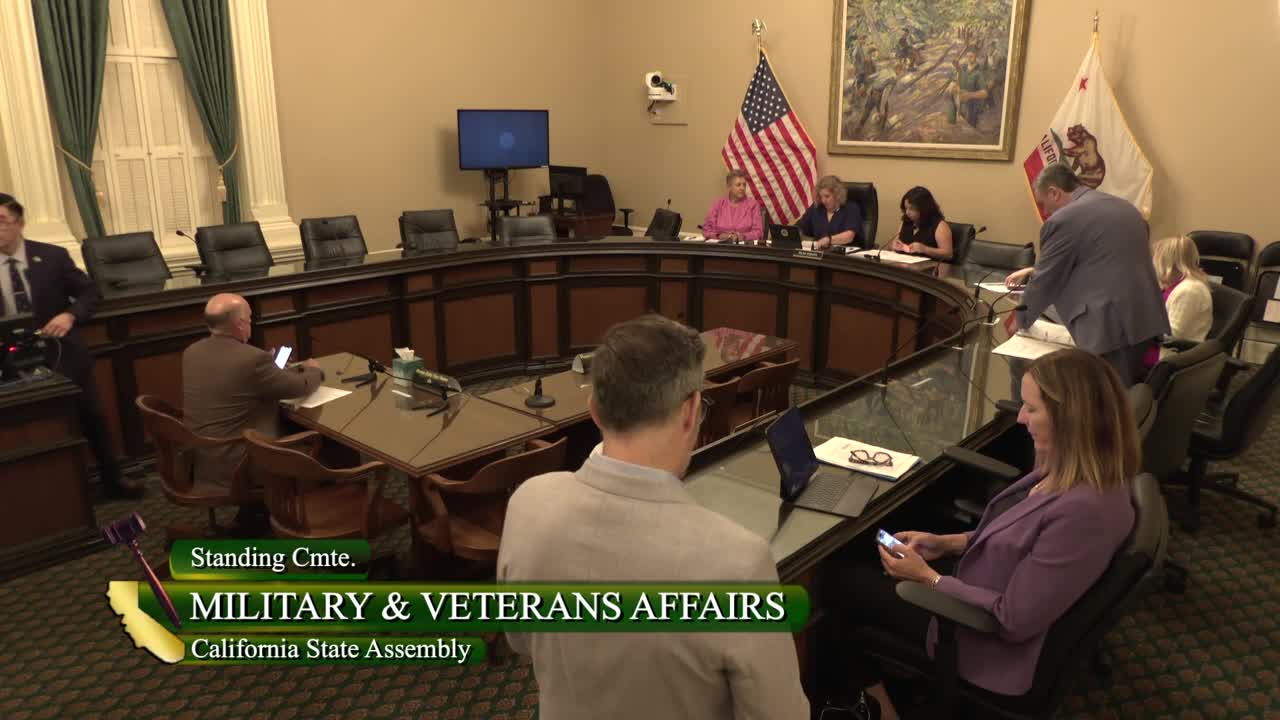 10MIN
Assembly Standing Committee on Military and Veterans Affairs
 6MIN
Senate Standing Committee on Military and Veterans Affairs
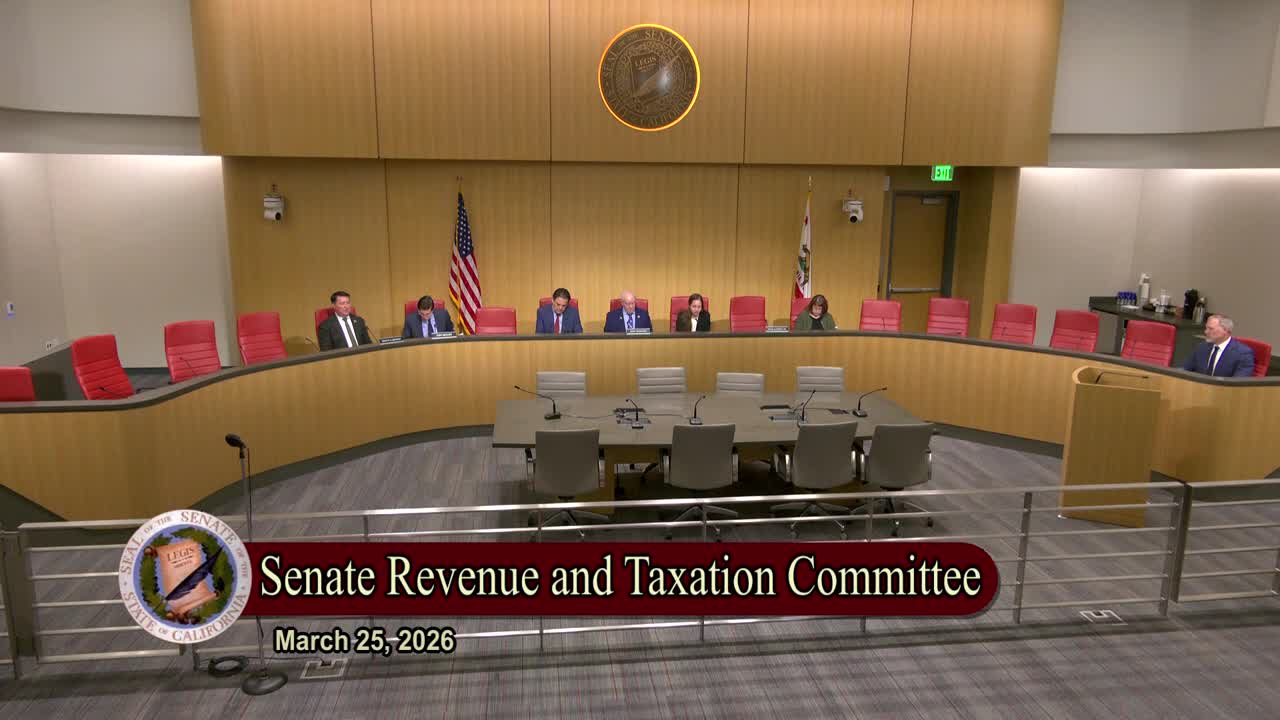 6MIN
Senate Standing Committee on Revenue and Taxation
Bill Author