SCR 82: Public higher education: artificial intelligence usage.
- Session Year: 2025-2026
- House: Senate
- Latest Version Date: 2026-06-11
Current Status:
In Progress
(2026-08-13: August 13 hearing: Held in committee and under submission.)
Introduced
In Committee
Awaiting First Chamber Vote
Passed First Chamber
In Committee
Awaiting Second Chamber Vote
Passed Second Chamber
Enacted
This measure would encourage the President of the University of California, the Chancellor of the California State University, and the Chancellor of the California Community Colleges to create a workgroup of faculty, staff, and administrators to (1) review the use of artificial intelligence in higher education, and (2) create a public report and make public on the strategies and best practices for artificial intelligence usage agreed upon by the workgroup. workgroup within one year following formation of the workgroup, and (3) submit the report to the Legislature and the relevant policy committees of the Legislature with jurisdiction over higher education and privacy and consumer protection.
This measure would encourage the President of the University of California, the Chancellor of the California State University, and the Chancellor of the California Community Colleges to create a workgroup of faculty, staff, and administrators to review the use of artificial intelligence in higher education, and create a report and make public the strategies and best practices for artificial intelligence usage agreed upon by the workgroup.
WHEREAS, The rapid advancement of artificial intelligence presents unprecedented opportunities and challenges for both students and faculty in higher education; and
WHEREAS, The University of California, California State University, and California Community Colleges are leading higher education institutions in California, the nation, and the world that play a pivotal role in shaping the academic landscape and must play an active role in fostering responsible artificial intelligence integration; and
WHEREAS, These three institutions work closely together to ensure academic success for students; and
WHEREAS, The collaboration between these segments is vital to the coordination of student education, services, and outcomes; and
WHEREAS, Understanding how to use artificial intelligence in academic assignments is crucial to creating an environment that values innovation and knowledge while upholding academic honesty and integrity; now, therefore, be it
Resolved by the Senate of the State of California, the Assembly thereof concurring, That the Legislature encourages the President of the University of California, theChancellor the Chancellor of the California State University, and the Chancellor for of the California Community Colleges to create a workgroup of faculty, staff, and administrators to review the use of artificial intelligence in higher education; and be it further
Resolved, That the workgroup should discuss strategies and best practices that lead to the acceptable use of artificial intelligence in higher education while emphasizing academic honesty and ethical academic standards; and be it further
Resolved, That the workgroup should discuss strategies and best practices for acceptable use of artificial intelligence across the three segments of California public higher education; and be it further
Resolved, That the workgroup should discuss strategies and best practices for the use of artificial intelligence in academic studies, including, but not limited to, mitigating plagiarism and plagiarism, ethically using artificial intelligence in academic assignments; assignments, reasonable safeguards to protect student privacy and personal information, ensuring safe and responsible use of artificial intelligence, and mitigating user harm caused by excessive sycophancy and addictive features; and be it further
Resolved, That the workgroup should discuss strategies and best practices for using artificial intelligence as it relates to providing student academic support; and be it further
Resolved, That the workgroup should discuss and strategize on ways to provide professional support to professors on using artificial intelligence in student and faculty work; and be it further
Resolved, That the workgroup should discuss and strategize on ways to provide professional support to professors on recognizing the use of artificial intelligence in student work, including reliable technologies for checking student work, and how to work with students to appropriately inform students when professors believe artificial intelligence was improperly used; and be it further
Resolved, That the workgroup should discuss best practices for responding to violations of artificial intelligence usage standards, with student participation in these discussions for relevant feedback; and be it further
Resolved, That the Legislature encourages the workgroup to collaborate with faculty, administrators, and students at the higher education segments, as well as individuals who work in higher education outside of California and experts in artificial intelligence; and be it further
Resolved, That the Legislature encourages the workgroup to collaborate with liaisons from the statewide associated student bodies of the three segments of California public higher education; and be it further
Resolved, That the Legislature encourages the workgroup to create a public report and make public on the strategies and best practices for artificial intelligence usage agreed upon by the workgroup; workgroup within one year following formation of the workgroup and submit the report to the Legislature and the relevant policy committees of the Legislature with jurisdiction over higher education and privacy and consumer protection; and be it further
Resolved, That the Secretary of the Senate transmit copies of this resolution to chairs of the academic senates at the University of California, the California State University, and the California Community Colleges, and to the author for appropriate distribution.
WHEREAS, The rapid advancement of artificial intelligence presents unprecedented opportunities and challenges for both students and faculty in higher education; and
WHEREAS, The University of California, California State University, and California Community Colleges are leading higher education institutions in California, the nation, and the world that play a pivotal role in shaping the academic landscape and must play an active role in fostering responsible artificial intelligence integration; and
WHEREAS, These three institutions work closely together to ensure academic success for students; and
WHEREAS, The collaboration between these segments is vital to the coordination of student education, services, and outcomes; and
WHEREAS, Understanding how to use artificial intelligence in academic assignments is crucial to creating an environment that values innovation and knowledge while upholding academic honesty and integrity; now, therefore, be it
Resolved by the Senate of the State of California, the Assembly thereof concurring, That the Legislature encourages the President of the University of California, the Chancellor of the California State University, and the Chancellor for the California Community Colleges to create a workgroup of faculty, staff, and administrators to review the use of artificial intelligence in higher education; and be it further
Resolved, That the workgroup should discuss strategies and best practices that lead to the acceptable use of artificial intelligence in higher education while emphasizing academic honesty and ethical academic standards; and be it further
Resolved, That the workgroup should discuss strategies and best practices for acceptable use of artificial intelligence across the three segments of California public higher education; and be it further
Resolved, That the workgroup should discuss strategies and best practices for the use of artificial intelligence in academic studies, including, but not limited to, mitigating plagiarism and ethically using artificial intelligence in academic assignments; and be it further
Resolved, That the workgroup should discuss strategies and best practices for using artificial intelligence as it relates to providing student academic support; and be it further
Resolved, That the workgroup should discuss and strategize on ways to provide professional support to professors on using artificial intelligence in student and faculty work; and be it further
Resolved, That the workgroup should discuss and strategize on ways to provide professional support to professors on recognizing the use of artificial intelligence in student work, including reliable technologies for checking student work, and how to work with students to appropriately inform students when professors believe artificial intelligence was improperly used; and be it further
Resolved, That the workgroup should discuss best practices for responding to violations of artificial intelligence usage standards, with student participation in these discussions for relevant feedback; and be it further
Resolved, That the Legislature encourages the workgroup to collaborate with faculty, administrators, and students at the higher education segments, as well as individuals who work in higher education outside of California and experts in artificial intelligence; and be it further
Resolved, That the Legislature encourages the workgroup to collaborate with liaisons from the statewide associated student bodies of the three segments of California public higher education; and be it further
Resolved, That the Legislature encourages the workgroup to create a report and make public the strategies and best practices for artificial intelligence usage agreed upon by the workgroup; and be it further
Resolved, That the Secretary of the Senate transmit copies of this resolution to chairs of the academic senates at the University of California, the California State University, and the California Community Colleges, and to the author for appropriate distribution.
|
Date
|
Status
|
|---|---|
| Aug 13, 2026 | August 13 hearing: Held in committee and under submission. |
| Aug 5, 2026 | August 5 hearing: Placed on suspense file. |
| Jun 17, 2026 | From committee: Be adopted and re-refer to Com. on APPR. (Ayes 15. Noes 0.) (June 16). Re-referred to Com. on APPR. |
| Jun 11, 2026 | From committee with author's amendments. Read second time and amended. Re-referred to Com. on P. & C.P. |
| Jun 10, 2026 | Coauthors revised. |
| Jun 10, 2026 | From committee: Be adopted and re-refer to Com. on P. & C.P. (Ayes 10. Noes 0.) (June 9). Re-referred to Com. on P. & C.P. |
| Aug 18, 2025 | Referred to Coms. on HIGHER ED. and P. & C.P. |
| Jul 10, 2025 | In Assembly. Held at Desk. |
| Jul 10, 2025 | Read. Adopted. (Ayes 37. Noes 0. Page 2040.) Ordered to the Assembly. |
| Jul 3, 2025 | Read second time. Ordered to consent calendar. |
| Jul 2, 2025 | From committee: Be adopted. Ordered to consent calendar. (Ayes 7. Noes 0. Page 1906.) (July 2). |
| Jun 19, 2025 | Set for hearing July 2. |
| May 28, 2025 | Re-referred to Com. on ED. |
| May 15, 2025 | Introduced. Referred to Com. on RLS. |
|
Date
|
Description
|
Location
|
Votes
|
|
|---|---|---|---|---|
| Jun 16, 2026 | Be adopted and re-referred to the Committee on [Appropriations] | Assembly Standing Committee on Privacy and Consumer Protection |
Passed |
|
| Jun 9, 2026 | Be adopted and re-referred to the Committee on [Privacy and Consumer Protection] | Assembly Standing Committee on Higher Education |
Passed |
|
| Jul 10, 2025 | Consent Calendar 2nd SCR82 Niello | Senate Floor |
Passed |
|
| Jul 2, 2025 | Be adopted and be ordered to the Consent Calendar | Senate Standing Committee on Education |
Passed |
This list shows positions taken on this bill by organizations on the date displayed, which is linked to the original source.
Positions by individuals are not included.
|
Organization
|
Position
|
Date
|
|---|---|---|
| Associated Student of San Francisco State University | ** Support | |
| Associated Students Board of Directors at San Francisco State University | ** Support | |
| Associated Students of San Francisco State University | ** Support |
Date of Hearing: August 5, 2026
ASSEMBLY COMMITTEE ON APPROPRIATIONS
Buffy Wicks, Chair
SBPCA Bill Id:SCR 82
Author:(Niello) – As Amended Ver:June 11, 2026
Policy Committee: | Higher Education | Vote: | 10 - 0 |
Privacy and Consumer Protection | 15 - 0 | ||
|
|
Urgency: State Mandated Local Program: Reimbursable: No
SUMMARY:
This measure encourages the President of the University of California (UC), the Chancellor of the California State University (CSU), and the Chancellor of the California Community Colleges (CCCCO) to create a workgroup to review artificial intelligence (AI) use in higher education.
Specifically, the measure prescribes that the workgroup includes faculty, staff, and administrators, and that workgroup members discuss strategies and best practices for AI use in public higher education, including but not limited to ethical use for assignments with reasonable safeguards to protect student privacy and mitigate plagiarism. The measure also encourages the workgroup to create a public report regarding the agreed upon strategies and best practices within one year of the workgroup’s formation and submit the report to the Legislature.
FISCAL EFFECT:
Cost pressures of an unknown, potentially significant amount, possibly in the low-to-mid hundreds of thousands of dollars (General Fund and Proposition 98 General Fund), for the public higher education segments collectively to form the workgroup encouraged by this measure and write the required report.
Regardless of cost, consistent with committee rules and practice, the bill is a candidate for the suspense file as its primary purpose is to create a workgroup and a report.
COMMENTS:
- Purpose. According to the author:
While each institution is working on the issue on their own, it is imperative they be communicating as a group due to California’s connected system. SCR 82 encourages dialogue amongst the CA higher education systems to help promote the best approaches in teaching, as well as regulations around the allowable usage AI. This is important not only for the student, but also faculty who are in uncharted waters. Convening a workgroup is in the best interest of all parties involved to work towards clear guidelines for usage.
- Background. Each of California’s public higher education segments—CSU, UC, and CCC—have established AI-related working groups and initiatives. Most notably, the CSU, February 2025, announced its AI-Empowered Initiative to “leverage the power of artificial intelligence to create an AI-empowered higher education system that could surpass any existing model in both scale and impact.” However, significant concerns arose, such as those raised by the California State Student Association (CSS), regarding rushed and inconsistent implementation, a lack of adequate training and awareness, and privacy, transparency, sustainability, and governance. Additionally, currently there exists no inter-segmental workgroup related to the use of AI in higher education.
According to the Associated Students of San Francisco State University, writing in support of this measure:
As students, we believe SCR82 is necessary because it will help intersegmental leaders gain a better understanding about how the use of artificial intelligence will be utilized and implemented into higher education, with a focus on AI literacy, ethics, and best practice usage.
The use of AI has impacted students in the CSU and has raised a variety of questions and concerns such as environmental responsibility, academic integrity, transparency and critical thinking skills. In light of the CSU’s $17 million partnership with Open AI – an immense investment in AI during a time of faculty layoffs and financial strain makes the role of this workforce even more essential.
- Related Legislation. AB 2392 (Fong), of the current legislative session, requires the CCC and CSU, and requests the UC, to convene a joint working group to develop responsible GenAI training and procurement standards and present its recommendations, by January 1, 2028, to the respective public higher education system leaders. AB 2392 is pending hearing in the Senate Appropriations Committee.
Analysis Prepared by: Aaron Heredia / APPR. / (916) 319-2081
Date of Hearing:
Fiscal:
ASSEMBLY COMMITTEE ON PRIVACY AND CONSUMER PROTECTION
Rebecca Bauer-Kahan, Chair
SBPCA Bill Id:SCR 82
Author:(Niello) – As Amended Ver:June 11, 2026
SENATE VOTE: 37-0
SUBJECT: Public higher education: artificial intelligence usage
SYNOPSIS
Artificial intelligence (AI) has revolutionized many aspects of daily life. In higher education, generative AI systems like ChatGPT have shifted the ways in which learning and schoolwork is performed. Despite the near ubiquity of AI, best practices and guidelines for AI use in education are fragmented across different institutions, leading to a patchwork response that can significantly hamper student success in the evolving workforce.
To address these concerns, this author-sponsored measure encourages the leaders of the University of California (UC), California State University (CSU), and California Community Colleges to convene a workgroup to discuss best practices and strategies for AI use and deployment across the public institutions. The workgroup is asked to create a final report, to be made available to the public, detailing their strategies and best practices. Recent amendments request the workgroup to distribute the report within one year of the formation of the workgroup to the Legislature and relevant policy committees. Additionally, the amendments encourage the workgroup to consider strategies and best practices to protect student privacy, ensure safe and responsible use of AI, and mitigate user harm caused by excessive AI sycophancy and addictive features.
The measure is supported by the Associated Students Board of Directors at San Francisco State University. The measure has no registered opposition.
This measure was previously heard in the Higher Education Committee where it passed on a 10-0 vote.
EXISTING LAW:
- Establishes the California State University (CSU), under the administration of the Trustees of the CSU, the University of California (UC), under the administration of the Regents of the UC, the California Community Colleges, under the administration of the Board of Governors of the California Community Colleges, and independent institutions of higher education as four segments of postsecondary education in the state. (Ed. Code §§ 66010, 70900, 66600, and Cal. Const. art. IX, § 9.)
- Defines “artificial intelligence” or “AI” to mean an engineered or machine-based system that varies in its level of autonomy and that can, for explicit or implicit objectives, infer from the input it receives how to generate outputs that can influence physical or virtual environments. (Gov. Code § 11546.45.5.)
- Requires the Superintendent of Public Instruction to convene a working group on AI, and requires that working group to develop expanded guidance and a model policy on AI for use by local educational agencies. (Ed. Code § 33328.5.)
- Requires the Secretary of Government Operations, upon appropriation by the Legislature, to evaluate, among other things, the impact that the proliferation of deepfakes has on state government, California-based businesses, and residents of the state, and the risks, including privacy risks, associated with the deployment of digital content forgery technologies and deepfakes on state and local government, California-based businesses, and residents of the state. (Gov. Code § 11547.5 et seq.)
THIS MEASURE:
- States the following:
- Rapid advancements in artificial intelligence present unprecedented opportunities and challenges for both students and faculty in higher education.
- The University of California, California State University, and California Community Colleges lead higher education institutions across the state and the nation and must play a pivotal role in fostering responsible artificial intelligence integration.
- Collaboration across the three institutions, that already work closely together, is vital to the coordination of student education, services, and outcomes.
- Understanding how to use artificial intelligence in academic assignments is crucial to creating an environment that values innovation and knowledge while upholding academic honesty and integrity.
- Encourages the President of the University of California, the Chancellor of the California State University, and the Chancellor for the California Community Colleges to create a workgroup of faculty, staff, and administrators to review the use of artificial intelligence in higher education.
- Resolves that the workgroup should do all of the following:
- Discuss strategies and best practices that lead to the acceptable use of artificial intelligence in higher education while emphasizing academic honesty and ethical academic standards;
- Discuss strategies and best practices for acceptable use of artificial intelligence across the three segments of California public higher education;
- Discuss strategies and best practices for the use of artificial intelligence in academic studies, including, but not limited to, mitigating plagiarism, ethically using artificial intelligence in academic assignments, and reasonable safeguards to protect student privacy and personal information;
- Discuss strategies and best practices for using artificial intelligence as it relates to providing student academic support;
- Discuss and strategize on ways to provide professional support to professors on using artificial intelligence in student and faculty work;
- Discuss and strategize on ways to provide professional support to professors on recognizing the use of artificial intelligence in student work, including reliable technologies for checking student work, and how to work with students to appropriately inform students when professors believe artificial intelligence was improperly used; and,
- Discuss best practices for responding to violations of artificial intelligence usage standards, with student participation in these discussions for relevant feedback.
- Encourages the workgroup to do all of the following:
- Collaborate with faculty, administrators, and students at the higher education segments, as well as individuals who work in higher education outside of California and experts in artificial intelligence;
- Collaborate with liaisons from the statewide associated student bodies of the three segments of California public higher education; and,
- Create a public report of the strategies and best practices for artificial intelligence usage agreed upon by the workgroup within one year following the formation of the workgroup and submit the report to the Legislature and relevant policy committees of the Legislature with jurisdiction over higher education and privacy and consumer protection.
COMMENTS:
1) Author’s statement. According to the author:
As we know, Artificial Intelligence (AI) is an emerging technology. The Legislature is working diligently on how California can be at the forefront of using AI, and that includes thinking through the impact this technology is having on our daily lives and how that may need to be limited in some instances. In the case of higher education, it is important to discuss the impact and best practices to be sure students can thrive in their educational journeys. Since AI can be used to do almost anything, including helping students cheat by allowing the student to pass off work created by AI as their own, it is vital our education systems are prepared and communicating on how to deal with these situations.
In addition, professors/faculty are on the front lines trying to assess student mastery of the subject, and many are having a hard time catching work that was created by AI. In some classes, the use of AI is encouraged, while in others it is punished. It is time that they have access to the best practices and tools that will help ensure that students are applying what they learned in the classroom, and not just copying and pasting what an AI bot wrote for them.
While each institution is working on the issue on their own, it is imperative they be communicating as a group due to California’s connected system. SCR 82 encourages dialogue amongst the CA higher education systems to help promote the best approaches in teaching, as well as regulations around the allowable usage AI. This is important not only for the student, but also faculty who are in uncharted waters. Convening a workgroup is in the best interest of all parties involved to work towards clear guidelines for usage.
2) Artificial intelligence in education. AI, and specifically generative AI (GenAI), is already drastically altering the modalities of modern life. Since ChatGPT’s launch in 2022, the use of GenAI chatbots has skyrocketed, with one report suggesting that roughly 115 million to 180 million people use GenAI daily.[1] A report published by the College Board in 2025 found that 84 percent of high school students use GenAI for schoolwork, predominantly as a source of information and answers.[2] This is a sharp increase from two years prior in 2023, when a Pew Survey found that just 13 percent of teens were using ChatGPT for schoolwork.[3] Despite the widespread adoption of GenAI tools, many students and teachers still demonstrate apprehension surrounding the utility of the tool, with roughly half of all high school students surveyed falling neutral on whether they believe that the benefits of using AI outweigh the risks.[4] Despite lingering questions regarding the benefits of GenAI tools, universities and workforces have begun to deploy these systems as tools to support learning and productivity. Students and faculty, therefore, must quickly develop AI literacy to adapt to the changing landscapes, and need appropriate guidance to navigate these systems.
3) Existing workgroups and initiatives in higher education. Separately, the UC, CSU, and California Community Colleges have undertaken several AI-related initiatives. In 2020, the UC convened the “UC Presidential Working Group on Artificial Intelligence,” which issued a final report in 2021 titled “Responsible Artificial Intelligence: Recommendations to Guide the University of California’s Artificial Intelligence Strategy.”[5] The final report made several recommendations, including institutionalizing the UC Responsible AI Principles in procurement and oversight practices, establishing campus-level councils and systemwide coordination through the UC Office of the President, developing a risk and impact assessment strategy, and documenting AI-enabled technologies in a public database.[6]
In 2024, the UC Academic Senate Workgroup on Artificial Intelligence was formed and tasked with surveying the use of AI in “admissions, teaching, and research, alongside issues of faculty workload and welfare.”[7] The resulting report, released in January 2026, highlighted three core principles for developing recommendations for AI use: faculty agency and shared decision-making in incorporating AI into teaching and research; adaptability and flexibility in adopting AI policies and practices; and responsible data stewardship through attention to transparency, data privacy, and data ownership.[8]
CSU launched their AI-Empowered Initiative in 2025 that established partnerships with some of the world’s leading tech companies and deployed a campuswide AI tool developed by OpenAI – ChatGPT Edu – that would enable “students, faculty, and staff to use AI to accelerate learning, optimize workflow efficiency, and foster cross-departmental collaboration.”[9]
A year after announcing the AI Initiative, CSU conducted a systemwide survey of over 75,000 individuals about students and faculty’s feelings about the initiative. Despite the nearly $17 million spent on the initiative, students felt the implementation was rushed, inconsistent, and lacked adequate training and awareness.[10] Many students appeared unaware of the tool or unsure how to use it, and students noted a lack of unified guidance across classrooms, leading to confusion about acceptable AI use. Additionally, conflicting faculty approaches, with some encouraging AI while others forbade its uses, exacerbated student confusion and apprehension of the tools.[11] Given these widespread concerns, over half of students – and over 70 percent of faculty – wanted formal training on AI tools.[12]
The California Community Colleges, in alignment with Vision 2030, established the Digital Center for Innovation, Transformation, and Equity, a systemwide hub that serves to provide hands-on professional learning to advance AI literacy and experimentation to address evolving workforce demands.[13] Housed within the Digital Center for Innovation, Transformation, and Equity is the Play Lab Pilot, a systemwide professional learning initiative that supports faculty and staff in “developing practical, educator-led approaches to AI literacy through hands-on design and implementation.”[14] Since its pilot launch in 2024, over 400 faculty and staff have participated in Play Lab’s training on developing AI tools.[15]
In 2024, California’s Education Learning Lab launched their AI Grand Challenge: Leveraging AI for Teaching and Learning grant program, which aimed to foster innovation in AI use to enhance curriculum and learning within California’s higher education system. Nearly 75 institutions across the California Community Colleges, CSU, and UC systems applied, and five projects were selected to receive grants of up to $1.5 million each.[16] These projects strive to promote equitable learning through AI to improve academic writing and performance in science, technology, engineering, and math (STEM) disciplines.[17]
4) What this measure would do. Despite widespread deployment of AI tools in higher education, there is currently little collaboration across public systems regarding best practices for AI use for education. This resolution encourages the UC President, the CSU Chancellor, and the California Community Colleges Chancellor to create a workgroup of faculty, staff, and administrators to review the use of AI in higher education. Specifically, this resolution asks the leaders of the three segments of California public higher education to discuss strategies and best practices for AI in academic studies, including how to mitigate plagiarism, teaching ethical use of AI, enforcing data privacy and good data stewardship, providing professional support to professors, and developing protocols to respond to violations in the AI usage standards. The resolution asks the workgroup to develop a report and make public the strategies and best practices for AI usage to be distributed to the Legislature and relevant policy committees.
ARGUMENTS IN SUPPORT: The Associated Students Board of Directors at San Francisco State University, write in support:
As the official voice of students at San Francisco State University, we support SCR82 as it will help create a workgroup for educators, staff and administrators on the best practices to use artificial intelligence.
We see this workgroup as a vital complement to the Systemwide CSU Generative AI Committee and the Chancellor’s Office AI Course workgroup, ensuring that faculty, staff, administrators, and student representatives are involved in shared decision making.
As students, we believe SCR82 is necessary because it will help intersegmental leaders gain a better understanding about how the use of artificial intelligence will be utilized and implemented into higher education, with a focus on AI literacy, ethics, and best practice usage.
The use of AI has impacted students in the CSU and has raised a variety of questions and concerns such as environmental responsibility, academic integrity, transparency and critical thinking skills. In light of the CSU’s $17 million partnership with Open AI – an immense investment in AI during a time of faculty layoffs and financial strain makes the role of this workforce even more essential.
Ensuring awareness and promoting clearer communication on the different ways AI will be implemented throughout the CSU is important to reducing confusion and making sure students know how these tools are used.
REGISTERED SUPPORT / OPPOSITION:
Support
Associated Student of San Francisco State University
Opposition
None on file.
Analysis Prepared by: Kate Davis / P. & C.P. / (916) 319-2200
Andres, Guadamuz, “How many people are using generative AI on a daily basis? A Gemini report,” (Apr 14, 2025), https://www.technollama.co.uk/a-gemini-report-how-many-people-are-using-generative-ai-on-a-daily-basis-a-gemini-report. ↑
Alexandra Adair et al., “U.S. High School Students’ Use of Generative Artificial Intelligence ,” College Board Research, (Oct. 2025), https://research.collegeboard.org/technology-learning. ↑
Olivia Sidoti & J. Gottfried, “About 1 in 5 U.S. teens who’ve heard of ChatGPT have used it for schoolwork,” Pew Research Center, (Nov. 16, 2023), https://www.pewresearch.org/short-reads/2023/11/16/about-1-in-5-us-teens-whove-heard-of-chatgpt-have-used-it-for-schoolwork/. ↑
Adair et al., “High School Students’ Use of GenAI.” ↑
University of California Presidential Working Group on Artificial Intelligence, “Presidential Working Group on Artificial Intelligence,” (Oct. 2021), https://www.ucop.edu/ethics-compliance-audit-services/compliance/presidential-working-group-on-artificial-intelligence.html. ↑
Id, p. 5-6. ↑
“UC Academic Senate Workgroup on Artificial Intelligence,” (Jan. 5, 2026), p. 1, 2https://senate.universityofcalifornia.edu/committees/ai-workgroup/index.html. ↑
Id, p. 2-3. ↑
“CSU Announces Landmark Initiative to Become Nation’s First and Largest AI-Empowered University System,” The California State University, (Feb. 4, 2025), https://www.calstate.edu/csu-system/news/Pages/CSU-AI-Powered-Initiative.aspx. ↑
“CSU Students’ Response to the CSU AI Initiative,” California State Student Association, (Feb. 24, 2026), https://calstatestudents.org/cssas-white-paper-on-csus-ai-initiative/. ↑
“CSU Students’ Response to CSU AI Initiative.” ↑
Jaweed Kaleem, “A $17-million bet brought ChatGPT to CSU campuses. A year later, AI distrust leaves many divided,” Los Angeles Times, (Apr. 1, 2026), https://www.latimes.com/california/story/2026-04-01/csu-ai-survey-students-faculty. ↑
“Digital Center for Innovation, Transformation, and Equity,” California Community Colleges Chancellor’s Office, https://ai.cccco.edu/initiative/digital-center/. ↑
California Community Colleges Chancellor’s Office, “Playlab Pilot,” https://ai.cccco.edu/initiative/playlab-pilot/. ↑
Ibid. ↑
California Education Learning Lab, “2024-25 RFP: AI Grand Challenge Grant Awards Announced,” (Nov. 20, 2024), https://calearninglab.org/2024/11/20/ai-grand-award-announcements/. ↑
Ibid. ↑
Date of Hearing: June 9, 2026
ASSEMBLY COMMITTEE ON HIGHER EDUCATION
Mike Fong, Chair
SBPCA Bill Id:SCR 82
Author:(Niello) – As Introduced Ver:May 15, 2025
SENATE VOTE: 37-0
SUBJECT: Public higher education: artificial intelligence usage
SUMMARY: Encourages the President of the University of California (UC), the Chancellor of the California State University (CSU), and the Chancellor of the California Community Colleges (CCC) to create a workgroup of faculty, staff, and administrators to review the use of artificial intelligence (AI) in higher education. Specifically, this bill:
- Encourages the President of UC, the Chancellor of CSU, and the Chancellor for the CCCs to create a workgroup of faculty, staff, and administrators to review the use of AI in higher education.
- Resolves that the workgroup should do all of the following:
- Discuss strategies and best practices that lead to the acceptable use of AI in higher education while emphasizing academic honesty and ethical academic standards;
- Discuss strategies and best practices for acceptable use of AI across the three segments of California public higher education;
- Discuss strategies and best practices for the use of AI in academic studies, including, but not limited to, mitigating plagiarism and ethically using AI in academic assignments;
- Discuss strategies and best practices for using AI as it relates to providing student academic support;
- Discuss and strategize on ways to provide professional support to professors on using AI in student and faculty work;
- Discuss and strategize on ways to provide professional support to professors on recognizing the use of AI in student work, including reliable technologies for checking student work, and how to work with students to appropriately inform students when professors believe AI was improperly used; and,
- Discuss best practices for responding to violations of AI usage standards, with student participation in these discussions for relevant feedback.
- Encourages the workgroup to do all of the following:
- Collaborate with faculty, administrators, and students at the higher education segments, as well as individuals who work in higher education outside of California and experts in AI;
- Collaborate with liaisons from the statewide associated student bodies of the three segments of California public higher education; and,
- Create a report and make public the strategies and best practices for AI usage agreed upon by the workgroup.
EXISTING LAW:
- Establishes the CSU, under the administration of the Trustees of the CSU, the University of California (UC), under the administration of the Regents of the UC, the California Community Colleges (CCC), under the administration of the Board of Governors of the CCC, and independent institutions of higher education as four segments of postsecondary education in the state. (Education Code (EDC) Sections 66010, 70900, 66600, and California Constitution, Article IX, Section 9)
- Defines “artificial intelligence” or “AI” to mean an engineered or machine-based system that
varies in its level of autonomy and that can, for explicit or implicit objectives, infer from the
input it receives how to generate outputs that can influence physical or virtual environments.
(Government Code Section 11546.45.5)
- Defines “GenAI” or “generative artificial intelligence” to mean an artificial intelligence
system that can generate derived synthetic content, including text, images, video, and audio
that emulates the structure and characteristics of the system’s training data. (Government Code Section 11549.64(b).)
- Requires the Superintendent of Public Instruction (SPI) to convene a working group on AI, and requires that working group to develop expanded guidance and a model policy on AI for use by local educational agencies (LEAs). (EDC Section 33328.5)
- Requires the Secretary of Government Operations, upon appropriation by the Legislature, to evaluate, among other things, the impact the proliferation of deepfakes has on state government, California-based businesses, and residents of the state, and the risks, including privacy risks, associated with the deployment of digital content forgery technologies and deepfakes on state and local government, California-based businesses, and residents of the state. (Government Code Section 11547.5 et seq.)
FISCAL EFFECT: This Resolution is keyed non-fiscal.
COMMENTS: Purpose. According to the author, “as we know, [AI] is an emerging technology. The Legislature is working diligently on how California can be at the forefront of using AI, and that includes thinking through the impact this technology is having on our daily lives and how that may need to be limited in some instances. In the case of higher education, it is important to discuss the impact and best practices to be sure students can thrive in their educational journeys. Since AI can be used to do almost anything, including helping students cheat by allowing the student to pass off work created by AI as their own, it is vital our education systems are prepared and communicating on how to deal with these situations.
The author continues that, “in addition, professors/faculty are on the front lines trying to assess student mastery of the subject, and many are having a hard time catching work that was created by AI. In some classes, the use of AI is encouraged, while in others it is punished. It is time that they have access to the best practices and tools that will help ensure that students are applying what they learned in the classroom, and not just copying and pasting what an AI bot wrote for them. While each institution is working on the issue on their own, it is imperative they be communicating as a group due to California’s connected system. SCR 82 encourages dialogue amongst the CA higher education systems to help promote the best approaches in teaching, as well as regulations around the allowable usage AI. This is important not only for the student, but also faculty who are in uncharted waters. Convening a workgroup is in the best interest of all parties involved to work towards clear guidelines for usage.”
AI in Higher Education background. AI refers broadly to computer systems designed to perform tasks that typically require human intelligence — such as understanding language, generating text, writing code, or analyzing data. While AI has existed as a field of research for decades, recent advances in "generative AI" - tools like ChatGPT, Google Gemini, and others that can generate human-like text, images, and other content in response to user prompts - have brought the technology into everyday use at unprecedented speed. According to Stanford University's AI Index 2026 Annual Report, a comprehensive, independently sourced annual assessment of global AI trends, generative AI reached approximately 53% population-level adoption within just three years of its introduction — a pace faster than the adoption of the personal computer or the internet. Globally, organizational adoption of AI tools reached 88% in 2025, and the estimated value of generative AI tools to U.S. consumers reached $172 billion annually by early 2026.
Higher education has been one of the most visible arenas for AI's rapid adoption. The Stanford report found that four out of five U.S. high school and college students now use AI for school-related tasks, and that usage in higher education reached approximately 67% in the United States and 67% in the United Kingdom — with some countries, such as Indonesia and Malaysia, reporting usage above 80% among university students. The most common uses among university students include research, brainstorming, editing essays, and — most notably — understanding academic concepts. A separate analysis by Anthropic, cited in the Stanford report, found that students primarily use AI for higher-order thinking tasks: 39.8% for creating content and 30.2% for analysis. At the same time, the report cautions that students themselves have concerns — a survey referenced in the Stanford report found that 55% of U.S. college students believe generative AI tools have had a mixed effect on their critical thinking skills.
California's higher education segments has been navigating these trends. In April 2026, the CSU released findings from its first-ever systemwide AI survey, Ahead of the Curve, drawing on more than 94,000 responses from students, faculty, and staff — the largest survey of its kind in higher education to date. The survey found that AI use is already widespread across the CSU community, with most students, faculty, and staff reporting regular engagement with AI tools, alongside near-universal exposure to at least one AI tool. At the same time, respondents expressed a cautious approach: while many see AI as essential to future careers, they also emphasized the need for verification, ethical guidelines, and transparency. There is strong demand for formal AI training - especially among faculty and staff—and notable concern about job security and academic integrity. Importantly, most students reported discomfort with submitting AI-generated work as their own, and many faculty are actively incorporating AI guidance into their teaching, signaling a shift toward structured, responsible adoption rather than unrestricted use.
Existing workgroups and initiatives. The UC, CSU, and CCCs have each undertaken AI-related initiatives. Examples include:
- The UC convened the “UC Presidential Working Group on Artificial Intelligence” in 2020, which issued a final report in 2021 titled “Responsible Artificial Intelligence: Recommendations to Guide the University of California’s Artificial Intelligence Strategy.” The recommendations included in this final report include:
- Institutionalize the UC Responsible AI Principles in procurement, development, implementation, and monitoring practices;
- Establish campus-level councils and support coordination across UC that will further the principles and guidance developed by this Working Group;
- Develop an AI risk and impact assessment strategy; and,
- Document AI-enabled technologies in a public database.
- As part of their AI-Empowered Initiative, the CSU announced in February 2025 that it would be using a comprehensive strategy, which included an AI Workforce Acceleration Board. The CSU Board of Trustees Joint Committee on Educational Policy & Finance presented the CSU Artificial Intelligence Strategy during the Board’s January 2025 meeting. The Academic Senate of the CSU called for a working group on AI in higher education in 2023, and has passed subsequent resolutions regarding AI in 2024 and 2025.
- The CCC has established the Digital Center for Innovation, Transformation and Equity to represent a strategic approach to supporting the CCC’s Vision 2030, including leading in innovation, harnessing the power of generative AI, public and private technology partnerships, and transforming the CCC’s ability to serve students as they move into an AI- powered workforce.
Additionally, in November 2024, the California Education Learning Lab announced the recipients of the “AI Grand Challenge: Leveraging AI for Teaching and Learning” grants, aimed at fostering innovation in the use of AI to enhance curriculum and pedagogy within California’s public higher education system. Nearly 75 institutions from the CCC, CSU and UC systems submitted 32 proposals. Five projects have been selected to receive grants of up to $1.5 million each. The Foundation for California Community Colleges is administering the grants on behalf of the State. The awarded projects aim to create significant influence on teaching and learning experiences statewide and will strive to reach approximately 150,000 students and 13,500 faculty/instructors across California’s public higher education institutions and beyond.
CSU AI-Empowered Initiative. On February 4th, 2025, the CSU system announced their AI-Empowered Initiative. In their press release, the CSU indicated that their goal was to “leverage the power of artificial intelligence to create an AI-empowered higher education system that could surpass any existing model in both scale and impact.” Among the various elements of this initiative included the systemwide deployment of an AI tool developed by OpenAI - ChatGPT Edu – that would enable “…students, faculty, and staff to use AI to accelerate learning, optimize workflow efficiency, and foster cross-departmental collaboration.” The contract for ChatGPT Edu $16.9 million, and runs from February 2025 through July 2026.
Although “ChatGPT” has become a somewhat ubiquitous term for generative AI tools, many different technology companies have deployed AI products that are now embedded in common e-mail, word processing, and document production systems. An element of CSU’s AI-Empowered Initiative also highlights partnerships with some world’s leading tech companies, including Adobe, Alphabet (Google), AWS, IBM, Instructure, Intel, LinkedIn, Microsoft, and NVIDIA, in addition to OpenAI.
Student response. The California State Student Association (CSSA) released a whitepaper regarding the CSU’s AI-Empowered Initiative on February 24th, 2026. The whitepaper noted that, while students broadly recognize AI’s potential to enhance creativity and learning, the implementation has been rushed, inconsistent, and lacking adequate training and awareness. Many students are unaware of the tool or unsure how to use it, and there is no unified guidance across classrooms, leading to confusion about acceptable AI use. This inconsistency is compounded by conflicting faculty approaches—some encourage AI while others penalize it—along with unreliable AI-detection tools that have led to false accusations and increased anxiety.
Beyond implementation challenges, the whitepaper highlights major concerns about privacy, transparency, sustainability, and governance. Students worry about how their data is collected and used, expressing distrust in the AI system despite the availability of an official platform. Students also question the financial transparency of the initiative and its alignment with broader CSU budget cuts. Environmental concerns are prominent as well, with many students criticizing the lack of attention to AI’s energy and water consumption and its conflict with CSU’s climate goals.
Additionally, the paper raises ethical and mental health concerns, including risks from harmful AI outputs and overreliance on the technology. Across all areas, a central theme emerges: students have felt excluded from decision-making and call for greater oversight, clearer policies, and consistent inclusion in governance to ensure AI is implemented responsibly, ethically, and in alignment with student needs.
Arguments in support. The Associated Students of San Francisco State University wrote in support, nothing that “…we see this workgroup as a vital complement to the Systemwide CSU Generative AI Committee and the Chancellor’s Office AI Course workgroup, ensuring that faculty, staff, administrators, and student representatives are involved in shared decision making. As students, we believe SCR 82 is necessary because it will help intersegmental leaders gain a better understanding about how the use of artificial intelligence will be utilized and implemented into higher education, with a focus on AI literacy, ethics, and best practice usage.”
The Associated Students also wrote that “…the use of AI has impacted students in the CSU and has raised a variety of questions and concerns such as environmental responsibility, academic integrity, transparency and critical thinking skills. In light of the CSU’s $17 million partnership with Open AI – an immense investment in AI during a time of faculty layoffs and financial strain makes the role of this workforce even more essential. Ensuring awareness and promoting clearer communication on the different ways AI will be implemented throughout the CSU is important to reducing confusion and making sure students know how these tools are used.”
Committee comments. Committee staff notes that there is no inter-segmental workgroup related to the use of AI in higher education. This resolution encourages the UC President, the CSU Chancellor, and the CCC Chancellor to create a workgroup of faculty, staff, and administrators to review the use of AI in higher education.
In 2025 the Governor signed AB 1098 (Fong & Padilla), Chapter 446, Statutes of 2025, establishing the California Education Interagency Council (Council) within the Government Operations Agency to align education and workforce systems, support adult skill development, and address the changing nature of work and the economy. The language of AB 1098 (Fong) specifically states that the Council was created to increase “collaboration across postsecondary education” and to be a “a forum for communication to discuss the impacts of proposed intersegmental and cross-sector issues.”
Moving forward, the Committee may wish to consider how the Council can convene and collaborate with stakeholders on intersegmental policy issues like the AI working group proposed by this resolution.
Committee staff also notes that AB 2392 (Fong) was developed following an August 26, 2025, Joint Oversight Hearing between the Assembly Committee on Higer Education and the Assembly Committee on Privacy and Consumer Affairs exploring the CSU’s AI-Empowered Initiative. AB 2392 (Fong) contains provisions that would require the CCC, CSU, and request the UC to jointly convene a working group to develop responsible standards for GenAI training and procurement before providing a GenAI system to students, faculty, or staff. The language of SCR 82 (Niello) appears to compliment those efforts and highlights the importance of intersegmental collaboration.
REGISTERED SUPPORT / OPPOSITION:
Support
Associated Student of San Francisco State University
Opposition
None on file
Analysis Prepared by: Kevin J. Powers / HIGHER ED. / (916) 319-3960
Discussed in Hearing
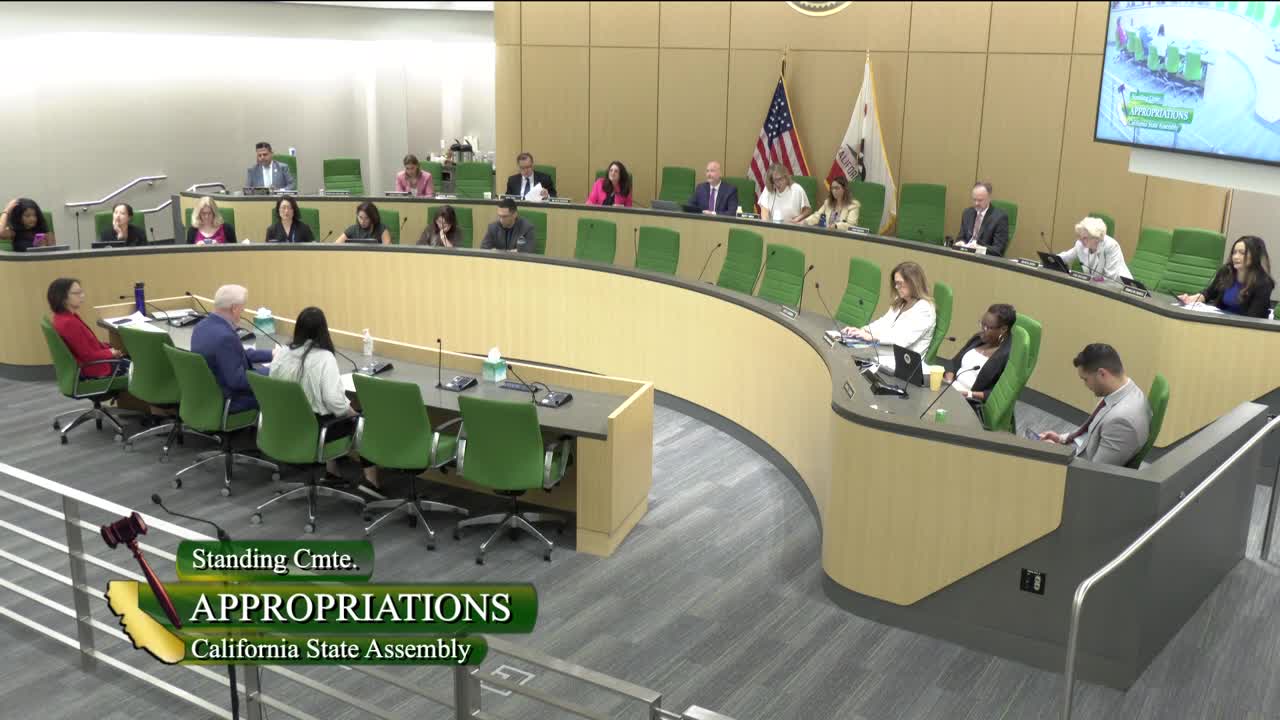 35SEC
Assembly Standing Committee on Appropriations
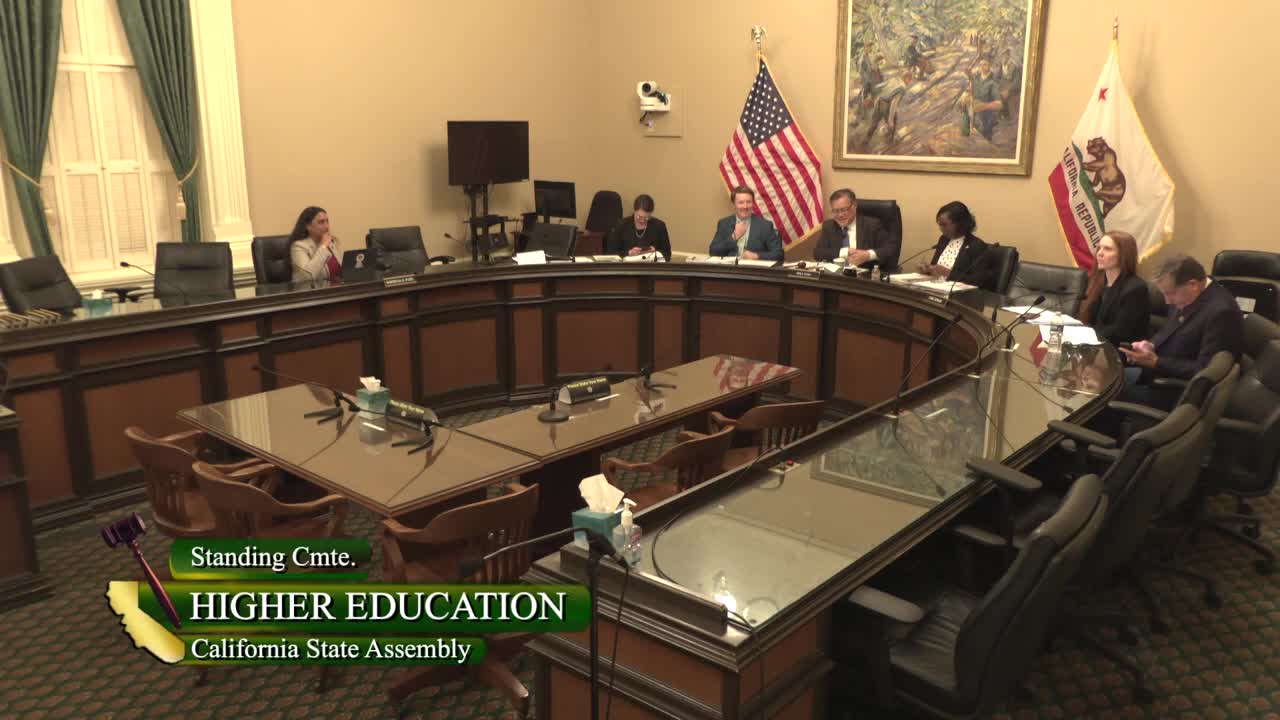 9MIN
Assembly Standing Committee on Higher Education
Bill Author