SB 494: Charter schools: establishment prohibition and renewal procedures.
- Session Year: 2025-2026
- House: Senate
- Latest Version Date: 2025-09-09
Current Status:
In Progress
(2025-09-13: Ordered to inactive file on request of Assembly Member Aguiar-Curry.)
Introduced
In Committee
Awaiting First Chamber Vote
Passed First Chamber
In Committee
Awaiting Second Chamber Vote
Passed Second Chamber
Enacted
(1)Existing law, the Charter Schools Act of 1992, authorizes the establishment, operation, and governance of charter schools. Existing law authorizes a charter school that has an approved charter to receive funding for nonclassroom-based instruction only if a determination for funding is made by the State Board of Education, as specified. The act prohibits, from January 1, 2020, to January 1, 2026, inclusive, the approval of a petition for the establishment of a new charter school offering nonclassroom-based instruction, as specified.
This bill would extend that prohibition to continue through January 1, 2027.
(2)Existing law, until January 1, 2026, sets out performance standards and procedures for the renewal of the charter of an existing charter school, including, among other things, the use of verified data, as provided. Existing law sets out revised standards and procedures that are operative on and after January 1, 2026, that, among other things, no longer requires a chartering authority to use verified data and instead requires a chartering authority to use only the data reported on the California School Dashboard in making a renewal decision, as provided.
This bill would extend, until January 1, 2027, the operation of the performance standards and procedures for the renewal of charter schools that would otherwise be inoperative on January 1, 2026, and would delay the operation of the revised standards and procedures until January 1, 2027. To the extent the bill imposes new duties on local educational agencies acting as chartering authorities, the bill would impose a state-mandated local program.
(3)The California Constitution requires the state to reimburse local agencies and school districts for certain costs mandated by the state. Statutory provisions establish procedures for making that reimbursement.
This bill would provide that, if the Commission on State Mandates determines that the bill contains costs mandated by the state, reimbursement for those costs shall be made pursuant to the statutory provisions noted above.
(1)Existing law requires the governing board of a school district to employ persons for positions not requiring certification qualifications and the governing board of a community college district to employ persons for positions that are not academic positions. Existing law requires the governing board of a school district or community college district to classify those employees and positions and requires that they be known as the classified service. Existing law requires the governing board of a school district or community college district to prescribe written rules and regulations governing the personnel management of the classified service whereby classified employees are designated as permanent employees after serving a prescribed period of probation. Existing law subjects a permanent classified employee to disciplinary action only for cause, as prescribed by rule or regulation of the governing board of the school district or community college district. Existing law requires the governing board of a school district or community college district to adopt rules of procedure for disciplinary proceedings that contain a provision for informing the employee by written notice of the specific charges against the employee, a statement of the employees right to a hearing on those charges, and the time within which the hearing may be requested that shall not be less than 5 days after service of notice to the employee, as provided.This bill would instead require the governing board of a school district or community college district to adopt rules of procedure for disciplinary proceedings authorizing the employee to request a hearing within a minimum of 30 days after service of notice of the specific charges to the employee, as provided.(2)If a classified employee is notified by the governing board of a school district or community college district that the employees service will not be required for the ensuing year due to lack of work or lack of funds, existing law authorizes the employee to request a hearing to determine if there is cause for not reemploying the employee for those reasons, as provided. Existing law requires an administrative law judge to conduct that hearing and to prepare a proposed decision, as specified.Existing law authorizes any county or other local public entity to contract with the Office of Administrative Hearings, and authorizes the office to contract for services for an administrative law judge or a hearing officer to conduct proceedings, as provided.This bill would authorize a permanent classified employee of a school district, excluding a peace officer, to appeal disciplinary action, as provided, to a contracted administrative law judge, paid by the school district and jointly selected by the district and the employee or their employee organization unless the employee organization and the school district have agreed to an alternative method of appealing disciplinary action. The bill would require this alternative method of appealing a disciplinary action to be subject to judicial review pursuant to specified standards of review of arbitration awards, as provided. If a permanent classified employee of a community college district, excluding a peace officer, requests a hearing on the charges lodged against the employee, the bill would require a contracted administrative law judge, paid for by the community college district and jointly selected by the district and the employee or their employee organization, to preside over the hearing and determine the outcome of the disciplinary action, as provided, unless the employee organization and the community college district have agreed to an alternative method of resolving the disciplinary action. The bill would require this alternative method of resolving disciplinary action to be subject to judicial review pursuant to specified standards of review of arbitration awards, as provided.(3)The Joint Exercise of Powers Act authorizes 2 or more public agencies, by agreement, to form a joint powers authority to exercise any power common to the contracting parties, as specified. Existing law extends certain employment rules applicable to classified employees of school districts to classified employees of joint powers authorities consisting of 2 or more school districts, as provided, including the rule that a permanent classified employee may be subject to disciplinary action only for cause, as prescribed by rule or regulation of the governing board. Existing law also extends certain employment rules, including the rule related to disciplinary action, to classified employees employed by a county superintendent of schools.This bill would extend to the classified employees of all joint powers authorities that include a school district the above-described authorization for a permanent classified employee, excluding a peace officer, to appeal disciplinary action, as provided, to a contracted administrative law judge, except as specified. The bill also would extend to the classified employees of all joint powers authorities that include a community college district the above-described requirement that a contracted administrative law judge preside over a hearing and determine the outcome of the disciplinary action for a permanent classified employee that requests a hearing on the charges, as provided.(4)If a hearing on the charges will be conducted by an impartial third-party hearing officer pursuant to a collective bargaining agreement, or the governing board is reviewing the impartial third-party hearing officers determination, existing law authorizes a school district or a community college district to stop paying a permanent employee before a decision is rendered after 30 calendar days from the date the hearing is requested.This bill would instead authorize a school district or community college district to stop paying a permanent employee before a decision is rendered after 30 calendar days from the date the hearing is requested, as provided, regardless of who conducts the hearing on the charges.(5)Existing law requires the governing board of a school district, or a delegated impartial third-party hearing officer, to delegate their authority to an administrative law judge to determine whether sufficient cause exists for disciplinary action against a classified employee involving allegations of egregious misconduct and involving a minor, as provided.This bill would additionally require a contracted administrative law judge to delegate their authority to an administrative law judge to determine whether sufficient cause exists for disciplinary action against a classified employee involving allegations of egregious misconduct and involving a minor, as provided.(6)To the extent the bill imposes additional obligations on school districts, community college districts, and county offices of education, the bill would impose a state-mandated local program.The California Constitution requires the state to reimburse local agencies and school districts for certain costs mandated by the state. Statutory provisions establish procedures for making that reimbursement.This bill would provide that, if the Commission on State Mandates determines that the bill contains costs mandated by the state, reimbursement for those costs shall be made pursuant to the statutory provisions noted above.(1)Existing law requires the governing board of a school district to employ persons for positions not requiring certification qualifications and the governing board of a community college district to employ persons for positions that are not academic positions. Existing law requires the governing board of a school district or community college district to classify those employees and positions and requires that they be known as the classified service. Existing law requires the governing board of a school district or community college district to prescribe written rules and regulations governing the personnel management of the classified service whereby classified employees are designated as permanent employees after serving a prescribed period of probation. Existing law subjects a permanent classified employee to disciplinary action only for cause, as prescribed by rule or regulation of the governing board of the school district or community college district. Existing law requires the governing board of a school district or community college district to adopt rules of procedure for disciplinary proceedings that contain a provision for informing the employee by written notice of the specific charges against the employee, a statement of the employees right to a hearing on those charges, and the time within which the hearing may be requested that shall not be less than 5 days after service of notice to the employee, as provided.
This bill would instead require the governing board of a school district or community college district to adopt rules of procedure for disciplinary proceedings authorizing the employee to request a hearing within a minimum of 30 days after service of notice of the specific charges to the employee, as provided.
(2)If a classified employee is notified by the governing board of a school district or community college district that the employees service will not be required for the ensuing year due to lack of work or lack of funds, existing law authorizes the employee to request a hearing to determine if there is cause for not reemploying the employee for those reasons, as provided. Existing law requires an administrative law judge to conduct that hearing and to prepare a proposed decision, as specified.
Existing law authorizes any county or other local public entity to contract with the Office of Administrative Hearings, and authorizes the office to contract for services for an administrative law judge or a hearing officer to conduct proceedings, as provided.
This bill would authorize a permanent classified employee of a school district, excluding a peace officer, to appeal disciplinary action, as provided, to a contracted administrative law judge, paid by the school district and jointly selected by the district and the employee or their employee organization unless the employee organization and the school district have agreed to an alternative method of appealing disciplinary action. The bill would require this alternative method of appealing a disciplinary action to be subject to judicial review pursuant to specified standards of review of arbitration awards, as provided. If a permanent classified employee of a community college district, excluding a peace officer, requests a hearing on the charges lodged against the employee, the bill would require a contracted administrative law judge, paid for by the community college district and jointly selected by the district and the employee or their employee organization, to preside over the hearing and determine the outcome of the disciplinary action, as provided, unless the employee organization and the community college district have agreed to an alternative method of resolving the disciplinary action. The bill would require this alternative method of resolving disciplinary action to be subject to judicial review pursuant to specified standards of review of arbitration awards, as provided.
(3)The Joint Exercise of Powers Act authorizes 2 or more public agencies, by agreement, to form a joint powers authority to exercise any power common to the contracting parties, as specified. Existing law extends certain employment rules applicable to classified employees of school districts to classified employees of joint powers authorities consisting of 2 or more school districts, as provided, including the rule that a permanent classified employee may be subject to disciplinary action only for cause, as prescribed by rule or regulation of the governing board. Existing law also extends certain employment rules, including the rule related to disciplinary action, to classified employees employed by a county superintendent of schools.
This bill would extend to the classified employees of all joint powers authorities that include a school district the above-described authorization for a permanent classified employee, excluding a peace officer, to appeal disciplinary action, as provided, to a contracted administrative law judge, except as specified. The bill also would extend to the classified employees of all joint powers authorities that include a community college district the above-described requirement that a contracted administrative law judge preside over a hearing and determine the outcome of the disciplinary action for a permanent classified employee that requests a hearing on the charges, as provided.
(4)If a hearing on the charges will be conducted by an impartial third-party hearing officer pursuant to a collective bargaining agreement, or the governing board is reviewing the impartial third-party hearing officers determination, existing law authorizes a school district or a community college district to stop paying a permanent employee before a decision is rendered after 30 calendar days from the date the hearing is requested.
This bill would instead authorize a school district or community college district to stop paying a permanent employee before a decision is rendered after 30 calendar days from the date the hearing is requested, as provided, regardless of who conducts the hearing on the charges.
(5)Existing law requires the governing board of a school district, or a delegated impartial third-party hearing officer, to delegate their authority to an administrative law judge to determine whether sufficient cause exists for disciplinary action against a classified employee involving allegations of egregious misconduct and involving a minor, as provided.
This bill would additionally require a contracted administrative law judge to delegate their authority to an administrative law judge to determine whether sufficient cause exists for disciplinary action against a classified employee involving allegations of egregious misconduct and involving a minor, as provided.
(6)To the extent the bill imposes additional obligations on school districts, community college districts, and county offices of education, the bill would impose a state-mandated local program.
The California Constitution requires the state to reimburse local agencies and school districts for certain costs mandated by the state. Statutory provisions establish procedures for making that reimbursement.
This bill would provide that, if the Commission on State Mandates determines that the bill contains costs mandated by the state, reimbursement for those costs shall be made pursuant to the statutory provisions noted above.
(1)Existing law requires the governing board of a school district to employ persons for positions not requiring certification qualifications and the governing board of a community college district to employ persons for positions that are not academic positions. Existing law requires the governing board of a school district or community college district to classify those employees and positions and requires that they be known as the classified service. Existing law requires the governing board of a school district or community college district to prescribe written rules and regulations governing the personnel management of the classified service whereby classified employees are designated as permanent employees after serving a prescribed period of probation. Existing law subjects a permanent classified employee to disciplinary action only for cause, as prescribed by rule or regulation of the governing board of the school district or community college district. Existing law requires the governing board of a school district or community college district to adopt rules of procedure for disciplinary proceedings that contain a provision for informing the employee by written notice of the specific charges against the employee, a statement of the employees right to a hearing on those charges, and the time within which the hearing may be requested that shall not be less than 5 days after service of notice to the employee, as provided.
This bill would instead require the governing board of a school district or community college district to adopt rules of procedure for disciplinary proceedings authorizing the employee to request a hearing within a minimum of 30 days after service of notice of the specific charges to the employee, as provided.
(2)Existing law authorizes the governing board of a school district or community college district to enter into a collective bargaining agreement with an employee organization, as specified. Existing law authorizes the governing board of a school district or community college district to delegate its authority to determine whether sufficient cause exists for disciplinary action against a classified employee, excluding a peace officer, to an impartial third-party hearing officer, pursuant to the terms of the collective bargaining agreement, as provided.This bill would delete that delegation authority only for the governing board of a community college district.(3)(2)If a classified employee is notified by the governing board of a school district or community college district that the employees service will not be required for the ensuing year due to lack of work or lack of funds, existing law authorizes the employee to request a hearing to determine if there is cause for not reemploying the employee for those reasons, as provided. Existing law requires an administrative law judge to conduct that hearing and to prepare a proposed decision, as specified.
Existing law authorizes any county or other local public entity to contract with the Office of Administrative Hearings, and authorizes the office to contract for services for an administrative law judge or a hearing officer to conduct proceedings, as provided.
This bill would authorize a permanent classified employee of a school district, excluding a peace officer, to appeal disciplinary action, as provided, to a contracted administrative law judge, paid by the school district and jointly selected by the district and the employee or their employee organization unless the employee organization and the school district have agreed to an alternative method of appealing disciplinary action. The bill would require this alternative method of appealing a disciplinary action to be subject to judicial review pursuant to specified standards of review of arbitration awards, as provided. If a permanent classified employee of a community college district, excluding a peace officer, requests a hearing on the charges lodged against the employee, the bill would require a contracted administrative law judge, paid for by the community college district and jointly selected by the district and the employee or their employee organization, to preside over the hearing and determine the outcome of the disciplinary action. The bill would make the contracted administrative law judges decision subject to judicial review pursuant to specified standards of review of arbitration awards, as provided. The bill would require the court, for judicial review of an administrative law judges decision for disciplinary action by a community college district, to also exercise independent judgment on the evidence and for the hearing to be set at the earliest possible date and take precedence over all other cases, except as specified. action, as provided, unless the employee organization and the community college district have agreed to an alternative method of resolving the disciplinary action. The bill would require this alternative method of resolving disciplinary action to be subject to judicial review pursuant to specified standards of review of arbitration awards, as provided.
(4)(3)The Joint Exercise of Powers Act authorizes 2 or more public agencies, by agreement, to form a joint powers authority to exercise any power common to the contracting parties, as specified. Existing law extends certain employment rules applicable to classified employees of school districts to classified employees of joint powers authorities consisting of 2 or more school districts, as provided, including the rule that a permanent classified employee may be subject to disciplinary action only for cause, as prescribed by rule or regulation of the governing board. Existing law also extends certain employment rules, including the rule related to disciplinary action, to classified employees employed by a county superintendent of schools.
This bill would extend to the classified employees of all joint powers authorities that include a school district the above-described authorization for a permanent classified employee, excluding a peace officer, to appeal disciplinary action, as provided, to a contracted administrative law judge, except as specified. The bill also would extend to the classified employees of all joint powers authorities that include a community college district the above-described requirement that a contracted administrative law judge preside over a hearing and determine the outcome of the disciplinary action for a permanent classified employee that requests a hearing on the charges, as provided.
(4)If a hearing on the charges will be conducted by an impartial third-party hearing officer pursuant to a collective bargaining agreement, or the governing board is reviewing the impartial third-party hearing officers determination, existing law authorizes a school district or a community college district to stop paying a permanent employee before a decision is rendered after 30 calendar days from the date the hearing is requested.
This bill would instead authorize a school district or community college district to stop paying a permanent employee before a decision is rendered after 30 calendar days from the date the hearing is requested, as provided, regardless of who conducts the hearing on the charges.
(5)Existing law requires the governing board of a school district, or a delegated impartial third-party hearing officer, to delegate their authority to an administrative law judge to determine whether sufficient cause exists for disciplinary action against a classified employee involving allegations of egregious misconduct and involving a minor, as provided.
This bill would additionally require a contracted administrative law judge to delegate their authority to an administrative law judge to determine whether sufficient cause exists for disciplinary action against a classified employee involving allegations of egregious misconduct and involving a minor, as provided.
(6)To the extent the bill imposes additional obligations on school districts, community college districts, and county offices of education, the bill would impose a state-mandated local program.
The California Constitution requires the state to reimburse local agencies and school districts for certain costs mandated by the state. Statutory provisions establish procedures for making that reimbursement.
This bill would provide that, if the Commission on State Mandates determines that the bill contains costs mandated by the state, reimbursement for those costs shall be made pursuant to the statutory provisions noted above.
(1)Existing law requires the governing board of a school district to employ persons for positions not requiring certification qualifications and the governing board of a community college district to employ persons for positions that are not academic positions. Existing law requires the governing board of a school district or community college district to classify those employees and positions and requires that they be known as the classified service. Existing law requires the governing board of a school district or community college district to prescribe written rules and regulations governing the personnel management of the classified service whereby classified employees are designated as permanent employees after serving a prescribed period of probation. Existing law subjects a permanent classified employee to disciplinary action only for cause, as prescribed by rule or regulation of the governing board of the school district or community college district. Existing law requires the governing board of a school district or community college district to adopt rules of procedure for disciplinary proceedings that contain a provision for informing the employee by written notice of the specific charges against the employee, a statement of the employees right to a hearing on those charges, and the time within which the hearing may be requested that shall not be less than 5 days after service of notice to the employee, as provided.
This bill would instead require the governing board of a school district or community college district to adopt rules of procedure for disciplinary proceedings authorizing the employee to request a hearing within a minimum of 30 days after service of notice of the specific charges to the employee, as provided.
(2)Existing law authorizes the governing board of a school district or community college district to enter into a collective bargaining agreement with an employee organization, as specified. Existing law authorizes the governing board of a school district or community college district to delegate its authority to determine whether sufficient cause exists for disciplinary action against a classified employee, excluding a peace officer, to an impartial third-party hearing officer, pursuant to the terms of the collective bargaining agreement, as provided.
This bill would delete that delegation authority only for the governing board of a community college district.
(3)If a classified employee is notified by the governing board of a school district or community college district that the employees service will not be required for the ensuing year due to lack of work or lack of funds, existing law authorizes the employee to request a hearing to determine if there is cause for not reemploying the employee for those reasons, as provided. Existing law requires an administrative law judge to conduct that hearing and to prepare a proposed decision, as specified.
Existing law authorizes any county or other local public entity to contract with the Office of Administrative Hearings, and authorizes the office to contract for services for an administrative law judge or a hearing officer to conduct proceedings, as provided.
This bill would authorize a permanent classified employee of a school district, excluding a peace officer, to appeal disciplinary action, as provided, to a contracted administrative law judge, paid by the school district and jointly selected by the district and the employee or their employee organization unless the employee organization and the school district have agreed to an alternative method of appealing disciplinary action. If a permanent classified employee of a community college district, excluding a peace officer, requests a hearing on the charges lodged against the employee, the bill would require a contracted administrative law judge, paid for by the community college district and jointly selected by the district and the employee or their employee organization, to preside over the hearing and determine the outcome of the disciplinary action. The bill would make the contracted administrative law judges decision subject to judicial review pursuant to specified standards of review of arbitration awards, as provided. The bill would require the court, for judicial review of an administrative law judges decision for disciplinary action by a community college district, to also exercise independent judgment on the evidence and for the hearing to be set at the earliest possible date and take precedence over all other cases, except as specified.
(4)The Joint Exercise of Powers Act authorizes 2 or more public agencies, by agreement, to form a joint powers authority to exercise any power common to the contracting parties, as specified. Existing law extends certain employment rules applicable to classified employees of school districts to classified employees of joint powers authorities consisting of 2 or more school districts, as provided, including the rule that a permanent classified employee may be subject to disciplinary action only for cause, as prescribed by rule or regulation of the governing board. Existing law also extends certain employment rules, including the rule related to disciplinary action, to classified employees employed by a county superintendent of schools.
This bill would extend to the classified employees of all joint powers authorities that include a school district the above-described authorization for a permanent classified employee, excluding a peace officer, to appeal disciplinary action, as provided, to a contracted administrative law judge, except as specified. The bill also would extend to the classified employees of all joint powers authorities that include a community college district the above-described requirement that a contracted administrative law judge preside over a hearing and determine the outcome of the disciplinary action for a permanent classified employee that requests a hearing on the charges, as provided.
(5)Existing law requires the governing board of a school district, or a delegated impartial third-party hearing officer, to delegate their authority to an administrative law judge to determine whether sufficient cause exists for disciplinary action against a classified employee involving allegations of egregious misconduct and involving a minor, as provided.
This bill would additionally require a contracted administrative law judge to delegate their authority to an administrative law judge to determine whether sufficient cause exists for disciplinary action against a classified employee involving allegations of egregious misconduct and involving a minor, as provided.
(6)To the extent the bill imposes additional obligations on school districts, community college districts, and county offices of education, the bill would impose a state-mandated local program.
The California Constitution requires the state to reimburse local agencies and school districts for certain costs mandated by the state. Statutory provisions establish procedures for making that reimbursement.
This bill would provide that, if the Commission on State Mandates determines that the bill contains costs mandated by the state, reimbursement for those costs shall be made pursuant to the statutory provisions noted above.
(a)(1)The chartering authority shall not renew a charter if either of the following apply for two consecutive years immediately preceding the renewal decision:
(A)The charter school has received the two lowest performance levels schoolwide on all the state indicators included in the evaluation rubrics adopted pursuant to Section 52064.5 for which it receives performance levels.
(B)For all measurements of academic performance, the charter school has received performance levels schoolwide that are the same or lower than the state average and, for a majority of subgroups performing statewide below the state average in each respective year, received performance levels that are lower than the state average.
(2)Notwithstanding paragraph (1), if the two consecutive years immediately preceding the renewal decision include the 201920 or 202021 school year, the chartering authority shall not renew a charter if either of the following apply for two of the most recent years for which state data is available preceding the renewal decision:
(A)The charter school has received the two lowest performance levels schoolwide on all the state indicators included in the evaluation rubrics adopted pursuant to Section 52064.5 for which it receives performance levels.
(B)For all measurements of academic performance, the charter school has received performance levels schoolwide that are the same or lower than the state average and, for a majority of subgroups performing statewide below the state average in each respective year, received performance levels that are lower than the state average.
(3)A charter school that meets the criteria established by this subdivision and paragraph (2) of subdivision (c) of Section 47607 shall only qualify for treatment under this subdivision.
(4)The chartering authority shall consider the following factors, and may renew a charter that meets the criteria in paragraph (1) or (2) only upon making both of the following written factual findings, specific to the particular petition, setting forth specific facts to support the findings:
(A)The charter school is taking meaningful steps to address the underlying cause or causes of low performance, and those steps are reflected, or will be reflected, in a written plan adopted by the governing body of the charter school.
(B)There is clear and convincing evidence showing either of the following:
(i)The school achieved measurable increases in academic achievement, as defined by at least one years progress for each year in school.
(ii)Strong postsecondary outcomes, as defined by college enrollment, persistence, and completion rates equal to similar peers.
(C)Clauses (i) and (ii) of subparagraph (B) shall be demonstrated by verified data, as defined in subdivision (c).
(5)Verified data, as defined in subdivision (c), shall be considered by the chartering authority until June 30, 2025, 2026, for a charter school pursuant to this subdivision, operating on or before June 30, 2020, only for the charter schools next two subsequent renewals.
(6)For a charter renewed pursuant to this subdivision, the chartering authority may grant a renewal for a period of two years.
(b)(1)For all charter schools for which paragraph (2) of subdivision (c) of Section 47607 and subdivision (a) of this section do not apply, the chartering authority shall consider the schoolwide performance and performance of all subgroups of pupils served by the charter school on the state indicators included in the evaluation rubrics adopted pursuant to Section 52064.5 and the performance of the charter school on the local indicators included in the evaluation rubrics adopted pursuant to Section 52064.5.
(2)The chartering authority shall provide greater weight to performance on measurements of academic performance in determining whether to grant a charter renewal.
(3)In addition to the state and local indicators, the chartering authority shall consider clear and convincing evidence showing either of the following:
(A)The school achieved measurable increases in academic achievement, as defined by at least one years progress for each year in school.
(B)Strong postsecondary outcomes, as defined by college enrollment, persistence, and completion rates equal to similar peers.
(4)Subparagraphs (A) and (B) of paragraph (3) shall be demonstrated by verified data, as defined in subdivision (c).
(5)Verified data, as defined in subdivision (c), shall be considered by the chartering authority for the next two subsequent renewals until January 1, 2026, 2027, for a charter school pursuant to this paragraph.
(6)The chartering authority may deny a charter renewal pursuant to this subdivision only upon making written findings, setting forth specific facts to support the findings, that the charter school has failed to meet or make sufficient progress toward meeting standards that provide a benefit to the pupils of the school, that closure of the charter school is in the best interest of pupils and, if applicable pursuant to paragraphs (2) and (3), that its decision provided greater weight to performance on measurements of academic performance.
(7)For a charter renewed pursuant to this subdivision, the chartering authority shall grant a renewal for a period of five years.
(c)(1)For purposes of this section, verified data means data derived from nationally recognized, valid, peer-reviewed, and reliable sources that are externally produced. Verified data shall include measures of postsecondary outcomes.
(2)By January 1, 2021, the state board shall establish criteria to define verified data and identify an approved list of valid and reliable assessments that shall be used for this purpose.
(3)No data sources other than those adopted by the state board pursuant to paragraph (2) shall be used as verified data.
(4)Notwithstanding paragraph (3), a charter school under consideration for renewal before the state boards adoption pursuant to paragraph (2) may present data consistent with this subdivision.
(5)Adoption of the criteria pursuant to this subdivision shall not be subject to the requirements of the Administrative Procedure Act (Chapter 3.5 (commencing with Section 11340) of Part 1 of Division 3 of Title 2 of the Government Code).
(6)The state board may adopt and make necessary revisions to the criteria in accordance with the requirements of the Bagley-Keene Open Meeting Act (Article 9 (commencing with Section 11120) of Chapter 1 of Part 1 of Division 3 of Title 2 of the Government Code).
(7)Upon adoption of a pupil-level academic growth measure for English language arts and mathematics, the state board may reconsider criteria adopted pursuant to this subdivision.
(d)This section shall remain in effect only until January 1, 2026, 2027, and as of that date is repealed.
SEC. 2.Section 47607.2 of the Education Code, as added by Section 9 of Chapter 486 of the Statutes of 2019, is amended to read:47607.2.(a)(1)The chartering authority shall not renew a charter if either of the following apply for two consecutive years immediately preceding the renewal decision:
(A)The charter school has received the two lowest performance levels schoolwide on all the state indicators included in the evaluation rubrics adopted pursuant to Section 52064.5 for which it receives performance levels.
(B)For all measurements of academic performance, the charter school has received performance levels schoolwide that are the same or lower than the state average and, for a majority of subgroups performing statewide below the state average in each respective year, received performance levels that are lower than the state average.
(2)A charter school that meets the criteria established by this subdivision and paragraph (2) of subdivision (c) of Section 47607 shall only qualify for treatment under this subdivision.
(3)The chartering authority shall consider the following factors, and may renew a charter that meets the criteria in paragraph (1) only upon making a written factual finding, specific to the particular petition, setting forth specific facts to support the finding that the charter school is taking meaningful steps to address the underlying cause or causes of low performance, and those steps are reflected, or will be reflected, in a written plan adopted by the governing body of the charter school.
(4)For a charter renewed pursuant to this subdivision, the chartering authority may grant a renewal for a period of two years.
(b)(1)For all charter schools for which paragraph (2) of subdivision (c) of Section 47607 and subdivision (a) of this section do not apply, the chartering authority shall consider the schoolwide performance and performance of all subgroups of pupils served by the charter school on the state indicators included in the evaluation rubrics adopted pursuant to Section 52064.5 and the performance of the charter school on the local indicators included in the evaluation rubrics adopted pursuant to Section 52064.5.
(2)The chartering authority shall provide greater weight to performance on measurements of academic performance in determining whether to grant a charter renewal.
(3)The chartering authority may deny a charter renewal pursuant to this subdivision only upon making written findings, setting forth specific facts to support the findings, that the charter school has failed to meet or make sufficient progress toward meeting standards that provide a benefit to the pupils of the school, that closure of the charter school is in the best interest of pupils and, if applicable pursuant to paragraph (2), that its decision provided greater weight to performance on measurements of academic performance.
(4)For a charter renewed pursuant to this subdivision, the chartering authority shall grant a renewal for a period of five years.
(c)This section shall become operative on January 1, 2026. 2027.
SEC. 3.Section 47612.7 of the Education Code is amended to read:47612.7.(a)Notwithstanding any other law and except as provided in subdivision (b), from January 1, 2020, to January 1, 2026, 2027, inclusive, the approval of a petition for the establishment of a new charter school, as defined in paragraph (2) of subdivision (e) of Section 47612.5, is prohibited.
(b)Subdivision (a) shall not apply to a nonclassroom-based charter school that was granted approval of its petition and providing educational services to pupils before October 1, 2019, under either of the following circumstances:
(1)If Assembly Bill 1507 of the 201920 Regular Session amends Section 47605.1 and becomes operative on January 1, 2020, and the charter school is required to submit a petition to the governing board of a school district or county board of education in an adjacent county in which its existing resource center is located in order to comply with Section 47605.1, as amended by Assembly Bill 1507 of the 201920 Regular Session, or to retain current program offerings or enrollment.
(2)If a charter school is required to submit a petition to a school district or county board of education in which a resource center is located in order to comply with the court decision in Anderson Union High School District v. Shasta Secondary Home School (2016) 4 Cal.App.5th 262, or other relevant court ruling, and the petition is necessary to retain current program offerings or enrollment.
(3)A charter school authorized by a different chartering authority pursuant to paragraphs (1) and (2) shall be regarded by the department as a continuing charter school for all purposes to the extent it does not conflict with federal law. In order to prevent any potential conflict with federal law, this paragraph does not apply to covered programs as identified in Section 8101(11) of the federal Elementary and Secondary Education Act of 1965 (20 U.S.C. Sec. 7801) to the extent the affected charter school is the restructured portion of a divided charter school pursuant to Section 47654.
(c)Notwithstanding Section 33050 or any other law, the state board shall not waive the restrictions described in this section.
(d)(1)No later than October 1, 2023, the Legislative Analyst and the County Office Fiscal Crisis and Management Assistance Team shall study the processes used to determine funding for nonclassroom-based charter schools.
(2)The study shall identify and make recommendations on potential improvements to the processes, including recommendations for enhancing oversight and reducing fraud, waste, and abuse.
(3)No later than March 1, 2024, the Legislative Analyst and the County Office Fiscal Crisis and Management Assistance Team shall report to the appropriate fiscal and policy committees of the Legislature, the Department of Finance, the department, and the executive director of the state board on recommendations and observations as a result of the study. These recommendations or observations shall consider the fiscal impact on the state.
(e)This section shall remain in effect only until January 1, 2027, 2028, and as of that date is repealed.
SEC. 4.If the Commission on State Mandates determines that this act contains costs mandated by the state, reimbursement to local agencies and school districts for those costs shall be made pursuant to Part 7 (commencing with Section 17500) of Division 4 of Title 2 of the Government Code.
SECTION 1.Section 45113 of the Education Code is amended to read:45113.(a)The governing board of a school district shall prescribe written rules and regulations governing the personnel management of the classified service. These written rules and regulations shall be printed and made available to employees in the classified service, the public, and those concerned with the administration of this section, whereby these employees are designated as permanent employees of the school district after serving a prescribed period of probation that shall not exceed six months or 130 days of paid service, whichever is longer. However, a full-time peace officer or public safety dispatcher employed by a school district operating a dispatch center certified by the Commission on Peace Officer Standards and Training, to be designated as a permanent employee of the school district, shall serve a probationary period of not less than one year of paid service from their date of appointment to that full-time position. A permanent employee who accepts a promotion and fails to complete the probationary period for that promotional position, shall be employed in the classification from which the employee was promoted.(b)An employee designated as a permanent employee shall be subject to disciplinary action only for cause as prescribed by rule or regulation of the governing board of the school district, but the governing boards determination of the sufficiency of the cause for disciplinary action shall be conclusive, except as set forth elsewhere in this section.(c)The governing board of a school district shall adopt rules of procedure for disciplinary proceedings that shall contain a provision for informing the employee by written notice of the specific charges against the employee, a statement of the employees right to a hearing on those charges, and the time within which the hearing may be requested that shall be not less than 30 days after service of the notice to the employee, and a card or paper, the signing and filing of which shall constitute a demand for hearing, and a denial of all charges. The burden of proof shall remain with the governing board of the school district, and any rule or regulation to the contrary is void.(d)Disciplinary action shall not be taken for any cause that arose before the employees becoming permanent, nor for any cause that arose more than two years preceding the date of the filing of the notice of cause unless the cause was concealed or not disclosed by the employee when it could be reasonably assumed that the employee should have disclosed the facts to the employing school district.(e)(1)Except as specified in paragraph (2), a permanent employee who timely requests a hearing on charges against the employee shall not be suspended without pay, suspended with a reduction in pay, demoted with a reduction in pay, or dismissed before a decision is rendered after the hearing, unless the governing board, or an impartial third-party hearing officer provided pursuant to the terms of an agreement with an employee organization under Chapter 10.7 (commencing with Section 3540) of Division 4 of Title 1 of the Government Code, finds that at the time discipline was imposed at the conclusion of the review process specified in Skelly v. State Personnel Bd. (1975) 15 Cal.3d 194, the employer demonstrated by a preponderance of the evidence that the employee engaged in criminal misconduct, misconduct that presents a risk of harm to pupils, staff, or property, or committed habitual violations of the districts policies or regulations.(2)The school district may stop paying a permanent employee before a decision is rendered after 30 calendar days from the date the hearing is requested.(3)To the extent that this subdivision conflicts with a provision of a collective bargaining agreement entered into by a public school employer and an exclusive bargaining representative before January 1, 2026, pursuant to Chapter 10.7 (commencing with Section 3540) of Division 4 of Title 1 of the Government Code, this subdivision shall not apply to the school district until the expiration or renewal of that collective bargaining agreement.(f)(1)An employee, excluding a peace officer as defined in Section 830.32 of the Penal Code, disciplined pursuant to the process described in subdivision (b) may appeal that disciplinary action to an administrative law judge paid by the school district and jointly selected by the district and the employee or their employee organization, as that term is defined in subdivision (d) of Section 3540.1 of the Government Code, unless the employee organization and the school district have entered into an agreement pursuant to Chapter 10.7 (commencing with Section 3540) of Division 4 of Title 1 of the Government Code providing an alternative method of appealing disciplinary action. An employee exercising this appeal right shall notify the governing board, in writing, within 30 days of receiving the initial disciplinary decision described in subdivision (b).(2)If an appeal is requested by the employee pursuant to this subdivision, either of the following shall occur:(A)The hearing shall be conducted and a decision made in accordance with Chapter 5 (commencing with Section 11500) of Part 1 of Division 3 of Title 2 of the Government Code and the governing board shall have all the power granted to an agency in that chapter.(B)If the employer and employee organization, as that term is defined in subdivision (d) of Section 3540.1 of the Government Code, have agreed upon an alternative method of appealing the disciplinary action, the procedures for the appeal shall apply, and any decision shall be judicially reviewable only under the standards of subdivision (a) of Section 1286.2 of the Code of Civil Procedure. (3)This subdivision shall also apply to those classified employees that are employed by any entity, including a regional occupational center or program, created or established by one or more school districts pursuant to statute, exercising any joint power pursuant to Article 1 (commencing with Section 6500) of Chapter 5 of Division 7 of Title 1 of the Government Code, or as otherwise conferred by law upon school districts.(4)For purposes of this subdivision, the following definitions apply:(A)Administrative law judge means an administrative law judge contracted from the Office of Administrative Hearings pursuant to Section 27727 of the Government Code.(B)Disciplinary action means dismissals and suspensions of classified employees and demotions of nonsupervisory classified employees, and does not include reprimands or warnings whether verbal or written.(g)(1)A governing board of a school district, an impartial third-party hearing officer, or an administrative law judge, as applicable, shall delegate its authority to a judge, as defined in Section 44990, to determine whether sufficient cause exists for disciplinary action against a classified employee involving allegations of egregious misconduct, as defined in Section 44932, and involving a minor, as defined in Section 44990. The judges ruling shall be binding upon all parties.(2)A judge authorized under this subdivision to conduct a hearing involving allegations as described in Section 44010 or 44011, or as described in Sections 11165.2 to 11165.6, inclusive, of the Penal Code, shall conduct that hearing in accordance with Article 3.3 (commencing with Section 44990) of Chapter 4 and Section 49077.(3)The term representative of the respondent, within the meaning of Article 3.3 (commencing with Section 44990) of Chapter 4, shall include, but not be limited to, an exclusive labor representative.(h)This section applies only to school districts not incorporating the merit system as outlined in Article 6 (commencing with Section 45240).SEC. 2.Section 88013 of the Education Code is amended to read:88013.(a)The governing board of a community college district shall prescribe written rules and regulations governing the personnel management of the classified service. These written rules and regulations shall be printed and made available to employees in the classified service, the public, and those concerned with the administration of this section, whereby these employees are, except as provided in Section 72411, designated as permanent employees of the district after serving a prescribed period of probation that shall not exceed six months or 130 days of paid service, whichever is longer. However, for a full-time peace officer or public safety dispatcher employed by a district operating a dispatch center certified by the Commission on Peace Officer Standards and Training to be designated as a permanent employee of the district, they shall serve a probationary period of not less than one year of paid service from their date of appointment to that full-time position. A permanent employee who accepts a promotion and fails to complete the probationary period for that promotional classification, shall be employed in the position from which the employee was promoted.(b)An employee designated as a permanent employee shall be subject to disciplinary action only for cause as prescribed by rule or regulation of the governing board.(c)The governing board shall adopt rules of procedure for disciplinary proceedings that shall contain a provision for informing the employee by written notice of the specific charges against the employee, a statement of the employees right to a hearing on those charges, and the 30 days within which the hearing may be requested after service of the notice to the employee, and a card or paper, the signing and filing of which shall constitute a demand for hearing, and a denial of all charges. The burden of proof shall remain with the governing board, and any rule or regulation to the contrary shall be void.(d)Disciplinary action shall not be taken for any cause that arose before the employee became permanent, or for any cause that arose more than two years preceding the date of the filing of the notice of cause, unless the cause was concealed or not disclosed by the employee when it could be reasonably assumed that the employee should have disclosed the facts to the employing district.(e)(1)If an employee, excluding a peace officer as defined in Section 830.32 of the Penal Code, requests a hearing pursuant to subdivision (c), either of the following shall occur: (A)An administrative law judge paid by the community college district and jointly selected by the district and the employee or their employee organization, as that term is defined in subdivision (d) of Section 3540.1 of the Government Code, shall preside over the hearing and provide a determination as to the outcome of the disciplinary action. The hearing shall be conducted and a decision made in accordance with Chapter 5 (commencing with Section 11500) of Part 1 of Division 3 of Title 2 of the Government Code and the governing board shall have all the power granted to an agency in that chapter. (B)If the employee organization and the community college district have entered into an agreement pursuant to Chapter 10.7 (commencing with Section 3540) of Division 4 of Title 1 of the Government Code providing an alternative method for the hearing and determination as to the outcome of the disciplinary action, the hearing and determination shall be conducted pursuant to the procedures agreed to, and any decision shall be judicially reviewable only under the standards of subdivision (a) of Section 1286.2 of the Code of Civil Procedure. (2)This subdivision shall also apply to those classified employees that are employed by any entity created or established by one or more community college districts pursuant to statute, exercising any joint power pursuant to Article 1 (commencing with Section 6500) of Chapter 5 of Division 7 of Title 1 of the Government Code, or as otherwise conferred by law upon community college districts.(3)To the extent that this subdivision conflicts with a provision of a collective bargaining agreement entered into by a public school employer and an exclusive bargaining representative before January 1, 2026, pursuant to Chapter 10.7 (commencing with Section 3540) of Division 4 of Title 1 of the Government Code, this subdivision shall not apply to the community college district until the expiration or renewal of that collective bargaining agreement.(4)For purposes of this subdivision, the following definitions apply:(A)Administrative law judge means an administrative law judge contracted from the Office of Administrative Hearings pursuant to Section 27727 of the Government Code.(B)Disciplinary action does not include verbal or written reprimands or verbal or written warnings.(f)(1)Except as specified in paragraph (2), a permanent employee who timely requests a hearing on charges against the employee shall not be suspended without pay, suspended with a reduction in pay, demoted with a reduction in pay, or dismissed before a decision is rendered after the hearing unless the governing board finds that at the time discipline was imposed at the conclusion of the review process specified in Skelly v. State Personnel Bd. (1975) 15 Cal.3d 194, the employer demonstrated by a preponderance of the evidence that the employee engaged in criminal misconduct, misconduct that presents a risk of harm to students, staff, or property, or committed habitual violations of the districts policies or regulations.(2)The community college district may stop paying a permanent employee before a decision is rendered after 30 calendar days from the date the hearing is requested.(3)To the extent that this subdivision conflicts with a provision of a collective bargaining agreement entered into by a public school employer and an exclusive bargaining representative before January 1, 2026, pursuant to Chapter 10.7 (commencing with Section 3540) of Division 4 of Title 1 of the Government Code, this subdivision shall not apply to the community college district until the expiration or renewal of that collective bargaining agreement.(g)This section shall apply only to districts not incorporating the merit system as outlined in Article 3 (commencing with Section 88060).(h)To the extent that this section, as amended by Assembly Bill 275 of the 202122 Regular Session, conflicts with a provision of a collective bargaining agreement entered into by a public school employer and an exclusive bargaining representative before January 1, 2022, pursuant to Chapter 10.7 (commencing with Section 3540) of Division 4 of Title 1 of the Government Code, the changes made to this section by Assembly Bill 275 of the 202122 Regular Session shall not apply to the community college district until expiration or renewal of that collective bargaining agreement.SEC. 3.If the Commission on State Mandates determines that this act contains costs mandated by the state, reimbursement to local agencies and school districts for those costs shall be made pursuant to Part 7 (commencing with Section 17500) of Division 4 of Title 2 of the Government Code.(a)The governing board of a school district shall prescribe written rules and regulations governing the personnel management of the classified service. These written rules and regulations shall be printed and made available to employees in the classified service, the public, and those concerned with the administration of this section, whereby these employees are designated as permanent employees of the school district after serving a prescribed period of probation that shall not exceed six months or 130 days of paid service, whichever is longer. However, a full-time peace officer or public safety dispatcher employed by a school district operating a dispatch center certified by the Commission on Peace Officer Standards and Training, to be designated as a permanent employee of the school district, shall serve a probationary period of not less than one year of paid service from their date of appointment to that full-time position. A permanent employee who accepts a promotion and fails to complete the probationary period for that promotional position, shall be employed in the classification from which the employee was promoted.
(b)An employee designated as a permanent employee shall be subject to disciplinary action only for cause as prescribed by rule or regulation of the governing board of the school district, but the governing boards determination of the sufficiency of the cause for disciplinary action shall be conclusive, except as set forth elsewhere in this section.
(c)The governing board of a school district shall adopt rules of procedure for disciplinary proceedings that shall contain a provision for informing the employee by written notice of the specific charges against the employee, a statement of the employees right to a hearing on those charges, and the time within which the hearing may be requested that shall be not less than 30 days after service of the notice to the employee, and a card or paper, the signing and filing of which shall constitute a demand for hearing, and a denial of all charges. The burden of proof shall remain with the governing board of the school district, and any rule or regulation to the contrary is void.
(d)Disciplinary action shall not be taken for any cause that arose before the employees becoming permanent, nor for any cause that arose more than two years preceding the date of the filing of the notice of cause unless the cause was concealed or not disclosed by the employee when it could be reasonably assumed that the employee should have disclosed the facts to the employing school district.
(e)This section shall not be construed to prohibit the governing board of a school district, pursuant to the terms of an agreement with an employee organization under Chapter 10.7 (commencing with Section 3540) of Division 4 of Title 1 of the Government Code, from delegating its authority to determine whether sufficient cause exists for disciplinary action, as described in subdivision (b), against classified employees, excluding peace officers as defined in Section 830.32 of the Penal Code, to an impartial third-party hearing officer. However, the governing board of the school district shall retain authority to review the determination under the standards set forth in Section 1286.2 of the Code of Civil Procedure.(f)(e)(1)Except as specified in paragraph (2), a permanent employee who timely requests a hearing on charges against the employee shall not be suspended without pay, suspended with a reduction in pay, demoted with a reduction in pay, or dismissed before a decision is rendered after the hearing, unless the governing board, or an impartial third-party hearing officer provided pursuant to the terms of an agreement with an employee organization under Chapter 10.7 (commencing with Section 3540) of Division 4 of Title 1 of the Government Code, finds that at the time discipline was imposed at the conclusion of the review process specified in Skelly v. State Personnel Bd. (1975) 15 Cal.3d 194, the employer demonstrated by a preponderance of the evidence that the employee engaged in criminal misconduct, misconduct that presents a risk of harm to pupils, staff, or property, or committed habitual violations of the districts policies or regulations.
(2)The school district may stop paying a permanent employee before a decision is rendered after 30 calendar days from the date the hearing is requested.
(3)To the extent that this subdivision conflicts with a provision of a collective bargaining agreement entered into by a public school employer and an exclusive bargaining representative before January 1, 2026, pursuant to Chapter 10.7 (commencing with Section 3540) of Division 4 of Title 1 of the Government Code, this subdivision shall not apply to the school district until the expiration or renewal of that collective bargaining agreement.
(g)(f)(1)An employee, excluding a peace officer as defined in Section 830.32 of the Penal Code, disciplined pursuant to the process described in subdivision (b) may appeal that disciplinary action to an administrative law judge paid by the school district and jointly selected by the district and the employee or their employee organization, as that term is defined in subdivision (d) of Section 3540.1 of the Government Code, unless the employee organization and the school district have entered into an agreement pursuant to Chapter 10.7 (commencing with Section 3540) of Division 4 of Title 1 of the Government Code providing an alternative method of appealing disciplinary action. An employee exercising this appeal right shall notify the governing board, in writing, within 30 days of receiving the initial disciplinary decision described in subdivision (b).
(2)If an appeal is requested by the employee pursuant to this subdivision, either of the proceeding following shall be occur:
(A)The hearing shall be conducted and a decision made in accordance with Chapter 5 (commencing with Section 11500) of Part 1 of Division 3 of Title 2 of the Government Code and the governing board shall have all the power granted to an agency in that chapter; except that if chapter.
(B)If the employer and employee organization, as that term is defined in subdivision (d) of Section 3540.1 of the Government Code, have agreed upon an alternative method of appealing the disciplinary action, the procedures agreed to for the appeal shall apply, and any decision shall be judicially reviewable only under the standards of subdivision (a) of Section 1286.2 of the Code of Civil Procedure.
(3)This subdivision shall also apply to those classified employees that are employed by any entity, including a regional occupational center or program, created or established by one or more school districts pursuant to statute, exercising any joint power pursuant to Article 1 (commencing with Section 6500) of Chapter 5 of Division 7 of Title 1 of the Government Code, or as otherwise conferred by law upon school districts.
(4)For purposes of this subdivision, the following definitions apply:
(A)Administrative law judge means an administrative law judge contracted from the Office of Administrative Hearings pursuant to Section 27727 of the Government Code.
(B)Disciplinary action means dismissals and suspensions of classified employees and demotions of nonsupervisory classified employees, and does not include reprimands or warnings whether verbal or written.
(h)(g)(1)A governing board of a school district, an impartial third-party hearing officer, or an administrative law judge, as applicable, shall delegate its authority to a judge, as defined in Section 44990, to determine whether sufficient cause exists for disciplinary action against a classified employee involving allegations of egregious misconduct, as defined in Section 44932, and involving a minor, as defined in Section 44990. The judges ruling shall be binding upon all parties.
(2)A judge authorized under this subdivision to conduct a hearing involving allegations as described in Section 44010 or 44011, or as described in Sections 11165.2 to 11165.6, inclusive, of the Penal Code, shall conduct that hearing in accordance with Article 3.3 (commencing with Section 44990) of Chapter 4 and Section 49077.
(3)The term representative of the respondent, within the meaning of Article 3.3 (commencing with Section 44990) of Chapter 4, shall include, but not be limited to, an exclusive labor representative.
(i)(h)This section applies only to school districts not incorporating the merit system as outlined in Article 6 (commencing with Section 45240).
SEC. 2.Section 88013 of the Education Code is amended to read:88013.(a)The governing board of a community college district shall prescribe written rules and regulations governing the personnel management of the classified service. These written rules and regulations shall be printed and made available to employees in the classified service, the public, and those concerned with the administration of this section, whereby these employees are, except as provided in Section 72411, designated as permanent employees of the district after serving a prescribed period of probation that shall not exceed six months or 130 days of paid service, whichever is longer. However, for a full-time peace officer or public safety dispatcher employed by a district operating a dispatch center certified by the Commission on Peace Officer Standards and Training to be designated as a permanent employee of the district, they shall serve a probationary period of not less than one year of paid service from their date of appointment to that full-time position. A permanent employee who accepts a promotion and fails to complete the probationary period for that promotional classification, shall be employed in the position from which the employee was promoted.
(b)An employee designated as a permanent employee shall be subject to disciplinary action only for cause as prescribed by rule or regulation of the governing board.
(c)The governing board shall adopt rules of procedure for disciplinary proceedings that shall contain a provision for informing the employee by written notice of the specific charges against the employee, a statement of the employees right to a hearing on those charges, and the 30 days within which the hearing may be requested after service of the notice to the employee, and a card or paper, the signing and filing of which shall constitute a demand for hearing, and a denial of all charges. The burden of proof shall remain with the governing board, and any rule or regulation to the contrary shall be void.
(d)Disciplinary action shall not be taken for any cause that arose before the employee became permanent, or for any cause that arose more than two years preceding the date of the filing of the notice of cause, unless the cause was concealed or not disclosed by the employee when it could be reasonably assumed that the employee should have disclosed the facts to the employing district.
(e)(1)If an employee, excluding a peace officer as defined in Section 830.32 of the Penal Code, requests a hearing pursuant to subdivision (c), an administrative law judge paid by the community college district and jointly selected by the district and the employee or their employee organization, as that term is defined in subdivision (d) of Section 3540.1 of the Government Code, shall preside over the hearing and provide a determination as to the outcome of the disciplinary action, unless the employee organization and the community college district have entered into an agreement pursuant to Chapter 10.7 (commencing with Section 3540) of Division 4 of Title 1 of the Government Code providing an alternative method for the hearing and determination as to the outcome of the disciplinary action.(2)If a hearing is requested by the employee pursuant to this subdivision, the proceeding shall be conducted and a decision made in accordance with Chapter 5 (commencing with Section 11500) of Part 1 of Division 3 of Title 2 of the Government Code and the governing board shall have all the power granted to an agency in that chapter; except that if the employer and employee organization, as that term is defined in subdivision (d) of Section 3540.1 of the Government Code, have agreed upon an alternative method for resolving the disciplinary action, the procedures agreed to shall apply, and any decision shall be judicially reviewable only under the standards of subdivision (a) of Section 1286.2 of the Code of Civil Procedure.(e)(1)If an employee, excluding a peace officer as defined in Section 830.32 of the Penal Code, requests a hearing pursuant to subdivision (c), either of the following shall occur:
(A)An administrative law judge paid by the community college district and jointly selected by the district and the employee or their employee organization, as that term is defined in subdivision (d) of Section 3540.1 of the Government Code, shall preside over the hearing and provide a determination as to the outcome of the disciplinary action. The hearing shall be conducted and a decision made in accordance with Chapter 5 (commencing with Section 11500) of Part 1 of Division 3 of Title 2 of the Government Code and the governing board shall have all the power granted to an agency in that chapter.
(B)If the employee organization and the community college district have entered into an agreement pursuant to Chapter 10.7 (commencing with Section 3540) of Division 4 of Title 1 of the Government Code providing an alternative method for the hearing and determination as to the outcome of the disciplinary action, the hearing and determination shall be conducted pursuant to the procedures agreed to, and any decision shall be judicially reviewable only under the standards of subdivision (a) of Section 1286.2 of the Code of Civil Procedure.
(3)(2)This subdivision shall also apply to those classified employees that are employed by any entity created or established by one or more community college districts pursuant to statute, exercising any joint power pursuant to Article 1 (commencing with Section 6500) of Chapter 5 of Division 7 of Title 1 of the Government Code, or as otherwise conferred by law upon community college districts.
(4)(3)To the extent that this subdivision conflicts with a provision of a collective bargaining agreement entered into by a public school employer and an exclusive bargaining representative before January 1, 2026, pursuant to Chapter 10.7 (commencing with Section 3540) of Division 4 of Title 1 of the Government Code, this subdivision shall not apply to the community college district until the expiration or renewal of that collective bargaining agreement.
(5)(4)For purposes of this subdivision, the following definitions apply:
(A)Administrative law judge means an administrative law judge contracted from the Office of Administrative Hearings pursuant to Section 27727 of the Government Code.
(B)Disciplinary action does not include verbal or written reprimands or verbal or written warnings.
(f)(1)Except as specified in paragraph (2), a permanent employee who timely requests a hearing on charges against the employee shall not be suspended without pay, suspended with a reduction in pay, demoted with a reduction in pay, or dismissed before a decision is rendered after the hearing unless the governing board finds that at the time discipline was imposed at the conclusion of the review process specified in Skelly v. State Personnel Bd. (1975) 15 Cal.3d 194, the employer demonstrated by a preponderance of the evidence that the employee engaged in criminal misconduct, misconduct that presents a risk of harm to students, staff, or property, or committed habitual violations of the districts policies or regulations.
(2)The community college district may stop paying a permanent employee before a decision is rendered after 30 calendar days from the date the hearing is requested.
(3)To the extent that this subdivision conflicts with a provision of a collective bargaining agreement entered into by a public school employer and an exclusive bargaining representative before January 1, 2026, pursuant to Chapter 10.7 (commencing with Section 3540) of Division 4 of Title 1 of the Government Code, this subdivision shall not apply to the community college district until the expiration or renewal of that collective bargaining agreement.
(g)This section shall apply only to districts not incorporating the merit system as outlined in Article 3 (commencing with Section 88060).
(h)To the extent that this section, as amended by Assembly Bill 275 of the 202122 Regular Session, conflicts with a provision of a collective bargaining agreement entered into by a public school employer and an exclusive bargaining representative before January 1, 2022, pursuant to Chapter 10.7 (commencing with Section 3540) of Division 4 of Title 1 of the Government Code, the changes made to this section by Assembly Bill 275 of the 202122 Regular Session shall not apply to the community college district until expiration or renewal of that collective bargaining agreement.
SEC. 3.If the Commission on State Mandates determines that this act contains costs mandated by the state, reimbursement to local agencies and school districts for those costs shall be made pursuant to Part 7 (commencing with Section 17500) of Division 4 of Title 2 of the Government Code.
(a)The governing board of a school district shall prescribe written rules and regulations governing the personnel management of the classified service. These written rules and regulations shall be printed and made available to employees in the classified service, the public, and those concerned with the administration of this section, whereby these employees are designated as permanent employees of the school district after serving a prescribed period of probation that shall not exceed six months or 130 days of paid service, whichever is longer. However, a full-time peace officer or public safety dispatcher employed by a school district operating a dispatch center certified by the Commission on Peace Officer Standards and Training, to be designated as a permanent employee of the school district, shall serve a probationary period of not less than one year of paid service from their date of appointment to that full-time position. A permanent employee who accepts a promotion and fails to complete the probationary period for that promotional position, shall be employed in the classification from which the employee was promoted.
(b)An employee designated as a permanent employee shall be subject to disciplinary action only for cause as prescribed by rule or regulation of the governing board of the school district, but the governing boards determination of the sufficiency of the cause for disciplinary action shall be conclusive, except as set forth elsewhere in this section.
(c)The governing board of a school district shall adopt rules of procedure for disciplinary proceedings that shall contain a provision for informing the employee by written notice of the specific charges against the employee, a statement of the employees right to a hearing on those charges, and the time within which the hearing may be requested that shall be not less than 30 days after service of the notice to the employee, and a card or paper, the signing and filing of which shall constitute a demand for hearing, and a denial of all charges. The burden of proof shall remain with the governing board of the school district, and any rule or regulation to the contrary is void.
(d)Disciplinary action shall not be taken for any cause that arose before the employees becoming permanent, nor for any cause that arose more than two years preceding the date of the filing of the notice of cause unless the cause was concealed or not disclosed by the employee when it could be reasonably assumed that the employee should have disclosed the facts to the employing school district.
(e)This section shall not be construed to prohibit the governing board of a school district, pursuant to the terms of an agreement with an employee organization under Chapter 10.7 (commencing with Section 3540) of Division 4 of Title 1 of the Government Code, from delegating its authority to determine whether sufficient cause exists for disciplinary action, as described in subdivision (b), against classified employees, excluding peace officers as defined in Section 830.32 of the Penal Code, to an impartial third-party hearing officer. However, the governing board of the school district shall retain authority to review the determination under the standards set forth in Section 1286.2 of the Code of Civil Procedure.
(f)(1)Except as specified in paragraph (2), a permanent employee who timely requests a hearing on charges against the employee shall not be suspended without pay, suspended with a reduction in pay, demoted with a reduction in pay, or dismissed before a decision is rendered after the hearing, unless the governing board, or an impartial third-party hearing officer provided pursuant to the terms of an agreement with an employee organization under Chapter 10.7 (commencing with Section 3540) of Division 4 of Title 1 of the Government Code, finds that at the time discipline was imposed at the conclusion of the review process specified in Skelly v. State Personnel Bd. (1975) 15 Cal.3d 194, the employer demonstrated by a preponderance of the evidence that the employee engaged in criminal misconduct, misconduct that presents a risk of harm to pupils, staff, or property, or committed habitual violations of the districts policies or regulations.
(2)The school district may stop paying a permanent employee before a decision is rendered after 30 calendar days from the date the hearing is requested.
(3)To the extent that this subdivision conflicts with a provision of a collective bargaining agreement entered into by a public school employer and an exclusive bargaining representative before January 1, 2023, 2026, pursuant to Chapter 10.7 (commencing with Section 3540) of Division 4 of Title 1 of the Government Code, this subdivision shall not apply to the school district until the expiration or renewal of that collective bargaining agreement.
(g)(1)An employee, excluding a peace officer as defined in Section 830.32 of the Penal Code, disciplined pursuant to the process described in subdivision (b) may appeal that disciplinary action to an administrative law judge paid by the school district and jointly selected by the district and the employee or their employee organization, as that term is defined in subdivision (d) of Section 3540.1 of the Government Code, unless the employee organization and the school district have entered into an agreement pursuant to Chapter 10.7 (commencing with Section 3540) of Division 4 of Title 1 of the Government Code providing an alternative method of appealing disciplinary action. An employee exercising this appeal right shall notify the governing board, in writing, within 30 days of receiving the initial disciplinary decision described in subdivision (b).
(2)The administrative law judges determination shall be subject to judicial review pursuant to the standards of subdivision (a) of Section 1286.2 of the Code of Civil Procedure.(2)If an appeal is requested by the employee pursuant to this subdivision, the proceeding shall be conducted and a decision made in accordance with Chapter 5 (commencing with Section 11500) of Part 1 of Division 3 of Title 2 of the Government Code and the governing board shall have all the power granted to an agency in that chapter; except that if the employer and employee organization, as that term is defined in subdivision (d) of Section 3540.1 of the Government Code, have agreed upon an alternative method of appealing the disciplinary action, the procedures agreed to shall apply, and any decision shall be judicially reviewable only under the standards of subdivision (a) of Section 1286.2 of the Code of Civil Procedure.
(3)This subdivision shall also apply to those classified employees that are employed by any entity, including a regional occupational center or program, created or established by one or more school districts pursuant to statute, exercising any joint power pursuant to Article 1 (commencing with Section 6500) of Chapter 5 of Division 7 of Title 1 of the Government Code, or as otherwise conferred by law upon school districts.
(4)For purposes of this subdivision, the following definitions apply:
(A)Administrative law judge means an administrative law judge contracted from the Office of Administrative Hearings pursuant to Section 27727 of the Government Code.
(B)Disciplinary action means dismissals and suspensions of classified employees and demotions of nonsupervisory classified employees, and does not include reprimands or warnings whether verbal or written.
(h)(1)A governing board of a school district, an impartial third-party hearing officer, or an administrative law judge, as applicable, shall delegate its authority to a judge, as defined in Section 44990, to determine whether sufficient cause exists for disciplinary action against a classified employee involving allegations of egregious misconduct, as defined in Section 44932, and involving a minor, as defined in Section 44990. The judges ruling shall be binding upon all parties.
(2)A judge authorized under this subdivision to conduct a hearing involving allegations as described in Section 44010 or 44011, or as described in Sections 11165.2 to 11165.6, inclusive, of the Penal Code, shall conduct that hearing in accordance with Article 3.3 (commencing with Section 44990) of Chapter 4 and Section 49077.
(3)The term representative of the respondent, within the meaning of Article 3.3 (commencing with Section 44990) of Chapter 4, shall include, but not be limited to, an exclusive labor representative.
(i)This section applies only to school districts not incorporating the merit system as outlined in Article 6 (commencing with Section 45240).
SEC. 2.Section 88013 of the Education Code is amended to read:88013.(a)The governing board of a community college district shall prescribe written rules and regulations governing the personnel management of the classified service. These written rules and regulations shall be printed and made available to employees in the classified service, the public, and those concerned with the administration of this section, whereby these employees are, except as provided in Section 72411, designated as permanent employees of the district after serving a prescribed period of probation that shall not exceed six months or 130 days of paid service, whichever is longer. However, for a full-time peace officer or public safety dispatcher employed by a district operating a dispatch center certified by the Commission on Peace Officer Standards and Training to be designated as a permanent employee of the district, they shall serve a probationary period of not less than one year of paid service from their date of appointment to that full-time position. A permanent employee who accepts a promotion and fails to complete the probationary period for that promotional classification, shall be employed in the position from which the employee was promoted.
(b)An employee designated as a permanent employee shall be subject to disciplinary action only for cause as prescribed by rule or regulation of the governing board.
(c)The governing board shall adopt rules of procedure for disciplinary proceedings that shall contain a provision for informing the employee by written notice of the specific charges against the employee, a statement of the employees right to a hearing on those charges, and the 30 days within which the hearing may be requested after service of the notice to the employee, and a card or paper, the signing and filing of which shall constitute a demand for hearing, and a denial of all charges. The burden of proof shall remain with the governing board, and any rule or regulation to the contrary shall be void.
(d)Disciplinary action shall not be taken for any cause that arose before the employee became permanent, or for any cause that arose more than two years preceding the date of the filing of the notice of cause, unless the cause was concealed or not disclosed by the employee when it could be reasonably assumed that the employee should have disclosed the facts to the employing district.
(e)(1)If an employee, excluding a peace officer as defined in Section 830.32 of the Penal Code, requests a hearing pursuant to subdivision (c), an administrative law judge paid by the community college district and jointly selected by the district and the employee or their employee organization, as that term is defined in subdivision (d) of Section 3540.1 of the Government Code, shall preside over the hearing and provide a determination as to the outcome of the disciplinary action. action, unless the employee organization and the community college district have entered into an agreement pursuant to Chapter 10.7 (commencing with Section 3540) of Division 4 of Title 1 of the Government Code providing an alternative method for the hearing and determination as to the outcome of the disciplinary action.
(2)The administrative law judges determination shall be subject to judicial review, on petition of either the governing board or the employee, pursuant to the standards of subdivision (a) of Section 1286.2 of the Code of Civil Procedure and in the same manner as a decision made by an administrative law judge under Chapter 5 (commencing with Section 11500) of Part 1 of Division 3 of Title 2 of the Government Code. The court, on review, shall exercise its independent judgment on the evidence. The proceeding shall be set for hearing at the earliest possible date and shall take precedence over all other cases, except older matters of the same character and matters to which special precedence is given by law.(2)If a hearing is requested by the employee pursuant to this subdivision, the proceeding shall be conducted and a decision made in accordance with Chapter 5 (commencing with Section 11500) of Part 1 of Division 3 of Title 2 of the Government Code and the governing board shall have all the power granted to an agency in that chapter; except that if the employer and employee organization, as that term is defined in subdivision (d) of Section 3540.1 of the Government Code, have agreed upon an alternative method for resolving the disciplinary action, the procedures agreed to shall apply, and any decision shall be judicially reviewable only under the standards of subdivision (a) of Section 1286.2 of the Code of Civil Procedure.
(3)This subdivision shall also apply to those classified employees that are employed by any entity created or established by one or more community college districts pursuant to statute, exercising any joint power pursuant to Article 1 (commencing with Section 6500) of Chapter 5 of Division 7 of Title 1 of the Government Code, or as otherwise conferred by law upon community college districts.
(4)To the extent that this subdivision conflicts with a provision of a collective bargaining agreement entered into by a public school employer and an exclusive bargaining representative before January 1, 2026, pursuant to Chapter 10.7 (commencing with Section 3540) of Division 4 of Title 1 of the Government Code, this subdivision shall not apply to the community college district until the expiration or renewal of that collective bargaining agreement.
(5)For purposes of this subdivision, the following definitions apply:
(A)Administrative law judge means an administrative law judge contracted from the Office of Administrative Hearings pursuant to Section 27727 of the Government Code.
(B)Disciplinary action does not include verbal or written reprimands or verbal or written warnings.
(f)(1)Except as specified in paragraph (2), a permanent employee who timely requests a hearing on charges against the employee shall not be suspended without pay, suspended with a reduction in pay, demoted with a reduction in pay, or dismissed before a decision is rendered after the hearing unless the governing board finds that at the time discipline was imposed at the conclusion of the review process specified in Skelly v. State Personnel Bd. (1975) 15 Cal.3d 194, the employer demonstrated by a preponderance of the evidence that the employee engaged in criminal misconduct, misconduct that presents a risk of harm to students, staff, or property, or committed habitual violations of the districts policies or regulations.
(2)The community college district may stop paying a permanent employee before a decision is rendered after 30 calendar days from the date the hearing is requested.
(3)To the extent that this subdivision conflicts with a provision of a collective bargaining agreement entered into by a public school employer and an exclusive bargaining representative before January 1, 2023, 2026, pursuant to Chapter 10.7 (commencing with Section 3540) of Division 4 of Title 1 of the Government Code, this subdivision shall not apply to the community college district until the expiration or renewal of that collective bargaining agreement.
(g)This section shall apply only to districts not incorporating the merit system as outlined in Article 3 (commencing with Section 88060).
(h)To the extent that this section, as amended by Assembly Bill 275 of the 202122 Regular Session, conflicts with a provision of a collective bargaining agreement entered into by a public school employer and an exclusive bargaining representative before January 1, 2022, pursuant to Chapter 10.7 (commencing with Section 3540) of Division 4 of Title 1 of the Government Code, the changes made to this section by Assembly Bill 275 of the 202122 Regular Session shall not apply to the community college district until expiration or renewal of that collective bargaining agreement.
SEC. 3.If the Commission on State Mandates determines that this act contains costs mandated by the state, reimbursement to local agencies and school districts for those costs shall be made pursuant to Part 7 (commencing with Section 17500) of Division 4 of Title 2 of the Government Code.
(a)The governing board of a school district shall prescribe written rules and regulations governing the personnel management of the classified service. These written rules and regulations shall be printed and made available to employees in the classified service, the public, and those concerned with the administration of this section, whereby these employees are designated as permanent employees of the school district after serving a prescribed period of probation that shall not exceed six months or 130 days of paid service, whichever is longer. However, a full-time peace officer or public safety dispatcher employed by a school district operating a dispatch center certified by the Commission on Peace Officer Standards and Training, to be designated as a permanent employee of the school district, shall serve a probationary period of not less than one year of paid service from their date of appointment to that full-time position. A permanent employee who accepts a promotion and fails to complete the probationary period for that promotional position, shall be employed in the classification from which the employee was promoted.
(b)An employee designated as a permanent employee shall be subject to disciplinary action only for cause as prescribed by rule or regulation of the governing board of the school district, but the governing boards determination of the sufficiency of the cause for disciplinary action shall be conclusive. conclusive, except as set forth elsewhere in this section.
(c)The governing board of a school district shall adopt rules of procedure for disciplinary proceedings that shall contain a provision for informing the employee by written notice of the specific charges against the employee, a statement of the employees right to a hearing on those charges, and the time within which the hearing may be requested that shall be not less than five 30 days after service of the notice to the employee, and a card or paper, the signing and filing of which shall constitute a demand for hearing, and a denial of all charges. The burden of proof shall remain with the governing board of the school district, and any rule or regulation to the contrary is void.
(d)Disciplinary action shall not be taken for any cause that arose before the employees becoming permanent, nor for any cause that arose more than two years preceding the date of the filing of the notice of cause unless the cause was concealed or not disclosed by the employee when it could be reasonably assumed that the employee should have disclosed the facts to the employing school district.
(e)This section shall not be construed to prohibit the governing board of a school district, pursuant to the terms of an agreement with an employee organization under Chapter 10.7 (commencing with Section 3540) of Division 4 of Title 1 of the Government Code, from delegating its authority to determine whether sufficient cause exists for disciplinary action action, as described in subdivision (b), against classified employees, excluding peace officers as defined in Section 830.32 of the Penal Code, to an impartial third-party hearing officer. However, the governing board of the school district shall retain authority to review the determination under the standards set forth in Section 1286.2 of the Code of Civil Procedure.
(f)(1)Except as specified in paragraph (2), a permanent employee who timely requests a hearing on charges against the employee shall not be suspended without pay, suspended with a reduction in pay, demoted with a reduction in pay, or dismissed before a decision is rendered after the hearing, unless the governing board, or an impartial third-party hearing officer provided pursuant to the terms of an agreement with an employee organization under Chapter 10.7 (commencing with Section 3540) of Division 4 of Title 1 of the Government Code, finds that at the time discipline was imposed at the conclusion of the review process specified in Skelly v. State Personnel Bd. (1975) 15 Cal.3d 194, the employer demonstrated by a preponderance of the evidence that the employee engaged in criminal misconduct, misconduct that presents a risk of harm to pupils, staff, or property, or committed habitual violations of the districts policies or regulations.
(2)If a hearing on the charges will be conducted by an impartial third-party hearing officer or the governing board pursuant to subdivision (e), the The school district may stop paying a permanent employee before a decision is rendered after 30 calendar days from the date the hearing is requested.
(3)To the extent that this subdivision conflicts with a provision of a collective bargaining agreement entered into by a public school employer and an exclusive bargaining representative before January 1, 2023, pursuant to Chapter 10.7 (commencing with Section 3540) of Division 4 of Title 1 of the Government Code, this subdivision shall not apply to the school district until the expiration or renewal of that collective bargaining agreement.
(g)(1)An employee, excluding a peace officer as defined in Section 830.32 of the Penal Code, disciplined pursuant to the process described in subdivision (b) may appeal that disciplinary action to an administrative law judge paid by the school district and jointly selected by the district and the employee or their employee organization, as that term is defined in subdivision (d) of Section 3540.1 of the Government Code, unless the employee organization and the school district have entered into an agreement pursuant to Chapter 10.7 (commencing with Section 3540) of Division 4 of Title 1 of the Government Code providing an alternative method of appealing disciplinary action. An employee exercising this appeal right shall notify the governing board, in writing, within 30 days of receiving the initial disciplinary decision described in subdivision (b).
(2)The administrative law judges determination shall be subject to judicial review pursuant to the standards of subdivision (a) of Section 1286.2 of the Code of Civil Procedure.
(3)This subdivision shall also apply to those classified employees that are employed by any entity, including a regional occupational center or program, created or established by one or more school districts pursuant to statute, exercising any joint power pursuant to Article 1 (commencing with Section 6500) of Chapter 5 of Division 7 of Title 1 of the Government Code, or as otherwise conferred by law upon school districts.
(4)For purposes of this subdivision, the following definitions apply:
(A)Administrative law judge means an administrative law judge contracted from the Office of Administrative Hearings pursuant to Section 27727 of the Government Code.
(B)Disciplinary action means dismissals and suspensions of classified employees and demotions of nonsupervisory classified employees, and does not include reprimands or warnings whether verbal or written.
(g)(h)(1)A governing board of a school district district, an impartial third-party hearing officer, or an administrative law judge, as applicable, shall delegate its authority to a judge, as defined in Section 44990, to determine whether sufficient cause exists for disciplinary action against a classified employee involving allegations of egregious misconduct, as defined in Section 44932, and involving a minor, as defined in Section 44990. The judges ruling shall be binding upon all parties.
(2)A judge authorized under this subdivision to conduct a hearing involving allegations as described in Section 44010 or 44011, or as described in Sections 11165.2 to 11165.6, inclusive, of the Penal Code, shall conduct that hearing in accordance with Article 3.3 (commencing with Section 44990) of Chapter 4 and Section 49077.
(3)The term representative of the respondent, within the meaning of Article 3.3 (commencing with Section 44990) of Chapter 4, shall include, but not necessarily be limited to, an exclusive labor representative.
(h)(i)This section applies only to school districts not incorporating the merit system as outlined in Article 6 (commencing with Section 45240).
(i)To the extent that this section, as amended by Chapter 542 of the Statutes of 2019, conflicts with a provision of a collective bargaining agreement entered into by a public school employer and an exclusive bargaining representative before January 1, 2020, pursuant to Chapter 10.7 (commencing with Section 3540) of Division 4 of Title 1 of the Government Code, the changes made to this section by Chapter 542 of the Statutes of 2019 shall not apply to the school district until expiration or renewal of that collective bargaining agreement. SEC. 2.Section 88013 of the Education Code is amended to read:88013.(a)The governing board of a community college district shall prescribe written rules and regulations governing the personnel management of the classified service. These written rules and regulations shall be printed and made available to employees in the classified service, the public, and those concerned with the administration of this section, whereby these employees are, except as provided in Section 72411, designated as permanent employees of the district after serving a prescribed period of probation that shall not exceed six months or 130 days of paid service, whichever is longer. However, for a full-time peace officer or public safety dispatcher employed by a district operating a dispatch center certified by the Commission on Peace Officer Standards and Training to be designated as a permanent employee of the district, they shall serve a probationary period of not less than one year of paid service from their date of appointment to that full-time position. A permanent employee who accepts a promotion and fails to complete the probationary period for that promotional classification, shall be employed in the position from which the employee was promoted.
(b)An employee designated as a permanent employee shall be subject to disciplinary action only for cause as prescribed by rule or regulation of the governing board, but the governing boards determination of the sufficiency of the cause for disciplinary action shall be conclusive. board.
(c)The governing board shall adopt rules of procedure for disciplinary proceedings that shall contain a provision for informing the employee by written notice of the specific charges against the employee, a statement of the employees right to a hearing on those charges, and the time 30 days within which the hearing may be requested which shall be not less than five days after service of the notice to the employee, and a card or paper, the signing and filing of which shall constitute a demand for hearing, and a denial of all charges. The burden of proof shall remain with the governing board, and any rule or regulation to the contrary shall be void.
(d)Disciplinary action shall not be taken for any cause that arose before the employee became permanent, or for any cause that arose more than two years preceding the date of the filing of the notice of cause, unless the cause was concealed or not disclosed by the employee when it could be reasonably assumed that the employee should have disclosed the facts to the employing district.
(e)This section shall not be construed to prohibit the governing board, pursuant to the terms of an agreement with an employee organization under Chapter 10.7 (commencing with Section 3540) of Division 4 of Title 1 of the Government Code, from delegating its authority to determine whether sufficient cause exists for disciplinary action against classified employees, excluding peace officers as defined in Section 830.32 of the Penal Code, to an impartial third-party hearing officer. However, the governing board shall retain authority to review the determination under the standards set forth in Section 1286.2 of the Code of Civil Procedure.(e)(1)If an employee, excluding a peace officer as defined in Section 830.32 of the Penal Code, requests a hearing pursuant to subdivision (c), an administrative law judge paid by the community college district and jointly selected by the district and the employee or their employee organization, as defined in subdivision (d) of Section 3540.1 of the Government Code, shall preside over the hearing and provide a determination as to the outcome of the disciplinary action.
(2)The administrative law judges determination shall be subject to judicial review, on petition of either the governing board or the employee, pursuant to the standards of subdivision (a) of Section 1286.2 of the Code of Civil Procedure and in the same manner as a decision made by an administrative law judge under Chapter 5 (commencing with Section 11500) of Part 1 of Division 3 of Title 2 of the Government Code. The court, on review, shall exercise its independent judgment on the evidence. The proceeding shall be set for hearing at the earliest possible date and shall take precedence over all other cases, except older matters of the same character and matters to which special precedence is given by law.
(3)This subdivision shall also apply to those classified employees that are employed by any entity created or established by one or more community college districts pursuant to statute, exercising any joint power pursuant to Article 1 (commencing with Section 6500) of Chapter 5 of Division 7 of Title 1 of the Government Code, or as otherwise conferred by law upon community college districts.
(4)To the extent that this subdivision conflicts with a provision of a collective bargaining agreement entered into by a public school employer and an exclusive bargaining representative before January 1, 2026, pursuant to Chapter 10.7 (commencing with Section 3540) of Division 4 of Title 1 of the Government Code, this subdivision shall not apply to the community college district until the expiration or renewal of that collective bargaining agreement.
(5)For purposes of this subdivision, the following definitions apply:
(A)Administrative law judge means an administrative law judge contracted from the Office of Administrative Hearings pursuant to Section 27727 of the Government Code.
(B)Disciplinary action does not include verbal or written reprimands or verbal or written warnings.
(f)(1)Except as specified in paragraph (2), a permanent employee who timely requests a hearing on charges against the employee shall not be suspended without pay, suspended with a reduction in pay, demoted with a reduction in pay, or dismissed before a decision is rendered after the hearing unless the governing board, or an impartial third-party hearing officer provided pursuant to the terms of an agreement with an employee organization under Chapter 10.7 (commencing with Section 3540) of Division 4 of Title 1 of the Government Code, board finds that at the time discipline was imposed at the conclusion of the review process specified in Skelly v. State Personnel Bd. (1975) 15 Cal.3d 194, the employer demonstrated by a preponderance of the evidence that the employee engaged in criminal misconduct, misconduct that presents a risk of harm to students, staff, or property, or committed habitual violations of the districts policies or regulations.
(2)If a hearing on the charges will be conducted by an impartial third-party hearing officer or the governing board pursuant to subdivision (e), the The community college district may stop paying a permanent employee before a decision is rendered after 30 calendar days from the date the hearing is requested.
(3)To the extent that this subdivision conflicts with a provision of a collective bargaining agreement entered into by a public school employer and an exclusive bargaining representative before January 1, 2023, pursuant to Chapter 10.7 (commencing with Section 3540) of Division 4 of Title 1 of the Government Code, this subdivision shall not apply to the community college district until the expiration or renewal of that collective bargaining agreement.
(g)This section shall apply only to districts not incorporating the merit system as outlined in Article 3 (commencing with Section 88060).
(h)To the extent that this section, as amended by Assembly Bill 275 of the 202122 Regular Session, conflicts with a provision of a collective bargaining agreement entered into by a public school employer and an exclusive bargaining representative before January 1, 2022, pursuant to Chapter 10.7 (commencing with Section 3540) of Division 4 of Title 1 of the Government Code, the changes made to this section by Assembly Bill 275 of the 202122 Regular Session shall not apply to the community college district until expiration or renewal of that collective bargaining agreement.
SEC. 3.If the Commission on State Mandates determines that this act contains costs mandated by the state, reimbursement to local agencies and school districts for those costs shall be made pursuant to Part 7 (commencing with Section 17500) of Division 4 of Title 2 of the Government Code.
|
Date
|
Status
|
|---|---|
| Sep 13, 2025 | Ordered to inactive file on request of Assembly Member Aguiar-Curry. |
| Sep 9, 2025 | Read third time and amended. |
| Sep 9, 2025 | Ordered to third reading. |
| Sep 9, 2025 | Joint Rule 61(a)(13) suspended. (Ayes 60. Noes 20. Page 3128.) |
| Sep 8, 2025 | Ordered to third reading. |
| Sep 8, 2025 | From inactive file. |
| Sep 8, 2025 | Assembly Rule 78 suspended. |
| Sep 2, 2025 | Read second time. Ordered to third reading. |
| Sep 2, 2025 | Ordered to inactive file on request of Assembly Member Aguiar-Curry. |
| Aug 29, 2025 | From committee: Do pass. (Ayes 11. Noes 3.) (August 29). |
| Aug 20, 2025 | August 20 set for first hearing. Placed on APPR. suspense file. |
| Jul 10, 2025 | Read second time and amended. Re-referred to Com. on APPR. |
| Jul 9, 2025 | From committee: Do pass as amended and re-refer to Com. on APPR. (Ayes 6. Noes 3.) (July 8). |
| Jun 25, 2025 | From committee: Do pass and re-refer to Com. on HIGHER ED. (Ayes 5. Noes 0.) (June 25). Re-referred to Com. on HIGHER ED. |
| Jun 9, 2025 | Referred to Coms. on P. E. & R. and HIGHER ED. |
| Jun 3, 2025 | In Assembly. Read first time. Held at Desk. |
| Jun 2, 2025 | Read third time. Passed. (Ayes 27. Noes 10. Page 1394.) Ordered to the Assembly. |
| May 23, 2025 | Read second time. Ordered to third reading. |
| May 23, 2025 | From committee: Do pass. (Ayes 5. Noes 1. Page 1202.) (May 23). |
| May 16, 2025 | Set for hearing May 23. |
| May 5, 2025 | May 5 hearing: Placed on APPR. suspense file. |
| Apr 25, 2025 | Set for hearing May 5. |
| Apr 23, 2025 | From committee: Do pass and re-refer to Com. on APPR. (Ayes 5. Noes 2. Page 865.) (April 23). Re-referred to Com. on APPR. |
| Apr 10, 2025 | From committee with author's amendments. Read second time and amended. Re-referred to Com. on ED. |
| Apr 4, 2025 | Set for hearing April 23. |
| Mar 26, 2025 | From committee: Do pass and re-refer to Com. on ED. (Ayes 4. Noes 1. Page 568.) (March 26). Re-referred to Com. on ED. |
| Mar 18, 2025 | Set for hearing March 26. |
| Feb 26, 2025 | Referred to Coms. on L., P.E. & R. and ED. |
| Feb 20, 2025 | From printer. May be acted upon on or after March 22. |
| Feb 19, 2025 | Introduced. Read first time. To Com. on RLS. for assignment. To print. |
|
Date
|
Description
|
Location
|
Votes
|
|
|---|---|---|---|---|
| Aug 29, 2025 | Do pass. | Assembly Standing Committee on Appropriations |
Passed |
|
| Jul 8, 2025 | Do pass as amended and be re-referred to the Committee on [Appropriations] | Assembly Standing Committee on Higher Education |
Passed |
|
| Jun 25, 2025 | Do pass and be re-referred to the Committee on [Higher Education] | Assembly Standing Committee on Public Employment and Retirement |
Passed |
|
| Jun 2, 2025 | Senate 3rd Reading SB494 Cortese | Senate Floor |
Passed |
|
| May 23, 2025 | Do pass | Senate Standing Committee on Appropriations |
Passed |
|
| May 5, 2025 | Placed on suspense file | Senate Standing Committee on Appropriations |
Passed |
|
| Apr 23, 2025 | Do pass, but first be re-referred to the Committee on [Appropriations] | Senate Standing Committee on Education |
Passed |
|
| Mar 26, 2025 | Do pass, but first be re-referred to the Committee on [Education] | Senate Standing Committee on Labor, Public Employment and Retirement |
Passed |
This list shows positions taken on this bill by organizations on the date displayed, which is linked to the original source.
Positions by individuals are not included.
|
Organization
|
Position
|
Date
|
|---|---|---|
| a coalition of local education agencies (LEAs) | ** Against | |
| Alameda County Superintendent of Schools | ** Against | |
| Alameda Unified School District | ** Against | |
| American Federation Of State, County And Municipal Employees, Afl-Cio | ** Support | |
| Association Of California Community College Administrators | ** Against | |
| Association Of California School Administrators | ** Against | |
| California Association Of Regional Occupational Centers And Programs | ** Against | |
| California Association Of School Business Officials | ** Against | |
| California County Superintendents | ** Against | |
| California Federation of Labor Unions, Afl-cio | ** Support | |
| California Federation of Teachers, AFT, AFL-CIO | ** Support | |
| California School Boards Association | ** Against | |
| California School Employees Association | ** Support | |
| California State Council of Service Employees International Union | ** Support | |
| California Teamsters Public Affairs Council | ** Support | |
| CAROCP - the Association of Career and College Readiness Organizations | ** Against | |
| Community College League of California (CCLC) | ** Against | |
| Dublin Unified School District | ** Against | |
| Los Angeles County Office Of Education | ** Against | |
| Office of the Riverside County Superintendent of Schools | ** Against | |
| Orange County Department Of Education | ** Against | |
| Pleasanton Unified School District | ** Against | |
| School Employers Association Of California | ** Against | |
| small school districts' association | ** Against | |
| United Administrators of Southern California | ** Support | |
| United Administrators Southern California | ** Support |
SENATE THIRD READING
STR Bill Id:SB 494
Author:(Cortese)
As Amended Ver:September 9, 2025
Majority vote
SUMMARY
Extends the date for a chartering authority to consider verified data to support measures of academic performance in the charter renewal process; and extends the moratorium on new non-classroom-based (NCB) charter schools.
Major Provisions
- Extends the authorization for chartering authorities to consider verified data for purposes of charter renewal in measuring academic performance of a low performing charter school that was operating on or before June 30, 2020, for the next two subsequent renewals until June 30, 2026.
- Extends the authorization for chartering authorities to consider verified data in measuring academic performance of middle performing charter schools for purposes of charter renewals for the next two subsequent renewals until January 1, 2027.
- Extends the moratorium on the approval of the establishment of new NCB charter schools until January 1, 2027.
COMMENTS
What is nonclassroom-based instruction? NCB-based instruction includes computer-based instruction using software modules, teacher-directed independent study, and traditional homeschool parents who enroll their children in independent study charter school programs.
A NCB-based charter school is defined as a school with less than 80% of its total average daily attendance (ADA) that is classroom-based, in which instruction takes place in a classroom setting. As of April 2021, there were 304 charter schools considered to be NCB. Of that number, 105 charter schools self-identified as providing exclusively virtual or primarily virtual instruction.
What is verified data? Existing law defines verified data, for these purposes, as data derived from nationally recognized, valid, peer-reviewed, and reliable sources that are externally produced and also includes measures of postsecondary outcomes.
Verified data is considered by the chartering authority during the charter school renewal process for schools in the low and middle performance zones. The chartering authority considers verified data (assessment data) outside the standardized California Assessment of Student Performance and Progress (CAASPP) testing program and considers renewing a charter school if the verified data show measurable increases in academic achievement or strong postsecondary outcomes. Increases in academic achievement are defined as showing one year’s progress for each year in school. Strong postsecondary outcomes are defined as achieving rates of college enrollment, persistence, and completion that are equal to those of their peers. The list of approved verified data criteria was adopted by the State Board of Education (SBE).
AB 1505 (O’Donnell), Statutes of 2019, established verified data and requires charter authorizers to consider verified data for middle and low performing charters for renewal during a transition period before the SBE’s student growth measure is adopted. Verified data was intended to be used only until the SBE adopted a student level growth measure, and was scheduled to sunset in 2025 and be repealed in 2026 because it was expected that the growth measure would be in place by that time.
State student-level growth model. According to the CDE, since 2015, California has invested significant time and effort in developing a student growth model that is valid, reliable, and fair. California conducted a thorough and thoughtful process of selecting the model that best meets California's needs. On May 12, 2021, the SBE approved a student-level growth model using grades four through eight growth scores. The development and adoption of this growth model was accomplished due to the input from a broad range of stakeholders, and the expertise of the CDE's assessment vendor, Educational Testing Service (ETS), and the Technical Design Group (TDG).
A growth model is a way of measuring the growth of students’ assessment scores year-to-year based on their statewide assessment scores in English language arts and mathematics. Growth is different from achievement. Achievement—such as a single assessment score—shows us how much students know at the time of the assessment. Growth shows us how much students' scores grew from one grade level to the next. In an accountability system, aggregate student growth can provide a picture of average growth for students within a school, LEA, or student group. California’s student-level growth model methodology uses statewide Smarter Balanced test results from students in grades four through eight, due to the fact that CAASPP assesses students in grades 3-8 and 11. The following is the anticipated data release timeline and action:
- January 2025:
- As of January 2025, the growth model data has been published on the dashboard.
- July 2025:
- The SBE approved performance standards for the growth model.
- December 2025:
- The performance standards for the growth model will be published on the dashboard.
NCB moratorium set to expire. The Legislature in 2019 issued a moratorium on the establishment of any new NCB charters in California. This moratorium gave time for experts from the Legislative Analyst Office (LAO) and the Fiscal Crisis and Management Assistance Team (FCMAT) to investigate these issues and propose comprehensive solutions. In addition, San Diego Superior Court Judge Robert C. Longstreth ordered the State Controller to chair a multi-agency task force to develop audit criteria and best practices for detecting and curtailing future fraud in charter schools. The NCB charter moratorium is set to expire in January 2026. This bill would extend the moratorium for one additional year.
According to the Author
“The State must enact comprehensive reforms to combat fraud before the moratorium on NCB charter schools expires. Without a negotiated solution in 2025, the Legislature must extend the sunsets of the moratorium and verified data to allow more time for all parties to achieve a comprehensive agreement on necessary reforms.
SB 494 extends the moratorium on the establishment of new NCB charter schools for one additional year and extends the use of verified data in charter school renewal for one additional year.”
Arguments in Support
The California School Employees Association writes, “
Arguments in Opposition
None on file
FISCAL COMMENTS
None on file for this version of the bill.
VOTES
SENATE FLOOR: 27-10-3
YES: Archuleta, Arreguín, Ashby, Becker, Blakespear, Cabaldon, Caballero, Cervantes, Cortese, Durazo, Gonzalez, Grayson, Laird, Limón, McGuire, McNerney, Menjivar, Padilla, Pérez, Richardson, Rubio, Smallwood-Cuevas, Stern, Umberg, Wahab, Weber Pierson, Wiener
NO: Alvarado-Gil, Choi, Dahle, Grove, Jones, Niello, Ochoa Bogh, Seyarto, Strickland, Valladares
ABS, ABST OR NV: Allen, Hurtado, Reyes
ASM PUBLIC EMPLOYMENT AND RETIREMENT: 5-0-2
YES: McKinnor, Boerner, Elhawary, Garcia, Nguyen
ABS, ABST OR NV: Lackey, Alanis
ASM HIGHER EDUCATION: 6-3-1
YES: Fong, Boerner, Jackson, Muratsuchi, Celeste Rodriguez, Sharp-Collins
NO: DeMaio, Jeff Gonzalez, Tangipa
ABS, ABST OR NV: Patel
ASM APPROPRIATIONS: 11-3-1
YES: Wicks, Arambula, Calderon, Caloza, Elhawary, Fong, Mark González, Ahrens, Pacheco, Pellerin, Solache
NO: Sanchez, Dixon, Tangipa
ABS, ABST OR NV: Ta
UPDATED
VERSION: September 9, 2025
CONSULTANT: Chelsea Kelley / ED. / (916) 319-2087 FN: 0001990
SENATE THIRD READING
STR Bill Id:SB 494
Author:(Cortese)
As Amended Ver:July 10, 2025
Majority vote
SUMMARY
Amends existing law by authorizing permanent classified employees of non-merit K-12 school districts (district) and community college districts (CCDs), respectively, to appeal certain disciplinary actions to an impartial party – an administrative law judge (ALJ), among other provisions.
Major Provisions
- Relating to non-merit districts:
- Authorize an employee, excluding a Penal Code Section 830.2 peace officer, who is disciplined, as prescribed, to appeal the disciplinary action to an ALJ – jointly selected by the district and the employee or their employee organization and paid for by the district, unless the district and employee organization have entered into a memorandum of understanding (MOU) providing for an alternative method of appealing disciplinary action.
- Require an employee exercising this appeal right to provide written notification to the governing board within 30 days of receiving the initial disciplinary decision.
- Provide that if an appeal is requested by the employee: (i) the hearing must be conducted and decision made in accordance with existing law that grants the governing board power; or, (ii) If the district and employee organization have agreed upon an alternative method of appealing the disciplinary action, those procedures must apply, and any decision must be judicially reviewable.
- Apply the above-described provisions to classified employees employed by any entity, including a regional occupational center or program, or created or established by one or more districts exercising joint power or otherwise conferred by law upon districts.
- Define "administrative law judge," as provided, and "disciplinary action" to mean dismissals and suspensions of classified employees and demotions of nonsupervisory classified employees, but does not include reprimands or warnings whether verbal or written.
- Relating to non-merit CCDs:
- Provide that if an employee, excluding a Penal Code Section 830.2 peace officer, requests a hearing regarding a disciplinary matter: (i) an ALJ – jointly selected by the school district and the employee or their employee organization, and paid for by the CCD – must preside over the hearing and provide a determination as to the outcome of the disciplinary action; or, (ii) if the employee organization and CCD have entered into a MOU providing for an alternative method for the hearing and determination as to the outcome of the disciplinary action, the hearing and determination must be conducted pursuant to procedures agreed to, and any decision must be judicially reviewable.
- Applies the above-described provisions to classified employees employed by any entity established by one or more CCDs exercising any joint power, or as conferred by law upon CCDs.
- Define "administrative law judge," and describe "disciplinary action" as to not include verbal or written reprimands or warnings.
- Defer the effectuation of the above-described provisions until the expiration or renewal of a collective bargaining agreement, if these provisions conflict with those in a MOU before January 1, 2026.
- Require reimbursement to local agencies and school districts for costs, if the Commission on State Mandates determines that this measure contains state-mandated costs.
COMMENTS
Due Process Rights of Public Employees
Generally, due process is a constitutional construction that consists of substantive, i.e., legal, and procedural, i.e., fairness (notice, hearing/opportunity to be heard), rights afforded to individuals (and businesses).[1] In sum, due process provides rights to make legal claims and to be heard in a court of law or other competent adjudicative forum regarding those claims.
Procedural due process also applies to permanent public employees to protect their employment rights, including those relating to discipline. Here, public employees have a right to a notice of disciplinary action, a copy of the materials on which the action is based, and an opportunity for the employee to respond to those charges to an impartial reviewer prior to discipline or termination being imposed. This pre-disciplinary hearing process for public employees is commonly referred to as a "Skelly Hearing" following a seminal judicial decision that involved a public employee surnamed Skelly in which the court held that permanent public employee status is a constitutionally protected property interest and because the employee has a protected property right to their job, they cannot be deprived of it without due process. (Skelly v. State Personnel Bd. (1975) 15 Cal.3d 194.) Thus, a preliminary hearing must take place prior to the imposition of discipline upon, or termination of, the employee.
Merit vs. Non-merit Systems in California Public Schools
Merit systems derive from the late 19th and early 20th century civil service movement that sought to curtail the "spoils" resulting from political patronage in the system whereby elected political candidates rewarded their supporters with government positions. These systems arose out of a particularly egregious school board decision to discharge over 700 classified employees in the 1930s upon the new board's election.
"Merit systems," also commonly referred to as district "civil service systems" relating to public education in California, are independent of the school or community college district's governing board where the independent and objective personnel commission of a merit system district is responsible for administering the hiring, retention, and discipline of classified school employees through a statutory framework pursuant to the Education Code. In some K-12 school districts and CCDs, the personnel commission staff are the human resources staff of either the district or campus within the district; whereas, in others, personnel commission staff are independent positions separate from the district. If classified employees elect to have a merit system, the personnel commission is established to oversee and enforce the merit system. In California, there approximately 100 of these systems that currently exist.
This history strongly suggests that the Legislature intended the merit system framework as a means to protect classified employees from local political mistreatment at a time prior to public sector collective bargaining, and in which such systems continue to presently exist. Generally, in the public education employment arena, districts that have not formally adopted the merit system are referred to as “non-merit” districts, and for such districts, employee disciplinary and termination matters are not addressed by an independent and objective personnel commission or disinterested governing body.
This Bill
This bill proposes to provide comparably equitable circumstances regarding disciplinary matters for classified employees in non-merit districts and CCDs compared to those in merit districts.
Please see the respective policy committee analyses for a full discussion of this bill.
According to the Author
"Classified employees are the lifeblood of a school — these employees drive our school buses, prepare and serve meals to children, and carry out essential office functions. They deserve the same due process rights as teachers. [This bill] promotes a more fair and equitable discipline system. Having [ALJs] arbitrate over disciplinary actions will protect the rights and liberties of classified school staff."
Arguments in Support
The California School Employees Association, AFL-CIO states, among other things, that this bill would provide parity because classified employees should not be denied fair appeal rights granted to teachers and most other public employees. This bill would still allow unions and districts to negotiate alternative appeal hearings in their collective bargaining agreements.
In part, the California Federation of Teachers, a union of educators and classified professionals, AFT, AFL-CIO, states that, this bill is necessary because current law requires a neutral third party to settle discipline appeal hearings involving most public sector employees, but classified school employees are not among this group. With this reform, this bill would still allow unions and districts to negotiate alternative appeal hearings in their collective bargaining agreements, but classified employees would finally win fair appeal rights granted to teachers and most other public sector workers.
Arguments in Opposition
A coalition of local education agencies (LEAs) contend that this bill will exacerbate the costs of LEAs throughout the state as the state faces financial uncertainty along with threatened financial reductions from the federal government. Among other things, the coalition contends that the costs and selection process of an ALJ turn the local process "upside down" as an ALJ is determined by the LEA's collective bargaining agreement negotiated at the local level, and this bill will further add to the delay in timely resolving sensitive personnel matters, including and especially for small and rural LEAs.
In part, the Community College League of California (CCLC) asserts that this bill would lead to significant increases in appeals being filed, multiplying a college's existing costs, regardless of the merits of the case, and express concerns regarding costs to CCDs. The CCLC also states that this bill is contrary to the spirit of local control and removes a layer of authority from locally elected officials and delegates that authority to an unelected entity.
FISCAL COMMENTS
According to the Assembly Committee on Appropriations, this bill would result in ongoing Proposition 98 General Fund costs of an unknown but likely significant amount, potentially in the hundreds of thousands to millions of dollars annually, for non-merit school districts and CCDs (districts) collectively statewide. Annual costs would fluctuate depending upon the number of proceedings required in any given year, however, such hearings typically average in the low tens of thousands of dollars each, with more complex cases ranging significantly higher, up to approximately $100,000 on an annual basis, and the bill requires districts pay for appeal hearings. These costs also do not include the cost of employee and union attorneys, which districts must pay if they lose. Of the 73 CCDs, all but five are non-merit districts, and of the over 1,000 school districts and county offices of education, all but 88 are non-merit districts.
VOTES
SENATE FLOOR: 27-10-3
YES: Archuleta, Arreguín, Ashby, Becker, Blakespear, Cabaldon, Caballero, Cervantes, Cortese, Durazo, Gonzalez, Grayson, Laird, Limón, McGuire, McNerney, Menjivar, Padilla, Pérez, Richardson, Rubio, Smallwood-Cuevas, Stern, Umberg, Wahab, Weber Pierson, Wiener
NO: Alvarado-Gil, Choi, Dahle, Grove, Jones, Niello, Ochoa Bogh, Seyarto, Strickland, Valladares
ABS, ABST OR NV: Allen, Hurtado, Reyes
ASM PUBLIC EMPLOYMENT AND RETIREMENT: 5-0-2
YES: McKinnor, Boerner, Elhawary, Garcia, Nguyen
ABS, ABST OR NV: Lackey, Alanis
ASM HIGHER EDUCATION: 6-3-1
YES: Fong, Boerner, Jackson, Muratsuchi, Celeste Rodriguez, Sharp-Collins
NO: DeMaio, Jeff Gonzalez, Tangipa
ABS, ABST OR NV: Patel
ASM APPROPRIATIONS: 11-3-1
YES: Wicks, Arambula, Calderon, Caloza, Elhawary, Fong, Mark González, Ahrens, Pacheco, Pellerin, Solache
NO: Sanchez, Dixon, Tangipa
ABS, ABST OR NV: Ta
UPDATED
VERSION: July 10, 2025
CONSULTANT: Michael Bolden / P. E. & R. / (916) 319-3957 FN: 0001398
Fifth Amendment (Due Process) and Fourteenth Amendment (Equal Protection), respectively, U.S. Const. ↑
Date of Hearing: August 20, 2025
ASSEMBLY COMMITTEE ON APPROPRIATIONS
Buffy Wicks, Chair
SBPCA Bill Id:SB 494
Author:(Cortese) – As Amended Ver:July 10, 2025
Policy Committee: | Public Employment and Retirement | Vote: | 5 - 0 |
Higher Education | 6 - 3 | ||
|
|
Urgency: No State Mandated Local Program: Yes Reimbursable: Yes
SUMMARY:
This bill provides an appeal process for specified disciplinary actions for classified employees at non-merit school districts and requires administrative law judge (ALJ) oversight of disciplinary action hearings for classified staff at non-merit community college districts (CCDs).
FISCAL EFFECT:
Ongoing Proposition 98 General Fund costs of an unknown but likely significant amount, potentially in the hundreds of thousands to millions of dollars annually, for non-merit school districts and CCDs (districts) collectively statewide. Annual costs would fluctuate depending upon the number of proceedings required in any given year, however, such hearings typically average in the low tens of thousands of dollars each, with more complex cases ranging significantly higher, up to approximately $100,000 on an annual basis, and the bill requires districts pay for appeal hearings. These costs also do not include the cost of employee and union attorneys, which districts must pay if they lose. Of the 73 CCDs, all but five are non-merit districts, and of the over 1,000 school districts and county offices of education, all but 88 are non-merit districts.
COMMENTS:
- Purpose. According to the author’s office:
Classified employees are the lifeblood of a school — these employees drive our school buses, prepare and serve meals to children, and carry out essential office functions. They deserve the same due process rights as teachers. SB 494 promotes a more fair and equitable discipline system. Having administrative law judges arbitrate over disciplinary actions will protect the rights and liberties of classified school staff.
- Background. Merit and Non-Merit Districts. Existing law allows a school district or CCD to establish a personnel commission as an independent board separate from the district’s leadership structure, with districts adopting this structure known as merit districts. The personnel commission’s primary purpose is to oversee the district and each campus of the district’s merit system for classified employees and to ensure fair and objective treatment of all applicants and employees. A merit system provides for a set of rules and procedures governing the selection, promotion, retention, and discipline of classified staff in order to avoid favoritism or prejudice. Among other responsibilities, the personnel commission is responsible for classifying and reclassifying positions and presides over appeal hearings for disciplinary actions taken against classified staff. School districts and CCDs may determine which position classifications are included within the classified designation but it typically includes custodians, bus drivers, educational center assistants, student support specialists, and financial aid supervisors.
The vast majority of both school districts and CCDs are non-merit districts, meaning they do not have an established personnel commission. Such districts must abide by a set of requirements in current law governing disciplinary actions taken against classified employees, most of which provide a significant level of discretion to the district’s collective bargaining (CBA) process to determine adjudication of such cases. For example, under current law a district must provide written notice to the employee of the specific charges, including a notice of the employee’s right to a hearing (if requested within five days of receiving the notice), and the hearing must be conducted by the district’s governing board or a third party officer. This bill extends the timeline that an employee of a school district or CCD may request a hearing from five days to 30 and, for school districts, establishes an additional appeal process overseen by an ALJ or according to the terms of the CBA. For CCDs, the bill modifies the existing initial hearing process to be overseen by an ALJ or the terms and conditions of the CBA.
Potential Change Relative to Current Practice. According to the Assembly Committee on Higher Education’s analysis, of the CCD CBAs they reviewed:
Roughly half of the CCDs reviewed delegated the final decision to a neutral third party. SB 494 (Cortese) empowers other districts to follow suit by introducing a binary requirement; either a district will collectively bargain the disciplinary proceedings or an administrative law judge will preside over the hearing.
However, for non-merit districts, the bill’s expansion of employee appeal rights and disciplinary action hearing proceeding requirements on districts, may represent significant cost exposure relative to current law requirements. In opposition, the California School Boards Association writes the following:
This measure removes the authority of a school district and their duly elected governing board to render personnel decisions concerning classified staff. This is contrary to the spirit of local control and removes yet another layer of locally elected and governance authority and delegates that authority to an unelected entity. It would also make the decision of the ALJ final, thus further removing the authority of the school district and county board of education to determine whether the staff should or should not be retained. In doing so, SB 494 would establish a “one-size fits all” approach, creating a blanket requirement for many disciplinary matters and increasing the number of appeals that will occur at the local level regardless of the merits of the case.
- Prior Legislation. SB 433 (Cortese), of the 2023-24 Legislative Session, would have established a disciplinary proceeding for classified staff at a district that included a hearing with an impartial third-party officer. Governor Newsom vetoed the bill, citing concerns with the increased liability for districts imposed by the bill amidst ongoing revenue uncertainty with the state budget.
Analysis Prepared by: Aaron Heredia / APPR. / (916) 319-2081
Date of Hearing: July 8, 2025
ASSEMBLY COMMITTEE ON HIGHER EDUCATION
Mike Fong, Chair
SBPCA Bill Id:SB 494
Author:(Cortese) – As Amended Ver:April 10, 2025
SENATE VOTE: 27-10
SUBJECT: Classified school and community college employees: disciplinary hearings: appeals: contracted administrative law judges
SUMMARY: Introduces an appeal process for specified disciplinary actions for K-12 non-merit school districts and requires specified disciplinary action hearings for classified staff at non-merit community college districts to be overseen by an administrative law judge. Specifically, this bill:
K-12 section of the measure [applies to non-merit districts].
- Restricts the conclusive authority of a K-12 school board to determine if there is sufficient cause for a disciplinary action to be taken against a classified K-12 employee.
- Extends the time frame by which a classified employee may request a hearing on the disciplinary action notification provided to them by the K-12 school board of a school district from five days to no less than 30 days after the employee has received the notification of the disciplinary action.
- Authorizes the school district to stop paying a permanent employee before a decision is rendered if 30 days have passed from the date the hearing was requested and permits a delay in implementation if this constitutes a conflict with existing collective bargaining agreements.
- Establishes an appeal process for classified employees, excluding peace offers, in the event the school board of a school district determines the conduct of an employee is subject to a disciplinary action that warrants a dismissal or suspension. Requires a classified employee to notify the school board of the school district, in writing, of the appeal within 30 days of the initial disciplinary decision. The appeal process will:
- Be conducted by an administrative law judge paid by the school district and selected by the school district and the employee or the employee’s union organization. The administrative law judge will conduct the proceedings and make a determination in the same manner as other hearings for local and state agencies; or,
- Be conducted pursuant to the alternative method for appealing the disciplinary action as outlined in the school district’s collective bargaining agreement with the classified employee union. The decision, in this case, will be subject to judicial review only by specified standards.
- Authorizes the appeal process to apply to classified employees employed by an entity created or established by one or more school districts who have joint power authority, as defined.
- Defines, for purposes of the appeal, the following:
- “Administrative law judge” means an administrative judge contracted from the Office of Administrative Hearings, as defined; and,
- “Disciplinary action” means dismissals and suspensions of classified employees and demotions of nonsupervisory classified employees and does not include reprimands or warning whether verbal or written.
- Requires a governing board of a school district, an impartial third-party hearing officer, or an administrative law judge, as applicable, to delegate to a judge, as defined, the authority to determine if there is sufficient cause existing for disciplinary action against a classified employee if the employee is accused of egregious misconduct or if the allegations involve a minor, as defined. The judge’s ruling shall be binding to all parties.
- Makes technical and conforming changes.
Higher Education section of the measure [only applies to non-merit community college districts].
- Restricts the conclusive authority of the governing board of a California Community College (CCC) district in determining whether there is sufficient cause for a disciplinary action to be taken against a classified employee.
- Extends the time frame by which a classified employee may request a hearing on the disciplinary action notification provided to them by the governing board of a community college district from five days to no less than 30 days after the employee has received the notification of the disciplinary action.
- Establishes a hearing process for classified employees, excluding peace officers, in the event the governing board of a community college district determines the conduct of an employee is subject to a disciplinary action. The hearing as requested by the employee will either be:
- Conducted by an administrative law judge paid by the community college district and selected by the community college district and either the employee or the employee’s union organization. The administrative law judge will conduct the proceedings and make a determination in the same manner as other hearings for local and state agencies; or,
- Conducted in a manner compliant with the agreed upon procedures outlined in the district’s classified employee collective bargaining agreement. The decision, in this case, will be subject to judicial review only by specified standards.
- Clarifies the hearing procedure applies to classified employees employed at entities created or established by one or more community college districts.
- Delays the implementation of the hearing procedures pursuant to (3) of this analysis, if the procedures conflict with existing collective bargaining agreements established prior to January 1, 2026. Permits the hearing process, as outlined, to be implemented in subsequent collective bargaining agreements.
- Defines for purposes of the hearing, the following:
- “Administrative law judge” means an administrative law judge contracted form the Office of Administrative Hearing, as defined.
- “Disciplinary action” means an action excluding verbal or written reprimands or verbal or written warnings.
- Removes references of an impartial third party judge officer as an entity who can conduct hearings requested by a classified employee in a community college district.
- Authorizes a community college district to stop paying a permanent employee before a decision is rendered if 30 days have passed from the date the hearing was requested and permits a delay in implementation if this constitutes a conflict with existing collective bargaining agreements.
- Makes technical and conforming changes.
- Establishes, if the Commission on State Mandates determines that this bill contains costs mandated by the state, the state shall reimburse the applicable entities.
EXISTING LAW: State law pertaining to classified staff in non-merit K-12 school districts.
- Establishes the procedures by which a K-12 school district may provide a disciplinary action for a classified employee. Specifically stipulates, a school district must adopt rules and procedures for disciplinary proceedings that include providing the employee a written notification of the specific charges against the employee, information on the employee’s right to a hearing, and how the employee can request a hearing including a requirement that the district must be notified at least five days after the service of notice to the employee. The burden of proof will remain with the governing board of the school district. Authorizes the governing board of the school district or a third-party impartial hearing officer to determine whether there is sufficient cause for the disciplinary action. If the school district elects to use an impartial hearing officer, the governing board of the school district will retain the ability to review the determination, as defined. Prohibits the suspension, demotion, or dismissal of an employee, who has requested a hearing, unless the governing board of the K-12 district or the third-party impartial hearing officer have determined the employee engaged in either criminal misconduct, misconduct that presents a risk of harm to pupils, staff, or property, or committed habitual violations of the district’s policies or regulations. For specific disciplinary actions involving allegations of egregious misconduct and conduct involving a minor, the governing board of a district will delegate its authority to a judge and the judge’s rule in the disciplinary matter will be binding for all parties. Clarifies the above appeal procedures only apply to non-merit K-12 districts (Education Code (EDC) Section 45113).
State law pertaining to classified staff in non-merit community college districts.
- Establishes the California Community Colleges (CCC) under the administration of the Board of Governors of the CCC, as one of the segments of public postsecondary education in this state. The CCC shall be comprised of community college districts (EDC Section 70900).
- Establishes that CCC districts are under the control of a board of trustees, known as the governing board, who has the authority to establish, maintain, operate, and govern one or more community colleges, within its district as specified (EDC Section 70902).
- Establishes the procedures and disciplinary proceedings for classified staff in non-merit community college districts. Specifies, the governing board of a community college district will adopt procedures for disciplinary proceedings that contain a provision for informing the employee by written notice of the specific charges, the employee’s right to a hearing, and the timeframe an employee has to request a hearing (must be at a minimum five days after the notice is received by the employee of the disciplinary action). Permits the governing board of a community college district to delegate authority as to whether there is sufficient cause for disciplinary action to an impartial third-party hearing officer (pursuant to the classified employee’s collective bargaining agreement), but the governing board will retain authority to review the determination under specific circumstances, as defined. Prohibits the suspension, demotion, or dismissal of an employee, who has requested a hearing, unless the governing board of the community college district or the third-party impartial hearing officer have determined the employee engaged in either criminal misconduct, misconduct that presents a risk of harm to pupils, staff, or property, or committed habitual violations of the district’s policies or regulations. Stipulates if a hearing is conducted by a third-party hearing officer the district will stop paying the employee after 30 calendar days from the date the hearing is requested. Clarifies the above appeal procedures only apply to non-merit community college districts (EDC Section 88013).
FISCAL EFFECT: According to the Senate Committee on Appropriations:
By requiring an administrative law judge to settle disciplinary appeal hearings for non-merit districts, this bill could result in unknown, but potentially significant Proposition 98 General Fund costs to school and community college districts. A precise amount would depend on the number and scope of such proceedings each year. The cost associated with each hearing can average about $7,000 but can be significantly higher for more complicated cases. The bill provides that the appeal hearings shall be paid by the districts.
COMMENTS: Double referral. This bill passed out of the Assembly Committee on Public Employment and Retirement on June 25, 2025, with a vote count of 5-0. The Committee has heard the measure as it pertained to matters that were germane to its jurisdiction.
Author’s intent. As explained by the Author, “classified employees are the lifeblood of a school — these employees drive our school buses, prepare and serve meals to children, and carry out essential office functions. They deserve the same due process rights as teachers. SB 494 promotes a more fair and equitable discipline system. Having administrative law judges arbitrate over disciplinary actions will protect the rights and liberties of classified school staff.”
Difference between K-12 vs. CCC in the measure. If this measure were to pass it would introduce a secondary appeal process for K-12 classified employees for disciplinary actions resulting in dismissals and suspensions; however, for community college classified staff it would require existing hearings requested by classified employees to either be subject to collective bargaining procedures or to be conducted by an administrative law judge. See the below diagram for a depiction of the differences between the K-12 section of the measure and the CCC section of the measure:
Existing K-12 Law | SB 494 K-12 Section | Existing CCC Law | SB 494 CCC Section |
Written notice of specific charges – statement of employee’s rights to a hearing – time in which the hearing can be requested by the employee, no less than five days. | Written notice of specific charges – statement of employee’s rights to a hearing – time in which the hearing can be requested by the employee, no less than 30 days. | Written notice of specific charges – statement of employee’s rights to a hearing – time in which the hearing can be requested by the employee, no less than five days. | Written notice of specific charges – statement of employee’s rights to a hearing – time in which the hearing can be requested by the employee, no less than 30 days. |
Hearing can be conducted by the governing board or by a third party officer depending upon the collective bargaining agreement. | Same | Hearing can be conducted by the governing board or by a third party officer depending upon the collective bargaining agreement. | Hearing shall be conducted by either an administrative law judge or by the terms and conditions of the collective bargaining agreement. |
Establishes an appeal process in addition to the above procedure if the disciplinary action is a dismissal or suspension. The employee will have 30 days from the initial disciplinary notification to request an appeal. The appeal will either be a hearing conducted by an administrative law judge or; The appeal will be conducted by the terms and conditions of the collective bargaining agreement. |
Classified Staff at CCC. Education Code Section 88003 authorizes the governing boards of community colleges to employ individuals in nonacademic positions. For non-merit districts the governing board of the community college classifies which employees and positions at the community college are “classified positions.” The California Code of Regulations Section 52510 of Title 5 defines nonacademic employees as anyone employed by a community college who is not an academic employee, an administrator, a classified administrator, an educational administrator, or faculty. The CCC Chancellor’s Office Management Information System Data Element Dictionary, defines classified administrative and support service employees as employees serving a formal probationary period or who have vested rights to employment by a CCC. The position also encompasses classified administrators, supervisors, management, and confidential positions.[1] In fall 2024, the CCC system employed 2,811 classified administrators, 3,765 classified professionals, and 22,827 classified support staff.[2]
Examples of classified positions include: athletic trainers, custodians, educational center assistants, financial aid supervisor, informational technology administrator, and student support specialists.[3]
Disciplinary proceedings for classified staff at CCC non-merit districts. Community colleges are organized into community college district which are overseen by a locally elected board of trustees, known as a community college district governing board. In addition to identifying classified positions and employing classified employees, the governing board is ascribed the authority to prescribe the written rules and regulation of the personnel management of classified employees including, but not limited to the disciplinary proceedings.
Education Code Section 88013 places the following parameters around the proceedings for disciplining classified employees:
- A permanent (non-probationary) employee may only be subject to discipline for cause as prescribed by the rules and regulations adopted by the governing board; and,
- An employee will be provided written notice of the specific charges against the employee, a statement of the employee’s right to a hearing, and the ability to request a hearing within five days of receipt of the written notice of the charges.
These parameters conform to the requirements of Skelly v. State Personnel Board (1975) 15 Cal.3d 194; which required all public employees to be entitled to the following, also known as a Skelly hearing:
- Notice of the proposed disciplinary action;
- A statement of the reasons for the proposed action;
- A copy of the charges and materials upon which the proposed action is based; and,
- The right to respond either orally or in writing to the authority initially imposing the discipline.
After the Skelly hearing or a pre-disciplinary hearing, a public employee may have the right to appeal. In the case of community college classified employees the right to appeal comes in the form of a hearing.
The Education Code does not prescribe exactly how a hearing is to transpire for community college districts and much of the disciplinary proceedings is subject to the policies adopted by the governing board or the local collective bargaining agreement between the community college district and the classified employees’ union.
Committee staff examined the board policies and the classified employee collective bargaining agreements of seven community college districts located in all seven regions of California. Each district contained policies and procedures for providing procedural due process to classified staff which followed a basic blueprint as described below:
However, the type of disciplinary actions, who conducts the hearing, and the time frame an employee is to request a hearing, differed across all seven districts examined by Committee staff. In several cases, the classified employees were allowed to select an impartial third party to conduct the hearing and in other cases, an appeal process existed beyond the initial hearing. The level of impartiality and whether an employee can appeal is all subject to collective bargaining.
AB 494 (Cortese) establishes a uniform procedure for community colleges by requiring the hearing to be conducted by either 1) an administrative law judge; or, 2) in a manner as agreed upon by the community college district and the classified employees in their collective bargaining agreement.
Administrative law judges. AB 494 (Cortese) requires the appeal hearing for K-12 districts and the initial disciplinary hearing for community college districts to be conducted by an administrative law judge, if it the disciplinary process is not collectively bargained. The administrative law judge is provided by the Office of Administrative Hearings.
Established in 1945, the Office of Administrative Hearings acts as a quasi-judicial tribunal that hears and decides on administrative disputes for over 1,500 state and local government agencies. The Office of Administrative Hearing manages 10,000 -14,000 cases each year with hearings only accounting for a small percentage of the office’s overall work The Office of Administrative Hearings has four regional offices and employs a total of 58 administrative law judges. [4]
AB 494 (Cortese) requires the proceedings of the hearings to be conducted in a manner consistent with the codified requirements for resolving administrative disputes for local and state agencies. The hearing will be conducted in a manner similar to a civil court trial, with each party being afforded the opportunity to give opening statements, produce evidence and witnesses, cross examine opposing party’s witnesses, and make closing arguments. The administrative law judge then will provide a written decision within 30 days.4
By requiring the classified employee disciplinary hearing to be conducted by an administrative law judge, AB 494 (Cortese) ensures the proceedings are conducted in a fair and neutral manner across all non-merit community college districts.
Personnel Commissions and the merit system – Merit districts. A personnel commission is an independent board separate from the governing board of a district and the leadership of a college within a district. The purpose of the personnel commission is to maintain a merit system for classified employees of the district and campuses within the district and to oversee the work of the executive director and personnel commission staff. The personnel commission’s main directive is to ensure fair and objective treatment of all applicants and employees.
Established in Education Code Section 88060 through 88139, a personnel commission is comprised of three to five citizens who are appointed into staggering terms to oversee the work of the personnel commission staff. In some K-12 and community college districts, the personnel commission staff are the human resources staff of either the district or campus within the district. However, that is not always the case and for many the personnel commission staff are independent positions separate from the district. If the classified staff elects to have a merit system, the personnel commission is established to oversee and enforce the merit system.
A merit system is a set of rules and procedures to ensure the selection, promotion, retention, and discipline of classified staff is conducted in a manner without favoritism or prejudice. As part of its role, the personnel commission is tasked with classifying and reclassifying positions and serves as the appeal hearing officer for disciplinary actions taken against classified staff. As of 2024, only five of the 73 community college districts have a merit system and therefore have a personnel commission.[5] SB 494 (Cortese) would provide comparable circumstances between classified staff in merit and non-merit districts by requiring that the hearing process requested by classified staff in merit-community college districts be conducted by a neutral administrative law judge or by the terms of agreed to by the employee in the collective bargaining agreement.
Arguments in support. As described by CFT – A Union of Educators and Classified Professionals, AFT, AFL-CIO, “the need for SB 494 (Cortese) is necessary because “current law requires a neutral third party to settle discipline appeal hearings involving most public sector employees, but classified school employees are not among this group. For example, school boards are not involved in discipline appeal hearings for teachers. The Commission on Professional Competence is tasked with overseeing disciplinary appeal proceedings involving TK-12 teachers. The commission consists of three people appointed for each disciplinary case: an administrative law judge working for the State Office of Administrative Hearings, a management appointed commissioner and a commissioner designated by the teacher. SB 494 would require an administrative law judge or independent hearing officer to determine on appeal if a permanent classified employee in a non-merit district should be subject to disciplinary action. The administrative law judge or independent hearing officer would be selected jointly by the district and labor union, and the district would be responsible for paying for whomever is chosen. With this reform, SB 494 would still allow unions and districts to negotiate alternative appeal hearings in their collective bargaining agreements, but classified employees would finally win fair appeal rights granted to teachers and most other public sector workers.”
Arguments in opposition. The Community College League of California opposes the measure as, “ SB 494 removes the authority of a duly elected community college board to render personnel decisions concerning disciplinary actions. The measure mandates that, upon an employee’s request, the district must fund an administrative law judge for a disciplinary appeal, with the judge selected jointly by the district and the employee or the employee’s representative. Currently, hearing officers are selected using a process determined by a district’s collective bargaining agreement, which is negotiated at the local level. The measure also changes the time an employee may ask for a hearing from five to 30 days. SB 494 turns that local process upside down and would further delay the resolution of sensitive personnel matters by requiring a community college district to schedule, fund, and wait for a hearing before an administrative law judge, which would further delay necessary and time-sensitive disciplinary actions involving an employee. The League believes that this measure would lead to significant increases in appeals being filed, multiplying a college’s existing costs, regardless of the merits of the case. We remain concerned about the cost implications SB 494 would have on community college districts, particularly given the current fiscal uncertainties our state faces. SB 494 is contrary to the spirit of local control and removes a layer of authority from locally elected officials and delegates that authority to an unelected entity.”
Assembly Committee on Education comments. As previously illustrated in this analysis, SB 494 (Cortese) establishes an appeal process for K-12 classified employees beyond the initial hearing already required by existing law. The classified employee has the right to an initial hearing as requested by subdivision (c) of the measure and then could appeal the decision from the initial hearing pursuant to subdivision (g) if the disciplinary action would result in a dismissal or suspension of the employee. Proponents of the measure has asserted this measure provides parity between certificated teachers and classified employees by allowing for a neutral third party to preside over the appeal proceedings; however, SB 494 (Cortese) introduces a secondary appeal process previously not included in code.
This measure would incur further costs to non-merit K-12 districts by requiring an appeal hearing to transpire upon the request of an employee 30 days after initial disciplinary notification.
The Committee should consider amending the bill to allow the fiscal burden of the appeal to be shared between the district and the employee/employee union.
Committee staff also note the distinct differences in the language between the K-12 section of the measure and the higher education section of the measure and asks if future bills contain such differences the bill be referred to both committees for analysis.
Committee comments and amendments. AB 494 (Cortese) strikes a balance between local authority of the governing board and the desire for classified staff to have a neutral party determine punitive disciplinary actions. AB 494 (Cortese) does not dismiss local control, as it permits an alternative to disciplinary hearing overseen by an administrative law judge. Technically for both K-12 and community college districts, the measure permits the governing board (or school board) and the classified employee representatives the opportunity to determine an alternative method for the disciplinary proceedings.
Existing law already permits both K-12 and community college districts the ability to release authority as the “final decision maker” for dismissals and suspensions to third parties. In the collective bargaining agreements reviewed by Committee staff roughly half of the community college districts reviewed delegated the final decision to a neutral third party. SB 494 (Cortese) empowers other districts to follow suit by introducing a binary requirement; either a district will collective bargain the disciplinary proceedings or an administrative law judge will preside of the hearing.
In reviewing the measure, Committee staff noticed two policy points that required clarification. The first was the preservation of existing law that permits a K-12 district to delegate authority to a neutral third party; this authority was entirely delegated to the administrative law judge or the agreement in the collective bargaining agreement in the community college section of the measure. The second clarification was whether the hearing or the entire disciplinary proceeding are to be subject to the provision of the Government Code.
In order to preserve the Author’s intent, while also providing clarity to the above, the Committee has suggested and the Author has agreed to the following:
- Deletes subdivision (e) from Education Code Section 45113 (K-12 Section).
(e) This section shall not be construed to prohibit the governing board of a school district, pursuant to the terms of an agreement with an employee organization under Chapter 10.7 (commencing with Section 3540) of Division 4 of Title 1 of the Government Code, from delegating its authority to determine whether sufficient cause exists for disciplinary action, as described in subdivision (b), against classified employees, excluding peace officers as defined in Section 830.32 of the Penal Code, to an impartial third-party hearing officer. However, the governing board of the school district shall retain authority to review the determination under the standards set forth in Section 1286.2 of the Code of Civil Procedure.
- Amends subdivision (g) paragraph (2) from Education Code Section 45113 (K-12 Section) to read as follows:
(2) If an appeal is requested by the employee pursuant to this subdivision, either of the following shall occur:
(A) The hearing proceeding shall be conducted and a decision made in accordance with Chapter 5 (commencing with Section 11500) of Part 1 of Division 3 of Title 2 of the Government Code and the governing board shall have all the power granted to an agency in that chapter.
(B) except that If the employer and employee organization, as that term is defined in subdivision (d) of Section 3540.1 of the Government Code, have agreed upon an alternative method of appealing the disciplinary action, the procedures for the appeal agreed to shall apply, and any decision shall be judicially reviewable only under the standards of subdivision (a) of Section 1286.2 of the Code of Civil Procedure.
- Amends subdivision (e) from Education Code Section 88013 (Community College Section) to read as follows:
(e) (1) If an employee, excluding a peace officer as defined in Section 830.32 of the Penal Code, requests a hearing pursuant to subdivision (c), either of the following shall occur:
(A) An administrative law judge paid by the community college district and jointly selected by the district and the employee or their employee organization, as that term is defined in subdivision (d) of Section 3540.1 of the Government Code, shall preside over the hearing and provide a determination as to the outcome of the disciplinary action. The hearing shall be conducted and a decision made in accordance with Chapter 5 (commencing with Section 11500) of Part 1 of Division 3 of Title 2 of the Government Code and the governing board shall have all the power granted to an agency in that chapter.
(B) If the employee organization and the community college district have entered into an agreement pursuant to Chapter 10.7 (commencing with Section 3540) of Division 4 of Title 1 of the Government Code providing an alternative method for the hearing and determination as to the outcome of the disciplinary action, the hearing shall be conducted pursuant to the procedures agreed to in the agreement shall apply, and any decision shall be judicially reviewable only under the standards of subdivision (a) of Section 1286.2 of the Code of Civil Procedure.
(e) (1) If an employee, excluding a peace officer as defined in Section 830.32 of the Penal Code, requests a hearing pursuant to subdivision (c), an impartial third-party hearing officer paid by the community college district and jointly selected by the district and the employee or their employee organization, as defined in subdivision (d) of Section 3540.1 of the Government Code, shall preside over the hearing and provide a determination as to the outcome of the disciplinary action.
(2) The impartial third-party hearing officer’s determination shall be subject to judicial review, on petition of either the governing board or the employee, pursuant to the standards of subdivision (a) of Section 1286.2 of the Code of Civil Procedure and in the same manner as a decision made by an administrative law judge under Chapter 5 (commencing with Section 11500) of Part 1 of Division 3 of Title 2 of the Government Code. The court, on review, shall exercise its independent judgment on the evidence. The proceeding shall be set for hearing at the earliest possible date and shall take precedence over all other cases, except older matters of the same character and matters to which special precedence is given by law.
- Makes technical and conforming changes.
Previous legislation. SB 433 (Cortese) of 2023, vetoed by the Governor, would have established a disciplinary proceeding for classified staff at a community college district and K-12 school district that included a hearing with an impartial third-party officer. The measure was heard by this Committee and passed with a vote of 8-3 and received a veto from the Governor with the following message:
“I am returning Senate Bill 433 without my signature.
This bill requires an impartial third-party hearing officer to hear disciplinary appeals of permanent classified personnel at school or community college nonmerit districts. This bill also requires the district to pay for the third-party hearing officer, and for the third-party hearing officer to be jointly selected by the district and the classified employee from a list of arbitrators, unless the parties agree otherwise.
Under the status quo for certificated employees, the district absorbs the full cost of appeals hearings if the employee prevails. If it is determined that the certificated employee should be dismissed or suspended, the cost is shared equally with the State and the district. This bill for classified employees requires districts to bear the full costs of a disciplinary hearing before an arbitrator, no matter the outcome. This could increase the number of appeals and would create significant costs for the State and must be considered in the annual budget in the context of all state funding priorities.
In partnership with the Legislature, we enacted a budget that closed a shortfall of more than $30 billion through balanced solutions that avoided deep program cuts and protected education, health care, climate, public safety, and social service programs that are relied on by millions of Californians. This year, however, the Legislature sent me bills outside of this budget process that, if all enacted, would add nearly $19 billion of unaccounted costs in the budget, of which $11 billion would be ongoing.
With our state facing continuing economic risk and revenue uncertainty, it is important to remain disciplined when considering bills with significant fiscal implications, such as this measure.
For these reasons, I cannot sign this bill.”
REGISTERED SUPPORT / OPPOSITION:
Support
American Federation of State, County and Municipal Employees, Afl-cio
California Federation of Labor Unions, Afl-cio
California School Employees Association
California State Council of Service Employees International Union (seiu California)
Cft- a Union of Educators & Classified Professionals, Aft, Afl-cio
United Administrators of Southern California (UASC)
Oppose
Alameda County Superintendent of Schools
Alameda Unified School District
Association of California Community College Administrators
Association of California School Administrators
California Association of School Business Officials (CASBO)
California County Superintendents
California School Boards Association
Carocp - the Association of Career and College Readiness Organizations
Community College League of California
Dublin Unified School District
Los Angeles County Office of Education
Office of the Riverside County Superintendent of Schools
Orange County Department of Education
Pleasanton Unified School District
School Employers Association of California (SEAC)
Small School Districts' Association
Analysis Prepared by: Ellen Cesaretti-Monroy / HIGHER ED. / (916) 319-3960
Date of Hearing: June 25, 2025
ASSEMBLY COMMITTEE ON PUBLIC EMPLOYMENT AND RETIREMENT
Tina S. McKinnor, Chair
SBPCA Bill Id:SB 494
Author:(Cortese) – As Amended Ver:April 10, 2025
SENATE VOTE: 27-10
SUBJECT: Classified school and community college employees: disciplinary hearings: appeals: contracted administrative law judges
SUMMARY: Amends existing law by authorizing permanent classified employees of non-merit K-12 school districts and community college districts (CCDs), respectively, to appeal certain disciplinary actions to an impartial party – an administrative law judge (ALJ), among other provisions. Specifically, this bill:
- Applicable to K-12 school districts:
- Allows classified employees, excluding certain peace officers, to appeal a disciplinary action, as defined, to an ALJ paid for by the district and jointly selected by the district and the employee or their employee organization who must preside over the hearing and provide a determination as to the outcome of the disciplinary action, unless the employee organization and school district have entered into a memorandum of understanding providing for an alternative method of appealing disciplinary action.
- Requires an employee exercising the aforementioned appeal right to notify the governing board, in writing, within 30 days of receiving the initiative disciplinary decision.
- Provides that if an appeal is requested by the employee, the proceeding must be conducted and a decision made by the governing board in accordance with existing law, as specified; except, that if the employer and employee organization have agreed upon an alternative method of appealing the disciplinary action, the procedures agreed to must apply, and any decision must be subject to judicial review under the standards of review of arbitration awards, as provided.
- Applies the above-described provisions to classified employees employed by any entity, including a regional occupation center or program created or established by one or more districts exercising joint powers.
- Defines the following terms:
- “Administrative law judge” to mean an administrative law judge contracted from the Office of Administrative Hearings, as provided.
- “Disciplinary action” to mean dismissals and suspensions of classified employees, and demotions of nonsupervisory classified employees, excluding verbal or written reprimands or warnings.
- Adjusts the applicability date from January 1, 2023, to January 1, 2026, regarding the effective date of conflicting statutory provisions with those within an effectuated collective bargaining agreement (CBA) as to the pay of a classified employee who timely requests a hearing on charges against them.
- Similarly applies the above-described provisions to classified employees of CCDs who request a hearing, but expressly establishes that “disciplinary action” does not include verbal or written reprimands or warnings.
- Makes clarifying and conforming changes for these purposes, and includes pro forma provisions relating to a determination by the Commission on State Mandates relating to reimbursement for state-mandated costs.
EXISTNG LAW:
Code Sections referenced immediately below refer to the Education Code, unless otherwise referenced.
- Requires that each person employed by a county superintendent of schools in a position not requiring certification qualifications and whose salary is paid from the county school service fund to be employed in accordance with rules and regulations governing disciplinary proceedings that apply to classified employees of a school district or community college district. (Section 1311.)
- Authorizes school and community college district classified employees to elect a merit system for the district whereby the district’s board establishes a personnel commission and personnel director to administer personnel rules established in statute. (Sections 45220 et seq. and 88050 et seq., respectively.)
- Establishes rules and regulations governing all school and community college district classified personnel, including those in non-merit districts. Several key provisions related to the disciplinary process for classified employees do the following (Sections 45113 et seq. and 88013 et seq., respectively):
- Require district boards to prescribe written rules and regulations governing classified personnel management that must be printed and made available to classified service employees whom the district designates as permanent after serving a probationary period not to exceed the longer of six months or 130 days of paid service, or one-year for peace officer employees, as specified.
- Authorize a district to discipline a permanent classified employee only for cause as prescribed by board rule or regulation and provide that the board’s determination of sufficiency of the cause for disciplinary action is conclusive.
- Require a district governing board to adopt rules of procedure for disciplinary proceedings that provide due process rights to employees, as specified; places the evidentiary burden of proof on the board; and, voids any contrary rule or regulation.
- Prohibit a district from imposing disciplinary action for any cause that arose prior to the employee attaining permanent status, or for any cause that arose more than two years before the district filed the notice of cause, unless the employee concealed or failed to disclose the cause when the employee reasonably should have disclosed the facts to the district.
- Clarify that a governing board continues to have authority to delegate disciplinary determinations to an impartial third party hearing officer, as specified, pursuant to a collective bargaining agreement, but must retain its authority to review the hearing officer’s determination pursuant to Section 1286.2 of the Code of Civil Procedure.
- Require a governing board to delegate cases involving disciplinary action against an employee for allegations of egregious conduct involving a minor, to an administrative law judge, as specified, and make the judge’s ruling binding on all parties.
- Prohibit the governing board, if the employee timely requests a hearing, from suspending the employee without pay or with reduced pay or from dismissing the employee before the board renders its decision at a hearing on the charges; however, the governing board may do so if an impartial third-party hearing officer finds at a preliminary hearing that the district demonstrated by a preponderance of the evidence that the employee engaged in criminal or risky misconduct, as specified. Further, if the board uses an impartial third-party hearing officer, as specified, to conduct the hearing on the charges, the board may suspend the employee’s pay, before the determination on the charges, 30 days after the employee requested the hearing.
- Provide that provisions involving classified employee discipline only apply to districts that have not incorporated the merit system.
- Requires a notice of disciplinary action to contain a statement in ordinary and concise language of the specific acts and omissions upon which the disciplinary action is based; a statement of the cause of the action to be taken; and, if there is a claim that an employee has violated a rule or regulation of the employer, the notice shall set forth the rule or regulation. The provision also describes when a notice is insufficient and the consequences when a notice violates the provision’s requirements. (Sections 45116 and 88016, respectively.)
- Establishes the Educational Employment Relations Act (EERA), which provides a statutory framework under California law governing employer-employee relations within the public schools (K-12) and community college districts by authorizing collective bargaining between those employers and their employees, as specified. (Sections 3540 et seq., Government Code.)
- Establishes the Public Employment Relations Board (PERB), a quasi-judicial administrative agency charged with resolving disputes and enforcing the statutory duties and rights of public agency employers and employee organizations, but provides the City and County of Los Angeles a local alternative to PERB oversight. (Sections 3541 et seq., Government Code.)[1]
- Authorizes counties or other local public entities to contract with the Office of Administrative Hearings (OAH) to provide ALJs for local government adjudications. (Section 27727, Government Code.)
FISCAL EFFECT: The Senate Committee on Appropriations states that by requiring an ALJ to settle disciplinary appeal hearings for non-merit districts, this bill could result in unknown, but potentially significant Proposition 98 General Fund costs to school and community college districts. A precise amount would depend on the number and scope of such proceedings each year. The cost associated with each hearing can average about $7,000 but can be significantly higher for more complicated cases. The bill provides that the appeal hearings shall be paid by the districts.
COMMENTS:
- Dual Referral
The committee is informed that this bill is dual referred to the Assembly Committee on Higher Education.
- Background
Information provided by the author states that, “[u]nder current law for non-merit districts and community colleges, the default is that a governing board conducts a hearing if an employee exercises their right to challenge disciplinary action taken against the employee by the district.
“This deprives many classified employees of a fair appeal because governing boards typically vote to take the initial disciplinary action. It is unfair for the same board that voted to discipline an employee to also be the appellate body. This is also contrary to how discipline appeals for most other public employees, including teachers, are determined. While unions representing classified employees can bargain to have a third party hear appeals, they do not benefit from this being the default as many other public employees do.”
In addition, “[s]chool boards are not involved in discipline appeal hearings for teachers. The Commission on Professional Competence is tasked with overseeing disciplinary proceedings involving K-12 teachers. The commission consists of three people appointed for each disciplinary case: an [ALJ working for the OAH], a management-appointed commissioner, and a teacher-designated commissioner. Though they have the same employer, classified employees must bargain for a disciplinary appeal hearing to be conducted by a neutral third party.”
- Due Process Rights of Public Employees
Generally, due process is a constitutional construction that consists of substantive (i.e., legal) and procedural (i.e., fairness [notice, hearing/opportunity to be heard]) rights afforded to individuals (and businesses).[2] In sum, due process provides rights to make legal claims and to be heard in a court of law or other competent adjudicative forum regarding those claims.
Procedural due process also applies to permanent public employees to protect their employment rights, including those relating to discipline. Here, public employees have a right to a notice of disciplinary action, a copy of the materials on which the action is based, and an opportunity for the employee to respond to those charges to an impartial reviewer prior to discipline or termination being imposed. This pre-disciplinary hearing process for public employees is commonly referred to as a “Skelly Hearing” following a seminal judicial decision that involved a public employee surnamed Skelly in which the court held that permanent public employee status is a constitutionally protected property interest and because the employee has a protected property right to their job, they cannot be deprived of it without due process. (Skelly v. State Personnel Bd. (1975) 15 Cal.3d 194.) Thus, a preliminary hearing must take place prior to the imposition of discipline upon, or termination of, the employee.
- Merit vs. Non-merit Systems in California Public Schools
Merit systems derive from the late 19th and early 20th century civil service movement that sought to curtail the “spoils” resulting from political patronage in the system whereby elected political candidates rewarded their supporters with government positions. These systems arose out of a particularly egregious school board decision to discharge over 700 classified employees in the 1930s upon the new board’s election.
“Merit systems,” also commonly referred to as district “civil service systems” relating to public education in California, are independent of the school or community college district’s governing board where the independent and objective personnel commission of a merit system district is responsible for administering the hiring, retention, and discipline of classified school employees through a statutory framework pursuant to the Education Code. In some K-12 school districts and CCDs, the personnel commission staff are the human resources staff of either the district or campus within the district; whereas, in others, personnel commission staff are independent positions separate from the district. If classified employees elect to have a merit system, the personnel commission is established to oversee and enforce the merit system. In California, there approximately 100 of these systems that currently exist.
This history strongly suggests that the Legislature intended the merit system framework as a means to protect classified employees from local political mistreatment at a time prior to public sector collective bargaining, and in which such systems continue to presently exist. Generally, in the public education employment arena, districts that have not formally adopted the merit system are referred to as “non-merit” districts, and for such districts, employee disciplinary and termination matters are not addressed by an independent and objective personnel commission or disinterested governing body.
- This Bill
To provide comparably equitable circumstances regarding disciplinary matters for classified employees in non-merit districts, this bill proposes that an impartial party – an ALJ – be the venue for redress of such matters.
- Statement by the Author
“Classified employees are the lifeblood of a school — these employees drive our school buses, prepare and serve meals to children, and carry out essential office functions. They deserve the same due process rights as teachers. SB 494 promotes a more fair and equitable discipline system. Having administrative law judges arbitrate over disciplinary actions will protect the rights and liberties of classified school staff.”
- Comments by Supporters
The California School Employees Association states that, “[d]iscipline appeal hearings for classified school employees are normally decided by school district or community college governing boards. These boards are typically the same body that voted on the initial disciplinary decision. It is unfair for the same board that took the initial vote to discipline an employee to also be the appellate body. Current law requires a neutral third party to settle discipline appeal hearings involving most public sector employees, not including classified school employees. For example, school boards are not involved in discipline appeal hearings for teachers. The Commission on Professional Competence is tasked with overseeing disciplinary appeal proceedings involving TK-12 teachers…, “[which] consists of three people appointed for each disciplinary case: an ALJ working for the State Office of Administrative Hearings, a management appointed commissioner, and a commissioner designated by the teacher. [This bill] would require an ALJ to determine on appeal if a permanent classified employee in a non-merit district should be subject to disciplinary action…, [and] “… would provide parity because classified employees should not be denied fair appeal rights granted to teachers and most other public employees.”
Other supporters offer similar statements regarding this bill.
- Comments by Opponents
A coalition of K-12 public education employer representatives express that removing the authority of the elected school governing board to render personnel decisions concerning classified staff is contrary to the spirit of local control; thereby, removing another layer of governance and diverting that authority to an unelected entity. Among other things, they contend that this bill will establish a “one-sized fits all” approach for disciplinary matters that increase the number of appeals that could occur, regardless of the merits of the case.
In part, the Association of California Community College Administrators states that, “[this bill] would remove the authority of a school or community college board, in non-merit districts, to subject a permanent classified employee to discipline action for due cause. Instead this authority would be delegated to an ALJ…, [which] would encroach upon the local autonomy of CCDs by removing [their] ability to set their own parameters for disciplinary action of a permanent employee…[.] This bill would also prove costly to the district, as they would be financially responsible for paying for the ALJ, no matter the outcome.”
- Prior or Related Legislation
Senate Bill 433 (Cortese, 2023) proposed to authorize a permanent classified school employee, excluding a peace officer, of a nonmerit school district, community college district or joint powers authority (JPA) that includes a school district, to have a disciplinary matter heard by an impartial third-party hearing officer, among other provisions. This bill was vetoed by the Governor stating that:
“Under the status quo for certificated employees, the district absorbs the full cost of appeals hearings if the employee prevails. If it is determined that the certificated employee should be dismissed or suspended, the cost is shared equally with the State and the district. This bill for classified employees requires districts to bear the full costs of a disciplinary hearing before an arbitrator, no matter the outcome. This could increase the number of appeals and would create significant costs for the State and must be considered in the annual budget in the context of all state funding priorities.
“With our state facing continuing economic risk and revenue uncertainty, it is important to remain disciplined when considering bills with significant fiscal implications, such as this measure.”
REGISTERED SUPPORT / OPPOSITION:
Support
California School Employees Association, AFL-CIO (Sponsor)
American Federation of State, County and Municipal Employees, AFL-CIO
California Federation of Labor Unions, AFL-CIO
California Federation of Teachers, a Union of Educators & Classified Professionals, AFT, AFL-CIO
Service Employees International Union, California
United Administrators Southern California
Opposition
Alameda County Superintendent of Schools
Alameda Unified School District
Association of California Community College Administrators
Association of California School Administrators
California Association of Regional Occupational Centers and Programs
California Association of School Business Officials
California County Superintendents
California School Boards Association
Dublin Unified School District
Los Angeles County Office of Education
Office of the Riverside County Superintendent of Schools
Orange County Department of Education
Pleasanton Unified School District
School Employers Association of California
Small School Districts' Association
Analysis Prepared by: Michael Bolden / P. E. & R. / (916) 319-3957
SENATE RULES COMMITTEE Office of Senate Floor Analyses (916) 651-1520 Fax: (916) 327-4478 | SB 494 |
THIRD READING
Bill No: SB 494
Author: Cortese (D)
Amended: 4/10/25
Vote: 21
SENATE LABOR, PUB. EMP. & RET. COMMITTEE: 4-1, 3/26/25
AYES: Smallwood-Cuevas, Cortese, Durazo, Laird
NOES: Strickland
SENATE EDUCATION COMMITTEE: 5-2, 4/23/25
AYES: Pérez, Cabaldon, Cortese, Gonzalez, Laird
NOES: Ochoa Bogh, Choi
SENATE APPROPRIATIONS COMMITTEE: 5-1, 5/23/25
AYES: Caballero, Cabaldon, Grayson, Richardson, Wahab
NOES: Seyarto
NO VOTE RECORDED: Dahle
SUBJECT: Classified school and community college employees: disciplinary hearings: appeals: contracted administrative law judges
SOURCE: American Federation of State, County and Municipal Employees,
California School Employees Association
__________________________________________________________________
DIGEST:
This bill allows a K-12 or community college (CCC) classified employee (excluding a peace officer) in non-merit districts to appeal disciplinary action to an administrative law judge from the Office of Administrative Hearings (OAH) paid by the district and jointly selected by the district and the employee or the employee’s union, unless the union and the district have entered into a memorandum of understanding (MOU) providing an alternative method of appealing disciplinary action.
ANALYSIS:
Existing law:
- Authorizes K-12 and CCC district classified employees to elect a merit system, in which a personnel commission independently oversees employment matters. (Education Code §§45220 et seq. and §§88050 et seq.)
- Establishes rules and regulations governing all K-12 and CCC classified personnel including those in non-merit districts (i.e., where a district has not established a merit system and the governing board retains direct decision authority over classified personnel issues). Key provisions related to the disciplinary process for classified employees do the following:
- Require K-12 and CCC district boards to prescribe written rules and regulations governing classified personnel management that must be printed and made available to classified service employees whom the district designates as permanent after serving a probationary period not to exceed the longer of six months or 130 days of paid service, or one-year for peace officer employees, as specified.
- Provide that a K-12 or CCC district may discipline their permanent classified employees only for cause as prescribed by board rules or regulations but also provide that the board’s determination of sufficiency of the cause for disciplinary action is conclusive.
- Require a district board to adopt rules of procedure for disciplinary proceedings that provide for the employees’ due process rights, as specified; place the evidentiary burden of proof on the board; and void any contrary rule or regulation.
- Prohibit a district from imposing disciplinary action for any cause that arose prior to the employee attaining permanent status, or for any cause that arose more than two years before the district filed the notice of cause, unless the employee concealed or failed to disclose the cause when the employee reasonably should have disclosed the facts to the district.
- Clarify that a board continues to have authority to delegate disciplinary determinations to an impartial third party hearing officer, as specified, pursuant to a bargaining agreement but must retain its authority to review the hearing officer’s determination pursuant to Civil Procedure Code Section 1286.2.
- Require a board to delegate cases involving disciplinary action against an employee for allegations of egregious conduct involving a minor, to an administrative law judge, as specified, and make the judge’s ruling binding on all parties.
- Prohibit the board, if the employee timely requests a hearing, from suspending the employee without pay or with reduced pay or from dismissing the employee before the board renders its decision at a hearing on the charges.
- However, the board may do so if an impartial third-party hearing officer finds at a preliminary (Skelly) hearing that the district demonstrated by a preponderance of the evidence that the employee engaged in criminal or risky misconduct, as specified.
- If the board uses an impartial third-party hearing officer, as specified, to conduct the hearing on the charges, the board may suspend the employee’s pay, before the determination on the charges, 30 days after the employee requested the hearing.
- To the extent that this subdivision on suspension of pay conflicts with a provision of a collective bargaining entered into before January 1, 2023, this subdivision shall not apply to the school district until the expiration or renewal of that collective bargaining agreement.
h) Provide that provisions involving classified employee discipline only apply to districts that have not incorporated the merit system (i.e., have not adopted a personnel commission, as specified).
(Education Code §§45113 et seq. and §§88013 et seq.)
- Requires a notice of disciplinary action to contain; a statement in ordinary and concise language of the specific acts and omissions upon which the disciplinary action is based; a statement of the cause of the action to be taken; and, if there is a claim that an employee has violated a rule or regulation of the employer, the rule or regulation. The provision also describes when a notice is insufficient and the consequences when a notice violates the provision’s requirements. (Education Code §45116 and §88016)
- Establishes the Educational Employment Relations Act (EERA), which provides a statutory framework under California law governing employer-employee relations within the public schools and community college system and authorizing collective bargaining between school employers and their school employees, as specified. (Government Code §3540 et seq.)
- Establishes the Public Employment Relations Board (PERB), a quasi-judicial administrative agency charged with resolving disputes and enforcing the statutory duties and rights of public agency employers and employee organizations, as specified. (Government Code §3541 et seq.)
- Establishes the Administrative Procedure Act (APA), the Office of Administrative Hearings (OAH), an executive director of that office, and authorizes the executive director to appoint and maintain a staff of full-time and pro tempore part-time administrative law judges who each shall have been admitted to practice law in this state for at least five years immediately preceding his or her appointment and shall possess any additional qualifications established by the State Personnel Board, as specified. (Government Code §§11370-11370.3, 11500-11502 )
- Allows any county or other local public entity to contract with the Office of Administrative Hearings for services for an administrative law judge or a hearing officer to conduct proceedings pursuant to this chapter. (Government Code §27727)
- Defines “local agency” under the APA to mean a county, city, district, public authority, public agency, or other political subdivision or public corporation in the state other than the state but does not apply its provisions to a local agency except to the extent the provisions are made applicable by statute. (Government Code §11410.30)
- Applies the APA to an adjudicative proceeding required to be conducted under Chapter 5 (commencing with Section 11500) unless the statutes relating to the proceeding provide otherwise. (Government Code §11410.50)
This bill:
- Amends sections of the Education Code regulating the process for appealing disciplinary actions against classified employees in non-merit system K-12 school districts, as follows:
- Creates an unspecified exemption to existing law regarding the conclusiveness of a school board’s determination of the sufficiency of the cause for disciplinary action.
- Increases the timeframe in which a hearing relating to disciplinary charges may be requested by an employee from not less than five days, to 30 days, after service of the notice to the employee
- Provides that if these provisions conflict with those of a collective bargaining agreement, as provided, before January 1, 2026, these provisions do not apply to a CCC district until the collective bargaining agreement is expired or renewed.
- Authorizes a permanent classified school district employee, excluding a peace officer, to appeal a disciplinary action to an administrative law judge (ALJ) from the Office of Administrative Hearings (OAH) paid by the school district, and jointly selected by the school district and the employee or the employee’s union, unless the union and the district enter into an agreement that provides for an alternative method of disciplinary appeal or selection of an impartial third-party hearing officer.
- Requires an employee exercising this appeal right to notify the governing board, in writing, within 30 days of receiving the initial disciplinary decision.
- Requires an appeal, if requested, to be conducted and decided according to provisions regulating administrative hearings, as specified, unless the district and union have agreed upon an alternative method, in which case, any decision shall be judicially reviewable only under the standards of subdivision (a) of Section 1286.2 of the Code of Civil Procedure, relating to fraud by the arbitrators.
- Provides these appellate rights also to classified employees employed by any entity created by a school district joint powers authority (JPA), including a regional occupational center or program.
- Defines “administrative law judge” to mean an ALJ contracted from the OAH pursuant to Section 27727 of the Government Code.
- Requires a school board, an impartial third-party hearing officer, or an ALJ, as applicable, to delegate its authority to a judge to determine whether sufficient cause exists for disciplinary action against a classified employee involving allegations of egregious misconduct and involving a minor. The ruling of the judge must be binding upon all parties.
- Defines "disciplinary action" to mean dismissals and suspensions of classified employees and demotions of nonsupervisory classified employees, and does not include reprimands or warnings whether verbal or written.
2) Amends sections of the Education Code regulating the process for appealing disciplinary actions against classified employees in non-merit system California Community College districts, as follows:
- Eliminates existing law that makes the CCC board’s determination of the sufficiency of the cause for disciplinary actions conclusive.
- Increases the timeframe in which an employee may request a hearing relating to disciplinary charges from not less than five days to 30 days after service of the notice to the employee.
- Provides that if a classified CCC employee requests a hearing on charges against the employee, an ALJ, paid for by the district and jointly selected by the district and the employee or the employee’s union, must preside over the hearing and provide a determination as to the outcome of the disciplinary action.
- Provides for judicial review on petition of the CCC board or the employee of the ALJ’s determination but limits judicial review to the standards of subdivision (a) of Section 1286.2 of the Code of Civil Procedure, which deal with overturning awards of arbitrators in private arbitration based on fraud by the arbitrators. Yet, this provision also requires that the court review and exercise its independent judgment on the evidence.
- Applies this bill’s provisions to CCC classified employees employed by a Joint Powers Agency established by one or more CCC districts.
- Provides that if these provisions conflict with those of a collective bargaining agreement, as provided, before January 1, 2026, these provisions do not apply to a CCC district until the collective bargaining agreement is expired or renewed.
- Defines "disciplinary action" to exclude verbal or written reprimands or warnings.
3) Includes provisions relating to state reimbursement, if the Commission on State Mandates determines that this bill results in state mandated.
Background
This bill would provide non-merit district classified employees similar rights as teachers and other public employees (including, generally, classified employees in merit districts) whereby neutral third parties decide employee disciplinary appeals. Proponents argue that this bill simply provides parity and fairness. Opponents argue that this bill will result in unnecessary delays and costs and that the legislation incentivizes the union to appeal all disciplinary actions since the cost will be borne by the district.
This bill was heard by both the Senate Labor, Public Employment and Retirement Committee and the Senate Education Committee.
Related/Prior Legislation
SB 433 (Cortese) of 2023 was substantially the same as this bill. The Governor vetoed SB 433.
FISCAL EFFECT: Appropriation: No Fiscal Com.: Yes Local: Yes
According to the Senate Appropriations Committee:
“By requiring an ALJ to settle disciplinary appeal hearings for non-merit districts, this bill could result in unknown, but potentially significant Proposition 98 General Fund costs to school and community college districts. A precise amount would depend on the number and scope of such proceedings each year. The cost associated with each hearing can average about $7,000 but can be significantly higher for more complicated cases. The bill provides that the appeal hearings shall be paid by the districts.”
SUPPORT: (Verified 5/23/2025)
American Federation of State, County and Municipal Employees (Co-source)
California School Employees Association (Co-source)
California Federation of Labor Unions
California State Council of Service Employees International Union
California Teamsters Public Affairs Council
California Federation of Teachers
OPPOSITION: (Verified 5/23/2025)
Alameda County Superintendent of Schools
Alameda Unified School District
Association of California School Administrators
California School Boards Association
California Association of School Business Officials
California County Superintendents
Community College League of California
Dublin Unified School District
Orange County Department of Education
Pleasanton Unified School District
Riverside County Superintendent of Schools
School Employers Association of California
Small School Districts' Association
ARGUMENTS IN SUPPORT:
According to the California School Employees Association:
“Discipline appeal hearings for classified school employees are normally decided by school district or community college governing boards. These boards are typically the same body that voted on the initial disciplinary decision. It is unfair for the same board that took the initial vote to discipline an employee to also be the appellate body.
Current law requires a neutral third party to settle discipline appeal hearings involving most public sector employees, not including classified school employees. For example, school boards are not involved in discipline appeal hearings for teachers. The Commission on Professional Competence is tasked with overseeing disciplinary appeal proceedings involving TK-12 teachers. The commission consists of three people appointed for each disciplinary case: an administrative law judge working for the State Office of Administrative Hearings, a management appointed commissioner and a commissioner designated by the teacher.
SB 494 would require an administrative law judge or independent hearing officer to determine on appeal if a permanent classified employee in a non-merit district should be subject to disciplinary action. The administrative law judge or independent hearing officer would be selected jointly by the district and labor union. The district would be responsible for paying for whomever is chosen.
This bill would provide parity because classified employees should not be denied fair appeal rights granted to teachers and most other public employees. SB 494 would still allow unions and districts to negotiate alternative appeal hearings in their collective bargaining agreements.”
According to a coalition of school employers, including the California School Boards Association, this bill:
- Undermines a local educational agency’s (LEAs) authority to make the ultimate disciplinary action of a classified staff person and places it into the hands of an unelected administrative law judge (ALJ).
- Makes the ALJ’s decision final, thus further removing the school district and county board of education’s authority to determine whether the staff should be retained.
- Establishes a “one-size fits all” approach, creating a blanket requirement for many disciplinary matters that would increase the number of appeals that will occur at the local level regardless of the merits of the case.
- Mandates the LEA pay for a hearing officer that the LEA and the union jointly select contravening current practice of bargaining the disciplinary process at the local level.
- Would cause the cost of a single case to range from the high tens of thousands to hundreds of thousands of dollars.
- Would result in delays in resolving sensitive personnel matters, especially for small and rural LEAs, where an ALJ’s cost and availability will place substantial burdens on LEAs.
- Creates concerns that the lack of adequately trained and funded ALJs would result in delayed decisions due to increased caseloads.
Prepared by: Glenn Miles / L., P.E. & R. / (916) 651-1556
5/26/25 13:51:32
SENATE COMMITTEE ON APPROPRIATIONS
Senator Anna Caballero, Chair
2025 - 2026 Regular Session
SB 494 (Cortese) - Classified school and community college employees: disciplinary hearings: appeals: contracted administrative law judges
Version: April 10, 2025 | Policy Vote: L., P.E. & R. 4 - 1, ED. 5 - 2 |
Urgency: No | Mandate: Yes |
Hearing Date: May 5, 2025 | Consultant: Lenin Del Castillo |
Bill Summary:
This bill establishes a right to appeal specified disciplinary actions to a neutral administrative law judge (ALJ) for permanent classified employees of non-merit K-12 and California Community College (CCC) districts, as specified.
Fiscal Impact:
By requiring an ALJ to settle disciplinary appeal hearings for non-merit districts, this bill could result in unknown, but potentially significant Proposition 98 General Fund costs to school and community college districts. A precise amount would depend on the number and scope of such proceedings each year. The cost associated with each hearing can average about $7,000 but can be significantly higher for more complicated cases. The bill provides that the appeal hearings shall be paid by the districts.
Background:
Existing law authorizes K-12 and CCC district classified employees to elect a merit (i.e., civil service) system for their district whereby the district’s board establishes a personnel commission and personnel director to administer personnel rules established in statute. The law establishes rules and regulations governing all K-12 and CCC classified personnel including those in non-merit districts (i.e., where a district has not established a merit system and the governing board retains direct decision authority over classified personnel issues).
Existing law requires K-12 and CCC district boards to prescribe written rules and regulations governing classified personnel management that must be printed and made available to classified service employees whom the district designates as permanent after serving a probationary period not to exceed the longer of six months or 130 days of paid service, or one-year for peace officer employees, as specified.
Existing law provides that a K-12 or CCC district may discipline their permanent classified employees only for cause as prescribed by board rule or regulation but also provides that the board’s determination of sufficiency of the cause for disciplinary action is conclusive.
Existing law requires a district board to adopt rules of procedure for disciplinary proceedings that provide for the employees’ due process rights, as specified; places the evidentiary burden of proof on the board; and voids any contrary rule or regulation. It also prohibits a district from imposing disciplinary action for any cause that arose prior to the employee attaining permanent status, or for any cause that arose more than two years before the district filed the notice of cause, unless the employee concealed or failed to disclose the cause when the employee reasonably should have disclosed the facts to the district.
Existing law provides that provisions involving classified employee discipline only apply to districts that have not incorporated the merit system (i.e., have not adopted a personnel commission, as specified).
Existing law requires a notice of disciplinary action to contain a statement in ordinary and concise language of the specific acts and omissions upon which the disciplinary action is based; a statement of the cause of the action to be taken; and, if there is a claim that an employee has violated a rule or regulation of the employer, the notice shall set forth the rule or regulation. The provision also describes when a notice is insufficient and the consequences when a notice violates the provision’s requirements.
Existing law establishes the Education Employer-Employee Relations Act (EERA), which provides a statutory framework under California law governing employer-employee relations within the public schools (K-12) and CCC system and authorizing collective bargaining between school employers and their school employees, as specified. It also establishes the Public Employment Relations Board (PERB), a quasi-judicial administrative agency charged with resolving disputes and enforcing the statutory duties and rights of public agency employers and employee organizations, but provides the City and County of Los Angeles a local alternative to PERB oversight.
Proposed Law:
This bill, for K-12 school districts, extends the time to request a disciplinary hearing from 5 to 30 days. It also allows permanent classified employees (excluding peace officers) to appeal disciplinary action—limited to dismissal, suspension, or demotion—to an ALJ from the OAH, jointly selected and funded by the district and the employee/union. The bill allows a memorandum of understanding (MOU) to supersede this ALJ process if the parties have bargained a different method. It also states that judicial review of the ALJ decision is limited to Code of Civil Procedure (CCP) § 1286.2(a). This bill applies these provisions to joint powers entities that include school districts, and provides that it applies only to non-merit districts. The bill would delay application of new provisions that conflict with a collective bargaining agreement (CBA) until that agreement expires or is renewed.
For community college districts, this bill would applies all of the above provisions and add that courts must exercise independent judgment in judicial review of ALJ decisions. It also requires these cases to be set for priority hearing in court and applies these provisions to CCC joint powers entities. The bill would delay conflicting CBA impacts until January 1, 2026, or expiration of the CBA.
Related Legislation:
SB 433 (Cortese, 2023) was substantially similar to this bill and would have required an impartial third-party hearing officer to determine, on appeal, if a classified school or community college employee should be subject to disciplinary action. The bill was vetoed by the Governor with the following message:
“This bill requires an impartial third-party hearing officer to hear disciplinary appeals of permanent classified personnel at school or community college nonmerit districts. This bill also requires the district to pay for the third-party hearing officer, and for the third-party hearing officer to be jointly selected by the district and the classified employee from a list of arbitrators, unless the parties agree otherwise.
“Under the status quo for certificated employees, the district absorbs the full cost of appeals hearings if the employee prevails. If it is determined that the certificated employee should be dismissed or suspended, the cost is shared equally with the State and the district. This bill for classified employees requires districts to bear the full costs of a disciplinary hearing before an arbitrator, no matter the outcome. This could increase the number of appeals and would create significant costs for the State and must be considered in the annual budget in the context of all state funding priorities.
“With our state facing continuing economic risk and revenue uncertainty, it is important to remain disciplined when considering bills with significant fiscal implications, such as this measure.”
Staff Comments:
This bill allows classified employees to appeal disciplinary actions to an ALJ and replace the current structure in which the school governing boards generally serve as both the body that initiates the discipline and the body that makes a decision on discipline appeal hearings. According to this bill’s proponents, although this can be negotiated under current law, they believe it should be the standard for better parity with other public employee appeal processes. For example, certificated employees and classified employees in merit districts typically have access to neutral third-party decision makers. This bill would provide similar protections to classified employees in non-merit districts and community college districts by defaulting to the use of an ALJ in cases involving dismissal, suspension, or demotion. It would be limited to permanent, non-supervisory employees and exclude verbal and written warnings from the definition of “disciplinary action.” However, the bill provides that the school district would be responsible for paying for the ALJ, which could potentially result in significant Proposition 98 General Fund costs. Actual costs would depend on the number and scope of such proceedings each year.
-- END --
SENATE COMMITTEE ON EDUCATION
Senator Sasha Renée Pérez, Chair
2025 - 2026 Regular
Bill No: Hearing Date: April 23, 2025
Author: | Cortese | ||
Version: |
| ||
Urgency: | Fiscal: | ||
Consultant: | |||
Subject: .
SUMMARY
This bill expands due process rights for permanent classified employees of non-merit K-12 and California Community College (CCC) districts by establishing a right to appeal specified disciplinary actions to a neutral administrative law judge (ALJ), jointly selected and funded by the employer and the employee or their representative, unless otherwise specified in a collective bargaining agreement.
BACKGROUND
Existing law:
- Authorizes K-12 and CCC district classified employees to elect a merit system, in which a personnel commission independently oversees employment matters. (Education Code (EC) §§ 45220 et seq., 88050 et seq.)
- Requires non-merit districts to adopt rules for disciplining classified employees that include:
- A defined probationary period (6 months or 130 days, or 1 year for peace officers),
- Disciplinary action only for cause, with the board’s determination generally conclusive,
- Due process protections including written notice, the right to a hearing, and the district bearing the burden of proof,
- Prohibition on discipline for pre-permanent or stale incidents unless concealed.
- Permits governing boards to delegate hearing authority to third parties through collective bargaining but retain final decision-making authority (except in cases involving egregious misconduct with minors, where an ALJ decision is binding).
- Establishes Skelly protections: an employee cannot be disciplined before a final decision unless misconduct poses specific risks or if 30 days have passed since a hearing request and an ALJ or third-party hearing officer has been assigned.
- Applies different systems for certificated employees, merit system employees, and employees of joint powers authorities.
- Authorizes the Office of Administrative Hearings (OAH) to provide ALJs for local government adjudications. (Government Code § 27727)
ANALYSIS
This bill:
For K-12 districts:
- Extends the time to request a disciplinary hearing from 5 to 30 days.
- Allows permanent classified employees (excluding peace officers) to appeal disciplinary action—limited to dismissal, suspension, or demotion—to an ALJ from the OAH, jointly selected and funded by the district and the employee/union.
- Allows a memorandum of understanding (MOU) to supersede this ALJ process if the parties have bargained a different method.
- States that judicial review of the ALJ decision is limited to Code of Civil Procedure (CCP) § 1286.2(a)—the same standard used in reviewing arbitration awards.
- Applies these provisions to joint powers entities that include school districts.
- Clarifies that this applies only to non-merit districts.
- Defines “disciplinary action” to exclude reprimands and warnings.
- Delays application of new provisions that conflict with a collective bargaining agreement (CBA) until that agreement expires or is renewed.
For community college districts:
- Applies all of the above provisions in similar form.
- Adds that courts must exercise independent judgment in judicial review of ALJ decisions.
- Requires these cases to be set for priority hearing in court.
- Applies these provisions to CCC joint powers entities.
- Delays conflicting CBA impacts until January 1, 2026, or expiration of the CBA.
STAFF COMMENTS
- Need for the bill. According to the author, “Classified employees are the lifeblood of a school — these employees drive our school buses, prepare and serve meals to children, and carry out essential office functions. They deserve the same due process rights as teachers. SB 494 promotes a more fair and equitable discipline system. Having administrative law judges arbitrate over disciplinary actions will protect the rights and liberties of classified school staff.”
- A response to inconsistent procedural protections across the education system. This bill attempts to address what proponents characterize as an imbalance in how disciplinary appeals are handled for classified employees in non-merit districts. In these districts, governing boards generally serve both as the body that initiates discipline and the body that adjudicates appeals. This stands in contrast to the systems in place for certificated employees—such as teachers—and for classified employees in merit districts, who typically have access to neutral third-party decision makers. The bill would provide similar protections to classified employees in non-merit districts by defaulting to the use of an ALJ in cases involving dismissal, suspension, or demotion. Whether this structural shift is necessary or whether current law—when paired with collective bargaining—provides sufficient procedural fairness is an open policy question.
- Narrow in scope but significant in effect. The bill limits its reach in ways that reduce immediate disruption. It applies only to non-merit school and community college districts and only to permanent, non-supervisory employees. It excludes verbal and written warnings from the definition of “disciplinary action,” and it defers to existing CBAs until they expire or are renegotiated. Despite this narrow scope, the policy change is significant. The bill replaces the governing board’s role as final decision-maker in many districts with an ALJ, shifting decision-making authority away from locally elected education officials. For some, this may offer necessary neutrality; for others, it raises concerns about the role of state-level adjudicators in local employment matters.
- Implications for education governance and local practice. This bill raises a longstanding tension in education policy between ensuring fairness and preserving local discretion. Governing boards are accountable to voters and charged with managing district operations—including employee discipline. Shifting that authority to an ALJ reduces the risk of bias but also distances the decision from the community. While the bill allows for collectively bargained alternatives, it makes the ALJ route the presumptive standard in the absence of local agreement. The Committee may wish to consider whether this default strikes the right balance between uniform procedural rights and respect for local governance models.
- Judicial review framework may merit clarification. The bill applies the arbitration-based judicial review standard in CCP § 1286.2 to ALJ decisions in K-12 cases, while requiring courts to exercise independent judgment in CCC cases. These diverging standards reflect different traditions in the K-12 and higher education codes, but may create confusion or invite litigation. While legal interpretation ultimately falls outside this committee’s jurisdiction, the difference is notable from a policy standpoint, as it could result in inconsistent legal treatment of otherwise similar disputes depending on the employer’s education segment.
- Still rooted in a widely shared equity goal. Despite these concerns, the underlying intent of the bill is one that many stakeholders support: ensuring that classified employees are afforded a level of procedural protection comparable to that available to certificated staff and other public employees. The question before the Committee is not whether greater fairness is a worthy goal, but whether the particular model offered by the bill is the most appropriate, efficient, and balanced way to achieve it in the context of school and community college governance.
- Prior version vetoed due to fiscal concerns. This bill is substantially similar to SB 433 (Cortese, 2023), which was vetoed by Governor Newsom. In his veto message, the Governor stated:
“This bill requires an impartial third-party hearing officer to hear disciplinary appeals of permanent classified personnel at school or community college nonmerit districts. This bill also requires the district to pay for the third-party hearing officer, and for the third-party hearing officer to be jointly selected by the district and the classified employee from a list of arbitrators, unless the parties agree otherwise.
“Under the status quo for certificated employees, the district absorbs the full cost of appeals hearings if the employee prevails. If it is determined that the certificated employee should be dismissed or suspended, the cost is shared equally with the State and the district. This bill for classified employees requires districts to bear the full costs of a disciplinary hearing before an arbitrator, no matter the outcome. This could increase the number of appeals and would create significant costs for the State and must be considered in the annual budget in the context of all state funding priorities.
“With our state facing continuing economic risk and revenue uncertainty, it is important to remain disciplined when considering bills with significant fiscal implications, such as this measure.”
While this bill substitutes an ALJ for an arbitrator and adds delayed implementation for conflicting MOUs, it retains the core framework that led to the veto: a mandatory third-party hearing process, jointly selected and fully funded by the district, without a corresponding cost-sharing mechanism. Whether these provisions will continue to raise fiscal and implementation concerns for the Administration is an open question.
SUPPORT
American Federation of State, County, and Municipal Employees (co-sponsor)
California School Employees Association (co-sponsor)
California Federation of Labor Unions
California Federation of Teachers
California State Council of Service Employees International Union
OPPOSITION
Alameda County Superintendent of Schools
Alameda Unified School District
Association of California School Administrators
California Association of School Business Officials
California County Superintendents
California School Boards Association
Community College League of California
Dublin Unified School District
Office of the Riverside County Superintendent of Schools
Orange County Department of Education
Pleasanton Unified School District
School Employers Association of California
Small School Districts' Association
-- END --
SENATE COMMITTEE ON LABOR, PUBLIC EMPLOYMENT AND RETIREMENT
Senator Lola Smallwood-Cuevas, Chair
2025 - 2026 Regular
Bill No: SB 494 Hearing Date: March 26, 2025
Author: | Cortese | ||
Version: | February 19, 2025 | ||
Urgency: | No | Fiscal: | Yes |
Consultant: | Glenn Miles | ||
SUBJECT: Classified school and community college employees: disciplinary hearings: appeals: contracted administrative law judges
KEY ISSUE
This bill allows a school or community college classified employee (excluding a peace officer) to appeal disciplinary action to an administrative law judge who is paid by the employer and jointly selected by the employer and the employee or the employee’s union, unless the union and the employer have entered into a memorandum of understanding (MOU) providing an alternative method of appealing disciplinary action.
ANALYSIS
Existing law:
- Authorizes K-12 school and California Community College (CCC) district classified employees to elect a merit (i.e., civil service) system for their district whereby the district’s board establishes a personnel commission and personnel director to administer personnel rules established in statute. (Education Code §§45220 et seq. and §§88050 et seq.)
- Establishes rules and regulations governing all K-12 and CCC classified personnel including those in non-merit districts (i.e., where a district has not established a merit system and the governing board retains direct decision authority over classified personnel issues). Key provisions related to the disciplinary process for classified employees do the following:
- Require K-12 and CCC district boards to prescribe written rules and regulations governing classified personnel management that must be printed and made available to classified service employees whom the district designates as permanent after serving a probationary period not to exceed the longer of six months or 130 days of paid service, or one-year for peace officer employees, as specified.
- Provide that a K-12 or CCC district may discipline their permanent classified employees only for cause as prescribed by board rules or regulations but also provide that the board’s determination of sufficiency of the cause for disciplinary action is conclusive.
- Require a district board to adopt rules of procedure for disciplinary proceedings that provide for the employees’ due process rights, as specified; place the evidentiary burden of proof on the board; and void any contrary rule or regulation.
- Prohibit a district from imposing disciplinary action for any cause that arose prior to the employee attaining permanent status, or for any cause that arose more than two years before the district filed the notice of cause, unless the employee concealed or failed to disclose the cause when the employee reasonably should have disclosed the facts to the district.
- Clarify that a board continues to have authority to delegate disciplinary determinations to an impartial third party hearing officer, as specified, pursuant to a bargaining agreement but must retain its authority to review the hearing officer’s determination pursuant to Civil Procedure Code Section 1286.2.
- Require a board to delegate cases involving disciplinary action against an employee for allegations of egregious conduct involving a minor, to an administrative law judge, as specified, and make the judge’s ruling binding on all parties.
- Prohibit the board, if the employee timely requests a hearing, from suspending the employee without pay or with reduced pay or from dismissing the employee before the board renders its decision at a hearing on the charges.
- However, the board may do so if an impartial third-party hearing officer finds at a preliminary (Skelly) hearing that the district demonstrated by a preponderance of the evidence that the employee engaged in criminal or risky misconduct, as specified.
- If the board uses an impartial third-party hearing officer, as specified, to conduct the hearing on the charges, the board may suspend the employee’s pay, before the determination on the charges, 30 days after the employee requested the hearing.
- To the extent that this subdivision on suspension of pay conflicts with a provision of a collective bargaining entered into before January 1, 2023, this subdivision shall not apply to the school district until the expiration or renewal of that collective bargaining agreement.
- Provide that provisions involving classified employee discipline only apply to districts that have not incorporated the merit system (i.e., have not adopted a personnel commission, as specified).
(Education Code §§45113 et seq. and §§88013 et seq.)
- Requires a notice of disciplinary action to contain: a statement in ordinary and concise language of the specific acts and omissions upon which the disciplinary action is based; a statement of the cause of the action to be taken; and, if there is a claim that an employee has violated a rule or regulation of the employer, the rule or regulation. The provision also describes when a notice is insufficient and the consequences when a notice violates the provision’s requirements. (Education Code §45116 and §88016)
- Establishes the Education Employer-Employee Relations Act (EERA), which provides a statutory framework under California law governing employer-employee relations within the public schools and community college system and authorizing collective bargaining between school employers and their school employees, as specified. (Government Code §3540 et seq.)
- Establishes the Public Employment Relations Board (PERB), a quasi-judicial administrative agency charged with resolving disputes and enforcing the statutory duties and rights of public agency employers and employee organizations, as specified. (Government Code §3541 et seq.)
- Establishes the Administrative Procedure Act (APA), the Office of Administrative Hearings (OAH), an executive director of that office, and authorizes the executive director to appoint and maintain a staff of full-time and pro tempore part-time administrative law judges who each shall have been admitted to practice law in this state for at least five years immediately preceding his or her appointment and shall possess any additional qualifications established by the State Personnel Board, as specified. (Government Code §§11370-11370.3, 11500-11502 )
- Allows any county or other local public entity to contract with the Office of Administrative Hearings for services for an administrative law judge or a hearing officer to conduct proceedings pursuant to this chapter. (Government Code §27727)
- Defines “local agency” under the APA to mean a county, city, district, public authority, public agency, or other political subdivision or public corporation in the state other than the state but does not apply its provisions to a local agency except to the extent the provisions are made applicable by statute. (Government Code §11410.30)
- Applies the APA to an adjudicative proceeding required to be conducted under Chapter 5 (commencing with Section 11500) unless the statutes relating to the proceeding provide otherwise. (Government Code §11410.50)
This bill:
For Non-merit system K-12 school districts:
- Creates an unspecified exemption to existing law regarding the conclusiveness of a school board’s determination of the sufficiency of the cause for disciplinary action.
- Increases the timeframe in which a hearing relating to disciplinary charges may be requested by an employee from not less than five days, to 30 days, after service of the notice to the employee
- Provides that if these provisions conflict with those of a collective bargaining agreement, as provided, before January 1, 2023, these provisions do not apply to a CCC district until the collective bargaining agreement is expired or renewed.
- Authorizes a permanent classified school district employee, excluding a peace officer, to appeal a disciplinary action to an administrative law judge (ALJ) paid by the school district, and jointly selected by the school district and the employee or the employee’s union, unless the union and the district enter into an agreement that provides for an alternative method of disciplinary appeal or selection of an impartial third-party hearing officer.
- Limits judicial review of the ALJ’s determination to the standards of subdivision (a) of Section 1286.2 of the Code of Civil Procedure, which deal with overturning awards of arbitrators in private arbitration based on fraud by the arbitrators.
- Defines “administrative law judge” to mean an ALJ contracted from the OAH pursuant to Section 27727 of the Government Code.
- Requires a school board, an impartial third-party hearing officer, or an ALJ, as applicable, to delegate its authority to a judge to determine whether sufficient cause exists for disciplinary action against a classified employee involving allegations of egregious misconduct and involving a minor. The ruling of the judge must be binding upon all parties.
- Defines "disciplinary action" to mean dismissals and suspensions of classified employees and demotions of nonsupervisory classified employees, and does not include reprimands or warnings whether verbal or written.
For Non-merit system California Community College districts (CCC:
- Eliminates existing law that makes the CCC board’s determination of the sufficiency of the cause for disciplinary actions conclusive.
- Increases the timeframe in which a hearing relating to disciplinary charges may be requested by an employee from not less than five days, to 30 days, after service of the notice to the employee.
- Provides that if a classified CCC employee requests a hearing on charges against the employee, an ALJ, paid for by the district and jointly selected by the district and the employee or the employee’s union, must preside over the hearing and provide a determination as to the outcome of the disciplinary action.
- Provides for judicial review on petition of the CCC board or the employee of the ALJ’s determination but limits judicial review to the standards of subdivision (a) of Section 1286.2 of the Code of Civil Procedure, which deal with overturning awards of arbitrators in private arbitration based on fraud by the arbitrators. Yet, also requires that the court review and exercise its independent judgment on the evidence.
- Requires the proceeding to be set for a hearing at the earliest possible date and take precedence over all other cases, except older matters of the same character and matters to which the law gives special precedence.
- Applies the bill’s provisions to CCC classified employees employed by a Joint Powers Agency established by one or more CCC districts.
- Provides that if these provisions conflict with those of a collective bargaining agreement, as provided, before January 1, 2026, these provisions do not apply to a CCC district until the collective bargaining agreement is expired or renewed.
- Defines "disciplinary action" to exclude verbal or written reprimands or warnings.
- Includes provisions relating to state reimbursement, if the Commission on State Mandates determines that this bill results in state mandated.
COMMENTS
1. Background
Merit vs non-merit districts
The merit system is a series of rules and procedures contained in statute governing classified school personnel. The merit system statutes are similar to those establishing the parameters for state and federal civil service. The merit system’s fundamental purpose is to ensure that public employers select and promote employees based on merit and without favoritism or prejudice.
The core principles of the merit system are as follows:
- Hiring and promoting employees by competitive examination.
- Providing fair compensation.
- Retaining employees on the basis of performance.
- Assuring equal and fair personnel practices to applicants and employees without regard to political affiliation, race, color, national origin, sex, age, disability, religious creed, and with proper regard for privacy and constitutional rights as citizens.
The requirements of this bill only apply to school and CCC districts not currently incorporating the merit system.
Discipline and due process for classified school employees
Permanent classified school employees have a property interest in their jobs, which requires their school or CCC district to comply with due process elements before imposing discipline. The due process rights of classified employees include the following three components:
- Notice of charges. Classified employees have the right to receive notification in writing of the charges against them. The document must set forth the “cause” for which the action is taken, and “…in ordinary and concise language, the specific acts or omissions upon which the disciplinary action is based…” In non-merit districts, classified employees cannot be subject to acts that occurred while the employee was on probation or that are over two years old.
- Right to respond orally and in writing. In a merit system school district, the governing board and its management agents impose discipline and must afford employees a "Skelly" conference where the employee has the right to respond orally and in writing to the charges. The district's "Skelly" hearing officer is supposed to be an "objective official" from the district. An employee has the right then to appeal any imposed discipline to the personnel commission (or its hearing officer), whose findings are binding upon the employee and the district.
In non-merit districts, the governing board's management agents propose the disciplinary action, providing the employee with written charges and five (5) days to request a hearing. The Governing Board may hear the case or the parties may delegate the hearing to a hearing officer or arbitrator but "... the governing board's determination of the sufficiency of cause for disciplinary action shall be conclusive," unless there is binding arbitration in the employee’s contract.
- Right to representation. Classified employees have a right to be represented at all investigative meetings that could reasonably lead to discipline and any meeting to challenge the discipline.
2. Committee Comments
This bill attempts to provide non-merit district classified employees similar rights as teachers and other public employees (including, generally, classified employees in merit districts) whereby neutral third parties decide employee disciplinary appeals. Proponents argue that the bill simply provides parity and fairness. Opponents argue that the bill will result in unnecessary delays and costs and that the legislation incentivizes the union to appeal all disciplinary actions since the cost will be borne by the district.
Generally, this committee’s remit is to ensure the protection of employee rights and working conditions. Fiscal committees have the remit to assess cost considerations. However, the bill contains drafting issues that the proponent should address to clarify the impact on existing MOUs, the ALJ’s process, and the extent of judicial oversight, as follows:
- Existing law prohibits a governing board from suspending the pay of an employee who timely appeals a disciplinary action until the board renders a decision after a hearing. However, if the board has agreed to hold hearings with an impartial third-party hearing officer or has entered into an agreement with the union to delegate board authority regarding the sufficiency of cause for disciplinary action, than the board may stop the employee’s pay 30 days before the hearing. Existing law also shields existing MOUs entered into before January 1, 2023, that conflict with this provision until the MOU expires or is renewed. This bill deletes the condition by which the board can suspend the employee’s pay, presumably because the bill would no longer permit the board to decide discipline unilaterally. Notably, since this bill does not amend the MOU effective dates, this provision would take effect in January 1, 2026, overriding any conflicting MOU.
- This bill appears to retain portions of SB 433 (Cortese, 2023) regulating arbitrations that provide that judicial review be limited to Civil Code provisions that require the court to vacate arbitration awards procured through fraud by the arbitrators. It is not clear that reference to such provisions are appropriate where this bill substitutes SB 433’s use of arbitration with the ALJ process. As drafted, it is unclear that the bill permits any judicial review of an ALJ’s determination except, possibly a challenge based on an accusation of fraud by the ALJ. However, at the same time, but for CCC districts only, the bill seems to require courts to exercise their independent judgement on the evidence and requires boards, ALJs, or courts (unclear from the drafting) to give priority to disciplinary appeals from classified employees over all other cases.
3. Recommended Committee Amendments
The committee recommends the following amendments to address the concerns above but is cognizant that the author and the proponents may desire different or further edits to clarify and tailor the bill’s provision to adequately accomplish the author’s goals.
Education Code § 45113 (f)(3):
To the extent that this subdivision conflicts with a provision of a collective bargaining agreement entered into by a public school employer and an exclusive bargaining representative before January 1, 2023 2026, pursuant to Chapter 10.7 (commencing with Section 3540) of Division 4 of Title 1 of the Government Code, this subdivision shall not apply to the school district until the expiration or renewal of that collective bargaining agreement.
Education Code § 45113 (g)(2)
(2) If a hearing is requested by the employee pursuant to this subdivision, the proceeding shall be conducted and a decision made in accordance with Chapter 5 (commencing with Section 11500) of Part 1 of Division 3 of Title 2 of the Government Code and the governing board shall have all the power granted to an agency in that chapter.
(2) The administrative law judge’s determination shall be subject to judicial review pursuant to the standards of subdivision (a) of Section 1286.2 of the Code of Civil Procedure.
Education Code § 88013 (e)(2):
If a hearing is requested by the employee pursuant to this subdivision, the proceeding shall be conducted and a decision made in accordance with Chapter 5 (commencing with Section 11500) of Part 1 of Division 3 of Title 2 of the Government Code and the governing board shall have all the power granted to an agency in that chapter.
The administrative law judge’s determination shall be subject to judicial review, on petition of either the governing board or the employee, pursuant to the standards of subdivision (a) of Section 1286.2 of the Code of Civil Procedure and in the same manner as a decision made by an administrative law judge under Chapter 5 (commencing with Section 11500) of Part 1 of Division 3 of Title 2 of the Government Code. The court, on review, shall exercise its independent judgment on the evidence. The proceeding shall be set for hearing at the earliest possible date and shall take precedence over all other cases, except older matters of the same character and matters to which special precedence is given by law.
Education Code § 88013 (f)(3):
To the extent that this subdivision conflicts with a provision of a collective bargaining agreement entered into by a public school employer and an exclusive bargaining representative before January 1, 2023 2026, pursuant to Chapter 10.7 (commencing with Section 3540) of Division 4 of Title 1 of the Government Code, this subdivision shall not apply to the community college district until the expiration or renewal of that collective bargaining agreement.
4. Need for this bill?
According to the author:
“Under current law for non-merit districts and community colleges, the default is that a governing board conducts a hearing if an employee exercises their right to challenge disciplinary action taken against the employee by the district.
This deprives many classified employees of a fair appeal because governing boards typically vote to take the initial disciplinary action. It is unfair for the same board that voted to discipline an employee to also be the appellate body. This is also contrary to how discipline appeals for most other public employees, including teachers, are determined.”
5. Proponent Arguments:
According to the California School Employees Association:
“Discipline appeal hearings for classified school employees are normally decided by school district or community college governing boards. These boards are typically the same body that voted on the initial disciplinary decision. It is unfair for the same board that took the initial vote to discipline an employee to also be the appellate body.
Current law requires a neutral third party to settle discipline appeal hearings involving most public sector employees, not including classified school employees. For example, school boards are not involved in discipline appeal hearings for teachers. The Commission on Professional Competence is tasked with overseeing disciplinary appeal proceedings involving TK-12 teachers. The commission consists of three people appointed for each disciplinary case: an administrative law judge working for the State Office of Administrative Hearings, a management appointed commissioner and a commissioner designated by the teacher.
SB 494 would require an administrative law judge or independent hearing officer to determine on appeal if a permanent classified employee in a non-merit district should be subject to disciplinary action. The administrative law judge or independent hearing officer would be selected jointly by the district and labor union. The district would be responsible for paying for whomever is chosen.
This bill would provide parity because classified employees should not be denied fair appeal rights granted to teachers and most other public employees. SB 494 would still allow unions and districts to negotiate alternative appeal hearings in their collective bargaining agreements.”
6. Opponent Arguments:
According to a coalition of school employers, including the California School Boards Association, this bill:
- Undermines a local educational agency’s (LEAs) authority to make the ultimate disciplinary action of a classified staff person and places it into the hands of an unelected administrative law judge (ALJ).
- Makes the ALJ’s decision final, thus further removing the school district and county board of education’s authority to determine whether the staff should be retained.
- Establishes a “one-size fits all” approach, creating a blanket requirement for many disciplinary matters that would increase the number of appeals that will occur at the local level regardless of the merits of the case.
- Mandates the LEA pay for a hearing officer that the LEA and the union jointly select contravening current practice of bargaining the disciplinary process at the local level.
- Would cause the cost of a single case to range from the high tens of thousands to hundreds of thousands of dollars.
- Would result in delays in resolving sensitive personnel matters, especially for small and rural LEAs, where an ALJ’s cost and availability will place substantial burdens on LEAs.
- Creates concerns that the lack of adequately trained and funded ALJs would result in delayed decisions due to increased caseloads.
7. Dual Referral:
The Senate Rules Committee referred this bill to the Senate Labor, Public Employment and Retirement Committee and the Senate Education Committee for review.
8. Prior Legislation:
SB 433 (Cortese, 2023) was substantially the same as this bill. The Governor vetoed SB 433. In his veto message, the Governor stated the following:
“This bill requires an impartial third-party hearing officer to hear disciplinary appeals of permanent classified personnel at school or community college nonmerit districts. This bill also requires the district to pay for the third-party hearing officer, and for the third-party hearing officer to be jointly selected by the district and the classified employee from a list of arbitrators, unless the parties agree otherwise.
Under the status quo for certificated employees, the district absorbs the full cost of appeals hearings if the employee prevails. If it is determined that the certificated employee should be dismissed or suspended, the cost is shared equally with the State and the district. This bill for classified employees requires districts to bear the full costs of a disciplinary hearing before an arbitrator, no matter the outcome. This could increase the number of appeals and would create significant costs for the State and must be considered in the annual budget in the context of all state funding priorities.
In partnership with the Legislature, we enacted a budget that closed a shortfall of more than $30 billion through balanced solutions that avoided deep program cuts and protected education, health care, climate, public safety, and social service programs that are relied on by millions of Californians. This year, however, the Legislature sent me bills outside of this budget process that, if all enacted, would add nearly $19 billion of unaccounted costs in the budget, of which $11 billion would be ongoing.
With our state facing continuing economic risk and revenue uncertainty, it is important to remain disciplined when considering bills with significant fiscal implications, such as this measure.
For these reasons, I cannot sign this bill.”
SUPPORT
American Federation of State, County and Municipal Employees (Co-sponsor)
California School Employees Association (Co-sponsor)
California Federation of Labor Unions
California Teamsters Public Affairs Council
OPPOSITION
Alameda County Superintendent of Schools
Alameda Unified School District
California School Board Association
California Association of School Business Officials
California County Superintendents
California School Boards Association
Dublin Unified School District
Office of the Riverside County Superintendent of Schools
Orange County Department of Education
Pleasanton Unified School District
School Employers Association of California
Small School Districts' Association
-- END --
Discussed in Hearing
 15MIN
Assembly Standing Committee on Higher Education
 7MIN
Assembly Standing Committee on Public Employment and Retirement
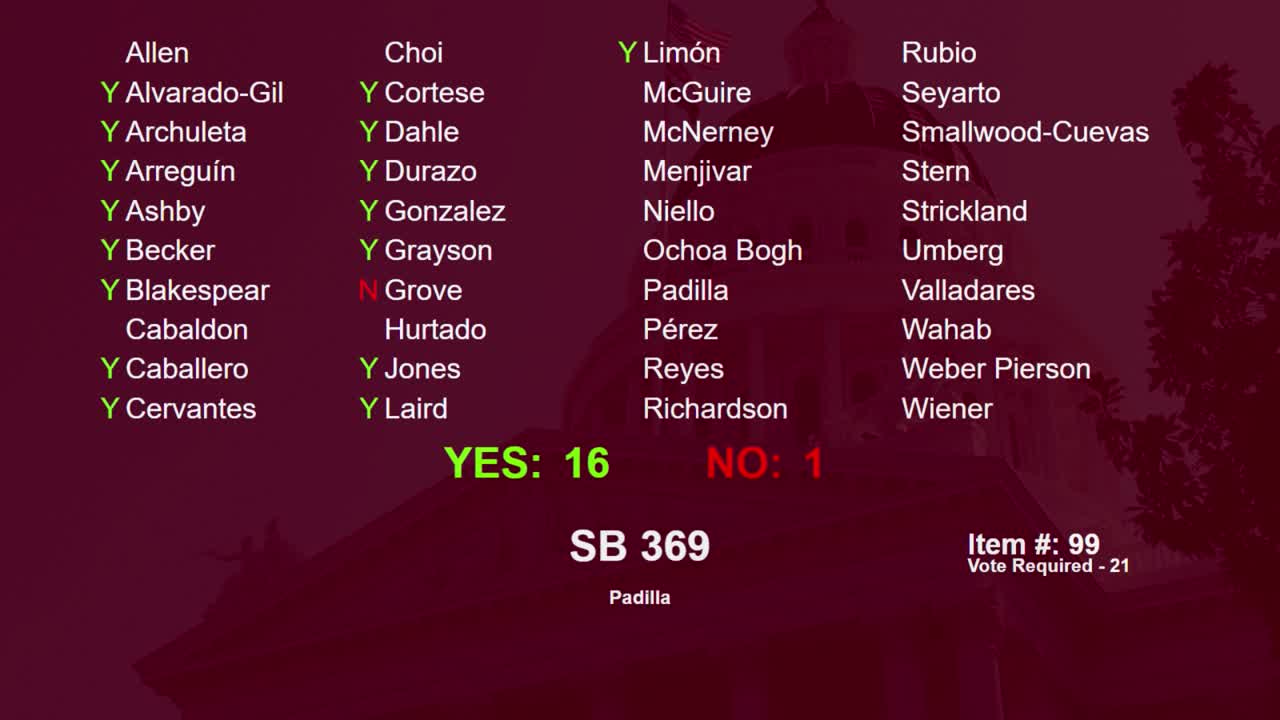 2MIN
Senate Floor
 9MIN
Senate Standing Committee on Education
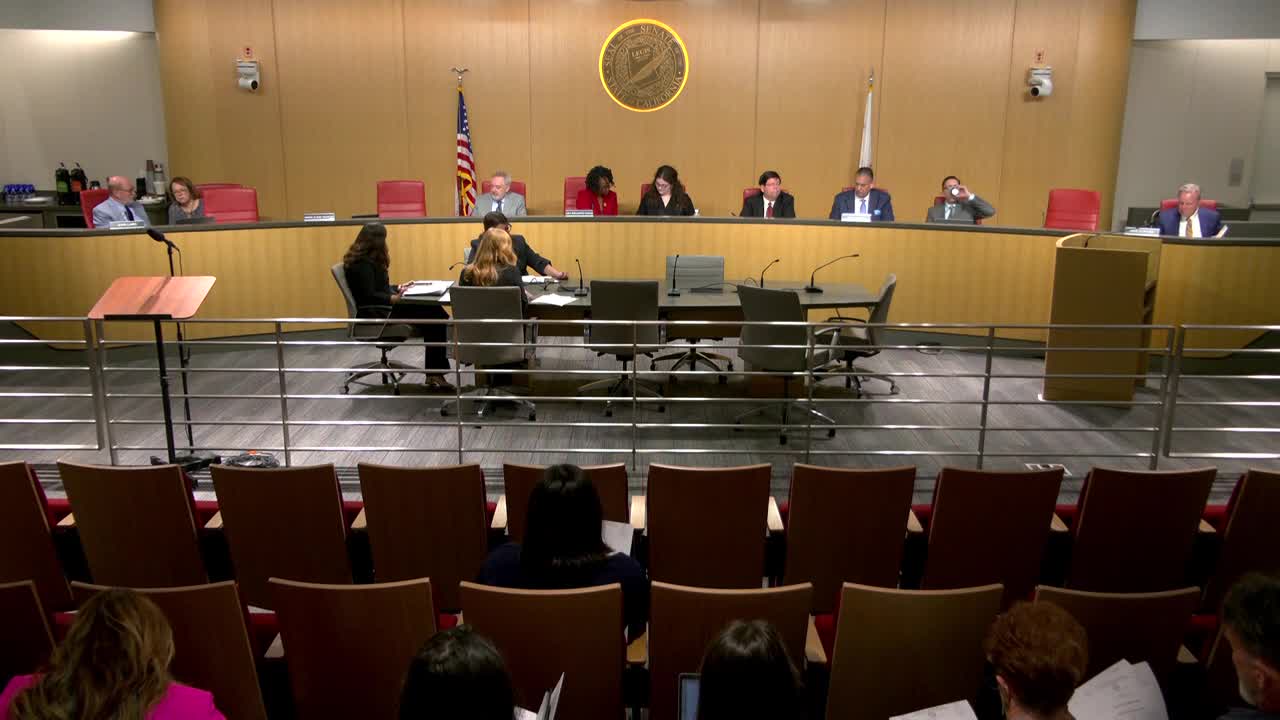 11MIN
Senate Standing Committee on Labor, Public Employment and Retirement
Bill Author
Bill Co-Author(s):