SB 962: Emergency vehicles: blue warning lights.
- Session Year: 2025-2026
- House: Senate
- Latest Version Date: 2026-05-14
Current Status:
In Progress
(2026-08-13: August 13 hearing: Held in committee and under submission.)
Introduced
In Committee
Awaiting First Chamber Vote
Passed First Chamber
In Committee
Awaiting Second Chamber Vote
Passed Second Chamber
Enacted
Existing law authorizes specified peace officers, including, among others, police officers, probation officers, and members of the California National Guard, in the performance of the officers duties, to display a steady or flashing blue warning light visible from the front, sides, or rear of their emergency vehicles.
This bill, the Agent Joshua Byrd Memorial Act, would authorize the Department of Corrections and Rehabilitation to, upon an appropriation from the Legislature, install a blue warning light on an emergency vehicle operated by a parole officer. The bill would additionally authorize parole officers to display the blue warning light from their emergency vehicles if they complete a 4-hour classroom training course regarding the operation of emergency vehicles that is certified by the Commission on Correctional Peace Officer Standards and Training.
Existing law authorizes specified peace officers, including, among others, police officers, probation officers, and members of the California National Guard, in the performance of the officers duties, to display a steady or flashing blue warning light visible from the front, sides, or rear of their emergency vehicles.
This bill would make technical, nonsubstantive changes to those provisions.This bill, the Agent Joshua Byrd Memorial Act, would additionally authorize parole officers to display the blue warning light from their emergency vehicles if they complete a 4-hour classroom training course regarding the operation of emergency vehicles that is certified by the Commission on Correctional Peace Officer Standards and Training.
Existing law authorizes specified peace officers, including, among others, police officers, probation officers, and members of the California National Guard, in the performance of the officers duties, to display a steady or flashing blue warning light visible from the front, sides, or rear of their emergency vehicles.
This bill would make technical, nonsubstantive changes to those provisions.
This act shall be known as, and may be cited as, the Agent Joshua Byrd Memorial Act.
SEC. 2.Section 25258 of the Vehicle Code is amended to read:25258.(a)An authorized emergency vehicle operating under the conditions specified in Section 21055 may display a flashing white light from a gaseous discharge lamp designed and used for the purpose of controlling official traffic control signals.
(b)(1)An authorized emergency vehicle used by a peace officer, as defined in Section 830.1 of, subdivision (a), (b), (c), (d), (e), (f), (g), or (i) of Section 830.2 of, subdivision (n) of Section 830.3 of, subdivision (b) of Section 830.31 of, subdivision (a) or (b) of Section 830.32 of, Section 830.33 of, subdivision (a) of Section 830.36 of, subdivision (a) of Section 830.4 of, Section 830.6 of, or a probation officer or parole officer, as described in subdivision (a) of Section 830.5 of, the Penal Code, in the performance of the peace officers duties, may, in addition, display a steady or flashing blue warning light visible from the front, sides, or rear of the vehicle.
(2)(A)Before a probation officer operates an emergency vehicle with a blue warning light, the officer shall complete a four-hour classroom training course on the operation of emergency vehicles that is certified by the Standards and Training for Corrections Division of the Board of State and Community Corrections.
(B)Before (i)Upon an appropriation from the Legislature, the Department of Corrections and Rehabilitation may install a blue warning light on an emergency vehicle operated by a parole officer.
(ii)Before a parole officer operates an emergency vehicle with a blue warning light, the officer shall complete a four-hour classroom training course on the operation of emergency vehicles that is certified by the Commission on Correctional Peace Officer Standards and Training.
(3)This subdivision does not expand any existing authority of a probation officer or parole officer to conduct a high-speed vehicle pursuit, nor does it change any existing training requirements for a high-speed vehicle pursuit.
(c)Except as provided in subdivision (a), a vehicle shall not be equipped with a device that emits any illumination or radiation that is designed or used for the purpose of controlling official traffic control signals.
This act shall be known as, and may be cited as, the Agent Joshua Byrd Memorial Act.
SECTION 1.SEC. 2.Section 25258 of the Vehicle Code is amended to read:25258.(a)An authorized emergency vehicle operating under the conditions specified in Section 21055 may display a flashing white light from a gaseous discharge lamp designed and used for the purpose of controlling official traffic control signals.
(b)(1)An authorized emergency vehicle used by a peace officer, as defined in Section 830.1 of, subdivision (a), (b), (c), (d), (e), (f), (g), or (i) of Section 830.2 of, subdivision (n) of Section 830.3 of, subdivision (b) of Section 830.31 of, subdivision (a) or (b) of Section 830.32 of, Section 830.33 of, subdivision (a) of Section 830.36 of, subdivision (a) of Section 830.4 of, or Section 830.6 of, or a probation officer or parole officer, as defined described in subdivision (a) of Section 830.5 of, the Penal Code, in the performance of the peace officers duties, may, in addition, display a steady or flashing blue warning light visible from the front, sides, or rear of the vehicle.
(2)(A)Before a probation officer operates an emergency vehicle with a blue warning light, the officer shall complete a four-hour classroom training course on the operation of emergency vehicles that is certified by the Standards and Training for Corrections Division of the Board of State and Community Corrections.
(B)Before a parole officer operates an emergency vehicle with a blue warning light, the officer shall complete a four-hour classroom training course on the operation of emergency vehicles that is certified by the Commission on Correctional Peace Officer Standards and Training.
(3)This subdivision does not expand any existing authority of a probation officer or parole officer to conduct a high-speed vehicle pursuit, nor does it change any existing training requirements for a high-speed vehicle pursuit.
(c)Except as provided in subdivision (a), a vehicle shall not be equipped with a device that emits any illumination or radiation that is designed or used for the purpose of controlling official traffic control signals.
(a)An authorized emergency vehicle operating under the conditions specified in Section 21055 may display a flashing white light from a gaseous discharge lamp designed and used for the purpose of controlling official traffic control signals.
(b)(1)An authorized emergency vehicle used by a peace officer, as defined in Section 830.1 of, subdivision (a), (b), (c), (d), (e), (f), (g), or (i) of Section 830.2 of, subdivision (n) of Section 830.3 of, subdivision (b) of Section 830.31 of, subdivision (a) or (b) of Section 830.32 of, Section 830.33 of, subdivision (a) of Section 830.36 of, subdivision (a) of Section 830.4 of, or Section 830.6 of, or a probation officer, as defined in Section 830.5 of, the Penal Code, in the performance of the peace officers duties, may, in addition, display a steady or flashing blue warning light visible from the front, sides, or rear of the vehicle.
(2)Before a probation officer operates an emergency vehicle with a blue warning light, the officer shall complete a four-hour classroom training course regarding on the operation of emergency vehicles that is certified by the Standards and Training for Corrections Division of the Board of State and Community Corrections.
(3)This subdivision does not expand any existing authority of a probation officer to conduct a high-speed vehicle pursuit, nor does it change any existing training requirements for a high-speed vehicle pursuits. pursuit.
(c)Except as provided in subdivision (a), a vehicle shall not be equipped with a device that emits any illumination or radiation that is designed or used for the purpose of controlling official traffic control signals.
|
Date
|
Status
|
|---|---|
| Aug 13, 2026 | August 13 hearing: Held in committee and under submission. |
| Aug 5, 2026 | August 5 set for first hearing. Placed on suspense file. |
| Jul 1, 2026 | From committee: Do pass and re-refer to Com. on APPR. with recommendation: To consent calendar. (Ayes 9. Noes 0.) (June 30). Re-referred to Com. on APPR. |
| Jun 23, 2026 | From committee: Do pass and re-refer to Com. on PUB. S. with recommendation: To consent calendar. (Ayes 16. Noes 0.) (June 22). Re-referred to Com. on PUB. S. |
| Jun 4, 2026 | Referred to Coms. on TRANS. and PUB. S. |
| May 28, 2026 | In Assembly. Read first time. Held at Desk. |
| May 28, 2026 | Read third time. Passed. (Ayes 39. Noes 0.) Ordered to the Assembly. |
| May 28, 2026 | Read third time. Passed. (Ayes 39. Noes 0. Page 4525.) Ordered to the Assembly. |
| May 26, 2026 | Ordered to special consent calendar. |
| May 18, 2026 | Read second time. Ordered to third reading. |
| May 14, 2026 | Read second time and amended. Ordered to second reading. |
| May 14, 2026 | From committee: Do pass as amended. (Ayes 7. Noes 0.) (May 14). |
| May 14, 2026 | From committee: Do pass as amended. (Ayes 7. Noes 0. Page 4259.) (May 14). |
| May 8, 2026 | Set for hearing May 14. |
| Apr 27, 2026 | April 27 hearing: Placed on APPR. suspense file. |
| Apr 17, 2026 | Set for hearing April 27. |
| Apr 14, 2026 | From committee: Do pass and re-refer to Com. on APPR. with recommendation: To consent calendar. (Ayes 6. Noes 0.) (April 14). Re-referred to Com. on APPR. |
| Apr 14, 2026 | From committee: Do pass and re-refer to Com. on APPR. with recommendation: To consent calendar. (Ayes 6. Noes 0. Page 3871.) (April 14). Re-referred to Com. on APPR. |
| Apr 9, 2026 | Set for hearing April 14. |
| Apr 8, 2026 | From committee: Do pass and re-refer to Com. on PUB. S. with recommendation: To consent calendar. (Ayes 12. Noes 0.) (April 7). Re-referred to Com. on PUB. S. |
| Apr 8, 2026 | From committee: Do pass and re-refer to Com. on PUB. S. with recommendation: To consent calendar. (Ayes 12. Noes 0. Page 3760.) (April 7). Re-referred to Com. on PUB. S. |
| Mar 23, 2026 | Set for hearing April 7. |
| Mar 18, 2026 | Re-referred to Coms. on TRANS. and PUB. S. |
| Mar 9, 2026 | From committee with author's amendments. Read second time and amended. Re-referred to Com. on RLS. |
| Feb 11, 2026 | Referred to Com. on RLS. |
| Feb 4, 2026 | From printer. May be acted upon on or after March 6. |
| Feb 3, 2026 | Introduced. Read first time. To Com. on RLS. for assignment. To print. |
|
Date
|
Description
|
Location
|
Votes
|
|
|---|---|---|---|---|
| Jun 30, 2026 | Do pass and be re-referred to the Committee on [Appropriations] with recommendation: To Consent Calendar | Assembly Standing Committee on Public Safety |
Passed |
|
| Jun 22, 2026 | Do pass and be re-referred to the Committee on [Public Safety] with recommendation: To Consent Calendar | Assembly Standing Committee on Transportation |
Passed |
|
| May 28, 2026 | Special Consent SB962 Archuleta | Senate Floor |
Passed |
|
| May 14, 2026 | Do pass as amended | Senate Standing Committee on Appropriations |
Passed |
|
| Apr 27, 2026 | Placed on suspense file | Senate Standing Committee on Appropriations |
Passed |
|
| Apr 14, 2026 | Do pass, but first be re-referred to the Committee on [Appropriations] with the recommendation: To Consent Calendar | Senate Standing Committee on Public Safety |
Passed |
|
| Apr 7, 2026 | Do pass, but first be re-referred to the Committee on [Public Safety] with the recommendation: To Consent Calendar | Senate Standing Committee on Transportation |
Passed |
This list shows positions taken on this bill by organizations on the date displayed, which is linked to the original source.
Positions by individuals are not included.
|
Organization
|
Position
|
Date
|
|---|---|---|
| California Association Of Highway Patrolmen | ** Support | |
| California Correctional Peace Officers Association | ** Support | |
| Peace Officers Research Association of California (PORAC) | ** Support |
Date of Hearing: August 5, 2026
ASSEMBLY COMMITTEE ON APPROPRIATIONS
Buffy Wicks, Chair
SBPCA Bill Id:SB 962
Author:(Archuleta) – As Amended Ver:May 14, 2026
Policy Committee: | Transportation | Vote: | 16 - 0 |
Public Safety | 9 - 0 | ||
|
|
Urgency: No State Mandated Local Program: No Reimbursable: No
SUMMARY:
This bill allows an emergency vehicle used by a parole officer to display a blue warning light.
More specifically, this bill, the Agent Joshua Byrd Memorial Act, expands the list of emergency vehicles that may display a steady or flashing blue warning light visible from the front, sides or rear of the vehicle to newly include a vehicle used by a parole officer.
The bill requires that, before a parole officer operates an emergency vehicle with a blue warning light, the officer must complete a four-hour classroom training course on the operation of emergency vehicles that is certified by the Commission on Correctional Peace Officer Standards and Training (POST).
The bill also authorizes the Department of Corrections and Rehabilitation (CDCR), upon an appropriation from the Legislature, to install a blue warning lights on emergency vehicles operated by parole officers.
FISCAL EFFECT:
This bill creates cost pressure on CDCR to equip vehicles used by parole officers with blue warning lights and to provide training to parole officers on the use of such lights.
CDCR estimates the cost to equip a vehicle with such lights to be roughly $3,000 and reports there to be, as of April of this year, 1,259 vehicles used in its Division of Adult Parole Officers (DAPO). If CDCR equipped each such vehicle with blue warning lights, it would incur one-time costs of approximately $3.8 million (General Fund).
In addition, CDCR reports there are roughly 1,347 sworn employees in its DAPO. CDCR estimates each DAPO officer would require four hours of training on use of blue warning lights. If such training cost $200 an hour, and every sworn DAPO officer received such training, CDCR would incur one-time costs of approximately $1.1 million (General Fund).
COMMENTS:
Existing law allows certain peace officers, in the performance of their duties, to display a flashing blue warning light visible from the sides or rear of an authorized emergency vehicle operated by such an officer. The list of peace officers who may display such flashing blue warning lights on their vehicles does not include parole officers.
The author has twice before introduced bills to authorize parole officers to display blue warning lights on their vehicles—SB 349 of this legislative session and SB 1021, of the 2023-24 Legislative Session, both of which were held by the Senate Committee on Appropriations.
The author, in expressing the need for this bill, argues “Without blue warning lights, other law enforcement officers and first responders are less likely to recognize, assist and support parole officers in the performance of their duties.” Writing in support of the bill, the California Correctional Peace Officers Association states:
SB 962 is grounded in the tragic loss of Parole Agent Joshua Byrd, who was killed in the line of duty in July 2025. During the emergency response, the absence of vehicle recognition lights and sirens delayed fellow officers’ ability to transport Agent Byrd to emergency medical care. His death highlighted a critical gap in basic emergency response tools available to frontline parole agents. Across California, numerous peace officers - including probation officers, district attorney investigators, university police, and park rangers - already utilize blue warning lights on official vehicles. SB 962 simply provides the department with the authority to extend similar tools more broadly if deemed appropriate.
There is no opposition registered against this bill. Nonetheless, CDCR asserts that, generally, daily parole operations are targeted at supervision of individuals returning to communities and, in most instances, blue emergency lights are unnecessary. However, CDCR accepts there may be instances in which blue emergency lights may be helpful to performance of parole officer duties.
Analysis Prepared by: Jay Dickenson / APPR. / (916) 319-2081
Date of Hearing: June 30, 2026
Counsel: Mary Kennedy
ASSEMBLY COMMITTEE ON PUBLIC SAFETY
Nick Schultz, Chair
SBPCA Bill Id:SB 962
Author:(Archuleta) – As Amended Ver:May 14, 2026
SUMMARY: This bill authorizes parole officers to display the blue warning light from their emergency vehicles if they complete a four-hour training regarding the operation of emergency vehicles, as specified. Specifically, this bill:
- Additionally authorizes a parole officer to display the blue warning light from their emergency vehicles.
- Requires a parole officer to complete a four-hour classroom training course regarding the operation of emergency vehicles that is certified by the Commission on Peace Officers Standards and Training (POST) before operating an emergency vehicle with a blue warning light.
EXISTING LAW:
- Provides that the authority of parole officers extends to any place in the state while engaged in the performance of the duties of their employment and for the purpose of carrying out the primary function of their employment, but shall otherwise be limited as follows:
- To conditions of parole, probation, mandatory supervision, or postrelease community supervision by any person in this state on parole, probation, mandatory supervision, or postrelease community supervision;
- To the escape of any inmate or ward from a state or local institution;
- To the transportation of persons on parole, probation, mandatory supervision, or postrelease community supervision;
- To violations of any penal provisions of law which are discovered while performing the usual or authorized duties of the officer’s employment;
- To the rendering of mutual aid to any other law enforcement agency. (Pen. Code, § 830.5.)
- Establishes POST to set minimum standards for the recruitment and training of peace officers, develop training courses and curriculum, and establish a professional certificate program that awards different levels of certification based on training, education, experience, and other relevant prerequisites. (Pen. Code, §§ 830-832.10, 13500 et seq.)
- Requires POST to implement a course or courses of instruction for the regular and periodic training of law enforcement officers in the handling of high-speed vehicle pursuits and to also develop uniform, minimum guidelines for adoption and promulgation by California law enforcement agencies for response to high-speed vehicle pursuits. The guidelines and course of instruction are required to stress the importance of vehicle safety and protecting the public at all times; include a regular assessment of law enforcement's vehicle pursuit policies, practices, and training; and recognize the need to balance the known offense and the need for immediate capture against the risks to officers and other citizens of a high-speed pursuit. These guidelines must also be a resource for each agency executive to use in the creation of a specific pursuit policy that the agency is encouraged to adopt and promulgate, and that reflects the needs of the agency, the jurisdiction it serves, and the law. (Pen. Code, § 13519.8.)
- Establishes within the Department of Corrections and Rehabilitation (CDCR) a Commission on Correctional Peace Officer Standards and Training (CPOST). (Pen. Code, § 13600, subd. (b).)
- Provides that CPOST shall develop, approve, and monitor standards for the selection and training of state correctional peace officer apprentices, and vests CPOST with other duties related to the training and duties of employees under its purview. (Pen. Code, § 13601.)
- Requires CDCR to adhere to the training standards developed by CPOST at all locations where training is provided. (Pen. Code, § 13602, subd. (a).)
- Requires CPOST to determine on-the-job training requirements for correctional peace officers. (Pen. Code, § 13603, subd. (b).)
- Defines an “authorized emergency vehicle” to include a publicly owned vehicle operated by any federal, state, or local agency, department or district employing peace officers, as defined. (Veh. Code, § 165, subd. (b)(1).)
- States that the driver of an authorized emergency vehicle is exempt from a variety of specified Vehicle Code requirements, under all of the following conditions:
- If the vehicle is being driven in response to an emergency call or while engaged in rescue operations or is being used in the immediate pursuit of an actual or suspected violator of the law or is responding to, but not returning from, a fire alarm, except that fire department vehicles are exempt whether directly responding to an emergency call or operated from one place to another as rendered desirable or necessary by reason of an emergency call and operated to the scene of the emergency or operated from one fire station to another or to some other location by reason of the emergency call.
- If the driver of the vehicle sounds a siren as may be reasonably necessary and the vehicle displays a lighted red lamp visible from the front as a warning to other drivers and pedestrians. (Veh. Code, § 21055.)
- Provides that the above provision does not relieve the driver of a vehicle from the duty to drive with due regard for the safety of all persons using the highway, nor protect them from the consequences of an arbitrary exercise of the privileges granted in that section. (Veh. Code, § 21056.)
- Requires that every authorized emergency vehicle be equipped with at least one steady burning red warning lamp visible from at least 1,000 feet to the front of the vehicle, as specified, and provides that emergency vehicles may display revolving, flashing, or steady red warning lights to the front, sides or rear of the vehicles. (Veh. Code, § 25252.)
- Provides that every authorized emergency vehicle may be equipped with a system which flashes the upper-beam headlamps of the vehicle with the flashes occurring alternately from the front headlamp on one side of the vehicle to the front headlamp on the other side of the vehicle, as specified. (Veh. Code, § 25252.5.)
- Allows any authorized emergency vehicle to display flashing amber warning lights to the front, sides, or rear, and allows a vehicle operated by a police or traffic officer while in the actual performance of their duties to display steady burning or flashing white lights to either side mounted above the roofline of the vehicle, as specified. (Veh. Code, § 25259.)
- Allows an authorized emergency vehicle operating under specified conditions to display a flashing white light from a gaseous discharge lamp designed and used for the purpose of controlling official traffic control signals. (Veh. Code, § 25258 subd. (a).)
- Allows an authorized emergency vehicle used by a peace officer, as defined, in the performance of the peace officer's duties, to, in addition, display a steady or flashing blue warning light visible from the front, sides, or rear of the vehicle. (Veh. Code, § 25258 subd. (b)(1).)
- Requires a probation officer, before operating an emergency vehicle with a blue warning light, to complete a four-hour classroom training course regarding the operation of emergency vehicles that is certified by the Standards and Training for Corrections Division of the Board of State and Community Corrections (BSCC). (Veh. Code, § 25258 subd. (b)(2).)
FISCAL EFFECT: Unknown
COMMENTS:
- Sponsor: California Correctional Peace Officers Association (CCPOA)
- Author’s statement: According to the author, “Without blue warning lights, other law enforcement officers and first responders are less likely to recognize, assist and support parole officers in the performance of their duties. This is especially important in cases where an officer is transporting someone who is suffering from a medical emergency, such as in the case of Agent Joshue Byrd. Agent Byrd was shot and killed in the line of duty on July 17, 2025. Emergency services were unable to reach the scene, and parole officer vehicles present did not have emergency lights. Agent Byrd’s colleagues were unable to quickly transport him to the ambulance’s staging or the hospital itself, and he passed away from his injuries. When something like this happens, every second counts. The Parole Officers’ branch of the California Correctional Peace Officers Association (CCPOA) has been asking for blue lights on their vehicles for years. CDCR has consistently denied this request because of cost. Now, CDCR has issued a new policy allowing certain parole officers to be issued amber lights on their vehicles for celebrations. This new policy begs the question: why is CDCR willing to pay for a purely ceremonial light but not one that is proven to be lifesaving?”
- Blue Warning Lights: California law tightly regulates the use of lighting on vehicles that operate on California roads, including lighting equipped on authorized emergency vehicles. Existing law defines “authorized emergency vehicle” to include any publicly owned vehicle operated by any federal, state, or local agency, department or district employing peace officers. (Veh. Code, § 165, subd. (b).) Existing law permits, but does not require, various classes of peace officer to affix a blue warning light to their vehicles, a group that has been expanded over time. (Veh. Code, § 25258, subd. (b).) In 2017, the Legislature passed SB 587 (Atkins), Chapter 286, Statutes of 2017, which added probation officers to this list, provided they completed a four hour classroom training course certified by the BSCC.
Under existing law, parole officers are not included in the class of peace officers that may affix a blue warning light to their vehicles. According to the author, this poses a problem when parole agents are transporting someone suffering from a medical emergency, or when parole agents are assisting other law enforcement. This bill authorizes parole officers to display blue warning lights from their vehicles, and imposes a training requirement similar to that in existing law for probation officers. This bill, however, provides that the 4-hour classroom training course must be certified not by the BSCC, but rather by CPOST, which falls under the ambit of CDCR.
- Argument in Support: According to the California Correctional Peace Officers Association, “SB 962 authorizes, but does not require, the California Department of Corrections and Rehabilitation (CDCR) to install and use blue warning lights on parole officer vehicles for officers who complete a certified emergency vehicle operations training course approved by the Commission on Correctional Peace Officer Standards and Training (CPOST). The bill does not expand pursuit authority or alter existing pursuit policies.
“SB 962 is grounded in the tragic loss of Parole Agent Joshua Byrd, who was killed in the line of duty in July 2025. During the emergency response, the absence of vehicle recognition lights and sirens delayed fellow officers’ ability to transport Agent Byrd to emergency medical care. His death highlighted a critical gap in basic emergency response tools available to frontline parole agents.
“Across California, numerous peace officers - including probation officers, district attorney investigators, university police, and park rangers - already utilize blue warning lights on official vehicles. SB 962 simply provides the department with the authority to extend similar tools more broadly if deemed appropriate. CDCR itself recognized the importance of this equipment earlier this year by authorizing emergency lighting and training for certain managerial and supervisory parole personnel. Yet, rank-and-file parole agents, who are most frequently in the field and exposed to rapidly evolving situations, remain without access to this critical safety equipment.
“SB 962 addresses this gap by authorizing CDCR to equip frontline parole officers with vehicle recognition lighting and appropriate training. Providing blue warning lights will enhance officer safety, improve coordination with responding law enforcement and emergency personnel, and support more effective responses during time-sensitive incidents.”
- Prior Legislation:
- SB 349 (Archuleta), of the 2025-2026 Legislative Session, would have authorized parole officers to display blue warning lights from their emergency vehicles if they completed a four hour classroom training by CPOST. SB 349 got held in the Senate Appropriations Committee.
- SB 1021 (Archuleta), of the 2023-2024 Legislative Session, would have authorized parole officers to display blue warning lights from their emergency vehicles if they completed a four hour classroom training by BSCC. SB 1021 was held in the Senate Appropriations Committee.
- SB 587 (Atkins), Chapter 386, Statutes of 2017, would have authorized probation officers to display blue warning lights.
- AB 2224 (Achadjian), of the 2015-2016 Legislative Session, would have authorized probation officers to display blue warning lights. AB 2224 failed in the Assembly Transportation Committee.
REGISTERED SUPPORT / OPPOSITION:
Support
California Association of Highway Patrolmen
California Correctional Peace Officers Association (CCPOA)
Peace Officers Research Association of California (PORAC)
Opposition
None submitted.
Analysis Prepared by: Mary Kennedy / PUB. S. / (916) 319-3744
Date of Hearing: 06/22/2026
ASSEMBLY COMMITTEE ON TRANSPORTATION
Lori D. Wilson, Chair
SBPCA Bill Id:SB 962
Author:(Archuleta) – As Amended Ver:May 14, 2026
SENATE VOTE: 39-0
SUBJECT: Emergency vehicles: blue warning lights
SUMMARY: Authorizes the California Department of Corrections and Rehabilitation (CDCR) to install a blue warning light on an emergency vehicle operated by a parole officer and authorizes parole officers to operate vehicles with these lights if they complete a four-hour training course on the operation of emergency vehicles. Specifically, this bill:
- Requires a parole officer operating an emergency vehicle with a blue warning light to complete a four-hour classroom training course on the operation of emergency vehicles that is certified by the Commission on Correctional Peace Officer Standards and Training (POST).
- Upon an appropriation from the Legislature, permits CDCR to install a blue warning light on an emergency vehicle operated by a parole officer.
- Provides that this does not expand the existing authority of a parole officer to conduct a high-speed vehicle pursuit, nor does it change any existing training requirements for a high-speed vehicle pursuit.
- States this shall be known as and may be cited as the Agent Joshue Byrd Memorial Act.
EXISTING LAW:
- Authorizes specified peace officers employed by the following public safety agencies in the performance of their duties, to display a steady or flashing blue warning light visible from the front, sides, or rear of their authorized emergency vehicle:
- Sheriffs, undersheriffs, deputy sheriffs, chiefs of police, chiefs or directors of consolidated municipal public safety agencies that perform police functions, police officers, harbor police, chief executive of public safety agencies, marshals or deputy marshals of superior courts, port wardens, and district attorney inspectors or investigators;
- California Highway Patrol (CHP) officers, University of California police, California State University police, correctional officers, members of the Office of Internal Affairs at the Department of Corrections and Rehabilitation, Department of Fish and Game employees, Department of Parks and Recreation employees, Department of Forestry and Fire Protection employees, and marshals and police appointed by the Board of Directors of the California Exposition and State Fair;
- The chief and coordinators of the Law Enforcement Branch of the Office of Emergency Services;
- Park rangers;
- Community college police and school district police;
- Bay Area Rapid Transit District police, transit district peace officers, airport law enforcement; railroad police;
- Legislative sergeants-at-arms;
- Members of the California National Guard; and,
- Probation officers. (Vehicle Code section (VEH) 25258)
- Provides that any law enforcement agency vehicle driven by a peace officer, including parole officers, in the performance of their duties is an “authorized emergency vehicle.” (VEH 165.)
- Defines “parole officer” and limits the extent of their authority as follows:
- To conditions of parole, probation, mandatory supervision, or post release community supervision by any person in this state on parole, probation, mandatory supervision, or post release community supervision;
- To the escape of any inmate or ward from a state or local institution;
- To the transportation of persons on parole, probation, mandatory supervision, or post release community supervision;
- To violations of any penal provisions of law which are discovered while performing the usual or authorized duties of the officer's employment; and,
- To the rendering of mutual aid to any other law enforcement agency. (Penal Code section (PEN) 830.5)
- Creates the Commission on Correctional Peace Officer Standards and Training to establish standards for the training and professional development of rank-and-file state correctional peace officers, as well as first-line and second-line supervisory state correctional peace officers. (PEN 13600)
FISCAL EFFECT:
According to the Senate Appropriations Committee:
- The Department of Corrections and Rehabilitation (CDCR) would incur unknown, significant one-time costs, potentially as high as the low millions of dollars, if funds are appropriated and the department exercises the authority granted in this bill to install light bars on parole officer vehicles. These costs would be lower to the extent CDCR only installs light bars on a portion of its parole officer vehicles. (General Fund [GF])
- CDCR would also incur unknown one-time costs, likely in the low hundreds of thousands of dollars, for parole officer staff time associated with completion of the four-hour training course, and for costs associated with the provision of training through CPOST. Actual costs would depend upon how many parole officers would be directed to complete training. CDCR further estimates one-time costs in the low tens of thousands of dollars to develop the four-hour classroom training course. (GF)
COMMENTS: State law provides for special treatment of authorized emergency vehicles (AEVs). If an AEV has a red or blue siren on, surrounding traffic is required to yield the right-of-way and immediately drive to the right-hand edge or curb of any road and clear any intersection until the vehicle has passed. AEVs are allowed to be equipped with at least one steady-burning red warning lamp if engaged in police, fire and lifesaving services. Blue warning lamps are restricted to peace officers. Drivers must change lanes or slow down when passing a stationary AEV with its sirens on. AEVs are generally exempt from most California Air Resources Board (CARB) emission regulations, such as the Clean Truck Program. AEVs are exempt from paying a toll or other charge if it is responding to an urgent or emergency call.
Parole officers have full law enforcement authority regarding the escape of any inmate or ward, as well as the tracking and apprehension of parolees who have violated their conditions or absconded. These operations often involve executing high-risk arrest warrants or conducting compliance searches alongside local police or sheriff departments. Parole officers are legally responsible for the official transportation of individuals on parole or post-release community supervision.
While parole officer vehicles are permitted to have authorized emergency vehicles with red warning lamps, more traditionally used by fire and ambulances, they are not authorized to have blue warning lamps authorized for other peace officers, including probation officers.
According to the author, “Without blue warning lights, other law enforcement officers and first responders are less likely to recognize, assist and support parole officers in the performance of their duties. This is especially important in cases where an officer is transporting someone who is suffering from a medical emergency, such as in the case of Agent Joshue Byrd. Agent Byrd was shot and killed in the line of duty on July 17, 2025. Emergency services were unable to reach the scene, and parole officer vehicles present did not have emergency lights. Agent Byrd’s colleagues were unable to quickly transport him to the ambulance’s staging or the hospital itself, and he passed away from his injuries. When something like this happens, every second counts. The Parole Officers’ branch of the California Correctional Peace Officers Association (CCPOA) has been asking for blue lights on their vehicles for years. CDCR has consistently denied this request because of cost. Now, CDCR has issued a new policy allowing certain parole officers to be issued amber lights on their vehicles for celebrations. This new policy begs the question: why is CDCR willing to pay for a purely ceremonial light but not one that is proven to be lifesaving?”
The California Correctional Peace Officers Association, writing in support of this bill, argues: “SB 962 is grounded in the tragic loss of Parole Agent Joshua Byrd, who was killed in the line of duty in July 2025. During the emergency response, the absence of vehicle recognition lights and sirens delayed fellow officers’ ability to transport Agent Byrd to emergency medical care. His death highlighted a critical gap in basic emergency response tools available to frontline parole agents. Across California, numerous peace officers - including probation officers, district attorney investigators, university police, and park rangers - already utilize blue warning lights on official vehicles. SB 962 simply provides the department with the authority to extend similar tools more broadly if deemed appropriate. CDCR itself recognized the importance of this equipment earlier this year by authorizing emergency lighting and training for certain managerial and supervisory parole personnel. Yet, rank-and-file parole agents, who are most frequently in the field and exposed to rapidly evolving situations, remain without access to this critical safety equipment.”
Previous legislation. SB 349 (Archuleta, 2025) was substantially similar to SB 962. It would have authorized parole officers to display a blue warning light from their emergency vehicles if the officer completes a certified training course on the operation of emergency vehicles. This bill failed passage in Senate Appropriations.
SB 1021 (Archuleta, 2024) would have authorized parole officers to display the blue warning light from their emergency vehicles if they complete a 4-hour classroom training course regarding the operation of emergency vehicles that is certified by the Standards and Training for Corrections Division of the Board of State and Community Corrections. This bill failed passage in Senate Appropriations.
SB 587 (Atkins, Chapter 286, Statutes 2017) authorized probation officers to display a blue warning light on their authorized emergency vehicles if the officer completes an emergency vehicle operations course certified by the Commission on Peace Officer Standards and Training.
REGISTERED SUPPORT / OPPOSITION:
Support
California Association of Highway Patrolmen
California Correctional Peace Officers Association
Peace Officers Research Association of California
Opposition
None on file
Analysis Prepared by: David Sforza / TRANS. / (916) 319-2093
SENATE RULES COMMITTEE Office of Senate Floor Analyses (916) 651-4171 | SB 962 |
THIRD READING
Bill No: SB 962
Author: Archuleta (D)
Amended: 5/14/26
Vote: 21
SENATE TRANSPORTATION COMMITTEE: 12-0, 4/7/26
AYES: Cortese, Strickland, Archuleta, Arreguín, Blakespear, Gonzalez, Grayson, Menjivar, Richardson, Seyarto, Valladares, Wiener
NO VOTE RECORDED: Dahle
SENATE PUBLIC SAFETY COMMITTEE: 6-0, 4/14/26
AYES: Arreguín, Seyarto, Caballero, Cortese, Pérez, Wiener
SENATE APPROPRIATIONS COMMITTEE: 7-0, 5/14/26
AYES: Cervantes, Seyarto, Cabaldon, Dahle, Grayson, Richardson, Wahab
SUBJECT: Emergency vehicles: blue warning lights
SOURCE: California Correctional Peace Officers Association
DIGEST:
This bill authorizes parole officers to display blue warning lights from their emergency vehicles in the performance of their official duties, if an officer completes a specified four-hour classroom training course certified by the Commission on Correctional Peace Officers Standards and Training (CPOST).
ANALYSIS:
Existing law:
- Authorizes specified peace officers employed by the following public safety agencies in the performance of their duties, to display a steady or flashing blue warning light visible from the front, sides, or rear of their authorized emergency vehicle:
- Sheriffs, undersheriffs, deputy sheriffs, chiefs of police, chiefs or directors of consolidated municipal public safety agencies that perform police functions, police officers, harbor police, chief executive of public safety agencies, marshals or deputy marshals of superior courts, port wardens, and district attorney inspectors or investigators;
- California Highway Patrol (CHP) officers, University of California police, California State University police, correctional officers, members of the Office of Internal Affairs at the Department of Corrections and Rehabilitation, Department of Fish and Game employees, Department of Parks and Recreation employees, Department of Forestry and Fire Protection employees, and marshals and police appointed by the Board of Directors of the California Exposition and State Fair;
- The chief and coordinators of the Law Enforcement Branch of the Office of Emergency Services;
- Park rangers;
- Community college police and school district police;
- Bay Area Rapid Transit District police, transit district peace officers, airport law enforcement; railroad police;
- Legislative sergeants-at-arms;
- Members of the California National Guard; and,
- Probation officers. (Vehicle Code § 25258)
- Provides that any law enforcement agency vehicle driven by a peace officer, including parole officers, in the performance of their duties is an “authorized emergency vehicle.” (Vehicle Code § 165.)
- Defines “parole officer” and limits the extent of their authority as follows:
- To conditions of parole, probation, mandatory supervision, or post release community supervision by any person in this state on parole, probation, mandatory supervision, or post release community supervision.
- To the escape of any inmate or ward from a state or local institution.
- To the transportation of persons on parole, probation, mandatory supervision, or post release community supervision.
- To violations of any penal provisions of law which are discovered while performing the usual or authorized duties of the officer's employment.
- To the rendering of mutual aid to any other law enforcement agency. (Penal Code § 830.5)
- Creates the Commission on Correctional Peace Officer Standards and Training to establish standards for the training and professional development of rank-and-file state correctional peace officers, as well as first-line and second-line supervisory state correctional peace officers. (Penal Code §13600)
This bill:
- Designates this act as the Agent Joshua Byrd Memorial Act.
- Authorizes parole officers to display a steady or flashing blue warning light visible from the front, sides, or rear of their emergency vehicle if they complete a 4-hour classroom training course regarding the operation of emergency vehicles that is certified by the Commission on Correctional Peace Officer Standards and Training.
- Specifies that the Department of Corrections and Rehabilitation may install a blue warning light on an emergency vehicle operated by a parole officer upon appropriation by the Legislature.
Comments
- Purpose of this bill. According to the author, “Without blue warning lights, other law enforcement officers and first responders are less likely to recognize, assist and support parole officers in the performance of their duties. This is especially important in cases where an officer is transporting someone who is suffering from a medical emergency, such as in the case of Agent Joshue Byrd. Agent Byrd was shot and killed in the line of duty on July 17, 2025. Emergency services were unable to reach the scene, and parole officer vehicles present did not have emergency lights. Agent Byrd’s colleagues were unable to quickly transport him to the ambulance’s staging or the hospital itself, and he passed away from his injuries. When something like this happens, every second counts. The Parole Officers’ branch of the California Correctional Peace Officers Association (CCPOA) has been asking for blue lights on their vehicles for years. CDCR has consistently denied this request because of cost. Now, CDCR has issued a new policy allowing certain parole officers to be issued amber lights on their vehicles for celebrations. This new policy begs the question: why is CDCR willing to pay for a purely ceremonial light but not one that is proven to be lifesaving?”
- Blue Lights. This bill authorizes parole officers to display a blue warning light to help better identify parole officers and their vehicles to the public and other law enforcement officers. Because vehicles driven by parole officers are defined as emergency vehicles, they are currently authorized to display flashing white, red, and amber lights. Blue lights, on the other hand, are largely limited to law enforcement vehicles only. However, the list of applicable entities is broad and includes probation officers performing significantly similar functions.
Parole officers can be involved in transporting individuals for urgent medical attention or responding quickly to a scene for support. The ability to display blue lights may help with recognition at the scene and the ability for expedited travel in emergency transport situations. A letter in support for SB 962 from the California Correctional Peace Officers Association echoes these points, “[t]his measure is grounded in the tragic and, we believe, preventable loss of Parole Agent Joshua Byrd, who was killed in the line of duty in July 2025. In that critical moment, the absence of vehicle recognition lights and sirens delayed the ability of fellow officers to transport Agent Byrd to emergency medical care. His death underscores the real-world consequences of a gap in basic safety equipment for frontline parole officers and highlights the urgent need to provide tools that can save lives in emergency situations.”
- Precedent. This bill mirrors a previous change made through SB 587 (Atkins, Chapter 286, Statutes 2017), which authorized probation officers to use blue lights on their emergency vehicles after training. Supporters argue that the duties of parole and probation officers are similar enough to justify aligning their access to display blue warning lights from their emergency vehicles. In order to utilize blue lights authorized under this bill, a parole officer must first complete a four-hour classroom training course on the operation of emergency vehicles that is certified by the Commission on Correctional Peace Officer Standards and Training.
- Emergency Vehicles and High-speed pursuit. This bill does not expand any existing authority of parole officers to conduct high-speed vehicle pursuit, nor does it change any existing training requirements for high-speed vehicle pursuit.
Related/Prior Legislation
SB 349 (Archuleta, 2025) – This bill was substantially similar to SB 962. It would have authorized parole officers to display a blue warning light from their emergency vehicles if the officer completes a certified training course on the operation of emergency vehicles. This bill failed passage in Senate Appropriations.
SB 1021 (Archuleta, 2024) – This bill would have authorized parole officers to display the blue warning light from their emergency vehicles if they complete a 4-hour classroom training course regarding the operation of emergency vehicles that is certified by the Standards and Training for Corrections Division of the Board of State and Community Corrections. This bill failed passage in Senate Appropriations.
SB 587 (Atkins, Chapter 286, Statutes 2017) – This bill authorizes probation officers to display a blue warning light on their authorized emergency vehicles if the officer completes an emergency vehicle operations course certified by the Commission on Peace Officer Standards and Training.
FISCAL EFFECT: Appropriation: No Fiscal Com.: Yes Local: No
According to the Senate Appropriations Committee:
- The Department of Corrections and Rehabilitation (CDCR) would incur unknown, significant one-time costs, potentially as high as the low millions of dollars, if funds are appropriated and the department exercises the authority granted in this bill to install light bars on parole officer vehicles. These costs would be lower to the extent CDCR only installs light bars on a portion of its parole officer vehicles. (General Fund)
- CDCR would also incur unknown one-time costs, likely in the low hundreds of thousands of dollars, for parole officer staff time associated with completion of the four-hour training course, and for costs associated with the provision of training through CPOST. Actual costs would depend upon how many parole officers would be directed to complete training. CDCR further estimates one-time costs in the low tens of thousands of dollars to develop the four-hour classroom training course. (General Fund)
SUPPORT: (Verified 5/14/26)
California Correctional Peace Officers Association (source)
California Association of Highway Patrolmen
Peace Officers Research Association of California
OPPOSITION: (Verified 5/14/26)
None received
Prepared by: Isabelle LaSalle / TRANS. / (916) 651-4121
5/18/26 15:16:24
**** END ****
SENATE COMMITTEE ON
Senator Sabrina Cervantes, Chair
2025 - 2026 Regular Session
SB 962 (Archuleta) - Emergency vehicles: blue warning lights
Version: | Policy Vote: |
Urgency: | Mandate: |
Hearing Date: | Consultant: |
Bill Summary:
SB 962 would authorize parole officers to display blue warning lights from their emergency vehicles in the performance of their official duties, if an officer completes a specified four-hour classroom training course certified by the Commission on Correctional Peace Officers Standards and Training (CPOST).
*********** ANALYSIS ADDENDUM – SUSPENSE FILE ***********
The following information is revised to reflect amendments
adopted by the committee on May 14, 2026
Fiscal Impact:
- The Department of Corrections and Rehabilitation (CDCR) would incur unknown, significant one-time costs, potentially as high as the low millions of dollars, if funds are appropriated and the department exercises the authority granted in this bill to install light bars on parole officer vehicles. These costs would be lower to the extent CDCR only installs light bars on a portion of its parole officer vehicles. (General Fund)
- CDCR would also incur unknown one-time costs, likely in the low hundreds of thousands of dollars, for parole officer staff time associated with completion of the four-hour training course, and for costs associated with the provision of training through CPOST. Actual costs would depend upon how many parole officers would be directed to complete training. CDCR further estimates one-time costs in the low tens of thousands of dollars to develop the four-hour classroom training course. (General Fund)
Author Amendments:
Authorize CDCR to install blue warning lights on emergency vehicles operated by a parole officer upon appropriation of funds by the Legislature.
-- END --
SENATE COMMITTEE ON
Senator Sabrina Cervantes, Chair
2025 - 2026 Regular Session
SB 962 (Archuleta) - Emergency vehicles: blue warning lights
Version: | Policy Vote: |
Urgency: | Mandate: |
Hearing Date: | Consultant: |
Bill Summary:
SB 962 would authorize parole officers to display blue warning lights from their emergency vehicles in the performance of their official duties, if an officer completes a specified four-hour classroom training course certified by the Commission on Correctional Peace Officers Standards and Training (CPOST).
Fiscal Impact:
- The Department of Corrections and Rehabilitation (CDCR) would incur unknown, significant one-time costs, potentially as high as the low millions of dollars, if it exercises the authority granted in this bill and installs light bars on parole officer vehicles. These costs would be lower to the extent CDCR only installs light bars on a portion of its parole officer vehicles. (General Fund)
- CDCR would also incur unknown one-time costs, likely in the low hundreds of thousands of dollars, for parole officer staff time associated with completion of the four-hour training course, and for costs associated with the provision of training through CPOST. Actual costs would depend upon how many parole officers would be directed to complete training. CDCR further estimates one-time costs in the low tens of thousands of dollars to develop the four-hour classroom training course. (General Fund)
Background:
Existing law defines an “authorized emergency vehicle” as a vehicle owned or operated by a U.S. department or agency when the vehicle is used in responding to emergency fire, ambulance, or lifesaving calls or is actively engaged in law enforcement work. The driver of an authorized emergency vehicle is exempt from a variety of vehicle code requirements if the driver is sounding a siren and displaying a lighted red lamp, and responding to an emergency call, engaged in rescue operations, or in the immediate pursuit of an actual or suspected violator of the law, as specified.
Existing law allows an authorized emergency vehicle used by a peace officer, as defined, in the performance of the peace officer's duties, to also display a steady or flashing blue warning light visible from the front, sides, or rear of the vehicle. For example, police, sheriffs, district attorney investigators, University of California and California State University police, and certain employees at the departments of Parks and Recreation, Forestry and Fire Protection, Fish and Game, Corrections and Rehabilitation, are all authorized to display blue warning lights on their vehicles. Probation officers were added to the list of peace officers that can display blue warning lights by SB 587 (Atkins), Chap. 286/2017, if they complete a 4-hour classroom training course regarding the operation of emergency vehicles that is certified by the Standards and Training for Corrections Division of the Board of State and Community Corrections (BSCC).
Existing law extends the authority of peace officers who are parole officers of CDCR, CDCR’s Division of Juvenile Parole Operations, and parole agents employed by the Juvenile Parole Board to the following duties:
- To conditions of parole, probation, mandatory supervision, or postrelease community supervision by any person in this state on parole, probation, mandatory supervision, or postrelease community supervision.
- To the escape of any inmate or ward from a state or local institution.
- To the transportation of persons on parole, probation, mandatory supervision, or postrelease community supervision.
- To violations of any penal provisions of law which are discovered while performing the usual or authorized duties of the officer’s employment.
- To the rendering of mutual aid to any other law enforcement agency.
CDCR’s Division of Adult Parole Operations (CDCR-DAPO) provides basic training for parole officers through CPOST.
On January 16, 2026, CDCR-DAPO issued Policy No.: 26-01, providing DAPO staff with a new policy and procedures regarding the use of vehicle recognition lights and sirens. Specifically, the policy requires the DAPO Director to determine which vehicles would be designated for vehicle recognition lights and a siren, and generally limits the use of those vehicles to specified senior DAPO personnel. The vehicle recognition lights may only be activated when the DAPO peace officer has completed the required training and:
- The vehicle driver is responding directly to a situation involving potential for serious injury to persons.
- The vehicle driver is transporting a seriously injured person to a hospital, and no other method of transportation is practical.
- At community events or peace officer recruitment events in which DAPO is participating.
- The DAPO vehicle is participating in a non-emergency law enforcement motorcade.
Proposed Law:
SB 962, the Agent Joshua Byrd Memorial Act, would authorize parole officers, in the performance of their official duties, to display a steady or flashing blue warning light on their authorized emergency vehicles after completing a four-hour classroom training course certified by CPOST. The bill specifies that it does not expand any existing authority of a parole officer to conduct a high-speed vehicle pursuit, or change existing training requirements for high-speed vehicle pursuits.
Related Legislation:
SB 349 (Archuleta), which was held on this Committee’s Suspense File last year, was substantially similar to this bill. It would have authorized parole officers, in the performance of their official duties, to display blue warning lights on their authorized emergency vehicles after completing a four-hour classroom training course certified by CPOST.
SB 1021 (Archuleta), which was held on this Committee’s Suspense File in 2024, was also similar to this bill. It would have authorized parole officers, in the performance of their official duties, to display blue warning lights on their authorized emergency vehicles after completing a four-hour classroom training course certified by the Board of State and Community Corrections (BSCC).
SB 587 (Atkins), Chap. 286/2017, authorized probation officers, in the performance of their official duties, to display blue warning lights on their emergency vehicles, if an officer completes a specified 4-hour classroom training course certified by BSCC.
Staff Comments:
This bill is intended to provide parole officers the same authority afforded to other peace officers regarding the displaying of blue lights on their vehicles in the performance of official duties. The author’s office notes that blue lights alert other officers on an emergency scene, which can be especially important when a parole officer is transporting someone suffering from an emergency, or assisting other law enforcement during emergencies. The author and sponsors note the circumstances surrounding the death of Parole Agent Joshua Byrd, who was shot and killed in the line of duty on July 17, 2025. Emergency services were unable to reach the scene of the incident, and parole officers on site did not have emergency lights, so Agent Byrd’s colleagues were unable to quickly transport him to the ambulance’s staging or the hospital itself, and he passed away from his injuries.
Staff notes that CDCR currently employs nearly 1,350 sworn parole agents who are regularly assigned vehicles. In addition, recent data indicates that CDCR owns 95 vehicles and leases 1,163 through the Department of General Services for parole officer use. CDCR costs noted above would be related to the installation of light bars on those vehicles, at estimated costs of around $3,000 per vehicle, and for CDCR parole officers’ time to complete the four-hour training course. Since the bill is permissive, and does not explicitly require the training and installation of light bars, it is currently unclear how CDCR would determine whether some or all of its parole officers would be directed to complete the training course, and how many vehicles would be equipped with light bars as a result of the bill.
-- END --
SENATE COMMITTEE ON PUBLIC SAFETY
Senator Jesse Arreguín, Chair
2025 - 2026 Regular
Bill No: SB 962 Hearing Date: April 14, 2026
Author: | Archuleta | ||
Version: | March 9, 2026 | ||
Urgency: | No | Fiscal: | Yes |
Consultant: | ML | ||
Subject: Emergency vehicles: blue warning lights
HISTORY
Source: California Correctional Peace Officers Association
Prior Legislation: SB 349 (Archuleta), held in Sen. Appropriations, 2025
SB 1021 (Archuleta), held in Sen. Appropriations, 2024
SB 587 (Atkins), Ch. 386, Stats. of 2017
Support: Peace Officers Research Association of California
Opposition: None known
PURPOSE
The purpose of this bill is to authorize parole officers to display the blue warning light from their emergency vehicles if they complete a 4-hour training regarding the operation of emergency vehicles, as specified.
Existing law provides that the authority of parole officers extends to any place in the state while engaged in the performance of the duties of their employment and for the purpose of carrying out the primary function of their employment, but shall otherwise be limited as follows:
- To conditions of parole, probation, mandatory supervision, or postrelease community supervision by any person in this state on parole, probation, mandatory supervision, or postrelease community supervision;
- To the escape of any inmate or ward from a state or local institution;
- To the transportation of persons on parole, probation, mandatory supervision, or postrelease community supervision;
- To violations of any penal provisions of law which are discovered while performing the usual or authorized duties of the officer’s employment;
- To the rendering of mutual aid to any other law enforcement agency. (Pen. Code, § 830.5.)
Existing law establishes the Commission on Peace Officer Standards and Training (POST) to set minimum standards for the recruitment and training of peace officers, develop training courses and curriculum, and establish a professional certificate program that awards different levels of certification based on training, education, experience, and other relevant prerequisites.
Authorizes POST to cancel a certificate that was awarded in error or fraudulently obtained; however, POST is prohibited from canceling a properly issued certificate. (Pen. Code, §§ 830-832.10, 13500 et seq.)
Existing law requires POST to implement a course or courses of instruction for the regular and periodic training of law enforcement officers in the handling of high-speed vehicle pursuits and to also develop uniform, minimum guidelines for adoption and promulgation by California law enforcement agencies for response to high-speed vehicle pursuits. The guidelines and course of instruction are required to stress the importance of vehicle safety and protecting the public at all times; include a regular assessment of law enforcement's vehicle pursuit policies, practices, and training; and recognize the need to balance the known offense and the need for immediate capture against the risks to officers and other citizens of a high-speed pursuit. These guidelines must also be a resource for each agency executive to use in the creation of a specific pursuit policy that the agency is encouraged to adopt and promulgate, and that reflects the needs of the agency, the jurisdiction it serves, and the law. (Pen. Code, § 13519.8.)
Existing law establishes within the Department of Corrections and Rehabilitation (CDCR) a Commission on Correctional Peace Officer Standards and Training (CPOST). (Pen. Code, § 13600, subd. (b).)
Existing law provides that CPOST shall develop, approve, and monitor standards for the selection and training of state correctional peace officer apprentices, and vests CPOST with other duties related to the training and duties of employees under its purview. (Pen. Code, § 13601.)
Existing law requires CDCR to adhere to the training standards developed by CPOST at all locations where training is provided. (Pen. Code, § 13602, subd. (a).)
Existing law requires CPOST to determine on-the-job training requirements for correctional peace officers. (Pen. Code, § 13603, subd. (b).)
Existing law defines an “authorized emergency vehicle” to include a publicly owned vehicle operated by any federal, state, or local agency, department or district employing peace officers, as defined. (Veh. Code, § 165, subd. (b)(1).)
Existing law states that the driver of an authorized emergency vehicle is exempt from a variety of specified Vehicle Code requirements, under all of the following conditions:
- If the vehicle is being driven in response to an emergency call or while engaged in rescue operations or is being used in the immediate pursuit of an actual or suspected violator of the law or is responding to, but not returning from, a fire alarm, except that fire department vehicles are exempt whether directly responding to an emergency call or operated from one place to another as rendered desirable or necessary by reason of an emergency call and operated to the scene of the emergency or operated from one fire station to another or to some other location by reason of the emergency call.
- If the driver of the vehicle sounds a siren as may be reasonably necessary and the vehicle displays a lighted red lamp visible from the front as a warning to other drivers and pedestrians. (Veh. Code, § 21055.)
Existing law provides that the above provision does not relieve the driver of a vehicle from the duty to drive with due regard for the safety of all persons using the highway, nor protect them from the consequences of an arbitrary exercise of the privileges granted in that section. (Veh. Code, § 21056.)
Existing law requires that every authorized emergency vehicle be equipped with at least one steady burning red warning lamp visible from at least 1,000 feet to the front of the vehicle, as specified, and provides that emergency vehicles may display revolving, flashing, or steady red warning lights to the front, sides or rear of the vehicles. (Veh. Code, § 25252.)
Existing law provides that every authorized emergency vehicle may be equipped with a system which flashes the upper-beam headlamps of the vehicle with the flashes occurring alternately from the front headlamp on one side of the vehicle to the front headlamp on the other side of the vehicle, as specified. (Veh. Code, § 25252.5.)
Existing law allows any authorized emergency vehicle to display flashing amber warning lights to the front, sides, or rear, and allows a vehicle operated by a police or traffic officer while in the actual performance of their duties to display steady burning or flashing white lights to either side mounted above the roofline of the vehicle, as specified. (Veh. Code, § 25259.)
Existing law allows an authorized emergency vehicle operating under specified conditions to display a flashing white light from a gaseous discharge lamp designed and used for the purpose of controlling official traffic control signals. (Veh. Code, § 25258 subd. (a).)
Existing law allows an authorized emergency vehicle used by a peace officer, as defined, in the performance of the peace officer's duties, to, in addition, display a steady or flashing blue warning light visible from the front, sides, or rear of the vehicle. (Veh. Code, § 25258 subd. (b)(1).)
Existing law requires a probation officer, before operating an emergency vehicle with a blue warning light, to complete a four-hour classroom training course regarding the operation of emergency vehicles that is certified by the Standards and Training for Corrections Division of the Board of State and Community Corrections (BSCC). (Veh. Code, § 25258 subd. (b)(2).)
This bill additionally authorizes a parole officer to display the blue warning light from their emergency vehicles.
This bill requires a parole officer to complete a four-hour classroom training course regarding the operation of emergency vehicles that is certified by CPOST before operating an emergency vehicle with a blue warning light.
COMMENTS
- Need for This Bill
According to the author:
Without blue warning lights, other law enforcement officers and first responders are less likely to recognize, assist and support parole officers in the performance of their duties. This is especially important in cases where an officer is transporting someone who is suffering from a medical emergency, such as in the case of Agent Joshue Byrd. Agent Byrd was shot and killed in the line of duty on July 17, 2025. Emergency services were unable to reach the scene, and parole officer vehicles present did not have emergency lights. Agent Byrd’s colleagues were unable to quickly transport him to the ambulance’s staging or the hospital itself, and he passed away from his injuries. When something like this happens, every second counts. The Parole Officers’ branch of the California Correctional Peace Officers Association (CCPOA) has been asking for blue lights on their vehicles for years. CDCR has consistently denied this request because of cost. Now, CDCR has issued a new policy allowing certain parole officers to be issued amber lights on their vehicles for celebrations. This new policy begs the question: why is CDCR willing to pay for a purely ceremonial light but not one that is proven to be lifesaving?
- Blue Warning Lights
California law tightly regulates the use of lighting on vehicles that operate on California roads, including lighting equipped on authorized emergency vehicles. Existing law defines “authorized emergency vehicle” to include any publicly owned vehicle operated by any federal, state, or local agency, department or district employing peace officers.[1] Existing law permits, but does not require, various classes of peace officer to affix a blue warning light to their vehicles, a group that has been expanded over time.[2] In 2017, the Legislature passed SB 587 (Atkins), Chapter 286, Statutes of 2017, which added probation officers to this list, provided they completed a 4-hour classroom training course certified by the BSCC.
Under existing law, parole officers are not included in the class of peace officers that may affix a blue warning light to their vehicles. According to the author, this poses a problem when parole agents are transporting someone suffering from a medical emergency, or when parole agents are assisting other law enforcement. This bill authorizes parole officers to display blue warning lights from their vehicles, and imposes a training requirement similar to that in existing law for probation officers. This bill, however, provides that the 4-hour classroom training course must be certified not by the BSCC, but rather by CPOST, which falls under the ambit of CDCR.[3]
- Prior Legislation
This bill is substantially similar to SB 349 (Archuleta), introduced last year, and SB 1021 (Archuleta), from the 2023-2024 legislative session, which would have similarly authorized parole officers to display blue warning lights from their emergency vehicles if they completed a 4-hour classroom training. However, under SB 1021, the entity responsible for developing that training would have been BSCC, not CPOST.
- Argument in Support
According to the California Correctional Peace Officers Association:
This measure is grounded in the tragic and, we believe, preventable loss of Parole Agent Joshua Byrd, who was killed in the line of duty in July 2025. In that critical moment, the absence of vehicle recognition lights and sirens delayed the ability of fellow officers to transport Agent Byrd to emergency medical care. His death underscores the real-world consequences of a gap in basic safety equipment for frontline parole officers and highlights the urgent need to provide tools that can save lives in emergency situations.
Across California, numerous peace officers, including district attorney investigators, university police, park rangers, and probation officers are already authorized to use blue warning lights on their vehicles. Notably, CDCR itself has recognized the importance of this equipment by authorizing blue lights for certain parole division managerial and supervisory personnel. Yet, rank-and-file parole agents, who are most frequently in the field and exposed to dangerous and
rapidly evolving situations, remain without access to this same critical safety tool.
SB 962 corrects this inconsistency by ensuring that frontline parole officers are afforded the same vehicle recognition capabilities already available within their own department. Providing blue warning lights will enhance officer safety, improve coordination with responding law enforcement and emergency personnel, and ensure more effective responses during time-sensitive incidents.
-- END --
Veh. Code, § 165(b). ↑
Veh. Code, § 25258(b). ↑
CPOST is generally responsible for establishing standards for training and professional development of rank-and-file state correctional peace officers, as well as first-line and second-line supervisory state correctional peace officers. For more info on CPOST, see their 2024 operating procedures here: CPOST-Operational-Procedures.pdf ↑
SENATE COMMITTEE ON TRANSPORTATION
Senator Dave Cortese, Chair
2025 - 2026 Regular
Bill No: Hearing Date: 4/7/2026
Author: | Archuleta | ||
Version: | 3/9/2026 Amended | ||
Urgency: | No | Fiscal: | Yes |
Consultant: | Isabelle LaSalle | ||
SUBJECT:
DIGEST: This bill authorizes parole officers to display a blue warning light from their emergency vehicles if the officer completes a certified training course on the operation of emergency vehicles.
ANALYSIS:
Existing law:
- Authorizes specified peace officers employed by the following public safety agencies in the performance of their duties, to display a steady or flashing blue warning light visible from the front, sides, or rear of their authorized emergency vehicle:
- Sheriffs, undersheriffs, deputy sheriffs, chiefs of police, chiefs or directors of consolidated municipal public safety agencies that perform police functions, police officers, harbor police, chief executive of public safety agencies, marshals or deputy marshals of superior courts, port wardens, and district attorney inspectors or investigators;
- California Highway Patrol (CHP) officers, University of California police, California State University police, correctional officers, members of the Office of Internal Affairs at the Department of Corrections and Rehabilitation, Department of Fish and Game employees, Department of Parks and Recreation employees, Department of Forestry and Fire Protection employees, and marshals and police appointed by the Board of Directors of the California Exposition and State Fair;
- The chief and coordinators of the Law Enforcement Branch of the Office of Emergency Services;
- Park rangers;
- Community college police and school district police;
- Bay Area Rapid Transit District police, transit district peace officers, airport law enforcement; railroad police;
- Legislative sergeants-at-arms;
- Members of the California National Guard; and,
- Probation officers. (Vehicle Code § 25258)
- Provides that any law enforcement agency vehicle driven by a peace officer, including parole officers, in the performance of their duties is an “authorized emergency vehicle.” (Vehicle Code § 165.)
- Defines “parole officer” and limits the extent of their authority as follows:
- To conditions of parole, probation, mandatory supervision, or post release community supervision by any person in this state on parole, probation, mandatory supervision, or post release community supervision.
- To the escape of any inmate or ward from a state or local institution.
- To the transportation of persons on parole, probation, mandatory supervision, or post release community supervision.
- To violations of any penal provisions of law which are discovered while performing the usual or authorized duties of the officer's employment.
- To the rendering of mutual aid to any other law enforcement agency. (Penal Code § 830.5)
- Creates the Commission on Correctional Peace Officer Standards and Training to establish standards for the training and professional development of rank-and-file state correctional peace officers, as well as first-line and second-line supervisory state correctional peace officers. (Penal Code §13600)
This bill:
- Designates this act as the Agent Joshua Byrd Memorial Act.
- Authorizes parole officers to display a steady or flashing blue warning light visible from the front, sides, or rear of their emergency vehicle if they complete a 4-hour classroom training course regarding the operation of emergency vehicles that is certified by the Commission on Correctional Peace Officer Standards and Training.
COMMENTS:
- Purpose of the bill. According to the author, “Without blue warning lights, other law enforcement officers and first responders are less likely to recognize, assist and support parole officers in the performance of their duties. This is especially important in cases where an officer is transporting someone who is suffering from a medical emergency, such as in the case of Agent Joshue Byrd. Agent Byrd was shot and killed in the line of duty on July 17, 2025. Emergency services were unable to reach the scene, and parole officer vehicles present did not have emergency lights. Agent Byrd’s colleagues were unable to quickly transport him to the ambulance’s staging or the hospital itself, and he passed away from his injuries. When something like this happens, every second counts. The Parole Officers’ branch of the California Correctional Peace Officers Association (CCPOA) has been asking for blue lights on their vehicles for years. CDCR has consistently denied this request because of cost. Now, CDCR has issued a new policy allowing certain parole officers to be issued amber lights on their vehicles for celebrations. This new policy begs the question: why is CDCR willing to pay for a purely ceremonial light but not one that is proven to be lifesaving?”
- Blue Lights. This bill authorizes parole officers to display a blue warning light to help better identify parole officers and their vehicles to the public and other law enforcement officers. Because vehicles driven by parole officers are defined as emergency vehicles, they are currently authorized to display flashing white, red, and amber lights. Blue lights, on the other hand, are largely limited to law enforcement vehicles only. However, the list of applicable entities is broad and includes probation officers performing significantly similar functions.
Parole officers can be involved in transporting individuals for urgent medical attention or responding quickly to a scene for support. The ability to display blue lights may help with recognition at the scene and the ability for expedited travel in emergency transport situations. A letter in support for SB 962 from the California Correctional Peace Officers Association echoes these points, “[w]ithout blue warning lights, other law enforcement and first responders are less likely to recognize, assist, and support parole officers in the performance of their duties. This is especially important in cases where an officer is transporting someone suffering a medical emergency. When this happens, every second counts. Parole officers may also be called upon for assistance by other law enforcement during emergencies but cannot display blue warning lights to alert other officers to the scene. This creates unnecessary confusion for the public and officers.”
- Precedent. This bill mirrors a previous change made through SB 587 (Atkins, Chapter 286, Statutes 2017), which authorized probation officers to use blue lights on their emergency vehicles after training. The duties of parole and probation officers are similar enough to justify aligning their access to display blue warning lights from their emergency vehicles. In order to utilize blue lights authorized under this bill, a parole officer must first complete a four-hour classroom training course on the operation of emergency vehicles that is certified by the Commission on Correctional Peace Officer Standards and Training.
- Emergency Vehicles and High-speed pursuit. This bill does not expand any existing authority of parole officers to conduct high-speed vehicle pursuit, nor does it change any existing training requirements for high-speed vehicle pursuit.
- Double-referral. This bill has been double referred to the Senate Public Safety Committee.
Related/previous Legislation:
SB 349 (Archuleta, 2025) – This bill was substantially similar to SB 962. It would have authorized parole officers to display a blue warning light from their emergency vehicles if the officer completes a certified training course on the operation of emergency vehicles. This bill failed passage in Senate Appropriations.
SB 1021 (Archuleta, 2024) – This bill would have authorized parole officers to display the blue warning light from their emergency vehicles if they complete a 4-hour classroom training course regarding the operation of emergency vehicles that is certified by the Standards and Training for Corrections Division of the Board of State and Community Corrections. This bill failed passage in Senate Appropriations.
SB 587 (Atkins, Chapter 286, Statutes 2017) – This bill authorizes probation officers to display a blue warning light on their authorized emergency vehicles if the officer completes an emergency vehicle operations course certified by the Commission on Peace Officer Standards and Training.
FISCAL EFFECT: Appropriation: Fiscal Com.: Local:
POSITIONS: (Communicated to the committee before noon on Wednesday, April 1, 2026.)
SUPPORT:
California Correctional Peace Officers Association (CCPOA) (Sponsor)
California Association of Highway Patrolmen
Peace Officers Research Association of California (PORAC)
OPPOSITION:
None received
-- END --
Discussed in Hearing
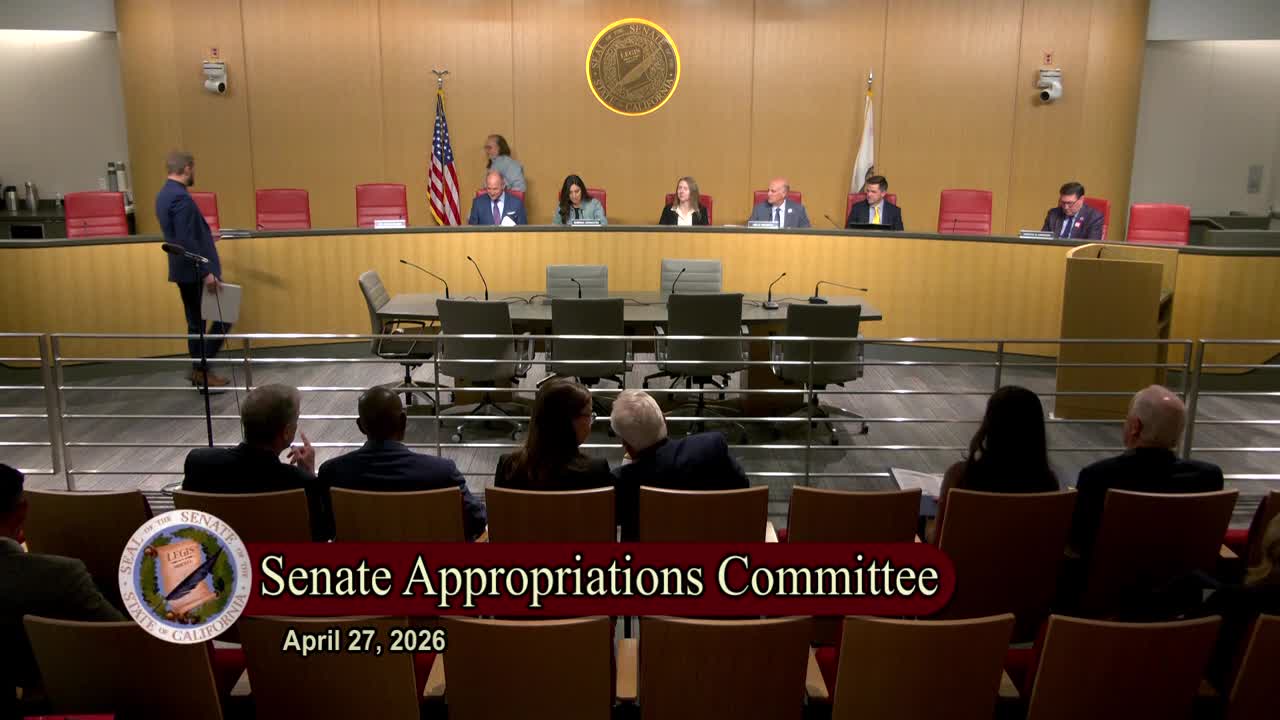 10MIN
Senate Standing Committee on Appropriations
Bill Author
Bill Co-Author(s):