SB 970: Military or overseas voters.
- Session Year: 2025-2026
- House: Senate
- Latest Version Date: 2026-05-21
Current Status:
In Progress
(2026-08-31: Ordered to inactive file on request of Assembly Member Garcia.)
Introduced
In Committee
Awaiting First Chamber Vote
Passed First Chamber
In Committee
Awaiting Second Chamber Vote
Passed Second Chamber
Enacted
Existing law regulates the voting procedures for military or overseas voters to register to vote, to apply for voting ballots, and to vote. Existing law requires, among other things, unvoted voting materials to be electronically transmitted to a military or overseas voter.
This bill would require the Secretary of State to promulgate regulations to facilitate the secure return of ballots from military or overseas voters delivered through secure electronic transmission methods.
(a)The Secretary of State shall see that this chapter is enforced pursuant to Section 12172.5 of the Government Code.
(b)The Secretary of State shall make available to any person who qualifies as a military or overseas voter information regarding voter registration procedures for military or overseas voters and procedures for casting ballots by military or overseas voters.
(c)The Secretary of State shall promulgate regulations to facilitate the secure return of ballots from military or overseas voters delivered through secure electronic transmission methods.
(d)The elections official for each district shall ensure that their jurisdiction has available a system that would allow a military or overseas voter to electronically request a ballot and other information pursuant to this chapter.
(e)The Secretary of State shall develop standardized military or overseas voter voting materials as required by this chapter.
(f)The Secretary of State shall prescribe the form and content of a declaration for use by a military or overseas voter to swear or affirm specific representations pertaining to the voters identity, eligibility to vote, and status as a military or overseas voter, and shall further prescribe requirements for the timely and proper completion of a military or overseas voters ballot. The declaration shall be based on the declaration prescribed to accompany a federal write-in absentee ballot, as modified to be consistent with this chapter. The elections official for each jurisdiction shall ensure that a form for the execution of the declaration, including an indication of the date of execution of the declaration, is a prominent part of all balloting materials for which the declaration is required.
REVISIONS: HeadingLine 2.(a)The Secretary of State shall see that this chapter is enforced pursuant to Section 12172.5 of the Government Code.
(b)The Secretary of State shall make available to any person who qualifies as a military or overseas voter information regarding voter registration procedures for military or overseas voters and procedures for casting ballots by military or overseas voters.
(c)The Secretary of State shall promulgate regulations to facilitate the secure return of ballots from military or overseas voters delivered through secure electronic transmission methods.
(c)(d)The elections official for each district shall ensure that their jurisdiction has available a system that would allow a military or overseas voter to electronically request a ballot and other information pursuant to this chapter.
(d)(e)The Secretary of State shall develop standardized military or overseas voter voting materials as required by this chapter.
(e)(f)The Secretary of State shall prescribe the form and content of a declaration for use by a military or overseas voter to swear or affirm specific representations pertaining to the voters identity, eligibility to vote, and status as a military or overseas voter, and shall further prescribe requirements for the timely and proper completion of a military or overseas voters ballot. The declaration shall be based on the declaration prescribed to accompany a federal write-in absentee ballot, as modified to be consistent with this chapter. The elections official for each jurisdiction shall ensure that a form for the execution of the declaration, including an indication of the date of execution of the declaration, is a prominent part of all balloting materials for which the declaration is required.
|
Date
|
Status
|
|---|---|
| Aug 31, 2026 | Ordered to inactive file on request of Assembly Member Garcia. |
| Aug 13, 2026 | Read second time. Ordered to third reading. |
| Aug 13, 2026 | From committee: Do pass. (Ayes 11. Noes 0.) (August 13). |
| Aug 13, 2026 | Assembly Rule 63 suspended. |
| Aug 5, 2026 | August 5 set for first hearing. Placed on suspense file. |
| Jul 1, 2026 | From committee: Do pass and re-refer to Com. on APPR. (Ayes 7. Noes 0.) (June 30). Re-referred to Com. on APPR. |
| Jun 17, 2026 | From committee: Do pass and re-refer to Com. on M. & V.A. (Ayes 6. Noes 0.) (June 17). Re-referred to Com. on M. & V.A. |
| Jun 17, 2026 | Coauthors revised. |
| Jun 4, 2026 | Referred to Coms. on ELECTIONS and M. & V.A. |
| May 27, 2026 | In Assembly. Read first time. Held at Desk. |
| May 27, 2026 | Read third time. Passed. (Ayes 29. Noes 1.) Ordered to the Assembly. |
| May 27, 2026 | Read third time. Passed. (Ayes 29. Noes 1. Page 4504.) Ordered to the Assembly. |
| May 22, 2026 | Read second time. Ordered to third reading. |
| May 21, 2026 | Read third time and amended. |
| May 21, 2026 | Ordered to second reading. |
| May 14, 2026 | Read second time. Ordered to third reading. |
| May 14, 2026 | From committee: Do pass. (Ayes 5. Noes 0.) (May 14). |
| May 14, 2026 | From committee: Do pass. (Ayes 5. Noes 0. Page 4259.) (May 14). |
| May 8, 2026 | Set for hearing May 14. |
| Apr 20, 2026 | April 20 hearing: Placed on APPR. suspense file. |
| Apr 10, 2026 | Set for hearing April 20. |
| Apr 7, 2026 | From committee: Do pass and re-refer to Com. on APPR. (Ayes 4. Noes 0.) (April 7). Re-referred to Com. on APPR. |
| Apr 7, 2026 | From committee: Do pass and re-refer to Com. on APPR. (Ayes 4. Noes 0. Page 3755.) (April 7). Re-referred to Com. on APPR. |
| Mar 16, 2026 | Set for hearing April 7. |
| Feb 11, 2026 | Referred to Com. on E. & C.A. |
| Feb 4, 2026 | From printer. May be acted upon on or after March 6. |
| Feb 3, 2026 | Introduced. Read first time. To Com. on RLS. for assignment. To print. |
|
Date
|
Description
|
Location
|
Votes
|
|
|---|---|---|---|---|
| Aug 13, 2026 | Do pass. | Assembly Standing Committee on Appropriations |
Passed |
|
| Jun 30, 2026 | Do pass and be re-referred to the Committee on [Appropriations] | Assembly Standing Committee on Military and Veterans Affairs |
Passed |
|
| Jun 17, 2026 | Do pass and be re-referred to the Committee on [Military and Veterans Affairs] | Assembly Standing Committee on Elections |
Passed |
|
| May 27, 2026 | Senate 3rd Reading SB970 Cervantes | Senate Floor |
Passed |
|
| May 14, 2026 | Do pass | Senate Standing Committee on Appropriations |
Passed |
|
| Apr 20, 2026 | Placed on suspense file | Senate Standing Committee on Appropriations |
Passed |
|
| Apr 7, 2026 | Do pass, but first be re-referred to the Committee on [Appropriations] | Senate Standing Committee on Elections and Constitutional Amendments |
Passed |
This list shows positions taken on this bill by organizations on the date displayed, which is linked to the original source.
Positions by individuals are not included.
|
Organization
|
Position
|
Date
|
|---|---|---|
| American Legion, Department Of California | ** Support | |
| Amvets, Department Of California | ** Support | |
| Brennan Center for Justice at NYU Law | ** Against | |
| California Association of Clerks and Election Officials | ** Support | |
| California Narcotic Officers' Association | ** Support | |
| California Secretary of State Shirley N. Weber, Ph.D. | ** Against | |
| California State Association Of Counties | ** Support | |
| California State Commanders Veterans Council | ** Support | |
| California Voter Foundation | ** Against | |
| Citizens' Oversight | ** Support | |
| County of Santa Clara | ** Support | |
| Disability Rights California | ** Support | |
| Former California Secretary of State Kevin Shelley | ** Against | |
| Free Speech for People | ** Against | |
| Indivisible California Green Team | ** Against | |
| Kevin Shelley, former California Secretary of State | ** Against | |
| Kevin Shelley, former Secretary of State | ** Against | |
| Los Angeles County | ** Support | |
| Military Officers Association Of America, California Council Of Chapters | ** Support | |
| Military-Officers Association of America-California Council of Chapters | ** Support | |
| Public Citizen | ** Against | |
| Riverside Sheriffs' Association | ** Support | |
| Secretary of State | ** Against | |
| Verified Voting | ** Against | |
| Vietnam Veterans Of America, California State Council | ** Support | |
| Vietnam Veterans of American-California State Council | ** Support |
SENATE THIRD READING
STR Bill Id:SB 970
Author:(Cervantes)
As Amended Ver:May 21, 2026
Majority vote
SUMMARY
Requires the Secretary of State (SOS) to promulgate regulations to facilitate the secure return of ballots from military or overseas voters delivered through secure methods.
Major Provisions
COMMENTS
The federal Military and Overseas Voter Empowerment (MOVE) Act requires states to provide blank absentee ballots to military and overseas voters in at least one electronic format – email, fax, or an online delivery system – at least 45 days before an election, thus allowing such voters time to receive, mark, and return a paper ballot in a timely manner. The MOVE Act does not require states to allow a military or overseas voter to submit their voted ballot electronically. However, California, similar to many other states, permits military and overseas voters to return their voted ballot by facsimile under certain circumstances, as specified. Utilization of fax services allows enfranchisement of voters whose vote may not otherwise be counted due to the time necessary for mail delivery, which is especially unreliable overseas.
When voting abroad, the Federal Voting Assistance Program (FVAP) provided assistance for service members, service members' families, and overseas citizens in voting in elections. Prior to 2025, as part of the program, the Department of Defense (DOD) Fax Service was available for those voters who could not fax their election materials directly to their elections official. If a voter needed to send election materials by fax to the elections official and did not have access to a fax machine, the voter was able to email their election materials to a specific email address and FVAP faxed the voter's election materials for the voter to the proper elections official.
On August 1, 2025, FVAP discontinued their DOD Fax Service. As a result, in California, a military or overseas voter must fax or mail their ballot directly to their elections official.
This bill requires the SOS to develop regulations for military and overseas voters to return ballots through "secure methods." However, the bill does not define what qualifies as a "secure ballot return method," nor does the bill establish any specific requirements, standards, or criteria that a return method must meet in order to be considered secure. Furthermore, this bill gives substantial discretion to the SOS without clear guidance on the development of these regulations.
The use of electronic ballot return may help facilitate voting for remote groups like military and overseas voters, however, it is not without risk. In 2020, the National Institute of Standards and Technology, the Election Assistance Commission, the Federal Bureau of Investigation, and the Cybersecurity and Infrastructure Security Agency issued a report assessing the risks involved in electronic ballot delivery, marking, and return. The report recommended "paper ballot return as electronic ballot return technologies are high-risk even with controls in place." The report further stated that electronic ballot return creates significant security risks to the confidentiality of ballot and voter data (e.g. voter privacy and ballot secrecy), integrity of the voted ballot, and availability of the system. However, the report also recognized that in light of the fact that "some election officials are mandated by state law to employ this high-risk process, its use should be limited to voters who have no other means to return their ballot and have it counted." Additionally, the report states that electronic delivery of ballots to voters for return by mail is less vulnerable to systemic disruption.
Please see the policy committee analysis for a full discussion of this bill.
According to the Author
"In 2025, the federal government announced that it was discontinuing the Department of Defense Fax Service through the Federal Voting Assistance Program, which allowed overseas voters and members of the Armed Forces to submit their ballot by fax. If the federal government will not do its part to ensure these voters have access to the franchise, then California must step up. Senate Bill 970 would allow the Secretary of State to work with stakeholders to create a process to allow military and overseas voters to submit their ballots through a secure method that balances security and our sacred right to vote."
Arguments in Support
In support of this bill, Los Angeles County (LA County), writes, "The federal government has made voting harder for individuals who serve, whether in the armed forces or in diplomatic missions, and for those who work and/or live internationally. Military and Overseas (MILOS) voters, while perhaps small in actual number, carry the significant weight of representing their country abroad, so facilitating their ability to vote makes good sense…The single most substantive concern related to facilitating electronic voting for MILOS voters is security. We share that concern, but SB 970 doesn't require the Secretary of State to accept emailed ballots. Rather, it charges the Secretary of State with working with elections and security professionals to develop protocols that will – at the same time – permit MILOS voting and ensure ballot security.
"LA County knows about ballot and election security. We believe SB 970 will result in increased efficiency for MILOS voters, allowing greater control and security while expanding voting options for military and overseas voters. The ability to accept ballots from MILOS voters via secure electronic transmission would enable better tracking and provide assurance to voters that the ballot and the required oath form have been received. Implementation costs could be offset by these efficiencies, including saving staff time and resources in the processing of the ballots by, most specifically, not having to manually duplicate the ballots for tabulation. California has the largest number of active-duty military personnel in the country. It is unfortunate that we are one of only seven states that do not allow a military or overseas voter to return a ballot electronically by a means other than fax.:
Arguments in Opposition
All letters received in opposition to this bill were submitted prior to the most recent amendments, which deleted language that would have required the SOS to develop regulations governing the return of ballots by electronic transmission. Because opposition to this bill related to concerns about the electronic transmission of voted ballots, it is unclear whether the organizations continue to oppose this bill.
FISCAL COMMENTS
According to the Assembly Appropriations Committee, costs of approximately $1.3 million in the first year and $646,000 annually thereafter to the SOS to implement this bill if this bill results in electronic ballot return (General Fund). The SOS estimates the initial costs to include $55,000 to develop regulations, $144,000 to update and translate informational materials to reflect new voting procedures, and $150,000 to update the statewide voter registration database (VoteCal) to enable the new ballot return method for military or overseas voters, among other costs. The SOS estimates the ongoing costs to include three staff positions to support new certification responsibilities, security monitoring, and compliance oversight, among other cybersecurity and risk assessment workload.
To the extent regulations promulgated by the SOS do not allow electronic ballot return, costs to the SOS may be more absorbable.
VOTES
SENATE FLOOR: 29-1-10
YES: Allen, Archuleta, Arreguín, Ashby, Becker, Blakespear, Cabaldon, Caballero, Cervantes, Cortese, Durazo, Gonzalez, Grayson, Hurtado, Laird, Limón, McGuire, McNerney, Menjivar, Padilla, Pérez, Reyes, Richardson, Rubio, Smallwood-Cuevas, Stern, Umberg, Wahab, Wiener
NO: Alvarado-Gil
ABS, ABST OR NV: Choi, Dahle, Grove, Jones, Niello, Ochoa Bogh, Seyarto, Strickland, Valladares, Weber Pierson
ASM ELECTIONS: 6-0-1
YES: Pellerin, Bennett, Berman, Elhawary, Solache, Stefani
ABS, ABST OR NV: Lackey
ASM MILITARY AND VETERANS AFFAIRS: 7-0-1
YES: Schiavo, Jeff Gonzalez, Ávila Farías, Carrillo, Irwin, Quirk-Silva, Valencia
ABS, ABST OR NV: Davies
ASM APPROPRIATIONS: 11-0-4
YES: Wicks, Arambula, Calderon, Caloza, Fong, Mark González, Krell, Pacheco, Pellerin, Sharp-Collins, Solache
ABS, ABST OR NV: Hoover, Dixon, Ta, Tangipa
UPDATED
VERSION: May 21, 2026
CONSULTANT: Nichole Becker / ELECTIONS / (916) 319-2094 FN: 0003614
Date of Hearing: August 5, 2026
ASSEMBLY COMMITTEE ON APPROPRIATIONS
Buffy Wicks, Chair
SBPCA Bill Id:SB 970
Author:(Cervantes) – As Amended Ver:May 21, 2026
Policy Committee: | Elections | Vote: | 6 - 0 |
Military and Veterans Affairs | 7 - 0 | ||
|
|
Urgency: No State Mandated Local Program: No Reimbursable: No
SUMMARY:
This bill requires the Secretary of State (SOS) to promulgate regulations to facilitate the secure return of ballots from military or overseas voters through secure methods.
FISCAL EFFECT:
Costs of approximately $1.3 million in the first year and $646,000 annually thereafter to the SOS to implement this bill if this bill results in electronic ballot return (General Fund). The SOS estimates the initial costs to include $55,000 to develop regulations, $144,000 to update and translate informational materials to reflect new voting procedures, and $150,000 to update the statewide voter registration database (VoteCal) to enable the new ballot return method for military or overseas voters, among other costs. The SOS estimates the ongoing costs to include three staff positions to support new certification responsibilities, security monitoring, and compliance oversight, among other cybersecurity and risk assessment workload.
To the extent regulations promulgated by the SOS do not allow electronic ballot return, costs to the SOS may be more absorbable.
COMMENTS:
- Purpose. According to the author:
In 2025, the federal government announced that it was discontinuing the Department of Defense Fax Service through the Federal Voting Assistance Program [FVAP], which allowed overseas voters and members of the Armed Forces to submit their ballot by fax. If the federal government will not do its part to ensure these voters have access to the franchise, then California must step up. [SB] 970 would allow the [SOS] to work with stakeholders to create a process to allow military and overseas voters to submit their ballots through a secure method that balances security and our sacred right to vote.
- Background. FVAP. The federal Military and Overseas Voter Empowerment (MOVE) Act requires states to provide blank absentee ballots to military and overseas voters in at least one electronic format – email, fax, or an online delivery system – at least 45 days before an election, thus allowing such voters time to receive, mark, and return a paper ballot in a timely manner. The MOVE Act does not require states to allow a military or overseas voter to submit their voted ballot electronically. However, California, similar to the majority of states, permits such voters to return their voted ballot via fax under certain circumstances, including requiring the voter to sign a declaration waiving their right to a secret ballot. Utilization of fax services allows enfranchisement of voters whose vote may not otherwise be counted due to the time necessary for mail delivery, which is especially unreliable overseas.
Prior to 2025, the FVAP provided a fax service for military and overseas voters who did not have access to a fax machine, allowing the voter to email their election materials to a specific email address, which the program then faxed to the voter’s elections official. However, this fax service was discontinued on August 1, 2025, meaning a California military or overseas voter must now find a fax machine or mail their ballot directly to their elections official.
Secure Return of Ballots. In light of the FVAP’s discontinued fax service, this bill requires the SOS to develop regulations for military and overseas voters to return ballots through “secure methods.” The Assembly Elections Committee’s analysis of this bill notes:
However, the bill does not define what qualifies as a “secure ballot return method.” Nor does the bill establish any specific requirements, standards, or criteria that a return method must meet in order to be considered secure. Furthermore, this bill gives substantial discretion to the SOS without clear guidance on the development of these regulations.
Although amendments made to this bill in May deleted reference to “electronic transmission” as the means to return ballots securely in regulations developed by the SOS, this bill does not prohibit the SOS from developing electronic transmission options. According to the National Conference of State Legislatures, 24 states, Washington, D.C., and the Virgin Islands allow military and overseas voters to return a voted ballot via email and 11 states allow such ballot return through an online portal. However, the use of electronic ballot return is not without risk of cyberattacks that may jeopardize the integrity and confidentiality of the vote.
- Support and Opposition. This bill is sponsored by the California Association of Clerks and Election Officials, which argues, “Without this legislation, too many [military and overseas] voters would be vulnerable to disenfranchisement if left to rely solely on traditional mail service.” This bill is also supported by other local government entities and veterans groups.
The letters registering opposition to this bill argue against the electronic transmission of voted ballots and are dated prior to the May amendments deleting explicit reference to such transmission. However, in an updated letter, the SOS expresses “continued concerns” to this bill, arguing, “After a comprehensive assessment by cybersecurity, information technology and voting systems technology professionals within my office, we have concluded that SB 970 in its current form would jeopardize” the “integrity and security of our elections.” The SOS instead proposes “the formation of a Task Force on Military and Overseas Ballot Return to be led by my office.”
Analysis Prepared by: Irene Ho / APPR. / (916) 319-2081
Date of Hearing: June 30, 2026
ASSEMBLY COMMITTEE ON MILITARY AND VETERANS AFFAIRS
Pilar Schiavo, Chair
SBPCA Bill Id:SB 970
Author:(Cervantes) – As Amended Ver:May 21, 2026
SENATE VOTE: 29-1
SUBJECT: Military or overseas voters.
SUMMARY: Requires the Secretary of State (SoS) to establish regulations that ensure the secure return of ballots cast by military or overseas voters, utilizing secure delivery methods.
EXISTING LAW:
- Provides, pursuant to the California Constitution, that voting is secret. (California Constitution, Article II, § 7)
- Allows a person to vote if the person is a United States (U.S.) citizen, a resident of California, not imprisoned for the conviction of a felony, and at least 18 years of age at the time of the next election. (California Constitution, Article II, § 2; Elections Code (EC) § 2101)
- Requires every active registered voter to receive a vote by mail (VBM) ballot for each election in which the person is eligible to vote. (EC §3000.5)
- Defines a “military or overseas voter” to mean an elector absent from the U.S. in which they are otherwise eligible to vote who is any of the following:
- A member of the active or reserve components of the U.S. Army, Navy, Air Force, Marine Corps, or Coast Guard; a Merchant Marine; a member of the U.S. Public Health Service Commissioned Corps; a member of the National Oceanic and Atmospheric Administration Commissioned Corps of the U.S.; or, a member on activated status of the National Guard or state militia.
- A citizen of the U.S. living outside of the territorial limits of the U.S. or the District of Columbia.
- A spouse or dependent of a person described in 4) a) above. (EC § 300)
- Allows a military or overseas voter who is living outside of the territorial limits of the U.S. or the District of Columbia, or is called for military service within the U.S. on or after the final date to apply for a VBM ballot, to return their ballot by facsimile transmission. Requires the ballot returned by facsimile transmission, in order to be counted, to be received by the voter’s elections official no later than the closing of the polls on election day and be accompanied by an identification envelope containing specified information, including an oath of voter declaration acknowledging that by returning their voted ballot by facsimile transmission they have waived their right to have their ballot kept secret. (EC §3106(a))
- Requires an elections official, notwithstanding the voter’s waiver of the right to a secret ballot, to adopt appropriate procedures to protect the secrecy of ballots returned by facsimile transmission. (EC §3106(b))
- Requires an elections official, upon receipt of a ballot returned by facsimile transmission, to determine the voter’s eligibility to vote by comparing the signature on the return information with the signature on the voter’s affidavit of registration or any other signature in the voter’s registration record. Requires the ballot to be duplicated and all materials preserved. (EC §3106(c))
- Encourages a military or overseas voter who is permitted to return their ballot by facsimile transmission to return their ballot by mail or in person, if possible. Specifies that a military or overseas voter should return a ballot by facsimile transmission only if doing so ensures that the ballot is received before the polls close on election day. (EC §3106(d))
- Permits a qualified military or overseas voter to apply in person to the voter’s elections official for permission to register after the closing date of registration under the following conditions:
- The voter is released from service after the closing date of registration for the election, returns to the county of the voter’s residence, and is not a registered voter. Requires the elector to furnish documentary proof that they were released from service after the closing date of registration for the election to register; or,
- The military or overseas voter is required to move under official active duty military orders after the closing date of registration. Requires the elector to furnish a copy of their official military orders to register. (EC §3108)
- Requires an elections official, on or before the day of the election, or the first day a vote center opens, to deliver to the precinct board a list of military or overseas voters who registered in person under the provisions in 9) above. (EC §3108)
- Establishes the Office of Elections Cybersecurity and requires the office, among other duties, to coordinate with federal, state, and local agencies the sharing of information on threats to election cybersecurity, risk assessment, and threat mitigation in a timely manner and in a manner that protects sensitive information. (EC §10.5)
FISCAL EFFECT: According to the Senate Appropriations Committee, SoS indicates the following:
- First-year costs of $1.3 million, and $646,000 annually thereafter, to implement the provisions of the bill. Cost drivers would include: a) updating publications; b) system modifications; c) regulatory development; and, d) ongoing security and compliance activities. (General Fund)
- This bill would require SoS to replace its existing stock of A Guide to Voting in California brochure, resulting in additional workload to create a new publication (including revising existing translations), and to reprint the new version in 10 languages.
COMMENTS:
- PURPOSE OF THIS BILL. According to the author, “at the core of our democratic ideals is the idea that all lawfully registered Americans should be able to exercise their right to vote, regardless of whether they are currently residing in the United States or not. This, of course, is an incredibly salient issue for overseas voters and voters who are currently deployed abroad as members of the U.S. Armed Forces. In 2025, the federal government announced that it was discontinuing the Department of Defense Fax Service through the Federal Voting Assistance Program, which allowed overseas voters and members of the Armed Forces to submit their ballot by fax. If the federal government will not do its part to ensure these voters have access to the franchise, then California must step up. Senate Bill 970 would allow the Secretary of State to work with stakeholders to create a process to allow military and overseas voters to submit their ballots through a secure method that balances security and our sacred right to vote.”
- BACKGROUND.
- Military and Overseas Voters and Faxed Ballot Return: A variety of factors can make the overseas voting process challenging, including the length of time it takes for a mailed ballot to transit both to and from states, logistical obstacles in receiving and sending ballots, and the planning and effort involved with voting abroad. In 2009, President Obama signed into law the Military and Overseas Voter Empowerment (MOVE) Act to expand the 1986 Uniformed and Overseas Citizens Absentee Voting Act (UOCAVA), which was established to protect the rights of service members to vote in federal elections regardless of where they are stationed. The MOVE Act builds on UOCAVA to provide greater protections for service members, their families, and other overseas citizens.
The MOVE Act requires states to provide blank absentee ballots to UOCAVA voters in at least one electronic format -- email, fax, or an online delivery system -- at least 45 days before an election, allowing a UOCAVA voter time to receive, mark, and return a paper ballot in a timely manner. Federal law does not require states to allow a military or overseas voter to submit their voted ballot electronically. However, California, similar to many other states, permits military and overseas voters to return their voted ballot by facsimile under certain circumstances. In California, a military and overseas voter who is living outside the territorial limits of the U.S. or is called for military service within the U.S. on or after the final date to make an application for a VBM ballot, is permitted to return their ballot by fax. Current law, however, requires the faxed ballot to include a signed oath of voter declaration waiving their right to a secret ballot. The rationale for allowing certain military and overseas voters to return their completed ballot by facsimile was to ensure the enfranchisement of voters who would not have been able to participate otherwise due to the time necessary for mail delivery. In practice, this includes ballots sent using traditional fax machines as well as ballots transmitted through commercial electronic fax services (also known as an eFax), which allow a voter to send a fax to a county elections office using a web-based platform. These ballots are received by elections officials as faxed documents and processed using the same procedures regardless of how the fax was generated. - Military and Overseas Voters in California: Since 2004, the U.S. Election Assistance Commission (EAC) has conducted the Election Administration and Voting Survey (EAVS) following each federal general election. EAVS is a federally mandated survey that states are required to complete after every biennial federal election cycle. The survey collects information about ballots cast, voter registration, overseas and military voting, Election Day activities, voting technology, and other key aspects of election administration.
According to the 2024 EAVS, approximately 88,081 ballots were returned by UOCAVA voters in California for the November 2024 election. Of those ballots, 55,939 (63%) were returned by mail, while 29,552 (33%) were returned by fax. Of the ballots returned via fax, approximately 3,520 (11%) were from military voters, with the vast majority returned by overseas civilians.
According to the SoS website, if you’re a voter living outside the U.S. or in military service within the country starting seven days before Election Day, you can send your ballot by fax. Just make sure it reaches your county elections office by 8:00 p.m. on Election Day. When you fax your voted ballot and signed Military or Overseas Voter Return Envelope, you also need to fax an "Oath of Voter" form to give up your right to a confidential vote. This oath goes along with the declaration on your Military or Overseas Voter Return Envelope. The SoS website lists all of the county elections office fax numbers and states that under California law, while you may receive a blank ballot by email, you may not return a voted ballot by email. - Federal Voting Assistance Program (FVAP): When voting abroad, the FVAP provides assistance for service members, service members’ families, and overseas citizens in voting in elections. Prior to 2025, as part of the program, the Department of Defense (DoD) Fax Service was available for those voters who could not send their election materials directly to their elections official. A voter was able to use the FVAP Transmission Cover Sheet and fax the proper election materials to a specific number. If a voter needed to send election materials by fax to the elections official and did not have access to a fax machine, the voter was able to email their election materials to a specific email address and FVAP faxed the voter’s election materials for the voter to the proper elections official.
On August 1, 2025, FVAP discontinued their DoD Fax Service. As a result, in California, a military or overseas voter must fax or mail their ballot directly to their elections official. Currently, FVAP recommends the Federal Post Card Application (FPCA). States administer elections in the U.S., but under federal law, the FPCA allows military and oversees voters to request voter registration in their state of legal voting residence, request absentee ballots for all federal elections in a current calendar year, and update their voter contact information. FVAP recommends that voters send in a new FPCA every January and each time they move. Election offices send out blank ballots 45 days before election day, suggest voters allow time for your FPCA to be mailed and processed. - Comments. This bill requires the SoS to create regulations for military and overseas voters to return their ballots in “secure methods.” However, it does not define what “secure” means or establish any requirements or criteria for a method to be considered secure. It leaves a lot of room for the SoS to decide how to proceed without giving clear directions. The SoS offered amendments to this bill to instead form a Task Force on Military and Overseas Voters' Ballot Return and submit a report to the Legislature by December 31, 2027. The Task Force would be required to determine how military and overseas voters can return their ballots and determine the most secure method. The Task Force would also be required to identify what’s currently being done, what hurdles exist, and compare best practices across the country. There is nothing that prevents the SoS from forming a Task Force and the resulting report would not allow for implementation by the next election.
- Other States. Some states, to address ballot return challenges for military and overseas voters, offer electronic ballot return as an alternative to relying on the postal service. According to the National Conference of State Legislatures, returning ballots electronically is most often reserved for UOCAVA voters (also referred to as military and overseas voters), as these voters can face unique challenges, such as unreliable foreign postal systems, in receiving and returning mail ballots by state deadlines. Thirty-one states, Washington, D.C., and the Virgin Islands allow UOCAVA voters to return a voted mail ballot by fax. Twenty-four states, Washington, D.C., and the Virgin Islands allow UOCAVA voters to return a voted mail ballot by email. Eleven states allow UOCAVA voters to return a voted mail ballot through an online portal. Some online portals allow voters to receive, mark, and return their ballots entirely online, while others require the voter to print the ballot, mark it, scan it and upload it back into the system as a PDF.
A few states allow electronic ballot return in other limited circumstances, such as during certain emergencies or natural disasters (Colorado) or for qualified first responders (Utah). In Louisiana, all absentee voters have the option of returning an absentee ballot by fax (note that in Louisiana, voters must provide a qualifying excuse to vote an absentee ballot).
This bill directs the SoS to develop regulations to facilitate the secure return of ballots from military and overseas voters, which could include electronic ballot return options.
- Military and Overseas Voters and Faxed Ballot Return: A variety of factors can make the overseas voting process challenging, including the length of time it takes for a mailed ballot to transit both to and from states, logistical obstacles in receiving and sending ballots, and the planning and effort involved with voting abroad. In 2009, President Obama signed into law the Military and Overseas Voter Empowerment (MOVE) Act to expand the 1986 Uniformed and Overseas Citizens Absentee Voting Act (UOCAVA), which was established to protect the rights of service members to vote in federal elections regardless of where they are stationed. The MOVE Act builds on UOCAVA to provide greater protections for service members, their families, and other overseas citizens.
- SUPPORT. The American Legion-Department of California, AMVETS-Department of California, California State Commanders Veterans Council, Military Officers Association of America-California Council of Chapters, and the Vietnam Veterans of America-California State Council all write in support. These supporters argue that California's military and overseas voters faced a major setback on August 1, 2025, when the DoD Fax Service was shut down. This service made it easy for deployed service members to send their ballots via email to be faxed to county officials, but with its end, voters now have limited options: they can either fax their ballots directly or use international mail, both of which are becoming impractical. The situation is dire, with data showing a significant drop in fax use among military voters and mail delivery issues from the Postal Service. In response, this bill aims to provide a more secure and private way for these voters to return ballots, addressing the concerns around existing laws that compromise ballot secrecy. This bill specifically caters to military and overseas voters, not extending to the public or internet voting, and ensures that security measures are handled appropriately. Currently, California is one of just seven states that only allows military ballot returns via fax, while many others have found success with electronic submissions. Overall, this bill seeks to improve ballot return processes for those who are often left without reliable options.
- SUPPORT IF AMENDED. Disability Rights California (DRC) supports the prior version of this bill if amended. DRC points out that this bill doesn't ensure accessible electronic ballot return options for military and overseas voters with print disabilities, nor does it help domestic voters with similar needs. This is an issue because California's ballot return methods haven’t kept up with accessibility laws. DRC believes it’s crucial to address this so that all voters with print disabilities can cast their votes privately and independently. Citizens Oversight Projects (COP) emphasizes that while voters can currently use paper ballots and mail them, the common use of fax for ballot returns poses serious security risks. Many modern fax systems lack proper encryption and expose ballots to potential interception. COP believes the proposed bill is too vague in defining secure electronic transmission methods, which could undermine ballot integrity. They insist that any electronic methods for returning ballots, especially for military and overseas voters, must adhere to the same security standards as the mail system, prioritizing voter validation and privacy. To maintain public confidence, it’s crucial to enforce strict rules on device control and the integrity of ballot transmission.
- OTHER. The SoS has some significant concerns about the current version of this bill and is suggesting amendments to better align with its goals. The SoS has asked for the bill to instead create the “Task Force on Military and Overseas Voters' Ballot Return” within the Office of the SoS. A thorough review by experts in cybersecurity and voting technology has shown that this bill as it stands could compromise the security and integrity of our elections. There's also worry that it could diminish public trust in future elections in California. Though recent amendments removed “electronic transmission” from the plan for military and overseas voters to return ballots, this bill still lacks clarity on how to handle ballot returns, especially after the DoD cut funding for FVAP. Without clear options going forward, there’s uncertainty about how to proceed.
- OPPOSITION. A coalition of organizations, including the Brennan Center for Justice and the California Voter Foundation, is opposing the previous version of this bill that would allow electronic ballot returns. They respect the goal of ensuring every Californian can vote, but they argue that the risks of electronic ballots far outweigh any benefits. Top cybersecurity experts have warned that the technology to secure online voting simply isn't up to par, calling it infeasible given today's threats. A group led by former Homeland Security Secretary Janet Napolitano found that a single attacker could manipulate vast numbers of votes and highlighted various vulnerabilities like malware and identity fraud. Ultimately, they believe these risks could seriously jeopardize election integrity and public trust. Note that the requirement for electronic transmission of ballots was deleted.
- DOUBLE REFERRAL. This bill is double referred; it passed the Assembly Committee on Elections with a vote of 6-0 on June 17, 2026.
- PREVIOUS LEGISLATION.
- SB 621 (Grove), Chapter 101, Statutes of 2025, deleted the requirement for a military or overseas voter to provide either of the following when registering to vote after the registration deadline: i) documentary proof they were released from service after the closing date of registration for an election; or, ii) military orders showing they are required to move under official active duty military orders after the closing date of registration. Deleted the requirement that an elections official must deliver to the precinct board a list of military or overseas voters who registered after the registration.
- SB 1480 (Glazer) of 2022 would have permitted the SoS to certify a remote accessible vote by mail system that allows a voter with a qualifying disability, as defined, to return their ballot electronically. SB 1480 passed the Senate but was not heard by the Assembly Committee on Elections.
- AB 269 (Grove) of 2013 was substantially similar to SB 621; it was scheduled for a hearing in the Senate Appropriations Committee, but the hearing was cancelled at the author's request.
- AB 477 (Valadao) of 2011 was also substantially similar to SB 621 and AB 269; it was held on the Senate Appropriations Committee's suspense file.
REGISTERED SUPPORT / OPPOSITION:
Support
American Legion, Department of California
Amvets, Department of California
California Association of Clerks & Election Officials
California Narcotic Officers' Association
California State Association of Counties (CSAC)
California State Commanders Veterans Council
County of Santa Clara
Los Angeles County
Military Officers Association of America, California Council of Chapters
Riverside Sheriffs' Association
Vietnam Veterans of America, California State Council
Opposition
Brennan Center for Justice at NYU Law
California Voter Foundation
Free Speech for People
Indivisible California Green Team
Kevin Shelley, former Secretary of State
Public Citizen
Verified Voting
Analysis Prepared by: Patty Patten / M. & V.A. / (916) 319-3550
Date of Hearing: June 17, 2026
ASSEMBLY COMMITTEE ON ELECTIONS
Gail Pellerin, Chair
SBPCA Bill Id:SB 970
Author:(Cervantes) – As Amended Ver:May 21, 2026
SENATE VOTE: 29-1
SUBJECT: Military or overseas voters.
SUMMARY: Requires the Secretary of State (SOS) to promulgate regulations to facilitate the secure return of ballots from military or overseas voters delivered through secure methods.
EXISTING LAW:
- Provides, pursuant to the California Constitution, that voting is secret. (California Constitution, Article II, §7)
- Provides a person may vote if the person is a United States (US) citizen, a resident of California, not imprisoned for the conviction of a felony, and at least 18 years of age at the time of the next election. (California Constitution, Article II, §2; Elections Code §2101)
- Requires every active registered voter to receive a vote by mail (VBM) ballot for each election in which the person is eligible to vote. (Elections Code §3000.5)
- Defines a “military or overseas voter” to mean an elector absent from the county in which they are otherwise eligible to vote who is any of the following:
- A member of the active or reserve components of the US Army, Navy, Air Force, Marine Corps, or Coast Guard; a Merchant Marine; a member of the US Public Health Service Commissioned Corps; a member of the National Oceanic and Atmospheric Administration Commissioned Corps of the US; or a member on activated status of the National Guard or state militia.
- A citizen of the US living outside of the territorial limits of the US or the District of Columbia.
- A member of the active or reserve components of the US Army, Navy, Air Force, Marine Corps, or Coast Guard; a Merchant Marine; a member of the US Public Health Service Commissioned Corps; a member of the National Oceanic and Atmospheric Administration Commissioned Corps of the US; or a member on activated status of the National Guard or state militia.
c) A spouse or dependent of a person described in (a) above. (Elections Code §300)
- Allows a military or overseas voter who is living outside of the territorial limits of the US or the District of Columbia, or is called for military service within the US on or after the final date to apply for a VBM ballot, to return their ballot by facsimile transmission. Requires the ballot returned by facsimile transmission, in order to be counted, to be received by the voter’s elections official no later than the closing of the polls on election day and be accompanied by an identification envelope containing specified information, including an oath of voter declaration acknowledging that by returning their voted ballot by facsimile transmission they have waived their right to have their ballot kept secret. (Elections Code §3106(a))
- Requires an elections official, notwithstanding the voter’s waiver of the right to a secret ballot, to adopt appropriate procedures to protect the secrecy of ballots returned by facsimile transmission. (Elections Code §3106(b))
- Requires an elections official, upon receipt of a ballot returned by facsimile transmission, to determine the voter’s eligibility to vote by comparing the signature on the return information with the signature on the voter’s affidavit of registration or any other signature in the voter’s registration record. Requires the ballot to be duplicated and all materials preserved. (Elections Code §3106(c))
- Provides that even though a military or overseas voter is permitted to return their ballot by facsimile transmission they are nonetheless encouraged to return their ballot by mail or in person if possible. Provides that a military or overseas voter should return a ballot by facsimile transmission only if doing so is necessary for the ballot to be received before the close of polls on election day. (Elections Code §3106(d))
- Establishes the Office of Elections Cybersecurity and requires the office, among other duties, to coordinate with federal, state, and local agencies the sharing of information on threats to election cybersecurity, risk assessment, and threat mitigation in a timely manner and in a manner that protects sensitive information. (Elections Code §10.5)
FISCAL EFFECT: According to the Senate Appropriations Committee, the SOS indicates that it would incur first-year costs of $1.3 million, and $646,000 annually thereafter, to implement the provisions of the bill. According to SOS, cost drivers would include (1) updating publications, (2) system modifications, (3) regulatory development, and (4) ongoing security/compliance activities (General Fund).
COMMENTS:
- Purpose of the Bill: According to the author:
At the core of our democratic ideals is the idea that all lawfully registered Americans should be able to exercise their right to vote, regardless of whether they are currently residing in the United States or not. This, of course, is an incredibly salient issue for overseas voters and voters who are currently deployed abroad as members of the U.S. Armed Forces. In 2025, the federal government announced that it was discontinuing the Department of Defense Fax Service through the Federal Voting Assistance Program, which allowed overseas voters and members of the Armed Forces to submit their ballot by fax. If the federal government will not do its part to ensure these voters have access to the franchise, then California must step up. Senate Bill 970 would allow the Secretary of State to work with stakeholders to create a process to allow military and overseas voters to submit their ballots through a secure method that balances security and our sacred right to vote.
- Military and Overseas Voters, Fax Ballot Return, and Previous Legislation: A variety of factors can make the overseas voting process challenging, including the length of time it takes for a mailed ballot to transit both to and from states, logistical obstacles in receiving and sending ballots, and the planning and effort involved with voting abroad. In 2009, President Obama signed into law the Military and Overseas Voter Empowerment (MOVE) Act to expand the 1986 Uniformed and Overseas Citizens Absentee Voting Act (UOCAVA), which was established to protect the rights of service members to vote in federal elections regardless of where they are stationed. The MOVE Act builds on UOCAVA to provide greater protections for service members, their families, and other overseas citizens.
The MOVE ACT requires states to provide blank absentee ballots to UOCAVA voters in at least one electronic format -- email, fax, or an online delivery system -- at least 45 days before an election, allowing a UOCAVA voter time to receive, mark, and return a paper ballot in a timely manner. Federal law does not require states to allow a military or overseas voter to submit their voted ballot electronically. However, California, similar to many other states, permits military and overseas voters to return their voted ballot by facsimile under certain circumstances. In California, a military and overseas voter who is living outside the territorial limits of the US, or is called for military service within the US on or after the final date to make an application for a VBM ballot, is permitted to return their ballot by fax. Current law, however, requires the faxed ballot to include a signed oath of voter declaration waiving their right to a secret ballot. The rationale for allowing certain military and overseas voters to return their completed ballot by facsimile was to ensure the enfranchisement of voters who would not have been able to participate otherwise due to the time necessary for mail delivery. In practice, this has included ballots sent using traditional fax machines as well as ballots transmitted through commercial electronic fax services (also known as an efax), which allow a voter to send a fax to a county elections office using a web-based platform. These ballots are received by elections officials as faxed documents and processed using the same procedures regardless of how the fax was generated.
- Military and Overseas Voters in California: Since 2004, the US Election Assistance Commission (EAC) has conducted the Election Administration and Voting Survey (EAVS) following each federal general election. EAVS is a federally mandated survey that states are required to complete after every biennial federal election cycle. The survey collects information about ballots cast, voter registration, overseas and military voting, Election Day activities, voting technology, and other key aspects of election administration.
According to the 2024 EAVS, approximately 88,081 ballots were returned by UOCAVA voters in California for the November 2024 election. Of those ballots, 55,939 (63%) were returned by mail, while 29,552 (33%) were returned by fax. Of the ballots returned via fax, approximately 3,520 (11%) were from military voters, with the vast majority returned by overseas civilians. - Federal Voting Assistance Program (FVAP): When voting abroad, the FVAP provided assistance for service members, service members’ families, and overseas citizens in voting in elections. Prior to 2025, as part of the program, the Department of Defense (DOD) Fax Service was available for those voters who could not send their election materials directly to their elections official. A voter was able to use the FVAP Transmission Cover Sheet and fax the proper election materials to a specific number. If a voter needed to send election materials by fax to the elections official and did not have access to a fax machine, the voter was able to email their election materials to a specific email address and FVAP faxed the voter’s election materials for the voter to the proper elections official.
On August 1, 2025, FVAP discontinued their DOD Fax Service. As a result, in California, a military or overseas voter must fax or mail their ballot directly to their elections official.
- What Does Secure Mean? This bill requires the SOS to develop regulations for military and overseas voters to return ballots through "secure methods." However, the bill does not define what qualifies as a “secure ballot return method.” Nor does the bill establish any specific requirements, standards, or criteria that a return method must meet in order to be considered secure. Furthermore, this bill gives substantial discretion to the SOS without clear guidance on the development of these regulations.
- Other States: Some states, in an effort to address ballot return challenges for military and overseas voters, offer electronic ballot return as an alternative to relying on the postal service. According to the National Conference of State Legislatures, returning ballots electronically is most often reserved for UOCAVA voters (also referred to as military and overseas voters), as these voters can face unique challenges, such as unreliable foreign postal systems, in receiving and returning mail ballots by state deadlines. Thirty-one states, Washington, D.C., and the Virgin Islands allow UOCAVA voters to return a voted mail ballot by fax. Twenty-four states, Washington, D.C., and the Virgin Islands allow UOCAVA voters to return a voted mail ballot by email. Eleven states allow UOCAVA voters to return a voted mail ballot through an online portal. Some online portals allow voters to receive, mark and return their ballots entirely online, while others may require the voter to print the ballot, mark it, scan it and upload it back into the system as a PDF.
A few states allow electronic ballot return in other limited circumstances, such as during certain emergencies or natural disasters (Colorado) or for qualified first responders (Utah). In Louisiana, all absentee voters have the option of returning a voted absentee ballot by fax (note that in Louisiana, voters must provide a qualifying excuse to vote an absentee ballot).
This bill directs the SOS to develop regulations to facilitate the secure return of ballots from military and overseas voters, which could include electronic ballot return options. - Security Concerns: The use of electronic ballot return may help facilitate voting for remote groups like military and overseas voters, however, it is not without risk. In 2016, amid concerns about the state of US election infrastructure, the National Academies of Sciences, Engineering, and Medicine conducted a study regarding the future of voting in the US, which included documenting the current state of play in terms of technology, standards, and resources for voting technologies; examining the challenges arising out of the 2016 federal election; evaluating advances in technology currently and soon-to-be available that can improve voting; and offering recommendations that provide a vision of voting that is easier, accessible, reliable, and verifiable. Their efforts resulted in a 2018 consensus report entitled, “Securing the Vote: Protecting American Democracy.” The comprehensive report provides that although internet voting offers convenience, it introduces new risks with regard to integrity and confidentiality for votes, as well as the potential for cyberattacks. The report states that several technologies are directly relevant to internet voting, including email and most fax transmissions. The report recommends that “at the present time, the Internet (or any network connected to the Internet) should not be used for the return of marked ballots” and that “Internet voting should not be used in the future until and unless very robust guarantees of security and verifiability are developed and in place, as no known technology guarantees the secrecy, security, and verifiability of a marked ballot transmitted over the Internet.” In addition, the report recommends that EAC standards and state laws should be revised to support pilot programs to explore and validate new election technologies and practices, and election officials should be encouraged to seek expert and public comment on proposed new election technology before it is piloted.
In 2020, the National Institute of Standards and Technology, the EAC, the Federal Bureau of Investigation, and the Cybersecurity and Infrastructure Security Agency issued a report assessing the risks involved in electronic ballot delivery, marking, and return. The report recommended “paper ballot return as electronic ballot return technologies are high-risk even with controls in place.” The report further stated that electronic ballot return creates significant security risks to the confidentiality of ballot and voter data (e.g. voter privacy and ballot secrecy), integrity of the voted ballot, and availability of the system. However, the report also recognized that in light of the fact that “some election officials are mandated by state law to employ this high-risk process, its use should be limited to voters who have no other means to return their ballot and have it counted.” Additionally, the report states that electronic delivery of ballots to voters for return by mail is less vulnerable to systemic disruption.
- Previous Legislation: SB 1480 (Glazer) of 2022 would have permitted the SOS to certify a remote accessible vote by mail system that allows a voter with a qualifying disability, as defined, to return their ballot electronically. The bill passed the Senate, but was not heard by the Assembly Committee on Elections.
- Arguments in Support: In support of this bill, the County of Santa Clara, writes:
While county elections officials prepare and send ballots to UOCAVA voters registered in their district earlier than domestic voters to account for the additional time it can take for these voters to receive, vote, and return their ballots, recent federal changes have created significant challenges to ensuring UOCAVA ballots can be returned securely and on time. In 2025, the Department of Defense ended its Federal Voting Assistance Program e-fax service, which was previously recommended by state and local elections officials as a secure method of ballot return for UOCAVA voters. It has also become increasingly common for foreign countries to suspend or restrict mail service to the United States, and in March 2026, the United States Postal Service terminated mail service to several countries, including some locations of U.S. military bases. As a result, overseas and military voters are left to find their own solutions to returning their ballots on time, such as third-party e-fax services, whose security cannot be validated or controlled by the state or county elections offices.
Successful passage of SB 970 would address these inequities in voter access by requiring the Secretary of State to create regulations that facilitate the secure and timely return of ballots cast by military and overseas voters. It would also require the development of standardized informational and voting materials for UOCAVA voters to guide counties in implementing a standardized, secure process. In the absence of reliable federal resources, California has an opportunity to take the steps necessary to ensure that military and overseas voters are able to securely exercise their right to vote.
- Arguments in Opposition: All letters received in opposition to this bill were submitted prior to the most recent amendments, which deleted language that would have required the SOS to develop regulations governing the return of ballots by electronic transmission. Because opposition to this bill related to concerns about the electronic transmission of voted ballots, it is unclear whether the organizations listed below continue to oppose this bill. In a joint letter of opposition to the version of the bill that would have provided for the electronic transmission of ballots, the Brennan Center for Justice, California Voter Foundation, Free Speech for People, Public Citizen, and Verified Voting, wrote:
The security risks associated with electronic ballot return are severe, well-documented, and broadly acknowledged by the federal government’s top security agencies and the nation’s leading cybersecurity experts.
A joint analysis from the Cybersecurity and Infrastructure Security Agency (CISA), the Election Assistance Commission (EAC), the Federal Bureau of Investigation (FBI), and the National Institute of Standards and Technology (NIST), published in 2020, and again in early 2024, classifies electronic ballot return as high risk, capable of enabling attacks that could alter or disrupt election results at scale. As stated in their analysis, “Electronic ballot return faces significant security risks to the confidentiality, integrity, and availability of voted ballots. These risks can ultimately affect the tabulation and results and can occur at scale.”
Congress shares these concerns. The U.S. Senate Select Committee on Intelligence concluded that no system of online voting has yet established itself as secure and urged states to resist adopting internet voting.
Independent cybersecurity experts mirror these findings. In 2022, a working group of cybersecurity and cryptography experts convened at the University of California, Berkeley to create standards to govern the security of internet voting systems instead concluded that “the current cybersecurity environment and state of technology makes it infeasible . . . to draft responsible standards.” The group, chaired by former Department of Homeland Security secretary Janet Napolitano, determined that the technology required to secure online ballot return does not exist today, and that a single attacker could potentially alter thousands or even millions of votes. The group outlined that electronic ballot return also carries multiple unique vulnerabilities, including malware, denial-of-service attacks, spoofing, identity fraud, and breaches that could expose voters’ private information. Any one of these could compromise an election; several could do so without detection. Currently, no federal certification standards exist for electronic ballot return systems.
As recently as January 16, 2026, a coalition of computer scientists and security researchers issued a statement clarifying that, even with recent technological advances, electronic ballot return technology is still not yet suitable for use in public elections. According to their statement, “it has been the scientific consensus for decades that internet voting is not securable by any known technology. Research on future technologies is certainly worth doing. However, the decades of work on [electronic ballot return] systems has yet to produce any solution, or even any hope of a solution, to the fundamental problems.”
- Double Referral: This bill is double referred to the Assembly Military and Veterans Affairs Committee.
REGISTERED SUPPORT / OPPOSITION:
Support
California Association of Clerks & Election Officials (Sponsor) (prior version)
American Legion, Department of California (prior version)
AMVETS-Department of California (prior version)
California Narcotic Officers' Association (prior version)
California State Association of Counties
California State Commanders Veterans Council (prior version)
Citizens' Oversight (if amended) (prior version)
County of Santa Clara
Disability Rights California (if amended)
Los Angeles County
Military Officers Association of America-California Council of Chapters (prior version)
Riverside Sheriffs' Association (prior version)
Vietnam Veterans of America-California State Council (prior version)
Opposition
Brennan Center for Justice (prior version)
California Secretary of State (prior version)
California Voter Foundation (prior version)
Free Speech for People (prior version)
Indivisible California Green Team (prior version)
Public Citizen (prior version)
Former California Secretary of State Kevin Shelley (prior version)
Verified Voting (prior version)
Analysis Prepared by: Nichole Becker / ELECTIONS / (916) 319-2094
SENATE RULES COMMITTEE Office of Senate Floor Analyses (916) 651-4171 | SB 970 |
THIRD READING
Bill No: SB 970
Author: Cervantes (D)
Amended: 5/21/26
Vote: 21
SENATE ELECTIONS & C.A. COMMITTEE: 4-0, 4/7/26
AYES: Wiener, Allen, Cervantes, Umberg
NO VOTE RECORDED: Choi
SENATE APPROPRIATIONS COMMITTEE: 5-0, 5/14/26
AYES: Cervantes, Cabaldon, Grayson, Richardson, Wahab
NO VOTE RECORDED: Seyarto, Dahle
SUBJECT: Military or overseas voters
SOURCE: California Association of Clerks and Election Officials
DIGEST:
This bill requires the Secretary of State (SOS) to promulgate regulations to facilitate the secure return of ballots from military and overseas voters.
Senate Floor Amendments of 5/21/26 expand the scope of this bill and require the SOS to promulgate regulations to facilitate the secure return of all ballots from military and overseas voters, instead of only ballots from military and overseas voters delivered through secure electronic transmission methods.
ANALYSIS:
Existing law:
- Requires every active registered voter to receive a vote by mail (VBM) ballot for any election. A VBM ballot is timely cast if it is received by the voter’s elections official by mail no later than seven days after Election Day and is postmarked or time/date stamped on or before Election Day.
- Requires election officials to send a ballot not earlier than 60 days but not later than 45 days before an election to military and overseas voters.
- Permits a military or overseas voter living outside of the United States, or who is called for military service within the United States on or after the seventh day prior to Election Day, to return their ballot by facsimile transmission. To be counted, the ballot must be returned no later than the closing of the polls on Election Day.
This bill requires the SOS to promulgate regulations to facilitate the secure return of ballots from military and overseas voters.
Background
Existing Practices. For California elections, a military or overseas voter may receive their ballot by mail, fax, or email, which must be sent beginning 60 days and no later than 45 days before Election Day. To return their ballot, a military or overseas voter living outside of the territorial limits of the United States or the District of Columbia, or a voter called for military service within the United States on or after the seventh day prior to Election Day, is permitted to return their ballot by fax or by mail. If a voter is faxing their ballot to their county elections official, the ballot, the identification envelope, and an “Oath of Voter” form waiving the voter’s right to a confidential vote must be returned no later than the closing of the polls on Election Day.
Department of Defense Fax Service. When voting abroad, the Federal Voting Assistance Program (FVAP) provides assistance for service members, service members’ families, and overseas citizens in voting in elections. Prior to 2025, as part of the program, the Department of Defense Fax Service was available for those voters who could not send their election materials directly to their elections official. If a voter needed to send election materials by fax to the elections official and did not have access to a fax machine, the voter was able to email their election materials to a specific email address and FVAP faxed the voter’s election materials for the voter to the proper elections official.
On August 1, 2025, the FVAP discontinued their Department of Defense Fax Service. As a result, in California, a military or overseas voter must fax or mail their ballot directly to their elections official.
Comments
Author’s Statement. At the core of our democratic ideals is the idea that all lawfully registered Americans should be able to exercise their right to vote, regardless of whether they are currently residing in the United States or not. This is a very salient issue for Americans living abroad or members of the U.S. Armed Forces who are deployed overseas. In 2025, the federal government announced that it was discontinuing the Department of Defense Fax Service, which allowed overseas voters and members of the Armed Forces to submit their ballot by fax. The United States Postal Service has also terminated mail service to several countries, many of which host United States military bases. If the federal government will not do its part to ensure these voters have access to the franchise, then California must step up. This bill allows the SOS to work with stakeholders to create a process to allow military and overseas voters to cast their ballots through a secure method that balances security and our sacred right to vote.
Future Secretaries of State. This bill requires the SOS to promulgate regulations to facilitate the secure return of ballots from military and overseas voters. This gives the SOS and any future SOS wide-ranging regulatory authority that could make any type of return of ballots easier or more difficult than initially intended.
Related/Prior Legislation
SB 1480 (Glazer, 2022) would have permitted the SOS to certify a remote accessible vote by mail system that allows a voter with a qualifying disability, as defined, to return their ballot electronically. The bill passed the Senate, but was not heard by the Assembly Committee on Elections.
FISCAL EFFECT: Appropriation: No Fiscal Com.: Yes Local: No
According to the Senate Committee on Appropriations:
SOS indicates that it would incur first-year costs of $1.3 million, and $646,000 annually thereafter, to implement the provisions of the bill. According to SOS, cost drivers would include (1) updating publications, (2) system modifications, (3) regulatory development, and (4) ongoing security/compliance activities (General Fund).
SUPPORT: (Verified 5/22/26)
California Association of Clerks and Election Officials (source)
County of Los Angeles
OPPOSITION: (Verified 5/22/26)
California Secretary of State Shirley N. Weber, Ph.D.
Prepared by: Scott Matsumoto / E. & C.A. / (916) 651-4106
5/22/26 17:16:39
**** END ****
SENATE RULES COMMITTEE Office of Senate Floor Analyses (916) 651-4171 | SB 970 |
THIRD READING
Bill No: SB 970
Author: Cervantes (D)
Introduced: 2/3/26
Vote: 21
SENATE ELECTIONS & C.A. COMMITTEE: 4-0, 4/7/26
AYES: Wiener, Allen, Cervantes, Umberg
NO VOTE RECORDED: Choi
SENATE APPROPRIATIONS COMMITTEE: 5-0, 5/14/26
AYES: Cervantes, Cabaldon, Grayson, Richardson, Wahab
NO VOTE RECORDED: Seyarto, Dahle
SUBJECT: Military or overseas voters
SOURCE: California Association of Clerks and Election Officials
DIGEST:
This bill requires the Secretary of State (SOS) to promulgate regulations to facilitate the secure return of ballots from military and overseas voters delivered through electronic transmission methods.
ANALYSIS:
Existing law:
- Requires every active registered voter to receive a vote by mail (VBM) ballot for any election.
- Requires election officials to send a ballot not earlier than 60 days but not later than 45 days before an election to military and overseas voters.
- Permits a military or overseas voter living outside of the United States, or who is called for military service within the United States on or after the seventh day prior to Election Day, to return their ballot by facsimile transmission. To be counted, the ballot must be returned no later than the closing of the polls on Election Day.
This bill requires the SOS to promulgate regulations to facilitate the secure return of ballots from military and overseas voters delivered through electronic transmission methods.
Background
Existing Practices. For California elections, a military or overseas voter may receive their ballot by mail, fax, or email, which must be sent beginning 60 days and no later than 45 days before Election Day. To return their ballot, a military or overseas voter living outside of the territorial limits of the United States or the District of Columbia, or a voter called for military service within the United States on or after the seventh day prior to Election Day, is permitted to return their ballot by fax or by mail. If a voter is faxing their ballot to their county elections official, the ballot, the identification envelope, and an “Oath of Voter” form waiving the voter’s right to a confidential vote and must be returned no later than the closing of the polls on Election Day.
Department of Defense Fax Service. When voting abroad, the Federal Voting Assistance Program (FVAP) provides assistance for service members, service members’ families, and overseas citizens in voting in elections. Prior to 2025, as part of the program, the Department of Defense Fax Service was available for those voters who could not send their election materials directly to their elections official. If a voter needed to send election materials by fax to the elections official and did not have access to a fax machine, the voter was able to email their election materials to a specific email address and FVAP faxed the voter’s election materials for the voter to the proper elections official.
On August 1, 2025, the FVAP discontinued their Department of Defense Fax Service. As a result, in California, a military or overseas voter must fax or mail their ballot directly to their elections official.
Risk Management for Electronic Ballot Return. In 2020, the Cybersecurity and Infrastructure Security Agency, the Election Assistance Commission, the Federal Bureau of Investigation, and the National Institute of Standards and Technology assessed the risks with electronic ballot delivery, marking, and return. The assessment noted that the electronic return of ballots “creates significant security risks to the confidentiality of ballot and voter data, integrity of the voted ballot, and availability of the system.” The report also stated that because securing the electronic return of voted ballots, ensuring ballot integrity, and maintaining voter privacy is difficult, if not impossible, the use of electronic ballot return “should be limited to voters who have no other means to return their ballot and have it counted.”
Comments
- Author’s Statement. At the core of our democratic ideals is the idea that all lawfully registered Americans should be able to exercise their right to vote, regardless of whether they are currently residing in the U.S. or not. This is a very salient issue for overseas voters and voters who are currently deployed abroad as members of the U.S. Armed Forces. In 2025, the federal government announced that it was discontinuing the Department of Defense Fax Service through the FVAP, which allowed overseas voters and members of the Armed Forces to submit their ballot by fax. If the federal government will not do its part to ensure these voters have access to the franchise, then California must step in. This bill would allow the SOS to work with stakeholders to create a process to allow military and overseas voters to submit their ballots via an electronic system that balances security and our sacred right to vote.
- Balancing Act. Access and security are two critical factors involved when examining voting systems that support an electronic return of ballots. If a voter is eligible to vote and is unable to vote, it creates an access issue for the voter attempting to participate in the democratic process. If a voting system or an electronic delivery system is not secure, it creates concerns about whether the voter’s ballot is tabulated accurately and correctly and damages the confidence that an election is accurate, free, and fair. These factors have positive and negative attributes and should be weighed appropriately when attempting to find an ideal balance between access and security to ensure that a voter has the ability to cast a vote using a secure voting system wherever the voter is located.
- Future Secretaries of State. This bill requires the SOS to promulgate regulations to facilitate the secure return of ballots from military and overseas voters delivered through electronic transmission methods. This gives the SOS and any future SOS wide-ranging regulatory authority that could make any type of electronic return of ballots easier or more difficult than initially intended.
Related/Prior Legislation
SB 1480 (Glazer, 2022) would have permitted the SOS to certify a remote accessible vote by mail system that allows a voter with a qualifying disability, as defined, to return their ballot electronically. The bill passed the Senate, but was not heard by the Assembly Committee on Elections.
FISCAL EFFECT: Appropriation: No Fiscal Com.: Yes Local: No
According to the Senate Committee on Appropriations:
SOS indicates that it would incur first-year costs of $1.3 million, and $646,000 annually thereafter, to implement the provisions of the bill. According to SOS, cost drivers would include (1) updating publications, (2) system modifications, (3) regulatory development, and (4) ongoing security/compliance activities (General Fund, see Staff Comments).
SUPPORT: (Verified 5/20/26)
California Association of Clerks and Election Officials (source)
American Legion-Department of California
AMVETS-Department of California
California Narcotic Officers’ Association
California State Association of Counties
California State Commanders Veterans Council
County of Los Angeles
Military-Officers Association of America-California Council of Chapters
Riverside Sheriffs’ Association
Vietnam Veterans of American-California State Council
OPPOSITION: (Verified 5/20/26)
Secretary of State Shirley N. Weber, Ph.D.
Kevin Shelley, former California Secretary of State
Brennan Center for Justice
California Voter Foundation
Free Speech for People
Indivisible California Green Team
Public Citizen
Verified Voting
One individual
ARGUMENTS IN SUPPORT: In a letter sponsoring this bill, the California Association of Clerks and Election Officials (CACEO) states, in part, the following:
The decline of landlines and scarcity of fax machines has been a concern of county registrars and is why this has been a legislative priority for CACEO over the past four years. For military and overseas voters, excessive cost also acts as a barrier to voting on top of scarcity. The Council of State Governments Overseas Voting Initiative found that, regardless of access, the already minimal use of fax by military voters decreased from 2% in 2010 to 0.8% in 2018 (The History of Fax for Uniformed and Overseas Citizens Absentee Voting Act (UOCAVA) Ballots. Council of State Governments, July 2022).
[…]
By working with the SOS to promulgate regulations for secure electronic return of ballots, this bill would play a critical role in protecting the franchise for all Californians living abroad, including our military service members and their families. Without this legislation, too many military and overseas voters would be vulnerable to disenfranchisement if left to rely solely on traditional mail service.
ARGUMENTS IN OPPOSITION: In a letter opposing this bill, Indivisible California Green Team states, in part, the following:
It is well known among election officials that voting systems should never be connected to the internet, precisely because of the above threats. Yet it is impossible to offer “electronic return” without connecting a vote server to the internet during the allowed days of voting. Such a server would be a bright target for attackers from our national rivals or for our own domestic partisans.
[...]
It should be noted that there are not and never have been any standards or regulations for any form of supposedly “secure” electronic ballot return anywhere in the U.S. No state has attempted it, nor has the Election Assistance Commission or National Institute of Standards and Technology. The reason is that it is just not possible to do it honestly. Some jurisdictions do allow various forms of electronic ballot return, but they do so primarily by contracting with vendors and simply certifying such systems on the authority of the SOS (or equivalent) without benefit of any standards.
Prepared by: Scott Matsumoto / E. & C.A. / (916) 651-4106
5/20/26 9:57:15
SENATE RULES COMMITTEE Office of Senate Floor Analyses (916) 651-4171 | SB 970 |
THIRD READING
Bill No: SB 970
Author: Cervantes (D)
Introduced: 2/3/26
Vote: 21
SENATE ELECTIONS & C.A. COMMITTEE: 4-0, 4/7/26
AYES: Wiener, Allen, Cervantes, Umberg
NO VOTE RECORDED: Choi
SENATE APPROPRIATIONS COMMITTEE: 5-0, 5/14/26
AYES: Cervantes, Cabaldon, Grayson, Richardson, Wahab
NO VOTE RECORDED: Seyarto, Dahle
SUBJECT: Military or overseas voters
SOURCE: California Association of Clerks and Election Officials
DIGEST:
This bill requires the Secretary of State (SOS) to promulgate regulations to facilitate the secure return of ballots from military and overseas voters delivered through electronic transmission methods.
ANALYSIS:
Existing law:
- Requires every active registered voter to receive a vote by mail (VBM) ballot for any election.
- Requires election officials to send a ballot not earlier than 60 days but not later than 45 days before an election to military and overseas voters.
- Permits a military or overseas voter living outside of the United States, or who is called for military service within the United States on or after the seventh day prior to Election Day, to return their ballot by facsimile transmission. To be counted, the ballot must be returned no later than the closing of the polls on Election Day.
This bill requires the SOS to promulgate regulations to facilitate the secure return of ballots from military and overseas voters delivered through electronic transmission methods.
Background
Existing Practices. For California elections, a military or overseas voter may receive their ballot by mail, fax, or email, which must be sent beginning 60 days and no later than 45 days before Election Day. To return their ballot, a military or overseas voter living outside of the territorial limits of the United States or the District of Columbia, or a voter called for military service within the United States on or after the seventh day prior to Election Day, is permitted to return their ballot by fax or by mail. If a voter is faxing their ballot to their county elections official, the ballot, the identification envelope, and an “Oath of Voter” form waiving the voter’s right to a confidential vote and must be returned no later than the closing of the polls on Election Day.
Department of Defense Fax Service. When voting abroad, the Federal Voting Assistance Program (FVAP) provides assistance for service members, service members’ families, and overseas citizens in voting in elections. Prior to 2025, as part of the program, the Department of Defense Fax Service was available for those voters who could not send their election materials directly to their elections official. If a voter needed to send election materials by fax to the elections official and did not have access to a fax machine, the voter was able to email their election materials to a specific email address and FVAP faxed the voter’s election materials for the voter to the proper elections official.
On August 1, 2025, the FVAP discontinued their Department of Defense Fax Service. As a result, in California, a military or overseas voter must fax or mail their ballot directly to their elections official.
Risk Management for Electronic Ballot Return. In 2020, the Cybersecurity and Infrastructure Security Agency, the Election Assistance Commission, the Federal Bureau of Investigation, and the National Institute of Standards and Technology assessed the risks with electronic ballot delivery, marking, and return. The assessment noted that the electronic return of ballots “creates significant security risks to the confidentiality of ballot and voter data, integrity of the voted ballot, and availability of the system.” The report also stated that because securing the electronic return of voted ballots, ensuring ballot integrity, and maintaining voter privacy is difficult, if not impossible, the use of electronic ballot return “should be limited to voters who have no other means to return their ballot and have it counted.”
Comments
- Author’s Statement. At the core of our democratic ideals is the idea that all lawfully registered Americans should be able to exercise their right to vote, regardless of whether they are currently residing in the U.S. or not. This is a very salient issue for overseas voters and voters who are currently deployed abroad as members of the U.S. Armed Forces. In 2025, the federal government announced that it was discontinuing the Department of Defense Fax Service through the FVAP, which allowed overseas voters and members of the Armed Forces to submit their ballot by fax. If the federal government will not do its part to ensure these voters have access to the franchise, then California must step in. This bill would allow the SOS to work with stakeholders to create a process to allow military and overseas voters to submit their ballots via an electronic system that balances security and our sacred right to vote.
- Balancing Act. Access and security are two critical factors involved when examining voting systems that support an electronic return of ballots. If a voter is eligible to vote and is unable to vote, it creates an access issue for the voter attempting to participate in the democratic process. If a voting system or an electronic delivery system is not secure, it creates concerns about whether the voter’s ballot is tabulated accurately and correctly and damages the confidence that an election is accurate, free, and fair. These factors have positive and negative attributes and should be weighed appropriately when attempting to find an ideal balance between access and security to ensure that a voter has the ability to cast a vote using a secure voting system wherever the voter is located.
- Future Secretaries of State. This bill requires the SOS to promulgate regulations to facilitate the secure return of ballots from military and overseas voters delivered through electronic transmission methods. This gives the SOS and any future SOS wide-ranging regulatory authority that could make any type of electronic return of ballots easier or more difficult than initially intended.
Related/Prior Legislation
SB 1480 (Glazer, 2022) would have permitted the SOS to certify a remote accessible vote by mail system that allows a voter with a qualifying disability, as defined, to return their ballot electronically. The bill passed the Senate, but was not heard by the Assembly Committee on Elections.
FISCAL EFFECT: Appropriation: No Fiscal Com.: Yes Local: No
According to the Senate Committee on Appropriations:
SOS indicates that it would incur first-year costs of $1.3 million, and $646,000 annually thereafter, to implement the provisions of the bill. According to SOS, cost drivers would include (1) updating publications, (2) system modifications, (3) regulatory development, and (4) ongoing security/compliance activities (General Fund, see Staff Comments).
SUPPORT: (Verified 5/15/26)
California Association of Clerks and Election Officials (source)
California Narcotic Officers’ Association
California State Association of Counties
County of Los Angeles
Riverside Sheriffs’ Association
OPPOSITION: (Verified 5/15/26)
Secretary of State Shirley N. Weber, Ph.D.
Kevin Shelley, former California Secretary of State
Brennan Center for Justice
California Voter Foundation
Free Speech for People
Indivisible California Green Team
Public Citizen
Verified Voting
One individual
ARGUMENTS IN SUPPORT: In a letter sponsoring this bill, the California Association of Clerks and Election Officials (CACEO) states, in part, the following:
The decline of landlines and scarcity of fax machines has been a concern of county registrars and is why this has been a legislative priority for CACEO over the past four years. For military and overseas voters, excessive cost also acts as a barrier to voting on top of scarcity. The Council of State Governments Overseas Voting Initiative found that, regardless of access, the already minimal use of fax by military voters decreased from 2% in 2010 to 0.8% in 2018 (The History of Fax for Uniformed and Overseas Citizens Absentee Voting Act (UOCAVA) Ballots. Council of State Governments, July 2022).
[…]
By working with the SOS to promulgate regulations for secure electronic return of ballots, this bill would play a critical role in protecting the franchise for all Californians living abroad, including our military service members and their families. Without this legislation, too many military and overseas voters would be vulnerable to disenfranchisement if left to rely solely on traditional mail service.
ARGUMENTS IN OPPOSITION: In a letter opposing this bill, Indivisible California Green Team states, in part, the following:
It is well known among election officials that voting systems should never be connected to the internet, precisely because of the above threats. Yet it is impossible to offer “electronic return” without connecting a vote server to the internet during the allowed days of voting. Such a server would be a bright target for attackers from our national rivals or for our own domestic partisans.
[...]
It should be noted that there are not and never have been any standards or regulations for any form of supposedly “secure” electronic ballot return anywhere in the U.S. No state has attempted it, nor has the Election Assistance Commission or National Institute of Standards and Technology. The reason is that it is just not possible to do it honestly. Some jurisdictions do allow various forms of electronic ballot return, but they do so primarily by contracting with vendors and simply certifying such systems on the authority of the SOS (or equivalent) without benefit of any standards.
Prepared by: Scott Matsumoto / E. & C.A. / (916) 651-4106
5/16/26 9:59:20
SENATE COMMITTEE ON
Senator Sabrina Cervantes, Chair
2025 - 2026 Regular Session
SB 970 (Cervantes) - Military or overseas voters
Version: | Policy Vote: |
Urgency: | Mandate: |
Hearing Date: | Consultant: |
Bill Summary:
SB 970 would require the Secretary of State (SOS) to promulgate regulations to facilitate the secure return of ballots from military and overseas voters delivered through electronic transmission methods.
Fiscal Impact:
SOS indicates that it would incur first-year costs of $1.3 million, and $646,000 annually thereafter, to implement the provisions of the bill. According to SOS, cost drivers would include (1) updating publications, (2) system modifications, (3) regulatory development, and (4) ongoing security/compliance activities (General Fund, see Staff Comments).
Background:
For California elections, a military or overseas voters register as such and receive their ballots by mail, fax, or email, which must be sent beginning 60 days and no later than 45 days before Election Day. To return their ballot, a military or overseas voter who is living outside of the territorial limits of the United States or the District of Columbia, or is called for military service within the United States on or after the final date to apply for a VBM ballot, is permitted to return their ballot by fax or by mail. If a voter is faxing their ballot to their county elections official, an “Oath of Voter” form also is needed in order to waive the voter’s right to a confidential vote.
When voting abroad, the Federal Voting Assistance Program (FVAP) provides assistance for service members, their families, and overseas citizens in voting in elections. Prior to 2025, as part of the program, the Department of Defense Fax Service was available for those voters who could not send their election materials directly to their elections official. A voter was able to use the FVAP Transmission Cover Sheet and fax the proper election materials to a specific number. If a voter needed to send election materials by fax to the elections official and did not have access to a fax machine, the voter was able to email their election materials to a specific email address and FVAP faxed the voter’s election materials for the voter to the proper elections official. However, last year, FVAP discontinued its fax service. Consequently, a military or overseas voter must fax or mail their ballot directly to their elections official.
As summarized by the Senate Committee on Elections and Constitutional Amendments, in 2020, the Cybersecurity and Infrastructure Security Agency, the Election Assistance Commission, the Federal Bureau of Investigation, and the National Institute of Standards and Technology assessed the risks with electronic ballot delivery, marking, and return. The assessment noted that the electronic return of ballots “creates significant security risks to the confidentiality of ballot and voter data, integrity of the voted ballot, and availability of the system.” The report also stated that because securing the electronic return of voted ballots, ensuring ballot integrity, and maintaining voter privacy is difficult, if not impossible, the use of electronic ballot return “should be limited to voters who have no other means to return their ballot and have it counted.” Data from the National Conference of State Legislatures indicates that 26 states, the District of Colombia, and the U.S. Virgin Islands permit a subset of voters to return ballots either by email or an online portal. This includes voters who are military and overseas voters, voters with disabilities, specific voters during a declared emergency, or voters living in a specific county.
Proposed Law:
This bill would require SOS to promulgate regulations to facilitate the secure return of ballots from military and overseas voters delivered through electronic transmission methods.
Related Legislation:
SB 1480 (Glazer, 2022) would have permitted the SOS to certify a remote accessible vote by mail system that allows a voter with a qualifying disability, as defined, to return their ballot electronically. The bill passed the Senate, but was not heard by the Assembly Committee on Elections.
Staff Comments:
SOS indicates that, in addition to promulgating the required regulations, this bill would require it to replace its existing stock of A Guide to Voting in California brochure, resulting in additional workload to create a new publication (including revising existing translations), and reprint the new version in ten languages.
SOS also notes that changes to its VoteCal system would be required to ensure the new VBM return method is only used by Uniformed and Overseas Citizens Absentee Voting Act (UOCAVA) voters. “My Voter Status” would also need to be updated to add an electronic method available to only UOCAVA voters.
SOS estimates that the promulgation of regulations to facilitate the secure electronic return of ballots for military and overseas voters would result in a one-time cost of $55,000, consistent with other bills that require SOS to issue regulations.
SOS notes that, under the bill, it also would be responsible for ongoing security monitoring and compliance oversight to safeguard election systems, including (1) identifying and mitigating emerging cybersecurity threats, and (2) ensuring continued compliance with state standards across election cycles.
To support new certification responsibilities and ongoing security monitoring and compliance for the secure return of ballots from military or overseas voters delivered through secure electronic transmission methods, SOS estimates that it would require three new information technology positions. SOS indicates that, prior to deployment, electronic ballot return technologies must undergo rigorous technical evaluation to ensure compliance with established security standards, including review of system architecture, encryption protocols, authentication controls, transmission safeguards, interoperability with state and county election infrastructure, and coordination of independent security testing.
-- END --
SENATE COMMITTEE ON
ELECTIONS AND CONSTITUTIONAL AMENDMENTS
Senator Scott Wiener, Chair
2025 - 2026 Regular
Bill No: Hearing Date: 4/7/26
Author: | |||
Version: |
| ||
Urgency: | Fiscal: | ||
Consultant: | |||
Subject:
DIGEST
This bill requires the Secretary of State (SOS) to promulgate regulations to facilitate the secure return of ballots from military and overseas voters delivered through electronic transmission methods.
ANALYSIS
Existing law:
- Requires every active registered voter to receive a vote by mail (VBM) ballot for any election.
- Requires election officials to send a ballot not earlier than 60 days but not later than 45 days before an election to military and overseas voters.
- Permits a military or overseas voter living outside of the United States, or who is called for military service within the United States on or after the seventh day prior to Election Day, to return their ballot by facsimile transmission. To be counted, the ballot must be returned no later than the closing of the polls on Election Day.
This bill requires the SOS to promulgate regulations to facilitate the secure return of ballots from military and overseas voters delivered through electronic transmission methods.
BACKGROUND
Existing Practices. For California elections, a military or overseas voter registers as a military or overseas voter and receives their ballot by mail, fax, or email, which must be sent beginning 60 days and no later than 45 days before Election Day. To return their ballot, a military or overseas voter who is living outside of the territorial limits of the United States or the District of Columbia, or is called for military service within the United States on or after the final date to apply for a VBM ballot, is permitted to return their ballot by fax or by mail. If a voter is faxing their ballot to their county elections official, an “Oath of Voter” form also is needed in order to waive the voter’s right to a confidential vote.
Department of Defense Fax Service. When voting abroad, the Federal Voting Assistance Program (FVAP) provides assistance for service members, service members’ families, and overseas citizens in voting in elections. Prior to 2025, as part of the program, the Department of Defense Fax Service was available for those voters who could not send their election materials directly to their elections official. A voter was able to use the FVAP Transmission Cover Sheet and fax the proper election materials to a specific number. If a voter needed to send election materials by fax to the elections official and did not have access to a fax machine, the voter was able to email their election materials to a specific email address and FVAP faxed the voter’s election materials for the voter to the proper elections official.
On August 1, 2025, the FVAP discontinued their Department of Defense Fax Service. As a result, in California, a military or overseas voter must fax or mail their ballot directly to their elections official.
Risk Management for Electronic Ballot Return. In 2020, the Cybersecurity and Infrastructure Security Agency, the Election Assistance Commission, the Federal Bureau of Investigation, and the National Institute of Standards and Technology assessed the risks with electronic ballot delivery, marking, and return. The assessment noted that the electronic return of ballots “creates significant security risks to the confidentiality of ballot and voter data, integrity of the voted ballot, and availability of the system.” The report also stated that because securing the electronic return of voted ballots, ensuring ballot integrity, and maintaining voter privacy is difficult, if not impossible, the use of electronic ballot return “should be limited to voters who have no other means to return their ballot and have it counted.”
Other States. According to the National Conference of State Legislatures, 26 states, the District of Colombia, and the U.S. Virgin Islands permit a subset of voters to return ballots either by email or an online portal. This includes voters who are military and overseas voters, voters with disabilities, specific voters during a declared emergency, or voters living in a specific county. These states include Alabama, Arizona, Colorado, Delaware, Hawaii, Indiana, Iowa, Kansas, Louisiana, Maine, Massachusetts, Michigan, Mississippi, Missouri, Montana, Nebraska, Nevada, New Jersey, New Mexico, North Carolina, North Dakota, Oregon, South Carolina, Utah, Washington, and West Virginia.
COMMENTS
- Author’s Statement. At the core of our democratic ideals is the idea that all lawfully registered Americans should be able to exercise their right to vote, regardless of whether they are currently residing in the U.S. or not. This is a very salient issue for overseas voters and voters who are currently deployed abroad as members of the U.S. Armed Forces. In 2025, the federal government announced that it was discontinuing the Department of Defense Fax Service through the FVAP, which allowed overseas voters and members of the Armed Forces to submit their ballot by fax. If the federal government will not do its part to ensure these voters have access to the franchise, then California must step in. This bill would allow the SOS to work with stakeholders to create a process to allow military and overseas voters to submit their ballots via an electronic system that balances security and our sacred right to vote.
- Balancing Act. Access and security are two critical factors involved when examining voting systems that support an electronic return of ballots. If a voter is eligible to vote and is unable to vote, it creates an access issue for the voter attempting to participate in the democratic process. If a voting system or an electronic delivery system is not secure, it creates concerns about whether the voter’s ballot is tabulated accurately and correctly and damages the confidence that an election is accurate, free, and fair. These factors have positive and negative attributes and should be weighed appropriately when attempting to find an ideal balance between access and security to ensure that a voter has the ability to cast a vote using a secure voting system wherever the voter is located.
- Future Secretaries of State. This bill requires the SOS to promulgate regulations to facilitate the secure return of ballots from military and overseas voters delivered through electronic transmission methods. This gives the SOS and any future SOS wide-ranging regulatory authority that could make any type of electronic return of ballots easier or more difficult. The committee should consider whether providing the SOS with a mandate to create a regulatory structure for the electronic return of ballots of military and overseas voters is too broad of an approach, especially if future SOS’ could facilitate changes to the initial regulations.
- Argument in Support. In a letter sponsoring this bill, the California Association of Clerks and Election Officials states, in part, the following:
The decline of landlines and scarcity of fax machines has been a concern of county registrars and is why this has been a legislative priority for CACEO over the past four years. For military and overseas voters, excessive cost also acts as a barrier to voting on top of scarcity. The Council of State Governments Overseas Voting Initiative found that, regardless of access, the already minimal use of fax by military voters decreased from 2% in 2010 to 0.8% in 2018 (The History of Fax for UOCAVA Ballots. Council of State Governments, July 2022).
[…]
By working with the SOS to promulgate regulations for secure electronic return of ballots, this bill would play a critical role in protecting the franchise for all Californians living abroad, including our military service members and their families. Without this legislation, too many military and overseas voters would be vulnerable to disenfranchisement if left to rely solely on traditional mail service.
- Argument in Opposition. In a letter opposing this bill, the Indivisible California Green Team states, in part, the following:
It is well known among election officials that voting systems should never be connected to the internet, precisely because of the above threats. Yet it is impossible to offer “electronic return” without connecting a vote server to the internet during the allowed days of voting. Such a server would be a bright target for attackers from our national rivals or for our own domestic partisans.
[...]
It should be noted that there are not and never have been any standards or regulations for any form of supposedly “secure” electronic ballot return anywhere in the U.S. No state has attempted it, nor has the Election Assistance Commission or National Institute of Standards and Technology. The reason is that it is just not possible to do it honestly. Some jurisdictions do allow various forms of electronic ballot return, but they do so primarily by contracting with vendors and simply certifying such systems on the authority of the SOS (or equivalent) without benefit of any standards.
RELATED/PRIOR LEGISLATION
SB 1480 (Glazer) of 2022 would have permitted the SOS to certify a remote accessible vote by mail system that allows a voter with a qualifying disability, as defined, to return their ballot electronically. The bill passed the Senate, but was not heard by the Assembly Committee on Elections.
POSITIONS
Sponsor: California Associations of Clerks and Election Officials
Support: California Narcotic Officers’ Association
California State Association of Counties
Riverside Sheriffs’ Association
Oppose: Brennan Center for Justice
California Voter Foundation
Free Speech for People
Indivisible California Green Team
Public Citizen
Verified Voting
-- END --
Discussed in Hearing
 26MIN
Assembly Standing Committee on Military and Veterans Affairs
 22MIN
Assembly Standing Committee on Elections
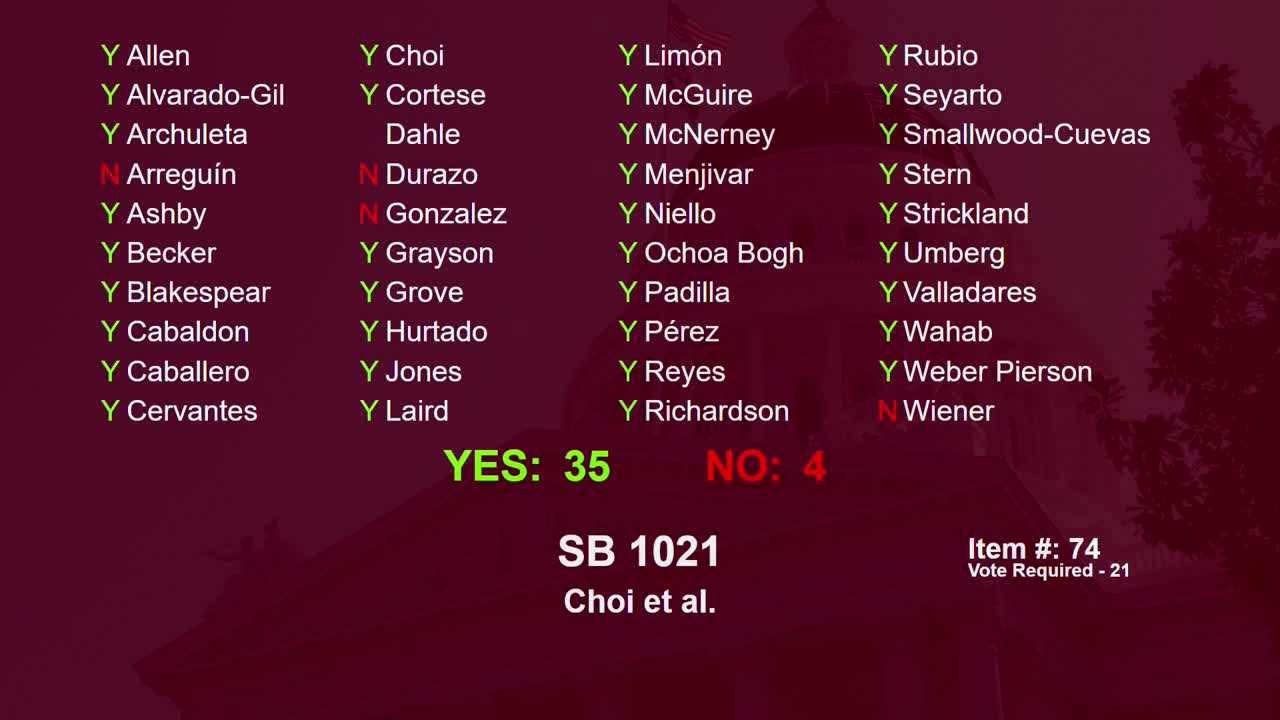 5MIN
Senate Floor
 30MIN
Senate Standing Committee on Elections and Constitutional Amendments
Bill Author

Bill Co-Author(s):