AB 2194: Physician assistants: supervision: doctors of podiatric medicine.
- Session Year: 2023-2024
- House: Assembly
- Latest Version Date: 2024-04-24
Current Status:
Failed
(2024-05-29: Referred to Com. on B., P. & E. D.)
Introduced
In Committee
First Chamber
In Committee
Second Chamber
Enacted
Existing law, the Physician Assistant Practice Act, establishes the Physician Assistant Board for the licensure and regulation of physician assistants. Existing law authorizes physician assistants to perform prescribed medical services that are rendered pursuant to a practice agreement and under the supervision of a licensed physician and surgeon. A violation of that supervision provision is a crime.
Existing law, the Medical Practice Act, provides for the certification and regulation of doctors of podiatric medicine by the Podiatric Medical Board of California, which is within the Department of Consumer Affairs. Existing law authorizes physicians and surgeons and doctors of podiatric medicine to establish a professional partnership that includes both physicians and surgeons and doctors of podiatric medicine if specified conditions are satisfied.
Existing law authorizes a physician assistant performing medical services under the supervision of a physician and surgeon to assist a doctor of podiatric medicine who is a partner, shareholder, or employee in the same medical group as the supervising physician and surgeon. Existing law requires a physician assistant who assists a doctor of podiatric medicine in this manner to do so only according to patient-specific orders from a supervising physician and surgeon and limits the physician assistant to performing those duties included within the scope of practice of a doctor of podiatric medicine. Existing law requires a supervising physician and surgeon to be available to the physician assistant for consultation when assistance is rendered.
This bill would revise those physician assistant supervision provisions to authorize a physician assistant performing medical services under the supervision of a physician and surgeon to assist a doctor of podiatric medicine who is on the staff of an the same organized health care system or who is a partner, shareholder, or employee in the same partnership, group, or professional corporation as the supervising physician and surgeon, pursuant to a practice agreement. The bill would delete both the restriction requiring that a physician assistant who assists a doctor of podiatric medicine do so only according to patient-specific orders from a supervising physician and surgeon and the requirement that a supervising physician and surgeon be available to the physician assistant for consultation when assistance is rendered to a doctor of podiatric medicine. The bill would authorize a doctor of podiatric medicine to participate in the practice agreement, and would authorize the practice agreement to include a doctor of podiatric medicine to cosign a treatment plan prepared by the physician assistant.
Existing law, the Physician Assistant Practice Act, establishes the Physician Assistant Board for the licensure and regulation of physician assistants. Existing law authorizes physician assistants to perform prescribed medical services that are rendered pursuant to a practice agreement and under the supervision of a licensed physician and surgeon. A violation of that supervision provision is a crime.
Existing law defines, for purposes of the act, the terms supervising physician and supervising physician and surgeon to mean a physician and surgeon licensed by the Medical Board of California or by the Osteopathic Medical Board of California who supervises one or more physician assistants, who possesses a current valid license to practice medicine, and who is not currently on disciplinary probation.Existing law, the Medical Practice Act, provides for the certification and regulation of podiatrists doctors of podiatric medicine by the Podiatric Medical Board of California, which is within the Department of Consumer Affairs. Existing law authorizes physicians and surgeons and doctors of podiatric medicine to establish a professional partnership that includes both physicians and surgeons and doctors of podiatric medicine if specified conditions are satisfied.
Existing law authorizes a physician assistant performing medical services under the supervision of a physician and surgeon to assist a doctor of podiatric medicine who is a partner, shareholder, or employee in the same medical group as the supervising physician and surgeon. Existing law requires a physician assistant who assists a doctor of podiatric medicine in this manner to do so only according to patient-specific orders from a supervising physician and surgeon and limits the physician assistant to performing those duties included within the scope of practice of a doctor of podiatric medicine. Existing law requires a supervising physician and surgeon to be available to the physician assistant for consultation when assistance is rendered.
This bill would delete these provisions establishing the conditions under which a physician assistant may assist a doctor of podiatric medicine and, instead, would expand the existing supervising physician and surgeon provisions to authorize a supervising podiatrist, as defined, to supervise a physician assistant in a similar manner. The bill would limit a physician assistant assisting a doctor of podiatric medicine pursuant to these expanded provisions to performing those duties included within the scope of practice of a doctor of podiatric medicine. The bill would make conforming changes.Under existing law, a physician assistant licensed by the board is eligible for employment or supervision by a physician and surgeon who is not subject to a disciplinary condition imposed by the Medical Board of California prohibiting that employment or supervision. Existing law, except as specified, prohibits a physician and surgeon from supervising more than 4 physician assistants at any one time. Existing law authorizes the Medical Board of California to restrict a physician and surgeon to supervising specific types of physician assistants, including, but not limited to, restricting a physician and surgeon from supervising physician assistants outside of the field of specialty of the physician and surgeon. A violation of these supervision provisions is a crime.This bill would expand these physician assistant supervision provisions to podiatrists and the Podiatric Medical Board of California.By expanding certain of the above supervision provisions, the violation of which is a crime, the bill would impose a state-mandated local program.The California Constitution requires the state to reimburse local agencies and school districts for certain costs mandated by the state. Statutory provisions establish procedures for making that reimbursement.This bill would provide that no reimbursement is required by this act for a specified reason.This bill would revise those physician assistant supervision provisions to authorize a physician assistant performing medical services under the supervision of a physician and surgeon to assist a doctor of podiatric medicine who is on the staff of an organized health care system or who is a partner, shareholder, or employee in the same partnership, group, or professional corporation as the supervising physician and surgeon, pursuant to a practice agreement. The bill would delete both the restriction requiring that a physician assistant who assists a doctor of podiatric medicine do so only according to patient-specific orders from a supervising physician and surgeon and the requirement that a supervising physician and surgeon be available to the physician assistant for consultation when assistance is rendered to a doctor of podiatric medicine. The bill would authorize a doctor of podiatric medicine to participate in the practice agreement, and would authorize the practice agreement to include a doctor of podiatric medicine to cosign a treatment plan prepared by the physician assistant.
Existing law, the Physician Assistant Practice Act, establishes the Physician Assistant Board for the licensure and regulation of physician assistants. Existing law authorizes physician assistants to perform prescribed medical services that are rendered pursuant to a practice agreement and under the supervision of a licensed physician and surgeon. A violation of that supervision provision is a crime.
Existing law defines, for purposes of the act, the terms supervising physician and supervising physician and surgeon to mean a physician and surgeon licensed by the Medical Board of California or by the Osteopathic Medical Board of California who supervises one or more physician assistants, who possesses a current valid license to practice medicine, and who is not currently on disciplinary probation.
Existing law, the Medical Practice Act, provides for the certification and regulation of podiatrists by the Podiatric Medical Board of California, which is within the Department of Consumer Affairs. Existing law authorizes physicians and surgeons and doctors of podiatric medicine to establish a professional partnership that includes both physicians and surgeons and doctors of podiatric medicine if specified conditions are satisfied.
Existing law authorizes a physician assistant performing medical services under the supervision of a physician and surgeon to assist a doctor of podiatric medicine who is a partner, shareholder, or employee in the same medical group as the supervising physician and surgeon. Existing law requires a physician assistant who assists a doctor of podiatric medicine in this manner to do so only according to patient-specific orders from a supervising physician and surgeon and limits the physician assistant to performing those duties included within the scope of practice of a doctor of podiatric medicine. Existing law requires a supervising physician and surgeon to be available to the physician assistant for consultation when assistance is rendered.
This bill would delete these provisions establishing the conditions under which a physician assistant may assist a doctor of podiatric medicine and, instead, would expand the existing supervising physician and surgeon provisions to authorize a supervising podiatrist, as defined, to supervise a physician assistant in a similar manner. The bill would limit a physician assistant assisting a doctor of podiatric medicine pursuant to these expanded provisions to performing those duties included within the scope of practice of a doctor of podiatric medicine. The bill would make conforming changes.
Under existing law, a physician assistant licensed by the board is eligible for employment or supervision by a physician and surgeon who is not subject to a disciplinary condition imposed by the Medical Board of California prohibiting that employment or supervision. Existing law, except as specified, prohibits a physician and surgeon from supervising more than 4 physician assistants at any one time. Existing law authorizes the Medical Board of California to restrict a physician and surgeon to supervising specific types of physician assistants, including, but not limited to, restricting a physician and surgeon from supervising physician assistants outside of the field of specialty of the physician and surgeon. A violation of these supervision provisions is a crime.
This bill would expand these physician assistant supervision provisions to podiatrists and the Podiatric Medical Board of California.
By expanding certain of the above supervision provisions, the violation of which is a crime, the bill would impose a state-mandated local program.
The California Constitution requires the state to reimburse local agencies and school districts for certain costs mandated by the state. Statutory provisions establish procedures for making that reimbursement.
This bill would provide that no reimbursement is required by this act for a specified reason.
(a)Notwithstanding any other law, a PA may perform medical services as authorized by this chapter if the following requirements are met:
(1)The PA renders the services under the supervision of a licensed physician and surgeon who is not subject to a disciplinary condition imposed by the Medical Board of California or by the Osteopathic Medical Board of California prohibiting that supervision or prohibiting the employment of a physician assistant.
(2)The PA renders the services pursuant to a practice agreement that meets the requirements of Section 3502.3.
(3)The PA is competent to perform the services.
(4)The PAs education, training, and experience have prepared the PA to render the services.
(b)(1)Notwithstanding any other law, a physician assistant performing medical services under the supervision of a physician and surgeon may assist a doctor of podiatric medicine who is on the staff of an the same organized health care system or who is a partner, shareholder, or employee in the same partnership, group, or professional corporation as the supervising physician and surgeon, pursuant to a practice agreement. A physician assistant assisting a doctor of podiatric medicine shall be limited to performing those duties authorized in the practice agreement.
(2)For purposes of implementing paragraph (1), a doctor of podiatric medicine may participate in the practice agreement. The practice agreement may include authorizing a doctor of podiatric medicine to cosign a treatment plan prepared by the physician assistant.(c)Nothing in regulations shall require that a physician and surgeon review or countersign a medical record of a patient treated by a physician assistant, unless required by the practice agreement. The board, as a condition of probation or reinstatement of a licensee, may require the review or countersignature of records of patients treated by a physician assistant for a specified duration.
(d)This chapter does not authorize the performance of medical services in any of the following areas:
(1)The determination of the refractive states of the human eye, or the fitting or adaptation of lenses or frames for the aid thereof.
(2)The prescribing or directing the use of, or using, any optical device in connection with ocular exercises, visual training, or orthoptics.
(3)The prescribing of contact lenses for, or the fitting or adaptation of contact lenses to, the human eye.
(4)The practice of dentistry or dental hygiene or the work of a dental auxiliary as defined in Chapter 4 (commencing with Section 1600).
(e)This section shall not be construed in a manner that shall preclude the performance of routine visual screening as defined in Section 3501.
(f)Notwithstanding any other law, a PA rendering services in a general acute care hospital as defined in Section 1250 of the Health and Safety Code shall be supervised by a physician and surgeon with privileges to practice in that hospital. Within a general acute care hospital, the practice agreement shall establish policies and procedures to identify a physician and surgeon who is supervising the PA.
REVISIONS: HeadingLine 2.(a)Notwithstanding any other law, a PA may perform medical services as authorized by this chapter if the following requirements are met:
(1)The PA renders the services under the supervision of a licensed physician and surgeon who is not subject to a disciplinary condition imposed by the Medical Board of California or by the Osteopathic Medical Board of California prohibiting that supervision or prohibiting the employment of a physician assistant.
(2)The PA renders the services pursuant to a practice agreement that meets the requirements of Section 3502.3.
(3)The PA is competent to perform the services.
(4)The PAs education, training, and experience have prepared the PA to render the services.
(b)(1)Notwithstanding any other law, a physician assistant performing medical services under the supervision of a physician and surgeon may assist a doctor of podiatric medicine who is on the staff of an organized health care system or who is a partner, shareholder, or employee in the same medical group partnership, group, or professional corporation as the supervising physician and surgeon. A physician assistant who assists a doctor of podiatric medicine pursuant to this subdivision shall do so only according to patient-specific orders from a supervising physician and surgeon.
(2)A supervising physician and surgeon shall be available to the physician assistant for consultation when assistance is rendered pursuant to this subdivision. surgeon, pursuant to a practice agreement. A physician assistant assisting a doctor of podiatric medicine shall be limited to performing those duties included within the scope of practice of a doctor of podiatric medicine. authorized in the practice agreement.
(2)For purposes of implementing paragraph (1), a doctor of podiatric medicine may participate in the practice agreement. The practice agreement may include authorizing a doctor of podiatric medicine to cosign a treatment plan prepared by the physician assistant.
(c)Nothing in regulations shall require that a physician and surgeon review or countersign a medical record of a patient treated by a physician assistant, unless required by the practice agreement. The board may, board, as a condition of probation or reinstatement of a licensee, may require the review or countersignature of records of patients treated by a physician assistant for a specified duration.
(d)This chapter does not authorize the performance of medical services in any of the following areas:
(1)The determination of the refractive states of the human eye, or the fitting or adaptation of lenses or frames for the aid thereof.
(2)The prescribing or directing the use of, or using, any optical device in connection with ocular exercises, visual training, or orthoptics.
(3)The prescribing of contact lenses for, or the fitting or adaptation of contact lenses to, the human eye.
(4)The practice of dentistry or dental hygiene or the work of a dental auxiliary as defined in Chapter 4 (commencing with Section 1600).
(e)This section shall not be construed in a manner that shall preclude the performance of routine visual screening as defined in Section 3501.
(f)Notwithstanding any other law, a PA rendering services in a general acute care hospital as defined in Section 1250 of the Health and Safety Code shall be supervised by a physician and surgeon with privileges to practice in that hospital. Within a general acute care hospital, the practice agreement shall establish policies and procedures to identify a physician and surgeon who is supervising the PA.
SECTION 1.Section 3500 of the Business and Professions Code is amended to read:3500.(a)In its concern with the growing shortage and geographic maldistribution of health care services in California, the Legislature intends to establish in this chapter a framework for another category of health manpowerthe physician assistant.(b)The purpose of this chapter is to encourage the effective utilization of the skills of physicians and surgeons and podiatrists by enabling them to work with qualified physician assistants to provide quality care.(c)This chapter is established to encourage the coordinated care between physician assistants, physicians and surgeons, podiatrists, and other qualified health care providers practicing in the same medical group, and to provide health care services. It is also the purpose of this chapter to allow for innovative development of programs for the education, training, and utilization of physician assistants.SEC. 2.Section 3501 of the Business and Professions Code is amended to read:3501.As used in this chapter:(a)Board means the Physician Assistant Board.(b)Approved program means a program for the education of physician assistants that has been formally approved by the board.(c)Trainee means a person who is currently enrolled in an approved program.(d)Physician assistant or PA means a person who meets the requirements of this chapter and is licensed by the board.(e)Supervising physician or supervising physician and surgeon means a physician and surgeon licensed by the Medical Board of California or by the Osteopathic Medical Board of California who supervises one or more physician assistants, who possesses a current valid license to practice medicine, and who is not currently on disciplinary probation prohibiting the employment or supervision of a physician assistant.(f)Supervising podiatrist means a podiatrist licensed by the Podiatric Medical Board of California who supervises one or more physician assistants, who possesses a current valid license to practice podiatric medicine, and who is not currently on disciplinary probation prohibiting the employment or supervision of a physician assistant. (g)(1)Supervision means that a licensed physician and surgeon podiatrist oversees the activities of, and accepts responsibility for, the medical services rendered by a physician assistant. Supervision, as defined in this subdivision, shall not be construed to require the physical presence of the physician and surgeon or podiatrist, but does require the following:(A)Adherence to adequate supervision as agreed to in the practice agreement.(B)The physician and surgeon or podiatrist being available by telephone or other electronic communication method at the time the PA examines the patient.(2)Nothing in this subdivision shall be construed as prohibiting the board from requiring the physical presence of a physician and surgeon or podiatrist as a term or condition of a PAs reinstatement, probation, or imposing discipline.(h)Regulations means the rules and regulations as set forth in Division 13.8 (commencing with Section 1399.500) of Title 16 of the California Code of Regulations.(i)Routine visual screening means noninvasive, nonpharmacological simple testing for visual acuity, visual field defects, color blindness, and depth perception.(j)Program manager means the staff manager of the diversion program, as designated by the executive officer of the board. The program manager shall have background experience in dealing with substance abuse issues.(k)Organized health care system includes a licensed clinic as described in Chapter 1 (commencing with Section 1200) of Division 2 of the Health and Safety Code, an outpatient setting as described in Chapter 1.3 (commencing with Section 1248) of Division 2 of the Health and Safety Code, a health facility as described in Chapter 2 (commencing with Section 1250) of Division 2 of the Health and Safety Code, a county medical facility as described in Chapter 2.5 (commencing with Section 1440) of Division 2 of the Health and Safety Code, an accountable care organization, a home health agency, a physicians office, a professional medical corporation, a medical partnership, a medical foundation, and any other entity that lawfully provides medical services and is in compliance with Article 18 (commencing with Section 2400) of Chapter 5.(l)Practice agreement means the writing, developed through collaboration among one or more physicians and surgeons or podiatrists and one or more physician assistants, that defines the medical services the physician assistant is authorized to perform pursuant to Section 3502 and that grants approval for physicians and surgeons or podiatrists on the staff of an organized health care system to supervise one or more physician assistants in the organized health care system. Any reference to a delegation of services agreement relating to physician assistants in any other law shall have the same meaning as a practice agreement.(m)Other specified medical services means tests or examinations performed or ordered by a PA practicing in compliance with this chapter or regulations of the board or the Medical Board of California promulgated under this chapter.SEC. 3.Section 3502 of the Business and Professions Code is amended to read:3502.(a)Notwithstanding any other law, a PA may perform medical services as authorized by this chapter if the following requirements are met:(1)The PA renders the services under the supervision of a licensed physician and surgeon who is not subject to a disciplinary condition imposed by the Medical Board of California or by the Osteopathic Medical Board of California, or under the supervision of a podiatrist who is not subject to a disciplinary condition imposed by the Podiatric Medical Board of California, prohibiting that supervision or prohibiting the employment of a physician assistant.(2)The PA renders the services pursuant to a practice agreement that meets the requirements of Section 3502.3.(3)The PA is competent to perform the services.(4)The PAs education, training, and experience have prepared the PA to render the services. (b)Nothing in regulations shall require that a physician and surgeon or podiatrist review or countersign a medical record of a patient treated by a physician assistant, unless required by the practice agreement. The board, as a condition of probation or reinstatement of a licensee, may require the review or countersignature of records of patients treated by a physician assistant for a specified duration.(c)This chapter does not authorize the performance of medical services in any of the following areas:(1)The determination of the refractive states of the human eye, or the fitting or adaptation of lenses or frames for the aid thereof.(2)The prescribing or directing the use of, or using, any optical device in connection with ocular exercises, visual training, or orthoptics.(3)The prescribing of contact lenses for, or the fitting or adaptation of contact lenses to, the human eye.(4)The practice of dentistry or dental hygiene or the work of a dental auxiliary as defined in Chapter 4 (commencing with Section 1600).(d)This section shall not be construed in a manner that shall preclude the performance of routine visual screening as defined in Section 3501.(e)Notwithstanding any other law, a PA rendering services in a general acute care hospital as defined in Section 1250 of the Health and Safety Code shall be supervised by a physician and surgeon or podiatrist with privileges to practice in that hospital. Within a general acute care hospital, the practice agreement shall establish policies and procedures to identify a physician and surgeon or podiatrist who is supervising the PA.SEC. 4.Section 3502.1 of the Business and Professions Code is amended to read:3502.1.In addition to the medical services authorized in the regulations adopted pursuant to Section 3502, and except as prohibited by Section 3502, a PA may furnish or order a drug or device subject to all of the following:(a)The PA shall furnish or order a drug or device in accordance with the practice agreement and consistent with the PAs educational preparation or for which clinical competency has been established and maintained.(b)(1)A practice agreement authorizing a PA to order or furnish a drug or device shall specify which PA or PAs may furnish or order a drug or device, which drugs or devices may be furnished or ordered, under what circumstances, the extent of physician and surgeon or podiatrist supervision, the method of periodic review of the PAs competence, including peer review, and review of the practice agreement.(2)In addition to the requirements in paragraph (1), if the practice agreement authorizes the PA to furnish a Schedule II controlled substance, the practice agreement shall address the diagnosis of the illness, injury, or condition for which the PA may furnish the Schedule II controlled substance.(c)The PA shall furnish or order drugs or devices under physician and surgeon or podiatrist supervision. This subdivision shall not be construed to require the physical presence of the physician and surgeon or podiatrist, but does require the following:(1)Adherence to adequate supervision as agreed to in the practice agreement.(2)The physician and surgeon or podiatrist be available by telephone or other electronic communication method at the time the PA examines the patient.(d)(1)Except as provided in paragraph (2), the PA may furnish or order only those Schedule II through Schedule V controlled substances under the California Uniform Controlled Substances Act (Division 10 (commencing with Section 11000) of the Health and Safety Code) that have been agreed upon in the practice agreement.(2)The PA may furnish or order Schedule II or III controlled substances, as defined in Sections 11055 and 11056, respectively, of the Health and Safety Code, in accordance with the practice agreement or a patient-specific order approved by the treating or supervising physician and surgeon or podiatrist.(e)(1)The PA has satisfactorily completed a course in pharmacology covering the drugs or devices to be furnished or ordered under this section or has completed a program for instruction of PAs that meet the requirements of Section 1399.530 of Title 16 of the California Code of Regulations, as that provision read on June 7, 2019.(2)A physician and surgeon or podiatrist through a practice agreement may determine the extent of supervision necessary pursuant to this section in the furnishing or ordering of drugs and devices.(3)PAs who hold an active license, who are authorized through a practice agreement to furnish Schedule II controlled substances, and who are registered with the United States Drug Enforcement Administration, and who have not successfully completed a one-time course in compliance with Sections 1399.610 and 1399.612 of Title 16 of the California Code of Regulations, as those provisions read on June 7, 2019, shall complete, as part of their continuing education requirements, a course that covers Schedule II controlled substances, and the risks of addiction associated with their use, based on the standards developed by the board. The board shall establish the requirements for satisfactory completion of this subdivision. Evidence of completion of a course meeting the standards, including pharmacological content, established in Sections 1399.610 and 1399.612 of Title 16 of the California Code of Regulations, as those provisions read on June 7, 2019, shall be deemed to meet the requirements of this section.(f)For purposes of this section:(1)Furnishing or ordering shall include the following:(A)Ordering a drug or device in accordance with the practice agreement.(B)Transmitting an order of a supervising physician and surgeon or podiatrist.(C)Dispensing a medication pursuant to Section 4170.(2)Drug order or order means an order for medication that is dispensed to or for an ultimate user, issued by a PA as an individual practitioner, within the meaning of Section 1306.02 of Title 21 of the Code of Federal Regulations.(g)Notwithstanding any other law, (1) a drug order issued pursuant to this section shall be treated in the same manner as a prescription of a supervising physician or podiatrist; (2) all references to prescription in this code and the Health and Safety Code shall include drug orders issued by physician assistants; and (3) the signature of a PA on a drug order issued in accordance with this section shall be deemed to be the signature of a prescriber for purposes of this code and the Health and Safety Code.SEC. 5.Section 3502.3 of the Business and Professions Code is amended to read:3502.3.(a)(1)A practice agreement shall include provisions that address the following:(A)The types of medical services a physician assistant is authorized to perform.(B)Policies and procedures to ensure adequate supervision of the physician assistant, including, but not limited to, appropriate communication, availability, consultations, and referrals between a physician and surgeon or podiatrist and the physician assistant in the provision of medical services.(C)The methods for the continuing evaluation of the competency and qualifications of the physician assistant.(D)The furnishing or ordering of drugs or devices by a physician assistant pursuant to Section 3502.1.(E)Any additional provisions agreed to by the physician assistant and physician and surgeon or podiatrist.(2)A practice agreement shall be signed by both of the following:(A)The physician assistant.(B)One or more physicians and surgeons or podiatrists or a physician and surgeon or podiatrist who is authorized to approve the practice agreement on behalf of the staff of the physicians and surgeons or podiatrists on the staff of an organized health care system.(3)A delegation of services agreement in effect prior to January 1, 2020, shall be deemed to meet the requirements of this subdivision.(4)A practice agreement may designate a PA as an agent of a supervising physician and surgeon or podiatrist.(5)Nothing in this section shall be construed to require approval of a practice agreement by the board.(b)Notwithstanding any other law, in addition to any other practices that meet the general criteria set forth in this chapter or regulations adopted by the board or the Medical Board of California, a practice agreement may authorize a PA to do any of the following:(1)Order durable medical equipment, subject to any limitations set forth in Section 3502 or the practice agreement. Notwithstanding that authority, nothing in this paragraph shall operate to limit the ability of a third-party payer to require prior approval.(2)For individuals receiving home health services or personal care services, after consultation with a supervising physician and surgeon, approve, sign, modify, or add to a plan of treatment or plan of care.(3)After performance of a physical examination by the PA under the supervision of a physician and surgeon or podiatrist consistent with this chapter, certify disability pursuant to Section 2708 of the Unemployment Insurance Code. The Employment Development Department shall implement this paragraph on or before January 1, 2017.(c)This section shall not be construed to affect the validity of any practice agreement in effect prior to the effective date of this section or those adopted subsequent to the effective date of this section.SEC. 6.Section 3502.5 of the Business and Professions Code is amended to read:3502.5.(a)Notwithstanding any other law, a physician assistant may perform those medical services permitted pursuant to Section 3502 during any state of war emergency, state of emergency, or state of local emergency, as defined in Section 8558 of the Government Code, and at the request of a responsible federal, state, or local official or agency, or pursuant to the terms of a mutual aid operation plan established and approved pursuant to the California Emergency Services Act (Chapter 7 (commencing with Section 8550) of Division 1 of Title 2 of the Government Code), regardless of whether the physician assistants approved supervising physician or podiatrist is available to supervise the physician assistant, so long as a licensed physician or podiatrist is available to render the appropriate supervision. Appropriate supervision shall not require the personal or electronic availability of a supervising physician or podiatrist if that availability is not possible or practical due to the emergency. The local health officers and their designees may act as supervising physicians during emergencies without being subject to approval by the Medical Board of California. At all times, the local health officers or their designees supervising the physician assistants shall be licensed physicians and surgeons. Supervising physicians acting pursuant to this section shall not be subject to the limitation on the number of physician assistants supervised under Section 3516.(b)A responsible official or mutual aid operation plan shall not invoke this section except in the case of an emergency that endangers the health of individuals. Under no circumstances shall this section be invoked as the result of a labor dispute or other dispute concerning collective bargaining.SEC. 7.Section 3502.7 is added to the Business and Professions Code, to read:3502.7.A physician assistant assisting a doctor of podiatric medicine pursuant to this chapter shall be limited to performing those duties included within the scope of practice of a doctor of podiatric medicine.SEC. 8.Section 3503.5 of the Business and Professions Code is amended to read:3503.5.(a)A person licensed under this chapter who in good faith renders emergency care at the scene of an emergency that occurs outside both the place and course of that persons employment shall not be liable for any civil damage as a result of any acts or omissions by that person in rendering the emergency care.(b)This section shall not be construed to grant immunity from civil damages to any person whose conduct in rendering emergency care is grossly negligent.(c)In addition to the immunity specified in subdivision (a), Article 17 (commencing with Section 2395) of Chapter 5 shall apply to a person licensed under this chapter when acting pursuant to delegated authority from an approved supervising physician or podiatrist.SEC. 9.Section 3516 of the Business and Professions Code is amended to read:3516.(a)Notwithstanding any other law, a physician assistant licensed by the board shall be eligible for employment or supervision by the following: (1)A physician and surgeon who is not subject to a disciplinary condition imposed by the Medical Board of California prohibiting that employment or supervision.(2)A podiatrist who is not subject to a disciplinary condition imposed by the Podiatric Medical Board of California prohibiting that employment or supervision.(b)(1)Except as provided in paragraph (2) and in Section 3502.5, a physician and surgeon or a podiatrist shall not supervise more than four physician assistants at any one time.(2)Notwithstanding paragraph (1), a physician and surgeon may supervise up to, but no more than, eight physician assistants at one time, but only if the following conditions are satisfied by all supervised physician assistants:(A)The physician assistants are focused solely on performing in home health evaluations.(B)The physician assistants are performing in home health evaluations solely for the following purposes:(i)Gathering patient information.(ii)Performing an annual wellness visit or health evaluation, if it does not involve direct patient treatment or prescribing medication.(3)A physician assistant who performs an in home health evaluation for the purposes specified in subparagraph (B) of paragraph (2) remains subject to all supervisory and scope requirements pursuant to this chapter and shall provide the supervising physician and surgeon with all information related to their evaluation under subparagraphs (A) and (B) of paragraph (2).(c)(1)The Medical Board of California may restrict a physician and surgeon to supervising specific types of physician assistants, including, but not limited to, restricting a physician and surgeon from supervising physician assistants outside of the field of specialty of the physician and surgeon.(2)The Podiatric Medical Board of California may restrict a podiatrist to supervising specific types of physician assistants, including, but not limited to, restricting a podiatrist from supervising physician assistants outside of the field of specialty of the podiatrist.(d)For purposes of this section:(1)In home health evaluation means a comprehensive physical exam, assessment of current and prior health conditions, a complete medication review, screening tests, health education, and assessment of social determination of health needs to be used for diagnosing individual medical conditions.(2)Annual wellness visit means a preventive visit with correlating current procedural terminology codes performed annually to a patient, to be used for the purposes of diagnosing patient conditions during the annual wellness visit, which may include a nonphysical examination for patients covered by Medicare Part B for more than 12 months.SEC. 10.No reimbursement is required by this act pursuant to Section 6 of Article XIIIB of the California Constitution because the only costs that may be incurred by a local agency or school district will be incurred because this act creates a new crime or infraction, eliminates a crime or infraction, or changes the penalty for a crime or infraction, within the meaning of Section 17556 of the Government Code, or changes the definition of a crime within the meaning of Section 6 of Article XIIIB of the California Constitution.(a)In its concern with the growing shortage and geographic maldistribution of health care services in California, the Legislature intends to establish in this chapter a framework for another category of health manpowerthe physician assistant.
The(b)The purpose of this chapter is to encourage the effective utilization of the skills of physicians and surgeons, and physicians and surgeons and podiatrists practicing in the same medical group practice, by enabling them to work with qualified physician assistants to provide quality care.
This(c)This chapter is established to encourage the coordinated care between physician assistants, physicians and surgeons, podiatrists, and other qualified health care providers practicing in the same medical group, and to provide health care services. It is also the purpose of this chapter to allow for innovative development of programs for the education, training, and utilization of physician assistants.
SEC. 2.Section 3501 of the Business and Professions Code is amended to read:3501.As used in this chapter:
(a)Board means the Physician Assistant Board.
(b)Approved program means a program for the education of physician assistants that has been formally approved by the board.
(c)Trainee means a person who is currently enrolled in an approved program.
(d)Physician assistant or PA means a person who meets the requirements of this chapter and is licensed by the board.
(e)Supervising physician or supervising physician and surgeon means a physician and surgeon licensed by the Medical Board of California or by the Osteopathic Medical Board of California who supervises one or more physician assistants, who possesses a current valid license to practice medicine, and who is not currently on disciplinary probation prohibiting the employment or supervision of a physician assistant.
(f)Supervising podiatrist means a podiatrist licensed by the Podiatric Medical Board of California who supervises one or more physician assistants, who possesses a current valid license to practice podiatric medicine, and who is not currently on disciplinary probation prohibiting the employment or supervision of a physician assistant.
(f)(g)(1)Supervision means that a licensed physician and surgeon podiatrist oversees the activities of, and accepts responsibility for, the medical services rendered by a physician assistant. Supervision, as defined in this subdivision, shall not be construed to require the physical presence of the physician and surgeon, surgeon or podiatrist, but does require the following:
(A)Adherence to adequate supervision as agreed to in the practice agreement.
(B)The physician and surgeon or podiatrist being available by telephone or other electronic communication method at the time the PA examines the patient.
(2)Nothing in this subdivision shall be construed as prohibiting the board from requiring the physical presence of a physician and surgeon or podiatrist as a term or condition of a PAs reinstatement, probation, or imposing discipline.
(g)(h)Regulations means the rules and regulations as set forth in Division 13.8 (commencing with Section 1399.500) of Title 16 of the California Code of Regulations.
(h)(i)Routine visual screening means noninvasive, nonpharmacological simple testing for visual acuity, visual field defects, color blindness, and depth perception.
(i)(j)Program manager means the staff manager of the diversion program, as designated by the executive officer of the board. The program manager shall have background experience in dealing with substance abuse issues.
(j)(k)Organized health care system includes a licensed clinic as described in Chapter 1 (commencing with Section 1200) of Division 2 of the Health and Safety Code, an outpatient setting as described in Chapter 1.3 (commencing with Section 1248) of Division 2 of the Health and Safety Code, a health facility as described in Chapter 2 (commencing with Section 1250) of Division 2 of the Health and Safety Code, a county medical facility as described in Chapter 2.5 (commencing with Section 1440) of Division 2 of the Health and Safety Code, an accountable care organization, a home health agency, a physicians office, a professional medical corporation, a medical partnership, a medical foundation, and any other entity that lawfully provides medical services and is in compliance with Article 18 (commencing with Section 2400) of Chapter 5.
(k)(l)Practice agreement means the writing, developed through collaboration among one or more physicians and surgeons or podiatrists and one or more physician assistants, that defines the medical services the physician assistant is authorized to perform pursuant to Section 3502 and that grants approval for physicians and surgeons or podiatrists on the staff of an organized health care system to supervise one or more physician assistants in the organized health care system. Any reference to a delegation of services agreement relating to physician assistants in any other law shall have the same meaning as a practice agreement.
(l)(m)Other specified medical services means tests or examinations performed or ordered by a PA practicing in compliance with this chapter or regulations of the board or the Medical Board of California promulgated under this chapter.
SEC. 3.Section 3502 of the Business and Professions Code is amended to read:3502.(a)Notwithstanding any other law, a PA may perform medical services as authorized by this chapter if the following requirements are met:
(1)The PA renders the services under the supervision of a licensed physician and surgeon who is not subject to a disciplinary condition imposed by the Medical Board of California or by the Osteopathic Medical Board of California California, or under the supervision of a podiatrist who is not subject to a disciplinary condition imposed by the Podiatric Medical Board of California, prohibiting that supervision or prohibiting the employment of a physician assistant.
(2)The PA renders the services pursuant to a practice agreement that meets the requirements of Section 3502.3.
(3)The PA is competent to perform the services.
(4)The PAs education, training, and experience have prepared the PA to render the services.
(b)(1)Notwithstanding any other law, a physician assistant performing medical services under the supervision of a physician and surgeon may assist a doctor of podiatric medicine who is a partner, shareholder, or employee in the same medical group as the supervising physician and surgeon. A physician assistant who assists a doctor of podiatric medicine pursuant to this subdivision shall do so only according to patient-specific orders from a supervising physician and surgeon.(2)A supervising physician and surgeon shall be available to the physician assistant for consultation when assistance is rendered pursuant to this subdivision. A physician assistant assisting a doctor of podiatric medicine shall be limited to performing those duties included within the scope of practice of a doctor of podiatric medicine. (c)(b)Nothing in regulations shall require that a physician and surgeon or podiatrist review or countersign a medical record of a patient treated by a physician assistant, unless required by the practice agreement. The board may, board, as a condition of probation or reinstatement of a licensee, may require the review or countersignature of records of patients treated by a physician assistant for a specified duration.
(d)(c)This chapter does not authorize the performance of medical services in any of the following areas:
(1)The determination of the refractive states of the human eye, or the fitting or adaptation of lenses or frames for the aid thereof.
(2)The prescribing or directing the use of, or using, any optical device in connection with ocular exercises, visual training, or orthoptics.
(3)The prescribing of contact lenses for, or the fitting or adaptation of contact lenses to, the human eye.
(4)The practice of dentistry or dental hygiene or the work of a dental auxiliary as defined in Chapter 4 (commencing with Section 1600).
(e)(d)This section shall not be construed in a manner that shall preclude the performance of routine visual screening as defined in Section 3501.
(f)(e)Notwithstanding any other law, a PA rendering services in a general acute care hospital as defined in Section 1250 of the Health and Safety Code shall be supervised by a physician and surgeon or podiatrist with privileges to practice in that hospital. Within a general acute care hospital, the practice agreement shall establish policies and procedures to identify a physician and surgeon or podiatrist who is supervising the PA.
SEC. 4.Section 3502.1 of the Business and Professions Code is amended to read:3502.1.In addition to the medical services authorized in the regulations adopted pursuant to Section 3502, and except as prohibited by Section 3502, a PA may furnish or order a drug or device subject to all of the following:
(a)The PA shall furnish or order a drug or device in accordance with the practice agreement and consistent with the PAs educational preparation or for which clinical competency has been established and maintained.
(b)(1)A practice agreement authorizing a PA to order or furnish a drug or device shall specify which PA or PAs may furnish or order a drug or device, which drugs or devices may be furnished or ordered, under what circumstances, the extent of physician and surgeon or podiatrist supervision, the method of periodic review of the PAs competence, including peer review, and review of the practice agreement.
(2)In addition to the requirements in paragraph (1), if the practice agreement authorizes the PA to furnish a Schedule II controlled substance, the practice agreement shall address the diagnosis of the illness, injury, or condition for which the PA may furnish the Schedule II controlled substance.
(c)The PA shall furnish or order drugs or devices under physician and surgeon or podiatrist supervision. This subdivision shall not be construed to require the physical presence of the physician and surgeon, surgeon or podiatrist, but does require the following:
(1)Adherence to adequate supervision as agreed to in the practice agreement.
(2)The physician and surgeon or podiatrist be available by telephone or other electronic communication method at the time the PA examines the patient.
(d)(1)Except as provided in paragraph (2), the PA may furnish or order only those Schedule II through Schedule V controlled substances under the California Uniform Controlled Substances Act (Division 10 (commencing with Section 11000) of the Health and Safety Code) that have been agreed upon in the practice agreement.
(2)The PA may furnish or order Schedule II or III controlled substances, as defined in Sections 11055 and 11056, respectively, of the Health and Safety Code, in accordance with the practice agreement or a patient-specific order approved by the treating or supervising physician and surgeon. surgeon or podiatrist.
(e)(1)The PA has satisfactorily completed a course in pharmacology covering the drugs or devices to be furnished or ordered under this section or has completed a program for instruction of PAs that meet the requirements of Section 1399.530 of Title 16 of the California Code of Regulations, as that provision read on June 7, 2019.
(2)A physician and surgeon or podiatrist through a practice agreement may determine the extent of supervision necessary pursuant to this section in the furnishing or ordering of drugs and devices.
(3)PAs who hold an active license, who are authorized through a practice agreement to furnish Schedule II controlled substances, and who are registered with the United States Drug Enforcement Administration, and who have not successfully completed a one-time course in compliance with Sections 1399.610 and 1399.612 of Title 16 of the California Code of Regulations, as those provisions read on June 7, 2019, shall complete, as part of their continuing education requirements, a course that covers Schedule II controlled substances, and the risks of addiction associated with their use, based on the standards developed by the board. The board shall establish the requirements for satisfactory completion of this subdivision. Evidence of completion of a course meeting the standards, including pharmacological content, established in Sections 1399.610 and 1399.612 of Title 16 of the California Code of Regulations, as those provisions read on June 7, 2019, shall be deemed to meet the requirements of this section.
(f)For purposes of this section:
(1)Furnishing or ordering shall include the following:
(A)Ordering a drug or device in accordance with the practice agreement.
(B)Transmitting an order of a supervising physician and surgeon. surgeon or podiatrist.
(C)Dispensing a medication pursuant to Section 4170.
(2)Drug order or order means an order for medication that is dispensed to or for an ultimate user, issued by a PA as an individual practitioner, within the meaning of Section 1306.02 of Title 21 of the Code of Federal Regulations.
(g)Notwithstanding any other law, (1) a drug order issued pursuant to this section shall be treated in the same manner as a prescription of a supervising physician; physician or podiatrist; (2) all references to prescription in this code and the Health and Safety Code shall include drug orders issued by physician assistants; and (3) the signature of a PA on a drug order issued in accordance with this section shall be deemed to be the signature of a prescriber for purposes of this code and the Health and Safety Code.
SEC. 5.Section 3502.3 of the Business and Professions Code is amended to read:3502.3.(a)(1)A practice agreement shall include provisions that address the following:
(A)The types of medical services a physician assistant is authorized to perform.
(B)Policies and procedures to ensure adequate supervision of the physician assistant, including, but not limited to, appropriate communication, availability, consultations, and referrals between a physician and surgeon or podiatrist and the physician assistant in the provision of medical services.
(C)The methods for the continuing evaluation of the competency and qualifications of the physician assistant.
(D)The furnishing or ordering of drugs or devices by a physician assistant pursuant to Section 3502.1.
(E)Any additional provisions agreed to by the physician assistant and physician and surgeon. surgeon or podiatrist.
(2)A practice agreement shall be signed by both of the following:
(A)The physician assistant.
(B)One or more physicians and surgeons or podiatrists or a physician and surgeon or podiatrist who is authorized to approve the practice agreement on behalf of the staff of the physicians and surgeons or podiatrists on the staff of an organized health care system.
(3)A delegation of services agreement in effect prior to January 1, 2020, shall be deemed to meet the requirements of this subdivision.
(4)A practice agreement may designate a PA as an agent of a supervising physician and surgeon. surgeon or podiatrist.
(5)Nothing in this section shall be construed to require approval of a practice agreement by the board.
(b)Notwithstanding any other law, in addition to any other practices that meet the general criteria set forth in this chapter or regulations adopted by the board or the Medical Board of California, a practice agreement may authorize a PA to do any of the following:
(1)Order durable medical equipment, subject to any limitations set forth in Section 3502 or the practice agreement. Notwithstanding that authority, nothing in this paragraph shall operate to limit the ability of a third-party payer to require prior approval.
(2)For individuals receiving home health services or personal care services, after consultation with a supervising physician and surgeon, approve, sign, modify, or add to a plan of treatment or plan of care.
(3)After performance of a physical examination by the PA under the supervision of a physician and surgeon or podiatrist consistent with this chapter, certify disability pursuant to Section 2708 of the Unemployment Insurance Code. The Employment Development Department shall implement this paragraph on or before January 1, 2017.
(c)This section shall not be construed to affect the validity of any practice agreement in effect prior to the effective date of this section or those adopted subsequent to the effective date of this section.
SEC. 6.Section 3502.5 of the Business and Professions Code is amended to read:3502.5.(a)Notwithstanding any other provision of law, a physician assistant may perform those medical services permitted pursuant to Section 3502 during any state of war emergency, state of emergency, or state of local emergency, as defined in Section 8558 of the Government Code, and at the request of a responsible federal, state, or local official or agency, or pursuant to the terms of a mutual aid operation plan established and approved pursuant to the California Emergency Services Act (Chapter 7 (commencing with Section 8550) of Division 1 of Title 2 of the Government Code), regardless of whether the physician assistants approved supervising physician or podiatrist is available to supervise the physician assistant, so long as a licensed physician or podiatrist is available to render the appropriate supervision. Appropriate supervision shall not require the personal or electronic availability of a supervising physician or podiatrist if that availability is not possible or practical due to the emergency. The local health officers and their designees may act as supervising physicians during emergencies without being subject to approval by the Medical Board of California. At all times, the local health officers or their designees supervising the physician assistants shall be licensed physicians and surgeons. Supervising physicians acting pursuant to this section shall not be subject to the limitation on the number of physician assistants supervised under Section 3516.
No(b)A responsible official or mutual aid operation plan shall not invoke this section except in the case of an emergency that endangers the health of individuals. Under no circumstances shall this section be invoked as the result of a labor dispute or other dispute concerning collective bargaining.
SEC. 7.Section 3502.7 is added to the Business and Professions Code, to read:3502.7.A physician assistant assisting a doctor of podiatric medicine pursuant to this chapter shall be limited to performing those duties included within the scope of practice of a doctor of podiatric medicine.
SEC. 8.Section 3503.5 of the Business and Professions Code is amended to read:3503.5.(a)A person licensed under this chapter who in good faith renders emergency care at the scene of an emergency that occurs outside both the place and course of that persons employment shall not be liable for any civil damage as a result of any acts or omissions by that person in rendering the emergency care.
(b)This section shall not be construed to grant immunity from civil damages to any person whose conduct in rendering emergency care is grossly negligent.
(c)In addition to the immunity specified in subdivision (a), the provisions of Article 17 (commencing with Section 2395) of Chapter 5 shall apply to a person licensed under this chapter when acting pursuant to delegated authority from an approved supervising physician. physician or podiatrist.
SEC. 9.Section 3516 of the Business and Professions Code is amended to read:3516.(a)Notwithstanding any other law, a physician assistant licensed by the board shall be eligible for employment or supervision by a the following:
(1)A physician and surgeon who is not subject to a disciplinary condition imposed by the Medical Board of California prohibiting that employment or supervision.
(2)A podiatrist who is not subject to a disciplinary condition imposed by the Podiatric Medical Board of California prohibiting that employment or supervision.
(b)(1)Except as provided in paragraph (2) and in Section 3502.5, a physician and surgeon or a podiatrist shall not supervise more than four physician assistants at any one time.
(2)Notwithstanding paragraph (1), a physician and surgeon may supervise up to, but no more than, eight physician assistants at one time, but only if the following conditions are satisfied by all supervised physician assistants:
(A)The physician assistants are focused solely on performing in home health evaluations.
(B)The physician assistants are performing in home health evaluations solely for the following purposes:
(i)Gathering patient information.
(ii)Performing an annual wellness visit or health evaluation, if it does not involve direct patient treatment or prescribing medication.
(3)A physician assistant who performs an in home health evaluation for the purposes specified in subparagraph (B) of paragraph (2) remains subject to all supervisory and scope requirements pursuant to this chapter and shall provide the supervising physician and surgeon with all information related to their evaluation under subparagraphs (A) and (B) of paragraph (2).
(c)(1)The Medical Board of California may restrict a physician and surgeon to supervising specific types of physician assistants assistants, including, but not limited to, restricting a physician and surgeon from supervising physician assistants outside of the field of specialty of the physician and surgeon.
(2)The Podiatric Medical Board of California may restrict a podiatrist to supervising specific types of physician assistants, including, but not limited to, restricting a podiatrist from supervising physician assistants outside of the field of specialty of the podiatrist.
(d)For purposes of this section:
(1)In home health evaluation means a comprehensive physical exam, assessment of current and prior health conditions, a complete medication review, screening tests, health education, and assessment of social determination of health needs to be used for diagnosing individual medical conditions.
(2)Annual wellness visit means a preventive visit with correlating current procedural terminology codes performed annually to a patient, to be used for the purposes of diagnosing patient conditions during the annual wellness visit, which may include a nonphysical examination for patients covered by Medicare Part B for more than 12 months.
SEC. 10.No reimbursement is required by this act pursuant to Section 6 of Article XIIIB of the California Constitution because the only costs that may be incurred by a local agency or school district will be incurred because this act creates a new crime or infraction, eliminates a crime or infraction, or changes the penalty for a crime or infraction, within the meaning of Section 17556 of the Government Code, or changes the definition of a crime within the meaning of Section 6 of Article XIIIB of the California Constitution.
|
Date
|
Status
|
|---|---|
| May 29, 2024 | Referred to Com. on B., P. & E. D. |
| May 21, 2024 | In Senate. Read first time. To Com. on RLS. for assignment. |
| May 20, 2024 | Read third time. Passed. Ordered to the Senate. (Ayes 56. Noes 1. Page 5328.) |
| May 16, 2024 | From Consent Calendar. |
| May 16, 2024 | Ordered to third reading. |
| May 9, 2024 | Read second time. Ordered to Consent Calendar. |
| May 8, 2024 | Coauthors revised. |
| May 8, 2024 | From committee: Do pass. To Consent Calendar. (Ayes 15. Noes 0.) (May 8). |
| Apr 25, 2024 | Re-referred to Com. on APPR. |
| Apr 24, 2024 | Read second time and amended. |
| Apr 23, 2024 | From committee: Amend, and do pass as amended and re-refer to Com. on APPR. (Ayes 15. Noes 0.) (April 23). |
| Apr 16, 2024 | Re-referred to Com. on B. & P. |
| Apr 15, 2024 | From committee chair, with author's amendments: Amend, and re-refer to Com. on B. & P. Read second time and amended. |
| Feb 26, 2024 | Referred to Com. on B. & P. |
| Feb 8, 2024 | From printer. May be heard in committee March 9. |
| Feb 7, 2024 | Read first time. To print. |
|
Date
|
Description
|
Location
|
Votes
|
|
|---|---|---|---|---|
| May 20, 2024 | AB 2194 Joe Patterson Assembly Third Reading | Assembly Floor |
Passed |
|
| May 8, 2024 | Do pass. To Consent Calendar. | Assembly Standing Committee on Appropriations |
Passed |
|
| Apr 23, 2024 | Do pass as amended and be re-referred to the Committee on [Appropriations] | Assembly Standing Committee on Business and Professions |
Passed |
This list shows positions taken on this bill by organizations on the date displayed, which is linked to the original source.
Positions by individuals are not included.
|
Organization
|
Position
|
Date
|
|---|---|---|
| California Academy of PAs | ** Support | |
| California Orthopedic Association | * Against | Apr 23, 2024 |
| California Podiatric Medical Association | * Support | Apr 23, 2024 |
| Physician Assistant Board | ** Against | |
| Stone Advocacy | * Against | Apr 23, 2024 |
ASSEMBLY THIRD READING
ATR Bill Id:AB 2194
Author:(Joe Patterson)
As Amended Ver:April 24, 2024
Majority vote
SUMMARY
Relaxes restrictions on the ability for a physician assistant (PA) to assist a doctor of podiatric medicine (DPM), replacing them with any conditions that may be agreed to by a PA and a supervising physician in a practice agreement.
Major Provisions
- Modify which DPMs a PA may assist:
- Expand the list of DPMs who are partners, shareholders, or employees in the same medical group as the supervising physician and surgeon to include those in the same partnership, group, or professional corporation.
- Add DPMs who are on the staff of the same organized health care system as the supervising physician and surgeon.
- Modify the conditions under which a PA under the supervision of a physician and surgeon may assist DPMs:
- Delete the requirements specific to assisting DPMs: 1) that the assistance be according to patient-specific orders from a supervising physician and surgeon, 2) that a supervising physician and surgeon be available to the PA for consultation, and 3) that the PA be limited to the scope of practice of a DPM.
- Require instead the assistance to be pursuant to the practice agreement.
COMMENTS
Background. PAs are licensed healthcare professionals trained to provide health care services under the supervision of a physician and surgeon. In California, PAs must complete an accredited PA medical training program associated with a medical school that includes classroom studies and clinical experience, in addition to any undergraduate and health care training required for entry into the program. According to the American Academy of Physician Assistants, most programs are three academic years and award master's degrees. Applicants must also pass the Physician Assistant National Certifying Examination. Once licensed, PAs must complete 50 hours of continuing education every two years.
A PA is authorized to perform the medical services a physician may perform, subject to a written document called a "practice agreement." A practice agreement is developed through collaboration between one or more supervising physicians and one or more PAs, except that a physician is only allowed to supervise up to four PAs at any given time. The agreement outlines the medical services the PAs may perform, and aside from restrictions around prescribing and specifically identified specialties or procedures in the PA Practice Act, there is no legal limit on what the agreement can authorize. Instead, the limits are established in the practice agreement by the signing physicians and PAs, taking into consideration the training and competence of the PAs and the type and level of supervision needed to provide the authorized services safely and effectively.
The regulatory agency responsible for licensing PAs and enforcing the PA Practice Act is the Physician Assistant Board (PAB). The PAB reported 15,879 licensed PAs at the end of fiscal year (FY) 2021-22.
Podiatry. Podiatry is the practice of medicine on the human foot, including the ankle and tendons that insert into the foot. DPMs are the licensed healthcare providers who practice podiatry. Because podiatric health conditions can be complex, or may be the result of a broader health condition, DPMs will work closely with physicians in the event treatment is needed beyond the DPM scope of practice. The regulatory agency responsible for licensing DPMs and enforcing the podiatry laws is the Podiatric Medical Board of California (PMBC). The PMBC reported 2,198 licensed DPMs at the end of FY 2021-22.
Podiatry-Specific PA Practice. Existing law authorizes a PA to assist a DPM in providing podiatry care but limits the conditions under which the assistance can be provided. First, the assistance must be within the scope of services authorized under the PA's practice agreement. This bill does not modify that requirement.
Second, the DPMs must be a partner, shareholder, or employee in the same medical group as the PA's supervising physician, requiring a practice relationship between any supervising physician and DPM that the PA will assist. This bill maintains the practice relationship requirement but replaces the term "medical group" with the terms "partnership, group, or professional corporation."
Third, the assistance must be according to patient-specific orders from a supervising physician. Although not currently defined in statute, an order is generally used as a mechanism for delegating something, such as the treatment of a condition or performance of tests, to another provider. When giving an order, the ordering provider must determine the medical necessity of the order. As a result, before a PA may assist a DPM, the supervising physician must assess each patient and order the PA to assist the treating DPM. This bill removes that requirement, leaving any requirements for a patient-specific order to the terms of the practice agreement.
Fourth, a supervising physician must be available to the PA for consultation when assistance is rendered. This bill also removes that requirement, but the practice agreement still requires the PAs and supervising physicians to specifically agree on policies and procedures to ensure adequate supervision, including appropriate communication, availability, consultations, and referrals.
Lastly, the assistance is limited to the scope of practice of a DPM, meaning the PA may not perform any service beyond the care of the foot and ankle, even if it falls within a broader scope of services authorized under the PA's practice agreement. This bill removes that limitation, leaving the need for a patient-specific order up to the terms of the practice agreement.
Prior Related Legislation. SB 697 (Caballero), Chapter 707, Statutes of 2019, revised and loosened the way PAs are supervised by physicians, including allowing multiple physicians to supervise a PA; renamed "delegation of services agreement" to "practice agreement"; and eliminated various specific statutory components of supervision, generally allowing supervising physicians to determine the appropriate level of supervision for PAs.
According to the Author
"Access to timely care is paramount in podiatric settings. Currently, a workforce barrier impedes optimal access. [This bill] aims to rectify this by enabling podiatric doctors, who specialize in foot and ankle care, to hire and utilize physician assistants across all practice settings. This is not a matter of scope, but rather an essential change to help deliver the best care to patients."
Arguments in Support
The California Podiatric Medical Association (sponsor) writes in support:
[D]espite DPMs ability to independently perform complicated surgeries and provide critical podiatric medical services in and out of the hospital setting, their profession is still denied many critical components that their physician counterparts enjoy even though their services and care may be virtually indistinguishable. One of these elements is the ability to utilize physician assistants (PA) in their practice.
While current law may authorize PAs to assist DPMs in the same medical group, its current structure is untenable as it specifies that the PA may only assist the DPM under "patient-specific orders" from their supervising physician. This creates a situation where a busy physician must insert themselves into the care of each patient and approve every patient's treatment plan created by the PA despite the fact it is the DPM who is solely responsible for the actual care of the patient and that the PA is still limited to procedures within the DPM's scope. Not only does this current structure provide barriers (i.e. finding a physician who can do this) and complicate the relationship between the PA and the DPM, it does not address how PAs may assist DPMs under the current system of practice agreements which now governs the services PAs may provide.
[This bill] addresses this problem by removing the requirement that a PA may only assist a DPM per a physician's "patient-specific" orders, and instead authorizes PAs to assist DPMs under a practice agreement, which is developed along with the PAs' supervising physicians. This practice agreement will establish general guidelines on what services PAs in the medical group may provide to the DPMs without the need to seek approval for every single patient.
The California Academy of PAs (CAPA) writes in support:
Currently, in an unwelcome vestige of the pre-SB 697 era, PAs can only assist podiatrists with a patient-specific order to do so. This means that the physician must each and every time approve the PAs assistance to the podiatrist, in advance, before care is given to the patient. That makes no sense. A PA and physician should be able to agree for a PA to assist a DPM on the same more global terms that a PA and physician could agree for the PA to perform surgery. The proposed amendments delete this patient-specific requirement and CAPA supports that deletion because doing so removes a bureaucratic disincentive to PAs assisting DPMs.
The proposed amendments also relatedly delete the language in code that prevents PAs and physicians from agreeing to collaborate with DPMs in ways that may exceed the DPM's limited scope. Currently, a "physician assistant assisting a doctor of podiatric medicine shall be limited to performing those duties within the scope of practice of the doctor of podiatric medicine." This makes no sense. A PA can perform deliver more medical services than a DPM. A PA and a physician in their practice agreements should be able to agree to offer patients of DPMs the full range of services they are licensed to provide.
The proposed amendments delete this legal antique and replace it, properly, wisely, with language that permits PAs and physicians to offer a DPM whatever help might be needed, if memorialized in a practice agreement between the PA and the physician. This, too, is a welcome change that CAPA supports.
Arguments in Opposition
The California Orthopaedic Association writes in opposition to the supervision provisions no longer in the bill, but also the current bill:
The California Podiatric Medicine Association has been proposing some amendments that would allow the podiatrist to be included as a provider in the physician/PA practice agreement. This would allow a podiatrist to directly supervise a PA and direct patient care for patients that the supervising physician might not have ever seen. This is also not appropriate or good patient care. PAs and orthopedic surgeons oppose expressly in code mandating the inclusion of podiatrists in these relationships. Such mandates represent a retreat from the physician-PA collaborative model that was the hallmark of SB 697 (Caballero) of 2109 reforming PA practice. Moreover, they are simply not needed. PAs and physicians are free, if they wish, under current law to shape their relationships as including podiatrists.
We have also seen proposed amendments that would allow PAs to assist DPMs under a generalized practice agreement that is not patient specific. Those proposed amendments still suffer the same underlying problem as the bill…. the supervising physician would be liable and responsible for any treatment performed by the PA and perhaps even for treatment recommended by the DPM and performed by the PA, whether or not the supervising physician made the recommendation and was aware of the treatment.
Orthopaedic surgeons and podiatrists commonly work together in the treatment of patients with foot and ankle injuries. If podiatrists feel they need an assistant, perhaps they should create their own category of podiatric assistants, rather than attempt to change the law allowing them to supervise PAs.
FISCAL COMMENTS
According to the Assembly Appropriations Committee, no costs to the Physician Assistant Board (PAB) and the Podiatric Medical Board of California (PMBC).
VOTES
ASM BUSINESS AND PROFESSIONS: 15-0-3
YES: Berman, Flora, Alanis, Juan Carrillo, Chen, Dixon, Aguiar-Curry, Irwin, Jackson, Lowenthal, McKinnor, Stephanie Nguyen, Pellerin, Sanchez, Zbur
ABS, ABST OR NV: Bains, Low, Soria
ASM APPROPRIATIONS: 15-0-0
YES: Wicks, Sanchez, Arambula, Bryan, Calderon, Wendy Carrillo, Dixon, Mike Fong, Friedman, Haney, Hart, Jim Patterson, Pellerin, Ta, Villapudua
UPDATED
VERSION: April 24, 2024
CONSULTANT: Vincent Chee / B. & P. / (916) 319-3301 FN: 0002909
Date of Hearing: May 8, 2024
ASSEMBLY COMMITTEE ON APPROPRIATIONS
Buffy Wicks, Chair
ABPCA Bill Id:AB 2194
Author:(Joe Patterson) – As Amended Ver:April 24, 2024
Policy Committee: | Business and Professions | Vote: | 15 - 0 |
|
| ||
|
|
Urgency: No State Mandated Local Program: No Reimbursable: No
SUMMARY:
This bill revises provisions governing how a physician assistant (PA) may work under the supervision of a doctor of podiatric medicine (DPM).
Specifically, this bill:
- Authorizes a PA working under the supervision of a physician to assist a DPM who is on the staff of the same organized health care system or who is a partner, shareholder, or employee in the same partnership, group, or professional corporation as the supervising physician, pursuant to a practice agreement.
- Removes the requirement that a PA assisting a DPM do so only (a) according to patient-specific orders from a supervising physician and (b) if a supervising physician is available for consultation.
FISCAL EFFECT:
No costs to the Physician Assistant Board (PAB) and the Podiatric Medical Board of California (PMBC).
COMMENTS:
- Purpose. This bill is sponsored by the California Podiatric Medical Association. According to the author:
Access to timely care is paramount in podiatric settings. Currently, a workforce barrier impedes optimal access. [This bill] aims to rectify this by enabling podiatric doctors, who specialize in foot and ankle care, to hire and utilize physician assistants across all practice settings. This is not a matter of scope, but rather an essential change to help deliver the best care to patients.
- Background.
PAs. PAs are licensed healthcare professionals trained to provide health care services under the supervision of a physician and surgeon. In California, a PA must complete an accredited PA medical training program associated with a medical school that includes classroom studies and clinical experience, in addition to any undergraduate and health care training required for entry into the program. According to the American Academy of Physician Assistants, most programs are three academic years and award master’s degrees. An applicant must also pass the Physician Assistant National Certifying Examination. Once licensed, a PA must complete 50 hours of continuing education every two years.
A PA is authorized to perform the medical services a physician may perform, subject to a written document called a “practice agreement.” A practice agreement is developed through collaboration between one or more supervising physicians and one or more PAs. A physician is allowed to supervise up to four PAs at any given time. The practice agreement outlines the medical services the PA may perform, and aside from restrictions around prescribing and specifically identified specialties or procedures in the PA Practice Act, there is no legal limit on what the agreement can authorize. Instead, the limits are established in the practice agreement by the signing physicians and PAs, taking into consideration the training and competence of the PAs and the type and level of supervision needed to provide the authorized services safely and effectively.
The PAB is the regulatory agency responsible for licensing PAs and enforcing the PA Practice Act. The PAB reported 15,879 licensed PAs at the end of fiscal year (FY) 2021-22.
Podiatry. Podiatry is the practice of medicine on the human foot, including the ankle and tendons that insert into the foot. DPMs are the licensed healthcare providers who practice podiatry. Because podiatric health conditions can be complex, or may be the result of a broader health condition, DPMs work closely with physicians in the event treatment is needed beyond the DPM scope of practice. The overall medical field relating to musculoskeletal care is orthopedics. The PMBC is the regulatory agency responsible for licensing DPMs and enforcing the podiatry laws. The PMBC reported 2,198 licensed DPMs at the end of FY 2021-22.
Podiatry-Specific PA Practice. Existing law authorizes a PA to assist a DPM in providing podiatry care but limits the conditions under which the assistance can be provided as follows:
- The assistance must be within the scope of services authorized under the PA’s practice agreement.
- The DPM must be a partner, shareholder, or employee in the same medical group as the PA’s supervising physician, requiring a practice relationship between any supervising physician and DPM that the PA will assist.
- The assistance must be according to patient-specific orders from a supervising physician. An order is generally used as a mechanism for delegating something, such as the treatment of a condition or performance of tests, to another provider. When giving an order, the ordering provider must determine the medical necessity of the order. As a result, before a PA may assist a DPM, the supervising physician must assess each patient and order the PA to assist the treating DPM. This bill removes that requirement, leaving any requirements for a patient-specific order to the terms of the practice agreement.
- A supervising physician must be available to the PA for consultation when assistance is rendered. This bill also removes that requirement, but the practice agreement still requires a PA and supervising physician to specifically agree on policies and procedures to ensure adequate supervision, including appropriate communication, availability, consultations, and referrals.
- The assistance is limited to the scope of practice of a DPM, meaning the PA may not perform any service beyond the care of the foot and ankle, even if it falls within a broader scope of services authorized under the PA’s practice agreement. This bill removes that limitation, leaving the need for a patient-specific order up to the terms of the practice agreement.
- The practice agreement must be signed by the PA and any supervising physicians and developed through collaboration among one or more physicians and one or more PAs.
- Prior Legislation. SB 697 (Caballero), Chapter 707, Statutes of 2019, revised and loosened the way PAs are supervised by physicians, including allowing multiple physicians to supervise a PA; renamed “delegation of services agreement” to “practice agreement”; and eliminated various specific statutory components of supervision, generally allowing supervising physicians to determine the appropriate level of supervision for PAs.
Analysis Prepared by: Allegra Kim / APPR. / (916) 319-2081
Date of Hearing: April 23, 2024
ASSEMBLY COMMITTEE ON BUSINESS AND PROFESSIONS
Marc Berman, Chair
ABPCA Bill Id:AB 2194
Author:(Joe Patterson) – As Amended Ver:April 15, 2024
SUBJECT: Physician assistants: supervision: doctors of podiatric medicine.
SUMMARY: Relaxes restrictions on the ability for a physician assistant (PA) to assist a doctor of podiatric medicine (DPM), replacing them with any conditions that may be agreed to by a PA and a supervising physician in a practice agreement.
EXISTING LAW:
- Regulates the practice of medicine, including podiatric medicine, under the Medical Practice Act. (BPC §§ 2460-2499.8)
- Establishes the Medical Board of California (MBC) to license physician and surgeons and administer and enforce the Medical Practice Act. (BPC §§ 2001-2004)
- Prohibits the practice of medicine, including using drugs or devices, severing or penetrating tissue, or using any other method in the treatment of diseases, injuries, deformities, or other physical and mental conditions without a physician and surgeon license, unless authorized by another law. (BPC §§ 2051, 2052, 2453)
- Establishes the Podiatric Medical Board of California (PMBC) to license DPMs and administer and enforce the article of the Medical Practice Act regulating the practice of podiatry. (BPC §§ 2460-2499.8)
- Defines “podiatric medicine” as the diagnosis, medical, surgical, mechanical, manipulative, and electrical treatment of the human foot, including the ankle and tendons that insert into the foot, and the nonsurgical treatment of the muscles and tendons of the leg that govern the functions of the foot and prohibits the practice of podiatric medicine unless licensed as a DPM. (BPC § 2472)
- Regulates and licenses PAs under the Physician Assistant Practice Act and establishes the Physician Assistant Board (PAB) to administer and enforce the act. (BPC §§ 3500-3546)
- Defines “practice agreement” as the writing developed through collaboration among one or more physicians and surgeons and one or more PAs that defines the medical services the PA is authorized to perform and that grants approval for physicians and surgeons on the staff of an organized health care system to supervise one or more PAs. (BPC § 3501(k))
- Defines “organized health care system” as any entity that lawfully provides medical services. (BPC § 3501(j))
- Defines “supervision” to mean that a physician and surgeon oversees the activities of, and accepts responsibility for, the medical services rendered by a PA. (BPC § 3501(f)(1))
- Authorizes a PA to perform medical services if: (1) the PA renders the services under the supervision of a physician and surgeon; (2) the PA renders the services under a practice agreement; (3) the PA is competent to perform the services; and (4) the PA’s education, training, and experience have prepared the PA to render the services. (BPC § 3502(a))
- Requires a practice agreement to address the following:
- The types of medical services a PA may perform. (BPC § 3502.3(a)(1)(A))
- Policies and procedures to ensure adequate supervision of the PA, including, but not limited to, appropriate communication, availability, consultations, and referrals between a physician and surgeon and the PA. (BPC § 3502.3(a)(1)(B))
- The methods for the continuing evaluation of the competency and qualifications of the PA. (BPC § 3502.3(a)(1)(C))
- The furnishing or ordering of drugs or devices by a PA. (BPC § 3502.3(a)(1)(D))
- Any other provisions agreed to. (BPC § 3502.3(a)(1)(E))
- Authorizes a PA under the supervision of a physician and surgeon to assist a DPM if: (1) the DPM is a partner, shareholder, or employee in the same medical group as the supervising physician and surgeon; (2) the assistance is according to patient-specific orders from a supervising physician and surgeon; (3) a supervising physician and surgeon is available to the PA for consultation when assistance is rendered; and (4) the assistance is limited to performing those duties included within the scope of practice of a DPM. (BPC § 3502(b))
THIS BILL:
- Modifies which DPMs a PA may assist:
- Removes DPMs who are a partner, shareholder, or employee in the same medical group as the supervising physician and surgeon.
- Adds DPMs who are a partner, shareholder, or employee in the same partnership, group, or professional corporation as the supervising physician and surgeon.
- Adds DPMs who are on the staff of an organized health care system.
- Modifies the conditions under which a PA under the supervision of a physician and surgeon may assist DPMs:
- Deletes the requirements specific to assisting DPMs: (1) that the assistance be according to patient-specific orders from a supervising physician and surgeon, (2) that a supervising physician and surgeon be available to the PA for consultation, and (3) that the PA be limited to the scope of practice of a DPM.
- Instead requires the assistance to be pursuant to the practice agreement.
- Clarifies that a DPM may participate in a practice agreement.
- Clarifies that a practice agreement may authorize a DPM to cosign a treatment plan prepared by a PA.
FISCAL EFFECT: Unknown. This bill is keyed fiscal by the Legislative Counsel.
COMMENTS:
Purpose. This bill is sponsored by the California Podiatric Medical Association. According to the author, “Access to timely care is paramount in podiatric settings. Currently, a workforce barrier impedes optimal access. [This bill] aims to rectify this by enabling podiatric doctors, who specialize in foot and ankle care, to hire and utilize physician assistants across all practice settings. This is not a matter of scope, but rather an essential change to help deliver the best care to patients.”
Background. PAs are licensed healthcare professionals trained to provide health care services under the supervision of a physician and surgeon. In California, PAs must complete an accredited PA medical training program associated with a medical school that includes classroom studies and clinical experience, in addition to any undergraduate and health care training required for entry into the program. According to the American Academy of Physician Assistants, most programs are three academic years and award master’s degrees. Applicants must also pass the Physician Assistant National Certifying Examination. Once licensed, PAs must complete 50 hours of continuing education every two years.
A PA is authorized to perform the medical services a physician may perform, subject to a written document called a “practice agreement.” A practice agreement is developed through collaboration between one or more supervising physicians and one or more PAs, except that a physician is only allowed to supervise up to four PAs at any given time. The agreement outlines the medical services the PAs may perform, and aside from restrictions around prescribing and specifically identified specialties or procedures in the PA Practice Act, there is no legal limit on what the agreement can authorize. Instead, the limits are established in the practice agreement by the signing physicians and PAs, taking into consideration the training and competence of the PAs and the type and level of supervision needed to provide the authorized services safely and effectively.
The Physician Assistant Board (PAB). The PAB is the regulatory agency responsible for licensing PAs and enforcing the PA Practice Act. The PAB reported 15,879 licensed PAs at the end of fiscal year (FY) 2021-22.
Podiatry. Podiatry is the practice of medicine on the human foot, including the ankle and tendons that insert into the foot. DPMs are the licensed healthcare providers who practice podiatry. Because podiatric health conditions can be complex, or may be the result of a broader health condition, DPMs will work closely with physicians in the event treatment is needed beyond the DPM scope of practice. The overall medical field relating to musculoskeletal care is orthopedics.
Podiatric Medical Board of California (PMBC). The PMBC is the regulatory agency responsible for licensing DPMs and enforcing the podiatry laws. The PMBC reported 2,198 licensed DPMs at the end of FY 2021-22.
Podiatry-Specific PA Practice. Existing law authorizes a PA to assist a DPM in providing podiatry care but limits the conditions under which the assistance can be provided. First, the assistance must be within the scope of services authorized under the PA’s practice agreement. This bill does not modify that requirement.
Second, the DPMs must be a partner, shareholder, or employee in the same medical group as the PA’s supervising physician, requiring a practice relationship between any supervising physician and DPM that the PA will assist. This bill maintains the practice relationship requirement but replaces the term “medical group” with the terms “partnership, group, or professional corporation.”
Third, the assistance must be according to patient-specific orders from a supervising physician. Although not currently defined in statute, an order is generally used as a mechanism for delegating something, such as the treatment of a condition or performance of tests, to another provider. When giving an order, the ordering provider must determine the medical necessity of the order. As a result, before a PA may assist a DPM, the supervising physician must assess each patient and order the PA to assist the treating DPM. This bill removes that requirement, leaving any requirements for a patient-specific order to the terms of the practice agreement.
Fourth, a supervising physician must be available to the PA for consultation when assistance is rendered. This bill also removes that requirement, but the practice agreement still requires the PAs and supervising physicians to specifically agree on policies and procedures to ensure adequate supervision, including appropriate communication, availability, consultations, and referrals.
Fifth, the assistance is limited to the scope of practice of a DPM, meaning the PA may not perform any service beyond the care of the foot and ankle, even if it falls within a broader scope of services authorized under the PA’s practice agreement. This bill removes that limitation, leaving the need for a patient-specific order up to the terms of the practice agreement.
Lastly, the practice agreement must be signed by the PA and any supervising physicians and developed through collaboration among one or more physicians and one or more PAs. While there is no restriction on who may collaborate in the development of the agreement nor any practice restrictions other than what may be agreed upon, this bill clarifies that a DPM may participate in the practice agreement and that the agreement may authorize a DPM to cosign a treatment plan prepared by a PA.
Prior Related Legislation. SB 697 (Caballero), Chapter 707, Statutes of 2019, revised and loosened the way PAs are supervised by physicians, including allowing multiple physicians to supervise a PA; renamed “delegation of services agreement” to “practice agreement”; and eliminated various specific statutory components of supervision, generally allowing supervising physicians to determine the appropriate level of supervision for PAs.
ARGUMENTS IN SUPPORT:
The California Podiatric Medical Association (sponsor) writes in support:
[D]espite DPMs ability to independently perform complicated surgeries and provide critical podiatric medical services in and out of the hospital setting, their profession is still denied many critical components that their physician counterparts enjoy even though their services and care may be virtually indistinguishable. One of these elements is the ability to utilize physician assistants (PA) in their practice.
While current law may authorize PAs to assist DPMs in the same medical group, its current structure is untenable as it specifies that the PA may only assist the DPM under “patient-specific orders” from their supervising physician. This creates a situation where a busy physician must insert themselves into the care of each patient and approve every patient’s treatment plan created by the PA despite the fact it is the DPM who is solely responsible for the actual care of the patient and that the PA is still limited to procedures within the DPM’s scope. Not only does this current structure provide barriers (i.e. finding a physician who can do this) and complicate the relationship between the PA and the DPM, it does not address how PAs may assist DPMs under the current system of practice agreements which now governs the services PAs may provide.
[This bill] addresses this problem by removing the requirement that a PA may only assist a DPM per a physician’s “patient-specific” orders, and instead authorizes PAs to assist DPMs under a practice agreement, which is developed along with the PAs’ supervising physicians. This practice agreement will establish general guidelines on what services PAs in the medical group may provide to the DPMs without the need to seek approval for every single patient.
The California Academy of PAs (CAPA) is currently opposed to this bill unless it is amended, as discussed under the arguments in opposition section of this analysis. However, it is supportive of the portions of the bill replacing the statutory requirements on assisting DPMs with the limits contained in any relevant practice agreement, writing:
Currently, in an unwelcome vestige of the pre-SB 697 era, PAs can only assist podiatrists with a patient-specific order to do so. This means that the physician must each and every time approve the PAs assistance to the podiatrist, in advance, before care is given to the patient. That makes no sense. A PA and physician should be able to agree for a PA to assist a DPM on the same more global terms that a PA and physician could agree for the PA to perform surgical procedures. The proposed amendments delete this patient-specific requirement and CAPA supports that deletion because doing so removes a bureaucratic disincentive to PAs assisting DPMs.
The proposed amendments also relatedly delete the language in code that prevents PAs and physicians from agreeing to collaborate with DPMs in ways that may exceed the DPM’s limited scope. Currently, a “physician assistant assisting a doctor of podiatric medicine shall be limited to performing those duties within the scope of practice of the doctor of podiatric medicine.” This makes no sense. A PA can perform broader medical services than a DPM. A PA and a physician in their practice agreements should be able to agree to offer patients of DPMs the full range of services they are licensed to provide.
The proposed amendments delete this legal antique and replace it, properly, wisely, with language that permits PAs and physicians to offer a DPM whatever help might be needed, if memorialized in a practice agreement between the PA and the physician. This, too, is a welcome change that CAPA supports.
ARGUMENTS IN OPPOSITION:
Although the California Academy of PAs (CAPA) writes in partial support as discussed under the arguments in support section of this analysis, it is currently opposed to this bill unless it is amended to delete, “For purposes of implementing paragraph (1), a doctor of podiatric medicine may participate in the practice agreement. The practice agreement may include authorizing a doctor of podiatric medicine to cosign a treatment plan prepared by the physician assistant.”
The first sentence is foundationally objectionable because it conveys a legal entitlement to another health professional (DPM) to participate in a practice agreement between a physician and a PA This legal right to insist on such “participation” even if the PA and physician object will, at best, inevitably confuse who can legally and competently do what and when and under what circumstances, and, at worst, risks thoroughly wrecking the model of collaboration that currently exists between physicians and PAs, to the enormous benefit of their patients.
The second sentence regarding co-signing is foundationally objectionable because it represents exactly the kind of micro-managing of PA practice that was the hallmark of the law prior to SB 697. It represents a giant step backward for PA practice and is incompatible with providing the most effective, non-bureaucratic driven health care to patients.
The California Orthopaedic Association writes in opposition to the supervision provisions no longer in the bill, but also the current bill:
The California Podiatric Medicine Association has been proposing some amendments that would allow the podiatrist to be included as a provider in the physician/PA practice agreement. This would allow a podiatrist to directly supervise a PA and direct patient care for patients that the supervising physician might not have ever seen. This is also not appropriate or good patient care. PAs and orthopedic surgeons oppose expressly in code mandating the inclusion of podiatrists in these relationships. Such mandates represent a retreat from the physician-PA collaborative model that was the hallmark of SB 697 (Caballero) of 2109 reforming PA practice. Moreover, they are simply not needed. PAs and physicians are free, if they wish, under current law to shape their relationships as including podiatrists.
We have also seen proposed amendments that would allow PAs to assist DPMs under a generalized practice agreement that is not patient specific. Those proposed amendments still suffer the same underlying problem as the bill…. the supervising physician would be liable and responsible for any treatment performed by the PA and perhaps even for treatment recommended by the DPM and performed by the PA, whether or not the supervising physician made the recommendation and was aware of the treatment.
Orthopaedic surgeons and podiatrists commonly work together in the treatment of patients with foot and ankle injuries. If podiatrists feel they need an assistant, perhaps they should create their own category of podiatric assistants, rather than attempt to change the law allowing them to supervise PAs.
The Physician Assistant Board at its meeting held on March 4, 2024, voted to oppose the introduced version of this bill, which included the ability for DPMs to supervise PAs, citing concerns over (1) a DPM’s ability to supervise a PA with a scope of practice beyond podiatry and (2) the lack of “training requirements that a physician assistant would need to complete to be adequately supervised by a podiatrist.” This bill no longer authorizes a DPM to supervise a PA in the way a physician and surgeon is required to.
POLICY ISSUES FOR CONSIDERATION:
- Patient-Specific Orders and Employer Pressure. Stakeholders have expressed opposition to the removal of the requirement for a supervising physician to assess each patient and issue a patient-specific order before a PA assists a DPM in treating the patient. The intent of removing the requirement is to allow PAs to assist DPMs in situations where it would be an unnecessary redundancy for the patient to have to be seen by the PA’s supervising physician before being seen by the DPM.
The redundancy occurs in situations where a patient appropriately sees a DPM before seeing a physician, and in particular the supervising physician. In those situations, a PA within the DPM’s medical group would not be able to assist the DPM without the PA’s supervising physician also assessing the patient to make the order. Further, the PA would not be able to assist even if the patient had seen a physician but not within the practice.
Take for example: a patient’s primary care physician examines the patient and determines podiatric care is medically necessary. The patient then takes the physician’s order to a DPM to receive the recommended care. If there is a PA in the DPM’s practice, the PA would not be able to assist the DPM unless the patient was seen again by the supervising physician within the practice, even though the patient could theoretically see the same PA separately.
While there are situations where a patient may have a condition that requires services beyond a DPM’s scope of practice, the expectation is that the DPM would refer the patient to an appropriate provider. Under this bill, the expectation would be that the PA would also be able to treat or refer in accordance with their practice agreement, no different than if the patient went directly to the PA. In addition, if a physician or PA agree that a patient-specific order requirement is necessary, it can still be included in the practice agreement.
Opposing stakeholders have argued that this potential redundancy is not significant enough to overcome the potential risks to patients because a physician may not always have discretion in what may or may not be included in a practice agreement. For example, in a larger practice or organized health system with many PAs and supervising physicians, there may be a standardized practice agreement that, while formed through collaboration among physicians and PAs at the administrative level, is essentially non-negotiable at the practice level. While the supervising physician is not legally required to sign the agreement, if they feel there is an employer expectation to sign the agreement, they may be concerned about employer retaliation and sign the agreement even if they are uncomfortable.
However, concerns around the ability for supervising physicians to amend or decline to sign a practice agreement due to employer pressure is a problem that affects the entire practice agreement model, not just the requirement being debated under this bill. In addition, due to legal requirements on the way medical groups are structured, DPMs are prohibited from voting on matters related to the practice of medicine outside of the DPM scope of practice.
- Liability. A related concern for the opposition is that, when a physician feels pressured by their employer to sign a take-it-or-leave-it practice agreement, the physician will be liable for any services provided by a PA that may lead to patient harm. Under the way practice agreements are intended to work, the relevant licensing board (MBC for physicians, PAB for PAs, and PMBC for DPMs), or the courts in egregious cases, would investigate and determine whether how much of the harm was the result of the PA’s incompetence in executing the services authorized in the practice agreement, the improper execution of the supervision in the practice agreement, problems with the terms or development of the practice agreement, and any other causal factors.
Ideally, an investigation would also provide a supervising physician the opportunity to demonstrate that they had no realistic choice other than to accept the terms of the practice agreement and attempt to execute the agreement to the best of their ability. While that may not always be the case, any undue liability would be the result of deficiencies in the contractual process as a whole, and not just specific to this bill.
IMPLEMENTATION ISSUES:
- Unnecessary Clarification. This bill clarifies that a DPM may participate in the practice agreement and that the practice agreement may authorize a DPM to cosign a PA’s treatment plan, but nothing currently prohibits either of these. The opposition argues this could result in the unintended consequence of requiring a supervising physician and PA to allow a DPM to participate in the process.
- Missing Modifier. The bill appears to be missing a link between the organized health care systems where the DPM is on staff and the supervising physician. If intended to be consistent with the requirement that the supervising physician be in the same practice as the DPM, then the author may wish to clarify that the DPM is on staff at the same organized health care system as the supervising physician.
AMENDMENTS:
- Unnecessary Clarification. To address the concerns regarding unintended consequences, the bill would need to be amended to delete the unnecessary clarifying language. CAPA has represented to this committee that, once the deletion is in print and assuming no other changes, CAPA will switch from an oppose to a support position on the bill.
On page 4 of the bill, strike lines 19-23:
(2) For purposes of implementing paragraph (1), a doctor of podiatric medicine may participate in the practice agreement. The practice agreement may include authorizing a doctor of podiatric medicine to cosign a treatment plan prepared by the physician assistant.
- Missing Modifier. To address the concerns regarding the missing modifier, amend the bill as follows:
On page 4 of the bill, lines 3-18:
(b) (1) Notwithstanding any other law, a physician assistant performing medical services under the supervision of a physician and surgeon may assist a doctor of podiatric medicine who is on the staff of an the same organized health care system or who is a partner, shareholder, or employee in the same partnership, group, or professional corporation as the supervising physician and surgeon, pursuant to a practice agreement. A physician assistant assisting a doctor of podiatric medicine shall be limited to performing those duties authorized in the practice agreement.
REGISTERED SUPPORT:
California Podiatric Medical Association (sponsor)
California Academy of PAs (as proposed to be amended)
REGISTERED OPPOSITION:
California Orthopedic Association
Physician Assistant Board
Analysis Prepared by: Vincent Chee / B. & P. / (916) 319-3301
Discussed in Hearing
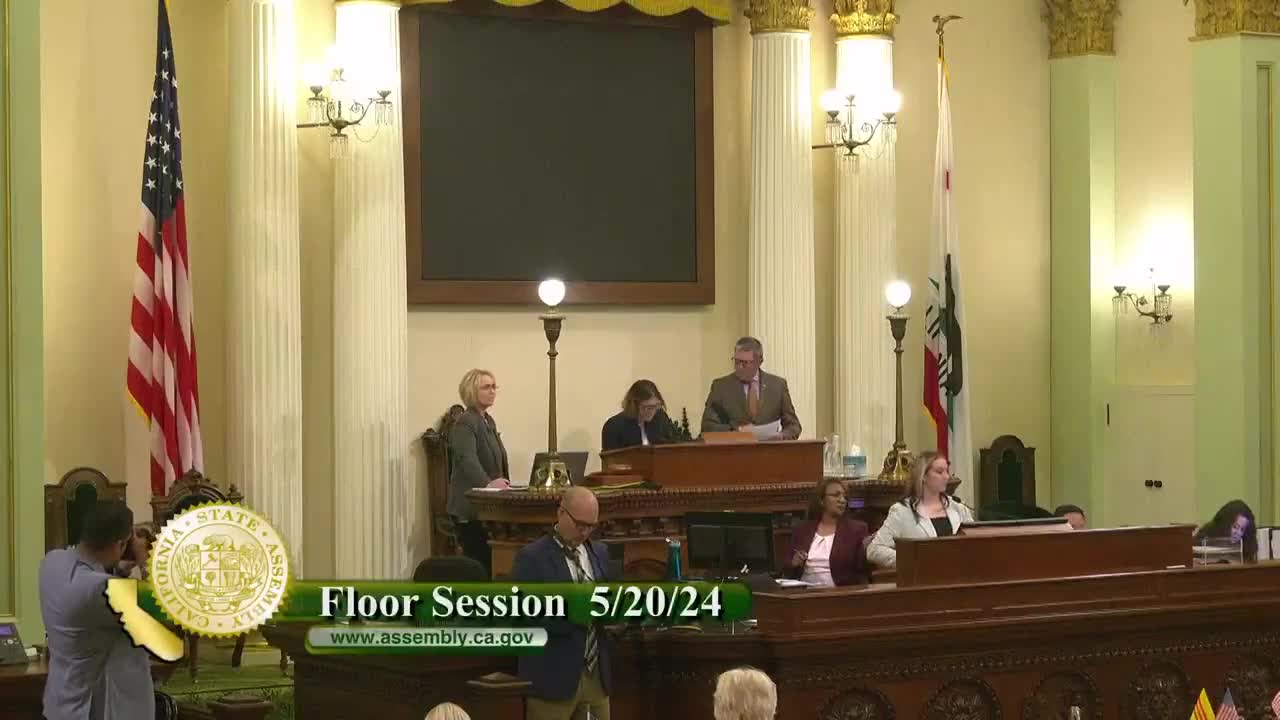 2MIN
Assembly Floor
 12MIN
Assembly Standing Committee on Business and Professions
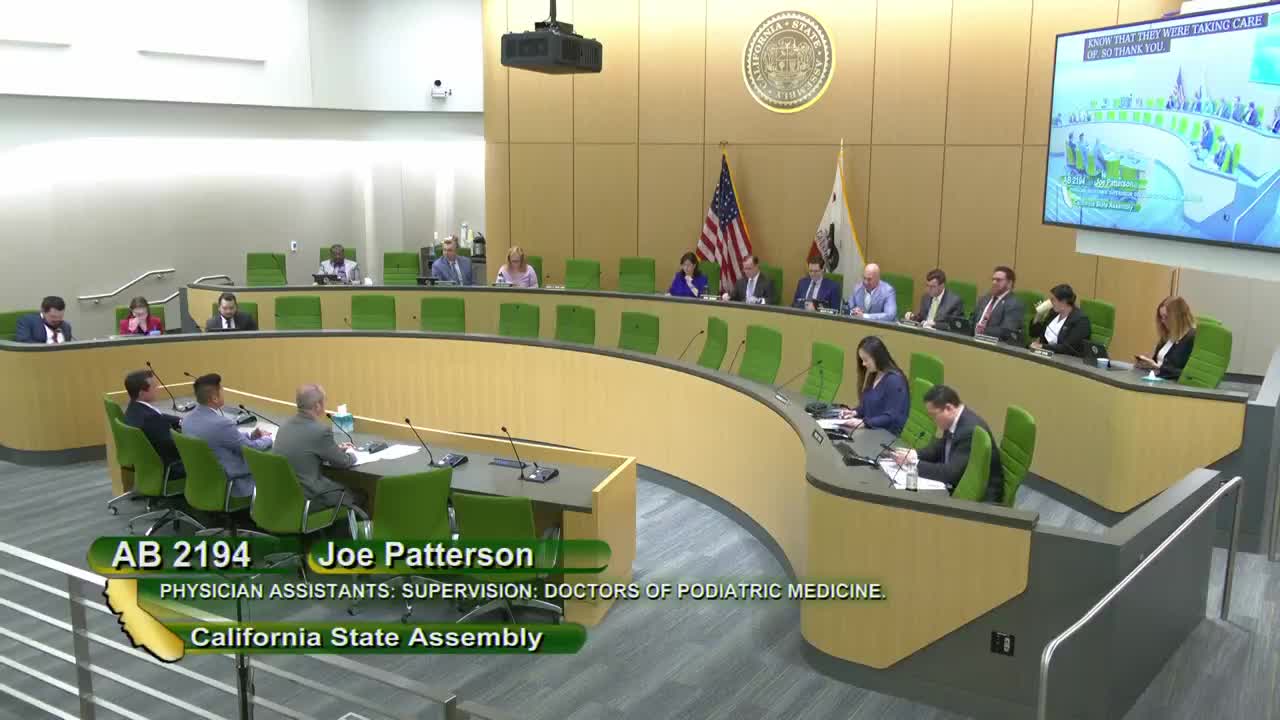 14MIN
Assembly Standing Committee on Business and Professions
Bill Author

Bill Co-Author(s):
