AB 2291: Mobilehomes.
- Session Year: 2023-2024
- House: Assembly
- Latest Version Date: 2024-04-25
Current Status:
Failed
(2024-06-13: In committee: Set, first hearing. Hearing canceled at the request of author.)
Introduced
In Committee
First Chamber
In Committee
Second Chamber
Enacted
Existing law, the Mobilehome Residency Law Protection Act, until January 1, 2027, establishes the Mobilehome Residency Law Protection Program within the Department of Housing and Community Development to assist in taking and resolving complaints from homeowners relating to the Mobilehome Residency Law. Existing law requires the department, in administering the program, to contract with one or more qualified and experienced nonprofit legal services providers and refer complaints selected for evaluation, and which are not resolved, to these nonprofit legal service providers for possible enforcement action, as specified.
This bill would require a nonprofit legal services provider contracted with the department to provide the department, in its role as the contract manager overseeing the performance of nonprofit legal services contracts, with full access to information regarding the status of each case and the services provided to complainants. The bill would prohibit laws relating to the attorney-client privilege or attorney work product doctrine that protect the confidentiality of communications or records from preventing disclosure, as provided. To the extent any information disclosed to the department includes confidential information subject to the attorney-client privilege or work product protection, the bill would prohibit any described disclosure from constituting a waiver of that privilege or protection. The bill would prohibit the department from disclosing any confidential information received, as specified, to anyone outside of the department. The bill would require the department to conduct regular surveys of complainants referred to a nonprofit legal services provider, as specified. The bill would require the department to monitor updates from a nonprofit legal services provider to detect any inappropriate denial of services and would require the department to respond immediately to correct any denials.
Beginning January 1, 2019, and each subsequent year thereafter, existing law requires the department to assess upon, and collect from, the management of a mobilehome park subject to the Mobilehome Residency Law an annual registration fee of $10 for each permitted mobilehome lot located within the mobilehome park, to be paid at the time of payment of the annual operating fee imposed under the Mobilehome Parks Act. Existing law establishes the Mobilehome Dispute Resolution Fund for the receipt of moneys received pursuant to these provisions, and makes the fund available upon appropriation by the Legislature.This bill would instead authorize the department to collect from the management of a mobilehome park the annual registration fee of $10, as described above, in the event that the department and the Department of Finance agree that the fund can cover only 6 months of expenditures.Existing constitutional provisions require that a statute that limits the right of access to the meetings of public bodies or the writings of public officials and agencies be adopted with findings demonstrating the interest protected by the limitation and the need for protecting that interest.This bill would make legislative findings to that effect.Existing law, the Mobilehome Residency Law Protection Act, until January 1, 2027, establishes the Mobilehome Residency Law Protection Program within the Department of Housing and Community Development to assist in taking and resolving complaints from homeowners relating to the Mobilehome Residency Law. Existing law requires the department, in administering the program, to contract with one or more qualified and experienced nonprofit legal services providers and refer complaints selected for evaluation, and which are not resolved, to these nonprofit legal service providers for possible enforcement action, as specified.
This bill would require a nonprofit legal services provider contracted with the department to provide the department, in its role as the contract manager overseeing the performance of nonprofit legal services contracts, with full access to information regarding the status of each case and the services provided to complainants. The bill would prohibit laws relating to the attorney-client privilege or attorney work product doctrine that protect the confidentiality of communications or records from preventing disclosure, as provided. To the extent any information disclosed to the department includes confidential information subject to the attorney-client privilege or work product protection, the bill would prohibit any described disclosure from constituting a waiver of that privilege or protection. The bill would prohibit the department from disclosing any confidential information received, as specified, to anyone outside of the department. The bill would require the department to conduct regular surveys of complainants referred to a nonprofit legal services provider, as specified. The bill would require the department to monitor updates from a nonprofit legal services provider to detect any inappropriate denial of services and would require the department to respond immediately to correct any denials.
Beginning January 1, 2019, and each subsequent year thereafter, existing law requires the department to assess upon, and collect from, the management of a mobilehome park subject to the Mobilehome Residency Law an annual registration fee of $10 for each permitted mobilehome lot located within the mobilehome park, to be paid at the time of payment of the annual operating fee imposed under the Mobilehome Parks Act. Existing law establishes the Mobilehome Dispute Resolution Fund for the receipt of moneys received pursuant to these provisions, and makes the fund available upon appropriation by the Legislature.
This bill would instead authorize the department to collect from the management of a mobilehome park the annual registration fee of $10, as described above, in the event that the department and the Department of Finance agree that the fund can cover only 6 months of expenditures.
Existing constitutional provisions require that a statute that limits the right of access to the meetings of public bodies or the writings of public officials and agencies be adopted with findings demonstrating the interest protected by the limitation and the need for protecting that interest.
This bill would make legislative findings to that effect.
Existing law, the Mobilehome Residency Law Protection Act, establishes the Mobilehome Residency Law Protection Program within the Department of Housing and Community Development, which requires the department to provide assistance in taking complaints, and helping to resolve and coordinate the resolution of those complaints, from homeowners relating to certain law. Existing law establishes in the State Treasury the Mobilehome Dispute Resolution Fund, requires the fund to receive all moneys derived pursuant to the program, and makes the moneys in the fund available, upon appropriation by the Legislature, for purposes of implementing the program.This bill would make nonsubstantive changes to provisions relating to that fund.Existing law, the Mobilehome Residency Law Protection Act, establishes the Mobilehome Residency Law Protection Program within the Department of Housing and Community Development, which requires the department to provide assistance in taking complaints, and helping to resolve and coordinate the resolution of those complaints, from homeowners relating to certain law. Existing law establishes in the State Treasury the Mobilehome Dispute Resolution Fund, requires the fund to receive all moneys derived pursuant to the program, and makes the moneys in the fund available, upon appropriation by the Legislature, for purposes of implementing the program.
This bill would make nonsubstantive changes to provisions relating to that fund.
(a)In administering the program, the department shall contract with one or more qualified and experienced nonprofit legal services providers and refer complaints selected for evaluation pursuant to subdivision (f) of Section 18802, and which are not resolved pursuant to subdivision (g) of Section 18802, to those nonprofit legal services providers for possible enforcement action.
(b)The department shall only contract with a nonprofit legal services provider that meets all of the following requirements:
(1)The nonprofit legal services provider has experience in handling complaints, disputes, or matters arising from the provisions of the Mobilehome Residency Law or matters related to general landlord-tenant law.
(2)The nonprofit legal services provider has experience in representing individuals in dispute resolution processes, state court proceedings, and appeals.
(3)The nonprofit legal services provider has sufficient staff and financial ability to provide for legal services to homeowners.
(c)A nonprofit legal services provider contracted with pursuant to this section shall maintain adequate legal malpractice insurance and shall agree to indemnify and hold harmless the state from any claims arising from the legal services provided pursuant to this part.
(d)(1)A nonprofit legal services provider contracted with pursuant to this section shall have the sole authority to determine which referred complaints will be addressed or pursued, based on the resources provided to it pursuant to the contract with the department.
(2)The nonprofit legal services provider shall inform the department of any complaints not handled due to a shortage of resources.
(e)A nonprofit legal services provider contracted with pursuant to this section shall not charge any fees to a homeowner for any services performed in connection with a complaint referred to it by the department.
(f)(1)A nonprofit legal services provider contracted with the department pursuant to this section shall provide the department, in its role as the contract manager overseeing the performance of nonprofit legal services contracts, with full access to information regarding the status of each case and the services provided to complainants.(2)Laws relating to the attorney-client privilege or attorney work product doctrine that protect the confidentiality of communications or records shall not prevent disclosure pursuant to this subdivision.(3)To the extent any information disclosed to the department includes confidential information subject to the attorney-client privilege or work product protection, disclosure pursuant to this subdivision shall not constitute a waiver of that privilege or protection.(4)The department shall not disclose any confidential information received pursuant to this subdivision to anyone outside of the department.(g)(f)The department shall conduct regular surveys of complainants referred to a nonprofit legal services provider to determine whether the nonprofit legal services provider is in regular communication with the complainants and whether complainants have any concerns about the services provided by the nonprofit legal services provider.
(h)(g)The department shall monitor updates from a nonprofit legal services provider to detect any inappropriate denial of services and shall respond immediately to correct any denials.
(i)(h)This section shall become operative on July 1, 2020.
SEC. 2.Section 18804 of the Health and Safety Code is amended to read:18804.(a)There is hereby established in the State Treasury the Mobilehome Dispute Resolution Fund. The fund shall receive all moneys derived pursuant to this part. Moneys in the fund shall be available, upon appropriation by the Legislature, for purposes of implementing this part.(b)(1)The department may collect from the management of a mobilehome park subject to the Mobilehome Residency Law an annual registration fee of ten dollars ($10) for each permitted mobilehome lot within the mobilehome park in the event that the department and Department of Finance agree that the fund can cover only six months of expenditures.(2)The department shall collect the registration fee pursuant to this paragraph at the same time as the annual operating permit fee imposed under the Mobilehome Parks Act (Part 2.1 (commencing with Section 18200) of Division 13 of the Health and Safety Code). (3)The Legislature finds and declares that the purpose of the fee imposed by this section is to cover the costs of the department incident to the investigation of mobilehome parks for purposes of enforcing the Mobilehome Residency Law.(c)Notwithstanding any other law or local ordinance, rule, regulation, or initiative measure to the contrary, within 90 days from payment of the registration fee to the department, management may pass on all or a portion of the amount of the annual registration fee assessed under this section to the homeowners within the mobilehome park and may collect the amount or portion thereof from the homeowner with the rent payment and other charges due, except that management shall not aggregate or include the fee in the rent nor shall the amount exceed ten dollars ($10) per mobilehome space annually. The annual registration fee shall appear as a separate line item in the bill and shall be accompanied by a clear written description of the purpose of the charge to homeowners, along with contact information for the department.SEC. 3.The Legislature finds and declares that Section 1 of this act, which amends Section 18803 of the Health and Safety Code, imposes a limitation on the publics right of access to the meetings of public bodies or the writings of public officials and agencies within the meaning of Section 3 of Article I of the California Constitution. Pursuant to that constitutional provision, the Legislature makes the following findings to demonstrate the interest protected by this limitation and the need for protecting that interest:This act restricts public access to the personal information retained by the Department of Housing and Community Development to maintain trust and confidentiality in attorney-client interactions.(a)In administering the program, the department shall contract with one or more qualified and experienced nonprofit legal services providers and refer complaints selected for evaluation pursuant to subdivision (f) of Section 18802, and which are not resolved pursuant to subdivision (g) of Section 18802, to those nonprofit legal services providers for possible enforcement action.
(b)The department shall only contract with a nonprofit legal services provider that meets all of the following requirements:
(1)The nonprofit legal services provider has experience in handling complaints, disputes, or matters arising from the provisions of the Mobilehome Residency Law or matters related to general landlord-tenant law.
(2)The nonprofit legal services provider has experience in representing individuals in dispute resolution processes, state court proceedings, and appeals.
(3)The nonprofit legal services provider has sufficient staff and financial ability to provide for legal services to homeowners.
(c)A nonprofit legal services provider contracted with pursuant to this section shall maintain adequate legal malpractice insurance and shall agree to indemnify and hold harmless the state from any claims arising from the legal services provided pursuant to this part.
(d)(1)A nonprofit legal services provider contracted with pursuant to this section shall have the sole authority to determine which referred complaints will be addressed or pursued, based on the resources provided to it pursuant to the contract with the department.
(2)The nonprofit legal services provider shall inform the department of any complaints not handled due to a shortage of resources.
(e)A nonprofit legal services provider contracted with pursuant to this section shall not charge any fees to a homeowner for any services performed in connection with a complaint referred to it by the department.
(f)(1)A nonprofit legal services provider contracted with the department pursuant to this section shall provide the department, in its role as the contract manager overseeing the performance of nonprofit legal services contracts, with full access to information regarding the status of each case and the services provided to complainants.
(2)Laws relating to the attorney-client privilege or attorney work product doctrine that protect the confidentiality of communications or records shall not prevent disclosure pursuant to this subdivision.
(3)To the extent any information disclosed to the department includes confidential information subject to the attorney-client privilege or work product protection, disclosure pursuant to this subdivision shall not constitute a waiver of that privilege or protection.
(4)The department shall not disclose any confidential information received pursuant to this subdivision to anyone outside of the department.
(g)The department shall conduct regular surveys of complainants referred to a nonprofit legal services provider to determine whether the nonprofit legal services provider is in regular communication with the complainants and whether complainants have any concerns about the services provided by the nonprofit legal services provider.
(h)The department shall monitor updates from a nonprofit legal services provider to detect any inappropriate denial of services and shall respond immediately to correct any denials.
(f)(i)This section shall become operative on July 1, 2020.
SEC. 2.Section 18804 of the Health and Safety Code is amended to read:18804.(a)There is hereby established in the State Treasury the Mobilehome Dispute Resolution Fund. The fund shall receive all moneys derived pursuant to this part. Moneys in the fund shall be available, upon appropriation by the Legislature, for purposes of implementing this part.
(b)(1)Beginning January 1, 2019, and each subsequent year thereafter, the The department shall assess upon, and may collect from, from the management of a mobilehome park subject to the Mobilehome Residency Law an annual registration fee of ten dollars ($10) for each permitted mobilehome lot within the mobilehome park. The department shall collect park in the registration fee at event that the same time as department and Department of Finance agree that the annual operating permit fee imposed under the Mobilehome Parks Act (Part 2.1 (commencing with Section 18200)). fund can cover only six months of expenditures.
(2)The department shall collect the registration fee pursuant to this paragraph at the same time as the annual operating permit fee imposed under the Mobilehome Parks Act (Part 2.1 (commencing with Section 18200) of Division 13 of the Health and Safety Code).
(2)(3)The Legislature finds and declares that the purpose of the fee imposed by this section is to cover the costs of the department incident to the investigation of mobilehome parks for purposes of enforcing the Mobilehome Residency Law.
(c)Notwithstanding any other law or local ordinance, rule, regulation, or initiative measure to the contrary, within 90 days from payment of the registration fee to the department, management may pass on all or a portion of the amount of the annual registration fee assessed under this section to the homeowners within the mobilehome park and may collect the amount or portion thereof from the homeowner with the rent payment and other charges due, except that management shall not aggregate or include the fee in the rent nor shall the amount exceed ten dollars ($10) per mobilehome space annually. The annual registration fee shall appear as a separate line item in the bill and shall be accompanied by a clear written description of the purpose of the charge to homeowners, along with contact information for the department.
SEC. 3.The Legislature finds and declares that Section 1 of this act, which amends Section 18803 of the Health and Safety Code, imposes a limitation on the publics right of access to the meetings of public bodies or the writings of public officials and agencies within the meaning of Section 3 of Article I of the California Constitution. Pursuant to that constitutional provision, the Legislature makes the following findings to demonstrate the interest protected by this limitation and the need for protecting that interest:
This act restricts public access to the personal information retained by the Department of Housing and Community Development to maintain trust and confidentiality in attorney-client interactions.
SECTION 1.Section 18804 of the Health and Safety Code is amended to read:18804.(a)There is hereby established in the State Treasury the Mobilehome Dispute Resolution Fund. The fund shall receive all moneys derived pursuant to this part. Upon appropriation by the Legislature, moneys in the fund shall be available for purposes of implementing this part.(b)(1)Each year, the department shall assess upon and collect from the management of a mobilehome park subject to the Mobilehome Residency Law an annual registration fee of ten dollars ($10) for each permitted mobilehome lot within the mobilehome park. The department shall collect the registration fee at the same time as the annual operating permit fee imposed under the Mobilehome Parks Act (Part 2.1 (commencing with Section 18200)).(2)The Legislature finds and declares that the purpose of the fee imposed by this section is to cover the costs of the department incident to the investigation of mobilehome parks for purposes of enforcing the Mobilehome Residency Law.(c)Notwithstanding any other law or local ordinance, rule, regulation, or initiative measure to the contrary, within 90 days from payment of the registration fee to the department, management may pass on all or a portion of the amount of the annual registration fee assessed under this section to the homeowners within the mobilehome park and may collect the amount or portion thereof from the homeowner with the rent payment and other charges due, except that management shall not aggregate or include the fee in the rent nor shall the amount exceed ten dollars ($10) per mobilehome space annually. The annual registration fee shall appear as a separate line item in the bill and shall be accompanied by a clear written description of the purpose of the charge to homeowners, along with contact information for the department.(a)There is hereby established in the State Treasury the Mobilehome Dispute Resolution Fund. The fund shall receive all moneys derived pursuant to this part. Moneys Upon appropriation by the Legislature, moneys in the fund shall be available, upon appropriation by the Legislature, available for purposes of implementing this part.
(b)(1)Beginning January 1, 2019, and each subsequent year thereafter, Each year, the department shall assess upon, upon and collect from, from the management of a mobilehome park subject to the Mobilehome Residency Law an annual registration fee of ten dollars ($10) for each permitted mobilehome lot within the mobilehome park. The department shall collect the registration fee at the same time as the annual operating permit fee imposed under the Mobilehome Parks Act (Part 2.1 (commencing with Section 18200)).
(2)The Legislature finds and declares that the purpose of the fee imposed by this section is to cover the costs of the department incident to the investigation of mobilehome parks for purposes of enforcing the Mobilehome Residency Law.
(c)Notwithstanding any other law or local ordinance, rule, regulation, or initiative measure to the contrary, within 90 days from payment of the registration fee to the department, management may pass on all or a portion of the amount of the annual registration fee assessed under this section to the homeowners within the mobilehome park and may collect the amount or portion thereof from the homeowner with the rent payment and other charges due, except that management shall not aggregate or include the fee in the rent nor shall the amount exceed ten dollars ($10) per mobilehome space annually. The annual registration fee shall appear as a separate line item in the bill and shall be accompanied by a clear written description of the purpose of the charge to homeowners, along with contact information for the department.
|
Date
|
Status
|
|---|---|
| Jun 13, 2024 | In committee: Set, first hearing. Hearing canceled at the request of author. |
| May 29, 2024 | Referred to Coms. on HOUSING and JUD. |
| May 22, 2024 | In Senate. Read first time. To Com. on RLS. for assignment. |
| May 21, 2024 | Read third time. Passed. Ordered to the Senate. (Ayes 71. Noes 0. Page 5444.) |
| May 16, 2024 | Read second time. Ordered to Consent Calendar. |
| May 15, 2024 | From committee: Do pass. To Consent Calendar. (Ayes 15. Noes 0.) (May 15). |
| Apr 29, 2024 | Re-referred to Com. on APPR. |
| Apr 25, 2024 | Read second time and amended. |
| Apr 24, 2024 | From committee: Amend, and do pass as amended and re-refer to Com. on APPR. (Ayes 9. Noes 0.) (April 24). |
| Mar 6, 2024 | Re-referred to Com. on H. & C.D. |
| Mar 4, 2024 | From committee chair, with author's amendments: Amend, and re-refer to Com. on H. & C.D. Read second time and amended. |
| Mar 4, 2024 | Referred to Com. on H. & C.D. |
| Feb 13, 2024 | From printer. May be heard in committee March 14. |
| Feb 12, 2024 | Read first time. To print. |
|
Date
|
Description
|
Location
|
Votes
|
|
|---|---|---|---|---|
| May 21, 2024 | AB 2291 Alanis Consent Calendar Second Day Regular Session | Assembly Floor |
Passed |
|
| May 15, 2024 | Do pass. To Consent Calendar. | Assembly Standing Committee on Appropriations |
Passed |
|
| Apr 24, 2024 | Do pass as amended and be re-referred to the Committee on [Appropriations] | Assembly Standing Committee on Housing and Community Development |
Passed |
This list shows positions taken on this bill by organizations on the date displayed, which is linked to the original source.
Positions by individuals are not included.
|
Organization
|
Position
|
Date
|
|---|---|---|
| California Mobile Home Park Owners Alliance | * Support | Apr 24, 2024 |
| Golden State Manufactured-Home Owners League | * Against | Apr 24, 2024 |
| Western Manufactured Housing Communities Association | * Support | Apr 24, 2024 |
Date of Hearing: May 15, 2024
ASSEMBLY COMMITTEE ON APPROPRIATIONS
Buffy Wicks, Chair
ABPCA Bill Id:AB 2291
Author:(Alanis) – As Amended Ver:April 25, 2024
Policy Committee: | Housing and Community Development | Vote: | 9 - 0 |
|
| ||
|
|
Urgency: No State Mandated Local Program: No Reimbursable: No
SUMMARY:
This bill requires the Department of Housing and Community Development (HCD) to conduct regular surveys of complainants referred to a legal services provider (LSP) through the Mobilehome Residency Law Protection Program (MRLPP), as specified.
Specifically, this bill:
- Requires HCD to conduct regular surveys of complainants referred to a LSP to determine whether the LSP is in regular communication with the complainants and whether complainants have any concerns about the services provided by the LSP.
- Requires HCD to monitor updates from a LSP to detect inappropriate denial of services and to respond immediately to correct any denials.
FISCAL EFFECT:
HCD anticipates minor and absorbable costs.
COMMENTS:
- Purpose. According to the author, “[This bill] aims to promote fairness and affordability for California's mobilehome residents. By refining the Mobilehome Residency Law, it ensures that residents have better access to legal support, fostering an environment of justice and equity.”
- Background. The Mobilehome Residency Law (MRL) regulates the relationship between landlords and homeowners who occupy a mobilehome park. In 2018, AB 3066 (Stone), Chapter 774, Statutes of 2018, created the MRLPP and established the protection program, a five-year pilot program within HCD designed to help coordinate the resolution of complaints from homeowners relating to the MRL. AB 318 (Addis), Chapter 736, Statutes of 2023, extended the sunset on the MRLPP from January 1, 2024, to January 1, 2027.
Under the MRLPP, HCD is charged with receiving, reviewing, and referring allegations of violations of the MRL to the appropriate resources, including nonprofit legal aid attorneys contracted with the protection program. To fund the protection program, HCD collects a $10 annual fee on mobilehome park management for each permitted mobilehome space within a mobilehome park, for deposit into the Mobilehome Dispute Resolution Fund (fund). Park management may pass on all or a portion of the fee to the homeowners within the mobilehome park.
On March 22, 2023, the Joint Legislative Audit Committee approved an audit of the protection program, Audit Request 2023-112. The California State Auditor (Auditor) released the findings on December 19, 2023. According to the Auditor’s report:
As of June 2023, the program had collected a total of $13.4 million in fee revenue and spent a total of $5.1 million. As a result, it has amassed unspent funds of $8.3 million, which is equal to more than 60 percent of the revenue collected. This surplus of unspent funds results from incorrect estimates of the revenue the program would need and the volume of complaints HCD would receive. When the program was established, HCD estimated that the program would annually receive an average of 6,500 complaints and would refer an average of 4,100 complaints to LSPs each year. However, the program has received only an average of 1,005 complaints per year and referred an average of 147 complaints to LSPs.
The Auditor recommended suspending the annual fee until the program’s next sunset date to reduce the unspent fund balance while still allowing sufficient funding for HCD to address complaints. A previous version of this bill addressed the Auditor’s recommendation by authorizing HCD to collect the annual $10 registration fee only in the event HCD and the Department of Finance agree the fund can cover only six months of expenditures. However, those provisions were subsequently amended out of the bill.
This bill instead requires HCD to conduct regular surveys of complainants referred to an LSP to determine whether complainants have concerns about the services provided by the LSP. The bill also requires HCD to monitor updates from an LSP to detect inappropriate denial of services and to respond immediately to correct any denials.
Analysis Prepared by: Jennifer Swenson / APPR. / (916) 319-2081
Date of Hearing: April 24, 2024
ASSEMBLY COMMITTEE ON HOUSING AND COMMUNITY DEVELOPMENT
Christopher M. Ward, Chair
ABPCA Bill Id:AB 2291 (
Author:Alanis) – As Amended Ver:March 4, 2024
SUBJECT: Mobilehomes
SUMMARY: Makes changes to the Department of Housing and Community Development’s (HCD’s) administration of the Mobilehome Residency Law Protection Program (MRLPP), and suspends the MRLPP fee until the program funds can only cover six months of expenditures. Specifically, this bill:
- Requires a nonprofit legal services provider (LSP) contracted with HCD for the MRLPP to provide the department, in its role as the contract manager overseeing the performance of LSP contracts, with full access to information regarding the status of each case and the services provided to complainants.
- Provides that laws relating to the attorney-client privilege or attorney work product doctrine that protect the confidentiality of communications or records shall not prevent disclosure under 1).
- Provides that, to the extent any information disclosed to HCD includes confidential information subject to the attorney-client privilege or work product protection, disclosure under 1) shall not constitute a waiver of that privilege or protection.
- Prohibits HCD from disclosing any confidential information received under 1) to anyone outside of HCD.
- Requires HCD to conduct regular surveys of complainants referred to a LSP to determine whether the LSP is in regular communication with the complainants and whether complainants have any concerns about the services provided by the LSP.
- Requires HCD to monitor updates from a LSP to detect any inappropriate denial of services and respond immediately to correct any denials.
- Deletes the requirement for HCD to assess upon, and collect from, the management of a mobilehome park subject to the Mobilehome Residency Law (MRL) an annual registration fee of $10 for each permitted mobilehome lot within the park, and instead authorizes HCD to collect the $10 fee in the event that HCD and the Department of Finance agree that the Mobilehome Dispute Resolution Fund can only cover six months of expenditures.
- Contains findings and declarations that the changes in 1)-6) impose a limitation on the public’s right of access to the meetings of public bodies or the writings of public officials and agencies within the meaning of Section 3 of Article I of the California Constitution. Pursuant to that constitutional provision, the Legislature makes the following findings to demonstrate the interest protected by this limitation and the need for protecting that interest: “This act restricts public access to the personal information retained by HCD to maintain trust and confidentiality in attorney-client interactions.”
EXISTING LAW:
- Regulates, pursuant to the MRL, the rights, responsibilities, obligations, and relationships between mobilehome park management and park residents. (Civil Code (CC) Section 798, et seq.)
- Establishes the Mobilehome Residency Law Protection Act (MRLPA). States the intent of the Legislature in enacting the MRLPA is to protect and safeguard the most vulnerable mobilehome homeowners by affording them an additional avenue to enforce violations of the MRL. (Health and Safety Code (HSC) Section 18800)
- Establishes the MRLPP within HCD. Requires HCD to provide assistance in taking complaints, and helping to resolve and coordinate the resolution of those complaints, from homeowners related to the MRL. (HSC 18802)
- Establishes the Mobilehome Dispute Resolution Fund in the State Treasury, and requires HCD, beginning January 1, 2019 and each subsequent year thereafter, to assess upon and collect from the management of a mobilehome park subject to the MRL an annual registration fee of $10 for each permitted mobilehome lot within the park, which must be collected at the same time as the annual operating permit fee. (HSC 18804)
- Allows management to pass on all or a portion of the amount of the annual registration fee assessed under 4) to the homeowners within the mobilehome park, and allows management to collect the amount or portion thereof from the homeowner with the rent payment and other charges due, not to be aggregated within rent or to exceed $10 per mobilehome space annually. (HSC 18804)
- Requires HCD, in administering the MRLPP, to contract with one or more qualified and experienced LSPs and refer complaints selected for evaluation and not resolved to those LSPs for possible enforcement action. (HSC 18803)
- Requires HCD to only contract with a LSP that meets all of the following requirements:
- The LSP has experience in handling complaints, disputes, or matters arising from the provisions of the MRL or matters related to general landlord-tenant law;
- The LSP has experience in representing individuals in dispute resolution processes, state court proceedings, and appeals; and
- The LSP has sufficient staff and financial ability to provide for legal services to homeowners. (HSC 18803)
- Requires a LSP contracted with under the MRLPP to maintain adequate legal malpractice insurance and to agree to indemnify and hold harmless the state from any claims arising from the legal services provided under the MRLPP. (HSC 18803)
- Provides a LSP contracted with under the MRLPP the sole authority to determine which referred complaints will be addressed or pursued, based on the resources provided to it under the contract with HCD. (HSC 18803)
- Requires the LSP to inform HCD of any complaints not handled due to a shortage of resources. (HSC 18803)
- Prohibits a LSP contracted with under the MRLPP from charging any fees to a homeowner for any services performed in connection with a complaint referred to it by HCD. (HSC 18803)
FISCAL EFFECT: Unknown.
COMMENTS:
Author’s Statement: According to the author, “AB 2291 aims to promote fairness and affordability for California's mobilehome residents. By refining the Mobilehome Residency Law, it ensures that residents have better access to legal support, fostering an environment of justice and equity. The bill's structure, which modifies the current fee structure, illustrates a thoughtful approach to maintaining these services without imposing undue financial burdens on mobilehome residents. AB 2291 looks to create a more balanced and supportive legal framework, promoting accessibility and fiscal responsibility for California’s mobilehome communities.”
Background: More than 1 million people live in California's approximately 4,500 mobilehome parks. Mobilehomes are not truly mobile, in that it is often cost prohibitive to relocate them. The cost to move a mobilehome ranges from $2,000 to upwards of $20,000 depending on the size of the home and the distance traveled. A mobilehome owner whose home is located in a mobilehome park does not own the land the unit sits on, and must pay rent and fees for the land and any community spaces.
The MRL extensively regulates the relationship between landlords and homeowners who occupy a mobilehome park. A limited number of provisions also apply to residents who rent, as opposed to own, their mobilehome. The MRL has two parts: Articles 1 through 8 apply to most mobilehome parks and Article 9 applies to resident-owned parks or parks which are established as a subdivision, cooperative or condominium. The provisions cover many issues, including, but not limited to: 1) the rental and lease contract terms and specific conditions of receipt and delivery of written leases, park rules and regulations, and other mandatory notices; 2) mandatory notice and amendment procedures for mobilehome park rules and regulations; 3) mandatory notice of fees and charges, and increases or changes in them; and 4) specified conditions governing mobilehome park evictions. A dispute that arises pursuant to the application of the MRL generally must be resolved in a civil court of competent jurisdiction.
HCD oversees several areas of mobilehome law, including health and safety standards, registration and titling of mobilehomes and parks, and, through the Mobilehome Ombudsman, assists the public with questions or problems associated with various aspects of mobilehome law. The Mobilehome Ombudsman provides assistance by taking complaints and helping to resolve and coordinate the resolution of those complaints. However, the Ombudsman does not have enforcement authority for the MRL, and cannot arbitrate, mediate, negotiate, or provide legal advice on mobilehome park rent disputes, lease or rental agreements, but may provide general information on these issues.
HCD also inspects parks and mobilehomes for health and safety issues. Under the Mobilehome Park Maintenance (MPM) program, HCD annually inspects 5% of parks for compliance with health and safety requirements under the Health and Safety Code (Mobilehome Parks Act) and Title 25. The program is funded through a $4 fee, of which the property owner may charge half ($2) to the homeowners. In addition to the MPM program, HCD also responds to health and safety complaints under the Mobilehome Parks Act.
MRLPP: AB 3066 (Stone), Chapter 744, Statutes of 2018, established the MRLPP as a time-limited five year pilot program to intake complaints regarding alleged violations of the MRL and refer complaints to legal service providers (LSPs). Last year, the Legislature extended the program for another three years and made some modifications that are likely to increase uptake of the program. The MRLPP is meant to resolve certain disputes between mobilehome/manufactured homeowners in mobilehome parks and park owners/management, and the annual program fee is paid by homeowners.
MRLPP Audit: The California State Auditor performed an audit of the MRLPP, and its findings were released on December 19, 2023 in Audit 2023-112.[1] The following is an excerpt from the audit:
Changes to state law that will take effect on January 1, 2024, will likely result in shifting responsibility for handling all program eligible complaints to the LSPs—a departure from the current requirement that HCD refer only the most severe complaints to LSPs. However, attorney related privileges prevent LSPs from sharing confidential information with HCD about the services they provide to complainants. As a result, HCD is unable to effectively monitor the progress of work under the LSP contracts, because it lacks certain information about complaints, such as the activities that LSPs are undertaking to help complainants. The Legislature could address this impediment and, by doing so, provide HCD with the ability to effectively oversee the program. Nonetheless, we found that even within its existing authority, HCD did not prevent some LSPs from inappropriately denying services to complainants. In fact, three of the eight LSPs to whom HCD refers complaints rejected 18 of the 275 referred complaints because the LSPs believed the complainants’ incomes made the complainants ineligible for services or because the complainants refused to answer questions about their incomes, even though the program has no income eligibility requirement. HCD did not act to correct these inappropriate rejections in the nearly two years since the LSPs first notified HCD of a rejection. We also found that HCD has not maintained program data in a manner that would allow it to easily identify the total number of complaints. Nor does HCD maintain data containing uniform information about the outcomes of complaints. Because of this problem, HCD has reported inaccurate outcome information to the Legislature.
To fund the program, state law requires HCD to collect an annual $10 fee from mobilehome parks for each of their mobilehome lots. Although we determined that HCD generally spent program funding appropriately, its spending has significantly lagged behind the revenue the fees generate. As of June 2023, the program had collected a total of $13.4 million in fee revenue and spent a total of $5.1 million. As a result, it has amassed unspent funds of $8.3 million, which is equal to more than 60 percent of the revenue collected. This surplus of unspent funds results from incorrect estimates of the revenue the program would need and the volume of complaints HCD would receive. When the program was established, HCD estimated that the program would annually receive an average of 6,500 complaints and would refer an average of 4,100 complaints to LSPs each year. However, the program has received only an average of 1,005 complaints per year and referred an average of 147 complaints to LSPs. Upcoming changes to state law will likely increase the number of complaints handled by LSPs and therefore increase expenditures. However, even in that scenario, HCD will continue to accumulate unspent funds, something it should not do if it does not need that revenue to administer the program. To assess the appropriateness of the program’s fee, we created several scenarios to model how different circumstances affect the program’s surplus. In a scenario in which the annual fee remains at $10 per lot, the unspent fund balance is projected to grow. We found that suspending the annual fee until the program’s next sunset date would reduce the unspent fund balance while still allowing sufficient funding for HCD to address complaints.[2]
HCD responded to the audit with the following, excerpted:
Thank you for the opportunity to review and provide comments to the audit titled The Mobilehome Residency Law Protection Program (MRLPP) The California Department of Housing and Community Development Must Improve Its Oversight of the Program. HCD generally concurs with the HCD recommendations and will take appropriate steps to implement the recommendations provided by the California State Auditor (CSA) where feasible. However, HCD has significant concerns with the CSA recommendation to the legislature to eliminate all new program revenue.
The MRLPP is a pilot program enacted by AB 3066 (Chapter 774, Statutes of 2018), operative as of January 1, 2019. Upon appropriation of program resources, the program was stood-up in earnest in July 2020 and will soon be undergoing significant programmatic changes due to recent legislative changes pursuant to AB 318 (Chapter 736, Statutes of 2023). As a result of these changes, historical data cannot be used to estimate the number of future complaints or revenue needed to support program expenditures. Accordingly, it would be both premature and fiscally irresponsible to suggest such radical changes to program funding.
HCD agrees that it is appropriate to analyze if the statutory fee should be adjusted to reflect the ongoing needs of the program, but strongly suggests that a reasonable fee remain in place until after the program modifications are complete and the new complaint volume, LSP workload/expenses and program outreach efforts are realized. Additionally, elimination of the current $10.00 per lot fee while simultaneously suggesting that HCD should request a new fee to be set by the legislature prior to current fund depletion would place an unreasonable burden on HCD by hindering their ability to administer the program given the uncertainty of expenditure authority, the ability to enter contracts, and the long-term viability of the program. The consequence of simultaneously suspending and/or eliminating program revenue at the same time as program expansion increases the likelihood that the program would need to cease operation prior to the new statutorily authorized sunset date of January 1, 2027.[3]
Arguments in Support: According to the Western Manufactured Housing Communities Association (WMA), “The State Auditor noted that there needs to be some level of transparency to make determinations about the proper use of funding, especially now that all complaints will be forwarded on for review. Why wouldn’t the state want to have oversight or some level of transparency over how these funds are being used and how much time is being spent on making determinations? The recommendations nor this bill is intended to water down the attorney client privilege. However, isn’t it reasonable to find a balance to allow HCD to review billing practices and activity? Also, isn’t it fair for the State to create a mechanism to ensure that funds are being used as intended?”
Arguments in Opposition: According to the Golden State Manufactured-home Owners League, “Last year, Mobilehome Residents worked with Assembly Member Dawn Addis and the Department of Housing to make improvements to the Pilot Program, including expanding the scope to include all violations committed by Park Owners – AB 318 (2023). Governor Newsom agreed and signed into law. Having failed to stop Assembly Member Addis’ bill, Park Owners have hatched a new scheme. They are working with Senator Seyarto and Assembly Member Alanis to prevent us from funding our protection program and take control and take us out of the equation. GSMOL and Mobilehome Residents OPPOSE these Republican bills AB 2291 and SB 1052. Mobilehome Residents want Governor Newsom’s and Assembly Member Dawn Addis’ law to be allowed to take effect, including the improvements to the Pilot Program. Mobilehome Residents want these Republican Legislators to stop picking on us and stop trying to trick everyone into eliminating our protection program.”
Committee Amendments: Staff recommends the bill be amended as follows:
- Strike Health and Safety Code Section 18803 (f)(1)-(4) and Section 3 in order to preserve full attorney-client confidentiality for participants in the program and to alleviate the possible chilling effect this change might have on LSPs’ interest in contracting with HCD under the program.
- Strike Section 2 of the bill, leaving intact the existing MRLPP fee structure.
18803. (a) In administering the program, the department shall contract with one or more qualified and experienced nonprofit legal services providers and refer complaints selected for evaluation pursuant to subdivision (f) of Section 18802, and which are not resolved pursuant to subdivision (g) of Section 18802, to those nonprofit legal services providers for possible enforcement action.
(b) The department shall only contract with a nonprofit legal services provider that meets all of the following requirements:
(1) The nonprofit legal services provider has experience in handling complaints, disputes, or matters arising from the provisions of the Mobilehome Residency Law or matters related to general landlord-tenant law.
(2) The nonprofit legal services provider has experience in representing individuals in dispute resolution processes, state court proceedings, and appeals.
(3) The nonprofit legal services provider has sufficient staff and financial ability to provide for legal services to homeowners.
(c) A nonprofit legal services provider contracted with pursuant to this section shall maintain adequate legal malpractice insurance and shall agree to indemnify and hold harmless the state from any claims arising from the legal services provided pursuant to this part.
(d) (1) A nonprofit legal services provider contracted with pursuant to this section shall have the sole authority to determine which referred complaints will be addressed or pursued, based on the resources provided to it pursuant to the contract with the department.
(2) The nonprofit legal services provider shall inform the department of any complaints not handled due to a shortage of resources.
(e) A nonprofit legal services provider contracted with pursuant to this section shall not charge any fees to a homeowner for any services performed in connection with a complaint referred to it by the department.
(f) (1) A nonprofit legal services provider contracted with the department pursuant to this section shall provide the department, in its role as the contract manager overseeing the performance of nonprofit legal services contracts, with full access to information regarding the status of each case and the services provided to complainants.
(2) Laws relating to the attorney-client privilege or attorney work product doctrine that protect the confidentiality of communications or records shall not prevent disclosure pursuant to this subdivision.
(3) To the extent any information disclosed to the department includes confidential information subject to the attorney-client privilege or work product protection, disclosure pursuant to this subdivision shall not constitute a waiver of that privilege or protection.
(4) The department shall not disclose any confidential information received pursuant to this subdivision to anyone outside of the department.
(g) The department shall conduct regular surveys of complainants referred to a nonprofit legal services provider to determine whether the nonprofit legal services provider is in regular communication with the complainants and whether complainants have any concerns about the services provided by the nonprofit legal services provider.
(h) The department shall monitor updates from a nonprofit legal services provider to detect any inappropriate denial of services and shall respond immediately to correct any denials.
(i) This section shall become operative on July 1, 2020.
SEC. 2. Section 18804 of the Health and Safety Code is amended to read:
18804. (a) There is hereby established in the State Treasury the Mobilehome Dispute Resolution Fund. The fund shall receive all moneys derived pursuant to this part. Moneys in the fund shall be available, upon appropriation by the Legislature, for purposes of implementing this part.
(b) (1) The department may collect from the management of a mobilehome park subject to the Mobilehome Residency Law an annual registration fee of ten dollars ($10) for each permitted mobilehome lot within the mobilehome park in the event that the department and Department of Finance agree that the fund can cover only six months of expenditures.
(2) The department shall collect the registration fee pursuant to this paragraph at the same time as the annual operating permit fee imposed under the Mobilehome Parks Act (Part 2.1 (commencing with Section 18200) of Division 13 of the Health and Safety Code).
(3) The Legislature finds and declares that the purpose of the fee imposed by this section is to cover the costs of the department incident to the investigation of mobilehome parks for purposes of enforcing the Mobilehome Residency Law.
(c) Notwithstanding any other law or local ordinance, rule, regulation, or initiative measure to the contrary, within 90 days from payment of the registration fee to the department, management may pass on all or a portion of the amount of the annual registration fee assessed under this section to the homeowners within the mobilehome park and may collect the amount or portion thereof from the homeowner with the rent payment and other charges due, except that management shall not aggregate or include the fee in the rent nor shall the amount exceed ten dollars ($10) per mobilehome space annually. The annual registration fee shall appear as a separate line item in the bill and shall be accompanied by a clear written description of the purpose of the charge to homeowners, along with contact information for the department.
SEC. 3. The Legislature finds and declares that Section 1 of this act, which amends Section 18803 of the Health and Safety Code, imposes a limitation on the public’s right of access to the meetings of public bodies or the writings of public officials and agencies within the meaning of Section 3 of Article I of the California Constitution. Pursuant to that constitutional provision, the Legislature makes the following findings to demonstrate the interest protected by this limitation and the need for protecting that interest:
This act restricts public access to the personal information retained by the Department of Housing and Community Development to maintain trust and confidentiality in attorney-client interactions.
Related Legislation:
AB 2399 (Rendon) of the current legislative session would require the rental agreement for a tenancy in a mobilehome park and the existing notice that must be provided to all homeowners by February 1 each year to include specified information about the MRLPP. This bill is currently pending before this committee.
SB 1052 (Seyarto) of the current legislative session is identical to this bill. This bill failed passage on a vote of 2-4 in the Senate Housing Committee and was granted reconsideration on March 19, 2024.
AB 318 (Addis), Chapter 736, Statutes of 2023: Extended the sunset on the MRLPP from January 1, 2024 to January 1, 2027, and made several changes to the program.
AB 3066 (Stone), Chapter 774, Statutes of 2018: Established the Mobilehome Residency Law Protection Act which enacted the MRLPP pilot program with a sunset date of January 1, 2024.
REGISTERED SUPPORT / OPPOSITION:
Support
Western Manufactured Housing Communities Association
Opposition
Golden State Manufactured-home Owners League
Analysis Prepared by: Nicole Restmeyer / H. & C.D. / (916) 319-2085
Discussed in Hearing
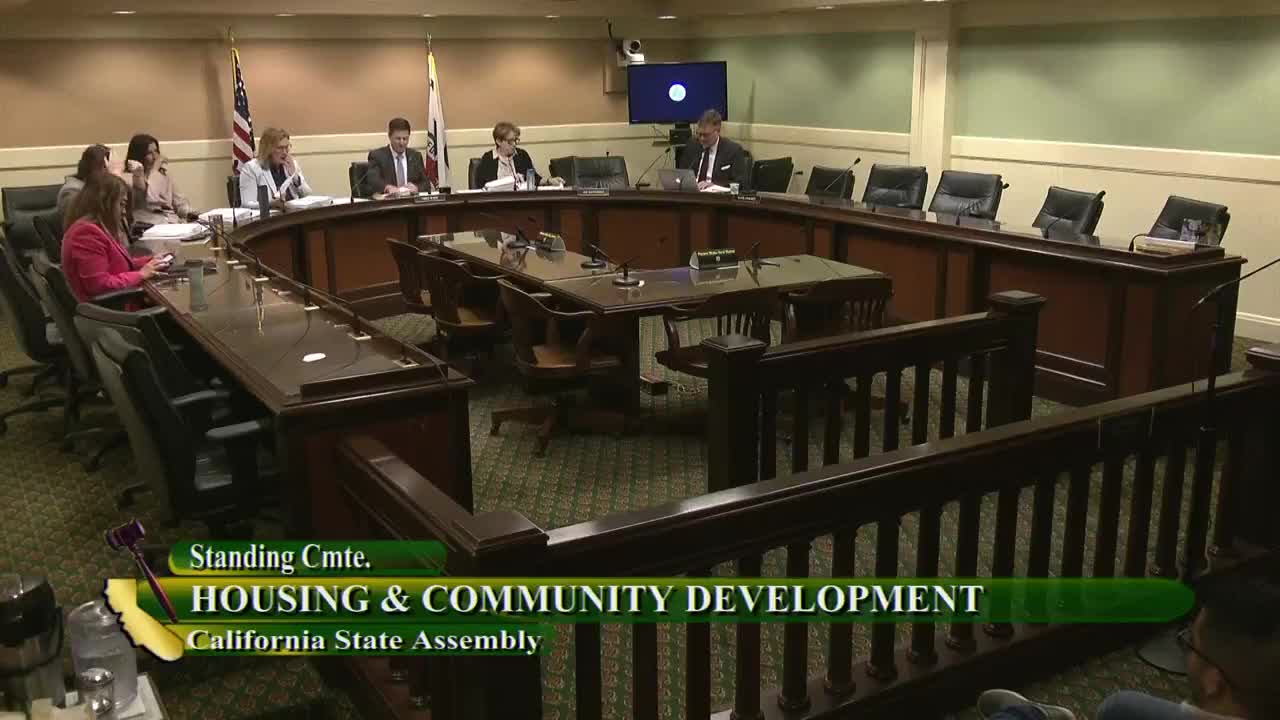 6MIN
Assembly Standing Committee on Housing and Community Development
Bill Author

Bill Co-Author(s):