AB 3268: Property taxation: low-value exemption: possessory interests in publicly owned streets and sidewalks.
- Session Year: 2023-2024
- House: Assembly
- Latest Version Date: 2024-04-18
Current Status:
Failed
(2024-06-04: In committee: Set, first hearing. Hearing canceled at the request of author.)
Introduced
In Committee
First Chamber
In Committee
Second Chamber
Enacted
The California Constitution authorizes the Legislature, with the approval of 2/3 of the membership of each house, to allow a county board of supervisors to exempt from property taxation those properties having a value too low to justify the costs of assessment and collection. Existing property tax law implementing this authority generally limits any exemption granted under this constitutional provision by a county board of supervisors to real property with a total base year value, or personal property with a full value, not exceeding $10,000, or $50,000 for lien dates occurring on or after January 1, 2020, and before January 1, 2025, in the case of possessory interests and, in the case of certain possessory interests, as specified. for lien dates occurring on or after January 1, 2025.
This bill would authorize a county board of supervisors, for purposes of making an exemption as described above, to establish a rebuttable presumption that a possessory interest in a publicly owned street or sidewalk for the purpose of operating a parklet has a value too low to justify the costs of assessment and collection. would instead apply the above-described authority for an exemption of $50,000 to lien dates occurring on or after January 1, 2020, and before January 1, 2030, in the case of possessory interests and, in the case of certain possessory interests, to lien dates occurring on or after January 1, 2030.
Existing law requires any bill authorizing a new tax expenditure to contain, among other things, specific goals, purposes, and objectives that the tax expenditure will achieve, detailed performance indicators, and data collection requirements.
This bill would declare findings and reporting requirements in compliance with this requirement, including that each county assessor report to the State Board of Equalization, as specified, and post that information on its internet website. By imposing additional duties on each county assessor, this bill would impose a state-mandated local program.
The California Constitution requires the state to reimburse local agencies and school districts for certain costs mandated by the state. Statutory provisions establish procedures for making that reimbursement.
This bill would provide that, if the Commission on State Mandates determines that the bill contains costs mandated by the state, reimbursement for those costs shall be made pursuant to the statutory provisions noted above.
Existing law requires the state to reimburse local agencies annually for certain property tax revenues lost as a result of any exemption or classification of property for purposes of ad valorem property taxation.
This bill would provide that, notwithstanding those provisions, no appropriation is made and the state shall not reimburse local agencies for property tax revenues lost by them pursuant to the bill.
This bill would take effect immediately as a tax levy.
The California Constitution authorizes the Legislature, with the approval of 2/3 of the membership of each house, to allow a county board of supervisors to exempt from property taxation those properties having a value too low to justify the costs of assessment and collection. Existing property tax law implementing this authority generally limits any exemption granted under this constitutional provision by a county board of supervisors to real property with a total base year value, or personal property with a full value, not exceeding $10,000, or $50,000 in the case of certain possessory interests, as specified.
This bill would authorize a county board of supervisors, for purposes of making an exemption as described above, to establish a rebuttable presumption that a possessory interest in a publicly owned street or sidewalk for the purpose of operating a parklet has a value too low to justify the costs of assessment and collection.
Existing law authorizes a special district, as defined, to incur indebtedness in the form of securitized limited obligation notes, solely for the acquisition or improvement of land, facilities, or equipment, as provided. Existing law prohibits a special district from issuing securitized limited obligation notes after December 31, 2024.This bill would extend the authorization to issue securitized limited obligation notes under these provisions from December 31, 2024, to December 31, 2025, inclusive.Existing law authorizes a special district, as defined, to incur indebtedness in the form of securitized limited obligation notes, solely for the acquisition or improvement of land, facilities, or equipment, as provided. Existing law prohibits a special district from issuing securitized limited obligation notes after December 31, 2024.
This bill would extend the authorization to issue securitized limited obligation notes under these provisions from December 31, 2024, to December 31, 2025, inclusive.
Existing law, the California State Government Volunteer Act, authorizes each state department or division to utilize the services of volunteers, as specified. Existing law defines the term volunteer for these purposes to mean any person who, of their own free will, provides goods or services, without any financial gain, to any state agency, and additionally defines administrative volunteer and direct service volunteer.This bill would make nonsubstantive changes to those definitions.Existing law, the California State Government Volunteer Act, authorizes each state department or division to utilize the services of volunteers, as specified. Existing law defines the term volunteer for these purposes to mean any person who, of their own free will, provides goods or services, without any financial gain, to any state agency, and additionally defines administrative volunteer and direct service volunteer.
This bill would make nonsubstantive changes to those definitions.
(a)(1)Subject to the limitations listed in subdivisions (b), (c), (d), and (e), a county board of supervisors may exempt from property tax all real property with a base year value (as determined pursuant to Chapter 1 (commencing with Section 50) of Part 0.5) as adjusted by an annual inflation factor pursuant to subdivision (f) of Section 110.1, and personal property with a full value so low that, if not exempt, the total taxes, special assessments, and applicable subventions on the property would amount to less than the cost of assessing and collecting them.
(2)For purposes of making an exemption pursuant to paragraph (1), a county board of supervisors may establish a rebuttable presumption that a possessory interest in a publicly owned street or sidewalk for purposes of operating a parklet has a full value so low that, if not exempt, the total taxes, special assessments, and applicable subventions on the property would amount to less than the cost of assessing and collecting them.(b)(1)(A)The board of supervisors shall have no authority to exempt property with a total base year value, as adjusted by an annual inflation factor pursuant to subdivision (f) of Section 110.1, or full value of more than ten thousand dollars ($10,000), except as otherwise provided in subparagraph (B).
(B)The limitation specified in subparagraph (A) on the amount of the exemption authorized by this section shall be increased as follows:
(i)For lien dates occurring on or after January 1, 2020, and before January 1, 2025, 2030, the limitation is increased to fifty thousand dollars ($50,000) in the case of a possessory interest.
(ii)For lien dates occurring on or after January 1, 2025, 2030, the limitation is increased to fifty thousand dollars ($50,000) in the case of a possessory interest, for a temporary and transitory use, in a publicly owned fairground, fairground facility, convention facility, or cultural facility. For purposes of this paragraph, publicly owned convention or cultural facility means a publicly owned convention center, civic auditorium, theater, assembly hall, museum, or other civic building that is used primarily for staging any of the following:
(I)Conventions, trade and consumer shows, or civic and community events.
(II)Live theater, dance, or musical productions.
(III)Artistic, historic, technological, or educational exhibits.
(2)In determining the level of the exemption, the board of supervisors shall determine at what level of exemption the costs of assessing the property and collecting taxes, assessments, and subventions on the property exceeds the proceeds to be collected. The board of supervisors shall establish the exemption level uniformly for different classes of property. In making this determination, the board of supervisors may consider the total taxes, special assessments, and applicable subventions for the year of assessment only or for the year of assessment and succeeding years where cumulative revenues will not exceed the cost of assessments and collections.
(3)In administering the exemption authorized by this section, the assessor may opt either to not enroll the property on the assessment roll or to enroll the property and apply the exemption.
(c)This section does not apply to those real or personal properties enumerated in Section 52.
(d)The exemption authorized by this section shall be adopted by the board of supervisors on or before the lien date for the fiscal year to which the exemption is to apply and may, at the option of the board of supervisors, continue in effect for succeeding fiscal years. Any revision or rescission of the exemption shall be adopted by the board of supervisors on or before the lien date for the fiscal year to which that revision or rescission is to apply.
(e)Nothing in this section shall authorize a county board of supervisors to exempt new construction, unless the new total base year value, as adjusted by an annual inflation factor pursuant to subdivision (f) of Section 110.1, of the property, including this new construction, is ten thousand dollars ($10,000) or less.
SEC. 2.It is the intent of the Legislature to apply the requirements of Section 41 of the Revenue and Taxation Code to this act. Therefore, the Legislature finds and declares the following with respect to the tax exemption provided by Section 155.20 of the Revenue and Taxation Code, as amended by Section 1 of this act:
(a)The specific goals, purposes, and objectives of expanding the low-value property tax exemption pursuant to this act are to provide county governments with the authority to increase the amount of low-value property exemption for possessory interests allowed under their ordinances up to the level that their cost-benefit analysis indicates in order to further the goal of cost-effective property tax administration.
(b)Detailed performance indicators for the Legislature to use in determining whether the expanded low-value property tax exemption meets the goals, purposes, and objectives described in subdivision (a) shall be the number of counties in this state that expand that exemption as authorized by this act.
(c)The data collection requirements for determining whether the expanded low-value property tax exemption is meeting, failing to meet, or exceeding the specific goals, purposes, and objectives described in subdivision (a) are as follows:
(1)Each county assessor shall report to the State Board of Equalization whether and by what amount the county has increased the low-value property tax exemption for possessory interests as authorized by this act.
(2)In order to make the information reported to pursuant to paragraph (1) widely available to the public, the State Board of Equalization shall post that information on its internet website.
SEC. 3.If the Commission on State Mandates determines that this act contains costs mandated by the state, reimbursement to local agencies and school districts for those costs shall be made pursuant to Part 7 (commencing with Section 17500) of Division 4 of Title 2 of the Government Code.
SEC. 4.Notwithstanding Section 2229 of the Revenue and Taxation Code, no appropriation is made by this act and the state shall not reimburse any local agency for any property tax revenues lost by it pursuant to this act.
SEC. 5.This act provides for a tax levy within the meaning of Article IV of the California Constitution and shall go into immediate effect.
(a)(1)Subject to the limitations listed in subdivisions (b), (c), (d), and (e), a county board of supervisors may exempt from property tax all real property with a base year value (as determined pursuant to Chapter 1 (commencing with Section 50) of Part 0.5) as adjusted by an annual inflation factor pursuant to subdivision (f) of Section 110.1, and personal property with a full value so low that, if not exempt, the total taxes, special assessments, and applicable subventions on the property would amount to less than the cost of assessing and collecting them.
(2)For purposes of making an exemption pursuant to paragraph (1), a county board of supervisors may establish a rebuttable presumption that a possessory interest in a publicly owned street or sidewalk for purposes of operating a parklet has a full value so low that, if not exempt, the total taxes, special assessments, and applicable subventions on the property would amount to less than the cost of assessing and collecting them.
(b)(1)(A)The board of supervisors shall have no authority to exempt property with a total base year value, as adjusted by an annual inflation factor pursuant to subdivision (f) of Section 110.1, or full value of more than ten thousand dollars ($10,000), except as otherwise provided in subparagraph (B).
(B)The limitation specified in subparagraph (A) on the amount of the exemption authorized by this section shall be increased as follows:
(i)For lien dates occurring on or after January 1, 2020, and before January 1, 2025, the limitation is increased to fifty thousand dollars ($50,000) in the case of a possessory interest.
(ii)For lien dates occurring on or after January 1, 2025, the limitation is increased to fifty thousand dollars ($50,000) in the case of a possessory interest, for a temporary and transitory use, in a publicly owned fairground, fairground facility, convention facility, or cultural facility. For purposes of this paragraph, publicly owned convention or cultural facility means a publicly owned convention center, civic auditorium, theater, assembly hall, museum, or other civic building that is used primarily for staging any of the following:
(I)Conventions, trade and consumer shows, or civic and community events.
(II)Live theater, dance, or musical productions.
(III)Artistic, historic, technological, or educational exhibits.
(2)In determining the level of the exemption, the board of supervisors shall determine at what level of exemption the costs of assessing the property and collecting taxes, assessments, and subventions on the property exceeds the proceeds to be collected. The board of supervisors shall establish the exemption level uniformly for different classes of property. In making this determination, the board of supervisors may consider the total taxes, special assessments, and applicable subventions for the year of assessment only or for the year of assessment and succeeding years where cumulative revenues will not exceed the cost of assessments and collections.
(3)In administering the exemption authorized by this section, the assessor may opt either to not enroll the property on the assessment roll or to enroll the property and apply the exemption.
(c)This section does not apply to those real or personal properties enumerated in Section 52.
(d)The exemption authorized by this section shall be adopted by the board of supervisors on or before the lien date for the fiscal year to which the exemption is to apply and may, at the option of the board of supervisors, continue in effect for succeeding fiscal years. Any revision or rescission of the exemption shall be adopted by the board of supervisors on or before the lien date for the fiscal year to which that revision or rescission is to apply.
(e)Nothing in this section shall authorize a county board of supervisors to exempt new construction, unless the new total base year value, as adjusted by an annual inflation factor pursuant to subdivision (f) of Section 110.1, of the property, including this new construction, is ten thousand dollars ($10,000) or less.
SECTION 1.Section 53839 of the Government Code is amended to read:53839.A special district shall not issue any securitized limited obligation notes after December 31, 2025, unless a later enacted statute that is enacted before December 31, 2025, deletes or extends that date.A special district shall not issue any securitized limited obligation notes after December 31, 2024, 2025, unless a later enacted statute that is enacted before December 31, 2024, 2025, deletes or extends that date.
SECTION 1.Section 3111 of the Government Code is amended to read:3111.As used in this chapter:(a)Volunteer means any person who, of their own free will, provides goods or services, without any financial gain, to any state agency, as defined in Section 11000.(b)Administrative volunteer means any person serving voluntarily on boards, commissions or other similar bodies with California state government.(c)Direct service volunteer means any person involved in specific volunteer service that includes one to one relationships or assistance to recipients of government services.As used in this chapter:
(a)Volunteer means any person who, of his their own free will, provides goods or services, without any financial gain, to any state agency, as defined in Section 11000; 11000.
(b)Administrative volunteer means any person serving voluntarily on boards, commissions or other similar bodies with California state government; and government.
(c)Direct service volunteer means any person involved in specific volunteer service that includes one to one relationships or assistance to recipients of government services.
|
Date
|
Status
|
|---|---|
| Jun 4, 2024 | In committee: Set, first hearing. Hearing canceled at the request of author. |
| May 29, 2024 | Referred to Com. on REV. & TAX. |
| May 22, 2024 | In Senate. Read first time. To Com. on RLS. for assignment. |
| May 21, 2024 | Read third time. Passed. Ordered to the Senate. (Ayes 71. Noes 0. Page 5447.) |
| May 16, 2024 | Read second time. Ordered to Consent Calendar. |
| May 15, 2024 | From committee: Do pass. To Consent Calendar. (Ayes 15. Noes 0.) (May 15). |
| Apr 23, 2024 | From committee: Do pass and re-refer to Com. on APPR. (Ayes 7. Noes 0.) (April 22). Re-referred to Com. on APPR. |
| Apr 22, 2024 | Re-referred to Com. on REV. & TAX. |
| Apr 18, 2024 | From committee chair, with author's amendments: Amend, and re-refer to Com. on REV. & TAX. Read second time and amended. |
| Apr 15, 2024 | Re-referred to Com. on REV. & TAX. pursuant to Assembly Rule 96. |
| Apr 10, 2024 | Re-referred to Com. on L. GOV. |
| Apr 9, 2024 | From committee chair, with author's amendments: Amend, and re-refer to Com. on L. GOV. Read second time and amended. |
| Apr 1, 2024 | Re-referred to Com. on L. GOV. |
| Mar 21, 2024 | Referred to Com. on L. GOV. |
| Mar 21, 2024 | From committee chair, with author's amendments: Amend, and re-refer to Com. on L. GOV. Read second time and amended. |
| Feb 17, 2024 | From printer. May be heard in committee March 18. |
| Feb 16, 2024 | Read first time. To print. |
|
Date
|
Description
|
Location
|
Votes
|
|
|---|---|---|---|---|
| May 21, 2024 | AB 3268 Low Consent Calendar Second Day Regular Session | Assembly Floor |
Passed |
|
| May 15, 2024 | Do pass. To Consent Calendar. | Assembly Standing Committee on Appropriations |
Passed |
|
| Apr 22, 2024 | Do pass and be re-referred to the Committee on [Appropriations] | Assembly Standing Committee on Revenue and Taxation |
Passed |
This list shows positions taken on this bill by organizations on the date displayed, which is linked to the original source.
Positions by individuals are not included.
|
Organization
|
Position
|
Date
|
|---|---|---|
| Alameda County Assessor's Office | * Support | Apr 22, 2024 |
Date of Hearing: May 15, 2024
ASSEMBLY COMMITTEE ON APPROPRIATIONS
Buffy Wicks, Chair
ABPCA Bill Id:AB 3268
Author:(Low) – As Amended Ver:April 18, 2024
Policy Committee: | Revenue and Taxation | Vote: | 7 - 0 |
|
| ||
|
|
Urgency: No State Mandated Local Program: Yes Reimbursable: Yes
SUMMARY:
This bill extends, by five years, the sunset date on the low-value ordinance exemption for a possessory interest.
Specifically, this bill:
- Allows, for lien dates occurring before January 1, 2030, instead of lien dates occurring before January 1, 2025, a county board of supervisors to exempt from property tax a possessory interest in property valued at $50,000 or less.
- Declares the goals and performance indicators of the increased exemption and requires each county assessor to report to the State Board of Equalization (BOE) whether, and by what amount, the county has increased its low-value property tax exemption for a possessory interest. The BOE must post the information on its website.
- Prohibits the state from reimbursing a local agency for lost property tax revenues.
FISCAL EFFECT:
- Property tax revenue loss of an unknown, but likely minor, amount. Although this bill will continue a tax exemption for property that would otherwise become taxable for lien dates beginning on or after January 1, 2025, a county board of supervisors is likely to have a low-value exemption for possessory interests only if, in its estimation, the costs of assessing the interest exceeds the potential revenue gain for doing so.
- By requiring a county assessor to report exemption information to the BOE, this bill creates a state-mandated local program. If the Commission on State Mandates determines the provisions of this bill create a new program or impose a higher level of service for which the state must reimburse local costs, counties could seek reimbursement from the state. However, reimbursable costs, if any, related to the reporting requirement should be minor.
- Likely minor costs to the BOE to compile and post reported information on its website.
COMMENTS:
- Purpose. According to the author:
This is a common-sense measure to extend the sunset period from 2025 to 2030, as over 23 counties adopted the use of this service. In light of the pandemic, it is important to consider ways to relieve Californians’ tax burden, and this measure could be a valuable step in that direction.
- Background.
Low-value Ordinance Exemption. Historically, it was common practice for a county assessor to not assess certain real property interests when the administrative costs would outweigh the revenue proceeds derived from taxing the property. Proposition 8 (1974) established the low-value ordinance exemption, granting a county board of supervisors explicit authority to set a low-value threshold by ordinance. Different thresholds can be set for different types of property. The maximum limit for the low-value ordinance exemption has been raised numerous times, generally adjusted upwards every 10 to 15 years. The limit was increased from $5,000 to $10,000 in 2009.
Possessory Interest. A possessory interest is a private interest held in public property. The California Constitution provides that public property of state and local governments is not subject to property tax. However, a possessory interest in that state or local property can be considered taxable, with the “taxable possessory interest” being the portion of the property’s value attributed to benefit the private entity. Examples include food and beverage concession agreements at state parks and the rental of government property at convention centers.
Prior to AB 608 (Petrie-Norris), Chapter 92, Statutes of 2019, the law allowed counties to set a higher low-value ordinance exemption threshold of $50,000 for a possessory interest in a temporary and transitory use in a publicly owned fairground, fairground facility, convention facility, or cultural facility. In light of the complexity of determining the taxable value of a possessory interest, the California Assessor’s Association sponsored AB 608, which expanded the $50,000 threshold to apply to all possessory interests, for lien dates beginning on or after January 1, 2020, and before January 1, 2025. This bill extends the 2025 sunset date by five years.
- Prior Legislation. AB 1066 (Joe Patterson) increases the maximum low-value property tax exemption amount from $10,000 to $15,000. AB 1066 was held on this committee’s suspense file.
Analysis Prepared by: Irene Ho / APPR. / (916) 319-2081
Date of Hearing: April 22, 2024
ASSEMBLY COMMITTEE ON REVENUE AND TAXATION
Jacqui Irwin, Chair
ABPCA Bill Id:AB 3268 (
Author:Low) – As Amended Ver:April 18, 2024
2/3 vote. Tax levy. Fiscal committee.
SUBJECT: Property taxation: low-value exemption: possessory interests in publicly owned streets and sidewalks
SUMMARY: Extends the existing maximum threshold amount for possessory interests under the low-value ordinance exemption (LVOE) by five years. Specifically, this bill:
- Extends the sunset for the existing maximum threshold amount of $50,000 for a possessory interest under the LVOE, from lien dates occurring before January 1, 2025 to before January 1, 2030.
- Finds and declares, for the purposes of complying with Revenue and Taxation Code (R&TC) Section 41, that the goal of this bill is to provide county governments with the authority to increase the amount of low-value property exemption for possessory interests allowed under their ordinances up to the level that their cost-benefit analysis indicates in order to further the goal of cost-effective property tax administration. The Legislature may use the number of counties in this state that expand the LVOE as a performance indicator. Each county assessor is required to report to the State Board of Equalization (BOE) whether and by what amount that county has increased the LVOE for possessory interests, and the BOE must post this information on its website.
- Requires reimbursement of costs to local agencies and school districts if the Commission on State Mandates determines that this bill contains costs mandated by the state.
- Prohibits the state from reimbursing local agencies for any property tax revenues lost pursuant to this bill, and provides that no appropriation is made by this bill.
- Takes immediate effect as a tax levy.
EXISTING LAW:
- Provides that all property is taxable, unless otherwise provided by the California Constitution or laws of the United States. (California Constitution, Article XIII, Section 1.)
- Limits the maximum amount of ad valorem property taxation to 1% of the full cash value of the property. Generally, the Constitution restricts the full cash value of a property to the assessed value upon a change of ownership in, or new construction on, the property. This is referred to as the base year value, which may be adjusted upwards for inflation at no more than 2% annually. (California Constitution, Article XIIIA, Sections 1 and 2.)
- Exempts certain property from taxation, including property owned by the state or a local government, as provided. (California Constitution, Article XIII, Section 3.)
- Permits the Legislature, by a 2/3 vote, to authorize a county board of supervisors to exempt real property having a full value so low that, if not exempt, the total taxes and applicable subventions on the property would amount to less than the cost of assessing and collecting them. This authorization is termed the "LVOE." (California Constitution, Article XIII, Section 7.) The Legislature implements this authority, in the case of possessory interests, by authorizing a county to exempt up to $50,000 in value, for lien dates occurring on or after January 1, 2020, and before January 1, 2025. (R&TC Section 155.20(b)(1)(B)(ii).)
- Defines a "possessory interest" as the possession of, claim to, or right to the possession of land or improvements that is "independent", "durable", "and exclusive" of rights held by others in the property, except when coupled with ownership of the land or improvements in the same person. (R&TC Section 107.)
- Defines "independent" as the ability to exercise authority and exert control over the management or operation of the property or improvements, separate and apart from the policies, statutes, ordinances, rules, and regulations of the public owner of the property or improvements. (R&TC Section 107.)
- Defines "durable" as a determinable period with a reasonable certainty that the use, possession, or claim with respect to the property or improvements will continue for that period. (R&TC Section 107.)
- Defines "exclusive" as the enjoyment of a beneficial use of land or improvements, together with the ability to exclude from occupancy by means of legal process others who may interfere with that enjoyment, as specified. (R&TC Section 107.)
- Limits the assessor from issuing escape assessments for previously escaped or under-assessed property to the last four tax years. (R&TC Section 532.)
FISCAL EFFECT: Unknown, but likely minor revenue losses below this Committee's Suspense File threshold.
COMMENTS:
- The author has provided the following statement in support of this bill:
This is a common-sense measure to extend the sunset period from 2025 to 2030, as over 23 counties adopted the use of this service. In light of the pandemic, it is important to consider ways to relieve Californians' tax burden, and this measure could be a valuable step in that direction.
- Committee Staff Comments:
- Possessory interests: A possessory interest is a private interest held in public property and constitutes that portion of a public property that is exclusively, independently, and durably vested in a private entity. The California Constitution provides that property of the state and local governments is not taxable. However, a possessory interest in that state or local government property can be considered taxable. In these instances, the portion of the property's value that can be attributed to benefit a private entity is taxed. This case is often referred to as a "taxable possessory interest."
- COVID-19 Pandemic: In March 2020, the COVID-19 Pandemic prompted the closure of most public venues, including businesses, in an effort to contain the virus. As these restrictions began to relax and businesses began to reopen, social distancing requirements caused certain businesses that had indoor seating, such as restaurants, to either reduce occupancy or move seating outside to comply. In the latter case, this took the form of building improvements on public right of ways, and some local jurisdictions chose to establish permitting programs that provided some level of organization and accountability to that process. Depending on the structure of those programs, an issued permit could give rise to a taxable possessory interest.
- General authorization for roll corrections: Assessors are generally authorized to retroactively examine the property tax rolls and correct errors up to four years after the year in which the error occurred. Thus, as assessors prepare their notifications of assessment to taxpayers this year, those businesses that have built improvements on public property resulting in a taxable possessory interest will begin to be assessed a property tax on those improvements. Additionally, these improvements are likely to fall below $50,000 in valuation and would be eligible to be exempt under the LVOE as it exists today.
- This bill: This bill simply extends by five years the maximum value threshold of a possessory interest under the LVOE, providing counties the option to exempt possessory interests held by businesses that have built improvements on public property that are valued below $50,000. Without this extension, some counties may lack the authority to exempt a possessory interest up to $50,000 in value as the existing authorization is set to expire on January 1, 2025.
- What is a "tax expenditure"? Existing law provides various credits, deductions, exclusions, and exemptions for particular taxpayer groups. In the late 1960s, United States Treasury officials began arguing that these features of the tax law should be referred to as "expenditures" since they are generally enacted to accomplish some governmental purpose and there is a determinable cost associated with each of them (in the form of forgone revenues). This bill would extend an existing property tax exemption that is due to sunset on January 1, 2025, thereby constituting a tax expenditure.
- Committee's tax expenditure policy: SB 1335 (Leno), Chapter 845, Statutes of 2014, added R&TC Section 41, which recognized that the Legislature should apply the same level of review used for government spending programs to tax credits introduced on or after January 1, 2015. AB 263 (Burke), Chapter 743, Statutes of 2019, extended the requirements in R&TC Section 41 to all tax expenditure measures under the Personal Income Tax Law, the Corporation Tax Law, and the Sales and Use Tax Law introduced on or after January 1, 2020. While statute applies this requirement only to tax expenditures under those laws, this Committee applies its tax expenditure policy to property tax expenditures. A tax expenditure proposal must outline specific goals, purposes, and objectives that the tax expenditure will achieve, along with detailed performance indicators for the Legislature to use when measuring whether the tax expenditure meets those stated goals, purposes, and objectives. In addition to the R&TC Section 41 requirements, this Committee's policy also requires that all tax expenditure proposals contain an appropriate sunset provision to be eligible for a vote[1]. Sunsets are required because eliminating a tax expenditure generally requires a two-thirds vote, whereas enacting a tax expenditure requires a simple majority vote. These reporting and sunset requirements must be satisfied before a bill can receive a vote in this Committee. This bill complies with R&TC Section 41 and includes an appropriate five-year sunset.
- Previous legislation: AB 608 (Petrie-Norris), Chapter 92, Statutes of 2019, authorized the existing possessory interest maximum value threshold of $50,000 under the LVOE.
REGISTERED SUPPORT / OPPOSITION:
Support
None on file
Opposition
None on file
Analysis Prepared by: Harrison Bowlby / REV. & TAX. / (916) 319-2098
An "appropriate sunset provision" shall mean five years, except in the case of a tax expenditure measure providing relief to California veterans, in which case "appropriate sunset provision" shall mean 10 years. ↑
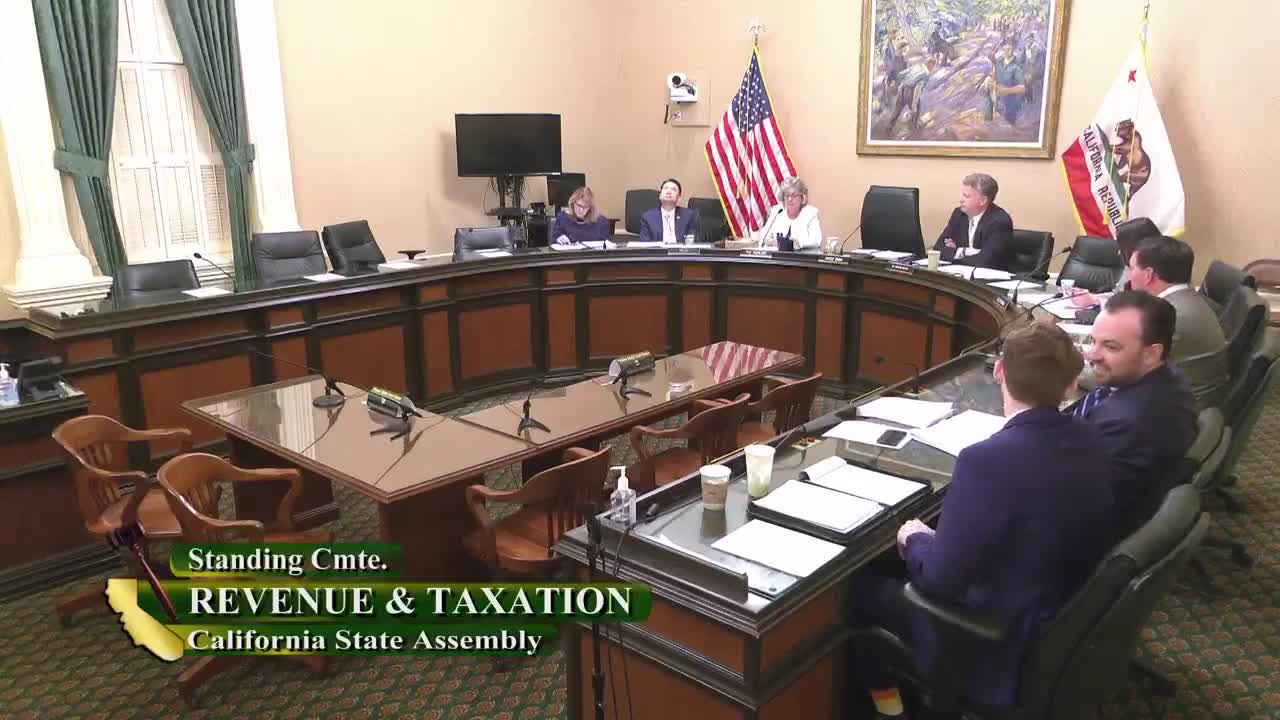
Discussed in Hearing
 2MIN
Assembly Standing Committee on Revenue and Taxation
Bill Author

Bill Co-Author(s):