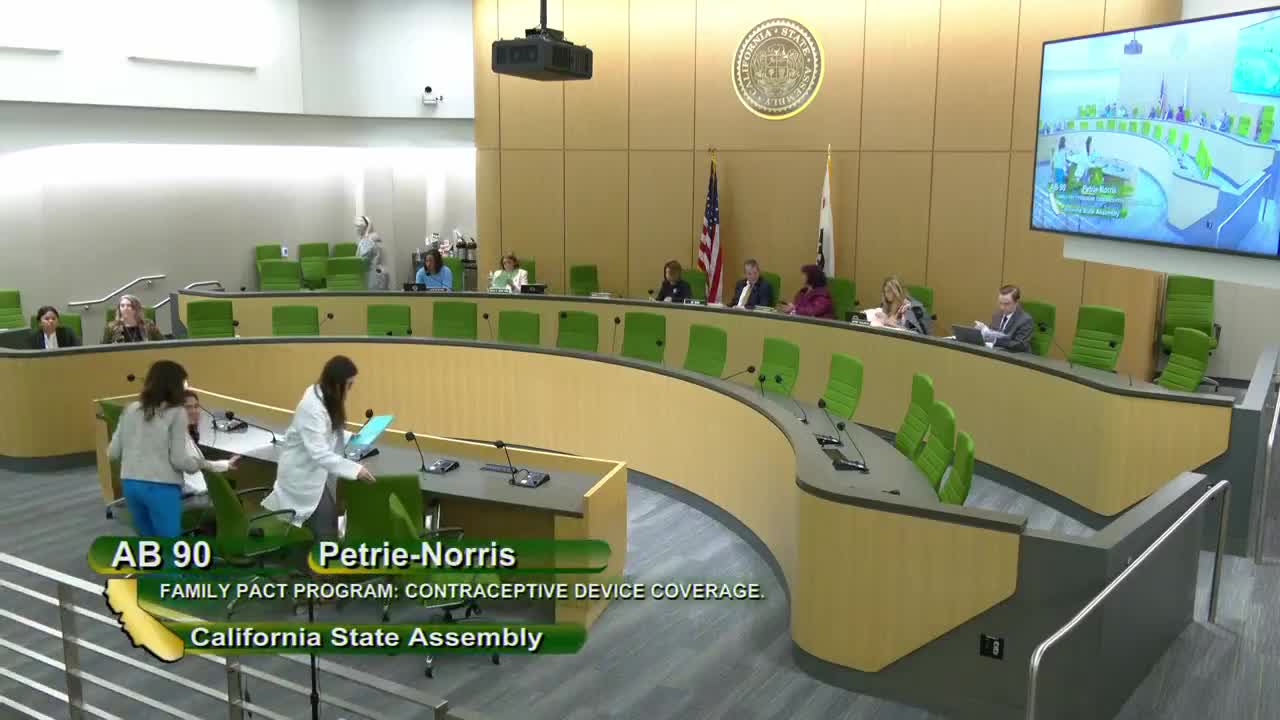
AB 90: Family PACT Program: contraceptive device coverage.
- Session Year: 2023-2024
- House: Assembly
- Latest Version Date: 2023-01-05
Current Status:
Failed
(2023-06-07: Referred to Com. on HEALTH.)
Introduced
In Committee
First Chamber
In Committee
Second Chamber
Enacted
What does this bill do?
This bill clarifies that California’s Family PACT program, which serves people with family incomes at or below 200% of the federal poverty level, covers inpatient services for the placement or insertion of contraceptive devices.
The summary is provided by generative AI which can make mistakes. For original language, please view the details in the table below.
Existing law establishes the Family Planning, Access, Care, and Treatment (Family PACT) Program, administered by the Office of Family Planning within the State Department of Health Care Services, under which comprehensive clinical family planning services are provided to a person who has a family income at or below 200% of the federal poverty level, and who is eligible to receive these services. Under existing law, those comprehensive clinical family planning services include coverage for contraceptive devices approved by the federal Food and Drug Administration.
This bill would clarify that Family PACT comprehensive clinical family planning services include inpatient services relating to the placement or insertion of a contraceptive device.
For purposes of subdivision (aa) of Section 14132, comprehensive clinical family planning services include inpatient services relating to the placement or insertion of a contraceptive device.
REVISIONS: HeadingLine 2.|
Date
|
Status
|
|---|---|
| Jun 7, 2023 | Referred to Com. on HEALTH. |
| May 26, 2023 | In Senate. Read first time. To Com. on RLS. for assignment. |
| May 25, 2023 | Read third time. Passed. Ordered to the Senate. (Ayes 78. Noes 0. Page 1747.) |
| May 18, 2023 | From committee: Do pass. (Ayes 15. Noes 0.) (May 18). |
| May 18, 2023 | Read second time. Ordered to third reading. |
| Apr 19, 2023 | In committee: Set, first hearing. Referred to APPR. suspense file. |
| Mar 22, 2023 | Coauthors revised. |
| Mar 22, 2023 | From committee: Do pass and re-refer to Com. on APPR. (Ayes 13. Noes 0.) (March 21). Re-referred to Com. on APPR. |
| Jan 26, 2023 | Referred to Com. on HEALTH. |
| Jan 6, 2023 | From printer. May be heard in committee February 5. |
| Jan 5, 2023 | Read first time. To print. |
|
Date
|
Description
|
Location
|
Votes
|
|
|---|---|---|---|---|
| May 25, 2023 | AB 90 Petrie-Norris Assembly Third Reading | Assembly Floor |
Passed |
|
| May 18, 2023 | Do pass. | Assembly Standing Committee on Appropriations |
Passed |
|
| Mar 21, 2023 | Do pass and be re-referred to the Committee on [Appropriations] | Assembly Standing Committee on Health |
Passed |
This list shows positions taken on this bill by organizations on the date displayed, which is linked to the original source.
Positions by individuals are not included.
|
Organization
|
Position
|
Date
|
|---|---|---|
| Access Reproductive Justice | ** Support | |
| American College of OBGYNs | * Support | Mar 21, 2023 |
| American College of Obstetricians and Gynecologists | * Support | Mar 21, 2023 |
| California Medical Association | * Support | Mar 21, 2023 |
| California Nurse-Midwives Association | * Support | Mar 21, 2023 |
| Naral Pro Choice California | * Support | Mar 21, 2023 |
| National Health Law Program | ** Support | |
| Planned Parenthood Affiliates Of California | * Support | Mar 21, 2023 |
| Western Center On Law And Poverty Inc | * Support | Mar 21, 2023 |
ASSEMBLY THIRD READING
ATR Bill Id:AB 90
Author:(Petrie-Norris)
As Introduced Ver:January 5, 2023
Majority vote
SUMMARY
Specifies that inpatient services related to the placement or insertion of a contraceptive device are a covered benefit in the Family Planning, Access, Care, and Treatment (Family PACT) Program.
Major Provisions
COMMENTS
- Long-Acting Reversible Contraception (LARCs). LARCs are highly effective birth control devices inserted into the body. They include intrauterine devices (IUDs) and implants, which can stay in the body for several years and can be removed if an individual wants to become pregnant. Because of the good safety profile and high patient satisfaction, as well as very high efficacy, evidence-based clinical guidelines such as those issued by American College of Obstetricians and Gynecologists (ACOG) advocate for improving access to and removing barriers to use of LARCs.
- Family PACT.
- Eligibility. Family PACT provides comprehensive clinical family planning and family planning-related services to qualified individuals with incomes below 200% federal poverty level. The program is designed to make contraception easily accessible to individuals who qualify. Family PACT providers can determine an individual's eligibility for Family PACT at the site of clinical service delivery, on the same day the individual seeks services.
- Coverage. Family PACT covers a wide range of family planning services, including office visits, procedures, drugs and contraceptive supplies. Family PACT does not cover abortions, nor services ancillary to abortions. However, the Family PACT provider manual specifies that Family PACT covers the insertion of an IUD when provided immediately after an abortion. Most abortions, including surgical abortions, are provided in an outpatient setting.
- Presumptive Eligibility for Pregnant Women (PE4PW). Department of Health Care Services (DHCS) also administers the PE4PW program, which provides immediate, temporary health care, including abortion and miscarriage, related to pregnancy for low-income pregnant people. PE4PW is designed for California residents who believe they are pregnant and who appear eligible for and do not have Medi-Cal coverage for prenatal care. The program is designed to ensure immediate access to a limited range of services important for pregnant people. It does not cover family planning services.
- Identified Coverage Gap. The Family PACT provider manual specifies provider enrollment is location-specific and all Family PACT services must be rendered by, or at, an enrolled service location only. There is no DHCS billing guidance that specifies Family PACT coverage extends to IUD insertions provided in an inpatient setting. Thus, the author expresses concern that a coverage gap exists in the following scenario:
- An individual eligible for Family PACT is receiving an abortion or other procedure in the inpatient setting (Family PACT does not cover the abortion service);
- The individual does not have other coverage or is receiving prenatal and abortion services through the PE4PW program, which does not cover contraception; and,
- It is clinically appropriate to insert an IUD and the individual wants an IUD.
For individuals with PE4PW, DHCS guidance indicates if an applicant needs a procedure that is not a PE4PW benefit, the applicant can apply for retroactive Medi-Cal benefits, which will cover those services if the individual is found Medi-Cal eligible. However, the bill's sponsor indicates retroactive coverage does not sufficiently address the financial disincentive for providers to provide LARCs immediately after an inpatient procedure, when most clinically appropriate.
The identified coverage gap is specific to services provided in an inpatient setting like an operating room, but on an outpatient basis, i.e., without a hospital admission.
- Post-Abortion Contraception. According to ACOG Committee Opinion Number 833, the post-abortion period is a safe and efficient time to initiate contraception for individuals who wish to delay or avoid a subsequent pregnancy. ACOG also states that providing a contraceptive method immediately after an induced or spontaneous abortion can help individuals achieve their desired reproductive outcomes and minimize the burden of multiple appointments. ACOG recommends contraceptive counseling to be offered, and immediate provision of all contraceptive methods should be made available, when possible, to any patient interested in contraceptive care in this setting. If an individual does not receive the device immediately postpartum, they may have to wait several weeks to reduce the risk of expulsion of an intrauterine device, and seek an additional clinic appointment specifically to receive the IUD.
According to the Author
Family PACT restricts coverage for care provided in the inpatient setting, which disadvantages eligible individuals who lack coverage for LARCs in the immediate postpartum period. According to the author, birthing individuals most at risk of becoming pregnant again shortly after a pregnancy are also more likely to miss their postpartum follow-up visits. This change is intended to ensure postpartum individuals receive needed care at the right time. Furthermore, the author notes this change will benefit women from underserved and marginalized communities by making it easier to receive a highly effective contraceptive option immediately postpartum, instead of requiring Family PACT patients to return for a follow-up visit at an outpatient clinic.
Arguments in Support
According to ACOG, the bill's sponsor, rates of follow-up visits after the end of pregnancy are unfortunately low. ACOG states between 40% and 75 % of those who claim they'll use an intrauterine device after giving birth fail to get one. ACOG asserts this bill will help California continue to lead in reproductive health care access by ensuring this effective contraception option is immediately available in the postpartum setting to patients who want it. ACCESS Reproductive Justice supports this bill, noting it reduces potential access barriers, including the need for an additional visit and potential loss of coverage postpartum.
Arguments in Opposition
There is no known opposition.
FISCAL COMMENTS
According to the Assembly Appropriations Committee:
Costs to DHCS to cover inpatient placement of LARCs are unknown, but could be in the millions to low tens of millions of dollars per year (90% federal funds, 10% General Fund). Costs of LARCs would be at least partially offset immediately because beneficiaries would not need other contraception, and over time because they would not get pregnant. For example, a study of adolescent mothers receiving immediate postpartum implant insertion of LARCs reported that for every dollar spent on LARC, $0.78, $3.54, and $6.50 were saved at 12, 24, and 36 months, respectively by preventing repeat pregnancies.
VOTES
ASM HEALTH: 13-0-2
YES: Wood, Waldron, Aguiar-Curry, Arambula, Boerner Horvath, Flora, Maienschein, McCarty, Joe Patterson, Rodriguez, Santiago, Villapudua, Weber
ABS, ABST OR NV: Wendy Carrillo, Vince Fong
ASM APPROPRIATIONS: 15-0-1
YES: Holden, Megan Dahle, Bryan, Calderon, Wendy Carrillo, Dixon, Mike Fong, Hart, Lowenthal, Mathis, Papan, Pellerin, Sanchez, Weber, Ortega
ABS, ABST OR NV: Robert Rivas
UPDATED
VERSION: January 5, 2023
CONSULTANT: Lisa Murawski / HEALTH / (916) 319-2097 FN: 0000634
Date of Hearing: April 19, 2023
ASSEMBLY COMMITTEE ON APPROPRIATIONS
Chris Holden, Chair
ABPCA Bill Id:AB 90
Author:(Petrie-Norris) – As Introduced Ver:January 5, 2023
Policy Committee: | Health | Vote: | 13 - 0 |
|
| ||
|
|
Urgency: No State Mandated Local Program: No Reimbursable: No
SUMMARY:
This bill allows the Family Planning, Access, Care, and Treatment (Family PACT) program to pay for contraceptive devices by defining inpatient services related to the placement or insertion of a contraceptive device as a covered benefit in the Family PACT program.
FISCAL EFFECT:
Costs to DHCS to cover inpatient placement of long active reversible contraception (LARC) are unknown, but could be in the millions to low tens of millions of dollars per year (90% federal funds, 10% General Fund). Costs of LARCs would be at least partially offset immediately because beneficiaries would not need other contraception, and over time because they would not get pregnant. For example, a study of adolescent mothers receiving immediate postpartum implant insertion of LARCs reported that for every dollar spent on LARC, $0.78, $3.54, and $6.50 were saved at 12, 24, and 36 months, respectively by preventing repeat pregnancies.
COMMENTS:
- Purpose. This bill is sponsored by American College of Obstetricians and Gynecologists (ACOG), District IX. According to the author:
Under current Family PACT coverage restrictions, patients covered by Family PACT for immediate postpartum and/or gynecological care, including abortions, may not be eligible for long active reversible contraception (LARC) at the same time as they receive such care with their provider if the care is provided in an inpatient setting.
This is particularly concerning because many women – including those most at risk of short interpregnancy intervals – miss their postpartum follow-ups. AB 90 proposes to expand Family PACT coverage and reimbursement guidelines to ensure that patients receiving inpatient gynecologic or postpartum treatment who want to obtain a LARC concurrently with that care can do so during the same visit.
- Family PACT Program. The Department of Health Care Services (DHCS), through the Family PACT program, provides comprehensive clinical family planning services, including family planning, contraceptive drugs and devices, health education and counseling, treatment of specified conditions, and other family-planning related services, to qualified individuals with incomes below 200% of the federal poverty level (FPL). According to DHCS, Family PACT is designed to make contraception easily accessible to individuals who qualify. Enrolled Family PACT providers can determine an individual’s eligibility for Family PACT at the site of clinical service delivery, on the same day the individual seeks services. Family PACT covers a wide range of family planning services, excluding abortions. Family PACT covers the insertion of an intrauterine device (IUD) when provided immediately after an abortion, which is usually provided in an outpatient setting.
- Coverage Gap. The Family PACT provider manual specifies provider enrollment is location-specific and all Family PACT services must be rendered by, or at, an enrolled service location. There is no DHCS billing guidance that specifies Family PACT coverage extends to IUD insertions provided in an inpatient setting. Thus, a LARC coverage gap exists for the following:
- An individual eligible for Family PACT who is delivering a baby or receiving an abortion or other procedure in the inpatient setting. (Family PACT does not cover the abortion.)
- An individual who does not have other coverage or is receiving abortion services through the Presumptive Eligibility for Pregnant Women program, which does not cover contraception.
- An individual who wants an IUD, and for whom it is clinically advisable.
- LARCs. LARCs are highly effective birth control devices that are inserted into the body. They can stay in the body for several years and can be removed if an individual wants to become pregnant. Because of the good safety profile, very high efficacy, and high patient satisfaction, evidence-based clinical guidelines, such as those issued by ACOG, advocate for improving access and removing barriers to use of LARCs.
- Post-abortion Contraception. According to ACOG, the post-abortion period is a safe and efficient time to initiate contraception for individuals who wish to delay or avoid a subsequent pregnancy. ACOG also states providing a contraceptive method immediately after an induced or spontaneous abortion can help an individual achieve their desired reproductive outcomes and minimize the burden of multiple appointments.
Analysis Prepared by: Allegra Kim / APPR. / (916) 319-2081
Date of Hearing: March 21, 2023
ASSEMBLY COMMITTEE ON HEALTH
Jim Wood, Chair
ABPCA Bill Id:AB 90
Author:(Petrie-Norris) – As Introduced Ver:January 5, 2023
SUBJECT: Family PACT Program: contraceptive device coverage.
SUMMARY: Specifies that inpatient services related to the placement or insertion of a contraceptive device are a covered benefit in the Family Planning, Access, Care, and Treatment (Family PACT) Program.
EXISTING LAW:
- Establishes the Family PACT program, administered by the Department of Health Care Services (DHCS), which provides comprehensive clinical family planning services, including family planning, contraceptive drugs and devices, health education and counseling, treatment of specified conditions, and other family-planning related services, to qualified individuals with incomes below 200% of the federal poverty level (FPL). [Welfare and Institutions Code (WIC) § 14132 (aa)]
- Requires DHCS to implement the federal option to grant presumptive eligibility for a Medi-Cal temporary benefits program that covers prenatal services for pregnant women (Presumptive Eligibility for Pregnant Women, or PE4PW). [WIC § 14148.7]
- Establishes the PE4PW option under federal law and specifies that the program covers ambulatory prenatal care. [42 U.S. Code § 1396r–1]
FISCAL EFFECT: Unknown. This bill has not yet been analyzed by a fiscal committee.
COMMENTS:
- PURPOSE OF THIS BILL. This bill is sponsored by American College of Obstetricians and Gynecologists (ACOG), District IX. According to the author, Family PACT restricts coverage for care provided in the inpatient setting, which disadvantages eligible individuals who lack coverage for long acting reversible contraception (LARCs) in the immediate postpartum period. According to the author, birthing individuals most at risk of becoming pregnant again shortly after a pregnancy are also more likely to miss their postpartum follow-up visits. This change is intended to ensure postpartum individuals receive needed care at the right time. Furthermore, the author notes this change will benefit women from underserved and marginalized communities by making it easier to receive a highly effective contraceptive option immediately postpartum, instead of requiring Family PACT patients to return for a follow-up visit at an outpatient clinic.
- BACKGROUND.
- LARCs. LARCs are highly effective birth control devices inserted into the body. They include intrauterine devices (IUDs) and implants, which can stay in the body for several years and can be removed if an individual wants to become pregnant. Because of the good safety profile and high patient satisfaction, as well as very high efficacy, evidence-based clinical guidelines such as those issued by ACOG advocate for improving access to and removing barriers to use of LARCs.
- Family PACT.
- Eligibility. Family PACT provides comprehensive clinical family planning and family planning-related services to qualified individuals with incomes below 200% FPL. According to DHCS, Family PACT is designed to narrow the gap between insured and uninsured individuals in California. The program is designed to make contraception easily accessible to individuals who qualify. Unlike other programs with more complex and lengthy eligibility processes, enrolled Family PACT providers can determine an individual’s eligibility for Family PACT at the site of clinical service delivery, on the same day the individual seeks services.
- Coverage. Family PACT covers a wide range of family planning services, including office visits, procedures, drugs and contraceptive supplies. Family PACT does not cover abortions, nor services ancillary to abortions. However, the Family PACT provider manual specifies that Family PACT covers the insertion of an IUD when provided immediately after an abortion. Most abortions, including surgical abortions, are provided in an outpatient setting.
- PE4PW. DHCS also administers the PE4PW program, which provides immediate, temporary health care, including abortion and miscarriage, related to pregnancy for low-income pregnant people. PE4PW is designed for California residents who believe they are pregnant and who appear eligible for and do not have Medi-Cal coverage for prenatal care. The program is designed to ensure immediate access to a limited range of services important for pregnant people. It does not cover family planning services.
- Identified Coverage Gap. The Family PACT provider manual specifies provider enrollment is location-specific and all Family PACT services must be rendered by, or at, an enrolled service location only. There is no DHCS billing guidance that specifies Family PACT coverage extends to IUD insertions provided in an inpatient setting. Thus, the author expresses concern that a coverage gap exists in the following scenario:
- An individual eligible for Family PACT is receiving an abortion or other procedure in the inpatient setting (Family PACT does not cover the abortion service);
- The individual does not have other coverage or is receiving prenatal and abortion services through the PE4PW program, which does not cover contraception; and,
- It is clinically appropriate to insert an IUD and the individual wants an IUD.
For individuals with PE4PW, DHCS guidance indicates if an applicant needs a procedure that is not a PE4PW benefit, the applicant can apply for retroactive Medi-Cal benefits, which will cover those services if the individual is found Medi-Cal eligible. However, according to this bill’s sponsor, even if someone covered through PE4PW eventually receives retroactive coverage for services not covered by PE4PW, like family planning, the lack of coverage at the time of the service is a disincentive for providers to provide LARCs immediately after an inpatient procedure, when most clinically appropriate.
- Post-Abortion Contraception. According to ACOG Committee Opinion Number 833, the post-abortion period is a safe and efficient time to initiate contraception for individuals who wish to delay or avoid a subsequent pregnancy. ACOG also states that providing a contraceptive method immediately after an induced or spontaneous abortion can help individuals achieve their desired reproductive outcomes and minimize the burden of multiple appointments. ACOG recommends contraceptive counseling to be offered, and immediate provision of all contraceptive methods should be made available, when possible, to any patient interested in contraceptive care in this setting. If an individual does not receive the device immediately postpartum, they may have to wait several weeks to reduce the risk of expulsion of an intrauterine device, and seek an additional clinic appointment specifically to receive the IUD.
- Medi-Cal Reimbursement for Inpatient Services Generally. Medi-Cal reimbursement for inpatient admissions to hospitals is made pursuant to the Diagnosis Related Groups (DRG) methodology. Similar to Medicare, which also uses a DRG methodology, Medi-Cal payment by DRG bases payments on patient acuity and hospital resources rather than length of stay. However, for the coverage gap identified by the author, the procedure is done on an outpatient basis and does not result in an inpatient stay; therefore, the procedure is not paid through the DRG methodology. The identified coverage gap is specific to services provided in an inpatient setting like an operating room, but on an outpatient basis, i.e., without a hospital admission.
- SUPPORT. According to ACOG, the bill’s sponsor, rates of follow-up visits after the end of pregnancy are unfortunately low. ACOG states between 40% and 75 % of those who claim they'll use an intrauterine device after giving birth fail to get one. ACOG asserts this bill will help California continue to lead in reproductive health care access by ensuring this effective contraception option is immediately available in the postpartum setting to patients who want it. ACCESS Reproductive Justice supports this bill, noting it reduces potential access barriers, including the need for an additional visit and potential loss of coverage postpartum.
- PREVIOUS LEGISLATION. SB 1234 (Pan) of 2022 would have expanded eligibility for sexually transmitted disease-related services through the Family PACT Program to individuals not at risk for experiencing or causing an unintended pregnancy, and not in need of contraceptive services, and required related reporting. SB 1234 was vetoed based on concerns it expanded Family PACT services beyond the federal definition of family planning and would have put ongoing cost pressure on the General Fund.
REGISTERED SUPPORT / OPPOSITION:
Support
American College of Obstetricians and Gynecologists District IX (sponsor)
Access Reproductive Justice
National Health Law Program
Opposition
None on file.
Analysis Prepared by: Lisa Murawski / HEALTH / (916) 319-2097
Discussed in Hearing
View Older Hearings
Bill Author





