ACR 135: Human rights violations and crimes against humanity on African slaves and their descendants.
- Session Year: 2023-2024
- House: Assembly
- Latest Version Date: 2024-02-21
Current Status:
Failed
(2024-03-06: Referred to Com. on JUD.)
Introduced
In Committee
First Chamber
In Committee
Second Chamber
Enacted
This measure would acknowledge the harms and atrocities committed by representatives of the State of California who promoted, facilitated, enforced, and permitted the institution of chattel slavery and the legacy of ongoing badges and incidents of slavery that form the systemic structures of discrimination. The measure would affirm the State of Californias role in protecting the descendants of enslaved people as well as their civil, political, and socio-cultural rights.
This measure would acknowledge the harms and atrocities committed by representatives of the State of California who promoted, facilitated, enforced, and permitted the institution of chattel slavery and the legacy of ongoing badges and incidents of slavery that form the systemic structures of discrimination. The measure would affirm the State of Californias role in protecting the descendants of enslaved people as well as their civil, political, and socio-cultural rights.
WHEREAS, This resolution may be cited as the Acknowledgment of Gross Human Rights Violations and Crimes Against Humanity on African Slaves and their Descendants; and
WHEREAS, The State of Californiaits executive, judicial, and legislative branchesdenied African Americans their fundamental liberties and denied their humanity throughout the states history, from before the Civil War to the present; and
WHEREAS, Although California entered the Union in 1850 outlawing slavery, the California Supreme Court stated that the antislavery law in the California Constitution was only a declaration of a principle and did not enact laws to enforce this provision and emancipate slaves; and
WHEREAS, The California Supreme Court enforced the federal fugitive slave law until the official end of enslavement in 1865; and
WHEREAS, The State of California prevented African Americans from testifying in court against a white person until 1863; and
WHEREAS, The California Legislature opposed Congress Reconstruction civil rights laws and delayed ratifying the 14th and 15th Amendments to the federal constitution; and
WHEREAS, The State of California disenfranchised African American citizens through racial barriers to voting such as poll taxes and literacy tests; and
WHEREAS, The California Legislature prohibited interracial marriage and passed an anti-miscegenation law in its first legislative session in 1850. Interracial marriage was not allowed until 1959; The Legislature repeatedly refused to repeal the law after the California Supreme Court struck it down in 1948, and only did so 11 years later; and
WHEREAS, The State of California constructed monuments, memorials, state markers, and plaques memorializing and preserving confederate culture and glorifying slavery and white supremacy; and
WHEREAS, From the brutality of enslavement to contemporary police killings, state and local government-sanctioned violence, such as lynching, coercive sterilization, torture, and property destruction inflicted death, physical injuries, and psychological harms on African Americans in California; and
WHEREAS, The State of California openly allowed segregation and discrimination against African Americans with respect to musicians, workers, and artists; and
WHEREAS, State and local governments in California enacted restrictive zoning ordinances, licensing laws, fire and safety codes, and anti-nuisance laws to disrupt African American businesses and their customers; and
WHEREAS, Discriminatory housing policies including redlining, residential zoning ordinances, and loan practices have produced persistent and longstanding housing segregation and inequities in home ownership for African Americans in California; and
WHEREAS, State and local governments in California targeted property owned by African Americans in urban renewal and development projects for unjust uses of eminent domain, often without providing just compensation; and
WHEREAS, State and local segregation laws in California historically excluded African Americans from outdoor recreation, public transit, and other public infrastructure; and
WHEREAS, The eugenics movement thrived in California and thousands of African Americans were forcibly sterilized or were the subjects of medical experiments without consent; and
WHEREAS, Black Californians experience persistent discrimination in healthcare services and access through inaccurate diagnoses, use of involuntary force, high costs, and a lack of culturally competent services; and
WHEREAS, African Americans have been routinely excluded from professional careers in California. For example, African American physicians, psychologists, and psychiatrists are underrepresented in Californias medical fields, further exacerbating the inequities in the healthcare system; and
WHEREAS, Californias child welfare system has experienced some of the worst racial disparities in the country, with African American children suffering the highest rate of system involvement and correspondingly heightened risks and harms associated with entering foster care; now, therefore, be it
Resolved by the Assembly of the State of California, the Senate thereof concurring, That the State of California recognizes and accepts responsibility for all of the harms and atrocities committed by representatives of the state who promoted, facilitated, enforced, and permitted the institution of chattel slavery and its legacy of ongoing badges and incidents of slavery that form the systemic structures of discrimination; and be it further
Resolved, That the State of California now affirms its role in protecting the descendants of enslaved people as well as their civil, political, and socio-cultural rights; and be it further
Resolved, That the Chief Clerk of the Assembly transmit copies of this resolution to the author for appropriate distribution.
WHEREAS, This resolution may be cited as the Acknowledgment of Gross Human Rights Violations and Crimes Against Humanity on African Slaves and their Descendants; and
WHEREAS, The State of Californiaits executive, judicial, and legislative branchesdenied African Americans their fundamental liberties and denied their humanity throughout the states history, from before the Civil War to the present; and
WHEREAS, Although California entered the Union in 1850 outlawing slavery, the California Supreme Court stated that the antislavery law in the California Constitution was only a declaration of a principle and did not enact laws to enforce this provision and emancipate slaves; and
WHEREAS, The California Supreme Court enforced the federal fugitive slave law until the official end of enslavement in 1865; and
WHEREAS, The State of California prevented African Americans from testifying in court against a white person until 1863; and
WHEREAS, The California Legislature opposed Congress Reconstruction civil rights laws and delayed ratifying the 14th and 15th Amendments to the federal constitution; and
WHEREAS, The State of California disenfranchised African American citizens through racial barriers to voting such as poll taxes and literacy tests; and
WHEREAS, The California Legislature prohibited interracial marriage and passed an anti-miscegenation law in its first legislative session in 1850. Interracial marriage was not allowed until 1959; and
WHEREAS, The State of California constructed monuments, memorials, state markers, and plaques memorializing and preserving confederate culture and glorifying slavery and white supremacy; and
WHEREAS, From the brutality of enslavement to contemporary police killings, state and local government-sanctioned violence, such as lynching, coercive sterilization, torture, and property destruction inflicted death, physical injuries, and psychological harms on African Americans in California; and
WHEREAS, The State of California openly allowed segregation and discrimination against African Americans with respect to musicians, workers, and artists; and
WHEREAS, State and local governments in California enacted restrictive zoning ordinances, licensing laws, fire and safety codes, and anti-nuisance laws to disrupt African American businesses and their customers; and
WHEREAS, Discriminatory housing policies including redlining, residential zoning ordinances, and loan practices have produced persistent and longstanding housing segregation and inequities in home ownership for African Americans in California; and
WHEREAS, State and local governments in California targeted property owned by African Americans in urban renewal and development projects for unjust uses of eminent domain, often without providing just compensation; and
WHEREAS, State and local segregation laws in California historically excluded African Americans from outdoor recreation, public transit, and other public infrastructure; and
WHEREAS, The eugenics movement thrived in California and thousands of African Americans were forcibly sterilized or were the subjects of medical experiments without consent; and
WHEREAS, Black Californians experience persistent discrimination in healthcare services and access through inaccurate diagnoses, use of involuntary force, high costs, and a lack of culturally competent services; and
WHEREAS, African Americans have been routinely excluded from professional careers in California. For example, African American physicians, psychologists, and psychiatrists are underrepresented in Californias medical fields, further exacerbating the inequities in the healthcare system; and
WHEREAS, Californias child welfare system has experienced some of the worst racial disparities in the country, with African American children suffering the highest rate of system involvement and correspondingly heightened risks and harms associated with entering foster care; now, therefore, be it
Resolved by the Assembly of the State of California, the Senate thereof concurring, That the State of California recognizes and accepts responsibility for all of the harms and atrocities committed by representatives of the state who promoted, facilitated, enforced, and permitted the institution of chattel slavery and its legacy of ongoing badges and incidents of slavery that form the systemic structures of discrimination; and be it further
Resolved, That the State of California now affirms its role in protecting the descendants of enslaved people as well as their civil, political, and socio-cultural rights; and be it further
Resolved, That the Chief Clerk of the Assembly transmit copies of this resolution to the author for appropriate distribution.
|
Date
|
Status
|
|---|---|
| Mar 6, 2024 | Referred to Com. on JUD. |
| Feb 27, 2024 | In Senate. To Com. on RLS. |
| Feb 26, 2024 | Adopted and to Senate. (Ayes 59. Noes 0. Page 4188.) |
| Feb 26, 2024 | Coauthors revised. |
| Feb 21, 2024 | Amended. Ordered to third reading. |
| Feb 20, 2024 | From committee: Amend, and be adopted as amended. (Ayes 9. Noes 0.) (February 20). |
| Feb 5, 2024 | Referred to Com. on JUD. |
| Jan 31, 2024 | From printer. |
| Jan 30, 2024 | Introduced. To print. |
|
Date
|
Description
|
Location
|
Votes
|
|
|---|---|---|---|---|
| Feb 26, 2024 | ACR 135 Weber Assembly Third Reading | Assembly Floor |
Passed |
|
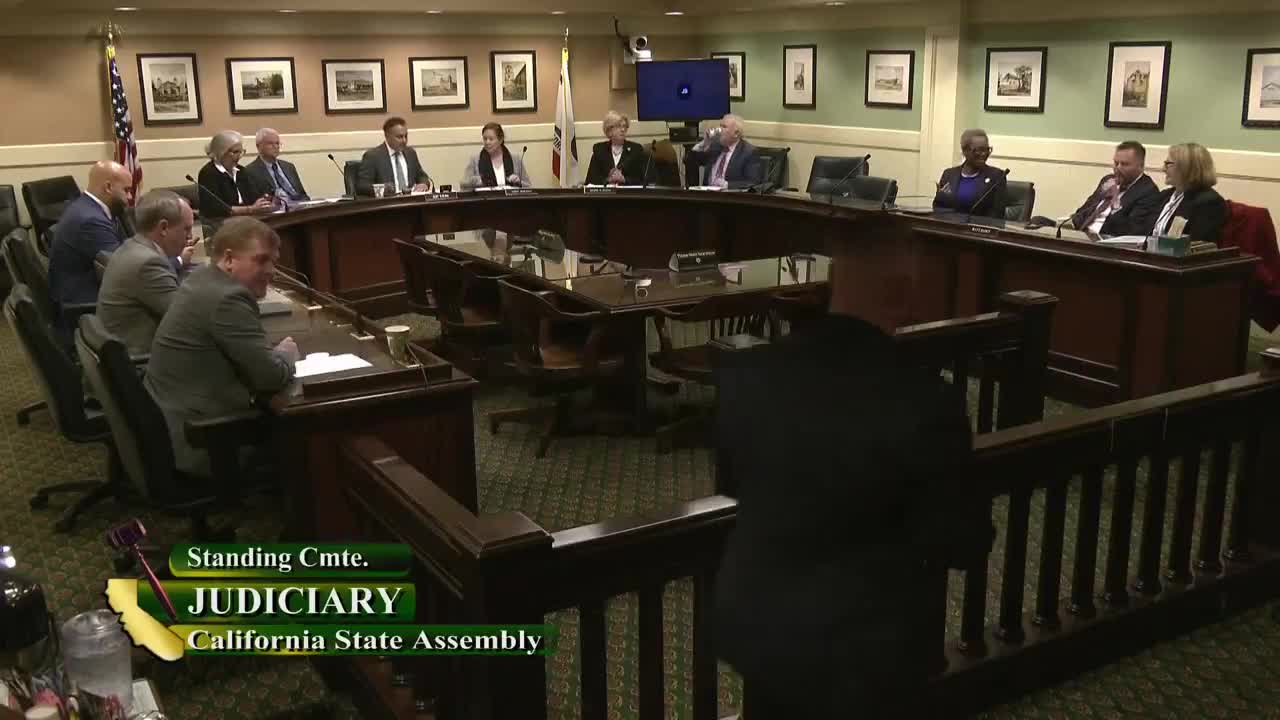
| Feb 20, 2024 | Be adopted as amended. | Assembly Standing Committee on Judiciary |
Passed |
This list shows positions taken on this bill by organizations on the date displayed, which is linked to the original source.
Positions by individuals are not included.
ASSEMBLY THIRD READING
ATR Bill Id:ACR 135
Author:(Weber)
As Amended Ver:February 21, 2024
Majority vote
SUMMARY
Recognizes and accepts responsibility for the harms and atrocities committed by representatives of the State of California who promoted, facilitated, enforced, and permitted the institution of chattel slavery and the legacy of ongoing badges and incidents of slavery that form the systemic structures of discrimination.
Major Provisions
- Finds that WHEREAS the State of California has:
- Denied African Americans fundamental liberties and denied their humanity through the state's history, from before the Civil War to the present.
- Entered the Union as a free state but the California Supreme Court stated that this provision was only a "declaration of principle" and not enforceable.
- Enforced the federal fugitive slave law until 1865; opposed Reconstruction Era civil rights laws; delayed ratifying the 14th and 15th Amendments to the federal constitution; disfranchised African Americans through various mechanisms; prohibited inter-racial marriage until the mid-20th century; constructed monuments and memorials in honor of Confederate leaders and white supremacists.
- Inflicted government-sanctioned violence and psychological harm against African Americans, from the brutality of enslavement to contemporary police killings.
- Openly allowed segregation and discrimination against African Americans and disrupted African American businesses through, among other things, restrictive zoning ordinances, licensing laws, fire and safety codes, and anti-nuisance laws.
- Enacted, enforced, or tolerated discriminatory housing policies, including redlining, residential zoning laws, and loans practices that have led to both segregation and inequities in homeownership.
- Targeted property owned by African Americans for urban renewal projects and unjust uses of eminent domain.
- Created or contributed to policies and practices that led to, among other things, exclusion from public accommodations, the forced sterilization and medical experiments on thousands of African Americans, discriminatory and inadequate health care and child welfare services, and exclusion from the most prestigious and lucrative professions.
- RESOLVES, in light of the above findings, that the State of California does the following:
- Recognizes and accepts responsibility for all of the harms and atrocities outlined above, including chattel slavery and its legacy of ongoing badges and incidents of slavery that form the systemic structures of discrimination.
- Affirms its role in protecting the descendants of enslaved people as well as their civil, political, and socio-cultural rights.
COMMENTS
Slavery and its legacy in a "free" state. Although California entered the Union as a "free state" in 1850, its entry indirectly helped Southern states maintain the institution of slavery. The "Compromise of 1850" allowed California to enter as a free state, but only on the condition that Congress strengthen the federal Fugitive Slave Act, which required that enslaved persons who escaped to Free States be returned to their "owner" in a slave state. The 1850 Act strengthened this law in part by requiring state and local officials in Free States to cooperate in this process of capture and re-enslavement. Because most enslaved African Americans in California in 1850 had not escaped from a slave state – but rather had been brought to California by their enslavers – the federal Fugitive Slave Act, in theory, should have had little impact in California. However, in 1852, California enacted its own state fugitive slave law to supplement the federal law. The state law allowed enslavers who had brought enslaved persons with them to California before it became a state to forcefully return them to the slave state. If the enslaved person had escaped while in California, that person could be declared a "fugitive slave" for purposes of both state and federal law, captured, and forced to return to the South with their enslaver.
In the one of the first cases brought under the state fugitive slave law, three enslaved men had previously reached an agreement with their enslaver to the effect that they would be granted their freedom after working for a specified period of time. The three men eventually won their freedom and worked for themselves for a time, and the enslaver returned home to his Southern state without them. However, when the enslaver learned of the 1852 law, he claimed that the three men had escaped and hired an agent to seek their return under the California law. The California Supreme Court sided with the enslaver, holding in part that the provision of the state constitution abolishing slavery was merely aspirational and could not liberate anyone who had already been enslaved. The Court order authorized the enslaver to forcefully transport his "property" back to the South, though legend has it that the three men escaped while crossing the Isthmus of Panama on the return trip. [In re Perkins 2 Cal 424 (1852); for background on the case and the alleged escape in Panama see Ray R. Albin, "The Perkins Case: The Ordeal of Three Slaves in Gold Rush California," California History 67 (1988), 214-224.]
In the infamous case of Archy Lee, the California Supreme Court conceded that Lee had been brought to California from Mississippi by his enslaver, Charles Stovall, in 1857. This was well after the state constitution had abolished slavery and two years after the state fugitive slave law had expired. Thus, neither federal nor state law applied to his case. Although federal law allowed enslavers to bring enslaved persons into a free state while "in transit" or for a brief but undefined "sojourn," the California Supreme Court admitted that these exceptions did not apply in this case because Stovall had stayed in California for at least six months and had hired out Lee during that time. Clearly, Stovall was not a mere sojourner or "in transit." Inexplicably, after admitting that Stovall "could not sustain either the character of a traveler or visitor," the Court went on to hold "that are circumstances connected with this particular case that may exempt him from the rules we have laid down." Presumably, the "circumstances" in this case involved Stovall's poor health, his youth, and his lack of knowledge of California law or the effect of its constitutional provision on his property rights. Because this was case of first impression, the Court reasoned, Stovall's lack of knowledge on this point was understandable. The Court ordered that Lee be turned over to Stovall's custody. (In re Archy (1858) 9 Cal 147, 171.)
Fortunately, the Court's confused holding was not the end of the Archy Lee story. A group of white and Black abolitionists managed to facilitate another escape and, in San Francisco, Lee appealed to one of the federal court Commissioners established under the federal Fugitive Slave Act. The Commissioner over-ruled the questionable California Supreme Court ruling and declared that Lee was free. Lee reportedly (and understandably) left California and joined other prospectors heading for the Fraser River Gold Rush in British Columbia. [Rudolph Lapp, Archy Lee: A California Fugitive Slave Case (Berkeley: 1969).]
In addition to the dangers of forced re-enslavement, African Americans in early California also endured several legal constraints, including, among other things, denial of the right to vote and prohibitions on testifying against whites in both criminal and civil trials. The denial of the right to testify was especially dangerous, as it affected the state fugitive slave law. For example, because state law permitted owners to reclaim and remove enslaved labor that had been brought into the state before 1850, an owner who came to California after 1850 could easily claim that they had come before. His enslaved labor could not offer testimony to the contrary. Inability to testify also meant that whites could commit crimes and breach contracts with African Americans with impunity, unless there were a white witness willing to testify against the white wrongdoer. On February 20, 1862 – 162 years to the day from the date of this hearing – a group of Free Blacks petitioned the state legislature, praying that the members remove the prohibition on testimony. (In 1863, the Legislature repealed the prohibition as applied to African Americans, but allowed it to stand against Native Americans and persons of Chinese descent.)
An old adage rings true: the more things change, the more they remain the same. Like the petitioners in 1862, African Americans have continued to protest, file lawsuits, and change laws into the 20th and 21st centuries. Yet the successes brought about by the collective efforts of African Americans have too often been met with reaction and setbacks. For example, in 1963 – 100 years after the Legislature repealed the ban on Black testimony – the Legislature enacted the Rumford Fair Housing Act, which prohibited racially-based discrimination in the sale or rental of residential housing. The legislation was named for its author, William Byron Rumford, one of the first African Americans to serve in the California Assembly, and reflected years of protest on the part of the Black community to challenge pervasive and institutionalized housing discrimination in California. The following year, 1964, California voters approved Proposition 14, a constitutional amendment that nullified the Rumford Fair Housing Act by declaring that a property owner had the right to "decline to sell, lease, or rent any part or all of his real property" to any person or persons "as he, in his absolute discretion, chooses." In short, the Proposition gave property owners a constitutional right to discriminate on the basis of race. Although the United States Supreme Court declared Proposition 14 unconstitutional in 1967 (thus restoring the Rumford Act), the overwhelming popular vote in support of the ballot measure suggested to many African Americans that even rare legislative victories were not safe. Indeed, the McCone Commission, which investigated the causes of the 1965 Watts Rebellion, counted the dashed expectations caused by Proposition 14 among the sources of frustration – though hardly the only one – that led to the uprising. [For a detailed discussion of Proposition 14 see Daniel Martinez HoSang, Racial Propositions: Ballot Initiatives and the Making of Postwar California (Berkeley: 2010), chapter 3.]
Findings and Recommendations of Reparations Task Force. The more than 1000-page Task Force report lays out both the past and continuing legacy of California laws and policy that were, according to the Task Force, designed to prevent African Americans in California from enjoying the full benefits of their citizenship. (The California Reparations Report, "Executive Summary," p. 48.) The section headings and chapter titles of the Report suggest a breathtaking range of laws and policies that have harmed African Americans: enslavement, racial terror, political disfranchisement, housing segregation, separate and unequal education, employment discrimination, and an unjust legal system that has led to unconscionable rates of incarceration for Black Californians. After laying out these findings of harm, the Report then examines international approaches to reparations and healing, from Germany, Chile, and South Africa, among others. These remedies can take the form of restitution, economic compensation, or programs of "rehabilitation," which could include an array of legal and social services or educational programs. The remainder of the Report suggests specific remedies for California, starting with a formal apology. Because "apologies alone are inadequate reparations for victims," the final sections of the Report make concrete policy recommendations, designed to provide true reparations for the harms documented in the Report. While a formal apology and legislative remedies can be expected in subsequent bills, this resolution takes the preliminary and necessary step of first acknowledging and taking accountability for the harms enumerated in the Report.
According to the Author
According to the author, one of the "most powerful aspects of the Reparations Tasks Force Report was the detailed discussion of how laws in California were crafted to directly cause harm to its Black residents. That harm touched every aspect of their lives and many of those harms are still felt by Black Californians generations later." In acknowledgement of these findings, this resolution "recognizes that harm done against Black Californians."
Arguments in Support
The Alliance for Reparations, Reconciliation, and Truth supports this resolution as an important step to righting a centuries-long wrong. It writes that "California not only has an opportunity to become the first State in the nation to finally formally recognize and acknowledge the harms and atrocities caused by its role in U.S. chattel slavery and its vestiges, but it would also affirm the State of California's role in protecting the descendants of enslaved people as well as the civil, political, and socio-cultural rights of Black Californians, particularly during a time when the rights of minority and traditionally underrepresented groups are being targeted, attacked, and devalued.
Arguments in Opposition
No opposition on file.
FISCAL COMMENTS
None
VOTES
ASM JUDICIARY: 9-0-3
YES: Kalra, Bauer-Kahan, Bryan, Connolly, Haney, Maienschein, McKinnor, Pacheco, Reyes
ABS, ABST OR NV: Dixon, Sanchez, Waldron
UPDATED
VERSION: February 21, 2024
CONSULTANT: Tom Clark / JUD. / (916) 319-2334 FN: 0002637
Date of Hearing: February 20, 2024
ASSEMBLY COMMITTEE ON JUDICIARY
Ash Kalra, Chair
ABPCA Bill Id:ACR 135
Author:(Weber) – As Introduced Ver:January 30, 2024
As Proposed to be Amended
SUBJECT: Human rights violations and crimes against humanity on African slaves and their descendants
KEY ISSUE: should the legislature acknowledge the findings of the Reparations Task Force and recognize and accept responsibility for the historical and continuing harms that California law and policy have imposed upon enslaved African Americans and their descendants?
SYNOPSIS
Fifty-six years ago the late historian John Hope Franklin, a distinguished pioneer in the field of African American History, wrote the following: “If the house is to be set in order, one cannot begin with the present; he must begin with the past.” (John Hope Franklin, “Rediscovering Black America,” New York Times, September 8, 1968). With AB 3121 (Chap.319, Stats. 2020), California belatedly confronted parts of its past and created the Task Force to Study and Develop Reparations Proposals for African Americans (Task Force). The legislation required the Task Force to gather and synthesize the documentary evidence of slavery and its ongoing legacy in California, develop ways to educate Californians about its findings, and recommend appropriate remedies in a report to the Legislature. The Task Force released its final “California Reparations Report” (Report) on June 29, 2023. Among other things, the Report recounted the historical harms committed against African Americans nationally and in California; discussed the international standards that have developed to remedy the wrongs done to other groups and in other places; and recommended general and specific remedies, including forms of compensation, restitution, and rehabilitation that should be afforded to the descendants of enslaved African Americans living in California today. Part III of the Report included a recommendation that California offer “a formal apology on behalf of the people of California for the perpetration of gross human rights violations and crimes against humanity on African slaves and their descendants.” The author points out that this resolution is not for the purpose of offering that formal apology; rather, this resolution takes the first step of acknowledging and accepting responsibility for the harms and atrocities set forth in the findings of the Report. A separate measure will issue the formal apology, and other legislation will presumably seek to implement the more specific policy proposals set forth in the Report. There is no registered support or opposition for this measure at the time of this writing. The author will take a minor clarifying amendment in this Committee.
SUMMARY: Recognizes and accepts responsibility for the harms and atrocities committed by representatives of the State of California who promoted, facilitated, enforced, and permitted the institution of chattel slavery and the legacy of ongoing badges and incidents of slavery that form the systemic structures of discrimination. Specifically this resolution:
- Finds that WHEREAS the State of California has:
- Denied African Americans fundamental liberties and denied their humanity through the state’s history, from before the Civil War to the present.
- Entered the Union as a free state but the California Supreme Court stated that this provision was only a “declaration of principle” and not enforceable.
- Enforced the federal fugitive slave law until 1865; opposed Reconstruction Era civil rights laws; delayed ratifying the 14th and 15th Amendments to the federal constitution; disfranchised African Americans through various mechanisms; prohibited inter-racial marriage until the mid-20th century; constructed monuments and memorials in honor of Confederate leaders and white supremacists.
- Inflicted government-sanctioned violence and psychological harm against African Americans, from the brutality of enslavement to contemporary police killings.
- Openly allowed segregation and discrimination against African Americans and disrupted African American businesses through, among other things, restrictive zoning ordinances, licensing laws, fire and safety codes, and anti-nuisance laws.
- Enacted, enforced, or tolerated discriminatory housing policies, including redlining, residential zoning laws, and loans practices that have led to both segregation and inequities in homeownership.
- Targeted property owned by African Americans for urban renewal projects and unjust uses of eminent domain.
- Created or contributed to policies and practices that led to, among other things, exclusion from public accommodations, the forced sterilization and medical experiments on thousands of African Americans, discriminatory and inadequate health care and child welfare services, and exclusion from the most prestigious and lucrative professions.
- RESOLVES, in light of the above findings, that the State of California does the following:
- Recognizes and accepts responsibility for all of the harms and atrocities outlined above, including chattel slavery and its legacy of ongoing badges and incidents of slavery that form the systemic structures of discrimination.
- Affirms its role in protecting the descendants of enslaved people as well as their civil, political, and socio-cultural rights.
EXISTING LAW: Established the, until July 1, 2023, the Task Force to Study and Develop Reparation Proposals for African Americans, with a Special Consideration for African Americans Who are Descendants of Persons Enslaved in the United States, consisting of nine members, appointed as provided. Required the Task Force to, among other things, identify, compile, and synthesize the relevant corpus of evidentiary documentation of the institution of slavery that existed within the United States and the colonies; recommend the form of compensation that should be awarded, the instrumentalities through which it should be awarded, and who should be eligible for this compensation; submit a written report of its findings and recommendations to the Legislature. (Government Code Sections 8301-8301.7.)
FISCAL EFFECT: As currently in print this resolution is keyed non-fiscal.
COMMENTS: According to the author, one of the “most powerful aspects of the Reparations Tasks Force Report was the detailed discussion of how laws in California were crafted to directly cause harm to its Black residents. That harm touched every aspect of their lives and many of those harms are still felt by Black Californians generations later.” In acknowledgement of these findings, this resolution “recognizes that harm done against Black Californians.” The author points out that the Task Force Report also called upon the state of California to issue an official apology for the state’s role in perpetuating slavery and its legacy; a bill introduced this year will offer that formal apology.
Slavery and its legacy in a “free” state. Although California entered the Union as a “free state” in 1850, its entry indirectly helped Southern states maintain the institution of slavery. The “Compromise of 1850” allowed California to enter as a free state, but only on the condition that Congress strengthen the federal Fugitive Slave Act, which required that enslaved persons who escaped to Free States be returned to their “owner” in a slave state. The 1850 Act strengthened this law in part by requiring state and local officials in Free States to cooperate in this process of capture and re-enslavement. Because most enslaved African Americans in California in 1850 had not escaped from a slave state – but rather had been brought to California by their enslavers – the federal Fugitive Slave Act, in theory, should have had little impact in California. However, in 1852 the California enacted its own state fugitive slave law to supplement the federal law. The state law allowed enslavers who had brought enslaved persons with them to California before it became a state to forcefully return them to the slave state. If the enslaved person had escaped while in California, that person could be declared a “fugitive slave” for purposes of both state and federal law, captured, and forced to return to the South with their enslaver.
In the one of the first cases brought under the state fugitive slave law, three enslaved men had previously reached an agreement with their enslaver to the effect that they would be granted their freedom after working for a specified period of time. The three men eventually won their freedom and worked for themselves for a time, and the enslaver returned home to his Southern state without them. However, when the enslaver learned of the 1852 law, he claimed that the three men had escaped and hired an agent to seek their return under the California law. The California Supreme Court sided with the enslaver, holding in part that the provision of the state constitution abolishing slavery was merely aspirational and could not liberate anyone who had already been enslaved. The Court order authorized the enslaver to forcefully transport his “property” back to the South, though legend has it that the three men escaped while crossing the Isthmus of Panama on the return trip. [In re Perkins 2 Cal 424 (1852); for background on the case and the alleged escape in Panama see Ray R. Albin, “The Perkins Case: The Ordeal of Three Slaves in Gold Rush California,” California History 67 (1988), 214-224; see also Stacey L. Smith, “Remaking Slavery in a Free State: Masters and Slaves in Gold Rush California,” Pacific Historical Review 80 (2011), 54-57.]
In the infamous case of Archy Lee, the California Supreme Court conceded that Lee had been brought to California from Mississippi by his enslaver, Charles Stovall, in 1857. This was well after the state constitution had abolished slavery and two years after the state fugitive slave law had expired. Thus, neither federal nor state law applied to his case. Although federal law allowed enslavers to bring enslaved persons into a free state while “in transit” or for a brief but undefined “sojourn,” the California Supreme Court admitted that these exceptions did not apply in this case because Stovall had stayed in California for at least six months and had hired out Lee during that time. Clearly, Stovall was not a mere sojourner or “in transit.” Inexplicitly, after admitting that Stovall “could not sustain either the character of a traveler or visitor,” the Court went on to hold “that are circumstances connected with this particular case that may exempt him from the rules we have laid down.” Presumably, the “circumstances” in this case involved Stovall’s poor health, his youth, and his lack of knowledge of California law or the effect of its constitutional provision on his property rights. Because this was case of first impression, the Court reasoned, Stovall’s lack of knowledge on this point was understandable. The Court ordered that Lee be turned over to Stovall’s custody. (In re Archy (1858) 9 Cal 147, 171.)
Fortunately, the confused and inconsistent holding was not the end of the Archy Lee story. A group of white and Black abolitionists managed to facilitate another escape and, in San Francisco, Lee appealed to one of the federal court Commissioners established under the federal Fugitive Slave Act. The Commissioner over-ruled the questionable California Supreme Court ruling and declared that Lee was free. Lee reportedly (and understandably) left California and joined other prospectors heading for the Fraser River Gold Rush in British Columbia. (See Smith, supra, 59-63; Rudolph Lapp, Archy Lee: A California Fugitive Slave Case (Berkeley: 1969).)
In addition to the dangers of forced re-enslavement, African Americans in early California also endured several legal constraints, including, among other things, denial of the right to vote and prohibitions on testifying against whites in both criminal and civil trials. The denial of the right to testify was especially dangerous, as it affected the state fugitive slave law. For example, because state law permitted owners to reclaim and remove enslaved labor that had been brought into the state before 1850, an owner who came to California after 1850 could easily claim that they had come before. His enslaved labor could not offer testimony to the contrary. Inability to testify also meant that whites could commit crimes and breach contracts with African Americans with impunity, unless there were a white witness willing to testify against the white wrongdoer. On February 20, 1862 – 162 years to the day from the date of this hearing – a group of Free Blacks petitioned the state legislature, praying that the members remove the prohibition on testimony. (In 1863, the Legislature repealed the prohibition as applied to African Americans, but allowed it to stand against Native Americans and persons of Chinese descent.)
An old adage rings true: the more things change, the more they remain the same. Like the petitioners in 1862, African Americans have continued to protest, file lawsuits, and change laws into the 20th and 21st centuries. Yet the successes brought about by the collective efforts of African Americans have too often met with reaction and setbacks. For example, in 1963 – one-hundred years after the Legislature repealed the ban on Black testimony – the Legislature enacted the Rumford Fair Housing Act, which prohibited racially-based discrimination in the sale or rental of residential housing. The legislation was named for its author, William Byron Rumford, one of the first African Americans to serve in the California Assembly, and reflected years of protest on the part of the Black community to challenge pervasive and institutionalized housing discrimination in California. The following year, 1964, California voters approved Proposition 14, a constitutional amendment that nullified the Rumford Fair Housing Act by declaring that a property owner had the right to “decline to sell, lease, or rent any part or all of his real property” to any person or persons “as he, in his absolute discretion, chooses.” In short, the Proposition gave property owners a constitutional right to discriminate on the basis of race. Although the United States Supreme Court declared Proposition 14 unconstitutional in 1967 (thus restoring the Rumford Act), the overwhelming popular vote in support of the ballot measure suggested to many African Americans that even rare legislative victories were not safe. Indeed, the McCone Commission, which investigated the causes of the 1965 Watts Rebellion, counted the dashed expectations caused by Proposition 14 among the sources of frustration – though hardly the only one – that led to the uprising. [For a detailed discussion of Proposition 14 see Daniel Martinez HoSang, Racial Propositions: Ballot Initiatives and the Making of Postwar California (Berkeley: 2010), chapter 3.]
Findings and Recommendations of Reparations Task Force. The more than 1000-page Task Force report lays out both the past and continuing legacy of California laws and policy that were, according to the Task Force, designed to prevent African Americans in California from enjoying the full benefits of their citizenship. (The California Reparations Report, “Executive Summary,” p. 48.) The section headings and chapter titles of the Report suggest a breathtaking range of laws and policies that have harmed African Americans: enslavement, racial terror, political disfranchisement, housing segregation, separate and unequal education, employment discrimination, and an unjust legal system that has led to unconscionable rates of incarceration for Black Californians. After laying out these findings of harm, the Report then examines international approaches to reparations and healing, from Germany, Chile, and South Africa, among others. These remedies can take the form of restitution, economic compensation, or programs of “rehabilitation,” which might could include an array of legal and social services or educational programs. The remaining parts of the Report suggest specific remedies for California, starting with a formal apology. Because “apologies alone are inadequate reparations for victims,” the final sections of the Report make concrete policy recommendations, designed to provide true reparations for the harms documented in the Report. As the Report stresses on more than one occasion, the harms inflicted “have not been incidental or accidental,” but are often the intentional result of “an all-encompassing web of discriminatory laws, regulations, and policies enacted by government.” Therefore, addressing these wrongs will require changes in existing laws and the disruption of institutionalized patterns of racism.
While a formal apology and legislative remedies can be expected in subsequent bills, this resolution takes the preliminary and necessary step of first acknowledging and taking accountability for the harms enumerated in the Report.
Proposed Amendment. The resolution in print notes that California enacted its first anti-miscegenation law in 1850 and claims that inter-racial marriage “was not allowed until 1959.” However, the California Supreme Court struck down California’s anti-miscegenation law in 1948 in Perez v Sharp 32 Cal.2d 711. The 1959 date apparently refers to the year in which the Legislature finally updated the statute, but inter-racial marriage was allowed after the Perez decision in 1948. Therefore, the author wishes to amend the bill in this Committee as follows:
- On page 2, lines 22-23 delete “Interracial marriage was not allowed until 1959” and insert: The Legislature repeatedly refused to repeal the law after the California Supreme Court struck it down in 1948, and only did so 11 years later.
Prior related resolutions and legislation. AJR 21 (Gonzalez, 2019) would have formally apologized for California’s past complicity in enabling and furthering the practice of slavery, both of African Americans and Native Americans, and would have urged the United States Congress to pass House Resolution 40 to study the legacy of slavery and provide recommendations on redress for descendants of enslaved persons. This resolution passed out of the Assembly but died in the Senate Rules Committee.
AB 3121 (Chap. 319, Stats. 2020) established a nine-member “Task Force to Study and Develop Reparation Proposals for African Americans, with a Special Consideration for African Americans Who are Descendants of Persons Enslaved in the United States.” The legislation required the Task Force to, among other things, identify, compile, and synthesize the relevant evidence and documentation on the institution of slavery that existed within the United States and the colonies; recommend the forms that any compensation might take and who should be eligible for such compensation. Finally, the bill required the Task Force to submit a written report of its findings and recommendations to the Legislature. The final report was released on June 29, 2023, and the legislation establishing the Task Force became inoperative on July 1, 2023.
REGISTERED SUPPORT / OPPOSITION:
Support
None on file
Opposition
None on file
Analysis Prepared by: Tom Clark / JUD. / (916) 319-2334
Discussed in Hearing
View Older Hearings
Bill Author

Bill Co-Author(s):