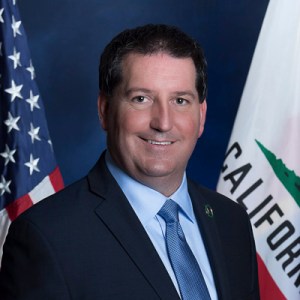
AJR 15: State and local tax (SALT) deduction limitation: repeal.
- Session Year: 2023-2024
- House: Assembly
- Latest Version Date: 2024-04-02
Current Status:
Failed
(2024-08-31: Ordered to inactive file at the request of Senator Gonzalez.)
Introduced
In Committee
First Chamber
In Committee
Second Chamber
Enacted
What does this bill do?
This resolution asks the U.S. Congress to repeal the $10,000 cap on the federal state and local tax deduction (SALT) so California residents and married taxpayers are no longer penalized by the federal tax code. Supporters say the SALT deduction helps fund local services and prevents double taxation of mandatory state and local payments.
The summary is provided by generative AI which can make mistakes. For original language, please view the details in the table below.
This measure would urge the Congress of the United States to repeal the state and local tax deduction limitation so that residents of California and married taxpayers are no longer penalized by the federal tax code.
WHEREAS, The state and local tax deduction, often referred to as the SALT deduction, is a federal tax benefit that encourages state and local investments in infrastructure, public safety, home ownership, and education; and
WHEREAS, In 2016, over 43,000,000 tax filers in the United States claimed the state and local tax deduction, representing well over 100,000,000 Americans or roughly 30 percent of all tax filers in the United States; and
WHEREAS, In 2016, over 5,800,000 California tax filers claimed the state and local tax deduction, or roughly 35.1 percent of California tax filers; and
WHEREAS, The state and local tax deduction helps prevent the double taxation of mandatory payments; and
WHEREAS, The Tax Cuts and Jobs Act of 2017 (Public Law 115-97) (TCJA) reduced federal investments in important public priorities like health care, education, public safety, and basic infrastructure; and
WHEREAS, Research has found that the TCJA resulted in growing economic inequality and concentration of wealth; and
WHEREAS, The TCJA contained a provision capping the state and local tax deduction at $10,000 for all taxpayers, including married couples filing joint returns; and
WHEREAS, The state and local tax deduction limitation included in the TCJA was specifically and unjustly intended to penalize the residents of California and other states with income taxes; and
WHEREAS, The state and local tax deduction limitation included in the TCJA unjustly penalizes married couples that would each be eligible for a $10,000 deduction if they filed their taxes separately; and
WHEREAS, The state and local tax deduction limitation included in the TCJA promotes double taxation, which distorts and reduces economic activity; and
WHEREAS, The TCJA expires in 2025 and the United States Congress is currently considering legislation that would provide parity for married couples who claim the state and local tax deduction; now, therefore, be it
Resolved by the Assembly and the Senate of the State of California, jointly, That the Legislature urges the Congress of the United States to repeal the state and local tax deduction limitation so that residents of California and married taxpayers are no longer penalized by the federal tax code; and be it further
Resolved, That the Chief Clerk of the Assembly transmit copies of this resolution to the President and the Vice President of the United States, to the Speaker of the House of Representatives, to the Majority Leader of the Senate, to each Senator and Representative from California in the Congress of the United States, and to the author for appropriate distribution.
|
Date
|
Status
|
|---|---|
| Aug 31, 2024 | Ordered to inactive file at the request of Senator Gonzalez. |
| Jun 25, 2024 | Read second time. Ordered to third reading. |
| Jun 24, 2024 | From committee: Be ordered to second reading pursuant to Senate Rule 28.8. |
| Jun 12, 2024 | From committee: Be adopted, and re-refer to Com. on APPR. Re-referred. (Ayes 6. Noes 0.) (June 12). Re-referred to Com. on APPR. |
| May 29, 2024 | Referred to Com. on REV. & TAX. |
| May 21, 2024 | In Senate. To Com. on RLS. |
| May 20, 2024 | Adopted and to Senate. (Ayes 70. Noes 0. Page 5304.) |
| May 20, 2024 | Coauthors revised. |
| May 2, 2024 | Assembly Rule 96 suspended. (Page 5068.) |
| May 2, 2024 | Ordered to third reading. |
| May 2, 2024 | Withdrawn from committee. |
| Apr 16, 2024 | From committee: Be adopted, and re-refer to Com. on APPR. Re-referred. (Ayes 6. Noes 0.) (April 15). Re-referred to Com. on APPR. |
| Apr 8, 2024 | Referred to Com. on REV. & TAX. |
| Apr 3, 2024 | From printer. |
| Apr 2, 2024 | Introduced. To print. |
|
Date
|
Description
|
Location
|
Votes
|
|
|---|---|---|---|---|
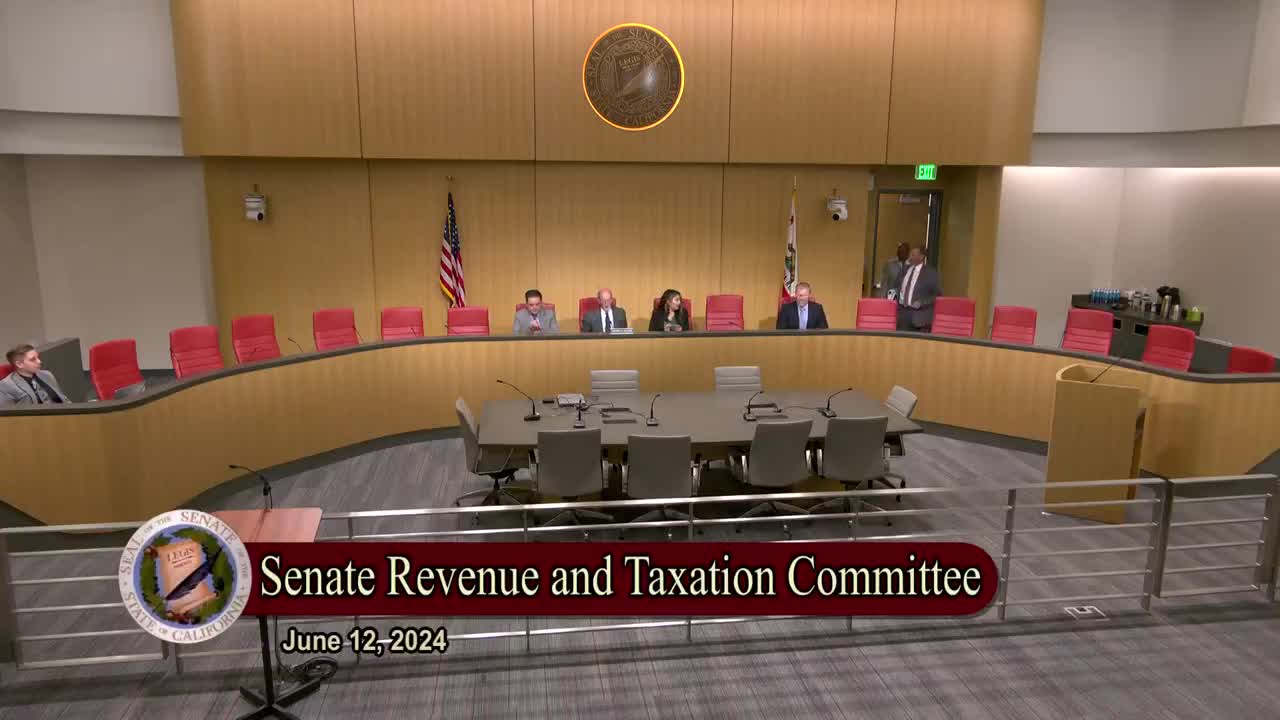
| Jun 12, 2024 | Be adopted, but first be re-referred to the Committee on [Appropriations] | Senate Standing Committee on Revenue and Taxation |
Passed |
|
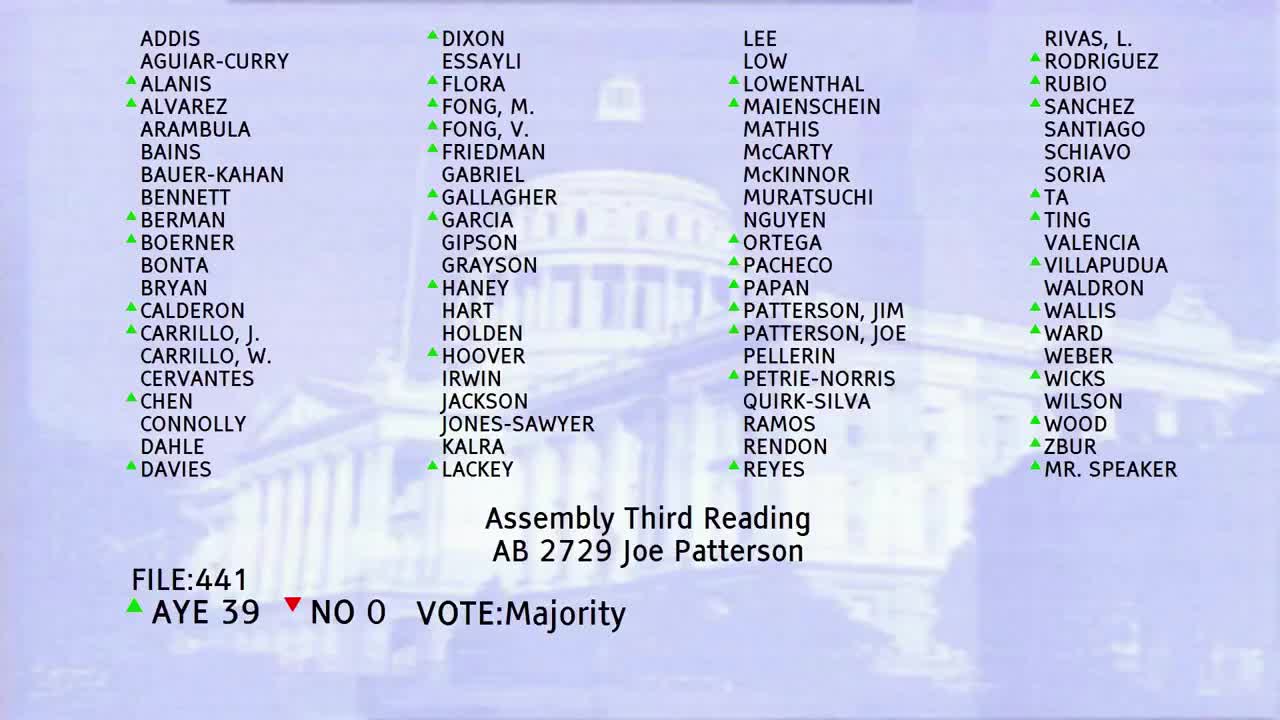
| May 20, 2024 | AJR 15 Irwin Assembly Third Reading | Assembly Floor |
Passed |
|
| Apr 15, 2024 | Be adopted and re-referred to the Committee on [Appropriations] | Assembly Standing Committee on Revenue and Taxation |
Passed |
This list shows positions taken on this bill by organizations on the date displayed, which is linked to the original source.
Positions by individuals are not included.
|
Organization
|
Position
|
Date
|
|---|---|---|
| California Association Of Realtors | ** Support |
SENATE RULES COMMITTEE Office of Senate Floor Analyses (916) 651-1520 Fax: (916) 327-4478 | AJR 15 |
THIRD READING
Bill No: AJR 15
Author: Irwin (D), et al.
Introduced: 4/2/24
Vote: 21
SENATE REVENUE AND TAXATION COMMITTEE: 6-0, 6/12/24
AYES: Glazer, Dahle, Bradford, Dodd, Padilla, Skinner
NO VOTE RECORDED: Ashby
SENATE APPROPRIATIONS COMMITTEE: Senate Rule 28.8
ASSEMBLY FLOOR: 70-0, 5/20/24 - See last page for vote
SUBJECT: State and local tax (SALT) deduction limitation: repeal
SOURCE: Author
DIGEST:
This resolution urges the Congress of the United States to repeal the state and local tax deduction limitation.
ANALYSIS:
Existing law:
- Allows generally, under federal law, until 2017, taxpayers to deduct certain state and local taxes (SALT) when calculating their taxable income.
- Enacts, under federal law, enacts the Federal Tax Cuts and Jobs Act (TCJA) which changed several itemized deductions, including the one to cap the total SALT deduction to $10,000 for individuals or married filing jointly, or $5,000 if married filing separately.
- Sunsets, under federal law, TCJA’s limitation on the SALT deduction after the 2025 taxable year.
This resolution:
- Urges the Congress of the United States to repeal the SALT deduction limitation so residents of California and married taxpayers are no longer penalized by the federal tax code.
- States that, among other findings, TCJA’s SALT deduction limitation was specifically and unjustly intended to penalize the residents of California and other states with income taxes, unjustly penalizes married couples that would each be eligible for a $10,000 deduction if they filed their taxes separately, and promotes double taxation.
- Directs the Chief Clerk of the Assembly to transmit copies of AJR 15 to the President and the Vice President of the United States, to the Speaker of the House of Representatives, to the Majority Leader of the Senate, to each Senator and Representative from California in Congress, and to the author for appropriate distribution.
Background
Getting SALTY. While the TCJA was the first significant limitation of the SALT deduction, Congress had debated limiting or eliminating the deduction for years, if not decades. The United States Department of Treasury under President Reagan proposed a phaseout of the deduction, arguing that the deduction essentially amounted to a federal subsidy for states that impose higher tax rates. Further, the deduction’s benefits skew towards higher-income taxpayers, as only taxpayers who itemize deductions claim it, and most taxpayers of lower income claim the standard deduction. According to the Congressional Joint Committee on Taxation, in 2018, taxpayers with an income above $100,000 claimed 91% of the SALT deduction benefit. The Tax Foundation argues affected taxpayers are concentrated in higher-tax states, notably California, New Jersey, and New York, among others. Additionally, proponents of repealing the deduction entirely argue that any change does not directly impact state and local revenues, but instead makes taxpayers more conscious of the actual cost of services in the form of relatively higher taxes by repealing any federal subsidy.
On the other hand. Many proponents for the SALT limitation agree that its primary beneficiaries are higher-income taxpayer. However, the limitation can also be understood as a redistribution of the federal tax burden between higher income taxpayers in progressive and regressive states- As noted below, the SALT deduction limitation helped pay for other tax reductions in TCJA, where benefits disproportionately accrued to those with higher incomes. Residents of states with no income taxes or less progressive rate schedules received all the benefits from TCJA, largely without any drawbacks. These states generate less revenue per capita and generally provide lower quality services, on which those of lower income generally depend on more. These states also usually assign a higher tax burden to lower-income individuals by relying on higher sales taxes or less progressive income tax schedules. In more progressive states, TCJA’s other benefits for higher-income taxpayers were offset by the SALT limitation. California’s tax system is famously progressive. For example, the state was a progressive rate schedule of 1% to 13.3%, robust dependent exemption credits, and the State’s Earned Income and Young Child Tax Credits can entirely offset income taxes lower-income taxpayers would otherwise have to pay.
FISCAL EFFECT: Appropriation: No Fiscal Com.: No Local: No
SUPPORT: (Verified 6/25/24)
California Association of Realtors
OPPOSITION: (Verified 6/25/24)
None received
ARGUMENTS IN SUPPORT: According to the author, “the state and local tax deduction, often referred to as the ‘SALT’ deduction, is a federal tax benefit that encourages state and local investments in infrastructure, public safety, home ownership, and education. In California, prior to the $10,000 cap being instituted in 2017, more than 1 in 3 California taxpayers claimed the SALT deduction and the average deduction amount was over $18,000. The $10,000 cap is the same for both single and married filers, which means that this change penalized married couples and their children simply for having a family. As Congress negotiates tax policies set to expire at the end of 2025, AJR 15 urges our Federal representatives to revisit this misguided decision and stop penalizing married couples that file jointly.”
ASSEMBLY FLOOR: 70-0, 5/20/24
AYES: Addis, Aguiar-Curry, Alanis, Alvarez, Bains, Bauer-Kahan, Bennett, Berman, Boerner, Bonta, Bryan, Calderon, Juan Carrillo, Wendy Carrillo, Chen, Connolly, Davies, Dixon, Flora, Mike Fong, Vince Fong, Friedman, Gallagher, Garcia, Gipson, Grayson, Haney, Hart, Holden, Hoover, Irwin, Jones-Sawyer, Kalra, Lackey, Lee, Low, Lowenthal, Maienschein, McCarty, McKinnor, Muratsuchi, Ortega, Pacheco, Papan, Jim Patterson, Joe Patterson, Pellerin, Petrie-Norris, Quirk-Silva, Ramos, Rendon, Reyes, Rodriguez, Blanca Rubio, Sanchez, Santiago, Schiavo, Soria, Ting, Valencia, Villapudua, Waldron, Wallis, Ward, Weber, Wicks, Wilson, Wood, Zbur, Robert Rivas
NO VOTE RECORDED: Arambula, Cervantes, Megan Dahle, Essayli, Gabriel, Jackson, Mathis, Stephanie Nguyen, Luz Rivas, Ta
Prepared by: Colin Grinnell / REV. & TAX. / (916) 651-4117
6/26/24 13:53:49
**** END ****
SENATE COMMITTEE ON REVENUE AND TAXATION
Senator Steven Glazer, Chair
2023 - 2024 Regular
Bill No: | AJR 15 | Hearing Date: | 6/12/24 |
Author: | Irwin | Tax Levy: | No |
Version: | 4/2/24 | Fiscal: | Yes |
Consultant: | Grinnell | ||
State and local tax (SALT) deduction limitation: repeal
Urges the Congress of the United States to repeal the state and local tax deduction limitation.
Background
Since the inception of the federal income tax in 1913, federal taxpayers have been allowed to deduct certain state and local taxes (SALT) when calculating their taxable income. However, beginning in 2018, the Federal Tax Cuts and Jobs Act (TCJA) changed several itemized deductions, including the one to cap the total SALT deduction to $10,000 for individuals or married filing jointly, or $5,000 if married filing separately. The SALT limitation placed on individuals is set to expire after the 2025 taxable year.
Proposed Law
Assembly Joint Resolution 15 urges the Congress of the United States to repeal the SALT deduction limitation so residents of California and married taxpayers are no longer penalized by the federal tax code. The measure also makes several finding supporting its conclusion. The resolution directs the Chief Clerk of the Assembly to transmit copies of AJR 15 to the President and the Vice President of the United States, to the Speaker of the House of Representatives, to the Majority Leader of the Senate, to each Senator and Representative from California in Congress, and to the author for appropriate distribution.
State Revenue Impact
No estimate.
Comments
1. Purpose of the bill. According to the author, “the state and local tax deduction, often referred to as the ‘SALT’ deduction, is a federal tax benefit that encourages state and local investments in infrastructure, public safety, home ownership, and education. In California, prior to the $10,000 cap being instituted in 2017, more than 1 in 3 California taxpayers claimed the SALT deduction and the average deduction amount was over $18,000. The $10,000 cap is the same for both single and married filers, which means that this change penalized married couples and their children simply for having a family. As Congress negotiates tax policies set to expire at the end of 2025, AJR 15 urges our Federal representatives to revisit this misguided decision and stop penalizing married couples that file jointly.”
2. Getting SALTY. While the TCJA was the first significant limitation of the SALT deduction, Congress had debated limiting or eliminating the deduction for years, if not decades. The United States Department of Treasury under President Reagan proposed a phaseout of the deduction, arguing that the deduction essentially amounted to a federal subsidy for states that impose higher tax rates. Further, the deduction’s benefits skew towards higher-income taxpayers, as only taxpayers who itemize deductions claim it, and most taxpayers of lower income claim the standard deduction. According to the Congressional Joint Committee on Taxation, in 2018, taxpayers with an income above $100,000 claimed 91% of the SALT deduction benefit.[1] The Tax Foundation argues affected taxpayers are concentrated in higher-tax states, notably California, New Jersey, and New York, among others.[2] Additionally, proponents of repealing the deduction entirely argue that any change does not directly impact state and local revenues, but instead makes taxpayers more conscious of the actual cost of services in the form of relatively higher taxes by repealing any federal subsidy.
3. On the other hand. Many proponents for the SALT limitation agree that its primary beneficiaries are higher-income taxpayer. However, the limitation can also be understood as a redistribution of the federal tax burden between higher income taxpayers in progressive and regressive states-[3] As noted below, the SALT limitation helped pay for other tax reductions in TCJA, where benefits disproportionately accrued to those with higher incomes. Residents of states with no income taxes or less progressive rate schedules received all the benefits from TCJA, largely without any drawbacks. These states generate less revenue per capita and generally provide lower quality services, on which those of lower income generally depend on more. These states also usually assign a higher tax burden to lower-income individuals by relying on higher sales taxes or less progressive income tax schedules. In more progressive states, TCJA’s other benefits for higher-income taxpayers were offset by the SALT limitation. California’s tax system is famously progressive. For example, the state was a progressive rate schedule of 1% to 13.3%, robust dependent exemption credits, and the State’s Earned Income and Young Child Tax Credits can entirely offset income taxes lower-income taxpayers would otherwise have to pay.
4. Something’s gotta give. While TCJA’s corporate tax changes that significantly reduce federal revenue do not sunset, many of its revenue-raising provisions, including the SALT deduction limitation, expire after the 2025 taxable year. While estimates vary, repealing the SALT limitation or allowing the sunset to lapse will reduce federal revenues by approximately $120 - $150 billion, which will worsen the federal budget deficit. While Congress has considered several efforts to remove or limit the limitation, none have been successful: most recently, the House of Representatives voted in February against taking up legislation to temporarily double the $10,000 cap.
5. Stay in your lane. The SALT deduction effectively prevents double taxation: taxpayers subtract the amount of SALT they paid from their income for federal tax purposes, so the federal government can only tax the income left over after a state has imposed its income tax. In so doing, the deduction also supports this nation’s federalist structure, where states are sovereign, and reserve any power not explicitly delegated to the federal government in the U.S Constitution.
Assembly Actions
Assembly Revenue & Taxation Committee: 6-0
Assembly Floor: 70-0
Support and Opposition
(6/7/24)
Support: California Association of Realtors
Opposition: None received.
-- END --
Joint Committee on Taxation, “Tables Related to the Federal Tax System As in Effect 2017 to 2026,” April 13, 2018: https://www.jct.gov/publications/2018/jcx-32-18/ ↑
Kyle Pomerlau, “Eliminating the SALT Deduction Cap Would Reduce Federal Revenue and Make the Tax Code Less Progressive” The Tax Foundation. January 4, 2019: https://taxfoundation.org/blog/salt-deduction-analysis/. ↑
Patrick Driessen, “A Progressive Case for a Federal SALT Deduction,” State Tax Notes, May 30, 2024: https://www.taxnotes.com/tax-notes-today-state/distributions/progressive-case-federal-salt-deduction/2024/05/30/7k6vw ↑
ASSEMBLY THIRD READING
ATR Bill Id:AJR 15
Author:(Irwin)
As Introduced Ver:April 2, 2024
Majority vote
SUMMARY
Urges the Congress of the United States to repeal the state and local tax (SALT) deduction limitation so that residents of California and married taxpayers are no longer penalized by the federal tax code.
Major Provisions
COMMENTS
A brief history of the SALT deduction: The ability for taxpayers to deduct state and local taxes from their federal income tax liability dates as far back as the Civil War when then President Lincoln signed the Revenue Act of 1862 into law.[1] While the income tax was repealed in 1871 after the end of the war, the Wilson-Gorman Tariff Act of 1894 reinstituted a Federal income tax of 2% on income over $4,000 and explicitly included the SALT deduction. The U.S. Supreme Court would later rule this income tax as unconstitutional, which eventually led to the ratification of the 16th Amendment. Congress, equipped with new powers to "lay and collect taxes on incomes" under the 16th Amendment, created the first permanent income tax in 1913 and once again included a deduction for state, local, and even national taxes. After the Great Depression caused property tax collections to fall, which were the main source of revenue for state and local governments at the time, many states began enacting general sales and personal income taxes, as well as taxes on alcohol, tobacco, and other goods to supplement and eventually replace state property taxes. In response to the new state sales taxes, Congress explicitly included in the Revenue Act of 1942 an allowance for a deduction of state and local retail sales taxes.
Narrowing the deduction: The largest modification to the SALT deduction occurred in 1986 during the Reagan Administration. Proponents of repealing the deduction argued that this change would not significantly impact state and local revenues, but would make taxpayers more conscious of the actual cost of services provided by these governments, which would incentivize the use of specific user charges in lieu of broad-based taxes. President Reagan argued that voters have the ultimate control over the state and local taxes they pay through the electoral process and are free to move to states with lower tax burdens. In order to broaden the tax base and enact substantial rate reductions, the Treasury Department recommended repealing the SALT deduction entirely, which was later endorsed by President Reagan. Congress, however, ultimately disagreed. The Tax Reform Act of 1986 repealed the deduction for state and local sales taxes, but retained the ability for taxpayers to deduct amounts paid for state and local taxes on property and income.
A bipartisan consensus: When the Treasury Department proposed repealing the SALT deduction, it met fierce, bipartisan opposition in Congress. Many legislators were resolute in their position that the SALT deduction was a cornerstone of Federalism, and moreover that it was an exceedingly popular feature in the tax code and should be preserved. In fact, Congress actually passed a resolution that emphasized these points, which enjoyed a large and broad bipartisan coalition. There were no discernable divisions between Democrats and Republicans; between high-tax and low-tax states; or between "Blue," "Red," and "Purple" states.
Tax Cuts and Jobs Act (TCJA) of 2017: The longstanding, bipartisan support in Congress for the SALT deduction changed in 2017. A Republican-controlled Executive and Legislative Branch pursued major and transformative changes to the IRC that met strong headwinds from Democrats. Initially, it was proposed to eliminate the SALT deduction entirely. Ultimately, the TCJA, in addition to reducing marginal personal income tax rates, doubling the size of the standard deduction, and enacting numerous other corporate tax changes, capped the SALT deduction at $10,000 for all taxpayers, including married couples filing jointly.[2] This change was widely understood to primarily affect states that imposed higher taxes, especially states with progressive income taxes that impose higher marginal rates on higher income individuals.
At the time, then Speaker of the House Paul Ryan stated that "[p]eople in states that have balanced budgets, whose state governments have done their job and kept their books balanced and don't have massive pension liabilities, they're effectively paying for states that don't." Another member of Congress added that the cap would not be "as good" for "New Jersey, New York, and other states that have horrible governments." Then Treasury Secretary Mnuchin "hope[d]" that the SALT deduction cap would "send[ ] a message to the state governments that, perhaps, they should try to get their budgets in line" and implied that "13 or 14% taxes" are unacceptably high. And President Trump stated that the new law "creat[es] an incentive" for state politicians to "do a good job of running [their] state."[3]
Rationale for maintaining the deduction: The main argument in favor of the deduction, since its inception during the Civil War, is that state and local tax payments are not optional. Thus, proponents of the deduction argued its elimination would amount to a "tax on a tax," and result in taxing non-disposable income. In fact, Senator John Smith Morrill of Vermont described this deduction in March of 1862 as one of "vital importance" to preserve the principle of Federalism and one that is necessary to avoid double taxation. In addition the argument that the SALT deduction avoids double taxation, proponents have argued that the repeal of this deduction would raise the cost of state and local services on taxpayers and pressure the state and local governments to reduce revenues and cut important public services.[4] This is because most taxpayers that itemized their taxes prior to the TCJA also claimed the deduction and a majority of the state and local governments' revenue sources are from property, income, and sales taxes.
According to the Author
"The state and local tax deduction, often referred to as the "SALT" deduction, is a federal tax benefit that encourages state and local investments in infrastructure, public safety, home ownership, and education. In California, prior to the $10,000 cap being instituted in 2017, more than 1 in 3 California taxpayers claimed the SALT deduction and the average deduction amount was over $18,000. The $10,000 cap is the same for both single and married filers, which means that this change penalized married couples and their children simply for having a family. As Congress negotiates tax policies set to expire at the end of 2025, AJR 15 urges our Federal representatives to revisit this misguided decision and stop penalizing married couples that file jointly."
Arguments in Support
In an article by CalMatters titled, "'The federal government really jacked us': How Trump's tax cuts are working out for Californians", which interviewed a married couple based out of Inglewood, the couple lamented the impacts the tax reforms had on their family of three, stating that the changes added a burdensome financial strain to their family who are trying to make ends meet all while continuing to keep current on their other obligations such as their mortgage payment, child care expenses, student loans, and credit cards. Since the beginning of the current 118th Session of Congress, over a dozen bills have been introduced to address the current $10,000 limit on SALT deductions on federal tax returns. A bipartisan SALT Caucus has been created by members of Congress who have made this a priority issue. C.A.R., along with the National Association of REALTORS®, supports reforms to SALT and calls on Congress to address the lasting impacts on California families.
Arguments in Opposition
None on file.
FISCAL COMMENTS
None.
VOTES
ASM REVENUE AND TAXATION: 6-0-1
YES: Irwin, Bains, Gipson, Grayson, Jim Patterson, Luz Rivas
ABS, ABST OR NV: Ta
UPDATED
VERSION: April 2, 2024
CONSULTANT: Wesley Whitaker / REV. & TAX. / (916) 319-2098 FN: 0002869
Surane, LEGISLATIVE HISTORY OF THE SALT DEDUCTION, American Bar Association Section of Taxation (2018 Mid-Year Meeting, San Diego.) https://www.americanbar.org/content/dam/aba/events/taxation/meetingmaterials/18mid_materials/18mid-tps-perspectives-lang-paper.authcheckdam.pdf. ↑
What the Tax Cuts and Jobs Act Means for States – A Guide to Impacts and Options, Institute on Taxation and Economic Policy (ITEP) (January 26, 2018). https://itep.org/what-the-tax-cuts-and-jobs-act-means-for-states-a-guide-to-impacts-and-options/. ↑
Lowy, The History of the SALT Deduction, Chamberlain Hrdlicka – TaxBlawg (February 11, 2022). https://www.chamberlainlaw.com/tax-blawg/history-of-the-salt-deduction. ↑
The Impact of Eliminating the State and Local Tax Deduction, Government Finance Officers Association (January 2017). https://www.gfoa.org/materials/the-impact-of-eliminating-the-state-and-local-tax-deduction. ↑
Date of Hearing: April 15, 2024
ASSEMBLY COMMITTEE ON REVENUE AND TAXATION
Jacqui Irwin, Chair
ABPCA Bill Id:AJR 15 (
Author:Irwin) – As Introduced Ver:April 2, 2024
Majority vote. Fiscal committee.
SUBJECT: State and local tax (SALT) deduction limitation: repeal
SUMMARY: Urges the Congress of the United States to repeal the state and local tax (SALT) deduction limitation so that residents of California and married taxpayers are no longer penalized by the federal tax code.
EXISTING FEDERAL LAW:
- Limits, for the 2018 through 2025 taxable years, the itemized deduction for taxes paid or accrued by an individual during the tax year that are not directly connected with a trade or business, or with property held for the production of income, to $10,000. [Internal Revenue Code (IRC) Section 164(b)(6)].
- Provides that the above limitation is $5,000 in the case of a married individual filing separately.
FISCAL EFFECT: Unknown
COMMENTS:
- The author has provided the following statement in support of this resolution:
The state and local tax deduction, often referred to as the "SALT" deduction, is a federal tax benefit that encourages state and local investments in infrastructure, public safety, home ownership, and education. In California, prior to the $10,000 cap being instituted in 2017, more than 1 in 3 California taxpayers claimed the SALT deduction and the average deduction amount was over $18,000. The $10,000 cap is the same for both single and married filers, which means that this change penalized married couples and their children simply for having a family. As Congress negotiates tax policies set to expire at the end of 2025, AJR 15 urges our Federal representatives to revisit this misguided decision and stop penalizing married couples that file jointly.
- The California Association of Realtors, writing in support of the resolution, note, in part:
In an article by CalMatters titled, "'The federal government really jacked us': How Trump's tax cuts are working out for Californians", which interviewed a married couple based out of Inglewood, the couple lamented the impacts the tax reforms had on their family of three, stating that the changes added a burdensome financial strain to their family who are trying to make ends meet all while continuing to keep current on their other obligations such as their mortgage payment, child care expenses, student loans, and credit cards. Since the beginning of the current 118th Session of Congress, over a dozen bills have been introduced to address the current $10,000 limit on SALT deductions on federal tax returns. A bipartisan SALT Caucus has been created by members of Congress who have made this a priority issue. C.A.R., along with the National Association of REALTORS®, supports reforms to SALT and calls on Congress to address the lasting impacts on California families.
- Committee Staff Comments:
- A brief history: The ability for taxpayers to deduct state and local taxes from their federal income tax liability dates as far back as the Civil War when then President Lincoln signed the Revenue Act of 1862 into law.[1] While the income tax was repealed in 1871 after the end of the war, the Wilson-Gorman Tariff Act of 1894 reinstituted a Federal income tax of 2% on income over $4,000 and explicitly included the SALT deduction. The U.S. Supreme Court would later rule this income tax as unconstitutional, which eventually led to the ratification of the 16th Amendment. Congress, equipped with new powers to "lay and collect taxes on incomes" under the 16th Amendment, created the first permanent income tax in 1913 and once again included a deduction for state, local, and even national taxes. The deductibility of federal taxes, however, was short-lived: Congress repealed the deduction for national income taxes paid, as well as the deductions for state gift, inheritance, and estate taxes in 1917 responding to revenue pressures resulting from World War I.
After the Great Depression caused property tax collections to fall, which were the main source of revenue for state and local governments at the time, many states began enacting general sales and personal income taxes, as well as taxes on alcohol, tobacco, and other goods to supplement and eventually replace state property taxes. In response to the new state sales taxes, Congress explicitly included in the Revenue Act of 1942 an allowance for a deduction of state and local retail sales taxes. This legislation also increased the tax rates and the number of individuals subject to the Federal income tax, largely due to the United States' burgeoning involvement in World War II. With the highest tax bracket rates ranging from 88% to 94% between 1942 and 1963, the state and local tax deduction was seemingly necessary to prevent the sum of the marginal tax rates for federal and state income taxes from exceeding 100%.
- A brief history: The ability for taxpayers to deduct state and local taxes from their federal income tax liability dates as far back as the Civil War when then President Lincoln signed the Revenue Act of 1862 into law.[1] While the income tax was repealed in 1871 after the end of the war, the Wilson-Gorman Tariff Act of 1894 reinstituted a Federal income tax of 2% on income over $4,000 and explicitly included the SALT deduction. The U.S. Supreme Court would later rule this income tax as unconstitutional, which eventually led to the ratification of the 16th Amendment. Congress, equipped with new powers to "lay and collect taxes on incomes" under the 16th Amendment, created the first permanent income tax in 1913 and once again included a deduction for state, local, and even national taxes. The deductibility of federal taxes, however, was short-lived: Congress repealed the deduction for national income taxes paid, as well as the deductions for state gift, inheritance, and estate taxes in 1917 responding to revenue pressures resulting from World War I.
The Revenue Act of 1964, after significant negotiations between the House and Senate, amended IRC Section 164 to explicitly provide that only certain deductions for taxes were allowed: state and local taxes on real property, personal property, income, general sales, and gasoline and other motor fuels. The deduction for state and local gasoline and other motor fuel taxes was repealed by Congress in 1977 in response to the oil embargo and ensuing gasoline shortage.
- Narrowing the deduction: The largest modification to the SALT deduction occurred in 1986 during the Reagan Administration. Starting in 1984, the Treasury Department proposed a phase out of the deduction over a two-year period, arguing that the deduction essentially amounted to the Federal government paying state and local governments to cover part of the costs borne by those state and local governments. Further, the Treasury Department argued that the bulk of the benefits were enjoyed by taxpayers with relatively high incomes, but paid for by everyone, including taxpayers that did not take the deduction. Additionally, proponents of repealing the deduction argued that this change would not significantly impact state and local revenues, but would make taxpayers more conscious of the actual cost of services provided by these governments, which would incentivize the use of specific user charges in lieu of broad-based taxes. President Reagan argued that voters have the ultimate control over the state and local taxes they pay through the electoral process and are free to move to states with lower tax burdens.
- Narrowing the deduction: The largest modification to the SALT deduction occurred in 1986 during the Reagan Administration. Starting in 1984, the Treasury Department proposed a phase out of the deduction over a two-year period, arguing that the deduction essentially amounted to the Federal government paying state and local governments to cover part of the costs borne by those state and local governments. Further, the Treasury Department argued that the bulk of the benefits were enjoyed by taxpayers with relatively high incomes, but paid for by everyone, including taxpayers that did not take the deduction. Additionally, proponents of repealing the deduction argued that this change would not significantly impact state and local revenues, but would make taxpayers more conscious of the actual cost of services provided by these governments, which would incentivize the use of specific user charges in lieu of broad-based taxes. President Reagan argued that voters have the ultimate control over the state and local taxes they pay through the electoral process and are free to move to states with lower tax burdens.
In order to broaden the tax base and enact substantial rate reductions, the Treasury Department recommended repealing the SALT deduction entirely, which was later endorsed by President Reagan. Congress, however, ultimately disagreed. The Tax Reform Act of 1986 repealed the deduction for state and local sales taxes, but retained the ability for taxpayers to deduct amounts paid for state and local taxes on property and income.
In 2004, the American Jobs Creation Act gave taxpayers the option of deducting either state and local income taxes or state and local sales taxes. This change was intended to correct an inequity created by limiting the deduction to state and local income taxes. Residents of states that had no income taxes, and relied instead on sales taxes, were unable to claim the deduction that was available to residents in states that relied on income taxes. Therefore, by allowing an election between a general state sales tax or income tax deduction, the Federal tax system would be more equitable across states and more neutral to the types of revenue sources the state and local governments use.
- A bipartisan consensus: When the Treasury Department proposed repealing the SALT deduction, it met fierce, bipartisan opposition in Congress. Many legislators were resolute in their position that the SALT deduction was a cornerstone of Federalism, and moreover that it was an exceedingly popular feature in the tax code and should be preserved. In fact, Congress actually passed a resolution that emphasized these points, which enjoyed a large and broad bipartisan coalition. There were no discernable divisions between Democrats and Republicans; between high-tax and low-tax states; or between "Blue," "Red," and "Purple" states.
- Tax Cuts and Jobs Act (TCJA) of 2017: The longstanding, bipartisan support in Congress for the SALT deduction changed in 2017. A Republican-controlled Executive and Legislative Branch pursued major and transformative changes to the IRC that met strong headwinds from Democrats. Initially, it was proposed to eliminate the SALT deduction entirely. Ultimately, the TCJA, in addition to reducing marginal personal income tax rates, doubling the size of the standard deduction, and enacting numerous other corporate tax changes, capped the SALT deduction at $10,000 for all taxpayers, including married couples filing jointly.[2] This change was widely understood to primarily affect states that imposed higher taxes, especially states with progressive income taxes that impose higher marginal rates on higher income individuals.
At the time, then Speaker of the House Paul Ryan stated that "[p]eople in states that have balanced budgets, whose state governments have done their job and kept their books balanced and don't have massive pension liabilities, they're effectively paying for states that don't." Another member of Congress added that the cap would not be "as good" for "New Jersey, New York, and other states that have horrible governments." Then Treasury Secretary Mnuchin "hope[d]" that the SALT deduction cap would "send[ ] a message to the state governments that, perhaps, they should try to get their budgets in line" and implied that "13 or 14% taxes" are unacceptably high. And President Trump stated that the new law "creat[es] an incentive" for state politicians to "do a good job of running [their] state."[3]
- Rationale for maintaining the deduction: As described above, the SALT deduction has enjoyed the support of many legislators in Congress and only became a partisan issue fairly recently. The main argument in favor of the deduction, since its inception during the Civil War, is that state and local tax payments are not optional. Thus, proponents of the deduction argued its elimination would amount to a "tax on a tax," and result in taxing non-disposable income. In fact, Senator John Smith Morrill of Vermont described this deduction in March of 1862 as one of "vital importance" to preserve the principle of Federalism and one that is necessary to avoid double taxation. In other words, Senator Morrill explained that allowing a state and local deduction stops federal government influence over the states and prevents a tax on a tax.
In addition the argument that the SALT deduction avoids double taxation, proponents have argued that the repeal of this deduction would raise the cost of state and local services on taxpayers and pressure the state and local governments to reduce revenues and cut important public services.[4] This is because most taxpayers that itemized their taxes prior to the TCJA also claimed the deduction and a majority of the state and local governments' revenue sources are from property, income, and sales taxes.
REGISTERED SUPPORT / OPPOSITION:
Support
California Association of Realtors
Opposition
None on file
Analysis Prepared by: Wesley Whitaker / REV. & TAX. / (916) 319-2098
Surane, LEGISLATIVE HISTORY OF THE SALT DEDUCTION, American Bar Association Section of Taxation (2018 Mid-Year Meeting, San Diego.) ↑
What the Tax Cuts and Jobs Act Means for States – A Guide to Impacts and Options, Institute on Taxation and Economic Policy (ITEP) (January 26, 2018). https://itep.org/what-the-tax-cuts-and-jobs-act-means-for-states-a-guide-to-impacts-and-options/. ↑
Lowy, The History of the SALT Deduction, Chamberlain Hrdlicka – TaxBlawg (February 11, 2022). https://www.chamberlainlaw.com/tax-blawg/history-of-the-salt-deduction. ↑
The Impact of Eliminating the State and Local Tax Deduction, Government Finance Officers Association (January 2017). https://www.gfoa.org/materials/the-impact-of-eliminating-the-state-and-local-tax-deduction. ↑
Discussed in Hearing
 5MIN
Senate Standing Committee on Revenue and Taxation
 2MIN
Assembly Floor
 5MIN
Assembly Standing Committee on Revenue and Taxation
Bill Author

Bill Co-Author(s):