AB 1133: Firearms: concealed carry licenses.
- Session Year: 2023-2024
- House: Assembly
- Latest Version Date: 2023-06-29
Current Status:
Failed
(2024-08-15: In committee: Held under submission.)
Introduced
In Committee
First Chamber
In Committee
Second Chamber
Enacted
Existing law authorizes the sheriff of a county or the chief or other head of a municipal police department of any city or city and county to issue a license to carry a concealed firearm to an applicant for that license if the applicant is of good moral character, good cause exists for issuance of the license, the applicant meets specified residency requirements, and the applicant has completed a specified course of training, acceptable to the licensing authority. Existing law requires the course of training to be no less than 8 hours, include instruction on firearm handling and shooting technique, as specified, and to include live-fire exercises conducted on a firing range. Existing law provides that, for license renewal applicants, the course of training may be any course acceptable to the licensing authority, must be no less than 4 hours, and must meet the above-described requirements.
This bill would, on and after January July 1, 2026, require the Department of Justice to develop, evaluate, update, maintain, and publish a standardized curricula for a license to carry a concealed firearm. The bill would require the department to create a standardized test, as specified, and to make that test available on a web portal. The bill would require an applicant to submit proof of passing that examination as part of an application to carry a concealed firearm. The bill would authorize the department to charge a reasonable fee for taking the standardized test, and require that fee to be used, upon appropriation by the Legislature, for the service, maintenance, and administration of the web portal for the test. The bill would additionally require the department to develop, evaluate, update, maintain, and publish ethical and professional standards for concealed carry instructors to maintain their certification with the department. The bill would require those instructors, for each applicant who receives a certificate of completion for any class taken by the certified instructor, to provide a sworn statement verifying that the applicant has successfully met the curriculum requirements, and would make any instructor who knowingly or willingly makes a false sworn statement punishable by an infraction. By creating a new crime, this bill would impose a state-mandated local program. The bill would require those instructors and issuing authorities for licenses to carry a concealed firearm to keep specified records for a minimum of 5 years. By imposing additional duties on local issuing authorities, the bill would impose a state-mandated local program.
The California Constitution requires the state to reimburse local agencies and school districts for certain costs mandated by the state. Statutory provisions establish procedures for making that reimbursement.
This bill would provide that with regard to certain mandates no reimbursement is required by this act for a specified reason.
With regard to any other mandates, this bill would provide that, if the Commission on State Mandates determines that the bill contains costs so mandated by the state, reimbursement for those costs shall be made pursuant to the statutory provisions noted above.
Existing law authorizes the sheriff of a county or the chief or other head of a municipal police department of any city or city and county to issue a license to carry a concealed firearm to an applicant for that license if the applicant is of good moral character, good cause exists for issuance of the license, the applicant meets specified residency requirements, and the applicant has completed a specified course of training, acceptable to the licensing authority. Existing law requires the course of training to be no less than 8 hours, include instruction on firearm handling and shooting technique, as specified, and to include live-fire exercises conducted on a firing range. Existing law provides that, for license renewal applicants, the course of training may be any course acceptable to the licensing authority, must be no less than 4 hours, and must meet the above-described requirements.
This bill would remove the requirement that the course of training be any course acceptable to the licensing authority, and instead would, on and after January 1, 2026, require the Department of Justice to develop, evaluate, update, maintain, and publish a standardized curricula for a license to carry a concealed firearm. The bill would require the department to create a standardized test, as specified, and to make that test available on a web portal. The bill would require an applicant to submit proof of passing that examination as part of an application to carry a concealed firearm. The bill would authorize the department to charge a reasonable fee for taking the standardized test, and require that fee to be used, upon appropriation by the Legislature, for the service, maintenance, and administration of the web portal for the test. The bill would additionally require the department to develop, evaluate, update, maintain, and publish ethical and professional standards for concealed carry instructors to maintain their certification with the department. The bill would require those instructors, for each applicant who receives a certificate of completion for any class taken by the certified instructor, to provide a sworn statement verifying, upon penalty of perjury, verifying that the applicant has successfully met the curriculum requirements. By expanding the scope of the crime of perjury, requirements, and would make any instructor who knowingly or willingly makes a false sworn statement punishable by an infraction. By creating a new crime, this bill would impose a state-mandated local program. The bill would require those instructors and issuing authorities for licenses to carry a concealed firearm to keep specified records for a minimum of 5 years. By imposing additional duties on local issuing authorities, the bill would impose a state-mandated local program.
The California Constitution requires the state to reimburse local agencies and school districts for certain costs mandated by the state. Statutory provisions establish procedures for making that reimbursement.
This bill would provide that with regard to certain mandates no reimbursement is required by this act for a specified reason.
With regard to any other mandates, this bill would provide that, if the Commission on State Mandates determines that the bill contains costs so mandated by the state, reimbursement for those costs shall be made pursuant to the statutory provisions noted above.
Existing law authorizes the sheriff of a county or the chief or other head of a municipal police department of any city or city and county to issue a license to carry a concealed firearm to an applicant for that license if the applicant is of good moral character, good cause exists for issuance of the license, the applicant meets specified residency requirements, and the applicant has completed a specified course of training, acceptable to the licensing authority. Existing law requires the course of training to be no less than 8 hours, include instruction on firearm handling and shooting technique, as specified, and to include live-fire exercises conducted on a firing range. Existing law provides that, for license renewal applicants, the course of training may be any course acceptable to the licensing authority, must be no less than 4 hours, and must meet the above-described requirements.
This bill would express the intent of the Legislature to enact legislation to create a state-approved standardized curriculum for persons who are training applicants and persons who are applying for a license to carry a firearm capable of being concealed upon the person.This bill would remove the requirement that the course of training be any course acceptable to the licensing authority, and instead require the Department of Justice to develop, evaluate, update, maintain, and publish a standardized curricula for a license to carry a concealed firearm. The bill would require the department to create a standardized test, as specified, and to make that test available on a web portal. The bill would require an applicant to submit proof of passing that examination as part of an application to carry a concealed firearm. The bill would authorize the department to charge a reasonable fee for taking the standardized test, and require that fee to be used, upon appropriation by the Legislature, for the service, maintenance, and administration of the web portal for the test. The bill would additionally require the department to develop, evaluate, update, maintain, and publish ethical and professional standards for concealed carry instructors to maintain their certification with the department. The bill would require those instructors, for each applicant who receives a certificate of completion for any class taken by the certified instructor, to provide a sworn statement verifying, upon penalty of perjury, that the applicant has successfully met the curriculum requirements. By expanding the scope of the crime of perjury, this bill would impose a state-mandated local program. The bill would require those instructors and issuing authorities for licenses to carry a concealed firearm to keep specified records for a minimum of 5 years. By imposing additional duties on local issuing authorities, the bill would impose a state-mandated local program.
The California Constitution requires the state to reimburse local agencies and school districts for certain costs mandated by the state. Statutory provisions establish procedures for making that reimbursement.
This bill would provide that with regard to certain mandates no reimbursement is required by this act for a specified reason.
With regard to any other mandates, this bill would provide that, if the Commission on State Mandates determines that the bill contains costs so mandated by the state, reimbursement for those costs shall be made pursuant to the statutory provisions noted above.
Existing law authorizes the sheriff of a county or the chief or other head of a municipal police department of any city or city and county to issue a license to carry a concealed firearm to an applicant for that license if the applicant is of good moral character, good cause exists for issuance of the license, the applicant meets specified residency requirements, and the applicant has completed a specified course of training, acceptable to the licensing authority. Existing law requires the course of training to be no less than 8 hours, include instruction on firearm handling and shooting technique, as specified, and to include live-fire exercises conducted on a firing range. Existing law provides that, for license renewal applicants, the course of training may be any course acceptable to the licensing authority, must be no less than 4 hours, and must meet the above-described requirements.
This bill would express the intent of the Legislature to enact legislation to create a state-approved standardized curriculum for persons who are training applicants and persons who are applying for a license to carry a firearm capable of being concealed upon the person.
(a)For new license applicants, the course of training for issuance of a license under Section 26150 or 26155 may be any course acceptable to the licensing authority that meets all of the following criteria:
(1)The course shall be no less than eight hours, but shall not be required to exceed 16 hours in length.
(2)The course shall include instruction on firearm safety, firearm handling, shooting technique, and laws regarding the permissible use of a firearm.
(3)The course shall include live-fire shooting exercises on a firing range and shall include a demonstration by the applicant of safe handling of, and shooting proficiency with, each firearm that the applicant is applying to be licensed to carry.
(b)A licensing authority shall establish, and make available to the public, the standards it uses when issuing licenses with regards to the required live-fire shooting exercises, including, but not limited to, a minimum number of rounds to be fired and minimum passing scores from specified firing distances.
(c)Notwithstanding subdivision (a), the licensing authority may require a community college course certified by the Commission on Peace Officer Standards and Training, up to a maximum of 24 hours, but only if required uniformly of all license applicants without exception.
(d)For license renewal applicants, the course of training may be any course acceptable to the licensing authority, shall be no less than four hours, and shall satisfy the requirements of paragraphs (2) and (3) of subdivision (a). No course of training shall be required for any person certified by the licensing authority as a trainer for purposes of this section, in order for that person to renew a license issued pursuant to this article.
(e)The applicant shall not be required to pay for any training courses prior to the determination of good cause being made pursuant to Section 26202.
(f)This section shall remain in effect only until July 1, 2026, and as of that date is repealed.
SEC. 2.Section 26165 is added to the Penal Code, to read:26165.(a)For new license applicants, the course of training for issuance of a license under Section 26150 or 26155 may be any course acceptable to the licensing authority that meets all of the following criteria:
(1)The course shall be no less than eight hours, but shall not be required to exceed 16 hours in length.
(2)The course shall include instruction on firearm safety, firearm handling, shooting technique, and laws regarding the permissible use of a firearm.
(3)The course shall include live-fire shooting exercises on a firing range and shall include a demonstration by the applicant of safe handling of, and shooting proficiency with, each firearm that the applicant is applying to be licensed to carry.
(b)For license renewal applicants, the course of training may be any course acceptable to the licensing authority, shall be no less than four hours, and shall satisfy the requirements of paragraphs (2) and (3) of subdivision (a).
(c)The Department of Justice shall develop, evaluate, update, maintain, and publish standardized curricula for original-issue and renewal-issue instruction for a license to carry a pistol, revolver, or other firearm capable of being concealed upon the person, and shall develop, evaluate, update, maintain, and publish, where appropriate, test questions, written examinations, and testing formats for use in evaluating applicant class performance.
(d)The department shall develop and maintain a library of standardized test questions, which shall be used to populate standardized tests to be taken by applicants, such that many possible combinations of test questions are available for each written examination.
(e)The department shall develop, evaluate, update, maintain, and publish ethical and professional standards, which all concealed carry instructors certified by the department shall follow in order to remain certified.
(f)The department shall develop, update, maintain, and publish a web portal, accessible to the general public, which shall make available, at no cost, downloadable-format documents containing a concealed carry knowledge handbook, other informational materials, sample test questions, and the ethical and professional standards applying to concealed carry instructors certified by the department.
(g)Any resident of this state making an application to carry a concealed firearm shall register on the state-maintained web portal, described in subdivision (e), and shall take a written examination offered and administered by the web portal.
(h)The written examination made available to applicants for a license to carry a pistol, revolver, or other firearm capable of being concealed upon the person on the state-maintained web portal shall consist of no fewer than 30 questions, and no more than 50 questions, and shall be automatically scored on the web portal, with that score immediately being made available to the applicant and the applicants certified instructor.
(i)A passing score of the written examination shall be no less than 80 percent correct answers of all questions on the examination. If the applicant fails the written examination, the applicant may retake the examination a maximum of one more time within a 30-day period. If the applicant fails the examination two times within a 30-day period, the applicant shall wait 60 days from the time of the last attempt at passing the examination to retake the examination a third time. Each subsequent failure shall require an additional 60-day waiting period between retaking written examinations. If an applicant fails the examination four times within one year following their first attempt, the applicant shall wait until one year following their first attempt before taking the examination again.
(j)Applicants taking the written examination on the state-maintained web portal shall pay a reasonable fee to the department. Funds collected by the department from fees paid by applicants for taking online written examinations shall be used, upon appropriation by the Legislature, in the service, maintenance, and administration of the web portal specified in subdivision (e).
(k)Each concealed carry instructor certified by the department shall keep and maintain records, for a period of no less than five years, of each applicant who has received instruction from the certified instructor, and the records shall contain, at a minimum, the applicants identity, California drivers license number, date of birth, residential address, address where firearms are registered, type of class taken, whether original-issue, renewal-issue, or other training was offered, the make, model, and serial number of each firearm the applicant intended to apply to their permit, the applicants written test score, the applicants range qualification score, and whether the certified instructor issued a certificate of completion to the applicant.
(l)Each concealed carry instructor certified by the department shall, for each applicant who receives a certificate of completion for any class taken by the certified instructor, provide a sworn statement verifying that the applicant has successfully met the curriculum requirements, successfully passed the written examination, and successfully passed the range qualification. The sworn statement shall be signed by the certified instructor, and shall be made part of the certificate of completion. Any instructor knowingly or willingly making a false sworn statement is punishable by an infraction. If the above requirements are not met, the instructor may be subject to revocation of their certification.
(m)Each original-issue and renewal-issue applicant shall submit to their issuing agency, upon application for a permit, a certificate of completion bearing a sworn written statement from the concealed carry instructor certified by the department, bearing the instructors signature, stating that the applicant has successfully passed the written examination and successfully passed the range qualification. The application to the issuing agency shall include a receipt and test score from the state-maintained web portal where the applicant took the written examination.
(n)Each issuing authority shall retain an electronic or paper copy of the applicants certificate of completion, for a minimum of five years.
(o)Each issuing authority shall direct and refer all applicants only to those concealed carry instructors certified by the department meeting the ethical and professional standards as determined by the department, and who provide, at a minimum, the entire standardized curriculum and written examination, as determined by the department.
(p)This section shall become operative on January July 1, 2026.
SEC. 3.No reimbursement is required by this act pursuant to Section 6 of Article XIIIB of the California Constitution for certain costs that may be incurred by a local agency or school district because, in that regard, this act creates a new crime or infraction, eliminates a crime or infraction, or changes the penalty for a crime or infraction, within the meaning of Section 17556 of the Government Code, or changes the definition of a crime within the meaning of Section 6 of Article XIIIB of the California Constitution.
However, if the Commission on State Mandates determines that this act contains other costs mandated by the state, reimbursement to local agencies and school districts for those costs shall be made pursuant to Part 7 (commencing with Section 17500) of Division 4 of Title 2 of the Government Code.
(a)For new license applicants, the course of training for issuance of a license under Section 26150 or 26155 may be any course acceptable to the licensing authority that meets all of the following criteria:
(1)The course shall be no less than eight hours, but shall not be required to exceed 16 hours in length.
(2)The course shall include instruction on firearm safety, firearm handling, shooting technique, and laws regarding the permissible use of a firearm.
(3)The course shall include live-fire shooting exercises on a firing range and shall include a demonstration by the applicant of safe handling of, and shooting proficiency with, each firearm that the applicant is applying to be licensed to carry.
(b)A licensing authority shall establish, and make available to the public, the standards it uses when issuing licenses with regards to the required live-fire shooting exercises, including, but not limited to, a minimum number of rounds to be fired and minimum passing scores from specified firing distances.(c)Notwithstanding subdivision (a), the licensing authority may require a community college course certified by the Commission on Peace Officer Standards and Training, up to a maximum of 24 hours, but only if required uniformly of all license applicants without exception.(d)For license renewal applicants, the course of training may be any course acceptable to the licensing authority, shall be no less than four hours, and shall satisfy the requirements of paragraphs (2) and (3) of subdivision (a). No course of training shall be required for any person certified by the licensing authority as a trainer for purposes of this section, in order for that person to renew a license issued pursuant to this article.(e)The applicant shall not be required to pay for any training courses prior to the determination of good cause being made pursuant to Section 26202.(b)For license renewal applicants, the course of training may be any course acceptable to the licensing authority, shall be no less than four hours, and shall satisfy the requirements of paragraphs (2) and (3) of subdivision (a).
(c)This section shall remain in effect only until January 1, 2026, and as of that date is repealed.
SEC. 2.Section 26165 is added to the Penal Code, to read:26165.(a)For new license applicants, the course of training for issuance of a license under Section 26150 or 26155 may be any course acceptable to the licensing authority that meets all of the following criteria:
(1)The course shall be no less than eight hours, but shall not be required to exceed 16 hours in length.
(2)The course shall include instruction on firearm safety, firearm handling, shooting technique, and laws regarding the permissible use of a firearm.
(3)The course shall include live-fire shooting exercises on a firing range and shall include a demonstration by the applicant of safe handling of, and shooting proficiency with, each firearm that the applicant is applying to be licensed to carry.
(b)For license renewal applicants, the course of training may be any course acceptable to the licensing authority, shall be no less than four hours, and shall satisfy the requirements of paragraphs (2) and (3) of subdivision (a).
(c)The Department of Justice shall develop, evaluate, update, maintain, and publish standardized curricula for original-issue and renewal-issue instruction for a license to carry a pistol, revolver, or other firearm capable of being concealed upon the person, and shall develop, evaluate, update, maintain, and publish, where appropriate, test questions, written examinations, and testing formats for use in evaluating applicant class performance.
(d)The department shall develop and maintain a library of standardized test questions, which shall be used to populate standardized tests to be taken by applicants, such that many possible combinations of test questions are available for each written examination.
(e)The department shall develop, evaluate, update, maintain, and publish ethical and professional standards, which all concealed carry instructors certified by the department shall follow in order to remain certified.
(f)The department shall develop, update, maintain, and publish a web portal, accessible to the general public, which shall make available, at no cost, downloadable-format documents containing a concealed carry knowledge handbook, other informational materials, sample test questions, and the ethical and professional standards applying to concealed carry instructors certified by the department.
(g)Any resident of this state making an application to carry a concealed firearm shall register on the state-maintained web portal, described in subdivision (e), and shall take a written examination offered and administered by the web portal.
(h)The written examination made available to applicants for a license to carry a pistol, revolver, or other firearm capable of being concealed upon the person on the state-maintained web portal shall consist of no fewer than 30 questions, and no more than 50 questions, and shall be automatically scored on the web portal, with that score immediately being made available to the applicant and the applicants certified instructor.
(i)A passing score of the written examination shall be no less than 80 percent correct answers of all questions on the examination. If the applicant fails the written examination, the applicant may retake the examination a maximum of one more time within a 30-day period. If the applicant fails the examination two times within a 30-day period, the applicant shall wait 60 days from the time of the last attempt at passing the examination to retake the examination a third time. Each subsequent failure shall require an additional 60-day waiting period between retaking written examinations. If an applicant fails the examination four times within one year following their first attempt, the applicant shall wait until one year following their first attempt before taking the examination again.
(j)Applicants taking the written examination on the state-maintained web portal shall pay a reasonable fee to the department. Funds collected by the department from fees paid by applicants for taking online written examinations shall be used, upon appropriation by the Legislature, in the service, maintenance, and administration of the web portal specified in subdivision (e).
(k)Each concealed carry instructor certified by the department shall keep and maintain records, for a period of no less than five years, of each applicant who has received instruction from the certified instructor, and the records shall contain, at a minimum, the applicants identity, California drivers license number, date of birth, residential address, address where firearms are registered, type of class taken, whether original-issue, renewal-issue, or other training was offered, the make, model, and serial number of each firearm the applicant intended to apply to their permit, the applicants written test score, the applicants range qualification score, and whether the certified instructor issued a certificate of completion to the applicant.
(l)Each concealed carry instructor certified by the department shall, for each applicant who receives a certificate of completion for any class taken by the certified instructor, provide a sworn statement verifying that the applicant has successfully met the curriculum requirements, successfully passed the written examination, and successfully passed the range qualification. The sworn statement shall be signed by the certified instructor, and shall be made part of the certificate of completion. Any instructor knowingly or willingly making a false sworn statement is punishable by an infraction. If the above requirements are not met, the instructor may be subject to revocation of their certification.
(m)Each original-issue and renewal-issue applicant shall submit to their issuing agency, upon application for a permit, a certificate of completion bearing a sworn written statement from the concealed carry instructor certified by the department, bearing the instructors signature, stating that the applicant has successfully passed the written examination and successfully passed the range qualification. The application to the issuing agency shall include a receipt and test score from the state-maintained web portal where the applicant took the written examination.
(n)Each issuing authority shall retain an electronic or paper copy of the applicants certificate of completion, for a minimum of five years.
(o)Each issuing authority shall direct and refer all applicants only to those concealed carry instructors certified by the department meeting the ethical and professional standards as determined by the department, and who provide, at a minimum, the entire standardized curriculum and written examination, as determined by the department.
(p)This section shall become operative on January 1, 2026.
SEC. 3.No reimbursement is required by this act pursuant to Section 6 of Article XIIIB of the California Constitution for certain costs that may be incurred by a local agency or school district because, in that regard, this act creates a new crime or infraction, eliminates a crime or infraction, or changes the penalty for a crime or infraction, within the meaning of Section 17556 of the Government Code, or changes the definition of a crime within the meaning of Section 6 of Article XIIIB of the California Constitution.
However, if the Commission on State Mandates determines that this act contains other costs mandated by the state, reimbursement to local agencies and school districts for those costs shall be made pursuant to Part 7 (commencing with Section 17500) of Division 4 of Title 2 of the Government Code.
SECTION 1.Section 26165 of the Penal Code is amended to read:26165.(a)For new license applicants, the course of training for issuance of a license under Section 26150 or 26155 may be any course acceptable to the licensing authority that meets all of the following criteria:(1)The course shall be no less than eight hours, but shall not be required to exceed 16 hours in length.(2)The course shall include instruction on firearm safety, firearm handling, shooting technique, and laws regarding the permissible use of a firearm.(3)The course shall include live-fire shooting exercises on a firing range and shall include a demonstration by the applicant of safe handling of, and shooting proficiency with, each firearm that the applicant is applying to be licensed to carry.(b)The Department of Justice shall develop, evaluate, update, maintain, and publish standardized curricula for original-issue and renewal-issue instruction for a license to carry a pistol, revolver, or other firearm capable of being concealed upon the person, and shall develop, evaluate, update, maintain, and publish, where appropriate, test questions, written examinations, and testing formats for use in evaluating applicant class performance.(c)The department shall develop and maintain a library of standardized test questions, which shall be used to populate standardized tests to be taken by applicants, such that many possible combinations of test questions are available for each written examination.(d)The department shall develop, evaluate, update, maintain, and publish ethical and professional standards, which all concealed carry instructors certified by the department shall follow in order to remain certified.(e)The department shall develop, update, maintain, and publish a web portal, accessible to the general public, which shall make available, at no cost, downloadable-format documents containing a concealed carry knowledge handbook, other informational materials, sample test questions, and the ethical and professional standards applying to concealed carry instructors certified by the department.(f)Any resident of this state making an application to carry a concealed firearm shall register on the state-maintained web portal, described in subdivision (e), and shall take a written examination offered and administered by the web portal.(g)The written examination made available to applicants for a license to carry a pistol, revolver, or other firearm capable of being concealed upon the person on the state-maintained web portal shall consist of no fewer than 30 questions, and no more than 50 questions, and shall be automatically scored on the web portal, with that score immediately being made available to the applicant and the applicants certified instructor.(h)A passing score of the written examination shall be no less than 80 percent correct answers of all questions on the examination. If the applicant fails the written examination, the applicant may retake the examination a maximum of one more time within a 30-day period. If the applicant fails the examination two times within a 30-day period, the applicant shall wait 60 days from the time of the last attempt at passing the examination to retake the examination a third time. Each subsequent failure shall require an additional 60-day waiting period between retaking written examinations. If an applicant fails the examination four times within one year following their first attempt, the applicant shall wait until one year following their first attempt before taking the examination again.(i)Applicants taking the written examination on the state-maintained web portal shall pay a reasonable fee to the department. Funds collected by the department from fees paid by applicants for taking online written examinations shall be used, upon appropriation by the Legislature, in the service, maintenance, and administration of the web portal specified in subdivision (e).(j)Each concealed carry instructor certified by the department shall keep and maintain records, for a period of no less than five years, of each applicant who has received instruction from the certified instructor, and the records shall contain, at a minimum, the applicants identity, California drivers license number, date of birth, residential address, address where firearms are registered, type of class taken, whether original-issue, renewal-issue, or other training was offered, the make, model, and serial number of each firearm the applicant intended to apply to their permit, the applicants written test score, the applicants range qualification score, and whether the certified instructor issued a certificate of completion to the applicant.(k)Each concealed carry instructor certified by the department shall, for each applicant who receives a certificate of completion for any class taken by the certified instructor, provide a sworn statement verifying, upon penalty of perjury, that the applicant has successfully met the curriculum requirements, successfully passed the written examination, and successfully passed the range qualification. The sworn statement shall be signed by the certified instructor, and shall be made part of the certificate of completion. If the above requirements are not met, the instructor may be subject to revocation of their license.(l)Each original-issue and renewal-issue applicant shall submit to their issuing agency, upon application for a permit, a certificate of completion bearing a sworn written statement from the concealed carry instructor certified by the department, bearing the instructors signature, stating that the applicant has successfully passed the written examination and successfully passed the range qualification. The application to the issuing agency shall include a receipt and test score from the state-maintained web portal where the applicant took the written examination.(m)Each issuing authority shall retain an electronic or paper copy of the applicants certificate of completion, for a minimum of five years.(n)Each issuing authority shall direct and refer all applicants only to those concealed carry instructors certified by the department meeting the ethical and professional standards as determined by the department, and who provide, at a minimum, the entire standardized curriculum and written examination, as determined by the department.SEC. 2.No reimbursement is required by this act pursuant to Section 6 of Article XIIIB of the California Constitution for certain costs that may be incurred by a local agency or school district because, in that regard, this act creates a new crime or infraction, eliminates a crime or infraction, or changes the penalty for a crime or infraction, within the meaning of Section 17556 of the Government Code, or changes the definition of a crime within the meaning of Section 6 of Article XIIIB of the California Constitution.However, if the Commission on State Mandates determines that this act contains other costs mandated by the state, reimbursement to local agencies and school districts for those costs shall be made pursuant to Part 7 (commencing with Section 17500) of Division 4 of Title 2 of the Government Code.(a)For new license applicants, the course of training for issuance of a license under Section 26150 or 26155 may be any course acceptable to the licensing authority that meets all of the following criteria:
(1)The course shall be no less than eight hours, but shall not be required to exceed 16 hours in length.
(2)The course shall include instruction on firearm safety, firearm handling, shooting technique, and laws regarding the permissible use of a firearm.
(3)The course shall include live-fire shooting exercises on a firing range and shall include a demonstration by the applicant of safe handling of, and shooting proficiency with, each firearm that the applicant is applying to be licensed to carry.
(b)A licensing authority shall establish, and make available to the public, the standards it uses when issuing licenses with regards to the required live-fire shooting exercises, including, but not limited to, a minimum number of rounds to be fired and minimum passing scores from specified firing distances.(c)Notwithstanding subdivision (a), the licensing authority may require a community college course certified by the Commission on Peace Officer Standards and Training, up to a maximum of 24 hours, but only if required uniformly of all license applicants without exception.(d)For license renewal applicants, the course of training may be any course acceptable to the licensing authority, shall be no less than four hours, and shall satisfy the requirements of paragraphs (2) and (3) of subdivision (a). No course of training shall be required for any person certified by the licensing authority as a trainer for purposes of this section, in order for that person to renew a license issued pursuant to this article.(e)The applicant shall not be required to pay for any training courses prior to the determination of good cause being made pursuant to Section 26202.(b)The Department of Justice shall develop, evaluate, update, maintain, and publish standardized curricula for original-issue and renewal-issue instruction for a license to carry a pistol, revolver, or other firearm capable of being concealed upon the person, and shall develop, evaluate, update, maintain, and publish, where appropriate, test questions, written examinations, and testing formats for use in evaluating applicant class performance.
(c)The department shall develop and maintain a library of standardized test questions, which shall be used to populate standardized tests to be taken by applicants, such that many possible combinations of test questions are available for each written examination.
(d)The department shall develop, evaluate, update, maintain, and publish ethical and professional standards, which all concealed carry instructors certified by the department shall follow in order to remain certified.
(e)The department shall develop, update, maintain, and publish a web portal, accessible to the general public, which shall make available, at no cost, downloadable-format documents containing a concealed carry knowledge handbook, other informational materials, sample test questions, and the ethical and professional standards applying to concealed carry instructors certified by the department.
(f)Any resident of this state making an application to carry a concealed firearm shall register on the state-maintained web portal, described in subdivision (e), and shall take a written examination offered and administered by the web portal.
(g)The written examination made available to applicants for a license to carry a pistol, revolver, or other firearm capable of being concealed upon the person on the state-maintained web portal shall consist of no fewer than 30 questions, and no more than 50 questions, and shall be automatically scored on the web portal, with that score immediately being made available to the applicant and the applicants certified instructor.
(h)A passing score of the written examination shall be no less than 80 percent correct answers of all questions on the examination. If the applicant fails the written examination, the applicant may retake the examination a maximum of one more time within a 30-day period. If the applicant fails the examination two times within a 30-day period, the applicant shall wait 60 days from the time of the last attempt at passing the examination to retake the examination a third time. Each subsequent failure shall require an additional 60-day waiting period between retaking written examinations. If an applicant fails the examination four times within one year following their first attempt, the applicant shall wait until one year following their first attempt before taking the examination again.
(i)Applicants taking the written examination on the state-maintained web portal shall pay a reasonable fee to the department. Funds collected by the department from fees paid by applicants for taking online written examinations shall be used, upon appropriation by the Legislature, in the service, maintenance, and administration of the web portal specified in subdivision (e).
(j)Each concealed carry instructor certified by the department shall keep and maintain records, for a period of no less than five years, of each applicant who has received instruction from the certified instructor, and the records shall contain, at a minimum, the applicants identity, California drivers license number, date of birth, residential address, address where firearms are registered, type of class taken, whether original-issue, renewal-issue, or other training was offered, the make, model, and serial number of each firearm the applicant intended to apply to their permit, the applicants written test score, the applicants range qualification score, and whether the certified instructor issued a certificate of completion to the applicant.
(k)Each concealed carry instructor certified by the department shall, for each applicant who receives a certificate of completion for any class taken by the certified instructor, provide a sworn statement verifying, upon penalty of perjury, that the applicant has successfully met the curriculum requirements, successfully passed the written examination, and successfully passed the range qualification. The sworn statement shall be signed by the certified instructor, and shall be made part of the certificate of completion. If the above requirements are not met, the instructor may be subject to revocation of their license.
(l)Each original-issue and renewal-issue applicant shall submit to their issuing agency, upon application for a permit, a certificate of completion bearing a sworn written statement from the concealed carry instructor certified by the department, bearing the instructors signature, stating that the applicant has successfully passed the written examination and successfully passed the range qualification. The application to the issuing agency shall include a receipt and test score from the state-maintained web portal where the applicant took the written examination.
(m)Each issuing authority shall retain an electronic or paper copy of the applicants certificate of completion, for a minimum of five years.
(n)Each issuing authority shall direct and refer all applicants only to those concealed carry instructors certified by the department meeting the ethical and professional standards as determined by the department, and who provide, at a minimum, the entire standardized curriculum and written examination, as determined by the department.
SEC. 2.No reimbursement is required by this act pursuant to Section 6 of Article XIIIB of the California Constitution for certain costs that may be incurred by a local agency or school district because, in that regard, this act creates a new crime or infraction, eliminates a crime or infraction, or changes the penalty for a crime or infraction, within the meaning of Section 17556 of the Government Code, or changes the definition of a crime within the meaning of Section 6 of Article XIIIB of the California Constitution.
However, if the Commission on State Mandates determines that this act contains other costs mandated by the state, reimbursement to local agencies and school districts for those costs shall be made pursuant to Part 7 (commencing with Section 17500) of Division 4 of Title 2 of the Government Code.
SECTION 1.It is the intent of the Legislature to enact legislation to create a state-approved standardized curriculum for persons who are training applicants and persons who are applying for a license to carry a firearm capable of being concealed upon the person.It is the intent of the Legislature to enact legislation to create a state-approved standardized curriculum for persons who are training applicants and persons who are applying for a license to carry a firearm capable of being concealed upon the person.
|
Date
|
Status
|
|---|---|
| Aug 15, 2024 | In committee: Held under submission. |
| Sep 1, 2023 | In committee: Held under submission. |
| Aug 14, 2023 | In committee: Referred to APPR suspense file. |
| Jul 12, 2023 | From committee: Do pass and re-refer to Com. on APPR. (Ayes 3. Noes 1.) (July 11). Re-referred to Com. on APPR. |
| Jun 29, 2023 | From committee chair, with author's amendments: Amend, and re-refer to committee. Read second time, amended, and re-referred to Com. on PUB S. |
| Jun 7, 2023 | Referred to Com. on PUB S. |
| May 31, 2023 | In Senate. Read first time. To Com. on RLS. for assignment. |
| May 30, 2023 | Read third time. Passed. Ordered to the Senate. (Ayes 55. Noes 18. Page 1900.) |
| May 18, 2023 | From committee: Do pass. (Ayes 11. Noes 4.) (May 18). |
| May 18, 2023 | Read second time. Ordered to third reading. |
| May 18, 2023 | Joint Rule 62(a), file notice suspended. (Page 1580.) |
| May 17, 2023 | In committee: Set, first hearing. Referred to APPR. suspense file. |
| May 3, 2023 | In committee: Hearing postponed by committee. |
| Apr 26, 2023 | In committee: Hearing postponed by committee. |
| Apr 17, 2023 | Re-referred to Com. on APPR. |
| Apr 13, 2023 | Read second time and amended. |
| Apr 12, 2023 | From committee: Amend, and do pass as amended and re-refer to Com. on APPR. (Ayes 6. Noes 2.) (April 11). |
| Mar 20, 2023 | Re-referred to Com. on PUB. S. |
| Mar 16, 2023 | Referred to Com. on PUB. S. |
| Mar 16, 2023 | From committee chair, with author's amendments: Amend, and re-refer to Com. on PUB. S. Read second time and amended. |
| Feb 16, 2023 | From printer. May be heard in committee March 18. |
| Feb 15, 2023 | Read first time. To print. |
|
Date
|
Description
|
Location
|
Votes
|
|
|---|---|---|---|---|
| Aug 14, 2023 | Placed on suspense file | Senate Standing Committee on Appropriations |
Passed |
|
| Jul 11, 2023 | Do pass, but first be re-referred to the Committee on [Appropriations] | Senate Standing Committee on Public Safety |
Passed |
|
| May 30, 2023 | AB 1133 Schiavo Assembly Third Reading | Assembly Floor |
Passed |
|
| May 18, 2023 | Do pass. | Assembly Standing Committee on Appropriations |
Passed |
|
| Apr 11, 2023 | Do pass as amended and be re-referred to the Committee on [Appropriations] | Assembly Standing Committee on Public Safety |
Passed |
This list shows positions taken on this bill by organizations on the date displayed, which is linked to the original source.
Positions by individuals are not included.
|
Organization
|
Position
|
Date
|
|---|---|---|
| Amador County | * Indeterminate | Jul 11, 2023 |
| Armed Women of America | * Against | Jul 11, 2023 |
| California Rifle and Pistol Association | * Against | Jul 11, 2023 |
| California State Sheriff's Association | * Against | Jul 11, 2023 |
| City Of Folsom | * Against | Jul 11, 2023 |
| City Of Irvine | * Against | Jul 11, 2023 |
| Contra Costa County | * Against | Jul 11, 2023 |
| Gun Owners of California | * Against | Jul 11, 2023 |
| Humboldt State University | * Support | Jul 11, 2023 |
| Mendocino County, CA | * Against | Jul 11, 2023 |
| National Rifle Association | * Against | Apr 11, 2023 |
SENATE COMMITTEE ON APPROPRIATIONS
Senator Anthony Portantino, Chair
2023 - 2024 Regular Session
AB 1133 (Schiavo) - Firearms: concealed carry licenses
Version: June 29, 2023 | Policy Vote: PUB. S. 3 - 1 |
Urgency: No | Mandate: Yes |
Hearing Date: August 14, 2023 | Consultant: Matthew Fleming |
Bill Summary:
AB 1133 would require as of July 1, 2026, the Department of Justice (DOJ) to develop a standardized curriculum regulating the licensing process to carry a concealed weapon (CCW).
Fiscal Impact:
- The DOJ reports costs of $265,000 in 2023-24, $3.5 million in 2024-25, and approximately $1 million annually thereafter to plan, develop, test, and implement a standardized CCW training and testing process (General Fund). See Staff Comments for additional detail.
- Unknown, likely significant and potentially reimbursable costs to local law enforcement agencies to store or retain paper copies of applicants’ certificates of completion for at least five years, as required by the bill (local funds, General Fund). General Fund costs would be depend on whether this bill imposes a reimbursable state mandate, as determined by the Commission on State Mandates.
Background:
Existing law generally prohibits a person from carrying a concealed firearm in public unless the person has been issued a license to carry a concealed weapon, also known as a “CCW.” Prior to June 23, 2022, when the United States Supreme Court issued a landmark decision regarding state CCW regulations (discussed further below), California was one of 7 “may-issue” jurisdictions, giving local law enforcement agencies responsible for issuing CCWs relatively broad discretion in doing so based on whether an applicant showed “good cause” for needing such a license.
Subsequent to the Bruen decision, the “good cause” requirement is no longer permissible under the Second Amendment. Existing law provides that CCWs may only be issued if the licensing authority finds the following additional requirements have been met: 1) the applicant is of good moral character, and, after a background check, is not prohibited by state or federal law from possessing, purchasing or owning a firearm; 2) the applicant meets specified residency requirements; 3) the applicant has completed a firearms training course. For new license applicants, the training course, at a minimum, must be no less than 8 hours but no more than 16 hours, must include instruction on specified topics related to firearm safety, handling and technique, and must include live-fire shooting exercises and a demonstration by the applicant of safe handling and proficiency with each firearm the applicant is being licensed to carry. For license renewal applicants, the course only needs to be 4 hours, but still must include the other components listed above for new applicant trainings. Beyond these minimum standards, firearm trainings prerequisite to obtaining a CCW are not subject to any other guidelines or benchmarks under state law.
Proposed Law:
- Requires the Department of Justice (DOJ) to develop, evaluate, update, maintain and publish standardized curricula for original-issue and renewal-issue instruction for a license to carry a concealable firearm, and shall develop, evaluate, update, maintain, and publish, where appropriate, test questions, written examinations, and testing formats for use in evaluating applicant class performance.
- Requires the DOJ to develop and maintain a library of standardized test questions, which shall be used to populate standardized tests to be taken by applicants, such that many possible combinations of test questions are available for each written examination.
- Requires the DOJ to develop, evaluate, update, maintain, and publish ethical and professional standards, which all concealed carry instructors certified by the department shall follow in order to remain certified.
- Requires the DOJ to develop, update, maintain, and publish a web portal, accessible to the general public, which shall make available, at no cost, downloadable-format documents containing a concealed carry knowledge handbook, other informational materials, sample test questions, and the ethical and professional standards applying to concealed carry instructors certified by the department.
- Provides that any resident of California making an application to carry a concealed firearm shall register on the state-maintained web portal described above, and shall take a written examination offered and administered by the web portal.
- Provides that the written examination described above shall consist of no fewer than 30 questions, and no more than 50 questions, and shall be automatically scored on the web portal, with that score immediately being made available to the applicant and the applicant’s certified instructor.
- Establishes the following regarding the required CCW examination:
- A passing score of the written examination shall be no less than 80 percent correct answers of all questions on the examination.
- If the applicant fails the written examination, the applicant may retake the examination a maximum of one more time within a 30-day period.
- If the applicant fails the examination two times within a 30-day period, the applicant shall wait 60 days from the time of the last attempt at passing the examination to retake the examination a third time.
- Each subsequent failure shall require an additional 60-day waiting period between retaking written examinations.
- If an applicant fails the examination four times within one year following their first attempt, the applicant shall wait until one year following their first attempt before taking the examination again.
- Requires applicants taking the written examination to pay a reasonable fee to the DOJ, and provides that funds collected from these fees shall be used, upon appropriation by the Legislature, in the service, maintenance, and administration of the web portal described above.
- Requires each concealed carry instructor certified by the department to keep and maintain records, for a period of no less than 5 years, of each applicant who has received instruction from the certified instructor, as specified.
- Provides that each concealed carry instructor certified by the department shall, for each applicant who receives a certificate of completion for any class taken by the certified instructor, provide a sworn statement verifying that the applicant has successfully met the curriculum requirements, successfully passed the written examination, and successfully passed the range qualification. The sworn statement shall be signed by the certified instructor, and shall be made part of the certificate of completion.
- Provides that any instructor knowingly or willingly making a false sworn statement is punishable by an infraction, and if the above requirements are not met, the instructor may be subject to revocation of their certification.
- Provides that each original-issue and renewal-issue applicant shall submit to their issuing agency, upon application for a permit, a certificate of completion bearing a sworn written statement from the concealed carry instructor certified by the department, bearing the instructor’s signature, stating that the applicant has successfully passed the written examination and successfully passed the range qualification. The application to the issuing agency shall include a receipt and test score from the state-maintained web portal where the applicant took the written examination.
- Provides that each issuing authority shall retain an electronic or paper copy of the applicant’s certificate of completion, for a minimum of five years.
- Provides that each issuing authority shall direct and refer all applicants only to those concealed carry instructors certified by the department meeting the ethical and professional standards as determined by the department, and who provide, at a minimum, the entire standardized curriculum and written examination, as determined by the department.
Related Legislation:
SB 2 (Portantino) would create a new issuing process for concealed carry weapons (CCW) licenses following the U.S. Supreme Court ruling in New York Rifle and Pistol Association v. Bruen from June of 2022. SB 2 is pending in the Assembly Appropriations Committee.
Staff Comments:
The DOJ would require additional limited-term and permanent staff in order to fully implement AB 1133. The DOJ also requests delayed implementation until July 1, 2026. AB 1133 would need to go through the Project Approval Lifecycle (PAL) process within the Department of Technology (CDT). The Managed Applications Services Section (MASS), within the Application Development Bureau (ADB), anticipates weeks of upfront planning, followed by 12 weeks of development effort, 4 weeks of testing, and 4 weeks post-implementation support. Additionally, the Enterprise Applications Support Section (EASS) would consist of 6 weeks of upfront planning to run concurrently with MASS in addition to the PAL planning stages administered by ESB, followed by 6 weeks development effort, 4 weeks of testing, and 5 weeks post implementation support, that would occur throughout each subsequent fiscal year. In total, the ADB would require 2.0 limited term ITS positions as well as consulting costs and temporary help hours. The DOJ also anticipates that it would need 3.0 permanent positions in the Enterprise Services Bureau, and 2.0 permanent positions in the Bureau of firearms for the planning, testing and implementation, as well as the evaluation, updating and maintenance of testing curricula, respectively. Numerous overtime and consulting hours would be required for both the PAL process as well as legal consultation for the drafting of regulations, development of materials and evaluations, updates, and maintenance of those items.
-- END --
SENATE COMMITTEE ON PUBLIC SAFETY
Senator Aisha Wahab, Chair
2023 - 2024 Regular
Bill No: AB 1133 Hearing Date: July 11, 2023
Author: | Schiavo | ||
Version: | June 29, 2023 | ||
Urgency: | No | Fiscal: | Yes |
Consultant: | AB | ||
Subject: Firearms: concealed carry licenses
HISTORY
Source: Author
Prior Legislation: SB 918 (Portantino, 2022), failed on Assembly Floor
AB 1096 (Melendez, 2019), failed in Assembly Public Safety
AB 2103 (Gloria, Ch. 752, Stats. of 2018)
AB 3026 (Melendez, 2018), failed in Assembly Public Safety
AB 1394 (Travis Allen, 2018), failed in Assembly Public Safety
AB 757 (Melendez, 2017), failed in Assembly Public Safety
AB 1563 (Donnelly, 2014), failed in Assembly Public Safety
Support: Unknown
Opposition: California State Sheriffs Association
Assembly Floor Vote: 55 - 18
PURPOSE
The purpose of this bill is to require, effective July 1, 2026, the Department of Justice (DOJ) to develop a standardized curriculum regulating the licensing process to carry a concealed weapon (CCW).
Existing law prohibits the possession of firearms in most public areas, with specified exceptions. (Pen. Code, §§ 25300 et seq.)
Existing law exempts persons with CCW licenses from the laws prohibiting possessing a firearm in a public area. (Pen. Code, § 25655.)
Existing law states that the sheriff of a county may issue a CCW license upon proof of an applicant’s good moral character, good cause for the license, completion of a specified training course, and certain residency requirements. (Pen. Code, § 26150.)
Existing law states that the head of a city or county’s police department may issue a CCW license upon proof of an applicant’s good moral character, good cause for the license, completion of a specified training course, and certain residency requirements. (Pen. Code, § 26155.)
Existing law provides that any sheriff or police chief may issue a specified CCW license to one of their peace officers upon proof of an applicant’s good moral character, good cause for the license, and proof of peace officer status. The sheriff or police chief may consider the applicant’s peace officer status for the purpose of issuing a license. (Pen. Code, § 26170.)
Existing law requires every licensing authority issuing CCW licenses to publish and make available written policies summarizing CCW licensing requirements. (Pen. Code, § 26160.)
Existing law provides that new CCW applicants must take a course of training accepted by the licensing authority that meets the following minimum criteria:
- Be no less than 8 hours and no more than 16 hours in length;
- Include instruction on firearm safety, firearm handling, shooting technique, and laws regarding permissible use of a firearm; and,
- Live-fire shooting exercises that include demonstration by the applicant of safe handling and shooting proficiency with each firearm the applicant is applying to be licensed for. (Pen. Code, § 26165, subd. (a).)
Existing law provides that CCW applicants seeking to renew their license may take a course no less than four hours in length that covers instruction on, among other things, firearm safety, handling, shooting technique, and a live-fire shooting exercise, as specified. (Pen. Code, § 26165, subd. (d).)
Existing law states that a CCW licensing authority must create and make publicly available the standards it uses for live-fire shooting exercises. Such standards must include the minimum number of rounds to be fired and the minimum passing scores from specified firing distances. (Pen. Code, § 26165, subd. (b).)
Existing law authorizes a CCW licensing authority to require a POST-certified community college course, for a maximum duration of up to 24 hours, if the requirement applies uniformly to all CCW applicants without exception. (Pen. Code, § 26165, subd. (c).)
Existing law provides that an applicant shall not be required to pay for any training courses prior to the determination of good cause being made pursuant to existing law. (Pen. Code, § 26165, subd. (e).)
Existing law requires that the DOJ develop a standard, uniform CCW license to be used throughout the state and requires that the license bear the licensee’s name, occupation, residence, business address, age, height, weight, eye color, hair color, reason for desiring CCW, description of the specific firearm authorized under the CCW license which includes the manufacturer name, serial number, and caliber of the firearm. (Pen. Code, § 26175.)
Existing law requires an applicant to submit fingerprints to the DOJ before a CCW license can be issued; however, does not require submission of fingerprints in cases where an applicant has previously applied for a CCW license, or if a current licensee has previously forwarded their fingerprints to the DOJ. (Pen. Code, § 26185.)
Existing law requires a licensing authority to report to the DOJ the reasons for issuing, revoking, denying, modifying or denying a modification to a CCW license, and requires the DOJ to record and tabulate such information by county and licensing authority. (Pen. Code, § 26225.)
Existing law provides that a CCW license can be valid for any period of time not exceeding two years from the date of the license for most individuals. (Pen. Code, § 26220.)
This bill requires the Department of Justice (DOJ) to develop, evaluate, update, maintain and publish standardized curricula for original-issue and renewal-issue instruction for a license to carry a concealable firearm, and shall develop, evaluate, update, maintain, and publish, where appropriate, test questions, written examinations, and testing formats for use in evaluating applicant class performance.
This bill requires the DOJ to develop and maintain a library of standardized test questions, which shall be used to populate standardized tests to be taken by applicants, such that many possible combinations of test questions are available for each written examination.
This bill requires the DOJ to develop, evaluate, update, maintain, and publish ethical and professional standards, which all concealed carry instructors certified by the department shall follow in order to remain certified.
This bill requires the DOJ to develop, update, maintain, and publish a web portal, accessible to the general public, which shall make available, at no cost, downloadable-format documents containing a concealed carry knowledge handbook, other informational materials, sample test questions, and the ethical and professional standards applying to concealed carry instructors certified by the department.
This bill provides that any resident of California making an application to carry a concealed firearm shall register on the state-maintained web portal described above, and shall take a written examination offered and administered by the web portal.
This bill provides that the written examination described above shall consist of no fewer than 30 questions, and no more than 50 questions, and shall be automatically scored on the web portal, with that score immediately being made available to the applicant and the applicant’s certified instructor.
This bill establishes the following regarding the required CCW examination:
- A passing score of the written examination shall be no less than 80 percent correct answers of all questions on the examination.
- If the applicant fails the written examination, the applicant may retake the examination a maximum of one more time within a 30-day period.
- If the applicant fails the examination two times within a 30-day period, the applicant shall wait 60 days from the time of the last attempt at passing the examination to retake the examination a third time.
- Each subsequent failure shall require an additional 60-day waiting period between retaking written examinations.
- If an applicant fails the examination four times within one year following their first attempt, the applicant shall wait until one year following their first attempt before taking the examination again.
This bill requires applicants taking the written examination to pay a reasonable fee to the DOJ, and provides that funds collected from these fees shall be used, upon appropriation by the Legislature, in the service, maintenance, and administration of the web portal described above.
This bill requires each concealed carry instructor certified by the department to keep and maintain records, for a period of no less than 5 years, of each applicant who has received instruction from the certified instructor, which must include the following information:
- The applicant’s identity
- California driver’s license number
- Date of birth
- Residential address
- Address where firearms are registered
- Type of class taken
- Whether the CCW is original-issue, renewal-issue, or other training was offered
- The make, model, and serial number of each firearm the applicant intended to apply to their permit
- The applicant’s written test score
- The applicant’s range qualification score
- Whether the certified instructor issued a certificate of completion to the applicant.
This bill provides that each concealed carry instructor certified by the department shall, for each applicant who receives a certificate of completion for any class taken by the certified instructor, provide a sworn statement verifying that the applicant has successfully met the curriculum requirements, successfully passed the written examination, and successfully passed the range qualification. The sworn statement shall be signed by the certified instructor, and shall be made part of the certificate of completion.
This bill provides that any instructor knowingly or willingly making a false sworn statement is punishable by an infraction, and if the above requirements are not met, the instructor may be subject to revocation of their certification.
This bill provides that each original-issue and renewal-issue applicant shall submit to their issuing agency, upon application for a permit, a certificate of completion bearing a sworn written statement from the concealed carry instructor certified by the department, bearing the instructor’s signature, stating that the applicant has successfully passed the written examination and successfully passed the range qualification. The application to the issuing agency shall include a receipt and test score from the state-maintained web portal where the applicant took the written examination.
This bill provides that each issuing authority shall retain an electronic or paper copy of the applicant’s certificate of completion, for a minimum of five years.
This bill provides that each issuing authority shall direct and refer all applicants only to those concealed carry instructors certified by the department meeting the ethical and professional standards as determined by the department, and who provide, at a minimum, the entire standardized curriculum and written examination, as determined by the department.
This bill removes the requirement that CCW licensing authorities publish for the general public, the standards for the required live fire shooting exercises.
This bill removes the authorization CCW licensing authorities have to require, as part of process for obtaining a CCW license, a community college course certified by the Commission on Peace Officer Standards and Training (POST).
This bill removes the exemption for certified CCW course instructors had from needing to take a CCW course in order to obtain a CCW license renewal.
This bill provides that its provisions shall become operative July 1, 2026.
COMMENTS
- Need for This Bill
According to the author:
Mass shootings have become a common occurrence in this country. It is beneficial to our public’s safety to have less firearms on the streets. AB 1133 will better educate those who want to carry in public and keep our community safer from the unaware. I am proud to champion this bill for it is a small stepping stone, on a bigger path, to a safer California.
- Existing Concealed Carry Requirements and Effect of This Bill
Existing law generally prohibits a person from carrying a loaded, concealed firearm in public unless the person has been issued a license to carry a concealed weapon, also known as a “CCW.” Prior to June 23, 2022, when the United States Supreme Court issued a landmark decision regarding state CCW regulations (discussed further below), California was one of 7 “may-issue” jurisdictions, giving local law enforcement agencies responsible for issuing CCWs relatively broad discretion in doing so based on whether an applicant showed “good cause” for needing such a license. Although the “good cause” requirement is no longer permissible under the Second Amendment, California law provides that CCWs may only be issued if the licensing authority finds the following additional requirements have been met: 1) the applicant is of good moral character, and, after a background check, is not prohibited by state or federal law from possessing, purchasing or owning a firearm; 2) the applicant meets specified residency requirements; 3) the applicant has completed a firearms training course.[1] For new license applicants, the training course, at a minimum, must be no less than 8 hours but no more than 16 hours, must include instruction on specified topics related to firearm safety, handling and technique, and must include live-fire shooting exercises and a demonstration by the applicant of safe handling and proficiency with each firearm the applicant is being licensed to carry.[2] For license renewal applicants, the course only needs to be 4 hours, but still must include the other components listed above for new applicant trainings. Beyond these minimum standards, firearm trainings prerequisite to obtaining a CCW are not subject to any other guidelines or benchmarks under state law.
This bill seeks to enact more rigorous standards for CCW training courses by requiring DOJ to 1) establish a statewide standardized curricula for these courses, 2) develop ethical and professional standards by which all CCW training instructors must abide, and 3) develop and maintain a web portal that will be used to publish CCW materials and administer newly required CCW examinations. Centrally, the bill requires any resident of California applying for a CCW to register on the web portal and take a written examination containing between 30 and 50 questions, on which a passing score is answering 80% or more of the questions correctly. In addition, the bill requires CCW instructors to maintain specified information regarding applicants and issue sworn statement verifying that an applicant has successfully met the curriculum requirements, successfully passed the written exam, and successfully passed the range qualification.
Several provisions of this bill refer to “concealed carry instructors certified by the department [DOJ].” While the DOJ does have a Certified Instructor program, certifications issued under that program are primarily required only for trainings and exams required to obtain a firearm safety certificate (FSC), a prerequisite of a firearm purchase. However, existing law does not require that CCW trainings – which existing law specifies are generally “any course acceptable to the licensing authority” that meets the enumerated minimum standards – be administered by DOJ-certified instructors. This bill appears to impose that requirement, but does not contain language that clearly does so. One provision of the bill requires issuing authorities to “direct and refer all applicants only [emphasis added] to those concealed carry instructors certified by the department […],” but it is still unclear whether, under the bill, CCWs may only be issued if the applicant has completed a training course administered by a DOJ-certified instructor. Additionally, the bill is unclear as to whether a “concealed carry instructor certified by the department” is the same as an instructor certified by the DOJ to issue an FSC. The Author and Committee may wish to consider amending the bill to clarify these issues.
- NYSRPA v. Bruen
On June 23, 2022, the United States Supreme Court issued its ruling in New York State Rifle and Pistol Association v. Bruen, (2022) 597 U.S. ___, concerning the constitutionality of a New York State law requiring applicants for a license to carry a concealed pistol on their person to show “proper cause,” or a special need distinguishable from the general public, as well as good moral character, when applying for license.[3] The plaintiffs, seeking to make the issuance of concealed carry permits no longer discretionary, argued that good moral character coupled with a simple desire to exercise a fundamental right should be sufficient to receive a permit. However, the New York law at issue, considered a “may-issue” public carry law and referenced above, gives the appropriate licensing authority significant discretion in approving or denying an application for a permit if they determine that the reason given for carry the weapon does not amount to “proper cause.”[4] New York’s law was upheld in federal court in the Northern District of New York and in the Second Circuit Court of Appeal. The plaintiffs appealed and the Supreme Court granted certiorari on the limited question of whether the state’s denial of their applications for concealed-carry licenses for self-defense violated the Second Amendment.
In a 6-3 decision along ideological lines, the Supreme Court ruled that the New York law’s “proper cause” requirement was an unconstitutional violation of the Second Amendment. The Court held that the “Second and Fourteenth Amendments protect an individual’s right to carry a handgun for self-defense outside the home,” effectively establishing a constitutional right to publicly carry a firearm under the Second Amendment.[5] In his concurring opinion, Justice Kavanaugh underscored the fact that the 43 states that employ “shall-issue” CCW regimes impose objective licensing requirements, such as background checks, mental health records checks, and training in firearms handling and in laws regarding use of force, all of which comport with the Court’s decision. Further, he noted that “the 6 states including New York potentially affected by today’s decision may continue to require licenses for carrying handguns for self-defense so long as those States employ objective licensing requirements like those used by the 43 shall issue States.”[6]
In reaching its decision, the Court also recognized that California is among the limited number of states that have an analogue to New York’s “proper cause” standard in their concealed carry laws.[7] On June 24, 2022, the Attorney General issued a “Legal Alert,” expressing his view that the Court’s decision renders California’s “good cause” standard to secure a permit to carry a concealed weapon in most public places unconstitutional and unenforceable.[8] Accordingly, the Attorney General directed issuing authorities to cease requiring proof of good cause for the issuance of a public carry license, but made clear that they should continue to apply and enforce all other aspects of California law with respect to public-carry licenses and the carrying of firearms in public, including the requirement that the applicant has completed a course of training, as specified.[9]
- Related Legislation – Senate Bill 2 (Portantino)
Senate Bill 2 (Portantino), currently pending in the Assembly Appropriations Committee and sponsored by the Governor and the Department of Justice, significantly restructures California concealed carry law in an effort to bring it into alignment with the Bruen decision. Of particular relevance to this bill, SB 2 makes certain changes to CCW training requirements, including requiring that the course be at least 16 hours in length, expanding the scope of topics that the course must cover, and including a in the course a mandatory 1-hour mental health component. Similar to this bill, SB 2 requires that the courses must be taught by DOJ-certified instructors and that applicants must pass a written examination prior to fulfilling the CCW training requirement. Critically, the provisions of SB 2 go into effect January 1, 2025, while recent amendments to this bill delay its implementation until July 1, 2026. Given that they amend the same Penal Code section, these bills present a chaptering issue, but their substantive provisions are not incongruous. The Author of this bill may wish to consider working with Senator Portantino on amendments allowing both bills to be enacted on a similar timeline without any implementation conflicts.
- Argument in Opposition
According to the California State Sheriffs Association:
This bill is a solution in search of a problem. Existing law sets minimum lengths for CCW courses (not less than eight hours, but shall not be required to exceed 16 hours in length); requires courses to include instruction on firearm safety, firearm handling, shooting technique, and laws regarding the permissible use of a firearm; and requires the course to include live-fire shooting exercises on a firing range and to include a demonstration by the applicant of safe handling of, and shooting proficiency with, each firearm that the applicant is applying to be licensed to carry. Existing law also requires a licensing authority to establish, and make available to the public, the standards it uses when issuing licenses with regards to the required live-fire shooting exercises, including, but not limited to, a minimum number of rounds to be fired and minimum passing scores from specified firing distances.
We have not been made aware of any issues that necessitate this bill. Statute already establishes a fairly standard set of criteria, and we are not familiar with any indication that the existing training requirements are resulting in poorly trained licensees or incidents that result from insufficient training. We believe this bill will be overly burdensome toward little discernible benefit, while creating costs and workload for DOJ for which they are unlikely to be funded.
-- END –
Penal Code §§26150, 26155, generally. ↑
Penal Code §26165(a). ↑
The case is also cited at 142 S.Ct. 2111 (2022). ↑
New York was one of 8 states that, until the decision in Bruen, was considered a “may issue” jurisdiction. Other states that require a permit are known as “shall issue” states, and either provide the issuing authority with some limited amount of discretion to deny permits if the applicant exhibits public safety concerns, or with no discretion, and require the issuance of the permit if the applicant meets minimum qualifications. ↑
Bruen, 142 S. Ct. at 2122. ↑
Id. at 2162. ↑
Id. at 2123-2124 ↑
The Legal Alert can be found here: https://oag.ca.gov/system/files/media/legal-alert-oag-2022-02.pdf ↑
Ibid. ↑
ASSEMBLY THIRD READING
ATR Bill Id:AB 1133
Author:(Schiavo)
As Amended Ver:April 13, 2023
Majority vote
SUMMARY
Requires the Department of Justice (DOJ) to develop a standardized curriculum regulating the licensing process to carry a concealed weapon (CCW).
Major Provisions
- Removes the requirement that CCW licensing authorities publish for the general public, the standards for the required live fire shooting exercises.
- Requires the DOJ to develop, update, maintain, and publish standardized curricula for all CCW license courses, including original-issue and renewals.
- Requires the DOJ to develop and maintain a library of standardized test questions for use in populating standardized CCW tests.
- Requires the DOJ to develop, evaluate, maintain, and publish ethical and professional standards for CCW instructors.
- Provides that CCW instructors must have a certification by the DOJ in order to provide a CCW course training.
- Removes the authorization CCW licensing authorities have to require, as part of process for obtaining a CCW license, a community college course certified by the Commission on Peace Officer Standards and Training (POST).
- Requires that DOJ develop, update, and maintain a public web portal that provides free access to documents containing CCW informational materials, sample test questions, and the ethical and professional standards required of certified CCW instructors.
- States that a CCW applicant must register on the DOJ web portal and take a written examination from the web portal.
- States that the written examination for CCW applicants shall consist of no less than 30, and no more than 50 questions, which must be scored automatically on DOJ's web portal and immediately made available to the applicant and the applicant's instructor.
- Removes the exemption for certified CCW course instructors had from needing to take a CCW course in order to obtain a CCW license renewal.
- States that a passing score for the written examination must be no less than 80% correct.
- Provides that a CCW applicant who fails the written examination may retake it within a 30-day period. If the applicant fails it again within that time period, the applicant must wait 60 days before any subsequent test can be taken. If an applicant fails four times within a one-year period following their first attempt, the applicant must wait one year before taking the examination again.
- Requires applicants taking the written examination to pay a reasonable fee to the DOJ and states that the fees must be used to service, maintain, and administer the web portal for the written examination.
- Requires CCW instructors to keep records, for no less than five years, of each applicant who has participated in their CCW course. The records shall contain the following information:
- Applicant's California driver's license number;
- Date of birth;
- Residential address;
- Address where firearms are registered;
- Type of class taken;
- Whether original-issue or renewal issue training was conducted;
- The make, model, and serial number of each firearm the applicant intended to use as their CCW firearm;
- The score of the written examination;
- The score of the range qualification exam; and,
- Whether a certificate of completion was issued to the applicant.
- Requires a CCW instructor, for each applicant receiving a certificate of completion, to provide a sworn statement, stating that the applicant successfully met the curriculum requirements, passed the written examination, and passed the range qualifications. The sworn statement must be signed by the instructor and made part of the certificate of completion. Failure to do so will result in a revocation of the instructor's certification. A knowing or willingly false sworn statement is punishable as an infraction.
- Requires all CCW applicants to submit to the issuing agency a certificate of completion, as provided by a CCW instructor. Also requires applicants to attach to their application a receipt and test score from the written examination.
- Provides that all CCW licensing authorities must retain electronic or paper copies of an applicant's certificate of completion for a minimum of five years.
- Removes a prohibition that prevents CCW applicants from being charged a training course fee prior to a determination of good cause.
- States that CCW licensing authorities must refer applicants only to instructors certified by the DOJ.
- Delays implementation of the standardized curricula, written examination, and instructor certification until January 1, 2026.
COMMENTS
According to the Author
"Mass shootings have become a common occurrence in this country. It is beneficial to our public's safety to have less firearms on the streets. AB 1133 will better educate those who want to carry in public and keep our community safer from the unaware. I am proud to champion this bill for it is a small stepping stone, on a bigger path, to a safer California."
Arguments in Support
According to the Women for American Values and Ethics Action Fund, "Current California penal law requires applicants for a concealed carry license to complete a course of firearms training prior to being issued a license. However, the content of training courses lack unified standards of rigor across the state. We believe that this inconsistency of standards makes a CA state-issued license to carry concealed weapons meaningless, and leads to deadly consequences. A state license of any kind should guarantee that every holder has met the same minimum standards of knowledge and proficiency as everyone else holding that license. By clarifying and defining a set ofunified standards, AB 1133 will improve the firearm knowledge and proficiency of concealed carry license holders. AB 1133 will reduce preventable mortality and morbidity from gun-related injuries in California, which costs the state of California nearly $18
billion annually, according to the Office of the Attorney General.
Arguments in Opposition
According to the California State Sheriffs' Association, "This bill is a solution in search of a problem. Existing law sets minimum lengths for CCW courses (not less than eight hours, but shall not be required to exceed 16 hours in length); requires courses to include instruction on firearm safety, firearm handling, shooting technique, and laws regarding the permissible use of a firearm; and requires the course to include live-fire shooting exercises on a firing range and to include a demonstration by the applicant of safe handling of, and shooting proficiency with, each firearm that the applicant is applying to be licensed to carry. Existing law also requires a licensing authority to establish, and make available to the public, the standards it uses when issuing licenses with regards to the required live-fire shooting exercises, including, but not limited to, a minimum number of rounds to be fired and minimum passing scores from specified firing distances.
We have not been made aware of any issues that necessitate this bill. Statute already establishes a fairly standard set of criteria, and we are not familiar with any indication that the existing training requirements are resulting in poorly trained licensees or incidents that result from insufficient training. We believe this bill will be overly burdensome toward little discernible benefit, while creating costs and workload for DOJ for which they are unlikely to be funded."
FISCAL COMMENTS
According to the Assembly Appropriations Committee:
- Costs (Dealer Record of Sale Fund) to DOJ to create and implement the statewide CCW curricula required by this bill. DOJ reports costs of $265,000 in fiscal year (FY) 2023-24, $3.5 million in FY 2024-25, and $1 million in FY 2025-26 and ongoing annually to develop the web portal, evaluate, update, and maintain CCW curricula, administer CCW instructor application process, and draft regulations. Costs may be offset in part by the "reasonable fee" that this bill requires each CCW applicant to pay before taking DOJ's CCW exam.
- Potential costs (local funds, General Fund) to law enforcement agencies that issue CCW licenses for record retention. This bill requires each agency that issues CCW licenses to maintain records of each CCW license applicant's certificate of completion for at least five years. To the extent that agencies incur costs retaining records as required by this bill, whether those costs are reimbursable from the General Fund depends on whether the Commission on State Mandates finds that this bill imposes reimbursable state mandate.
VOTES
ASM PUBLIC SAFETY: 6-2-0
YES: Jones-Sawyer, Bonta, Jackson, Ortega, Santiago, Zbur
NO: Alanis, Lackey
ASM APPROPRIATIONS: 11-4-1
YES: Holden, Bryan, Calderon, Wendy Carrillo, Mike Fong, Hart, Lowenthal, Papan, Pellerin, Weber, Ortega
NO: Megan Dahle, Dixon, Mathis, Sanchez
ABS, ABST OR NV: Robert Rivas
UPDATED
VERSION: April 13, 2023
CONSULTANT: Mureed Rasool / PUB. S. / (916) 319-3744 FN: 0000827
Date of Hearing: May 17, 2023
ASSEMBLY COMMITTEE ON APPROPRIATIONS
Chris Holden, Chair
ABPCA Bill Id:AB 1133
Author:(Schiavo) – As Amended Ver:April 13, 2023
Policy Committee: | Public Safety | Vote: | 6 - 2 |
|
| ||
|
|
Urgency: No State Mandated Local Program: Yes Reimbursable: Yes
SUMMARY:
This bill requires the Department of Justice (DOJ) to develop a standard curriculum for carry concealed weapon (CCW) license courses, and develop and administer an exam that at CCW permit applicant must pass before they can be granted a CCW license.
Among other related provisions, this bill:
- Requires the DOJ to develop, update, maintain, and publish standardized a curriculum for all CCW license courses, and develop and administer a standardized CCW test that an applicant must pass before they can be granted a CCW license.
- Requires the DOJ to certify CCW instructors and develop, evaluate, maintain, and publish ethical and professional standards for CCW instructors.
- Requires that DOJ develop, update, and maintain a public web portal that provides free access to documents containing CCW informational materials, sample test questions, and the ethical and professional standards required of certified CCW instructors. A CCW applicant must register on the DOJ web portal, pay a fee, and take a written examination through the web portal.
- Requires a CCW applicant to submit to an issuing agency a certificate of completion of a CCW course and a receipt and test score from the written examination.
- Provides that all CCW licensing authorities must retain electronic or paper copies of an applicant’s certificate of completion for a minimum of five years.
- Delays implementation of the standardized curricula, written examination, and instructor certification until January 1, 2026.
FISCAL EFFECT:
- Costs (Dealer Record of Sale Fund) to DOJ to create and implement the statewide CCW curricula required by this bill. DOJ reports costs of $265,000 in fiscal year (FY) 2023-24, $3.5 million in FY 2024-25, and $1 million in FY 2025-26 and ongoing annually to develop the web portal, evaluate, update, and maintain CCW curricula, administer CCW instructor application process, and draft regulations. Costs may be offset in part by the “reasonable fee” that this bill requires each CCW applicant to pay before taking DOJ’s CCW exam.
- Potential costs (local funds, General Fund) to law enforcement agencies that issue CCW licenses for record retention. This bill requires each agency that issues CCW licenses to maintain records of each CCW license applicant’s certificate of completion for at least five years. To the extent that agencies incur costs retaining records as required by this bill, whether those costs are reimbursable from the General Fund depends on whether the Commission on State Mandates finds that this bill imposes reimbursable state mandate.
COMMENTS:
- Author’s Statement. According to the author:
Mass shootings have become a common occurrence in this country. It is beneficial to our public’s safety to have less firearms on the streets. AB 1133 will better educate those who want to carry in public and keep our community safer from the unaware. I am proud to champion this bill for it is a small stepping stone, on a bigger path, to a safer California.
- Background. DOJ is responsible for education, regulation, and enforcement pertaining to the manufacture, sales, ownership, and transfer of firearms. As part of those duties, DOJ establishes and administers basic requirements that must be met by anyone who wishes to purchase and own a firearm in California. However, CCW licenses are issued by local law enforcement agencies. State law requires a CCW applicant to undergo a training course, but an issuing authority can choose which courses to accept as a prerequisite to granting a CCW license. This bill seeks to establish a more uniform approach to CCW license courses statewide. It requires DOJ to develop standard courses that a CCW applicant must take before they may be granted a CCW license. DOJ must certify and oversee CCW instructors who provide the courses to applicants, and DOJ must create a web portal through which applicants can take the course exam and access related informational materials. This bill also requires CCW instructors and issuing authorities to maintain specified records about people who take the CCW courses and apply for CCW licenses.
- Related Legislation: SB 2 (Portantino) requires, among other things, CCW courses to include components on mental health and a written examination requirement, and requires CCW instructors to be certified by the DOJ. SB 2 is pending on the Senate Appropriations Committee’s suspense file.
Analysis Prepared by: Annika Carlson / APPR. / (916) 319-2081
Date of Hearing: April 11, 2023
Counsel: Mureed Rasool
ASSEMBLY COMMITTEE ON
Reginald Byron Jones-Sawyer, Sr., Chair
ABPCA Bill Id:
Author:() – As Ver:
As Proposed to be Amended in Committee
SUMMARY:
Requires the Department of Justice (DOJ) to develop a standardized curriculum regulating the licensing process to carry a concealed weapon (CCW). Specifically, this bill:
- Removes the requirement that CCW licensing authorities publish for the general public, the standards for the required live fire shooting exercises.
- Requires the DOJ to develop, update, maintain, and publish standardized curricula for all CCW license courses, including original-issue and renewals.
- Requires the DOJ to develop and maintain a library of standardized test questions for use in populating standardized CCW tests.
- Requires the DOJ to develop, evaluate, maintain, and publish ethical and professional standards for CCW instructors.
- Provides that CCW instructors must have a certification by the DOJ in order to provide a CCW course training.
- Removes the authorization CCW licensing authorities have to require, as part of process for obtaining a CCW license, a community college course certified by the Commission on Peace Officer Standards and Training (POST).
- Requires that DOJ develop, update, and maintain a public web portal that provides free access to documents containing CCW informational materials, sample test questions, and the ethical and professional standards required of certified CCW instructors.
- States that a CCW applicant must register on the DOJ web portal and take a written examination from the web portal.
- States that the written examination for CCW applicants shall consist of no less than 30, and no more than 50 questions, which must be scored automatically on DOJ’s web portal and immediately made available to the applicant and the applicant’s instructor.
- Removes the exemption for certified CCW course instructors had from needing to take a CCW course in order to obtain a CCW license renewal.
- States that a passing score for the written examination must be no less than 80% correct.
- Provides that a CCW applicant who fails the written examination may retake it within a 30-day period. If the applicant fails it again within that time period, the applicant must wait 60 days before any subsequent test can be taken. If an applicant fails four times within a one-year period following their first attempt, the applicant must wait one year before taking the examination again.
- Requires applicants taking the written examination to pay a reasonable fee to the DOJ and states that the fees must be used to service, maintain, and administer the web portal for the written examination.
- Requires CCW instructors to keep records, for no less than five years, of each applicant who has participated in their CCW course. The records shall contain the following information:
- Applicant’s California driver’s license number;
- Date of birth;
- Residential address;
- Address where firearms are registered;
- Type of class taken;
- Whether original-issue or renewal issue training was conducted;
- The make, model, and serial number of each firearm the applicant intended to use as their CCW firearm;
- The score of the written examination;
- The score of the range qualification exam; and,
- Whether a certificate of completion was issued to the applicant.
- Requires a CCW instructor, for each applicant receiving a certificate of completion, to provide a sworn statement, stating that the applicant successfully met the curriculum requirements, passed the written examination, and passed the range qualifications. The sworn statement must be signed by the instructor and made part of the certificate of completion. Failure to do so will result in a revocation of the instructor’s certification. A knowing or willingly false sworn statement is punishable as an infraction.
- Requires all CCW applicants to submit to the issuing agency a certificate of completion, as provided by a CCW instructor. Also requires applicants to attach to their application a receipt and test score from the written examination.
- Provides that all CCW licensing authorities must retain electronic or paper copies of an applicant’s certificate of completion for a minimum of five years.
- Removes a prohibition that prevents CCW applicants from being charged a training course fee prior to a determination of good cause.
- States that CCW licensing authorities must refer applicants only to instructors certified by the DOJ.
- Delays implementation of the standardized curricula, written examination, and instructor certification until January 1, 2026.
EXISTING LAW:
- Prohibits the possession of firearms in most public areas, with specified exceptions. (Pen. Code, §§ 25300 et seq.)
- Exempts persons with CCW licenses from the laws prohibiting possessing a firearm in a public area. (Pen. Code, § 25655.)
- States that the sheriff of a county may issue a CCW license upon proof of an applicant’s good moral character, good cause for the license, completion of a specified training course, and certain residency requirements. (Pen. Code, § 26150.)
- States that the head of a city or county’s police department may issue a CCW license upon proof of an applicant’s good moral character, good cause for the license, completion of a specified training course, and certain residency requirements. (Pen. Code, § 26155.)
- Provides that any sheriff or police chief may issue a specified CCW license to one of their peace officers upon proof of an applicant’s good moral character, good cause for the license, and proof of peace officer status. The sheriff or police chief may consider the applicant’s peace officer status for the purpose of issuing a license. (Pen. Code, § 26170.)
- Requires every licensing authority issuing CCW licenses to publish and make available written policies summarizing CCW licensing requirements. (Pen. Code, § 26160.)
- Provides that new CCW applicants must take a course of training accepted by the licensing authority that meets the following minimum criteria:
- Be no less than 8 hours and no more than 16 hours in length;
- Include instruction on firearm safety, firearm handling, shooting technique, and laws regarding permissible use of a firearm; and,
- Live-fire shooting exercises that include demonstration by the applicant of safe handling and shooting proficiency with each firearm the applicant is applying to be licensed for. (Pen. Code, § 26165, subd. (a).)
- Provides that CCW applicants seeking to renew their license may take a course no less than four hours in length that covers instruction on, among other things, firearm safety, handling, shooting technique, and a live-fire shooting exercise, as specified. (Pen. Code, § 26165, subd. (d).)
- States that a CCW licensing authority must create and make publicly available the standards it uses for live-fire shooting exercises. Such standards must include the minimum number of rounds to be fired and the minimum passing scores from specified firing distances. (Pen. Code, § 26165, subd. (b).)
- Authorizes a CCW licensing authority to require a POST-certified community college course, for a maximum duration of up to 24 hours, if the requirement applies uniformly to all CCW applicants without exception. (Pen. Code, § 26165, subd. (c).)
- Requires that the DOJ develop a standard, uniform CCW license to be used throughout the state and requires that the license bear the licensee’s name, occupation, residence, business address, age, height, weight, eye color, hair color, reason for desiring CCW, description of the specific firearm authorized under the CCW license which includes the manufacturer name, serial number, and caliber of the firearm. (Pen. Code, § 26175.)
- Requires an applicant to submit fingerprints to the DOJ before a CCW license can be issued; however, does not require submission of fingerprints in cases where an applicant has previously applied for a CCW license, or if a current licensee has previously forwarded their fingerprints to the DOJ. (Pen. Code, § 26185.)
- Requires a licensing authority to report to the DOJ the reasons for issuing, revoking, denying, modifying or denying a modification to a CCW license, and requires the DOJ to record and tabulate such information by county and licensing authority. (Pen. Code, § 26225.)
- Provides that a CCW license can be valid for any period of time not exceeding two years from the date of the license for most individuals. (Pen. Code, § 26220.)
FISCAL EFFECT:
Unknown
COMMENTS:
- Author's Statement: According to the author, “Mass shootings have become a common occurrence in this country. It is beneficial to our public’s safety to have less firearms on the streets. AB 1133 will better educate those who want to carry in public and keep our community safer from the unaware. I am proud to champion this bill for it is a small stepping stone, on a bigger path, to a safer California.”
- Firearm Safety Training: The impact that firearm safety training can have on outcomes depends on the actual content of the programs, the efficacy of the programs in conveying relevant information, and whether it causes gun owners to modify their behavior in accordance with the training. (Research and Development (RAND) Corporation. The Effects of Firearm Safety Training Requirements. (Updated Jan. 10, 2023) <https://www.rand.org/research/gun-policy/analysis/firearm-safety-training-requirements.html> [as of Apr. 6, 2023].) Advocates of these policies say that regulations ensure a minimum competency for safe gun use, similar to how drivers’ tests are used to determine whether someone is able to safely drive a car. (Ibid.) Opponents of such laws suggest that they create unwarranted costs and barriers, and that the right to own a firearm should not be conditional on training. (Ibid.) According to RAND, further research is needed to determine whether firearm safety training courses lead to individuals being able to better use their weapons for self-defense or whether courses sufficiently prepare gun owners for a defensive situation. (Ibid.)
That said, Everytown For Gun Safety has pointed out one self-defense experiment involving a firearm simulator, where participants with lower levels of firearm training and experience performed worse than those with higher levels of training. (Everytown. Gun Owner Safety Training. <https://www.everytown.org/solutions/safety-training/> [as of Apr. 6, 2023].) And most people agree that high safety standards are critical in issuing concealed carry permits. (Ibid.) Furthermore, common sense suggests that those who have higher levels of training for a certain situation will tend to react in accordance with their training.
Currently, state law requires CCW applicants to undergo a training course that among other things, includes firearm safety, handling, shooting technique, laws on permissible use of a firearm, and live-fire shooting exercises. (Pen. Code, § 26165.) Aside from those minimum requirements, the course may be any that is acceptable to the licensing authority and there is no substantial state guideline as to what those courses should look like. (Id.) This bill would require the DOJ to establish a statewide standardized curricula for what needs to be taught and tested in a CCW course. This bill would also require CCW instructors be certified by the DOJ and create a uniform standard that CCW instructors would need to abide by in order to keep their certification. By doing so, this bill seeks to ensure the effectiveness of CCW courses by regulating their content. - Argument in Support: None received.
- Argument in Opposition: According to the California State Sheriffs’ Association, “This bill is a solution in search of a problem. Existing law sets minimum lengths for CCW courses (not less than eight hours, but shall not be required to exceed 16 hours in length); requires courses to include instruction on firearm safety, firearm handling, shooting technique, and laws regarding the permissible use of a firearm; and requires the course to include live-fire shooting exercises on a firing range and to include a demonstration by the applicant of safe handling of, and shooting proficiency with, each firearm that the applicant is applying to be licensed to carry. Existing law also requires a licensing authority to establish, and make available to the public, the standards it uses when issuing licenses with regards to the required live-fire shooting exercises, including, but not limited to, a minimum number of rounds to be fired and minimum passing scores from specified firing distances.
We have not been made aware of any issues that necessitate this bill. Statute already establishes a fairly standard set of criteria, and we are not familiar with any indication that the existing training requirements are resulting in poorly trained licensees or incidents that result from insufficient training. We believe this bill will be overly burdensome toward little discernible benefit, while creating costs and workload for DOJ for which they are unlikely to be funded.”
- Related Legislation: SB 2 (Portantino) would, among other things, require CCW courses to include components on mental health, a written examination requirement, and would require CCW instructors to be certified by the DOJ. SB 2 is set to be heard on April 10 in the Senate Appropriations Committee.
- Prior Legislation:
- SB 918 (Portantino) of the 2021-2022 Legislative Session, was substantially similar to SB 2. SB 918 failed passage on the Assembly floor.
- AB 2103 (Gloria) Chapter 752, Statutes of 2018, among other things, established a minimum of 8 hours for a CCW course, required instruction on firearm safety and handling, and required a live-fire shooting exercise.
- AB 1563 (Donnelly) of the 2013-2014 Legislative Session, among other things, would have required the DOJ to issue a license to carry a concealed firearm. AB 1563 failed passage in the Assembly Public Safety Committee.
- SB 918 (Portantino) of the 2021-2022 Legislative Session, was substantially similar to SB 2. SB 918 failed passage on the Assembly floor.
REGISTERED SUPPORT / OPPOSITION:
Support
None received.
Opposition
California State Sheriffs' Association
Gun Owners of California, INC.
Analysis Prepared by:
Discussed in Hearing
 1MIN
Senate Standing Committee on Appropriations
 13MIN
Senate Standing Committee on Public Safety
 1MIN
Assembly Floor
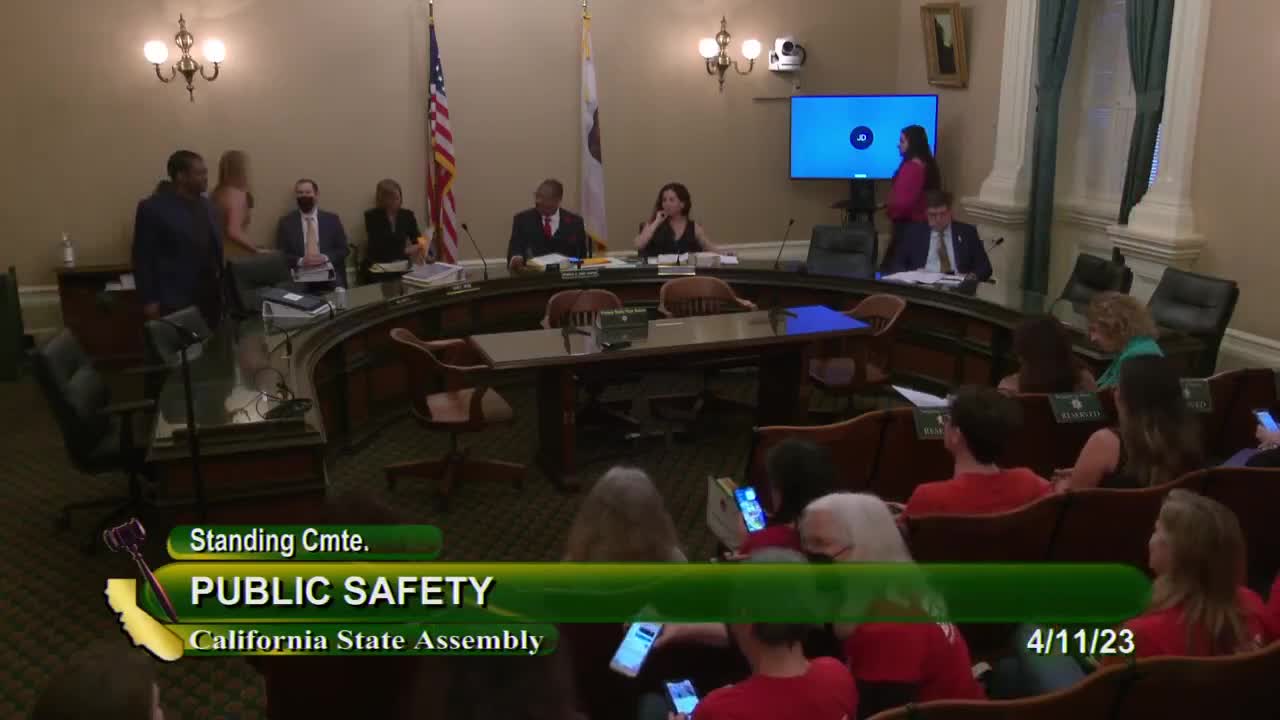 22MIN
Assembly Standing Committee on Public Safety
Bill Author

Bill Co-Author(s):