AB 1297: Public restrooms.
- Session Year: 2023-2024
- House: Assembly
- Latest Version Date: 2023-06-21
Current Status:
Failed
(2023-09-01: In committee: Held under submission.)
Introduced
In Committee
First Chamber
In Committee
Second Chamber
Enacted
Existing law requires every public agency, as defined, that conducts an establishment serving the public or open to the public and that maintains restroom facilities for the public, to make every water closet available without cost or charge, as provided. Existing law also requires publicly and privately owned facilities where the public congregates to be equipped with sufficient temporary or permanent restrooms to meet the needs of the public at peak hours.
This bill would require each local government, as defined, to complete an inventory of public restrooms owned and maintained by the local government, either directly or by contract, that are available to the general population in its jurisdiction by July 1, 2024. The bill would require local governments to report their findings to the State Department of Public Health, which would be required to compile the information and to make the inventory available in a searchable database on its internet website report the availability of public restrooms to the Legislature by March 1, 2025, as specified. The bill would require the database to be updated quarterly. The bill would require the department to conduct educational outreach to the general public and homelessness service providers that the database is available on its internet website. Legislature to consider the report when evaluating the publics access to reliable public restrooms.
The bill would include findings that changes proposed by this bill address a matter of statewide concern rather than a municipal affair and, therefore, apply to all cities, including charter cities.
By imposing additional duties on local governments, this bill would impose a state-mandated local program.
The California Constitution requires the state to reimburse local agencies and school districts for certain costs mandated by the state. Statutory provisions establish procedures for making that reimbursement.
This bill would provide that, if the Commission on State Mandates determines that the bill contains costs mandated by the state, reimbursement for those costs shall be made pursuant to the statutory provisions noted above.
Existing law requires every public agency, as defined, that conducts an establishment serving the public or open to the public and that maintains restroom facilities for the public, to make every water closet available without cost or charge, as provided. Existing law also requires publicly and privately owned facilities where the public congregates to be equipped with sufficient temporary or permanent restrooms to meet the needs of the public at peak hours.
This bill would require each local government, as defined, to complete an inventory of public restrooms owned and maintained by the local government, either directly or by contract, that are available to the general population in its jurisdiction by July 1, 2024. The bill would require local governments to report their findings to the State Department of Public Health, which would be required to compile the information and to make the inventory available in a searchable database on its internet website by March 1, 2025, as specified. The bill would require the database to be updated quarterly. The bill would require the department to conduct educational outreach to the general public and homelessness service providers that the database is available on its internet website.
The bill would include findings that changes proposed by this bill address a matter of statewide concern rather than a municipal affair and, therefore, apply to all cities, including charter cities.
By imposing additional duties on local governments, this bill would impose a state-mandated local program.
The California Constitution requires the state to reimburse local agencies and school districts for certain costs mandated by the state. Statutory provisions establish procedures for making that reimbursement.
This bill would provide that, if the Commission on State Mandates determines that the bill contains costs mandated by the state, reimbursement for those costs shall be made pursuant to the statutory provisions noted above.
(a)Each local government shall complete an inventory of accessible, permanent public restrooms, including single-occupancy restrooms, owned and maintained, either directly or by contract, by the local government that are available to the general population in its jurisdiction. The inventory shall include the physical address of each public restroom. Local governments shall provide the inventory to the State Department of Public Health not later than July 1, 2024, and quarterly thereafter. 2024.
(b)(1)The State Department of Public Health shall compile the information provided by local governments and shall develop and maintain a user-friendly database of the information that is searchable by ZIP Code on its public internet website not later than March 1, 2025. report to the Legislature, by March 1, 2025, the availability of public restrooms by county.
(A)The department shall update the database quarterly.(B)The internet website shall contain a notice stating that the database does not guarantee the hours of operation or the accessibility of a listed restroom.(2)The State Department of Public Health shall conduct educational outreach to the general public and to homelessness service providers that the searchable database is available on its internet website.(2)The Legislature shall consider the information from this report when evaluating the publics access to reliable public restrooms.
(c)(1)For purposes of this section, local government means a city, including a charter city, a county, a city and county, and a special district.
(2)For purposes of this section, special district means a library district established pursuant to Chapter 8 (commencing with Section 19400) or Chapter 9 (commencing with Section 19600) of Part 11 of Division 1 of Title 1 of the Education Code, or a park district as described in Section 5096.228 of the Public Resources Code.
(d)The Legislature finds and declares that this section, which ensures access to public restrooms, addresses a matter of statewide concern rather than a municipal affair as that term is used in Section 5 of Article XI of the California Constitution. Therefore, this section applies to all cities, including charter cities.
(e)A report to be submitted pursuant to subdivision (b) shall be submitted in compliance with Section 9795 of the Government Code.
SEC. 2.If the Commission on State Mandates determines that this act contains costs mandated by the state, reimbursement to local agencies and school districts for those costs shall be made pursuant to Part 7 (commencing with Section 17500) of Division 4 of Title 2 of the Government Code.
(a)Each local government shall complete an inventory of accessible, permanent public restrooms, including single-occupancy restrooms, owned and maintained, either directly or by contract, by the local government that are available to the general population in its jurisdiction. Local governments shall provide the inventory to the State Department of Public Health not later than July 1, 2024, and quarterly thereafter.
(b)(1)The State Department of Public Health shall compile the information provided by local governments and shall develop and maintain a user-friendly database of the information that is searchable by ZIP Code on its public internet website not later than March 1, 2025.
(A)The department shall update the database quarterly.
(B)The internet website shall contain a notice stating that the database does not guarantee the hours of operation or the accessibility of a listed restroom.
(2)The State Department of Public Health shall conduct educational outreach to the general public and to homelessness service providers that the searchable database is available on its internet website.
(c)(1)For purposes of this section, local government means a city, including a charter city, a county, a city and county, and a special district.
(2)For purposes of this section, special district means a library district established pursuant to Chapter 8 (commencing with Section 19400) or Chapter 9 (commencing with Section 19600) of Part 11 of Division 1 of Title 1 of the Education Code, or a park district as described in Section 5096.228 of the Public Resources Code.
(d)The Legislature finds and declares that this section, which ensures access to public restrooms, addresses a matter of statewide concern rather than a municipal affair as that term is used in Section 5 of Article XI of the California Constitution. Therefore, this section applies to all cities, including charter cities.
SEC. 2.If the Commission on State Mandates determines that this act contains costs mandated by the state, reimbursement to local agencies and school districts for those costs shall be made pursuant to Part 7 (commencing with Section 17500) of Division 4 of Title 2 of the Government Code.
|
Date
|
Status
|
|---|---|
| Sep 1, 2023 | In committee: Held under submission. |
| Jul 10, 2023 | In committee: Referred to APPR. suspense file. |
| Jun 28, 2023 | From committee: Do pass and re-refer to Com. on APPR. (Ayes 6. Noes 2.) (June 28). Re-referred to Com. on APPR. |
| Jun 21, 2023 | From committee chair, with author's amendments: Amend, and re-refer to committee. Read second time, amended, and re-referred to Com. on GOV. & F. |
| Jun 15, 2023 | In committee: Set, first hearing. Hearing canceled at the request of author. |
| Jun 7, 2023 | Referred to Com. on GOV. & F. |
| May 26, 2023 | In Senate. Read first time. To Com. on RLS. for assignment. |
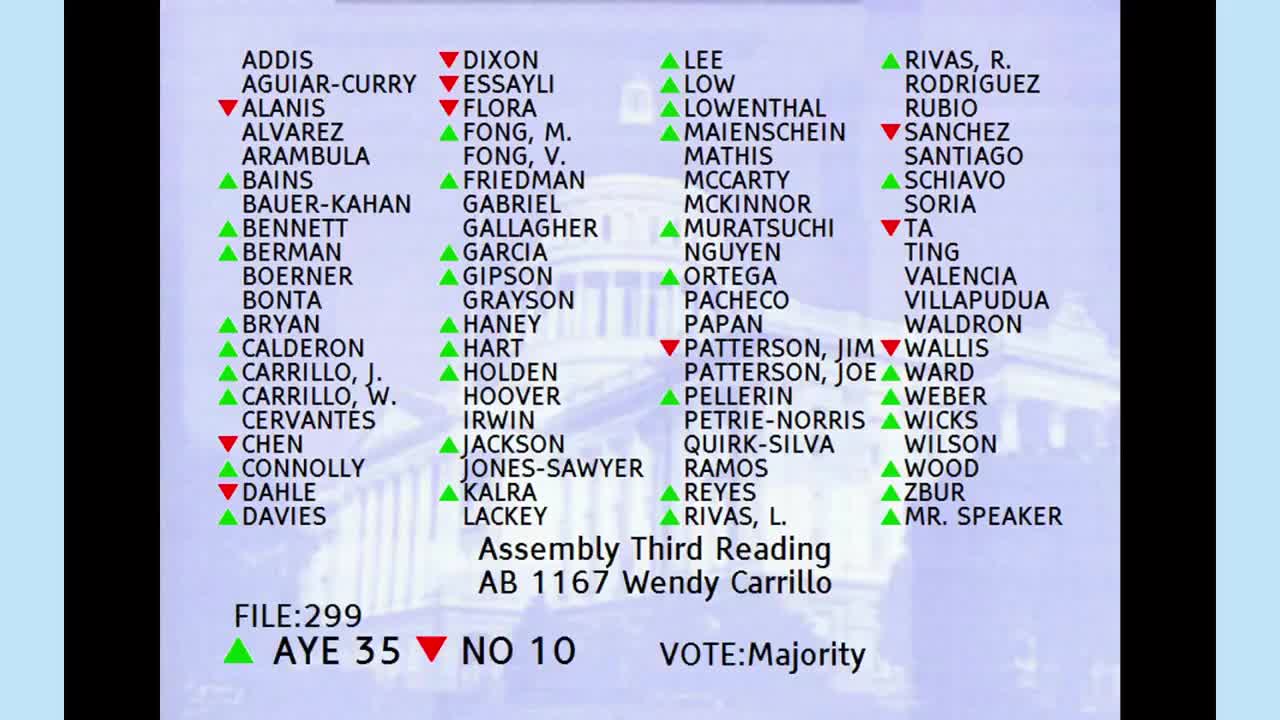
| May 25, 2023 | Read third time. Passed. Ordered to the Senate. (Ayes 62. Noes 6. Page 1768.) |
| May 18, 2023 | From committee: Do pass. (Ayes 11. Noes 4.) (May 18). |
| May 18, 2023 | Read second time. Ordered to third reading. |
| Apr 19, 2023 | In committee: Set, first hearing. Referred to APPR. suspense file. |
| Mar 29, 2023 | From committee: Do pass and re-refer to Com. on APPR. (Ayes 6. Noes 1.) (March 29). Re-referred to Com. on APPR. |
| Mar 2, 2023 | Referred to Com. on L. GOV. |
| Feb 17, 2023 | From printer. May be heard in committee March 19. |
| Feb 16, 2023 | Read first time. To print. |
|
Date
|
Description
|
Location
|
Votes
|
|
|---|---|---|---|---|
| Jul 10, 2023 | Placed on suspense file | Senate Standing Committee on Appropriations |
Passed |
|
| Jun 28, 2023 | Do pass, but first be re-referred to the Committee on [Appropriations] | Senate Standing Committee on Governance and Finance |
Passed |
|
| May 25, 2023 | AB 1297 Quirk-Silva Assembly Third Reading | Assembly Floor |
Passed |
|
| May 18, 2023 | Do pass. | Assembly Standing Committee on Appropriations |
Passed |
|
| Mar 29, 2023 | Do pass and be re-referred to the Committee on [Appropriations] | Assembly Standing Committee on Local Government |
Passed |
This list shows positions taken on this bill by organizations on the date displayed, which is linked to the original source.
Positions by individuals are not included.
|
Organization
|
Position
|
Date
|
|---|---|---|
| Aclu California Action | * Support | Jun 28, 2023 |
| American Restroom Association | ** Support | |
| League of Califonia Cities | * For If Amend | Jun 28, 2023 |
| National Association Of Social Workers, California Chapter | ** Support | |
| Streets for All | ** Support | |
| The Western Center on Law and Poverty | * Support | Jun 28, 2023 |
| University of the Pacific, McGeorge School of Law | * Support | Jun 28, 2023 |
SENATE COMMITTEE ON APPROPRIATIONS
Senator Anthony Portantino, Chair
2023 - 2024 Regular Session
AB 1297 (Quirk-Silva) - Public restrooms
Version: June 21, 2023 | Policy Vote: GOV. & F. 6 - 2 |
Urgency: No | Mandate: Yes |
Hearing Date: July 10, 2023 | Consultant: Mark McKenzie |
Bill Summary:
AB 1297 would require cities, counties, and specified special districts to complete an inventory of public restrooms that they own and maintain, and provide the inventory to the California Department of Public Health (CDPH) by July 1, 2024. The bill would require CDPH to compile the information and report the availability of local agency public restrooms, by county, to the Legislature by March 1, 2025.
Fiscal Impact:
- CDPH estimates one-time costs of approximately $78,000 in 2024-25 for 0.5 PY of staff time to provide administrative support, coordinate with local entities, respond to inquiries, support data collection and compilation, and draft the report. (General Fund)
- Unknown, likely significant one-time local costs in 2023-24 to collect and report specified information for each identified site in the inventory of accessible, permanent public restrooms. These costs are likely reimbursable by the state, subject to a determination by the Commission on State Mandates if a local agency files a claim for reimbursement. (General Fund)
Background:
According to a February 2023 report issued by the Public Policy Institute of California, California has topped the national list as the state with the largest homeless population for more than a decade. The most recent point-in-time count found that 171,521 people are experiencing homelessness in the state on any given night. As of 2022, 30% of all people in the United Stated experiencing homelessness lived in California, including half of all unsheltered people (115,491 in California compared to 233,832 nationwide). Those who are unsheltered are living outdoors and not in temporary shelters, which oftentimes indicates that these individuals lack regular access to proper sanitation facilities and services.
According to an article by Ron S. Hochbaum, “Bathrooms as a Homeless Rights Issue” published in the North Carolina Law Review in January 2020, one of the many barriers to accessibility of public bathrooms for homeless individuals includes the fact that cities do not adequately publicize their availability, often failing to provide a centralized list of bathrooms they maintain. The article also found the mere existence of a public restroom does not mean the restroom is appropriately accessible to people experiencing homelessness, and cited numerous reasons that impact access, including restricted hours of operation, and requiring a fee for entry, among others.
Proposed Law:
AB 1297 would require local governments to complete an inventory of public restrooms and submit the inventory to CDPH, which would compile the information by county and submit a report to the Legislature. Specifically, this bill would:
- Define “local government” for purposes of the bill as a city, county, city and county, library district, and park district, as specified.
- Require each of those local governments to complete an inventory of accessible, publicly-available, permanent public restrooms it owns and maintains, including single-occupancy restrooms, and to provide the inventory, including the physical address of each restroom, to CDPH by July 1, 2024.
- Require CDPH to compile the information provided by local governments, and report to the Legislature, by March 1, 2025, on the availability of public restrooms by county.
- Require the Legislature to consider the information from the report when evaluating the public’s access to reliable public restrooms.
Related Legislation:
AB 1883 (Quirk-Silva), which was held on this Committee’s Suspense File last year, would have required local governments to complete an inventory of all public restrooms it owns and maintains and provide that inventory to CDPH by July 1, 2023, and quarterly thereafter until January 1, 2027. The bill would have also required CDPH to create a searchable database of those inventories and post it on its website by March 1, 2024, as specified.
AB 1017 (Quirk-Silva), which was held on this Committee’s Suspense File last year, would have required each city, county, and special district to complete a one-time inventory of all public restrooms it owns and maintains, make the inventory available to homelessness service providers and on its website, and report the information to DPH, as specified. The bill would have required DPH to compile the information and submit it to the Legislature in a report by March 1, 2023.
Staff Comments:
This bill would impose a state-mandated local program on California’s 58 counties, 482 cities, 95 parks districts, and 18 library districts by requiring each entity to compile a detailed inventory of accessible, permanent public restroom locations, including the physical address of each public restroom, and provide the inventory to CDPH by July 1, 2024. Staff notes that the local workload and one-time costs, which are likely to be significant in the aggregate, would take place in 2023-24. Subject to a determination by the Commission on State Mandates, any costs incurred by local agencies to comply with the bill’s requirements could be borne by the General Fund, to the extent a local agency successfully files a claim for state reimbursement.
CDPH indicates that it would incur one-time costs of approximately $78,000 in 2024-25 for 0.5 PY of staff time to perform specified administrative tasks, as noted above.
Staff notes that the bill imposes one-time duties on specified local governments and CDPH that would be completed by March 1, 2025. The only remaining substantive provision requires the Legislature to consider the information in the report when evaluating the public’s access to reliable public restrooms. The Committee may wish to consider an amendment to add an appropriate sunset date so that obsolete provisions are automatically repealed from the Health and Safety Code.
-- END --
SENATE COMMITTEE ON GOVERNANCE AND FINANCE
Senator Anna M. Caballero, Chair
2023 - 2024 Regular
Bill No: | AB 1297 | Hearing Date: | 6/28/23 |
Author: | Quirk-Silva | Tax Levy: | No |
Version: | 6/21/23 | Fiscal: | Yes |
Consultant: | Goldberg | ||
Public restrooms
Requires local governments to create public restroom inventories and submit them to the Department of Public Health, which in turn must compile the information and report it to the Legislature.
Background
According to a February 2023 report issued by the Public Policy Institute of California, the Golden State has topped the list as the state with the largest homeless population for more than a decade. As of 2022, 30% of all people in the U.S experiencing homelessness lived in California, including half of all unsheltered people (115,491 in California compared to 233,832 nationwide). Those who are unsheltered are living outdoors and not in temporary shelters, meaning they also lack regular access to proper sanitation facilities and services.
People experiencing homeless confront many challenges, including regular access to restrooms. According to an article by Ron S. Hochbaum, “Bathrooms as a Homeless Rights Issue” published in the North Carolina Law Review in January 2020, “one of the many barriers to accessibility of public bathrooms for homeless individuals includes the fact that cities do not adequately publicize their availability, often failing to provide a centralized list of bathrooms they maintain.”
It also found cities don’t provide enough public bathrooms for homeless people for two main reasons:
- Public bathrooms are not intended to serve the homeless community alone. Rather, they are designed to serve the public at large.
- The presence or availability of a bathroom does not reflect whether it is actually accessible to homeless people.
The article notes the importance of considering potential barriers that publicly maintained bathrooms may present for homeless individuals, including:
- Not being open 24 hours a day and 7 days a week;
- Closing during particular seasons;
- Not being clean and sanitary or providing an ability to wash one’s hands;
- Not being strategically located;
- Being located in an area where anti-homeless laws are enforced;
- Being hard to find due to an absence of signage;
- Having physical security on site;
- Being located in a building that requires identification to enter; and
- Requiring a fee for entry or being located in a facility that requires the same.
The article reports 98% of the 264 bathrooms the City of Los Angeles operates have restricted hours. In San Jose, 43% of bathrooms are located in buildings or facilities that require a fee or membership for entry. In 87% of San Francisco’s public bathrooms, the hours are restricted. In San Diego, until recently, almost all of the city’s public bathrooms closed at night. The article concludes that, “Prohibitions on public urination and defecation alone cannot protect
homeless individuals and others from the health risks associated with exposure to human waste. Homeless individuals will have to urinate and defecate regardless of whether doing so publicly violates the law. By failing to provide adequate access to public bathrooms, governments ensure that homeless individuals do so in a manner that threatens their health and the health of others.”
The City of Sacramento produced a report in 2018 evaluating the public’s access to restrooms and developed a plan to improve that access. The report provided an inventory and map of all city-operated restrooms open to the public, the location of planned new restrooms, and short- and long-term recommendations to improve public restroom access. The city identified 85 locations with public restrooms, 28 of which are open 24 hours per day. The city’s short-term strategies included more effective signage, creating maps to show restroom locations and hours, and on-call cleanup and waste removal. Their long-term strategies included more regional collaboration to implement permanent attended restroom program, identify additional restroom locations, business incentives, and to identify additional funding opportunities.
To increase access to public restrooms, the author wants certain local agencies to create an inventory of the public restrooms in their areas.
Proposed Law
Assembly Bill 1297 requires each city, county, charter city, city and county, library district, and park district to complete an inventory of public restrooms hours in their jurisdiction, including the physical address of the public restroom. The inventory must include restrooms owned and maintained, either directly or by contract, by the local government that are available to the general population. Local governments must provide the inventory to the state Department of Public Health (DPH) by July 1, 2024.
The bill requires DPH to compile the information and report back to the Legislature by March 1, 2025, on the availability and status of public restrooms accessible to the public, broken down by county.
State Revenue Impact
No estimate.
Comments
1. Purpose of the bill. According to the author, “Every person goes to the restroom, it is a biological human fact. However, in today's world, finding accessible public restrooms can be challenging for various reasons. This challenge is particularly acute for individuals facing medical challenges, experiencing homelessness, dealing with time constraints as delivery drivers, pregnancy, or when visiting unfamiliar locations. While public entities maintain lists of public transit stations, libraries, parks, and polling places, they often overlook the importance of providing information about restrooms. My bill will gather the locations of permanent public restrooms in Cities, Charter Cities, Counties, and defined special districts with a follow up report by the Department of Public Health so that the State can develop further policy on this issue informed by empirical information.”
2. Letting people know where public restrooms are located. AB 1297 requires 58 counties, 482 cities, 95 parks districts and 18 library districts to complete an inventory of their publicly accessible restrooms. DPH would then compile the information it receives from these 600+ agencies and create a one-time report to the Legislature on the availability and status of public restrooms accessible to the public, broken down by county.
While the measure would collect a significant amount of information on the number and location of public restrooms, it does not require local agencies to increase the number of restrooms they operate, make them more accessible, or provide local agencies with funding to accomplish those goals. It’s not clear how completing a restroom inventory will effectively addresses concerns about public restroom access or whether the benefits from collecting this information will outweigh the costs local agencies and DPH will incur to collect and compile this information.
It is worth noting that a person with Internet access can already find much of this information online today. Simply typing “public restroom” into the map application on a phone will generally provide directions to the closest public restroom. There are also a number of free third-party apps on phones – ToiletFinder and Flush, just to name two – that provide users with the locations of public restrooms near them.
3. Goose vs. Gander. If the bill’s goal is to inform the discussion about whether there are enough public restrooms in the state and where they are located, it’s not clear why the bill doesn’t require state agencies to submit the locations of their public restrooms to DPH for inclusion in the inventory report this bill requires DPH to compile and send to the Legislature.
4. Beat the clock. AB 1297 requires local agencies to submit their inventories to DPH by July 1, 2024, only six months after the bill would go into effect. The Committee may wish to consider whether this is enough time for local agencies to complete the inventory.
5. You look so familiar. This bill is similar to AB 1883 (Quirk-Silva, 2022), which was approved by this committee but held on the Senate Appropriations Committee’s suspense file. That bill would have required local agencies to complete an inventory of their public restrooms and report it to DPH, which would have to create a searchable database and post it on its internet website. AB 1017 (Quirk-Silva, 2021) would have required each local agency to complete a one-time inventory of all public restrooms it owns and maintains, make the inventory available to homelessness service providers and on its website, and report the information to the DPH. AB 1017 also was approved by this committee but was held on the Senate Appropriations Committee’s suspense file.
6. Mandate. The California Constitution requires the state to reimburse local governments for the costs of new or expanded state mandated local programs. Because AB 1297 adds to the duties of local officials, Legislative Counsel says the bill imposes a new state mandate. The measure states that if the Commission on State Mandates determines the bill imposes a reimbursable mandate, then reimbursement must be made pursuant to existing statutory provisions.
Assembly Actions
Assembly Local Government Committee: 6-1
Assembly Appropriations Committee: 11-4
Assembly Floor: 62-6
Support and Opposition
(6/23/23)
Support: American Restroom Association
National Association of Social Workers, California Chapter
Streets for All
Opposition: None submitted.
-- END --
ASSEMBLY THIRD READING
ATR Bill Id:AB 1297
Author:(Quirk-Silva and Haney)
As Introduced Ver:February 16, 2023
Majority vote
SUMMARY
Requires specified local governments to complete an inventory of accessible, permanent public restrooms owned and maintained by a local government and requires the local government to provide the inventory to the State Department of Public Health (DPH).
Major Provisions
- Defines "local government" as a city, including a charter city, a county, a city and a county, and a special district.
- Defines "special district" as a library district or a park district, as specified.
- Requires each local government to complete an inventory of accessible, permanent public restrooms, including single-occupancy restrooms, owned and maintained, either directly or by contract, by the local government that are available to the general population in its jurisdiction. Local governments shall provide the inventory to DPH not later than July 1, 2024, and quarterly thereafter.
- Specifies that DPH shall compile the information provided by local governments and shall develop and maintain a user-friendly database of the information that is searchable by ZIP code on its public internet website not later than March 1, 2025.
- Requires DPH to update the database quarterly.
- Specifies that the internet website shall contain a notice stating the database does not guarantee the hours of operation or accessibility of a listed restroom.
- Requires DPH to conduct educational outreach to the general public and to homelessness service providers that the searchable database is available on its internet website.
COMMENTS
- California's Homelessness Crisis. California has one of the worst homelessness rates in the nation. According to the October 6, 2022 article "California's homeless population grew by 22,000 over pandemic" from Cal Matters, "The first statewide snapshot of California's homelessness crisis since the pandemic hit reveals that the number of people without a stable place to call home increased by at least 22,500 over the past three years, to 173,800. That's based on a CalMatters analysis of the federal government's point-in-time count, a biennial headcount of people sleeping on the streets and in shelters tallied by California cities and counties earlier this year for the first time since 2019. Homelessness experts mostly attribute the rise to precipitous drops in earnings during the pandemic among Californians already teetering on the edge. They also point to a worsening housing affordability crisis that is decades in the making"
On February 1, 2023, the Public Policy Institute of California (PPIC) wrote that, "Homelessness continues to grow in California: nationally, California has topped the list for the state with the largest homeless population for more than a decade. As of 2022, 30% of all people in the United States experiencing homelessness resided in California, including half of all unsheltered people (115,491 in California; 233,832 in the United States)
"Since 2020, California's overall homeless population has increased about 6%, compared to just 0.4% in the rest of the country. A 17% increase in the homeless but sheltered population accounts for almost all of California's change, while the more visible unsheltered population increased 2%. The rest of the country's unsheltered population grew faster than California's (4%), while its sheltered population actually shrank (-2%)....
"Pandemic homeless programs have begun to unwind and the substantial federal funding efforts around COVID are expiring; the disappearance of these programs and funds may alter the options available to people experiencing homelessness in California. The state is taking steps to point legislation toward addressing issues around homelessness—including setting up CARE courts for mental health support— while bipartisan pressure is growing to audit how recent funds were spent."
- California Department of Public Health. DPH's mission, according to their website, is to advance the health and well-being of California's diverse people and communities. Their responsibilities are comprehensive and include infectious disease control and prevention, food safety, environmental health, laboratory services, patient safety, emergency preparedness, chronic disease prevention and health promotion, family health, health equity and vital records and statistics.
- Barriers and Solutions. An article published in the North Carolina Law review in January of 2020 (Ron S. Hochbaum, Bathrooms as a Homeless Rights Issue, 98 N.C. L. REV. 205 (2020) asserts that "one of the many barriers to accessibility of public bathrooms for homeless individuals includes the fact that cities do not adequately publicize their availability, often failing to provide a centralized list of bathrooms they maintain." It also found that cities don't provide enough public bathrooms for homeless individuals for two reasons. "First, the public bathrooms are not intended to serve the homeless community alone. Rather, they are designed to serve the public at large. Second…the presence or availability of a bathroom does not reflect whether the bathroom is accessible to homeless individuals.
The report noted that the mere existence of a public restroom does not necessarily mean that the restroom is appropriately accessible to people experiencing homelessness and that it is important to consider barriers for homeless individuals, including:
- Not being open twenty-four hours per day and seven days a week.
- Closing during particular seasons.
- Not being clean and sanitary or providing an ability to wash one's hands.
- Not being strategically located.
- Being located in an area where anti-homeless laws are enforced.
- Being hard to find due to an absence of signage.
- Having physical security on site.
- Being located in a building that requires identification to enter.
- Requiring a fee for entry or being located in a facility that requires the same.
The article reports that 98% of Los Angeles's 264 bathrooms have restricted hours. In San Jose 43% of bathrooms are located in buildings or facilities that required a fee or membership for entry. In 87% of San Francisco's public bathrooms, the hours are restricted. In San Diego, until recently, almost all of the city's public bathrooms closed at night. "Before the city's recent hepatitis A outbreak, the city maintained only two 24-hour public bathrooms. After the outbreak, it began leaving many of its public bathrooms open all day and started installing new ones. As of September 15, 2017, the city was keeping sixty-eight bathrooms open twenty-four hours per day."
- Restroom Inventories. In March of 2018, staff at the City of Sacramento produced a report evaluating the public's access to restrooms and developing a plan to improve access. Staff was requested to identify the current inventory of public restrooms and the service gaps. The report provided an inventory and map of all existing restrooms open to the public in the City, the location of planned new restrooms, and short and long-term recommendations to improve public restroom access. It identified restrooms open 24/7 and those with varying operational hours.
In March 2022, the Project for Sanitation Justice, supported by San Diego State University, published a report Public Restrooms in San Diego County: A Regional Assessment and proclaimed that San Diego County has insufficient public restroom facilities based on its population's needs, and that the lack of adequate sanitation had repeatedly been linked to infectious disease outbreaks in the region. The report mapped the locations of the public restrooms, and found that 49% of the county's census tracts lack public restroom facilities. The report also estimated that at night, there is a ratio of one available restroom for every 383 unsheltered people in downtown San Diego.
According to the Author
According to the author, "Every person goes to the restroom, it is a biological human fact. The Centers for Disease Control has consistently advised that frequent hand washing can keep you healthy and prevent the further spread of COVID-19. These days, even knowing where an accessible public restroom is can be challenging for varied reasons, especially if you are: homeless, on the clock at work, or on a day-trip somewhere new. My bill provides the people of California a tool to locate an accessible public restroom by zip code so that we can all have the opportunity to be healthy, wash our hands, help keep our economy moving and to use the restroom with some dignity and respect."
Arguments in Support
According to the National Association of Social Workers, California Chapter, "As a social work association, our members have a mandate to help people meet their basic needs. Our Code of Ethics also recognizes the dignity and worth of every person. This bill is fundamental to our mandate as professional social workers and is consistent with our Code of Ethics.
"Taking a moment to practice good hygiene is an individual step, which people can practice regularly to help keep their local communities and economies moving. Public restroom data is rarely published for public knowledge and this bill allows the state to take a step forward, with empirical data, towards a modern notion of better defining what accessibility to a public restroom looks like for all people in the state, regardless of housing or income status."
Arguments in Opposition
None on file.
FISCAL COMMENTS
According to the Assembly Appropriations Committee:
- CDPH estimates, based on a prior similar bill:
- One-time General Fund (GF) costs of approximately $3.6 million through the 2024-25 fiscal year to implement this bill, including state operations and staffing costs of approximately $1.3 million, one-time consultant costs of approximately $1.57 million, and one-time IT systems costs of approximately $700,000 to develop the user-friendly, searchable database.
- Ongoing administrative costs (GF) of approximately $531,000 annually for three staff to provide technical assistance, conduct educational outreach, and perform quarterly updates to the database, as well as $235,000 in annual IT support and license costs.
- Estimated one-time costs to cities, counties, park districts and library districts of an unknown amount, but likely in the mid-hundreds of thousands of dollars statewide, to inventory public restrooms and submit the information to CDPH by July 1, 2024. If each of California's 482 cities, including 121 charter cities, and 58 counties spent an average of $1,000 on this requirement, statewide costs would be $540,000. The majority of the workload and costs would occur in the first year, with quarterly updates unlikely to be as labor-intensive or costly. These costs are potentially reimbursable by the state General Fund, subject to a determination by the Commission on State Mandates if a local agency files a claim.
VOTES
ASM LOCAL GOVERNMENT: 6-1-1
YES: Aguiar-Curry, Boerner Horvath, Pacheco, Ramos, Robert Rivas, Wilson
NO: Dixon
ABS, ABST OR NV: Waldron
ASM APPROPRIATIONS: 11-4-1
YES: Holden, Bryan, Calderon, Wendy Carrillo, Mike Fong, Hart, Lowenthal, Papan, Pellerin, Weber, Ortega
NO: Megan Dahle, Dixon, Mathis, Sanchez
ABS, ABST OR NV: Robert Rivas
UPDATED
VERSION: February 16, 2023
CONSULTANT: Jimmy MacDonald / L. GOV. / (916) 319-3958 FN: 0000453
Date of Hearing: April 19, 2023
ASSEMBLY COMMITTEE ON APPROPRIATIONS
Chris Holden, Chair
ABPCA Bill Id:AB 1297
Author:(Quirk-Silva) – As Introduced Ver:February 16, 2023
Policy Committee: | Local Government | Vote: | 6 - 1 |
|
| ||
|
|
Urgency: No State Mandated Local Program: Yes Reimbursable: Yes
SUMMARY:
This bill requires each local government to inventory public restrooms and to provide this information to the California Department of Public Health (CDPH) for inclusion in a database available to the public.
Specifically, this bill:
- Requires each local government to complete an inventory of accessible, permanent public restrooms owned and maintained by the local government in its jurisdiction, as specified.
- Requires each local government to provide its inventory to the California Department of Public Health (CDPH) no later than July 1, 2024, and quarterly thereafter.
- Requires CDPH to compile the information provided by local governments and develop a user-friendly database available by March 1, 2025, on its public internet website that is searchable by ZIP Code, updated quarterly, and includes a notice the database does not guarantee hours of operation or accessibility.
- Requires CDPH to conduct educational outreach to the general public and to homeless service providers that the searchable database is available on its internet website.
- Defines “local government” as a city, including a charter city, a county, a city and county, a library district and a park district.
FISCAL EFFECT:
- CDPH estimates, based on a prior similar bill:
- One-time General Fund (GF) costs of approximately $3.6 million through the 2024-25 fiscal year to implement this bill, including state operations and staffing costs of approximately $1.3 million, one-time consultant costs of approximately $1.57 million, and one-time IT systems costs of approximately $700,000 to develop the user-friendly, searchable database.
- Ongoing administrative costs (GF) of approximately $531,000 annually for three staff to provide technical assistance, conduct educational outreach, and perform quarterly updates to the database, as well as $235,000 in annual IT support and license costs.
- Estimated one-time costs to cities, counties, park districts and library districts of an unknown amount, but likely in the mid-hundreds of thousands of dollars statewide, to inventory public restrooms and submit the information to CDPH by July 1, 2024. If each of California’s 482 cities, including 121 charter cities, and 58 counties spent an average of $1,000 on this requirement, statewide costs would be $540,000. The majority of the workload and costs would occur in the first year, with quarterly updates unlikely to be as labor-intensive or costly. These costs are potentially reimbursable by the state General Fund, subject to a determination by the Commission on State Mandates if a local agency files a claim.
COMMENTS:
- Purpose. This bill seeks to improve access to public restrooms. According to the author:
The Centers for Disease Control has consistently advised that frequent hand washing can keep you healthy and prevent the further spread of COVID-19. These days, even knowing where an accessible public restroom is can be challenging for varied reasons, especially if you are homeless, on the clock at work, or on a day-trip somewhere new. This bill provides the people of California a tool to locate an accessible public restroom by zip code so that we can all have the opportunity to be healthy, wash our hands, help keep our economy moving and to use the restroom with some dignity and respect.
- Background. According to the Public Policy Institute of California (PPIC), “California has topped the list for the state with the largest homeless population for more than a decade. As of 2022, 30% of all people in the United States experiencing homelessness resided in California.” This includes 115,000 unsheltered people (half of the unsheltered population in the US) meaning they are living outdoors and not in temporary shelters, which often indicates these individuals lack regular access to proper sanitation facilities and services.
In March 2022, the Project for Sanitation Justice, supported by San Diego State University, published a report entitled, “Public Restrooms in San Diego County: A Regional Assessment” that found San Diego County has insufficient public restroom facilities based on its population’s needs, and the lack of adequate sanitation had repeatedly been linked to infectious disease outbreaks in the region. The report mapped the locations of the public restrooms, and found 49% of the county’s census tracts lack public restroom facilities.
This bill requires local governments to inventory public restrooms and to provide this information to CDPH for inclusion in a searchable, publically available database.
- Prior Legislation. AB 1883 (Quirk-Silva) of 2022 was nearly identical to this bill. AB 1883 was held on the suspense file in the Senate Committee on Appropriations.
AB 1017 (Quirk-Silva) of 2021 would have required an inventory of public restrooms available to the homeless populations by local governments be reported to the Office of Emergency Services. AB 1017 was held on the suspense file in the Senate Committee on Appropriations.
Analysis Prepared by: Jennifer Swenson / APPR. / (916) 319-2081
Date of Hearing: March 29, 2023
ASSEMBLY COMMITTEE ON LOCAL GOVERNMENT
Cecilia Aguiar-Curry, Chair
ABPCA Bill Id:AB 1297 (
Author:Quirk-Silva) – As Introduced Ver:February 16, 2023
SUBJECT: Public restrooms.
SUMMARY: Requires specified local governments to complete an inventory of accessible, permanent public restrooms owned and maintained by a local government and requires the local government to provide the inventory to the State Department of Public Health (DPH). Specifically, this bill:
- Defines “local government” as a city, including a charter city, a county, a city and a county, and a special district.
- Defines “special district” as a library district or a park district, as specified.
- Requires each local government to complete an inventory of accessible, permanent public restrooms, including single-occupancy restrooms, owned and maintained, either directly or by contract, by the local government that are available to the general population in its jurisdiction. Local governments shall provide the inventory to DPH not later than July 1, 2024, and quarterly thereafter.
- Specifies that DPH shall compile the information provided by local governments and shall develop and maintain a user-friendly database of the information that is searchable by ZIP code on its public internet website not later than March 1, 2025.
- Requires DPH to update the database quarterly.
- Specifies that the internet website shall contain a notice stating the database does not guarantee the hours of operation or accessibility of a listed restroom.
- Requires DPH to conduct educational outreach to the general public and to homelessness service providers that the searchable database is available on its internet website.
- Finds and declares that this bill, which ensures access to public restrooms, addresses a matter of statewide concern rather than a municipal affair. Therefore, this bill applies to all cities, including charter cities.
- Provides that, if the Commission on State Mandates determines that this bill contains costs mandated by the state, reimbursement to local agencies and school districts for those costs shall be made.
FISCAL EFFECT: This bill is keyed fiscal and contains a state mandated local program.
COMMENTS:
- Bill Summary. This bill requires cities, counties, and library districts and parks districts to complete an inventory of accessible, permanent public restrooms that are owned and maintained by that local government that are available to the general population in its jurisdiction. The local governments must provide the inventory to DPH by July 1, 2024, and quarterly thereafter. This bill also requires DPH to compile the information provide by the local governments and develop and maintain a user-friendly database that is searchable by ZIP code on its website by March 1, 2025. Lastly, this bill requires DPH to update its database quarterly, the website contain a notice that the database does not guarantee the hours of operation or accessibility of a restroom, and DPH to conduct educational outreach to the general public and to homelessness service providers regarding the searchable database. This bill is sponsored by the author.
- Author’s Statement. According to the author, “Every person goes to the restroom, it is a biological human fact. The Centers for Disease Control has consistently advised that frequent hand washing can keep you healthy and prevent the further spread of COVID-19. These days, even knowing where an accessible public restroom is can be challenging for varied reasons, especially if you are: homeless, on the clock at work, or on a day-trip somewhere new. My bill provides the people of California a tool to locate an accessible public restroom by zip code so that we can all have the opportunity to be healthy, wash our hands, help keep our economy moving and to use the restroom with some dignity and respect.”
- California’s Homelessness Crisis. California has one of the worst homelessness rates in the nation. According to the October 6, 2022 article “California’s homeless population grew by 22,000 over pandemic” from Cal Matters, “The first statewide snapshot of California’s homelessness crisis since the pandemic hit reveals that the number of people without a stable place to call home increased by at least 22,500 over the past three years, to 173,800. That’s based on a CalMatters analysis of the federal government’s point-in-time count, a biennial headcount of people sleeping on the streets and in shelters tallied by California cities and counties earlier this year for the first time since 2019. Homelessness experts mostly attribute the rise to precipitous drops in earnings during the pandemic among Californians already teetering on the edge. They also point to a worsening housing affordability crisis that is decades in the making”
On February 1, 2023, the Public Policy Institute of California (PPIC) wrote that, “Homelessness continues to grow in California: nationally, California has topped the list for the state with the largest homeless population for more than a decade. As of 2022, 30% of all people in the United States experiencing homelessness resided in California, including half of all unsheltered people (115,491 in California; 233,832 in the US)....
“Since 2020, California’s overall homeless population has increased about 6%, compared to just 0.4% in the rest of the country. A 17% increase in the homeless but sheltered population accounts for almost all of California’s change, while the more visible unsheltered population increased 2%. The rest of the country’s unsheltered population grew faster than California’s (4%), while its sheltered population actually shrank (-2%)....
“Pandemic homeless programs have begun to unwind and the substantial federal funding efforts around COVID are expiring; the disappearance of these programs and funds may alter the options available to people experiencing homelessness in California. The state is taking steps to point legislation toward addressing issues around homelessness—including setting up CARE courts for mental health support— while bipartisan pressure is growing to audit how recent funds were spent.”
- California Department of Public Health. DPH’s mission, according to their website, is to advance the health and well-being of California’s diverse people and communities. Their responsibilities are comprehensive and include infectious disease control and prevention, food safety, environmental health, laboratory services, patient safety, emergency preparedness, chronic disease prevention and health promotion, family health, health equity and vital records and statistics.
- Barriers and Solutions. An article published in the North Carolina Law review in January of 2020 (Ron S. Hochbaum, Bathrooms as a Homeless Rights Issue, 98 N.C. L. REV. 205 (2020) asserts that “one of the many barriers to accessibility of public bathrooms for homeless individuals includes the fact that cities do not adequately publicize their availability, often failing to provide a centralized list of bathrooms they maintain.” It also found that cities don’t provide enough public bathrooms for homeless individuals for two reasons. “First, the public bathrooms are not intended to serve the homeless community alone. Rather, they are designed to serve the public at large. Second…the presence or availability of a bathroom does not reflect whether the bathroom is accessible to homeless individuals.
The report noted that the mere existence of a public restroom does not necessarily mean that the restroom is appropriately accessible to people experiencing homelessness and that it is important to consider barriers for homeless individuals, including:
- Not being open twenty-four hours per day and seven days a week.
- Closing during particular seasons.
- Not being clean and sanitary or providing an ability to wash one’s hands.
- Not being strategically located.
- Being located in an area where anti-homeless laws are enforced.
- Being hard to find due to an absence of signage.
- Having physical security on site.
- Being located in a building that requires identification to enter.
- Requiring a fee for entry or being located in a facility that requires the same.
- Not being open twenty-four hours per day and seven days a week.
The article reports that 98% of Los Angeles’s 264 bathrooms have restricted hours. In San Jose 43% of bathrooms are located in buildings or facilities that required a fee or membership for entry. In 87% of San Francisco’s public bathrooms, the hours are restricted. In San Diego, until recently, almost all of the city’s public bathrooms closed at night. “Before the city’s recent hepatitis A outbreak, the city maintained only two 24-hour public bathrooms. After the outbreak, it began leaving many of its public bathrooms open all day and started installing new ones. As of September 15, 2017, the city was keeping sixty-eight bathrooms open twenty-four hours per day.”
- Restroom Inventories. In March of 2018, staff at the City of Sacramento produced a report evaluating the public’s access to restrooms and developing a plan to improve access. Staff was requested to identify the current inventory of public restrooms and the service gaps. The report provided an inventory and map of all existing restrooms open to the public in the City, the location of planned new restrooms, and short and long-term recommendations to improve public restroom access. It identified restrooms open 24/7 and those with varying operational hours.
In March 2022, the Project for Sanitation Justice, supported by San Diego State University, published a report Public Restrooms in San Diego County: A Regional Assessment and proclaimed that San Diego County has insufficient public restroom facilities based on its population’s needs, and that the lack of adequate sanitation had repeatedly been linked to infectious disease outbreaks in the region. The report mapped the locations of the public restrooms, and found that 49% of the county’s census tracts lack public restroom facilities. The report also estimated that at night, there is a ratio of one available restroom for every 383 unsheltered people in downtown San Diego.
- Previous Legislation. AB 1017 (Quirk-Silva) of 2021 would have created the Right to Restrooms Act of 2021 to require the inventory of public restrooms available to the homeless populations by local governments to be reported to the Office of Emergency Services. This bill was held in the Senate Appropriations Committee.
AB 1883 (Quirk-Silva) of 2022 was almost identical to this bill and was held in the Senate Appropriations Committee.
- Arguments in Support. According to the National Association of Social Workers, California Chapter, “As a social work association, our members have a mandate to help people meet their basic needs. Our Code of Ethics also recognizes the dignity and worth of every person. This bill is fundamental to our mandate as professional social workers and is consistent with our Code of Ethics.
“Taking a moment to practice good hygiene is an individual step, which people can practice regularly to help keep their local communities and economies moving. Public restroom data is rarely published for public knowledge and this bill allows the state to take a step forward, with empirical data, towards a modern notion of better defining what accessibility to a public restroom looks like for all people in the state, regardless of housing or income status.”
- Arguments in Opposition. None on file.
REGISTERED SUPPORT / OPPOSITION:
Support
National Association of Social Workers, California Chapter
Opposition
None on file
Analysis Prepared by: Jimmy MacDonald / L. GOV. / (916) 319-3958
Discussed in Hearing
 15MIN
Senate Standing Committee on Governance and Finance
 2MIN
Assembly Floor
 14MIN
Assembly Standing Committee on Local Government


Bill Co-Author(s):
