AB 2776: Recovery from disaster or emergency: funding priority.
- Session Year: 2023-2024
- House: Assembly
- Latest Version Date: 2024-05-20
Current Status:
Failed
(2024-08-15: In committee: Held under submission.)
Introduced
In Committee
First Chamber
In Committee
Second Chamber
Enacted
What does this bill do?
This bill lets the state Office of Emergency Services prioritize funding and technical help for infrastructure and housing recovery in communities that lost people and businesses because of a major federal disaster, state of emergency, or local emergency and still have unmet recovery needs. It applies to programs such as the federal Hazard Mitigation Grant Program, the federal Building Resilient Infrastructure and Communities program, and support under the California Disaster Assistance Act.
The summary is provided by generative AI which can make mistakes. For original language, please view the details in the table below.
Existing law, the California Emergency Services Act, among other things, creates the Office of Emergency Services (OES), which is responsible for the states emergency and disaster response services, as specified. Existing law establishes the Office of Planning and Research (OPR) within the Governors office to provide long-range planning and research and to serve as the comprehensive state planning agency. Existing law establishes the Strategic Growth Council (council) and requires the council to administer various programs that support the planning and development of sustainable communities, including, the Regional Climate Collaborative Program, the Affordable Housing and Sustainable Communities Program, the Transformative Climate Communities Program, and the Community Resilience Center Program. The OES is under the supervision of the Director of Emergency Services. During a state of war emergency, a state of emergency, or a local emergency, existing law requires the director to coordinate the emergency activities of all state agencies in connection with that emergency.
Existing law, the California Global Warming Solutions Act of 2006, designates the State Air Resources Board as the state agency charged with monitoring and regulating sources of emissions of greenhouse gases. The act authorizes the state board to include in its regulation of those emissions the use of market-based compliance mechanisms. Existing law requires all moneys, except for fines and penalties, collected by the state board from the auction or sale of allowances as part of a market-based compliance mechanism to be deposited in the Greenhouse Gas Reduction Fund. Existing law continuously appropriates 20% of the annual proceeds of the fund to the council for the Affordable Housing and Sustainable Communities Program, as provided. Under its authority, the council established the Sustainable Agricultural Lands Conservation Program as a component of the Affordable Housing and Sustainable Communities Program to provide incentives for conservation of agricultural lands.This bill would authorize the OES, the OPR, and the council OES to prioritize funding and technical assistance under specified programs, including, but not limited to, for infrastructure and housing recovery projects projects, in communities that suffered a loss in population and businesses due to a major federal disaster disaster, state of emergency, or local emergency and have unmet recovery needs as a result of a major federal disaster under specified programs, including, among others, the Affordable Housing and Sustainable Communities Program and the federal Building Resilient Infrastructure and Communities program. The bill would also authorize the OES, the OPR, and the council to prioritize funding to communities recovering from major federal disasters under those same specified programs. disaster, state of emergency, or local emergency.
Existing law, the California Emergency Services Act, among other things, creates the Office of Emergency Services (OES), which is responsible for the states emergency and disaster response services, as specified. Existing law establishes the Office of Planning and Research (OPR) within the Governors office to provide long-range planning and research and to serve as the comprehensive state planning agency. Existing law establishes the Strategic Growth Council (council) and requires the council to administer various programs that support the planning and development of sustainable communities, including, the Regional Climate Collaborative Program, the Affordable Housing and Sustainable Communities Program, the Transformative Climate Communities Program, and the Community Resilience Center Program.
Existing law, the California Global Warming Solutions Act of 2006, designates the State Air Resources Board as the state agency charged with monitoring and regulating sources of emissions of greenhouse gases. The act authorizes the state board to include in its regulation of those emissions the use of market-based compliance mechanisms. Existing law requires all moneys, except for fines and penalties, collected by the state board from the auction or sale of allowances as part of a market-based compliance mechanism to be deposited in the Greenhouse Gas Reduction Fund. Existing law continuously appropriates 20% of the annual proceeds of the fund to the council for the Affordable Housing and Sustainable Communities Program, as provided. Under its authority, the council established the Sustainable Agricultural Lands Conservation Program as a component of the Affordable Housing and Sustainable Communities Program to provide incentives for conservation of agricultural lands.
This bill would authorize the OES, the OPR, and the council to prioritize infrastructure and housing recovery projects in communities that suffered a loss in population and businesses due to a major federal disaster and have unmet recovery needs as a result of a major federal disaster under specified programs, including, among others, the Affordable Housing and Sustainable Communities Program and the federal Building Resilient Infrastructure and Communities program. The bill would also authorize the OES, the OPR, and the council to prioritize funding to communities recovering from major federal disasters under those same specified programs.
Existing law, the California Emergency Services Act, among other things, creates the Office of Emergency Services (OES), which is responsible for the states emergency and disaster response services, as specified. Existing law establishes the Office of Planning and Research (OPR) within the Governors office to provide long-range planning and research and to serve as the comprehensive state planning agency. Existing law establishes the Strategic Growth Council (council) and requires the council to administer various programs that support the planning and development of sustainable communities, including, the Regional Climate Collaborative Program, the Affordable Housing and Sustainable Communities Program, the Transformative Climate Communities Program, and the Community Resilience Center Program.
Existing law, the California Global Warming Solutions Act of 2006, designates the State Air Resources Board as the state agency charged with monitoring and regulating sources of emissions of greenhouse gases. The act authorizes the state board to include in its regulation of those emissions the use of market-based compliance mechanisms. Existing law requires all moneys, except for fines and penalties, collected by the state board from the auction or sale of allowances as part of a market-based compliance mechanism to be deposited in the Greenhouse Gas Reduction Fund. Existing law continuously appropriates 20% of the annual proceeds of the fund to the council for the Affordable Housing and Sustainable Communities Program, as provided. Under its authority, the council established the Sustainable Agricultural Lands Conservation Program as a component of the Affordable Housing and Sustainable Communities Program to provide incentives for conservation of agricultural lands.
This bill would require authorize the OES, the OPR, and the council to prioritize infrastructure and housing recovery projects in communities that suffered a loss in population and businesses due to a major federal disaster and have unmet recovery needs as a result of a major federal disaster. disaster under specified programs, including, among others, the Affordable Housing and Sustainable Communities Program and the federal Building Resilient Infrastructure and Communities program. The bill would require also authorize the OES, the OPR OPR, and the council to prioritize funding to communities recovering from major federal disasters under those same specified programs, including, the Affordable Housing and Sustainable Communities Program and the Sustainable Agricultural Lands Conservation Program. programs.
Existing law establishes the Department of Finance, under the control of the Director of Finance, and vested with general powers of supervision over all matters concerning the financial and business policies of the state.Existing law, under the Budget Act of 2023, appropriates $40,000,000 for the transfer, upon approval by the Director of Finance, to augment any other General Fund item of appropriation that is made under the Budget Act of 2023 to an agency, department, board, commission, or other state entity. Existing law authorizes the transfer to be made to fund unanticipated expenses to be incurred for the 202324 fiscal year under an existing program, as defined, that is funded by that item of appropriation, but only in a case of actual necessity as determined by the Director of Finance, subject to certain requirements, including that the Director of Finance is only authorized to approve a transfer under this item for an emergency expense, if the approval is set forth in a written notification that is filed, as specified. For purposes of this item, existing law defines emergency expense to mean an expense incurred in response to conditions of disaster or extreme peril that threaten the immediate health or safety of persons or property in this state.This bill would provide that emergency expense includes disaster recovery projects, including, but not limited to, housing, defensible space due to the Camp Fire, the 2023 winter storms, and other federally declared disasters.Existing law, the California Emergency Services Act, among other things, creates the Office of Emergency Services (OES), which is responsible for the states emergency and disaster response services, as specified. Existing law establishes the Office of Planning and Research (OPR) within the Governors office to provide long-range planning and research and to serve as the comprehensive state planning agency. Existing law establishes the Strategic Growth Council (council) and requires the council to administer various programs that support the planning and development of sustainable communities, including, the Regional Climate Collaborative Program, the Affordable Housing and Sustainable Communities Program, the Transformative Climate Communities Program, and the Community Resilience Center Program.
Existing law, the California Global Warming Solutions Act of 2006, designates the State Air Resources Board as the state agency charged with monitoring and regulating sources of emissions of greenhouse gases. The act authorizes the state board to include in its regulation of those emissions the use of market-based compliance mechanisms. Existing law requires all moneys, except for fines and penalties, collected by the state board from the auction or sale of allowances as part of a market-based compliance mechanism to be deposited in the Greenhouse Gas Reduction Fund. Existing law continuously appropriates 20% of the annual proceeds of the fund to the council for the Affordable Housing and Sustainable Communities Program, as provided. Under its authority, the council established the Sustainable Agricultural Lands Conservation Program as a component of the Affordable Housing and Sustainable Communities Program to provide incentives for conservation of agricultural lands.
This bill would require the OES, the OPR, and the council to prioritize infrastructure and housing recovery projects in communities that suffered a loss in population and businesses due to a major federal disaster and have unmet recovery needs as a result of a major federal disaster. The bill would require the OPR and the council to prioritize funding to communities recovering from major federal disasters under specified programs, including, the Affordable Housing and Sustainable Communities Program and the Sustainable Agricultural Lands Conservation Program.
Existing law establishes the Department of Finance, under the control of the Director of Finance, and vested with general powers of supervision over all matters concerning the financial and business policies of the state.
Existing law, under the Budget Act of 2023, appropriates $40,000,000 for the transfer, upon approval by the Director of Finance, to augment any other General Fund item of appropriation that is made under the Budget Act of 2023 to an agency, department, board, commission, or other state entity. Existing law authorizes the transfer to be made to fund unanticipated expenses to be incurred for the 202324 fiscal year under an existing program, as defined, that is funded by that item of appropriation, but only in a case of actual necessity as determined by the Director of Finance, subject to certain requirements, including that the Director of Finance is only authorized to approve a transfer under this item for an emergency expense, if the approval is set forth in a written notification that is filed, as specified. For purposes of this item, existing law defines emergency expense to mean an expense incurred in response to conditions of disaster or extreme peril that threaten the immediate health or safety of persons or property in this state.
This bill would provide that emergency expense includes disaster recovery projects, including, but not limited to, housing, defensible space due to the Camp Fire, the 2023 winter storms, and other federally declared disasters.
(a)The Office of Emergency Services, the Office of Planning and Research, and the Strategic Growth Council Services may prioritize funding and technical assistance under any of the programs listed in subdivision (b), including, but not limited to, for infrastructure and housing recovery projects projects, in communities that meet both of the following requirements under all of the programs listed in subdivisions (b) and (c): requirements:
(1)Suffered a loss in population and businesses due to a major federal disaster. disaster, state of emergency, or local emergency.
(2)Have unmet recovery needs as a result of a major federal disaster. disaster, state of emergency, or local emergency.
(b)The Office of Planning and Research and the Strategic Growth Council may prioritize funding and technical assistance to communities recovering from major federal disasters under all of the following programs:(1)The Regional Climate Collaborative Program (Part 3.6 (commencing with Section 71130) of Division 34).(2)The Affordable Housing and Sustainable Communities Program (Chapter 2 (commencing with Section 75210) of Part 1), including the Tribal Capacity Building Pilot Program funded through the Affordable Housing and Sustainable Communities Program.(3)The Transformative Climate Communities Program (Part 4 (commencing with Section 75240)).(4)The Community Resilience Center Program (Part 5 (commencing with Section 75250)).(5)The Sustainable Agricultural Lands Conservation Program (Item 3480-102-0001 of the Budget Act of 2022 (Chs. 43, 45, and 249, Stats. 2022)).(c)The Office of Emergency Services may prioritize funding and technical assistance to communities recovering from major federal disasters under all of the following programs:(1)(b)(1)The federal Hazard Mitigation Grant Program (42 U.S.C. Sec. 5170c).
(2)The federal Building Resilient Infrastructure and Communities program (42 U.S.C. Sec. 5133).
(3)The California Disaster Assistance Act (Chapter 7.5 (commencing with Section 8680) of Division 1 of Title 2 of the Government Code). 8680)).
(a)The Office of Emergency Services, the Office of Planning and Research, and the Strategic Growth Council may prioritize infrastructure and housing recovery projects in communities that meet both of the following requirements under all of the programs listed in subdivisions (b) and (c):
(1)Suffered a loss in population and businesses due to a major federal disaster.
(2)Have unmet recovery needs as a result of a major federal disaster.
(b)The Office of Planning and Research and the Strategic Growth Council may prioritize funding and technical assistance to communities recovering from major federal disasters under all of the following programs:
(1)The Regional Climate Collaborative Program (Part 3.6 (commencing with Section 71130) of Division 34).
(2)The Affordable Housing and Sustainable Communities Program (Chapter 2 (commencing with Section 75210) of Part 1), including the Tribal Capacity Building Pilot Program funded through the Affordable Housing and Sustainable Communities Program.
(3)The Transformative Climate Communities Program (Part 4 (commencing with Section 75240)).
(4)The Community Resilience Center Program (Part 5 (commencing with Section 75250)).
(5)The Climate Change Research Program (Provision 2 of Item 0650-001-3228 of Section 2.00 of the Budget Act of 2019).(6)(5)The Sustainable Agricultural Lands Conservation Program (Item 3480-102-0001 of the Budget Act of 2022 (Chs. 43, 45, and 249, Stats. 2022)).
(c)The Office of Emergency Services may prioritize funding and technical assistance to communities recovering from major federal disasters under all of the following programs:
(1)The federal Hazard Mitigation Grant Program (42 U.S.C. Sec. 5170c).
(2)The federal Building Resilient Infrastructure and Communities program (42 U.S.C. Sec. 5133).
(3)The California Disaster Assistance Act (Chapter 7.5 (commencing with Section 8680) of Division 1 of Title 2 of the Government Code).
(a)The Office of Emergency Services, the Office of Planning and Research, and the Strategic Growth Council shall may prioritize infrastructure and housing recovery projects in communities that meet both of the following requirements: requirements under all of the programs listed in subdivisions (b) and (c):
(1)Suffered a loss in population and businesses due to a major federal disaster.
(2)Have unmet recovery needs as a result of a major federal disaster.
(b)The Office of Planning and Research and the Strategic Growth Council shall may prioritize funding and technical assistance to communities recovering from major federal disasters under all of the following programs:
(1)The Regional Climate Collaborative Program (Part 3.6 (commencing with Section 71130) of Division 34).
(2)The Affordable Housing and Sustainable Communities Program (Chapter 2 (commencing with Section 75210) of Part 1), including the Tribal Capacity Building Pilot Program funded through the Affordable Housing and Sustainable Communities Program.
(3)The Transformative Climate Communities Program (Part 4 (commencing with Section 75240)).
(4)The Community Resilience Center Program (Part 5 (commencing with Section 75250)).
(5)The Climate Change Research Program (Provision 2 of Item 0650-001-3228 of Section 2.00 of the Budget Act of 2019).
(6)The Sustainable Agricultural Lands Conservation Program (Item 3480-102-0001 of the Budget Act of 2022 (Chs. 43, 45, and 249, Stats. 2022)).
(c)Of the amounts appropriated in Item 9840-001-0001 of the Budget Act of 2023, emergency expense as the term is defined under that item, includes disaster recovery projects, including, but not limited to, housing, defensible space due to the Camp Fire, the 2023 winter storms, and other federally declared disasters.(c)The Office of Emergency Services may prioritize funding and technical assistance to communities recovering from major federal disasters under all of the following programs:
(1)The federal Hazard Mitigation Grant Program (42 U.S.C. Sec. 5170c).
(2)The federal Building Resilient Infrastructure and Communities program (42 U.S.C. Sec. 5133).
(3)The California Disaster Assistance Act (Chapter 7.5 (commencing with Section 8680) of Division 1 of Title 2 of the Government Code).
(a)The Office of Emergency Services, the Office of Planning and Research, and the Strategic Growth Council shall prioritize infrastructure and housing recovery projects in communities that meet both of the following requirements:
(1)Suffered a loss in population and businesses due to a major federal disaster.
(2)Have unmet recovery needs as a result of a major federal disaster.
(b)The Office of Planning and Research and the Strategic Growth Council shall prioritize funding to communities recovering from major federal disasters under all of the following programs:
(1)The Regional Climate Collaborative Program (Part 3.6 (commencing with Section 71130) of Division 34).
(2)The Affordable Housing and Sustainable Communities Program (Chapter 2 (commencing with Section 75210) of Part 1), including the Tribal Capacity Building Pilot Program funded through the Affordable Housing and Sustainable Communities Program.
(3)The Transformative Climate Communities Program (Part 4 (commencing with Section 75240)).
(4)The Community Resilience Center Program (Part 5 (commencing with Section 75250)).
(5)The Climate Change Research Program (Provision 2 of Item 0650-001-3228 of Section 2.00 of the Budget Act of 2019).
(6)The Sustainable Agricultural Lands Conservation Program (Item 3480-102-0001 of the Budget Act of 2022 (Chs. 43, 45, and 249, Stats. 2022)).
(c)Of the amounts appropriated in Item 9840-001-0001 of the Budget Act of 2023, emergency expense as the term is defined under that item, includes disaster recovery projects, including, but not limited to, housing, defensible space due to the Camp Fire, the 2023 winter storms, and other federally declared disasters.
|
Date
|
Status
|
|---|---|
| Aug 15, 2024 | In committee: Held under submission. |
| Aug 5, 2024 | In committee: Referred to APPR suspense file. |
| Jun 27, 2024 | In committee: Hearing postponed by committee. |
| Jun 11, 2024 | From committee: Do pass and re-refer to Com. on APPR with recommendation: To Consent Calendar. (Ayes 15. Noes 0.) (June 11). Re-referred to Com. on APPR. |
| Jun 5, 2024 | Referred to Com. on G.O. |
| May 23, 2024 | In Senate. Read first time. To Com. on RLS. for assignment. |
| May 22, 2024 | Read third time. Passed. Ordered to the Senate. (Ayes 70. Noes 0. Page 5546.) |
| May 21, 2024 | Read second time. Ordered to third reading. |
| May 20, 2024 | From committee: Amend, and do pass as amended. (Ayes 11. Noes 0.) (May 16). |
| May 20, 2024 | Read second time and amended. Ordered returned to second reading. |
| May 8, 2024 | In committee: Set, first hearing. Referred to APPR. suspense file. |
| Apr 25, 2024 | Re-referred to Com. on APPR. |
| Apr 24, 2024 | Read second time and amended. |
| Apr 23, 2024 | From committee: Amend, and do pass as amended and re-refer to Com. on APPR. (Ayes 10. Noes 0.) (April 22). |
| Apr 9, 2024 | From committee: Do pass and re-refer to Com. on NAT. RES. with recommendation: To Consent Calendar. (Ayes 7. Noes 0.) (April 8). Re-referred to Com. on NAT. RES. |
| Apr 2, 2024 | Re-referred to Com. on E.M. |
| Apr 1, 2024 | From committee chair, with author's amendments: Amend, and re-refer to Com. on E.M. Read second time and amended. |
| Mar 21, 2024 | Referred to Coms. on E.M. and NAT. RES. |
| Feb 16, 2024 | From printer. May be heard in committee March 17. |
| Feb 15, 2024 | Read first time. To print. |
|
Date
|
Description
|
Location
|
Votes
|
|
|---|---|---|---|---|
| Aug 5, 2024 | Placed on suspense file | Senate Standing Committee on Appropriations |
Passed |
|
| Jun 11, 2024 | Do pass, but first be re-referred to the Committee on [Appropriations] with the recommendation: To Consent Calendar | Senate Standing Committee on Governmental Organization |
Passed |
|
| May 22, 2024 | AB 2776 Rodriguez Assembly Third Reading | Assembly Floor |
Passed |
|
| May 16, 2024 | Do pass as amended. | Assembly Standing Committee on Appropriations |
Passed |
|
| Apr 22, 2024 | Do pass as amended and be re-referred to the Committee on [Appropriations] | Assembly Standing Committee on Natural Resources |
Passed |
|
| Apr 8, 2024 | Do pass and be re-referred to the Committee on [Natural Resources] with recommendation: To Consent Calendar | Assembly Standing Committee on Emergency Management |
Passed |
This list shows positions taken on this bill by organizations on the date displayed, which is linked to the original source.
Positions by individuals are not included.
|
Organization
|
Position
|
Date
|
|---|---|---|
| California Apartment Association | ** Support |
SENATE COMMITTEE ON
Senator Anna Caballero, Chair
2023 - 2024 Regular Session
AB 2776 (Rodriguez) - Recovery from disaster or emergency: funding priority
Version: | Policy Vote: |
Urgency: | Mandate: |
Hearing Date: | Consultant: |
Bill Summary:
AB 2776 authorizes the Office of Emergency Services (OES) to prioritize funding and technical assistance under specified programs for infrastructure and housing recovery projects in communities that have suffered a loss in population and business and have unmet recovery needs as a result of a major federal disaster, state of emergency, or local emergency.
Fiscal Impact:
No significant direct costs to OES. However, to the extent that this bill results in a different prioritization of available funds in grant programs administered by OES, there may be significant General Fund and special fund cost pressures to provide additional grant funding to applicants not selected to receive grant awards or to those recipients that receive less funding than they might have absent this bill.
Background:
Hazard Mitigation Grant Program. The Federal Emergency Management Agency’s (FEMA’s) Hazard Mitigation Grant Program (HMGP) provides funding to state, local, tribal, and territorial governments so they can develop hazard mitigation plans and rebuild in a way that reduces, or mitigates, future disaster losses in their communities. This grant funding is available after a presidentially declared disaster. In this program, homeowners and businesses cannot apply for a grant. However, a local community may apply for funding on their behalf. All state, local, tribal, and territorial governments must adopt hazard mitigation plans to receive funding for hazard mitigation project application.
Building Resilient Infrastructure and Communities. FEMA’s Building Resilient Infrastructure and Communities (BRIC) supports states, local communities, tribes, and territories as they undertake hazard mitigation projects, reducing the risks they face from disasters and natural hazards. The program’s guiding principles are supporting communities through capability and capacity building; encouraging and enabling innovation; promoting partnerships; enabling large infrastructure projects; maintaining flexibility; and providing consistency.
For this fiscal year’s grant application cycle, BRIC’s available funding is $1 billion. These funds will help state, local, tribal, and territorial governments address future risks to natural disasters, foster greater community resilience and reduce disaster suffering.
The California Disaster Assistance Act. The California Disaster Assistance Act (CDAA) authorizes the Director of the OES to administer a disaster assistance program that provides financial assistance from the state for costs incurred by local governments as a result of a disaster event. CDAA provides for the reimbursement of local government costs including funding for the repair, restoration, or replacement of public real property damaged or destroyed by a disaster.
Proposed Law:
- Authorizes OES to prioritize funding and technical assistance under the HMGP, the BRIC, or the CDAA for infrastructure and housing recovery projects in communities that meet both of the following requirements:
- Suffered a loss in population and businesses due to a major federal disaster, state of emergency, or local emergency.
- Have unmet recovery needs as a result of a major federal disaster, state of emergency, or local emergency.
-- END --
SENATE COMMITTEE ON GOVERNMENTAL ORGANIZATION
Senator Bill Dodd
Chair
2023 - 2024 Regular
Bill No: 2776 Hearing Date: 6/11/2024
Author: | & Gallagher | ||
Version: | 5/20/2024 Amended | ||
Urgency: | No | Fiscal: | Yes |
Consultant: | Brian Duke | ||
SUBJECT: Recovery from disaster or emergency: funding priority
DIGEST: This bill authorizes the California Office of Emergency Services (OES) to prioritize funding and technical assistance under specified programs, including, but not limited to, for infrastructure and housing recovery projects in communities that suffered a loss in population and business due to a major federal disaster, state of emergency, or local emergency, as specified.
ANALYSIS:
Existing law:
- The California Emergency Services Act (ESA), among other things, creates OES, which is responsible for the state’s emergency and disaster response services, as specified.
- Requires the Director of OES, during a state of war emergency, a state of emergency, or a local emergency, to coordinate the emergency activities of all state agencies in connection with that emergency.
This bill:
- Authorizes OES to prioritize funding and technical assistance under specified programs, including, but not limited to, for infrastructure and housing recovery projects, in communities that meet both of the following requirements:
- Suffered a loss in population and businesses due to a major federal disaster, state of emergency, or local emergency.
- Have unmet recovery needs as a result of a major federal disaster, state of emergency, or local emergency.
- Specifies, for the prioritized funding and technical assistance mentioned above, the following three programs:
- The federal Hazard Mitigation Grant Program (HMGP), as specified.
- The federal Building and Resilient Infrastructure and Communities (BRIC) program, as specified.
- The California Disaster Assistance Act (CDAA), as specified.
Background
Author Statement. According to the author’s office, “unfortunately, communities impacted by wildfires and floods had near zero housing vacancies prior to disasters, which limits options for disaster survivors to access both temporary and long-term shelter. High housing costs result in rent-burdened households and many who live precariously close to homelessness. For example, the Camp wildfire displaced 50,000 people from the communities of Paradise, Concow, Yankee Hill, and Magalia and destroyed almost 20,000 buildings. This tragic event resulted in the loss of about 14% of Butte County’s housing stock. Housing affordability and availability dropped steeply after the wildfire. Before the fire, the rental market vacancy rate was about 3%. Following the fire, the vacancy rate fell to nearly 0%. Many evacuees resorted to buying trailers or RVs, renting individual bedrooms, or leaving the area completely.”
California Emergency Services Act. The ESA was enacted in 1970, and established OES within the Governor’s Office. OES is charged with coordinating statewide emergency preparedness; post emergency recovery and mitigation efforts; and the development, review, approval, and integration of emergency plans.
The ESA gives the Governor the authority to proclaim a state of emergency in an area affected or likely to be affected when: a) conditions of disaster or extreme peril exist; b) the Governor is requested to do so upon request from a designated local government official; or c) the Governor finds that local authority is inadequate to cope with the emergency. Local governments may also issue local emergency proclamations, which is a prerequisite for requesting the Governor’s Proclamation of a State of Emergency.
Specifically, the ESA defines a “state of emergency” as the duly proclaimed existence of conditions of disaster or of extreme peril to the safety of persons and property within the state caused by conditions such as air pollution, fire, flood, storm, epidemic, riot, drought, cyberterrorism, sudden and severe energy shortage, (deenergization event – specifically only for a local emergency), electromagnetic pulse attack, plant or animal infestation or disease, the Governor’s warning of an earthquake or volcanic prediction, or an earthquake, or other conditions, other than conditions resulting from a labor controversy or conditions causing a “state of war emergency,” which, by reason of their magnitude, are or are likely to be beyond the control of the services, personnel, equipment, and facilities of any single county, city and county, or city and require the combined forces of a mutual aid region or regions to combat, or with respect to regulated energy utilities, a sudden and severe energy shortage requires extraordinary measures beyond the authority vested in the Public Utilities Commission.
Informational Hearing on Communities Recovering from Disasters. Earlier this year, the Assembly Committee on Emergency Management held an informational hearing to discuss community recovery from disasters. Expert witnesses from across the state contributed valuable insights, emphasizing the urgent need for ongoing support for communities hit by unprecedented and consecutive disasters.
Kelsey Scanlon, Director of Emergency Management for Monterey County, spoke about the levee breach and flooding in Pajaro last year. Pajaro's residents, many of whom are undocumented and underserved, were largely ineligible for Federal Emergency Management Agency (FEMA) assistance, with over half unable to receive aid.
The district has faced six federal disasters in six years, resulting in $102 million in needs, with $82 million eligible for FEMA aid. However, due to administrative delays, only $7 million of this has been approved, and just $2-4 million has been received. Ms. Scanlon highlighted the shortage of funding and resources to meet this rising demand and advocated for more resources to bolster local capabilities.
David Reid, Director of the Santa Cruz County Office of Response, Recovery, and Resilience, outlined the impact of seven emergencies in six years, which caused over $250 million in damage. Some disasters cost more than the county's annual revenue, leaving $140 million in unpaid FEMA claims and necessitating $85 million in debt.
In 2023, state aid (CDAA categories A and B) for debris removal and emergency response was beneficial, but Mr. Reid stressed the need for a state program to support categories C-G for more permanent recovery efforts. He praised OES Mitigation's technical assistance in accessing federal mitigation funds and requested similar help for FEMA public assistance dollars.
Colette Curtis, Recovery and Economic Development Director for Paradise, discussed the long-term recovery from the 2018 Camp Fire, which burned 153,000 acres, destroyed 11,000 homes, and claimed 85 lives. She expressed gratitude for state support, noting that Paradise has grown to 10,000 residents (37 percent of its pre-fire population), rebuilt 2,800 homes, and has 350 businesses in operation (down from 1,200 pre-fire). Paradise has been the fastest-growing city in California for the past two years.
Ms. Curtis highlighted two key early recovery efforts coordinated by OES and funded by FEMA: the removal of 2.5 million tons of debris in nine months and the innovative tree removal program that cleared 28,000 trees on private property. The town is committed to rebuilding responsibly and resiliently, implementing science-based practices to enhance wildfire resilience, installing 21 evacuation sirens, improving evacuation routes, and reconfiguring roads. Despite applying for $815 million for these projects, only $199 million (25% of the need) was funded.
Rebuilding is hindered by the lack of pre-fire infrastructure in Paradise, which has a lower median income and a higher population of seniors, veterans, and disabled residents. The town lacked basic infrastructure such as sidewalks, stormwater systems, wastewater facilities, and adequate roads. Recovery funds typically replace lost infrastructure rather than build new, making progress difficult. Curtis credited the achievements so far to the collaborative efforts of local, state, and federal partners.
Despite the progress, significant challenges remain, including securing funding for infrastructure improvements, installing a sewer system to meet modern building standards, and improving insurance availability. Insurance remains largely inaccessible despite efforts to enhance defensible space, resilience, and risk assessment.
Hazard Mitigation Grant Program. FEMA’s HMGP provides funding to state, local, tribal, and territorial governments so they can develop hazard mitigation plans and rebuild in a way that reduces, or mitigates, future disaster losses in their communities. This grant funding is available after a presidentially declared disaster. In this program, homeowners and businesses cannot apply for a grant. However, a local community may apply for funding on their behalf. All state, local, tribal, and territorial governments must adopt hazard mitigation plans to receive funding for hazard mitigation project application.
Building Resilient Infrastructure and Communities. FEMA’s BRIC supports states, local communities, tribes, and territories as they undertake hazard mitigation projects, reducing the risks they face from disasters and natural hazards. The program’s guiding principles are supporting communities through capability and capacity building; encouraging and enabling innovation; promoting partnerships; enabling large infrastructure projects; maintaining flexibility; and providing consistency.
For this fiscal year’s grant application cycle, BRIC’s available funding is $1 billion. These funds will help state, local, tribal, and territorial governments address future risks to natural disasters, foster greater community resilience and reduce disaster suffering.
The California Disaster Assistance Act. The CDAA authorizes the Director of the OES to administer a disaster assistance program that provides financial assistance from the state for costs incurred by local governments as a result of a disaster event. CDAA provides for the reimbursement of local government costs including funding for the repair, restoration, or replacement of public real property damaged or destroyed by a disaster.
Prioritization Authorization. This bill authorizes OES to prioritize funding and technical assistance for infrastructure and housing recovery projects in specific communities. This prioritization is aimed at communities that have experienced a loss in population and businesses due to a major federal disaster, state of emergency, or local emergency, and that have unmet recovery needs resulting from such events. The programs eligible for this prioritization include the HMGP, BRIC, and the CDAA.
The author notes that, “California is a disaster-prone state. The heightened intensity and scale of wildfires in recent years is a trend that shows no sign of slowing. On November 8, 2018, the Camp and Woolsey wildfires ignited in Butte, Los Angeles, and Ventura counties. Together, the Camp and Woolsey wildfires claimed 89 lives and burned more than 250,000 acres. These were some of the most destructive wildfires in California's history. On the heels of the historic fire season in 2017 and 2018, the 2020 wildfires claimed 31 lives, destroyed more than 10,000 buildings, burned more than 4% of the state's land mass, and prompted FEMA Individual Assistance declarations in 22 counties. California is also experiencing what climatologists have referred to as ‘climate whiplash,’ defined as a severe transition between very dry and very wet weather. The recent winter storms and successive atmospheric rivers have caused devastating floods, which resulted in major federal disasters being proclaimed in 2023 and 2024.”
Further, “there is also an ongoing risk of a catastrophic earthquake in the San Francisco Bay Area and Southern California. Planning scenarios for these catastrophic events estimate thousands of casualties, destroyed and damaged buildings, and displaced residents. The major disasters experienced in recent years have further exacerbated the existing housing crisis in California.”
Prior/Related Legislation
SB 1461 (Allen, 2024) adds “landslide” to the list of conditions constituting a state of emergency or local emergency. (Pending in the Assembly Emergency Management Committee)
AB 2660 (Committee on Emergency Management, 2024) requires OES to provide to local operational areas and urban areas the maximum local share of federal grant funding administered by OES from specified federal grant programs relating to emergency management and homeland security, and authorizes OES to retain up to three percent of that grant funding for administrative purposes, as specified. (Pending in the Senate Governmental Organization Committee)
AB 513 (Rodriguez, 2023) would have established the California Individual Assistance Act to provide financial assistance to local agencies, community-based organizations, and individuals to aid in disaster recovery. (Held in the Senate Appropriations Committee’s Suspense File)
AB 1786 (Rodriguez, 2023) would have enacted to grant programs to provide funds for specified costs related to a disaster, as specified. (Held in the Assembly Appropriations Committee)
AB 973 (Rodriguez, 2021) would have required OES to submit a written report, as specified, that details the priority investments and expenditures of the CDAA. (Held on the Assembly Appropriations Committee Suspense File)
FISCAL EFFECT: Appropriation: Fiscal Com.: Local:
SUPPORT:
California Apartment Association
OPPOSITION:
None received
ARGUMENTS IN SUPPORT: In support of the bill, the California Apartment Association writes that, “[t]he natural disasters experienced in recent years have further exacerbated California’s existing housing crisis. Communities impacted by wildfires and floods are often our state’s most inhabited, which limits options for disaster survivors to access both temporary and long-term shelter. For example, the Camp wildfire displaced 50,000 people from the communities of Paradise, Concow, Yankee Hill, and Magalia and destroyed almost 20,000 buildings, which resulted in the loss of about 14 percent of the local housing stock. AB 2776 would help these communities recover faster and thereby limit unnecessary increases in housing costs.”
ASSEMBLY THIRD READING
ATR Bill Id:AB 2776
Author:(Rodriguez and Gallagher)
As Amended Ver:May 20, 2024
Majority vote
SUMMARY
Would allow the California Office of Emergency Services (Cal OES) to prioritize funding and technical assistance, not limited to, infrastructure and housing recovery projects, in communities that suffered losses of population and business due to a declared major federal disaster, state of emergency, or local emergency.
Major Provisions
- Authorizes Cal OES to prioritize funding and technical assistance, not limited to infrastructure and housing recovery projects, in communities that have unmet recovery needs and suffered a loss in population and businesses as a result of a major federal disaster, state of emergency, or local emergency.
- Provides Cal OES may prioritize funding and technical assistance in the following programs:
- Hazard Mitigation Grant Program;
- Building Resilient Infrastructure and Communities; and
- California Disaster Assistance Act.
COMMENTS
California is a disaster prone state: Since 2018, 27 major federal disasters have been proclaimed in the State of California due to wildfires, floods, earthquakes, a hurricane, a tropical storm and a pandemic. These major disasters have taken a heavy toll on lives, homes, communities, and public infrastructure throughout the state. In the past two years alone, severe winter storms have caused more than a billion dollars in damages. These disasters came on the heels of the Covid-19 pandemic and unprecedented wildfires that lead to the deadliest wildfire in California's history. The impacts of these disasters cannot be understated, many lives were lost, thousands of homes were destroyed, and residents, in some cases entire communities, have been forced to relocate. Billions of dollars in damage was caused to homes, businesses, and infrastructure throughout the state. Many communities are now feeling the cumulative impact of several years of disasters and are still engaged in comprehensive, long-term recovery planning.
Federal and state disaster assistance and recovery programs leave some behind: Although the state has a robust and sophisticated emergency response and management system, there are individuals and communities that do not meet the criteria for federal or state disaster assistance programs. For example, several counties proclaimed a local emergency due to winter storms this year and have requested the Governor issue a state of emergency proclamation and recovery assistance under the California Disaster Assistance Act, but may not have extensive enough damages (in Cal OES's determination) to be granted assistance.
According to the Author
California is a disaster-prone state. The heightened intensity and scale of wildfires in recent years is a trend that shows no sign of slowing. On November 8, 2018, the Camp and Woolsey wildfires ignited in Butte, Los Angeles, and Ventura counties. Together, the Camp and Woolsey wildfires claimed 89 lives and burned more than 250,000 acres. These were some of the most destructive wildfires in California's history. On the heels of the historic fire season in 2017 and 2018, the 2020 wildfires claimed 31 lives, destroyed more than 10,000 buildings, burned more than 4% of the state's land mass, and prompted FEMA Individual Assistance declarations in 22 counties. California is also experiencing what climatologists have referred to as "climate whiplash," defined as a severe transition between very dry and very wet weather. The recent winter storms and successive atmospheric rivers have caused devastating floods, which resulted in major federal disasters being proclaimed in 2023 and 2024.
There is also an ongoing risk of a catastrophic earthquake in the San Francisco Bay Area and Southern California. Planning scenarios for these catastrophic events estimate thousands of casualties, destroyed and damaged buildings, and displaced residents. The major disasters experienced in recent years have further exacerbated the existing housing crisis in California.
Arguments in Support
The California Apartment Association writes in support, "The natural disasters experienced in recent years have further exacerbated California's existing housing crisis. Communities impacted by wildfires and floods are often our state's most inhabited, which limits options for disaster survivors to access both temporary and long-term shelter. For example, the Camp wildfire displaced 50,000 people from the communities of Paradise, Concow, Yankee Hill, and Magalia and destroyed almost 20,000 buildings, which resulted in the loss of about 14% of the local housing stock. AB 2776 would help these communities recover faster and thereby limit unnecessary increases in housing costs."
Arguments in Opposition
None on file.
FISCAL COMMENTS
According to the Assembly Committee on Appropriations, "General Fund (GF) cost pressures of an unknown amount, across all specified programs administered by OES to revise each program's project selection criteria to prioritize funding and TA in disaster-impacted communities. To the extent this bill results in certain projects receiving program support that would not have otherwise been selected, this bill may also result in additional GF cost pressures to fund these programs at a higher amount to implement the original intent of covered programs."
According to the Legislative Analyst's Office, the GF faces a structural deficit in the tens of billions of dollars over the next several fiscal years.
VOTES
ASM EMERGENCY MANAGEMENT: 7-0-1
YES: Rodriguez, Arambula, Boerner, Calderon, Wendy Carrillo, Davies, Waldron
ABS, ABST OR NV: Bennett
ASM NATURAL RESOURCES: 10-0-1
YES: Bryan, Flora, Friedman, Hoover, Kalra, Joe Patterson, Muratsuchi, Pellerin, Wicks, Wood
ABS, ABST OR NV: Bauer-Kahan
ASM APPROPRIATIONS: 11-0-4
YES: Wicks, Arambula, Bryan, Calderon, Wendy Carrillo, Mike Fong, Grayson, Haney, Hart, Pellerin, Villapudua
ABS, ABST OR NV: Sanchez, Dixon, Jim Patterson, Ta
UPDATED
VERSION: May 20, 2024
CONSULTANT: Mike Dayton / E.M. / (916) 319-3802 FN: 0003311
Date of Hearing: May 8, 2024
ASSEMBLY COMMITTEE ON APPROPRIATIONS
Buffy Wicks, Chair
ABPCA Bill Id:AB 2776
Author:(Rodriguez) – As Amended Ver:April 24, 2024
Policy Committee: | Emergency Management | Vote: | 7 - 0 |
Natural Resources | 10 - 0 | ||
|
|
Urgency: No State Mandated Local Program: No Reimbursable: No
SUMMARY:
This bill authorizes the Office of Emergency Services (OES), Office of Planning and Research (OPR), and Strategic Growth Council (SGC) to prioritize, in the administration of certain programs, funding and technical assistance (TA) for communities recovering from a major federal disaster, including funding and TA for infrastructure and housing recovery projects in those communities.
This bill provides that eligible communities for prioritized funding and TA are those that suffered a loss in population and businesses and have unmet recovery needs as a result of a major federal disaster. The following programs may prioritize funding and TA to disaster-impacted communities:
- At OPR and SGC: (a) Regional Climate Collaborative Program, (b) Affordable Housing and Sustainable Communities Program, (c) Transformative Climate Communities Program, (d) Community Resilience Center Program, and (e) Sustainable Agricultural Lands Conservation Program.
- At OES: (a) federal Hazard Mitigation Grant Program, (b) federal Building Resilient Infrastructure Communities program, and (c) California Disaster Assistance Act.
FISCAL EFFECT:
- General Fund (GF) and special fund cost pressures of an unknown, but potentially significant amount, across all specified programs administered by OES, OPR, and SGC to revise each program’s project selection criteria to prioritize funding and TA in disaster-impacted communities. For its part, SGC estimates costs between approximately $250,000 to $500,000 annually to contract with a technical assistance provider and costs of approximately $117,000 annually in staff workload to help with guideline development, application support, and technical selection for covered programs.
- To the extent this bill results in certain projects receiving program support that would not have otherwise been selected, this bill may also result in additional GF and special fund cost pressures to fund these programs at a higher amount to implement the original intent of covered programs. For example, some covered programs have either statutory requirements or guidelines focused on providing funding to already-identified priority populations, such as disadvantaged communities.
According to the Legislative Analyst’s Office, the GF faces a structural deficit in the tens of billions of dollars over the next several fiscal years.
COMMENTS:
- Purpose. According to the author:
The major disasters experienced in recent years have further exacerbated the existing housing crisis in California.
Unfortunately, communities impacted by wildfires and floods had near zero housing vacancies prior to disasters, which limits options for disaster survivors to access both temporary and long-term shelter…For example, the Camp wildfire displaced 50,000 people from the communities of Paradise, Concow, Yankee Hill, and Magalia and destroyed almost 20,000 buildings. This tragic event resulted in the loss of about 14% of Butte County’s housing stock.
This bill is supported by the California Apartment Association.
- Disaster Relief Programs Leave Some Behind. Although the state has a robust and sophisticated emergency response and management system, there are individuals and communities that do not meet the criteria for federal or state disaster assistance programs. For example, several counties proclaimed a local emergency due to winter storms this year and have requested the Governor issue a state of emergency proclamation and recovery assistance under the California Disaster Assistance Act. However, such counties may not have extensive enough damages in OES’s determination to receive assistance. While this bill authorizes OES, OPR, and SGC to prioritize funding and TA for communities recovering from a major federal disaster in their administration of certain programs, this bill does not extend such prioritization of funding and TA to communities recovering from a state-proclaimed or local disaster not deemed to be a major federal disaster.
Analysis Prepared by: Irene Ho / APPR. / (916) 319-2081
Date of Hearing: April 22, 2024
ASSEMBLY COMMITTEE ON NATURAL RESOURCES
Isaac G. Bryan, Chair
ABPCA Bill Id:AB 2776 (
Author:Rodriguez) – As Amended Ver:April 1, 2024
SUBJECT: Recovery from major federal disasters: funding priority
SUMMARY: Would authorize the California Office of Emergency Services (Cal OES), the Office of Planning and Research (OPR), and the Strategic Growth Council (SGC) to prioritize infrastructure and housing recovery projects in communities that suffered losses of population and business or have unmet recovery needs due to a major federal disaster.
EXISTING LAW:
- Establishes the Regional Climate Collaborative Program, administered by SGC, to assist under-resourced communities within a region to access statewide public and other grant moneys. Authorizes eligible applicants to form a regional collaborative and submit one application for funding for climate change mitigation and adaptation projects. (Public Resources Code (PRC) 71130 et seq.)
- Establishes the Affordable Housing and Sustainable Communities Program, administered by SGC, to reduce greenhouse gas (GHG) emissions through projects that implement land use, housing, transportation, and agricultural land preservation practices to support infill and compact development, and that support related and coordinated public policy objectives, as specified. (PRC 75210 et seq.)
- Establishes the Transformative Climate Communities Program, administered by SGC, to fund the development and implementation of neighborhood-level transformative climate community plans that include multiple, coordinated GHG emissions reduction projects that provide local economic, environmental, and health benefits to disadvantaged communities. (PRC 75240 et seq.)
- Establishes the Community Resilience Center Program, administered by the SGC in coordination with OPR, to provide funding for the construction of new, or the retrofitting of existing, facilities that will serve as community resilience centers. Specifies that the centers serve as community emergency response facilities and aid in building long-term resilience, preparedness, and recovery operations for local communities. (PRC 75250 et seq.)
- Establishes a grant program, administered by SGC, to fund research on reducing carbon emissions, including clean energy, adaptation, and resiliency. Specifies that grants are available to institutions, federal research laboratories, and private nonprofit colleges and universities located in the state to conduct research consistent with criteria established by SGC. Specifies that funds shall be available for liquidation until June 30, 2023. (Budget Act of 2019, AB 74 (Ting), Chapter 23, Statutes of 2019)
- Establishes the Sustainable Lands Conservation Program, administered by SGC, to protect critical agricultural lands that are at risk of conversion to more energy intensive uses. (Budget Act of 2022, AB 154 (Ting), Chapter 43, Statutes of 2022 and AB 178 (Ting), Chapter 45, Statutes of 2022)
- Establishes the federal Hazard Mitigation Grant Program (HMGP), administered by the Federal Emergency Management Agency (FEMA), to provide funding to state, local, tribal, and territorial governments to develop hazard mitigation plans and rebuild in a way that reduces or mitigates future disaster losses in their communities. Funding under this program is available after a presidentially declared disaster. (42 United States Code (USC) Section 5170c)
- Establishes the federal Building Resilient Infrastructure and Communities (BRIC) Program, administered by FEMA, to support states, local communities, tribes, and territories as they undertake hazard mitigation projects to reduce risks from disasters and natural hazards. (42 USC Section 5133)
- Establishes the California Disaster Resilience Act, administered by Cal OES, to provide funding for local agencies for the replacement and repair and/or restoration of real property used for essential government services, including buildings, levees, flood control works, channels, irrigation works, streets, roads, bridges, highways, and other public works that are damaged or destroyed by a disaster. (Government Code 8680 et seq.)
THIS BILL:
- Authorizes Cal OES, OPR, and SGC to prioritize infrastructure and housing recovery projects in communities that:
- Suffered a loss in population and businesses due to a major federal disaster; and,
- Have unmet recovery needs as a result of a major federal disaster.
- Authorizes OPR and SGC to prioritize funding and technical assistance to communities recovering from major federal disasters under the following programs:
- The Regional Climate Collaborative Program;
- The Affordable Housing and Sustainable Communities Program, including the Tribal Capacity Building Pilot Program;
- The Transformative Climate Communities Program;
- The Community Resilience Center Program;
- The Climate Change Research Program; and,
- The Sustainable Agricultural Lands Conservation Program.
- Authorizes Cal OES to prioritize funding and technical assistance to communities recovering from major federal disasters under the following programs:
- The federal Hazard Mitigation Grant Program;
- The federal Building Resilient Infrastructure and Communities Program; and,
- The California Disaster Assistance Act.
FISCAL EFFECT: Unknown
COMMENTS:
- Background. Since 2018, 27 major federal disasters have been proclaimed in California due to wildfires, floods, earthquakes, a hurricane, a tropical storm, and a pandemic. These major disasters have taken a heavy toll on lives, homes, communities, and public infrastructure throughout the state. These disasters came on the heels of the Covid-19 pandemic and unprecedented wildfires that lead to the deadliest wildfire in California’s history.
The impacts of these disasters cannot be understated, many lives were lost, thousands of homes were destroyed, and residents, in some cases entire communities, have been forced to relocate. Billions of dollars in damage was caused to homes, businesses, and infrastructure throughout the state. Many communities are now feeling the cumulative impact of several years of disasters and are still engaged in comprehensive, long-term recovery planning.
Although the state has a robust and sophisticated emergency response and management system, individuals and communities may experience disasters that do not meet the criteria for federal or state disaster assistance programs. For example, several counties proclaimed a local emergency due to winter storms this year and have requested the Governor issue a state of emergency proclamation and recovery assistance under the California Disaster Assistance Act, but may not have extensive enough damages (in Cal OES’s determination) to be granted assistance.
The extent of damages to public infrastructure and residences within a county is one of the factors FEMA considers in evaluating a Governor’s request for a major disaster declaration and requests for public and individual assistance programs. If the damages do not meet the federal criteria, the county, and individuals within the county, will not be eligible for disaster assistance.
- Author’s statement:
California is a disaster-prone state. The heightened intensity and scale of wildfires in recent years is a trend that shows no sign of slowing. On November 8, 2018, the Camp and Woolsey wildfires ignited in Butte, Los Angeles, and Ventura counties. Together, the Camp and Woolsey wildfires claimed 89 lives and burned more than 250,000 acres. These were some of the most destructive wildfires in California’s history. On the heels of the historic fire season in 2017 and 2018, the 2020 wildfires claimed 31 lives, destroyed more than 10,000 buildings, burned more than 4% of the state’s land mass, and prompted FEMA Individual Assistance declarations in 22 counties. California is also experiencing what climatologists have referred to as “climate whiplash,” defined as a severe transition between very dry and very wet weather. The recent winter storms and successive atmospheric rivers have caused devastating floods, which resulted in major federal disasters being proclaimed in 2023 and 2024.
There is also an ongoing risk of a catastrophic earthquake in the San Francisco Bay Area and Southern California. Planning scenarios for these catastrophic events estimate thousands of casualties, destroyed and damaged buildings, and displaced residents. The major disasters experienced in recent years have further exacerbated the existing housing crisis in California.
Unfortunately, communities impacted by wildfires and floods had near zero housing vacancies prior to disasters, which limits options for disaster survivors to access both temporary and long-term shelter. High housing costs result in rent-burdened households and many who live precariously close to homelessness. For example, the Camp wildfire displaced 50,000 people from the communities of Paradise, Concow, Yankee Hill, and Magalia and destroyed almost 20,000 buildings. This tragic event resulted in the loss of about 14% of Butte County’s housing stock. Housing affordability and availability dropped steeply after the wildfire. Before the fire, the rental market vacancy rate was about 3%. Following the fire, the vacancy rate fell to nearly 0%. Many evacuees resorted to buying trailers or RVs, renting individual bedrooms, or leaving the area completely.
- This bill. This bill was introduced in response to an informational hearing on Communities Recovering from Disasters by the Assembly Emergency Management Committee on March 4, 2024. The hearing focused on the efforts and challenges of communities recovering from disasters. The hearing demonstrated that communities require significant and sustained support after a disaster. This bill would allow Cal OES, OPR, and SGC to prioritize funding for housing and infrastructure projects for communities that have suffered losses of population and businesses due to a major federal disaster or have unmet recovery needs as a result of a major federal disaster.
- Double referral. This bill passed out of the Assembly Emergency Management Committee on April 8th with a vote of 7-0.
- Suggested amendment. This bill includes a funding program dedicated toward climate research that does not provide funding for disaster response. The committee may wish to amend the bill to remove the reference to this program by striking lines 1-2 on page 4.
REGISTERED SUPPORT / OPPOSITION:
Support
California Apartment Association
Opposition
None on file
Analysis Prepared by: Elizabeth MacMillan / NAT. RES. /
Date of Hearing: April 8, 2024
ASSEMBLY COMMITTEE ON EMERGENCY MANAGEMENT
Freddie Rodriguez, Chair
ABPCA Bill Id:AB 2776 (
Author:Rodriguez) – As Amended Ver:April 1, 2024
SUBJECT: Recovery from major federal disasters: funding priority
SUMMARY: Would allow the California Office of Emergency Services (Cal OES), the Office of Planning and Research (OPR), and the Strategic Growth Council (SGC) to prioritize infrastructure and housing recovery projects in communities that suffered losses of population and business due to a declared major federal disaster. Specifically, this bill:
- Provides Cal OES, OPR, and the SGC may prioritize infrastructure, housing recovery projects, and technical assistance in communities that have unmet recovery needs and suffered a loss in population and businesses as a result of a major federal disaster.
- Provides OPR and the SGC may prioritize funding and technical assistance to communities recovering from major federal disasters under all of the following programs:
(a) Regional Climate Collaborative Program;
(b) Affordable Housing and Sustainable
Communities Program;
(c) Transformative Climate Communities Program;
(d) Community Resilience Center Program;
(e) Climate Change Research Program; and
(f) Sustainable Agricultural Lands Conservation Program.
- Provides Cal OES may prioritize funding and technical assistance in the following programs:
- Hazard Mitigation Grant Program;
- Building Resilient Infrastructure and Communities;
- California Disaster Assistance Act.
EXISTING LAW:
- Under the California Emergency Services Act, establishes the California Office of Emergency Services (Cal OES) within the office of the Governor for the purpose of mitigating the effects of natural, manmade, or war-caused emergencies. (Government Code 8550)
- Under the California Disaster Assistance Act, requires the Director of Cal OES to provide financial assistance to local agencies for their personnel costs, equipment costs, and the cost of supplies and materials used during disaster response activities, incurred as a result of a state of emergency proclaimed by the Governor, subject to specified criteria. (Government Code Section 8680)
- Provides the California Disaster Assistance Act continuously appropriates moneys in the Disaster Assistance Fund and its subsidiary account, the Earthquake Emergency Investigations Account, without regard to fiscal year. (Government Code Section 8690.25)
- Under the California Global Warming Solutions Act of 2006, establishes the State Air Resources Board as the state agency responsible for monitoring and regulating sources emitting greenhouse gases. (Health and Safety Code 38500)
- Establishes the Strategic Growth Council to, among other things, identify and review activities and funding programs to improve air and water quality, improve natural resource protection, increase the availability of affordable housing, improve transportation, meet the goals of the California Global Warming Solutions Act of 2006 and the strategies and priorities developed in the state’s climate adaptation strategy, encourage sustainable land use planning, and revitalize urban and community centers in a sustainable manner. (Public Resource Codes 75121 and 75125)
- Under the Federal Robert T. Stafford Disaster Relief and Emergency Assistance Act, authorizes the Federal Emergency Management Agency (FEMA) to provide emergency assistance to states and local entities impacted by disasters. In any emergency, the President may, among other things, authorize public assistance programs aimed at providing essential emergency assistance, repairing and restoring damaged public facilities and removing debris. (Public Law 100707)
- Under the Sandy Recovery Improvement Act of 2013, requires FEMA, in cooperation with State, local, and Tribal emergency management agencies, to review, update, and revise through rulemaking the factors that FEMA uses to determine whether to recommend provision of Individual Assistance (IA) during a major disaster. (Public Law 113-2, Section 1109).
- Under Title I of the Housing and Community Development Act of 1974, authorizes the Community Development Block Grant - Disaster Recovery (CDBG-DR). (Subsequent Public Laws are the appropriation acts that provide funding for each disaster. In addition to any requirements cited in the appropriation acts, the CDBG regulations in 24 CFR 570 apply to CDBG-DR funds.)
FISCAL EFFECT: Unknown. This bill has not been analyzed by a fiscal committee.
COMMENTS:
Purpose of the bill: According to the author, “California is a disaster-prone state. The heightened intensity and scale of wildfires in recent years is a trend that shows no sign of slowing. On November 8, 2018, the Camp and Woolsey wildfires ignited in Butte, Los Angeles, and Ventura counties. Together, the Camp and Woolsey wildfires claimed 89 lives and burned more than 250,000 acres. These were some of the most destructive wildfires in California’s history. On the heels of the historic fire season in 2017 and 2018, the 2020 wildfires claimed 31 lives, destroyed more than 10,000 buildings, burned more than 4% of the state’s land mass, and prompted FEMA Individual Assistance declarations in 22 counties. California is also experiencing what climatologists have referred to as “climate whiplash,” defined as a severe transition between very dry and very wet weather. The recent winter storms and successive atmospheric rivers have caused devastating floods, which resulted in major federal disasters being proclaimed in 2023 and 2024.”
The author continues, “There is also an ongoing risk of a catastrophic earthquake in the San Francisco Bay Area and Southern California. Planning scenarios for these catastrophic events estimate thousands of casualties, destroyed and damaged buildings, and displaced residents. The major disasters experienced in recent years have further exacerbated the existing housing crisis in California.”
“Unfortunately, communities impacted by wildfires and floods had near zero housing vacancies prior to disasters, which limits options for disaster survivors to access both temporary and long-term shelter. High housing costs result in rent-burdened households and many who live precariously close to homelessness. For example, the Camp wildfire displaced 50,000 people from the communities of Paradise, Concow, Yankee Hill, and Magalia and destroyed almost 20,000 buildings. This tragic event resulted in the loss of about 14% of Butte County’s housing stock. Housing affordability and availability dropped steeply after the wildfire. Before the fire, the rental market vacancy rate was about 3%. Following the fire, the vacancy rate fell to nearly 0%. Many evacuees resorted to buying trailers or RVs, renting individual bedrooms, or leaving the area completely.”
Equity Impact: According to the author’s staff, “people of low socioeconomic status are more likely to live in homes that are vulnerable to disasters and to have their homes damaged or destroyed in the event of a disaster.”
California is a disaster prone state: Since 2018, 27 major federal disasters have been proclaimed in the State of California due to wildfires, floods, earthquakes, a hurricane, a tropical storm and a pandemic. These major disasters have taken a heavy toll on lives, homes, communities, and public infrastructure throughout the state. In the past two years alone, severe winter storms have caused more than a billion dollars in damages. These disasters came on the heels of the Covid-19 pandemic and unprecedented wildfires that lead to the deadliest wildfire in California’s history.
The impacts of these disasters cannot be understated, many lives were lost, thousands of homes were destroyed, and residents, in some cases entire communities, have been forced to relocate. Billions of dollars in damage was caused to homes, businesses, and infrastructure throughout the state. Many communities are now feeling the cumulative impact of several years of disasters and are still engaged in comprehensive, long-term recovery planning.
Federal and state disaster assistance and recovery programs leave some behind: Although the state has a robust and sophisticated emergency response and management system, there are individuals and communities that do not meet the criteria for federal or state disaster assistance programs. For example, several counties proclaimed a local emergency due to winter storms this year and have requested the Governor issue a state of emergency proclamation and recovery assistance under the California Disaster Assistance Act, but may not have extensive enough damages (in Cal OES’s determination) to be granted assistance.
The extent of damages to public infrastructure and residences within a county is one of the factors FEMA considers in evaluating a Governor’s request for a major disaster declaration and requests public and individual assistance programs. If the damages, to homes and public infrastructure, do not meet the federal criteria, the county and individuals will not be eligible for disaster assistance. Also, individuals who lack legal status do not qualify for federal individual assistance programs.
Disaster response and recovery: Cal OES serves as the state’s leadership hub during all major emergencies and disasters. This includes responding, directing, and coordinating local, state and federal resources and mutual aid assets across all regions to support the diverse communities across the state. Cal OES also is responsible for developing and maintaining the State Emergency Plan (SEP) and the Disaster Recovery Framework. Cal OES serves as the state’s overall coordinator and agent to secure federal government resources through the Federal Emergency Management Agency. Cal OES also administers the California Disaster Assistance Acts funds and several federal emergency preparedness grant programs.
The California Department of Housing and Community Development also plays a critical role in the longer-term recovery process as they manage the US Department Housing and Urban Development’s Community Development Block Grant-Disaster Recovery (CDBG-DR) program, which are primarily intended to assist housing recovery and to benefit low and moderate income households impacted by disasters.
March 4, 2024 Emergency Management Committee Informational Hearing on Communities Recovering from Disasters: Last month the Assembly Committee on Emergency Management convened an informational hearing focused on how communities are recovering from disasters. The Committee benefited from several expert witnesses across the state and underscored the need to provide significant and sustained support to communities that faced unprecedented and successive disasters.
Kelsey Scanlon, the Director of Emergency Management, County of Monterey, spoke on the impacts of a levee breach and flooding in the community of Pajaro last year. Residents of Pajaro were generally underserved and under-resourced, with a substantial undocumented population. Over half the population was ineligible for FEMA assistance.
Ms. Scanlon also discussed impacts to small businesses. 4.2 million small businesses represent 99.8% of all businesses in the state, and employ 7.4 million people, which amounts to 47.9% of all California employees. Yet, there is no federal or state relief program for small businesses. Low interest loans, which are currently the available option, fail to meet the reality of how difficult it is to reopen after a disaster. 40% of small businesses reportedly never reopen after a disaster. As such, the local community created a small business assistance program and urges the state to institute a statewide program.
In terms of outstanding need, the district has survived six federal disasters in six years, amounting to $102 million in need, $82 million of which is eligible for a direct check from FEMA. Due to a massive administrative backlog, only $7 million of that 82 have actually been obligated, and just $2-4 million of that has been received. This is an indicator of the overall underpowering of the country’s disaster program, which in the 1980s oversaw an average of 3.3 one-billion-dollar disasters per year. In drastic contrast, 2023 brought 28 one-billion-dollar disasters nationwide. Funding for staff and other resources has failed to keep up with this massive increase in need, and Ms. Scanlon advocated for greater resources to be funneled to local jurisdictions to be able to build their on-the-ground capacity to handle ever-increasing crises.
David Reid, Director, Santa Cruz County Office of Response, Recovery, and Resilience
Santa Cruz, discussed the implications of the seven emergencies Santa Cruz County has experienced in six years, amounting to over $250 million in damage. A few of these disasters cost more than all of the revenue collected by the county that year. $140 million unpaid FEMA claims remain outstanding, forcing the county to finance $85 million in debt.
In 2023, the county incurred CDAA category A and B state aid (debris removal and emergency response), which proved very helpful. However, because of the delays in obtaining federal funds, Mr. Reid expressed a need for a state program to assist with categories C-G, which encompass more permanent recovery work. Mr. Reid praised the technical assistance provided by Cal OES Mitigation for local jurisdictions accessing federal mitigation funds and asked for the same help in accessing FEMA public assistance dollars.
Colette Curtis, Recovery and Economic Development Director, Town of Paradise, spoke on the long term recovery process of Paradise and its surrounding communities, which suffered through the 2018 Camp Fire. In that fire, 153,000 acres burned, 11,000 homes were lost, and 85 people lost their lives. She expressed gratitude for all the state support and assistance that has helped her community through the first five years of its recovery process. In five years, the town of Paradise has grown its population to 10,000 people, or 37% of its pre-fire size, rebuilt 2,800 homes, and 350 businesses are now in operation (down from 1200 pre-fire). It has been the fastest growing city in CA for the past two years.
Ms. Curtis noted two critical early recovery efforts coordinated by Cal OES and funded by FEMA: the removal of 2.5 million tons of debris in 9 months and the removal of 28,000 trees on private property within the town of Paradise. The tree removal program was the first of its kind and required creativity and determination to create.
In terms of rebuilding the community, Ms. Curtis emphasized the town’s dedication to building back responsibly and resiliently. This includes local overlays on state codes, which were developed with insurance in mind. These local requirements are science-based proven practices for improving wildfire resilience. Additionally, the town has installed 21 evacuation sirens in the last year, and continues to improve and connect evacuation routes, and reconfigure and connect roads for better accessibility. These roadway and infrastructure projects are funded by Community Development Block Grant Disaster Recovery (CDBGDR) funds, which are meant to be last-mile funds to fill unmet needs. However, while the town applied for $815 million to complete these projects critical to its recovery, $199 million, or 25% of the identified need, was actually funded.
Infrastructure development in Paradise is hampered by the lack of critical infrastructure in place before the fire. The town is home to residents with a lower median income than the surrounding region, and a higher than average population of seniors, veterans, and disabled people. The town, like other disadvantaged communities in California, lacked infrastructure one could consider basic, including sidewalks, stormwater and drainage infrastructure, wastewater collection and disposal, and fair road service condition. This poses a major barrier to recovery, as recovery funds are often designated for replacing lost infrastructure, not installing needed infrastructure from scratch. The work accomplished to date is credited by Ms. Curtis to the relentless efforts of local, state, and federal partners working creatively within the existing system to help Paradise move forward.
While Paradise is proud of the progress it has accomplished in the last five years, significant strides yet remain, including funding infrastructure improvements, the installation of a sewer system - which is necessary in order to meet modern building standards for rebuilding dense housing and commercial buildings - and improving insurance availability. Insurance remains out of reach for most residents, despite a community wide effort to improve defensible space, build more resiliently, and assess risk more realistically.
Even “last mile” funding from HUD is insufficient: Jenny Cho, Assistant Director of Housing and Community Development (HCD), discussed HCD’s roles in long-term equitable disaster recovery, how recovery funds are allocated to and administered by HCD, and provided some examples of recent and prior efforts. HCD largely administers federal US Department of Housing and Community Development or HUD Community, Block Grant, Disaster Recovery, or CDBGDR. Funds for presidentially declared major disasters. These funds are intended to be ‘last mile’ funds after initial response funds through FEMA and the SBA have been exhausted, though as noted by the speaker from Paradise, communities are not always actually in their ‘final mile’ of recovery when they become eligible for CDBGDR funds.
The California Disaster Assistance Act (CDAA): The CDAA authorizes the Director of the Cal OES to administer a disaster assistance program that provides financial assistance from the state for costs incurred by local governments as a result of a disaster event. CDAA provides for the reimbursement of local government costs including funding for the repair, restoration, or replacement of public real property damaged or destroyed by a disaster.
Hazard Mitigation Grant Program (HMGP): FEMA’s Hazard Mitigation Grant Program provides funding to state, local, tribal and territorial governments so they can develop hazard mitigation plans and rebuild in a way that reduces, or mitigates, future disaster losses in their communities. This grant funding is available after a presidentially declared disaster. In this program, homeowners and businesses cannot apply for a grant. However, a local community may apply for funding on their behalf. All state, local, tribal and territorial governments must develop and adopt hazard mitigation plans to receive funding for hazard mitigation project application.
Eligible Risk Reduction Projects under the HMPG: Hazard mitigation includes long-term efforts to reduce risk and the potential impact of future disasters. HMGP assists communities in rebuilding in a better, stronger, and safer way in order to become more resilient overall. The grant program can fund a wide variety of mitigation projects. These can include:
1) Planning & Enforcement: Developing and adopting hazard mitigation plans, which are required for state, local, tribal and territorial governments to receive funding for their hazard mitigation projects. Acquisition of hazard prone homes and businesses which enable owners to relocate to safer areas (acquisition). Post-disaster code enforcement.
2) Flood Protection: Protecting homes and businesses with permanent barriers to prevent floodwater from entering (levees, floodwalls, floodproofing). Elevating structures above known flood levels to prevent and reduce losses (elevation). Reconstructing a damaged dwelling on an elevated foundation to prevent and reduce future flood losses. Drainage improvement projects to reduce flooding (flood risk reduction projects).
3) Retrofitting: Structural retrofits to make a building more resistant to floods, earthquakes, wind, wildfire and other natural hazards. Retrofits to utilities and other infrastructure to enhance resistance to natural hazards (utility retrofits).
4) Construction: Construction of safe rooms for both communities and individual residences in areas prone to hurricane and tornado activity. Slope stabilization projects to prevent and reduce losses to structures.
Building Resilient Infrastructure and Communities: The Building Resilient Infrastructure and Communities (BRIC) program supports states, local communities, tribes and territories as they undertake hazard mitigation projects, reducing the risks they face from disasters and natural hazards. The BRIC program guiding principles are supporting communities through capability- and capacity-building; encouraging and enabling innovation; promoting partnerships; enabling large projects; maintaining flexibility; and providing consistency.
The Strategic Growth Council: As noted above, the Strategic Growth Council, among other things, has broad responsibility identify and review activities and funding programs of state agencies that may be coordinated to improve air and water quality, improve natural resource protection, increase the availability of affordable housing, improve transportation, meet the goals of the California Global Warming Solutions Act of 2006 and the strategies and priorities developed in the state’s climate adaptation strategy known as the Safeguarding California Plan, encourage sustainable land use planning, and revitalize urban and community centers in a sustainable manner.
The Strategic Growth Council also recommends policies and investment strategies and priorities to the Governor, the Legislature, and to appropriate state agencies to encourage the development of sustainable and resilient communities, such as those communities that promote equity, strengthen the economy, protect the environment, and promote public health and safety.
Related legislation: AB 1786 (Rodriguez) of this Session. Would establish individual and local assistance programs to help individuals and communities recover from disasters. (Set to be heard in the Assembly Committee on Emergency Management on April 8, 2024.)
AB 513 (Rodriguez) of this Session. Would have established the California Individual Assistance Act to be administered by Cal OES. (Died in the Senate Committee on Appropriations)
Prior legislation: AB 973 (Rodriguez) of the 2021-2022 Session. Would have required the Cal OES to provide an annual report on the funding priorities and expenditures of CDAA funds. (Held in the Assembly Committee on Appropriations)
REGISTERED SUPPORT / OPPOSITION:
Support
None on file.
Opposition
None on file.
Analysis Prepared by: Mike Dayton / E.M. / (916) 319-3802
Discussed in Hearing
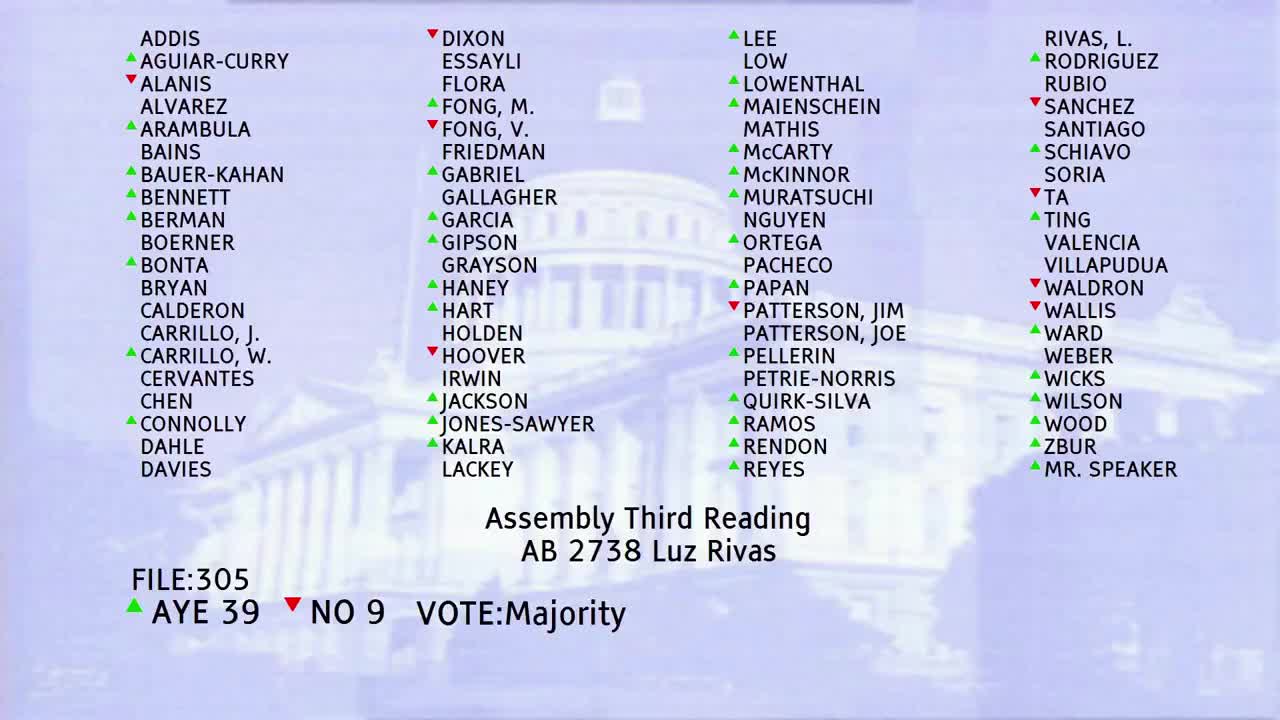 2MIN
Assembly Floor
 5MIN
Assembly Standing Committee on Natural Resources
 57SEC
Assembly Standing Committee on Natural Resources


Bill Co-Author(s):