AB 958: Prisons: visitation.
- Session Year: 2023-2024
- House: Assembly
- Latest Version Date: 2023-05-18
Current Status:
Failed
(2023-09-01: In committee: Held under submission.)
Introduced
In Committee
First Chamber
In Committee
Second Chamber
Enacted
What does this bill do?
This bill makes in-person personal visits a protected civil right for people in state prison and for their family members and intimate partners, and defines who counts as a family member or intimate partner. It sharply limits when visits can be denied to narrow security reasons or specific misconduct during a visit (for example, bringing contraband, violence, escape, or sexual abuse of a minor), requires written notice and that visitors and inmates may reapply after 30 days, and requires prisons to provide at least three days of in-person visiting per week with at least seven visiting hours per day.
The summary is provided by generative AI which can make mistakes. For original language, please view the details in the table below.
(1)Under existing law, a person sentenced to imprisonment in a state prison or in a county jail for a felony offense, as specified, may, during that period of confinement, be deprived of only those rights as is reasonably related to legitimate penological interests. Existing law enumerates certain civil rights of these prisoners, including the right to purchase, receive, and read newspapers, periodicals, and books accepted for distribution by the United States Post Office.
This bill would include the right to personal visits by an intimate partner or a family member, as those terms are defined, as a civil right, as specified. The bill would provide that these civil rights may not be infringed, except as necessary and only if narrowly tailored to further a compelling security interest of the government, and would provide that any governmental action related to these civil rights may be reviewed in court for legal or factual error.
(2)Existing law authorizes the Secretary of the Department of Corrections and Rehabilitation to prescribe and amend rules and regulations for the administration of prisons and requires regulations, which are adopted by the Department of Corrections and Rehabilitation and may impact the visitation of inmates. Existing law requires these regulations to recognize and consider the value of inmate visitation as a means of increasing safety in prisons, maintaining family and community connections, and preparing inmates for successful release and rehabilitation. Existing regulations create the framework for establishing a visitation process in prisons that is conducted in as accommodating a manner as possible, subject to the need to maintain order, the safety of persons, the security of institutions and facilities, and required prison activities and operations.
This bill would additionally require those regulations pertaining to inmate visits to recognize and consider the right to personal visits as a civil right. The bill would prohibit the department from denying or restricting in-person contact visits, visits except as specified, including as a disciplinary sanction against the incarcerated person, except as specified. person who has committed a listed offense during a personal visit. The bill would require the department to inform an applicant both the visitor and the incarcerated person of the specific reason for any denial of a visit. visit, as specified. The bill would require the department to provide at least 3 days of in-person visiting per week, with a minimum of 8 7 visiting hours per day, plus access to video calls for at least an additional 8 hours per week. day.
(1)Under existing law, a person sentenced to imprisonment in a state prison or in a county jail for a felony offense, as specified, may, during that period of confinement, be deprived of only those rights as is reasonably related to legitimate penological interests. Existing law enumerates certain civil rights of these prisoners, including the right to purchase, receive, and read newspapers, periodicals, and books accepted for distribution by the United States Post Office.
This bill would include the right to personal visits by an intimate partner or a family member, as defined, as a civil right, as specified. The bill would provide that these civil rights may not be infringed upon, infringed, except as necessary and only if narrowly tailored to further the legitimate security interests a compelling security interest of the government, and would provide that any governmental action related to these civil rights may be reviewed in court for legal error under a substantial evidence standard of review. or factual error.
(2)Existing law authorizes the Secretary of the Department of Corrections and Rehabilitation to prescribe and amend rules and regulations for the administration of prisons and requires regulations, which are adopted by the Department of Corrections and Rehabilitation and may impact the visitation of inmates. Existing law requires these regulations to recognize and consider the value of inmate visitation as a means of increasing safety in prisons, maintaining family and community connections, and preparing inmates for successful release and rehabilitation. Existing regulations create the framework for establishing a visitation process in prisons that is conducted in as accommodating a manner as possible, subject to the need to maintain order, the safety of persons, the security of institutions and facilities, and required prison activities and operations.
This bill would additionally require those regulations pertaining to inmate visits to recognize and consider the right to personal visits as a civil right. The bill would prohibit the department from denying in-person contact visits, as specified, including as a disciplinary sanction against the incarcerated person, except as specified. The bill would require the department to inform an applicant of the specific reason for any denial of a visit. The bill would require the department to provide at least 3 days of in-person visiting per week, with a minimum of 8 visiting hours per day, plus access to video calls for at least an additional 8 hours per week.
(1)Under existing law, a person sentenced to imprisonment in a state prison or in a county jail for a felony offense, as specified, may, during that period of confinement, be deprived of only those rights as is reasonably related to legitimate penological interests. Existing law enumerates certain civil rights of these prisoners, including the right to purchase, receive, and read newspapers, periodicals, and books accepted for distribution by the United States Post Office.
This bill would include the right to personal visits by an intimate partner or a family member, as defined, as a civil right, as specified. The bill would provide that these civil rights may not be infringed upon, except as necessary and only if narrowly tailored to further the legitimate security interests of the government, and would provide that any governmental action related to these civil rights may be reviewed in court for legal error under a substantial evidence standard of review.
(2)Existing law authorizes the Secretary of the Department of Corrections and Rehabilitation to prescribe and amend rules and regulations for the administration of prisons and requires regulations, which are adopted by the Department of Corrections and Rehabilitation and may impact the visitation of inmates. Existing law requires these regulations to recognize and consider the value of inmate visitation as a means of increasing safety in prisons, maintaining family and community connections, and preparing inmates for successful release and rehabilitation. Existing regulations create the framework for establishing a visitation process in prisons that is conducted in as accommodating a manner as possible, subject to the need to maintain order, the safety of persons, the security of institutions and facilities, and required prison activities and operations.
This bill would additionally require those regulations pertaining to inmate visits to recognize and consider the right to personal visits as a civil right. The bill would prohibit the department from denying in-person contact visits, as specified, including as a disciplinary sanction against the incarcerated person, except as specified. The bill would require the department to inform an applicant of the specific reason for any denial of a visit. The bill would require the department to provide at least 3 days of in-person visiting per week, with a minimum of 8 visiting hours per day, plus access to video calls for at least an additional 8 hours per week.
(a)The Legislature finds and declares all of the following:
(1)The United States Supreme Court has recognized a constitutional right to maintain parent-child relationships absent a compelling government interest, such as protecting a child from an unfit parent. (Santosky v. Kramer (1982) 455 U.S. 745, 753). The United States Court of Appeals for the Ninth Circuit has recognized that this constitutional right logically encompasses a right to maintain a relationship with a life partner. (United States v. Wolf Child (2012) 699 F.3d 1082, 1091).
(2)In 2009, the Legislature passed Senate Concurrent Resolution No. 20 (Resolution Chapter 88 of the Statutes of 2009), which encouraged the Department of Corrections and Rehabilitation to use the bill of rights created by the San Francisco Children of Incarcerated Parents Partnership as a framework for analysis and determination of procedures when making decisions about services for the children of incarcerated parents.
(3)The bill of rights created by the San Francisco Children of Incarcerated Parents Partnership includes all of the following:
(A)A child has the right to speak with, see, and touch their parents. Actions to realize this right include, but are not limited to, providing access to visiting rooms that are child-centered, nonintimidating, and conducive to bonding, considering proximity to family when locating prisons and assigning incarcerated persons, and encouraging child welfare departments to facilitate contact.
(B)A child has the right to support as that child faces a parents incarceration. Actions to realize this right include, but are not limited to, training adults who work with young people to recognize the needs and concerns of children whose parents are incarcerated, providing access to specially trained therapists, counselors, and mentors, and allocating 5 percent of the corrections-related budget to support the families of incarcerated persons.
(C)A child has a right to a lifelong relationship with their parent. Actions to realize this right include, but are not limited to, reexamining the federal Adoption and Safe Families Act of 1997, designating a family services coordinator at prisons and jails, supporting incarcerated parents on reentry, and focusing on rehabilitation and alternatives to incarceration.
(4)The principles announced in the bill of rights created by the San Francisco Children of Incarcerated Parents Partnership additionally apply to close family members and loved ones of incarcerated people, including individuals with family-like relationships who are often excluded under unduly narrow legal definitions of family members.
(5)In resolution A/RES/70/175 (December 2015), the General Assembly of the United Nations adopted the United Nations Standard Minimum Rules for the Treatment of Prisoners, known as the Mandela Rules. The Mandela Rules require that incarcerated persons be permitted to maintain regular communication with family and friends by visits, telephone, electronic or digital communications, and mail (Rule 58). Further, the Mandela Rules provide that disciplinary sanctions or restrictive measures shall not include the prohibition of family contact (Rule 43).
(6)Article 16(3) of the Universal Declaration of Human Rights and Article 23(1) of the International Covenant on Civil and Political Rights establish the family as the natural and fundamental group unit of society and is entitled to protection by society and the State.
(7)Family bonds extend through prison gates and must be protected during periods of incarceration by promoting in-person contact and regular communication between incarcerated persons and their families.
(8)From 1975 until 1997, Section 2601 of the Penal Code listed the right to receive personal visits among the civil rights retained by incarcerated persons.
(9)The American Bar Association established the Criminal Justice Standards on the Treatment of Prisoners (February 2010), which requires correctional authorities to provide incarcerated people with conditions conducive to maintaining healthy relationships with their families (Standard 23-1.2(a)(vi)).
(A)Standard 23-8.5(b) directs correctional authorities to implement visiting policies that support maintaining healthy family relationships by providing sufficient visiting space, convenient visiting times, and family friendly family-friendly environments.
(B)Standard 23-8.5(c) directs that visitors not be unreasonably excluded on the basis of past criminal convictions.
(C)Standard 23-8.5(e) directs that contact visits be provided to persons incarcerated for more than 30 days absent an individual determination that a contact visit between a particular incarcerated person and a particular visitor poses a specified danger. Prison officials should develop other forms of communication, including video visits, provided that such options are not a replacement for opportunities for in-person contact.
(10)Family support and connections can help promote an incarcerated persons reentry and reduce recidivism. Protecting and promoting in-person family contact for an incarcerated person and their family can help to maintain those connections and that support.
(A)As early as January 1972, a study by the then-California Department of Corrections Research Division identified its central finding as the discovery of a strong and consistently positive relationship between parole success and the maintenance of strong family ties while in prison. . . . evidence suggests that the inmates family should be viewed as the prime treatment agent and family contacts as a major correctional technique. (Research Report No. 46, Explorations in Inmate-Family Relationships, in collaboration with the Research Division of the California Department of Corrections at 111113).
(B)A review of 50 years of empirical research by the Prison Policy Initiative (December 2021) found that researchers in multiple states consistently concluded that visitation, mail, phone, and other forms of contact between incarcerated people and their families have positive impacts for both the incarcerated person and their familyincluding better health, reduced recidivism, and improvement in childrens school performance. In particular, the review affirmed In-person visitation is incredibly beneficial, reducing recidivism and improving health and behavior.
(C)Research shows that visits and family programming reduce disciplinary infractions, increase the chances of successful parole, and decrease recidivism rates upon release and reentry into the community. Many incarcerated people rely on their families immediately after release to overcome reentry obstacles, including unemployment, debt, and homelessness.
(11)Research confirms that incarceration imposes heavy burdens on the families of incarcerated people, including trauma for the children of incarcerated parents, as recognized on the adverse childhood experience index, in addition to the high costs of maintaining contact by telephone and visits. Consistent visits also have the potential for reducing the likelihood of intergenerational cycles of criminality and incarceration.
(12)Isolation from lack of visits and limited phone communications adversely affects the mental health of incarcerated people and contributes to mental suffering and conflict within prisons.
(13)The COVID-19 pandemic has exacerbated these burdens for families and adverse effects of isolation for incarcerated persons. From March 2020 to April 2021, in-person visits were canceled. In-person visits were severely restricted thereafter and were canceled intermittently due to periodic COVID-19 outbreaks. In September 2022, COVID-19 restrictions for in-person visits were lifted.
(b)Therefore, it is the intent of the Legislature to restore, strengthen, and protect the right of incarcerated persons to receive personal visits to support the emotional health of Californians and their incarcerated loved ones, to improve in-custody conduct, and to reduce recidivism.
(c)It is the Legislatures further intent to strictly limit the circumstances under which in-person visitation between an incarcerated person and their family can be denied, restricted, terminated, or suspended.
SEC. 2.Section 2600 of the Penal Code is amended to read:2600.(a)A person sentenced to imprisonment in a state prison or to imprisonment pursuant to subdivision (h) of Section 1170 shall not be deprived of their rights unless the deprivation of those rights is narrowly tailored to further a compelling security interest of the government.
(b)This section does not overturn the decision in Thor v. Superior Court (1993) 5 Cal.4th 725.
SEC. 3.Section 2601 of the Penal Code is amended to read:2601.Each person described in Section 2600 shall have all of the civil rights set forth under subdivisions (a) to (i), inclusive. These rights may not be infringed, except if narrowly tailored to further a compelling security interest of the government.
(a)Except as provided in Section 2225 of the Civil Code, to inherit, own, sell, or convey real or personal property, including all written and artistic material produced or created by the person during the period of imprisonment. However, to the extent authorized in Section 2600, the Department of Corrections and Rehabilitation may restrict or prohibit sales or conveyances that are made for business purposes.
(b)To correspond, confidentially, with a member of a state or federal bar or holder of public office, provided that the prison authorities may open and inspect incoming mail to search for contraband.
(c)(1)To purchase, receive, and read any newspapers, periodicals, and books accepted for distribution by the United States Post Office. Pursuant to this section, prison authorities may exclude any of the following matter:
(A)Obscene publications or writings, writings and mail containing information concerning where, how, or from whom this matter may be obtained.
(B)Any matter of a character tending to incite murder, arson, riot, violent racism, or any other form of violence.
(C)Any matter concerning gambling or a lottery.
(2)This section does not limit the right of prison authorities to do either of the following:
(A)Open and inspect any packages received by an incarcerated person.
(B)Establish reasonable restrictions on the number of newspapers, magazines, and books that an incarcerated person may have in their cell or elsewhere in the prison at one time.
(d)To initiate civil actions, subject to a three dollar ($3) filing fee to be collected by the Department of Corrections and Rehabilitation, in addition to any other filing fee authorized by law, and subject to Title 3a (commencing with Section 391) of Part 2 of the Code of Civil Procedure.
(e)To marry.
(f)To create a power of appointment.
(g)To make a will.
(h)To receive all benefits provided for in Sections 3370 and 3371 of the Labor Code and in Section 5069.
(i)(1)To receive personal visits, including in-person contact visits. This
(2)This section shall does not require in-person visits either of the following:
(A)Personal visits for a person incarcerated pursuant to subdivision (h) of Section 1170 in a county that is not required to provide those visits pursuant to Section 15820.948 of the Government Code or Section 4032.
(B)Personal visits to be contact visits in jails or other local detention facilities that lack appropriate space.
(3)It is the intent of the Legislature that a jail or other local detention facility prioritize expanding capacity for personal visits when performing a renovation or new construction.
(j)For purposes of this section, a personal visit has the same meaning as defined in Section 6403.
SEC. 4.Section 2601.5 is added to the Penal Code, to read:2601.5.(a)In order to further the constitutionally protected right of a family member and intimate partner of an incarcerated person to maintain a relationship with that person, the Department of Corrections and Rehabilitation shall not infringe on a family members or intimate partners right to visit an incarcerated person unless the incarcerated person freely withholds consent or if the action is narrowly tailored to further a compelling security interest of the government.
(b)As used in this section, the following definitions shall apply:
(1)A family member includes a spouse of the incarcerated person, a parent of the incarcerated persons legal or biological child, and any of the following relatives, including step, in-law, grand, and great-grand relatives:
(A)Legal or biological child.
(B)Child under guardianship.
(C)Sibling.
(D)Parent.
(E)Guardian.
(F)Aunt or uncle.
(G)Cousin.
(H)Niece or nephew.
(I)A person with a familial-style or mentoring relationship with the incarcerated person or an above-listed family member of the incarcerated person.
(2)An intimate partner is an adult who is a spouse, former spouse, domestic partner, significant other, cohabitant, former cohabitant, or person with whom the incarcerated person has had a child or is having, or has had, a dating or engagement relationship.
(c)The enumeration of relationships in this section does not exclude persons with other social, religious, legal, or professional relationships from visiting an incarcerated person.
SEC. 5.Section 6400 of the Penal Code is amended to read:6400.Amendments to existing regulations and any future regulations adopted by the Department of Corrections and Rehabilitation that may impact the visitation of an incarcerated person shall do all of the following:
(a)Recognize and consider the right to personal visits, including in-person contact visits, visits as a civil right pursuant to subdivision (i) of Section 2601 and family members and intimate partners right to visits as a civil right pursuant to Section 2601.5.
(b)Recognize and consider the value of visiting visitation as a means to improve the safety of prisons for both staff and incarcerated people.
(c)Recognize and consider the important role of visitation in establishing and maintaining a meaningful connection between an incarcerated person and their family members, intimate partners, and community.
(d)Recognize and consider the important role of visitation in preparing an incarcerated person for successful release and rehabilitation.
SEC. 6.Section 6403 is added to the Penal Code, to read:6403.(a)An in-person contact visit, including a family visit, shall not be denied or restricted by the Department of Corrections and Rehabilitation for any of the following reasons:
(1)As a disciplinary sanction against an incarcerated person, except as discipline for commission of an offense listed in subdivision (b) during a personal visit.
(2)A visitors criminal, juvenile delinquency, or other history of involvement with law enforcement or the criminal justice system, whether it resulted in a criminal conviction, other than a conviction for an offense listed in subdivision (b).
(3)A visitors current status of being under supervision, including parole, postrelease community supervision, probation, or informal probation supervision.
(4)A visitors previous incarceration, including incarceration in the facility where the personal visit will take place.
(5)A visitors pending criminal charges, other than for an offense listed in subdivision (b).
(6)A visitors outstanding unpaid fines, fees, or restitution.
(7)(A)An incarcerated persons criminal, juvenile delinquency, or other history of involvement with law enforcement or the criminal justice system, regardless of whether it resulted in a criminal conviction, other than a conviction for an offense set forth under subdivision (b), except when required by Section 1202.05 or required or permitted by regulation in existence on or before January 1, 2024, based on convictions or arrests for sex crimes against minors.
(B)A family visit with a specific visitor may be denied or restricted because of an incarcerated persons convictions for registrable sex offenses or violence against a family member or against a minor in the persons care or custody if there is a substantial risk of violence or sexual abuse against that specific visitor.
(b)A visitor or incarcerated person may have their personal visits denied or restricted based only on the following conduct during a visit:
(1)Bringing contraband into the visiting area.
(2)Committing physical violence during a personal visit or the visitor screening process.
(3)Escaping, aiding an escape, or attempting to escape or aid an escape.
(2)(4)(A)Engaging in sexual conduct with a minor.
(B)An incarcerated person may be denied a video call with that minor or with other minors if a preponderance of the evidence shows a substantial risk of inappropriate conduct.
(3)(5)Engaging in sexual conduct with adults an adult outside of a family visit.
(4)Committing physical violence during a visit or the visitor screening process.(5)Escaping, aiding an escape, or attempting to escape or aid an escape.(c)The department may require an applicant to provide sufficient information to enable it to obtain the applicants criminal history records from the Department of Justice but shall neither require an applicant to itemize their own criminal history nor consider such voluntarily submitted information in determining whether to approve the application.
(d)When an incarcerated person is limited to in-person noncontact visits, the length and frequency of their in-person noncontact visits and video calls shall equal the length of in-person contact visits and video calls available to the general population, reasonable space permitting.
(e)(1)In the case of a denial of a request for a personal visit, both the visitor and the incarcerated person shall receive written notice of the denial within three days of the decision. The notice shall include all of the following:
(A)The date of the decision and its effect together with the name, title, and institutional affiliation of the decisionmaking official.
(B)Except as specified in subparagraph (C), the notice shall also state the reason for the denial.
(C)When the grounds for denial include criminal record information, alleged personal conduct, or any other personal or private information about either party, only the person to whom that information pertains, or about whom the allegations are made, shall receive a detailed specification of the reasons for the denial.
(D)Written instructions on all procedures for appeals.
(2)In the case of a denial of a request for a personal visit, both the visitor and the incarcerated person may reapply after 30 days.
(2)Nothing in this section shall be interpreted to(3)This section does not restrict the legal remedies available to an incarcerated person or to nonincarcerated visitors to dispute or redress denials of visitations.
(f)An incarcerated person shall not be required to withhold consent to a personal visit as a disciplinary sanction as a means of avoiding a disciplinary sanction or as a condition of participating in or enjoying any privilege or program while incarcerated.
(g)For the purposes of this section, all of the following apply:
(1)(A)A visit personal visit means an in-person contact visit, an in-person noncontact visit, or a family visit.
(B)A personal visit is denied or restricted if it is suspended, revoked, or terminated early and when a visitor is excluded or any other administrative action reduces a specified incarcerated persons or visitors access to visiting.
(B)(C)A visitor may be denied visiting access per reasonable uniformly enforced departmentwide regulations, communicated to the public with adequate and timely notice, related to identification, dress, intoxication, search procedures, and authorization for visits by minors that are consistent with this section, subdivision (i) of Section 2601, and Section 2601.5.
(C)(D)A denial of, or restriction on, visits or visiting access under this section shall not exceed what was permissible under department regulations at the time this law is enacted on January 1, 2024.
(2)A family visit is an in-person contact visit that occurs overnight in a private, apartment-like facility on prison grounds in which only an eligible incarcerated person and eligible immediate family members, as both are defined in department regulations, may participate.
(3)A disciplinary sanction is a consequence of being charged with, investigated for, or found guilty of a rule violation, including a change in privilege group, except that incarcerated people may be limited to noncontact visits when placed in administrative segregation or security housing units.
(h)To the extent that visiting rules and standards, as prescribed in Title 15 of the California Code of Regulations, conflict with this section, the Department of Corrections and Rehabilitation shall adopt regulations that conform with this section.
(i)The California Department of Corrections and Rehabilitation shall reinstate personal visits, including in-person visits and family visits, that were restricted or prohibited contrary to the standards created in this section prior to January 1, 2024.
SEC. 7.Section 6403.5 is added to the Penal Code, to read:6403.5.(a)At each facility, the Department of Corrections and Rehabilitation shall provide at least three days of in-person visitation per week, with a minimum of eight seven visiting hours per day, plus access to video calls for at least an additional eight hours per week. The Department day. The department shall make strenuous efforts to maximize visiting space in order to accommodate as many visitors as possible in family friendly family-friendly settings.
(b)If in-person visitation is impossible due to a public health emergency, the in-person visiting hours shall be replaced by an equal number of video calling hours in addition to the regular video calling hours. Once the emergency is over, in-person visiting shall be immediately reinstated.
(a)The Legislature finds and declares all of the following:
(1)The United States Supreme Court has recognized a constitutional right to maintain parent-child relationships absent a compelling government interest, such as protecting a child from an unfit parent. (Santosky v. Kramer (1982) 455 U.S. 745, 753). The United States Court of Appeals for the Ninth Circuit has recognized that this constitutional right logically encompasses a right to maintain a relationship with a life partner. (United States v. Wolf Child (2012) 699 F.3d 1082, 1091).
(2)In 2009, the Legislature passed Senate Concurrent Resolution No. 20 (Resolution Chapter 88 of the Statutes of 2009), which encouraged the Department of Corrections and Rehabilitation to use the bill of rights created by the San Francisco Children of Incarcerated Parents Partnership as a framework for analysis and determination of procedures when making decisions about services for the children of incarcerated parents.
(3)The bill of rights created by the San Francisco Children of Incarcerated Parents Partnership includes all of the following:
(A)A child has the right to speak with, see, and touch their parents. Actions to realize this right include, but are not limited to, providing access to visiting rooms that are child-centered, nonintimidating, and conducive to bonding, considering proximity to family when locating prisons and assigning incarcerated persons, and encouraging child welfare departments to facilitate contact.
(B)A child has the right to support as that child faces a parents incarceration. Actions to realize this right include, but are not limited to, training adults who work with young people to recognize the needs and concerns of children whose parents are incarcerated, providing access to specially trained therapists, counselors, and mentors, and allocating 5 percent of the corrections-related budget to support the families of incarcerated persons.
(C)A child has a right to a lifelong relationship with their parent. Actions to realize this right include, but are not limited to, reexamining the federal Adoption and Safe Families Act of 1997, designating a family services coordinator at prisons and jails, supporting incarcerated parents on reentry, and focusing on rehabilitation and alternatives to incarceration.
(4)The principles announced in the bill of rights created by the San Francisco Children of Incarcerated Parents Partnership additionally apply to close family members and loved ones of incarcerated people, including individuals with family-like relationships who are often excluded under unduly narrow legal definitions of family members.
(5)In resolution A/RES/70/175 (December 2015), the General Assembly of the United Nations adopted the United Nations Standard Minimum Rules for the Treatment of Prisoners, known as the Mandela Rules. The Mandela Rules require that incarcerated persons be permitted to maintain regular communication with family and friends by visits, telephone, electronic or digital communications, and mail (Rule 58). Further, the Mandela Rules provide that disciplinary sanctions or restrictive measures shall not include the prohibition of family contact (Rule 43).
(6)Article 16(3) of the Universal Declaration of Human Rights and Article 23(1) of the International Covenant on Civil and Political Rights establish the family as the natural and fundamental group unit of society and is entitled to protection by society and the State.
(7)Family bonds extend through prison gates and must be protected during periods of incarceration by promoting in-person contact and regular communication between incarcerated persons and their families.
(8)From 1975 until 1994, 1997, Section 2601 of the Penal Code listed the right to receive personal visits among the civil rights retained by incarcerated persons.
(9)The American Bar Association established the Criminal Justice Standards on the Treatment of Prisoners (February 2010), which requires correctional authorities to provide incarcerated people with conditions conducive to maintaining healthy relationships with their families (Standard 23-1.2(a)(vi)).
(A)Standard 23-8.5(b) directs correctional authorities to implement visiting policies that support maintaining healthy family relationships by providing sufficient visiting space, convenient visiting times, and family-friendly family friendly environments.
(B)Standard 23-8.5(c) directs that visitors not be unreasonably excluded on the basis of past criminal convictions.
(C)Standard 23-8.5(e) directs that contact visits be provided to persons incarcerated for more than 30 days absent an individual determination that a contact visit between a particular incarcerated person and a particular visitor poses a specified danger. Prison officials should develop other forms of communication, including video visits, provided that such options are not a replacement for opportunities for in-person contact.
(10)Family support and connections can help promote an incarcerated persons reentry and reduce recidivism. Protecting and promoting in-person family contact for an incarcerated person and their family can help to maintain those connections and that support.
(A)As early as January 1972, a study by the then-California Department of Correction Corrections Research Division identified its central finding as the discovery of a strong and consistently positive relationship between parole success and the maintenance of strong family ties while in prison. . . . evidence suggests that the inmates family should be viewed as the prime treatment agent and family contacts as a major correctional technique. (Research Report No. 46, Explorations in Inmate-Family Relationships, in collaboration with the Research Division of the California Department of Corrections at 111113).
(B)A review of 50 years of empirical research by the Prison Policy Initiative (December 2021) found that researchers in multiple states consistently concluded that visitation, mail, phone, and other forms of contact between incarcerated people and their families have positive impacts for both the incarcerated person and their familyincluding better health, reduced recidivism, and improvement in childrens school performance. In particular, the review affirmed In-person visitation is incredibly beneficial, reducing recidivism and improving health and behavior.
(C)Research shows that visits and family programming reduce disciplinary infractions, increase the chances of successful parole, and decrease recidivism rates upon release and reentry into the community. Many incarcerated people rely on their families immediately after release to overcome reentry obstacles, including unemployment, debt, and homelessness.
(11)Research confirms that incarceration imposes heavy burdens on the families of incarcerated people, including trauma for the children of incarcerated parents, as recognized on the adverse childhood experience index, in addition to the high costs of maintaining contact by telephone and visits. Consistent visits also have the potential for reducing the likelihood of intergenerational cycles of criminality and incarceration.
(12)Isolation from lack of visits and limited phone communications adversely affects the mental health of incarcerated people and contributes to mental suffering and conflict within prisons.
(13)The COVID-19 pandemic has exacerbated these burdens for families and adverse effects of isolation for incarcerated persons. From March 2020 to April 2021, in-person visits were canceled. In-person visits were severely restricted thereafter and were canceled intermittently due to periodic COVID-19 outbreaks. In September 2022, COVID-19 restrictions for in-person visits were lifted.
(b)Therefore, it is the intent of the Legislature to restore, strengthen, and protect the right of incarcerated persons to receive personal visits to support the emotional health of Californians and their incarcerated loved ones, to improve in-custody conduct, and to reduce recidivism.
(c)It is the Legislatures further intent to strictly limit the circumstances under which in-person visitation between an incarcerated person and their family can be denied, restricted, terminated, or suspended.
SEC. 2.Section 2600 of the Penal Code is amended to read:2600.(a)A person sentenced to imprisonment in a state prison or to imprisonment pursuant to subdivision (h) of Section 1170 shall not be deprived of their rights unless the deprivation of those rights is necessary and narrowly tailored to further the legitimate security interests a compelling security interest of the government.
(b)This section does not overturn the decision in Thor v. Superior Court (1993) 5 Cal. 4th Cal.4th 725.
SEC. 3.Section 2601 of the Penal Code is amended to read:2601.Each person described in Section 2600 shall have all of the following civil rights set forth under subdivisions (a) to (i), inclusive. These rights may not be infringed upon, infringed, except as necessary and only if narrowly tailored to further the legitimate security interests a compelling security interest of the government. A governmental action related to these rights may be reviewed in court for legal error and under a substantial evidence standard of review.
(a)Except as provided in Section 2225 of the Civil Code, to inherit, own, sell, or convey real or personal property, including all written and artistic material produced or created by the person during the period of imprisonment. However, to the extent authorized in Section 2600, the Department of Corrections and Rehabilitation may restrict or prohibit sales or conveyances that are made for business purposes.
(b)To correspond, confidentially, with a member of the State Bar of California a state or federal bar or holder of public office, provided that the prison authorities may open and inspect incoming mail to search for contraband.
(c)(1)To purchase, receive, and read any newspapers, periodicals, and books accepted for distribution by the United States Post Office. Pursuant to this section, prison authorities may exclude any of the following matter:
(A)Obscene publications or writings, and mail containing information concerning where, how, or from whom this matter may be obtained.
(B)Any matter of a character tending to incite murder, arson, riot, violent racism, or any other form of violence.
(C)Any matter concerning gambling or a lottery.
(2)This section does not limit the right of prison authorities to do either of the following:
(A)Open and inspect any packages received by an incarcerated person.
(B)Establish reasonable restrictions on the number of newspapers, magazines, and books that an incarcerated person may have in their cell or elsewhere in the prison at one time.
(d)To initiate civil actions, subject to a three dollar ($3) filing fee to be collected by the Department of Corrections and Rehabilitation, in addition to any other filing fee authorized by law, and subject to Title 3a (commencing with Section 391) of Part 2 of the Code of Civil Procedure.
(e)To marry.
(f)To create a power of appointment.
(g)To make a will.
(h)To receive all benefits provided for in Sections 3370 and 3371 of the Labor Code and in Section 5069.
(i)To receive personal visits, including in-person contact visits. This section shall not require in-person visits for a person incarcerated pursuant to subdivision (h) of Section 1170 in a county that is not required to provide those visits pursuant to Section 15820.948 of the Government Code or Section 4032.
SEC. 4.Section 2601.5 is added to the Penal Code, to read:2601.5.(a)In order to further the constitutionally protected right of a family member and intimate partner of an incarcerated person to maintain a relationship with that person, the Department of Corrections and Rehabilitation shall not infringe on a family members or intimate partners right to visit an incarcerated person unless the incarcerated person freely withholds consent or as necessary and if the action is narrowly tailored to further legitimate security interests. A governmental action related to these rights may be reviewed in court for legal error under a substantial evidence standard of review. a compelling security interest of the government.
(b)As used in this section, the following definitions shall apply:
(1)A family member includes a spouse of the incarcerated person, a parent of the incarcerated persons legal or biological child, and any of the following relatives, including step, in-law, grand, and great-grand relatives:
(A)Legal or biological child.
(B)Child under guardianship.
(C)Sibling.
(D)Parent.
(E)Guardian.
(F)Aunt or uncle.
(G)Cousin.
(H)Niece or nephew.
(I)A person with a familial-style or mentoring relationship with the incarcerated person or an above-listed family member of the incarcerated person.
(2)An intimate partner is an adult or a minor who is a spouse, former spouse, domestic partner, significant other, cohabitant, former cohabitant, or person with whom the incarcerated person has had a child or is having, or has had, a dating or engagement relationship.
SEC. 5.Section 6400 of the Penal Code is amended to read:6400.Amendments to existing regulations and any future regulations adopted by the Department of Corrections and Rehabilitation that may impact the visitation of an incarcerated person shall do all of the following:
(a)Recognize and consider the right to personal visits, including in-person contact visits, as a civil right pursuant to subdivision (i) of Section 2601 and family members and intimate partners right to visits as a civil right pursuant to Section 2601.5.
(b)Recognize and consider the value of visiting as a means to improve the safety of prisons for both staff and incarcerated people.
(c)Recognize and consider the important role of visitation in establishing and maintaining a meaningful connection between an incarcerated person and their family members, intimate partners, and community.
(d)Recognize and consider the important role of visitation in preparing an incarcerated person for successful release and rehabilitation.
SEC. 6.Section 6403 is added to the Penal Code, to read:6403.(a)An in-person contact visit, including a family visit, shall not be denied or restricted by the Department of Corrections and Rehabilitation for any of the following reasons:
(1)As a disciplinary sanction against an incarcerated person, except as discipline for commission of an offense listed in subdivision (b) during a visit.
(2)A visitors criminal, juvenile delinquency, or other history of involvement with law enforcement or the criminal justice system, whether it resulted in a criminal conviction, other than a conviction for an offense listed in subdivision (c). (b).
(3)A visitors current status of being under supervision, including parole, postrelease community supervision, probation, or informal probation supervision.
(4)A visitors previous incarceration, including incarceration in the facility where the visit will take place.
(5)A visitors pending criminal charges, other than for an offense listed in subdivision (b).
(6)A visitors outstanding unpaid fines, fees, or restitution.
(7)(A)An incarcerated persons criminal, juvenile delinquency, or other history of involvement with law enforcement or the criminal justice system, regardless of whether it resulted in a criminal conviction, other than a conviction for an offense set forth under subdivision (b), except when required by Section 1202.05 or required or permitted by regulation in existence on or before January 1, 2024, based on convictions or arrests for sex crimes against minors.
(B)A family visit with a specific visitor may be denied or restricted because of an incarcerated persons convictions for registrable sex offenses or violence against a family member or against a minor in the persons care or custody if there is a substantial risk of violence or sexual abuse against that specific visitor.
(b)A visitor or incarcerated person may have their visits denied or restricted based only on the following conduct during a visit:
(1)Bringing contraband into the visiting area.
(2)Engaging in sexual conduct with a minor.
(3)Engaging in sexual conduct with adults outside of a family visit.
(4)Committing physical violence during a visit or the visitor screening process.
(5)Escaping, aiding an escape, or attempting to escape or aid an escape.
(c)The department may require an applicant to provide sufficient information to enable it to obtain the applicants criminal history records from the Department of Justice but shall neither require an applicant to itemize their own criminal history nor consider such voluntarily submitted information in determining whether to approve the application.
(d)When an incarcerated person is limited to in-person noncontact visits, the length and frequency of their in-person noncontact visits and video calls shall equal the length of in-person contact visits and video calls available to the general population, reasonable space permitting.
(e)(1)In the case of a denial of a request for a visit, both the visitor and the incarcerated person shall receive written notice of the denial within three days of the decision. The notice shall include all of the following:
(A)The date of the decision and its effect together with the name, title, and institutional affiliation of the decisionmaking official.
(B)Except as specified in subparagraph (C), the notice shall also state the reason for the denial.
(C)When the grounds for denial include criminal record information, alleged personal conduct, or any other personal or private information about either party, only the person to whom that information pertains, or about whom the allegations are made, shall receive a detailed specification of the reasons for the denial.
(D)Written instructions on all procedures for appeals.
(2)Nothing in this section shall be interpreted to restrict the legal remedies available to an incarcerated person or to nonincarcerated visitors to dispute or redress denials of visitations.
(f)An incarcerated person shall not be required to withhold consent to a visit as a disciplinary sanction as a means of avoiding a disciplinary sanction or as a condition of participating in or enjoying any privilege or program while incarcerated.
(g)For the purposes of this section, all of the following apply:
(1)(A)A visit is denied or restricted if it is suspended, revoked, or terminated early and when a visitor is excluded or any other administrative action reduces a specified incarcerated persons or visitors access to visiting.
(B)A visitor may be denied visiting access per reasonable uniformly enforced departmentwide regulations, communicated to the public with adequate and timely notice, related to identification, dress, intoxication, search procedures, and authorization for visits by minors that are consistent with this section, subdivision (i) of Section 2601, and Section 2601.5.
(C)A denial of, or restriction on, visits or visiting access under this section shall not exceed what was permissible under department regulations at the time this law is enacted on January 1, 2024.
(2)A family visit is an in-person contact visit that occurs overnight in a private, apartment-like facility on prison grounds in which only an eligible incarcerated person and eligible immediate family members, as both are defined in department regulations, may participate.
(3)A disciplinary sanction is a consequence of being charged with, investigated for, or found guilty of a rule violation, including a change in privilege group, except that incarcerated people may be limited to noncontact visits when placed in administrative segregation or security housing units.
(h)To the extent that visiting rules and standards, as prescribed in Title 15 of the California Code of Regulations, conflict with this section, the Department of Corrections and Rehabilitation shall adopt regulations that conform with this section.
(i)The California Department of Corrections and Rehabilitation shall reinstate personal visits, including in-person visits and family visits, that were restricted or prohibited contrary to the standards created in this section prior to January 1, 2024.
SEC. 7.Section 6403.5 is added to the Penal Code, to read:6403.5.(a)At each facility, the Department of Corrections and Rehabilitation shall provide at least three days of in-person visitation per week, with a minimum of eight visiting hours per day, plus access to video calls for at least an additional eight hours per week. The Department shall make strenuous efforts to maximize visiting space in order to accommodate as many visitors as possible in family friendly settings.
(b)If in-person visitation is impossible due to a public health emergency, the in-person visiting hours shall be replaced by an equal number of video calling hours in addition to the regular video calling hours. Once the emergency is over, in-person visiting shall be immediately reinstated.
(a)The Legislature finds and declares all of the following:
(1)The United States Supreme Court has recognized a constitutional right to maintain parent-child relationships absent a compelling government interest, such as protecting a child from an unfit parent. (Santosky v. Kramer (1982) 455 U.S. 745, 753). The United States Court of Appeals for the Ninth Circuit has recognized that this constitutional right logically encompasses a right to maintain a relationship with a life partner. (United States v. Wolf Child (2012) 699 F.3d 1082, 1091).
(2)In 2009, the Legislature passed Senate Concurrent Resolution No. 20 (Resolution Chapter 88 of the Statutes of 2009), which encouraged the Department of Corrections and Rehabilitation to use the bill of rights created by the San Francisco Children of Incarcerated Parents Partnership as a framework for analysis and determination of procedures when making decisions about services for the children of incarcerated parents.
(3)The bill of rights created by the San Francisco Children of Incarcerated Parents Partnership includes all of the following:
(A)A child has the right to speak with, see, and touch their parents. Actions to realize this right include, but are not limited to, providing access to visiting rooms that are child-centered, nonintimidating, and conducive to bonding, considering proximity to family when locating prisons and assigning incarcerated persons, and encouraging child welfare departments to facilitate contact.
(B)A child has the right to support as that child faces a parents incarceration. Actions to realize this right include, but are not limited to, training adults who work with young people to recognize the needs and concerns of children whose parents are incarcerated, providing access to specially trained therapists, counselors, and mentors, and allocating 5 percent of the corrections-related budget to support the families of incarcerated persons.
(C)A child has a right to a lifelong relationship with their parent. Actions to realize this right include, but are not limited to, reexamining the federal Adoption and Safe Families Act of 1997, designating a family services coordinator at prisons and jails, supporting incarcerated parents on reentry, and focusing on rehabilitation and alternatives to incarceration.
(4)The principles announced in the bill of rights created by the San Francisco Children of Incarcerated Parents Partnership additionally apply to close family members and loved ones of incarcerated people, including individuals with family-like relationships who are often excluded under unduly narrow legal definitions of family members.
(5)In resolution A/RES/70/175 (December 2015), the General Assembly of the United Nations adopted the United Nations Standard Minimum Rules for the Treatment of Prisoners, known as the Mandela Rules. The Mandela Rules require that incarcerated persons be permitted to maintain regular communication with family and friends by visits, telephone, electronic or digital communications, and mail (Rule 58). Further, the Mandela Rules provide that disciplinary sanctions or restrictive measures shall not include the prohibition of family contact (Rule 43).
(6)Article 16(3) of the Universal Declaration of Human Rights and Article 23(1) of the International Covenant on Civil and Political Rights establish the family as the natural and fundamental group unit of society and is entitled to protection by society and the State.
(7)Family bonds extend through prison gates and must be protected during periods of incarceration by promoting in-person contact and regular communication between incarcerated persons and their families.
(8)From 1975 until 1994, Section 2601 of the Penal Code listed the right to receive personal visits among the civil rights retained by incarcerated persons.
(9)The American Bar Association established the Criminal Justice Standards on the Treatment of Prisoners (February 2010), which requires correctional authorities to provide incarcerated people with conditions conducive to maintaining healthy relationships with their families (Standard 23-1.2(a)(vi)).
(A)Standard 23-8.5(b) directs correctional authorities to implement visiting policies that support maintaining healthy family relationships by providing sufficient visiting space, convenient visiting times, and family-friendly environments.
(B)Standard 23-8.5(c) directs that visitors not be unreasonably excluded on the basis of past criminal convictions.
(C)Standard 23-8.5(e) directs that contact visits be provided to persons incarcerated for more than 30 days absent an individual determination that a contact visit between a particular incarcerated person and a particular visitor poses a specified danger. Prison officials should develop other forms of communication, including video visits, provided that such options are not a replacement for opportunities for in-person contact.
(10)Family support and connections can help promote an incarcerated persons reentry and reduce recidivism. Protecting and promoting in-person family contact for an incarcerated person and their family can help to maintain those connections and that support.
(A)As early as January 1972, a study by the then-California Department of Correction Research Division identified its central finding as the discovery of a strong and consistently positive relationship between parole success and the maintenance of strong family ties while in prison. . . . evidence suggests that the inmates family should be viewed as the prime treatment agent and family contacts as a major correctional technique. (Research Report No. 46, Explorations in Inmate-Family Relationships, in collaboration with the Research Division of the California Department of Corrections at 111113).
(B)A review of 50 years of empirical research by the Prison Policy Initiative (December 2021) found that researchers in multiple states consistently concluded that visitation, mail, phone, and other forms of contact between incarcerated people and their families have positive impacts for both the incarcerated person and their familyincluding better health, reduced recidivism, and improvement in childrens school performance. In particular, the review affirmed In-person visitation is incredibly beneficial, reducing recidivism and improving health and behavior.
(C)Research shows that visits and family programming reduce disciplinary infractions, increase the chances of successful parole, and decrease recidivism rates upon release and reentry into the community. Many incarcerated people rely on their families immediately after release to overcome reentry obstacles, including unemployment, debt, and homelessness.
(11)Research confirms that incarceration imposes heavy burdens on the families of incarcerated people, including trauma for the children of incarcerated parents, as recognized on the adverse childhood experience index, in addition to the high costs of maintaining contact by telephone and visits. Consistent visits also have the potential for reducing the likelihood of intergenerational criminality and incarceration.
(12)Isolation from lack of visits and limited phone communications adversely affects the mental health of incarcerated people and contributes to mental suffering and conflict within prisons.
(13)The COVID-19 pandemic has exacerbated these burdens for families and adverse effects of isolation for incarcerated persons. From March 2020 to April 2021, in-person visits were canceled. In-person visits were severely restricted thereafter and were canceled intermittently due to periodic COVID-19 outbreaks. In September 2022, COVID-19 restrictions for in-person visits were lifted.
(b)Therefore, it is the intent of the Legislature to restore, strengthen, and protect the right of incarcerated persons to receive personal visits to support the emotional health of Californians and their incarcerated loved ones, to improve in-custody conduct, and to reduce recidivism.
(c)It is the Legislatures further intent to strictly limit the circumstances under which in-person visitation between an incarcerated person and their family can be denied, restricted, terminated, or suspended.
SEC. 2.Section 2600 of the Penal Code is amended to read:2600.(a)A person sentenced to imprisonment in a state prison or to imprisonment pursuant to subdivision (h) of Section 1170 may during that period of confinement be deprived of such rights, and only such rights, as is reasonably related to legitimate penological interests. shall not be deprived of their rights unless the deprivation of those rights is necessary and narrowly tailored to further the legitimate security interests of the government.
(b)Nothing in this section shall be construed to This section does not overturn the decision in Thor v. Superior Court, Court (1993) 5 Cal. 4th 725.
SEC. 3.Section 2601 of the Penal Code is amended to read:2601.Subject only to the provisions of that section, each Each person described in Section 2600 shall have all of the following civil rights: rights set forth under subdivisions (a) to (i), inclusive. These rights may not be infringed upon, except as necessary and only if narrowly tailored to further the legitimate security interests of the government. A governmental action related to these rights may be reviewed in court for legal error and under a substantial evidence standard of review.
(a)Except as provided in Section 2225 of the Civil Code, to inherit, own, sell, or convey real or personal property, including all written and artistic material produced or created by the person during the period of imprisonment. However, to the extent authorized in Section 2600, the Department of Corrections and Rehabilitation may restrict or prohibit sales or conveyances that are made for business purposes.
(b)To correspond, confidentially, with any a member of the State Bar of California or holder of public office, provided that the prison authorities may open and inspect incoming mail to search for contraband.
(c)(1)To purchase, receive, and read any and all newspapers, periodicals, and books accepted for distribution by the United States Post Office. Pursuant to this section, prison authorities may exclude any of the following matter:
(A)Obscene publications or writings, and mail containing information concerning where, how, or from whom this matter may be obtained.
(B)Any matter of a character tending to incite murder, arson, riot, violent racism, or any other form of violence.
(C)Any matter concerning gambling or a lottery.
(2)Nothing in this section shall be construed as limiting This section does not limit the right of prison authorities to do either of the following:
(A)Open and inspect any and all packages received by an inmate. incarcerated person.
(B)Establish reasonable restrictions as to on the number of newspapers, magazines, and books that the inmate an incarcerated person may have in his or her their cell or elsewhere in the prison at one time.
(d)To initiate civil actions, subject to a three dollar ($3) filing fee to be collected by the Department of Corrections, Corrections and Rehabilitation, in addition to any other filing fee authorized by law, and subject to Title 3a (commencing with Section 391) of Part 2 of the Code of Civil Procedure.
(e)To marry.
(f)To create a power of appointment.
(g)To make a will.
(h)To receive all benefits provided for in Sections 3370 and 3371 of the Labor Code and in Section 5069.
(i)To receive personal visits, including in-person contact visits. This section shall not require in-person visits for a person incarcerated pursuant to subdivision (h) of Section 1170 in a county that is not required to provide those visits pursuant to Section 15820.948 of the Government Code or Section 4032.
SEC. 4.Section 2601.5 is added to the Penal Code, to read:2601.5.(a)In order to further the constitutionally protected right of a family member and intimate partner of an incarcerated person to maintain a relationship with that person, the Department of Corrections and Rehabilitation shall not infringe on a family members or intimate partners right to visit an incarcerated person unless the incarcerated person freely withholds consent or as necessary and narrowly tailored to further legitimate security interests. A governmental action related to these rights may be reviewed in court for legal error under a substantial evidence standard of review.
(b)As used in this section, the following definitions shall apply:
(1)A family member includes a spouse of the incarcerated person, a parent of the incarcerated persons legal or biological child, and any of the following relatives, including step, in-law, grand, and great-grand relatives:
(A)Legal or biological child.
(B)Child under guardianship.
(C)Sibling.
(D)Parent.
(E)Guardian.
(F)Aunt or uncle.
(G)Cousin.
(H)Niece or nephew.
(I)A person with a familial-style or mentoring relationship with the incarcerated person or an above-listed family member of the incarcerated person.
(2)An intimate partner is an adult or a minor who is a spouse, former spouse, domestic partner, significant other, cohabitant, former cohabitant, or person with whom the incarcerated person has had a child or is having, or has had, a dating or engagement relationship.
SEC. 5.Section 6400 of the Penal Code is amended to read:6400.Any amendments Amendments to existing regulations and any future regulations adopted by the Department of Corrections which and Rehabilitation that may impact the visitation of inmates an incarcerated person shall do all of the following:
(a)Recognize and consider the right to personal visits, including in-person contact visits, as a civil right pursuant to subdivision (i) of Section 2601 and family members and intimate partners right to visits as a civil right pursuant to Section 2601.5.
(a)(b)Recognize and consider the value of visiting as a means to improve the safety of prisons for both staff and inmates. incarcerated people.
(b)(c)Recognize and consider the important role of inmate visitation in establishing and maintaining a meaningful connection with family between an incarcerated person and their family members, intimate partners, and community.
(c)(d)Recognize and consider the important role of inmate visitation in preparing an inmate incarcerated person for successful release and rehabilitation.
SEC. 6.Section 6403 is added to the Penal Code, to read:6403.(a)An in-person contact visit, including a family visit, shall not be denied or restricted by the Department of Corrections and Rehabilitation for any of the following reasons:
(1)As a disciplinary sanction against an incarcerated person, except as discipline for commission of an offense listed in subdivision (b) during a visit.
(2)A visitors criminal, juvenile delinquency, or other history of involvement with law enforcement or the criminal justice system, whether it resulted in a criminal conviction, other than a conviction for an offense listed in subdivision (c).
(3)A visitors current status of being under supervision, including parole, postrelease community supervision, probation, or informal probation supervision.
(4)A visitors previous incarceration, including incarceration in the facility where the visit will take place.
(5)A visitors pending criminal charges, other than for an offense listed in subdivision (b).
(6)A visitors outstanding unpaid fines, fees, or restitution.
(7)(A)An incarcerated persons criminal, juvenile delinquency, or other history of involvement with law enforcement or the criminal justice system, regardless of whether it resulted in a criminal conviction, other than a conviction for an offense set forth under subdivision (b), except when required by Section 1202.05 or required or permitted by regulation in existence on or before January 1, 2024, based on convictions or arrests for sex crimes against minors.
(B)A family visit with a specific visitor may be denied or restricted because of an incarcerated persons convictions for registrable sex offenses or violence against a family member or against a minor in the persons care or custody if there is a substantial risk of violence or sexual abuse against that specific visitor.
(b)A visitor or incarcerated person may have their visits denied or restricted based only on the following conduct during a visit:
(1)Bringing contraband into the visiting area.
(2)Engaging in sexual conduct with a minor.
(3)Engaging in sexual conduct with adults outside of a family visit.
(4)Committing physical violence during a visit or the visitor screening process.
(5)Escaping, aiding an escape, or attempting to escape or aid an escape.
(c)The department may require an applicant to provide sufficient information to enable it to obtain the applicants criminal history records from the Department of Justice but shall neither require an applicant to itemize their own criminal history nor consider such voluntarily submitted information in determining whether to approve the application.
(d)When an incarcerated person is limited to in-person noncontact visits, the length and frequency of their in-person noncontact visits and video calls shall equal the length of in-person contact visits and video calls available to the general population, reasonable space permitting.
(e)(1)In the case of a denial of a request for a visit, both the visitor and the incarcerated person shall receive written notice of the denial within three days of the decision. The notice shall include all of the following:
(A)The date of the decision and its effect together with the name, title, and institutional affiliation of the decisionmaking official.
(B)Except as specified in subparagraph (C), the notice shall also state the reason for the denial.
(C)When the grounds for denial include criminal record information, alleged personal conduct, or any other personal or private information about either party, only the person to whom that information pertains, or about whom the allegations are made, shall receive a detailed specification of the reasons for the denial.
(D)Written instructions on all procedures for appeals.
(2)Nothing in this section shall be interpreted to restrict the legal remedies available to an incarcerated person or to nonincarcerated visitors to dispute or redress denials of visitations.
(f)An incarcerated person shall not be required to withhold consent to a visit as a disciplinary sanction as a means of avoiding a disciplinary sanction or as a condition of participating in or enjoying any privilege or program while incarcerated.
(g)For the purposes of this section, all of the following apply:
(1)(A)A visit is denied or restricted if it is suspended, revoked, or terminated early and when a visitor is excluded or any other administrative action reduces a specified incarcerated persons or visitors access to visiting.
(B)A visitor may be denied visiting access per reasonable uniformly enforced departmentwide regulations, communicated to the public with adequate and timely notice, related to identification, dress, intoxication, search procedures, and authorization for visits by minors that are consistent with this section, subdivision (i) of Section 2601, and Section 2601.5.
(C)A denial of, or restriction on, visits or visiting access under this section shall not exceed what was permissible under department regulations at the time this law is enacted on January 1, 2024.
(2)A family visit is an in-person contact visit that occurs overnight in a private, apartment-like facility on prison grounds in which only an eligible incarcerated person and eligible immediate family members, as both are defined in department regulations, may participate.
(3)A disciplinary sanction is a consequence of being charged with, investigated for, or found guilty of a rule violation, including a change in privilege group, except that incarcerated people may be limited to noncontact visits when placed in administrative segregation or security housing units.
(h)To the extent that visiting rules and standards, as prescribed in Title 15 of the California Code of Regulations, conflict with this section, the Department of Corrections and Rehabilitation shall adopt regulations that conform with this section.
(i)The California Department of Corrections and Rehabilitation shall reinstate personal visits, including in-person visits and family visits, that were restricted or prohibited contrary to the standards created in this section prior to January 1, 2024.
SEC. 7.Section 6403.5 is added to the Penal Code, to read:6403.5.(a)At each facility, the Department of Corrections and Rehabilitation shall provide at least three days of in-person visitation per week, with a minimum of eight visiting hours per day, plus access to video calls for at least an additional eight hours per week. The Department shall make strenuous efforts to maximize visiting space in order to accommodate as many visitors as possible in family friendly settings.
(b)If in-person visitation is impossible due to a public health emergency, the in-person visiting hours shall be replaced by an equal number of video calling hours in addition to the regular video calling hours. Once the emergency is over, in-person visiting shall be immediately reinstated.
|
Date
|
Status
|
|---|---|
| Sep 1, 2023 | In committee: Held under submission. |
| Aug 14, 2023 | In committee: Referred to APPR suspense file. |
| Jun 28, 2023 | From committee: Do pass and re-refer to Com. on APPR. (Ayes 4. Noes 1.) (June 27). Re-referred to Com. on APPR. |
| Jun 7, 2023 | Referred to Com. on PUB S. |
| May 31, 2023 | In Senate. Read first time. To Com. on RLS. for assignment. |
| May 30, 2023 | Read third time. Passed. Ordered to the Senate. (Ayes 52. Noes 15. Page 1923.) |
| May 22, 2023 | Read second time. Ordered to third reading. |
| May 18, 2023 | From committee: Amend, and do pass as amended. (Ayes 11. Noes 4.) (May 18). |
| May 18, 2023 | Read second time and amended. Ordered returned to second reading. |
| Apr 26, 2023 | In committee: Set, first hearing. Referred to APPR. suspense file. |
| Mar 22, 2023 | From committee: Do pass and re-refer to Com. on APPR. (Ayes 7. Noes 0.) (March 21). Re-referred to Com. on APPR. |
| Mar 15, 2023 | Re-referred to Com. on PUB. S. |
| Mar 14, 2023 | From committee chair, with author's amendments: Amend, and re-refer to Com. on PUB. S. Read second time and amended. |
| Feb 23, 2023 | Referred to Com. on PUB. S. |
| Feb 15, 2023 | From printer. May be heard in committee March 17. |
| Feb 14, 2023 | Read first time. To print. |
|
Date
|
Description
|
Location
|
Votes
|
|
|---|---|---|---|---|
| Aug 14, 2023 | Placed on suspense file | Senate Standing Committee on Appropriations |
Passed |
|
| Jun 27, 2023 | Do pass, but first be re-referred to the Committee on [Appropriations] | Senate Standing Committee on Public Safety |
Passed |
|
| May 30, 2023 | AB 958 Santiago Assembly Third Reading | Assembly Floor |
Passed |
|
| May 18, 2023 | Do pass as amended. | Assembly Standing Committee on Appropriations |
Passed |
|
| Mar 21, 2023 | Do pass and be re-referred to the Committee on [Appropriations] | Assembly Standing Committee on Public Safety |
Passed |
This list shows positions taken on this bill by organizations on the date displayed, which is linked to the original source.
Positions by individuals are not included.
|
Organization
|
Position
|
Date
|
|---|---|---|
| A New Way of Life | * Support | Jun 27, 2023 |
| Aclu California Action | * Support | Jun 27, 2023 |
| Alameda County District Attorney's Office | * Support | Jun 27, 2023 |
| Alliance for Boys and Men of Color | * Support | Jun 27, 2023 |
| Anti-Recidivism Coalition | * Support | Aug 14, 2023 |
| Aouon Orange County | ** Support | |
| Asian Americans Advancing Justice Southern California | * Support | Jun 27, 2023 |
| Blameless and Forever Free Ministries | ** Support | |
| California Alliance for Youth and Community Justice | ** Support | |
| California Coalition for Women Prisoners | * Support | Jun 27, 2023 |
| California Correctional Peace Officers Association | * Against | Mar 21, 2023 |
| California Families Against Solitary Confinement | * Support | Mar 21, 2023 |
| California Families Rise | ** Support | |
| California Immigrant Policy Center | * Support | Jun 27, 2023 |
| California Impacted Families Project | * Support | Mar 21, 2023 |
| California Impacted Families Project | * Support | Mar 21, 2023 |
| California Public Defenders Association | * Support | Jun 27, 2023 |
| California State Sheriff's Association | * Against | Mar 21, 2023 |
| California's Family Against Solitary Confinement | * Support | Mar 21, 2023 |
| Californians for Safety and Justice | * Support | Jun 27, 2023 |
| Californians for Safety and Justice - Timedone | ** Support | |
| Californians United for a Responsible Budget | ** Support | |
| Center on Juvenile and Criminal Justice | ** Support | |
| Coalition for Family Unity | * Support | Mar 21, 2023 |
| Coalition for Family Unity | * Support | Mar 21, 2023 |
| Communities United for Restorative Justice | * Support | Jun 27, 2023 |
| Communities United for Restorative Youth Justice | * Support | Jun 27, 2023 |
| Community Healers | ** Support | Mar 21, 2023 |
| Community Legal Services in East Palo Alto | ** Support | |
| Community Works | * Support | Mar 21, 2023 |
| CommunityWorks | * Support | Mar 21, 2023 |
| Courage | * Support | Mar 21, 2023 |
| Courage California | * Support | Mar 21, 2023 |
| Deputy Sheriff's Association of Monterey County | * Against | Mar 21, 2023 |
| Disability Rights Califonia | * Support | Jun 27, 2023 |
| Dream Beyond Bars | * Support | Jun 27, 2023 |
| DROP LWOP | * Support | Mar 21, 2023 |
| Drop LWOP | * Support | Mar 21, 2023 |
| East Bay Family Defenders | * Support | Mar 21, 2023 |
| Ella Baker Center | * Support | Jun 27, 2023 |
| Ella Baker Center For Human Rights | * Support | Jun 27, 2023 |
| Empowering Women Impacted by Incarceration | ** Support | |
| End Solitary Santa Cruz County | ** Support | |
| F.u.e.l.- Families United to End Lwop | ** Support | |
| Fair Chance Project | ** Support | |
| Family Reunification Equity & Empowerment | ** Support | |
| Family United to End LWOP | * Support | Mar 21, 2023 |
| Family United to End LWOP | * Support | Mar 21, 2023 |
| Felony Murder Elimination Project | * Support | Mar 21, 2023 |
| Friends Committee On Legislation Of California | * Support | Jun 27, 2023 |
| Grip Training Institute | * Support | Jun 27, 2023 |
| Henry Community Healer | * Support | Mar 21, 2023 |
| Homies Unidos | * Support | Mar 21, 2023 |
| Homies Unidos Inc | * Support | Mar 21, 2023 |
| Humane Prison Hospice Project | ** Support | |
| Initiate Justice | * Support | Mar 21, 2023 |
| Jesse's Place Org | ** Support | |
| Legal Aid At Work | ** Support | |
| Legal Services for Prisoners with Children | * Support | Jun 27, 2023 |
| Los Angeles Dependency Lawyers, Inc. | ** Support | |
| Mary Mac | * Support | Mar 21, 2023 |
| Mary Mac House | * Support | Mar 21, 2023 |
| milpa | ** Support | |
| Pillars of the Community | * Support | Mar 21, 2023 |
| Place for Grace | * Support | Mar 21, 2023 |
| Placer County | * Against | Mar 21, 2023 |
| PLACER COUNTY DEPUTY SHERIFFS ASSOCIATION | ** Against | |
| Prison From-theinside-out INC | ** Support | |
| Prisoner From the Inside Out | * Support | Mar 21, 2023 |
| Prisoners from the Inside Out | * Support | Mar 21, 2023 |
| Prosecutors Alliance of California | * Support | Jun 27, 2023 |
| Riverside Sheriff's Association | * Against | Mar 21, 2023 |
| Root & Rebound | ** Support | |
| Rtime Co. | ** Support | |
| Rubicon Programs | ** Support | |
| Sacramento Chapter | * Support | Mar 21, 2023 |
| Santa Cruz Barrios Unidos INC. | ** Support | |
| Secure Justice | ** Support | |
| Showing Up for Racial Justice North County San Diego | ** Support | |
| Silicon Valley De-Bug | ** Support | |
| Sister Warriors Freedom Coalition | * Support | Mar 21, 2023 |
| Smart Justice California | * Support | Jun 27, 2023 |
| Starting Over Inc | * Support | Mar 21, 2023 |
| Starting Over Inc. | * Support | Mar 21, 2023 |
| Team Justice | ** Support | |
| The Children's Partnership | * Support | Aug 14, 2023 |
| The Place 4 Grace | * Support | Mar 21, 2023 |
| The Place4grace | ** Support | |
| Transformative InPrison Workgroup | * Support | Jun 27, 2023 |
| Uncommon Law | ** Support | |
| Underground Scholars Initiative - UC Berkeley | * Support | Jun 27, 2023 |
| W. Haywood Burns Institute | * Support | Jun 27, 2023 |
| Western Center On Law & Poverty | * Support | Jun 27, 2023 |
| Young Women's Freedom Center | * Support | Jun 27, 2023 |
| Youth Forward | ** Support |
SENATE COMMITTEE ON
Senator Anthony Portantino, Chair
2023 - 2024 Regular Session
AB 958 (Santiago) - Prisons: visitation
Version: | Policy Vote: |
Urgency: | Mandate: |
Hearing Date: August 14, 2023 | Consultant: |
Bill Summary:
AB 958 would establish the civil right to personal visits for each person serving a sentence in state prison or county jail for a realigned felony, except as specified, and limit the reasons for which the California Department of Corrections and Rehabilitation (CDCR) can deny an in-person contact visit.
Fiscal Impact:
- Unknown costs, likely in the tens of millions, to CDCR in additional staffing to expand visitation hours, establish the IT the necessary infrastructure for video visitation, and in litigation costs due to inmate visitation being protected as a civil right (General Fund).*
- The Department of Justice (DOJ) reports ongoing costs to represent CDCR in habeas and civil litigation due to this bill. DOJ projects costs of approximately $29,000 in 2023-24, and $59,000 annually thereafter for litigating habeas petitions, as well as unspecified but potentially significant civil litigation costs (Legal Services Revolving Fund). Costs to DOJ would be reimbursed through billings to CDCR.
- Unknown costs, potentially in the millions to tens of millions, to counties to provide visitation to people incarcerated in county jails for felonies that were realigned under Criminal Justice Realignment (Proposition 30, General Fund). To comply with AB 958, counties will likely need to alter their facilities and increase staffing to provide additional visitation within county jails. Under Proposition 30, new laws that increase the local costs for providing public safety services transferred during realignment in 2011 apply to local agencies only if the state provides funding to cover the cost increase.
- Unknown court workload cost pressures to adjudicate alleged violations of the civil right to visitation established by AB 958 (Trial Court Trust Fund, General Fund).*
* See Staff Comments for additional detail.
Background:
There are three types of visits in CDCR institutions: contact visits, no-contact visits, and family visits. Most incarcerated individuals who are housed in a general population setting may receive contact visits which are not limited in duration except for normal visiting hours or terminations caused by overcrowding to allow other visits to begin. Incarcerated individuals who are still in reception or are segregated from the general population (e.g., Administrative Segregation) are restricted to non-contact visits which occur with a glass partition in between the incarcerated person and the visitor and are limited in time. Finally, some incarcerated individuals are eligible for family visits which take place in private, apartment-like facilities on prison grounds and last approximately 30-40 hours.
Proposed Law:
- Adds personal visits to the list of enumerated civil rights for incarcerated persons.
- Specifies that the right to personal visits does not require personal visits for the realigned county jail population in a county that is not required to provide those visits.
- Provides that personal visits are not required to be contact visits in local facilities that lack appropriate space.
- Prohibits CDCR from infringing on a family member’s or intimate partner’s right to visit an incarcerated person unless the incarcerated person freely withholds consent or if the action is narrowly tailored to further a compelling security interest of the government.
- Requires amendments to existing regulations and any future regulations adopted by CDCR that may impact the visitation of an incarcerated person to recognize and consider the right to personal visits as a civil right pursuant and family members’ and intimate partners’ right to visits as a civil right.
- Prohibits CDCR from denying an in-person contact visit, including a family visit, for specified reasons.
- Authorizes CDCR to deny or restrict an in-person contact visit due to an incarcerated person’s criminal history, as specified.
- Provides that a visitor or incarcerated person may have their personal visits denied or restricted based only on specified conduct that occurs during a visit, including bringing in contraband, committing violence, or escaping/attempting to escape.
- Provides that CDCR may require an applicant to provide sufficient information to enable it to obtain the applicant’s criminal history records from the Department of Justice. Prohibits CDCR from requiring an applicant to itemize their own criminal history. Prohibits CDCR from considering voluntarily submitted information in determining whether to approve the application.
- Requires, when an incarcerated person is limited to in-person noncontact visits, the length and frequency of visits and video calls to equal the length of in-person contact visits and video calls available to the general population, reasonable space permitting.
- Requires both the visitor and the incarcerated person to receive written notice in the case of a denial of a request for a personal visit within three days of the decision.
- Provides that a visitor may be denied visiting access per reasonable uniformly enforced department wide regulations, communicated to the public with adequate and timely notice, related to identification, dress, intoxication, search procedures, and authorization for visits by minors that are consistent with other provisions of this bill.
- Requires CDCR to adopt regulations that pertain to visiting rules and standards that conform with the provisions of this bill.
- Requires CDCR to reinstate personal visits, including in-person visits and family visits, that were restricted or prohibited contrary to the standards created in the provisions of this bill prior to January 1, 2024.
- Requires CDCR to provide at least three days of in-person visitation per week, with a minimum of seven visiting hours per day at each facility. Requires CDCR to make strenuous efforts to maximize visiting space in order to accommodate as many visitors as possible in family-friendly settings.
- Requires, if in-person visitation is impossible due to a public health emergency, the in-person visiting hours to be replaced by an equal number of video calling hours. Requires in-person visiting to be immediately reinstated once the emergency is over.
Related Legislation:
AB 990 (Santiago, 2021), of the 2021-2022 Legislative Session, was substantially similar to this bill. AB 990 was vetoed by the Governor.
Staff Comments:
Although litigation costs are typically speculative, AB 958 would provide that visitation rights may not be infringed, except as necessary and only if narrowly tailored to further a compelling security interest of the government. The tension between security interests in the correctional setting and the right to visitation is likely to produce significant disagreement that will require judicial review. It is unknown how many additional actions would be brought as a result of the implementation of this bill. However, it generally costs about $8,000 to operate a courtroom for one eight-hour day. Although courts are not funded on the basis of workload, increased pressure on the trial courts and staff may create a need for increased funding for courts from the General Fund (GF) to perform existing duties. Numerous trial court operations are funded through the imposition and collection of criminal fines and fees. However, the Legislature has reduced and eliminated criminal fines and fees over the past decade. As a result, the 2023-24 budget includes an ongoing annual allocation of $105.1 million backfill from the General Fund in order to address declining revenue to the Trial Court Trust Fund.
-- END --
SENATE COMMITTEE ON PUBLIC SAFETY
Senator Aisha Wahab, Chair
2023 - 2024 Regular
Bill No: AB 958 Hearing Date: June 27, 2023
Author: | Santiago | ||
Version: | May 18, 2023 | ||
Urgency: | No | Fiscal: | Yes |
Consultant: | SJ | ||
Subject: Prisons: visitation
HISTORY
Source: A New Way of Life; All of Us or None; Alliance for Boys and Men of Color; Anti-Recidivism Coalition; California Families Against Solitary Confinement; California’s Impacted Families Project; Community Works; Communities United for Restorative Youth Justice; Drop LWOP; East Bay Family Defenders; Felony Murder Elimination Project; Families United to End LWOP; Homies Unidos; Legal Services for Prisoners with Children; Mary Mac Transitional Homes; Pillars of the Community; Place4Grace; Prison From-TheInside-Out Inc.; RTime Co; Sister Warriors; Starting Over; Young Women’s Freedom Center
Prior Legislation: SB 1139 (Kamlager), Ch. 837, Stats. 2022
AB 990 (Santiago), vetoed in 2021
AB 964 (Medina), held in Assembly Appropriations 2019
SB 1157 (Mitchell), vetoed in 2016
SB 843 (Comm. on Budget & Fiscal Review), Ch. 33, Stats. 2016
AB 900 (Solorio), Ch. 7, Stats. 2007
AB 2133 (Goldberg), Ch. 238, Stats. 2002
SB 1221 (Calderon), Ch. 132, Stats. 1996
SB 1260 (Hurtt), 1994
AB 1512 (Filante), Ch. 17, Stats. 1982
Support: ACLU California Action; All of Us or None of Us Orange County; Asian Americans Advancing Justice-Southern California; Asian Prisoner Support Committee; Blameless and Forever Free Ministries; Buen Vecino; California Alliance for Youth and Community Justice; California Attorneys for Criminal Justice; California Families Rise; California Immigrant Policy Center; California Public Defenders Association; Center for Restorative Justice Works; Children’s Defense Fund-CA; Ella Baker Center for Human Rights; Empowering Women Impacted by Incarceration; Family Reunification Equity & Empowerment; Fresh Lifelines for Youth; Friends Committee on Legislation of California; GRACE - End Child Poverty in CA; GRIP Training Institute; Human Impact Partners; Initiate Justice; Initiate Justice Action; MILPA; Prosecutors Alliance California; Returning Home Foundation; Root & Rebound; Secure Justice; Showing Up for Racial Justice Bay Area; Showing Up for Racial Justice North County San Diego; Silicon Valley Debug; Smart Justice California; South Bay People Power; Starting Over; Team Justice; Transformative In-Prison Workgroup; UnCommon Law; Women’s Foundation California; Youth Law Center; Youth Leadership Institute; several individuals
Opposition: California State Sheriffs’ Association; Deputy Sheriffs’ Association of Monterey County; Los Angeles County Professional Peace Officers Association; Placer County Deputy Sheriffs’ Association; Riverside Sheriffs’ Association
Assembly Floor Vote: 52 - 15
PURPOSE
The purpose of this bill is to establish the right to personal visits for each person serving a sentence in state prison or county jail for a realigned felony, except as specified, and limit the reasons for which the California Department of Corrections and Rehabilitation (CDCR) can deny an in-person contact visit.
Existing law provides that a person sentenced to imprisonment in a state prison or to imprisonment pursuant to Section 1170 subdivision (h) may during that period of confinement be deprived of such rights, and only such rights, as is reasonably related to legitimate penological interests. (Pen. Code, § 2600, subd. (a).)
Existing law provides that each person sentenced to imprisonment in a state prison or to imprisonment pursuant to Section 1170 (h) has the following civil rights:
- To inherit, own, sell, or convey real or personal property, including all written and artistic material produced or created by the person during the period of imprisonment, except as provided. However, CDCR may restrict or prohibit sales or conveyances that are made for business purposes, to the extent authorized under the law.
- To correspond, confidentially, with any member of the State Bar or holder of public office, provided that the prison authorities may open and inspect incoming mail to search for contraband.
- To purchase, receive, and read any and all newspapers, periodicals, and books accepted for distribution by the United States Post Office, except as specified.
- To initiate civil actions, as specified.
- To marry.
- To create a power of appointment.
- To make a will.
- To receive specified benefits. (Pen. Code, § 2601, subd. (a)-(h).)
Existing law requires that any amendments to existing regulations and any future regulations adopted by CDCR which may impact the visitation of incarcerated individuals do all of the following:
- Recognize and consider the value of visiting as a means to improve the safety of prisons for both staff and inmates.
- Recognize and consider the important role of inmate visitation in establishing and maintaining a meaningful connection with family and community.
- Recognize and consider the important role of inmate visitation in preparing an inmate for successful release and rehabilitation.
(Pen. Code, § 6400.)
Existing law prohibits incarcerated persons from family visits based solely on the fact that the incarcerated person is sentenced to life without the possibility of parole or is sentenced to life and is without a parole date. (Pen. Code, § 6404.)
Existing law requires emergency in-person contact visits and video calls to be made available whenever an incarcerated person is hospitalized due to a serious or critical medical condition, including imminent danger of dying. Requires CDCR allow up to four visitors at one time to visit the incarcerated person when the person is in imminent danger of dying. (Pen. Code, § 6401, subd. (c).)
Existing law prohibits a local detention facility that offered in-person visitation as of January 1, 2017 from converting to video visitation only. (Pen. Code, § 4032, subd. (b).)
Existing law defines “in-person visit” to mean an on-site visit that may include barriers. Includes interactions in which an incarcerated person has physical contact with a visitor, the incarcerated person is able to see a visitor through a barrier, or the incarcerated person is otherwise in a room with a visitor without physical contact. Specifies that it does not include an interaction between an inmate and a visitor through the use of an on-site, two-way, audio-video terminal. (Pen. Code, § 4032, subd. (a)(1).)
This bill provides that a person sentenced to imprisonment in a state prison or to imprisonment in a county jail for a realigned felony shall not be deprived of their rights unless the deprivation of those rights is narrowly tailored to further a compelling security interest of the government.
This bill provides that the enumerated civil rights of incarcerated individuals may not be infringed, except if narrowly tailored to further a compelling security interest of the government.
This bill adds personal visits to the list of enumerated civil rights.
This bill specifies that the right to personal visits does not require personal visits for the realigned county jail population in a county that is not required to provide those visits.
This bill provides that personal visits are not required to be contact visits in local facilities that lack appropriate space.
This bill states that is the intent of the Legislature that a jail or other local detention facility prioritize expanding capacity for personal visits when performing a renovation or new construction.
This bill prohibits CDCR from infringing on a family member’s or intimate partner’s right to visit an incarcerated person unless the incarcerated person freely withholds consent or if the action is narrowly tailored to further a compelling security interest of the government.
This bill includes the following definitions:
- “Family member” includes a spouse of the incarcerated person, a parent of the incarcerated person’s legal or biological child, and any of the following relatives, including step, in-law, grand, and great-grand relatives: legal or biological child; child under guardianship; sibling; parent; guardian; aunt or uncle; cousin; niece or nephew; and person with a familial-style or mentoring relationship with the incarcerated person or an above-listed family member of the incarcerated person.
- “Intimate partner” is an adult who is a spouse, former spouse, domestic partner, significant other, cohabitant, former cohabitant, or person with whom the incarcerated person has had a child or is having, or has had, a dating or engagement relationship.
This bill specifies that the enumeration of relationships within its provisions does not exclude persons with other social, religious, legal, or professional relationships from visiting an incarcerated person.
This bill requires amendments to existing regulations and any future regulations adopted by CDCR that may impact the visitation of an incarcerated person to recognize and consider the right to personal visits as a civil right pursuant and family members’ and intimate partners’ right to visits as a civil right.
This bill prohibits an in-person contact visit, including a family visit, from being denied or restricted by CDCR for any of the following reasons:
- As a disciplinary sanction against an incarcerated person, except as discipline for commission of a specified offense during a visit.
- A visitor’s criminal, juvenile delinquency, or other history of involvement with law enforcement or the criminal justice system, whether it resulted in a criminal conviction, other than a conviction for a specified offense.
- A visitor’s current status of being under supervision, including parole, postrelease community supervision, probation, or informal probation supervision.
- A visitor’s previous incarceration, including incarceration in the facility where the personal visit will take place.
- A visitor’s pending criminal charges, other than for specified offenses.
- A visitor’s outstanding unpaid fines, fees, or restitution.
- An incarcerated person’s criminal, juvenile delinquency, or other history of involvement with law enforcement or the criminal justice system, regardless of whether it resulted in a criminal conviction, other than a conviction for a specified offense.
This bill allows CDCR to deny or restrict an in-person contact visit due to an incarcerated person’s criminal history when:
- Whenever a person is sentenced to state prison for a specified sex offense against the child, as specified;
- Required or permitted by regulation in existence on or before January 1, 2024, based on convictions or arrests for sex crimes against minors; and,
- The incarcerated person’s conviction is for a registrable sex offense or violence against a family member or against a minor in the person’s care or custody, if there is a substantial risk of violence or sexual abuse against that specific visitor.
This bill provides that a visitor or incarcerated person may have their personal visits denied or restricted based only on the following conduct during a visit:
- Bringing contraband into the visiting area.
- Committing physical violence during a personal visit or the visitor screening process.
- Escaping, aiding an escape, or attempting to escape or aid an escape.
- Engaging in sexual conduct with a minor. Provides that an incarcerated person may be denied a video call with that minor or with other minors if a preponderance of the evidence shows a substantial risk of inappropriate conduct.
- Engaging in sexual conduct with an adult outside of a family visit.
This bill provides that CDCR may require an applicant to provide sufficient information to enable it to obtain the applicant’s criminal history records from the Department of Justice. Prohibits CDCR from requiring an applicant to itemize their own criminal history. Prohibits CDCR from considering voluntarily submitted information in determining whether to approve the application.
This bill requires, when an incarcerated person is limited to in-person noncontact visits, the length and frequency of visits and video calls to equal the length of in-person contact visits and video calls available to the general population, reasonable space permitting.
This bill requires both the visitor and the incarcerated person to receive written notice in the case of a denial of a request for a personal visit within three days of the decision. Requires the notice to include all of the following:
- The date of the decision and its effect together with the name, title, and institutional affiliation of the decision making official.
- The reason for the denial. Provides that when the grounds for denial include criminal record information, alleged personal conduct, or any other personal or private information about either party, only the person to whom that information pertains, or about whom the allegations are made, shall receive a detailed specification of the reasons for the denial.
- Written instructions on all procedures for appeals.
This bill provides that both the visitor and the incarcerated person may reapply after 30 days of a denial of a request for a personal visit.
This bill provides that its provisions do not restrict the legal remedies available to an incarcerated person or to nonincarcerated visitors to dispute or redress denials of visitations.
This bill prohibits an incarcerated person from being required to withhold consent to a personal visit as a disciplinary sanction as a means of avoiding a disciplinary sanction or as a condition of participating in or enjoying any privilege or program while incarcerated.
This bill defines a “personal visit” as an in-person contact visit, an in-person noncontact visit, or a family visit.
This bill provides that a personal visit is “denied or restricted” if it is suspended, revoked, or terminated early and when a visitor is excluded or any other administrative action reduces a specified incarcerated person’s or visitor’s access to visiting.
This bill provides that a visitor may be denied visiting access per reasonable uniformly enforced department wide regulations, communicated to the public with adequate and timely notice, related to identification, dress, intoxication, search procedures, and authorization for visits by minors that are consistent with other provisions of this bill.
This bill prohibits a denial of, or restriction on, visits or visiting access from exceeding what was permissible under CDCR regulations on January 1, 2024.
This bill defines a “family visit” as an in-person contact visit that occurs overnight in a private, apartment-like facility on prison grounds in which only an eligible incarcerated person and eligible immediate family members, as both are defined in department regulations, may participate.
This bill defines a “disciplinary sanction” as a consequence of being charged with, investigated for, or found guilty of a rule violation, including a change in privilege group, except that incarcerated people may be limited to noncontact visits when placed in administrative segregation or security housing units.
This bill requires CDCR to adopt regulations that pertain to visiting rules and standards that conform with the provisions of this bill.
This bill requires CDCR to reinstate personal visits, including in-person visits and family visits, that were restricted or prohibited contrary to the standards created in the provisions of this bill prior to January 1, 2024.
This bill requires CDCR to provide at least three days of in-person visitation per week, with a minimum of seven visiting hours per day at each facility. Requires CDCR to make strenuous efforts to maximize visiting space in order to accommodate as many visitors as possible in family-friendly settings.
This bill requires, if in-person visitation is impossible due to a public health emergency, the in-person visiting hours to be replaced by an equal number of video calling hours. Requires in-person visiting to be immediately reinstated once the emergency is over.
This bill includes uncodified legislative findings and declarations.
COMMENTS
- Need For This Bill
According to the author:
AB 958 would support the children left behind in communities that are heavily impacted by incarceration, improve in-custody conduct, and reduce recidivism by strengthening visiting rights for family members of incarcerated people. Maintaining consistent and meaningful connections between incarcerated persons and their loved ones is often difficult. Incarcerated people can be denied personal visits with family or friends as a disciplinary action unrelated to visitation or the prospective visitor. Some visits are denied due to honest mistakes on the visitor’s application or for criminal histories unrelated to abuses of the visitation privilege. The pandemic only further exacerbated the difficulties of maintaining familial bonds. As CDCR reopens its institutions, barriers to visitation remain.
AB 958 is a comprehensive bill that removes these barriers to family visitations and helps ensure we keep Californian families connected. This bill demonstrates California’s commitment to rehabilitating individuals who are incarcerated. Denying incarcerated people the right to see their loved ones impacts the mental health and well-being of both the individual and their family members. With this measure, we can ensure we are not punishing innocent family members of incarcerated individuals by denying them the right to visit their loved one, while simultaneously eliminating barriers to one of the most successful methods of reducing recidivism and improving in-custody conduct: keeping families connected.
- Benefits of Visitation
Research has shown that in-person visitation is beneficial, particularly in reducing recidivism. (Prison Policy Initiative, Research Roundup: The Positive Impacts of Family Contact for Incarcerated People and Their Families (Dec. 21, 2021) available at <https://www.prisonpolicy.org/blog/2021/12/21/family_contact/> [as of Jun. 21, 2023].) Visitation has also been shown to have a positive correlation with increased compliance with prison rules. (Ibid.) Research has additionally found that visitation is linked to improved mental health for incarcerated individuals, including reduced depressive symptoms. (Ibid.) Finally, supportive family relationships can promote the psychological and physiological well-being of incarcerated individuals and their loved ones. (Ibid.)
- Codified Civil Rights
Penal Code section 2601 provides that each person serving a sentence in state prison or county jail for a realigned felony has specified civil rights, including the right to inherit, own, sell, or convey real or personal property, the right to correspond confidentially with any member of the State Bar or public office, the right to marry, and the right to make a will, among others. Penal Code section 2600 provides that a person serving a sentence in state prison or county jail for a realigned felony may be deprived of such rights, and only such rights, as is reasonably related to legitimate penological interests.
This bill adds the right to personal visits to the list of enumerated civil rights. This bill also changes the standard for depriving an incarcerated person of the person’s rights from a deprivation that “is reasonably related to legitimate penological interests” to a deprivation that is only permitted if “narrowly tailored to further a compelling security interest of the government.”
- Applicable Agencies
With respect to the establishment of visitation as a civil right, this bill applies to individuals incarcerated in a state prison and those serving a felony sentence in a county facility. However, this bill specifies that the right to personal visits does not require personal visits for the realigned county jail population in a county that is not required to provide those visits. Additionally, personal visits are not required to be contact visits in local facilities that lack appropriate space. This bill also changes the standard for judicial review, as discussed above, for any limitation of an enumerated civil right imposed by either a county jail or state prison.
The remaining provisions in this bill pertaining to the rules and regulations for visitations, video calls, and denial of visitations are only applicable to CDCR, leaving county jails with broader discretion as to how to implement visitation rights.
- Visitation Regulations at Local Correctional Facilities
The Board of State and Community Corrections (BSCC) regulations on local correctional facilities require facility administrators at all local detention facilities to develop and implement written policies and procedures on visitation. (Cal. Code Regs., tit., 15, § 1062.)
Visiting programs at local correctional facilities must provide for: (1) as many in-person visits and visitors as facility schedules, space, and number of personnel will allow; (2) a publicly posted schedule of facility visiting hours, and if practicable, visiting hours should be made available on weekends, evenings, or holidays; (3) no fewer than two visits totaling at least one hour per incarcerated person each week. (Cal. Code Regs., tit., 15, § 1062, subd. (a).) The policies and procedures must include a schedule to assure that non-sentenced detainees are afforded a visit no later than the calendar day following arrest. (Ibid.) Further, visits may not be cancelled unless a legitimate operational or safety and security concern exists. (Cal. Code Regs., tit., 15, § 1062, subd. (b).) All canceled visits must be documented and reviewed by a facility manager. (Ibid.) The regulations allow video visitation to be used to supplement existing visitation programs, but not be used to fulfill the requirements if in-person visitation is requested by an incarcerated person. (Cal. Code Regs., tit., 15, § 1062, subd. (c).) Also, facilities cannot charge for visitation when visitors are onsite and participating in either in-person or video visitation. (Cal. Code Regs., tit., 15, § 1062, subd. (e).)
- Existing CDCR Policies on Visitation
There are three types of visits in CDCR institutions: contact visits, no-contact visits, and family visits. Most incarcerated individuals who are housed in a general population setting may receive contact visits which are not limited in duration except for normal visiting hours or terminations caused by overcrowding to allow other visits to begin. Incarcerated individuals who are still in reception or are segregated from the general population (e.g., Administrative Segregation) are restricted to non-contact visits which occur with a glass partition in between the incarcerated person and the visitor and are limited in time. Finally, some incarcerated individuals are eligible for family visits which take place in private, apartment-like facilities on prison grounds and last approximately 30-40 hours. (https://www.cdcr.ca.gov/visitors/inmate-visiting-guidelines/)
As required by state law, the department’s regulations “are made in recognition and consideration of the value of inmate visitation as a means of increasing safety in prisons, maintaining family and community connections, and preparing inmates for successful release and rehabilitation.” (Cal. Code Regs., tit. 15, § 3170, subd. (a).) The regulations additionally provide that “[i]t is the intent of these regulations to establish a visiting process in the institutions/facilities of the department that is conducted in as accommodating a manner as possible, subject to the need to maintain order, the safety of persons, the security of the institution/facility, and required prison activities and operations.” (Id.) Before a person may be permitted to visit someone incarcerated in one of CDCR’s institutions, the person must apply for approval using the department’s questionnaire. (Cal. Code Regs., tit. 15, § 3172, subd. (b).) Regulations require that the visiting approval application process include an inquiry of personal, identifying, and the arrest history information of the prospective visitor sufficient to complete a criminal records clearance and a decision by the staff at the institution to approve or disapprove based upon the information provided. (Cal. Code Regs., tit. 15, § 3172, subd. (e).)
CDCR regulations provide the following non-exhaustive list of reasons for the disapproval of a prospective visitor:
- The prospective visitor has outstanding arrests or warrants, including a Department of Motor Vehicles Failure to Appear notice with no disposition from the court.
- The prospective visitor has one felony conviction within the last three years, two felony convictions within the last six years, or three or more felony convictions during the last ten years.
- The prospective visitor has any one conviction of the following types of offenses: distributing a controlled substance into or out of a state prison, correctional facility, or jail; transporting contraband, including weapons, alcohol, escape and drug paraphernalia, and cell phones or other wireless communication devices, in or out of a state prison, correctional facility, or jail; aiding or attempting to aid in an escape or attempted escape from a state prison, correctional facility, or jail; or the prospective visitor is a co-offender of the incarcerated individual.
- The prospective visitor is a former prison inmate who has not received the prior written approval of the institution head or designee.
- The prospective visitor is a supervised parolee, probationer, or on civil addict outpatient status and has not received written permission of his or her case supervisor and/or the prior approval of the institution head.
- The identity of the prospective visitor or any information on the visiting questionnaire, is omitted or falsified. (Cal. Code Regs., tit. 15, § 3172.1, subd. (b).)
Visits with an incarcerated person may, without prior notification, be terminated, temporarily suspended, or modified in response to an institution emergency as determined by the institution head or designee. (Cal. Code Regs., tit. 15, § 3170, subd. (c).)
This bill makes a number of changes to CDCR visits. First, this bill prohibits an in-person contact visit from being denied for any of the following reasons:
- As a disciplinary sanction against an incarcerated person, except as discipline for commission of a specified offense during a visit.
- A visitor’s criminal, juvenile delinquency, or other history of involvement with law enforcement or the criminal justice system, whether it resulted in a criminal conviction, other than a conviction for a specified offense.
- A visitor’s current status of being under supervision, including parole, postrelease community supervision, probation, or informal probation supervision.
- A visitor’s previous incarceration, including incarceration in the facility where the personal visit will take place.
- A visitor’s pending criminal charges, other than for specified offenses.
- A visitor’s outstanding unpaid fines, fees, or restitution.
- An incarcerated person’s criminal, juvenile delinquency, or other history of involvement with law enforcement or the criminal justice system, regardless of whether it resulted in a criminal conviction, other than a conviction for a specified offense.
Next, this bill provides that a visitor or incarcerated person may have their personal visits denied or restricted based only on the following conduct during a visit:
- Bringing contraband into the visiting area.
- Committing physical violence during a personal visit or the visitor screening process.
- Escaping, aiding an escape, or attempting to escape or aid an escape.
- Engaging in sexual conduct with a minor.
- Engaging in sexual conduct with an adult outside of a family visit.
This bill allows CDCR to deny a visitor access per reasonable uniformly enforced regulations related to identification, dress, intoxication, search procedures. This bill also outlines the steps the department must take if a personal visit is denied. Finally, this bill requires CDCR to provide at least three days of in-person visitation per week, with a minimum of seven visiting hours per day at each facility, and requires CDCR to make strenuous efforts to maximize visiting space in order to accommodate as many visitors as possible in family-friendly settings.
- AB 990 Veto
AB 990 (Santiago), of the 2021-2022 Legislative Session, was substantially similar to this bill. In vetoing AB 990, the Governor stated:
My Administration has made it a priority to reform our state’s rehabilitation processes, including visitation rights. In fact, this year’s budget added a third day of weekly in-person visitation at all CDCR institutions and included funding to provide visitors with free transportation on select days throughout the year to all prisons. While I am in strong support of expanding and increasing visitation opportunities, the heightened standard in this legislation is likely to result in extensive and costly litigation from individuals denied visitation for what may be valid and serious safety and security concerns. I urge the author to work with CDCR to find a solution that expands access to visitation in a manner that protects all parties.
- Argument in Support
Communities United for Restorative Youth Justice, one of the bill’s co-sponsors, writes:
The United States Supreme Court has recognized a constitutional right to maintain parent-child relationships absent a compelling government interest, such as protecting a child from an unfit parent. (Santosky v. Kramer (1982) 455 U.S. 745, 753). The United States Court of Appeals for the Ninth Circuit has recognized that this constitutional right logically encompasses a right to maintain a relationship with a life partner. (United States v. Wolf Child (2012) 699 F.3d 1082, 1091).
In 2020, CDCR’s budget proposal recognized that ‘high quality visiting programs for inmates have been proven to reduce prison violence, maintain family bonds, break the intergenerational cycle of incarceration and smooth the reentry process, thereby reducing recidivism rates.’
In 2009, the California Legislature passed Senate Concurrent Resolution 20, which endorsed the San Francisco Children of Incarcerated Parents Partnership Bill of Rights for state prisons, including the right to a lifelong relationship with one’s parents and the right to speak with, see, and touch one’s parents at visits.
Minimum prison standards of the American Bar Association and United Nations similarly require regular access to visits and communication with friends and family members. Regular visits are critical to the mental health of incarcerated people, affecting their conduct in custody and their successful reentry once released.
As early as January 1972, a study by the California Department of Corrections Research Division identified its ‘central finding’ as ‘the discovery of a strong and consistently positive relationship between parole success and the maintenance of strong family ties while in prison. . . .evidence suggests that the inmate's family should be viewed as the prime treatment agent and family contacts as a major correctional technique.’ […]
Research shows that visits and family programming reduce disciplinary infractions, increase the chances of successful parole, and decrease recidivism rates upon release and reentry into the community. Many incarcerated people rely on their families immediately after release to overcome reentry obstacles, including unemployment, debt, and homelessness.
…
AB 958 would potentially save taxpayers millions of dollars. Restoring visiting as a right would strengthen family connections and create a strong support system after release. These changes can save a significant amount of money for taxpayers by reducing recidivism (avoiding costly reincarceration), improving in-custody conduct (reducing disciplinary and security costs in prisons), and supporting healthy development of children with incarcerated parents (lowering social service spending). Strong family connections can reduce intergenerational cycles of incarceration and create healthier and safer communities throughout California.
- Argument in Opposition
According to the California State Sheriffs’ Association:
Assembly Bill 958…would provide that a person serving a felony sentence in a county jail has a right to receive personal visits and that the inmate may only be deprived of that right if it is narrowly tailored to further a compelling security interest of the government.
Sheriffs understand the benefits of visitation for incarcerated persons and their visitors, but this bill goes too far in mandating visitation at the expense of several other important considerations. By limiting the ability to suspend visitation to issues related to security, jail authorities would be prohibited from conditioning visitation and terms of visitation on behavior and discipline considerations. This language would also preclude the suspension of visitation that has been adopted by prisons and most jails because of the COVID-19 pandemic, which necessitated limiting access to, and movement within, correctional facilities for the medical safety of inmates and staff. Future challenges like other pandemics, natural disasters, and even logistical realities like power outages and HVAC breakdowns would not suffice as legitimate reasons to cancel visitation.
By codifying a right to visitation that can only be suspended under specific and likely rare circumstances, this bill will invite costly litigation.
-- END --
ASSEMBLY THIRD READING
ATR Bill Id:AB 958
Author:(Santiago and Bonta)
As Amended Ver:May 18, 2023
Majority vote
SUMMARY
Makes the right to personal visits for incarcerated persons a civil right.
Major Provisions
- Adds to the list of civil rights of persons sentenced to imprisonment in a state prison or in a county jail pursuant to realignment, the right to receive personal visits, except as specified.
- States that these provisions do not require personal visits to be contact visits in jails or other local detention facilities that lack appropriate space.
- Provides that, in order to further the constitutionally protected right of a family member and intimate partner of an incarcerated person to maintain a relationship with that person, the Department of Corrections and Rehabilitation (CDCR) shall not infringe on a family member's or intimate partner's right to visit an incarcerated person unless the incarcerated person freely withholds consent, or if necessary and narrowly tailored to further a compelling security interest of the government.
- Provides that CDCR shall not deny or restrict an in-person contact visit, including a family visit, for any of the following reasons:
- As a disciplinary sanction against an incarcerated person, except as discipline for commission of a specified offense during a personal visit;
- A visitor's criminal, juvenile delinquency, or other history of involvement with law enforcement or the criminal justice system, whether it resulted in a criminal conviction, other than a conviction for a specified offense;
- A visitor's current status of being under supervision, including parole, postrelease community supervision, probation, or informal probation supervision;
- A visitor's previous incarceration, including incarceration in the facility where the personal visit will take place;
- A visitor's pending criminal charges, other than for a specified offense;
- A visitor's outstanding unpaid fines, fees, or restitution; and,
- An incarcerated person's criminal, juvenile delinquency, or other history of involvement with law enforcement or the criminal justice system, regardless of whether it resulted in a criminal conviction, other than a conviction for a specified offense.
- Allows CDCR to deny or restrict an personal visits due to an incarcerated person's criminal history when:
- Whenever a person is sentenced to state prison for a specified sex offense against the child, as specified;
- Required or permitted by regulation in existence on or before January 1, 2024, based on convictions or arrests for sex crimes against minors; and,
- The incarcerated person's conviction is for a registrable sex offense or violence against a family member or against a minor in the person's care or custody, if there is a substantial risk of violence or sexual abuse against that specific visitor.
- Provides that a visitor or incarcerated person may have their personal visits denied or restricted based only on the following conduct during a visit:
- Bringing contraband into the visiting area;
- Committing physical violence during a personal visit or the visitor screening process;
- Escaping, aiding an escape, or attempting to escape or aid an escape;
- Engaging in sexual conduct with a minor; and,
- Engaging in sexual conduct with an adult outside of a family visit.
- States that an incarcerated person may be denied a video call with a minor if a preponderance of the evidence shows a substantial risk of inappropriate conduct.
- Provides that CDCR may require an applicant to provide sufficient information to enable it to obtain the applicant's criminal history records from the Department of Justice (DOJ) but shall neither require an applicant to itemize their own criminal history nor consider such voluntarily submitted information in determining whether to approve the application.
- States that if a request for a personal visit is denied, both the visitor and the incarcerated person shall receive written notice of the denial within three days of the decision. The notice shall include all of the following:
- The date of the decision and its effect together with the name, title, and institutional affiliation of the decision-making official;
- The reason for the denial. When the grounds for denial include criminal record information, alleged personal conduct, or any other personal or private information about either party, only the person to whom that information pertains, or about whom the allegations are made, shall receive a detailed specification of the reasons for the denial; and,
- Written instructions on all procedures for appeals.
- States that if a request for a personal visit is denied, both the visitor and the incarcerated person may reapply after 30 days.
- Provides that, when an incarcerated person is limited to in-person noncontact visits, the length and frequency of their visits and video calls shall equal the length of in-person contact visits and video calls available to the general population, reasonable space permitting.
- Provides that an incarcerated person shall not be required to withhold consent to a visit as a disciplinary sanction as a means of avoiding a disciplinary sanction or as a condition of participating in or enjoying any privilege or program while incarcerated.
- States that a personal visit is "denied or restricted" if it is suspended, revoked, or terminated early and when a visitor is excluded or any other administrative action reduces a specified incarcerated person's or visitor's access to visiting.
- Allows a visitor to be denied visiting access per reasonable uniformly enforced regulations, communicated to the public with adequate and timely notice, related to identification, dress, intoxication, search procedures, and authorization for visits by minors that are consistent with these provisions. A denial of, or restriction on, visits or visiting access shall not exceed what was permissible under CDCR regulations on January 1, 2024.
- Defines a "personal visit" as an in-person contact visit, an in-person noncontact visit, or a family visit.
- Defines a "family visit" as an in-person contact visit that occurs overnight in a private, apartment-like facility on prison grounds in which only an eligible incarcerated person and eligible immediate family members, as both are defined in department regulations, may participate.
- Defines a "disciplinary sanction" as a consequence of being charged with, investigated for, or found guilty of a rule violation, including a change in privilege group.
- Provides that incarcerated people may be limited to noncontact visits when placed in administrative segregation or security housing units.
- Requires CDCR to provide at least three days of in-person visitation per week, with a minimum of seven visiting hours per day.
- Permits, if in-person visitation is impossible due to a public health emergency, the in-person visiting hours to be replaced by an equal number of video calling hours. Once the emergency is over, in-person visiting shall be immediately reinstated.
COMMENTS
According to the Author
"AB 958 would support the children left behind in communities that are heavily impacted by incarceration, improve in-custody conduct, and reduce recidivism by strengthening visiting rights for family members of incarcerated people. Maintaining consistent and meaningful connections between incarcerated persons and their loved ones is often difficult. Incarcerated people can be denied personal visits with family or friends as a disciplinary action unrelated to visitation or the prospective visitor. Some visits are denied due to honest mistakes on the visitor's application or for criminal histories unrelated to abuses of the visitation privilege. The pandemic only further exacerbated the difficulties of maintaining familial bonds. As CDCR reopens its institutions, barriers to visitation remain.
"AB 958 is a comprehensive bill that removes these barriers to family visitations and helps ensure we keep Californian families connected. This bill demonstrates California's commitment to rehabilitating individuals who are incarcerated. Denying incarcerated people the right to see their loved ones impacts the mental health and well-being of both the individual and their family members. With this measure, we can ensure we are not punishing innocent family members of incarcerated individuals by denying them the right to visit their loved one, while simultaneously eliminating barriers to one of the most successful methods of reducing recidivism and improving in-custody conduct: keeping families connected."
Arguments in Support
According to Communities United for Restorative Youth Justice (CURYJ), "As early as January 1972, a study by the California Department of Corrections Research Division identified its 'central finding' as 'the discovery of a strong and consistently positive relationship between parole success and the maintenance of strong family ties while in prison. . . .evidence suggests that the inmate's family should be viewed as the prime treatment agent and family contacts as a major correctional technique.' […]
"Research shows that visits and family programming reduce disciplinary infractions, increase the chances of successful parole, and decrease recidivism rates upon release and reentry into the community. Many incarcerated people rely on their families immediately after release to overcome reentry obstacles, including unemployment, debt, and homelessness. […]
"AB 958 would potentially save taxpayers millions of dollars. Restoring visiting as a right would strengthen family connections and create a strong support system after release. These changes can save a significant amount of money for taxpayers by reducing recidivism (avoiding costly reincarceration), improving in-custody conduct (reducing disciplinary and security costs in prisons), and supporting healthy development of children with incarcerated parents (lowering social service spending). Strong family connections can reduce intergenerational cycles of incarceration and create healthier and safer communities throughout California."
Arguments in Opposition
According to the Riverside Sheriffs' Association, "The regulations and policies concerning the visitation processes at correctional facilities are varied and based on a number of factors, including, facility design and staffing abilities, infrastructure issues, behavior of inmates and behavior of visitors. These issues are "reasonably related to legitimate penological interests," yet AB 958 eliminates this standard along with the decades of U.S. Supreme Court jurisprudence declaring the constitutional requirements related to imprisonment.
"Under AB 958, correctional facilities and county jails would be barred from denying a prisoner an in-person contact visit if other issues, or even emergencies, arise but which may later be determined to be unrelated to furthering 'the legitimate security interests of the government.' The bill also creates a new right to in-custody visits for inmates and visitors that will result in costly litigation even where a court finds that a good faith-based, but subsequently determined to be an impermissible denial of a visit.
"The breadth (and limits) of this new untested standard, will undoubtedly cause chaos in our facilities. Prisons and jails are not places where the 'unknown' leads to positive outcomes - for the inmates or our members."
FISCAL COMMENTS
According to the Assembly Appropriations Committee:
- Costs (General Fund) of an unknown but significant amount to CDCR to fulfill the visitation requirements of this bill, potentially in the tens of millions of dollars. Additional significant costs to CDCR for litigation, since this bill changes the standard of judicial review for alleged civil rights violations.
- Significant but unknown cost pressures (General Fund, Prop 30) to county jails. Although some portions of this bill apply only to CDCR and the bill states it does not require personal visits in jail facilities, the establishment of visitation as a civil right extends to people incarcerated in county jails for felony convictions, which will prompt litigation and puts pressure on jails to provide additional visitation. Counties may need to alter their facilities and increase staffing to provide additional visitation within county jails. Under Proposition 30, new laws that increase the local costs for providing public safety services transferred during realignment in 2011 apply to local agencies only if the state provides funding to cover the cost increase. This bill may lead to additional appropriation of state funds to ensure local compliance, resulting in costs to the General Fund.
- Potentially significant workload cost pressures (Trial Court Trust Fund, General Fund) to the courts to adjudicate alleged civil rights violations by CDCR and county jails. Although courts are not funded on the basis of workload, increased pressure on staff and the Trial Court Trust Fund may create a need for increased court funding from the General Fund to perform existing duties.
- Costs likely in the tens of thousands of dollars (Legal Services Revolving Fund) to the Department of Justice (DOJ) to represent CDCR in habeas and civil litigation due to this bill. DOJ projects costs of approximately $29,000 in FY 2023-24, and $59,000 annually thereafter for litigating habeas petitions. DOJ also reported unspecified but potentially significant civil litigation costs. Costs to DOJ would be reimbursed through direct billing to the client agency.
VOTES
ASM PUBLIC SAFETY: 7-0-1
YES: Jones-Sawyer, Alanis, Bonta, Bryan, Ortega, Santiago, Zbur
ABS, ABST OR NV: Lackey
ASM APPROPRIATIONS: 11-4-1
YES: Holden, Bryan, Calderon, Wendy Carrillo, Mike Fong, Hart, Lowenthal, Papan, Pellerin, Weber, Ortega
NO: Megan Dahle, Dixon, Mathis, Sanchez
ABS, ABST OR NV: Robert Rivas
UPDATED
VERSION: May 18, 2023
CONSULTANT: Liah Burnley / PUB. S. / (916) 319-3744 FN: 0000919
Date of Hearing: April 26, 2023
ASSEMBLY COMMITTEE ON APPROPRIATIONS
Chris Holden, Chair
ABPCA Bill Id:AB 958
Author:(Santiago) – As Amended Ver:March 14, 2023
Policy Committee: | Public Safety | Vote: | 7 - 0 |
|
| ||
|
|
Urgency: No State Mandated Local Program: No Reimbursable: No
SUMMARY:
This bill changes the judicial review standard for alleged civil rights violations of certain incarcerated people, establishes visitation as a civil right for certain incarcerated people, requires the California Department of Corrections and Rehabilitation (CDCR) to expand opportunities for visitation at its facilities, and makes other changes to CDCR’s policies and regulations on visitation.
Specifically, this bill:
- States that the enumerated civil rights of someone incarcerated in state prison, or incarcerated in county jail for a felony offense, shall not be infringed, except if the infringement is narrowly tailored to further a compelling security interest of the government.
- Adds the right to receive personal visits, including in-person visits, to the list of civil rights enumerated by law for certain incarcerated people.
- Requires changes to CDCR’s visitation procedures and regulations, including those related to denying visitation, providing notice of denied visits, and providing in-person noncontact visits.
- Requires each CDCR facility to provide in-person visitation at least three days a week, for at least eight hours per day, and provide access to video visitation calls for at least eight hours per week.
FISCAL EFFECT:
- Costs in the tens of millions to hundreds of millions of dollars (General Fund) for CDCR to fulfill the visitation requirements of this this bill, including staffing for expanded visitation hours and additional IT infrastructure needed to expand video visitation. Additional significant costs to CDCR for litigation, since this bill changes the standard of judicial review for alleged civil rights violations.
- Significant but unknown costs (General Fund, Prop 30) to counties to provide visitation to people incarcerated in county jails for felonies. Although some portions of this bill apply only to CDCR, the establishment of visitation as a civil right extends to people incarcerated in county jails for felony convictions. As a result, counties will likely need to alter their facilities and increase staffing to provide additional visitation within county jails. Under Proposition 30, new laws that increase the local costs for providing public safety services transferred during realignment in 2011 apply to local agencies only if the state provides funding to cover the cost increase. This bill may lead to additional appropriation of state funds to ensure local compliance, resulting in costs to the General Fund.
- Potentially significant workload cost pressures (Trial Court Trust Fund, General Fund) to the courts to adjudicate alleged civil rights violations by CDCR and county jails. Although courts are not funded on the basis of workload, increased pressure on staff and the Trial Court Trust Fund may create a need for increased court funding from the General Fund to perform existing duties. Any new, unfunded workload to the branch could result in delays of court services and may impact access to justice.
- Costs likely in the tens of thousands of dollars (Legal Services Revolving Fund) to the Department of Justice (DOJ) to represent CDCR in habeas and civil litigation due to this bill. DOJ projects costs of approximately $29,000 in FY 2023-24, and $59,000 annually thereafter for litigating habeas petitions. DOJ also reported unspecified but potentially significant civil litigation costs. Costs to DOJ would be reimbursed through direct billing to the client agency.
COMMENTS:
- Author’s Statement. According to the author,
AB 958 is a comprehensive bill that removes these barriers to family visitations and helps ensure we keep Californian families connected. This bill demonstrates California’s commitment to rehabilitating individuals who are incarcerated. Denying incarcerated people the right to see their loved ones impacts the mental health and well-being of both the individual and their family members. With this measure, we can ensure we are not punishing innocent family members of incarcerated individuals by denying them the right to visit their loved one, while simultaneously eliminating barriers to one of the most successful methods of reducing recidivism and improving in-custody conduct: keeping families connected.
- Current Visitation Policies. As noted by the author, in-person visitation for incarcerated people can be an integral part of their rehabilitation. The analysis of this bill by the Assembly Committee on Public Safety details CDCR’s existing policies on visitation, as well as the regulations on visitation for county-level correctional facilities. By adding visitation as an enumerated civil right for certain incarcerated people and mandating specific changes to CDCR’s visitation policies and regulations, this bill expands availability of visitation in prison and other correctional facilities, and reduces CDCR’s discretion to deny visits in some circumstances. As noted by the Committee on Public Safety, this bill raises some equal protection concerns because it applies only to a subset of people incarcerated in county jails. It is unclear whether the government has a legitimate reason to treat jail inmates incarcerated for felony offenses differently than jail inmates incarcerated for other offenses when it comes to visitation.
- Judicial Review of Civil Rights Violations. This bill changes the standard of judicial review for all enumerated civil rights of certain incarcerated people. Under this bill, an incarcerated person’s civil rights, as specified, cannot be infringed unless the infringement is narrowly tailored to further a compelling government security interest. This bill would apply this rigorous standard of review to all inmate civil rights listed in Penal Code section 2601, including the right to own or sell property, correspond with an attorney, receive mail, and get married. This bill would also add the right to visitation to this list of civil rights. Due to this bill, the government would need to meet a higher burden of proof to justify depriving incarcerated people of these civil rights, likely meaning that incarcerated people will be more successful when they file lawsuits alleging civil rights violations. This could result in more claims filed against prisons and county jails, and more judgments when those claims are successfully litigated, both of which contribute to higher government costs.
- Prior Legislation. AB 990 (Santiago), of the 2021-2022 Legislative Session, was substantially similar to this bill. It was vetoed by Governor Newsom, who wrote:
My Administration has made it a priority to reform our state’s rehabilitation processes, including visitation rights. In fact, this year’s budget added a third day of weekly in-person visitation at all CDCR institutions and included funding to provide visitors with free transportation on select days throughout the year to all prisons. While I am in strong support of expanding and increasing visitation opportunities, the heightened standard in this legislation is likely to result in extensive and costly litigation from individuals denied visitation for what may be valid and serious safety and security concerns. I urge the author to work with CDCR to find a solution that expands access to visitation in a manner that protects all parties.
Like AB 990, this bill includes a heightened standard of judicial review for alleged civil rights violations. While AB 990 did not specifically require CDCR to expand the availability of visitation, this bill would require each CDCR facility to make in-person visitation available three days each week for eight hours each day, and would require each CDCR facility to make available an additional eight hours of video calls each week.
Analysis Prepared by: Annika Carlson / APPR. / (916) 319-2081
Date of Hearing: March 21, 2023
Counsel: Liah Burnley
ASSEMBLY COMMITTEE ON
Reginald Byron Jones-Sawyer, Sr., Chair
ABPCA Bill Id:
Author:() – As Ver:
SUMMARY:
Makes the right to personal visits for incarcerated persons a civil right. Specifically, this bill:
- States that a person sentenced to imprisonment in a state prison or in a county jail pursuant to realignment shall not be deprived of their rights unless the deprivation of those rights is necessary and narrowly tailored to further a compelling security interest of the government.
- Adds to the list of civil rights of persons sentenced to imprisonment in a state prison or in a county jail pursuant to realignment, the right to receive personal visits, including in-person contact visits, except as specified. States that these civil rights shall not be infringed upon except as necessary and only if narrowly tailored to further a compelling security interest of the government.
- Provides that, in order to further the constitutionally protected right of a family member, as defined, and intimate partner, as defined, of an incarcerated person to maintain a relationship with that person, the Department of Corrections and Rehabilitation (CDCR) shall not infringe on a family member’s or intimate partner’s right to visit an incarcerated person unless the incarcerated person freely withholds consent or if necessary and narrowly tailored to further a compelling security interest of the government.
- Provides that amendments to existing and any future CDCR regulations that may impact the visitation of an incarcerated person shall recognize and consider the right to personal visits, including in-person contact visits as a civil right, and family members’ and intimate partners’ right to visits as a civil right.
- Provides that CDCR shall not deny or restrict an in-person contact visit, including a family visit, for any of the following reasons:
- As a disciplinary sanction against an incarcerated person, except as discipline for commission of a specified offense during a visit;
- A visitor’s criminal, juvenile delinquency, or other history of involvement with law enforcement or the criminal justice system, whether it resulted in a criminal conviction, other than a conviction for a specified offense;
- A visitor’s current status of being under supervision, including parole, postrelease community supervision, probation, or informal probation supervision;
- A visitor’s previous incarceration, including incarceration in the facility where the visit will take place;
- A visitor’s pending criminal charges, other than for a specified offense;
- A visitor’s outstanding unpaid fines, fees, or restitution; and,
- An incarcerated person’s criminal, juvenile delinquency, or other history of involvement with law enforcement or the criminal justice system, regardless of whether it resulted in a criminal conviction, other than a conviction for a specified offense.
- As a disciplinary sanction against an incarcerated person, except as discipline for commission of a specified offense during a visit;
- Allows CDCR to deny or restrict an in-person contact visit due to an incarcerated person’s criminal history when:
- Whenever a person is sentenced to state prison for a specified sex offense against the child, as specified;
- Required or permitted by regulation in existence on or before January 1, 2024, based on convictions or arrests for sex crimes against minors; and,
- The incarcerated person’s conviction is for a registrable sex offense or violence against a family member or against a minor in the person’s care or custody, if there is a substantial risk of violence or sexual abuse against that specific visitor.
- Whenever a person is sentenced to state prison for a specified sex offense against the child, as specified;
- Provides that a visitor or incarcerated person may have their visits denied or restricted based only on the following conduct during a visit:
- Bringing contraband into the visiting area;
- Engaging in sexual conduct with a minor;
- Engaging in sexual conduct with adults outside of a family visit;
- Committing physical violence during a visit or the visitor screening process; and,
- Escaping, aiding an escape, or attempting to escape or aid an escape.
- Bringing contraband into the visiting area;
- Provides that CDCR may require an applicant to provide sufficient information to enable it to obtain the applicant’s criminal history records from the Department of Justice (DOJ) but shall neither require an applicant to itemize their own criminal history nor consider such voluntarily submitted information in determining whether to approve the application.
- Provides that, when an incarcerated person is limited to in-person noncontact visits, the length and frequency of their in-person noncontact visits and video calls shall equal the length of in-person contact visits and video calls available to the general population, reasonable space permitting.
- States that if a request for a visit is denied, both the visitor and the incarcerated person shall receive written notice of the denial within three days of the decision. The notice shall include all of the following:
- The date of the decision and its effect together with the name, title, and institutional affiliation of the decision-making official;
- The reason for the denial. When the grounds for denial include criminal record information, alleged personal conduct, or any other personal or private information about either party, only the person to whom that information pertains, or about whom the allegations are made, shall receive a detailed specification of the reasons for the denial; and,
- Written instructions on all procedures for appeals.
- The date of the decision and its effect together with the name, title, and institutional affiliation of the decision-making official;
- Provides that these provisions shall not be interpreted to restrict the legal remedies available to an incarcerated person or to nonincarcerated visitors to dispute or redress denials of visitations.
- Provides that an incarcerated person shall not be required to withhold consent to a visit as a disciplinary sanction as a means of avoiding a disciplinary sanction or as a condition of participating in or enjoying any privilege or program while incarcerated.
- States that a visit is “denied or restricted” if it is suspended, revoked, or terminated early and when a visitor is excluded or any other administrative action reduces a specified incarcerated person’s or visitor’s access to visiting.
- Allows a visitor to be denied visiting access per reasonable uniformly enforced regulations, communicated to the public with adequate and timely notice, related to identification, dress, intoxication, search procedures, and authorization for visits by minors that are consistent with these provisions. A denial of, or restriction on, visits or visiting access shall not exceed what was permissible under CDCR regulations on January 1, 2024.
- Defines a “family visit” as an in-person contact visit that occurs overnight in a private, apartment-like facility on prison grounds in which only an eligible incarcerated person and eligible immediate family members, as both are defined in department regulations, may participate.
- Defines a “disciplinary sanction” as a consequence of being charged with, investigated for, or found guilty of a rule violation, including a change in privilege group.
- Provides that incarcerated people may be limited to noncontact visits when placed in administrative segregation or security housing units.
- Requires CDCR to reinstate personal visits, including in-person visits and family visits, that were restricted or prohibited contrary to the standards created in this section prior to January 1, 2024.
- Requires CDCR to provide at least three days of in-person visitation per week, with a minimum of eight visiting hours per day, plus access to video calls for at least an additional eight hours per week.
- States that CDCR shall make strenuous efforts to maximize visiting space in order to accommodate as many visitors as possible in family friendly settings.
- Permits, if in-person visitation is impossible due to a public health emergency, the in-person visiting hours to be replaced by an equal number of video calling hours in addition to the regular video calling hours. Once the emergency is over, in-person visiting shall be immediately reinstated.
- States legislative findings and declarations.
EXISTING FEDERAL LAW:
- Prohibits cruel and unusual punishments. (U.S. Const., 8th Amend.)
- Prohibits States from denying to any person within its jurisdiction the equal protection of the laws. (U.S. Const., 14th Amend.)
EXISTING STATE LAW:
- Provides that a person sentenced to imprisonment in a state prison or county jail for a felony may during that period of confinement be deprived of such rights, and only such rights, as is reasonably related to legitimate penological interests. (Pen. Code, § 2600, subd. (a).)
- Provides that each person sentenced to imprisonment in a state prison or to imprisonment in a county jail for a felony has the following civil rights:
- To inherit, own, sell, or convey real or personal property;
- To correspond, confidentially, with any member of the State Bar or holder of public office;
- To purchase, receive, and read any and all newspapers, periodicals, and books accepted for distribution by the United States Post Office, except as specified;
- To initiate civil actions, as specified;
- To marry;
- To create a power of appointment;
- To make a will; and,
- To receive specified benefits. (Pen. Code, § 2601, subds. (a)-(h).)
- To inherit, own, sell, or convey real or personal property;
- Requires that any amendments to existing regulations and any future regulations adopted by CDCR which may impact the visitation of incarcerated persons do all of the following:
- Recognize and consider the value of visiting as a means to improve the safety of prisons for both staff and incarcerated persons;
- Recognize and consider the important role of visitation in establishing and maintaining a meaningful connection with family and community; and,
- Recognize and consider the important role of visitation in preparing an incarcerated person for successful release and rehabilitation. (Pen. Code, § 6400.)
- Recognize and consider the value of visiting as a means to improve the safety of prisons for both staff and incarcerated persons;
- Provides that whenever a person is sentenced to the state prison for violating a specified sex offense and the victim of the offense is a child under the age of 18 years, the court shall prohibit all visitation between the defendant and the child victim. (Pen. Code, § 1202.05)
- Prohibits incarcerated persons from family visits based solely on the fact that the incarcerated person is sentenced to life without the possibility of parole or is sentenced to life and is without a parole date. (Pen. Code, § 6404.)
- States that every person who, without the permission of the warden or other officer in charge of any state prison, or any jail, communicates with any prisoner or person detained therein, is guilty of a misdemeanor. (Pen. Code, § 4570.5.)
- Requires emergency in-person contact visits and video calls to be made available whenever an incarcerated person is hospitalized due to a serious or critical medical condition, including imminent danger of dying. When the incarcerated person is in imminent danger of dying, CDCR must allow up to four visitors at one time to visit the incarcerated person. (Pen. Code, § 6401, subd. (c).)
FISCAL EFFECT:
Unknown
COMMENTS:
- Author's Statement: According to the author, “AB 958 would support the children left behind in communities that are heavily impacted by incarceration, improve in-custody conduct, and reduce recidivism by strengthening visiting rights for family members of incarcerated people. Maintaining consistent and meaningful connections between incarcerated persons and their loved ones is often difficult. Incarcerated people can be denied personal visits with family or friends as a disciplinary action unrelated to visitation or the prospective visitor. Some visits are denied due to honest mistakes on the visitor’s application or for criminal histories unrelated to abuses of the visitation privilege. The pandemic only further exacerbated the difficulties of maintaining familial bonds. As CDCR reopens its institutions, barriers to visitation remain.
“AB 958 is a comprehensive bill that removes these barriers to family visitations and helps ensure we keep Californian families connected. This bill demonstrates California’s commitment to rehabilitating individuals who are incarcerated. Denying incarcerated people the right to see their loved ones impacts the mental health and well-being of both the individual and their family members. With this measure, we can ensure we are not punishing innocent family members of incarcerated individuals by denying them the right to visit their loved one, while simultaneously eliminating barriers to one of the most successful methods of reducing recidivism and improving in-custody conduct: keeping families connected.” - Codified Civil Rights: The United States Supreme Court has recognized a constitutional right to maintain parent-child relationships absent a compelling government interest, such as protecting a child from an unfit parent. (Santosky v. Kramer (1982) 455 U.S. 745, 753). The United States Court of Appeals for the Ninth Circuit has recognized that this constitutional right logically encompasses a right to maintain a relationship with a life partner. (United States v. Wolf Child (2012) 699 F.3d 1082, 1091).
Despite these constitutional guarantees, incarcerated persons do not have a clearly established constitutional right to receive visits, in particular contact visits. (Overton v. Bazzetta (2003) 539 U.S. 126, 131; Dunn v. Castro (9th Cir. 2010) 621 F.3d 1196, 1202.) The Supreme Court has upheld a variety of restrictions on visitation including denials of contact visitation, as well as limitations on the people allowed to visit an incarcerated person, against First, Eighth, and Fourteenth Amendment challenges. (Overton, 539 U.S., supra, at p. 133; accord Dunn, 621 F.3d, supra, at 1206 [upholding temporary prohibition on incarcerated person’s right to visitation with his children on First, Eighth, and Fourteenth Amendment grounds].) Only where all visitation privileges have been revoked permanently or for a substantial period of time will the deprivation take on constitutional proportions. (See Overton, 539 U.S. at 130; Dunn, 621 F.3d at 1204.)
California law used to give incarcerated persons visiting rights greater protection than the U.S. Constitution. Former Penal Code Section 2061 guaranteed incarcerated persons the right to receive personal visits, subject only to such restrictions as were necessary for the reasonable security of the institution. Courts generally considered that statute to be a legislative signal that visiting restrictions should be carefully scrutinized. (In re French (1980) Cal.App.3d 74, 84 fn. 22.) However, in 1996, that statutory provision was deleted. Currently, correctional staff can place restrictions on visitation privileges, subject only to a deferential rational basis review. (Overton, supra, 539 U.S. 126 at 133 [visitation regulations that bear a rational relation to legitimate penological interests are sufficient].)
Penal Code section 2601 provides that each person serving a sentence in state prison or county jail for a realigned felony has specified civil rights, including the right to inherit, own, sell, or convey real or personal property, the right to correspond confidentially with any member of the State Bar or public office, the right to marry, and the right to make a will, among others. Penal Code section 2600 provides that a person serving a sentence in state prison or county jail for a realigned felony may be deprived of such rights, and only such rights, as is reasonably related to legitimate penological interests. This bill would add the right to personal visits to the list of enumerated civil rights. This bill would also change the standard for depriving an incarcerated person of their rights from a deprivation that “is reasonably related to legitimate penological interests” to a deprivation that is only permitted as necessary and only if narrowly tailored to further the a compelling security interest of the government.
The expansion of the standard for limiting an incarcerated person’s civil rights applies to all civil rights afforded to an incarcerated person, not just the new right of visitation. By raising the standard to one that is narrowly tailored to further a compelling security interest, this bill would narrow the ability of CDCR to limit these enumerated rights, including visitation rights.
- Applicable Agencies: This bill would apply to both state prisons and county jails, with respect to the establishment of visitation as a civil right. It also changes the standard for judicial review, as discussed above, for any limitation of an enumerated civil right imposed by either a county jail or state prison. This bill would only applyto a person who is serving a felony sentence in a county facility, not a lesser sentence.
The remaining provisions in this bill regulating the rules and regulations for visitations, video calls, and denial of visitations are only applicable to CDCR, leaving county jails broader discretion as to how to implement visitation rights.
Limiting the requirements of this bill to only incarcerated persons who are serving felony sentences raises equal protection concerns. The Equal Protection Clause requires that all persons who are similarly situated be treated alike. (U.S. Const., 14th Amend; City of Cleburne v. Cleburne Loving Center, Inc. (1985) 473 U.S. 432, 439.) An equal protection claim may be established by proving that government officials intentionally discriminated against the incarcerated person where “similarly situated” incarcerated persons were intentionally treated differently, without a rational relationship to a legitimate governmental purpose. (Village of Hallowbrook v. Olech (2000) 528 U.S. 562, 564.) Thus, the Legislature should consider whether there is a legitimate purpose to treat individuals serving sentences in county jails for felonies different from those incarcerated in county jails for other reasons. - Positive Impacts of In-Person Visitation: Decades of research has shown that in-person visitation is beneficial, particularly when it comes to reducing recidivism. One study found that any visit reduced the risk of recidivism by 13 percent for felony reconvictions and 25 percent for technical violation revocations, which reflects the fact that visitation generally had a greater impact on revocations. The findings further showed that more frequent and recent visits were associated with a decreased risk of recidivism. A 1972 study on visitation that followed 843 people on parole from California prisons found that those who had no visitors during their incarceration were six times more likely to be reincarcerated than people with three or more visitors. Visitation is also correlated with adherence to prison rules. A 2019 study found that one additional visit per month would reduce misconduct by 14 percent. According to another study, misconduct tended to decrease in the three weeks before a visit. This may explain why more frequent visits lead to more consistent good behavior, better overall outcomes and post-release success. Research has also found that visitation is linked to better mental health, including reduced depressive symptoms for incarcerated persons. (Prison Policy Imitative, Research Roundup: The Positive Impacts of Family Contact for Incarcerated People and Their Families (Dec. 21, 2021) <https://www.prisonpolicy.org/blog/2021/12/21/family_contact/> [as of March 11, 2023].)
- Visitation Regulations at Local Correctional Facilities: The Board of State and Community Corrections (BSCC) regulations on local correctional facilities require facility administrators at all local detention facilities to develop and implement written policies and procedures on visitation. (Cal. Code Regs., tit., 15, § 1062.)
Visiting programs at local correctional facilities must provide for: (1) as many in-person visits and visitors as facility schedules, space, and number of personnel will allow; (2) a publicly posted schedule of facility visiting hours, and if practicable, visiting hours should be made available on weekends, evenings, or holidays; (3) no fewer than two visits totaling at least one hour per incarcerated person each week. (Cal. Code Regs., tit., 15, § 1062, subd. (a).) The policies and procedures must include a schedule to assure that non-sentenced detainees are afforded a visit no later than the calendar day following arrest. (Ibid.) Further, visits may not be cancelled unless a legitimate operational or safety and security concern exists. (Cal. Code Regs., tit., 15, § 1062, subd. (b).) All cancelled visits must be documented and reviewed by a facility manager. (Ibid.) The regulations allow video visitation to be used to supplement existing visitation programs, but not be used to fulfill the requirements if in-person visitation is requested by an incarcerated person. (Cal. Code Regs., tit., 15, § 1062, subd. (c).) Also, facilities cannot charge for visitation when visitors are onsite and participating in either in-person or video visitation. (Cal. Code Regs., tit., 15, § 1062, subd. (e).)
- Existing CDCR Policies on Visitation: There are three types of visits in CDCR institutions: contact visits, no-contact visits, and family visits. Most incarcerated individuals who are housed in a general population setting may receive contact visits which are not limited in duration except for normal visiting hours or terminations caused by overcrowding to allow other visits to begin. Incarcerated individuals who are still in reception or are segregated from the general population (e.g., Administrative Segregation) are restricted to non-contact visits which occur with a glass partition in between the incarcerated person and the visitor and are limited in time. Finally, some incarcerated individuals are eligible for family visits which take place in private, apartment-like facilities on prison grounds and last approximately 30-40 hours. (CDCR, Visiting Guidelines <https://www.cdcr.ca.gov/visitors/inmate-visiting-guidelines/> [as of March 12, 2023].)
According to CDCR’s Department Operations Manual (DOM), it is CDCR’s policy to “encourage inmates to develop and maintain healthy family and community relationships.” (DOM § 54020.1.) CDCR considers it a “privilege for inmates to have personal contact visits while confined in CDCR institutions and facilities” not a right. (Ibid.) “Visiting in CDCR institutions and facilities shall be conducted in as accommodating a manner as possible in keeping with the need to maintain order, the safety of persons, the security of the institution/facility, and the requirements of prison activities and operations.”
CDCR regulations require all institutions to provide visiting for no less than 12 hours per week. Any reduction of an institution/facility visiting schedule below 12 hours shall require the prior approval of the Secretary or designee. (Cal. Code Regs., tit., 15 § 3172.2.) All adults seeking to visit an incarcerated person are required to provide a completed visiting questionnaire and obtain institution/facility approval before they may be permitted to visit. (Cal. Code Regs., tit., 15 § 3172.) The visiting approval application process includes an inquiry of personal, identifying, and the arrest history information of the prospective visitor sufficient to complete a criminal records clearance and a decision by the institution/facility designated staff to approve or disapprove based upon the information provided. (Ibid.) Visits with an incarcerated person may, without prior notification, be terminated, temporarily suspended, or modified in response to an institution emergency as determined by the institution head or designee. (Cal. Code Regs., tit. 15, § 3170, subd. (c).)
CDCR regulations provide the following non-exhaustive list of reasons for the disapproval of a prospective visitor:
- The prospective visitor has outstanding arrests or warrants, including a Department of Motor Vehicles Failure to Appear notice with no disposition from the court.
- The prospective visitor has one felony conviction within the last three years, two felony convictions within the last six years, or three or more felony convictions during the last ten years.
- The prospective visitor has any one conviction of the following types of offenses: distributing a controlled substance into or out of a state prison, correctional facility, or jail; transporting contraband, including weapons, alcohol, escape and drug paraphernalia, and cell phones or other wireless communication devices, in or out of a state prison, correctional facility, or jail; aiding or attempting to aid in an escape or attempted escape from a state prison, correctional facility, or jail; or the prospective visitor is a co-offender of the incarcerated individual.
- The prospective visitor is a former prison inmate who has not received the prior written approval of the institution head or designee.
- The prospective visitor is a supervised parolee, probationer, or on civil addict outpatient status and has not received written permission of his or her case supervisor and/or the prior approval of the institution head.
- The identity of the prospective visitor or any information on the visiting questionnaire, is omitted or falsified. (Cal. Code Regs., tit. 15, § 3172.1, subd. (b).)
- The prospective visitor has outstanding arrests or warrants, including a Department of Motor Vehicles Failure to Appear notice with no disposition from the court.
This bill would make a number of changes to CDCR visits. First, this bill prohibits the denial of an in-person contact visit for any of the following reasons:
- As a disciplinary sanction against an incarcerated person, except as discipline for commission of a specified offense during a visit.
- A visitor’s criminal, juvenile delinquency, or other history of involvement with law enforcement or the criminal justice system, whether it resulted in a criminal conviction, other than a conviction for a specified offense.
- A visitor’s current status of being under supervision, including parole, postrelease community supervision, probation, or informal probation supervision.
- A visitor’s previous incarceration, including incarceration in the facility where the visit will take place.
- A visitor’s pending criminal charges, other than for a specified offense.
- A visitor’s outstanding unpaid fines, fees, or restitution.
- An incarcerated person’s criminal, juvenile delinquency, or other history of involvement with law enforcement or the criminal justice system, regardless of whether it resulted in a criminal conviction, other than a conviction for a specified offense.
Next, this bill would provide that a visitor or incarcerated person may be denied visits for following offenses:
- Required by Penal Code Section 1202.05, which prohibits visitation between a defendant and the child victim for specified sex offenses against the child;
- Required or permitted by regulation in existence on or before January 1, 2024, based on convictions or arrests for sex crimes against minors; and,
- The incarcerated person’s conviction is for a registrable sex offense or violence against a family member or against a minor in the person’s care or custody, if there is a substantial risk of violence or sexual abuse against that specific visitor.
This bill would also provide that a visit may be denied or restricted based on the following conduct that occurs during a visit:
- Bringing contraband into the visiting area.
- Engaging in sexual conduct with a minor.
- Engaging in sexual conduct with adults outside of a family visit.
- Committing physical violence during a visit or the visitor screening process.
- Escaping, aiding an escape, or attempting to escape or aid an escape.
Additionally, this bill would allow CDCR to deny a visitor visiting access per reasonable uniformly enforced regulations related to identification, dress, intoxication, search procedures.
Finally, this bill would prohibit an incarcerated person from being required to withhold consent to a visit as a disciplinary sanction, as a means of avoiding a disciplinary sanction, or as a condition of participating in programming or enjoying any privilege while incarcerated.
- AB 990 (Santiago) Veto Message: AB 990 (Santiago), of the 2021-2022 Legislative Session, was substantially similar to this bill. In vetoing AB 990, the Governor stated:
My Administration has made it a priority to reform our state's rehabilitation processes, including visitation rights. In fact, this year's budget added a third day of weekly in-person visitation at all CDCR institutions and included funding to provide visitors with free transportation on select days throughout the year to all prisons. While I am in strong support of expanding and increasing visitation opportunities, the heightened standard in this legislation is likely to result in extensive and costly litigation from individuals denied visitation for what may be valid and serious safety and security concerns. I urge the author to work with CDCR to find a solution that expands access to visitation in a manner that protects all parties.
Like AB 990, this bill includes a heightened standard, which, according to Riverside Sheriffs’ Association in opposition to the bill, could result “in costly litigation even where a court finds that a good faith-based, but subsequently determined to be an impermissible denial of a visit.”
- Argument in Support: According to Communities United for Restorative Youth Justice (CURYJ), “The United States Supreme Court has recognized a constitutional right to maintain parent-child relationships absent a compelling government interest, such as protecting a child from an unfit parent. (Santosky v. Kramer (1982) 455 U.S. 745, 753). The United States Court of Appeals for the Ninth Circuit has recognized that this constitutional right logically encompasses a right to maintain a relationship with a life partner. (United States v. Wolf Child (2012) 699 F.3d 1082, 1091).
“In 2020, CDCR’s budget proposal recognized that ‘high quality visiting programs for inmates have been proven to reduce prison violence, maintain family bonds, break the intergenerational cycle of incarceration and smooth the reentry process, thereby reducing recidivism rates.’
“In 2009, the California Legislature passed Senate Concurrent Resolution 20, which endorsed the San Francisco Children of Incarcerated Parents Partnership Bill of Rights for state prisons, including the right to a lifelong relationship with one’s parents and the right to speak with, see, and touch one’s parents at visits.
“Minimum prison standards of the American Bar Association and United Nations similarly require regular access to visits and communication with friends and family members. Regular visits are critical to the mental health of incarcerated people, affecting their conduct in custody and their successful reentry once released.
“As early as January 1972, a study by the California Department of Corrections Research Division identified its ‘central finding’ as ‘the discovery of a strong and consistently positive relationship between parole success and the maintenance of strong family ties while in prison. . . .evidence suggests that the inmate's family should be viewed as the prime treatment agent and family contacts as a major correctional technique.’ […]
“Research shows that visits and family programming reduce disciplinary infractions, increase the chances of successful parole, and decrease recidivism rates upon release and reentry into the community. Many incarcerated people rely on their families immediately after release to overcome reentry obstacles, including unemployment, debt, and homelessness. […]
“AB 958 would potentially save taxpayers millions of dollars. Restoring visiting as a right would strengthen family connections and create a strong support system after release. These changes can save a significant amount of money for taxpayers by reducing recidivism (avoiding costly reincarceration), improving in-custody conduct (reducing disciplinary and security costs in prisons), and supporting healthy development of children with incarcerated parents (lowering social service spending). Strong family connections can reduce intergenerational cycles of incarceration and create healthier and safer communities throughout California.” - Argument in Opposition: According to the Riverside Sheriffs’ Association, “The regulations and policies concerning the visitation processes at correctional facilities are varied and based on a number of factors, including, facility design and staffing abilities, infrastructure issues, behavior of inmates and behavior of visitors. These issues are “reasonably related to legitimate penological interests,” yet AB 958 eliminates this standard along with the decades of U.S. Supreme Court jurisprudence declaring the constitutional requirements related to imprisonment.
“Under AB 958, correctional facilities and county jails would be barred from denying a prisoner an in-person contact visit if other issues, or even emergencies, arise but which may later be determined to be unrelated to furthering ‘the legitimate security interests of the government.’ The bill also creates a new right to in-custody visits for inmates and visitors that will result in costly litigation even where a court finds that a good faith-based, but subsequently determined to be an impermissible denial of a visit.
“The breadth (and limits) of this new untested standard, will undoubtedly cause chaos in our facilities. Prisons and jails are not places where the ‘unknown’ leads to positive outcomes - for the inmates or our members.” - Related Legislation:
- AB 280 (Holden) would limit the use of segregated confinement in detention facilities in the State and require facilities to follow specified procedures related to segregated confinement. AB 280 is pending hearing in the Assembly Appropriations Committee.
- AB 1226 (Haney) would require CDCR to place incarcerated persons in the correctional facility that is located nearest to the primary place of residence of their child to facilitate increased contact between the incarcerated person and their child. AB 1226 is pending hearing in this committee.
- AB 280 (Holden) would limit the use of segregated confinement in detention facilities in the State and require facilities to follow specified procedures related to segregated confinement. AB 280 is pending hearing in the Assembly Appropriations Committee.
- Prior Legislation:
- AB 990 (Santiago), of the 2021-2022 Legislative Session, was substantially similar to this bill. AB 990 was vetoed.
- SB 1008 (Becker), Chapter 827, Statutes of 2022, requires CDCR to provide voice communication services to incarcerated persons free of charge.
- SB 1139 (Kamlager) Chapter 837, Statutes of 2022, requires, among other things, emergency in-person contact visits and video calls to be made available whenever an incarcerated person is hospitalized or moved to a medical unit within the facility and the incarcerated person is in a critical or more serious medical condition.
- AB 964 (Medina), of the 2019-2020 Legislative Session, would have required all local detention facilities to offer in-person visitation. AB 964 was held on the Assembly Appropriations suspense file.
- SB 843 (Committee on Budget), Chapter 33, Statutes of 2016, barred prohibiting incarcerated persons from family visits based solely on the fact that the incarcerated person is sentenced to life without the possibility of parole or is sentenced to life and is without a parole date.
- SB 1157 (Mitchell), of the 2015-2016 Legislative Session, would have prohibited local correctional facilities and juvenile facilities from replacing in-person visits with video or other types of electronic visitation. SB 1157 was vetoed.
- SCR 20, Chapter 88, Statutes of 2009, encouraged correctional facilities to distribute the Children of Incarcerated Parents Bill of Rights to children of incarcerated parents, and to use the bill of rights as a framework for analysis and determination of procedures when making decisions about services for these children.
- AB 2133 (Goldberg), Chapter 238, Statutes of 2002, required that any amendments to regulations adopted by CDCR which may impact the visitation of incarcerated persons recognize and consider the value of visitation as a means of increasing safety in prisons, maintaining family and community connections, and preparing inmates for successful release and rehabilitation.
REGISTERED SUPPORT / OPPOSITION:
Support
A New Way of Life Reentry Project (Co-Sponsor)
California Families Against Solitary Confinement (Co-Sponsor)
Communities United for Restorative Youth Justice (CURYJ) (Co-Sponsor)
Community Works (Co-Sponsor)
East Bay Family Defenders (Co-Sponsor)
Felony Murder Elimination Project (Co-Sponsor)
Initiate Justice (Co-Sponsor)
Legal Services for Prisoners With Children (Co-Sponsor)
Prison From-theinside-out INC (Co-Sponsor)
Rtime Co. (Co-Sponsor)
Sister Warriors Freedom Coalition (Co-Sponsor)
Alliance for Boys and Men of Color
Aouon Orange County
Blameless and Forever Free Ministries
California Alliance for Youth and Community Justice
California Coalition for Women Prisoners
California Families Against Solitary Confinement (CFASC)
California Families Rise
California for Safety and Justice
California Public Defenders Association (CPDA)
Californians for Safety and Justice - Timedone
Californians United for A Responsible Budget
Center on Juvenile and Criminal Justice
Community Legal Services in East Palo Alto
Disability Rights California
Ella Baker Center for Human Rights
Empowering Women Impacted by Incarceration
End Solitary Santa Cruz County
F.u.e.l.- Families United to End Lwop
Fair Chance Project
Family Reunification Equity & Empowerment (F.R.E.E.)
Friends Committee on Legislation of California
Grip Training Institute
Humane Prison Hospice Project
Initiate Justice Action
Jesse's Place Org
Legal Aid At Work
Los Angeles Dependency Lawyers, INC.
Milpa (motivating Individual Leadership for Public Advancement)
Pillars of The Community
Prosecutors Alliance California
Riverside All of Us or None
Root & Rebound
Rubicon Programs
Santa Cruz Barrios Unidos INC.
Secure Justice
Showing Up for Racial Justice North County San Diego
Silicon Valley De-bug
Starting Over, INC.
Team Justice
The Place4grace
Uncommon Law
Young Women's Freedom Center
Youth Forward
9 Private Individuals
Opposition
California Correctional Peace Officers Association (CCPOA)
California State Sheriffs' Association
Deputy Sheriffs' Association of Monterey County
Placer County Deputy Sheriffs' Association
Riverside Sheriffs' Association
Analysis Prepared by:
Discussed in Hearing
 1MIN
Senate Standing Committee on Appropriations
 10MIN
Senate Standing Committee on Public Safety
 1MIN
Assembly Floor
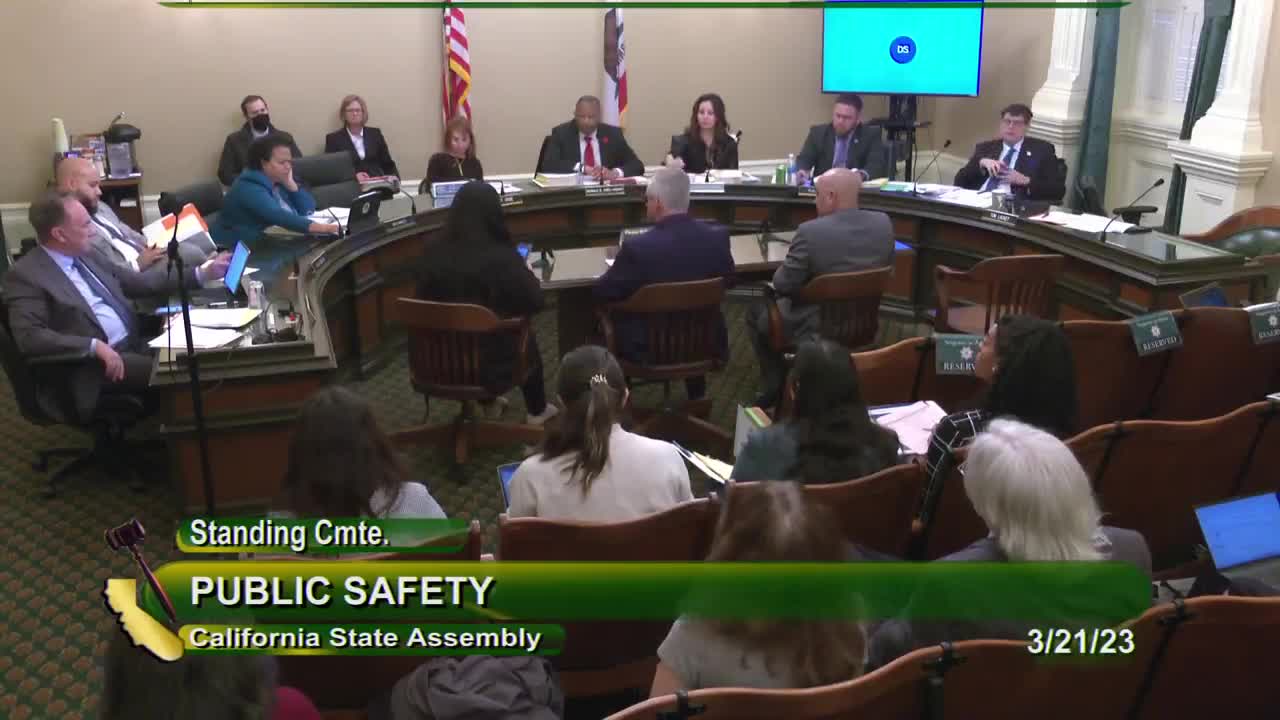 22MIN
Assembly Standing Committee on Public Safety
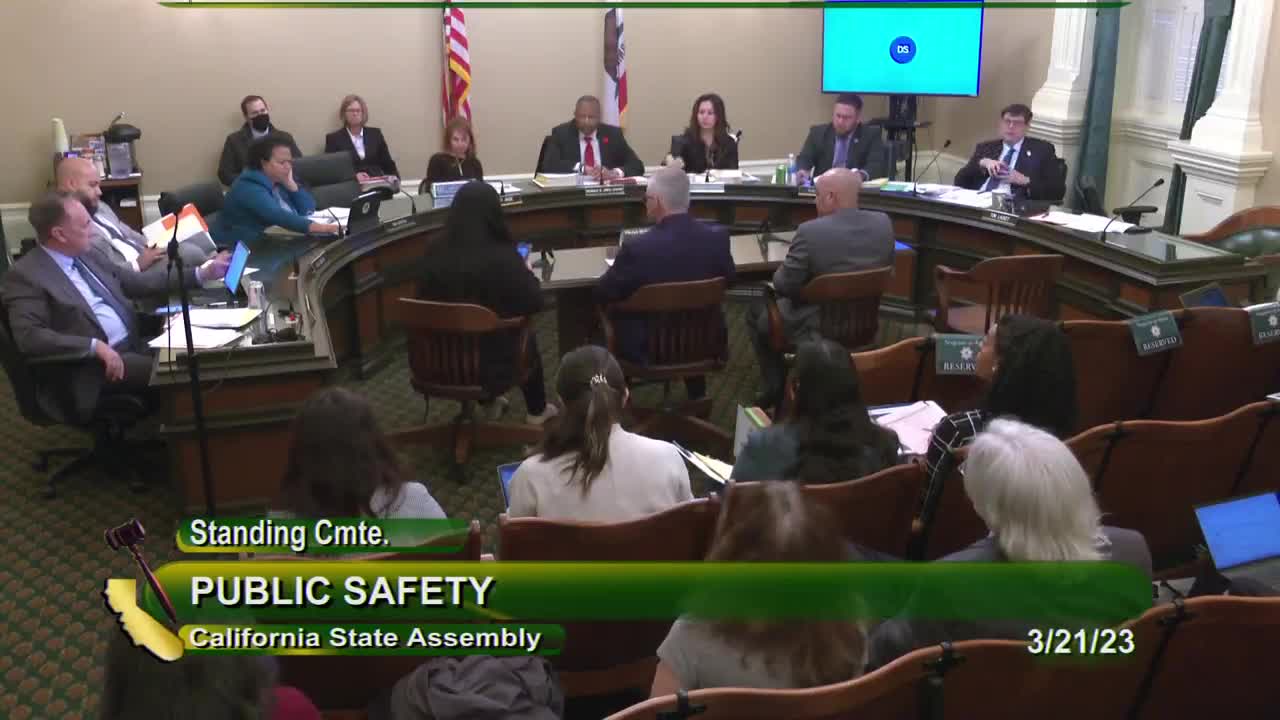 22MIN
Assembly Standing Committee on Public Safety


Bill Co-Author(s):