AB 1370: California Community Colleges Economic and Workforce Development Program.
- Session Year: 2023-2024
- House: Assembly
- Latest Version Date: 2023-03-28
Current Status:
Failed
(2023-09-01: In committee: Held under submission.)
Introduced
In Committee
First Chamber
In Committee
Second Chamber
Enacted
Existing law establishes the California Community Colleges Economic and Workforce Development Program to, among other things, advance Californias economic growth and global competitiveness through education, training, and services that contribute to continuous workforce improvement. Existing law authorizes the Board of Governors of the California Community Colleges to award grants and project funds for the program, as specified. Existing law establishes the Job Development Incentive Training Program as a component of the California Community Colleges Economic and Workforce Development Program. Existing law states the intent of the Legislature that the Job Development Incentive Training Program provide training on a no-cost or low-cost basis to participating employers who create employment opportunities at an acceptable wage level for the attainment of self-sufficiency by specified groups. Existing law requires the California Community Colleges Economic and Workforce Development Program to be implemented only during those fiscal years for which funds are appropriated for its purposes. Existing law repeals the California Community Colleges Economic and Workforce Development Program on January 1, 2025.
This bill would revise and recast several provisions of the California Community Colleges Economic and Workforce Development Program. The bill would extend operation of the program indefinitely and would repeal the Job Development Incentive Training Program. The bill would revise and recast the principles governing the Economic and Workforce Development Program, provisions on the duties and membership of the programs advisory committee, the decision criteria for allocating program funds to colleges, and the definitions that apply to the programs provisions.
(a)For purposes of this section, the following definitions apply:
(1)Career pathway has the same meaning as set forth in Section 88620, as it read on January 1, 2023.
(2)Economic security has the same meaning as set forth in Section 14005 of the Unemployment Insurance Code.
(3)Industry cluster has the same meaning as set forth in Section 88620.
(4)Long-term unemployed means, with respect to an award applicant, a person who has been unemployed for more than 26 weeks at the time of submission to the commission of the applicants application.
(5)Occupational or technical training means that phase of education coming after the completion of a secondary school program and leading toward recognized occupational goals approved by the commission.
(b)A Cal Grant C award shall be used only for occupational or technical training in a course of not less than four months. There shall be the same number of Cal Grant C awards each year as were made in the 200001 fiscal year. The maximum award amount and the total amount of funding shall be determined each year in the annual Budget Act.
(c)The commission may use criteria it deems appropriate in selecting students to receive grants for occupational or technical training and shall give special consideration to the social and economic situations of the students applying for these grants, giving additional weight to disadvantaged applicants, applicants who face economic hardship, and applicants who face particular barriers to employment. Criteria to be considered for these purposes shall include, but are not limited to, all of the following:
(1)Family income and household size.
(2)Students or the students parents household status, including whether the student is a single parent or child of a single parent.
(3)The employment status of the applicant and whether the applicant is unemployed, giving greater weight to the long-term unemployed.
(d)The Cal Grant C award recipients shall be eligible for renewal of their grants until they have completed their occupational or technical training in conformance with terms prescribed by the commission. A determination by the commission for a subsequent award year that the program under which a Cal Grant C award was initially awarded is no longer deemed to receive priority shall not affect an award recipients renewal. In no case shall the grants exceed two calendar years.
(e)Cal Grant C awards may be used for institutional fees, charges, and other costs, including tuition, plus training-related costs, such as special clothing, local transportation, required tools, equipment, supplies, technology, books, and living expenses. In determining the individual award amounts, the commission shall take into account the financial means available to the student to fund the students course of study and costs of attendance as well as other state and federal programs available to the applicant.
(f)(1)To ensure alignment with the states dynamic economic needs, the commission, in consultation with appropriate state and federal agencies, including the Economic and Workforce Development Division of the office of the Chancellor of the California Community Colleges and the California Workforce Investment Board, shall identify areas of occupational and technical training for which students may use Cal Grant C awards. The commission, to the extent feasible, shall also consult with representatives of the states leading competitive and emerging industry clusters, workforce professionals, and career technical educators, to determine which occupational training programs and industry clusters should be prioritized.
(2)(A)Except as provided in subparagraph (B), the areas of occupational and technical training developed pursuant to paragraph (1) shall be regularly reviewed and updated at least every five years, beginning in 2012.
(B)By January 1, 2016, the commission shall update the priority areas of occupational and technical training.
(3)(A)The commission shall give priority in granting Cal Grant C awards to students pursuing occupational or technical training in areas that meet two of the following criteria pertaining to job quality:
(i)High employer need or demand for the specific skills offered in the program.
(ii)High employment growth in the occupational field or industry cluster for which the student is being trained.
(iii)High employment salary and wage projections for workers employed in the occupations for which they are being trained.
(iv)The occupation or training program is part of a well-articulated career pathway to a job providing economic security.
(B)To receive priority pursuant to subparagraph (A), at least one of the criteria met shall be specified in clause (iii) or (iv) of that subparagraph.
(g)The commission shall determine areas of occupational or technical training that meet the criteria described in paragraph (3) of subdivision (f) in consultation with the Employment Development Department, the Economic and Workforce Development Division of the office of the Chancellor of the California Community Colleges, and the California Workforce Investment Board using projections available through the Labor Market Information Data Library. The commission may supplement the analyses of the Employment Development Departments Labor Market Information Data Library with the labor market analyses developed by the Economic and Workforce Development Division of the office of the Chancellor of the California Community Colleges and the California Workforce Investment Board, and the projections of occupational shortages and skills gap developed by industry leaders. The commission shall publish, and retain, on its internet website a current list of the areas of occupational or technical training that meet the criteria described in paragraph (3) of subdivision (f), and update this list as necessary.
(h)Using the best available data, the commission shall examine the graduation rates and job placement data, or salary data, of eligible programs. Commencing with the 201415 academic year, the commission shall give priority to Cal Grant C award applicants seeking to enroll in programs that rate high in graduation rates and job placement data, or salary data.
(i)(1)The commission shall consult with the Employment Development Department, the office of the Chancellor of the California Community Colleges, the California Workforce Investment Board, and the local workforce investment boards to develop a plan to publicize the existence of the grant award program to Californias long-term unemployed to be used by those consulting agencies when they come in contact with members of the population who are likely to be experiencing long-term unemployment. The outreach plan shall use existing administrative and service delivery processes making use of existing points of contact with the long-term unemployed. The local workforce investment boards are required to participate only to the extent that the outreach efforts are a part of their existing responsibilities under the federal Workforce Investment Act of 1998 (Public Law 105-220).
(2)The commission shall consult with the Workforce Services Branch of the Employment Development Department, the office of the Chancellor of the California Community Colleges, the California Workforce Investment Board, and the local workforce investment boards to develop a plan to make students receiving awards aware of job search and placement services available through the Employment Development Department and the local workforce investment boards. Outreach shall use existing administrative and service delivery processes making use of existing points of contact with the students. The local workforce investment boards are required to participate only to the extent that the outreach efforts are a part of their existing responsibilities under the federal Workforce Investment Act of 1998 (Public Law 105-220).
(j)(1)The Legislative Analysts Office shall submit a report to the Legislature on the outcomes of the Cal Grant C program on or before April 1, 2019. This report shall include, but not necessarily be limited to, information on all of the following:
(A)The age, gender, and segment of attendance for recipients in two prior award years.
(B)The occupational and technical training program categories prioritized.
(C)The number and percentage of students who received selection priority as defined in paragraph (3) of subdivision (f).
(D)The extent to which recipients in these award years were successfully placed in jobs that meet local, regional, or state workforce needs.
(2)For the report submitted pursuant to paragraph (1), the Legislative Analysts Office shall include data for two additional prior award years and shall compare the mix of occupational and technical training programs and institutions in which Cal Grant C award recipients enrolled before and after implementation of subdivision (f).
(3)Notwithstanding Section 10231.5 of the Government Code, the commission shall submit a report to the Legislature on or before April 1, 2021, and on or before April 1 of each odd-numbered year thereafter, that includes the information specified in paragraph (1).
(4)A report to be submitted pursuant to this subdivision shall be submitted in compliance with Section 9795 of the Government Code.
SEC. 2.Section 88600 of the Education Code is amended to read:88600.(a)The economic and workforce development program shall operate according to all of the following principles:
(1)The program shall be responsive to the needs of employers, incumbent workers, and students.
(2)The program shall collaborate with other public institutions, aligning resources to foster cooperation across workforce education and service delivery systems and career pathways.
(3)Program decisions shall be data informed and evidence based.
(4)The program shall develop strong partnerships with the private sector, ensuring industry involvement in needs assessment, planning, work-based experiences, and program evaluation.
(5)The program shall be outcome oriented and measure results for program participants.
(6)The program shall be accessible to employers, incumbent workers, and students who may benefit from its operation.
(7)The program shall provide guidance to local educational agencies on the allocation and oversight of apprenticeship training funds, consistent with the rules set by the California Apprenticeship Council for building and construction trades and for firefighters or by the Chief of the Division of Apprenticeship Standards of the Department of Industrial Relations for other trades.
(8)The program shall adopt continuous improvement processes.
(b)The mission of the economic and workforce development program is to do all of the following:
(1)To advance Californias economic growth and global competitiveness through education, training, and services that contribute to economic mobility and continuous workforce improvement.
(2)To advance Californias economic and jobs growth through employer-aligned education workforce training services and cross-discipline strategies to meet the needs of Californias employers.
(3)To use industry trends and student-centered labor market information to advise the chancellors office and regional community college bodies on the workforce gaps and needs of Californias employers, in accordance with both of the following:
(A)To the extent possible, the economic and workforce development program shall use the most current and up-to-date information available on economic conditions and labor market supply and demand data and analysis.
(B)The economic and workforce development program may also use its own resources to bolster and refine these labor market and industry sector and industry cluster analyses, including, but not limited to, identifying high-demand occupations or emergency labor shortages, and regional disparate impact data to fulfill its mission.
(4)To provide technical assistance, process improvement, and logistical, technical, and communications infrastructure support that engenders alignment between the career technical education programs of the community college system and the needs of Californias students, incumbent workers, and employers.
(5)To collaborate and coordinate investment with other state, regional, or local agencies involved in education and workforce training in California, including, but not necessarily limited to, the Labor and Workforce Development Agency, the California Workforce Development Board, local workforce investment boards, the Employment Training Panel, the Governors Office of Business and Economic Development, the State Department of Education, and the Employment Development Department.
(6)To identify, acquire, and leverage community college and other financial and in-kind public and private resources to support innovative economic and workforce career mobility, student-centered outcomes, and the career technical education programs of the states community colleges.
(7)To work with small businesses, employers, labor, and professional trade associations to enable students and dislocated and incumbent workers to become more competitive in their regions labor market, increase competency, and identify career pathways to economic mobility.
SEC. 3.Section 88610 of the Education Code is amended to read:88610.(a)The board of governors may award grants and project funds to districts for leadership in accomplishing the mission and goals of the program, provided that funds are appropriated for this purpose in the annual Budget Act. Grants under this section shall be awarded on a competitive basis, as determined by the board of governors and authorized in the annual Budget Act.(b)(1)The board of governors shall establish an advisory committee for the program and determine the membership pursuant to paragraph (2). The advisory committee shall advise on strategies for improving program outcomes, addressing student economic and career mobility, equity gaps, and skills shortages.(2)The membership of the advisory committee may include, but is not limited to, all of the following: representatives from labor, business, community economic development, and appropriate state agencies; a student representative; a faculty representative; a classified employee representative; and one community college chief executive officer representative from each of the regions of the program.(c) At a minimum, the decision criteria for allocating funds to colleges shall be based on each of the following:(1)An assessment of how the funding results in measurable job placement and work-based learning outcomes that are evidence based and scalable for students and dislocated and incumbent workers.(2)An evaluation of the relevance of the funding to the labor market needs of the state and relevant regions competitive and emerging industry sectors and industry clusters, or to the states need to fill skills gaps and skills shortages in the economy, including skills gaps and emergency labor shortages at the state and regional level.(3)An assessment of the past performance of the college on student outcomes, as measured based on achievement of the systemwide goals identified in the Vision for Success adopted by the board of governors in 2017.(4)An assessment of the colleges performance on student outcomes and contractual financial management based on previous funding.(5)An assessment of the colleges past performance on establishing effective and collaborative regional partnerships with key stakeholders, including, but not limited to, other colleges within the defined region, local workforce investment boards, economic development organizations, adult education providers, and other organizations with related career mobility missions.(6)An assessment of the grantees capacity to identify, collect, analyze, disaggregate, and interpret relevant labor market information, wage data, college performance, and student-centered data to inform decisionmaking and equity-centered results.(7)An assessment of the colleges capability to identify effective partner organizations and contractually manage subawards in order to reach stated student-centered outcomes and overall performance.(d)The chancellors office shall provide systemwide oversight and assessment of the economic and workforce development program, and shall evaluate projects and programs to assess whether awardees achieved their stated student-centered outcomes and the overall effectiveness of the projects and programs. The chancellors office has the authority to terminate programs for nonperformance.(e)The chancellor may establish program requirements, awardee eligibility requirements, and performance standards in the administration of the economic and workforce development program, and distribute funds as appropriate to implement the program.(f)The chancellor may provide technical assistance to community colleges for the purpose of improving the data and outcomes of their proposals.(g)The chancellor, in awarding funds, shall take into account colleges serving economically disadvantaged students in economically distressed urban and rural areas.SEC. 3.Section 88610 of the Education Code is amended to read:88610.(a)The board of governors may award grants and project funds to districts for leadership in accomplishing the mission and goals of the program, provided that funds are appropriated for this purpose in the annual Budget Act. Grants under this section shall be awarded on a competitive basis, as determined by the board of governors and authorized in the annual Budget Act.
(b)(1)The board of governors shall establish an advisory committee for the program and determine the membership pursuant to paragraph (2). The advisory committee shall advise on overall program development, recommend resource deployment, including whether projects should be funded at existing levels, increased, decreased, or terminated, and recommend strategies for regional coordination. strategies for improving program outcomes, addressing student economic and career mobility, equity gaps, and skills shortages.
(2)The membership of the advisory committee shall include may include, but is not limited to, all of the following: representatives from labor, business, community economic development, and appropriate state agencies; a student representative; a faculty representative; a classified employee representative; and one community college chief executive officer representative from each of the regions of the program.
(c) At a minimum, the decision criteria for allocating funds to colleges shall be based on each of the following:
(1)An assessment of how the funding results in measurable job placement and work-based learning outcomes that are evidence based and scalable for students and dislocated and incumbent workers.
(1)(2)An evaluation of the relevance of the grant funding to the labor market needs of the state and relevant regions competitive and emerging industry sectors and industry clusters, or to the states need to fill skills gaps and skills shortages in the economy, including skills gaps and emergency labor shortages at the state and regional level.
(2)(3)An assessment of the past performance of the grantee if the grantee has been awarded other economic and workforce development grants or other state grants, including an assessment of whether the grantees previous awards produced project deliverables specified in prior grant applications. college on student outcomes, as measured based on achievement of the systemwide goals identified in the Vision for Success adopted by the board of governors in 2017.
(3)For grants providing direct services to an employer, a group of employers, or an industry sector or industry cluster, an assessment of the purported beneficial impacts of the grant on the relevant businesses, which may include a review of the grants purported impacts on any of the following: increased profitability, increased labor productivity, reductions in worker injuries, employer cost savings resulting from improved business processes, improved customer satisfaction, increased employee retention, estimates of new revenue to be generated, sales increases, or new market penetration, as well as information on new products or services developed.(4)For grants involving direct education and training services provided to workers and students, an assessment of the educational and training goals of the grant, the projected numbers of students and workers served and the projected rates of course and program completion or transfer-readiness, the projected rate of skills attainment for certificates and degrees, and the projected wages and rate of employment placement for those entering the labor market.(5)For technical assistance and logistical support projects, a concrete enumeration of the ways the project will collaborate with the chancellors office to advance sector strategies, regional development, accountability based on performance data, and the adoption of effective workforce and economic development practices.(4)An assessment of the colleges performance on student outcomes and contractual financial management based on previous funding.
(5)An assessment of the colleges past performance on establishing effective and collaborative regional partnerships with key stakeholders, including, but not limited to, other colleges within the defined region, local workforce investment boards, economic development organizations, adult education providers, and other organizations with related career mobility missions.
(6)An assessment of the grantees capacity to identify, collect, analyze, disaggregate, and interpret relevant labor market information, wage data, college performance, and student-centered data to inform decisionmaking and equity-centered results.
(7)An assessment of the colleges capability to identify effective partner organizations and contractually manage subawards in order to reach stated student-centered outcomes and overall performance.
(d)The chancellors office shall provide systemwide oversight and evaluation assessment of the economic and workforce development program, and shall evaluate grant projects and programs to assess whether grantees awardees achieved their stated objectives. student-centered outcomes and the overall effectiveness of the projects and programs. The chancellors office has the authority to terminate programs for nonperformance.
(e)The chancellor may establish program requirements and requirements, awardee eligibility requirements, and performance standards in the administration of the economic and workforce development program, and distribute funds as appropriate to implement the program.
(f)The chancellor may provide technical assistance to community colleges for the purpose of improving the competitiveness data and outcomes of their proposals.
(g) Grant funds shall be awarded for the program on a competitive basis.
(h)The chancellor, in awarding short-term competitive funds, shall take into account colleges serving economically disadvantaged students in economically distressed urban and rural areas, and colleges that have not previously been successful in the competitive bid process. areas.
SEC. 4.Section 88620 of the Education Code is amended to read:88620.For purposes of this part, the following definitions apply:(a)Board of governors means the Board of Governors of the California Community Colleges.(b)California Community Colleges Economic and Workforce Development Program and economic and workforce development program mean the program.(c)Career mobility means strategic efforts that align, communicate, and intentionally connect the California Community College systems learning infrastructure to prepare and maximize the talents and abilities of all students while they attend community college. Career mobility assumes a role of the system for upskilling and reskilling students throughout their working careers. Career mobility fundamentally recenters the system on activating college learning and supports across the student learning journey from enrollment, to credential completion, to career and economic mobility in the labor market.(d)(1)Center means a comprehensive program of services offered by one or more community colleges or eligible organizations to an economic region of the state in accordance with criteria established by the chancellors office for designation as an economic and workforce development program center. Center services shall be designed to respond to the statewide strategic priorities pursuant to the mission of the community colleges economic and workforce development program, and to be consistent with programmatic priorities, competitive and emerging industry sectors and industry clusters, identified economic development, career technical education, business development, and continuous workforce training needs of a region. Centers shall provide a foundation for a long-term, sustained relationship with businesses, labor, colleges, and other workforce education and training delivery systems, such as local workforce investment boards, in the region.(2)A center shall support, develop, and deliver direct services to students, businesses, colleges, labor organizations, employees, and employers. For purposes of this subdivision, direct services include, but are not necessarily limited to, data analysis of labor market information, college outcome and performance, and student-centered mobility; disaggregation of data to identify opportunity structures; intraregion and multiregion sector coordination and logistics; inventory of community college and other assets relevant to meeting student and labor market needs; curriculum development, curriculum model development, or job task analysis development; articulation of curriculum within a career mobility framework; college institutional research and data analysis functions; faculty training; implementation of continuous improvement learning; calibration to a career readiness or other assessment; assessment administration; career guidance module development or counseling; convenings, such as seminars, workshops, conferences, and training; facilitating collaboration between faculty working in related disciplines and sectors; upgrading, leveraging, and developing technology; and other educational services. The establishment and maintenance of the centers is under the sole authority of the chancellors office in order to preserve the flexibility of the system to adapt to labor market needs and to integrate resources.(e)Chancellor means the Chancellor of the California Community Colleges.(f)Economic mobility means the ability of an individual to improve their economic status through an increase in income.(g)Emergency occupation means an occupation that is in urgent demand due to the occurrence of a disaster event.(h)Industry cluster means a geographic concentration or emerging concentration of interdependent industries with direct service, supplier, and research relationships, or independent industries that share common resources in a given regional economy or labor market. An industry cluster is a group of employers closely linked by a common product or services, workforce needs, similar technologies, and supply chains in a given regional economy or labor market.(i)Industry sector means those firms that produce similar products or provide similar services using somewhat similar business processes.(j)Initiative means an identified strategic priority area that is organized statewide, but is a regionally based effort to develop and implement innovative solutions designed to facilitate the development, implementation, and coordination of community college economic development and related programs and services. Each initiative shall be workforce and business development driven by a statewide committee made up of community college faculty and administrators and practitioners and managers from business, labor, and industry. Centers, industry-driven regional collaboratives, and other economic and workforce development programs performing services as a part of the implementation of an initiative shall coordinate services statewide and within regions of the state, as appropriate.(k)Matching resources means any combination of public or private resources, either cash or in-kind, derived from sources other than the economic and workforce development program funds appropriated by the annual Budget Act, that are determined to be necessary for the success of the project to which they are applied. The criteria for in-kind resources shall be developed by the board of governors, with advice from the chancellor, and shall be consistent with generally accepted accounting practices for state and federal matching requirements. The ratio of matching resources to economic and workforce development program funding shall be determined by the board of governors.(l)Opportunity structure means a matrix that relates personal characteristics, such as age, disability, race, gender, education, and financial status, to the cultural and social opportunities and options that are available to an individual throughout their life. For example, inadequate education and job availability are elements that can serve to block a particular opportunity structure for certain segments of the population, while permitting others to advance.(m)Program means the California Community Colleges Economic and Workforce Development Program established under this part.(n)Region means a geographic area of the state defined by economic and labor market factors containing at least one industry cluster and the cities, counties, or community college districts, or all of them, in the industry clusters geographic area. For the purposes of this chapter, and to the extent possible, California Community College economic development regions shall be designated by the board of governors based on both of the following factors:(1)Alignment with the federal Workforce Innovation and Opportunity Act (Public Law 113-128) regional planning unit boundaries specified in the California Strategic Workforce and Development Plan.(2)Integration and expansion of existing regional collaboratives and consortium infrastructures used by the California Community Colleges.SEC. 4.Section 88620 of the Education Code is amended to read:88620.The following definitions govern the construction of this part: For purposes of this part, the following definitions apply:
(a)Board of governors means the Board of Governors of the California Community Colleges.
(b)Business Resource Assistance and Innovation Network means the network of projects and programs that comprise the California Community Colleges Economic and Workforce Development Program.
(c)California Community Colleges Economic and Workforce Development Program and economic and workforce development program mean the program.
(d)Career pathways, and career ladders, or career lattices mean an identified series of positions, work experiences, or educational benchmarks or credentials that offer occupational and financial advancement within a specified career field or related fields over time.(d)Career mobility means strategic efforts that align, communicate, and intentionally connect the California Community College systems learning infrastructure to prepare and maximize the talents and abilities of all students while they attend community college. Career mobility assumes a role of the system for upskilling and reskilling students throughout their working careers. Career mobility fundamentally recenters the system on activating college learning and supports across the student learning journey from enrollment, to credential completion, to career and economic mobility in the labor market.
(e)(e)(1)Center means a comprehensive program of services offered by one or more community colleges or eligible organizations to an economic region of the state in accordance with criteria established by the chancellors office for designation as an economic and workforce development program center. Center services shall be designed to respond to the statewide strategic priorities pursuant to the mission of the community colleges economic and workforce development program, and to be consistent with programmatic priorities, competitive and emerging industry sectors and industry clusters, identified economic development, career technical education, business development, and continuous workforce training needs of a region. Centers shall provide a foundation for a long-term, sustained relationship with businesses, labor, colleges, and other workforce education and training delivery systems, such as local workforce investment boards, in the region.
(2)A center shall support, develop, and deliver direct services to students, businesses, colleges, labor organizations, employees, and employers. For purposes of this subdivision, direct services include, but are not necessarily limited to, data analysis both of labor market information and college performance; information, college outcome and performance, and student-centered mobility; disaggregation of data to identify opportunity structures; intraregion and multiregion sector coordination and logistics; inventory of community college and other assets relevant to meeting a student and labor market need; needs; curriculum development, curriculum model development, or job task analysis development; articulation of curriculum in a career pathway or career lattice or in a system of stackable credentials; within a career mobility framework; college institutional research and data analysis functions; faculty training; implementation of continuous improvement learning; calibration to a career readiness or other assessment; assessment administration; career guidance module development or counseling; convenings, such as seminars, workshops, conferences, and training; facilitating collaboration between faculty working in related disciplines and sectors; upgrading, leveraging, and developing technology; and other educational services. The establishment and maintenance of the centers is under the sole authority of the chancellors office in order to preserve the flexibility of the system to adapt to labor market needs and to integrate resources.
(f)Chancellor means the Chancellor of the California Community Colleges.
(g)Economic security means, with respect to a worker, earning a wage sufficient to adequately support a family and to, over time, save money for emergency expenses and adequate retirement income, the sufficiency of which is determined considering a variety of factors including household size, the cost of living in the workers community, and other factors that may vary by region. mobility means the ability of an individual to improve their economic status through an increase in income.
(h)High-priority occupation means an occupation that has a significant presence in a targeted industry sector or industry cluster, is in demand by employers, and pays or leads to payment of high wages.(h)Emergency occupation means an occupation that is in urgent demand due to the occurrence of a disaster event.
(i)Industry cluster means a geographic concentration or emerging concentration of interdependent industries with direct service, supplier, and research relationships, or independent industries that share common resources in a given regional economy or labor market. An industry cluster is a group of employers closely linked by a common product or services, workforce needs, similar technologies, and supply chains in a given regional economy or labor market.
(j)Industry-driven regional collaborative means a regional public, private, or other community organizational structure that jointly defines priorities, delivers services across programs, sectors, and in response to, or driven by, industry needs. The industry-driven regional collaborative projects meet the needs and fill gaps in services that respond to regional business, employee, and labor needs. These service-delivery structures offer flexibility to local communities and partners to meet the identified needs in an economic development region. Industry-driven regional collaboratives are broadly defined to allow maximum local autonomy in developing projects responding to the needs of business, industry, and labor.
(k)Industry sector means those firms that produce similar products or provide similar services using somewhat similar business processes.
(l)Initiative is means an identified strategic priority area that is organized statewide, but is a regionally based effort to develop and implement innovative solutions designed to facilitate the development, implementation, and coordination of community college economic development and related programs and services. Each initiative shall be workforce and business development driven by a statewide committee made up of community college faculty and administrators and practitioners and managers from business, labor, and industry. Centers, industry-driven regional collaboratives, and other economic and workforce development programs performing services as a part of the implementation of an initiative shall coordinate services statewide and within regions of the state, as appropriate.
(m)Job development incentive training means programs that provide incentives to employers to create entry-level positions in their businesses, or through their suppliers or prime customers, for welfare recipients and the working poor.(n)(m)Matching resources means any combination of public or private resources, either cash or in-kind, derived from sources other than the economic and workforce development program funds appropriated by the annual Budget Act, that are determined to be necessary for the success of the project to which they are applied. The criteria for in-kind resources shall be developed by the board of governors, with advice from the chancellor and the California Community Colleges Economic and Workforce Development Program Advisory Committee, chancellor, and shall be consistent with generally accepted accounting practices for state and federal matching requirements. The ratio of matching resources to economic and workforce development program funding shall be determined by the board of governors.
(o)Performance improvement training means training delivered by a community college that includes all of the following:(1)An initial needs assessment process that identifies both training and nontraining issues that need to be addressed to improve individual and organizational performance.(2)Consultation with employers to develop action plans that address business or nonprofit performance improvements.(3)Training programs that link individual performance requirements with quantifiable business measures, resulting in demonstrable productivity gains, and, as appropriate, job retention, job creation, improvement in wages, or attainment of wages that provide economic security.(n)Opportunity structure means a matrix that relates personal characteristics, such as age, disability, race, gender, education, and financial status, to the cultural and social opportunities and options that are available to an individual throughout their life. For example, inadequate education and job availability are elements that can serve to block a particular opportunity structure for certain segments of the population, while permitting others to advance.
(p)(o)Program means the California Community Colleges Economic and Workforce Development Program established under this part.
(q)(p)Region means a geographic area of the state defined by economic and labor market factors containing at least one industry cluster and the cities, counties, or community college districts, or all of them, in the industry clusters geographic area. For the purposes of this chapter, and to the extent possible, California Community College economic development regions shall be designated by the board of governors based on factors, including, but not necessarily limited to, all of the following: both of the following factors:
(1)Regional economic development and training needs of business and industry.(2)Regional collaboration, as appropriate, among community colleges and districts, and existing economic development, continuous workforce improvement, technology deployment, and business development.(3)Other state economic development definitions of regions.(r)Sector strategies means prioritizing investments in competitive and emerging industry sectors and industry clusters on the basis of labor market and other economic data that indicate strategic growth potential, especially with regard to jobs and income. Sector strategies focus workforce investment in education and workforce training programs that are likely to lead to high-wage jobs or to entry-level jobs with well-articulated career pathways into high-wage jobs. Sector strategies effectively boost labor productivity or reduce business barriers to growth and expansion stemming from workforce supply problems, including skills gaps, and occupational shortages by directing resources and making investments to plug skills gaps and provide education and training programs for high-priority occupations. Sector strategies may be implemented using articulated career pathways or career lattices and a system of stackable credentials. Sector strategies often target underserved communities, disconnected youth, incumbent workers, and recently separated military veterans. Cluster-based sector strategies focus workforce and economic development on those sectors that have demonstrated a capacity for economic growth and job creation in a particular geographic area. Industry clusters are similar to industry sectors, but the focus is on a geographic concentration of interdependent industries.(s)Skills panel means a collaboration which brings together multiple employers from an industry sector or industry cluster with career technical educators, including, but not limited to, community college career technical education faculty, and other stakeholders which may include workers and organized labor to address common workforce needs. Skills panels assess workforce training and education needs through the identification of assets relevant to industry need, produce curricula models, perform job task analysis, define how curricula articulate into career pathways or career lattices or a system of stackable credentials, calibrate career readiness, develop other assessment tools, and produce career guidance tools.(t)Stackable credentials means a progression of training modules, credentials, or certificates that build on one another and are linked to educational and career advancement.(1)Alignment with the federal Workforce Innovation and Opportunity Act (Public Law 113-128) regional planning unit boundaries specified in the California Strategic Workforce and Development Plan.
(2)Integration and expansion of existing regional collaboratives and consortium infrastructures used by the California Community Colleges.
SEC. 5.The heading of Chapter 5 (commencing with Section 88630) of Part 52.5 of Division 7 of Title 3 of the Education Code is amended to read:5.CentersSEC. 6.Section 88630 of the Education Code is amended to read:88630.(a)It is the intent of the Legislature that the programs and services provided through the program shall be flexible, focused on career mobility for students and dislocated and incumbent workers, and responsive to the needs of employers and employees. Services shall be demand driven, and delivery structures shall be agile, performance oriented, cost effective, results oriented, and contribute to regional economic growth and competitiveness. The use of economic and workforce development program centers, local economic development corporations, industry-driven regional collaboratives, and business networks, employers, and service providers shall provide a stable and flexible response mechanism for the identification of training priorities and to focus resources on intensive projects for competitive and emerging industry sectors, including the identification of potential remote employment opportunities.
(b)It is the intent of the Legislature that centers shall be established as an extension of the chancellors office and as the long-term network for student-centered service delivery, innovation, continuous improvement, and initiative effectiveness. Centers shall deliver services for the strategic initiative areas pursuant to the mission of the community colleges economic and workforce development program and provide regional sites to evaluate all of the following:
(1)The effectiveness of initiatives to achieve evidence-informed outcomes in alignment with the systemwide goals identified in the Vision for Success adopted by the board of governors in 2017.
(2)The effectiveness of initiatives to achieve job placement and work-based learning outcomes for students.
(3)The effectiveness of initiatives to effectively respond to employer and worker needs.
(c)It is the intent of the Legislature that the chancellors office fund initiatives that enable districts to be responsive to the labor and skills needs of employers and students, meet the demand for new and emerging industry growth sectors, address urgent employer needs due to a disaster event, respond to critical need labor shortages, and be formed, modified, eliminated, and reformed for short- or long-term responses customized to the duration of the identified labor and skill need.
SEC. 7.Section 88631 of the Education Code is amended to read:88631.Economic and workforce development program centers and California Community Colleges participation in industry-driven regional collaboratives may provide any or all of the following services and perform the following functions as participants of networks, including, but not necessarily limited to, all of the following:
(a)Measurement and analysis of student outcomes from the implementation of workforce development initiatives, including development and use of scorecards, equity metrics, and other assessment tools, as needed. Key measurement factors may include, but are not limited to, all of the following:
(1)Student job placement data, including student first job status, underemployment, and wage metrics.
(2)Regional availability of programs providing high-wage opportunities across student populations, including students of color.
(3)Work-based learning data.
(4)Data on participation of students of color in initiatives.
(5)Data on participation of underserved student population in initiatives.
(6)Number of employers engaged in the development of initiatives.
(b)Development of instructional packages focusing on the technical skill specific to emerging or high-demand occupations in targeted industry sectors and industry clusters.
(c)Support student or worker evaluation of career and career mobility factors by articulating innovative curricula to better navigate a dynamic economy.
(d)Faculty mentorships, faculty and staff development, faculty training to support the development of student social capital and networking skills, in-service training, and worksite experience supporting the new curriculum and instructional modes responding to identified regional needs.
(e)Institutional support, professional development, and process improvement activities focused on removing systemic barriers to the development of new methods, transition to a flexible and more responsive administration of cohesive programs, and the timely and cost-effective delivery of services.
(f)The deployment of new methodologies, modes, and technologies that enhance performance and outcomes and improve cost-effectiveness of service delivery or create new college programs.
(g)One-on-one counseling, seminars, workshops, and conferences that contribute to the achievement of the success of existing businesses and foster the growth of new businesses and jobs in emerging industry clusters.
(h)The delivery of performance-improvement training, which shall be provided on a matching basis to employers to benefit workforce participants. This will promote continuous workforce improvement in identified strategic priority areas, identified industry clusters, or areas targeted in the regional business resource assistance and innovation network plans.
(i)Credit, not-for-credit, and noncredit programs and courses that contribute to workforce skill development and career mobility for competitive and emerging industry sectors and industry clusters within a region or that focus on addressing a workforce skills gap or occupational shortage.
(j)Subsidized student internships or work-based learning on a cash or in-kind matching basis for program participants in occupational categories identified in competitive and emerging industry sectors and industry clusters.
(k)Acquisition of equipment to support the eligible activities and the limited renovation of facilities to accommodate the delivery of eligible services.
(l)Submission of performance data for aggregation by the chancellors office.
SEC. 8.Chapter 6 (commencing with Section 88640) of Part 52.5 of Division 7 of Title 3 of the Education Code is repealed.SEC. 9.The heading of Chapter 7 (commencing with Section 88650) of Part 52.5 of Division 7 of Title 3 of the Education Code is amended to read:6.ReportingSEC. 10.Section 88650 of the Education Code is amended to read:88650.(a)The chancellor shall implement funding analysis and performance accountability outcome measures for the economic and workforce development program that provide the Governor, Legislature, and general public with information that quantifies effectiveness of the program and student outcomes for those participating in the program based on achievement of the systemwide goals identified in the Vision for Success adopted by the board of governors in 2017. These measures should, to the extent possible, align with the performance accountability measures of the federal Workforce Innovation and Opportunity Act (Public Law 113-128).
(b)The chancellor shall submit a report to the Governor and Legislature on or about March 1 of each year. This report shall include, but not necessarily be limited to, both of the following:
(1)Sufficient information to ensure the understanding of the magnitude of expenditures, by type of expenditure, including those specified in Section 88625, disaggregated by industry sector or cluster, region, and type of grant.
(2)Data summarizing outcome accountability performance measures required by this section.
SEC. 11.Section 88650.5 of the Education Code is repealed.SEC. 12.Chapter 8 (commencing with Section 88651) of Part 52.5 of Division 7 of Title 3 of the Education Code is repealed.(a)For the purposes of this section, the following terms have the following meanings: definitions apply:
(1)Career pathway has the same meaning as set forth in Section 88620. 88620, as it read on January 1, 2023.
(2)Economic security has the same meaning as set forth in Section 14005 of the Unemployment Insurance Code.
(3)Industry cluster has the same meaning as set forth in Section 88620.
(4)Long-term unemployed means, with respect to an award applicant, a person who has been unemployed for more than 26 weeks at the time of submission to the commission of his or her the applicants application.
(5)Occupational or technical training means that phase of education coming after the completion of a secondary school program and leading toward recognized occupational goals approved by the commission.
(b)A Cal Grant C award shall be utilized used only for occupational or technical training in a course of not less than four months. There shall be the same number of Cal Grant C awards each year as were made in the 200001 fiscal year. The maximum award amount and the total amount of funding shall be determined each year in the annual Budget Act.
(c)The commission may use criteria it deems appropriate in selecting students to receive grants for occupational or technical training and shall give special consideration to the social and economic situations of the students applying for these grants, giving additional weight to disadvantaged applicants, applicants who face economic hardship, and applicants who face particular barriers to employment. Criteria to be considered for these purposes shall include, but are not limited to, all of the following:
(1)Family income and household size.
(2)Students or the students parents household status, including whether the student is a single parent or child of a single parent.
(3)The employment status of the applicant and whether the applicant is unemployed, giving greater weight to the long-term unemployed.
(d)The Cal Grant C award recipients shall be eligible for renewal of their grants until they have completed their occupational or technical training in conformance with terms prescribed by the commission. A determination by the commission for a subsequent award year that the program under which a Cal Grant C award was initially awarded is no longer deemed to receive priority shall not affect an award recipients renewal. In no case shall the grants exceed two calendar years.
(e)Cal Grant C awards may be used for institutional fees, charges, and other costs, including tuition, plus training-related costs, such as special clothing, local transportation, required tools, equipment, supplies, technology, books, and living expenses. In determining the individual award amounts, the commission shall take into account the financial means available to the student to fund his or her the students course of study and costs of attendance as well as other state and federal programs available to the applicant.
(f)(1)To ensure alignment with the states dynamic economic needs, the commission, in consultation with appropriate state and federal agencies, including the Economic and Workforce Development Division of the Office office of the Chancellor of the California Community Colleges and the California Workforce Investment Board, shall identify areas of occupational and technical training for which students may utilize use Cal Grant C awards. The commission, to the extent feasible, shall also consult with representatives of the states leading competitive and emerging industry clusters, workforce professionals, and career technical educators, to determine which occupational training programs and industry clusters should be prioritized.
(2)(A)Except as provided in subparagraph (B), the areas of occupational and technical training developed pursuant to paragraph (1) shall be regularly reviewed and updated at least every five years, beginning in 2012.
(B)By January 1, 2016, the commission shall update the priority areas of occupational and technical training.
(3)(A)The commission shall give priority in granting Cal Grant C awards to students pursuing occupational or technical training in areas that meet two of the following criteria pertaining to job quality:
(i)High employer need or demand for the specific skills offered in the program.
(ii)High employment growth in the occupational field or industry cluster for which the student is being trained.
(iii)High employment salary and wage projections for workers employed in the occupations for which they are being trained.
(iv)The occupation or training program is part of a well-articulated career pathway to a job providing economic security.
(B)To receive priority pursuant to subparagraph (A), at least one of the criteria met shall be specified in clause (iii) or (iv) of that subparagraph.
(g)The commission shall determine areas of occupational or technical training that meet the criteria described in paragraph (3) of subdivision (f) in consultation with the Employment Development Department, the Economic and Workforce Development Division of the Office office of the Chancellor of the California Community Colleges, and the California Workforce Investment Board using projections available through the Labor Market Information Data Library. The commission may supplement the analyses of the Employment Development Departments Labor Market Information Data Library with the labor market analyses developed by the Economic and Workforce Development Division of the Office office of the Chancellor of the California Community Colleges and the California Workforce Investment Board, as well as and the projections of occupational shortages and skills gap developed by industry leaders. The commission shall publish, and retain, on its Internet Web site internet website a current list of the areas of occupational or technical training that meet the criteria described in paragraph (3) of subdivision (f), and update this list as necessary.
(h)Using the best available data, the commission shall examine the graduation rates and job placement data, or salary data, of eligible programs. Commencing with the 201415 academic year, the commission shall give priority to Cal Grant C award applicants seeking to enroll in programs that rate high in graduation rates and job placement data, or salary data.
(i)(1)The commission shall consult with the Employment Development Department, the Office office of the Chancellor of the California Community Colleges, the California Workforce Investment Board, and the local workforce investment boards to develop a plan to publicize the existence of the grant award program to Californias long-term unemployed to be used by those consulting agencies when they come in contact with members of the population who are likely to be experiencing long-term unemployment. The outreach plan shall use existing administrative and service delivery processes making use of existing points of contact with the long-term unemployed. The local workforce investment boards are required to participate only to the extent that the outreach efforts are a part of their existing responsibilities under the federal Workforce Investment Act of 1998 (Public Law 105-220).
(2)The commission shall consult with the Workforce Services Branch of the Employment Development Department, the Office office of the Chancellor of the California Community Colleges, the California Workforce Investment Board, and the local workforce investment boards to develop a plan to make students receiving awards aware of job search and placement services available through the Employment Development Department and the local workforce investment boards. Outreach shall use existing administrative and service delivery processes making use of existing points of contact with the students. The local workforce investment boards are required to participate only to the extent that the outreach efforts are a part of their existing responsibilities under the federal Workforce Investment Act of 1998 (Public Law 105-220).
(j)(1)The Legislative Analysts Office shall submit a report to the Legislature on the outcomes of the Cal Grant C program on or before April 1, 2019. This report shall include, but not necessarily be limited to, information on all of the following:
(A)The age, gender, and segment of attendance for recipients in two prior award years.
(B)The occupational and technical training program categories prioritized.
(C)The number and percentage of students who received selection priority as defined in paragraph (3) of subdivision (f).
(D)The extent to which recipients in these award years were successfully placed in jobs that meet local, regional, or state workforce needs.
(2)For the report submitted pursuant to paragraph (1), the Legislative Analysts Office shall include data for two additional prior award years and shall compare the mix of occupational and technical training programs and institutions in which Cal Grant C award recipients enrolled before and after implementation of subdivision (f).
(3)Notwithstanding Section 10231.5 of the Government Code, the commission shall submit a report to the Legislature on or before April 1, 2021, and on or before April 1 of each odd-numbered year thereafter, that includes the information specified in paragraph (1).
(4)A report to be submitted pursuant to this subdivision shall be submitted in compliance with Section 9795 of the Government Code.
SEC. 2.Section 88600 of the Education Code is amended to read:88600.(a)The economic and workforce development program shall operate according to all of the following principles:
(1)The program shall be responsive to the needs of employers, incumbent workers, and students.
(2)The program shall collaborate with other public institutions, aligning resources to foster cooperation across workforce education and service delivery systems, and building well-articulated systems and career pathways.
(3)Program decisions shall be data driven informed and evidence based, investing resources and adopting practices on the basis of what works. based.
(4)The program shall develop strong partnerships with the private sector, ensuring industry involvement in needs assessment, planning, work-based experiences, and program evaluation.
(5)The program shall be outcome oriented and accountable, measuring measure results for program participants, including students, employers, and workers. participants.
(6)The program shall be accessible to employers, incumbent workers, and students who may benefit from its operation.
(7)The program shall provide guidance to local educational agencies on the allocation and oversight of apprenticeship training funds, consistent with the rules set by the California Apprenticeship Council for building and construction trades and for firefighters or by the Chief of the Division of Apprenticeship Standards of the Department of Industrial Relations for other trades.
(8)The program shall adopt continuous improvement processes.
(b)The mission of the economic and workforce development program is to do all of the following:
(1)To advance Californias economic growth and global competitiveness through education, training, and services that contribute to economic mobility and continuous workforce improvement.
(2)To advance Californias economic and jobs recovery and sustain economic growth through labor market-aligned employer-aligned education workforce training services, and sector strategies focusing on continuous workforce improvement, technology deployment, and business development, services and cross-discipline strategies to meet the needs of Californias competitive and emerging industry sectors and industry clusters. employers.
(3)To use industry trends and student-centered labor market information to advise the chancellors office and regional community college bodies on the workforce gaps and needs of Californias competitive and emerging industry sectors and industry clusters, employers, in accordance with both of the following:
(A)To the extent possible, the economic and workforce development program shall work with, share information with, and consider the labor market analyses produced by, the Employment Development Departments Labor Market Information Division and the California Workforce Development Board. shall use the most current and up-to-date information available on economic conditions and labor market supply and demand data and analysis.
(B)The economic and workforce development program may also use its own resources to bolster and refine these labor market and industry sector and industry cluster analyses analyses, including, but not limited to, identifying high-demand occupations or emergency labor shortages, and regional disparate impact data to fulfill its mission.
(4)To provide technical assistance assistance, process improvement, and logistical, technical, and communications infrastructure support that engenders alignment between the career technical education programs of the community college system and the needs of Californias competitive and emerging industry sectors and industry clusters. students, incumbent workers, and employers.
(5)To collaborate and coordinate investment with other state, regional, or local agencies involved in education and workforce training in California, including, but not necessarily limited to, the Labor and Workforce Development Agency, the California Workforce Development Board, local workforce investment boards, the Employment Training Panel, the Governors Office of Business and Economic Development, the State Department of Education, and the Employment Development Department.
(6)To identify, acquire, and leverage community college and other financial and in-kind public and private resources to support innovative economic and workforce development career mobility, student-centered outcomes, and the career technical education programs of the states community colleges.
(7)To work with representatives of business, small businesses, employers, labor, and professional trade associations to explore and develop alternatives for assisting incumbent workers in the states competitive and emerging industry sectors. A key objective is to enable students and dislocated and incumbent workers to become more competitive in their regions labor market, increase competency, and identify career pathways to economic self-sufficiency, economic security, and lifelong access to good-paying jobs. mobility.
SEC. 3.Section 88610 of the Education Code is amended to read:88610.(a)The board of governors may award grants and project funds to districts for leadership in accomplishing the mission and goals of the program, provided that funds are appropriated for this purpose in the annual Budget Act. Grants under this section shall be awarded on a competitive basis, as determined by the board of governors and authorized in the annual Budget Act.
(b)(1)The board of governors shall establish an advisory committee for the program and determine the membership pursuant to paragraph (2). The advisory committee shall advise on overall program development, recommend resource deployment, including whether projects should be funded at existing levels, increased, decreased, or terminated, and recommend strategies for regional coordination. strategies for improving program outcomes, addressing student economic and career mobility, equity gaps, and skills shortages.
(2)The membership of the advisory committee shall include may include, but is not limited to, all of the following: representatives from labor, business, community economic development, and appropriate state agencies; a student representative; a faculty representative; a classified employee representative; and one community college chief executive officer representative from each of the regions of the program.
(c) At a minimum, the decision criteria for allocating funds to colleges shall be based on each of the following:
(1)An assessment of how the funding results in measurable job placement and work-based learning outcomes that are evidence based and scalable for students and dislocated and incumbent workers.
(1)(2)An evaluation of the relevance of the grant funding to the labor market needs of the state and relevant regions competitive and emerging industry sectors and industry clusters, or to the states need to fill skills gaps and skills shortages in the economy, including skills gaps and emergency labor shortages at the state and regional level.
(2)(3)An assessment of the past performance of the grantee if the grantee has been awarded other economic and workforce development grants or other state grants, including an assessment of whether the grantees previous awards produced project deliverables specified in prior grant applications. college on student outcomes, as measured based on achievement of the systemwide goals identified in the Vision for Success adopted by the board of governors in 2017.
(3)For grants providing direct services to an employer, a group of employers, or an industry sector or industry cluster, an assessment of the purported beneficial impacts of the grant on the relevant businesses, which may include a review of the grants purported impacts on any of the following: increased profitability, increased labor productivity, reductions in worker injuries, employer cost savings resulting from improved business processes, improved customer satisfaction, increased employee retention, estimates of new revenue to be generated, sales increases, or new market penetration, as well as information on new products or services developed.(4)For grants involving direct education and training services provided to workers and students, an assessment of the educational and training goals of the grant, the projected numbers of students and workers served and the projected rates of course and program completion or transfer-readiness, the projected rate of skills attainment for certificates and degrees, and the projected wages and rate of employment placement for those entering the labor market.(5)For technical assistance and logistical support projects, a concrete enumeration of the ways the project will collaborate with the chancellors office to advance sector strategies, regional development, accountability based on performance data, and the adoption of effective workforce and economic development practices.(4)An assessment of the colleges performance on student outcomes and contractual financial management based on previous funding.
(5)An assessment of the colleges past performance on establishing effective and collaborative regional partnerships with key stakeholders, including, but not limited to, other colleges within the defined region, local workforce investment boards, economic development organizations, adult education providers, and other organizations with related career mobility missions.
(6)An assessment of the grantees capacity to identify, collect, analyze, disaggregate, and interpret relevant labor market information, wage data, college performance, and student-centered data to inform decisionmaking and equity-centered results.
(7)An assessment of the colleges capability to identify effective partner organizations and contractually manage subawards in order to reach stated student-centered outcomes and overall performance.
(d)The chancellors office shall provide systemwide oversight and evaluation assessment of the economic and workforce development program, and shall evaluate grant projects and programs to assess whether grantees awardees achieved their stated objectives. student-centered outcomes and the overall effectiveness of the projects and programs. The chancellors office has the authority to terminate programs for nonperformance.
(e)The chancellor may establish program requirements and requirements, awardee eligibility requirements, and performance standards in the administration of the economic and workforce development program, and distribute funds as appropriate to implement the program.
(f)The chancellor may provide technical assistance to community colleges for the purpose of improving the competitiveness data and outcomes of their proposals.
(g) Grant funds shall be awarded for the program on a competitive basis.(h)(g)The chancellor, in awarding short-term competitive funds, shall take into account colleges serving economically disadvantaged students in economically distressed urban and rural areas, and colleges that have not previously been successful in the competitive bid process. areas.
SEC. 4.Section 88620 of the Education Code is amended to read:88620.The following definitions govern the construction of this part: For purposes of this part, the following definitions apply:
(a)Board of governors means the Board of Governors of the California Community Colleges.
(b)Business Resource Assistance and Innovation Network means the network of projects and programs that comprise the California Community Colleges Economic and Workforce Development Program.(c)(b)California Community Colleges Economic and Workforce Development Program and economic and workforce development program mean the program.
(d)Career pathways, and career ladders, or career lattices mean an identified series of positions, work experiences, or educational benchmarks or credentials that offer occupational and financial advancement within a specified career field or related fields over time.(c)Career mobility means strategic efforts that align, communicate, and intentionally connect the California Community College systems learning infrastructure to prepare and maximize the talents and abilities of all students while they attend community college. Career mobility assumes a role of the system for upskilling and reskilling students throughout their working careers. Career mobility fundamentally recenters the system on activating college learning and supports across the student learning journey from enrollment, to credential completion, to career and economic mobility in the labor market.
(e)(d)(1)Center means a comprehensive program of services offered by one or more community colleges or eligible organizations to an economic region of the state in accordance with criteria established by the chancellors office for designation as an economic and workforce development program center. Center services shall be designed to respond to the statewide strategic priorities pursuant to the mission of the community colleges economic and workforce development program, and to be consistent with programmatic priorities, competitive and emerging industry sectors and industry clusters, identified economic development, career technical education, business development, and continuous workforce training needs of a region. Centers shall provide a foundation for a long-term, sustained relationship with businesses, labor, colleges, and other workforce education and training delivery systems, such as local workforce investment boards, in the region.
(2)A center shall support, develop, and deliver direct services to students, businesses, colleges, labor organizations, employees, and employers. For purposes of this subdivision, direct services include, but are not necessarily limited to, data analysis both of labor market information and college performance; information, college outcome and performance, and student-centered mobility; disaggregation of data to identify opportunity structures; intraregion and multiregion sector coordination and logistics; inventory of community college and other assets relevant to meeting a student and labor market need; needs; curriculum development, curriculum model development, or job task analysis development; articulation of curriculum in a career pathway or career lattice or in a system of stackable credentials; within a career mobility framework; college institutional research and data analysis functions; faculty training; implementation of continuous improvement learning; calibration to a career readiness or other assessment; assessment administration; career guidance module development or counseling; convenings, such as seminars, workshops, conferences, and training; facilitating collaboration between faculty working in related disciplines and sectors; upgrading, leveraging, and developing technology; and other educational services. The establishment and maintenance of the centers is under the sole authority of the chancellors office in order to preserve the flexibility of the system to adapt to labor market needs and to integrate resources.
(f)(e)Chancellor means the Chancellor of the California Community Colleges.
(g)(f)Economic security means, with respect to a worker, earning a wage sufficient to adequately support a family and to, over time, save money for emergency expenses and adequate retirement income, the sufficiency of which is determined considering a variety of factors including household size, the cost of living in the workers community, and other factors that may vary by region. mobility means the ability of an individual to improve their economic status through an increase in income.
(g)Emergency occupation means an occupation that is in urgent demand due to the occurrence of a disaster event.
(h)High-priority occupation means an occupation that has a significant presence in a targeted industry sector or industry cluster, is in demand by employers, and pays or leads to payment of high wages.(i)(h)Industry cluster means a geographic concentration or emerging concentration of interdependent industries with direct service, supplier, and research relationships, or independent industries that share common resources in a given regional economy or labor market. An industry cluster is a group of employers closely linked by a common product or services, workforce needs, similar technologies, and supply chains in a given regional economy or labor market.
(j)Industry-driven regional collaborative means a regional public, private, or other community organizational structure that jointly defines priorities, delivers services across programs, sectors, and in response to, or driven by, industry needs. The industry-driven regional collaborative projects meet the needs and fill gaps in services that respond to regional business, employee, and labor needs. These service-delivery structures offer flexibility to local communities and partners to meet the identified needs in an economic development region. Industry-driven regional collaboratives are broadly defined to allow maximum local autonomy in developing projects responding to the needs of business, industry, and labor.(k)(i)Industry sector means those firms that produce similar products or provide similar services using somewhat similar business processes.
(l)(j)Initiative is means an identified strategic priority area that is organized statewide, but is a regionally based effort to develop and implement innovative solutions designed to facilitate the development, implementation, and coordination of community college economic development and related programs and services. Each initiative shall be workforce and business development driven by a statewide committee made up of community college faculty and administrators and practitioners and managers from business, labor, and industry. Centers, industry-driven regional collaboratives, and other economic and workforce development programs performing services as a part of the implementation of an initiative shall coordinate services statewide and within regions of the state, as appropriate.
(m)Job development incentive training means programs that provide incentives to employers to create entry-level positions in their businesses, or through their suppliers or prime customers, for welfare recipients and the working poor.(n)(k)Matching resources means any combination of public or private resources, either cash or in-kind, derived from sources other than the economic and workforce development program funds appropriated by the annual Budget Act, that are determined to be necessary for the success of the project to which they are applied. The criteria for in-kind resources shall be developed by the board of governors, with advice from the chancellor and the California Community Colleges Economic and Workforce Development Program Advisory Committee, chancellor, and shall be consistent with generally accepted accounting practices for state and federal matching requirements. The ratio of matching resources to economic and workforce development program funding shall be determined by the board of governors.
(o)Performance improvement training means training delivered by a community college that includes all of the following:(1)An initial needs assessment process that identifies both training and nontraining issues that need to be addressed to improve individual and organizational performance.(2)Consultation with employers to develop action plans that address business or nonprofit performance improvements.(3)Training programs that link individual performance requirements with quantifiable business measures, resulting in demonstrable productivity gains, and, as appropriate, job retention, job creation, improvement in wages, or attainment of wages that provide economic security.(l)Opportunity structure means a matrix that relates personal characteristics, such as age, disability, race, gender, education, and financial status, to the cultural and social opportunities and options that are available to an individual throughout their life. For example, inadequate education and job availability are elements that can serve to block a particular opportunity structure for certain segments of the population, while permitting others to advance.
(p)(m)Program means the California Community Colleges Economic and Workforce Development Program established under this part.
(q)(n)Region means a geographic area of the state defined by economic and labor market factors containing at least one industry cluster and the cities, counties, or community college districts, or all of them, in the industry clusters geographic area. For the purposes of this chapter, and to the extent possible, California Community College economic development regions shall be designated by the board of governors based on factors, including, but not necessarily limited to, all of the following: both of the following factors:
(1)Regional economic development and training needs of business and industry.(2)Regional collaboration, as appropriate, among community colleges and districts, and existing economic development, continuous workforce improvement, technology deployment, and business development.(3)Other state economic development definitions of regions.(r)Sector strategies means prioritizing investments in competitive and emerging industry sectors and industry clusters on the basis of labor market and other economic data that indicate strategic growth potential, especially with regard to jobs and income. Sector strategies focus workforce investment in education and workforce training programs that are likely to lead to high-wage jobs or to entry-level jobs with well-articulated career pathways into high-wage jobs. Sector strategies effectively boost labor productivity or reduce business barriers to growth and expansion stemming from workforce supply problems, including skills gaps, and occupational shortages by directing resources and making investments to plug skills gaps and provide education and training programs for high-priority occupations. Sector strategies may be implemented using articulated career pathways or career lattices and a system of stackable credentials. Sector strategies often target underserved communities, disconnected youth, incumbent workers, and recently separated military veterans. Cluster-based sector strategies focus workforce and economic development on those sectors that have demonstrated a capacity for economic growth and job creation in a particular geographic area. Industry clusters are similar to industry sectors, but the focus is on a geographic concentration of interdependent industries.(s)Skills panel means a collaboration which brings together multiple employers from an industry sector or industry cluster with career technical educators, including, but not limited to, community college career technical education faculty, and other stakeholders which may include workers and organized labor to address common workforce needs. Skills panels assess workforce training and education needs through the identification of assets relevant to industry need, produce curricula models, perform job task analysis, define how curricula articulate into career pathways or career lattices or a system of stackable credentials, calibrate career readiness, develop other assessment tools, and produce career guidance tools.(t)Stackable credentials means a progression of training modules, credentials, or certificates that build on one another and are linked to educational and career advancement.(1)Alignment with the federal Workforce Innovation and Opportunity Act (Public Law 113-128) regional planning unit boundaries specified in the California Strategic Workforce and Development Plan.
(2)Integration and expansion of existing regional collaboratives and consortium infrastructures used by the California Community Colleges.
SEC. 5.The heading of Chapter 5 (commencing with Section 88630) of Part 52.5 of Division 7 of Title 3 of the Education Code is amended to read:5.Centers and Regional CollaborativesSEC. 6.Section 88630 of the Education Code is amended to read:88630.(a)It is the intent of the Legislature that the programs and services provided through the program shall be flexible flexible, focused on career mobility for students and dislocated and incumbent workers, and responsive to the needs identified through the statewide and regional planning process. of employers and employees. Services shall be demand driven, and delivery structures shall be agile, performance oriented, cost effective, results oriented, and contribute to regional economic growth and competitiveness. The use of economic and workforce development program centers, local economic development corporations, industry-driven regional collaboratives, and business networks, employers, and service providers shall provide a stable and flexible response mechanism for the identification of training priorities and to focus resources on intensive projects for competitive and emerging industry sectors. These networks shall have the flexibility to meet the demand for new and emerging growth sectors and be formed, modified, eliminated, and reformed for short- or long-term responses customized to the duration of the need. Programs and projects developed and implemented at centers and industry-driven regional collaborative projects shall act as catalysts for future career technical education programs in the system. sectors, including the identification of potential remote employment opportunities.
(b)It is the intent of the Legislature that centers shall be established as an extension of the chancellors office and as the long-term structure of the networks service delivery system. Centers shall provide regional sites to efficiently respond to employer and worker needs, and network for student-centered service delivery, innovation, continuous improvement, and initiative effectiveness. Centers shall deliver services for the strategic initiative areas pursuant to the mission of the community colleges economic and workforce development program. program and provide regional sites to evaluate all of the following:
(1)The effectiveness of initiatives to achieve evidence-informed outcomes in alignment with the systemwide goals identified in the Vision for Success adopted by the board of governors in 2017.
(2)The effectiveness of initiatives to achieve job placement and work-based learning outcomes for students.
(3)The effectiveness of initiatives to effectively respond to employer and worker needs.
(c)It is the intent of the Legislature that industry-driven regional collaboratives perform services as participants of regional networks. Grants by industry-driven regional collaboratives shall provide flexibility for local projects to assess and define their individual project needs. New local programs and equipment shall be key components of these grants. Funding shall not be limited per project, but shall be based on the merit and reasonable cost for the anticipated outcomes and performance of the project. Funding for industry-driven regional collaboratives shall be limited to two consecutive fiscal years. the chancellors office fund initiatives that enable districts to be responsive to the labor and skills needs of employers and students, meet the demand for new and emerging industry growth sectors, address urgent employer needs due to a disaster event, respond to critical need labor shortages, and be formed, modified, eliminated, and reformed for short- or long-term responses customized to the duration of the identified labor and skill need.
SEC. 7.Section 88631 of the Education Code is amended to read:88631.Economic and workforce development program centers and California Community Colleges participation in industry-driven regional collaboratives may provide any or all of the following services and perform the following functions as participants of networks, including, but not necessarily limited to, all of the following:
(a) Convening skill panels to produce deliverables, such as curriculum models, that contribute to workforce skill development common to competitive and emerging industry sectors and industry clusters within a region.(a)Measurement and analysis of student outcomes from the implementation of workforce development initiatives, including development and use of scorecards, equity metrics, and other assessment tools, as needed. Key measurement factors may include, but are not limited to, all of the following:
(1)Student job placement data, including student first job status, underemployment, and wage metrics.
(2)Regional availability of programs providing high-wage opportunities across student populations, including students of color.
(3)Work-based learning data.
(4)Data on participation of students of color in initiatives.
(5)Data on participation of underserved student population in initiatives.
(6)Number of employers engaged in the development of initiatives.
(b)Development of instructional packages focusing on the technical skill specific to emerging or changing emerging or high-demand occupations in targeted industry sectors and industry clusters.
(c)Support student or worker evaluation of, and fit for, career paths by articulating how a curriculum model fits within a career pathway or career lattice or system of stackable credentials, relevant career readiness battery scores, and career guidance tools. of career and career mobility factors by articulating innovative curricula to better navigate a dynamic economy.
(d)Faculty mentorships, faculty and staff development, faculty training to support the development of student social capital and networking skills, in-service training, and worksite experience supporting the new curriculum and instructional modes responding to identified regional needs.
(e)Institutional support, professional development, and transformational activities process improvement activities focused on removing systemic barriers to the development of new methods, transition to a flexible and more responsive administration of cohesive programs, and the timely and cost-effective delivery of services.
(f)The deployment of new methodologies, modes, and technologies that enhance performance and outcomes and improve cost-effectiveness of service delivery or create new college programs.
(g)One-on-one counseling, seminars, workshops, and conferences that contribute to the achievement of the success of existing businesses and foster the growth of new businesses and jobs in emerging industry clusters.
(h)The delivery of performance-improvement training, which shall be provided on a matching basis to employers to benefit workforce participants. This will promote continuous workforce improvement in identified strategic priority areas, identified industry clusters, or areas targeted in the regional business resource assistance and innovation network plans.
(i)Credit, not-for-credit, and noncredit programs and courses that contribute to workforce skill development and career mobility for competitive and emerging industry sectors and industry clusters within a region or that focus on addressing a workforce skills gap or occupational shortage.
(j)Subsidized student internships or work-based learning on a cash or in-kind matching basis for program participants in occupational categories identified in competitive and emerging industry sectors and industry clusters.
(k)Acquisition of equipment to support the eligible activities and the limited renovation of facilities to accommodate the delivery of eligible services.
(l)Submission of performance data for aggregation by the chancellors office.
SEC. 8.Chapter 6 (commencing with Section 88640) of Part 52.5 of Division 7 of Title 3 of the Education Code is repealed.SEC. 9.The heading of Chapter 7 (commencing with Section 88650) of Part 52.5 of Division 7 of Title 3 of the Education Code is amended to read:7.6.ReportingSEC. 10.Section 88650 of the Education Code is amended to read:88650.(a)The chancellor shall implement funding analysis and performance accountability outcome measures for the economic and workforce development program that provide the Governor, Legislature, and general public with information that quantifies employer effectiveness of the program and student outcomes for those participating in the program. program based on achievement of the systemwide goals identified in the Vision for Success adopted by the board of governors in 2017. These performance accountability measures should, to the extent possible, align with the performance accountability measures of the federal Workforce Innovation and Opportunity Act (Public Law 113-128).
(b)The chancellor shall submit a report to the Governor and Legislature on or about March 1 of each year. This report shall include, but not necessarily be limited to, both of the following:
(1)Sufficient information to ensure the understanding of the magnitude of expenditures, by type of expenditure, including those specified in Section 88625, disaggregated by industry sector or cluster, region, and type of grant.
(2)Data summarizing outcome accountability performance measures required by this section.
SEC. 11.Section 88650.5 of the Education Code is repealed.88650.5.Prior to January 1, 2015, the chancellor shall contract for an independent evaluation of the effectiveness of the program in achieving the specific program goals and objectives set forth in this part. This performance evaluation shall include, but not necessarily be limited to, specific conclusions about the strengths and weaknesses of the program, as well as specific recommendations for strategies to improve the effectiveness of the program. The evaluation shall include an analysis of available outcome accountability performance measures and data for program participants. To the extent feasible, the analysis shall use experimental, quasi-experimental, or controlled case comparison methodology to compare outcome measures for program participants with a suitable control group to assess and isolate the impact of the program on program participants. The chancellor shall provide the findings of the study to the Legislature no later than March 1, 2016. This report shall be submitted in compliance with Section 9795 of the Government Code.SEC. 12.Chapter 8 (commencing with Section 88651) of Part 52.5 of Division 7 of Title 3 of the Education Code is repealed.|
Date
|
Status
|
|---|---|
| Sep 1, 2023 | In committee: Held under submission. |
| Jul 3, 2023 | In committee: Referred to APPR suspense file. |
| Jun 21, 2023 | From committee: Do pass and re-refer to Com. on APPR with recommendation: To Consent Calendar. (Ayes 7. Noes 0.) (June 21). Re-referred to Com. on APPR. |
| Jun 7, 2023 | Referred to Com. on ED. |
| May 31, 2023 | In Senate. Read first time. To Com. on RLS. for assignment. |
| May 30, 2023 | Read third time. Passed. Ordered to the Senate. (Ayes 80. Noes 0. Page 1906.) |
| May 18, 2023 | From committee: Do pass. (Ayes 15. Noes 0.) (May 18). |
| May 18, 2023 | Read second time. Ordered to third reading. |
| May 10, 2023 | In committee: Set, first hearing. Referred to APPR. suspense file. |
| Apr 27, 2023 | From committee: Do pass and re-refer to Com. on APPR. with recommendation: To Consent Calendar. (Ayes 7. Noes 0.) (April 26). Re-referred to Com. on APPR. |
| Apr 12, 2023 | From committee: Do pass and re-refer to Com. on L. & E. with recommendation: To Consent Calendar. (Ayes 12. Noes 0.) (April 11). Re-referred to Com. on L. & E. |
| Mar 29, 2023 | Re-referred to Com. on HIGHER ED. |
| Mar 28, 2023 | From committee chair, with author's amendments: Amend, and re-refer to Com. on HIGHER ED. Read second time and amended. |
| Mar 9, 2023 | Referred to Coms. on HIGHER ED. and L. & E. |
| Feb 18, 2023 | From printer. May be heard in committee March 20. |
| Feb 17, 2023 | Read first time. To print. |
|
Date
|
Description
|
Location
|
Votes
|
|
|---|---|---|---|---|
| Jul 3, 2023 | Placed on suspense file | Senate Standing Committee on Appropriations |
Passed |
|
| Jun 21, 2023 | Do pass, but first be re-referred to the Committee on [Appropriations] with the recommendation: To Consent Calendar | Senate Standing Committee on Education |
Passed |
|
| May 30, 2023 | AB 1370 Ta Assembly Third Reading | Assembly Floor |
Passed |
|
| May 18, 2023 | Do pass. | Assembly Standing Committee on Appropriations |
Passed |
|
| Apr 26, 2023 | Do pass and be re-referred to the Committee on [Appropriations] with recommendation: To Consent Calendar | Assembly Standing Committee on Labor and Employment |
Passed |
|
| Apr 11, 2023 | Do pass and be re-referred to the Committee on [Labor and Employment] with recommendation: To Consent Calendar | Assembly Standing Committee on Higher Education |
Passed |
This list shows positions taken on this bill by organizations on the date displayed, which is linked to the original source.
Positions by individuals are not included.
|
Organization
|
Position
|
Date
|
|---|---|---|
| California Chamber Of Commerce | ** Support | |
| California Community Colleges Chancellor's Office | ** Support | |
| North Orange County Community College District | ** Support | |
| Office of Lieutenant Governor Eleni Kounalakis | ** Support | |
| Pasadena Area Community College District | ** Support | |
| Rancho Santiago Community College District | ** Support | |
| San Jose-Evergreen Community College District | ** Support | |
| Student Senate for California Community Colleges | ** Support |
SENATE COMMITTEE ON APPROPRIATIONS
Senator Anthony Portantino, Chair
2023 - 2024 Regular Session
AB 1370 (Ta) - California Community Colleges Economic and Workforce Development Program
Version: March 28, 2023 | Policy Vote: ED. 7 - 0 |
Urgency: No | Mandate: No |
Hearing Date: July 3, 2023 | Consultant: Lenin Del Castillo |
Bill Summary:
This bill makes various changes to the California Community Colleges (CCC) Economic and Workforce Development Program (EWDP) and repeals its sunset date, and also repeals the Job Development Incentive Training Program portion of the program.
Fiscal Impact:
By repealing the January 1, 2025 sunset date for the EWDP, this bill could result in ongoing Proposition 98 General Fund costs of $22.9 million to continue to fund the program. Additionally, the Chancellor’s Office indicates that the programmatic changes would not create any new costs and could be implemented utilizing existing resources.
Background:
Existing law establishes the CCC EWDP to, among other things, advance California’s economic growth and global competitiveness through education, training, and services that contribute to continuous workforce improvement. The law authorizes the CCC Board of Governors of the CCC to award grants and project funds for the program, as specified.
Existing law establishes the Job Development Incentive Training Program as a component of the CCC EWDP. It also states the intent of the Legislature that the Job Development Incentive Training Program provide training on a no-cost or low-cost basis to participating employers who create employment opportunities at an acceptable wage level for the attainment of self-sufficiency by specified groups.
Existing law provides that the EWDP be implemented only during those fiscal years for which funds are appropriated for its purposes. Existing law repeals the EWDP on January 1, 2025.
Proposed Law:
This bill revises and recasts some provisions of the EWDP, specifying that the program operate according to certain principals, including:
- Be responsive to the needs of employers, incumbent workers, and students;
- Develop strong partnerships with the private sector, ensuring industry involvement in needs assessment, planning, work-based experiences, and program evaluation; and
- Adopt continuous improvement processes.
This bill revises and recasts some provisions of the EWDP mission statement, as specified, and affirms that the CCC BOG may establish an advisory committee for the EWDP, as specified.
This bill specifies that, at a minimum, the decision criteria for allocating grants and project funds to colleges be based on specified components, including:
- An assessment of how the funding results in measurable job placement and work-based learning outcomes that are evidence based and scalable for students and dislocated and incumbent workers;
- An evaluation of the relevance of the funding to the labor market needs of the state and relevant region’s competitive and emerging industry sectors and industry clusters, or to the state’s need to fill skills gaps and skills shortages in the economy, including skills gaps and emergency labor shortages at the state and regional level;
- An assessment of the past performance of the college on student outcomes, as measured based on achievement of the systemwide goals identified in the Vision for Success adopted by the BOG in 2017; and
- An assessment of the college’s performance on student outcomes and contractual financial management based on previous funding.
This bill specifies that the Chancellor’s Office must provide systemwide oversight and assessment of the economic and workforce development program, and will evaluate projects and programs to assess whether awardees achieved their stated student-centered outcomes and the overall effectiveness of the projects and programs. It also provides that the CCC Chancellor may establish program requirements, awardee eligibility requirements, and performance standards in the administration of the economic and workforce development program, and distribute funds as appropriate to implement the program.
This bill declares that the Chancellor may provide technical assistance to community colleges for the purpose of improving the data and outcomes of their proposals. It also requires the Chancellor, in awarding funds, to take into account colleges serving economically disadvantaged students in economically distressed urban and rural areas.
This bill establishes that EWDP centers and CCC participation in industry-driven regional collaboratives may provide specified services and functions as participants of networks.
This bill repeals the Job Development Incentive Training Program and the January 1, 2025 sunset date for the EWDP.
This bill requires the Chancellor to implement funding analysis and performance accountability outcome measures for the economic and workforce development program, as specified.
-- END --
SENATE COMMITTEE ON EDUCATION
Senator Josh Newman, Chair
2023 - 2024 Regular
Bill No: AB 1370 Hearing Date: June 21, 2023
Author: | |||
Version: | March 28, 2023 | ||
Urgency: | No | Fiscal: | Yes |
Consultant: | Ian Johnson | ||
Subject: California Community Colleges Economic and Workforce Development Program.
SUMMARY
This bill makes various changes to several provisions of the California Community Colleges (CCC) Economic and Workforce Development Program (EWDP), including repealing the sunset on the current program and repealing the Job Development Incentive Training Program portion of the program.
BACKGROUND
Existing law:
- Establishes the CCC EWDP to, among other things, advance California’s economic growth and global competitiveness through education, training, and services that contribute to continuous workforce improvement. Additionally, the CCC EWDP:
- Authorizes the CCC Board of Governors (BOG) of the CCC to award grants and project funds for the program, as specified.
- Establishes the Job Development Incentive Training Program as a component of the CCC EWDP.
- States the intent of the Legislature that the Job Development Incentive Training Program provide training on a no-cost or low-cost basis to participating employers who create employment opportunities at an acceptable wage level for the attainment of self-sufficiency by specified groups.
- Requires the CCC EWDP to be implemented only during those fiscal years for which funds are appropriated for its purposes.
- Repeals the CCC EWDP on January 1, 2025.
ANALYSIS
This bill:
- Revises and recasts some provisions of the EWDP, specifying that the program operate according to certain principals, including:
- Be responsive to the needs of employers, incumbent workers, and students;
- Develop strong partnerships with the private sector, ensuring industry involvement in needs assessment, planning, work-based experiences, and program evaluation; and,
- Adopt continuous improvement processes.
- Revises and recasts some provisions of the EWDP mission statement, as specified.
- Affirms that the CCC BOG may establish an advisory committee for the EWDP, as specified.
- Specifies that, at a minimum, the decision criteria for allocating grants and project funds to colleges will be based on each of the following:
- An assessment of how the funding results in measurable job placement and work-based learning outcomes that are evidence based and scalable for students and dislocated and incumbent workers;
- An evaluation of the relevance of the funding to the labor market needs of the state and relevant region’s competitive and emerging industry sectors and industry clusters, or to the state’s need to fill skills gaps and skills shortages in the economy, including skills gaps and emergency labor shortages at the state and regional level;
- An assessment of the past performance of the college on student outcomes, as measured based on achievement of the systemwide goals identified in the Vision for Success adopted by the BOG in 2017;
- An assessment of the college’s performance on student outcomes and contractual financial management based on previous funding;
- An assessment of the college’s past performance on establishing effective and collaborative regional partnerships with key stakeholders, including, but not limited to, other colleges within the defined region, local workforce investment boards, economic development organizations, adult education providers, and other organizations with related career mobility missions;
- An assessment of the grantee’s capacity to identify, collect, analyze, disaggregate, and interpret relevant labor market information, wage data, college performance, and student-centered data to inform decision-making and equity-centered results.
- An assessment of the college’s capability to identify effective partner organizations and contractually manage subawards in order to reach stated student-centered outcomes and overall performance.
- Specifies that the CCC Chancellor’s Office must provide systemwide oversight and assessment of the economic and workforce development program, and will evaluate projects and programs to assess whether awardees achieved their stated student-centered outcomes and the overall effectiveness of the projects and programs.
- Establishes that the CCC chancellor may establish program requirements, awardee eligibility requirements, and performance standards in the administration of the economic and workforce development program, and distribute funds as appropriate to implement the program.
- Declares that the CCC chancellor may provide technical assistance to community colleges for the purpose of improving the data and outcomes of their proposals.
- Requires the CCC chancellor, in awarding funds, to take into account colleges serving economically disadvantaged students in economically distressed urban and rural areas.
- Revises and recasts various definitions.
- Establishes that EWDP centers and CCC participation in industry-driven regional collaboratives may provide specified services and functions as participants of networks.
- Repeals the Job Development Incentive Training Program.
- Requires the CCC chancellor to implement funding analysis and performance accountability outcome measures for the economic and workforce development program, as specified.
- Repeals the January 1, 2025, EWDP sunset.
STAFF COMMENTS
- Need for the bill. According to the author, “AB 1370 would modernize the [CCC EWDP] and prioritize equitable student outcomes, work-based learning, and career and economy mobility. AB 1370 ultimately would put the money that’s currently allocated to this program to modernize this program and give students the tools to choose to go into a workforce that is in great need of new workers.”
- Vision for success and the Governor’s Roadmap. In 2017, the CCC BOG adopted the Vision for Success, a comprehensive framework to improve student outcomes by closing achievement gaps, increasing degree and certificate attainment, increasing transfers to four-year institutions, reducing excess unit accumulation by students, and provides the necessary skills for gainful employment. The Vision for Success has acted as the foundation supporting financial and educational decisions of the system to produce student-driven results. Incorporated within the Vision for Success was the implementation of Guided Pathways across all community college campuses.
The Vision for Success included the following five primary goals:
- Increase completion of degrees, credentials, and job-specific skill sets by 20% by 2022.
- Increase transfers to the University of California (UC) and California State University (CSU) by 35% by 2022.
- Decrease the average number of units accumulated by associate degree earners to 79 units by 2022 (down from an average of 87 units in 2017).
- Increase the number of exiting Career Technical Education students employed in their field of study to 76% by 2022 (up from 60% in 2017).
- Reduce equity gaps by 40% across all of the above measures by 2022, and fully close those gaps by 2027; including regional gaps.
Governor Newsom and the CCC Chancellor’s Office entered into a multi-year roadmap containing mutually prioritized goals, expectations, and accompanying outcome measures. These expectations are modeled after the Vision for Success, and include:
- Increase the percentage of students earning degrees, certificates and specific skill sets for in-demand jobs by 20% by 2026.
- Increase the percentage of TK-12 students who graduate with 12 or more college units earned through dual enrollment by 15%.
- Focus on establishing or expanding programs that address workforce needs in healthcare, climate action, education, and early education.
- Increase the number of transfers to the UC or CSU in proportion to enrollment growth in those systems.
- Annually publish, for all colleges, the 2-year associate degree graduation rate and the share of first-time students who have successfully completed at least 30 units before entering their second year, disaggregated for underrepresented and Pell students.
- Establish pathways in those fields from high school through university, including development of Associate Degree for Transfer and transfer pathways along with dual enrollment opportunities that ensure transfer of community college credits toward degree programs.
- Decrease the median units to completion in excess of 60 by 15% of the units, and establish systemwide stretch goals regarding the number of students completing or transferring within the minimum amount of time necessary.
- Establish a baseline for credit for prior learning (CPL) offerings and increase these offerings annually. Increase systemwide access and enrollment into direct-assessment competency based education (CBE) programs by 15%.
- Improve systemwide graduation rates, transfer rates, and time to completion among underrepresented, Pell Grant recipients, and disabled students to meet the average of all students by 2026.
- Close equity gaps in access to dual enrollment programs.
- Increase the percentage of completing students who earn a living wage by 15%.
- Arguments in support. The Student Senate for the California Community Colleges writes, “AB 1370 requires the effective use of data to guide the EWD Program’s work and help it grow California’s middle-class. A data-informed approach will assist employers in need of skilled workers, and will allocate resources to fill high-demand occupations, particularly in moments of emergency labor shortages. We support AB 1370’s commitment to put data at the center of the EWD Program so that it is focused on both present and future market needs.”
“This bill will better connect students, employers, and workers to each other in the communities where they live. Under AB 1370, regional centers will work with small businesses and employers to enable greater competitiveness and career mobility, not just for students, but also for dislocated and incumbent workers in a modern economy, including through remote employment and networking opportunities.”
SUPPORT
Office of Lieutenant Governor Eleni Kounalakis
California Chamber of Commerce
North Orange County Community College District
Pasadena Area Community College District
San Jose-evergreen Community College District
Student Senate for California Community Colleges
OPPOSITION
None received
-- END --
ASSEMBLY THIRD READING
ATR Bill Id:AB 1370
Author:(Ta)
As Amended Ver:March 28, 2023
Majority vote
SUMMARY
Revises and recasts several provisions of the California Community Colleges (CCC) Economic and Workforce Development Program (EWDP). The bill would extend the operation of the program indefinitely, and would repeal the Job Development Incentive Training Program. The bill would revise and recast the principles governing the EWDP, provisions on the duties and membership of the program's advisory committee, the decision criteria for allocating program funds to colleges, and the definitions that apply to the program's provisions.
Major Provisions
Please refer the Assembly Committee on Higher Education policy analysis for a detailed breakdown of the major provisions of AB 1370.
COMMENTS
Vision for success and Governor's Roadmap. In 2017, the CCC Board of Governors adopted the Vision for Success, a comprehensive framework to improve student outcomes by closing achievement gaps, increasing degree and certificate attainment, increasing transfers to four-year institutions, reducing excess unit accumulation by students, and provides the necessary skills for gainful employment. The Vision for Success has acted as the foundation supporting financial and educational decisions of the system to produce student-driven results. Incorporated within the Vision for Success was the implementation of Guided Pathways across all community college campuses.
The Vision for Success included five primary goals. They are:
- Increase completion of degrees, credentials, certificates, and job-specific skill sets by 20% by 2022.
- Increase transfers to UC and CSU by 35% by 2022.
- Decrease the average number of units accumulated by associate degree earners to 79 units by 2022 (down from an average of 87 units in 2017).
- Increase the number of exiting CTE students employed in their field of study to 76% by 2022 (up from 60% in 2017)
- Reduce equity gaps by 40% across all of the above measures by 2022, and fully close those gaps by 2027; including regional gaps.
Governor Newsom and the CCC Chancellor's Office entered into a multi-year roadmap containing mutually prioritized goals, expectations, and accompanying outcome measures. These expectations are modeled after the Vision for Success, and include:
- Increase the percentage of students earning degrees, certificates and specific skill sets for in-
demand jobs by 20% by 2026. - Increase the percentage of TK-12 students who graduate with 12 or more college units earned through dual enrollment by 15%.
- Focus on establishing or expanding programs that address workforce needs in healthcare, climate action, education and early education.
- Increase the number of transfers to the UC or CSU in proportion to enrollment growth in those systems.
- Annually publish, for all colleges, the 2-year associate degree graduation rate and the share of first-time students who have successfully completed at least 30 units before entering their second year, disaggregated for underrepresented and Pell students.
- Establish pathways in those fields from high school through university, including development of Associate Degree for Transfer and transfer pathways along with dual enrollment opportunities that ensure transfer of community college credits toward degree programs.
- Decrease the median units to completion in excess of 60 by 15% of the units, and establish systemwide stretch goals regarding the number of students completing or transferring within the minimum amount of time necessary.
- Establish a baseline for credit for prior learning (CPL) offerings and increase these offerings annually. Increase systemwide access and enrollment into direct-assessment competency based education (CBE) programs by 15 percent.
- Improve systemwide graduation rates, transfer rates, and time to completion among
underrepresented, Pell Grant recipients, and disabled students to meet the average of all students by 2026. - Close equity gaps in access to dual enrollment programs.
- Increase the percentage of completing students who earn a living wage by 15%.
Removal of the Job Development Incentive Training Program. AB 1370 (Ta) seeks to remove the Job Development Incentive Training Program. According to information provided by the CCC Chancellor's Office, this grant program is no longer used, and can be removed from the EWDP.
Removal of sunset. The author seeks to remove the sunset on the EWDP. The sponsor contends that the EWDP has been operative for over 30 years and has provided funding for workforce development, while being renewed time and again. Sunset provisions provide opportunities for the Legislature to review and assess the effectiveness of programs; however, the EWDP continues to contain reporting requirements to the Governor and Legislature. This report includes, but not necessarily be limited to, both of the following:
- Sufficient information to ensure the understanding of the magnitude of expenditures, by type of expenditure, including those specified in Section 88625, disaggregated by industry sector or cluster, region, and type of grant.
- Data summarizing outcome accountability performance measures required by this section.
According to the Author
According to the author, "AB 1370 would modernize the [CCC EWDP] and prioritize equitable student outcomes, work-based learning, and career and economy mobility. AB 1370 ultimately would put the money that's currently allocated to this program to modernize this program and give students the tools to choose to go into a workforce that is in great need of new workers."
The CCC Chancellor's Office, the sponsor of AB 1370 (Ta), notes that "Since it was first established in statute in 1991, the EWD Program has prepared students to be work ready, world ready, and for the future of work. During the same time period, California's population has grown more diverse while its economy has evolved with information technology, automation, and clean technologies. If left to a 1990s framework, the impact the EWD Program can have upon the careers of students is limited. The EWD Program must be updated to meet economic and demographic changes so that California maintains a competitive workforce advantage.
As currently structured, the EWD Program has not centered on student outcomes, including student retention and career goals, nor is it guided by an equity framework. In addition, the California Community Colleges' Vision for Success goals and the Governor's Roadmap for Higher Education are not reflected in the EWD Program. EWD statutory updates are further needed to align the program with recent policy reforms that have a direct impact on EWD program efforts, including AB 927 (Medina, 2021)."
The author and sponsor contends that AB 1370 modernizes the EWDP in three ways:
- Utilizes market and other data to meet and anticipate the needs of students, workers, and employers.
- Creates alignment with recent national and statewide policy reforms.
- Updates the program's operational structures so that the EWD Program will be faithfully administered and implemented.
Arguments in Support
The Student Senate for the California Community Colleges wrote in support of AB 1370 (Ta), noting that "AB 1370 requires the effective use of data to guide the EWD Program's work and help it grow California's middle-class. A data-informed approach will assist employers in need of skilled workers, and will allocate resources to fill high-demand occupations, particularly in moments of emergency labor shortages. We support AB 1370's commitment to put data at the center of the EWD Program so that it is focused on both present and future market needs."
"This bill will better connect students, employers, and workers to each other in the communities where they live. Under AB 1370, regional centers will work with small businesses and employers to enable greater competitiveness and career mobility, not just for students, but also for dislocated and incumbent workers in a modern economy, including through remote employment and networking opportunities."
The California Chamber of Commerce wrote in support of AB 1370 (Ta), writing that "This bill will better connect students, employers, and workers to each other where they live. Under AB 1370, regional centers will work with small businesses and employers to enable greater competitiveness and career mobility for students and dislocated and incumbent workers in a modern economy, including through remote employment and networking opportunities."
Arguments in Opposition
None on file.
FISCAL COMMENTS
According to the Assembly Committee on Appropriations:
$23 million in ongoing Proposition 98 General Fund costs beginning in January 1, 2025, to extend authorization for this program indefinitely, should the Legislature choose to continue to fund this program at its historic levels.
VOTES
ASM HIGHER EDUCATION: 12-0-0
YES: Mike Fong, Ta, Addis, Arambula, Gabriel, Irwin, Low, Ortega, Sanchez, Santiago, Wallis, Weber
ASM LABOR AND EMPLOYMENT: 7-0-0
YES: Kalra, Flora, Chen, Haney, Ortega, Reyes, Ward
ASM APPROPRIATIONS: 15-0-1
YES: Holden, Megan Dahle, Bryan, Calderon, Wendy Carrillo, Dixon, Mike Fong, Hart, Lowenthal, Mathis, Papan, Pellerin, Sanchez, Weber, Ortega
ABS, ABST OR NV: Robert Rivas
UPDATED
VERSION: March 28, 2023
CONSULTANT: Kevin J. Powers / HIGHER ED. / (916) 319-3960 FN: 0000691
Date of Hearing: May 10, 2023
ASSEMBLY COMMITTEE ON APPROPRIATIONS
Chris Holden, Chair
ABPCA Bill Id:AB 1370
Author:(Ta) – As Amended Ver:March 28, 2023
Policy Committee: | Higher Education | Vote: | 12 - 0 |
Labor and Employment | 7 - 0 | ||
|
|
Urgency: No State Mandated Local Program: No Reimbursable: No
SUMMARY:
This bill makes various changes to several provisions of the California Community Colleges (CCC) Economic and Workforce Development Program (EWD), including repealing the sunset on the current program and repealing the Job Development Incentive Training Program portion of the program.
FISCAL EFFECT:
$23 million in ongoing Proposition 98 General Fund costs beginning in January 1, 2025, to extend authorization for this program indefinitely, should the Legislature choose to continue to fund this program at its historic levels.
COMMENTS:
1) Purpose. According to the author, this bill would:
Modernize the California Community Colleges Economic and Workforce Development program and prioritize equitable student outcomes, work-based learning, and career and economic mobility. [This bill] ultimately would put the money that’s currently allocated to this program to modernize this program and give students the tools to choose to go into a workforce that is in great need of new workers.
This bill is sponsored by the CCC Chancellor’s Office and has no opposition.
- Background. The state budget provides $23 million in ongoing Proposition 98 General Fund to the CCC to administer the EWD program. The program supports CCCs in identifying regional workforce needs and offering associated training programs in collaboration with industry partners. Within EWD is the Job Development Incentive Training Program, which provides training on a no-cost or low-cost basis to participating employers who create employment opportunities.
The sunset provision of the EWD has been extended various times, most recently to January 1, 2025. This bill deletes the sunset provision.
Analysis Prepared by: Natasha Collins / APPR. / (916) 319-2081
Date of Hearing: April 26, 2023
ASSEMBLY COMMITTEE ON LABOR AND EMPLOYMENT
Ash Kalra, Chair
ABPCA Bill Id:AB 1370 (
Author:Ta) – As Amended Ver:March 28, 2023
SUBJECT: California Community Colleges Economic and Workforce Development Program
SUMMARY: Revises several provisions of the California Community Colleges (CCC) Economic and Workforce Development Program (EWDP) including extending the operation of the program indefinitely, and repealing the Job Development Incentive Training Program. The bill also revises the principles governing the EWDP, the duties and membership of the program’s advisory committee, the criteria for allocating program funds to colleges, and the definitions of key program terms. Specifically, this bill:
- Revises and recasts various provisions of the EWDP, specifying that the program operate according to certain principals, including:
- Being responsive to the needs of employers, incumbent workers, and students;
- Developing strong partnerships with the private sector, ensuring industry involvement in needs assessment, planning, work-based experiences, and program evaluation; and,
- Adopting continuous improvement processes.
- Revises and recasts various provisions of the EWDP mission statement, specifying that EWDP’s mission is to:
- Advance California’s economic growth and global competitiveness through education, training, and services that contribute to economic mobility and continuous workforce improvement.
- Advance California’s economic and jobs employer-aligned education workforce training services and cross-discipline strategies to meet the needs of California’s employers.
- Use industry trends and student-centered labor market information to advise the chancellor’s office and regional community college bodies on the workforce gaps and needs of California’s employers, in accordance with both of the following:
- To the extent possible, the EWDP will use the most current and up-to-date information available on economic conditions and labor market supply and demand data and analysis; and,
- The EWDP may also use its own resources to bolster and refine labor market, industry sector, and industry cluster analyses, including, but not limited to, identifying high-demand occupations or emergency labor shortages, and regional disparate impact data to fulfill its mission.
- To the extent possible, the EWDP will use the most current and up-to-date information available on economic conditions and labor market supply and demand data and analysis; and,
- Provide technical assistance, process improvement, logistical, technical, and communications infrastructure support that engenders alignment between the career technical education programs of the community college system and the needs of California’s students, incumbent workers, and employers.
- Collaborate and coordinate investment with other state, regional, or local agencies involved in education and workforce training in California, including, but not necessarily limited to, the Labor and Workforce Development Agency, the California Workforce Development Board, local workforce investment boards, the Employment Training Panel, the Governor’s Office of Business and Economic Development, the State Department of Education, and the Employment Development Department.
- Identify, acquire, and leverage community college and other financial and in-kind public and private resources to support innovative economic and workforce career mobility, student-centered outcomes, and the career technical education programs of the state’s community colleges.
- To work with small businesses, employers, labor, and professional trade associations to enable students and dislocated and incumbent workers to become more competitive in their region’s labor market, increase competency, and identify career pathways to economic mobility.
- Advance California’s economic growth and global competitiveness through education, training, and services that contribute to economic mobility and continuous workforce improvement.
- Specifies that the EWDP advisory board established by the CCC Board of Governors (Board) is required to advise on strategies for improving program outcomes, addressing student economic and career mobility, equity gaps, and skill shortages.
- Specifies that the EWDP advisory board established by the CCC Board may include, but is not limited to, all of the following: representatives from labor, business, community economic development, and appropriate state agencies; a student representative; a faculty representative; a classified employee representative; and one community college chief executive officer representative from each of the regions of the program.
- Specifies that, at a minimum, the decision criteria for allocating grants and project funds to colleges will be based on each of the following:
- An assessment of how the funding results in measurable job placement and work-based learning outcomes that are evidence based and scalable for students and dislocated and incumbent workers.
- An evaluation of the relevance of the funding to the labor market needs of the state and relevant region’s competitive and emerging industry sectors and industry clusters, or to the state’s need to fill skills gaps and skills shortages in the economy, including skills gaps and emergency labor shortages at the state and regional level.
- An assessment of the past performance of the college on student outcomes, as measured based on achievement of the system-wide goals identified in the Vision for Success adopted by the Board in 2017.
- An assessment of the college’s performance on student outcomes and contractual financial management based on previous funding.
- An assessment of the college’s past performance on establishing effective and collaborative regional partnerships with key stakeholders, including, but not limited to, other colleges within the defined region, local workforce investment boards, economic development organizations, adult education providers, and other organizations with related career mobility missions.
- An assessment of the grantee’s capacity to identify, collect, analyze, disaggregate, and interpret relevant labor market information, wage data, college performance, and student-centered data to inform decision-making and equity-centered results.
- An assessment of the college’s capability to identify effective partner organizations and contractually manage subawards in order to reach stated student-centered outcomes and overall performance.
- Specifies that the CCC Chancellor’s office must provide system-wide oversight and assessment of the economic and workforce development program, and will evaluate projects and programs to assess whether awardees achieved their stated student-centered outcomes and the overall effectiveness of the projects and programs.
- Permits the CCC Chancellor to establish program requirements, awardee eligibility requirements, and performance standards in the administration of the economic and workforce development program, and distribute funds as appropriate to implement the EWDP.
- Permits the CCC Chancellor to provide technical assistance to community colleges for the purpose of improving the data and outcomes of their proposals.
- Requires the CCC Chancellor, in awarding funds, to take into account colleges serving economically disadvantaged students in economically distressed urban and rural areas.
- Revises the following definitions for the purposes of the EWDP:
- “Career mobility” means strategic efforts that align, communicate, and intentionally connect the CCC system’s learning infrastructure to prepare and maximize the talents and abilities of all students while they attend community college. “Career mobility” assumes a role of the system for upskilling and reskilling students throughout their working careers. “Career mobility” fundamentally recenters the system on activating college learning and supports across the student learning journey from enrollment, to credential completion, to career and economic mobility in the labor market.
- “Center” means a comprehensive program of services offered by one or more community colleges or eligible organizations to an economic region of the state in accordance with criteria established by the chancellor’s office for designation as an economic and workforce development program center.
- Requires a center to support, develop, and deliver direct services to students, businesses, colleges, labor organizations, employees, and employers, as specified.
- “Economic mobility” means the ability of an individual to improve their economic status through an increase in income.
- “Emergency occupation” means an occupation that is in urgent demand due to the occurrence of a disaster event.
- “Opportunity structure” means a matrix that relates personal characteristics, such as age, disability, race, gender, education, and financial status, to the cultural and social opportunities and options that are available to an individual throughout their life.
- “Region” means a geographic area of the state defined by economic and labor market factors containing at least one industry cluster and the cities, counties, or community college districts, or all of them, in the industry cluster’s geographic area.
- Specifies that it is the intent of the Legislature that, among other things, centers be established as an extension of the Chancellor’s office and as the long-term network for student-centered service delivery, innovation, continuous improvement, and initiative effectiveness.
- Requires centers to deliver services for the strategic initiative areas pursuant to the mission of the community colleges’ EWDP and provide regional sites to evaluate all of the following:
- The effectiveness of initiatives to achieve evidence-informed outcomes in alignment with the system-wide goals identified in the Vision for Success adopted by the board of governors in 2017.
- The effectiveness of initiatives to achieve job placement and work-based learning outcomes for students.
- The ability of initiatives to effectively respond to employer and worker needs.
- Provides that EWDP centers and CCC participation in industry-driven regional collaboratives may provide any or all of the following services and perform the following functions as participants of networks, including, but not necessarily limited to, all of the following:
- Measurement and analysis of student outcomes from the implementation of workforce development initiatives, including development and use of scorecards, equity metrics, and other assessment tools, as needed. Key measurement factors may include, but are not limited to, all of the following:
- Student job placement data, including student first job status, underemployment, and wage metrics.
- Regional availability of programs providing high-wage opportunities across student populations, including students of color.
- Work-based learning data.
- Data on participation of students of color in initiatives.
- Data on participation of underserved student population in initiatives.
- Number of employers engaged in the development of initiatives.
- Measurement and analysis of student outcomes from the implementation of workforce development initiatives, including development and use of scorecards, equity metrics, and other assessment tools, as needed. Key measurement factors may include, but are not limited to, all of the following:
- Repeals the Job Development Incentive Training Program.
- Repeals the January 1, 2025, EWDP sunset.
- Makes various technical and non-substantive changes.
EXISTING LAW:
- Establishes the CCC EWDP to, among other things, advance California’s economic growth and global competitiveness through education, training, and services that contribute to continuous workforce improvement. Additionally, the CCC EWDP:
- Authorizes the CCC Board of the CCC to award grants and project funds for the program, as specified.
- Establishes the Job Development Incentive Training Program as a component of the CCC EWDP.
- States that the intent of the Legislature is for the Job Development Incentive Training Program to provide training on a no-cost or low-cost basis to participating employers who create employment opportunities at an acceptable wage level for the attainment of self-sufficiency by specified groups.
- Requires the CCC EWDP to be implemented only during those fiscal years for which funds are appropriated for its purposes.
- Repeals the CCC EWDP on January 1, 2025. (Education Code, § 88600 et seq.)
FISCAL EFFECT: Unknown
COMMENTS: According to the author, “[This bill] would modernize the California Community Colleges Economic and Workforce Development program and prioritize equitable student outcomes, work-based learning, and career and economic mobility. [This bill] ultimately would put the money that’s currently allocated to this program to modernize this program and give students the tools to choose to go into a workforce that is in great need of new workers.”
In addition, the author points out that this bill will promote equity solutions and maximize benefits for underserved and marginalized communities because, “[this bill] adds to the EWD program a focus on equity in the program’s strategies, the metrics it uses, and ensuring the program is equity-based, including by achieving economic mobility for its participants. Current law does not center on student outcomes, including student retention and career goals, nor is it guided by an equity framework.”
Arguments in Support
The California Community Colleges Chancellor's Office, sponsor of the bill, states, “[This bill] modernizes the California Community Colleges' Economic and Workforce Development (EWD) Program by prioritizing equitable student outcomes, work-based learning, and career and economic mobility. Since it was first established in statute in 1991, the EWD Program has prepared students to be work ready, world ready, and for the future of work. During the same time period, California's population has grown more diverse while its economy has evolved with information technology, automation, and clean technologies. If left to a 1990s framework, the impact the EWD Program can have upon the careers of students is limited. The EWD Program must be updated to meet economic and demographic changes so that California maintains a competitive workforce advantage.
[This bill] modernizes the EWD Program in three essential aspects: (1) the utilization of market and other data to meet and anticipate the needs of students, workers, and employers; (2) alignment with recent national and statewide policy reforms; and (3) updates the program's operational structures so that the EWD Program will be faithfully administered and implemented.”
Prior Legislation
AB 1731 (Committee on Jobs, Economic Development, and the Economy) Chapter 94, Statutes of 2017 revised the principles upon which the CCC EWDP operates to require the program to provide guidance to local educational agencies on the allocation and oversight of apprenticeship training funds, consistent with the rules set by the California Apprenticeship Council.
SB 1402 (Lieu) Chapter 361, Statutes of 2012 revised provisions of the CCC EWDP and extended the program’s sunset date from January 1, 2013, to January 1, 2018.
REGISTERED SUPPORT / OPPOSITION:
Support
California Community Colleges Chancellor's Office (Sponsor)
California Chamber of Commerce
Rancho Santiago Community College District
Student Senate for California Community Colleges
Opposition
None on file.
Analysis Prepared by: Martin Vindiola / L. & E. /
Date of Hearing: April 11, 2023
ASSEMBLY COMMITTEE ON HIGHER EDUCATION
Mike Fong, Chair
ABPCA Bill Id:AB 1370 (
Author:Ta) – As Amended Ver:March 28, 2023
[Note: This bill is doubled referred to the Assembly Committee on Labor and Employment and will be heard by that Committee as it relates to issues under its jurisdiction.]
SUBJECT: California Community Colleges Economic and Workforce Development Program
SUMMARY: Revises and recasts several provisions of the California Community Colleges (CCC) Economic and Workforce Development Program (EWDP). The bill would extend the operation of the program indefinitely, and would repeal the Job Development Incentive Training Program. The bill would revise and recast the principles governing the EWDP, provisions on the duties and membership of the program’s advisory committee, the decision criteria for allocating program funds to colleges, and the definitions that apply to the program’s provisions. Specifically, this bill:
- Revises and recasts some provisions of the EWDP, specifying that the program operate according to certain principals, including:
- Be responsive to the needs of employers, incumbent workers, and students;
- Develop strong partnerships with the private sector, ensuring industry involvement in needs assessment, planning, work-based experiences, and program evaluation; and,
- Adopt continuous improvement processes.
- Revises and recasts some provisions of the EWDP mission statement, specifying that EWDP’s mission is to:
- Advance California’s economic growth and global competitiveness through education, training, and services that contribute to economic mobility and continuous workforce improvement;
- Advance California’s economic and jobs employer-aligned education workforce training services and cross-discipline strategies to meet the needs of California’s employers;
- Use industry trends and student-centered labor market information to advise the chancellor’s office and regional community college bodies on the workforce gaps and needs of California’s employers, in accordance with both of the following:
- To the extent possible, the EWDP will use the most current and up-to-date information available on economic conditions and labor market supply and demand data and analysis; and,
- The EWDP may also use its own resources to bolster and refine labor market, industry sector, and industry cluster analyses, including, but not limited to, identifying high-demand occupations or emergency labor shortages, and regional disparate impact data to fulfill its mission.
- Provide technical assistance, process improvement, logistical, technical, and communications infrastructure support that engenders alignment between the career technical education programs of the community college system and the needs of California’s students, incumbent workers, and employers;
- Collaborate and coordinate investment with other state, regional, or local agencies involved in education and workforce training in California, including, but not necessarily limited to, the Labor and Workforce Development Agency, the California Workforce Development Board, local workforce investment boards, the Employment Training Panel, the Governor’s Office of Business and Economic Development, the State Department of Education, and the Employment Development Department;
- Identify, acquire, and leverage community college and other financial and in-kind public and private resources to support innovative economic and workforce career mobility, student-centered outcomes, and the career technical education programs of the state’s community colleges; and,
- To work with small businesses, employers, labor, and professional trade associations to enable students and dislocated and incumbent workers to become more competitive in their region’s labor market, increase competency, and identify career pathways to economic mobility.
- Affirms that the CCC Board of Governors (BOG) may establish an advisory committee for the EWDP, and that the committee:
- Will advise on strategies for improving program outcomes, addressing student economic and career mobility, equity gaps, and skill shortages; and,
- The membership may include, but is not limited to, all of the following: representatives from labor, business, community economic development, and appropriate state agencies; a student representative; a faculty representative; a classified employee representative; and one community college chief executive officer representative from each of the regions of the program.
- Specifies that, at a minimum, the decision criteria for allocating grants and project funds to colleges will be based on each of the following:
- An assessment of how the funding results in measurable job placement and work-based learning outcomes that are evidence based and scalable for students and dislocated and incumbent workers;
- An evaluation of the relevance of the funding to the labor market needs of the state and relevant region’s competitive and emerging industry sectors and industry clusters, or to the state’s need to fill skills gaps and skills shortages in the economy, including skills gaps and emergency labor shortages at the state and regional level;
- An assessment of the past performance of the college on student outcomes, as measured based on achievement of the systemwide goals identified in the Vision for Success adopted by the BOG in 2017;
- An assessment of the college’s performance on student outcomes and contractual financial management based on previous funding;
- An assessment of the college’s past performance on establishing effective and collaborative regional partnerships with key stakeholders, including, but not limited to, other colleges within the defined region, local workforce investment boards, economic development organizations, adult education providers, and other organizations with related career mobility missions;
- An assessment of the grantee’s capacity to identify, collect, analyze, disaggregate, and interpret relevant labor market information, wage data, college performance, and student-centered data to inform decision-making and equity-centered results.
- An assessment of the college’s capability to identify effective partner organizations and contractually manage subawards in order to reach stated student-centered outcomes and overall performance.
- Specifies that the CCC chancellor’s office must provide systemwide oversight and assessment of the economic and workforce development program, and will evaluate projects and programs to assess whether awardees achieved their stated student-centered outcomes and the overall effectiveness of the projects and programs.
- Establishes that the CCC chancellor may establish program requirements, awardee eligibility requirements, and performance standards in the administration of the economic and workforce development program, and distribute funds as appropriate to implement the program.
- Declares that the CCC chancellor may provide technical assistance to community colleges for the purpose of improving the data and outcomes of their proposals.
- Requires the CCC chancellor, in awarding funds, to take into account colleges serving economically disadvantaged students in economically distressed urban and rural areas.
- Revises and recasts the following definitions:
- “Career mobility” means strategic efforts that align, communicate, and intentionally connect the CCC system’s learning infrastructure to prepare and maximize the talents and abilities of all students while they attend community college. “Career mobility” assumes a role of the system for upskilling and reskilling students throughout their working careers. “Career mobility” fundamentally recenters the system on activating college learning and supports across the student learning journey from enrollment, to credential completion, to career and economic mobility in the labor market.
- “Center” means a comprehensive program of services offered by one or more community colleges or eligible organizations to an economic region of the state in accordance with criteria established by the CCC chancellor’s office for designation as a EWDP center;
- Further establishes that a center will support, develop, and deliver direct services to students, businesses, colleges, labor organizations, employees, and employers. Direct services include, but are not necessarily limited to, data analysis of labor market information, college outcome and performance, and student-centered mobility; disaggregation of data to identify opportunity structures; intra-region and multi-region sector coordination and logistics; inventory of community college and other assets relevant to meeting student and labor market needs; curriculum development, curriculum model development, or job task analysis development; articulation of curriculum within a career mobility framework; college institutional research and data analysis functions; faculty training; implementation of continuous improvement learning; calibration to a career readiness or other assessment; assessment administration; career guidance module development or counseling; convenings, such as seminars, workshops, conferences, and training; facilitating collaboration between faculty working in related disciplines and sectors; upgrading, leveraging, and developing technology; and other educational services.
- “Economic mobility” means the ability of an individual to improve their economic status through an increase in income.
- “Emergency occupation” means an occupation that is in urgent demand due to the occurrence of a disaster event.
- “Matching resources” means any combination of public or private resources, either cash or in-kind, derived from sources other than the EWDP funds appropriated by the annual Budget Act, that are determined to be necessary for the success of the project to which they are applied. The criteria for in-kind resources shall be developed by the CCC BOG, with advice from the CCC chancellor, and must be consistent with generally accepted accounting practices for state and federal matching requirements. The ratio of matching resources to EWDP funding will be determined by the CCC BOG.
- “Opportunity structure” means a matrix that relates personal characteristics, such as age, disability, race, gender, education, and financial status, to the cultural and social opportunities and options that are available to an individual throughout their life.
- “Region” means a geographic area of the state defined by economic and labor market factors containing at least one industry cluster and the cities, counties, or community college districts, or all of them, in the industry cluster’s geographic area. For the purposes of this chapter, and to the extent possible, “CCC economic development regions” shall be designated by the BOG based on both of the following factors:
- Alignment with the federal Workforce Innovation and Opportunity Act (Public Law 113-128) regional planning unit boundaries specified in the California Strategic Workforce and Development Plan; and,
- Integration and expansion of existing regional collaboratives and consortium infrastructures used by the California Community Colleges.
- Establishes that it is the intent of the Legislature that:
- Programs and services provided through the EWDP will be flexible, focused on career mobility for students and dislocated and incumbent workers, and responsive to the needs of employers and employees. Services will be demand driven, and delivery structures must be agile, performance oriented, cost effective, results oriented, and contribute to regional economic growth and competitiveness. The use of EWDP centers, local economic development corporations, industry-driven regional collaboratives, and business networks, employers, and service providers will provide a stable and flexible response mechanism for the identification of training priorities and to focus resources on intensive projects for competitive and emerging industry sectors, including the identification of potential remote employment opportunities;
- Centers will be established as an extension of the CCC chancellor’s office and as the long-term network for student-centered service delivery, innovation, continuous improvement, and initiative effectiveness. Centers will deliver services for the strategic initiative areas pursuant to the mission of the community colleges economic and workforce development program and provide regional sites to evaluate all of the following:
- The effectiveness of initiatives to achieve evidence-informed outcomes in alignment with the systemwide goals identified in the Vision for Success adopted by the BOG in 2017;
- The effectiveness of initiatives to achieve job placement and work-based learning outcomes for students; and,
- The effectiveness of initiatives to effectively respond to employer and worker needs.
- The chancellor’s office fund initiatives that enable districts to be responsive to the labor and skills needs of employers and students, meet the demand for new and emerging industry growth sectors, address urgent employer needs due to a disaster event, respond to critical need labor shortages, and be formed, modified, eliminated, and reformed for short- or long-term responses customized to the duration of the identified labor and skill need.
- Establishes that EWDP centers and CCC participation in industry-driven regional collaboratives may provide any or all of the following services and perform the following functions as participants of networks, including, but not necessarily limited to, all of the following:
- Measurement and analysis of student outcomes from the implementation of workforce development initiatives, including development and use of scorecards, equity metrics, and other assessment tools, as needed. Key measurement factors may include, but are not limited to, all of the following:
- Student job placement data, including student first job status, underemployment, and wage metrics;
- Regional availability of programs providing high-wage opportunities across student populations, including students of color;
- Work-based learning data;
- Data on participation of students of color in initiatives;
- Data on participation of underserved student population in initiatives;
- Number of employers engaged in the development of initiatives;
- Measurement and analysis of student outcomes from the implementation of workforce development initiatives, including development and use of scorecards, equity metrics, and other assessment tools, as needed. Key measurement factors may include, but are not limited to, all of the following:
- Repeals the Job Development Incentive Training Program.
- Requires the CCC chancellor to implement funding analysis and performance accountability outcome measures for the economic and workforce development program that provide the Governor, Legislature, and general public with information that quantifies the effectiveness of the EWDP program and student outcomes for those participating in the program based on achievement of the systemwide goals identified in the Vision for Success adopted by the board of governors in 2017. These measures should, to the extent possible, align with the performance accountability measures of the federal Workforce Innovation and Opportunity Act, as specified.
- Repeals the January 1, 2025, EWDP sunset.
- Makes various technical and non-substantive changes.
EXISTING LAW:
- Establishes the CCC EWDP to, among other things, advance California’s economic growth and global competitiveness through education, training, and services that contribute to continuous workforce improvement. Additionally, the CCC EWDP:
- Authorizes the CCC BOG of the CCC to award grants and project funds for the program, as specified.
- Establishes the Job Development Incentive Training Program as a component of the CCC EWDP.
- States the intent of the Legislature that the Job Development Incentive Training Program provide training on a no-cost or low-cost basis to participating employers who create employment opportunities at an acceptable wage level for the attainment of self-sufficiency by specified groups.
- Requires the CCC EWDP to be implemented only during those fiscal years for which funds are appropriated for its purposes.
- Repeals the California Community Colleges Economic and Workforce Development Program on January 1, 2025. (Education Code (EDC) Section 88600 et seq.)
FISCAL EFFECT: Unknown.
COMMENTS: Purpose. According to the author, “AB 1370 would modernize the [CCC EWDP] and prioritize equitable student outcomes, work-based learning, and career and economy mobility. AB 1370 ultimately would put the money that’s currently allocated to this program to modernize this program and give students the tools to choose to go into a workforce that is in great need of new workers.”
The CCC Chancellor’s Office, the sponsor of AB 1370 (Ta), notes that “Since it was first established in statute in 1991, the EWD Program has prepared students to be work ready, world ready, and for the future of work. During the same time period, California’s population has grown more diverse while its economy has evolved with information technology, automation, and clean technologies. If left to a 1990s framework, the impact the EWD Program can have upon the careers of students is limited. The EWD Program must be updated to meet economic and demographic changes so that California maintains a competitive workforce advantage.
As currently structured, the EWD Program has not centered on student outcomes, including student retention and career goals, nor is it guided by an equity framework. In addition, the California Community Colleges’ Vision for Success goals and the Governor’s Roadmap for Higher Education are not reflected in the EWD Program. EWD statutory updates are further needed to align the program with recent policy reforms that have a direct impact on EWD program efforts, including AB 927 (Medina, 2021).”
The author and sponsor contends that AB 1370 modernizes the EWDP in three ways:
- Utilizes market and other data to meet and anticipate the needs of students, workers, and employers.
- Creates alignment with recent national and statewide policy reforms.
- Updates the program’s operational structures so that the EWD Program will be faithfully administered and implemented.
Vision for success and Governor’s Roadmap. In 2017, the CCC Board of Governors adopted the Vision for Success, a comprehensive framework to improve student outcomes by closing achievement gaps, increasing degree and certificate attainment, increasing transfers to four-year institutions, reducing excess unit accumulation by students, and provides the necessary skills for gainful employment. The Vision for Success has acted as the foundation supporting financial and educational decisions of the system to produce student-driven results. Incorporated within the Vision for Success was the implementation of Guided Pathways across all community college campuses.
The Vision for Success included five primary goals. They are:
- Increase completion of degrees, credentials, certificates, and job-specific skill sets by 20% by 2022.
- Increase transfers to UC and CSU by 35% by 2022.
- Decrease the average number of units accumulated by associate degree earners to 79 units by 2022 (down from an average of 87 units in 2017).
- Increase the number of exiting CTE students employed in their field of study to 76% by 2022 (up from 60% in 2017)
- Reduce equity gaps by 40% across all of the above measures by 2022, and fully close those gaps by 2027; including regional gaps.
Governor Newsom and the CCC Chancellor’s Office entered into a multi-year roadmap containing mutually prioritized goals, expectations, and accompanying outcome measures. These expectations are modeled after the Vision for Success, and include:
- Increase the percentage of students earning degrees, certificates and specific skill sets for in-
demand jobs by 20% by 2026. - Increase the percentage of TK-12 students who graduate with 12 or more college units earned through dual enrollment by 15%.
- Focus on establishing or expanding programs that address workforce needs in healthcare, climate action, education and early education.
- Increase the number of transfers to the UC or CSU in proportion to enrollment growth in those systems.
- Annually publish, for all colleges, the 2-year associate degree graduation rate and the share of first-time students who have successfully completed at least 30 units before entering their second year, disaggregated for underrepresented and Pell students.
- Establish pathways in those fields from high school through university, including development of Associate Degree for Transfer and transfer pathways along with dual enrollment opportunities that ensure transfer of community college credits toward degree programs.
- Decrease the median units to completion in excess of 60 by 15% of the units, and establish systemwide stretch goals regarding the number of students completing or transferring within the minimum amount of time necessary.
- Establish a baseline for credit for prior learning (CPL) offerings and increase these offerings annually. Increase systemwide access and enrollment into direct-assessment competency based education (CBE) programs by 15 percent.
- Improve systemwide graduation rates, transfer rates, and time to completion among
underrepresented, Pell Grant recipients, and disabled students to meet the average of all students by 2026. - Close equity gaps in access to dual enrollment programs.
- Increase the percentage of completing students who earn a living wage by 15%.
Removal of the Job Development Incentive Training Program. AB 1370 (Ta) seeks to remove the Job Development Incentive Training Program. According to information provided by the CCC Chancellor’s Office, this grant program is no longer used, and can be removed from the EWDP.
Removal of sunset. The author seeks to remove the sunset on the EWDP. The sponsor contends that the EWDP has been operative for over 30 years and has provided funding for workforce development, while being renewed time and again. Committee staff notes that sunset provisions provide opportunities for the Legislature to review and assess the effectiveness of programs; however, the EWDP continues to contain reporting requirements to the Governor and Legislature. This report includes, but not necessarily be limited to, both of the following:
- Sufficient information to ensure the understanding of the magnitude of expenditures, by type of expenditure, including those specified in Section 88625, disaggregated by industry sector or cluster, region, and type of grant.
- Data summarizing outcome accountability performance measures required by this section.
Arguments in support. The Student Senate for the California Community Colleges wrote in support of AB 1370 (Ta), noting that “AB 1370 requires the effective use of data to guide the EWD Program’s work and help it grow California’s middle-class. A data-informed approach will assist employers in need of skilled workers, and will allocate resources to fill high-demand occupations, particularly in moments of emergency labor shortages. We support AB 1370’s commitment to put data at the center of the EWD Program so that it is focused on both present and future market needs.”
“This bill will better connect students, employers, and workers to each other in the communities where they live. Under AB 1370, regional centers will work with small businesses and employers to enable greater competitiveness and career mobility, not just for students, but also for dislocated and incumbent workers in a modern economy, including through remote employment and networking opportunities.”
The California Chamber of Commerce wrote in support of AB 1370 (Ta), writing that “This bill will better connect students, employers, and workers to each other where they live. Under AB 1370, regional centers will work with small businesses and employers to enable greater competitiveness and career mobility for students and dislocated and incumbent workers in a modern economy, including through remote employment and networking opportunities.”
REGISTERED SUPPORT / OPPOSITION:
Support
California Chamber of Commerce
California Community Colleges Chancellor's Office
Rancho Santiago Community College District
Student Senate for California Community Colleges
Opposition
None on file
Analysis Prepared by: Kevin J. Powers / HIGHER ED. / (916) 319-3960
Discussed in Hearing
 1MIN
Assembly Floor
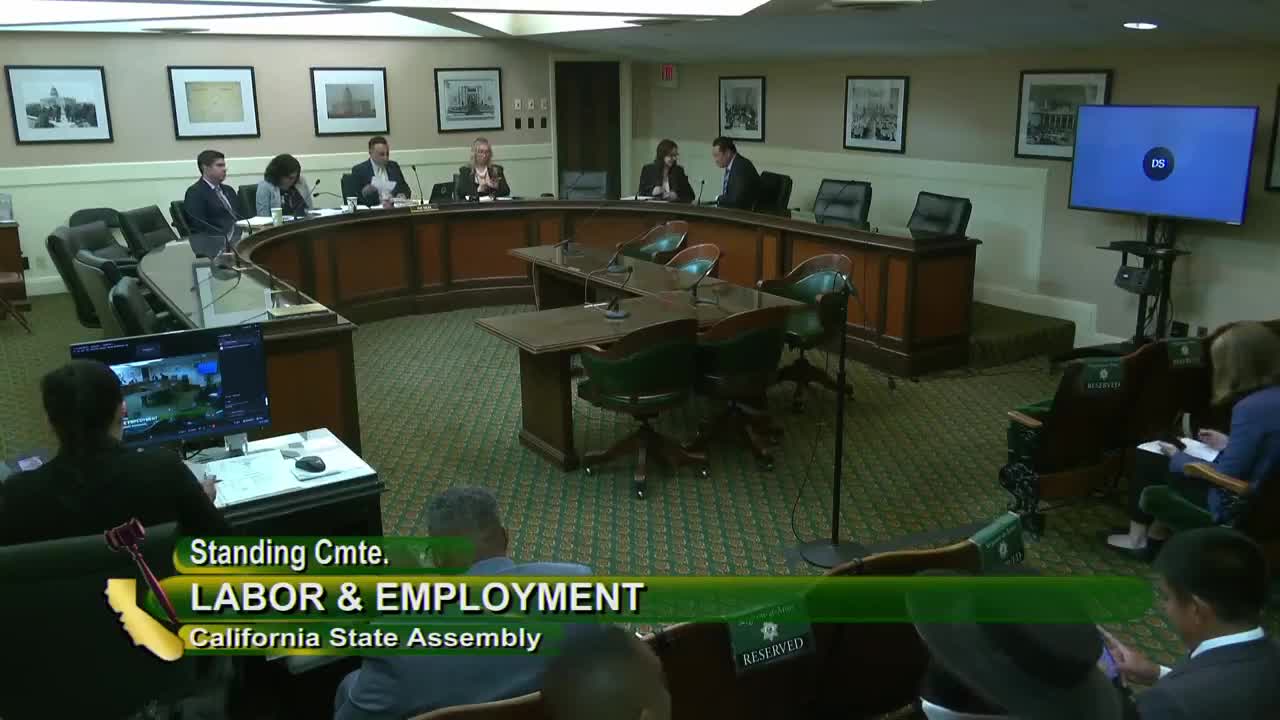 52SEC
Assembly Standing Committee on Labor and Employment
Bill Author
Bill Co-Author(s):