AB 1970: Mental Health: Black Mental Health Navigator Certification.
- Session Year: 2023-2024
- House: Assembly
- Latest Version Date: 2024-06-18
Current Status:
Failed
(2024-08-15: In committee: Held under submission.)
Introduced
In Committee
First Chamber
In Committee
Second Chamber
Enacted
What does this bill do?
The bill directs the state agency that oversees health training to create a Black Mental Health Navigator certification and specialized training to help Black Californians find and use mental health services and connect with licensed providers. It also requires the agency, if the Legislature provides funding, to publish yearly counts and demographic data on who earns each type of community health worker certificate and how many work in community health roles, while keeping names and personal IDs private.
The summary is provided by generative AI which can make mistakes. For original language, please view the details in the table below.
Existing law establishes, within the Health and Welfare Agency, the Department of Health Care Access and Information, which is responsible for, among other things, administering various health professions training and development programs. Existing law requires the department to develop and approve statewide requirements for community health worker certificate programs. Existing law defines community health worker to mean a liaison, link, or intermediary between health and social services and the community to facilitate access to services and to improve the access and cultural competence of service delivery.
This bill would require the department to, on or before July 1, 2025, to develop criteria for a specialty certificate program and specialized training requirements for a Black Mental Health Navigator Certification, as specified. The bill would require the department to collect and regularly publish data, not less than annually, including, but not limited to, the number of individuals certified, including those who complete a specialty certificate program, as specified, and the number of individuals who are actively employed in a community health worker role. The bill would make these provisions subject to an appropriation by the Legislature.
Existing law establishes, within the Health and Welfare Agency, the Department of Health Care Access and Information, which is responsible for, among other things, administering various health professions training and development programs. Existing law requires the department to develop and approve statewide requirements for community health worker certificate programs. Existing law defines community health worker to mean a liaison, link, or intermediary between health and social services and the community to facilitate access to services and to improve the access and cultural competence of service delivery.
This bill would require the department to to, on or before July 1, 2025, develop criteria for a specialty certificate program and specialized training requirements for a Black Mental Health Navigator Certification, as specified. The bill would require the department to collect and regularly publish data, not less than annually, including, but not limited to, the number of individuals certified, including those who complete a specialty certificate program, as specified, and the number of individuals who are actively employed in a community health worker role.
Existing law establishes, within the Health and Welfare Agency, the Department of Health Care Access and Information, which is responsible for, among other things, administering various health professions training and development programs. Existing law requires the department to develop and approve statewide requirements for community health worker certificate programs. Existing law defines community health worker to mean a liaison, link, or intermediary between health and social services and the community to facilitate access to services and to improve the access and cultural competence of service delivery.
This bill would require the department to develop criteria for a specialty certificate program and specialized training requirements for a Black Mental Health Navigator Certification, as specified. The bill would require the department to collect and regularly publish data, not less than annually, including, but not limited to, the number of individuals certified, including those who complete a specialty certificate program, as specified, and the number of individuals who are actively employed in a community health worker role.
Existing law authorizes the State Department of State Hospitals, the State Department of Health Care Services, and other departments as necessary to perform various tasks relating to mental health services, including, among others, disseminating educational information relating to the prevention, diagnosis, and treatment of mental illness and, upon request, advising all public officers, organizations, and agencies interested in the mental health of the people of the state.This bill would, commencing July 1, 2025, establish, until June 30, 2028, the Black Mental Health Navigator Certification Pilot Program, to be administered by the State Department of Health Care Services, to provide comprehensive training in mental health resources and awareness, as specified. This bill would require the department to collect specific data and submit a report to the Legislature and the relevant policy committees on or before December 31, 2028. The bill would make those provisions contingent upon appropriation and would repeal those provisions on January 1, 2030.Existing law authorizes the State Department of State Hospitals, the State Department of Health Care Services, and other departments as necessary to perform various tasks relating to mental health services, including, among others, disseminating educational information relating to the prevention, diagnosis, and treatment of mental illness and, upon request, advising all public officers, organizations, and agencies interested in the mental health of the people of the state.
This bill would, commencing July 1, 2025, establish, until June 30, 2028, the Black Mental Health Navigator Certification Pilot Program, to be administered by the State Department of Health Care Services, to provide comprehensive training in mental health resources and awareness, as specified. This bill would require the department to collect specific data and submit a report to the Legislature and the relevant policy committees on or before December 31, 2028. The bill would make those provisions contingent upon appropriation and would repeal those provisions on January 1, 2030.
(a)(1)Pursuant to paragraph (3) of subdivision (a) of Section 18998.1, the department shall, on or before July 1, 2025, upon appropriation by the Legislature, develop criteria for a specialty certificate program and specialized training requirements for a Black Mental Health Navigator Certification.
(2)The department shall solicit stakeholder feedback on the criteria for the certificate.
(3)The department may engage a community-based organization with relevant expertise about mental health and wellness in Black communities to advise on or to develop the criteria.
(b)The Black Mental Health Navigator Certification specialty certificate program and specialized training shall include comprehensive training in mental health resources and awareness, including, but not limited to, entry-level assessments, crisis intervention training for nonemergency cases, navigation support, and culturally specific practices relative to delivering public health and mental health assistance to help connect individuals with state resources, licensed mental health professionals, and wellness services.
SEC. 2.Section 18998.35 is added to the Welfare and Institutions Code, to read:18998.35.(a)The Upon appropriation by the Legislature, the department shall collect and regularly publish data, not less than annually, including, but not limited to, both of the following:
(1)The number of individuals certified, and corresponding demographic information on the individuals certified, including those who complete a specialty certificate program and specialized training, by each type of certificate.
(2)The number of individuals who are actively employed in a community health worker role.
(b)This section does not require the reporting of the names or personal identifying information.
(a)(1)Pursuant to paragraph (3) of subdivision (a) of Section 18998.1, the department shall shall, on or before July 1, 2025, develop criteria for a specialty certificate program and specialized training requirements for a Black Mental Health Navigator Certification.
(2)The department shall solicit stakeholder feedback on the criteria for the certificate.
(3)The department may engage a community-based organization with relevant expertise about mental health and wellness in Black communities to advise on or to develop the criteria.
(b)The Black Mental Health Navigator Certification specialty certificate program and specialized training shall include comprehensive training in mental health resources and awareness, including, but not limited to, entry-level assessments, crisis intervention training for nonemergency cases, navigation support, and Afrocentric culturally specific practices relative to delivering public health and mental health assistance to help connect individuals with state resources, licensed mental health professionals, and wellness services.
SEC. 2.Section 18998.35 is added to the Welfare and Institutions Code, to read:18998.35.(a)The department shall collect and regularly publish data, not less than annually, including, but not limited to, both of the following:
(1)The number of individuals certified, and corresponding demographic information on the individuals certified, including those who complete a specialty certificate program and specialized training, by each type of certificate.
(2)The number of individuals who are actively employed in a community health worker role.
(b)This section does not require the reporting of the names or personal identifying information.
(a)(1)Pursuant to paragraph (3) of subdivision (a) of Section 18998.1, the department shall develop criteria for a specialty certificate program and specialized training requirements for a Black Mental Health Navigator Certification.
(2)The department shall solicit stakeholder feedback on the criteria for the certificate.
(3)The department may engage a community-based organization with relevant expertise about mental health and wellness in Black communities to advise on or to develop the criteria.
(b)The Black Mental Health Navigator Certification specialty certificate program and specialized training shall include comprehensive training in mental health resources and awareness, including, but not limited to, entry-level assessments, crisis intervention training for nonemergency cases, navigation support, and Afrocentric practices relative to delivering public health and mental health assistance to help connect individuals with state resources, licensed mental health professionals, and wellness services.
SEC. 2.Section 18998.35 is added to the Welfare and Institutions Code, to read:18998.35.(a)The department shall collect and regularly publish data, not less than annually, including, but not limited to, both of the following:
(1)The number of individuals certified, and corresponding demographic information on the individuals certified, including those who complete a specialty certificate program and specialized training, by each type of certificate.
(2)The number of individuals who are actively employed in a community health worker role.
(b)This section does not require the reporting of the names or personal identifying information.
SECTION 1.Chapter 3 (commencing with Section 4342) is added to Part 3 of Division 4 of the Welfare and Institutions Code, to read:3.Black Mental Health Navigator Certification Pilot Program4342.This chapter shall be known, and may be cited, as the Black Mental Health Navigator Certification Pilot Program.4342.01.(a)(1)The Black Mental Health Navigator Certification Pilot Program is hereby established to provide comprehensive training in mental health resources and awareness, including, but not limited to, entry-level assessments, crisis intervention training for nonemergency cases, navigation support, and Afrocentric practices relative to delivering public health and mental health assistance to help connect individuals with state resources, licensed mental health professionals, and wellness services.(2)The State Department of Health Care Services shall issue a certificate of completion to every person who completes this program.(b)The State Department of Health Care Services shall administer this pilot program.(c)The pilot program shall begin on July 1, 2025, and end on June 30, 2028.4342.04.(a)The State Department of Health Care Services shall monitor the pilot program and collect data regarding the program, including, but not limited to, all of the following:(1)The certification completion rate.(2)The number of navigators who are actively employed as a navigator.(3)The number of referrals given by navigators.(4)The amount of time it takes from receiving a request to the delivery of services.(5)The patient retention rate.(6)(A)Patient demographic information.(B)This paragraph does not require the reporting of the names or personal identifying information.(b)(1)The State Department of Health Care Services shall, on or before December 31, 2028, submit a report to the Legislature and the relevant policy committees containing the data collected pursuant to subdivision (a).(2)The report submitted pursuant to this section shall be submitted in accordance with Section 9795 of the Government Code.4342.05.(a)This chapter shall be contingent upon appropriation, by express reference, in the annual Budget Act or another statute for the purposes of this chapter.(b)This chapter shall remain in effect only until January 1, 2030, and as of that date is repealed. REVISIONS: HeadingLine 2.This chapter shall be known, and may be cited, as the Black Mental Health Navigator Certification Pilot Program.
4342.01.(a)(1)The Black Mental Health Navigator Certification Pilot Program is hereby established to provide comprehensive training in mental health resources and awareness, including, but not limited to, entry-level assessments, crisis intervention training for nonemergency cases, navigation support, and Afrocentric practices relative to delivering public health and mental health assistance to help connect individuals with state resources, licensed mental health professionals, and wellness services.
(2)The State Department of Health Care Services shall issue a certificate of completion to every person who completes this program.
(b)The State Department of Health Care Services shall administer this pilot program.
(c)The pilot program shall begin on July 1, 2025, and end on June 30, 2028.
4342.04.(a)The State Department of Health Care Services shall monitor the pilot program and collect data regarding the program, including, but not limited to, all of the following:
(1)The certification completion rate.
(2)The number of navigators who are actively employed as a navigator.
(3)The number of referrals given by navigators.
(4)The amount of time it takes from receiving a request to the delivery of services.
(5)The patient retention rate.
(6)(A)Patient demographic information.
(B)This paragraph does not require the reporting of the names or personal identifying information.
(b)(1)The State Department of Health Care Services shall, on or before December 31, 2028, submit a report to the Legislature and the relevant policy committees containing the data collected pursuant to subdivision (a).
(2)The report submitted pursuant to this section shall be submitted in accordance with Section 9795 of the Government Code.
4342.05.(a)This chapter shall be contingent upon appropriation, by express reference, in the annual Budget Act or another statute for the purposes of this chapter.
(b)This chapter shall remain in effect only until January 1, 2030, and as of that date is repealed.
|
Date
|
Status
|
|---|---|
| Aug 15, 2024 | In committee: Held under submission. |
| Jun 24, 2024 | In committee: Referred to suspense file. |
| Jun 18, 2024 | From committee chair, with author's amendments: Amend, and re-refer to committee. Read second time, amended, and re-referred to Com. on APPR. |
| Jun 13, 2024 | From committee: Do pass and re-refer to Com. on APPR. (Ayes 9. Noes 0.) (June 12). Re-referred to Com. on APPR. |
| Jun 3, 2024 | From committee chair, with author's amendments: Amend, and re-refer to committee. Read second time, amended, and re-referred to Com. on HEALTH. |
| May 29, 2024 | Referred to Com. on HEALTH. |
| May 22, 2024 | In Senate. Read first time. To Com. on RLS. for assignment. |
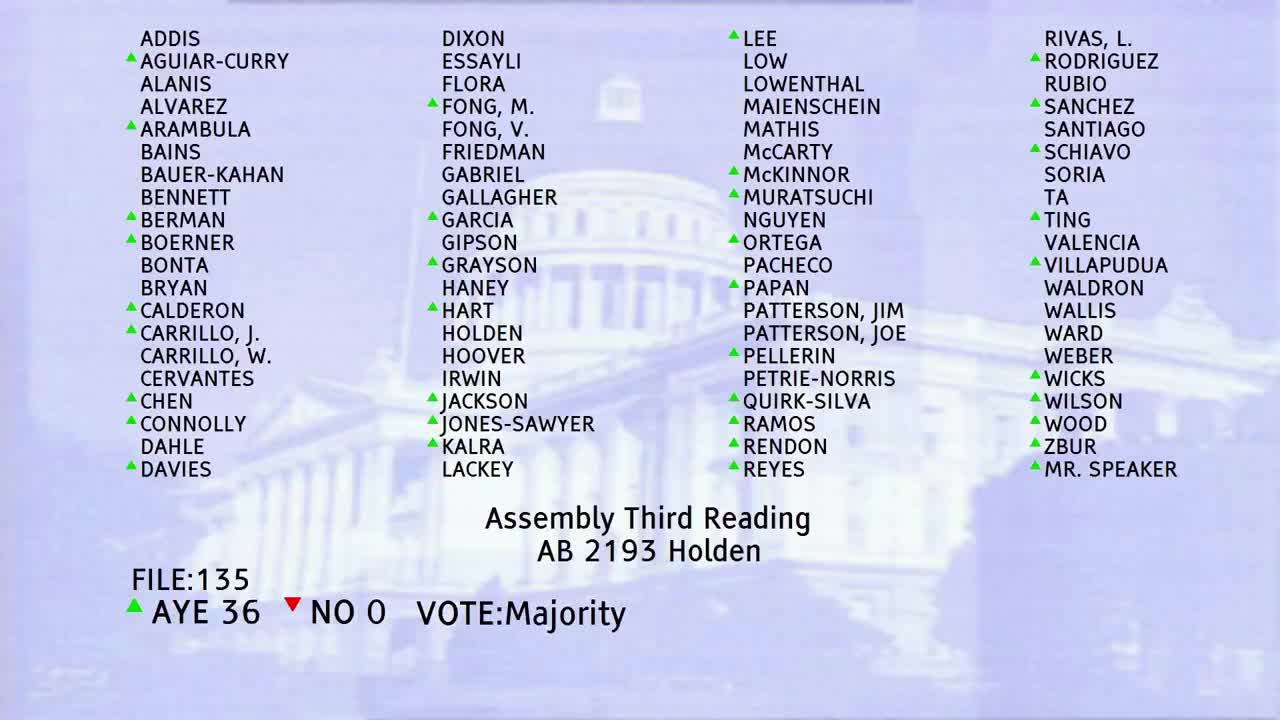
| May 21, 2024 | Read third time. Passed. Ordered to the Senate. (Ayes 62. Noes 1. Page 5407.) |
| May 20, 2024 | Read second time. Ordered to third reading. |
| May 16, 2024 | From committee: Do pass. (Ayes 11. Noes 2.) (May 16). |
| May 1, 2024 | In committee: Set, first hearing. Referred to APPR. suspense file. |
| Apr 10, 2024 | From committee: Do pass and re-refer to Com. on APPR. (Ayes 13. Noes 0.) (April 9). Re-referred to Com. on APPR. |
| Apr 10, 2024 | Coauthors revised. |
| Apr 2, 2024 | Re-referred to Com. on HEALTH. |
| Apr 1, 2024 | From committee chair, with author's amendments: Amend, and re-refer to Com. on HEALTH. Read second time and amended. |
| Feb 12, 2024 | Referred to Com. on HEALTH. |
| Jan 31, 2024 | From printer. May be heard in committee March 1. |
| Jan 30, 2024 | Read first time. To print. |
|
Date
|
Description
|
Location
|
Votes
|
|
|---|---|---|---|---|
| Jun 24, 2024 | Placed on suspense file | Senate Standing Committee on Appropriations |
Passed |
|
| Jun 12, 2024 | Do pass, but first be re-referred to the Committee on [Appropriations] | Senate Standing Committee on Health |
Passed |
|
| May 21, 2024 | AB 1970 Jackson Assembly Third Reading | Assembly Floor |
Passed |
|
| May 16, 2024 | Do pass. | Assembly Standing Committee on Appropriations |
Passed |
|
| Apr 9, 2024 | Do pass and be re-referred to the Committee on [Appropriations] | Assembly Standing Committee on Health |
Passed |
This list shows positions taken on this bill by organizations on the date displayed, which is linked to the original source.
Positions by individuals are not included.
|
Organization
|
Position
|
Date
|
|---|---|---|
| California Academy Of Family Physicians | * Support | Jun 12, 2024 |
| California Alliance Of Child And Family Services | * Support | Jun 12, 2024 |
| California Black Health Policy Advisory Council | * Support | Apr 9, 2024 |
| California Black Women's Health Project | * Support | Apr 9, 2024 |
| California Black Women's Health Project | * Support | Jun 12, 2024 |
| California Family Resource Association | ** Support | |
| California Medical Association | * Support | Jun 14, 2024 |
| California Pan - Ethnic Health Network | ** Support | |
| California State Association of Psychiatrists | * For If Amend | Apr 9, 2024 |
| Child Abuse Prevention Center | ** Support | |
| National Association of Social Workers California | ** Support | |
| Planned Parenthood Affiliates Of California | * Support | Jun 12, 2024 |
| Prevent Child Abuse California | ** Support | |
| Safe Kids California | ** Support |
SENATE COMMITTEE ON
Senator Anna Caballero, Chair
2023 - 2024 Regular Session
AB 1970 (Jackson) - Mental Health: Black Mental Health Navigator Certification
Version: | Policy Vote: |
Urgency: | Mandate: |
Hearing Date: | Consultant: |
Bill Summary:
AB 1970 would require the Department of Health Care Access and Information (HCAI) to develop criteria for a specialty certificate program and specialized training requirements for a Black Mental Health Navigator Certification.
Fiscal Impact:
The HCAI estimates General Fund cost pressures of $986,000 in 2025-26 and $606,000 in 2026-27 and ongoing thereafter for state administration, including staffing resources and information technology.
Background:
Current law defines “community health worker (CHW)” to mean a liaison, link, or intermediary between health and social services and the community to facilitate access to services and to improve the access and cultural competence of service delivery. Current law requires the HCAI to develop statewide requirements for CHW certificate programs in consultation with stakeholders, including, but not limited to, the Department of Health Care Services (DHCS), the Department of Public Health, CHWs, Promotores and Promotores de Salud, or representative organizations.
Current law also requires HCAI to approve statewide requirements for the development of certificate programs; approve the curriculum required for programs to certify CHWs; and, review, approve, or renew evidence-based curricula and community-defined curricula for core competencies, specialized programs, and training.
Proposed Law:
Specific provisions of the bill would:
- Require HCAI, upon appropriation and pursuant to the CHW certificate program, to develop criteria for a specialty certificate program and specialized training requirements for a Black Mental Health Navigator Certification, as specified.
- Require HCAI, upon appropriation, to collect and regularly publish data, not less than annually, including, but not limited to, both of the following:
- The number of individuals certified, and corresponding demographic information on the individuals certified, including those who complete a specialty certificate program and specialized training, by each type of certificate.
- The number of individuals who are actively employed in a community health worker role.
-- END --
SENATE COMMITTEE ON HEALTH
Senator Richard Roth, Chair
BILL NO: AB 1970
AUTHOR: | Jackson | ||
VERSION: | June 3, 2024 | ||
HEARING DATE: | June 12, 2024 | ||
CONSULTANT: | Reyes Diaz | ||
SUBJECT: Mental Health: Black Mental Health Navigator Certification
SUMMARY:
Requires the Department of Health Care Access and Information, on or before July 1, 2025, to develop criteria for a specialty certificate program and specialized training requirements for a Black Mental Health Navigator Certification.
Existing law:
- Requires the Department of Health Care Access and Information (HCAI) to develop statewide requirements for “community health worker” (CHW) certificate programs in consultation with stakeholders, including, but not limited to, the Department of Health Care Services (DHCS), the Department of Public Health, CHWs, Promotores and Promotores de Salud, or representative organizations. Requires HCAI, in developing the requirements, to:
- Consult evidenced-based and community-defined materials;
- Determine necessary curriculum to meet certificate program objectives;
- Determine criteria for specialty certificate programs and specialized training requirements that build on the lived experience of CHWs;
- Determine a structure of statewide oversight that reduces barriers to training;
- Determine how past experience as a community health worker may provide a pathway to certification, and how to verify past experience. [WIC §18998.1]
- Requires HCAI additionally to approve statewide requirements for the development of certificate programs CHW; approve the curriculum required for programs to certify CHWs; and, review, approve, or renew evidence-based curricula and community-defined curricula for core competencies, specialized programs, and training. [WIC §18998.1]
- Establishes the Medi-Cal program, administered by DHCS, under which low-income individuals are eligible for medical coverage. [WIC §14000, et seq.]
- Establishes a schedule of benefits under the Medi-Cal program, which includes benefits required under federal law and benefits provided at state option but for which federal financial participation is available. Makes CHW services a covered Medi-Cal benefit subject to federal approval. [WIC §14132, §14132.36]
- Permits HCAI, in consultation with stakeholders, to request that an individual who is either enrolled in, or who has completed, a CHW certificate program submit data consistent with collected workforce data from licensees and registrants, as specified, for future workforce planning. [WIC §18998.3]
This bill:
- Requires HCAI, on or before July 1, 2025, pursuant to the CHW certificate program, to develop criteria for a specialty certificate program and specialized training requirements for a Black Mental Health Navigator Certification (BMHNC). Requires HCAI to solicit stakeholder feedback on the criteria for this certification, as specified.
- Requires the BMHNC specialty certificate program and specialized training to include comprehensive training in mental health resources and awareness, including, but not limited to, entry-level assessments, crisis intervention training for nonemergency cases, navigation support, and culturally specific practices relative to delivering public health and mental health assistance to help connect individuals with state resources, licensed mental health professionals, and wellness services.
- Requires HCAI, in order to further their efforts on data collection for future workforce planning, to collect and regularly publish data, not less than annually, including, but not limited to:
- The number of individuals certified, and corresponding demographic information on the individuals certified, including those who complete a specialty certificate program and specialized training, by each type of certificate; and,
- The number of individuals who are actively employed in a CHW role.
FISCAL EFFECT:
According to the Assembly Appropriations Committee, HCAI estimates costs of $986,000 in fiscal year (FY) 2025-26 and $606,000 in FY 2026-27, and ongoing for staff to develop the program outlined in the bill and to build out the certificate application portal (General Fund). HCAI has been allocated funds to develop CHW training and certification.
According to the Legislative Analyst's Office, the General Fund faces a structural deficit in the tens of billions of dollars over the next several fiscal years.
PRIOR VOTES:
Assembly Floor: | 62 - 1 |
Assembly Appropriations Committee: | 11 - 2 |
Assembly Health Committee: | 13 - 0 |
COMMENTS:
- Author’s statement. According to the author, California must ensure equal access and quality health care for our African-American communities. Studies consistently highlight disparities in health outcomes among people of color, particularly within our Black communities—an inequity that stems partly from a lack of cultural specificity among health care providers. This bill aims to address these disparities by implementing better training and data reporting on CHWs, paving the way for long-term policy solutions.
- Mental health disparities in the Black community. According to the National Alliance on Mental Illness (NAMI) California, while the experience of being Black in the U.S. varies tremendously, there are shared cultural factors that play a role in helping define mental health and supporting well-being, resiliency, and healing. Part of this shared cultural experience—family connections, values, expression through spirituality or music, reliance on community, and religious networks—are enriching and can be great sources of strength and support. However, another part of this shared experience is facing racism, discrimination, and inequity that can significantly affect a person’s mental health. Being treated or perceived as less than because of the color of your skin can be stressful and even traumatizing. Additionally, members of the Black community face structural challenges accessing the care and treatment they need. Black adults in the U.S. are more likely than White adults to report persistent symptoms of emotional distress, such as sadness, hopelessness, and feeling like everything is an effort. Black adults living below the poverty line are more than twice as likely as those with more financial security to report serious psychological distress. Despite the needs, only one in three Black adults who need mental health care receive it. According to the American Psychiatric Association’s Mental Health Facts for African Americans, they are also less likely to receive guideline-consistent care, less frequently included in research, and more likely to use emergency rooms or primary care (rather than mental health specialists). Socioeconomic factors also can make treatment options less available.
Further, negative attitudes and beliefs towards people who live with mental health conditions is pervasive within the U.S. and can be particularly strong within the Black community. One study showed that 63% of Black people believe that a mental health condition is a sign of personal weakness. As a result, people may experience shame about having a mental illness and worry that they may be discriminated against due to their condition. For many in the Black community, it can be incredibly challenging to discuss the topic of mental health due to this concern about how they may be perceived by others. This fear could prevent people from seeking mental health care when they really need it.
- Addition of CHWs as a Medi-Cal benefit. AB 2697 (Aguiar-Curry, Chapter 488, Statutes of 2022) implemented the CHW covered Medi-Cal benefit. DHCS defines a CHW as a frontline health worker who is a trusted member of and/or has an unusually close understanding of the community served. The trusting relationship enables the CHW to serve as a liaison/link/intermediary between health and social services and the community to facilitate access to services and improve the quality and cultural competence of service delivery through care coordination, screening, and other care support activities. A CHW also improves population health, builds individual, and community capacity by increasing health knowledge and self-sufficiency through a range of activities such as outreach, community education, informal counseling, social support, and advocacy.
Effective January 8, 2024, community based organizations and local health jurisdictions providing CHW and/or asthma preventive services can now enroll as Medi-Cal providers. Those who successfully enroll through the Medi-Cal fee-for-service enrollment process are eligible to contract with MCPs.
- State’s certification effort paused. According to HCAI’s website, after hearing from community partners about the need for additional community engagement on the rollout of the CHW certification program, the California Health and Human Services Agency, HCAI, and DHCS announced a pause to the previously issued July 2023 HCAI guidance letter. HCAI asserts that it is committed to broadening and continuing the engagement with community partners, which includes an additional series of dialogue sessions to re-engage stakeholders about the CHW certification program. The purpose of the dialogues is to hear from community partners about 1) how to build CHW capacity across California; 2) how to increase uptake of the Medi-Cal benefit; and, 3) any concerns regarding the certificate program as set out in HCAI’s July 2023 guidance letter. After the dialogue sessions conclude, HCAI hopes to develop strategies to build up the infrastructure and investments needed to scale up and support the CHW workforce across the state. Discussions will include the purpose and scope of a CHW certificate, development of common curricula, investments in CHW training capacity, and other ways to use funding to better support CHW workforce development and community access to health care. Strategies will be reviewed by a CHW Advisory Workgroup and used to inform the allocation of HCAI funding for CHWs.
- Related legislation. AB 2250 (Weber) requires health plans and insurers to cover screenings for social determinants of health (SDOH) and provide primary care providers with adequate access to CHWs and social workers, among other types of workers. Requires DHCS to provide reimbursement for SDOH screenings as a covered Medi-Cal benefit. AB 2250 is pending in the Senate Appropriations Committee.
AB 2110 (Arambula) would have required DHCS to provide payment for Adverse Childhood Experiences screenings provided by doulas, as well as community-based organizations and local health jurisdictions that provide health services through CHWs. AB 2110 was held on the Assembly Appropriations suspense file.
- Prior legislation. SB 184 (Committee on Budget and Fiscal Review, Chapter 47, Statutes of 2022) implemented the requirement for HCAI to develop statewide requirements for CHW certificate programs.
AB 2697 (Aguiar-Curry, Chapter 488, Statutes of 2022) implemented the CHW covered Medi-Cal benefit.
- Support. California Primary Care Association (CPCA) Advocates write that community health centers (CHCs) and clinics provide high quality, comprehensive care to 7.8 million people in California each year. These CHCs and clinics provide care to nearly one-third of the Medi-Cal population, providing the full spectrum of care, from primary care, dental, reproductive, and behavioral health services to a variety of enabling and wraparound services. In many rural communities, CHCs serve as the only source of medical and wellness care for lower-to-middle class families. To truly make our communities healthier, our systems of care must tackle SDOH, which can commonly be grouped into five categories: economic stability, education access and quality, health care access and quality, neighborhood and built environment, and social and community context. For many CHC patients, these factors weigh heavily in determining a person’s health outcomes. Where a person is born often has more to do with long-term health conditions and outcomes than other factors. For Black communities, health outcomes are often worse because of many historical and systemic inequities. In 2020, 10.4% of Black adults in the U.S. had no form of health insurance. The Black community, like other communities of color, are more likely to experience socioeconomic disparities, such as exclusion from health, educational, social, and economic resources. These disparities may contribute to worse mental health outcomes. Black adults are more likely than Whites adults to report persistent symptoms of emotional distress. Despite the needs, only one in three Black adults with mental illness receive treatment. This bill seeks to ensure equal access and quality mental health access for Black communities. Disability Rights California echoes many of the arguments made by CPCA Advocates.
- How does this bill differ from existing law? Under the current CHW certification program, HCAI has the authority to determine criteria for specialty certificate programs and specialized training requirements that build on the lived experience of CHWs. The provisions of this bill also specify that the BMHNC program be developed pursuant to the CHW certification program. This bill appears to be duplicative of existing law, resulting in an unclear effect.
SUPPORT AND OPPOSITION:
Support: California Family Resource Association
California Pan-Ethnic Health Network
Child Abuse Prevention Center
CleanEarth4Kids.org
California Primary Care Association Advocates
Disability Rights California
First 5 California
National Association of Social Workers California
Oppose: None received
-- END --
ASSEMBLY THIRD READING
ATR Bill Id:AB 1970
Author:(Jackson)
As Amended Ver:April 1, 2024
Majority vote
SUMMARY
Requires the Department of Health Care Access and Information (HCAI) to develop, as a component of an existing Community Health Worker (CHW) certificate program, criteria for a specialty certificate program and specialized training requirements for a Black Mental Health Navigator Certification, and report related program data.
Major Provisions
COMMENTS
- Mental Health Disparities in Black/African American Communities. Racial and ethnic disparities in health and health care remain a persistent challenge in the United States. Compared with non-Hispanic whites, Black and African Americans with any mental illness have lower rates of any mental health service use including prescription medications and outpatient services, but higher use of inpatient services. According to the federal Substance Abuse and Mental Health Services Administration, Black and African Americans and other minority groups experience barriers to behavioral health services and care, including bias, stigma, mistrust of health care providers, provider shortages, and lack of culturally competent providers.
- CHWs. According to the National Association of Community Health Workers, "CHW" is used as an umbrella term to describe community health representatives, promotores de salud or promotoras, outreach workers, and many other different work titles. CHWs share life experience with the people they serve and have firsthand knowledge of the causes and impacts of health inequity. They provide health education, navigation, coaching, screening and referral to services, and advocacy and support. In the United States (US), the majority of CHWs serve communities that have experienced structural oppression and who are marginalized by traditional health care systems, including Black, Latinx, American Indian/Alaska Native, and Asian/Pacific Islander communities, as well as rural and low-income communities.
CHWs can and do work in the behavioral health field alongside peer support specialists and licensed clinicians. However, they are not limited to working in behavioral health.
- Recent State Efforts. In recent years, the state has enacted two major initiatives related to CHWs, promotoras, and community health representatives (CHW/P/Rs): First, DHCS added CHW services as a Medi-Cal benefit starting in July 1, 2022, and has leveraged CHW/P/Rs in specific roles under the Medi-Cal transformation project called California Advancing and Innovating Medi-Cal (CalAIM). Under Medi-Cal, supervising providers can bill for the services CHW/P/Rs provide across a wide range of health conditions, including behavioral health.
Second, the 2022 Budget Act included $281.4 million over three years to support a new program administered by HCAI to recruit, train, and certify 25,000 new CHW/P/Rs by 2025, including those with specialized training to work with specific populations or on specific issues. The Governor's May Revision eliminates funding for this HCAI CHW/P/R workforce program.
- Implementation of this Bill. Statute requires HCAI to determine criteria for specialty certificate programs and specialized training requirements that build on the lived experience of CHWs. HCAI has not yet adopted curricula for specialty certificates. This bill would require adoption of a specialty certificate specific to the mental health needs of Black/African American people and require reporting on the number of people who earn certificates, including the specialty certificates. Once the state approves the curriculum, training entities make available the applicable training, and individuals earn the certificates, then providers, including community-based organizations, can employ these trained CHWs who are trained and possess the Black Mental Health Navigator Certification. Providers would then be able to bill Medi-Cal through the CHW benefit for provision of covered CHW services, including navigation, screening and assessment, health education, and individual support and advocacy, to Medi-Cal eligible individuals.
According to the Author
California must ensure equal access and quality healthcare for our African American communities. The author notes studies consistently highlight disparities in health outcomes among people of color, particularly within our Black communities—an inequity that stems partly from a lack of cultural competency among healthcare providers. This bill aims to address these disparities by implementing better training and data reporting on CHWs, paving the way for long-term policy solutions. California Black Health Network is this bill's sponsor.
Arguments in Support
National Association of Social Workers California Chapter writes in support that this bill directs attention to a particular demographic and emphasizes the importance of delivering services with competence by mandating a thorough understanding of who our clients are and what social conditions have historically impacted their trajectory through multiple generations. The California Pan-Ethnic Health Network indicates providing targeted mental health support tailored to the specific needs and experiences of Black communities is essential for addressing disparities and promoting overall well-being. The California State Association of Psychiatrists writes that while they support the bill and its intentions, changing the language to Behavioral Health would be more inclusive and allow for a more accurate and comprehensive representation of the individuals the legislation is aimed at helping.
Arguments in Opposition
There is no known opposition.
FISCAL COMMENTS
According to the Assembly Appropriations Committee:
HCAI estimates costs of $986,000 in fiscal year 2025-26 and $606,000 in FY 2026-27 and ongoing for staffing to develop the program outlined in the bill and to build out the certificate application portal (General Fund). HCAI has been allocated funds to develop CHW training and certification.
According to the Legislative Analyst's Office, the General Fund faces a structural deficit in the tens of billions of dollars over the next several fiscal years.
VOTES
ASM HEALTH: 13-0-3
YES: Bonta, Waldron, Aguiar-Curry, Arambula, Wendy Carrillo, Haney, Jones-Sawyer, Maienschein, McCarty, Rodriguez, Santiago, Schiavo, Weber
ABS, ABST OR NV: Flora, Joe Patterson, Sanchez
ASM APPROPRIATIONS: 11-2-2
YES: Wicks, Arambula, Bryan, Calderon, Wendy Carrillo, Mike Fong, Grayson, Haney, Hart, Pellerin, Villapudua
NO: Dixon, Jim Patterson
ABS, ABST OR NV: Sanchez, Ta
UPDATED
VERSION: April 1, 2024
CONSULTANT: Lisa Murawski / HEALTH / (916) 319-2097 FN: 0003220
Date of Hearing: May 1, 2024
ASSEMBLY COMMITTEE ON APPROPRIATIONS
Buffy Wicks, Chair
ABPCA Bill Id:AB 1970
Author:(Jackson) – As Amended Ver:April 1, 2024
Policy Committee: | Health | Vote: | 13 - 0 |
|
| ||
|
|
Urgency: No State Mandated Local Program: No Reimbursable: No
SUMMARY:
This bill requires the Department of Health Care Access and Information (HCAI) to develop, as part of an existing Community Health Worker (CHW) certificate program, a Black Mental Health Navigator Certification, and to collect and regularly publish specified data on the certification program.
Specifically, this bill:
- Requires HCAI to develop criteria for a specialty certificate program and specialized training requirements for a Black Mental Health Navigator Certification.
- Includes, in the criteria developed pursuant to 1, above, comprehensive training in mental health resources and awareness, including entry-level assessments, crisis intervention training for nonemergency cases, navigation support, and Afrocentric practices relative to delivering public health and mental health assistance to help connect individuals with state resources, licensed mental health professionals, and wellness services.
- Requires HCAI to solicit stakeholder feedback on criteria for the certificate and allows HCAI to engage a community-based organization to advise on or to develop the criteria.
- Requires HCAI to collect and regularly publish data, not less than annually, on individuals who earn a certificate, including a specialty certificate, as well as the number who are actively employed in a community health worker role.
FISCAL EFFECT:
HCAI estimates costs of $986,000 in fiscal year (FY) 2025-26 and $606,000 in FY 2026-27 and ongoing for staffing to develop the program outlined in the bill and to build out the certificate application portal (General Fund).
As noted below under “State Initiatives,” HCAI has been allocated funds to develop CHW training and certification.
According to the Legislative Analyst’s Office, the General Fund faces a structural deficit in the tens of billions of dollars over the next several fiscal years.
COMMENTS:
- Purpose. This bill is sponsored by the California Black Health Network. According to the author:
California must ensure equal access and quality healthcare for our African American communities. Studies consistently highlight disparities in health outcomes among people of color, particularly within our black communities. This inequity stems partly from a lack of cultural competency among healthcare providers. This bill aims to address these disparities by implementing better training and monitoring of healthcare professionals, paving the way for long-term policy solutions.
- State Initiatives. The state recently enacted two major initiatives related to CHWs, promotoras, and community health representatives (CHW/P/Rs). First, DHCS added CHW services as a Medi-Cal benefit starting in July 1, 2022 and leverages CHW/P/Rs in specific roles under the Medi-Cal transformation project called California Advancing and Innovating Medi-Cal (CalAIM). Under Medi-Cal, supervising providers may bill for the services CHW/P/Rs provide, including health education, navigation, limited screening and assessment to determine need for services, and individual support and advocacy across a wide range of health conditions, including behavioral health.
Second, the Budget Act of 2022 included $281.4 million over three years to support a new program administered by HCAI to recruit, train, and certify 25,000 new CHW/P/Rs by 2025. However, after recent proposed budget changes, HCAI states it has been allocated $280 million over four years to recruit, train, and certify 15,000 new CHWs by 2028, with specialized training to work with varying populations, such as people who are justice-involved, people who are unhoused, older adults, and people with disabilities. HCAI must develop statewide requirements for CHW certificate programs in consultation with stakeholders. The statute allows organizations to submit an application for HCAI approval of a CHW certificate program. - Related Legislation.
- AB 2250 (Weber) requires a health plan, health insurer, and Medi-Cal to provide coverage for, and reimbursement of, social determinants of health (SDOH) screenings. AB 2250 also requires a health plan or insurer to provide to physicians who provide primary care services with adequate access to peer support specialists, lay health workers, social workers, or CHWs, as defined. AB 2250 is pending in this committee.
- AB 2110 (Arambula) allows doulas, as well as community-based organizations and local health jurisdictions that provide health services through CHWs, to provide Adverse Childhood Experiences trauma screenings (ACEs screening) and makes them eligible for Medi-Cal reimbursement for the screening. AB 2110 is pending in this committee.
- AB 85 (Weber), of the current legislative session, is similar to AB 2250 and requires HCAI to convene a working group. AB 85 was vetoed by Governor Newsom, who was supportive of the goal of the proposal, but argued it is duplicative of existing efforts, such as ACEs screenings and the work DHCS is doing through the CalAIM initiative. The Governor also stated the bill may be premature given a standardized SDOH tool does not yet exist.
- Prior Legislation.
- AB 2697 (Aguiar-Curry), Chapter 488, Statutes of 2022, codifies CHW services as a covered Medi-Cal benefit.
- SB 184 (Committee on Budget and Fiscal Review), Chapter 47, Statutes of 2022, the 2022 Health Trailer Bill, describes the HCAI CHW initiative and requires HCAI to develop statewide requirements for CHW certificate programs in consultation with stakeholders.
Analysis Prepared by: Allegra Kim / APPR. / (916) 319-2081
Date of Hearing: April 9, 2024
ASSEMBLY COMMITTEE ON HEALTH
Mia Bonta, Chair
ABPCA Bill Id:AB 1970
Author:((Jackson) – As Amended Ver:April 1, 2024
SUBJECT: Mental Health: Black Mental Health Navigator Certification.
SUMMARY: Requires the Department of Health Care Access and Information (HCAI) to develop, as a component of an existing Community Health Worker (CHW) certificate program, criteria for a specialty certificate program and specialized training requirements for a Black Mental Health Navigator Certification, and report related program data. Specifically, this bill:
- Requires HCAI to develop criteria for a specialty certificate program and specialized training requirements for a Black Mental Health Navigator Certification.
- Includes, in the criteria developed pursuant to 1) above, comprehensive training in mental health resources and awareness, including, but not limited to, entry-level assessments, crisis intervention training for nonemergency cases, navigation support, and Afrocentric practices relative to delivering public health and mental health assistance to help connect individuals with state resources, licensed mental health professionals, and wellness services.
- Requires HCAI to solicit stakeholder feedback on criteria for the certificate and allows HCAI to engage a community-based organization with relevant expertise about mental health and wellness in Black communities to advise on or to develop the criteria.
- Requires HCAI to collect and regularly publish data, not less than annually, on the number and overall demographics of individuals who earn a certificate, including a specialty certificate, as well as the number of individuals who are actively employed in a community health worker role.
EXISTING LAW:
- Specifies CHW services as a covered benefit under Medi-Cal. [Welfare & Institutions Code (WIC) § 14132.36]
- Defines CHW to mean a liaison, link, or intermediary between health and social services and the community to facilitate access to services and to improve the access and cultural competence of service delivery. States that a CHW is a frontline health worker either trusted by, or who has a close understanding of, the community served, and requires a CHW’s lived experience to align with and provide a connection to the community being served. [WIC § 18998]
- States that CHWs include Promotores, Promotores de Salud, community health representatives, navigators, and other nonlicensed health workers, including violence prevention professionals. [ibid.]
- Requires HCAI to develop statewide requirements for CHW certificate programs in consultation with stakeholders, including, but not limited to, the Department of Health Care Services (DHCS), the California Department of Public Health, CHWs, Promotores and Promotores de Salud, or representative organizations. [ibid.]
- Requires, as part of 4), above, HCAI to determine criteria for specialty certificate programs and specialized training requirements that build on the lived experience of CHWs. [ibid.]
- Allows HCAI to, in consultation with stakeholders, request that an individual who is either enrolled in, or who has completed, a community health worker certificate program submit data, and allows HCAI to determine the frequency and manner of data submission. [ibid.]
FISCAL EFFECT: Unknown. This bill has not yet been analyzed by a fiscal committee.
COMMENTS:
- PURPOSE OF THIS BILL. According to the author, California must ensure equal access and quality healthcare for our African American communities. The author notes studies consistently highlight disparities in health outcomes among people of color, particularly within our Black communities—an inequity that stems partly from a lack of cultural competency among healthcare providers. This bill aims to address these disparities by implementing better training and data reporting on CHWs, paving the way for long-term policy solutions. California Black Health Network is this bill’s sponsor.
- BACKGROUND.
- Mental Health Disparities in Black/African American Communities. Racial and ethnic disparities in health and health care remain a persistent challenge in the United States. Compared with non-Hispanic whites, Black and African Americans with any mental illness have lower rates of any mental health service use including prescription medications and outpatient services, but higher use of inpatient services. Black people are also less likely to utilize psychiatric services, and if they receive care, it is usually of lower quality than care provided to white people. Consequently, unmet need for mental health care is greater among Black and African Americans than white people.
Unfortunately, unmet need for mental health care can manifest itself in crises. According to the Centers for Disease Control and Prevention, rates of mental health-related emergency department (ED) visits by race and Hispanic ethnicity were highest among non-Hispanic Black adults (96.8 visits per 1,000 adults), followed by non-Hispanic white (53.4) and Hispanic (36.0) adults. Rates of ED visits for specific mental health disorders, including substance use disorders, anxiety disorders, and mood disorders, were also highest among non-Hispanic Black adults.
According to KFF’s “Key Data on Health and Health Care by Race and Ethnicity,” among adults with any mental illness, Black (39%), Hispanic (36%), and Asian (25%) adults were less likely than white (52%) adults to receive mental health services as of 2021. Overall rates of mental illness and substance use disorder were lower for people of color compared to white people but could be underdiagnosed among people of color. Research suggests that a lack of culturally sensitive screening tools that detect mental illness, coupled with structural barriers could contribute to underdiagnosis of mental illness among people of color.
- Barriers to Mental Health Care. According to the federal Substance Abuse and Mental Health Services Administration, Black and African Americans and other minority groups experience barriers to behavioral health services and care including:
- Experiences of bias, stemming from historical, structural, and systemic racism, and discrimination;
- Mental health stigma which hinders Black and African Americans from seeking help;
- Mistrust of the health care system, access barriers and negative encounters with care professionals;
- Provider shortage due to the limited from diverse racial/ethnic backgrounds (only 2% of psychiatrists and 4% of psychologists in the United States are Black); and,
- Lack of culturally competent providers to meet cultural, social, and language-related needs.
- Barriers to Mental Health Care. According to the federal Substance Abuse and Mental Health Services Administration, Black and African Americans and other minority groups experience barriers to behavioral health services and care including:
According to the American Psychiatric Association, other common barriers reported in the Black population include the importance of family privacy, lack of knowledge regarding available treatments, and denial of mental health problems. Concerns about medications, not receiving appropriate information about services, and dehumanizing services have also been reported to hinder Black and African Americans from accessing mental health services.
- CHWs. According to the National Association of Community Health Workers, “CHW” is used as an umbrella term to describe community health representatives, promotores de salud or promotoras, outreach workers, and many other different work titles. CHWs share life experience with the people they serve and have firsthand knowledge of the causes and impacts of health inequity. In the United States (US), the majority of CHWs serve communities that have experienced structural oppression and who are marginalized by traditional health care systems, including Black, Latinx, American Indian/Alaska Native, and Asian/Pacific Islander communities, as well as rural and low-income communities.
According to the American Public Health Association (APHA), CHWs are frontline public health workers who are trusted members of and/or have an unusually close understanding of the community served. This trusting relationship enables CHWs to serve as a liaison between health/social services and the community to facilitate access to services and improve the quality and cultural competence of service delivery. CHWs also build individual and community capacity by increasing health knowledge and self-sufficiency through a range of activities such as outreach, community education, informal counseling, social support and advocacy. APHA’s definition is commonly cited by other organizations. California’s Welfare and Institutions Code Section 18998 contains a similar definition, and emphasizes that a CHW’s lived experience aligns with and provides a connection to the community being served. Although CHW is commonly used as an umbrella term, promotores and Community Health Representatives (CHRs) have distinct histories and footprints in California. Promotores. Promotores de salud, or promotores, are lay health workers who most often provide culturally congruent services informed by their lived experiences to Spanish-speaking communities, while CHRs serve in tribal communities.
Although CHWs leverage their own language, culture, and lived experience to relate to the people they serve, CHWs are distinct from peer support specialists common in the behavioral health field. Peer support specialists are distinguished by having direct experience with recovery from and treatment of their own mental health condition or substance use; furthermore, they are specifically trained how to make use of their personal experience to assist others in recovery.
- CHWs. According to the National Association of Community Health Workers, “CHW” is used as an umbrella term to describe community health representatives, promotores de salud or promotoras, outreach workers, and many other different work titles. CHWs share life experience with the people they serve and have firsthand knowledge of the causes and impacts of health inequity. In the United States (US), the majority of CHWs serve communities that have experienced structural oppression and who are marginalized by traditional health care systems, including Black, Latinx, American Indian/Alaska Native, and Asian/Pacific Islander communities, as well as rural and low-income communities.
CHWs can and do work in the behavioral health field alongside peer support specialists and licensed clinicians. However, they are not limited to behavioral health—they can address a variety of different health conditions in addition to behavioral health, including infectious and chronic disease, oral health, maternal and child health, among others. Many CHWs specialize in working with specific populations or in a specific topical area, including behavioral health.
- Recent State Efforts. In recent years, the state has enacted two major initiatives related to CHWs, promotoras, and community health representatives (CHW/P/Rs): First, DHCS added CHW services as a Medi-Cal benefit starting in July 1, 2022, and has leveraged CHW/P/Rs in specific roles under the Medi-Cal transformation project called California Advancing and Innovating Medi-Cal (CalAIM). Under Medi-Cal, supervising providers can bill for the services CHW/P/Rs provide, including health education, navigation, limited screening and assessment to determine need for services, and individual support and advocacy across a wide range of health conditions, including behavioral health.
Second, the 2022 Budget Act included $281.4 million over three years to support a new program administered by HCAI to recruit, train, and certify 25,000 new CHW/P/Rs by 2025, including those with specialized training to work with specific populations or on specific issues. Both initiatives are still in the early stages of implementation. - HCAI Statutory Requirements. SB 184 (Committee on Budget and Fiscal Review), Chapter 47, Statutes of 2022, the 2022 Health Trailer Bill, described the HCAI CHW initiative. It required HCAI to develop statewide requirements for CHW certificate programs in consultation with stakeholders. Specifically, it required HCAI to do the following:
- Consult evidenced-based and community-defined materials;
- Determine necessary curriculum to meet certificate program objectives;
- Determine criteria for specialty certificate programs and specialized training requirements that build on the lived experience of CHWs;
- Determine a structure of statewide oversight that reduces barriers to training;
- Determine how past experience as a CHW may provide a pathway to certification, and how to verify past experience; and,
- Approve statewide requirements for the development of certificate programs for CHWs, approve the curriculum for such programs, and review, approve, or renew evidence-based curricula and community-defined curricula for core competencies, specialized programs, and training. The statute allows organizations to submit an application for HCAI approval of a CHW certificate program.
- Current Status and Stakeholder Work. In July 2023, following a series of stakeholder consultation sessions, HCAI issued a guidance letter implementing the requirements described above. However, the guidance letter has since been “paused” as HCAI collects more robust stakeholder input. The state team comprised of the California Health and Human Services Agency, DHCS, and HCAI has been working since late 2023 to design a further stakeholder engagement process, which launched in February. This work is planned to conclude in June 2024. In late February, the agencies convened an ad hoc advisory group that will continue to advise to ensure the process is comprehensive, relevant, and appropriate.
- Implementation of this Bill. As noted above, statute requires HCAI to determine criteria for specialty certificate programs and specialized training requirements that build on the lived experience of CHWs. HCAI has not yet adopted curricula for specialty certificates. This bill would require adoption of a specialty certificate specific to the mental health needs of Black/African American people, as described above, and require reporting on the number of people who earn certificates, including the specialty certificates. Once the state approves the curriculum, training entities make available the applicable training, and individuals earn the certificates, then providers, including community-based organizations, can employ these trained CHWs who are trained and possess the Black Mental Health Navigator Certification. Providers would then be able to bill Medi-Cal through the CHW benefit for provision of covered CHW services, including navigation, screening and assessment, health education, and individual support and advocacy, to Medi-Cal eligible individuals.
- Recent State Efforts. In recent years, the state has enacted two major initiatives related to CHWs, promotoras, and community health representatives (CHW/P/Rs): First, DHCS added CHW services as a Medi-Cal benefit starting in July 1, 2022, and has leveraged CHW/P/Rs in specific roles under the Medi-Cal transformation project called California Advancing and Innovating Medi-Cal (CalAIM). Under Medi-Cal, supervising providers can bill for the services CHW/P/Rs provide, including health education, navigation, limited screening and assessment to determine need for services, and individual support and advocacy across a wide range of health conditions, including behavioral health.
- SUPPORT. National Association of Social Workers California Chapter writes in support that this bill directs attention to a particular demographic and emphasizes the importance of delivering services with competence by mandating a thorough understanding of who our clients are and what social conditions have historically impacted their trajectory through multiple generations. The California Pan-Ethnic Health Network indicates providing targeted mental health support tailored to the specific needs and experiences of Black communities is essential for addressing disparities and promoting overall well-being. The California State Association of Psychiatrists writes that while they support the bill and its intentions, changing the language to Behavioral Health would be more inclusive and allow for a more accurate and comprehensive representation of the individuals the legislation is aimed at helping.
- RELATED LEGISLATION.
- AB 2250 (Weber) requires a health plan, health insurer, and Medi-Cal to provide coverage for, and provider reimbursement of, social determinants of health (SDOH) screenings. Requires a health plan or insurer to provide to physicians who provide primary care services with adequate access to peer support specialists, lay health workers, social workers, or CHWs, as defined. Provides for reimbursement of SDOH screenings at the Medi-Cal fee-for-service rate for federally qualified health centers and rural health clinics. AB 2250 passed the Assembly Health Committee on April 2, 2024, on a vote of 15 to 0.
- AB 2110 (Arambula), also pending in this committee, allows doulas, as well as community-based organizations and local health jurisdictions that provide health services through CHWs, to provide Adverse Childhood Experiences trauma screenings (ACEs screening) and makes them eligible for Medi-Cal reimbursement for the screening.
- PREVIOUS LEGISLATION.
- AB 85 (Weber) of 2023 was similar to AB 2250 (Weber), above, and required the Department of Health Care Access and Information to convene a working group. AB 85 was vetoed by Governor Newsom, who expressed support for the overall goal of this proposal, but that it is duplicative of existing efforts, such as ACEs screenings and the work DHCS is doing through the CalAIM initiative. The Governor also cited that the bill may be premature given a standardized SDOH tool does not yet exist.
- AB 2697 (Aguiar-Curry), Chapter 488, Statutes of 2022, codifies CHW services as a covered Medi-Cal benefit.
- SB 184 codified the HCAI CHW workforce initiative.
REGISTERED SUPPORT / OPPOSITION:
Support
California Family Resource Association
California Pan - Ethnic Health Network
California State Association of Psychiatrists
Child Abuse Prevention Center
National Association of Social Workers California
Prevent Child Abuse California
Safe Kids California
Opposition
None on file.
Analysis Prepared by: Lisa Murawski / HEALTH / (916) 319-2097
Discussed in Hearing
 4MIN
Senate Standing Committee on Health
 1MIN
Assembly Floor
 8MIN
Assembly Standing Committee on Health
Bill Author


