AB 2112: Expanded Learning Opportunities Program: stakeholder working group.
- Session Year: 2023-2024
- House: Assembly
- Latest Version Date: 2024-06-06
Current Status:
Failed
(2024-08-15: In committee: Held under submission.)
Introduced
In Committee
First Chamber
In Committee
Second Chamber
Enacted
Existing law establishes the Expanded Learning Opportunities Program. Existing law authorizes a local educational agency that elects to operate an expanded learning opportunity program to operate a before school component of a program, an after school component of a program, or both, as specified. Existing law requires the Superintendent of Public Instruction to allocate a specified amount of the funding appropriated for purposes of the program to local educational agencies with an enrollment in the prior fiscal year that was at least 75% English learners, pupils who are eligible for a free or reduced-price meal, and foster youth. Existing law requires the Superintendent to allocate the remainder of the funding appropriated for purposes of the program to all other local educational agencies on a per-unit basis of the local educational agencys prior year reported kindergarten and grades 1 to 6, inclusive, classroom-based average daily attendance attributable to pupils who are either English learners, eligible for a free or reduced-price meal, or foster youth.
This bill would provide that the per-pupil amount of funding allocated to local educational agencies that did not have an enrollment in the prior fiscal year that was at least 75% English learners, pupils who are eligible for a free or reduced-price meal, and foster youth shall not be less than the amount allocated to that local educational agency in the 202223 fiscal year.This bill would require, on or before February 1, 2025, the Superintendent of Public Instruction to convene an Expanded Learning Opportunities Program stakeholder working group, or leverage an existing expanded learning workgroup in the State Department of Education, to provide recommendations on the Expanded Learning Opportunities Program to the relevant fiscal and policy committees of the Legislature no later than November 1, 2025, as provided. The bill would require the working group or workgroup to include, but not be limited to, department staff, expanded learning providers, local educational agency representatives, representatives of school districts, charter schools, and county offices of education, parents, pupils, and community partners. The bill would repeal these requirements related to the working group or workgroup on January 1, 2026.
Existing law establishes the Expanded Learning Opportunities Program. Existing law authorizes a local educational agency that elects to operate an expanded learning opportunity program to operate a before school component of a program, an after school component of a program, or both, as specified. Existing law requires the Superintendent of Public Instruction to allocate a specified amount of the funding appropriated for purposes of the program to local educational agencies with an enrollment in the prior fiscal year that was at least 75% English learners, pupils who are eligible for a free or reduced-price meal, and foster youth. Existing law requires the Superintendent to allocate the remainder of the funding appropriated for purposes of the program to all other local educational agencies on a per-unit basis of the local educational agencys prior year reported kindergarten and grades 1 to 6, inclusive, classroom-based average daily attendance attributable to pupils who are either English learners, eligible for a free or reduced-price meal, or foster youth.
This bill would provide that the per-pupil amount of funding allocated to local educational agencies that did not have an enrollment in the prior fiscal year that was at least 75% English learners, pupils who are eligible for a free or reduced-price meal, and foster youth shall not be less than the amount allocated to that local educational agency in the 202223 fiscal year.
This bill would require, on or before February 1, 2025, the Superintendent to convene an Expanded Learning Opportunities Program stakeholder working group, or leverage an existing expanded learning workgroup in the State Department of Education, to provide recommendations on the Expanded Learning Opportunities Program to the relevant fiscal and policy committees of the Legislature no later than November 1, 2025, as provided. The bill would require the working group or workgroup to include, but not be limited to, department staff, expanded learning providers, local educational agency representatives, parents, pupils, and community partners. The bill would repeal these requirements related to the working group or workgroup on January 1, 2026.
Existing law establishes the Expanded Learning Opportunities Program. Existing law authorizes a local educational agency that elects to operate an expanded learning opportunity program to operate a before school component of a program, an after school component of a program, or both, as specified. Existing law requires the Superintendent of Public Instruction to allocate a specified amount of the funding appropriated for purposes of the program to local educational agencies with an enrollment in the prior fiscal year that was at least 75% English learners, pupils who are eligible for a free or reduced-price meal, and foster youth. Existing law requires the Superintendent to allocate the remainder of the funding appropriated for purposes of the program to all other local educational agencies on a per-unit basis of the local educational agencys prior year reported kindergarten and grades 1 to 6, inclusive, classroom-based average daily attendance attributable to pupils who are either English learners, eligible for a free or reduced-price meal, or foster youth.
This bill would provide that the per-pupil amount of funding allocated to local educational agencies that did not have an enrollment in the prior fiscal year that was at least 75% English learners, pupils who are eligible for a free or reduced-price meal, and foster youth shall not be less than the amount allocated to that local educational agency in the 202223 fiscal year.
(a)On or before February 1, 2025, the Superintendent shall convene an Expanded Learning Opportunities Program stakeholder working group, or leverage an existing departmental expanded learning workgroup, to provide recommendations to the relevant fiscal and policy committees of the Legislature no later than November 1, 2025, including, but not limited to, recommendations on all of the following:
(1)A method for stabilizing per-unit rates provided to local educational agencies providing an expanded learning opportunities program pursuant to subparagraph (B) or (C) of paragraph (1) of subdivision (d) of Section 46120 that are adequate to meet the requirements of the Expanded Learning Opportunities Program established pursuant to Section 46120.
(2)Best practices for a successful expanded learning opportunities program pursuant to Section 46120.
(3)The need to provide technical assistance and guidance to providers on blending and braiding funding from the Expanded Learning Opportunities Program established pursuant to Section 46120 with funding from other expanded learning programs to design one comprehensive expanded learning program at a schoolsite.
(4)Estimates of the costs of providing a high-quality expanded learning opportunities program pursuant to Section 46120.
(5)Need for an annual cost of living allowance for the Expanded Learning Opportunities Program established pursuant to Section 46120.
(6)A review of whether the allocation of a minimum of fifty thousand dollars ($50,000) pursuant to paragraph (2) of subdivision (d) of Section 46120 is adequate.
(7)The impact of the ability of providers to levy family fees pursuant to paragraph (5) of subdivision (c) (b) of Section 46120 on the ability to provide universal access to the Expanded Learning Opportunities Program established pursuant to Section 46120.
(8)The need for statewide data collection, evaluation, and reporting on the Expanding Learning Opportunities Program established pursuant to Section 46120 and programs authorized pursuant to Article 19 (commencing with Section 8420) of, Article 22.5 (commencing with Section 8482) of, and Article 22.6 (commencing with Section 8484.7) of, Chapter 2 of Part 6 of Division 1 of Title 1.
(9)A need to further clarify the term offer pursuant to paragraph (1) of subdivision (b) of Section 46120 and as defined in paragraph (5) of subdivision (g) of Section 46120 to ensure equitable access to all eligible pupils.
(b)The working group established pursuant to subdivision (a) shall include, but not be limited to, department staff, expanded learning providers, local educational agency representatives, representatives of school districts, charter schools, and county offices of education, parents, pupils, and community partners.
(c)This section shall remain in effect only until January 1, 2026, and as of that date is repealed.
(a)(1)It is the intent of the Legislature that all local educational agencies offer all unduplicated pupils in classroom-based instructional programs access to comprehensive after school and intersessional expanded learning opportunities.
(2)The Expanded Learning Opportunities Program is hereby established.
(b)(1)For the 202122 and 202223 school years, local educational agencies that receive funds pursuant to subdivision (d) shall offer to at least all unduplicated pupils in classroom-based instructional programs in kindergarten and grades 1 to 6, inclusive, and provide to at least 50 percent of enrolled unduplicated pupils in classroom-based instructional programs in kindergarten and grades 1 to 6, inclusive, access to expanded learning opportunity programs. Funding received pursuant to this section for the 202122 and 202223 school years shall be expended to develop an expanded learning opportunity program or provide services in accordance with program requirements. Commencing with the 202324 school year, as a condition of receipt of funds allocated pursuant to subparagraph (B) of paragraph (1) of subdivision (d), local educational agencies shall offer to all pupils in classroom-based instructional programs in kindergarten and grades 1 to 6, inclusive, access to expanded learning opportunity programs, and shall provide access to any pupil whose parent or guardian requests their placement in a program. Commencing with the 202324 school year, as a condition of receipt of funds allocated pursuant to subparagraph (C) of paragraph (1) of subdivision (d), local educational agencies shall offer to at least all unduplicated pupils in classroom-based instructional programs in kindergarten and grades 1 to 6, inclusive, access to expanded learning opportunity programs, and shall provide access to any unduplicated pupil whose parent or guardian requests their placement in a program. Expanded learning opportunity programs shall include all of the following:
(A)On schooldays, as described in Section 46100 and Sections 46110 to 46119, inclusive, and days on which school is taught for the purpose of meeting the 175-instructional-day offering as described in Section 11960 of Title 5 of the California Code of Regulations, in-person before or after school expanded learning opportunities that, when added to daily instructional minutes, recess, and meals, are no less than nine hours of combined instructional time, recess, meals, and expanded learning opportunities per instructional day.
(B)(i)For at least 30 nonschooldays, inclusive of extended school year days provided pursuant to paragraph (3) of subdivision (b) of Section 56345, no less than nine hours of in-person expanded learning opportunities per day.
(ii)Extended school year days may include in-person before or after school expanded learning opportunities that, when added to daily instructional minutes, recess, and meals, are not less than nine hours of combined instructional time, recess, meals, and expanded learning opportunities per instructional day.
(C)For expanded learning opportunity programs located in a frontier designated geographical location, program requirements are no less than eight hours of combined instructional time, recess, meals, and in-person before or after school expanded learning opportunities per instructional day, and no less than eight hours of in-person expanded learning opportunities on at least 30 nonschooldays.
(2)Local educational agencies operating expanded learning opportunity programs pursuant to this section may operate a before school component of a program, an after school component of a program, or both the before and after school components of a program, on one or multiple schoolsites, and shall comply with subdivisions (c), (d), and (g) of Section 8482.3, including the development of a program plan based on all of the following:
(A)The departments guidance.
(B)Section 8482.6.
(C)Paragraphs (1) to (9), inclusive, and paragraph (12) of subdivision (c) of Section 8483.3.
(D)Section 8483.4, except that programs serving transitional kindergarten or kindergarten pupils shall maintain a pupil-to-staff member ratio of no more than 10 to 1.
(3)Local educational agencies shall prioritize services provided pursuant to this section at schoolsites in the lowest income communities, as determined by prior year percentages of pupils eligible for free and reduced-price meals, while maximizing the number of schools and neighborhoods with expanded learning opportunity programs across their attendance area.
(4)Local educational agencies may serve all pupils, including elementary, middle, and secondary school pupils, in expanded learning opportunity programs provided pursuant to this section.
(5)Local educational agencies may charge pupil fees for expanded learning opportunity programs provided pursuant to this section, consistent with Section 8482.6.
(6)Local educational agencies are encouraged to collaborate with community-based organizations and childcare providers, especially those participating in state or federally subsidized childcare programs, to maximize the number of expanded learning opportunity programs offered across their attendance areas.
(7)This section does not limit parent choice in choosing a care provider or program for their child outside of the required instructional minutes provided during a schoolday. Pupil participation in an expanded learning opportunity program is optional. Children eligible for an expanded learning opportunity program may participate in, and generate reimbursement for, other state or federally subsidized childcare programs, pursuant to the statutes regulating those programs.
(8)Local educational agencies may provide up to three days of staff development during regular expanded learning opportunity program hours.
(9)For a local educational agency that is temporarily prevented from operating its expanded learning opportunity program because of a school or program site closure due to emergency conditions listed in Section 41422 or subdivision (d) of Section 8482.8, and is not able to meet all of the requirements pursuant to paragraph (1), which is in fact shown by a resolution adopted by the governing board or body of the local educational agency, in addition to documentation substantiating the need for closure, the local educational agency shall not be subject to the penalty required pursuant to paragraphs (1) to (3), inclusive, of subdivision (c) as a result of the emergency.
(10)(A)An expanded learning opportunity program shall not be required to comply with the requirements of Chapter 2 (commencing with Section 8200) of Part 6 of Division 1 of Title 1 or the requirements set forth in Chapter 19 of Division 1 of Title 5 of the California Code of Regulations.
(B)Notwithstanding any other law, an expanded learning opportunity program operating pursuant to this section may operate without obtaining a child daycare facility license or special permit pursuant to Chapter 3.4 (commencing with Section 1596.70) of, and Chapter 3.5 (commencing with Section 1596.90) of, Division 2 of the Health and Safety Code. An expanded learning opportunity program shall not receive any additional funding pursuant to this subparagraph.
(C)Notwithstanding subparagraph (B), an expanded learning opportunity program operated by a third party that holds a child daycare facility license or special permit pursuant to Chapter 3.4 (commencing with Section 1596.70) of, and Chapter 3.5 (commencing with Section 1596.90) of, Division 2 of the Health and Safety Code, as of June 1, 2023, shall maintain that license or permit capacity as a requirement of contracting pursuant to this section until June 30, 2024. An expanded learning opportunity program shall not receive any additional funding pursuant to this subparagraph.
(D)Nothing in this section exempts an expanded learning opportunity program operating pursuant to this section from complying with the child daycare facility license requirements set forth in Chapter 3.4 (commencing with Section 1596.70) of, and Chapter 3.5 (commencing with Section 1596.90) of, Division 2 of the Health and Safety Code when serving children who do not participate in the After School Education and Safety Program (Article 22.5 (commencing with Section 8482) of Chapter 2 of Part 6 of Division 1 of Title 1), 21st Century Community Learning Centers (Article 22.6 (commencing with Section 8484.7) of Chapter 2 of Part 6 of Division 1 of Title 1), or the Expanded Learning Opportunities Program pursuant to this section. If multiple funding sources are used to serve pupils in an expanded learning opportunity program, a conflict in program requirements shall be resolved in favor of the funding source with the stricter requirements.
(c)(1)Commencing with the 202324 fiscal year, a local educational agency shall be subject to the audit conducted pursuant to Section 41020 to determine compliance with subdivision (b).
(2)Commencing with the 202324 fiscal year, if a local educational agency either fails to offer or provide access to expanded learning opportunity programs to eligible pupils pursuant to paragraph (1) of subdivision (b), the Superintendent shall withhold from the local educational agencys apportionment of funds pursuant to subdivision (d) an amount proportionate to the number of pupils to whom the local educational agency failed to offer or provide access to expanded learning opportunity programs. Pupils opting not to participate in the expanded learning opportunity program shall not generate a penalty for a local educational agency pursuant to this paragraph.
(3)(A)Commencing with the 202324 fiscal year, if a school district fails to maintain the required number of days or hours described in subparagraphs (A) to (C), inclusive, of paragraph (1) of subdivision (b), the Superintendent shall withhold from the school districts apportionment of funds pursuant to subdivision (d), as adjusted pursuant to paragraph (2), an amount equal to the product of 0.0048 times the school districts apportionment for each day the school district fails to meet the day or hour requirements.
(B)Commencing with the 202324 fiscal year, if a charter school fails to maintain the required number of days or hours described in subparagraphs (A) to (C), inclusive, of paragraph (1) of subdivision (b), the Superintendent shall withhold from the charter schools apportionment of funds pursuant to subdivision (d), as adjusted pursuant to paragraph (2), an amount equal to the product of 0.0049 times the charter schools apportionment for each day the charter school fails to meet the day or hour requirements.
(d)(1)The Superintendent shall allocate funding appropriated in Item 6100-110-0001 of the annual Budget Act and in subdivision (h), if applicable, in the following manner:
(A)For the 202122 fiscal year, for local educational agencies with a prior fiscal year local control funding formula unduplicated pupil percentage calculated pursuant to paragraph (5) of subdivision (b) of Section 42238.02 of equal to or greater than 80 percent, the amount of one thousand one hundred seventy dollars ($1,170) per unit of the local educational agencys prior fiscal year second period reported kindergarten and grades 1 to 6, inclusive, classroom-based average daily attendance multiplied by the local educational agencys unduplicated pupil percentage. Prior fiscal year average daily attendance and unduplicated pupil percentage shall be considered final as of the second principal apportionment for that fiscal year.
(B)Commencing with the 202223 fiscal year, for local educational agencies with a prior fiscal year local control funding formula unduplicated pupil percentage calculated pursuant to paragraph (5) of subdivision (b) of Section 42238.02 of equal to or greater than 75 percent, the amount of two thousand seven hundred fifty dollars ($2,750) per unit of the local educational agencys prior fiscal year second period reported kindergarten and grades 1 to 6, inclusive, classroom-based average daily attendance multiplied by the local educational agencys unduplicated pupil percentage. Prior fiscal year average daily attendance and unduplicated pupil percentage shall be considered final as of the second principal apportionment for that fiscal year.
(C)(i)For all other local educational agencies not receiving an allocation under subparagraph (A) or (B), the amount of funds remaining from the appropriations in Item 6100-110-0001 of the annual Budget Act and subdivision (h), if applicable, after the amount allocated pursuant to subparagraph (A) or (B), shall be allocated on a per-unit basis of the local educational agencys prior year second period reported kindergarten and grades 1 to 6, inclusive, classroom-based average daily attendance multiplied by the local educational agencys unduplicated pupil percentage. Prior year average daily attendance and unduplicated pupil percentage shall be considered final as of the second principal apportionment for that fiscal year.
(ii)Notwithstanding clause (i), the per-pupil amount allocated to each local educational agency pursuant to this subparagraph shall not be less than the amount allocated to the local educational agency in the 202223 fiscal year.
(2)A local educational agency with prior year classroom-based average daily attendance in kindergarten and grades 1 to 6, inclusive, shall not receive funding pursuant to paragraph (1) of less than fifty thousand dollars ($50,000).
(3)Funds provided to a local educational agency pursuant to paragraph (1) shall be used to support pupil access to expanded learning opportunity programs, which may include, but is not limited to, hiring literacy coaches, high-dosage tutors, school counselors, and instructional day teachers and aides to assist pupils as part of the local educational agencys program enrichment activities.
(4)A local educational agency receiving funding pursuant to subparagraph (B) of paragraph (1) shall be provided at least three years of funding pursuant to that subparagraph upon becoming eligible to receive funding pursuant to that subparagraph. A local educational agency that does not meet the requirements of subparagraph (B) of paragraph (1) for four consecutive years shall be ineligible to receive funding pursuant to that subparagraph.
(5)The Superintendent shall proportionately reduce the amount of funding allocated pursuant to this section for a charter school that has ceased operation during the school year if school was actually taught in the charter school on fewer than 175 calendar days during that school year. The reduction shall be commensurate to the number of days that the charter school failed to operate due to the closure.
(6)For the 202122 fiscal year, a school district or charter school may expend or encumber the funds received pursuant to this subdivision from the 202122 fiscal year to the 202324 fiscal year, inclusive. For the 202223 fiscal year, a school district or charter school may expend or encumber the funds received pursuant to this subdivision from the 202223 and 202324 fiscal years.
(7)(A)For reorganized school districts, the prior fiscal year percentage of unduplicated pupils for purposes of paragraph (1) shall be calculated as follows:
(i)For a new or acquiring school district that has reorganized pursuant to paragraph (1), (2), or (3) of subdivision (a), or subdivision (b), of Section 35511, formed by all of two or more existing districts, combine the unduplicated pupils and total pupil enrollment of the original school districts.
(ii)For a new or acquiring school district that has reorganized pursuant to paragraph (1), (2), or (3) of subdivision (a), or subdivision (b), of Section 35511, formed by parts of one or more existing districts, and for the remaining portion of a divided district, or for a new school district formed as a result of a deunification pursuant to paragraph (4) of subdivision (a) of Section 35511, the county office of education with jurisdiction over the reorganized school district may provide to the department, under timelines and procedures established by the Superintendent, the unduplicated pupils and total pupil enrollment for the prior three fiscal years from each affected school district that will be served by each reorganized district, and the prior fiscal year unduplicated pupil percentage may be based on the unduplicated pupils and total pupil enrollment attributed to each reorganized school district. If the county office of education with jurisdiction over the reorganized school district does not provide to the department the unduplicated pupils and total pupil enrollment for the prior three fiscal years from each affected school district that will be served by each reorganized school district, the unduplicated pupils and total pupil enrollment shall be equal to the counts reported for the original school district.
(B)For reorganized school districts, the prior fiscal year average daily attendance for purposes of paragraph (1) shall be calculated as follows:
(i)For a new or acquiring school district that has reorganized pursuant to paragraph (1), (2), or (3) of subdivision (a), or subdivision (b), of Section 35511, the sum of the average daily attendance of the original school districts.
(ii)For a remaining portion of a divided school district, the average daily attendance attributed to that portion of the school district.
(iii)For a new school district formed as a result of a deunification pursuant to paragraph (4) of subdivision (a) of Section 35511, the average daily attendance of the former school district shall be attributed to the new school districts so that the sum of the average daily attendance for the new school districts equals the average daily attendance of the former school district.
(iv)For purposes of clauses (i), (ii), and (iii), the county superintendent of schools with jurisdiction over the reorganized school district shall provide to the department the prior fiscal year average daily attendance as of the second principal apportionment from each affected school district that will be served by each reorganized district.
(8)(A)Beginning with the 202223 fiscal year, the department may allocate up to five million dollars ($5,000,000) of moneys appropriated for purposes of this subdivision to county offices of education to provide technical assistance, evaluation, and training services to support program improvement, in coordination with activities described in Section 8483.55. County offices of education already providing technical assistance pursuant to Section 8483.55 shall be prioritized to receive these funds.
(B)Training and support shall include, but is not limited to, supporting local educational agencies with leveraging multiple funding initiatives to support expanded learning, including, but not limited to, community schools, school meal programs, and California state preschool programs.
(e)Commencing with the 202324 school year, the Superintendent, in consultation with the State Department of Social Services, shall establish a process and a timeline for local educational agencies that contract with third-party providers to operate expanded learning opportunity programs at a location other than a local educational agencys school campus pursuant to this section, and California state preschool program providers pursuant to Chapter 2 (commencing with Section 8200) of Part 6 of Division 1 of Title 1, to annually submit program access information to the department, which shall distribute a compiled list to the State Department of Social Services for purposes of Community Care Licensing Division data collection and submission to the local educational agencys applicable resource and referral agency. Information required to be submitted under this subdivision shall include, but not be limited to, all of the following:
(1)The name, address, and telephone number of each third party.
(2)The number of pupils being served by each third party, as well as the grade levels of those pupils.
(3)The State Department of Social Services child daycare facility license number of each third party, if applicable.
(4)A single point of contact for each local educational agency regarding expanded learning opportunity programs.
(f)By February 1, 2024, the Superintendent, in consultation with the State Department of Social Services, shall submit a report to the relevant fiscal and policy committees of the Legislature that includes all of the following:
(1)The number of expanded learning providers who are operating an expanded learning opportunity program for pupils enrolled in transitional kindergarten and kindergarten on a nonlocal educational agency site during the fiscal year, and how many pupils are provided access to these programs.
(2)The number of expanded learning providers who are operating an expanded learning opportunity program for pupils enrolled in transitional kindergarten and kindergarten on a nonlocal educational agency site during nonschooldays, and how many pupils are provided access to these programs.
(3)The number of expanded learning providers who are operating an expanded learning opportunity program for pupils enrolled in transitional kindergarten and kindergarten on a nonlocal educational agency site in the 202324 fiscal year who are also licensed by the State Department of Social Services for purposes of community care licensing, the type of programs that are licensed by the State Department of Social Services for purposes of community care licensing, and how many pupils are provided access to their programs.
(4)A list of local educational agencies that contract with third-party providers that provide access to pupils on a nonlocal educational agency site during the fiscal year, how many contractors they work with, and the number of pupils provided access to these programs, by grade.
(5)A list of local educational agencies that contract with third-party providers that provide access to pupils on a nonlocal educational agency site during nonschooldays, how many contractors they work with, and the number of pupils provided access to these programs, by grade.
(g)For purposes of this section, the following definitions apply:
(1)Expanded learning opportunities has the same meaning as expanded learning is defined in Section 8482.1. means before school, after school, summer, or intersession learning programs that focus on developing the academic, social, emotional, and physical needs and interests of pupils through hands-on, engaging learning experiences. Expanded learning opportunities does not mean an extension of instructional time, but rather, opportunities to engage pupils in enrichment, play, nutrition, and other developmentally appropriate activities.
(2)Frontier designated geographic location means a schoolsite in an area that has a population density of less than 11 persons per square mile.
(3)Local educational agency means a school district or charter school, excluding a charter school established pursuant to Section 47605.5.
(4)Nonschooldays means days not identified pursuant to subparagraph (A) of paragraph (1) of subdivision (b), inclusive of Saturdays, as described in Section 37223.
(5)Offer access means to recruit, advertise, publicize, or solicit through culturally and linguistically effective and appropriate communication channels.
(6)Provide access, with respect to an expanded learning opportunity program, means to enroll in the expanded learning opportunity program. If a parent or guardian has a signed expanded learning opportunity program registration form and that form is on file, the pupil shall be considered enrolled in the expanded learning opportunity program. For a local educational agency receiving an expanded learning opportunity program apportionment, transportation shall be provided for any pupil who attends a school that is not operating an expanded learning opportunity program to attend a location that is providing an expanded learning opportunity program and to return to their original location or another location that is established by the local educational agency.
(7)Unduplicated pupil has the same meaning as in Section 42238.02.
(h)For the 202122 fiscal year, the sum of seven hundred fifty-four million twenty-one thousand dollars ($754,021,000) is hereby appropriated from the General Fund to the Superintendent for allocation for the Expanded Learning Opportunities Program in the manner and for the purpose set forth in this section.
(i)For purposes of making the computations required by Section 8 of Article XVI of the California Constitution, the appropriation made by subdivision (h) shall be deemed to be General Fund revenues appropriated for school districts, as defined in subdivision (c) of Section 41202, for the 202021 fiscal year, and included within the total allocations to school districts and community college districts from General Fund proceeds of taxes appropriated pursuant to Article XIIIB, as defined in subdivision (e) of Section 41202, for the 202021 fiscal year.
SEC. 2.Section 46120.1 is added to the Education Code, immediately following Section 46120, to read:46120.1.(a)On or before February 1, 2025, the Superintendent shall convene an Expanded Learning Opportunities Program stakeholder working group, or leverage an existing departmental expanded learning workgroup, to provide recommendations to the relevant fiscal and policy committees of the Legislature no later than November 1, 2025, including, but not limited to, recommendations on all of the following:
(1)A method for stabilizing per-unit rates provided to local educational agencies providing an expanded learning opportunities program pursuant to subparagraph (B) or (C) of paragraph (1) of subdivision (d) of Section 46120 that are adequate to meet the requirements of the Expanded Learning Opportunities Program established pursuant to Section 46120.
(2)Best practices for a successful expanded learning opportunities program pursuant to Section 46120.
(3)The need to provide technical assistance and guidance to providers on blending and braiding funding from the Expanded Learning Opportunities Program established pursuant to Section 46120 with funding from other expanded learning programs to design one comprehensive expanded learning program at a schoolsite.
(4)Estimates of the costs of providing a high-quality expanded learning opportunities program pursuant to Section 46120.
(5)Need for an annual cost of living allowance for the Expanded Learning Opportunities Program established pursuant to Section 46120.
(6)A review of whether the allocation of a minimum of fifty thousand dollars ($50,000) pursuant to paragraph (2) of subdivision (d) of Section 46120 is adequate.
(7)The impact of the ability of providers to levy family fees pursuant to paragraph (5) of subdivision (c) of Section 46120 on the ability to provide universal access to the Expanded Learning Opportunities Program established pursuant to Section 46120.
(8)The need for statewide data collection, evaluation, and reporting on the Expanding Learning Opportunities Program established pursuant to Section 46120 and programs authorized pursuant to Article 19 (commencing with Section 8420) of, Article 22.5 (commencing with Section 8482) of, and Article 22.6 (commencing with Section 8484.7) of, Chapter 2 of Part 6 of Division 1 of Title 1.
(9)A need to further clarify the term offer pursuant to paragraph (1) of subdivision (b) of Section 46120 and as defined in paragraph (5) of subdivision (g) of Section 46120 to ensure equitable access to all eligible pupils.
(b)The working group established pursuant to subdivision (a) shall include, but not be limited to, department staff, expanded learning providers, local educational agency representatives, parents, pupils, and community partners.
(c)This section shall remain in effect only until January 1, 2026, and as of that date is repealed.
(a)(1)It is the intent of the Legislature that all local educational agencies offer all unduplicated pupils in classroom-based instructional programs access to comprehensive after school and intersessional expanded learning opportunities.
(2)The Expanded Learning Opportunities Program is hereby established.
(b)(1)For the 202122 and 202223 school years, local educational agencies that receive funds pursuant to subdivision (d) shall offer to at least all unduplicated pupils in classroom-based instructional programs in kindergarten and grades 1 to 6, inclusive, and provide to at least 50 percent of enrolled unduplicated pupils in classroom-based instructional programs in kindergarten and grades 1 to 6, inclusive, access to expanded learning opportunity programs. Funding received pursuant to this section for the 202122 and 202223 school years shall be expended to develop an expanded learning opportunity program or provide services in accordance with program requirements. Commencing with the 202324 school year, as a condition of receipt of funds allocated pursuant to subparagraph (B) of paragraph (1) of subdivision (d), local educational agencies shall offer to all pupils in classroom-based instructional programs in kindergarten and grades 1 to 6, inclusive, access to expanded learning opportunity programs, and shall provide access to any pupil whose parent or guardian requests their placement in a program. Commencing with the 202324 school year, as a condition of receipt of funds allocated pursuant to subparagraph (C) of paragraph (1) of subdivision (d), local educational agencies shall offer to at least all unduplicated pupils in classroom-based instructional programs in kindergarten and grades 1 to 6, inclusive, access to expanded learning opportunity programs, and shall provide access to any unduplicated pupil whose parent or guardian requests their placement in a program. Expanded learning opportunity programs shall include all of the following:
(A)On schooldays, as described in Section 46100 and Sections 46110 to 46119, inclusive, and days on which school is taught for the purpose of meeting the 175-instructional-day offering as described in Section 11960 of Title 5 of the California Code of Regulations, in-person before or after school expanded learning opportunities that, when added to daily instructional minutes, recess, and meals, are no less than nine hours of combined instructional time, recess, meals, and expanded learning opportunities per instructional day.
(B)(i)For at least 30 nonschooldays, inclusive of extended school year days provided pursuant to paragraph (3) of subdivision (b) of Section 56345, no less than nine hours of in-person expanded learning opportunities per day.
(ii)Extended school year days may include in-person before or after school expanded learning opportunities that, when added to daily instructional minutes, recess, and meals, are not less than nine hours of combined instructional time, recess, meals, and expanded learning opportunities per instructional day.
(C)For expanded learning opportunity programs located in a frontier designated geographical location, program requirements are no less than eight hours of combined instructional time, recess, meals, and in-person before or after school expanded learning opportunities per instructional day, and no less than eight hours of in-person expanded learning opportunities on at least 30 nonschooldays.
(2)Local educational agencies operating expanded learning opportunity programs pursuant to this section may operate a before school component of a program, an after school component of a program, or both the before and after school components of a program, on one or multiple schoolsites, and shall comply with subdivisions (c), (d), and (g) of Section 8482.3, including the development of a program plan based on all of the following:
(A)The departments guidance.
(B)Section 8482.6.
(C)Paragraphs (1) to (9), inclusive, and paragraph (12) of subdivision (c) of Section 8483.3.
(D)Section 8483.4, except that programs serving transitional kindergarten or kindergarten pupils shall maintain a pupil-to-staff member ratio of no more than 10 to 1.
(3)Local educational agencies shall prioritize services provided pursuant to this section at schoolsites in the lowest income communities, as determined by prior year percentages of pupils eligible for free and reduced-price meals, while maximizing the number of schools and neighborhoods with expanded learning opportunity programs across their attendance area.
(4)Local educational agencies may serve all pupils, including elementary, middle, and secondary school pupils, in expanded learning opportunity programs provided pursuant to this section.
(5)Local educational agencies may charge pupil fees for expanded learning opportunity programs provided pursuant to this section, consistent with Section 8482.6.
(6)Local educational agencies are encouraged to collaborate with community-based organizations and childcare providers, especially those participating in state or federally subsidized childcare programs, to maximize the number of expanded learning opportunity programs offered across their attendance areas.
(7)This section does not limit parent choice in choosing a care provider or program for their child outside of the required instructional minutes provided during a schoolday. Pupil participation in an expanded learning opportunity program is optional. Children eligible for an expanded learning opportunity program may participate in, and generate reimbursement for, other state or federally subsidized childcare programs, pursuant to the statutes regulating those programs.
(8)Local educational agencies may provide up to three days of staff development during regular expanded learning opportunity program hours.
(9)For a local educational agency that is temporarily prevented from operating its expanded learning opportunity program because of a school or program site closure due to emergency conditions listed in Section 41422 or subdivision (d) of Section 8482.8, and is not able to meet all of the requirements pursuant to paragraph (1), which is in fact shown by a resolution adopted by the governing board or body of the local educational agency, in addition to documentation substantiating the need for closure, the local educational agency shall not be subject to the penalty required pursuant to paragraphs (1) to (3), inclusive, of subdivision (c) as a result of the emergency.
(10)(A)An expanded learning opportunity program shall not be required to comply with the requirements of Chapter 2 (commencing with Section 8200) of Part 6 of Division 1 of Title 1 or the requirements set forth in Chapter 19 of Division 1 of Title 5 of the California Code of Regulations.
(B)Notwithstanding any other law, an expanded learning opportunity program operating pursuant to this section may operate without obtaining a child daycare facility license or special permit pursuant to Chapter 3.4 (commencing with Section 1596.70) of, and Chapter 3.5 (commencing with Section 1596.90) of, Division 2 of the Health and Safety Code. An expanded learning opportunity program shall not receive any additional funding pursuant to this subparagraph.
(C)Notwithstanding subparagraph (B), an expanded learning opportunity program operated by a third party that holds a child daycare facility license or special permit pursuant to Chapter 3.4 (commencing with Section 1596.70) of, and Chapter 3.5 (commencing with Section 1596.90) of, Division 2 of the Health and Safety Code, as of June 1, 2023, shall maintain that license or permit capacity as a requirement of contracting pursuant to this section until June 30, 2024. An expanded learning opportunity program shall not receive any additional funding pursuant to this subparagraph.
(D)Nothing in this section exempts an expanded learning opportunity program operating pursuant to this section from complying with the child daycare facility license requirements set forth in Chapter 3.4 (commencing with Section 1596.70) of, and Chapter 3.5 (commencing with Section 1596.90) of, Division 2 of the Health and Safety Code when serving children who do not participate in the After School Education and Safety Program (Article 22.5 (commencing with Section 8482) of Chapter 2 of Part 6 of Division 1 of Title 1), 21st Century Community Learning Centers (Article 22.6 (commencing with Section 8484.7) of Chapter 2 of Part 6 of Division 1 of Title 1), or the Expanded Learning Opportunities Program pursuant to this section. If multiple funding sources are used to serve pupils in an expanded learning opportunity program, a conflict in program requirements shall be resolved in favor of the funding source with the stricter requirements.
(c)(1)Commencing with the 202324 fiscal year, a local educational agency shall be subject to the audit conducted pursuant to Section 41020 to determine compliance with subdivision (b).
(2)Commencing with the 202324 fiscal year, if a local educational agency either fails to offer or provide access to expanded learning opportunity programs to eligible pupils pursuant to paragraph (1) of subdivision (b), the Superintendent shall withhold from the local educational agencys apportionment of funds pursuant to subdivision (d) an amount proportionate to the number of pupils to whom the local educational agency failed to offer or provide access to expanded learning opportunity programs. Pupils opting not to participate in the expanded learning opportunity program shall not generate a penalty for a local educational agency pursuant to this paragraph.
(3)(A)Commencing with the 202324 fiscal year, if a school district fails to maintain the required number of days or hours described in subparagraphs (A) to (C), inclusive, of paragraph (1) of subdivision (b), the Superintendent shall withhold from the school districts apportionment of funds pursuant to subdivision (d), as adjusted pursuant to paragraph (2), an amount equal to the product of 0.0048 times the school districts apportionment for each day the school district fails to meet the day or hour requirements.
(B)Commencing with the 202324 fiscal year, if a charter school fails to maintain the required number of days or hours described in subparagraphs (A) to (C), inclusive, of paragraph (1) of subdivision (b), the Superintendent shall withhold from the charter schools apportionment of funds pursuant to subdivision (d), as adjusted pursuant to paragraph (2), an amount equal to the product of 0.0049 times the charter schools apportionment for each day the charter school fails to meet the day or hour requirements.
(d)(1)The Superintendent shall allocate funding appropriated in Item 6100-110-0001 of the annual Budget Act and in subdivision (h), if applicable, in the following manner:
(A)For the 202122 fiscal year, for local educational agencies with a prior fiscal year local control funding formula unduplicated pupil percentage calculated pursuant to paragraph (5) of subdivision (b) of Section 42238.02 of equal to or greater than 80 percent, the amount of one thousand one hundred seventy dollars ($1,170) per unit of the local educational agencys prior fiscal year second period reported kindergarten and grades 1 to 6, inclusive, classroom-based average daily attendance multiplied by the local educational agencys unduplicated pupil percentage. Prior fiscal year average daily attendance and unduplicated pupil percentage shall be considered final as of the second principal apportionment for that fiscal year.
(B)Commencing with the 202223 fiscal year, for local educational agencies with a prior fiscal year local control funding formula unduplicated pupil percentage calculated pursuant to paragraph (5) of subdivision (b) of Section 42238.02 of equal to or greater than 75 percent, the amount of two thousand seven hundred fifty dollars ($2,750) per unit of the local educational agencys prior fiscal year second period reported kindergarten and grades 1 to 6, inclusive, classroom-based average daily attendance multiplied by the local educational agencys unduplicated pupil percentage. Prior fiscal year average daily attendance and unduplicated pupil percentage shall be considered final as of the second principal apportionment for that fiscal year.
(C)(i)For all other local educational agencies not receiving an allocation under subparagraph (A) or (B), the amount of funds remaining from the appropriations in Item 6100-110-0001 of the annual Budget Act and subdivision (h), if applicable, after the amount allocated pursuant to subparagraph (A) or (B), shall be allocated on a per-unit basis of the local educational agencys prior year second period reported kindergarten and grades 1 to 6, inclusive, classroom-based average daily attendance multiplied by the local educational agencys unduplicated pupil percentage. Prior year average daily attendance and unduplicated pupil percentage shall be considered final as of the second principal apportionment for that fiscal year.
(ii)Notwithstanding clause (i), the per-pupil amount allocated to each local educational agency pursuant to this subparagraph shall not be less than the amount allocated to the local educational agency in the 202223 fiscal year.
(2)A local educational agency with prior year classroom-based average daily attendance in kindergarten and grades 1 to 6, inclusive, shall not receive funding pursuant to paragraph (1) of less than fifty thousand dollars ($50,000).
(3)Funds provided to a local educational agency pursuant to paragraph (1) shall be used to support pupil access to expanded learning opportunity programs, which may include, but is not limited to, hiring literacy coaches, high-dosage tutors, school counselors, and instructional day teachers and aides to assist pupils as part of the local educational agencys program enrichment activities.
(4)A local educational agency receiving funding pursuant to subparagraph (B) of paragraph (1) shall be provided at least three years of funding pursuant to that subparagraph upon becoming eligible to receive funding pursuant to that subparagraph. A local educational agency that does not meet the requirements of subparagraph (B) of paragraph (1) for four consecutive years shall be ineligible to receive funding pursuant to that subparagraph.
(5)The Superintendent shall proportionately reduce the amount of funding allocated pursuant to this section for a charter school that has ceased operation during the school year if school was actually taught in the charter school on fewer than 175 calendar days during that school year. The reduction shall be commensurate to the number of days that the charter school failed to operate due to the closure.
(6)For the 202122 fiscal year, a school district or charter school may expend or encumber the funds received pursuant to this subdivision from the 202122 fiscal year to the 202324 fiscal year, inclusive. For the 202223 fiscal year, a school district or charter school may expend or encumber the funds received pursuant to this subdivision from the 202223 and 202324 fiscal years.
(7)(A)For reorganized school districts, the prior fiscal year percentage of unduplicated pupils for purposes of paragraph (1) shall be calculated as follows:
(i)For a new or acquiring school district that has reorganized pursuant to paragraph (1), (2), or (3) of subdivision (a), or subdivision (b), of Section 35511, formed by all of two or more existing districts, combine the unduplicated pupils and total pupil enrollment of the original school districts.
(ii)For a new or acquiring school district that has reorganized pursuant to paragraph (1), (2), or (3) of subdivision (a), or subdivision (b), of Section 35511, formed by parts of one or more existing districts, and for the remaining portion of a divided district, or for a new school district formed as a result of a deunification pursuant to paragraph (4) of subdivision (a) of Section 35511, the county office of education with jurisdiction over the reorganized school district may provide to the department, under timelines and procedures established by the Superintendent, the unduplicated pupils and total pupil enrollment for the prior three fiscal years from each affected school district that will be served by each reorganized district, and the prior fiscal year unduplicated pupil percentage may be based on the unduplicated pupils and total pupil enrollment attributed to each reorganized school district. If the county office of education with jurisdiction over the reorganized school district does not provide to the department the unduplicated pupils and total pupil enrollment for the prior three fiscal years from each affected school district that will be served by each reorganized school district, the unduplicated pupils and total pupil enrollment shall be equal to the counts reported for the original school district.
(B)For reorganized school districts, the prior fiscal year average daily attendance for purposes of paragraph (1) shall be calculated as follows:
(i)For a new or acquiring school district that has reorganized pursuant to paragraph (1), (2), or (3) of subdivision (a), or subdivision (b), of Section 35511, the sum of the average daily attendance of the original school districts.
(ii)For a remaining portion of a divided school district, the average daily attendance attributed to that portion of the school district.
(iii)For a new school district formed as a result of a deunification pursuant to paragraph (4) of subdivision (a) of Section 35511, the average daily attendance of the former school district shall be attributed to the new school districts so that the sum of the average daily attendance for the new school districts equals the average daily attendance of the former school district.
(iv)For purposes of clauses (i), (ii), and (iii), the county superintendent of schools with jurisdiction over the reorganized school district shall provide to the department the prior fiscal year average daily attendance as of the second principal apportionment from each affected school district that will be served by each reorganized district.
(8)(A)Beginning with the 202223 fiscal year, the department may allocate up to five million dollars ($5,000,000) of moneys appropriated for purposes of this subdivision to county offices of education to provide technical assistance, evaluation, and training services to support program improvement, in coordination with activities described in Section 8483.55. County offices of education already providing technical assistance pursuant to Section 8483.55 shall be prioritized to receive these funds.
(B)Training and support shall include, but is not limited to, supporting local educational agencies with leveraging multiple funding initiatives to support expanded learning, including, but not limited to, community schools, school meal programs, and California state preschool programs.
(e)Commencing with the 202324 school year, the Superintendent, in consultation with the State Department of Social Services, shall establish a process and a timeline for local educational agencies that contract with third-party providers to operate expanded learning opportunity programs at a location other than a local educational agencys school campus pursuant to this section, and California state preschool program providers pursuant to Chapter 2 (commencing with Section 8200) of Part 6 of Division 1 of Title 1, to annually submit program access information to the department, which shall distribute a compiled list to the State Department of Social Services for purposes of Community Care Licensing Division data collection and submission to the local educational agencys applicable resource and referral agency. Information required to be submitted under this subdivision shall include, but not be limited to, all of the following:
(1)The name, address, and telephone number of each third party.
(2)The number of pupils being served by each third party, as well as the grade levels of those pupils.
(3)The State Department of Social Services child daycare facility license number of each third party, if applicable.
(4)A single point of contact for each local educational agency regarding expanded learning opportunity programs.
(f)By February 1, 2024, the Superintendent, in consultation with the State Department of Social Services, shall submit a report to the relevant fiscal and policy committees of the Legislature that includes all of the following:
(1)The number of expanded learning providers who are operating an expanded learning opportunity program for pupils enrolled in transitional kindergarten and kindergarten on a nonlocal educational agency site during the fiscal year, and how many pupils are provided access to these programs.
(2)The number of expanded learning providers who are operating an expanded learning opportunity program for pupils enrolled in transitional kindergarten and kindergarten on a nonlocal educational agency site during nonschooldays, and how many pupils are provided access to these programs.
(3)The number of expanded learning providers who are operating an expanded learning opportunity program for pupils enrolled in transitional kindergarten and kindergarten on a nonlocal educational agency site in the 202324 fiscal year who are also licensed by the State Department of Social Services for purposes of community care licensing, the type of programs that are licensed by the State Department of Social Services for purposes of community care licensing, and how many pupils are provided access to their programs.
(4)A list of local educational agencies that contract with third-party providers that provide access to pupils on a nonlocal educational agency site during the fiscal year, how many contractors they work with, and the number of pupils provided access to these programs, by grade.
(5)A list of local educational agencies that contract with third-party providers that provide access to pupils on a nonlocal educational agency site during nonschooldays, how many contractors they work with, and the number of pupils provided access to these programs, by grade.
(g)For purposes of this section, the following definitions apply:
(1)Expanded learning opportunities has the same meaning as expanded learning is defined in Section 8482.1. Expanded learning opportunities does not mean an extension of instructional time, but rather, opportunities to engage pupils in enrichment, play, nutrition, and other developmentally appropriate activities.
(2)Frontier designated geographic location means a schoolsite in an area that has a population density of less than 11 persons per square mile.
(3)Local educational agency means a school district or charter school, excluding a charter school established pursuant to Section 47605.5.
(4)Nonschooldays means days not identified pursuant to subparagraph (A) of paragraph (1) of subdivision (b), inclusive of Saturdays, as described in Section 37223.
(5)Offer access means to recruit, advertise, publicize, or solicit through culturally and linguistically effective and appropriate communication channels.
(6)Provide access, with respect to an expanded learning opportunity program, means to enroll in the expanded learning opportunity program. If a parent or guardian has a signed expanded learning opportunity program registration form and that form is on file, the pupil shall be considered enrolled in the expanded learning opportunity program. For a local educational agency receiving an expanded learning opportunity program apportionment, transportation shall be provided for any pupil who attends a school that is not operating an expanded learning opportunity program to attend a location that is providing an expanded learning opportunity program and to return to their original location or another location that is established by the local educational agency.
(7)Unduplicated pupil has the same meaning as in Section 42238.02.
(h)For the 202122 fiscal year, the sum of seven hundred fifty-four million twenty-one thousand dollars ($754,021,000) is hereby appropriated from the General Fund to the Superintendent for allocation for the Expanded Learning Opportunities Program in the manner and for the purpose set forth in this section.
(i)For purposes of making the computations required by Section 8 of Article XVI of the California Constitution, the appropriation made by subdivision (h) shall be deemed to be General Fund revenues appropriated for school districts, as defined in subdivision (c) of Section 41202, for the 202021 fiscal year, and included within the total allocations to school districts and community college districts from General Fund proceeds of taxes appropriated pursuant to Article XIIIB, as defined in subdivision (e) of Section 41202, for the 202021 fiscal year.
|
Date
|
Status
|
|---|---|
| Aug 15, 2024 | In committee: Held under submission. |
| Jul 1, 2024 | In committee: Referred to suspense file. |
| Jun 19, 2024 | From committee: Do pass and re-refer to Com. on APPR with recommendation: To Consent Calendar. (Ayes 7. Noes 0.) (June 19). Re-referred to Com. on APPR. |
| Jun 6, 2024 | From committee chair, with author's amendments: Amend, and re-refer to committee. Read second time, amended, and re-referred to Com. on ED. |
| Jun 5, 2024 | Referred to Com. on ED. |
| May 24, 2024 | In Senate. Read first time. To Com. on RLS. for assignment. |
| May 23, 2024 | Read third time. Passed. Ordered to the Senate. (Ayes 71. Noes 0. Page 5623.) |
| May 20, 2024 | Read second time. Ordered to third reading. |
| May 16, 2024 | From committee: Do pass. (Ayes 15. Noes 0.) (May 16). |
| May 1, 2024 | In committee: Set, first hearing. Referred to APPR. suspense file. |
| Apr 11, 2024 | From committee: Do pass and re-refer to Com. on APPR. (Ayes 7. Noes 0.) (April 10). Re-referred to Com. on APPR. |
| Mar 21, 2024 | Re-referred to Com. on ED. |
| Mar 20, 2024 | From committee chair, with author's amendments: Amend, and re-refer to Com. on ED. Read second time and amended. |
| Feb 20, 2024 | Referred to Com. on ED. |
| Feb 6, 2024 | From printer. May be heard in committee March 7. |
| Feb 5, 2024 | Read first time. To print. |
|
Date
|
Description
|
Location
|
Votes
|
|
|---|---|---|---|---|
| Jul 1, 2024 | Placed on suspense file | Senate Standing Committee on Appropriations |
Passed |
|
| Jun 19, 2024 | Do pass, but first be re-referred to the Committee on [Appropriations] with the recommendation: To Consent Calendar | Senate Standing Committee on Education |
Passed |
|
| May 23, 2024 | AB 2112 Muratsuchi Assembly Third Reading | Assembly Floor |
Passed |
|
| May 16, 2024 | Do pass. | Assembly Standing Committee on Appropriations |
Passed |
|
| Apr 10, 2024 | Do pass and be re-referred to the Committee on [Appropriations] | Assembly Standing Committee on Education |
Passed |
This list shows positions taken on this bill by organizations on the date displayed, which is linked to the original source.
Positions by individuals are not included.
|
Organization
|
Position
|
Date
|
|---|---|---|
| After-School All-Stars, Los Angeles | ** Support | |
| ARC | ** Support | |
| Association Of California School Administrators | ** Support | |
| Bay Area Community Resources | ** Support | |
| Boys & Girls Clubs of Carson | ** Support | |
| California Afterschool Network | ** Support | |
| California Association Of Suburban School Districts | * Support | Apr 10, 2024 |
| California Music Educators Association | * Support | Apr 10, 2024 |
| California School-Age Consortium | ** Support | |
| California Teaching Fellows Foundation | ** Support | |
| Clare Rose Center for Creative Youth Development | ** Support | |
| EduCare Foundation | ** Support | |
| Edventure More | ** Support | |
| Elk Grove Unified School District | * Support | Apr 10, 2024 |
| Envisioneers INC | ** Support | |
| Expanded Learning Alliance | ** Support | |
| heart of los angeles | ** Support | |
| LA's Best | ** Support | |
| Los Angeles Conservation Corps | ** Support | |
| Montecito Union School District | ** Support | |
| Partnership for Children & Youth | ** Support | |
| Riverside County Public K-12 School District Superintendents | ** Support | |
| Riverside County Superintendent of Schools | * Support | Apr 10, 2024 |
| San Diego Unified School District | * Support | Apr 10, 2024 |
| San Rafael City Schools | ** Support | |
| Torrance Unified School District | ** Support | |
| Vallecito Union School District | ** Support | |
| Woodcraft Rangers | ** Support | |
| YMCA of Metropolitan Los Angeles | ** Support | |
| YMCA of San Diego County | ** Support |
SENATE COMMITTEE ON APPROPRIATIONS
Senator Anna Caballero, Chair
2023 - 2024 Regular Session
AB 2112 (Muratsuchi) - Expanded Learning Opportunities Program: stakeholder working group
Version: June 6, 2024 | Policy Vote: ED. 7 - 0 |
Urgency: No | Mandate: No |
Hearing Date: July 1, 2024 | Consultant: Lenin Del Castillo |
Bill Summary:
This bill requires the Superintendent of Public Instruction (SPI) to establish a workgroup to develop and provide recommendations to the Legislature on specified elements of the Expanded Learning Opportunities Program (ELOP).
Fiscal Impact:
This bill could result in one-time General Fund costs in the mid tens of thousands of dollars to convene a workgroup and provide recommendations on the ELOP. However, to the extent that CDE utilizes an existing workgroup which is authorized by the bill, these costs could be lower.
Background:
Existing law establishes the ELOP and allocates funding to school districts and charter schools based upon their unduplicated pupil percentage (UPP). It requires, commencing with the 2021-22 and 2022-23 school years, as a condition of receipt of these funds, school districts and charter schools to offer to at least all unduplicated pupils in kindergarten to grade 6 and to provide to at least 50 percent of unduplicated pupils enrolled in kindergarten to grade 6, classroom-based instructional programs with ELOPs that provide access to no less than 9 hours of combined in-person instructional time and expanded learning opportunities per instructional day on schooldays, and no less than 9 hours of expanded learning opportunities per day for at least 30 non-schooldays during intersessional periods.
Existing law defines “expanded learning” as before school, afterschool, summer, or intersession learning programs that focus on developing the academic, social, emotional, and physical needs and interests of students through hands-on, engaging learning experiences, and expresses the intent of the Legislature that expanded learning programs are student-centered, results-driven, include community partners, and complement, but do not replicate, learning activities in the regular schoolday and school year.
Proposed Law:
This bill requires the SPI to convene an ELOP stakeholder workgroup or leverage an existing departmental working group by February 1, 2025, to provide recommendations to the Legislature no later than November 1, 2025, including but not limited to, the following:
- A method for stabilizing per-unit rates provided to LEAs that are adequate to meet the requirements of the ELOP;
- Best practices for a successful ELOP;
- The need to provide technical assistance and guidance to providers on blending and braiding funding from the ELOP with funding from other expanded learning programs to design one comprehensive expanded learning program at a schoolsite;
- Estimates of the costs of providing a high-quality ELOP;
- Need for an annual cost of living allowance for the ELOP;
- A review of whether the allocation of a minimum of $50,000 to implement an ELOP is adequate;
- The impact of the ability of providers to levy family fees on the ability to provide universal access to the ELOP;
- The need for statewide data collection, evaluation, and reporting on the ELOP and other state and federally funded expanded learning programs; and
- A need to further clarify the term "offer" in the ELOP to ensure equitable access to all eligible pupils.
This bill requires that the working group established include, but not be limited to, department staff, expanded learning providers, LEA representatives, parents, students, and community partners.
Staff Comments:
The ELOP program provides funding for afterschool and summer school enrichment programs for TK through 6th grade students. The state provided $1.8 billion Proposition 98 funding in 2021-22 to establish the program, with a goal to reach $5 billion annually by 2025-26. The Budget Act of 2022 provided $4 billion in ongoing funding for the ELOP. School districts and charter schools are required to offer at least nine hours of combined in-person instructional time and expanded learning opportunities during the school day and for 30 days during the summer. The program must include educational and enrichment components with a maximum student to staff ratios of 20:1. This bill requires the CDE to convene a workgroup and provide recommendations to the Legislature by November 1, 2025, related to the operations of expanded learning programs in schools, best practices, and the cost for providing high-quality programs. The California Expanded Learning Research and Evaluation Strategy Committee has been established at the CDE and includes a diverse group of interest holders with a goal of making research and evaluation recommendations to the CDE on expanded learning programs. This bill would authorize the CDE to utilize an existing workgroup, such as this one, to provide recommendations on the program.
-- END --
SENATE COMMITTEE ON EDUCATION
Senator Josh Newman, Chair
2023 - 2024 Regular
Bill No: Hearing Date: June 19, 2024
Author: | Muratsuchi | ||
Version: |
| ||
Urgency: | Fiscal: | ||
Consultant: | |||
Subject: .
SUMMARY
This bill requires the Superintendent of Public Instruction (SPI) to establish a workgroup to develop and provide recommendations to the Legislature on specified elements of the Expanded Learning Opportunities Program (ELOP).
BACKGROUND
Existing law:
- Defines “expanded learning” as before school, afterschool, summer, or intersession learning programs that focus on developing the academic, social, emotional, and physical needs and interests of students through hands-on, engaging learning experiences. (Education Code (EC) 8482.1)
- Expresses the intent of the Legislature that expanded learning programs are student-centered, results-driven, include community partners, and complement, but do not replicate, learning activities in the regular schoolday and school year. (EC 8482.1)
- Establishes the ELOP and allocates funding to school districts and charter schools based upon their unduplicated pupil percentage (UPP). Requires, commencing with the 2021-22 and 2022-23 school years, as a condition of receipt of these funds, school districts and charter schools to offer to at least all unduplicated pupils in kindergarten to grade 6 and to provide to at least 50 percent of unduplicated pupils enrolled in kindergarten to grade 6, classroom-based instructional programs with ELOPs that provide access to no less than 9 hours of combined in-person instructional time and expanded learning opportunities per instructional day on schooldays, and no less than 9 hours of expanded learning opportunities per day for at least 30 non-schooldays during intersessional periods. (EC 46120)
- Defines “unduplicated pupil” as a pupil enrolled in a school district or a charter school who is either classified as an English learner (EL), eligible for a free or reduced-price meal, or is a foster youth. Specifies that UPP is calculated as the percentage of unduplicated pupils by dividing the enrollment of unduplicated pupils in the school district or charter schools by the total enrollment in that school district or charter school. (EC 42238.02)
- Establishes the After School Education and Safety (ASES) program, passed by voters as Proposition 49 in 2002, which provides $550 million annually for before and afterschool programs for K-9 students. Priority for funding is granted to schools where at least 50 percent of the students are eligible for free or reduced price meals. ASES programs receive direct grants, for which attendance is projected and grants are funded up-front, in three one-year increments. (EC 8482, 8482.4, & 8482.5)
- Sets the maximum total direct grant awarded annually for an ASES program as $112,500 for each regular school year for elementary schools and $150,000 for middle or junior high schools. Specifies additional factors that may increase the maximum grant awards, subject to funding. (EC 8482.55, 8483.7)
- Continuously appropriates $550 million from the General Fund to the California Department of Education (CDE) for the ASES program. (EC 8483.5)
- Expresses the intent of the Legislature that the federal 21st Century Community Learning Centers (21st CCLC) program (Public Law 107-110) complement the ASES program to provide year-round opportunities for expanded learning. (EC 8484.7)
- Establishes the 21st CCLC High School After School Safety and Enrichment for Teens (ASSETS) program to create incentives for establishing locally driven school enrichment programs that partner with schools and communities to provide academic supports and safe, constructive alternatives for high school students in the hours after the regular schoolday, and that support college and career readiness and requires that the CDE implement the ASSETS program to the extent that federal funds are available. (EC 8421, 8425)
- Specifies that an ASSETS grantee receive a five-year grant of up to $250,000 per year per site, pursuant to meeting specified conditions, and subject to the availability of federal funds for this purpose. (EC 8426)
ANALYSIS
This bill:
- Requires the SPI to convene an ELOP stakeholder workgroup or leverage an existing departmental working group by February 1, 2025, to provide recommendations to the Legislature no later than November 1, 2025, including but not limited to, the following:
- A method for stabilizing per-unit rates provided to LEAs that are adequate to meet the requirements of the ELOP;
- Best practices for a successful ELOP;
- The need to provide technical assistance and guidance to providers on blending and braiding funding from the ELOP with funding from other expanded learning programs to design one comprehensive expanded learning program at a schoolsite;
- Estimates of the costs of providing a high-quality ELOP;
- Need for an annual cost of living allowance for the ELOP;
- A review of whether the allocation of a minimum of $50,000 to implement an ELOP is adequate;
- The impact of the ability of providers to levy family fees on the ability to provide universal access to the ELOP;
- The need for statewide data collection, evaluation, and reporting on the ELOP and other state and federally funded expanded learning programs; and
- A need to further clarify the term "offer" in the ELOP to ensure equitable access to all eligible pupils.
- Requires that the working group established include, but not be limited to, department staff, expanded learning providers, LEA representatives, parents, students, and community partners.
STAFF COMMENTS
- Need for the bill. According to the author, “AB 2112 will increase access to high-quality expanded learning programs for students enrolled in TK through 6th grade by bringing together stakeholders and practitioners to identify best practices, strategies for providing stable ongoing funding, the need for effective data collection and evaluation, as well the need for technical assistance. Through this work, we can ensure that we meet the promise of universal access to exemplary expanded learning opportunities.”
- Expanded Learning Programs Benefit Students and Families. Increasing access to expanded learning programs can be beneficial to students and communities for a variety of reasons. Research suggests that expanded learning programs with academic enrichment opportunities can increase student engagement and attendance. These programs also provide opportunities for students to receive additional academic support and engage in other enriching activities outside of the traditional classroom setting. Expanded learning programs also can make it easier for schools to provide non‑academic supports and other wraparound services, such as health services and behavioral health counseling, as is common with the community schools model. Expanded learning programs can also offer a safe and enriching place for students while parents or guardians are at work or otherwise unable to provide care.
- Expanded Learning Opportunity Program (ELOP). The ELOP program, established in 2021, provides funding for afterschool and summer school enrichment programs for transitional kindergarten (TK) through 6th grade students. The state provided $1.8 billion Proposition 98 funding in 2021-22 to establish this program, with a goal to reach $5 billion annually by 2025-26. The Budget Act of 2022 provided $4 billion in ongoing funding for the ELOP.
School districts and charter schools are required to offer at least nine hours of combined in-person instructional time and expanded learning opportunities during the school day and for 30 days during the summer. The program must include educational and enrichment components with a maximum student to staff ratios of 20:1.
Beginning in the 2023-24 school year, as a condition of receipt of ELOP funding, districts and charter schools with a UPP equal to or more than 75 percent must offer the program to all TK through grade 6 students in classroom-based settings and provide access to any student whose parent or guardian requests their placement in a program. LEAs with less than 75 percent UPP must offer ELOP to all TK through grade 6 students attending classroom-based programs who are unduplicated and must provide access to at least 50 percent of those students.
- ELOP has a two-tiered funding structure. Funding for the ELOP is allocated based on a formula rather than a competitive grant process. This funding depends on the district's or charter's UPP in grades TK-6.
There are two ELOP funding rates. The first rate applies to LEAs with a UPP of 75 percent or higher. This rate is set by law at $2,750 per LEA’s ADA for TK-6 enrollment. These LEAs must offer the ELOP program to all TK-6 students and provide access to any student whose parent requests enrollment in the program.
The second rate applies to LEAs with a UPP of less than 75 percent. This rate is calculated annually based on the remaining funds in the $4 billion ELOP fund after the Rate 1 allocations and is based on the statewide ADA for TK-6 students. LEAs receiving this funding must offer the ELOP program to all UPP students and provide access to any UPP student whose parent requests enrollment. Each LEA receives a minimum of $50,000 for the ELOP program.
LEAs are authorized and encouraged to combine funding from other expanded learning programs, such as the ASES program and the 21st CCLC program, to provide a single, cohesive program for their students.
- CDE expanded learning workgroup. An existing workgroup, the California Expanded Learning Research and Evaluation Strategy Committee (RESC), has been established at the CDE and includes a diverse group of interest holders with a goal of making research and evaluation recommendations to the CDE on expanded learning programs, including the following priorities:
- ELOP future data collection and evaluation strategies;
- ELOP, ASES, and 21st CCLC research and evaluation strategies as they function as one comprehensive program; and
- Identifying high-quality local research on expanded learning programs.
This bill would authorize the CDE to utilize an existing workgroup, such as this one, to provide additional recommendations on the ELOP as specified.
- Arguments in support. The San Diego Unified School District, sponsor of this measure, writes: “In 2022-23, San Diego Unified utilized ELOP funding to offer safe, inclusive, and joy-filled expanded learning opportunities to over 45,000 students through partnerships with more than 80 local nonprofits.
“Stable funding is critical for the successful planning and implementation of expanded learning programs. Unfortunately, because of the way funding is allocated through the ELOP, the per-pupil funding rate for LEAs with an unduplicated pupil percentage below 75% (“Rate 2”) is unstable and can vary significantly from year to year. Between 2022-23 and 2023-24, Rate 2 declined by more than 12%. At San Diego Unified, this resulted in a loss of $7.2M in expanded learning funding just weeks before the start of the school year. This instability puts LEAs that receive Rate 2 in the challenging position of developing plans, making staffing decisions, and cultivating community partnerships in order to offer high-quality programs and comply with the ELOP requirements without knowing how much funding they will receive from year to year.
“AB 2112 (Muratsuchi) follows through on the promise of the ELOP by investing in the success and sustainability of high-quality programs at Rate 2 LEAs. Specifically, AB 2112 ensures that Rate 2 will not fall below the 2022-23 per-pupil funding level, giving LEAs the fiscal certainty necessary for deliberate planning and the development of lasting community partnerships that are the cornerstones of high-quality expanded learning programs.”
SUPPORT
San Diego Unified School District (Sponsor)
After-School All-Stars, Los Angeles
Alameda County Office of Education
Alliance for Children's Rights
ARC
Association of California School Administrators
Bay Area Community Resources
California Afterschool Advocacy Alliance
California Afterschool Network
California Alliance of Boys & Girls Clubs
California Music Educators Association
California School-age Consortium
California Teaching Fellows Foundation
Clare Rose Center for Creative Youth Development
Educare Foundation
Edventure More
Envisioneers
Expanded Learning Alliance
Heart of Los Angeles
Innovate Public Schools
Inplay
Keep Youth Doing Something
LA Conservation Corps
LA's Best After School Enrichment Program
Office of the Riverside County Superintendent of Schools
Para Los Ninos
Partnership for Children & Youth
Rincon Valley Union School District
Riverside County Public K-12 School District Superintendents
STAR Education
The Children's Initiative
Think Together
Woodcraft Rangers
YMCA of Metropolitan Los Angeles
YMCA of San Diego County
OPPOSITION
None received
-- END --
ASSEMBLY THIRD READING
ATR Bill Id:AB 2112
Author:(Muratsuchi)
As Amended Ver:March 20, 2024
Majority vote
SUMMARY
Requires that the per pupil allocation to local educational agencies (LEAs) for the Expanded Learning Opportunities Program (ELOP) be no less than the amount received in the 2022-23 fiscal year, and requires the Superintendent of Public Instruction (SPI) to establish a workgroup to develop and provide recommendations to the Legislature on specified elements of the ELOP.
Major Provisions
- Requires that the per pupil allocation to LEAs for the ELOP program be no less than the amount received in the 2022-23 fiscal year.
- Requires the SPI to convene an ELOP stakeholder workgroup or leverage an existing departmental working group by February 1, 2025, to provide recommendations to the Legislature no later than November 1, 2025, including but not limited to, the following:
- A method for stabilizing per-unit rates provided to LEAs that are adequate to meet the requirements of the ELOP;
- Best practices for a successful ELOP;
- The need to provide technical assistance and guidance to providers on blending and braiding funding from the ELOP with funding from other expanded learning programs to design one comprehensive expanded learning program at a schoolsite;
- Estimates of the costs of providing a high-quality ELOP;
- Need for an annual cost of living allowance for the ELOP;
- A review of whether the allocation of a minimum of $50,000 to implement an ELOP is adequate;
- The impact of the ability of providers to levy family fees on the ability to provide universal access to the ELOP;
- The need for statewide data collection, evaluation, and reporting on the ELOP and other state and federally funded expanded learning programs; and
- A need to further clarify the term "offer" in the ELOP to ensure equitable access to all eligible pupils.
- Requires that the working group established include, but not be limited to, department staff, expanded learning providers, LEA representatives, parents, students, and community partners.
COMMENTS
Expanded Learning Opportunity Program. The ELOP program, established in 2021, provides funding for afterschool and summer school enrichment programs for transitional kindergarten (TK) through 6th grade students. The state provided $1.8 billion Proposition 98 funding in 2021-22 to establish this program, with a goal to reach $5 billion annually by 2025-26. The Budget Act of 2022 provided $4 billion in ongoing funding for the ELOP.
School districts and charter schools are required to offer at least nine hours of combined in-person instructional time and expanded learning opportunities during the school day and for 30 days during the summer. The program must include educational and enrichment components with a maximum student to staff ratio of 20:1.
Beginning in the 2023-24 school year, as a condition of receipt of ELOP funding, districts and charter schools with an unduplicated pupil percentage (UPP) equal to or more than 75% must offer the program to all TK through grade 6 students in classroom-based settings and provide access to any student whose parent or guardian requests their placement in a program. LEAs with less than 75% UPP must offer ELOP to all TK through grade 6 students attending classroom-based programs who are unduplicated and must provide access to at least 50% of those students.
ELOP funding is inequitable. Funding for ELOP is apportioned on a formula basis rather than through a competitive grant process. Funding is based on the school district or charter school's UPP, namely English learners, foster youth, and low-income students in grades TK-6th grade.
There are two ELOP funding rates. Rate 1 applies to LEAs with an UPP of 75% or more. Rate 1 is specified in statute as $2,750 per the LEAs' average daily attendance (ADA) for TK-6th grade enrollment. These LEAs are required to offer the ELOP program to all TK-6th grade students and to provide access to any student whose parent requests that they be placed in the program.
Rate 2 applies to those LEAs with an UPP of less than 75%. This figure is calculated annually based upon the total funds remaining in the $4 billion ELOP fund after the Rate 1 funds are determined and is calculated using the statewide ADA for students in TK-6th grade. The LEAs receiving funding under this formula must offer the ELOP program to at least all UPPs and provide access to any UPP whose parent requests that they be placed in the program. No LEA receives less than $50,000 for the ELOP program.
Due to the way it is calculated, Rate 2 can vary significantly from year to year. This puts Rate 2 LEAs in the challenging position of developing plans, making staffing decisions, and cultivating community partnerships to offer high-quality ELOPs and comply with ELOP requirements without knowing how much funding they will receive. The ELOP Rate 2 declined by more than 12% between 2022-23 and 2023-24, dropping from $2,054 per student to $1,802 per student. This instability in Rate 2 poses a significant hurdle to the success and sustainability of ELOPs offered by LEAs subject to Rate 2. A total of 597 school districts and charter schools are funded under Rate 1, while 754 are funded under Rate 2.
According to the CDE, the decrease in Rate 2 for 2023-24 is due to a 3.27% growth in statewide ADA in TK-6th grade, or an increase of approximately 42,794 in ADA from 2021-22 to 2022-23. Of this, 29,903 or 70% was attributable to the increase in TK ADA as the universal TK program is being phased in. This suggests that Rate 2 could decline further as TK enrollment increases with full implementation through 2025-26.
According to the Author
"AB 2112 would increase access to high quality expanded learning programs for students enrolled in TK through 6th grade by providing stability in the funding provided to LEAs for the ELOP. Given the method by which rates are calculated, LEAs with less than 75% UPP are subject to Rate 2. These LEAs are in the challenging position of developing plans, making staffing decisions, and cultivating community partnerships to offer high-quality expanded learning programs and complying with ELOP requirements without knowing how much funding they will receive. This instability poses a significant hurdle to the success and sustainability of ELOP programs offered by LEAs subject to Rate 2.
AB 2112 also requires the SPI to form a working group to address other critical issues related to the ELOP to ensure that LEAs are able to fulfill the promise of meeting the needs of students with high-quality expanded learning experiences."
Arguments in Support
The San Diego Unified School District, sponsor of this measure, writes: "In 2022-23, San Diego Unified utilized ELOP funding to offer safe, inclusive, and joy-filled expanded learning opportunities to over 45,000 students through partnerships with more than 80 local nonprofits.
Stable funding is critical for the successful planning and implementation of expanded learning programs. Unfortunately, because of the way funding is allocated through the ELOP, the per-pupil funding rate for LEAs with an unduplicated pupil percentage below 75% ("Rate 2") is unstable and can vary significantly from year to year. Between 2022-23 and 2023-24, Rate 2 declined by more than 12%. At San Diego Unified, this resulted in a loss of $7.2M in expanded learning funding just weeks before the start of the school year. This instability puts LEAs that receive Rate 2 in the challenging position of developing plans, making staffing decisions, and cultivating community partnerships in order to offer high-quality programs and comply with the ELOP requirements without knowing how much funding they will receive from year to year.
AB 2112 (Muratsuchi) follows through on the promise of the ELOP by investing in the success and sustainability of high-quality programs at Rate 2 LEAs. Specifically, AB 2112 ensures that Rate 2 will not fall below the 2022-23 per-pupil funding level, giving LEAs the fiscal certainty necessary for deliberate planning and the development of lasting community partnerships that are the cornerstones of high-quality expanded learning programs."
Arguments in Opposition
None on file.
FISCAL COMMENTS
According to the Assembly Appropriations Committee:
- Ongoing Proposition 98 General Fund, of an unknown amount, but potentially in the low hundreds of millions of dollars, to provide to LEAs receiving "Rate 2" funding for operating ELOP programs a per-student allocation that is not less than the amount provided in the 2022-23 fiscal year.
The Rate 2 per-student amount declined by 14% between 2022-23 fiscal year and the 2023-24 fiscal year. Holding total Rate 2 funding flat between the 2022-23 fiscal year in 2023-24 fiscal year would have resulted in a cost of about $216 million. While enrollment of Rate 1 and Rate 2 students for the 2024-25 fiscal year is not yet clear, all else equal, holding Rate 2 at its 2022-23 fiscal year level into perpetuity would result in a cost increase of $216 million in ongoing Proposition 98 General Fund. "Rate 1" and "Rate 2" are described in detail in comment 2, below.
- One-time general fund costs to CDE, potentially of $100,000, to convene a workgroup and provide recommendations, as required by this bill. Costs could be lower to the extent CDE utilizes an existing workgroup.
VOTES
ASM EDUCATION: 7-0-0
YES: Muratsuchi, Addis, Alvarez, Bonta, Flora, Hoover, McCarty
ASM APPROPRIATIONS: 15-0-0
YES: Wicks, Sanchez, Arambula, Bryan, Calderon, Wendy Carrillo, Dixon, Mike Fong, Grayson, Haney, Hart, Jim Patterson, Pellerin, Ta, Villapudua
UPDATED
VERSION: March 20, 2024
CONSULTANT: Debbie Look / ED. / (916) 319-2087 FN: 0003124
Date of Hearing: May 1, 2024
ASSEMBLY COMMITTEE ON APPROPRIATIONS
Buffy Wicks, Chair
ABPCA Bill Id:AB 2112
Author:(Muratsuchi) – As Amended Ver:March 20, 2024
Policy Committee: | Education | Vote: | 7 - 0 |
|
| ||
|
|
Urgency: No State Mandated Local Program: No Reimbursable: No
SUMMARY:
This bill requires that the per-student allocation to local educational agencies (LEAs) receiving “Rate 2” for the Expanded Learning Program (ELOP) be no less than the amount received in the 2022-23 fiscal year. This bill also requires, by February 1, 2025, the Superintendent of Public Instruction to convene a workgroup, or utilize an existing workgroup, to provide recommendations to the Legislation by November 1, 2025, related to funding and operations of expanded learning programs in schools.
FISCAL EFFECT:
- Ongoing Proposition 98 General Fund, of an unknown amount, but potentially in the low hundreds of millions of dollars, to provide to LEAs receiving “Rate 2” funding for operating ELOP programs a per-student allocation that is not less than the amount provided in the 2022-23 fiscal year.
The Rate 2 per-student amount declined by 14% between 2022-23 fiscal year and the 2023-24 fiscal year. Holding total Rate 2 funding flat between the 2022-23 fiscal year in 2023-24 fiscal year would have resulted in a cost of about $216 million. While enrollment of Rate 1 and Rate 2 students for the 2024-25 fiscal year is not yet clear, all else equal, holding Rate 2 at its 2022-23 fiscal year level into perpetuity would result in a cost increase of $216 million in ongoing Proposition 98 General Fund. “Rate 1” and “Rate 2” are described in detail in comment 2, below.
- One-time general fund costs to CDE, potentially of $100,000, to convene a workgroup and provide recommendations, as required by this bill. Costs could be lower to the extent CDE utilizes an existing workgroup.
According to the Legislative Analyst’s Office, the General Fund faces a structural deficit in the tens of billions of dollars over the next several fiscal years.
COMMENTS:
1) Purpose. According to the author:
AB 2112 would increase access to high quality expanded learning programs for students enrolled in TK through 6th grade by providing stability in the funding provided to LEAs for the ELOP. Given the method by which rates are calculated, LEAs with less than 75% UPP are subject to Rate 2. These LEAs are in the challenging position of developing plans, making staffing decisions, and cultivating community partnerships to offer high-quality expanded learning programs and complying with ELOP requirements without knowing how much funding they will receive. This instability poses a significant hurdle to the success and sustainability of ELOP programs offered by LEAs subject to Rate 2.
- Background. Expanded learning is learning provided outside of normal school hours, such as programming provided by schools after school or in the summer. The Legislature established the ELOP program in 2021. ELOP provides funding for afterschool and summer school enrichment programs for transitional kindergarten through sixth grade students. The Budget Act of 2021 provided $1.8 billion in Proposition 98 General Fund to establish the program. The Budget Act of 2022 provided $4 billion in ongoing Proposition 98 General Fund for ELOP.
Schools are awarded ELOP funds based on the number of “unduplicated” students enrolled at the LEA. (Unduplicated student means a student who is either an English learner, foster youth, or low-income.) Specifically, an LEA with an unduplicated student count that makes up 75% or more of its student population receives Rate 1. Rate 1 provides $2,750 per student, based on the LEA’s average daily attendance in transitional kindergarten through grade six. An LEA with an unduplicated student count that makes up less than 75% of its students population receives Rate 2. Rate 2 provides an amount calculated annually based upon the total funds remaining after Rate 1 is disbursed and LEA’s average daily attendance in transitional kindergarten through grade six. Due to the way it is calculated, Rate 2 can vary from year to year. Rate 2 declined from $2,054 per student in the 2022-23 school year to $1,802 in the 2023-24 school year (-14%). In the 2022-23 fiscal year, of the $4 billion provided to ELOP, $2.5 billion went to Rate 1 students and $1.6 billion went to Rate 2 students.
This bill keeps Rate 2 at its 2022-23 school year per-student amount of $2,054 into perpetuity.
The CDE has an existing workgroup, the California Expanded Learning Research and Evaluation Strategy Committee, which makes recommendations to the CDE on expanded learning programs.
This bill requires a workgroup, either new or existing, to make recommendations related to ELOP, including recommendations related to a method for stabilizing per-student funding rates.
Analysis Prepared by: Natasha Collins / APPR. / (916) 319-2081
Date of Hearing: April 10, 2024
ASSEMBLY COMMITTEE ON EDUCATION
Al Muratsuchi, Chair
ABPCA Bill Id:AB 2112 (
Author:Muratsuchi) – As Amended Ver:March 20, 2024
SUBJECT: Expanded Learning Opportunities Program: minimum allocation and stakeholder working group
SUMMARY: Requires that the per pupil allocation to local educational agencies (LEAs) for the Expanded Learning Opportunities Program (ELOP) be no less than the amount received in the 2022-23 fiscal year, and requires the Superintendent of Public Instruction (SPI) to establish a workgroup to develop and provide recommendations to the Legislature on specified elements of the ELOP. Specifically, this bill:
- Requires that the per pupil allocation to LEAs for the ELOP program be no less than the amount received in the 2022-23 fiscal year.
- Requires the SPI to convene an ELOP stakeholder workgroup or leverage an existing departmental working group by February 1, 2025, to provide recommendations to the Legislature no later than November 1, 2025, including but not limited to, the following:
- A method for stabilizing per-unit rates provided to LEAs that are adequate to meet the requirements of the ELOP;
- Best practices for a successful ELOP;
- The need to provide technical assistance and guidance to providers on blending and braiding funding from the ELOP with funding from other expanded learning programs to design one comprehensive expanded learning program at a schoolsite;
- Estimates of the costs of providing a high-quality ELOP;
- Need for an annual cost of living allowance for the ELOP;
- A review of whether the allocation of a minimum of $50,000 to implement an ELOP is adequate;
- The impact of the ability of providers to levy family fees on the ability to provide universal access to the ELOP;
- The need for statewide data collection, evaluation, and reporting on the ELOP and other state and federally funded expanded learning programs; and
- A need to further clarify the term “offer” in the ELOP to ensure equitable access to all eligible pupils.
- Requires that the working group established include, but not be limited to, department staff, expanded learning providers, LEA representatives, parents, students, and community partners.
- Technical and conforming changes.
EXISTING LAW:
- Defines “expanded learning” as before school, afterschool, summer, or intersession learning programs that focus on developing the academic, social, emotional, and physical needs and interests of students through hands-on, engaging learning experiences. (Education Code (EC) 8482.1)
- Expresses the intent of the Legislature that expanded learning programs are student-centered, results-driven, include community partners, and complement, but do not replicate, learning activities in the regular schoolday and school year. (EC 8482.1)
- Establishes the ELOP and allocates funding to school districts and charter schools based upon their unduplicated pupil percentage (UPP). Requires, commencing with the 2021-22 and 2022-23 school years, as a condition of receipt of these funds, school districts and charter schools to offer to at least all unduplicated pupils in kindergarten to grade 6 and to provide to at least 50% of unduplicated pupils enrolled in kindergarten to grade 6, classroom-based instructional programs with ELOPs that provide access to no less than 9 hours of combined in-person instructional time and expanded learning opportunities per instructional day on schooldays, and no less than 9 hours of expanded learning opportunities per day for at least 30 non-schooldays during intersessional periods. (EC 46120)
- Defines “unduplicated pupil” as a pupil enrolled in a school district or a charter school who is either classified as an English learner (EL), eligible for a free or reduced-price meal, or is a foster youth. Specifies that UPP is calculated as the percentage of unduplicated pupils by dividing the enrollment of unduplicated pupils in the school district or charter schools by the total enrollment in that school district or charter school. (EC 42238.02)
- Establishes the After School Education and Safety (ASES) program, passed by voters as Proposition 49 in 2002, which provides $550 million annually for before and afterschool programs for K-9 students. Priority for funding is granted to schools where at least 50% of the students are eligible for free or reduced price meals. ASES programs receive direct grants, for which attendance is projected and grants are funded up-front, in three one-year increments. (EC 8482, 8482.4, & 8482.5)
- Sets the maximum total direct grant awarded annually for an ASES program as $112,500 for each regular school year for elementary schools and $150,000 for middle or junior high schools. Specifies additional factors that may increase the maximum grant awards, subject to funding. (EC 8482.55, 8483.7)
- Continuously appropriates $550 million from the General Fund to the California Department of Education (CDE) for the ASES program. (EC 8483.5)
- Expresses the intent of the Legislature that the federal 21st Century Community Learning Centers (21st CCLC) program (Public Law 107-110) complement the ASES program to provide year-round opportunities for expanded learning. (EC 8484.7)
- Establishes the 21st CCLC High School After School Safety and Enrichment for Teens (ASSETS) program to create incentives for establishing locally driven school enrichment programs that partner with schools and communities to provide academic supports and safe, constructive alternatives for high school students in the hours after the regular schoolday, and that support college and career readiness and requires that the CDE implement the ASSETS program to the extent that federal funds are available. (EC 8421, 8425)
- Specifies that an ASSETS grantee receive a five-year grant of up to $250,000 per year per site, pursuant to meeting specified conditions, and subject to the availability of federal funds for this purpose. (EC 8426)
FISCAL EFFECT: Unknown
COMMENTS:
Need for the bill. According to the author, “AB 2112 would increase access to high quality expanded learning programs for students enrolled in TK through 6th grade by providing stability in the funding provided to LEAs for the ELOP. Given the method by which rates are calculated, LEAs with less than 75% UPP are subject to Rate 2. These LEAs are in the challenging position of developing plans, making staffing decisions, and cultivating community partnerships to offer high-quality expanded learning programs and complying with ELOP requirements without knowing how much funding they will receive. This instability poses a significant hurdle to the success and sustainability of ELOP programs offered by LEAs subject to Rate 2.
AB 2112 also requires the SPI to form a working group to address other critical issues related to the ELOP to ensure that LEAs are able to fulfill the promise of meeting the needs of students with high-quality expanded learning experiences.”
Value of afterschool programs. According to a 2016 report by the Afterschool Alliance, “Research has found that when children from low-income families take part in quality afterschool programs, they see positive gains. Consistent participation in high-quality afterschool programs has been shown to help students improve their work habits and demonstrate higher levels of persistence, and helps to close the achievement gap that exists between children from low-income families and their more affluent peers.”
The California Afterschool Advocacy Alliance reports that public afterschool programs:
- Improve school attendance and reduce dropout rates;
- Help ELs transition to proficiency;
- Expand STEAM learning and develop workforce skills;
- Build social-emotional skills, health, and nutrition;
- Prevent and reduce youth substance use and abuse; and
- Reduce juvenile crime by keeping students engaged during the prime time for crime involving children.
The report From Risk to Opportunity: Afterschool Programs Keep Kids Safe when Juvenile Crime Peaks, notes that the hours immediately after school lets out, when parents are not likely available to supervise, are the prime time for juvenile crime. Juvenile arrest rates have decreased by 70% nationally since 2000 due in part to increased access to high-quality afterschool programming. Not only do high-quality programs provide youth with a safe and stable environment that can help keep them from engaging in dangerous behavior or becoming the victim of a crime, these programs also contribute to positive outcomes such as improved attendance, improved classroom behavior, better academic outcomes, and increased graduation rates. The positive impact that high-quality afterschool programs have on high school graduation rates is particularly important to law enforcement leaders because they know that six in 10 inmates nationwide do not have a high school diploma. (Fight Crime, Invest in Kids, 2019)
Another report, Transforming Challenges Into Opportunities: The Role of Expanded Learning Time in Advancing Educational Equity, notes:
High-quality expanded learning time initiatives support students’ development of critical skills, as well as their social-emotional health and well-being. For maximum benefit, these programs should be taught by well-prepared educators who utilize student-centered pedagogy and curriculum. For programming to effectively meet students’ needs, it must complement the learning that takes place during the typical school day in ways that support essential curricular standards and the learning activities developed to achieve those standards. In an ideal world, expanded learning is seamlessly woven into the regular school day.
Decades of research have demonstrated that disparities in out-of-school learning opportunities translate into disparities in academic achievement. By 6th grade, students from middle- and upper-income families typically spend upwards of 6,000 more hours on educational activities than students from low-income families. (Learning Policy Institute (LPI), 2021)
Expanded Learning Opportunity Program (ELOP). The ELOP program, established in 2021, provides funding for afterschool and summer school enrichment programs for transitional kindergarten (TK) through 6th grade students. The state provided $1.8 billion Proposition 98 funding in 2021-22 to establish this program, with a goal to reach $5 billion annually by 2025-26. The Budget Act of 2022 provided $4 billion in ongoing funding for the ELOP.
School districts and charter schools are required to offer at least nine hours of combined in-person instructional time and expanded learning opportunities during the school day and for 30 days during the summer. The program must include educational and enrichment components with a maximum student to staff ratios of 20:1.
Beginning in the 2023-24 school year, as a condition of receipt of ELOP funding, districts and charter schools with a UPP equal to or more than 75% must offer the program to all TK through grade 6 students in classroom-based settings and provide access to any student whose parent or guardian requests their placement in a program. LEAs with less than 75% UPP must offer ELOP to all TK through grade 6 students attending classroom-based programs who are unduplicated and must provide access to at least 50% of those students.
ELOP funding is inequitable. Funding for ELOP is apportioned on a formula basis rather than through a competitive grant process. Funding is based on the district or charter’s percentage of UPP, namely English learners, foster youth, and low-income students in grades TK-6th grade.
There are two ELOP funding rates. Rate 1 applies to LEAs with an UPP of 75% or more. Rate 1 is specified in statute as $2,750 per the LEAs’ average daily attendance (ADA) for TK-6th grade enrollment. These LEAs are required to offer the ELOP program to all TK-6th grade students and to provide access to any student whose parent requests that they be placed in the program.
Rate 2 applies to those LEAs with a UPP of less than 75%. This figure is calculated annually based upon the total funds remaining in the $4 billion ELOP fund after the Rate 1 funds are determined and is based upon the statewide ADA for students in TK-6th grade. The LEAs receiving funding under this formula must offer the ELOP program to at least all UPPs and provide access to any UPP whose parent requests that they be placed in the program. No LEA receives less than $50,000 for the ELOP program.
Due to the way it is calculated, Rate 2 can vary significantly from year to year. This puts Rate 2 LEAs in the challenging position of developing plans, making staffing decisions, and cultivating community partnerships to offer high-quality ELOPs and comply with ELOP requirements without knowing how much funding they will receive. The ELOP Rate 2 declined by more than 12% between 2022-23 and 2023-24, dropping from $2,054 per student to $1,802 per student. This instability in Rate 2 poses a significant hurdle to the success and sustainability of ELOPs offered by LEAs subject to Rate 2.
According to the CDE, 597 school districts and charter schools are funded under Rate 1, while 754 are funded under Rate 2.
According to the CDE, the decrease in Rate 2 for 2023-24 is due to a 3.27% growth in statewide ADA in TK-6th grade, or an increase of approximately 42,794 in ADA from 2021-22 to 2022-23. Of this, 29,903 or 70% was attributable to the increase in TK ADA as the universal TK program is being phased in. This suggests that Rate 2 could decline further as TK enrollment increases with full implementation through 2025-26.
LEAs are authorized and encouraged to braid funding from other expanded learning programs they may receive in order to provide a single blended program to their students. This may include the ASES program and the 21st CCLC.
ASES program. The ASES program, passed by voters as Proposition 49 in 2002, provides a minimum of $550 million annually from Proposition 98 for before and afterschool programs for kindergarten through grade 9 students. The 2017-18 Budget Act increased ongoing funding to the ASES program by $50 million for a total of $600 million. According to the CDE, the current maximum grant amount is $152,612 per year for elementary schools and $203,483 per year for middle/junior high schools.
School districts, COEs, state special schools, and charter schools are eligible for funding. Local governments and nonprofit organizations working in partnership with LEAs may also apply for funding. Afterschool programs must commence immediately following the end of the school day and at least until 6 p.m. for 15 hours per week. Grants are provided in three one-year increments. Priority for funding goes to schools where at least 50% of the students are eligible for free- or reduced-price lunch. Each program is required to provide a match equal to not less than one-third of the total grant. Facilities may count towards 25% of the local contribution.
Participating afterschool programs are required to have an educational and literacy component in which tutoring or homework assistance is provided in one or more of the following areas: language arts, mathematics, history and social science, computer training, or sciences; and an educational enrichment component, which may include, but is not limited to, fine arts, career technical education, career exploration, recreation, physical fitness and prevention activities. ASES grantees are able to apply for summer/supplemental funding in order to operate for more than 180 days, including during summer, intersession, or vacation periods.
21st CCLC Program. The 21st CCLC program is a federally funded competitive grant program. The purpose of the program is to support the creation of community learning centers that provide academic enrichment opportunities during non-school hours for children, particularly students who attend high-poverty and low-performing schools. The program helps students meet state and local student standards in core academic subjects, such as reading and math; offers students a broad array of enrichment activities that can complement their regular academic programs; and offers educational services to the families of participating children. Programs must operate during every regular school day and may operate during summer, weekends, intercession, or vacation periods.
This program is federally funded and makes up the smallest portion of California’s afterschool funding. Federal law allows this funding to be used to serve children in any grade (TK-12), but California reserves 50% of the funding for high school students in the ASSETS program. The 21st CCLC currently receives approximately $150 million in federal funding. Of this $79 million or 53% is allocated to elementary and middle schools, and $70 million or 47% to high schools.
CDE expanded learning workgroup. An existing workgroup, the California Expanded Learning Research and Evaluation Strategy Committee (RESC) has been established at the CDE and includes a diverse group of interest holders with a goal of making research and evaluation recommendations to the CDE on expanded learning programs, including the following priorities:
- ELOP future data collection and evaluation strategies;
- ELOP, ASES, and 21st CCLC research and evaluation strategies as they function as one comprehensive program; and
- Identifying high-quality local research on expanded learning programs.
This bill would authorize the CDE to utilize an existing workgroup, such as this one, to provide additional recommendations on the ELOP as specified.
Arguments in support. The San Diego Unified School District, sponsor of this measure, writes: “In 2022-23, San Diego Unified utilized ELOP funding to offer safe, inclusive, and joy-filled expanded learning opportunities to over 45,000 students through partnerships with more than 80 local nonprofits.
Stable funding is critical for the successful planning and implementation of expanded learning programs. Unfortunately, because of the way funding is allocated through the ELOP, the per-pupil funding rate for LEAs with an unduplicated pupil percentage below 75% (“Rate 2”) is unstable and can vary significantly from year to year. Between 2022-23 and 2023-24, Rate 2 declined by more than 12%. At San Diego Unified, this resulted in a loss of $7.2M in expanded learning funding just weeks before the start of the school year. This instability puts LEAs that receive Rate 2 in the challenging position of developing plans, making staffing decisions, and cultivating community partnerships in order to offer high-quality programs and comply with the ELOP requirements without knowing how much funding they will receive from year to year.
AB 2112 (Muratsuchi) follows through on the promise of the ELOP by investing in the success and sustainability of high-quality programs at Rate 2 LEAs. Specifically, AB 2112 ensures that Rate 2 will not fall below the 2022-23 per-pupil funding level, giving LEAs the fiscal certainty necessary for deliberate planning and the development of lasting community partnerships that are the cornerstones of high-quality expanded learning programs.”
Related legislation. AB 1113 (McCarty) of the 2023-24 Session would have required that a portion of the funds appropriated for the ASES program be prioritized for middle schools; prioritized a portion of funding for the 21st CCLC for high schools; required a cost-of-living adjustment (COLA) for expanded learning programs, and required the CDE to collect data on students participating in the ELOP. This bill is currently inactive on the Senate Floor.
AB 2501 (Carrillo) of the 2021-22 Session would have established the California Universal Afterschool Program Workgroup to develop recommendations and proposals to reduce impediments and to develop a roadmap for providing universal access to afterschool programs for all school-age children. This bill was held in the Senate Appropriations Committee.
AB 1112 (Carrillo) of the 2021-22 Session would have required the CDE to conduct a statewide cost study, utilizing an expanded learning stakeholder group, to determine adequate funding levels for expanded learning programs and make associated recommendations. This bill was held in the Senate Appropriations Committee.
AB 130 (Committee on Budget) Chapter 44, Statutes of 2021, establishes the ELOP and appropriates $753 million for allocation to specified school districts and charter schools serving a high proportion of unduplicated pupils. Requires, upon receipt of funding for this purpose, specified schools serving pupils in kindergarten through grade 6 to provide at least 50% of unduplicated pupils with ELOP for a minimum of 9 hours of combined in-person instruction and expanded learning opportunities on school days and no less than 9 hours of expanded learning opportunities per day for at least 30 non-schooldays during summer and intersessional periods.
REGISTERED SUPPORT / OPPOSITION:
Support
After-school All-stars, Los Angeles Arc Association of California School Administrators Bay Area Community Resources Boys & Girls Clubs of Carson California Afterschool Network California School-age Consortium California Teaching Fellows Foundation Clare Rose Center for Creative Youth Development Educare Foundation Edventure More Envisioneers INC Expanded Learning Alliance Heart of Los Angeles LA's Best Los Angeles Conservation Corps Montecito Union School District Office of the Riverside County Superintendent of Schools Partnership for Children & Youth Riverside County Public K-12 School District Superintendents San Diego Unified School District San Rafael City Schools Torrance Unified School District Vallecito Union School District Woodcraft Rangers YMCA of Metropolitan Los Angeles YMCA of San Diego County |
Opposition
None on file
Analysis Prepared by: Debbie Look / ED. / (916) 319-2087
Discussed in Hearing
View Older Hearings
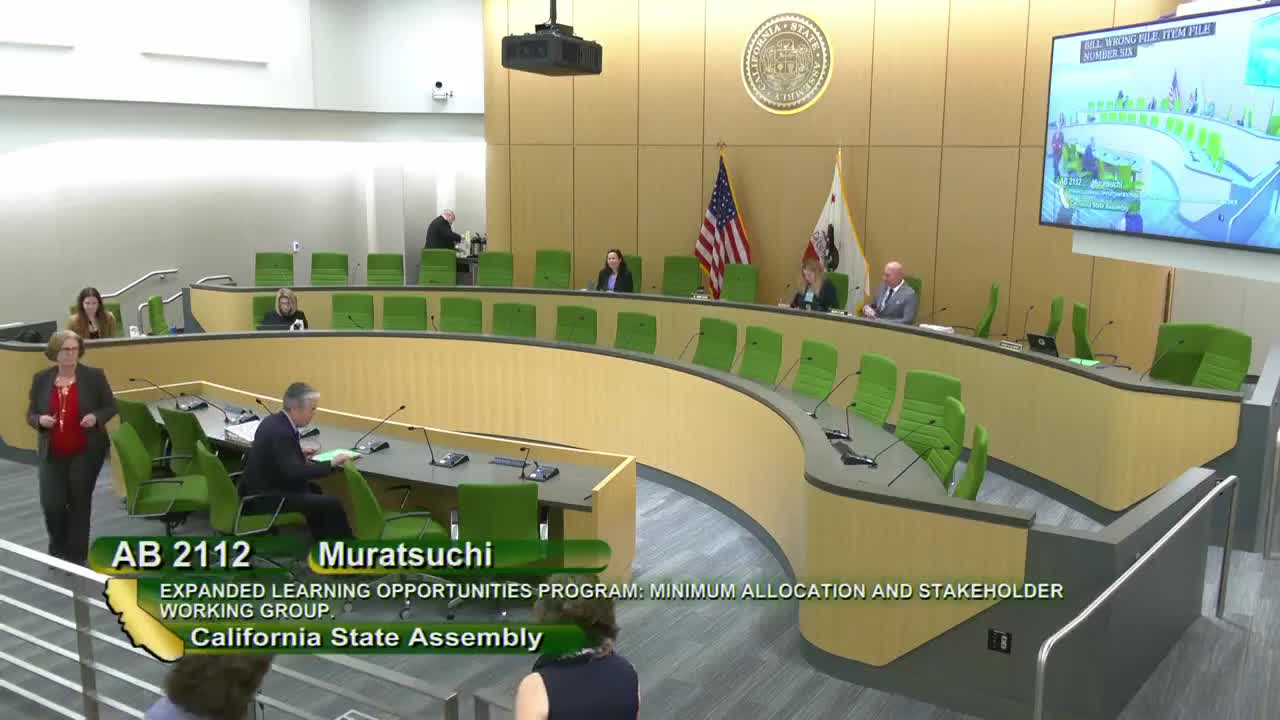
Bill Author

Bill Co-Author(s):