AB 1244: California Environmental Quality Act: transportation impact mitigation: Transit-Oriented Development Implementation Program.
- Session Year: 2025-2026
- House: Assembly
- Latest Version Date: 2025-04-23
Current Status:
In Progress
(2025-07-02: In committee: Set, first hearing. Hearing canceled at the request of author.)
Introduced
In Committee
Awaiting First Chamber Vote
Passed First Chamber
In Committee
Awaiting Second Chamber Vote
Passed Second Chamber
Enacted
The California Environmental Quality Act (CEQA) requires a lead agency, as defined, to prepare, or cause to be prepared, and certify the completion of an environmental impact report on a project that it proposes to carry out or approve that may have a significant effect on the environment or to adopt a negative declaration if it finds that the project will not have that effect. CEQA also requires a lead agency to prepare a mitigated negative declaration for a project that may have a significant effect on the environment if revisions in the project would avoid or mitigate that effect and there is no substantial evidence that the project, as revised, would have a significant effect on the environment.
Under existing law, the TransitOriented Transit-Oriented Development Implementation Program is administered by the Department of Housing and Community Development to provide local assistance to developers for the purpose of developing higher density uses within close proximity to transit stations as provided. Existing law, establishes the TransitOriented Transit-Oriented Development Implementation Fund and, to the extent funds are available, requires the department to make loans for the development and construction of housing development projects within close proximity to a transit station that meet specified criteria.
This bill would authorize a project, to the extent that the project is required to mitigate transportation impacts under CEQA, to satisfy the mitigation requirement by electing to contribute an unspecified amount of money for each vehicle mile traveled money, at a price per vehicle mile traveled, as determined by the Office of Land Use and Climate Innovation, to the TransitOriented Transit-Oriented Development Implementation Fund for the purposes of the TransitOriented Transit-Oriented Development Implementation Program. The Program, as provided. The bill would require the office, on or before July 1, 2029, and at least once every 3 years thereafter, to update the price per vehicle mile traveled based on specified factors. The bill would require, upon appropriation by the Legislature, the contributions to be available to the department to fund developments located in the same region, as defined, with preference given to specified projects. The bill would require the department to, for each award, confirm the estimated reduction in vehicle miles traveled, as provided, and would require the department to post specified information on its internet website.
The California Environmental Quality Act (CEQA) requires a lead agency, as defined, to prepare, or cause to be prepared, and certify the completion of an environmental impact report on a project that it proposes to carry out or approve that may have a significant effect on the environment or to adopt a negative declaration if it finds that the project will not have that effect. CEQA also requires a lead agency to prepare a mitigated negative declaration for a project that may have a significant effect on the environment if revisions in the project would avoid or mitigate that effect and there is no substantial evidence that the project, as revised, would have a significant effect on the environment.
Under existing law, the TransitOriented Development Implementation Program is administered by the Department of Housing and Community Development to provide local assistance to developers for the purpose of developing higher density uses within close proximity to transit stations as provided. Existing law, establishes the TransitOriented Development Implementation Fund and, to the extent funds are available, requires the department to make loans for the development and construction of housing development projects within close proximity to a transit station that meet specified criteria.
This bill would authorize a project, to the extent that the project is required to mitigate transportation impacts under CEQA, to satisfy the mitigation requirement by electing to contribute an unspecified amount of money for each vehicle mile traveled to the TransitOriented Development Implementation Fund for the purposes of the TransitOriented Development Implementation Program. The bill would require, upon appropriation by the Legislature, the contributions to be available to the department to fund developments located in the same region, as defined, with preference given to specified projects.
Existing law establishes the Department of Housing and Community Development and requires it to administer various programs intended to promote the development of housing, including the Multifamily Housing Program, pursuant to which the department provides financial assistance in the form of deferred payment loans to pay for the eligible costs of development of specified types of housing projects. Existing law defines various terms for purposes of that program, including supportive housing.This bill would make nonsubstantive changes to those definitions relating to the Multifamily Housing Program.Existing law establishes the Department of Housing and Community Development and requires it to administer various programs intended to promote the development of housing, including the Multifamily Housing Program, pursuant to which the department provides financial assistance in the form of deferred payment loans to pay for the eligible costs of development of specified types of housing projects. Existing law defines various terms for purposes of that program, including supportive housing.
This bill would make nonsubstantive changes to those definitions relating to the Multifamily Housing Program.
The Legislature finds and declares all of the following:
(a)Senate Bill 743 (Chapter 386 of the Statutes of 2013) requires developers of transportation and land use projects to take actions to mitigate under the California Environmental Quality Act ((CEQA) (Division 13 (commencing with Section 21000) of the Public Resources Code)) the environmental impact of the additional vehicle miles traveled generated by the project, with the stated intent to balance the needs of congestion management with statewide goals related to infill development, promotion of public health through active transportation, and reduction of greenhouse gas emissions.
(b)Executive Order No. N-2-24 directs the Department of Transportation, in consultation with the Transportation Agency and the Office of Climate and Land Use Innovation, to identify opportunities to support the use of affordable infill housing as an environmental mitigation strategy.
(c)The Governors proposed budget for the 2025-26 202526 fiscal year directs the state to promote policies that remove barriers to infill housing and support transit-oriented development.
(d)Research definitively demonstrates that transit-oriented affordable housing significantly reduces vehicle miles traveled. Lower income households drive 25 percent to 30 percent fewer miles when living within one-half mile of transit. When living within one-quarter mile of frequent transit transit, they drive nearly 50 percent less.
(e)A statewide fund that collects and distributes funding for infill affordable housing as a vehicle miles traveled mitigation strategy is one voluntary option by which developers of transportation and land use projects may choose to fulfill their mitigation requirements under CEQA.
(f)A statewide approach provides efficiency, certainty, consistency, and a familiar process by which developers of affordable homes can access funding.
SEC. 2.Section 21080.43 is added to the Public Resources Code, to read:21080.43.(a)For purposes of this section, region means the territory of the regional transportation planning agency with jurisdiction over the project.
(b)(1)To the extent that a project is required to mitigate transportation impacts as determined by vehicle miles traveled metrics pursuant to this division, a project may satisfy the mitigation requirement by electing to contribute ____ dollars ($_____) for each vehicle mile traveled an amount, at a price per vehicle mile traveled that shall be determined, on or before July 1, 2026, by the Office of Land Use and Climate Innovation, to the TransitOriented Transit-Oriented Development Implementation Fund established in Section 53561 of the Health and Safety Code for the purposes of the TransitOriented Transit-Oriented Development Implementation Program established pursuant to Part 13 (commencing with Section 53560) of Division 31 of the Health and Safety Code.
(2)On or before July 1, 2029, and at least once every three years thereafter, the Office of Land Use and Climate Innovation shall update the price per vehicle mile traveled pursuant to paragraph (1) based on housing project costs and awards, vehicle miles traveled mitigated, and other factors relevant to housing projects funded by either the Transit-Oriented Development Implementation Program or the Affordable Housing and Sustainable Communities Program.
(c)The moneys contributed pursuant to paragraph (1) of subdivision (b) shall be available to the Department of Housing and Community Development, upon appropriation by the Legislature, to fund developments located within the same region as the project, in the following priority order:
(1)First priority to developments within the same city as the project or for projects in unincorporated areas to developments in the same county.
(2)Second priority to developments in the same county.
(d)For each award using moneys contributed pursuant to paragraph (1) of subdivision (b), the Department of Housing and Community Development shall confirm the estimated reduction in vehicle miles traveled attributable to the award using the same method as that employed for the Affordable Housing and Sustainable Communities Program.
(e)The Department of Housing and Community Development shall post on its internet website, as part of the list of Transit-Oriented Development Implementation Program awards posted to its internet website at the conclusion of each funding round, all of the following information:
(1)The name, location, and number of units in each development funded.
(2)The total development cost and the amount of funds awarded to each development, including, but not limited to, the amount of funds contributed pursuant to this section.
(3)The reduction in vehicle miles traveled estimated for each development and attributable to the award using the same method as that employed for the Affordable Housing and Sustainable Communities Program.
(4)The vehicle miles traveled mitigation obligations of each project that contributed funds pursuant to this section awarded during that round.
REVISIONS: HeadingLine 2.The Legislature finds and declares all of the following:
(a)Senate Bill 743 (Chapter 386 of the Statutes of 2013) requires developers of transportation and land use projects to take actions to mitigate under the California Environmental Quality Act ((CEQA) (Division 13 (commencing with Section 21000) of the Public Resources Code)) the environmental impact of the additional vehicle miles traveled generated by the project, with the stated intent to balance the needs of congestion management with statewide goals related to infill development, promotion of public health through active transportation, and reduction of greenhouse gas emissions.
(b)Executive Order No. N-2-24 directs the Department of Transportation, in consultation with the Transportation Agency and the Office of Climate and Land Use Innovation, to identify opportunities to support the use of affordable infill housing as an environmental mitigation strategy.
(c)The Governors proposed budget for the 2025-26 fiscal year directs the state to promote policies that remove barriers to infill housing and support transit-oriented development.
(d)Research definitively demonstrates that transit-oriented affordable housing significantly reduces vehicle miles traveled. Lower income households drive 25 percent to 30 percent fewer miles when living within one-half mile of transit. When living within one-quarter of frequent transit they drive nearly 50 percent less.
(e)A statewide fund that collects and distributes funding for infill affordable housing as a vehicle miles traveled mitigation strategy is one voluntary option by which developers of transportation and land use projects may choose to fulfill their mitigation requirements under CEQA.
(f)A statewide approach provides efficiency, certainty, consistency, and a familiar process by which developers of affordable homes can access funding.
SEC. 2.Section 21080.43 is added to the Public Resources Code, to read:21080.43.(a)For purposes of this section, region means the territory of the regional transportation planning agency with jurisdiction over the project.
(b)To the extent that a project is required to mitigate transportation impacts as determined by vehicle miles traveled metrics pursuant to this division, a project may satisfy the mitigation requirement by electing to contribute ____ dollars ($_____) for each vehicle mile traveled to the TransitOriented Development Implementation Fund established in Section 53561 of the Health and Safety Code for the purposes of the TransitOriented Development Implementation Program established pursuant to Part 13 (commencing with Section 53560) of Division 31 of the Health and Safety Code.
(c)The moneys contributed pursuant to subdivision (b) shall be available to the Department of Housing and Community Development, upon appropriation by the Legislature, to fund developments located within the same region as the project, in the following priority order:
(1)First priority to developments within the same city as the project or for projects in unincorporated areas to developments in the same county.
(2)Second priority to developments in the same county.
SECTION 1.Section 50675.2 of the Health and Safety Code is amended to read:50675.2.The definitions contained in this section shall apply to all activities conducted pursuant to this chapter. Except as otherwise provided in this chapter, or unless the context requires otherwise, the definitions contained in Chapter 2 (commencing with Section 50050) of Part 1 shall also apply to this chapter.(a) Affordable rent shall be established by the department to be consistent with the rent limitations imposed by the Low-Income Housing Tax Credit Program, as administered by the California Tax Credit Allocation Committee.(b) Assisted unit means a unit that is affordable to a lower income household as a result of a loan provided pursuant to this chapter. In order to ensure consistency with the Low-Income Housing Tax Credit Program, occupancy of assisted units shall be limited to households whose income does not exceed the limits specified by the California Tax Credit Allocation Committee.(c) Maintain affordable rent levels means rents may be increased by the sponsor on an annual basis in the amount that would be allowed if the project was subject to the requirements of the Low-Income Housing Tax Credit Program established pursuant to Section 42 of the federal Internal Revenue Code.(d) Rental housing development means a structure or set of structures with common financing, ownership, and management, and which collectively contain five or more dwelling units, including efficiency units. No more than one of the dwelling units may be occupied as a primary residence by a person or household who is the owner of the structure or structures.(e) Rehabilitation, in addition to the meaning set forth in Section 50096, includes improvements and repairs made to a residential structure acquired for the purpose of preserving its affordability.(f) Rent-up costs means costs incurred while a unit is on the housing market but not rented to its first tenant.(g) Sponsor has the same meaning as defined in subdivision (c) of Section 50669, and also includes a limited partnership in which the sponsor or an affiliate of the sponsor is a general partner.(h) Supportive housing means housing with no limit on length of stay, which is occupied by the target population, and is linked to onsite or offsite services that assist the supportive housing resident in retaining the housing, improving their health status, and maximizing their ability to live and, when possible, work in the community.(i) Transitional housing and transitional housing development means buildings configured as rental housing developments, but operated under program requirements that call for the termination of assistance and recirculation of the assisted unit to another eligible program recipient at some predetermined future point in time, which shall be no less than six months.The definitions of contained in this section shall apply to all activities conducted pursuant to this chapter. Except as otherwise provided in this chapter, or unless the context requires otherwise, the definitions contained in Chapter 2 (commencing with Section 50050) of Part 1 shall also apply to this chapter.
(a) Affordable rent shall be established by the department to be consistent with the rent limitations imposed by the Low-Income Housing Tax Credit Program, as administered by the California Tax Credit Allocation Committee.
(b) Assisted unit means a unit that is affordable to a lower income household as a result of a loan provided pursuant to this chapter. In order to ensure consistency with the Low-Income Housing Tax Credit Program, occupancy of assisted units shall be limited to households whose income does not exceed the limits specified by the California Tax Credit Allocation Committee.
(c) Maintain affordable rent levels means rents may be increased by the sponsor on an annual basis in the amount that would be allowed if the project was subject to the requirements of the Low-Income Housing Tax Credit Program established pursuant to Section 42 of the federal Internal Revenue Code.
(d) Rental housing development means a structure or set of structures with common financing, ownership, and management, and which collectively contain five or more dwelling units, including efficiency units. No more than one of the dwelling units may be occupied as a primary residence by a person or household who is the owner of the structure or structures.
(e) Rehabilitation, in addition to the meaning set forth in Section 50096, includes improvements and repairs made to a residential structure acquired for the purpose of preserving its affordability.
(f) Rent-up costs means costs incurred while a unit is on the housing market but not rented to its first tenant.
(g) Sponsor has the same meaning as defined in subdivision (c) of Section 50669, and also includes a limited partnership in which the sponsor or an affiliate of the sponsor is a general partner.
(h) Supportive housing means housing with no limit on length of stay, that which is occupied by the target population, and that is linked to onsite or offsite services that assist the supportive housing resident in retaining the housing, improving their health status, and maximizing their ability to live and, when possible, work in the community.
(i) Transitional housing and transitional housing development means buildings configured as rental housing developments, but operated under program requirements that call for the termination of assistance and recirculation of the assisted unit to another eligible program recipient at some predetermined future point in time, which shall be no less than six months.
|
Date
|
Status
|
|---|---|
| Jul 2, 2025 | In committee: Set, first hearing. Hearing canceled at the request of author. |
| Jun 11, 2025 | Referred to Coms. on E.Q. and HOUSING. |
| Jun 3, 2025 | In Senate. Read first time. To Com. on RLS. for assignment. |
| Jun 2, 2025 | Read third time. Passed. Ordered to the Senate. (Ayes 76. Noes 0. Page 1884.) |
| May 27, 2025 | Read second time. Ordered to third reading. |
| May 23, 2025 | From committee: Do pass. (Ayes 14. Noes 0.) (May 23). |
| May 14, 2025 | In committee: Set, first hearing. Referred to APPR. suspense file. |
| May 1, 2025 | From committee: Do pass and re-refer to Com. on APPR. (Ayes 9. Noes 0.) (April 30). Re-referred to Com. on APPR. |
| May 1, 2025 | Coauthors revised. |
| Apr 24, 2025 | Re-referred to Com. on H. & C.D. |
| Apr 23, 2025 | Read second time and amended. |
| Apr 22, 2025 | From committee: Amend, and do pass as amended and re-refer to Com. on H. & C.D. (Ayes 14. Noes 0.) (April 21). |
| Apr 21, 2025 | Assembly Rule 56 suspended. (Page 1163.) |
| Apr 21, 2025 | (Pending re-refer to Com. on H. & C. D.) |
| Mar 25, 2025 | Re-referred to Com. on NAT. RES. |
| Mar 24, 2025 | Referred to Coms. on NAT. RES. and H. & C.D. |
| Mar 24, 2025 | From committee chair, with author's amendments: Amend, and re-refer to Com. on NAT. RES. Read second time and amended. |
| Feb 24, 2025 | Read first time. |
| Feb 22, 2025 | From printer. May be heard in committee March 24. |
| Feb 21, 2025 | Introduced. To print. |
|
Date
|
Description
|
Location
|
Votes
|
|
|---|---|---|---|---|
| Jun 2, 2025 | AB 1244 Wicks Assembly Third Reading | Assembly Floor |
Passed |
|
| May 23, 2025 | Do pass. | Assembly Standing Committee on Appropriations |
Passed |
|
| Apr 30, 2025 | Do pass and be re-referred to the Committee on [Appropriations] | Assembly Standing Committee on Housing and Community Development |
Passed |
|
| Apr 21, 2025 | Do pass as amended and be re-referred to the Committee on [Housing and Community Development] | Assembly Standing Committee on Natural Resources |
Passed |
This list shows positions taken on this bill by organizations on the date displayed, which is linked to the original source.
Positions by individuals are not included.
|
Organization
|
Position
|
Date
|
|---|---|---|
| Active San Gabriel Valley | ** Support | |
| Brilliant Corners | ** Support | |
| California Housing Partnership | ** Support | |
| California Walks | ** Support | |
| East Bay Housing Organizations | ** Support | |
| Enterprise Community Partners Inc | ** Support | |
| Homes & Hope | ** Support | |
| Housing California | ** Support | |
| Move LA | ** Support | |
| San Diego Housing Federation | ** Support | |
| Southern California Association of Nonprofit Housing | ** Support | |
| Streets for All | ** Support | |
| Transform | ** Support | |
| Wakeland Housing and Development Corporation | ** Support |
ASSEMBLY THIRD READING
ATR Bill Id:AB 1244
Author:(Wicks)
As Amended Ver:April 23, 2025
Majority vote
SUMMARY
Establishes an in-lieu fee mechanism for vehicles miles traveled (VMT) mitigation – permitting a project, which is under the jurisdiction of a regional transportation planning agency (RTPA) and has a VMT mitigation requirement pursuant to the California Environmental Quality Act (CEQA), to satisfy its VMT mitigation requirement by contributing an unspecified amount per VMT to the Transit-Oriented Development (TOD) Implementation Fund, which would then be available, upon appropriation, to the Department of Housing and Community Development (HCD) to provide financing for transit-oriented rental housing developments located within the same county as the "donor" project.
Major Provisions
- Authorizes a project to satisfy its VMT mitigation requirements by electing to contribute an amount for each VMT to be determined, by July 1, 2026, by the Office of Land Use and Climate Innovation (LCI), to the TOD Fund for the purposes of the TOD Program.
- Requires LCI, by July 1, 2029, and at least once every three years thereafter, to update the price per VMT based on housing project costs and awards, VMT mitigated, and other factors relevant to housing projects funded by either the TOD Program or the Affordable Housing and Sustainable Communities Program (AHSC).
- Requires that moneys contributed be available to HCD, upon appropriation by the Legislature, to fund developments located within the same region as the project, in the following priority order:
- First priority to developments within the same city as the project or for projects in unincorporated areas to developments in the same county.
- Second priority to developments in the same county.
- Defines "region" as the territory of the RTPA with jurisdiction over the project.
- Requires HCD to confirm the estimated reduction in VMT attributable to each award using the same method as that employed for AHSC.
- Requires HCD to post on its website, as part of the list of TOD Implementation Program awards posted to its website at the conclusion of each funding round, all of the following information: a) the name, location, and number of units in each development funded; b) the total development cost and the amount of funds awarded to each development, including the amount of funds contributed pursuant to this bill; c) the reduction in VMT estimated for each development and attributable to the award using the same method as that employed for AHSC; and d) the VMT mitigation obligations of each project that contributed funds pursuant to this bill awarded during that round.
COMMENTS
Level of service (LOS) is a measure used by traffic engineers to determine the effectiveness of elements of transportation infrastructure. LOS measures the presence of traffic and how quickly cars can move through a street. LOS was used for decades to analyze transportation impacts under CEQA. However, several years ago LOS became regarded as outdated, based on concerns it neglects transit, pedestrian crossings, and bicycles. Critics contended that an over-reliance on LOS considerations by planners had led to widening intersections and roadways to move automobile traffic faster at the expense of other, less polluting modes of transportation.
In response, SB 743 (Steinberg), Chapter 386, Statutes of 2013, required OPR to update the criteria for analyzing transportation impacts of projects to replace LOS in TPAs (areas within a one-half mile of a major transit stop). According to SB 743, "(n)ew methodologies under (CEQA) are needed for evaluating transportation impacts that are better able to promote the state's goals of reducing (GHG) emissions and traffic-related air pollution, promoting the development of multimodal transportation system, and providing clean, efficient access to destinations." Under SB 743, the criteria was required to promote the reduction of GHG emissions, the development of multimodal transportation networks, and a diversity of land uses. For areas outside of a TPA, OPR was authorized to adopt guidelines that would establish alternative metrics to LOS. Additionally, OPR could retain LOS as a part of those alternative metrics outside of a TPA, if and where OPR deemed appropriate.
Pursuant to SB 743, OPR proposed changes to the CEQA Guidelines that identify VMT as the most appropriate metric to evaluate a project's transportation impacts and to apply VMT statewide. VMT measures the amount and distance of automobile travel attributable to a project. The Guidelines took effect July 2020 and agencies are now required to analyze the transportation impacts of a project using a VMT metric instead of LOS.
According to OPR's Technical Advisory on Evaluating Transportation Impacts in CEQA, published in December 2018:
The transportation sector has three major means of reducing GHG emissions: increasing vehicle efficiency, reducing fuel carbon content, and reducing the amount of vehicle travel. The California Air Resources Board (CARB) has provided a path forward for achieving these emission reductions from the transportation sector in its 2016 Mobile Source Strategy. CARB determined that it will not be possible to achieve the State's 2030 and post-2030 emission goals without reducing VMT growth. Further, in its 2018 Progress Report on California's Sustainable Communities and Climate Protection Act, CARB found that despite the State meetings its 2020 climate goals, 'emissions from statewide passenger vehicle travel per capita (have been) increasing and going in the wrong direction,' and 'California cannot meet its (long-term) climate goals without curbing growth in single-occupancy vehicle activity.' CARB also found that '(w)ith emissions from the transportation sector continuing to rise despite increases in fuel efficiency and decreases in the carbon content of fuel, California will not achieve the necessary (GHG) emissions reductions to meet mandates for 2030 and beyond without significant changes to how communities and transportation systems are planned, funded, and built.'
Thus, to achieve the state's long-term climate goals, California needs to reduce per capita VMT. This can occur under CEQA through VMT mitigation. Half of California's GHG emissions come from the transportation sector, therefore, reducing VMT is an effective climate strategy, which can also result in co-benefits. Furthermore, without early VMT mitigation, the state may follow a path that meets GHG targets in the early years, but finds itself poorly positioned to meet more stringent targets later.
In addition to providing many examples of VMT-reduction measures, the technical advisory further addresses VMT-reduction programs and in-lieu fees:
Notably, because VMT is largely a regional impact, regional VMT-reduction programs may be an appropriate form of mitigation. In lieu fees have been found to be valid mitigation where there is both a commitment to pay fees and evidence that mitigation will actually occur. (Save Our Peninsula Committee v. Monterey County Bd. of Supervisors (2001) 87 Cal.App.4th 99, 140-141; Gentry v. City of Murrieta (1995) 36 Cal.App.4th 1359; Kings County Farm Bureau v. City of Hanford (1990) 221 Cal.App.3d 692, 727–728.) Fee programs are particularly useful to address cumulative impacts. (CEQA Guidelines, Section 15130, subd. (a)(3) [a "project's incremental contribution is less than cumulatively considerable if the project is required to implement or fund its fair share of a mitigation measure or measures designed to alleviate the cumulative impact"].) The mitigation program must undergo CEQA evaluation, either on the program as a whole, or the in-lieu fees or other mitigation must be evaluated on a project-specific basis. (California Native Plant Society v. County of El Dorado (2009) 170 Cal.App.4th 1026.) That CEQA evaluation could be part of a larger program, such as a regional transportation plan, analyzed in a Program EIR. (CEQA Guidelines, Section 15168.)
(https://lci.ca.gov/docs/20190122-743_Technical_Advisory.pdf)
In implementing this bill, HCD will need to consider requirements to assure funds awarded result in VMT reductions that match the VMT reductions claimed by the donor projects. Additional considerations may include demonstrating that the reductions claimed are additional, and would not otherwise occur absent the HCD award, and that the reductions are not counted toward any other requirement, such as a regional Sustainable Communities Strategy. Without good accounting, contributions to this program may be considered risky by developers.
According to the Author
Developers that are required to mitigate for VMT produced by their projects have an array of options available to them, including through affordable housing, which we desperately need more of in order to address California's housing crisis. However, mitigating VMT by developing affordable housing is not currently a widely used strategy and there is no process at the state level to collect and disburse VMT mitigation dollars for this purpose. That is exactly what AB 1244 would do by creating a statewide VMT mitigation fund to facilitate the creation of affordable housing. This bill would not remove any of the existing strategies available to developers – it would expand the options available to them and add another tool to their mitigation toolbox. AB 1244 would also facilitate the pooling of VMT mitigation dollars, which will enable larger and more effective mitigation strategies than is possible for individual projects, and could help to spur more affordable housing development in California.
Arguments in Support
According to sponsors California Housing Partnership and Housing California, AB 1244 would make it easy for VMT-generating projects to mitigate their impacts with affordable housing. It would do so by allowing project sponsors to pay a per-mile fee into the fund for HCD's TOD Program. HCD would then use this existing program to award the funds to qualifying affordable housing developments in the same region…Such a statewide approach provides efficiency, certainty, consistency, and a familiar process by which developers of affordable homes can access funding. Moreover, this approach would be optional and additive and not remove any of the existing mitigation approaches available to VMT-generating projects.
Arguments in Opposition
None received.
FISCAL COMMENTS
According to the Assembly Appropriations Committee:
- LCI estimates General Fund contracting costs of approximately $330,000 in year one and $19,000 in year two and ongoing for technical consultation in developing the appropriate methodology and approach to determine the price per VMT and to update its methodology and calculations every three years.
2) HCD estimates its costs to verify and confirm estimated reductions in VMT attributable to TOD awards, as well any workload associated with directing mitigation funds to projects through the TOD program, are minor and absorbable.
3) Ongoing annual revenue gain of an unknown amount to the TOD Implementation Fund depending on the number of transportation and land use project developers who elect to fulfill their mitigation obligations under CEQA by contributing to the fund and the aggregate amount contributed to the fund annually.
According to HCD, between 2007 and 2020, the TOD program awarded approximately $336 million to projects. HCD plans to disburse $24 million in fiscal year (FY) 2024-25 and FY 2025-26. Awards are expected in August of this year.
VOTES
ASM NATURAL RESOURCES: 14-0-0
YES: Bryan, Alanis, Connolly, Ellis, Flora, Garcia, Haney, Hoover, Kalra, Muratsuchi, Pellerin, Schultz, Wicks, Zbur
ASM HOUSING AND COMMUNITY DEVELOPMENT: 9-0-3
YES: Haney, Patterson, Ávila Farías, Caloza, Garcia, Kalra, Lee, Quirk-Silva, Wicks
ABS, ABST OR NV: Ta, Tangipa, Wilson
ASM APPROPRIATIONS: 14-0-1
YES: Wicks, Arambula, Calderon, Caloza, Dixon, Elhawary, Fong, Mark González, Hart, Pacheco, Pellerin, Solache, Ta, Tangipa
ABS, ABST OR NV: Sanchez
UPDATED
VERSION: April 23, 2025
CONSULTANT: Lawrence Lingbloom / NAT. RES. / (916) 319-2092 FN: 0000748
Date of Hearing: May 14, 2025
ASSEMBLY COMMITTEE ON APPROPRIATIONS
Buffy Wicks, Chair
ABPCA Bill Id:AB 1244
Author:(Wicks) – As Amended Ver:April 23, 2025
Policy Committee: | Natural Resources | Vote: | 14 - 0 |
Housing and Community Development | 9 - 0 | ||
|
|
Urgency: No State Mandated Local Program: No Reimbursable: No
SUMMARY:
This bill allows a development project required to mitigate transportation impacts to elect to contribute an amount, at a price per vehicle miles traveled (VMT), for purposes of the Transit-Oriented Development (TOD) program.
Specifically, this bill, among other things:
1) Authorizes a project, to the extent the project is required to mitigate transportation impacts as determined by VMT, to satisfy the mitigation requirement by electing to contribute an amount, at a price per VMT to be determined, by July 1, 2026, by the Office of Land Use and Climate Innovation (LCI), to the TOD Implementation Fund for purposes of the TOD Implementation Program, as provided.
2) Requires LCI, by July 1, 2029, and at least once every three years thereafter, to update the price per VMT based on housing project costs and awards, VMT mitigated, and other factors relevant to housing projects funded by either the TOD Implementation Program or the Affordable Housing and Sustainable Communities Program (AHSC).
3) Provides that the moneys contributed pursuant to item 1, above, shall be available to the Department of Housing and Community Development (HCD), upon appropriation by the Legislature, to fund developments located within the same region as the project, in a specified priority order.
4) Requires HCD, for each award using moneys contributed pursuant to item 1, above, to confirm the estimated reduction in VMT attributable to the award using the same method as that employed for AHSC.
5) Requires HCD to post on its website, as part of the list of TOD Implementation Program awards posted to its website at the conclusion of each funding round, all of the following information: (a) the name, location, and number of units in each development funded; (b) the total development cost and the amount of funds awarded to each development, including the amount of funds contributed pursuant to this bill; (c) the reduction in VMT estimated for each development and attributable to the award using the same method as that employed for AHSC; and (d) the VMT mitigation obligations of each project that contributed funds pursuant to this bill awarded during that round.
FISCAL EFFECT:
1) LCI estimates General Fund costs of approximately $785,000 in the first year and approximately $474,000 annually thereafter. The $300,000 in one-time costs in year one will enable LCI to contract for technical consultation in developing the appropriate methodology and approach to determine the price per VMT. The $17,000 in ongoing contracting costs will allow LCI to update its methodology and calculations every three years. LCI contends it will need to hire one principal transportation planner and 0.5 of a vehicle program specialist to provide project management and technical support.
2) HCD estimates its costs to verify and confirm estimated reductions in VMT attributable to TOD awards, as well any workload associated with directing mitigation funds to projects through the TOD program, are minor and absorbable.
3) Ongoing annual revenue gain of an unknown amount to the TOD Implementation Fund depending on the number of transportation and land use project developers who elect to fulfill their mitigation obligations under the California Environmental Quality Act (CEQA) by contributing to the fund and the aggregate amount contributed to the fund annually.
According to HCD, between 2007 and 2020, the TOD program awarded approximately $336 million to projects. HCD plans to disburse $24 million in fiscal year (FY) 2024-25 and FY 2025-26. Awards are expected in August of this year.
COMMENTS:
1) Purpose. According to the author:
Mitigating VMT by developing affordable housing is not currently a widely used strategy and there is no process at the state level to collect and disburse VMT mitigation dollars for this purpose. That is exactly what AB 1244 would do by creating a statewide VMT mitigation fund to facilitate the creation of affordable housing…AB 1244 would also facilitate the pooling of VMT mitigation dollars, which will enable larger and more effective mitigation strategies than is possible for individual projects, and could help to spur more affordable housing development in California.
2) Background. According to the UC Berkeley Center for Law, Energy, and the Environmental, under CEQA, government agencies and developers are required to mitigate (where feasible) the environmental impacts of new discretionary projects, including impacts to transportation. Traditionally, transportation impacts were evaluated in terms of level of service (LOS), which focuses on roadway congestion. SB 743 (Steinberg), Chapter 386, Statutes of 2013, called for a new transportation impact measure that promotes greenhouse gas emission reduction and multimodal transportation. In 2018, the state updated the CEQA guidelines to recommend VMT as the preferred impact measurement. VMT focuses on total vehicle trip-miles generated by a new project regardless of where they occur or how much traffic they cause.
There are several options available for project sponsors to choose from when deciding how they will meet their mitigation requirements. According to the California Housing Partnership and Housing California, who are in support of the bill, research definitively demonstrates that transit-oriented affordable housing significantly reduces VMT: “Lower income households drive 25% to 30% fewer miles when living within one-half mile of transit, and nearly 50% less when living within one-quarter mile of frequent transit.” However, the organizations note, there is no clear process to direct VMT mitigation resources to affordable housing developments:
AB 1244 would make it easy for VMT-generating projects to mitigate their impacts with affordable housing. It would do so by allowing project sponsors to pay a per-mile fee into the fund for the Department of Housing and Community Development’s (HCD) Transit-Oriented Development (TOD) Implementation Program. HCD would then use this existing program to award the funds to qualifying affordable housing developments in the same region, with a first priority for developments in the same city and a second priority for developments in the same county.
Such a statewide approach provides efficiency, certainty, consistency, and a familiar process by which developers of affordable homes can access funding. Moreover, this approach would be optional and additive and not remove any of the existing mitigation approaches available to VMT-generating projects.
Under HCD’s TOD program, low-interest loans are available as gap financing for rental housing developments near transit that include affordable units. In addition, grants are available to localities and transit agencies for infrastructure improvements necessary for the development of specified housing developments, or to facilitate connections between these developments and the transit station. The maximum loan amount awarded for a single housing development or to a single applicant, including any affiliates, is $10 million. The maximum grant awarded to a locality or transit agency applicant is $5 million. The total maximum award amount for a single project is $15 million.
Analysis Prepared by: Nikita Koraddi / APPR. / (916) 319-2081
Date of Hearing: April 30, 2025
ASSEMBLY COMMITTEE ON HOUSING AND COMMUNITY DEVELOPMENT
Matt Haney, Chair
ABPCA Bill Id:AB 1244 (
Author:Wicks) – As Amended Ver:April 23, 2025
SUBJECT: California Environmental Quality Act: transportation impact mitigation: Transit-Oriented Development Implementation Program
SUMMARY: Allows a development project that is required to mitigate transportation impacts to elect to contribute an amount, at a price per vehicle miles travelled (VMT) determined by the Office of Land Use and Climate Innovation (LCI), to the Transit Oriented Development (TOD) Implementation fund for allocation to a local infill housing development. Specifically, this bill:
- Requires LCI to determine a price per VMT by July 1, 2026.
- Requires LCI to update the price per VMT on or before July 1, 2029 and every three years thereafter, based on housing project costs and award, VMT mitigated, and other factors related to housing projects funded by the TOD Program or the Affordable Housing and Sustainable Communities (AHSC) Program.
- Makes the money contributed to the TOD Fund available to the Department of Housing and Community Development (HCD), upon appropriation, to fund developments located within the same region as the project in the following order:
- To developments within the same city as the project or for projects in unincorporated areas to developments in the same county; and
- To developments in the same county.
- Requires HCD, in determining the award for each project, to confirm the estimated reduction in VMT attributed to the award using the method used for the AHSC program.
- Requires HCD to post on its website as part of the list of TOD program awards at the conclusion of each funding round all of the following information:
- The name, location, and number of units in each development funded;
- The total development cost and amount of funds awarded to each development, including but not limited to the amount of funds contributed as a result of VMT mitigation;
- The reduction in VMT estimated for each development and attributed to the award using the same method as used by the AHSC program; and
- The VMT obligations of each project that contributed funds to the award during the funding round.
EXISTING LAW:
- Requires lead agencies with the principal responsibility for carrying out or approving a proposed discretionary project to prepare a negative declaration (ND), mitigated negative declaration (MND), or environmental impact report (EIR) for this action, unless the project is exempt from the California Environmental Quality Act (CEQA). (Public Resources Code (PRC) 21000 et seq.)
- Requires the Office of Planning and Research (OPR, now known as LCI) to prepare and develop proposed guidelines for the implementation of CEQA by public agencies. Requires the guidelines to include objectives and criteria for the orderly evaluation of projects and the preparation of EIRs and NDs. Also requires the guidelines to include criteria for public agencies to follow in determining whether a proposed project may have a significant effect on the environment. (PRC 21083)
- Requires OPR to prepare proposed revisions to the CEQA Guidelines establishing criteria for determining the significance of transportation impacts within transit priority areas (TPAs). Requires the criteria to promote the reduction of greenhouse gas (GHG) emissions, the development of multimodal transportation networks, and a diversity of land uses. (PRC 21099)
- Authorizes OPR to adopt CEQA Guidelines establishing alternative metrics to traffic “levels of service” (LOS) for transportation impacts outside of TPAs. Authorizes the alternative metrics to include the retention of LOS, where appropriate and as determined by OPR. Pursuant to this authority, OPR revised the CEQA Guidelines to identify VMT as the most appropriate metric to evaluate a project’s transportation impacts and to apply VMT statewide. (PRC 21099)
- Establishes the TOD Program, to be administered by HCD, to provide local assistance to developers for the purpose of developing higher density uses within close proximity to transit stations that will increase public transit ridership. The TOD Program provides gap financing for rental housing developments near transit that include affordable units as well as necessary infrastructure improvements. (Health and Safety Code 53560)
FISCAL EFFECT: Unknown.
COMMENTS:
Author’s Statement: According to the author, “Developers that are required to mitigate for VMT produced by their projects have an array of options available to them, including through affordable housing, which we desperately need more of in order to address California’s housing crisis. However, mitigating VMT by developing affordable housing is not currently a widely used strategy and there is no process at the state level to collect and disburse VMT mitigation dollars for this purpose. That is exactly what AB 1244 would do by creating a statewide VMT mitigation fund to facilitate the creation of affordable housing. This bill would not remove any of the existing strategies available to developers—it would expand the options available to them and add another tool to their mitigation toolbox. AB 1244 would also facilitate the pooling of VMT mitigation dollars, which will enable larger and more effective mitigation strategies than is possible for individual projects, and could help to spur more affordable housing development in California.”
SB 743 and VMT: CEQA requires cities counties and other public agencies to analyze transportation projects to determine if they have a significant impact on the environment. Traditionally, transportation impacts were evaluated by examining whether the project was likely to cause automobile delay at intersections and congestion on nearby individual highway segments, and whether this delay would exceed a certain amount. This was known as Level of Service or LOS analysis.
SB 743 (Steinberg), Chapter 386, Statutes of 2013 updated CEQA Guidelines to change how lead agencies evaluate transportation impacts under CEQA, with the goal of better measuring the actual transportation-related environmental impacts of any given project. Starting on July 1, 2020, lead agencies were required to analyze based on VMT rather than LOS. VMT measures how much actual auto travel (additional miles driven) a proposed project would create on California roads. If the project adds excessive car travel onto roads, the project may cause a significant transportation impact. Projects are required to mitigate the impacts of VMT. Cities and counties had the option to adopt the VMT metric and many of the state’s cities, which comprise nearly one-fifth of the state’s population, have done so. VMT fees can be used toward GHG reduction activities including bus and transit passes, bicycle and pedestrian infrastructure, carpool and van pools, habitat conservation, and affordable housing.
Some Councils of Governments (COGs) have or are developing local TOD programs to invest in infill development. CalCOG hosted a webinar in the fall with a representative from the Western Riverside Council of Governments which is in the process of developing a program with local partners including the Housing Authority. According to materials provided at the webinar, in terms of VMT mitigation, affordable housing is comparable to transit passes/transit subsidies, it is cheaper to invest in affordable housing than bicycle infrastructure, and paying for the gap financing for one or two affordable housing projects can sufficiently mitigate an interchange project.[1] The Riverside Housing Authority has identified 15 affordable projects that have partial funding but need additional gap funding to move forward. VMT mitigation funds are a potential sources of funding for these projects.
This bill is intended to create an easier path for local jurisdictions that want to invest VMT fees into affordable housing but lack a local program. LCI would be required to develop a price per VMT by July of 2026. Fees collected on local projects would be deposited into a fund to be used for TOD in the city or county in which the fee was collected.
State TOD Program: Research demonstrates that transit-oriented affordable housing significantly reduces VMT. Lower income households drive 25% to 30% fewer miles when living within one-half mile of transit, and drive nearly 50% less when living within one-quarter mile of frequent transit. The TOD Program administered by HCD provides low-interest loans that are available as gap financing for rental housing developments near transit that include affordable units. Grants are also available to local governments and transit agencies for infrastructure improvements necessary for housing developments or to facilitate connections between these developments and the transit station. The program requires 15% of the units in a development to be affordable to lower income households and within one-half mile of transit.
Governor’s Executive Order N-2-24: In July 2024, Governor Newsom issued Executive Order N-2-24 to accelerate and streamline infill development projects to transform undeveloped and underutilized properties statewide into livable and affordable housing for Californians. The order directs a number of state agencies to work together to address key roadblocks in the development of infill housing. These agencies are directed to work together to comprehensively address the need to develop more housing by:
- Lowering costs and increasing flexibility by exploring updates to the state building standards codes and permitting processes to accelerate housing approvals and development;
- Creating more resources for local governments to build housing through infill development, by developing mechanisms to provide local governments and developers with a range of additional resources, including state and federal infrastructure dollars and other financing;
- Building more tools and opportunities by publishing resources and guidance, including through the states’ existing Site Check website, to assist developers and other stakeholders in identifying opportunities to transform vacant sites into housing for Californians; and
- Aligning state housing and climate goals by creating tools to assess the environmental benefits of thriving urban cores and transportation centers, and working to better align housing and transportation investments across the state.
The Executive Order directed state agencies to take some key actions to leverage transportation funds to support infill development. Specifically, the California Department of Transportation (CalTrans), in consultation with CalSTA and LCI, is required to identify and implement opportunities to leverage transportation funds and projects to support the use of infill housing as an environmental mitigation approach by publishing guidance on the use of affordable infill housing as a mitigation strategy as part of its "Transportation Analysis under CEQA" guidance and track and report progress at the project level. The Executive Order also requires LCI to establish an interagency Task Force on Mitigation Banks, to include CalSTA, BCSH, CalTrans, HCD, and other state agencies as appropriate, for the purpose of developing a framework for a Statewide Mitigation Bank to provide flexibility in the use of infill housing as a mitigation strategy for transportation and housing projects with significant environmental impacts under CEQA. The California Air Resources Board, in partnership with BCSH and SGC, is directed to develop and propose metrics to assess the climate and environmental benefits of infill housing development, in order to help decision makers more accurately assess relative costs and benefits of infill development and adaptive reuse opportunities as remote work continues to be a part of the broader economy and travel patterns adjust.
Arguments in Support: According to one of the sponsors, the California Housing Partnership,
“AB 1244 would make it easy for VMT-generating projects to mitigate their impacts with
affordable housing. It would do so by allowing project sponsors to pay a per-mile fee into the
fund for the Department of Housing and Community Development’s (HCD) Transit-Oriented
Development (TOD) Implementation Program. HCD would then use this existing program to
award the funds to qualifying affordable housing developments in the same region, with a first
priority for developments in the same city and a second priority for developments in the same county. Such a statewide approach provides efficiency, certainty, consistency, and a familiar
process by which developers of affordable homes can access funding.”
Arguments in Opposition: None on file.
Double Referred: This bill was also referred to the Committee on Natural Resources, where it passed with a vote of 14-0 on April 21, 2025.
REGISTERED SUPPORT / OPPOSITION:
Support
California Housing Partnership (Sponsor)
Housing California (Sponsor)
Active San Gabriel Valley
Brilliant Corners
California Walks
East Bay Housing Organizations
Enterprise Community Partners, INC.
Homes & Hope
Move LA
San Diego Housing Federation
Southern California Association of Nonprofit Housing
Streets for All
Transform
Wakeland Housing and Development Corporation
Opposition
None on file.
Analysis Prepared by: Lisa Engel / H. & C.D. / (916) 319-2085
Date of Hearing: April 21, 2025
ASSEMBLY COMMITTEE ON NATURAL RESOURCES
Isaac G. Bryan, Chair
ABPCA Bill Id:AB 1244 (
Author:Wicks) – As Amended Ver:March 24, 2025
SUBJECT: California Environmental Quality Act: transportation impact mitigation: TransitOriented Development Implementation Program
SUMMARY: Establishes an in-lieu fee mechanism for vehicles miles traveled (VMT) mitigation – permitting a project, which is under the jurisdiction of a regional transportation planning agency (RTPA) and has a VMT mitigation requirement pursuant to the California Environmental Quality Act (CEQA), to satisfy its VMT mitigation requirement by contributing an unspecified amount per VMT to the Transit-Oriented Development Implementation Fund (TOD Fund), which would then be available, upon appropriation, to the Department of Housing and Community Development (HCD) to provide financing for transit-oriented rental housing developments located within the same county as the “donor” project.
EXISTING LAW:
- Requires lead agencies with the principal responsibility for carrying out or approving a proposed discretionary project to prepare a negative declaration (ND), mitigated negative declaration (MND), or environmental impact report (EIR) for this action, unless the project is exempt from CEQA. (Public Resources Code (PRC) 21000 et seq.)
- Requires the Office of Planning and Research (OPR, now known as the Office of Land Use and Climate Innovation (LUCI)) to prepare and develop proposed guidelines for the implementation of CEQA by public agencies. Requires the guidelines to include objectives and criteria for the orderly evaluation of projects and the preparation of EIRs and NDs. Also requires the guidelines to include criteria for public agencies to follow in determining whether a proposed project may have a significant effect on the environment. (PRC 21083)
- Requires OPR to prepare proposed revisions to the CEQA Guidelines establishing criteria for determining the significance of transportation impacts within transit priority areas (TPAs). Requires the criteria to promote the reduction of greenhouse gas (GHG) emissions, the development of multimodal transportation networks, and a diversity of land uses. (PRC 21099)
- Authorizes OPR to adopt CEQA Guidelines establishing alternative metrics to traffic “levels of service” (LOS) for transportation impacts outside of TPAs. Authorizes the alternative metrics to include the retention of LOS, where appropriate and as determined by OPR. Pursuant to this authority, OPR revised the CEQA Guidelines to identify VMT as the most appropriate metric to evaluate a project’s transportation impacts and to apply VMT statewide. (PRC 21099)
- Establishes the Transit-Oriented Development Implementation Program (TOD Program), to be administered by HCD, to provide local assistance to developers for the purpose of developing higher density uses within close proximity to transit stations that will increase public transit ridership. The TOD Program provides gap financing for rental housing developments near transit that include affordable units as well as necessary infrastructure improvements. (Health and Safety Code 53560)
THIS BILL:
- Authorizes a project to satisfy its VMT mitigation requirements by electing to contribute an unspecified amount for each VMT to the TOD Fund for the purposes of the TOD Program.
- Requires that moneys contributed be available to HCD, upon appropriation by the Legislature, to fund developments located within the same region as the project, in the following priority order:
- First priority to developments within the same city as the project or for projects in unincorporated areas to developments in the same county.
- Second priority to developments in the same county.
- Defines “region” as the territory of the RTPA with jurisdiction over the project.
FISCAL EFFECT: Unknown
COMMENTS:
- From LOS to VMT. Level of service (LOS) is a measure used by traffic engineers to determine the effectiveness of elements of transportation infrastructure. LOS measures the presence of traffic and how quickly cars can move through a street. LOS was used for decades to analyze transportation impacts under CEQA. However, several years ago LOS became regarded as outdated, based on concerns it neglects transit, pedestrian crossings, and bicycles. Critics contended that an over-reliance on LOS considerations by planners had led to widening intersections and roadways to move automobile traffic faster at the expense of other, less polluting modes of transportation.
In response, SB 743 (Steinberg), Chapter 386, Statutes of 2013, required OPR to update the criteria for analyzing transportation impacts of projects to replace LOS in TPAs (areas within a one-half mile of a major transit stop). According to SB 743, “(n)ew methodologies under (CEQA) are needed for evaluating transportation impacts that are better able to promote the state’s goals of reducing (GHG) emissions and traffic-related air pollution, promoting the development of multimodal transportation system, and providing clean, efficient access to destinations.” Under SB 743, the criteria was required to promote the reduction of GHG emissions, the development of multimodal transportation networks, and a diversity of land uses. For areas outside of a TPA, OPR was authorized to adopt guidelines that would establish alternative metrics to LOS. Additionally, OPR could retain LOS as a part of those alternative metrics outside of a TPA, if and where OPR deemed appropriate.
Pursuant to SB 743, OPR proposed changes to the CEQA Guidelines that identify VMT as the most appropriate metric to evaluate a project’s transportation impacts and to apply VMT statewide. VMT measures the amount and distance of automobile travel attributable to a project. The Guidelines took effect July 2020 and agencies are now required to analyze the transportation impacts of a project using a VMT metric instead of LOS.
According to OPR’s Technical Advisory on Evaluating Transportation Impacts in CEQA, published in December 2018:
The transportation sector has three major means of reducing GHG emissions: increasing vehicle efficiency, reducing fuel carbon content, and reducing the amount of vehicle travel. The California Air Resources Board (CARB) has provided a path forward for achieving these emission reductions from the transportation sector in its 2016 Mobile Source Strategy. CARB determined that it will not be possible to achieve the State’s 2030 and post-2030 emission goals without reducing VMT growth. Further, in its 2018 Progress Report on California’s Sustainable Communities and Climate Protection Act, CARB found that despite the State meetings its 2020 climate goals, ‘emissions from statewide passenger vehicle travel per capita (have been) increasing and going in the wrong direction,’ and ‘California cannot meet its (long-term) climate goals without curbing growth in single-occupancy vehicle activity.’ CARB also found that ‘(w)ith emissions from the transportation sector continuing to rise despite increases in fuel efficiency and decreases in the carbon content of fuel, California will not achieve the necessary (GHG) emissions reductions to meet mandates for 2030 and beyond without significant changes to how communities and transportation systems are planned, funded, and built.’
Thus, to achieve the state’s long-term climate goals, California needs to reduce per capita VMT. This can occur under CEQA through VMT mitigation. Half of California’s GHG emissions come from the transportation sector, therefore, reducing VMT is an effective climate strategy, which can also result in co-benefits. Furthermore, without early VMT mitigation, the state may follow a path that meets GHG targets in the early years, but finds itself poorly positioned to meet more stringent targets later.
In addition to providing many examples of VMT-reduction measures, the technical advisory further addresses VMT-reduction programs and in-lieu fees:
Notably, because VMT is largely a regional impact, regional VMT-reduction programs may be an appropriate form of mitigation. In lieu fees have been found to be valid mitigation where there is both a commitment to pay fees and evidence that mitigation will actually occur. (Save Our Peninsula Committee v. Monterey County Bd. of Supervisors (2001) 87 Cal.App.4th 99, 140-141; Gentry v. City of Murrieta (1995) 36 Cal.App.4th 1359; Kings County Farm Bureau v. City of Hanford (1990) 221 Cal.App.3d 692, 727–728.) Fee programs are particularly useful to address cumulative impacts. (CEQA Guidelines, § 15130, subd. (a)(3) [a “project’s incremental contribution is less than cumulatively considerable if the project is required to implement or fund its fair share of a mitigation measure or measures designed to alleviate the cumulative impact”].) The mitigation program must undergo CEQA evaluation, either on the program as a whole, or the in-lieu fees or other mitigation must be evaluated on a project-specific basis. (California Native Plant Society v. County of El Dorado (2009) 170 Cal.App.4th 1026.) That CEQA evaluation could be part of a larger program, such as a regional transportation plan, analyzed in a Program EIR. (CEQA Guidelines, § 15168.)
(https://lci.ca.gov/docs/20190122-743_Technical_Advisory.pdf)
- Author’s statement:
Developers that are required to mitigate for VMT produced by their projects have an array of options available to them, including through affordable housing, which we desperately need more of in order to address California’s housing crisis. However, mitigating VMT by developing affordable housing is not currently a widely used strategy and there is no process at the state level to collect and disburse VMT mitigation dollars for this purpose. That is exactly what AB 1244 would do by creating a statewide VMT mitigation fund to facilitate the creation of affordable housing. This bill would not remove any of the existing strategies available to developers – it would expand the options available to them and add another tool to their mitigation toolbox. AB 1244 would also facilitate the pooling of VMT mitigation dollars, which will enable larger and more effective mitigation strategies than is possible for individual projects, and could help to spur more affordable housing development in California.
- Some basic accounting is needed to assure contributions to the TOD Fund result in valid mitigation. In implementing this bill, HCD will need to consider requirements to assure funds awarded result in VMT reductions that match the VMT reductions claimed by the donor projects. Additional considerations may include demonstrating that the reductions claimed are additional, and would not otherwise occur absent the HCD award, and that the reductions are not counted toward any other requirement, such as a regional Sustainable Communities Strategy. Without good accounting, contributions to this program may be considered risky by developers.
In addition, CEQA lead agencies and HCD will want to take steps to confirm that the voluntary fees resulting from this bill either are not subject to, or comply with, the Mitigation Fee Act (Government Code 66000 et seq.).
- Suggested amendments. The author and the committee may wish to consider adding requirements for HCD to confirm and report VMT reductions attributed to the projects it funds, as well as report the VMT reductions claimed by donor projects.
In addition, the author proposes to replace the blank dollar amount with an amount “to be determined by the Office of Land Use and Climate Innovation” and require the Office to update the amount at least every three years.
- Double referral. This bill has been double-referred to the Housing and Community Development Committee.
REGISTERED SUPPORT / OPPOSITION:
Support
California Housing Partnership (co-sponsor)
Housing California (co-sponsor)
Active San Gabriel Valley
Brilliant Corners
California Walks
Homes & Hope
San Diego Housing Federation
Southern California Association of Nonprofit Housing
Streets for All
Transform
Wakeland Housing and Development Corporation
Opposition
None on file
Analysis Prepared by: Lawrence Lingbloom / NAT. RES. /
Discussed in Hearing
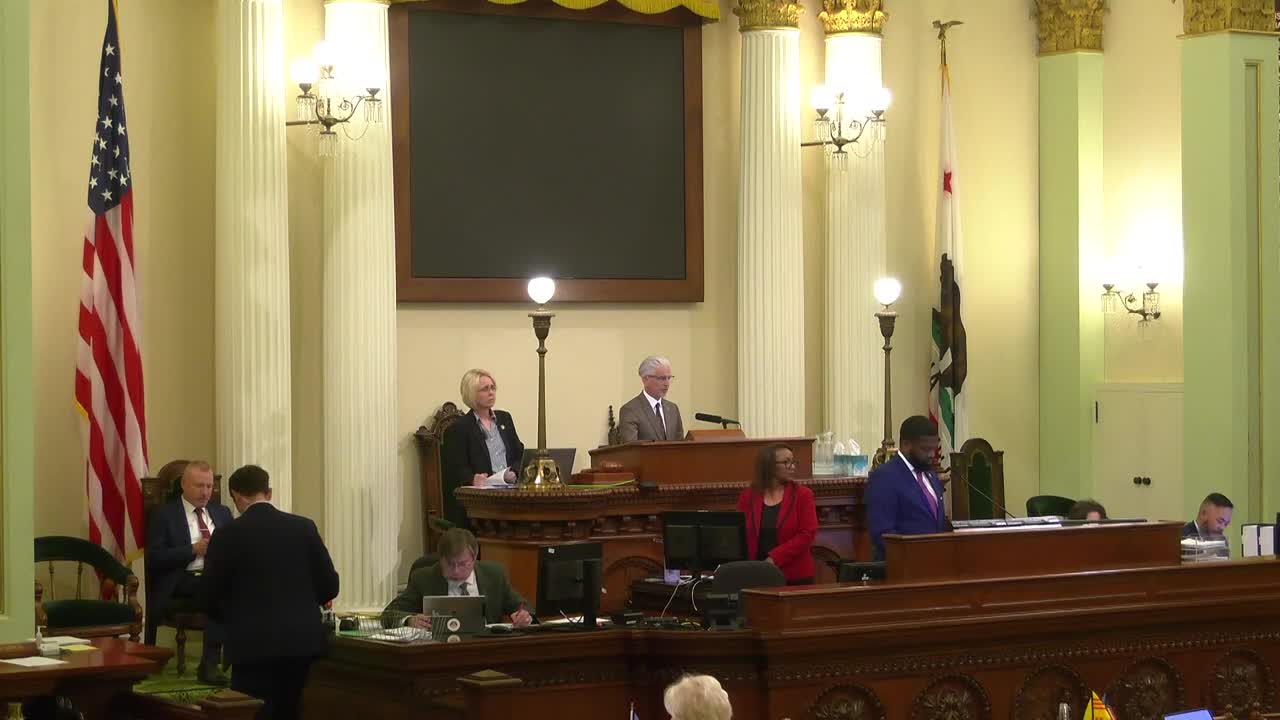 1MIN
Assembly Floor
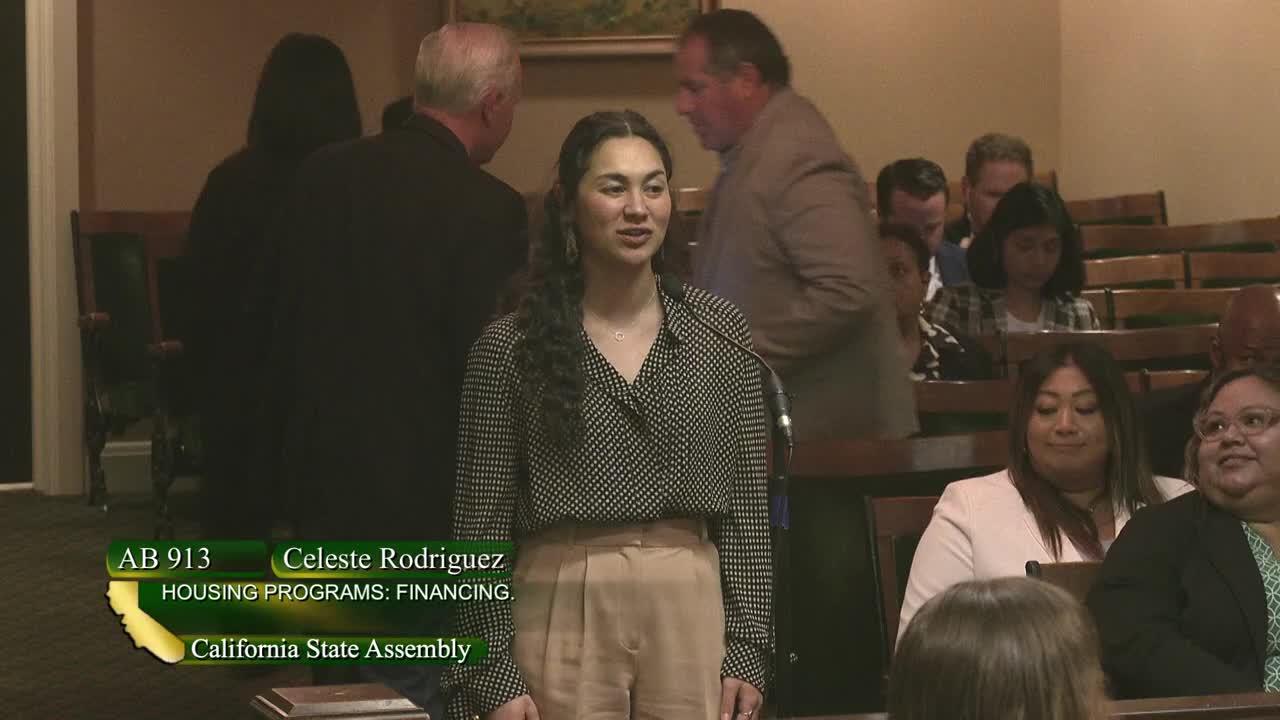 3MIN
Assembly Standing Committee on Housing and Community Development
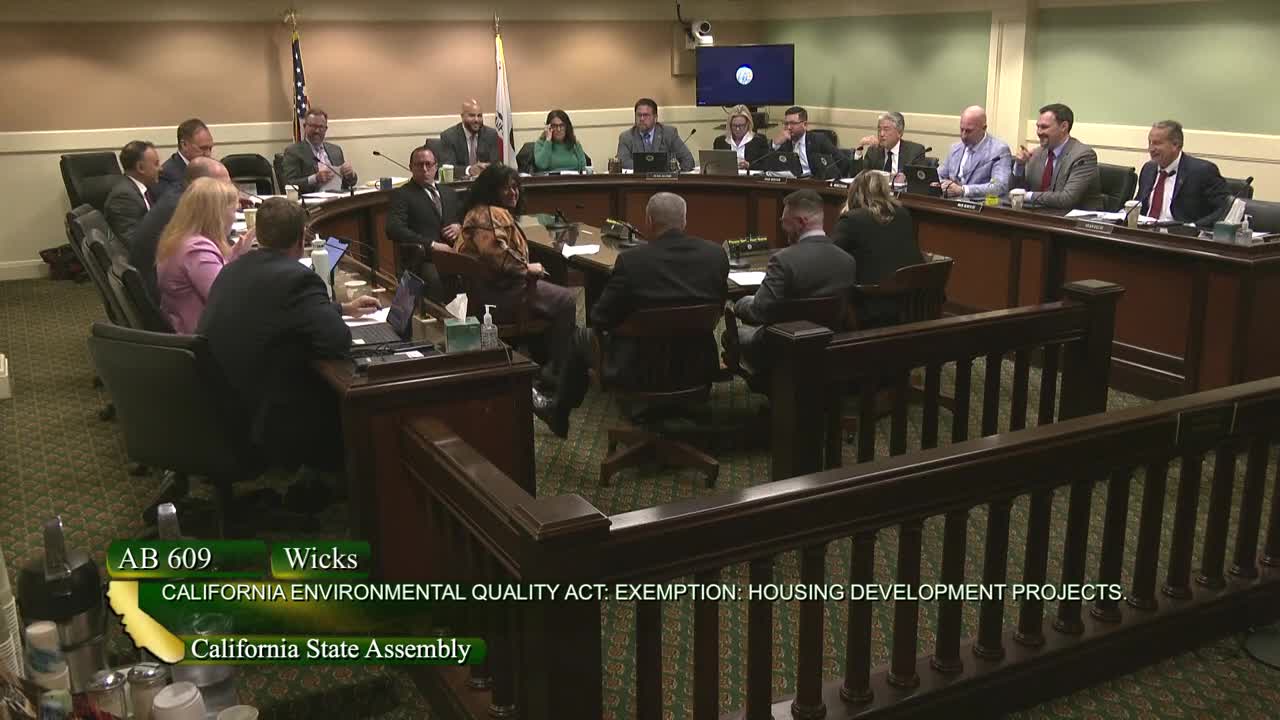 8MIN
Assembly Standing Committee on Natural Resources
Bill Author

Bill Co-Author(s):
