AB 48: Education finance: postsecondary education facilities: College Health and Safety Bond Act of 2026.
- Session Year: 2025-2026
- House: Assembly
- Latest Version Date: 2025-05-29
Current Status:
In Progress
(2025-06-05: In Senate. Read first time. To Com. on RLS. for assignment.)
Introduced
In Committee
Awaiting First Chamber Vote
Passed First Chamber
In Committee
Awaiting Second Chamber Vote
Passed Second Chamber
Enacted
(1)The California Constitution prohibits the Legislature from creating a debt or liability that singly or in the aggregate with any previous debts or liabilities exceeds the sum of $300,000, except by an act that (A) authorizes the debt for a single object or work specified in the act, (B) has been passed by a 2/3 2/3 vote of all the Members elected to each house of the Legislature, (C) has been submitted to the people at a statewide general or primary election, and (D) has received a majority of all the votes cast for and against it at that election.
This bill would set forth the College Health and Safety Bond Act of 2026 as a state general obligation bond act that would provide $____ to construct and modernize education facilities, as specified. This bond act would become operative only if approved by the voters at an undefined statewide election. The bill would also provide for the submission of the bond act to the voters at that election.
(4)(2)Existing law establishes the California State University, under the administration of the Trustees of the California State University, and the University of California, under the administration of the Regents of the University of California, as 2 of the segments of public postsecondary education in the state.
This bill would require the Trustees and the Regents to comply with certain conditions, as provided, before receiving funds from the 2026 University Capital Outlay Bond Fund established pursuant to the College Health and Safety Bond Act of 2026.
(5)(3)This bill, except for the provision making the provisions of the bill severable, would become operative upon the adoption of the College Health and Safety Bond Act of 2026 by the voters at an undefined statewide election.
(1)Existing law authorizes the governing board of any school district or community college district to order an election and submit to the electors of the district the question of whether the bonds of the district shall be issued and sold to raise money for specified purposes. Existing law generally requires, to pass a school bond measure, that either at least 2/3 of the votes cast on the proposition of issuing bonds be in favor of issuing the bonds to pass the measure, or, if certain conditions are met, at least 55% of the votes cast on the proposition of issuing bonds be in favor of issuing the bonds. Existing law prohibits the total amount of bonds issued by a school district or community college district from exceeding 1.25% of the taxable property of the district, as provided.
This bill would raise that limit to 2% for a community college district.
(2)Existing law also authorizes a unified school district or community college district to issue bonds receiving at least 55% of the votes cast on the proposition of issuing the bonds that, in aggregation with bonds issued with a 2/3 favorable vote, do not exceed 2.5% of the taxable property of the district, as provided.
This bill would raise that limit to 4% for a community college district.
(1)(3)The California Constitution prohibits the Legislature from creating a debt or liability that singly or in the aggregate with any previous debts or liabilities exceeds the sum of $300,000, except by an act that (A) authorizes the debt for a single object or work specified in the act, (B) has been passed by a 2/3 vote of all the Members elected to each house of the Legislature, (C) has been submitted to the people at a statewide general or primary election, and (D) has received a majority of all the votes cast for and against it at that election.
This bill would set forth the College Health and Safety Bond Act of 2026 as a state general obligation bond act that would provide $____ to construct and modernize education facilities, as specified. This bond act would become operative only if approved by the voters at the ____, an undefined statewide primary election. The bill would also provide for the submission of the bond act to the voters at that election.
(2)Existing law authorizes the governing board of a school district to impose, as specified, an alternative fee, charge, dedication, or requirement on developers to fund school facilities, until the date new construction bond proceeds authorized by the Preschool-College Public Education Bond Act of 2016 are expended, or December 31, 2020, whichever is earlier.This bill would remove this authority beginning the earlier of an unspecified date or the date new construction bond proceeds authorized by the 2016 bond act are expended or apportioned, until an unspecified date. The bill would also exempt multifamily housing developments that are located no further than 1/2 mile from a major transit stop, and reduce by 20% from specified amounts for any other multifamily housing developments, as specified, from any fee, charge, dedication, or other requirement for the construction or reconstruction of school facilities, as provided.(4)Existing law establishes the California State University, under the administration of the Trustees of the California State University, and the University of California, under the administration of the Regents of the University of California, as 2 of the segments of public postsecondary education in the state.
This bill would require the Trustees and the Regents to comply with certain conditions, as provided, before receiving funds from the 2026 University Capital Outlay Bond Fund established pursuant to the College Health and Safety Bond Act of 2026.
(3)(5)This bill, except for the provision making the provisions of the bill severable, would become effective operative upon the adoption of the College Health and Safety Bond Act of 2026 by the voters at the ____, an undefined statewide primary election.
(1)The California Constitution prohibits the Legislature from creating a debt or liability that singly or in the aggregate with any previous debts or liabilities exceeds the sum of $300,000, except by an act that (A) authorizes the debt for a single object or work specified in the act, (B) has been passed by a 2/3 vote of all the Members elected to each house of the Legislature, (C) has been submitted to the people at a statewide general or primary election, and (D) has received a majority of all the votes cast for and against it at that election.
This bill would set forth the College Health and Safety Bond Act of 2026 as a state general obligation bond act that would provide $____ to construct and modernize education facilities, as specified. This bond act would become operative only if approved by the voters at the ____, statewide primary election. The bill would also provide for the submission of the bond act to the voters at that election.
(2)Existing law authorizes the governing board of a school district to impose, as specified, an alternative fee, charge, dedication, or requirement on developers to fund school facilities, until the date new construction bond proceeds authorized by the Preschool-College Public Education Bond Act of 2016 are expended, or December 31, 2020, whichever is earlier.
This bill would remove this authority beginning the earlier of an unspecified date or the date new construction bond proceeds authorized by the 2016 bond act are expended or apportioned, until an unspecified date. The bill would also exempt multifamily housing developments that are located no further than 1/2 mile from a major transit stop, and reduce by 20% from specified amounts for any other multifamily housing developments, as specified, from any fee, charge, dedication, or other requirement for the construction or reconstruction of school facilities, as provided.
(3)This bill, except for the provision making the provisions of the bill severable, would become effective upon the adoption of the College Health and Safety Bond Act of 2026 by the voters at the ____, statewide primary election.
(a)As a condition of receiving funds from the 2026 University Capital Outlay Bond Fund established in Section 101230, the Trustees of the California State University shall adopt a five-year affordable student housing plan for each campus covering the 202627 to 203031 fiscal years, inclusive. Each campus plan shall include all of the following:
(1)A description of current student housing capacity, including the number of on-campus housing units, the demonstrated demand for those units, and the availability of off-campus alternatives for students who are denied student housing or are otherwise unable to access student housing. This data shall be disaggregated to detail the number of units in demand by, and occupied by, low-income students.
(2)The cost of on-campus and off-campus student housing, including how on-campus housing compares to local market rates and the availability of affordable off-campus housing located near the main campus.
(3)A description of campus efforts, over the last five years, to increase the availability of affordable student housing to a larger percentage of the campus student body.
(4)A goal for additional affordable student housing units and a detailed plan for campus efforts within the next five years to prospectively construct, acquire, or develop collaboratively with their local communities, including their local community colleges, additional affordable student housing.
(5)A description of campus institutional aid distribution policies to assist full-time students that meet the family income and asset qualifications to receive either a Cal Grant A financial aid award or Cal Grant B financial aid award to afford student housing.
(b)Commencing October 1, 2026, the Trustees of the California State University shall submit an updated report for each campus on the progress toward its goal to the Department of Finance and the Legislature by October 15 of each year. A final summative and systemwide report shall be submitted to the Department of Finance and the Legislature by October 15, 2031.
(c)(1)In developing a list of capital projects for consideration in the annual Budget Act that are proposed to be funded from the 2026 University Capital Outlay Bond Fund, the Trustees of the California State University shall use each campus five-year affordable student housing plan as a key input in prioritizing projects from campuses that the Trustees determines are improving, or will improve, access to affordable on-campus and off-campus student housing. Other key inputs in prioritizing the bond fund list shall include projects that address critical fire and life safety issues, projects that address seismic deficiencies, and projects that address critical deferred maintenance issues.
(2)The final prioritization and schedule of projects, including the extent to which the key inputs required pursuant to paragraph (1) were used by the Trustees to prioritize the Trustees list of submitted projects, shall be subject to review and consideration through the annual budget process.
(d)For purposes of this section, the following definitions apply:
(1)Affordable student housing means housing for low-income students for which the rental rate is either below the local market rate or the rent could be paid with the equivalent of 15 hours per week of federal work student wages in conjunction with financial aid.
(2)Low-income student means a full-time student that meets the family income and asset qualifications needs to receive either a Cal Grant A financial aid award or Cal Grant B financial aid award.
(e)It is the intent of the Legislature that each campus reflect local conditions, such as the percentage of local commuter students and the availability of affordable off-campus housing located near the campus, when developing the campus five-year affordable student housing plan.
(f)Reports submitted to the Legislature pursuant to this section shall be submitted in compliance with Section 9795 of the Government Code.
SEC. 6.SEC. 2.Article 7 (commencing with Section 92170) is added to Chapter 2 of Part 57 of Division 9 of Title 3 of the Education Code, to read:7.2026 University Capital Outlay Bond Fund Conditions92170.(a)As a condition of receiving funds from the 2026 University Capital Outlay Bond Fund established in Section 101230, the Regents of the University of California shall adopt a five-year affordable student housing plan for each campus covering the 202627 to 203031 fiscal years, inclusive. Each campus plan shall include all of the following:
(1)A description of current student housing capacity, including the number of on-campus housing units, the demonstrated demand for those units, and the availability of off-campus alternatives for students who are denied student housing or are otherwise unable to access student housing. This data shall be disaggregated to detail the number of units in demand by, and occupied by, low-income students.
(2)The cost of on-campus and off-campus student housing, including how on-campus housing compares to local market rates and the availability of affordable off-campus housing located near the main campus.
(3)A description of campus efforts, over the last five years, to increase the availability of affordable student housing to a larger percentage of the campus student body.
(4)A goal for additional affordable student housing units and a detailed plan for campus efforts within the next five years to prospectively construct, acquire, or develop collaboratively with their local communities, including their local community colleges, additional affordable student housing.
(5)A description of campus institutional aid distribution policies to assist full-time students that meet either the family income and asset qualifications to receive a Cal Grant A financial aid award or Cal Grant B financial aid award to afford student housing.
(b)Commencing October 1, 2026, the Regents of the University of California shall submit an updated report for each campus on the progress toward its goal to the Department of Finance and the Legislature by October 15 of each year. A final summative and systemwide report shall be submitted to the Department of Finance and the Legislature by October 15, 2031.
(c)(1)In developing a list of capital projects for consideration in the annual Budget Act that are proposed to be funded from the 2026 University Capital Outlay Bond Fund, the Regents of the University of California shall use each campus five-year affordable student housing plan as a key input in prioritizing projects from campuses that the Regents determine are improving, or will improve, access to affordable on-campus and off-campus student housing. Other key inputs in prioritizing the bond fund list shall include projects that address critical fire and life safety issues, projects that address seismic deficiencies, and projects that address critical deferred maintenance issues.
(2)The final prioritization and schedule of projects, including the extent to which the key inputs required pursuant to paragraph (1) were used by the Regents to prioritize its list of submitted projects, shall be subject to review and consideration through the annual budget process.
(d)For purposes of this section, the following definitions apply:
(1)Affordable student housing means housing for low-income students for which the rental rate is either below the local market rate or the rent could be paid with the equivalent of 15 hours per week of federal work student wages in conjunction with financial aid.
(2)Low-income student means a full-time student that meets the family income and asset qualifications needs to receive either a Cal Grant A financial aid award or Cal Grant B financial aid award.
(e)It is the intent of the Legislature that each campus reflect local conditions, such as the percentage of local commuter students and the availability of affordable off-campus housing located near the campus, when developing the campus five-year affordable student housing plan.
(f)Reports submitted to the Legislature pursuant to this section shall be submitted in compliance with Section 9795 of the Government Code.
SEC. 7.SEC. 3.Part 71 (commencing with Section 101200) is added to Division 14 of Title 3 of the Education Code, to read:71.The College Health and Safety Bond Act of 20261.General Provisions101200.This part shall be known, and may be cited, as the College Health and Safety Bond Act of 2026.
101201.The incorporation of, or reference to, any provision of state statutory law in this part includes all acts amendatory thereof and supplementary thereto.
101202.Bonds in the total amount of ____ dollars ($____), not including the amount of any refunding bonds issued in accordance with Sections 101221 and 101242, may be issued and sold for the purposes set forth in Sections 101212, 101231, and 101232. The bonds, when sold, issued, and delivered, shall be and constitute a valid and binding obligation of the State of California, and the full faith and credit of the State of California is hereby pledged for the punctual payment of the principal of, and interest on, the bonds as the principal and interest become due and payable.
101203.It is the intent of the Legislature to address the crisis of school facilities for all California students attending public community colleges and universities to:
(a)Upgrade public school facilities for earthquakes and other emergencies.
(b)Provide emergency funding to reopen schools following major disasters, including fires.
(c)Remove mold, asbestos, and other hazardous materials from classrooms and lead from school drinking water.
(d)Repair and replace aging public school buildings.
(e)Provide space for school nurses and counselors to increase student access to health care and mental health services.
(f)Modernize job, career, and vocational training facilities, including for veterans returning from duty.
(g)Construct, renovate, and expand affordable student and employee housing at public universities and community colleges to address critical shortages.
(h)Modernize existing student housing facilities to meet health, safety, and accessibility standards.
(i)Require independent audits and public hearings to provide accountability for taxpayer dollars.
(j)Cap administrative costs at 5 percent.
101204.Not more than 5 percent of the funds allocated pursuant to this part may be used to support the costs to administer the programs authorized by this act.
101205.(a)Debt service for bonds issued under this part shall not be paid from funds allocated pursuant to Section 8 of Article XVI of the California Constitution.
(b)The Legislature shall prioritize repayment of bonds issued under this part from revenue sources outside of the moneys to be applied by the state for support of school districts and community college districts pursuant to Section 8 of Article XVI of the California Constitution.
2.California Community College Facilities1.General Provisions101210.(a)The 2026 California Community College Capital Outlay Bond Fund is hereby established in the State Treasury for deposit of funds from the proceeds of bonds, not including the proceeds of any refunding bonds issued in accordance with Section 101221, issued and sold for the purposes of this chapter.
(b)The Higher Education Facilities Finance Committee established pursuant to Section 67353 is hereby continued in existence to act as the committee, as defined in the State General Obligation Bond Law (Chapter 4 (commencing with Section 16720) of Part 3 of Division 4 of Title 2 of the Government Code), for purposes of this chapter and to provide funds to aid the California Community Colleges.
2.California Community College Program Provisions101211.(a)From the proceeds of bonds issued and sold pursuant to Article 3 (commencing with Section 101212), the sum of ____ ($____) shall be deposited in the 2026 California Community College Capital Outlay Bond Fund for purposes of this chapter. When appropriated, these funds shall be available for expenditure for purposes of this chapter.
(b)The purposes of this chapter include assisting in meeting the capital outlay financing needs of the California Community Colleges, including the construction, acquisition, and renovation of affordable student and employee housing facilities.
(c)Proceeds from the sale of bonds issued and sold for purposes of this chapter may be used to fund any of the following:
(1)Student and employee housing projects on or near community college campuses, with priority given for affordability and proximity to transit.
(2)Construction on existing campuses, including the construction of buildings and the acquisition of related fixtures.
(3)Construction of intersegmental facilities.
(4)Renovation and reconstruction of facilities, site acquisition, the equipping of new, renovated, or reconstructed facilities, which equipment shall have an average useful life of 10 years, and to provide funds for the payment of preconstruction costs, including, but not limited to, preliminary plans and working drawings for facilities of the California Community Colleges.
(d)For purposes of this section, intersegmental means may be used by more than one segment of public higher education.
3.California Community College Fiscal Provisions101212.(a)Of the total amount of bonds authorized to be issued and sold pursuant to Chapter 1 (commencing with Section 101200), bonds in the total amount of ____ dollars ($____), not including the amount of any refunding bonds issued in accordance with Section 101221, may be issued and sold to provide a fund to be used for carrying out the purposes expressed in this chapter and to reimburse the General Obligation Bond Expense Revolving Fund pursuant to Section 16724.5 of the Government Code.
(b)Pursuant to this section, the Treasurer shall sell the bonds authorized by the Higher Education Facilities Finance Committee established pursuant to Section 67353 at any different times necessary to service expenditures required by the apportionments.
101213.(a)The bonds authorized by this chapter shall be prepared, executed, issued, sold, paid, and redeemed as provided in the State General Obligation Bond Law (Chapter 4 (commencing with Section 16720) of Part 3 of Division 4 of Title 2 of the Government Code). The provisions of that law, including all acts amendatory thereof and supplementary thereto, apply to those authorized bonds and this chapter, and are hereby incorporated into this chapter as though set forth in full within this chapter, except that subdivisions (a) and (b) of Section 16727 of the Government Code shall not apply to the bonds authorized by this chapter.
(b)For purposes of the State General Obligation Bond Law, each state agency administering an appropriation of the 2026 Community College Capital Outlay Bond Fund is designated as the board for projects funded pursuant to this chapter.
(c)The proceeds of the bonds issued and sold pursuant to this chapter shall be available for the purpose of funding aid to the California Community Colleges for the construction on existing or new campuses, and their respective off-campus centers and joint use and intersegmental facilities, as set forth in this chapter.
101214.The Higher Education Facilities Finance Committee established pursuant to Section 67353 shall authorize the issuance of bonds under this chapter only to the extent necessary to fund the related apportionments for the purposes described in this chapter that are expressly authorized by the Legislature in the annual Budget Act. Pursuant to that legislative direction, the committee shall determine by resolution whether or not it is necessary or desirable to issue bonds authorized pursuant to this chapter in order to carry out the purposes described in this chapter and, if so, the amount of bonds to be issued and sold. Successive issues of bonds may be authorized and sold to carry out those actions progressively, and it is not necessary that all of the bonds authorized to be issued be sold at any one time.
101215.There shall be collected each year and in the same manner and at the same time as other state revenue is collected, in addition to the ordinary revenues of the state, a sum in an amount required to pay the principal of, and interest on, the bonds each year. It is the duty of all officers charged by law with any duty in regard to the collection of the revenue to do and perform each and every act that is necessary to collect that additional sum.
101216.Notwithstanding Section 13340 of the Government Code, there is hereby appropriated from the General Fund in the State Treasury, for the purposes of this chapter, an amount that equals the total of the following:
(a)The sum annually necessary to pay the principal of, and interest on, bonds issued and sold pursuant to this chapter, as the principal and interest become due and payable.
(b)The sum necessary to carry out Section 101219, appropriated without regard to fiscal years.
101217.The board, as defined in subdivision (b) of Section 101213, may request the Pooled Money Investment Board to make a loan from the Pooled Money Investment Account or any other approved form of interim financing, in accordance with Section 16312 of the Government Code, for the purpose of carrying out this chapter. The amount of the request shall not exceed the amount of the unsold bonds that the Higher Education Facilities Finance Committee, by resolution, has authorized to be sold for the purpose of carrying out this chapter excluding any refunding bonds authorized pursuant to Section 101221, less any amount loaned and not yet repaid pursuant to this section and withdrawn from the General Fund pursuant to Section 101219 and not yet returned. The board, as defined in subdivision (b) of Section 101213, shall execute any documents required by the Pooled Money Investment Board to obtain and repay the loan. Any amounts loaned shall be deposited in the 2026 California Community College Capital Outlay Bond Fund to be allocated by the board in accordance with this chapter.
101218.Notwithstanding any other provision of this chapter, or of the State General Obligation Bond Law, if the Treasurer sells bonds pursuant to this chapter that include a bond counsel opinion to the effect that the interest on the bonds is excluded from gross income for federal tax purposes under designated conditions or is otherwise entitled to any federal tax advantage, the Treasurer may maintain separate accounts for the investment of bond proceeds and for the investment earnings on those proceeds. The Treasurer may use or direct the use of those proceeds or earnings to pay any rebate, penalty, or other payment required under federal law or take any other action with respect to the investment and use of those bond proceeds required or desirable under federal law to maintain the tax-exempt status of those bonds and to obtain any other advantage under federal law on behalf of the funds of this state.
101219.(a)For purposes of carrying out this chapter, the Director of Finance may authorize the withdrawal from the General Fund of an amount not to exceed the amount of the unsold bonds, excluding any refunding bonds authorized pursuant to Section 101221, less any amount loaned and not yet repaid pursuant to this section and withdrawn from the General Fund pursuant to Section 101217 and not yet returned, that have been authorized by the Higher Education Facilities Finance Committee to be sold for the purpose of carrying out this chapter. Any amounts withdrawn shall be deposited in the 2026 California Community College Capital Outlay Bond Fund consistent with this chapter. Any money made available under this section shall be returned to the General Fund, plus an amount equal to the interest that the money would have earned in the Pooled Money Investment Account, from proceeds received from the sale of bonds for purposes of carrying out this chapter.
(b)Any request forwarded to the Legislature and the Department of Finance for funds from this bond issue for expenditure for the purposes described in this chapter by the California Community Colleges shall be accompanied by the five-year capital outlay plan that reflects the needs and priorities of the community college system and is prioritized on a statewide basis. Requests shall include a schedule that prioritizes the seismic retrofitting needed to significantly reduce, in the judgment of the particular college, seismic hazards in buildings identified as high priority by the college.
101220.All moneys deposited in the 2026 California Community College Capital Outlay Bond Fund that are derived from premium and accrued interest on bonds sold pursuant to this chapter shall be reserved in the fund and shall be available for transfer to the General Fund as a credit to expenditures for bond interest, except those amounts derived from premium may be reserved and used to pay the cost of the bond issuance before any transfer to the General Fund.
101221.The bonds issued and sold pursuant to this chapter may be refunded in accordance with Article 6 (commencing with Section 16780) of Chapter 4 of Part 3 of Division 4 of Title 2 of the Government Code, which is a part of the State General Obligation Bond Law. Approval by the voters of the state for the issuance of the bonds described in this chapter includes the approval of the issuance of any bonds issued to refund any bonds originally issued under this chapter or any previously issued refunding bonds. Any bond refunded with the proceeds of refunding bonds as authorized by this section may be legally defeased to the extent permitted by law in the manner and to the extent set forth in the resolution, as amended from time to time, authorizing that refunded bond.
101222.The proceeds from the sale of bonds authorized by this chapter are not proceeds of taxes as that term is used in Article XIII B of the California Constitution, and the disbursement of these proceeds is not subject to the limitations imposed by that article.
3.University Facilities1.General Provisions101230.(a)The system of public universities in this state includes the University of California, the college named in Section 92200, and the California State University, and their respective off-campus centers.
(b)The 2026 University Capital Outlay Bond Fund is hereby established in the State Treasury for deposit of funds from the proceeds of bonds, not including the proceeds of any refunding bonds issued in accordance with Section 101242, issued and sold for the purposes of this chapter.
(c)(1)The Higher Education Facilities Finance Committee established pursuant to Section 67353 is hereby continued in existence to act as the committee, as defined in the State General Obligation Bond Law (Chapter 4 (commencing with Section 16720) of Part 3 of Division 4 of Title 2 of the Government Code), for purposes of this chapter to provide funds to aid the University of California, including the college named in Section 92200, and the California State University.
(2)The addition of the college named in Section 92200 to this section clarifies the Legislatures intent regarding, and is not intended to mark a change from, the funding authorizations made by Section 67354, as set forth in the Higher Education Facilities Bond Act of 1986, or by Section 67334, as set forth in the Higher Education Facilities Bond Act of 1988.
2.Program Provisions Applicable to the University of California and the College Named in Section 92200101231.(a)From the proceeds of bonds issued and sold pursuant to Article 4 (commencing with Section 101233), the sum of ____ dollars ($____) shall be deposited in the 2026 University Capital Outlay Bond Fund for purposes of this chapter. When appropriated, these funds shall be available for expenditure for purposes of this chapter.
(b)The purposes of this chapter include assisting in meeting the capital outlay financing needs of the University of California, including the college named in Section 92200, including the development of affordable student and employee housing.
(c)The proceeds of the bonds issued and sold pursuant to this chapter shall be available for any of the following:
(1)The construction, reconstruction, and remodeling of existing or new facilities, including the construction of buildings and the acquisition of related fixtures.
(2)The construction, acquisition, or renovation of student and employee housing, with priority given to projects that reduce housing cost burdens.
(3)The equipping of new, renovated, or reconstructed facilities.
(4)The payment of preconstruction costs, including, but not limited to, preliminary plans and working drawings.
(5)The renovation and reconstruction of facilities.
(6)The construction or improvement of off-campus and on-campus facilities of the University of California approved by the Regents of the University of California, including the acquisition of sites upon which these facilities are to be constructed.
3.Program Provisions Applicable to the California State University101232.(a)From the proceeds of bonds issued and sold pursuant to Article 4 (commencing with Section 101233), the sum of ____ dollars ($____) shall be deposited in the 2026 University Capital Outlay Bond Fund for the purposes of this chapter. When appropriated, these funds shall be available for expenditure for the purposes of this chapter.
(b)The purposes of this chapter include assisting in meeting the capital outlay financing needs of the California State University.
(c)The proceeds of the bonds issued and sold pursuant to this chapter shall be available for any of the following:
(1)The construction, reconstruction, and remodeling of existing or new facilities, including the construction of buildings and the acquisition of related fixtures.
(2)The construction, acquisition, or renovation of student and employee housing, with priority given to projects that reduce housing cost burdens.
(3)The equipping of new, renovated, or reconstructed facilities.
(4)The payment of preconstruction costs, including, but not limited to, preliminary plans and working drawings.
(5)The renovation and reconstruction of facilities.
(6)The construction or improvement of off-campus and on-campus facilities of the California State University approved by the Trustees of the California State University, including the acquisition of sites upon which these facilities are to be constructed.
4.University Fiscal Provisions101233.(a)Of the total amount of bonds authorized to be issued and sold pursuant to Chapter 1 (commencing with Section 101200), bonds in the amount of ____ dollars ($____), not including the amount of any refunding bonds issued in accordance with Section 101242, may be issued and sold to provide a fund to be used for carrying out the purposes expressed in this chapter and to reimburse the General Obligation Bond Expense Revolving Fund pursuant to Section 16724.5 of the Government Code.
(b)Pursuant to this section, the Treasurer shall sell the bonds authorized by the Higher Education Facilities Finance Committee, established pursuant to Section 67353, at any different times necessary to service expenditures required by the apportionments.
(c)(1)It is the intent of the Legislature that the University of California and the California State University annually consider the inclusion of intersegmental facilities as part of those entities annual capital outlay planning process and that on or before May 15th of each year, those entities report their findings to the budget committees of each house of the Legislature.
(2)For purposes of this subdivision, intersegmental means may be used by more than one segment of public higher education.
101234.(a)The bonds authorized by this chapter shall be prepared, executed, issued, sold, paid, and redeemed as provided in the State General Obligation Bond Law (Chapter 4 (commencing with Section 16720) of Part 3 of Division 4 of Title 2 of the Government Code). The provisions of that law, including all acts amendatory thereof and supplementary thereto, apply to those authorized bonds and this chapter, and are hereby incorporated into this chapter as though set forth in full within this chapter, except that subdivisions (a) and (b) of Section 16727 of the Government Code shall not apply to the bonds authorized by this chapter.
(b)For the purposes of the State General Obligation Bond Law, each state agency administering an appropriation of the 2026 University Capital Outlay Bond Fund is designated as the board for projects funded pursuant to this chapter.
(c)The proceeds of the bonds issued and sold pursuant to this chapter shall be available for the purpose of funding aid to the University of California, including the college named in Section 92200, and the California State University, for the construction on existing or new campuses, and their respective off-campus centers and joint use and intersegmental facilities, as set forth in this chapter.
101235.The Higher Education Facilities Finance Committee established pursuant to Section 67353 shall authorize the issuance of bonds under this chapter only to the extent necessary to fund the apportionments for the purposes described in this chapter that are expressly authorized by the Legislature in the annual Budget Act. Pursuant to that legislative direction, the committee shall determine whether or not it is necessary or desirable to issue bonds authorized pursuant to this chapter in order to carry out the purposes described in this chapter and, if so, the amount of bonds to be issued and sold. Successive issues of bonds may be authorized and sold to carry out those actions progressively, and it is not necessary that all of the bonds authorized to be issued be sold at any one time.
101236.There shall be collected each year and in the same manner and at the same time as other state revenue is collected, in addition to the ordinary revenues of the state, a sum in an amount required to pay the principal of, and interest on, the bonds each year. It is the duty of all officers charged by law with any duty in regard to the collection of the revenue to do and perform each and every act which is necessary to collect that additional sum.
101237.Notwithstanding Section 13340 of the Government Code, there is hereby appropriated from the General Fund in the State Treasury, for the purposes of this chapter, an amount that equals the total of the following:
(a)The sum annually necessary to pay the principal of, and interest on, bonds issued and sold pursuant to this chapter, as the principal and interest become due and payable.
(b)The sum necessary to carry out Section 101240, appropriated without regard to fiscal years.
101238.The board, as defined in subdivision (b) of Section 101234, may request the Pooled Money Investment Board to make a loan from the Pooled Money Investment Account or any other approved form of interim financing, in accordance with Section 16312 of the Government Code, for the purpose of carrying out this chapter. The amount of the request shall not exceed the amount of the unsold bonds that the Higher Education Facilities Finance Committee, by resolution, has authorized to be sold for the purpose of carrying out this chapter, excluding any refunding bonds authorized pursuant to Section 101242. The board, as defined in subdivision (b) of Section 101234, shall execute any documents required by the Pooled Money Investment Board to obtain and repay the loan. Any amounts loaned shall be deposited in the 2026 University Capital Outlay Bond Fund to be allocated by the board in accordance with this chapter.
101239.Notwithstanding any other provision of this chapter, or of the State General Obligation Bond Law, if the Treasurer sells bonds pursuant to this chapter that include a bond counsel opinion to the effect that the interest on the bonds is excluded from gross income for federal tax purposes under designated conditions, or is otherwise entitled to any federal tax advantage, the Treasurer may maintain separate accounts for the investment of bond proceeds and for the investment earnings on those proceeds. The Treasurer may use or direct the use of those proceeds or earnings on those proceeds to pay any rebate, penalty, or other payment required under federal law or take any other action with respect to the investment and use of those bond proceeds required or desirable under federal law to maintain the tax-exempt status of those bonds and to obtain any other advantage under federal law on behalf of the funds of this state.
101240.(a)For purposes of carrying out this chapter, the Director of Finance may authorize the withdrawal from the General Fund of an amount not to exceed the amount of the unsold bonds, excluding any refunding of bonds authorized pursuant to Section 101242, that have been authorized by the Higher Education Facilities Finance Committee to be sold for the purpose of carrying out this chapter. Any amounts withdrawn shall be deposited in the 2026 University Capital Outlay Bond Fund consistent with this chapter. Any money made available under this section shall be returned to the General Fund, plus an amount equal to the interest that the money would have earned in the Pooled Money Investment Account, from proceeds received from the sale of bonds for purposes of carrying out this chapter.
(b)Any request forwarded to the Legislature and the Department of Finance for funds from this bond issued for expenditure for the purposes described in this chapter by the University of California, the college named in Section 92200, or the California State University shall be accompanied by the five-year capital outlay plan of the particular university or college.
101241.All moneys deposited in the 2026 University Capital Outlay Bond Fund that are derived from premium and accrued interest on bonds sold pursuant to this chapter shall be reserved in the fund and shall be available for transfer to the General Fund as a credit to expenditures for bond interest, except those amounts derived from premium may be reserved and used to pay the costs of the bond issuance before any transfer to the General Fund.
101242.The bonds issued and sold pursuant to this chapter may be refunded in accordance with Article 6 (commencing with Section 16780) of Chapter 4 of Part 3 of Division 4 of Title 2 of the Government Code, which is a part of the State General Obligation Bond Law. Approval by the voters of the state for the issuance of the bonds described in this chapter includes the approval of the issuance of any bonds issued to refund any bonds originally issued under this chapter or any previously issued refunding bonds. Any bond refunded with the proceeds of refunding bonds as authorized by this section may be legally defeased to the extent permitted by law in the manner and to the extent set forth in the resolution, as amended from time to time, authorizing that refunded bond.
101243.The proceeds from the sale of bonds authorized by this chapter are not proceeds of taxes as that term is used in Article XIII B of the California Constitution, and the disbursement of these proceeds is not subject to the limitations imposed by that article.
4.Transparency and Accountability Provisions101250.(a)(1)A governing board of a community college district, the Trustees of the California State University, the Regents of the University of California, or the Board of Directors of the college named in Section 92200 shall ensure that an independent performance audit of any project funded in whole or in part from the proceeds of a bond authorized by this part is conducted to ensure that the use of the applicable funds has been reviewed for expenditure consistent with the requirements of all applicable laws.
(2)A performance audit conducted for any project funded in whole or in part from the proceeds of bonds authorized by this part and required by any other law shall be deemed to satisfy the requirements of paragraph (1).
(3)The result of any audit required by this subdivision shall be posted on the internet website of the applicable community college district, the California State University, the University of California, or the college named in Section 92200.
(b)(1)Before approving a request for the consideration of a project, or projects, by the Legislature that would be funded by the proceeds of a bond authorized by this part, the governing board of a community college district shall hold at least one public hearing to solicit input from members of the public regarding a project, or projects, being requested for consideration.
(2)The public hearing required pursuant to paragraph (1) may:
(A)Occur at the same public hearing in which the governing board approves the project, or projects, seeking funds from this part.
(B)Be conducted as part of a regularly scheduled and publicly noticed hearing of the governing board.
(3)(A)A community college district shall post information regarding a project, or projects, seeking, or requesting, funds from this part that have been approved by the governing board of the community college district on its public internet website.
(B)The project information reflected on the internet website pursuant to subparagraph (A) shall include, but not be limited to, the location of the project, or projects, estimated project costs, and the estimated timeline for the completion of the project, or projects.
(4)(A)A community college district shall retain all financial accounts, documents, and records necessary for the audit required pursuant to subdivision (a).
(B)For purposes of this paragraph, a community college district may maintain records electronically, in compliance with any applicable state and federal laws.
(c)(1)Before approving a request for the consideration of a project, or projects, by the Legislature that would be funded by the proceeds of a bond authorized by this part, the Trustees of the California State University, the Regents of the University of California, and the Board of Directors of the college named in Section 92200 shall hold at least one public hearing to solicit input from members of the public regarding a project, or projects, being requested for consideration.
(2)The public hearing required pursuant to paragraph (1) may:
(A)Occur at the same public hearing in which the governing entity approves the submission of the applicable project, or projects.
(B)Be conducted as part of a regularly scheduled and publicly noticed hearing of the governing entity.
(3)(A)The California State University, the University of California, and the college named in Section 92200 shall post information regarding a project, or projects, that have been approved for submission by the applicable governing body on their respective public internet websites.
(B)The project information reflected on the internet website pursuant to subparagraph (A) shall include, but not be limited to, the location of the project, or projects, estimated project costs, and the estimated timeline for the completion of the project, or projects.
(4)(A)The California State University, the University of California, and the college named in Section 92200, or their applicable campuses, shall retain all financial accounts, documents, and records necessary for the audit required pursuant to subdivision (a).
(B)For purposes of this paragraph, the California State University, the University of California, and the college named in Section 92200, or their applicable campuses, may maintain records electronically, in compliance with any applicable state and federal laws.
SEC. 8.SEC. 4.The provisions of this act are severable. If any provision of this act or its application is held invalid, that invalidity shall not affect other provisions or applications that can be given effect without the invalid provision or application.
SEC. 9.SEC. 5.Sections 1 to 7, 3, inclusive, of this act shall become operative upon the adoption by the voters of the College Health and Safety Bond Act of 2026, as set forth in Section 7 3 of this act.
SEC. 10.SEC. 6.Section 7 3 of this act shall be submitted to the voters at the ____, statewide election.
(a)The total amount of bonds issued pursuant to this chapter and Chapter 1.5 (commencing with Section 15264) shall not exceed 1.25 percent of the taxable property of the school district or community college district, or the school facilities improvement district, if applicable, as shown by the last equalized assessment of the county or counties in which the school district or school facilities improvement district is located.
(b)The total amount of bonds issued pursuant to this chapter and Chapter 1.5 (commencing with Section 15264) shall not exceed 2 percent of the taxable property of the community college district, as shown by the last equalized assessment of the county or counties in which the community college district is located.
For(c)For purposes of this section, the taxable property of a district for any fiscal year shall be calculated to include, but not be limited to, the assessed value of all unitary and operating nonunitary property of the district, which shall be derived by dividing the gross assessed value of the unitary and operating nonunitary property within the district for the 198788 fiscal year by the gross assessed value of all unitary and operating nonunitary property within the county in which the district is located for the 198788 fiscal year, and multiplying that result by the gross assessed value of all unitary and operating nonunitary property of the county on the last equalized assessment roll.
SEC. 2.Section 15106 of the Education Code is amended to read:15106.(a)(1)A unified school district or community college district may issue bonds that, in aggregation with bonds issued pursuant to Section 15270, shall not exceed 2.5 percent of the taxable property of the school district or community college district, unified school district, or the school facilities improvement district, if applicable, as shown by the last equalized assessment of the county or counties in which the district is located.
(2)A community college district may issue bonds that, in aggregation with bonds issued pursuant to Section 15270, shall not exceed 4 percent of the taxable property of the community college district, as shown by the last equalized assessment of the county or counties in which the community college district is located.
In(3)In computing the outstanding bonded indebtedness of a unified school district or community college district for all purposes of this section, any outstanding bonds shall be deemed to have been issued for elementary school purposes, high school purposes, and community college purposes, respectively, in the respective amounts that the proceeds of the sale of those outstanding bonds, excluding any premium and accrued interest received on that sale, were or have been allocated by the governing board of the unified school district or community college district to each of those purposes respectively.
(a)(b)For the purposes of the State School Building Aid Law of 1952 (Chapter 6 (commencing with Section 16000)) with respect to applications for apportionments and apportionments filed or made prior to before September 15, 1961, and to the repayment thereof, Chapter 4 (commencing with Section 15700), inclusive, only, a unified school district shall be considered to have a bonding capacity in the amount permitted by law for an elementary school district and a bonding capacity in the amount permitted by law for a high school district.
(b)(c)For purposes of this section, the taxable property of a district for a fiscal year shall be calculated to include, but not be limited to, the assessed value of all unitary and operating nonunitary property of the district, which shall be derived by dividing the gross assessed value of the unitary and operating nonunitary property within the district for the 198788 fiscal year by the gross assessed value of all unitary and operating nonunitary property within the county in which the district is located for the 198788 fiscal year, and multiplying the result by the gross assessed value of all unitary and operating nonunitary property of the county on the last equalized assessment roll. In the event of the unification of If two or more school districts or community college districts are unified subsequent to the 198788 fiscal year, the assessed value of all unitary and operating nonunitary property of the unified district or community college district shall be deemed to be the total of the assessed value of the taxable property of each of the unifying districts as that assessed value would be determined under Section 15102.
SEC. 3.Section 15268 of the Education Code is amended to read:15268.(a)The total amount of bonds issued, including bonds issued pursuant to Chapter 1 (commencing with Section 15100), shall not exceed 1.25 percent of the taxable property of the school district as shown by the last equalized assessment of the county or counties in which the school district is located.
(b)The total amount of bonds issued, including bonds issued pursuant to Chapter 1 (commencing with Section 15100), shall not exceed 2 percent of the taxable property of the community college district as shown by the last equalized assessment of the county or counties in which the community college district is located.
The(c)The bonds may only be issued if the tax rate levied to meet the requirements of Section 18 of Article XVI of the California Constitution in the case of indebtedness incurred by a school district pursuant to this chapter, at a single election, would not exceed thirty dollars ($30) per year per one hundred thousand dollars ($100,000) of taxable property when assessed valuation is projected by the school district to increase in accordance with Article XIIIA of the California Constitution. For
(d)For purposes of this section, the taxable property of a school district or community college district for any fiscal year shall be calculated to include, but not be limited to, the assessed value of all unitary and operating nonunitary property of the district, which shall be derived by dividing the gross assessed value of the unitary and operating nonunitary property within the district for the 198788 fiscal year by the gross assessed value of all unitary and operating nonunitary property within the county in which the district is located for the 198788 fiscal year, and multiplying that result by the gross assessed value of all unitary and operating nonunitary property of the county on the last equalized assessment roll.
SEC. 4.Section 15270 of the Education Code is amended to read:15270.(a)Notwithstanding Sections 15102 and 15268, any a unified school district may issue bonds pursuant to this article that, in aggregation with bonds issued pursuant to Chapter 1 (commencing with Section 15100), may shall not exceed 2.5 percent of the taxable property of the district as shown by the last equalized assessment of the county or counties in which the district is located. The bonds may only be issued if the tax rate levied to meet the requirements of Section 18 of Article XVI of the California Constitution in the case of indebtedness incurred pursuant to this chapter at a single election, by a unified school district, would not exceed sixty dollars ($60) per year per one hundred thousand dollars ($100,000) of taxable property when assessed valuation is projected by the district to increase in accordance with Article XIIIA of the California Constitution.
(b)Notwithstanding Sections 15102 and 15268, any a community college district may issue bonds pursuant to this article that, in aggregation with bonds issued pursuant to Chapter 1 (commencing with Section 15100), may shall not exceed 2.5 4 percent of the taxable property of the district as shown by the last equalized assessment of the county or counties in which the district is located. The bonds may only be issued if the tax rate levied to meet the requirements of Section 18 of Article XVI of the California Constitution in the case of indebtedness incurred pursuant to this chapter at a single election, by a community college district, would not exceed twenty-five dollars ($25) per year per one hundred thousand dollars ($100,000) of taxable property when assessed valuation is projected by the district to increase in accordance with Article XIIIA of the California Constitution.
(c)In computing the outstanding bonded indebtedness of any unified school district or community college district for all purposes of this section, any outstanding bonds shall be deemed to have been issued for elementary school purposes, high school purposes, and community college purposes, respectively, in the respective amounts that the proceeds of the sale of those outstanding bonds, excluding any premium and accrued interest received on that sale, were or have been allocated by the governing board of the unified school district or community college district to each of those purposes respectively.
(d)For purposes of this section, the taxable property of a district for any fiscal year shall be calculated to include, but not be limited to, the assessed value of all unitary and operating nonunitary property of the district, which shall be derived by dividing the gross assessed value of the unitary and operating nonunitary property within the district for the 198788 fiscal year by the gross assessed value of all unitary and operating nonunitary property within the county in which the district is located for the 198788 fiscal year, and multiplying the result by the gross assessed value of all unitary and operating nonunitary property of the county on the last equalized assessment roll. In the event of the unification of If two or more school districts are unified subsequent to the 198788 fiscal year, the assessed value of all unitary and operating nonunitary property of the unified district shall be deemed to be the total of the assessed value of the taxable property of each of the unifying districts as that assessed value would be determined under Section 15268.
(e)For the purposes of this article, general obligation bonds, as that term is used in Section 18 of Article XVI of the California Constitution, means bonds of a school district or community college district district, the repayment of which is provided for by this chapter and Chapter 1 (commencing with Section 15100) of Part 10, 15100), and includes bonds of a school facilities improvement district district, the repayment of which is provided for by this chapter and Chapter 2 (commencing with Section 15300).
SEC. 5.Article 8 (commencing with Section 89800) is added to Chapter 6 of Part 55 of Division 8 of Title 3 of the Education Code, to read:8.2026 University Capital Outlay Bond Fund Conditions89800.(a)As a condition of receiving funds from the 2026 University Capital Outlay Bond Fund established in Section 101230, the Trustees of the California State University shall adopt a five-year affordable student housing plan for each campus covering the 202627 to 203031 fiscal years, inclusive. Each campus plan shall include all of the following:
(1)A description of current student housing capacity, including the number of on-campus housing units, the demonstrated demand for those units, and the availability of off-campus alternatives for students who are denied student housing or are otherwise unable to access student housing. This data shall be disaggregated to detail the number of units in demand by, and occupied by, low-income students.
(2)The cost of on-campus and off-campus student housing, including how on-campus housing compares to local market rates and the availability of affordable off-campus housing located near the main campus.
(3)A description of campus efforts, over the last five years, to increase the availability of affordable student housing to a larger percentage of the campus student body.
(4)A goal for additional affordable student housing units and a detailed plan for campus efforts within the next five years to prospectively construct, acquire, or develop collaboratively with their local communities, including their local community colleges, additional affordable student housing.
(5)A description of campus institutional aid distribution policies to assist full-time students that meet the family income and asset qualifications to receive either a Cal Grant A financial aid award or Cal Grant B financial aid award to afford student housing.
(b)Commencing October 1, 2026, the Trustees of the California State University shall submit an updated report for each campus on the progress toward its goal to the Department of Finance and the Legislature by October 15 of each year. A final summative and systemwide report shall be submitted to the Department of Finance and the Legislature by October 15, 2031.
(c)(1)In developing a list of capital projects for consideration in the annual Budget Act that are proposed to be funded from the 2026 University Capital Outlay Bond Fund, the Trustees of the California State University shall use each campus five-year affordable student housing plan as a key input in prioritizing projects from campuses that the Trustees determines are improving, or will improve, access to affordable on-campus and off-campus student housing. Other key inputs in prioritizing the bond fund list shall include projects that address critical fire and life safety issues, projects that address seismic deficiencies, and projects that address critical deferred maintenance issues.
(2)The final prioritization and schedule of projects, including the extent to which the key inputs required pursuant to paragraph (1) were used by the Trustees to prioritize the Trustees list of submitted projects, shall be subject to review and consideration through the annual budget process.
(d)For purposes of this section, the following definitions apply:
(1)Affordable student housing means housing for low-income students for which the rental rate is either below the local market rate or the rent could be paid with the equivalent of 15 hours per week of federal work student wages in conjunction with financial aid.
(2)Low-income student means a full-time student that meets the family income and asset qualifications needs to receive either a Cal Grant A financial aid award or Cal Grant B financial aid award.
(e)It is the intent of the Legislature that each campus reflect local conditions, such as the percentage of local commuter students and the availability of affordable off-campus housing located near the campus, when developing the campus five-year affordable student housing plan.
(f)Reports submitted to the Legislature pursuant to this section shall be submitted in compliance with Section 9795 of the Government Code.
SEC. 6.Article 7 (commencing with Section 92170) is added to Chapter 2 of Part 57 of Division 9 of Title 3 of the Education Code, to read:7.2026 University Capital Outlay Bond Fund Conditions92170.(a)As a condition of receiving funds from the 2026 University Capital Outlay Bond Fund established in Section 101230, the Regents of the University of California shall adopt a five-year affordable student housing plan for each campus covering the 202627 to 203031 fiscal years, inclusive. Each campus plan shall include all of the following:
(1)A description of current student housing capacity, including the number of on-campus housing units, the demonstrated demand for those units, and the availability of off-campus alternatives for students who are denied student housing or are otherwise unable to access student housing. This data shall be disaggregated to detail the number of units in demand by, and occupied by, low-income students.
(2)The cost of on-campus and off-campus student housing, including how on-campus housing compares to local market rates and the availability of affordable off-campus housing located near the main campus.
(3)A description of campus efforts, over the last five years, to increase the availability of affordable student housing to a larger percentage of the campus student body.
(4)A goal for additional affordable student housing units and a detailed plan for campus efforts within the next five years to prospectively construct, acquire, or develop collaboratively with their local communities, including their local community colleges, additional affordable student housing.
(5)A description of campus institutional aid distribution policies to assist full-time students that meet either the family income and asset qualifications to receive a Cal Grant A financial aid award or Cal Grant B financial aid award to afford student housing.
(b)Commencing October 1, 2026, the Regents of the University of California shall submit an updated report for each campus on the progress toward its goal to the Department of Finance and the Legislature by October 15 of each year. A final summative and systemwide report shall be submitted to the Department of Finance and the Legislature by October 15, 2031.
(c)(1)In developing a list of capital projects for consideration in the annual Budget Act that are proposed to be funded from the 2026 University Capital Outlay Bond Fund, the Regents of the University of California shall use each campus five-year affordable student housing plan as a key input in prioritizing projects from campuses that the Regents determine are improving, or will improve, access to affordable on-campus and off-campus student housing. Other key inputs in prioritizing the bond fund list shall include projects that address critical fire and life safety issues, projects that address seismic deficiencies, and projects that address critical deferred maintenance issues.
(2)The final prioritization and schedule of projects, including the extent to which the key inputs required pursuant to paragraph (1) were used by the Regents to prioritize its list of submitted projects, shall be subject to review and consideration through the annual budget process.
(d)For purposes of this section, the following definitions apply:
(1)Affordable student housing means housing for low-income students for which the rental rate is either below the local market rate or the rent could be paid with the equivalent of 15 hours per week of federal work student wages in conjunction with financial aid.
(2)Low-income student means a full-time student that meets the family income and asset qualifications needs to receive either a Cal Grant A financial aid award or Cal Grant B financial aid award.
(e)It is the intent of the Legislature that each campus reflect local conditions, such as the percentage of local commuter students and the availability of affordable off-campus housing located near the campus, when developing the campus five-year affordable student housing plan.
(f)Reports submitted to the Legislature pursuant to this section shall be submitted in compliance with Section 9795 of the Government Code.
SECTION 1.SEC. 7.Part 71 (commencing with Section 101200) is added to Division 14 of Title 3 of the Education Code, to read:71.The College Health and Safety Bond Act of 20261.General Provisions101200.This part shall be known, and may be cited, as the College Health and Safety Bond Act of 2026.
101201.The incorporation of, or reference to, any provision of state statutory law in this part includes all acts amendatory thereof and supplementary thereto.
101202.Bonds in the total amount of ____ dollars ($____), not including the amount of any refunding bonds issued in accordance with Sections 101221 and 101242, may be issued and sold for the purposes set forth in Sections 101212, 101231, and 101232. The bonds, when sold, issued, and delivered, shall be and constitute a valid and binding obligation of the State of California, and the full faith and credit of the State of California is hereby pledged for the punctual payment of the principal of, and interest on, the bonds as the principal and interest become due and payable.
101203.It is the intent of the Legislature to address the crisis of school facilities for all California students attending public community colleges and universities to:
(a)Upgrade public school facilities for earthquakes and other emergencies.
(b)Provide emergency funding to reopen schools following major disasters, including fires.
(c)Remove mold, asbestos, and other hazardous materials from classrooms and lead from school drinking water.
(d)Repair and replace aging public school buildings.
(e)Provide space for school nurses and counselors to increase student access to health care and mental health services.
(f)Modernize job, career, and vocational training facilities, including for veterans returning from duty.
(g)Construct, renovate, and expand affordable student and employee housing at public universities and community colleges to address critical shortages.
(h)Modernize existing student housing facilities to meet health, safety, and accessibility standards.
(g)(i)Require independent audits and public hearings to provide accountability for taxpayer dollars.
(h)(j)Cap administrative costs at 5 percent.
101204.Not more than 5 percent of the funds allocated pursuant to this part may be used to support the costs to administer the programs authorized by this act.
101205.(a)Debt service for bonds issued under this part shall not be paid from funds allocated pursuant to Section 8 of Article XVI of the California Constitution.
(b)The Legislature shall prioritize repayment of bonds issued under this part from revenue sources outside of the moneys to be applied by the state for support of school districts and community college districts pursuant to Section 8 of Article XVI of the California Constitution.
2.California Community College Facilities1.General Provisions101210.(a)The 2026 California Community College Capital Outlay Bond Fund is hereby established in the State Treasury for deposit of funds from the proceeds of bonds, not including the proceeds of any refunding bonds issued in accordance with Section 101221, issued and sold for the purposes of this chapter.
(b)The Higher Education Facilities Finance Committee established pursuant to Section 67353 is hereby continued in existence to act as the committee, as defined in the State General Obligation Bond Law (Chapter 4 (commencing with Section 16720) of Part 3 of Division 4 of Title 2 of the Government Code), for purposes of this chapter and to provide funds to aid the California Community Colleges.
2.California Community College Program Provisions101211.(a)From the proceeds of bonds issued and sold pursuant to Article 3 (commencing with Section 101212), the sum of ____ ($____) shall be deposited in the 2026 California Community College Capital Outlay Bond Fund for purposes of this chapter. When appropriated, these funds shall be available for expenditure for purposes of this chapter.
(b)The purposes of this chapter include assisting in meeting the capital outlay financing needs of the California Community Colleges. Colleges, including the construction, acquisition, and renovation of affordable student and employee housing facilities.
(c)Proceeds from the sale of bonds issued and sold for purposes of this chapter may be used to fund construction any of the following:
(1)Student and employee housing projects on or near community college campuses, with priority given for affordability and proximity to transit.
(2)Construction on existing campuses, including the construction of buildings and the acquisition of related fixtures, construction fixtures.
(3)Construction of intersegmental facilities, the renovation facilities.
(4)Renovation and reconstruction of facilities, site acquisition, the equipping of new, renovated, or reconstructed facilities, which equipment shall have an average useful life of 10 years, and to provide funds for the payment of preconstruction costs, including, but not limited to, preliminary plans and working drawings for facilities of the California Community Colleges.
(d)For purposes of this section, intersegmental means may be used by more than one segment of public higher education.
3.California Community College Fiscal Provisions101212.(a)Of the total amount of bonds authorized to be issued and sold pursuant to Chapter 1 (commencing with Section 101200), bonds in the total amount of ____ dollars ($____), not including the amount of any refunding bonds issued in accordance with Section 101221, may be issued and sold to provide a fund to be used for carrying out the purposes expressed in this chapter and to reimburse the General Obligation Bond Expense Revolving Fund pursuant to Section 16724.5 of the Government Code.
(b)Pursuant to this section, the Treasurer shall sell the bonds authorized by the Higher Education Facilities Finance Committee established pursuant to Section 67353 at any different times necessary to service expenditures required by the apportionments.
101213.(a)The bonds authorized by this chapter shall be prepared, executed, issued, sold, paid, and redeemed as provided in the State General Obligation Bond Law (Chapter 4 (commencing with Section 16720) of Part 3 of Division 4 of Title 2 of the Government Code). The provisions of that law, including all acts amendatory thereof and supplementary thereto, apply to those authorized bonds and this chapter, and are hereby incorporated into this chapter as though set forth in full within this chapter, except that subdivisions (a) and (b) of Section 16727 of the Government Code shall not apply to the bonds authorized by this chapter.
(b)For purposes of the State General Obligation Bond Law, each state agency administering an appropriation of the 2026 Community College Capital Outlay Bond Fund is designated as the board for projects funded pursuant to this chapter.
(c)The proceeds of the bonds issued and sold pursuant to this chapter shall be available for the purpose of funding aid to the California Community Colleges for the construction on existing or new campuses, and their respective off-campus centers and joint use and intersegmental facilities, as set forth in this chapter.
101214.The Higher Education Facilities Finance Committee established pursuant to Section 67353 shall authorize the issuance of bonds under this chapter only to the extent necessary to fund the related apportionments for the purposes described in this chapter that are expressly authorized by the Legislature in the annual Budget Act. Pursuant to that legislative direction, the committee shall determine by resolution whether or not it is necessary or desirable to issue bonds authorized pursuant to this chapter in order to carry out the purposes described in this chapter and, if so, the amount of bonds to be issued and sold. Successive issues of bonds may be authorized and sold to carry out those actions progressively, and it is not necessary that all of the bonds authorized to be issued be sold at any one time.
101215.There shall be collected each year and in the same manner and at the same time as other state revenue is collected, in addition to the ordinary revenues of the state, a sum in an amount required to pay the principal of, and interest on, the bonds each year. It is the duty of all officers charged by law with any duty in regard to the collection of the revenue to do and perform each and every act that is necessary to collect that additional sum.
101216.Notwithstanding Section 13340 of the Government Code, there is hereby appropriated from the General Fund in the State Treasury, for the purposes of this chapter, an amount that equals the total of the following:
(a)The sum annually necessary to pay the principal of, and interest on, bonds issued and sold pursuant to this chapter, as the principal and interest become due and payable.
(b)The sum necessary to carry out Section 101219, appropriated without regard to fiscal years.
101217.The board, as defined in subdivision (b) of Section 101213, may request the Pooled Money Investment Board to make a loan from the Pooled Money Investment Account or any other approved form of interim financing, in accordance with Section 16312 of the Government Code, for the purpose of carrying out this chapter. The amount of the request shall not exceed the amount of the unsold bonds that the Higher Education Facilities Finance Committee, by resolution, has authorized to be sold for the purpose of carrying out this chapter excluding any refunding bonds authorized pursuant to Section 101221, less any amount loaned and not yet repaid pursuant to this section and withdrawn from the General Fund pursuant to Section 101219 and not yet returned. The board, as defined in subdivision (b) of Section 101213, shall execute any documents required by the Pooled Money Investment Board to obtain and repay the loan. Any amounts loaned shall be deposited in the 2026 California Community College Capital Outlay Bond Fund to be allocated by the board in accordance with this chapter.
101218.Notwithstanding any other provision of this chapter, or of the State General Obligation Bond Law, if the Treasurer sells bonds pursuant to this chapter that include a bond counsel opinion to the effect that the interest on the bonds is excluded from gross income for federal tax purposes under designated conditions or is otherwise entitled to any federal tax advantage, the Treasurer may maintain separate accounts for the investment of bond proceeds and for the investment earnings on those proceeds. The Treasurer may use or direct the use of those proceeds or earnings to pay any rebate, penalty, or other payment required under federal law or take any other action with respect to the investment and use of those bond proceeds required or desirable under federal law to maintain the tax-exempt status of those bonds and to obtain any other advantage under federal law on behalf of the funds of this state.
101219.(a)For purposes of carrying out this chapter, the Director of Finance may authorize the withdrawal from the General Fund of an amount not to exceed the amount of the unsold bonds, excluding any refunding bonds authorized pursuant to Section 101221, less any amount loaned and not yet repaid pursuant to this section and withdrawn from the General Fund pursuant to Section 101217 and not yet returned, that have been authorized by the Higher Education Facilities Finance Committee to be sold for the purpose of carrying out this chapter. Any amounts withdrawn shall be deposited in the 2026 California Community College Capital Outlay Bond Fund consistent with this chapter. Any money made available under this section shall be returned to the General Fund, plus an amount equal to the interest that the money would have earned in the Pooled Money Investment Account, from proceeds received from the sale of bonds for purposes of carrying out this chapter.
(b)Any request forwarded to the Legislature and the Department of Finance for funds from this bond issue for expenditure for the purposes described in this chapter by the California Community Colleges shall be accompanied by the five-year capital outlay plan that reflects the needs and priorities of the community college system and is prioritized on a statewide basis. Requests shall include a schedule that prioritizes the seismic retrofitting needed to significantly reduce, in the judgment of the particular college, seismic hazards in buildings identified as high priority by the college.
101220.All moneys deposited in the 2026 California Community College Capital Outlay Bond Fund that are derived from premium and accrued interest on bonds sold pursuant to this chapter shall be reserved in the fund and shall be available for transfer to the General Fund as a credit to expenditures for bond interest, except those amounts derived from premium may be reserved and used to pay the cost of the bond issuance before any transfer to the General Fund.
101221.The bonds issued and sold pursuant to this chapter may be refunded in accordance with Article 6 (commencing with Section 16780) of Chapter 4 of Part 3 of Division 4 of Title 2 of the Government Code, which is a part of the State General Obligation Bond Law. Approval by the voters of the state for the issuance of the bonds described in this chapter includes the approval of the issuance of any bonds issued to refund any bonds originally issued under this chapter or any previously issued refunding bonds. Any bond refunded with the proceeds of refunding bonds as authorized by this section may be legally defeased to the extent permitted by law in the manner and to the extent set forth in the resolution, as amended from time to time, authorizing that refunded bond.
101222.The proceeds from the sale of bonds authorized by this chapter are not proceeds of taxes as that term is used in Article XIII B of the California Constitution, and the disbursement of these proceeds is not subject to the limitations imposed by that article.
3.University Facilities1.General Provisions101230.(a)(1)The system of public universities in this state includes the University of California, the college named in Section 92200, and the California State University, and their respective off-campus centers.
(2)The Charles R. Drew University of Medicine and Science shall be considered an off-campus center within the University of California.(b)The 2026 University Capital Outlay Bond Fund is hereby established in the State Treasury for deposit of funds from the proceeds of bonds, not including the proceeds of any refunding bonds issued in accordance with Section 101242, issued and sold for the purposes of this chapter.
(c)(1)The Higher Education Facilities Finance Committee established pursuant to Section 67353 is hereby continued in existence to act as the committee, as defined in the State General Obligation Bond Law (Chapter 4 (commencing with Section 16720) of Part 3 of Division 4 of Title 2 of the Government Code), for purposes of this chapter to provide funds to aid the University of California, including the Charles R. Drew University of Medicine and Science, the college named in Section 92200, and the California State University.
(2)The addition of the college named in Section 92200 to this section clarifies the Legislatures intent regarding, and is not intended to mark a change from, the funding authorizations made by Section 67354, as set forth in the Higher Education Facilities Bond Act of 1986, or by Section 67334, as set forth in the Higher Education Facilities Bond Act of 1988.
2.Program Provisions Applicable to the University of California and the College Named in Section 92200101231.(a)From the proceeds of bonds issued and sold pursuant to Article 4 (commencing with Section 101233), the sum of ____ dollars ($____) shall be deposited in the 2026 University Capital Outlay Bond Fund for purposes of this chapter. Of those moneys, the sum of fifty million dollars ($50,000,000) shall be reserved for allocation to the Charles R. Drew University of Medicine and Science. When appropriated, these funds shall be available for expenditure for purposes of this chapter.
(b)The purposes of this chapter include assisting in meeting the capital outlay financing needs of the University of California, including the Charles R. Drew University of Medicine and Science, and the college named in Section 92200. 92200, including the development of affordable student and employee housing.
(c)The proceeds of the bonds issued and sold pursuant to this chapter shall be available for any of the following:
(1)(A)The construction, reconstruction, and remodeling of existing or new facilities, including the construction of buildings and the acquisition of related fixtures.
(B)Any bond proceeds expended for the Charles R. Drew University of Medicine and Science shall be for the construction, reconstruction, and remodeling of their medical education program facilities.(2)The construction, acquisition, or renovation of student and employee housing, with priority given to projects that reduce housing cost burdens.
(2)(3)The equipping of new, renovated, or reconstructed facilities.
(3)(4)The payment of preconstruction costs, including, but not necessarily limited to, preliminary plans and working drawings.
(4)(5)The renovation and reconstruction of facilities.
(5)(6)The construction or improvement of off-campus and on-campus facilities of the University of California approved by the Regents of the University of California, including the acquisition of sites upon which these facilities are to be constructed.
3.Program Provisions Applicable to the California State University101232.(a)From the proceeds of bonds issued and sold pursuant to Article 4 (commencing with Section 101233), the sum of ____ dollars ($____) shall be deposited in the 2026 University Capital Outlay Bond Fund for the purposes of this chapter. When appropriated, these funds shall be available for expenditure for the purposes of this chapter.
(b)The purposes of this chapter include assisting in meeting the capital outlay financing needs of the California State University.
(c)The proceeds of the bonds issued and sold pursuant to this chapter shall be available for any of the following:
(1)The construction, reconstruction, and remodeling of existing or new facilities, including the construction of buildings and the acquisition of related fixtures.
(2)The construction, acquisition, or renovation of student and employee housing, with priority given to projects that reduce housing cost burdens.
(2)(3)The equipping of new, renovated, or reconstructed facilities.
(3)(4)The payment of preconstruction costs, including, but not necessarily limited to, preliminary plans and working drawings.
(4)(5)The renovation and reconstruction of facilities.
(5)(6)The construction or improvement of off-campus and on-campus facilities of the California State University approved by the Board of Trustees of the California State University, including the acquisition of sites upon which these facilities are to be constructed.
4.University Fiscal Provisions101233.(a)Of the total amount of bonds authorized to be issued and sold pursuant to Chapter 1 (commencing with Section 101200), bonds in the amount of ____ dollars ($____), not including the amount of any refunding bonds issued in accordance with Section 101242, may be issued and sold to provide a fund to be used for carrying out the purposes expressed in this chapter and to reimburse the General Obligation Bond Expense Revolving Fund pursuant to Section 16724.5 of the Government Code.
(b)Pursuant to this section, the Treasurer shall sell the bonds authorized by the Higher Education Facilities Finances Finance Committee, established pursuant to Section 67353, at any different times necessary to service expenditures required by the apportionments.
(c)(1)It is the intent of the Legislature that the University of California and the California State University annually consider the inclusion of intersegmental facilities as part of those entities annual capital outlay planning process and that on or before May 15th of each year, those entities report their findings to the budget committees of each house of the Legislature.
(2)For purposes of this subdivision, intersegmental means may be used by more than one segment of public higher education.
101234.(a)The bonds authorized by this chapter shall be prepared, executed, issued, sold, paid, and redeemed as provided in the State General Obligation Bond Law (Chapter 4 (commencing with Section 16720) of Part 3 of Division 4 of Title 2 of the Government Code). The provisions of that law, including all acts amendatory thereof and supplementary thereto, apply to those authorized bonds and this chapter, and are hereby incorporated into this chapter as though set forth in full within this chapter, except that subdivisions (a) and (b) of Section 16727 of the Government Code shall not apply to the bonds authorized by this chapter.
(b)For the purposes of the State General Obligation Bond Law, each state agency administering an appropriation of the 2026 University Capital Outlay Bond Fund is designated as the board for projects funded pursuant to this chapter.
(c)The proceeds of the bonds issued and sold pursuant to this chapter shall be available for the purpose of funding aid to the University of California, including the Charles R. Drew University of Medicine and Science, the college named in Section 92200, and the California State University, for the construction on existing or new campuses, and their respective off-campus centers and joint use and intersegmental facilities, as set forth in this chapter.
101235.The Higher Education Facilities Finance Committee established pursuant to Section 67353 shall authorize the issuance of bonds under this chapter only to the extent necessary to fund the apportionments for the purposes described in this chapter that are expressly authorized by the Legislature in the annual Budget Act. Pursuant to that legislative direction, the committee shall determine whether or not it is necessary or desirable to issue bonds authorized pursuant to this chapter in order to carry out the purposes described in this chapter and, if so, the amount of bonds to be issued and sold. Successive issues of bonds may be authorized and sold to carry out those actions progressively, and it is not necessary that all of the bonds authorized to be issued be sold at any one time.
101236.There shall be collected each year and in the same manner and at the same time as other state revenue is collected, in addition to the ordinary revenues of the state, a sum in an amount required to pay the principal of, and interest on, the bonds each year. It is the duty of all officers charged by law with any duty in regard to the collection of the revenue to do and perform each and every act which is necessary to collect that additional sum.
101237.Notwithstanding Section 13340 of the Government Code, there is hereby appropriated from the General Fund in the State Treasury, for the purposes of this chapter, an amount that equals the total of the following:
(a)The sum annually necessary to pay the principal of, and interest on, bonds issued and sold pursuant to this chapter, as the principal and interest become due and payable.
(b)The sum necessary to carry out Section 101240, appropriated without regard to fiscal years.
101238.The board, as defined in subdivision (b) of Section 101234, may request the Pooled Money Investment Board to make a loan from the Pooled Money Investment Account or any other approved form of interim financing, in accordance with Section 16312 of the Government Code, for the purpose of carrying out this chapter. The amount of the request shall not exceed the amount of the unsold bonds that the Higher Education Facilities Finance Committee, by resolution, has authorized to be sold for the purpose of carrying out this chapter, excluding any refunding bonds authorized pursuant to Section 101242. The board, as defined in subdivision (b) of Section 101234, shall execute any documents required by the Pooled Money Investment Board to obtain and repay the loan. Any amounts loaned shall be deposited in the 2026 University Capital Outlay Bond Fund to be allocated by the board in accordance with this chapter.
101239.Notwithstanding any other provision of this chapter, or of the State General Obligation Bond Law, if the Treasurer sells bonds pursuant to this chapter that include a bond counsel opinion to the effect that the interest on the bonds is excluded from gross income for federal tax purposes under designated conditions, or is otherwise entitled to any federal tax advantage, the Treasurer may maintain separate accounts for the investment of bond proceeds and for the investment earnings on those proceeds. The Treasurer may use or direct the use of those proceeds or earnings on those proceeds to pay any rebate, penalty, or other payment required under federal law or take any other action with respect to the investment and use of those bond proceeds required or desirable under federal law to maintain the tax-exempt status of those bonds and to obtain any other advantage under federal law on behalf of the funds of this state.
101240.(a)For purposes of carrying out this chapter, the Director of Finance may authorize the withdrawal from the General Fund of an amount not to exceed the amount of the unsold bonds, excluding any refunding of bonds authorized pursuant to Section 101242, that have been authorized by the Higher Education Facilities Finance Committee to be sold for the purpose of carrying out this chapter. Any amounts withdrawn shall be deposited in the 2026 University Capital Outlay Bond Fund consistent with this chapter. Any money made available under this section shall be returned to the General Fund, plus an amount equal to the interest that the money would have earned in the Pooled Money Investment Account, from proceeds received from the sale of bonds for purposes of carrying out this chapter.
(b)Any request forwarded to the Legislature and the Department of Finance for funds from this bond issued for expenditure for the purposes described in this chapter by the University of California, the college named in Section 92200, or the California State University shall be accompanied by the five-year capital outlay plan of the particular university or college.
(c)Any request forwarded to the Legislature and the Department of Finance for funds from this bond issued for expenditure for the purposes described in this chapter by the Charles R. Drew University of Medicine and Science shall include documents related to the establishment of its medical education program.101241.All moneys deposited in the 2026 University Capital Outlay Bond Fund that are derived from premium and accrued interest on bonds sold pursuant to this chapter shall be reserved in the fund and shall be available for transfer to the General Fund as a credit to expenditures for bond interest, except those amounts derived from premium may be reserved and used to pay the costs of the bond issuance before any transfer to the General Fund.
101242.The bonds issued and sold pursuant to this chapter may be refunded in accordance with Article 6 (commencing with Section 16780) of Chapter 4 of Part 3 of Division 4 of Title 2 of the Government Code, which is a part of the State General Obligation Bond Law. Approval by the voters of the state for the issuance of the bonds described in this chapter includes the approval of the issuance of any bonds issued to refund any bonds originally issued under this chapter or any previously issued refunding bonds. Any bond refunded with the proceeds of refunding bonds as authorized by this section may be legally defeased to the extent permitted by law in the manner and to the extent set forth in the resolution, as amended from time to time, authorizing that refunded bond.
101243.The proceeds from the sale of bonds authorized by this chapter are not proceeds of taxes as that term is used in Article XIII B of the California Constitution, and the disbursement of these proceeds is not subject to the limitations imposed by that article.
4.Transparency and Accountability Provisions101250.(a)(1)A governing board of a community college district, the Board of Trustees of the California State University, the Regents of the University of California, the Board of Trustees of the Charles R. Drew University of Medicine and Science, or the Board of Directors of the college named in Section 92200 shall ensure that an independent performance audit of any project funded in whole or in part from the proceeds of a bond authorized by this part is conducted to ensure that the use of the applicable funds has been reviewed for expenditure consistent with the requirements of all applicable laws.
(2)A performance audit conducted for any project funded in whole or in part from the proceeds of bonds authorized by this part and required by any other law shall be deemed to satisfy the requirements of paragraph (1).
(3)The result of any audit required by this subdivision shall be posted on the internet website of the applicable community college district, the California State University, the University of California, the Charles R. Drew University of Medicine and Science, or the college named in Section 92200.
(b)(1)Before approving a request for the consideration of a project, or projects, by the Legislature that would be funded by the proceeds of a bond authorized by this part, the governing board of a community college district shall hold at least one public hearing to solicit input from members of the public regarding a project, or projects, being requested for consideration.
(2)The public hearing required pursuant to paragraph (1) may:
(A)Occur at the same public hearing in which the governing board approves the project, or projects, seeking funds from this part.
(B)Be conducted as part of a regularly scheduled and publicly noticed hearing of the governing board.
(3)(A)A community college district shall post information regarding a project, or projects, seeking, or requesting, funds from this part that have been approved by the governing board of the community college district on its public internet website.
(B)The project information reflected on the internet website pursuant to subparagraph (A) shall include, but not be limited to, the location of the project, or projects, estimated project costs, and the estimated timeline for the completion of the project, or projects.
(4)(A)A community college district shall retain all financial accounts, documents, and records necessary for the audit required pursuant to subdivision (a).
(B)For purposes of this paragraph, a community college district may maintain records electronically, in compliance with any applicable state and federal laws.
(c)(1)Before approving a request for the consideration of a project, or projects, by the Legislature that would be funded by the proceeds of a bond authorized by this part, the Board of Trustees of the California State University, the Regents of the University of California, and the Board of Directors of the college named in Section 92200 shall hold at least one public hearing to solicit input from members of the public regarding a project, or projects, being requested for consideration.
(2)The public hearing required pursuant to paragraph (1) may:
(A)Occur at the same public hearing in which the governing entity approves the submission of the applicable project, or projects.
(B)Be conducted as part of a regularly scheduled and publicly noticed hearing of the governing entity.
(3)(A)The California State University, the University of California, and the college named in Section 92200 shall post information regarding a project, or projects, that have been approved for submission by the applicable governing body on their respective public internet websites.
(B)The project information reflected on the internet website pursuant to subparagraph (A) shall include, but not be limited to, the location of the project, or projects, estimated project costs, and the estimated timeline for the completion of the project, or projects.
(4)(A)The California State University, the University of California, and the college named in Section 92200, or its their applicable campuses, shall retain all financial accounts, documents, and records necessary for the audit required pursuant to subdivision (a).
(B)For purposes of this paragraph, the California State University, the University of California, and the college named in Section 92200, or its their applicable campuses, may maintain records electronically, in compliance with any applicable state and federal laws.
SEC. 2.Chapter 4.95 (commencing with Section 65998.5) is added to Division 1 of Title 7 of the Government Code, to read:4.95.Exceptions and Fee Calculations for Payment of Fees, Charges, Dedications, or Other Requirements Against a Development Project65998.5.(a)Section 65995.7 shall be inoperative commencing on the earlier of January 1, ____, or the date the full amount of bonds authorized for new school facility construction pursuant to paragraph (1) of subdivision (a) of Section 101122 of the Education Code have been expended or apportioned, and shall remain inoperative until January 1, ____.(b)Section 65995.7 shall again be operative on January 1, ____.65998.6.The percentages reflected in Sections 15102, 15106, 15268, and 15270 of the Education Code, as those sections read on January 1, 2025, shall be used for purposes of calculating the fees authorized in Section 65995.5.SEC. 3.Chapter 4.97 (commencing with Section 65999) is added to Division 1 of Title 7 of the Government Code, to read:4.97.Multifamily Housing Developments65999.(a)Notwithstanding any other law, multifamily housing developments that are located no further than one-half mile from a major transit stop shall not be subject to any fee, charge, dedication, or other requirement for the construction or reconstruction of school facilities levied or imposed in connection with, or made a condition of, any legislative or adjudicative act, or both, by any state or local agency involving, but not limited to, the planning, use, or development of real property, or any change in governmental organization or reorganization, as defined in Section 56021 or 56073.(b)Notwithstanding any other law, the maximum amount of any fee, charge, dedication, or other requirement for any multifamily housing development for which subdivision (a) does not apply shall be reduced by 20 percent from the amount calculated pursuant to Section 65995, 65995.5, or 65995.7, for the construction or reconstruction of school facilities levied or imposed in connection with, or made a condition of, any legislative or adjudicative act, or both, by any state or local agency involving, but not limited to, the planning, use or development of real property, or any change in governmental organization or reorganization, as defined in Section 56021 or 56073.(c)For purposes of this chapter, the following definitions apply:(1)Major transit stop has the same meaning as that term is defined in Section 21155 of the Public Resources Code.(2)Multifamily means a structure containing more than one dwelling unit.(d)This chapter shall become inoperative on January 1, ____, and as of June 1, ____, is repealed.SEC. 4.SEC. 8.The provisions of this act are severable. If any provision of this act or its application is held invalid, that invalidity shall not affect other provisions or applications that can be given effect without the invalid provision or application.
SEC. 5.SEC. 9.Sections 1 to 3, 7, inclusive, of this act shall take effect become operative upon the adoption by the voters of the College Health and Safety Bond Act of 2026, as set forth in Section 1 7 of this act.
SEC. 6.SEC. 10.Section 1 7 of this act shall be submitted to the voters at the ____, 2026, statewide primary election.
REVISIONS: HeadingLine 2.This part shall be known, and may be cited, as the College Health and Safety Bond Act of 2026.
101201.The incorporation of, or reference to, any provision of state statutory law in this part includes all acts amendatory thereof and supplementary thereto.
101202.Bonds in the total amount of ____ dollars ($____), not including the amount of any refunding bonds issued in accordance with Sections 101221 and 101242, may be issued and sold for the purposes set forth in Sections 101212, 101231, and 101232. The bonds, when sold, issued, and delivered, shall be and constitute a valid and binding obligation of the State of California, and the full faith and credit of the State of California is hereby pledged for the punctual payment of the principal of, and interest on, the bonds as the principal and interest become due and payable.
101203.It is the intent of the Legislature to address the crisis of school facilities for all California students attending public community colleges and universities to:
(a)Upgrade public school facilities for earthquakes and other emergencies.
(b)Provide emergency funding to reopen schools following major disasters, including fires.
(c)Remove mold, asbestos, and other hazardous materials from classrooms and lead from school drinking water.
(d)Repair and replace aging public school buildings.
(e)Provide space for school nurses and counselors to increase student access to health care and mental health services.
(f)Modernize job, career, and vocational training facilities, including for veterans returning from duty.
(g)Require independent audits and public hearings to provide accountability for taxpayer dollars.
(h)Cap administrative costs at 5 percent.
101204.Not more than 5 percent of the funds allocated pursuant to this part may be used to support the costs to administer the programs authorized by this act.
2.California Community College Facilities1.General Provisions101210.(a)The 2026 California Community College Capital Outlay Bond Fund is hereby established in the State Treasury for deposit of funds from the proceeds of bonds, not including the proceeds of any refunding bonds issued in accordance with Section 101221, issued and sold for the purposes of this chapter.
(b)The Higher Education Facilities Finance Committee established pursuant to Section 67353 is hereby continued in existence to act as the committee, as defined in the State General Obligation Bond Law (Chapter 4 (commencing with Section 16720) of Part 3 of Division 4 of Title 2 of the Government Code), for purposes of this chapter and to provide funds to aid the California Community Colleges.
2.California Community College Program Provisions101211.(a)From the proceeds of bonds issued and sold pursuant to Article 3 (commencing with Section 101212), the sum of ____ ($____) shall be deposited in the 2026 California Community College Capital Outlay Bond Fund for purposes of this chapter. When appropriated, these funds shall be available for expenditure for purposes of this chapter.
(b)The purposes of this chapter include assisting in meeting the capital outlay financing needs of the California Community Colleges.
(c)Proceeds from the sale of bonds issued and sold for purposes of this chapter may be used to fund construction on existing campuses, including the construction of buildings and the acquisition of related fixtures, construction of intersegmental facilities, the renovation and reconstruction of facilities, site acquisition, the equipping of new, renovated, or reconstructed facilities, which equipment shall have an average useful life of 10 years, and to provide funds for the payment of preconstruction costs, including, but not limited to, preliminary plans and working drawings for facilities of the California Community Colleges.
(d)For purposes of this section, intersegmental means may be used by more than one segment of public higher education.
3.California Community College Fiscal Provisions101212.(a)Of the total amount of bonds authorized to be issued and sold pursuant to Chapter 1 (commencing with Section 101200), bonds in the total amount of ____ dollars ($____), not including the amount of any refunding bonds issued in accordance with Section 101221, may be issued and sold to provide a fund to be used for carrying out the purposes expressed in this chapter and to reimburse the General Obligation Bond Expense Revolving Fund pursuant to Section 16724.5 of the Government Code.
(b)Pursuant to this section, the Treasurer shall sell the bonds authorized by the Higher Education Facilities Finance Committee established pursuant to Section 67353 at any different times necessary to service expenditures required by the apportionments.
101213.(a)The bonds authorized by this chapter shall be prepared, executed, issued, sold, paid, and redeemed as provided in the State General Obligation Bond Law (Chapter 4 (commencing with Section 16720) of Part 3 of Division 4 of Title 2 of the Government Code). The provisions of that law, including all acts amendatory thereof and supplementary thereto, apply to those authorized bonds and this chapter, and are hereby incorporated into this chapter as though set forth in full within this chapter, except that subdivisions (a) and (b) of Section 16727 of the Government Code shall not apply to the bonds authorized by this chapter.
(b)For purposes of the State General Obligation Bond Law, each state agency administering an appropriation of the 2026 Community College Capital Outlay Bond Fund is designated as the board for projects funded pursuant to this chapter.
(c)The proceeds of the bonds issued and sold pursuant to this chapter shall be available for the purpose of funding aid to the California Community Colleges for the construction on existing or new campuses, and their respective off-campus centers and joint use and intersegmental facilities, as set forth in this chapter.
101214.The Higher Education Facilities Finance Committee established pursuant to Section 67353 shall authorize the issuance of bonds under this chapter only to the extent necessary to fund the related apportionments for the purposes described in this chapter that are expressly authorized by the Legislature in the annual Budget Act. Pursuant to that legislative direction, the committee shall determine by resolution whether or not it is necessary or desirable to issue bonds authorized pursuant to this chapter in order to carry out the purposes described in this chapter and, if so, the amount of bonds to be issued and sold. Successive issues of bonds may be authorized and sold to carry out those actions progressively, and it is not necessary that all of the bonds authorized to be issued be sold at any one time.
101215.There shall be collected each year and in the same manner and at the same time as other state revenue is collected, in addition to the ordinary revenues of the state, a sum in an amount required to pay the principal of, and interest on, the bonds each year. It is the duty of all officers charged by law with any duty in regard to the collection of the revenue to do and perform each and every act that is necessary to collect that additional sum.
101216.Notwithstanding Section 13340 of the Government Code, there is hereby appropriated from the General Fund in the State Treasury, for the purposes of this chapter, an amount that equals the total of the following:
(a)The sum annually necessary to pay the principal of, and interest on, bonds issued and sold pursuant to this chapter, as the principal and interest become due and payable.
(b)The sum necessary to carry out Section 101219, appropriated without regard to fiscal years.
101217.The board, as defined in subdivision (b) of Section 101213, may request the Pooled Money Investment Board to make a loan from the Pooled Money Investment Account or any other approved form of interim financing, in accordance with Section 16312 of the Government Code, for the purpose of carrying out this chapter. The amount of the request shall not exceed the amount of the unsold bonds that the Higher Education Facilities Finance Committee, by resolution, has authorized to be sold for the purpose of carrying out this chapter excluding any refunding bonds authorized pursuant to Section 101221, less any amount loaned and not yet repaid pursuant to this section and withdrawn from the General Fund pursuant to Section 101219 and not yet returned. The board, as defined in subdivision (b) of Section 101213, shall execute any documents required by the Pooled Money Investment Board to obtain and repay the loan. Any amounts loaned shall be deposited in the 2026 California Community College Capital Outlay Bond Fund to be allocated by the board in accordance with this chapter.
101218.Notwithstanding any other provision of this chapter, or of the State General Obligation Bond Law, if the Treasurer sells bonds pursuant to this chapter that include a bond counsel opinion to the effect that the interest on the bonds is excluded from gross income for federal tax purposes under designated conditions or is otherwise entitled to any federal tax advantage, the Treasurer may maintain separate accounts for the investment of bond proceeds and for the investment earnings on those proceeds. The Treasurer may use or direct the use of those proceeds or earnings to pay any rebate, penalty, or other payment required under federal law or take any other action with respect to the investment and use of those bond proceeds required or desirable under federal law to maintain the tax-exempt status of those bonds and to obtain any other advantage under federal law on behalf of the funds of this state.
101219.(a)For purposes of carrying out this chapter, the Director of Finance may authorize the withdrawal from the General Fund of an amount not to exceed the amount of the unsold bonds, excluding any refunding bonds authorized pursuant to Section 101221, less any amount loaned and not yet repaid pursuant to this section and withdrawn from the General Fund pursuant to Section 101217 and not yet returned, that have been authorized by the Higher Education Facilities Finance Committee to be sold for the purpose of carrying out this chapter. Any amounts withdrawn shall be deposited in the 2026 California Community College Capital Outlay Bond Fund consistent with this chapter. Any money made available under this section shall be returned to the General Fund, plus an amount equal to the interest that the money would have earned in the Pooled Money Investment Account, from proceeds received from the sale of bonds for purposes of carrying out this chapter.
(b)Any request forwarded to the Legislature and the Department of Finance for funds from this bond issue for expenditure for the purposes described in this chapter by the California Community Colleges shall be accompanied by the five-year capital outlay plan that reflects the needs and priorities of the community college system and is prioritized on a statewide basis. Requests shall include a schedule that prioritizes the seismic retrofitting needed to significantly reduce, in the judgment of the particular college, seismic hazards in buildings identified as high priority by the college.
101220.All moneys deposited in the 2026 California Community College Capital Outlay Bond Fund that are derived from premium and accrued interest on bonds sold pursuant to this chapter shall be reserved in the fund and shall be available for transfer to the General Fund as a credit to expenditures for bond interest, except those amounts derived from premium may be reserved and used to pay the cost of the bond issuance before any transfer to the General Fund.
101221.The bonds issued and sold pursuant to this chapter may be refunded in accordance with Article 6 (commencing with Section 16780) of Chapter 4 of Part 3 of Division 4 of Title 2 of the Government Code, which is a part of the State General Obligation Bond Law. Approval by the voters of the state for the issuance of the bonds described in this chapter includes the approval of the issuance of any bonds issued to refund any bonds originally issued under this chapter or any previously issued refunding bonds. Any bond refunded with the proceeds of refunding bonds as authorized by this section may be legally defeased to the extent permitted by law in the manner and to the extent set forth in the resolution, as amended from time to time, authorizing that refunded bond.
101222.The proceeds from the sale of bonds authorized by this chapter are not proceeds of taxes as that term is used in Article XIII B of the California Constitution, and the disbursement of these proceeds is not subject to the limitations imposed by that article.
3.University Facilities1.General Provisions101230.(a)(1)The system of public universities in this state includes the University of California, the college named in Section 92200, and the California State University, and their respective off-campus centers.
(2)The Charles R. Drew University of Medicine and Science shall be considered an off-campus center within the University of California.
(b)The 2026 University Capital Outlay Bond Fund is hereby established in the State Treasury for deposit of funds from the proceeds of bonds, not including the proceeds of any refunding bonds issued in accordance with Section 101242, issued and sold for the purposes of this chapter.
(c)(1)The Higher Education Facilities Finance Committee established pursuant to Section 67353 is hereby continued in existence to act as the committee, as defined in the State General Obligation Bond Law (Chapter 4 (commencing with Section 16720) of Part 3 of Division 4 of Title 2 of the Government Code), for purposes of this chapter to provide funds to aid the University of California, including the Charles R. Drew University of Medicine and Science, the college named in Section 92200, and the California State University.
(2)The addition of the college named in Section 92200 to this section clarifies the Legislatures intent regarding, and is not intended to mark a change from, the funding authorizations made by Section 67354, as set forth in the Higher Education Facilities Bond Act of 1986, or by Section 67334, as set forth in the Higher Education Facilities Bond Act of 1988.
2.Program Provisions Applicable to the University of California and the College Named in Section 92200101231.(a)From the proceeds of bonds issued and sold pursuant to Article 4 (commencing with Section 101233), the sum of ____ dollars ($____) shall be deposited in the 2026 University Capital Outlay Bond Fund for purposes of this chapter. Of those moneys, the sum of fifty million dollars ($50,000,000) shall be reserved for allocation to the Charles R. Drew University of Medicine and Science. When appropriated, these funds shall be available for expenditure for purposes of this chapter.
(b)The purposes of this chapter include assisting in meeting the capital outlay financing needs of the University of California, including the Charles R. Drew University of Medicine and Science, and the college named in Section 92200.
(c)The proceeds of the bonds issued and sold pursuant to this chapter shall be available for any of the following:
(1)(A)The construction, reconstruction, and remodeling of existing or new facilities, including the construction of buildings and the acquisition of related fixtures.
(B)Any bond proceeds expended for the Charles R. Drew University of Medicine and Science shall be for the construction, reconstruction, and remodeling of their medical education program facilities.
(2)The equipping of new, renovated, or reconstructed facilities.
(3)The payment of preconstruction costs, including, but not necessarily limited to, preliminary plans and working drawings.
(4)The renovation and reconstruction of facilities.
(5)The construction or improvement of off-campus and on-campus facilities of the University of California approved by the Regents of the University of California, including the acquisition of sites upon which these facilities are to be constructed.
3.Program Provisions Applicable to the California State University101232.(a)From the proceeds of bonds issued and sold pursuant to Article 4 (commencing with Section 101233), the sum of ____ dollars ($____) shall be deposited in the 2026 University Capital Outlay Bond Fund for the purposes of this chapter. When appropriated, these funds shall be available for expenditure for the purposes of this chapter.
(b)The purposes of this chapter include assisting in meeting the capital outlay financing needs of the California State University.
(c)The proceeds of the bonds issued and sold pursuant to this chapter shall be available for any of the following:
(1)The construction, reconstruction, and remodeling of existing or new facilities, including the construction of buildings and the acquisition of related fixtures.
(2)The equipping of new, renovated, or reconstructed facilities.
(3)The payment of preconstruction costs, including, but not necessarily limited to, preliminary plans and working drawings.
(4)The renovation and reconstruction of facilities.
(5)The construction or improvement of off-campus and on-campus facilities of the California State University approved by the Board of Trustees of the California State University, including the acquisition of sites upon which these facilities are to be constructed.
4.University Fiscal Provisions101233.(a)Of the total amount of bonds authorized to be issued and sold pursuant to Chapter 1 (commencing with Section 101200), bonds in the amount of ____ dollars ($____), not including the amount of any refunding bonds issued in accordance with Section 101242, may be issued and sold to provide a fund to be used for carrying out the purposes expressed in this chapter and to reimburse the General Obligation Bond Expense Revolving Fund pursuant to Section 16724.5 of the Government Code.
(b)Pursuant to this section, the Treasurer shall sell the bonds authorized by the Higher Education Facilities Finances Committee, established pursuant to Section 67353, at any different times necessary to service expenditures required by the apportionments.
(c)(1)It is the intent of the Legislature that the University of California and the California State University annually consider the inclusion of intersegmental facilities as part of those entities annual capital outlay planning process and that on or before May 15th of each year, those entities report their findings to the budget committees of each house of the Legislature.
(2)For purposes of this subdivision, intersegmental means may be used by more than one segment of public higher education.
101234.(a)The bonds authorized by this chapter shall be prepared, executed, issued, sold, paid, and redeemed as provided in the State General Obligation Bond Law (Chapter 4 (commencing with Section 16720) of Part 3 of Division 4 of Title 2 of the Government Code). The provisions of that law, including all acts amendatory thereof and supplementary thereto, apply to those authorized bonds and this chapter, and are hereby incorporated into this chapter as though set forth in full within this chapter, except that subdivisions (a) and (b) of Section 16727 of the Government Code shall not apply to the bonds authorized by this chapter.
(b)For the purposes of the State General Obligation Bond Law, each state agency administering an appropriation of the 2026 University Capital Outlay Bond Fund is designated as the board for projects funded pursuant to this chapter.
(c)The proceeds of the bonds issued and sold pursuant to this chapter shall be available for the purpose of funding aid to the University of California, including the Charles R. Drew University of Medicine and Science, the college named in Section 92200, and the California State University, for the construction on existing or new campuses, and their respective off-campus centers and joint use and intersegmental facilities, as set forth in this chapter.
101235.The Higher Education Facilities Finance Committee established pursuant to Section 67353 shall authorize the issuance of bonds under this chapter only to the extent necessary to fund the apportionments for the purposes described in this chapter that are expressly authorized by the Legislature in the annual Budget Act. Pursuant to that legislative direction, the committee shall determine whether or not it is necessary or desirable to issue bonds authorized pursuant to this chapter in order to carry out the purposes described in this chapter and, if so, the amount of bonds to be issued and sold. Successive issues of bonds may be authorized and sold to carry out those actions progressively, and it is not necessary that all of the bonds authorized to be issued be sold at any one time.
101236.There shall be collected each year and in the same manner and at the same time as other state revenue is collected, in addition to the ordinary revenues of the state, a sum in an amount required to pay the principal of, and interest on, the bonds each year. It is the duty of all officers charged by law with any duty in regard to the collection of the revenue to do and perform each and every act which is necessary to collect that additional sum.
101237.Notwithstanding Section 13340 of the Government Code, there is hereby appropriated from the General Fund in the State Treasury, for the purposes of this chapter, an amount that equals the total of the following:
(a)The sum annually necessary to pay the principal of, and interest on, bonds issued and sold pursuant to this chapter, as the principal and interest become due and payable.
(b)The sum necessary to carry out Section 101240, appropriated without regard to fiscal years.
101238.The board, as defined in subdivision (b) of Section 101234, may request the Pooled Money Investment Board to make a loan from the Pooled Money Investment Account or any other approved form of interim financing, in accordance with Section 16312 of the Government Code, for the purpose of carrying out this chapter. The amount of the request shall not exceed the amount of the unsold bonds that the Higher Education Facilities Finance Committee, by resolution, has authorized to be sold for the purpose of carrying out this chapter, excluding any refunding bonds authorized pursuant to Section 101242. The board, as defined in subdivision (b) of Section 101234, shall execute any documents required by the Pooled Money Investment Board to obtain and repay the loan. Any amounts loaned shall be deposited in the 2026 University Capital Outlay Bond Fund to be allocated by the board in accordance with this chapter.
101239.Notwithstanding any other provision of this chapter, or of the State General Obligation Bond Law, if the Treasurer sells bonds pursuant to this chapter that include a bond counsel opinion to the effect that the interest on the bonds is excluded from gross income for federal tax purposes under designated conditions, or is otherwise entitled to any federal tax advantage, the Treasurer may maintain separate accounts for the investment of bond proceeds and for the investment earnings on those proceeds. The Treasurer may use or direct the use of those proceeds or earnings on those proceeds to pay any rebate, penalty, or other payment required under federal law or take any other action with respect to the investment and use of those bond proceeds required or desirable under federal law to maintain the tax-exempt status of those bonds and to obtain any other advantage under federal law on behalf of the funds of this state.
101240.(a)For purposes of carrying out this chapter, the Director of Finance may authorize the withdrawal from the General Fund of an amount not to exceed the amount of the unsold bonds, excluding any refunding of bonds authorized pursuant to Section 101242, that have been authorized by the Higher Education Facilities Finance Committee to be sold for the purpose of carrying out this chapter. Any amounts withdrawn shall be deposited in the 2026 University Capital Outlay Bond Fund consistent with this chapter. Any money made available under this section shall be returned to the General Fund, plus an amount equal to the interest that the money would have earned in the Pooled Money Investment Account, from proceeds received from the sale of bonds for purposes of carrying out this chapter.
(b)Any request forwarded to the Legislature and the Department of Finance for funds from this bond issued for expenditure for the purposes described in this chapter by the University of California, the college named in Section 92200, or the California State University shall be accompanied by the five-year capital outlay plan of the particular university or college.
(c)Any request forwarded to the Legislature and the Department of Finance for funds from this bond issued for expenditure for the purposes described in this chapter by the Charles R. Drew University of Medicine and Science shall include documents related to the establishment of its medical education program.
101241.All moneys deposited in the 2026 University Capital Outlay Bond Fund that are derived from premium and accrued interest on bonds sold pursuant to this chapter shall be reserved in the fund and shall be available for transfer to the General Fund as a credit to expenditures for bond interest, except those amounts derived from premium may be reserved and used to pay the costs of the bond issuance before any transfer to the General Fund.
101242.The bonds issued and sold pursuant to this chapter may be refunded in accordance with Article 6 (commencing with Section 16780) of Chapter 4 of Part 3 of Division 4 of Title 2 of the Government Code, which is a part of the State General Obligation Bond Law. Approval by the voters of the state for the issuance of the bonds described in this chapter includes the approval of the issuance of any bonds issued to refund any bonds originally issued under this chapter or any previously issued refunding bonds. Any bond refunded with the proceeds of refunding bonds as authorized by this section may be legally defeased to the extent permitted by law in the manner and to the extent set forth in the resolution, as amended from time to time, authorizing that refunded bond.
101243.The proceeds from the sale of bonds authorized by this chapter are not proceeds of taxes as that term is used in Article XIII B of the California Constitution, and the disbursement of these proceeds is not subject to the limitations imposed by that article.
4.Transparency and Accountability Provisions101250.(a)(1)A governing board of a community college district, the Board of Trustees of the California State University, the Regents of the University of California, the Board of Trustees of the Charles R. Drew University of Medicine and Science, or the Board of Directors of the college named in Section 92200 shall ensure that an independent performance audit of any project funded in whole or in part from the proceeds of a bond authorized by this part is conducted to ensure that the use of the applicable funds has been reviewed for expenditure consistent with the requirements of all applicable laws.
(2)A performance audit conducted for any project funded in whole or in part from the proceeds of bonds authorized by this part and required by any other law shall be deemed to satisfy the requirements of paragraph (1).
(3)The result of any audit required by this subdivision shall be posted on the internet website of the applicable community college district, the California State University, the University of California, the Charles R. Drew University of Medicine and Science, or the college named in Section 92200.
(b)(1)Before approving a request for the consideration of a project, or projects, by the Legislature that would be funded by the proceeds of a bond authorized by this part, the governing board of a community college district shall hold at least one public hearing to solicit input from members of the public regarding a project, or projects, being requested for consideration.
(2)The public hearing required pursuant to paragraph (1) may:
(A)Occur at the same public hearing in which the governing board approves the project, or projects, seeking funds from this part.
(B)Be conducted as part of a regularly scheduled and publicly noticed hearing of the governing board.
(3)(A)A community college district shall post information regarding a project, or projects, seeking, or requesting, funds from this part that have been approved by the governing board of the community college district on its public internet website.
(B)The project information reflected on the internet website pursuant to subparagraph (A) shall include, but not be limited to, the location of the project, or projects, estimated project costs, and the estimated timeline for the completion of the project, or projects.
(4)(A)A community college district shall retain all financial accounts, documents, and records necessary for the audit required pursuant to subdivision (a).
(B)For purposes of this paragraph, a community college district may maintain records electronically, in compliance with any applicable state and federal laws.
(c)(1)Before approving a request for the consideration of a project, or projects, by the Legislature that would be funded by the proceeds of a bond authorized by this part, the Board of Trustees of the California State University, the Regents of the University of California, and the Board of Directors of the college named in Section 92200 shall hold at least one public hearing to solicit input from members of the public regarding a project, or projects, being requested for consideration.
(2)The public hearing required pursuant to paragraph (1) may:
(A)Occur at the same public hearing in which the governing entity approves the submission of the applicable project, or projects.
(B)Be conducted as part of a regularly scheduled and publicly noticed hearing of the governing entity.
(3)(A)The California State University, the University of California, and the college named in Section 92200 shall post information regarding a project, or projects, that have been approved for submission by the applicable governing body on their respective public internet websites.
(B)The project information reflected on the internet website pursuant to subparagraph (A) shall include, but not be limited to, the location of the project, or projects, estimated project costs, and the estimated timeline for the completion of the project, or projects.
(4)(A)The California State University, the University of California, and the college named in Section 92200, or its applicable campuses, shall retain all financial accounts, documents, and records necessary for the audit required pursuant to subdivision (a).
(B)For purposes of this paragraph, the California State University, the University of California, and the college named in Section 92200, or its applicable campuses, may maintain records electronically, in compliance with any applicable state and federal laws.
SEC. 2.Chapter 4.95 (commencing with Section 65998.5) is added to Division 1 of Title 7 of the Government Code, to read:4.95.Exceptions and Fee Calculations for Payment of Fees, Charges, Dedications, or Other Requirements Against a Development Project65998.5.(a)Section 65995.7 shall be inoperative commencing on the earlier of January 1, ____, or the date the full amount of bonds authorized for new school facility construction pursuant to paragraph (1) of subdivision (a) of Section 101122 of the Education Code have been expended or apportioned, and shall remain inoperative until January 1, ____.
(b)Section 65995.7 shall again be operative on January 1, ____.
65998.6.The percentages reflected in Sections 15102, 15106, 15268, and 15270 of the Education Code, as those sections read on January 1, 2025, shall be used for purposes of calculating the fees authorized in Section 65995.5.
SEC. 3.Chapter 4.97 (commencing with Section 65999) is added to Division 1 of Title 7 of the Government Code, to read:4.97.Multifamily Housing Developments65999.(a)Notwithstanding any other law, multifamily housing developments that are located no further than one-half mile from a major transit stop shall not be subject to any fee, charge, dedication, or other requirement for the construction or reconstruction of school facilities levied or imposed in connection with, or made a condition of, any legislative or adjudicative act, or both, by any state or local agency involving, but not limited to, the planning, use, or development of real property, or any change in governmental organization or reorganization, as defined in Section 56021 or 56073.
(b)Notwithstanding any other law, the maximum amount of any fee, charge, dedication, or other requirement for any multifamily housing development for which subdivision (a) does not apply shall be reduced by 20 percent from the amount calculated pursuant to Section 65995, 65995.5, or 65995.7, for the construction or reconstruction of school facilities levied or imposed in connection with, or made a condition of, any legislative or adjudicative act, or both, by any state or local agency involving, but not limited to, the planning, use or development of real property, or any change in governmental organization or reorganization, as defined in Section 56021 or 56073.
(c)For purposes of this chapter, the following definitions apply:
(1)Major transit stop has the same meaning as that term is defined in Section 21155 of the Public Resources Code.
(2)Multifamily means a structure containing more than one dwelling unit.
(d)This chapter shall become inoperative on January 1, ____, and as of June 1, ____, is repealed.
SEC. 4.The provisions of this act are severable. If any provision of this act or its application is held invalid, that invalidity shall not affect other provisions or applications that can be given effect without the invalid provision or application.
SEC. 5.Sections 1 to 3, inclusive, of this act shall take effect upon the adoption by the voters of the College Health and Safety Bond Act of 2026, as set forth in Section 1 of this act.
SEC. 6.Section 1 of this act shall be submitted to the voters at the ____, 2026, statewide primary election.
|
Date
|
Status
|
|---|---|
| Jun 5, 2025 | In Senate. Read first time. To Com. on RLS. for assignment. |
| Jun 4, 2025 | Read third time. Passed. Ordered to the Senate. (Ayes 68. Noes 9. Page 2075.) |
| May 29, 2025 | Read third time and amended. Ordered to third reading. (Page 1787.) |
| May 27, 2025 | Read second time. Ordered to third reading. |
| May 23, 2025 | From committee: Do pass. (Ayes 11. Noes 3.) (May 23). |
| May 14, 2025 | In committee: Set, first hearing. Referred to suspense file. |
| May 1, 2025 | From committee: Do pass and re-refer to Com. on APPR. (Ayes 9. Noes 1.) (April 30). Re-referred to Com. on APPR. |
| Apr 23, 2025 | Coauthors revised. |
| Apr 23, 2025 | From committee: Do pass and re-refer to Com. on H. & C.D. (Ayes 6. Noes 2.) (April 22). Re-referred to Com. on H. & C.D. |
| Apr 21, 2025 | (Pending re-refer to Com. on H. & C. D.) |
| Apr 21, 2025 | Assembly Rule 56 suspended. (Page 1163.) |
| Apr 21, 2025 | Re-referred to Com. on HIGHER ED. |
| Apr 10, 2025 | From committee chair, with author's amendments: Amend, and re-refer to Com. on HIGHER ED. Read second time and amended. |
| Feb 18, 2025 | Referred to Coms. on HIGHER ED. and H. & C.D. |
| Dec 3, 2024 | From printer. May be heard in committee January 2. |
| Dec 2, 2024 | Read first time. To print. |
|
Date
|
Description
|
Location
|
Votes
|
|
|---|---|---|---|---|
| Jun 4, 2025 | AB 48 Alvarez Assembly Third Reading | Assembly Floor |
Passed |
|
| May 23, 2025 | Do pass. | Assembly Standing Committee on Appropriations |
Passed |
|
| Apr 30, 2025 | Do pass and be re-referred to the Committee on [Appropriations] | Assembly Standing Committee on Housing and Community Development |
Passed |
|
| Apr 22, 2025 | Do pass and be re-referred to the Committee on [Housing and Community Development] | Assembly Standing Committee on Higher Education |
Passed |
This list shows positions taken on this bill by organizations on the date displayed, which is linked to the original source.
Positions by individuals are not included.
|
Organization
|
Position
|
Date
|
|---|---|---|
| California Faculty Association | ** Support | |
| California State University, Office Of The Chancellor | ** Support | |
| Community College Facility Coalition | ** Support | |
| Faculty Association Of California Community Colleges | ** Support | |
| Howard Jarvis Taxpayers Association | ** Against | |
| Student Senate for California Community Colleges | ** Support | |
| University of California | ** Support |
ASSEMBLY THIRD READING
ATR Bill Id:AB 48
Author:(Alvarez)
As Amended Ver:May 29, 2025
2/3 vote
SUMMARY
Enacts the College Health and Safety Bond Act of 2026 as a state general obligation bond act that would provide an unspecified dollar amount to construct and modernize education facilities, as specified. The bond act would only become operative if approved by the voters at an unspecified statewide election in 2026.
Major Provisions
- Establishes the College Health and Safety Bond Act of 2026 as a state general obligation bond act that would provide an unspecified dollar amount to construct and modernize education facilities, as specified. The bond act would only become operative if approved by the voters at an unspecified statewide election in 2026. Requires the Legislature to prioritize repayment of bonds issued under this bond act from revenue sources outside of the moneys to be applied by the state for support of school districts and community college districts.
- Creates the 2026 California Community Colleges (CCC) Capital Outlay Bond Fund, and also uses the Higher Education Facilities Finance Committee (Committee), created by the Higher Education Facilities Bond Act of 1986.
- Creates the 2026 University Capital Outlay Bond Fund, and also uses the Committee, created by the Higher Education Facilities Bond Act of 1986.
- States the purpose of this measure, in part, includes assisting in meeting the capital outlay financing needs of the CCC, the California State University (CSU), and the University of California (UC), including the development of affordable student and employee housing.
- Includes the following definitions:
- "Affordable student housing" means housing for low-income students for which the rental rate is either below the local market rate or the rent could be paid with the equivalent of 15 hours per week of federal work student wages in conjunction with financial aid.
- "Low-income student" means a full-time student that meets the family income and asset qualifications to receive either a Cal Grant A financial aid award or Cal Grant B financial aid award.
- Directs the Committee to authorize the issuance of bonds only to the extent necessary to fund the related apportionments for the purposes described in this bill that are expressly authorized by the Legislature in the annual Budget Act. Pursuant to that legislative direction, the Committee determines by resolution whether or not it is necessary or desirable to issue bonds.
- Conditions the receipt of funding from its proposed bond by requiring the CSU Board of Trustees and the UC Board of Regents to adopt a five-year affordable student housing plan for each campus with specified contents, as well as updated reports for each campus by October 15 of each year. The CSU Board of Trustees and UC Board of Regents must use its affordable student housing plan as a key input in prioritizing projects from campuses it determines are improving, or will improve, access to affordable student housing, in addition to other key inputs.
COMMENTS
Background. Since the late 1980s, the Legislature has placed on the ballot, and voters have approved bonds for public elementary, secondary, and postsecondary education every two to four years. Over time, this rate was reduced, bringing us to 2006, when obligation bond Proposition 1D (AB 127, Núñez and Perata, Chapter 35, Statutes of 2006), was approved by voters in November 2006, authorizing the sale of $10.4 billion in general obligation bonds of which $3.087 billion was earmarked for higher education facilities. Of this amount, $1.5 billion was provided for CCC facilities, $890 million was provided for the UC, and $690 million was provided for the CSU. All Proposition 1D higher education facilities funds have since been depleted.
This was the last time that the UC and CSU received funds from a statewide bond initiative.
Ten years would pass before the passage of the next statewide general obligation bond, Proposition 51; approved by voters in November 2016. Proposition 51 authorized a total of $9 billion in state general obligation bond funds with $7 billion for K-12 education facilities and $2 billion for CCC facilities.
Of the $7 billion for K-12 education, $3 billion was set aside for new construction, $3 billion for modernization, and $1 billion for charter schools and vocational education facilities.
Due to the Great Recession and the deterioration of the state's fiscal condition, legislation needed to authorize the education bonds was not enacted. Instead, since 2008, the higher education segments have received capital funding from lease-revenue bonds through the Annual Budget Acts; however, these funds have met less than half of the segments' capital needs. Bond funds, whether lease-revenue or general obligation, are allocated through the budget process in accordance with the segments' five-year capital facility plans.
Furthermore, in November 2012, California voters approved Proposition 39 to close a corporate tax loophole and increase the state's annual corporate tax revenues by as much as $1.1 billion. Proposition 39 specified that half of the revenue generated from 2013-2018, up to $550 million, should support energy efficiency and alternative energy projects at public schools, colleges, universities and other public buildings, as well as related public-private partnerships and workforce training.
Proposition 13 (AB 48, O'Donnell and Glazer, Chapter 530, Statutes of 2019), placed the $15 billion Public Preschool, K-12, and College Health and Safety Bond Act of 2020 on the March 2020 statewide ballot. California voters did not adopt Proposition 13 during the Statewide Primary Election on March 3, 2020; the provisions did not take effect.
Lastly, Proposition 2 (AB 247, Muratsuchi and Mike Fong, et al., Chapter 81, Statutes of 2024), placed the Kindergarten Through Grade 12 Schools and Local Community College Public Education Facilities Modernization, Repair, and Safety Bond Act of 2024 in the amount of $10 billion on the November 2024 statewide ballot.
Summary of Capital Needs. The CCC. The 2025-26 Five-Year Capital Outlay Plan (Five-Year Plan) for the CCC covers the period from 2025-26 through 2029-30, and totals $28.3 billion. This amount includes $5.7 billion for construction of new facilities for enrollment growth and $22.6 billion for modernization of existing facilities.
In addition to capital facility needs, the CCC has deferred needs to future years totaling $5.2 billion. This amount includes $628 million of out-year costs for continuing phases of projects started within the Five-Year Plan period and $4.5 billion carried over into subsequent plan years, primarily for modernization projects.
Currently, the total unmet facilities needs for the CCC are approximately $33.5 billion for the five-year period of this plan.
The CSU. The primary objective of the Five-Year Plan for the CSU is to provide facilities appropriate to the CSU's approved educational programs to create environments conducive to learning, and to ensure that the quality and quantity of facilities at the 23 campuses serve the students equally well. The campuses and the CSU Office of the Chancellor have enlisted broad participation by administrators, faculty, and students in the development of the Five-Year Plan.
The CSU has an aging infrastructure in dire need of renovation and replacement, with more than half of the CSU facility spaces being 40 years or older and a third being over 50 years old. The CSU's Five-Year Capital Outlay Plan reflects more than $23.9 billion in academic and self-support infrastructure projects and $7 billion in critical facilities renewal needs.
Between 2017-18 to 2022-23, the CSU backlog for academic facilities and infrastructure grew by $2.4 billion or 60%.
The UC. The 2023-29 Capital Financial Plan (CFP) has been developed based on the needs at each UC location for buildings and other physical infrastructure to achieve the following overarching plans:
- Strategic and Academic Plans that define priority areas and goals and other institutional aspirations.
- Physical Design Frameworks that identify planning principles and objectives for the design of the physical environment.
- Long Range Development Plans, as approved by the UC Regents, that guide future physical planning and describe the proposed future development of the campuses and medical centers.
The CFP presents proposed capital projects, public private partnerships, and the acquisition of real property that support these plans. The CFP identifies $30 billion in funding to meet UC's most urgent capital needs over this year and the next five fiscal years (through 2028-29). The campuses and medical centers have identified over $46 billion of capital need that does not have a funding plan.
Further, this state bond adds student and employee housing as an allowable bond expenditure. According to various stakeholders, while they support student housing grant programs, it may not be judicious to include affordable student and employee housing to a state bond unless adequate polling demonstrates that it will be a net benefit to the proposal.
Please refer the Assembly Committee on Higher Education Committee's policy analysis for further discussion.
According to the Author
According to the author, "AB 48 is a critical investment in California's future. By addressing the urgent infrastructure and housing crises plaguing public higher education, this bill safeguards students, promotes equity, and strengthens communities. Outdated facilities riddled with seismic risks, lead-contaminated water, and hazardous materials endanger the health and safety of students and educators. Meanwhile, skyrocketing housing costs disproportionately force low-income students—many from underrepresented backgrounds—to choose between basic needs and their education."
The author contends that, "AB 48 confronts these challenges head-on. It unlocks funding to modernize classrooms, remove environmental hazards, and expand access to affordable student housing, ensuring campuses are safe, inclusive, and equipped to support learning. By mandating accountability measures like public hearings, audits, and transparent reporting, the bill ensures taxpayer dollars directly benefit those most in need."
Lastly, the author states that, "this legislation is not just about bricks and mortar—it's about equity. Safe, affordable housing and modernized facilities are foundational to closing opportunity gaps and empowering students of all backgrounds to succeed. AB 48 reaffirms California's commitment to accessible, high-quality education as a pathway to economic mobility and a stronger, more equitable society. Its enactment is vital to building a higher education system that truly serves all Californians."
Arguments in Support
According to the Student Senate for California Community Colleges (SSCCC), "AB 48 aims to improve facilities at community colleges and universities by providing bond funding for safety upgrades, disaster recovery, and modernization of vocational facilities at community colleges, while universities will receive investments in health sciences and campus safety. The measure includes accountability through independent audits and public hearings for projects, setting a 5% limit on administrative costs to ensure more funding goes toward infrastructure."
Further, SSCCC contends that, "additionally, it enhances housing affordability by waiving school facility fees for multifamily homes near transit and reducing fees by 20% elsewhere. Institutions will also be required to submit five-year capital plans to prioritize their needs. AB 48 will appear on the 2026 statewide primary election ballot, and if approved, funds will be managed by established oversight bodies with strict transparency requirements."
Arguments in Opposition
According to the Howard Jarvis Taxpayers Association (HJTA), "AB 48 would sharply raise the limit on debt issuance by community college districts to 4% of the taxable property of the district. This is unnecessary. The bonding capacity of community college districts rises with the increase in the taxable value of property. In 2024, the rising value of county-assessed property was sufficient to produce a 7.1% increase in property taxes statewide, according to the Board of Equalization. BOE Chair Sally J. Lieber stated in an April 2024 press release, 'Property values statewide have steadily increased year over year since 2011.'"
Additionally, HJTA contends that, "roll values increased significantly across the state in 2024 compared to 2023 values: up 4.85% in Los Angeles County, up 5.41% in Orange County, up 4.17% in Contra Costa County, up 5.39% in Santa Clara County, up 2.12% in San Francisco County, up 5.58% in San Diego County, up 5.75% in San Mateo County, and up 7.11% in Riverside County. Lifting the debt cap in current law would further raise the cost of living for property owners as well as for tenants and consumers, who bear the cost of property tax increases in the form of higher rents and retail prices."
To note, HJTA's opposition to this measure was based on increasing the CCC local bonding capacity. This version of the measure removes CCC local bonding capacity; it is presently unclear if the current version of this measure removes HJTA's opposition.
FISCAL COMMENTS
According to the Assembly Committee on Appropriations:
- Assuming a 2024 statewide general obligation bond of $15 billion, total principal and interest costs of $29 billion ($15 billion in principal and $14 billion in interest). Annual General Fund debt service of $967 million annually beginning in 2026, after all bonds are sold, assuming they are sold in two years. This assumes an interest rate of 5% and a 30-year maturity.
The bond amount assumption is based on the amount of the last K-12 and higher education facilities bond placed on the statewide ballot, described in more detail below.
- One-time costs of approximately $1.6 million General Fund to the Secretary of State's office for printing and mailing should this bond measure be placed on an unspecified statewide election 2026 ballot. It costs approximately $123,000 per page for printing costs related to the Voter Information Guide and the text of proposed laws for each new ballot measure.
- Minor, ongoing Proposition 98 General Fund costs in the low thousands of dollars per community college district (CCD) to gather the necessary information and apply for capital outlay projects.
- Ongoing General Fund costs of up to $35,000 for the CCC Chancellor's Office to provide technical assistance to districts interested in applying for bond funds.
VOTES
ASM HIGHER EDUCATION: 6-2-2
YES: Fong, Boerner, Jackson, Muratsuchi, Patel, Celeste Rodriguez
NO: DeMaio, Tangipa
ABS, ABST OR NV: Jeff Gonzalez, Sharp-Collins
ASM HOUSING AND COMMUNITY DEVELOPMENT: 9-1-2
YES: Haney, Ávila Farías, Caloza, Garcia, Kalra, Lee, Quirk-Silva, Wicks, Wilson
NO: Ta
ABS, ABST OR NV: Patterson, Tangipa
ASM APPROPRIATIONS: 11-3-1
YES: Wicks, Arambula, Calderon, Caloza, Elhawary, Fong, Mark González, Hart, Pacheco, Pellerin, Solache
NO: Dixon, Ta, Tangipa
ABS, ABST OR NV: Sanchez
UPDATED
VERSION: May 29, 2025
CONSULTANT: Jeanice Warden / HIGHER ED. / (916) 319-3960 FN: 0000950
ASSEMBLY THIRD READING
ATR Bill Id:AB 48
Author:(Alvarez)
As Amended Ver:April 10, 2025
2/3 vote
SUMMARY
Enacts the College Health and Safety Bond Act of 2026 as a state general obligation bond act that would provide an unspecified dollar amount to construct and modernize education facilities, as specified. The bond act would only become operative if approved by the voters at an unspecified statewide election in 2026.
Major Provisions
- Increases the local bond capacity for California Community College (CCC) districts (CCD) from 1.25% to 2%.
- Authorizes CCDs to issue bonds that, as specified, must not exceed 4% of the taxable property of the CCD, as specified.
- Establishes the College Health and Safety Bond Act of 2026 as a state general obligation bond act that would provide an unspecified dollar amount to construct and modernize education facilities, as specified. The bond act would only become operative if approved by the voters at an unspecified statewide election in 2026. Requires the Legislature to prioritize repayment of bonds issued under this bond act from revenue sources outside of the moneys to be applied by the state for support of school districts and community college districts.
- Creates the 2026 CCC Capital Outlay Bond Fund, and also uses the Higher Education Facilities Finance Committee (Committee), created by the Higher Education Facilities Bond Act of 1986.
- Creates the 2026 University Capital Outlay Bond Fund, and also uses the Committee, created by the Higher Education Facilities Bond Act of 1986.
- States the purpose of this measure, in part, includes assisting in meeting the capital outlay financing needs of the CCC, CSU, and UC, including the development of affordable student and employee housing.
- Directs the Committee to authorize the issuance of bonds only to the extent necessary to fund the related apportionments for the purposes described in this bill that are expressly authorized by the Legislature in the annual Budget Act. Pursuant to that legislative direction, the Committee determines by resolution whether or not it is necessary or desirable to issue bonds.
- Conditions the receipt of funding from its proposed bond by requiring the CSU Board of Trustees and the UC Board of Regents to adopt a five-year affordable student housing plan for each campus with specified contents, as well as updated reports for each campus by October 15 of each year. The CSU Board of Trustees and UC Board of Regents must use its affordable student housing plan as a key input in prioritizing projects from campuses it determines are improving, or will improve, access to affordable student housing, in addition to other key inputs.
Please refer the Assembly Committee on Higher Education Committee's policy analysis for further discussion.
COMMENTS
Background. Since the late 1980s, the Legislature has placed on the ballot, and voters have approved bonds for public elementary, secondary, and postsecondary education every two to four years. Over time, this rate was reduced, bringing us to 2006, when obligation bond Proposition 1D (AB 127, Núñez and Perata, Chapter 35, Statutes of 2006), was approved by voters in November 2006, authorizing the sale of $10.4 billion in general obligation bonds of which $3.087 billion was earmarked for higher education facilities. Of this amount, $1.5 billion was provided for CCC facilities, $890 million was provided for the UC, and $690 million was provided for the CSU. All Proposition 1D higher education facilities funds have since been depleted.
This was the last time that the UC and CSU received funds from a statewide bond initiative.
Ten years would pass before the passage of the next statewide general obligation bond, Proposition 51; approved by voters in November 2016. Proposition 51 authorized a total of $9 billion in state general obligation bond funds with $7 billion for K-12 education facilities and $2 billion for CCC facilities.
Of the $7 billion for K-12 education, $3 billion was set aside for new construction, $3 billion for modernization, and $1 billion for charter schools and vocational education facilities.
Due to the Great Recession and the deterioration of the state's fiscal condition, legislation needed to authorize the education bonds was not enacted. Instead, since 2008, the higher education segments have received capital funding from lease-revenue bonds through the Annual Budget Acts; however, these funds have met less than half of the segments' capital needs. Bond funds, whether lease-revenue or general obligation, are allocated through the budget process in accordance with the segments' five-year capital facility plans.
Furthermore, in November 2012, California voters approved Proposition 39 to close a corporate tax loophole and increase the state's annual corporate tax revenues by as much as $1.1 billion. Proposition 39 specified that half of the revenue generated from 2013-2018, up to $550 million, should support energy efficiency and alternative energy projects at public schools, colleges, universities and other public buildings, as well as related public-private partnerships and workforce training.
Proposition 13 (AB 48, O'Donnell and Glazer, Chapter 530, Statutes of 2019), placed the $15 billion Public Preschool, K-12, and College Health and Safety Bond Act of 2020 on the March 2020 statewide ballot. California voters did not adopt Proposition 13 during the Statewide Primary Election on March 3, 2020; the provisions did not take effect.
Lastly, Proposition 2 (AB 247, Muratsuchi and Mike Fong, et al., Chapter 81, Statutes of 2024), placed the Kindergarten Through Grade 12 Schools and Local Community College Public Education Facilities Modernization, Repair, and Safety Bond Act of 2024 in the amount of $10 billion on the November 2024 statewide ballot.
Summary of Capital Needs. The CCC. The 2025-26 Five-Year Capital Outlay Plan (Five-Year Plan) for the CCC covers the period from 2025-26 through 2029-30, and totals $28.3 billion. This amount includes $5.7 billion for construction of new facilities for enrollment growth and $22.6 billion for modernization of existing facilities.
In addition to capital facility needs, the CCC has deferred needs to future years totaling $5.2 billion. This amount includes $628 million of out-year costs for continuing phases of projects started within the Five-Year Plan period and $4.5 billion carried over into subsequent plan years, primarily for modernization projects.
Currently, the total unmet facilities needs for the CCC are approximately $33.5 billion for the five-year period of this plan.
The CSU. The primary objective of the Five-Year Plan for the CSU is to provide facilities appropriate to the CSU's approved educational programs to create environments conducive to learning, and to ensure that the quality and quantity of facilities at the 23 campuses serve the students equally well. The campuses and the CSU Office of the Chancellor have enlisted broad participation by administrators, faculty, and students in the development of the Five-Year Plan.
The CSU has an aging infrastructure in dire need of renovation and replacement, with more than half of the CSU facility spaces being 40 years or older and a third being over 50 years old. The CSU's Five-Year Capital Outlay Plan reflects more than $23.9 billion in academic and self-support infrastructure projects and $7 billion in critical facilities renewal needs.
Between 2017-18 to 2022-23, the CSU backlog for academic facilities and infrastructure grew by $2.4 billion or 60%.
The UC. The 2023-29 Capital Financial Plan (CFP) has been developed based on the needs at each UC location for buildings and other physical infrastructure to achieve the following overarching plans:
- Strategic and Academic Plans that define priority areas and goals and other institutional aspirations.
- Physical Design Frameworks that identify planning principles and objectives for the design of the physical environment.
- Long Range Development Plans, as approved by the UC Regents, that guide future physical planning and describe the proposed future development of the campuses and medical centers.
The CFP presents proposed capital projects, public private partnerships, and the acquisition of real property that support these plans. The CFP identifies $30 billion in funding to meet UC's most urgent capital needs over this year and the next five fiscal years (through 2028-29). The campuses and medical centers have identified over $46 billion of capital need that does not have a funding plan.
As currently drafted, this measure increases the local bonding capacity. Various stakeholder groups have expressed concerns that this same provision was included in Proposition 13 which the failed March 2020 K-University School bond. The stakeholders believe that this was one of the primary components that led to the bond's defeat.
State school bonds are not tax increases, as the state uses existing General Fund revenue to pay debt service on the bonds, with no impact on tax rates. However, local bonds do have a direct impact on a voter's taxes. Increasing these tax limits could jeopardize the success of the school bond. Additionally it is unclear why local bonding capacity for CCC was included in this measure, as amended on April 10, 2025. If there are CCC districts that are up against their local bonding capacity limit, it may be more prudent to solve their situation in a separate legislative measure, not a state bond measure.
Further, this state bond adds student and employee housing as an allowable bond expenditure. According to various stakeholders, while they support student housing grant programs, it may not be judicious to include affordable student and employee housing to a state bond unless adequate polling demonstrates that it will be a net benefit to the proposal.
Please refer the Assembly Committee on Higher Education Committee's policy analysis for further discussion.
According to the Author
According to the author, "AB 48 is a critical investment in California's future. By addressing the urgent infrastructure and housing crises plaguing public higher education, this bill safeguards students, promotes equity, and strengthens communities. Outdated facilities riddled with seismic risks, lead-contaminated water, and hazardous materials endanger the health and safety of students and educators. Meanwhile, skyrocketing housing costs disproportionately force low-income students—many from underrepresented backgrounds—to choose between basic needs and their education."
The author contends that, "AB 48 confronts these challenges head-on. It unlocks funding to modernize classrooms, remove environmental hazards, and expand access to affordable student housing, ensuring campuses are safe, inclusive, and equipped to support learning. By mandating accountability measures like public hearings, audits, and transparent reporting, the bill ensures taxpayer dollars directly benefit those most in need."
Lastly, the author states that, "this legislation is not just about bricks and mortar—it's about equity. Safe, affordable housing and modernized facilities are foundational to closing opportunity gaps and empowering students of all backgrounds to succeed. AB 48 reaffirms California's commitment to accessible, high-quality education as a pathway to economic mobility and a stronger, more equitable society. Its enactment is vital to building a higher education system that truly serves all Californians."
Arguments in Support
According to the Student Senate for California Community Colleges (SSCCC), "AB 48 aims to improve facilities at community colleges and universities by providing bond funding for safety upgrades, disaster recovery, and modernization of vocational facilities at community colleges, while universities will receive investments in health sciences and campus safety. The measure includes accountability through independent audits and public hearings for projects, setting a 5% limit on administrative costs to ensure more funding goes toward infrastructure."
Further, SSCCC contends that, "additionally, it enhances housing affordability by waiving school facility fees for multifamily homes near transit and reducing fees by 20% elsewhere. Institutions will also be required to submit five-year capital plans to prioritize their needs. AB 48 will appear on the 2026 statewide primary election ballot, and if approved, funds will be managed by established oversight bodies with strict transparency requirements."
Arguments in Opposition
According to the Howard Jarvis Taxpayers Association (HJTA), "AB 48 would sharply raise the limit on debt issuance by community college districts to 4% of the taxable property of the district. This is unnecessary. The bonding capacity of community college districts rises with the increase in the taxable value of property. In 2024, the rising value of county-assessed property was sufficient to produce a 7.1% increase in property taxes statewide, according to the Board of Equalization. BOE Chair Sally J. Lieber stated in an April 2024 press release, 'Property values statewide have steadily increased year over year since 2011.'"
Additionally, HJTA contends that, "roll values increased significantly across the state in 2024 compared to 2023 values: up 4.85% in Los Angeles County, up 5.41% in Orange County, up 4.17% in Contra Costa County, up 5.39% in Santa Clara County, up 2.12% in San Francisco County, up 5.58% in San Diego County, up 5.75% in San Mateo County, and up 7.11% in Riverside County. Lifting the debt cap in current law would further raise the cost of living for property owners as well as for tenants and consumers, who bear the cost of property tax increases in the form of higher rents and retail prices."
FISCAL COMMENTS
According to the Assembly Committee on Appropriations:
- Assuming a 2024 statewide general obligation bond of $15 billion, total principal and interest costs of $29 billion ($15 billion in principal and $14 billion in interest). Annual General Fund debt service of $967 million annually beginning in 2026, after all bonds are sold, assuming they are sold in two years. This assumes an interest rate of 5% and a 30-year maturity.
The bond amount assumption is based on the amount of the last K-12 and higher education facilities bond placed on the statewide ballot, described in more detail below.
- One-time costs of approximately $1.6 million General Fund to the Secretary of State's office for printing and mailing should this bond measure be placed on an unspecified statewide election 2026 ballot. It costs approximately $123,000 per page for printing costs related to the Voter Information Guide and the text of proposed laws for each new ballot measure.
- Minor, ongoing Proposition 98 General Fund costs in the low thousands of dollars per community college district (CCD) to gather the necessary information and apply for capital outlay projects.
- Ongoing General Fund costs of up to $35,000 for the CCC Chancellor's Office to provide technical assistance to districts interested in applying for bond funds.
VOTES
ASM HIGHER EDUCATION: 6-2-2
YES: Fong, Boerner, Jackson, Muratsuchi, Patel, Celeste Rodriguez
NO: DeMaio, Tangipa
ABS, ABST OR NV: Jeff Gonzalez, Sharp-Collins
ASM HOUSING AND COMMUNITY DEVELOPMENT: 9-1-2
YES: Haney, Ávila Farías, Caloza, Garcia, Kalra, Lee, Quirk-Silva, Wicks, Wilson
NO: Ta
ABS, ABST OR NV: Patterson, Tangipa
ASM APPROPRIATIONS: 11-3-1
YES: Wicks, Arambula, Calderon, Caloza, Elhawary, Fong, Mark González, Hart, Pacheco, Pellerin, Solache
NO: Dixon, Ta, Tangipa
ABS, ABST OR NV: Sanchez
UPDATED
VERSION: April 10, 2025
CONSULTANT: Jeanice Warden / HIGHER ED. / (916) 319-3960 FN: 0000762
Date of Hearing: May 14, 2025
ASSEMBLY COMMITTEE ON APPROPRIATIONS
Buffy Wicks, Chair
ABPCA Bill Id:AB 48
Author:(Alvarez) – As Amended Ver:April 10, 2025
Policy Committee: | Higher Education | Vote: | 6 - 2 |
Housing and Community Development | 9 - 1 | ||
|
|
Urgency: No State Mandated Local Program: No Reimbursable: No
SUMMARY:
This bill enacts the College Health and Safety Bond Act of 2026, which authorizes an unspecified dollar amount in general obligation bonds to fund the construction and modernization of higher education facilities of the California Community Colleges (CCC), the University of California (UC), the California State University (CSU), upon approval by voters in an unspecified statewide election in 2026.
FISCAL EFFECT:
- Assuming a 2024 statewide general obligation bond of $15 billion, total principal and interest costs of $29 billion ($15 billion in principal and $14 billion in interest). Annual General Fund debt service of $967 million annually beginning in 2026, after all bonds are sold, assuming they are sold in two years. This assumes an interest rate of 5% and a 30-year maturity.
The bond amount assumption is based on the amount of the last K-12 and higher education facilities bond placed on the statewide ballot, described in more detail below.
- One-time costs of approximately $1.6 million General Fund to the Secretary of State’s office for printing and mailing should this bond measure be placed on an unspecified statewide election 2026 ballot. It costs approximately $123,000 per page for printing costs related to the Voter Information Guide and the text of proposed laws for each new ballot measure.
- Minor, ongoing Proposition 98 General Fund costs in the low thousands of dollars per community college district (CCD) to gather the necessary information and apply for capital outlay projects.
- Ongoing General Fund costs of up to $35,000 for the CCC Chancellor’s Office to provide technical assistance to districts interested in applying for bond funds.
COMMENTS:
- Purpose. According to the author:
AB 48 is a critical investment in California’s future. By addressing the urgent infrastructure and housing crises plaguing public higher education, this bill safeguards students, promotes equity, and strengthens communities. Outdated facilities riddled with seismic risks, lead-contaminated water, and hazardous materials endanger the health and safety of students and educators. Meanwhile, skyrocketing housing costs disproportionately force low-income students—many from underrepresented backgrounds—to choose between basic needs and their education.
- Background. The UC and CSU have not received funds from a statewide bond initiative since Proposition 1D in 2006. Proposition 51 in 2016 authorized a total of $9 billion in state general obligation bond funds with $7 billion for K-12 education facilities and $2 billion for CCC facilities. Additionally, in November 2012, California voters approved Proposition 39 to close a corporate tax loophole and increase the state’s annual corporate tax revenues by as much as $1.1 billion. Proposition 39 specified that half of the revenue generated from 2013 to 2018, up to $550 million, should support energy efficiency and alternative energy projects at public schools, colleges, universities and other public buildings, as well as related public-private partnerships and workforce training.
AB 48 (O’Donnell and Glazer), Chapter 530, Statutes of 2019, placed a $15 billion bond, known as Proposition 13, or the Public Preschool, K-12, and College Health and Safety Bond Act of 2020, on the March 2020 statewide ballot. The measure would have provided $9 billion to improve school facilities and $6 billion for public universities and community colleges. The measure received 47% of the vote and, therefore, did not pass.
Analysis Prepared by: Aaron Heredia / APPR. / (916) 319-2081
Date of Hearing: April 30, 2025
ASSEMBLY COMMITTEE ON HOUSING AND COMMUNITY DEVELOPMENT
Matt Haney, Chair
ABPCA Bill Id:AB 48 (
Author:Alvarez) – As Amended Ver:April 10, 2025
[Note: This bill is double referred to the Assembly Committee on Higher Education. The analysis prepared by that committee deals with issues that pertain to their jurisdiction.]
SUBJECT: Education finance: postsecondary education facilities: College Health and Safety Bond Act of 2026
SUMMARY: Enacts the College Health and Safety Bond Act of 2026 as a state general obligation bond act that would provide an unspecified dollar amount to construct and modernize education facilities, as specified. The bond act would only become operative if approved by the voters at an unspecified statewide election in 2026. Specifically, this bill:
- Requires California State University (CSU) and Regents of the University of California (UC) to adopt a five year strategy plan for student housing for each campus covering the 2026-27 to 2023-31 fiscal years. Each plan shall include all of the following:
- A description of current student housing capacity, including the number of on-campus housing units, the demonstrated demand for those units, and the availability of off-campus alternatives for students who are denied student housing or are otherwise unable to access student housing. Requires this data to be disaggregated to detail the number of units in demand by, and occupied by, low-income students;
- The cost of on-campus and off-campus student housing, including how on-campus housing compares to local market rates and the availability of affordable off-campus housing located near the main campus;
- A description of campus efforts, over the last five years, to increase the availability of affordable student housing to a larger percentage of the campus’ student body;
- A goal for additional affordable student housing units and a detailed plan for campus efforts within the next five years to prospectively construct, acquire, or develop collaboratively with their local communities, including their local community colleges, additional affordable student housing; and
- A description of campus institutional aid distribution policies to assist full-time students that meet the family income and asset qualifications to receive either a Cal Grant A financial aid award or Cal Grant B financial aid award to afford student housing.
- Requires CSU and UC to submit a report to the Department of Finance (DOF) and the Legislature each year beginning in October 1, 2026 for each campus on the progress toward reaching the goals in the strategy plan.
- Requires CSU and UC to use the campus housing plans in determining how to prioritize projects that are proposed to be funded using bond funds.
- Includes the following definitions:
- “Affordable student housing” means housing for low-income students for which the rental rate is either below the local market rate or the rent could be paid with the equivalent of 15 hours per week of federal work student wages in conjunction with financial aid.
- “Low-income student” means a full-time student that meets the family income and asset qualifications to receive either a Cal Grant A financial aid award or Cal Grant B financial aid award.
- Provides that it is the intent of the Legislature that each campus reflect local conditions, such as the percentage of local commuter students and the availability of affordable off-campus housing located near the campus, when developing the campus’ five-year affordable student housing plan.
- States that the Legislature intends to address the crisis of school facilities for all California students attending public community colleges and universities in order to:
- Upgrade public school facilities for earthquakes and other emergencies;
- Provide emergency funding to reopen schools following major disasters, including fires;
- Remove mold, asbestos, and other hazardous materials from classrooms and lead from school drinking water;
- Repair and replace aging public school buildings;
- Provide space for school nurses and counselors to increase student access to health care and mental health services;
- Modernize job, career, and vocational training facilities, including for veterans returning from duty;
- Construct, renovate, and expand affordable student and employee housing at public universities and community colleges to address critical shortages;
- Modernize existing student housing facilities to meet health, safety, and accessibility standards;
- Require independent audits and public hearings to provide accountability for taxpayer dollars; and,
- Cap administrative costs at 5%.
- Increases the local bond capacity for California Community College (CCC) districts (CCDs) from 1.25% to 2%.
- Authorizes CCDs to issue bonds that, as specified, must not exceed 4% of the taxable property of the CCD, as specified.
- Establishes the College Health and Safety Bond Act of 2026 as a state general obligation bond act that would provide an unspecified dollar amount to construct and modernize education facilities, as specified. The bond act would only become operative if approved by the voters at an unspecified statewide election in 2026. Requires the Legislature to prioritize repayment of bonds issued under this bond act from revenue sources outside of the moneys to be applied by the state for support of school districts and community college districts.
- Creates the 2026 CCC Capital Outlay Bond Fund, and also uses the Higher Education Facilities Finance Committee (Committee), created by the Higher Education Facilities Bond Act of 1986.
- Creates the 2026 University Capital Outlay Bond Fund, and also uses the Committee, created by the Higher Education Facilities Bond Act of 1986.
- States the purpose of this measure, in part, includes assisting in meeting the capital outlay financing needs of the CCC, CSU, and UC, including the development of affordable student and employee housing.
- Directs the Committee to authorize the issuance of bonds only to the extent necessary to fund the related apportionments for the purposes described in this bill that are expressly authorized by the Legislature in the annual Budget Act. Pursuant to that legislative direction, the Committee determines by resolution whether or not it is necessary or desirable to issue bonds.
- Conditions the receipt of funding from its proposed bond by requiring the CSU Board of Trustees and the UC Board of Regents to adopt a five-year affordable student housing plan for each campus with specified contents, as well as updated reports for each campus by October 15 of each year. The CSU Board of Trustees and UC Board of Regents must use its affordable student housing plan as a key input in prioritizing projects from campuses it determines are improving, or will improve, access to affordable student housing, in addition to other key inputs.
- Makes funds available to UC and CSU for assisting in meeting its capital outlay financing needs, including:
- Construction, reconstruction, and remodeling of existing or new facilities and related fixtures;
- Equipping of new, renovated, or reconstructed facilities;
- Funding for the payment of preconstruction costs; and,
- Construction of off-campus facilities, so long as the respective governing board approved the construction.
- Authorizes proceeds from the sale of bonds issued and sold for purposes of the measure to be used to fund any of the following at the CCC:
- Student and employee housing projects on or near CCC campuses, with priority given for affordability and proximity to transit;
- Construction on existing campuses, including the construction of buildings and the acquisition of related fixtures;
- Construction of intersegmental facilities; and
- Renovation and reconstruction of facilities, site acquisition, the equipping of new, renovated, or reconstructed facilities, which equipment shall have an average useful life of 10 years, and to provide funds for the payment of preconstruction costs, including, but not limited to, preliminary plans and working drawings for facilities of the CCC.
EXISTING LAW:
- Stipulates that the Legislature shall not, in any manner create any debt or debts, liability or liabilities, which shall, singly or in the aggregate with any previous debts or liabilities, exceed $300,000 unless enactment has been passed by a two-thirds vote of all the members elected to each house of the Legislature and until, at a general election or at a direct primary, it shall have been submitted to the people and shall have received a majority of all the votes cast for and against it at such election (California Constitution, Article XVI, Section 1).
- Requires the CCC Chancellor’s Office to prepare a five-year capital outlay plan identifying the CCC’s statewide needs and priorities (Education Code (EC) Section 67501).
- Authorizes CSU to use up to 12% of its General Fund support budget, less the amount required to fund general obligation bond payments and State Public Works Board rental payments, to fund capital outlay projects, either on a pay-as-you-go approach or to pay principal and interest on university-issued revenue bonds (EC Section 89770, et seq.).
- Under the State University Revenue Bond Act of 1947, authorizes the CSU Board of Trustees to construct operate and control certain facilities, including student housing and boarding facilities, and to establish charges for use of such facilities (EC Section 90010, et seq.).
- Under the UC Dormitory Revenue Bond Act of 1947, authorizes the UC Board of Regents to construct operate and control certain facilities, including student housing and boarding facilities, and to establish charges for use of such facilities (EC Section 92400, et seq.).
- Authorizes UC to use up to 15% of its General Fund support budget, less the amount required to fund general obligation bond payments and State Public Works Board rental payments, to fund capital outlay projects, either on a pay-as-you-go approach or to pay principal and interest on university-issued revenue bonds (EC Section 92495, et seq.).
- Establishes the Kindergarten-University Public Education Facilities Bond Act of 2006, authorized $10.4 billion in general obligation bonds, including $3.1 billion for higher education facilities, of which UC received $890 million and CSU received $690 million (EC Section 101000, et seq.).
- Establishes the Kindergarten Through Community College Public Education Facilities Bond Act of 2016, approved by the voters in November 2016 (Proposition 51), which authorized $9 billion state general obligation bonds for K-12 facilities ($7 billion) and CCC facilities ($2 billion) (EC Section 101110, et seq.).
- Establishes the Kindergarten Through Grade 12 Schools and Local Community College Public Education Facilities Modernization, Repair, and Safety Bond Act of 2024, approved by the voters in November 2024 (Proposition 2), which authorized $10 billion state general obligation bonds for K-12 facilities ($8.5 billion) and CCC facilities ($1.5 billion) (EC Section 101400, et seq.).
- Requires the Governor to annually submit to the Legislature, in conjunction with the Governor's Budget, a proposed five-year infrastructure plan, which among other things, shall include the instructional and support facilities needs of the CCC (Government Code Section 13102).
FISCAL EFFECT: Unknown.
COMMENTS:
Author’s Statement: According to the author, “AB 48 is a critical investment in California’s future. By addressing the urgent infrastructure and housing crises plaguing public higher education, this bill safeguards students, promotes equity, and strengthens communities. Outdated facilities riddled with seismic risks, lead-contaminated water, and hazardous materials endanger the health and safety of students and educators. Meanwhile, skyrocketing housing costs disproportionately force low-income students—many from underrepresented backgrounds—to choose between basic needs and their education.”
The author contends that, “AB 48 confronts these challenges head-on. It unlocks funding to modernize classrooms, remove environmental hazards, and expand access to affordable student housing, ensuring campuses are safe, inclusive, and equipped to support learning. By mandating accountability measures like public hearings, audits, and transparent reporting, the bill ensures taxpayer dollars directly benefit those most in need.”
Lastly, the author states that, “this legislation is not just about bricks and mortar—it’s about equity. Safe, affordable housing and modernized facilities are foundational to closing opportunity gaps and empowering students of all backgrounds to succeed. AB 48 reaffirms California’s commitment to accessible, high-quality education as a pathway to economic mobility and a stronger, more equitable society. Its enactment is vital to building a higher education system that truly serves all Californians.”
Student Housing Need: California’s housing crisis is a half-century in the making. [1] After decades of underproduction, supply is far behind need and housing and rental costs are soaring. As a result, millions of Californians must make hard decisions about paying for housing at the expense of food, health care, child care, and transportation, directly impacting the quality of life in the state. One in three households in the state doesn’t earn enough money to meet their basic needs. In 2024, over 187,000 Californians experienced homelessness on a given night.[2]
To meet this housing need, the Department of Housing and Community Development (HCD) determined that California must plan for more than 2.5 million new homes, and no less than one million of those homes must be affordable to lower-income households, in the 6th Regional Housing Needs Allocation (RHNA). By contrast, housing production in the past decade has been under 100,000 units per year – including less than 10,000 units of affordable housing per year.[3]
A recent report from the Public Policy Institute of California (PPIC) shows that students spend more on housing than tuition while attending public university.[4] While public colleges have made significant efforts to house students on campus in recent years, the vast majority of California’s college students still rely on a limited number of increasingly unaffordable and inaccessible off-campus housing units available through the private market.
According to a 2023 survey from the California Student Aid Commission, a majority of California college students experience rent burdens and housing insecurity due to high housing costs.[5] Nearly 24% of CCC, 11% of CSU, and 8% of UC students are unable to keep up with the high cost of housing and are forced into homelessness in a given year.[6] The largest representative study of homelessness since the 1990s found that the most common reason for leaseholders leaving their last housing was economic.[7]
Student Housing: All three of the higher education segments operate self‑supporting facilities. Both UC and CSU have longstanding student housing programs with all of their campuses offering some housing. Most community colleges do not offer student housing. Student housing is financed using general obligation bonds or fee-revenue bonds. To get a self‑supported student housing project approved, a CSU or UC campus develops a proposal and submits it for board approval at the system level. A CSU campus submits a new student housing project proposal to the CSU Chancellor’s Office. A UC campus submits its housing proposals to the UC Office of the President for approval by the UC Board of Regents. A community college submits its proposal to its local governing board, with no approval required by the system wide Board of Governors. Proposals are reviewed to determine if they are financially viable. The revenue from rent payments must be sufficient to cover the cost of the debt service and the rents must be affordable enough for students to pay. At the universities, CSU and UC may sell university bonds. Community colleges may sell local general obligation bonds or lease revenue bonds. Campuses across all three segments also may engage in public‑private partnerships.
UC houses the greatest share of its students (more than one‑third). Among UC campuses, the share of students housed in fall 2022 ranged from 21% (at the Berkeley campus) to 49% (at the Los Angeles campus). At CSU, the number of on‑campus beds system wide equated to 13% of all students in fall 2022, with the share ranging from 4% (at the Fresno campus) to 50% (at the Sonoma campus).
At CCC, the number of on‑campus beds systemwide in fall 2022 equated to less than 0.5% of CCC headcount. Of the 12 colleges that have on‑campus housing, beds as a share of headcount ranged from 0.7% (at the Sierra campus) to 17% (at the Feather River campus). Compared to UC students, students at CSU and CCC are much more likely to live at home with families or in off‑campus housing.
In 2019‑20, the state provided all three segments with ongoing General Fund augmentations to create rapid rehousing programs in partnership with community organizations. As of 2022‑23, the state provided a total of $29 million ongoing ($19 million Proposition 98 General Fund and $10 million non‑Proposition 98 General Fund) for these programs. These programs provide students who are homeless or at risk of homelessness with various services, including case management, emergency housing, and emergency grants. Beyond rapid rehousing programs, all three public segments also have received ongoing state funds in recent years to address students’ basic needs, including food and housing insecurity.
In addition to these ongoing program expansions, the state provided a substantial amount of one‑time funding two years ago for the Higher Education Student Housing Grant program. As part of the 2022‑23 budget agreement, the state provided a total of $1.5 billion one‑time non‑Proposition 98 General Fund for the first round of student housing grants. $565 million was provided for CCC projects, $498 million for CSU projects, and $389 million for UC projects. The funding supported 25 student housing construction projects across the three segments—11 CCC projects, eight CSU projects, five UC projects, and one intersegmental CCC/CSU project. The program also funded 75 community college planning grants.
Past Higher Education Bonds: Since the late 1980s, the Legislature has placed on the ballot and voters have approved bonds for public elementary, secondary, and postsecondary education every two to four years. The last bond with funds for UC and CSU approved by the voters, Proposition 1D (AB 127, Núñez and Perata, Chapter 35, Statutes of 2006), authorized $10.4 billion in general obligation bonds of which $3.087 billion was earmarked for higher education facilities. Of this amount, $1.5 billion was provided for CCC facilities, $890 million was provided for the UC, and $690 million was provided for the CSU. All Proposition 1D higher education facilities funds have since been depleted. This was the last time that the UC and CSU received funds from a statewide bond initiative.
Due to the Great Recession and the deterioration of the state’s fiscal condition, no legislation needed to authorize the education bonds was enacted. Instead, since 2008, the higher education segments have received capital funding from lease-revenue bonds through the Annual Budget Acts; however, these funds have met less than half of the segments' capital needs. Bond funds, whether lease-revenue or general obligation, are allocated through the budget process in accordance with the segments' five-year capital facility plans.
In November 2012, California voters approved Proposition 39 to close a corporate tax loophole and increase the state’s annual corporate tax revenues by as much as $1.1 billion. Proposition 39 specified that half of the revenue generated from 2013-2018, up to $550 million, should support energy efficiency and alternative energy projects at public schools, colleges, universities and other public buildings, as well as related public-private partnerships and workforce training.
Proposition 51 was approved by voters in November 2016. Proposition 51 authorized a total of $9 billion in state general obligation bond funds with $7 billion for K-12 education facilities and $2 billion for CCC facilities. Of the $7 billion for K-12 education, $3 billion was set aside for new construction, $3 billion for modernization, and $1 billion for charter schools and vocational education facilities.
Proposition 13 (AB 48, O’Donnell and Glazer, Chapter 530, Statutes of 2019), placed the $15 billion Public Preschool, K-12, and College Health and Safety Bond Act of 2020 on the March 2020 statewide ballot. California voters did not approve Proposition 13 during the Statewide Primary Election on March 3, 2020.
Lastly, Proposition 2 (AB 247, Muratsuchi and Mike Fong, Chapter 81, Statutes of 2024), placed the Kindergarten Through Grade 12 Schools and Local Community College Public Education Facilities Modernization, Repair, and Safety Bond Act of 2024 in the amount of $10 billion on the November 2024 statewide ballot. This measure was approved by the voters.
Student Housing Components of College Health and Safety Bond Act of 2026: This bill would place the College Health and Safety Bond Act of 2026 with an unspecified amount of funding on a statewide 2026 election to pay for capital projects on UC, CSU, and community college land, including student and employee housing, construction on existing campuses, construction of intersegmental facilities, renovations, and reconstructions of facilities.
UC and CSU would be required to create a five-year strategy for each campus that sets out a goal for additional affordable student housing units and a detailed plan for how to construct, acquire, or develop additional student housing. The plan must include the demand for housing for low-income students. UC and CSU would be required to use the 5-year strategy to inform how bond funds are spent, but are not required to spend a specific amount on student housing. Community colleges could also prioritize student housing from the bond funds but would not be required to develop a five year strategy plan.
Arguments in Support: According to UC, “UC campuses face significant long-term capital needs. Over 60 percent of UC’s over 150 million gross square feet of built space across the system was constructed in the last century. The University last received state GO bond funds in 2006 as part of Prop. The University’s Capital Financial Plan 2024-2030–which provides the system-wide blueprint for developing and maintaining appropriate and necessary facilities–identifies tens of billions in unfunded capital needs in state-eligible education and general facilities within the University. A GO bond for public higher education could assist campuses in developing these unfunded projects with a focus on capacity expansion and student housing to accommodate enrollment increases.”
Arguments in Opposition: According to the Howard Jarvis Taxpayers Association, “AB 48 would sharply raise the limit on debt issuance by community college districts to 4% of the taxable property of the district. This is unnecessary. The bonding capacity of community college districts rises with the increase in the taxable value of property. In 2024, the rising value of county-assessed property was sufficient to produce a 7.1% increase in property taxes statewide, according to the Board of Equalization. BOE Chair Sally J. Lieber stated in an April 2024 press release, “Property values statewide have steadily increased year over year since 2011.” Roll values increased significantly across the state in 2024 compared to 2023 values: up 4.85% in Los Angeles County, up 5.41% in Orange County, up 4.17% in Contra Costa County, up 5.39% in Santa Clara County, up 2.12% in San Francisco County, up 5.58% in San Diego County, up 5.75% in San Mateo County and up 7.11% in Riverside County. Bond debt burdens taxpayers for decades. In the Los Angeles Community College District, voters approved four bond measures totaling $9.5 billion between 2001 and 2016. The district sought and voters approved another $5.3 billion in 2022. Property owners in the district are currently paying $40 per $100,000 of assessed value for the two most recent bond measures alone, adding $391 per year to the tax bill for a home valued at the average price in Los Angeles, $978,157 (per Zillow).”
Related Legislation:
SB 28 (Glazer) of 2023, which was held on the Suspense File in the Assembly Committee on Appropriations, in part, would have authorized a $15 billion bond measure for the construction and modernization of public preschool, K-12, CCC, UC, and CSU facilities to be placed on the ballot for the March 2024 statewide primary election.
SB 22 (Glazer), of 2021, which was held by the Assembly Committee on Education, would have placed the Public Preschool, K–12, and College Health and Safety Bond Act of 2022 on an unspecified statewide election in 2022. The Bond Act would be for $15 billion.
AB 75 (O’Donnell) of 2021, which was held in the Senate Committee on Education, would have placed the Kindergarten-Community Colleges Public Education Facilities Bond Act of 2022 on the 2022 statewide ballot, to be operative only if approved by voters at the election.
AB 48 (O’Donnell and Glazer), Chapter 530, Statutes of 2019: Placed the $15 billion Public Preschool, K-12, and College Health and Safety Bond Act of 2020 on the March 2020 statewide ballot. California voters rejected the measure during the Statewide Primary Election on March 3, 2020.
AB 13 (Eggman) of 2019 would have placed the Higher Education Facilities Bond Act of 2020 on the November 3, 2020, Statewide General Election. The measure proposed $2 billion for UC facilities, $2 billion for CSU facilities and $3 billion for new CSU campuses. The measure was held in the Assembly Committee on Higher Education.
SB 14 (Glazer) of 2019, which died in the Assembly Rules Committee, placed the Higher Education Facilities Bond Act of 2020 on the March 3, 2020 Statewide Primary Election. The measure proposed $4 billion each for UC and CSU facilities.
AB 2771 (Eggman, et al.) of 2018, which died on the Senate Floor, in part, would have enacted a $7 billion general obligation bond for higher education facilities, to be considered by the voters at the November 2018 ballot.
SB 1225 (Glazer and Allen) of 2018, which died on the Assembly Floor, proposed a $4 billion general obligation bond measure for UC, CSU, and UC Law San Francisco (previously named UC Hastings) to be placed on the November 2018 statewide ballot.
SB 483 (Glazer and Allen) of 2017, which was held on the Suspense File in the Senate Committee on Appropriations, proposed a $2 billion bond for the November 2018 ballot facilities at UC, CSU, and UC Law San Francisco (previously named UC Hastings).
AB 148 (Holden) of 2015, which was held on the Suspense File in the Assembly Appropriations Committee, would have placed the K–14 School Investment Bond Act of 2016 with unspecified dollar amounts on the November 8, 2016 statewide ballot.
AB 1088 (O'Donnell) of 2015, which was held on the Suspense File in the Assembly Committee on Appropriations, authorized an unspecified amount of bonds for school districts, county superintendents of schools, county boards of education, charter schools, the CCC, CSU, Hastings, and UC.
AB 1433 (Gray) of 2015, which was held on the Suspense File in the Assembly Committee on Appropriations, would have placed the Recommitment to Higher Education Bond Act of 2016 with unspecified amounts for higher education facilities on the November 8, 2016 Statewide General Election.
Double-referred: This bill is double referred. It was heard in the Assembly Committee on Higher Education and passed on a vote of 6-2 on April 22, 2025.
REGISTERED SUPPORT / OPPOSITION:
Support
California Faculty Association
California State University, Office of the Chancellor
Faculty Association of California Community Colleges
Student Senate for California Community Colleges
Opposition
Howard Jarvis Taxpayers Association
Analysis Prepared by: Lisa Engel / H. & C.D. / (916) 319-2085
California Department of Housing and Community Development, A Home for Every Californian: 2022 Statewide Housing Plan. March 2022, https://storymaps.arcgis.com/stories/94729ab1648d43b1811c1698a748c136 ↑
U.S. Department of Housing and Urban Development, Point in Time Counts. https://www.huduser.gov/portal/datasets/ahar/2023-ahar-part-1-pit-estimates-of-homelessness-in-the-us.html ↑
https://www.hcd.ca.gov/policy-research/housing-challenges.shtml ↑
https://www.ppic.org/publication/keeping-college-affordable-for-california-students/#:~:text=In%20fact%2C%20for%20a%20majority,community%20college%20(Figure%201). ↑
https://www.csac.ca.gov/sites/main/files/file-attachments/food_and_housing_basic_needs_survey_2023.pdf?1700100691&utm_medium=email&utm_source=ActiveCampaign&utm_medium=email&utm_content=California+Democrats+gather+to+pick+favorites+-+and+party&utm_campaign=WhatMatters ↑
https://lao.ca.gov/reports/2024/4898/Update-on-Student-Housing-Assistance-050724.pdf ↑
https://homelessness.ucsf.edu/our-impact/studies/california-statewide-study-people-experiencing-homelessness ↑
Date of Hearing: April 22, 2025
ASSEMBLY COMMITTEE ON HIGHER EDUCATION
Mike Fong, Chair
ABPCA Bill Id:AB 48 (
Author:Alvarez) – As Amended Ver:April 10, 2025
[Note: This bill is double referred to the Assembly Committee on Housing and Community Development and will be heard by that Committee as it relates to issues under its jurisdiction.]
SUBJECT: Education finance: postsecondary education facilities: College Health and Safety Bond Act of 2026.
SUMMARY: Enacts the College Health and Safety Bond Act of 2026 as a state general obligation bond act that would provide an unspecified dollar amount to construct and modernize education facilities, as specified. The bond act would only become operative if approved by the voters at an unspecified statewide election in 2026. Specifically, this bill:
- States that the Legislature intends to address the crisis of school facilities for all California students attending public community colleges and universities in order to:
- Upgrade public school facilities for earthquakes and other emergencies;
- Provide emergency funding to reopen schools following major disasters, including fires;
- Remove mold, asbestos, and other hazardous materials from classrooms and lead from school drinking water;
- Repair and replace aging public school buildings;
- Provide space for school nurses and counselors to increase student access to health care and mental health services;
- Modernize job, career, and vocational training facilities, including for veterans returning from duty;
- Construct, renovate, and expand affordable student and employee housing at public universities and community colleges to address critical shortages;
- Modernize existing student housing facilities to meet health, safety, and accessibility standards;
- Require independent audits and public hearings to provide accountability for taxpayer dollars; and,
- Cap administrative costs at 5%.
- Increases the local bond capacity for California Community College (CCC) districts (CCD) from 1.25% to 2%.
- Authorizes CCDs to issue bonds that, as specified, must not exceed 4% of the taxable property of the CCD, as specified.
- Establishes the College Health and Safety Bond Act of 2026 as a state general obligation bond act that would provide an unspecified dollar amount to construct and modernize education facilities, as specified. The bond act would only become operative if approved by the voters at an unspecified statewide election in 2026. Requires the Legislature to prioritize repayment of bonds issued under this bond act from revenue sources outside of the moneys to be applied by the state for support of school districts and community college districts.
- Creates the 2026 CCC Capital Outlay Bond Fund, and also uses the Higher Education Facilities Finance Committee (Committee), created by the Higher Education Facilities Bond Act of 1986.
- Creates the 2026 University Capital Outlay Bond Fund, and also uses the Committee, created by the Higher Education Facilities Bond Act of 1986.
- States the purpose of this measure, in part, includes assisting in meeting the capital outlay financing needs of the CCC, CSU, and UC, including the development of affordable student and employee housing.
- Directs the Committee to authorize the issuance of bonds only to the extent necessary to fund the related apportionments for the purposes described in this bill that are expressly authorized by the Legislature in the annual Budget Act. Pursuant to that legislative direction, the Committee determines by resolution whether or not it is necessary or desirable to issue bonds.
- Conditions the receipt of funding from its proposed bond by requiring the CSU Board of Trustees and the UC Board of Regents to adopt a five-year affordable student housing plan for each campus with specified contents, as well as updated reports for each campus by October 15 of each year. The CSU Board of Trustees and UC Board of Regents must use its affordable student housing plan as a key input in prioritizing projects from campuses it determines are improving, or will improve, access to affordable student housing, in addition to other key inputs.
- Makes funds available to UC and CSU for assisting in meeting its capital outlay financing needs, including:
- Construction, reconstruction, and remodeling of existing or new facilities and related fixtures;
- Equipping of new, renovated, or reconstructed facilities;
- Funding for the payment of preconstruction costs; and,
- Construction of off-campus facilities, so long as the respective governing board approved the construction.
- Authorizes proceeds from the sale of bonds issued and sold for purposes of measure may be used to fund any of the following at the CCC:
- Student and employee housing projects on or near CCC campuses, with priority given for affordability and proximity to transit;
- Construction on existing campuses, including the construction of buildings and the acquisition of related fixtures;
- Construction of intersegmental facilities; and,
- Renovation and reconstruction of facilities, site acquisition, the equipping of new, renovated, or reconstructed facilities, which equipment shall have an average useful life of 10 years, and to provide funds for the payment of preconstruction costs, including, but not limited to, preliminary plans and working drawings for facilities of the CCC.
- Makes technical and clarifying changes to existing law.
EXISTING LAW:
- Stipulates that the Legislature shall not, in any manner create any debt or debts, liability or liabilities, which shall, singly or in the aggregate with any previous debts or liabilities, exceed $300,000 unless enactment has been passed by a two-thirds vote of all the members elected to each house of the Legislature and until, at a general election or at a direct primary, it shall have been submitted to the people and shall have received a majority of all the votes cast for and against it at such election (California Constitution, Article XVI, Section 1).
- Requires the CCC Chancellor’s Office to prepare a five-year capital outlay plan identifying the CCC’s statewide needs and priorities (Education Code (EC) Section 67501).
- Authorizes CSU to use up to 12% of its General Fund support budget, less the amount required to fund general obligation bond payments and State Public Works Board rental payments, to fund capital outlay projects, either on a pay-as-you-go approach or to pay principal and interest on university-issued revenue bonds (EC Section 89770, et seq.).
- Under the State University Revenue Bond Act of 1947, authorizes the CSU Board of Trustees to construct operate and control certain facilities, including student housing and boarding facilities, and to establish charges for use of such facilities (EC Section 90010, et seq.).
- Under the UC Dormitory Revenue Bond Act of 1947, authorizes the UC Board of Regents to construct operate and control certain facilities, including student housing and boarding facilities, and to establish charges for use of such facilities (EC Section 92400, et seq.).
- Authorizes UC to use up to 15% of its General Fund support budget, less the amount required to fund general obligation bond payments and State Public Works Board rental payments, to fund capital outlay projects, either on a pay-as-you-go approach or to pay principal and interest on university-issued revenue bonds (EC Section 92495, et seq.).
- Establishes the Kindergarten-University Public Education Facilities Bond Act of 2006, authorized $10.4 billion in general obligation bonds, including $3.1 billion for higher education facilities, of which UC received $890 million and CSU received $690 million (EC Section 101000, et seq.).
- Establishes the Kindergarten Through Community College Public Education Facilities Bond Act of 2016, approved by the voters in November 2016 (Proposition 51), authorized $9 billion state general obligation bonds for K-12 facilities ($7 billion) and CCC facilities ($2 billion) (EC Section 101110, et seq.).
- Establishes the Kindergarten Through Grade 12 Schools and Local Community College Public Education Facilities Modernization, Repair, and Safety Bond Act of 2024, approved by the voters in November 2024 (Proposition 2), authorized $10 billion state general obligation bonds for K-12 facilities ($8.5 billion) and CCC facilities ($1.5 billion) (EC Section 101400, et seq.).
- Requires the Governor to annually submit to the Legislature, in conjunction with the Governor's Budget, a proposed five-year infrastructure plan, which among other things, shall include the instructional and support facilities needs of the CCC (Government Code Section 13102).
FISCAL EFFECT: Unknown
COMMENTS: Need for the measure. According to the author, “AB 48 is a critical investment in California’s future. By addressing the urgent infrastructure and housing crises plaguing public higher education, this bill safeguards students, promotes equity, and strengthens communities. Outdated facilities riddled with seismic risks, lead-contaminated water, and hazardous materials endanger the health and safety of students and educators. Meanwhile, skyrocketing housing costs disproportionately force low-income students—many from underrepresented backgrounds—to choose between basic needs and their education.”
The author contends that, “AB 48 confronts these challenges head-on. It unlocks funding to modernize classrooms, remove environmental hazards, and expand access to affordable student housing, ensuring campuses are safe, inclusive, and equipped to support learning. By mandating accountability measures like public hearings, audits, and transparent reporting, the bill ensures taxpayer dollars directly benefit those most in need.”
Lastly, the author states that, “this legislation is not just about bricks and mortar—it’s about equity. Safe, affordable housing and modernized facilities are foundational to closing opportunity gaps and empowering students of all backgrounds to succeed. AB 48 reaffirms California’s commitment to accessible, high-quality education as a pathway to economic mobility and a stronger, more equitable society. Its enactment is vital to building a higher education system that truly serves all Californians.”
Background. Since the late 1980s, the Legislature has placed on the ballot, and voters have approved bonds for public elementary, secondary, and postsecondary education every two to four years. Over time, this rate was reduced, bringing us to 2006, when obligation bond Proposition 1D (AB 127, Núñez and Perata, Chapter 35, Statutes of 2006), was approved by voters in November 2006, authorizing the sale of $10.4 billion in general obligation bonds of which $3.087 billion was earmarked for higher education facilities. Of this amount, $1.5 billion was provided for CCC facilities, $890 million was provided for the UC, and $690 million was provided for the CSU. All Proposition 1D higher education facilities funds have since been depleted.
This was the last time that the UC and CSU received funds from a statewide bond initiative.
Ten years would pass before the passage of the next statewide general obligation bond, Proposition 51; approved by voters in November 2016. Proposition 51 authorized a total of $9 billion in state general obligation bond funds with $7 billion for K-12 education facilities and $2 billion for CCC facilities.
Of the $7 billion for K-12 education, $3 billion was set aside for new construction, $3 billion for modernization, and $1 billion for charter schools and vocational education facilities.
Due to the Great Recession and the deterioration of the state’s fiscal condition, legislation needed to authorize the education bonds was not enacted. Instead, since 2008, the higher education segments have received capital funding from lease-revenue bonds through the Annual Budget Acts; however, these funds have met less than half of the segments' capital needs. Bond funds, whether lease-revenue or general obligation, are allocated through the budget process in accordance with the segments' five-year capital facility plans.
Furthermore, in November 2012, California voters approved Proposition 39 to close a corporate tax loophole and increase the state’s annual corporate tax revenues by as much as $1.1 billion. Proposition 39 specified that half of the revenue generated from 2013-2018, up to $550 million, should support energy efficiency and alternative energy projects at public schools, colleges, universities and other public buildings, as well as related public-private partnerships and workforce training.
Proposition 13 (AB 48, O’Donnell and Glazer, Chapter 530, Statutes of 2019), placed the $15 billion Public Preschool, K-12, and College Health and Safety Bond Act of 2020 on the March 2020 statewide ballot. California voters did not adopt Proposition 13 during the Statewide Primary Election on March 3, 2020; the provisions did not take effect.
Lastly, Proposition 2 (AB 247, Muratsuchi and Mike Fong, et al., Chapter 81, Statutes of 2024, placed the Kindergarten Through Grade 12 Schools and Local Community College Public Education Facilities Modernization, Repair, and Safety Bond Act of 2024 in the amount of $10 billion on the November 2024 statewide ballot.
The chart below depicts the outcomes of the most recent obligation bonds for public elementary, secondary (K-12), and postsecondary (higher education) education facilities:
Ballot | Measure | Amount | % Support |
November 1998 | Proposition 1A | $ 9.2 billion ($6.7 billion K-12 + $2.5 billion Higher Education) | 62.5 (Approved by Voters) |
November 2002 | Proposition 47 | $13.05 billion ($11.4 billion K-12 + $1.65 billion Higher Education) | 59.1 (Approved by Voters) |
March 2004 | Proposition 55 | $12.3 billion ($10 billion K-12 + $2.3 billion Higher Education) | 50.9 (Approved by Voters) |
November 2006 | Proposition 1D | $10.416 billion ($7.329 K-12 + $3.087 billion Higher Education) | 56.9 (Approved by Voters) |
November 2016 | Proposition 51 | $9 billion ($7 billion K-12 + $2 billion CCC) | 55.2 (Approved by Voters) |
March 2020 | Proposition 13 | $15 billion ($9 billion K-12 + $6 billion Higher Education) | 47.0 (Rejected by Voters) |
November 2024 | Proposition 2 | $10 billion ($8.5 billion K-12 + $1.5 billion CCC) | 58.7 (Approved by Voters) |
Summary of Capital Needs. The CCC. The 2025-26 Five-Year Capital Outlay Plan (Five-Year Plan) for the CCC covers the period from 2025-26 through 2029-30, and totals $28.3 billion. This amount includes $5.7 billion for construction of new facilities for enrollment growth and $22.6 billion for modernization of existing facilities.
In addition to capital facility needs, the CCC has deferred needs to future years totaling $5.2 billion. This amount includes $628 million of out-year costs for continuing phases of projects started within the Five-Year Plan period and $4.5 billion carried over into subsequent plan years, primarily for modernization projects.
Currently, the total unmet facilities needs for the CCC are approximately $33.5 billion for the five-year period of this plan.
The CSU. The primary objective of the Five-Year Plan for the CSU is to provide facilities appropriate to the CSU’s approved educational programs to create environments conducive to learning, and to ensure that the quality and quantity of facilities at the 23 campuses serve the students equally well. The campuses and the CSU Office of the Chancellor have enlisted broad participation by administrators, faculty, and students in the development of the Five-Year Plan.
The CSU has an aging infrastructure in dire need of renovation and replacement, with more than half of the CSU facility spaces being 40 years or older and a third being over 50 years old. The CSU’s Five-Year Capital Outlay Plan reflects more than $23.9 billion in academic and self-support infrastructure projects and $7 billion in critical facilities renewal needs.
Between 2017-18 to 2022-23, the CSU backlog for academic facilities and infrastructure grew by $2.4 billion or 60%.
The UC. The 2023-29 Capital Financial Plan (CFP) has been developed based on the needs at each UC location for buildings and other physical infrastructure to achieve the following overarching plans:
- Strategic and Academic Plans that define priority areas and goals and other institutional aspirations.
- Physical Design Frameworks that identify planning principles and objectives for the design of the physical environment.
- Long Range Development Plans, as approved by the UC Regents, that guide future physical planning and describe the proposed future development of the campuses and medical centers.
The CFP presents proposed capital projects, public private partnerships, and the acquisition of real property that support these plans. As summarized in Display 1 (below), the CFP identifies $30 billion in funding to meet UC’s most urgent capital needs over this year and the next five fiscal years (through 2028-29). The campuses and medical centers have identified over $46 billion of capital need that does not have a funding plan.

Committee comments. As currently drafted, this measure increases the local bonding capacity. Committee Staff understands from various stakeholder groups who expressed concerns that this same provision was included in Proposition 13 which the failed March 2020 K-University School bond. The stakeholders believe that this was one of the primary components that led to the bond’s defeat.
State school bonds are not tax increases, as the state uses existing General Fund revenue to pay debt service on the bonds, with no impact on tax rates. However, local bonds do have a direct impact on a voter’s taxes. Increasing these tax limits could jeopardize the success of the school bond. Additionally it is unclear why local bonding capacity for CCC was included in this measure, as amended on April 10, 2025. If there are CCC districts that are up against their local bonding capacity limit, it may be more prudent to solve their situation in a separate legislative measure, not a state bond measure.
Moving forward, the author may wish to delete all references to local boding capacities and not include it in this state bond.
Further, this state bond adds student and employee housing as an allowable bond expenditure. Committee Staff understands from various stakeholders that while they support student housing grant programs, it may not be judicious to include affordable student and employee housing to a state bond unless adequate polling demonstrates that it will be a net benefit to the proposal.
Moving forward, the author may wish to work with appropriate stakeholders in order to determine if student and employee housing should remain in the bond proposal.
Arguments in support. According to the Student Senate for California Community Colleges (SSCCC), “AB 48 aims to improve facilities at community colleges and universities by providing bond funding for safety upgrades, disaster recovery, and modernization of vocational facilities at community colleges, while universities will receive investments in health sciences and campus safety. The measure includes accountability through independent audits and public hearings for projects, setting a 5% limit on administrative costs to ensure more funding goes toward infrastructure.”
Further, SSCCC contends that, “additionally, it enhances housing affordability by waiving school facility fees for multifamily homes near transit and reducing fees by 20% elsewhere. Institutions will also be required to submit 5-year capital plans to prioritize their needs. AB 48 will appear on the 2026 statewide primary election ballot, and if approved, funds will be managed by established oversight bodies with strict transparency requirements.”
Arguments in opposition. According to the Howard Jarvis Taxpayers Association (HJTA), “AB 48 would sharply raise the limit on debt issuance by community college districts to 4% of the taxable property of the district. This is unnecessary. The bonding capacity of community college districts rises with the increase in the taxable value of property. In 2024, the rising value of county-assessed property was sufficient to produce a 7.1% increase in property taxes statewide, according to the Board of Equalization. BOE Chair Sally J. Lieber stated in an April 2024 press release, ‘Property values statewide have steadily increased year over year since 2011.’”
Additionally, HJTA contends that, “roll values increased significantly across the state in 2024 compared to 2023 values: up 4.85% in Los Angeles County, up 5.41% in Orange County, up 4.17% in Contra Costa County, up 5.39% in Santa Clara County, up 2.12% in San Francisco County, up 5.58% in San Diego County, up 5.75% in San Mateo County, and up 7.11% in Riverside County. Lifting the debt cap in current law would further raise the cost of living for property owners as well as for tenants and consumers, who bear the cost of property tax increases in the form of higher rents and retail prices.”
Prior legislation. Several bond measures have been proposed since 2006 to fund higher education facilities. The most recent besides those referenced in the Background section of this analysis, include:
SB 28 (Glazer) of the 2023-24 Legislative Session, which was held on the Suspense File in the Assembly Committee on Appropriations, in part, would have authorized a $15 billion bond measure for the construction and modernization of public preschool, K-12, CCC, UC, and CSU facilities to be placed on the ballot for the March 2024 statewide primary election
AB 75 (O’Donnell) of 2021, which was held in the Senate Committee on Education, placed the Kindergarten-Community Colleges Public Education Facilities Bond Act of 2022 on the 2022 statewide ballot, to be operative only if approved by voters at the election
AB 48 (O’Donnell and Glazer), Chapter 530, Statutes of 2019, which was substantially similar to SB 22 (as referenced below), placed the $15 billion Public Preschool, K-12, and College Health and Safety Bond Act of 2020 on the March 2020 statewide ballot.
California voters did not adopt the measure during the Statewide Primary Election on March 3, 2020; the provisions did not take effect.
SB 22 (Glazer), of 2021, which, was held by the Assembly Committee on Education, would place the Public Preschool, K–12, and College Health and Safety Bond Act of 2022 on an unspecified statewide election in 2022. The Bond Act would be for $15 billion.
AB 13 (Eggman) of 2019, which was held by this Committee, placed the Higher Education Facilities Bond Act of 2020 on the November 3, 2020, Statewide General Election. The measure proposed $2 billion for UC facilities, $2 billion for CSU facilities and $3 billion for new CSU campuses.
SB 14 (Glazer) of 2019, which died in the Assembly Rules Committee, placed the Higher Education Facilities Bond Act of 2020 on the March 3, 2020 Statewide Primary Election. The measure proposed $4 billion each for UC and CSU facilities.
AB 2771 (Eggman, et al.) of 2018, which died on the Senate Floor, in part, enacted a $7 billion general obligation bond for higher education facilities, to be considered by the voters at the November 2018 ballot.
SB 1225 (Glazer and Allen) of 2018, which died on the Assembly Floor, proposed a $4 billion general obligation bond measure for UC, CSU, and UC Law San Francisco (previously named UC Hastings) to be placed on the November 2018 statewide ballot.
SB 483 (Glazer and Allen) of 2017, which was held on the Suspense File in the Senate Committee on Appropriations, proposed a $2 billion bond for the November 2018 ballot facilities at UC, CSU, and UC Law San Francisco (previously named UC Hastings).
AB 148 (Holden) of 2015, which was held on the Suspense File in the Assembly Appropriations Committee, would have placed the K–14 School Investment Bond Act of 2016 with unspecified dollar amounts on the November 8, 2016 statewide ballot.
AB 1088 (O'Donnell) of 2015, which was held on the Suspense File in the Assembly Committee on Appropriations, authorized an unspecified amount of bonds for school districts, county superintendents of schools, county boards of education, charter schools, the CCC, CSU, Hastings, and UC.
AB 1433 (Gray) of 2015, which was held on the Suspense File in the Assembly Committee on Appropriations, would have placed the Recommitment to Higher Education Bond Act of 2016 with unspecified amounts for higher education facilities on the November 8, 2016 Statewide General Election.
REGISTERED SUPPORT / OPPOSITION:
Support
California State University, Office of the Chancellor
Community College Facility Coalition
Student Senate for California Community Colleges
University of California
Opposition
Howard Jarvis Taxpayers Association
Analysis Prepared by: Jeanice Warden / HIGHER ED. / (916) 319-3960
Discussed in Hearing
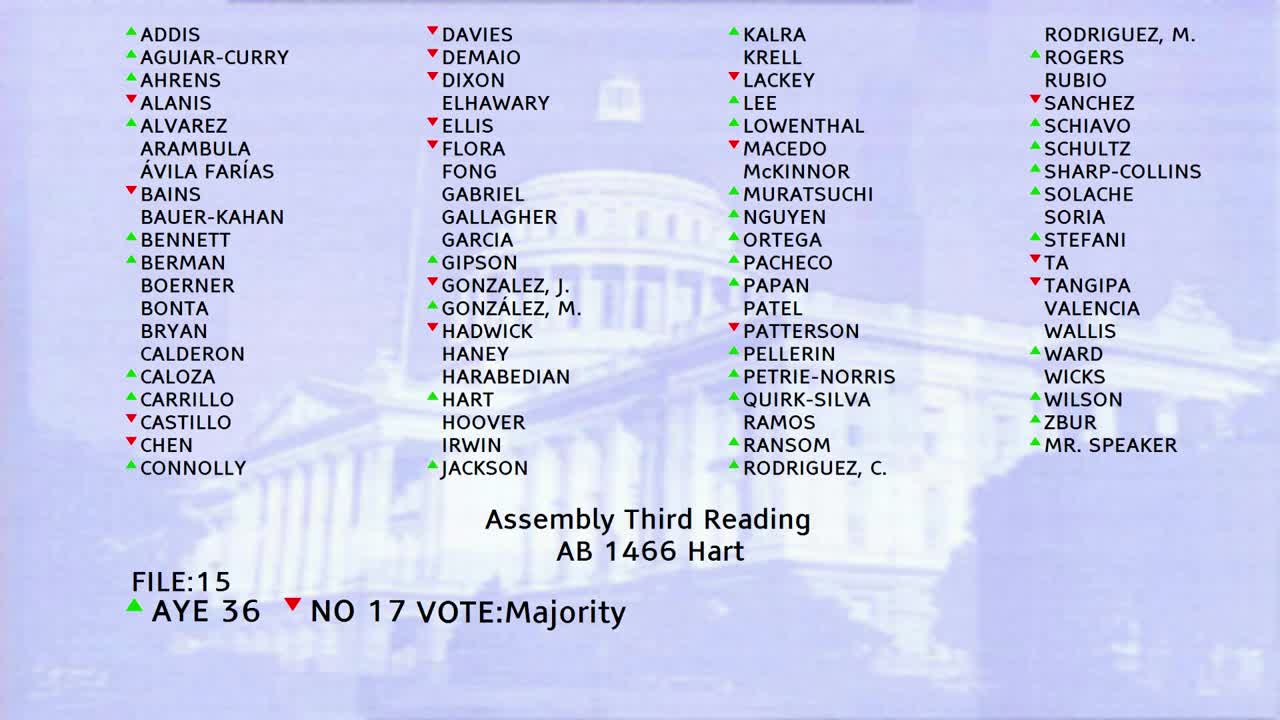 11MIN
Assembly Floor
 19MIN
Assembly Standing Committee on Housing and Community Development
 9MIN
Assembly Standing Committee on Higher Education
Bill Author