AB 97: Personal Income Tax Law: Corporation Tax Law: Bobcat Fire: exclusions.
- Session Year: 2025-2026
- House: Assembly
- Latest Version Date: 2025-01-07
Current Status:
In Progress
(2025-06-18: Referred to Com. on REV. & TAX.)
Introduced
In Committee
Awaiting First Chamber Vote
Passed First Chamber
In Committee
Awaiting Second Chamber Vote
Passed Second Chamber
Enacted
The Personal Income Tax Law and the Corporation Tax Law, in conformity with federal income tax law, generally define gross income as income from whatever source derived, except as specifically excluded, and provides various exclusions from gross income.
This bill, for taxable years beginning on or after January 1, 2024, and before January 1, 2029, would provide an exclusion from gross income for any qualified taxpayer, as defined, for amounts received in settlement for costs and losses associated with the 2020 Bobcat Fire in the County of Los Angeles, as provided.
Existing law requires a bill authorizing a new tax expenditure to contain, among other things, specific goals, purposes, and objectives the tax expenditure will achieve, detailed performance indicators, and data collection requirements.
This bill would include additional information required for any bill authorizing a new tax expenditure.
This bill would make findings and declarations related to a gift of public funds.
This bill would declare that it is to take effect immediately as an urgency statute.
(a)For taxable years beginning on or after January 1, 2024, and before January 1, 2029, gross income does not include any qualified amount received by a qualified taxpayer.
(b)For purposes of this section:
(1)Qualified amount means any amount received in settlement by a qualified taxpayer from a settlement entity in connection with the 2020 Bobcat Fire.
(2)Qualified taxpayer means any of the following:
(A)Any taxpayer that owned real property located in the County of Los Angeles during the 2020 Bobcat Fire who paid or incurred expenses and received amounts from a settlement arising out of the 2020 Bobcat Fire.
(B)Any taxpayer that resided within the County of Los Angeles during the 2020 Bobcat Fire who paid or incurred expenses and received amounts from a settlement arising out of the 2020 Bobcat Fire.
(C)Any taxpayer that had a place of business within the County of Los Angeles during the 2020 Bobcat Fire who paid or incurred expenses and received amounts from a settlement arising out of the 2020 Bobcat Fire.
(3)Settlement entity means Southern California Edison or its subsidiary that is making the settlement payment to a qualified taxpayer.
(c)The settlement entity shall provide, upon request by the Franchise Tax Board, documentation of the settlement payments in the form and manner requested by the Franchise Tax Board.
(d)(1)For the purpose of complying with Section 41 in regards to the exclusion provided by this section and Section 24309.9, the Legislature finds and declares as follows:
(A)The specific goal, purpose, and objective of the tax exclusion is to provide essential relief to individuals who have suffered injury, loss, inconvenience, and expenses resulting from the devastating 2020 Bobcat Fire.
(B)The performance indicators for the Legislature to use in determining if the exclusion achieves the stated goal, purpose, and objective shall be the number of qualified taxpayers that excluded qualified amounts from gross income, and the aggregate amount of settlement payments arising out of the 2020 Bobcat Fire.
(2)(A)On December 1, 2029, the Franchise Tax Board shall deliver to the Legislature a written report that includes both of the following:
(i)To the extent feasible, the number of qualified taxpayers that excluded qualified amounts from gross income, as a result of the exclusion.
(ii)The aggregate amount of those settlement payments arising out of the 2020 Bobcat Fire.
(B)The report required by this paragraph shall be delivered to the Legislature in compliance with Section 9795 of the Government Code.
(C)The disclosure provisions of this subdivision shall be treated as an exception to Section 19542.
(e)This section shall remain in effect only until December 1, 2029, and as of that date is repealed.
SEC. 2.Section 24309.9 is added to the Revenue and Taxation Code, to read:24309.9.(a)For taxable years beginning on or after January 1, 2024, and before January 1, 2029, gross income does not include any qualified amount received by a qualified taxpayer.
(b)For purposes of this section:
(1)Qualified amount means any amount received in settlement by a qualified taxpayer from a settlement entity in connection with the 2020 Bobcat Fire.
(2)Qualified taxpayer means any of the following:
(A)Any taxpayer that owned real property located in the County of Los Angeles during the 2020 Bobcat Fire who paid or incurred expenses and received amounts from a settlement arising out of the 2020 Bobcat Fire.
(B)Any taxpayer that had a place of business within the County of Los Angeles during the 2020 Bobcat Fire who paid or incurred expenses and received amounts from a settlement arising out of the 2020 Bobcat Fire.
(3)Settlement entity means Southern California Edison or its subsidiary that is making the settlement payment to a qualified taxpayer.
(c)The settlement entity shall provide, upon request by the Franchise Tax Board, documentation of the settlement payments in the form and manner requested by the Franchise Tax Board.
(d)This section shall remain in effect only until December 1, 2029, and as of that date is repealed.
SEC. 3.The Legislature finds and declares that Sections 17139. and 24309.9 of the Revenue and Taxation Code, as added by this act, are necessary for the public purpose of preventing undue hardship to taxpayers who reside, or used to reside, in a part of California devastated by wildfire, and do not constitute a gift of public funds within the meaning of Section 6 of Article XVI of the California Constitution.
SEC. 4.This act is an urgency statute necessary for the immediate preservation of the public peace, health, or safety within the meaning of Article IV of the California Constitution and shall go into immediate effect. The facts constituting the necessity are:
In order to provide essential relief to those persons who have suffered injury, loss, inconvenience, and expenses resulting from the devastating 2020 Bobcat Fire as soon as possible, it is necessary that this act take effect immediately.
REVISIONS: HeadingLine 2.|
Date
|
Status
|
|---|---|
| Jun 18, 2025 | Referred to Com. on REV. & TAX. |
| Jun 5, 2025 | In Senate. Read first time. To Com. on RLS. for assignment. |
| Jun 4, 2025 | Read third time. Urgency clause adopted. Passed. Ordered to the Senate. (Ayes 72. Noes 0. Page 2076.). |
| May 27, 2025 | Read second time. Ordered to third reading. |
| May 23, 2025 | From committee: Do pass. (Ayes 14. Noes 0.) (May 23). |
| May 21, 2025 | In committee: Set, first hearing. Referred to APPR. suspense file. |
| May 21, 2025 | Joint Rule 62(a), file notice suspended. (Page 1627.) |
| May 14, 2025 | In committee: Hearing postponed by committee. |
| May 6, 2025 | Coauthors revised. |
| May 6, 2025 | From committee: Do pass and re-refer to Com. on APPR. (Ayes 7. Noes 0.) (May 5). Re-referred to Com. on APPR. |
| Mar 17, 2025 | In committee: Set, first hearing. Referred to REV. & TAX. suspense file. |
| Feb 3, 2025 | Referred to Com. on REV. & TAX. |
| Jan 8, 2025 | From printer. May be heard in committee February 7. |
| Jan 7, 2025 | Read first time. To print. |
|
Date
|
Description
|
Location
|
Votes
|
|
|---|---|---|---|---|
| Jun 4, 2025 | AB 97 Lackey Third Reading Urgency | Assembly Floor |
Passed |
|
| May 23, 2025 | Do pass. | Assembly Standing Committee on Appropriations |
Passed |
|
| May 5, 2025 | Do pass and be re-referred to the Committee on [Appropriations] | Assembly Standing Committee on Revenue and Taxation |
Passed |
This list shows positions taken on this bill by organizations on the date displayed, which is linked to the original source.
Positions by individuals are not included.
|
Organization
|
Position
|
Date
|
|---|---|---|
| California Federation Of Teachers | ** Against | |
| California Forestry Association | ** Support |
ASSEMBLY THIRD READING
ATR Bill Id:AB 97
Author:(Lackey)
As Introduced Ver:January 7, 2025
2/3 vote. Urgency
SUMMARY
Excludes from gross income amounts received in settlement arising out of the 2020 Bobcat Fire.
Major Provisions
- Excludes, under the Personal Income Tax (PIT) Law and the Corporation Tax (CT) Law, any "qualified amount" received by a "qualified taxpayer," for taxable years beginning on or after January 1, 2024, and before January 1, 2029.
- Defines a "qualified amount" as any amount received in settlement by a "qualified taxpayer" from a "settlement entity" in connection with the 2020 Bobcat Fire.
- Defines a "qualified taxpayer" as:
- Any taxpayer that owned real property located in the County of Los Angeles during the 2020 Bobcat Fire who paid or incurred expenses and received amounts from a settlement arising out of or pursuant to the 2020 Bobcat Fire; or,
- Any taxpayer that had a place of business within the County of Los Angeles during the 2020 Bobcat Fire who paid or incurred expenses and received amounts from a settlement arising out of or pursuant to the 2020 Bobcat Fire.
- Provides that, for this bill's exclusion under the PIT Law, a "qualified taxpayer" includes any taxpayer that resided within the County of Los Angeles during the 2020 Bobcat Fire who paid or incurred expenses and received amounts from a settlement arising out of or pursuant to the 2020 Bobcat Fire.
- Defines a "settlement entity" as Southern California Edison (SCE) or its subsidiary.
- Finds and declares, for the purposes of complying with Revenue and Taxation Code (R&TC) Section 41, that the goal, purpose, and objective of this bill is to provide essential relief to individuals who have suffered injury, loss, inconvenience, and expenses resulting from the devastating 2020 Bobcat Fire. The performance indicators that the Legislature may use to measure whether this bill meets the stated goal, purpose, and objective are the number of qualified taxpayers that excluded qualified amounts from gross income, and the aggregate amount of settlement payments arising out of the 2020 Bobcat Fire. The Franchise Tax Board (FTB) must report this information to the Legislature on December 1, 2029, which is treated as an exception to the general prohibition against disclosure of confidential taxpayer information.
- Provides that this bill remains in effect only until December 1, 2029, and is repealed as of that date.
COMMENTS
- California wildfires: California has seen a sharp increase in the severity and frequency of wildfires in the last two decades. As of December 2024, the California Department of Forestry and Fire Protection notes that 15 of the 20 most destructive wildfires in California's history have occurred in the last decade. Additionally, eight of those 20 most destructive wildfires have been attributed to faulty power lines or electrical equipment.
The Bobcat Fire ignited in early September 2020, and was fully contained by late November. The fire burned 115,997 acres before containment and the projected loss from the fire is equivalent to approximately $123 million in 2025. In December 2023, the Los Angeles County Office of the County Counsel released a statement confirming that the County had agreed to settle a lawsuit filed against SCE for $80 million, despite SCE denying any liability or responsibility for the fire or any resulting damages.
- Treatment of settlement awards: Generally, federal and state law allow for the exclusion from gross income of amounts received in a settlement, other than punitive damages, which result from personal physical injuries or physical sickness. Amounts resulting from emotional distress, however, are included when calculating gross income unless the emotional distress is the result of physical injury or sickness. Additionally, federal and state law generally require inclusion of attorney's fees resulting from a settlement in the calculation of gross income. Payments received as a reimbursement of costs are excluded from gross income; however, to the extent that any settlement payment exceeds costs paid or incurred in connection with the event that caused the settlement, those amounts may be taxable income. Therefore, some portions of the disbursements issued from qualifying settlements may be included in gross income. This bill excludes from gross income all amounts received in settlements resulting from the 2020 Bobcat Fire.
- Tax treatment of federal disaster areas: Federal and state law allow a deduction of losses sustained in federally declared disaster areas. The Bobcat Fire was declared a major disaster by the federal government, and unreimbursed losses sustained as a result of that fire are eligible to be deducted by taxpayers. Generally, higher income taxpayers derive a greater benefit from deductions. In addition to the deduction of qualified losses, taxpayers may exclude from gross income amounts of disaster relief payments issued for areas subject to a federally declared disaster. This bill excludes from gross income any amounts received by a qualified taxpayer as a settlement related to the 2020 Bobcat Fire.
- This all seems familiar: In the 2021-22 Legislative Session, this Committee heard and approved AB 1249 (Gallagher), Chapter 749, Statutes of 2022, and SB 1246 (Stern), Chapter 841, Statutes of 2022, which authorized a gross income exclusion for amounts received in settlement from specified wildfires.
Upon signing AB 1249 and SB 1246, Governor Newsom included a message related to these bills, partially stating that, "In signing this bill, I expect that building the associated revenue reduction of over $200 million into the budget framework is equally supported. In the future, measures such as this should be included as part of the Budget Act." Acknowledging the Governor's request, the Legislature enacted two additional gross income exclusions for settlement amounts related to the 2019 Kincade Fire and the 2020 Zogg Fire by authorizing SB 131 (Committee on Budget and Fiscal Review), Chapter 55, Statutes of 2023. SB 131 incorporated the provisions of two separate bills, SB 370 (McGuire) and SB 542 (Dahle), which would have provided gross income exclusions for settlements arising out of the Kincade and Zogg fires.
Last year, this Committee heard and approved AB 1973 (Lackey), which was essentially identical to this bill. AB 1973 was vetoed by the Governor, who, regarding a package of vetoed bills with similar subject matter, wrote in part:
I wholeheartedly support the intent of these bills. In 2022, I signed legislation that provided similar tax exclusions for settlement claims resulting from catastrophic wildfires that occurred in the preceding five years. In signing those bills, I stated future measures, like these bills, should be included as part of the annual budget process given the General Fund implications. The following year, the Legislature enacted an income tax exclusion for an additional wildfire in the 2023-24 Budget Act. As such, I strongly encourage the Legislature to include these proposals in next year's budget framework.
In this year's proposed budget, the Governor included a provision to exclude settlement amounts received by a taxpayer resulting from a wildfire if the settlement was paid in the 2025 through 2029 taxable years. The gross income exclusion proposed by the Governor, however, would likely not cover all payments related to the 2020 Bobcat Fire, as some settlement amounts may have been distributed in the 2024 taxable year.
According to the Author
The author has provided the following statement in support of this bill:
By passing AB 97, we cannot only provide much-needed financial relief to those who have lost their homes and businesses in the Bobcat Fire, but also reaffirm our commitment to standing with communities in their darkest hours. We must help alleviate the burdens on those already grappling with the aftermath of a natural disaster.
Arguments in Support
The California Forestry Association, writing in support of this bill, states, in part:
Requiring victims to pay state income tax on these settlements is fundamentally unfair, which is why the Legislature has routinely passed legislation to exempt such settlements from state income tax on a case-by-case basis. In recent years, the Legislature approved exemptions for the victims of the 2019 Kincade Fire in Sonoma County and the 2020 Zogg Fire in Tehama and Shasta Counties (SB 131: Committee on Budget); the 2017 Thomas Fire and 2018 Woolsey Fire (SB 1246: Stern, 2022); and the 2017 North Bay and 2018 Camp fires (AB 1249: Gallagher, 2022).
Arguments in Opposition
The California Federation of Teachers, writing in opposition to this bill, state, in part:
California voters secured funding for public education via Proposition 98, which provides funding to our TK-12 schools and Community Colleges from revenues of the General Fund. Specifically, public education is funded mainly by the income tax, corporate income tax, sales and use tax, and property taxes. Tax credits, exemptions, and other expenditures however, remove funding from public education. For every dollar that is provided in tax expenditures, approximately 40 cents of each dollar comes out of California's classrooms.
FISCAL COMMENTS
The Assembly Committee on Appropriations, in its analysis of this bill, states:
- General Fund (GF) revenue loss of an unknown amount, likely in the low millions of dollars. FTB notes it does not know the amount and timing of qualified settlement amounts. However, FTB assumes approximately $3 million in GF revenue loss for every $50 million in amounts received (applying an average tax rate of 6%). The settlement resulting from the Bobcat Fire is $80 million. By decreasing PIT and CT revenue, this bill also likely decreases Proposition 98 GF spending by approximately 40% of the revenue loss (the exact amount depends on the specific amount of the annual Proposition 98 guarantee).
The Governor's proposed state budget for FY 2025-26 includes a gross income exclusion for wildfire settlement amounts paid to a taxpayer from the 2025 to 2029 taxable years. However, some of the settlement payments related to the 2020 Bobcat Fire were paid in the 2024 taxable year.
- Costs of an unknown, but potentially non-absorbable, amount to FTB to administer the exclusion and provide the report. This bill provides a retroactive gross income exclusion and most taxpayers have already filed their 2024 tax returns. Thus, FTB will likely incur additional costs to process amended returns claiming the exclusion.
VOTES
ASM REVENUE AND TAXATION: 7-0-0
YES: Gipson, Ta, Carrillo, DeMaio, Garcia, McKinnor, Quirk-Silva
ASM APPROPRIATIONS: 14-0-1
YES: Wicks, Arambula, Calderon, Caloza, Dixon, Elhawary, Fong, Mark González, Hart, Pacheco, Pellerin, Solache, Ta, Tangipa
ABS, ABST OR NV: Sanchez
UPDATED
VERSION: January 7, 2025
CONSULTANT: Harrison Bowlby / REV. & TAX. / (916) 319-2098 FN: 0000795
Date of Hearing: May 21, 2025
ASSEMBLY COMMITTEE ON APPROPRIATIONS
Buffy Wicks, Chair
ABPCA Bill Id:AB 97
Author:(Lackey) – As Introduced Ver:January 7, 2025
Policy Committee: | Revenue and Taxation | Vote: | 7 - 0 |
|
| ||
|
|
Urgency: Yes State Mandated Local Program: No Reimbursable: No
SUMMARY:
This bill provides a gross income exclusion for amounts received in settlement arising out of the 2020 Bobcat Fire.
Specifically, this bill:
- Excludes from gross income, under the Personal Income Tax (PIT) Law and Corporation Tax (CT) Law, for taxable years beginning on or after January 1, 2024, and before January 1, 2029, an amount received in a settlement by a qualified taxpayer from a settlement entity in connection with the 2020 Bobcat Fire. A qualified taxpayer must have owned real property, resided, or had a place of business in the County of Los Angeles during the fire.
- Requires the settlement entity, Southern California Edison (SCE) or its subsidiary, to provide, upon request of the Franchise Tax Board (FTB), documentation of the settlement payments in the form and manner requested by FTB.
- Declares the goal and performance indicators of this tax expenditure and requires, by December 1, 2029, FTB to provide a report to the Legislature with specified exclusion data.
FISCAL EFFECT:
- General Fund (GF) revenue loss of an unknown amount, likely in the low millions of dollars. FTB notes it does not know the amount and timing of qualified settlement amounts. However, FTB assumes approximately $3 million in GF revenue loss for every $50 million in amounts received (applying an average tax rate of 6%). The settlement resulting from the Bobcat Fire is $80 million. By decreasing PIT and CT revenue, this bill also likely decreases Proposition 98 GF spending by approximately 40% of the revenue loss (the exact amount depends on the specific amount of the annual Proposition 98 guarantee).
The Governor’s proposed state budget for FY 2025-26 includes a gross income exclusion for wildfire settlement amounts paid to a taxpayer from the 2025 to 2029 taxable years. However, some of the settlement payments related to the 2020 Bobcat Fire were paid in the 2024 taxable year.
- Costs of an unknown, but potentially non-absorbable, amount to FTB to administer the exclusion and provide the report. This bill provides a retroactive gross income exclusion and most taxpayers have already filed their 2024 tax returns. Thus, FTB will likely incur additional costs to process amended returns claiming the exclusion.
COMMENTS:
- Purpose. According to the author, “By passing AB 97, we cannot only provide much-needed financial relief to those who have lost their homes and businesses in the Bobcat Fire, but also reaffirm our commitment to standing with communities in their darkest hours.”
- Background. Treatment of Settlement Funds. Existing federal and state laws generally exclude amounts received in a settlement from gross income. However, exceptions include punitive damages and awards resulting from emotional distress, unless the emotional distress results from physical injury or sickness. Attorney’s fees resulting from a settlement must also be included in the taxpayer’s calculation of gross income under specified circumstances.
Bobcat Fire. The Bobcat Fire ignited in September 2020 and burned over 115,000 acres before being fully contained in late November 2020. Projected losses from the fire are valued at approximately $119 million. In December 2023, the Los Angeles county counsel released a statement confirming the county settled a lawsuit filed against SCE for $80 million, despite SCE denying liability or responsibility for the fire and resulting damages. This bill allows a qualified taxpayer that paid or incurred expenses due to the Bobcat Fire to exclude from gross income amounts received in settlement from SCE.
- Support and Opposition. This bill is supported by the California Forestry Association, which argues, “Requiring victims to pay state income tax on these settlements is fundamentally unfair, which is why the Legislature has routinely passed legislation to exempt such settlements from state income tax on a case-by-case basis.”
This bill is opposed by the California Federation of Teachers, which generally opposes tax expenditures, and argues, “While the merit and goal of the bill are laudable, educators prefer that the state invest in progressive tax policies, such as a wealth tax…Revenue from such a source would more than cover the goal of this bill and more, without harming others in this zero-sum environment.”
- Related Legislation. AB 429 (Hadwick) provides a gross income exclusion for amounts received in settlement arising out of the 2021 Dixie Fire or 2022 Mill Fire. AB 429 is pending hearing by this committee.
- Prior Legislation. AB 1973 (Lackey), of the 2023-24 Legislative Session, was identical to this bill. AB 1973 was vetoed by Governor Newsom, who stated, “I strongly encourage the Legislature to include these proposals in next year’s budget framework.”
In 2022, two measures were signed into law to provide a similar income exclusion for specific wildfire victims. AB 1249 (Gallagher), Chapter 749, Statutes of 2022, allowed taxpayers to exclude settlement amounts relating to the 2015 Butte Fire, 2017 North Bay Fires and 2018 Camp Fire. SB 1246 (Stern), Chapter 841, Statutes of 2022, allowed a taxpayer to exclude settlement amounts relating to the 2017 Thomas Fire and 2018 Woolsey Fire. In signing these measures, Governor Newsom included the following signing message:
The Legislature approved these bills with an overwhelming, bipartisan vote. In signing this bill, I expect that building the associated revenue reductions of over $200 million into the budget framework is equally supported. In the future, measures such as this should be included as part of the Budget Act.
Acknowledging the Governor’s message, SB 131 (Committee on Budget and Fiscal Review), Chapter 55, Statutes of 2023, enacted two additional gross income exclusions for settlement amounts related to the 2019 Kincade Fire and 2020 Zogg Fire.
Analysis Prepared by: Irene Ho / APPR. / (916) 319-2081
Date of Hearing: May 5, 2025
ASSEMBLY COMMITTEE ON REVENUE AND TAXATION
Mike Gipson, Chair
ABPCA Bill Id:AB 97 (
Author:Lackey) – As Introduced Ver:January 7, 2025
SUSPENSE
2/3 vote. Urgency measure. Fiscal committee.
SUBJECT: Personal Income Tax Law: Corporation Tax Law: Bobcat Fire: exclusions
SUMMARY: Excludes from gross income amounts received in settlement arising out of the 2020 Bobcat Fire, as provided. Specifically, this bill:
- Excludes, under the Personal Income Tax (PIT) Law and the Corporation Tax (CT) Law, any "qualified amount" received by a "qualified taxpayer," for taxable years beginning on or after January 1, 2024, and before January 1, 2029.
- Defines a "qualified amount" as any amount received in settlement by a "qualified taxpayer" from a "settlement entity" in connection with the 2020 Bobcat Fire.
- Defines a "qualified taxpayer" as:
- Any taxpayer that owned real property located in the County of Los Angeles during the 2020 Bobcat Fire who paid or incurred expenses and received amounts from a settlement arising out of or pursuant to the 2020 Bobcat Fire; or,
- Any taxpayer that had a place of business within the County of Los Angeles during the 2020 Bobcat Fire who paid or incurred expenses and received amounts from a settlement arising out of or pursuant to the 2020 Bobcat Fire.
- Provides that, for this bill's exclusion under the PIT Law, a "qualified taxpayer" includes any taxpayer that resided within the County of Los Angeles during the 2020 Bobcat Fire who paid or incurred expenses and received amounts from a settlement arising out of or pursuant to the 2020 Bobcat Fire.
- Defines a "settlement entity" as Southern California Edison (SCE) or its subsidiary.
- Finds and declares, for the purposes of complying with Revenue and Taxation Code (R&TC) Section 41, that the goal, purpose, and objective of this bill is to provide essential relief to individuals who have suffered injury, loss, inconvenience, and expenses resulting from the devastating 2020 Bobcat Fire. The performance indicators that the Legislature may use to measure whether this bill meets the stated goal, purpose, and objective are the number of qualified taxpayers that excluded qualified amounts from gross income, and the aggregate amount of settlement payments arising out of the 2020 Bobcat Fire. The Franchise Tax Board (FTB) must report this information to the Legislature on December 1, 2029, which is treated as an exception to the general prohibition against disclosure of confidential taxpayer information.
- Provides that this bill remains in effect only until December 1, 2029, and is repealed as of that date.
- Finds and declares that this bill is necessary for the public purpose of preventing undue hardship to taxpayers who reside, or used to reside, in a part of California devastated by the 2020 Bobcat Fire, and does not constitute a gift of public funds, as defined.
- Takes immediate effect as an urgency measure necessary to provide essential relief to those persons who have suffered injury, loss, inconvenience, and expenses resulting from the devastating 2020 Bobcat Fire.
EXISTING FEDERAL LAW:
- Provides that gross income includes all income from whatever source derived, unless specifically excluded. (Internal Revenue Code (IRC) Section 61.)
- Excludes from gross income amounts received as a qualified disaster relief payment, as defined, in presidentially declared disaster areas. (IRC Section 139.)
- Authorizes a deduction equal to the amount of loss attributable to a federally declared disaster, to the extent those amounts are not reimbursed from other sources. (IRC Section 165.)
- Excludes from gross income amounts of damages, other than punitive damages, received in a settlement on account of personal physical injuries or physical sickness. (IRC Section 104.)
- Excludes from gross income a "qualified wildfire relief payment" received by an individual during taxable years beginning on or after December 31, 2019, and before January 1, 2026. A "qualified wildfire relief payment" is defined as any amount received by or on behalf of an individual as compensation for unreimbursed losses, expenses, or damages incurred, as provided, as a result of a forest or range fire declared as a disaster by the President after December 31, 2014. (Public Law 118-148.)
EXISTING STATE LAW:
- Conforms, with certain modifications, to the definition of gross income. (R&TC Section 17071 and 24721.)
- Conforms, with certain modifications, to the federal treatment of qualified disaster payments. (R&TC Section 17201 and 24329.)
- Provides a corresponding state disaster loss deduction, mirrored on the federal disaster loss deduction, for disasters in areas of the state for which the Governor has proclaimed a state of emergency. (R&TC Section 17207.14 and 24347.)
- Excludes from gross income settlement amounts received by qualifying taxpayers resulting from specified wildfires. (R&TC Sections 17138.5, 17138.6, 17139.2, 17139.3, 24309.1, 24309.3, 24309.6 and 24309.7.)
FISCAL EFFECT: The FTB, in its analysis of this bill, notes that a definitive revenue impact is difficult to determine, but estimates that for every $50 million in qualified settlement amounts, the associated loss would be approximately $3 million, assuming an average tax rate of 6%. Committee staff notes that the settlement resulting from the Bobcat Fire is $80 million, and revenue losses associated with this bill would almost certainly be in excess of this Committee's Suspense File threshold.
COMMENTS:
- The author has submitted the following statement in support of this bill:
By passing AB 97, we cannot only provide much-needed financial relief to those who have lost their homes and businesses in the Bobcat Fire, but also reaffirm our commitment to standing with communities in their darkest hours. We must help alleviate the burdens on those already grappling with the aftermath of a natural disaster.
- The California Forestry Association, writing in support of this bill, states, in part:
Requiring victims to pay state income tax on these settlements is fundamentally unfair, which is why the Legislature has routinely passed legislation to exempt such settlements from state income tax on a case-by-case basis. In recent years, the Legislature approved exemptions for the victims of the 2019 Kincade Fire in Sonoma County and the 2020 Zogg Fire in Tehama and Shasta Counties (SB 131: Committee on Budget); the 2017 Thomas Fire and 2018 Woolsey Fire (SB 1246: Stern, 2022); and the 2017 North Bay and 2018 Camp fires (AB 1249: Gallagher, 2022). Assembly Bill 97 is consistent with these past efforts and will ensure that victims of the Dixie and Mill fires are treated fairly.
- The California Federation of Teachers (CFT), writing in opposition to this bill, state, in part:
California voters secured funding for public education via Proposition 98, which provides funding to our TK-12 schools and Community Colleges from revenues of the General Fund. Specificall0,y public education is funded mainly by the income tax, corporate income tax, sales and use tax, and property taxes. Tax credits, exemptions, and other expenditures however, remove funding from public education. For every dollar that is provided in tax expenditures, approximately 40 cents of each dollar comes out of California's classrooms.
- Committee Staff Comments:
- California wildfires: California has seen a sharp increase in the severity and frequency of wildfires in the last two decades. As of December 2024, the California Department of Forestry and Fire Protection notes that 15 of the 20 most destructive wildfires in California's history have occurred in the last decade. Additionally, eight of those 20 most destructive wildfires have been attributed to faulty power lines or electrical equipment.
The Bobcat Fire ignited in early September 2020, and was fully contained by late November. The fire burned 115,997 acres before containment and the projected loss from the fire is equivalent to approximately $123 million in 2025. In December 2023, the Los Angeles County Office of the County Counsel released a statement confirming that the County had agreed to settle a lawsuit filed against SCE for $80 million, despite SCE denying any liability or responsibility for the fire or any resulting damages.
- Treatment of settlement awards: Generally, federal and state law allow for the exclusion from gross income of amounts received in a settlement, other than punitive damages, which result from personal physical injuries or physical sickness. Amounts resulting from emotional distress, however, are included when calculating gross income unless the emotional distress is the result of physical injury or sickness. Additionally, federal and state law generally require inclusion of attorney's fees resulting from a settlement in the calculation of gross income. Payments received as a reimbursement of costs are excluded from gross income; however, to the extent that any settlement payment exceeds costs paid or incurred in connection with the event that caused the settlement, those amounts may be taxable income. Therefore, some portions of the disbursements issued from qualifying settlements may be included in gross income. This bill excludes from gross income all amounts received in settlements resulting from the 2020 Bobcat Fire.
- Tax treatment of federal disaster areas: Federal and state law allow a deduction of losses sustained in federally declared disaster areas. The Bobcat Fire was declared a major disaster by the federal government, and unreimbursed losses sustained as a result of that fire are eligible to be deducted by taxpayers. Generally, higher income taxpayers derive a greater benefit from deductions. In addition to the deduction of qualified losses, taxpayers may exclude from gross income amounts of disaster relief payments issued for areas subject to a federally declared disaster. This bill excludes from gross income any amounts received by a qualified taxpayer as a settlement related to the 2020 Bobcat Fire.
- This all seems familiar: In the 2021-22 Legislative Session, this Committee heard and approved AB 1249 (Gallagher), Chapter 749, Statutes of 2022, and SB 1246 (Stern), Chapter 841, Statutes of 2022, which authorized a gross income exclusion for amounts received in settlement from specified wildfires.
Upon signing AB 1249 and SB 1246, Governor Newsom included a message related to these bills, partially stating that, "In signing this bill, I expect that building the associated revenue reduction of over $200 million into the budget framework is equally supported. In the future, measures such as this should be included as part of the Budget Act." Acknowledging the Governor's request, the Legislature enacted two additional gross income exclusions for settlement amounts related to the 2019 Kincade Fire and the 2020 Zogg Fire by authorizing SB 131 (Committee on Budget and Fiscal Review), Chapter 55, Statutes of 2023. SB 131 incorporated the provisions of two separate bills, SB 370 (McGuire) and SB 542 (Dahle), which would have provided gross income exclusions for settlements arising out of the Kincade and Zogg fires.
Last year, this Committee heard and approved AB 1973 (Lackey), which was essentially identical to this bill. AB 1973 was vetoed by the Governor, who, regarding a package of vetoed bills with similar subject matter, wrote in part:
I wholeheartedly support the intent of these bills. In 2022, I signed legislation that provided similar tax exclusions for settlement claims resulting from catastrophic wildfires that occurred in the preceding five years. In signing those bills, I stated future measures, like these bills, should be included as part of the annual budget process given the General Fund implications. The following year, the Legislature enacted an income tax exclusion for an additional wildfire in the 2023-24 Budget Act. As such, I strongly encourage the Legislature to include these proposals in next year's budget framework.
In this year's proposed budget, the Governor included a provision to exclude settlement amounts received by a taxpayer resulting from a wildfire if the settlement was paid in the 2025 through 2029 taxable years. The gross income exclusion proposed by the Governor, however, would likely not cover all payments related to the 2020 Bobcat Fire, as some settlement amounts may have been distributed in the 2024 taxable year.
- Recent federal legislation addressing wildfire settlement payments: In December 2024, President Biden signed House Resolution 5863 into law, thereby authorizing a gross income exclusion for wildfire reimbursement payments received by an individual on or after December 31, 2019, and before January 1, 2026. Thus, this bill would provide partial conformity with federal tax law.
- FTB considerations: In its analysis of this bill, the FTB notes the following:
- Implementation considerations: The FTB notes that this bill would allow a gross income exclusion for payments made on or after January 1, 2024. Thus, this bill would provide a retroactive gross income exclusion. The FTB notes that the forms and instructions for the 2024 taxable year have been developed, and many taxpayers may have already filed their 2024 tax return before enactment of this bill. The FTB may incur additional costs to develop additional tax forms and process amended returns. Committee staff notes that the author's intent is to provide relief to taxpayers who received settlement amounts that potentially began disbursement in 2024, and retroactive application of this bill's provisions is appropriate given this intent.
- Technical consideration: The FTB notes that, on Page 3, Lines 33 and 37, the term "who" should be replaced with the term "that" for consistency of terminology in the CT Law.
- What is a "tax expenditure"? Existing law provides various credits, deductions, exclusions, and exemptions for particular taxpayer groups. In the late 1960s, United States Treasury officials began arguing that these features of the tax law should be referred to as "expenditures" since they are generally enacted to accomplish some governmental purpose and there is a determinable cost associated with each of them (in the form of forgone revenues). This bill would authorize taxpayers to exclude amounts received in settlements related to the 2020 Bobcat Fire, thereby qualifying this bill as a tax expenditure.
- Committee's tax expenditure policy: SB 1335 (Leno), Chapter 845, Statutes of 2014, added R&TC Section 41, which recognized that the Legislature should apply the same level of review used for government spending programs to tax credits introduced on or after January 1, 2015. AB 263 (Burke), Chapter 743, Statutes of 2019, extended the requirements in R&TC Section 41 to all tax expenditure measures under the PIT Law, the CT Law, and the Sales and Use Tax Law introduced on or after January 1, 2020. A tax expenditure proposal must outline specific goals, purposes, and objectives that the tax expenditure will achieve, along with detailed performance indicators for the Legislature to use when measuring whether the tax expenditure meets those stated goals, purposes, and objectives. In addition to the R&TC Section 41 requirements, this Committee's policy also requires that all tax expenditure proposals contain an appropriate sunset provision to be eligible for a vote[1]. Sunsets are required because eliminating a tax expenditure generally requires a 2/3 vote. These requirements must be satisfied before a bill can receive a vote in this Committee. This bill complies with the requirements of R&TC Section 41 and contains an appropriate five-year sunset.
- Previous legislation: AB 294 (Petrie-Norris), of the 2023-24 Legislative Session, would have excluded from gross income any amount received by a qualified taxpayer as settlement payments related to a wildfire. SB 294 was held on the Assembly Appropriations Committee's Suspense File.
REGISTERED SUPPORT / OPPOSITION:
Support
California Forestry Association
Opposition
California Federation of Teachers
Analysis Prepared by: Harrison Bowlby / REV. & TAX. / (916) 319-2098
An "appropriate sunset provision" shall mean five years, except in the case of a tax expenditure measure providing relief to California veterans, in which case "appropriate sunset provision" shall mean 10 years. ↑
Date of Hearing: March 17, 2025
ASSEMBLY COMMITTEE ON REVENUE AND TAXATION
Mike Gipson, Chair
ABPCA Bill Id:AB 97 (
Author:Lackey) – As Introduced Ver:January 7, 2025
2/3 vote. Urgency measure. Fiscal committee.
SUBJECT: Personal Income Tax Law: Corporation Tax Law: Bobcat Fire: exclusions
SUMMARY: Excludes from gross income amounts received in settlement arising out of the 2020 Bobcat Fire, as provided. Specifically, this bill:
- Excludes, under the Personal Income Tax (PIT) Law and the Corporation Tax (CT) Law, any "qualified amount" received by a "qualified taxpayer," for taxable years beginning on or after January 1, 2024, and before January 1, 2029.
- Defines a "qualified amount" as any amount received in settlement by a "qualified taxpayer" from a "settlement entity" in connection with the 2020 Bobcat Fire.
- Defines a "qualified taxpayer" as:
- Any taxpayer that owned real property located in the County of Los Angeles during the 2020 Bobcat Fire who paid or incurred expenses and received amounts from a settlement arising out of or pursuant to the 2020 Bobcat Fire; or,
- Any taxpayer that had a place of business within the County of Los Angeles during the 2020 Bobcat Fire who paid or incurred expenses and received amounts from a settlement arising out of or pursuant to the 2020 Bobcat Fire.
- Provides that, for this bill's exclusion under the PIT Law, a "qualified taxpayer" includes any taxpayer that resided within the County of Los Angeles during the 2020 Bobcat Fire who paid or incurred expenses and received amounts from a settlement arising out of or pursuant to the 2020 Bobcat Fire.
- Defines a "settlement entity" as Southern California Edison (SCE) or its subsidiary.
- Finds and declares, for the purposes of complying with Revenue and Taxation Code (R&TC) Section 41, that the goal, purpose, and objective of this bill is to provide essential relief to individuals who have suffered injury, loss, inconvenience, and expenses resulting from the devastating 2020 Bobcat Fire. The performance indicators that the Legislature may use to measure whether this bill meets the stated goal, purpose, and objective are the number of qualified taxpayers that excluded qualified amounts from gross income, and the aggregate amount of settlement payments arising out of the 2020 Bobcat Fire. The Franchise Tax Board (FTB) must report this information to the Legislature on December 1, 2029, which is treated as an exception to the general prohibition against disclosure of confidential taxpayer information.
- Provides that this bill remains in effect only until December 1, 2029, and is repealed as of that date.
- Finds and declares that this bill is necessary for the public purpose of preventing undue hardship to taxpayers who reside, or used to reside, in a part of California devastated by the 2020 Bobcat Fire, and does not constitute a gift of public funds, as defined.
- Takes immediate effect as an urgency measure necessary to provide essential relief to those persons who have suffered injury, loss, inconvenience, and expenses resulting from the devastating 2020 Bobcat Fire.
EXISTING FEDERAL LAW:
- Provides that gross income includes all income from whatever source derived, unless specifically excluded. (Internal Revenue Code (IRC) Section 61.)
- Excludes from gross income amounts received as a qualified disaster relief payment, as defined, in presidentially declared disaster areas. (IRC Section 139.)
- Authorizes a deduction equal to the amount of loss attributable to a federally declared disaster, to the extent those amounts are not reimbursed from other sources. (IRC Section 165.)
- Excludes from gross income amounts of damages, other than punitive damages, received in a settlement on account of personal physical injuries or physical sickness. (IRC Section 104.)
- Excludes from gross income a "qualified wildfire relief payment" received by an individual during taxable years beginning on or after December 31, 2019, and before January 1, 2026. A "qualified wildfire relief payment" is defined as any amount received by or on behalf of an individual as compensation for unreimbursed losses, expenses, or damages incurred, as provided, as a result of a forest or range fire declared as a disaster by the President after December 31, 2014. (Public Law 118-148.)
EXISTING STATE LAW:
- Conforms, with certain modifications, to the definition of gross income. (R&TC Section 17071 and 24721.)
- Conforms, with certain modifications, to the federal treatment of qualified disaster payments. (R&TC Section 17201 and 24329.)
- Provides a corresponding state disaster loss deduction, mirrored on the federal disaster loss deduction, for disasters in areas of the state for which the Governor has proclaimed a state of emergency. (R&TC Section 17207.14 and 24347.)
- Excludes from gross income settlement amounts received by qualifying taxpayers resulting from specified wildfires. (R&TC Sections 17138.5, 17138.6, 17139.2, 17139.3, 24309.1, 24309.3, 24309.6 and 24309.7.)
FISCAL EFFECT: The FTB, in its analysis of this bill, notes that a definitive revenue impact is difficult to determine, but estimates that for every $50 million in qualified settlement amounts, the associated loss would be approximately $3 million, assuming an average tax rate of 6%. Committee staff notes that the settlement resulting from the Bobcat Fire is $80 million, and revenue losses associated with this bill would almost certainly be in excess of this Committee's Suspense File threshold.
COMMENTS:
- The author has submitted the following statement in support of this bill:
By passing AB 97, we cannot only provide much-needed financial relief to those who have lost their homes and businesses in the Bobcat Fire, but also reaffirm our commitment to standing with communities in their darkest hours. We must help alleviate the burdens on those already grappling with the aftermath of a natural disaster.
- The California Forestry Association, writing in support of this bill, states, in part:
Requiring victims to pay state income tax on these settlements is fundamentally unfair, which is why the Legislature has routinely passed legislation to exempt such settlements from state income tax on a case-by-case basis. In recent years, the Legislature approved exemptions for the victims of the 2019 Kincade Fire in Sonoma County and the 2020 Zogg Fire in Tehama and Shasta Counties (SB 131: Committee on Budget); the 2017 Thomas Fire and 2018 Woolsey Fire (SB 1246: Stern, 2022); and the 2017 North Bay and 2018 Camp fires (AB 1249: Gallagher, 2022). Assembly Bill 97 is consistent with these past efforts and will ensure that victims of the Dixie and Mill fires are treated fairly.
- Committee Staff Comments:
- California wildfires: California has seen a sharp increase in the severity and frequency of wildfires in the last two decades. As of December 2024, the California Department of Forestry and Fire Protection notes that 15 of the 20 most destructive wildfires in California's history have occurred in the last decade. Additionally, eight of those 20 most destructive wildfires have been attributed to faulty power lines or electrical equipment.
The Bobcat Fire ignited in early September 2020, and was fully contained by late November. The fire burned 115,997 acres before containment and the projected loss from the fire is equivalent to approximately $123 million in 2025. In December 2023, the Los Angeles County Office of the County Counsel released a statement confirming that the County had agreed to settle a lawsuit filed against SCE for $80 million, despite SCE denying any liability or responsibility for the fire or any resulting damages.
- Treatment of settlement awards: Generally, federal and state law allow for the exclusion from gross income of amounts received in a settlement, other than punitive damages, which result from personal physical injuries or physical sickness. Amounts resulting from emotional distress, however, are included when calculating gross income unless the emotional distress is the result of physical injury or sickness. Additionally, federal and state law generally require inclusion of attorney's fees resulting from a settlement in the calculation of gross income. Payments received as a reimbursement of costs are excluded from gross income; however, to the extent that any settlement payment exceeds costs paid or incurred in connection with the event that caused the settlement, those amounts may be taxable income. Therefore, some portions of the disbursements issued from qualifying settlements may be included in gross income. This bill excludes from gross income all amounts received in settlements resulting from the 2020 Bobcat Fire.
- Tax treatment of federal disaster areas: Federal and state law allow a deduction of losses sustained in federally declared disaster areas. The Bobcat Fire was declared a major disaster by the federal government, and unreimbursed losses sustained as a result of that fire are eligible to be deducted by taxpayers. Generally, higher income taxpayers derive a greater benefit from deductions. In addition to the deduction of qualified losses, taxpayers may exclude from gross income amounts of disaster relief payments issued for areas subject to a federally declared disaster. This bill excludes from gross income any amounts received by a qualified taxpayer as a settlement related to the 2020 Bobcat Fire.
- This all seems familiar: In the 2021-22 Legislative Session, this Committee heard and approved AB 1249 (Gallagher), Chapter 749, Statutes of 2022, and SB 1246 (Stern), Chapter 841, Statutes of 2022, which authorized a gross income exclusion for amounts received in settlement from specified wildfires.
Upon signing AB 1249 and SB 1246, Governor Newsom included a message related to these bills, partially stating that, "In signing this bill, I expect that building the associated revenue reduction of over $200 million into the budget framework is equally supported. In the future, measures such as this should be included as part of the Budget Act." Acknowledging the Governor's request, the Legislature enacted two additional gross income exclusions for settlement amounts related to the 2019 Kincade Fire and the 2020 Zogg Fire by authorizing SB 131 (Committee on Budget and Fiscal Review), Chapter 55, Statutes of 2023. SB 131 incorporated the provisions of two separate bills, SB 370 (McGuire) and SB 542 (Dahle), which would have provided gross income exclusions for settlements arising out of the Kincade and Zogg fires.
Last year, this Committee heard and approved AB 1973 (Lackey), which was essentially identical to this bill. AB 1973 was vetoed by the Governor, who, regarding a package of vetoed bills with similar subject matter, wrote in part:
I wholeheartedly support the intent of these bills. In 2022, I signed legislation that provided similar tax exclusions for settlement claims resulting from catastrophic wildfires that occurred in the preceding five years. In signing those bills, I stated future measures, like these bills, should be included as part of the annual budget process given the General Fund implications. The following year, the Legislature enacted an income tax exclusion for an additional wildfire in the 2023-24 Budget Act. As such, I strongly encourage the Legislature to include these proposals in next year's budget framework.
In this year's proposed budget, the Governor included a provision to exclude settlement amounts received by a taxpayer resulting from a wildfire if the settlement was paid in the 2025 through 2029 taxable years. The gross income exclusion proposed by the Governor, however, would likely not cover all payments related to the 2020 Bobcat Fire, as some settlement amounts may have been distributed in the 2024 taxable year.
- Recent federal legislation addressing wildfire settlement payments: In December 2024, President Biden signed House Resolution 5863 into law, thereby authorizing a gross income exclusion for wildfire reimbursement payments received by an individual on or after December 31, 2019, and before January 1, 2026. Thus, this bill would provide partial conformity with federal tax law.
- FTB considerations: In its analysis of this bill, the FTB notes the following:
- Implementation considerations: The FTB notes that this bill would allow a gross income exclusion for payments made on or after January 1, 2024. Thus, this bill would provide a retroactive gross income exclusion. The FTB notes that the forms and instructions for the 2024 taxable year have been developed, and many taxpayers may have already filed their 2024 tax return before enactment of this bill. The FTB may incur additional costs to develop additional tax forms and process amended returns. Committee staff notes that the author's intent is to provide relief to taxpayers who received settlement amounts that potentially began disbursement in 2024, and retroactive application of this bill's provisions is appropriate given this intent.
- Technical consideration: The FTB notes that, on Page 3, Lines 33 and 37, the term "who" should be replaced with the term "that" for consistency of terminology in the CT Law.
- What is a "tax expenditure"? Existing law provides various credits, deductions, exclusions, and exemptions for particular taxpayer groups. In the late 1960s, United States Treasury officials began arguing that these features of the tax law should be referred to as "expenditures" since they are generally enacted to accomplish some governmental purpose and there is a determinable cost associated with each of them (in the form of forgone revenues). This bill would authorize taxpayers to exclude amounts received in settlements related to the 2020 Bobcat Fire, thereby qualifying this bill as a tax expenditure.
- Committee's tax expenditure policy: SB 1335 (Leno), Chapter 845, Statutes of 2014, added R&TC Section 41, which recognized that the Legislature should apply the same level of review used for government spending programs to tax credits introduced on or after January 1, 2015. AB 263 (Burke), Chapter 743, Statutes of 2019, extended the requirements in R&TC Section 41 to all tax expenditure measures under the PIT Law, the CT Law, and the Sales and Use Tax Law introduced on or after January 1, 2020. A tax expenditure proposal must outline specific goals, purposes, and objectives that the tax expenditure will achieve, along with detailed performance indicators for the Legislature to use when measuring whether the tax expenditure meets those stated goals, purposes, and objectives. In addition to the R&TC Section 41 requirements, this Committee's policy also requires that all tax expenditure proposals contain an appropriate sunset provision to be eligible for a vote[1]. Sunsets are required because eliminating a tax expenditure generally requires a 2/3 vote. These requirements must be satisfied before a bill can receive a vote in this Committee. This bill complies with the requirements of R&TC Section 41 and contains an appropriate five-year sunset.
- Previous legislation: AB 294 (Petrie-Norris), of the 2023-24 Legislative Session, would have excluded from gross income any amount received by a qualified taxpayer as settlement payments related to a wildfire. SB 294 was held on the Assembly Appropriations Committee's Suspense File.
REGISTERED SUPPORT / OPPOSITION:
Support
California Forestry Association
Opposition
None on file
Analysis Prepared by: Harrison Bowlby / REV. & TAX. / (916) 319-2098
An "appropriate sunset provision" shall mean five years, except in the case of a tax expenditure measure providing relief to California veterans, in which case "appropriate sunset provision" shall mean 10 years. ↑
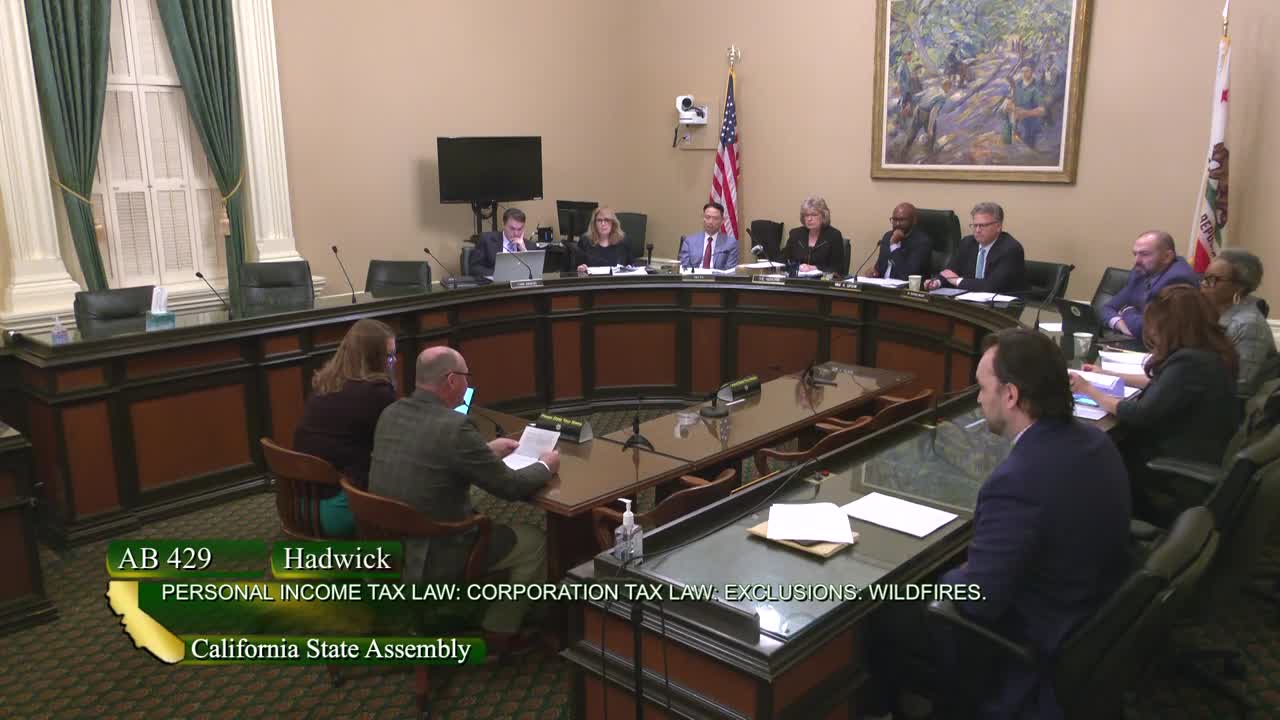
Discussed in Hearing
 46SEC
Assembly Floor
 3MIN
Assembly Standing Committee on Revenue and Taxation
Bill Author