AJR 14: California ports: tariffs.
- Session Year: 2025-2026
- House: Assembly
- Latest Version Date: 2025-06-09
Current Status:
In Progress
(2026-06-25: In committee: Hearing cancelled at the request of author.)
Introduced
In Committee
Awaiting First Chamber Vote
Passed First Chamber
In Committee
Awaiting Second Chamber Vote
Passed Second Chamber
Enacted
This measure would call upon relevant federal agencies to consider the ramifications of tariff policies on California ports and to work collaboratively toward strategies that stabilize trade and bolster the competitiveness of California port infrastructure.
WHEREAS, Ports serve as critical infrastructure for trade and commerce, acting as vital gateways for the import and export of goods; and
WHEREAS, The recent imposition and fluctuation of tariffs has led to significant disruptions in trade patterns, affecting the flow of goods through California ports; and
WHEREAS, These tariffs have resulted in increased costs for both importers and exporters, leading to a reduced volume of trade that negatively impacts port operations; and
WHEREAS, Ports are experiencing longer turnaround times due to the uncertainty surrounding tariffs, leading to logistical bottlenecks and increased costs for shipping companies and consumers alike; and
WHEREAS, The economic implications of tariffs extend beyond port operations, affecting broader regional economies reliant on trade, transportation, and logistics industries; and
WHEREAS, Ports are facing challenges related to workforce stability, as uncertainty in tariff regulations may lead to reduced hours or layoffs in port-related jobs, thus impacting families and communities; and
WHEREAS, The infrastructure at many ports must be enhanced and adapted to remain competitive, but the financial strain imposed by tariffs hampers the needed investments; and
WHEREAS, The anticipated continuation of tariff disputes poses risks to future trade agreements, further complicating planning and forecasting for port authorities and stakeholders; now, therefore, be it
Resolved by the Assembly and the Senate of the State of California, jointly, That the Legislature calls upon relevant federal agencies to consider the ramifications of tariff policies on California ports and to work collaboratively toward strategies that stabilize trade and bolster the competitiveness of California port infrastructure; and be it further
Resolved, That the Chief Clerk of the Assembly transmit copies of this resolution to relevant federal agencies, port authorities, trade associations, and other stakeholders to assist in advocacy for the needs of our ports and in promoting policies that will mitigate the adverse effects of tariffs on trade and commerce.
|
Date
|
Status
|
|---|---|
| Jun 25, 2026 | In committee: Hearing cancelled at the request of author. |
| Aug 27, 2025 | Referred to Com. on B. P. & E.D. |
| Aug 25, 2025 | In Senate. To Com. on RLS. |
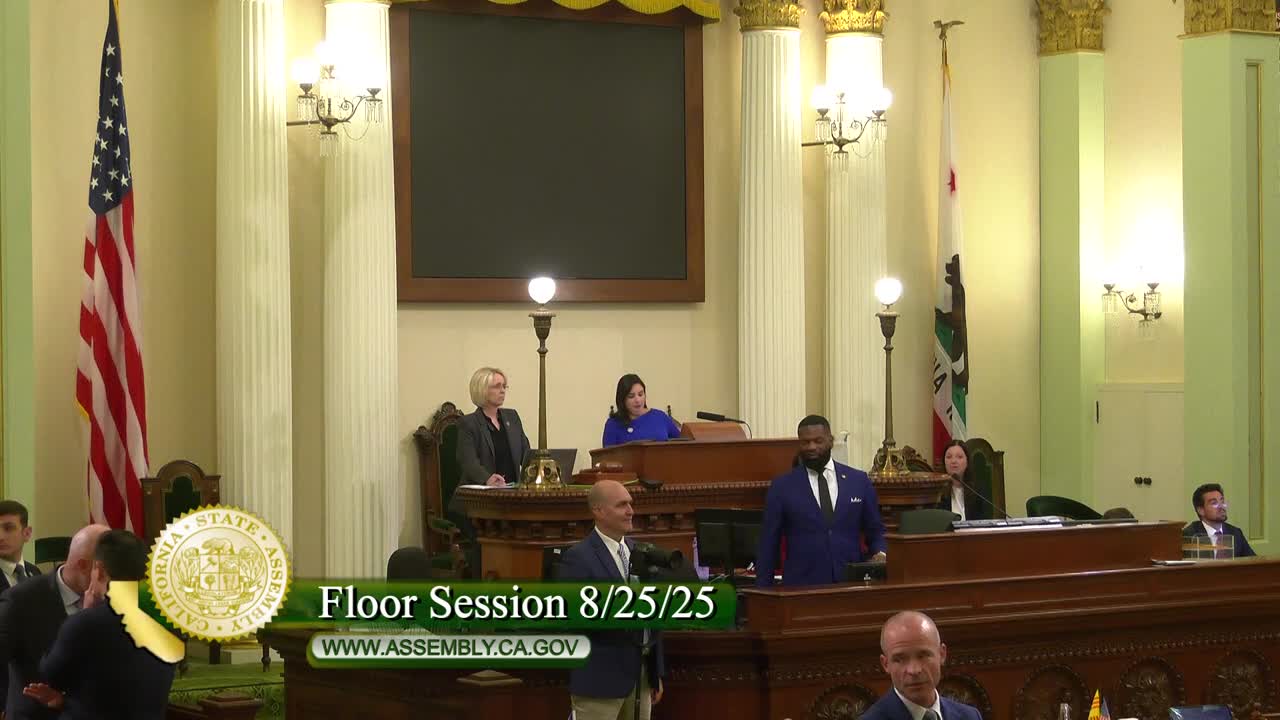
| Aug 25, 2025 | Adopted and to Senate. (Ayes 60. Noes 1. Page 2728.) |
| Jul 8, 2025 | From committee: Be adopted. Ordered to Third Reading. (Ayes 7. Noes 0.) (July 8). |
| Jun 16, 2025 | Referred to Com. on E.D., G., & H.I. |
| Jun 10, 2025 | From printer. |
| Jun 9, 2025 | Introduced. To print. |
|
Date
|
Description
|
Location
|
Votes
|
|
|---|---|---|---|---|
| Aug 25, 2025 | AJR 14 Gipson Assembly Third Reading | Assembly Floor |
Passed |
This list shows positions taken on this bill by organizations on the date displayed, which is linked to the original source.
Positions by individuals are not included.
|
Organization
|
Position
|
Date
|
|---|---|---|
| Pacific Merchant Association | ** Support | |
| Pacific Merchant Shipping Association | ** Support |
ASSEMBLY THIRD READING
ATR Bill Id:AJR 14
Author:(Gipson)
As Introduced Ver:June 9, 2025
Majority vote
SUMMARY
This Resolution urges federal trade and economic agencies to assess the impacts of current U.S. tariff policies on California's port infrastructure and global trade competitiveness. It calls for coordinated strategies to mitigate trade disruptions and support the long-term resilience of the state's ports. The resolution highlights the critical role California's ports play in national supply chains and seeks federal engagement to address tariff-related challenges.
Major Provisions
COMMENTS
California's 12 commercial seaports are essential pillars of both the state and national economies. They directly provide employment for more than 500,000 Californians across sectors such as maritime operations, logistics, and freight transportation. When including indirect and induced impacts, total employment linked to these ports exceeds one million jobs statewide. Nationally, they support approximately three million jobs.
The San Pedro Bay port complex, comprising the Ports of Los Angeles and Long Beach, alone generates over 225,000 direct jobs in Southern California and supports more than 2.7 million jobs across the country. Other major ports, such as Oakland and Port Hueneme, also play a significant role in driving regional economic activity.
However, ongoing U.S. trade tensions—particularly with China and other major trading partners—have introduced new uncertainties for California's ports. Tariffs, retaliatory measures, and shifts in global supply chains are impacting cargo volumes, altering trade flows, and challenging long-standing logistics networks. As gateways for a significant share of America's imports and exports, these ports are on the front lines of trade policy shifts.
Despite these challenges, California's ports remain powerful engines of job creation and indispensable components of the U.S. trade and supply chain infrastructure. Their adaptability and strategic importance are critical to maintaining economic resilience amid an increasingly complex global trade environment.
According to the Author
According to the author, "California's ports are crucial for trade, but recent tariff changes have caused disruptions, raising costs for businesses and slowing down port operations. This has led to longer wait times, logistical issues, and uncertainty for workers in port-related jobs. The financial strain from tariffs also makes it harder to invest in needed infrastructure upgrades. This bill urges federal agencies to recognize the harm these tariffs are causing and work together to find solutions that stabilize trade and support the growth and competitiveness of California's ports."
Arguments in Support
The Pacific Merchant Shipping Association (PMSA), representing ocean carriers and marine terminals at California's public seaports, supports AJR 14. They note that the resolution emphasizes the need for sustained investment in California's port infrastructure and recognizes that unpredictable policy environments pose challenges to long-term planning and global competitiveness.
Arguments in Opposition
None on file.
FISCAL COMMENTS
None.
VOTES
ASM ECONOMIC DEVELOPMENT, GROWTH, AND HOUSEHOLD IMPACT: 7-0-1
YES: Solache, Castillo, Patel, Petrie-Norris, Soria, Stefani, Wallis
ABS, ABST OR NV: Bonta
UPDATED
VERSION: June 9, 2025
CONSULTANT: Carla Castilla / E.D., G., & H.I. / (916) 319-2090 FN: 0001092
Date of Hearing: July 8, 2025
ASSEMBLY COMMITTEE ON ECONOMIC DEVELOPMENT, GROWTH, AND HOUSEHOLD IMPACT
José Luis Solache, Jr., Chair
ABPCA Bill Id:AJR 14 (
Author:Gipson) – As Introduced Ver:June 9, 2025
SUBJECT: California ports: tariffs
SUMMARY: This Resolution urges relevant federal agencies to assess the impacts of tariff policies on California ports and to collaborate on strategies that stabilize trade and enhance the global competitiveness of California’s port infrastructure.
Specifically, this bill: Recognizes that California ports are critical gateways for international trade, essential to the flow of imports and exports. Recent tariffs and their unpredictability have disrupted trade patterns, increasing costs for importers and exporters and reducing trade volumes.
Ports face operational challenges, including longer vessel turnaround times and logistical bottlenecks, driving up costs for shipping companies and consumers. The economic effects extend beyond ports to regional economies dependent on trade, transportation, and logistics sectors. Workforce stability at ports is threatened, with tariff-related uncertainty potentially leading to reduced work hours and layoffs, impacting families and communities.
Infrastructure modernization and capacity improvements are hindered by the financial burdens imposed by tariffs, threatening long-term competitiveness. Ongoing tariff disputes complicate planning and forecasting for port authorities and stakeholders due to the uncertainty around future trade agreements.
EXISTING LAW:
- Government Code § 8879.23 – Trade Corridors Improvement Fund (TCIF)
- Purpose: Authorizes allocation of state transportation funds (notably from Proposition 1B) for infrastructure projects that enhance goods movement—especially projects that relieve congestion and improve port access.
• Impact: Supports federal-state collaboration through grant matching (e.g., RAISE, INFRA, and IIJA funding).
- Government Code § 13996.5–13996.75 – International Trade and Investment Act
• Administered by: Governor’s Office of Business and Economic Development (GO-
Biz)
• Summary: Establishes California’s international trade strategy and defines GO-Biz’s role in promoting exports, foreign direct investment, and trade competitiveness.
• Relevance: Directly supports California businesses navigating global markets and trade disruptions, including tariff-related cost barriers.
- Government Code § 99520 – California–Mexico Border Relations Council
• Summary: Establishes a cross-agency body to coordinate infrastructure planning, goods movement, and trade logistics at California’s border ports of entry.
• Impact: Enhances binational competitiveness and nearshoring resilience, especially relevant during tariff-driven shifts in trade routes.
- Public Resources Code § 71130 et seq. – California Climate Adaptation Strategy (including ports)
• Scope: Directs the integration of sea-level rise, extreme weather, and emissions planning into state infrastructure policy.
• Port Impact: Supports climate-resilient port infrastructure and sustainable logistics practices critical to long-term global competitiveness.
- California Foreign-Trade Zones (FTZs) – Enabled under Federal Law, Administered Locally
• Locations: Los Angeles, Long Beach, Oakland, Stockton, San Jose, and others.
• Summary: Although governed by federal statute (19 U.S.C. § 81a), FTZs in California are supported by state and local economic development policies.
• Relevance: Allow companies to defer or reduce tariffs, enhancing export competitiveness and offsetting federal trade policy impacts.
- Executive Order N-19-21 (2021) – Supply Chain Resilience
• Governor’s Directive: Called on state agencies to use surplus land for temporary cargo storage and accelerate infrastructure permitting during the 2021–22 port congestion crisis.
• Legacy: Demonstrates the state’s authority and agility to respond to logistics crises tied to global trade shocks.
FISCAL EFFECT: This joint resolution will not have a fiscal effect.
COMMENTS: California’s network of twelve commercial seaports constitutes a foundational pillar of both the state’s and the nation’s economic infrastructure. Collectively, these ports directly sustain over 500,000 jobs within California, encompassing a diverse array of sectors including maritime operations, logistics, freight transportation, warehousing, and ancillary services. When accounting for indirect and induced employment effects, the total number of jobs attributable to port activity in the state exceeds one million.
At the national level, California’s ports underpin approximately three million jobs, reflecting their critical role in supporting the broader U.S. supply chain and trade ecosystem. The San Pedro Bay complex—comprising the Ports of Los Angeles and Long Beach—is particularly significant, with direct employment exceeding 225,000 jobs in Southern California alone, and total regional employment (direct plus indirect and induced) approaching 700,000 jobs. Nationally, this complex supports in excess of 2.7 million jobs, underscoring its status as the foremost maritime gateway in the United States.
Additionally, other key facilities such as the Port of Oakland and the Port of Hueneme contribute substantively to regional employment. The Port of Oakland supports approximately 200,000 jobs, while the Port of Hueneme plays a vital role as Southern California’s only deep-water port serving agricultural and automotive industries, supporting thousands of jobs critical to local economies and specialized trade sectors.
These figures highlight California’s seaport system not only as a vital economic engine generating substantial employment opportunities but also as a strategic asset integral to national economic resilience and competitiveness.
Author’s Statement: According to the author, “California’s ports are crucial for trade, but recent tariff changes have caused disruptions, raising costs for businesses and slowing down port operations. This has led to longer wait times, logistical issues, and uncertainty for workers in port-related jobs. The financial strain from tariffs also makes it harder to invest in needed infrastructure upgrades. This bill urges federal agencies to recognize the harm these tariffs are causing and work together to find solutions that stabilize trade and support the growth and competitiveness of California’s ports.”
REGISTERED SUPPORT / OPPOSITION:
Support
Pacific Merchant Association
Pacific Merchant Shipping Association
Opposition
None on file.
Analysis Prepared by: Carla Castilla / E.D., G., & H.I. / (916) 319-2090
Discussed in Hearing
 10MIN
Assembly Floor
 7MIN
Assembly Standing Committee on Economic Development, Growth, and Household Impact
Bill Author

Bill Co-Author(s):