AB 2239: Digital discrimination of access: prohibition.
- Session Year: 2023-2024
- House: Assembly
- Latest Version Date: 2024-07-03
Current Status:
Failed
(2024-08-15: In committee: Held under submission.)
Introduced
In Committee
First Chamber
In Committee
Second Chamber
Enacted
Existing law prohibits fixed and mobile internet service providers, as defined, that provide broadband internet access service, as defined, from engaging in specified actions concerning the treatment of internet traffic.
This bill would define digital discrimination of access as policies or practices, practices not justified by a legitimate business impediment, including genuine issues of technical or economic feasibility, that differentially impact consumers access to broadband internet access service based on their race, ethnicity, color, religion, or national origin, or that are intended to have a differential impact. The bill would prohibit entities that provide, facilitate, and affect consumer access to broadband internet access service, including internet service providers, as defined, from engaging in digital discrimination of access. access, as specified. The bill would authorize certain public attorneys only the Attorney General to bring a civil action against an internet service provider those entities for violating that prohibition, as provided.
Existing law vests the Public Utilities Commission with regulatory authority over public utilities, including telephone corporations. Existing law requires the commission to develop, implement, and administer the California Advanced Services Fund to encourage deployment of high-quality advanced communications services to all Californians that will promote economic growth, job creation, and the substantial social benefits of advanced information and communications technologies, as specified. This bill would require the commission to ensure that rules for California Advanced Services Fund grant programs prohibit digital discrimination of access, and would require the commission to take specified actions to ensure all grant applicants and grant recipients comply with the prohibition.Under existing law, a violation of the Public Utilities Act or any order, decision, rule, direction, demand, or requirement of the commission is a crime.Because certain of the above provisions would be part of the act and a violation of a commission action implementing this bills requirements would be a crime, the bill would impose a state-mandated local program.The California Constitution requires the state to reimburse local agencies and school districts for certain costs mandated by the state. Statutory provisions establish procedures for making that reimbursement.This bill would provide that no reimbursement is required by this act for a specified reason.Existing law prohibits fixed and mobile internet service providers, as defined, that provide broadband internet access service, as defined, from engaging in specified actions concerning the treatment of internet traffic.
This bill would define digital discrimination of access as policies or practices, not justified by genuine issues of technical or economic feasibility, that differentially impact consumers access to broadband internet access service based on their income level, race, ethnicity, color, religion, or national origin, or that are intended to have a differential impact. The bill would prohibit internet service providers, as defined, from engaging in digital discrimination of access. The bill would authorize certain public attorneys to bring a civil action against an internet service provider for violating that prohibition, as provided.
Existing law vests the Public Utilities Commission with regulatory authority over public utilities, including telephone corporations. Existing law requires the commission to develop, implement, and administer the California Advanced Services Fund to encourage deployment of high-quality advanced communications services to all Californians that will promote economic growth, job creation, and the substantial social benefits of advanced information and communications technologies, as specified.
This bill would require the commission to ensure that rules for California Advanced Services Fund grant programs prohibit digital discrimination of access, and would require the commission to take specified actions to ensure all grant applicants and grant recipients comply with the prohibition.
Under existing law, a violation of the Public Utilities Act or any order, decision, rule, direction, demand, or requirement of the commission is a crime.
Because certain of the above provisions would be part of the act and a violation of a commission action implementing this bills requirements would be a crime, the bill would impose a state-mandated local program.
The California Constitution requires the state to reimburse local agencies and school districts for certain costs mandated by the state. Statutory provisions establish procedures for making that reimbursement.
This bill would provide that no reimbursement is required by this act for a specified reason.
Existing law prohibits fixed and mobile internet service providers, as defined, that provide broadband internet access service, as defined, from engaging in specified actions concerning the treatment of internet traffic.
This bill would define digital discrimination of access as policies or practices, not justified by genuine issues of technical or economic feasibility, that differentially impact consumers access to broadband internet access service based on their income level, race, ethnicity, color, religion, or national origin, or that are intended to have a differential impact. The bill would prohibit internet service providers, as defined, from engaging in digital discrimination of access. The bill would authorize certain public attorneys to bring a civil action against an internet service provider for violating that prohibition, as provided.
Existing law vests the Public Utilities Commission with regulatory authority over public utilities, including telephone corporations. Existing law requires the commission to develop, implement, and administer the California Advanced Services Fund to encourage deployment of high-quality advanced communications services to all Californians that will promote economic growth, job creation, and the substantial social benefits of advanced information and communications technologies, as specified.
This bill would require the commission to ensure that rules for California Advanced Services Fund grant programs prohibit digital discrimination of access, and would require the commission to take specified actions to ensure all grant applicants and grant recipients comply with the prohibition.
Under existing law, a violation of the Public Utilities Act or any order, decision, rule, direction, demand, or requirement of the commission is a crime.
Because certain of the above provisions would be part of the act and a violation of a commission action implementing this bills requirements would be a crime, the bill would impose a state-mandated local program.
The California Constitution requires the state to reimburse local agencies and school districts for certain costs mandated by the state. Statutory provisions establish procedures for making that reimbursement.
This bill would provide that no reimbursement is required by this act for a specified reason.
Existing law prohibits fixed and mobile Internet internet service providers, as defined, that provide broadband Internet internet access service, as defined, from engaging in specified actions concerning the treatment of Internet internet traffic.
This bill would define digital discrimination of access as policies or practices, not justified by genuine issues of technical or economic feasibility, that differentially impact consumers access to broadband internet access service based on their income level, race, ethnicity, color, religion, or national origin, or that are intended to have a differential impact. The bill would prohibit Internet internet service providers, as defined, from engaging in digital discrimination of access.
Existing law vests the Public Utilities Commission (PUC) with regulatory authority over public utilities, including telephone corporations. Existing law requires the commission to develop, implement, and administer the California Advanced Services Fund to encourage deployment of high-quality advanced communications services to all Californians that will promote economic growth, job creation, and the substantial social benefits of advanced information and communications technologies, as specified.
This bill would require the PUC commission to ensure that rules for California Advanced Services Fund grant programs include guidance prohibiting prohibit digital discrimination of access, and to update processes, reporting requirements, and investigative procedures within existing mechanisms and staff structures for California residents, consumer advocates, and local governments to make complaints regarding activity that results in digital discrimination of access. would require the commission to take specified actions to ensure all grant applicants and grant recipients comply with the prohibition.
Under existing law, a violation of the Public Utilities Act or any order, decision, rule, direction, demand, or requirement of the PUC commission is a crime.
Because certain of the above provisions would be part of the act and a violation of a PUC commission action implementing this bills requirements would be a crime, the bill would impose a state-mandated local program.
The California Constitution requires the state to reimburse local agencies and school districts for certain costs mandated by the state. Statutory provisions establish procedures for making that reimbursement.
This bill would provide that no reimbursement is required by this act for a specified reason.
Existing law prohibits fixed and mobile Internet service providers, as defined, that provide broadband Internet access service, as defined, from engaging in specified actions concerning the treatment of Internet traffic.
This bill would define digital discrimination of access as policies or practices, not justified by genuine issues of technical or economic feasibility, that differentially impact consumers access to broadband internet access service based on their income level, race, ethnicity, color, religion, or national origin, or that are intended to have a differential impact. The bill would require the PUC to integrate a prohibition on digital discrimination of access into the development, implementation, and administration of the California Advanced Services Fund and the Federal Funding Account, as provided, and would require the Department of Technology to integrate a prohibition on digital discrimination of access into the development, implementation, and administration of state broadband and digital equity programs, as specified. The prohibit Internet service providers, as defined, from engaging in digital discrimination of access.
Existing law vests the Public Utilities Commission (PUC) with regulatory authority over public utilities, including telephone corporations. Existing law requires the commission to develop, implement, and administer the California Advanced Services Fund to encourage deployment of high-quality advanced communications services to all Californians that will promote economic growth, job creation, and the substantial social benefits of advanced information and communications technologies, as specified.
This bill would also require the PUC to integrate a prohibition on digital discrimination of access into the establishment of ensure that rules for California Advanced Services Fund grant programs include guidance prohibiting digital discrimination of access, and to update processes, reporting requirements, and investigative procedures within existing mechanisms and staff structures for California residents, consumer advocates, and local governments to make complaints regarding activity that results in digital discrimination of access.
Under existing law, a violation of the Public Utilities Act or any order, decision, rule, direction, demand, or requirement of the PUC is a crime.
Because certain of the above provisions would be part of the act and a violation of a PUC action implementing this bills requirements would be a crime, the bill would impose a state-mandated local program.
The California Constitution requires the state to reimburse local agencies and school districts for certain costs mandated by the state. Statutory provisions establish procedures for making that reimbursement.
This bill would provide that no reimbursement is required by this act for a specified reason.
Existing law vests the Public Utilities Commission (PUC) with regulatory authority over public utilities, including telephone corporations. Existing law requires the commission to develop, implement, and administer the California Advanced Services Fund to encourage deployment of high-quality advanced communications services to all Californians that will promote economic growth, job creation, and the substantial social benefits of advanced information and communications technologies, as specified. Existing law establishes, within the Government Operations Agency, the Department of Technology under the supervision of the Director of Technology, who also serves as the State Chief Information Officer. Existing law requires the department, in consultation with the public, the PUC, and the California Broadband Council, to develop a state digital equity plan.
This bill would state the intent of the Legislature to adopt subsequent legislation that codifies a definition of digital discrimination of access in state law that conforms to the definition adopted by the Federal Communications Commission.This bill would define digital discrimination of access as policies or practices, not justified by genuine issues of technical or economic feasibility, that differentially impact consumers access to broadband internet access service based on their income level, race, ethnicity, color, religion, or national origin, or that are intended to have a differential impact. The bill would require the PUC to integrate a prohibition on digital discrimination of access into the development, implementation, and administration of the California Advanced Services Fund and the Federal Funding Account, as provided, and would require the Department of Technology to integrate a prohibition on digital discrimination of access into the development, implementation, and administration of state broadband and digital equity programs, as specified. The bill would also require the PUC to integrate a prohibition on digital discrimination of access into the establishment of processes, reporting requirements, and investigative procedures within existing mechanisms and staff structures for California residents, consumer advocates, and local governments to make complaints regarding activity that results in digital discrimination of access.
Under existing law, a violation of the Public Utilities Act or any order, decision, rule, direction, demand, or requirement of the PUC is a crime.
Because certain of the above provisions would be part of the act and a violation of a PUC action implementing this bills requirements would be a crime, the bill would impose a state-mandated local program.
The California Constitution requires the state to reimburse local agencies and school districts for certain costs mandated by the state. Statutory provisions establish procedures for making that reimbursement.
This bill would provide that no reimbursement is required by this act for a specified reason.
Existing law vests the Public Utilities Commission with regulatory authority over public utilities, including telephone corporations. Existing law requires the commission to develop, implement, and administer the California Advanced Services Fund to encourage deployment of high-quality advanced communications services to all Californians that will promote economic growth, job creation, and the substantial social benefits of advanced information and communications technologies, as specified.
This bill would state the intent of the Legislature to adopt subsequent legislation that codifies a definition of digital discrimination of access in state law that conforms to the definition adopted by the Federal Communications Commission.
For purposes of this title, all of the following definitions apply:
(a)Broadband internet access service means a mass-market retail service by wire or radio provided to customers in California that provides the capability to transmit data to, and receive data from, all or substantially all internet endpoints, including, but not limited to, any capabilities that are incidental to and enable the operation of the communications service, but excluding dial-up internet access service. Broadband internet access service also encompasses any service provided to customers in California that provides a functional equivalent of that service or that is used to evade the protections set forth in this title.
(b)Covered entity means an entity that provides, facilitates, and affects consumer access to broadband internet access service. Covered entities include, but are not limited to, internet service providers, contractors retained by, or entities working through partnership agreements or other business arrangements with, broadband internet access service providers, entities facilitating or involved in the provision of broadband internet access service, entities maintaining and upgrading network infrastructure, and entities that otherwise affect consumer access to broadband internet access service.
(b)(c)Differential impact or disparate impact, in relation to digital discrimination of access, means policies or practices that meet all of the following criteria:
(1)The policy or practice causes a disparate impact on a prohibited basis.
(2)The policy or practice is not justified by a legitimate business impediment, including genuine issues of technical or economic feasibility.
(3)There are other reasonably achievable and less discriminatory alternatives.
(c)(d)Digital discrimination of access means policies or practices, practices not justified by a legitimate business impediment, including genuine issues of technical or economic feasibility, that differentially impact consumers access to broadband internet access service based on their race, ethnicity, color, religion, or national origin, or that are intended to have a differential impact.
(d)(e)Economic feasibility means reasonably achievable and not subject to any substantial, legitimate business impediment, as evidenced by prior success by covered entities under similar circumstances or demonstrated new economic conditions clearly indicating that the policy or practice in question may reasonably be adopted, implemented, and used.
(e)(f)Internet service provider means any entity that provides broadband internet access service to an individual, corporation, government, or other customer in California.
(f)(g)Technical feasibility means reasonably achievable and not subject to any substantial, legitimate business impediment, as evidenced by prior success by covered entities under similar circumstances or demonstrated technological advances clearly indicating that the policy or practice in question may reasonably be adopted, implemented, and used.
3131.(a)An internet service provider A covered entity shall not engage in digital discrimination of access.
(b)(1)Any of the following public attorneys Only the Attorney General in the name of the people of the State of California may bring a civil action against an internet service provider a covered entity for a violation of this section: section.
(A)The Attorney General in the name of the people of the State of California.(B)A district attorney, county counsel, or city attorney for the jurisdiction in which the violation occurred.(C)A city prosecutor in any city having a full-time city prosecutor, with the consent of the district attorney.(2)In an action brought pursuant to this subdivision, a court may award both of the following:
(A)Injunctive relief.
(B)Reasonable attorneys fees and litigation costs.
SEC. 2.Section 281.3 is added to the Public Utilities Code, to read:281.3.(a)The commission shall ensure that rules for California Advanced Services Fund grant programs, including the Broadband Adoption Account, Broadband Infrastructure Grant Account, Broadband Public Housing Account, Rural and Urban Regional Broadband Consortia Grant Account, line extension pilot program, and the tribal technical assistance grant program, prohibit digital discrimination of access.(b)To ensure all grant applicants and grant recipients comply with subdivision (a), the commission shall do all of the following:(1)Require an attestation by all grant applicants and grant recipients that they will not engage in digital discrimination of access.(2)Integrate a consideration of projects that may help remedy instances of digital discrimination of access into the application scoring procedures and criteria.(3)Adjust ongoing reporting requirements.(c)For purposes of this section, digital discrimination of access has the same meaning as defined in Section 3130 of the Civil Code.SEC. 3.No reimbursement is required by this act pursuant to Section 6 of Article XIIIB of the California Constitution because the only costs that may be incurred by a local agency or school district will be incurred because this act creates a new crime or infraction, eliminates a crime or infraction, or changes the penalty for a crime or infraction, within the meaning of Section 17556 of the Government Code, or changes the definition of a crime within the meaning of Section 6 of Article XIIIB of the California Constitution.For purposes of this title, all of the following definitions apply:
(a)Broadband internet access service means a mass-market retail service by wire or radio provided to customers in California that provides the capability to transmit data to, and receive data from, all or substantially all internet endpoints, including, but not limited to, any capabilities that are incidental to and enable the operation of the communications service, but excluding dial-up internet access service. Broadband internet access service also encompasses any service provided to customers in California that provides a functional equivalent of that service or that is used to evade the protections set forth in this title.
(b)Differential impact or disparate impact, in relation to digital discrimination of access, means policies or practices that meet all of the following criteria:
(1)The policy or practice causes a disparate impact on a prohibited basis.
(2)The policy or practice is not justified by genuine issues of technical or economic feasibility.
(3)There are other reasonably achievable and less discriminatory alternatives.
(c)Digital discrimination of access means policies or practices, not justified by genuine issues of technical or economic feasibility, that differentially impact consumers access to broadband internet access service based on their income level, race, ethnicity, color, religion, or national origin, or that are intended to have a differential impact.
(d)Economic feasibility means reasonably achievable as evidenced by prior success by covered entities under similar circumstances or demonstrated new economic conditions clearly indicating that the policy or practice in question may reasonably be adopted, implemented, and used.
(e)Internet service provider means any entity that provides broadband internet access service to an individual, corporation, government, or other customer in California.
(f)Technical feasibility means reasonably achievable as evidenced by prior success by covered entities under similar circumstances or demonstrated technological advances clearly indicating that the policy or practice in question may reasonably be adopted, implemented, and used.
3131.(a)An internet service provider shall not engage in digital discrimination of access.
(b)(1)Any of the following public attorneys may bring a civil action against an internet service provider for a violation of this section:
(A)The Attorney General in the name of the people of the State of California.
(B)A district attorney, county counsel, or city attorney for the jurisdiction in which the violation occurred.
(C)A city prosecutor in any city having a full-time city prosecutor, with the consent of the district attorney.
(2)In an action brought pursuant to this subdivision, a court may award both of the following:
(A)Injunctive relief.
(B)Reasonable attorneys fees and litigation costs.
SEC. 2.Section 281.3 is added to the Public Utilities Code, to read:281.3.(a)The commission shall ensure that rules for California Advanced Services Fund grant programs, including the Broadband Adoption Account, Broadband Infrastructure Grant Account, Broadband Public Housing Account, Rural and Urban Regional Broadband Consortia Grant Account, line extension pilot program, and the tribal technical assistance grant program, prohibit digital discrimination of access.
(b)To ensure all grant applicants and grant recipients comply with subdivision (a), the commission shall do all of the following:
(1)Require an attestation by all grant applicants and grant recipients that they will not engage in digital discrimination of access.
(2)Integrate a consideration of projects that may help remedy instances of digital discrimination of access into the application scoring procedures and criteria.
(3)Adjust ongoing reporting requirements.
(c)For purposes of this section, digital discrimination of access has the same meaning as defined in Section 3130 of the Civil Code.
SEC. 3.No reimbursement is required by this act pursuant to Section 6 of Article XIIIB of the California Constitution because the only costs that may be incurred by a local agency or school district will be incurred because this act creates a new crime or infraction, eliminates a crime or infraction, or changes the penalty for a crime or infraction, within the meaning of Section 17556 of the Government Code, or changes the definition of a crime within the meaning of Section 6 of Article XIIIB of the California Constitution.
For purposes of this title, all of the following definitions apply:
(a)Broadband internet access service means a mass-market retail service by wire or radio provided to customers in California that provides the capability to transmit data to, and receive data from, all or substantially all internet endpoints, including, but not limited to, any capabilities that are incidental to and enable the operation of the communications service, but excluding dial-up internet access service. Broadband internet access service also encompasses any service provided to customers in California that provides a functional equivalent of that service or that is used to evade the protections set forth in this title.
(b)Differential impact or disparate impact, in relation to digital discrimination of access, means policies or practices that meet all of the following criteria:
(1)The policy or practice causes a disparate impact on a prohibited basis.
(2)The policy or practice is not justified by genuine issues of technical or economic feasibility.
(3)There are other reasonably achievable and less discriminatory alternatives.
(c)Digital discrimination of access means policies or practices, not justified by genuine issues of technical or economic feasibility, that differentially impact consumers access to broadband internet access service based on their income level, race, ethnicity, color, religion, or national origin, or that are intended to have a differential impact.
(d)Economically feasible Economic feasibility means reasonably achievable as evidenced by prior success by covered entities under similar circumstances or demonstrated new economic conditions clearly indicating that the policy or practice in question may reasonably be adopted, implemented, and used.
(e)Internet service provider means any entity that provides broadband internet access service to an individual, corporation, government, or other customer in California.
(f)Technically feasible Technical feasibility means reasonably achievable as evidenced by prior success by covered entities under similar circumstances or demonstrated technological advances clearly indicating that the policy or practice in question may reasonably be adopted, implemented, and used.
3131.(a)An internet service provider shall not engage in digital discrimination of access.
(b)(1)Any of the following public attorneys may bring a civil action against an internet service provider for a violation of this section:
(A)The Attorney General in the name of the people of the State of California.
(B)A district attorney, county counsel, or city attorney for the jurisdiction in which the violation occurred.
(C)A city prosecutor in any city having a full-time city prosecutor, with the consent of the district attorney.
(2)In an action brought pursuant to this subdivision, a court may award both of the following:
(A)Injunctive relief.
(B)Reasonable attorneys fees and litigation costs.
SEC. 2.Section 281.3 is added to the Public Utilities Code, to read:281.3.(a)The commission shall ensure that rules for California Advanced Services Fund grant programs, including the Broadband Adoption Account, Broadband Infrastructure Grant Account, Broadband Public Housing Account, Rural and Urban Regional Broadband Consortia Grant Account, line extension pilot program, and the tribal technical assistance grant program, prohibit digital discrimination of access.
(b)To ensure all grant applicants and grant recipients comply with subdivision (a), the commission shall do all of the following:
(1)Require an attestation by all grant applicants and grant recipients that they will not engage in digital discrimination of access.
(2)Integrate a consideration of projects that may help remedy instances of digital discrimination of access into the application scoring procedures and criteria.
(3)Adjust ongoing reporting requirements.
(c)For purposes of this section, digital discrimination of access has the same meaning as defined in Section 3130 of the Civil Code.
SEC. 3.No reimbursement is required by this act pursuant to Section 6 of Article XIIIB of the California Constitution because the only costs that may be incurred by a local agency or school district will be incurred because this act creates a new crime or infraction, eliminates a crime or infraction, or changes the penalty for a crime or infraction, within the meaning of Section 17556 of the Government Code, or changes the definition of a crime within the meaning of Section 6 of Article XIIIB of the California Constitution.
For purposes of this title, the following definitions apply:
(a)Broadband Internet internet access service means a mass-market retail service by wire or radio provided to customers in California that provides the capability to transmit data to, and receive data from, all or substantially all Internet internet endpoints, including, but not limited to, any capabilities that are incidental to and enable the operation of the communications service, but excluding dial-up Internet internet access service. Broadband Internet internet access service also encompasses any service provided to customers in California that provides a functional equivalent of that service or that is used to evade the protections set forth in this title.
(b)Differential impact or disparate impact, in relation to digital discrimination of access, means policies or practices that meet all of the following criteria:
(1)The policy or practice causes a disparate impact on a prohibited basis.
(2)The policy or practice is not justified by genuine issues of technical or economic feasibility.
(3)There are other reasonably achievable and less discriminatory alternatives.
(c)Digital discrimination of access means policies or practices, not justified by genuine issues of technical or economic feasibility, that differentially impact consumers access to broadband internet access service based on their income level, race, ethnicity, color, religion, or national origin, or that are intended to have a differential impact.
(d)Economically feasible means reasonably achievable as evidenced by prior success by covered entities under similar circumstances or demonstrated new economic conditions clearly indicating that the policy or practice in question may reasonably be adopted, implemented, and used.
(e)Internet service provider means a business any entity that provides broadband Internet internet access service to an individual, corporation, government, or other customer in California.
(f)Technically feasible means reasonably achievable as evidenced by prior success by covered entities under similar circumstances or demonstrated technological advances clearly indicating that the policy or practice in question may reasonably be adopted, implemented, and used.
3131.An Internet internet service provider shall not engage in digital discrimination of access.
SEC. 2.Section 281.3 is added to the Public Utilities Code, to read:281.3.(a)The commission shall ensure that rules for California Advanced Services Fund grant programs, including the Broadband Adoption Account, Broadband Infrastructure Grant Account, Broadband Public Housing Account, Rural and Urban Regional Broadband Consortia Grant Account, line extension pilot program, and the tribal technical assistance grant program, include guidance prohibiting prohibit digital discrimination of access, including, but not limited to, by doing all of the following: access.
(1)Modifying required attestations.(2)Modifying grant program points for projects that help remedy documented digital discrimination of access.(3)Adjusting required reporting to confirm compliance.(b)The commission shall update processes, reporting requirements, and investigative procedures within existing mechanisms and staff structures to enable California residents, consumer advocates, and local governments to make complaints regarding any activity that results in digital discrimination of access.(b)To ensure all grant applicants and grant recipients comply with subdivision (a), the commission shall do all of the following:
(1)Require an attestation by all grant applicants and grant recipients that they will not engage in digital discrimination of access.
(2)Integrate a consideration of projects that may help remedy instances of digital discrimination of access into the application scoring procedures and criteria.
(3)Adjust ongoing reporting requirements.
(c)For purposes of this section, digital discrimination of access means has the same meaning as defined in Section 3130 of the Civil Code.
SEC. 3.No reimbursement is required by this act pursuant to Section 6 of Article XIIIB of the California Constitution because the only costs that may be incurred by a local agency or school district will be incurred because this act creates a new crime or infraction, eliminates a crime or infraction, or changes the penalty for a crime or infraction, within the meaning of Section 17556 of the Government Code, or changes the definition of a crime within the meaning of Section 6 of Article XIIIB of the California Constitution.
For purposes of this title, the following definitions apply:
(a)Broadband Internet access service means a mass-market retail service by wire or radio provided to customers in California that provides the capability to transmit data to, and receive data from, all or substantially all Internet endpoints, including, but not limited to, any capabilities that are incidental to and enable the operation of the communications service, but excluding dial-up Internet access service. Broadband Internet access service also encompasses any service provided to customers in California that provides a functional equivalent of that service or that is used to evade the protections set forth in this title.
(b)Differential impact or disparate impact, in relation to digital discrimination of access, means policies or practices that meet all of the following criteria:
(1)The policy or practice causes a disparate impact on a prohibited basis.
(2)The policy or practice is not justified by genuine issues of technical or economic feasibility.
(3)There are other reasonably achievable and less discriminatory alternatives.
(c)Digital discrimination of access means policies or practices, not justified by genuine issues of technical or economic feasibility, that differentially impact consumers access to broadband internet access service based on their income level, race, ethnicity, color, religion, or national origin, or that are intended to have a differential impact.
(d)Economically feasible means reasonably achievable as evidenced by prior success by covered entities under similar circumstances or demonstrated new economic conditions clearly indicating that the policy or practice in question may reasonably be adopted, implemented, and used.
(e)Internet service provider means a business that provides broadband Internet access service to an individual, corporation, government, or other customer in California.
(f)Technically feasible means reasonably achievable as evidenced by prior success by covered entities under similar circumstances or demonstrated technological advances clearly indicating that the policy or practice in question may reasonably be adopted, implemented, and used.
3131.An Internet service provider shall not engage in digital discrimination of access.
SEC. 2.Section 281.3 is added to the Public Utilities Code, to read:281.3.(a)For purposes of this section, digital discrimination of access means policies or practices, not justified by genuine issues of technical or economic feasibility, that differentially impact consumers access to broadband internet access service based on their income level, race, ethnicity, color, religion, or national origin, or that are intended to have a differential impact.(b)(1)The commission shall integrate a prohibition on digital discrimination of access into the development, implementation, and administration of the California Advanced Services Fund pursuant to Section 281.(2)Consistent with paragraph (1), the(a)The commission shall ensure rules for California Advanced Services Fund grant programs, including the Broadband Adoption Account, Broadband Infrastructure Grant Account, Broadband Public Housing Account, Rural and Urban Regional Broadband Consortia Grant Account, line extension pilot program, and the tribal technical assistance grant program, include guidance prohibiting digital discrimination of access, including, but not limited to, by doing all of the following:
(A)(1)Modifying required attestations.
(B)(2)Modifying grant program points for projects that help remedy documented digital discrimination of access.
(C)(3)Adjusting required reporting to confirm compliance.
(c)The commission shall integrate a prohibition on digital discrimination of access into the development, implementation, and administration of the Federal Funding Account pursuant to Section 281.(d)(b)The commission shall integrate a prohibition on digital discrimination of access into the establishment of update processes, reporting requirements, and investigative procedures within existing mechanisms and staff structures to enable California residents, consumer advocates, and local governments to make complaints regarding any activity that results in digital discrimination of access.
(c)For purposes of this section, digital discrimination of access means the same as defined in Section 3130 of the Civil Code.
SEC. 3.No reimbursement is required by this act pursuant to Section 6 of Article XIIIB of the California Constitution because the only costs that may be incurred by a local agency or school district will be incurred because this act creates a new crime or infraction, eliminates a crime or infraction, or changes the penalty for a crime or infraction, within the meaning of Section 17556 of the Government Code, or changes the definition of a crime within the meaning of Section 6 of Article XIIIB of the California Constitution.
(a)For purposes of this section, digital discrimination of access means policies or practices, not justified by genuine issues of technical or economic feasibility, that differentially impact consumers access to broadband internet access service based on their income level, race, ethnicity, color, religion, or national origin, or that are intended to have a differential impact.
(b)The Department of Technology shall integrate a prohibition on digital discrimination of access into the development, implementation, and administration of state broadband and digital equity programs, including the middle-mile broadband initiative pursuant to Chapter 112 of the Statutes of 2021.
SEC. 2.Section 281.3 is added to the Public Utilities Code, to read:281.3.(a)For purposes of this section, digital discrimination of access means policies or practices, not justified by genuine issues of technical or economic feasibility, that differentially impact consumers access to broadband internet access service based on their income level, race, ethnicity, color, religion, or national origin, or that are intended to have a differential impact.
(b)(1)The commission shall integrate a prohibition on digital discrimination of access into the development, implementation, and administration of the California Advanced Services Fund pursuant to Section 281.
(2)Consistent with paragraph (1), the commission shall ensure rules for California Advanced Services Fund grant programs, including the Broadband Adoption Account, Broadband Infrastructure Grant Account, Broadband Public Housing Account, Rural and Urban Regional Broadband Consortia Grant Account, line extension pilot program, and the tribal technical assistance grant program, include guidance prohibiting digital discrimination of access, including, but not limited to, by doing all of the following:
(A)Modifying required attestations.
(B)Modifying grant program points for projects that help remedy documented digital discrimination of access.
(C)Adjusting required reporting to confirm compliance.
(c)The commission shall integrate a prohibition on digital discrimination of access into the development, implementation, and administration of the Federal Funding Account pursuant to Section 281.
(d)The commission shall integrate a prohibition on digital discrimination of access into the establishment of processes, reporting requirements, and investigative procedures within existing mechanisms and staff structures to enable California residents, consumer advocates, and local governments to make complaints regarding any activity that results in digital discrimination of access.
SEC. 3.No reimbursement is required by this act pursuant to Section 6 of Article XIIIB of the California Constitution because the only costs that may be incurred by a local agency or school district will be incurred because this act creates a new crime or infraction, eliminates a crime or infraction, or changes the penalty for a crime or infraction, within the meaning of Section 17556 of the Government Code, or changes the definition of a crime within the meaning of Section 6 of Article XIIIB of the California Constitution.
SECTION 1.It is the intent of the Legislature to adopt subsequent legislation that codifies a definition of digital discrimination of access in state law that conforms to the definition adopted by the Federal Communications Commission in Report and Order and Further Notice of Proposed Rulemaking (FCC 23-100).It is the intent of the Legislature to adopt subsequent legislation that codifies a definition of digital discrimination of access in state law that conforms to the definition adopted by the Federal Communications Commission in Report and Order and Further Notice of Proposed Rulemaking (FCC 23-100).
|
Date
|
Status
|
|---|---|
| Aug 15, 2024 | In committee: Held under submission. |
| Aug 5, 2024 | In committee: Referred to APPR suspense file. |
| Jul 3, 2024 | Read second time and amended. Re-referred to Com. on APPR. |
| Jul 3, 2024 | From committee: Amend, and do pass as amended and re-refer to Com. on APPR. (Ayes 9. Noes 2.) (July 2). |
| Jul 2, 2024 | From committee: Do pass and re-refer to Com. on JUD. (Ayes 11. Noes 4.) (July 2). Re-referred to Com. on JUD. |
| Jun 24, 2024 | In committee: Set, first hearing. Hearing canceled at the request of author. |
| Jun 12, 2024 | Referred to Coms. on E., U. & C. and JUD. |
| May 23, 2024 | In Senate. Read first time. To Com. on RLS. for assignment. |
| May 22, 2024 | Read third time. Passed. Ordered to the Senate. (Ayes 43. Noes 10. Page 5556.) |
| May 20, 2024 | Read second time. Ordered to third reading. |
| May 16, 2024 | Joint Rule 62(a), file notice suspended. (Page 5215.) |
| May 16, 2024 | From committee: Do pass. (Ayes 11. Noes 4.) (May 16). |
| May 15, 2024 | In committee: Set, first hearing. Referred to APPR. suspense file. |
| Apr 30, 2024 | Re-referred to Com. on APPR. |
| Apr 29, 2024 | From committee chair, with author's amendments: Amend, and re-refer to Com. on APPR. Read second time and amended. |
| Apr 25, 2024 | Re-referred to Com. on APPR. |
| Apr 24, 2024 | Read second time and amended. |
| Apr 23, 2024 | From committee: Amend, and do pass as amended and re-refer to Com. on APPR. (Ayes 9. Noes 2.) (April 23). |
| Apr 16, 2024 | Re-referred to Com. on JUD. |
| Apr 15, 2024 | Read second time and amended. |
| Apr 11, 2024 | From committee: Amend, and do pass as amended and re-refer to Com. on JUD. (Ayes 7. Noes 3.) (April 10). |
| Apr 2, 2024 | Re-referred to Com. on C. & C. |
| Apr 1, 2024 | From committee chair, with author's amendments: Amend, and re-refer to Com. on C. & C. Read second time and amended. |
| Mar 19, 2024 | Re-referred to Com. on C. & C. |
| Mar 18, 2024 | Referred to Coms. on C. & C. and JUD. |
| Mar 18, 2024 | From committee chair, with author's amendments: Amend, and re-refer to Com. on C. & C. Read second time and amended. |
| Feb 9, 2024 | From printer. May be heard in committee March 10. |
| Feb 8, 2024 | Read first time. To print. |
|
Date
|
Description
|
Location
|
Votes
|
|
|---|---|---|---|---|
| Aug 5, 2024 | Placed on suspense file | Senate Standing Committee on Appropriations |
Passed |
|
| Jul 2, 2024 | Do pass, but first be re-referred to the Committee on [Judiciary] | Senate Standing Committee on Energy, Utilities and Communications |
Passed |
|
| Jul 2, 2024 | Do pass as amended, but first amend, and re-refer to the Committee on [Appropriations] | Senate Standing Committee on Judiciary |
Passed |
|
| May 22, 2024 | AB 2239 Bonta Assembly Third Reading | Assembly Floor |
Passed |
|
| May 16, 2024 | Do pass. | Assembly Standing Committee on Appropriations |
Passed |
|
| Apr 23, 2024 | Do pass as amended and be re-referred to the Committee on [Appropriations] | Assembly Standing Committee on Judiciary |
Passed |
|
| Apr 10, 2024 | Do pass as amended and be re-referred to the Committee on [Judiciary] | Assembly Standing Committee on Communications and Conveyance |
Passed |
This list shows positions taken on this bill by organizations on the date displayed, which is linked to the original source.
Positions by individuals are not included.
|
Organization
|
Position
|
Date
|
|---|---|---|
| San Francisco Filipino Chamber of Commerce | ** Support | |
| A Place Called Home | ** Support | |
| Access Humboldt | ** Support | |
| African American Empowerment Coalition | * Support | Jul 2, 2024 |
| African American Farmers of California | ** Against | |
| Alliance for A Better Community | ** Support | |
| AltaMed Health Services | ** Support | |
| American, Santa Monica, and Vietnamese American | ** Support | |
| An individual | ** Against | |
| Arts for LA | ** Support | |
| Asian Business Association | ** Against | |
| Axiom Advisors | * Against | Jul 2, 2024 |
| Biola Community Services District | ** Against | |
| Bizfed Central Valley | ** Against | |
| Black Chamber of Orange County | ** Against | |
| Boys & Girls Clubs of The Los Angeles Harbor | ** Support | |
| Cal Asian Chamber of Commerce | ** Against | |
| Cal broadband | * Against | Jul 2, 2024 |
| Cal broadband | * Support | Jul 2, 2024 |
| Cal Chamber | * Against | Jul 2, 2024 |
| CalCom | * Against | Jul 2, 2024 |
| CalCom | * Against | Jul 2, 2024 |
| California Alliance for Digital Equity | * Support | Jul 2, 2024 |
| California Alliance for Digital Equity | * Support | Jul 2, 2024 |
| California Alliance for Digital Equity Coalition | * Support | Apr 23, 2024 |
| California Asian Pacific Chamber Of Commerce | ** Against | |
| California Building Industry Association | * Against | Jul 2, 2024 |
| California Community Foundation | * Support | Jul 2, 2024 |
| California Emerging Technology Fund | * Support | Jul 2, 2024 |
| California Family Resource Association | ** Support | |
| California Hispanic Chambers Of Commerce | * Against | Jul 2, 2024 |
| California Manufacturers And Technology Association | * Against | Jul 2, 2024 |
| California Manufacturers And Technology Association | * Against | Jul 2, 2024 |
| California Teachers Association | * Support | Jul 2, 2024 |
| California Teachers Association | * Support | Jul 2, 2024 |
| Campesinas Unidas Del Valle De San Joaquin | ** Support | |
| Center for Accessible Technology | * Support | Jul 2, 2024 |
| Center for Accessible Technology | * Support | Jul 2, 2024 |
| Center For Powerful Public Schools | ** Support | |
| Central Valley Business Federation | ** Against | |
| Central Valley Empowerment Alliance | ** Support | |
| Chamber San Mateo County | ** Against | |
| Child Abuse Prevention Center and | ** Support | |
| Children's Defense Fund - CA | ** Support | |
| Chinese for Affirmative Action | ** Support | |
| Chinese For Affirmative Action/Aacre | ** Support | |
| CHIRLA-Coalition for Humane Immigrant Rights | * Support | Jul 2, 2024 |
| Citizen Schools | ** Support | |
| Civil Justice Association Of California | * Against | Jul 2, 2024 |
| Coalition of Filipino American Chambers of Commerce | ** Support | |
| Common Sense Media | ** Support | |
| Communities in Schools of Los Angeles | ** Support | |
| Community Clinic Association of Los Angeles County | ** Support | |
| Community Coalition of The Antelope Valley | ** Support | |
| Community Impact Team | * Support | Jul 2, 2024 |
| Councilmember Eric Ohlsen, City of Palmdale | ** Support | |
| County of Fresno | ** Against | |
| CTIA | * Against | Jul 2, 2024 |
| CTIA | * Against | Jul 2, 2024 |
| Destination Crenshaw | ** Support | |
| Digital Equity LA | * Support | Apr 10, 2024 |
| Diversity in Leadership Institute | ** Support | |
| Dolores Huerta Foundation | * Support | Jul 2, 2024 |
| EduCare Foundation | ** Support | |
| Electronic Frontier Foundation | ** Support | |
| End Poverty in California | * Support | Jul 2, 2024 |
| Everychild Foundation | ** Support | |
| EveryoneOn | ** Support | |
| Fairfield-Suisun Chamber of Commerce | ** Against | |
| Fairfield-Suisun, Long Beach Area, Los Angeles Area, Orange County Black, | ** Against | |
| Faith Church LA | * Against | Jul 2, 2024 |
| Families In Schools | ** Support | |
| Fresno Coalition for Digital Equity | ** Support | |
| Fresno Coalition for Digital Inclusion | ** Support | |
| Fresno Coalition for Digital Inclusion | * Support | Jul 2, 2024 |
| Fresno Coalition for Digitial Inclusion | ** Support | |
| Glad Tidings International Church of God in Christ | ** Against | |
| GPSN | ** Support | |
| Greater Coachella Valley Chamber of Commerce | ** Against | |
| Hack the Hood | ** Support | |
| Healing and Justice Center | ** Support | |
| Hispanic Chamber of Commerce of Marin | ** Against | |
| Inland Empire Economic Partnership | ** Against | |
| InnerCity Struggle | ** Support | |
| Innovate Public Schools | ** Support | |
| Institute for Local Self-Reliance | ** Support | |
| Insure the Uninsured Project | * Support | Jul 2, 2024 |
| Insure the Uninsured Project | * Support | Jul 2, 2024 |
| Joint Venture Silicon Valley | ** Against | |
| Kapor Center | ** Support | |
| Latino Council | ** Against | |
| latino equality alliance | ** Support | |
| Lighthouse Community Public Schools | ** Support | |
| Los Angeles Area Chamber Of Commerce | ** Against | |
| Los Angeles County Board of Supervisors | * Against | Jul 2, 2024 |
| Los Angeles County Board of Supervisors | * Support | Jul 2, 2024 |
| Los Angeles Unified School District | * Support | Jul 2, 2024 |
| Los Angeles Unified School District | * Support | Jul 2, 2024 |
| Los Angeles Youth Uprising Coalition | ** Support | |
| Media Alliance | ** Support | |
| Mediajustice | ** Support | |
| Michelson Center For Public Policy | * Support | Jul 2, 2024 |
| Michelson Center For Public Policy | * Support | Jul 2, 2024 |
| NextGen California | ** Support | |
| Nisei Farmers League | ** Against | |
| North Bay Leadership Council | ** Against | |
| Oakland African American Chamber Of Commerce | ** Against | |
| Oakland National Association for the Advancement of Colored People | * Support | Jul 2, 2024 |
| Oakland Undivided | * Support | Jul 2, 2024 |
| Oakland Undivided | * Support | Jul 2, 2024 |
| Oakland Youth Commission | ** Support | |
| Oakland Youth Commission | * Support | Apr 10, 2024 |
| Orange County Business Council | ** Against | |
| Orange County Hispanic Chamber of Commerce | ** Against | |
| Orange County Hispanic, Palo Alto, Sacramento Metropolitan, and San Mateo | ** Against | |
| Our Voice: Communities for Quality Education | ** Support | |
| Ousd Tech Repair Program | ** Support | |
| Palo Alto Chamber of Commerce | ** Against | |
| Para Los Ninos | ** Support | |
| Parent Engagement Academy | ** Support | |
| Parent Institute for Quality Education | ** Support | |
| parent organization network | ** Support | |
| Partnership for Los Angeles Schools | * Support | Apr 23, 2024 |
| Partnership for Los Angeles Schools | * Support | Apr 23, 2024 |
| Sacramento Metropolitan Chamber of Commerce | ** Against | |
| San Francisco Filipino American Chamber of Commerce | ** Support | |
| San Francisco Unified School District | * Support | Jul 2, 2024 |
| San Francisco Unified School District | * Support | Jul 2, 2024 |
| San Gabriel Valley Economic Partnership | ** Against | |
| San Mateo County Economic Development Association | ** Against | |
| Santa Monica Chamber of Commerce | ** Support | |
| SEIU California | * Support | Jul 2, 2024 |
| SEIU California | * Support | Jul 2, 2024 |
| Southeast Community Development Corporation | ** Support | |
| Southern California College Attainment Network | ** Support | |
| Teach Plus - Calfornia | ** Support | |
| Tech Exchange | ** Support | |
| Technet | * Against | Jul 2, 2024 |
| The Angeleno Project | ** Support | |
| The Child Abuse Prevention Center And Its Affiliates Safe Kids California Prevent Child Abuse California And The California Family Resource Association | ** Support | |
| The Children's Partnership | * Support | Jul 2, 2024 |
| The Children's Partnership | * Support | Jul 2, 2024 |
| The Coalition for Humane Immigrant Rights | * Support | Jul 2, 2024 |
| The Greenlining Institute | ** Support | |
| The Unity Council | ** Support | |
| The Utility Reform Network | * Neutral | Jul 2, 2024 |
| The Wireless Infrastructure Association | * Against | Jul 2, 2024 |
| The Wireless Infrastructure Association | * Against | Jul 2, 2024 |
| Trade Association for the Wireless Industry | * Against | Jul 2, 2024 |
| Unite-LA | ** Support | |
| United Parents and Students | ** Support | |
| Urban Montessori Charter School | ** Support | |
| US Telecom | * Against | Jul 2, 2024 |
| US Telecom | * Against | Jul 2, 2024 |
| Valley Industry & Commerce Association | ** Against | |
| Valley Onward | ** Support | |
| Vermont Slauson Economic Development Corporation | ** Support | |
| vietnamese american chamber of commerce | ** Support | |
| Voice for Our Children | ** Support | |
| Watts of Power Foundation | ** Support | |
| wireless infrastructure association | ** Against | |
| Youth UpRising | ** Support |
SENATE COMMITTEE ON
Senator Anna Caballero, Chair
2023 - 2024 Regular Session
AB 2239 (Bonta) - Digital discrimination of access: prohibition
Version: | Policy Vote: |
Urgency: | Mandate: |
Hearing Date: | Consultant: |
Bill Summary:
This bill would define “digital discrimination of access” and prohibit entities that provide, facilitate, and affect consumer access to broadband internet from engaging in it.
Fiscal Impact:
- The California Public Utilities Commission (CPUC) estimates ongoing costs of $389,000 annually (ratepayer funds) to gather and coordinate public and confidential California broadband data collection, economic and policy analyses, technical analyses, and research activities relevant to an evaluation of digital discrimination of access in coordination with the California Department of Justice. The CPUC notes that under the framework of similar anti-discrimination statutes, the disparate impact claims like those in this bill are often established using statistical data to determine whether the policy or practice is disproportionate and causally related to the differential, adverse impact on a BIAS consumer. As the agency with communications subject matter authority and expertise, the CPUC would also coordinate with and provide information to the Department of Justice.
- The Department of Justice (DOJ) estimates ongoing costs of up to $500,000 annually (General Fund) to bring civil actions for violations of the digital discrimination prohibition that would be established by this bill.
Background:
This bill seeks to codify a portion of the FCC’s recently adopted digital discrimination rules at the state level. The FCC adopted these standards pursuant to direction in the Infrastructure Investment and Jobs Act (IIJA). The IIJA required the FCC and United States Attorney General to ensure that federal policies promote equal access to internet services by prohibiting discrimination of infrastructure deployment based on:
- The income of an area
- The predominant race or ethnicity of an area
- Other factors that the FCC determines to be relevant as part of a rulemaking.
The IIJA also directed the FCC to recommend model policies and best practices for states. Based on this direction, the FCC undertook a rulemaking to set a standard for prohibiting digital discrimination. In November 2023, the FCC adopted its final rules prohibiting digital discrimination. Since the FCC adopted these rules, multiple parties have filed lawsuits to limit the application of the order. Groups have argued that the FCC overstepped its authority and adopted requirements that are too broad and too vague to enable reasonable compliance. These lawsuits are still pending.
California is one of several states that have enacted anti-discrimination laws protecting a larger range of protected classes than those included in federal law. California’s Unruh Civil Rights Act prohibits discrimination on the bases of the following classes: sex, race, color, religion, ancestry, national origin, disability, medical condition, genetic information, marital status, sexual orientation, citizenship, primary language, or immigration status. In contrast, this bill more narrowly prohibits discrimination on the bases of race, ethnicity, color, religion, or national origin.
Proposed Law:
This bill would prohibit entities that provide, facilitate, and affect access to broadband internet, including Internet service providers (ISPs) from engaging in digital discrimination, as defined. Specifically, this bill would:
- Define “digital discrimination of access” as policies or practices not justified by a legitimate business impediment, including genuine issues of technical or economic feasibility, that differentially impact consumers’ access to broadband internet access service based on their race, ethnicity, color, religion, or national origin, or that are intended to have a differential impact.
- Define “covered entity” as an entity that provides, facilitates, and affects consumer access to broadband internet access service. Covered entities include, but are not limited to, internet service providers, contractors retained by, or entities working through partnership agreements or other business arrangements with, broadband internet access service providers, entities facilitating or involved in the provision of broadband internet access service, entities maintaining and upgrading network infrastructure, and entities that otherwise affect consumer access to broadband internet access service.
- Define other terms for the purpose of this bill.
- Prohibit covered entities from engaging in digital discrimination of access.
- Authorize only the California Attorney General t bring a civil action, as specified.
- Authorize a court to award the following as part of a judgement in civil actions brought under this bill:
- Injunctive relief.
- Reasonable attorney fees and litigation costs.
Related Legislation:
SB 1383 (Bradford, 2024) would modify eligibility criteria for the Broadband Public Housing Account, explicitly authorize the use of Public Housing Account Funds for devices such as range extenders, and clarify that projects receiving Public Housing Account funds must offer either an affordable or free broadband plan as a condition of receiving those funds.
AB 41 (Holden, 2023) would have made various changes to California’s cable video franchise regulation laws, including, but not limited to, clarifying the CPUC’s cable franchise regulatory authority, extending timelines for the franchise renewal process at the CPUC, prohibiting franchises from denying potential subscribers equal access to services based on the community income of those subscribers, and updating certain maximum fines for customer service violations to reflect inflation rates. The bill was vetoed.
AB 414 (Reyes, Chapter 436, Statutes of 2023) established a digital equity Bill of Rights in statute to support consumers’ right to equal access for broadband internet service within a broadband provider’s service territory.
SB 4 (Gonzalez, Chapter 671, Statutes of 2021) and AB 14 (Aguiar-Curry, Chapter 658, Statutes of 2021) revised and extended the CASF by increasing speed standards for CASF-funded infrastructure to 100/20 Mbps, expanded eligibility to communities that lack broadband service meeting federal standards, expanded local governments’ eligibility for CASF grants, and extended CASF’s operation and funding until 2032.
SB 822 (Weiner, Chapter 976, Statutes of 2018) defined broadband internet access service and established California’s net neutrality policy by prohibiting ISPs from engaging in certain acts that limit internet traffic and favor certain applications over others.
-- END --
Senator Thomas Umberg, Chair
2023-2024 Regular Session
Bill No: AB 2239 (Author:Bonta)
Version: April 29, 2024
Hearing Date: July 2, 2024
Fiscal: Yes
Urgency: No
Consultant: CK
SUBJECT
Digital discrimination of access: prohibition
DIGEST
This bill prohibits internet service providers (ISPs) from engaging in “digital discrimination of access,” as defined. The bill requires the California Public Utilities Commission (CPUC) to take certain steps to incorporate this prohibition into various broadband deployment, adoption, and technical assistance programs.
EXECUTIVE SUMMARY
Broadband is an essential service for accessing emergency services, healthcare, employment, education, and social services. Despite millions of dollars of investment, the “digital divide,” the persistent gap in broadband access and digital literacy that exists in many parts of the state, remains an urgent problem. At the federal level, the Federal Communications Commission (FCC) recently adopted rules seeking “to promote equal access to broadband for all people in the United States” by establishing “a framework to facilitate equal access to broadband internet access service by preventing digital discrimination of access.” The FCC defined digital discrimination of access” as “policies or practices, not justified by genuine issues of technical or economic feasibility, that differentially impact consumers’ access to broadband internet access service based on their income level, race, ethnicity, color, religion or national origin, or are intended to have such differential impact.”
Based on the FCC rule, this bill prohibits digital discrimination of access by ISPs, provides for public enforcement, and directs the CPUC to take steps to incorporate this prohibition into its rules.
The bill is sponsored by the California Alliance for Digital Equity, #OaklandUndivided, California Community Foundation, NextGen California, and The Children’s Partnership. It is supported by a wide variety of groups, including local chambers of commerce, community groups, and public-interest advocacy organizations. This includes the Santa Monica Chamber of Commerce, the Los Angeles Unified School District, and the Dolores Huerta Foundation. It is opposed by a number of industry associations, including the California Broadband & Video Association and the Los Angeles Area Chamber of Commerce. The bill is set to first be heard by the Senate Energy, Utilities, and Communications Committee on Tuesday, July 2. Should that bill pass that Committee, it will then be heard by this Committee on the same day.
PROPOSED CHANGES TO THE LAW
Existing law:
- Defines “broadband internet access service” as a mass-market retail service by wire or radio provided to customers in California that provides the capability to transmit data to, and receive data from, all or substantially all Internet endpoints, including, but not limited to, any capabilities that are incidental to and enable the operation of the communications service, but excluding dial-up Internet access service. “Broadband Internet access service” all encompasses any service provided to customers in California that provides a functional equivalent of that service or that is used to evade specified protections. (Civ. Code § 3100(b).)
- Defines “internet service provider” as a business that provides broadband Internet access service to an individual, corporation, government, or other customer in California. (Civ. Code § 3100(k).)
- Prohibits a fixed ISP, insofar as the provider is engaged in providing fixed broadband Internet access service, to engage in specified activities that violate the neutrality of internet traffic, including blocking or throttling it. (Civ. Code § 3101.)
- Establishes, and requires the CPUC to develop, implement, and administer the California Advanced Services Fund (CASF) to encourage deployment of high-quality advanced services communications to all Californians that will promote economic job growth, job creation, and the substantial social benefits of advanced information and communications technologies. (Pub. Util. Code § 281(a).)
- Establishes the Broadband Adoption Account in the CASF to award grants to increase publicly available or after school broadband access and digital inclusion, such as grants for digital literacy training programs and public education, to communities with limited broadband adoption, including low-income communities, senior communities, and communities facing socioeconomic barriers to broadband adoption. (Pub. Util. Code § 281(d).)
- Provides that monies in the Broadband Adoption Account shall be available to the PUC to award grants to increase publicly available, or after-school, broadband access and digital inclusion, such as grants for digital literacy training programs and public education in communities with limited broadband adoption, including low-income communities, senior communities, and communities facing socioeconomic barriers to broadband adoption. (Pub. Util. Code § 281(j)(1).)
This bill:
- Prohibits an internet service provider from engaging in “digital discrimination of access.”
- Defines the relevant terms:
- “Digital discrimination of access” means policies or practices, not justified by genuine issues of “technical or economic feasibility,” that “differentially impact” consumers’ access to “broadband internet access service” based on their race, ethnicity, color, religion, or national origin, or that are intended to have a differential impact.
- “Broadband internet access service” means a mass-market retail service by wire or radio provided to customers in California that provides the capability to transmit data to, and receive data from, all or substantially all internet endpoints, including any capabilities that are incidental to and enable the operation of the communications service, but excluding dial-up internet access service. “Broadband internet access service” also encompasses any service provided to customers in California that provides a functional equivalent of that service or that is used to evade the protections set forth herein.
- “Differential impact” or “disparate impact,” in relation to digital discrimination of access, means policies or practices that meet all of the following criteria:
- The policy or practice causes a disparate impact on a prohibited basis.
- The policy or practice is not justified by genuine issues of technical or economic feasibility.
- There are other reasonably achievable and less discriminatory alternatives.
- “Economic feasibility” means reasonably achievable as evidenced by prior success by covered entities under similar circumstances or demonstrated new economic conditions clearly indicating that the policy or practice in question may reasonably be adopted, implemented, and used.
- “Technical feasibility” means reasonably achievable as evidenced by prior success by covered entities under similar circumstances or demonstrated technological advances clearly indicating that the policy or practice in question may reasonably be adopted, implemented, and used.
- “Internet service provider” means any entity that provides broadband internet access service to an individual, corporation, government, or other customer in California.
- Authorizes the Attorney General, district attorneys, county counsel, and city attorneys and prosecutors, as specified, to bring a civil action against an ISP for a violation of this bill, seeking injunctive relief and reasonable attorney’s fees and costs.
- Requires the CPUC to ensure that rules for California Advanced Services Fund grant programs, including the Broadband Adoption Account, Broadband Infrastructure Grant Account, Broadband Public Housing Account, Rural and Urban Regional Broadband Consortia Grant Account, line extension pilot program, and the tribal technical assistance grant program, prohibit digital discrimination of access.
- Requires the CPUC, to ensure all grant applicants and grant recipients comply with the above, to do all of the following:
- Require an attestation by all grant applicants and grant recipients that they will not engage in digital discrimination of access.
- Integrate a consideration of projects that may help remedy instances of digital discrimination of access into the application scoring procedures and criteria.
- Adjust ongoing reporting requirements.
COMMENTS
- The digital divide
Broadband internet access service is vital for individuals and communities to participate in modern society and the economy. However, the digital divide persists in California. While 84 percent of Californians had high-speed internet in their homes in 2019, certain demographic groups—including Latino and Black households, as well as seniors and persons living in rural areas—lag behind the state adoption rate.[1] The COVID-19 pandemic exacerbated the cost of no internet access: when schools and colleges switched to remote instruction in 2020, 26 percent of K-12 students, and nearly 40 percent of low-income students, did not have reliable internet access.[2]
A recent report put out by the California Community Foundation and Digital Equity Los Angeles highlights the disparities in broadband access and the differential pricing for access in poorer communities in California:
Low-income households, people of color, and immigrants are significantly more likely to be stranded on the wrong side of the digital divide than people living in wealthy, white neighborhoods. The most common reason disconnected people report for not having a fast and reliable connection is affordability; the price is too high, or the service they can afford isn’t fast or reliable enough to justify the expense. . . .
The findings of this report are sobering, raising significant red flags about the higher prices many poorer communities are being charged for the same or inferior service, and the implications of those pricing disparities on the effectiveness of current interventions to close the digital divide.[3]
The disparities are found nationwide, as revealed by recent reporting from The Markup:
The Markup gathered and analyzed more than 800,000 internet service offers from AT&T, Verizon, Earthlink, and CenturyLink in 38 cities across America and found that all four routinely offered fast base speeds at or above 200 Mbps in some neighborhoods for the same price as connections below 25 Mbps in others.
The neighborhoods offered the worst deals had lower median incomes in nine out of 10 cities in the analysis. In two-thirds of the cities where The Markup had enough data to compare, the providers gave the worst offers to the least-White neighborhoods.[4]
At the federal level, the FCC has taken action pursuant to the authority granted it pursuant to the Infrastructure Investment and Jobs Act, codified at 47 U.S.C § 1754. The Act directs the FCC to “adopt final rules to facilitate equal access to broadband internet access service, taking into account the issues of technical and economic feasibility presented by that objective” including the following:
- Preventing digital discrimination of access based on income level, race, ethnicity, color, religion, or national origin.
- Identifying necessary steps for the FCC to take to eliminate such discrimination.
The FCC recently adopted rules seeking “to promote equal access to broadband for all people in the United States” by establishing “a framework to facilitate equal access to broadband internet access service by preventing digital discrimination of access.”[5] The FCC defined digital discrimination of access” as “policies or practices, not justified by genuine issues of technical or economic feasibility, that differentially impact consumers’ access to broadband internet access service based on their income level, race, ethnicity, color, religion or national origin, or are intended to have such differential impact.”
The FCC explains:
Under the rules we adopt today, we will investigate conduct alleged to be motivated by discriminatory intent, as well as conduct alleged to have discriminatory effect, based on income level, race, ethnicity, color, religion, or national origin. Consistent with the definition of “equal access” in the statute, we find that differentiation as to any available quality of service metric for broadband service may provide a basis for liability under these rules, absent sufficient justification.
Since the FCC adopted these rules in November 2023, multiple parties have filed lawsuits challenging the order. The main thrust of the challenges is that the FCC overstepped its regulatory authority. The U.S. Chamber of Commerce filed suit in the 5th Circuit Court of Appeals against the FCC over the new rules, claiming that the regulation is “overly broad and covers ‘nearly every business practice related to providing access to broadband – including pricing.’”[6] In February, the NCTA- The Internet Television Association, which represents hundreds of broadband ISPs, also filed suit challenging the new FCC rules, this time in the D.C. Circuit Court of Appeals.[7] These lawsuits are still pending.
- Addressing digital discrimination in California
This bill takes lead from the FCC rule by prohibiting digital discrimination of access, which uses an identical definition to the FCC rule, minus the basis of income. Similar to the FCC rule, it incorporates in issues of technical and economic infeasibility to the standard, defining those terms essentially identically to the FCC rules:
- “Economic feasibility” means reasonably achievable as evidenced by prior success by covered entities under similar circumstances or demonstrated new economic conditions clearly indicating that the policy or practice in question may reasonably be adopted, implemented, and used.
- “Technical feasibility” means reasonably achievable as evidenced by prior success by covered entities under similar circumstances or demonstrated technological advances clearly indicating that the policy or practice in question may reasonably be adopted, implemented, and used.
However, where the FCC rule applies broadly to a host of “covered entities,” the bill in print applies only to ISPs. The FCC defines covered entities to include broadband providers, contractors retained by, or entities working through partnership agreements or other business arrangements with, broadband internet access service providers; entities facilitating or involved in the provision of broadband internet access service; entities maintaining and upgrading network infrastructure; and entities that otherwise affect consumer access to broadband internet access service. The author is expected to commit to amendments that expand the scope of the bill to cover these entities in the Senate Energy, Utilities, and Communications Committee, which will hear the bill before this Committee on July 2. It should be noted that the FCC made clear that application of this standard to entities beyond those actually providing the broadband internet access service necessarily requires additional considerations:
[T]o the extent that entities outside the communications industry provide services that facilitate and affect consumer access to broadband, they may be in violation of our rules if their policies and practices impede equal access to broadband internet access service as specified in the rules. To the extent that such entities have policies or practices that differentially impact consumers’ access to broadband internet access service, we will consider, among other things, the closeness of the relationship between that entity’s policies and practices and the provision of broadband service.
Public prosecutors are granted authority to enforce this prohibition, but limit remedies to only injunctive relief and attorney’s fees and costs.
According to the author:
Despite historic public investments to close the digital divide, low-income communities of color across the state remain disproportionately disconnected, stranded on the wrong side of the digital divide. To the extent that there are policies and practices that serve to exacerbate this persistent inequity – even when that is not the intent – we must put an end to them. AB 2239 will put every Californian on equal footing to access high quality broadband services.
- Disparate impact vs. disparate treatment
A great deal of the opposition to this bill focuses on the standard applied. The prohibited discrimination relies on “differential impact” or “disparate impact,” which means policies and practices that meet all of the following criteria:
- The policy or practice causes a disparate impact on a prohibited basis.
- The policy or practice is not justified by genuine issues of technical or economic feasibility.
- There are other reasonably achievable and less discriminatory alternatives.
The disparate impact standard, as opposed to the disparate treatment standard, is focused on the outcomes rather than solely the intents of given policies and practices by ISPs. It is used only in certain contexts including certain housing discrimination claims pursuant to the Fair Housing Act and certain employment claims pursuant to Title VI of the Civil Rights Act of 1964. The Supreme Court has explained the motivation for seeking to get at even unintentional discrimination, finding even benignly-motivated policies and practices that appear neutral on their face may be traceable to the nation’s long history of invidious race discrimination in employment, education, housing, and many other areas.[8]
As pointed out in the Senate Energy, Utilities, and Communications Committee analysis of this bill, the FCC expounded upon the relevant analysis: “Under traditional disparate impact analysis, once a policy or practice is shown to have a meaningful adverse impact on a protected group, the covered entity may affirmatively produce evidence that the challenged policy or practice is justified by a substantial, legitimate business interest.” The author is expected to commit to amending language into the bill in the Senate Energy, Utilities, and Communications Committee, to be taken in this Committee. That would mean that even after proving a disparate impact on a prohibited basis, a prosecutor would further have to establish that the policy or practice was not justified by a genuine issue of technical or economic feasibility or a legitimate business impediment, and that there were other reasonably achievable and less discriminatory alternatives.
A coalition of industry associations, including the California Chamber of Commerce and the California Manufacturers and Technology Association, writes in opposition to using this disparate impact standard:
AB 2239 incorporates a disparate impact standard, rather than a disparate treatment standard, that will almost certainly be challenged in court and is contrary to good public policy. AB 2239 is vulnerable to challenge because it purports to regulate an overly broad set of practices under a very open-ended standard of liability. AB 2239 is poor public policy because it sets an unworkable standard for ISPs (Internet Service Providers) that would leave them exposed to potential liability relating to new network investments and thus would impede broadband deployment and upgrades to existing infrastructure.
The disparate impact standard would lead to frivolous claims and unnecessary investigations where no credible evidence of discrimination exists. Perhaps even worse, it would divert government resources away from investigating legitimate claims of discrimination. As a result, ISPs would expend money and time addressing allegations targeting legitimate business practices, instead of putting resources toward broadband deployment and expanded broadband access. The government would instead devote limited resources toward addressing baseless allegations. Such a framework would benefit only lawyers and consultants.
It should be noted that enforcement in the bill is limited to public prosecutors only and limits the remedies available to only injunctive relief, as well as attendant fees and costs.
Ultimately, opposition argues for a disparate treatment standard, focused on intentional discrimination that provides clearer boundaries.
A large coalition of groups, including the California Alliance for Digital Equity, #OaklandUndivided, California Community Foundation, NextGen California, and The Children’s Partnership, all co-sponsors of the bill, defend the standard and its necessity:
Last November, the Federal Communications Commission adopted a “digital discrimination of access” definition that includes a disparate impact standard - interested in the outcomes rather than solely the intents of given policies and practices - and established initial steps toward enforcing it. That definition - including its allowances for “genuine issues of technical and economic feasibility” - resulted from more than a year of consideration and thousands of formal and informal input and information from industry, advocates, local governments, and others.
No party considers this definition perfect. Indeed, industry representatives have filed multiple claims to invalidate the disparate impact standard and advocates have filed multiple claims to strengthen enforcement mechanisms and defend the rules in toto. All claims are in process in the 8th Circuit court which declined to issue an injunction on the FCC process as requested by industry. However, we believe it is the appropriate policy to adopt in California on the basis of the extraordinary volume of evidence and input engaged by the FCC.
Additionally, AB 2239 echoes California’s Net Neutrality policy, and would place the definition of digital discrimination of access and a prohibition on it alongside it in the code section. This is important, as California’s Net Neutrality policy has been thoroughly litigated - the same industry representatives that oppose AB 2239 sued to invalidate Net Neutrality - and the courts definitively affirmed California’s jurisdiction and right to enforce such protections within California’s borders.
The proposed definition is simple and straightforward: “Policies or practices, not justified by genuine issues of technical or economic feasibility, that (1) differentially impact consumers’ access to broadband internet access service based on their race, ethnicity, color, religion or national origin, or (2) are intended to have such differential impact.” The bill includes clear definitions of both technical and economic feasibility (also borrowed from the FCC), providing parameters for Internet Service Providers to be aware of to avoid running afoul of the prohibition on intentional AND unintentional discrimination.
The FCC speaks to the standard extensively in its report and makes the legal case for why it had authority to do so in this instance:
In determining whether section 60506 [the authorizing statute] authorizes us to include disparate impact in our definition of digital discrimination of access, we look to the guidance provided in the Supreme Court’s decision in Texas Department of Housing and Comm’ty Affairs v. Inclusive Communities Project [(2015) 576 U.S. 519, 532].
There, the Court set out a framework for determining when an antidiscrimination statute “must be construed to encompass disparate impact claims.” Under that framework, a disparate impact legal standard is authorized where the statutory text is “results based” and such a standard is “consistent with statutory purpose.” And, where evidence of a statistical disparity is shown to support a complaint of disparate impact, liability is properly limited where (1) the challenged policy or practice is shown to cause the disparity complained about, and (2) business owners are permitted to explain the valid interests served by the challenged policy or practice. We find that 60506 authorizes a disparate impact liability standard and that our implementing rules, outlined below, fully comport with the limiting criteria set out in Inclusive Communities.[9]
More relevant here, the FCC’s assessment of the industry support the conclusion that regulations adequate to address digital discrimination must go beyond intentional acts:
Based on the record before us, we do not expect to encounter many instances of intentional discrimination with respect to deployment and network upgrades, as there is little or no evidence in the legislative history of section 60506 or the record of this proceeding indicating that intentional discrimination by industry participants based on the listed characteristics substantially contributes to disparities in access to broadband internet service across the Nation.
The FCC report highlights that the issue was fiercely debated by those submitting comments during the rulemaking process:
The disagreement among commenters centers on whether policies and practices having discriminatory effects should be prohibited under our definition of digital discrimination of access. Most industry commenters argue that the definition must be limited to disparate treatment, i.e., intentional discrimination, relying largely on case law interpreting the Fair Housing Act (FHA) and asserting that a Commission rule permitting claims based on disparate impact, i.e., discriminatory effect, would conflict with other provisions of the Infrastructure Act, and could disincentivize investment in broadband networks. On the other hand, most public interest and government commenters, relying on the same case law, argue that the rule must encompass disparate impact claims because most discrimination in broadband access stems from business practices having discriminatory effect, and any rule that excludes a disparate impact liability standard would render section 60506 largely meaningless. In adopting a definition of digital discrimination of access that encompasses both disparate treatment and disparate impact, we are guided primarily by the text of the statute, including its expressly stated goal of ensuring “equal access” to broadband internet access service.
- Additional stakeholder positions
The coalition in opposition, which includes the Civil Justice Association of California, argues:
AB 2239 creates enforcement risk for providers even though it does not explicitly include a private right of action. California courts generally limit private rights of action to statutes that clearly evince an intent to create one. Even assuming AB 2239 does not itself allow a private right of action; California’s Unfair Competition Law may offer an avenue for overly aggressive trial lawyers to find financial opportunities to pursue frivolous claims. To avoid this uncertainty, AB 2239 should include an express statement that it does not create a private right of action under its own terms or any other statute, as is the case in the California Digital Equity Bill of Rights.
Writing in support, the Los Angeles Unified School District asserts:
Establishing a definition of digital discrimination for the State will be instrumental in ensuring California’s historic investments of nearly $8 billion in state and federal funds in broadband infrastructure are deployed equitably.
Now more than ever before, access to high-speed and reliable internet has proven to be a necessity – not a luxury – allowing students, families, and businesses to access valuable information online to continue instruction, stay socially connected and complete daily work. The digital divide is especially harmful to public education in low-income communities and communities of color which are disproportionately impacted, leaving the highest need families disconnected. This and other measures will help ensure that when it comes to broadband access, our least resourced consumers are not paying more and getting or less.
SUPPORT
#OaklandUndivided (cosponsor)
California Alliance for Digital Equity (cosponsor)
California Community Foundation (cosponsor)
NextGen California (cosponsor)
The Children’s Partnership (cosponsor)
A Place Called Home
Access Humboldt
Alliance for A Better Community
Altamed Health Services
Arts for La
Boys & Girls Clubs of The Los Angeles Harbor
California Family Resource Association
California State Council of Service Employees International Union
California Teachers Association
Campesinas Unidas Del Valle De San Joaquin
Center for Powerful Public Schools
Central Valley Empowerment Alliance
Child Abuse Prevention Center and Its Affiliates Safe Kids California, Prevent Child Abuse California and the California Family Resource Association; the
Children's Defense Fund - CA
Chinese for Affirmative Action
Chinese for Affirmative Action/AACRE
Citizen Schools
Coalition for Humane Immigrant Rights
Coalition of Filipino American Chambers of Commerce
Common Sense Media
Communities in Schools of Los Angeles
Community Clinic Association of Los Angeles County
Community Coalition of the Antelope Valley
County of Los Angeles Board of Supervisors
Destination Crenshaw
Diversity in Leadership Institute
Dolores Huerta Foundation
Educare Foundation
Electronic Frontier Foundation
End Poverty in California
Everychild Foundation
Everyoneon
Families in Schools
Fresno Coalition for Digital Inclusion
Gpsn
Hack the Hood
Healing and Justice Center
Innercity Struggle
Innovate Public Schools
Institute for Local Self-reliance
Insure the Uninsured Project
Kapor Center
Latino Equality Alliance
Lighthouse Community Public Schools
Los Angeles Unified School District
Media Alliance
Mediajustice
Michelson Center for Public Policy
Oakland NAACP
Oakland Youth Commission
Our Voice: Communities for Quality Education
Ousd Tech Repair Program
Para Los Ninos
Parent Engagement Academy
Parent Institute for Quality Education
Parent Organization Network
San Francisco Filipino American Chamber of Commerce
San Francisco Unified School District
Santa Monica Chamber of Commerce
Southeast Community Development Corporation
Southern California College Attainment Network
Teach Plus - California
Tech Exchange
The Angeleno Project
The Greenlining Institute
The Unity Council
UNITE-LA
United Parents and Students
Urban Montessori Charter School
Valley Onward
Vermont-Slauson Economic Development Corporation
Vietnamese American Chamber of Commerce
Voice for Our Children
Watts of Power Foundation
Youth Uprising
OPPOSITION
African American Farmers of California
Asian Business Association
Black Chamber of Orange County
Cal Asian Chamber of Commerce
Cal Chamber
Calbroadband
Calchamber
Calcom Association
California Building Industry Association
California Communications Association
California Hispanic Chambers of Commerce
California Manufacturers & Technology Association
Central Valley Business Federation
Chamber San Mateo County
Civil Justice Association of California
County of Fresno
Fairfield-Suisun Chamber of Commerce
Glad Tidings International Church of God in Christ
Hispanic Chamber of Commerce of Marin
Joint Venture Silicon Valley
Latino Council
Los Angeles Area Chamber of Commerce
Nisei Farmers League
North Bay Leadership Council
Orange County Hispanic Chamber of Commerce
Palo Alto Chamber of Commerce
Sacramento Metropolitan Chamber of Commerce
San Gabriel Valley Economic Partnership
San Mateo County Economic Development Association
The Utility Reform Network
United States Telecom Association
Valley Industry & Commerce Association
Wireless Infrastructure Association
RELATED LEGISLATION
Pending Legislation: SB 1383 (Bradford, 2024) expands eligibility for the California Advanced Services Fund (CASF) Broadband Public Housing Account, authorizes the use of Public Housing Account funds for devices that improve existing broadband service, and enables Public Housing Account recipients offering new broadband plans to low-income communities to provide a free or low-cost broadband plan to those communities as a condition of obtaining the grant. SB 1383 is currently in the Assembly Appropriations Committee.
Prior Legislation:
AB 41 (Holden, 2023) would have made various changes to California’s cable video franchise regulation laws, including prohibiting franchises from denying potential subscribers equal access to services based on the community income of those subscribers. AB 41 was vetoed with Governor Newsom stating: “While I greatly value and appreciate the efforts made by the author, the changes this bill makes will not meaningfully increase digital equity in California.”
AB 414 (Reyes, Ch. 436, Stats. 2023) established a digital equity Bill of Rights in statute to support consumers’ right to equal access for broadband internet service within a broadband provider’s service territory.
SB 822 (Weiner, Ch. 976, Stats. 2018) established California’s net neutrality policy by prohibiting ISPs from engaging in certain acts that limit internet traffic and favor certain applications over others.
PRIOR VOTES:
Senate Energy, Utilities and Communications (Vote not available at the time of publishing this analysis)
Assembly Floor (Ayes 43, Noes 10)
Assembly Appropriations Committee (Ayes 11, Noes 4)
Assembly Judiciary Committee (Ayes 9, Noes 2)
Assembly Communications and Conveyance Committee (Ayes 7, Noes 3)
**************
Gao & Hayes, California’s Digital Divide, Public Policy Institute of California (Feb. 2021), at p. 1. ↑
Ibid. ↑
Slower and More Expensive, Sounding the Alarm: Disparities in Advertised Pricing for Fast, Reliable Broadband (October 2022) California Community Foundation & Digital Equity Los Angeles, https://www.calfund.org/wp-content/uploads/Pricing-Disparities-Report.pdf. All internet citations are current as of June 30, 2024. ↑
Leon Yin & Aaron Sankin, Dollars to Megabits, You May Be Paying 400 Times As Much As Your Neighbor for Internet Service (October 19, 2022) The Markup, https://themarkup.org/still-loading/2022/10/19/dollars-to-megabits-you-may-be-paying-400-times-as-much-as-your-neighbor-for-internet-service. ↑
Report and Order and Further Notice of Proposed Rulemaking FCC 23-100, (November 15, 2023) FCC, https://docs.fcc.gov/public/attachments/FCC-23-100A1.pdf. ↑
David Shepardson, US Chamber sues to block FCC digital discrimination rule (January 30, 2024) Reuters, https://www.reuters.com/legal/us-chamber-sues-block-biden-administration-digital-discrimination-rule-2024-01-30/. ↑
Ted Hearn, Cable Trade Groups Take FCC To Court Over Digital Discrimination Rules (February 20, 2024) Broadband Breakfast, https://broadbandbreakfast.com/cable-trade-groups-take-fcc-to-court-over-digital-discrimination-rules/. ↑
See Griggs v. Duke Power Co. (1971) 401 U.S. 424, 430–31 (“Under the Act, practices, procedures, or tests neutral on their face, and even neutral in terms of intent, cannot be maintained if they operate to ‘freeze’ the status quo of prior discriminatory employment practices.”); City of Rome v. United States (1980) 446 U.S. 156, 176–77 (“Congress could rationally have determined that these provisions were appropriate methods of attacking the perpetuation of earlier, purposeful racial discrimination, regardless of whether the practices they prohibited were discriminatory only in effect.”); Gaston Cty. v. United States (1969) 395 U.S. 285, 297 (finding even “impartial” administration of a literacy test would still serve to “perpetuate” the inequities of the past). ↑
Report and Order and Further Notice of Proposed Rulemaking FCC 23-100, (November 15, 2023) FCC, https://docs.fcc.gov/public/attachments/FCC-23-100A1.pdf. ↑
SENATE COMMITTEE ON ENERGY, UTILITIES AND COMMUNICATIONS
Senator Steven Bradford, Chair
2023 - 2024 Regular
Bill No: Hearing Date: 7/2/2024
Author: | |||
Version: | Amended | ||
Urgency: | Fiscal: | ||
Consultant: | |||
SUBJECT:
DIGEST: This bill establishes a definition of digital discrimination of access, prohibits internet service providers (ISPs) from engaging in this digital discrimination, and requires the California Public Utilities Commission (CPUC) to take certain steps to incorporate the prohibition on digital discrimination of access into various broadband deployment, adoption, and technical assistance programs.
ANALYSIS:
Existing law:
- Establishes California’s universal telecommunications service policy, which specifies that it is the state’s policy to provide affordable and accessible high-quality telecommunications services to all Californians. This policy also encourages the closure of the digital divide and the removal of barriers too market competition and greater consumer choice. (Public Utilities Code §709)
- Establishes a process for issuing video franchises through the CPUC and prohibits video franchise holders from discriminating against or denying access to their services on the basis of a potential subscriber’s income. Existing law establishes criteria for determining whether a video service provider has discriminated against residential subscribers. Existing law establishes different criteria for demonstrating compliance with non-discrimination prohibitions for franchise holders providing telephone service to more than one million Californians and those franchise holders providing telephone service to less than one million Californians. (Public Utilities Code §5890 (a-f))
- Establishes the California Advanced Services Fund (CASF) to support the deployment of broadband infrastructure in the state. Existing law establishes various accounts within the CASF to address specific broadband deployment and adoption efforts, including, but not limited to the Broadband Public Housing Account. Existing law also establishes the Federal Funding Account within the CASF to provide broadband infrastructure grants using one-time federal moneys allocated for this purpose. (Public Utilities Code §281)
- Defines broadband internet access service as a mass market retail communications service capable of transmitting data to and from all Internet endpoints, including any functional equivalent of broadband service. Existing law specifies that this definition does not include dial-up Internet access service. (Civil Code §3100)
- Establishes net neutrality requirements by prohibiting ISPs from engaging in blocking or throttling internet traffic, requiring consideration to transmit internet traffic, engaging in paid prioritization, and zero-rating certain internet content. (Civil Code §3101)
- Establishes a digital equity bill of rights, which states that it is the policy of the state that, to the extent technologically feasible, broadband subscribers shall benefit from equal access to broadband internet service within the service area of a broadband ISP. (Civil Code §3120)
- Prohibits discrimination against protected classes in programs or activities that are funded directly by the state or receive state financial assistance. (Government Code §11135)
- Establishes personal rights against discrimination by stating that all individuals within the state are entitled to full and equal accommodations, advantages, facilities, privileges, or services in all business establishments of every kind whatsoever, regardless of their sex, race, color, religion, ancestry, national origin, disability, medical condition, genetic information, marital status, sexual orientation, citizenship, primary language, or immigration status. (Civil Code §51)
This bill:
- Establishes a definition of “digital discrimination of access,” which means policies or practices, not justified by genuine issues of technical or economic feasibility, that differentially impact consumers’ access to broadband internet access service based on their race, ethnicity, color, religion, or national origin, or that are intended to have a differential impact.
- Adopts an existing definition of broadband internet access service, and defines an “internet service provider” as any entity that provides broadband service to an individual, corporation, government, or other customer in California.
- Makes various other definitions for the purpose of this bill, including, but not limited to the following definitions:
- “Differential impact” or “disparate impact” means policies or practices that cause a disparate impact on a prohibited basis, are not justified by genuine technical or economic feasibility, and occur where other reasonably achievable and less discriminatory alternatives exist.
- “Economic feasibility” means reasonably achievable as evidenced by prior success by covered entities under similar circumstances or demonstrated new economic conditions clearly indicating that the policy or practice in question may reasonably be adopted, implemented, and used.
- “Technical feasibility” means reasonably achievable as evidenced by prior success by covered entities under similar circumstances or demonstrated technological advances clearly indicating that the policy or practice in question may reasonably be adopted, implemented, and used.
- Prohibits an ISP from engaging in digital discrimination of access.
- Authorizes the following public attorneys to bring a civil action against an ISP for violating this bill:
- The California Attorney General.
- A district attorney, county counsel or city attorney for the jurisdiction in which the violation occurred.
- A city prosecutor in any city with a full-time city prosecutor, with the consent of the district attorney.
- Authorizes a court to award the following as part of a judgement in civil actions brought under this bill:
- Injunctive relief.
- Reasonable attorney fees and litigation costs.
- Requires the CPUC to ensure that rules for grants from the following CASF accounts prohibit digital discrimination of access: the Adoption Account, Infrastructure Grant Account, line extension grants within the Infrastructure Grant Account, the Public Housing Account, Consortia Account, and the Tribal Technical Assistance grants. This bill also requires all applicants and recipients of these funds to submit an attestation that they will not engage in digital discrimination of access.
- Requires the CPUC to integrate remedies for digital discrimination of access into CASF application scoring criteria and adjust reporting requirements.
Background
Status of the Federal Communications Commission (FCC) digital discrimination rules. This bill seeks to codify a portion of the FCC’s recently adopted digital discrimination rules at the state level. The FCC adopted these standards pursuant to direction in the Infrastructure Investment and Jobs Act (IIJA). The IIJA required the FCC and United States Attorney General to ensure that federal policies promote equal access to internet services by prohibiting discrimination of infrastructure deployment based on the following:
- The income of an area
- The predominant race or ethnicity of an area
- Other factors that the FCC determines to be relevant as part of a rulemaking.
The IIJA also directed the FCC to recommend model policies and best practices for states. Based on this direction, the FCC undertook a rulemaking to set a standard for prohibiting digital discrimination. In November 2023, the FCC adopted its final rules prohibiting digital discrimination. Since the FCC adopted these rules, multiple parties have filed lawsuits to limit the application of the order. Groups have argued that the FCC overstepped its authority and adopted requirements that are too broad and too vague to enable reasonable compliance. These lawsuits are still pending.
The FCC’s Digital Discrimination Standard: Higher Bars, Fewer Protected Groups. As part of the process to adopt the digital discrimination order, the FCC solicited comments on the extent to which the FCC should consider expanding the classes protected by the order's anti-discrimination provisions. Multiple groups, including advocates for LGBTQ+ rights, advocates for disability rights, state-level broadband offices, and a coalition of advocates, including sponsors of this bill, urged the FCC to expand the list of classes protected by the digital discrimination standard to include more groups that have been historically excluded. In its adopted order, the FCC declined to expand the list of protected classes. The FCC stated the following as its justification for adopting a more narrow list of groups protected from digital discrimination under the order:
Congress must be presumed to have deliberately limited the list of protected characteristics in section 60506(b) to income level, race, ethnicity, color, religion, and national origin. While we acknowledge the strong record support for extending the rule to cover persons with other characteristics, federal antidiscrimination laws often vary in terms of the protected classes they cover. For instance, Title VII of the Civil Rights Act protects against discrimination based on “race, color, religion, sex, or national origin,” whereas the FHA goes further and includes additional protections for “disability and familial status.” Here, Congress chose the six listed, protected characteristics and not others. We have no discretion to overrule the choice made by Congress in this regard, at least as it applies to our rules implementing section 60506(b).
California is one of several states that have enacted anti-discrimination laws protecting a larger range of protected classes than those included in federal law. This bill codifies a federal definition of digital discrimination that protects a more narrow set of classes than those generally protected under California law. California’s Unruh Civil Rights Act prohibits discrimination on the bases of the following classes: sex, race, color, religion, ancestry, national origin, disability, medical condition, genetic information, marital status, sexual orientation, citizenship, primary language, or immigration status. In contrast, this bill more narrowly prohibits discrimination on the bases of race, ethnicity, color, religion, or national origin. As a result, this bill’s standard may only apply to a subset of the classes that are generally protected under existing California anti-discrimination law.
While the scope of classes protected under this bill is narrow, the standard of protection applied to these classes may be higher than other anti-discrimination standards. This bill and the FCC order adopt a “disparate impact” standard for prohibiting discrimination. Unlike a “disparate treatment” standard, disparate impact does not rely on a party proving that the discrimination was intentional. Under disparate impact, a party may be liable if a practice that appears to be neutral has the unintended effect of disproportionately disadvantaging a protected class. The FCC’s order acknowledges that application of a disparate impact standard generally requires an analysis of a specific practice or policy to determine the impact of the policy or practice and whether the practice or policy derives from a substantial, legitimate business interest. The FCC’s order states:
Under traditional disparate impact analysis, once a policy or practice is shown to have a meaningful adverse impact on a protected group, the covered entity may affirmatively produce evidence that the challenged policy or practice is justified by a substantial, legitimate business interest. If the covered entity does so, it may still be liable if there is a less discriminatory alternative to the challenged policy or practice. Congress’s directive that the Commission take into account issues of technical and economic feasibility represents a formulation of this traditional test as tailored to the specific context of section 60506 and the issues it aims to address.
While the IIJA directed the FCC to consider issues of technical and economic feasibility in adopting a digital discrimination standard, the FCC clarified that technical and economic feasibility are factors it intends to analyze when determining if a policy or practice is justified by a substantial, legitimate business interest. This bill incorporates language from the IIJA in defining a disparate impact; however, it does not include language from the subsequent FCC order clarifying a disparate impact is a policy or practice not justified by a substantial, legitimate business interest.
Bill’s scope does not match the FCC order. While this bill adopts a definition of “digital discrimination of access” that closely mirrors the definition adopted by the FCC, the scope of entities prohibited from engaging in digital discrimination under this bill is more narrow than those covered by the FCC order. This bill specifically prohibits ISPs from engaging in digital discrimination; however, the FCC’s list of entities prohibited from engaging in this discrimination extends to ISPs and other entities whose services and actions impact consumers’ access to broadband service. The FCC’s order states: “Therefore, we find that our rules and, in particular, our prohibition against digital discrimination of access, extend not only to broadband providers, but also to entities that provide services that facilitate and meaningfully affect consumer access to broadband internet access service.”
Both this bill and the FCC order are aimed at addressing the extent to which digital redlining has created disparate impacts between communities based on the income, race and ethnicity of those communities. While digital discrimination has multiple interpretations, the concept of “digital redlining” largely evolved from an understanding of the impacts from historically exclusionary housing, lending, and zoning policies known as “redlining.” These policies created a legacy of default segregation and disinvestment in predominantly non-white and lower income communities. A number of parties, including federal, state and local governments played a role in developing and perpetuating redlining policies. The scope of entities covered by the FCC’s digital discrimination order reflects the extent to which redlining did not originate with ISPs, and ISPs are not the only parties that play a role in limiting the extent to which broadband services are accessible. Permitting restrictions, lack of access to facilities by property owners, financing limitations, and other factors can contribute to practices that disproportionately impact lower income and non-white communities. By applying its prohibition against digital discrimination of access to only ISPs, this bill’s prohibition on digital discrimination does not fully match that of the FCC’s order, and it may not go as far as the FCC’s order in addressing the factors that led to digital redlining of certain communities.
Double Jeopardy: should the state seek to duplicate FCC efforts? This bill seeks to codify a portion of the FCC’s digital discrimination order by establishing definition of digital discrimination that is substantially similar to the definition adopted by the FCC. The FCC’s order included a set of best practices for states. While these best practices did not recommend that states codify the FCC’s prohibition on digital discrimination, the FCC did not expressly pre-empt states from adopting their own digital discrimination standards.
While portions of this bill are substantially similar to the FCC order, this bill establishes an enforcement mechanism that differs from the FCC’s complaint investigation process. In addition to adopting a standard prohibiting digital discrimination, the FCC’s order also created a federal-level enforcement framework. This framework enables the FCC to collect complaints on a formal and informal basis (including cases brought by states), investigate those complaints, and provide remedies for violations. This bill establishes a litigation framework for enforcing the bill’s provisions. Risks associated with extensive litigation under this bill may lead ISPs to reconsider certain broadband infrastructure investments if the ISP believes that such an investment may trigger a lawsuit from a local attorney regarding the construction plans. While the FCC may prescribe remedies for digital discrimination that still reflect the overall goal of continuing to support broadband deployment, courts may not necessarily provide injunctive relief with the aim of supporting that deployment.
To the extent that parties use both the FCC’s rules and this bill to pursue a digital discrimination case for the same violation, it is unclear how courts and the FCC would prevent conflicts between prescribed remedies. Since this bill’s prohibition applies to a more limited group of parties than the FCC’s prohibition on digital discrimination, this bill may also not provide the same scope of remedies that can be achieved through complaints to the FCC.
Net neutrality and Digital Discrimination: Contexts Differ. While California previously enacted net neutrality requirements by codifying a portion of an FCC standard, the contexts between this bill and California’s net neutrality law differ. When California enacted SB 822 (Weiner, Chapter 976, Statutes of 2018), the Trump FCC had declined to adopt net neutrality requirements and attempted to block states from adopting state-level standards. California enacted net neutrality requirements because the federal government expressly declined to do so. This bill adopts a prohibition against digital discrimination when the FCC has already adopted a similar standard and created a framework for enforcing that standard on a broader scope of parties at the federal level. Generally, when states act to establish standards that differ from federal regulation, they do so by adopting standards that are more strict than federal rules. This bill adopts a standard similar to the FCC’s prohibition; however, it applies that standard more narrowly. As a result, this bill could be interpreted as establishing a more permissive rule at the state level for addressing digital discrimination practices that are not those of an ISP.
Bill’s CPUC provisions may create unnecessary burdens for grant applicants. This bill requires the CPUC to incorporate this bill’s prohibition against digital discrimination into existing broadband grant programs by requiring applicants for those grants to submit an attestation that they will comply with this bill. Additionally, this bill requires the CPUC adjust program rules and reporting requirements for these grant programs; however, this bill does not specify how rules and reporting should be adjusted to reflect the need to prohibit digital discrimination of access. Some of the grant programs to which this bill seeks to apply its provisions are technical assistance programs and grants that do not necessarily subsidize mass market broadband infrastructure or service. In certain cases, these requirements may create unnecessary work for programs specifically aimed at addressing broadband inequities experienced by low-income and non-white populations. For example, this bill would require applicants for the Public Housing Account and the Tribal Technical Assistance Grant program to submit an affidavit that they will not engaging in digital discrimination of access; however, these grant programs are only available to entities that are aiming to address existing broadband gaps experienced by low-income and tribal populations. To the extent that an ISP participates in the CPUC’s broadband grant programs, this bill’s prohibition against digital discrimination would already prohibit the ISP from engaging in digital discrimination.
Need for Amendments. As currently written, this bill’s prohibition against digital discrimination of access does not fully match the prohibition established by the FCC. To the extent that the author and committee wish to ensure that the prohibition against digital discrimination of access in this bill matches the definition adopted by the FCC, the author and committee may wish to amend this bill to clarify the following:
- The bill’s prohibition on digital discrimination applies to the same scope of “covered entities” included in the FCC’s order.
- The bill’s definition of disparate impact does not include policies and practices justified by a substantial, legitimate business interest.
Additionally, Section 2 of this bill establishes requirements for the CPUC’s broadband deployment programs that are vague and unnecessary. As a result, the author and committee may wish to amend this bill to delete Section 2 of the bill.
Dual referral. Should this bill be approved by this committee, it will be re-referred to the Senate Committee on Judiciary.
Prior/Related Legislation
SB 1383 (Bradford, 2024) would modify eligibility criteria for the Broadband Public Housing Account, explicitly authorize the use of Public Housing Account Funds for devices such as range extenders, and clarify that projects receiving Public Housing Account funds must offer either an affordable or free broadband plan as a condition of receiving those funds. The bill is currently pending in the Assembly.
AB 41 (Holden, 2023) would have made various changes to California’s cable video franchise regulation laws, including, but not limited to, clarifying the CPUC’s cable franchise regulatory authority, extending timelines for the franchise renewal process at the CPUC, prohibiting franchises from denying potential subscribers equal access to services based on the community income of those subscribers, and updating certain maximum fines for customer service violations to reflect inflation rates. The bill was vetoed.
AB 414 (Reyes, Chapter 436, Statutes of 2023) established a digital equity Bill of Rights in statute to support consumers’ right to equal access for broadband internet service within a broadband provider’s service territory.
SB 4 (Gonzalez, Chapter 671, Statutes of 2021) and AB 14 (Aguiar-Curry, Chapter 658, Statutes of 2021) revised and extended the CASF by increasing speed standards for CASF-funded infrastructure to 100/20 Mbps, expanded eligibility to communities that lack broadband service meeting federal standards, expanded local governments’ eligibility for CASF grants, and extended CASF’s operation and funding until 2032.
SB 822 (Weiner, Chapter 976, Statutes of 2018) defined broadband internet access service and established California’s net neutrality policy by prohibiting ISPs from engaging in certain acts that limit internet traffic and favor certain applications over others.
FISCAL EFFECT: Appropriation: Fiscal Com.: Local:
SUPPORT:
#OaklandUndivided, Co-sponsor
California Alliance for Digital Equity, Co-sponsor
California Community Foundation, Co-sponsor
NextGen California, Co-sponsor
The Children's Partnership, Co-sponsor
Mayor Karen Bass, City of Los Angeles
Councilmember Eric Ohlsen, City of Palmdale
A Place Called Home
Access Humboldt
Alliance for a Better Community
AltaMed Health Services
Arts for LA
Boys & Girls Clubs of the Los Angeles Harbor
California Emerging Technology Fund
California Family Resource Association
California Teachers Association
Campesinas Unidas Del Valle De San Joaquin
Center for Powerful Public Schools
Central Valley Empowerment Alliance
Chamber of Commerce: Coalition of Filipino American, San Francisco Filipino
American, Santa Monica, and Vietnamese American
Child Abuse Prevention Center and
Children's Defense Fund-California
Chinese for Affirmative Action
Citizen Schools
Coalition for Humane Immigrant Rights
Common Sense Media
Communities in Schools of Los Angeles
Community Clinic Association of Los Angeles County
Community Coalition of The Antelope Valley
Destination Crenshaw
Diversity in Leadership Institute
Dolores Huerta Foundation
EduCare Foundation
Electronic Frontier Foundation
Everychild Foundation
everyoneon
Families in Schools
Fresno Coalition for Digital Inclusion
GPSN
Hack the Hood
Healing and Justice Center
InnerCity Struggle
Innovate Public Schools
Institute for Local Self-reliance
Insure the Uninsured Project
Kapor Center
Latino Equality Alliance
Lighthouse Community Public Schools
Los Angeles Unified School District
Media Alliance
MediaJustice
Michelson Center for Public Policy
National Association for the Advancement of Colored People, Oakland
Oakland Youth Commission
Our Voice: Communities for Quality Education
OUSD Tech Repair Program
Para Los Niños
Parent Engagement Academy
Parent Institute for Quality Education
Parent Organization Network
SEIU California
Southeast Community Development Corporation
Southern California College Attainment Network
Teach Plus - California
Tech Exchange
The Angeleno Project
The Greenlining Institute
The Unity Council
UNITE-LA
United Parents and Students
Urban Montessori Charter School
Valley Onward
Vermont Slauson Economic Development Corporation
Voice for Our Children
Watts of Power Foundation
Youth Uprising
Three Individuals
OPPOSITION:
African American Farmers of California
Asian Business Association Orange County
Biola Community Services District
California Broadband & Video Association
California Building Industry Association
California Communications Association
California Manufacturers & Technology Association
Central Valley Business Federation
Chamber of Commerce: California, California Asian Pacific, California Hispanic,
Fairfield-Suisun, Long Beach Area, Los Angeles Area, Orange County Black,
Orange County Hispanic, Palo Alto, Sacramento Metropolitan, and San Mateo
County
Civil Justice Association of California
County of Fresno
CTIA
Glad Tidings International Church of God in Christ, unless amended
Nisei Farmers League
North Bay Leadership Council, unless amended
Orange County Business Council
San Gabriel Valley Economic Partnership
San Mateo County Economic Development Association, unless amended
USTelecom - The Broadband Association
Valley Industry and Commerce Association
Wireless Infrastructure Association
An Individual
ARGUMENTS IN SUPPORT: According to the author:
Despite historic public investments to close the digital divide, low-income communities of color across the state remain disproportionately disconnected, stranded on the wrong side of the digital divide. To the extent that there are policies and practices that serve to exacerbate this persistent inequity – even when that is not the intent – we must put an end to them. AB 2239 will put every Californian on equal footing to access high quality broadband services.
ARGUMENTS IN OPPOSITION: In opposition, a coalition of telecommunications associations and the Civil Justice Association of California states:
AB 2239 incorporates a disparate impact standard, rather than a disparate treatment standard, that will almost certainly be challenged in court and is contrary to good public policy. AB 2239 is vulnerable to challenge because it purports to regulate an overly broad set of practices under a very open-ended standard of liability. AB 2239 is poor public policy because it sets an unworkable standard for ISPs that would leave them exposed to potential liability relating to new network investments and thus would impede broadband deployment and upgrades to existing infrastructure.
-- END --
ASSEMBLY THIRD READING
ATR Bill Id:AB 2239
Author:(Bonta)
As Amended Ver:April 29, 2024
Majority vote
SUMMARY
This bill prohibits an internet service provider (ISP) from engaging in digital discrimination of access, as defined.
Major Provisions
- Defines digital discrimination of access as policies or practices, not justified by genuine issues of technical or economic feasibility, that differentially impact consumers' access to broadband internet access service based on their race, ethnicity, color, religion, or national origin, or that are intended to have a differential impact.
- Empowers any of the following entities to bring a civil action against an ISP for a violation of the provisions of this bill, to seek injunctive relief and reasonable attorney's fees and litigation costs:
- The Attorney General (AG).
- A district attorney, county counsel or city attorney for the jurisdiction in which the violation occurred.
- A city prosecutor in any city having a full-time city prosecutor, with the consent of the district attorney.
- Requires the California Public Utilities Commission (CPUC) to ensure that rules for California Advanced Services Fund (CASF) grant programs prohibit digital discrimination of access by a) requiring an attestation by all grant applicants and grant recipients that they will not engage in digital discrimination of access, b) integrating a consideration of projects that may help remedy instances of digital discrimination of access into the application scoring procedures and criteria, and c) adjusting ongoing reporting requirements.
COMMENTS
- Framing this bill in the context of state and federal efforts to expand broadband access. This bill builds on the federal and state government's comprehensive strategy of expanding equitable access to broadband internet service by also addressing digital discrimination as part of the suite of policies passed over the last several years. At the federal level Congress appropriated billions of pandemic relief dollars to states and local entities through a series of bills including the Coronavirus Aid Relief, and Economic Security (CARES) Act in 2020, the American Rescue Plan Act in (ARPA) in 2021, and subsequently the bipartisan Infrastructure Investment and Jobs Act (IIJA) also in 2021. In response, California has also committed significant sums of money to expand broadband infrastructure through legislation such as SB 156 (Committee on Budget and Fiscal Review) Chapter 112, Statutes of 2021 and policy bills that required a statewide digital equity plan and also established a Digital Equity Bill of Rights. While past efforts have focused on providing incentives to build out infrastructure and subsidies to help households afford the cost of broadband service, this bill aims to regulate the business practices of ISPs.
- Newly adopted federal regulations prohibit digital discrimination of access. Late last year, complying with directives set out in the Infrastructure and Jobs Act enacted by Congress in 2021, the Federal Communications Division (FCC) adopted a set of rules to target practices which they alleged resulted in discrimination of access to internet services. The new rules define digital discrimination of access as "policies or practices, not justified by genuine issues of technical or economic feasibility, that differentially impact consumers' access to broadband internet access service based on their income level, race, ethnicity, color, religion or national origin, or are intended to have such differential impact".
- Disparate treatment vs disparate or differential impact. The definition established by this bill for the term "digital discrimination of access" includes a consideration of differential impact or disparate impact, consistent with the definition adopted by the FCC. While this bill also establishes specific criteria to understand the term differential impact and disparate impact, the terms are generally understood to cover unintentional acts of discrimination. In other words, in addition to intentional discrimination, under this bill an internet service provider would also be prohibited from engaging in unintentional acts that have a discriminatory impact. The idea that unintentional acts could also be considered discrimination is not a novel idea, and has precedent in employment and housing law.
For the proponents, a disparate treatment standard alone would not be sufficient to remedy the alleged harm and unequal access to broadband services experiences by protected classes. In FCC comments, advocates of the disparate impact standard argue that the rule must encompass disparate impact claims because most discrimination in broadband access stems from business practices having discriminatory effect, and not necessarily discriminatory intent. Therefore, only considering disparate treatment would render the prohibition on digital discrimination of access essentially meaningless. The opponents, on the other hand, argue that the inclusion of a disparate treatment standard would stifle further investment and make the goal of universal broadband deployment more difficult to achieve. Additionally, the opponents have argued for the inclusion of a safe-harbor in this bill that would more clearly define or describe the types of acts that are clearly prohibited.
- Enforcement of this bill. Under the existing FCC rules, that agency would have the enforcement authority for its own rules. To that end, the FCC adopted specific procedures for how the agency will consider allegations of digital discrimination. The procedures give an internet service provider the opportunity to respond to the claim and demonstrate that a specific policy or practice may fall under a legitimate technical or economic feasibility exception. This bill would not necessarily give ISPs in California the same right, as this bill sets out an enforcement scheme that relies on the courts. Specifically, this bill is to be enforced by public prosecutors by seeking injunctive relief such as the Attorney General, city attorney or district attorney.
One concern of the opposition was enforcement litigation being filed without the ability for a broadband company to correct potentially discriminatory activities. By vesting enforcement with local prosecutors, many of these concerns should be addressed because of preexisting relationships between local prosecutors and the broadband companies. For example, because building out broadband infrastructure frequently requires accessing public rights of way, closing down streets for construction, or installing new public infrastructure, broadband deployment requires coordination with local governments. Given this high degree of coordination, it is highly likely that a local agency will know exactly how and when a broadband company plans to deploy new infrastructure across a jurisdiction. Given this fact, a local prosecutor is only likely to seek injunctive relief when a broadband company deviates from the previously approved plans in a discriminatory manner.
- CPUC would be required to update program rules. This bill would task the California Public Utilities Commission (CPUC) with ensuring that rules for various grant fund programs comply with the prohibition against digital discrimination of access, as specified. Specifically, this bill requires the CPUC to take three specific actions including: requiring an attestation by grant recipients against engaging in digital discrimination of access, integrating a consideration of projects that may help remedy instances of digital discrimination of access into scoring criteria, and adjusting ongoing reporting requirements. Attestations of various sorts and ongoing reporting are already part of the CPUC's work administering grant programs. Nonetheless, the CPUC has estimated that implementing this bill would require "determining historical patterns of digital discrimination of access, both demographically and spatially, and integrating consideration of these patterns of digital discrimination of access into the application process, inclusive of scoring and criteria, and in project reporting and completion." However, that may be above and beyond what is necessary considering that this bill does not require or imply that the CPUC would need to determine historical patterns of digital discrimination of access. While amendments taken in Communications and Conveyance Committee attempted to provide more explicit direction to the CPUC when integrating considerations of digital discrimination of access into the program rules, in order to reduce the burden of work, this bill may benefit from further revisions to that end.
According to the Author
"Despite historic public investments to close the digital divide, low-income communities of color across the state remain disproportionately disconnected, stranded on the wrong side of the digital divide. To the extent that there are policies and practices that serve to exacerbate this persistent inequity – even when that is not the intent – we must put an end to them. AB 2239 will put every Californian on equal footing to access high quality broadband services."
Arguments in Support
Consumer and digital equity advocates argue that this bill builds on multipronged efforts to bring about digital equity in California, a matter of paramount importance in today's ever-digitally connected society & economy. Supporters claim that despite substantial and continuous public investments aimed at bridging the digital divide, it is evident that codifying this definition into California statute is necessary to advance our state's digital equity goals.
Arguments in Opposition
According broadband industry trade groups this bill simply codifies a decision by the FCC, without the relevant definitions in that rulemaking. As a result, the opposition argues it risks repeating the FCC's mistakes in California, which would risk provoking costly litigation and delaying the deployment in California.
FISCAL COMMENTS
According to the Assembly Appropriations Committee:
- This bill requires new work of the CPUC in its administration of CASF grant programs. It is reasonable to expect CPUC to require resources in the low hundreds of thousands of dollars per year to do so. (Special Fund)
- The Department of Justice (DOJ) anticipates needing resources totaling approximately $400,000 annually, mainly for personnel—one deputy AG and one legal secretary—and associated operations and equipment costs (General Fund).
- Cost pressures (Trial Court Trust Fund, General Fund) of an unknown, but potentially significant, amount to the courts to adjudicate claims authorized by this bill.
VOTES
ASM COMMUNICATIONS AND CONVEYANCE: 7-3-1
YES: Boerner, Bonta, Garcia, Holden, Maienschein, Luz Rivas, Rodriguez
NO: Jim Patterson, Davies, Hoover
ABS, ABST OR NV: Stephanie Nguyen
ASM JUDICIARY: 9-2-1
YES: Kalra, Bauer-Kahan, Bryan, Connolly, Haney, Maienschein, McKinnor, Pacheco, Reyes
NO: Dixon, Sanchez
ABS, ABST OR NV: Waldron
ASM APPROPRIATIONS: 11-4-0
YES: Wicks, Arambula, Bryan, Calderon, Wendy Carrillo, Mike Fong, Grayson, Haney, Hart, Pellerin, Villapudua
NO: Sanchez, Dixon, Jim Patterson, Ta
UPDATED
VERSION: April 29, 2024
CONSULTANT: Emilio Perez / C. & C. / (916) 319-2637 FN: 0003099
Date of Hearing: May 15, 2024
ASSEMBLY COMMITTEE ON APPROPRIATIONS
Buffy Wicks, Chair
ABPCA Bill Id:AB 2239
Author:(Bonta) – As Amended Ver:April 29, 2024
Policy Committee: | Communications and Conveyance | Vote: | 7 - 3 |
Judiciary | 9 - 2 | ||
|
|
Urgency: No State Mandated Local Program: Yes Reimbursable: No
SUMMARY:
This bill prohibits an internet service provider (ISP) from engaging in digital discrimination of access.
Specifically, this bill, among other things:
- Defines digital discrimination of access as policies or practices, not justified by genuine issues of technical or economic feasibility, that differentially impact consumers’ access to broadband internet access service based on their race, ethnicity, color, religion, or national origin, or that are intended to have a differential impact.
- Empowers any of the following entities to bring a civil action against an ISP for a violation of the provisions of this bill, to seek injunctive relief and reasonable attorney’s fees and litigation costs:
- The Attorney General (AG).
- A district attorney, county counsel or city attorney for the jurisdiction in which the violation occurred.
- A city prosecutor in any city having a full-time city prosecutor, with the consent of the district attorney.
- Requires the California Public Utilities Commission (CPUC) to ensure that rules for California Advanced Services Fund (CASF) grant programs prohibit digital discrimination of access by (a) requiring an attestation by all grant applicants and grant recipients that they will not engage in digital discrimination of access, (b) integrating a consideration of projects that may help remedy instances of digital discrimination of access into the application scoring procedures and criteria and (c) adjusting ongoing reporting requirements.
FISCAL EFFECT:
- This bill requires new work of the CPUC in its administration of CASF grant programs. It reasonable to expect CPUC to require resources in the low hundreds of thousands of dollars per year to do so.
The CPUC estimates it will need two new positions to comply with this bill, at a cost of $355,000 annually: a regulatory analyst, at a cost of $210,000 annually, and a data analyst, at a cost of $145,000 annually. All CPUC costs would be funded by the Public Utilities Commission Utilities Reimbursement Account. The CPUC describes the activities these two positions would undertake as determining historical patterns of digital discrimination of access, both demographically and spatially, and integrating consideration of these patterns of digital discrimination of access into the application process, inclusive of scoring and criteria, and in project reporting and completion.
- This bill empowers the AG to bring a civil action against an ISP for a violation of the bill’s provisions. Presumably, the AG will act upon this authority, which will entail significant costs. The Department of Justice (DOJ) assumes, following passage of this bill, its Civil Rights Enforcement Section within the Public Rights Division will face increased workload to investigate claims of violations, analyze application of new rights, assess methodologies of measuring disparate treatment and litigating cases against violators. The DOJ anticipates needing resources totaling approximately $400,000 annually, mainly for personnel—one deputy AG and one legal secretary—and associated operations and equipment costs (General Fund).
- Cost pressures (Trial Court Trust Fund, General Fund) of an unknown, but potentially significant, amount to the courts to adjudicate claims authorized by this bill. Actual costs will depend on the number of cases filed by public prosecutors and the amount of court time needed to adjudicate each case. It generally costs about $1,000 to operate a courtroom for one hour. Although courts are not funded on the basis of workload, increased pressure on the Trial Court Trust Fund may create a need for increased funding for courts from the General Fund. The 2023-24 state budget includes $105 million from the General Fund to backfill declining revenue to the Trial Court Trust Fund.
The Governor’s 2024-25 budget proposes $83.1 million ongoing from the General Fund to backfill declining revenue to the Trial Court Trust Fund.
According to the Legislative Analyst’s Office, the General Fund faces a structural deficit in the tens of billions of dollars over the next several fiscal years.
COMMENTS:
- Purpose. The author describes the persistence of a “digital divide” that leaves “low-income communities of color across the state…disproportionately disconnected,” despite “historic public investments.” According to the author:
To the extent that there are policies and practices that serve to exacerbate this persistent inequity – even when that is not the intent – we must put an end to them. AB 2239 will put every Californian on equal footing to access high quality broadband services.
- Background. The digital divide is a catchall term that broadly describes disparate access to computers and internet technology. Such a divide exists in California—millions of Californians lack internet access, and internet access is lower among certain ethnic, racial groups and other demographic groups and among low-income Californians—though the state has progressed recently in closing that divide. The federal government has provided billions of dollars to California to expand broadband infrastructure and internet access.
In addition, the Federal Communications Commission (FCC) last year adopted enforceable rules to define digital discrimination of access as “policies or practices, not justified by genuine issues of technical or economic feasibility, that differentially impact consumers’ access to broadband internet access service based on their race, ethnicity, color, religion or national origin, or are intended to have such differential impact.” Not long thereafter, the U.S. Chamber of Commerce filed suit against the FCC, contending its new rules were too broad, objecting specifically to rules concerning disparate pricing.
This bill’s definition of digital discrimination largely mirrors the FCC’s action. Not surprising, then: industry objects. A coalition of industry associations, including the California Broadband and Video Association (CalBroadband), asserts “Disparate impact requirements are about eliminating ‘artificial, arbitrary, and unnecessary barriers,’ not about second-guessing any and all valid business decisions that do not relate specifically to technical and economic feasibility.” While objecting to the bill overall, the coalition calls for inclusion of language regarding “legitimate business decisions.” Specifically, citing Supreme Court findings:
Under Inclusive Communities precedent, if the plaintiff can establish a prima facie case, the burden then shifts to the defendant to show that the ‘challenged practice is necessary to achieve one or more substantial, legitimate, nondiscriminatory interests.’ In contrast, this bill artificially limits this defense to ‘genuine issues of technical or economic feasibility.’
In contrast, a very long and varied list of advocacy organizations argues in favor of the bill:
Tackling digital discrimination is not the only action needed to ensure digital equity, but it is a necessary action. By passing AB 2239 and adopting a clear definition of digital discrimination, the State can address the disparate outcomes of provider decisions, regardless of whether providers intended those outcomes. As such, the legislation will allow us to safeguard vulnerable and historically disadvantaged communities better and ensure anti-discrimination provisions are embedded in the State’s own Broadband for All projects and programs moving forward.
Analysis Prepared by: Jay Dickenson / APPR. / (916) 319-2081
Date of Hearing: April 23, 2024
ASSEMBLY COMMITTEE ON JUDICIARY
Ash Kalra, Chair
ABPCA Bill Id:AB 2239
Author:Bonta – As Amended Ver:April 15, 2024
As Proposed to be Amended
SUBJECT: Digital discrimination of access: prohibition
KEY ISSUE: SHOULD INTERNET SERVICE PROVIDERS BE PROHIBITED FROM ENGAGING IN DIGITAL DISCRIMINATION OF ACCESS?
SYNOPSIS
Access to affordable and reliable broadband services is critical for all Californians in our increasingly digital society. Nothing demonstrated the need for reliable internet access like the stay-at-home orders issued during the COVID-19 pandemic when most aspects of public life moved to a computer screen. Without reliable broadband internet working from home and remote learning would have been impossible. Unfortunately, for far too many lower income Californians, particularly those living in predominantly communities of color, this impossibility was their reality.
Seeking to ensure fair and equitable deployment of broadband access across California this measure would prohibit broadband companies from engaging in digital discrimination of access. As proposed to be amended, this bill defines digital discrimination of access as policies or practices, not justified by genuine issues of technical or economic feasibility that differentially impact consumers’ access to broadband internet access service based on their race, ethnicity, color, religion, or national origin, or that are intended to have a differential impact. This prohibition would be enforced by local public prosecutors and the Attorney General who may seek injunctive relief to combat instances of discrimination. These amendments are incorporated into the SUMMARY and discussed in the COMMENTS sections of this analysis.
This bill is co-sponsored by the California Alliance for Digital Equity, #OaklandUndivided, the California Community Foundation, and the Children’s Partnership, and is supported by numerous advocates for economic justice. The proponents highlight the need to close California’s digital divide and ensure that all Californians have access to reliable internet services. This measure, particularly the version of the bill currently in print, is vociferously opposed by the broadband industry and the larger business community. The opposition contends that the definitions in the bill are unworkable, the measure presents a litigation trap even for rational business decisions, and that the companies deserve a safe harbor. While it appears that the proposed amendments to this measure should address some of the opposition’s concerns, especially related to litigation risks and the definition of digital discrimination of access, their opposition is likely to remain in place. This measure was previously heard and approved by the Assembly Committee on Communications and Conveyance by a vote of 7-3.
SUMMARY: Prohibits internet service providers from engaging in digital discrimination of access. Specifically, this bill:
- Defines the following for the purposes of this bill:
- “Broadband Internet access service” means a mass-market retail service by wire or radio provided to customers in California that provides the capability to transmit data to, and receive data from, all or substantially all internet endpoints, including, but not limited to, any capabilities that are incidental to and enable the operation of the communications service, but excluding dial-up internet access service. “Broadband Internet access service” also encompasses any service provided to customers in California that provides a functional equivalent of that service or that is used to evade the protections set forth in this bill;
- “Differential impact” or “disparate impact,” in relation to digital discrimination of access, means policies or practices that meet all of the following criteria:
- The policy or practice causes a disparate impact on a prohibited basis;
- The policy or practice is not justified by genuine issues of technical or economic feasibility;
- There are other reasonably achievable and less discriminatory alternatives.
- “Digital discrimination of access” means policies or practices, not justified by genuine issues of technical or economic feasibility, that differentially impact consumers’ access to broadband internet access service based on their race, ethnicity, color, religion, or national origin, or that are intended to have a differential impact;
- “Economic feasibility” means reasonable achievable as evidenced by prior success by covered entities under similar circumstances or demonstrated new economic conditions clearly indicating that the policy or practice in question may be reasonably adopted, implemented, and used;
- “Internet service provider” means any entity that provides broadband internet access to an individual, corporation, government, or other customer in California;
- “Technical feasibility” means reasonably achievable as evidenced by prior success by covered entities under similar circumstances or demonstrated technological advances clearly indicating that the policy or practice in question may be reasonably adopted, implemented and used.
- Prohibits an internet service provider from engaging in digital discrimination of access.
- Provides that the prohibition in 2) is to be enforced by a civil action seeking injunctive relief by any of the following:
- The Attorney General in the name of the people of the State of California;
- A district attorney, county counsel, or city attorney for the jurisdiction in which the violation occurred;
- A city prosecutor in any city having a full-time city prosecutor, with the consent of the district attorney.
- Authorizes a public prosecutor to bring an action pursuant to 3) to seek attorney’s costs and fees.
- Requires the California Public Utilities Commission (Commission) to ensure that rules for California Advanced Services Fund grant programs, including the Broadband Adoption account, Broadband Infrastructure Grant Account, Broadband Public Housing Account, Rural and Urban Regional Broadband Consortia Grant account, line extension pilot program, and the tribal technical assistance grant program prohibit digital discrimination of access.
- To ensure all grant applicants and grant recipients comply with 5), requires the Commission to do all of the following:
- Require an attestation by all grant applicants and grant recipients that they will not engage in digital discrimination of access;
- Integrate a consideration of projects that may help remedy instances of digital discrimination of access into the application scoring procedures and criteria;
- Adjust ongoing reporting requirements.
EXISTING LAW:
- Defines “broadband internet access service” as a mass-market retail service by wire or radio provided to customers in California that provides the capability to transmit data to, and receive data from, all or substantially all Internet endpoints, including, but not limited to, any capabilities that are incidental to and enable the operation of the communications service, but excluding dial-up Internet access service. “Broadband Internet access service” all encompasses any service provided to customers in California that provides a functional equivalent of that service or that is used to evade the protections set forth in Title 15 of the Civil Code regulating Internet Neutrality. (Civil Code Section 3100 (b). Unless otherwise specified all further statutory references are to the Civil Code.)
- Defines “Fixed broadband Internet access service” to mean a broadband Internet access service that serves end users primarily at fixed endpoints using stationary equipment. Fixed broadband Internet access service includes, but is not limited to, fixed wireless services including, but not limited to, fixed unlicensed wireless services, and fixed satellite services. (Section 3100 (h).)
- Defines “Fixed Internet service provider” as a business that provides fixed broadband Internet access service to an individual, corporation, government, or other customer in California. (Section 3100 (i).)
- Defines “internet service provider” as a business that provides broadband Internet access service to an individual, corporation, government, or other customer in California. (Section 3100 (k).)
- Prohibits an internet service provider, insofar as the provider is engaged in providing fixed broadband Internet access service, to engage in specified activities that violate the neutrality of internet traffic. (Section 3101.)
- Vests the Public Utilities Commission (CPUC) with regulatory authority over public utilities. (Public Utilities Code Section 216; California Constitution Article XII.)
- Authorizes the CPUC to impose a fine ranging from $500 to $50,000 per offense, against any person or entity, other than a public utility, that fails to comply with a utility law or commission requirement, or who aids or abets a public utility in the violation of the same. (Public Utilities Code Section 2111.)
- Establishes a misdemeanor penalty for every person either individually, or acting as an officer, agent, or employee of a corporation other than a public utility, if they violate any utility law or commission requirement, or aid or abet a public utility in the violation of the same, in a case in which a penalty has not otherwise been provided for such person. The penalty is up to one year in jail and/or a $1,000 fine. (Public Utilities Code Section 2112.)
FISCAL EFFECT: As currently in print this bill is keyed fiscal.
COMMENTS: As evidenced by the COVID-19 pandemic, effective broadband internet access has become a necessary resource. For Americans that lacked adequate home internet, working from home and remote schooling was virtually impossible. Unfortunately, too many of the Americans lacking access to reliable broadband internet live in lower incomes communities of color. This bill attempts to ensure equitable availability of broadband internet by prohibiting internet providers from engaging in “digital discrimination of access.” According to the author:
Despite historic public investments to close the digital divide, low-income communities of color across the state remain disproportionately disconnected, stranded on the wrong side of the digital divide. To the extent that there are policies and practices that serve to exacerbate this persistent inequity – even when that is not the intent – we must put an end to them. AB 2239 will put every Californian on equal footing to access high quality broadband services.
The digital divide. Nationally, the vast majority of adults (90%) reported the internet was important during the pandemic, and 58% stated it was essential. (Colleen McClain et al., The Internet and the Pandemic (Pew Research Center), September 1, 2021 available at: https://www.pewresearch.org/internet/2021/09/01/the-internet-and-the-pandemic/.) For example, at the onset of the pandemic, lack of internet access prevented individuals from accessing information about grocery store and restaurant closures, opening and closing hours, and designated hours for vulnerable groups. Many schools, workplaces, and primary care providers transitioned exclusively to online videoconferencing platforms which were inaccessible to individuals without reliable, high-speed internet access. Even before the pandemic, internet access was essential to equal opportunity. As early as 2007, researchers estimated that every one percent increase in broadband internet penetration in a state was associated with an increase in employment of up to 0.3 percent. (Crandall, The Effects of Broadband Deployment on Output and Employment (July 2007) Issues in Economic Policy.) For students, internet access has become increasingly essential to educational achievement over the past few years. In 2016, advocates estimated that 70 percent of teachers assign homework that requires internet access. (Kang, Bridging a Digital Divide That Leaves Schoolchildren Behind (Feb. 2016) available at https://www.nytimes.com/2016/02/23/technology/fcc-internet-access-school.html.) Students without Internet access tend to have grades half a letter grade below those with fast access. (Hampton, et al. Broadband and Student Performance Gaps (March 2020) Michigan State University, available at https://doi.org/10.25335/BZGY-3V91.)
The digital divide is more pronounced among low-income households, rural households, and communities of color. In a rigorous international study, researchers demonstrated that internet access is much lower for marginalized ethnic groups, even after considering economic status. (Weidmann, et al., Digital discrimination: Political bias in Internet service provision across ethnic groups (Sep. 2016) Science.) Nationally, lower income households are about 30 percent more likely to have problems related to speed, reliability, and quality of their internet connections than higher income households. (Pew Research Center, The Internet and the Pandemic Evaluating California’s Conservatorship Continuum, supra.) For students, the digital divide tracks along class lines. Forty percent of students in lower income households had to use a cell phone to finish their homework in 2020, compared to 16 percent of upper income students. (Ibid.) In fact, 25 percent of lower income students were unable to even complete their homework because they didn’t have a computer at home, compared to two percent of upper income students. (Ibid.)
In 2023, the Federal Communications Commission adopted a rules package prohibiting digital discrimination of access. Despite widespread dependence on internet access to actively participate in society, broadband is not regulated as a public utility in the same manner as water or electricity. Instead, the service is provided by private companies, which are regulated by the Federal Communications Commission (FCC). Late last year, complying with directives set out in the Infrastructure and Jobs Act enacted by Congress in 2021, the FCC adopted a set of rules to target practices which they alleged resulted in discrimination of access to internet services. (Matt Brown, FCC adopts rules to eliminate ‘digital discrimination’ for communities with poor internet access, (AP News) November 15, 2023 available at: https://apnews.com/article/fcc-broadband-redlining-internet-access-rural-race-f7fe239eb61b1241020d6b5737789277.)
The new rules define digital discrimination of access as “policies or practices, not justified by genuine issues of technical or economic feasibility, that differentially impact consumers’ access to broadband internet access service based on their income level, race, ethnicity, color, religion or national origin, or are intended to have such differential impact.” (Report and Order and Further Notice of Proposed Rulemaking FCC 23-100, (Adopted November 15, 2023) at p. 16 available at: https://docs.fcc.gov/public/attachments/FCC-23-100A1.pdf.) The rules package specified that “[c]onsistent with the definition of ‘equal access’ in the statute, we find that differentiation as to any available quality of service metric for broadband service may provide a basis for liability under these rules, absent sufficient justification.” (Id. at p. 3) The new rules would allow the FCC to investigate allegations of digital discrimination and levy penalties against companies found to be in violation. (Id. at p. 4.)
A few months later, the U.S. Chamber of Commerce filed suit in the 5th Circuit Court of Appeals against the FCC over the new rules, claiming that the rules were “overly broad and covers ‘nearly every business practice related to providing access to broadband – including pricing.’” (David Shepardson, US Chamber sues to block FCC digital discrimination rule (Reuters) January 30, 2024 available at: https://www.reuters.com/legal/us-chamber-sues-block-biden-administration-digital-discrimination-rule-2024-01-30/.) In February, the NCTA- The Internet Television Association (formerly the National Cable and Telecommunications Association) also filed suit challenging the new FCC rules, this time in the D.C. Circuit Court of Appeals. (Ted Hearn, Cable Trade Groups Take FCC To Court Over Digital Discrimination Rules (Broadband Breakfast) February 20, 2024 available at: https://broadbandbreakfast.com/cable-trade-groups-take-fcc-to-court-over-digital-discrimination-rules/.)
This bill prohibits internet providers from engaging in the practice of “digital discrimination.” The bill generally copies the definition of “digital discrimination” from the FCC as “policies or practices, not justified by genuine issues of technical or economic feasibility, that differentially impact consumers’ access to broadband internet access service based on their race, ethnicity, color, religion, or national origin, or that are intended to have a differential impact.” The bill also adopts several other definitions from the FCC rulemaking. The measure also tasks the California Public Utilities Commission (CPUC) with ensuring that rules for various grant fund programs comply with the prohibition against digital discrimination of access, as specified.
Seeking to strike a balance between holding broadband providers accountable while not opening a Pandora’s box of potential litigation, as proposed to be amended, this bill would utilize injunctive relief as the primary means of enforcing this measure. The bill would authorize the Attorney General, local city attorneys, county counsels and district attorneys to seek injunctive relief for violations of this bill. Finally, the measure would award reasonable attorney’s costs fees.
The opposition cites concern with the bill’s scope and impacts to services for low income Californians. In opposition to the in-print version of this measure, a coalition of broadband service providers put forward a litany of complaints. Principal of these complaints are that the definitions do not sufficiently track to federal regulations (regulations they are ironically contesting in federal court), the inclusion of income as a potential basis for discrimination, and the risk of litigation. As it relates to the overlap between this measure and the federal regulations, given that this measure appears to be more modest than the federal regulations mirroring the panoply of terms utilized in the federal rules seems unnecessary. The litigation issue will be discussed at length below.
In response to the contention that income should not be a basis for discrimination the author notes that income may in fact be a key determinant in the business decisions that guide the deployment of broadband technology. Indeed, as a result of state and federal programs seeking to provide lower cost broadband services to residents who may not be able to afford the full cost of service such a scenario is not inconceivable. For example, assuming that a company may not be able to recoup all of their investment costs when installing broadband in areas with a high proportion of users receiving subsidized service, the broadband company may opt to prioritize more affluent areas. Despite the risk that broadband companies may deprioritize investment in lower income areas, the author concedes the inclusion of income in the definition of “digital discrimination of access” may in fact undermine the vital programs that provide these areas lower cost internet service. Accordingly, the author is proposing to amend the definition to remove references to income as follows:
(c) “Digital discrimination of access” means policies or practices, not justified by genuine issues of technical or economic feasibility, that differentially impact consumers’ access to broadband internet access service based on their income level, race, ethnicity, color, religion, or national origin, or that are intended to have a differential impact.
Proposed amendments adopt a relatively narrow set of enforcement provisions. Additional concerns were raised by opposition as to how the bill’s prohibition on discrimination on access would be enforced. Indeed, given the bill in print’s silence on the matter this concern is not unfounded. There are a number of different options when it comes to enforcement mechanisms, including administrative enforcement through agencies, private rights of actions brought by individuals harmed by the prohibited behavior, and civil claims brought by public prosecutors. In situations such as the one presented by the current measure, each of these approaches poses its own benefits and challenges. Given this proposed statute’s similarity to code sections conferring a private right of action for discrimination, the implication that the bill in print would confer the same right is not unreasonable. However, the author indicates that this was not the intent. Instead the author intends for the measure to be enforced by public prosecutors. Accordingly, proposed Civil Code Section 3131 will be amended to clarify that this bill is to be enforced by public prosecutors by seeking injunctive relief. These amendments will read:
3131. (a) An internet service provider shall not engage in digital discrimination of access.
(b)(1) Any of the following public attorneys may bring a civil action against an internet service provider for a violation of this section:
(A) The Attorney General in the name of the people of the State of California.
(B) A district attorney, county counsel, or city attorney for the jurisdiction in which the violation occurred.
(C) A city prosecutor in any city having a full-time city prosecutor, with the consent of the district attorney. (2) A court may award in an action brought pursuant to this subdivision all of the following:
(A) Injunctive relief
(B) Reasonable attorney’s fees and litigation costs.
Injunctive relief pursued by local prosecutors recognizes that broadband deployment requires significant coordination with local officials. As noted, one concern of the opposition was enforcement litigation being filed without the ability for a broadband company to correct potentially discriminatory activities. By vesting enforcement with local prosecutors, many of these concerns should be addressed. Many broadband providers are cable companies with franchise agreements with local governments. These agreements already create a preexisting relationship between a local government and the broadband company. Furthermore, because building out broadband infrastructure frequently requires accessing public rights of way, closing down streets for construction, or installing new public infrastructure, broadband deployment likely requires significant permitting and coordination with local governments.
Given this high degree of coordination, it is highly likely that a local agency will know exactly how and when a broadband company plans to deploy new infrastructure across a jurisdiction. Given this fact, a local prosecutor is only likely to seek injunctive relief when a broadband company deviates from the previously approved plans in a discriminatory manner. Furthermore, given that there are no financial penalties associated with the enforcement of this measure, seeking injunctive relief (which will likely result in a stipulated settlement or similar arrangement) essentially serves as the “safe harbor” the opposition to this measure so desperately seeks. Given the relatively modest enforcement tools in this measure, a safe harbor seems unnecessary at this time.
Additional technical amendments. This measure also makes two minor technical amendments to grammar and clarity. Presently the bill defines “economically feasible” and “technically feasible” however when those terms are used in the bill they create grammatical confusion. Accordingly proposed amendments will now use the terms “economic feasibility” and “technical feasibility.”
ARGUMENTS IN SUPPORT: This bill is co-sponsored by the California Alliance for Digital Equity, #OaklandUndivided, the California Community Foundation, and the Children’s Partnership, and is supported by numerous advocates for economic and environmental justice. A coalition letter submitted by the co-sponsors argues:
This bill, which mirrors California’s other internet equal access code mandating Net Neutrality, is on solid moral, policy, and legal ground and is critical to addressing California’s persistent digital divide. Today, Californians who live in neighborhoods of predominantly low-income residents and people of color are disproportionately disconnected from the internet and therefore are disproportionately disconnected from opportunities to thrive than their neighbors living in wealthier and more predominantly white communities. This reality has been well-documented in many independent reports including The Markup, CalAdvocates, UC Santa Barbara, UC Berkeley, and others. The disparities span all of the state’s geographies, urban, suburban, and rural.
There is little argument that broadband internet service is essential for accessing education and healthcare and participating in the economy and civic life. Until the neighborhood in which you live or work no longer determines the quality, price, and terms of internet service available to you, the differences in our levels of connectivity will continue to exacerbate systemic inequities in our state.
Last November, the Federal Communications Commission adopted a “digital discrimination of access” definition that includes a disparate impact standard - interested in the outcomes rather than solely the intents of given policies and practices - and established initial steps toward enforcing it. That definition - including its allowances for “genuine issues of technical and economic feasibility” - resulted from more than a year of consideration and thousands of formal and informal input and information from industry, advocates, local governments, and others.
No party considers this definition perfect. Indeed, industry representatives have filed multiple claims to invalidate the disparate impact standard and advocates have filed multiple claims to strengthen enforcement mechanisms and defend the rules in toto. All claims are in process in the 8th Circuit court which declined to issue an injunction on the FCC process as requested by industry. However, we believe it is the appropriate policy to adopt in California on the basis of the extraordinary volume of evidence and input engaged by the FCC.
Additionally, AB2239 echoes California’s Net Neutrality policy, and would place the definition of digital discrimination of access and a prohibition on it alongside it in the code section. This is important, as California’s Net Neutrality policy has been thoroughly litigated - the same industry representatives that oppose AB2239 sued to invalidate Net Neutrality - and the courts definitively affirmed California’s jurisdiction and right to enforce such protections within California’s borders.
ARGUMENTS IN OPPOSITION: This bill, particularly the version as currently in print, is vehemently opposed by the broadband industry and the broader business and tort reform community. A coalition letter in opposition to this bill states:
Ensuring universal access to broadband is an extremely important issue given broadband’s essential role in our lives, impacting how we work, study, engage in civic life and even entertainment. In addition, access to reliable broadband can transform the lives of Californians based on its positive impacts on education, workforce development, economic development, healthcare, and public safety. However, while we understand the goals, AB 2239 is not a workable solution because it simply codifies a decision by the FCC, without the definitions in the rulemaking and makes it California law. We do not want to repeat the FCC’s mistakes in California, which would risk provoking costly litigation and delaying the deployment in California, thus we must oppose AB 2239.
Our members are striving to advance universal connectivity and have been actively engaged in the implementation of the broadband access, affordability, and adoption programs in the California Advanced Services Fund (CASF), the Federal Funding Account (FFA) and the Broadband, Equity, Access and Deployment (BEAD) program and are committed to the success of these and other programs. At the same time, our members face the challenging realities of network buildout. These challenges include technical and economic feasibility barriers to deployment such as low population density, workforce and supply limitations, inability to access buildings, limited spectrum, long line drops, topographical challenges, and permitting issues. While these challenges are common to all, they vary from place to place and often result in different deployment levels that are unrelated to discrimination.
Unfortunately, the FCC digital discrimination rules implementing Section 60506 of the Infrastructure Investment and Jobs Act (“IIJA”) are unworkable and currently mired in legal challenges, because the FCC chose to regulate a very broad set of practices under a very open-ended standard of liability, including entities other than broadband providers. California cannot make this same mistake. There are unprecedented federal funds coming to California that cannot be hindered with the uncertainty that AB 2239 would place on the deployment of broadband
REGISTERED SUPPORT / OPPOSITION:
Support
#oaklandundivided (co-sponsor)
California Alliance for Digital Equity (co-sponsor)
California Community Foundation (co-sponsor)
The Children's Partnership (co-sponsor)
A Place Called Home
Access Humboldt
Alliance for A Better Community
AltaMed Health Services
Arts for LA
Boys & Girls Clubs of The Los Angeles Harbor
California Emerging Technology Fund
Center for Powerful Public Schools
Children's Defense Fund-California
Chinese for Affirmative Action
Citizen Schools
Common Sense Media
Communities in Schools of Los Angeles (CISLA)
Community Clinic Association of Los Angeles County (CCALAC)
Community Coalition of The Antelope Valley
Destination Crenshaw
Diversity in Leadership Institute
EduCare Foundation
Electronic Frontier Foundation
Everychild Foundation
EveryoneOn
Families in Schools
Fresno Coalition for Digital Equity
Fresno Coalition for Digital Inclusion
GPSN
Hack the Hood
Healing and Justice Center
Inner City Struggle
Innercity Struggle
Innovate Public Schools
Institute for Local Self-Reliance
Insure the Uninsured Project
Kapor Center
Latino Equality Alliance
Lighthouse Community Public Schools
Los Angeles Youth Uprising Coalition
Media Alliance
Michelson Center for Public Policy
NextGen California
Oakland NAACP
Our Voice: Communities for Quality Education
OUSD Tech Repair Program
Para Los Ninos
Parent Engagement Academy
Parent Institute for Quality Education
Parent Organization Network
Southern California College Attainment Network
Teach Plus - California
Tech Exchange
The Angeleno Project
The Greenlining Institute
The Unity Council
Unite-LA
United Parents and Students
Watts of Power Foundation
Opposition
Bizfed Central Valley
CalBroadband
California Chamber of Commerce
California Communications Association
Civil Justice Association of California
CTIA
Greater Coachella Valley Chamber of Commerce
Inland Empire Economic Partnership
Oakland African American Chamber of Commerce
Orange County Business Council
San Gabriel Valley Economic Partnership
United States Telecom Association
Wireless Infrastructure Association
Analysis Prepared by: Nicholas Liedtke & Manuela Boucher-de la Cadena / JUD. / (916) 319-2334
Date of Hearing: April 10, 2024
ASSEMBLY COMMITTEE ON COMMUNICATIONS AND CONVEYANCE
Tasha Boerner, Chair
ABPCA Bill Id:AB 2239 (
Author:Bonta) – As Amended Ver:March 18, 2024
SUBJECT: Digital discrimination of access: definition
SUMMARY: This bill expressly prohibits an internet service provider (ISP) from engaging in digital discrimination of access (“digital discrimination”), as defined. This bill also requires the California Public Utilities (CPUC) to take specified actions to integrate and update existing processes and rules to implement the prohibition into the CPUC’s programs and functions.
Specifically, this bill:
- Establishes definitions for key terms:
- “Digital discrimination of access” to mean policies or practices, not justified by genuine issues of technical or economic feasibility, that differentially impact consumers’ access to broadband internet access service based on their income level, race, ethnicity, color, religion, or national origin, or that are intended to have a differential impact
- “Broadband internet access service” to mean a mass-market retail service by wire or radio provided to customers in California that provides the capability to transmit data to, and receive data from, all or substantially all Internet endpoints, including, but not limited to, any capabilities that are incidental to and enable the operation of the communications service, but excluding dial-up Internet access service. “Broadband Internet access service” also encompasses any service provided to customers in California that provides a functional equivalent of that service or that is used to evade the protections set forth in this title.
- “Internet service provider” to mean a business that provides broadband Internet access service to an individual, corporation, government, or other customer in California.
- “Differential impact” or “disparate impact” in relation to digital discrimination of access to mean policies or practices that meet specified criteria.
- “Economically feasible” to mean reasonably achievable as evidence by covered entities under similar circumstances or demonstrated new economic conditions clearly indicating that the policy or practice in question may reasonably be adopted, implemented, and used.
- “Technically feasible” to mean reasonably achievable as evidenced by prior success by covered entities under similar circumstances or demonstrated technological advances clearly indicating that the policy or practice in question may reasonably be adopted, implemented, and used.
- Requires the CPUC to ensure that rules for specified broadband programs include guidance prohibiting digital discrimination of access by taking at a minimum, three specified actions:
- Modifying required attestations.
- Modifying grant program points for projects that help remedy documented digital discrimination of access.
- Adjusting required reporting to confirm compliance.
- Requires the CPUC to update processes, reporting requirements, and investigative procedures within existing mechanisms and staff structures to enable California residents, consumer advocates, and local governments to make complaints regarding any activity that results in digital discrimination of access.
EXISTING LAW:
- Establishes an identical, but separate, definition of “broadband internet access service” and “internet service provider” under the Internet Neutrality statutes. (Civil Code § 3100)
- Establishes a definition of “fixed broadband Internet access service” to mean a broadband Internet access service that serves end users primarily at fixed endpoints using stationary equipment. Fixed broadband Internet access service includes, but is not limited to, fixed wireless services including, but not limited to, fixed unlicensed wireless services, and fixed satellite services.
- Prohibits an internet service provider, insofar as the provider is engaged in providing fixed broadband Internet access service, to engage in specified activities that violate the neutrality of internet traffic. (Civil Code § 3101).
- Vests the Public Utilities Commission (PUC) with regulatory authority over public utilities. (Public Utilities Code § 216; California Constitution Article XII).
- Authorizes the CPUC to impose a fine ranging from $500 to $50,000 per offense, against any person or entity, other than a public utility, that fails to comply with a utility law or commission requirement, or who aids or abets a public utility in the violation of the same. (Public Utilities Code § 2111)
- Establishes a misdemeanor penalty for every person either individually, or acting as an officer, agent, or employee of a corporation other than a public utility, if they violate any utility law or commission requirement, or aid or abet a public utility in the violation of the same, in a case in which a penalty has not otherwise been provided for such person. The penalty is up to one year in jail and/or a $1,000 fine. (Public Utilities Code § 2112)
FISCAL EFFECT: Unknown. This bill is keyed as fiscal by the Legislative Counsel.
COMMENTS:
- Author’s Statement. According to the author, “Despite historic public investments to close the digital divide, low-income communities of color across the state remain disproportionately disconnected, stranded on the wrong side of the digital divide. To the extent that there are policies and practices that serve to exacerbate this persistent inequity – even when that is not the intent – we must put an end to them. AB 2239 will put every Californian on equal footing to access high quality broadband services.”
- Framing this bill in the context of state and federal efforts to expand broadband access. Especially since 2020 in the wake of the COVID-19 pandemic, both the federal and state government have passed ambitious pieces of legislation to expand broadband access to more people. At the federal level Congress appropriated billions of pandemic relief dollars to states and local entities through a series of bills including the Coronavirus Aid Relief, and Economic Security (CARES) Act in 2020, the American Rescue Plan Act in (ARPA) in 2021, and subsequently the bipartisan Infrastructure Investment and Jobs Act (IIJA) also in 2021. In response, California has also committed significant sums of money to expand broadband infrastructure through legislation such as SB 156 (Committee on Budget and Fiscal Review. Chapter 112, Statutes of 2021) and policy bills that required a statewide digital equity plan and also established a Digital Equity Bill of Rights. In turn, this bill continues the federal and state government’s comprehensive strategy of expanding equitable access to broadband internet service by also addressing digital discrimination as part of the suite of policies passed over the last several years.
Specifically, under the IIJA, Congress directed the Federal Communications Commission (FCC) to “adopt rules to facilitate equal access to broadband internet access service.” Further, the law directed the FCC to develop rules “preventing digital discrimination of access based on income level, race, ethnicity, color, religion, or national origin; and identifying necessary steps for the Commission to take to eliminate discrimination.[1]” According to the FCC’s interpretation of those statutes, which are reflected in this bill, the text of the IIJA means that the FCC’s rules would miss the mark if they only covered discriminatory intent because that would fall short of meeting the statutory obligation to “facilitate equal access” to broadband[2]. As a result of that interpretation, the FCC defined digital discrimination to include disparate treatment and disparate impact, which this bill also proposed to incorporate.
- The FCC’s rules for digital discrimination are currently being challenged in court. Notably, the FCC’s Rules to prevent and eliminate digital discrimination are currently being challenged in several lawsuits by a number of different business-aligned groups, including the U.S. Chamber of Commerce, NCTA – The Internet & Television Association, ACA Connects, and wireless trade groups. CalBroadband, in their letter of opposition to this bill, characterizes the various lawsuits as follows:
“These challenges to the FCC’s rules will focus in part on the rule’s inclusion of a disparate impact standard and overly broad extension of its rules, contrary to congressional intent. The FCC’s attempt to impose a disparate impact standard and to regulate every aspect of broadband, including the price of broadband services, also implicates the “major questions” doctrine.”
In summary, many of the petitioners challenging the FCC’s rules argue that they are unconstitutional, overly broad, and exceeded the authority granted in the IIJA by adopting a disparate impact standard. Given the legal challenges, the opposition to this bill would argue that California should not push for the same policy in this state. However, there is more to consider with this bill than simply whether the FCC’s rule is being challenged in federal courts.
First and foremost, there is precedent in California for adopting state broadband policies modeled from FCC decisions, even while litigation is pending. For example, in 2018 after President Trump’s FCC Chair abdicated open internet rules and principles entirely, California adopted into law net neutrality legislation[3] that applied to internet service providers in our state. The bill passed despite concerns about ongoing litigation regarding the role of the FCC, particularly the agency’s authority to preempt state regulation of broadband service. The truth is, under our system of law, the courts are often and appropriately asked to evaluate the legality of a public policy, often when certain parties have a fundamental opposition to the outcome. There is a high likelihood that, if this bill should pass, it will be challenged in court, just as the FCC decision is being challenged. The legal challenges are not without risk, both to the implementation of this bill and to the state’s broadband deployment goals. Nonetheless, there is also a clear potential benefit to broadband customers and the public under this legislation, should it pass legal muster.
The second point to consider regarding this bill in light of pending federal litigation, is that the underlying legal challenges to the FCC’s rules and this bill would be fundamentally different. Petitioners against the FCC’s Rules are making specific arguments that the FCC exceeded its authority under the IIJA, specifically by adopting a disparate impact standard. The clear difference with this bill is that the California Legislature, in passing this bill, would not be acting under the authority of the IIJA to pass it and therefore could not exceed its own authority in that particular manner. While there are other credible legal arguments that could be made against this bill, particularly regarding constitutional limitations on regulating interstate commerce, the relevant legal precedent would suggest that there is a role for states to regulate broadband internet access service. For example, in 2022 the U.S. Court of Appeals for the Ninth Circuit upheld[4] California's net neutrality law, concluding that the FCC's deregulatory approach to net neutrality did not preempt California's regulatory approach. The specific facts in this instance in regards to that precedent are clearly different, in particular because in this instance the FCC has chosen to adopt its own rules; however, the existence of the FCC regulations prohibiting digital discrimination are not a given. Just as a court may toss the rules out completely if the current legal challenges are successful, the FCC itself may choose to repeal the rules under different political leadership.
In summary, it is true that there are extensive legal questions that arise because of this bill, and therefore significant reason to believe that this bill will be challenged in court. On the other hand, the outcome of such a challenge is difficult to predict or accurately characterize because there are a multitude of variable factors to consider. What is more certain from a public policy perspective, is that consumers would benefit from being protected from digital discrimination of access just as the public has benefitted from other anti-discrimination laws.
- Disparate treatment vs disparate or differential impact. The definition established by this bill for the term “digital discrimination of access” includes a consideration of differential impact or disparate impact, consistent with the definition adopted by the FCC. While this bill also establishes specific criteria to understand the term differential impact and disparate impact, the terms are generally understood to cover unintentional acts of discrimination. In other words, in addition to intentional discrimination, under this bill an internet service provider would also be prohibited from engaging in unintentional acts that have a discriminatory impact. The idea that unintentional acts could also be considered discrimination is not a novel idea, but has precedent in employment[5] and housing law[6].
For decades, this country’s civil rights laws have recognized that equal opportunity to achieve economic and social benefits can be denied intentionally because of the personal characteristics or status of the person seeking the opportunity or benefit. The prohibition of disparate treatment discrimination has, at least more recently, not typically been a controversial public policy. Also consider that our nation’s civil rights laws have also recognized that equal opportunity, or in this case equal access, may also be denied unintentionally because of seemingly neutral policies or practices that disproportionately exclude certain persons based on protected characteristics or status. The later has always been more controversial, even for organizations that may legitimately intend not to discriminate. Unsurprisingly then, the inclusion of a disparate impact standard in this bill has awakened a similar discussion among the stakeholders advocating for and against it.
For the proponents, a disparate treatment standard alone would not be sufficient to remedy the alleged harm and unequal access to broadband services experiences by protected classes. In FCC comments, advocates of the disparate impact standard argue that the rule must encompass disparate impact claims because most discrimination in broadband access stems from business practices having discriminatory effect, and not necessarily discriminatory intent. Therefore, only considering disparate treatment would render the prohibition on digital discrimination of access essentially meaningless. The opponents, on the other hand, argue that the inclusion of a disparate treatment standard would stifle further investment and make the goal of universal broadband deployment more difficult to achieve. Some opponents have also gone as far as arguing that digital discrimination does not exist at all. However, Congress’ findings in the IIJA, evidence submitted to the FCC, and studies conducted in California demonstrate that people who live in neighborhoods of predominantly low-income residents and people of color are disproportionately disconnected from the internet. Therefore, the question this bill raises in the face of clear and convincing evidence of unequal outcomes is: how far we are willing to go to remedy the problem?
- Enforcement of this bill. While the definition portions of this bill mirror the FCC’s digital discrimination decision, the enforcement of this bill raises significant issues for consideration. Under the IIJA, the FCC would have the enforcement authority for its own rules. To that end, the FCC adopted procedures for how the agency will consider allegations of digital discrimination. First, the FCC requires that any determination of differential impact that relies on observed disparity must point to a specific policy or practice that is causing the disparity. This causality requirement ensures that any statistical imbalance does not on its own establish liability and thus protects covered entities from being held liable for disparities they did not create. Secondly, covered entities have an opportunity to present justifications for discriminatory policies and practices, in particular to distinguish between genuine issues of technical and economic feasibility. This bill does not directly attempt to require such procedures, although it does require the CPUC to take specified actions, as follows:
“[The CPUC] shall update processes, reporting requirements, and investigative procedures within existing mechanisms and staff structures to enable California residents, consumer advocates, and local governments to make complaints regarding any activity that results in digital discrimination of access.”
This language, which is vague yet sweeping, could be read to suggest the CPUC should implement a similar a process to the FCC. If so, then the CPUC would be required to update its administrative functions to both accept complaints and make investigations against ISPs in order to enforce the rules adopted by the agency. Although this bill does not specifically mention enforcement against ISPs by the CPUC, existing law in the Public Utilities Code makes clear that the CPUC would have the authority to enforce any rules it adopts including issuing significant fines. Such a regulatory scheme would be a significant and unprecedented expansion of the CPUC’s current regulatory jurisdiction over broadband service. Given the ambiguity in regard the CPUC’s enforcement authority, the author may wish to revise this bill to provide more detail in regards to the CPUC’s role in implementing this bill.
Without further direction in this bill, or if the CPUC is removed, enforcement of this bill would be left to the courts. While the courts may be qualified to adjudicate allegations of digital discrimination of access, this bill provides little guidance except that both technical and economic feasibility should be considered. Under the latest round of author’s amendments definitions for both “economic feasibility” and “technical feasibility” were included in this bill, which are also based on the FCC decision. However, even the definitions currently in this bill would provide the courts with significant discretion to interpret the terms and decide any case brought against an ISP. Moving forward, if this bill should pass this committee and proceed to the Assembly Judiciary Committee, the author may wish to continue refining what enforcement ought to look like in California. Doing so would hedge against courts potentially undermining the intent of the law, or also may serve to encourage ISPs doing business in California to follow specific best practices and procedures.
- Related/previous legislation.
- AB 414 (Reyes. Chapter 436, Statutes of 2023), among other things, established the policy of the state that broadband internet subscribers benefit from equal access to broadband internet service within the service area of a broadband provider.
- AB 2751 (Bonta. Chapter 597, Statutes of 2022) requires the Department of Technology, by January 1, 2024, to develop a state digital equity plan.
- SB 156 (Committee on Budget and Fiscal Review. Chapter 112, Statutes of 2021) provides the statutory framework to implement the broadband provisions contained in the 2021 Budget Package, including last-mile and middle-mile broadband infrastructure programs.
- SB 822 (Wiener. Chapter 976, Statutes of 2018) established net neutrality rules by prohibiting Internet Service providers (ISPs) from engaging in activities that interfere with a user's ability to access content on the internet.
- Committee amendments. The committee may wish to adopt the following amendments:
- Expand the definition of an “internet service provider” to include any entity that provides broadband Internet access service to an individual, corporation, government, or other customer in California.
- Revise proposed Section 281.3(a) of the Public Utilities Code to instead require that the CPUC’s revised rules for existing programs explicitly prohibit digital discrimination of access and require the CPUC only to take specified actions in implementing that section.
- Strike proposed Section 281.3(b) of the Public Utilities Code, pertaining to a complaint and enforcement scheme to be administered by the CPUC.
REGISTERED SUPPORT / OPPOSITION:
Support
#oaklandundivided
A Place Called Home
Access Humboldt
Alliance for A Better Community
Arts for La
Boys & Girls Clubs of The Los Angeles Harbor
California Alliance for Digital Equity
California Community Foundation
California Emerging Technology Fund
Center for Powerful Public Schools
Citizen Schools
Common Sense Media
Communities in Schools of Los Angeles (CISLA)
Community Coalition of The Antelope Valley
Destination Crenshaw
Diversity in Leadership Institute
Educare Foundation
Electronic Frontier Foundation
Everyoneon
Families in Schools
Fresno Coalition for Digitial Inclusion
Gpsn
Hack the Hood
Healing and Justice Center
Innercity Struggle
Innovate Public Schools
Institute for Local Self-reliance
Insure the Uninsured Project
Kapor Center
Latino Equality Alliance
Lighthouse Community Public Schools
Media Alliance
Michelson Center for Public Policy
Nextgen California
Oakland NAACP
Our Voice: Communities for Quality Education
Ousd Tech Repair Program
Para Los Ninos
Parent Engagement Academy
Parent Institute for Quality Education
Parent Organization Network
Southern California College Attainment Network
Teach Plus - Calfornia
Tech Exchange
The Angeleno Project
The Children's Partnership
The Green Lining Institute
The Unity Council
Unite-la
United Parents and Students
Watts of Power Foundation
Opposition
Calbroadband
CTIA
Analysis Prepared by: Emilio Perez / C. & C. / (916) 319-2637
§ 60506 of the Infrastructure Investment and Jobs Act, Public Law No. 117-58. ↑
FCC. (2024). Statement of FCC Chair Jessica Rosenworcel. p. 217. https://docs.fcc.gov/public/attachments/FCC-23-100A1.pdf ↑
SB 822 (Wiener. Chapter 976, Statutes of 2018). ↑
ACA Connects v. Bonta. Case No. 21-15430 https://cdn.ca9.uscourts.gov/datastore/opinions/2022/01/28/21-15430.pdf ↑
42 U.S.C. § 2000e–2(a) (making it unlawful for employers to act “in any way which would deprive or tend to deprive any individual of employment opportunities or otherwise adversely affect his status as an employee”). ↑
42 U.S.C. Section 3604(a); 24 C.F.R. Sections 100.50(b)(1) and 100.60. “It is unlawful to make unavailable or deny a dwelling to any person because of their sex, race and national origin.” ↑
Discussed in Hearing
 1MIN
Senate Standing Committee on Appropriations
 46MIN
Senate Standing Committee on Energy, Utilities and Communications
 41MIN
Senate Standing Committee on Judiciary
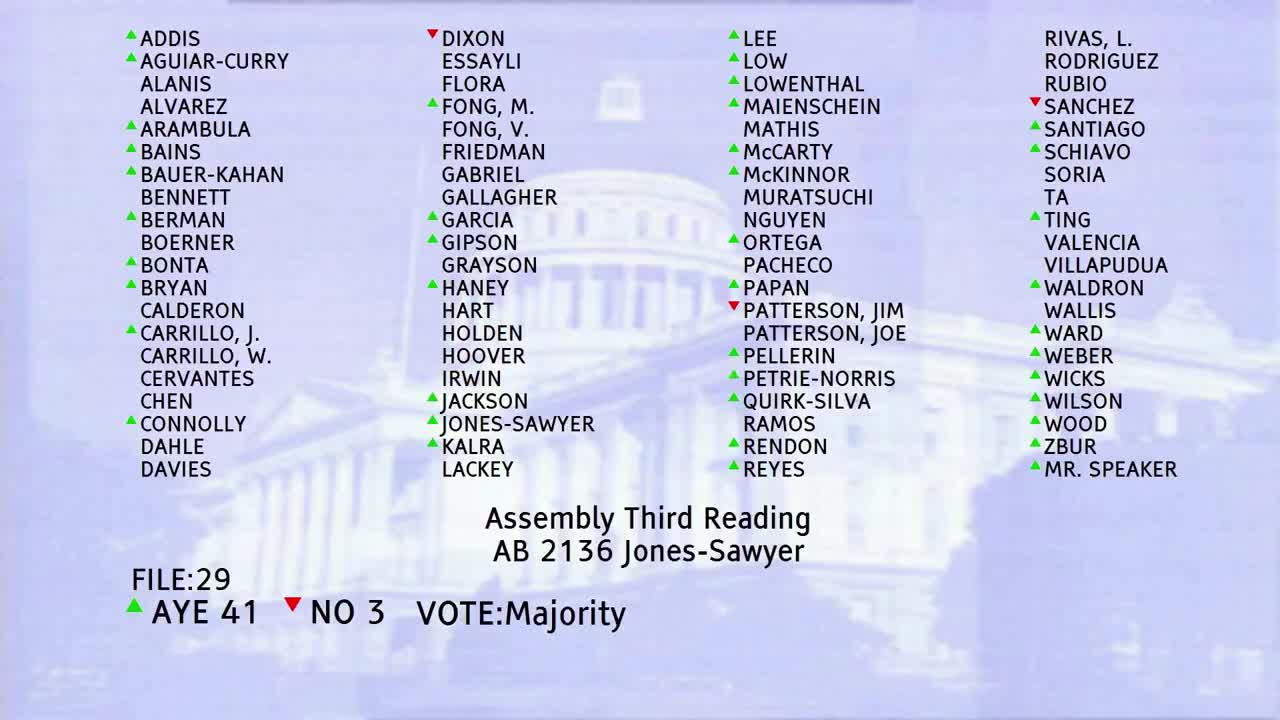 7MIN
Assembly Floor
 29MIN
Assembly Standing Committee on Judiciary
 7SEC
Assembly Standing Committee on Judiciary
 38MIN
Assembly Standing Committee on Communications and Conveyance
Bill Author

Bill Co-Author(s):