AB 2587: Sexual assault: statute of limitations.
- Session Year: 2023-2024
- House: Assembly
- Latest Version Date: 2024-06-20
Current Status:
Failed
(2024-08-15: In committee: Held under submission.)
Introduced
In Committee
First Chamber
In Committee
Second Chamber
Enacted
What does this bill do?
The bill lets certain civil suits by adults for sexual assault that were previously barred by the time limit to sue be revived if they would have been time‑barred before January 1, 2025, and allows those suits to be filed or proceed between January 1, 2025 and December 31, 2026. A revived claim must allege both that one or more people or entities are legally responsible and that an entity engaged in a cover‑up — such as hiding evidence or using nondisclosure agreements — and failing to allege a cover‑up as to one entity won’t block claims against others; related claims like wrongful termination are also revived.
The summary is provided by generative AI which can make mistakes. For original language, please view the details in the table below.
Existing law revives certain claims seeking to recover damages suffered as a result of a sexual assault that occurred on or after the plaintiffs 18th birthday when one or more entities are legally responsible for damages and the entity or their agents engaged in a cover up, as defined, that would otherwise be barred prior to January 1, 2023, solely because the applicable statute of limitations has or had expired. Existing law authorizes a cause of action for any such claim to proceed if already pending in court on January 1, 2023, or, if not filed by that date, to be commenced between January 1, 2023, and December 31, 2023. Existing law revives such claims brought by a plaintiff to who alleges all of the following: (1) the plaintiff was sexually assaulted, (2) one or more entities are legally responsible for damages arising out of the assault, and (3) the entity or entities engaged in a cover up or attempted cover up, as defined, of a previous instance or allegations of sexual assault.
This bill would extend the eligibility period for revival of claims of the type described above to include claims that would otherwise be barred prior to January 1, 2025, because the applicable statute of limitations has or had expired. The bill would instead require a revived claim to allege that the plaintiff was sexually assaulted and either that (1) one or more entities or persons are legally responsible for damages arising out of sexual assault by an alleged perpetrator against the plaintiff, or and (2) an entity or entities, including their specified representatives, engaged in a cover up or attempted a cover up of a previous instance or allegations of sexual assault by an alleged perpetrator. The bill would specify that failure to allege a cover up as to one entity does not affect revival of a claim or claims against any other entity or person, including the perpetrator. The bill would permit a cause of action for any such claim to proceed if already pending in court on the effective date of the bill or, if not filed by that date, to be commenced between January 1, 2025, and December 31, 2026. The bill would make conforming changes.
Existing law revives certain claims seeking to recover damages suffered as a result of a sexual assault that occurred on or after the plaintiffs 18th birthday when one or more entities are legally responsible for damages and the entity or their agents engaged in a cover up, as defined, that would otherwise be barred prior to January 1, 2023, solely because the applicable statute of limitations has or had expired. Existing law authorizes a cause of action for any such claim to proceed if already pending in court on January 1, 2023, or, if not filed by that date, to be commenced between January 1, 2023, and December 31, 2023. Existing law revives such claims brought by a plaintiff to who alleges all of: of the following: (1) the plaintiff was sexually assaulted, (2) one or more entities are legally responsible for damages arising out of the assualt, assault, and (3) the entity or entities engaged in a cover up or attempted cover up, as defined, of a previous instance or allegations of sexual assault.
This bill would extend the eligibility period for revival of claims of the type described above to include claims that would otherwise be barred prior to January 1, 2025, because the applicable statute of limitations has or had expired. The bill would instead require a revived claim to allege any of the allegations described above, and would expressly state that those allegations may include an allegation that a person, including the perpretrator of the assault, is legally responsible for the plaintiffs damages. that the plaintiff was sexually assaulted and either that (1) one or more entities or persons are legally responsible for damages arising out of sexual assault by an alleged perpetrator against the plaintiff, or (2) an entity or entities, including their specified representatives, engaged in a cover up or attempted a cover up of a previous instance or allegations of sexual assault by an alleged perpetrator. The bill would permit a cause of action for any such claim to proceed if already pending in court on the effective date of the bill or, if not filed by that date, to be commenced between January 1, 2025, and December 31, 2026. The bill would make conforming changes.
Existing law revives certain claims seeking to recover damages suffered as a result of a sexual assault that occurred on or after the plaintiffs 18th birthday when one or more entities are legally responsible for damages and the entity or their agents engaged in a cover up, as defined, that would otherwise be barred prior to January 1, 2023, solely because the applicable statute of limitations has or had expired. Existing law authorizes a cause of action for any such claim to proceed if already pending in court on January 1, 2023, or, if not filed by that date, to be commenced between January 1, 2023, and December 31, 2023. Existing law revives such claims brought by a plaintiff to who alleges all of: (1) the plaintiff was sexually assaulted, (2) one or more entities are legally responsible for damages arising out of the assualt, and (3) the entity or entities engaged in a cover up or attempted cover up, as defined, of a previous instance or allegations of sexual assault.
This bill would recast those provisions by reviving different claims seeking to recover damages suffered as a result of a sexual assault that occurred on or after the plaintiffs 18th birthday that would otherwise be barred before January 1, 2025, solely because the applicable statute of limitations has or had expired. The bill would eliminate the requirement that the revived claims allege that one or more entities are legally responsible for damages and that the entity or their agents engaged in a cover up. The bill would instead only revive claims for an action (1) against a person for committing sexual assault, (2) for liability against a person or entity who owes a duty of care to the plaintiff and whose wrongful or negligent act legally caused the sexual assault that injured the plaintiff, (3) for liability against a person or entity whose intentional act legally caused the sexual assault that injured the plaintiff, or (4) for liability against a person or entity who is legally responsible for damages arising out of the sexual assault. extend the eligibility period for revival of claims of the type described above to include claims that would otherwise be barred prior to January 1, 2025, because the applicable statute of limitations has or had expired. The bill would instead require a revived claim to allege any of the allegations described above, and would expressly state that those allegations may include an allegation that a person, including the perpretrator of the assault, is legally responsible for the plaintiffs damages. The bill would permit a cause of action for any such claim to proceed if already pending in court on the effective date of the bill or, if not filed by that date, to be commenced between January 1, 2025, and December 31, 2026. The bill would make conforming changes.
Existing law revives claims seeking to recover damages suffered as a result of a sexual assault that occurred on or after the plaintiffs 18th birthday when one or more entities are legally responsible for damages and the entity or their agents engaged in a cover up, as defined, that would otherwise be barred prior to January 1, 2023, solely because the applicable statute of limitations has or had expired. Existing law authorizes a cause of action for any such claim to proceed if already pending in court on January 1, 2023 or, if not filed by that date, to be commenced between January 1, 2023 and December 31, 2023.
This bill would recast those provisions by reviving different claims seeking to recover damages suffered as a result of a sexual assault that occurred on or after the plaintiffs 18th birthday that would otherwise be barred before January 1, 2025, solely because the applicable statute of limitations has or had expired. The bill would eliminate the requirement that the revived claims allege that one or more entities are legally responsible for damages and that the entity or their agents engaged in a cover up. The bill would instead only revive claims for an action (1) against a person for committing sexual assault, (2) for liability against a person or entity who owes a duty of care to the plaintiff and whose wrongful or negligent act legally caused the sexual assault that injured the plaintiff, (3) for liability against a person or entity whose intentional act legally caused the sexual assault that injured the plaintiff, or (4) for liability against a person or entity who is legally responsible for damages arising out of the sexual assault. The bill would permit a cause of action for any such claim to proceed if already pending in court on the effective date of the bill or, if not filed by that date, to be commenced between January 1, 2025, and December 31, 2026. The bill would make conforming changes.
(a)In any civil action for recovery of damages suffered as a result of sexual assault, where the assault occurred on or after the plaintiffs 18th birthday, the time for commencement of the action shall be the later of the following:
(1)Within 10 years from the date of the last act, attempted act, or assault with the intent to commit an act, of sexual assault against the plaintiff.
(2)Within three years from the date the plaintiff discovers or reasonably should have discovered that an injury or illness resulted from an act, attempted act, or assault with the intent to commit an act, of sexual assault against the plaintiff.
(b)(1)As used in this section, sexual assault means any of the crimes described in Section 243.4, 261, 264.1, 286, 287, or 289, or former Sections 262 and 288a, of the Penal Code, assault with the intent to commit any of those crimes, or an attempt to commit any of those crimes.
(2)For the purpose of this section, it is not necessary that a criminal prosecution or other proceeding have been brought as a result of the sexual assault or, if a criminal prosecution or other proceeding was brought, that the prosecution or proceeding resulted in a conviction or adjudication. This subdivision does not limit the availability of causes of action permitted under subdivision (a), including causes of action against persons or entities other than the alleged person who committed the crime.
(3)This section applies to any action described in subdivision (a) that is based upon conduct that occurred on or after January 1, 2009, and is commenced on or after January 1, 2019, that would have been barred solely because the applicable statute of limitations has or had expired. Such claims are hereby revived and may be commenced until December 31, 2026. This subdivision does not revive any of the following claims:
(A)A claim that has been litigated to finality in a court of competent jurisdiction before January 1, 2023.
(B)A claim that has been compromised by a written settlement agreement between the parties entered into before January 1, 2023.
(c)(1)Notwithstanding any other law, any claim seeking to recover more than two hundred fifty thousand dollars ($250,000) in damages arising out of a sexual assault or other inappropriate contact, communication, or activity of a sexual nature by a physician occurring at a student health center between January 1, 1988, and January 1, 2017, that would otherwise be barred before January 1, 2020, solely because the applicable statute of limitations has or had expired, is hereby revived and, a cause of action may proceed if already pending in court on October 2, 2019, or, if not filed by that date, may be commenced between January 1, 2020, and December 31, 2020.
(2)This subdivision does not revive any of the following claims:
(A)A claim that has been litigated to finality in a court of competent jurisdiction before January 1, 2020.
(B)A claim that has been compromised by a written settlement agreement between the parties entered into before January 1, 2020.
(C)A claim brought against a public entity.
(3)An attorney representing a claimant seeking to recover under this subdivision shall file a declaration with the court under penalty of perjury stating that the attorney has reviewed the facts of the case and consulted with a mental health practitioner, and that the attorney has concluded on the basis of this review and consultation that it is the attorneys good faith belief that the claim value is more than two hundred fifty thousand dollars ($250,000). The declaration shall be filed upon filing the complaint, or for those claims already pending, by December 1, 2019.
(d)(1)Notwithstanding any other law, any claim seeking to recover damages arising out of a sexual assault or other inappropriate contact, communication, or activity of a sexual nature by a physician while employed by a medical clinic owned and operated by the University of California, Los Angeles, or a physician who held active privileges at a hospital owned and operated by the University of California, Los Angeles, at the time that the sexual assault or other inappropriate contact, communication, or activity of a sexual nature occurred, between January 1, 1983, and January 1, 2019, that would otherwise be barred before January 1, 2021, solely because the applicable statute of limitations has or had expired, is hereby revived, and a cause of action may proceed if already pending in court on January 1, 2021, or, if not filed by that date, may be commenced between January 1, 2021, and December 31, 2021.
(2)This subdivision does not revive either of the following claims:
(A)A claim that has been litigated to finality in a court of competent jurisdiction before January 1, 2021.
(B)A claim that has been compromised by a written settlement agreement between the parties entered into before January 1, 2021.
(e)(1)Notwithstanding any other law, any claim seeking to recover damages suffered as a result of a sexual assault that occurred on or after the plaintiffs 18th birthday that would otherwise be barred before January 1, 2025, solely because the applicable statute of limitations has or had expired, is hereby revived, and a cause of action may proceed if already pending in court on January 1, 2025, or, if not filed by that date, may be commenced between January 1, 2025, and December 31, 2026.
(2)This subdivision revives claims brought by a plaintiff who alleges that the plaintiff was sexually assaulted and either both of the following:
(A)One or more entities or persons, including the perpetrator of the sexual assault, are legally responsible for damages arising out of sexual assault by an alleged perpetrator against the plaintiff.
(B)An entity or entities, including, but not limited to, their officers, directors, representatives, employees, or agents, engaged in a cover up or attempted a cover up of a previous instance or allegations of sexual assault by an alleged perpetrator of such abuse.
(3)(3)Failure to allege a cover up as required by subparagraph (B) of paragraph (2) as to one entity does not affect revival of the plaintiffs claim or claims against any other entity or person, including the perpetrator.
(4)For purposes of this subdivision:
(A)Cover up means a concerted effort to hide evidence relating to a sexual assault that incentivizes individuals to remain silent or prevents information relating to a sexual assault from becoming public or being disclosed to the plaintiff, including, but not limited to, the use of nondisclosure agreements or confidentiality agreements.
(B)Entity means a sole proprietorship, partnership, limited liability company, corporation, association, or other legal entity.
(C)Legally responsible means that the person, entity, or entities are liable under any theory of liability established by statute or common law, including, but not limited to, negligence, intentional torts, and vicarious liability.
(4)(5)This subdivision revives any related claims, including, but not limited to, wrongful termination and sexual harassment, arising out of the sexual assault that is the basis for a claim pursuant to this subdivision.
(5)(6)This subdivision does not revive either of the following claims:
(A)A claim that has been litigated to finality in a court of competent jurisdiction before January 1, 2025.
(B)A claim that has been compromised by a written settlement agreement between the parties entered into before January 1, 2025.
(6)(7)This subdivision shall not be construed to alter the otherwise applicable burden of proof, as defined in Section 115 of the Evidence Code, that a plaintiff has in a civil action subject to this section.
(7)(8)Nothing in this subdivision precludes a plaintiff from bringing an action for sexual assault pursuant to subdivisions (a) and (b).
(a)In any civil action for recovery of damages suffered as a result of sexual assault, where the assault occurred on or after the plaintiffs 18th birthday, the time for commencement of the action shall be the later of the following:
(1)Within 10 years from the date of the last act, attempted act, or assault with the intent to commit an act, of sexual assault against the plaintiff.
(2)Within three years from the date the plaintiff discovers or reasonably should have discovered that an injury or illness resulted from an act, attempted act, or assault with the intent to commit an act, of sexual assault against the plaintiff.
(b)(1)As used in this section, sexual assault means any of the crimes described in Section 243.4, 261, 264.1, 286, 287, or 289, or former Sections 262 and 288a, of the Penal Code, assault with the intent to commit any of those crimes, or an attempt to commit any of those crimes.
(2)For the purpose of this section, it is not necessary that a criminal prosecution or other proceeding have been brought as a result of the sexual assault or, if a criminal prosecution or other proceeding was brought, that the prosecution or proceeding resulted in a conviction or adjudication. This subdivision does not limit the availability of causes of action permitted under subdivision (a), including causes of action against persons or entities other than the alleged person who committed the crime.
(3)This section applies to any action described in subdivision (a) that is based upon conduct that occurred on or after January 1, 2009, and is commenced on or after January 1, 2019, that would have been barred solely because the applicable statute of limitations has or had expired. Such claims are hereby revived and may be commenced until December 31, 2026. This subdivision does not revive any of the following claims:
(A)A claim that has been litigated to finality in a court of competent jurisdiction before January 1, 2023.
(B)A claim that has been compromised by a written settlement agreement between the parties entered into before January 1, 2023.
(c)(1)Notwithstanding any other law, any claim seeking to recover more than two hundred fifty thousand dollars ($250,000) in damages arising out of a sexual assault or other inappropriate contact, communication, or activity of a sexual nature by a physician occurring at a student health center between January 1, 1988, and January 1, 2017, that would otherwise be barred before January 1, 2020, solely because the applicable statute of limitations has or had expired, is hereby revived and, a cause of action may proceed if already pending in court on October 2, 2019, or, if not filed by that date, may be commenced between January 1, 2020, and December 31, 2020.
(2)This subdivision does not revive any of the following claims:
(A)A claim that has been litigated to finality in a court of competent jurisdiction before January 1, 2020.
(B)A claim that has been compromised by a written settlement agreement between the parties entered into before January 1, 2020.
(C)A claim brought against a public entity.
(3)An attorney representing a claimant seeking to recover under this subdivision shall file a declaration with the court under penalty of perjury stating that the attorney has reviewed the facts of the case and consulted with a mental health practitioner, and that the attorney has concluded on the basis of this review and consultation that it is the attorneys good faith belief that the claim value is more than two hundred fifty thousand dollars ($250,000). The declaration shall be filed upon filing the complaint, or for those claims already pending, by December 1, 2019.
(d)(1)Notwithstanding any other law, any claim seeking to recover damages arising out of a sexual assault or other inappropriate contact, communication, or activity of a sexual nature by a physician while employed by a medical clinic owned and operated by the University of California, Los Angeles, or a physician who held active privileges at a hospital owned and operated by the University of California, Los Angeles, at the time that the sexual assault or other inappropriate contact, communication, or activity of a sexual nature occurred, between January 1, 1983, and January 1, 2019, that would otherwise be barred before January 1, 2021, solely because the applicable statute of limitations has or had expired, is hereby revived, and a cause of action may proceed if already pending in court on January 1, 2021, or, if not filed by that date, may be commenced between January 1, 2021, and December 31, 2021.
(2)This subdivision does not revive either of the following claims:
(A)A claim that has been litigated to finality in a court of competent jurisdiction before January 1, 2021.
(B)A claim that has been compromised by a written settlement agreement between the parties entered into before January 1, 2021.
(e)(1)Notwithstanding any other law, any claim seeking to recover damages suffered as a result of a sexual assault that occurred on or after the plaintiffs 18th birthday that would otherwise be barred before January 1, 2025, solely because the applicable statute of limitations has or had expired, is hereby revived, and a cause of action may proceed if already pending in court on January 1, 2025, or, if not filed by that date, may be commenced between January 1, 2025, and December 31, 2026.
(2)This subdivision revives claims brought by a plaintiff who alleges any that the plaintiff was sexually assaulted and either of the following:
(A)The plaintiff was sexually assaulted.(B)(A)One or more entities or persons, including the perpetrator of the sexual assault, are legally responsible for damages arising out of sexual assault by an alleged perpetrator against the plaintiff.
(C)(B)An entity or entities, including, but not limited to, their officers, directors, representatives, employees, or agents, engaged in a cover up or attempted a cover up of a previous instance or allegations of sexual assault by an alleged perpetrator of such abuse.
(3)For purposes of this subdivision:
(A)Cover up means a concerted effort to hide evidence relating to a sexual assault that incentivizes individuals to remain silent or prevents information relating to a sexual assault from becoming public or being disclosed to the plaintiff, including, but not limited to, the use of nondisclosure agreements or confidentiality agreements.
(B)Entity means a sole proprietorship, partnership, limited liability company, corporation, association, or other legal entity.
(C)Legally responsible means that the person, entity, or entities are liable under any theory of liability established by statute or common law, including, but not limited to, negligence, intentional torts, and vicarious liability.
(4)This subdivision revives any related claims, including, but not limited to, wrongful termination and sexual harassment, arising out of the sexual assault that is the basis for a claim pursuant to this subdivision.
(5)This subdivision does not revive either of the following claims:
(A)A claim that has been litigated to finality in a court of competent jurisdiction before January 1, 2025.
(B)A claim that has been compromised by a written settlement agreement between the parties entered into before January 1, 2025.
(6)This subdivision shall not be construed to alter the otherwise applicable burden of proof, as defined in Section 115 of the Evidence Code, that a plaintiff has in a civil action subject to this section.
(7)Nothing in this subdivision precludes a plaintiff from bringing an action for sexual assault pursuant to subdivisions (a) and (b).
(a)In any civil action for recovery of damages suffered as a result of sexual assault, where the assault occurred on or after the plaintiffs 18th birthday, the time for commencement of the action shall be the later of the following:
(1)Within 10 years from the date of the last act, attempted act, or assault with the intent to commit an act, of sexual assault against the plaintiff.
(2)Within three years from the date the plaintiff discovers or reasonably should have discovered that an injury or illness resulted from an act, attempted act, or assault with the intent to commit an act, of sexual assault against the plaintiff.
(b)(1)As used in this section, sexual assault means any of the crimes described in Section 243.4, 261, 264.1, 286, 287, or 289, or former Sections 262 and 288a, of the Penal Code, assault with the intent to commit any of those crimes, or an attempt to commit any of those crimes.
(2)For the purpose of this section, it is not necessary that a criminal prosecution or other proceeding have been brought as a result of the sexual assault or, if a criminal prosecution or other proceeding was brought, that the prosecution or proceeding resulted in a conviction or adjudication. This subdivision does not limit the availability of causes of action permitted under subdivision (a), including causes of action against persons or entities other than the alleged person who committed the crime.
(3)This section applies to any action described in subdivision (a) that is based upon conduct that occurred on or after January 1, 2009, and is commenced on or after January 1, 2019, that would have been barred solely because the applicable statute of limitations has or had expired. Such claims are hereby revived and may be commenced until December 31, 2026. This subdivision does not revive any of the following claims:
(A)A claim that has been litigated to finality in a court of competent jurisdiction before January 1, 2023.
(B)A claim that has been compromised by a written settlement agreement between the parties entered into before January 1, 2023.
(c)(1)Notwithstanding any other law, any claim seeking to recover more than two hundred fifty thousand dollars ($250,000) in damages arising out of a sexual assault or other inappropriate contact, communication, or activity of a sexual nature by a physician occurring at a student health center between January 1, 1988, and January 1, 2017, that would otherwise be barred before January 1, 2020, solely because the applicable statute of limitations has or had expired, is hereby revived and, a cause of action may proceed if already pending in court on October 2, 2019, or, if not filed by that date, may be commenced between January 1, 2020, and December 31, 2020.
(2)This subdivision does not revive any of the following claims:
(A)A claim that has been litigated to finality in a court of competent jurisdiction before January 1, 2020.
(B)A claim that has been compromised by a written settlement agreement between the parties entered into before January 1, 2020.
(C)A claim brought against a public entity.
(3)An attorney representing a claimant seeking to recover under this subdivision shall file a declaration with the court under penalty of perjury stating that the attorney has reviewed the facts of the case and consulted with a mental health practitioner, and that the attorney has concluded on the basis of this review and consultation that it is the attorneys good faith belief that the claim value is more than two hundred fifty thousand dollars ($250,000). The declaration shall be filed upon filing the complaint, or for those claims already pending, by December 1, 2019.
(d)(1)Notwithstanding any other law, any claim seeking to recover damages arising out of a sexual assault or other inappropriate contact, communication, or activity of a sexual nature by a physician while employed by a medical clinic owned and operated by the University of California, Los Angeles, or a physician who held active privileges at a hospital owned and operated by the University of California, Los Angeles, at the time that the sexual assault or other inappropriate contact, communication, or activity of a sexual nature occurred, between January 1, 1983, and January 1, 2019, that would otherwise be barred before January 1, 2021, solely because the applicable statute of limitations has or had expired, is hereby revived, and a cause of action may proceed if already pending in court on January 1, 2021, or, if not filed by that date, may be commenced between January 1, 2021, and December 31, 2021.
(2)This subdivision does not revive either of the following claims:
(A)A claim that has been litigated to finality in a court of competent jurisdiction before January 1, 2021.
(B)A claim that has been compromised by a written settlement agreement between the parties entered into before January 1, 2021.
(e)(1)Notwithstanding any other law, any claim seeking to recover damages suffered as a result of a sexual assault that occurred on or after the plaintiffs 18th birthday that would otherwise be barred before January 1, 2025, solely because the applicable statute of limitations has or had expired, is hereby revived, and a cause of action may proceed if already pending in court on January 1, 2025, or, if not filed by that date, may be commenced between January 1, 2025, and December 31, 2026.
(2)This subdivision revives claims for any of the following actions:(A)An action against any person for committing an act of sexual assault.(B)An action for liability against any person or entity who owed a duty of care to the plaintiff, if a wrongful or negligent act by that person or entity was a legal cause of the sexual assault that resulted in the injury to the plaintiff.(C)An action for liability against any person or entity if an intentional act by that person or entity was a legal cause of the sexual assault that resulted in the injury to the plaintiff.(D)An action for liability against any person or entity if that person or entity is legally responsible for damages arising out of the sexual assault.(2)This subdivision revives claims brought by a plaintiff who alleges any of the following:
(A)The plaintiff was sexually assaulted.
(B)One or more entities or persons, including the perpetrator of the sexual assault, are legally responsible for damages arising out of sexual assault by an alleged perpetrator against the plaintiff.
(C)An entity or entities, including, but not limited to, their officers, directors, representatives, employees, or agents, engaged in a cover up or attempted a cover up of a previous instance or allegations of sexual assault by an alleged perpetrator of such abuse.
(3)For purposes of this subdivision:
(A)Cover up means a concerted effort to hide evidence relating to a sexual assault that incentivizes individuals to remain silent or prevents information relating to a sexual assault from becoming public or being disclosed to the plaintiff, including, but not limited to, the use of nondisclosure agreements or confidentiality agreements.
(A)(B)Entity means a sole proprietorship, partnership, limited liability company, corporation, association, or other legal entity.
(B)(C)Legally responsible means that the person, entity, or entities are liable under any theory of liability established by statute or common law, including, but not limited to, negligence, intentional torts, and vicarious liability.
(4)This subdivision revives any related claims, including, but not limited to, wrongful termination and sexual harassment, arising out of the sexual assault that is the basis for a claim pursuant to this subdivision.
(5)This subdivision does not revive either of the following claims:
(A)A claim that has been litigated to finality in a court of competent jurisdiction before January 1, 2025.
(B)A claim that has been compromised by a written settlement agreement between the parties entered into before January 1, 2025.
(6)This subdivision shall not be construed to alter the otherwise applicable burden of proof, as defined in Section 115 of the Evidence Code, that a plaintiff has in a civil action subject to this section.
(7)Nothing in this subdivision precludes a plaintiff from bringing an action for sexual assault pursuant to subdivisions (a) and (b).
(a)In any civil action for recovery of damages suffered as a result of sexual assault, where the assault occurred on or after the plaintiffs 18th birthday, the time for commencement of the action shall be the later of the following:
(1)Within 10 years from the date of the last act, attempted act, or assault with the intent to commit an act, of sexual assault against the plaintiff.
(2)Within three years from the date the plaintiff discovers or reasonably should have discovered that an injury or illness resulted from an act, attempted act, or assault with the intent to commit an act, of sexual assault against the plaintiff.
(b)(1)As used in this section, sexual assault means any of the crimes described in Section 243.4, 261, 264.1, 286, 287, or 289, or former Sections 262 and 288a, of the Penal Code, assault with the intent to commit any of those crimes, or an attempt to commit any of those crimes.
(2)For the purpose of this section, it is not necessary that a criminal prosecution or other proceeding have been brought as a result of the sexual assault or, if a criminal prosecution or other proceeding was brought, that the prosecution or proceeding resulted in a conviction or adjudication. This subdivision does not limit the availability of causes of action permitted under subdivision (a), including causes of action against persons or entities other than the alleged person who committed the crime.
(3)This section applies to any action described in subdivision (a) that is based upon conduct that occurred on or after January 1, 2009, and is commenced on or after January 1, 2019, that would have been barred solely because the applicable statute of limitations has or had expired. Such claims are hereby revived and may be commenced until December 31, 2026. This subdivision does not revive any of the following claims:
(A)A claim that has been litigated to finality in a court of competent jurisdiction before January 1, 2023.
(B)A claim that has been compromised by a written settlement agreement between the parties entered into before January 1, 2023.
(c)(1)Notwithstanding any other law, any claim seeking to recover more than two hundred fifty thousand dollars ($250,000) in damages arising out of a sexual assault or other inappropriate contact, communication, or activity of a sexual nature by a physician occurring at a student health center between January 1, 1988, and January 1, 2017, that would otherwise be barred before January 1, 2020, solely because the applicable statute of limitations has or had expired, is hereby revived and, a cause of action may proceed if already pending in court on October 2, 2019, or, if not filed by that date, may be commenced between January 1, 2020, and December 31, 2020.
(2)This subdivision does not revive any of the following claims:
(A)A claim that has been litigated to finality in a court of competent jurisdiction before January 1, 2020.
(B)A claim that has been compromised by a written settlement agreement between the parties entered into before January 1, 2020.
(C)A claim brought against a public entity.
(3)An attorney representing a claimant seeking to recover under this subdivision shall file a declaration with the court under penalty of perjury stating that the attorney has reviewed the facts of the case and consulted with a mental health practitioner, and that the attorney has concluded on the basis of this review and consultation that it is the attorneys good faith belief that the claim value is more than two hundred fifty thousand dollars ($250,000). The declaration shall be filed upon filing the complaint, or for those claims already pending, by December 1, 2019.
(d)(1)Notwithstanding any other law, any claim seeking to recover damages arising out of a sexual assault or other inappropriate contact, communication, or activity of a sexual nature by a physician while employed by a medical clinic owned and operated by the University of California, Los Angeles, or a physician who held active privileges at a hospital owned and operated by the University of California, Los Angeles, at the time that the sexual assault or other inappropriate contact, communication, or activity of a sexual nature occurred, between January 1, 1983, and January 1, 2019, that would otherwise be barred before January 1, 2021, solely because the applicable statute of limitations has or had expired, is hereby revived, and a cause of action may proceed if already pending in court on January 1, 2021, or, if not filed by that date, may be commenced between January 1, 2021, and December 31, 2021.
(2)This subdivision does not revive either of the following claims:
(A)A claim that has been litigated to finality in a court of competent jurisdiction before January 1, 2021.
(B)A claim that has been compromised by a written settlement agreement between the parties entered into before January 1, 2021.
(e)(1)Notwithstanding any other law, any claim seeking to recover damages suffered as a result of a sexual assault that occurred on or after the plaintiffs 18th birthday that would otherwise be barred before January 1, 2023, 2025, solely because the applicable statute of limitations has or had expired, is hereby revived, and a cause of action may proceed if already pending in court on January 1, 2023, 2025, or, if not filed by that date, may be commenced between January 1, 2023, 2025, and December 31, 2023. 2026.
(2)This subdivision revives claims brought by a plaintiff who alleges all of the following:(A)The plaintiff was sexually assaulted.(B)One or more entities are legally responsible for damages arising out of the sexual assault.(C)The entity or entities, including, but not limited to, their officers, directors, representatives, employees, or agents, engaged in a cover up or attempted a cover up of a previous instance or allegations of sexual assault by an alleged perpetrator of such abuse.(3)Failure to allege a cover up as required by subparagraph (C) of paragraph (2) as to one entity does not affect revival of the plaintiffs claim or claims against any other entity.(4)For purposes of this subdivision:(A)Cover up means a concerted effort to hide evidence relating to a sexual assault that incentivizes individuals to remain silent or prevents information relating to a sexual assault from becoming public or being disclosed to the plaintiff, including, but not limited to, the use of nondisclosure agreements or confidentiality agreements.(2)This subdivision revives claims for any of the following actions:
(A)An action against any person for committing an act of sexual assault.
(B)An action for liability against any person or entity who owed a duty of care to the plaintiff, if a wrongful or negligent act by that person or entity was a legal cause of the sexual assault that resulted in the injury to the plaintiff.
(C)An action for liability against any person or entity if an intentional act by that person or entity was a legal cause of the sexual assault that resulted in the injury to the plaintiff.
(D)An action for liability against any person or entity if that person or entity is legally responsible for damages arising out of the sexual assault.
(3)For purposes of this subdivision:
(B)(A)Entity means a sole proprietorship, partnership, limited liability company, corporation, association, or other legal entity.
(C)(B)Legally responsible means that the entity person, entity, or entities are liable under any theory of liability established by statute or common law, including, but not limited to, negligence, intentional torts, and vicarious liability.
(5)(4)This subdivision revives any related claims, including, but not limited to, wrongful termination and sexual harassment, arising out of the sexual assault that is the basis for a claim pursuant to this subdivision.
(6)(5)This subdivision does not revive either of the following claims:
(A)A claim that has been litigated to finality in a court of competent jurisdiction before January 1, 2023. 2025.
(B)A claim that has been compromised by a written settlement agreement between the parties entered into before January 1, 2023. 2025.
(7)(6)This subdivision shall not be construed to alter the otherwise applicable burden of proof, as defined in Section 115 of the Evidence Code, that a plaintiff has in a civil action subject to this section.
(8)(7)Nothing in this subdivision precludes a plaintiff from bringing an action for sexual assault pursuant to subdivisions (a) and (b).
|
Date
|
Status
|
|---|---|
| Aug 15, 2024 | In committee: Held under submission. |
| Jul 1, 2024 | In committee: Referred to suspense file. |
| Jun 20, 2024 | Read second time and amended. Re-referred to Com. on APPR. |
| Jun 19, 2024 | From committee: Amend, and do pass as amended and re-refer to Com. on APPR. (Ayes 9. Noes 0.) (June 18). |
| Jun 5, 2024 | Referred to Coms. on JUD. and APPR. |
| May 23, 2024 | In Senate. Read first time. To Com. on RLS. for assignment. |
| May 22, 2024 | Read third time. Passed. Ordered to the Senate. (Ayes 60. Noes 0. Page 5492.) |
| May 20, 2024 | Read second time. Ordered to third reading. |
| May 16, 2024 | From committee: Do pass. (Ayes 11. Noes 2.) (May 16). |
| May 8, 2024 | In committee: Set, first hearing. Referred to APPR. suspense file. |
| May 6, 2024 | Re-referred to Com. on APPR. |
| May 2, 2024 | Read second time and amended. |
| May 1, 2024 | From committee: Amend, and do pass as amended and re-refer to Com. on APPR. (Ayes 9. Noes 1.) (April 30). |
| Apr 23, 2024 | Re-referred to Com. on JUD. |
| Apr 22, 2024 | From committee chair, with author's amendments: Amend, and re-refer to Com. on JUD. Read second time and amended. |
| Mar 4, 2024 | Referred to Com. on JUD. |
| Feb 15, 2024 | From printer. May be heard in committee March 16. |
| Feb 14, 2024 | Read first time. To print. |
|
Date
|
Description
|
Location
|
Votes
|
|
|---|---|---|---|---|
| Jul 1, 2024 | Placed on suspense file | Senate Standing Committee on Appropriations |
Passed |
|
| Jun 18, 2024 | Do pass as amended, but first amend, and re-refer to the Committee on [Appropriations] | Senate Standing Committee on Judiciary |
Passed |
|
| May 22, 2024 | AB 2587 Aguiar-Curry Assembly Third Reading | Assembly Floor |
Passed |
|
| May 16, 2024 | Do pass. | Assembly Standing Committee on Appropriations |
Passed |
|
| Apr 30, 2024 | Do pass as amended and be re-referred to the Committee on [Appropriations] | Assembly Standing Committee on Judiciary |
Passed |
This list shows positions taken on this bill by organizations on the date displayed, which is linked to the original source.
Positions by individuals are not included.
|
Organization
|
Position
|
Date
|
|---|---|---|
| American Property Casualty Insurance Association | ** Against | |
| American Tort Reform Association | ** Against | |
| Anti Trafficking Organization Exodus Cry | * Support | Apr 30, 2024 |
| California Business Properties Association | ** Against | |
| California Business Roundtable | ** Against | |
| California Chamber Of Commerce | ** Against | |
| California Retailers Association | ** Against | |
| Civil Justice Association Of California | * Against | Jun 20, 2024 |
| Consumer Attorneys in California | * Support | Apr 30, 2024 |
| County Of Los Angeles | * Against | Jun 20, 2024 |
| Exodus Cry | * Support | Apr 30, 2024 |
| National Federation Of Independent Business | ** Against | |
| Pave | ** Support | |
| Stand With Survivors | ** Support | |
| Stand with Survivors | * Support | Jun 18, 2024 |
| Stand with Survivors | * Support | Apr 30, 2024 |
| The Female Composer Safety League | ** Support | |
| The Punk Rock Therapist | * Support | Apr 30, 2024 |
| The Punk Rock Therapist | ** Support | |
| The Punk Rock Therapist | * Support | Jun 18, 2024 |
| Victim Policy Institute | * Support | Jun 18, 2024 |
| Zero Abuse Project | ** Support |
SENATE COMMITTEE ON
Senator Anna Caballero, Chair
2023 - 2024 Regular Session
AB 2587 (Aguiar-Curry) - Sexual assault: statute of limitations
Version: | Policy Vote: |
Urgency: | Mandate: |
Hearing Date: | Consultant: |
Bill Summary:
AB 2587 would revive, for two years, the statute of limitations on civil claims of sexual assault brought against an entity, for claims that are otherwise time-barred if they meet qualifying criteria.
Fiscal Impact:
- Cost pressures (Trial Court Trust Fund, General Fund) of an unknown but potentially significant amount to the courts to adjudicate cases that are time-barred by the current statute of limitation, but may be brought during the two-year revival period. Although this bill revives only one type of sexual assault claim, the short duration of the revival period could result in a large number of cases being filed in a short period of time. A significant increase in workload to the courts could result in delays of court services and prioritization of court cases might impact access to justice, and would put pressure on the General Fund to fund additional staff and resources. The Governor’s 2024-25 budget proposes $83.1 million ongoing from the General Fund to backfill declining revenue to the Trial Court Trust Fund.
- Significant cost (local funds, General Funds) potentiality in the billions collectively to state and local agencies due to settlements and judgments that must be paid out as result of claims that are successfully brought by plaintiffs that would have otherwise been barred by the existing statute of limitations. Such cost pressures would be exacerbated by a large number of potential settlements and judgments that would have to be paid in a short window of time. Additionally, to the extent an extended statute of limitations affects liability insurance premiums, state and local entities could experience unknown, potentially-significant costs related to procuring liability insurance, apart from any specific claims. (See staff comments.)
Background:
Statutes of limitations dictate the time period within which a legal proceeding must begin. A case will typically be dismissed if it is not brought before the statute of limitation expires. Statutes of limitations play a critical role in ensuring that justice is timely served. They encourage plaintiffs to gather their evidence early and to bring their cases to court promptly, thereby preventing any delays and inaccuracies that arise due to the destruction of evidence, fading memories, and the passing away of witnesses. Statutes of limitations also prevent the unexpected enforcement of stale claims “concerning which persons interested have been thrown off their guard by want of prosecution.” (Pashley v. Pacific Elec. Co. (1944) 25 Cal. 2d 226, 228-29.)
One of the underlying purposes of statutes of limitation is to prevent the unexpected enforcement of stale claims concerning which persons interested have been thrown off their guard by want of prosecution. When statutes of limitations are too long or are uncertain (for example, when an expired limitations period is arbitrarily revived by the Legislature) commercial and other activities become encumbered by the looming threat of litigation.
The limitations period serves important policy goals that help to preserve both the integrity of our legal system and the due process rights of individuals. “These statutes are declared to be 'among the most beneficial to be found in our books. They rest upon sound policy, and tend to the peace and welfare of society.” (Ibid.)
Unless there is a statute providing otherwise, the time for bringing a civil action is two years after the injury occurs or, depending upon the type of injury, two years after the plaintiff discovered, or reasonably should have discovered, the injury. The Legislature has previously extended the statute of limitations for civil cases involving sexual assault, and has authorized revival periods that allow a plaintiff to bring a case that would otherwise be barred by the statute of limitations. Most recently, in 2022, the Legislature passed AB 2777 (Wicks), Chapter 442, Statutes of 2022, which authorized a one-year revival period that allowed plaintiffs to file specified claims of sexual assault that would otherwise be time-barred by the existing statute of limitations.
Proposed Law:
This bill revives, from January 1, 2025, to December 31, 2026, a claim that is time-barred as of January 1, 2025, solely because of the statute of limitations and allows it to be filed, if the claim is filed by a plaintiff who alleges they were sexually assaulted and one of the following conditions is met:
- One or more entities or persons, including the perpetrator of the sexual assault, are legally responsible for damages arising out of sexual assault by an alleged perpetrator against the plaintiff; or,
- An entity or entities, including, but not limited to, their officers, directors, representatives, employees, or agents, engaged in a cover up or attempted a cover up of a previous instance or allegations of sexual assault by an alleged perpetrator of such abuse.
Staff Comments: This bill would revive claims against “entities” “legally responsible for damages arising out of sexual assault” including but not limited to their “representatives, employees, or agents.” The statute amended by this bill defines “entity” as a “sole proprietorship, partnership, limited liability company, corporation, association, or other legal entity.” State and local agencies are legal entities that can be sued. Thus, this bill would result in significant state costs to the extent state agencies must litigate claims revived by this bill.
For example, AB 218 (Gonzales), Chapter 861, Statutes of 2019, revived specified claims for childhood sex assault for a three-year period. That bill opened floodgates to litigation. Los Angeles County has reported thousands of claims filed against it, which specifically cite the revived statute of limitations. Los Angeles County reports that it is facing settlements for billions of dollars. AB 218 was more limited than this bill as it only applied to childhood sexual assault. Accordingly, to the extent this bill revives all claims of sexual assault, this bill could result in significant fiscal impacts to state and local agencies.
-- END --
Senator Thomas Umberg, Chair
2023-2024 Regular Session
Bill No: AB 2587 (Author:Aguiar-Curry)
Version: May 2, 2024
Hearing Date: June 18, 2024
Fiscal: No
Urgency: No
Consultant: CK
SUBJECT
Sexual assault: statute of limitations
DIGEST
This bill revives otherwise time-barred claims for damages arising from sexual assault and related claims arising out of the sexual assault against the perpetrator and any entities responsible, as specified.
EXECUTIVE SUMMARY
The statute of limitations for damages arising from a sexual assault that occurred when the victim was an adult is the later of either 10 years from the date of the last actionable conduct or three years from the discovery of the injury resulting, as specified. When that limitations timeline was extended in 2009 from two years to 10 years it only provided that benefit to victims whose claims had not yet expired when the bill was signed.
This bill revives claims seeking to recover damages suffered as a result of a sexual assault of an adult plaintiff that would otherwise be time-barred if the plaintiff alleges certain facts. These revivals do not apply to claims litigated to finality or compromised by a written settlement. However, the bill also revives any related claims arising out of the sexual assault, including wrongful termination and sexual harassment.
This bill is sponsored by the Victim Policy Institute. It is supported by a variety of organizations, including the Zero Abuse Project. It is opposed by a coalition of industry groups, including the Civil Justice Association of California.
PROPOSED CHANGES TO THE LAW
Existing law:
- Requires all civil actions be commenced within applicable statutes of limitations. (Code Civ. Proc. § 312.)
- Provides that in any civil action commenced on or after January 1, 2019, for recovery of damages suffered as a result of sexual assault, as defined, where the assault occurred on or after the plaintiff’s 18th birthday, the time for commencement of the action shall be the later of the following:
- within 10 years from the date of the last act, attempted act, or assault with the intent to commit an act, of sexual assault against the plaintiff; or
- within three years from the date the plaintiff discovers or reasonably should have discovered that an injury or illness resulted from an act, attempted act, or assault with the intent to commit an act, of sexual assault against the plaintiff. (Code Civ. Proc. § 340.16.)
- Defines “sexual assault,” for the purposes of the above provision, to mean any of the crimes described in Section 243.4, 261, former 262, 264.1, 286, 287, former 288a, or 289 of the Penal Code, assault with the intent to commit any of those crimes, or an attempt to commit any of those crimes. (§ 340.16(b)(1).)
- Clarifies that it is not necessary that a criminal prosecution or other proceeding have been brought as a result of the sexual assault or, if a criminal prosecution or other proceeding was brought, that the prosecution or proceeding resulted in a conviction or adjudication. It further makes clear that Section 340.16(b) does not limit the availability of causes of action permitted under Section 340.16(a), including causes of action against persons or entities other than the alleged person who committed the crime. (§ 340.16(b)(2).)
- Provides revival periods for various claims arising from sexual assault or other sexual misconduct, including where entities engaged in a “cover up,” and where the assaults were perpetrated by physicians in two unique circumstances. (§ 340.16(c)-(e).)
- Provides that claims for money or damages against local public entities must be presented in accordance with specified procedures, unless specifically exempted. (Gov. Code § 905.) A written claim relating to a cause of action for death or for injury to person or to personal property shall be presented not later than six months after the accrual of the cause of action with the ability to file an application to present an untimely claim up to one year after the accrual of the cause of action. (Gov. Code §§ 911.2, 911.4.) A claim relating to any other cause of action shall be presented not later than one year after the accrual of the cause of action. (Gov. Code § 911.2.) “Local public entity” includes a county, city, district, public authority, public agency, and any other political subdivision or public corporation in the State, but does not include the State. (Gov. Code § 900.4.)
- Establishes numerous exceptions to the claims presentation requirements including claims made pursuant to Section 340.1 of the Code of Civil Procedure for the recovery of damages suffered as a result of childhood sexual abuse. (Gov. Code § 905.)
This bill:
- Provides that any claim seeking to recover damages suffered as a result of a sexual assault, and any related claims arising out of the sexual assault, that would otherwise be barred before January 1, 2025, solely because the applicable statute of limitations has or had expired, is revived for a two-year period if the plaintiff alleges that they were sexually assaulted and either of the following:
- One or more entities or persons, including the perpetrator of the sexual assault, are legally responsible for damages arising out of sexual assault by an alleged perpetrator against the plaintiff.
- An entity or entities, including, but not limited to, their officers, directors, representatives, employees, or agents, engaged in a cover up or attempted a cover up of a previous instance or allegations of sexual assault by an alleged perpetrator of such abuse.
- Defines “cover up” as a concerted effort to hide evidence relating to a sexual assault that incentivizes individuals to remain silent or prevents information relating to a sexual assault from becoming public or being disclosed to the plaintiff, including, but not limited to, the use of nondisclosure agreements or confidentiality agreements.
- Clarifies that it does not alter the otherwise applicable burden of proof, as defined in Section 115 of the Evidence Code, that a plaintiff has in a civil action subject to this statute. It further clarifies that the above revival does not preclude a plaintiff from bringing an action for sexual assault pursuant to the statute.
- Provides that these revival provisions do not apply to claims that have been litigated to finality in a court of competent jurisdiction or compromised by a written settlement agreement between the parties entered into before January 1, 2025.
COMMENTS
- Statutes of limitations
A statute of limitations is a requirement to commence legal proceedings (either civil or criminal) within a specific period of time. Statutes of limitations are tailored to the cause of action at issue – for example, cases involving injury must be brought within two years from the date of injury, cases relating to written contracts must be brought four years from the date the contract was broken, and, as commonly referenced in the media, there is no statute of limitations for murder. Although it may appear unfair to bar actions after the statute of limitations has elapsed, that limitations period serves important policy goals that help to preserve both the integrity of our legal system and the due process rights of individuals.
For example, one significant reason that a limitations period is necessary in many cases is that evidence may disappear over time – paperwork gets lost, witnesses forget details or pass away, and physical locations that may be critical to a case change over time. Limitations periods also promote finality by encouraging an individual who has been wronged to bring an action sooner rather than later – timely actions arguably ensure that the greatest amount of evidence is available to all parties.
In general, California law requires all civil actions be commenced within applicable statutes of limitations. (Code Civ. Proc. § 312.) Under existing law, the general statute of limitations in California to bring an action for assault, battery, or injury to, or for the death of, an individual caused by the wrongful act or neglect of another is two years. (Code Civ. Proc. § 335.1.)
In 2018, AB 1619 (Berman, Ch. 939, Stats. 2018) added Section 340.16 to the Code of Civil Procedure expanding the statute of limitations for recovery of damages suffered by an adult as a result of sexual assault. The default statute of limitations applicable to such claims was two years. Section 340.16 now provides that a case seeking damages suffered as a result of sexual assault, as defined, where the assault occurred when the plaintiff was 18 years of age or older, must be brought by the later of the following:
(a) within 10 years from the date of the last act, attempted act, or assault with the intent to commit an act, of sexual assault against the plaintiff; or
(b) within three years from the date the plaintiff discovers or reasonably should have discovered that an injury or illness resulted from an act, attempted act, or assault with the intent to commit an act, of sexual assault against the plaintiff.
- Revival of claims
When AB 1619 went into effect on January 1, 2019, it extended the clock for all relevant claims that had not already expired, those dating back less than two years from that date. Therefore, even though the new limitations period was ten years, those claims that accrued more than two years before the effective date of the new law did not reap the benefit of the extension.
AB 2777 (Wicks, Ch. 442, Stats. 2022) revived claims based upon conduct that occurred on or after January 1, 2009, and that are commenced on or after January 1, 2019, that would have been barred solely because the applicable statute of limitations has or had expired. This functions to revive actions that could have been brought if AB 1619 had applied its 10-year statute of limitations retroactively. The revival period lasts until December 31, 2026.
Relevant here, AB 2777 also revived any claims seeking to recover damages suffered as a result of a sexual assault of an adult victim, regardless of the date the conduct occurred, where the plaintiff alleges the following facts:
- The plaintiff was sexually assaulted.
- One or more entities are legally responsible for damages arising out of the sexual assault.
- The entity or entities, including, but not limited to, their officers, directors, representatives, employees, or agents, engaged in a cover up or attempted a cover up of a previous instance or allegations of sexual assault by an alleged perpetrator of such abuse.
AB 2777 also revived any related claims, including wrongful termination and sexual harassment, arising out of the sexual assault. That one-year revival period lasted until December 31, 2023.
Concerns have arisen that this latter revival only applied to entities and not the actual perpetrators of these covered up sexual assault claims. In response, this bill again revives any claim seeking to recover damages suffered as a result of a sexual assault, and any related claims arising out of that assault, that would otherwise be time barred. However, the plaintiff needs only allege they were sexually assaulted and allege either of the following:
- One or more entities or persons, including the perpetrator of the sexual assault, are legally responsible for damages arising out of sexual assault by an alleged perpetrator against the plaintiff.
- An entity or entities, including, but not limited to, their officers, directors, representatives, employees, or agents, engaged in a cover up or attempted a cover up of a previous instance or allegations of sexual assault by an alleged perpetrator of such abuse.
“Legally responsible” means that the person, entity, or entities are liable under any theory of liability established by statute or common law, including, but not limited to, negligence, intentional torts, and vicarious liability.
Similar to AB 2777, this bill also revives any related claims arising out of the sexual assault, including wrongful termination and sexual harassment, but does not apply to claims litigated to finality or settled before January 1, 2025.
- Revival of time-barred claims
This bill explicitly revives claims seeking to recover damages arising out of a sexual assault that would otherwise be barred because the applicable statute of limitations has expired.
As can be imagined, there are exceptionally egregious instances of a statute of limitations running out and leaving a victim of such heinous acts without a remedy. In addition to AB 2777, the Legislature has revived time-barred claims for sexual assaults in several contexts.
AB 218 (Gonzalez, Ch. 861, Stats. 2019) provided that the claims provided for in Section 340.1 involving childhood sexual assault that would otherwise be barred as of January 1, 2020, because an applicable statute of limitations, claim presentation deadline, or any other time limit had expired, are explicitly revived by the bill. AB 218 created a three-year window in which such claims can be brought, or, if later, within the statute of limitations period newly established by the bill.
AB 1510 (Reyes, Ch. 462, Stats. 2019) amended Section 340.16 by reviving claims that arose out of either sexual assault, or other inappropriate contact, communication, or activity of a sexual nature by a physician where the conduct occurs at a student health center between January 1, 1988 and January 1, 2017. The revival applied to claims that would have otherwise been time-barred prior to January 1, 2020, solely because the applicable statute of limitations had expired. AB 1510 provided that a cause of action could proceed if already pending in court or, if not filed, could be commenced within a one-year revival period starting January 1, 2020.
The revival period created by AB 1510 was tailored to a now infamous scandal at the University of Southern California student health clinic, where one full-time gynecologist, Dr. George Tyndall, was repeatedly accused of sexually assaulting, and engaging in other sexual misconduct with, numerous patients, and the school was accused of failing to act to stop his crimes and protect students.
AB 3092 (Wicks, Ch. 246, Stats. 2020) dealt with a similar situation with similar legislative action. It closely tracked the provisions included by AB 1510, but revived claims seeking to recover damages arising out of a sexual assault or other inappropriate contact, communication, or activity of a sexual nature by a physician while employed by a medical clinic owned and operated by UCLA, or a physician who held active privileges at a hospital owned and operated by UCLA, at the time that the sexual assault or other inappropriate contact, communication, or activity of a sexual nature occurred, between January 1, 1983, and January 1, 2019.
The perpetrator at the center of this scandal was Dr. James Heaps. UCLA was found to have failed to adequately respond to allegations, potentially allowing preventable tragedies, namely the sexual assault of additional students.
More recently, AB 1455 (Wicks, Ch. 595, Stats. 2021) amended the statute of limitations for seeking damages arising out of a sexual assault that occurred while a plaintiff was an adult and that was committed by a law enforcement officer. It also eliminated the claim presentation requirements for such claims. AB 1455 also revived such claims that would otherwise be barred by the existing statute of limitations, any government claim presentation deadline, or any other applicable time limit, and applied an extended statute of limitations as to those revived claims.
As stated, several of these revival bills also exempted the claims from the claims presentation requirements that apply to actions against public entities. This bill does not, and therefore does not apply to all claims against public entities.
- Policy implications of revival
The California Supreme Court has squarely addressed the modification of statutes of limitations and the revival of stale claims:
The Legislature has authority to establish—and to enlarge—limitations periods. . . . [H]owever, legislative enlargement of a limitations period does not revive lapsed claims in the absence of express language of revival. This rule of construction grows out of an understanding of the difference between prospective and retroactive application of statutes. . . . As long as the former limitations period has not expired, an enlarged limitations period ordinarily applies and is said to apply prospectively to govern cases that are pending when, or instituted after, the enactment took effect. This is true even though the underlying conduct that is the subject of the litigation occurred prior to the new enactment. . . . However, when it comes to applying amendments that enlarge the limitations period to claims as to which the limitations period has expired before the amendment became law—that is, claims that have lapsed—the analysis is different. Once a claim has lapsed (under the formerly applicable statute of limitations), revival of the claim is seen as a retroactive application of the law under an enlarged statute of limitations. Lapsed claims will not be considered revived without express language of revival.
(Quarry v. Doe I (Quarry) (2012) 53 Cal.4th 945, 955-957, internal citations omitted.) The court continues, specifically addressing the policy reasons against revival:
“The reason for this rule is a judicial perception of unfairness in reviving a cause after the prospective defendant has assumed its expiration and has conducted his affairs accordingly.” As one court commented, “a statute of limitations grants prospective defendants relief from the burdens of indefinite exposure to stale claims. By reviving lapsed claims, the Legislature may appear to renege on this promise. As Judge [Learned] Hand wrote, there may be something ‘unfair and dishonest’ in after-the-fact withdrawal of this legislative assurance of safety.” Individuals, as well as businesses and other enterprises ordinarily rely upon the running of the limitations period: “The keeping of records, the maintenance of reserves, and the commitment of funds may all be affected by such reliance . . . . To defeat such reliance . . . deprives [enterprises] of the ability to plan intelligently with respect to stale and apparently abandoned claims.”
(Quarry, at 958, internal citations omitted.)
The California Supreme Court thus makes the case against reviving claims that have expired, highlighting the principle that such revival, while within the Legislature’s power, should not be provided lightly. (See also Chase Sec. Corp. v. Donaldson (1945) 325 U.S. 304, 314 [finding statutes of limitations are “good only by legislative grace and to be subject to a relatively large degree of legislative control”]; Liebig v. Superior Court (1989) 209 Cal. App. 3d 828, 831-834; Lent v. Doe (1995) 40 Cal.App.4th 1177, 1181 [finding the Legislature has the power to revive causes of action].) The courts have made clear that important state interests must be at stake to justify such a disruption of the law.
In analyzing the expansion of the limitations period in AB 1619, this Committee stated:
The nature of sexual assault arguably supports the need for a longer statute of limitations for survivors to be able to raise their claims. While recovering from sexual assault, many survivors do not have the capacity to also pursue civil remedies. As stated by the author [of AB 1619], the “current two-year statute of limitations simply does not provide sexual assault survivors adequate time to heal from the physical and emotional trauma of a sexual assault and prepare for a civil case.” Researchers are learning more about the aftermath of sexual assault. As more information about the potential for post-traumatic stress syndrome (PTSD), depression, and other mental health complications in sexual assault survivors is unveiled, it is clear that two years does not provide victims with the time needed to heal from the trauma of sexual assault.[1] By providing victims the later of 10 years or within 3 years from when the plaintiff discovers or reasonably should have discovered an injury or illness that resulted from the sexual assault, this bill would provide victims with a timeframe that is more respectful of the violence they have endured and the trauma that has resulted.
According to the author:
In 2022, the Legislature passed AB 2777 (Wicks, Chapter 442, Statutes of 2022) to protect survivors of sexual assault by opening a one-year window for survivors to bring claims against the entities who harmed them. However, as survivors have tried to access their overdue recourse, they have encountered problems as courts make determinations about the intent of the Legislature. Notably, courts have prevented survivors from holding the individual who perpetrate the sexual assault accountable, which is not consistent with the original intent of the bill.
Today, AB 2587 will clarify that the legislature intends to hold both the perpetrators of sexual assault and entities who covered up or willfully ignored the assault accountable for the harms inflicted on survivors, regardless of when the assault occurred. This bill allows additional time for survivors to seek restitution and act on the clearer signals sent by this bill. However, nothing in the bill changes any legal standard or burden of proof with regard to any claim brought before a judge or court. Victims must still prove all the elements of their claims regardless of when the sexual assault occurred.
At a moment of reckoning in the United States about sexual assault, California has made landmark policies that recognize it can take years for many survivors to come forward due to trauma, stigma, fears of backlash, or other complex factors. With this bill, California ensures survivors of sexual assault can continue to come forward while maintaining the integrity of the judicial process.
- Stakeholder positions
Writing in support, the Junior Leagues of California State Public Affairs Committee (CalSPAC) states:
CalSPAC seeks to increase awareness of the impact of violence in California communities and champions policies that strive to decrease violence through prevention, intervention, and education. AB 2587 plays a vital role in guaranteeing access to justice for survivors of sexual assault, empowering them to hold accountable not only the perpetrators of the assault but also any entities whose negligence or misconduct demonstrably contributed to the assault.
The Victim Policy Institute, the sponsor of the bill, discusses its scope:
AB 2587 does not interfere with any pending claims or litigation. AB 2587 does not change any legal standard or burden of proof with regard to any claim brought before a judge or court. Survivors must still prove all the elements of their claims regardless of when the sexual assault occurred.
A coalition of industry associations, including the American Property Casualty Insurance Association, write in opposition:
AB 2587 attempts to recast the negotiated provisions in AB 2777 (Wicks) (Chapter 422, 2022) (reviving claims against entities that allegedly “covered up” evidence related to a sexual assault) which at the time was the broadest reviver bill to be presented to a California governor in the state’s history. This bill goes further by reviving any claims alleging injuries not only from sexual assault, but also related employment claims. The justification for AB 2777 was that an entity should not be able to avoid being held accountable for wrongdoing by engaging in a cover up to run out the statutes of limitations clock, but AB 2587 expands the window by two additional years, without a justification for why this policy change is necessary at this time.
Not only does AB 2587 violate fundamental fairness principles in our civil justice system by disregarding the public policy benefits of the statutes of limitations, but it also discriminates against an entire class of sexual assault survivors who were victimized at the hands of public employers since this bill only applies to the private sector.
In response to requests from opposition, the author has agreed to amend the bill to require a plaintiff to allege both of the following rather than one or the other:
- One or more entities or persons, including the perpetrator of the sexual assault, are legally responsible for damages arising out of sexual assault by an alleged perpetrator against the plaintiff.
- An entity or entities, including, but not limited to, their officers, directors, representatives, employees, or agents, engaged in a cover up or attempted a cover up of a previous instance or allegations of sexual assault by an alleged perpetrator of such abuse.
However, to ensure that perpetrators can still be held liable under the revival, the amendments will also provide: “Failure to allege a cover up as required by subparagraph (B) of paragraph (2) as to one entity does not affect revival of the plaintiff’s claim or claims against any other entity or person, including the perpetrator.”
SUPPORT
Victim Policy Institute (sponsor)
American Association of University Women California
Consumer Attorneys of California
Female Composer Safety League
Junior Leagues of California State Public Affairs Committee
Promoting Awareness, Victim Empowerment
Punk Rock Therapist
Stand With Survivors
Zero Abuse Project
One individual
OPPOSITION
American Property Casualty Insurance Association
American Tort Reform Association
California Business Properties Association
California Business Roundtable
California Chamber of Commerce
California Retailers Association
Civil Justice Association of California
National Federation of Independent Business
RELATED LEGISLATION
Pending Legislation: AB 2693 (Wicks, 2024) revives otherwise expired claims for damages suffered as a result of childhood sexual assault by an employee of a juvenile probation camp or detention facility owned and operated by a county. AB 2693 is currently in this Committee.
Prior Legislation:
AB 2777 (Wicks, Ch. 442, Stats. 2022) See Comment 2.
AB 1455 (Wicks, Ch. 595, Stats. 2021) See Comment 3.
AB 3092 (Wicks, Ch. 246, Stats. 2020) See Comment 3.
AB 218 (Gonzalez, Ch. 861, Stats. 2019) See Comment 3.
AB 1510 (Reyes, Ch. 462, Stats. 2019) See Comment 3.
AB 1619 (Berman, Ch. 939, Stats. 2018) See Comment 1.
PRIOR VOTES:
Assembly Floor (Ayes 60, Noes 0)
Assembly Appropriations Committee (Ayes 11, Noes 2)
Assembly Judiciary Committee (Ayes 9, Noes 1)
**************
Statistics about Sexual Violence (2015) National Sexual Violence Resource Center, http://www.nsvrc.org/sites/default/files/publications_nsvrc_factsheet_media-packet_statistics-about-sexual-violence_0.pdf. Internet citations are current as of June 8, 2022. ↑
ASSEMBLY THIRD READING
ATR Bill Id:AB 2587
Author:(Aguiar-Curry)
As Amended Ver:May 2, 2024
Majority vote
SUMMARY
Revives a claim for sexual assault against a private entity that is time barred as of January 1, 2025 solely because of the statute of limitations and allows it to be filed for a two-year period if the claim meets specified criteria.
Major Provisions
- Revives for a two year period, beginning on January 1, 2025 and until December 31, 2026, a claim that is time barred as of January 1, 2025 solely because of the statute of limitations and allows it to be filed, or allows it to proceed if already filed as of January 1, 2025; specifies that claims by a plaintiff who alleges that the plaintiff was sexually assaulted and one of the following are revived:
- One or more entities or persons, including the perpetrator of the sexual assault, are legally responsible for damages arising out of sexual assault by an alleged perpetrator against the plaintiff.
- An entity or entities, including, but not limited to, their officers, directors, representatives, employees, or agents, engaged in a cover up or attempted a cover up of a previous instance or allegations of sexual assault by an alleged perpetrator of such abuse.
- Clarifies that the term "legally responsible" means that the person, entity, or entities are liable under any theory of liability established by statute or common law, including, but not limited to, negligence, intentional torts, and vicarious liability.
- Clarifies that the bill does not revive either of the following:
- A claim that has been litigated to finality in a court of competent jurisdiction before January 1, 2025.
- A claim that has been compromised by a written settlement agreement between the parties entered into before January 1, 2025.
COMMENTS
This bill, sponsored by Victim Policy Institute, revives some time-lapsed claims for sexual assault. Specifically, it revives a claim seeking to recover damages suffered as a result of a sexual assault that occurred on or after the plaintiff's 18th birthday that would otherwise be barred before January 1, 2025, solely because the applicable statute of limitations and allows a cause of action to proceed if already pending in court on January 1, 2025, or, if not filed by that date, to be commenced between January 1, 2025, and December 31, 2026. The type of claims that may be revived under the bill are those alleging that the plaintiff was sexually assaulted and one of the following:
- One or more entities or persons, including the perpetrator of the sexual assault, are legally responsible for damages arising out of sexual assault by an alleged perpetrator against the plaintiff.
- An entity or entities, including, but not limited to, their officers, directors, representatives, employees, or agents, engaged in a cover up or attempted a cover up of a previous instance or allegations of sexual assault by an alleged perpetrator of such abuse.
The bill defines "entity" to mean "a sole proprietorship, partnership, limited liability company, corporation, association, or other legal entity." Therefore the bill does not apply to public entities.
The Legislature has the power to create, extend, and change statutes of limitation, as it deems appropriate. The policy behind statutes of limitations provides that they "are designed to promote justice by preventing surprises through the revival of claims that have been allowed to slumber until evidence has been lost, memories have faded, and witnesses have disappeared. The theory is that even if one has a just claim it is unjust not to put the adversary on notice to defend within the period of limitation and the right to be free of stale claims in time comes to prevail over the right to prosecute them." (3 Witkin, California Procedure Section 433, 4th Ed.) Statutes of limitation reflect the reality that, over time, evidence is lost or destroyed and witnesses' memories fade. However, current laws regarding the statute of limitations for sexual abuse claims reflect another reality, namely that victims often delay coming forward for a variety of reasons, including threats, shame, lack of trust, fear, or some combination thereof.
Nonetheless, courts have acknowledged that, "the need for repose is not so overarching that the Legislature cannot by express legislative provision allow certain actions to be brought at any time, and it has occasionally done so." (Duty v. Abex Corp (1989) 214 Cal.App.3rd 742, 749 [citations omitted].)
The most recent revival statute regarding sexual assault of an adult is AB 2777 (Wicks), Chapter 442, Statutes of 2022. AB 2777 allowed some time-barred claims to be revived for a one-year period in 2023 if there were a "cover up" of a sexual assault. AB 2777 revived some lapsed claims for adult sexual assault and others for childhood sexual assault. Relevant to this bill, AB 2777 revived claims alleging that one or more entities or their agents engaged in a "cover up" of a sexual assault, or other inappropriate conduct, communication, or activity of a sexual nature. The bill revived claims that otherwise would be barred before January 1, 2023. Those claims, once revived, were allowed to be filed during a one-year period between January 1, 2023 and December 31, 2023. According to the author of this bill, "Unfortunately, courts have interpreted AB 2777 to only allow sexual assault survivors to recover damages from the entities that engaged in the cover up, not the perpetrators of sexual assault. This is not consistent with the intent of AB 2777 and this bill seeks to include the perpetrators as a party that can be held responsible for damages."
According to the Author
In 2022, the Legislature passed AB 2777 (Wicks), Chapter 442, Statutes of 2022 to protect survivors of sexual assault by opening a one-year window for survivors to bring claims against the entities who harmed them. However, as survivors have tried to access their overdue recourse, they have encountered problems as courts make determinations about the intent of the Legislature. Notably, courts have prevented survivors from holding the individual who perpetrated the sexual assault accountable, which is not consistent with the original intent of the bill.
Today, AB 2587 will clarify that the legislature intends to hold both the perpetrators of sexual assault and entities who covered up or willfully ignored the assault accountable for the harms inflicted on survivors, regardless of when the assault occurred. This bill allows additional time for survivors to seek restitution and act on the clearer signals sent by this bill. However, nothing in the bill changes any legal standard or burden of proof with regard to any claim brought before a judge or court. Victims must still prove all the elements of their claims regardless of when the sexual assault occurred.
At a moment of reckoning in the United States about sexual assault, California has made landmark policies that recognize it can take years for many survivors to come forward due to trauma, stigma, fears of backlash, or other complex factors. With this bill, California ensures survivors of sexual assault can continue to come forward while maintaining the integrity of the judicial process.
Arguments in Support
Sponsor Victim Policy Institute writes the following in support of the bill:
The person who committed the sexual assault or the entity whose intentional or negligent act caused the sexual assault were not intended to be excluded from AB 2777 (Wicks) as the issue of cover up was being addressed in the state.
Currently, accused perpetrators of sexual assault are interpreting AB 2777 to mean the statute did not intend to allow victims of sexual assault to revive claims against individuals who committed the sexual assault. They are also asserting AB 2777 only applies to workplace assaults at major companies. A recent state Court of Appeal's analysis included that the revival of claims under Code of Civil Procedure 340.16(e) depends upon whether plaintiffs have alleged a cover up.
AB 2587 would clarify any confusion for victims of sexual assault by making clear that cover up is not required in order for them to come forward against their perpetrators or the entities whose intentional or negligent act caused the sexual assault. The bill would also allow more time for victims.
Consumer Attorneys of California write the following:
AB 2587 will clarify that the legislature intends to hold both the perpetrators of sexual assault, and entities who covered up or willfully ignored the assault, accountable for the harm inflicted on survivors. This bill allows a limited time for survivors to seek recourse by clarifying the intent of past legislation.
Arguments in Opposition
The coalition of business groups that are opposed to the bill write the following in their joint letter:
AB 2587 attempts to recast the negotiated provisions in AB 2777 (Wicks) (Chapter 422, 2022) (reviving claims against entities that allegedly "covered up" evidence related to a sexual assault) which at the time was the broadest reviver bill to be presented to a California governor in the state's history. This bill goes further by reviving any claims alleging injuries not only from sexual assault, but also related employment claims. The justification for AB 2777 was that an entity should not be able to avoid being held accountable for wrongdoing by engaging in a cover up to run out the statutes of limitations clock, but AB 2587 expands the window by two additional years, without a justification for why this policy change is necessary at this time.
Not only does AB 2587 violate fundamental fairness principles in our civil justice system by disregarding the public policy benefits of the statutes of limitations, but it also discriminates against an entire class of sexual assault survivors who were victimized at the hands of public employers since this bill only applies to the private sector.
FISCAL COMMENTS
According to the Assembly Appropriations analysis, cost pressures (Trial Court Trust Fund, General Fund) of an unknown but potentially significant amount to the courts to adjudicate cases that are time-barred by the current statute of limitation, but may be brought during the two-year revival period. Although this bill revives only one type of sexual assault claim, the short duration of the revival period could result in a large number of cases being filed in a short period of time. A significant increase in workload to the courts could result in delays of court services and prioritization of court cases might impact access to justice, and would put pressure on the General Fund to fund additional staff and resources.
The Governor's 2024-25 budget proposes $83.1 million ongoing from the General Fund to backfill declining revenue to the Trial Court Trust Fund. According to the Legislative Analyst's Office, the General Fund faces a structural deficit in the tens of billions of dollars over the next several fiscal years.
VOTES
ASM JUDICIARY: 9-1-2
YES: Kalra, Bauer-Kahan, Bryan, Connolly, Haney, Maienschein, McKinnor, Pacheco, Reyes
NO: Dixon
ABS, ABST OR NV: Essayli, Sanchez
ASM APPROPRIATIONS: 11-2-2
YES: Wicks, Arambula, Bryan, Calderon, Wendy Carrillo, Mike Fong, Grayson, Haney, Hart, Pellerin, Villapudua
NO: Dixon, Ta
ABS, ABST OR NV: Sanchez, Jim Patterson
UPDATED
VERSION: April 22, 2024
CONSULTANT: Alison Merrilees / JUD. / (916) 319-2334 FN: 0002974
Date of Hearing: May 8, 2024
ASSEMBLY COMMITTEE ON APPROPRIATIONS
Buffy Wicks, Chair
ABPCA Bill Id:AB 2587
Author:(Aguiar-Curry) – As Amended Ver:May 2, 2024
Policy Committee: | Judiciary | Vote: | 9 - 1 |
|
| ||
|
|
Urgency: No State Mandated Local Program: No Reimbursable: No
SUMMARY:
This bill suspends, for two years, the statute of limitations on civil claims of sexual assault brought against a private entity, for claims that meet qualifying criteria.
Specifically, among other provisions, this bill:
- Revives, from January 1, 2025, to December 31, 2026, a claim that is time-barred as of January 1, 2025, solely because of the statute of limitations and allows it to be filed, if the claim is filed by a plaintiff who alleges they were sexually assaulted and one of the following conditions is met:
- One or more entities or persons, including the perpetrator of the sexual assault, are legally responsible for damages arising out of sexual assault by an alleged perpetrator against the plaintiff.
- An entity or entities, including, but not limited to, their officers, directors, representatives, employees, or agents, engaged in a cover up or attempted a cover up of a previous instance or allegations of sexual assault by an alleged perpetrator of such abuse.
FISCAL EFFECT:
Cost pressures (Trial Court Trust Fund, General Fund) of an unknown but potentially significant amount to the courts to adjudicate cases that are time-barred by the current statute of limitation, but may be brought during the two-year revival period. Although this bill revives only one type of sexual assault claim, the short duration of the revival period could result in a large number of cases being filed in a short period of time. A significant increase in workload to the courts could result in delays of court services and prioritization of court cases might impact access to justice, and would put pressure on the General Fund to fund additional staff and resources.
The Governor’s 2024-25 budget proposes $83.1 million ongoing from the General Fund to backfill declining revenue to the Trial Court Trust Fund. According to the Legislative Analyst’s Office, the General Fund faces a structural deficit in the tens of billions of dollars over the next several fiscal years.
COMMENTS:
- Purpose. According to the author:
This bill allows additional time for survivors to seek restitution and act on the clearer signals sent by this bill. However, nothing in the bill changes any legal standard or burden of proof with regard to any claim brought before a judge or court. Victims must still prove all the elements of their claims regardless of when the sexual assault occurred. At a moment of reckoning in the United States about sexual assault, California has made landmark policies that recognize it can take years for many survivors to come forward due to trauma, stigma, fears of backlash, or other complex factors. With this bill, California ensures survivors of sexual assault can continue to come forward while maintaining the integrity of the judicial process.
- Background. A statute of limitations is a requirement to commence legal proceedings (either civil or criminal) within a specific period of time after the conduct that prompted the case. Statutes of limitations are tailored to the cause of action at issue – for example, cases involving injury must be brought within two years from the date of injury, cases relating to written contracts must be brought four years from the date the contract was broken, and there is no statute of limitations for murder. Statutes of limitation help preserve the integrity of the legal system and the due process rights of individuals by ensuring that cases are brought close in time to the harms that prompted them, when physical and testimonial evidence is most reliable.
The Legislature has previously extended the statute of limitations for civil cases involving sexual assault, and has authorized revival periods that allow a plaintiff to bring a case that would otherwise be barred by the statute of limitations. Most recently, in 2022, the Legislature passed AB 2777 (Wicks), Chapter 442, Statutes of 2022, which authorized a one-year revival period that allowed plaintiffs to file specified claims of sexual assault that would otherwise be time-barred by the existing statute of limitations. This bill authorizes another, two-year revival for these claims, as described above.
Analysis Prepared by: Annika Carlson / APPR. / (916) 319-2081
Date of Hearing: April 30, 2024
ASSEMBLY COMMITTEE ON JUDICIARY
Ash Kalra, Chair
ABPCA Bill Id:AB 2587
Author:(Aguiar-Curry) – As Amended Ver:April 22, 2024
As Proposed to be Amended
SUBJECT: Sexual assault: statute of limitations
KEY ISSUE: should some claims for sexual assault that are time barred as of January 1, 2025 solely because of the statute of limiTations, other than claims against public entities, be revived and allowed to be filed for a two year period between January 1, 2025 and december 31, 2026?
SYNOPSIS
California has long recognized the unique problem that SOLs create in sexual assault cases. Victims often delay coming forward for a variety of reasons, including threats, shame, lack of trust, fear, or some combination thereof. Fortunately, the Legislature has the power to create, extend, and change statutes of limitation, as it deems appropriate. In 2023, AB 2777 (Wicks, Chap. 442, Stats. 2022) revived some lapsed claims for adult sexual assault and others for childhood sexual assault. Relevant to this bill, it revived claims for sexual assault alleging that one or more entities or their agents engaged in a “cover up” of the sexual assault, or other inappropriate conduct, communication, or activity of a sexual nature. The bill revived claims that otherwise would be barred before January 1, 2023. Those claims, once revived, could be filed during a one-year period between January 1, 2023 and December 31, 2023. According to the author of this bill, “Unfortunately, courts have interpreted AB 2777 to only allow sexual assault survivors to recover damages from the entities that engaged in the cover up, not the perpetrators of sexual assault. This is not consistent with the intent of AB 2777 and this bill seeks to include the perpetrators as a party that can be held responsible for damages.”
This bill, sponsored by Victim Policy Institute, revives some time-lapsed claims for sexual assault. Specifically, it revives a claim seeking to recover damages suffered as a result of a sexual assault that occurred on or after the plaintiff’s 18th birthday that would otherwise be barred before January 1, 2025, solely because the applicable statute of limitations and allows a cause of action to proceed if already pending in court on January 1, 2025, or, if not filed by that date, to be commenced between January 1, 2025, and December 31, 2026. The type of claims that may be revived under the bill, as it is proposed to be amended, are those alleging that the plaintiff was sexually assaulted and one of the following: (1) one or more entities or persons, including the perpetrator of the sexual assault, are legally responsible for damages arising out of sexual assault by an alleged perpetrator against the plaintiff; or (2) an entity or entities, including, but not limited to, their officers, directors, representatives, employees, or agents, engaged in a cover up or attempted a cover up of a previous instance or allegations of sexual assault by an alleged perpetrator of such abuse. The author’s amendments are incorporated into the SUMMARY, below, and explained in the analysis. The bill is supported by the Consumer Attorneys of California and a number of groups advocating for survivors of sexual assault. It is opposed by a coalition of business groups.
SUMMARY: Revives a claim for sexual assault against a private entity that is time barred as of January 1, 2025 solely because of the statute of limitations and allows it to be filed for a two year period if it meets specified criteria. Specifically, this bill:
- Revives for a two year period, beginning on January 1, 2025 and until December 31, 2026, a claim that is time barred as of January 1, 2025 solely because of the statute of limitations and allows it to be filed, or allows it to proceed if already filed as of January 1, 2025; specifies that claims by a plaintiff who alleges that the plaintiff was sexually assaulted and one of the following are revived:
- One or more entities or persons, including the perpetrator of the sexual assault, are legally responsible for damages arising out of sexual assault by an alleged perpetrator against the plaintiff.
- An entity or entities, including, but not limited to, their officers, directors, representatives, employees, or agents, engaged in a cover up or attempted a cover up of a previous instance or allegations of sexual assault by an alleged perpetrator of such abuse.
- Clarifies that the term “legally responsible” means that the person, entity, or entities are liable under any theory of liability established by statute or common law, including, but not limited to, negligence, intentional torts, and vicarious liability.
- Clarifies that the bill does not revive either of the following:
- A claim that has been litigated to finality in a court of competent jurisdiction before January 1, 2025.
- A claim that has been compromised by a written settlement agreement between the parties entered into before January 1, 2025.
EXISTING LAW:
- Revives claims for sexual assault of an adult that are based upon conduct that occurred on or after January 1, 2009, and commenced on or after January 1, 2019, that would have been barred solely because the applicable statute of limitations has or had expired. Specifies that such claims are hereby revived and may be commenced until December 31, 2026. Specifies that the bill does not revive either of the following claims:
- A claim that has been litigated to finality in a court of competent jurisdiction before January 1, 2023.
- A claim that has been compromised by a written settlement agreement between the parties entered into before January 1, 2023. (Code of Civil Procedure Section 340.16 (b)(3). All further statutory references are to this code, unless otherwise indicated.)
- Provides that, notwithstanding any other law, any claim seeking to recover damages suffered as a result of a sexual assault that would otherwise be barred before January 1, 2023, solely because the applicable statute of limitations has or had expired, is hereby revived, and a cause of action may proceed if already pending in court on January 1, 2023, or, if not filed by that date, may be commenced between January 1, 2023, and December 31, 2023. Specifies that the bill revives claims brought by a plaintiff who alleges all of the following:
- The plaintiff was sexually assaulted.
- One or more entities are legally responsible for damages arising out of the sexual assault.
- The entity or entities, including, but not limited to, their officers, directors, representatives, employees, or agents, engaged in a cover up or attempted a cover up of a previous instance or allegation of sexual assault by an alleged perpetrator of such abuse.
- Failure to allege a cover up as required as to one entity does not affect revival of the plaintiff's claim or claims against any other entity. (Section 340.16 (e)(1) – (3).)
- Defines the following for purposes of 2), above:
- "Cover up" means a concerted effort to hide evidence relating to a sexual assault that incentivizes individuals to remain silent or prevents information relating to a sexual assault from becoming public or being disclosed to the plaintiff, including, but not limited to, the use of nondisclosure agreements or confidentiality agreements.
- "Entity" means a sole proprietorship, partnership, limited liability company, corporation, association, or other legal entity.
- "Legally responsible" means that the entity or entities are liable under any theory of liability established by statute or common law, including, but not limited to, negligence, intentional torts, and vicarious liability. (Id., at (e)(4).)
- Specifies that 2), above, revives any related claims, including, but not limited to, wrongful termination and sexual harassment, arising out of the sexual assault that is the basis for a claim. (Id., at (e)(5).)
- Specifies that 2), above, does not revive either of the following claims:
- A claim that has been litigated to finality in a court of competent jurisdiction before January 1, 2023.
- A claim that has been compromised by a written settlement agreement between the parties entered into before January 1, 2023. (Id., at (e)(6).)
- Clarifies that 2), above, shall not be construed to alter the otherwise applicable burden of proof, as defined in Evidence Code Section 115, that a plaintiff has in a civil action subject to this section. (Id., at (e)(7).)
- Clarifies that 2), above, does not preclude a plaintiff from bringing an action for sexual assault pursuant to laws governing sexual assault of a person 18 years and older, or pursuant to 1), above. (Id., at (e)(8).)
FISCAL EFFECT: As currently in print this bill is keyed non-fiscal.
COMMENTS: This bill, sponsored by Victim Policy Institute, revives some time-lapsed claims for sexual assault. Specifically, it revives a claim seeking to recover damages suffered as a result of a sexual assault that occurred on or after the plaintiff’s 18th birthday that would otherwise be barred before January 1, 2025, solely because the applicable statute of limitations and allows a cause of action to proceed if already pending in court on January 1, 2025, or, if not filed by that date, to be commenced between January 1, 2025, and December 31, 2026. The type of claims that may be revived under the bill, as it is proposed to be amended, are those alleging that the plaintiff was sexually assaulted and one of the following:
(1) One or more entities or persons, including the perpetrator of the sexual assault, are legally responsible for damages arising out of sexual assault by an alleged perpetrator against the plaintiff.
(2) An entity or entities, including, but not limited to, their officers, directors, representatives, employees, or agents, engaged in a cover up or attempted a cover up of a previous instance or allegations of sexual assault by an alleged perpetrator of such abuse.
According to the author:
In 2022, the Legislature passed AB 2777 (Wicks, Chapter 442, Statutes of 2022) to protect survivors of sexual assault by opening a one-year window for survivors to bring claims against the entities who harmed them. However, as survivors have tried to access their overdue recourse, they have encountered problems as courts make determinations about the intent of the Legislature. Notably, courts have prevented survivors from holding the individual who perpetrated the sexual assault accountable, which is not consistent with the original intent of the bill.
Today, AB 2587 will clarify that the legislature intends to hold both the perpetrators of sexual assault and entities who covered up or willfully ignored the assault accountable for the harms inflicted on survivors, regardless of when the assault occurred. This bill allows additional time for survivors to seek restitution and act on the clearer signals sent by this bill. However, nothing in the bill changes any legal standard or burden of proof with regard to any claim brought before a judge or court. Victims must still prove all the elements of their claims regardless of when the sexual assault occurred.
At a moment of reckoning in the United States about sexual assault, California has made landmark policies that recognize it can take years for many survivors to come forward due to trauma, stigma, fears of backlash, or other complex factors. With this bill, California ensures survivors of sexual assault can continue to come forward while maintaining the integrity of the judicial process.
The bill defines “entity” to mean “a sole proprietorship, partnership, limited liability company, corporation, association, or other legal entity.” Therefore the bill does not apply to public entities. The author may wish to consider whether the rights of victims of sexual assault for which public entities are responsible, or that they covered up, are adequately and fairly protected under existing law, given that this bill will not apply to them.
The Legislature has the power to create, extend, and change statutes of limitation, as it deems appropriate. The policy behind statutes of limitations provides that they “are designed to promote justice by preventing surprises through the revival of claims that have been allowed to slumber until evidence has been lost, memories have faded, and witnesses have disappeared. The theory is that even if one has a just claim it is unjust not to put the adversary on notice to defend within the period of limitation and the right to be free of stale claims in time comes to prevail over the right to prosecute them.” (3 Witkin, California Procedure Section 433, 4th Ed.)
Nonetheless, courts have acknowledged that, “the need for repose is not so overarching that the Legislature cannot by express legislative provision allow certain actions to be brought at any time, and it has occasionally done so.” (Duty v. Abex Corp (1989) 214 Cal.App.3rd 742, 749 [citations omitted].) The United States Supreme Court has long held that:
Statutes of limitation find their justification in necessity and convenience rather than in logic. They represent expedients, rather than principles. . . . They are by definition arbitrary, and their operation does not discriminate against the just and the unjust claim, or the avoidable or unavoidable delay . . . . Their shelter has never been regarded as what now is called a "fundamental right" . . . . [T]he history of pleas of limitation shows them to be good only by legislative grace and to be subject to a relatively large degree of legislative control. (Chase Securities Corp. v. Donaldson (1945) 325 U.S. 304, 314.)
With regard to reviving cases previously barred by a statute of limitations, in Liebig v. Superior Court (1989) 209 Cal.App.3d 828 and Lent v. Doe (1995) 40 Cal.App.4th 1177, the courts cited Chase Securities and affirmed the Legislature's power to revive civil causes of action, even if the actions were otherwise barred by the running of the statute of limitations. In both cases, the appellate courts upheld against constitutional attack the retroactive application of prior legislation amending CCP Section 340.1 to revive childhood abuse actions that had lapsed or technically expired under prior law. Similarly, in Hellinger v. Farmers Group, Inc. (2001) 91 Cal.App.4th 1049, the appellate court upheld the Legislature's revival of certain insurance claims arising out of the Northridge Earthquake that were not brought previously and otherwise were time-barred, allowing the claimants a one-year window to file the revived actions. (SB 1899 (Burton), Chap. 1090, Stats. 2000, enacting CCP Section 340.9.)
Perhaps most importantly for purposes of this bill, the California Supreme Court, in Quarry v. Doe I (2009) 53 Cal.4th 945, held that the provision of CCP 340.1, allowing a plaintiff over 26 years of age to file suit against specified third parties in specified circumstances, did not apply to claims that had lapsed under prior law; the Court did not say that the Legislature could not revive the claims by express terms, but rather (the majority) held that the Legislature had not expressly done so.
The Legislature has authority to establish—and to enlarge—limitations periods. . . . [H]owever, legislative enlargement of a limitations period does not revive lapsed claims in the absence of express language of revival. This rule of construction grows out of an understanding of the difference between prospective and retroactive application of statutes. . . . As long as the former limitations period has not expired, an enlarged limitations period ordinarily applies and is said to apply prospectively to govern cases that are pending when, or instituted after, the enactment took effect. This is true even though the underlying conduct that is the subject of the litigation occurred prior to the new enactment. . . . However, when it comes to applying amendments that enlarge the limitations period to claims as to which the limitations period has expired before the amendment became law—that is, claims that have lapsed—the analysis is different. Once a claim has lapsed (under the formerly applicable statute of limitations), revival of the claim is seen as a retroactive application of the law under an enlarged statute of limitations. Lapsed claims will not be considered revived without express language of revival. (Quarry v. Doe I (Quarry) (2012) 53 Cal.4th 945, 955-957 [emphasis added, internal citations omitted].)
This bill, unlike the statute at issue in Quarry, includes express language of revival.
The purpose of statutes of limitations and their evolving application to actions alleging sexual assault. Unless there is a statute providing otherwise, the time for bringing a tort action is two years after the injury occurs or, depending upon the type of injury, two years after the plaintiff discovered, or reasonably should have discovered, the injury. Statutes of limitation reflect the reality that, over time, evidence is lost or destroyed and witnesses’ memories fade. However, current laws regarding the statute of limitations for sexual abuse claims reflect another reality, namely that victims often delay coming forward for a variety of reasons, including threats, shame, lack of trust, fear, or some combination thereof.
Prior to 2019, the statute of limitations for bringing a cause of action alleging sexual assault of an adult was two years, the same as any other tort action. The enactment of AB 1619 (Berman), Chap. 939, Stats. 2018, which coincided with the “Me Too” and “Time’s Up” movements, reflected a widespread consensus among professionals and women’s advocates that survivors of sexual assault often need more than two years to process and engage with the legal system to seek a legal remedy. As a result, AB 1619 created Code of Civil Procedure Section 340.16, which extended the time for bringing an action seeking damages for sexual assault of an adult to ten years after the date of the assault, or three years after the plaintiff discovered that an injury or illness was the result of the assault, whichever date is later. While the concept of “discovery” is an important equitable principle in civil procedure, it is especially important in sexual assault cases, where memories might be repressed or the connection between an assault and later psychological or physical manifestations may not be apparent for some time.
However, AB 1619 did not expressly revive civil claims for sexual assault that were time-barred because of lapsed statutes of limitations by including the explicit revival language which the California Supreme Court held in Quarry to be required. Therefore, despite the new ten-year period to file claims provided by AB 1619, a claim based upon a sexual assault more than two years prior to the date when that bill went into effect (January 1, 2019) remained time-barred, while claims based upon sexual assault less than two years prior, and at any point after, that effective date, still could be filed, which seems somewhat arbitrary and unfair. Disclosures of sexual assaults at student health centers at both USC and UCLA, over an extended period of time, provides examples of cases in which even the extended time frame for bringing civil claims under AB 1619 proved to be inadequate.
Adult sexual assaults at USC. A gynecologist at USC who treated patients at the university’s student health center committed multiple and egregious assaults on college-aged women over a period of nearly thirty years, from 1988 until 2017. The rationale for extending statutes of limitation for victims of sexual assault were especially appropriate for college students, many of whom were experiencing their first gynecological exam and therefore did not know that the procedures the doctor subjected them to were medically unnecessary or inappropriate. For many women, it was only when the sexual assaults were widely reported that they realized they had been assaulted or abused. In 2019, therefore, the Legislature enacted AB 1510 (Reyes), Chap. 462, Stats. 2019, which revived otherwise time-barred causes of action arising out of a sexual assault, or related sexual misconduct, committed by a physician at a college or university student health center, between 1988 and 2017.
Specifically, AB 1510 provided that an otherwise time-barred cause of action may proceed if already pending in court on October 2, 2019, or, if not filed by that date, could be commenced between January 1, 2020 and December 31, 2020. In short, it created a one-year window in which a plaintiff could revive or newly file a claim that would otherwise be dismissed because of a failure to bring the case in a timely manner under the applicable statute of limitation. Because the author of AB 1510 wanted to limit that revival to the unique situation at USC, the bill exempted assaults that occurred at a student health center at any public college or university. In addition, AB 1510 only applied to causes of actions seeking more than $250,000 in damages. This monetary limitation reflected the fact that many victims had become part of a settlement agreement with USC that limited damages to $250,000. AB 1510 allowed survivors who sought more than that limited amount to not join (or opt out of) the settlement without having their individual action barred by the statute of limitation.
Adult sexual assaults at UCLA. Dr. James Heaps, a physician employed by UCLA, in both its student health centers and its medical center, allegedly committed sexual assaults against over 100 women over the course of his career that lasted from 1983 to 2018. To the extent that the existing statute of limitation would bar any of these women’s legal claims against the doctor or UCLA, AB 3092 (Wicks), Chap. 246, Stats. 2020, revived those claims, allowing a cause of action to proceed if it were already pending as of January 1, 2021, or any claim to be commenced between January 1, 2021 and December 31, 2021. Like AB 1510, AB 3092 created a one-year window to bring or revive otherwise time-barred claims. Also, like AB 1510, AB 3092 did not revive any claim that had been litigated to finality or was already subject to an approved settlement agreement. Unlike AB 1510, however, AB 3092 did not include the $250,000 limitation, as that limitation was in response to the settlement agreement reached between USC and a specific class of plaintiffs. Like AB 1510, AB 3092 revived claims based on sexual assault, as well as claims based on “other inappropriate contact, communication, or activity of a sexual nature.” It appears that most of the young women assaulted at both USC and UCLA were subject to behavior that would meet the statutory definition of sexual assault, but some claims alleged other kinds of conduct, such as demeaning comments or unnecessary and prurient procedures, that might fall short of sexual assault.
The most recent revival statute regarding sexual assault of an adult is AB 2777 (Wicks, Chap. 442, Stats. 2022) that allowed some time-barred claims to be revived for a one-year period in 2023 if there was a “cover up” of a sexual assault. AB 2777 revived some lapsed claims for adult sexual assault and others for childhood sexual assault. Relevant to this bill, it revived claims alleging that one or more entities or their agents engaged in a “cover up” of a sexual assault, or other inappropriate conduct, communication, or activity of a sexual nature. The bill revived claims that otherwise would be barred before January 1, 2023. Those claims, once revived, were allowed to be filed during a one-year period between January 1, 2023 and December 31, 2023. According to the author of this bill, “Unfortunately, courts have interpreted AB 2777 to only allow sexual assault survivors to recover damages from the entities that engaged in the cover up, not the perpetrators of sexual assault. This is not consistent with the intent of AB 2777 and this bill seeks to include the perpetrators as a party that can be held responsible for damages.”
Author’s amendments. As mentioned above, the author’s intent is to “clarify that the legislature intends to hold both the perpetrators of sexual assault and entities who covered up or willfully ignored the assault accountable for the harms inflicted on survivors[.]” The bill is meant to be responsive to courts interpreting AB 2777’s revival provisions as being applicable only to entities that cover up sexual assault, rather than the perpetrators whose abuse was covered up.
But the language of the bill in print appears to go significantly beyond the scope of AB 2777. By making the bill in print applicable to any lapsed claim alleging that—among other things—“(A) That the plaintiff was sexually assaulted,” the bill in print’s limitations in (B) and (C) are swallowed up by the all-inclusive (A), and therefore superfluous. Therefore, the bill in print appears to allow any claim for sexual assault that is time-barred as of January 1, 2025 to be revived and allowed to be filed for a two-year period between January 1, 2025 and December 31, 2026 (at least where a private entity is involved).
In order to address the apparently inadvertent overbreadth of the bill in print, the author proposes the following amendment to somewhat limit the effect of the bill:
(e) (1) Notwithstanding any other law, any claim seeking to recover damages suffered as a result of a sexual assault that occurred on or after the plaintiff’s 18th birthday that would otherwise be barred before January 1, 2025, solely because the applicable statute of limitations has or had expired, is hereby revived, and a cause of action may proceed if already pending in court on January 1, 2025, or, if not filed by that date, may be commenced between January 1, 2025, and December 31, 2026.
(2) This subdivision revives claims brought by a plaintiff who alleges any that the plaintiff was sexually assaulted and one of the following:
(A) The plaintiff was sexually assaulted.
(B) One or more entities or persons, including the perpetrator of the sexual assault, are legally responsible for damages arising out of sexual assault by an alleged perpetrator against the plaintiff.
(C) (B) An entity or entities, including, but not limited to, their officers, directors, representatives, employees, or agents, engaged in a cover up or attempted a cover up of a previous instance or allegations of sexual assault by an alleged perpetrator of such abuse.
It should be noted that the newly re-lettered (A), as proposed by the author’s amendments—“One or more entities or persons, including the perpetrator of the sexual assault, are legally responsible for damages arising out of sexual assault by an alleged perpetrator against the plaintiff”-- seems to merely restate the basic pleading requirement for all civil claims: that an entity or person is responsible for damages arising from the conduct that injured the plaintiff. Nevertheless, the bill as proposed to be amended is slightly more narrow than the bill in print. Also, the newly re-lettered (B) proposed by the amendments—“An entity or entities, including, but not limited to, their officers, directors, representatives, employees, or agents, engaged in a cover up or attempted a cover up of a previous instance or allegations of sexual assault by an alleged perpetrator of such abuse”—is focused on the same issue that was addressed by AB 2777 (a cover-up perpetrated by an entity or entities of a sexual assault). But in this legislative do-over, survivors of sexual assault will also clearly have the ability to bring claims against the perpetrators of sexual assault once their causes of action are revived by this bill.
Additional amendments requested by the opposition. The coalition of business groups that are opposed to the bill write in their joint letter, “AB 2587 could be amended to affect the goal of the author while limiting the bill’s most problematic application.”
In meeting with the author’s office, we were told the main goal of AB 2587 was to revive claims against perpetrators who were omitted from the 2022 adult reviver bill. CJAC offered amendments to AB 2587 that would have limited the two-year reviver window to claims against a perpetrator (the person who committed the sexual assault) and to claims alleging that a person or entity aided and abetted in the commission of a sexual assault, as defined by Section 31 in the California penal code. We believe these amendments would address the concern that claims against perpetrators were omitted from AB 2777 and appropriately define fault for those who aided and abetted such conduct. Those amendments have not been accepted.
ARGUMENTS IN SUPPORT: Sponsor Victim Policy Institute writes the following in support of the bill:
The person who committed the sexual assault or the entity whose intentional or negligent act caused the sexual assault were not intended to be excluded from AB 2777 (Wicks) as the issue of cover up was being addressed in the state.
Currently, accused perpetrators of sexual assault are interpreting AB 2777 to mean the statute did not intend to allow victims of sexual assault to revive claims against individuals who committed the sexual assault. They are also asserting AB 2777 only applies to workplace assaults at major companies. A recent state Court of Appeal’s analysis included that the revival of claims under Code of Civil Procedure 340.16(e) depends upon whether plaintiffs have alleged a cover up.
AB 2587 would clarify any confusion for victims of sexual assault by making clear that cover up is not required in order for them to come forward against their perpetrators or the entities whose intentional or negligent act caused the sexual assault. The bill would also allow more time for victims.
Consumer Attorneys of California write the following:
AB 2587 will clarify that the legislature intends to hold both the perpetrators of sexual assault, and entities who covered up or willfully ignored the assault, accountable for the harm inflicted on survivors. This bill allows a limited time for survivors to seek recourse by clarifying the intent of past legislation.
ARGUMENTS IN OPPOSITION: The coalition of business groups that are opposed to the bill write the following in their joint letter:
AB 2587 attempts to recast the negotiated provisions in AB 2777 (Wicks) (Chapter 422, 2022) (reviving claims against entities that allegedly “covered up” evidence related to a sexual assault) which at the time was the broadest reviver bill to be presented to a California governor in the state’s history. This bill goes further by reviving any claims alleging injuries not only from sexual assault, but also related employment claims. The justification for AB 2777 was that an entity should not be able to avoid being held accountable for wrongdoing by engaging in a cover up to run out the statutes of limitations clock, but AB 2587 expands the window by two additional years, without a justification for why this policy change is necessary at this time.
Not only does AB 2587 violate fundamental fairness principles in our civil justice system by disregarding the public policy benefits of the statutes of limitations, but it also discriminates against an entire class of sexual assault survivors who were victimized at the hands of public employers since this bill only applies to the private sector.
REGISTERED SUPPORT / OPPOSITION:
Support
Victim Policy Institute (sponsor)
Consumer Attorneys of California
Pave
Stand With Survivors
The Female Composer Safety League
The Punk Rock Therapist
Zero Abuse Project
Opposition
American Property Casualty Insurance Association
American Tort Reform Association
California Business Properties Association
California Business Roundtable
California Chamber of Commerce
California Retailers Association
Civil Justice Association of California
National Federation of Independent Business
Analysis Prepared by: Alison Merrilees / JUD. / (916) 319-2334
Discussed in Hearing
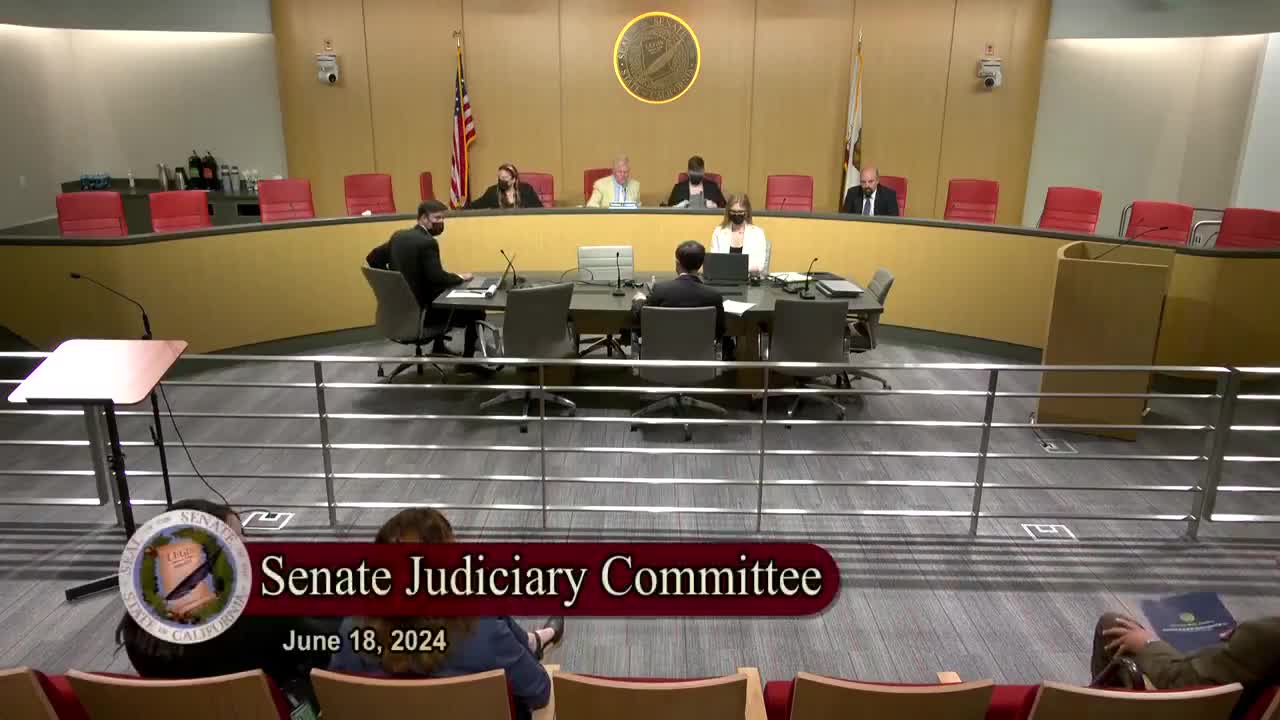 8MIN
Senate Standing Committee on Judiciary
 2MIN
Assembly Floor
 17MIN
Assembly Standing Committee on Judiciary
Bill Author

Bill Co-Author(s):