AB 3172: Social media platforms: injuries to children: civil penalties.
- Session Year: 2023-2024
- House: Assembly
- Latest Version Date: 2024-08-15
Current Status:
Failed
(2024-08-31: Ordered to inactive file at the request of Senator Gonzalez.)
Introduced
In Committee
First Chamber
In Committee
Second Chamber
Enacted
Existing law provides that everyone is responsible not only for the result of their willful acts, but also for an injury occasioned to another by their want of ordinary care or skill in the management of their property or person.
This bill would make a social media platform, as defined, liable for specified civil penalties in addition to any other remedy provided by law, if the platform knowingly and willfully fails to exercise ordinary care or skill toward a child. Under the bill, the civil penalties would only be available in an action brought by the Attorney General, a district attorney, or a city attorney. The bill would require no less than 51% of any civil penalties recovered pursuant to the bill to be distributed to the child to whom the duty of ordinary care and skill was owed. deposited into the Safe Social Media Fund, which the bill would create. The bill would allow money deposited into the fund, upon appropriation by the Legislature, to be used by the Office of the Surgeon General to raise awareness about safe social media use. The bill would apply to causes of action arising from conduct occurring on or after January 1, 2026. The bill would declare that its provisions are severable.
Existing law provides that everyone is responsible not only for the result of their willful acts, but also for an injury occasioned to another by their want of ordinary care or skill in the management of their property or person.
This bill would make a social media platform, as defined, liable for specified damages civil penalties in addition to any other remedy provided by law, if the platform fails to exercise ordinary care or skill toward a child. Under the bill, the civil penalties would only be available in an action brought by the Attorney General, a district attorney, or a city attorney. The bill would require no less than 51% of any civil penalties recovered pursuant to the bill to be distributed to the child to whom the duty of ordinary care and skill was owed. The bill would apply to causes of action arising from conduct occurring on or after January 1, 2026. The bill would declare that its provisions are severable.
Existing law provides that everyone is responsible not only for the result of their willful acts, but also for an injury occasioned to another by their want of ordinary care or skill in the management of their property or person.
This bill would make a social media platform, as defined, liable for specified damages in addition to any other remedy provided by law, if the platform fails to exercise ordinary care or skill toward a child. The bill would declare that its provisions are severable.
The Information Practices Act of 1977 requires an agency, as defined, that collects personal information, as defined, to maintain the source or sources of the information, as specified.This bill would make nonsubstantive changes to that provision.The Information Practices Act of 1977 requires an agency, as defined, that collects personal information, as defined, to maintain the source or sources of the information, as specified.
This bill would make nonsubstantive changes to that provision.
The people of the State of California find as follows:
(a)Subdivision (a) of Section 1714 of the Civil Code already makes every person and corporation, including social media platforms, financially responsible for an injury occasioned to another by their want of ordinary care or skill in the management of their property or person.
(b)Children are uniquely vulnerable on social media platforms.
(c)The biggest social media platforms invent and deploy features they know injure large numbers of children, including contributing to child deaths.
(d)The costs of these injuries are unfairly being paid by parents, schools, and taxpayers, not the platforms.
(e)This act is necessary to ensure that the social media platforms that are knowingly causing the most severe injuries to the largest number of children receive heightened damages to prevent injury from occurring to children in the first place.
SEC. 2.Section 1714.02 is added to the Civil Code, immediately following Section 1714.01, to read:1714.02.(a)(1)A social media platform that knowingly and willfully breaches its responsibility of ordinary care and skill to a child shall, in addition to any other remedy, be liable for civil penalties for the larger of the following:
(A)Five thousand dollars ($5,000) per violation up to a maximum, per child, maximum of one million dollars ($1,000,000). two hundred fifty thousand dollars ($250,000).
(B)Three times the amount of the childs actual damages.
(2)The civil penalties provided for in paragraph (1) shall only be available in an action brought by the Attorney General, a district attorney, or a city attorney.
(3)(i)No less than 51 percent of any civil penalties recovered in an action brought pursuant to this subdivision shall be distributed to the child to whom the duty of ordinary care and skill was owed. deposited into the Safe Social Media Fund, which is hereby established in the State Treasury.
(ii)Upon appropriation by the Legislature, moneys in the Safe Social Media Fund may be used by the Office of the Surgeon General within the California Health and Human Services Agency to raise awareness among adolescents on safe social media use, including avoiding any potential health and/or mental health risks associated with excessive use.
(b)Any waiver of this section shall be void and unenforceable as contrary to public policy.
(c)For the purpose of this section, the following definitions apply:
(1)Child means a minor under 18 years of age.
(2)Social media platform means a platform, as defined in Section 22675 of the Business and Professions Code, that generates more than one hundred million dollars ($100,000,000) per year in gross revenues.
(d)The duties, remedies, and obligations imposed by this section are cumulative to the duties, remedies, or obligations imposed under other law and shall not be construed to relieve a social media platform from any duties, remedies, or obligations imposed under any other law.
(e)This section applies to causes of action arising from conduct occurring on or after January 1, 2026.
SEC. 3.The provisions of this act are severable. If any provision of this act or its application is held invalid, that invalidity shall not affect other provisions or applications that can be given effect without the invalid provision or application.
The people of the State of California find as follows:
(a)Subdivision (a) of Section 1714 of the Civil Code already makes every person and corporation, including social media platforms, financially responsible for an injury occasioned to another by their want of ordinary care or skill in the management of their property or person.
(b)Children are uniquely vulnerable on social media platforms.
(c)The biggest social media platforms invent and deploy features they know injure large numbers of children, including contributing to child deaths.
(d)The costs of these injuries are unfairly being paid by parents, schools, and taxpayers, not the platforms.
(e)This act is necessary to ensure that the social media platforms that are knowingly causing the most severe injuries to the largest number of children receive heightened damages to prevent injury from occurring to children in the first place.
SEC. 2.Section 1714.02 is added to the Civil Code, immediately following Section 1714.01, to read:1714.02.(a)(1)A social media platform that violates subdivision (a) of Section 1714 and breaches its responsibility of ordinary care and skill to a child shall, in addition to any other remedy, be liable for statutory damages civil penalties for the larger of the following:
(1)(A)Five thousand dollars ($5,000) per violation up to a maximum, per child, of one million dollars ($1,000,000).
(2)(B)Three times the amount of the childs actual damages.
(2)The civil penalties provided for in paragraph (1) shall only be available in an action brought by the Attorney General, a district attorney, or a city attorney.
(3)No less than 51 percent of any civil penalties recovered in an action brought pursuant to this subdivision shall be distributed to the child to whom the duty of ordinary care and skill was owed.
(b)Any waiver of this subdivision section shall be void and unenforceable as contrary to public policy.
(c)For the purpose of this section, the following definitions apply:
(1)Child means a minor under 18 years of age.
(2)Social media platform means a platform, as defined in Section 22675 of the Business and Professions Code, that generates more than one hundred million dollars ($100,000,000) per year in gross revenues.
(d)The duties, remedies, and obligations imposed by this section are cumulative to the duties, remedies, or obligations imposed under other law and shall not be construed to relieve a social media platform from any duties, remedies, or obligations imposed under any other law.
(e)This section applies to causes of action arising from conduct occurring on or after January 1, 2026.
SEC. 3.The provisions of this act are severable. If any provision of this act or its application is held invalid, that invalidity shall not affect other provisions or applications that can be given effect without the invalid provision or application.
SEC. 4.The provisions of this act shall only apply prospectively. This act does not apply to any legal case that was pending on or before January 1, 2025.The people of the State of California find as follows:
(a)Subdivision (a) of Section 1714 of the Civil Code already makes every person and corporation, including social media platforms, financially responsible for an injury occasioned to another by their want of ordinary care or skill in the management of their property or person.
(b)Children are uniquely vulnerable on social media platforms.
(a)(c)The biggest social media platforms invent and deploy features they know injure large numbers of children, including contributing to child deaths.
(b)(d)The costs of these injuries are unfairly being paid by parents, schools, and taxpayers, not the social media platforms.
(c)(e)This act is necessary to ensure that the social media platforms that are knowingly causing the most severe injuries to the largest number of children are more financially motivated than they have been previously receive heightened damages to prevent injury from occurring to children. children in the first place.
SEC. 2.Section 1714 of the Civil Code is amended to read:1714.(a)Everyone is responsible, not only for the result of their willful acts, but also for an injury occasioned to another by their want of ordinary care or skill in the management of their property or person, except so far as the latter has, willfully or by want of ordinary care, brought the injury upon themselves. The design, distribution, or marketing of firearms and ammunition is not exempt from the duty to use ordinary care and skill that is required by this section. The extent of liability in these cases is defined by the Title on Compensatory Relief.(b)It is the intent of the Legislature to abrogate the holdings in cases such as Vesely v. Sager (1971) 5 Cal.3d 153, Bernhard v. Harrahs Club (1976) 16 Cal.3d 313, and Coulter v. Superior Court (1978) 21 Cal.3d 144 and to reinstate the prior judicial interpretation of this section as it relates to proximate cause for injuries incurred as a result of furnishing alcoholic beverages to an intoxicated person, namely that the furnishing of alcoholic beverages is not the proximate cause of injuries resulting from intoxication, but rather the consumption of alcoholic beverages is the proximate cause of injuries inflicted upon another by an intoxicated person.(c)Except as provided in subdivision (d), no social host who furnishes alcoholic beverages to any person may be held legally accountable for damages suffered by that person, or for injury to the person or property of, or death of, any third person, resulting from the consumption of those beverages.(d)(1)Nothing in subdivision (c) shall preclude a claim against a parent, guardian, or another adult who knowingly furnishes alcoholic beverages at their residence to a person whom they know, or should have known, to be under 21 years of age, in which case, notwithstanding subdivision (b), the furnishing of the alcoholic beverage may be found to be the proximate cause of resulting injuries or death.(2)A claim under this subdivision may be brought by, or on behalf of, the person under 21 years of age or by a person who was harmed by the person under 21 years of age.(e)(1)A social media platform that violates its responsibility of ordinary care and skill to a child pursuant to subdivision (a) shall, in addition to any other remedy, be liable for damages in the amount of either of the following:(A)Five thousand dollars ($5,000) per violation up to a maximum, per child, of one million dollars ($1,000,000).(B)Three times the amount of the childs actual damages.(2)Any waiver of this subdivision shall be void and unenforceable as contrary to public policy.(3)For the purpose of this subdivision the following definitions apply:(A)Child means a minor under 18 years of age.(B)Social media platform means a platform as defined in Section 22675 of the Business and Professions Code that generates more than one hundred million dollars ($100,000,000) per year in gross revenues.(4)The duties, remedies, and obligations imposed by this subdivision are cumulative to the duties, remedies, or obligations imposed under other law and shall not be construed to relieve a social media platform from any duties, remedies, or obligations imposed under any other law.SEC. 2.Section 1714.02 is added to the Civil Code, immediately following Section 1714.01, to read:1714.02.(a)A social media platform that violates subdivision (a) of Section 1714 and breaches its responsibility of ordinary care and skill to a child shall, in addition to any other remedy, be liable for statutory damages for the larger of the following:
(1)Five thousand dollars ($5,000) per violation up to a maximum, per child, of one million dollars ($1,000,000).
(2)Three times the amount of the childs actual damages.
(b)Any waiver of this subdivision shall be void and unenforceable as contrary to public policy.
(c)For the purpose of this section, the following definitions apply:
(1)Child means a minor under 18 years of age.
(2)Social media platform means a platform, as defined in Section 22675 of the Business and Professions Code, that generates more than one hundred million dollars ($100,000,000) per year in gross revenues.
(d)The duties, remedies, and obligations imposed by this section are cumulative to the duties, remedies, or obligations imposed under other law and shall not be construed to relieve a social media platform from any duties, remedies, or obligations imposed under any other law.
SEC. 3.The provisions of this act are severable. If any provision of this act or its application is held invalid, that invalidity shall not affect other provisions or applications that can be given effect without the invalid provision or application.
SEC. 4.The provisions of this act shall only apply prospectively. This act does not apply to any legal case that was pending on or before January 1, 2025.
The people of the State of California find as follows:
(a)The biggest social media platforms invent and deploy features they know injure large numbers of children, including contributing to child deaths.
(b)The costs of these injuries are unfairly being paid by parents, schools, and taxpayers, not the social media platforms.
(c)This act is necessary to ensure that the social media platforms that are causing the most severe injuries to the largest number of children are more financially motivated than they have been previously to prevent injury from occurring to children.
SEC. 2.Section 1714 of the Civil Code is amended to read:1714.(a)Everyone is responsible, not only for the result of his or her their willful acts, but also for an injury occasioned to another by his or her their want of ordinary care or skill in the management of his or her their property or person, except so far as the latter has, willfully or by want of ordinary care, brought the injury upon himself or herself. themselves. The design, distribution, or marketing of firearms and ammunition is not exempt from the duty to use ordinary care and skill that is required by this section. The extent of liability in these cases is defined by the Title on Compensatory Relief.
(b)It is the intent of the Legislature to abrogate the holdings in cases such as Vesely v. Sager (1971) 5 Cal.3d 153, Bernhard v. Harrahs Club (1976) 16 Cal.3d 313, and Coulter v. Superior Court (1978) 21 Cal.3d 144 and to reinstate the prior judicial interpretation of this section as it relates to proximate cause for injuries incurred as a result of furnishing alcoholic beverages to an intoxicated person, namely that the furnishing of alcoholic beverages is not the proximate cause of injuries resulting from intoxication, but rather the consumption of alcoholic beverages is the proximate cause of injuries inflicted upon another by an intoxicated person.
(c)Except as provided in subdivision (d), no social host who furnishes alcoholic beverages to any person may be held legally accountable for damages suffered by that person, or for injury to the person or property of, or death of, any third person, resulting from the consumption of those beverages.
(d)(1)Nothing in subdivision (c) shall preclude a claim against a parent, guardian, or another adult who knowingly furnishes alcoholic beverages at his or her their residence to a person whom he they know, or she knows, or should have known, to be under 21 years of age, in which case, notwithstanding subdivision (b), the furnishing of the alcoholic beverage may be found to be the proximate cause of resulting injuries or death.
(2)A claim under this subdivision may be brought by, or on behalf of, the person under 21 years of age or by a person who was harmed by the person under 21 years of age.
(e)(1)A social media platform that violates its responsibility of ordinary care and skill to a child pursuant to subdivision (a) shall, in addition to any other remedy, be liable for damages in the amount of either of the following:
(A)Five thousand dollars ($5,000) per violation up to a maximum, per child, of one million dollars ($1,000,000).
(B)Three times the amount of the childs actual damages.
(2)Any waiver of this subdivision shall be void and unenforceable as contrary to public policy.
(3)For the purpose of this subdivision the following definitions apply:
(A)Child means a minor under 18 years of age.
(B)Social media platform means a platform as defined in Section 22675 of the Business and Professions Code that generates more than one hundred million dollars ($100,000,000) per year in gross revenues.
(4)The duties, remedies, and obligations imposed by this subdivision are cumulative to the duties, remedies, or obligations imposed under other law and shall not be construed to relieve a social media platform from any duties, remedies, or obligations imposed under any other law.
SEC. 3.The provisions of this act are severable. If any provision of this act or its application is held invalid, that invalidity shall not affect other provisions or applications that can be given effect without the invalid provision or application.
SECTION 1.Section 1798.16 of the Civil Code is amended to read:1798.16.(a)Whenever an agency collects personal information, the agency shall maintain the source or sources of the information, unless the source is the data subject or has received a copy of the source document, including, but not limited to, the name of any source who is an individual acting in the individuals own private or individual capacity. If the source is an agency, governmental entity, or other organization, such as a corporation or association, this requirement may be met by maintaining the name of the agency, governmental entity, or organization, as long as the smallest reasonably identifiable unit of that agency, governmental entity, or organization is named.(b)On or after July 1, 2001, unless otherwise authorized by the Department of Information Technology pursuant to Executive Order D-3-99, whenever an agency electronically collects personal information, as defined by Section 11015.5 of the Government Code, the agency shall retain the source or sources or any intermediate form of the information, if either are created or possessed by the agency, unless the source is the data subject that has requested that the information be discarded or the data subject has received a copy of the source document.(c)An agency shall maintain the source or sources of the information in a readily accessible form so as to be able to provide it to the data subject when they inspect any record pursuant to Section 1798.34. This section shall not apply if the source or sources are exempt from disclosure under this chapter.(a)Whenever an agency collects personal information, the agency shall maintain the source or sources of the information, unless the source is the data subject or he or she has received a copy of the source document, including, but not limited to, the name of any source who is an individual acting in his or her the individuals own private or individual capacity. If the source is an agency, governmental entity entity, or other organization, such as a corporation or association, this requirement can may be met by maintaining the name of the agency, governmental entity, or organization, as long as the smallest reasonably identifiable unit of that agency, governmental entity, or organization is named.
(b)On or after July 1, 2001, unless otherwise authorized by the Department of Information Technology pursuant to Executive Order D-3-99, whenever an agency electronically collects personal information, as defined by Section 11015.5 of the Government Code, the agency shall retain the source or sources or any intermediate form of the information, if either are created or possessed by the agency, unless the source is the data subject that has requested that the information be discarded or the data subject has received a copy of the source document.
(c)The An agency shall maintain the source or sources of the information in a readily accessible form so as to be able to provide it to the data subject when they inspect any record pursuant to Section 1798.34. This section shall not apply if the source or sources are exempt from disclosure under the provisions of this chapter.
|
Date
|
Status
|
|---|---|
| Aug 31, 2024 | Ordered to inactive file at the request of Senator Gonzalez. |
| Aug 19, 2024 | Read second time. Ordered to third reading. |
| Aug 15, 2024 | Read second time and amended. Ordered returned to second reading. |
| Aug 15, 2024 | From committee: Amend, and do pass as amended. (Ayes 5. Noes 1.) (August 15). |
| Aug 5, 2024 | In committee: Referred to APPR suspense file. |
| Jul 3, 2024 | Re-referred to Com. on APPR pursuant to Joint Rule 10.5. |
| Jul 2, 2024 | Read second time and amended. Ordered to third reading. |
| Jul 1, 2024 | From committee: Amend, and do pass as amended. (Ayes 11. Noes 0.) (June 25). |
| May 29, 2024 | Referred to Com. on JUD. |
| May 21, 2024 | In Senate. Read first time. To Com. on RLS. for assignment. |
| May 20, 2024 | Read third time. Passed. Ordered to the Senate. (Ayes 65. Noes 0. Page 5303.) |
| May 2, 2024 | Read second time. Ordered to third reading. |
| May 1, 2024 | From committee: Do pass. (Ayes 9. Noes 0.) (April 30). |
| Apr 22, 2024 | Re-referred to Com. on JUD. |
| Apr 18, 2024 | Read second time and amended. |
| Apr 17, 2024 | From committee: Amend, and do pass as amended and re-refer to Com. on JUD. (Ayes 11. Noes 0.) (April 16). |
| Apr 1, 2024 | Re-referred to Com. on P. & C.P. |
| Mar 21, 2024 | Referred to Coms. on P. & C.P. and JUD. |
| Mar 21, 2024 | From committee chair, with author's amendments: Amend, and re-refer to Com. on P. & C.P. Read second time and amended. |
| Feb 17, 2024 | From printer. May be heard in committee March 18. |
| Feb 16, 2024 | Read first time. To print. |
|
Date
|
Description
|
Location
|
Votes
|
|
|---|---|---|---|---|
| Aug 15, 2024 | Do pass as amended | Senate Standing Committee on Appropriations |
Passed |
|
| Aug 5, 2024 | Placed on suspense file | Senate Standing Committee on Appropriations |
Passed |
|
| Jun 25, 2024 | Do pass as amended | Senate Standing Committee on Judiciary |
Passed |
|
| May 20, 2024 | AB 3172 Lowenthal Assembly Third Reading | Assembly Floor |
Passed |
|
| Apr 30, 2024 | Do pass. | Assembly Standing Committee on Judiciary |
Passed |
|
| Apr 16, 2024 | Do pass as amended and be re-referred to the Committee on [Judiciary] | Assembly Standing Committee on Privacy and Consumer Protection |
Passed |
This list shows positions taken on this bill by organizations on the date displayed, which is linked to the original source.
Positions by individuals are not included.
|
Organization
|
Position
|
Date
|
|---|---|---|
| California Chamber Of Commerce | ** Against | |
| California School Boards Association | ** Support | |
| California Teachers Association | ** Support | |
| CCIA | * Against | Apr 16, 2024 |
| Chamber Of Progress | ** Against | |
| Childrens Advocacy Institute | ** Support | |
| Civil Justice Association Of California | ** Against | |
| Common Sense Media | ** Support | |
| Computer And Communications Industry Association | ** Against | |
| Cummins & White LLP | * Support | Apr 16, 2024 |
| Democrats for Israel - CA | ** Support | |
| Democrats for Israel Los Angeles | ** Support | |
| Electronic Frontier Foundation | ** Against | |
| ETTA | ** Support | |
| Fred Whitaker, Chair of Orange County Republican Party | ** Support | |
| Hadassah | ** Support | |
| Holocaust Museum LA | ** Support | |
| Jakara Movement | ** Support | |
| Jewish Center for Justice | ** Support | |
| Jewish Community Federation and Endowment Fund | ** Support | |
| Jewish Democratic Club of Marin | ** Support | |
| Jewish Democratic Club of Solano County | ** Support | |
| Jewish Democratic Coalition of the Bay Area | ** Support | |
| Jewish Family and Children's Services of San Francisco, the Peninsula, Marin and Sonoma Counties | ** Support | |
| Jewish Family and Children’s Service of Long Beach and Orange County | ** Support | |
| Jewish Family Service of Los Angeles | ** Support | |
| Jewish Family Services of Silicon Valley | ** Support | |
| Jewish Federation of Greater Los Angeles | ** Support | |
| Jewish Federation of The Greater San Gabriel and Pomona Valleys | ** Support | |
| Jewish Long Beach | ** Support | |
| Jewish Public Affairs Committee | ** Support | |
| Jewish Public Affairs Committee Of California | ** Support | |
| Jewish Silicon Valley | ** Support | |
| NetChoice | ** Against | |
| NextGen California | ** Support | |
| Parents Against Social Media Addiction | ** Support | |
| Parents Television and Media Council | ** Support | |
| Progressive Zionists of California | ** Support | |
| Technet | ** Against | |
| University of California Berkeley | * Support | Apr 30, 2024 |
| University of San Diego School of Law | * Support | Apr 16, 2024 |
SENATE RULES COMMITTEE Office of Senate Floor Analyses (916) 651-1520 Fax: (916) 327-4478 | AB 3172 |
THIRD READING
Bill No: AB 3172
Author: Lowenthal (D)
Amended: 8/15/24 in Senate
Vote: 21
SENATE JUDICIARY COMMITTEE: 11-0, 6/25/24
AYES: Umberg, Wilk, Allen, Ashby, Caballero, Durazo, Laird, Niello, Roth, Stern, Wahab
SENATE APPROPRIATIONS COMMITTEE: 5-1, 8/15/24
AYES: Caballero, Ashby, Becker, Bradford, Wahab
NOES: Jones
NO VOTE RECORDED: Seyarto
ASSEMBLY FLOOR: 65-0, 5/20/24 - See last page for vote
SUBJECT: Social media platforms: injuries to children: civil penalties
SOURCE: Author
DIGEST:
This bill increases the penalties that can be sought against a social media platform, as defined, if the platform knowingly and willfully fails to exercise ordinary care or skill toward a child.
ANALYSIS:
Existing federal law:
- Provides, in federal law, that a provider or user of an interactive computer service shall not be treated as the publisher or speaker of any information provided by another information content provider. (Title 47 United States Code (U.S.C.) § 230(c)(1))
- Provides that a provider or user of an interactive computer service shall not be held liable on account of:
- any action voluntarily taken in good faith to restrict access to or availability of material that the provider or user considers to be obscene, lewd, lascivious, filthy, excessively violent, harassing, or otherwise objectionable, whether or not such material is constitutionally protected; or
- any action taken to enable or make available to information content providers or others the technical means to restrict access to such material. (Title 47 U.S.C. § 230(c)(2))
Existing state law:
- Provides that every person is responsible, not only for the result of their willful acts, but also for an injury occasioned to another by the person’s want of ordinary care or skill in the management of their property or person, except so far as the latter has, willfully or by want of ordinary care, brought the injury upon themselves. (Civil Code § 1714(a))
- Defines “social media platform” as a public or semipublic internet-based service or application that has users in California and that meets both of the following criteria:
- A substantial function of the service or application is to connect users in order to allow users to interact socially with each other within the service or application. A service or application that provides email or direct messaging services shall not be considered to meet this criterion on the basis of that function alone.
- The service or application allows users to do all of the following:
- Construct a public or semipublic profile for purposes of signing into and using the service or application.
- Populate a list of other users with whom an individual shares a social connection within the system.
- Create or post content viewable by other users, including, but not limited to, on message boards, in chat rooms, or through a landing page or main feed that presents the user with content generated by other users. (Business & Professions Code § 22675(e))
This bill:
- Provides that a social media platform that knowingly and willfully breaches its responsibility of ordinary care and skill to a child shall, in addition to any other remedy, be liable for civil penalties for the larger of the following:
- $5,000 per violation up to a maximum of $250,000.
- Three times the amount of the child’s actual damages.
- Provides that the civil penalties laid out above are only available in an action brought by the Attorney General, a district attorney, or a city attorney. No less than 51 percent of the recovered civil penalties recovered must be deposited into the Safe Social Media Fund, hereby established.
- Provides that the duties, remedies, and obligations it imposes are cumulative to the duties, remedies, or obligations imposed under other law and shall not be construed to relieve a social media platform from any duties, remedies, or obligations imposed under any other law.
- Includes a severability clause and applies to causes of action arising from conduct occurring on or after January 1, 2026. Any attempted waiver is void and unenforceable.
- States findings and declarations.
Comment
Existing negligence law imposes a responsibility on everyone, including social media platforms, for injuries occasioned to others by their want of ordinary care or skill in the management of their property or person. This bill does not alter any existing duty. Rather, it seeks to acknowledge the unique impacts that social media platforms are shown to have on a particularly vulnerable population, California’s children.
This bill does that by increasing the remedies that certain public prosecutors may seek when social media platforms break this existing duty to refrain from causing children injury, but only when they do so knowingly and willfully. This bill provides for civil penalties from $5,000 to $250,000 per violation, or three times the child’s actual damages, whichever is more. At least half of the recovered penalties must be deposited into a fund established by the bill to be used for raising awareness regarding safe social media use.
According to the author:
This bill holds social media platforms accountable for the harm they cause to children and teenagers. This legislation would impose financial liabilities on large social media companies if proven in court that they knowingly offered products or design features that resulted in harm or injury to minors and are found to violate long standing state negligence law.
FISCAL EFFECT: Appropriation: No Fiscal Com.: Yes Local: No
According to the Senate Appropriations Committee:
- Unknown, potentially significant cost pressure to the state funded trial court system (Trial Court Trust Fund, General Fund) to adjudicate the claims created by this bill. Creating a new civil enforcement penalty could lead to lengthier and more complex court proceedings with attendant workload and resource costs to the court. An eight-hour court day costs approximately $8,000 in staff in workload. If the bill results in only 12 or more days spent in court, trial court costs could be in the hundreds of thousands of dollars. While the courts are not funded on a workload basis, an increase in workload could result in delayed court services and would put pressure on the General Fund to fund additional staff and resources and to increase the amount appropriated to backfill for trial court operations. The Budget Act of 2024, for the fiscal year beginning July 1, 2024, includes a $97 million reduction to the trial courts, a commensurate reduction of up to 7.95 percent to the budget for the state-level judiciary, and a reduction of the trial court state-level emergency reserve in the Trial Court Trust Fund from $10 million to $5 million. The Budget Act also includes a $37.3 million General Fund backfill for the Trial Court Trust Fund to address the continued decline in civil fee and criminal fine and penalty revenues expected in fiscal year 2024‒25.
- Workload cost pressures (Unfair Competition Law Fund, local funds) to the Department of Justice (DOJ) and local prosecutors of an unknown but potentially significant amount. If state and local prosecutors file enforcement actions as authorized by this bill, it may result in a significant workload increase. DOJ indicates that the Consumer Protection Section, within the Public Rights Division, anticipates an increase in workload in investigating and prosecuting of violations of the requirements of this bill. To address the increase in workload, CPS will require the following resources in each fiscal year beginning on January 1, 2026 and ongoing: 1.0 Deputy Attorney General (DAG) and 1.0 Legal Secretary (Legal Complement to DAG). The fiscal impact is estimated $500,000 ongoing.
SUPPORT: (Verified 8/18/24)
California School Boards Association
California Teachers Association
Children’s Advocacy Institute
Common Sense Media
Democrats for Israel - CA
Democrats for Israel Los Angeles
Etta
Fred Whitaker, Chair of Orange County Republican Party
Hadassah
Holocaust Museum LA
Jakara Movement
Jewish Center for Justice
Jewish Community Federation and Endowment Fund
Jewish Democratic Club of Marin
Jewish Democratic Club of Solano County
Jewish Democratic Coalition of the Bay Area
Jewish Family and Children's Service of Long Beach and Orange County
Jewish Family and Children's Services of San Francisco, the Peninsula, Marin and Sonoma Counties
Jewish Family Service of Los Angeles
Jewish Family Services of Silicon Valley
Jewish Federation of Greater Los Angeles
Jewish Federation of the Greater San Gabriel and Pomona Valleys
Jewish Long Beach
Jewish Public Affairs Committee
Jewish Public Affairs Committee of California
Jewish Silicon Valley
NextGen California
Parents Television and Media Council
Progressive Zionists of California
OPPOSITION: (Verified 8/18/24)
California Chamber of Commerce
Chamber of Progress
Civil Justice Association of California
Computer and Communications Industry Association
Electronic Frontier Foundation
Netchoice
Technet
ARGUMENTS IN SUPPORT: NextGen California writes:
AB 3172 (Lowenthal) utilizes the threat of financial liability to compel social media platforms to proactively safeguard youth users from potential harm. AB 3172 makes one change to California's existing negligence law, Civil Code, Section 1714, by increasing statutory damages to encourage proactive measures by social media companies. . . .
California must intervene for our youth and hold social media companies accountable and financially responsible for negligent actions and practices.
ARGUMENTS IN OPPOSITION: Chamber of Progress writes:
The “responsibility of ordinary care and skill to a child” is excessively vague, given the diverse range of opinions regarding appropriate content for children of varying ages. Faced with the risk of a deluge of litigation seeking high payments based on unclear standards, websites will be forced to strip any content or features that could be possibly considered inappropriate (or risk severe penalties), which is precisely the sort of “chilling” that the Supreme Court’s vagueness doctrine is intended to prevent.
ASSEMBLY FLOOR: 65-0, 5/20/24
AYES: Addis, Aguiar-Curry, Alanis, Alvarez, Bains, Bauer-Kahan, Bennett, Berman, Boerner, Bonta, Bryan, Calderon, Juan Carrillo, Wendy Carrillo, Chen, Connolly, Davies, Dixon, Flora, Mike Fong, Friedman, Garcia, Gipson, Grayson, Haney, Hart, Holden, Hoover, Irwin, Jackson, Kalra, Low, Lowenthal, Maienschein, McCarty, McKinnor, Muratsuchi, Ortega, Pacheco, Papan, Joe Patterson, Pellerin, Petrie-Norris, Quirk-Silva, Ramos, Rendon, Reyes, Rodriguez, Blanca Rubio, Sanchez, Santiago, Schiavo, Soria, Ting, Valencia, Villapudua, Waldron, Wallis, Ward, Weber, Wicks, Wilson, Wood, Zbur, Robert Rivas
NO VOTE RECORDED: Arambula, Cervantes, Megan Dahle, Essayli, Vince Fong, Gabriel, Gallagher, Jones-Sawyer, Lackey, Lee, Mathis, Stephanie Nguyen, Jim Patterson, Luz Rivas, Ta
Prepared by: Christian Kurpiewski / JUD. / (916) 651-4113
8/19/24 12:46:44
**** END ****
SENATE COMMITTEE ON
Senator Anna Caballero, Chair
2023 - 2024 Regular Session
AB 3172 (Lowenthal) - Social media platforms: injuries to children: civil penalties
Version: | Policy Vote: |
Urgency: | Mandate: |
Hearing Date: | Consultant: |
Bill Summary:
AB 3172 establishes a civil penalty for any social media platform that breaches its responsibility of ordinary care and skill to any person under 18 years.
*********** ANALYSIS ADDENDUM – SUSPENSE FILE ***********
The following information is revised to reflect amendments
adopted by the committee on August 15, 2024
Fiscal Impact:
- Unknown, potentially significant cost pressure to the state funded trial court system (Trial Court Trust Fund, General Fund) to adjudicate the claims created by this bill. Creating a new civil enforcement penalty could lead to lengthier and more complex court proceedings with attendant workload and resource costs to the court. An eight-hour court day costs approximately $8,000 in staff in workload. If the bill results in only 12 or more days spent in court, trial court costs could be in the hundreds of thousands of dollars. While the courts are not funded on a workload basis, an increase in workload could result in delayed court services and would put pressure on the General Fund to fund additional staff and resources and to increase the amount appropriated to backfill for trial court operations. The Budget Act of 2024, for the fiscal year beginning July 1, 2024, includes a $97 million reduction to the trial courts, a commensurate reduction of up to 7.95 percent to the budget for the state-level judiciary, and a reduction of the trial court state-level emergency reserve in the Trial Court Trust Fund from $10 million to $5 million. The Budget Act also includes a $37.3 million General Fund backfill for the Trial Court Trust Fund to address the continued decline in civil fee and criminal fine and penalty revenues expected in fiscal year 2024‒25.
- Workload cost pressures (Unfair Competition Law Fund, local funds) to the Department of Justice (DOJ) and local prosecutors of an unknown but potentially significant amount. If state and local prosecutors file enforcement actions as authorized by this bill, it may result in a significant workload increase. DOJ indicates that the Consumer Protection Section, within the Public Rights Division, anticipates an increase in workload in investigating and prosecuting of violations of the requirements of this bill. To address the increase in workload, CPS will require the following resources in each fiscal year beginning on January 1, 2026 and ongoing: 1.0 Deputy Attorney General (DAG) and 1.0 Legal Secretary (Legal Complement to DAG). The fiscal impact is estimated $500,000 ongoing.
Committee Amendments:
- Provide that the social media platform must have knowingly and willfully failed to exercise its duty of care toward a child to be liable under this bill’s provisions.
- Reduce the civil penalty to five thousand dollars per violation up to a maximum, of two hundred fifty thousand dollars ($250,000).
- Delete the provisions that require no less than 51% of any civil penalties recovered pursuant to the bill to be distributed to the child to whom the duty of ordinary care and skill was owed, and instead require 51% of the civil penalties to be deposited into the Safe Social Media Fund, which the bill would create.
-- END --
SENATE COMMITTEE ON APPROPRIATIONS
Senator Anna Caballero, Chair
2023 - 2024 Regular Session
AB 3172 (Lowenthal) - Social media platforms: injuries to children: civil penalties
Version: July 2, 2024 | Policy Vote: JUD. 11 - 0 |
Urgency: No | Mandate: No |
Hearing Date: August 5, 2024 | Consultant: Liah Burnley |
Bill Summary:
AB 3172 establishes a civil penalty for any social media platform that breaches its responsibility of ordinary care and skill to any person under 18 years.
Fiscal Impact:
- Unknown, potentially significant cost pressure to the state funded trial court system (Trial Court Trust Fund, General Fund) to adjudicate the claims created by this bill. Creating a new civil enforcement penalty could lead to lengthier and more complex court proceedings with attendant workload and resource costs to the court. An eight-hour court day costs approximately $8,000 in staff in workload. If the bill results in only 12 or more days spent in court, trial court costs could be in the hundreds of thousands of dollars. While the courts are not funded on a workload basis, an increase in workload could result in delayed court services and would put pressure on the General Fund to fund additional staff and resources and to increase the amount appropriated to backfill for trial court operations. The Budget Act of 2024, for the fiscal year beginning July 1, 2024, includes a $97 million reduction to the trial courts, a commensurate reduction of up to 7.95 percent to the budget for the state-level judiciary, and a reduction of the trial court state-level emergency reserve in the Trial Court Trust Fund from $10 million to $5 million. The Budget Act also includes a $37.3 million General Fund backfill for the Trial Court Trust Fund to address the continued decline in civil fee and criminal fine and penalty revenues expected in fiscal year 2024‒25. (See Staff Comments)
- Workload cost pressures (Unfair Competition Law Fund, local funds) to the Department of Justice (DOJ) and local prosecutors of an unknown but potentially significant amount. If state and local prosecutors file enforcement actions as authorized by this bill, it may result in a significant workload increase. DOJ indicates that the Consumer Protection Section, within the Public Rights Division, anticipates an increase in workload in investigating and prosecuting of violations of the requirements of this bill. To address the increase in workload, CPS will require the following resources in each fiscal year beginning on January 1, 2026 and ongoing: 1.0 Deputy Attorney General (DAG) and 1.0 Legal Secretary (Legal Complement to DAG). The fiscal impact is estimated $500,000 ongoing. As drafted, it is unclear to what extent these costs, if any, would be offset by the civil penalty. If prosecutors choose not to file enforcement actions they will not incur any costs. (See Staff Comments)
Background:
Existing negligence law imposes a responsibility on everyone for injuries occasioned to others by their want of ordinary care or skill. This includes social media companies. To that end, social media companies can already be held liable under existing tort law for their negligent conduct causes harm to children.
Proposed Law:
Creates a civil penalty for any social media platform, as defined, that generates more than $100,000,000 per year in gross revenues that breaches its responsibility of ordinary care and skill to any person under 18, as follows:
- The social medial platform shall be liable for civil penalties for the larger of the following:
- $5,000 per violation up to a maximum, per child, of one million dollars $1,000,000; or,
- Three times the amount of the child’s actual damages.
- The civil penalties shall only be available in an action brought by the Attorney General, a district attorney, or a city attorney;
- No less than 51 percent of any civil penalties recovered shall be distributed to the child;
- Provides that these provisions shall not be construed to relieve a social media platform from any duties, remedies, or obligations imposed under any other law.
- Contains a delayed implementation date and would only apply to conduct occurring on or after January 1, 2026.
Staff Comments:
Generally, legislation establishing a civil penalty directs where the penalty is to be deposited. This bill contains no such provisions. Thus, it is unclear to what extent the civil penalties authorized by this bill would be deposited into the General Fund (or some other special fund, like the Unfair Competition Fund), and city and county treasurers. Even assuming the civil penalties authorized by this bill are deposited into the state’s General Fund, the extent to which penalties would offset any state costs created by this bill is still uncertain. This bill specifies that at least 51% of the penalty must be transferred to the child to whom a duty of care was owed. It cannot be known how much of the penalty agencies will share with the child in every case—70%, 80%, 100%? Further, this bill specifies that the civil penalty may be brought in addition to existing remedies. Thus, a child could recover civil damages from the platform in a tort action, in addition to 51% or more of the civil penalty established by this bill. As a result, this bill encourages repetitive litigation of the same claim, which would increase trial court workload pressures.
-- END --
SENATE RULES COMMITTEE Office of Senate Floor Analyses (916) 651-1520 Fax: (916) 327-4478 | AB 3172 |
THIRD READING
Bill No: AB 3172
Author: Lowenthal (D)
Amended: 7/2/24 in Senate
Vote: 21
SENATE JUDICIARY COMMITTEE: 11-0, 6/25/24
AYES: Umberg, Wilk, Allen, Ashby, Caballero, Durazo, Laird, Niello, Roth, Stern, Wahab
ASSEMBLY FLOOR: 65-0, 5/20/24 - See last page for vote
SUBJECT: Social media platforms: injuries to children: damages
SOURCE: Author
DIGEST:
This bill increases the penalties that can be sought against a social media platform, as defined, if the platform fails to exercise ordinary care or skill toward a child.
ANALYSIS:
Existing federal law:
- Provides, in federal law, that a provider or user of an interactive computer service shall not be treated as the publisher or speaker of any information provided by another information content provider. (Title 47 United States Code (U.S.C.) § 230(c)(1))
- Provides that a provider or user of an interactive computer service shall not be held liable on account of:
- any action voluntarily taken in good faith to restrict access to or availability of material that the provider or user considers to be obscene, lewd, lascivious, filthy, excessively violent, harassing, or otherwise objectionable, whether or not such material is constitutionally protected; or
- any action taken to enable or make available to information content providers or others the technical means to restrict access to such material. (Title 47 U.S.C. § 230(c)(2))
Existing state law:
- Provides that every person is responsible, not only for the result of their willful acts, but also for an injury occasioned to another by the person’s want of ordinary care or skill in the management of their property or person, except so far as the latter has, willfully or by want of ordinary care, brought the injury upon themselves. (Civil Code § 1714(a))
- Defines “social media platform” as a public or semipublic internet-based service or application that has users in California and that meets both of the following criteria:
- A substantial function of the service or application is to connect users in order to allow users to interact socially with each other within the service or application. A service or application that provides email or direct messaging services shall not be considered to meet this criterion on the basis of that function alone.
- The service or application allows users to do all of the following:
- Construct a public or semipublic profile for purposes of signing into and using the service or application.
- Populate a list of other users with whom an individual shares a social connection within the system.
- Create or post content viewable by other users, including, but not limited to, on message boards, in chat rooms, or through a landing page or main feed that presents the user with content generated by other users. (Business & Professions Code § 22675(e))
This bill:
- Provides that a social media platform that breaches its responsibility of ordinary care and skill to a child shall, in addition to any other remedy, be liable for civil penalties for the larger of the following:
- $5,000 per violation up to a maximum, per child, of $1,000,000.
- Three times the amount of the child’s actual damages.
- Provides that the civil penalties laid out above are only available in an action brought by the Attorney General, a district attorney, or a city attorney. No less than 51 percent of the recovered civil penalties recovered must be distributed to the child to whom the relevant duty of ordinary care and skill was owed.
- Provides that the duties, remedies, and obligations it imposes are cumulative to the duties, remedies, or obligations imposed under other law and shall not be construed to relieve a social media platform from any duties, remedies, or obligations imposed under any other law.
- Includes a severability clause and applies to causes of action arising from conduct occurring on or after January 1, 2026. Any attempted waiver is void and unenforceable.
- States findings and declarations.
Comment
Existing negligence law imposes a responsibility on everyone, including social media platforms, for injuries occasioned to others by their want of ordinary care or skill in the management of their property or person. This bill does not alter any existing duty. Rather, it seeks to acknowledge the unique impacts that social media platforms are shown to have on a particularly vulnerable population, California’s children.
This bill does that by increasing the remedies that certain public prosecutors may seek when social media platforms break this existing duty to refrain from causing children injury. This bill provides for civil penalties from $5,000 to $1 million per violation, per child or three times the child’s actual damages, whichever is more. At least half of the recovered penalties must be distributed to the child to whom the duty was owed.
According to the author:
This bill holds social media platforms accountable for the harm they cause to children and teenagers. This legislation would impose financial liabilities on large social media companies if proven in court that they knowingly offered products or design features that resulted in harm or injury to minors and are found to violate long standing state negligence law.
FISCAL EFFECT: Appropriation: No Fiscal Com.: No Local: No
SUPPORT: (Verified 7/2/24)
California School Boards Association
California Teachers Association
Children’s Advocacy Institute
Common Sense Media
Democrats for Israel - CA
Democrats for Israel Los Angeles
Etta
Fred Whitaker, Chair of Orange County Republican Party
Hadassah
Holocaust Museum LA
Jakara Movement
Jewish Center for Justice
Jewish Community Federation and Endowment Fund
Jewish Democratic Club of Marin
Jewish Democratic Club of Solano County
Jewish Democratic Coalition of the Bay Area
Jewish Family and Children's Service of Long Beach and Orange County
Jewish Family and Children's Services of San Francisco, the Peninsula, Marin and Sonoma Counties
Jewish Family Service of Los Angeles
Jewish Family Services of Silicon Valley
Jewish Federation of Greater Los Angeles
Jewish Federation of the Greater San Gabriel and Pomona Valleys
Jewish Long Beach
Jewish Public Affairs Committee
Jewish Public Affairs Committee of California
Jewish Silicon Valley
NextGen California
Parents Television and Media Council
Progressive Zionists of California
OPPOSITION: (Verified 7/2/24)
California Chamber of Commerce
Chamber of Progress
Civil Justice Association of California
Computer and Communications Industry Association
Electronic Frontier Foundation
Netchoice
Technet
ARGUMENTS IN SUPPORT: NextGen California writes:
AB 3172 (Lowenthal) utilizes the threat of financial liability to compel social media platforms to proactively safeguard youth users from potential harm. AB 3172 makes one change to California's existing negligence law, Civil Code, Section 1714, by increasing statutory damages to encourage proactive measures by social media companies. The bill provides penalties of $5,000 per violation, up to $1 million per child, or three times the damages otherwise awarded in court.
California must intervene for our youth and hold social media companies accountable and financially responsible for negligent actions and practices.
ARGUMENTS IN OPPOSITION: Chamber of Progress writes:
The "responsibility of ordinary care and skill to a child" is excessively vague, given the diverse range of opinions regarding appropriate content for children of varying ages. Faced with the risk of a deluge of litigation seeking high payments based on unclear standards, websites will be forced to strip any content or features that could be possibly considered inappropriate (or risk severe penalties), which is precisely the sort of “chilling” that the Supreme Court’s vagueness doctrine is intended to prevent.
ASSEMBLY FLOOR: 65-0, 5/20/24
AYES: Addis, Aguiar-Curry, Alanis, Alvarez, Bains, Bauer-Kahan, Bennett, Berman, Boerner, Bonta, Bryan, Calderon, Juan Carrillo, Wendy Carrillo, Chen, Connolly, Davies, Dixon, Flora, Mike Fong, Friedman, Garcia, Gipson, Grayson, Haney, Hart, Holden, Hoover, Irwin, Jackson, Kalra, Low, Lowenthal, Maienschein, McCarty, McKinnor, Muratsuchi, Ortega, Pacheco, Papan, Joe Patterson, Pellerin, Petrie-Norris, Quirk-Silva, Ramos, Rendon, Reyes, Rodriguez, Blanca Rubio, Sanchez, Santiago, Schiavo, Soria, Ting, Valencia, Villapudua, Waldron, Wallis, Ward, Weber, Wicks, Wilson, Wood, Zbur, Robert Rivas
NO VOTE RECORDED: Arambula, Cervantes, Megan Dahle, Essayli, Vince Fong, Gabriel, Gallagher, Jones-Sawyer, Lackey, Lee, Mathis, Stephanie Nguyen, Jim Patterson, Luz Rivas, Ta
Prepared by: Christian Kurpiewski / JUD. / (916) 651-4113
7/2/24 15:16:51
**** END ****
Senator Thomas Umberg, Chair
2023-2024 Regular Session
Bill No: AB 3172 (Author:Lowenthal)
Version: April 18, 2024
Hearing Date: June 25, 2024
Fiscal: No
Urgency: No
Consultant: CK
SUBJECT
Social media platforms: injuries to children: damages
DIGEST
This bill increases the penalties that can be sought against a social media platform, as defined, if the platform fails to exercise ordinary care or skill toward a child.
EXECUTIVE SUMMARY
In 2005, five percent of adults in the United States used social media. In just six years, that number jumped to half of all Americans. Today, over 70 percent of adults use at least one social media platform. Facebook alone is used by 69 percent of adults, and 70 percent of those adults say they use the platform on a daily basis.
However, this explosion is not limited to adults. Survey data found that overall screen use among teens and tweens increased by 17 percent from 2019 to 2021, with the number of hours spent online spiking sharply during the pandemic. A recent survey found almost 40 percent of tweens stated that they use social media and estimates from 2018 put the number of teens on the sites at over 70 percent.
Given the reach of social media and the increasing role they play in many children’s lives, concerns have arisen over the connection between social media usage and mental health, drug use, and other self-harming conduct. This bill seeks to address these issues by simply enhancing the remedies that can be sought against a social media platform that breaches its existing duty of ordinary care and skill to a child. Based on existing negligence law, this bill provides for statutory damages of $5,000 to $1 million per violation or three times the amount of the child’s actual damages, whichever is larger.
This bill is supported by various groups, including Common Sense Media and the California Teachers Association. It is opposed by a number of industry associations, including Technet and the Computer and Communications Industry Association.
PROPOSED CHANGES TO THE LAW
Existing federal law:
- Provides, in federal law, that a provider or user of an interactive computer service shall not be treated as the publisher or speaker of any information provided by another information content provider. (47 U.S.C. § 230(c)(1).)
- Provides that a provider or user of an interactive computer service shall not be held liable on account of:
- any action voluntarily taken in good faith to restrict access to or availability of material that the provider or user considers to be obscene, lewd, lascivious, filthy, excessively violent, harassing, or otherwise objectionable, whether or not such material is constitutionally protected; or
- any action taken to enable or make available to information content providers or others the technical means to restrict access to such material. (47 U.S.C. § 230(c)(2).)
Existing state law:
- Provides that every person is responsible, not only for the result of their willful acts, but also for an injury occasioned to another by the person’s want of ordinary care or skill in the management of their property or person, except so far as the latter has, willfully or by want of ordinary care, brought the injury upon themselves. (Civ. Code § 1714(a) (“Section 1714(a)”).)
- Defines “social media platform” as a public or semipublic internet-based service or application that has users in California and that meets both of the following criteria:
- A substantial function of the service or application is to connect users in order to allow users to interact socially with each other within the service or application. A service or application that provides email or direct messaging services shall not be considered to meet this criterion on the basis of that function alone.
- The service or application allows users to do all of the following:
- Construct a public or semipublic profile for purposes of signing into and using the service or application.
- Populate a list of other users with whom an individual shares a social connection within the system.
- Create or post content viewable by other users, including, but not limited to, on message boards, in chat rooms, or through a landing page or main feed that presents the user with content generated by other users. (Bus. & Prof. Code § 22675(e).)
This bill:
- Provides that a social media platform that violates Section 1714(a) and breaches its responsibility of ordinary care and skill to a child shall, in addition to any other remedy, be liable for statutory damages for the larger of the following:
- $5,000 per violation up to a maximum, per child, of $1,000,000.
- Three times the amount of the child’s actual damages.
- Provides that the duties, remedies, and obligations it imposes are cumulative to the duties, remedies, or obligations imposed under other law and shall not be construed to relieve a social media platform from any duties, remedies, or obligations imposed under any other law.
- Includes a severability clause and applies prospectively. Any attempted waiver is void and unenforceable.
- States findings and declarations.
COMMENTS
- Social media and children
The effects of social media on our mental health and what should and can be done about it are pressing policy and societal questions that have become increasingly urgent. Evidence shows that engagement on social media has a clear effect on our emotions.
Researchers conducted a massive experiment on Facebook involving almost 700,000 users to test the emotional effects of social networks:
The results show emotional contagion. [For] people who had positive content reduced in their News Feed, a larger percentage of words in people’s status updates were negative and a smaller percentage were positive. When negativity was reduced, the opposite pattern occurred. These results suggest that the emotions expressed by friends, via online social networks, influence our own moods, constituting, to our knowledge, the first experimental evidence for massive-scale emotional contagion via social networks [. . .] and providing support for previously contested claims that emotions spread via contagion through a network.[1]
Research has shown that amongst American teenagers, YouTube, Instagram, and Snapchat are the most popular social media sites, and 45 percent of teenagers stated that
they are “online almost constantly.”[2] A meta-analysis of research on social networking site (SNS) use concluded the studies supported an association between problematic SNS use and psychiatric disorder symptoms, particularly in adolescents.[3] The study found most associations were with depression and anxiety.
As pointed out by recent Wall Street Journal reporting, the companies’ employees are aware of the dangers:
A Facebook Inc. team had a blunt message for senior executives. The company’s algorithms weren’t bringing people together. They were driving people apart.
“Our algorithms exploit the human brain’s attraction to divisiveness,” read a slide from a 2018 presentation. “If left unchecked,” it warned, Facebook would feed users “more and more divisive content in an effort to gain user attention & increase time on the platform.”
That presentation went to the heart of a question dogging Facebook almost since its founding: Does its platform aggravate polarization and tribal behavior?
The answer it found, in some cases, was yes.[4]
A recent New York Times article on leadership at Facebook elaborates:
To achieve its record-setting growth, [Facebook] had continued building on its core technology, making business decisions based on how many hours of the day people spent on Facebook and how many times a day they returned. Facebook’s algorithms didn’t measure if the magnetic force pulling them back to Facebook was the habit of wishing a friend happy birthday, or a rabbit hole of conspiracies and misinformation.
Facebook’s problems were features, not bugs.[5]
Another paper recently released provides “Recommendations to the Biden Administration,” and is relevant to the considerations here:
The Administration should work with Congress to develop a system of financial incentives to encourage greater industry attention to the social costs, or “externalities,” imposed by social media platforms. A system of meaningful fines for violating industry standards of conduct regarding harmful content on the internet is one example. In addition, the Administration should promote greater transparency of the placement of digital advertising, the dominant source of social media revenue. This would create an incentive for social media companies to modify their algorithms and practices related to harmful content, which their advertisers generally seek to avoid.[6]
A series of startling revelations unfolded after a Facebook whistle-blower, Frances Haugen, began sharing internal documents. The Wall Street Journal published many of the findings:
About a year ago, teenager Anastasia Vlasova started seeing a therapist. She had developed an eating disorder, and had a clear idea of what led to it: her time on Instagram.
She joined the platform at 13, and eventually was spending three hours a day entranced by the seemingly perfect lives and bodies of the fitness influencers who posted on the app.
“When I went on Instagram, all I saw were images of chiseled bodies, perfect abs and women doing 100 burpees in 10 minutes,” said Ms. Vlasova, now 18, who lives in Reston, Va.
Around that time, researchers inside Instagram, which is owned by Facebook Inc., were studying this kind of experience and asking whether it was part of a broader phenomenon. Their findings confirmed some serious problems.
“Thirty-two percent of teen girls said that when they felt bad about their bodies, Instagram made them feel worse,” the researchers said in a March 2020 slide presentation posted to Facebook’s internal message board, reviewed by The Wall Street Journal. “Comparisons on Instagram can change how young women view and describe themselves.”
For the past three years, Facebook has been conducting studies into how its photo-sharing app affects its millions of young users. Repeatedly, the company’s researchers found that Instagram is harmful for a sizable percentage of them, most notably teenage girls.
“We make body image issues worse for one in three teen girls,” said one slide from 2019, summarizing research about teen girls who experience the issues.
“Teens blame Instagram for increases in the rate of anxiety and depression,” said another slide. “This reaction was unprompted and consistent across all groups.”
Among teens who reported suicidal thoughts, 13% of British users and 6% of American users traced the desire to kill themselves to Instagram, one presentation showed.
Expanding its base of young users is vital to the company’s more than $100 billion in annual revenue, and it doesn’t want to jeopardize their engagement with the platform.
More than 40% of Instagram’s users are 22 years old and younger, and about 22 million teens log onto Instagram in the U.S. each day . . . .[7]
The released documents from Instagram make clear that “Facebook is acutely aware that the products and systems central to its business success routinely fail”:
The features that Instagram identifies as most harmful to teens appear to be at the platform’s core.
The tendency to share only the best moments, a pressure to look perfect and an addictive product can send teens spiraling toward eating disorders, an unhealthy sense of their own bodies and depression, March 2020 internal research states. It warns that the Explore page, which serves users photos and videos curated by an algorithm, can send users deep into content that can be harmful.
“Aspects of Instagram exacerbate each other to create a perfect storm,” the research states.[8]
The referenced documents revealed that Facebook’s own internal research found “1 in 8 of its users reported compulsive social media use that interfered with their sleep, work, and relationships— what the social media platform calls ‘problematic use’ but is more commonly known as ‘internet addiction.’”[9]
There are various features of social media that are believed to contribute to excessive social media use and preoccupation and attendant mental health issues in children and that are repeatedly highlighted as the most problematic for users, especially children. They are pinpointed by academic research,[10] and lawsuits brought by most states’ Attorneys General,[11] as the core of the problem. These include the display of “likes” and other feedback on posted media that drive minors’ unhealthy comparisons to others and their obsessive usage.
In addition, the constant notifications that are sent to users to nudge them back onto a platform throughout the day and night to seek the next hit of dopamine. The biggest and most central of them all is the algorithmic feeds that are fueled by a user’s own information and inferences drawn from their past behavior and data collected from other sources. While these features can effectively serve up content curated for a user’s personal tastes and create social connections among users, it is these types of features that are most concerning to advocates for reform.
- Ensuring social media platforms are held accountable for the harms they cause
Existing negligence law imposes a responsibility on everyone, including social media platforms, for injuries occasioned to others by their want of ordinary care or skill in the management of their property or person. This bill does not alter any existing duty. Rather, it seeks to acknowledge the unique impacts that social media platforms are shown to have on a particularly vulnerable population, California’s children.
The bill does that by increasing the remedies that children may seek when social media platforms break this existing duty to refrain from causing them injury. The bill provides for statutory damages from $5,000 to $1 million per violation, per child or three times the child’s actual damages, whichever is more.
According to the author:
This bill holds social media platforms accountable for the harm they cause to children and teenagers. This legislation would impose financial liabilities on large social media companies if proven in court that they knowingly offered products or design features that resulted in harm or injury to minors and are found to violate long standing state negligence law.
- Legal considerations
Concerns have been raised about whether the bill runs afoul of federal statutory and constitutional law. Namely, whether the bill is preempted by Section 230 of the Communications Decency Act, 47 U.S.C. § 230 or violates the First Amendment to the United States Constitution.
- Section 230
Section 230 does not apply to the users of social media (or the internet generally), but rather applies to the platforms themselves. In the early 1990s, prior to the enactment of Section 230, two trial court orders—one in the United States District Court for the Southern District of New York, and New York state court—suggested that internet platforms could be held liable for allegedly defamatory statements made by the platforms’ users if the platforms engaged in any sort of content moderation (e.g., filtering out offensive material).[12] In response, two federal legislators and members of the burgeoning internet industry crafted a law that would give internet platforms immunity from liability for users’ statements, even if they might have reason to know that statements might be false, defamatory, or otherwise actionable.[13] The result—Section 230—was relatively uncontroversial at the time, in part because of the relative novelty of the internet and in part because Section 230 was incorporated into a much more controversial internet regulation scheme that was the subject of greater debate.[14]
The crux of Section 230 is laid out in two parts. The first provides that “[n]o provider or user of an interactive computer service shall be treated as the publisher or speaker of any information provided by another information content provider.”[15] The second provides a safe harbor for content moderation, by stating that no provider or user shall be held liable because of good-faith efforts to restrict access to material that is “obscene, lewd, lascivious, filthy, excessively violent, harassing, or otherwise objectionable, whether or not such material is constitutionally protected.”[16]
Together, these two provisions give platforms immunity from any civil or criminal liability that could be incurred by user statements, while explicitly authorizing platforms to engage in their own content moderation without risking that immunity. Section 230 specifies that “[n]o cause of action may be brought and no liability may be imposed under any State law that is inconsistent with this section.”[17] Courts have applied Section 230 in a vast range of cases to immunize internet platforms from “virtually all suits arising from third-party content.”[18]
This bill does not specifically address content at all. In fact, it does not alter any existing obligation, but merely alters the remedies.
The Ninth Circuit Court of Appeals in Barnes v. Yahoo!, Inc. (9th Cir. 2009) 570 F.3d 1096, 1100-01 established a three-part test for assessing the immunities of Section 230 on claims against platforms: “[I]t appears that subsection (c)(1) only protects from liability (1) a provider or user of an interactive computer service (2) whom a plaintiff seeks to treat, under a state law cause of action, as a publisher or speaker (3) of information provided by another information content provider.”
This test was applied by the Ninth Circuit in Lemmon v. Snap, Inc. (9th Cir. 2021) 995 F.3d 1085. In that case, the parents of minor decedents sued Snap, the owner and operator of Snapchat, a social media application. At issue was the use of a filter provided by Snapchat that allowed users to record their real-life speed and overlay it over photos or video. The plaintiffs’ children opened Snapchat and used the filter shortly before their fatal high-speed car crash. The opinion states that “[t]o keep its users engaged, Snapchat rewards them with ‘trophies, streaks, and social recognitions’ based on the snaps they send. Snapchat, however, does not tell its users how to earn these various achievements” but that many users believed hitting 100 miles per hour using the filter would result in such rewards. According to the opinion: “Snapchat allegedly knew or should have known, before May 28, 2017, that its users believed that such a reward system existed and that the Speed Filter was therefore incentivizing young drivers to drive at dangerous speeds.”
The parents filed a negligent design lawsuit against Snap, and the district court agreed with Snap’s argument that Section 230 immunity foreclosed such suit, granting Snap’s motion to dismiss. On appeal, the Ninth Circuit turned to the Barnes v. Yahoo test. After acknowledging the first element was met, it turned to the second:
The second Barnes question asks whether a cause of action seeks to treat a defendant as a “publisher or speaker” of third-party content. We conclude that here the answer is no, because the Parents’ claim turns on Snap’s design of Snapchat.
In this particular context, “publication” generally “involve[s] reviewing, editing, and deciding whether to publish or to withdraw from publication third-party content.” A defamation claim is perhaps the most obvious example of a claim that seeks to treat a website or smartphone application provider as a publisher or speaker, but it is by no means the only type of claim that does so. Thus, regardless of the type of claim brought, we focus on whether “the duty the plaintiff alleges” stems “from the defendant’s status or conduct as a publisher or speaker.”
Here, the Parents seek to hold Snap liable for its allegedly “unreasonable and negligent” design decisions regarding Snapchat. They allege that Snap created: (1) Snapchat; (2) Snapchat’s Speed Filter; and (3) an incentive system within Snapchat that encouraged its users to pursue certain unknown achievements and rewards. The Speed Filter and the incentive system then supposedly worked in tandem to entice young Snapchat users to drive at speeds exceeding 100 MPH.
The Parents thus allege a cause of action for negligent design—a common products liability tort. This type of claim rests on the premise that manufacturers have a “duty to exercise due care in supplying products that do not present an unreasonable risk of injury or harm to the public.” Thus, a negligent design action asks whether a reasonable person would conclude that “the reasonably foreseeable harm” of a product, manufactured in accordance with its design, “outweigh[s] the utility of the product.”
The duty underlying such a claim differs markedly from the duties of publishers as defined in the CDA.[19]
Writing in opposition, a coalition of industry groups, including TechNet argue the bill is likely preempted by Section 230:
Section 230 explicitly preempts state laws such as AB 3172 that would conflict with this protection. This bill creates liability for platforms based on third party content by applying to any feature that allows users to encounter content. It effectively assumes that all features are harmful and imposes liability on a site for offering any of those features to children. Platforms’ algorithms and features that allow users to encounter or share content from other users are inextricably linked to the underlying content. Therefore, by imposing liability on platforms for these features, AB 3172 conflicts with Section 230 and is likely preempted.
It should be noted that the operative part of the bill does not reference features or content. Existing negligence law has always applied to social media platforms, and as seen in cases such as Lemmon, platforms can be held liable for the injuries they negligently cause without triggering Section 230 preemption.
- First Amendment
The First Amendment, as applied to the states through the Fourteenth Amendment, prohibits Congress or the states from passing any law “abridging the freedom of speech.”[20] “[A]s a general matter, the First Amendment means that government has no power to restrict expression because of its message, its ideas, its subject matter, or its content.”[21] However, while the amendment is written in absolute terms, the courts have created a handful of narrow exceptions to the First Amendment’s protections, including “true threats,”[22] “fighting words,”[23] incitement to imminent lawless action,[24] defamation,[25] and obscenity.[26] Expression on the internet is given the same measure of protection granted to in-person speech or statements published in a physical medium.[27]
A constitutional challenge to a restriction on speech is generally analyzed under one of two frameworks, depending on whether the courts deem it to be “content neutral” or “content based,” i.e., targeting a particular type of speech. A law is content neutral when it “serves purposes unrelated to the content of the expression.”[28] On the other hand, a law is content based when the proscribed speech is “defined solely on the basis of the content of the suppressed speech.”[29]
If a law is determined to be content neutral it will be subject to intermediate scrutiny, which requires that the law “be ‘narrowly tailored to serve a significant government interest.’”[30] In other words, the law “‘need not be the least restrictive or least intrusive means of’ serving the government’s interests,” but “‘may not regulate expression in such a manner that a substantial portion of the burden on speech does not serve to advance its goals.’”[31]
If a restriction on speech is determined to be content based, it will be subject to strict scrutiny.[32] A restriction is content based “if it require[s] ‘enforcement authorities’ to ‘examine the content of the message that is conveyed to determine whether’ a violation has occurred.”[33] Content-based restrictions subject to strict scrutiny are “presumptively unconstitutional.”[34] A restriction can survive strict scrutiny only if it uses the least-restrictive means available to achieve a compelling government purpose.[35]
The coalition in opposition argues that the bill seeks to regulate speech because it requires “platforms exercise ‘ordinary care and skill’ for teen users.” Essentially, the argument is that any application of negligence law to platforms is a regulation of speech. The coalition states:
AB 3172 is unconstitutional because it imposes liability on social media platforms for whether certain types of third-party content are shown to child users, as well as the expressive choices social media platforms make in designing the user experience. This violates the First Amendment rights of both minors and social media platforms. Courts have repeatedly upheld and protected platforms’ First Amendment rights to decide how to moderate and present content on their platforms. Likewise, because the bill would result in limited or restricted access to teens, it infringes upon their First Amendment rights to receive information and express themselves.
Additionally, the bill’s “overbreadth” appears both “real” and “substantial,” and is thus arguably unconstitutional, because it sweeps in social media activity that might negatively affect a relatively small amount of children but prove to be of utility to many more (i.e., organizing children’s social media feeds to highlight content they are more interested in).
AB 3172 also directly interferes with the expressive rights of both the minors who will be banned from social media services and the service providers themselves.
Again, the operative part of the bill does not reference content or the moderation choices of platforms. It does not change any basis for liability.
- Arguments in support
NextGen California writes in support:
AB 3172 (Lowenthal) utilizes the threat of financial liability to compel social media platforms to proactively safeguard youth users from potential harm. AB 3172 makes one change to California's existing negligence law, Civil Code, Section 1714, by increasing statutory damages to encourage proactive measures by social media companies. The bill provides penalties of $5,000 per violation, up to $1 million per child, or three times the damages otherwise awarded in court.
California must intervene for our youth and hold social media companies accountable and financially responsible for negligent actions and practices.
A coalition in support, including Common Sense Media and Jewish Family and Children’s Services explains the need:
This bill establishes statutory damages in California’s existing negligence law for harms to minors related to social media that can be proven in court. That is the only change to California law that this bill makes. These financial penalties are needed and intended to motivate large social media companies to do what they currently refuse to do - ensure that the way they design and operate their platforms does not injure young users. There is mounting evidence, including from internal company communications, that social media platforms contribute to our youth mental crisis and to other direct harms to kids and teens, including accessing fentanyl and other illegal drugs.
As the use of social media continues to climb among children and adolescents, so too does the urgency for legislative action. AB 3172 offers a path to mitigate the risks faced by our youth in an increasingly connected world, ensuring that social media companies operate with the due care our children deserve.
Again, AB 3172 makes no other change to California law other than to introduce specific financial liabilities for platforms whose products or designs are proven in court to result in harm to minors, incentivizing those companies to prioritize the safety of their younger users. In light of the compelling association between social media use and injuries to young users, including effects on their mental well-being, we strongly urge your support for AB 3172.
Chamber of Progress writes in opposition:
The "responsibility of ordinary care and skill to a child" is excessively vague, given the diverse range of opinions regarding appropriate content for children of varying ages. Faced with the risk of a deluge of litigation seeking high payments based on unclear standards, websites will be forced to strip any content or features that could be possibly considered inappropriate (or risk severe penalties), which is precisely the sort of “chilling” that the Supreme Court’s vagueness doctrine is intended to prevent.
In response to opposition concerns, the author has agreed to amendments that limit these additional penalties to being recoverable only in actions brought by public prosecutors. The amendments will ensure that a majority of any civil penalties recovered are provided to the child to whom the duty of ordinary care and skill was owed. To be clear, the bill provides enhanced remedies in these actions and the duties, remedies, and obligations imposed continue to be cumulative to the duties, remedies, and obligations imposed under other laws. Therefore, nothing herein affects the ability of an individual to bring their own suit, as exists under current law. The amendments will also push out the operative date such that the changes apply only to causes of actions arising from conduct occurring on or after January 1, 2026.
SUPPORT
California School Boards Association
California Teachers Association
Children’s Advocacy Institute
Common Sense Media
Democrats for Israel - CA
Democrats for Israel Los Angeles
Etta
Fred Whitaker, Chair of Orange County Republican Party
Hadassah
Holocaust Museum LA
Jakara Movement
Jewish Center for Justice
Jewish Community Federation and Endowment Fund
Jewish Democratic Club of Marin
Jewish Democratic Club of Solano County
Jewish Democratic Coalition of the Bay Area
Jewish Family and Children's Service of Long Beach and Orange County
Jewish Family and Children's Services of San Francisco, the Peninsula, Marin and Sonoma Counties
Jewish Family Service of Los Angeles
Jewish Family Services of Silicon Valley
Jewish Federation of Greater Los Angeles
Jewish Federation of the Greater San Gabriel and Pomona Valleys
Jewish Long Beach
Jewish Public Affairs Committee
Jewish Public Affairs Committee of California
Jewish Silicon Valley
NextGen California
Parents Television and Media Council
Progressive Zionists of California
OPPOSITION
California Chamber of Commerce
Chamber of Progress
Civil Justice Association of California
Computer and Communications Industry Association
Electronic Frontier Foundation
Netchoice
Technet
RELATED LEGISLATION
Pending Legislation:
SB 976 (Skinner, 2024) prohibits operators of “internet-based services or applications” from providing “addictive feeds,” as those terms are defined, to minors without parental consent and from sending notifications to minors at night and during school hours without parental consent, as provided. This bill requires operators to make available to parents a series of protective measures for controlling access to and features of the platform for their children. This bill also requires reporting on data regarding children on their platforms, as specified. SB 976 is currently in the Assembly Privacy and Consumer Protection Committee.
SB 981 (Wahab, 2024) requires social media platforms to provide a mechanism for reporting “digital identity theft,” essentially the posting of nonconsensual, sexual deepfakes; and requires platforms to timely respond and investigate and to block instances of this material, as provided. SB 981 is currently in the Assembly Privacy and Consumer Protection Committee.
AB 3080 (Alanis, 2024) requires a person or business that seeks to make available a product that is illegal to make available to a minor, including pornographic websites, to take reasonable steps to ensure the user is of legal age. AB 3080 is currently in this Committee.
Prior Legislation:
SB 287 (Skinner, 2023) would have subjected social media platforms to civil liability for damages caused by their designs, algorithms, or features, as provided. It would have provided a safe harbor where certain auditing practices are carried out. SB 287 was held in the Senate Appropriations Committee.
AB 1394 (Wicks, Ch. 579, Stats. 2023) required social media platforms to provide a reporting mechanism for suspected child sexual abuse material and requires them to permanently block the material, as provided. It also prohibits platforms from knowingly facilitating, aiding, or abetting minor’s commercial sexual exploitation.
SB 1056 (Umberg, Ch. 881, Stats. 2022) required a social media platform, as defined, to clearly and conspicuously state whether it has a mechanism for reporting violent posts, as defined; and allows a person who is the target, or who believes they are the target, of a violent post to seek an injunction to have the violent post removed.
AB 587 (Gabriel, Ch. 269, Stats. 2022) required social media companies, as defined, to post their terms of service and report certain information to the Attorney General on a quarterly basis.
AB 1628 (Ramos, Ch. 432, Stats. 2022) required a social media platform, as defined, that operates in this state to create and publicly post a policy statement including specified information pertaining to the use of the platform to illegally distribute controlled substances, until January 1, 2028.
AB 2273 (Wicks, Ch. 320, Stats. 2022) established the California Age-Appropriate Design Code Act, placing a series of obligations and restriction on businesses that provide online services, products, or features likely to be accessed by a child.
AB 2408 (Cunningham, 2022) would have prohibited a social media platform from using a design, feature, or affordance that the platform knew, or which by the exercise of reasonable care it should have known, causes child users to become addicted to the platform. AB 2408 died in the Senate Appropriations Committee.
AB 1114 (Gallagher, 2021) would have required a social media company located in California to develop a policy or mechanism to address content or communications that constitute unprotected speech, including obscenity, incitement of imminent lawless action, and true threats, or that purport to state factual information that is demonstrably false. AB 1114 died in the Assembly Arts, Entertainment, Sports, Tourism, and Internet Media Committee.
SB 388 (Stern, 2021) would have required a social media platform company, as defined, that, in combination with each subsidiary and affiliate of the service, has 25,000,000 or more unique monthly visitors or users for a majority of the preceding 12 months, to report to the Department of Justice by April 1, 2022, and annually thereafter, certain information relating to its efforts to prevent, mitigate the effects of, and remove potentially harmful content. This bill died in the Senate Judiciary Committee.
PRIOR VOTES:
Assembly Floor (Ayes 65, Noes 0)
Assembly Judiciary Committee (Ayes 9, Noes 0)
Assembly Privacy and Consumer Protection Committee (Ayes 11, Noes 0)
**************
Adam D. I. Kramer et al., Experimental Evidence of Massive-Scale Emotional Contagion through Social Networks (June 17, 2014) Proceedings of the National Academy of Sciences, vol. 111, No. 24, https://www.pnas.org/doi/full/10.1073/pnas.1320040111. All internet citations are current as of June 18, 2024. ↑
Zaheer Hussain and Mark D Griffiths, Problematic Social Networking Site Use and Comorbid Psychiatric Disorders: A Systematic Review of Recent Large-Scale Studies.”
(December 14, 2018) Frontiers in psychiatry vol. 9 686, https://www.ncbi.nlm.nih.gov/pmc/articles/PMC6302102/pdf/fpsyt-09-00686.pdf. ↑Ibid. ↑
Jeff Horowitz & Deepa Seetharaman, Facebook Executives Shut Down Efforts to Make the Site Less Divisive (May 26, 2020) Wall Street Journal, https://www.wsj.com/articles/facebook-knows-it-encourages-division-top-executives-nixed-solutions-11590507499. ↑
Sheera Frenkel & Cecilia Kang, Mark Zuckerberg and Sheryl Sandberg’s Partnership Did Not Survive Trump (July 8, 2021) The New York Times, https://www.nytimes.com/2021/07/08/business/mark-zuckerberg-sheryl-sandberg-facebook.html. ↑
Caroline Atkinson, et al., Recommendations to the Biden Administration On Regulating Disinformation and Other Harmful Content on Social Media (March 2021) Harvard Kennedy School & New York University Stern School of Business, https://static1.squarespace.com/static/5b6df958f8370af3217d4178/t/6058a456ca24454a73370dc8/1616421974691/TechnologyRecommendations_2021final.pdf. ↑
Georgia Wells et al., Facebook Knows Instagram Is Toxic for Teen Girls, Company Documents Show (September 14, 2021) The Wall Street Journal, https://www.wsj.com/articles/facebook-knows-instagram-is-toxic-for-teen-girls-company-documents-show-11631620739?mod=article_inline. ↑
Ibid. ↑
Kim Lyons, Facebook reportedly is aware of the level of ‘problematic use’ among its users (November 6, 2021) The Verge, www.theverge.com/2021/11/6/22766935/facebook-meta-aware-problematic-use-addiction-wellbeing. ↑
Kirsten Weir, Social media brings benefits and risks to teens. Here’s how psychology can help identify a path forward (September 1, 2023) American Psychological Association, https://www.apa.org/monitor/2023/09/protecting-teens-on-social-media. ↑
Matt Richtel, Is Social Media Addictive? Here’s What the Science Says (October 25, 2023) The New York Times, https://www.nytimes.com/2023/10/25/health/social-media-addiction.html. ↑
See Cubby, Inc. v. Compuserve, Inc. (S.D.N.Y. 1991) 776 F.Supp. 135, 141; Stratton Oakmont v. Prodigy Servs. Co. (N.Y. Sup. Ct., May 26, 1995) 1995 N.Y. Misc. LEXIS 229, *10-14. These opinions relied on case law developed in the context of other media, such as whether bookstores and libraries could be held liable for distributing defamatory material when they had no reason to know the material was defamatory. (See Cubby, Inc., 776 F. Supp. at p. 139; Smith v. California (1959) 361 U.S. 147, 152-153.) ↑
Kosseff, The Twenty-Six Words That Created The Internet (2019) pp. 57-65. ↑
Id. at pp. 68-73. Section 230 was added to the Communications Decency Act of 1996 (title 5 of the Telecommunications Act of 1996, Pub. L. 104-104, 110 Stat. 56), which would have imposed criminal liability on internet platforms if they did not take steps to prevent minors from obtaining “obscene or indecent” material online. The Supreme Court invalidated the CDA, except for Section 230, on the basis that it violated the First Amendment. (See Reno v. ACLU (1997) 521 U.S. 844, 874.) ↑
Id., § 230(c)(1). ↑
Id., § 230(c)(1) & (2). ↑
Id., § 230(e)(1) & (3). ↑
Kosseff, supra, fn. 13, at pp. 94-95; see, e.g., Doe v. MySpace Inc. (5th Cir. 2008) 528 F.3d 413, 421-422; Carfano v. Metrospalsh.com, Inc. (9th Cir. 2003) 339 F.3d 1119, 1125; Zeran v. America Online, Inc. (4th Cir. 1997) 129 F.3d 327, 333-334. ↑
Lemmon v. Snap, Inc., 995 F.3d at 1091-92, internal citations omitted. ↑
U.S. Const., 1st & 14th amends. ↑
Ashcroft v. American Civil Liberties Union (2002) 535 U.S. 564, 573. ↑
Snyder v. Phelps (2011) 562 U.S. 443, 452. ↑
Cohen v. California (1971) 403 U.S. 15, 20. ↑
Virginia v. Black (2003) 538 U.S. 343, 359. ↑
R.A.V. v. St. Paul (1992) 505 U.S. 377, 383. ↑
Ibid. ↑
Reno v. ACLU (1997) 521 U.S. 844, 870. ↑
Ward v. Rock Against Racism (1989) 491 U.S. 781, 791. ↑
FCC v. League of Women Voters (1984) 468 U.S. 364, 383. ↑
Packingham v. North Carolina (2017) 582 U.S. 98, 105. ↑
McCullen v. Coakley (2014) 573 U.S. 464, 486 (McCullen). ↑
Id. at p. 478. ↑
Id. at p. 479. ↑
Reed v. Town of Gilbert (2015) 135 S.Ct. 2218, 2226 (Reed). ↑
United States v. Playboy Entertainment Group (2000) 529 U.S. 803, 813. ↑
ASSEMBLY THIRD READING
ATR Bill Id:AB 3172
Author:(Lowenthal)
As Amended Ver:April 18, 2024
Majority vote
SUMMARY
Makes social media platforms liable for specified damages in addition to any other remedy provided by law, if the platform fails to exercise ordinary care or skill toward a minor.
Major Provisions
- Provides that a social media platform that, with respect to a minor, violates the existing statute governing liability for negligent or intentional harm caused to others and breaches its responsibility of ordinary care and skill to the minor, is, in addition to any other liability owed, liable for statutory damages for the larger of the following:
- $5,000 per violation up to a maximum, per minor, of $1 million.
- Three times the amount of the minor's actual damages.
- Provides that a waiver of the bill's provisions is void and unenforceable as contrary to public policy.
- Applies only to social media platforms that generate more than $100 million per year in gross revenues.
COMMENTS
Social media harms to children. From 2010 to 2019, "rates of depression and anxiety—fairly stable during the 2000s—rose by more than 50% in many studies" and "[t]he suicide rate rose 48% for adolescents ages 10 to 19." This trend tracks "the years when adolescents in rich countries traded their flip phones for smartphones and moved much more of their social lives online—particularly onto social-media platforms designed for virality and addiction."[1]
According to the Surgeon General:
[T]he current body of evidence indicates that while social media may have benefits for some children and adolescents, there are ample indicators that social media can also have a profound risk of harm to the mental health and well-being of children and adolescents. At this time, we do not yet have enough evidence to determine if social media is sufficiently safe for children and adolescents.[2]
Social media companies have known for some time that social media use can be harmful to young users, and despite that knowledge, have continued to use algorithms and other design features to capture and hold their attention. Whistleblower Frances Haugen, for instance, revealed in 2021 that Facebook was well aware of the apparent causal connection between the teen mental health crisis and social media—including the severe harm to body image visited disproportionately on young teen women as a result of social comparison on these platforms—but nonetheless sought to recruit more children and expose them to addictive features that would lead to harmful content.[3] Such revelations underscore the culpability of some social media companies in propagating features detrimental to the wellbeing of youth through intentional design choices that maximize engagement with profit-motivated online services.
Enhanced liability for negligence. State law provides that everyone, including individuals, businesses, and other entities, has a duty of "ordinary care and skill" in the "management" of their "property or person"—the long-established standard for negligence. This bill provides that a social media platform that violates this duty and harms a minor is additionally liable for either $5,000 per violation, with a per-minor maximum of $1,000,000, or three times the amount of the minor's actual damages.
Under existing law, social media platforms, like other entities, owe everyone a duty of care. The breach of this duty in a manner that causes harm can give rise to negligence lawsuit. This bill does not change those underlying principles. It simply increases the amount of damages that may be recovered if the injured party in such cases is a minor.
Constitutional considerations. Under existing law, some cases against social media platforms do not make it past the hurdles posed by Section 230 of the Communications Decency Act and the First Amendment to the United States Constitution.
Section 230 states, "No provider or user of an interactive computer service shall be treated as the publisher or speaker of any information provided by another information content provider."[4] Case law suggests that social media platforms continue to have a duty of care to users and that negligence claims arising from a platform's independent conduct, as opposed to the content posted by third parties, are compatible with Section 230.
The First Amendment to the United States Constitution, among other things, prohibits states from abridging freedom of speech. Because the bill does not directly restrict speech, it likely does not facially violate First Amendment. Nevertheless, as with existing law, there may be cases in which the application of the bill to a particular situation unduly infringes on speech.
See the policy committee analyses for more discussion of these issues.
According to the Author
This bill amends Section 1714 only by adding statutory damages against platforms that are found in court to be liable under current law for negligently causing harm to children under the age of 18. Under the bill, if a company is proven to have failed to exercise its already established duty of operating with ordinary care, the company becomes financially liable for a set amount of $5,000 per violation, up to a maximum penalty of $1 million per child, or three times the amount of the child's actual damages, whichever is applicable. This financial liability aims to incentivize platforms who count their profits in the tens of billions to proactively safeguard children against potential harm by changing how they operate their platforms.
Arguments in Support
The bill's sponsor, Common Sense Media, writes:
This bill establishes statutory damages in California's existing negligence law for harms to minors related to social media that can be proven in court. That is the only change to California law that this bill makes.
These financial penalties are needed and intended to motivate large social media companies to do what they currently refuse to do - ensure that the way they design and operate their platforms does not injure young users. There is mounting evidence, including from internal company communications, that social media platforms contribute to our youth mental crisis and to other direct harms to kids and teens, including accessing fentanyl and other illegal drugs.
As the use of social media continues to climb among children and adolescents, so too does the urgency for legislative action. [This bill] offers a path to mitigate the risks faced by our youth in an increasingly connected world, ensuring that social media companies operate with the due care our children deserve.
Again, [this bill] makes no other change to California law other than to introduce specific financial liabilities for platforms whose products or designs are proven in court to result in harm to minors, incentivizing those companies to prioritize the safety of their younger users.
Arguments in Opposition
A coalition of industry associations writes that the bill will result in a flood of litigation:
It is entirely unclear what will constitute a violation of a platform's "responsibility of ordinary care and skill" in this context. Feasibly, any sort of negative impact on a child could be sufficient for a plaintiff to allege a breach of the platform's responsibility of ordinary care and skill. Every platform feature, every interaction between users, and every post that a teen sees could be the basis for a lawsuit. Reasonable people, even parents in the same household, might disagree about what is harmful to a particular teen. [This bill] asks social media platforms to decide what is harmful to every user and exercise ordinary care to prevent that harm. This ambiguity will be impossible for platforms to operationalize.
This vagueness, combined with high per-violation statutory penalties (up to $1 million per violation per child per social media platform) that are decoupled from a plaintiff's actual harm and potential lawsuits from outside of California, will invite a flood of frivolous litigation. [This bill] does not limit suits to only California users or residents; rather, any platform with users in California could face liability. Feasibly, a user in Texas could try to bring suit in California against not only those platforms that are domiciled in California but against those that are not domiciled in California but that have California users, under the current wording of the bill. Consequently, litigants from across the country could file suits in California state courts, potentially resulting in judgments in the hundreds of millions per case and encouraging opportunistic plaintiffs' attorneys.
Even after lawsuits are filed, decisions are rendered, or cases are settled, it'll be impossible for platforms to learn or anticipate what sort of features violate this duty as each case will be heavily fact intensive. What might be found to violate a platform's duty in one case, might not in another. Platforms can't draw sound conclusions and make decisions about their features or policies from a conflicting patchwork of precedents. As a result, this bill will not lead to improvements in platform safety and will likely restrict teens' access to social media platforms.
FISCAL COMMENTS
No fiscal impact.
VOTES
ASM PRIVACY AND CONSUMER PROTECTION: 11-0-0
YES: Bauer-Kahan, Joe Patterson, Bryan, Dixon, Hoover, Irwin, Lowenthal, Ortega, Ward, Wicks, Wilson
ASM JUDICIARY: 9-0-3
YES: Kalra, Dixon, Bauer-Kahan, Bryan, Connolly, Haney, Maienschein, Reyes, Sanchez
ABS, ABST OR NV: Essayli, McKinnor, Pacheco
UPDATED
VERSION: April 18, 2024
CONSULTANT: Josh Tosney / P. & C.P. / (916) 319-2200 FN: 0002844
Haidt, End the Phone-Based Childhood Now (March 13, 2024) The Atlantic, https://www.theatlantic.com/technology/archive/2024/03/teen-childhood-smartphone-use-mental-health-effects/677722/. ↑
Social Media and Youth Mental Health, supra, p. 4. ↑
Facebook Whistleblower Frances Haugen Testifies on Children & Social Media Use: Full Senate Hearing Transcript (Oct. 5, 2021), https://www.rev.com/blog/transcripts/facebook-whistleblower-frances-haugen-testifies-on-children-social-media-use-full-senate-hearing-transcript. ↑
47 U.S.C. § 230(c)(1). ↑
Date of Hearing: April 30, 2024
ASSEMBLY COMMITTEE ON JUDICIARY
Ash Kalra, Chair
ABPCA Bill Id:AB 3172
Author:(Lowenthal) – As Amended Ver:April 18, 2024
SUBJECT: Social media platforms: injuries to children: damages
KEY ISSUE: SHOULD SOCIAL MEDIA PLATFORMS BE LIABLE FOR SPECIFIED STATUTORY DAMAGES FOR BREACHING THEIR DUTY OF ORDINARY CARE AND SKILL TO A CHILD?
SYNOPSIS
Social media has become a ubiquitous element of our society. Across platforms, social media is used as a tool to establish and maintain personal relationships; keep up to date with current events; engage in political organizing; and develop professional relationships. In the United States alone, approximately 70 percent of people use some form of social media. These demographics broken down by age demonstrate a significant percentage of younger users. This bill presents the latest approach to the issue of social media platforms’ responsibility to these younger users by imposing statutory damages on social media platforms who breach their duty of ordinary care and skill to a minor. Like a number of its predecessors, such as SB 680, the current measure seeks to squarely situate social media platforms’ liability within existing parameters of tort law.
This bill is sponsored by Common Sense Media and supported by a number of children’s online safety advocates, including the Children’s Advocacy Institute, NextGen California, and Parents Against Social Media Addiction. It is opposed by a coalition of internet trade associations, including TechNet, the Chamber of Commerce, and NetChoice. This bill was previously heard by the Assembly Committee on Privacy and Consumer Protection where it was approved on a vote of 11-0.
SUMMARY: Imposes statutory damages on a social media that breaches its duty of care to a child. Specifically, this bill:
- Makes the following findings and declarations on behalf of the people of the State of California:
- Subdivision (a) of Section 1714 of the Civil Code already makes every person and corporation, including social media platforms, financially responsible for an injury occasioned to another by their want of ordinary care or skill in the management of their property or person;
- Children are uniquely vulnerable on social media platforms;
- The biggest social media platforms invent and deploy features they know injure large numbers of children, including contributing to child deaths;
- The costs of these injuries are unfairly being paid by parents, schools, and taxpayers, and not the platforms;
- This act is necessary to ensure that the social media platforms that are knowingly causing the most severe injuries to the largest number of children receive heightened damages to prevent injury from occurring to children in the first place.
- Makes a social media platform that violates subdivision (a) of Section 1714 of the Civil Code and breaches its responsibility of ordinary care and skill to a child, in addition to any other remedy, liable for statutory damages for the larger of the following:
- $5,000 per violation up to a maximum, per child, of $1,000,000;
- Three times the amount of the child’s actual damages.
- Makes any waiver of 2) void and unenforceable as contrary to public policy.
- Defines the following for purposes of this bill:
- “Child” means a minor under 18 years of age;
- “Social media platform” means a platform, as defined in the specified provision of the Business and Professions Code, that generates more than $100,000,000 per year in gross revenues.
- Makes the duties, remedies, and obligations imposed by the bill cumulative to the duties, remedies, or obligations imposed under other law and prohibits them from being construed to relieve a social media platform from any duties, remedies, or obligations imposed under any other law.
- Includes a severability clause.
- Makes the provisions of the bill prospective. Establishes that the bill will not apply to any case pending on or before January 1, 2025.
EXISTING LAW:
- Establishes, under Section 230 of the Communications Decency Act, that no provider or user of an interactive computer service shall be treated as the publisher or speaker of any information provided by another information content provider. (47 U.S.C. Section 230(c)(1).)
- Provides that every person is responsible, not only for the result of their willful acts, but also for an injury occasioned to another by the person’s want of ordinary care or skill in the management of their property or person, except so far as the latter has, willfully or by want of ordinary care, brought the injury upon themselves. (Civil Code Section 1714 (a).)
- Defines “social media platform” as a public or semipublic internet-based service or application that has users in California and meets specified criteria. (Business and Professions Code Section 22945.)
FISCAL EFFECT: As currently in print this bill is keyed non-fiscal.
COMMENTS: Social media has become a ubiquitous element of our society. Across platforms, social media is used as a tool to establish and maintain personal relationships; keep up to date with current events; engage in political organizing; and develop professional relationships. In the United States alone, approximately 70 percent of people use some form of social media. These demographics broken down by age include a significant percentage of younger users. Approximately 84 percent of people between the ages of 18 and 29 years old use at least one social media site, while the utilization rate for those between the ages of 50 to 84 years drops to 73 percent. Participation rates also vary between the social media platforms themselves. For example, while 65 percent of users between 18 and 29 years old use Snapchat, only 42 percent have Twitter accounts. Perhaps particularly relevant to this bill, over 70 percent of 18 to 29 year-olds use Instagram, while that number drops to 48 percent for those between 30 to 49 years old, and to 29 percent for those between the ages of 50 and 64. (Social Media Fact Sheet, (April 7, 2021) Pew Research Center available at: https://www.pewresearch.org/internet/fact-sheet/social-media/.) As usage of social media apps and websites has grown, so has research on its consequences. The prevalence of social media in daily life impacts all demographics but has, perhaps predictably, had an outsized effect on younger populations.
Over the course of the last few years, the Legislature has seen its fair share of bills attempting to hold social media platforms accountable for harms caused to minors who use their products. Bills have taken a variety of approaches, including attempting to make platforms liable for addicting children (AB 2408 (Cunningham, 2022)), requiring platforms that provide services to children to comply with certain safety requirements (AB 2273 (Wicks, 2022)), establishing reporting mechanisms to facilitate removal of child pornography on platforms (AB 1394 (Wicks, 2023)), authorizing individuals to bring claims against entities that distribute child pornography (SB 646 (Cortese, 2023)), and making platforms liable for features that cause harm to child users (SB 680 (Skinner, 2023)).
This bill presents the latest approach to the issue of a social media platform’s responsibility to its young users. The bill imposes statutory damages on social media platforms who breach their duty of ordinary care and skill to a minor. Like a number of its predecessors, such as SB 680, the current measure seeks to squarely situate social media platforms’ liability within existing parameters of tort law. The bill does so by cross-referencing Civil Code section 1714 (a) which provides that “[e]veryone is responsible, not only for the result of his or her willful acts, but also for an injury occasioned to another by his or her want of ordinary care or skill in the management of his or her property or person, except so far as the latter has, willfully or by want of ordinary care, brought the injury upon himself or herself.”
First Amendment concerns. The opposition, consisting of a coalition of tech industry organizations, raises numerous concerns including the potential that AB 3172 runs afoul of the First Amendment. More specifically, the coalition writes that AB 3172 “seeks to regulate speech by requiring platforms exercise ‘ordinary care and skill’ for teen users. This will inevitably lead to lawsuits based on harmful content as well as content-serving features, both of which violate first amendment principles.”
As a threshold issue, in order to fall under the scope of the First Amendment’s speech protections, a bill or law must limit or promote speech. The current measure does not seem to impose any restriction on speech, but rather cross-references an existing provision of law imposing a general duty of care. Therefore, as the statute itself does not impose any restriction on speech, it is likely to survive a facial challenge on First Amendment grounds.
The opponents seem to suggest that claims brought under the new statute would be susceptible instead to an “as applied” challenge. This argument holds more water. To the extent that plaintiffs elect to bring claims alleging a violation of the stated duty of care that relies on either the platform’s own editorial decisions, or other forms of content, the platforms may very well succeed in dismissing the claims based on First Amendment principles. While claims brought pursuant to the statute may be susceptible to a First Amendment challenge, that does not necessarily invalidate the proposed statute itself.
Section 230 of the Federal Communications Decency Act. The federal Communications Decency Act (CDA) provides that “[n]o provider or user of an interactive computer service shall be treated as the publisher or speaker of any information provided by another information content provider,” and affords broad protection from civil liability for the good faith content moderation decisions of interactive computer services. (47 U.S.C. Sec. 230(c)(1) and (2).) Though Section 230 was originally passed in response to judicial inconsistency with respect to the liability of internet service providers under statutes pertaining to “publishers” of content created by others, it has since been interpreted to confer operators of social media platforms and other online services with broad immunity from liability for content posted by others.
Section 230 also indicates that “[n]othing in this section shall be construed to prevent any State from enforcing any State law that is consistent with this section,” but further provides that “[n]o cause of action may be brought and no liability may be imposed under any State or local law that is inconsistent with this section.” (47 U.S.C. Sec. 230(e)(3).) The latter provision has generally been interpreted to expressly preempt any state law that has the effect of treating a social media or other online platform as the publisher of information posted by other users, including prescriptive requirements relating to content moderation. This is consistent with the law’s original intent, which was to ensure that internet platforms facilitating the sharing of content can do so without considerable risk of liability in the event that content is not meticulously policed.
Since the development of social media platforms, the extent of Section 230’s immunity shield has been heavily litigated. Questions have arisen regarding what elements of a user’s experience and therefore of a social media platform’s business model, benefit from section 230, and which fall outside its scope. In Fair Housing Council v. Roommates.com, LLC, Roommates.com was sued by a coalition of fair housing councils in California for allegedly violating the federal Fair Housing Act and state housing discrimination laws. (Fair Housing Council of San Fernando Valley v. Roommates.com, LLC, 521 F.3d 1157 (2007).) The claim was based largely on the website’s search function which appeared to prefer certain profiles over others, seemingly on the basis of elements of the user’s identity, including their gender and sexual orientation, which were collected by Roommate.com through a mandatory questionnaire developed by the website. The District Court ruled in favor of Roommates.com, holding that the website was protected by Section 230. The councils subsequently appealed to the Ninth Circuit, which held that the website’s use of the information they required users to submit in order to utilize the website rendered Roommate.com outside the protection of Section 230. In its analysis, the court reasoned that a “website operator can be both a service provider and a content provider: If it passively displays content that is created entirely by third parties, then it is only a service provider with respect to that content. But as to content that it creates itself, or is ‘responsible, in whole or in part’ for creating or developing, the website is also a content provider.” (Roommates.com, LLC, 521 F.3d at p. 1163 (2007).) With regard to Roommate.com’s own role in developing the users’ profiles, the court argued, “Roommate is ‘responsible’ at least ‘in part’ for each subscriber’s profile page, because ever such page is a collaborative effort between Roommate and the subscriber.” (Id. at p. 1167)
Two years later in Barnes v. Yahoo! Inc., the Ninth Circuit established a three-part test for determining whether a website benefits from the liability shield of Section 230. According to Barnes, Section 230 “only protects from liability (1) a provider or user of an interactive computer service (2) whom a plaintiff seeks to treat, under a state law cause of action, as a publisher or speaker (3) of information provided by another information content provider.” (Barnes v. Yahoo! Inc., 570 F.3d 1096, 1100 - 1101 (2009).)
Most recently, the Court issued a decision in a pair of cases addressing the same practice – Twitter v. Taamneh and Google v. Gonzalez. In November 2015, the Islamic State (ISIS) took responsibility for a series of coordinated terrorist attacks in Paris. Among the at least 130 people killed was 23-year-old American Nohemi Gonzalez. Shortly after Nohemi’s death, her father filed suit against Google, Twitter, and Facebook, arguing that the platforms were liable for aiding and abetting international terrorism by failing to appropriately respond to, or address, terrorist organizations’ use of their services. (Gonzalez v. Google LLC, (Oyez) available at: https://www.oyez.org/cases/2022/21-1333.) They additionally argued that Google was not immune under Section 230 because their algorithm recommended ISIS videos to their users who ultimately conducted the acts of terrorism. The petitioners lost in both district court and on appeal to the Ninth Circuit, and subsequently appealed to the United States Supreme Court. In June, 2023, the Court issued its decision in both matters, holding that “the failure to allege that the platforms here do more than transmit information by billions of people – most of whom use the platforms for interactions that once took place via mail, on the phone, or in public areas – is insufficient to state a claim that defendants knowingly gave substantial assistance and thereby aided and abetted ISIS’ acts. A contrary conclusion would effectively hold any sort of communications provider liable for any sort of wrongdoing merely for knowing that the wrongdoers were using its services and failing to stop them.” (Twitter, Inc. v. Taamneh, (2023) 143 S. Ct. 1206, 1213.)
The extensive jurisprudence relating to liability of a social media platform for content distributed by a user on the site that may have led to injury appears to bolster the immunity conferred by Section 230. However, the question over whether choices made by the platform itself, is not quite so straight forward.
In Lemmon v. Snap, Snap (commonly known as Snapchat) attempted to argue that the CDA immunized them from liability in a negligent design lawsuit. (Lemmon v. Snap, Inc. (2021) 995 F.3d 1085.) In Lemmon, the plaintiff-parents’ children were tragically killed in a car accident. At the time of the accident, one of the young men, Landen Brown, opened Snapchat, and used a feature called the “Speed Filter,” which allowed users to superimpose the speed the user is going at the time of the image or video is taken. At the time of the accident, the boys were going as fast as 123 miles per hour. The parents claim against Snapchat focused, not on Landen’s video, but on the “Speed Filter,” and that Snapchat “allegedly knew or should have known that its users believed [that Snapchat will reward them for ‘recording a 100-MPH or faster [s]nap’” using the filter. (Id. at p. 5- 6.)
In response, Snap argued that Section 230 shielded them from liability for the publication of third party materials, in this case referring to the image with the superimposed speed. (Id. at pp. 1090 – 1091.) The Ninth Circuit applied the three-pronged test set forth by Barnes v. Yahoo! Inc. (2009) 570 F.3d 1096 described above. (Id. at p. 1091) The court ultimately decided against Snap “because the Parents’ claim turns on Snap’s design of Snapchat.” (Id. at p. 1092.) While the merits of the parents’ claim in Lemmon were not ultimately adjudicated, nonetheless this case may indicate that basing liability on a platform’s own feature that they knew or reasonably should have known would be a substantial factor in causing harm to its users may preserve a law from being struck down under a Section 230 preemption argument.
It is possible this bill presents an opportunity for plaintiffs to bring claims more akin to Lemmon than Twitter v. Taamneh, particularly considering that the language of the measure itself includes no reference to specific types of content. Ultimately, as with numerous measures introduced in the Legislature each year, whether or not this bill survives legal challenge is a question to be answered by the courts.
Assuming this bill survives legal challenge, a negligence claim may still be difficult to successfully prove. The language of the bill allows for any manner of claims, including those that would be obviously barred by Section 230 and the First Amendment. It is likely that these sorts of claims would be quickly dismissed. However, it is also possible that a plaintiff would bring a claim that hinges, not on any particular content, but on an element of the platform itself, such as the approach suggested in Lemmon.
Assuming a plaintiff brings a claim that survives both a First Amendment and Section 230 challenge, they would still need to satisfy the elements of a negligence claim, including causation. This element could pose a steep challenge for plaintiffs, though not an impossible one. In the example from Lemmon, the parents would need to demonstrate that the death of the plaintiffs’ children was reasonably foreseeable and that Snap’s decision to maintain the feature was the proximate cause of their harm. Ultimately, the court would engage in a fact-intensive determination regarding whether the platform’s decision to make the specific feature available, or failure to remove it from the platform, satisfied causation for the purpose of a negligence claim.
The difficulty of bringing a negligence claim against the platforms is not raised to throw water on the concept proposed by this bill. Rather, it is raised to demonstrate that despite the potential appearance of significant economic liability for platforms, the actual risk is arguably minimal. As the opposition notes and discussed above, many of the claims that could be brought under the proposed statute would fail on either a First Amendment or Section 230 challenge. Those that do survive both hurdles would still need to satisfy the elements of a negligence claim which could, in and of itself, prove quite challenging. Thus, it seems that platforms subject to liability under this measure, which is already limited to those generating more than $100,000,000 per year in gross revenue, are unlikely to face significant financial losses as a result of claims arising from the new statute.
ARGUMENTS IN SUPPORT: This bill is sponsored by Common Sense Media. It is supported by the Childrens Advocacy Institute, Fred M. Whitaker as Chairman of the Republican Party of Orange County, the Jakara Movement, Jewish Family and Childrens Services of San Francisco, the Peninsula, Marin and Sonoma Counties, Nextgen California, Parents Against Social Media Addiction, and Parents Television and Media Council. In support of the measure the sponsors submit:
This bill establishes statutory damages in California’s existing negligence law for harms to minors related to social media that can be proven in court. That is the only change to California law that this bill makes.
These financial penalties are needed and intended to motivate large social media companies to do what they currently refuse to do - ensure that the way they design and operate their platforms does not injure young users. There is mounting evidence, including from internal company communications, that social media platforms contribute to our youth mental crisis and to other direct harms to kids and teens, including accessing fentanyl and other illegal drugs.
As the use of social media continues to climb among children and adolescents, so too does the urgency for legislative action. AB 3172 offers a path to mitigate the risks faced by our youth in an increasingly connected world, ensuring that social media companies operate with the due care our children deserve.
Again, AB 3172 makes no other change to California law other than to introduce specific financial liabilities for platforms whose products or designs are proven in court to result in harm to minors, incentivizing those companies to prioritize the safety of their younger users.
ARGUMENTS IN OPPOSITION: This bill is opposed by a coalition of internet industry associations including TechNet, the California Chamber of Commerce, the Civil Justice Association of California, and the Electronic Frontier Foundation. TechNet submits the following:
It is entirely unclear what will constitute a violation of a platform’s “responsibility of ordinary care and skill” in this context. Feasibly, any sort of negative impact on a child could be sufficient for a plaintiff to allege a breach of the platform’s responsibility of ordinary care and skill. Every platform feature, every interaction between users, and every post that a teen sees could be the basis for a lawsuit. Reasonable people, even parents in the same household, might disagree about what is harmful to a particular teen. AB 3172 asks social media platforms to decide what is harmful to every user and exercise ordinary care to prevent that harm. This ambiguity will be impossible for platforms to operationalize.
This vagueness, combined with high per-violation statutory penalties (up to $1 million per violation per child per social media platform) that are decoupled from a plaintiff’s actual harm and potential lawsuits from outside of California, will invite a flood of frivolous litigation. AB 3172 does not limit suits to only California users or residents; rather, any platform with users in California could face liability. Feasibly, a user in Texas could try to bring suit in California against not only those platforms that are domiciled in California but against those that are not domiciled in California but that have California users, under the current wording of the bill. Consequently, litigants from across the country could file suits in California state courts, potentially resulting in judgments in the hundreds of millions per case and encouraging opportunistic plaintiffs’ attorneys.
Even after lawsuits are filed, decisions are rendered, or cases are settled, it’ll be impossible for platforms to learn or anticipate what sort of features violate this duty as each case will be heavily fact intensive. What might be found to violate a platform’s duty in one case, might not in another. Platforms can’t draw sound conclusions and make decisions about their features or policies from a conflicting patchwork of precedents. As a result, AB 3172 will not lead to improvements in platform safety and will likely restrict teens’ access to social media platforms.
Restrictions on Teen Access to the Internet
To the extent this bill provides an incentive for platforms to change their policies and features, the extreme risk of liability will likely result in companies severely limiting or completely eliminating online spaces for teens.
Litigation leads to uneven and inconsistent outcomes, with different companies choosing to limit the immense exposure this bill will create in different ways. There are two main ways platforms could respond to the vague requirements and extreme liability in this bill, neither of which are good outcomes for teens.
First, companies could adjust their policies and terms of service to exclude all users under the age of 18. This would be a tremendous and detrimental blow to teens’ ability to access information and the open internet. As discussed below, this violates First Amendment principles and protections for teens. However, even if a platform stated in its terms of service that teens under 18 were not allowed on the platform and took steps to prevent their access, that may not be enough to avoid liability for a teen who accesses the site anyway and has a negative outcome.
Second, companies could also adjust their terms of service so that users under the age of 18 have a heavily sanitized version of the platform. This could include limiting which users teens can interact with (e.g. only users approved by parents), which features they have access to (no messaging or public posting), and even what content they can interact with or view (no political, news, or other “potentially harmful” content). This might reduce but would not prevent every instance of harm to teens given the nebulousness and subjectivity that is inherent in defining “harm”.
This bill’s implicit concern is harmful content. It is impossible for companies to identify and remove every potentially harmful piece of content because there’s no clear consensus on what exactly constitutes harmful content, apart from clearly illicit content. Determining what is harmful is highly subjective and varies from person to person, making it impossible to make such judgments on behalf of millions of users. Faced with this impossible task and the liability imposed by this bill, some platforms may decide to aggressively over restrict content that could be considered harmful for teens. For instance, content promoting healthy eating could be restricted due to concerns it could lead to body image issues. Similarly, content about the climate crisis or foreign conflicts would need to be restricted as it could lead to depression, anxiety, and self-harm. Additionally, beneficial information like anti-drug or smoking cessation programs, mental health support, and gender identity resources could get overregulated because of the impossibility of deciding what is harmful to every user.
Furthermore, platforms would need to evaluate whether to eliminate fundamental features and functions of their platform, features that are the reason teens and users go to their platforms, due to the legal risk involved. For instance, since direct messaging features could potentially be misused for contacting and bullying other teens, such features would likely be removed.
Teens’ use of these platforms would be overly policed and sanitized to such a degree that they would surely leave our sites in favor of others that don’t meet AB 3172’s $100 million revenue threshold. Collectively, our organizations represent platforms that take their responsibility to their users incredibly seriously and have devoted millions of dollars to increasing the safety and enjoyment of their platforms. Teens will seek out the ability to interact online, whether it is on our platforms or on others, including ones that don’t prioritize their safety and well-being.
AB 3172 Creates an Incentive for Platforms to Surveil and Moderate Direct Messages
Direct messaging is a common feature of social media platforms and is a safe feature for the overwhelming majority of users. But in rare circumstances, messaging can be abused by bad actors to victimize other users. To the extent that this bill creates a strong incentive to drastically reform any features that present even a slight risk of harm, it would incentivize platforms to remove end-to-end encryption for user messaging. End-to-end encryption protects user privacy by ensuring that the message cannot be read by the platform or other users if it is intercepted. Any incentive to encrypt private messages would allow platforms to surveil and moderate content in users’ private messages, which is a tremendous invasion of privacy. This is an outcome our members are firmly against. Not only does it completely undermine users’ trust in our platforms not to monitor their private communications but would seem to conflict with the principles of the California Privacy Rights Act.
REGISTERED SUPPORT / OPPOSITION:
Support
Common Sense Media (sponsor)
Childrens Advocacy Institute
Fred M. Whitaker, P.c., Chairman, Republican Party of Orange County
Jakara Movement
Jewish Family and Children's Services of San Francisco, the Peninsula, Marin and Sonoma Counties
NextGen California
Parents Against Social Media Addiction
Parents Television and Media Council
Opposition
California Chamber of Commerce
Chamber of Progress
Civil Justice Association of California
Computer and Communications Industry Association
Electronic Frontier Foundation
Netchoice
TechNet
Analysis Prepared by: Manuela Boucher-de la Cadena / JUD. / (916) 319-2334
Date of Hearing: April 16, 2024
ASSEMBLY COMMITTEE ON PRIVACY AND CONSUMER PROTECTION
Rebecca Bauer-Kahan, Chair
ABPCA Bill Id:AB 3172 (
Author:Lowenthal) – As Amended Ver:March 21, 2024
AS PROPOSED TO BE AMENDED
SUBJECT: Social media platforms: injuries to children: damages
SYNOPSIS
State law provides that everyone, including individuals, businesses, and other entities, has a duty of “ordinary care and skill” in the “management” of their “property or person”—the long-established standard for negligence. This bill, sponsored by Common Sense Media, provides that a social media platform that violates this duty and harms a minor is additionally liable for either $5,000 per violation, with a per-child maximum of $1,000,000, or three times the amount of the child’s actual damages.
The bill is sponsored by Common Sense Media and supported by, among others, Children’s Advocacy Institute and Parents Against Social Media Addiction. Proponents contend that augmented financial liability will incentivize platforms, who count their profits in the tens of billions, to proactively safeguard children against potential harm by changing how they operate their platforms.
Opponents, including Technet, Netchoice, and Electronic Frontier Foundation, argue, among other things, that the bill is largely preempted by federal law, will lead to a flood of unmeritorious litigation, and will restrict protected speech.
Committee amendments clarify that a finding of negligence is a predicate for the application of the new statutory damages, and that the bill does not apply to litigation pending prior to its effective date.
SUMMARY: Makes social media platforms liable for specified damages in addition to any other remedy provided by law, if the platform fails to exercise ordinary care or skill toward a child. Specifically, this bill:
- Finds and declares:
- The biggest social media platforms invent and deploy features they know injure large numbers of children, including contributing to child deaths.
- The costs of these injuries are unfairly being paid by parents, schools, and taxpayers, not the social media platforms.
- The bill is necessary to ensure that the social media platforms that are causing the most severe injuries to the largest number of children are more financially motivated than they have been previously to prevent injury from occurring to children.
- Provides that a social media platform that violates its responsibility of ordinary care and skill to a child—defined as a minor under 18 years of age—shall, in addition to any other remedy, be liable for damages in the amount of either $5,000 per violation up to a per-child maximum of $1,000,000, or three times the amount of the child’s actual damages.
- Provides that waivers of 2) are void and unenforceable as contrary to public policy.
- Specifies that the duties, remedies, and obligations imposed under the bill are cumulative and must not be construed to relieve a social media platform from any duties, remedies, or obligations imposed under any law.
- Contains a severability clause.
EXISTING LAW:
- Prohibits, under Section 230 of the Communications Decency Act, treating a provider or user of an interactive computer service as the publisher or speaker of any information provided by another information content provider. (47 U.S.C. § 230(c)(1).)
- Exempts from Section 230 protection violations of federal criminal law; intellectual property law; state law that is consistent with Section 230; communications privacy law; and sex trafficking law. (47 U.S.C. § 230(e).) Defines “social media platform” as a public or semipublic internet-based service or application that has users in California and that meets both of the following criteria:
- A substantial function of the service or application is to connect users in order to allow them to interact socially with each other within the service or application. (A service or application that provides email or direct messaging services does not meet this criterion based solely on that function.)
- The service or application allows users to do all of the following:
- Construct a public or semipublic profile for purposes of signing into and using the service or application.
- Populate a list of other users with whom an individual shares a social connection within the system.
- Create or post content viewable by other users, including, but not limited to, on message boards, in chat rooms, or through a landing page or main feed that presents the user with content generated by other users. (Bus. & Prof. Code § 22675(e).)
- Provides that everyone is responsible, not only for the result of their willful acts, but also for an injury occasioned by their want of ordinary care or skill in the management of their property or person, except so far as the latter has, willfully or by want of ordinary care, brought the injury upon themselves. (Civ. Code § 1714(a).)
FISCAL EFFECT: As currently in print, the bill is keyed non-fiscal.
COMMENTS:
1) Social media harms to children. From 2010 to 2019, “rates of depression and anxiety—fairly stable during the 2000s—rose by more than 50 percent in many studies” and “[t]he suicide rate rose 48 percent for adolescents ages 10 to 19.” This trend tracks “the years when adolescents in rich countries traded their flip phones for smartphones and moved much more of their social lives online—particularly onto social-media platforms designed for virality and addiction.”[1]
According to the recent U.S. Surgeon General’s advisory on the impact of social media on children’s mental health, social media use by youth is nearly universal. Up to 95% of youth ages 13-17 report using a social media platform, with more than a third saying they use social media “almost constantly.” Although age 13 is commonly the required minimum age used by social media platforms in the U.S., nearly 40% of children ages 8–12 use social media. As of 2021, the Surgeon General notes that 8th and 10th graders spent an average of 3.5 hours per day on social media.[2]
Whereas the European Union requires platforms to take down certain illegal content, Section 230 of the Communications Decency Act of 1996 provides civil immunity for online platforms based on third-party content and for the removal of content in certain circumstances.[3] As the United States Department of Justice has stated, “[t]he combination of significant technological changes since 1996 and the expansive interpretation that courts have given Section 230. . . has left online platforms both immune for a wide array of illicit activity on their services and free to moderate content with little transparency or accountability.”[4] Social media platforms thus have virtually no duty to remove deplorable, tortious, or even criminal content such as hate speech, harassment, misinformation, criminal incitement, sexually predatory content, and drug trafficking.[5] Inadequate content moderation exposes users, particularly children, to enormous risks.
Beyond the directly harmful content created by third parties that is all too common on many social media sites, the conduct of social media sites themselves has also been associated with harm to users. In particular, social media sites often build engagement and, in turn, addict users, through features that exploit human psychology. The encouragement to publicly “like” or favorite another user’s content or message provides a sense of validation while also nudging the receiver of a “like” to “like” content as well, generating a mutually-reinforcing network of engagement. Snapchat’s “snap streaks” feature capitalizes on the desire for social reciprocity by encouraging users to exchange content daily. The feature employs a system of emoji badges that indicate how many days the streak has lasted and when the streak is about to expire.[6] Many social media platforms use algorithms that are carefully calibrated to continually mesmerize users. For example, TikTok uses “a machine-learning system that analyzes each video and tracks user behavior to serve up a continually refined, never-ending stream of TikToks optimized to hold [users’] attention.”[7] Moreover, social media products tend to addict users by omitting natural stopping cues from products. Nearly all social media products contain a near-infinite feed of content with no logical end. Finally, the content in such feeds is often only partly displayed on the screen, which is designed to encourage users to continue to scroll to see the content.[8]
Adolescents, in a critical formative period of brain development, are especially vulnerable to the mental health impacts of social media. Among these impacts are increased neuroticism and anxiety, higher rates of depression, lower self-esteem, decreased attention spans, impulsivity, and brain patterns that resemble attention-deficit hyperactivity disorder.[9] The studies reviewed by the Surgeon General’s Office point to a higher risk of harm in adolescent girls and those already experiencing poor mental health. The Surgeon General concludes:
[T]he current body of evidence indicates that while social media may have benefits for some children and adolescents, there are ample indicators that social media can also have a profound risk of harm to the mental health and well-being of children and adolescents. At this time, we do not yet have enough evidence to determine if social media is sufficiently safe for children and adolescents.[10]
Social media companies have known for some time that social media use can be harmful to young users, and despite that knowledge, have continued to use algorithms and other design features to capture and hold their attention. Whistleblower Frances Haugen, for instance, revealed in 2021 that Facebook was well aware of the apparent causal connection between the teen mental health crisis and social media—including the severe harm to body image visited disproportionately on young teen women as a result of social comparison on these platforms—but nonetheless sought to recruit more children and expose them to addictive features that would lead to harmful content.[11] Such revelations underscore the culpability of some social media companies in propagating features detrimental to the wellbeing of youth through intentional design choices that maximize engagement with profit-motivated online services.
2) Author’s statement. The author writes:
AB 3172 amends Section 1714 only by adding statutory damages against platforms that are found in court to be liable under current law for negligently causing harm to children under the age of 18. Under the bill, if a company is proven to have failed to exercise its already established duty of operating with ordinary care, the company becomes financially liable for a set amount of $5,000 per violation, up to a maximum penalty of $1 million per child, or three times the amount of the child’s actual damages, whichever is applicable. This financial liability aims to incentivize platforms who count their profits in the tens of billions to proactively safeguard children against potential harm by changing how they operate their platforms.
3) Enhanced liability for negligence. Civil Code section 1714(a) provides, “Everyone is responsible, not only for the result of his or her willful acts, but also for an injury occasioned to another by his or her want of ordinary care or skill in the management of his or her property or person, except so far as the latter has, willfully or by want of ordinary care, brought the injury upon himself or herself.” This bill amends that section to provide that a social media platform that violates its responsibility of ordinary care and skill to a child—defined as a minor under 18 years of age—shall, in addition to any other remedy, be liable for damages in the amount of either $5,000 per violation up to a per-child maximum of $1,000,000, or three times the amount of the child’s actual damages. The bill would also provide that any waivers of this liability exposure are void and unenforceable as contrary to public policy.
The bill closely tracks a recently proposed ballot measure and is kindred with a number of bills in recent years that have sought to situate social media platform liability in tort law by expressly delineating a duty of care.[12] AB 2408 (Cunningham, 2022), for example, would have prohibited a social media platform from using a design, feature, or affordance that the platform knows, or should know by the exercise of reasonable care, causes a child user to become addicted to the platform. The bill was held in the Senate Appropriations Committee. SB 287 (Skinner, 2023) and SB 680 (Skinner, 2023) similarly would have prohibited a social media platform from using a design, algorithm, or feature that the platform knows or reasonably should have known causes a child user to inflict harm on themselves or others, develop an eating disorder, or experience addiction to the social media platform. SB 287 made it to the Senate floor but was not brought up for a vote, and SB 680 was held in the Assembly Appropriations Committee.
While section 1714 applies to both negligent and intentional conduct, the authors and sponsors focus liability arising from a showing of negligence under that section. “To establish a cause of action for negligence, the plaintiff must show that the defendant had a duty to use due care, that he breached that duty, and that the breach was the proximate or legal cause of the resulting injury.”[13]
Opponents point out that the provision that imposes additional damages for $5,000 per violation, technically speaking, does not require harm. However, the intent of the author and sponsors is that the additional liability under this bill is predicated on a finding of negligence under section 1714(a). Author’s amendments, set forth below, resolve this ambiguity.
4) Duty of care. Absent a statutory duty of care, California courts apply section 1714’s general duty of ordinary care and skill unless “foreseeability and policy considerations justify a categorical no-duty rule.”[14] The test for determining whether section 1714’s application should be limited in a particular case is as follows:
[T]he foreseeability of harm to the plaintiff, the degree of certainty that the plaintiff suffered injury, the closeness of the connection between the defendant’s conduct and the injury suffered, the moral blame attached to the defendant’s conduct, the policy of preventing future harm, the extent of the burden to the defendant and consequences to the community of imposing a duty to exercise care with resulting liability for breach, and the availability, cost, and prevalence of insurance for the risk involved.[15]
Contending, correctly, that social media companies owe children—and for that matter, adults—a duty of care under common law principles, the author and sponsors point to pending superior court cases that have found that negligence actions under section 1714 against social media platforms were not barred as a matter of law.[16] But, as they recognize, many cases against social media platforms will not make it past the formidable hurdles posed by federal and constitutional law—namely, Section 230 of the Communications Decency Act and the First Amendment to the United States Constitution.
5) Section 230. Section 230 states, “No provider or user of an interactive computer service shall be treated as the publisher or speaker of any information provided by another information content provider.”[17] That section also provides a safe harbor for “any action voluntarily taken in good faith to restrict access to or availability of material that the provider or user considers to be obscene, lewd, lascivious, filthy, excessively violent, harassing, or otherwise objectionable, whether or not such material is constitutionally protected.”[18] Finally, it provides that “[n]o cause of action may be brought and no liability may be imposed under any State or local law that is inconsistent with this section.”[19]
Through this statute, “Congress intended to create a blanket immunity from tort liability for online republication of third party content.”[20] “The courts have consistently construed CDA Section 230 to eliminate all tort liability against websites, search engines, and other online intermediaries arising out of third-party postings on their services. The result is that large gatekeepers such as Facebook, Google, Twitter, and YouTube have no duty to respond to takedown notices, even if the deplorable content is a continuing tort or crime.”[21]
However, section 230 applies to content, not conduct. The Ninth Circuit’s test for whether section 230 bars a claim was set forth in Barnes v. Yahoo!, Inc. (9th Cir. 2009) 570 F.3d 1096, 1100-1101 (Barnes). That test provides that section 230(c)(1) only immunizes “(1) a provider or user of an interactive computer service (2) whom a plaintiff seeks to treat, under a state law cause of action, as a publisher or speaker (3) of information provided by another information content provider.”[22] Barnes held that section 230 did not bar a lawsuit against Yahoo for promising and then failing to remove fictitious profiles of the plaintiff containing revenge porn and defamatory content.[23] The asserted liability did not “derive[] from the defendant’s status or conduct as a publisher or speaker.” Rather, “the duty the defendant allegedly violated springs from a contract—an enforceable promise… Barnes does not seek to hold Yahoo liable as a publisher or speaker of third party content, but rather the counter-party to a contractor, as a promisor who has breached.”[24]
Lemmon v. Snap, Inc. (9th Cir. 2021) 995 F.3d 1085 is instructive. The Ninth Circuit held that section 230 did not protect Snap from the claim that its negligently designed app encouraged two teen boys who died in a high-speed car accident to drive at dangerous speeds. The cause of action “rest[ed] on the premise that manufacturers have ‘a duty to exercise due care in supplying products that do not present an unreasonable risk of injury or harm to the public.’”[25] The unreasonable risk, the parents alleged, was posed by Snap’s “Speed Filter” app, which enabled users to capture how fast they are driving and share it with friends. The parents argued the app was “a game for Snap and many of its users with the goal being to reach 100 MPH, take a photo or video with the Speed Filter, and then share the 100-MPH-Snap on Snapchat.”[26]
Applying the test set forth in Barnes, the court held Section 230 did not bar the case because the parents’ claim neither treated Snap as a “publisher or speaker,” nor relied on “information provided by another information content provider.” Instead, the parents’ “negligent design lawsuit treats Snap as a products manufacturer, accusing it of negligently designing a product (Snapchat) with a defect (the interplay between Snapchat’s reward system and the Speed Filter). Thus, the duty that Snap allegedly violated ‘springs from’ its distinct capacity as a product designer.”[27] The court specifically contrasted the duties of manufacturers, who “have a specific duty to refrain from designing a product that poses an unreasonable risk of injury or harm to consumers” with “entities acting solely as publishers,” who “generally have no similar duty.”[28]
These precedents show that social media platforms continue to have a duty of care to users and that negligence claims arising from a platform’s independent conduct are compatible with Section 230. Indeed, such conduct, rather than the content on social media platforms, is what the bill seeks to address. The bill’s findings and declarations state that “[t]he biggest social media platforms invent and deploy features they know injure large numbers of children, including contributing to child deaths.”
Nevertheless, a coalition of opponents argues:
This bill creates liability for platforms based on third party content by applying to any feature that allows users to encounter content. It effectively assumes that all features are harmful and imposes liability on a site for offering any of those features to children. Platforms’ algorithms and features that allow users to encounter or share content from other users are inextricably linked to the underlying content. Therefore, by imposing liability on platforms for these features, AB 3172 conflicts with Section 230 and is likely preempted.
The contention that the bill “effectively assumes that all features are harmful” is addressed in the committee amendments that clarify that a finding of negligence—an element of which is harm—is the predicate for the augmented liability this bill provides.
6) First Amendment. While section 230 broadly immunizes social media platforms from liability for publishing third party content, the First Amendment also protects the speech acts of the platforms themselves. “The Free Speech Clause of the First Amendment . . . can serve as a defense in state tort suits.”[29] “[A]s a general matter, the First Amendment means that government has no power to restrict expression because of its message, its ideas, its subject matter, or its content.”[30] “[T]he basic principles of freedom of speech and the press, like the First Amendment’s command, do not vary when a new and different medium for communication appears.”[31] Additionally, “the creation and dissemination of information are speech . . . .”[32] Dissemination of speech is different from “expressive conduct,” which is conduct that has its own expressive purpose and may be entitled to First Amendment protection.[33]
At the threshold, the bill does not directly restrict speech. Opponents argue, however, that “the extreme risk of liability will likely result in companies severely limiting or completely eliminating online spaces for teens.” In their view:
AB 3172 is unconstitutional because it imposes liability on social media platforms for whether certain types of third-party content are shown to child users, as well as the expressive choices social media platforms make in designing the user experience. This violates the First Amendment rights of both minors and social media platforms. Courts have repeatedly upheld and protected platforms’ First Amendment rights to decide how to moderate and present content on their platforms. Likewise, because the bill would result in limited or restricted access to teens, it infringes upon their First Amendment rights to receive information and express themselves.
Arguably, by increasing a platform’s exposure to liability, the bill ups the stakes of litigation and thus gives more leverage to injured plaintiffs seeking redress. Such power could, depending on the facts of a given case, lead to more aggressive content moderation, interfering with young social media users’ communication and consumption of information.
Applying a First Amendments analysis, the bill does not, on its face, concern any particular type of content and thus it appears the bill would, at most, be subject to “intermediate scrutiny,” which requires that the law “be ‘narrowly tailored to serve a significant government interest.’”[34] In other words, the law “‘need not be the least restrictive or least intrusive means of’ serving the government’s interests,” but “‘may not regulate expression in such a manner that a substantial portion of the burden on speech does not serve to advance its goals.’ ”[35]
The bill certainly serves an important government interest by protecting children from addiction and emotional harm. And, again, the bill does not “regulate” speech; any burden imposed on speech would result from the social media platform’s own content moderation. Presumably this would begin with filtering the most odious content—the very result the sponsors are seeking. Opponents warn that platforms, faced with enormous exposure to liability, may feel they have no choice but to dramatically restrict content or cease operations for minors. This seems to tacitly concede that current practices are resulting in widespread harms—the very reason the sponsors introduced this bill.
One thing the parties agree on is that the bill’s application will be resolved in court. The author and sponsors write:
Ultimately, liability will depend on whether the harms to children were caused by the social media companies’ unilateral conduct (then the claims would not be barred), or third party content of users (then the claims may be barred). But it will be left to the courts to decide. This is the law today. AB 3172 changes none of this. What it does do, in response to the damage knowingly and admittedly being done to an entire generation of children by just a handful of companies that are earning enormous profits off of children and teen users, is to use financial incentives to prompt these few companies to be more careful.
7) Committee amendments. As discussed above, opponents have raised concerns that the bill would impose statutory damages in the absence of a finding of harm. Because this is not the author’s intention, the author has agreed to amend the bill to clarify that a violation of section 1714(a) is the predicate for the imposition of additional liability under the bill. Additionally, in lieu of amending section 1714, which is a longstanding statute with a large body of case law, the amendments would instead add a new section in the same area of the code. That section will read as follows:
SEC. 2 Section 1714.02 is added to the Civil Code:
1714.02 (a) A social media platform that violates Section 1714, subdivision (a) and breaches its responsibility of ordinary care and skill to a child shall, in addition to any other remedy, be liable for statutory damages for the larger of the following:
(1) Five thousand dollars ($5,000) per violation up to a maximum, per child, of one million dollars ($1,000,000).
(2) Three times the amount of the child’s actual damages.
(b) Any waiver of this subdivision shall be void and unenforceable as contrary to public policy.
(c) For the purpose of this subdivision the following definitions apply:
(1) “Child” means a minor under 18 years of age.
(2) “Social media platform” means a platform as defined in Section 22675 of the Business and Professions Code that generates more than one hundred million dollars ($100,000,000) per year in gross revenues.
(d) The duties, remedies, and obligations imposed by this subdivision are cumulative to the duties, remedies, or obligations imposed under other law and shall not be construed to relieve a social media platform from any duties, remedies, or obligations imposed under any other law.
Additionally, to ensure there is no confusion about how the bill applies, the author has offered to amend the bill to clarify that it does not apply to cases pending before January 1, 2025.
Finally, the author wishes to amend the bill to make the following changes to the findings and declarations section:
SECTION 1. The people of the State of California find as follows:
(a) Subdivision (a) of Section 1714 of the Civil Code already makes every person and corporation, including social media platforms, financially responsible for an injury occasioned to another by their want of ordinary care or skill in the management of their property or person.
(b) Children are uniquely vulnerable on social media platforms.
(a) (c) The biggest social media platforms invent and deploy features they know injure large numbers of children, including contributing to child deaths.
(b) (d) The costs of these injuries are unfairly being paid by parents, schools, and taxpayers, not the social media platforms.
(c) (e) This act is necessary to ensure that the social media platforms that are knowingly causing the most severe injuries to the largest number of children are more financially motivated than they have been previously receive heightened damages to prevent injury from occurring to children in the first place.
Related legislation. SB 680 (Skinner, 2023) would have prohibited a social media platform from using a design, algorithm, or feature that the platform knows or reasonably should have known causes a child user to inflict harm on themselves or others, develop an eating disorder, or experience addiction to the social media platform. That bill was held on Appropriations Committee suspense file.
SB 287 (Skinner, 2023) was substantially similar to SB 680. That bill was not taken up for a vote on the Senate Floor.
AB 1394 (Wicks, Chap. 579, Stats. 2023) requires social media platforms to provide a mechanism for users to report child sexual abuse material in which they are depicted, and provides platforms 30-60 days after receiving a report to verify the content of the material and block it from reappearing. The bill also provide victims of commercial sexual exploitation the right to sue social media platforms for deploying features that were a substantial factor in causing their exploitation.
AB 2408 (Cunningham, 2022) would have prohibited a social media platform from using a design, feature, or affordance that the platform knows, or should know by the exercise of reasonable care, causes a child user to become addicted to the platform. The bill was held on the Senate Appropriations Committee suspense file.
ARGUMENTS IN SUPPORT: Children’s Advocacy Institute writes:
All a platform needs to do to avoid any possibility of liability under AB 3172 is do what they should be doing anyway, what every other company does all day and every day, and that is act with what the law describes as merely “ordinary care.” We urge you and your colleagues to vote to save an entire generation of children from the greed of just a few corporations that could – but refuse – to make their products safe for children. Unless and until the profit is taken out of harming children, the harm will endure and, with the expansion of AI, become worse.
Parents Against Social Media Addiction writes:
Legislative action is needed, now more than ever. Social media companies have sued to block the implementation of a prior online child safety law (AB 2273 (2022, Wicks/Cunningham)). We must change the incentive structure, so that these companies have the financial incentive to design products that protect kids, rather than addict kids. AB 3172 is the most direct path to changing this incentive structure, and it would be difficult to successfully challenge in court.
ARGUMENTS IN OPPOSITION: Electronic Frontier Foundation writes:
We respectfully oppose A.B. 3172, authored by Assemblymember Lowenthal, which would restrict all Californians’ access to online information. Should it become law, it will also be ineffective because a federal law preempts Californians’ ability to hold online services civilly liable for harm caused by user-generated content.
A.B. 3172 would allow for plaintiffs suing online information providers to collect statutory damages of up to $1 million dollars based on the vaguest of claims that the service violated “its responsibility of ordinary care and skill to a child.” To be sure, children can be harmed online. A.B. 3172, however, takes a deeply flawed and punitive approach to protecting children that will disproportionately harm everyone’s ability to speak and to access information online.
The heavy statutory damages imposed by A.B. 3172 will result in broad censorship via scores of lawsuits that may claim any given content online is harmful to any child. California should not enact a law that would be more harmful to children and will not be enforceable in any event.
Chamber of Progress writes:
As written, AB 3172 presents a significant challenge with its broad language and obscurely-defined parameters, holding covered platforms “liable for specific damages” and “injuries” if the platform “fails to exercise ordinary care or skill toward a child.” Social media platforms serve as valuable tools for communication and connection. They take their responsibilities to keep young users safe, but they are not meant to replace parental guidance. While AB 3172’s concern for young users are important considerations, in practice, its requirement would make each platform the arbiter of appropriate content for children of all age ranges and circumstances. Platforms would face difficult choices regarding what types of content to deem as causing “injury,” resulting in excessive moderation and hesitation to deploy new features – including those aimed at improving online experiences for young people – in fear of potential litigation.
REGISTERED SUPPORT / OPPOSITION:
Support
Childrens Advocacy Institute
Common Sense Media
Jakara Movement
Jewish Family and Children's Services of San Francisco, the Peninsula, Marin and Sonoma Counties
Nextgen California
Parents Against Social Media Addiction (PASMA)
Parents Television and Media Council
1 Individual
Opposition
California Chamber of Commerce
Chamber of Progress
Computer and Communications Industry Association
Electronic Frontier Foundation
Netchoice
Technet
Analysis Prepared by: Josh Tosney / P. & C.P. / (916) 319-2200
Haidt, End the Phone-Based Childhood Now (March 13, 2024) The Atlantic, https://www.theatlantic.com/technology/archive/2024/03/teen-childhood-smartphone-use-mental-health-effects/677722/. ↑
Social Media and Youth Mental Health: The U.S. Surgeon General’s Advisory (May 23, 2023) p. 7, https://www.hhs.gov/sites/default/files/sg-youth-mental-health-social-media-advisory.pdf. ↑
47 U.S.C. § 230. ↑
Section 230—Nurturing Innovation or Fostering Unaccountability (June, 2020), https://www.justice.gov/ag/file/1072971/dl?inline=. ↑
See Rustad and Koenig, The Case for a CDA Section 230 Notice-and-Takedown Duty (Spring, 2023) 23 Nev.L.J. 533; Hoffman, Fentanyl Tainted Pills Bought on Social Media Cause Youth Drug Deaths to Soar (May 19, 2022) N.Y. Times, https://www.nytimes.com/2022/05/19/health/pills-fentanyl-social-media.html. ↑
Bhargava and Velazquez, Ethics of the Attention Economy: The Problem of Social Media Addiction, (July 2021) https://www.cambridge.org/core/journals/business-ethics-quarterly/article/ethics-of-the-attention-economy-the-problem-of-social-media-addiction/1CC67609A12E9A912BB8A291FDFFE799/share/08cfe97de12fef45b5175836cfd00d3941a74b78 ↑
Tolentino, How TikTok holds our attention (Sep. 23, 2019), New Yorker https://www.newyorker.com/magazine/2019/09/30/how-tiktok-holds-our-attention. ↑
Ethics of the Attention Economy: The Problem of Social Media Addiction, supra. ↑
Center for Humane Technology, Extractive Technology is Damaging our Attention and Mental Health, https://www.humanetech.com/attention-mental-health. ↑
Social Media and Youth Mental Health, supra, p. 4. ↑
Facebook Whistleblower Frances Haugen Testifies on Children & Social Media Use: Full Senate Hearing Transcript (Oct. 5, 2021), https://www.rev.com/blog/transcripts/facebook-whistleblower-frances-haugen-testifies-on-children-social-media-use-full-senate-hearing-transcript. ↑
Legislative Analyst’s analysis of A.G. File No. 2023-035 (Feb. 6, 2024), https://lao.ca.gov/BallotAnalysis/Initiative/2023-035. ↑
Hacala v. Bird Rides, Inc. (2023) 90 Cal.App.5th 292, 310. ↑
Cabral v. Ralphs Grocery Co. (2011) 51 Cal.4th 764, 772. ↑
Rowland v. Christian (1968) 69 Cal.2d 108, 113. ↑
Social Media Cases, Judicial Council Coordination Case No. JCCP 5255 (Los Angeles Superior Court), October 2023; Neville v. Snap, Inc., Case No. 22STCV33500 (Los Angeles Superior Court), January 2024. ↑
47 U.S.C. § 230(c)(1). ↑
Id. at § 230(c)(2)(A) ↑
Id. at (e)(3). ↑
Barrett v. Rosenthal (2006) 40 Cal.4th 33, 57. ↑
The Case for a CDA Section 230 Notice-and-Takedown Duty, supra, 23 Nev.L.J. at p. 536. ↑
Id. at pp. 1100-1101. ↑
Id. at p. 1109. ↑
Id. at p. 1107, emphasis added. ↑
Id. at p. 1092. ↑
Id. at p. 1089, internal quotation marks and brackets omitted. ↑
Id. at p. 1092, citing Barnes, supra, 570 F.3d at 1107. ↑
Ibid. ↑
Snyder v. Phelps (2011) 562 U.S. 443, 451. ↑
Ashcroft v. American Civil Liberties Union (2002) 535 U.S. 564, 573. ↑
Joseph Burstyn v. Wilson (1952) 343 U.S. 495, 503. ↑
Sorrell v. IMS Health Inc. (2011) 564 U.S. 552, 570. ↑
Ibid. ↑
Packingham v. North Carolina (2017) 582 U.S. 98, 98. ↑
McCullen v. Coakley (2014) 573 U.S. 464, 486. ↑
Discussed in Hearing
 1MIN
Senate Standing Committee on Appropriations
 15MIN
Senate Standing Committee on Judiciary
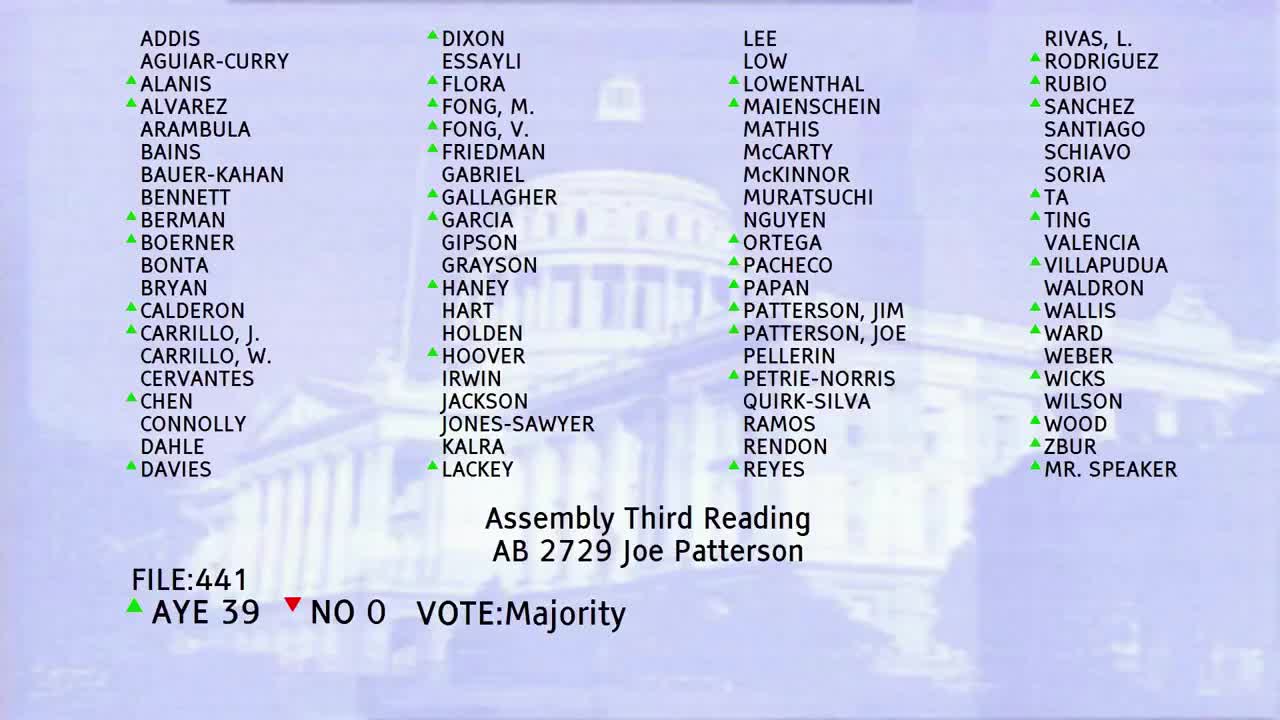 13MIN
Assembly Floor
 18MIN
Assembly Standing Committee on Judiciary
 44MIN
Assembly Standing Committee on Privacy and Consumer Protection
Bill Author

Bill Co-Author(s):