AB 46: Personal income taxes: exclusion: Military Services Retirement and Surviving Spouse Benefit Payment Act.
- Session Year: 2023-2024
- House: Assembly
- Latest Version Date: 2023-07-12
Current Status:
Failed
(2024-08-15: In committee: Held under submission.)
Introduced
In Committee
First Chamber
In Committee
Second Chamber
Enacted
The Personal Income Tax Law imposes a tax on individual taxpayers measured by the taxpayers taxable income for the taxable year, but excludes certain items of income from the computation of tax, including an exclusion for combat-related special compensation.
This bill, for taxable years beginning on or after January 1, 2024, and before January 1, 2034, would exclude from gross income retirement pay received by a taxpayer from the federal government for service performed in the uniformed services, as defined, during the taxable year. The bill, for taxable years beginning on or after January 1, 2024, and before January 1, 2034, would also exclude from gross income annuity payments received by a qualified taxpayer, as defined, pursuant to a United States Department of Defense Survivor Benefit Plan during the taxable year. The bill would make related findings and declarations.
Existing law requires any bill authorizing a new tax expenditure to contain, among other things, specific goals, purposes, and objectives that the tax expenditure will achieve, detailed performance indicators, and data collection requirements.
This bill also would include additional information required for any bill authorizing a new tax expenditure. The bill would require the Franchise Tax Board and the Department of Veterans Affairs to provide any data requested by the Legislative Analyst to write the report, as provided, and would make taxpayer information received by the Legislative Analyst subject to limitation on the collection and use of that information. By expanding the scope of a crime, this bill would impose a state-mandated local program.
The California Constitution requires the state to reimburse local agencies and school districts for certain costs mandated by the state. Statutory provisions establish procedures for making that reimbursement.
This bill would provide that no reimbursement is required by this act for a specified reason.
This bill would take effect immediately as a tax levy.
The Personal Income Tax Law imposes a tax on individual taxpayers measured by the taxpayers taxable income for the taxable year, but excludes certain items of income from the computation of tax, including an exclusion for combat-related special compensation.
This bill, for taxable years beginning on or after January 1, 2024, and before January 1, 2034, would exclude from gross income retirement pay received by a taxpayer from the federal government for service performed in the uniformed services, as defined, during the taxable year. The bill, for taxable years beginning on or after January 1, 2024, and before January 1, 2034, would also exclude from gross income annuity payments received by a qualified taxpayer, as defined, pursuant to a United States Department of Defense Survivor Benefit Plan during the taxable year. The bill would make related findings and declarations.
Existing law requires any bill authorizing a new tax expenditure to contain, among other things, specific goals, purposes, and objectives that the tax expenditure will achieve, detailed performance indicators, and data collection requirements.
This bill also would include additional information required for any bill authorizing a new tax expenditure. The bill would require the Franchise Tax Board and the Department of Veterans Affairs to provide any data requested by the Legislative Analyst to write the report, and would make taxpayer information received by the Legislative Analyst subject to limitation on the collection and use of that information. By expanding the scope of a crime, this bill would impose a state-mandated local program.
The California Constitution requires the state to reimburse local agencies and school districts for certain costs mandated by the state. Statutory provisions establish procedures for making that reimbursement.
This bill would provide that no reimbursement is required by this act for a specified reason.
This bill would take effect immediately as a tax levy.
This measure shall be known, and may be cited, as the Military Services Retirement and Surviving Spouse Benefit Payment Act.
SEC. 2.The Legislature finds and declares all of the following:
(a)Servicemembers are eligible to retire from the military after 20 years of service. These retirees devoted the prime years of their life to defending the freedom of all Americans.
(b)To preserve the current policy of an all-volunteer force while still maintaining critical skills and readiness requires the retention of qualified military personnel, both enlisted and officers. This retention of military professionals also saves the costs to the taxpayer associated with training replacement personnel in essential skills.
(c)Retired members of the nations two nonarmed uniformed services, which consist of the commissioned corps of the United States Public Health Service and the National Oceanic and Atmospheric Administration Commissioned Officer Corps, also provide valuable service to the nations health and environmental safety.
(d)Providing a state income tax exclusion to retirees of the uniformed services not only signifies the gratitude of Californians for these men and women who chose to serve our country, it also benefits the state and local economies by helping to retain skilled and motivated individuals in California.
(e)The number one issue for employers in California is attracting a qualified workforce. Approximately 60,000 high-tech jobs are unfilled. Uniformed service retirees are highly skilled, often in areas requiring technical and management expertise. These men and women often continue to be valuable assets to our schools, local charities, and nonprofit organizations.
(f)Substantial new federal funds are infused into the state and local economies not only from retirement pay, but also from the full taxation of their second careers. These retirees may also qualify for federal veterans benefits, which further bring new monies into the state.
(g)The United States Department of Defenses Survivor Benefit Plan allows a retiree to ensure, after death, a continuous lifetime annuity for their dependents. The maximum annuity for a spouse is based on 55 percent of the members retirement pay. Eligible children may also be beneficiaries. State income taxation of these funds, which are critical to the economic well-being of those who have suffered the loss of a husband, wife, father, or mother, can place the surviving family members in risk of falling into the state and local safety nets.
SEC. 3.Section 17132.9 is added to the Revenue and Taxation Code, to read:17132.9.(a)For taxable years beginning on or after January 1, 2024, and before January 1, 2034, gross income shall not include retirement pay received by a taxpayer from the federal government for service in the uniformed services during the taxable year.
(b)For purposes of this section, the following definitions apply:
(1)Armed Forces of the United States includes all regular and reserve components of the uniformed services which are subject to the jurisdiction of the Secretary of Defense, the Secretary of the Army, the Secretary of the Navy, or the Secretary of the Air Force, and each term also includes the Coast Guard and United States Space Force. The members of such forces include commissioned officers and personnel below the grade of commissioned officers in such forces.
(2)Uniformed services means the Armed Forces of the United States, the Army National Guard and the Air National Guard when engaged in active duty for training, inactive duty training, or full-time National Guard duty, the commissioned corps of the United States Public Health Service, and the National Oceanic and Atmospheric Administration Commissioned Officer Corps.
(c)This section shall remain in effect only until December 1, 2034, and as of that date is repealed.
SEC. 4.Section 17132.10 is added to the Revenue and Taxation Code, to read:17132.10.(a)For taxable years beginning on or after January 1, 2024, and before January 1, 2034, gross income shall not include annuity payments received by a qualified taxpayer pursuant to a United States Department of Defense Survivor Benefit Plan during the taxable year.
(b)For purposes of this section, the following definitions apply:
(1)Qualified taxpayer means the surviving spouse or other named beneficiary of a plan.
(2)United States Department of Defense Survivor Benefit Plan or plan means a survivor benefit plan established pursuant to Sections 1447 to 1455, inclusive, of Title 10 of the United States Code.
(c)This section shall remain in effect only until December 1, 2034, and as of that date is repealed.
SEC. 5.For purposes of complying with the requirements of Section 41 of the Revenue and Taxation Code, with respect to the exclusions allowed by Sections 17132.9 and 17132.10 of the Revenue and Taxation Code, as added by this act, hereafter known as the exclusions, the Legislature finds and declares the following:
(a)The specific goals, purposes, and objectives of the exclusions are as follows:
(1)To honor the service of California veterans and provide fiscal relief so that they and their families will remain or retire in California.
(2)To increase the number of highly skilled retired veterans in Californias workforce.
(b)Detailed performance indicators for the Legislature to use in determining whether the exclusions meet the goals, purposes, and objectives described in subdivision (a) are as follows:
(1)The number of retired veterans and survivor benefit plan beneficiaries taking advantage of the tax exclusions.
(2)The economic security of retired veterans and survivor benefit plan beneficiaries in California.
(3)The number of retired veterans and survivor benefit plan beneficiaries leaving California.
(4)The earned income generated by retired veterans and survivor benefit plan beneficiaries subject to state income tax under the Revenue and Taxation Code.
(c)The data collection requirements for the exclusions are as follows:
(1)On or before December 1, 2034, the Legislative Analyst, in collaboration with the Department of Veterans Affairs, Affairs and the Franchise Tax Board, shall write and submit a report to the Legislature on the effectiveness of the exclusions. The To the extent data is available, the report shall include, but not be limited to, an analysis of the number of retired veterans and survivor benefit plan beneficiaries taking advantage of the exclusions, the impact of the exclusions on the economic security of retired veterans and survivor benefit plan beneficiaries in California, and the number of retired veterans and survivor benefit plan beneficiaries leaving California. California, and the earned income generated by retired veterans and survivor benefit plan beneficiaries subject to state income tax under the Revenue and Taxation Code. The report shall be submitted in compliance with Section 9795 of the Government Code. Code and shall not include any personally identifiable information.
(2)To write the report required by this subdivision, the Legislative Analyst may request information from the Franchise Tax Board and the Department of Veterans Affairs.
(3)Notwithstanding Section 19542 of the Revenue and Taxation Code, the Franchise Tax Board and the Department of Veterans Affairs shall provide any data requested by the Legislative Analyst pursuant to this subdivision. subdivision to the extent that data is available. Taxpayer information received pursuant to this section by the Legislative Analyst is subject to Section 19542 of the Revenue and Taxation Code.
SEC. 6.No reimbursement is required by this act pursuant to Section 6 of Article XIIIB of the California Constitution because the only costs that may be incurred by a local agency or school district will be incurred because this act creates a new crime or infraction, eliminates a crime or infraction, or changes the penalty for a crime or infraction, within the meaning of Section 17556 of the Government Code, or changes the definition of a crime within the meaning of Section 6 of Article XIIIB of the California Constitution.
SEC. 7.This act provides for a tax levy within the meaning of Article IV of the California Constitution and shall go into immediate effect.
CORRECTIONS: HeadingLine 3.This measure shall be known, and may be cited, as the Military Services Retirement and Surviving Spouse Benefit Payment Act.
SEC. 2.The Legislature finds and declares all of the following:
(a)Servicemembers are eligible to retire from the military after 20 years of service. These retirees devoted the prime years of their life to defending the freedom of all Americans.
(b)To preserve the current policy of an all-volunteer force while still maintaining critical skills and readiness requires the retention of qualified military personnel, both enlisted and officers. This retention of military professionals also saves the costs to the taxpayer associated with training replacement personnel in essential skills.
(c)Retired members of the nations two nonarmed uniformed services, which consist of the commissioned corps of the United States Public Health Service and the National Oceanic and Atmospheric Administration Commissioned Officer Corps, also provide valuable service to the nations health and environmental safety.
(d)Providing a state income tax exclusion to retirees of the uniformed services not only signifies the gratitude of Californians for these men and women who chose to serve our country, it also benefits the state and local economies by helping to retain skilled and motivated individuals in California.
(e)The number one issue for employers in California is attracting a qualified workforce. Approximately 60,000 high-tech jobs are unfilled. Uniformed service retirees are highly skilled, often in areas requiring technical and management expertise. These men and women often continue to be valuable assets to our schools, local charities, and nonprofit organizations.
(f)Substantial new federal funds are infused into the state and local economies not only from retirement pay, but also from the full taxation of their second careers. These retirees may also qualify for federal veterans benefits, which further bring new monies into the state.
(g)The United States Department of Defenses Survivor Benefit Plan allows a retiree to ensure, after death, a continuous lifetime annuity for their dependents. The maximum annuity for a spouse is based on 55 percent of the members retirement pay. Eligible children may also be beneficiaries. State income taxation of these funds, which are critical to the economic well-being of those who have suffered the loss of a husband, wife, father, or mother, can place the surviving family members in risk of falling into the state and local safety nets.
SEC. 3.Section 17132.9 is added to the Revenue and Taxation Code, to read:17132.9.(a)For taxable years beginning on or after January 1, 2024, and before January 1, 2034, gross income shall not include retirement pay received by a taxpayer from the federal government for service in the uniformed services during the taxable year.
(b)For purposes of this section, the following definitions apply:
(1)Armed Forces of the United States includes all regular and reserve components of the uniformed services which are subject to the jurisdiction of the Secretary of Defense, the Secretary of the Army, the Secretary of the Navy, or the Secretary of the Air Force, and each term also includes the Coast Guard and United States Space Force. The members of such forces include commissioned officers and personnel below the grade of commissioned officers in such forces.
(2)Uniformed services means the Armed Forces of the United States, the Army National Guard and the Air National Guard when engaged in active duty for training, inactive duty training, or full-time National Guard duty, the commissioned corps of the United States Public Health Service, and the National Oceanic and Atmospheric Administration Commissioned Officer Corps.
(c)This section shall remain in effect only until December 1, 2034, and as of that date is repealed.
SEC. 4.Section 17132.10 is added to the Revenue and Taxation Code, to read:17132.10.(a)For taxable years beginning on or after January 1, 2024, and before January 1, 2034, gross income shall not include annuity payments received by a qualified taxpayer pursuant to a United States Department of Defense Survivor Benefit Plan during the taxable year.
(b)For purposes of this section, the following definitions apply:
(1)Qualified taxpayer means the surviving spouse or other named beneficiary of a plan.
(2)United States Department of Defense Survivor Benefit Plan or plan means a survivor benefit plan established pursuant to Sections 1447 to 1455, inclusive, of Title 10 of the United States Code.
(c)This section shall remain in effect only until December 1, 2034, and as of that date is repealed.
SEC. 5.For purposes of complying with the requirements of Section 41 of the Revenue and Taxation Code, with respect to the exclusions allowed by Sections 17132.9 and 17132.10 of the Revenue and Taxation Code, as added by this act, hereafter known as the exclusions, the Legislature finds and declares the following:
(a)The specific goals, purposes, and objectives of the exclusions are as follows:
(1)To honor the service of California veterans and provide fiscal relief so that they and their families will remain or retire in California.
(2)To increase the number of highly skilled retired veterans in Californias workforce.
(b)Detailed performance indicators for the Legislature to use in determining whether the exclusions meet the goals, purposes, and objectives described in subdivision (a) are as follows:
(1)The number of veterans and survivor benefit plan beneficiaries taking advantage of the tax exclusions.
(2)The economic security of veterans and survivor benefit plan beneficiaries in California.
(3)The number of retired veterans and survivor benefit plan beneficiaries leaving California.
(c)The data collection requirements for the exclusions are as follows:
(1)On or before December 1, 2034, the Legislative Analyst, in collaboration with the Department of Veterans Affairs, shall write and submit a report to the Legislature on the effectiveness of the exclusions. The report shall include, but not be limited to, an analysis of the number of veterans and survivor benefit plan beneficiaries taking advantage of the exclusions, the impact of the exclusions on the economic security of veterans and survivor benefit plan beneficiaries in California, and the number of retired veterans and survivor benefit plan beneficiaries leaving California. The report shall be submitted in compliance with Section 9795 of the Government Code.
(2)To write the report required by this subdivision, the Legislative Analyst may request information from the Franchise Tax Board and the Department of Veterans Affairs.
(3)Notwithstanding Section 19542 of the Revenue and Taxation Code, the Franchise Tax Board and the Department of Veterans Affairs shall provide any data requested by the Legislative Analyst pursuant to this subdivision. Taxpayer information received pursuant to this section by the Legislative Analyst is subject to Section 19542 of the Revenue and Taxation Code.
SEC. 6.No reimbursement is required by this act pursuant to Section 6 of Article XIIIB of the California Constitution because the only costs that may be incurred by a local agency or school district will be incurred because this act creates a new crime or infraction, eliminates a crime or infraction, or changes the penalty for a crime or infraction, within the meaning of Section 17556 of the Government Code, or changes the definition of a crime within the meaning of Section 6 of Article XIIIB of the California Constitution.
SEC. 7.This act provides for a tax levy within the meaning of Article IV of the California Constitution and shall go into immediate effect.
REVISIONS: HeadingLine 1.|
Date
|
Status
|
|---|---|
| Aug 15, 2024 | In committee: Held under submission. |
| Sep 1, 2023 | In committee: Held under submission. |
| Aug 14, 2023 | In committee: Referred to APPR suspense file. |
| Jul 13, 2023 | Measure version as amended on July 12 corrected. |
| Jul 12, 2023 | Read second time and amended. Re-referred to Com. on APPR. |
| Jul 11, 2023 | From committee: Amend, and do pass as amended and re-refer to Com. on APPR. (Ayes 5. Noes 0.) (July 10). |
| Jun 14, 2023 | From committee: Do pass and re-refer to Com. on M. & V.A. (Ayes 7. Noes 0.) (June 14). Re-referred to Com. on M. & V.A. |
| May 31, 2023 | Referred to Coms. on GOV. & F. and M. & V.A. |
| May 23, 2023 | In Senate. Read first time. To Com. on RLS. for assignment. |
| May 22, 2023 | Read third time. Passed. Ordered to the Senate. (Ayes 77. Noes 0. Page 1703.) |
| May 18, 2023 | Read second time. Ordered to third reading. |
| May 18, 2023 | Joint Rule 62(a), file notice suspended. (Page 1580.) |
| May 18, 2023 | From committee: Do pass. (Ayes 15. Noes 0.) (May 18). |
| May 17, 2023 | In committee: Set, first hearing. Referred to APPR. suspense file. |
| May 2, 2023 | From committee: Do pass and re-refer to Com. on APPR. (Ayes 11. Noes 0.) (May 1). Re-referred to Com. on APPR. |
| Mar 14, 2023 | In committee: Set, first hearing. Referred to REV. & TAX. suspense file. |
| Feb 7, 2023 | Coauthors revised. |
| Jan 26, 2023 | Referred to Com. on REV. & TAX. |
| Dec 6, 2022 | From printer. May be heard in committee January 5. |
| Dec 5, 2022 | Read first time. To print. |
|
Date
|
Description
|
Location
|
Votes
|
|
|---|---|---|---|---|
| Aug 14, 2023 | Placed on suspense file | Senate Standing Committee on Appropriations |
Passed |
|
| Jul 10, 2023 | Do pass as amended, but first amend, and re-refer to the Committee on [Appropriations] | Senate Standing Committee on Military and Veterans Affairs |
Passed |
|
| Jun 14, 2023 | Do pass, but first be re-referred to the Committee on [Military and Veterans Affairs] | Senate Standing Committee on Governance and Finance |
Passed |
|
| May 22, 2023 | AB 46 Ramos Assembly Third Reading | Assembly Floor |
Passed |
|
| May 18, 2023 | Do pass. | Assembly Standing Committee on Appropriations |
Passed |
|
| May 1, 2023 | Do pass and be re-referred to the Committee on [Appropriations] | Assembly Standing Committee on Revenue and Taxation |
Passed |
This list shows positions taken on this bill by organizations on the date displayed, which is linked to the original source.
Positions by individuals are not included.
|
Organization
|
Position
|
Date
|
|---|---|---|
| Aerospace and Defense Alliance of California | ** Support | |
| Air Force Reserve | * Support | Jun 14, 2023 |
| Alameda County Veterans Affairs | * Support | Jun 14, 2023 |
| American Legion, Department Of California | ** Support | |
| Amvets, Department Of California | ** Support | |
| Association of The U.s. Army, Northern & Southern California Chapters | ** Support | |
| California Air National Guard | * Support | Jun 14, 2023 |
| California Association of County Veteran Service Officers | ** Support | |
| California Association Of County Veterans Service Officers | * Support | Jul 10, 2023 |
| California Association Of Highway Patrolmen | ** Support | |
| California Association Of Highway Patrolmen | * Support | Jul 10, 2023 |
| California Enlisted Association of the National Guard of the United States | * Support | Jul 10, 2023 |
| California Enlisted Association of the National Guard of the United States | ** Support | |
| California Federation of Teachers, AFL-CIO | ** Against | |
| California Manufacturers And Technology Association | ** Support | |
| California Manufacturers And Technology Association | * Support | Jul 10, 2023 |
| California Military Officer Association of America | * Support | Jul 10, 2023 |
| California Municipal Utilities Association | * Support | Jul 10, 2023 |
| California Senior Legislature | ** Support | |
| California State Commanders Veterans Council | ** Support | |
| California Tax Reform Association | * Indeterminate | Mar 13, 2023 |
| City of Coronado | * Support | Jul 10, 2023 |
| City of Fairfield | ** Support | |
| City of Oxnard | * Support | Jun 14, 2023 |
| County of Monterey | ** Support | |
| County of Monterey | * Support | Jul 10, 2023 |
| County of San Bernardino | * Support | Jul 10, 2023 |
| Gold Star Wives of California | * Support | Mar 13, 2023 |
| Howard Jarvis Taxpayers Association | ** Support | |
| Marine Corps Veterans Association | * Support | Mar 13, 2023 |
| Military Officers Association of America - Alameda Chapter | ** Support | |
| Military Officers Association of America - Alta CA Chapter | ** Support | |
| Military Officers Association of America - Miramar Chapter | ** Support | |
| Military Officers Association of America - Redwood Empire Chapter | ** Support | |
| Military Officers Association of America - Sacramento Chapter | ** Support | |
| Military Officers Association of America - Solano County | ** Support | |
| Military Officers Association of America - Ventura County Chapter | ** Support | |
| Military Officers Association Of America California Council Of Chapters | ** Support | |
| Opposition: | ** Against | |
| Orange Empire Military Officers Club | ** Support | |
| Peace Officers Research Assn of CA (PORAC PAC) | * Support | Jul 10, 2023 |
| Peace Officers Research Association Of California | ** Support | |
| Reeb Government Relations | * Support | Jun 14, 2023 |
| San Bernadino County | * Support | Aug 14, 2023 |
| San Diego County Taxpayers Association | ** Support | |
| San Diego Military Advisory Council | * Support | Aug 14, 2023 |
| San Diego Regional Chamber Of Commerce | ** Support | |
| Scottish-American Military Society | ** Support | |
| US Air Force | * Support | Jun 14, 2023 |
| US Navy | * Support | Jun 14, 2023 |
| US Reserves | * Support | Jun 14, 2023 |
| Veteran Strong USA | ** Support | |
| Veterans Administration | * Support | Mar 13, 2023 |
| Vietnam Veterans of America | * Support | Mar 13, 2023 |
| Vietnam Veterans Of America, California State Council | ** Support |
SENATE COMMITTEE ON APPROPRIATIONS
Senator Anthony Portantino, Chair
2023 - 2024 Regular Session
AB 46 (Ramos) - Personal income taxes: exclusion: Military Services Retirement and Surviving Spouse Benefit Payment Act
Version: July 12, 2023 | Policy Vote: GOV. & F. 7 - 0, M.&V.A. 5 - 0 |
Urgency: No | Mandate: Yes |
Hearing Date: August 14, 2023 | Consultant: Robert Ingenito |
Bill Summary:
AB 46 would exclude two forms of military retirement income from state income tax.
Fiscal Impact:
- The Franchise Tax Board (FTB) estimates that this bill would result in General Fund revenue losses of $50 million in 2023-24, $85 million in 2024-25, and $85 million in 2025-26. FTB’s implementation costs would likely be minor and absorbable.
- CalVet and the Legislative Analyst’s Office (LAO) would likely incur minor and absorbable costs related to the bill’s reporting requirement.
Background:
Tax expenditure programs (TEPs) are special tax provisions that reduce the amount of revenues the “basic” tax system would otherwise generate in order to provide (1) benefits to certain groups of taxpayers, and/or (2) incentives to encourage certain types of behavior and activities, such as charitable giving. Specifically, current law provides for, among other things, various income and corporation tax credits and deductions, as well as exemptions from the sales and use tax. The Department of Finance is required to publish a list of TEPs (currently totaling several hundred), which currently exceed $87 billion annually.
Existing federal and state laws provide that gross income includes all income from any source, including compensation for services, business income, gains from property, interest, dividends, rents, and royalties, unless specifically excluded. Existing federal and state laws exclude certain types of income from gross income, such as amounts received as a gift or inheritance, certain compensation for injuries and sickness, qualified scholarships, educational assistance programs, foster care payments, and interest received on certain state or federal obligations, among others.
Military service members generally can retire from active duty at any age with at least 20 years of service. In addition, persons who meet retirement requirements partially or entirely through reserve or National Guard service receive retirement pay after age 59. Military retirement pay received by a taxpayer is usually taxable for federal and state purposes. However, federal and state law exclude certain types of military income from tax, including military death benefits paid to qualified survivors, military pay for time serviced in combat zones, and the premium paid into a survivor annuity account for qualified survivors of military personnel.
The Survivor Benefit Plan is a United States Department of Defense (DoD) sponsored and subsidized program that allows a military retiree to ensure, after death, a continuous lifetime annuity for their dependents. Under existing federal law, members of the uniformed services may elect to reduce their retirement pay to provide an annuity to their survivors, and the reduction is excluded from gross income. However, payments received by beneficiaries of the survivor annuity accounts, are included in gross income calculation for those beneficiaries.
Proposed Law:
This bill would, for taxable years 2024 through 2033, exclude from income for state tax purposes (1) retirement pay received by a taxpayer from the federal government for services in the uniformed services, and (2) annuity payments received by a qualified taxpayer pursuant to a DoD Survivor Benefit Plan. The bill would additionally require the LAO to prepare a report, as specified, on the effective of the bill’s exclusions.
Related Legislation:
- AB 1623 (Ramos, 2022), similar to this bill, would have excluded from gross income retirement pay received for service in the uniformed services and annuity payments received from a Survivor Benefit Plan. The bill was held under submission on the Suspense File of the Assembly Appropriations Committee.
- AB 291 (Seyarto, 2021) and AB 1629 (Seyarto, 2022), would have excluded from gross income survivor benefits and payments received under a Survivor Benefit Plan. Both bills did not pass out of the Assembly by the constitutional deadline.
- AB 2380 (Choi, 2020), would have excluded from gross income survivor benefits and payments received under Survivor Benefit Plans. The bill did not pass out of the Assembly by the constitutional deadline.
Staff Comments:
DoD data indicate that, as of December 31, 2021, 132,344 military retirees in California received total monthly payments of over $340 million or about $4.1 billion annually from the United States Department of Defense (DoD). Also, as of December 31, 2021, 27,060 survivors in California received total monthly Survivor Benefit Plan payments of $34,593,000 or about $415 million annually.
California previously offered a military-specific income exclusion until taxable year 1987, when the tax benefit morphed into a tax credit equal to 4 percent of the eligible income received by an individual with adjusted gross income under $27,000. The tax credit sunset on January 1, 1992.
-- END --
SENATE COMMITTEE ON MILITARY AND VETERANS AFFAIRS
Senator Bob Archuleta, Chair
2023 - 2024 Regular
Bill No: AB 46 Hearing Date: 7/10/23
Author: | Ramos | ||
Version: | 12/5/22 Introduced | ||
Urgency: | No | Fiscal: | Yes |
Consultant: | Jenny Callison | ||
Subject: Personal income taxes: exclusion: Military Services Retirement and Surviving Spouse Benefit Payment Act
DESCRIPTION
Summary:
Excludes retirement pay received by a member of the Armed Forces of the United States, and excludes income annuity payments received pursuant to a United States Department of Defense Survivor Benefit Plan, from gross income under the Personal Income Tax Law during taxable years beginning on or after January 1, 2024, and before January 1, 2034,
Existing law:
- Imposes a tax on individual taxpayers measured by the taxpayer’s taxable income for the taxable year, but excludes certain items of income from the computation of tax, including an exclusion for combat-related special compensation.
- Requires any bill authorizing a new tax expenditure to contain, among other things, specific goals, purposes, and objectives that the tax expenditure will achieve, detailed performance indicators, and data collection requirements.
This bill:
- Enacts the Military Services Retirement and Surviving Spouse Benefit Payment Act, which excludes from income for state tax purposes:
- Retirement pay received by a taxpayer from the federal government for services in the uniformed services, and
- Annuity payments received by a qualified taxpayer pursuant to a DoD Survivor Benefit Plan.
- Defines the following terms:
- "Uniformed services" for the retirement pay exclusion includes service in the Armed Forces of the United States, the Army National Guard and the Air National Guard when engaged in active duty for training, inactive duty training, or full-time National Guard duty, the commissioned corps of the United States Public Health Service, or the National Oceanic and Atmospheric Administration Commissioned Officer Corps;
- "United States Department of Defense Survivor Benefit Plan" or "plan" is a survivor benefit plan established under Sections 1447 to 1455, inclusive, of Title 10 of the United States Code; and,
- "Qualified taxpayer" for the annuity payments exclusion is the surviving spouse or other named beneficiary of a plan.
- Provides the income exclusion for taxable years beginning on or after January 1, 2024, and before January 1, 2034.
- Takes immediate effect as a tax levy.
- Repeals the gross income exclusion's statutory provisions on December 1, 2034.
- Requires the Legislative Analyst's Office (LAO), in collaboration with the Department of Veterans Affairs (CalVet), to submit a report to the Legislature on the exclusion's effectiveness.
BACKGROUND
California law allows various income tax credits, deductions, exemptions, and exclusions. The Legislature enacts such tax incentives either to compensate taxpayers for incurring certain expenses, such as child adoption, or to influence certain behavior, such as charitable giving. The Legislature uses tax incentives to encourage taxpayers to do something they would otherwise not do, but for the tax credit.
Generally, service members can retire from active duty at any age once they have completed at least 20 years of service. In addition, persons who meet retirement requirements partially or entirely through reserve or National Guard service receive retirement pay after age 59. Federal and state law exclude certain types of military income from tax, including military death benefits paid to qualified survivors, military pay for time serviced in combat zones, and the premium paid into a survivor annuity account for qualified survivors of military personnel.
The Survivor Benefit Plan is a United States Department of Defense (DoD) sponsored and subsidized program that allows a military retiree to ensure, after death, a continuous lifetime annuity for their dependents. Under existing federal law, members of the uniformed services may elect to reduce their retirement pay to provide an annuity to their survivors, and the reduction is excluded from gross income. However, payments received by beneficiaries of the survivor annuity accounts, are included in gross income calculation for those beneficiaries.
California is the only state that fully taxes military retirement. Most states exclude all or some military retirement pay from being taxed in the state, and California is an outlier. Twenty-seven states do not tax military retirement pay and fourteen states tax military retirement income partially through income exemptions and exclusions. Five states (Arizona, Utah, Indiana, Nebraska, and North Carolina) passed laws to fully exclude military retirement income from taxation starting for the 2021 or 2022 taxable year. Vermont and Virginia enacted legislation in 2022 exempting the first $10,000 in military retirement pay from state income taxation for qualifying taxpayers. A significant number of states also do not tax annuity payments from the Survivor Benefit Plan. Arizona, North Carolina, and Utah passed legislation to exclude survivor annuity payments in 2021 from gross income for income taxation purposes.
Seeking to reward military veterans for their service, and provide an incentive for military retirees to reside in the state, the author wants to exclude military retirement and survivor benefit payments from state income tax. Military retirees are often high skilled employees who will contribute to the community and generate taxable economic activity.
COMMENT
According to the DOD's Statistical Report on the Military Retirement System for Fiscal Year 2021 (the most recent data available), there are 145,308 military retirees residing in California, fourth only to Texas (222K), Florida (210K), and Virginia (156K).
A 40-year old E-6 who retires in July 2023 after 20 years will receive approximately $26,448 a year in a defined-benefit military pension (which is adjusted annually for inflation), akin to just about $2,204 a month. In this example, the state of California would likely benefit from another 25-years+ worth of state income taxes as the retiree moves on to a second career in California during their working-age retirement years post-military service (~40-65+). Enlisted personnel make up approximately 83 percent of the military while the Officer Corps makes up just 17 percent. Thus, the vast majority of retirees who will benefit from the provisions in AB46 are enlisted.
The ratio of California public-school teachers to military retirees living in California is more than 2:1. There are approximately 319,000 public school teachers in California, all California residents. Whereas, there are only about 158,000 active-duty military personnel stationed in California at any one time, most of whom are not California residents and will not retire in California. Compared to public school teachers, the number of military retirees who would benefit from this provision is relatively modest.
In the active-duty U.S. Army, for instance, 46,000 Soldiers consider California their Home of Record. Statistically speaking, just 17 percent of military personnel serve the 20 years required to receive a defined-benefit pension. Assuming all 46,000 Californians return home after their military service, which is unlikely, only about 7,820 would be eligible for the benefits outlined in this provision.
The State of California is the only state that fully taxes the pay of its 145,308 military retirees. In deciding where to live, housing costs, prior living locations, and employment opportunities are important. From 2010 to 2021, the veteran retiree population grew by 17% in the United States. California, which was one of only five states to see a decrease in military retiree population, saw a 14% reduction in the number of military retirees over that same time period.
Currently, in California, approximately 60,000 high-tech jobs remain unfilled. Armed Forces retirees are highly skilled, often in areas requiring technical and management expertise. These men and women are likely to continue to be valuable assets to our schools, local charities, and non-profit organizations. Substantial new federal funds are infused into the state and local economies not only from retirement pay, but also from the full taxation of their second careers. These retirees may also qualify for federal veterans’ benefits, which further bring new monies into the state.
According to the author:
AB 46 recognizes members of the Armed Forces and their contribution to our nation and seeks to exempt their retirement pay once they retire after twenty years of service. The purpose of the bill is twofold; to honor those who dedicated their life to serving their country, and to retain and attract uniformed service retirees to California for the purposes of strengthening the state’s skilled workforce, bringing stability to communities, and contributing to the state and local tax base. AB 46 has received unanimous Bi-partisan support through the process.
Proposed Amendments:
- Clarify reporting requirements to specify tracking of “retired” veterans taking advantage of the tax exclusions and also the economic security of “retired” veterans.
- Includes collaboration between CalVet and the Franchise Tax Board in writing and submitting the report on the effectiveness of the exclusions to the Legislature.
- Adds a data column for the earned income generated by retired veterans and survivor benefit plan beneficiaries subject to California state income tax.
- Adds co-authors.
POSITIONS
Sponsor: Military Officers Association of America, California Council of Chapters.
Support:
Aerospace and Defense Alliance of California
American Legion, Department of California
AMVETs, Department of California
Association of The U.S. Army, Northern & Southern California Chapters
California Association of County Veteran Services Officers
California Association of Highway Patrolmen
California Enlisted Association of The National Guard of The United States
California Manufacturers and Technology Association
California State Commanders Veterans Council
City of Fairfield
County of Monterey
Howard Jarvis Taxpayers Association
Military Officers Association of America - Alameda Chapter
Military Officers Association of America - Alta CA Chapter
Military Officers Association of America - California Council of Chapters
Military Officers Association of America - Miramar Chapter
Military Officers Association of America - Redwood Empire Chapter
Military Officers Association of America - Sacramento Chapter
Military Officers Association of America - Solano County
Military Officers Association of America - Ventura County Chapter
Peace Officers Research Association of California
San Diego Military Advisory Council
San Diego Regional Chamber of Commerce
Scottish-American Military Society
Vietnam Veterans of America, California State Council
41 Individuals
Oppose:
California Federation of Teachers, AFL-CIO
-- END --
SENATE COMMITTEE ON GOVERNANCE AND FINANCE
Senator Anna M. Caballero, Chair
2023 - 2024 Regular
Bill No: | AB 46 | Hearing Date: | 6/14/23 |
Author: | Ramos | Tax Levy: | Yes |
Version: | 12/5/22 | Fiscal: | Yes |
Consultant: | Grinnell | ||
Personal income taxes: exclusion: Military Services Retirement and Surviving Spouse Benefit Payment Act
Enacts the Military Services Retirement and Surviving Spouse Benefit Payment Act, which excludes two forms of military retirement income from state income tax.
Background
Tax expenditures. California law allows various income tax credits, deductions, exemptions, and exclusions. The Legislature enacts such tax incentives either to compensate taxpayers for incurring certain expenses, such as child adoption, or to influence certain behavior, such as charitable giving. The Legislature uses tax incentives to encourage taxpayers to do something they would otherwise not do, but for the tax credit. The Department of Finance is required annually to publish a list of tax expenditures, which currently total around $87 billion per year.
Income. Existing federal and state laws provide that gross income includes all income from any source, including compensation for services, business income, gains from property, interest, dividends, rents, and royalties, unless specifically excluded. Existing federal and state laws exclude certain types of income from gross income, such as amounts received as a gift or inheritance, certain compensation for injuries and sickness, qualified scholarships, educational assistance programs, foster care payments, and interest received on certain state or federal obligations, among others.
Military retirement income. Generally, military service members can retire from active duty at any age with at least 20 years of service. In addition, persons who meet retirement requirements partially or entirely through reserve or National Guard service receive retirement pay after age 59. Military retirement pay received by a taxpayer is usually taxable for federal and state purposes. However, federal and state law exclude certain types of military income from tax, including military death benefits paid to qualified survivors, military pay for time serviced in combat zones, and the premium paid into a survivor annuity account for qualified survivors of military personnel.
The Survivor Benefit Plan is a United States Department of Defense (DoD) sponsored and subsidized program that allows a military retiree to ensure, after death, a continuous lifetime annuity for their dependents. Under existing federal law, members of the uniformed services may elect to reduce their retirement pay to provide an annuity to their survivors, and the reduction is excluded from gross income. However, payments received by beneficiaries of the survivor annuity accounts, are included in gross income calculation for those beneficiaries.
According to DoD, as of December 31, 2021, 132,344 military retirees in California received total monthly payments of over $340 million or about $4.1 billion annually from the United States Department of Defense (DoD). Also, as of December 31, 2021, 27,060 survivors in California received total monthly Survivor Benefit Plan payments of $34,593,000 or about $415 million annually.
Seeking to reward military veterans for their service, and provide an incentive for military retirees to reside in the state, the author wants to exclude military retirement and survivor benefit payments from state income tax.
Proposed Law
Assembly Bill 46 enacts the Military Services Retirement and Surviving Spouse Benefit Payment Act, which excludes from income for state tax purposes:
- Retirement pay received by a taxpayer from the federal government for services in the uniformed services, and
- Annuity payments received by a qualified taxpayer pursuant to a DoD Survivor Benefit Plan.
AB 46 applies beginning in the 2024 taxable year, and ends after the 2033 taxable year. The bill defines several terms, and makes legislative findings and declarations supporting its purposes, as well as to comply with Section 41 of the Revenue and Taxation Code.
State Revenue Impact
According to the Franchise Tax Board (FTB), AB 46 results in state revenue losses of $50 million in 2023-24, and $85 million in 2024-25 and 2025-26.
Comments
1. Purpose of the bill. According to the author, “AB 46 recognizes members of the Armed Forces and their contribution to our nation and seeks to exempt their retirement pay once they retire after twenty years of service. The purpose of the bill is twofold; to honor those who dedicated their life to serving their country, and to retain and attract uniformed service retirees to California for the purposes of strengthening the state’s skilled workforce, bringing stability to communities, and contributing to the state and local tax base. AB 46 has received unanimous Bi-partisan support through the process.”
2. Revenue loss. Existing tax law provides various credits, deductions, exclusions, and exemptions for certain taxpayers. By excluding a form of income that is currently included for tax purposes, AB 46 will result in the State General fund receiving less revenue. As a result, the state will have to reduce spending or increase taxes to account for the loss.
3. Precedent. Income is generally taxable, regardless of the source derived. If the Legislature exempts retirement income for one line of work that provides a direct benefit to the public, why shouldn’t it extend the same treatment for other commendable professions, such as teachers, fire fighters, police officers, or health providers? Additionally, military personnel, like other public servants, agree to enter into service in exchange for a salary, benefits, and other considerations; AB 46 would provide an unexpected windfall benefit after their service is complete. Why should retired military not have to pay tax on retirement income, when retirees of other worthy jobs have to?
4. Who benefits? California’s progressive income tax system applies higher marginal rates as annual taxable income grows above certain thresholds. As a result, enacting a gross income exclusion benefits higher income earners more than any other group; a taxpayer whose income from other sources puts them in the 12.3% bracket has a higher dollar benefit from AB 46’s exclusion than a taxpayer in the 4% one. In comparison, a capped exclusion or a fixed amount tax credit similar to the personal or dependent exemption credit helps all taxpayers equally. The Committee may wish to consider whether enacting a fixed credit amount for military retirees would be more equitable.
5. Conformity. AB 46 would exempt certain military retirement benefits for state tax purposes that are taxable under federal law unless and until Congress adopts similar treatment. While the bill would provide a financial benefit to military retirees, taxpayers often find different treatment between state and federal taxes for the same item of income confusing and frustrating.
6. Section 41. Section 41 of the Revenue and Taxation Code requires any bill enacting a new tax expenditure to contain, among other things, specific goals, purposes, and objectives that the tax expenditure will achieve and detailed performance indicators, along with data collection and reporting requirements (SB 1335, Leno, 2014). To satisfy these requirements, AB 46 states that its purpose is to honor the service of California veterans and provide fiscal relief so they and their families will remain or retire in California, and to increase the number of highly skilled retired veterans in California’s workforce. The bill identifies the following performance indicators:
- The number of veterans and survivor benefit plan beneficiaries taking advantage of the tax exclusions.
- The economic security of veterans and survivor benefit plan beneficiaries in California.
- The number of retired veterans and survivor benefit plan beneficiaries leaving California.
The bill then directs the Legislative Analyst’s Office (LAO) in collaboration with the Department of Veterans Affairs to submit a report to the Legislature on the effectiveness of the exclusion. The report must include an analysis of the number of veterans and survivor benefit plan beneficiaries taking advantage of the exclusions, the impact of the exclusions on the economic security of veterans and survivor benefit plan beneficiaries in California, and the number of retired veterans and survivor benefit plan beneficiaries leaving California. AB 46 provides that FTB, the California Department of Tax and Fee Administration, and the Department of Veterans Affairs must provide any information necessary requested by LAO, and subjects the information to existing confidentiality requirements and sanctions for unlawful disclosure.
Assembly Actions
Assembly Revenue and Taxation Committee: 11-0
Assembly Appropriations Committee: 15-0
Assembly Floor: 77-0
Support and Opposition
(6/9/23)
Support:
Military Officers Association of America, California Council of Chapters (Sponsor)
Aerospace and Defense Alliance of California
American Legion, Department of California
Amvets, Department of California
Association of The U.s. Army, Northern & Southern California Chapters
California Association of County Veteran Services Officers
California Association of County Veterans Service Officers
California Association of Highway Patrolmen
California Enlisted Association of The National Guard of The United States
California Manufacturers and Technology Association
California State Commanders Veterans Council
City of Fairfield
County of Monterey
Howard Jarvis Taxpayers Association
Military Officers Association of America - Alameda Chapter
Military Officers Association of America - Alta CA Chapter
Military Officers Association of America - California Council of Chapters
Military Officers Association of America - Miramar Chapter
Military Officers Association of America - Redwood Empire Chapter
Military Officers Association of America - Sacramento Chapter
Military Officers Association of America - Solano County
Military Officers Association of America - Ventura County Chapter
Peace Officers Research Association of California
San Diego Military Advisory Council
San Diego Regional Chamber of Commerce
Scottish-american Military Society
Vietnam Veterans of America, California State Council
41 Individuals
OPPOSITION
Opposition:
California Federation of Teachers Afl-cio
-- END --
ASSEMBLY THIRD READING
ATR Bill Id:AB 46
Author:(Ramos, et al.)
As Introduced Ver:December 5, 2022
Majority vote
SUMMARY
Excludes from gross income, under the Personal Income Tax (PIT) Law, uniformed services retirement pay and annuity payments from a United States Department of Defense Survivor Benefit Plan received by qualified taxpayers, as specified.
Major Provisions
- Defines the following terms:
- "Uniformed services" for the retirement pay exclusion includes service in the Armed Forces of the United States, the Army National Guard and the Air National Guard when engaged in active duty for training, inactive duty training, or full-time National Guard duty, the commissioned corps of the United States Public Health Service, or the National Oceanic and Atmospheric Administration Commissioned Officer Corps;
- "United States Department of Defense Survivor Benefit Plan" or "plan" is a survivor benefit plan established under Sections 1447 to 1455, inclusive, of Title 10 of the United States Code; and,
- "Qualified taxpayer" for the annuity payments exclusion is the surviving spouse or other named beneficiary of a plan.
- Provides the income exclusion for taxable years beginning on or after January 1, 2024, and before January 1, 2034.
- Takes immediate effect as a tax levy.
- Repeals the gross income exclusion's statutory provisions on December 1, 2034.
- Requires the Legislative Analyst's Office (LAO), in collaboration with the Department of Veterans Affairs (CalVet), to submit a report to the Legislature on the exclusion's effectiveness.
COMMENTS
Military benefits: This bill excludes uniformed services retirement pay and Survivor Benefit Plan annuity payments from gross income, thus providing a tax benefit for retired members of the uniformed services and their beneficiaries. As of December 31, 2021, 132,344 military retirees in California received total monthly payments of over $340 million, or about $4.1 billion annually, from the U.S. Department of Defense. Generally, service members can retire from active duty at any age once they have completed at least 20 years of service. In addition, persons who meet retirement requirements partially or entirely through reserve or National Guard service receive retirement pay after age 59. As of December 31, 2021, 27,060 individuals in California received total monthly payments of almost $35 million, or about $415 million annually, from the Survivor Benefit Plan, which allows a military retiree to ensure, after death, a continuous lifetime annuity for their dependents. A military retiree pays premiums from their gross retired pay for the Survivor Benefit Plan coverage, which is not taxed at the federal or state level.
California compared to other states: A significant number of states exclude military retirement pay from being taxed in the state, and California appears to be an outlier. Twenty-seven states do not tax military retirement pay and fourteen states tax military retirement income partially through income exemptions and exclusions. Five states (Arizona, Utah, Indiana, Nebraska, and North Carolina) passed laws to fully exclude military retirement income from taxation starting for the 2021 or 2022 taxable year. Vermont and Virginia enacted legislation in 2022 exempting the first $10,000 in military retirement pay from state income taxation for qualifying taxpayers. A significant number of states are also not taxing annuity payments from the Survivor Benefit Plan. Arizona, North Carolina, and Utah passed legislation to exclude survivor annuity payments in 2021 from gross income for income taxation purposes. California appears to now be the only state that fully taxes military retirement pay. Supporters of this bill contend that preferable tax treatment in other states creates a strong incentive for military retirees and their families to move out of California.
Potential for double tax benefit and nonconformity: Under existing federal law, members of the uniformed services may elect to reduce their retirement pay to provide an annuity to their survivors and families. This amount is generally excluded from gross income (front-end tax benefit). Under this bill, the survivors would also receive tax-free money (back-end tax benefit). Therefore, this bill results in a front-end and back-end tax benefit, a net loss for the state. Additionally, this bill would reestablish a state gross income exclusion for which federal law appears to have no counterpart, thus increasing nonconformity. California typically conforms to federal law for gross income exclusions for ease of administration and taxpayer compliance.
According to the Author
The author has provided the following statement in support of this bill:
AB 46 recognizes members of the Armed Forces and their contribution to our nation and seeks to exempt their retirement pay once they retire after twenty years of service. This bill sunsets in 2034. The purpose of the bill is twofold; to honor those who dedicated their life to serving their country, and to retain and attract uniformed service retirees to California for the purposes of strengthening the state's skilled workforce, bringing stability to communities, and contributing to the state and local tax base.
Arguments in Support
This bill is supported by several veteran's organizations and sponsored by the California Council of Chapters Affiliated Military Officers Association of America (CALMOAA), who note, in part:
Between 2010 and 2020 the nation's population of military retirees has increased by 4%. California, during this period, was one of the few states that saw a reduction in the number of military retirees. California had a decline of 12% in the state's military retiree population. During the same period, Nevada showed a gain of 10% and Arizona a gain of 6%. Both Arizona and Nevada fully exempt military retirement from state taxes.
Recent studies conducted by the San Diego Military Advisory Council and others agree that retaining Uniformed Service retirees in California provide a valuable workforce and economic development tool for California. These studies also show that military retirees generate millions of dollars in general tax revenue for the state's economy from their 2nd careers.
Arguments in Opposition
None on file
FISCAL COMMENTS
According to the Assembly Appropriations Committee:
- General Fund (GF) revenue loss of $50 million in fiscal year (FY) 2023-24, $85 million in FY 2024-25 and $85 million in FY 2025-26.
- GF costs of an unknown, but likely absorbable, amount to the Franchise Tax Board (FTB) to administer the gross income exclusion and share data with the LAO.
- Minor and absorbable costs to CalVet to collaborate with the LAO on the report analyzing the effectiveness of the exclusion.
- Costs of an unknown, but likely absorbable, amount to the LAO to write the report. However, this committee sees a wide array of bills that require the LAO to measure different tax expenditures. Generally, a request to prepare an individual report would not generate significant new workload for the LAO. But, taken together, these proposals strain the ability of the LAO fulfill other existing or future legislative mandates and requests, as the LAO's budget is subject to the Legislature's constitutional spending cap.
VOTES
ASM REVENUE AND TAXATION: 11-0-0
YES: Irwin, Wallis, Bains, Grayson, Pacheco, Jim Patterson, Petrie-Norris, Luz Rivas, Ta, Valencia, Zbur
ASM APPROPRIATIONS: 15-0-1
YES: Holden, Megan Dahle, Bryan, Calderon, Wendy Carrillo, Dixon, Mike Fong, Hart, Lowenthal, Mathis, Papan, Pellerin, Sanchez, Weber, Ortega
ABS, ABST OR NV: Robert Rivas
UPDATED
VERSION: December 5, 2022
CONSULTANT: Wesley Whitaker / REV. & TAX. / (916) 319-2098 FN: 0000641
Date of Hearing: May 17, 2023
ASSEMBLY COMMITTEE ON APPROPRIATIONS
Chris Holden, Chair
ABPCA Bill Id:AB 46
Author:(Ramos) – As Introduced Ver:December 5, 2022
Policy Committee: | Revenue and Taxation | Vote: | 11 - 0 |
|
| ||
|
|
Urgency: No State Mandated Local Program: Yes Reimbursable: No
SUMMARY:
This bill provides, for taxable years beginning on or after January 1, 2024, and before January 1, 2034, an exclusion from gross income, under the Personal Income Tax Law, for retirement pay from the federal government for specified military services and annuity payments received from a U.S. Department of Defense Survivor Benefit Plan.
This bill declares the goals and performance indicators for the exclusion and requires, by December 1, 2034, the Legislative Analyst (LAO), in collaboration with the Department of Veterans Affairs (CalVet), to submit a report to the Legislature on the exclusion’s effectiveness.
FISCAL EFFECT:
- General Fund (GF) revenue loss of $50 million in fiscal year (FY) 2023-24, $85 million in FY 2024-25 and $85 million in FY 2025-26.
- GF costs of an unknown, but likely absorbable, amount to the Franchise Tax Board (FTB) to administer the gross income exclusion and share data with the LAO.
- Minor and absorbable costs to CalVet to collaborate with the LAO on the report analyzing the effectiveness of the exclusion.
- Costs of an unknown, but likely absorbable, amount to the LAO to write the report. However, this committee sees a wide array of bills that require the LAO to measure different tax expenditures. Generally, a request to prepare an individual report would not generate significant new workload for the LAO. But, taken together, these proposals strain the ability of the LAO fulfill other existing or future legislative mandates and requests, as the LAO’s budget is subject to the Legislature’s constitutional spending cap.
COMMENTS:
- Purpose. According to the author:
The purpose of the bill is twofold; to honor those who dedicated their life to serving their country, and to retain and attract uniformed service retirees to California for the purposes of strengthening the state’s skilled workforce, bringing stability to communities, and contributing to the state and local tax base.
This bill is supported by various veterans groups, local governments, Howard Jarvis Taxpayers Association, and Peace Officers Research Association of California.
- Military Benefits. According to the Assembly Revenue and Taxation Committee’s analysis of this bill, as of December 31, 2021, 132,344 military retirees in California received total monthly payments of over $340 million, or about $4.1 billion annually, from the U.S. Department of Defense. Generally, service members can retire from active duty at any age once they have completed at least 20 years of service. In addition, persons who meet retirement requirements partially or entirely through reserve or National Guard service receive retirement pay after age 59. Additionally, as of December 31, 2021, 27,060 individuals in California received total monthly payments of almost $35 million, or about $415 million annually, from the Survivor Benefit Plan, which allows a military retiree to ensure, after death, a continuous lifetime annuity for their dependents. A military retiree pays premiums from their gross retired pay for such coverage, which is not taxed at the federal or state level.
California previously offered a military-specific income exclusion until the 1987 tax year, when the tax benefit morphed into a tax credit equal to 4% of the eligible income received by an individual with adjusted gross income under $27,000. The tax credit sunset on January 1, 1992. This bill excludes uniformed services retirement pay and Survivor Benefit Plan annuity payments from gross income, thus providing a tax benefit for retired members of the uniformed services and their beneficiaries. The exclusion would exist for 10 tax years, which is longer than the five-year timeline usually imposed on new tax expenditures.
- Prior Legislation. AB 1623 (Ramos), of the 2021-22 Legislative Session, was substantially similar to this bill, except AB 1623 defined a qualified taxpayer for purposes of the retirement income exclusion to mean a person over age 60. AB 1623 was held on this committee’s suspense file.
AB 427 (Brough), of the 2019-20 Legislative Session, would have excluded specified amounts of military retirement pay from gross income over time. AB 427 was held on this committee’s suspense file.
AB 1275 (Gray), of the 2015-16 Legislative Session, would have excluded military retirement pay and survivor benefits from gross income if the taxpayer was a Purple Heart or Medal of Honor recipient. AB 1275 was held on this committee’s suspense file.
Analysis Prepared by: Irene Ho / APPR. / (916) 319-2081
Date of Hearing: May 1, 2023
ASSEMBLY COMMITTEE ON REVENUE AND TAXATION
Jacqui Irwin, Chair
ABPCA Bill Id:AB 46 (
Author:Ramos) – As Introduced Ver:December 5, 2022
SUSPENSE
Majority vote. Tax levy. Fiscal committee.
SUBJECT: Personal income taxes: exclusion: Military Services Retirement and Surviving Spouse Benefit Payment Act
SUMMARY: Excludes, for taxable years beginning on or after January 1, 2024, and before January 1, 2034, uniformed services retirement pay and annuity payments from a United States Department of Defense Survivor Benefit Plan received by qualified taxpayers during the taxable year from gross income under the Personal Income Tax (PIT) Law. Specifically, this bill:
- Contains the following legislative findings and declarations:
- Servicemembers are eligible to retire from the military after 20 years of service. These retirees devoted the prime years of their life to defending the freedom of all Americans;
- To preserve the current policy of an all-volunteer force while still maintaining critical skills and readiness requires the retention of qualified military personnel, both enlisted and officers. This retention of military professionals also saves the costs to the taxpayer associated with training replacement personnel in essential skills;
- Retired members of the nation's two nonarmed uniformed services, which consist of the commissioned corps of the United States Public Health Service and the National Oceanic and Atmospheric Administration Commissioned Officer Corps, also provide valuable service to the nation's health and environmental safety;
- Providing a state income tax exclusion to retirees of the uniformed services not only signifies the gratitude of Californians for these men and women who chose to serve our country, it also benefits the state and local economies by helping to retain skilled and motivated individuals in California;
- The number one issue for employers in California is attracting a qualified workforce. Approximately 60,000 high-tech jobs are unfilled. Uniformed service retirees are highly skilled, often in areas requiring technical and management expertise. These men and women often continue to be valuable assets to our schools, local charities, and nonprofit organizations;
- Substantial new federal funds are infused into the state and local economies not only from retirement pay, but also from the full taxation of their second careers. These retirees may also qualify for federal veterans' benefits, which further bring new monies into the state; and,
- The United States Department of Defense's Survivor Benefit Plan allows a retiree to ensure, after death, a continuous lifetime annuity for their dependents. The maximum annuity for a spouse is based on 55% of the member's retirement pay. Eligible children may also be beneficiaries. State income taxation of these funds, which are critical to the economic well-being of those who have suffered the loss of a husband, wife, father, or mother, can place the surviving family members in risk of falling into the state and local safety nets.
- Excludes retirement pay received by a taxpayer from the federal government for service in the "uniformed services" during the taxable year from the gross income under the PIT Law for taxable years beginning on or after January 1, 2024, and before January 1, 2034.
- Defines "uniformed services" for the retirement pay exclusion as:
- The "Armed Forces of the United States";
- The Army National Guard and the Air National Guard when engaged in active duty for training, inactive duty training, or full-time National Guard duty;
- The commissioned corps of the United States Public Health Service; and,
- The National Oceanic and Atmospheric Administration Commissioned Officer Corps.
- Provides that "Armed Forces of the United States" for the retirement pay exclusion includes:
- All regular and reserve components of the uniformed services which are subject to the jurisdiction of the Secretary of Defense, the Secretary of the Army, the Secretary of the Navy, or the Secretary of the Air Force, and each term also includes the Coast Guard and the United States Space Force; and,
- Commissioned officers and personnel below the grade of commissioned officers in such forces.
- Excludes annuity payments received by a qualified taxpayer under the United States Department of Defense Survivor Benefit Plan during the taxable year from gross income for taxable years beginning on or after January 1, 2024, and before January 1, 2034.
- Defines "United States Department of Defense Survivor Benefit Plan" or "plan" as a survivor benefit plan established under Sections 1447 to 1455, inclusive, of Title 10 of the United States Code.
- Defines a "qualified taxpayer" for the annuity payments exclusion as the surviving spouse or other named beneficiary of a plan.
- Repeals both gross income exclusion provisions on December 1, 2034.
- Makes findings and declarations in compliance with Revenue and Taxation Code (R&TC) Section 41.
- Declares that no reimbursement is required by this bill under Section 6 of Article XIIIB of the California Constitution for specified reasons.
- Takes immediate effect as a tax levy.
EXISTING LAW:
- Conforms to federal law, which provides that "gross income" includes all income from whatever source derived unless expressly excluded. (Internal Revenue Code (IRC) Section 61 and R&TC Section 17071.) Gross income includes compensation for services, business income, gain from selling property, interest, rents, royalties, dividends, and pensions. Military retirement pay of California residents is taxable.
- Provides various exclusions from gross income in determining tax liability under the PIT Law. (R&TC Section 17131 et seq.)
- Excludes from gross income, under state and federal law, certain types of income for an individual's active service in the Armed Forces, such as military pay for time served in combat zones, disability compensation, and death benefits paid to qualified survivors. (R&TC Section 17142.5.)
- Excludes from gross income specified death benefits received by the surviving spouse or designated beneficiary of any member of the California National Guard, State Military Reserve, or Naval Militia who dies or is killed in the performance of duty, as specified. (R&TC Section 17132.4.)
- Allows, under existing federal, members of uniformed services to elect to reduce their retirement pay pre-tax to provide an annuity to their survivors. In addition, under federal and state tax laws, the reduction is excluded from gross income.
- Provides, under federal and state tax laws that certain annuities paid to survivors are in the survivors' gross income for tax purposes. Therefore, the annuities paid are taxable.
FISCAL EFFECT: The Franchise Tax Board (FTB) estimates General Fund revenue losses of $50 million for fiscal year (FY) 23-24, $85 million for FY 24-25, and $85 million for FY 25-26.
COMMENTS:
- The author has provided the following statement in support of this bill:
AB 46 recognizes members of the Armed Forces and their contribution to our nation and seeks to exempt their retirement pay once they retire after twenty years of service. This bill sunsets in 2034.
The purpose of the bill is twofold; to honor those who dedicated their life to serving their country, and to retain and attract uniformed service retirees to California for the purposes of strengthening the state's skilled workforce, bringing stability to communities, and contributing to the state and local tax base.
- This bill is supported by several veteran's organizations and sponsored by the California Council of Chapters Affiliated Military Officers Association of America (CALMOAA), who note, in part:
Between 2010 and 2020 the nation's population of military retirees has increased by 4%. California, during this period, was one of the few states that saw a reduction in the number of military retirees. California had a decline of 12% in the state's military retiree population. During the same period, Nevada showed a gain of 10% and Arizona a gain of 6%. Both Arizona and Nevada fully exempt military retirement from state taxes.
Recent studies conducted by the San Diego Military Advisory Council and others agree that retaining Uniformed Service retirees in California provide a valuable workforce and economic development tool for California. These studies also show that military retirees generate millions of dollars in general tax revenue for the state's economy from their 2nd careers.
- Committee staff comments:
- What would this bill do? This bill excludes uniformed services retirement pay and annuity payments from the United States Department of Defense Survivor Benefit Plan from gross income for taxable years beginning on or after January 1, 2024, and before January 1, 2034. In other words, this bill provides that retirement pay for members of the uniformed services and survivor benefits paid to beneficiaries are not considered taxable income for the purposes of the PIT.
- Who receives military retirement payments and survivor annuity payments? As of December 31, 2021, 132,344 military retirees in California received total monthly payments of over $340 million or about $4.1 billion annually from the United States Department of Defense (DoD).[1] Generally, service members can retire from active duty at any age with at least 20 years of service. In addition, persons who meet retirement requirements partially or entirely through reserve or National Guard service receive retirement pay after age 59.
Also, as of December 31, 2021, 27,060 survivors in California received total monthly payments of $34,593,000 or about $415 million annually.[2] The Survivor Benefit Plan allows a military retiree to ensure, after death, a continuous lifetime annuity for their dependents. A military retiree pays premiums for the Survivor Benefit Plan coverage upon retiring. Premiums are paid from gross retired pay and are not taxed at the federal level, and are also not taxed at the state level.
- The population of California's military retirees and survivors receiving pay from the DoD has been steadily declining: Committee staff analyzed the DoD Office of Actuary's data. The data show that the population of military retirees receiving pay from the DoD in California has been steadily declining by approximately 1% to 3% year-over-year (YOY) since 2013.[3] California experienced this YOY decline while the world and the U.S. generally had a slight YOY increase. (See "TOTAL MILITARY RETIREES RECEIVING PAY FROM DOD" table below.)
TOTAL MILITARY RETIREES RECEIVING PAY FROM DOD | ||||||
Year | World Total | World YOY | U.S. Total | U.S. YOY | CA Total | CA YOY |
2021 | 2,008,403 | -0.36% | 1,985,852 | -0.32% | 132,344 | -3.28% |
2020 | 2,015,756 | -0.22% | 1,992,319 | -0.18% | 136,833 | -2.27% |
2019 | 2,020,175 | 0.09% | 1,995,969 | 0.07% | 140,015 | -2.11% |
2018 | 2,018,457 | 0.15% | 1,994,526 | 0.16% | 143,030 | -2.09% |
2017 | 2,015,423 | 0.14% | 1,991,414 | 0.14% | 146,088 | -1.55% |
2016 | 2,012,619 | 0.35% | 1,988,655 | 0.35% | 148,394 | -1.48% |
2015 | 2,005,526 | 0.50% | 1,981,625 | 0.50% | 150,628 | -1.02% |
2014 | 1,995,472 | 0.68% | 1,971,829 | 0.67% | 152,182 | -0.72% |
2013 | 1,981,999 |
| 1,958,673 |
| 153,280 |
|
The population of survivors receiving pay from DoD in California has also experienced a persistent YOY decline, at a greater rate than in the world and the U.S. (See "TOTAL SURVIVORS RECEIVING PAY FROM DOD" table below.)
TOTAL SURVIVORS RECEIVING PAY FROM DOD | ||||||
Year | World Total | World YOY | U.S. Total | U.S. YOY | CA Total | CA YOY |
2021 | 308,654 | -1.02% | 307,830 | -1.03% | 27,060 | -4.04% |
2020 | 311,825 | 1.00% | 311,030 | 1.52% | 28,199 | -1.63% |
2019 | 308,739 | -0.49% | 306,365 | -0.50% | 28,665 | -2.91% |
2018 | 310,272 | -1.48% | 307,904 | -1.48% | 29,523 | -3.89% |
2017 | 314,928 | -1.28% | 312,542 | -1.28% | 30,718 | -3.48% |
2016 | 319,012 | -0.53% | 316,599 | -0.53% | 31,825 | -2.61% |
2015 | 320,708 | -1.80% | 318,299 | -0.65% | 32,678 | -2.71% |
2014 | 326,583 | -0.43% | 320,397 | -0.43% | 33,587 | -2.22% |
2013 | 327,989 |
| 321,784 |
| 34,351 |
|
- Need to improve California's attractiveness to veterans and discharging service members: In a 2015 report to the Governor, the Governor's Military Council stated on page 70:
At the same time, many veterans and discharging service members choose to move to other states. While some portion of these individuals are simply returning to their home state, others leave California based on concerns about our state's cost of living or because they are attracted to incentives provided by other states for veterans. State leaders should explore appropriate ways to incentivize veterans to stay in California.[4]
- California previously offered military-specific income exclusions and later a targeted tax credit: For taxable years beginning December 22, 1972 through January 1, 1986, California law provided taxpayers an annual $1,000 income exclusion for compensation received during active duty in the Armed Forces or State Military Reserve. State law also provided taxpayers an exclusion of up to $500 per month for any compensation received during active duty in the National Guard in connection with an emergency. Additionally, an income exclusion was applied to pensions or retirement pay received by an individual for their service in the Armed Forces, the State Military Reserve, or the National Guard. (See former R&TC Section 17146.)
For taxable years beginning January 1, 1987 through January 1, 1992, a member of the Armed Forces was allowed a credit, rather than an exclusion from gross income, in an amount equal to 4% of the eligible income received by an individual whose adjusted gross income was less than $27,000. Eligible income included salary, wages, bonuses, allowances, pensions, retirement pay, and other compensation received by an individual for their services on extended active duty as a member of the Armed Forces, including the California National Guard or the State Military Reserve. This law remained in effect until its January 1, 1992 sunset. (See former R&TC Section 17053.13.)
- Treatment of military retiree and survivor income by other states: A significant number of states exclude military retirement pay from being taxed in the state, and California appears to be an outlier. For example, five states (Arizona, Utah, Indiana, Nebraska, and North Carolina) passed laws not to tax military retirement income starting for the 2021 or 2022 taxable year.[5]
Twenty-seven states do not tax military retirement pay: Alabama, Arizona, Arkansas, Connecticut, Hawaii, Illinois, Indiana, Iowa, Kansas, Louisiana, Maine, Massachusetts, Michigan, Minnesota, Mississippi, Missouri, Nebraska, New Hampshire, New Jersey, New York, North Carolina, North Dakota, Ohio, Pennsylvania, Utah, West Virginia, and Wisconsin.
Nine states have no state income tax: Alaska, Florida, Nevada, South Dakota, Tennessee, Texas, Washington, and Wyoming. New Hampshire taxes residents on interest and dividends but does not tax regular earned income or pension income.
Fourteen states tax military retirement income partially through income exemptions and exclusions: Colorado, Delaware, Georgia, Idaho, Kentucky, Maryland, Montana, New Mexico, Oklahoma, Oregon, Rhode Island, South Carolina, Vermont, and Virginia.[6]
Vermont and Virginia enacted legislation in 2022 exempting the first $10,000 in military retirement pay from state income taxation for qualifying taxpayers.[7],[8] California appears to now be the only state that fully taxes military retirement pay.
A significant number of states are also not taxing annuity payments from the Survivor Benefit Plan.[9] For example, Arizona, North Carolina, and Utah passed legislation to not tax survivor annuity payments in 2021.[10]
- Taxation may not be the primary reason for the recent increase in migration out of California to other states: According to the Public Policy Institute of California (PPIC), people who move to California are more likely to be working age, to be employed, and to earn high wages—and are less likely to be in poverty—than those who move away.[11] Moreover, a PPIC Statewide Survey found that one-third of Californians have seriously considered leaving the state because of housing costs.[12] PPIC notes that the state's high cost of living, driven almost solely by comparatively high housing costs, remains an ongoing public policy challenge—one that needs resolution if the state is to be a place of opportunity for all of its residents.[13]
Furthermore, lower income and middle-income taxpayers may be paying a higher percentage of total state and local taxes in other states than in California. For example, the Institute on Taxation and Economic Policy's study in 2018, based on one of the largest databases of tax returns and supplementary data, found that middle-income taxpayers in California pay 8.3% of total state and local taxes as a share of family income compared to 9.7% in Texas or 8.5% in Arizona.[14] Therefore, legislative solutions that provide tax relief may not be as effective as those that decrease housing costs.
- Potential unintended consequences of this bill: Generally, gross income exclusions in a progressive income tax system benefit higher income earners more than any other group. If high living costs persist in California, this bill may disproportionately attract wealthier military retirees and survivors to stay or come to California. In addition, over one million veterans in California who are not receiving military retirement benefits do not directly benefit from this bill.
It should also be noted that California currently taxes the retirement benefits of teachers, first responders, and public service retirees. As a result, this Committee may face a slippery slope of choosing which groups should be rewarded and commended with similar income exclusions.
- Potential for double tax benefit: Under existing federal law, members of the uniformed services may elect to reduce their retirement pay to provide an annuity to their survivors and families. This amount is generally excluded from gross income (front-end tax benefit). Under this bill, the survivors would also receive tax-free money (back-end tax benefit). Therefore, this bill results in a front-end and back-end tax benefit, a net loss for the state.
- Nonconformity to federal law: This bill establishes exclusions for which federal law has no counterpart. Generally, nonconformity to federal law adds complexity and additional administrative burdens.
- Agency implementation concerns: This bill requires the FTB to provide information to the Legislative Analyst's Office related to the exclusions; however, FTB is not clear on what specific information would be required. Additionally, FTB may not have information on the exclusions taken, the economic security of veterans or recipients of survivor benefit plans, or the number of veterans and beneficiaries leaving California.
- What is a "tax expenditure"? Existing law provides various credits, deductions, exclusions, and exemptions for particular taxpayer groups. In the late 1960s, U.S. Treasury officials began arguing that these tax law features should be referred to as "expenditures" since they are generally enacted to accomplish some governmental purpose, and there is a determinable cost associated with each (in the form of foregone revenues).
As the Department of Finance notes in its annual Tax Expenditure Report, there are several critical differences between tax expenditures and direct expenditures. First, tax expenditures are reviewed less frequently than direct expenditures. Second, there is generally no control over the amount of revenue losses associated with any given tax expenditure. Finally, it takes a two-thirds vote to rescind an existing tax expenditure absent a sunset date. This effectively results in a "one-way ratchet" whereby tax expenditures can be conferred by a majority vote but cannot be rescinded, regardless of efficacy or cost, without a supermajority vote. This bill enacts a new tax expenditure program in the form of gross income exclusions for military retirement pay and annuity payments from the United States Department of Defense Survivor Benefit Plan.
- Committee's tax expenditure policy: This bill complies with R&TC Section 41 because it outlines specific goals, purposes, and objectives that the tax expenditure will achieve, along with detailed performance indicators for the Legislature to use when measuring whether the tax expenditure meets those stated goals, purposes, and objectives.
In addition to the R&TC Section 41 requirements, this Committee's policy also requires that all tax expenditure proposals have an appropriate sunset provision to be eligible for a vote. Sunsets are required because eliminating a tax expenditure generally requires a two-thirds vote. Accordingly, this bill contains a sunset provision that states the income exclusions provided in this bill are repealed on December 1, 2034.
- Prior Legislation:
- AB 1623 (Ramos), of the 2021-22 Legislation Session, was substantially similar to this bill. AB 1623 was held on the Assembly Appropriations Committee's Suspense File.
- AB 1629 (Seyarto), of the 2021-22 Legislation Session, would have excluded from gross income survivor benefits or payments, not to exceed $20,000 per taxable year, received under the federal Survivor Benefit Plan for a period of five taxable years. AB 1629 was not heard by this Committee.
- AB 291 (Seyarto), of the 2021-22 Legislation Session, would have excluded from gross income survivor benefits and payments received under the federal Survivor Benefit Plan for five taxable years. AB 291 was not heard by this Committee.
- AB 151 (Voepel), of the 2019-20 Legislative Session, would have excluded from gross income specified amounts of military retirement pay for 10 taxable years. AB 151 was not heard by this Committee.
- AB 427 (Brough), of the 2019-20 Legislative Session, would have excluded from gross income specified amounts of retirement pay for ten taxable years. AB 427 was held on the Assembly Appropriations Committee's Suspense File.
- AB 2380 (Choi), of the 2019-20 Legislative Session, would have excluded from gross income survivor benefits or payments received under the federal Survivor Benefit Plan for five taxable years. AB 2380 was not heard by this Committee.
- SB 1007 (Hueso), of the 2019-20 Legislative Session, would have excluded from gross income military retirement pay for 10 taxable years. SB 1007 was not heard due to the shortened 2020 Legislative Calendar as a result of the COVID-19 pandemic.
- SB 1071 (Wilk), of the 2019-20 Legislative Session, would have excluded from gross income a percentage of military retirement pay for 10 taxable years. SB 1071 was never heard due to the shortened 2020 Legislative Calendar as a result of the COVID-19 pandemic.
REGISTERED SUPPORT / OPPOSITION:
Support
American Legion, Department of California
AMVETS, Department of California
California Association of County Veterans Service Officers
California Council of Chapters Military Officers Association of America
California Enlisted Association of The National Guard of The United States (CAL-EANGUS)
California Senior Legislature
California State Commanders Veterans Council
Fairfield; City of
Howard Jarvis Taxpayers Association (HJTA)
Military Officers Association of America (MOAA)
Miramar Chapter, Military Officers Association of America
Monterey County Board of Supervisors
Orange Empire Military Officers Club
Peace Officers Research Association of California (PORAC)
San Bernardino County
San Diego County Taxpayers Association
San Diego Military Advisory Council (SDMAC)
Solano County Chapter, Military Officers Association of America
Ventura County Chapter of The Military Officers Association of America (VCC-MOAA)
Veteran Strong USA
Vietnam Veterans of America, California State Council
26 private individuals
Opposition
None on file
Analysis Prepared by: Wesley Whitaker / REV. & TAX. / (916) 319-2098
Office of the Actuary, Department of Defense, Military retirees and survivors by congressional district as of December 31, 2021 for the 117th congress (CONGDIST 2021) (2022). https://actuary.defense.gov/Portals/15/CONGDIST%202021%20v999.pdf ↑
Id. ↑
Id. ↑
Governor's Military Council, Office of Governor Edmund G. Brown Jr., Maintaining and Expanding California's National Security Mission (June 2015). https://militarycouncil.ca.gov/
s_councilreport/ ↑Geier, Yahoo Smartasset. These five states just eliminated income tax on military retirement. (January 11, 2022.) https://www.yahoo.com/video/five-states-just-eliminated-income-203758421.html ↑
Baumhover, The Military Wallet, Military Retirement Income Taxes by State – Which States Don't Tax Military Retirement Pay? (October 18, 2022). https://themilitarywallet.com/military-retirement-pay-tax-exempt/ ↑
Hanley, Military Officers Association of America, State Tax Update: Details on New Virginia Retiree Exemptions and Much More (July 22, 2022). https://www.moaa.org/content/publications-and-media/news-articles/2022-news-articles/state-tax-update-details-on-the-new-virginia-law-and-much-more/ ↑
Office of Veterans Affairs, State of Vermont, Tax Exemptions for Veterans. https://veterans.vermont.gov/benefits-and-services/veteran-benefits/tax-exemptions-veterans ↑
Absher, Military.com (January 10, 2022). States tax information for military members and retirees. https://www.military.com/money/personal-finance/state-tax-information.html ↑
Absher, Military.com (January 11, 2022). 5 more states make military retirement tax free. https://www.military.com/daily-news/2022/01/10/five-more-states-make-military-retirement-tax-free.html ↑
Johnson, Public Policy Institute of California, Who's leaving California—and who's moving in? (May 6, 2021). https://www.ppic.org/blog/whos-leaving-california-and-whos-moving-in/ ↑
Baldassare, Bonner, Lawler, & Thomas, Public Policy Institute, PPIC statewide survey: Californians and their government. https://www.ppic.org/publication/
ppic-statewide-survey-californians-and-their-government-february-2023/ ↑Johnson (2021). ↑
Institute on Taxation and Economic Policy, Who pays? (6th Edition 2018). https://itep.sfo2.digitaloceanspaces.com/whopays-ITEP-2018.pdf ↑
Date of Hearing: March 13, 2023
ASSEMBLY COMMITTEE ON REVENUE AND TAXATION
Jacqui Irwin, Chair
ABPCA Bill Id:AB 46 (
Author:Ramos) – As Introduced Ver:December 5, 2022
Majority vote. Tax levy. Fiscal committee.
SUBJECT: Personal income taxes: exclusion: Military Services Retirement and Surviving Spouse Benefit Payment Act
SUMMARY: Excludes, for taxable years beginning on or after January 1, 2024, and before January 1, 2034, uniformed services retirement pay and annuity payments from a United States Department of Defense Survivor Benefit Plan received by qualified taxpayers during the taxable year from gross income under the Personal Income Tax (PIT) Law. Specifically, this bill:
- Contains the following legislative findings and declarations:
- Servicemembers are eligible to retire from the military after 20 years of service. These retirees devoted the prime years of their life to defending the freedom of all Americans;
- To preserve the current policy of an all-volunteer force while still maintaining critical skills and readiness requires the retention of qualified military personnel, both enlisted and officers. This retention of military professionals also saves the costs to the taxpayer associated with training replacement personnel in essential skills;
- Retired members of the nation's two nonarmed uniformed services, which consist of the commissioned corps of the United States Public Health Service and the National Oceanic and Atmospheric Administration Commissioned Officer Corps, also provide valuable service to the nation's health and environmental safety;
- Providing a state income tax exclusion to retirees of the uniformed services not only signifies the gratitude of Californians for these men and women who chose to serve our country, it also benefits the state and local economies by helping to retain skilled and motivated individuals in California;
- The number one issue for employers in California is attracting a qualified workforce. Approximately 60,000 high-tech jobs are unfilled. Uniformed service retirees are highly skilled, often in areas requiring technical and management expertise. These men and women often continue to be valuable assets to our schools, local charities, and nonprofit organizations;
- Substantial new federal funds are infused into the state and local economies not only from retirement pay, but also from the full taxation of their second careers. These retirees may also qualify for federal veterans' benefits, which further bring new monies into the state; and,
- The United States Department of Defense's Survivor Benefit Plan allows a retiree to ensure, after death, a continuous lifetime annuity for their dependents. The maximum annuity for a spouse is based on 55% of the member's retirement pay. Eligible children may also be beneficiaries. State income taxation of these funds, which are critical to the economic well-being of those who have suffered the loss of a husband, wife, father, or mother, can place the surviving family members in risk of falling into the state and local safety nets.
- Excludes retirement pay received by a taxpayer from the federal government for service in the "uniformed services" during the taxable year from the gross income under the PIT Law for taxable years beginning on or after January 1, 2024, and before January 1, 2034.
- Defines "uniformed services" for the retirement pay exclusion as:
- The "Armed Forces of the United States";
- The Army National Guard and the Air National Guard when engaged in active duty for training, inactive duty training, or full-time National Guard duty;
- The commissioned corps of the United States Public Health Service; and,
- The National Oceanic and Atmospheric Administration Commissioned Officer Corps.
- Provides that "Armed Forces of the United States" for the retirement pay exclusion includes:
- All regular and reserve components of the uniformed services which are subject to the jurisdiction of the Secretary of Defense, the Secretary of the Army, the Secretary of the Navy, or the Secretary of the Air Force, and each term also includes the Coast Guard and the United States Space Force; and,
- Commissioned officers and personnel below the grade of commissioned officers in such forces.
- Excludes annuity payments received by a qualified taxpayer under the United States Department of Defense Survivor Benefit Plan during the taxable year from gross income for taxable years beginning on or after January 1, 2024, and before January 1, 2034.
- Defines "United States Department of Defense Survivor Benefit Plan" or "plan" as a survivor benefit plan established under Sections 1447 to 1455, inclusive, of Title 10 of the United States Code.
- Defines a "qualified taxpayer" for the annuity payments exclusion as the surviving spouse or other named beneficiary of a plan.
- Repeals both gross income exclusion provisions on December 1, 2034.
- Makes findings and declarations in compliance with Revenue and Taxation Code (R&TC) Section 41.
- Declares that no reimbursement is required by this bill under Section 6 of Article XIIIB of the California Constitution for specified reasons.
- Takes immediate effect as a tax levy.
EXISTING LAW:
- Conforms to federal law, which provides that "gross income" includes all income from whatever source derived unless expressly excluded. (Internal Revenue Code (IRC) Section 61 and R&TC Section 17071.) Gross income includes compensation for services, business income, gain from selling property, interest, rents, royalties, dividends, and pensions. Military retirement pay of California residents is taxable.
- Provides various exclusions from gross income in determining tax liability under the PIT Law. (R&TC Section 17131 et seq.)
- Excludes from gross income, under state and federal law, certain types of income for an individual's active service in the Armed Forces, such as military pay for time served in combat zones, disability compensation, and death benefits paid to qualified survivors. (R&TC Section 17142.5.)
- Excludes from gross income specified death benefits received by the surviving spouse or designated beneficiary of any member of the California National Guard, State Military Reserve, or Naval Militia who dies or is killed in the performance of duty, as specified. (R&TC Section 17132.4.)
- Allows, under existing federal, members of uniformed services to elect to reduce their retirement pay pre-tax to provide an annuity to their survivors. In addition, under federal and state tax laws, the reduction is excluded from gross income.
- Provides, under federal and state tax laws that certain annuities paid to survivors are in the survivors' gross income for tax purposes. Therefore, the annuities paid are taxable.
FISCAL EFFECT: The Franchise Tax Board (FTB) estimates General Fund revenue losses of $50 million for fiscal year (FY) 23-24, $85 million for FY 24-25, and $85 million for FY 25-26.
COMMENTS:
- The author has provided the following statement in support of this bill:
AB 46 recognizes members of the Armed Forces and their contribution to our nation and seeks to exempt their retirement pay once they retire after twenty years of service. This bill sunsets in 2034.
The purpose of the bill is twofold; to honor those who dedicated their life to serving their country, and to retain and attract uniformed service retirees to California for the purposes of strengthening the state's skilled workforce, bringing stability to communities, and contributing to the state and local tax base.
- This bill is supported by several veteran's organizations and sponsored by the California Council of Chapters Affiliated Military Officers Association of America (CALMOAA), who note, in part:
Between 2010 and 2020 the nation's population of military retirees has increased by 4%. California, during this period, was one of the few states that saw a reduction in the number of military retirees. California had a decline of 12% in the state's military retiree population. During the same period, Nevada showed a gain of 10% and Arizona a gain of 6%. Both Arizona and Nevada fully exempt military retirement from state taxes.
Recent studies conducted by the San Diego Military Advisory Council and others agree that retaining Uniformed Service retirees in California provide a valuable workforce and economic development tool for California. These studies also show that military retirees generate millions of dollars in general tax revenue for the state's economy from their 2nd careers.
- Committee staff comments:
- What would this bill do? This bill excludes uniformed services retirement pay and annuity payments from the United States Department of Defense Survivor Benefit Plan from gross income for taxable years beginning on or after January 1, 2024, and before January 1, 2034. In other words, this bill provides that retirement pay for members of the uniformed services and survivor benefits paid to beneficiaries are not considered taxable income for the purposes of the PIT.
- Who receives military retirement payments and survivor annuity payments? As of December 31, 2021, 132,344 military retirees in California received total monthly payments of over $340 million or about $4.1 billion annually from the United States Department of Defense (DoD).[1] Generally, service members can retire from active duty at any age with at least 20 years of service. In addition, persons who meet retirement requirements partially or entirely through reserve or National Guard service receive retirement pay after age 59.
Also, as of December 31, 2021, 27,060 survivors in California received total monthly payments of $34,593,000 or about $415 million annually.[2] The Survivor Benefit Plan allows a military retiree to ensure, after death, a continuous lifetime annuity for their dependents. A military retiree pays premiums for the Survivor Benefit Plan coverage upon retiring. Premiums are paid from gross retired pay and are not taxed at the federal level, and are also not taxed at the state level.
- The population of California's military retirees and survivors receiving pay from the DoD has been steadily declining: Committee staff analyzed the DoD Office of Actuary's data. The data show that the population of military retirees receiving pay from the DoD in California has been steadily declining by approximately 1% to 3% year-over-year (YOY) since 2013.[3] California experienced this YOY decline while the world and the U.S. generally had a slight YOY increase. (See "TOTAL MILITARY RETIREES RECEIVING PAY FROM DOD" table below.)
TOTAL MILITARY RETIREES RECEIVING PAY FROM DOD | ||||||
Year | World Total | World YOY | U.S. Total | U.S. YOY | CA Total | CA YOY |
2021 | 2,008,403 | -0.36% | 1,985,852 | -0.32% | 132,344 | -3.28% |
2020 | 2,015,756 | -0.22% | 1,992,319 | -0.18% | 136,833 | -2.27% |
2019 | 2,020,175 | 0.09% | 1,995,969 | 0.07% | 140,015 | -2.11% |
2018 | 2,018,457 | 0.15% | 1,994,526 | 0.16% | 143,030 | -2.09% |
2017 | 2,015,423 | 0.14% | 1,991,414 | 0.14% | 146,088 | -1.55% |
2016 | 2,012,619 | 0.35% | 1,988,655 | 0.35% | 148,394 | -1.48% |
2015 | 2,005,526 | 0.50% | 1,981,625 | 0.50% | 150,628 | -1.02% |
2014 | 1,995,472 | 0.68% | 1,971,829 | 0.67% | 152,182 | -0.72% |
2013 | 1,981,999 |
| 1,958,673 |
| 153,280 |
|
The population of survivors receiving pay from DoD in California has also experienced a persistent YOY decline, at a greater rate than in the world and the U.S. (See "TOTAL SURVIVORS RECEIVING PAY FROM DOD" table below.)
TOTAL SURVIVORS RECEIVING PAY FROM DOD | ||||||
Year | World Total | World YOY | U.S. Total | U.S. YOY | CA Total | CA YOY |
2021 | 308,654 | -1.02% | 307,830 | -1.03% | 27,060 | -4.04% |
2020 | 311,825 | 1.00% | 311,030 | 1.52% | 28,199 | -1.63% |
2019 | 308,739 | -0.49% | 306,365 | -0.50% | 28,665 | -2.91% |
2018 | 310,272 | -1.48% | 307,904 | -1.48% | 29,523 | -3.89% |
2017 | 314,928 | -1.28% | 312,542 | -1.28% | 30,718 | -3.48% |
2016 | 319,012 | -0.53% | 316,599 | -0.53% | 31,825 | -2.61% |
2015 | 320,708 | -1.80% | 318,299 | -0.65% | 32,678 | -2.71% |
2014 | 326,583 | -0.43% | 320,397 | -0.43% | 33,587 | -2.22% |
2013 | 327,989 |
| 321,784 |
| 34,351 |
|
- Need to improve California's attractiveness to veterans and discharging service members: In a 2015 report to the Governor, the Governor's Military Council stated on page 70:
At the same time, many veterans and discharging service members choose to move to other states. While some portion of these individuals are simply returning to their home state, others leave California based on concerns about our state's cost of living or because they are attracted to incentives provided by other states for veterans. State leaders should explore appropriate ways to incentivize veterans to stay in California.[4]
- California previously offered military-specific income exclusions and later a targeted tax credit: For taxable years beginning December 22, 1972 through January 1, 1986, California law provided taxpayers an annual $1,000 income exclusion for compensation received during active duty in the Armed Forces or State Military Reserve. State law also provided taxpayers an exclusion of up to $500 per month for any compensation received during active duty in the National Guard in connection with an emergency. Additionally, an income exclusion was applied to pensions or retirement pay received by an individual for their service in the Armed Forces, the State Military Reserve, or the National Guard. (See former R&TC Section 17146.)
For taxable years beginning January 1, 1987 through January 1, 1992, a member of the Armed Forces was allowed a credit, rather than an exclusion from gross income, in an amount equal to 4% of the eligible income received by an individual whose adjusted gross income was less than $27,000. Eligible income included salary, wages, bonuses, allowances, pensions, retirement pay, and other compensation received by an individual for their services on extended active duty as a member of the Armed Forces, including the California National Guard or the State Military Reserve. This law remained in effect until its January 1, 1992 sunset. (See former R&TC Section 17053.13.)
- Treatment of military retiree and survivor income by other states: A significant number of states exclude military retirement pay from being taxed in the state, and California appears to be an outlier. For example, five states (Arizona, Utah, Indiana, Nebraska, and North Carolina) passed laws not to tax military retirement income starting for the 2021 or 2022 taxable year.[5]
Twenty-seven states do not tax military retirement pay: Alabama, Arizona, Arkansas, Connecticut, Hawaii, Illinois, Indiana, Iowa, Kansas, Louisiana, Maine, Massachusetts, Michigan, Minnesota, Mississippi, Missouri, Nebraska, New Hampshire, New Jersey, New York, North Carolina, North Dakota, Ohio, Pennsylvania, Utah, West Virginia, and Wisconsin.
Nine states have no state income tax: Alaska, Florida, Nevada, South Dakota, Tennessee, Texas, Washington, and Wyoming. New Hampshire taxes residents on interest and dividends but does not tax regular earned income or pension income.
Fourteen states tax military retirement income partially through income exemptions and exclusions: Colorado, Delaware, Georgia, Idaho, Kentucky, Maryland, Montana, New Mexico, Oklahoma, Oregon, Rhode Island, South Carolina, Vermont, and Virginia.[6]
Vermont and Virginia enacted legislation in 2022 exempting the first $10,000 in military retirement pay from state income taxation for qualifying taxpayers.[7],[8] California appears to now be the only state that fully taxes military retirement pay.
A significant number of states are also not taxing annuity payments from the Survivor Benefit Plan.[9] For example, Arizona, North Carolina, and Utah passed legislation to not tax survivor annuity payments in 2021.[10]
- Taxation may not be the primary reason for the recent increase in migration out of California to other states: According to the Public Policy Institute of California (PPIC), people who move to California are more likely to be working age, to be employed, and to earn high wages—and are less likely to be in poverty—than those who move away.[11] Moreover, a PPIC Statewide Survey found that one-third of Californians have seriously considered leaving the state because of housing costs.[12] PPIC notes that the state's high cost of living, driven almost solely by comparatively high housing costs, remains an ongoing public policy challenge—one that needs resolution if the state is to be a place of opportunity for all of its residents.[13]
Furthermore, lower income and middle-income taxpayers may be paying a higher percentage of total state and local taxes in other states than in California. For example, the Institute on Taxation and Economic Policy's study in 2018, based on one of the largest databases of tax returns and supplementary data, found that middle-income taxpayers in California pay 8.3% of total state and local taxes as a share of family income compared to 9.7% in Texas or 8.5% in Arizona.[14] Therefore, legislative solutions that provide tax relief may not be as effective as those that decrease housing costs.
- Potential unintended consequences of this bill: Generally, gross income exclusions in a progressive income tax system benefit higher income earners more than any other group. If high living costs persist in California, this bill may disproportionately attract wealthier military retirees and survivors to stay or come to California. In addition, over one million veterans in California who are not receiving military retirement benefits do not directly benefit from this bill.
It should also be noted that California currently taxes the retirement benefits of teachers, first responders, and public service retirees. As a result, this Committee may face a slippery slope of choosing which groups should be rewarded and commended with similar income exclusions.
- Potential for double tax benefit: Under existing federal law, members of the uniformed services may elect to reduce their retirement pay to provide an annuity to their survivors and families. This amount is generally excluded from gross income (front-end tax benefit). Under this bill, the survivors would also receive tax-free money (back-end tax benefit). Therefore, this bill results in a front-end and back-end tax benefit, a net loss for the state.
- Nonconformity to federal law: This bill establishes exclusions for which federal law has no counterpart. Generally, nonconformity to federal law adds complexity and additional administrative burdens.
- Agency implementation concerns: This bill requires the FTB to provide information to the Legislative Analyst's Office related to the exclusions; however, FTB is not clear on what specific information would be required. Additionally, FTB may not have information on the exclusions taken, the economic security of veterans or recipients of survivor benefit plans, or the number of veterans and beneficiaries leaving California.
- What is a "tax expenditure"? Existing law provides various credits, deductions, exclusions, and exemptions for particular taxpayer groups. In the late 1960s, U.S. Treasury officials began arguing that these tax law features should be referred to as "expenditures" since they are generally enacted to accomplish some governmental purpose, and there is a determinable cost associated with each (in the form of foregone revenues).
As the Department of Finance notes in its annual Tax Expenditure Report, there are several critical differences between tax expenditures and direct expenditures. First, tax expenditures are reviewed less frequently than direct expenditures. Second, there is generally no control over the amount of revenue losses associated with any given tax expenditure. Finally, it takes a two-thirds vote to rescind an existing tax expenditure absent a sunset date. This effectively results in a "one-way ratchet" whereby tax expenditures can be conferred by a majority vote but cannot be rescinded, regardless of efficacy or cost, without a supermajority vote. This bill enacts a new tax expenditure program in the form of gross income exclusions for military retirement pay and annuity payments from the United States Department of Defense Survivor Benefit Plan.
- Committee's tax expenditure policy: This bill complies with R&TC Section 41 because it outlines specific goals, purposes, and objectives that the tax expenditure will achieve, along with detailed performance indicators for the Legislature to use when measuring whether the tax expenditure meets those stated goals, purposes, and objectives.
In addition to the R&TC Section 41 requirements, this Committee's policy also requires that all tax expenditure proposals have an appropriate sunset provision to be eligible for a vote. Sunsets are required because eliminating a tax expenditure generally requires a two-thirds vote. Accordingly, this bill contains a sunset provision that states the income exclusions provided in this bill are repealed on December 1, 2034.
- Prior Legislation:
- AB 1623 (Ramos), of the 2021-22 Legislation Session, was substantially similar to this bill. AB 1623 was held on the Assembly Appropriations Committee's Suspense File.
- AB 1629 (Seyarto), of the 2021-22 Legislation Session, would have excluded from gross income survivor benefits or payments, not to exceed $20,000 per taxable year, received under the federal Survivor Benefit Plan for a period of five taxable years. AB 1629 was not heard by this Committee.
- AB 291 (Seyarto), of the 2021-22 Legislation Session, would have excluded from gross income survivor benefits and payments received under the federal Survivor Benefit Plan for five taxable years. AB 291 was not heard by this Committee.
- AB 151 (Voepel), of the 2019-20 Legislative Session, would have excluded from gross income specified amounts of military retirement pay for 10 taxable years. AB 151 was not heard by this Committee.
- AB 427 (Brough), of the 2019-20 Legislative Session, would have excluded from gross income specified amounts of retirement pay for ten taxable years. AB 427 was held on the Assembly Appropriations Committee's Suspense File.
- AB 2380 (Choi), of the 2019-20 Legislative Session, would have excluded from gross income survivor benefits or payments received under the federal Survivor Benefit Plan for five taxable years. AB 2380 was not heard by this Committee.
- SB 1007 (Hueso), of the 2019-20 Legislative Session, would have excluded from gross income military retirement pay for 10 taxable years. SB 1007 was not heard due to the shortened 2020 Legislative Calendar as a result of the COVID-19 pandemic.
- SB 1071 (Wilk), of the 2019-20 Legislative Session, would have excluded from gross income a percentage of military retirement pay for 10 taxable years. SB 1071 was never heard due to the shortened 2020 Legislative Calendar as a result of the COVID-19 pandemic.
REGISTERED SUPPORT / OPPOSITION:
Support
American Legion, Department of California
AMVETS, Department of California
California Association of County Veterans Service Officers
California Council of Chapters Military Officers Association of America
California Enlisted Association of The National Guard of The United States (CAL-EANGUS)
California State Commanders Veterans Council
Howard Jarvis Taxpayers Association (HJTA)
Military Officers Association of America (MOAA)
Monterey County Board of Supervisors
Orange Empire Military Officers Club
San Bernardino County
San Diego County Taxpayers Association
San Diego Military Advisory Council (SDMAC)
Solano County Chapter, Military Officers Association of America
Ventura County Chapter of The Military Officers Association of America (VCC-MOAA)
Vietnam Veterans of America, California State Council
24 private individuals
Opposition
None on file
Analysis Prepared by: Wesley Whitaker / REV. & TAX. / (916) 319-2098
Office of the Actuary, Department of Defense, Military retirees and survivors by congressional district as of December 31, 2021 for the 117th congress (CONGDIST 2021) (2022). https://actuary.defense.gov/Portals/15/CONGDIST%202021%20v999.pdf ↑
Id. ↑
Id. ↑
Governor's Military Council, Office of Governor Edmund G. Brown Jr., Maintaining and Expanding California's National Security Mission (June 2015). https://militarycouncil.ca.gov/
s_councilreport/ ↑Geier, Yahoo Smartasset. These five states just eliminated income tax on military retirement. (January 11, 2022.) https://www.yahoo.com/video/five-states-just-eliminated-income-203758421.html ↑
Baumhover, The Military Wallet, Military Retirement Income Taxes by State – Which States Don't Tax Military Retirement Pay? (October 18, 2022). https://themilitarywallet.com/military-retirement-pay-tax-exempt/ ↑
Hanley, Military Officers Association of America, State Tax Update: Details on New Virginia Retiree Exemptions and Much More (July 22, 2022). https://www.moaa.org/content/publications-and-media/news-articles/2022-news-articles/state-tax-update-details-on-the-new-virginia-law-and-much-more/ ↑
Office of Veterans Affairs, State of Vermont, Tax Exemptions for Veterans. https://veterans.vermont.gov/benefits-and-services/veteran-benefits/tax-exemptions-veterans ↑
Absher, Military.com (January 10, 2022). States tax information for military members and retirees. https://www.military.com/money/personal-finance/state-tax-information.html ↑
Absher, Military.com (January 11, 2022). 5 more states make military retirement tax free. https://www.military.com/daily-news/2022/01/10/five-more-states-make-military-retirement-tax-free.html ↑
Johnson, Public Policy Institute of California, Who's leaving California—and who's moving in? (May 6, 2021). https://www.ppic.org/blog/whos-leaving-california-and-whos-moving-in/ ↑
Baldassare, Bonner, Lawler, & Thomas, Public Policy Institute, PPIC statewide survey: Californians and their government. https://www.ppic.org/publication/
ppic-statewide-survey-californians-and-their-government-february-2023/ ↑Johnson (2021). ↑
Institute on Taxation and Economic Policy, Who pays? (6th Edition 2018). https://itep.sfo2.digitaloceanspaces.com/whopays-ITEP-2018.pdf ↑
Discussed in Hearing
 3MIN
Senate Standing Committee on Appropriations
 24MIN
Senate Standing Committee on Military and Veterans Affairs
 8MIN
Assembly Standing Committee on Revenue and Taxation
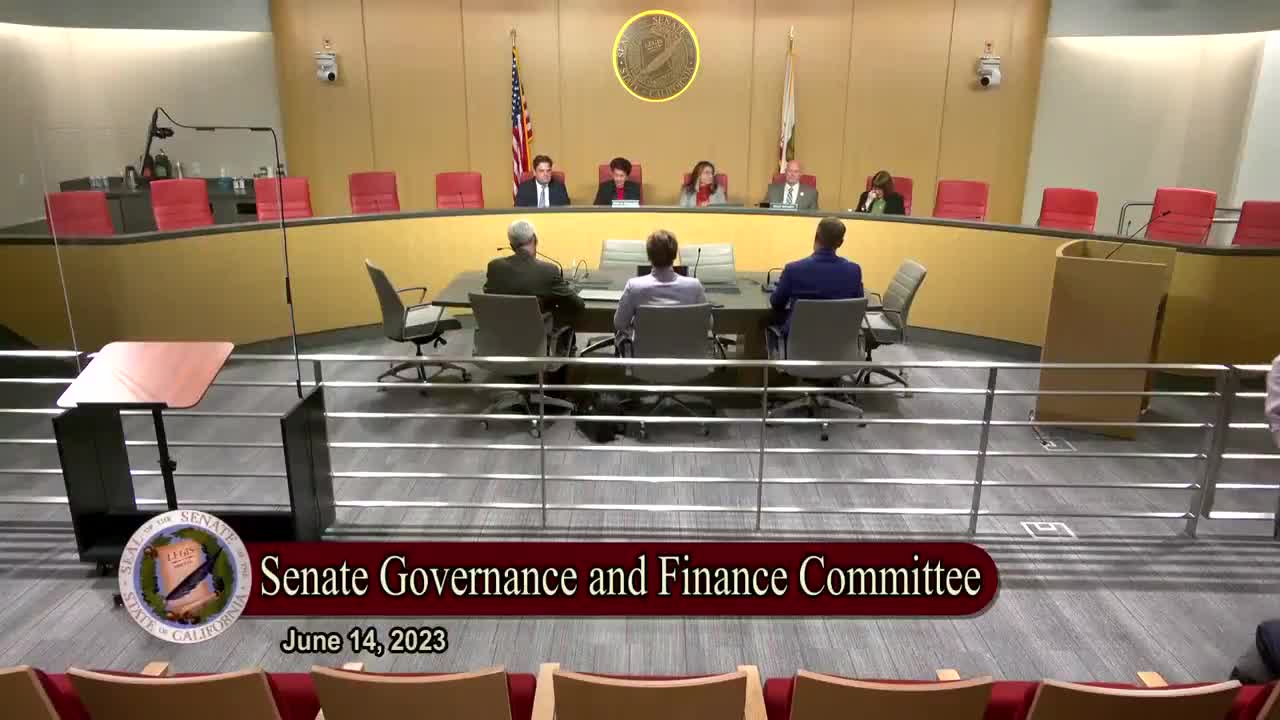 14MIN
Senate Standing Committee on Governance and Finance
 1MIN
Assembly Floor
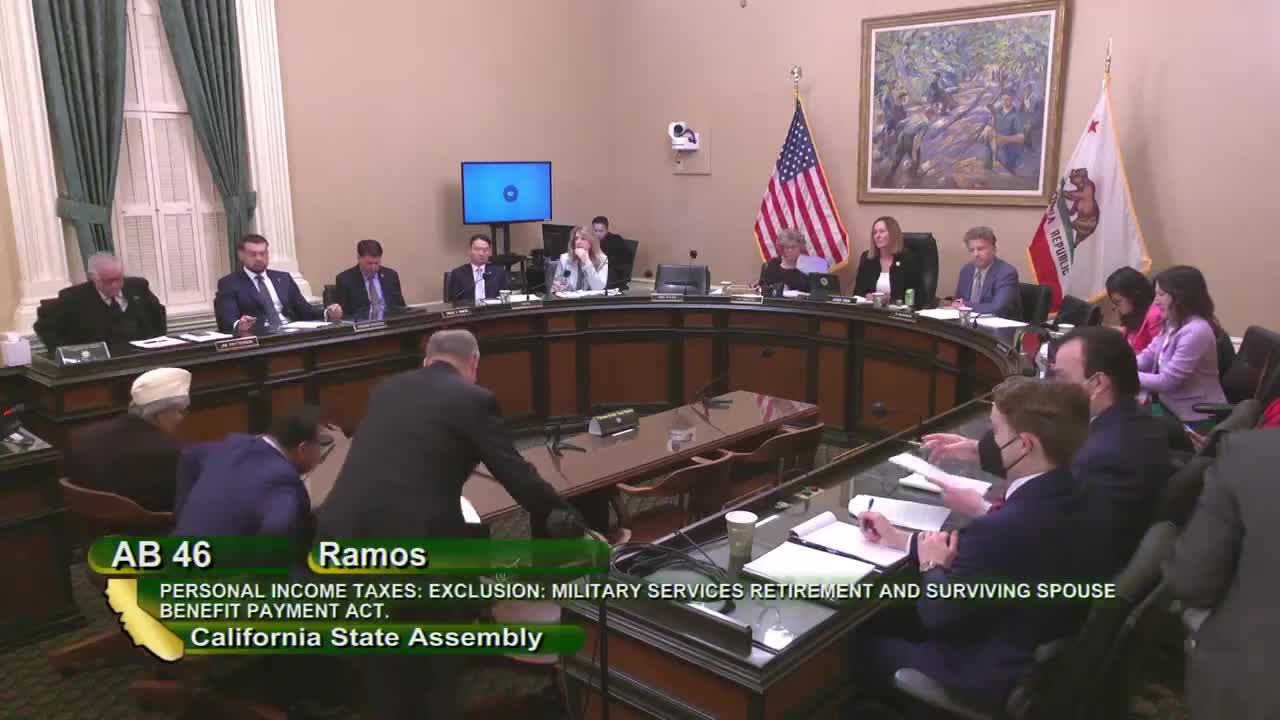 11MIN
Assembly Standing Committee on Revenue and Taxation


Bill Co-Author(s):