AB 886: California Journalism Preservation Act.
- Session Year: 2023-2024
- House: Assembly
- Latest Version Date: 2024-06-27
Current Status:
Failed
(2024-08-15: In committee: Reconsideration of a favorable vote granted.)
Introduced
In Committee
First Chamber
In Committee
Second Chamber
Enacted
What does this bill do?
The bill requires very large online platforms to either pay digital news publishers for accessing their websites for California audiences or enter a final arbitration (a private legal decision) that sets a share of the platform’s advertising revenue to pay publishers. It also makes platforms publish and provide a list of publishers they accessed, bans retaliation like downgrading a publisher’s content for asserting rights, and requires publishers to spend most payments on journalists and support staff and file annual public reports about how the money was used.
The summary is provided by generative AI which can make mistakes. For original language, please view the details in the table below.
Existing law generally regulates online platforms, including by requiring, on a semiannual basis and as specified, a social media company to submit to the Attorney General a terms of service report that includes, among other things, the current version of the terms of service of the social media platform.
This bill, the California Journalism Preservation Act, would require a covered platform, as defined, to either pay at least $____ annually to compensate digital journalism providers, as defined, for accessing the internet websites of the providers, providers for a California audience, where the money is annually adjusted, as specified, and annually distributed to digital journalism providers, as described, or to participate in a final arbitration process, as specified, and fully pay the arbitration award, as provided. The bill would require, commencing not later than March 1, 2025, a covered platform to compile and post on its internet website a list of digital journalism providers providers, as described, that the platform accessed for a California audience during the preceding 12 months. The bill would require a covered platform to provide the above-described list to any digital journalism provider upon request, as specified, and to establish a designated email address to which a request may be submitted.
This bill would prohibit a covered platform from retaliating against a digital journalism provider for asserting its rights under the act by refusing to access content or changing the ranking, identification, modification, branding, or placement of the content of the digital journalism provider on the covered platform. The bill would require a digital journalism provider to spend at least 70% of funds received pursuant to the act on news journalists and support staff employed by the digital journalism provider. The bill would require an eligible digital journalism provider with 5 or fewer employees, to spend at least 50% of funds received pursuant to these provisions on news journalists and support staff employed by the digital journalism provider.
This bill would require, no later than one year after the end of an arbitration proceeding or reaching a settlement in lieu of an arbitration proceeding, or receiving a payment, as specified, and each year thereafter, the digital journalism provider to compile a report containing, among other things, an attestation that the digital journalism provider has complied with the revenue sharing provisions described above. The bill would require a digital journalism provider to publish and distribute that report, as specified. By expanding the scope of the crime of perjury, this bill would impose a state-mandated local program. The bill would authorize a digital journalism provider to seek and obtain injunctive relief to compel compliance, as specified, and would require court costs and reasonable attorneys fees to be awarded to a prevailing provider. The bill would state that its provisions are severable.
The California Constitution requires the state to reimburse local agencies and school districts for certain costs mandated by the state. Statutory provisions establish procedures for making that reimbursement.
This bill would provide that no reimbursement is required by this act for a specified reason.
Existing law generally regulates online platforms, including by requiring, on a semiannual basis and as specified, a social media company to submit to the Attorney General a terms of service report that includes, among other things, the current version of the terms of service of the social media platform.
This bill, the California Journalism Preservation Act, would require, within 10 days of the close of each quarter, a covered platform, as defined, to remit a journalism usage fee payment to each eligible digital journalism provider, as defined, that submits to the covered platform a certain notice. Under the bill, the journalism usage fee payment would be equal to a percentage, as determined by a certain arbitration process, of the covered platforms advertising revenue generated during that quarter multiplied by the eligible digital journalism providers allocation share, as defined, for that quarter.This bill would require the notice described above to, among other things, certify, not under penalty of perjury, that the eligible digital journalism provider reasonably believes that it is either an eligible broadcaster, as defined, or an eligible publisher, as defined. The bill would authorize a covered platform, within 30 days of having received the notice, to challenge the sufficiency of the notice or the noticing partys qualification as an eligible digital journalism provider.This bill, the California Journalism Preservation Act, would require a covered platform, as defined, to either pay at least $____ annually to compensate digital journalism providers, as defined, for accessing the internet websites of the providers, where the money is annually adjusted, as specified, and annually distributed to digital journalism providers, as described, or to participate in a final arbitration process, as specified, and fully pay the arbitration award, as provided. The bill would require, commencing not later than March 1, 2025, a covered platform to compile and post on its internet website a list of digital journalism providers that the platform accessed for a California audience during the preceding 12 months. The bill would require a covered platform to provide the above-described list to any digital journalism provider upon request, as specified, and to establish a designated email address to which a request may be submitted.
This bill would prohibit a covered platform from retaliating against an eligible a digital journalism provider for asserting its rights under the act by refusing to index access content or changing the ranking, identification, modification, branding, or placement of the content of the eligible digital journalism provider on the covered platform. The bill would require an eligible a digital journalism provider to spend at least 70% of funds received pursuant to the act on news journalists and support staff employed by the eligible digital journalism provider. The bill would require an eligible digital journalism provider with 5 or fewer employees, to spend at least 50% of funds received pursuant to these provisions on news journalists and support staff employed by the eligible digital journalism provider.
This bill would require, no later than one year after the end of an arbitration proceeding or reaching a settlement, settlement in lieu of an arbitration proceeding, or receiving a payment, as specified, and each year thereafter, the eligible digital journalism provider to compile a report containing, among other things, the number of usage fees received from covered platforms, the name of each covered platform paying it a usage fee, and how it spent the usage fee payment. The bill would also require the eligible digital journalism provider at those times to publish a copy of the report online and to provide it to the news journalists and support staff it employs and the covered platforms paying the fees. an attestation that the digital journalism provider has complied with the revenue sharing provisions described above. The bill would require a digital journalism provider to publish and distribute that report, as specified. By expanding the scope of the crime of perjury, this bill would impose a state-mandated local program. The bill would authorize a digital journalism provider to seek and obtain injunctive relief to compel compliance, as specified, and would require court costs and attorneys fees to be awarded to a prevailing provider. The bill would state that its provisions are severable.
The California Constitution requires the state to reimburse local agencies and school districts for certain costs mandated by the state. Statutory provisions establish procedures for making that reimbursement.
This bill would provide that no reimbursement is required by this act for a specified reason.
Existing law generally regulates online platforms, including by requiring, on a semiannual basis and as specified, a social media company to submit to the Attorney General a terms of service report that includes, among other things, the current version of the terms of service of the social media platform.
This bill, the California Journalism Preservation Act, would require, within 10 days of the close of each month, quarter, a covered platform, as defined, to remit a journalism usage fee payment to each eligible digital journalism provider, as defined, that submits to the covered platform a certain notice. Under the bill, the journalism usage fee payment would be equal to a percentage, as determined by a certain arbitration process, of the covered platforms advertising revenue generated during that month quarter multiplied by the eligible digital journalism providers allocation share, as defined, for that month. quarter.
This bill would require the notice described above to, among other things, certify, not under penalty of perjury, that the eligible digital journalism provider reasonably believes that it is either an eligible broadcaster, as defined, or an eligible publisher, as defined. The bill would authorize a covered platform, within 30 days of having received the notice, to challenge the sufficiency of the notice or the noticing partys qualification as an eligible digital journalism provider.
This bill would prohibit a covered platform from retaliating against an eligible digital journalism provider for asserting its rights under the act by refusing to index content or changing the ranking, identification, modification, branding, or placement of the content of the eligible digital journalism provider on the covered platform. The bill would require an eligible digital journalism provider to spend at least 70% of funds received pursuant to the act on news journalists and support staff employed by the eligible digital journalism provider. The bill would require an eligible digital journalism provider with 5 or fewer employees, to spend at least 50% of funds received pursuant to these provisions on news journalists and support staff employed by the eligible digital journalism provider.
This bill would require, no later than one year after the end of an arbitration proceeding or a settlement, and each year thereafter, the eligible digital journalism provider to compile a report containing, among other things, the number of usage fees received from covered platforms, the name of each covered platform paying it a usage fee, and how it spent the usage fee payment. The bill would also require the eligible digital journalism provider at those times to publish a copy of the report online and to provide it to the news journalists and support staff it employs and the covered platforms paying the fees. The bill would state that its provisions are severable.
Existing law generally regulates online platforms, including by requiring, on a semiannual basis and as specified, a social media company to submit to the Attorney General a terms of service report that includes, among other things, the current version of the terms of service of the social media platform.
This bill, the California Journalism Preservation Act, would require, within an unspecified number of 10 days of the close of each month, a covered platform, as defined, to remit a journalism usage fee payment to each eligible digital journalism provider, as defined, that submits to the covered platform a certain notice that is notice. Under the bill, the journalism usage fee payment would be equal to a percentage, as determined by a certain arbitration process, of the covered platforms advertising revenue generated during that month multiplied by the eligible digital journalism providers allocation share, as defined, for that month. The
This bill would require the notice described above to, among other things, certify, not under penalty of perjury, that the eligible digital journalism provider reasonably believes that it is either an eligible broadcaster, as defined, or an eligible publisher, as defined. The bill would authorize a covered platform that receives that notice to, platform, within an unspecified number of 30 days of having received the notice, to challenge the sufficiency of the notice and or the noticing partys qualification as an eligible digital journalism provider. The
This bill would prohibit a covered platform from retaliating against an eligible digital journalism provider for asserting its rights under the act by refusing to index content or changing the ranking, identification, modification, branding, or placement of the content of the eligible digital journalism provider on the covered platform. The bill would require an eligible digital journalism provider to spend at least 70% of funds received pursuant to the act on news journalists and support staff employed by the eligible digital journalism provider and maintaining or enhancing the production and distribution of news or information that concerns local, regional, national, or international matters of public interest. provider.
This bill would require, no later than one year after the end of an arbitration proceeding or a settlement, and each year thereafter, the eligible digital journalism provider to compile a report containing, among other things, the number of usage fees received from covered platforms, the name of each covered platform paying it a usage fee, and how it spent the usage fee payment. The bill would also require the eligible digital journalism provider at those times to publish a copy of the report online and to provide it to the news journalists and support staff it employs and the covered platforms paying the fees. The bill would state that its provisions are severable.
Existing law generally regulates online platforms, including by requiring, on a semiannual basis and as specified, a social media company to submit to the Attorney General a terms of service report that includes, among other things, the current version of the terms of service of the social media platform.
This bill, the California Journalism Preservation Act, would require, within an unspecified number of days of the close of each month, a covered platform, as defined, to remit a journalism usage fee payment to each eligible digital journalism provider, as defined, that submits to the covered platform a certain notice that is equal to an unspecified percent a percentage, as determined by a certain arbitration process, of the covered platforms advertising revenue generated during that month multiplied by the eligible digital journalism providers allocation share, as defined, for that month. The bill would require the notice described above to, among other things, certify, not under penalty of perjury, that the eligible digital journalism provider reasonably believes that it is either an eligible broadcaster, as defined, or an eligible publisher, as defined. The bill would authorize a covered platform that receives that notice to, within an unspecified number of days of having received the notice, challenge the sufficiency of the notice and the noticing partys qualification as an eligible digital journalism provider. The bill would prohibit a covered platform from retaliating against an eligible digital journalism provider for asserting its rights under the act by refusing to index content or changing the ranking, identification, modification, branding, or placement of the content of the eligible digital journalism provider on the covered platform. The bill would require an eligible digital journalism provider to spend at least 70% of funds received pursuant to the act on news journalists employed by the eligible digital journalism provider and maintaining or enhancing the production and distribution of news or information that concerns local, regional, national, or international matters of public interest.
Existing law generally regulates online platforms, including by requiring, on a semiannual basis and as specified, a social media company to submit to the Attorney General a terms of service report that includes, among other things, the current version of the terms of service of the social media platform.
This bill, the California Journalism Preservation Act, would require, within an unspecified number of days of the close of each month, a covered platform, as defined, to remit a journalism usage fee payment to each eligible digital journalism provider, as defined, that submits to the covered platform a certain notice that is equal to an unspecified percent of the covered platforms advertising revenue generated during that month multiplied by the eligible digital journalism providers allocation share, as defined, for that month. The bill would require the notice described above to, among other things, certify, not under penalty of perjury, that the eligible digital journalism provider reasonably believes that it is either an eligible broadcaster, as defined, or an eligible publisher, as defined. The bill would authorize a covered platform that receives that notice to, within an unspecified number of days of having received the notice, challenge the sufficiency of the notice and the noticing partys qualification as an eligible digital journalism provider. The bill would prohibit a covered platform from retaliating against an eligible digital journalism provider for asserting its rights under the act by refusing to index content or changing the ranking, identification, modification, branding, or placement of the content of the eligible digital journalism provider on the covered platform. The bill would require an eligible digital journalism provider to spend at least 70% of funds received pursuant to the act on news journalists employed by the eligible digital journalism provider and maintaining or enhancing the production and distribution of news or information that concerns local, regional, national, or international matters of public interest.
Existing law defines holidays, for purposes of provisions relating to civil law, as every Sunday and other days specified in the Government Code.This bill would make nonsubstantive changes to this provision.Existing law defines holidays, for purposes of provisions relating to civil law, as every Sunday and other days specified in the Government Code.
This bill would make nonsubstantive changes to this provision.
This act shall be known as the California Journalism Preservation Act.
SEC. 2.The Legislature finds and declares all of the following:
(a)A free and diverse fourth estate was critical in the founding of our democracy and continues to be the lifeblood for a functional society.
(b)California has a compelling interest in protecting businesses that report and distribute news from unfair business practices and competition. Every day, journalism plays an essential role in California and in local communities, and the ability of local news organizations to continue to provide the public with critical information about their communities and enabling publishers to receive fair market value for their content that is used by others will preserve and ensure the sustainability of local and diverse news outlets.
(c)Communities without newspapers lose touch with government, business, education, and neighbors. They operate without journalists working to keep them informed, uncover truth, expose corruption, and share common goals and experiences.
(d)Over the past 10 years, newspaper advertising has decreased 66 percent, and newsroom staff have declined 44 percent.
(e)Ethnic media has long been a distinctive genre of journalism and communications, informing, engaging, and advocating on behalf of communities underserved by both the for-profit and not-for-profit general market media. It plays a unique role in upholding the fourth estate in our democracy by facilitating cross-racial and cross-ethnic communications to facilitate social integration, promote civic engagement, and address inequalities among all of the underserved communities.
(f)Given the important role of ethnic media, it is critical to advance state policy that ensures their publishers are justly compensated for the content they create and distribute. An excellent example is the historic preamble, We Wish to Plead Our Own Cause, a document penned by the African American journalist and abolitionist Samuel Cornish in 1827. It marked a significant milestone in the history of the Black press as it highlighted the urgent need for African Americans to have their own platform to voice their grievances, advocate for their rights, and challenge racial inequality. This call to action spurred the establishment of numerous Black-owned newspapers and publications, solidifying the role of the Black press as a powerful tool for empowerment and social change, and laid the groundwork in our country for other ethnic media to plead their own cause.
(g)Quality local journalism is key to sustaining civic society, strengthening communal ties, and providing information at a deeper level that national outlets cannot match.
(h)Seventy-three percent of United States adults surveyed said they have confidence in their local newspaper.
SEC. 3.Title 23 (commencing with Section 3273.80) is added to Part 4 of Division 3 of the Civil Code, to read:23.Compensation for Journalism Usage3273.80.For purposes of this title, the following definitions apply:
(a)Access means to acquire, to crawl, or to index content.
(b)Advertising revenue means revenue generated through the sale of digital advertising impressions that are served to customers in the state through an online platform, regardless of whether those impressions are served on internet websites or accessed through online or mobile applications.
(c)(1)Covered platform means an online platform that at any point during a 12-month period meets both of the following criteria:
(A)The online platform has at least 50,000,000 United States-based monthly active users or subscribers on the online platform.
(B)The online platform is owned or controlled by a person with either of the following:
(i)United States net annual sales or a market capitalization greater than five hundred fifty billion dollars ($550,000,000,000), adjusted annually for inflation on the basis of the Consumer Price Index published by the United States Bureau of Labor Statistics.
(ii)At least 1,000,000,000 worldwide monthly active users on the online platform.
(2)Covered platform does not mean either of the following:
(A)An organization exempt from federal income taxation pursuant to Section 501(c)(3) of the Internal Revenue Code of 1986.
(B)A company where at least that earns fewer than 50 percent of its annual revenue, as calculated at the level of the ultimate corporate parent, is from the manufacturing and sales of company-branded devices and hardware to consumers. from its online platform, advertising, and search services.
(d)Digital journalism provider means a publisher or eligible broadcaster that discloses its ownership to the public.
(e)Eligible broadcaster means a person that meets all of the following criteria:
(1)The person holds or operates under a license issued by the Federal Communications Commission under Subchapter III (commencing with Section 301) of Chapter 5 of Title 47 of the United States Code. Code, and has held or operated under the license for the prior two years.
(2)The person engages professionals to create, edit, produce, and distribute original content concerning local, regional, national, or international matters of public interest through activities, including conducting interviews, observing current events, analyzing documents and other information, or fact checking through multiple firsthand or secondhand news sources.
(3)The person updates its content on at least a weekly basis.
(4)The person uses an editorial process for error correction and clarification, including a transparent process for reporting errors or complaints to the station.
(f)News journalist means a natural person who meets both of the following criteria:
(1)The person is employed for an average of at least 30 hours per week during a calendar quarter by the digital journalism provider.
(2)The person is responsible for gathering, developing, preparing, directing the recording of, producing, collecting, photographing, recording, writing, editing, reporting, designing, presenting, or publishing original news or information that concerns local, regional, national, or international matters of public interest.
(g)Online platform means an internet website, online or mobile application, digital assistant, or online service that does both of the following:
(1)Accesses news articles, works of journalism, or other content, or portions thereof, generated, created, produced, or owned by a digital journalism provider.
(2)Aggregates, displays, provides, distributes, or directs users to content described in paragraph (1).
(h)Publisher means a person that publishes a qualifying publication.
(i)Qualified arbitrator means an arbitration organization that has established arbitration rules and procedures for at least one year prior to the initiation of the arbitration.
(j)Qualifying publication means an internet website, online or mobile application, or other digital service that meets all of the following criteria:
(1)The internet website, online or mobile application, or other digital service does not primarily display, provide, distribute, or offer content generated, created, produced, or owned by an eligible broadcaster.
(2)The internet website, online or mobile application, or other digital service provides information to an audience in the state. state and has done so for the prior two years.
(3)The internet website, online or mobile application, or other digital service performs a public information function comparable to that traditionally served by newspapers and other periodical news publications.
(4)The internet website, online or mobile application, or other digital service engages professionals to create, edit, produce, and distribute original content or original content for which a valid license has been obtained concerning local, regional, national, or international matters of public interest through activities, including conducting interviews, observing current events, analyzing documents and other information, or fact checking through multiple firsthand or secondhand news sources.
(5)The internet website, online or mobile application, or other digital service updates its content on at least a weekly basis.
(6)The internet website, online or mobile application, or other digital service has an editorial process for error correction and clarification, including a transparent process for reporting errors or complaints to the publication.
(7)The internet website, online or mobile application, or other digital service meets any of the following criteria:
(A)The internet website, online or mobile application, or other digital service generated at least one hundred thousand dollars ($100,000) in annual revenue from its editorial content in the previous calendar year.
(B)The internet website, online or mobile application, or other digital service had an International Standard Serial Number assigned to an affiliated periodical before January 1, 2025.
(C)The internet website, online or mobile application, or other digital service is owned or controlled by an organization exempt from federal income taxation pursuant to Section 501(c)(3) of the Internal Revenue Code of 1986.
(8)The internet website, online or mobile application, or other digital service has at least 25 percent of its editorial content consisting of information about topics of current local, regional, national, or international public interest.
(9)The internet website, online or mobile application, or other digital service is not controlled, or wholly or partially owned by, an entity that meets any of the following criteria:
(A)The entity is a foreign power or an agent of a foreign power, as those terms are defined in Section 1801 of Title 50 of the United States Code.
(B)The entity is designated as a foreign terrorist organization pursuant to Section 1189 of Title 8 of the United States Code.
(C)The entity is a terrorist organization, as defined in Section 1182 of Title 8 of the United States Code.
(D)The entity is designated as a specially designated global terrorist organization under federal Executive Order 13224.
(E)The entity is an affiliate of an entity described in subparagraph (A), (B), (C), or (D).
(F)The entity that has been convicted of violating, or attempting to violate, Section 2331, 2332b, or 2339A of Title 18 of the United States Code.
(k)Representative means a labor organization designated as the exclusive bargaining representative of news journalists or support staff for the purposes of collective bargaining in accordance with applicable state or federal law.
(l)Support staff means a natural person who performs nonexecutive functions, including payroll, human resources, fundraising and grant support, advertising and sales, community events and partnerships, technical support, sanitation, and security.
3273.81.A covered platform shall do either of the following:
(a)Pay at least ____ dollars ($____) annually to compensate digital journalism providers for accessing the internet websites of the providers, providers for a California audience, where those amounts are annually adjusted for increases in the Consumer Price Index and annually distributed to digital journalism providers as follows:
(1)No less than 1 percent of this amount shall be paid to digital journalism providers that would receive less than twenty-five thousand dollars ($25,000) pursuant to paragraph (2) to be distributed annually proportionally by the number of news journalists and, subject to subparagraph (B) of paragraph (2) of subdivision (a) of Section 3273.86, freelancers who, in the previous calendar year, were employed by each qualifying publication for the primary purpose of producing content for a California audience among those digital journalism providers, in addition to the amount those providers would receive pursuant to paragraph (2).
(2)Proportionally by the number of news journalists and, subject to subparagraph (B) of paragraph (2) of subdivision (a) of Section 3273.86, freelancers, who, in the previous calendar year, were employed by each qualifying publication for the primary purpose of producing content for a California audience.
(b)Participate in a final arbitration process under Section 3273.84 and fully pay the arbitration award, if any, to the administrator engaged pursuant to subdivision (a) of Section 3273.82 within 30 days of the award, or to each participating digital journalism provider within 90 days of the award.
3273.82.(a)A covered platform shall make distributions pursuant to Section 3273.81 by doing either of the following:
(1)Engaging an approved claims administrator to administer the distributions. distribute the annual payments to digital journalism providers.
(A)In selecting an approved claims administrator the covered platform shall ensure that the administrator is well qualified to perform the distribution and has administered multiple settlements in the State of California that comply with complex civil litigation class action settlement guidelines in at least three state or federal courts in California.
(B)The cost of the claims administrator shall be in addition to the amount specified in Section 3273.81.
(2)Distributing the annual payments to digital journalism providers itself, the costs of which shall be in addition to the amount specified in Section 3273.81.
(b)An administrator distributing payments pursuant to paragraph (1) of subdivision (a) or a covered platform distributing payments pursuant to paragraph (2) of subdivision (a) shall do all of the following:
(1)Prepare an annual statement of account related to the distribution activities, certified by a certified public accountant.
(2)Identify a point of contact for digital journalism provider inquiries with timely redress.
(3)Establish policies to resolve disputes, guard against fraud and abuse, and ensure that any undistributable funds are reallocated among participating digital journalism providers after a reasonable holding period pursuant to Section 3273.81.
(4)Publish on its internet website and the covered platforms internet website an annual report detailing nonconfidential operations of the fund, including the digital journalism providers that received compensation and the amount paid. If the covered platform has engaged a claims administrator to distribute the payments, the administrator shall provide the report to the covered platform and the covered platform shall also publish the report on its internet website.
(c)(1)On or before April 1, 2025, a covered platform shall identify a point of contact for email or other electronically communicated digital journalism provider inquiries.
(2)Digital (A)A digital journalism providers provider that want wishes to receive payments an annual payment pursuant to subdivision (a) of Section 3273.81 shall submit notice to the point of contact by May 1, 2025.
(B)The notice shall include, at a minimum, the name of the digital journalism provider, the number of eligible journalists employed or claimed pursuant to Section 3273.86, and a contact person for the publication.
(C)The covered platform may institute reasonable measures to verify that the notice was sent by an actual representative of the publication.
(d)(1)A digital journalism provider who, after utilizing in good faith the dispute resolution process established pursuant to paragraph (3) of subdivision (b), is aggrieved by the decision of the payment distributor may initiate an arbitration of the dispute by a qualified arbitrator.(2)In an arbitration pursuant to paragraph (1), the payment distributor shall pay the cost of the qualified arbitrator.(e)(d)A covered platform distributing payments pursuant to paragraph (2) of subdivision (a) shall retain a qualified auditor to examine relevant books and records with respect to the distributions as part of an annual audit.
(f)(e)A final arbitration award under Section 3273.84 to a jointly participating group of digital journalism providers shall be distributed proportionally by the number of news journalists and, subject to subparagraph (B) of paragraph (2) of subdivision (a) of Section 3273.86, freelancers, who, in the previous calendar year, were employed by each participating provider for the primary purpose of producing content for a California audience.
(g)Any
(f)The amount of any compensation received by a digital journalism provider through a commercial agreement for access to content by the covered platform prior to commencement of arbitration or payment by a covered platform pursuant to subdivision (a) of Section 3273.81 that was offset pursuant to subparagraph (C) of paragraph (3) of subdivision (g) of Section 3273.84 shall be deducted from its allocation accordingly.
(g)(1)A digital journalism provider that disagrees with the determination of their eligibility or the amount of compensation awarded may seek a review of the determination as follows:
(A)(i)If the covered platform has retained a claims administrator, the digital journalism provider shall seek redress through the dispute resolution process established pursuant to paragraph (3) of subdivision (b).
(ii)If the digital journalism provider disagrees with the result of the dispute resolution process, the digital journalism provider may initiate an arbitration of the dispute by a qualified arbitrator.
(B)If the covered platform has not retained a claims administrator, the digital journalism provider may initiate an arbitration of the dispute by a qualified arbitrator.
(2)Any challenge pursuant to paragraph (1) shall be made within 10 days of receiving notice of the eligibility decision or compensation determination to be challenged.
(3)In an arbitration pursuant to paragraph (1), the claims administrator or covered platform, as applicable, shall pay the cost of the qualified arbitrator.
(h)A digital journalism provider shall not be denied compensation under this section on the basis that the provider publishes or broadcasts, in whole or in part, in a language other than English.
3273.83.(a)Commencing no later than March 1, 2025, a covered platform shall compile and post on its internet website a list of digital journalism providers that the platform accessed for a California audience during the preceding 12 months.
(b)A covered platform shall provide that list to any digital journalism provider upon request within three days after the request is submitted and shall establish a designated email address to which a request may be submitted.
(c)A digital journalism provider shall not be excluded from the list or the arbitration under Section 3273.84 on the basis that the provider publishes or broadcasts, in whole or in part, in a language other than English.
3273.84.(a)(1)In an arbitration initiated pursuant to subdivision (b) of Section 3273.81, the arbitrator shall solely determine the percentage of the covered platforms advertising revenue to be remitted to participating digital journalism providers on an annual basis pursuant to this section. Digital
(2)Digital journalism providers shall jointly participate in the a final offer arbitration process with a covered platform described in this section with each covered platform to determine a single percentage of the covered platforms advertising revenue from which the distributions described in subdivision (f) (e) of Section 3273.82 will be allotted. Covered platforms shall not participate jointly in a final offer arbitration process.
(2)(3)Within 30 days after a covered platform posts the list of digital journalism providers pursuant to subdivision (a) of Section 3273.83, by a majority vote, participating digital journalism providers shall establish rules and procedures to govern decisionmaking regarding the arbitration proposal or any settlement reached pursuant to subdivision (c) and each eligible digital journalism provider shall be entitled to one vote on any matter submitted to a vote of the members.
(3)(4)The covered platform or digital journalism providers may initiate a final offer arbitration with a qualified arbitrator for an arbitration panel to determine the percentage of the covered platforms advertising revenue remitted to the participating digital journalism providers.
(b)Nothing in this section shall be interpreted as preventing a digital journalism provider from being individually represented in the joint arbitration process in subdivision (a).
(c)Prior to the commencement of the final offer arbitration, there shall be 60 days of mediation between the covered platforms and digital journalism providers to reach a settlement. If no agreement is reached, the final offer arbitration shall commence 10 days after the conclusion of the mediation period. If an agreement is reached through mediation, the arbitrator may approve the agreement, in which case the group will not proceed to arbitration.
(d)The arbitration procedure authorized by this section shall be decided by a panel of three arbitrators affiliated with the qualified arbitrator under the rules of the arbitrator except to the extent they conflict with this section.
(e)The covered platform and the digital journalism providers shall each pay one-half of the cost of administering the arbitration proceeding, including arbitrator compensation, expenses, and administrative fees. The costs for the digital journalism providers shall be deducted from the amount awarded before the calculation in subdivision (f) (e) of Section 3273.82.
(f)During a final offer arbitration proceeding under this section, all of the following shall apply:
(1)(A)(i)Digital journalism providers and the covered platform may demand the production of business records that are relevant to the single percentage of a covered platforms advertising revenue to be awarded to participating digital journalism providers and that are nonprivileged, reasonably necessary, and reasonably accessible without undue expense.
(ii)For A covered platform seeking the production of business records of a digital journalism providers provider that qualify qualifies for a distribution pursuant to subparagraph (A) of paragraph (1) of subdivision (a) of Section 3273.81, documents and information requested shall be limited to one request for documents and information and the covered platform requesting the information shall, within 10 days, reimburse the provider for the reasonable costs of production, including attorneys reasonable attorneys fees.
(B)Documents and information described in subparagraph (A) shall be exchanged not later than 30 days after the date the demand is filed.
(2)Digital journalism providers and the covered platform shall each submit a final offer proposal for the remuneration that the digital journalism providers should receive receive, on an annual basis, from the covered platform for access to the internet websites or other digital services of the digital journalism providers during the period under arbitration for an audience in California based on the value that access provides to the platform. The final offer proposals shall include backup materials sufficient to permit the other party to replicate the proffered valuation.
(3)A final offer proposal pursuant to this section shall not address whether or how the covered platform or any digital journalism provider displays, ranks, distributes, suppresses, promotes, throttles, labels, filters, or curates the content of the digital journalism providers or any other person.
(g)(1)Not later than 60 days after the date arbitration proceedings begin pursuant to subdivision (c), the arbitration panel shall determine the percentage of the covered platforms advertising revenue to be remitted by the covered platform to the participating digital journalism providers from a final offer from one of the parties without modification. which of the parties final offer proposals to accept pursuant to paragraph (2) of subdivision (f). The arbitration panel shall accept one of the two offers without modification.
(2)In making a determination pursuant to paragraph (1), the arbitration panel shall do all of the following:
(A)Refrain from considering any value conferred upon any digital journalism provider by the covered platform for distributing or aggregating its content content, other than monetary compensation agreed to by the digital journalism provider in a written commercial agreement with the platform, as an offset to the value created by that digital journalism provider, unless the covered platform does not automatically access and extract information from a digital journalism providers internet website.
(B)Consider past incremental revenue contributions as a guide to the future incremental revenue contribution by any digital journalism provider.
(C)Consider the pricing, terms, and conditions of any available, comparable commercial agreements between parties granting access to digital content, including pricing, terms, and conditions relating to price, duration, territory, and the value of data generated directly or indirectly by the content accounting for any material disparities in negotiating power between the parties to those commercial agreements.
(D)If submitted with a final offer proposal, consider the digital journalism providers previous compliance with Section 3273.86, if applicable.
(E)Issue a standard binding arbitration award of the percentage of the covered platforms advertising revenue remitted to participating digital journalism providers.
(3)Within 15 days of accepting a final offer proposal, the arbitration panel shall issue an order setting forth the final amount that the covered platform pay on an annual basis pursuant to Section 6273.81. The order shall do all of the following:
(A)Set forth the amount of the final offer accepted by the arbitration panel.
(B)Require the covered platform to pay the final offer amount on an annual basis.
(C)(i)If applicable, authorize the covered platform to reduce the total payment by the total amount of all commercial agreements the covered platform has with any participating digital journalism provider that participated in the arbitration for the covered period.
(ii)To receive an offset under this subparagraph, the covered platform shall provide to the arbitration panel copies of all of the commercial agreements for which it seeks an offset.
(iii)The platform may offset its annual payment for a payment made pursuant to a commercial agreement only by the amount actually paid under that agreement each year.
(D)The date of the order.
(3)(4)Any party to the arbitration proceeding may elect to appeal the decision of the arbitration panel pursuant to Section 3273.88 on the grounds of a procedural irregularity. any ground permitted under subsection (a) of Section 10 of Title 9 of the United States Code.
(h)If the covered platform and digital journalism providers reach a settlement in lieu of arbitration, the settlement shall not waive the digital journalism providers obligations pursuant to Section 3273.86.
(i)No less than 1 percent of each arbitration award shall be paid to digital journalism providers that would receive less than twenty-five thousand dollars ($25,000), to be distributed annually proportionally by the number of news journalists and, subject to subparagraph (B) of paragraph (2) of subdivision (a) of Section 3273.86, freelancers who, in the previous calendar year, were employed by each qualifying publication for the primary purpose of producing content for a California audience among those digital journalism providers, in addition to the amount those providers would receive pursuant to paragraph (1) of subdivision (g).
(j)No fewer than 24 months after the end of an arbitration proceeding, any (1)Any party to the proceeding may elect to reinitiate the arbitration process. process on a date no fewer than 24 months from the date of the order in paragraph (3) of subdivision (g).
(2)The order shall remain in effect until the issuance of a superseding order.
3273.85.(a)A covered platform shall not retaliate against a digital journalism provider for asserting its rights under this title by refusing to access content or changing the ranking, identification, modification, branding, or placement of the content of the digital journalism provider on the covered platform.
(b)A digital journalism provider that is retaliated against may bring a civil action against the covered platform.
(c)This section does not prohibit a covered platform from, and does not impose liability on a covered platform for, enforcing its terms of service against a journalism provider.
3273.86.(a)(1) Except as provided in paragraph (2), a digital journalism provider shall spend at least 70 percent of funds received pursuant to this title on news journalists and support staff employed by the digital journalism provider.
(2)(A)A digital journalism provider with five or fewer employees shall spend at least 50 percent of funds received pursuant to this title on news journalists and support staff employed by the digital journalism provider.
(B)For the purpose of calculating an allocation from a covered platform pursuant to subdivision (a) of Section 3273.81 and subdivision (f) (e) of Section 3273.82, or for establishing a digital journalism providers minimum allocation to news journalists and support staff pursuant to this section, a digital journalism provider with five or fewer employees may elect to count dollars spent on the equivalent functions performed by news journalists as follows:
(i)The digital journalism provider shall employ at least one news journalist for the primary purpose of producing content for a California audience.
(ii)Each forty thousand dollars ($40,000) spent by a digital journalism provider in the previous calendar year to compensate other natural persons performing the functions defined by paragraph (2) of subdivision (f) of Section 3273.80 may claim to employ the equivalent of one news journalist, up to a maximum of one hundred sixty thousand dollars ($160,000) or the equivalent of four news journalists, with those amounts subsequently annually adjusted for increases in the Consumer Price Index. In no instance may the total number of news journalists and their equivalents claimed pursuant to this clause exceed the number of natural persons compensated by the digital journalism provider.
(b)No later than 30 days after the end of an arbitration proceeding described in Section 3273.84, reaching a settlement in lieu of an arbitration proceeding, or receiving a payment pursuant to subdivision (a) of Section 3273.81, the digital journalism provider shall provide notification in writing of its plan to comply with subdivision (a) to the news journalists and support staff employed by the digital journalism provider and any representatives of those news journalists or support staff.
(c)The digital journalism providers plan to comply with subdivision (a) shall include a good faith estimate of the number of news journalists and support staff, respectively, if any, expected to be hired, details regarding proposed compensation adjustments, if any, and a disclosure if either hiring or compensation adjustments are not expected.
3273.87.(a)No later than one year after the end of an arbitration proceeding described in Section 3273.84, or reaching a settlement in lieu of an arbitration proceeding, or receiving a payment pursuant to subdivision (a) of Section 3273.81, and each year thereafter, the digital journalism provider shall compile a report that includes all of the following:
(1)An attestation as to whether the digital journalism provider has complied with subdivision (a) of Section 3273.86.
(2)The text of the digital journalism providers plan to comply with subdivision (a) of Section 3273.86.
(3)The total number of payments under this title received from covered platforms.
(4)The name of each covered platform paying the digital journalism provider a payment under this title and a description of how the digital journalism provider spent the payment, including any amount of payments under this title remaining unspent.
(5)The total number of news journalists and support staff respectively staff, respectively, employed by the digital journalism provider, including the number of news journalists and support staff hired or terminated respectively terminated, respectively, during the previous year.
(b)No later than one year after the end of an arbitration proceeding described in Section 3273.84 or reaching a settlement in lieu of an arbitration proceeding, or receiving a payment pursuant to subdivision (a) of Section 3273.81, and each year thereafter, the digital journalism provider shall publish a copy of the report described in subdivision (a) online in a text-searchable format and provide a copy to the news journalists and support staff employed by the digital journalism provider, any representatives of those news journalists or support staff, and the covered platforms making payments under this title to the digital journalism provider.
(c)If a digital journalism provider fails to comply with this section, a covered platform may withhold payments under this title until the digital journalism provider has provided a copy of the report to the covered platform and has published a copy of the report online pursuant to subdivision (b).
3273.88.(a)Nothing in this title shall be construed as amending or repealing the ability of a digital journalism provider or a covered platform to avail themselves of Section 526 of the Code of Civil Procedure or any other existing remedy at law.
(b)A digital journalism provider may seek and obtain injunctive relief to compel compliance with this section, title, and court costs and reasonable attorneys fees shall be awarded to a prevailing provider.
3273.89.(a)This title does not modify, impair, expand, or in any way alter rights pertaining to Title 17 of the United States Code or the Lanham Act (15 U.S.C. 1051 et seq.).
(b)This title does not abridge or impair rights otherwise reserved by news journalists, support staff, or their representatives according to applicable law or existing collective bargaining agreements.
SEC. 4.The provisions of this act are severable. If any provision of this act or its application is held invalid, that invalidity shall not affect other provisions or applications that can be given effect without the invalid provision or application.
SEC. 5.No reimbursement is required by this act pursuant to Section 6 of Article XIIIB of the California Constitution because the only costs that may be incurred by a local agency or school district will be incurred because this act creates a new crime or infraction, eliminates a crime or infraction, or changes the penalty for a crime or infraction, within the meaning of Section 17556 of the Government Code, or changes the definition of a crime within the meaning of Section 6 of Article XIIIB of the California Constitution.
This act shall be known as the California Journalism Preservation Act.
SEC. 2.The Legislature finds and declares all of the following:
(a)A free and diverse fourth estate was critical in the founding of our democracy and continues to be the lifeblood for a functioning democracy. functional society.
(b)California has a compelling interest in protecting businesses that report and distribute news from unfair business practices and competition. Every day, journalism plays an essential role in California and in local communities, and the ability of local news organizations to continue to provide the public with critical information about their communities and enabling publishers to receive fair market value for their content that is used by others will preserve and ensure the sustainability of local and diverse news outlets.
(c)Communities without newspapers lose touch with government, business, education, and neighbors. They operate without journalists working to keep them informed, uncover truth, expose corruption, and share common goals and experiences.
(d)Over the past 10 years, newspaper advertising has decreased 66 percent, and newsroom staff have declined 44 percent.
(e)Ethnic media has long been a distinctive genre of journalism and communications, informing, engaging engaging, and advocating on behalf of communities underserved by both the for-profit and not-for-profit general market media. It plays a unique role in upholding the fourth estate in our democracy by facilitating cross-racial and cross-ethnic communications to facilitate social integration, promote civic engagement, and address inequalities among all of the underserved communities.
(f)Given the important role of ethnic media, it is critical to advance state policy that ensures their publishers are justly compensated for the content they create and distribute. An excellent example is the historic preamble, We Wish to Plead Our Own Cause, a document penned by the African American journalist and abolitionist Samuel Cornish in 1827. It marked a significant milestone in the history of the Black press as it highlighted the urgent need for African Americans to have their own platform to voice their grievances, advocate for their rights, and challenge racial inequality. This call to action spurred the establishment of numerous Black-owned newspapers and publications, solidifying the role of the Black press as a powerful tool for empowerment and social change, and laid the groundwork in our country for other ethnic media to plead their own cause.
(g)Quality local journalism is key to sustaining civic society, strengthening communal ties, and providing information at a deeper level that national outlets cannot match.
(h)Seventy-three percent of United States adults surveyed said they have confidence in their local newspaper.
SEC. 3.Title 21 (commencing with Section 3273.60) is added to Part 4 of Division 3 of the Civil Code, to read:21.Journalism Usage Fees3273.60.SEC. 3.Title 23 (commencing with Section 3273.80) is added to Part 4 of Division 3 of the Civil Code, to read:23.Compensation for Journalism Usage3273.80.For purposes of this title, the following definitions apply:
(a)Access means to acquire, to crawl, or to index content.
(b)Advertising revenue means revenue generated through the sale of digital advertising impressions that are served to customers in the state through an online platform, regardless of whether those impressions are served on internet websites or accessed through online or mobile applications.
(c)Allocation share means the percentage of a covered platforms journalism usage fees that an eligible digital journalism provider is entitled to receive for a particular month computed by dividing the value derived pursuant to paragraph (1) by the value derived pursuant to paragraph (2), less any applicable amount pursuant to paragraph (3).(1)The total number of the covered platforms internet web pages displayed or presented to California residents during the month that link to, display, or present the eligible digital journalism providers news articles, works of journalism, or other content, or portions thereof.(2)The total number of the covered platforms internet web pages displayed or presented to California residents during the month that link to, display, or present any eligible digital journalism providers news articles, works of journalism, or other content, or portions thereof.(3)Any compensation received by an eligible digital journalism provider through commercial agreement prior to commencement of arbitration for access to content by the covered platform shall be deducted from its allocation accordingly. (d)(c)(1)Covered platform means an online platform that at any point during a 12-month period meets both of the following criteria:
(A)The online platform has at least 50,000,000 United States-based monthly active users or subscribers on the online platform.
(B)The online platform is owned or controlled by a person with either of the following:
(i)United States net annual sales or a market capitalization greater than five hundred fifty billion dollars ($550,000,000,000), adjusted annually for inflation on the basis of the Consumer Price Index published by the United States Bureau of Labor Statistics.
(ii)At least 1,000,000,000 worldwide monthly active users on the online platform.
(2)Covered platform does not mean either of the following:
(2)Covered platform does not mean an(A)An organization exempt from federal income taxation pursuant to Section 501(c)(3) of the Internal Revenue Code of 1986.
(B)A company where at least 50 percent of its annual revenue, as calculated at the level of the ultimate corporate parent, is from the manufacturing and sales of company-branded devices and hardware to consumers.
(d)Digital journalism provider means a publisher or eligible broadcaster that discloses its ownership to the public.
(e)Eligible broadcaster means a person that meets all of the following criteria:
(1)The person holds or operates under a license issued by the Federal Communications Commission under Subchapter III (commencing with Section 301) of Chapter 5 of Title 47 of the United States Code.
(2)The person engages professionals to create, edit, produce, and distribute original content concerning local, regional, national, or international matters of public interest through activities, including conducting interviews, observing current events, analyzing documents and other information, or fact checking through multiple firsthand or secondhand news sources.
(3)The person updates its content on at least a weekly basis.
(4)The person uses an editorial process for error correction and clarification, including a transparent process for reporting errors or complaints to the station.
(f)Eligible digital journalism provider means an eligible publisher or eligible broadcaster that discloses its ownership to the public.(g)Eligible publisher means a person that publishes a qualifying publication. (h)(f)News journalist means a natural person who meets both of the following criteria:
(1)The person is employed for an average of at least 30 hours per week during a calendar quarter by the eligible digital journalism provider.
(2)The person is responsible for gathering, developing, preparing, directing the recording of, producing, collecting, photographing, recording, writing, editing, reporting, designing, presenting, distributing, or publishing original news or information that concerns local, regional, national, or international matters of public interest.
(i)Notifying eligible digital journalism provider means an entity that has provided notice to a covered platform pursuant to Section 3273.61 that the entity is an eligible digital journalism provider. (j)(g)Online platform means an internet website, online or mobile application, digital assistant, or online service that does both of the following:
(1)Accesses news articles, works of journalism, or other content, or portions thereof, generated, created, produced, or owned by an eligible a digital journalism provider.
(2)Aggregates, displays, provides, distributes, or directs users to content described in paragraph (1).
(h)Publisher means a person that publishes a qualifying publication.
(i)Qualified arbitrator means an arbitration organization that has established arbitration rules and procedures for at least one year prior to the initiation of the arbitration.
(k)(j)Qualifying publication means an internet website, online or mobile application, or other digital service that meets all of the following criteria:
(1)The internet website, online or mobile application, or other digital service does not primarily display, provide, distribute, or offer content generated, created, produced, or owned by an eligible broadcaster.
(2)The internet website, online or mobile application, or other digital service provides information to an audience in the state.
(3)The internet website, online or mobile application, or other digital service performs a public information function comparable to that traditionally served by newspapers and other periodical news publications.
(4)The internet website, online or mobile application, or other digital service engages professionals to create, edit, produce, and distribute original content or original content for which a valid license has been obtained concerning local, regional, national, or international matters of public interest through activities, including conducting interviews, observing current events, analyzing documents and other information, or fact checking through multiple firsthand or secondhand news sources.
(5)The internet website, online or mobile application, or other digital service updates its content on at least a weekly basis.
(6)The internet website, online or mobile application, or other digital service has an editorial process for error correction and clarification, including a transparent process for reporting errors or complaints to the publication.
(7)The internet website, online or mobile application, or other digital service meets any of the following criteria:
(A)The internet website, online or mobile application, or other digital service generated at least one hundred thousand dollars ($100,000) in annual revenue from its editorial content in the previous calendar year.
(B)The internet website, online or mobile application, or other digital service had an International Standard Serial Number assigned to an affiliated periodical before submitting notice to a covered platform under Section 3273.61. January 1, 2025.
(C)The internet website, online or mobile application, or other digital service is owned or controlled by an organization exempt from federal income taxation pursuant to Section 501(c)(3) of the Internal Revenue Code of 1986.
(8)The internet website, online or mobile application, or other digital service has at least 25 percent of its editorial content consisting of information about topics of current local, regional, national, or international public interest.
(9)The internet website, online or mobile application, or other digital service is not controlled, or wholly or partially owned by, an entity that meets any of the following criteria:
(A)The entity is a foreign power or an agent of a foreign power, as those terms are defined in Section 1801 of Title 50 of the United States Code.
(B)The entity is designated as a foreign terrorist organization pursuant to Section 1189 of Title 8 of the United States Code.
(C)The entity is a terrorist organization, as defined in Section 1182 of Title 8 of the United States Code.
(D)The entity is designated as a specially designated global terrorist organization under federal Executive Order 13224.
(E)The entity is an affiliate of an entity described in subparagraph (A), (B), (C), or (D).
(F)The entity that has been convicted of violating, or attempting to violate, Section 2331, 2332b, or 2339A of Title 18 of the United States Code.
(l)(k)Representative means a labor organization designated as the exclusive bargaining representative of news journalists or support staff for the purposes of collective bargaining in accordance with applicable state or federal law.
(m)(l)Support staff means a natural person who performs nonexecutive functions, including payroll, human resources, fundraising and grant support, advertising and sales, community events and partnerships, technical support, sanitation, and security.
3273.61.(a)(1)On or before February 1, 2024, all eligible digital journalism providers that want to receive usage fee payments pursuant to this title shall submit notice to a covered platform pursuant to subdivision (b). Those eligible digital journalism providers that submit the notice shall receive journalism usage fee payments from covered platforms pursuant to Section 3273.63 beginning not more than 30 days following the end of the arbitration process described in Section 3273.64.(2)Digital journalism providers may provide notice to a covered platform pursuant to subdivision (b) after the initial arbitration has concluded; however, notice received from an eligible digital journalism provider after February 1, 2024, shall not prompt any adjustment to the percentage of advertising revenue that has previously been determined pursuant to the most recent arbitration proceeding conducted pursuant to Section 3273.64. (b)The notice described in subdivision (a) shall meet all of the following criteria:(1)The notice identifies the eligible digital journalism provider and the authorized representative of the eligible digital journalism provider.(2)The notice certifies, not under penalty of perjury, that the eligible digital journalism provider reasonably believes that it is either an eligible broadcaster or an eligible publisher.(3)The notice identifies the root uniform resource locators for the internet websites associated with the eligible digital journalism providers digital content.(c)Not later than 30 days after submitting a notice described in subdivision (b), the eligible digital journalism provider shall distribute a copy of the notice to the news journalists and support staff it employs and their representatives, if any, and publish a copy of the notice online in a text-searchable format.(d)Not later than 30 days after the deadline described in paragraph (1) of subdivision (a), or after receiving a notice pursuant to paragraph (2) of subdivision (a), the covered platform shall send a reply notice to the authorized representative identified in subdivision (b) to acknowledge receipt of the notice.3273.62.A covered platform that receives a notice pursuant to Section 3273.61 may, within 30 days of having received the notice, challenge both of the following:(a)The sufficiency of the notice.(b)The noticing partys qualification as an eligible digital journalism provider.3273.63.(a)(1)For each quarter, a covered platform shall track and record, for each eligible digital journalism provider that submits a notice pursuant to Section 3273.61, the total number of the covered platforms internet websites that link to, display, or present that eligible digital journalism providers news articles, works of journalism, or other content, or portions thereof, and that the covered platform has displayed or presented to California residents, regardless of whether the content appears in a language other than English.(2)For each month, a covered platform shall use the data collected pursuant to paragraph (1) to calculate the allocation share for each notifying eligible digital journalism provider.(b)Within 10 days of the close of each quarter, a covered platform shall remit a journalism usage fee payment to each notifying eligible digital journalism provider that is equal to a percentage, determined pursuant to Section 3273.64, of the covered platforms advertising revenue generated during that quarter multiplied by the eligible digital journalism providers allocation share for that quarter.(c)One percent of the journalism usage fee shall be paid to eligible digital journalism providers that produce at least 30,000 annual search occurrences in California searches or 10,000 annual Facebook impressions from California. (d)If an eligible digital journalism provider fails to comply with Section 3273.67, a covered platform may withhold usage fee payments until the eligible digital journalism provider has provided a copy of the report described in subdivision (a) of Section 3273.67 to the covered platform and has published a copy of the report online pursuant to subdivision (b) of Section 3273.67.3273.81.A covered platform shall do either of the following:
(a)Pay at least ____ dollars ($____) annually to compensate digital journalism providers for accessing the internet websites of the providers, where those amounts are annually adjusted for increases in the Consumer Price Index and annually distributed to digital journalism providers as follows:
(1)No less than 1 percent of this amount shall be paid to digital journalism providers that would receive less than twenty-five thousand dollars ($25,000) pursuant to paragraph (2) to be distributed annually proportionally by the number of news journalists and, subject to subparagraph (B) of paragraph (2) of subdivision (a) of Section 3273.86, freelancers who, in the previous calendar year, were employed by each qualifying publication for the primary purpose of producing content for a California audience among those digital journalism providers, in addition to the amount those providers would receive pursuant to paragraph (2).
(2)Proportionally by the number of news journalists and, subject to subparagraph (B) of paragraph (2) of subdivision (a) of Section 3273.86, freelancers, who, in the previous calendar year, were employed by each qualifying publication for the primary purpose of producing content for a California audience.
(b)Participate in a final arbitration process under Section 3273.84 and fully pay the arbitration award, if any, to the administrator engaged pursuant to subdivision (a) of Section 3273.82 within 30 days of the award, or to each participating digital journalism provider within 90 days of the award.
3273.82.(a)A covered platform shall make distributions pursuant to Section 3273.81 by doing either of the following:
(1)Engaging an approved claims administrator to administer the distributions.
(A)In selecting an approved claims administrator the covered platform shall ensure that the administrator is well qualified to perform the distribution and has administered multiple settlements in the State of California that comply with complex civil litigation class action settlement guidelines in at least three state or federal courts in California.
(B)The cost of the claims administrator shall be in addition to the amount specified in Section 3273.81.
(2)Distributing payments to digital journalism providers itself, the costs of which shall be in addition to the amount specified in Section 3273.81.
(b)An administrator distributing payments pursuant to paragraph (1) of subdivision (a) or a covered platform distributing payments pursuant to paragraph (2) of subdivision (a) shall do all of the following:
(1)Prepare an annual statement of account related to the distribution activities, certified by a certified public accountant.
(2)Identify a point of contact for digital journalism provider inquiries with timely redress.
(3)Establish policies to resolve disputes, guard against fraud and abuse, and ensure that any undistributable funds are reallocated among participating digital journalism providers after a reasonable holding period pursuant to Section 3273.81.
(4)Publish on its internet website and the covered platforms internet website an annual report detailing nonconfidential operations of the fund, including the digital journalism providers that received compensation and the amount paid.
(c)(1)On or before April 1, 2025, a covered platform shall identify a point of contact for email or other electronically communicated digital journalism provider inquiries.
(2)Digital journalism providers that want to receive payments pursuant to subdivision (a) of Section 3273.81 shall submit notice to the point of contact by May 1, 2025.
(d)(1)A digital journalism provider who, after utilizing in good faith the dispute resolution process established pursuant to paragraph (3) of subdivision (b), is aggrieved by the decision of the payment distributor may initiate an arbitration of the dispute by a qualified arbitrator.
(2)In an arbitration pursuant to paragraph (1), the payment distributor shall pay the cost of the qualified arbitrator.
(e)A covered platform distributing payments pursuant to paragraph (2) of subdivision (a) shall retain a qualified auditor to examine relevant books and records with respect to the distributions as part of an annual audit.
(f)A final arbitration award under Section 3273.84 to a jointly participating group of digital journalism providers shall be distributed proportionally by the number of news journalists and, subject to subparagraph (B) of paragraph (2) of subdivision (a) of Section 3273.86, freelancers, who, in the previous calendar year, were employed by each participating provider for the primary purpose of producing content for a California audience.
(g)Any compensation received by a digital journalism provider through a commercial agreement for access to content by the covered platform prior to commencement of arbitration or payment by a covered platform pursuant to subdivision (a) of Section 3273.81 shall be deducted from its allocation accordingly.
3273.83.(a)Commencing no later than March 1, 2025, a covered platform shall compile and post on its internet website a list of digital journalism providers that the platform accessed for a California audience during the preceding 12 months.
(b)A covered platform shall provide that list to any digital journalism provider upon request within three days after the request is submitted and shall establish a designated email address to which a request may be submitted.
3273.64.3273.84.(a)The (1)In an arbitration initiated pursuant to subdivision (b) of Section 3273.81, the arbitrator shall solely determine the percentage of the covered platforms advertising revenue remitted to notifying eligible participating digital journalism providers shall be determined pursuant to this section. Those eligible digital Digital journalism providers shall jointly participate in the final offer arbitration process described in this section with each covered platform to determine a single percentage of the covered platforms advertising revenue from which future quarterly allocation shares the distributions described in subdivision (f) of Section 3273.82 will be allotted.
(b)Within 10 days after the receipt of the reply notice required by subdivision (d) of Section 3273.61, eligible digital journalism providers may initiate, pursuant to Rule R-4 of the American Arbitration Associations Commercial Arbitration Rules and Mediation Procedures, a final offer arbitration against the covered platform for an arbitration panel to determine the percentage of the covered platforms advertising revenue remitted to the notifying eligible digital journalism providers.(c)The arbitration procedure authorized by this section shall commence 10 days after the receipt of the reply notice required by subdivision (d) of Section 3273.61.(2)Within 30 days after a covered platform posts the list of digital journalism providers pursuant to subdivision (a) of Section 3273.83, by a majority vote, participating digital journalism providers shall establish rules and procedures to govern decisionmaking regarding the arbitration proposal or any settlement reached pursuant to subdivision (c) and each eligible digital journalism provider shall be entitled to one vote on any matter submitted to a vote of the members.
(3)The covered platform or digital journalism providers may initiate a final offer arbitration with a qualified arbitrator for an arbitration panel to determine the percentage of the covered platforms advertising revenue remitted to the participating digital journalism providers.
(b)Nothing in this section shall be interpreted as preventing a digital journalism provider from being individually represented in the joint arbitration process in subdivision (a).
(c)Prior to the commencement of the final offer arbitration, there shall be 60 days of mediation between the platforms and digital journalism providers to reach a settlement. If no agreement is reached, the final offer arbitration shall commence 10 days after the conclusion of the mediation period. If an agreement is reached through mediation, the arbitrator may approve the agreement, in which case the group will not proceed to arbitration.
(d)The arbitration procedure authorized by this section shall be decided by a panel of three arbitrators under the American Arbitration Associations Commercial Arbitration Rules and Mediation Procedures and the American Arbitration Association-International Centre for Dispute Resolution Final Offer Arbitration Supplementary Rules affiliated with the qualified arbitrator under the rules of the arbitrator except to the extent they conflict with this section.
(e)The covered platform and the eligible digital journalism providers shall each pay one-half of the cost of administering the arbitration proceeding, including arbitrator compensation, expenses, and administrative fees. The costs for the digital journalism providers shall be deducted from the amount awarded before the calculation in subdivision (f) of Section 3273.82.
(f)The arbitrators shall be appointed in accordance with the American Arbitration Associations Commercial Arbitration Rules and Mediation Procedures. (g)(f)During a final offer arbitration proceeding under this section, all of the following shall apply:
(1)(A)Eligible digital (i)Digital journalism providers and the covered platform may demand the production of documents and information business records that are relevant to the single percentage of a covered platforms advertising revenue to be awarded to participating digital journalism providers and that are nonprivileged, reasonably necessary, and reasonably accessible without undue expense.
(ii)For digital journalism providers that qualify for a distribution pursuant to subparagraph (A) of paragraph (1) of subdivision (a) of Section 3273.81, documents and information requested shall be limited to one request for documents and information and the covered platform requesting the information shall, within 10 days, reimburse the provider for the reasonable costs of production, including attorneys fees.
(B)Documents and information described in subparagraph (A) shall be exchanged not later than 30 days after the date the demand is filed.
(2)Rules regarding the admissibility of evidence under the American Arbitration Associations Commercial Arbitration Rules and Mediation Procedures shall apply.(3)Eligible digital(2)Digital journalism providers and the covered platform shall each submit a final offer proposal for the remuneration that the eligible digital journalism providers should receive from the covered platform for access to the content of the eligible internet websites or other digital services of the digital journalism providers during the period under arbitration based on the value that access provides to the platform. The final offer proposals shall include backup materials sufficient to permit the other party to replicate the proffered valuation.
(4)(3)A final offer proposal pursuant to this section shall not address whether or how the covered platform or any eligible digital journalism provider displays, ranks, distributes, suppresses, promotes, throttles, labels, filters, or curates the content of the eligible digital journalism providers or any other person.
(h)(g)(1)Not later than 60 days after the date arbitration proceedings begin pursuant to subdivision (c), the arbitration panel shall determine the percentage of the covered platforms advertising revenue to be remitted to notifying eligible by the covered platform to the participating digital journalism providers from a final offer from one of the parties without modification.
(2)In making a determination pursuant to paragraph (1), the arbitration panel shall do all of the following:
(A)Refrain from considering any value conferred upon any eligible digital journalism provider by the covered platform for distributing or aggregating its content as an offset to the value created by that eligible digital journalism provider, unless the covered platform does not automatically access and extract information from an eligible a digital journalism providers internet website.
(B)Consider past incremental revenue contributions as a guide to the future incremental revenue contribution by any eligible digital journalism provider.
(C)Consider the pricing, terms, and conditions of any available, comparable commercial agreements between parties granting access to digital content, including pricing, terms, and conditions relating to price, duration, territory, and the value of data generated directly or indirectly by the content accounting for any material disparities in negotiating power between the parties to those commercial agreements.
(D)If submitted with a final offer proposal, consider the eligible digital journalism providers previous compliance with Section 3273.66, 3273.86, if applicable.
(E)Issue a standard binding arbitration award of the percentage of the covered platforms advertising revenue remitted to notifying eligible participating digital journalism providers.
(3)Any party to the arbitration proceeding may elect to appeal the decision of the arbitration panel pursuant to Section 3273.68 3273.88 on the grounds of a procedural irregularity.
(i)(h)If the covered platform and any eligible digital journalism providers have given notice under Section 3273.61 reach a settlement in lieu of arbitration, the settlement shall not waive the eligible digital journalism providers obligations pursuant to Section 3273.66 and shall not settle for an amount other than the final offer proposals submitted by the parties pursuant to paragraph (3) of subdivision (g). 3273.86.
(i)No less than 1 percent of each arbitration award shall be paid to digital journalism providers that would receive less than twenty-five thousand dollars ($25,000), to be distributed annually proportionally by the number of news journalists and, subject to subparagraph (B) of paragraph (2) of subdivision (a) of Section 3273.86, freelancers who, in the previous calendar year, were employed by each qualifying publication for the primary purpose of producing content for a California audience among those digital journalism providers, in addition to the amount those providers would receive pursuant to paragraph (1) of subdivision (g).
(j)No fewer than 24 months after the end of an arbitration proceeding, any party to the proceeding may elect to reinitiate the arbitration process.
3273.65.3273.85.(a)A covered platform shall not retaliate against an eligible a digital journalism provider for asserting its rights under this title by refusing to index access content or changing the ranking, identification, modification, branding, or placement of the content of the eligible digital journalism provider on the covered platform.
(b)An eligible A digital journalism provider that is retaliated against may bring a civil action against the covered platform.
(c)This section does not prohibit a covered platform from, and does not impose liability on a covered platform for, enforcing its terms of service against an eligible a journalism provider.
3273.66.3273.86.(a)(1) Except as provided in paragraph (2), an eligible a digital journalism provider shall spend at least 70 percent of funds received pursuant to this title on news journalists and support staff employed by the eligible digital journalism provider.
(2)An eligible (A)A digital journalism provider with five or fewer employees shall spend at least 50 percent of funds received pursuant to this title on news journalists and support staff employed by the eligible digital journalism provider.
(B)For the purpose of calculating an allocation from a covered platform pursuant to subdivision (a) of Section 3273.81 and subdivision (f) of Section 3273.82, or for establishing a digital journalism providers minimum allocation to news journalists and support staff pursuant to this section, a digital journalism provider with five or fewer employees may elect to count dollars spent on the equivalent functions performed by news journalists as follows:
(i)The digital journalism provider shall employ at least one news journalist for the primary purpose of producing content for a California audience.
(ii)Each forty thousand dollars ($40,000) spent by a digital journalism provider in the previous calendar year to compensate other natural persons performing the functions defined by paragraph (2) of subdivision (f) of Section 3273.80 may claim to employ the equivalent of one news journalist, up to a maximum of one hundred sixty thousand dollars ($160,000) or the equivalent of four news journalists, with those amounts subsequently annually adjusted for increases in the Consumer Price Index. In no instance may the total number of news journalists and their equivalents claimed pursuant to this clause exceed the number of natural persons compensated by the digital journalism provider.
(b)No later than 30 days after the end of an arbitration proceeding described in Section 3273.64 or 3273.84, reaching a settlement in lieu of an arbitration proceeding, or receiving a payment pursuant to subdivision (a) of Section 3273.81, the eligible digital journalism provider shall provide notification in writing of its plan to comply with subdivision (a) to the news journalists and support staff employed by the eligible digital journalism provider and any representatives of those news journalists or support staff.
(c)The eligible digital journalism providers plan to comply with subdivision (a) shall include a good faith estimate of the number of news journalists and support staff, respectively, if any, expected to be hired, details regarding proposed compensation adjustments, if any, and a disclosure if either hiring or compensation adjustments are not expected.
3273.67.3273.87.(a)No later than one year after the end of an arbitration proceeding described in Section 3273.64 3273.84, or reaching a settlement in lieu of an arbitration proceeding, or receiving a payment pursuant to subdivision (a) of Section 3273.81, and each year thereafter, the eligible digital journalism provider shall compile a report that includes all of the following:
(1)An attestation as to whether the eligible digital journalism provider has complied with subdivision (a) of Section 3473.66. 3273.86.
(2)The text of the digital journalism providers plan to comply with subdivision (a) of Section 3473.66. 3273.86.
(3)The total number of usage fees payments under this title received from covered platforms.
(4)The name of each covered platform paying the eligible digital journalism provider a usage fee payment under this title and a description of how the eligible digital journalism provider spent the usage fee payment, including any amount of usage fees payments under this title remaining unspent.
(5)The total number of news journalists and support staff respectively employed by the eligible digital journalism provider, including the number of news journalists and support staff hired or terminated respectively during the previous year.
(b)No later than one year after the end of an arbitration proceeding described in Section 3273.64 3273.84 or reaching a settlement in lieu of an arbitration proceeding, or receiving a payment pursuant to subdivision (a) of Section 3273.81, and each year thereafter, the eligible digital journalism provider shall publish a copy of the report described in subdivision (a) online in a text-searchable format and provide a copy to the news journalists and support staff employed by the eligible digital journalism provider, any representatives of those news journalists or support staff, and the covered platforms paying usage fees making payments under this title to the eligible digital journalism provider.
(c)If a digital journalism provider fails to comply with this section, a covered platform may withhold payments under this title until the digital journalism provider has provided a copy of the report to the covered platform and has published a copy of the report online pursuant to subdivision (b).
3273.68.3273.88.(a)Nothing in this title shall be construed as amending or repealing the ability of an eligible a digital journalism provider or a covered platform to avail themselves of Section 526 of the Code of Civil Procedure or any other existing remedy at law.
(b)A digital journalism provider may seek and obtain injunctive relief to compel compliance with this section, and court costs and attorneys fees shall be awarded to a prevailing provider.
3273.69.3273.89.(a)This title does not modify, impair, expand, or in any way alter rights pertaining to Title 17 of the United States Code or the Lanham Act (15 U.S.C. 1051 et seq.).
(b)This title does not abridge or impair rights otherwise reserved by news journalists, support staff, or their representatives according to applicable law or existing collective bargaining agreements.
SEC. 4.The provisions of this act are severable. If any provision of this act or its application is held invalid, that invalidity shall not affect other provisions or applications that can be given effect without the invalid provision or application.
SEC. 5.No reimbursement is required by this act pursuant to Section 6 of Article XIIIB of the California Constitution because the only costs that may be incurred by a local agency or school district will be incurred because this act creates a new crime or infraction, eliminates a crime or infraction, or changes the penalty for a crime or infraction, within the meaning of Section 17556 of the Government Code, or changes the definition of a crime within the meaning of Section 6 of Article XIIIB of the California Constitution.
This act shall be known as the California Journalism Preservation Act.
SEC. 2.The Legislature finds and declares all of the following:
(a)A free and diverse fourth estate was critical in the founding of our democracy and continues to be the lifeblood for a functioning democracy.
(b)Every day, journalism plays an essential role in California and in local communities, and the ability of local news organizations to continue to provide the public with critical information about their communities and enabling publishers to receive fair market value for their content that is used by others will preserve and ensure the sustainability of local and diverse news outlets.
(c)Communities without newspapers lose touch with government, business, education, and neighbors. They operate without journalists working to keep them informed, uncover truth, expose corruption, and share common goals and experiences.
(d)Over the past 10 years, newspaper advertising has decreased 66 percent, and newsroom staff have declined 44 percent.
(e)Ethnic media has long been a distinctive genre of journalism and communications, informing, engaging and advocating on behalf of communities underserved by both the for-profit and not-for-profit general market media. It plays a unique role in upholding the fourth estate in our democracy by facilitating cross-racial and cross-ethnic communications to facilitate social integration, promote civic engagement, and address inequalities among all of the underserved communities.
(e)(f)Given the important role of ethnic media, it is critical to advance state policy that ensures their publishers are justly compensated for the content they create and distribute. An excellent example is the historic preamble, We Wish to Plead Our Own Cause, a document penned by the African American journalist and abolitionist Samuel Cornish in 1827. It marked a significant milestone in the history of the Black press as it highlighted the urgent need for African Americans to have their own platform to voice their grievances, advocate for their rights, and challenge racial inequality. This call to action spurred the establishment of numerous Black-owned newspapers and publications, solidifying the role of the Black press as a powerful tool for empowerment and social change, and laid the groundwork in our country for other ethnic media to plead their own cause.
(f)(g)Quality local journalism is key to sustaining civic society, strengthening communal ties, and providing information at a deeper level that national outlets cannot match.
(g)(h)Seventy-three percent of United States adults surveyed said they have confidence in their local newspaper.
SEC. 3.Title 21 (commencing with Section 3273.60) is added to Part 4 of Division 3 of the Civil Code, to read:21.Journalism Usage Fees3273.60.For purposes of this title, the following definitions apply:
(a)Access means to acquire, to crawl, or to index content.
(b)Advertising revenue means revenue generated through the sale of digital advertising impressions that are served to customers in the state through an online platform, regardless of whether those impressions are served on internet websites or accessed through online or mobile applications.
(c)Allocation share means the percentage of a covered platforms journalism usage fees that an eligible digital journalism provider is entitled to receive for a particular month computed by dividing the value derived pursuant to paragraph (1) by the value derived pursuant to paragraph (2). (2), less any applicable amount pursuant to paragraph (3).
(1)The total number of the covered platforms internet web pages displayed or presented to California residents during the month that link to, display, or present the eligible digital journalism providers news articles, works of journalism, or other content, or portions thereof.
(2)The total number of the covered platforms internet web pages displayed or presented to California residents during the month that link to, display, or present any eligible digital journalism providers news articles, works of journalism, or other content, or portions thereof.
(3)Any compensation received by an eligible digital journalism provider through commercial agreement prior to commencement of arbitration for access to content by the covered platform shall be deducted from its allocation accordingly.
(d)(1)Covered platform means an online platform that at any point during a 12-month period meets either both of the following criteria:
(A)The online platform has at least 50,000,000 United States-based monthly active users or subscribers on the online platform.
(B)The online platform is owned or controlled by a person with either of the following:
(i)United States net annual sales or a market capitalization greater than five hundred fifty billion dollars ($550,000,000,000), adjusted annually for inflation on the basis of the Consumer Price Index published by the United States Bureau of Labor Statistics.
(ii)At least 1,000,000,000 worldwide monthly active users on the online platform.
(2)Covered platform does not mean an organization exempt from federal income taxation pursuant to Section 501(c)(3) of the Internal Revenue Code of 1986.
(e)Eligible broadcaster means a person that meets all of the following criteria:
(1)The person holds or operates under a license issued by the Federal Communications Commission under Subchapter III (commencing with Section 301) of Chapter 5 of Title 47 of the United States Code.
(2)The person engages professionals to create, edit, produce, and distribute original content concerning local, regional, national, or international matters of public interest through activities, including conducting interviews, observing current events, analyzing documents and other information, or fact checking through multiple firsthand or secondhand news sources.
(3)The person updates its content on at least a weekly basis.
(4)The person uses an editorial process for error correction and clarification, including a transparent process for reporting errors or complaints to the station.
(f)Eligible digital journalism provider means an eligible publisher or eligible broadcaster that discloses its ownership to the public.
(g)Eligible publisher means a person that publishes a qualifying publication.
(h)News journalist means a natural person who meets both of the following criteria:
(1)The person is employed for an average of at least 30 hours per week during a calendar quarter by the eligible digital journalism provider.
(2)The person is responsible for gathering, developing, preparing, directing the recording of, producing, collecting, photographing, recording, writing, editing, reporting, designing, presenting, distributing, or publishing original news or information that concerns local, regional, national, or international matters of public interest.
(i)Notifying eligible digital journalism provider means an entity that has provided notice to a covered platform pursuant to Section 3273.61 that the entity is an eligible digital journalism provider.
(j)Online platform means an internet website, online or mobile application, digital assistant, or online service that does both of the following:
(1)Accesses news articles, works of journalism, or other content, or portions thereof, generated, created, produced, or owned by an eligible digital journalism provider.
(2)Aggregates, displays, provides, distributes, or directs users to content described in paragraph (1).
(k)Qualifying publication means an internet website, online or mobile application, or other digital service that meets all of the following criteria:
(1)The internet website, online or mobile application, or other digital service does not primarily display, provide, distribute, or offer content generated, created, produced, or owned by an eligible broadcaster.
(2)The internet website, online or mobile application, or other digital service provides information to an audience in the state.
(3)The internet website, online or mobile application, or other digital service performs a public information function comparable to that traditionally served by newspapers and other periodical news publications.
(4)The internet website, online or mobile application, or other digital service engages professionals to create, edit, produce, and distribute original content concerning local, regional, national, or international matters of public interest through activities, including conducting interviews, observing current events, analyzing documents and other information, or fact checking through multiple firsthand or secondhand news sources.
(5)The internet website, online or mobile application, or other digital service updates its content on at least a weekly basis.
(6)The internet website, online or mobile application, or other digital service has an editorial process for error correction and clarification, including a transparent process for reporting errors or complaints to the publication.
(7)The internet website, online or mobile application, or other digital service meets any of the following criteria:
(A)The internet website, online or mobile application, or other digital service generated at least one hundred thousand dollars ($100,000) in annual revenue from its editorial content in the previous calendar year.
(B)The internet website, online or mobile application, or other digital service had an International Standard Serial Number assigned to an affiliated periodical before January 1, 2024. submitting notice to a covered platform under Section 3273.61.
(C)The internet website, online or mobile application, or other digital service is owned or controlled by an organization exempt from federal income taxation pursuant to Section 501(c)(3) of the Internal Revenue Code of 1986.
(8)The internet website, online or mobile application, or other digital service has at least 25 percent of its editorial content consisting of information about topics of current local, regional, national, or international public interest.
(9)The internet website, online or mobile application, or other digital service is not controlled, or wholly or partially owned by, an entity that meets any of the following criteria:
(A)The entity is a foreign power or an agent of a foreign power, as those terms are defined in Section 1801 of Title 50 of the United States Code.
(B)The entity is designated as a foreign terrorist organization pursuant to Section 1189 of Title 8 of the United States Code.
(C)The entity is a terrorist organization, as defined in Section 1182 of Title 8 of the United States Code.
(D)The entity is designated as a specially designated global terrorist organization under federal Executive Order 13224.
(E)The entity is an affiliate of an entity described in subparagraph (A), (B), (C), or (D).
(F)The entity that has been convicted of violating, or attempting to violate, Section 2331, 2332b, or 2339A of Title 18 of the United States Code.
(l)Representative means a labor organization designated as the exclusive bargaining representative of news journalists or support staff for the purposes of collective bargaining in accordance with applicable state or federal law.
(m)Support staff means a natural person who performs nonexecutive functions, including payroll, human resources, fundraising and grant support, advertising and sales, community events and partnerships, technical support, sanitation, and security.
3273.61.(a)(1)On or before February 1, 2024, all eligible digital journalism providers that want to receive usage fee payments pursuant to this title shall submit notice to a covered platform pursuant to subdivision (b). Those eligible digital journalism providers that submit the notice shall receive journalism usage fee payments from covered platforms pursuant to Section 3273.63 beginning not more than 30 days following the end of the arbitration process described in Section 3273.64.
(2)Digital journalism providers may provide notice to a covered platform pursuant to subdivision (b) after the initial arbitration has concluded; however, notice received from an eligible digital journalism provider after February 1, 2024, shall not prompt any adjustment to the percentage of advertising revenue that has previously been determined pursuant to the most recent arbitration proceeding conducted pursuant to Section 3273.64.
(b)The notice described in subdivision (a) shall meet all of the following criteria:
(1)The notice identifies the eligible digital journalism provider and the authorized representative of the eligible digital journalism provider.
(2)The notice certifies, not under penalty of perjury, that the eligible digital journalism provider reasonably believes that it is either an eligible broadcaster or an eligible publisher.
(3)The notice identifies the root uniform resource locators for the internet websites associated with the eligible digital journalism providers digital content.
(c)Not later than 30 days after submitting a notice described in subdivision (b), the eligible digital journalism provider shall distribute a copy of the notice to the news journalists and support staff it employs and their representatives, if any, and publish a copy of the notice online in a text-searchable format.
(d)Not later than 30 days after the deadline described in paragraph (1) of subdivision (a), or after receiving a notice pursuant to paragraph (2) of subdivision (a), the covered platform shall send a reply notice to the authorized representative identified in subdivision (b) to acknowledge receipt of the notice.
3273.62.A covered platform that receives a notice pursuant to Section 3273.61 may, within 30 days of having received the notice, challenge both of the following:
(a)The sufficiency of the notice.
(b)The noticing partys qualification as an eligible digital journalism provider.
3273.63.(a)(1)For each month, quarter, a covered platform shall track and record, for each eligible digital journalism provider that submits a notice pursuant to Section 3273.61, the total number of the covered platforms internet websites that link to, display, or present that eligible digital journalism providers news articles, works of journalism, or other content, or portions thereof, and that the covered platform has displayed or presented to California residents. residents, regardless of whether the content appears in a language other than English.
(2)For each month, a covered platform shall use the data collected pursuant to paragraph (1) to calculate the allocation share for each notifying eligible digital journalism provider.
(b)Within 10 days of the close of each month, quarter, a covered platform shall remit a journalism usage fee payment to each notifying eligible digital journalism provider that is equal to a percentage, determined pursuant to Section 3273.64, of the covered platforms advertising revenue generated during that month quarter multiplied by the eligible digital journalism providers allocation share for that month. quarter.
(c)One percent of the journalism usage fee shall be paid to eligible digital journalism providers that produce at least 30,000 annual search occurrences in California searches or 10,000 annual Facebook impressions from California.
(c)(d)If an eligible digital journalism provider fails to comply with Section 3273.67, a covered platform may withhold usage fee payments until the eligible digital journalism provider has provided a copy of the report described in subdivision (a) of Section 3273.67 to the covered platform and has published a copy of the report online pursuant to subdivision (b) of Section 3273.67.
3273.64.(a)The percentage of the covered platforms advertising revenue remitted to notifying eligible digital journalism providers shall be determined pursuant to this section. Those eligible digital journalism providers shall jointly participate in the final offer arbitration process described in this section with each covered platform to determine a single percentage of advertising revenue from which future monthly quarterly allocation shares will be allotted.
(b)Eligible Within 10 days after the receipt of the reply notice required by subdivision (d) of Section 3273.61, eligible digital journalism providers may initiate, pursuant to Rule R-4 of the American Arbitration Associations Commercial Arbitration Rules and Mediation Procedures, a final offer arbitration against the covered platform for an arbitration panel to determine the percentage of the covered platforms advertising revenue remitted to the notifying eligible digital journalism providers.
(c)The arbitration procedure authorized by this section shall commence 10 days after the receipt of the reply notice required by subdivision (d) of Section 3273.61.
(d)The arbitration procedure authorized by this section shall be decided by a panel of three arbitrators under the American Arbitration Associations Commercial Arbitration Rules and Mediation Procedures and the American Arbitration Association-International Centre for Dispute Resolution Final Offer Arbitration Supplementary Rules except to the extent they conflict with this section.
(e)The covered platform and the eligible digital journalism providers shall each pay one-half of the cost of administering the arbitration proceeding, including arbitrator compensation, expenses, and administrative fees, shall be shared equally between the covered platform and the eligible digital journalism providers. fees.
(f)The arbitrators shall be appointed in accordance with the American Arbitration Associations Commercial Arbitration Rules and Mediation Procedures.
(g)During a final offer arbitration proceeding under this section, all of the following shall apply:
(1)(A)Eligible digital journalism providers and the covered platform may demand the production of documents and information that are nonprivileged, reasonably necessary, and reasonably accessible without undue expense.
(B)Documents and information described in subparagraph (A) shall be exchanged not later than 30 days after the date the demand is filed.
(2)Rules regarding the admissibility of evidence applicable in federal court under the American Arbitration Associations Commercial Arbitration Rules and Mediation Procedures shall apply.
(3)Eligible digital journalism providers and the covered platform shall each submit a final offer proposal for the remuneration that the eligible digital journalism providers should receive from the covered platform for access to the content of the eligible digital journalism providers during the period under arbitration based on the value that access provides to the platform. The final offer proposals shall include backup materials sufficient to permit the other party to replicate the proffered valuation.
(4)A discussion or final offer proposal pursuant to this section shall not address whether or how the covered platform or any eligible digital journalism provider displays, ranks, distributes, suppresses, promotes, throttles, labels, filters, or curates the content of the eligible digital journalism providers or any other person.
(h)(1)Not later than 60 days after the date proceedings begin pursuant to subdivision (c), the arbitration panel shall determine the percentage of the covered platforms advertising revenue remitted to notifying eligible digital journalism providers from a final offer from one of the parties without modification.
(2)In making a determination pursuant to paragraph (1), the arbitration panel shall do all of the following:
(A)Refrain from considering any value conferred upon any eligible digital journalism provider by the covered platform for distributing or aggregating its content as an offset to the value created by that eligible digital journalism provider, unless the covered platform does not automatically access and extract information from an eligible digital journalism providers internet website.
(B)Consider past incremental revenue contributions as a guide to the future incremental revenue contribution by any eligible digital journalism provider.
(C)Consider the pricing, terms, and conditions of any available, comparable commercial agreements between parties granting access to digital content, including pricing, terms, and conditions relating to price, duration, territory, and the value of data generated directly or indirectly by the content accounting for any material disparities in negotiating power between the parties to those commercial agreements.
(D)Consider If submitted with a final offer proposal, consider the eligible digital journalism providers previous compliance with Section 3273.66, if applicable.
(E)Issue a binding, reasoned determination standard binding arbitration award of the percentage of the covered platforms advertising revenue remitted to notifying eligible digital journalism providers.
(3)Any party to the arbitration proceeding may elect to appeal the decision of the arbitration panel to a second arbitration panel pursuant to Section 3273.68 on the grounds of a procedural irregularity.
(i)If the covered platform and the any eligible digital journalism providers have given notice under Section 3273.61 reach a settlement in lieu of arbitration, the settlement shall not waive the eligible digital journalism providers obligations pursuant to Section 3273.66 and shall not settle for an amount other than the final offer proposals submitted by the parties pursuant to paragraph (3) of subdivision (g).
(j)No fewer than 24 months after the end of an arbitration proceeding, any party to the proceeding may elect to reinitiate the arbitration process.
3273.65.(a)A covered platform shall not retaliate against an eligible digital journalism provider for asserting its rights under this title by refusing to index content or changing the ranking, identification, modification, branding, or placement of the content of the eligible digital journalism provider on the covered platform.
(b)An eligible digital journalism provider that is retaliated against may bring a civil action against the covered platform.
(c)This section does not prohibit a covered platform from, and does not impose liability on a covered platform for, enforcing its terms of service against an eligible journalism provider.
3273.66.(a)An (1) Except as provided in paragraph (2), an eligible digital journalism provider shall spend at least 70 percent of funds received pursuant to this title on news journalists and support staff employed by the eligible digital journalism provider.
(2)An eligible digital journalism provider with five or fewer employees shall spend at least 50 percent of funds received pursuant to this title on news journalists and support staff employed by the eligible digital journalism provider.
(b)No later than 30 days after the end of an arbitration proceeding described in Section 3273.64 or reaching a settlement in lieu of an arbitration proceeding, the eligible digital journalism provider shall provide notification in writing of its plan to comply with subdivision (a) to the news journalists and support staff employed by the eligible digital journalism provider and any representatives of those news journalists or support staff.
(c)The eligible digital journalism providers plan to comply with subdivision (a) shall include a good-faith good faith estimate of the number of news journalists and support staff, if any, expected to be hired, details regarding proposed compensation adjustments, if any, and a disclosure if either hiring or compensation adjustments are not expected.
3273.67.(a)No later than one year after the end of an arbitration proceeding described in Section 3273.64 or reaching a settlement in lieu of an arbitration proceeding, and each year thereafter, the eligible digital journalism provider shall compile a report that includes all of the following:
(1)An attestation as to whether the eligible digital journalism provider has complied with subdivision (a) of Section 3473.66.
(2)The text of the digital journalism providers plan to comply with subdivision (a) of Section 3473.66.
(3)The total number of usage fees received from covered platforms.
(4)The name of each covered platform paying the eligible digital journalism provider a usage fee and a description of how the eligible digital journalism provider spent the usage fee payment, including any amount of usage fees remaining unspent.
(5)The total number of news journalists and support staff employed by the eligible digital journalism provider, including the number of news journalists and support staff hired or terminated during the previous year.
(b)No later than one year after the end of an arbitration proceeding described in Section 3273.64 or reaching a settlement in lieu of an arbitration proceeding, and each year thereafter, the eligible digital journalism provider shall publish a copy of the report described in subdivision (a) online in a text-searchable format and provide a copy to the news journalists and support staff employed by the eligible digital journalism provider, any representatives of those news journalists or support staff, and the covered platforms paying usage fees to the eligible digital journalism provider.
3273.68.Nothing in this title shall be construed as amending or repealing the ability of an eligible digital journalism provider or a covered platform to avail themselves of Section 526 of the Code of Civil Procedure or any other existing remedy at law.
3273.68.3273.69.(a)This title does not modify, impair, expand, or in any way alter rights pertaining to Title 17 of the United States Code or the Lanham Act (15 U.S.C. 1051 et seq.).
(b)This title does not abridge or impair rights otherwise reserved by news journalists, support staff, or their representatives according to applicable law or existing collective bargaining agreements.
SEC. 4.The provisions of this act are severable. If any provision of this act or its application is held invalid, that invalidity shall not affect other provisions or applications that can be given effect without the invalid provision or application.
This act shall be known as the California Journalism Preservation Act.
SEC. 2.The Legislature finds and declares all of the following:
(a)A free and diverse fourth estate was critical in the founding of our democracy and continues to be the lifeblood for a functioning democracy.
(b)Every day, journalism plays an essential role in California and in local communities, and the ability of local news organizations to continue to provide the public with critical information about their communities and enabling publishers to receive fair market value for their content that is used by others will preserve and ensure the sustainability of local and diverse news outlets.
(c)Communities without newspapers lose touch with government, business, education, and neighbors. They operate without journalists working to keep them informed, uncover truth, expose corruption, and share common goals and experiences.
(d)Over the past 10 years, newspaper advertising has decreased 66 percent, and newsroom staff have declined 44 percent.
(e)Given the important role of ethnic media, it is critical to advance state policy that ensures their publishers are justly compensated for the content they create and distribute. An excellent example is the historic preamble, We Wish to Plead Our Own Cause, a document penned by the African American journalist and abolitionist Samuel Cornish in 1827. It marked a significant milestone in the history of the Black press as it highlighted the urgent need for African Americans to have their own platform to voice their grievances, advocate for their rights, and challenge racial inequality. This call to action spurred the establishment of numerous Black-owned newspapers and publications, solidifying the role of the Black press as a powerful tool for empowerment and social change, and laid the groundwork in our country for other ethnic media to plead their own cause.
(e)(f)Quality local journalism is key to sustaining civic society, strengthening communal ties, and providing information at a deeper level that national outlets cannot match.
(f)(g)Seventy-three percent of United States adults surveyed said they have confidence in their local newspaper.
SEC. 3.Title 21 (commencing with Section 3273.60) is added to Part 4 of Division 3 of the Civil Code, to read:21.Journalism Usage Fees3273.60.(a)For purposes of this title, the following definitions apply:
(a)Access means to acquire, to crawl, or to index content.
(b)Advertising revenue means revenue generated through the sale of digital advertising impressions that are served to customers in the state through an online platform, regardless of whether those impressions are served on internet websites or accessed through online or mobile applications.
(c)Allocation share means the percentage of a covered platforms journalism usage fees that an eligible digital journalism provider is entitled to receive for a particular month computed by dividing the value derived pursuant to paragraph (1) by the value derived pursuant to paragraph (2).
(1)The total number of the covered platforms internet web pages displayed or presented to California residents during the month that link to, display, or present the eligible digital journalism providers news articles, works of journalism, or other content, or portions thereof.
(2)The total number of the covered platforms internet web pages displayed or presented to California residents during the month that link to, display, or present any eligible digital journalism providers news articles, works of journalism, or other content, or portions thereof.
(d)(1)Covered platform means an online platform that at any point during a 12-month period meets either of the following criteria:
(A)The online platform has at least 50,000,000 United States-based monthly active users or subscribers on the online platform.
(B)The online platform is owned or controlled by a person with either of the following:
(i)United States net annual sales or a market capitalization greater than five hundred fifty billion dollars ($550,000,000,000), adjusted annually for inflation on the basis of the Consumer Price Index published by the United States Bureau of Labor Statistics.
(ii)At least 1,000,000,000 worldwide monthly active users on the online platform.
(2)Covered platform does not mean an organization exempt from federal income taxation pursuant to Section 501(c)(3) of the Internal Revenue Code of 1986.
(e)Eligible broadcaster means a person that meets all of the following criteria:
(1)The person holds or operates under a license issued by the Federal Communications Commission under Subchapter III (commencing with Section 301) of Chapter 5 of Title 47 of the United States Code.
(2)The person engages professionals to create, edit, produce, and distribute original content concerning local, regional, national, or international matters of public interest through activities, including conducting interviews, observing current events, analyzing documents and other information, or fact checking through multiple firsthand or secondhand news sources.
(3)The person updates its content on at least a weekly basis.
(4)The person uses an editorial process for error correction and clarification, including a transparent process for reporting errors or complaints to the station.
(f)Eligible digital journalism provider means an eligible publisher or eligible broadcaster that discloses its ownership to the public.
(g)Eligible publisher means a person that publishes a qualifying publication.
(h)Network station means a television broadcast station, including a translator station or terrestrial satellite station that rebroadcasts all, or substantially all, of the programming broadcast by a network station that is owned or operated by, or affiliated with, one or more television networks. (i)(h)News journalist means a natural person who meets both of the following criteria:
(1)The person is employed for an average of at least 20 30 hours per week during a calendar quarter by the eligible digital journalism provider.
(2)The person is responsible for gathering, developing, preparing, directing the recording of, producing, collecting, photographing, recording, writing, editing, reporting, designing, presenting, distributing, or publishing original news or information that concerns local, regional, national, or international matters of public interest.
(j)(i)Notifying eligible digital journalism provider means an entity that has provided notice to a covered platform pursuant to Section 3273.61 that the entity is an eligible digital journalism provider.
(k)(j)Online platform means an internet website, online or mobile application, digital assistant, or online service that does both of the following:
(1)Accesses news articles, works of journalism, or other content, or portions thereof, generated, created, produced, or owned by an eligible digital journalism provider.
(2)Aggregates, displays, provides, distributes, or directs users to content described in paragraph (1).
(l)(k)Qualifying publication means an internet website, online or mobile application, or other digital service that meets all of the following criteria:
(1)The internet website, online or mobile application, or other digital service does not primarily display, provide, distribute, or offer content generated, created, produced, or owned by an eligible broadcaster or television network. broadcaster.
(2)The internet website, online or mobile application, or other digital service provides information to an audience in the state.
(3)The internet website, online or mobile application, or other digital service performs a public information function comparable to that traditionally served by newspapers and other periodical news publications.
(4)The internet website, online or mobile application, or other digital service engages professionals to create, edit, produce, and distribute original content concerning local, regional, national, or international matters of public interest through activities, including conducting interviews, observing current events, analyzing documents and other information, or fact checking through multiple firsthand or secondhand news sources.
(5)The internet website, online or mobile application, or other digital service updates its content on at least a weekly basis.
(6)The internet website, online or mobile application, or other digital service has an editorial process for error correction and clarification, including a transparent process for reporting errors or complaints to the publication.
(7)The internet website, online or mobile application, or other digital service meets any of the following criteria:
(A)The internet website, online or mobile application, or other digital service generated at least one hundred thousand dollars ($100,000) in annual revenue from its editorial content in the previous calendar year.
(B)The internet website, online or mobile application, or other digital service had an International Standard Serial Number assigned to an affiliated periodical before January 1, 2024.
(C)The internet website, online or mobile application, or other digital service is owned or controlled by an organization exempt from federal income taxation pursuant to Section 501(c)(3) of the Internal Revenue Code of 1986.
(8)The internet website, online or mobile application, or other digital service has at least 25 percent of its editorial content consisting of information about topics of current local, regional, national, or international public interest.
(9)The internet website, online or mobile application, or other digital service is not controlled, or wholly or partially owned by, an entity that meets any of the following criteria:
(A)The entity is a foreign power or an agent of a foreign power, as those terms are defined in Section 1801 of Title 50 of the United States Code.
(B)The entity is designated as a foreign terrorist organization pursuant to Section 1189 of Title 8 of the United States Code.
(C)The entity is a terrorist organization, as defined in Section 1182 of Title 8 of the United States Code.
(D)The entity is designated as a specially designated global terrorist organization under federal Executive Order 13224.
(E)The entity is an affiliate of an entity described in subparagraph (A), (B), (C), or (D).
(F)The entity that has been convicted of violating, or attempting to violate, Section 2331, 2332b, or 2339A of Title 18 of the United States Code.
(l)Representative means a labor organization designated as the exclusive bargaining representative of news journalists or support staff for the purposes of collective bargaining in accordance with applicable state or federal law.
(m)Support staff means a natural person who performs nonexecutive functions, including payroll, human resources, fundraising and grant support, advertising and sales, community events and partnerships, technical support, sanitation, and security.
3273.61.(a)An (1)On or before February 1, 2024, all eligible digital journalism provider that submits a providers that want to receive usage fee payments pursuant to this title shall submit notice to a covered platform pursuant to subdivision (b) (b). Those eligible digital journalism providers that submit the notice shall receive journalism usage fee payments from that covered platform platforms pursuant to Section 3273.63 beginning not more than ____ 30 days following the end of the arbitration proceeding process described in Section 3273.64.
(2)Digital journalism providers may provide notice to a covered platform pursuant to subdivision (b) after the initial arbitration has concluded; however, notice received from an eligible digital journalism provider after February 1, 2024, shall not prompt any adjustment to the percentage of advertising revenue that has previously been determined pursuant to the most recent arbitration proceeding conducted pursuant to Section 3273.64.
(b)The notice described in subdivision (a) shall meet all of the following criteria:
(1)The notice identifies the eligible digital journalism provider. provider and the authorized representative of the eligible digital journalism provider.
(2)The notice certifies, not under penalty of perjury, that the eligible digital journalism provider reasonably believes that it is either an eligible broadcaster or an eligible publisher.
(3)The notice identifies the root uniform resource locators for the internet websites associated with the eligible digital journalism providers digital content.
(c)Not later than 30 days after submitting a notice described in subdivision (b), the eligible digital journalism provider shall distribute a copy of the notice to the news journalists and support staff it employs and their representatives, if any, and publish a copy of the notice online in a text-searchable format.
(c)(d)Not later than 30 days after receiving a notice the deadline described in paragraph (1) of subdivision (a), or after receiving a notice pursuant to paragraph (2) of subdivision (a), the covered platform shall send a reply notice to the authorized representative identified in subdivision (b) to acknowledge receipt of the notice.
3273.62.A covered platform that receives a notice pursuant to Section 3273.61 may, within ____ 30 days of having received the notice, challenge both of the following:
(a)The sufficiency of the notice.
(b)The noticing partys qualification as an eligible digital journalism provider.
3273.63.(a)(1)For each month, a covered platform shall track and record, for each eligible digital journalism provider that submits a notice pursuant to Section 3273.61, the total number of the covered platforms internet websites that link to, display, or present that eligible digital journalism providers news articles, works of journalism, or other content, or portions thereof, and that the covered platform has displayed or presented to California residents.
(2)For each month, a covered platform shall use the data collected pursuant to paragraph (1) to calculate the allocation share for each notifying eligible digital journalism provider.
(b)Within ____ 10 days of the close of each month, a covered platform shall remit a journalism usage fee payment to each notifying eligible digital journalism provider that is equal to a percentage, determined pursuant to Section 3273.64, of the covered platforms advertising revenue generated during that month multiplied by the eligible digital journalism providers allocation share for that month.
(c)If an eligible digital journalism provider fails to comply with Section 3273.67, a covered platform may withhold usage fee payments until the eligible digital journalism provider has provided a copy of the report described in subdivision (a) of Section 3273.67 to the covered platform and has published a copy of the report online pursuant to subdivision (b) of Section 3273.67.
3273.64.(a)The percentage of the covered platforms advertising revenue remitted to notifying eligible digital journalism providers shall be determined pursuant to this section. Those eligible digital journalism providers shall jointly participate in the final offer arbitration process described in this section with each covered platform to determine a single percentage of advertising revenue from which future monthly allocation shares will be allotted.
(b)Eligible digital journalism providers may initiate, pursuant to Rule R-4 of the American Arbitration Associations Commercial Arbitration Rules and Mediation Procedures, a final offer arbitration against the covered platform for an arbitration panel to determine the percentage of the covered platforms advertising revenue remitted to the notifying eligible digital journalism provider. providers.
(c)The arbitration procedure authorized by this section shall commence 10 days after the receipt of the reply notice required by subdivision (c) (d) of Section 3273.61.
(d)The arbitration procedure authorized by this section shall be decided by a panel of three arbitrators under the American Arbitration Associations Commercial Arbitration Rules and Mediation Procedures and the American Arbitration Association-International Centre for Dispute Resolution Final Offer Arbitration Supplementary Rules except to the extent they conflict with this section.
(e)The cost of administering the arbitration proceeding, including arbitrator compensation, expenses, and administrative fees, shall be shared equally between the covered platform and the eligible digital journalism provider. providers.
(f)The arbitrators shall be appointed in accordance with the American Arbitration Associations Commercial Arbitration Rules and Mediation Procedures.
(g)During a final offer arbitration proceeding under this section section, all of the following shall apply:
(1)(A)Eligible digital journalism providers and the covered platform may demand the production of documents and information that are nonprivileged, reasonably necessary, and reasonably accessible without undue expense.
(B)Documents and information described in subparagraph (A) shall be exchanged not later than 30 days after the date the demand is filed.
(2)Rules regarding the admissibility of evidence applicable in federal court shall apply.
(3)Eligible digital journalism providers and a the covered platform shall each submit a final offer proposal for the remuneration that the eligible digital journalism provider providers should receive from the covered platform for access to the content of the eligible digital journalism providers during the period under arbitration based on the value that access provides to the platform, which platform. The final offer proposals shall include backup materials sufficient to permit the other party to replicate the proffered valuation.
(4)A discussion or final offer under pursuant to this section shall not address whether or how the covered platform or any eligible digital journalism provider displays, ranks, distributes, suppresses, promotes, throttles, labels, filters, or curates the content of the eligible digital journalism providers or any other person.
(h)(1)Not later than 60 days after the date proceedings commence begin pursuant to subdivision (c), the arbitration panel shall determine the percentage of the covered platforms advertising revenue remitted to notifying eligible digital journalism providers from a final offer from one of the parties without modification.
(2)In making a determination under pursuant to paragraph (1), the arbitration panel shall do all of the following:
(A)Refrain from considering any value conferred upon any eligible digital journalism provider by the covered platform for distributing or aggregating its content as an offset to the value created by that eligible digital journalism provider. provider, unless the covered platform does not automatically access and extract information from an eligible digital journalism providers internet website.
(B)Consider past incremental revenue contributions as a guide to the future incremental revenue contribution by any eligible digital journalism provider.
(C)Consider the pricing, terms, and conditions of any available, comparable commercial agreements between parties granting access to digital content, including pricing, terms, and conditions relating to price, duration, territory, and the value of data generated directly or indirectly by the content accounting for any material disparities in negotiating power between the parties to those commercial agreements.
(D)Consider the eligible digital journalism providers previous compliance with Section 3273.66, if applicable.
(D)(E)Issue a binding, reasoned determination of the percentage of the covered platforms advertising revenue remitted to notifying eligible digital journalism providers.
(3)Any party to the arbitration proceeding may elect to appeal the decision of the arbitration panel to a second arbitration panel on the grounds of a procedural irregularity.
(i)If the covered platform and the eligible digital journalism providers reach a settlement in lieu of arbitration, the settlement shall not waive the eligible digital journalism providers obligations pursuant to Section 3273.66 and shall not settle for an amount other than the final offer proposals submitted by the parties pursuant to paragraph (3) of subdivision (g).
(j)No fewer than 24 months after the end of an arbitration proceeding, any party to the proceeding may elect to reinitiate the arbitration process.
3273.65.(a)A covered platform shall not retaliate against an eligible digital journalism provider for asserting its rights under this title by refusing to index content or changing the ranking, identification, modification, branding, or placement of the content of the eligible digital journalism provider on the covered platform.
(b)An eligible digital journalism provider that is retaliated against may bring a civil action against the covered platform.
(c)This section does not prohibit a covered platform from, and does not impose liability on a covered platform for, enforcing its terms of service against an eligible journalism provider.
3273.66.(a)An eligible digital journalism provider shall spend at least 70 percent of funds received pursuant to this title on news journalists and support staff employed by the eligible digital journalism provider and maintaining or enhancing the production and distribution of news or information that concerns local, regional, national, or international matters of public interest. provider.
(b)No later than 30 days after the end of an arbitration proceeding described in Section 3273.64 or reaching a settlement in lieu of an arbitration proceeding, the eligible digital journalism provider shall provide notification in writing of its plan to comply with subdivision (a) to the news journalists and support staff employed by the eligible digital journalism provider and any representatives of those news journalists or support staff.
(c)The eligible digital journalism providers plan to comply with subdivision (a) shall include a good-faith estimate of the number of news journalists and support staff, if any, expected to be hired, details regarding proposed compensation adjustments, if any, and a disclosure if either hiring or compensation adjustments are not expected.
3273.67.(a)No later than one year after the end of an arbitration proceeding described in Section 3273.64 or reaching a settlement in lieu of an arbitration proceeding, and each year thereafter, the eligible digital journalism provider shall compile a report that includes all of the following:
(1)An attestation as to whether the eligible digital journalism provider has complied with subdivision (a) of Section 3473.66.
(2)The text of the digital journalism providers plan to comply with subdivision (a) of Section 3473.66.
(3)The total number of usage fees received from covered platforms.
(4)The name of each covered platform paying the eligible digital journalism provider a usage fee and a description of how the eligible digital journalism provider spent the usage fee payment, including any amount of usage fees remaining unspent.
(5)The total number of news journalists and support staff employed by the eligible digital journalism provider, including the number of news journalists and support staff hired or terminated during the previous year.
(b)No later than one year after the end of an arbitration proceeding described in Section 3273.64 or reaching a settlement in lieu of an arbitration proceeding, and each year thereafter, the eligible digital journalism provider shall publish a copy of the report described in subdivision (a) online in a text-searchable format and provide a copy to the news journalists and support staff employed by the eligible digital journalism provider, any representatives of those news journalists or support staff, and the covered platforms paying usage fees to the eligible digital journalism provider.
3273.67.This3273.68.(a)This title does not modify, impair, expand, or in any way alter rights pertaining to Title 17 of the United States Code or the Lanham Act (15 U.S.C. 1051 et seq.).
(b)This title does not abridge or impair rights otherwise reserved by news journalists, support staff, or their representatives according to applicable law or existing collective bargaining agreements.
SEC. 4.The provisions of this act are severable. If any provision of this act or its application is held invalid, that invalidity shall not affect other provisions or applications that can be given effect without the invalid provision or application.
This act shall be known as the California Journalism Preservation Act.
SEC. 2.The Legislature finds and declares all of the following:
(a)A free and diverse fourth estate was critical in the founding of our democracy and continues to be the lifeblood for functioning democracy.
(b)Every day, journalism plays an essential role in California and in local communities, and the ability of local news organizations to continue to provide the public with critical information about their communities and enabling publishers to receive fair market value for their content that is used by others will preserve and ensure the sustainability of local and diverse news outlets.
(c)Communities without newspapers lose touch with government, business, education, and neighbors. They operate without journalists working to keep them informed, uncover truth, expose corruption, and share common goals and experiences.
(d)Over the past 10 years, newspaper advertising has decreased 66 percent, and newsroom staff have declined 44 percent.
(e)Quality local journalism is key to sustaining civic society, strengthening communal ties, and providing information at a deeper level that national outlets cannot match.
(f)Seventy-three percent of United States adults surveyed said they have confidence in their local newspaper.
SEC. 3.Title 21 (commencing with Section 3273.60) is added to Part 4 of Division 3 of the Civil Code, to read:21.Journalism Usage Fees3273.60.(a)Access means to acquire, to crawl, or to index content.
(b)Advertising revenue means revenue generated through the sale of digital advertising impressions that are served to customers in the state through an online platform, regardless of whether those impressions are served on internet websites or accessed through online or mobile applications, and contain references to content from eligible digital journalism providers. applications.
(c)Allocation share means the percentage of a covered platforms journalism usage fees that an eligible digital journalism provider is entitled to receive for a particular month computed by dividing the value derived pursuant to paragraph (1) by the value derived pursuant to paragraph (2).
(1)The total number of the covered platforms internet websites web pages displayed or presented to California residents during the month that link to, display, or present the eligible digital journalism providers news articles, works of journalism, or other content, or portions thereof.
(2)The total number of the covered platforms internet websites web pages displayed or presented to California residents during the month that link to, display, or present any eligible digital journalism providers news articles, works of journalism, or other content, or portions thereof.
(d)(1)Covered platform means an online platform that at any point during a 12-month period meets either of the following criteria:
(A)The online platform has at least 50,000,000 United States-based monthly active users or subscribers on the online platform.
(B)The online platform is owned or controlled by a person with either of the following:
(i)United States net annual sales or a market capitalization greater than five hundred fifty billion dollars ($550,000,000,000), adjusted annually for inflation on the basis of the Consumer Price Index published by the United States Bureau of Labor Statistics.
(ii)At least 50,000,000,000 1,000,000,000 worldwide monthly active users on the online platform.
(2)Covered platform does not mean an organization exempt from federal income taxation pursuant to Section 501(c)(3) of the Internal Revenue Code of 1986.
(e)Eligible broadcaster means a person that meets all of the following criteria:
(1)The person holds or operates under a license issued by the Federal Communications Commission under Subchapter III (commencing with Section 301) of Chapter 5 of Title 47 of the United States Code.
(2)The person engages professionals to create, edit, produce, and distribute original content concerning local, regional, national, or international matters of public interest through activities, including conducting interviews, observing current events, analyzing documents and other information, and or fact checking through multiple firsthand or secondhand news sources.
(3)The person updates its content on at least a weekly basis.
(4)The person uses an editorial process for error correction and clarification, including a transparent process for reporting errors or complaints to the station.
(f)Eligible digital journalism provider means an eligible publisher or eligible broadcaster that discloses its ownership to the public.
(g)Eligible publisher means a person that publishes a qualifying publication.
(h)Network station means a television broadcast station, including a translator station or terrestrial satellite station that rebroadcasts all, or substantially all, of the programming broadcast by a network station that is owned or operated by, or affiliated with, one or more television networks.
(i)News journalist means a natural person who meets both of the following criteria:
(1)The person is employed for an average of at least 20 hours per week during a calendar quarter by the eligible digital journalism provider.
(2)The person is responsible for gathering, developing, preparing, directing the recording of, producing, collecting, photographing, recording, writing, editing, reporting, designing, presenting, distributing, or publishing original news or information that concerns local, regional, national, or international matters of public interest.
(j)Notifying eligible digital journalism provider means an entity that has provided notice to a covered platform pursuant to Section 3273.61 that the entity is an eligible digital journalism provider.
(k)Online platform means an internet website, online or mobile application, digital assistant, or online service that does both of the following:
(1)Serves references to Accesses news articles, works of journalism, or other content, or portions thereof, generated, created, produced, or owned by an eligible digital journalism provider.
(2)Aggregates, displays, provides, distributes, or directs users to content described in paragraph (1).
(l)Qualifying publication means an internet website, online or mobile application, or other digital service that meets all of the following criteria:
(1)The internet website, online or mobile application, or other digital service does not primarily display, provide, distribute, or offer content generated, created, produced, or owned by an eligible broadcaster or television network.
(2)The internet website, online or mobile application, or other digital service provides information to an audience in the state.
(3)The internet website, online or mobile application, or other digital service performs a public information function comparable to that traditionally served by newspapers and other periodical news publications.
(4)The internet website, online or mobile application, or other digital service engages professionals to create, edit, produce, and distribute original content concerning local, regional, national, or international matters of public interest through activities, including conducting interviews, observing current events, or analyzing documents and other information, and or fact checking through multiple firsthand or secondhand news sources.
(5)The internet website, online or mobile application, or other digital service updates its content on at least a weekly basis.
(6)The internet website, online or mobile application, or other digital service has an editorial process for error correction and clarification, including a transparent process for reporting errors or complaints to the publication.
(7)The internet website, online or mobile application, or other digital service meets any of the following criteria:
(A)The internet website, online or mobile application, or other digital service generated at least one hundred thousand dollars ($100,000) in annual revenue from its editorial content in the previous calendar year.
(B)The internet website, online or mobile application, or other digital service had an International Standard Serial Number assigned to an affiliated periodical before January 1, 2024.
(C)The internet website, online or mobile application, or other digital service is owned or controlled by an organization exempt from federal income taxation pursuant to Section 501(c)(3) of the Internal Revenue Code of 1986.
(8)The internet website, online or mobile application, or other digital service has at least 25 percent of its editorial content consisting of information about topics of current local, regional, national, or international public interest.
(9)The internet website, online or mobile application, or other digital service is not controlled, or wholly or partially owned by, an entity that meets any of the following criteria:
(A)The entity is a foreign power or an agent of a foreign power, as those terms are defined in Section 1801 of Title 50 of the United States Code.
(B)The entity is designated as a foreign terrorist organization pursuant to Section 1189 of Title 8 of the United States Code.
(C)The entity is a terrorist organization, as defined in Section 1182 of Title 8 of the United States Code.
(D)The entity is designated as a specially designated global terrorist organization under federal Executive Order 13224.
(E)The entity is an affiliate of an entity described in subparagraph (A), (B), (C), or (D).
(F)The entity that has been convicted of violating, or attempting to violate, Section 2331, 2332b, or 2339A of Title 18 of the United States Code.
3273.61.(a)An eligible digital journalism provider that submits a notice to a covered platform pursuant to subdivision (b) shall receive journalism usage fee payments from that covered platform pursuant to Section 3273.63 beginning not more than ____ days following the submission of that notice. arbitration proceeding described in Section 3273.64.
(b)The notice described in subdivision (a) shall meet all of the following criteria:
(1)The notice identifies the eligible digital journalism provider.
(2)The notice certifies, not under penalty of perjury, that the eligible digital journalism provider reasonably believes that it is either an eligible broadcaster or an eligible publisher.
(3)The notice identifies the root uniform resource locators for the internet websites associated with the eligible digital journalism providers digital content.
(c)Not later than 30 days after receiving a notice described in subdivision (a), the covered platform shall send a reply notice to the authorized representative identified in subdivision (b) to acknowledge receipt of the notice.
3273.62.A covered platform that receives a notice pursuant to Section 3273.61 may, within ____ days of having received the notice, challenge both of the following:
(a)The sufficiency of the notice.
(b)The noticing partys qualification as an eligible digital journalism provider.
3273.63.(a)(1)For each month, a covered platform shall track and record, for each eligible digital journalism provider that submits a notice pursuant to Section 3273.61, the total number of the covered platforms internet websites that link to, display, or present that eligible digital journalism providers news articles, works of journalism, or other content, or portions thereof, and that the covered platform has displayed or presented to California residents.
(2)For each month, a covered platform shall use the data collected pursuant to paragraph (1) to calculate the allocation share for each notifying eligible digital journalism provider.
(b)Within ____ days of the close of each month, a covered platform shall remit a journalism usage fee payment to each notifying eligible digital journalism provider that is equal to ____ percent a percentage, determined pursuant to Section 3273.64, of the covered platforms advertising revenue generated during that month multiplied by the eligible digital journalism providers allocation share for that month.
3273.64.(a)The percentage of the covered platforms advertising revenue remitted to notifying eligible digital journalism providers shall be determined pursuant to this section.
(b)Eligible digital journalism providers may initiate, pursuant to Rule R-4 of the American Arbitration Associations Commercial Arbitration Rules and Mediation Procedures, a final offer arbitration against the covered platform for an arbitration panel to determine the percentage of the covered platforms advertising revenue remitted to the notifying eligible journalism provider.
(c)The arbitration procedure authorized by this section shall commence 10 days after the receipt of the notice required by subdivision (c) of Section 3273.61.
(d)The arbitration procedure authorized by this section shall be decided by a panel of three arbitrators under the American Arbitration Associations Commercial Arbitration Rules and Mediation Procedures and the American Arbitration Association-International Centre for Dispute Resolution Final Offer Arbitration Supplementary Rules except to the extent they conflict with this section.
(e)The cost of administering the arbitration proceeding, including arbitrator compensation, expenses, and administrative fees, shall be shared equally between the covered platform and the eligible digital journalism provider.
(f)The arbitrators shall be appointed in accordance with the American Arbitration Associations Commercial Arbitration Rules and Mediation Procedures.
(g)During a final offer arbitration proceeding under this section all of the following shall apply:
(1)(A)Eligible digital journalism providers and the covered platform may demand the production of documents and information that are nonprivileged, reasonably necessary, and reasonably accessible without undue expense.
(B)Documents and information described in subparagraph (A) shall be exchanged not later than 30 days after the date the demand is filed.
(2)Rules regarding the admissibility of evidence applicable in federal court shall apply.
(3)Eligible digital journalism providers and a covered platform shall each submit a final offer proposal for the remuneration that the eligible digital journalism provider should receive from the covered platform for access to the content of the eligible digital journalism providers during the period under arbitration based on the value that access provides to the platform, which shall include backup materials sufficient to permit the other party to replicate the proffered valuation.
(4)A discussion or final offer under this section shall not address whether or how the covered platform or any eligible digital journalism provider displays, ranks, distributes, suppresses, promotes, throttles, labels, filters, or curates the content of the eligible digital journalism providers or any other person.
(h)(1)Not later than 60 days after the date proceedings commence pursuant to subdivision (c), the arbitration panel shall determine the percentage of the covered platforms advertising revenue remitted to notifying eligible journalism providers from a final offer from one of the parties without modification.
(2)In making a determination under paragraph (1), the arbitration panel shall do all of the following:
(A)Refrain from considering any value conferred upon any eligible digital journalism provider by the covered platform for distributing or aggregating its content as an offset to the value created by that eligible digital journalism provider.
(B)Consider past incremental revenue contributions as a guide to the future incremental revenue contribution by any eligible digital journalism provider.
(C)Consider the pricing, terms, and conditions of any available, comparable commercial agreements between parties granting access to digital content, including pricing, terms, and conditions relating to price, duration, territory, and the value of data generated directly or indirectly by the content accounting for any material disparities in negotiating power between the parties to those commercial agreements.
(D)Issue a binding, reasoned determination of the percentage of the covered platforms advertising revenue remitted to notifying eligible digital journalism providers.
3273.64.3273.65.(a)A covered platform shall not retaliate against an eligible digital journalism provider for asserting its rights under this title by refusing to index content or changing the ranking, identification, modification, branding, or placement of the content of the eligible digital journalism provider on the covered platform.
(b)An eligible digital journalism provider that is retaliated against may bring a civil action against the covered platform.
3273.65.3273.66.An eligible digital journalism provider shall spend at least 70 percent of funds received pursuant to this title on news journalists employed by the eligible digital journalism provider and maintaining or enhancing the production and distribution of news or information that concerns local, regional, national, or international matters of public interest.
3273.66.3273.67.This title does not modify, impair, expand, or in any way alter rights pertaining to Title 17 of the United States Code or the Lanham Act (15 U.S.C. 1051 et seq.).
REVISIONS: HeadingLine 2.This act shall be known as the California Journalism Preservation Act.
SEC. 2.The Legislature finds and declares all of the following:
(a)A free and diverse fourth estate was critical in the founding of our democracy and continues to be the lifeblood for functioning democracy.
(b)Every day, journalism plays an essential role in California and in local communities, and the ability of local news organizations to continue to provide the public with critical information about their communities and enabling publishers to receive fair market value for their content that is used by others will preserve and ensure the sustainability of local and diverse news outlets.
(c)Communities without newspapers lose touch with government, business, education, and neighbors. They operate without journalists working to keep them informed, uncover truth, expose corruption, and share common goals and experiences.
(d)Over the past 10 years, newspaper advertising has decreased 66 percent, and newsroom staff have declined 44 percent.
(e)Quality local journalism is key to sustaining civic society, strengthening communal ties, and providing information at a deeper level that national outlets cannot match.
(f)Seventy-three percent of United States adults surveyed said they have confidence in their local newspaper.
SEC. 3.Title 21 (commencing with Section 3273.60) is added to Part 4 of Division 3 of the Civil Code, to read:21.Journalism Usage Fees3273.60.(a)Access means to acquire, to crawl, or to index content.
(b)Advertising revenue means revenue generated through the sale of digital advertising impressions that are served to customers through an online platform, regardless of whether those impressions are served on internet websites or accessed through online or mobile applications, and contain references to content from eligible digital journalism providers.
(c)Allocation share means the percentage of a covered platforms journalism usage fees that an eligible digital journalism provider is entitled to receive for a particular month computed by dividing the value derived pursuant to paragraph (1) by the value derived pursuant to paragraph (2).
(1)The total number of the covered platforms internet websites displayed or presented to California residents during the month that link to, display, or present the eligible digital journalism providers news articles, works of journalism, or other content, or portions thereof.
(2)The total number of the covered platforms internet websites displayed or presented to California residents during the month that link to, display, or present any eligible digital journalism providers news articles, works of journalism, or other content, or portions thereof.
(d)(1)Covered platform means an online platform that at any point during a 12-month period meets either of the following criteria:
(A)The online platform has at least 50,000,000 United States-based monthly active users or subscribers on the online platform.
(B)The online platform is owned or controlled by a person with either of the following:
(i)United States net annual sales or a market capitalization greater than five hundred fifty billion dollars ($550,000,000,000), adjusted annually for inflation on the basis of the Consumer Price Index published by the United States Bureau of Labor Statistics.
(ii)At least 50,000,000,000 worldwide monthly active users on the online platform.
(2)Covered platform does not mean an organization exempt from federal income taxation pursuant to Section 501(c)(3) of the Internal Revenue Code of 1986.
(e)Eligible broadcaster means a person that meets all of the following criteria:
(1)The person holds or operates under a license issued by the Federal Communications Commission under Subchapter III (commencing with Section 301) of Chapter 5 of Title 47 of the United States Code.
(2)The person engages professionals to create, edit, produce, and distribute original content concerning local, regional, national, or international matters of public interest through activities, including conducting interviews, observing current events, analyzing documents and other information, and fact checking through multiple firsthand or secondhand news sources.
(3)The person updates its content on at least a weekly basis.
(4)The person uses an editorial process for error correction and clarification, including a transparent process for reporting errors or complaints to the station.
(f)Eligible digital journalism provider means an eligible publisher or eligible broadcaster that discloses its ownership to the public.
(g)Eligible publisher means a person that publishes a qualifying publication.
(h)Network station means a television broadcast station, including a translator station or terrestrial satellite station that rebroadcasts all, or substantially all, of the programming broadcast by a network station that is owned or operated by, or affiliated with, one or more television networks.
(i)News journalist means a natural person who meets both of the following criteria:
(1)The person is employed for an average of at least 20 hours per week during a calendar quarter by the eligible digital journalism provider.
(2)The person is responsible for gathering, developing, preparing, directing the recording of, producing, collecting, photographing, recording, writing, editing, reporting, designing, presenting, distributing, or publishing original news or information that concerns local, regional, national, or international matters of public interest.
(j)Notifying eligible digital journalism provider means an entity that has provided notice to a covered platform pursuant to Section 3273.61 that the entity is an eligible digital journalism provider.
(k)Online platform means an internet website, online or mobile application, digital assistant, or online service that does both of the following:
(1)Serves references to news articles, works of journalism, or other content, or portions thereof, generated, created, produced, or owned by an eligible digital journalism provider.
(2)Aggregates, displays, provides, distributes, or directs users to content described in paragraph (1).
(l)Qualifying publication means an internet website, online or mobile application, or other digital service that meets all of the following criteria:
(1)The internet website, online or mobile application, or other digital service does not primarily display, provide, distribute, or offer content generated, created, produced, or owned by an eligible broadcaster or television network.
(2)The internet website, online or mobile application, or other digital service provides information to an audience in the state.
(3)The internet website, online or mobile application, or other digital service performs a public information function comparable to that traditionally served by newspapers and other periodical news publications.
(4)The internet website, online or mobile application, or other digital service engages professionals to create, edit, produce, and distribute original content concerning local, regional, national, or international matters of public interest through activities, including conducting interviews, observing current events, or analyzing documents and other information, and fact checking through multiple firsthand or secondhand news sources.
(5)The internet website, online or mobile application, or other digital service updates its content on at least a weekly basis.
(6)The internet website, online or mobile application, or other digital service has an editorial process for error correction and clarification, including a transparent process for reporting errors or complaints to the publication.
(7)The internet website, online or mobile application, or other digital service meets any of the following criteria:
(A)The internet website, online or mobile application, or other digital service generated at least one hundred thousand dollars ($100,000) in annual revenue from its editorial content in the previous calendar year.
(B)The internet website, online or mobile application, or other digital service had an International Standard Serial Number assigned to an affiliated periodical before January 1, 2024.
(C)The internet website, online or mobile application, or other digital service is owned or controlled by an organization exempt from federal income taxation pursuant to Section 501(c)(3) of the Internal Revenue Code of 1986.
(8)The internet website, online or mobile application, or other digital service has at least 25 percent of its editorial content consisting of information about topics of current local, national, or international public interest.
(9)The internet website, online or mobile application, or other digital service is not controlled, or wholly or partially owned by, an entity that meets any of the following criteria:
(A)The entity is a foreign power or an agent of a foreign power, as those terms are defined in Section 1801 of Title 50 of the United States Code.
(B)The entity is designated as a foreign terrorist organization pursuant to Section 1189 of Title 8 of the United States Code.
(C)The entity is a terrorist organization, as defined in Section 1182 of Title 8 of the United States Code.
(D)The entity is designated as a specially designated global terrorist organization under federal Executive Order 13224.
(E)The entity is an affiliate of an entity described in subparagraph (A), (B), (C), or (D).
(F)The entity that has been convicted of violating, or attempting to violate, Section 2331, 2332b, or 2339A of Title 18 of the United States Code.
3273.61.(a)An eligible digital journalism provider that submits a notice to a covered platform pursuant to subdivision (b) shall receive journalism usage fee payments from that covered platform pursuant to Section 3273.63 beginning not more than ____ days following the submission of that notice.
(b)The notice described in subdivision (a) shall meet all of the following criteria:
(1)The notice identifies the eligible digital journalism provider.
(2)The notice certifies, not under penalty of perjury, that the eligible digital journalism provider reasonably believes that it is either an eligible broadcaster or an eligible publisher.
(3)The notice identifies the root uniform resource locators for the internet websites associated with the eligible digital journalism providers digital content.
3273.62.A covered platform that receives a notice pursuant to Section 3273.61 may, within ____ days of having received the notice, challenge both of the following:
(a)The sufficiency of the notice.
(b)The noticing partys qualification as an eligible digital journalism provider.
3273.63.(a)(1)For each month, a covered platform shall track and record, for each eligible digital journalism provider that submits a notice pursuant to Section 3273.61, the total number of the covered platforms internet websites that link to, display, or present that eligible digital journalism providers news articles, works of journalism, or other content, or portions thereof, and that the covered platform has displayed or presented to California residents.
(2)For each month, a covered platform shall use the data collected pursuant to paragraph (1) to calculate the allocation share for each notifying eligible digital journalism provider.
(b)Within ____ days of the close of each month, a covered platform shall remit a journalism usage fee payment to each notifying eligible digital journalism provider that is equal to ____ percent of the covered platforms advertising revenue generated during that month multiplied by the eligible digital journalism providers allocation share for that month.
3273.64.(a)A covered platform shall not retaliate against an eligible digital journalism provider for asserting its rights under this title by refusing to index content or changing the ranking, identification, modification, branding, or placement of the content of the eligible digital journalism provider on the covered platform.
(b)An eligible digital journalism provider that is retaliated against may bring a civil action against the covered platform.
3273.65.An eligible digital journalism provider shall spend at least 70 percent of funds received pursuant to this title on news journalists employed by the eligible digital journalism provider and maintaining or enhancing the production and distribution of news or information that concerns local, regional, national, or international matters of public interest.
3273.66.This title does not modify, impair, expand, or in any way alter rights pertaining to Title 17 of the United States Code or the Lanham Act (15 U.S.C. 1051 et seq.).
SECTION 1.Section 7 of the Civil Code is amended to read:7.Holidays within the meaning of this code are every Sunday and any other days that are specified or provided for as holidays in the Government Code. REVISIONS: HeadingLine 2.Holidays within the meaning of this code are every Sunday and such any other days as that are specified or provided for as holidays in the Government Code of the State of California. Code.
|
Date
|
Status
|
|---|---|
| Aug 15, 2024 | In committee: Reconsideration of a favorable vote granted. |
| Aug 15, 2024 | From committee: Do pass and re-refer to Com. on RLS. (Ayes 4. Noes 2.) (August 15). Re-referred to Com. on RLS. |
| Aug 5, 2024 | In committee: Referred to APPR suspense file. |
| Jun 27, 2024 | Read second time and amended. Re-referred to Com. on APPR. |
| Jun 26, 2024 | From committee: Amend, and do pass as amended and re-refer to Com. on APPR. (Ayes 9. Noes 2.) (June 25). |
| Jun 10, 2024 | From committee chair, with author's amendments: Amend, and re-refer to committee. Read second time, amended, and re-referred to Com. on JUD. |
| Jul 7, 2023 | In committee: Set, first hearing. Hearing canceled at the request of author. |
| Jul 3, 2023 | From committee chair, with author's amendments: Amend, and re-refer to committee. Read second time, amended, and re-referred to Com. on JUD. |
| Jun 14, 2023 | Referred to Com. on JUD. |
| Jun 1, 2023 | In Senate. Read first time. To Com. on RLS. for assignment. |
| Jun 1, 2023 | Read third time. Passed. Ordered to the Senate. (Ayes 55. Noes 6. Page 2139.) |
| May 30, 2023 | Read third time and amended. Ordered to third reading. (Page 1934.) |
| May 3, 2023 | Read second time. Ordered to third reading. |
| May 2, 2023 | From committee: Do pass. (Ayes 10. Noes 0.) (May 2). |
| May 2, 2023 | Coauthors revised. |
| May 1, 2023 | Re-referred to Com. on JUD. |
| Apr 27, 2023 | From committee chair, with author's amendments: Amend, and re-refer to Com. on JUD. Read second time and amended. |
| Apr 26, 2023 | From committee: Do pass and re-refer to Com. on JUD. (Ayes 9. Noes 0.) (April 25). Re-referred to Com. on JUD. |
| Apr 26, 2023 | Coauthors revised. |
| Apr 3, 2023 | In committee: Set, first hearing. Hearing canceled at the request of author. |
| Mar 27, 2023 | Re-referred to Com. on P. & C.P. |
| Mar 23, 2023 | Referred to Coms. on P. & C.P. and JUD. |
| Mar 23, 2023 | From committee chair, with author's amendments: Amend, and re-refer to Com. on P. & C.P. Read second time and amended. |
| Feb 15, 2023 | From printer. May be heard in committee March 17. |
| Feb 14, 2023 | Read first time. To print. |
|
Date
|
Description
|
Location
|
Votes
|
|
|---|---|---|---|---|
| Aug 15, 2024 | Do pass, but first be re-referred to the Committee on [Rules] | Senate Standing Committee on Appropriations |
Passed |
|
| Aug 15, 2024 | [08-15-2024] set for [First] hearing: Reconsideration of favorable vote granted | Senate Standing Committee on Appropriations |
Passed |
|
| Aug 15, 2024 | Do pass | Senate Standing Committee on Appropriations |
Passed |
|
| Aug 5, 2024 | Placed on suspense file | Senate Standing Committee on Appropriations |
Passed |
|
| Jun 25, 2024 | Do pass as amended, but first amend, and re-refer to the Committee on [Appropriations] | Senate Standing Committee on Judiciary |
Passed |
|
| Jun 1, 2023 | AB 886 Wicks Assembly Third Reading | Assembly Floor |
Passed |
|
| May 2, 2023 | Do pass. | Assembly Standing Committee on Judiciary |
Passed |
|
| Apr 25, 2023 | Do pass and be re-referred to the Committee on [Judiciary] | Assembly Standing Committee on Privacy and Consumer Protection |
Passed |
This list shows positions taken on this bill by organizations on the date displayed, which is linked to the original source.
Positions by individuals are not included.
|
Organization
|
Position
|
Date
|
|---|---|---|
| Aclu California Action | * Against | Jun 25, 2024 |
| American Economic Liberties Project | * Support | May 2, 2023 |
| Authors Alliance | ** Against | |
| Authors Guild | ** Support | Apr 25, 2023 |
| Authors Guild | * Support | May 2, 2023 |
| Burbank Leader | * Support | May 2, 2023 |
| Burbank Leader | ** Support | |
| Cal Chamber | * Against | Jun 25, 2024 |
| California Black Media | * Neutral | Apr 25, 2023 |
| California Black Media Association | * Neutral | Jun 25, 2024 |
| California Broadcasters Association | * Support | Jun 25, 2024 |
| California Labor Federation | * Support | Jun 25, 2024 |
| California News Publishers Association | * Support | May 2, 2023 |
| California Taxpayers Association | * Against | May 2, 2023 |
| CalMatters | ** Against | |
| Capital Advocacy | * Against | May 2, 2023 |
| Casper Dispatch | ** Support | Apr 25, 2023 |
| Chamber Of Progress | * Against | Jun 25, 2024 |
| City University of New York | * Against | Jun 25, 2024 |
| Computer And Communications Industry Association | * Against | Jun 25, 2024 |
| Consumer Federation Of California | * Support | Jun 25, 2024 |
| Dana Point Times | ** Support | Apr 25, 2023 |
| Econ One | * Support | May 2, 2023 |
| Electronic Frontier Foundation | * Against | Jun 25, 2024 |
| Free Press Action | ** Against | |
| Gannett | * Support | Jun 25, 2024 |
| Glendale News-Press | * Support | May 2, 2023 |
| Glendale News-press | ** Support | |
| * Against | Jun 25, 2024 | |
| Internet.Works | ** Against | |
| James Madison Institute | ** Against | |
| Library Futures | ** Against | |
| Lion Publishers | ** Against | |
| Local Independent Online News Publishers INC. | ** Against | |
| Lookout Santa Cruz | ** Against | |
| Los Angeles Blade | ** Support | |
| Los Angeles Blade | * Support | May 2, 2023 |
| Los Angeles Blade | ** Support | Apr 25, 2023 |
| Los Angeles Times | * Support | May 2, 2023 |
| Los Angeles Times | * Support | Jun 25, 2024 |
| McClatchy | * Support | Jun 25, 2024 |
| Media Alliance | * Support | May 2, 2023 |
| Media Guild of the West | * Support | May 2, 2023 |
| Media Guild of the West | * Support | Apr 25, 2023 |
| Media Guild of the West | * Support | Jun 25, 2024 |
| Media Guild of The West, NewsGuild-CWA Local 39213 | ** Support | |
| Monterey County Weekly | * Support | Jun 25, 2024 |
| National Newspaper Association | ** Support | Apr 25, 2023 |
| National Newspaper Association | * Support | May 2, 2023 |
| National Newspaper Association | ** Support | |
| National Newspaper Publishers Association | ** Against | |
| National Press Photographers Association | * Support | May 2, 2023 |
| NetChoice | * Against | Jun 25, 2024 |
| News Media Alliance | * Support | Jun 25, 2024 |
| Ojai Magazine | * Support | May 2, 2023 |
| Ojai Magazine | ** Support | |
| Ojai Valley News | * Support | May 2, 2023 |
| Ojai Valley News | ** Support | |
| Outlook Pasadena | * Support | May 2, 2023 |
| Outlook Pasadena | ** Support | |
| Outlook Valley Sun | * Support | May 2, 2023 |
| Outlook Valley Sun | ** Support | |
| Pacific Media Workers Guild | ** Support | |
| Picket Fence Media | * Support | May 2, 2023 |
| Picket Fence Media | ** Support | |
| Picket Fence Media | ** Support | Apr 25, 2023 |
| R Street Institute | ** Against | |
| Radio Television Digital News Association | ** Support | |
| Radio Television Digital News Association | * Support | May 2, 2023 |
| Radio Television Digital News Association | ** Support | Apr 25, 2023 |
| Re:Create | ** Against | |
| San Clemente Times | ** Support | Apr 25, 2023 |
| San Diego Union-Tribune | * Support | May 2, 2023 |
| San Fernando Valley San El Sol | * Support | Jun 25, 2024 |
| San Fernando Valley Sun | * Support | May 2, 2023 |
| San Fernando Valley Sun | ** Support | |
| San Fernando Valley Sun | ** Support | Apr 25, 2023 |
| San Francisco Chronicle | ** Support | Apr 25, 2023 |
| San Francisco Chronicle | ** Support | |
| San Francisco Chronicle | * Support | May 2, 2023 |
| San Marino Tribune | * Support | May 2, 2023 |
| San Marino Tribune | ** Support | |
| Software & Information Industry Association | ** Against | |
| South Pasadena Review | * Support | May 2, 2023 |
| South Pasadena Review | ** Support | |
| TechFreedom | ** Against | |
| Technet | * Against | Jun 25, 2024 |
| The Authors Guild | ** Support | |
| University of Utah | * Support | May 2, 2023 |
| USA Today Network | * Support | Jun 25, 2024 |
SENATE COMMITTEE ON APPROPRIATIONS
Senator Anna Caballero, Chair
2023 - 2024 Regular Session
AB 886 (Wicks) - California Journalism Preservation Act
Version: June 27, 2024 | Policy Vote: JUD. 9 - 2 |
Urgency: No | Mandate: Yes |
Hearing Date: August 5, 2024 | Consultant: Liah Burnley |
Bill Summary:
AB 886 require large internet platforms to either pay “at least $____ annually” to digital journalism providers or, participate in arbitration and fully pay an arbitration award to digital journalism providers.
Fiscal Impact:
- Unknown, potentially significant state costs (General Fund) to the extent the amounts internet platforms are required to pay digital journalism providers are deemed takings that require just compensation pursuant to the Fifth Amendment of the United States Constitution and Section 19, of Article I, of the California Constitution. (See Staff Comments)
- Unknown, potentially significant cost pressure to the state funded trial court system (Trial Court Trust Fund, General Fund) to adjudicate to potential claims and novel constitutional issues raised by this bill. Certain rights are attached to constitutional proceedings, including the right to a jury trial for takings claims brought pursuant the California Constitution, which could lead to lengthier and more complex court proceedings with attendant workload and resource costs to the court. In addition, internet platforms and digital journalism providers will likely commence litigation to determine and enforce their rights and obligations and specified in this bill. This bill specifically provides that digital journalism providers may seek judicial relief to compel compliance, and allows a digital journalism provider to bring a cause of action against the internet platform for retaliation. The fiscal impact of this bill to the courts will depend on many unknown factors, including the numbers of violations alleged to have occurred, if parties settle the matter before the filing of an action, and the factors unique to each case. An eight-hour court day costs approximately $8,000 in staff in workload. If this bill results in only 12 days spent in court, trial court costs could be in the hundreds of thousands of dollars. While the courts are not funded on a workload basis, an increase in workload could result in delayed court services and put pressure on the General Fund to fund additional staff and resources and to increase the amount appropriated to backfill for trial court operations. The Budget Act of 2024, for the fiscal year beginning July 1, 2024, includes a $97 million reduction to the trial courts, a commensurate reduction of up to 7.95 percent to the budget for the state-level judiciary, and a reduction of the trial court state-level emergency reserve in the Trial Court Trust Fund from $10 million to $5 million. The Budget Act also includes a $37.3 million General Fund backfill for the Trial Court Trust Fund to address the continued decline in civil fee and criminal fine and penalty revenues expected in fiscal year 2024‒25.
- Potential non-reimbursable annual costs (local funds, General Fund) to counties for increased incarceration costs relating to the expansion of felony perjury in this bill. California county jails are increasingly overcrowded – particularly since the enactment of the Realignment Act in 2011. Overcrowding in county jails creates cost pressure on the General Fund because the state has historically granted new funding to counties to offset overcrowding since 2011.
Background:
According to the Senate Judiciary Committee’s analysis of this bill:
[…] users who get their news online increasingly rely on social media platforms for news—such as TikTok, Instagram, and YouTube—rather than traditional news sources. […] when a video is made by a person who summarizing or discussing facts gathered by journalists and published in a newspaper, the ad revenue goes to the summarizer, not the journalist and newspaper that made the video possible.
[…]
As more news is consumed digitally, publishers are increasingly reliant on online platforms to disseminate their content and for the generation of ad revenues. Two of those platforms—Google (which owns YouTube) and Meta (which owns Facebook and Instagram)—are the two largest advertising companies in the world. […] Together, the two companies account for over 50 percent of all digital ad revenues in the United States.
[…]
According to the author and sponsors, these platforms’ practices—and other large platforms, such as Amazon and TikTok—have reduced news providers’ revenues ….
Proposed Law:
- Defines “digital journalism provider” as a publisher or eligible broadcaster. An “eligible broadcaster” is a person that operates under a FCC license, as specified, engages professionals to produce and distribute original content concerning local, regional, national, or international matters of public interest, updates content on a weekly basis, and uses an editorial process to correct errors, as specified.
- Defines “covered platform” as, an online platform that at any point during a 12-month period has at least 50,000,000 United States-based monthly active users or subscribers and has a United States net annual sales or a market capitalization greater than five $550,000,000,000, or at least 1,000,000,000 worldwide monthly active users on the online platform. An online platform is a website or application that accesses news content produced by a digital journalism provider, and aggregates, displays or directs users to such content.
- Requires a covered platform to do either of the following:
- Pay “at least ____ dollars ($____)” annually to compensate digital journalism providers for accessing the internet websites of the providers for a California audience. These amounts are annually distributed to digital journalism providers, as specified; or,
- Participate in an arbitration process and fully pay the arbitration award to each participating digital journalism provider, as specified. A qualified arbitrator shall determine the percentage of the covered platform’s advertising revenue to be remitted to participating digital journalism providers on an annual basis. A “qualified arbitrator” is an arbitration organization that has established arbitration rules and procedures for at least one year prior to the initiation of the arbitration.
- Requires digital journalism providers to spend at least 70 percent of the funds on news journalists and support staff employed by the digital journalism provider. A digital journalism provider with five or fewer employees shall spend at least 50 percent of funds on news journalists and support staff employed by the digital journalism provider.
- Authorizes a digital journalism provider to seek and obtain injunctive relief to compel compliance with these provisions. Court costs and reasonable attorney’s fees shall be awarded to a prevailing digital journalism provider.
- Prohibits a covered platform from retaliating against a digital journalism provider for asserting its rights under this bill and authorizes a digital journalism provider to bring a civil action against a covered platform for retaliation.
Staff Comments:
The Fifth Amendment states, in pertinent part, that private property shall not “be taken for public use, without just compensation.” This portion of the Fifth Amendment is the “takings clause.” The intent behind the takings clause “is to prevent the government from forcing some people alone to bear public burdens, which, in all fairness and justice, should be borne by the public as a whole.” (Eastern Enterprises v. Apfel (1998) 524 U.S. 498, 522.) Article I, Section 19 of the California Constitution provides a more stringent protection: “Private property may be taken or damaged for a public use and only when just compensation, ascertained by a jury unless waived, has
There are different ways in which a government can “take” property. Under the takings clause, “a taking may occur not only where the government directly appropriates private property, but also may arise from an economic regulation—a ‘public program adjusting the benefits and burdens of economic life to promote the common good.” (Laza v. City of Palestine (2022) U.S. Dist. 65321 at 31-32.) When considering whether a regulatory taking has occurred, courts generally consider the economic impact on the claimant, the extent to which the regulation interferes with the claimant’s distinct investment-backed expectations, and the character of the governmental action. (Penn Central Transp. Co. v. New York City (1978) 438 U.S. 104, 124.) Whenever a regulation results in a physical appropriation of property, a per se taking has occurred. (Cedar Point, supra, 141 S. Ct. 2072.) Property rights should not be treated as an empty formality, subject to modification at the government’s pleasure. (Id. at 2077.)
This bill would require private businesses to apportion a part of their income to compensate digital journalism providers
For example, one case of a taking occurred when a government agency required raisin growers to physically set aside a portion of their crop, free of charge, so that it could be donated to charity. (Horne v. Dep’t of Agric. (2015) 576 U.S. 351, 354.) In stating that it was a clear taking, the Supreme Court noted that people do not expect their property to be actually occupied or taken away. (Id. at 361.) Like the raisin growers in Horne, this bill would require covered platforms to apportion a part of their income so that it can be given to digital platform providers, or require them to participate in an arbitration process and pay the arbitration award.[1] According to the author, the purpose is to “make space for the Fourth Estate in our discourse.” This is the exact situation where the government is “forcing some people alone to bear public burdens, which, in all fairness and justice, should be borne by the public as a whole.” (Armstrong v. U.S. (1960) 364 U.S. 40, 49.) As mentioned above, such a regulation is likely a taking.
If this bill does in fact constitute a taking, then just compensation must be provided by the. (Property Reserve, Inc. v. Superior Court (2016) 1 Cal.5th 151, 186.) The guiding principle in calculating just compensation is to reimburse an owner for the interest in property taken. (Id. at 186.) Fair market value is normally an accepted standard, but it is not an exclusive method of valuation since the determination of value cannot be reduced to inexorable rules. (Ibid.) Considerations relevant to this bill could include, but not be limited to, the actual amounts forfeited by covered platforms and other costs, such as costs of claims administrators and forgone interests, costs associated with participating in the arbitration process.
In addition to the takings issue, there are other questions remaining as to the constitutionality of this bill that will result in costly litigation and court resources namely, whether this bill is a violation of the separation of powers (“core powers”).[2]
-- END --
The fact that this bill allows a platform “choose” arbitration does not resolve the takings issue. This bill “requires arbitration” in lieu of a direct payment, specifies all the requirements for arbitration, and “requires payment” of the arbitration award. This bill is a legislative run-around of the judicial process, wherein parties can commence a court action to seek compensation from those that have been unjustly enriched. ↑
Typically, courts resolve judicial disputes and can order compensation and damages through judicially enforceable judgments. Courts, not the Legislature, have the power to resolve specific controversies with final judgements. (Cal. Const., art. III, section 3; see also, Francois v. Goel (2005) 112 P.3d 636, 642 ([“One of the core judicial functions that the Legislature may regulate but not usurp is the essential power of the judiciary to resolve specific controversies between parties.”) The Legislature may not vest judicial power in any other body unless expressly permitted by the California Constitution. (Tulare Water Co. v. State Water Comm’n (1921) 202 P. 874, 878 [Shaw, C.J., concurring].) This bill vests judicial power in an extrajudicial “final arbitration” process. In addition, the legality of state-mandated arbitration is unknown. The Federal Arbitration Act (FAA) provides that arbitration in a majority of instances is legal when both parties, either after or prior to the arising of a dispute, agree to the arbitration. Typically, mandatory arbitration occurs when there explicit agreement, for example in an employment contract, where the parties consent waive their rights to litigation. The practice of arbitration, especially "forced" arbitration clauses between consumers and large companies has been gaining a growing amount of scrutiny from both the general public and trial lawyers. ↑
Senator Thomas Umberg, Chair
2023-2024 Regular Session
Bill No: AB 886 (Author:Wicks)
Version: June 10, 2024
Hearing Date: June 25, 2024
Fiscal: Yes
Urgency: No
Consultant: AWM
SUBJECT
California Journalism Preservation Act
DIGEST
This bill establishes the California Journalism Preservation Act (CJPA), which establishes two mechanisms through which digital journalism providers, as defined, can obtain compensation from very large online platforms for the value that the platforms derive from accessing the digital journalism providers’ websites and other digital services.
EXECUTIVE SUMMARY
Journalists and journalism providers hold power to account, expose fraud and corruption, and challenge official narratives. They shine light in dark corners and dig up what’s been buried. They inform voters, foster communities, and bring people together. In words attributed to Walter Cronkite, “[f]reedom of the press is not just important to democracy, it is democracy.”
The guarantee of a free press, however, is meaningless if there is no press. As this Committee heard at its December 2023 informational hearing, “The Importance of Journalism in the Digital Age,” many of California’s news providers are struggling. News outlets large and small are experiencing revenue losses that have led to staff cuts and reductions in coverage. Local news, in particular, is suffering; since the 1990s, many local news outlets have closed entirely, transforming communities that cannot sustain a print or digital news organization into “news deserts.” The widespread loss of local news isn’t just bad for the individual communities; as explained by Northwestern University’s Medill School of Journalism, it’s bad for society as a whole:
The loss of local journalism has been accompanied by the malignant spread of misinformation and disinformation, political polarization, eroding trust in media, and a yawning digital and economic divide among citizens. In communities without a credible source of local news, voter participation declines, corruption in both government and business increases, and local residents end up paying more in taxes and at checkout.[1]
The author and sponsors of this bill assert that the problems facing news providers stem, in large part, from the shift from print news to digital news. They argue that the platform-based model of the internet—wherein a few platforms serve as curators of content and control a substantial portion of the ad sales market—unfairly deprives them of the actual value they provide to the platforms.
This bill establishes the California Journalism Preservation Act (CJPA), which is intended to require very large online platforms—those with net annual sales or market capitalization of $550,000,000,000, or over 1,000,000,000 worldwide active monthly users—to pay digital news providers, as defined, for the value that the platforms gain from accessing the providers’ websites. The CJPA gives covered platforms two options for determining the size of the payment: (1) the platform may pay an annual lump sum—the amount of which will be determined further along in the legislative process—and distribute that sum to qualifying digital journalism providers; or (2) the covered platform may elect to arbitrate the amount of the annual payment, in which case the platform and the providers will engage in the arbitration procedure outlined in the bill. The funds received under either option will be distributed proportionally based on the number of journalists employed by each California digital news publisher, with an option for small publishers to be compensated for amounts spent on independent contractor-journalists. The bill requires that at least 70 percent of the payment received by a digital journalism provider—or 50 percent for small publishers—be spent on news journalists and support staff. The author has agreed to a number of amendments, which are set forth in the Appendix to this analysis.
This bill is sponsored by the California Broadcasters Association and the California News Publishers Association, and is supported by over 40 organizations, including labor groups, consumer protection groups, and publishers. This bill is opposed by over 30 organizations, including tech groups, business organizations, and publishers.
PROPOSED CHANGES TO THE LAW
Existing constitutional law:
- Provides that Congress and the States shall make no law abridging the freedom of the press. (U.S. Const., 1st & 14th amends.; see Gitlow v. People of State of New York (1925) 268 U.S. 652, 666 (First Amendment guarantees apply to the states through the due process clause of the Fourteenth Amendment).)
- Provides that no State shall deprive any person of life, liberty, or property without due process of law. (U.S. Const., 14th amend.)
- Provides that a law may not restrain or abridge liberty of speech or press. (Cal. Const., art I, § 2.)
Existing federal law:
- Establishes the Copyright Act of 1976 (the Copyright Act), which establishes copyright protections in original works of authorship fixed in any tangible medium of expression, now known or later developed, from which they can be perceived, reproduced, or otherwise communicated, either directly or with the aid of a machine or device. (17 U.S.C. §§ 101 et seq.)
- Provides that, on and after January 1, 1978, all legal or equitable rights equal to those within the scope of the Copyright Act are governed exclusively by the Copyright Act, and no person is entitled to any such right or equivalent right in any such work under the common law or statutes of any State. (17 U.S.C. § 301.)
- Provides that nothing in 2) annuls or limits any rights or remedies under the common law or statutes of any State with respect to:
- Subject matter that does not come within the subject matter of 1), including works of authorship not fixed in any tangible medium of expression.
- Any cause of action arising from undertakings commenced before January 1, 1978.
- Activities violating legal or equitable rights that are not equivalent to any of the exclusive rights within the general scope of copyright, as defined.
- State and local landmarks, historic preservation, zoning or building codes, relating to architectural works, as defined. (17 U.S.C. § 301(b).)
- Establishes the Sherman Antitrust Act of 1890 (Sherman Antitrust Act), which prohibits every contract, combination in the form of trust or otherwise, or conspiracy, in restraint of trade of commerce. (15 U.S.C. §§ 1-7.)
Existing state law:
- Establishes the Public Broadcasting Act of 1975, which establishes the California Public Broadcasting Commission, which is tasked with developing and supporting a statewide policy to encourage the orderly growth and development of public broadcasting service responsive to the informational, cultural, and educational needs of the people of California. (Gov. Code, tit. 2, div. 1, ch. 10, §§ 8800 et seq.)
- Requires the California Public Broadcasting Commission to perform its duties in a manner that will assure the maximum freedom of the public broadcasting stations and systems from interference with or control of program content, scheduling, or other activities. (Gov. Code, § 8827.)
This bill:
- Establishes the California Journalism Preservation Act (CJPA).
- Makes findings and declarations about the importance of a free and diverse press and quality local journalism.
- Defines relevant terms, including:
- “Access” means to acquire, to crawl, or to index.
- “Advertising revenue” means revenue generated through the sale of digital advertising impressions that are served to customers in the State through an online platform, regardless of whether those impressions are served on internet websites or accessed through online or mobile applications.
- “Covered platform”:
- Means an online platform that, any point during a 12-month period, either has at least 50,000,000 United States-based monthly active users on the online platform, or is owned or controlled by a person with either United States net annual sales or a market capitalization greater than $550 billion adjusted annually for inflation on the basis of the Consumer Price Index, or at least one billion worldwide monthly active users on the online platform.
- Excludes a platform that is either a 501(c)(3) nonprofit or a company where at least 50 percent of its annual revenue, as calculated at the level of the ultimate corporate parent, is from the manufacturing and sales of company-branded devices and hardware to consumers.
- “Digital journalism provider” means a publisher or eligible broadcaster that discloses its ownership to the public.
- “Eligible broadcaster” means a person that meets specified criteria, engaging professionals to create, edit, produce, and distribute original content concerning local, regional, national, or international matters of public interest, and updating its content on at least a weekly basis.
- “News journalist” means a natural person who is both (1) employed for an average of at least 30 hours per week during a calendar quarter by the digital journalism provider; and (2) responsible for gathering, developing, preparing, directing the recording of, producing, collecting, photographing, recording, writing, editing, reporting, designing, presenting, distributing, or publishing original news or information that concerns local, regional, national, or international matters of public interest.
- “Online platform” means an internet website, online or mobile application, digital assistant, or online service that accesses news articles, works of journalism, or other content, as specified.
- “Publisher” means a person that publishes a qualifying publication.
- “Qualified arbitrator” means an arbitration organization that has established arbitration rules and procedures for at least one year prior to the initiation of the arbitration.
- “Qualifying publication” means an internet website, online or mobile application, or other digital service that meets specified criteria.
- “Representative” means a labor organization designated as the exclusive bargaining representative of news journalists or support staff for the purposes of collective bargaining in accordance with applicable state or federal law.
- Requires a covered platform to either:
- Make an annual payment, in an amount to be determined, to compensate digital journalism providers, as set forth in 13)-15).
- Participate in the arbitration process set forth in 16)-29).
- Requires a covered platform to make distributions of the payments required pursuant to 4) by doing either of the following:
- Engaging an approved claims administrator to administer the distributions, the cost of which shall be paid in addition to the amount paid under 5); the claims administrator must have experience administrating settlements in complex cases in the State of California, as specified.
- Distributing the payments directly to the digital journalism providers, the cost of which shall be paid in addition to the amount under 4).
- Requires an administrator engaged under 5)(a) to do all of the following:
- Prepare an annual statement of account related to the distribution activities, certified by a certified public accountant.
- Identify a point of contact for digital journalism provider inquiries with timely redress.
- Establish policies to resolve disputes, guard against fraud and abuse, and ensure that any undistributable funds are reallocated among participating digital journalism providers after a reasonable holding period.
- Publish on its website and the covered platform’s website an annual report detailing nonconfidential operations of the fund, including the digital journalism providers that received compensation and the amount paid.
- Requires a platform that distributes the payments directly under 5)(b) to retain a qualified auditor to examine relevant books and records with respect to the distributions as part of an annual audit.
- Requires a covered platform, on or before April 1, 2025, to identify a point of contact for email or other electronically communicated digital journalism provider inquiries.
- Requires a digital journalism provider that wishes to receive payments under 4) to submit notice to the point of contact by May 1, 2025.
- Provides that a digital journalism provider that, after utilizing the dispute resolution process established under 6), is aggrieved by the decision of the payment distributor may initiate an arbitration of the dispute by a qualified arbitrator; the payment distributor shall pay the cost of the arbitrator.
- Provides that any compensation received by a digital journalism provider through a commercial agreement for access to content by the covered platform prior to the payment under 4) shall be deducted from its allocation.
- Requires a covered platform, beginning no later than March 1, 2025, to compile and post on its website a list of digital journalism providers that the platform accessed for a California audience during the preceding 12 months.
- The covered platform must establish a designated request to which a request for the list from a digital journalism provider may be submitted.
- Upon request from a digital journalism provider, the covered platform must provide the list to the provider within three days after the request is submitted.
- If a covered platform elects to make an annual payment under 4), the payment shall be made to compensate digital journalism providers for accessing the websites of the providers.
- The annual payment under 13) shall be distributed as follows, with the amounts to be annually adjusted for increases in the Consumer Price Index:
- No less than one percent of the amount shall be paid to digital journalism providers that would receive less than $25,000 pursuant to (b), to be distributed proportionally among those providers based on the number of journalists employed at each provider.
- The remaining amount shall be paid proportionally to each digital journalism provider based on the number of news journalists employed by each provider.
- A digital journalism provider with five or fewer employees may elect the alternative formula for compensation set forth in 16).
- A digital journalism provider with five or fewer employees may count money paid to freelancers as an employed news journalist for purposes of calculating its proportional share of the annual payment under 13), as follows:
- The digital journalism provider may count only amounts paid to freelancers who perform the equivalent functions of a news journalist.
- The digital journalism provider must employ at least one news journalist for the primary purpose of producing content for a California audience.
- Each $40,000 spent by a digital journalism provider in the previous calendar year to compensate a natural person freelancer may claim to employ the equivalent of one news journalist, up to a maximum of $160,000 (the equivalent of four news journalists), with these amounts annually adjusted for increases in the Consumer Price Index.
- The total number of news journalists and their equivalents may not exceed the number of natural persons compensated by the digital journalism provider.
- If a covered platform elects to participate in the arbitration process under 5), the covered platform shall pay an amount determined in the arbitration process as set forth below in 17)-29).
- Provides that, in an arbitration initiated pursuant to 16), the arbitrator shall determine only the percentage of the covered platform’s revenue remitted to participating digital journalism providers.
- Provides that digital journalism providers participating in the arbitration process under 16) shall jointly participate in the arbitration process with a covered platform, and shall jointly determine a single proposed percentage of the covered platform’s revenues to be distributed as ordered by the arbitrator.
- Requires, within 30 days after a covered platform posts the list of journalism providers’ websites that the covered platform accessed within the preceding year pursuant to 12), participating journalism providers to establish, by majority vote, rules and procedures to govern decisionmaking regarding the arbitration proposal or any settlement reached pursuant to 22); each eligible digital journalism provider shall be entitled to one vote on any matter submitted to a vote of the members.
- Permits the covered platform or digital journalism providers to initiate a final offer arbitration with a qualified arbitrator for an arbitration panel to determine the percentage of the covered platform’s advertising revenue remitted to the participating digital journalism providers; each digital journalism provider may be individually represented.
- Requires, prior to commencement of the arbitration, a platform and digital journalism providers to engage in 60 days of mediation to attempt to reach a settlement.
- If no agreement is reached, the final offer arbitration shall commence 10 days after the conclusion of the mediation period.
- If an agreement is reached, the arbitrator may approve the agreement and the parties will not proceed to arbitration.
- Provides that the arbitration procedure in 16) shall be decided by a panel of three arbitrators affiliated with the qualified arbitrator under the rules of the arbitrator, except to the extent those rules conflict with the requirements of this bill.
- Provides that the covered platform and the digital journalism providers shall each pay one-half of the cost of administering the arbitration proceeding, including arbitrator compensation, expenses, and administrative fees; the digital journalism providers’ share of the costs shall be deducted from the amount awarded before the calculation in 27).
- Provides that each party in the arbitration procedure may engage in discovery, as provided, that are relevant to the single percentage of a covered platform’s advertising revenue to be awarded to participating digital journalism providers and that are nonprivileged, reasonably necessary, and reasonably accessible without undue expense; the documents must be exchanged not later than 30 days after the date the demand is filed.
- Provides that the covered platform and the digital journalism providers shall each submit a final offer proposal for the remuneration that the digital journalism providers should receive from the covered platform for access to websites or other digital services of the digital journalism providers during the period under arbitration, based on the value that access provides to the platform. The final offer proposals shall include backup materials sufficient to permit the other party to replicate the proffered valuation.
- A final offer proposal shall not address whether or how the covered platform or any digital journalism provider displays, ranks, distributes, suppresses, promotes, throttles, labels, filters, or curates the content of the digital journalism providers or any other person.
- The arbitration panel, in making its decision, shall do all of the following:
- Refrain from considering any value conferred upon any digital journalism provider by the covered platform for distributing or aggregating its content as an offset to the value created by that eligible digital journalism provider, unless the covered platform does not automatically access and extract information from a digital journalism provider’s website.
- Consider past incremental revenue contributions as a guide to the future incremental revenue contribution by any digital journalism provider.
- Consider the pricing, terms, and conditions of any available, comparable commercial agreements between parties granting access to digital content, including pricing, terms, and conditions relating to price, duration, territory, and the value of data generated directly or indirectly by the content accounting for any material disparities in negotiating power between the parties to those commercial agreements.
- Consider the eligible digital journalism provider’s previous compliance with 32), if applicable.
- Issue a binding, reasoned determination of the percentage of the covered platform’s advertising revenue remitted to participating digital journalism providers.
- Any party to the arbitration may elect to appeal the decision of the arbitration panel to a second arbitration panel on the grounds of a procedural irregularity.
- Provides, if the covered platform and journalism providers reach a settlement in lieu of arbitration, the settlement shall not waive the digital journalism provider’s obligations pursuant to 31).
- Provides that a final award under the arbitration procedure in 16) to a jointly participating group of digital journalism providers shall be distributed proportionally to each digital journalism provider by the number of journalists employed by each publication for the primary purpose of producing content for a California news audience, or their freelance equivalent, except as provided in 28).
- A digital journalism provider with five or fewer employees, at least one of whom is a news journalist for the primary purpose of producing content in California, may elect to count dollars spent on the equivalent functions performed by news journalists.
- A digital news journalism provider may claim to employ one news journalist for each $40,000 spent to compensate natural persons performing the functions of news journalists, up to a maximum of $160,000 (four journalists), with these amounts annually adjusted for increases in the Consumer Price Index.
- The digital journalism provider may not claim journalist and journalist equivalents that exceed the number of natural persons compensated by the digital journalism provider.
- Provides, notwithstanding 27), that no less than one percent of the arbitration award shall be paid collectively to digital journalism providers that would otherwise receive less than $25,000, to be distributed proportionally under the same formula as in 28).
- Permits any party to the proceeding, no fewer than 24 months after the end of an arbitration proceeding, may elect to reinstate the arbitration process.
- Prohibits a covered platform from retaliating against a digital journalism provider for asserting its rights under the CJPA by refusing to access content or changing the ranking, identification, modification, branding, or placement of the content of the digital journalism provider on the covered platform.
- A digital journalism provider that is retaliated against may bring a civil action against the covered platform.
- This does not affect the right of a covered platform to enforce its terms of service against a journalism provider.
- Requires a digital journalism platform to spend at least 70 percent of funds received pursuant to 5) on news journalists and support staff employed by the digital journalism provider, unless the digital journalism provider has five or fewer employees, in which case it must spend at least 50 percent of the funds on news journalists or support staff employed by the digital journalism provider.
- A digital journalism provider with five or fewer employees and at least one news journalist employed for the primary purpose of producing content for a California audience may, in lieu of spending funds on employees, treat each $40,000 spent in a calendar year to compensate freelancers performing journalism as funds spent to employ a news journalist, for up to an amount of $160,000, adjusted for inflation. In no instance may a digital journalism provider claim more employees and equivalents than the number of persons compensated by the provider.
- No later than 30 days after receiving a payment under 4), a digital journalism provider must provide notification in writing of its plan to comply with this obligation to the news journalists or support staff employed by the digital journalism provider and any representatives of those news journalists or support staff.
- The digital journalism provider’s plan to comply with this obligation shall include a good faith estimate of the number of news journalists and support staff, if any, expected to be hired, details regarding proposed compensation adjustments, if any, and a disclosure if either hiring or compensation are not expected.
- Requires a digital journalism provider, no later than one year after receiving a payment under 4), and each year thereafter, to compile a report that includes specified information, including the total number of payments under 5) received from covered platforms and the total number of news journalists and support staff, respectively, employed by the digital journalism news provider, including the number of news journalists and support staff, respectively, hired or terminated during the previous year.
- Requires a digital journalism provider, no later than one year after receiving a payment under 4), to publish a copy of the report in 32) online in a text-searchable format and provide a copy to the news journalists and support staff employed by the digital journalism provider, any representatives of those news journalists or support staff, and the covered platforms making the payments to the digital journalism provider.
- Provides that, if a digital journalism provider fails to comply with 32), a covered platform may withhold payments under 4) until the digital journalism provider has provided a copy of the report to the covered platform and has published a copy of the report online.
- Provides that nothing in the CJPA shall be construed as amending or repealing the availability of a digital journalism provider or a covered platform to avail themselves of injunctive relief pursuant to Code of Civil Procedure section 526.
- A digital journalism provider may seek and obtain injunctive relief to compel compliance with the act.
- If a digital journalism provider brings an action for injunctive relief, court costs and attorney’s fees shall be awarded to a prevailing digital journalism provider.
- States that the CJPA does not:
- Modify, impair, expand, or in any way alter the rights pertaining to the Copyright Act or the Lanham Act.
- Abridge or impair rights otherwise reserved by news journalists, support staff, or their representatives according to applicable law or existing collective bargaining agreements.
- Contains a severability clause.
COMMENTS
- Author’s comment
According to the author:
A free and diverse press is the backbone of a healthy and vibrant democracy. Studies show that communities without local journalism suffer consequences, from declining civic engagement and lower voter turnout, to higher taxes and increased corruption.
As news consumption has moved onto the internet, community news outlets have downsized and closed at alarming rates. California has lost more than 100 newspapers in the last decade. A Northwestern study published last year found an two and a half newspapers in the United States close every week, and that our nation has lost two-thirds of its newspaper journalists since 2005.
It’s not that no one reads or watches news anymore. It’s the fact that as news moved online, massive, monopolistic technology platforms coerced newsrooms to share the original content journalists produce, which the platforms sell advertising against, while providing little to no compensation in return.
The California Journalism Preservation Act (CJPA) directs the very largest tech platforms to compensate journalism publications for accessing content. Platforms are provided a choice: either pay journalism providers a predetermined annual fee or enter into arbitration and pay an amount determined by a neutral party.
Money is distributed to individual publishers based on a headcount of journalists they employ. To be counted, a journalist must be employed for the primary purpose of producing content for a California audience. In newsrooms of 6 or more, 70% of any payout must be invested back into journalism jobs. The bill also provides special consideration to small publications, even those with only one employee who work with freelancers. These publishers—with 5 or less staff—are compensated relative to their newsroom budgets.
The CJPA provides a lifeline for news outlets. The economies which support quality journalism and the technological advances that impact its vitality have never been ignored by American government. Whether adapting to telegraph, radio, broadcast television, and now the Internet, our Fourth Estate has always had the help of lawmakers to bolster its standing because of our shared belief that a free press is vital to our democracy. Allowing rank-and-file journalism to continue to atrophy has never been this country’s approach when journalism has faced challenges. We’ve always made space for the Fourth Estate in our discourse, because without it, our civic health is at great risk.
Framers of the US Constitution understood that a government of, for, and by the people requires an informed citizenry. No enterprise is more important to this precept than a thriving, free press.
2. Democracy needs news, and news needs journalists
The First Amendment to the United States Constitution states that “congress shall make no law…abridging the freedom…of the press.”[2] As explained by Justice Hugo Black, with this guarantee,
…the Founding Fathers gave the free press the protection it must have to fulfill its essential role in our democracy. The press was to serve the governed, not the governors. The Government’s power to censor the press was abolished so that the press would remain forever free to censure the Government.[3]
To that end, courts have recognized that the First Amendment protects the publication of matters ranging from the federal government’s national security policy[4] to vituperative accounts of local politics[5] to crass political satire.[6]
For the most part, discussions about the importance of a free press or the availability of news are, more fundamentally, discussions about the importance of journalists. A newspaper that merely reprints stories gathered and written by others—sometimes known as a “ghost paper”[7]—does not add meaningful societal value. For communities to thrive, they need local news sources with actual journalists who can chase down stories, follow leads, and ask the questions that powerful people hope they don’t ask.
The indispensability of journalists has taken on new urgency with the rise of generative AI.[8] Bot-generated articles have been around for a while, and now several tech companies, including Google, Meta, and ChatGPT, are developing increasingly sophisticated AI tools that can scour the internet for information and produce news summaries that obviate the reader’s need to click through to an actual publisher. Publishers themselves are also reportedly relying on AI, rather than journalists, to generate stories.[9] The point is not that AI does not have its uses in journalism,[10] but that, without journalists doing actual reporting, AI-generated news will be useless—an ouroboros of summaries of summaries. Accordingly, any discussion of saving news must include a discussion of how to make sure that there are paying jobs for journalists.
3. Background on the rise of digital news, the decline of print media, and the loss of local news
In the 1970s and 1980s, around 60 million to 64 million daily U.S. newspapers were circulated each day.[11] Circulation began falling in the 1990s, and took a sharp downward turn in the mid-aughts.[12] This curve coincides with the widespread adoption of the internet, as more individuals turned to online sources for news.
Today, Americans consume their news on digital devices rather than in print by a significant margin: according to the Pew Research Center, as of 2022, 49 percent of U.S. adults often, and 33 percent sometimes, got their news from digital devices, while 8 percent of adults often, and 25 percent sometimes, got their news from print publications.[13] Conversely, a mere 8 percent of adults reported that they never consumed news on digital devices, and 33 percent of adults reported that they never got their news in print.[14]
Since 2005, the country has lost almost one-third of its newspapers, or almost 2,900 publications.[15] Newspaper closures disproportionately affect smaller communities and, in most cases, no digital or print replacement comes to fill the gap, leaving these communities without a reliable source of local news.[16] Northwestern University’s Medill School of Journalism reports that “more than half of U.S. counties have no, or very limited, access to a reliable local news source—either print, digital, or broadcast.”[17] “In addition to losing almost a third of its newspapers, the country has lost almost two-thirds of its newspaper journalists…many of the large dailies owned by chains employ less than a fifth of the journalists on staff in 2005.”[18] The quality of local news also appears to decrease when local newspapers are purchased by private equity firms, consistent with these firms’ interest in cutting costs (including labor costs) so as to maximize profits.[19] As of 2021, hedge funds or private equity firms were estimated to control half of U.S. daily newspapers.[20]
Research also suggests that users who get their news online increasingly rely on social media platforms for news—such as TikTok, Instagram, and YouTube—rather than traditional news sources.[21] While relying on social media for news is not a problem per se, it is unclear how much of the news consumed on social media platforms comes from a source that results in compensation for the organization that paid for the news to be gathered. In other words, it’s fine to get news through video on TikTok; but when a video is made by a person who summarizing or discussing facts gathered by journalists and published in a newspaper, the ad revenue goes to the summarizer, not the journalist and newspaper that made the video possible.
4. The economics of news
In the 20th century, print media generally got most of their revenues from ad sales, with subscription payments providing a respectable, but much smaller, portion.[22] The transition from exclusively print media to a predominantly digital media landscape wrought havoc on that model. [23] As paper subscriptions declined, thereby reducing ad revenues from print media, the revenues from digital advertising did not make up for those losses.[24] As a result, U.S. newspapers’ revenues are significantly lower than they were at the end of the 20th century and the beginning of the 21st.[25] The reduced revenues have, in turn, led to a loss of employment in newsrooms.[26]
As more news is consumed digitally, publishers are increasingly reliant on online platforms to disseminate their content and for the generation of ad revenues.[27] Two of those platforms—Google (which owns YouTube) and Meta (which owns Facebook and Instagram)—are the two largest advertising companies in the world.[28] Google’s parent company, Alphabet Inc., reported $307,394,000,000 in revenues in 2023; 77 percent of those revenues, or $237,855,000,000, was ad revenue from Google and YouTube.[29] For the same year, Meta reported $134,902,000,000 in revenues, of which $131,948,000,000—or 97.8 percent—was ad revenue.[30] Together, the two companies account for over 50 percent of all digital ad revenues in the United States.[31]
According to the author and sponsors, these platforms’ practices—and other large platforms, such as Amazon and TikTok—have reduced news providers’ revenues in two ways.
First, they argue that the platforms display news providers’ content on their own pages (e.g., in a Google search result or a Facebook post) in a way that displays so much of the linked content that the reader does not click through to the news site. In this case, the reader gets the information provided by the news provider—who in turn paid for the work of the journalist—but, because the reader never clicked through to the news provider’s page, the news provider gets no ad revenue for the information they spent money to generate.
Second, the author and sponsors argue that the platforms’ market power allows them, in their roles as ad sales brokers, to keep a higher percentage of ad revenues than a news provider would have had to pay to a print ad broker. For example, Google’s AdX—also known as DoubleClick for Publishers—connects publishers who want to sell ad space to companies that want to buy digital ads; the author and sponsors argue that Google’s cut of the payment from the advertiser to the publisher is far higher than it would be in a truly competitive digital ad market. The United States Department of Justice, the State of California, and 15 other states have alleged something similar, in a pending antitrust lawsuit against Google.[32] The suit alleges that Google, through its dominance in the search market[33] and strategic acquisitions of ad tech firms, has taken control of both sides of the digital ad sales transaction so effectively that potential competitors are unable to enter the market.[34] As a result, the suit alleges, Google is able to charge higher prices for ads and extract a far higher fee for connecting publishers to advertisers than it would in an efficient market—upwards of 30 percent of each advertising dollar spent.[35] The lawsuit is set for a bench trial in September 2024.
5. This bill requires very large online platforms to pay digital news providers for the value they provide to the platforms
This bill establishes the California Journalism Preservation Act (CJPA), which is intended to require very large online platforms—those with over $550,000,000,000 in net annual sales or market capitalization, or over 1,000,000,000 worldwide active monthly users—to pay digital news providers, as defined, for the value the providers provide to the platforms. The CJPA was originally adapted from a federal bill introduced in 2022 and held up in committee,[36] but recent author’s amendments move it further away from the federal model.
The CJPA requires online platforms covered by the bill to compensate digital journalism providers who provide news services to readers in the state, on an annual basis, for the value that the platforms gain from accessing the providers’ websites. The CJPA gives covered platforms two options for determining the size of the annual payment: (1) the covered platform may pay a lump sum—the amount of which will be determined further along in the legislative process—and distribute that sum to qualifying digital journalism providers; or (2) the covered platform may elect to arbitrate the amount of the value, in which case the platform and the providers will engage in an arbitration procedure.
If the platform chooses option (1), it may elect to distribute the money to eligible digital journalism providers directly, or it may retain a qualified claims administrator to perform that role. The bill establishes procedures by which digital journalism providers may opt in to receive annual payments and the procedures by which the payments will be distributed.
If the platform chooses option (2), the arbitration will proceed in a two-party manner: the platform on one side, and all of the participating digital journalism providers on the other. After conducting discovery, each side presents to a three-arbitrator panel its proposal for how much of the platform’s revenue should be awarded to the digital journalism providers, based on the party’s assessment of the value the platform obtains by accessing the providers’ websites. The arbitration panel will select one of the two offers and enter an order for the covered platform to pay that amount to the digital journalism providers on an annual basis. The arbitration process can be reinitiated no fewer than 24 months after an arbitration order is entered, at which point a new valuation will be assessed and a superseding order will be entered.
Under both options, the annual payments will be disbursed to participating digital journalism providers proportionally on a per-journalist basis; small publishers may also obtain compensation for amounts spent on freelance reporters, provided certain conditions are met. Additionally, participating digital journalism providers who would receive less than $25,000 under this formula will receive, to split among themselves, at least one percent of the total award. Digital journalism providers must spend at least 70 percent—or 50 percent, for small publishers—of the funds received through the CJPA on journalists and support staff. Each digital journalism provider must publish an annual report setting forth how it has used the funds.
The bill provides procedures and remedies for disputes that arise and for alleged noncompliance. The bill also prohibits an online platform from retaliating against a digital journalism provider for exercising its rights under the CJPA; retaliation includes refusing to access the provider’s content, or changing the ranking, identification, modification, branding, or placement of the content on the online platform.
The author has agreed to a number of amendments in response to concerns from stakeholders and this Committee. Those amendments are discussed further in Part 8 of this analysis and set forth in the Appendix.
6. Similar efforts in other countries
While federal legislation in this space has stalled, several other countries have enacted similar regimes intended to compel online platforms to pay digital news providers for the value they provide. The most salient examples come from Australia and Canada.
a. Australia
In March 2021, Australia implemented a mandatory code of conduct that requires online platforms “designated” by the government to engage in arbitration with Australian news publishers in a procedure similar to the one in this bill (but without the express option of a lump-sum payment).[37] The law was intended address a “significant bargaining power imbalance” between Australian news businesses and certain online platforms.[38] No platforms have been designated under the law, however; Google and Meta worked out deals with Australian publishers that allowed them to avoid designation for arbitration.[39] The exact amounts paid under these deals are unknown and the details are “guarded like they’re nuclear launch codes.”[40]
At one point in the legislative process, Facebook pulled all news links from its platform, but it resumed linking to news a deal was reached.[41] This year, Meta again announced that it will stop paying Australia news publishers for content;[42] it is yet to be seen whether Australia will designate Facebook or Instagram to force an arbitration.
b. Canada
In 2023, Canada enacted the Online News Act. Like the Australian law, the Online News Act requires large platforms to arbitrate with news providers; unlike the Australian law, it includes an express off-ramp for platforms that reach payment deals with Canadian news providers.[43] Meta, rather than arbitrate or bargain, stopped allowing users to display news content on its platforms.[44] Google chose Option B and, in a deal reflected in the Online News Act’s regulations, agreed to pay Canadian news outlets C$100 million annually (around $70 million).[45] Google recently selected a media collective that will distribute the payments to eligible Canadian news publishers.[46]
There is no consensus on whether Canadian news publishers—or Canadians—are better or worse off as a result of the Online News Act. Some trumpet the law and the deal with Google as a victory for publishers.[47] Others fear that it has done more harm than good. Some argue that the C$100 million payment is less of a boost than it sounds: in reaching the overall deal, Google ended its existing deals with individual publishers, so they argue that the C$100 million needs be offset by those losses. Others argue that, taking into account the revenues lost due to being blocked on Facebook, news publishers might actually be worse off. Some small publishers, including Indigenous publishers, reported significant losses in site traffic, and some have gone on hiatus due to the loss of revenues.
It also appears that Meta’s refusal to carry news in Canada has led to a sharp rise in “misleading viral clickbait.”[48] One preliminary study found that 33 percent of Canadians still used Facebook or Instagram to get news, even though there are no legitimate news sources on the site,[49] giving rise to concerns about the quality of the “news” being consumed.
7. Legal issues
a. Copyright questions
Opponents of the bill argue that the CJPA forces platforms to pay digital news providers for accessing their copyrighted works, and is therefore preempted by federal copyright law. The Copyright Act of 1976 (Copyright Act) preempts all state “legal or equitable rights that are the equivalent of” the rights set forth in the Copyright Act.[50] The Copyright Act does not, however, preempt a state law if “an extra element is required instead of or in addition to the acts of reproduction, performance, distribution or display.”[51] The author and sponsors of the bill argue that the bill’s amended language—requiring a platform to pay for the value platforms derive from “accessing” news providers’ websites—makes clear that the CJPA seeks more than to have the platforms pay for clicks. They assert that matters such as the value of the data collected by platforms through access to publishers’ platforms, the value of the facts made available to the platforms as a result of publishers’ news-gathering efforts,[52] and, more recently, the use of publishers’ works to train AI platforms are all relevant to the necessary valuation, and therefore that the CJPA seeks to vindicate rights not covered by the Copyright Act. No U.S. state has attempted a bill like the CJPA, so there is no precedent to clearly answer this question.
b. First Amendment questions
Opponents of the bill argue that the bill’s anti-retaliation provision—or as they call it, a “must-carry” provision—violates the First Amendment of the United States Constitution by forcing a platform to carry content against its will. Private actors generally have a First Amendment right to choose what not to publish, because the right to speak freely includes the right not to speak.[53] In February of this year, the United States Supreme Court heard oral argument in two cases on the question of whether that right extends to online social media platforms, thereby allowing them to block or deprioritize content, or ban speakers, at will.[54] The Court invited the Solicitor General of the United States to weigh in; the Solicitor General took the position that platforms’ content-moderation activities are protected speech under the First Amendment.[55] The outcome of these cases—which, unfortunately, might be published after this analysis is released but before the hearing on this bill—will be relevant to this question.
c. Due Process questions
Opponents of the bill argue that this bill violates the Due Process Clause of the Fourteenth Amendment.[56] They argue that the bill’s provision for appealing the award, which permits an appeal only on the basis of procedural irregularity, deny them of the requisite due process. As discussed below, the author has agreed to amend the bill to provide a right to appeal the arbitration award on any basis permitted under the Federal Arbitration Act.
8. Amendments
The author has agreed to a number of amendments to respond to concerns raised by stakeholders and by this Committee. The full mock-up of the amendments is set forth at the Appendix of this analysis. The amendments include:
- Clarifying that a covered platform’s payment, under both the lump-sum and arbitration paths, is based on value produced in connection with a California audience.
- Modifying the provisions relating to when a platform is exempt from the CJPA’s payment requirement.
- Requiring, as a condition of eligibility for payments, a digital news provider to be in the news business for at least two years.
- Clarifying the payment distribution process, including the procedures by which a digital journalism provider can seek compensation.
- Adding protections for digital journalism providers that publish or broadcast in a language other than English; these were inadvertently removed in the most recent set of amendments.
- Clarifying the arbitration process, including the procedure for the issuance of a final order and commencing a new arbitration procedure for a subsequent order.
- Making clear that a covered platform can offset, from its arbitration-ordered payment, amounts paid in separate commercial agreements with digital journalism providers participating in the arbitration; those amounts will be subtracted from the shares of the digital journalism providers who received the funds pursuant to their commercial agreements, thereby avoiding duplicative payments.
- Permitting a party to appeal the arbitration order under any basis set forth in subdivision (a) of Section 10 of Title 9 of the United States Code.
9. Arguments in support
The bill’s supporters all argue that a robust press is vital to democracy, and that this bill is necessary to provide news outlets with the funds to continue their important work. For example, a coalition of consumer advocates argue that:
When it comes to Google/YouTube, Facebook, and threats to ensuring the kind of informed electorate necessary for a minimally functioning democracy, much of the public debate has been about so-called “fake news” spreading and aggressively being algorithmically disseminated via social media sites and so-called “news aggregators”. However there is another, perhaps even more serious, threat to democracy related to these companies: the threat of no news at all.
Large numbers of Californians are increasingly living in what are called “news deserts.” Two local newspapers close every week in the United States. Since 2005, the nation has lost over a quarter of its local publications. That trend is expected to continue, and by 2025, researchers predict the US will lose one third of its local newspapers…
In Europe and Australia, measures similar to AB 886 have successfully improved the bargaining position of news outlets that have zero market power to contest whatever business terms behemoth tech giants like Google and Facebook impose upon them. The result is that, in Europe and Australia, news outlets are hiring again. Rarely are there issues that cut across all of the issues public interest groups care about. Ensuring a vital free press is one of them.
Similarly, the California News Publishers Association, one of the bill’s sponsors, writes:
AB 886 remedies a digital advertising injustice whereby Big Tech aggregates local news to the enrichment of their own sites without bearing any of the costs that publishers incur to employ local journalists and gather and report news vital to their communities. It’s time for big tech to pay market value for the content they siphon from local print, digital and broadcast news publishers. Doing so will help preserve vital local journalism and, under AB 886, produce investments in newsroom expansion.
And the California Labor Federation writes:
Like all workers, journalists’ labor produces value. News workers win their fair share of it through collective bargaining with employers, as protected by the National Labor Relations Act. But, if that value is unfairly captured by third-party tech websites instead of the news publishers that employ journalists, these workers cannot bargain for pay that reflects their actual economic productivity. Meanwhile, newsroom jobs keep disappearing.
AB 886 will require a covered social media website to remit a journalism usage fee to an eligible digital journalism provider, as defined, in an amount determined by a prescribed arbitration process. Specifically, the bill requires the provider to spend at least 70% of the fee received on news journalists and support staff employed by the provider and 50% on small providers with 5 or fewer employees.
With these reforms, AB 886 will address the growing disparity between the revenue journalists create and the amount available to their employers. By bringing this value back from the social media companies currently collecting so much of it, we can take a major step towards protecting journalism jobs and promoting fairness throughout the industry.
10. Arguments in opposition
The bill’s opponents have a range of reasons for their opposition. One frequently raised concern is that the bill’s structure will unduly benefit out-of-state publishers rather than enriching local California news providers. For example, the Chamber of Progress argues:
Though intended to help small local news organizations, the CJPA would primarily line the pockets of national conservative media outlets like Fox News, The Daily Caller, and Newsmax.
Our analysis of the CJPA estimates that Fox News would make 643 times as much money as small papers in news deserts, 151 times as much as Latino news outlets, and 844 times as much money as Black California news outlets under the legislation.
Google argues that the CJPA is predicated on misconceptions about the value of news to platforms:
News websites constitute a small slice of the information on the internet. News-seeking queries on Search accounted for under 2% of total queries on Google Search globally in 2022. We do not show ads — or make money — on the vast majority of searches. And we do not run ads on Google News or the news results tab on Google Search. We do help news organizations show ads on their websites, apps, and videos. Many news publishers choose to use our advertising tools and platforms. In fact, top news publishers using Ad Manager keep more than 95% of the revenue on average. Every year, we pay out billions of dollars directly to the publishing partners in our ad network.
And a coalition made up of small publishers and digital organizations states:
New language in the bill gives covered platforms two options: either pay an unknown annual fee for “accessing the internet websites of the providers” or enter into arbitration with media outlets producing articles to access their content. That means at its core, the bill remains a tax on content being linked to on websites or on search engines. This approach undermines local publications seeking to engage with audiences, foster online communities, and generate ad revenue at a grassroots level.
The bill starts from the false premise that digital services somehow “siphon” revenue away from news sites by linking to them and then sending them traffic.1 While there is a serious crisis in local journalism, this crisis has many causes, as explained by a 2022 report from the U.S. Copyright Office. There is little evidence that online services’ linking to news sites is the cause of this crisis. On the contrary, news sites depend on this linking. The bill itself recognizes this by prohibiting so-called “retaliation;” the news sites get much of their traffic from search engines and news aggregators.
11. Statements of concern
This bill was referred to this Committee over a year ago. In that time, many publishers and organizations representing publishers have weighed in with comments which do not rise to the level of opposition, but which express profound concerns about how the CJPA might affect their businesses. These concerns include:
- Concerns that they will lose more revenues from Google (in the form of Google News licenses) or Meta (in the form of site impressions generated from Facebook or Meta) than they gain from their CJPA payout.
- Concerns that this model will further widen the gap between smaller news providers—including start-ups and ethnic media outlets—and established, legacy news providers, because the pay-out model is based on the publishers’ existing size.
- Concerns that the payments will be paid out to enrich investors rather than to strengthen newsrooms and hire more journalists. While the CJPA requires a portion of the payments received from a platform to go to newsroom staff, money is fungible; there is nothing to stop a hedge fund from replacing its existing payroll funds with CJPA funds, and using those newly freed funds for other purposes.
- Concerns that Meta will follow through on its threat to stop linking to news in California rather than provide payments under the CJPA;[57] many digital-native publications have stated that they could not operate without traffic from Facebook.
- Concerns that Google will follow through on its threat to stop linking to news in California rather than provide payments under the CJPA. Google tested a process for removing links to California news sites in April of this year, “to prepare for the possible implications of” the CJPA.[58] Because Google is the most-used search engine by an order of magnitude, being unsearchable on Google would likely cause irreparable damage to many publishers.
SUPPORT
California Broadcasters Association (co-sponsor)
California News Publishers Association (co-sponsor)
Asian-American Journalists Association, Los Angeles
California Labor Federation
CAMEO
CCNMA: Latino Journalists of California
Children’s Advocacy Institute
Chino Champion
Communications Workers of America, District 9
Consumer Federation of California
Consumer Protection Policy Center, University of San Diego School of Law
Consumer Watchdog
Consumers for Auto Reliability and Safety
Justice2Jobs Coalition
Lompoc Record
Media Alliance
Media Guild of the West, TheNewsGuild-CWA Local 39213
Monterey County Weekly
NABET-CWA
NABET-CWA Local 51
NABET-CWA Local 53
NABET-CWA Region 5
National Press Photographers Association
National Writers Union
News/Media Alliance
Ojai Valley News
Orange County Press Club
Outlook Newspapers
Pacific Media Workers Guild, TheNewsGuild-CWA Local 39521
Patterson Irrigator
Picket Fence Media
Press Banner
Public Good Law Center
Radio Television Digital News Association
SAG-AFTRA
San Fernando Valley Sun/el Sol
San Francisco Board of Supervisors
San Francisco Chronicle/SF Gate
Santa Maria Times
Santa Ynez Valley News
Society of Professional Journalists Los Angeles
Southern California News Group
The Hanford Sentinel
The Kingsburg Recorder
The Selma Enterprise
TheNewsGuild-CWA
Tracy Press
Transparency Coalition.AI
OPPOSITION
Access Humboldt
ACLU California Action
Alameda Post
Author’s Alliance
Broke-Ass Stuart
BuzzMachine
California Chamber of Commerce
CalTax
Chamber of Progress
Computer & Communications Industry Association
Creative Commons
Crosstown LA
edhat Santa Barbara
El Tímpano
Electronic Frontier Foundation
Free Press Action
Internet Society
James Madison Institute
Library Futures
LION Publishers
Lost Coast Outpost
NetChoice
R Street Institute
Re:Create
Shasta Scout
Software & Information Industry Association
Techdirt
TechFreedom
TechNet
The Ingleside Light
Times of San Diego
YubaNet.com
RELATED LEGISLATION
Pending Legislation:
SB 1327 (Glazer, 2024) imposes a tax on gross receipts derived from data extraction transactions, as defined, and appropriates a certain portion of those revenues for grants to eligible local news organizations, as defined. SB 1327 is pending on the Senate Floor.
AB 1511 (Santiago, 2023) establishes the Ethnic and Community Media Program in the Office of Community Partnerships and Strategic Communications for the purpose of helping state departments integrate ethnic and community media into their marketing, advertising, and outreach strategies. AB 1511 is pending before the Senate Governmental Organization Committee.
Prior Legislation: SB 911 (Glazer, 2022) would have created the California Board to Fund Public Interest Media which would, among other things, encourage independent, local public service news coverage and award grants to individuals or organizations. SB 911 died in the Assembly Appropriations Committee.
AB 1776 (Levine, 2019) would have provided two separate sales and use tax exemptions designed to benefit the newspaper industry. AB 1776 died in the Assembly Appropriations Committee.
PRIOR VOTES:
Assembly Floor (Ayes 55, Noes 6)
Assembly Judiciary Committee (Ayes 10, Noes 0)
Assembly Privacy and Consumer Protection Committee (Ayes 9, Noes 0)
**************
Appendix
The proposed amendments are set forth below, subject to any nonsubstantive changes the Office of Legislative Counsel make. Additions are bold and in underline; deletions are in strikethrough.
The people of the State of California do enact as follows:
SECTION 1. This act shall be known as the California Journalism Preservation Act.
SEC. 2. The Legislature finds and declares all of the following:
(a) A free and diverse fourth estate was critical in the founding of our democracy and continues to be the lifeblood for a functional society.
(b) California has a compelling interest in protecting businesses that report and distribute news from unfair business practices and competition. Every day, journalism plays an essential role in California and in local communities, and the ability of local news organizations to continue to provide the public with critical information about their communities and enabling publishers to receive fair market value for their content that is used by others will preserve and ensure the sustainability of local and diverse news outlets.
(c) Communities without newspapers lose touch with government, business, education, and neighbors. They operate without journalists working to keep them informed, uncover truth, expose corruption, and share common goals and experiences.
(d) Over the past 10 years, newspaper advertising has decreased 66 percent, and newsroom staff have declined 44 percent.
(e) Ethnic media has long been a distinctive genre of journalism and communications, informing, engaging, and advocating on behalf of communities underserved by both the for-profit and not-for-profit general market media. It plays a unique role in upholding the fourth estate in our democracy by facilitating cross-racial and cross-ethnic communications to facilitate social integration, promote civic engagement, and address inequalities among all of the underserved communities.
(f) Given the important role of ethnic media, it is critical to advance state policy that ensures their publishers are justly compensated for the content they create and distribute. An excellent example is the historic preamble, “We Wish to Plead Our Own Cause,” a document penned by the African American journalist and abolitionist Samuel Cornish in 1827. It marked a significant milestone in the history of the Black press as it highlighted the urgent need for African Americans to have their own platform to voice their grievances, advocate for their rights, and challenge racial inequality. This call to action spurred the establishment of numerous Black-owned newspapers and publications, solidifying the role of the Black press as a powerful tool for empowerment and social change, and laid the groundwork in our country for other ethnic media to plead their own cause.
(g) Quality local journalism is key to sustaining civic society, strengthening communal ties, and providing information at a deeper level that national outlets cannot match.
(h) Seventy-three percent of United States adults surveyed said they have confidence in their local newspaper.
SEC. 3. Title 23 (commencing with Section 3273.80) is added to Part 4 of Division 3 of the Civil Code, to read:
TITLE 23. Compensation for Journalism Usage
3273.80. For purposes of this title, the following definitions apply:
(a) “Access” means to acquire, to crawl, or to index content.
(b) “Advertising revenue” means revenue generated through the sale of digital advertising impressions that are served to customers in the state through an online platform, regardless of whether those impressions are served on internet websites or accessed through online or mobile applications.
(c) (1) “Covered platform” means an online platform that at any point during a 12-month period meets both of the following criteria:
(A) The online platform has at least 50,000,000 United States-based monthly active users or subscribers on the online platform.
(B) The online platform is owned or controlled by a person with either of the following:
(i) United States net annual sales or a market capitalization greater than five hundred fifty billion dollars ($550,000,000,000), adjusted annually for inflation on the basis of the Consumer Price Index published by the United States Bureau of Labor Statistics.
(ii) At least 1,000,000,000 worldwide monthly active users on the online platform.
(2) “Covered platform” does not mean either of the following:
(A) An organization exempt from federal income taxation pursuant to Section 501(c)(3) of the Internal Revenue Code of 1986.
(B) A company where at least that earns fewer than 50 percent of its annual revenue, as calculated at the level of the ultimate corporate parent, is from the manufacturing and sales of company-branded devices and hardware to consumers from its online platform, advertising, and search services.
(d) “Digital journalism provider” means a publisher or eligible broadcaster that discloses its ownership to the public.
(e) “Eligible broadcaster” means a person that meets all of the following criteria:
(1) The person holds or operates under a license issued by the Federal Communications Commission under Subchapter III (commencing with Section 301) of Chapter 5 of Title 47 of the United States Code, and has held or operated under the license for the prior two years.
(2) The person engages professionals to create, edit, produce, and distribute original content concerning local, regional, national, or international matters of public interest through activities, including conducting interviews, observing current events, analyzing documents and other information, or fact checking through multiple firsthand or secondhand news sources.
(3) The person updates its content on at least a weekly basis.
(4) The person uses an editorial process for error correction and clarification, including a transparent process for reporting errors or complaints to the station.
(f) “News journalist” means a natural person who meets both of the following criteria:
(1) The person is employed for an average of at least 30 hours per week during a calendar quarter by the digital journalism provider.
(2) The person is responsible for gathering, developing, preparing, directing the recording of, producing, collecting, photographing, recording, writing, editing, reporting, designing, presenting, or publishing original news or information that concerns local, regional, national, or international matters of public interest.
(g) “Online platform” means an internet website, online or mobile application, digital assistant, or online service that does both of the following:
(1) Accesses news articles, works of journalism, or other content, or portions thereof, generated, created, produced, or owned by a digital journalism provider.
(2) Aggregates, displays, provides, distributes, or directs users to content described in paragraph (1).
(h) “Publisher” means a person that publishes a qualifying publication.
(i) “Qualified arbitrator” means an arbitration organization that has established arbitration rules and procedures for at least one year prior to the initiation of the arbitration.
(j) “Qualifying publication” means an internet website, online or mobile application, or other digital service that meets all of the following criteria:
(1) The internet website, online or mobile application, or other digital service does not primarily display, provide, distribute, or offer content generated, created, produced, or owned by an eligible broadcaster.
(2) The internet website, online or mobile application, or other digital service provides information to an audience in the state and has done so for the prior two years.
(3) The internet website, online or mobile application, or other digital service performs a public information function comparable to that traditionally served by newspapers and other periodical news publications.
(4) The internet website, online or mobile application, or other digital service engages professionals to create, edit, produce, and distribute original content or original content for which a valid license has been obtained concerning local, regional, national, or international matters of public interest through activities, including conducting interviews, observing current events, analyzing documents and other information, or fact checking through multiple firsthand or secondhand news sources.
(5) The internet website, online or mobile application, or other digital service updates its content on at least a weekly basis.
(6) The internet website, online or mobile application, or other digital service has an editorial process for error correction and clarification, including a transparent process for reporting errors or complaints to the publication.
(7) The internet website, online or mobile application, or other digital service meets any of the following criteria:
(A) The internet website, online or mobile application, or other digital service generated at least one hundred thousand dollars ($100,000) in annual revenue from its editorial content in the previous calendar year.
(B) The internet website, online or mobile application, or other digital service had an International Standard Serial Number assigned to an affiliated periodical before January 1, 2025.
(C) The internet website, online or mobile application, or other digital service is owned or controlled by an organization exempt from federal income taxation pursuant to Section 501(c)(3) of the Internal Revenue Code of 1986.
(8) The internet website, online or mobile application, or other digital service has at least 25 percent of its editorial content consisting of information about topics of current local, regional, national, or international public interest.
(9) The internet website, online or mobile application, or other digital service is not controlled, or wholly or partially owned by, an entity that meets any of the following criteria:
(A) The entity is a foreign power or an agent of a foreign power, as those terms are defined in Section 1801 of Title 50 of the United States Code.
(B) The entity is designated as a foreign terrorist organization pursuant to Section 1189 of Title 8 of the United States Code.
(C) The entity is a terrorist organization, as defined in Section 1182 of Title 8 of the United States Code.
(D) The entity is designated as a specially designated global terrorist organization under federal Executive Order 13224.
(E) The entity is an affiliate of an entity described in subparagraph (A), (B), (C), or (D).
(F) The entity that has been convicted of violating, or attempting to violate, Section 2331, 2332b, or 2339A of Title 18 of the United States Code.
(k) “Representative” means a labor organization designated as the exclusive bargaining representative of news journalists or support staff for the purposes of collective bargaining in accordance with applicable state or federal law.
(l) “Support staff” means a natural person who performs nonexecutive functions, including payroll, human resources, fundraising and grant support, advertising and sales, community events and partnerships, technical support, sanitation, and security.
3273.81. A covered platform shall do either of the following:
(a) Pay at least ____ dollars ($____) annually to compensate digital journalism providers for accessing the internet websites of the providers for a California audience, where those amounts are annually adjusted for increases in the Consumer Price Index and annually distributed to digital journalism providers as follows:
(1) No less than 1 percent of this amount shall be paid to digital journalism providers that would receive less than twenty-five thousand dollars ($25,000) pursuant to paragraph (2) to be distributed annually proportionally by the number of news journalists and, subject to subparagraph (B) of paragraph (2) of subdivision (a) of Section 3273.86, freelancers who, in the previous calendar year, were employed by each qualifying publication for the primary purpose of producing content for a California audience among those digital journalism providers, in addition to the amount those providers would receive pursuant to paragraph (2).
(2) Proportionally by the number of news journalists and, subject to subparagraph (B) of paragraph (2) of subdivision (a) of Section 3273.86, freelancers, who, in the previous calendar year, were employed by each qualifying publication for the primary purpose of producing content for a California audience.
(b) Participate in a final arbitration process under Section 3273.84 and fully pay the arbitration award, if any, to the administrator engaged pursuant to subdivision (a) of Section 3273.82 within 30 days of the award, or to each participating digital journalism provider within 90 days of the award.
3273.82. (a) A covered platform shall make distributions pursuant to Section 3273.81 by doing either of the following:
(1) Engaging an approved claims administrator to distribute the annual payments to digital journalism providers administer the distributions.
(A) In selecting an approved claims administrator the covered platform shall ensure that the administrator is well qualified to perform the distribution and has administered multiple settlements in the State of California that comply with complex civil litigation class action settlement guidelines in at least three state or federal courts in California.
(B) The cost of the claims administrator shall be in addition to the amount specified in Section 3273.81.
(2) Distributing the annual payments to digital journalism providers itself, the costs of which shall be in addition to the amount specified in Section 3273.81.
(b) An administrator distributing payments pursuant to paragraph (1) of subdivision (a) or a covered platform distributing payments pursuant to paragraph (2) of subdivision (a) shall do all of the following:
(1) Prepare an annual statement of account related to the distribution activities, certified by a certified public accountant.
(2) Identify a point of contact for digital journalism provider inquiries with timely redress.
(3) Establish policies to resolve disputes, guard against fraud and abuse, and ensure that any undistributable funds are reallocated among participating digital journalism providers after a reasonable holding period pursuant to Section 3273.81.
(4) Publish on its internet website and the covered platform’s internet website an annual report detailing nonconfidential operations of the fund, including the digital journalism providers that received compensation and the amount paid. If the covered platform has engaged a claims administrator to administer the distribute the payments, the administrator shall provide the report to the covered platform and the covered platform shall also publish the report on its internet website.
(c) (1) On or before April 1, 2025, a covered platform shall identify a point of contact for email or other electronically communicated digital journalism provider inquiries.
(2) (A) A Ddigital journalism providers that want wishes to receive an annual payments pursuant to subdivision (a) of Section 3273.81 shall submit notice to the point of contact by May 1, 2025. The notice shall include, at a minimum, the name of the digital journalism provider, the number of eligible journalists employed or claimed pursuant to Section 3273.86, and a contact person for the publication. The covered platform may institute reasonable measures to verify that the notice was sent by an actual representative of the publication.
(d) (1) A digital journalism provider who, after utilizing in good faith the dispute resolution process established pursuant to paragraph (3) of subdivision (b), is aggrieved by the decision of the payment distributor may initiate an arbitration of the dispute by a qualified arbitrator.
(2) In an arbitration pursuant to paragraph (1), the payment distributor shall pay the cost of the qualified arbitrator.
(de) A covered platform distributing payments pursuant to paragraph (2) of subdivision (a) shall retain a qualified auditor to examine relevant books and records with respect to the distributions as part of an annual audit.
(ef) A final arbitration award under Section 3273.84 to a jointly participating group of digital journalism providers shall be distributed proportionally by the number of news journalists and, subject to subparagraph (B) of paragraph (2) of subdivision (a) of Section 3273.86, freelancers, who, in the previous calendar year, were employed by each participating provider for the primary purpose of producing content for a California audience.
(fg) AnyThe amount of any compensation received by a digital journalism provider through a commercial agreement for access to content by the covered platform prior to commencement of arbitration or payment by a covered platform pursuant to subdivision (a) of Section 3273.81 that was offset pursuant to subparagraph (C) of paragraph (3) of subdivision (a) of Section 3273.84 shall be deducted from that digital journalism provider’s its allocation accordingly.
(d) (1) A digital journalism provider that disagrees with the determination of their eligibility or the amount of compensation awarded can seek a review of the determination as follows:
(A) If the covered platform has retained a claims administrator, the digital journalism provider must seek redress through the dispute resolution process established pursuant to paragraph (3) of subdivision (b). If the digital journalism provider disagrees with the result of the dispute resolution process, the digital journalism provider may initiate an arbitration of the dispute by a qualified arbitrator.
(B) If the covered platform has not retained a claims administrator, the digital journalism provider may initiate an arbitration of the dispute by a qualified arbitrator.
(2) Any challenge pursuant to paragraph (1) must be made within 10 days of receiving notice of the eligibility decision or compensation determination to be challenged.
(3) In an arbitration pursuant to paragraph (1), the claims administrator or covered platform, as applicable, shall pay the cost of the qualified arbitrator.
(e) A digital journalism provider shall not be denied compensation under this section on the basis that the provider publishes or broadcasts, in whole or in part, in a language other than English.
3273.83. (a) Commencing no later than March 1, 2025, a covered platform shall compile and post on its internet website a list of digital journalism providers that the platform accessed for a California audience during the preceding 12 months.
(b) A covered platform shall provide that list to any digital journalism provider upon request within three days after the request is submitted and shall establish a designated email address to which a request may be submitted.
(c) A digital journalism provider shall not be excluded from the list or the arbitration under Section 3273.84 on the basis that the provider publishes or broadcasts, in whole or in part, in a language other than English.
3273.84. (a) (1) In an arbitration initiated pursuant to subdivision (b) of Section 3273.81, the arbitrator shall solely determine the percentage of the covered platform’s advertising revenue to be remitted to participating digital journalism providers on an annual basis pursuant to this section.
(2) Digital journalism providers shall jointly participate in the a final offer arbitration process with a covered platform described in this section with each covered platform to determine a single percentage of the covered platform’s advertising revenue from which the distributions described in subdivision (f) of Section 3273.82 will be allotted. Covered platforms may not participate jointly in a final offer arbitration process.
(32) Within 30 days after a covered platform posts the list of digital journalism providers pursuant to subdivision (a) of Section 3273.83, by a majority vote, participating digital journalism providers shall establish rules and procedures to govern decisionmaking regarding the arbitration proposal or any settlement reached pursuant to subdivision (c) and each eligible digital journalism provider shall be entitled to one vote on any matter submitted to a vote of the members.
(43) The covered platform or digital journalism providers may initiate a final offer arbitration with a qualified arbitrator for an arbitration panel to determine the percentage of the covered platform’s advertising revenue remitted to the participating digital journalism providers.
(b) Nothing in this section shall be interpreted as preventing a digital journalism provider from being individually represented in the joint arbitration process in subdivision (a).
(c) Prior to the commencement of the final offer arbitration, there shall be 60 days of mediation between the covered platforms and digital journalism providers to reach a settlement. If no agreement is reached, the final offer arbitration shall commence 10 days after the conclusion of the mediation period. If an agreement is reached through mediation, the arbitrator may approve the agreement, in which case the group will not proceed to arbitration.
(d) The arbitration procedure authorized by this section shall be decided by a panel of three arbitrators affiliated with the qualified arbitrator under the rules of the arbitrator except to the extent they conflict with this section.
(e) The covered platform and the digital journalism providers shall each pay one-half of the cost of administering the arbitration proceeding, including arbitrator compensation, expenses, and administrative fees. The costs for the digital journalism providers shall be deducted from the amount awarded before the calculation in subdivision (f) of Section 3273.82.
(f) During a final offer arbitration proceeding under this section, all of the following shall apply:
(1) (A) (i) Digital journalism providers and the covered platform may demand the production of business records that are relevant to the single percentage of a covered platform’s advertising revenue to be awarded to participating digital journalism providers and that are nonprivileged, reasonably necessary, and reasonably accessible without undue expense.
(ii) A covered platform seeking the production of business records of aFor digital journalism providers that qualifiesy for a distribution pursuant to subparagraph (A) of paragraph (1) of subdivision (a) of Section 3273.81, documents and information requested shall be limited to one request for documents and information and the covered platform requesting the information shall, within 10 days, reimburse the provider for the reasonable costs of production, including reasonable attorneys’ fees.
(B) Documents and information described in subparagraph (A) shall be exchanged not later than 30 days after the date the demand is filed.
(2) Digital journalism providers and the covered platform shall each submit a final offer proposal for the remuneration that the digital journalism providers should receive, on an annual basis, from the covered platform for access to the internet websites or other digital services of the digital journalism providers for an audience in California during the period under arbitration based on the value that access provides to the platform. The final offer proposals shall include backup materials sufficient to permit the other party to replicate the proffered valuation.
(3) A final offer proposal pursuant to this section shall not address whether or how the covered platform or any digital journalism provider displays, ranks, distributes, suppresses, promotes, throttles, labels, filters, or curates the content of the digital journalism providers or any other person.
(g) (1) Not later than 60 days after the date arbitration proceedings begin pursuant to subdivision (c), the arbitration panel shall determine the percentage of the covered platform’s advertising revenue to be remitted by the covered platform to the participating digital journalism providers from a final offer from one of the parties without modificationwhich of the parties’ final offer proposals to accept pursuant to paragraph (2) of subdivision (f). The arbitration panel must accept one of the two offers without modification.
(2) In making a determination pursuant to paragraph (1), the arbitration panel shall do all of the following:
(A) Refrain from considering any value conferred upon any digital journalism provider by the covered platform for distributing or aggregating its content, other than monetary compensation agreed to by the digital journalism provider in a written commercial agreement with the platform, as an offset to the value created by that digital journalism provider, unless the covered platform does not automatically access and extract information from a digital journalism provider’s internet website.
(B) Consider past incremental revenue contributions as a guide to the future incremental revenue contribution by any digital journalism provider.
(C) Consider the pricing, terms, and conditions of any available, comparable commercial agreements between parties granting access to digital content, including pricing, terms, and conditions relating to price, duration, territory, and the value of data generated directly or indirectly by the content accounting for any material disparities in negotiating power between the parties to those commercial agreements.
(D) If submitted with a final offer proposal, consider the digital journalism provider’s previous compliance with Section 3273.86, if applicable.
(E) Issue a standard binding arbitration award of the percentage of the covered platform’s advertising revenue remitted to participating digital journalism providers.
(3) Within 15 days of accepting a final offer proposal, the panel shall issue an order setting forth the final amount that the covered platform pay pursuant on an annual basis to Section 3273.81. The order shall do all of the following:
(A) Set forth the amount of the final offer accepted by the panel.
(B) Require the covered platform to pay the final offer amount on an annual basis.
(C) (i) If applicable, authorize the covered platform to reduce the total payment by the total amount of all commercial agreements the covered platform has with any participating digital journalism provider that participated in the arbitration for the covered period.
(ii) To receive an offset under this subparagraph, the covered platform must provide to the arbitration panel copies of all of the commercial agreements for which it seeks an offset.
(iii) The platform may offset its annual payment for a payment made pursuant to a commercial agreement only by the amount actually paid under that agreement each year.
(D) The date of the order.
(43) Any party to the arbitration proceeding may elect to appeal the decision of the arbitration panel pursuant to Section 3273.88 on any ground permitted under subdivision (a) of Section 10 of Title 9 of the United States Code the grounds of a procedural irregularity.
(h) If the covered platform and digital journalism providers reach a settlement in lieu of arbitration, the settlement shall not waive the digital journalism provider’s obligations pursuant to Section 3273.86.
(i) No less than 1 percent of each arbitration award shall be paid to digital journalism providers that would receive less than twenty-five thousand dollars ($25,000), to be distributed annually proportionally by the number of news journalists and, subject to subparagraph (B) of paragraph (2) of subdivision (a) of Section 3273.86, freelancers who, in the previous calendar year, were employed by each qualifying publication for the primary purpose of producing content for a California audience among those digital journalism providers, in addition to the amount those providers would receive pursuant to paragraph (1) of subdivision (g).
(j) No fewer than 24 months after the end of an arbitration proceeding, any Any party to the proceeding may elect to reinitiate the arbitration process on a date no fewer than 24 months from the date of the order in paragraph (3). The order shall remain in effect until the issuance of a superseding order.
3273.85. (a) A covered platform shall not retaliate against a digital journalism provider for asserting its rights under this title by refusing to access content or changing the ranking, identification, modification, branding, or placement of the content of the digital journalism provider on the covered platform.
(b) A digital journalism provider that is retaliated against may bring a civil action against the covered platform.
(c) This section does not prohibit a covered platform from, and does not impose liability on a covered platform for, enforcing its terms of service against a journalism provider.
3273.86. (a) (1) Except as provided in paragraph (2), a digital journalism provider shall spend at least 70 percent of funds received pursuant to this title on news journalists and support staff employed by the digital journalism provider.
(2) (A) A digital journalism provider with five or fewer employees shall spend at least 50 percent of funds received pursuant to this title on news journalists and support staff employed by the digital journalism provider.
(B) For the purpose of calculating an allocation from a covered platform pursuant to subdivision (a) of Section 3273.81 and subdivision (f) of Section 3273.82, or for establishing a digital journalism provider’s minimum allocation to news journalists and support staff pursuant to this section, a digital journalism provider with five or fewer employees may elect to count dollars spent on the equivalent functions performed by news journalists as follows:
(i) The digital journalism provider shall employ at least one news journalist for the primary purpose of producing content for a California audience.
(ii) Each forty thousand dollars ($40,000) spent by a digital journalism provider in the previous calendar year to compensate other natural persons performing the functions defined by paragraph (2) of subdivision (f) of Section 3273.80 may claim to employ the equivalent of one news journalist, up to a maximum of one hundred sixty thousand dollars ($160,000) or the equivalent of four news journalists, with those amounts subsequently annually adjusted for increases in the Consumer Price Index. In no instance may the total number of news journalists and their equivalents claimed pursuant to this clause exceed the number of natural persons compensated by the digital journalism provider.
(b) No later than 30 days after the end of an arbitration proceeding described in Section 3273.84, reaching a settlement in lieu of an arbitration proceeding, or receiving a payment pursuant to subdivision (a) of Section 3273.81, the digital journalism provider shall provide notification in writing of its plan to comply with subdivision (a) to the news journalists and support staff employed by the digital journalism provider and any representatives of those news journalists or support staff.
(c) The digital journalism provider’s plan to comply with subdivision (a) shall include a good faith estimate of the number of news journalists and support staff, respectively, if any, expected to be hired, details regarding proposed compensation adjustments, if any, and a disclosure if either hiring or compensation adjustments are not expected.
3273.87. (a) No later than one year after the end of an arbitration proceeding described in Section 3273.84, or reaching a settlement in lieu of an arbitration proceeding, or receiving a payment pursuant to subdivision (a) of Section 3273.81, and each year thereafter, the digital journalism provider shall compile a report that includes all of the following:
(1) An attestation as to whether the digital journalism provider has complied with subdivision (a) of Section 3273.86.
(2) The text of the digital journalism provider’s plan to comply with subdivision (a) of Section 3273.86.
(3) The total number of payments under this title received from covered platforms.
(4) The name of each covered platform paying the digital journalism provider a payment under this title and a description of how the digital journalism provider spent the payment, including any amount of payments under this title remaining unspent.
(5) The total number of news journalists and support staff respectively employed by the digital journalism provider, including the number of news journalists and support staff hired or terminated respectively during the previous year.
(b) No later than one year after the end of an arbitration proceeding described in Section 3273.84 or reaching a settlement in lieu of an arbitration proceeding, or receiving a payment pursuant to subdivision (a) of Section 3273.81, and each year thereafter, the digital journalism provider shall publish a copy of the report described in subdivision (a) online in a text-searchable format and provide a copy to the news journalists and support staff employed by the digital journalism provider, any representatives of those news journalists or support staff, and the covered platforms making payments under this title to the digital journalism provider.
(c) If a digital journalism provider fails to comply with this section, a covered platform may withhold payments under this title until the digital journalism provider has provided a copy of the report to the covered platform and has published a copy of the report online pursuant to subdivision (b).
3273.88. (a) Nothing in this title shall be construed as amending or repealing the ability of a digital journalism provider or a covered platform to avail themselves of Section 526 of the Code of Civil Procedure or any other existing remedy at law.
(b) A digital journalism provider may seek and obtain injunctive relief to compel compliance with this actsection, and court costs and reasonable attorney’s fees shall be awarded to a prevailing provider.
3273.89. (a) This title does not modify, impair, expand, or in any way alter rights pertaining to Title 17 of the United States Code or the Lanham Act (15 U.S.C. 1051 et seq.).
(b) This title does not abridge or impair rights otherwise reserved by news journalists, support staff, or their representatives according to applicable law or existing collective bargaining agreements.
SEC. 4. The provisions of this act are severable. If any provision of this act or its application is held invalid, that invalidity shall not affect other provisions or applications that can be given effect without the invalid provision or application.
SEC. 5. No reimbursement is required by this act pursuant to Section 6 of Article XIII B of the California Constitution because the only costs that may be incurred by a local agency or school district will be incurred because this act creates a new crime or infraction, eliminates a crime or infraction, or changes the penalty for a crime or infraction, within the meaning of Section 17556 of the Government Code, or changes the definition of a crime within the meaning of Section 6 of Article XIII B of the California Constitution.
Penny Abernathy, The State of Local News 2022, Northwestern University (Jun. 29, 2022), available at https://localnewsinitiative.northwestern.edu/research/state-of-local-news/report/. All links in this analysis are current as of June 20, 2024. ↑
U.S. Const., 1st amend. ↑
New York Times Co. v. U.S. (1971) 403 U.S. 713, 717 (conc. opn. of Black, J.) ↑
Id., at p. 714 (maj. opn., per curium). ↑
Greenbelt Co-op. Pub. Ass’n v. Bresler (1970) 398 U.S. 6, 14-15. ↑
Hustler Magazine, Inc. v. Falwell (1988) 485 U.S. 46, 50-51. ↑
See, e.g., Cross, Rural Mirages: Shattered papers and ‘ghosts’ without local news; (Dec. 5, 2023), https://localnewsinitiative.northwestern.edu/posts/2023/12/05/ghost-newspaper-solutions/. ↑
“AI” stands for “artificial intelligence.” ↑
E.g., Wu, Gannett halts AI-written sports recaps after readers mocked the stories, Washington Post (Aug. 31, 2023), https://www.washingtonpost.com/nation/2023/08/31/gannett-ai-written-stories-high-school-sports/. ↑
For example, reporters used data mining technology to organize and make sense of the documents that led to the Panama Papers story. (Guevara, How Artificial Intelligence Can Help Us Crack More Panama Papers Stories, International Consortium of Investigative Journalists (Mar. 25, 2019), https://www.icij.org/inside-icij/2019/03/how-artificial-intelligence-can-help-us-crack-more-panama-papers-stories/.) ↑
Pew Research Center, Newspaper Fact Sheet (Jun. 29, 2021), https://www.pewresearch.org/journalism/fact-sheet/newspapers/. ↑
Ibid. ↑
Forman-Katz & Matsa, News Platform Fact Sheet, Pew Research Center (Sept. 20, 2022), https://www.pewresearch.org/journalism/fact-sheet/news-platform-fact-sheet/. ↑
Ibid. Television and radio sources are in the middle, popularity-wise, with 31 percent and 13 percent of adults, respectively, reporting consuming from those sources “often.” (Ibid.) ↑
Abernathy, The State of Local News 2023, Northwestern Medill Local News Initiative (Nov. 16, 2023), https://localnewsinitiative.northwestern.edu/projects/state-of-local-news/2023/report/#executive-summary. ↑
Ibid. ↑
Ibid. ↑
Ibid. ↑
Ewens, Gupta, & Howell, Local Journalism under Private Equity Ownership (April 2, 2023) pp. 19-23, available at https://ssrn.com/abstract=3939405. ↑
Helmore, Fears for future of American journalism as hedge funds flex power, The Guardian (Jun. 21, 2021), https://www.theguardian.com/media/2021/jun/21/us-newspapers-journalism-industry-hedge-funds. ↑
Lorenz, Content creators surge past legacy media as news hits a tipping point, Washington Post (Oct. 31, 2023), https://www.washingtonpost.com/technology/2023/10/31/creator-economy-news-outlets-influencers/. ↑
Pew Research Center, Newspapers Fact Sheet (Nov. 10, 2023), https://www.pewresearch.org/journalism/fact-sheet/newspapers/. ↑
See, e.g., Adgate, Global Ad Revenue For Print Struggles, As Total Ad Revenue Nears $1 Trillion, Forbes (Mar. 7, 2023), https://www.forbes.com/sites/bradadgate/2023/03/07/global-ad-revenue-for-print-struggles-as-total-ad-revenue-nears-1-trillion/?sh=155a2a70275a (in 1980, print media advertising accounted for 62.4 percent of global ad spending). ↑
E.g., Chung, Kim, & Song, The Comprehensive Effects of a Digital Paywall Sales Strategy, Harvard Business School Working Paper 19-118 (2019) p. 2. ↑
E.g., Pew Research Center, Newspaper Fact Sheet, supra. ↑
Ibid. ↑
Bell & Owen, The Platform Press: How Silicon Valley reengineered journalism, Columbia Journalism Review (Mar. 29, 2017), https://www.cjr.org/tow_center_reports/platform-press-how-silicon-valley-reengineered-journalism.php. ↑
E.g., Adgate, supra. ↑
Alphabet Inc., Form 10-K for the fiscal year ended December 31, 2023, pp. 34-35, available at https://www.abc.xyz/assets/43/44/675b83d7455885c4615d848d52a4/goog-10-k-2023.pdf. ↑
Meta Platforms, Inc., Form 10-K for the fiscal year ended December 31, 2023, pp. 74, 75, available at https://investor.fb.com/financials/sec-filings-details/default.aspx?FilingId=17229405. ↑
Statista, Shares of ad-selling companies in digital advertising revenue in the United States from 2020 to 2025 (Mar. 20, 2024), https://www.statista.com/statistics/242549/digital-ad-market-share-of-major-ad-selling-companies-in-the-us-by-revenue/. ↑
See U.S. v. Google LLC (E.D. Va.) Case No. 1:23-cv-00108_LMB-JFA. ↑
The United States Department of Justice and 49 states—all of them except Alabama—have filed an antitrust suit against Google for allegedly engaging in anticompetitive practices with respect to its search engine. (See U.S. v. Google LLC (D.D.C.) Case No. 1:20-cv-03010.) The trial concluded in May of this year and the court has yet to issue an opinion. (See ibid.) ↑
See U.S. v. Google LLC (E.D. Va.) Case No. 1:23-cv-00108-LMB-JFA, Amended Complaint (Dkt. No. 120). ↑
Ibid. ↑
See S. 673, H.R. 1735 (117th Cong, 2021-2011). ↑
Treasury Laws Amendment (News Media and Digital Platforms Mandatory Bargaining Code) Act of 2021 (No. 21, 2021), available at https://www.legislation.gov.au/C2021A00021/latest/text. ↑
See Australian Competition & Consumer Commission, News media bargaining code, https://www.accc.gov.au/by-industry/digital-platforms-and-services/news-media-bargaining-code/news-media-bargaining-code. ↑
Grueskin, Australia pressured Google and Facebook to pay for journalism. Is America next?, Columbia Journalism Review (Mar. 9, 2022), available at https://www.cjr.org/business_of_news/australia-pressured-google-and-facebook-to-pay-for-journalism-is-america-next.php. ↑
Ibid. ↑
Ibid. ↑
Kaye & Jackson, Facebook owner Meta angers Australia with plan to stop paying for news content, Reuters (Mar. 1, 2024), https://www.reuters.com/technology/meta-says-will-no-longer-pay-traditional-news-content-australia-france-germany-2024-03-01/. ↑
Online News Act, C-18, S.C. 2023, c. 23., available at https://www.parl.ca/DocumentViewer/en/44-1/bill/C-18/royal-assent. ↑
See Meta, Changes to News Availability on Our Platforms in Canada (Jun. 1, 2023), https://about.fb.com/news/2023/06/changes-to-news-availability-on-our-platforms-in-canada/. ↑
Montgomery, Google to pay Canada news publishers $73m a year to keep news in search, The Guardian (Nov. 29, 2023), https://www.theguardian.com/technology/2023/nov/29/google-canada-online-news-act-agreement-publishers. ↑
Djuric, Google signs deal with organizations to distribute $100M to Canadian news companies, CBC (Jun. 7. 2024), https://www.cbc.ca/news/politics/google-canadian-news-companies-1.7228190. ↑
E.g., Business Wire, Canada’s News Publishers Welcome Online News Act’s Final Regulations (Dec. 15, 2023), https://www.businesswire.com/news/home/20231215142087/en/Canada%E2%80%99s-News-Publishers-Welcome-Online-News-Act%E2%80%99s-Final-Regulations. ↑
Cecco & Taylor, Misleading clickbait is prevalent on Facebook and Instagram and Canada after Meta’s news ban. Could it happen in Australia?, The Guardian (Mar. 5, 2024), https://www.theguardian.com/technology/2024/mar/06/misleading-clickbait-is-prevalent-on-facebook-and-instagram-in-canada-after-metas-news-ban-could-it-happen-in-australia. According to one professor, “ ‘A real-world, newsless Facebook turns out to be more toxic than I had anticipated.’ ” (Ibid.) ↑
Parker, et al., When journalism is turned off: Preliminary findings on the effects of Meta’s news ban in Canada (Apr. 2024), p. 2, available at https://www.mediaecosystemobservatory.com/reports/state-of-the-canadian-media-ecosystem-ldra7. ↑
17 U.S.C. § 301(a). ↑
Wrench LLC v. Taco Bell Corp. (6th Cir. 2001) 256 F.3d 446, 456; see also 1 Nimmer on Copyright (2024) The Nature of the Rights Subject to Preemption, § 1.15. ↑
The Berne convention expressly exempts from its protections “news of the day or to miscellaneous facts having the character of mere items of press information,” so while publishers’ compilations of facts (i.e., articles and broadcasts) are covered by the Copyright Act, the facts themselves are not. (Berne Convention (Paris text), art. 2, § 8.) ↑
Miami Herald Pub. Co. v. Tornillo (1974) 418 U.S. 241, 258. ↑
See United States Supreme Court Docket for NetChoice, LLC v. Paxton, Case No. 21-51178; United States Supreme Court Docket for Moody v. NetChoice, Case No. 21-12355. ↑
Brief for the United States as Amicus Curiae in Moody v. NetChoice LLC; NetChoice LLC v. Moody; and NetChoice LLC v. Paxton, available at https://www.supremecourt.gov/docket/docketfiles/html/public/22-555.html. ↑
U.S. Const., 14th amend. ↑
E.g., Li, Meta threatens to pull news from Facebook, Instagram if California bill passes, L.A. Times (Jun. 1, 2023), available at https://www.latimes.com/business/story/2023-06-01/meta-threatens-to-pull-news-from-facebook-instagram-if-california-bill-passes. ↑
E.g., Khan, Why Is Google Removing News Links for Some Californians?, KQED (Apr. 18, 2024), https://www.kqed.org/news/11983333/why-is-google-removing-news-links-for-some-californians (internal quotation marks omitted). ↑
ASSEMBLY THIRD READING
ATR Bill Id:AB 886
Author:(Wicks)
As Amended Ver:May 30, 2023
Majority vote
SUMMARY
Creates the California Journalism Preservation Act (CJPA), which will require a covered platform, as defined, to remit a journalism usage fee to an eligible digital journalism provider, as defined, in an amount determined by a prescribed arbitration process; requires the provider to spend at least 70% of the fee received on news journalists and support staff; and prohibits retaliation against a provider who exercises their right to demand the fee.
Major Provisions
- Provides that an eligible digital journalism provider that submits a notice to the covered platform, as prescribed, must receive journalism usage fee payments from the covered platform, beginning within 30 days after the arbitration proceeding in 4), below. Requires the covered platform to send a reply notice within 30 days to acknowledge receipt of the provider's notice. Permits the covered platform to challenge the sufficiency of the notice and the noticing party's qualifications as an eligible digital journalism provider.
- Requires a covered platform, on a monthly basis, to track and record, for each eligible digital journalism provider that has provided notice, the total number of its internet webpages that link to, display, or present that provider's news articles, works of journalism, or other content that the covered platform has displayed or presented to California residents. Additionally, requires the covered platform to calculate the allocation share for each eligible notifying provider.
- Requires the covered platform to remit, on a monthly basis, a journalism usage fee payment to each notifying eligible digital journalism provider within 10 days of the close of each month. The payment must be based on a percentage of advertising revenue, as determined through a prescribed arbitration process, and the eligible provider's allocation share relative to other providers.
- Sets forth an arbitration process to determine the percentage of the covered platform's advertising revenue that must be remitted to the eligible provider. Permits the eligible providers to initiate a final offer arbitration and specifies that the arbitration must be decided by a three judge panel operating under the rules of American Arbitration Association's Commercial Arbitration and Mediation Procedures.
- Provides that, as part of the arbitration process, the eligible journalism providers and a covered platform must each submit a final offer proposal for the remuneration that each provider must receive from the covered platform based on the value that provider's content contributes to the platform. Specifies various factors that the arbitration panel can and cannot consider in making its binding, reasoned determination of the percentage of the covered platform’s advertising revenue that must be remitted to eligible digital journalism providers.
- Prohibits a covered platform from retaliating against an eligible journalism provider for asserting its rights under the provisions above by refusing to index content or changing the ranking, identification, modification, branding, or placement of the provider's content on the platform. Permits a provider that is retaliated against to bring a civil action against the covered platform.
- Requires an eligible digital journalism provider to spend at least 70% of the funds received pursuant to the provisions above on news journalists and support staff employed by the provider.
COMMENTS
According to Northwestern University's Medill School of Journalism, since 2005, the United States has lost more than 2,500 newspapers and tens of thousands of newsroom jobs, turning the communities of tens of millions of Americans into siloed "news deserts" devoid of local reporting. By 2025, it is estimated that one-third of the newspapers that were in operation 20 years ago will be gone.
While newspapers have struggled for decades and their decline cannot be laid entirely at the feet of social media, social media platforms' general refusal to reimburse news organizations for using their content to entice and retain visitors has clearly played a significant role.
Platforms that display news content are, increasingly, designed to keep viewers in their walled garden, meaning users are able to view full content without ever having to leave the platform, which means the platforms capture all of the digital advertising revenue, with none of it passed along to the content creators, the journalists.
In an effort to shore up the newspaper and local news broadcasting industry, this bill proposes requiring large platforms, primarily Facebook, Google, and Microsoft, to enter into binding arbitration with digital journalism providers to establish an appropriate percentage of advertising revenue to be paid to digital journalism providers for accessing their journalistic output. Under this bill, accessing content includes acquiring, crawling, and indexing content. To insure that the increased revenue is reinvested in newsrooms, the bill requires that 70% of the funds derived from the bill must be spent on news journalists employed by the eligible digital journalism provider.
Around the world, governments have begun requiring that large social media platforms compensate digital journalism providers for the use of their content. Two of those governments are Australia and Canada. The framework presented in this bill most closely resembles the Australian model, with the exception that there is no requirement for a negotiation between the platforms and news providers prior to arbitration.
Does this bill create an incentive for more sensational stories and less journalism? The opposition raises the concern that the legislation encourages news providers to dramatically increase the volume of stories they produce, so that more of their links show up in searches and thus generate revenue. It is worth considering whether or not the model proposed in this bill will exacerbate the problem of sensationalism trumping traditional news in an effort to attract more readers online. The solution proposed in this bill will indeed establish a system where payment is based on the number of impressions online. However, the incentive to get eyeballs and clicks already exists today, so that users will click through to a news site and the publisher will get advertising revenue. In an effort to generate much needed revenue, publishers are already trying everything they can to optimize search results. This bill is unlikely to make them try things they have not tried already.
In fact, one could make the opposite argument: it is conceivable that with financially sound books and healthier newsrooms, more engaging and investigative reporting will lead to quality stories based on real events in city halls, schoolboards, and communities across the state. That will lead to more clicks, because there is higher quality content, not lesser. As proposed in this bill, 70% of the payment must be spent on journalists. More journalists may equal both more content and higher quality.
The Constitutional concerns raised by the opponents seem mostly overstated. Opponents of the bill raise a number of constitutional questions. First, opponents claim that this bill violates the dormant commerce clause by interfering with Congress' exclusive right to regulate interstate commerce and improperly seeks to regulate out-of-state businesses. However, the commerce clause does not say that California cannot regulate out-of-state business. Rather, the dormant commerce clause analysis first asks if the law or regulation disadvantages out-of-state companies and favors in-state companies. Because this bill regulates national businesses, and because both in-state and out-of-state news providers can make use of the law if their content is shown to California residents, the bill does discriminate against out-of-state businesses. Indeed, the opposition also claims that the bill will favor large out-of-state publishers, who have more bargaining power, at the expense of smaller, local California publishers. Both things cannot be true. The bill cannot both violate the dormant commerce clause (which requires discriminating against out-of-state businesses) and at the same time favor out-of-state businesses.
Similarly, several of the opponents claim that the bill's "retaliation" provision violates the First Amendment's "compelled speech" doctrine, as well as Section 230 of the federal Communications Decency Act, which expressly allows platforms to use their discretion to exclude content. While the First Amendment and Section 230 constitute independent sources of law, they converge on a fairly well-settled principle that a platform cannot be compelled to display content that it chooses not to associate with. The opponents argue that the retaliation provision, by effectively prohibiting the platform from denying access to any provider who sought the usage fee, could compel the platform to display content that is false, offensive, violent, or otherwise objectionable to the platform. However, the retaliation provision only prohibits a platform from denying access for the purpose of retaliation. Some of the opponents seem to recognize this but fear that a provider who was barred access because of objectionable content might use a retaliation claim as pretext. This seems highly unlikely. Only an eligible provider whose content has already been posted on the platform can seek usage fees. Nothing in this bill prevents a platform from blocking a news provider because of objectionable content. The retaliation provision in the bill would only apply where the platform has already allowed the provider to post content, but then seeks to block it after the provider seeks a usage fee. The bill does not stop the platform from exercising its First Amendment and Section 230 rights to refuse to post certain views; it simply says that, if they do display the content, then they may be required to pay a usage fee and will not be able to remove someone solely because a fee was requested.
According to the Author
A free and diverse press is the backbone of a healthy and vibrant democracy. When newsrooms are full, the public reaps rewards. Studies show that communities without local journalism suffer consequences, from declining civic engagement and lower voter turnout, to higher taxes and increased corruption.
California has lost more than 100 newspapers in the last decade. As news consumption has moved online, community news outlets have been downsizing and closing at alarming rates. It's not that no one reads or watches news anymore. It's the fact that huge technology platforms like Google and Meta have coerced newsrooms to share the content they produce, which the platforms sell advertising against, while providing little to no compensation in return.
The CJPA provides a lifeline for news outlets by directing some of the revenue from ad dollars back to the print, digital and broadcast media that bear the entire cost of gathering and reporting news while tech platforms bear none. These dominant companies are padding their profit margins with locally produced news without adequately compensating the originators of that content.
Arguments in Support
The California News Publishers Association, co-sponsors of the bill, write in support:
AB 886 goes to the heart of our democracy. The framers of the US Constitution understood that a government of, for and by the people requires an informed citizenry. There is no enterprise that is more important to this precept than a free and vibrant press.
But as news consumption shifts to digital sources, news outlets, especially small local ones, are shuttering at alarming rates as revenues decline and costs rise. California has lost over 100 newspapers in the last decade. We are at a moment in history when credible information is critical and when, according to Pew Research, 81 percent of Americans rely on local media to keep them informed. When local newspapers shutter, civic engagement goes down, corruption goes up, and the ability to combat disinformation erodes further.
Arguments in Opposition
In opposition, the Chamber of Progress notes:
Freely sharing links to information has been a core attribute of the modern day internet, yet this legislation's mandate for platforms to pay a fee for displaying links threatens to disrupt that. While the bill intends to support journalism, publishers benefit from the traffic to their sites that platforms generate. Disrupting that relationship will not address the core goals of this bill.
Furthermore, this legislation sets a dangerous precedent of the government mandating the type of online information that platforms must pay for and also incentivizes platforms to not display or present hyperlinks to news sources. We have seen this play out internationally. In Australia, platforms were only allowed to bypass the link tax by simply cutting payment deals with the large news companies directly, completely denying any support for local news organizations, as this bill intends to do.
FISCAL COMMENTS
None.
VOTES
ASM PRIVACY AND CONSUMER PROTECTION: 9-0-2
YES: Gabriel, Bauer-Kahan, Bennett, Essayli, Irwin, Lowenthal, Papan, Wicks, Wilson
ABS, ABST OR NV: Joe Patterson, Vince Fong
ASM JUDICIARY: 10-0-1
YES: Maienschein, Essayli, Connolly, Dixon, Haney, Kalra, Pacheco, Papan, Reyes, Robert Rivas
ABS, ABST OR NV: Sanchez
UPDATED
VERSION: May 30, 2023
CONSULTANT: Julie Salley / P. & C.P. / (916) 319-2200 FN: 0001036
ASSEMBLY THIRD READING
ATR Bill Id:AB 886
Author:(Wicks)
As Amended Ver:April 27, 2023
Majority vote
SUMMARY
Creates the California Journalism Preservation Act (CJPA), which will require a covered platform, as defined, to remit a journalism usage fee to an eligible digital journalism provider, as defined, in an amount determined by a prescribed arbitration process; requires the provider to spend at least 70% of the fee received on news journalists and operational costs; and prohibits retaliation against a provider who exercises their right to demand the fee.
Major Provisions
- Provides that an eligible digital journalism provider that submits a notice to the covered platform, as prescribed, must receive journalism usage fee payments from the covered platform, beginning a certain number of days after the arbitration proceeding in 4), below. Requires the covered platform to send a reply notice within 30 days to acknowledge receipt of the provider's notice. Permits the covered platform to challenge the sufficiency of the notice and the noticing party's qualifications as an eligible digital journalism provider.
- Requires a covered platform, on a monthly basis, to track and record, for each eligible digital journalism provider that has provided notice, the total number of its internet webpages that link to, display, or present that provider's news articles, works of journalism, or other content that the covered platform has displayed or presented to California residents. Additionally, requires the covered platform to calculate the allocation share for each eligible notifying provider.
- Requires the covered platform to remit, on a monthly basis, a journalism usage fee payment to each notifying eligible digital journalism provider. The payment must be based on a percentage of advertising revenue, as determined through a prescribed arbitration process, and the eligible provider's allocation share relative to other providers.
- Sets forth an arbitration process to determine the percentage of the covered platform's advertising revenue that must be remitted to the eligible provider. Permits the eligible providers to initiate a final offer arbitration and specifies that the arbitration must be decided by a three judge panel operating under the rules of American Arbitration Association's Commercial Arbitration and Mediation Procedures.
- Provides that, as part of the arbitration process, the eligible journalism providers and a covered platform must each submit a final offer proposal for the remuneration that each provider must receive from the covered platform based on the value that provider's content contributes to the platform. Specifies various factors that the arbitration panel can and cannot consider in making its binding, reasoned determination of the percentage of the covered platform's advertising revenue that must be remitted to eligible digital journalism providers.
- Prohibits a covered platform from retaliating against an eligible journalism provider for asserting its rights under the provisions above by refusing to index content or changing the ranking, identification, modification, branding, or placement of the provider's content on the platform. Permits a provider that is retaliated against to bring a civil action against the covered platform.
- Requires an eligible digital journalism provider to spend at least 70% of the funds received pursuant to the provisions above on news journalists employed by the provider and maintaining or enhancing the production and distribution of news or information that concerns local, regional, national, or international matters of public interest.
COMMENTS
According to Northwestern University's Medill School of Journalism, since 2005, the United States has lost more than 2,500 newspapers and tens of thousands of newsroom jobs, turning the communities of tens of millions of Americans into siloed "news deserts" devoid of local reporting. By 2025, it is estimated that one-third of the newspapers that were in operation twenty years ago will be gone.
While newspapers have struggled for decades and their decline cannot be laid entirely at the feet of social media, social media platforms' general refusal to reimburse news organizations for using their content to entice and retain visitors has clearly played a significant role.
Platforms that display news content are, increasingly, designed to keep viewers in their walled garden, meaning users are able to view full content without ever having to leave the platform, which means the platforms capture all of the digital advertising revenue, with none of it passed along to the content creators, the journalists.
In an effort to shore up the newspaper and local news broadcasting industry, this bill proposes requiring large platforms, primarily Facebook, Google, and Microsoft, to enter into binding arbitration with digital journalism providers to establish an appropriate percentage of advertising revenue to be paid to digital journalism providers for accessing their journalistic output. Under this bill, accessing content includes acquiring, crawling, and indexing content. To insure that the increased revenue is reinvested in newsrooms, the bill requires that 70 percent of the funds derived from the bill must be spent on news journalists employed by the eligible digital journalism provider.
Around the world, governments have begun requiring that large social media platforms compensate digital journalism providers for the use of their content. Two of those governments are Australia and Canada. The framework presented in this bill most closely resembles the Australian model, with the exception that there is no requirement for a negotiation between the platforms and news providers prior to arbitration.
Does this bill create an incentive for more sensational stories and less journalism? The opposition raises the concern that the legislation encourages news providers to dramatically increase the volume of stories they produce, so that more of their links show up in searches and thus generate revenue. It is worth considering whether or not the model proposed in this bill will exacerbate the problem of sensationalism trumping traditional news in an effort to attract more readers online. The solution proposed in this bill will indeed establish a system where payment is based on the number of impressions online. However, the incentive to get eyeballs and clicks already exists today, so that users will click through to a news site and the publisher will get advertising revenue. In an effort to generate much needed revenue, publishers are already trying everything they can to optimize search results. This bill is unlikely to make them try things they have not tried already.
In fact, one could make the opposite argument: it is conceivable that with financially sound books and healthier newsrooms, more engaging and investigative reporting will lead to quality stories based on real events in city halls, schoolboards, and communities across the state. That will lead to more clicks, because there is higher quality content, not lesser. As proposed in this bill, 70% of the payment must be spent on journalists. More journalists may equal both more content and higher quality.
The Constitutional concerns raised by the opponents seem mostly overstated. Opponents of the bill raise a number of constitutional questions. First, opponents claim that this bill violates the dormant commerce clause by interfering with Congress' exclusive right to regulate interstate commerce and improperly seeks to regulate out-of-state businesses. However, the commerce clause does not say that California cannot regulate out-of-state business. Rather, the dormant commerce clause analysis first asks if the law or regulation disadvantages out-of-state companies and favors in-state companies. Because this bill regulates national businesses, and because both in-state and out-of-state news providers can make use of the law if their content is shown to California residents, the bill does discriminate against out-of-state businesses. Indeed, the opposition also claims that the bill will favor large out-of-state publishers, who have more bargaining power, at the expense of smaller, local California publishers. Both things cannot be true. The bill cannot both violate the dormant commerce clause (which requires discriminating against out-of-state businesses) and at the same time favor out-of-state businesses.
Similarly, several of the opponents claim that the bill's "retaliation" provision violates the First Amendment's "compelled speech" doctrine, as well as Section 230 of the federal Communications Decency Act, which expressly allows platforms to use their discretion to exclude content. While the First Amendment and Section 230 constitute independent sources of law, they converge on a fairly well-settled principle that a platform cannot be compelled to display content that it chooses not to associate with. The opponents argue that the retaliation provision, by effectively prohibiting the platform from denying access to any provider who sought the usage fee, could compel the platform to display content that is false, offensive, violent, or otherwise objectionable to the platform. However, the retaliation provision only prohibits a platform from denying access for the purpose of retaliation. Some of the opponents seem to recognize this but fear that a provider who was barred access because of objectionable content might use a retaliation claim as pretext. This seems highly unlikely. Only an eligible provider whose content has already been posted on the platform can seek usage fees. Nothing in this bill prevents a platform from blocking a news provider because of objectionable content. The retaliation provision in the bill would only apply where the platform has already allowed the provider to post content, but then seeks to block it after the provider seeks a usage fee. The bill does not stop the platform from exercising its First Amendment and Section 230 rights to refuse to post certain views; it simply says that, if they do display the content, then they may be required to pay a usage fee and will not be able to remove someone solely because a fee was requested.
According to the Author:
A free and diverse press is the backbone of a healthy and vibrant democracy. When newsrooms are full, the public reaps rewards. Studies show that communities without local journalism suffer consequences, from declining civic engagement and lower voter turnout, to higher taxes and increased corruption.
California has lost more than 100 newspapers in the last decade. As news consumption has moved online, community news outlets have been downsizing and closing at alarming rates. It's not that no one reads or watches news anymore. It's the fact that huge technology platforms like Google and Meta have coerced newsrooms to share the content they produce, which the platforms sell advertising against, while providing little to no compensation in return.
The CJPA provides a lifeline for news outlets by directing some of the revenue from ad dollars back to the print, digital and broadcast media that bear the entire cost of gathering and reporting news while tech platforms bear none. These dominant companies are padding their profit margins with locally produced news without adequately compensating the originators of that content.
Arguments in Support:
The California News Publishers Association, co-sponsors of this bill, write in support:
AB 886 goes to the heart of our democracy. The framers of the US Constitution understood that a government of, for and by the people requires an informed citizenry. There is no enterprise that is more important to this precept than a free and vibrant press.
But as news consumption shifts to digital sources, news outlets, especially small local ones, are shuttering at alarming rates as revenues decline and costs rise. California has lost over 100 newspapers in the last decade. We are at a moment in history when credible information is critical and when, according to Pew Research, 81% of Americans rely on local media to keep them informed. When local newspapers shutter, civic engagement goes down, corruption goes up, and the ability to combat disinformation erodes further.
Arguments in Opposition:
In opposition, the Chamber of Progress notes:
Freely sharing links to information has been a core attribute of the modern day internet, yet this legislation's mandate for platforms to pay a fee for displaying links threatens to disrupt that. While the bill intends to support journalism, publishers benefit from the traffic to their sites that platforms generate. Disrupting that relationship will not address the core goals of this bill.
Furthermore, this legislation sets a dangerous precedent of the government mandating the type of online information that platforms must pay for and also incentivizes platforms to not display or present hyperlinks to news sources. We have seen this play out internationally. In Australia, platforms were only allowed to bypass the link tax by simply cutting payment deals with the large news companies directly, completely denying any support for local news organizations, as this bill intends to do.
FISCAL COMMENTS
None
VOTES
ASM PRIVACY AND CONSUMER PROTECTION: 9-0-2
YES: Gabriel, Bauer-Kahan, Bennett, Essayli, Irwin, Lowenthal, Papan, Wicks, Wilson
ABS, ABST OR NV: Joe Patterson, Vince Fong
ASM JUDICIARY: 10-0-1
YES: Maienschein, Essayli, Connolly, Dixon, Haney, Kalra, Pacheco, Papan, Reyes, Robert Rivas
ABS, ABST OR NV: Sanchez
UPDATED
VERSION: April 27, 2023
CONSULTANT: Julie Salley / P. & C.P. / (916) 319-2200 FN: 0000297
Date of Hearing: May 2, 2023
ASSEMBLY COMMITTEE ON JUDICIARY
Brian Maienschein, Chair
ABPCA Bill Id:AB 886
Author:(Wicks) – As Amended Ver:April 27, 2023
SUBJECT: California Journalism Preservation Act
KEY ISSUE: should large social media platforms be required to share advertising revenue with digital journalism providers when they index and list content produced by those providers?
SYNOPSIS
According to the California News Publishers Association (CNPA), as consumers increasingly turn to digital sources for their news, local newspapers and news outlets have suffered. CNPA reports that California has lost more than 100 newspapers in the last decade. While there are many complex causes for this decline, the author points to large social media platforms like Google and Meta (formerly Facebook) who display news content on their platform but who do not share advertising revenue generated from that content. The opponents of the bill dispute this characterization of the relationship between online platforms and news producers, and they point to other factors to explain the decline of local newspapers. To the supporters, this bill presents a question of basic fairness: if search engines and social media platforms generate billions of dollars by displaying news content, then they should share some of that revenue with those who produce the content. Opponents argue, among other things, that news producers not only consent to the display of content, but that they want and actively seek display of their content on the platforms because it brings them more traffic. While both sides agree that digital journalism providers should be supported and compensated for their product, they disagree on the best mechanism for achieving this end.
This bill would require a “covered platform,” as defined, to remit a “journalism usage fee” to each eligible content provider based on the percentage of a platform’s revenue generated by the provider. The exact amount of the “usage fee” would be determined by a new arbitration process established by the bill. The bill would require the provider to spend at least 70% of that fee on news journalists employed by the provider. Finally, the bill prohibits a covered platform from retaliating against a content provider who exercises its right to demand the usage fee by, for example, refusing to index the provider’s content or changing its ranking or placement.
The bill is co-sponsored by the CNPA, the California Broadcasters Association, and the News Media Alliance. It is supported by several other news and broadcast associations, individual newspapers, and labor organizations representing news and media workers. The bill is opposed by several associations representing social media platforms and internet companies, as well as by a number of online publishers. As discussed in the analysis, the bill’s definition of “covered platform” and certain aspects of the proposed arbitration process remain problematic; they will require further adjustments if the bill moves out of this Committee. The bill recently passed out of the Assembly Privacy and Consumer Protection Committee on a 9-0 vote with two members not voting.
SUMMARY: Creates the California Journalism Preservation Act, which will require a covered platform, as defined, to remit a journalism usage fee to an eligible digital journalism provider, as defined, in an amount determined by a prescribed arbitration process; requires the provider to spend at least 70% of the fee received on news journalists and operational costs; and prohibits retaliation against a provider who exercises their right to demand the fee. Specifically, this bill:
- Provides that an eligible digital journalism provider that submits a notice to the covered platform, as prescribed, must receive journalism usage fee payments from the covered platform, beginning a certain number of days after the arbitration proceeding in 4) below. Requires the covered platform to send a reply notice within 30 days to acknowledge receipt of the provider’s notice. Permits the covered platform to challenge the sufficiency of the notice and the noticing party’s qualifications as an eligible digital journalism provider.
- Requires a covered platform, on a monthly basis, to track and record, for each eligible digital journalism provider that has provided notice, the total number of its internet webpages that link to, display, or present that provider’s news articles, works of journalism, or other content that the covered platform has displayed or presented to California residents. Additionally, requires the covered platform to calculate the allocation share for each eligible notifying provider.
- Requires the covered platform to remit, on a monthly basis, a journalism usage fee payment to each notifying eligible digital journalism provider. The payment must be based on a percentage of advertising revenue, as determined through a prescribed arbitration process, and the eligible provider’s allocation share relative to other providers.
- Sets forth an arbitration process to determine the percentage of the covered platform’s advertising revenue that must be remitted to the eligible provider. Permits the eligible providers to initiate a final offer arbitration and specifies that the arbitration must be decided by a three judge panel operating under the rules of American Arbitration Association’s Commercial Arbitration and Mediation Procedures.
- Provides that the eligible journalism providers and a covered platform must each submit a final offer proposal for the remuneration that each provider must receive from the covered platform based on the value that provider’s content contributes to the platform. Specifies various factors that the arbitration panel can and cannot consider in making its binding, reasoned determination of the percentage of the covered platform’s advertising revenue that must be remitted to the eligible digital journalism providers.
- Prohibits a covered platform from retaliating against an eligible journalism provider for asserting its rights under the provisions above by refusing to index content or changing the ranking, identification, modification, branding, or placement of the provider’s content on the platform. Permits a provider that is retaliated against to bring a civil action against the covered platform.
- Requires an eligible digital journalism provider to spend at least 70% of the funds received pursuant to the provisions above on news journalists employed by the provider and maintaining or enhancing the production and distribution of news or information that concerns local, regional, national, or international matters of public interest.
- Specifies that nothing in the provisions of this bill modify, impair, expand, or in any way alter federal copyright and trademark laws.
- Defines “advertising revenue” to mean revenue generated through the sale of digital advertising impressions that are served to customers in the state through an online platform, regardless of whether those impressions are served on internet websites or access through online or mobile applications.
- Defines a “covered platform” to mean an online platform that at any point during a 12-month period meets either of the following criteria:
- The online platform has at least 50 million United States-based active users or subscribers.
- An online platform that is owned or controlled by a person with either (1) net annual sales or market capitalization of $550 billion, as adjusted, or (2) at least one billion worldwide monthly active users.
- Defines an “eligible digital journalism provider” to mean a person who publishes a “qualifying publication,” which is in turn defined as an internet website, online or mobile application, or other digital service that meets specified criteria, but most notably that it performs a public information function comparable to that traditionally served by newspapers and other periodical publications.
EXISTING LAW regulates online platforms, including by requiring a social media company, on a semiannual basis, to submit to the Attorney General a terms of service report that includes, among other things, the current version of the terms of service of the social media platform.
FISCAL EFFECT: As currently in print this bill is keyed non-fiscal.
COMMENTS: According to the author, “a free and diverse press is the backbone of a healthy and vibrant democracy. When newsrooms are full, the public reaps rewards.” Unfortunately, the author writes, “California has lost more than 100 newspapers in the last decade,” and this is at least in part due to “the fact that huge technology platforms like Google and Meta have coerced newsrooms to share the content they produce, which the platforms sell advertising against, while providing little to no compensation in return.” This bill, therefore, “directs big tech platforms to pay publishers a usage fee each time they use local news content. In turn, the bill requires news publishers to invest 70% of the fee back into journalism jobs.” In short, the author contends, this measure will provide “a lifeline for news outlets by directing some of the revenue from ad dollars back to the print, digital and broadcast media that bear the entire cost of gathering and reporting news while tech platforms bear none.”
Specifically, this bill has three key provisions. First, it would require the largest social media companies (primarily Google and Meta) to pay a “journalism usage fee” to a digital news provider if they display the provider’s content on their platform. The exact amount of the fee would be determined by an arbitration process spelled out in the bill; however, the fee should represent some portion of the amount of value that the provider’s content adds to the platform’s advertising revenue. Once a usage fee is determined by the arbitration panel, eligible digital news providers could notify the platform that they are entitled to the usage fee, and the platform would have a certain amount of time to either challenge the provider’s eligibility or begin remitting payments to the provider.
Second, because the author’s ultimate goal is to support quality journalism, the bill would require the provider to spend at least 70% of the amount received pursuant to the bill on journalists employed by the provider and anything necessary to maintain or enhance the production of news on matters of public interest. While the author and sponsor suggest that the funds will be used to hire new journalists or keep existing ones employed, the bill’s opponents point out that the funds could also be used for the ill-defined purpose of “maintaining or enhancing production and distribution.” However, a plain reading of the bill makes it clear that funds must be reinvested in a way that will keep its news function viable, which presumably means keeping journalists employed and covering operational expenses.
Third, the bill prohibits a platform from retaliating against a news provider that asserts its right to the usage fee. Specifically, the platform cannot refuse to index the content or change the provider’s ranking or placement on platform just because the provider requested the usage fee. The bill authorizes any news provider that faces such retaliation to bring a civil action against a covered platform.
Do online platforms use their marketing power to exploit digital news providers? The answer to this question is probably more complicated than either the supporters or the opponents of this bill will admit. The opponents, especially the associations representing various social media platforms and internet companies, question the author’s characterization of the relationship between the online platforms and digital news providers. They deny that the large platforms “siphon” revenue away from news providers by appropriating content without the news providers’ consent or that they “coerce” the providers to accept the platforms’ unilateral terms. To the contrary, the opposition points out that digital news providers want the platforms to display and favorably index their content, because this ultimately brings more traffic to the provider’s website, where the user might view ads on the provider’s website or even become a subscriber. Indeed, opponents claim that the provision in the bill prohibiting retaliation recognizes as much, for the providers fear that the platform will refuse to display their content or deny them a positive ranking or placement on the website.
The supporters of the bill, or course, do not deny that digital journalism providers want their content on the platforms, for this does indeed increase their readership and, often, send traffic to their website. Rather, they argue that the larger platforms take advantage of this need and refuse to negotiate a fair division of advertising revenue to which both parties contribute. When someone searches Google for a newsworthy term (e.g. homelessness in Sacramento) they will get a list of links to sources on this topic, including links to stories by local newspapers and broadcasters. All revenue from ads displayed on that page go to Google; none of it goes to the news publishers or broadcasters who created the content. To be sure, if the user clicks on one of these headlines they will be directed to the website of the newspaper or broadcaster. At that point, in theory at least, the user would see ads that were posted on the provider’s website that produce revenue for the provider. However, the online ecosystem is not quite this simple. In addition to Google Search, the company has developed other programs such as Google News, Google Discover, and Accelerated Mobile Pages (AMP) that, according to the supporters, make it more difficult to leave the Google ecosystem. Moreover, the supporters point out that Google has increasingly offered links that include not only titles, but also high quality photographs and brief summaries of the content that may satisfy a user’s curiosity and keep them from clicking through to the news provider’s website.
Precisely how all of these interactions work and the dynamics of user clicking behavior is beyond the ken of the Committee staff, but a few things seem clear. News providers do indeed want their content on the platforms, but individually they have little or no power to negotiate for a fair share of the “pre-click” advertising revenue, even though the platform profits from advertising that appears before the user clicks through to the provider’s website. To the supporters, therefore, this bill presents a question of basic fairness: if search engines and social media platforms generate billions of dollars by displaying news content, then should they not have an obligation to share some of that revenue with those who produce the content? If, on the other hand, opponents are correct that the news providers do not contribute much to the value of the platforms advertising revenue, then the neutral arbitration panel will not require a usage fee or will set it at a very low level.
The Constitutional concerns raised by the opponents seem mostly overstated. In addition to rejecting the notion that platforms exploit digital news providers by hoarding advertising revenue, the opponents also raise a number of constitutional problems with the bill. First, opponents claim that this bill violates the dormant commerce clause by interfering with Congress’ exclusive right to regulate interstate commerce and improperly seeks to regulate out-of-state businesses. However, the commerce clause does not say that California cannot regulate out-of-state business. Rather, the dormant commerce clause analysis first asks if the law or regulation disadvantages out-of-state companies and favors in-state companies. Because this bill regulates national businesses, and because both in-state and out-of-state news providers can make use of the law if their content is shown to California residents, the bill does discriminate against out-of-state businesses. Indeed, the opposition also claims that the bill will favor large out-of-state publishers, who have more bargaining power, at the expense of smaller, local California publishers. Both things cannot be true. The bill cannot both violate the dormant commerce clause (which requires discriminating against out-of-state businesses) and at the same time favor out-of-state businesses.
Similarly, several of the opponents claim that the bill’s “retaliation” provision violates the First Amendment’s “compelled speech” doctrine, as well as Section 230 of the federal Communications Decency Act, which expressly allows platforms to use their discretion to exclude content. While the First Amendment and Section 230 constitute independent sources of law, they converge on a fairly well-settled principle that a platform cannot be compelled to display content that it chooses not to associate with. The opponents argue that the retaliation provision, by effectively prohibiting the platform from denying access to any provider who sought the usage fee, could compel the platform to display content that is false, offensive, violent, or otherwise objectionable to the platform. However, the retaliation provision only prohibits a platform from denying access for the purpose of retaliation. Some of the opponents seem to recognize this but fear that a provider who was barred access because of objectionable content might use a retaliation claim as pretext. This seems highly unlikely. Only an eligible provider whose content has already been posted on the platform can seek usage fees. Nothing in this bill prevents a platform from blocking a news provider because of objectionable content. The retaliation provision in the bill would only apply where the platform has already allowed the provider to post content, but then seeks to block it after the provider seeks a usage fee. The bill does not stop the platform from exercising its First Amendment and Section 230 rights to refuse to post certain views; it simply says that, if they do display the content, then they may be required to pay a usage fee and will not be able to remove someone solely because a fee was requested.
Differences between Google and Meta. The bill’s definition of “covered platform,” which only includes companies with at least 50 million users in the United States, targets only the largest social media platforms, and the background information suggest that Google and Meta are the bill’s primary targets. However, Google and Meta are quite different kinds of social media platforms. In the terminology of the trade, Google “scrapes” and “crawls” or otherwise takes content from the Internet and then indexes and ranks the content for display in Google searches. Meta, formerly Facebook, is not a search engine. A representative from Meta informed the Committee that Meta, unlike Google, does not take journalists’ content from the Internet and re-post it on Facebook. Rather, journalists post their own articles and images on their individual Facebook pages, hoping that other readers will re-post the article or image and give it wider circulation. Meta believes that it would be unfair to make it pay more usage fees every time a journalist and newspaper posts more content to Facebook; indeed, Meta fears that under this bill some might abuse the policy and flood the platform with postings so that they may claim more usage fees. Whether or not the scenario imagined by Meta is likely occur, it raises valid questions about whether both companies should be treated in the same manner. Of course, one could argue that if Meta is not generating advertising revenues from articles posted on their platform, then the panel of arbiters could not require them to pay usage fees. Nonetheless, should the bill move out of this Committee the author may wish to consider whether the same system of revenue sharing and arbitration should apply to both types of companies.
Arbitration: Putting the cart before the horse? An earlier version of the bill considered establishing a fixed percentage of advertising revenue that a covered platform would have to share with all eligible digital news providers whose articles were displayed, based more or less on the amount of a provider’s content that had been displayed. But the author agreed in the prior Committee to replace the fixed percentage with an arbitration process. While statutorily setting a fixed percentage for such a complex and changing market seemed ill-advised, the “arbitration” process has problems of its own. To begin with, in the bill in print, the timeline for when an eligible provider must notify a covered platform and when arbitration must commence is, at best, confusing. In addition, it is not clear how many publishers must seek a usage fee before arbitration will commence. Surely, the author and sponsors do not intend to have separate arbitration between the platform and each eligible news provider. Yet, it is not entirely clear how many providers are needed to initiate arbitration. For example, could three or ten or twenty publishers initiate the arbitration process and set a usage fee that applies to all eligible providers, whether they participated in the arbitration or not? Relatedly, the “arbitration” proposed in the bill is not arbitration as usually understood. Arbitration involves parties who have a legal dispute over a contract, legal claim, or right. But here there are no parties with a preexisting contract, right, or claim, and thus there is no legal dispute to submit to arbitration. Rather than arbitration, it appears that the bill seeks some form of mediated negotiations to establish rates, not to settle a dispute. Should the bill move out of this Committee, the author may wish to clarify the existing timelines and establish clearer thresholds for initiating the arbitration process.
S. 673 and H.R. 1735: The Pending Journalism Competition and Preservation Act. This bill, to some extent, mirrors legislation pending in Congress, known as the Journalism Competition and Preservation Act (JCPA). JCPA seeks the same end as this bill: to require large social media platforms to share advertising revenue with digital journalism providers when they display their content on the platforms. However, in lieu of an “arbitration” process, JCPA creates an exemption to federal anti-trust laws in order to allow news providers to do what is otherwise a violation of anti-trust law: act collectively to set a single usage rate for their news content. Unfortunately, unlike Congress, the California Legislature cannot create exemptions to federal anti-trust laws.
Other nations have adopted similar plans. Australia and Canada, for example, developed bargaining codes to govern negotiations between their respective news industries and large social media platforms. Although there are important differences between the Australian and Canadian approaches, both settle disagreements over negotiated rates by use of a government commission, whereas this bill designates the private American Arbitration Association (AAA) to conduct the arbitration and determine the final rate. While other statutes have designated AAA to act as arbitrator, it has typically done so to resolve disputes arising under existing law. While the Legislature often delegates rule-making to government entities, it is less common to delegate such decisions to a private entity. Should the bill move out of this Committee, the author may wish to consider assigning a government agency, as opposed to a private entity, to facilitate negotiations between news providers and online platforms, and to provide that entity with clear guidelines so as to avoid an improper delegation of legislative authority.
In sum, this bill seeks to do something that other jurisdictions – the U.S. Congress, Australia, and Canada – have implemented or attempted to implement. Both the supporters and opponents of this bill cite the Australian model, albeit for different purposes: the supporters cite it as an example of what can be done; the opponents allege that the model has mostly failed or, to the extent that it has led to some revenue sharing, it is largely due to the efforts of private entities, not to the Australian law. Whatever the virtues of the Australian and Canadian models, or the prospects of the JCPA, they at least acknowledge a problem: that newspapers and other news networks are struggling to survive in the age of the Internet, and at least part of that problem is a loss of advertising revenue, while online platforms seem awash in advertising revenue. While the arbitration model proposed by this bill needs clarification, there appears to be an emerging consensus that social media platforms have some obligation to share advertising revenue with news providers, at least where the news provider helped to generate that revenue.
ARGUMENTS IN SUPPORT: News Media Alliance [Alliance], one the bill’s three sponsors, believes that “AB 886 remedies a digital advertising injustice whereby Big Tech aggregates local news to the enrichment of their own sites without bearing any of the costs that publishers incur to employ local journalists and gather and report news vital to their communities. It’s time for big tech to pay market value for the content they siphon from local print, digital and broadcast news publishers.” The Alliance believes that this bill helps to redress the imbalance by requiring “Big Tech platforms to directly compensate publishers with a ‘journalism usage fee’ that is directly based on the amount of advertising revenue the platform receives from accessing and displaying a publication’s content.” Finally, the Alliance believes that AB 886 will promote reinvestment in journalism jobs by requiring the news providers to direct 70% of the usage fees to hire journalists and enhance news gathering on matters of public interest.
Several other organizations support this bill for substantially the same reasons articulated by News Media Alliance.
ARGUMENTS IN OPPOSITION: The Chamber of Progress (COP), a tech industry coalition, opposes AB 886 because it will “have the unintended consequence of eliminating the open access to information that our internet ecosystem currently provides.” In addition to this general concern, COP sets forth more specific concerns. First, it claims that this bill may violate federal copyright law by “charging platforms to link to news.” This “basic mechanism of the bill appears to create an ancillary copyright” that will expand “the rights of content owners beyond their traditional bounds in ways that may prove detrimental to the public interest.” Second, it claims that “the free exchange of information and ideas is a fundamental aspect of the internet, and any attempt to limit the use of links could be seen as a form of censorship or control over how information is shared. This would be contrary to the open and democratic nature of the internet, and could have a chilling effect on free speech and the free flow of information.” Indeed, COP claims that restrictions on hyperlinks would likely “implicate strict scrutiny under the First Amendment.”
Third, COP claims that “prohibitions on content moderation could increase more harmful content online,” because the bill effectively “undercuts platforms’ efforts to moderate dangerous content.” Specifically, COP believes that the bill’s “non-retaliation” provision “essentially guarantees that platforms must carry the content spread by all eligible publishers, including those who have historically spread misinformation and disinformation.” Fourth, COP believes that this bill will “effectively force companies to pay all news outlets, including the well-funded ones, and many of these are not even based in California.” Finally, COP argues that there are “alternative solutions for funding local journalism.” COP points, in particular, “to tax credits for subscriptions to local media or for outlets who hire local journalists.”
The Electronic Frontier Federation (EFF) opposes this bill because it believes that it is unconstitutional, will not resurrect local news, and rewards clickbait and misinformation. As with many of the other opponents, EFF argues that the bill violates the First Amendment as a form of compelled speech, because the “platforms covered by this law are still private parties who cannot be forced to disseminate the speech of the covered publishers.” Moreover, EFF contends that the bill will not achieve its goal of saving local journalism because there are other factors contributing to the traditional news industry’s decline, including the role of venture capital firms that “have snapped up newsrooms for far less than they are worth, downsizing newsrooms, fighting the labor unions that staff them, and selling off the assets of the papers.” These same firms, EFF claims, will profit the most from this bill because “they are the ones who will dominate negotiations with the tech platforms” and “will also be the ones collecting the payments mandated by this bill.” Finally, like many of the other opponents, EFF claims that the “non-retaliation” provisions constitute compelled speech inconsistent with the First Amendment.
REGISTERED SUPPORT / OPPOSITION:
Support
American Economic Liberties Project
Burbank Leader
California Broadcasters Association
California News Publishers Association
Glendale News-press
Los Angeles Blade
Media Alliance
Media Guild of The West, News Guild-CWA Local 39213
National Newspaper Association
National Press Photographers Association
News Media Alliance
Ojai Magazine
Ojai Valley News
Outlook Pasadena
Outlook Valley Sun
Pacific Media Workers Guild (News Guild- CWA Local 39521)
Picket Fence Media
Radio Television Digital News Association
San Fernando Valley Sun
San Francisco Chronicle
San Marino Tribune
South Pasadena Review
The Authors Guild
Opposition
Authors Alliance
California Chamber of Commerce
California Taxpayers Association
CalMatters
Chamber of Progress
Computer and Communications Industry Association
Electronic Frontier Foundation
Free Press Action
Internet.Works
James Madison Institute
Library Futures
Lion Publishers
Local Independent Online News Publishers INC.
Lookout Santa Cruz
National Newspaper Publishers Association (NNPA)
Netchoice
R Street Institute
Re:create
Software & Information Industry Association
Techfreedom
Technet
One Individual
Analysis Prepared by: Tom Clark / JUD. / (916) 319-2334
Date of Hearing: April 25, 2023
ASSEMBLY COMMITTEE ON PRIVACY AND CONSUMER PROTECTION
Jesse Gabriel, Chair
ABPCA Bill Id:AB 886 (
Author:Wicks) – As Amended Ver:March 23, 2023
As Proposed to be Amended
SUBJECT: California Journalism Preservation Act
SYNOPSIS
According to Northwestern University’s Medill School of Journalism, since 2005, the United States has lost more than 2,500 newspapers and tens of thousands of newsroom jobs, turning the communities of tens of millions of Americans into siloed “news deserts” devoid of local reporting. By 2025, it is estimated that one-third of the newspapers that were in operation twenty years ago will be gone.
Whiles newspapers have struggled for decades and their decline cannot be laid entirely at the feet of social media, social media platforms’ general refusal to reimburse news organizations for using their content to entice and retain visitors has clearly played a significant role.
Platforms that display news content are, increasingly, designed to keep viewers in their walled garden, meaning users are able to view full content without ever having to leave the platform, which means the platforms capture all of the digital advertising revenue, with none of it passed along to the content creators, the journalists.
In an effort to shore up the newspaper and local news broadcasting industry, this bill proposes requiring large platforms, primarily Facebook, Google, and Microsoft, to enter into binding arbitration with digital journalism providers to establish an appropriate percentage of advertising revenue to be paid to digital journalism providers for accessing their journalistic output. Under this bill, accessing content includes acquiring, crawling, and indexing content. To insure that the increased revenue is reinvested in newsrooms, the bill requires that 70 percent of the funds derived from the bill must be spent on news journalists employed by the eligible digital journalism provider.
Around the world, governments have begun requiring that large social media platforms compensate digital journalism providers for the use of their content. Two of those governments are Australia and Canada. The framework presented in this bill most closely resembles the Australian model, with the exception that there is no requirement for a negotiation between the platforms and news providers prior to arbitration.
The details of how the binding arbitration process will function are not within the jurisdiction of the Privacy and Consumer Protection Committee and will be handled by the Judiciary Committee if the bill passes this Committee. The agreed-upon amendments are intended to replace the current percentage designation in proposed section 3273.63(b) of the bill with a final offer arbitration process that will bind all parties.
This bill is co-sponsored by the California Newspaper Publishers Association and the California Broadcasters Association, among others. It also enjoys support from a large number of other organizations, including the News Media Alliance, the Pacific Media Workers Guild (Local 39521, and the San Fernando Valley Sun. On the other side, among the opponents are ACLU California Action, the California Chamber of Commerce, Technet, and the California Taxpayers Association.
This bill will next be heard in the Assembly Judiciary Committee if it passes this Committee.
SUMMARY: Creates the California Journalism Preservation Act, which requires certain online platforms, as defined, to enter into binding arbitration with eligible publishers and network stations, as defined, to establish a journalism usage fee that will be paid to journalism providers to compensate for use of their work product. Specifically, this bill:
- Requires online platforms, as defined, and eligible digital journalism providers, as defined, to enter into a final offer arbitration process to determine the percentage of advertising revenue that online platforms will pay the providers for the use of their content on their platforms.
- Requires that an eligible digital journalism provider that submits a notice to a covered online platform receive a journalism usage fee payment from the platform.
- Requires a platform to track and record the total number of the covered platform’s websites that link to, display, or present the news articles, works of journalism, or other content of an eligible digital journalism provider that the covered platform has displayed or presented to California residents.
- Prohibits a platform from retaliating against a digital journalism provider for asserting its rights under this title.
- Allows a provider who has been retaliated against to bring a civil action against the platform.
- Requires that the digital journalism provider spend at least 70 percent of the funds received on journalists it employs and maintaining or enhancing the production and distribution of news or information.
- Defines “access” as acquiring, crawling, or indexing content.
- Defines “advertising revenue” as revenue generated through the sale of digital advertising impressions that are served to customers in California through an online platform, regardless of the website or application used, and whether or not the advertising references the news content.
- Defines “covered platform” as a platform that at any point during a 12-month period meets either of the following criteria:
- Has at least 50 million United States-based active users or subscribers.
- Is owned or controlled by a person with either of the following:
- US net annual sales or market capitalization of greater than $550 billion.
- At least 1 billion worldwide monthly active users.
- Defines “eligible broadcaster” as a person that meets all of the following criteria:
- Holds or operates under a license issued by the Federal Communications Commission.
- Engages professionals to create, edit, produce, and distribute original content concerning matters of public interest.
- Updates the content at least once a week.
- Uses an editorial process for error correction and clarification.
- Defines “eligible digital journalism provider” as an eligible publisher or broadcaster that discloses its ownership to the public.
- Defines “eligible publisher” as a person that publishes a qualifying publication.
- Defines “online platform” to mean an internet website, online or mobile application, digital assistant, or online service that does both of the following:
- Accesses news articles, works of journalism or other content, or portions thereof, generated, created, produced or owned by an eligible digital journalism provider.
- Aggregates, displays, provides, distributes, or directs users to content described in a).
- Defines “qualifying publication” as an internet website, online or mobile application, or other digital service that meets all of the following criteria:
- Does not primarily display, provide, distribute, or offer content generated by an eligible broadcaster or television network.
- Provides information to an audience in California.
- Performs a public information function comparable to that traditionally served by newspapers or other periodical news publications.
- Engages professionals to create, edit, produce, and distribute original content concerning matters of public interest.
- Updates its content at least weekly.
- Has an editorial process for error correction and clarification.
- The internet website, online or mobile application or other digital service meets any of the following criteria:
- Generated at least $100,000 in annual revenue from its editorial content in the previous calendar year.
- Had an International Standard Serial Number assigned to an affiliated periodical before January 1, 2024.
- Is owned or controlled by an organization exempt from federal income taxation pursuant to Section 501(C)(3) of the Internal Revenue Code of 1986.
- Has at least 25 percent of its editorial content consisting of information about topics of current, local, national, or international public interest.
- Is not wholly or partially owned by an entity that meets any of the following criteria:
- A foreign power or an agent of a foreign power.
- Has been designated as a foreign terrorist organization.
- A terrorist organization.
- A specially designated global terrorist organization.
- An affiliate of an entity described above.
- Has been convicted of violating or attempting to violate United States terrorism laws.
- States legislative findings and declarations in support of the foregoing.
EXISTING LAW:
- States that Congress shall make no law respecting an establishment of religion, or prohibiting the free exercise thereof; or abridging the freedom of speech, or of the press; or the right of the people peaceably to assemble, and to petition the Government for a redress of grievances. (U.S. Const., Amend. 1)
- States, as a matter of federal law, that it is the United States’ policy to preserve the vibrant and competitive free market that presently exists for the internet and other interactive computer services, unfettered by federal or state regulation, and to encourage the development of technologies which maximize user control over what information is received by individuals, families, and schools who use the internet and other interactive computer services. (47 U.S.C. § 230.)
- Enacts the Public Broadcasting Act of 1975, which establishes the California Public Broadcasting Commission (PBC), in state government as an independent commission, in order to encourage the growth and development of public broadcasting services to the people of this state, as specified. (Gov. Code §§ 8800.-8809.5.)
FISCAL EFFECT: As currently in print this bill is keyed non-fiscal.
COMMENTS:
1) The need for this bill. According to Northwestern University’s Medill School of Journalism, since 2005, the United States has lost more than 2,500 newspapers and tens of thousands of newsroom jobs, turning the communities of tens of millions of Americans into siloed “news deserts” devoid of local reporting. Most communities that lose a newspaper do not get a digital or print replacement. According to its 2022 “State of Local News” report:
This is a nation increasingly divided journalistically, between those who live and work in communities where there is an abundance of local news and those who don’t. Invariably, the economically struggling, traditionally underserved communities that need local journalism the most are the very places where it is most difficult to sustain either print or digital news organizations.
The loss of local journalism has been accompanied by the malignant spread of misinformation and disinformation, political polarization, eroding trust in media, and a yawning digital and economic divide among citizens. In communities without a credible source of local news, voter participation declines, corruption in both government and business increases, and local residents end up paying more in taxes and at checkout.
By 2025, it is estimated that one-third of the newspapers that were in operation twenty years ago will be gone. (Penny Abernathy, The State of Local News 2022, Northwestern University. June 29, 2022 available at https://localnewsinitiative.northwestern.edu/research/state-of-local-news/report/.)
According to information provided by the bill’s sponsors, the California Newspaper Publishers Association (CNPA), between 2004 and 2019, in California one in four publications closed their doors. Then in 2020, the pandemic hit and California publications saw ad revenues drop anywhere from 40 to 78 percent while placing content in front of paywalls as a public service, according to a survey of CNPA members. That survey also found that 66 percent of CNPA members found that digital revenue is still not enough to offset the losses in print advertising. However, according to a Pew research study, 68 percent of Americans still rely on newspapers, 71 percent feel they report accurately, and 66 percent see newspapers as a government watchdog. Nationally web traffic to the top 50 news sites is up 39 percent. Between 16 and 40 percent of Google search results are from news content. However, in order to appear on big tech platforms, news outlets assert that they are required to permit full access to their content and have no bargaining power.
Platforms that display news content are, increasingly, designed to keep viewers in their walled garden, meaning users are able to view full content without ever having to leave the platform, meaning the platforms capture all of the digital advertising revenue, with none of it passed along to the content creators, the journalists. According to a report from the News Media Alliance, a supporter of the bill:
Google used its market dominant position to force news publishers into the use of their content in the newly designed Google News app. [. . which] is designed in a fashion to satisfy many casual readers, rather than leading them to click through to the articles. Further, to participate meaningfully in Google News, news publishers must accept the onerous Google News Producer Terms of Service, which grant Google the right to use the news content not only in Google News and the Google News app, but for all “Google Services.” (News Media Alliance, How Google abuses its position as a market dominant platform (Jun. 2020) available at http://www.newsmediaalliance.org/wp-content/uploads/2020/06/NMA-Google-White-Paper-Design-Final.pdf.)
2) Author’s statement. According to the author:
A free and diverse press is the backbone of a healthy and vibrant democracy. When newsrooms are full, the public reaps rewards. Studies show that communities without local journalism suffer consequences, from declining civic engagement and lower voter turnout, to higher taxes and increased corruption.
California has lost more than 100 newspapers in the last decade. As news consumption has moved online, community news outlets have been downsizing and closing at alarming rates. It’s not that no one reads or watches news anymore. It’s the fact that huge technology platforms like Google and Meta have coerced newsrooms to share the content they produce, which the platforms sell advertising against, while providing little to no compensation in return.
AB 886, the California Journalism Preservation Act (CJPA), directs big tech platforms to pay publishers a usage fee each time they use local news content. In turn, the bill requires news publishers to invest 70% of the fee back into journalism jobs.
The CJPA provides a lifeline for news outlets by directing some of the revenue from ad dollars back to the print, digital and broadcast media that bear the entire cost of gathering and reporting news while tech platforms bear none. These dominant companies are padding their profit margins with locally produced news without adequately compensating the originators of that content.
The framers of the US Constitution understood that a government of, for, and by the people requires an informed citizenry. There is no enterprise that is more important to this precept than a thriving, free press.
3) What this bill would do. This bill would require platforms, as defined, primarily Facebook, Google, and Microsoft to enter into binding arbitration in order to establish an appropriate percentage of advertising revenue to compensate digital journalism providers for accessing their journalistic output. Under this bill, accessing content includes acquiring, crawling, and indexing content. The bill would require covered platforms to pay an eligible digital journalism provider an allocation share based on the platform’s access of that provider’s content. The bill would require that the journalism usage fee be a percentage of the advertising revenue the platform receives for the month multiplied by the allocation share for the use of the journalism provider’s content.
The bill requires a journalism provider to notify the covered platform that it reasonably believes itself to be an eligible provider. It also requires that the platform track and record, for each provider, the platform’s websites that link to, display, or present journalism content to California residents.
The bill also requires that 70 percent of the funds derived from the bill must be spent on news journalists employed by the eligible digital journalism provider. This will ensure that funds are reinvested in newsrooms.
4) Understanding the concept of the “walled garden” and its impact. A “walled garden,” when it comes to search engines and online social media platforms, means that a platform does not just capture a small piece of an article, such as a picture and headline, which then requires a user to click through to the news site for more information. Instead, the platform mirrors the content of the website or captures the key points of an article so the user never has to leave the original platform. The benefit of the walled garden for the platform is that it is able to attract more advertising revenue and, perhaps more importantly, mine users’ data in order to target advertising, modify their platform based on users’ movement to encourage them to linger longer, and/or to sell to a third-party. According to information provided by the author, news platforms only get any revenue when a user clicks through to their website; whereas, in a walled garden, the platforms are using the work product of the news site, without compensating them.
According to the sponsors, “As news consumption has moved online, Google and Facebook have become the de facto gatekeepers of journalism. As such, they leverage their dominance of the digital marketplace, setting rules for how news content is displayed, prioritized, and monetized.” As a result of this imbalance and their reliance on online platforms to attract people to their content, digital journalism providers are at a significant disadvantage when it comes to negotiating with the platforms for compensation for their work.
5) Journalism Competition & Preservation Act (JCPA) (H.R. 1735 and S. 673) of 2022. The federal JCPA proposed to create a process through which broadcast or digital news providers would have been able to collectively negotiate with covered online platforms (e.g., social media companies) regarding the use of the news providers’ content by the platforms. Specifically, the bill would have authorized an eligible provider (one with not more than 1,500 full-time employees and non-network news broadcasters) to form an entity with other eligible providers to negotiate the pricing, terms, and conditions by which the platform could use the providers’ content.
Similar to this bill, the JCPA defined an eligible platform as one that had at least 50 million monthly users in the United States or was owned or controlled by a person with either sales or a market capitalization that exceeds $550 billion or not fewer than one billion worldwide monthly active users. Finally, the legislation included a sunset date six years after its enactment and required the Government Accountability Office to study the impact of the joint negotiations and submit a report five years after enactment.
Neither bill was voted on by the U.S. Senate or House of Representatives before the adjournment of the 2021-2022 session. According to the sponsors of this bill, the definitions included in this bill were modeled after language in the JCPA. However, unlike the JCPA, which authorized a collective negotiation, this bill establishes a binding arbitration process to establish a usage fee and requires that the publishers and broadcasters use 70 percent of the revenue on the journalists they employ and maintaining the production of the news.
As has been the case with many issues—access to abortion, sensible gun control measures, and online privacy protections, to name a few—the ideal solution to the problem this bill is seeking to address would be federal legislation that impacts all states. However, those attempts have been unsuccessful. So, it falls to the Legislature to lead the way in finding a solution to protect what remains of California’s newspaper industry and local news sources. This bill is an effort to begin putting those supports in place by requiring that online platforms pay for using the journalism content that they take from other sources and post on their platforms in order to attract users and collect the users’ personal data, thereby increasing their already significant profits.
6) Other jurisdictions. Around the world, governments have begun requiring that large social media platforms compensate digital journalism providers for the use of their content. Two of those governments are Australia and Canada. The framework presented in this bill most closely resembles the Australian model, with the exception that there is no requirement for a negotiation between the platforms and news providers, prior to arbitration.
Australia. In March 2021, Australia implemented a mandatory code of conduct that governs commercial relationships between Australian news businesses and designated digital platforms. The law is intended to ensure that news media businesses are compensated for the content they generate on social media platforms. In enacting the code, Australia became the first country where a government-appointed arbitrator can decide on the final price that Google and Facebook will have to pay to Australian news publishers, if an agreement cannot be reached independently. (Saheli Roy Choudhury, Australia passes new media law that will require Google, Facebook to pay for news, CNBC, (Feb 24, 2021) available at https://www.cnbc.com/2021/02/25/australia-passes-its-news-media-bargaining-code.html.)
Canada. The Canadian Parliament recently passed Bill C-18, the Online News Act, which requires large digital platforms to compensate Canadian media companies for republishing their content on their platforms. The Act would create a system overseen by the Canadian Radio-television and Telecommunications Commission, which would have the power to impose administrative monetary penalties on companies that are not compliant with its provisions. As a result, Google announced that it is blocking some Canadian users from viewing news content in a test run. (Why Google is blocking some Canadians from seeing online news, The Canadian Press (Feb. 23, 2023) available at https://www.cbc.ca/news/business/google-blocking-news-1.6757500.)
7) Committee amendments. The details of how the binding arbitration process will work are within the jurisdiction of the Judiciary Committee, and will be handled by that Committee if the bill passes this Committee. Generally speaking, the agreed-upon amendments will replace the current percentage designation in proposed Section 3273.63(b) of the bill with a final offer arbitration process that will bind all parties.
In addition to the arbitration language, the amendments will require that notices from a digital journalism provider that will designate them as eligible for a share of advertising revenues through the usage fee will also be provided to the appropriate state department.
The amendments will also contain a definition of a “television news network” (see #15 in the SUMMARY).
Finally, the amendments will make several technical and clarifying changes.
8) Things to Consider.
1. Why a free press is critical to a functioning democracy. As noted by the author, the framers of the US Constitution understood that one of the key pillars of a democracy was ensuring the existence of a free press. James Madison, echoing the Virginia Declaration of Rights (1776), referred to a free press as “one of the great bulwarks of liberty” and believed it was a prerequisite for a free society. Under British rule, the colonists were familiar with a press that was controlled by a monarchy. Between the invention of movable type in the mid-1400s and the expiration of licensing law in 1694, the British Crown licensed printers and required official approval before publication. Despite the expiration of the law in England, the control over the press continued in the British colonies, allowing officials to suppress ideas or information they considered harmful. During the colonists’ struggle for independence from Great Britain, they used pamphlets, broadsides, and newspapers to protest, debate, and rally support for independence. The press proved to be a critical tool for reaching a wide audience. Given this experience of a controlled press and the way in which the press was used around the time of the Revolutionary War to rally support for independence, it is not surprising that the framers understood that maintaining a free society required an engaged and informed citizenry and the key to that was through freedom of the press.
Of course, almost immediately, disagreements would break out over the meanings of “freedom of speech” and “freedom of the press.” At moments throughout the 18th, 19th, and 20th centuries, there were calls for legal restraints to be placed on the press. Had those efforts been successful, it is worth thinking about their impact on the country’s ability to maintain an informed citizenry and how quickly democracy may have unraveled as a results.
Whether past efforts to limit and control the press were related to concerns around “muckraking” in the 19th century or attempts to stifle leftist or ethnic papers because they did not uphold “American values” at the turn of the 20th century, these legal and philosophical struggles did not contemplate the potential death of the press that we are faced with in the 21st century, a death by starvation. If, as the framers believed, the survival of democracy depends upon an informed citizenry and freedom of the press, what happens when that press is threatened with extinction, leaving in its place misinformation, sensationalism, and opinion, rather than fact-based journalism? How will the American public be made aware of future corruption or injustices without journalists speaking truth to power? At what point is it incumbent on the government to step in and ensure its survival and what happens if government fails to act?
Throughout the history of the United States, we have powerful examples of journalists and newspapers uncovering abuses of power, corruption, and state sanctioned violence.
Take the example of investigative journalist and publisher, Ida B. Wells-Barnett, who led an anti-lynching crusade in the southern United States by documenting the lynching of Black men and boys. Wells-Barnett co-owned and wrote for the Memphis Free Speech newspaper. In 1892, after three friends of hers had been lynched by a mob, Wells-Barnett began an editorial campaign against lynching that ultimately led to an angry mob destroying her newspaper’s office. Despite that, she continued her anti-lynching work. Wells-Barnett, through her investigative journalism was able to uncover the fact that white Southerners involved in lynching Black men and boys often used the argument that the men had sexually assaulted white women. Through her investigation she came to understand and write about the fact that the lynchings, in actuality, were often used against Black people who dared to start businesses, own property, and build wealth. In 2020, she was posthumously awarded a special Pulitzer Prize citation for her work and many scholars credit her work as planting the seeds of the Civil Rights Movement. (Neely Tucker, “Truth is mighty and will prevail”– Ida B. Wells, The Library of Congress (Feb. 6, 2020) available at https://blogs.loc.gov/loc/2020/02/truth-is-mighty-and-will-prevail-ida-b-wells/.)
As another example, just under 100 years later, investigative journalists Bob Woodward and Carl Bernstein, working for The Washington Post, slowly and diligently uncovered and reported on the Watergate scandal that stemmed from illegal activities by President Nixon and his aides related to the burglary and wiretapping of the national headquarters of the Democratic Party at the Watergate office complex in Washington, D.C. Eventually, their reporting came to encompass allegations of other loosely related crimes committed both before and after the break-in. Their reporting ultimately played a significant role in his resignation.
One final, current, example that is still unfolding: earlier this month, three investigative journalists published a story in ProPublica detailing the relationship between a United States Supreme Court Justice and a billionaire real estate magnate. This friendship over 25 years has involved lavish vacations, gifts, and real estate deals that have all gone undisclosed by the Justice. (Kaplan, Elliott and Mierjeski, Clarence Thomas and the Billionaire, ProPublica (Apr. 7, 2023) available at https://www.propublica.org/article/clarence-thomas-scotus-undisclosed-luxury-travel-gifts-crow.) Following quickly on the heels of that report, two days later, a journalist for the Los Angeles Times connected the ProPublica story to the fact that 20 years ago, the LAT reported on the Justice’s disclosure of expensive gifts and trips paid for by the same billionaire. At the time, the Justice did not comment on the article, but also did not disclose any gifts or trips after it was published. (Savage, Los Angeles Times reported about Justice Thomas’ gifts 20 years ago. After that he stopped disclosing them, The Los Angeles Times (Apr. 6, 2023) available at https://www.latimes.com/politics/story/2023-04-06/the-times-reported-about-justice-thomas-gifts-20-years-ago-after-he-just-stopped-disclosing-them.) Because of the work of all of these investigative journalists, the public now knows that at one time the gifts were reported on disclosure forms, then they stopped being reported despite the fact that the Justice continued to enjoy his friend’s generosity.
Absent the work of journalists and the role of newspapers in this country over the last 250 years or more, it is likely that our democracy would have died in its infancy. Based on the quickly declining number of local newspapers and broadcasters, it appears that the independent, free press may not last more than a handful of years and its demise would lead to democracy’s demise if the framers are correct.
2. Does this bill create an incentive for more sensational stories and less journalism? In opposition to the bill, the Chief Executive Officer of CalMatters, the nonprofit news organization that covers California policy, raises the concern that the legislation encourages news providers to dramatically increase the volume of stories they produce, so that more of their links show up in searches and thus generate revenue. He argues:
The larger publishers (those doing fewer California news stories than ever) have access to unlimited numbers of stories from their sister publishers outside the state, and they can use artificial intelligence to generate thousands more—none of which might be news that’s useful to Californians. That flooding of the marketplace would make it even harder for people seeking real California news to find it. That benefits the larger publishers at the expense of the smaller ones.
He is not the only person to raise this concern and it is worth considering whether or not the model proposed in this bill will exacerbate the problem of sensationalism trumping traditional news in an effort to attract more readers online. The solution proposed in this bill will indeed establish a system where payment is based on the number of impressions online. However, the incentive to get eyeballs and clicks already exists today, so that users will click through to a news site and the publisher will get advertising revenue. In an effort to generate much needed revenue, publishers are already trying everything they can to optimize search results. This bill is unlikely to make them try things they have not tried already.
In fact, one could make the opposite argument: it is conceivable that with financially sound books and healthier newsrooms, more engaging and investigative reporting will lead to quality stories based on real events in city halls, schoolboards, and communities across the state. That will lead to more clicks, because there higher quality content, not lesser. As proposed in this bill, 70% of the payment must be spent on journalists. More journalists may equal both more content and higher quality.
3. Is this bill enough to save the press? This bill represents a significant step toward creating a more level playing field between powerful social media platforms and publishers and broadcaster. Once the arbitration process is completed and advertising revenues are shared between the platforms and the newspapers, it may very well be that more support is needed to ensure the continuation of journalism and local news. At that point, the Legislature may wish to consider additional remedies, including but not limited to the possibility of creating selected tax incentives, such as an exemption for newspaper subscriptions or providing a tax incentive for businesses to place advertising in local newspapers or other local media outlets. In the meantime, this bill appears to be a sensible intervention to start shoring up professional journalism.
9) Related legislation. SB 911 (Glazer, 2022) would have enacted the California Public Interest Media Act of 2022, establishing the California Board to Fund Public Interest Media (PIM Board) and the California Fund for Public Interest Media (PIM Fund) to encourage independent, local public service news coverage, and awarding grants to individuals or organizations. That bill passed the Assembly Accountability and Administrative Review Committee but was not heard in the Assembly Appropriations Committee.
AB 1776 (Levine, 2019) would have provided two separate sales and use tax (SUT) exemptions designed to benefit the newspaper industry. That bill was held in the Assembly Appropriations Committee.
ARGUMENTS IN SUPPORT. The California News Publishers Association, co-sponsors of the bill, write in support:
AB 886 goes to the heart of our democracy. The framers of the US Constitution understood that a government of, for and by the people requires an informed citizenry. There is no enterprise that is more important to this precept than a free and vibrant press.
But as news consumption shifts to digital sources, news outlets, especially small local ones, are shuttering at alarming rates as revenues decline and costs rise. California has lost over 100 newspapers in the last decade. We are at a moment in history when credible information is critical and when, according to Pew Research, 81 percent of Americans rely on local media to keep them informed. When local newspapers shutter, civic engagement goes down, corruption goes up, and the ability to combat disinformation erodes further.
In support of the bill, the Los Angeles Blade writes:
The provisions of Asm. Wicks’ AB 886 strengthens local journalism in our state by asking Big Tech to finally pay us for our original content and requiring that we use 70 percent of the proceeds from the Act to invest in sustaining and creating journalism jobs.
As you know, Big Tech scrapes news content from the internet, displays it in response to searches and keeps the vast majority of attendant search and ad revenue ... all without investing a dime in the employment of the journalists who produce it.
Further, Big Tech has spent hundreds of millions of dollars training local businesses how they can elevate their brands on social media and other platforms to create virtually free marketing. Quite often, these businesses are prospective (and increasingly former) advertisers of the very newspapers whose content feeds generates platform traffic. It’s a one-two knockout punch with an added blow.
As news consumption shifts to digital sources, news outlets, especially small local ones, are shuttering at alarming rates. As a result, many communities have become “news deserts” at a moment in history when credible information is critical.
ARGUMENTS IN OPPOSITION. In opposition to the bill, ACLU California Action writes:
A web address is literally that: the directions that get a user to the page they were looking for—the digital equivalent to a card-catalogue entry in a library. The text snippet that appears with a link helps a user figure out whether that link is the one they are looking for. Attaching a legal right to payment for links risks making it harder for anyone to find information from trusted sources online.
The platforms covered by this law are private parties who cannot be forced to disseminate the speech of the covered publishers, yet AB 886’s antiretaliation provisions have the effect of forcing covered platforms to either carry the content of covered news organizations who request it or risk lawsuits alleging retaliation. That mandate is contrary to the First Amendment’s guarantee of free speech, including freedom from compelled speech. The Supreme Court has repeatedly stated that the First Amendment protects the right of someone to refuse to carry the speech of others. Similar legislation was considered, and rejected, by Congress due to these constitutional concerns.
Also in opposition, the Chamber of Progress notes:
Freely sharing links to information has been a core attribute of the modern day internet, yet this legislation’s mandate for platforms to pay a fee for displaying links threatens to disrupt that. While the bill intends to support journalism, publishers benefit from the traffic to their sites that platforms generate. Disrupting that relationship will not address the core goals of this bill.
Furthermore, this legislation sets a dangerous precedent of the government mandating the type of online information that platforms must pay for and also incentivizes platforms to not display or present hyperlinks to news sources. We have seen this play out internationally. In Australia, platforms were only allowed to bypass the link tax by simply cutting payment deals with the large news companies directly, completely denying any support for local news organizations, as this bill intends to do.
REGISTERED SUPPORT / OPPOSITION:
Support
California Broadcasters Association (co-sponsor)
California News Publishers Association (co-sponsor)
National Press Photographers Association (co-sponsor)
Radio Television Digital News Association (co-sponsor)
Los Angeles Blade
Media Alliance
Media Guild of The West, NewsGuild-CWA Local 39213
News Media Alliance
Pacific Media Workers Guild (the NewsGuild-Communications Workers of America Local 39521)
Picket Fence Media
San Fernando Valley Sun
San Francisco Chronicle
The Authors Guild
Opposition
ACLU California Action
Authors Alliance
California Chamber of Commerce
California Taxpayers Association
CalMatters
Chamber of Progress
Computer and Communications Industry Association
Electronic Frontier Foundation
Free Press Action
Internet.Works
James Madison Institute
Library Futures
Lion Publishers
Local Independent Online News Publishers INC.
Lookout Santa Cruz
National Newspaper Publishers Association (NNPA)
NetChoice
R Street Institute
Re:Create
Software & Information Industry Association
Techfreedom
Technet
Analysis Prepared by: Julie Salley / P. & C.P. / (916) 319-2200
Discussed in Hearing
 46SEC
Senate Standing Committee on Appropriations
 48MIN
Senate Standing Committee on Judiciary
 28MIN
Assembly Floor
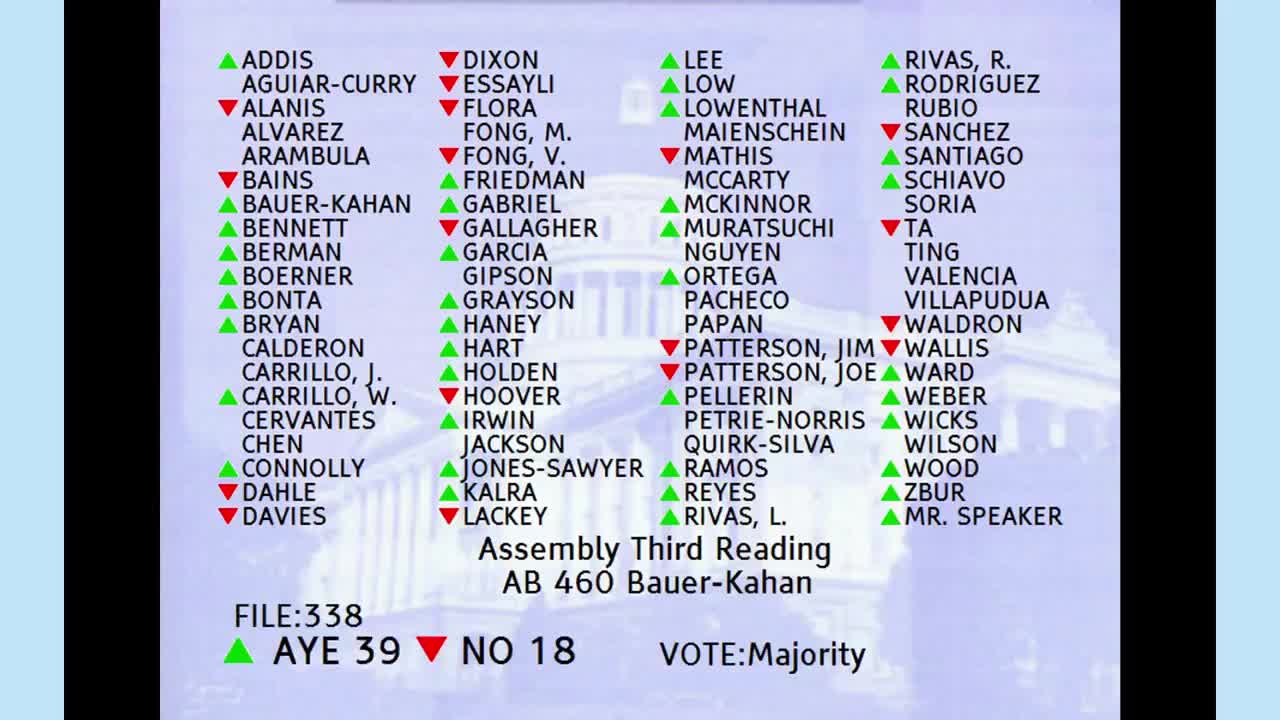 44SEC
Assembly Floor
 40MIN
Assembly Standing Committee on Judiciary
 58MIN
Assembly Standing Committee on Privacy and Consumer Protection
Bill Author