AB 1958: Criminal procedure: discrimination.
- Session Year: 2025-2026
- House: Assembly
- Latest Version Date: 2026-03-25
Current Status:
Failed
(2026-05-28: Read third time. Refused passage. (Ayes 33. Noes 22.).)
Introduced
In Committee
Awaiting First Chamber Vote
Passed First Chamber
In Committee
Awaiting Second Chamber Vote
Passed Second Chamber
Enacted
What does this bill do?
This bill broadens California’s Racial Justice Act by allowing courts to compare a defendant to others who engaged in similar conduct (not just those convicted of the same charge) and by explicitly covering disparities in plea bargaining, diversion, and other case resolutions. It also lets defendants request data previously disclosed in other criminal cases unless irrelevant, updates key definitions, requires judges to step aside if accused of bias, and makes a defendant found to have suffered a racial‑bias violation ineligible for the death penalty.
The summary is provided by generative AI which can make mistakes. For original language, please view the details in the table below.
Existing law prohibits the state from seeking or obtaining a criminal conviction or sentence on the basis of race, ethnicity, or national origin, as specified. Existing law allows a defendant to establish a violation of these provisions under specified circumstances, including when a longer or more severe sentence was imposed on the defendant than was imposed on other similarly situated individuals convicted of the same offense and other specified conditions are met.
This bill would instead compare the defendant to similarly situated individuals who have engaged in similar conduct, as specified. The bill would make these provisions apply to disparities in plea negotiating and diversion, among other things. The bill would clarify procedures for motions under these provisions.
Existing law authorizes a defendant in these cases to file a motion requesting disclosure to the defense of all evidence relevant to a potential violation of these provisions, as specified.
This bill would additionally authorize a defendant to request any data that has been previously disclosed pursuant to those provisions in another criminal case, and require the court to grant that request, unless the data has no relevance to the current charges.
The bill would also revise and recast definitions for these provisions.
Existing law requires that any offense declared to be a misdemeanor for which no punishment is specified is punishable by imprisonment in the county jail not to exceed 6 months, by a fine not to exceed $1,000, or by both that fine and imprisonment. This bill would decrease the amount of the fine to $500.Existing law requires that any offense declared to be a misdemeanor for which no punishment is specified is punishable by imprisonment in the county jail not to exceed 6 months, by a fine not to exceed $1,000, or by both that fine and imprisonment.
This bill would decrease the amount of the fine to $500.
The Legislature finds and declares all of the following:
(a)In 2020, the Legislature enacted the California Racial Justice Act (RJA) to correct Californias troubled history of disproportionately prosecuting and incarcerating people of color and to eradicate and remedy race- and ethnicity-based injustices within the criminal system. As stated in the findings and declarations of the original law, [d]iscrimination in our criminal justice system based on race, ethnicity, or national origin [...] has a deleterious effect not only on individual criminal defendants but on our system of justice as a whole. [...] It is the intent of the Legislature to reject the conclusion that racial disparities within our criminal justice are inevitable, and to actively work to eradicate them.
(b)There are many disturbing examples of stark racial disparities in the California criminal justice system that have persisted for decades. Black individuals serving sentences impacted by the Three Strikes law are heavily overrepresented, relative to both the resident population of California as well as the prison population (Bird, Gill, Lacoe, Pickard, Raphael, & Skog, Three Strikes in California (California Policy Lab, Aug. 2022)). Non-White individuals from every county are overwhelmingly represented in the prison population serving gang enhancements (Committee on Revision of the Penal Code, 2020 Annual Report and Recommendations (Feb. 2021)). Decades of research shows that Black, Latino, and native people are more likely to be sentenced to death and to life without parole (Committee on Revision of the Penal Code, Death Penalty Report (Nov. 2021); Committee on Revision of the Penal Code, 2021 Annual Report and Recommendations (Dec. 2021)). Despite the Legislatures intent to address these widespread and well-documented disparities, there has been limited movement in correcting these trends since the passage of the RJA in 2020.
(c)There remain ongoing barriers to presenting and proving disparity claims under the RJA, including that numerous counties do not maintain data, counties that maintain some data do not have data going back far enough in time, and sufficient data for statistical analysis may not exist in small counties. Barriers are also being erected by those resisting implementation of the RJA, including intentional delays in production of data, requiring duplicative litigation, and production of incomplete data. It is the intent of the Legislature that the data needed to investigate an RJA claim should be made available, including that the data already produced in one case should be accessible across cases to increase efficiency and transparency. It is also the intent of the Legislature that individuals be able to rely on other evidence of disparities aside from data.
(d)It is the intent of the Legislature to reiterate what is and what is not required to prove a disparity under the RJA, and to streamline litigation, reduce costs and delays, and increase judicial efficiency. The Legislature reaffirms that to prove a disparity claim under the RJA, a defendant or petitioner may use qualitative evidence, quantitative evidence, or any other type of evidence. A defendant or petitioner does not need to present data or statistical analysis in every case to prove a disparity claim under the RJA. A defendant or petitioner relying on data or statistical evidence does not also need to present individual case comparisons in every case to prove a disparity claim under the RJA. Whether a claim is proven is determined by the totality of the evidence presented (See Hernandez v. Superior Court (2025) 115 Cal.App.5th 1120, 1130; Romo, The Disparity in Litigating Racial Disparity Claims: The Need for California Courts to Articulate A Framework for Assessing Racial Justice Act Challenges to Charging, Conviction, and Sentencing (2025) 65 Santa Clara L. Rev. 229).
(e)The Legislature again endorses the concurring opinion in Mosby v. Superior Court (2024) 99 Cal.App.5th 106, 136 (conc. opn. of Menetrez, J.), and intends that the language of paragraph (1) of subdivision (h) of Section 745 of the Penal Code places the burden on the prosecutor to offer race-neutral reasons to explain the disparities between groups, not between individuals, and that to prevail on a disparity claim, a defendant or petitioner need not negate every possible race-neutral reason for the charging or sentencing disparities at issue in the case.
(f)Plea negotiations and settlements are a significant source of disparities in our criminal system and are not insulated from the reach of the RJA. The Legislature has been unequivocal that the RJA covers all stages of criminal proceedings. The Legislature rejects interpretations of the statute that exclude plea negotiations and outcomes, habeas proceedings, or other carveouts to the RJA despite the plain language of the statute. Negotiations to reach a disposition and dispositions themselves, which constitute the vast majority of case resolutions, cannot be separated from trial proceedings and results when considering whether a disparity exists (See, e.g., Berdejo, Criminalizing Race: Racial Disparities in Plea-Bargaining (2018) 59 Boston College L. Rev. 1187).
(g)Equality requires acknowledgment of inequality. (Students for Fair Admissions, Inc. v. President and Fellows of Harvard College (2023) 600 U.S. 181, 334 (dis. opn. of Sotomayor, J.)). It is the intent of the Legislature that California urgently and without hesitation open its eyes to and lift impediments that keep it from expeditiously confronting and eliminating racial injustice within its criminal system, and that those working within the system such as law enforcement, prosecutors, defense attorneys, and judges be vigilant and aggressive in their duty to strike out racial bias at every turn.
SEC. 2.Section 745 of the Penal Code is amended to read:745.(a)The state shall not seek or obtain a criminal conviction or seek, obtain, or impose a sentence on the basis of race, ethnicity, or national origin. A violation is established if the defendant proves, by a preponderance of the evidence, any of the following:
(1)The judge, an attorney in the case, a law enforcement officer involved in the case, an expert witness, or juror exhibited bias or animus towards the defendant because of the defendants race, ethnicity, or national origin.
(2)During the defendants trial, in court and during the proceedings, the judge, an attorney in the case, a law enforcement officer involved in the case, an expert witness, or juror, used racially discriminatory language about the defendants race, ethnicity, or national origin, or otherwise exhibited bias or animus towards the defendant because of the defendants race, ethnicity, or national origin, whether or not purposeful. This paragraph does not apply if the person speaking is relating language used by another that is relevant to the case or if the person speaking is giving a racially neutral and unbiased physical description of the suspect.
(3)The defendant was charged or convicted of a more serious offense than defendants of other races, ethnicities, or national origins who have engaged in similar conduct and are similarly situated, and the evidence establishes that the prosecution more frequently sought or obtained convictions for more serious offenses against the group of people who share the defendants race, ethnicity, or national origin in the county where the convictions were sought or obtained.
(4)(A)A longer or more severe sentence was imposed on the defendant than was imposed on other similarly situated individuals who have engaged in similar conduct, and longer or more severe sentences were more frequently imposed on people that share the defendants race, ethnicity, or national origin than on the group of defendants of other races, ethnicities, or national origins in the county where the sentence was imposed.
(B)A longer or more severe sentence was imposed on the defendant than was imposed on other similarly situated individuals who have engaged in similar conduct and longer or more severe sentences were more frequently imposed on defendants in cases with victims of one race, ethnicity, or national origin than in cases with victims of other races, ethnicities, or national origins, in the county where the sentence was imposed.
(b)(1)A defendant may file a motion pursuant to this section, or a petition for writ of habeas corpus or a motion under Section 1473.7, in a court of competent jurisdiction, alleging a violation of subdivision (a). For claims based on the trial record, a defendant may raise a claim alleging a violation of subdivision (a) on direct appeal from the conviction or sentence. The defendant may also move to stay the appeal and request remand to the superior court to file a motion pursuant to this section. If the motion is based in whole or in part on conduct or statements by the judge, the judge shall disqualify themselves from any further proceedings under this section.
(2)If the motion is based in whole or in part on conduct or statements by the judge, the judge shall disqualify themselves from any further proceedings under this section. If the motion is made under this subdivision in a case where judgment has not previously been imposed, the judge may state, on the record, any additional facts material to the motion at the time of reassigning the motion. The judge shall not opine on the validity of the motion or underlying alleged violation. The court shall order the transcript of any such proceeding, and the clerk shall, without delay, transmit a copy of the transcript to each party and the judge that will hear the proceeding under this section.(c)If a motion is filed in the trial court and the defendant makes a prima facie showing of a violation of subdivision (a), the trial court shall hold a hearing. A motion made at trial shall be made as soon as practicable upon the defendant learning of the alleged violation. A motion that is not timely may be deemed waived, in the discretion of the court.
(1)At the hearing, evidence may be presented by either party, including, but not limited to, statistical evidence, aggregate data, expert testimony, and the sworn testimony of witnesses. The court may also appoint an independent expert. For the purpose of a motion and hearing under this section, out-of-court statements that the court finds trustworthy and reliable, statistical evidence, and aggregated data are admissible for the limited purpose of determining whether a violation of subdivision (a) has occurred.
(2)The defendant shall have the burden of proving a violation of subdivision (a) by a preponderance of the evidence. The defendant does not need to prove intentional discrimination. To satisfy the burden and establish a violation under paragraph (3) or (4) of subdivision (a), the defendant may rely on statistical evidence, aggregate data, or nonstatistical evidence. The defendant is not required to conduct a statistical analysis and is not required to present both statistical evidence and nonstatistical evidence.
(3)If the defense establishes a violation of paragraph (3) or (4) of subdivision (a), the court shall impose a remedy as provided in subdivision (e) unless the prosecution proves by a preponderance of the evidence that the disparity can be explained by race-neutral factors. The prosecution shall provide notice of its intent to present race-neutral factors and provide copies of reasonably available documentary evidence supporting those factors prior to the evidentiary hearing. The prosecutions burden requires proffering affirmative evidence and cannot be met by proffering theoretical race-neutral factors.
(4)If the defendant is represented by an attorney and the motion alleges a violation of paragraph (1) or (2) of subdivision (a), based in whole or in part on the conduct of one or more law enforcement officers, the attorney shall serve a copy of the motion on the law enforcement agency or agencies that employed the officer or officers.
(5)At the conclusion of the hearing, the court shall make findings on the record.
(d)(1) In any proceeding alleging a violation of subdivision (a), a defendant or petitioner may file a motion requesting disclosure to the defense of all evidence relevant to a potential violation of subdivision (a) in the constructive possession or control of the prosecution. A motion filed under this section, a motion under paragraph (2) of subdivision (e) of Section 1473, or a motion under paragraph (3) of subdivision (a) of Section 1473.7 shall describe the type of records or information the defendant seeks. Upon a showing of good cause, the court shall order the records to be released.
(2)Upon a showing of good cause, and in order to protect a privacy right or privilege, the court may permit the prosecution to redact information prior to disclosure or may subject disclosure to a protective order. If a statutory privilege or constitutional privacy right cannot be adequately protected by redaction or a protective order, the court shall not order the release of the records.
(3)A defendant may request any data that has been previously disclosed pursuant to this subdivision in another criminal case, and a court shall grant that request, subject to redaction or protective order, unless the data has no relevance to the current charges.
(e)Notwithstanding any other law, except as provided in subdivision (k), or for an initiative approved by the voters, if the court finds, by a preponderance of evidence, a violation of subdivision (a), the court shall impose a remedy specific to the violation found from the following list:
(1)Before a judgment has been entered, the court shall impose any of the following remedies:
(A)Grant a defendants request for a mistrial.
(B)Discharge the jury panel and empanel a new jury.
(C)If the court determines that it would be in the interest of justice, dismiss enhancements, special circumstances, or special allegations, or reduce one or more charges.
(D)Any other remedy not prohibited by another law.
(2)(A)After a judgment has been entered, if the court finds that a conviction was sought or obtained in violation of subdivision (a), the court shall vacate the conviction and sentence, find that it is legally invalid, and order new proceedings consistent with subdivision (a). If the court finds that the only violation of subdivision (a) that occurred is based on paragraph (3) of subdivision (a), the court may modify the judgment to a lesser included or lesser related offense. On resentencing, the court shall not impose a new sentence greater than that previously imposed.
(B)After a judgment has been entered, if the court finds that only the sentence was sought, obtained, or imposed in violation of subdivision (a), the court shall vacate the sentence, find that it is legally invalid, and impose a new sentence. On resentencing, the court shall not impose a new sentence greater than that previously imposed.
(3)The remedies available under this section do not foreclose any other remedies available under the United States Constitution, the California Constitution, or any other law.
(f)This section applies to, but is not limited to, jury or bench trials, plea negotiating practices, plea outcomes, diversion and other alternative dispositions in adult court, adjudications and dispositions in the juvenile delinquency system, and adjudications to transfer a juvenile case to adult court.
(g)This section shall not prevent the prosecution of hate crimes pursuant to Sections 422.6 to 422.865, inclusive.
(h)As used in this section and for the purposes of a petition pursuant to subdivision (e) of Section 1473 or a motion pursuant to paragraph (3) of subdivision (a) of Section 1473.7, the following definitions apply:
(1)More frequently sought or obtained or more frequently imposed means that the totality of the evidence, with or without statistics, demonstrates a significant difference in charging, convictions, or sentencing comparing groups of individuals of different races, ethnicities, or national origins who could have been similarly charged, convicted, or sentenced. Statistical significance is a factor the court may consider, but is not necessary to establish a significant difference. In evaluating the totality of the evidence, the court shall consider whether systemic and institutional racial bias, racial profiling, and historical patterns of racially biased policing and prosecution may have contributed to, or caused differences observed in, the data or impacted the availability of data overall.
(2)Prima facie showing means that the defendant produces facts that, if true, establish that there is a substantial likelihood that a violation of subdivision (a) occurred. For purposes of this section, a substantial likelihood requires more than a mere possibility, but less than a standard of more likely than not.
(3)Race-neutral factors, as that phrase relates to charging and conviction, means elements of an offense, and other factors that may be legally considered in charging, that are supported by evidence. Race-neutral factors, as the term relates to sentencing, means factors contained in the California Rules of Court pertaining to sentencing decisions. Race-neutral factors cannot be factors that are influenced by implicit, systemic, or institutional bias based on race, ethnicity, or national origin.
(4)Racially discriminatory language means language that, to an objective observer, explicitly or implicitly appeals to racial bias, including, but not limited to, racially charged or racially coded language, language that compares the defendant to an animal, or language that references the defendants physical appearance, culture, ethnicity, or national origin. Evidence that particular words or images are used exclusively or disproportionately in cases where the defendant is of a specific race, ethnicity, or national origin is relevant to determining whether language is discriminatory.
(5)State includes the Attorney General, a district attorney, or a city prosecutor.
(6)Similarly situated means that factors that are relevant in charging and sentencing are similar and do not require that all individuals in the comparison group are identical. A defendants conviction history may be a relevant factor to the severity of the charges, convictions, or sentences. If it is a relevant factor and the defense produces evidence that the conviction history may have been impacted by racial profiling or historical patterns of racially biased policing, the court shall consider the evidence.
(i)A defendant may share a race, ethnicity, or national origin with more than one group. A defendant may aggregate data among groups to demonstrate a violation of subdivision (a).
(j)This section applies as follows:
(1)To all cases in which judgment is not final.
(2)Commencing January 1, 2023, to all cases in which, at the time of the filing of a petition pursuant to subdivision (e) of Section 1473 raising a claim under this section, the petitioner is sentenced to death or to cases in which the motion is filed pursuant to Section 1473.7 because of actual or potential immigration consequences related to the conviction or sentence, regardless of when the judgment or disposition became final.
(3)Commencing January 1, 2024, to all cases in which, at the time of the filing of a petition pursuant to subdivision (e) of Section 1473 raising a claim under this section, the petitioner is currently serving a sentence in the state prison or in a county jail pursuant to subdivision (h) of Section 1170, or committed to the Division of Juvenile Justice for a juvenile disposition, regardless of when the judgment or disposition became final.
(4)Commencing January 1, 2025, to all cases filed pursuant to Section 1473.7 or subdivision (e) of Section 1473 in which judgment became final for a felony conviction or juvenile disposition that resulted in a commitment to the Division of Juvenile Justice on or after January 1, 2015.
(5)Commencing January 1, 2026, to all cases filed pursuant to Section 1473.7 or subdivision (e) of Section 1473 in which judgment was for a felony conviction or juvenile disposition that resulted in a commitment to the Division of Juvenile Justice, regardless of when the judgment or disposition became final.
(k)For petitions that are filed in cases for which judgment was entered before January 1, 2021, and only in those cases, if the petition is based on a violation of paragraph (1) or (2) of subdivision (a), the petitioner shall be entitled to relief as provided in subdivision (e), unless the state proves beyond a reasonable doubt that the violation did not contribute to the judgment.
(l)When the court finds there has been a violation of subdivision (a), the defendant shall not be eligible for the death penalty.
The Legislature finds and declares all of the following:
(a)In 2020, the Legislature enacted the California Racial Justice Act (RJA) to correct Californias troubled history of disproportionately prosecuting and incarcerating people of color and to eradicate and remedy race- and ethnicity-based injustices within the criminal system. As stated in the findings and declarations of the original law, [d]iscrimination in our criminal justice system based on race, ethnicity, or national origin [...] has a deleterious effect not only on individual criminal defendants but on our system of justice as a whole. [...] It is the intent of the Legislature to reject the conclusion that racial disparities within our criminal justice are inevitable, and to actively work to eradicate them.
(b)There are many disturbing examples of stark racial disparities in the California criminal justice system that have persisted for decades. Black individuals serving sentences impacted by the Three Strikes law are heavily overrepresented, relative to both the resident population of California as well as the prison population (Bird, Gill, Lacoe, Pickard, Raphael, & Skog, Three Strikes in California (California Policy Lab, Aug. 2022)). Non-White individuals from every county are overwhelmingly represented in the prison population serving gang enhancements (Committee on Revision of the Penal Code, 2020 Annual Report and Recommendations (Feb. 2021)). Decades of research shows that Black, Latino, and native people are more likely to be sentenced to death and to life without parole (Committee on Revision of the Penal Code, Death Penalty Report (Nov. 2021); Committee on Revision of the Penal Code, 2021 Annual Report and Recommendations (Dec. 2021)). Despite the Legislatures intent to address these widespread and well-documented disparities, there has been limited movement in correcting these trends since the passage of the RJA in 2020.
(c)There remain ongoing barriers to presenting and proving disparity claims under the RJA, including that numerous counties do not maintain data, counties that maintain some data do not have data going back far enough in time, and sufficient data for statistical analysis may not exist in small counties. Barriers are also being erected by those resisting implementation of the RJA, including intentional delays in production of data, requiring duplicative litigation, and production of incomplete data. It is the intent of the Legislature that the data needed to investigate an RJA claim should be made available, including that the data already produced in one case should be accessible across cases to increase efficiency and transparency. It is also the intent of the Legislature that individuals be able to rely on other evidence of disparities aside from data.
(d)It is the intent of the Legislature to reiterate what is and what is not required to prove a disparity under the RJA, and to streamline litigation, reduce costs and delays, and increase judicial efficiency. The Legislature reaffirms that to prove a disparity claim under the RJA, a defendant or petitioner may use qualitative evidence, quantitative evidence, or any other type of evidence. A defendant or petitioner does not need to present data or statistical analysis in every case to prove a disparity claim under the RJA. A defendant or petitioner relying on data or statistical evidence does not also need to present individual case comparisons in every case to prove a disparity claim under the RJA. Whether a claim is proven is determined by the totality of the evidence presented (See Hernandez v. Superior Court (2025) 115 Cal.App.5th 1120, 1130; Romo, The Disparity in Litigating Racial Disparity Claims: The Need for California Courts to Articulate A Framework for Assessing Racial Justice Act Challenges to Charging, Conviction, and Sentencing (2025) 65 Santa Clara L. Rev. 229).
(e)The Legislature again endorses the concurring opinion in Mosby v. Superior Court (2024) 99 Cal.App.5th 106, 136 (conc. opn. of Menetrez, J.), and intends that the language of paragraph (1) of subdivision (h) of Section 745 of the Penal Code places the burden on the prosecutor to offer race-neutral reasons to explain the disparities between groups, not between individuals, and that to prevail on a disparity claim, a defendant or petitioner need not negate every possible race-neutral reason for the charging or sentencing disparities at issue in the case.
(f)Plea negotiations and settlements are a significant source of disparities in our criminal system and are not insulated from the reach of the RJA. The Legislature has been unequivocal that the RJA covers all stages of criminal proceedings. The Legislature rejects interpretations of the statute that exclude plea negotiations and outcomes, habeas proceedings, or other carveouts to the RJA despite the plain language of the statute. Negotiations to reach a disposition and dispositions themselves, which constitute the vast majority of case resolutions, cannot be separated from trial proceedings and results when considering whether a disparity exists (See, e.g., Berdejo, Criminalizing Race: Racial Disparities in Plea-Bargaining (2018) 59 Boston College L. Rev. 1187).
(g)Equality requires acknowledgment of inequality. (Students for Fair Admissions, Inc. v. President and Fellows of Harvard College (2023) 600 U.S. 181, 334 (dis. opn. of Sotomayor, J.)). It is the intent of the Legislature that California urgently and without hesitation open its eyes to and lift impediments that keep it from expeditiously confronting and eliminating racial injustice within its criminal system, and that those working within the system such as law enforcement, prosecutors, defense attorneys, and judges be vigilant and aggressive in their duty to strike out racial bias at every turn.
SEC. 2.Section 745 of the Penal Code is amended to read:745.(a)The state shall not seek or obtain a criminal conviction or seek, obtain, or impose a sentence on the basis of race, ethnicity, or national origin. A violation is established if the defendant proves, by a preponderance of the evidence, any of the following:
(1)The judge, an attorney in the case, a law enforcement officer involved in the case, an expert witness, or juror exhibited bias or animus towards the defendant because of the defendants race, ethnicity, or national origin.
(2)During the defendants trial, in court and during the proceedings, the judge, an attorney in the case, a law enforcement officer involved in the case, an expert witness, or juror, used racially discriminatory language about the defendants race, ethnicity, or national origin, or otherwise exhibited bias or animus towards the defendant because of the defendants race, ethnicity, or national origin, whether or not purposeful. This paragraph does not apply if the person speaking is relating language used by another that is relevant to the case or if the person speaking is giving a racially neutral and unbiased physical description of the suspect.
(3)The defendant was charged or convicted of a more serious offense than defendants of other races, ethnicities, or national origins who have engaged in similar conduct and are similarly situated, and the evidence establishes that the prosecution more frequently sought or obtained convictions for more serious offenses against the group of people who share the defendants race, ethnicity, or national origin in the county where the convictions were sought or obtained.
(4)(A)A longer or more severe sentence was imposed on the defendant than was imposed on other similarly situated individuals convicted of the same offense, who have engaged in similar conduct, and longer or more severe sentences were more frequently imposed for that offense on people that share the defendants race, ethnicity, or national origin than on the group of defendants of other races, ethnicities, or national origins in the county where the sentence was imposed.
(B)A longer or more severe sentence was imposed on the defendant than was imposed on other similarly situated individuals convicted of the same offense, who have engaged in similar conduct and longer or more severe sentences were more frequently imposed for the same offense on defendants in cases with victims of one race, ethnicity, or national origin than in cases with victims of other races, ethnicities, or national origins, in the county where the sentence was imposed.
(b)(1)A defendant may file a motion pursuant to this section, or a petition for writ of habeas corpus or a motion under Section 1473.7, in a court of competent jurisdiction, alleging a violation of subdivision (a). For claims based on the trial record, a defendant may raise a claim alleging a violation of subdivision (a) on direct appeal from the conviction or sentence. The defendant may also move to stay the appeal and request remand to the superior court to file a motion pursuant to this section. If
(2)If the motion is based in whole or in part on conduct or statements by the judge, the judge shall disqualify themselves from any further proceedings under this section. If the motion is made under this subdivision in a case where judgment has not previously been imposed, the judge may state, on the record, any additional facts material to the motion at the time of reassigning the motion. The judge shall not opine on the validity of the motion or underlying alleged violation. The court shall order the transcript of any such proceeding, and the clerk shall, without delay, transmit a copy of the transcript to each party and the judge that will hear the proceeding under this section.
(c)If a motion is filed in the trial court and the defendant makes a prima facie showing of a violation of subdivision (a), the trial court shall hold a hearing. A motion made at trial shall be made as soon as practicable upon the defendant learning of the alleged violation. A motion that is not timely may be deemed waived, in the discretion of the court.
(1)At the hearing, evidence may be presented by either party, including, but not limited to, statistical evidence, aggregate data, expert testimony, and the sworn testimony of witnesses. The court may also appoint an independent expert. For the purpose of a motion and hearing under this section, out-of-court statements that the court finds trustworthy and reliable, statistical evidence, and aggregated data are admissible for the limited purpose of determining whether a violation of subdivision (a) has occurred.
(2)The defendant shall have the burden of proving a violation of subdivision (a) by a preponderance of the evidence. The defendant does not need to prove intentional discrimination. To satisfy the burden and establish a violation under paragraph (3) or (4) of subdivision (a), the defendant may rely on statistical evidence, aggregate data, or nonstatistical evidence. The defendant is not required to conduct a statistical analysis and is not required to present both statistical evidence and nonstatistical evidence.
(3)If the defense establishes a violation of paragraph (3) or (4) of subdivision (a), the court shall impose a remedy as provided in subdivision (e) unless the prosecution proves by a preponderance of the evidence that the disparity can be explained by race-neutral factors. The prosecution shall provide notice of its intent to present race-neutral factors and provide copies of reasonably available documentary evidence supporting those factors prior to the evidentiary hearing. The prosecutions burden requires proffering affirmative evidence and cannot be met by proffering theoretical race-neutral factors.
(3)(4)If the defendant is represented by an attorney and the motion alleges a violation of paragraph (1) or (2) of subdivision (a), based in whole or in part on the conduct of one or more law enforcement officers, the attorney shall serve a copy of the motion on the law enforcement agency or agencies that employed the officer or officers.
(4)(5)At the conclusion of the hearing, the court shall make findings on the record.
(d)(1) In any proceeding alleging a violation of subdivision (a), a defendant or petitioner may file a motion requesting disclosure to the defense of all evidence relevant to a potential violation of subdivision (a) in the constructive possession or control of the state. prosecution. A motion filed under this section, a motion under paragraph (2) of subdivision (e) of Section 1473, or a motion under paragraph (3) of subdivision (a) of Section 1473.7 shall describe the type of records or information the defendant seeks. Upon a showing of good cause, the court shall order the records to be released. Upon
(2)Upon a showing of good cause, and in order to protect a privacy right or privilege, the court may permit the prosecution to redact information prior to disclosure or may subject disclosure to a protective order. If a statutory privilege or constitutional privacy right cannot be adequately protected by redaction or a protective order, the court shall not order the release of the records.
(3)A defendant may request any data that has been previously disclosed pursuant to this subdivision in another criminal case, and a court shall grant that request, subject to redaction or protective order, unless the data has no relevance to the current charges.
(e)Notwithstanding any other law, except as provided in subdivision (k), or for an initiative approved by the voters, if the court finds, by a preponderance of evidence, a violation of subdivision (a), the court shall impose a remedy specific to the violation found from the following list:
(1)Before a judgment has been entered, the court shall impose any of the following remedies:
(A)Grant a defendants request for a mistrial.
(B)Discharge the jury panel and empanel a new jury.
(C)If the court determines that it would be in the interest of justice, dismiss enhancements, special circumstances, or special allegations, or reduce one or more charges.
(D)Any other remedy not prohibited by another law.
(2)(A)After a judgment has been entered, if the court finds that a conviction was sought or obtained in violation of subdivision (a), the court shall vacate the conviction and sentence, find that it is legally invalid, and order new proceedings consistent with subdivision (a). If the court finds that the only violation of subdivision (a) that occurred is based on paragraph (3) of subdivision (a), the court may modify the judgment to a lesser included or lesser related offense. On resentencing, the court shall not impose a new sentence greater than that previously imposed.
(B)After a judgment has been entered, if the court finds that only the sentence was sought, obtained, or imposed in violation of subdivision (a), the court shall vacate the sentence, find that it is legally invalid, and impose a new sentence. On resentencing, the court shall not impose a new sentence greater than that previously imposed.
(3)The remedies available under this section do not foreclose any other remedies available under the United States Constitution, the California Constitution, or any other law.
(f)This section also applies to to, but is not limited to, jury or bench trials, plea negotiating practices, plea outcomes, diversion and other alternative dispositions in adult court, adjudications and dispositions in the juvenile delinquency system system, and adjudications to transfer a juvenile case to adult court.
(g)This section shall not prevent the prosecution of hate crimes pursuant to Sections 422.6 to 422.865, inclusive.
(h)As used in this section and for the purposes of a petition pursuant to subdivision (e) of Section 1473 or a motion pursuant to paragraph (3) of subdivision (a) of Section 1473.7, the following definitions apply:
(1)More frequently sought or obtained or more frequently imposed means that the totality of the evidence evidence, with or without statistics, demonstrates a significant difference in seeking or obtaining convictions or in imposing sentences comparing individuals who have engaged in similar conduct and are similarly situated, and the prosecution cannot establish race-neutral reasons for the disparity. The evidence may include statistical evidence, aggregate data, or nonstatistical evidence. charging, convictions, or sentencing comparing groups of individuals of different races, ethnicities, or national origins who could have been similarly charged, convicted, or sentenced. Statistical significance is a factor the court may consider, but is not necessary to establish a significant difference. In evaluating the totality of the evidence, the court shall consider whether systemic and institutional racial bias, racial profiling, and historical patterns of racially biased policing and prosecution may have contributed to, or caused differences observed in, the data or impacted the availability of data overall. Race-neutral reasons shall be relevant factors to charges, convictions, and sentences that are not influenced by implicit, systemic, or institutional bias based on race, ethnicity, or national origin.
(2)Prima facie showing means that the defendant produces facts that, if true, establish that there is a substantial likelihood that a violation of subdivision (a) occurred. For purposes of this section, a substantial likelihood requires more than a mere possibility, but less than a standard of more likely than not.
(3) Relevant factors, as that phrase applies to sentencing, means the factors in the California Rules of Court that pertain to sentencing decisions and any additional factors required to or permitted to be considered in sentencing under state law and under the state and federal constitutions.(3)Race-neutral factors, as that phrase relates to charging and conviction, means elements of an offense, and other factors that may be legally considered in charging, that are supported by evidence. Race-neutral factors, as the term relates to sentencing, means factors contained in the California Rules of Court pertaining to sentencing decisions. Race-neutral factors cannot be factors that are influenced by implicit, systemic, or institutional bias based on race, ethnicity, or national origin.
(4)Racially discriminatory language means language that, to an objective observer, explicitly or implicitly appeals to racial bias, including, but not limited to, racially charged or racially coded language, language that compares the defendant to an animal, or language that references the defendants physical appearance, culture, ethnicity, or national origin. Evidence that particular words or images are used exclusively or disproportionately in cases where the defendant is of a specific race, ethnicity, or national origin is relevant to determining whether language is discriminatory.
(5)State includes the Attorney General, a district attorney, or a city prosecutor.
(6)Similarly situated means that factors that are relevant in charging and sentencing are similar and do not require that all individuals in the comparison group are identical. A defendants conviction history may be a relevant factor to the severity of the charges, convictions, or sentences. If it is a relevant factor and the defense produces evidence that the conviction history may have been impacted by racial profiling or historical patterns of racially biased policing, the court shall consider the evidence.
(i)A defendant may share a race, ethnicity, or national origin with more than one group. A defendant may aggregate data among groups to demonstrate a violation of subdivision (a).
(j)This section applies as follows:
(1)To all cases in which judgment is not final.
(2)Commencing January 1, 2023, to all cases in which, at the time of the filing of a petition pursuant to subdivision (e) of Section 1473 raising a claim under this section, the petitioner is sentenced to death or to cases in which the motion is filed pursuant to Section 1473.7 because of actual or potential immigration consequences related to the conviction or sentence, regardless of when the judgment or disposition became final.
(3)Commencing January 1, 2024, to all cases in which, at the time of the filing of a petition pursuant to subdivision (e) of Section 1473 raising a claim under this section, the petitioner is currently serving a sentence in the state prison or in a county jail pursuant to subdivision (h) of Section 1170, or committed to the Division of Juvenile Justice for a juvenile disposition, regardless of when the judgment or disposition became final.
(4)Commencing January 1, 2025, to all cases filed pursuant to Section 1473.7 or subdivision (e) of Section 1473 in which judgment became final for a felony conviction or juvenile disposition that resulted in a commitment to the Division of Juvenile Justice on or after January 1, 2015.
(5)Commencing January 1, 2026, to all cases filed pursuant to Section 1473.7 or subdivision (e) of Section 1473 in which judgment was for a felony conviction or juvenile disposition that resulted in a commitment to the Division of Juvenile Justice, regardless of when the judgment or disposition became final.
(k)For petitions that are filed in cases for which judgment was entered before January 1, 2021, and only in those cases, if the petition is based on a violation of paragraph (1) or (2) of subdivision (a), the petitioner shall be entitled to relief as provided in subdivision (e), unless the state proves beyond a reasonable doubt that the violation did not contribute to the judgment.
(l)When the court finds there has been a violation of subdivision (a), the defendant shall not be eligible for the death penalty.
SECTION 1.Section 19 of the Penal Code is amended to read:19.Except in cases where a different punishment is prescribed by any law of this state, every offense declared to be a misdemeanor is punishable by imprisonment in the county jail not exceeding six months, or by fine not exceeding five hundred dollars ($500), or by both that imprisonment and fine.Except in cases where a different punishment is prescribed by any law of this state, every offense declared to be a misdemeanor is punishable by imprisonment in the county jail not exceeding six months, or by fine not exceeding one thousand five hundred dollars ($1,000), ($500), or by both. both that imprisonment and fine.
|
Date
|
Status
|
|---|---|
| May 28, 2026 | Read third time. Refused passage. (Ayes 33. Noes 22. Page 5545.). |
| May 28, 2026 | Read third time. Refused passage. (Ayes 33. Noes 22.). |
| May 18, 2026 | Read second time. Ordered to third reading. |
| May 14, 2026 | From committee: Do pass. (Ayes 10. Noes 4.) (May 14). |
| Apr 29, 2026 | In committee: Set, first hearing. Referred to APPR. suspense file. |
| Apr 8, 2026 | From committee: Do pass and re-refer to Com. on APPR. (Ayes 6. Noes 2.) (April 7). Re-referred to Com. on APPR. |
| Mar 26, 2026 | Re-referred to Com. on PUB. S. |
| Mar 25, 2026 | From committee chair, with author's amendments: Amend, and re-refer to Com. on PUB. S. Read second time and amended. |
| Mar 17, 2026 | Re-referred to Com. on PUB. S. |
| Mar 16, 2026 | From committee chair, with author's amendments: Amend, and re-refer to Com. on PUB. S. Read second time and amended. |
| Mar 2, 2026 | Referred to Com. on PUB. S. |
| Feb 14, 2026 | From printer. May be heard in committee March 16. |
| Feb 13, 2026 | Read first time. To print. |
|
Date
|
Description
|
Location
|
Votes
|
|
|---|---|---|---|---|
| May 28, 2026 | AB 1958 Kalra Assembly Third Reading | Assembly Floor |
Failed |
|
| May 14, 2026 | Do pass. | Assembly Standing Committee on Appropriations |
Passed |
|
| Apr 7, 2026 | Do pass and be re-referred to the Committee on [Appropriations] | Assembly Standing Committee on Public Safety |
Passed |
This list shows positions taken on this bill by organizations on the date displayed, which is linked to the original source.
Positions by individuals are not included.
|
Organization
|
Position
|
Date
|
|---|---|---|
| 4 Private Individuals | ** Support | |
| A New PATH | ** Support | |
| A New Way of Life Re-Entry Project | ** Support | |
| Aclu California Action | ** Support | |
| alameda county public defender's office | ** Support | |
| Alliance for Boys and Men of Color | ** Support | |
| American Friends Service Committee | ** Support | |
| Amnesty International USA | ** Support | |
| Amnesty International USA Group 30 San Francisco | ** Support | |
| Asian Americans Advancing Justice-southern California | ** Support | |
| Bend the Arc: Jewish Action, California | ** Support | |
| Black American Political Association of California (BAPAC) Sacramento Chapter | ** Support | |
| California Attorneys For Criminal Justice | ** Support | |
| California Black Power Network | ** Support | |
| California Coalition for Women Prisoners | ** Support | |
| California Coalition for Women's Prisoners | ** Support | |
| California District Attorneys Association | ** Against | |
| California Domestic Workers Coalition | ** Support | |
| California for Safety and Justice | ** Support | |
| California Innocence Coalition | ** Support | |
| California Police Chiefs Association | ** Against | |
| California Public Defenders Association | ** Support | |
| Californians United for a Responsible Budget | ** Support | |
| Care First California | ** Support | |
| Center for Policing Equity | ** Support | |
| Center on Juvenile and Criminal Justice | ** Support | |
| Communities United for Restorative Youth Justice (CURYJ) | ** Support | |
| Consumer Attorneys Of California | ** Support | |
| contra costa county public defender | ** Support | |
| Courage California | ** Support | |
| Criminal Justice Clinic, Uc Irvine School Of Law | ** Support | |
| Death Penalty Focus | ** Support | |
| Dignity and Power Now | ** Support | |
| Disability Rights California | ** Support | |
| Ella Baker Center For Human Rights | ** Support | |
| Equal Rights Advocates | ** Support | |
| Fair Chance Project | ** Support | |
| Felony Murder Elimination Project | ** Support | |
| Friends Committee On Legislation Of California | ** Support | |
| Glide | ** Support | |
| Indivisible Ca Statestrong | ** Support | |
| Initiate Justice | ** Support | |
| Inland Coalition for Immigrant Justice | ** Support | |
| Justice and Diversity Center of the Bar Association of San Francisco | ** Support | |
| Justice2jobs Coalition | ** Support | |
| Juvenile Innocence & Fair Sentencing Clinic, LMU Loyola Law School, Los Angeles | ** Support | |
| Kapor Center Advocacy | ** Support | |
| LA Defensa | ** Support | |
| Lawyers Committee for Civil Rights of the San Francisco Bay Area | ** Support | |
| League Of Women Voters Of California | ** Support | |
| Local 148 Los Angeles County Public Defender's Union | ** Support | |
| Los Angeles County Public Defender's Office | ** Support | |
| National Center for Youth Law (NCYL) | ** Support | |
| Peace Officers Research Association of California (PORAC) | ** Against | |
| Pillars of the Community | ** Support | |
| Restoring Hope California | ** Support | |
| Riverside All of Us or None | ** Support | |
| Rubicon Programs | ** Support | |
| San Francisco Public Defender | ** Support | |
| Showing Up for Racial Justice - San Francisco (surj Sf) | ** Support | |
| Silicon Valley De-Bug | ** Support | |
| Sister Warriors Freedom Coalition | ** Support | |
| Smart Justice California, a Project of Beyond Impact | ** Support | |
| Starting Over Inc. | ** Support | |
| Starting Over Strong | ** Support | |
| The Amelia Ann Adams Whole Life Center | ** Support | |
| The Social Impact Center | ** Support | |
| The W. Haywood Burns Institute | ** Support | |
| transitions clinic network | ** Support | |
| University of San Francisco School of Law | Racial Justice Clinic | ** Support | |
| western center on law & poverty | ** Support | |
| Youth Leadership Institute | ** Support |
ASSEMBLY THIRD READING
ATR Bill Id:AB 1958
Author:(Kalra)
As Amended Ver:March 25, 2026
Majority vote
SUMMARY
Amends the Racial Justice Act of 2020 (RJA) to clarify the process by which a defendant may show evidence they were charged or convicted of a more serious offense than other similarly situated defendants of a different race, ethnicity, or national origin.
Major Provisions
- Changes the standard required for RJA allegations based on a defendant’s sentence, to state that a defendant need only show they were sentenced to a longer or more severe term than defendants similarly situated who engaged in the same conduct rather than defendants similarly situated who were convicted of the same crime.
- States that in order to establish a violation of the RJA based on charging or sentencing of similarly situated defendants of a different race, ethnicity, or national origin:
- A defendant may rely on statistical evidence, aggregate data, or nonstatistical evidence. The defendant is not required to conduct a statistical analysis and is not required to present both statistical evidence and nonstatistical evidence.
- The court shall impose a remedy, as specified, unless the prosecution proves by a preponderance of the evidence that the disparity can be explained by race-neutral factors.
- Requires the prosecution to provide notice of its intent to present race-neutral factors and provide copies of reasonably available documentary evidence supporting those factors prior to the evidentiary hearing.
- States the prosecution's burden requires proffering affirmative evidence and cannot be met by proffering theoretical race-neutral factors.
- Clarifies that, when alleging a RJA violation, the defense may request and be entitled to any evidence relevant to the RJA allegations in the constructive possession or control of the prosecution.
- Provides that a defendant may request any data that has been previously disclosed in response to an RJA claim in another criminal case, and a court shall grant that request, subject to redaction or protective order, unless the data has no relevance to the current charges.
- Expands application of the RJA to either jury or bench trials, plea negotiation practices, plea outcomes, diversion and other alternative dispositions in adult court.
- Clarifies that "more frequently sought or obtained" or "more frequently imposed" means the totality of evidence with or without statistics and means that it demonstrates a significant difference in charging, convictions, or sentencing comparing groups of individuals of different races ethnicities, or national origins who could have been similarly charged, convicted, or sentenced.
- Defines "race-neutral factors," as that phrase relates to charging and conviction, as elements of an offense, and other factors that may be legally considered in charging, that are supported by evidence.
- Defines "race-neutral factors," as the term relates to sentencing, as factors contained in the California Rules of Court pertaining to sentencing decisions. Race-neutral factors cannot be factors that are influenced by implicit, systemic, or institutional bias based on race, ethnicity, or national origin.
COMMENTS
According to the Author
"In 2020, the Legislature passed AB 2542 (Kalra), the California Racial Justice Act (RJA), to address racial discrimination and bias in criminal proceedings across the state. Under the RJA, individuals are allowed two paths of relief: 1) show bias directed at the individual or use of "racially discriminatory language," or 2) demonstrate a showing of disparate treatment between similarly situated people from different racial groups in the same county where they were charged or sentenced.
"Since the passage of AB 2542 over five years ago, only four disparity claims using that second path of relief have been litigated to conclusion, and in only one of those cases did a trial find a violation had been established. This can be explained by several reasons, including difficulty obtaining relevant data, lack of clarity as to what is required to establish a disparity claim, and other procedural inconsistencies.
"To address this, AB 1958 makes clear that there are multiple ways to establish a disparity claim and that to refute a disparity claim, the prosecution must produce evidence showing the disparities are explained by race-neutral factors. The bill also clarifies the evidence disclosure requirements, makes it explicit that no part of the criminal process is insulated from the RJA, and specifies the procedure for cases where a motion is based on conduct or statements from a judge before sentence has been imposed. In doing so, AB 1958 will streamline litigation, reduce delays, provide consistent guidance to courts across the state, and increase judicial efficiency."
Arguments in Support
According to the California Innocence Coalition, "The Racial Justice Act (RJA) prohibits the state from seeking, obtaining, or imposing a criminal conviction or sentence on the basis of race, ethnicity, or national origin. The RJA was passed, in part, to address disparities in charging and sentencing that pervade California's criminal legal system.
"A 'disparity' in charging or sentencing exists when people of one race are charged, convicted, or sentenced more harshly than people of other races who engage in similar conduct. For example, decades of research shows that Black, Latino, and Native people in California are more likely to be sentenced to death or life without the possibility of parole than white individuals who commit similar offenses. Despite the clear intent of the Legislature to address racial disparities through the RJA, justice has eluded those with viable claims due to procedural barriers. In the five years since the RJA became law, only four disparity claims have been litigated to completion due to procedural uncertainty and difficulty obtaining data.
"This bill provides needed clarity regarding procedures for evaluating charging and sentencing disparity claims including that:
(1) a violation may be found when the defendant shows statistical or non-statistical evidence to establish a disparity claim, and the defendant is not required to show both kinds of evidence;
(2) to refute a claim, prosecutors must show by a preponderance of the evidence that any disparity is explained by race-neutral factors; and
(3) counsel may use previously requested data to reduce courts’ duplicative labor and litigation.
"Additionally, AB 1958 addresses other inconsistencies that have presented themselves since the law's passage to ensure that no part of the criminal legal process is insulated from the RJA, including plea negotiations. Finally, this bill makes absolutely clear that the prosecution's duty to disclose evidence includes evidence possessed by law enforcement.
AB 1958 builds upon the Legislature's previous work to address racial discrimination and bias in the criminal legal system. In 2020, California enacted the California Racial Justice Act, making it possible to confront racial bias in our criminal courts. Through additional refinements, the California Legislature can support the law in functioning more effectively to provide justice to those who have experienced discrimination in our legal system.
"The Racial Justice Act is one of the most important and consequential laws enacted in this state. AB 1958 (Kalra) is essential to aid courts in effectuating the legislation’s intent to eliminate racial bias from California’s criminal legal system because racism, whether intentional, implicit, or institutional, is intolerable and undermines true justice."
Arguments in Opposition
According to California District Attorneys Association, "Fundamental fairness in the criminal justice system rests at the core of the California District Attorneys Association (CDAA) and is embedded in every prosecutor’s oath of office. When a prosecutor swears to support and defend the Constitution of the United States and the Constitution of the State of California, that prosecutor pledges fealty to Equal Protection for all under the Fourteenth Amendment to the United States and article I, section 7 of the "California Constitution. With these underpinnings, CDAA unquestionably agrees that '[d]iscrimination on the basis of race, odious in all respects, is especially pernicious in the administration of justice.' (Assem. Bill No. 2542 (2019 – 2020 Reg. Sess.) Section 2, subd. (a) [which initially enacted the Racial Justice Act], quoting Rose v. Mitchell (1979) 443 U.S. 545, 556.)
"It is CDAA's steadfast adherence to these constitutions that also compels it to focus on the rights of crime victims found within article I, section 28 of the California Constitution (Marsy's Law). Because of our commitment to the rule of law, the fundamental principles of the proper presentation of evidence, and our obligation to protect justly obtained verdicts, we must oppose "AB 1958. The changes proposed by AB 1958 pose numerous troubling issues.
- Resources throughout the justice system have been significantly taxed in recent years with the advent of legislatively driven post-conviction proceedings. AB 1958 would not only put additional fiscal strains on all justice partners, it would erase much of the groundwork that has already been laid for the Racial Justice Act.
- Significant parts of the language in AB 1958 appear without definition, but rest in key operative areas. Vagueness of terminology can only lead to varied guesswork by the courts across the state, causing further delays in resolution for defendants and victims.
- The bill appears to suggest that the use of information couched as "statistics" might somehow bypass the adversarial process inherent in our system of justice, which is of particular concern when there is no current agreed-upon repository of data sets or methodology.
- The proposed language of the bill appears to require the affirmative proffering of evidence that racial bias did not exist. In other words, a requirement of concrete proof of a negative.
- At no point does the bill work to assess the disparate negative impact suffered by victims of crime with re-litigation of old cases, and whether victims in underserved communities see justice pulled further away from them as a result.
"Under existing law, the Racial Justice Act permits a criminal defendant, or a former defendant who already stands convicted of a crime, to challenge the validity of the case against her or him via claims that the process bore the taint of impermissible bias. (Pen. Code, Section 745, subd. (b).) No conviction or sentence may be based on race, ethnicity, or national origin. (Pen. Code, Section 745, subd. (a).) Bias of this nature may not be present in the judge, any attorney in the case, the law enforcement personnel who investigated the case, expert witnesses, or any juror. (Pen. Code, Section 745, subd. (a)(2).)
“Historically, the improper influence of bias was already a means of redress in both state and federal courts. California’s Racial Justice Act, however, removed certain barriers for defendants challenging their cases and convictions by removing the requirement that a criminal defendant shows that impermissible bias had an actual impact on her or his case. For example, in most circumstances under federal law, a defendant claiming ineffective defense counsel must also show that counsel’s ineffectiveness had an actual negative impact on the defendant’s case. (Strickland v. Washington (1984) 466 U.S. 668, 687.) There are circumstances in which prejudice to the defendant would be presumed. (See, e.g., Cuyler v. Sullivan (1980) 446 U.S. 335, 345 – 350 (an actual conflict of interest for counsel creates a presumption of prejudice).) In applying these precepts to racist defense counsel, federal courts have contemplated the abrogation of a defendant’s Sixth Amendment right to effective counsel where racist beliefs on the part of counsel have a “cumulative effect,” rendering a fundamental failure to the defendant. (See, e.g., Ellis v. Harrison (9th Cir. 2020) 947 F.3d 555, 561 – 564 (conc. opn. of Nguyen, J.)
“In its current form, the Racial Justice Act provides “broader relief for racial discrimination in the criminal justice system than is available under federal equal protection principles . . ..” (Gonzales v. Superior Court (2024) 108 Cal.App.5th.Supp 36.) The Act employs a common-sense nexus between the defendant in the case and claims of bias, either through an expression of that bias or the impact of bias. (Pen. Code, Section 745, subds. (a)(1) – (4).) But courts throughout California are still addressing the proper measure of implementation and whether there are constitutional infirmities within its framework.[1] The state of the already-developed jurisprudence implementing the Act would be open to new questions with the fundamental altering proposed by AB 1958.”
FISCAL COMMENTS
According to the Assembly Committee on Appropriations:
- Potential costs of an unknown, but likely significant amount, to county district attorneys' offices and public defenders' offices for expanded RJA litigation resulting from the bill's broadened scope, eased evidentiary standards, and expanded discovery requirements. The bill establishes that RJA claims apply to plea negotiations, diversion, and bench trials and shifts the comparison standard from "same offense" to "similar conduct," which could broaden the universe of potential claims and the discovery necessary to litigate them. The California District Attorneys Association reports that existing RJA discovery costs range from approximately $81,000 per case in Contra Costa County to $750,000 per case in Santa Clara County. The Los Angeles County Public Defender's Office estimated $2.19 million in statewide costs for RJA claims in fiscal year 2024-25 in a test claim filed with the Commission on State Mandates. The bill’s clarification of the RJA would increase these costs, though by how much is unknown. These county costs are potentially reimbursable as state-mandated local programs. Los Angeles County has filed Test Claim 24-TC-02 with the Commission on State Mandates regarding costs under the existing RJA. If the Commission determines the existing RJA imposes a reimbursable state mandate, this bill's expansion of RJA claims would amplify those costs.
- Unknown, likely moderate impact to the judicial branch (Trial Court Trust Fund) for additional and expanded RJA hearings, discovery motions, and additional litigation over terms that may require judicial interpretation. Actual costs will depend on the number of cases filed and the amount of court time needed to resolve each case. It generally costs approximately $1,000 to operate a courtroom for one hour. Although courts are not funded on the basis of workload, increased pressure on the Trial Court Trust Fund may create a demand for increased funding for courts from the General Fund. The state budget provides annual General Fund backfills to the Trial Court Trust Fund to offset revenue reductions, totaling approximately $117.3 million in 2025-26.
- Costs of $5.5 million ongoing to the Department of Justice (DOJ) (General Fund). The Legal unit within DOJ's Office of General Counsel (OGC Legal) would be responsible for responding to requests seeking DOJ data to support RJA motions. To address the increase in workload, OGC Legal would require one supervising deputy attorney general, three deputy attorneys general, one analyst, and three legal secretaries. The Appeals, Writs and Trials section (AWT) within DOJ’s Division of Criminal Law would be responsible for defending against an increased number of claims of RJA violations. To address the increase in workload, the AWT section would require one supervising deputy attorney general, seven deputy attorneys general, and five legal secretaries. The DOJ will be unable to absorb the costs to comply with or implement the requirements of the bill within existing budgeted resources; implementation will be dependent upon the appropriation of funds.
The Legislative Analyst's Office recently warned of General Fund structural deficits of around $35 billion per year beginning in the 2027-28 fiscal year.
VOTES
ASM PUBLIC SAFETY: 6-2-1
YES: Schultz, Mark González, Haney, Harabedian, Ramos, Sharp-Collins
NO: Alanis, Lackey
ABS, ABST OR NV: Nguyen
ASM APPROPRIATIONS: 10-4-1
YES: Wicks, Aguiar-Curry, Calderon, Caloza, Fong, Mark González, Krell, Pellerin, Sharp-Collins, Solache
NO: Hoover, Dixon, Ta, Tangipa
ABS, ABST OR NV: Pacheco
UPDATED
VERSION: March 25, 2026
CONSULTANT: Kimberly Horiuchi / PUB. S. / (916) 319-3744 FN: 0002835
The California Supreme Court appears to have serious concerns over whether the Racial Justice Act, in a portion that would be unaltered by AB 1958, runs afoul of an initiative enacted by the Electorate. In People v. Bankston (case number S044739), People v. Barrera (case number S103358), People v. Chhuon & Pan (case number S105403) and People v. Demolle (case number S159120), the Court asked three questions concerning the constitutionality of the Act in light of the Briggs Initiative. In an unusual move, the Court held new oral argument on the matter in all of these cases. The cases stand submitted and an opinion from the Court is pending. ↑
Date of Hearing: April 29, 2026
ASSEMBLY COMMITTEE ON APPROPRIATIONS
Buffy Wicks, Chair
ABPCA Bill Id:AB 1958
Author:(Kalra) – As Amended Ver:March 25, 2026
Policy Committee: | Public Safety | Vote: | 6 - 2 |
|
| ||
|
|
Urgency: No State Mandated Local Program: No Reimbursable: No
SUMMARY:
This bill amends the Racial Justice Act of 2020 (RJA) to expand and clarify the process for challenging racial disparities in criminal proceedings.
Specifically, this bill:
- Expressly includes negotiations, plea outcomes, diversion, and other alternative dispositions in adult and juvenile court in RJA disparity claims.
- Shifts the sentencing comparison standard from defendants convicted of the “same offense” to defendants who “engaged in similar conduct.”
- Allows defendants to establish disparity claims using statistical evidence, aggregate data, or nonstatistical evidence without requiring both.
- Expands discovery to include evidence in the constructive possession of the prosecution.
- Requires courts to grant requests for data previously disclosed in other RJA cases.
- Requires the prosecution to prove by a preponderance of the evidence that any disparity is explained by race-neutral factors supported by affirmative evidence.
FISCAL EFFECT:
- Potential costs of an unknown, but likely significant amount, to county district attorneys’ offices and public defenders’ offices for expanded RJA litigation resulting from the bill’s broadened scope, eased evidentiary standards, and expanded discovery requirements. The bill establishes that RJA claims apply to plea negotiations, diversion, and bench trials and shifts the comparison standard from “same offense” to “similar conduct,” which could broaden the universe of potential claims and the discovery necessary to litigate them. The California District Attorneys Association reports that existing RJA discovery costs range from approximately $81,000 per case in Contra Costa County to $750,000 per case in Santa Clara County. The Los Angeles County Public Defender’s Office estimated $2.19 million in statewide costs for RJA claims in fiscal year 2024-25 in a test claim filed with the Commission on State Mandates. The bill’s clarification of the RJA would increase these costs, though by how much is unknown. These county costs are potentially reimbursable as state-mandated local programs. Los Angeles County has filed Test Claim 24-TC-02 with the Commission on State Mandates regarding costs under the existing RJA. If the Commission determines the existing RJA imposes a reimbursable state mandate, this bill’s expansion of RJA claims would amplify those costs.
- Unknown, likely moderate impact to the judicial branch (Trial Court Trust Fund) for additional and expanded RJA hearings, discovery motions, and additional litigation over terms that may require judicial interpretation. Actual costs will depend on the number of cases filed and the amount of court time needed to resolve each case. It generally costs approximately $1,000 to operate a courtroom for one hour. Although courts are not funded on the basis of workload, increased pressure on the Trial Court Trust Fund may create a demand for increased funding for courts from the General Fund. The state budget provides annual General Fund backfills to the Trial Court Trust Fund to offset revenue reductions, totaling approximately $117.3 million in 2025-26.
- Costs of $5.5 million ongoing to the Department of Justice (DOJ) (General Fund). The Legal unit within DOJ’s Office of General Counsel (OGC Legal) would be responsible for responding to requests seeking DOJ data to support RJA motions. To address the increase in workload, OGC Legal would require one supervising deputy attorney general, three deputy attorneys general, one analyst, and three legal secretaries. The Appeals, Writs and Trials section (AWT) within DOJ’s Division of Criminal Law would be responsible for defending against an increased number of claims of RJA violations. To address the increase in workload, the AWT section would require one supervising deputy attorney general, seven deputy attorneys general, and five legal secretaries. The DOJ will be unable to absorb the costs to comply with or implement the requirements of the bill within existing budgeted resources; implementation will be dependent upon the appropriation of funds.
The Legislative Analyst’s Office recently warned of General Fund structural deficits of around $35 billion per year beginning in the 2027-28 fiscal year.
COMMENTS:
- Purpose. According to the author, since the RJA’s passage over five years ago, only four disparity claims have been litigated to completion, and only one resulted in a finding of a violation. The author attributes this to difficulty obtaining relevant data, lack of clarity on what is required to establish a disparity claim, and procedural inconsistencies. According to the author, the bill clarifies the evidentiary standards, expands discovery rights, and ensures no part of the criminal process is insulated from the RJA.
- Background. The RJA, enacted by AB 2542 (Kalra), Chapter 317, Statutes of 2020 and made retroactive by AB 256 (Kalra), Chapter 739, Statutes of 2022, prohibits the state from seeking or obtaining a criminal conviction or sentence on the basis of race, ethnicity, or national origin, and provides a mechanism for defendants to challenge charges, convictions, and sentences on that basis. A defendant may establish a violation by showing, among other things, that convictions for an offense were more frequently sought or obtained against people who share the defendant’s race, ethnicity, or national origin, or that longer sentences were more frequently imposed based on the defendant’s or victim’s race, ethnicity, or national origin. The defendant must demonstrate the disparity by a preponderance of the evidence.
Since enactment, courts have confronted a number of procedural and interpretive questions, including whether claims are forfeited if not raised before judgment, what constitutes a sufficient statistical showing, and the scope of prosecutorial discovery obligations. This bill addresses three broad categories of issues.
Clarifying the Scope of the RJA. The bill confirms that RJA claims extend to plea negotiations, plea outcomes, diversion, and other alternative dispositions in adult and juvenile court, and that disparity claims may be brought in connection with bench trials. The sponsor’s position is that these stages of criminal proceedings are already within the RJA’s intended reach and that the bill codifies that scope to prevent narrow interpretations from foreclosing claims.
Discovery and Constructive Possession. The bill explains that discovery in RJA proceedings under Penal Code section 745(d) extends to evidence in the constructive possession of the prosecution. The sponsor notes that the phrase “in the possession or control of the state” tracks language long used by California courts in the discovery context. In support of this position, the sponsor points to Penal Code section 1054.1, which requires disclosure of materials in the possession of the prosecuting attorney or known to be in the possession of investigating agencies, and cites numerous California cases for the proposition that this obligation reaches materials “within the possession or control” of the prosecution or “reasonably accessible” to it. This statutory change is intended to codify an established legal standard rather than codify a new one.
Simplifying the Terms and Procedures for Disparity Claims. The bill shifts the sentencing comparison standard from defendants convicted of the “same offense” to defendants who “engaged in similar conduct,” allows defendants to establish disparity claims using statistical evidence, aggregate data, or nonstatistical evidence without requiring both, and requires the prosecution to prove by a preponderance of the evidence that any disparity is explained by race-neutral factors supported by affirmative evidence. In addition, Penal Code section 745(d)(3) would require courts to grant requests for data previously disclosed in other RJA cases. The sponsor argues that this data-reuse provision will reduce discovery costs by avoiding duplicative production of the same underlying records across multiple RJA proceedings. The extent to which data reuse will reduce aggregate costs is uncertain and will depend on implementation, how broadly courts construe “previously disclosed,” and the volume of new claims generated by the bill’s other provisions.
Analysis Prepared by: Shiran Zohar / APPR. / (916) 319-2081
Date of Hearing:
Counsel: Kimberly Horiuchi
ASSEMBLY COMMITTEE ON
Nick Schultz, Chair
ABPCA Bill Id:
Author:() – As Ver:
SUMMARY:
Amends the Racial Justice Act of 2020 (RJA) to clarify the process by which a defendant may show evidence they were charged or convicted of a more serious offense than other similarly situated defendants of a different race, ethnicity, or national origin. Specifically, this bill:
- Changes the standard required for RJA allegations based on a defendant’s sentence, to state that a defendant need only show they were sentenced to a longer or more severe term than defendants similarly situated who engaged in the same conduct rather than defendants similarly situated who were convicted of the same crime.
- States that in order to establish a violation of the RJA based on charging or sentencing of similarly situated defendants of a different race, ethnicity, or national origin:
- A defendant may rely on statistical evidence, aggregate data, or nonstatistical evidence. The defendant is not required to conduct a statistical analysis and is not required to present both statistical evidence and nonstatistical evidence.
- The court shall impose a remedy, as specified, unless the prosecution proves by a preponderance of the evidence that the disparity can be explained by race-neutral factors.
- A defendant may rely on statistical evidence, aggregate data, or nonstatistical evidence. The defendant is not required to conduct a statistical analysis and is not required to present both statistical evidence and nonstatistical evidence.
- Requires the prosecution to provide notice of its intent to present race-neutral factors and provide copies of reasonably available documentary evidence supporting those factors prior to the evidentiary hearing.
- States the prosecution’s burden requires proffering affirmative evidence and cannot be met by proffering theoretical race-neutral factors.
- Clarifies that, when alleging a RJA violation, the defense may request and be entitled to any evidence relevant to the RJA allegations in the constructive possession or control of the prosecution.
- Provides that a defendant may request any data that has been previously disclosed in response to an RJA claim in another criminal case, and a court shall grant that request, subject to redaction or protective order, unless the data has no relevance to the current charges.
- Expands application of the RJA to either jury or bench trials, plea negotiation practices, plea outcomes, diversion and other alternative dispositions in adult court.
- Clarifies that “more frequently sought or obtained” or “more frequently imposed” means the totality of evidence with or without statistics and means that it demonstrates a significant difference in charging, convictions, or sentencing comparing groups of individuals of different races ethnicities, or national origins who could have been similarly charged, convicted, or sentenced.
- Defines “race-neutral factors,” as that phrase relates to charging and conviction, as elements of an offense, and other factors that may be legally considered in charging, that are supported by evidence.
- Defines “race-neutral factors,” as the term relates to sentencing, as factors contained in the California Rules of Court pertaining to sentencing decisions. Race-neutral factors cannot be factors that are influenced by implicit, systemic, or institutional bias based on race, ethnicity, or national origin.
EXISTING LAW:
- Establishes the RJA which prohibits the state from seeking or obtaining a criminal conviction or seeking, obtaining or imposing a sentence on the basis of race, ethnicity, or national origin. A violation is established if the defendant proves, by a preponderance of the evidence, any of the following:
- The judge, an attorney in the case, a law enforcement officer involved in the case, an expert witness, or juror exhibited bias or animus towards the defendant because of the defendant’s race, ethnicity, or national origin.
- During the trial, in a court and during the proceedings, the judge, an attorney in the case, a law enforcement officer involved in the case, an expert witness, or juror, used racially discriminatory language about the defendant’s race, ethnicity, or national origin, or otherwise exhibited bias or animus towards the defendant because of the defendant’s race, ethnicity, or national origin, whether or not purposeful, except as specified.
- The defendant was charged or convicted of a more serious offense than defendants of other races, ethnicities, or national origins who commit similar offenses and are similarly situated and the evidence establishes that the prosecution more frequently sought or obtained convictions for more serious offenses against people who share the defendant’s race, ethnicity, or national origin in the county where the convictions were sought or obtained.
- A longer or more severe sentence was imposed on the defendant than was imposed on other similarly situated individuals convicted of the same offense, and longer or more severe sentences were more frequently imposed for that offense on people that share the defendant’s race, ethnicity, or national origin than on defendants of other races, ethnicities, or national origins in the county where the sentence was imposed.
- A longer or more severe sentence was imposed on the defendant than was imposed on other similarly situated individuals convicted of the same offense, and longer or more severe sentences were more frequently imposed for the same offense on defendants in cases with victims of one race, ethnicity, or national origin than in cases with victims of other races, ethnicities, or national origins in the county where the sentence was imposed. (Pen. Code, § 745, subd. (a).)
- States that a defendant may file a motion in the trial court, or if judgement has been imposed, may file a petition for writ of habeas corpus or a motion to vacate the conviction or sentence in a court of competent jurisdiction alleging a violation of the RJA. (Pen. Code, § 745, subd. (b).)
- States that if a motion is filed in the trial court and the defendant makes a prima facie showing of a violation of the RJA, the court shall hold a hearing. (Pen. Code, § 745, subd. (c).)
- Provides that at the hearing, either party may present evidence, including, but not limited to, statistical evidence, aggregate data, expert testimony, and the sworn testimony of witnesses. The court may also appoint an independent investigator. (Pen. Code, § 745, subd. (c)(1).)
- States the defendant must prove the violation by a preponderance of the evidence. (Pen. Code, § 745, subd. (c)(2).)
- Requires the court to make findings on the record at the conclusion of the hearing. (Pen. Code, § 745, subd. (c)(3).)
- Provides that a defendant may file a motion requesting disclosure of all evidence relevant to a potential violation of the RJA that is in the possession or control of the state. Upon a showing of good cause, the court shall order the records to be released. Upon a showing of good cause, and if the records are not privileged, the court may permit the prosecution to redact information prior to disclosure. (Pen. Code, § 745, subd. (d).)
- States that, notwithstanding any other law, except for an initiative approved by the voters, if the court finds by a preponderance of evidence a violation of the RJA, the court shall impose a remedy specific to the violation found from a specified list of remedies. (Pen. Code, § 745, subd. (e).)
- Provides that before a judgment has been entered, the court may declare a mistrial if requested by the defendant, discharge the jury panel and empanel a new jury, or, in the interests of justice, the court may dismiss enhancements, special circumstances, or special allegations, or reduce one or more charges. (Pen. Code, § 745, subd. (e)(1).)
- Provides that when judgement has been entered, the following remedies apply:
- If the court finds that the conviction was sought or obtained in violation of the RJA, the court shall vacate the conviction and sentence, find that it is legally invalid, and order new proceedings consistent with the RJA;
- If the court finds the violation was based only on the defendant being charged or convicted of a more serious offense than defendants of other races, ethnicities, or national origins, and the court has the ability to rectify the violation by modifying the judgment, the court shall vacate the conviction and sentence, find that the conviction is legally invalid, and modify the judgment to impose an appropriate remedy for the violation that occurred, except that the court shall not impose a sentence greater than that previously imposed; and,
- If the court finds that only the sentence was sought or obtained in violation of the RJA, the court shall vacate the sentence, find that it is legally invalid, and impose a new sentence no greater than the sentence previously imposed. (Pen. Code, § 745, subd. (e)(2).)
- Prohibits imposition of the death penalty where the court finds a violation of the RJA. (Pen. Code, § 745, subd. (e)(3).)
- Provides that a court is not foreclosed from imposing any other remedies available under the United States Constitution, the California Constitution, or any other law. (Pen. Code, § 745, subd. (e)(4).)
- Specifies that these provisions apply to adjudications and dispositions in the juvenile delinquency system. (Pen. Code, § 745, subd. (f).)
- Specifies that these provisions do not prevent the prosecution of hate crimes. (Pen. Code, § 745, subd. (g).)
- Defines “more frequently sought or obtained” or “more frequently imposed” as statistical evidence or aggregate data that demonstrate a significant difference in seeking or obtaining convictions or in imposing sentences comparing individuals who have committed similar offenses and are similarly situated, and the prosecution cannot establish race-neutral reasons for the disparity. (Pen. Code, § 745, subd. (h)(1).)
- Defines “prima facie showing” as meaning that the defendant produces facts that, if true, establish a substantial likelihood that a violation of the RJA occurred, as specified. (Pen. Code, § 745, subd. (h)(2).)
- Defines “racially discriminatory language” as meaning language that, to an objective observer, explicitly or implicitly appeals to racial bias, including, but not limited to, racially charged or racially coded language, language that compares the defendant to an animal, or language that references the defendant’s physical appearance, culture, ethnicity or national origin. Evidence that particular words or images are used exclusively or disproportionately in cases where the defendant is of a specific race, ethnicity, or national origin is relevant to determining whether language is discriminatory. (Pen. Code, § 745, subd. (h)(3).)
- Defines “state” as including the Attorney General, a district attorney, or a city prosecutor. (Pen. Code, § 745, subd. (h)(4).)
- States that a defendant may share a race, ethnicity, or national origin with more than one group and may aggregate data among groups to demonstrate a violation of the prohibition. (Pen. Code, § 745, subd. (i).)
- Applies the RJA prospectively to cases in which a judgment has not been entered prior to January 1, 2021. (Pen. Code, § 745, subd. (j).)
FISCAL EFFECT:
Unknown
COMMENTS:
- Author's Statement: According to the author, “In 2020, the Legislature passed AB 2542 (Kalra), the California Racial Justice Act (RJA), to address racial discrimination and bias in criminal proceedings across the state. Under the RJA, individuals are allowed two paths of relief: 1) show bias directed at the individual or use of “racially discriminatory language,” or 2) demonstrate a showing of disparate treatment between similarly situated people from different racial groups in the same county where they were charged or sentenced.
“Since the passage of AB 2542 over five years ago, only four disparity claims using that second path of relief have been litigated to conclusion, and in only one of those cases did a trial find a violation had been established. This can be explained by several reasons, including difficulty obtaining relevant data, lack of clarity as to what is required to establish a disparity claim, and other procedural inconsistencies.
“To address this, AB 1958 makes clear that there are multiple ways to establish a disparity claim and that to refute a disparity claim, the prosecution must produce evidence showing the disparities are explained by race-neutral factors. The bill also clarifies the evidence disclosure requirements, makes it explicit that no part of the criminal process is insulated from the RJA, and specifies the procedure for cases where a motion is based on conduct or statements from a judge before sentence has been imposed. In doing so, AB 1958 will streamline litigation, reduce delays, provide consistent guidance to courts across the state, and increase judicial efficiency.”
- RJA: The RJA was initially enacted in 2020 and amended again in 2021. It generally authorizes a criminal defendant to file a motion in court alleging they suffered racial bias in the charging or sentencing of a defendant. Specifically, the RJA allows racial bias to be shown by, among other things, statistical evidence that convictions for an offense were more frequently sought or obtained against people who share the defendant’s race, ethnicity or national origin than for defendants of other races, ethnicities, or national origin in the county where the convictions were sought or obtained; or longer or more severe sentences were imposed on persons based on their race, ethnicity or national origin or based on the victim’s race, ethnicity or national origin. The defendant must demonstrate a prima facie case that defendants similarly situated of other races are less likely to be charged or sentenced in a specific manner.
Racial bias may also be shown by evidence that a judge or attorney, among other listed persons associated with the defendant’s case, exhibited bias towards the defendant, or, in court and during the trial proceedings, used racially discriminatory language or otherwise exhibited bias or animus, based on the defendant’s race, ethnicity or national origin. The RJA does not require the discrimination to have been purposeful or to have had a prejudicial impact on the defendant’s case.
Since the enactment of the RJA, the courts have confronted a variety of situations that demonstrate the need for clarity. First, a few appellate courts have continued to deem petitions forfeited if the trial record does not demonstrate the issue was preserved, or the motion is procedurally deficient. (See People v. Lashon (2023) 95 Cal.App.5th 136 (RJA motion deemed forfeited on direct appeal because it was not raised in the trial court before judgment was entered [remanded by the Cal. Sup. Ct., 315 Cal.Rptr.3d 16]; People v. Singh (2024) 103 Cal.App.5th 76, 114 [“The Legislature could have, but did not, expressly declare that a defendant in such instances could raise such a claim on appeal for the first time.”]; People v. Corbi (2024) 106 Cal.App.5th 25, 43 [holding defendant forfeited RJA claim by not objecting at trial]; People v. Hodge (2024) 107 Cal.App.5th 985 [holding that since the defendant was in custody, he must raise an RJA claim in a habeas petition].)
- Disparity Claims: Penal Code section 745, subdivision (a)(3)-(4) stands for the proposition, “…the Racial Justice Act revitalizes the venerable principle, recognized 135 years ago in Yick Wo, that we must offer a remedy where a facially neutral law is applied with discriminatory effect” by “endorsing statistics as an appropriate mode of proof and eliminating any requirement of showing discriminatory purpose.” (Young v. Superior Court (People) (2022) 79 Cal.App.5th 138, 165.)
Perhaps the most notable example of how disparity demonstrates institutional racism in criminal sentencing is the Baldus Study at issue in McCleskey v. Kemp (1987). Professor David Baldus at the University of Iowa found that, even accounting for hundreds of factors, people accused of killing white victims were 4.3 times more likely to be sentenced to death than those accused of killing Black victims. The unadjusted data, as Justice William Brennan pointed out in his dissent, was even more striking—it showed the capital sentencing rate for all white-victim cases was almost 11 times greater than the rate for Black-victim cases. Black defendants in cases with white victims were sentenced to death at nearly 22 times the rate of Black defendants with Black victims and more than seven times the rate of white defendants with Black victims. And the Baldus study showed that prosecutors sought the death penalty for 70% of Black defendants with white victims, but for only 15% of Black defendants with Black victims, and only 19% of white defendants with Black victims.[1]
Despite the Court noting the racial disparity in the manner in which the death penalty is imposed, it ultimately upheld McCleskey’s death sentence holding,
At most, the Baldus study indicates a discrepancy that appears to correlate with race. Apparent disparities in sentencing are an inevitable part of our criminal justice system. The discrepancy indicated by the Baldus study is "a far cry from the major systemic defects identified in Furman," Pulley v. Harris, 465 U. S., at 54. As this Court has recognized, any mode for determining guilt or punishment "has its weaknesses and the potential for misuse." Singer v. United States, 380 U. S. 24, 35 (1965). See Bordenkircher v. Hayes, 434 U. S. 357, 365 (1978). Specifically, "there can be `no perfect procedure for deciding in which cases governmental authority should be used to impose death.' Zant v. Stephens, 462 U. S. 862, 884 (1983) (quoting Lockett v. Ohio, 438 U. S., at 605 (plurality opinion of Burger, C. J.)). Despite these imperfections, our consistent rule has been that constitutional guarantees are met when "the mode [for determining guilt or punishment] itself has been surrounded with safeguards to make it as fair as possible." [internal citation omitted]. Where the discretion that is fundamental to our criminal process is involved, we decline to assume that what is unexplained is invidious. In light of the safeguards designed to minimize racial bias in the process, the fundamental value of jury trial in our criminal justice system, and the benefits that discretion provides to criminal defendants, we hold that the Baldus study does not demonstrate a constitutionally significant risk of racial bias affecting the Georgia capital sentencing process. (McCleskey v. Kemp (1987) 481 US 279, 313.)
In order to demonstrate a violation of the RJA based on disparity in charging or sentencing a defendant in a more serious manner than similarly situated defendants, the defendant must show:
“A longer or more severe sentence was imposed on the defendant than was imposed on other similarly situated individuals convicted of the same offense, and longer or more severe sentences were more frequently imposed for that offense on people that share the defendant’s race, ethnicity, or national origin than on defendants of other races, ethnicities, or national origins in the county where the sentence was imposed.” (§ 745, subd. (a)(4)(A).) Under section 745, subdivision (h)(1), “‘more frequently imposed’ means that the totality of the evidence,” which “may include statistical evidence” or “aggregate data,” “demonstrates a significant difference … in imposing sentences comparing individuals who have committed similar offenses and are similarly situated, and the prosecution cannot establish race-neutral reasons for the disparity.” And under section 745, subdivision (h)(6), “‘[similarly situated’ means that factors that are relevant in … sentencing are similar and do not require that all individuals in the comparison group are identical.” (In re Mency (Nov. 19, 2025, No. S292693) ___Cal.5th___ [2025 Cal. LEXIS 7706, at *4-5].)
It seems obvious this is an onerous burden for a defendant. It generally requires access to statistical data and interpretative resources that are unavailable to defendants that may be incarcerated. For instance, the trial court in People v. Windom, et al., May 23, 2023, Case No. 01001976380, Contra Costa Sup. Ct.) demonstrates the laborious nature of determining whether a defendant is similarly situated and whether the more sever sentence is more frequently imposed on people of a specific race, national origin, or ethnicity. In that case, the court analogized examples like baseball statistics to discuss whether the sample size was statistically significant.
There was significant testimony about which defendants were similarly situated and whether all relevant cases were included in the sample. The court held that the percentage of Black defendants that were charged with special circumstances gang homicides was greater than Non-Black defendants. Also, the People were unable to present any race-neutral reasons for the statistical disparity.
This bill specifically eases the burden on a defendant alleging a violation based on disparity by specifying that a defendant need only show that similarly situated individuals of a different race, ethnicity, or national origin that engaged in similar conduct rather than a similarly situated individual that was convicted of the same offense. It also expands the case type that a defendant may allege a RJA claim to include plea negotiations, plea outcomes, diversion, and other alternative disposition in juvenile and adult court.
- Discovery: This bill specifies that a defendant may file a request for all evidence relevant to a potential RJA claim that is in the constructive possession of the prosecution. The author suggests that district attorney offices are not providing evidence relevant to a RJA claim claiming it is in the possession of law enforcement. It also requires that a court grant any request for data that was provided in another criminal case.
A trial court has jurisdiction to consider a stand-alone post judgment discovery motion filed under the RJA and must order discovery "[u]pon a showing of good cause." (Pen. Code, § 745, subd. (d); People v. Serrano (2024) 106 Cal.App.5th 276, 282.) In order to establish good cause for discovery under the RJA, a defendant is only required to advance a plausible factual foundation, based on specific facts, that a violation of the Racial Justice Act could or might have occurred in their case. (Young v. Superior Court (People) (2022) 79 Cal.App.5th 138, 159.) As the court in Young explained:
But a showing of plausible justification is merely a threshold consideration. The trial court, in deciding whether the defendant shall be permitted to obtain discovery of the requested material, must consider and balance a number of other factors, specifically: (1) whether the material requested is adequately described, (2) whether the requested material is reasonably available to the governmental entity from which it is sought (and not readily available to the defendant from other sources), (3) whether production of the records containing the requested information would violate (i) third party confidentiality or privacy rights or (ii) any protected governmental interest, (4) whether the defendant has acted in a timely manner, (5) whether the time required to produce the requested information will necessitate an unreasonable delay of defendant's trial, and (6) whether the production of the records containing the requested information would place an unreasonable burden on the governmental entity involved. (Young, supra, at p. 144.)
By expanding the discovery rights to include any information in the constructive possession of the prosecutor, it may reduce the amount of litigation between the defense and the prosecutor regarding access to information. Presumably, if the state argues it does not have records because they are in the possession of law enforcement, the petitioner must file further motions to compel the law enforcement agency to produce the records.
- Argument in Support: According to the California Innocence Coalition: “The Racial Justice Act (RJA) prohibits the state from seeking, obtaining, or imposing a criminal conviction or sentence on the basis of race, ethnicity, or national origin. The RJA was passed, in part, to address disparities in charging and sentencing that pervade California's criminal legal system.
“A ‘disparity’ in charging or sentencing exists when people of one race are charged, convicted, or sentenced more harshly than people of other races who engage in similar conduct. For example, decades of research shows that Black, Latino, and Native people in California are more likely to be sentenced to death or life without the possibility of parole than white individuals who commit similar offenses. Despite the clear intent of the Legislature to address racial disparities through the RJA, justice has eluded those with viable claims due to procedural barriers. In the five years since the RJA became law, only four disparity claims have been litigated to completion due to procedural uncertainty and difficulty obtaining data.
“This bill provides needed clarity regarding procedures for evaluating charging and sentencing disparity claims including that:
(1) a violation may be found when the defendant shows statistical or non-statistical evidence to establish a disparity claim, and the defendant is not required to show
both kinds of evidence;
(2) to refute a claim, prosecutors must show by a preponderance of the evidence that any disparity is explained by race-neutral factors; and
(3) counsel may use previously requested data to reduce courts’ duplicative labor and litigation.
“Additionally, AB 1958 addresses other inconsistencies that have presented themselves since the law’s passage to ensure that no part of the criminal legal process is insulated from the RJA, including plea negotiations. Finally, this bill makes absolutely clear that the prosecution’s duty to disclose evidence includes evidence possessed by law enforcement.
AB 1958 builds upon the Legislature’s previous work to address racial discrimination and bias in the criminal legal system. In 2020, California enacted the California Racial Justice Act, making it possible to confront racial bias in our criminal courts. Through additional refinements, the California Legislature can support the law in functioning more effectively to provide justice to those who have experienced discrimination in our legal system.
“The Racial Justice Act is one of the most important and consequential laws enacted in this state. AB 1958 (Kalra) is essential to aid courts in effectuating the legislation’s intent to eliminate racial bias from California’s criminal legal system because racism, whether intentional, implicit, or institutional, is intolerable and undermines true justice.”
- Argument in Opposition: According to California District Attorneys Association: “Fundamental fairness in the criminal justice system rests at the core of the California District Attorneys Association (CDAA) and is embedded in every prosecutor’s oath of office. When a prosecutor swears to support and defend the Constitution of the United States and the Constitution of the State of California, that prosecutor pledges fealty to Equal Protection for all under the Fourteenth Amendment to the United States and article I, section 7 of the “California Constitution. With these underpinnings, CDAA unquestionably agrees that ‘[d]iscrimination on the basis of race, odious in all respects, is especially pernicious in the administration of justice.’ (Assem. Bill No. 2542 (2019 – 2020 Reg. Sess.) § 2, subd. (a) [which initially enacted the Racial Justice Act], quoting Rose v. Mitchell (1979) 443 U.S. 545, 556.)
“It is CDAA’s steadfast adherence to these constitutions that also compels it to focus on the rights of crime victims found within article I, section 28 of the California Constitution (Marsy’s Law). Because of our commitment to the rule of law, the fundamental principles of the proper presentation of evidence, and our obligation to protect justly obtained verdicts, we must oppose AB 1958. The changes proposed by AB 1958 pose numerous troubling issues.
- Resources throughout the justice system have been significantly taxed in recent years with the advent of legislatively driven post-conviction proceedings. AB 1958 would not only put additional fiscal strains on all justice partners, it would erase much of the groundwork that has already been laid for the Racial Justice Act.
- Significant parts of the language in AB 1958 appear without definition, but rest in key operative areas. Vagueness of terminology can only lead to varied guesswork by the courts across the state, causing further delays in resolution for defendants and victims.
- The bill appears to suggest that the use of information couched as “statistics” might somehow bypass the adversarial process inherent in our system of justice, which is of particular concern when there is no current agreed-upon repository of data sets or methodology.
- The proposed language of the bill appears to require the affirmative proffering of evidence that racial bias did not exist. In other words, a requirement of concrete proof of a negative.
- At no point does the bill work to assess the disparate negative impact suffered by victims of crime with re-litigation of old cases, and whether victims in underserved communities see justice pulled further away from them as a result.
“Under existing law, the Racial Justice Act permits a criminal defendant, or a former defendant who already stands convicted of a crime, to challenge the validity of the case against her or him via claims that the process bore the taint of impermissible bias. (Pen. Code, § 745, subd. (b).) No conviction or sentence may be based on race, ethnicity, or national origin. (Pen. Code, § 745, subd. (a).) Bias of this nature may not be present in the judge, any attorney in the case, the law enforcement personnel who investigated the case, expert witnesses, or any juror. (Pen. Code, § 745, subd. (a)(2).)
“Historically, the improper influence of bias was already a means of redress in both state and federal courts. California’s Racial Justice Act, however, removed certain barriers for defendants challenging their cases and convictions by removing the requirement that a criminal defendant shows that impermissible bias had an actual impact on her or his case. For example, in most circumstances under federal law, a defendant claiming ineffective defense counsel must also show that counsel’s ineffectiveness had an actual negative impact on the defendant’s case. (Strickland v. Washington (1984) 466 U.S. 668, 687.) There are circumstances in which prejudice to the defendant would be presumed. (See, e.g., Cuyler v. Sullivan (1980) 446 U.S. 335, 345 – 350 (an actual conflict of interest for counsel creates a presumption of prejudice).) In applying these precepts to racist defense counsel, federal courts have contemplated the abrogation of a defendant’s Sixth Amendment right to effective counsel where racist beliefs on the part of counsel have a “cumulative effect,” rendering a fundamental failure to the defendant. (See, e.g., Ellis v. Harrison (9th Cir. 2020) 947 F.3d 555, 561 – 564 (conc. opn. of Nguyen, J.)
“In its current form, the Racial Justice Act provides “broader relief for racial discrimination in the criminal justice system than is available under federal equal protection principles . . ..” (Gonzales v. Superior Court (2024) 108 Cal.App.5th.Supp 36.) The Act employs a common-sense nexus between the defendant in the case and claims of bias, either through an expression of that bias or the impact of bias. (Pen. Code, § 745, subds. (a)(1) – (4).) But courts throughout California are still addressing the proper measure of implementation and whether there are constitutional infirmities within its framework.[2] The state of the already-developed jurisprudence implementing the Act would be open to new questions with the fundamental altering proposed by AB 1958.
Fiscal Impact
“No widening of post-conviction remedies can occur without the very practical consideration of the use of finite resources within the justice system. Many district attorneys’ offices throughout the state now devote specific staff to the handling of Racial Justice Act claims due to the volume and complexity of the litigation. We observe that our colleagues in the Public Defenders’ offices often do the same, and courts now must parse out significant blocks of time to litigate issues arising from the claims. Using a two-stage process that is now common in many post-conviction proceedings, with an initial prima-facie showing followed by a hearing to address the substantive merits of each claim, the criminal justice system must divert significant resources away from current prosecutions to assess the merits of each petition or motion.
“The fiscal impact statewide from these changes cannot be ignored. Based on current Racial Justice Act litigation, Contra Costa County estimated no less than $81,000 in district attorney resources being consumed per case for discovery alone. Santa Clara County ran a test case to measure the costs of pulling, reviewing and properly redacting files and determined a single case could cost $750,000. When costs to the public defenders and the courts are added, the economic effects statewide easily reach into the millions of dollars. In Los Angeles County’s Test Claim number 24-TC-02, filed with the Commission on State Mandates, the Public Defender’s Office of that county estimated $2,190,000 in statewide costs for addressing Racial Justice Act claims for Fiscal Year 2024 – 2025. AB 1958 offers no funding source to accommodate expenditures, and district attorneys will be forced to bill the state for time spent on habeas corpus litigation.
Undefined Terms, Shifting Standards and Proof of a Negative
“AB 1958’s use of vague terminology and re-writing of the established standards exponentially aggravates costs associated with implementation. For example, AB 1958 would change the basis of comparing cases for disparate treatment or impact. Under current law, claims made under the Racial Justice Act are analyzed between cases for the same offense. (Pen. Code, § 745, subd. (a)(4)(A) & (B).) The bill would change that to a comparison of similarly situated individuals “who have engaged in similar conduct,” but it contains no explanation as to what “similar conduct” might mean. Different courts could easily reach different conclusions with no statewide uniformity.
“Moreover, AB 1958’s use of “similar conduct” necessarily defeats the best method of accumulating meaningful statistics for comparison. With a discrete and identifiable data set under current language (“the same offense”) a known universe is created without leaving room for ambiguity. “Similar conduct,” however, leaves much room for varied interpretation, rendering an easily identified data sample as elusive as the definition of the term. Litigation over the meaning of this phrase alone would consume the resources of both superior and appellate courts throughout California, delaying resolution and denying access to justice for many other important issues pending in those courts.
“In the proposed amendment to subdivision (d)(1), the bill would charge prosecutors with ‘constructive’ possession or control of materials in discovery proceedings. Although constructive possession is a concept known to criminal law in the context of litigation related to Brady v. Maryland (1963) 373 U.S. 83 and the Criminal Discovery Act, it is not clear that it has the same meaning within this context. If its meaning ultimately requires prosecutors to either work with law enforcement to research and scour records solely in law enforcement possession, or to litigate privilege issues with law enforcement, the costs discussed above become even more significant.
“AB 1958 would also redefine the standards and evidence used in each case, in part by requiring prosecutors to provide “race-neutral factors,” but in a manner that leaves litigants and courts guessing as to what a “race-neutral factor” might be. Although proposed subdivision (h)(3) of Penal Code section 745, indicates that such factors would “relate[] to charging and conviction” and “means elements of an offense [] and other factors that may be legally considered in charging, it goes on to state that “[r]ace-neutral factors cannot be factors that are influenced by implicit, systemic, or institutional bias based on race, ethnicity, or national origin. With no more explicit guidance as to what that means, courts will be forced to struggle with numerous questions, such as whether a defendant’s prior criminal history can be attributed to implicit bias, and therefore in assessing whether that defendant is similarly situated to another person, or whether that defendant might be viewed as being similarly situated to someone with no prior criminal history. Guesswork in the courts leads to neither increased efficiency nor swift resolution.
“Finally, the bill’s requirement that the prosecution produce affirmative evidence in proposed subdivision (c)(3) of the statute creates the nearly impossible burden of producing evidence that something did not exist. One might struggle to conceive of how such evidence might be presented in the face of the proposed language that would bar the offering of “theoretical race-neutral factors.”
“These unanswered questions and others mean that the courts would necessarily have to scrap the recently developed body of law that has developed in relation to the Racial Justice Act framework. Existing jurisprudence would offer little assistance to vague new terms and procedural guidelines, thus compounding problems of resource exhaustion.
Untethered Statistical Sources
“Nothing about AB 1958 establishes any guidelines for statistical analysis or interpretation.[3] The freeform approach leaves open many questions as to the validity and discipline behind statistical interpretations, so that testing of methodology, data and analysis must be addressed in California’s courts. The rules of evidence are key to the use of such information.
“From inception, the right to confrontation under the Sixth Amendment to the United States Constitution has played a vital role in our criminal justice system. The United States Supreme Court has long referred to confrontation as a “bedrock procedural guarantee.” (Crawford v. Washington (2004) 541 U.S. 36, 42.) It is a fundamental method to “help[] assure the accuracy of the truth-determining process.” (Chambers v. Mississippi (1973) 410 U.S. 284, 295, internal citations and quotation omitted.) The absence of confrontation “calls into question the ultimate ‘integrity of the fact-finding process.” (Ibid.) Our state Supreme Court recognizes “[c]ross-examination is the principal means by which the believability of a witness and the truth of his testimony are tested.” (People v. Sanchez (2016) 63 Cal.4th 665, 679 – 680, quoting Davis v. Alaska (1974) 415 U.S. 308, 315 – 316.) Its means of testing evidence is guaranteed to California defendants in the state constitution (Cal. Const., art. I, § 15) and by statute (Evid. Code, § 711). With its proven ability to test the reliability of evidence, it is no wonder that the statutory guarantee applies to all litigants in state court. (Ibid.)
“AB 1958’s alteration of the Racial Justice Act to allow those convicted of crimes to challenge either their criminal proceedings or their convictions with the use of statistics alone creates great concern over the ability to test such proffers through courtroom cross-examination. Although permitting a defendant to rely solely on “statistical evidence” or “aggregate data,” AB 1958 does not provide a definition of the meaning of these terms. Moreover, the implication is that a defendant is now further distanced from the need to tie such statistics into her or his own case. By further granting access to such “data” (in whatever form that might be) across cases, a defendant might be permitted to obtain and use information with no real assessment of its source or reliability. Indeed, the manner in which the amendments are presented suggests that such information might be sufficient for an ultimate determination following an order to show cause, and that one defendant’s success in a trial court might enable an entire cognizable class to obtain relief from criminal convictions, while another class might not have the same opportunity. In other words, the amendments may raise as many Equal Protection claims as those that they seek to address.
Other Considerations and Impact on Victims
“Other considerations at work make one wonder how prosecutors can help guard against violations beyond our control. Statistical surveys offered on conviction rates seemingly never factor in the personal choices made by defendants in cases. Whether one defendant chooses an offered plea bargain and another does not is completely beyond the prosecutorial purview. Moreover, the amendments proposed by AB 1958 provide nothing to assist prosecutors who want to ensure that cases pending in court are not infected by implicit bias on the part of defense counsel. (See, e.g., Sanchez v. Superior Court (2024) 106 Cal.App.5th 617.) The changes proffered by AB 1958 appear to assume all bias flows from prosecution and do nothing to assist prosecutors actively working to prevent it from infecting a case.
“Criminal prosecutions are reactive by nature. Cases begin in response to victimization in our communities. Many socioeconomic forces impact crime rates in a given area long before our cases are ever seen in court. Those factors go unacknowledged by litigation and processes focused solely on criminal prosecution. Sadly, no attention is paid to the unequal treatment of victims.
“CDAA shares the goals of the Racial Justice Act, as its members are steadfastly committed to a justice system that treats all people fairly, and without the taint of racial or ethnic bias. Indeed, we seek to ensure that those who are most impacted on a personal level, the victims of crime, are also afforded a just and meaningful outcome within the system. While the ultimate processes of the Racial Justice Act are still being addressed by our courts, the changes suggested within AB 1958 appear unworkable and counterproductive to any progress that has been made. CDAA cannot support changes that could counter the rule of law and needlessly harm those who have been victimized.”
- Prior Legislation:
- AB 1071 (Kalra), Chapter 721, Statutes of 2025 amended the RJA by authorizing a defendant to file a motion for disclosure of relevant evidence in any proceeding alleging a violation of the RJA and in preparation for the filing of a motion to vacate or habeas petition based on an RJA violation; makes other technical and clarifying changes.
- AB 2065 (Kalra), of the 2023-24 Legislative Session, would have required disclosure of certain arrest records and probation reports, upon request, to an attorney for the purpose of investigating a RJA claim. AB 2065 was held in the Assembly Appropriations Committee.
- AB 256 (Kalra), Chapter 739, Statutes of 2022, makes the RJA, which prohibits the state from seeking or obtaining a conviction or sentence on the basis of race, ethnicity, or national origin, apply retroactively and makes other changes.
- AB 2542 (Kalra), Chapter 317, Statutes of 2020, prohibits the state from seeking or obtaining a conviction or sentence on the basis of race, ethnicity, or national origin by establishing the RJA.
- SB 734 (Caballero), Chapter 784, Statutes of 2025, prohibits a public agency from taking punitive action or denial of promotion on grounds other than merit against any public safety officer because of a court finding made in a challenge brought pursuant to the RJA.
- SB 133 (Committee on Budget), Chapter 34, Statutes of 2023, require Judicial Council to promulgate standards for appointment of private counsel in superior court for claims where an individual has not been sentenced to death and require those standards to include a minimum requirement of 10 hours of training in the RJA approved for Minimum Continuing Legal Education credit by the State Bar of California.
REGISTERED SUPPORT / OPPOSITION:
Support
A New Path
A New Way of Life Re-entry Project
ACLU California Action
Alameda County Public Defender's Office
Alliance for Boys and Men of Color
American Friends Service Committee
Amnesty International USA
Amnesty International USA Group 30 San Francisco
Asian Americans Advancing Justice-southern California
Bend the Arc: Jewish Action, California
Black American Political Association of California (BAPAC) Sacramento Chapter
California Attorneys for Criminal Justice
California Black Power Network
California Coalition for Women Prisoners
California Coalition for Women's Prisoners
California Domestic Workers Coalition
California for Safety and Justice
California Innocence Coalition
California Public Defenders Association
Californians United for A Responsible Budget
Care First California
Center for Policing Equity
Center on Juvenile and Criminal Justice
Communities United for Restorative Youth Justice (CURYJ)
Consumer Attorneys of California
Contra Costa County Public Defender
Courage California
Criminal Justice Clinic, UC Irvine School of Law
Death Penalty Focus
Dignity and Power Now
Disability Rights California
Ella Baker Center for Human Rights
Equal Rights Advocates
Fair Chance Project
Felony Murder Elimination Project
Friends Committee on Legislation of California
Glide
Indivisible CA Statestrong
Initiate Justice
Inland Coalition for Immigrant Justice
Justice and Diversity Center of the Bar Association of San Francisco
Justice2jobs Coalition
Juvenile Innocence & Fair Sentencing Clinic, LMU Loyola Law School, Los Angeles
Kapor Center Advocacy
LA Defensa
Lawyers Committee for Civil Rights of the San Francisco Bay Area
League of Women Voters of California
Local 148 Los Angeles County Public Defender's Union
Los Angeles County Public Defender's Office
National Center for Youth Law (NCYL)
Pillars of the Community
Restoring Hope California
Riverside All of US or None
Rubicon Programs
San Francisco Public Defender
Showing Up for Racial Justice - San Francisco (surj Sf)
Silicon Valley De-bug
Sister Warriors Freedom Coalition
Smart Justice California, a Project of Beyond Impact
Starting Over INC.
Starting Over Strong
The Amelia Ann Adams Whole Life Center
The Social Impact Center
The W. Haywood Burns Institute
Transitions Clinic Network
University of San Francisco School of Law | Racial Justice Clinic
Western Center on Law & Poverty
Youth Leadership Institute
4 Private Individuals
Opposition
California District Attorneys Association
California Police Chiefs Association
Peace Officers Research Association of California (PORAC)
Analysis Prepared by:
https://eji.org/news/the-legacy-of-mccleskey-v-kemp/ ↑
The California Supreme Court appears to have serious concerns over whether the Racial Justice Act, in a portion that would be unaltered by AB 1958, runs afoul of an initiative enacted by the Electorate. In People v. Bankston (case number S044739), People v. Barrera (case number S103358), People v. Chhuon & Pan (case number S105403) and People v. Demolle (case number S159120), the Court asked three questions concerning the constitutionality of the Act in light of the Briggs Initiative. In an unusual move, the Court held new oral argument on the matter in all of these cases. The cases stand submitted and an opinion from the Court is pending. ↑
CDAA recognizes a statewide effort for data collection in the area of criminal justice is slated to commence in 2027 with the transmission of information from the Justice Data Accountability and Transparency Act. (Pen. Code, § 13370.) In its 2025 report, the Committee on the Revision of the Penal Code urged this Act be funded “to support the collection and publication of data from prosecutors.” (Annual Report and Recommendations (December 2025), Committee on Revision of the Penal Code, at p. 38.) ↑
Discussed in Hearing
View Older Hearings
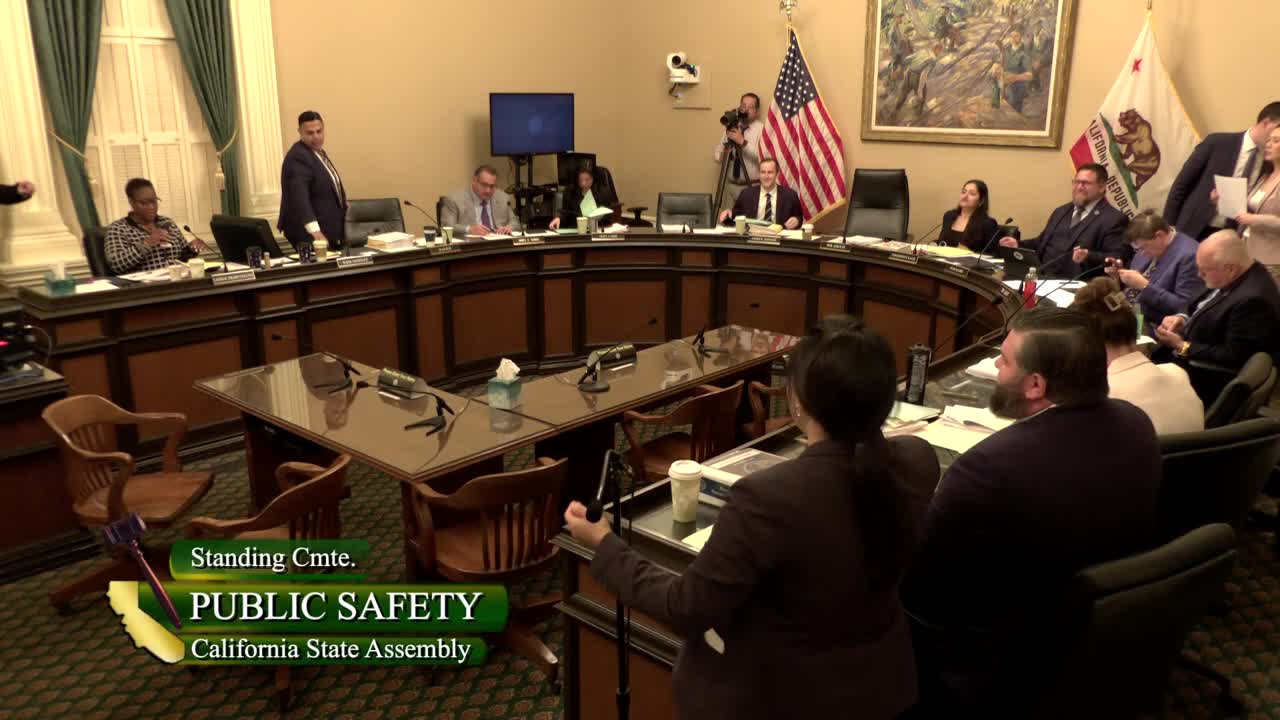
Bill Author

Bill Co-Author(s):