AB 2043: Countering Unmanned Aircraft Systems Task Force.
- Session Year: 2025-2026
- House: Assembly
- Latest Version Date: 2026-04-06
Current Status:
In Progress
(2026-05-22: Referred to Coms. on PUB. S. and E.M.)
Introduced
In Committee
Awaiting First Chamber Vote
Passed First Chamber
In Committee
Awaiting Second Chamber Vote
Passed Second Chamber
Enacted
What does this bill do?
The bill creates a statewide Countering Unmanned Aircraft Systems Task Force led by the Office of Emergency Services to develop and implement a plan to protect mass gatherings, critical infrastructure, and other soft targets from attacks by drones (unmanned aircraft systems). The task force will include state and local public safety, military, and utility representatives and will organize detection, training, exercises, and coordination with federal rules to help local and tribal governments detect, track, and respond to unlawful drone threats.
The summary is provided by generative AI which can make mistakes. For original language, please view the details in the table below.
Existing law, the California Emergency Services Act, establishes the Office of Emergency Services within the office of the Governor and charges it Governor under the supervision of the Director of Emergency Services. The act charges the office with responsibility for the states emergency and disaster response services for natural, technological, or manmade disasters and emergencies. The act specifies that its provisions do not prevent the Governor or the office from formally recognizing committees or boards established by or with segments of the private sector, public agencies, or both, that control facilities, resources, or the provision of services essential to the mitigation of the effects of an emergency or recovery therefrom.
This bill would require the Office of Emergency Services, on or before January 1, 2027, to establish, within its office, establish and lead the Countering Unmanned Aircraft Systems Task Force to develop a statewide strategy to protect mass gatherings, critical infrastructure, and other soft targets from attacks by unmanned aircraft systems. The bill would require the office Director of Emergency Services to seek to compose a membership of the task force that includes representatives of specific public and private entities, as specified, including, among others, the State Threat Assessment Center. The bill would authorize the task force to achieve its specific purpose, primary objective, and goals by developing or updating response plans specific to unmanned aircraft systems that integrate detection systems into existing emergency operation plans or incident command systems, among other things.
This bill would declare that it is to take effect immediately as an urgency statute.
Existing law, the California Emergency Services Act, establishes the Office of Emergency Services within the office of the Governor and charges it with responsibility for the states emergency and disaster response services for natural, technological, or manmade disasters and emergencies. The act specifies that its provisions do not prevent the Governor or the office from formally recognizing committees or boards established by or with segments of the private sector, public agencies, or both, that control facilities, resources, or the provision of services essential to the mitigation of the effects of an emergency or recovery therefrom.
This bill would require the Office of Emergency Services, on or before January 1, 2027, to establish, within its office, the Countering Unmanned Aircraft Systems Task Force to develop a statewide strategy to protect mass gatherings, critical infrastructure, and other soft targets from attacks by unmanned aircraft systems. The bill would require the office to seek to compose a membership of the task force that includes representatives of public and private entities, as specified, including, among others, the State Threat Assessment Center. The bill would authorize the task force to achieve its specific purpose, primary objective, and goals by developing or updating response plans specific to unmanned aircraft systems that integrate detection systems into existing emergency operation plans or incident command systems, among other things.
This bill would declare that it is to take effect immediately as an urgency statute.
For purposes of this article, the following definitions shall apply:
(a)Office means the Office of Emergency Services.
(b)Task force means the Countering Unmanned Aircraft Systems Task Force established by this article.
(c)Unmanned aircraft system means the same as unmanned aircraft system pursuant to Section 44801(12) of Title 49 of the United States Code.
8577.4.The office shall seek to compose a membership of the task force that includes representatives of its legal branch, the State Threat Assessment Center, the Department of the California Highway Patrol, the Department of Forestry and Fire Protection (CAL FIRE), the California National Guard, and representatives of privacy advocates, sheriffs, local police departments, local fire departments, local emergency managers, Major League Baseball, the National Football League, the University of California, the California State University, investor-owned utilities, LA28, FIFA, and amusement park associations.8577.2.(a)On or before January 1, 2027, the office shall establish and lead the Countering Unmanned Aircraft Systems Task Force to develop a statewide strategy to protect mass gatherings, critical infrastructure, and other soft targets from attacks by unmanned aircraft systems.
(b)The Director of Emergency Services shall seek to compose a membership of the task force with one or more representatives of all the following:
(1)State Threat Assessment Center.
(2)Department of the California Highway Patrol.
(3)Military Department.
(4)California Department of Forestry and Fire Protection (CAL FIRE).
(5)California Utilities Emergency Association.
(6)California State Sheriffs Association.
(7)California Police Chiefs Association.
(8)California Fire Chiefs Association.
(9)LA28 Organizing Committee of the 2028 Olympic and Paralympic Games (LA28).
(10)Any National Football League team based in California.
(11)Any Major League Baseball team based in California.
(12)Rank and file police officers.
(13)Firefighters employed by a public agency.
(14)Any organization devoted to the protection of personal privacy.
(c)The Director of Emergency Services, at their discretion, may appoint any other members to the task force.
8577.6.8577.4.The purpose of the task force shall be to organize and enhance the states lawful capabilities to detect, identify, track, and monitor unmanned aircraft systems and to support local and tribal governments in combating the unlawful use of unmanned aircraft systems that pose a threat to the safety and security of individuals, communities, and critical infrastructure.
8577.8.8577.6.The primary objective of the task force shall be to develop and implement a statewide strategy to deter and counter attacks by unmanned aircraft systems by ensuring public safety entities have the resources, training, and operational capacity to detect, track, identify, and mitigate unmanned aircraft system threats.
8577.10.8577.8.The goals of the task force shall include, but not be limited to, all of the following:
(a)Protect critical infrastructure, mass gatherings, and other soft targets from threats by unmanned aircraft systems. systems in coordination with federally established airspace restrictions and operational requirements.
(b)Support the deployment of fixed or portable systems for the detection, tracking, identification, and mitigation of unmanned aircraft systems consistent with applicable laws. federal laws, regulations, and restrictions.
(c)Ensure statewide readiness, in coordination with federal officials, to respond to emergencies or public safety threats associated with malicious use of unmanned aircraft systems.
8577.12.8577.10.The task force may achieve its purpose, primary objective, and goals by doing any of the following:
(a)Developing or updating response plans specific to unmanned aircraft systems that integrate detection systems into existing emergency operation plans or incident command systems.
(b)Conducting risk assessments to identify high-priority areas areas, in alignment with federal prioritization framework, for the detection of unmanned aircraft systems, including critical infrastructure, public events, or disaster-prone areas.
(c)Developing Leveraging existing training methodologies to document standard operating procedures for responding to unauthorized or malicious activity by unmanned aircraft systems.
(d)Coordinating with federal agencies to ensure compliance with and provide feedback on federal laws and regulations governing the detection and mitigation of unmanned aircraft systems.
(e)Planning for the integration of detection systems for unmanned aircraft systems with existing public safety technologies, including geographic information system (GIS) platforms or computer-aided dispatch (CAD) systems.
(f)Developing training for first responders Ensuring first responders receive appropriate training on the operation of specific detection systems for unmanned aircraft systems.
(g)Developing train-the-trainer programs to build local capacity for ongoing training efforts. efforts, as appropriate in the context of federal training requirements.
(h)Providing scenario-based response training to prepare responders for real-world threats by unmanned aircraft systems, including swarming drones or unmanned aircraft systems equipped with payloads.
(i)Developing secure training for personnel on the interpretation of unmanned aircraft system detection data in the context of federal law and regulation and the integration of this data into decisionmaking processes. processes in alignment with federal training standards.
(j)Designing tabletop exercises to simulate unmanned aircraft system-related incidents and test response plans, standard operating procedures, and coordination protocols.
(k)Organizing functional exercises to test the operation of unmanned aircraft system detection systems and the integration of these systems with other public safety technologies.
(l)Running full-scale exercises to simulate large-scale unmanned aircraft system threats, including unauthorized activity at a public event or near critical infrastructure, and multijurisdictional exercises to test coordination between the state, local agencies, tribal governments, federal agencies, and private sector partners.
(m)Conducting after-action reviews to identify lessons learned and areas for improvement following exercises.
SEC. 2.This act is an urgency statute necessary for the immediate preservation of the public peace, health, or safety within the meaning of Article IV of the California Constitution and shall go into immediate effect. The facts constituting the necessity are:
To prepare for and mitigate the evolving threat to public safety from attacks by malicious use of unmanned aircraft systems, including attacks on critical infrastructure and mass gatherings, it is necessary for this act to take effect immediately.
On or before January 1, 2027, the Office of Emergency Services shall establish, within its office, the Countering Unmanned Aircraft Systems Task Force to develop a statewide strategy to protect mass gatherings, critical infrastructure, and other soft targets from attacks by unmanned aircraft systems.
8577.2.For purposes of this article, the following definitions shall apply:
(a)Office means the Office of Emergency Services.
(b)Task force means the Countering Unmanned Aircraft Systems Task Force established by this article.
(c)Unmanned aircraft system means the same as unmanned aircraft system pursuant to Section 44801(12) of Title 49 of the United States Code.
8577.4.The office shall seek to compose a membership of the task force that includes representatives of its legal branch, the State Threat Assessment Center, the Department of the California Highway Patrol, the Department of Forestry and Fire Protection (CAL FIRE), the California National Guard, and representatives of privacy advocates, sheriffs, local police departments, local fire departments, local emergency managers, Major League Baseball, the National Football League, the University of California, the California State University, investor-owned utilities, LA28, FIFA, and amusement park associations.
8577.6.The purpose of the task force shall be to enhance the states capabilities to detect, identify, track, and monitor unmanned aircraft systems and to support local and tribal governments in combating the unlawful use of unmanned aircraft systems that pose a threat to the safety and security of individuals, communities, and critical infrastructure.
8577.8.The primary objective of the task force shall be to develop a statewide strategy to deter and counter attacks by unmanned aircraft systems by ensuring public safety entities have the resources, training, and operational capacity to detect, track, identify, and mitigate unmanned aircraft system threats.
8577.10.The goals of the task force shall include, but not be limited to, all of the following:
(a)Protect critical infrastructure, mass gatherings, and other soft targets from threats by unmanned aircraft systems.
(b)Support the deployment of fixed or portable systems for the detection, tracking, identification, and mitigation of unmanned aircraft systems consistent with applicable laws.
8577.12.The task force may achieve its purpose, primary objective, and goals by doing any of the following:
(a)Developing or updating response plans specific to unmanned aircraft systems that integrate detection systems into existing emergency operation plans or incident command systems.
(b)Conducting risk assessments to identify high-priority areas for the detection of unmanned aircraft systems, including critical infrastructure, public events, or disaster-prone areas.
(c)Developing standard operating procedures for responding to unauthorized or malicious activity by unmanned aircraft systems.
(d)Coordinating with federal agencies to ensure compliance with federal laws and regulations governing the detection and mitigation of unmanned aircraft systems.
(e)Planning for the integration of detection systems for unmanned aircraft systems with existing public safety technologies, including geographic information system (GIS) platforms or computer-aided dispatch (CAD) systems.
(f)Developing training for first responders on the operation of specific detection systems for unmanned aircraft systems.
(g)Developing train-the-trainer programs to build local capacity for ongoing training efforts.
(h)Providing scenario-based training to prepare responders for real-world threats by unmanned aircraft systems, including swarming drones or unmanned aircraft systems equipped with payloads.
(i)Developing secure training for personnel on the interpretation of unmanned aircraft system detection data and the integration of this data into decisionmaking processes.
(j)Designing tabletop exercises to simulate unmanned aircraft system-related incidents and test response plans, standard operating procedures, and coordination protocols.
(k)Organizing functional exercises to test the operation of unmanned aircraft system detection systems and the integration of these systems with other public safety technologies.
(l)Running full-scale exercises to simulate large-scale unmanned aircraft system threats, including unauthorized activity at a public event or near critical infrastructure, and multijurisdictional exercises to test coordination between the state, local agencies, tribal governments, federal agencies, and private sector partners.
(m)Conducting after-action reviews to identify lessons learned and areas for improvement following exercises.
SEC. 2.This act is an urgency statute necessary for the immediate preservation of the public peace, health, or safety within the meaning of Article IV of the California Constitution and shall go into immediate effect. The facts constituting the necessity are:
To prepare for and mitigate the evolving threat to public safety from attacks by unmanned aircraft systems, including attacks on critical infrastructure and mass gatherings, it is necessary for this act to take effect immediately.
|
Date
|
Status
|
|---|---|
| May 22, 2026 | Referred to Coms. on PUB. S. and E.M. |
| May 22, 2026 | In Senate. Read first time. To Com. on RLS. for assignment. |
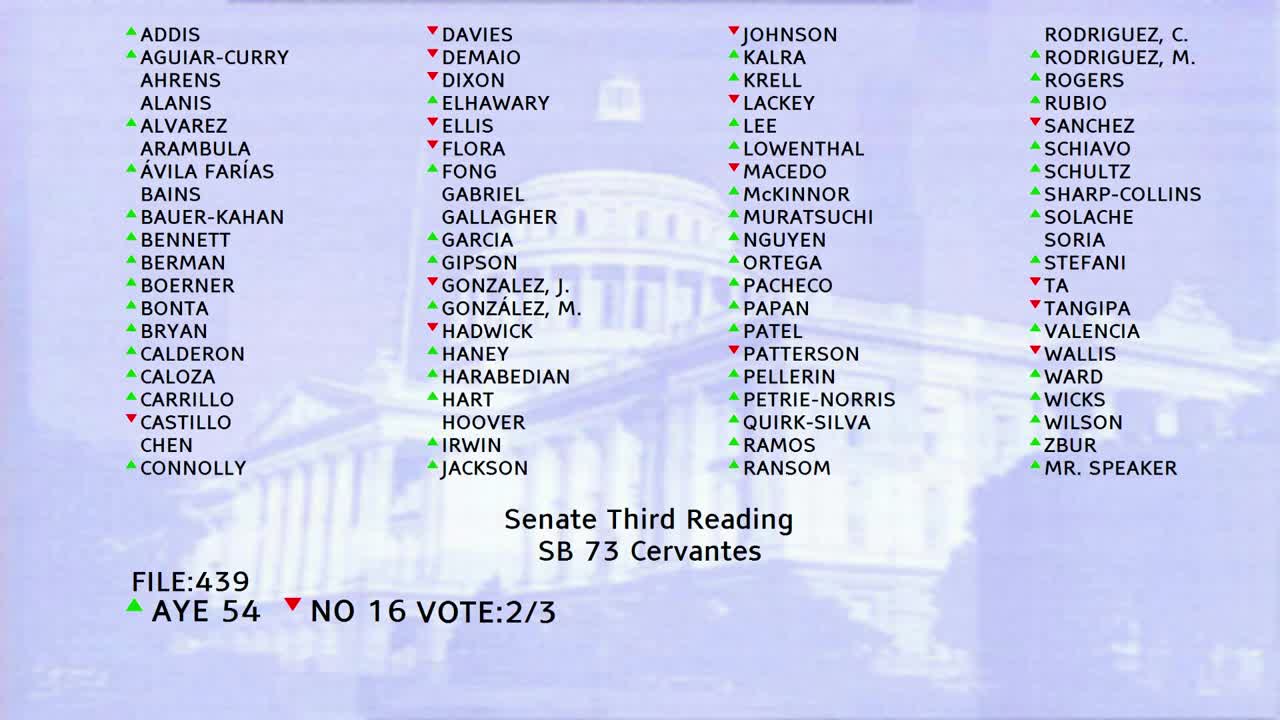
| May 22, 2026 | Read third time. Urgency clause adopted. Passed. Ordered to the Senate. (Ayes 74. Noes 0.). |
| May 22, 2026 | Read third time. Urgency clause adopted. Passed. Ordered to the Senate. (Ayes 74. Noes 0. Page 5261.). |
| May 18, 2026 | Read second time. Ordered to third reading. |
| May 14, 2026 | From committee: Do pass. (Ayes 15. Noes 0.) (May 14). |
| May 6, 2026 | In committee: Set, first hearing. Referred to APPR. suspense file. |
| Apr 20, 2026 | From committee: Do pass and re-refer to Com. on APPR. with recommendation: To Consent Calendar. (Ayes 15. Noes 0.) (April 16). Re-referred to Com. on APPR. |
| Apr 14, 2026 | From committee: Do pass and re-refer to Com. on P. & C.P. with recommendation: To Consent Calendar. (Ayes 6. Noes 0.) (April 13). Re-referred to Com. on P. & C.P. |
| Apr 13, 2026 | Assembly Rule 56 suspended. (Page 4580.) |
| Apr 13, 2026 | Assembly Rule 56 suspended. |
| Apr 13, 2026 | (Pending re-refer to Com. on P. & C.P.) |
| Apr 7, 2026 | Re-referred to Com. on E.M. |
| Apr 6, 2026 | From committee chair, with author's amendments: Amend, and re-refer to Com. on E.M. Read second time and amended. |
| Mar 9, 2026 | Referred to Coms. on E.M and P. & C.P. |
| Feb 18, 2026 | From printer. May be heard in committee March 20. |
| Feb 17, 2026 | Read first time. To print. |
|
Date
|
Description
|
Location
|
Votes
|
|
|---|---|---|---|---|
| May 22, 2026 | AB 2043 Calderon Third Reading Urgency | Assembly Floor |
Passed |
|
| May 14, 2026 | Do pass. | Assembly Standing Committee on Appropriations |
Passed |
|
| Apr 16, 2026 | Do pass and be re-referred to the Committee on [Appropriations] with recommendation: To Consent Calendar | Assembly Standing Committee on Privacy and Consumer Protection |
Passed |
|
| Apr 13, 2026 | Do pass and be re-referred to the Committee on [Privacy and Consumer Protection] with recommendation: To Consent Calendar | Assembly Standing Committee on Emergency Management |
Passed |
This list shows positions taken on this bill by organizations on the date displayed, which is linked to the original source.
Positions by individuals are not included.
|
Organization
|
Position
|
Date
|
|---|---|---|
| Police Officer Research Association of California (PORAC) | ** Support | |
| Public Officers’ Research Association of California | ** Support |
ASSEMBLY THIRD READING
ATR Bill Id:AB 2043
Author:(Calderon)
As Amended Ver:April 6, 2026
2/3 vote. Urgency
SUMMARY
Requires Cal OES to establish and lead the Countering Unmanned Aircraft Systems Task Force to develop a statewide strategy to protect mass gatherings, critical infrastructure, and other soft targets from attacks by unmanned aircraft systems. Additionally, this bill defines the task force′s purpose, primary objective, goals, and the specific methods it may use to achieve them
Major Provisions
- Requires the California Office of Emergency Services (Cal OES), by January 1, 2027, to establish and lead the Countering Unmanned Aircraft Systems Task Force, with membership as specified, to develop a statewide strategy to protect mass gatherings, critical infrastructure, and other soft targets from attacks by unmanned aircraft systems.
- Specifies the purpose of the task force is to organize and enhance the state′s lawful capabilities to detect, identify, track, and monitor unmanned aircraft systems and to support local and tribal governments in combating the unlawful use of unmanned aircraft systems that pose a threat to the safety and security of individuals, communities, and critical infrastructure.
- Specifies the primary objective of the task force is to develop and implement a statewide strategy to deter and counter attacks by unmanned aircraft systems by ensuring public safety entities have the resources, training, and operational capacity to detect, track, identify, and mitigate unmanned aircraft system threats.
- Establishes the goals of the task force, as specified, including protecting sensitive locations from unmanned aircraft threats, supporting the deployment of unmanned aircraft detection, tracking, identification and mitigation systems, and ensuring state readiness.
- Authorizes the task force to achieve its purpose, primary objective, and goals by doing any of the following:
(a) Developing or updating response plans specific to unmanned aircraft systems that integrate detection systems into existing emergency operation plans or incident command systems.
(b) Conducting risk assessments to identify high-priority areas in alignment with federal prioritization framework, for the detection of unmanned aircraft systems, including critical infrastructure, public events, or disaster-prone areas.
(c) Leveraging existing training methodologies to document standard operating procedures for responding to unauthorized or malicious activity by unmanned aircraft systems.
(d) Coordinating with federal agencies to ensure compliance with and provide feedback on federal laws and regulations governing the detection and mitigation of unmanned aircraft systems.
(e) Planning for the integration of detection systems for unmanned aircraft systems with existing public safety technologies, including geographic information system (GIS) platforms or computer-aided dispatch (CAD) systems.
(f) Ensuring first responders receive appropriate training on the operation of specific detection systems for unmanned aircraft systems.
(g) Developing train-the-trainer programs to build local capacity for ongoing training efforts, as appropriate in the context of federal training requirements.
(h) Providing scenario-based response training to prepare responders for real-world threats by unmanned aircraft systems, including swarming drones or unmanned aircraft systems equipped with payloads.
(i) Developing secure training for personnel on the interpretation of unmanned aircraft system detection data in the context of federal law and regulation and the integration of this data into decisionmaking processes in alignment with federal training standards.
(j) Designing tabletop exercises to simulate unmanned aircraft system-related incidents and test response plans, standard operating procedures, and coordination protocols.
(k) Organizing functional exercises to test the operation of unmanned aircraft system detection systems and the integration of these systems with other public safety technologies.
(l) Running full-scale exercises to simulate large-scale unmanned aircraft system threats, including unauthorized activity at a public event or near critical infrastructure, and multijurisdictional exercises to test coordination between the state, local agencies, tribal governments, federal agencies, and private sector partners.
(m) Conducting after-action reviews to identify lessons learned and areas for improvement following exercises.
- Includes an Urgency Clause
COMMENTS
SAFER SKIES Act (S.3481): Passed as part of the FY2026 National Defense Authorization Act, the SAFER SKIES Act (Act) expands the authority to use counter-unmanned aircraft system technologies to local, State, Tribal, and territorial law enforcement and correctional agencies as well as extending existing federal authorities for the Department of Homeland Security (DHS) and Department of Justice (DOJ) to respond to drone threats near airports, stadiums, and other sensitive locations through 2031. The Act also requires the Federal Bureau of Investigation (FBI) to train state and local law enforcement on counter-drone technology (a requirement before a local or state deploys the technology) and provides associated grant funding for the purchase of counter-drone equipment.
The author′s office notes the importance of creating a task force to leverage the new authorities and grant funding provided by the Act.
Executive Order (EO) 14305: On June 6, 2025, President Trump issued EO 14305, titled ″Restoring American Airspace Sovereignty.″ This EO declared it is the policy of the United States to ensure control over our national airspace and to protect the public, critical infrastructure, mass gathering events, and military and sensitive government installations and operations from threats posed by the careless or unlawful use of UAS. Additionally, it created the Federal Task Force to Restore American Airspace Sovereignty to guarantee control over the national airspace. This task force is directed to review relevant operational, technical, and regulatory frameworks; develop and propose solutions to UAS threats; and make recommendations, as specified. The task force is chaired by the Assistant to the President for National Security Affairs and principals from related executive departments. The EO also directs relevant federal agencies to expand restrictions on drones near sensitive sites and critical infrastructure, improve existing enforcement mechanisms, recommend stronger penalties, improve drone detection and tracking as well as operator identification, provide state and local agencies with grants for counter-drone technology, assess protection needs for locations with a high risk factor and make related recommendations, and consider building the national counter-drone capacity.
Drone Flight Bans and Permanent Restrictions: Federal regulation prohibits drones from flying near designated national security sensitive facilities. This includes locations such as military bases, national landmarks, and certain critical infrastructure. Additionally, there are drone restrictions for major stadiums and sports arenas, airports, restricted or special use airspace, and Washington, DC.
Temporary Flight Restrictions: The Federal Aviation Administration (FAA) frequently establishes Temporary Flight Restrictions (TFRs) to restrict aircrafts, which includes drones, from accessing designated airspace for a limited time. All unauthorized aircraft and drones are prohibited from entering these restricted areas without permission. TFRs are initiated when there are temporary hazardous conditions, a security-related event, or another special situation. In California, TFRs are most frequently seen in the airspace above wildfire response efforts.
According to the Author
″The purpose of the Countering Unmanned Aircraft Systems Task Force is to enhance California′s capabilities to detect, identify, track, or monitor unmanned aircraft systems and to support local and tribal governments in combatting the unlawful use of unmanned aircraft systems that pose a threat to the safety and security of individuals, communities, and critical infrastructure. In recent years, criminals, terrorists, and hostile foreign actors with malicious intentions have intensified their use of drones. We need to have a statewide strategy to counter this evolving threat and to keep the World Cup and Olympic Games safe.″
Arguments in Support
The Police Officer Research Association of California (PORAC) writes ″The rapid expansion of unmanned aircraft systems (UAS) brings growing risks to public safety, including interference with emergency operations, threats to mass gatherings, critical infrastructure, and community spaces. With major events like the 2028 Olympics approaching, a coordinated statewide approach is essential. AB 2043 takes an important step forward by bringing together public and private stakeholders to assess these risks and develop comprehensive response strategies. The integration of UAS detection systems into existing emergency operations plans and incident command structures will help ensure that first responders are better equipped to prevent, identify, and respond to emerging threats.″
Arguments in Opposition
None on file.
FISCAL COMMENTS
According to the Assembly Committee on Appropriations:
- Costs of approximately $1 million annually to OES for four additional staff positions to immediately establish and lead the Task Force (General Fund (GF)). Additionally, cost pressures of approximately $2.9 million annually to OES for eight additional staff positions should the Task Force determine all the enumerated activities the Task Force may undertake to achieve its purpose are necessary (GF).
- Costs of an unknown amount to CHP, CMD, and CAL FIRE to participate on the task force.
VOTES
ASM EMERGENCY MANAGEMENT: 6-0-1
YES: Ransom, Hadwick, Arambula, Bennett, Calderon, DeMaio
ABS, ABST OR NV: Bains
ASM PRIVACY AND CONSUMER PROTECTION: 15-0-0
YES: Bauer-Kahan, Macedo, Aguiar-Curry, Bryan, DeMaio, Hoover, Irwin, Lowenthal, McKinnor, Ortega, Patterson, Petrie-Norris, Ward, Wicks, Wilson
ASM APPROPRIATIONS: 15-0-0
YES: Wicks, Hoover, Aguiar-Curry, Calderon, Caloza, Dixon, Fong, Mark González, Krell, Pacheco, Pellerin, Sharp-Collins, Solache, Ta, Tangipa
UPDATED
VERSION: April 6, 2026
CONSULTANT: Ryan Fleming / E.M. / (916) 319-3802 FN: 0002738
Date of Hearing: May 6, 2026
ASSEMBLY COMMITTEE ON APPROPRIATIONS
Buffy Wicks, Chair
ABPCA Bill Id:AB 2043
Author:(Calderon) – As Amended Ver:April 6, 2026
Policy Committee: | Emergency Management | Vote: | 6 - 0 |
Privacy and Consumer Protection | 15 - 0 | ||
|
|
Urgency: Yes State Mandated Local Program: No Reimbursable: No
SUMMARY:
This bill requires the Office of Emergency Services (OES) to establish the Countering Unmanned Aircraft Systems Task Force (Task Force).
Specifically, this bill, as an urgency statute:
- Requires OES to establish and lead the Task Force by January 1, 2027, to develop a statewide strategy to protect mass gatherings, critical infrastructure, and other soft targets from attacks by unmanned aircraft systems (drones).
- Requires the OES director to compose a Task Force membership representing certain state and non-state entities, such as the State Threat Assessment Center, California Highway Patrol (CHP), Military Department (CMD), Department of Forestry and Fire Protection (CAL FIRE), California Utilities Emergency Association, LA28 Organizing Committee of the 2028 Olympic and Paralympic Games, a National Football League team based in California, and an organization devoted to the protection of personal privacy, among others.
- Allows the Task Force to undertake certain activities to achieve its purpose, such as conducting risk assessments to identify high-priority areas for the detection of drones, ensuring first responders receive appropriate training to operate drone detection systems and designing tabletop exercises to simulate drone-related incidents, among others.
FISCAL EFFECT:
- Costs of approximately $1 million annually to OES for four additional staff positions to immediately establish and lead the Task Force (General Fund (GF)). Additionally, cost pressures of approximately $2.9 million annually to OES for eight additional staff positions should the Task Force determine all the enumerated activities the Task Force may undertake to achieve its purpose are necessary (GF).
- Costs of an unknown amount to CHP, CMD, and CAL FIRE to participate on the task force.
The Legislative Analyst’s Office recently warned of GF structural deficits of around $35 billion
per year in the 2027-28 fiscal year and ongoing.
COMMENTS:
- Purpose. According to the author, “In recent years, criminals, terrorist, and hostile foreign actors with malicious intentions have intensified their use of drones. We need to have a statewide strategy to counter this evolving threat and to keep the World Cup and Olympic Games safe.” This bill is supported by the Public Officers’ Research Association of California.
- Drone Attacks. Drones have become increasingly popular due to their various applications and mass availability. However, concerns about the potential for drones to harm critical infrastructure and the public has led to local and federal investments in drone detection and mitigation. The federal SAFER SKIES Act of 2025 (SSA) authorizes local, state, and tribal, and territorial law enforcement to respond to drone threats near airports, stadiums, and other sensitive locations through 2031. The SSA also requires the Federal Bureau of Investigation to train state and local law enforcement on counter-drone technology and provides related grant funding to purchase counter-drone equipment. Additionally, a June 6, 2025, executive order created a Federal Task Force to Restore American Airspace Sovereignty to develop solutions to drone threats. This bill similarly establishes a state drone task force to implement a statewide strategy to deter and counter drone attacks by ensuring public safety entities have the resources, training, and operational capacity to detect, track, identify, and mitigate drone threats.
Analysis Prepared by: Irene Ho / APPR. / (916) 319-2081
Date of Hearing: April 16, 2026
Fiscal:
ASSEMBLY COMMITTEE ON PRIVACY AND CONSUMER PROTECTION
Rebecca Bauer-Kahan, Chair
ABPCA Bill Id:AB 2043 (
Author:Calderon) – As Amended Ver:April 6, 2026
SUBJECT: Countering Unmanned Aircraft Systems Task Force
SYNOPSIS
Unmanned aircraft systems (UAS), or drones, have become increasingly popular due to their various applications and mass availability. However, concerns about the potential for drones to harm critical infrastructure and the public has led local and federal law enforcement to invest in drone detection and mitigation. Under the 2025 SAFER SKIES Act, local and tribal law enforcement are authorized to actively mitigate malicious drones if the drone poses a safety or security risk. Additionally, 2025 Presidential Executive Order 14305 establishes a federal task force to develop protocols to respond to drone threats and enables local and tribal law enforcement agencies to apply for federal grants for drone detection and identification equipment.
This bill mirrors federal law by establishing a statewide drone task force, housed under the Office of Emergency Services, to enhance the state’s capabilities to detect, identify, track, and monitor drones and to support local and tribal law enforcement in combatting drones that pose safety and security risks. This bill requires the Director of Emergency Services to include representatives of specific public and private entities on the task force, including local law enforcement, California sports teams, and organizations concerned with privacy protections, with the goal of developing response plans specific to unauthorized drones.
This bill is supported by the Peace Officers Research Association of California (PORAC). It has no registered opposition.
This bill was previously heard by the Assembly Emergency Management Committee, where it passed with a 6-0 vote.
This bill contains an urgency clause.
EXISTING LAW:
- Establishes that the United States Government has exclusive sovereignty of airspace of the United States, but that a citizen of the United States has a public right of transit through navigable airspace. (49 U.S.C, § 40103.)
- Establishes definitions related to unmanned aircraft systems (UAS), or drones, as well as various requirements and restrictions on the operation of drones, including integration of civil drones into national airspace, safety standards, carriage of property by small unmanned aircraft, certain exceptions for limited recreations operations, and other provisions. (49 U.S.C. Ch. 448.)
- Defines, through the Critical Infrastructures Protection Act of 2001, “critical infrastructure” as the systems and assets, whether physical or virtual, so vital to the United States that the incapacity or destruction of such systems and assets would have a debilitating impact on security, national economic security, national public health or safety, or any combination of those matters, and states that it is the policy of the United States that that any physical or virtual disruption of the operation of the critical infrastructures the United States be rare, brief, geographically limited in effect, manageable, and minimally detrimental to the economy, human and government services, and national security of the United States. (42 U.S.C, § 5195c.)
- Authorizes the Secretary of Transportation and Attorney General of the United States, through the Preventing Emerging Threats Act of 2018, to authorize certain personnel to take such actions as are necessary to mitigate a credible threat that a drone or unmanned aircraft poses to the safety or security of a covered facility or asset, including disrupting control of the drone by the operator, seizing the drone and using reasonable force, as necessary, to disable, damage, or destroy the drone or unmanned aircraft. (6 U.S.C, § 124n.)
- Authorizes the Administrator of the Federal Aviation Administration (FAA) to issue special security instructions in the interest of national security, with which any person operating an aircraft, including a drone, in a national security sensitive area must comply. (14 CFR, § 99.7 and 14 CFR Part 107.)
- Authorizes state, local, Tribal, and territorial law enforcement officers, after completing detailed training, to take necessary action to mitigate a credible threat than an unmanned aircraft or drone poses to the safety or security of people, facilities, and assets, a venue or set of venues used for large-scale public gatherings or events, critical infrastructure, or correctional facilities. (6 U.S.C, § 124n(a)(2).)
- Defines “unmanned aircraft” as an aircraft that is operated without the possibility of direct human intervention from within or on the aircraft. (Gov. Code § 853.5(a).)
- Defines “unmanned aircraft system” as an unmanned aircraft and associated elements, including, but not limited to, communication links and the components that control the unmanned aircraft that are required for the pilot in command to operate safely and efficiently in the national airspace system. (Gov. Code § 853.5(a).)
- Makes it a misdemeanor for a person to use a drone to look through a hole or opening into the interior of an area in which the occupant has a reasonable expectation of privacy, with the intent to invade the privacy of a person or persons inside. (Pen. Code § 647(j)(1).)
- Establishes that a person is liable for physical invasion of privacy when the person knowingly enters onto the land or into the airspace above the land of another person without permission or otherwise commits a trespass in order to capture any type of visual image, sound recording, or other physical impression of the plaintiff engaging in a private, personal, or familial activity and the invasion occurs in a manner that is offensive to a reasonable person. (Civ. Code § 1708.8(a).)
- Makes it unlawful for any person to operate a drone in pest control unless the pilot operating the drone holds a valid manned pest control aircraft pilot’s certificate or a valid unmanned pest control aircraft pilot’s certificate issued by the director and is certified or otherwise authorized by the FAA to operate a drone approved by the FAA to conduct pest control. (Food & Agr. Code § 11901(b).)
- Establishes a misdemeanor for a person who goes to the scene of an emergency, or stops at the scene of an emergency, and uses a drone for the purpose of viewing the scene or the activities of police officers, firefighters, emergency medical, or other emergency personnel, unless it is part of the duties of that person’s employment to view that scene, and impedes emergency personnel in the performance of their duties. (Pen. Code, § 402.)
THIS BILL:
- Creates the Countering Unmanned Aircraft Systems Task Force, housed under the Office of Emergency Services, to develop a statewide strategy to protect mass gatherings, critical infrastructure, and other soft targets from attacks by unmanned aircraft systems.
- Authorizes the Director of Emergency Services to compose a membership of the task force with one or more representatives of the following:
- State Threat Assessment Center.
- Department of the California Highway Patrol.
- Military Department.
- Department of Forestry and Fire Protection.
- Utilities Emergency Association.
- California State Sheriffs’ Association.
- California Police Chiefs Association.
- California Fire Chiefs Association.
- Organizing Committee of the 2028 Olympic and Paralympic Games.
- A National Football League team based in California.
- A Major League Baseball team based in California.
- Rank and file police officers.
- Firefighters employed by a public agency.
- An organization devoted to the protection of personal privacy.
- Authorizes the Director of Emergency Services to appoint additional members to the task force, at their discretion.
- States that the purpose of the task force is to organize and enhance the state’s ability to detect, identify, track, and monitor drones and local law enforcement in combatting the unlawful use of drones that poses a threat to the safety and security of individuals, communities, or critical infrastructure.
- States that the task force’s primary objective is to develop and implement a statewide strategy to deter and counter attacks by drones.
- Establishes the goals of the task force including, but not be limited to, the following:
- Protect critical infrastructure, mass gatherings, and other soft targets from threats.
- Support the deployment of fixed or portable systems for the detection, tracking, identification, and mitigation of unmanned aircraft.
- Ensure statewide readiness, in coordination with federal officials, to respond to emergencies or public safety threats associated with malicious use of drones.
- Authorizes the task force to:
- Develop or update response plans specific for drones as necessary.
- Conduct risk assessments to identify high-priority areas for the detection of drones, including critical infrastructure, public events, or disaster-prone areas.
- Create standard operating procedures for responding to unauthorized or malicious activity by drones.
- Coordinate with federal agencies to ensure compliance with and provide feedback on federal laws and regulations governing drones.
- Plan for the integration of detection systems for drones within existing public safety technologies.
- Ensure first responders receive appropriate training in the operation of specific detection systems for drones.
- Develop other necessary training including but not limited to training for trainers, scenario-based response training, table-top exercises.
COMMENTS:
1) Author’s statement. According to the author:
The purpose of the Countering Unmanned Aircraft Systems Task Force is to enhance California’s capabilities to detect, identify, track, or monitor unmanned aircraft systems and to support local and tribal governments in combatting the unlawful use of unmanned aircraft systems that pose a threat to the safety and security of individuals, communities, and critical infrastructure. In recent years, criminals, terrorists, and hostile foreign actors with malicious intentions have intensified their use of drones. We need to have a statewide strategy to counter this evolving threat and to keep the World Cup and Olympic Games safe.
2) Background. Unmanned aircraft systems (UAS), commonly known as drones, have become increasingly popular in the United States due to their widespread availability. Originally intended for military and commercial applications, drones are commonplace in a variety of fields, including delivery, agriculture, infrastructure development, search and rescue, security, and have become a popular recreational hobby. The FAA projects that the popularity of drones will only increase in coming years, forecasting commercial drone fleet (drones used in connection with a business) will reach 955,000, and that recreational fleet (drones operated for personal enjoyment) will number around 1.82 million by 2027.[1]
In 2026, the FAA reported registering over 855,000 drones. Of these registered drone operators, nearly two-thirds (63 percent) are hobbyist flyers.[2] Although the vast majority of drone operators are recreational flyers, concerns about how drones can interfere with public safety, including through invasive surveillance, weaponization and terrorism, airspace interference, and potential property damage, have percolated in law enforcement spheres. In December 2023, several drones swarmed a military base in Virginia for 17 days, confounding government officials and law enforcement.[3] In November 2024, the Federal Bureau of Investigation (FBI) thwarted a man who attempted to use a drone rigged with explosives to destroy an energy facility in Nashville.[4] These cases highlight potential vulnerabilities in American infrastructure, as explained by an article in the Journal of Domestic Preparedness:
In the U.S., most critical infrastructure was designed and built in a relatively low-threat environment, designed to survive weather events, minimize accidents, and prevent theft, rather than built to protect against attack or sabotage. The idea that people would intentionally destroy infrastructure was generally not considered. For instance, in the energy sector, most substations were simply protected by chain link fences and signage indicating the dangers of high voltage. The reason for fencing was to deter theft and protect the public.
[…]
Wars in Ukraine and Israel have shown how drones can be used to destroy civilian infrastructure. In a similar fashion, transnational crime organizations embrace weaponized drones to combat rivals and police, as the use of weaponized drones is spreading beyond war zones. In 2020, a drone was used in an attempt to disrupt the U.S. power grid by attacking a substation in Pennsylvania by dropping a metal cable across high-voltage lines. Fortunately, the attack was unsuccessful. However, it is only a matter of time before a drone attack disables or destroys critical infrastructure.[5]
Drones also have the potential to act as tools for public safety and support. Drones are beginning to be deployed in remote regions to deliver lifesaving medicine and supplies to patients who would otherwise be left waiting hours for conventional transit systems like delivery vans.[6] In Canada, drones are being used to assist in avalanche control. Rather than throwing explosives from helicopters or firing artillery weapons to stimulate small, manageable avalanches (much like controlled fire burning), drones can drop an explosive remotely, saving the government time, money, and potentially lives.[7] Like any emerging technology, the potential benefits of expansive drone use must be weighed alongside potential harms to determine how best to protect public interest and safety.
3) Artificial intelligence and drones. Unlike remotely piloted drones that rely on constant human input to navigate, autonomous drones rely on artificial intelligence (AI) to adapt to their surroundings and operate without human oversight.[8] This is the “unmanned” part of unmanned aircraft systems. These drones rely on AI for things like object perception and recognition, terrain mapping, target identification, obstacle avoidance, and multi-drone coordination – a technique known as drone swarming. Drone swarms refer to when a group of drones operate as a natural swarm, like bees, to coordinate complex tasks through decentralized decision-making and synchronized behaviors.[9] By acting as a natural swarm feeding off one another’s actions, drones can quickly and effectively coordinate across a range of complex behaviors to assist in agricultural operations and potentially even mining without the need for human intervention. However, AI use exposes these drones to bias and security risks, as AI systems are vulnerable to signal jamming and GPS spoofing – software that can send incorrect coordinates to drones to change a drone’s position in the sky.[10] These tools can be used to mitigate malicious drones by disrupting the drone’s link with its controller and thus sending it off course (as with signal jamming) or by encouraging the drone to redirect or avoid a private area by sending it inaccurate GPS coordinates (as with GPS spoofing).[11]
3) Federal laws regarding drone mitigation. Historically, federal law generally prohibited non-federal law enforcement officers from disrupting drone links, seizing control, or disabling drones. Non-federal law enforcement was allowed to identify and track drones, although active mitigation of drones was restricted to certain federal agencies. However, in December 2025, Congress passed the SAFER SKIES Act, which authorized non-federal law enforcement, after training and certification, to “take actions necessary to mitigate a credible threat” that a drone poses to people, facilities, assets, large‑venue events, critical infrastructure, or correctional facilities.[12] Credible threat refers to a statement or action that a reasonable person would interpret as a genuine intent to inflict harm, coupled with the likelihood that the actor could carry out that harm.[13]
In June 2025, the President signed Executive Order (EO) 14305 establishing the Federal Task Force to Restore American Airspace Sovereignty that was tasked with reviewing operational, technical, and regulatory frameworks and developing and proposing solutions to drone threats.[14] In addition to creating a task force, the order enabled non-federal law enforcement agencies to access grant programs for the intention of purchasing drones or equipment for the detection, tracking, or identification of drones and drone signals. The same day, EO 14307, “Unleashing American Drone Dominance,” was signed, which seeks to enhance U.S. productivity in drone development, commercialization, and export.[15]
4) The potential impact of drone usage on California Infrastructure. California hosts some of the largest events in the world. The 2028 Los Angeles Olympics, for example, are projected to draw record numbers of sports enthusiasts from around the globe. Conservative estimates suggest a minimum of 1-1.5 million visitors to Los Angeles for the Olympics, making the event one of the largest attractions hosted in the state. [16]
Large events like the Olympics can increase the demand for public safety protocols and procedures to identify and circumvent potential threats. Indeed, concerns regarding drone strikes were raised during the Paris Olympics in 2024, with security authorities noting that:
While authorities planned for the possibility of drones being used to deliver harmful devices, the more common incidents involved spectators trying to capture [unauthorized] footage or conduct activity that could resemble surveillance.[17]
Law enforcement should consider previous mass gatherings as case studies for understanding the threats that drones may pose to public safety. Although there have been no reports of malicious drone use at prior Olympics or sporting games, drone usage has been employed widely for unauthorized surveillance across a range of live events. A recently introduced bill, AB 2113 (McKinnor), aims to curb this practice by prohibiting drones within 400 feet of an outdoor ticketed entertainment event.
5) Drones as a tool for mass surveillance. Equipped on nearly every commercially available drone is a camera capable of capturing hours of footage high above unsuspecting eyes. Footage captured by drones, be it a concert that does not allow filming or of a private property without an owner’s consent, can violate privacy and impede autonomy, especially when these tools are in the hands of the government. Despite the fundamental right to privacy enshrined in the California constitution, state and local governments continue to purchase and implement surveillance tools under the guise of protecting public safety. In April 2026, Oakland County approved a Flock drone pilot program that aims to deploy drones in response to 911 calls.[18] Flock, an automated license plate reader camera company, is well-known for their contracts with the Department of Homeland Security’s Immigration and Customs Enforcement (ICE) agency, which relies on the hours of footage from Flock cameras to identity and track suspected undocumented immigrants.[19] The idea of Flock technology now becoming airborne and mobile understandably concerns some community members, with one constituent arguing at the Oakland County board meeting:
[Flock drones] could cost our privacy, our rights, and our personal data. Drone surveillance introduces a public eye in the sky, recording movement, faces, and private property, often without clear oversight or consent.[20]
The task force should carefully consider how to implement policies and procedures that effectively monitor for malicious drones whilst ensuring that these practices do not encourage mass surveillance. Common methods of drone detection such as radar and radio frequency analyzers do not require increased surveillance or monitoring of the public and should be encouraged over cameras and other surveillance tools that may impact the most vulnerable populations. Care should be taken in establishing a balanced task force that incorporates both law enforcement experts, as well as privacy experts and government watchdogs to ensure that the strategies developed for countering drones are holistic and focused on public safety and security, rather than providing tools that would allow law enforcement unfettered access to our personal lives.
Additionally, the task force may wish to consider what, if there are any federal grants, now accessible to local law enforcement under EO 14305, they may wish to pursue. Notably, EO 14305 allows for the purchasing of both drones and the equipment used to track and identify them. The goals of this task force, which are to ensure that the state is prepared in the event of a malicious drone attack, are not aligned with investing government resources in purchasing drones for law enforcement’s use. The Legislature may wish to establish clear limits regarding the investment in these drones to ensure that government resources are not spent on tools that can be used to surveil its constituents. Rather, the task force should invest in resources and in equipment to identify and protect them from malicious drones whilst maintaining privacy protections for all Californians.
ARGUMENTS IN SUPPORT: PORAC writes in support:
The rapid expansion of unmanned aircraft systems (UAS) brings growing risks to public safety, including interference with emergency operations, threats to mass gatherings, critical infrastructure, and community spaces. With major events like the 2028 Olympics approaching, a coordinated statewide approach is essential.
AB 2043 takes an important step forward by bringing together public and private stakeholders to assess these risks and develop comprehensive response strategies. The integration of UAS detection systems into existing emergency operations plans and incident command structures will help ensure that first responders are better equipped to prevent, identify, and respond to emerging threats.
REGISTERED SUPPORT / OPPOSITION:
Support
Peace Officers Research Association of California (PORAC)
Opposition
None on file.
Analysis Prepared by: Kate Davis / P. & C.P. / (916) 319-2200
U.S. Government Accountability Office, “Drone Operations,” https://www.gao.gov/drone-operations. ↑
“What Are the Statistics for Drones? The Ultimate 2026 Data Dive,” Drone Brands, (Jan. 26, 2026), https://www.dronebrands.org/what-are-the-statistics-for-drones/#data-methodology-how-we-gathered-and-analyzed-drone-statistics. ↑
Gordon Lubold, L. Seligman, & A. Viswanatha, “Mystery Drones Swarmed a U.S. Military Base for 17 Days. The Pentagon Is Stumped.” Wall Street Journal, (Oct. 12, 2024), https://www.congress.gov/119/meeting/house/118165/documents/HHRG-119-GO06-20250429-SD004.pdf. ↑
Jonathan Mattise, “Man pleads guilty to charges that he meant to blow up a Nashville power site with a bomb-laden drone,” Associated Press, (Sept. 9, 2025), https://apnews.com/article/nashville-weapons-power-grid-f186115d41fb97e59615adbb2ee97afc. ↑
David Winks et al., “Protecting Critical Infrastructure From Weaponized Drones,” Journal of Domestic Preparedness, (Dec. 4, 2024), https://domesticpreparedness.com/articles/protecting-critical-infrastructure-from-weaponized-drones/. ↑
Meshari Aljohani, R. Mukkamala, & S. Olariu. “Delivery of Medical Supplies to Remote Locations via Unmanned Aerial Vehicles: Approaches, Challenges, and Solutions,” Transportation Research Procedia, vol. 84 (2025), https://www.sciencedirect.com/science/article/pii/S235214652500095X. ↑
“Drones could change avalanche control in Canada. Here’s how,” CBC, (Apr. 11, 2026), https://www.msn.com/en-ca/public-safety-and-emergencies/health-and-safety-alerts/drones-could-change-avalanche-control-in-canada-here-s-how/ar-AA20EabL?ocid=BingNewsVerp. ↑
For the purposes of this analysis, “drones” has the same meaning as “autonomous drones or “UAS.” ↑
Vladimir Spinko, “Drone swarms: How they actually work and what industries should care,” The Robot Report, (Aug. 3, 2025), https://www.therobotreport.com/drone-swarms-how-they-actually-work-and-what-industries-should-care/. ↑
“How Anti-Drone Jammers and GPS Spoofers Disrupt Unauthorized Drones,” Laffaz, (Oct. 18, 2025), https://laffaz.com/anti-drone-jammers-gps-spoofers-disrupt-unauthorized-drones/. ↑
Id. ↑
(6 U.S.C, § 124n(a)(2).). ↑
“What Legally Constitutes a Credible Threat in the United States,” Legal Guide Team, (Nov. 7, 2025), https://thelegalguide.org/what-legally-constitutes-credible-threat-united-states/. ↑
Trump, Donald, “Restoring American Airspace Sovereignty,” The White House, June 6, 2025, https://www.whitehouse.gov/presidential-actions/2025/06/restoring-american-airspace-sovereignty/. ↑
Trump, Donald, “Unleashing American Drone Dominance,” U.S. Government Information, June 6, 2025, https://www.govinfo.gov/content/pkg/DCPD-202500670/pdf/DCPD-202500670.pdf. ↑
Grant Morningstar, “How Many People Will Actually Attend the LA 2028 Olympics – and What That Means for Brands,” Eleven8 blog, (Mar. 15, 2026), https://elev8.la/blog/how-many-people-will-attend-la-2028-olympics. ↑
Rory Carroll, “US security team flags drone threat at Milano Cortina Games,” Reuters, (Jan. 26, 2026), https://www.reuters.com/world/us-security-team-flags-drone-threat-milano-cortina-games-2026-01-26/. ↑
Amber Eikenberry, “Oakland County approves Flock drone pilot program despite strong opposition from some residents,” Fox2 Detroit, (Apr. 9, 2026), https://www.fox2detroit.com/news/oakland-county-approves-flock-drone-pilot-program-despite-strong-opposition-from-some-residents. ↑
Jack Lemnus, “Florida police use Flock license plate cameras for ICE surveillance,” Saints Wire, (Apr. 7, 2026), https://saintswire.usatoday.com/story/news/local/florida/2026/04/06/florida-police-use-flock-license-plate-cameras-for-ice-surveillance/89243062007/. ↑
Eikenberry, “Oakland County approves Flock drone”, Fox2 Detroit. ↑
Date of Hearing: April 13, 2026
ASSEMBLY COMMITTEE ON EMERGENCY MANAGEMENT
Rhodesia Ransom, Chair
ABPCA Bill Id:AB 2043 (
Author:Calderon) – As Amended Ver:April 6, 2026
SUBJECT: Countering Unmanned Aircraft Systems Task Force
SUMMARY: This bill requires Cal OES to establish and lead the Countering Unmanned Aircraft Systems Task Force to develop a statewide strategy to protect mass gatherings, critical infrastructure, and other soft targets from attacks by unmanned aircraft systems. Additionally, this bill defines the task force’s purpose, primary objective, goals, and the specific methods it may use to achieve them. Specifically, this bill:
- Requires the California Office of Emergency Services (Cal OES), by January 1, 2027, to establish and lead the Countering Unmanned Aircraft Systems Task Force to develop a statewide strategy to protect mass gatherings, critical infrastructure, and other soft targets from attacks by unmanned aircraft systems.
- Requires the Cal OES Director to seek to compose task force membership with representatives of all the following:
- State Threat Assessment Center.
- Department of the California Highway Patrol.
- Military Department.
- California Department of Forestry and Fire Protection (CAL FIRE).
- California Utilities Emergency Association.
- California State Sheriffs’ Association.
- California Police Chiefs Association.
- California Fire Chiefs Association.
- LA28 Organizing Committee of the 2028 Olympic and Paralympic Games (LA28).
- Any National Football League team based in California.
- Any Major League Baseball team based in California.
- Rank and file police officers.
- Firefighters employed by a public agency.
- Any organization devoted to the protection of personal privacy.
- Authorizes the Director to appoint any other members to the task force.
- Specifies the purpose of the task force is to organize and enhance the state’s lawful capabilities to detect, identify, track, and monitor unmanned aircraft systems and to support local and tribal governments in combating the unlawful use of unmanned aircraft systems that pose a threat to the safety and security of individuals, communities, and critical infrastructure.
- Specifies the primary objective of the task force is to develop and implement a statewide strategy to deter and counter attacks by unmanned aircraft systems by ensuring public safety entities have the resources, training, and operational capacity to detect, track, identify, and mitigate unmanned aircraft system threats.
- Establishes the goals of the task force, as specified, including protecting sensitive locations from unmanned aircraft threats, supporting the deployment of unmanned aircraft detection, tracking, identification and mitigation systems, and ensuring state readiness.
- Authorizes the task force to achieve its purpose, primary objective, and goals by doing any of the following:
(a) Developing or updating response plans specific to unmanned aircraft systems that integrate detection systems into existing emergency operation plans or incident command systems.
(b) Conducting risk assessments to identify high-priority areas in alignment with federal prioritization framework, for the detection of unmanned aircraft systems, including critical infrastructure, public events, or disaster-prone areas.
(c) Leveraging existing training methodologies to document standard operating procedures for responding to unauthorized or malicious activity by unmanned aircraft systems.
(d) Coordinating with federal agencies to ensure compliance with and provide feedback on federal laws and regulations governing the detection and mitigation of unmanned aircraft systems.
(e) Planning for the integration of detection systems for unmanned aircraft systems with existing public safety technologies, including geographic information system (GIS) platforms or computer-aided dispatch (CAD) systems.
(f) Ensuring first responders receive appropriate training on the operation of specific detection systems for unmanned aircraft systems.
(g) Developing train-the-trainer programs to build local capacity for ongoing training efforts, as appropriate in the context of federal training requirements.
(h) Providing scenario-based response training to prepare responders for real-world threats by unmanned aircraft systems, including swarming drones or unmanned aircraft systems equipped with payloads.
(i) Developing secure training for personnel on the interpretation of unmanned aircraft system detection data in the context of federal law and regulation and the integration of this data into decisionmaking processes in alignment with federal training standards.
(j) Designing tabletop exercises to simulate unmanned aircraft system-related incidents and test response plans, standard operating procedures, and coordination protocols.
(k) Organizing functional exercises to test the operation of unmanned aircraft system detection systems and the integration of these systems with other public safety technologies.
(l) Running full-scale exercises to simulate large-scale unmanned aircraft system threats, including unauthorized activity at a public event or near critical infrastructure, and multijurisdictional exercises to test coordination between the state, local agencies, tribal governments, federal agencies, and private sector partners.
(m) Conducting after-action reviews to identify lessons learned and areas for improvement following exercises.
- Urgency Clause
EXISTING LAW:
- Defines unmanned aircraft and unmanned aircraft systems, as specified. (Government Code § 853.5)
- Under the California Emergency Services Act, establishes the California Office of Emergency Services (Cal OES) within the office of the Governor for the purpose of mitigating the effects of natural, manmade, or war-caused emergencies. (Government Code § 8550)
FISCAL EFFECT: Unknown. A fiscal committee has not yet heard this bill.
COMMENTS:
Author’s Statement: “The purpose of the Countering Unmanned Aircraft Systems Task Force is to enhance California’s capabilities to detect, identify, track, or monitor unmanned aircraft systems and to support local and tribal governments in combatting the unlawful use of unmanned aircraft systems that pose a threat to the safety and security of individuals, communities, and critical infrastructure. In recent years, criminals, terrorists, and hostile foreign actors with malicious intentions have intensified their use of drones. We need to have a statewide strategy to counter this evolving threat and to keep the World Cup and Olympic Games safe.”
Equity Statement: “The purpose of this bill is to prevent drone attacks on critical infrastructure and mass gatherings. Unfortunately, disruptions to lifeline systems have a disproportionate impact on vulnerable populations.”
SAFER SKIES Act (S.3481): Passed as part of the FY2026 National Defense Authorization Act, the SAFER SKIES Act (Act) expands the authority to use counter-unmanned aircraft system technologies to local, State, Tribal, and territorial law enforcement and correctional agencies as well as extending existing federal authorities for the Department of Homeland Security (DHS) and Department of Justice (DOJ) to respond to drone threats near airports, stadiums, and other sensitive locations through 2031. The Act also requires the Federal Bureau of Investigation (FBI) to train state and local law enforcement on counter-drone technology (a requirement before a local or state deploys the technology) and provides associated grant funding for the purchase of counter-drone equipment.
The author’s office notes the importance of creating a task force to leverage the new authorities and grant funding provided by the Act.
Executive Order (EO) 14305: On June 6, 2025, President Trump issued EO 14305, titled “Restoring American Airspace Sovereignty.” This EO declared it is the policy of the United States to ensure control over our national airspace and to protect the public, critical infrastructure, mass gathering events, and military and sensitive government installations and operations from threats posed by the careless or unlawful use of UAS. Additionally, it created the Federal Task Force to Restore American Airspace Sovereignty to guarantee control over the national airspace. This task force is directed to review relevant operational, technical, and regulatory frameworks; develop and propose solutions to UAS threats; and make recommendations, as specified. The task force is chaired by the Assistant to the President for National Security Affairs and principals from related executive departments. The EO also directs relevant federal agencies to expand restrictions on drones near sensitive sites and critical infrastructure, improve existing enforcement mechanisms, recommend stronger penalties, improve drone detection and tracking as well as operator identification, provide state and local agencies with grants for counter-drone technology, assess protection needs for locations with a high risk factor and make related recommendations, and consider building the national counter-drone capacity.
Drone Flight Bans and Permanent Restrictions: Federal regulation prohibits drones from flying near designated national security sensitive facilities. This includes locations such as military bases, national landmarks, and certain critical infrastructure. Additionally, there are drone restrictions for major stadiums and sports arenas, airports, restricted or special use airspace, and Washington, DC.
Temporary Flight Restrictions: The Federal Aviation Administration (FAA) frequently establishes Temporary Flight Restrictions (TFRs) to restrict aircrafts, which includes drones, from accessing designated airspace for a limited time. All unauthorized aircraft and drones are prohibited from entering these restricted areas without permission. TFRs are initiated when there are temporary hazardous conditions, a security-related event, or another special situation. In California, TFRs are most frequently seen in the airspace above wildfire response efforts.
Part 107 FAA Regulations and Waivers: To fly a drone under the FAA's Small UAS Rule (Part 107), the drone operator must obtain a Remote Pilot Certificate from the FAA. This certificate demonstrates that the operator understands the regulations, operating requirements, and procedures for safely flying drones. An operator may apply for a waiver, an official document issued by the FAA, which approves certain aircraft operations outside the limitations of the Part 107 regulations.
State Threat Assessment Center: The State Threat Assessment Center (STAC) serves as California’s information sharing clearinghouse of strategic threat analysis and situational awareness reporting to statewide leadership and the public safety community in support of efforts to prevent, prepare for, mitigate and respond to all crimes and all hazards impacting California citizens and critical infrastructure, while preserving civil liberties, individual privacy, and constitutional rights.
Arguments in Support: The Police Officer Research Association of California (PORAC) writes the rapid expansion of unmanned aircraft systems (UAS) brings growing risks to public safety, including interference with emergency operations, threats to mass gatherings, critical infrastructure, and community spaces. With major events like the 2028 Olympics approaching, a coordinated statewide approach is essential. AB 2043 takes an important step forward by bringing together public and private stakeholders to assess these risks and develop comprehensive response strategies. The integration of UAS detection systems into existing emergency operations plans and incident command structures will help ensure that first responders are better equipped to prevent, identify, and respond to emerging threats.
Double referral: Should this bill be approved, it will be referred to the Assembly Committee on on Privacy and Consumer Protection.
Prior and Related Legislation:
AB 2113 (McKinnor, 2026). This bill would prohibit the operation of an unmanned aircraft within a 400-foot radius of, or above, a ticketed entertainment event, except under specified circumstances. The bill would make a violation of this prohibition an infraction punishable by a fine of $500. (Currently in the Assembly Committee on Privacy and Consumer Protection)
AB 1749 (Dixon, 2026). This bill prohibits the use of a drone to knowingly or recklessly interfere with wildfire suppression efforts or related emergency response efforts, and authorizes the Attorney General, a county counsel, or a city attorney to bring civil actions, as specified, for each violation. (Currently in the Assembly Committee on Judiciary)
AB 426 (Dixon, 2025). This bill would have prohibited the operation of a drone at the site of an emergency that obstructs the emergency response and authorized the Attorney General, a county counsel, or a city attorney to bring civil actions, as specified, for each violation. (Held in Senate Appropriations)
SB 260 (Wahab, 2025) This bill establishes new requirements on residential property insurers when using aerial images taken by a remotely unmanned aircraft system (UAS) to gather evidence when evaluating policies, as specified; and creates criminal penalties for the use of UASs in specified locations, including near critical infrastructure, the California State Capitol, and any school with the intent to surveil. (Assembly Desk)
REGISTERED SUPPORT / OPPOSITION:
Support
Peace Officers Research Association of California (PORAC)
Opposition
None on file.
Analysis Prepared by: Ryan Fleming / E.M. / (916) 319-3802
Bill Author